Al Wasiyyah - The Lawful
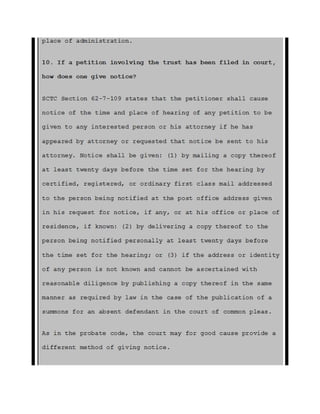
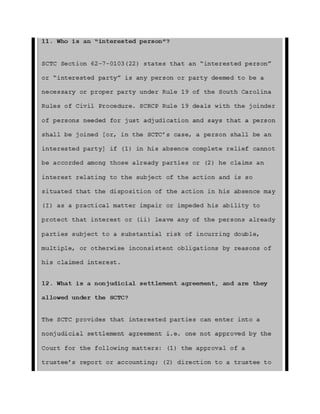
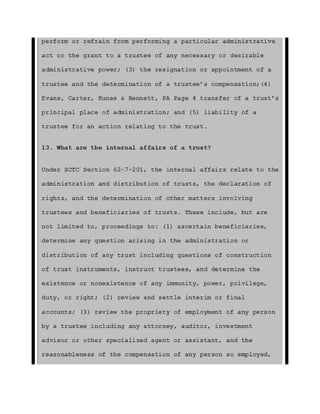
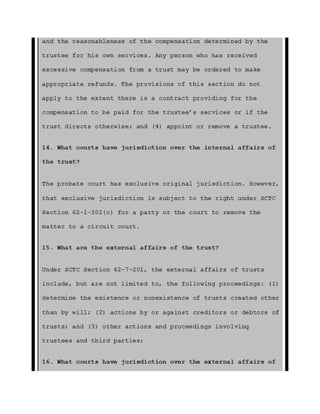
   Islamic Will, and the Issues
   Pertaining to Death, Burial,
   and Matters of Inheritance
      As-Salamu-Alaikum! I would like to take this opportunity

to congratulate all of my Muslim brothers and sisters for

submitting their wills' to Allah and accepting Mohammed (Peace

be upon him) as Allah’s final prophet and messenger. May Allah

reward you all with the highest level of paradise (Jannah-

firdus)!

      Many Muslims, particularly those living outside of the

USA, were fortunate enough to be born onto the deen (Islamic way

of life) by having Muslim parents that provided them with an

Islamic household and community. However, a great deal of

people, myself included, were not raised as Muslims.

Nevertheless, we have been extremely fortunate, in that Allah,

subhanahu wa-ta'ala (glorified and exalted is He) through his

qadar (predestination) has enabled us to receive dawah (Islamic

teaching/preaching) in non-Muslim lands such as the USA via his

righteous servants, media, etc., in order to accept Islam. As a

result, we have reverted back to the original way of life
ordained for mankind by Allah and have in essence reclaimed our

Islam. Unfortunately, although we Muslims who live in non-Muslim

lands, such as the USA are passionate about Islam and want to be

free to express our religious beliefs, we are not always

afforded this luxury. Often times our Islamic way of life is

suppressed; either by negative media, by Muslims in authority

whom are ignorant or insecure about proselytizing, or even by

the structures of the society in which we live. Regardless of

which factors we regard as the culprit, it is obvious that

actions must be taken in order to improve our overall way of

life while simultaneously respecting the laws of the land in

which we live.

      In view of these facts, I feel like it is of the utmost

importance for me to do my part to improve the condition of my

Muslim brothers and sisters living in the USA; particularly the

state of South Carolina. Charity begins at home! Also, since

Allah has made it clear that he will not change the condition of

a people until they first change it themselves; coupled with the

statement of our beloved prophet Mohammed (P.B.U.H.): “The pen

is mightier than the sword;” insha-Allah, my aim is to create a

document that will assist revert and immigrant Muslims living

within the USA, particularly the state of South Carolina with

fulfilling the basic requirements of their socio-Islamic

obligations; namely, writing an Islamic will that complies with
the Quran and sunnah, while simultaneously fulfilling the legal

requirements of the state in question (South Carolina). Details

regarding preparing for and performing salatul-janaza (Islamic

funeral) and the distribution of inheritance will also be

addressed.


      My reason for addressing the issues of the Islamic will,

death, burial, and inheritance has been influenced by the number

of instances wherein I observed Muslims whom were totally

unfamiliar with these responsibilities present inquiries that

either went unanswered or were addressed with misinformation. In

most instances, the problems pertaining to the above mentioned

matters stems from a general case of gross neglect; i.e., either

not seeking knowledge or simply believing that there would be

sufficient time to address these matters at a later date, and in

other instances, from more complex matters such as oppression;

i.e., being ostracized for not engaging in practices that are

clearly forms of bidah (innovation), kufur (disbelief), or even

shirk (associating partners with Allah). Therefore, as a result

of inadequate answers or obstacles faced while pursuing

information regarding these matters, a frustrated and

disheartened believer may voluntarily leave the only community

in their vicinity; thus, severing their main, and in most

instances, only lifeline to proper Islamic knowledge and advise.
With this being said, I would like to make it clear that

exposing dilemmas within Islamic communities in the USA or even

South Carolina is beyond the scope of this document. I am merely

a revert who felt inspired to create this document to serve as a

pacifier for those Muslims whom are making the transition into

Islam from another religion and do not have access to an Islamic

community, and for all others whom are in need of this

information due to mitigating circumstances.


      AL-Wasiyya The lawful
                   Islamic Will
      BY no means should I be considered an Islamic authority!

Therefore, I welcome the input of any Islamic authority on this

subject matter to help improve the quality of this document. To

reiterate, I constructed this document because it is imperative

for every Muslim to be educated about the Islamic will

(wasiyya), how to perform a janaza, and distribute inheritance;

especially those Muslims living in non-Muslim lands. Moreover,

the importance of possessing a will and having it prepared prior

to one’s death was highly stressed by the prophet (P.B.U.H.). In

a hadith collected by Bukhari, that was narrated by Ibn Omar,

the Prophet (P.B.U.H.) explicitlidly said: "It is not right

(fair) for a Muslim who has anything to be disposed of (willed),
to sleep for two nights unless his will is written with him."

What is of even greater importance is the statement of Allah

wherein he reminds us of the importance of writing a will in

surah Al-Baqarah (2:180) which reads: “ Prescribed for you when

death approaches [any] one of you if he leaves wealth [is that

he should make] a bequest for the parents and near relatives

according to what is acceptable - a duty upon the righteous.” In

addition, most contemporary scholars hold that in a country

where Shariah (Islamic law) is not applied by the government to

one’s assets pertaining to death (as is the case of the USA),

then the duty referred to in the above mentioned Quranic verse

and hadith, applies not only to preparing a will but also to

matters pertaining to inheritance and all assets owned.

Therefore, legal considerations should be taken into account

when living in a non-Muslim land; because, Shariah law is not

recognized under the U.S. Constitution or State law as being an

enforceable code of laws.


     An example of this fact is the U.S. Supreme Court’s 1878

ruling wherein it was declared that plurality of wives

(polygamy), as practiced in Islamic lands, was deemed a

violation of criminal law and is not defensible as an exercise

of religious liberty; thus, making polygamy illegal in South

Carolina. Also, if a member of the deceased’s family,
particularly among those not regarded as eligible heirs under

the shariah, (adopted children, step children, illegitimate

children and foster parents); or a common-law husband/wife, life

partner (member of the same sex), etc., (regarded as lawful

heirs in the USA), wishes to contest the will, the matter would

customarily be resolved by the State Court laws of the state in

which the deceased lived. As a result, if a will is prepared

according to Shariah only, and is not drafted in a manner so as

to comply with the State laws in which the deceased resided, the

Islamic will might not have any legal standing within the state

in question. With this being said, it is imperative for a Muslim

living in a non-Muslim land to write a will in accordance with

their state's legal guidelines in order to successfully fulfill

their obligations to their Creator, parents, and next of kin.

The will should also be written in a manner that makes it

uncontestable by any court and or other person. In addition, the

will should be sufficiently explicit to the extent that it does

not require any interpretation by a non-Islamic court.


      In retrospect, a will is a very significant means to

provide a flexible instrument in estate planning in Islam. The

Islamic will basically involves one, a testator, giving a gift

to others (beneficiaries), after their (testator's) death.
Creating an Islamic Will
    Before engaging into will making, it is crucial to know

what constitutes a will versus what is considered a gift. There

is a big difference between a will and a gift, in that a will

consists of items, not exceeding 1/3 of one’s net assets which

one possesses or is entitled to prior to their demise, but

cannot be awarded until after their (testator's) death. Whereas,

a gift is basically any item that one willingly donated while

they were alive and mentally competent. Moreover, it should be

noted that it is permissible for one to give a gift to someone

even if they are not a Muslim; as a result, it is permissible to

will items to non-Muslim family members and friends. However,

the main condition which must be fulfilled by a testator is to

always be mindful that charity and wills must not be so

allocated that the rightful owners and other dependents, which

rely upon the testator, are not rendered poor and helpless;

i.e., denied their rights as a result of one’s charitable

nature.


    It is also imperative that one become aware of the

difference between an Islamic will and a normal will. Basically,

there is not much difference between an Islamic will and a

normal will.   However, there is a major difference between the
two with regard to how one’s wealth is to be distributed and who

are regarded as heirs.   With regard to an Islamic will, one’s

wealth must be distributed in accordance with the Quran and

Sunnah with fixed shares being allotted to one’s closest

relatives. However, a normal will, which is unlawful for

Muslims, enables one to appoint anyone as an heir and distribute

the shares of their wealth howsoever they wish. Thus, the main

differences are that an Islamic will has fixed shares and

specific heirs.


    After one has made the decision to utilize an Islamic will

to settle their estate after their death, one should make a list

of every possible question pertaining to employing an Islamic

will in a non-Muslim country. If accessible, one should then

look for a Muslim scholar at a local masjid/Islamic center who

can provide them with the correct understanding of how the

shares mentioned in the Quran and ahadith need to be allocated.

Janaza arrangements and any other issue relating to one’s demise

should also be clarified from an Islamic perspective and

specified in one's will; because, they also pertain to the will

in question. One should then contact about three "wills and

estate lawyers" and inquire about dividing one’s estate in

accordance with Islamic law. If the attorney does not seem

motivated about your decision to create an Islamic will, it
behooves you to pursue your second and third choices; and more

if you feel it necessary. Lastly, get all of the details and

inquire about all available options before making a commitment.

Also visit http://www.livingmuslim.com to contact an attorney

who is knowledgeable about Islamic law. For the benefit of all

Muslims residing in the USA, a listing of the State Requirements

for a Last Will and Testament can be viewed at:

http://www.legalzoom.com/wills-guide/last-wills-state-

requirements.html


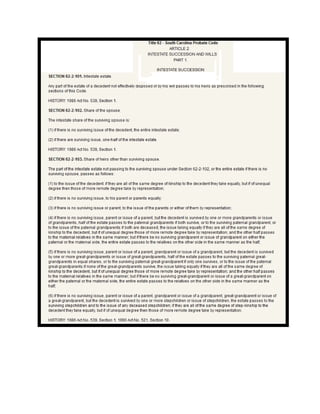
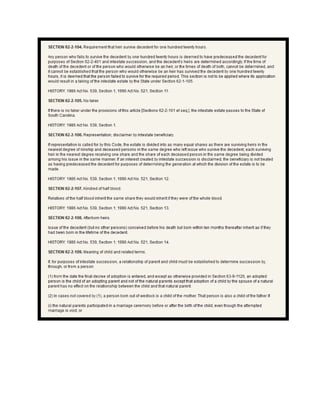
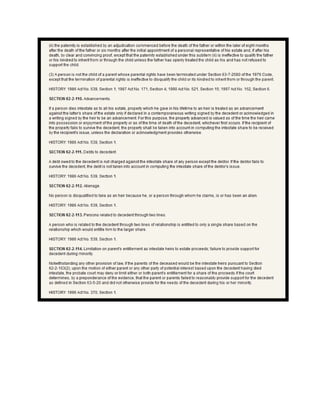
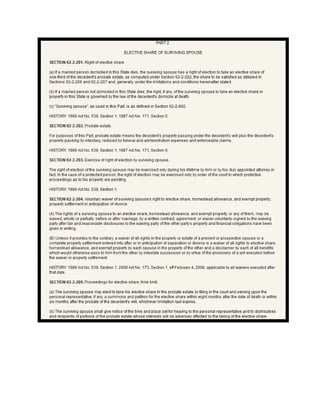
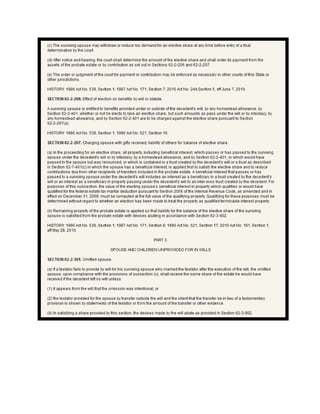
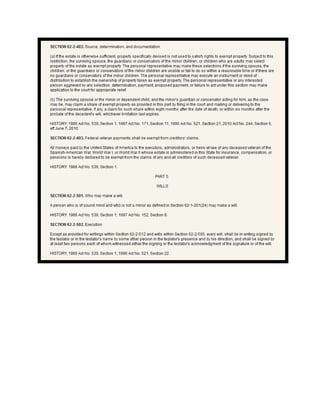
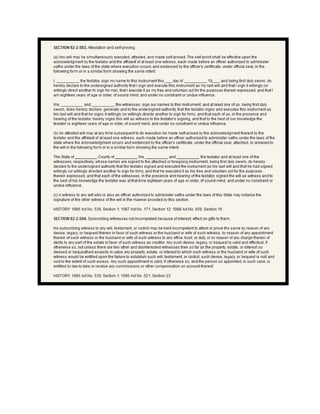
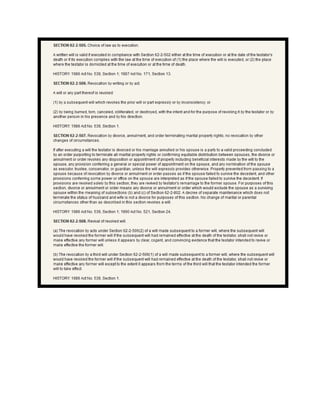
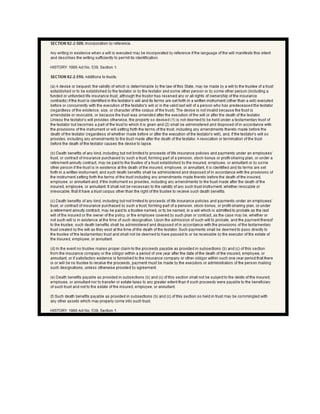
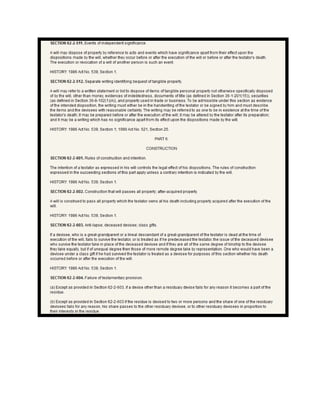
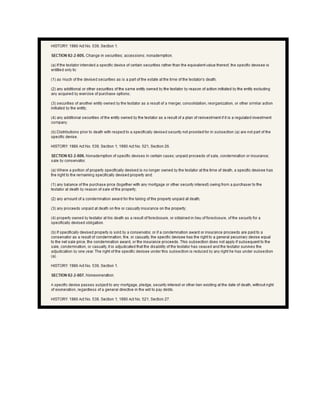
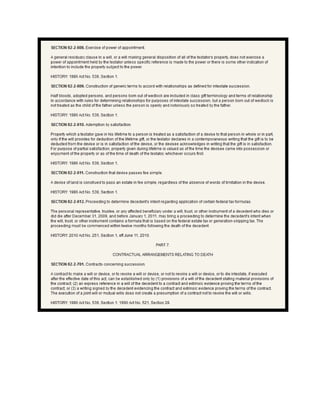
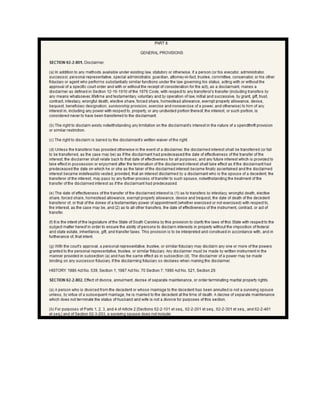
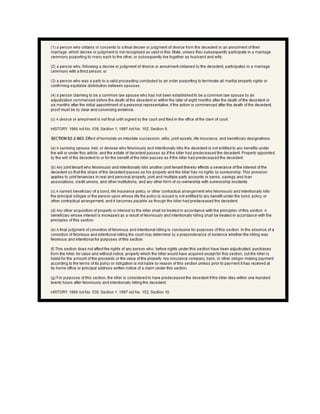
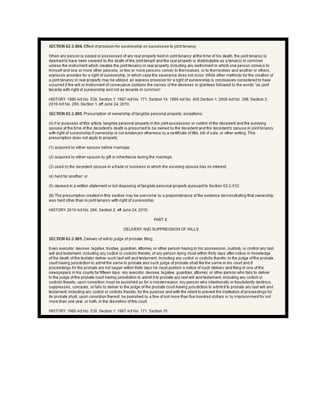
     In South Carolina, the laws regarding the valid execution

and witnessing of a will are set forth in the Code of Laws of

South Carolina, Title 62 South Carolina Probate Code, Article 2

Intestate Succession and Wills, Part 5 Wills, Sections 62-2-501

through 62-2-504. The basic requirements for a legal will for

the state of South Carolina include age, capacity, signature,

witnesses, writing, and beneficiaries.


    In accordance with the objective of this document, I have

included the most important aspects which should be included in

one's Last Will and Testament; which include the following:


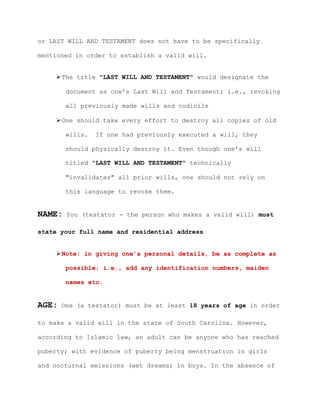
TITLE:   Generally, the headline would be: LAST WILL AND

TESTAMENT. However, according to Islamic law, the word wasiyya
or LAST WILL AND TESTAMENT does not have to be specifically

mentioned in order to establish a valid will.


     The title "LAST WILL AND TESTAMENT" would designate the

        document as one’s Last Will and Testament; i.e., revoking

        all previously made wills and codicils

     One should take every effort to destroy all copies of old

        wills.   If one had previously executed a will, they

        should physically destroy it. Even though one’s will

        titled "LAST WILL AND TESTAMENT" technically

        "invalidates" all prior wills, one should not rely on

        this language to revoke them.


NAME:   You (testator - the person who makes a valid will) must

state your full name and residential address


     Note: in giving one’s personal details, be as complete as

        possible; i.e., add any identification numbers, maiden

        names etc.


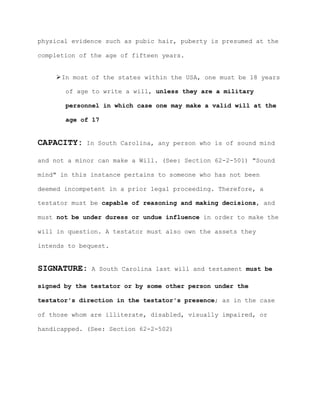
AGE:   One (a testator) must be at least 18 years of age in order

to make a valid will in the state of South Carolina. However,

according to Islamic law, an adult can be anyone who has reached

puberty; with evidence of puberty being menstruation in girls

and nocturnal emissions (wet dreams) in boys. In the absence of
physical evidence such as pubic hair, puberty is presumed at the

completion of the age of fifteen years.


     In most of the states within the USA, one must be 18 years

       of age to write a will, unless they are a military

       personnel in which case one may make a valid will at the

       age of 17


CAPACITY:   In South Carolina, any person who is of sound mind

and not a minor can make a Will. (See: Section 62-2-501) "Sound

mind" in this instance pertains to someone who has not been

deemed incompetent in a prior legal proceeding. Therefore, a

testator must be capable of reasoning and making decisions, and

must not be under duress or undue influence in order to make the

will in question. A testator must also own the assets they

intends to bequest.


SIGNATURE:    A South Carolina last will and testament must be

signed by the testator or by some other person under the

testator's direction in the testator's presence; as in the case

of those whom are illiterate, disabled, visually impaired, or

handicapped. (See: Section 62-2-502)
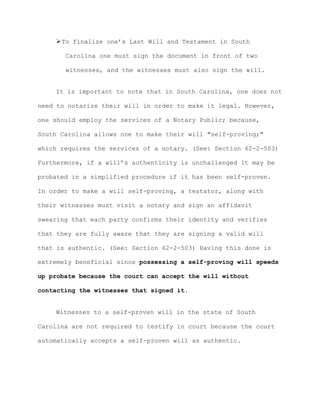
 To finalize one’s Last Will and Testament in South

       Carolina one must sign the document in front of two

       witnesses, and the witnesses must also sign the will.


    It is important to note that in South Carolina, one does not

need to notarize their will in order to make it legal. However,

one should employ the services of a Notary Public; because,

South Carolina allows one to make their will "self-proving;"

which requires the services of a notary. (See: Section 62-2-503)

Furthermore, if a will’s authenticity is unchallenged it may be

probated in a simplified procedure if it has been self-proven.

In order to make a will self-proving, a testator, along with

their witnesses must visit a notary and sign an affidavit

swearing that each party confirms their identity and verifies

that they are fully aware that they are signing a valid will

that is authentic. (See: Section 62-2-503) Having this done is

extremely beneficial since possessing a self-proving will speeds

up probate because the court can accept the will without

contacting the witnesses that signed it.


    Witnesses to a self-proven will in the state of South

Carolina are not required to testify in court because the court

automatically accepts a self-proven will as authentic.
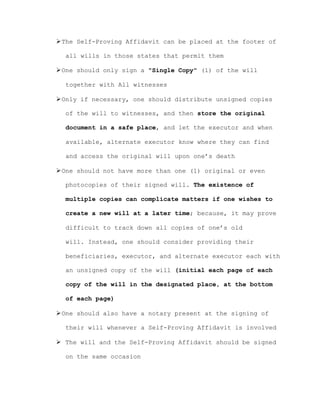
 The Self-Proving Affidavit can be placed at the footer of

  all wills in those states that permit them

 One should only sign a "Single Copy" (1) of the will

  together with All witnesses

 Only if necessary, one should distribute unsigned copies

  of the will to witnesses, and then store the original

  document in a safe place, and let the executor and when

  available, alternate executor know where they can find

  and access the original will upon one’s death

 One should not have more than one (1) original or even

  photocopies of their signed will. The existence of

  multiple copies can complicate matters if one wishes to

  create a new will at a later time; because, it may prove

  difficult to track down all copies of one’s old

  will. Instead, one should consider providing their

  beneficiaries, executor, and alternate executor each with

  an unsigned copy of the will (initial each page of each

  copy of the will in the designated place, at the bottom

  of each page)

 One should also have a notary present at the signing of

  their will whenever a Self-Proving Affidavit is involved

 The will and the Self-Proving Affidavit should be signed

  on the same occasion
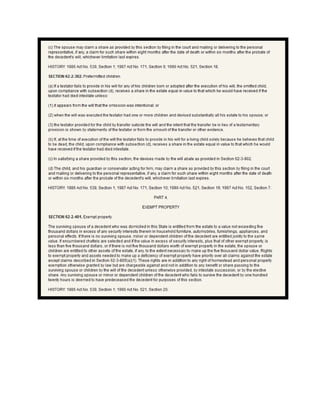
WITNESSES:      At least "two witnesses" whom are at least 18

years of age from among those whom cannot be beneficiaries are

required for a valid South Carolina Last Will and Testament.

(See: Section 62-2-502) Generally, it is recommended that the

two witnesses to the will be “disinterested”, which means that

they are not a beneficiary of the will.    In South Carolina, the

signing of a will by an interested witness does not invalidate

the will but the gift to the witness is void unless there are at

least two disinterested witnesses to the will. (A court might

later disqualify a beneficiary who serves as a witness from

their inheritance; and one’s Last Will and Testament would be

more vulnerable to challenge) However, an exception is if an

interested witness (a spouse or child) becomes a beneficiary via

intestacy (when a person died intestate without a valid Last

Will and Testament). In this instance, the interested witness

would be entitled to receive the gift (according to South

Carolina intestate guidelines) up to the value they would have

received had the will not been established. (See: Section 62-2-

504)


       At the testator's direction or request, the two witnesses,

while in the presence of the testator, must include an

attestation clause wherein they observe the testator’s actual

signing of the will; and every witness must observe the other
witnesses signing the will or Self-Proving Affidavit. (See:

Section 62-2-503) Moreover, a testator does not need to read the

will to their witnesses, and it is unnecessary for the witnesses

to read the will. However, the testator must ensure that all

witnesses clearly understand that the document is to function as

a Last Will and Testament upon the testator’s demise.


    It is also important to note that all states require two

witnesses, with the exception of Vermont. Moreover, contrary to

South Carolina law, Islamic law requires that both witnesses be

males when the matter involves financial transactions).

Therefore, in matters involving financial transactions, Islamic

law requires the testimony of “two females” in the absence of a

male party; i.e., 1 male and 2 females. This fact is evident

from Surah Al-Maidah (5:106) of the Quran which reads: "O you

believe! When death approaches any of you, and you make a

bequest (then take) the testimony of two just men of our own

folk or two others from outside, while you are traveling through

the land and death befalls on you..."


     Although only two witnesses are required by law, it is

       strongly recommended that one obtains “three” witnesses

       to sign one’s will in the event a witness dies or moves

       to another state
 It is also advantageous to select witnesses that are young

       and whom are unlikely to move far away, so that they may

       be around if needed at the time of the execution of the

       will; the same applies to Notary Publics


WRITING:   A South Carolina Last Will and Testament must be in

writing in order to be valid. (See: Section 62-2-502)


     Nuncupative (Oral Wills) have no statutory recognition in

       South Carolina, but are valid under Islamic law

     Holographic Wills are impliedly forbidden by statute

       unless specifically recognized by valid out-of-state

       execution or out-of-state probate


However, according to Islamic law, after the revelation of Surah

Nisa (4:11-12), in Islamic countries where shariah is followed,

it is not required for a Muslim to physically write a will

during their lifetime; because, upon their death their estate

will be divided as outlined in the Quran and sunnah, among the

living heirs. However, in South Carolina, if one dies without

writing a will, their property will be distributed according to

the state’s "intestacy" laws.   Moreover, it is the right of every

citizen of a non-Muslim country, to will their property as per

their desires. Thus, by writing a will, a Muslim can ensure that

the State laws of the land will execute as closely to the
Islamic Shariah as possible with regard to their will. In view

of these facts, in a non-Muslim country like the USA which does

not have a separate Muslim Personal Law, every Muslim should

view writing a will as a compulsory act; because, in the absence

of a will each state within the USA will employ its own

intestate method of distributing one’s assets. Lastly, every

Muslim that writes a will should be aware that according to

Islamic Law, a Muslim has the freedom to will only 1/3rd of

their net assets. This fact is evident from the following hadith

of Bukhari, wherein Sad bin Abu Waqqas narrated: "The Prophet

(P.B.U.H.) came visiting me while I was (sick) in Mecca, ('Amir

the sub-narrator said, and he disliked to die in the land,

whence he had already migrated). He (i.e. the Prophet) said,

'May Allah bestow His Mercy on Ibn Afra (Sad bin Khaula).' I

said, 'O Allah's Apostle! May I will all my property (in

charity)?' He said, 'No.' I said, 'Then may I will half of it?'

He said, 'No.' I said, 'One third?' He said: 'Yes, one third,

yet even one third is too much. It is better for you to leave

your inheritors wealthy than to leave them poor begging others,

and whatever you spend for Allah's sake will be considered as a

charitable deed even the handful of food you put in your wife's

mouth. Allah may lengthen your age so that some people may

benefit by you, and some others be harmed by you." At that time

Sad had only one daughter.'"
To exercise this freedom, a Muslim will need to write a

will; especially, if one wishes to award parts of their estate

to non-Muslims or other persons not deemed immediate family

(illegitimate or adopted children); charities or friends whom

are not permitted to inherit from the testator under Islamic

law. The remaining 2/3rds must be shared across one’s “immediate

Muslim” family in order to comply with the rules outlined in the

Quran and sunnah. In instances where one has no immediate Muslim

family, the (2/3rds) portion of their estate would pass to the

Muslim Treasury. However, in South Carolina or the USA where no

Muslim Treasury exists, the remaining 2/3rds might become the

property of the state. The scholars should be consulted

regarding this scenario; because, it is opined that if there is

a Muslim state, the state will take the place of the Holy

Prophet Mohammed (P.B.U.H.); if not, the Muslim community would

inherit from the individual who has no other heir, near or

distant.


BENEFICIARIES:     A South Carolina Last Will and Testament

enables one to make a disposition of property in any amount to

any person. A South Carolina last will and testament also

permits one to include their primary heirs (mother, father,

sister, brother, spouse, children), despite the fact that Islam

strictly forbids this. Islamic law clearly states that there is
no will for an heir. The evidence supporting this fact is a

hadith collected by Abu Dawud that was narrated by Abu Hurayrah

wherein Allah's Prophet (P.B.U.H.) said: "Allah has appointed

for everyone who has a right what is due to him, and no bequest

must be made to an heir."


     If a beneficiary dies without accepting or rejecting a

       bequest, the bequest becomes part of the beneficiary’s

       estate or the right to accept or reject the bequest

       passes onto the heirs of the original beneficiary

     In the event it becomes uncertain as to whether or not a

       beneficiary died before the testator, such as when a

       beneficiary has been missing for longer than a year, the

       bequest would become invalid because a beneficiary must

       be alive at the time of the testator’s death for the will

       to be valid

     In instances where the testator and beneficiary die

       together, such as in an airplane crash, where it was not

       possible to determine who died first, then the bequest

       would become invalid according to the majority (Hanafi,

       Maliki and Shafii fiqh). However, a minority view

       (Hanbali fiqh) is of the opinion that the bequest should

       be awarded to the original beneficiary’s heirs who may

       either accept or reject it
 There is difference of opinion as to the time at which

       ownership of a bequest is transferred from the testator

       (or his heirs) to the beneficiary.   According to the

       Hanafi and Shafii fiqh the transfer of ownership is at

       the time of death of the testator, but according to the

       Maliki and Hanbali fiqh the transfer of ownership begins

       at the time the beneficiary accepts the bequest


    It is also important to note that in a scenario where a

Muslim with non-Muslim parents and siblings has been written in

their parent’s (mother or father) will as an heir according to

South Carolina guidelines, declaring that they (the Muslim in

question) is to receive specific assets, which are also to be

divided evenly between their non-Muslim siblings, the will in

question would be valid according to South Carolina law but

invalid according to Islamic law; because, a Muslim cannot

modify the shares allotted by Allah for each heir and can only

inherit from another Muslim. However, Islamic law does allow the

Muslim in question to receive from their non-Muslim parent

provided one-third or less of the non-Muslim parent’s wealth is

left to their Muslim child in the form of a gift via a legal

will. Therefore, a Muslim living in the USA is permitted to

receive from a South Carolina legal will with regard to

accepting the grants and gifts, from their non-Muslim parents. A
Muslim can also make contracts with non-Muslims in accordance

with Islamic regulations. However, if a Muslim’s non-Muslim

parents were to deprive them from a share of the inheritance and

dedicated all of the inheritance to their other children, which

happen to be non-Muslim, the Muslim child in question would have

no right to claim any of their parent’s property, as this claim

only takes the form of inheritance, which would be deemed

illegal according to Islamic law; because, as mentioned earlier,

a Muslim is not permitted to inherit from a non-Muslim.


PURPOSE:   The purpose of a valid will involves the distribution

of property. A will (al-wasiyya) is a legal document created by

a testator (al-musi) to determine how their property, known as

their estate, is to be distributed to others (al-musa lahu)

listed therein, after their (testator’s) death. One’s estate

consists of their assets and property including bank accounts,

homes, land, furniture, automobiles, and securities (stocks and

bonds). The Islamic will also includes bequest and legacies,

instructions, admonishments, and assignments of rights.

Therefore, when a Muslim dies the main duties which need to be

performed involve the payment of one’s funeral expenses, the

payment of one’s debts, the execution of one’s will, and the

distribution of what remains from one’s estate among the heirs

designated in the Quran, sunnah, and shariah (Islamic law).
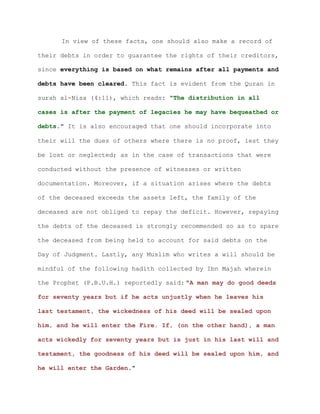
In view of these facts, one should also make a record of

their debts in order to guarantee the rights of their creditors,

since everything is based on what remains after all payments and

debts have been cleared. This fact is evident from the Quran in

surah al-Nisa (4:11), which reads: "The distribution in all

cases is after the payment of legacies he may have bequeathed or

debts." It is also encouraged that one should incorporate into

their will the dues of others where there is no proof, lest they

be lost or neglected; as in the case of transactions that were

conducted without the presence of witnesses or written

documentation. Moreover, if a situation arises where the debts

of the deceased exceeds the assets left, the family of the

deceased are not obliged to repay the deficit. However, repaying

the debts of the deceased is strongly recommended so as to spare

the deceased from being held to account for said debts on the

Day of Judgment. Lastly, any Muslim who writes a will should be

mindful of the following hadith collected by Ibn Majah wherein

the Prophet (P.B.U.H.) reportedly said: "A man may do good deeds

for seventy years but if he acts unjustly when he leaves his

last testament, the wickedness of his deed will be sealed upon

him, and he will enter the Fire. If, (on the other hand), a man

acts wickedly for seventy years but is just in his last will and

testament, the goodness of his deed will be sealed upon him, and

he will enter the Garden."
Additional Functions of
       South Carolina Wills
Choosing a Guardian:

    A South Carolina Last Will and Testament may be used to

designate a guardian for any minor child. Testators who have

minor or dependent children may use a will to name a guardian to

care for their children if there is no surviving parent to do

so. Therefore, a Muslim residing in South Carolina is permitted

to appoint a guardian for their dependent children. If a will

does not name a guardian, a court may appoint someone who is not

necessarily the ideal person whom the testator would have

chosen. Thus, it is imperative for every Muslim with children or

dependents to become aware of how the courts will address their

affairs if no will exists.


      A guardian is a court appointed individual whom has been

granted legal custody over another person with the authority to

make decision on their behalf. In addition to dependent

children, individuals eighteen and older who suffer from either

a mental or physical illness/disability, geriatric old-age,

chronic substance abuse, or simply lacks adequate comprehension,

insight or competence to make responsible decisions regarding
their personal affairs, and have not executed the proper legal

documents to name an agent to make decisions on their behalf are

among those whom are in need of a guardian. Also, there is no

legal limit to the number of guardians that a child can have.

One can be appointed for the child and another can be appointed

for the child's property; however, the number of guardians

should be kept to a minimum.


      SECTION 21-21-25 of South Carolina Code of Laws,

pertaining to: "Disposition of custody of minors," declares that

the father or mother (age twenty-one and under) of any child

(under age twenty-one) who is not married, may by deed executed

and recorded according to law or by a valid Last Will and

Testament (made and probated according to law) may dispose of

the custody and tuition of their child while it remains under

the age of twenty-one years to any other person, in possession

or remainder. It is also important to note that no deed is valid

unless signed by both father and mother. Also if both parents

are living and no such deed exists, except a deed to an agency

or department of the State that is authorized by law to receive

or place the custody of children, the deed will be considered

effective unless approved upon petition by a family court or

family court judge of this State. In view of this fact, nothing

in SECTION 21-21-25 of South Carolina Code of Laws, pertaining
to: Disposition of custody of minors may be construed to

abrogate, lessen, or interfere with the right and duty of a

court of competent jurisdiction at any time to transfer and

assign the custody of a child for its best interest. With this

being said, the role of a guardian is basically to provide one’s

dependents with a residence, provisions, maintenance, and any

other service pertaining to their overall well-being. Thus, in a

nutshell, a guardian is basically a support structure that one

depends on to take care of their loved-ones and affairs in the

event that they become incapable of performing said tasks.

Therefore, an ideal guardian for a Muslim would be an immediate

family member, an adult child, a parent or sibling. A testator

usually chooses a family member or friend to perform this

function, and often names an alternate; however, a Muslim

testator is restricted to only choosing from those individuals

that comply with Islamic law. Also, potential guardians should

know that they have been chosen, and should fully understand

what may be required of them; i.e., what the role of a guardian

entails.


      This function is lawful under Islamic law provided that

both parents are deceased or deemed unfit under the Quran and

sunnah. However, one cannot take a child from a parent who is a

practicing Muslim and award custody to another while said parent
is still alive and capable of providing for said child. In the

case of minor children where both parents have died, custody is

awarded in accordance to the Islamic maternal hierarchy; i.e.,

the maternal grandmother, the paternal grandmother, the Full

Sister, etc. In cases of dispute, the Islamic Court will appoint

custody in its wisdom. However, in South Carolina, the state

will address this matter according to its established laws and

guidelines (Dept. of Social Services – Foster care, etc.)

Furthermore, under Islamic law the custody of a child and a

child's inheritance are often dealt with separately. A guardian

(usually male) will often be appointed to take responsibility

for the inheritance, and is entitled to reasonably dispose of

assets on account of his ward as he deems appropriate.


      Guardianship is governed by the CARE OF CHILDREN ACT,

which replaced the GUARDIANSHIP ACT of 1968. Guardianship has a

number of different types of guardians, such as natural

guardians (the parents), testamentary guardians, new partners

appointed as guardians by the parents, and court-appointed

guardians. In Islamic law, guardianship falls under three main

categories; namely, natural guardians, testamentary guardians,

and guardians appointed by the court. However, the most common

guardianships are minor child guardianships, adult guardianships

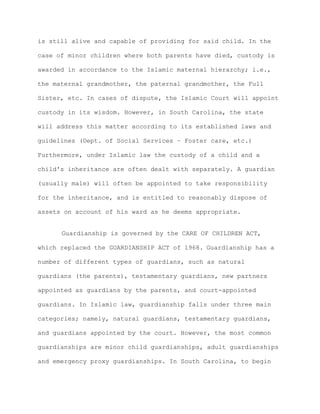
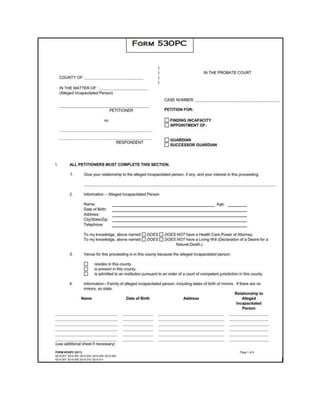
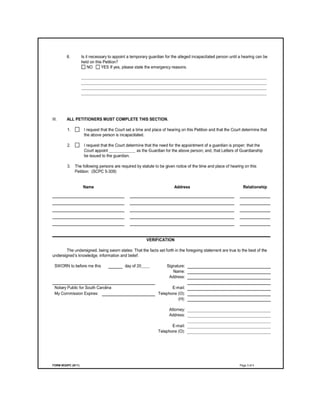
and emergency proxy guardianships. In South Carolina, to begin
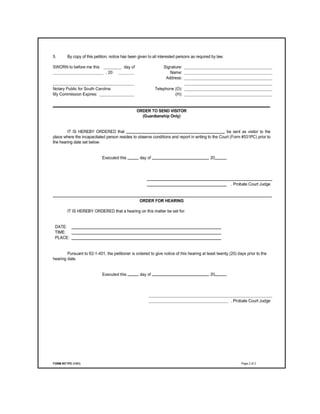
the guardianship proceeding a Summons; one must complete a

Petition for Finding of Incapacity and Appointment of Guardian

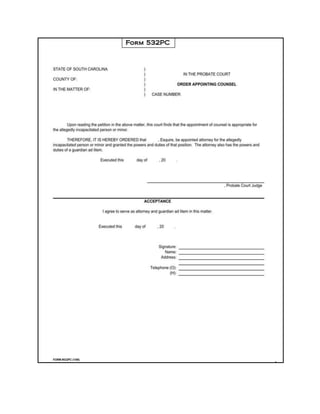
(Form 530PC); pay a $150.00 filing fee; complete a Petition to

Appoint a Visitor and Proposed Order; complete the Petition to

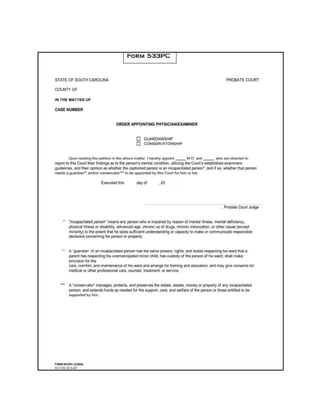
Appoint Two Designated Examiners and Proposed Order (Form

533PC); and complete a SLED report for the proposed Petitioner.
In South Carolina under the general structure of

guardianships, parents are usually classified as natural

guardians, with the mother automatically being a guardian in the

eyes of the court. However, contrary to Islamic law, the father

is not automatically a guardian. The father becomes a guardian

under South Carolina guardianship laws "only" in instances where

he was married to, or was in a civil union with the child’s

mother at any time from when the child was conceived until it

was born; namely, if the child was conceived before July 1, 2005

and he was living with the child’s mother when the child was

born; the child was conceived on or after July 1, 2005 and he

was living with the child’s mother at any time between

conception and the birth; or he was recorded as the father of

the child on the birth certificate on or after July 1, 2005.


      When the father is not automatically a guardian, he can

apply to the court for it to appoint him as such. The court is

likely to grant the father’s request unless it deems that said

action is against the child’s best interests. However, according

to Islamic law, the father is always a guardian unless he

apostates from Islam or is plagued by personal issues which

would impair his ability to adequately provide for his children.

Furthermore, if the father is automatically a guardian, he can

ask the court to officially declare him as a natural guardian
since an instance may arise where he and the mother of his

children have separated and the mother does not want him to have

an active role in the children’s upbringing. In the event that a

parent desires that the other is prohibited from having an

active role in the child’s upbringing, an attorney should be

consulted about how to prove to the court that the other parent

is unfit to raise the child in question. Nevertheless, in

addition to being a guardian, under Islamic law, the father is

always recognized as a natural guardian. The consensus in Islam

is that the father is vested with the financial burden of

providing for his wife and children. This fact is evident from

Surah Al-Nisa (4:34) which reads, "(husbands) are the protectors

and maintainers of their (wives) because Allah has given the one

more (strength) than the other, and because they support them

from their means. Therefore, the righteous women are devoutly

obedient, and guard in (the husband’s) absence what Allah would

have them guard..."   As a result, the father is awarded the

legal guardianship role. However, in the case of divorce, where

the mother is a practicing Muslim, she will have more right to

the rearing of her young children than their father.


      In recognition of an infant’s need for female care, the

consensus is that the mother has the first choice with regard to

a child’s physical custody; because, she is recognized as the
fittest person to take care of the children. This fact is

evident from the following hadith collected by Ibn Majah that

was narrated by Amr Ibn Shu'aib: "A woman came to the Prophet

(P.B.U.H.) and said: 'Truly my belly served as a container for

my son here, and my breast served as a skin-bag for him (to

drink out of) and my bosom served as a refuge for him; and now

his father has divorced me, and he (also) desires to take him

away from me.' The Prophet (P.B.U.H.) said: 'You have a better

right to have him, as long as you do not marry again.'" With

this being said, Islam recognizes the mother as generally the

fittest person to take care of the children because of the

innate love and tenderness she feels for them resulting from the

bond she established during pregnancy, nursing, and childhood.

As a result, even after divorce, the mother is entitled to

receive custody wages from the father to help her maintain the

children. However, to reiterate from the above mentioned hadith,

the mother forfeits this right once she remarries; i.e., the

period of female custody ends once the child reaches a certain

age of custodial transfer or when she takes another husband.

Moreover, if the mother forfeits her right as primary caretaker

of the children, there will be no compulsion on her to retain

this obligation; because, unless it is determined that she

forfitted this right out of duress, the decision will be

accepted as being in the best interest of the children.
It is also important to note that although the Muslim

mother is to be awarded custody of the children upon divorce,

Islam grants the Muslim father the right to have access to his

children. The father has the right to control the education and

religion of his minor children; in addition to their upbringing

and movement. Thus, so long as the father is alive, he is the

sole and supreme guardian of his minor children; which is the

reason why he remains financially responsible for their

maintenance and education even though they may be under the care

of their divorced mother or one of her relatives. However, there

is a difference of opinion among the Islamic schools of thought

regarding the age when custody is shifted from the mother to the

father. Some schools suggest as young as age seven, when the

child begins learning how to make salat (ritualistic prayer -

worship), at puberty, or even as late as the age of marriage, as

in the case of daughters. In any event, after the determined age

of independence, the choice is up to the child as to which

parent they prefer to live with.


      In summary, the father's right of guardianship extends

only over his minor legitimate children. Moreover, he is

automatically not entitled to guardianship or to custody of his

minor illegitimate children. It is also important to remember

that parents continue to be guardians even if they split up. If
both parents agree, or the South Carolina court in question

orders that only one of them will have day-to-day care for their

children, the other parent will continue to maintain certain

responsibilities of guardianship; namely, contributing to their

child’s personal development and assisting them with making big

decisions. In view of these facts, it is important for one

appointed as a guardian to be aware that their custody granted

by the courts does not terminate a parent’s relationship with

their child like an adoption would; which is an illegal practice

according to Islamic law; i.e., replacing a child’s surname and

replacing it with the surname of one intending to classify the

child in question as their own via adoption. Moreover, electing

to appoint a guardian generally does not categorize a parent as

unfit by the courts or society.   Among those individuals whom it

may be deemed necessary for them to appoint a guardian are those

Muslims living in a non-Muslim land whom want to ensure that

their children are raised according to the Quran and sunnah,

Military parents that are deployed, a single parent, etc.


      Any individual selected to serve as one’s guardian is also

permitted to appoint someone else to be a guardian after their

demise in a will or deed. The individual whom is appointed as

the new guardian by the current guardian is referred to as a

"testamentary" guardian. The position of a testamentary guardian
becomes a joint guardianship with all other guardians. However a

surviving parent or guardian can dispute the appointment of a

testamentary guardian in court if they are dissatisfied with

either the decision or the individual selected. An example of

this would pertain to an instance where a Muslim guardian

appoints another Muslim who is a member of a deviant sect or

deeply engaged in biddat (innovative practices not approved by

the Quran or sunnah) as a testamentary guardian; or the

testamentary guardian is one with a history of gambling

problems, substance abuse, or deviant behavior. In this event,

the Muslim parent or other guardian can refer the matter to the

court in question in an attempt to have the unwanted guardian

removed. This point is evident from SECTION 21-21-35 of South

Carolina Code of Laws, pertaining to: Persons against whom

disposition of custody is valid, which declares that the

disposition of the custody of the child as provided in Section

21-21-25 is effective against any person claiming the custody of

the child as guardian. SECTION 21-21-45 of South Carolina Code

of Laws, pertaining to: Action by custodian for recovery of

children and damages, declares that any person to whom the

custody of any child has been so disposed or devised may

maintain an action against any person who wrongfully takes away

or detains the child for the recovery of the child and may

recover damages in the action for benefit of the child.
Moreover, electing to pursue legal assistance to correct the

dilemma is imperative because although a testamentary guardian

does not have the role of providing day-to-day care for the

child, they can apply to the Court for a parenting order that

would legally grant them this right.


      In the event that joint guardians are unable to agree on

an issue, any of the guardians in question can ask the Family

Court to arrange free and confidential counseling for them in an

effort to resolve the dispute. However, if counseling is

ineffective, the guardians can apply to a Family Court for

further instructions. If this is the case, Family Court can make

any ruling that it deems necessary with regard to what is in the

best interest of the child. The court in question will also

grant the child a reasonable opportunity to voice their opinions

and will take the child’s views into account. It is also

important to note that under Islamic law, the father has full

power when it comes to making a testamentary appointment of

guardian. In the absence of the father and his executor, the

grandfather has the power of appointing a testamentary guardian.

With this being said, it is clear that the mother has no power

with regard to appointing a testamentary guardian for her

children. However, there are two cases wherein the mother is

permitted to appoint a testamentary guardian for the property of
her minor children. The first, instance is when she has been

appointed as a general executrix by the will of the child's

father, wherein she can appoint an executor by her will. The

second instance is in respect to her personal property. The

mother can also be appointed a testamentary guardian by either

the father or grandfather whenever they are permitted to

exercise this authority. Even the appointment of a non-Muslim

mother as testamentary guardian is permissible.


      South Carolina law also permits the spouse of a person

with disabilities or parent of an incapacitated person to make a

testamentary appointment of a guardian in their will. The

testamentary appointment by a spouse or parent comes into effect

after the incapacitated person and their caregiver or the

nearest adult relative has received a twenty days written notice

and the guardian files acceptance of appointment in the court.

When both a spouse and a parent appoint guardians in their

wills, the appointment of the spouse has priority. Testamentary

guardianship also permits a parent with a new partner (which is

an illegal relationship in Islam) who has been sharing day-to-

day care of the children for at least a year, the opportunity to

appoint the new partner as a guardian of the children in

question under the Care of Children Act. The Act pertains to a

parent and their new partner, whom are married, in a civil
union, or in a de facto relationship. Moreover, in instances

where the other parent of the children is still living, the ACT

requires both parents to make the appointment of the new partner

as guardian. Also, in instances where the new partner in

question cannot be appointed as a guardian due to the

restrictions contained in the Care of Children Act such as cases

where the new partner has been involved in Family Court

proceedings over day-to-day care (custody) or contact (access),

or had a domestic violence protection order made against them,

they are permitted to apply to the Family Court to have it make

the appointment. For more details, visit the Family Court

website at www.justice.govt.nz/family.


      A child age sixteen or older in the state of South

Carolina can ask the Family Court to intervene and give its

permission, which would overrule the guardian’s decision in

instances where they disagree or is unhappy about an important

decision that their guardian or guardians have made; such as

denying them the opportunity to get married. However, to

reiterate, children ages 16 or 17 must obtain written permission

from their guardian before they can get married or enter into a

civil union or de facto relationship; which are illegal

relationships in Islam. It is important to note that in South

Carolina a parent’s guardianship status does not grant them
unlimited freedom to make decisions for their children; because,

the law recognizes that as a child approaches adulthood their

maturity and level of understanding entitles them to make

decisions for themselves regarding particular issues. As a

result, the child in question can ask the Family Court to give

its permission, which could then overrule the guardian’s

decision. However, in certain instances the Family Court’s

ruling in favor of the child can do the child in question a

great disservice; such as overruling a Muslim guardian’s

decision to deny the child in question the right to engage in

dating or to marry someone that is not acceptable under Islamic

law. In this instance, the Family Court’s ruling in favor of the

child could result in the child in question committing

fornication or contracting an illegal marriage.


      A South Carolina Family Court can also deprive a parent of

guardianship or remove a testamentary or court-appointed

guardian whenever a parent/guardian of a child, a partner of a

parent of a child (whether they are married, in a civil union,

or in a de facto relationship, as long as they have been sharing

day-to-day care of the child; a child’s grandparent, aunt,

uncle, brother or sister, including half-brothers and half-

sisters, have applied to the court for it to perform this

action. However, it should be noted that the court in question
will not deprive a parent of guardianship unless it is certain

that the parent in question is for some grave reason unfit to be

the guardian or that they are simply unwilling to be a guardian.


      With regard to deciding whether to remove a testamentary

or court-appointed guardian, the only issue for the court is the

child’s welfare and best interests. Therefore, if one wishes to

apply to the court to be appointed as a guardian, or if an

application has been made to the court to deprive one of

guardianship, it is imperative that they obtain legal advice

regarding these matters. It is also important for one pursuing

guardianship to become familiar with SECTION 21-21-55 of South

Carolina Code of Laws, pertaining to: Possession of property

conveyed, devised, or bequeathed to child, which maintains that

any person to whom the custody of any child has been so disposed

or devised may take into their possession to and for the use,

support, and education of the child all property, real and

personal, which by deed or will has been conveyed, devised, or

bequeathed to the child, until said child attains the age of

twenty-one years or for a lesser time as may be fixed by the

deed or will, and may receive and receipt for the proceeds of

any life insurance taken out by the parent for the benefit of

the child and do all acts in relation to the child which a

guardian appointed according to law might do. The family court
may, in its discretion, require a return of the property and an

annual accounting for the rents, profits, and income of the

property.


      It is also important to note that a Muslim residing in

South Carolina with the objective of leaving bequest for their

children is permitted to appoint a guardian under the Uniform

Transfers to Minors Act. One can utilize the Uniform Transfers

to Minors Act to addresses property management so that the

probate court does not need to appoint someone to address

matters on their behalf. What is more, guardianships for minors

are not under the authority of the Probate Court; rather, under

the jurisdiction of the Family Court.   However, in order to

avoid the Probate Court appointing a guardian for one’s adult

dependents, one should execute the proper legal documents, such

as a will, Health Care Power of Attorney, and/or a Durable Power

of Attorney. The choice of guardianship often affects other will

provisions; because, the testator may want to provide financial

support to the guardian in raising surviving children.

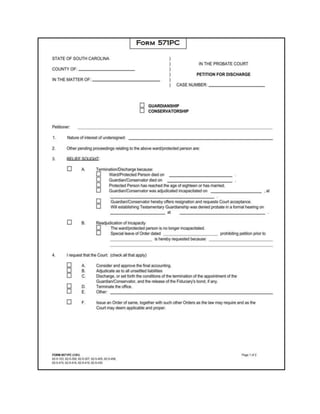
Nevertheless, if the capacity of the adult changes or the

incapacitated person in question passes away, the guardian in

question should file a final guardian report and Petition for

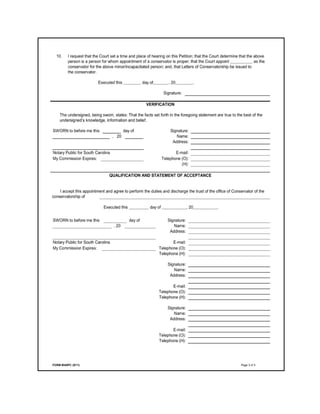
Discharge (Form 571PC).
A hearing may be held before the guardianship is terminated to

determine capacity. If death is the reason for termination then

a death certificate should be provided.


      To reiterate, an ideal guardian for a Muslim would be an

immediate family member, such as an adult child, a parent, or

sibling, etc. However, if there are no immediate family members

then the Court will look to other relatives or interested

individuals, such as a neighbor or close friend. What is more,

under certain circumstances, the Court may even look into the

possibility of appointing an institutional conservator; which is

a court appointed individual or entity that handles the

management of financial affairs or property. However, in view of

these facts, it is important to note that a Muslim residing in

South Carolina must exhaust every effort to appoint only

individuals that the dependent in question is permitted to

socialize with in an un-chaperoned environment; such as those

individuals whom it is illegal to contract a marriage with.


      Conservatorships in South Carolina fall under two main

categories; namely, those involving minors receiving funds

exceeding $10,000 from an inheritance; insurance proceeds, other

beneficiary designated funds, personal injury settlements or

sale of real estate, and those involving individuals over the

age of eighteen that suffer from a mental/physical illness or
disability. Additional factors requiring the appointment of a

conservator include mental deficiency, advanced age, chronic

substance abuse, or any other cause to the extent that an

individual lacks sufficient understanding, insight, or capacity

to make responsible decisions concerning their financial

affairs. It is also important to note that all of these factors

are in the event that the proper legal documents have not been

executed, such as a Durable Power of Attorney naming an agent

for decision-making. With this being said, just as the matter

pertains to guardians, an immediate family member, such as

spouse, adult child, parent or adult sibling, would be an ideal

conservator. Also, as guardianships are handled in instances

where there are no immediate family members, the Court

addressing the issue of conservatorship will look to other

relatives or interested individuals, such as a neighbor or

friend of the incapacitated adult or minor. Nevertheless, to

reiterate, it is important for every Muslim to remember that one

must exhaust every effort to appoint only individuals that one’s

dependents are permitted to socialize with in an un-chaperoned

manner. Lastly, the need for financial or legal expertise may

lead the Court in question to look for corporate entities,

accountants or lawyers to serve in this capacity.
It is therefore imperative for Muslims involved in matters

pertaining to a conservatorship proceeding for a minor to note

that due to a recent South Carolina policy change, the Court in

question will appoint a Guardian Ad Litem for all incoming

cases. In addition, a Summons, Petition for Appointment of

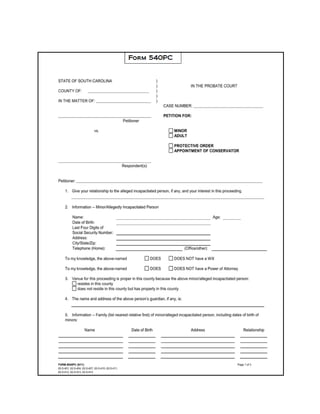
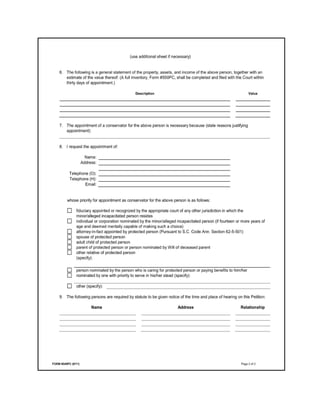
Conservator (Form 540PC), a $150.00 filing fee, a Proposed

Guardian ad Litem/Counsel Order [minors 14 and older must
consent to the proposed counsel] (Form 532PC), a certified copy

of the birth certificate for the minor, a SLED report, a credit

report for the proposed Petitioner, a copy of the proposed

conservators drivers license, and a copy of the proposed

conservators social security card are required by the Courts for

conservatorship proceeding for a minor. Furthermore, to begin a

Conservatorship proceeding for an adult, the Court requires a

Summons; Petition for Appointment of Conservator (Form 540PC);

$150.00 filing fee; Petition to Appoint Two Designated Examiners

and Proposed Order (Form 533PC); Proposed Guardian ad

Litem/Counsel Order (Form 532PC); SLED report and Credit report

for the proposed Petitioner, a copy of the proposed conservators

driver’s license, and a copy of the proposed conservators social

security card.
It should also be noted that in order to obtain a Sled

Report for either of the above mentioned situations, one must

make a written request for the criminal report from SLED at P.O.

Box 21398 Columbia, SC 29221-1398. One is also required to

provide SLED with the Proposed Guardian’s full name including

maiden and alias names; date of birth, sex, race, and social

security number. Moreover, a $25.00 business check, certified

check, money order, or cashier's check, and a self addressed

envelope must be included for each search. One also has the

option to pay for each search with their credit card and make an

internet request at www.sled.state.sc.us.


      A credit report on the other hand can be obtained by

filling out the credit history report written request at

Equifax, P.O. Box 105252 Atlanta, GA 30348-5252, or by calling

1-800-685-1111. Equifax’s emergency fax request line can also be

accessed by dialing (770) 375-3150. Equifax also offers the

option to contact them via the internet at www.equifax.com.


      A second credit reporting organization is TransUnion,

which can be contacted by written request at P.O. Box 1000

Chester, PA 19022, or by calling them direct at 1-800-888-4213.

TransUnion can also be contacted via the internet at

www.transunion.com. TransUnion requires one to provide their
agency with the proposed conservator’s driver's license number,

social security number and date of birth.


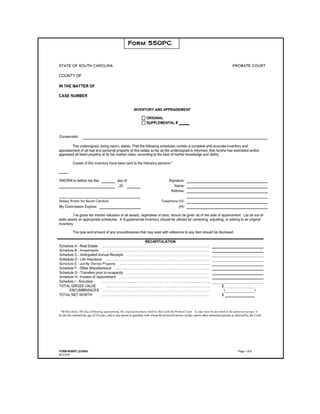
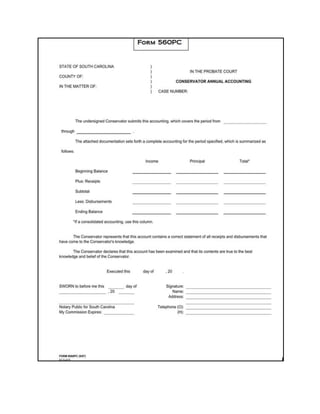
         Once a conservator is appointed, within thirty days they

are required to file an Inventory and Appraisement (Form 550PC).

The conservator in question is also required to annually report

(Form 560PC) to the Court, along with the income, approved

disbursements, account statements, and receipts of expenditures.

The Court in question is required to approve expenditures from

the restricted accounts once the conservator has filed the

appropriate Petitions for Expenditures along with supporting

documentation. The conservator in question should also inform

the Court as to the whereabouts of the incapacitated

adult/minor, and the Court has the authority to appoint visitors

and guardian ad litems to check on the incapacitated adult or

minor.


         These actions are methods the Court exercises to make

certain that the conservator in question is performance in the

best interest of the protected person. Lastly, Letters of

conservatorship and orders terminating conservatorship, must be

filed and recorded in the office where conveyance of real estate

are recorded for the county in which the protected person

resides and or owns real estate.
In view of these facts, an individual with an interest to

petition to be a conservator should seek the assistance of a

lawyer; because, due to the legal complexities of the Summons

and Petition, the requirements of proper legal service on all

interested parties including proper service on the alleged

incapacitated adult, and the need for proper notice of the

hearing to all interested parties, the Court in question

recommends that the proposed Petitioner have an attorney. The

State law specifies the venue; i.e., where the proceedings are

to take place. The venue for conservatorship proceedings will be

in the county where the incapacitated person resides. Even if

the person is or is not a South Carolina resident the venue can

be in any county where the person in question owns property. What

is more, an attorney is needed because they are appointed as the

Guardian Ad Litem and is involved in the intricate details of

the proceeding. Moreover, due to a recent policy change, the

Court in question now selects the Guardian ad Litem for all

incoming cases from a rotating list of attorneys in good

standing with the South Carolina Bar that are willing to serve

in this capacity. Also, due to the intricate nature of the

proceedings and the allegations that the adult in question is

incapacitated and cannot handle their financial affairs, the

Probate Court deems it necessary to appoint an attorney for the

alleged incapacitated adult. It is also important to note that
an attorney is always needed to represent the interest of a

minor; serving a dual role as both Guardian ad Litem and Counsel

for the incapacitated adult and minor. The attorney in question

is also required to investigate the need for the conservatorship

as well as the proposed conservator's ability to adequately

serve the best interest of the incapacitated person.


      A surety bond, which is similar to an insurance policy for

the minor or incapacitated person in question, conditioned on

the conservator carrying out their duties faithfully and

appropriately, is required for the appointment of a conservator.

A surety bond is almost always required for adults with ongoing

monthly expenditures. Thus, to alleviate the annual expense of

the surety bond, a South Carolina Probate Court often allows the

conservator to open a restricted brokerage account. As a result,

the financial institution that accepts the conservatorship funds

in a restricted account is required to execute a Restricted

Account Agreement with the Court in question. The Restricted

Account Agreement states that funds will not be disbursed and

assets will not be sold without an Order from the Court in

question. Both the Conservator and the financial institution are

obligated to agree to the terms set forth in the Restricted

Account Agreement.
In any event, one’s guardianship automatically terminates

when a child reaches the age of majority - sometimes 18,

sometimes 21; marries, or enters into a civil union or de facto

relationship. Whereas one’s conservatorship status terminates

once the minor in question reaches majority, when the capacity

of the adult in question changes, or upon the death of the

incapacitated person. In any of these cases the conservator is

expected to file a final accounting and Petition for Discharge

(Form 571PC). Also, when death is the reason for terminating

one’s conservatorship status, then a death certificate should be

provided along with proof that a Personal Representative has

been appointed. The Court will then issue an Order for the

transfer of assets to either the minor that has reached

majority, to the individual that is no longer incapacitated, or

to the Personal Representative of the decedent's estate.

Moreover, a Receipt and Release shall be filed within ten (10)

days of the release of assets. Also, a hearing may be held

before the assets of the estate are distributed. Lastly, letters

of conservatorship, and orders terminating conservatorships

shall be filed and recorded in the office where conveyances of

real estate are recorded for the county in which the protected

person resides and in the other counties where the protected

person owns real estate. Nevertheless, from then on, any property

left to a child is exclusively owned and controlled by the child
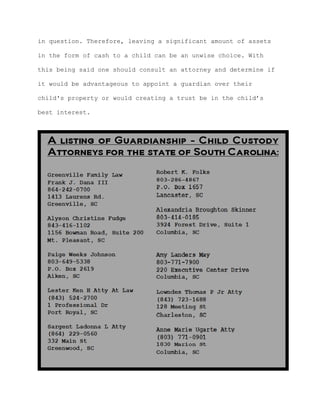
in question. Therefore, leaving a significant amount of assets

in the form of cash to a child can be an unwise choice. With

this being said one should consult an attorney and determine if

it would be advantageous to appoint a guardian over their

child's property or would creating a trust be in the child’s

best interest.
CREATING A TRUST:

      A trust is a fiduciary relationship with respect to

property where by a trustee holds legal title for the benefit of

another. The Islamic waqf system in many ways resembles a trust

in that it is based on the idea of someone gifting to a third

party specific property to be held for the benefit of others. A

trust is ideal if one does not want to have a conservatorship

proceeding wherein one’s family will have to go to court if they

disagree.


      A South Carolina Last Will and Testament can enable one to

create a trust and designate a trustee to handle their estate

(property left after death) on behalf of their children or other

beneficiaries. A trust, particularly a discretionary trust,

enables one to collect, arrange, and manage their assets during

their lifetime. The assets then pass to one’s beneficiaries upon

their death. A trust achieves many of the same ends as a Last

Will and Testament; however, a trust serves as a tax-saving

device which enables one to avoid excessive estate expenses. If

one’s Last Will and Testament is used to transfer property after

their death, there will be a probate. However, trusts are not

required to go through probate, which can save one a small

percentage of the total value of their estate.
Title 62 - South Carolina Probate Code SECTION 62-6-101.

Definitions. (14) mandates: "Trust account" means an account in

the name of one or more parties as trustee for one or more

beneficiaries where the relationship is established by the form

of the account and the deposit agreement with the financial

institution and there is no subject of the trust other than the

sums on deposit in the account; it is not essential that payment

to the beneficiary be mentioned in the deposit agreement. A

trust account does not include a regular trust account under a

testamentary trust or a trust agreement which has significance

apart from the account, or a fiduciary account arising from a

fiduciary relationship such as attorney-client.


         It is therefore important to highlight that a trust

account does not include a regular trust account under a

testamentary trust (will trust) or a trust agreement. A

testamentary trust is a trust that is not created until after a

testator's death, and is therefore irrevocable; because, since

the testator has died, it will be physically impossible for them

to have the ability to amend or revoke the testamentary trust. A

testamentary trust can be established under one's Last Will and

Testament, Revocable Living Trust, or Irrevocable Life Insurance

Trust.


     There are four parties involved in a testamentary trust:
   The one (grantor or trustor, but is generally referred to

      as the settlor) who stipulates that the trust be formed,

      generally as a part of their will

     The trustee (or Executor), who is generally named in the

      will, is responsible for carrying out the terms of the

      testator's Last Will and Testament. If not named in the

      will, they will be appointed by the probate court which

      handles the will

     The beneficiary(s) who will receive the benefits of the

      trust in question

     The actual trust itself


STRUCTURING A TRUST:

      It is imperative that a Muslim living in South Carolina

consider the practical Islamic guidelines with regard to how the

trust is actually structured. In theory, there are various ways

one can structure a trust to achieve the underlying objective

while also remaining shariah compliant.


Wali (guardian) of the trust

      The Settlor can appoint one they consider an ideal wali,

whose authority should be held in a fiduciary capacity while

acting as the protector of the trust. This individual should

essentially ensure that all activities of the trust are in
compliance with Islamic law. Furthermore, in order to ensure

that the Trustees observe the requirements of both Islamic and

state law while administering the trust, the settlor should

prepare a letter of wishes. However, it is important to note

that as a matter of practicality, where the trust is

administered from an abroad jurisdiction this option may be

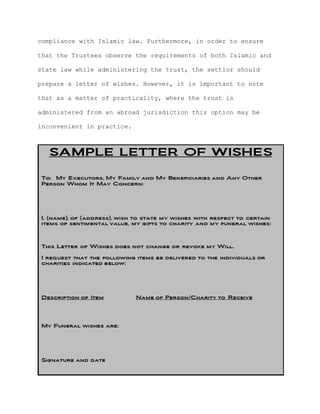
inconvenient in practice.
Type of Trust - Discretionary


    A Discretionary Trust (Family Trust) is established by a

Deed between the settlor who sets up the trust and a Trustee. In

a discretionary trust, the Trustee has the power use their

judgment when deciding whether any sum is to be paid to

beneficiaries, and if so, how much. The heads of a family are

generally appointed as a trustee company's directors; and in

this way they are able to control the exercise of the trustee's

discretionary powers.


Revocable/Irrevocable Trust structure

    An important consideration is the issue of whether the

trust should in essense be revocable or irrevocable. When

electing a revocable trust, careful thought must be given to the

interests of the beneficiaries under the trusts; because, the

parties involved could actually deviate from the rules of

established heirs outlined in the Quran, resulting in an

unsupported couse of action. In summary, there are a variety of

ways in which the framework of the trust can be adapted flexibly

to ensure that one's wishes are carried-out; however, carefull

planning will be required.


      Regarding Revocable Living Trust, some Trust advocates

preach against wills, declaring that Trusts are a better
instrument. Nevertheless, even if one has a Revocable Living

Trust, they are required to create a will. However, in many

instances, a will is all that is required. Regardless of the size

of one’s estate, a will should form the foundation of their

estate plan. In instances where one has a Revocable Living

Trust, it is ok if their will is very simple. Nevertheless, a

will is still an important part of one’s estate plan, and it

should not be considered as being unimportant simply because a

Revocable Living Trust has been created. In all fairness,

something is wrong if one has a Revocable Living Trust and does

not posses a will. When one has a Revocable Living Trust, they

create what is referred to as a "Pour-Over Will." A Pour-Over

Will acts as a safety net for one’s Trust. One’s Last Will and

Testament will actually "tie" together the Revocable Living

Trust, tax plan, and other facets of their estate plan.


      In instances where one has minor children or an

incompetent family member, the will in question should at least

name a guardian/conservator. The purpose of a Revocable Living

Trust is to allow property to be transferred through the Trust

rather than through the will, thus avoiding probate. It is also

important to note that some attorneys will flat out say that

Revocable Living Trusts do not work and should not be used in

the vast majority of the cases. The reason being, drafting a
will in the manner employed by most lawyers does not make a lot

of money for them up front, but once a will is written, the

testator and their heirs are psychologically "locked" into the

lawyer in question. As a result, a lawyer can benefit

financially because the party in question will probably do other

legal work with them. Unfortunately, there are even instances in

which a lawyer will take advantage of one’s family during the

probate process. Lawyers will also draft a great deal of wills

at inexpensive prices in order to get the probate business;

because, their financial success is guaranteed by the probate

process.


      Fundamentally a trust is formed by a token donation; such

as 10,000 USD, and thereafter transferring properties etc., into

the name of said trust. The donor then specifies specific

beneficiaries who will become the eventual owners of the trust

once it is dissolved. In this context, the donor neither intends

on immediately donating their property, nor do they really wish

to make the specified beneficiaries their immediate owners. From

the standpoint of Islamic law, there is no problem with regard

to what clauses may be written into the trust deed, provided

that it does not constitute a violation of any aspect of Islamic

law; i.e., involvement in interest, gambling, intoxicants,

pornography, etc. However, as it pertains to Islamic law, the
trust in question is non-existent, and will be regarded as part

of the donor’s estate upon their death; despite the fact that

the trust deed is a valid legal document according to South

Carolina law.


      The trust in question is non-existent because the intended

recipients will not take actual possession until after the donor

has died. The same would apply even if the donor issued the

items in question as he was dying (maradul-maut); because in

this instance, the transaction would be regarded as a will. In

order for the transaction to be valid under Islamic law, the

donor would have to issue a particular item and witness the

intended recipient take actual possession prior to their demise.

Thus, if a house was to be part of an Islamic trust, the owner

would have to donate the house to the intended recipient, move

out, hand over the keys, and sign over the title to the new

owner. The new owner could then allow the former owner to remain

in the house until the time of their demise. However, even

though the former owner will remain in the house, it is

important to note that every detail pertaining to the house will

be at the new owner’s discretion.


      If the donor dies with the situation remaining unchanged,

the donated property will transfer upon their heirs according to

the laws of inheritance. The evidence for this view is a hadith
collected by Bukhari, narrated by 'Abida, who reports: "If he

dies and the gift has been set aside while the one who was given

it was alive, then it is for his heirs. If it was not set aside,

it is for the heirs of the one who gave it.' Al-Hasan said, 'No

matter which one dies before, it is for the heirs of the one to

whom it was given if it has been given to the messenger.'" With

this being said, all the donor’s eventual heirs, as well as

those specified as beneficiaries to the trust in question must

be informed of the true reality of the trust. Therefore, it is

best if the true position of the trust be documented and all the

heirs and beneficiaries be required to sign the document in

question, stating that they have been informed about the fact

that the trust is non-existent in terms of Islamic law, and that

the donor is the sole owner. Consequently, if one intends to

form a trust that is valid according to Islamic law, it is

imperative that they seek guidance from a scholar/expert who is

experienced in this field before any trust deed is finalized.

Nonetheless, whatever the situation may be, the reality of the

trust must be clearly known and recorded in order to enable the

executors to wind-up the estate correctly.


    Below is a listing of important questions one might have

regarding South Carolina'a new Trust code; taken from Answers to

95 Questions You Should Have About the New South Carolina Trust
Code, By Evans, Carter, Kunes & Bennett. According to the

authors, "The new South Carolina Trust Code (SCTC) was passed by

the South Carolina General Assembly and signed into law in 2005.

It takes effect on January 1, 2006, and applies retroactively to

all trusts. Modeled on the Uniform Trust Code (UTC), which was

promulgated by the National Conference of Commissioners on

Uniform State Laws, the SCTC was the result of the efforts of

the SCTC Study Committee of the Probate, Estate Planning and

Trust Section of the South Carolina Bar. For the most part, the

SCTC is a default statute. The absence of case law and the

absence of statutes left practitioners dealing with uncertainty

in many areas of the common law. The SCTC introduces new

concepts and makes significant changes to our laws on trusts.

The SCTC is codified in Article 7 of Title 62 of the South

Carolina Code. There are eleven sections to the Act, and it

includes the official UTC comments as well as South Carolina

comments. Attorneys, judges, corporate and individual trustees,

and trust beneficiaries and their duties and rights will soon be

guided and governed by the SCTC. Herewith are answers to 95

questions we should all have about the new law."


    The questions I have included are the following based on

their relevency to the objective of this book: