ISLAMIC BANKING IN PAKISTAN Irum Saba Islamic Banking Department STATE BANK OF PAKISTAN * The views expressed in this presentation are those of the presenter and do not necessarily represent State Bank of Pakistan.
OUTLINE Why Islamic Banking? Is conventional banking really banking? Common Misconceptions Distinguishing Features History of Islamic Banking Reasons for Failure of Previous Efforts Current Efforts of SBP Three –pronged Strategy Islamic Banking Department, Shariah Board Current Strategy  Major Achievements Islamic Modes of financing The Challenges  The Way Forward Conclusion
Why IB? Obligations: Religious,  Constitutional, Economic  (financial crisis)
…why From Hazrat Jabir Ibn-e-Abdullah (RA): The Prophet, peace be on him, cursed : The  receiver   and the  payer  of interest,  The one  who records  it and  The  witnesses  to the transaction And said: " They are all alike  [in guilt]."  (Muslim, Tirmidhi and Musnad Ahmad)
…why ? Objectives Resolution First major step in framing a constitution was the passage by the  Constituent Assembly  of the  Objectives Resolution  of March  1949 , which defined the basic principles of the new state. It provided that Pakistan would be a state  "wherein the principles of democracy, freedom, equality, tolerance and social justice, as enunciated by  Islam , shall be fully observed; wherein the Muslims shall be enabled to order their lives in the individual and collective spheres in accordance with the teachings and requirements of Islam as set out in the Holy  Qur'an  and  Sunnah ; [and] wherein adequate provision shall be made for the minorities freely to progress and practice their religions and develop their cultures."
Constitution of IRP 1973 Article 227 :   All existing laws shall be brought  in conformity with the injunctions of Islam as laid down in the Holy Qur’an and Sunnah .
What is Riba? An excess or increase  without   an  ‘ iwad’   or equal counter-value   God has permitted trade and forbidden interest…”    (The Cow – Sura Al-Baqara 2:275) CLASSIFICATION OF RIBA Riba-un-Nasiyah or Riba-al-Jahiliya Riba-al-Fadl or Riba-al-Bai
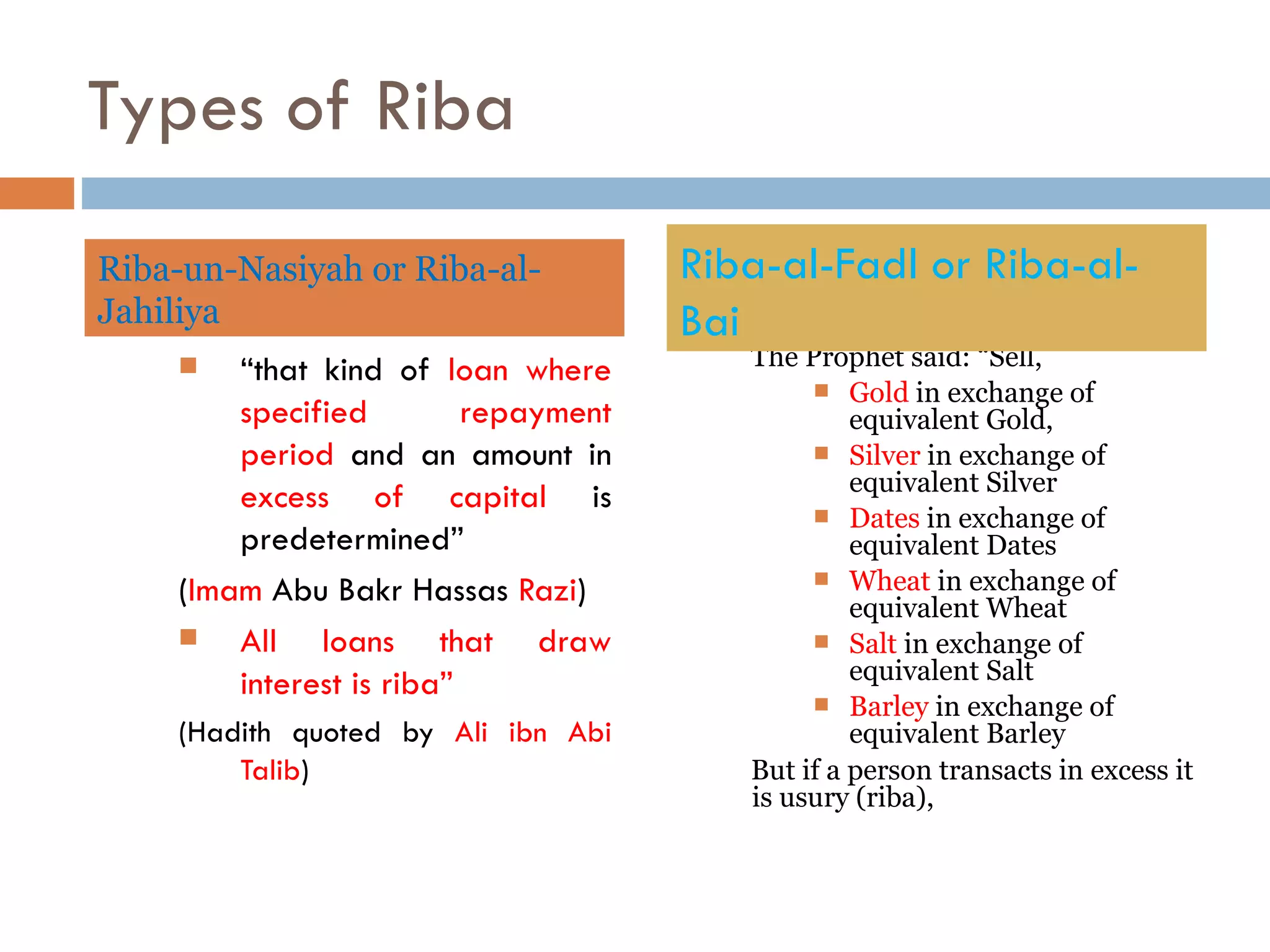
Types of Riba “ that kind of  loan where specified repayment period  and an amount in  excess of capital  is predetermined”  ( Imam  Abu Bakr Hassas  Razi ) All loans that draw interest is riba”  (Hadith quoted by  Ali ibn Abi Talib ) The Prophet said: “Sell, Gold  in exchange of equivalent Gold, Silver  in exchange of equivalent Silver  Dates  in exchange of equivalent Dates  Wheat  in exchange of equivalent Wheat Salt  in exchange of equivalent Salt Barley  in exchange of equivalent Barley But if a person transacts in excess it is usury (riba),  Riba-un-Nasiyah or Riba-al-Jahiliya Riba-al-Fadl or Riba-al-Bai
Misconceptions A fixed rate of return is not permitted under Islamic Shariah” Fixed return does not make a transaction Halal or Haram
Misconceptions “ A fixed rate of return is not permitted under Islamic Shariah” There are many Halal transactions with a fixed return e.g. House rent. Profit on sale of goods.
Islamic Banking VS Conventional Banking “ Islamic banking looks the same as conventional banking” A halal meat and haram meat may look exactly the same but one is permissible while the other is not.
Distinguishing Features WHAT IS INTEREST BASED BANKING The subject matter of Interest based banking is money Bank treats money as commodity and earns profit from  pricing it Therefore most transactions are interest based contract
WHAT IS ISLAMIC BANKING WHAT IS ISLAMIC BANKING The subject matter of Islamic banking is the economy Bank earns profit from participating in the economy, by sharing risks and rewards through pricing of goods, services and benefits Consequently there are no interest based contracts
DOES ONLY ISLAM PROHIBIT Riba Prohibition of interest is not limited to Islam it is prohibited in Judaism and Christianity Exodus 22:25, Leviticus 25:35-36, Deuteronomy 23:20,Psalms 15:5, Proverbs 28:8, Nehemiah 5:7 and Ezakhiel 18:8,13,17 & 22:12
WHY IS INTEREST PROHIBITED? key objective  is to ensure  SOCIAL JUSTICE Economic justice Economic justice requires a viable economic system supported by an efficient banking system Interest based banking is inefficient
HISTORY OF  I B IN PAKISTAN Efforts for elimination of  Riba  started during 1970s and most of the practical steps were taken in early 1980s - Banking and other relevant laws and regulations were amended  Two important areas  kept outside the purview of interest free banking system: Government borrowings (both local and foreign) and foreign exchange- mainly due to lack of research. Supreme Courts Riba Judgement-1999
Failure of Earlier Efforts  (80s) Absence of  Shari’ah  compliance mechanism in financial institutions . Inadequate training to the staff . Lack of public awareness about Islamic economic system  Social and cultural factors . Non-availability of  Shari’ah  compliant government securities
…   Failure Disoriented education system devoid of Islamic principles. Ineffective enforcement of contracts and inefficient system for early recovery. Ineffective code of conduct for professionals. Lack of continued research and development in the field of Islamic finance and economics Adoption of free market economic (capitalistic) policies.
New strategy Parallel Banking System, Three-pronged Strategy, Issues addressed: Shariah Compliance Mechanism, Training made compulsory,
Three-pronged Strategy, In order to promote Islamic Banking in Pakistan, State Bank is following a three-pronged strategy as under: Establishment of full-fledged Islamic bank(s) in the private sector;  Setting up of subsidiaries for Islamic Banking by existing commercial banks; and  Allowing Stand-alone branches for Islamic banking in the existing commercial banks. Ref :  BPD Circular No. 01 of 2003
Importance of  Shariah Compliance in IBIs Shariah the distinguishing feature  Reputational risk in non compliance,
Shariah Compliance Mechanism  At SBP: Shariah Board, IBD Shariah Inspection Manual for IBIs, At IBIs: Shariah Advisor F&P Criteria for SAs, Training of staff
SBP Shariah Board Formally established in December  2003, Unique composition, Role and Responsibilities
Shariah Compl. Mechanism Appointment of SA, Qualification of SA, Role of SBP in appointment of SA, Role and Responsibilities of SA in Shariah compliance in an IBI,
…Role of SA Product development: In consultation with SA, Approval of SA, Copy to SBP,
Role of Shariah Advisors in IBIs Shahadat ul Aalmia (Dars e Nizami)  minimum 70% marks and  Bachelor’s Degree with a minimum of 2nd Class and sufficient understanding of banking and finance. OR Post Graduate Degree in Islamic Jurisprudence/Usooluddin, L.L.M. (Shariah), etc.
Role of Shariah Advisors in IBIs At least 4 years experience of giving Shariah rulings including the period of  Takhasus fil Ifta ; or  At least 5 years post qualification experience in teaching or Research and Development in Islamic Banking and Finance.
Duties of SA To ensures that all products and services and related policies and agreements of IBIs are in compliance with Shariah rules and principles. Before launching any new products and services, the related policies and agreements have to be duly vetted by the SA.  Based on review conducted in terms of aforementioned para B(2), the Shariah Advisor shall prepare a report, which shall be published in the IBI’s annual report.
Current Status of Islamic Banking State Bank is committed to implement Islamic banking in Pakistan in a gradual manner: First license for Islamic banking was granted to Meezan Bank Limited in Jan. 2002 which started commercial operations in March 2002  A full fledged Islamic Banking Department in September, 2003 . Regulations for Islamic banks in countries like Malaysia, Bahrain, Indonesia, etc. have been reviewed.
…Current St. Currently Islamic banking is available in all  major  cities and in  rural areas   in   all four provinces of Pakistan. Banks & Branches: 6 full fledge banks-with 387 branches, 13 CB with IBDs- with 133 branches, Total IBBs- 520 branches.
Rs. in Billion INDUSTRY PROGRESS AND MARKET SHARE Description Dec.03 Dec.04 Dec.05 Dec.06 Dec.07 Dec-08 * Total Assets  13  44  71  119  206  276 % of Banking Industry 0.5% 1.5% 2.0% 2.8% 4.0% 4.9 % Deposits  8  30  50  84  147  202 % of Banking Industry 0.4% 1.3% 1.8% 2.6% 3.8%   4.8% Financing & Investment  10  30  48  73  138  187 % of Banking Industry 0.5% 1.3% 1.7% 2.3% 3.5%   4.4% Full fledged Islamic Banks (IBs) 1 2 2 4 6 6  Branches of IBs 10 23 37 93 186 384  Conventional Banks with Islamic Banking branches (CBs) 3 9 9 12 12   12 Branches of CBs 7 25 33 57 103 130 Total Islamic Banking Institutions 4 11 11 16 18   18 Total No. of Branches 17 48 70 150 289   514**
Islamic Modes of Financing
Islamic Banking Modes Participatory Modes : i) Mudaraba ii) Musharaka iii) Diminishing Musharaka iv) Equity Participation  in the form of shares in a corporate entity Trading Modes: v) Ijarah vi) Murabaha vii) Musawamah viii) Salam ix) Istisna Tawarruq  may also be used in exceptional cases requiring specific prior approval of Islamic Banking Department of SBP Debt Based Modes: xi) Qard d. Other Modes: xii) Wakalah xiii) Assignment of Debt xiv) Kafalah
Murabaha A margin of profit based sale where the seller expressly mentions the cost of commodity and adds agreed margin of profit. Price must be fixed in an unambiguous manner. If deferred, due date should be known and specific.
… Murabaha Subject of sale must exist and it should be in  ownership of the  seller at  the time of sale. Bank makes purchases through agent; Payment to supplier and issuance of invoice by him; Price once agreed cannot change; Penalty in case of delay. To go to charity; Buyer may be asked to furnish security; No rollover is possible; Buyback arrangement is prohibited All conditions of sale must be met;
Ijara Ijara is an alternative to financing in which a financer buys and rent a productive asset to a person short of funds and is in need of such asset. The aim of such arrangement is to obtain the rentals and proceeds by receiving the benefits of the assets through time.
… Ijara - Lessors’s ownership;  - Delivery of assets to lessee essential to  claim rentals; - Lessor’s ownership during the entire term of  lease; - Rental in absolute terms. Predetermined lease period  -  Penalty for delay; - Damage to the Asset, With or  Without Lessee’s fault; - Lessee bear the  operating expenses;; - Unilateral promises
Istisna’ A mode of sale, being an exception to the norm, whereby an order is placed by the buyer, with the seller, to assemble, construct or manufacture, or cause so to do, anything to be delivered at a future date, at an agreed price.
… Istisna’ Known and specified commodity; Fixation of price in absolute / unambiguous manner.   Flexibility in manner of payment. Obtaining of material cannot be the buyer’s  responsibility; Penalty for delay.
Salam A sale where the seller agrees to supply specific goods by a future date in consideration of a price fully paid in advance, at the time of contract.  Suitable for Agr. finance.
… Salam Full payment of price at the time of contract  a must - Firm agreement on quality, quantity, specifications -  Date and place of delivery must be specified - Commodities which can be offered in Salam - Availability of commodity; -  Salam cannot be tied -  No buy back with the Seller - Security can be asked for
Mudaraba An arrangement where one or more persons participate with their investment and other(s) with their efforts/skills to participate in profit in a predetermined ratio. The Manager (Mudarib) can be a natural person, a group of persons or legal entity.
… Mudaraba - Conduct of business within a framework; - Sharing of profit in agreed proportion; - Financial loss on capital only; - Liability of investor limited to his  investment;
Musharaka Relationship established under a contract through mutual consent of the parties for sharing of profits, losses from a joint enterprise, venture. Investment comes from all partners. GENERAL: - All assets joint property of all partners; - Capital contribution in terms of money or species at an agreed valuation.
… Musharaka SHARING OF PROFITS: - in strict proportion, mutually agreed - no lump sum payment for anyone or at a rate tied to capital  invested; SHARING OF LOSS: - Losses to be shared in strict proportion of investment.
Diminishing Musharaka (DM)  (For Shrikatul-Milk) DM is a form of co-ownership in which two or more persons share the ownership of a tangible asset in an agreed proportion and one of the co-owners undertakes to buy in periodic installments the proportionate share of the other co-owner until the title to such tangible asset is completely transferred to the purchasing co-owner.
Wakalah Wakalah is a contract of agency in which one person appoints another person to perform a certain task on his behalf on agreed terms and conditions, usually against a certain fee. A contract of Wakalah can take place only in respect of such acts which the principal is competent to perform himself, provided such act can be performed by the agent.
Kafalah Kafalah is a contract in which a third party becomes surety i.e. provides guarantee for the payment of debt on behalf of the debtor. It is a pledge given by a third party to a creditor to the effect that if the debtor defaults in payment of the debt, it will be paid by such third party as Kafeel i.e. Surety
Tawarruq Tawarruq literally means to liquidate. In the fiqhi term it is to sell a commodity at spot after its purchase on deferred basis.  In practice,  Tawarruq  is an arrangement in which one party sells a commodity to the other party on deferred payment at cost plus profit. The other party, namely, the buyer, then sells the commodity to a third party on cash with a purpose of having access to liquidity.
Takaful Takaful  is an Arabic word meaning “guaranteeing each other” or joint guarantee. The principles of Takaful insurance are as follows:  Policyholders cooperate among themselves for their common good.  Every policyholder pays his subscription to help those that need assistance.  Losses are divided and liabilities spread according to the community pooling system.  Uncertainty is eliminated in respect of subscription and compensation.
Islamic Banking Why Islamic Banking?- Quran & Hadith, IRP Constitution Distinguishing Features-  Asset based/social aspect Common Misconceptions-  outlook/fixed return History of Islamic Banking-  70/80s-Int. free –Second Phase –Parallel approach Reasons for Failure of Previous  Efforts-Lack of Sh. Compliance, enforcement, training and R & D Current Efforts of SBP-  IBD, supervision Major Achievements - Sh. Board, Task Forces, Awareness Current Status of IB Industry= 6 +13 licenses (520 Br) Islamic Modes of financing
Islamic Agr. Finance Guidelines on Islamic Agri. finance issued by SBP. Islamic Banking Department and Agriculture Credit department of SBP on February 3 rd , 2009 issued “Guidelines on Islamic Financing for Agriculture” to help banks develop specific Shariah compliant products in order to meet the financing needs of the farming community. These Guidelines have been developed in consultation with stakeholders while keeping in view the potential and demand for Islamic banking products in the field of agriculture.
Any Question?
Allah Hafiz

Al huda presentation on islamic bankingmiss iram saba

  • 1.
    ISLAMIC BANKING INPAKISTAN Irum Saba Islamic Banking Department STATE BANK OF PAKISTAN * The views expressed in this presentation are those of the presenter and do not necessarily represent State Bank of Pakistan.
  • 2.
    OUTLINE Why IslamicBanking? Is conventional banking really banking? Common Misconceptions Distinguishing Features History of Islamic Banking Reasons for Failure of Previous Efforts Current Efforts of SBP Three –pronged Strategy Islamic Banking Department, Shariah Board Current Strategy Major Achievements Islamic Modes of financing The Challenges The Way Forward Conclusion
  • 3.
    Why IB? Obligations:Religious, Constitutional, Economic (financial crisis)
  • 4.
    …why From HazratJabir Ibn-e-Abdullah (RA): The Prophet, peace be on him, cursed : The receiver and the payer of interest, The one who records it and The witnesses to the transaction And said: " They are all alike [in guilt]." (Muslim, Tirmidhi and Musnad Ahmad)
  • 5.
    …why ? ObjectivesResolution First major step in framing a constitution was the passage by the Constituent Assembly of the Objectives Resolution of March 1949 , which defined the basic principles of the new state. It provided that Pakistan would be a state "wherein the principles of democracy, freedom, equality, tolerance and social justice, as enunciated by Islam , shall be fully observed; wherein the Muslims shall be enabled to order their lives in the individual and collective spheres in accordance with the teachings and requirements of Islam as set out in the Holy Qur'an and Sunnah ; [and] wherein adequate provision shall be made for the minorities freely to progress and practice their religions and develop their cultures."
  • 6.
    Constitution of IRP1973 Article 227 : All existing laws shall be brought in conformity with the injunctions of Islam as laid down in the Holy Qur’an and Sunnah .
  • 7.
    What is Riba?An excess or increase without an ‘ iwad’ or equal counter-value God has permitted trade and forbidden interest…” (The Cow – Sura Al-Baqara 2:275) CLASSIFICATION OF RIBA Riba-un-Nasiyah or Riba-al-Jahiliya Riba-al-Fadl or Riba-al-Bai
  • 8.
    Types of Riba“ that kind of loan where specified repayment period and an amount in excess of capital is predetermined” ( Imam Abu Bakr Hassas Razi ) All loans that draw interest is riba” (Hadith quoted by Ali ibn Abi Talib ) The Prophet said: “Sell, Gold in exchange of equivalent Gold, Silver in exchange of equivalent Silver Dates in exchange of equivalent Dates Wheat in exchange of equivalent Wheat Salt in exchange of equivalent Salt Barley in exchange of equivalent Barley But if a person transacts in excess it is usury (riba), Riba-un-Nasiyah or Riba-al-Jahiliya Riba-al-Fadl or Riba-al-Bai
  • 9.
    Misconceptions A fixedrate of return is not permitted under Islamic Shariah” Fixed return does not make a transaction Halal or Haram
  • 10.
    Misconceptions “ Afixed rate of return is not permitted under Islamic Shariah” There are many Halal transactions with a fixed return e.g. House rent. Profit on sale of goods.
  • 11.
    Islamic Banking VSConventional Banking “ Islamic banking looks the same as conventional banking” A halal meat and haram meat may look exactly the same but one is permissible while the other is not.
  • 12.
    Distinguishing Features WHATIS INTEREST BASED BANKING The subject matter of Interest based banking is money Bank treats money as commodity and earns profit from pricing it Therefore most transactions are interest based contract
  • 13.
    WHAT IS ISLAMICBANKING WHAT IS ISLAMIC BANKING The subject matter of Islamic banking is the economy Bank earns profit from participating in the economy, by sharing risks and rewards through pricing of goods, services and benefits Consequently there are no interest based contracts
  • 14.
    DOES ONLY ISLAMPROHIBIT Riba Prohibition of interest is not limited to Islam it is prohibited in Judaism and Christianity Exodus 22:25, Leviticus 25:35-36, Deuteronomy 23:20,Psalms 15:5, Proverbs 28:8, Nehemiah 5:7 and Ezakhiel 18:8,13,17 & 22:12
  • 15.
    WHY IS INTERESTPROHIBITED? key objective is to ensure SOCIAL JUSTICE Economic justice Economic justice requires a viable economic system supported by an efficient banking system Interest based banking is inefficient
  • 16.
    HISTORY OF I B IN PAKISTAN Efforts for elimination of Riba started during 1970s and most of the practical steps were taken in early 1980s - Banking and other relevant laws and regulations were amended Two important areas kept outside the purview of interest free banking system: Government borrowings (both local and foreign) and foreign exchange- mainly due to lack of research. Supreme Courts Riba Judgement-1999
  • 17.
    Failure of EarlierEfforts (80s) Absence of Shari’ah compliance mechanism in financial institutions . Inadequate training to the staff . Lack of public awareness about Islamic economic system Social and cultural factors . Non-availability of Shari’ah compliant government securities
  • 18.
    Failure Disoriented education system devoid of Islamic principles. Ineffective enforcement of contracts and inefficient system for early recovery. Ineffective code of conduct for professionals. Lack of continued research and development in the field of Islamic finance and economics Adoption of free market economic (capitalistic) policies.
  • 19.
    New strategy ParallelBanking System, Three-pronged Strategy, Issues addressed: Shariah Compliance Mechanism, Training made compulsory,
  • 20.
    Three-pronged Strategy, Inorder to promote Islamic Banking in Pakistan, State Bank is following a three-pronged strategy as under: Establishment of full-fledged Islamic bank(s) in the private sector; Setting up of subsidiaries for Islamic Banking by existing commercial banks; and Allowing Stand-alone branches for Islamic banking in the existing commercial banks. Ref : BPD Circular No. 01 of 2003
  • 21.
    Importance of Shariah Compliance in IBIs Shariah the distinguishing feature Reputational risk in non compliance,
  • 22.
    Shariah Compliance Mechanism At SBP: Shariah Board, IBD Shariah Inspection Manual for IBIs, At IBIs: Shariah Advisor F&P Criteria for SAs, Training of staff
  • 23.
    SBP Shariah BoardFormally established in December 2003, Unique composition, Role and Responsibilities
  • 24.
    Shariah Compl. MechanismAppointment of SA, Qualification of SA, Role of SBP in appointment of SA, Role and Responsibilities of SA in Shariah compliance in an IBI,
  • 25.
    …Role of SAProduct development: In consultation with SA, Approval of SA, Copy to SBP,
  • 26.
    Role of ShariahAdvisors in IBIs Shahadat ul Aalmia (Dars e Nizami) minimum 70% marks and Bachelor’s Degree with a minimum of 2nd Class and sufficient understanding of banking and finance. OR Post Graduate Degree in Islamic Jurisprudence/Usooluddin, L.L.M. (Shariah), etc.
  • 27.
    Role of ShariahAdvisors in IBIs At least 4 years experience of giving Shariah rulings including the period of Takhasus fil Ifta ; or At least 5 years post qualification experience in teaching or Research and Development in Islamic Banking and Finance.
  • 28.
    Duties of SATo ensures that all products and services and related policies and agreements of IBIs are in compliance with Shariah rules and principles. Before launching any new products and services, the related policies and agreements have to be duly vetted by the SA. Based on review conducted in terms of aforementioned para B(2), the Shariah Advisor shall prepare a report, which shall be published in the IBI’s annual report.
  • 29.
    Current Status ofIslamic Banking State Bank is committed to implement Islamic banking in Pakistan in a gradual manner: First license for Islamic banking was granted to Meezan Bank Limited in Jan. 2002 which started commercial operations in March 2002 A full fledged Islamic Banking Department in September, 2003 . Regulations for Islamic banks in countries like Malaysia, Bahrain, Indonesia, etc. have been reviewed.
  • 30.
    …Current St. CurrentlyIslamic banking is available in all major cities and in rural areas in all four provinces of Pakistan. Banks & Branches: 6 full fledge banks-with 387 branches, 13 CB with IBDs- with 133 branches, Total IBBs- 520 branches.
  • 31.
    Rs. in BillionINDUSTRY PROGRESS AND MARKET SHARE Description Dec.03 Dec.04 Dec.05 Dec.06 Dec.07 Dec-08 * Total Assets 13 44 71 119 206 276 % of Banking Industry 0.5% 1.5% 2.0% 2.8% 4.0% 4.9 % Deposits 8 30 50 84 147 202 % of Banking Industry 0.4% 1.3% 1.8% 2.6% 3.8%   4.8% Financing & Investment 10 30 48 73 138 187 % of Banking Industry 0.5% 1.3% 1.7% 2.3% 3.5%   4.4% Full fledged Islamic Banks (IBs) 1 2 2 4 6 6  Branches of IBs 10 23 37 93 186 384  Conventional Banks with Islamic Banking branches (CBs) 3 9 9 12 12   12 Branches of CBs 7 25 33 57 103 130 Total Islamic Banking Institutions 4 11 11 16 18   18 Total No. of Branches 17 48 70 150 289   514**
  • 32.
  • 33.
    Islamic Banking ModesParticipatory Modes : i) Mudaraba ii) Musharaka iii) Diminishing Musharaka iv) Equity Participation in the form of shares in a corporate entity Trading Modes: v) Ijarah vi) Murabaha vii) Musawamah viii) Salam ix) Istisna Tawarruq may also be used in exceptional cases requiring specific prior approval of Islamic Banking Department of SBP Debt Based Modes: xi) Qard d. Other Modes: xii) Wakalah xiii) Assignment of Debt xiv) Kafalah
  • 34.
    Murabaha A marginof profit based sale where the seller expressly mentions the cost of commodity and adds agreed margin of profit. Price must be fixed in an unambiguous manner. If deferred, due date should be known and specific.
  • 35.
    … Murabaha Subjectof sale must exist and it should be in ownership of the seller at the time of sale. Bank makes purchases through agent; Payment to supplier and issuance of invoice by him; Price once agreed cannot change; Penalty in case of delay. To go to charity; Buyer may be asked to furnish security; No rollover is possible; Buyback arrangement is prohibited All conditions of sale must be met;
  • 36.
    Ijara Ijara isan alternative to financing in which a financer buys and rent a productive asset to a person short of funds and is in need of such asset. The aim of such arrangement is to obtain the rentals and proceeds by receiving the benefits of the assets through time.
  • 37.
    … Ijara -Lessors’s ownership; - Delivery of assets to lessee essential to claim rentals; - Lessor’s ownership during the entire term of lease; - Rental in absolute terms. Predetermined lease period - Penalty for delay; - Damage to the Asset, With or Without Lessee’s fault; - Lessee bear the operating expenses;; - Unilateral promises
  • 38.
    Istisna’ A modeof sale, being an exception to the norm, whereby an order is placed by the buyer, with the seller, to assemble, construct or manufacture, or cause so to do, anything to be delivered at a future date, at an agreed price.
  • 39.
    … Istisna’ Knownand specified commodity; Fixation of price in absolute / unambiguous manner. Flexibility in manner of payment. Obtaining of material cannot be the buyer’s responsibility; Penalty for delay.
  • 40.
    Salam A salewhere the seller agrees to supply specific goods by a future date in consideration of a price fully paid in advance, at the time of contract. Suitable for Agr. finance.
  • 41.
    … Salam Fullpayment of price at the time of contract a must - Firm agreement on quality, quantity, specifications - Date and place of delivery must be specified - Commodities which can be offered in Salam - Availability of commodity; - Salam cannot be tied - No buy back with the Seller - Security can be asked for
  • 42.
    Mudaraba An arrangementwhere one or more persons participate with their investment and other(s) with their efforts/skills to participate in profit in a predetermined ratio. The Manager (Mudarib) can be a natural person, a group of persons or legal entity.
  • 43.
    … Mudaraba -Conduct of business within a framework; - Sharing of profit in agreed proportion; - Financial loss on capital only; - Liability of investor limited to his investment;
  • 44.
    Musharaka Relationship establishedunder a contract through mutual consent of the parties for sharing of profits, losses from a joint enterprise, venture. Investment comes from all partners. GENERAL: - All assets joint property of all partners; - Capital contribution in terms of money or species at an agreed valuation.
  • 45.
    … Musharaka SHARINGOF PROFITS: - in strict proportion, mutually agreed - no lump sum payment for anyone or at a rate tied to capital invested; SHARING OF LOSS: - Losses to be shared in strict proportion of investment.
  • 46.
    Diminishing Musharaka (DM) (For Shrikatul-Milk) DM is a form of co-ownership in which two or more persons share the ownership of a tangible asset in an agreed proportion and one of the co-owners undertakes to buy in periodic installments the proportionate share of the other co-owner until the title to such tangible asset is completely transferred to the purchasing co-owner.
  • 47.
    Wakalah Wakalah isa contract of agency in which one person appoints another person to perform a certain task on his behalf on agreed terms and conditions, usually against a certain fee. A contract of Wakalah can take place only in respect of such acts which the principal is competent to perform himself, provided such act can be performed by the agent.
  • 48.
    Kafalah Kafalah isa contract in which a third party becomes surety i.e. provides guarantee for the payment of debt on behalf of the debtor. It is a pledge given by a third party to a creditor to the effect that if the debtor defaults in payment of the debt, it will be paid by such third party as Kafeel i.e. Surety
  • 49.
    Tawarruq Tawarruq literallymeans to liquidate. In the fiqhi term it is to sell a commodity at spot after its purchase on deferred basis. In practice, Tawarruq is an arrangement in which one party sells a commodity to the other party on deferred payment at cost plus profit. The other party, namely, the buyer, then sells the commodity to a third party on cash with a purpose of having access to liquidity.
  • 50.
    Takaful Takaful is an Arabic word meaning “guaranteeing each other” or joint guarantee. The principles of Takaful insurance are as follows: Policyholders cooperate among themselves for their common good. Every policyholder pays his subscription to help those that need assistance. Losses are divided and liabilities spread according to the community pooling system. Uncertainty is eliminated in respect of subscription and compensation.
  • 51.
    Islamic Banking WhyIslamic Banking?- Quran & Hadith, IRP Constitution Distinguishing Features- Asset based/social aspect Common Misconceptions- outlook/fixed return History of Islamic Banking- 70/80s-Int. free –Second Phase –Parallel approach Reasons for Failure of Previous Efforts-Lack of Sh. Compliance, enforcement, training and R & D Current Efforts of SBP- IBD, supervision Major Achievements - Sh. Board, Task Forces, Awareness Current Status of IB Industry= 6 +13 licenses (520 Br) Islamic Modes of financing
  • 52.
    Islamic Agr. FinanceGuidelines on Islamic Agri. finance issued by SBP. Islamic Banking Department and Agriculture Credit department of SBP on February 3 rd , 2009 issued “Guidelines on Islamic Financing for Agriculture” to help banks develop specific Shariah compliant products in order to meet the financing needs of the farming community. These Guidelines have been developed in consultation with stakeholders while keeping in view the potential and demand for Islamic banking products in the field of agriculture.
  • 53.
  • 54.