Aga Khan Education Service, Pakistan
Space Education & its Significance
(K-12)
Muhammad Kashif Saleem
Manager Learning Technologies
Aga Khan Education Service, Pakistan
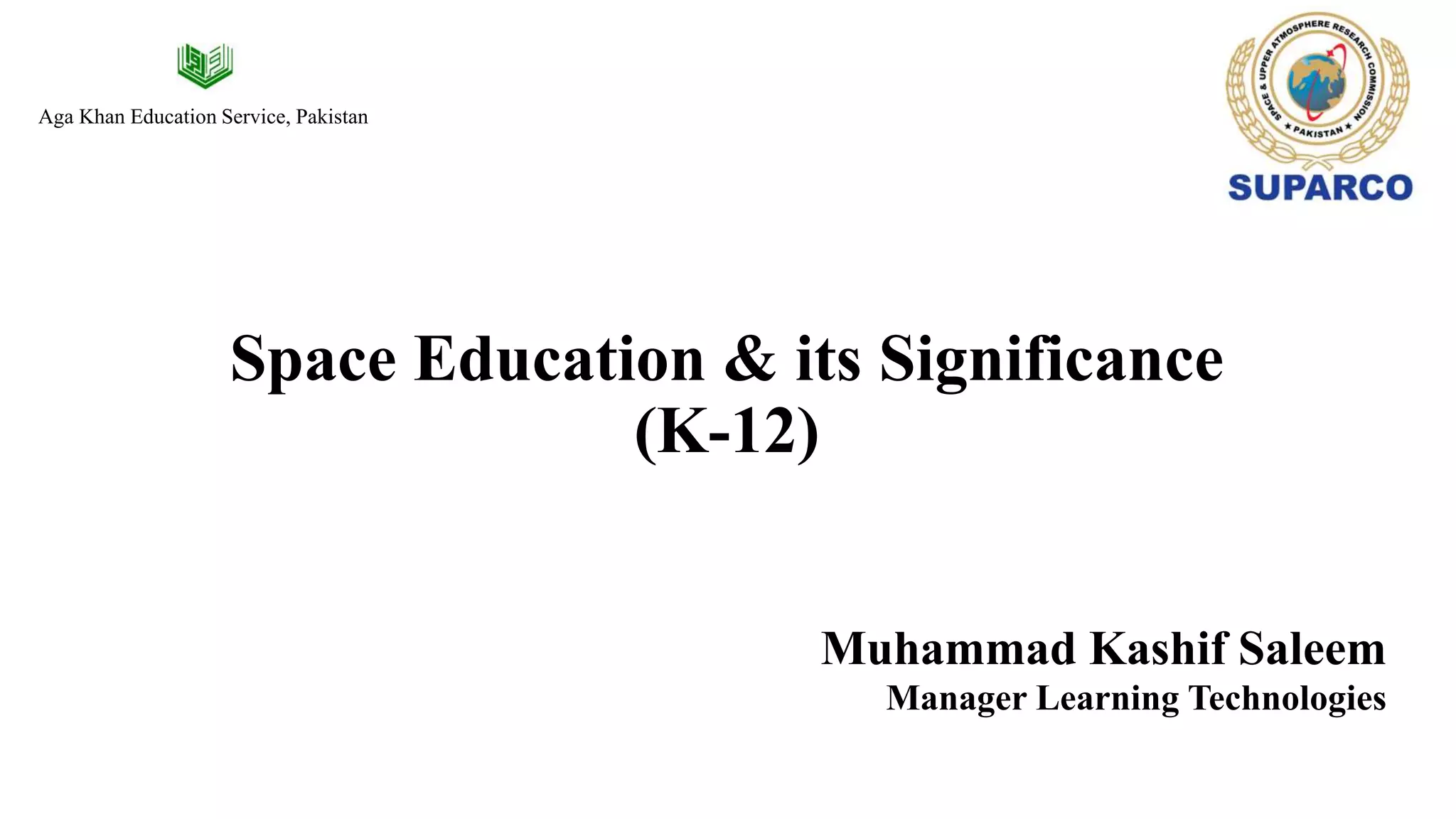
‫ا‬‫جاؤ۔‬ ‫نکل‬ ‫تو‬ ‫جاؤ‬ ‫نکل‬ ‫سے‬ ‫کناروں‬ ‫کے‬ ‫زمین‬ ‫اور‬ ‫آسمان‬ ‫کہ‬ ‫ہو‬ ‫قدرت‬ ‫تمہیں‬ ‫اگر‬ ‫وانس‬ ‫جن‬ ِ‫ہ‬‫گرو‬ ‫ے‬
‫نہیں‬ ‫کے‬ ‫ہی‬ ‫سکنے‬ ‫نکل‬ ‫تم‬ ‫سوا‬ ‫کے‬ ‫زور‬ ‫اور‬
1
1. https://quran.com/55/33
Aga Khan Education Service, Pakistan
O company of jinn and human
beings. If you are able to pierce
through the confines of the
heavens and Earth, pierce through
them. You will not pierce through,
except with a clear authority.
(Qur'an, 55:33)
2
2. http://www.miraclesofthequran.com/scientific_112.html
Aga Khan Education Service, Pakistan
Iterated on achieving self-sufficiency in
all fields of education and urged for a
proactive role, devising of such strategies
beneficial for coming generations and for
the welfare of humanity
High Excellency President Mamnoon Hussain: 2nd
International Conference on Space – 2016
Aga Khan Education Service, Pakistan
As the Holy Quran so powerfully affirms,
“Allah is the Creator and the Master of
the heavens and the earth.” And then it
continues: “Everything in the heavens and
on earth, and everything between them,
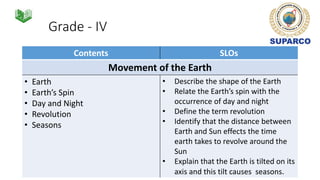
and everything beneath the soil, belongs
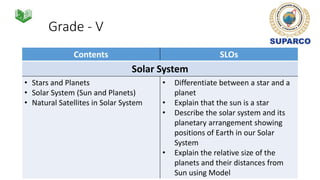
to Him.”
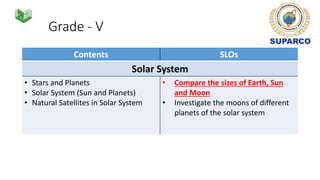
His Highness the Aga Khan - Dec. 6, 2008 (Ottawa, Canada)
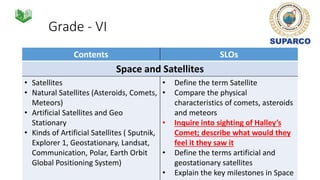
Aga Khan Education Service, Pakistan
But in Islamic thought….beauty and
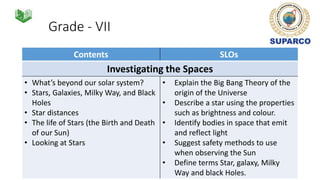
mystery are not separated from intellect –
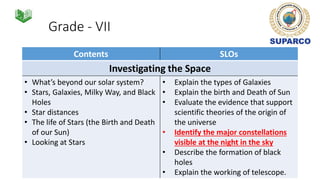
in fact, the reverse is true. As we use our
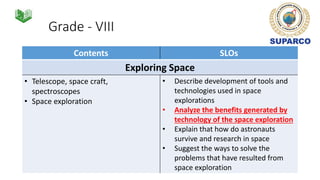
intellect to gain new knowledge about
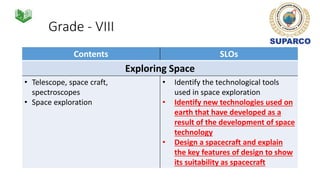
Creation, we come to see even more
profoundly the depth and breadth of its
mysteries.
His Highness the Aga Khan - Dec. 6, 2008 (Ottawa, Canada)
Aga Khan Education Service, Pakistan
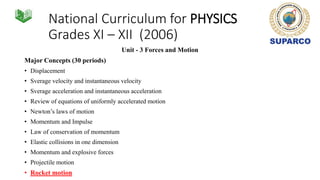
We explore unknown regions beneath the
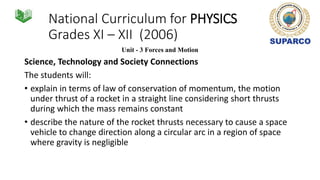
seas – and in outer space. We reach back
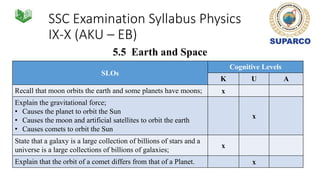
over hundreds of millions of years in
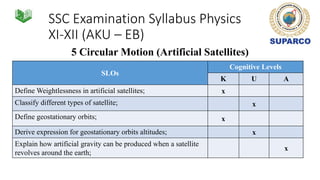
time…..And the more we discover, the more
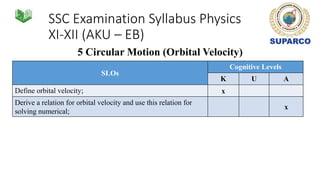
we know, the more we penetrate just below
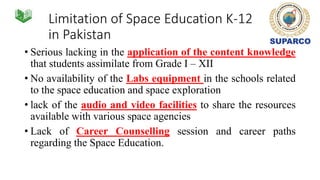
the surface of our normal lives – the more our
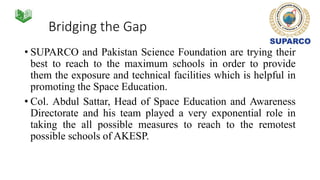
imagination staggers.His Highness the Aga Khan - Dec. 6, 2008 (Ottawa, Canada)
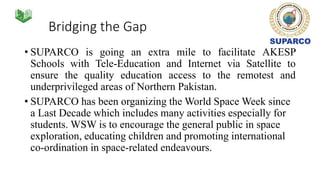
Aga Khan Education Service, Pakistan
Just think for example what might lie below
the surfaces of celestial bodies all across the
far flung reaches of our universe. What we
feel, even as we learn, is an ever-renewed
sense of wonder, indeed, a powerful sense of
Divine inspiration.”
His Highness the Aga Khan - Dec. 6, 2008 (Ottawa, Canada)
Aga Khan Education Services, Pakistan
• AKES,P is amongst the largest private networks of education
institutions in Pakistan.
• Reaching out to the most remote areas of Pakistan, AKES,P
has been providing quality education for over a hundred
years.
• It is a direct provider of education for pre-primary to higher
secondary school(K-12) students and facilitates access to
tertiary education through the provision of scholarships,
hostels and other educational support services.
Aga Khan Education Services, Pakistan
• The first AKES,P school was established in 1905 in Gwadar,
Balochistan.
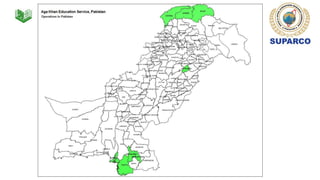
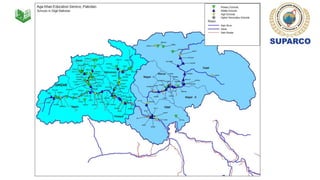
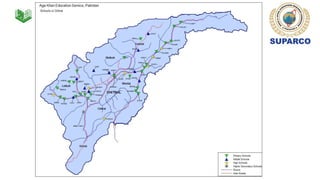
• Over a century later, AKES,P operates 159 schools (200 CBS) and 4
hostels in Gilgit-Baltistan, Chitral, Punjab and Sindh, mostly in rural
areas.
• Over 50,000 students
• These represent very diverse schools, ranging from rural schools with
less than a 100 students to large urban schools.
• With over 2,500 (Over 1800 Teachers) employees, most of which are
teachers, AKES,P is also supported by over 2,000 volunteers.
AKESP
Aga Khan Education Service, Pakistan
Space Education Provisions in
K-12
National Curriculum General Knowledge
(Class I-III) - 2007
• Knowledge:
• Students will develop knowledge and understanding of the
following concepts and apply these understanding to interpret,
integrate, and extend their knowledge.
• Our Beliefs
• History
• Geography
• Economics
• Political Science
• Life Science
• Physical Science
• Earth and Space Science
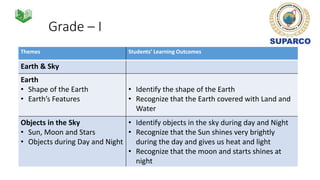
Grade – I
Themes Students’ Learning Outcomes
Earth & Sky
Earth
• Shape of the Earth
• Earth’s Features
• Identify the shape of the Earth
• Recognize that the Earth covered with Land and
Water
Objects in the Sky
• Sun, Moon and Stars
• Objects during Day and Night
• Identify objects in the sky during day and Night
• Recognize that the Sun shines very brightly
during the day and gives us heat and light
• Recognize that the moon and starts shines at
night
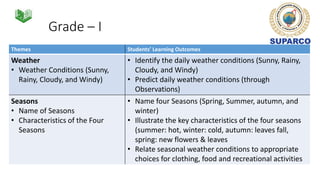
Grade – I
Themes Students’ Learning Outcomes
Weather
• Weather Conditions (Sunny,
Rainy, Cloudy, and Windy)
• Identify the daily weather conditions (Sunny, Rainy,
Cloudy, and Windy)
• Predict daily weather conditions (through
Observations)
Seasons
• Name of Seasons
• Characteristics of the Four
Seasons
• Name four Seasons (Spring, Summer, autumn, and
winter)
• Illustrate the key characteristics of the four seasons
(summer: hot, winter: cold, autumn: leaves fall,
spring: new flowers & leaves
• Relate seasonal weather conditions to appropriate
choices for clothing, food and recreational activities
Aga Khan Education Service, Pakistan
Grade – II
Deals with the Earth and Earth’s resources
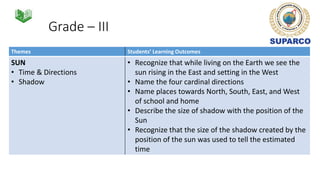
Grade – III
Themes Students’ Learning Outcomes
SUN
• Time & Directions
• Shadow
• Recognize that while living on the Earth we see the
sun rising in the East and setting in the West
• Name the four cardinal directions
• Name places towards North, South, East, and West
of school and home
• Describe the size of shadow with the position of the
Sun
• Recognize that the size of the shadow created by the
position of the sun was used to tell the estimated
time
National Curriculum for General
Science Grade IV – VIII (2006)
Strand – 3 (Earth and Space Science)
•Content Standard Benchmarks Grade V
• Observe and describe the characteristics of objects in the sky
• Observe and record the changing appearances and positions
of the Moon in the sky at night and determining the monthly
patterns of lunar change;
• Model changes that occur because of the rotation of the
earth and the revolution of the Earth round the Sun;
National Curriculum for General
Science Grade IV – VIII (2006)
Strand – 3 (Earth and Space Science)
•Content Standard Benchmarks Grade V
• Understand that the Sun, a star, is a source of heat and light
energy and identifying its effects upon the Earth;
• Compare celestial bodies in our solar system; and
• Demonstrate how relationship of the Earth, Moon, and Sun
causes eclipses and Moon phases
National Curriculum for General
Science Grade IV – VIII (2006)
Strand – 3 (Earth and Space Science)
•Content Standard Benchmarks Grade VIII
•Identify the characteristics of the Sun and other stars;
•Compare and contrast the celestial bodies in our solar
system;
•Investigate the force of gravity and the ways gravity
governs motion in the solar system and objects on
Earth;
National Curriculum for General
Science Grade IV – VIII (2006)
Strand – 3 (Earth and Space Science)
•Content Standard Benchmarks Grade VIII
•Model the position of the Earth in relationship to
other objects in the solar system; and
•Understand that space exploration is an active area of
scientific and technological research and development
National Curriculum for General
Science Grade IV – VIII (2006)
Strand – 3 (Earth and Space Science)
•Skill Standard Benchmarks Grade V
•Ask questions about objects and events in the
immediate environment; and develop ideas about how
those questions might be answered
•Observe and explore material and events in
immediate environment and record the results;
•Identify patterns and order in objects and events
studied;
National Curriculum for General
Science Grade IV – VIII (2006)
Strand – 3 (Earth and Space Science)
•Skill Standard Benchmarks Grade V
•Develop solutions to problems through reasoning,
observation and investigation;
•Work with others, share and communicate ideas about
their explanations; and
•Take safety measures during experiments.
National Curriculum for General
Science Grade IV – VIII (2006)
Strand – 3 (Earth and Space Science)
•Skill Standard Benchmarks Grade VIII
•Ask questions about objects and events in local
environment and develop plans to investigate those
questions.
•Observe and investigate the local environment and
record the results;
National Curriculum for General
Science Grade IV – VIII (2006)
Strand – 3 (Earth and Space Science)
•Skill Standard Benchmarks Grade VIII
•Use appropriate tools, techniques, and measurement
units for gathering observations and presenting the
same in an organized way/form;
•Design and conduct scientific investigations;
•Interpret findings from investigations using appropriate
methods
National Curriculum for General
Science Grade IV – VIII (2006)
Strand – 3 (Earth and Space Science)
•Skill Standard Benchmarks Grade VIII
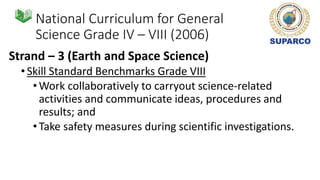
•Work collaboratively to carryout science-related
activities and communicate ideas, procedures and
results; and
•Take safety measures during scientific investigations.
National Curriculum for General
Science Grade IV – VIII (2006)
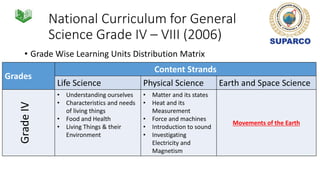
• Grade Wise Learning Units Distribution Matrix
Grades
Content Strands
Life Science Physical Science Earth and Space Science
GradeIV
• Understanding ourselves
• Characteristics and needs
of living things
• Food and Health
• Living Things & their
Environment
• Matter and its states
• Heat and its
Measurement
• Force and machines
• Introduction to sound
• Investigating
Electricity and
Magnetism
Movements of the Earth
National Curriculum for General
Science Grade IV – VIII (2006)
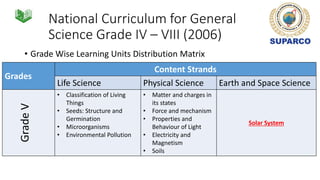
• Grade Wise Learning Units Distribution Matrix
Grades
Content Strands
Life Science Physical Science Earth and Space Science
GradeV
• Classification of Living
Things
• Seeds: Structure and
Germination
• Microorganisms
• Environmental Pollution
• Matter and charges in
its states
• Force and mechanism
• Properties and
Behaviour of Light
• Electricity and
Magnetism
• Soils
Solar System
National Curriculum for General
Science Grade IV – VIII (2006)
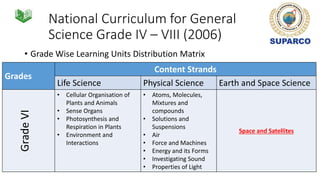
• Grade Wise Learning Units Distribution Matrix
Grades
Content Strands
Life Science Physical Science Earth and Space Science
GradeVI
• Cellular Organisation of
Plants and Animals
• Sense Organs
• Photosynthesis and
Respiration in Plants
• Environment and
Interactions
• Atoms, Molecules,
Mixtures and
compounds
• Solutions and
Suspensions
• Air
• Force and Machines
• Energy and its Forms
• Investigating Sound
• Properties of Light
Space and Satellites
National Curriculum for General
Science Grade IV – VIII (2006)
• Grade Wise Learning Units Distribution Matrix
Grades
Content Strands
Life Science Physical Science Earth and Space Science
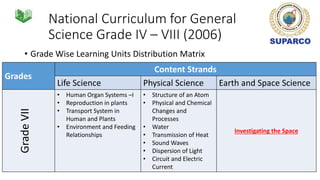
GradeVII
• Human Organ Systems –I
• Reproduction in plants
• Transport System in
Human and Plants
• Environment and Feeding
Relationships
• Structure of an Atom
• Physical and Chemical
Changes and
Processes
• Water
• Transmission of Heat
• Sound Waves
• Dispersion of Light
• Circuit and Electric
Current
Investigating the Space
National Curriculum for General
Science Grade IV – VIII (2006)
• Grade Wise Learning Units Distribution Matrix
Grades
Content Strands
Life Science Physical Science Earth and Space Science
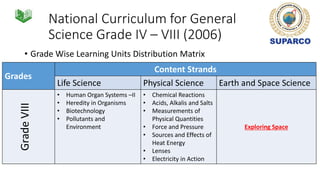
GradeVIII
• Human Organ Systems –II
• Heredity in Organisms
• Biotechnology
• Pollutants and
Environment
• Chemical Reactions
• Acids, Alkalis and Salts
• Measurements of
Physical Quantities
• Force and Pressure
• Sources and Effects of
Heat Energy
• Lenses
• Electricity in Action
Exploring Space
Grade - IV
Contents SLOs
Movement of the Earth
• Earth
• Earth’s Spin
• Day and Night
• Revolution
• Seasons
• Describe the shape of the Earth
• Relate the Earth’s spin with the
occurrence of day and night
• Define the term revolution
• Identify that the distance between
Earth and Sun effects the time
earth takes to revolve around the
Sun
• Explain that the Earth is tilted on its
axis and this tilt causes seasons.
Grade - V
Contents SLOs
Solar System
• Stars and Planets
• Solar System (Sun and Planets)
• Natural Satellites in Solar System
• Differentiate between a star and a
planet
• Explain that the sun is a star
• Describe the solar system and its
planetary arrangement showing
positions of Earth in our Solar
System
• Explain the relative size of the
planets and their distances from
Sun using Model
Grade - V
Contents SLOs
Solar System
• Stars and Planets
• Solar System (Sun and Planets)
• Natural Satellites in Solar System
• Compare the sizes of Earth, Sun
and Moon
• Investigate the moons of different
planets of the solar system
Grade - VI
Contents SLOs
Space and Satellites
• Satellites
• Natural Satellites (Asteroids, Comets,
Meteors)
• Artificial Satellites and Geo
Stationary
• Kinds of Artificial Satellites ( Sputnik,
Explorer 1, Geostationary, Landsat,
Communication, Polar, Earth Orbit
Global Positioning System)
• Define the term Satellite
• Compare the physical
characteristics of comets, asteroids
and meteors
• Inquire into sighting of Halley’s
Comet; describe what would they
feel it they saw it
• Define the terms artificial and
geostationary satellites
• Explain the key milestones in Space
Grade - VI
Contents SLOs
Space and Satellites
• Satellites
• Natural Satellites (Asteroids, Comets,
Meteors)
• Artificial Satellites and Geo
Stationary
• Kinds of Artificial Satellites ( Sputnik,
Explorer 1, Geostationary, Landsat,
Communication, Polar, Earth Orbit
Global Positioning System)
• Explain the key milestones in Space
Technology
• Describe the uses of various
satellites in space.
• Investigate how artificial satellites
have improved our knowledge
about space and are used for
space research.
• Explain that how do satellites tell us
where we are,
Grade - VII
Contents SLOs
Investigating the Spaces
• What’s beyond our solar system?
• Stars, Galaxies, Milky Way, and Black
Holes
• Star distances
• The life of Stars (the Birth and Death
of our Sun)
• Looking at Stars
• Explain the Big Bang Theory of the
origin of the Universe
• Describe a star using the properties
such as brightness and colour.
• Identify bodies in space that emit
and reflect light
• Suggest safety methods to use
when observing the Sun
• Define terms Star, galaxy, Milky
Way and black Holes.
Grade - VII
Contents SLOs
Investigating the Space
• What’s beyond our solar system?
• Stars, Galaxies, Milky Way, and Black
Holes
• Star distances
• The life of Stars (the Birth and Death
of our Sun)
• Looking at Stars
• Explain the types of Galaxies
• Explain the birth and Death of Sun
• Evaluate the evidence that support
scientific theories of the origin of
the universe
• Identify the major constellations
visible at the night in the sky
• Describe the formation of black
holes
• Explain the working of telescope.
Grade - VIII
Contents SLOs
Exploring Space
• Telescope, space craft,
spectroscopes
• Space exploration
• Describe development of tools and
technologies used in space
explorations
• Analyze the benefits generated by
technology of the space exploration
• Explain that how do astronauts
survive and research in space
• Suggest the ways to solve the
problems that have resulted from
space exploration
Grade - VIII
Contents SLOs
Exploring Space
• Telescope, space craft,
spectroscopes
• Space exploration
• Identify the technological tools
used in space exploration
• Identify new technologies used on
earth that have developed as a
result of the development of space
technology
• Design a spacecraft and explain
the key features of design to show
its suitability as spacecraft
National Curriculum for PHYSICS
Grades IX – X (2006)
UNIT # 5 Gravitation
Major Concepts (16 periods)
• Law of gravitation
• Measurement of mass of earth
• Variation of ‘g’ with altitude
• Motion of artificial satellites(simple treatment)
Science, Technology and Society Connections
The students will:
• gather information to predict the value of the acceleration due to gravity ‘g’ at
any planet or moon surface using Newton’s law of gravitation.
• Describe how artificial satellites keep on moving around the earth due to
gravitational force.
National Curriculum for PHYSICS
Grades IX – X (2006)
UNIT # 12 Geometrical Optics
Major Concepts (23 periods)
• Reflection of light
• Image location by spherical mirror equation
• Refraction of light
• Total internal reflection
• Refraction through a prism
• Image location by lens equation
• Magnifying power and resolving power
• Compound microscope
• Telescope (Just a Concept)
• Defects in vision
National Curriculum for PHYSICS
Grades XI – XII (2006)
Unit - 5 Rotational and Circular Motion
Major Concepts (21 periods)
• Kinematics of angular motion
• Centripetal force and centripetal acceleration
• Orbital velocity
• Artificial satellites
• Artificial gravity
• Moment of inertia
• Angular momentum
National Curriculum for PHYSICS
Grades XI – XII (2006)
Unit - 5 Rotational and Circular Motion
Science, Technology and Society Connections
The students will:
• assess the suitability of the recommended speed limit for the given data on
the banking angle and radius of curvature of some roads.
• describe the experience of roller coaster rides in the amusement parks.
• describe the principles and benefits of weather forecasting and
communication satellites.
• evaluate the accuracy of the information presented in a newspaper
article on satellite.
• write a report on an information search on the topic of 'Space station’
National Curriculum for PHYSICS
Grades XI – XII (2006)
Unit - 3 Forces and Motion
Major Concepts (30 periods)
• Displacement
• Sverage velocity and instantaneous velocity
• Sverage acceleration and instantaneous acceleration
• Review of equations of uniformly accelerated motion
• Newton’s laws of motion
• Momentum and Impulse
• Law of conservation of momentum
• Elastic collisions in one dimension
• Momentum and explosive forces
• Projectile motion
• Rocket motion
National Curriculum for PHYSICS
Grades XI – XII (2006)
Unit - 3 Forces and Motion
Science, Technology and Society Connections
The students will:
• explain in terms of law of conservation of momentum, the motion
under thrust of a rocket in a straight line considering short thrusts
during which the mass remains constant
• describe the nature of the rocket thrusts necessary to cause a space
vehicle to change direction along a circular arc in a region of space
where gravity is negligible
SSC Examination Syllabus Physics
IX-X (AKU – EB)
5.5 Earth and Space
SLOs
Cognitive Levels
K U A
Recall that moon orbits the earth and some planets have moons; x
Explain the gravitational force;
• Causes the planet to orbit the Sun
• Causes the moon and artificial satellites to orbit the earth
• Causes comets to orbit the Sun
x
State that a galaxy is a large collection of billions of stars and a
universe is a large collections of billions of galaxies;
x
Explain that the orbit of a comet differs from that of a Planet. x
SSC Examination Syllabus Physics
XI-XII (AKU – EB)
5 Circular Motion (Artificial Satellites)
SLOs
Cognitive Levels
K U A
Define Weightlessness in artificial satellites; x
Classify different types of satellite; x
Define geostationary orbits; x
Derive expression for geostationary orbits altitudes; x
Explain how artificial gravity can be produced when a satellite
revolves around the earth;
x
SSC Examination Syllabus Physics
XI-XII (AKU – EB)
5 Circular Motion (Orbital Velocity)
SLOs
Cognitive Levels
K U A
Define orbital velocity; x
Derive a relation for orbital velocity and use this relation for
solving numerical;
x
Limitation of Space Education K-12
in Pakistan
• Serious lacking in the application of the content knowledge
that students assimilate from Grade I – XII
• No availability of the Labs equipment in the schools related
to the space education and space exploration
• lack of the audio and video facilities to share the resources
available with various space agencies
• Lack of Career Counselling session and career paths
regarding the Space Education.
Bridging the Gap
• SUPARCO and Pakistan Science Foundation are trying their
best to reach to the maximum schools in order to provide
them the exposure and technical facilities which is helpful in
promoting the Space Education.
• Col. Abdul Sattar, Head of Space Education and Awareness
Directorate and his team played a very exponential role in
taking the all possible measures to reach to the remotest
possible schools of AKESP.
Bridging the Gap
• SUPARCO is going an extra mile to facilitate AKESP
Schools with Tele-Education and Internet via Satellite to
ensure the quality education access to the remotest and
underprivileged areas of Northern Pakistan.
• SUPARCO has been organizing the World Space Week since
a Last Decade which includes many activities especially for
students. WSW is to encourage the general public in space
exploration, educating children and promoting international
co-ordination in space-related endeavours.
Bridging the Gap
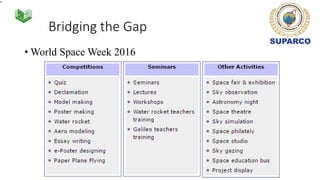
• World Space Week 2016
Application and Significance of
Space Education
• SATELLITE REMOTE SENSING
• Remote sensing systems are commonly used to survey, map and monitor the
resources and environment
• Applications of Remote Sensing
• Agriculture
• Forestry
• Geology
• Natural Disasters
• Cartography
• Geographic Information System
• Environmental Assessment
Application and Significance of
Space Education
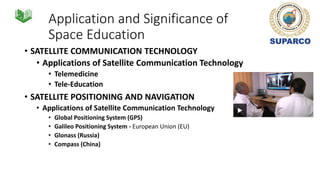
• SATELLITE COMMUNICATION TECHNOLOGY
• Applications of Satellite Communication Technology
• Telemedicine
• Tele-Education
• SATELLITE POSITIONING AND NAVIGATION
• Applications of Satellite Communication Technology
• Global Positioning System (GPS)
• Galileo Positioning System - European Union (EU)
• Glonass (Russia)
• Compass (China)
Application and Significance of
Space Education
• SATELLITE METEOROLOGY
• Applications of Satellite Communication Technology
• Weather Forecasting
• Drought Monitoring
• Forest Fire Monitoring
• Sea Surface Temperature Monitoring
• Fog and Haze Monitoring
Application and Significance of
Space Education
• SATELLITE METEOROLOGY
• Applications of Satellite Communication Technology
• Weather Forecasting
• Drought Monitoring
• Forest Fire Monitoring
• Sea Surface Temperature Monitoring
• Fog and Haze Monitoring
Top five reasons to keep exploring
space
1- The Apollo missions promoted science education by inspiring a
whole generation of kids to become astronauts, rocket scientists, and
engineers.
2- Space science also helps in environmental research by studying air
quality, climate change, alternative energy, and near-earth objects.
3- We are consuming earth’s natural resources pretty quickly. Space
has virtually unlimited resources. It is all just a matter of collecting and
bringing them back.
Planetsave.com - July 26th, 2009 by Daniel Hohler
Top five reasons to keep exploring space
4- The more we explore the cosmos, the more it humbles us. Earth is
just a tiny speck orbiting a mediocre yellow-dwarf star nowhere near
the centre of our galaxy, let alone the universe. (Vastness)
5- The population on earth is growing exponentially while the
resources required to support life are fast eroding. Space colonization
can be the ultimate solution
Planetsave.com - July 26th, 2009 by Daniel Hohler
In this era of hyper globalization with increasing
technological capture of almost all aspects of life,
one cannot simply afford to look the other way
when the world is slowly preparing to break the
shackles of gravity and move out of this planet.
Conclusion
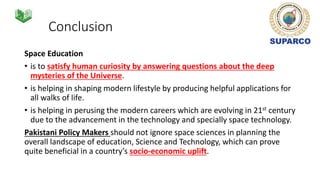
Space Education
• is to satisfy human curiosity by answering questions about the deep
mysteries of the Universe.
• is helping in shaping modern lifestyle by producing helpful applications for
all walks of life.
• is helping in perusing the modern careers which are evolving in 21st century
due to the advancement in the technology and specially space technology.
Pakistani Policy Makers should not ignore space sciences in planning the
overall landscape of education, Science and Technology, which can prove
quite beneficial in a country’s socio-economic uplift.
Aga Khan Education Service, Pakistan
Thanks
for listening patiently.

AKESP & SUPARCO

  • 1.
    Aga Khan EducationService, Pakistan Space Education & its Significance (K-12) Muhammad Kashif Saleem Manager Learning Technologies
  • 2.
    Aga Khan EducationService, Pakistan ‫ا‬‫جاؤ۔‬ ‫نکل‬ ‫تو‬ ‫جاؤ‬ ‫نکل‬ ‫سے‬ ‫کناروں‬ ‫کے‬ ‫زمین‬ ‫اور‬ ‫آسمان‬ ‫کہ‬ ‫ہو‬ ‫قدرت‬ ‫تمہیں‬ ‫اگر‬ ‫وانس‬ ‫جن‬ ِ‫ہ‬‫گرو‬ ‫ے‬ ‫نہیں‬ ‫کے‬ ‫ہی‬ ‫سکنے‬ ‫نکل‬ ‫تم‬ ‫سوا‬ ‫کے‬ ‫زور‬ ‫اور‬ 1 1. https://quran.com/55/33
  • 3.
    Aga Khan EducationService, Pakistan O company of jinn and human beings. If you are able to pierce through the confines of the heavens and Earth, pierce through them. You will not pierce through, except with a clear authority. (Qur'an, 55:33) 2 2. http://www.miraclesofthequran.com/scientific_112.html
  • 4.
    Aga Khan EducationService, Pakistan Iterated on achieving self-sufficiency in all fields of education and urged for a proactive role, devising of such strategies beneficial for coming generations and for the welfare of humanity High Excellency President Mamnoon Hussain: 2nd International Conference on Space – 2016
  • 5.
    Aga Khan EducationService, Pakistan As the Holy Quran so powerfully affirms, “Allah is the Creator and the Master of the heavens and the earth.” And then it continues: “Everything in the heavens and on earth, and everything between them, and everything beneath the soil, belongs to Him.” His Highness the Aga Khan - Dec. 6, 2008 (Ottawa, Canada)
  • 6.
    Aga Khan EducationService, Pakistan But in Islamic thought….beauty and mystery are not separated from intellect – in fact, the reverse is true. As we use our intellect to gain new knowledge about Creation, we come to see even more profoundly the depth and breadth of its mysteries. His Highness the Aga Khan - Dec. 6, 2008 (Ottawa, Canada)
  • 7.
    Aga Khan EducationService, Pakistan We explore unknown regions beneath the seas – and in outer space. We reach back over hundreds of millions of years in time…..And the more we discover, the more we know, the more we penetrate just below the surface of our normal lives – the more our imagination staggers.His Highness the Aga Khan - Dec. 6, 2008 (Ottawa, Canada)
  • 8.
    Aga Khan EducationService, Pakistan Just think for example what might lie below the surfaces of celestial bodies all across the far flung reaches of our universe. What we feel, even as we learn, is an ever-renewed sense of wonder, indeed, a powerful sense of Divine inspiration.” His Highness the Aga Khan - Dec. 6, 2008 (Ottawa, Canada)
  • 9.
    Aga Khan EducationServices, Pakistan • AKES,P is amongst the largest private networks of education institutions in Pakistan. • Reaching out to the most remote areas of Pakistan, AKES,P has been providing quality education for over a hundred years. • It is a direct provider of education for pre-primary to higher secondary school(K-12) students and facilitates access to tertiary education through the provision of scholarships, hostels and other educational support services.
  • 10.
    Aga Khan EducationServices, Pakistan • The first AKES,P school was established in 1905 in Gwadar, Balochistan. • Over a century later, AKES,P operates 159 schools (200 CBS) and 4 hostels in Gilgit-Baltistan, Chitral, Punjab and Sindh, mostly in rural areas. • Over 50,000 students • These represent very diverse schools, ranging from rural schools with less than a 100 students to large urban schools. • With over 2,500 (Over 1800 Teachers) employees, most of which are teachers, AKES,P is also supported by over 2,000 volunteers.
  • 11.
  • 14.
    Aga Khan EducationService, Pakistan Space Education Provisions in K-12
  • 15.
    National Curriculum GeneralKnowledge (Class I-III) - 2007 • Knowledge: • Students will develop knowledge and understanding of the following concepts and apply these understanding to interpret, integrate, and extend their knowledge. • Our Beliefs • History • Geography • Economics • Political Science • Life Science • Physical Science • Earth and Space Science
  • 16.
    Grade – I ThemesStudents’ Learning Outcomes Earth & Sky Earth • Shape of the Earth • Earth’s Features • Identify the shape of the Earth • Recognize that the Earth covered with Land and Water Objects in the Sky • Sun, Moon and Stars • Objects during Day and Night • Identify objects in the sky during day and Night • Recognize that the Sun shines very brightly during the day and gives us heat and light • Recognize that the moon and starts shines at night
  • 17.
    Grade – I ThemesStudents’ Learning Outcomes Weather • Weather Conditions (Sunny, Rainy, Cloudy, and Windy) • Identify the daily weather conditions (Sunny, Rainy, Cloudy, and Windy) • Predict daily weather conditions (through Observations) Seasons • Name of Seasons • Characteristics of the Four Seasons • Name four Seasons (Spring, Summer, autumn, and winter) • Illustrate the key characteristics of the four seasons (summer: hot, winter: cold, autumn: leaves fall, spring: new flowers & leaves • Relate seasonal weather conditions to appropriate choices for clothing, food and recreational activities
  • 18.
    Aga Khan EducationService, Pakistan Grade – II Deals with the Earth and Earth’s resources
  • 19.
    Grade – III ThemesStudents’ Learning Outcomes SUN • Time & Directions • Shadow • Recognize that while living on the Earth we see the sun rising in the East and setting in the West • Name the four cardinal directions • Name places towards North, South, East, and West of school and home • Describe the size of shadow with the position of the Sun • Recognize that the size of the shadow created by the position of the sun was used to tell the estimated time
  • 20.
    National Curriculum forGeneral Science Grade IV – VIII (2006) Strand – 3 (Earth and Space Science) •Content Standard Benchmarks Grade V • Observe and describe the characteristics of objects in the sky • Observe and record the changing appearances and positions of the Moon in the sky at night and determining the monthly patterns of lunar change; • Model changes that occur because of the rotation of the earth and the revolution of the Earth round the Sun;
  • 21.
    National Curriculum forGeneral Science Grade IV – VIII (2006) Strand – 3 (Earth and Space Science) •Content Standard Benchmarks Grade V • Understand that the Sun, a star, is a source of heat and light energy and identifying its effects upon the Earth; • Compare celestial bodies in our solar system; and • Demonstrate how relationship of the Earth, Moon, and Sun causes eclipses and Moon phases
  • 22.
    National Curriculum forGeneral Science Grade IV – VIII (2006) Strand – 3 (Earth and Space Science) •Content Standard Benchmarks Grade VIII •Identify the characteristics of the Sun and other stars; •Compare and contrast the celestial bodies in our solar system; •Investigate the force of gravity and the ways gravity governs motion in the solar system and objects on Earth;
  • 23.
    National Curriculum forGeneral Science Grade IV – VIII (2006) Strand – 3 (Earth and Space Science) •Content Standard Benchmarks Grade VIII •Model the position of the Earth in relationship to other objects in the solar system; and •Understand that space exploration is an active area of scientific and technological research and development
  • 24.
    National Curriculum forGeneral Science Grade IV – VIII (2006) Strand – 3 (Earth and Space Science) •Skill Standard Benchmarks Grade V •Ask questions about objects and events in the immediate environment; and develop ideas about how those questions might be answered •Observe and explore material and events in immediate environment and record the results; •Identify patterns and order in objects and events studied;
  • 25.
    National Curriculum forGeneral Science Grade IV – VIII (2006) Strand – 3 (Earth and Space Science) •Skill Standard Benchmarks Grade V •Develop solutions to problems through reasoning, observation and investigation; •Work with others, share and communicate ideas about their explanations; and •Take safety measures during experiments.
  • 26.
    National Curriculum forGeneral Science Grade IV – VIII (2006) Strand – 3 (Earth and Space Science) •Skill Standard Benchmarks Grade VIII •Ask questions about objects and events in local environment and develop plans to investigate those questions. •Observe and investigate the local environment and record the results;
  • 27.
    National Curriculum forGeneral Science Grade IV – VIII (2006) Strand – 3 (Earth and Space Science) •Skill Standard Benchmarks Grade VIII •Use appropriate tools, techniques, and measurement units for gathering observations and presenting the same in an organized way/form; •Design and conduct scientific investigations; •Interpret findings from investigations using appropriate methods
  • 28.
    National Curriculum forGeneral Science Grade IV – VIII (2006) Strand – 3 (Earth and Space Science) •Skill Standard Benchmarks Grade VIII •Work collaboratively to carryout science-related activities and communicate ideas, procedures and results; and •Take safety measures during scientific investigations.
  • 29.
    National Curriculum forGeneral Science Grade IV – VIII (2006) • Grade Wise Learning Units Distribution Matrix Grades Content Strands Life Science Physical Science Earth and Space Science GradeIV • Understanding ourselves • Characteristics and needs of living things • Food and Health • Living Things & their Environment • Matter and its states • Heat and its Measurement • Force and machines • Introduction to sound • Investigating Electricity and Magnetism Movements of the Earth
  • 30.
    National Curriculum forGeneral Science Grade IV – VIII (2006) • Grade Wise Learning Units Distribution Matrix Grades Content Strands Life Science Physical Science Earth and Space Science GradeV • Classification of Living Things • Seeds: Structure and Germination • Microorganisms • Environmental Pollution • Matter and charges in its states • Force and mechanism • Properties and Behaviour of Light • Electricity and Magnetism • Soils Solar System
  • 31.
    National Curriculum forGeneral Science Grade IV – VIII (2006) • Grade Wise Learning Units Distribution Matrix Grades Content Strands Life Science Physical Science Earth and Space Science GradeVI • Cellular Organisation of Plants and Animals • Sense Organs • Photosynthesis and Respiration in Plants • Environment and Interactions • Atoms, Molecules, Mixtures and compounds • Solutions and Suspensions • Air • Force and Machines • Energy and its Forms • Investigating Sound • Properties of Light Space and Satellites
  • 32.
    National Curriculum forGeneral Science Grade IV – VIII (2006) • Grade Wise Learning Units Distribution Matrix Grades Content Strands Life Science Physical Science Earth and Space Science GradeVII • Human Organ Systems –I • Reproduction in plants • Transport System in Human and Plants • Environment and Feeding Relationships • Structure of an Atom • Physical and Chemical Changes and Processes • Water • Transmission of Heat • Sound Waves • Dispersion of Light • Circuit and Electric Current Investigating the Space
  • 33.
    National Curriculum forGeneral Science Grade IV – VIII (2006) • Grade Wise Learning Units Distribution Matrix Grades Content Strands Life Science Physical Science Earth and Space Science GradeVIII • Human Organ Systems –II • Heredity in Organisms • Biotechnology • Pollutants and Environment • Chemical Reactions • Acids, Alkalis and Salts • Measurements of Physical Quantities • Force and Pressure • Sources and Effects of Heat Energy • Lenses • Electricity in Action Exploring Space
  • 34.
    Grade - IV ContentsSLOs Movement of the Earth • Earth • Earth’s Spin • Day and Night • Revolution • Seasons • Describe the shape of the Earth • Relate the Earth’s spin with the occurrence of day and night • Define the term revolution • Identify that the distance between Earth and Sun effects the time earth takes to revolve around the Sun • Explain that the Earth is tilted on its axis and this tilt causes seasons.
  • 35.
    Grade - V ContentsSLOs Solar System • Stars and Planets • Solar System (Sun and Planets) • Natural Satellites in Solar System • Differentiate between a star and a planet • Explain that the sun is a star • Describe the solar system and its planetary arrangement showing positions of Earth in our Solar System • Explain the relative size of the planets and their distances from Sun using Model
  • 36.
    Grade - V ContentsSLOs Solar System • Stars and Planets • Solar System (Sun and Planets) • Natural Satellites in Solar System • Compare the sizes of Earth, Sun and Moon • Investigate the moons of different planets of the solar system
  • 37.
    Grade - VI ContentsSLOs Space and Satellites • Satellites • Natural Satellites (Asteroids, Comets, Meteors) • Artificial Satellites and Geo Stationary • Kinds of Artificial Satellites ( Sputnik, Explorer 1, Geostationary, Landsat, Communication, Polar, Earth Orbit Global Positioning System) • Define the term Satellite • Compare the physical characteristics of comets, asteroids and meteors • Inquire into sighting of Halley’s Comet; describe what would they feel it they saw it • Define the terms artificial and geostationary satellites • Explain the key milestones in Space
  • 38.
    Grade - VI ContentsSLOs Space and Satellites • Satellites • Natural Satellites (Asteroids, Comets, Meteors) • Artificial Satellites and Geo Stationary • Kinds of Artificial Satellites ( Sputnik, Explorer 1, Geostationary, Landsat, Communication, Polar, Earth Orbit Global Positioning System) • Explain the key milestones in Space Technology • Describe the uses of various satellites in space. • Investigate how artificial satellites have improved our knowledge about space and are used for space research. • Explain that how do satellites tell us where we are,
  • 39.
    Grade - VII ContentsSLOs Investigating the Spaces • What’s beyond our solar system? • Stars, Galaxies, Milky Way, and Black Holes • Star distances • The life of Stars (the Birth and Death of our Sun) • Looking at Stars • Explain the Big Bang Theory of the origin of the Universe • Describe a star using the properties such as brightness and colour. • Identify bodies in space that emit and reflect light • Suggest safety methods to use when observing the Sun • Define terms Star, galaxy, Milky Way and black Holes.
  • 40.
    Grade - VII ContentsSLOs Investigating the Space • What’s beyond our solar system? • Stars, Galaxies, Milky Way, and Black Holes • Star distances • The life of Stars (the Birth and Death of our Sun) • Looking at Stars • Explain the types of Galaxies • Explain the birth and Death of Sun • Evaluate the evidence that support scientific theories of the origin of the universe • Identify the major constellations visible at the night in the sky • Describe the formation of black holes • Explain the working of telescope.
  • 41.
    Grade - VIII ContentsSLOs Exploring Space • Telescope, space craft, spectroscopes • Space exploration • Describe development of tools and technologies used in space explorations • Analyze the benefits generated by technology of the space exploration • Explain that how do astronauts survive and research in space • Suggest the ways to solve the problems that have resulted from space exploration
  • 42.
    Grade - VIII ContentsSLOs Exploring Space • Telescope, space craft, spectroscopes • Space exploration • Identify the technological tools used in space exploration • Identify new technologies used on earth that have developed as a result of the development of space technology • Design a spacecraft and explain the key features of design to show its suitability as spacecraft
  • 43.
    National Curriculum forPHYSICS Grades IX – X (2006) UNIT # 5 Gravitation Major Concepts (16 periods) • Law of gravitation • Measurement of mass of earth • Variation of ‘g’ with altitude • Motion of artificial satellites(simple treatment) Science, Technology and Society Connections The students will: • gather information to predict the value of the acceleration due to gravity ‘g’ at any planet or moon surface using Newton’s law of gravitation. • Describe how artificial satellites keep on moving around the earth due to gravitational force.
  • 44.
    National Curriculum forPHYSICS Grades IX – X (2006) UNIT # 12 Geometrical Optics Major Concepts (23 periods) • Reflection of light • Image location by spherical mirror equation • Refraction of light • Total internal reflection • Refraction through a prism • Image location by lens equation • Magnifying power and resolving power • Compound microscope • Telescope (Just a Concept) • Defects in vision
  • 45.
    National Curriculum forPHYSICS Grades XI – XII (2006) Unit - 5 Rotational and Circular Motion Major Concepts (21 periods) • Kinematics of angular motion • Centripetal force and centripetal acceleration • Orbital velocity • Artificial satellites • Artificial gravity • Moment of inertia • Angular momentum
  • 46.
    National Curriculum forPHYSICS Grades XI – XII (2006) Unit - 5 Rotational and Circular Motion Science, Technology and Society Connections The students will: • assess the suitability of the recommended speed limit for the given data on the banking angle and radius of curvature of some roads. • describe the experience of roller coaster rides in the amusement parks. • describe the principles and benefits of weather forecasting and communication satellites. • evaluate the accuracy of the information presented in a newspaper article on satellite. • write a report on an information search on the topic of 'Space station’
  • 47.
    National Curriculum forPHYSICS Grades XI – XII (2006) Unit - 3 Forces and Motion Major Concepts (30 periods) • Displacement • Sverage velocity and instantaneous velocity • Sverage acceleration and instantaneous acceleration • Review of equations of uniformly accelerated motion • Newton’s laws of motion • Momentum and Impulse • Law of conservation of momentum • Elastic collisions in one dimension • Momentum and explosive forces • Projectile motion • Rocket motion
  • 48.
    National Curriculum forPHYSICS Grades XI – XII (2006) Unit - 3 Forces and Motion Science, Technology and Society Connections The students will: • explain in terms of law of conservation of momentum, the motion under thrust of a rocket in a straight line considering short thrusts during which the mass remains constant • describe the nature of the rocket thrusts necessary to cause a space vehicle to change direction along a circular arc in a region of space where gravity is negligible
  • 49.
    SSC Examination SyllabusPhysics IX-X (AKU – EB) 5.5 Earth and Space SLOs Cognitive Levels K U A Recall that moon orbits the earth and some planets have moons; x Explain the gravitational force; • Causes the planet to orbit the Sun • Causes the moon and artificial satellites to orbit the earth • Causes comets to orbit the Sun x State that a galaxy is a large collection of billions of stars and a universe is a large collections of billions of galaxies; x Explain that the orbit of a comet differs from that of a Planet. x
  • 50.
    SSC Examination SyllabusPhysics XI-XII (AKU – EB) 5 Circular Motion (Artificial Satellites) SLOs Cognitive Levels K U A Define Weightlessness in artificial satellites; x Classify different types of satellite; x Define geostationary orbits; x Derive expression for geostationary orbits altitudes; x Explain how artificial gravity can be produced when a satellite revolves around the earth; x
  • 51.
    SSC Examination SyllabusPhysics XI-XII (AKU – EB) 5 Circular Motion (Orbital Velocity) SLOs Cognitive Levels K U A Define orbital velocity; x Derive a relation for orbital velocity and use this relation for solving numerical; x
  • 52.
    Limitation of SpaceEducation K-12 in Pakistan • Serious lacking in the application of the content knowledge that students assimilate from Grade I – XII • No availability of the Labs equipment in the schools related to the space education and space exploration • lack of the audio and video facilities to share the resources available with various space agencies • Lack of Career Counselling session and career paths regarding the Space Education.
  • 53.
    Bridging the Gap •SUPARCO and Pakistan Science Foundation are trying their best to reach to the maximum schools in order to provide them the exposure and technical facilities which is helpful in promoting the Space Education. • Col. Abdul Sattar, Head of Space Education and Awareness Directorate and his team played a very exponential role in taking the all possible measures to reach to the remotest possible schools of AKESP.
  • 54.
    Bridging the Gap •SUPARCO is going an extra mile to facilitate AKESP Schools with Tele-Education and Internet via Satellite to ensure the quality education access to the remotest and underprivileged areas of Northern Pakistan. • SUPARCO has been organizing the World Space Week since a Last Decade which includes many activities especially for students. WSW is to encourage the general public in space exploration, educating children and promoting international co-ordination in space-related endeavours.
  • 55.
    Bridging the Gap •World Space Week 2016
  • 56.
    Application and Significanceof Space Education • SATELLITE REMOTE SENSING • Remote sensing systems are commonly used to survey, map and monitor the resources and environment • Applications of Remote Sensing • Agriculture • Forestry • Geology • Natural Disasters • Cartography • Geographic Information System • Environmental Assessment
  • 57.
    Application and Significanceof Space Education • SATELLITE COMMUNICATION TECHNOLOGY • Applications of Satellite Communication Technology • Telemedicine • Tele-Education • SATELLITE POSITIONING AND NAVIGATION • Applications of Satellite Communication Technology • Global Positioning System (GPS) • Galileo Positioning System - European Union (EU) • Glonass (Russia) • Compass (China)
  • 58.
    Application and Significanceof Space Education • SATELLITE METEOROLOGY • Applications of Satellite Communication Technology • Weather Forecasting • Drought Monitoring • Forest Fire Monitoring • Sea Surface Temperature Monitoring • Fog and Haze Monitoring
  • 59.
    Application and Significanceof Space Education • SATELLITE METEOROLOGY • Applications of Satellite Communication Technology • Weather Forecasting • Drought Monitoring • Forest Fire Monitoring • Sea Surface Temperature Monitoring • Fog and Haze Monitoring
  • 60.
    Top five reasonsto keep exploring space 1- The Apollo missions promoted science education by inspiring a whole generation of kids to become astronauts, rocket scientists, and engineers. 2- Space science also helps in environmental research by studying air quality, climate change, alternative energy, and near-earth objects. 3- We are consuming earth’s natural resources pretty quickly. Space has virtually unlimited resources. It is all just a matter of collecting and bringing them back. Planetsave.com - July 26th, 2009 by Daniel Hohler
  • 61.
    Top five reasonsto keep exploring space 4- The more we explore the cosmos, the more it humbles us. Earth is just a tiny speck orbiting a mediocre yellow-dwarf star nowhere near the centre of our galaxy, let alone the universe. (Vastness) 5- The population on earth is growing exponentially while the resources required to support life are fast eroding. Space colonization can be the ultimate solution Planetsave.com - July 26th, 2009 by Daniel Hohler
  • 62.
    In this eraof hyper globalization with increasing technological capture of almost all aspects of life, one cannot simply afford to look the other way when the world is slowly preparing to break the shackles of gravity and move out of this planet.
  • 63.
    Conclusion Space Education • isto satisfy human curiosity by answering questions about the deep mysteries of the Universe. • is helping in shaping modern lifestyle by producing helpful applications for all walks of life. • is helping in perusing the modern careers which are evolving in 21st century due to the advancement in the technology and specially space technology. Pakistani Policy Makers should not ignore space sciences in planning the overall landscape of education, Science and Technology, which can prove quite beneficial in a country’s socio-economic uplift.
  • 64.
    Aga Khan EducationService, Pakistan Thanks for listening patiently.

Editor's Notes

  • #4 The Arabic word sultan, translated here as "a clear authority," has other meanings as well: force, power, sovereignty, dominion, law, path, permission, give leave, justify, and proof. Careful examination reveals that the above verse emphasizes that humanity will be able to move into the depths of Earth and sky, but only with a superior power. In all likelihood, this superior power is the superior technology employed in the twentieth century, for it enabled scientists to achieve this great feat.