Tobacco
For the plant genus, see Nicotiana. For the American electronic musician,
see Tobacco (musician).
Not to be confused with Tabacco.
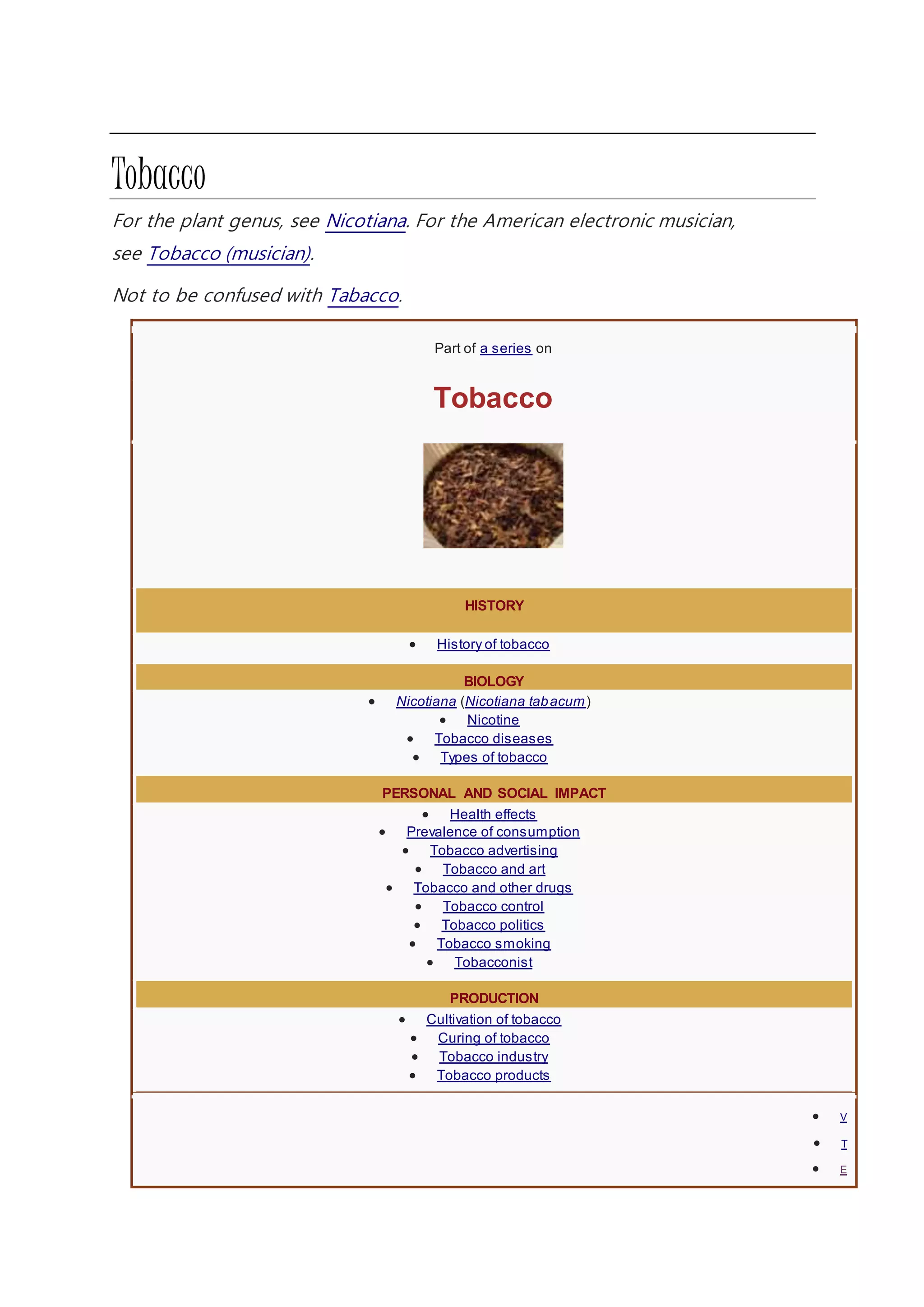
Part of a series on
Tobacco
HISTORY
 History of tobacco
BIOLOGY
 Nicotiana (Nicotiana tabacum)
 Nicotine
 Tobacco diseases
 Types of tobacco
PERSONAL AND SOCIAL IMPACT
 Health effects
 Prevalence of consumption
 Tobacco advertising
 Tobacco and art
 Tobacco and other drugs
 Tobacco control
 Tobacco politics
 Tobacco smoking
 Tobacconist
PRODUCTION
 Cultivation of tobacco
 Curing of tobacco
 Tobacco industry
 Tobacco products
 V
 T
 E
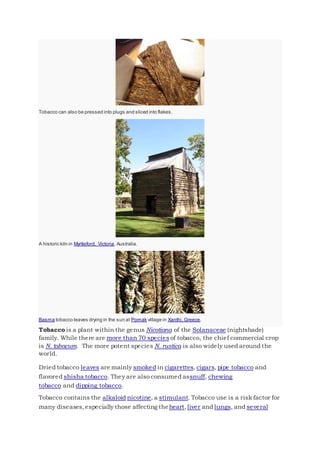
Tobacco can also be pressed into plugs and sliced into flakes.
A historic kiln in Myrtleford, Victoria, Australia.
Basma tobacco leaves drying in the sun at Pomak village in Xanthi, Greece.
Tobacco is a plant within the genus Nicotiana of the Solanaceae (nightshade)
family. While there are more than 70 species of tobacco, the chief commercial crop
is N. tabacum. The more potent species N. rustica is also widely used around the
world.
Dried tobacco leaves are mainly smoked in cigarettes, cigars, pipe tobacco and
flavored shisha tobacco. They are also consumed assnuff, chewing
tobacco and dipping tobacco.
Tobacco contains the alkaloid nicotine, a stimulant. Tobacco use is a risk factor for
many diseases,especially those affecting theheart,liver and lungs, and several
cancers. In 2008, the World Health Organization (WHO) named tobacco as the
world's single greatest cause of preventable death.[1]
Contents
 1 Etymology
 2 History
o 2.1 Traditional use
o 2.2 Popularization
o 2.3 Contemporary
 3 Biology
o 3.1 Nicotiana
o 3.2 Types
 4 Impact
o 4.1 Social
o 4.2 Demographic
o 4.3 Harmful effects of tobacco and smoking
 5 Economic
 6 Production
o 6.1 Cultivation
o 6.2 Curing
o 6.3 Consumption
o 6.4 Global production
o 6.4.1 Trends
o 6.4.2 Major producers
o 6.4.2.1 China
o 6.4.2.2 India
o 6.4.2.3 Brazil
o 6.4.3 Minor producer
 6.4.3.1 Philippines
 6.5 Problems in production
 6.5.1 Child labor
 6.5.2 Economy
 6.5.3 Environment
 6.6 Research
 6.7 Genetic modification
 6.7.1 Field trials
 6.7.2 Production
 6.8 Advertising
 6.9 Cinema
 7 Gallery
 8 References
 8.1 Notes
 8.2 Bibliography
 9 Further reading
 10 External links
Etymology
The English word tobacco originatesfrom the Spanish and Portugueseword tabaco. The precise origin of
the Spanish/Portugueseword is disputed but it generally thought to have originated, at least in part,
from Taino, the Arawakan languageof the Caribbean. In Taino, it was said to refer either to a roll of
tobacco leaves (according to BartolomĂŠde las Casas, 1552), or to the tabago, a kind of Y-shaped pipe for
sniffing tobacco smoke also known as snuff (according to Oviedo; with the leaves themselves being
referred to as cohiba).
However, similar words in Spanish, Portugueseand Italian were commonly used from 1410 to define
medicinal herbs which arebelieved to have originatedfrom the Arabic ‫بق‬ ‫ط‬ tabbaq, a word reportedly
dating to the 9th century, as the name of variousherbs.
History
Main article: History of tobacco
See also: History of commercial tobacco in the United States
William Michael Harnett (American, 1848-1892). Still Life with Three Castles Tobacco, 1880. Brooklyn
Museum
The earliest depiction of a European man smoking, from Tabacco byAnthony Chute.
Tobacco had already long been used in the Americas, with some cultivation sites in
Mexico dating back to 1400–1000 B.C.] Many Native American tribes have traditionally
grown and used tobacco as an entheogen. Eastern North American tribes carried large
amounts of tobacco in pouches as a readily accepted trade item, and often smoked it
in peace pipes, either in defined sacred ceremonies, or to seal a bargain.] They smoked
it at such occasions in all stages of life, even in childhood.] It is believed that tobacco is
a gift from the Creator, and that the exhaled tobacco smoke carries one's thoughts and
prayers to the Creator.
Popularization
An Illustration from Frederick William Fairholt's Tobacco,its History and Association,1859.
Following the arrival of the Europeans, tobacco became increasingly popular as a trade
item. Before the development of lighter Virginia and White Burley strains of tobacco,
the smoke was too harsh to be inhaled. Small quantities were smoked at a time, using
a pipe like themidwakh or kiseru or smoking newly invented waterpipes such as
the bong or the hookah (See Thuoc lao for a modern continuance of this practice).
Inhaling smoke was already common in India and China through the consumption
of cannabis and opium millennia before.
Tobacco fostered the economy for the southern United States until it was replaced by
cotton. Following the American civil war, a change in demand and a change in labor
force allowed inventor James Bonsack to create a machine that automated cigarette
production.This increase in production allowed tremendous growth in the tobacco
industry until the scientific revelations of the mid-20th century.
Contemporary
Following the scientific revelations of the mid-20th century, tobacco became condemned as
a health hazard, and eventually became encompassed as a cause for cancer, as well as other
respiratory and circulatory diseases. In the United States, this led to the Tobacco Master
Settlement Agreement (MSA), which settled the lawsuit in exchange for a combination of
yearly payments to the states and voluntary restrictions on advertising and marketing of
tobacco products.
In the 1970s, Brown & Williamson cross-bred a strain of tobacco to produce Y1. This strain
of tobacco contained an unusually high amount of nicotine, nearly doubling its content
from 3.2-3.5% to 6.5%. In the 1990s, this prompted the Food and Drug
Administration(FDA) to use this strain as evidence that tobacco companies were
intentionally manipulating the nicotine content of cigarettes.
In 2003, in response to growth of tobacco use in developing countries, the World Health
Organization (WHO) successfully rallied 168 countries to sign the Framework Convention
on Tobacco Control. The Convention is designed to push for effective legislation and its
enforcement in all countries to reduce the harmful effects of tobacco. This led to the
development of tobacco cessation products.
Nicotiana
Main article: Nicotiana
See also: List of tobacco diseases
Nicotine is the compound responsible for the addictive nature of Tobacco use.
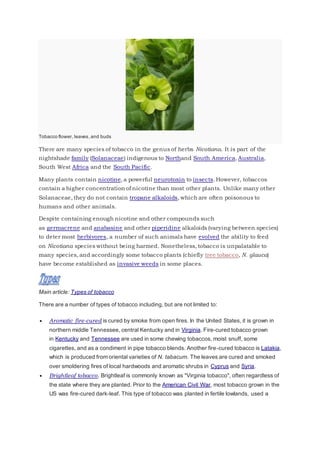
Tobacco flower, leaves,and buds
There are many species of tobacco in the genus of herbs Nicotiana. It is part of the
nightshade family (Solanaceae) indigenous to Northand South America, Australia,
South West Africa and the South Pacific.
Many plants contain nicotine, a powerful neurotoxin to insects. However, tobaccos
contain a higher concentration of nicotine than most other plants. Unlike many other
Solanaceae, they do not contain tropane alkaloids, which are often poisonous to
humans and other animals.
Despite containing enough nicotine and other compounds such
as germacrene and anabasine and other piperidine alkaloids (varying between species)
to deter most herbivores, a number of such animals have evolved the ability to feed
on Nicotiana species without being harmed. Nonetheless, tobacco is unpalatable to
many species, and accordingly some tobacco plants (chiefly tree tobacco, N. glauca)
have become established as invasive weeds in some places.
Main article: Types of tobacco
There are a number of types of tobacco including, but are not limited to:
 Aromatic fire-cured is cured by smoke from open fires. In the United States, it is grown in
northern middle Tennessee, central Kentucky and in Virginia. Fire-cured tobacco grown
in Kentucky and Tennessee are used in some chewing tobaccos, moist snuff, some
cigarettes, and as a condiment in pipe tobacco blends. Another fire-cured tobacco is Latakia,
which is produced from oriental varieties of N. tabacum. The leaves are cured and smoked
over smoldering fires of local hardwoods and aromatic shrubs in Cyprus and Syria.
 Brightleaf tobacco, Brightleaf is commonly known as "Virginia tobacco", often regardless of
the state where they are planted. Prior to the American Civil War, most tobacco grown in the
US was fire-cured dark-leaf. This type of tobacco was planted in fertile lowlands, used a
robust variety of leaf, and was either fire cured or air cured. Most Canadian cigarettes are
made from 100% pure Virginia tobacco.[11]
 Burley tobacco, is an air-cured tobacco used primarily for cigarette production. In the U.S.,
burley tobacco plants are started from palletized seeds placed in polystyrene trays floated on
a bed of fertilized water in March or April.
 Cavendish is more a process of curing and a method of cutting tobacco than a type. The
processing and the cut are used to bring out the natural sweet taste in the tobacco.
Cavendish can be produced from any tobacco type, but is usually one of, or a blend
of Kentucky, Virginia, and burley, and is most commonly used for pipe tobacco and cigars.
 Criollo tobacco is a type of tobacco, primarily used in the making of cigars. It was, by most
accounts, one of the original Cuban tobaccos that emerged around the time of Columbus.
 Dokha, is a tobacco originally grown in Iran, mixed with leaves, bark, and herbs for smoking
in a midwakh.
 Turkish tobacco, is a sun-cured, highly aromatic, small-leafed variety (Nicotiana tabacum)
that is grown in Turkey, Greece, Bulgaria, andMacedonia. Originally grown in regions
historically part of the Ottoman Empire, it is also known as "oriental". Many of the early
brands of cigarettes were made mostly or entirely of Turkish tobacco; today, its main use is
in blends of pipe and especially cigarette tobacco (a typical American cigarette is a blend of
bright Virginia, burley and Turkish).
 Perique, a farmer called Pierre Chenet is credited with first turning this local tobacco into the
Perique in 1824 through the technique of pressure-fermentation. Considered
thetruffle of pipe tobaccos, it is used as a component in many blended pipe tobaccos, but is
too strong to be smoked pure. At one time, the freshly moist Perique was also chewed, but
none is now sold for this purpose. It is typically blended with pure Virginia to lend spice,
strength, and coolness to the blend.
 Shade tobacco, is cultivated in Connecticut and Massachusetts. Early
Connecticut colonists acquired from the Native Americans the habit of smoking tobacco in
pipes, and began cultivating the plant commercially, even though the Puritans referred to it
as the "evil weed". The Connecticut shade industry has weathered some major catastrophes,
including a devastating hailstorm in 1929, and an epidemic of brown spot fungus in 2000, but
is now in danger of disappearing altogether, given the increase in the value of land.
 White burley, in 1865, George Webb of Brown County, Ohio planted red burley seeds he
had purchased, and found that a few of the seedlings had a whitish, sickly look. The air-
cured leaf was found to be more mild than other types of tobacco.
 Wild tobacco, is native to the southwestern United States, Mexico, and parts of South
America. Its botanical name is Nicotiana rustica.
 Y1 is a strain of tobacco cross-bred by Brown & Williamson in the 1970s to obtain an
unusually high nicotine content. In the 1990s, the United States Food and Drug
Administration (FDA) used it as evidence that tobacco companies were intentionally
manipulating the nicotine content of cigarettes.
Comparison ofthe perceived harm for various psychoactive drugs from a poll among medical psychiatrists
specialized in addiction treatment(published 2007).Tobacco is ranked the 3rd mostaddictive and 7th most
harmful of 20 commonlyused drugs.
According to the World Health Organization (WHO), tobacco is the single greatest cause
of preventable death globally. The WHO estimates that tobacco caused 5.4 million
deaths in 2004. and 100 million deaths over the course of the 20th century.[] Similarly,
the United States Centers for Disease Control and Prevention describes tobacco use as
"the single most important preventable risk to human health in developed countries
and an important cause of premature death worldwide."
The harms caused by using tobacco include diseases affecting the heart and lungs,
with smoking being a major risk factor for heart attacks, strokes, chronic obstructive
pulmonary disease (COPD), emphysema, and cancer (particularly lung cancer, cancers
of the larynx and mouth, and pancreatic cancers).
Inhaling secondhand tobacco smoke can cause lung cancer in nonsmoking adults. In
the United States, approximately 3,000 adults die each year due to lung cancer from
secondhand smoke exposure. Heart disease caused by secondhand smoke kills
approximately 46,000 nonsmokers every year.
The addictive alkaloid nicotine is a stimulant, and popularly known as the most
characteristic constituent of tobacco. Users may
develop tolerance and dependence. Harmful effects of tobacco consumption can further
derive from the thousands of different chemicals in the smoke, including polycyclic
aromatic hydrocarbons (such
as benzopyrene), formaldehyde, cadmium, nickel, arsenic,tobacco-specific
nitrosamines (TSNAs), phenols, and many others.
This section
requires expansionwith:
discussion ofthe impacton the
poor, taxation, and so
forth.(January 2009)
"Much of the disease burden and premature mortality
attributable to tobacco use disproportionately affect the
poor", and of the 1.22 billion smokers, 1 billion of them live
in developing or transitional economies.
In Indonesia, the lowest income group spends 15% of its
total expenditures on tobacco. In Egypt, more than 10% of
households expenditure in low-income homes is on tobacco.
The poorest 20% of households in Mexico spend 11% of
their income on tobacco.
This article needs additional
citations
for verification. Please
help improve this
article by adding citations to
reliable sources
Cultivation
Main article: Cultivation of tobacco
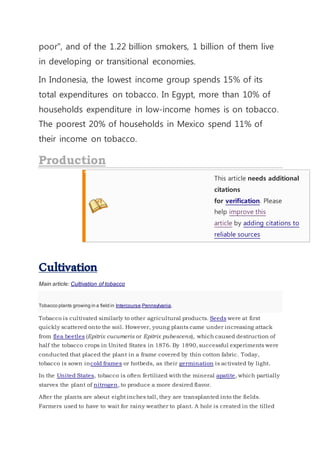
Tobacco plants growing in a field in Intercourse,Pennsylvania.
Tobacco is cultivated similarly to other agricultural products. Seeds were at first
quickly scattered onto the soil. However, young plants came under increasing attack
from flea beetles (Epitrix cucumeris or Epitrix pubescens), which caused destruction of
half the tobacco crops in United States in 1876. By 1890, successful experiments were
conducted that placed the plant in a frame covered by thin cotton fabric. Today,
tobacco is sown incold frames or hotbeds, as their germination is activated by light.
In the United States, tobacco is often fertilized with the mineral apatite, which partially
starves the plant of nitrogen, to produce a more desired flavor.
After the plants are about eight inches tall, they are transplanted into the fields.
Farmers used to have to wait for rainy weather to plant. A hole is created in the tilled
earth with a tobacco peg, either a curved wooden tool or deer antler. After making two
holes to the right and left, the planter would move forward two feet, select plants from
his/her bag, and repeat. Various mechanical tobacco planters like Bemis, New Idea
Setter, and New Holland Transplanter were invented in the late 19th and 20th
centuries to automate the process: making the hole, watering it, guiding the plant in —
all in one motion.
Tobacco is cultivated annually, and can be harvested in several ways. In the oldest
method still used today, the entire plant is harvested at once by cutting off the stalk at
the ground with a tobacco knife. It is then speared onto sticks, four to six plants a stick
and hung in a curing barn. In the 19th century, bright tobacco began to be harvested
by pulling individual leaves off the stalk as they ripened. The leaves ripen from the
ground upwards, so a field of tobacco harvested in this manner will involve the serial
harvest of a number of "primings," beginning with the volado leaves near the ground,
working to the seco leaves in the middle of the plant, and finishing with the
potent ligero leaves at the top. Before this the crop needs to be topped when the pink
flowers develop. Topping always refers to the removal of the tobacco flower before the
leaves are systematically removed and, eventually, entirely harvested. As the industrial
revolution took hold, harvesting wagons used to transport leaves were equipped with
man-powered stringers, an apparatus that used twine to attach leaves to a pole. In
modern times, large fields are harvested mechanically, although topping the flower and
in some cases the plucking of immature leaves is still done by hand. Most tobacco in
the U.S. is grown in North Carolina, Kentucky, and Virginia.
Curing
Main article: Curing of tobacco
Tobacco barn in Simsbury,Connecticut used for air curing of shade tobacco.
Sun-cured tobacco, Bastam,Iran.
Curing and subsequent aging allow for the slow oxidation and degradation
of carotenoids in tobacco leaf. This produces certain compounds in the tobacco leaves,
and gives a sweet hay, tea, rose oil, or fruity aromatic flavor that contributes to the
"smoothness" of the smoke. Starch is converted to sugar, which glycates protein, and is
oxidized into advanced glycation endproducts (AGEs), acaramelization process that also
adds flavor. Inhalation of these AGEs in tobacco smoke contributes
to atherosclerosis and cancer.[34]Levels of AGEs are dependent on the curing method
used.
Tobacco can be cured through several methods, including:
 Air cured tobacco is hung in well-ventilated barns and allowed to dry over a period of four to
eight weeks. Air-cured tobacco is low in sugar, which gives the tobacco smoke a light, mild
flavor, and high in nicotine. Cigar and burley tobaccos are 'Dark' air cured.
 Fire cured tobacco is hung in large barns where fires of hardwoods are kept on continuous
or intermittent low smoulder and takes between three days and ten weeks, depending on the
process and the tobacco. Fire curing produces a tobacco low in sugar and high in nicotine.
Pipe tobacco, chewing tobacco, and snuff are fire cured.
 Flue cured tobacco was originally strung onto tobacco sticks, which were hung from tier-
poles in curing barns (Aus: kilns, also traditionally called Oasts). These barns have flues run
from externally fed fire boxes, heat-curing the tobacco without exposing it to smoke, slowly
raising the temperature over the course of the curing. The process generally takes about a
week. This method produces cigarette tobacco that is high in sugar and has medium to high
levels of nicotine. Most cigarettes incorporate flue-cured tobacco, which produces a milder,
more inhalable smoke.
 Sun-cured tobacco dries uncovered in the sun. This method is used in Turkey, Greece and
other Mediterranean countries to produce oriental tobacco. Sun-cured tobacco is low in
sugar and nicotine and is used in cigarettes.
Consumption
Further information: Tobacco products
Tobacco is consumed in many forms and through a number of different methods. Below are
examples including, but not limited to, such forms and usage.
 Beedi are thin, often flavoured cigarettes from India made of tobacco wrapped in
a tendu leaf, and secured with coloured thread at one end.
 Chewing tobacco is the oldest way of consuming tobacco leaves. It is consumed orally, in
two forms: through sweetened strands, or in a shredded form. When consuming the long
sweetened strands, the tobacco is lightly chewed and compacted into a ball. When
consuming the shredded tobacco, small amounts are placed at the bottom lip, between the
gum and the teeth, where it is gently compacted, thus it can often be called dipping tobacco.
Both methods stimulate the saliva glands, which led to the development of the spittoon.
 Cigars are tightly rolled bundles of dried and fermented tobacco, which is ignited so its
smoke may be drawn into the smoker's mouth.
 Cigarettes are a product consumed through inhalation of smoke and manufactured from
cured and finely cut tobacco leaves and reconstituted tobacco, often combined with other
additives, then rolled into a paper cylinder.
 Creamy snuffs are tobacco paste, consisting of tobacco, clove oil, glycerin, spearmint,
menthol, and camphor, and sold in a toothpaste tube. It is marketed mainly to women
in India, and is known by the brand names Ipco (made by Asha Industries), Denobac,
Tona, Ganesh. It is locally known as "mishri" in some parts of Maharashtra.
 Dipping tobaccos are a form of smokeless tobacco. Dip is occasionally referred to as
"chew", and because of this, it is commonly confused with chewing tobacco, which
encompasses a wider range of products. A small clump of dip is 'pinched' out of the tin and
placed between the lower or upper lip and gums.
 Gutka is a preparation of crushed betel nut, tobacco, and sweet or savory flavorings. It is
manufactured in India and exported to a few other countries. A mild stimulant, it is sold
across India in small, individual-size packets.
 Hookah is a single or multi-stemmed (often glass-based) water pipe for smoking. Hookahs
were first used in India and Persia,[36]
the hookah has gained immense popularity, especially
in the Middle East. A hookah operates by water filtration and indirect heat. It can be used for
smoking herbal fruits or moassel, a mixture of tobacco, flavouring andhoney or glycerin.
 Kreteks are cigarettes made with a complex blend of tobacco, cloves and a flavoring
"sauce". It was first introduced in the 1880s in Kudus, Java, to deliver the
medicinaleugenol of cloves to the lungs.
 Roll-Your-Own, often called 'rollies' or 'roll-ups', are relatively popular in some European
countries. These are prepared from loose tobacco, cigarette papers and filters all bought
separately. They are usually cheaper to make.
 Pipe smoking typically consists of a small chamber (the bowl) for the combustion of the
tobacco to be smoked and a thin stem (shank) that ends in a mouthpiece (the bit). Shredded
pieces of tobacco are placed into the chamber and ignited.
 Snuff is a ground smokeless tobacco product, inhaled or "snuffed" through the nose. If
referring specifically to the orally consumed moist snuff see dipping tobacco.
 Snus is a steam-cured moist powder tobacco product that is not fermented, and does not
induce salivation. It is consumed by placing it in the mouth against the gums for an extended
period of time. It is a form of snuff used in a manner similar to American dipping tobacco, but
does not require regular spitting.
 Topical tobacco paste is sometimes used as a treatment for wasp, hornet, fire
ant, scorpion, and bee stings. An amount equivalent to the contents of a cigarette is mashed
in a cup with about a 0.5 to 1 teaspoon of water to make a paste that is then applied to the
affected area.
Tobacco water is a traditional organic insecticide used in domestic gardening. Tobacco dust
can be used similarly. It is produced by boiling strong tobacco in water, or by steeping the
tobacco in water for a longer period. When cooled, the mixture can be applied as a spray, or
'painted' on to the leaves of garden plants, where it kills insects. Tobacco is however banned
from use as pesticide in certified organic production.
Global production
Trends
Tobacco production in Portuguese Timor in the 1930s
Production of tobacco leaf increased by 40% between
1971, during which 4.2 million tons of leaf were
produced, and 1997, during which 5.9 million tons of
leaf were produced. According to the Food and
Agriculture organization of the UN, tobacco leaf
production was expected to hit 7.1 million tons by 2010.
This number is a bit lower than the record high
production of 1992, during which 7.5 million tons of leaf
were produced. The production growth was almost
entirely due to increased productivity by developing
nations, where production increased by 128%.] During
that same time period, production in developing
countries actually decreased. China’s increase in tobacco
production was the single biggest factor in the increase
in world production. China’s share of the world market
increased from 17% in 1971 to 47% in 1997. This growth
can be partially explained by the existence of a high
import tariff on foreign tobacco entering China. While
this tariff has been reduced from 64% in 1999 to 10% in
2004, it still has led to local, Chinese cigarettes being
preferred over foreign cigarettes because of their lower
cost.
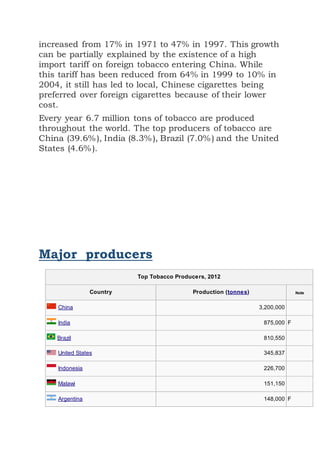
Every year 6.7 million tons of tobacco are produced
throughout the world. The top producers of tobacco are
China (39.6%), India (8.3%), Brazil (7.0%) and the United
States (4.6%).
Major producers
Top Tobacco Producers, 2012
Country Production (tonnes) Note
China 3,200,000
India 875,000 F
Brazil 810,550
United States 345,837
Indonesia 226,700
Malawi 151,150
Argentina 148,000 F
Tanzania 120,000
Zimbabwe 115,000 F
World 7,490,661.35 A
No note = official figure,F = FAO Estimate, A = Aggregate (may includeofficial, semiofficial or estimates).
Around the peak of global tobacco production there were 20 million rural Chinese
households producing tobacco on 2.1 million hectares of land. While it is the major crop
for millions of Chinese farmers, growing tobacco is not as profitable as cotton or sugar
cane. This is because the Chinese government sets the market price. While this price is
guaranteed, it is lower than the natural market price, because of the lack of market risk. To
further control tobacco in their borders, China founded aState Tobacco Monopoly
Administration (STMA) in 1982. STMA control tobacco production, marketing, imports and
exports and contributes 12% to the nation's national income. As noted above, despite the
income generated for the state by profits from state-owned tobacco companies and the
taxes paid by companies and retailers, China's government has acted to reduce tobacco use.
India's Tobacco Board is headquartered in Guntur in the state of Andhra
Pradesh. India has 96,865 registered tobacco farmers and many more who are not
registered. In 2010, there were 3,120 tobacco product manufacturing facilities in all of
India. Around 0.25% of India’s cultivated land is used for tobacco production.
Since 1947, the Indian Government has supported growth in the tobacco industry.
India has seven tobacco research centers, located in Madras (now known
as Chennai, Tamil Nadu), Andhra Pradesh, Punjab, Bihar, Mysore, West Bengal,
and Rajamundry. Rajahmundry houses the core research institute. The government
has set up a Central Tobacco Promotion Council, which works to increase exports of
Indian tobacco.
The Indian Government and several states have taken multiple measures to reduce
Cigarette smoking. Smoking in public places is banned in many states, it is not allowed
to be portrayed in movies, and warnings are posted on cigarette packs.
Brazil
In Brazil around 135,000 family farmers cite tobacco production as their main
economic activity.] Tobacco has never exceeded 0.7% of the country’s total cultivated
area. In the southern regions of Brazil, Virginia and Amarelinho flue-cured tobacco as
well as Burley and GalpĂŁo Comum air-cured tobacco are produced. These types of
tobacco are used for cigarettes. In the northeast, darker, air- and sun-cured tobacco is
grown. These types of tobacco are used for cigars, twists and dark-cigarettes. Brazil’s
government has made attempts to reduce the production of tobacco, but has not had a
successful systematic anti-tobacco farming initiative. Brazil’s government, however,
provides small loans for family farms, including those that grow tobacco, through
the Programa Nacional de Fortalecimento da Agricultura Familiar (PRONAF).
Minorproducer
Tobacco plantation, Pinar del RĂ­o,Cuba
 Philippines
Tobacco in the Philippines remained highly concentrated in 2009 and dominated by
cigarette manufacturers Fortune Tobacco Corporation and Philip Morris International.
The strength of these companies is due to their extensive distribution networks which
encompass both traditional and non-traditional retail channels as well as their ability
to offer their products at affordable prices. Top player Fortune Tobacco Corp
maintained its leadership position throughout the review period as mass market
cigarette smokers continued to purchase its economy cigarette brands, particularly
leading brand Fortune International.
Cigarette prices in the Philippines are low, with the price of Marlboro being the second
lowest for all ASEAN nations. The cigarette market has been dominated by menthol
brands for several decades, although non-menthol volume has been steadily improving
in recent years. La Suerte Cigar and Cigarette Company and the Fortune
Tobacco Corporation (FTC) have been the two leading producers, and have had
licensing agreements with PMI and RJ Reynolds (RJR) respectively. FTC commands a
67% market share, while La Suerte holds a 25% share.
Problems in production
Child labor
The International Labour Office reported that the most child-laborers work in
agriculture, which is one of the most hazardous types of work. The tobacco industry
houses some of these working children. There is widespread use of children on farms in
Argentina, Brazil, China, India, Indonesia, Malawi and Zimbabwe. While some of these
children work with their families on small family-owned farms, others work on large
plantations. In late 2009 reports were released by the London-based human-rights
group Plan International, claiming that child labor was common on Malawi (producer of
1.8% of the world’s tobacco) tobacco farms. The organization interviewed 44 teens, who
worked full-time on farms during the 2007-2008 growing season. The child-laborers
complained of low pay, long hours as well as physical and sexual abuse by their
supervisors. They also reported suffering from Green Tobacco Sickness, a form of
nicotine poisoning. When wet leaves are handled, nicotine from the leaves gets
absorbed in the skin and causes nausea, vomiting and dizziness. Children were
exposed to 50 cigarettes worth of nicotine through direct contact with tobacco leaves.
This level of nicotine in children can permanently alter brain structure and function.
Economy
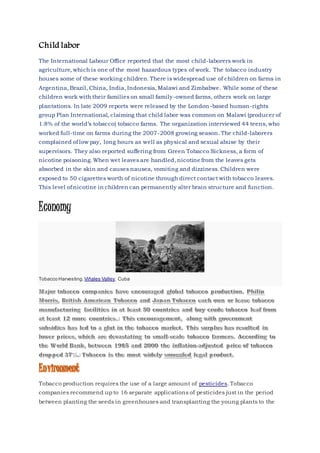
Tobacco Harvesting, ViĂąales Valley, Cuba
Tobacco production requires the use of a large amount of pesticides. Tobacco
companies recommend up to 16 separate applications of pesticides just in the period
between planting the seeds in greenhouses and transplanting the young plants to the
field. Pesticide use has been worsened by the desire to produce larger crops in less time
because of the decreasing market value of tobacco. Pesticides often harm tobacco
farmers because they are unaware of the health effects and the proper safety protocol
for working with pesticides. These pesticides, as well as fertilizers, end up in the soil,
waterways, and the food chain. Coupled with child labor, pesticides pose an even
greater threat. Early exposure to pesticides may increase a child's lifelong cancer risk
as well as harm his or her nervous and immune systems.
Tobacco is a crop that extracts nutrients, such
as phosphorus, nitrogen and potassium, from the soil more quickly than any other
major crop.] This leads to dependence on fertilizers.
Furthermore, the wood used to cure tobacco in some places leads to deforestation.
While some big tobacco producers such as China and the United States have access to
petroleum, coal and natural gas, which can be used as alternatives to wood, most
developing countries still rely on wood in the curing process] Brazil alone uses the wood
of 60 million trees per year for curing, packaging and rolling cigarettes.
Research
Several tobacco plants have been used as model organisms in genetics. Tobacco BY-2
cells, derived from N. tabacum cultivar 'Bright Yellow-2', are among the most important
research tools in plant cytology.[65] Tobacco has played a pioneering role
in callus culture research and the elucidation of the mechanism by
which kinetin works, laying the groundwork for modern agricultural biotechnology. The
first genetically modified plant was produced in 1982, using Agrobacterium
tumefaciens to create an antibiotic-resistant tobacco plant. This research laid the
groundwork for all genetically modified crops.

Akash bio project ON TOBACCO

  • 1.
    Tobacco For the plantgenus, see Nicotiana. For the American electronic musician, see Tobacco (musician). Not to be confused with Tabacco. Part of a series on Tobacco HISTORY  History of tobacco BIOLOGY  Nicotiana (Nicotiana tabacum)  Nicotine  Tobacco diseases  Types of tobacco PERSONAL AND SOCIAL IMPACT  Health effects  Prevalence of consumption  Tobacco advertising  Tobacco and art  Tobacco and other drugs  Tobacco control  Tobacco politics  Tobacco smoking  Tobacconist PRODUCTION  Cultivation of tobacco  Curing of tobacco  Tobacco industry  Tobacco products  V  T  E
  • 2.
    Tobacco can alsobe pressed into plugs and sliced into flakes. A historic kiln in Myrtleford, Victoria, Australia. Basma tobacco leaves drying in the sun at Pomak village in Xanthi, Greece. Tobacco is a plant within the genus Nicotiana of the Solanaceae (nightshade) family. While there are more than 70 species of tobacco, the chief commercial crop is N. tabacum. The more potent species N. rustica is also widely used around the world. Dried tobacco leaves are mainly smoked in cigarettes, cigars, pipe tobacco and flavored shisha tobacco. They are also consumed assnuff, chewing tobacco and dipping tobacco. Tobacco contains the alkaloid nicotine, a stimulant. Tobacco use is a risk factor for many diseases,especially those affecting theheart,liver and lungs, and several
  • 3.
    cancers. In 2008,the World Health Organization (WHO) named tobacco as the world's single greatest cause of preventable death.[1] Contents  1 Etymology  2 History o 2.1 Traditional use o 2.2 Popularization o 2.3 Contemporary  3 Biology o 3.1 Nicotiana o 3.2 Types  4 Impact o 4.1 Social o 4.2 Demographic o 4.3 Harmful effects of tobacco and smoking  5 Economic  6 Production o 6.1 Cultivation o 6.2 Curing o 6.3 Consumption o 6.4 Global production o 6.4.1 Trends o 6.4.2 Major producers o 6.4.2.1 China o 6.4.2.2 India o 6.4.2.3 Brazil o 6.4.3 Minor producer  6.4.3.1 Philippines  6.5 Problems in production  6.5.1 Child labor  6.5.2 Economy  6.5.3 Environment  6.6 Research
  • 4.
     6.7 Geneticmodification  6.7.1 Field trials  6.7.2 Production  6.8 Advertising  6.9 Cinema  7 Gallery  8 References  8.1 Notes  8.2 Bibliography  9 Further reading  10 External links Etymology The English word tobacco originatesfrom the Spanish and Portugueseword tabaco. The precise origin of the Spanish/Portugueseword is disputed but it generally thought to have originated, at least in part, from Taino, the Arawakan languageof the Caribbean. In Taino, it was said to refer either to a roll of tobacco leaves (according to Bartoloméde las Casas, 1552), or to the tabago, a kind of Y-shaped pipe for sniffing tobacco smoke also known as snuff (according to Oviedo; with the leaves themselves being referred to as cohiba). However, similar words in Spanish, Portugueseand Italian were commonly used from 1410 to define medicinal herbs which arebelieved to have originatedfrom the Arabic ‫بق‬ ‫ط‬ tabbaq, a word reportedly dating to the 9th century, as the name of variousherbs. History Main article: History of tobacco See also: History of commercial tobacco in the United States William Michael Harnett (American, 1848-1892). Still Life with Three Castles Tobacco, 1880. Brooklyn Museum
  • 5.
    The earliest depictionof a European man smoking, from Tabacco byAnthony Chute. Tobacco had already long been used in the Americas, with some cultivation sites in Mexico dating back to 1400–1000 B.C.] Many Native American tribes have traditionally grown and used tobacco as an entheogen. Eastern North American tribes carried large amounts of tobacco in pouches as a readily accepted trade item, and often smoked it in peace pipes, either in defined sacred ceremonies, or to seal a bargain.] They smoked it at such occasions in all stages of life, even in childhood.] It is believed that tobacco is a gift from the Creator, and that the exhaled tobacco smoke carries one's thoughts and prayers to the Creator. Popularization An Illustration from Frederick William Fairholt's Tobacco,its History and Association,1859. Following the arrival of the Europeans, tobacco became increasingly popular as a trade item. Before the development of lighter Virginia and White Burley strains of tobacco, the smoke was too harsh to be inhaled. Small quantities were smoked at a time, using a pipe like themidwakh or kiseru or smoking newly invented waterpipes such as the bong or the hookah (See Thuoc lao for a modern continuance of this practice). Inhaling smoke was already common in India and China through the consumption of cannabis and opium millennia before. Tobacco fostered the economy for the southern United States until it was replaced by cotton. Following the American civil war, a change in demand and a change in labor force allowed inventor James Bonsack to create a machine that automated cigarette
  • 6.
    production.This increase inproduction allowed tremendous growth in the tobacco industry until the scientific revelations of the mid-20th century. Contemporary Following the scientific revelations of the mid-20th century, tobacco became condemned as a health hazard, and eventually became encompassed as a cause for cancer, as well as other respiratory and circulatory diseases. In the United States, this led to the Tobacco Master Settlement Agreement (MSA), which settled the lawsuit in exchange for a combination of yearly payments to the states and voluntary restrictions on advertising and marketing of tobacco products. In the 1970s, Brown & Williamson cross-bred a strain of tobacco to produce Y1. This strain of tobacco contained an unusually high amount of nicotine, nearly doubling its content from 3.2-3.5% to 6.5%. In the 1990s, this prompted the Food and Drug Administration(FDA) to use this strain as evidence that tobacco companies were intentionally manipulating the nicotine content of cigarettes. In 2003, in response to growth of tobacco use in developing countries, the World Health Organization (WHO) successfully rallied 168 countries to sign the Framework Convention on Tobacco Control. The Convention is designed to push for effective legislation and its enforcement in all countries to reduce the harmful effects of tobacco. This led to the development of tobacco cessation products. Nicotiana Main article: Nicotiana See also: List of tobacco diseases Nicotine is the compound responsible for the addictive nature of Tobacco use.
  • 7.
    Tobacco flower, leaves,andbuds There are many species of tobacco in the genus of herbs Nicotiana. It is part of the nightshade family (Solanaceae) indigenous to Northand South America, Australia, South West Africa and the South Pacific. Many plants contain nicotine, a powerful neurotoxin to insects. However, tobaccos contain a higher concentration of nicotine than most other plants. Unlike many other Solanaceae, they do not contain tropane alkaloids, which are often poisonous to humans and other animals. Despite containing enough nicotine and other compounds such as germacrene and anabasine and other piperidine alkaloids (varying between species) to deter most herbivores, a number of such animals have evolved the ability to feed on Nicotiana species without being harmed. Nonetheless, tobacco is unpalatable to many species, and accordingly some tobacco plants (chiefly tree tobacco, N. glauca) have become established as invasive weeds in some places. Main article: Types of tobacco There are a number of types of tobacco including, but are not limited to:  Aromatic fire-cured is cured by smoke from open fires. In the United States, it is grown in northern middle Tennessee, central Kentucky and in Virginia. Fire-cured tobacco grown in Kentucky and Tennessee are used in some chewing tobaccos, moist snuff, some cigarettes, and as a condiment in pipe tobacco blends. Another fire-cured tobacco is Latakia, which is produced from oriental varieties of N. tabacum. The leaves are cured and smoked over smoldering fires of local hardwoods and aromatic shrubs in Cyprus and Syria.  Brightleaf tobacco, Brightleaf is commonly known as "Virginia tobacco", often regardless of the state where they are planted. Prior to the American Civil War, most tobacco grown in the US was fire-cured dark-leaf. This type of tobacco was planted in fertile lowlands, used a
  • 8.
    robust variety ofleaf, and was either fire cured or air cured. Most Canadian cigarettes are made from 100% pure Virginia tobacco.[11]  Burley tobacco, is an air-cured tobacco used primarily for cigarette production. In the U.S., burley tobacco plants are started from palletized seeds placed in polystyrene trays floated on a bed of fertilized water in March or April.  Cavendish is more a process of curing and a method of cutting tobacco than a type. The processing and the cut are used to bring out the natural sweet taste in the tobacco. Cavendish can be produced from any tobacco type, but is usually one of, or a blend of Kentucky, Virginia, and burley, and is most commonly used for pipe tobacco and cigars.  Criollo tobacco is a type of tobacco, primarily used in the making of cigars. It was, by most accounts, one of the original Cuban tobaccos that emerged around the time of Columbus.  Dokha, is a tobacco originally grown in Iran, mixed with leaves, bark, and herbs for smoking in a midwakh.  Turkish tobacco, is a sun-cured, highly aromatic, small-leafed variety (Nicotiana tabacum) that is grown in Turkey, Greece, Bulgaria, andMacedonia. Originally grown in regions historically part of the Ottoman Empire, it is also known as "oriental". Many of the early brands of cigarettes were made mostly or entirely of Turkish tobacco; today, its main use is in blends of pipe and especially cigarette tobacco (a typical American cigarette is a blend of bright Virginia, burley and Turkish).  Perique, a farmer called Pierre Chenet is credited with first turning this local tobacco into the Perique in 1824 through the technique of pressure-fermentation. Considered thetruffle of pipe tobaccos, it is used as a component in many blended pipe tobaccos, but is too strong to be smoked pure. At one time, the freshly moist Perique was also chewed, but none is now sold for this purpose. It is typically blended with pure Virginia to lend spice, strength, and coolness to the blend.  Shade tobacco, is cultivated in Connecticut and Massachusetts. Early Connecticut colonists acquired from the Native Americans the habit of smoking tobacco in pipes, and began cultivating the plant commercially, even though the Puritans referred to it as the "evil weed". The Connecticut shade industry has weathered some major catastrophes, including a devastating hailstorm in 1929, and an epidemic of brown spot fungus in 2000, but is now in danger of disappearing altogether, given the increase in the value of land.  White burley, in 1865, George Webb of Brown County, Ohio planted red burley seeds he had purchased, and found that a few of the seedlings had a whitish, sickly look. The air- cured leaf was found to be more mild than other types of tobacco.  Wild tobacco, is native to the southwestern United States, Mexico, and parts of South America. Its botanical name is Nicotiana rustica.  Y1 is a strain of tobacco cross-bred by Brown & Williamson in the 1970s to obtain an unusually high nicotine content. In the 1990s, the United States Food and Drug Administration (FDA) used it as evidence that tobacco companies were intentionally manipulating the nicotine content of cigarettes.
  • 9.
    Comparison ofthe perceivedharm for various psychoactive drugs from a poll among medical psychiatrists specialized in addiction treatment(published 2007).Tobacco is ranked the 3rd mostaddictive and 7th most harmful of 20 commonlyused drugs. According to the World Health Organization (WHO), tobacco is the single greatest cause of preventable death globally. The WHO estimates that tobacco caused 5.4 million deaths in 2004. and 100 million deaths over the course of the 20th century.[] Similarly, the United States Centers for Disease Control and Prevention describes tobacco use as "the single most important preventable risk to human health in developed countries and an important cause of premature death worldwide." The harms caused by using tobacco include diseases affecting the heart and lungs, with smoking being a major risk factor for heart attacks, strokes, chronic obstructive pulmonary disease (COPD), emphysema, and cancer (particularly lung cancer, cancers of the larynx and mouth, and pancreatic cancers). Inhaling secondhand tobacco smoke can cause lung cancer in nonsmoking adults. In the United States, approximately 3,000 adults die each year due to lung cancer from secondhand smoke exposure. Heart disease caused by secondhand smoke kills approximately 46,000 nonsmokers every year. The addictive alkaloid nicotine is a stimulant, and popularly known as the most characteristic constituent of tobacco. Users may develop tolerance and dependence. Harmful effects of tobacco consumption can further derive from the thousands of different chemicals in the smoke, including polycyclic aromatic hydrocarbons (such as benzopyrene), formaldehyde, cadmium, nickel, arsenic,tobacco-specific nitrosamines (TSNAs), phenols, and many others. This section requires expansionwith: discussion ofthe impacton the poor, taxation, and so forth.(January 2009) "Much of the disease burden and premature mortality attributable to tobacco use disproportionately affect the
  • 10.
    poor", and ofthe 1.22 billion smokers, 1 billion of them live in developing or transitional economies. In Indonesia, the lowest income group spends 15% of its total expenditures on tobacco. In Egypt, more than 10% of households expenditure in low-income homes is on tobacco. The poorest 20% of households in Mexico spend 11% of their income on tobacco. This article needs additional citations for verification. Please help improve this article by adding citations to reliable sources Cultivation Main article: Cultivation of tobacco Tobacco plants growing in a field in Intercourse,Pennsylvania. Tobacco is cultivated similarly to other agricultural products. Seeds were at first quickly scattered onto the soil. However, young plants came under increasing attack from flea beetles (Epitrix cucumeris or Epitrix pubescens), which caused destruction of half the tobacco crops in United States in 1876. By 1890, successful experiments were conducted that placed the plant in a frame covered by thin cotton fabric. Today, tobacco is sown incold frames or hotbeds, as their germination is activated by light. In the United States, tobacco is often fertilized with the mineral apatite, which partially starves the plant of nitrogen, to produce a more desired flavor. After the plants are about eight inches tall, they are transplanted into the fields. Farmers used to have to wait for rainy weather to plant. A hole is created in the tilled
  • 11.
    earth with atobacco peg, either a curved wooden tool or deer antler. After making two holes to the right and left, the planter would move forward two feet, select plants from his/her bag, and repeat. Various mechanical tobacco planters like Bemis, New Idea Setter, and New Holland Transplanter were invented in the late 19th and 20th centuries to automate the process: making the hole, watering it, guiding the plant in — all in one motion. Tobacco is cultivated annually, and can be harvested in several ways. In the oldest method still used today, the entire plant is harvested at once by cutting off the stalk at the ground with a tobacco knife. It is then speared onto sticks, four to six plants a stick and hung in a curing barn. In the 19th century, bright tobacco began to be harvested by pulling individual leaves off the stalk as they ripened. The leaves ripen from the ground upwards, so a field of tobacco harvested in this manner will involve the serial harvest of a number of "primings," beginning with the volado leaves near the ground, working to the seco leaves in the middle of the plant, and finishing with the potent ligero leaves at the top. Before this the crop needs to be topped when the pink flowers develop. Topping always refers to the removal of the tobacco flower before the leaves are systematically removed and, eventually, entirely harvested. As the industrial revolution took hold, harvesting wagons used to transport leaves were equipped with man-powered stringers, an apparatus that used twine to attach leaves to a pole. In modern times, large fields are harvested mechanically, although topping the flower and in some cases the plucking of immature leaves is still done by hand. Most tobacco in the U.S. is grown in North Carolina, Kentucky, and Virginia. Curing Main article: Curing of tobacco Tobacco barn in Simsbury,Connecticut used for air curing of shade tobacco.
  • 12.
    Sun-cured tobacco, Bastam,Iran. Curingand subsequent aging allow for the slow oxidation and degradation of carotenoids in tobacco leaf. This produces certain compounds in the tobacco leaves, and gives a sweet hay, tea, rose oil, or fruity aromatic flavor that contributes to the "smoothness" of the smoke. Starch is converted to sugar, which glycates protein, and is oxidized into advanced glycation endproducts (AGEs), acaramelization process that also adds flavor. Inhalation of these AGEs in tobacco smoke contributes to atherosclerosis and cancer.[34]Levels of AGEs are dependent on the curing method used. Tobacco can be cured through several methods, including:  Air cured tobacco is hung in well-ventilated barns and allowed to dry over a period of four to eight weeks. Air-cured tobacco is low in sugar, which gives the tobacco smoke a light, mild flavor, and high in nicotine. Cigar and burley tobaccos are 'Dark' air cured.  Fire cured tobacco is hung in large barns where fires of hardwoods are kept on continuous or intermittent low smoulder and takes between three days and ten weeks, depending on the process and the tobacco. Fire curing produces a tobacco low in sugar and high in nicotine. Pipe tobacco, chewing tobacco, and snuff are fire cured.  Flue cured tobacco was originally strung onto tobacco sticks, which were hung from tier- poles in curing barns (Aus: kilns, also traditionally called Oasts). These barns have flues run from externally fed fire boxes, heat-curing the tobacco without exposing it to smoke, slowly raising the temperature over the course of the curing. The process generally takes about a week. This method produces cigarette tobacco that is high in sugar and has medium to high levels of nicotine. Most cigarettes incorporate flue-cured tobacco, which produces a milder, more inhalable smoke.  Sun-cured tobacco dries uncovered in the sun. This method is used in Turkey, Greece and other Mediterranean countries to produce oriental tobacco. Sun-cured tobacco is low in sugar and nicotine and is used in cigarettes. Consumption Further information: Tobacco products Tobacco is consumed in many forms and through a number of different methods. Below are examples including, but not limited to, such forms and usage.  Beedi are thin, often flavoured cigarettes from India made of tobacco wrapped in a tendu leaf, and secured with coloured thread at one end.  Chewing tobacco is the oldest way of consuming tobacco leaves. It is consumed orally, in two forms: through sweetened strands, or in a shredded form. When consuming the long sweetened strands, the tobacco is lightly chewed and compacted into a ball. When consuming the shredded tobacco, small amounts are placed at the bottom lip, between the
  • 13.
    gum and theteeth, where it is gently compacted, thus it can often be called dipping tobacco. Both methods stimulate the saliva glands, which led to the development of the spittoon.  Cigars are tightly rolled bundles of dried and fermented tobacco, which is ignited so its smoke may be drawn into the smoker's mouth.  Cigarettes are a product consumed through inhalation of smoke and manufactured from cured and finely cut tobacco leaves and reconstituted tobacco, often combined with other additives, then rolled into a paper cylinder.  Creamy snuffs are tobacco paste, consisting of tobacco, clove oil, glycerin, spearmint, menthol, and camphor, and sold in a toothpaste tube. It is marketed mainly to women in India, and is known by the brand names Ipco (made by Asha Industries), Denobac, Tona, Ganesh. It is locally known as "mishri" in some parts of Maharashtra.  Dipping tobaccos are a form of smokeless tobacco. Dip is occasionally referred to as "chew", and because of this, it is commonly confused with chewing tobacco, which encompasses a wider range of products. A small clump of dip is 'pinched' out of the tin and placed between the lower or upper lip and gums.  Gutka is a preparation of crushed betel nut, tobacco, and sweet or savory flavorings. It is manufactured in India and exported to a few other countries. A mild stimulant, it is sold across India in small, individual-size packets.  Hookah is a single or multi-stemmed (often glass-based) water pipe for smoking. Hookahs were first used in India and Persia,[36] the hookah has gained immense popularity, especially in the Middle East. A hookah operates by water filtration and indirect heat. It can be used for smoking herbal fruits or moassel, a mixture of tobacco, flavouring andhoney or glycerin.  Kreteks are cigarettes made with a complex blend of tobacco, cloves and a flavoring "sauce". It was first introduced in the 1880s in Kudus, Java, to deliver the medicinaleugenol of cloves to the lungs.  Roll-Your-Own, often called 'rollies' or 'roll-ups', are relatively popular in some European countries. These are prepared from loose tobacco, cigarette papers and filters all bought separately. They are usually cheaper to make.  Pipe smoking typically consists of a small chamber (the bowl) for the combustion of the tobacco to be smoked and a thin stem (shank) that ends in a mouthpiece (the bit). Shredded pieces of tobacco are placed into the chamber and ignited.  Snuff is a ground smokeless tobacco product, inhaled or "snuffed" through the nose. If referring specifically to the orally consumed moist snuff see dipping tobacco.  Snus is a steam-cured moist powder tobacco product that is not fermented, and does not induce salivation. It is consumed by placing it in the mouth against the gums for an extended period of time. It is a form of snuff used in a manner similar to American dipping tobacco, but does not require regular spitting.  Topical tobacco paste is sometimes used as a treatment for wasp, hornet, fire ant, scorpion, and bee stings. An amount equivalent to the contents of a cigarette is mashed
  • 14.
    in a cupwith about a 0.5 to 1 teaspoon of water to make a paste that is then applied to the affected area. Tobacco water is a traditional organic insecticide used in domestic gardening. Tobacco dust can be used similarly. It is produced by boiling strong tobacco in water, or by steeping the tobacco in water for a longer period. When cooled, the mixture can be applied as a spray, or 'painted' on to the leaves of garden plants, where it kills insects. Tobacco is however banned from use as pesticide in certified organic production. Global production Trends Tobacco production in Portuguese Timor in the 1930s Production of tobacco leaf increased by 40% between 1971, during which 4.2 million tons of leaf were produced, and 1997, during which 5.9 million tons of leaf were produced. According to the Food and Agriculture organization of the UN, tobacco leaf production was expected to hit 7.1 million tons by 2010. This number is a bit lower than the record high production of 1992, during which 7.5 million tons of leaf were produced. The production growth was almost entirely due to increased productivity by developing nations, where production increased by 128%.] During that same time period, production in developing countries actually decreased. China’s increase in tobacco production was the single biggest factor in the increase in world production. China’s share of the world market
  • 15.
    increased from 17%in 1971 to 47% in 1997. This growth can be partially explained by the existence of a high import tariff on foreign tobacco entering China. While this tariff has been reduced from 64% in 1999 to 10% in 2004, it still has led to local, Chinese cigarettes being preferred over foreign cigarettes because of their lower cost. Every year 6.7 million tons of tobacco are produced throughout the world. The top producers of tobacco are China (39.6%), India (8.3%), Brazil (7.0%) and the United States (4.6%). Major producers Top Tobacco Producers, 2012 Country Production (tonnes) Note China 3,200,000 India 875,000 F Brazil 810,550 United States 345,837 Indonesia 226,700 Malawi 151,150 Argentina 148,000 F
  • 16.
    Tanzania 120,000 Zimbabwe 115,000F World 7,490,661.35 A No note = official figure,F = FAO Estimate, A = Aggregate (may includeofficial, semiofficial or estimates). Around the peak of global tobacco production there were 20 million rural Chinese households producing tobacco on 2.1 million hectares of land. While it is the major crop for millions of Chinese farmers, growing tobacco is not as profitable as cotton or sugar cane. This is because the Chinese government sets the market price. While this price is guaranteed, it is lower than the natural market price, because of the lack of market risk. To further control tobacco in their borders, China founded aState Tobacco Monopoly Administration (STMA) in 1982. STMA control tobacco production, marketing, imports and exports and contributes 12% to the nation's national income. As noted above, despite the income generated for the state by profits from state-owned tobacco companies and the taxes paid by companies and retailers, China's government has acted to reduce tobacco use. India's Tobacco Board is headquartered in Guntur in the state of Andhra Pradesh. India has 96,865 registered tobacco farmers and many more who are not registered. In 2010, there were 3,120 tobacco product manufacturing facilities in all of India. Around 0.25% of India’s cultivated land is used for tobacco production. Since 1947, the Indian Government has supported growth in the tobacco industry. India has seven tobacco research centers, located in Madras (now known as Chennai, Tamil Nadu), Andhra Pradesh, Punjab, Bihar, Mysore, West Bengal, and Rajamundry. Rajahmundry houses the core research institute. The government has set up a Central Tobacco Promotion Council, which works to increase exports of Indian tobacco. The Indian Government and several states have taken multiple measures to reduce Cigarette smoking. Smoking in public places is banned in many states, it is not allowed to be portrayed in movies, and warnings are posted on cigarette packs. Brazil
  • 17.
    In Brazil around135,000 family farmers cite tobacco production as their main economic activity.] Tobacco has never exceeded 0.7% of the country’s total cultivated area. In the southern regions of Brazil, Virginia and Amarelinho flue-cured tobacco as well as Burley and Galpão Comum air-cured tobacco are produced. These types of tobacco are used for cigarettes. In the northeast, darker, air- and sun-cured tobacco is grown. These types of tobacco are used for cigars, twists and dark-cigarettes. Brazil’s government has made attempts to reduce the production of tobacco, but has not had a successful systematic anti-tobacco farming initiative. Brazil’s government, however, provides small loans for family farms, including those that grow tobacco, through the Programa Nacional de Fortalecimento da Agricultura Familiar (PRONAF). Minorproducer Tobacco plantation, Pinar del Río,Cuba  Philippines Tobacco in the Philippines remained highly concentrated in 2009 and dominated by cigarette manufacturers Fortune Tobacco Corporation and Philip Morris International. The strength of these companies is due to their extensive distribution networks which encompass both traditional and non-traditional retail channels as well as their ability to offer their products at affordable prices. Top player Fortune Tobacco Corp maintained its leadership position throughout the review period as mass market cigarette smokers continued to purchase its economy cigarette brands, particularly leading brand Fortune International. Cigarette prices in the Philippines are low, with the price of Marlboro being the second lowest for all ASEAN nations. The cigarette market has been dominated by menthol brands for several decades, although non-menthol volume has been steadily improving in recent years. La Suerte Cigar and Cigarette Company and the Fortune Tobacco Corporation (FTC) have been the two leading producers, and have had licensing agreements with PMI and RJ Reynolds (RJR) respectively. FTC commands a 67% market share, while La Suerte holds a 25% share. Problems in production
  • 18.
    Child labor The InternationalLabour Office reported that the most child-laborers work in agriculture, which is one of the most hazardous types of work. The tobacco industry houses some of these working children. There is widespread use of children on farms in Argentina, Brazil, China, India, Indonesia, Malawi and Zimbabwe. While some of these children work with their families on small family-owned farms, others work on large plantations. In late 2009 reports were released by the London-based human-rights group Plan International, claiming that child labor was common on Malawi (producer of 1.8% of the world’s tobacco) tobacco farms. The organization interviewed 44 teens, who worked full-time on farms during the 2007-2008 growing season. The child-laborers complained of low pay, long hours as well as physical and sexual abuse by their supervisors. They also reported suffering from Green Tobacco Sickness, a form of nicotine poisoning. When wet leaves are handled, nicotine from the leaves gets absorbed in the skin and causes nausea, vomiting and dizziness. Children were exposed to 50 cigarettes worth of nicotine through direct contact with tobacco leaves. This level of nicotine in children can permanently alter brain structure and function. Economy Tobacco Harvesting, Viñales Valley, Cuba Tobacco production requires the use of a large amount of pesticides. Tobacco companies recommend up to 16 separate applications of pesticides just in the period between planting the seeds in greenhouses and transplanting the young plants to the
  • 19.
    field. Pesticide usehas been worsened by the desire to produce larger crops in less time because of the decreasing market value of tobacco. Pesticides often harm tobacco farmers because they are unaware of the health effects and the proper safety protocol for working with pesticides. These pesticides, as well as fertilizers, end up in the soil, waterways, and the food chain. Coupled with child labor, pesticides pose an even greater threat. Early exposure to pesticides may increase a child's lifelong cancer risk as well as harm his or her nervous and immune systems. Tobacco is a crop that extracts nutrients, such as phosphorus, nitrogen and potassium, from the soil more quickly than any other major crop.] This leads to dependence on fertilizers. Furthermore, the wood used to cure tobacco in some places leads to deforestation. While some big tobacco producers such as China and the United States have access to petroleum, coal and natural gas, which can be used as alternatives to wood, most developing countries still rely on wood in the curing process] Brazil alone uses the wood of 60 million trees per year for curing, packaging and rolling cigarettes. Research Several tobacco plants have been used as model organisms in genetics. Tobacco BY-2 cells, derived from N. tabacum cultivar 'Bright Yellow-2', are among the most important research tools in plant cytology.[65] Tobacco has played a pioneering role in callus culture research and the elucidation of the mechanism by which kinetin works, laying the groundwork for modern agricultural biotechnology. The first genetically modified plant was produced in 1982, using Agrobacterium tumefaciens to create an antibiotic-resistant tobacco plant. This research laid the groundwork for all genetically modified crops.