Ā© 2006 Prentice Hall Business Publishing Accounting Information Systems, 10/e Romney/Steinbart 1 of 43
C HAPTER 1
Accounting Information
Systems:
An Overview
Ā© 2006 Prentice Hall Business Publishing Accounting Information Systems, 10/e Romney/Steinbart 2 of 43
INTRODUCTION
• Questions to be addressed in this chapter
include:
– What is the meaning of system, data, and
information?
– What is an accounting information system (AIS)?
– Why is the AIS an important topic to study?
– What is the role of the AIS in the value chain?
– How does the AIS provide information for decision
making?
– What are the basic strategies and strategic positions
an organization can pursue?
Ā© 2006 Prentice Hall Business Publishing Accounting Information Systems, 10/e Romney/Steinbart 3 of 43
SYSTEMS, DATA, AND INFORMATION
• A system is:
– A set of interrelated components
– That interact
– To achieve a goal
• Most systems are composed of smaller
subsystems . . .
• . . . And vice versa!
Ā© 2006 Prentice Hall Business Publishing Accounting Information Systems, 10/e Romney/Steinbart 4 of 43
SYSTEMS, DATA, AND INFORMATION
• Every organization has goals.
– The sub systems should be designed to
maximize achievement of the organization’s
goals
– EXAMPLE: The production department (a
subsystem) of a company might have to
forego its goal of staying within its budget in
order to meet the organization’s goal of
delivering product on time.
Ā© 2006 Prentice Hall Business Publishing Accounting Information Systems, 10/e Romney/Steinbart 5 of 43
SYSTEMS, DATA, AND INFORMATION
• Goal conflict occurs when the activity of a
subsystem is not consistent with another
subsystem or with the larger system.
• Goal congruence occurs when the
subsystem’s goals are in line with the
organization’s goals.
• The larger and more complicated a
system, the more difficult it is to achieve
goal congruence.
Ā© 2006 Prentice Hall Business Publishing Accounting Information Systems, 10/e Romney/Steinbart 6 of 43
SYSTEMS, DATA, AND INFORMATION
• Data are facts that are collected, recorded,
stored, and processed by an information system.
• Organizations collect data about:
– Events that occur
– Resources that are affected by those events
– Agents who participate in the events
• Information is data that have been organized
and processed to provide meaning to a user.
• Usually, more information and better information
translates into better decisions.
Ā© 2006 Prentice Hall Business Publishing Accounting Information Systems, 10/e Romney/Steinbart 7 of 43
SYSTEMS, DATA, AND INFORMATION
• However, when you get more information
than you can effectively assimilate, you
suffer from information overload.
– Example: Final exams week!
• When you’ve reached the overload point,
the quality of decisions declines while the
costs of producing the information
increases.
Ā© 2006 Prentice Hall Business Publishing Accounting Information Systems, 10/e Romney/Steinbart 8 of 43
SYSTEMS, DATA, AND INFORMATION
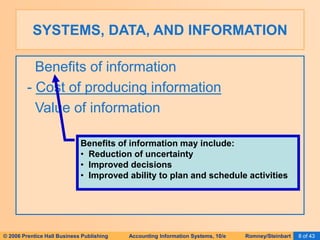
Benefits of information
- Cost of producing information
Value of information
Benefits of information may include:
• Reduction of uncertainty
• Improved decisions
• Improved ability to plan and schedule activities
Ā© 2006 Prentice Hall Business Publishing Accounting Information Systems, 10/e Romney/Steinbart 9 of 43
SYSTEMS, DATA, AND INFORMATION
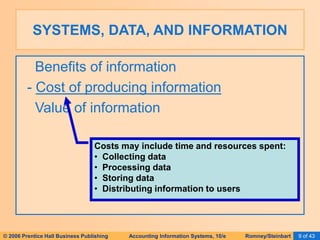
Benefits of information
- Cost of producing information
Value of information
Costs may include time and resources spent:
• Collecting data
• Processing data
• Storing data
• Distributing information to users
Ā© 2006 Prentice Hall Business Publishing Accounting Information Systems, 10/e Romney/Steinbart 10 of 43
SYSTEMS, DATA, AND INFORMATION
• Characteristics that make information
useful:
– Relevance
It reduces uncertainty by helping you predict
what will happen or confirm what already has
happened.
Ā© 2006 Prentice Hall Business Publishing Accounting Information Systems, 10/e Romney/Steinbart 11 of 43
SYSTEMS, DATA, AND INFORMATION
• Characteristics that make information
useful:
– Relevance
– Reliability
It’s dependable, i.e., free from error or bias
and faithfully portrays events and activities.
Ā© 2006 Prentice Hall Business Publishing Accounting Information Systems, 10/e Romney/Steinbart 12 of 43
SYSTEMS, DATA, AND INFORMATION
• Characteristics that make information
useful:
– Relevance
– Reliability
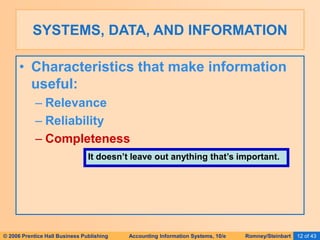
– Completeness
It doesn’t leave out anything that’s important.
Ā© 2006 Prentice Hall Business Publishing Accounting Information Systems, 10/e Romney/Steinbart 13 of 43
SYSTEMS, DATA, AND INFORMATION
• Characteristics that make information
useful:
– Relevance
– Reliability
– Completeness
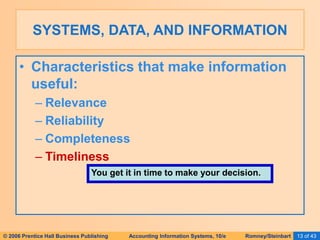
– Timeliness
You get it in time to make your decision.
Ā© 2006 Prentice Hall Business Publishing Accounting Information Systems, 10/e Romney/Steinbart 14 of 43
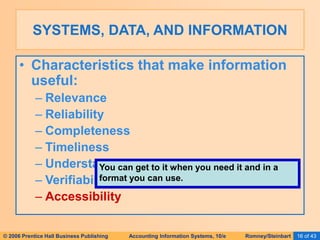
SYSTEMS, DATA, AND INFORMATION
• Characteristics that make information
useful:
– Relevance
– Reliability
– Completeness
– Timeliness
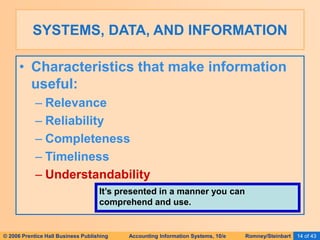
– Understandability
It’s presented in a manner you can
comprehend and use.
Ā© 2006 Prentice Hall Business Publishing Accounting Information Systems, 10/e Romney/Steinbart 15 of 43
SYSTEMS, DATA, AND INFORMATION
• Characteristics that make information
useful:
– Relevance
– Reliability
– Completeness
– Timeliness
– Understandability
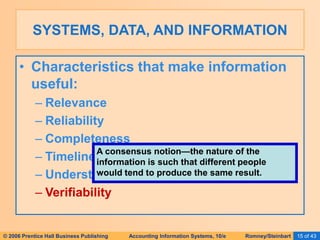
– Verifiability
A consensus notion—the nature of the
information is such that different people
would tend to produce the same result.
Ā© 2006 Prentice Hall Business Publishing Accounting Information Systems, 10/e Romney/Steinbart 16 of 43
SYSTEMS, DATA, AND INFORMATION
• Characteristics that make information
useful:
– Relevance
– Reliability
– Completeness
– Timeliness
– Understandability
– Verifiability
– Accessibility
You can get to it when you need it and in a
format you can use.
Ā© 2006 Prentice Hall Business Publishing Accounting Information Systems, 10/e Romney/Steinbart 17 of 43
• Information is provided to both:
– External users
– Internal Users
SYSTEMS, DATA, AND INFORMATION
Ā© 2006 Prentice Hall Business Publishing Accounting Information Systems, 10/e Romney/Steinbart 18 of 43
• External users primarily use information
that is either:
– MANDATORY INFORMATION—Required by
a governmental entity,
– ESSENTIAL INFORMATION—Required to
conduct business with external parties, such
as purchase orders.
SYSTEMS, DATA, AND INFORMATION
Ā© 2006 Prentice Hall Business Publishing Accounting Information Systems, 10/e Romney/Steinbart 19 of 43
• In providing mandatory or essential
information, the focus should be on:
– Minimizing costs
– Meeting regulatory requirements
– Meeting minimum standards of reliability and
usefulness
SYSTEMS, DATA, AND INFORMATION
Ā© 2006 Prentice Hall Business Publishing Accounting Information Systems, 10/e Romney/Steinbart 20 of 43
• Internal users primarily use discretionary
information.
• The primary focus in producing this
information is ensuring that benefits
exceed costs, i.e., the information has
positive value.
SYSTEMS, DATA, AND INFORMATION
Ā© 2006 Prentice Hall Business Publishing Accounting Information Systems, 10/e Romney/Steinbart 21 of 43
• An AIS is a system that collects, records,
stores, and processes data to produce
information for decision makers.
• It can:
– Use advanced technology; or
– Be a simple paper-and-pencil system; or
– Be something in between.
• Technology is simply a tool to create,
maintain, or improve a system.
WHAT IS AN AIS?
Ā© 2006 Prentice Hall Business Publishing Accounting Information Systems, 10/e Romney/Steinbart 22 of 43
• The functions of an AIS are to:
– Collect and store data about events,
resources, and agents.
– Transform that data into information that
management can use to make decisions
about events, resources, and agents.
– Provide adequate controls to ensure that the
entity’s resources (including data) are:
• Available when needed
• Accurate and reliable
WHAT IS AN AIS?
Ā© 2006 Prentice Hall Business Publishing Accounting Information Systems, 10/e Romney/Steinbart 23 of 43
• It’s fundamental to accounting.
WHY STUDY ACCOUNTING
INFORMATION SYSTEMS?
• Other accounting courses focus on how
the information is provided and used.
• An AIS course places greater emphasis
on:
– How the data is collected and
transformed
– How the reliability and accuracy of the
data is ensured
• AIS courses are not number-crunching
courses
Ā© 2006 Prentice Hall Business Publishing Accounting Information Systems, 10/e Romney/Steinbart 24 of 43
• It’s fundamental to accounting.
• The skills are critical to career success.
WHY STUDY ACCOUNTING
INFORMATION SYSTEMS?
• Auditors need to evaluate the accuracy
and reliability of information produced by
the AIS.
Ā© 2006 Prentice Hall Business Publishing Accounting Information Systems, 10/e Romney/Steinbart 25 of 43
• It’s fundamental to accounting.
• The skills are critical to career success.
WHY STUDY ACCOUNTING
INFORMATION SYSTEMS?
• Tax accountants must understand the
client’s AIS adequately to be confident that
it is providing complete and accurate
information for tax planning and
compliance work.
Ā© 2006 Prentice Hall Business Publishing Accounting Information Systems, 10/e Romney/Steinbart 26 of 43
• It’s fundamental to accounting.
• The skills are critical to career success.
WHY STUDY ACCOUNTING
INFORMATION SYSTEMS?
• In management consulting, the design,
selection, and implementation of
accounting systems is a rapid growth area.
Ā© 2006 Prentice Hall Business Publishing Accounting Information Systems, 10/e Romney/Steinbart 27 of 43
• The objective of most organizations is to provide
value to their customers.
• ā€œadding valueā€ is means making the value of the
finished component greater than the sum of its
parts.
• It may mean:
– Making it faster
– Making it more reliable
– Providing better service or advice
– Providing something in limited supply
– Providing enhanced features
– Customizing it
ROLE OF THE AIS IN THE VALUE CHAIN
Ā© 2006 Prentice Hall Business Publishing Accounting Information Systems, 10/e Romney/Steinbart 28 of 43
• Value is provided by performing a series of
activities referred to as the value chain.
These include:
– Primary activities
– Support activities
• These activities are sometimes referred to
as ā€œlineā€ and ā€œstaffā€ activities respectively.
ROLE OF THE AIS IN THE VALUE CHAIN
Ā© 2006 Prentice Hall Business Publishing Accounting Information Systems, 10/e Romney/Steinbart 29 of 43
• Primary activities include:
– Inbound logistics
ROLE OF THE AIS IN THE VALUE CHAIN
Receiving, storing, and distributing the
materials that are inputs to the
organization’s product or service.
For a pharmaceutical company, this activity
might involve handling incoming chemicals
and elements that will be used to make their
drugs.
Ā© 2006 Prentice Hall Business Publishing Accounting Information Systems, 10/e Romney/Steinbart 30 of 43
• Primary activities include:
– Inbound logistics
– Operations
ROLE OF THE AIS IN THE VALUE CHAIN
Transforming those inputs into products or
services.
For the pharmaceutical company, this step
involves combining the raw chemicals and
elements with the work of people and equipment to
produce the finished drug product that will be sold
to customers.
Ā© 2006 Prentice Hall Business Publishing Accounting Information Systems, 10/e Romney/Steinbart 31 of 43
• Primary activities include:
– Inbound logistics
– Operations
– Outbound logistics
ROLE OF THE AIS IN THE VALUE CHAIN
Distributing products or services to customers.
For the pharmaceutical company, this step involves
packaging and shipping the goods to drug stores,
doctors, and hospitals.
Ā© 2006 Prentice Hall Business Publishing Accounting Information Systems, 10/e Romney/Steinbart 32 of 43
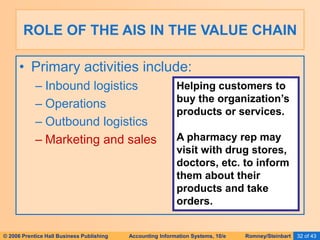
• Primary activities include:
– Inbound logistics
– Operations
– Outbound logistics
– Marketing and sales
ROLE OF THE AIS IN THE VALUE CHAIN
Helping customers to
buy the organization’s
products or services.
A pharmacy rep may
visit with drug stores,
doctors, etc. to inform
them about their
products and take
orders.
Ā© 2006 Prentice Hall Business Publishing Accounting Information Systems, 10/e Romney/Steinbart 33 of 43
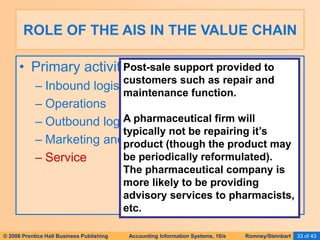
• Primary activities include:
– Inbound logistics
– Operations
– Outbound logistics
– Marketing and sales
– Service
ROLE OF THE AIS IN THE VALUE CHAIN
Post-sale support provided to
customers such as repair and
maintenance function.
A pharmaceutical firm will
typically not be repairing it’s
product (though the product may
be periodically reformulated).
The pharmaceutical company is
more likely to be providing
advisory services to pharmacists,
etc.
Ā© 2006 Prentice Hall Business Publishing Accounting Information Systems, 10/e Romney/Steinbart 34 of 43
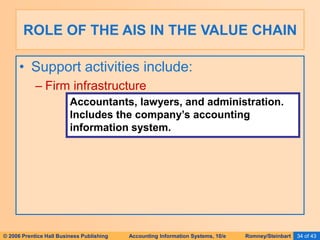
• Support activities include:
– Firm infrastructure
ROLE OF THE AIS IN THE VALUE CHAIN
Accountants, lawyers, and administration.
Includes the company’s accounting
information system.
Ā© 2006 Prentice Hall Business Publishing Accounting Information Systems, 10/e Romney/Steinbart 35 of 43
• Support activities include:
– Firm infrastructure
– Human resources
ROLE OF THE AIS IN THE VALUE CHAIN
Involves recruiting and hiring new
employees, training employees, paying
employees, and handling employee
benefits.
Ā© 2006 Prentice Hall Business Publishing Accounting Information Systems, 10/e Romney/Steinbart 36 of 43
• Support activities include:
– Firm infrastructure
– Human resources
– Technology
ROLE OF THE AIS IN THE VALUE CHAIN
Activities to improve the products or services
(e.g., R&D, website development).
For the pharmaceutical company, these activities
would include research and development to
create new drugs and modify existing ones.
Ā© 2006 Prentice Hall Business Publishing Accounting Information Systems, 10/e Romney/Steinbart 37 of 43
• Support activities include:
– Firm infrastructure
– Human resources
– Technology
– Purchasing
ROLE OF THE AIS IN THE VALUE CHAIN
Buying the resources (e.g.,
materials, inventory, fixed
assets) needed to carry out the
entity’s primary activities.
In the pharmaceutical company,
the purchasing folks are trying
to get the best combination of
cost and quality in buying
chemicals, supplies, and other
assets the company needs to
run its operations.
Ā© 2006 Prentice Hall Business Publishing Accounting Information Systems, 10/e Romney/Steinbart 38 of 43
• Information technology can significantly
impact the efficiency and effectiveness
with which the preceding activities are
carried out.
• An organization’s value chain can be
connected with the value chains of its
customers, suppliers, and distributors.
ROLE OF THE AIS IN THE VALUE CHAIN
Ā© 2006 Prentice Hall Business Publishing Accounting Information Systems, 10/e Romney/Steinbart 39 of 43
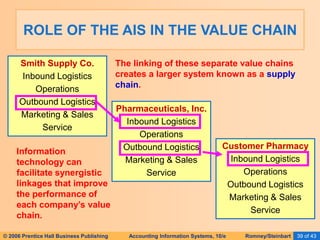
Pharmaceuticals, Inc.
Inbound Logistics
Operations
Outbound Logistics
Marketing & Sales
Service
ROLE OF THE AIS IN THE VALUE CHAIN
Smith Supply Co.
Inbound Logistics
Operations
Outbound Logistics
Marketing & Sales
Service
Customer Pharmacy
Inbound Logistics
Operations
Outbound Logistics
Marketing & Sales
Service
The linking of these separate value chains
creates a larger system known as a supply
chain.
Information
technology can
facilitate synergistic
linkages that improve
the performance of
each company’s value
chain.
Ā© 2006 Prentice Hall Business Publishing Accounting Information Systems, 10/e Romney/Steinbart 40 of 43
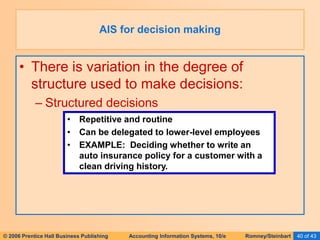
• There is variation in the degree of
structure used to make decisions:
– Structured decisions
AIS for decision making
• Repetitive and routine
• Can be delegated to lower-level employees
• EXAMPLE: Deciding whether to write an
auto insurance policy for a customer with a
clean driving history.
Ā© 2006 Prentice Hall Business Publishing Accounting Information Systems, 10/e Romney/Steinbart 41 of 43
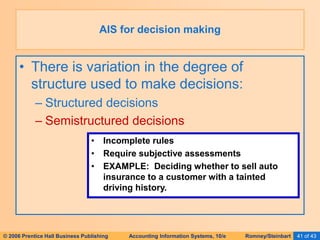
• There is variation in the degree of
structure used to make decisions:
– Structured decisions
– Semistructured decisions
AIS for decision making
• Incomplete rules
• Require subjective assessments
• EXAMPLE: Deciding whether to sell auto
insurance to a customer with a tainted
driving history.
Ā© 2006 Prentice Hall Business Publishing Accounting Information Systems, 10/e Romney/Steinbart 42 of 43
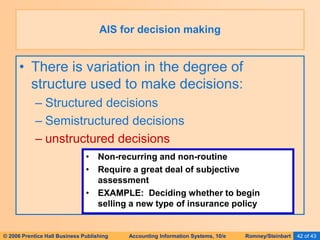
• There is variation in the degree of
structure used to make decisions:
– Structured decisions
– Semistructured decisions
– unstructured decisions
AIS for decision making
• Non-recurring and non-routine
• Require a great deal of subjective
assessment
• EXAMPLE: Deciding whether to begin
selling a new type of insurance policy
Ā© 2006 Prentice Hall Business Publishing Accounting Information Systems, 10/e Romney/Steinbart 43 of 43
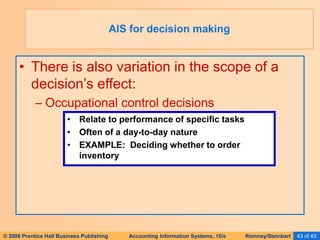
• There is also variation in the scope of a
decision’s effect:
– Occupational control decisions
AIS for decision making
• Relate to performance of specific tasks
• Often of a day-to-day nature
• EXAMPLE: Deciding whether to order
inventory
Ā© 2006 Prentice Hall Business Publishing Accounting Information Systems, 10/e Romney/Steinbart 44 of 43
• There is also variation in the scope of a
decision’s effect:
– Occupational control decisions
– Management control decisions
AIS for decision making
• Relate to utilizing resources to accomplish
organizational objectives
• EXAMPLE: Budgeting
Ā© 2006 Prentice Hall Business Publishing Accounting Information Systems, 10/e Romney/Steinbart 45 of 43
• There is also variation in the scope of a
decision’s effect:
– Occupational control decisions
– Management control decisions
– Strategic planning decisions
AIS for decision making
• The ā€œwhat do we want to be when we grow
upā€ types of questions
• Involves establishing
– Organizational objectives
– Policies to achieve those objectives
• EXAMPLE: Deciding whether to diversify the
company into other product lines
Ā© 2006 Prentice Hall Business Publishing Accounting Information Systems, 10/e Romney/Steinbart 46 of 43
• In general, the higher a manager is in the
organization, the more likely he/she is to
be engaging in:
– Less structured decisions
– Broader scope (i.e., strategic planning)
decisions
AIS for decision making
Ā© 2006 Prentice Hall Business Publishing Accounting Information Systems, 10/e Romney/Steinbart 47 of 43
• Michael Porter suggests that there are two
basic business strategies companies can
follow:
– Product-differentiation strategy
– Low-cost strategy
THE AIS AND CORPORATE STRATEGY
Ā© 2006 Prentice Hall Business Publishing Accounting Information Systems, 10/e Romney/Steinbart 48 of 43
• A product differentiation strategy involves
setting your product apart from those of
your competitors, i.e., building a ā€œbetterā€
mousetrap by offering one that’s faster,
has enhanced features, etc.
THE AIS AND CORPORATE STRATEGY
Ā© 2006 Prentice Hall Business Publishing Accounting Information Systems, 10/e Romney/Steinbart 49 of 43
• A low-cost strategy involves offering a
cheaper mousetrap than your competitors.
The low cost is made possible by
operating more efficiently.
THE AIS AND CORPORATE STRATEGY
Ā© 2006 Prentice Hall Business Publishing Accounting Information Systems, 10/e Romney/Steinbart 50 of 43
• The AIS should help a company adopt and
maintain its strategic position.
– Requires that data be collected about each
activity.
– Requires the collection and integration of both
financial and nonfinancial data.
THE AIS AND CORPORATE STRATEGY

AIS CH_01 Accounting Information Systems an overview.PPT

  • 1.
    Ā© 2006 PrenticeHall Business Publishing Accounting Information Systems, 10/e Romney/Steinbart 1 of 43 C HAPTER 1 Accounting Information Systems: An Overview
  • 2.
    Ā© 2006 PrenticeHall Business Publishing Accounting Information Systems, 10/e Romney/Steinbart 2 of 43 INTRODUCTION • Questions to be addressed in this chapter include: – What is the meaning of system, data, and information? – What is an accounting information system (AIS)? – Why is the AIS an important topic to study? – What is the role of the AIS in the value chain? – How does the AIS provide information for decision making? – What are the basic strategies and strategic positions an organization can pursue?
  • 3.
    Ā© 2006 PrenticeHall Business Publishing Accounting Information Systems, 10/e Romney/Steinbart 3 of 43 SYSTEMS, DATA, AND INFORMATION • A system is: – A set of interrelated components – That interact – To achieve a goal • Most systems are composed of smaller subsystems . . . • . . . And vice versa!
  • 4.
    Ā© 2006 PrenticeHall Business Publishing Accounting Information Systems, 10/e Romney/Steinbart 4 of 43 SYSTEMS, DATA, AND INFORMATION • Every organization has goals. – The sub systems should be designed to maximize achievement of the organization’s goals – EXAMPLE: The production department (a subsystem) of a company might have to forego its goal of staying within its budget in order to meet the organization’s goal of delivering product on time.
  • 5.
    Ā© 2006 PrenticeHall Business Publishing Accounting Information Systems, 10/e Romney/Steinbart 5 of 43 SYSTEMS, DATA, AND INFORMATION • Goal conflict occurs when the activity of a subsystem is not consistent with another subsystem or with the larger system. • Goal congruence occurs when the subsystem’s goals are in line with the organization’s goals. • The larger and more complicated a system, the more difficult it is to achieve goal congruence.
  • 6.
    Ā© 2006 PrenticeHall Business Publishing Accounting Information Systems, 10/e Romney/Steinbart 6 of 43 SYSTEMS, DATA, AND INFORMATION • Data are facts that are collected, recorded, stored, and processed by an information system. • Organizations collect data about: – Events that occur – Resources that are affected by those events – Agents who participate in the events • Information is data that have been organized and processed to provide meaning to a user. • Usually, more information and better information translates into better decisions.
  • 7.
    Ā© 2006 PrenticeHall Business Publishing Accounting Information Systems, 10/e Romney/Steinbart 7 of 43 SYSTEMS, DATA, AND INFORMATION • However, when you get more information than you can effectively assimilate, you suffer from information overload. – Example: Final exams week! • When you’ve reached the overload point, the quality of decisions declines while the costs of producing the information increases.
  • 8.
    Ā© 2006 PrenticeHall Business Publishing Accounting Information Systems, 10/e Romney/Steinbart 8 of 43 SYSTEMS, DATA, AND INFORMATION Benefits of information - Cost of producing information Value of information Benefits of information may include: • Reduction of uncertainty • Improved decisions • Improved ability to plan and schedule activities
  • 9.
    Ā© 2006 PrenticeHall Business Publishing Accounting Information Systems, 10/e Romney/Steinbart 9 of 43 SYSTEMS, DATA, AND INFORMATION Benefits of information - Cost of producing information Value of information Costs may include time and resources spent: • Collecting data • Processing data • Storing data • Distributing information to users
  • 10.
    Ā© 2006 PrenticeHall Business Publishing Accounting Information Systems, 10/e Romney/Steinbart 10 of 43 SYSTEMS, DATA, AND INFORMATION • Characteristics that make information useful: – Relevance It reduces uncertainty by helping you predict what will happen or confirm what already has happened.
  • 11.
    Ā© 2006 PrenticeHall Business Publishing Accounting Information Systems, 10/e Romney/Steinbart 11 of 43 SYSTEMS, DATA, AND INFORMATION • Characteristics that make information useful: – Relevance – Reliability It’s dependable, i.e., free from error or bias and faithfully portrays events and activities.
  • 12.
    Ā© 2006 PrenticeHall Business Publishing Accounting Information Systems, 10/e Romney/Steinbart 12 of 43 SYSTEMS, DATA, AND INFORMATION • Characteristics that make information useful: – Relevance – Reliability – Completeness It doesn’t leave out anything that’s important.
  • 13.
    Ā© 2006 PrenticeHall Business Publishing Accounting Information Systems, 10/e Romney/Steinbart 13 of 43 SYSTEMS, DATA, AND INFORMATION • Characteristics that make information useful: – Relevance – Reliability – Completeness – Timeliness You get it in time to make your decision.
  • 14.
    Ā© 2006 PrenticeHall Business Publishing Accounting Information Systems, 10/e Romney/Steinbart 14 of 43 SYSTEMS, DATA, AND INFORMATION • Characteristics that make information useful: – Relevance – Reliability – Completeness – Timeliness – Understandability It’s presented in a manner you can comprehend and use.
  • 15.
    Ā© 2006 PrenticeHall Business Publishing Accounting Information Systems, 10/e Romney/Steinbart 15 of 43 SYSTEMS, DATA, AND INFORMATION • Characteristics that make information useful: – Relevance – Reliability – Completeness – Timeliness – Understandability – Verifiability A consensus notion—the nature of the information is such that different people would tend to produce the same result.
  • 16.
    Ā© 2006 PrenticeHall Business Publishing Accounting Information Systems, 10/e Romney/Steinbart 16 of 43 SYSTEMS, DATA, AND INFORMATION • Characteristics that make information useful: – Relevance – Reliability – Completeness – Timeliness – Understandability – Verifiability – Accessibility You can get to it when you need it and in a format you can use.
  • 17.
    Ā© 2006 PrenticeHall Business Publishing Accounting Information Systems, 10/e Romney/Steinbart 17 of 43 • Information is provided to both: – External users – Internal Users SYSTEMS, DATA, AND INFORMATION
  • 18.
    Ā© 2006 PrenticeHall Business Publishing Accounting Information Systems, 10/e Romney/Steinbart 18 of 43 • External users primarily use information that is either: – MANDATORY INFORMATION—Required by a governmental entity, – ESSENTIAL INFORMATION—Required to conduct business with external parties, such as purchase orders. SYSTEMS, DATA, AND INFORMATION
  • 19.
    Ā© 2006 PrenticeHall Business Publishing Accounting Information Systems, 10/e Romney/Steinbart 19 of 43 • In providing mandatory or essential information, the focus should be on: – Minimizing costs – Meeting regulatory requirements – Meeting minimum standards of reliability and usefulness SYSTEMS, DATA, AND INFORMATION
  • 20.
    Ā© 2006 PrenticeHall Business Publishing Accounting Information Systems, 10/e Romney/Steinbart 20 of 43 • Internal users primarily use discretionary information. • The primary focus in producing this information is ensuring that benefits exceed costs, i.e., the information has positive value. SYSTEMS, DATA, AND INFORMATION
  • 21.
    Ā© 2006 PrenticeHall Business Publishing Accounting Information Systems, 10/e Romney/Steinbart 21 of 43 • An AIS is a system that collects, records, stores, and processes data to produce information for decision makers. • It can: – Use advanced technology; or – Be a simple paper-and-pencil system; or – Be something in between. • Technology is simply a tool to create, maintain, or improve a system. WHAT IS AN AIS?
  • 22.
    Ā© 2006 PrenticeHall Business Publishing Accounting Information Systems, 10/e Romney/Steinbart 22 of 43 • The functions of an AIS are to: – Collect and store data about events, resources, and agents. – Transform that data into information that management can use to make decisions about events, resources, and agents. – Provide adequate controls to ensure that the entity’s resources (including data) are: • Available when needed • Accurate and reliable WHAT IS AN AIS?
  • 23.
    Ā© 2006 PrenticeHall Business Publishing Accounting Information Systems, 10/e Romney/Steinbart 23 of 43 • It’s fundamental to accounting. WHY STUDY ACCOUNTING INFORMATION SYSTEMS? • Other accounting courses focus on how the information is provided and used. • An AIS course places greater emphasis on: – How the data is collected and transformed – How the reliability and accuracy of the data is ensured • AIS courses are not number-crunching courses
  • 24.
    Ā© 2006 PrenticeHall Business Publishing Accounting Information Systems, 10/e Romney/Steinbart 24 of 43 • It’s fundamental to accounting. • The skills are critical to career success. WHY STUDY ACCOUNTING INFORMATION SYSTEMS? • Auditors need to evaluate the accuracy and reliability of information produced by the AIS.
  • 25.
    Ā© 2006 PrenticeHall Business Publishing Accounting Information Systems, 10/e Romney/Steinbart 25 of 43 • It’s fundamental to accounting. • The skills are critical to career success. WHY STUDY ACCOUNTING INFORMATION SYSTEMS? • Tax accountants must understand the client’s AIS adequately to be confident that it is providing complete and accurate information for tax planning and compliance work.
  • 26.
    Ā© 2006 PrenticeHall Business Publishing Accounting Information Systems, 10/e Romney/Steinbart 26 of 43 • It’s fundamental to accounting. • The skills are critical to career success. WHY STUDY ACCOUNTING INFORMATION SYSTEMS? • In management consulting, the design, selection, and implementation of accounting systems is a rapid growth area.
  • 27.
    Ā© 2006 PrenticeHall Business Publishing Accounting Information Systems, 10/e Romney/Steinbart 27 of 43 • The objective of most organizations is to provide value to their customers. • ā€œadding valueā€ is means making the value of the finished component greater than the sum of its parts. • It may mean: – Making it faster – Making it more reliable – Providing better service or advice – Providing something in limited supply – Providing enhanced features – Customizing it ROLE OF THE AIS IN THE VALUE CHAIN
  • 28.
    Ā© 2006 PrenticeHall Business Publishing Accounting Information Systems, 10/e Romney/Steinbart 28 of 43 • Value is provided by performing a series of activities referred to as the value chain. These include: – Primary activities – Support activities • These activities are sometimes referred to as ā€œlineā€ and ā€œstaffā€ activities respectively. ROLE OF THE AIS IN THE VALUE CHAIN
  • 29.
    Ā© 2006 PrenticeHall Business Publishing Accounting Information Systems, 10/e Romney/Steinbart 29 of 43 • Primary activities include: – Inbound logistics ROLE OF THE AIS IN THE VALUE CHAIN Receiving, storing, and distributing the materials that are inputs to the organization’s product or service. For a pharmaceutical company, this activity might involve handling incoming chemicals and elements that will be used to make their drugs.
  • 30.
    Ā© 2006 PrenticeHall Business Publishing Accounting Information Systems, 10/e Romney/Steinbart 30 of 43 • Primary activities include: – Inbound logistics – Operations ROLE OF THE AIS IN THE VALUE CHAIN Transforming those inputs into products or services. For the pharmaceutical company, this step involves combining the raw chemicals and elements with the work of people and equipment to produce the finished drug product that will be sold to customers.
  • 31.
    Ā© 2006 PrenticeHall Business Publishing Accounting Information Systems, 10/e Romney/Steinbart 31 of 43 • Primary activities include: – Inbound logistics – Operations – Outbound logistics ROLE OF THE AIS IN THE VALUE CHAIN Distributing products or services to customers. For the pharmaceutical company, this step involves packaging and shipping the goods to drug stores, doctors, and hospitals.
  • 32.
    Ā© 2006 PrenticeHall Business Publishing Accounting Information Systems, 10/e Romney/Steinbart 32 of 43 • Primary activities include: – Inbound logistics – Operations – Outbound logistics – Marketing and sales ROLE OF THE AIS IN THE VALUE CHAIN Helping customers to buy the organization’s products or services. A pharmacy rep may visit with drug stores, doctors, etc. to inform them about their products and take orders.
  • 33.
    Ā© 2006 PrenticeHall Business Publishing Accounting Information Systems, 10/e Romney/Steinbart 33 of 43 • Primary activities include: – Inbound logistics – Operations – Outbound logistics – Marketing and sales – Service ROLE OF THE AIS IN THE VALUE CHAIN Post-sale support provided to customers such as repair and maintenance function. A pharmaceutical firm will typically not be repairing it’s product (though the product may be periodically reformulated). The pharmaceutical company is more likely to be providing advisory services to pharmacists, etc.
  • 34.
    Ā© 2006 PrenticeHall Business Publishing Accounting Information Systems, 10/e Romney/Steinbart 34 of 43 • Support activities include: – Firm infrastructure ROLE OF THE AIS IN THE VALUE CHAIN Accountants, lawyers, and administration. Includes the company’s accounting information system.
  • 35.
    Ā© 2006 PrenticeHall Business Publishing Accounting Information Systems, 10/e Romney/Steinbart 35 of 43 • Support activities include: – Firm infrastructure – Human resources ROLE OF THE AIS IN THE VALUE CHAIN Involves recruiting and hiring new employees, training employees, paying employees, and handling employee benefits.
  • 36.
    Ā© 2006 PrenticeHall Business Publishing Accounting Information Systems, 10/e Romney/Steinbart 36 of 43 • Support activities include: – Firm infrastructure – Human resources – Technology ROLE OF THE AIS IN THE VALUE CHAIN Activities to improve the products or services (e.g., R&D, website development). For the pharmaceutical company, these activities would include research and development to create new drugs and modify existing ones.
  • 37.
    Ā© 2006 PrenticeHall Business Publishing Accounting Information Systems, 10/e Romney/Steinbart 37 of 43 • Support activities include: – Firm infrastructure – Human resources – Technology – Purchasing ROLE OF THE AIS IN THE VALUE CHAIN Buying the resources (e.g., materials, inventory, fixed assets) needed to carry out the entity’s primary activities. In the pharmaceutical company, the purchasing folks are trying to get the best combination of cost and quality in buying chemicals, supplies, and other assets the company needs to run its operations.
  • 38.
    Ā© 2006 PrenticeHall Business Publishing Accounting Information Systems, 10/e Romney/Steinbart 38 of 43 • Information technology can significantly impact the efficiency and effectiveness with which the preceding activities are carried out. • An organization’s value chain can be connected with the value chains of its customers, suppliers, and distributors. ROLE OF THE AIS IN THE VALUE CHAIN
  • 39.
    Ā© 2006 PrenticeHall Business Publishing Accounting Information Systems, 10/e Romney/Steinbart 39 of 43 Pharmaceuticals, Inc. Inbound Logistics Operations Outbound Logistics Marketing & Sales Service ROLE OF THE AIS IN THE VALUE CHAIN Smith Supply Co. Inbound Logistics Operations Outbound Logistics Marketing & Sales Service Customer Pharmacy Inbound Logistics Operations Outbound Logistics Marketing & Sales Service The linking of these separate value chains creates a larger system known as a supply chain. Information technology can facilitate synergistic linkages that improve the performance of each company’s value chain.
  • 40.
    Ā© 2006 PrenticeHall Business Publishing Accounting Information Systems, 10/e Romney/Steinbart 40 of 43 • There is variation in the degree of structure used to make decisions: – Structured decisions AIS for decision making • Repetitive and routine • Can be delegated to lower-level employees • EXAMPLE: Deciding whether to write an auto insurance policy for a customer with a clean driving history.
  • 41.
    Ā© 2006 PrenticeHall Business Publishing Accounting Information Systems, 10/e Romney/Steinbart 41 of 43 • There is variation in the degree of structure used to make decisions: – Structured decisions – Semistructured decisions AIS for decision making • Incomplete rules • Require subjective assessments • EXAMPLE: Deciding whether to sell auto insurance to a customer with a tainted driving history.
  • 42.
    Ā© 2006 PrenticeHall Business Publishing Accounting Information Systems, 10/e Romney/Steinbart 42 of 43 • There is variation in the degree of structure used to make decisions: – Structured decisions – Semistructured decisions – unstructured decisions AIS for decision making • Non-recurring and non-routine • Require a great deal of subjective assessment • EXAMPLE: Deciding whether to begin selling a new type of insurance policy
  • 43.
    Ā© 2006 PrenticeHall Business Publishing Accounting Information Systems, 10/e Romney/Steinbart 43 of 43 • There is also variation in the scope of a decision’s effect: – Occupational control decisions AIS for decision making • Relate to performance of specific tasks • Often of a day-to-day nature • EXAMPLE: Deciding whether to order inventory
  • 44.
    Ā© 2006 PrenticeHall Business Publishing Accounting Information Systems, 10/e Romney/Steinbart 44 of 43 • There is also variation in the scope of a decision’s effect: – Occupational control decisions – Management control decisions AIS for decision making • Relate to utilizing resources to accomplish organizational objectives • EXAMPLE: Budgeting
  • 45.
    Ā© 2006 PrenticeHall Business Publishing Accounting Information Systems, 10/e Romney/Steinbart 45 of 43 • There is also variation in the scope of a decision’s effect: – Occupational control decisions – Management control decisions – Strategic planning decisions AIS for decision making • The ā€œwhat do we want to be when we grow upā€ types of questions • Involves establishing – Organizational objectives – Policies to achieve those objectives • EXAMPLE: Deciding whether to diversify the company into other product lines
  • 46.
    Ā© 2006 PrenticeHall Business Publishing Accounting Information Systems, 10/e Romney/Steinbart 46 of 43 • In general, the higher a manager is in the organization, the more likely he/she is to be engaging in: – Less structured decisions – Broader scope (i.e., strategic planning) decisions AIS for decision making
  • 47.
    Ā© 2006 PrenticeHall Business Publishing Accounting Information Systems, 10/e Romney/Steinbart 47 of 43 • Michael Porter suggests that there are two basic business strategies companies can follow: – Product-differentiation strategy – Low-cost strategy THE AIS AND CORPORATE STRATEGY
  • 48.
    Ā© 2006 PrenticeHall Business Publishing Accounting Information Systems, 10/e Romney/Steinbart 48 of 43 • A product differentiation strategy involves setting your product apart from those of your competitors, i.e., building a ā€œbetterā€ mousetrap by offering one that’s faster, has enhanced features, etc. THE AIS AND CORPORATE STRATEGY
  • 49.
    Ā© 2006 PrenticeHall Business Publishing Accounting Information Systems, 10/e Romney/Steinbart 49 of 43 • A low-cost strategy involves offering a cheaper mousetrap than your competitors. The low cost is made possible by operating more efficiently. THE AIS AND CORPORATE STRATEGY
  • 50.
    Ā© 2006 PrenticeHall Business Publishing Accounting Information Systems, 10/e Romney/Steinbart 50 of 43 • The AIS should help a company adopt and maintain its strategic position. – Requires that data be collected about each activity. – Requires the collection and integration of both financial and nonfinancial data. THE AIS AND CORPORATE STRATEGY