A. ISMAEILI
A/C MATERIALS
CONSTRUCTION & REPAIR
(NON-METALLIC)
PART 1
Can you think of any examples of
where composites are used?
Introduction
History of Composite Materials
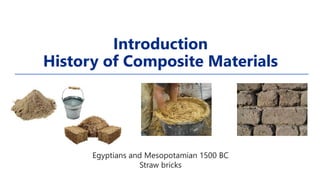
Egyptians and Mesopotamian 1500 BC
Straw bricks
Introduction
History of Composite Materials
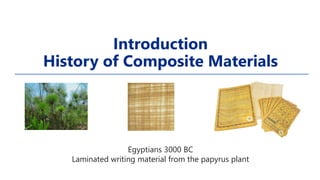
Egyptians 3000 BC
Laminated writing material from the papyrus plant
Introduction
History of Composite Materials
Assyrians & Mongols
Composite bow
Introduction
History of Composite Materials
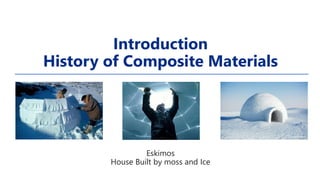
Eskimos
House Built by moss and Ice
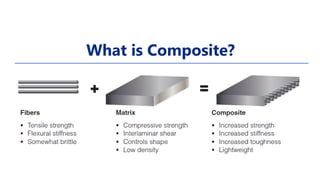
What is Composite?
Composite is used to describe two or more materials that are
combined to form a structure that is much stronger than the
individuals components.
What is Composite?
▪ Straw-bricks
▪ Concrete
▪ Wood
▪ (cellulose + lignin)
▪ Human body
▪ (muscles + bones)
▪ Tires
▪ Plywood
Composite: Examples from Day-to-Day Life
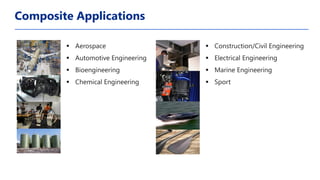
▪ Aerospace
▪ Automotive Engineering
▪ Bioengineering
▪ Chemical Engineering
▪ Construction/Civil Engineering
▪ Electrical Engineering
▪ Marine Engineering
▪ Sport
Composite Applications
Aerospace
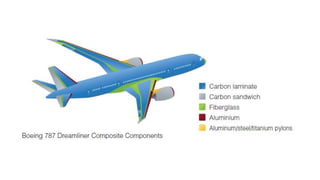
▪ A leading role in the development of both composite materials and processing technology has been taken
by the aerospace industry.
▪ The high specific stiffness and strength of the reinforcements offered the potential for reduced fuel
consumption and increased range with passenger aircraft and increased performance (range, turn rates,
stealth) for military aircraft.
▪ The ability to tailor thermal expansion together with the low material density also made materials attractive
for space applications. A substantial research effort was therefore made by the aerospace industrial,
governmental, and academic communities to develop this material class.
Composite Applications
Aerospace
▪ The main driving forces for the aerospace industry are therefore primary weight reduction by using a
material with higher specific mechanical properties (mechanical property/density), facilitating secondary
weight savings, leading to considerable additional weight reduction.
▪ The strong demand for weight saving in aerospace applications, as well as the lower sensitivity of this
industry to production rates and material costs, has led to the development of finely-tuned high-
performance processing techniques and materials.
Composite Applications
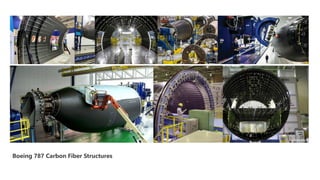
Boeing 787 Carbon Fiber Structures
Automotive Engineering
▪ The transportation industry represents a potentially large application area for fiber reinforced composites
and is driven by a number of interacting driving forces.
▪ The needs of the automotive industry have led to the development of engineering composites with
increased shape complexity
▪ Decreasing system cost must be considered while maximizing quality, functionality, and return on
manufacturing investment together with meeting legislative requirements for safety, emissions, and
recycling.
Composite Applications
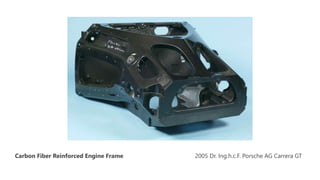
Carbon Fiber Reinforced Engine Frame 2005 Dr. Ing.h.c.F. Porsche AG Carrera GT
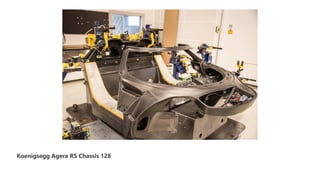
Koenigsegg Agera RS Chassis 128
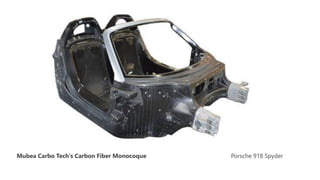
Mubea Carbo Tech's Carbon Fiber Monocoque Porsche 918 Spyder
Bioengineering
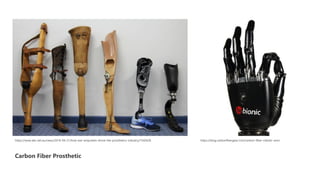
▪ Composites are widely used as prostheses for amputees. In running, carbon fiber prosthetics ‘flex’ which
provides for kinetic energy storage, thus greatly increasing a runner’s performance level. As arms and
hands, composites are light, strong and malleable.
▪ The bebionic3, features microprocessor controlled motors in each finger. This allows for a multitude of grips
and hand positions previously out of reach with wood and rubber models.
Composite Applications
Carbon Fiber Prosthetic
https://www.abc.net.au/news/2016-04-21/how-war-amputees-drove-the-prosthetics-industry/7342626 https://blog.carbonfibergear.com/carbon-fiber-robotic-arm/
Chemical Engineering
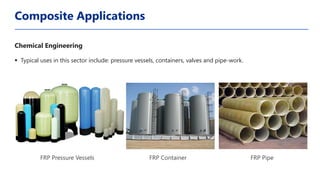
▪ Typical uses in this sector include: pressure vessels, containers, valves and pipe-work.
Composite Applications
FRP Container
FRP Pressure Vessels FRP Pipe
Construction/Civil Engineering
▪ Typical uses include folded-plate structures, cladding panels, decorative architectural panels, ducting,
racking, pipe work, gutters, water tanks, form work for concrete, and light-duty structures such as
pedestrian bridges.
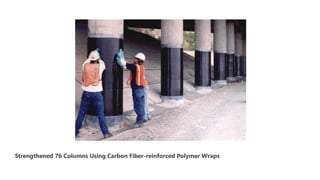
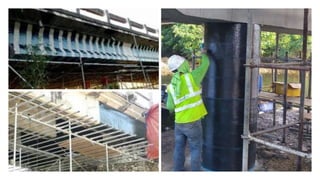
▪ Composites are also used to retrofit and upgrade existing bridges through externally applied impact-
containment supports and patches over concrete.
Composite Applications
Strengthened 76 Columns Using Carbon Fiber-reinforced Polymer Wraps
Electrical Engineering
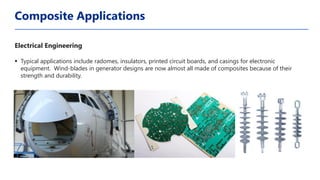
▪ Typical applications include radomes, insulators, printed circuit boards, and casings for electronic
equipment. Wind-blades in generator designs are now almost all made of composites because of their
strength and durability.
Composite Applications
Marine Engineering
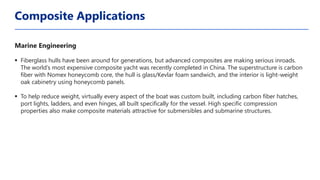
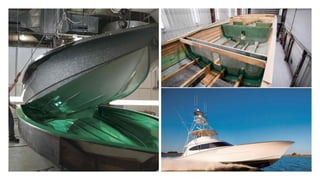
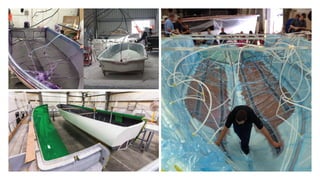
▪ Fiberglass hulls have been around for generations, but advanced composites are making serious inroads.
The world’s most expensive composite yacht was recently completed in China. The superstructure is carbon
fiber with Nomex honeycomb core, the hull is glass/Kevlar foam sandwich, and the interior is light-weight
oak cabinetry using honeycomb panels.
▪ To help reduce weight, virtually every aspect of the boat was custom built, including carbon fiber hatches,
port lights, ladders, and even hinges, all built specifically for the vessel. High specific compression
properties also make composite materials attractive for submersibles and submarine structures.
Composite Applications
Sport
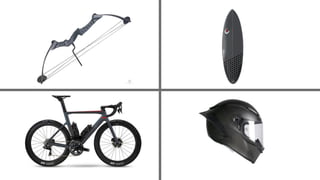
▪ In no other sector has the use of composites become more visible than sporting goods. Manufacturers
quickly adopted new materials like carbon and boron fiber composites to replace wood, aluminum, and
steel in nearly every category imaginable.
▪ The rush to composites began with vaulting poles and now encompasses tennis rackets, baseball bats, golf
clubs, fishing rods, boats, oars, archery equipment, canoes, kayaks, surf boards, wind-surfers, skateboards,
skis and ski-poles, bicycles (and wheel-sets), helmets, body armor, and much more.
Composite Applications
- END -
2021 - 2022

Aircraft Composite Materials Introduction Lecture 1

  • 1.
    A. ISMAEILI A/C MATERIALS CONSTRUCTION& REPAIR (NON-METALLIC) PART 1
  • 2.
    Can you thinkof any examples of where composites are used?
  • 3.
    Introduction History of CompositeMaterials Egyptians and Mesopotamian 1500 BC Straw bricks
  • 4.
    Introduction History of CompositeMaterials Egyptians 3000 BC Laminated writing material from the papyrus plant
  • 5.
    Introduction History of CompositeMaterials Assyrians & Mongols Composite bow
  • 6.
    Introduction History of CompositeMaterials Eskimos House Built by moss and Ice
  • 7.
    What is Composite? Compositeis used to describe two or more materials that are combined to form a structure that is much stronger than the individuals components.
  • 8.
  • 9.
    ▪ Straw-bricks ▪ Concrete ▪Wood ▪ (cellulose + lignin) ▪ Human body ▪ (muscles + bones) ▪ Tires ▪ Plywood Composite: Examples from Day-to-Day Life
  • 10.
    ▪ Aerospace ▪ AutomotiveEngineering ▪ Bioengineering ▪ Chemical Engineering ▪ Construction/Civil Engineering ▪ Electrical Engineering ▪ Marine Engineering ▪ Sport Composite Applications
  • 11.
    Aerospace ▪ A leadingrole in the development of both composite materials and processing technology has been taken by the aerospace industry. ▪ The high specific stiffness and strength of the reinforcements offered the potential for reduced fuel consumption and increased range with passenger aircraft and increased performance (range, turn rates, stealth) for military aircraft. ▪ The ability to tailor thermal expansion together with the low material density also made materials attractive for space applications. A substantial research effort was therefore made by the aerospace industrial, governmental, and academic communities to develop this material class. Composite Applications
  • 12.
    Aerospace ▪ The maindriving forces for the aerospace industry are therefore primary weight reduction by using a material with higher specific mechanical properties (mechanical property/density), facilitating secondary weight savings, leading to considerable additional weight reduction. ▪ The strong demand for weight saving in aerospace applications, as well as the lower sensitivity of this industry to production rates and material costs, has led to the development of finely-tuned high- performance processing techniques and materials. Composite Applications
  • 13.
  • 15.
    Boeing 787 CarbonFiber Structures
  • 16.
    Automotive Engineering ▪ Thetransportation industry represents a potentially large application area for fiber reinforced composites and is driven by a number of interacting driving forces. ▪ The needs of the automotive industry have led to the development of engineering composites with increased shape complexity ▪ Decreasing system cost must be considered while maximizing quality, functionality, and return on manufacturing investment together with meeting legislative requirements for safety, emissions, and recycling. Composite Applications
  • 17.
    Carbon Fiber ReinforcedEngine Frame 2005 Dr. Ing.h.c.F. Porsche AG Carrera GT
  • 18.
  • 19.
    Mubea Carbo Tech'sCarbon Fiber Monocoque Porsche 918 Spyder
  • 20.
    Bioengineering ▪ Composites arewidely used as prostheses for amputees. In running, carbon fiber prosthetics ‘flex’ which provides for kinetic energy storage, thus greatly increasing a runner’s performance level. As arms and hands, composites are light, strong and malleable. ▪ The bebionic3, features microprocessor controlled motors in each finger. This allows for a multitude of grips and hand positions previously out of reach with wood and rubber models. Composite Applications
  • 21.
  • 22.
    Chemical Engineering ▪ Typicaluses in this sector include: pressure vessels, containers, valves and pipe-work. Composite Applications FRP Container FRP Pressure Vessels FRP Pipe
  • 23.
    Construction/Civil Engineering ▪ Typicaluses include folded-plate structures, cladding panels, decorative architectural panels, ducting, racking, pipe work, gutters, water tanks, form work for concrete, and light-duty structures such as pedestrian bridges. ▪ Composites are also used to retrofit and upgrade existing bridges through externally applied impact- containment supports and patches over concrete. Composite Applications
  • 24.
    Strengthened 76 ColumnsUsing Carbon Fiber-reinforced Polymer Wraps
  • 26.
    Electrical Engineering ▪ Typicalapplications include radomes, insulators, printed circuit boards, and casings for electronic equipment. Wind-blades in generator designs are now almost all made of composites because of their strength and durability. Composite Applications
  • 28.
    Marine Engineering ▪ Fiberglasshulls have been around for generations, but advanced composites are making serious inroads. The world’s most expensive composite yacht was recently completed in China. The superstructure is carbon fiber with Nomex honeycomb core, the hull is glass/Kevlar foam sandwich, and the interior is light-weight oak cabinetry using honeycomb panels. ▪ To help reduce weight, virtually every aspect of the boat was custom built, including carbon fiber hatches, port lights, ladders, and even hinges, all built specifically for the vessel. High specific compression properties also make composite materials attractive for submersibles and submarine structures. Composite Applications
  • 31.
    Sport ▪ In noother sector has the use of composites become more visible than sporting goods. Manufacturers quickly adopted new materials like carbon and boron fiber composites to replace wood, aluminum, and steel in nearly every category imaginable. ▪ The rush to composites began with vaulting poles and now encompasses tennis rackets, baseball bats, golf clubs, fishing rods, boats, oars, archery equipment, canoes, kayaks, surf boards, wind-surfers, skateboards, skis and ski-poles, bicycles (and wheel-sets), helmets, body armor, and much more. Composite Applications
  • 34.