Air pollution & SMOKING
PRESENTED BY,
ARUNANJALI A
II PHARM D
19Q0755
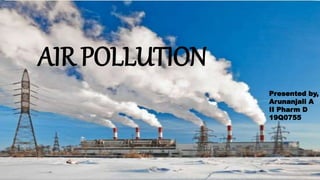
AIR POLLUTION
Presented by,
Arunanjali A
II Pharm D
19Q0755
Definition:
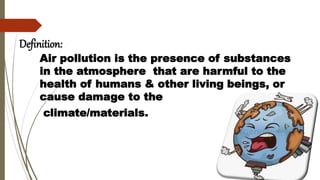
Air pollution is the presence of substances
in the atmosphere that are harmful to the
health of humans & other living beings, or
cause damage to the
climate/materials.
Normal components of ouratmosphere:
 Nitrogen - 78.1%
 Oxygen - 20.9%
 Carbon dioxide - 0.03%
 Everything else - 0.07%
Noble gases (krypton, xenon,
argon, helium)
Methane
Sulfur dioxide
CAUSES OF AIR POLLUTION:
• Dust raised on the ground during dust storms.
• Stone dust raised by crushing of stones in
quarries.
• Smoke emitted by vehicles.
• Smoke from forest fires.
• Smoke raised by burning of coal in powerhouses.
• Burning of wood, cow dung cakes, garbage etc.
• Germs from coughing & sneezing.
Sources of Air pollution
NATURAL
Natural contaminants
(fungi,spores,bacteria,dust
etc)
CO from methane gas
Volcanic Eruptions
Forest fires
Dust & storms
MAN MADE
• Rapid industrialization
• Automobile Revolution
• Deforestation
POLLUTANTS:
A pollutant is a substance that can have adverse
effects on human and ecosystem.
This substance can be a solid/liquid/ gaseous
molecule.
Pollutants may be of a natural origin or man
made.
Pollutants are classified into 2 types:
1.Primary pollutants
2.Secondary pollutants.
PRIMARY POLLUTANTS
 CO2, NO, NO2, CO, SO2
 Volatile organic compounds
 Particulates
 Persistent free radicals
 Toxic metals
 Chlorofluoro carbons
 Ammonia
SECONDARY POLLUTANTS
• Smog • UV rays
• Ozone
• Peroxy acetyl nitrate
EFECTSOF AIRPOLLUTIONON HUMAN
SHORT TERM EFFECTS:
• Irritation to the nose, eye and throat.
• Upper respiratory infections like
bronchitis & pneumonia.
• Headache, nausea and allergic reactions.
• Asthma and Emphysema.
LONG TERM EFFECTS:
• Chronic respiratory diseases
• Lung cancer.
• Heart diseases.
• Damage to the brain, nerves, liver or
kidneys.
CONTROL OF AIR POLLUTION
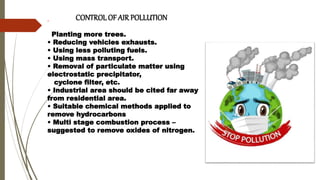
• Planting more trees.
• Reducing vehicles exhausts.
• Using less polluting fuels.
• Using mass transport.
• Removal of particulate matter using
electrostatic precipitator,
cyclone filter, etc.
• Industrial area should be cited far away
from residential area.
• Suitable chemical methods applied to
remove hydrocarbons
• Multi stage combustion process –
suggested to remove oxides of nitrogen.
SMOKING
Definition:
Smoking is defined as the action or habit of inhaling
and exhaling the smoke of tobacco or a drug it emits
smoke or visible vapour.
• It can also be done as a part of rituals, to induce
trances & spiritual enlightenment.
• Tobacco smoking is today by far the most popular
form of smoking & is practiced by over one billion
people.
• Air pollution emitted by cigarettes is 10 times greater than diesel car
exhaust, suggests a controlled experiment, reported in tobacco
control.
• Environmental tobacco smoke
produces fine particulate matter,
which is most dangerous element
of air pollution for health.
• Cigars causes environmental
pollution by releasing toxic
air pollutants into atmosphere &
the toxic chemicals in the remains
seep into soils and waterways.
EFFECTS OF SMOKING ON OUR HEALTH
Smoking compromises the immune
system, making smokers more likely to
have respiratory infections.
Smoking is one of the main factor
that increase the risk for osteoporosis,
a condition in which bones weaken and
become more likely to facture.
The chemicals in tobacco smoke
harm your blood cells and damage the
function of your heart which increase
the risk of Atherosclerosis, Aneurysms,
CVD etc.
Every cigarette you smoke damages your
breathing and scars your lungs, it causes COPD,
Emphysema, Chronic bronchitis, Pneumonia,
Asthma, Tuberculosis.
Smoking increases the risk of developing age-
related macular degeneration, cataract, optic
nerve damage and all which leads to blindness.
Smoking cigarette is the number one risk factor
for lung cancer, it cause cancer in the lungs,
trachea, bronchus, esophagus and different
organs in our body.
CARBONMONOXIDE (CO)
• It is colorless , odorless gas , a product
of incomplete combustion of carbon
containing materials, such as in in
automobiles, industrial process, heating
facilities and incinerators .
• Some widespread natural non biological
and biological sources have also been
identified.
• Concentrations in urban areas depend on
weather and traffic density.
EFFECT OF CO POLLUTION ON THE HEALTH
• It causes harmful effect by reducing oxygeen delivery
to body organ, in extermelly high level it can cause
death.
• CO’s affinity for Hb is 240–270 times greater than
oxygen and Fetal Hb has higher affinity for CO , so it
competes with O2 to bind (irreversibly) with
haemoglobin.
• By this exposure to it reduce the oxygen -carrying
capacity of the blood to the heart, brain and other
organs
• Deprives body of O2 causing headaches, fatigue, MI
and impaired vision.
SULPHUR DIOXIDE (SO2)
It is one of the several forms in which sulphur
exists in air.
The others include H2S,H2SO4and sulphate
salts.
Sulphur dioxide results from the combustion of
sulphur containing fossil fuel, and when coal and
fuel oil are burned.
Domestic fires can also produce emissions
containing sulphur dioxide.
Acid aerosol - sulphuric acid (H2S04)is a strong
acid that is formed from the reaction of sulphur
trioxide gas (S03) with water.
NITROGENDIOXIDE(NO2)
• Nitric oxide (NO) is produced by combustion.
• Nitrogen dioxide (NO2), which has greater health effects, is
a secondary pollutant created by the oxidation of NO under
conditions of sunlight, or may be formed directly by higher
temperature.
• Combustion in power plants or indoors from gas stoves.
• Nitrogen Dioxide -- reddish, brown gas present in car
exhaust and power plants.
• Levels of exposure to nitrogen dioxide that should not be
exceeded (WHO guideline levels) are respectively 400 μg/m3
(0.21 parts per million (ppm) for one hour and 150 μg/m3
(0.08 ppm) for 24 hours (WHO, 1987a).
Effectsof N02 on human health
• Increased inflammation of the airways;
• Worsened cough and wheezing;
• Reduced lung function;
• Increased asthma attacks; and
• Greater likelihood of emergency department
and hospital admissions.
Thank You

Air Pollution.pptx

  • 1.
    Air pollution &SMOKING PRESENTED BY, ARUNANJALI A II PHARM D 19Q0755 AIR POLLUTION Presented by, Arunanjali A II Pharm D 19Q0755
  • 2.
    Definition: Air pollution isthe presence of substances in the atmosphere that are harmful to the health of humans & other living beings, or cause damage to the climate/materials.
  • 3.
    Normal components ofouratmosphere:  Nitrogen - 78.1%  Oxygen - 20.9%  Carbon dioxide - 0.03%  Everything else - 0.07% Noble gases (krypton, xenon, argon, helium) Methane Sulfur dioxide
  • 4.
    CAUSES OF AIRPOLLUTION: • Dust raised on the ground during dust storms. • Stone dust raised by crushing of stones in quarries. • Smoke emitted by vehicles. • Smoke from forest fires. • Smoke raised by burning of coal in powerhouses. • Burning of wood, cow dung cakes, garbage etc. • Germs from coughing & sneezing.
  • 6.
    Sources of Airpollution NATURAL Natural contaminants (fungi,spores,bacteria,dust etc) CO from methane gas Volcanic Eruptions Forest fires Dust & storms MAN MADE • Rapid industrialization • Automobile Revolution • Deforestation
  • 7.
    POLLUTANTS: A pollutant isa substance that can have adverse effects on human and ecosystem. This substance can be a solid/liquid/ gaseous molecule. Pollutants may be of a natural origin or man made. Pollutants are classified into 2 types: 1.Primary pollutants 2.Secondary pollutants.
  • 8.
    PRIMARY POLLUTANTS  CO2,NO, NO2, CO, SO2  Volatile organic compounds  Particulates  Persistent free radicals  Toxic metals  Chlorofluoro carbons  Ammonia SECONDARY POLLUTANTS • Smog • UV rays • Ozone • Peroxy acetyl nitrate
  • 9.
    EFECTSOF AIRPOLLUTIONON HUMAN SHORTTERM EFFECTS: • Irritation to the nose, eye and throat. • Upper respiratory infections like bronchitis & pneumonia. • Headache, nausea and allergic reactions. • Asthma and Emphysema. LONG TERM EFFECTS: • Chronic respiratory diseases • Lung cancer. • Heart diseases. • Damage to the brain, nerves, liver or kidneys.
  • 10.
    CONTROL OF AIRPOLLUTION • Planting more trees. • Reducing vehicles exhausts. • Using less polluting fuels. • Using mass transport. • Removal of particulate matter using electrostatic precipitator, cyclone filter, etc. • Industrial area should be cited far away from residential area. • Suitable chemical methods applied to remove hydrocarbons • Multi stage combustion process – suggested to remove oxides of nitrogen.
  • 11.
    SMOKING Definition: Smoking is definedas the action or habit of inhaling and exhaling the smoke of tobacco or a drug it emits smoke or visible vapour. • It can also be done as a part of rituals, to induce trances & spiritual enlightenment. • Tobacco smoking is today by far the most popular form of smoking & is practiced by over one billion people.
  • 13.
    • Air pollutionemitted by cigarettes is 10 times greater than diesel car exhaust, suggests a controlled experiment, reported in tobacco control. • Environmental tobacco smoke produces fine particulate matter, which is most dangerous element of air pollution for health. • Cigars causes environmental pollution by releasing toxic air pollutants into atmosphere & the toxic chemicals in the remains seep into soils and waterways.
  • 14.
    EFFECTS OF SMOKINGON OUR HEALTH Smoking compromises the immune system, making smokers more likely to have respiratory infections. Smoking is one of the main factor that increase the risk for osteoporosis, a condition in which bones weaken and become more likely to facture. The chemicals in tobacco smoke harm your blood cells and damage the function of your heart which increase the risk of Atherosclerosis, Aneurysms, CVD etc.
  • 15.
    Every cigarette yousmoke damages your breathing and scars your lungs, it causes COPD, Emphysema, Chronic bronchitis, Pneumonia, Asthma, Tuberculosis. Smoking increases the risk of developing age- related macular degeneration, cataract, optic nerve damage and all which leads to blindness. Smoking cigarette is the number one risk factor for lung cancer, it cause cancer in the lungs, trachea, bronchus, esophagus and different organs in our body.
  • 16.
    CARBONMONOXIDE (CO) • Itis colorless , odorless gas , a product of incomplete combustion of carbon containing materials, such as in in automobiles, industrial process, heating facilities and incinerators . • Some widespread natural non biological and biological sources have also been identified. • Concentrations in urban areas depend on weather and traffic density.
  • 17.
    EFFECT OF COPOLLUTION ON THE HEALTH • It causes harmful effect by reducing oxygeen delivery to body organ, in extermelly high level it can cause death. • CO’s affinity for Hb is 240–270 times greater than oxygen and Fetal Hb has higher affinity for CO , so it competes with O2 to bind (irreversibly) with haemoglobin. • By this exposure to it reduce the oxygen -carrying capacity of the blood to the heart, brain and other organs • Deprives body of O2 causing headaches, fatigue, MI and impaired vision.
  • 18.
    SULPHUR DIOXIDE (SO2) Itis one of the several forms in which sulphur exists in air. The others include H2S,H2SO4and sulphate salts. Sulphur dioxide results from the combustion of sulphur containing fossil fuel, and when coal and fuel oil are burned. Domestic fires can also produce emissions containing sulphur dioxide. Acid aerosol - sulphuric acid (H2S04)is a strong acid that is formed from the reaction of sulphur trioxide gas (S03) with water.
  • 19.
    NITROGENDIOXIDE(NO2) • Nitric oxide(NO) is produced by combustion. • Nitrogen dioxide (NO2), which has greater health effects, is a secondary pollutant created by the oxidation of NO under conditions of sunlight, or may be formed directly by higher temperature. • Combustion in power plants or indoors from gas stoves. • Nitrogen Dioxide -- reddish, brown gas present in car exhaust and power plants. • Levels of exposure to nitrogen dioxide that should not be exceeded (WHO guideline levels) are respectively 400 μg/m3 (0.21 parts per million (ppm) for one hour and 150 μg/m3 (0.08 ppm) for 24 hours (WHO, 1987a).
  • 20.
    Effectsof N02 onhuman health • Increased inflammation of the airways; • Worsened cough and wheezing; • Reduced lung function; • Increased asthma attacks; and • Greater likelihood of emergency department and hospital admissions.
  • 21.