NAME ARYA H PATEL
MY TOPIC –AIR CARGO OVERVIEW
AIR CARGO OVERVIEW
AIR CARGO CARRIERS
AIR CARGO CARRIERS
• Air cargo services are provided by a segmented group of air carriers that provide various
services based upon wide ranging customer demands .
• The following four basic types of carriers provide these services:
• Integrated express operators
• All cargo carriers
• Commercial service passenger airlines
• Ad hoc cargo charter carriers
Integrated express operators
• FENDX UPS AND DHL Operate a fleet of scheduled aircraft truck and couriers offering door to door
delivery service .these carriers operate extensive hub and spoke network providing expansive
geographic converage
• In 2003 integrated express carriers accounted for 61 percent of this us domestic air cargo market yet
held only 12 percent of the inrnational market (projected to increase to increase to 31 percent by 2019)
DHL CARGO PIANE
FEDEX CARGO PLANE
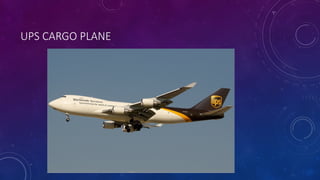
UPS CARGO PLANE
• The Boeing 747 is a long-range wide-body airliner designed and manufactured by Boeing Commercial Airplanes in the United States
between 1968 and 2023. After the introduction of the 707 in October 1958, Pan Am wanted a jet 2+1
⁄2 times its size, to reduce its seat cost
by 30%. In 1965, Joe Sutter left the 737 development program to design the 747. In April 1966, Pan Am ordered 25 Boeing 747-100
aircraft, and in late 1966, Pratt & Whitney agreed to develop the JT9D engine, a high-bypass turbofan. On September 30, 1968, the first
747 was rolled out of the custom-built Everett Plant, the world's largest building by volume. The 747's first flight took place on February 9,
1969, and the 747 was certified in December of that year. It entered service with Pan Am on January 22, 1970. The 747 was the first
airplane called a "Jumbo Jet" as the first wide-body airliner.
• The 747 is a four-engined jet aircraft, initially powered by Pratt & Whitney JT9D turbofan engines, then General Electric CF6 and
Rolls-Royce RB211 engines for the original variants. With a ten-abreast economy seating, it typically accommodates 366 passengers in
three travel classes. It has a pronounced 37.5° wing sweep, allowing a Mach 0.85 (490 kn; 900 km/h) cruise speed, and its heavy weight
is supported by four main landing gear legs, each with a four-wheel bogie. The partial double-deck aircraft was designed with a raised
cockpit so it could be converted to a freighter airplane by installing a front cargo door, as it was initially thought that it would eventually be
superseded by supersonic transports.
• Boeing introduced the -200 in 1971, with uprated engines for a heavier maximum takeoff weight (MTOW) of 833,000 pounds (378 t) from
the initial 735,000 pounds (333 t), increasing the maximum range from 4,620 to 6,560 nautical miles [nmi] (8,560 to 12,150 km; 5,320 to
7,550 mi). It was shortened for the longer-range 747SP in 1976, and the 747-300 followed in 1983 with a stretched upper deck for up to
400 seats in three classes. The heavier 747-400 with improved RB211 and CF6 engines or the new PW4000 engine (the JT9D
successor), and a two-crew glass cockpit, was introduced in 1989 and is the most common variant. After several studies, the stretched
747-8 was launched on November 14, 2005, with new General Electric GEnx engines, and was first delivered in October 2011. The 747 is
the basis for several government and military variants, such as the VC-25 (Air Force One), E-4 Emergency Airborne Command Post,
Shuttle Carrier Aircraft, and some experimental test aircraft such as the YAL-1 and SOFIA airborne observatory.
thank you

air cargo overview...........................

  • 1.
    NAME ARYA HPATEL MY TOPIC –AIR CARGO OVERVIEW
  • 2.
  • 3.
  • 4.
    AIR CARGO CARRIERS •Air cargo services are provided by a segmented group of air carriers that provide various services based upon wide ranging customer demands . • The following four basic types of carriers provide these services: • Integrated express operators • All cargo carriers • Commercial service passenger airlines • Ad hoc cargo charter carriers
  • 5.
    Integrated express operators •FENDX UPS AND DHL Operate a fleet of scheduled aircraft truck and couriers offering door to door delivery service .these carriers operate extensive hub and spoke network providing expansive geographic converage • In 2003 integrated express carriers accounted for 61 percent of this us domestic air cargo market yet held only 12 percent of the inrnational market (projected to increase to increase to 31 percent by 2019)
  • 6.
  • 7.
  • 8.
  • 13.
    • The Boeing747 is a long-range wide-body airliner designed and manufactured by Boeing Commercial Airplanes in the United States between 1968 and 2023. After the introduction of the 707 in October 1958, Pan Am wanted a jet 2+1 ⁄2 times its size, to reduce its seat cost by 30%. In 1965, Joe Sutter left the 737 development program to design the 747. In April 1966, Pan Am ordered 25 Boeing 747-100 aircraft, and in late 1966, Pratt & Whitney agreed to develop the JT9D engine, a high-bypass turbofan. On September 30, 1968, the first 747 was rolled out of the custom-built Everett Plant, the world's largest building by volume. The 747's first flight took place on February 9, 1969, and the 747 was certified in December of that year. It entered service with Pan Am on January 22, 1970. The 747 was the first airplane called a "Jumbo Jet" as the first wide-body airliner. • The 747 is a four-engined jet aircraft, initially powered by Pratt & Whitney JT9D turbofan engines, then General Electric CF6 and Rolls-Royce RB211 engines for the original variants. With a ten-abreast economy seating, it typically accommodates 366 passengers in three travel classes. It has a pronounced 37.5° wing sweep, allowing a Mach 0.85 (490 kn; 900 km/h) cruise speed, and its heavy weight is supported by four main landing gear legs, each with a four-wheel bogie. The partial double-deck aircraft was designed with a raised cockpit so it could be converted to a freighter airplane by installing a front cargo door, as it was initially thought that it would eventually be superseded by supersonic transports. • Boeing introduced the -200 in 1971, with uprated engines for a heavier maximum takeoff weight (MTOW) of 833,000 pounds (378 t) from the initial 735,000 pounds (333 t), increasing the maximum range from 4,620 to 6,560 nautical miles [nmi] (8,560 to 12,150 km; 5,320 to 7,550 mi). It was shortened for the longer-range 747SP in 1976, and the 747-300 followed in 1983 with a stretched upper deck for up to 400 seats in three classes. The heavier 747-400 with improved RB211 and CF6 engines or the new PW4000 engine (the JT9D successor), and a two-crew glass cockpit, was introduced in 1989 and is the most common variant. After several studies, the stretched 747-8 was launched on November 14, 2005, with new General Electric GEnx engines, and was first delivered in October 2011. The 747 is the basis for several government and military variants, such as the VC-25 (Air Force One), E-4 Emergency Airborne Command Post, Shuttle Carrier Aircraft, and some experimental test aircraft such as the YAL-1 and SOFIA airborne observatory.
  • 18.