Overview
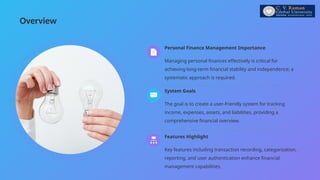
Managing personal financeseffectively is critical for
achieving long-term financial stability and independence; a
systematic approach is required.
Personal Finance Management Importance
Key features including transaction recording, categorization,
reporting, and user authentication enhance financial
management capabilities.
Features Highlight
The goal is to create a user-friendly system for tracking
income, expenses, assets, and liabilities, providing a
comprehensive financial overview.
System Goals
5.
Scope
System Boundaries
The systemfocuses exclusively on
personal finance management;
external investment
functionalities are explicitly
excluded.
01
Target Users
Designed for individuals looking to
efficiently manage their finances,
regardless of financial expertise.
02
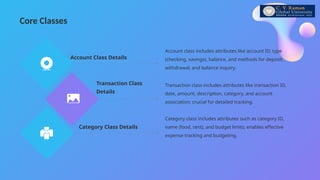
Core Classes
Account classincludes attributes like account ID, type
(checking, savings), balance, and methods for deposit,
withdrawal, and balance inquiry.
Account Class Details
Transaction class includes attributes like transaction ID,
date, amount, description, category, and account
association; crucial for detailed tracking.
Transaction Class
Details
Category class includes attributes such as category ID,
name (food, rent), and budget limits; enables effective
expense tracking and budgeting.
Category Class Details
8.
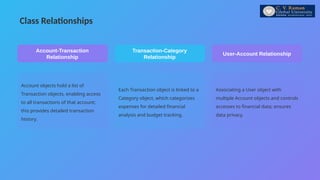
Class Relationships
Account objectshold a list of
Transaction objects, enabling access
to all transactions of that account;
this provides detailed transaction
history.
Account-Transaction
Relationship
Each Transaction object is linked to a
Category object, which categorizes
expenses for detailed financial
analysis and budget tracking.
Transaction-Category
Relationship
Associating a User object with
multiple Account objects and controls
accesses to financial data; ensures
data privacy.
User-Account Relationship
9.
Inheritance and Polymorphism
Usingpolymorphism enables handling
different transaction types like deposits and
withdrawals uniformly, simplifying
transaction processing.
Subclasses like CheckingAccount and
SavingsAccount extend the Account class,
implementing specific functionalities like
interest calculation.
Account Type Hierarchy
Transaction Type Handling
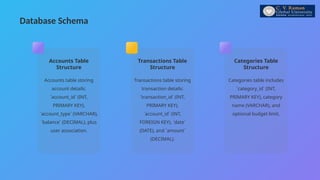
Database Schema
Accounts Table
Structure
Accountstable storing
account details:
`account_id` (INT,
PRIMARY KEY),
`account_type` (VARCHAR),
`balance` (DECIMAL), plus
user association.
Transactions Table
Structure
Transactions table storing
transaction details:
`transaction_id` (INT,
PRIMARY KEY),
`account_id` (INT,
FOREIGN KEY), `date`
(DATE), and `amount`
(DECIMAL).
Categories Table
Structure
Categories table includes
`category_id` (INT,
PRIMARY KEY), category
name (VARCHAR), and
optional budget limit.
12.
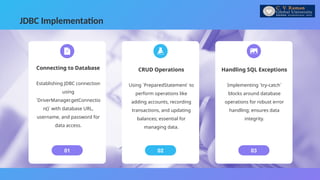
JDBC Implementation
01 0203
Connecting to Database
Establishing JDBC connection
using
`DriverManager.getConnectio
n()` with database URL,
username, and password for
data access.
CRUD Operations
Using `PreparedStatement` to
perform operations like
adding accounts, recording
transactions, and updating
balances; essential for
managing data.
Handling SQL Exceptions
Implementing `try-catch`
blocks around database
operations for robust error
handling; ensures data
integrity.
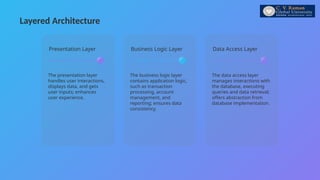
Layered Architecture
Presentation Layer
Thepresentation layer
handles user interactions,
displays data, and gets
user inputs; enhances
user experience.
Business Logic Layer
The business logic layer
contains application logic,
such as transaction
processing, account
management, and
reporting; ensures data
consistency.
Data Access Layer
The data access layer
manages interactions with
the database, executing
queries and data retrieval;
offers abstraction from
database implementation.
15.
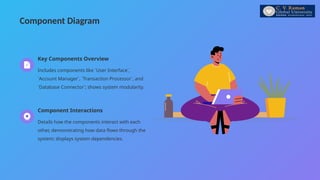
Component Diagram
Key ComponentsOverview
Includes components like `User Interface`,
`Account Manager`, `Transaction Processor`, and
`Database Connector`; shows system modularity.
Component Interactions
Details how the components interact with each
other, demonstrating how data flows through the
system; displays system dependencies.
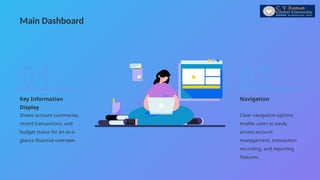
Main Dashboard
Navigation
Clear navigationoptions
enable users to easily
access account
management, transaction
recording, and reporting
features.
02
Key Information
Display
Shows account summaries,
recent transactions, and
budget status for an at-a-
glance financial overview.
01
18.
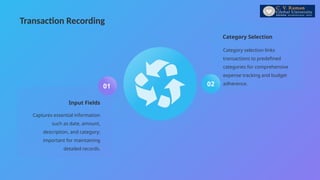
Transaction Recording
Input Fields
Capturesessential information
such as date, amount,
description, and category;
important for maintaining
detailed records.
01
Category Selection
Category selection links
transactions to predefined
categories for comprehensive
expense tracking and budget
adherence.
02
19.
Reporting
Report Generation
Generates reportson income, expenses, and net
worth, aiding informed financial decisions.
Visualization
Charts and graphs provide visual insights into
spending patterns and financial trends for
improving financial awareness.
Connect to Database
Codesnippet demonstrating database
connection setup using JDBC; replace
placeholders with real database credentials.
JDBC Configuration
22.
Add Transaction
Prepared StatementConfiguration
Code snippet for adding new transaction into database; demonstrates usage
of Prepared Statements.
23.
Get Account Balance
Codesnippet for retrieving account balance via
SQL query; shows balance retrieval
implementation.
SQL Query
Unit Tests
Account ClassTests
Tests to ensure account
functionalities correctly
perform
deposit/withdrawals and
balance calculations;
confirms proper account
operation.
02
Transaction Class
Tests
Tests to ensure transaction
calculations accurately
record amounts and
categories; validates
calculation accuracy.
01
26.
Integration Tests
Ensures thatdata consistency is maintained
throughout the system; crucial for financial
data reliability.
Verifies that system components work
together correctly, from user input through
database updates; checks system
connectivity.
End-to-End Testing
Data Integrity Checks
27.
User Acceptance Testing
UserFeedback
Gathers user feedback on system usability and
functionality, ensuring it meets requirements;
prioritizes user experience.
Issue Resolution
Addresses user-reported issues, enhancing the
system to meet user expectations and satisfaction;
improves system reliability.
Summary
Summarizes the successfuldevelopment of a
personal asset management system using Java
OOP and JDBC for finance tracking.
Accomplishments
Recaps the achievement of goals, effective
financial tracking, budget management, and
financial insights delivery.
Project Goals Achieved
30.
Future Enhancements
Possible Improvements
Scalability
Includesonline banking
integration, investment tracking,
mobile app availability, and
advanced reporting features;
enhances user experience.
Discusses future scalability and
adaptation to incorporate new
features and handle larger
datasets; crucial for future
growth.



















![[DSC Europe 25] Laila Kakar - Leveraging AI for Strategic Excellence: Enhanci...](https://cdn.slidesharecdn.com/ss_thumbnails/eykmhrtsqmaaftwkexh7-dsc-lailakakar-1-260119101520-5f3b5616-thumbnail.jpg?width=640&height=640&fit=bounds)
![[DSC Europe 25] Andrzej Kowalczyk - AI - how to start small and grow in the f...](https://cdn.slidesharecdn.com/ss_thumbnails/oy1zmo94qv6vpcqjvno2-andrzej-kowalczyk-ai-how-to-start-small-and-grow-in-the-future-1-260119121559-cf093b23-thumbnail.jpg?width=640&height=640&fit=bounds)


![[DSC Europe 25] Paula Garcia Esteban -Building the Future: The Role of Data S...](https://cdn.slidesharecdn.com/ss_thumbnails/9ld1r1bsqpwve8qfvphy-paula-garcia-esteban-building-the-future-260122103838-4171f5cb-thumbnail.jpg?width=640&height=640&fit=bounds)

![[DSC Europe 25] Tali Fulman - Guild Meetings, Then What? Building Data Commun...](https://cdn.slidesharecdn.com/ss_thumbnails/fgohhi33rwmhqdowdj5k-tali-fulman-guild-meetings-then-what-building-data-communities-that-actually-ch-260120105855-528492c3-thumbnail.jpg?width=640&height=640&fit=bounds)
![[DSC Europe 25] Josip Saban - Career building for data professionals.pptx](https://cdn.slidesharecdn.com/ss_thumbnails/zroflcttkm1vmli0txea-josip-saban-career-building-for-data-professionals-260123083019-587cdb8c-thumbnail.jpg?width=640&height=640&fit=bounds)


![[DSC Europe 25] Tamas Srancsik - How To Teach Your AI Football? An Argument f...](https://cdn.slidesharecdn.com/ss_thumbnails/bcjh1m9xtbosv20ucftb-tamas-srancsik-how-to-teach-your-ai-football-260121115910-08b53e9e-thumbnail.jpg?width=640&height=640&fit=bounds)

![[DSC Europe 25] Bojan Banjac - AI is always right when it comes to the matter...](https://cdn.slidesharecdn.com/ss_thumbnails/syoxtqierpydwxm5srcb-4-bojan-banjac-ai-is-always-right-when-it-comes-to-the-matters-of-taste-260119101519-694ee7d7-thumbnail.jpg?width=640&height=640&fit=bounds)


