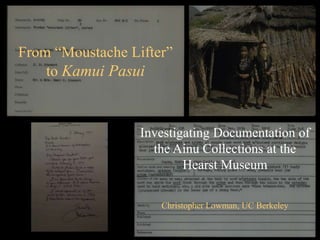
From “Moustache Lifter”
to Kamui Pasui
Investigating Documentation of
the Ainu Collections at the
Hearst Museum
Christopher Lowman, UC Berkeley
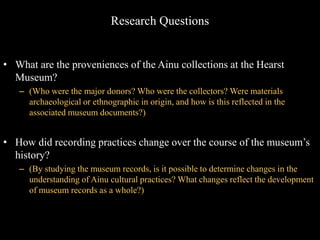
Research Questions
• What are the proveniences of the Ainu collections at the Hearst
Museum?
– (Who were the major donors? Who were the collectors? Were materials
archaeological or ethnographic in origin, and how is this reflected in the
associated museum documents?)
• How did recording practices change over the course of the museum’s
history?
– (By studying the museum records, is it possible to determine changes in the
understanding of Ainu cultural practices? What changes reflect the development
of museum records as a whole?)
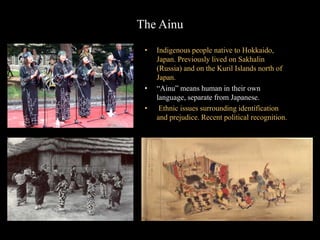
The Ainu
• Indigenous people native to Hokkaido,
Japan. Previously lived on Sakhalin
(Russia) and on the Kuril Islands north of
Japan.
• “Ainu” means human in their own
language, separate from Japanese.
• Ethnic issues surrounding identification
and prejudice. Recent political recognition.
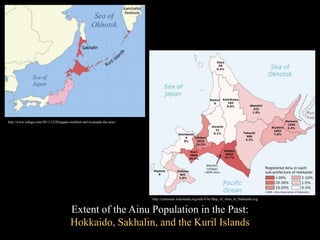
Extent of the Ainu Population in the Past:
Hokkaido, Sakhalin, and the Kuril Islands
http://www.tofugu.com/2011/12/20/japans-resilient-native-people-the-ainu/
http://commons.wikimedia.org/wiki/File:Map_of_Ainu_in_Hokkaido.svg
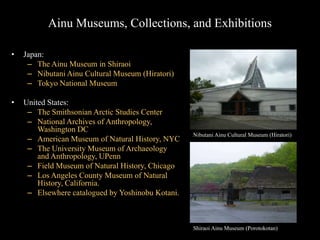
Ainu Museums, Collections, and Exhibitions
• Japan:
– The Ainu Museum in Shiraoi
– Nibutani Ainu Cultural Museum (Hiratori)
– Tokyo National Museum
• United States:
– The Smithsonian Arctic Studies Center
– National Archives of Anthropology,
Washington DC
– American Museum of Natural History, NYC
– The University Museum of Archaeology
and Anthropology, UPenn
– Field Museum of Natural History, Chicago
– Los Angeles County Museum of Natural
History, California.
– Elsewhere catalogued by Yoshinobu Kotani.
Shiraoi Ainu Museum (Porotokotan)
Nibutani Ainu Cultural Museum (Hiratori)
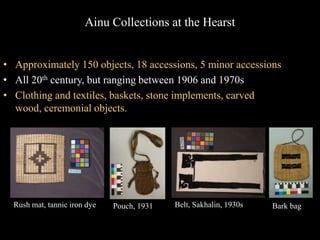
Ainu Collections at the Hearst
• Approximately 150 objects, 18 accessions, 5 minor accessions
• All 20th century, but ranging between 1906 and 1970s
• Clothing and textiles, baskets, stone implements, carved
wood, ceremonial objects.
Belt, Sakhalin, 1930sRush mat, tannic iron dye Bark bagPouch, 1931
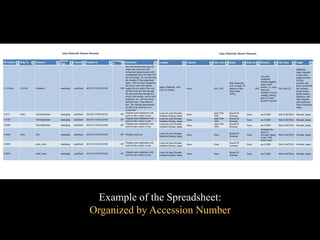
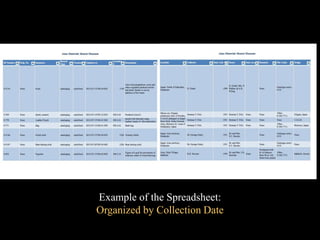
Example of the Spreadsheet:
Organized by Accession Number
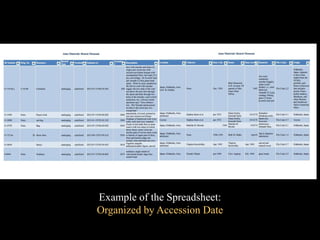
Example of the Spreadsheet:
Organized by Accession Date
Example of the Spreadsheet:
Organized by Collection Date
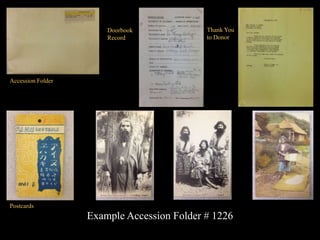
Example Accession Folder # 1226
Accession Folder
Doorbook
Record
Thank You
to Donor
Postcards
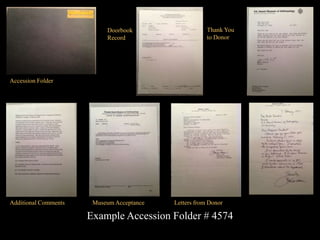
Example Accession Folder # 4574
Accession Folder
Doorbook
Record
Thank You
to Donor
Additional Comments Museum Acceptance Letters from Donor
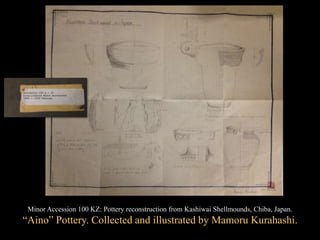
Minor Accession 100 KZ: Pottery reconstruction from Kashiwai Shellmounds, Chiba, Japan.
“Aino” Pottery. Collected and illustrated by Mamoru Kurahashi.
From “Moustache Lifter” to Prayer Stick to Kamui Pasui
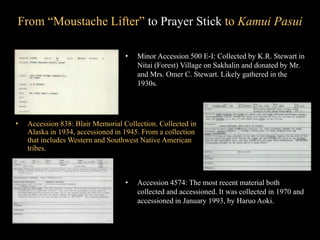
• Minor Accession 500 E-I: Collected by K.R. Stewart in
Nitai (Forest) Village on Sakhalin and donated by Mr.
and Mrs. Omer C. Stewart. Likely gathered in the
1930s.
• Accession 838: Blair Memorial Collection. Collected in
Alaska in 1934, accessioned in 1945. From a collection
that includes Western and Southwest Native American
tribes.
• Accession 4574: The most recent material both
collected and accessioned. It was collected in 1970 and
accessioned in January 1993, by Haruo Aoki.
Next Steps
• Record the objects and photographs
that have missing information.
• Follow-up research using the names
of the collectors and donors.
• Make contact with Yoshinobu
Kotani to find out more about his
documentation of Berkeley’s
collections.
• Synthesize research so far in the
context of class readings.
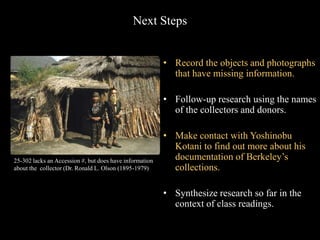
25-302 lacks an Accession #, but does have information
about the collector (Dr. Ronald L. Olson (1895-1979)
Thank you—
Ira Jacknis
Junko Habu
William Fitzhugh
Laura Fleming
The Arctic Studies Center at the
Smithsonian

Ainu presentation anthro 235

  • 1.
    From “Moustache Lifter” toKamui Pasui Investigating Documentation of the Ainu Collections at the Hearst Museum Christopher Lowman, UC Berkeley
  • 2.
    Research Questions • Whatare the proveniences of the Ainu collections at the Hearst Museum? – (Who were the major donors? Who were the collectors? Were materials archaeological or ethnographic in origin, and how is this reflected in the associated museum documents?) • How did recording practices change over the course of the museum’s history? – (By studying the museum records, is it possible to determine changes in the understanding of Ainu cultural practices? What changes reflect the development of museum records as a whole?)
  • 3.
    The Ainu • Indigenouspeople native to Hokkaido, Japan. Previously lived on Sakhalin (Russia) and on the Kuril Islands north of Japan. • “Ainu” means human in their own language, separate from Japanese. • Ethnic issues surrounding identification and prejudice. Recent political recognition.
  • 4.
    Extent of theAinu Population in the Past: Hokkaido, Sakhalin, and the Kuril Islands http://www.tofugu.com/2011/12/20/japans-resilient-native-people-the-ainu/ http://commons.wikimedia.org/wiki/File:Map_of_Ainu_in_Hokkaido.svg
  • 5.
    Ainu Museums, Collections,and Exhibitions • Japan: – The Ainu Museum in Shiraoi – Nibutani Ainu Cultural Museum (Hiratori) – Tokyo National Museum • United States: – The Smithsonian Arctic Studies Center – National Archives of Anthropology, Washington DC – American Museum of Natural History, NYC – The University Museum of Archaeology and Anthropology, UPenn – Field Museum of Natural History, Chicago – Los Angeles County Museum of Natural History, California. – Elsewhere catalogued by Yoshinobu Kotani. Shiraoi Ainu Museum (Porotokotan) Nibutani Ainu Cultural Museum (Hiratori)
  • 6.
    Ainu Collections atthe Hearst • Approximately 150 objects, 18 accessions, 5 minor accessions • All 20th century, but ranging between 1906 and 1970s • Clothing and textiles, baskets, stone implements, carved wood, ceremonial objects. Belt, Sakhalin, 1930sRush mat, tannic iron dye Bark bagPouch, 1931
  • 7.
    Example of theSpreadsheet: Organized by Accession Number
  • 8.
    Example of theSpreadsheet: Organized by Accession Date
  • 9.
    Example of theSpreadsheet: Organized by Collection Date
  • 10.
    Example Accession Folder# 1226 Accession Folder Doorbook Record Thank You to Donor Postcards
  • 11.
    Example Accession Folder# 4574 Accession Folder Doorbook Record Thank You to Donor Additional Comments Museum Acceptance Letters from Donor
  • 12.
    Minor Accession 100KZ: Pottery reconstruction from Kashiwai Shellmounds, Chiba, Japan. “Aino” Pottery. Collected and illustrated by Mamoru Kurahashi.
  • 13.
    From “Moustache Lifter”to Prayer Stick to Kamui Pasui • Minor Accession 500 E-I: Collected by K.R. Stewart in Nitai (Forest) Village on Sakhalin and donated by Mr. and Mrs. Omer C. Stewart. Likely gathered in the 1930s. • Accession 838: Blair Memorial Collection. Collected in Alaska in 1934, accessioned in 1945. From a collection that includes Western and Southwest Native American tribes. • Accession 4574: The most recent material both collected and accessioned. It was collected in 1970 and accessioned in January 1993, by Haruo Aoki.
  • 14.
    Next Steps • Recordthe objects and photographs that have missing information. • Follow-up research using the names of the collectors and donors. • Make contact with Yoshinobu Kotani to find out more about his documentation of Berkeley’s collections. • Synthesize research so far in the context of class readings. 25-302 lacks an Accession #, but does have information about the collector (Dr. Ronald L. Olson (1895-1979)
  • 15.
    Thank you— Ira Jacknis JunkoHabu William Fitzhugh Laura Fleming The Arctic Studies Center at the Smithsonian