23AIG NEWS No 115, February 2014 Professional Development
Cont. Overleaf
Porphyry Field Mapping Course – Orange, NSW November 2013
This course was intended to aid in the development of
young geologist’s careers, perhaps even to help gain that
difficult first job, by the provision of the necessary field
mapping and core logging skills to begin porphyry exploration.
The model here is that training should be a more cost effective
manner and friendly to the unemployed than the courses run by
now defunct AMF. The inaugural porphyry field mapping course
run by Doug Menzies with help from Greg Corbett was held in the
Orange district 15-21 November 2013. This course was over-
subscribed and required a bigger bus and additional helpers to
accommodate the 26 participants.
Day 1: We assembled about mid-day and collected equipment
including the short-course manual, mapping jacket, aluminium clip
board, colour pencils etc. Doug gave a lecture on his porphyry
mapping technique using different colour pencils as a simplified
and more user-friendly version of the old Anaconda mapping
method. Greg gave an explanation of porphyry geology focusing on
the staged model for alteration and mineralisation using rock
photos from the deposits we were about to visit, already reviewed
by Doug and Greg. Next time we hope to have actual rocks related
to poster scale copies of the Corbett and Leach geological models.
Day 2: We learned to compass and tape map studying porphyry
rock types, alteration and vein styles at the Cargo road side quarry.
Some rain did not dampen enthusiasm, but rather improved the
quality of the exposures. That night John Holliday, one of the most
experienced practitioners in the art, provided a talk on ‘Geophysics
in porphyry exploration’.
Days 3 and 4 were spent at the Golden Cross Coppervale operation
where we mapped the old open pit and leached cap environs and
logged drill core from Copper Hill and Cargo, including material in
the wall rocks to understand the use of alteration and vein types as
vectors towards porphyry mineralisation. On those evenings Mark
Arundell talked on the Goonumbla (North Parks) porphyry Cu-Au
deposits and Doug Menzies on footprints of porphyry Cu-Mo-Au
systems including the Wafi, Golpu case study.
Day 5 was devoted to logging an impressive array of Cadia Valley
drill core provided by Newcrest including the Ridgeway discovery
hole, still with lumps of excitement lying in the bottoms of some
trays, and also Cadia East, Big Cadia etc. That night Mel Quigley,
ex-CSIRO, provided a talk on infrared mineral spectroscopy related
to porphyry deposits. Mel also brought a portable spectrometer
along and demonstrated its use during day time drill core inspections.
Day 6: At Goonumbla (North Parks) several geologists talked the
group through a selection of drill core focusing on types of veins,
Greg Corbett
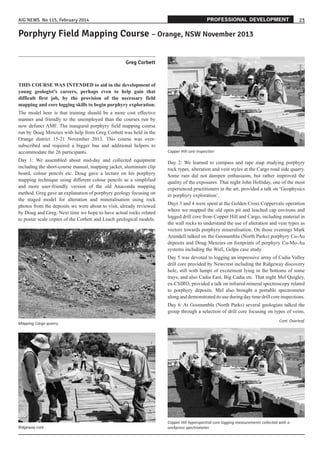
Copper Hill hyperspectral core logging measurements collected with a
oreXpress spectrometer.
Copper Hill core inspection
Ridgeway core
Mapping Cargo quarry
AIG NEWS No 115, February 201424
intrusions and alteration, to show a relationship to
mineralisation and mineral paragenesis. That evening a wrap
up session focused upon ‘what have we learned’ and
commented on how the next field course might differ.
The interesting mix of new graduates and older geoscientists
who wanted to learn about porphyry exploration, and
including those with none or reasonable porphyry exploration
experience, contributed towards a great outcome and positive
interaction. The favourable feedback has prompted a future
provision of an updated porphyry field course.
This course could not have been possible without the help
and moral support from the management of Golden Cross
who also provided access to exposures and drill core for
Cargo and Copper Hill; Newcrest Limited for drill core from
a variety of Cadia Valley ore systems, North Parks Limited for
facilitation of the core Goonumbla core inspection, while Strength
Mining aided with equipment, and John Holliday, Mark Arundell
and Mel Quigley gave talks.
Doug and I will run this course again in late 2014. Anyone may
register an interest at www.cmcgeos.com to be sent the details
when they become available.
Left: Copper
Hill pit
mapping
Porphyry Field Mapping Course – Orange, NSW November 2013 Cont. from Page 23
Below: New
graduate
Cameron Perks
at Copper Hill
(closest to
camera) with
other attendees
Professional Development
Cameron's attendance at the course was supported by an
AIG NSW branch award for early career geoscientists
attending field-based training courses.

aig_cameron

  • 1.
    23AIG NEWS No115, February 2014 Professional Development Cont. Overleaf Porphyry Field Mapping Course – Orange, NSW November 2013 This course was intended to aid in the development of young geologist’s careers, perhaps even to help gain that difficult first job, by the provision of the necessary field mapping and core logging skills to begin porphyry exploration. The model here is that training should be a more cost effective manner and friendly to the unemployed than the courses run by now defunct AMF. The inaugural porphyry field mapping course run by Doug Menzies with help from Greg Corbett was held in the Orange district 15-21 November 2013. This course was over- subscribed and required a bigger bus and additional helpers to accommodate the 26 participants. Day 1: We assembled about mid-day and collected equipment including the short-course manual, mapping jacket, aluminium clip board, colour pencils etc. Doug gave a lecture on his porphyry mapping technique using different colour pencils as a simplified and more user-friendly version of the old Anaconda mapping method. Greg gave an explanation of porphyry geology focusing on the staged model for alteration and mineralisation using rock photos from the deposits we were about to visit, already reviewed by Doug and Greg. Next time we hope to have actual rocks related to poster scale copies of the Corbett and Leach geological models. Day 2: We learned to compass and tape map studying porphyry rock types, alteration and vein styles at the Cargo road side quarry. Some rain did not dampen enthusiasm, but rather improved the quality of the exposures. That night John Holliday, one of the most experienced practitioners in the art, provided a talk on ‘Geophysics in porphyry exploration’. Days 3 and 4 were spent at the Golden Cross Coppervale operation where we mapped the old open pit and leached cap environs and logged drill core from Copper Hill and Cargo, including material in the wall rocks to understand the use of alteration and vein types as vectors towards porphyry mineralisation. On those evenings Mark Arundell talked on the Goonumbla (North Parks) porphyry Cu-Au deposits and Doug Menzies on footprints of porphyry Cu-Mo-Au systems including the Wafi, Golpu case study. Day 5 was devoted to logging an impressive array of Cadia Valley drill core provided by Newcrest including the Ridgeway discovery hole, still with lumps of excitement lying in the bottoms of some trays, and also Cadia East, Big Cadia etc. That night Mel Quigley, ex-CSIRO, provided a talk on infrared mineral spectroscopy related to porphyry deposits. Mel also brought a portable spectrometer along and demonstrated its use during day time drill core inspections. Day 6: At Goonumbla (North Parks) several geologists talked the group through a selection of drill core focusing on types of veins, Greg Corbett Copper Hill hyperspectral core logging measurements collected with a oreXpress spectrometer. Copper Hill core inspection Ridgeway core Mapping Cargo quarry
  • 2.
    AIG NEWS No115, February 201424 intrusions and alteration, to show a relationship to mineralisation and mineral paragenesis. That evening a wrap up session focused upon ‘what have we learned’ and commented on how the next field course might differ. The interesting mix of new graduates and older geoscientists who wanted to learn about porphyry exploration, and including those with none or reasonable porphyry exploration experience, contributed towards a great outcome and positive interaction. The favourable feedback has prompted a future provision of an updated porphyry field course. This course could not have been possible without the help and moral support from the management of Golden Cross who also provided access to exposures and drill core for Cargo and Copper Hill; Newcrest Limited for drill core from a variety of Cadia Valley ore systems, North Parks Limited for facilitation of the core Goonumbla core inspection, while Strength Mining aided with equipment, and John Holliday, Mark Arundell and Mel Quigley gave talks. Doug and I will run this course again in late 2014. Anyone may register an interest at www.cmcgeos.com to be sent the details when they become available. Left: Copper Hill pit mapping Porphyry Field Mapping Course – Orange, NSW November 2013 Cont. from Page 23 Below: New graduate Cameron Perks at Copper Hill (closest to camera) with other attendees Professional Development Cameron's attendance at the course was supported by an AIG NSW branch award for early career geoscientists attending field-based training courses.