
|
GENDER-BASED VIOLENCE AND
HIV
A PROGRAM GUIDE FOR INTEGRATING GENDER-
BASED VIOLENCE PREVENTION AND RESPONSE IN
PEPFAR PROGRAMS


______________________________________________________________________________________
OCTOBER 2011
This publication was made possible through the support of the U.S. President’s Emergency Plan for AIDS Relief (PEPFAR)
through the U.S. Agency for International Development under contract number GHH-I-00-07-00059-00, AIDS Support and
Technical Assistance Resources (AIDSTAR-One) Project, Sector I, Task Order 1.
GENDER-BASED VIOLENCE
AND HIV
A PROGRAM GUIDE FOR INTEGRATING GENDER-
BASED VIOLENCE PREVENTION AND RESPONSE IN
PEPFAR PROGRAMS


The authors' views expressed in this publication do not necessarily reflect the views of the U.S. Agency for
International Development or the United States Government.
AIDS Support and Technical Assistance Resources Project

AIDS Support and Technical Assistance Resources, Sector I, Task Order 1 (AIDSTAR-One) is funded by the
U.S. President’s Emergency Plan for AIDS Relief (PEPFAR) through the U.S. Agency for International
Development (USAID) under contract no. GHH-I-00–07–00059–00, funded January 31, 2008. AIDSTAR-
One is implemented by John Snow, Inc., in collaboration with Broad Reach Healthcare, Encompass, LLC,
International Center for Research on Women, MAP International, Mothers 2 Mothers, Social and Scientific
Systems, Inc., University of Alabama at Birmingham, the White Ribbon Alliance for Safe Motherhood, and
World Education. The project provides technical assistance services to the Office of HIV/AIDS and USG
country teams in knowledge management, technical leadership, program sustainability, strategic planning, and
program implementation support.

Recommended Citation
Khan, Alia. 2011. Gender-based Violence and HIV: A Program Guide for Integrating Gender-based Violence Prevention
and Response in PEPFAR Programs. Arlington, VA: USAID’s AIDS Support and Technical Assistance
Resources, AIDSTAR-One, Task Order 1.

Acknowledgments
Many thanks to the members of the U.S. President’s Emergency Plan for AIDS Relief (PEPFAR) Gender
Technical Working Group for its leadership in conceptualizing and overseeing the development of this guide.
Thanks also to the following individuals for their participation in the Technical Advisory Group consultations
to develop this guide and for their thoughtful review and contributions: Avni Amin (World Health
Organization [WHO]), Ginna Anderson (International Community of Women Living with HIV), Doris
Bartel (CARE), Claudia Briones (UN Women), Manuel Contreras (International Center for Research on
Women [ICRW]), Mary Ellen Duke (U.S. Agency for International Development [USAID]), Mary Ellsberg
(ICRW), Diane Gardsbane (EnCompass LLC), Jill Gay (independent consultant), Jessie Gleckel (U.S. Health
and Human Services Centers for Disease Control and Prevention [CDC]), Alessandra C. Guedes (Pan
American Health Organization/WHO), Andrea Halverson (USAID), Daniela Ligiero (Office of the U.S.
Global AIDS Coordinator), Ronnie Lovich (Save the Children), Lyn Messner (EnCompass LLC), Sasha Mital
(CDC), Claudia Garcia Moreno (WHO), Kellie Moss (Kaiser Family Foundation), Patricia Poppe (Johns
Hopkins University Center for Communication Programs), Diana Prieto (USAID), Samira Sami (CDC), Kai
Spratt (USAID), and Pamela Wyville-Staples (USAID). Thanks to the following PEPFAR Technical Working
Groups for reviewing relevant sections of the guide: HIV Testing and Counseling, Prevention of Mother-to-
Child Transmission, Orphans and Vulnerable Children, Most at-Risk Populations, and Adult Treatment; and
to the AIDSTAR-One Gender Team for their support in the development and publication of this guide.


AIDSTAR-One
John Snow, Inc.
1616 Fort Myer Drive, 16th Floor
Arlington, VA 22209 USA
Phone: 703-528-7474
Fax: 703-528-7480
E-mail: info@aidstar-one.com
Internet: aidstar-one.com
CONTENTS
Acronyms............................................................................................................................................................................. v
Introduction ........................................................................................................................................................................ 7
   Why Link Gender-based Violence and HIV Programs? ....................................................................................... 7
   The Case for Integrating Gender-based Violence Services ................................................................................ 8
   About this Guide .......................................................................................................................................................... 9
   Limitations of the Guide ........................................................................................................................................... 10
   How to Use the Guide .............................................................................................................................................. 11
   Methodology ................................................................................................................................................................ 12
Guiding Principles for Working with Survivors of Gender-based Violence ...................................................... 13
Guidelines for Gender-based Violence Programming ............................................................................................ 19
Prevention ......................................................................................................................................................................... 29
HIV Testing and Counseling .......................................................................................................................................... 33
Prevention of Mother-to-Child Transmission........................................................................................................... 39
Adult Treatment .............................................................................................................................................................. 45
Care and Support ............................................................................................................................................................ 51
Orphans and Vulnerable Children ............................................................................................................................... 55
References ......................................................................................................................................................................... 59
Recommended Resources ............................................................................................................................................. 61


                                                                                                                                                                                    iii
iv
ACRONYMS
ACORD    Agency for Cooperation and Research in Development
ART      antiretroviral therapy
CDC      Centers for Disease Control and Prevention
CHTC     couples HIV testing and counseling
FHI      Family Health International (now known as FHI 360)
GBV      gender-based violence
GNP+     Global Network for People Living with HIV
HTC      HIV testing and counseling
IASC     Inter-Agency Standing Committee
ICRW     International Center for Research on Women
IGWG     Inter-Agency Gender Working Group
IHAA     International HIV/AIDS Alliance
IPPF     International Planned Parenthood Federation
IRC      International Rescue Committee
M&E      monitoring and evaluation
MARP     most-at-risk population
MSM      men who have sex with men
OHA      Office of HIV/AIDS
OVC      orphans and vulnerable children
PAHO     Pan American Health Organization
PEPFAR   U.S. President’s Emergency Plan for AIDS Relief
PLHIV    people living with HIV
PMTCT    prevention of mother-to-child transmission
RHRC     Reproductive Health for Refugees Consortium
STI      sexually transmitted infection
UNAIDS   Joint U.N. Programme on HIV/AIDS
UNDAW    U.N. Division for the Advancement of Women
UNFPA    U.N. Population Fund
UNHCR    U.N. Refugee Agency


                                                              v
UNICEF     U.N. Children’s Fund
UN Women   U.N. Entity for Gender Equality and the Empowerment of Women
USAID      U.S. Agency for International Development
WHO        World Health Organization


vi
INTRODUCTION
While there is mounting evidence that gender-based violence (GBV) is both a cause and
consequence of HIV infection, programs and services designed to address these pandemics are
largely fragmented. This guide offers a starting point for U.S. President’s Emergency Plan for AIDS
Relief (PEPFAR) program managers to integrate a basic response to GBV within existing HIV
programs and to establish linkages with other efforts that are addressing GBV.

WHY LINK GENDER-                                   Defining Gender-Based Violence
                                                   In the broadest terms, “gender-based
BASED VIOLENCE AND                                 violence” is violence that is directed at an
HIV PROGRAMS?                                      individual based on his or her biological sex,
                                                   gender identity, or his or her perceived
Violence or the fear of violence can pose          adherence to socially defined norms of
formidable barriers to HIV prevention, care,       masculinity and femininity. It includes physical,
and treatment, limiting individuals’ ability to    sexual, and psychological abuse; threats;
learn their status and adopt and maintain          coercion; arbitrary deprivation of liberty; and
protective measures ranging from negotiating       economic deprivation, whether occurring in
safer sex to getting and staying on treatment to   public or private life.
remaining in school (Gardsbane 2010; World
Health Organization [WHO] and the Joint U.N.       GBV takes on many forms and can occur
Programme on HIV/AIDS [UNAIDS] 2010).              throughout the lifecycle, from the prenatal
Similarly, violence can impede access to basic     phase through childhood and adolescence, the
health information and services, including HIV     reproductive years, and old age (Moreno
treatment, care, and support. Conversely, a        2005). Types of GBV include female
positive test result can lead to stigma,           infanticide; harmful traditional practices such
discrimination, isolation, and violence in the     as early and forced marriage, “honor” killings,
home and community, magnifying the                 and female genital cutting; child sexual abuse
vulnerabilities that women, girls, orphans and     and slavery; trafficking in persons; sexual
vulnerable children (OVC), and other at-risk       coercion and abuse; neglect; domestic violence;
populations already face in pursuing healthy,      and elder abuse.
satisfying, and productive lives (Hale and         Women and girls are the most at risk and most
Vazquez 2011). Research studies from India,        affected by GBV. Consequently, the terms
Kenya, Rwanda, South Africa, Tanzania, the         “violence against women” and “gender-based
United Kingdom, the United States, and             violence” are often used interchangeably.
Vietnam demonstrate that women who are             However, boys and men can also experience
HIV-positive are more at risk of violence than     GBV, as can sexual and gender minorities,
women who are HIV-negative, and that               such as men who have sex with men and
violence is a major contributing factor to HIV     transgender persons. Regardless of the target,
infection (Program on International Health and     GBV is rooted in structural inequalities
Human Rights and Harvard School of Public          between men and women and is characterized
Health 2009).                                      by the use and abuse of physical, emotional, or
                                                   financial power and control.


                                                                                                       7
Like HIV, GBV has implications for almost every aspect of health and development from access to
and use of health services to educational attainment, economic empowerment, and full enjoyment of
human rights. The similarities between these two mutually reinforcing pandemics do not end there.
Women, girls, and other at-risk populations’ distinct vulnerability to HIV and GBV are rooted in
structural inequalities—i.e., unequal power relationships based on biological sex, gender identity, and
sexual orientation—that are codified via cultural beliefs and societal norms and are reinforced in
political and economic systems.
Linking GBV and HIV efforts is both a necessary and a potentially powerful strategy for eliminating
the structural drivers of each and achieving lasting results in the fight against HIV. Both require a
comprehensive response: one that simultaneously addresses the biomedical, behavioral, and social
risk factors and implications for affected populations. Both require well-coordinated, multi-sectoral
efforts that address the multiple dimensions in which violence and HIV infection can affect peoples’
lives, including their health, education, social interactions, economic opportunities, safety, legal
protections, and human rights. And both must be addressed on a continuous basis throughout the
lifecycle to ensure lasting results.

THE CASE FOR INTEGRATING GENDER-BASED
VIOLENCE SERVICES
Integrated health services provided within the context of well-coordinated referral networks and
social services is a recognized strategy for meeting the unique health needs of women and children
(Ferdinand 2009; Global Health Initiative n.d.; Women Won’t Wait 2010). While health services and
programs may be fragmented, individual health and social needs are comprehensive, including
multiple types of care (e.g., primary care, family planning and sexual and reproductive health,
antenatal and maternal health care, child health) and social services (e.g., education, livelihood
programs, legal assistance). Strengthening linkages and integration between and among services can
increase access, which is a fundamental priority for individuals who already face barriers due to
poverty, low social status, lack of education, stigma, discrimination, and GBV (Keesbury and Askew
2010; Morel-Seytoux et al. 2010).
Emerging evidence regarding integrated programs has found that access to comprehensive services,
whether through one-stop centers, co-location of services, or functional referral systems, among
other strategies, can produce better outcomes for GBV survivors (Keesbury and Askew 2010).
Training programs for different cadres of health care workers, police, and community leaders have
been shown to increase individuals’ comfort level with respect to addressing GBV, paving the way
for victim-centered services, community-based violence prevention efforts, increased utilization of
HIV testing and counseling (HTC) services, and better adherence to antiretroviral therapy (ART): all
essential elements for achieving lasting success in the fight against HIV (Keesbury et al. 2011).
Research studies and program evaluations also point to challenges to integration, largely related to
the pressure on already overburdened health systems (Keesbury et al. 2011). Health care worker
shortages, burnout, poor infrastructure, lack of emergency equipment and supplies, long wait times,
and inadequate geographic coverage must be addressed not only within the context of HIV
prevention, care, and support, but in broader attempts to integrate services (Keesbury and Askew
2010; Keesbury et al. 2011). In addition, discriminatory norms, laws, and policies, for example,
relating to HIV status, property rights, and high-risk behaviors, both statutory and customary, create
an enabling environment for violence and pose barriers to receiving comprehensive, compassionate
care that fully respects individuals’ dignity and rights (Spratt 2010). However, though challenges


8
exist, this should not be construed as an argument against integration. Rather, they identify clear
priorities for ensuring that health and development efforts are gender sensitive, promote universal
access to needed services, and respect and promote human rights.

ABOUT THIS GUIDE
The authorizing legislation for PEPFAR specifies that PEPFAR will support five high priority areas,
including reducing GBV and coercion, challenging negative male norms, and expanding women’s
legal rights and protections (Lantos and Hyde 2008). This legislation includes both programmatic
and budgetary reporting requirements on gender-sensitive activities as well as inclusion of gender
equality in partnership frameworks. Accordingly, PEPFAR’s five-year strategy aims to link HIV
services to broader delivery mechanisms that improve health outcomes for women and children,
including by expanding PEPFAR’s commitment to cross-cutting integration of gender equality in its
programs and policies, with a renewed focus on addressing and reducing GBV (Office of the U.S.
Global AIDS Coordinator 2009). Likewise, a focus on women, girls, and gender equality, including
the prevention of and response to GBV, is a key priority of the U.S. Global Health Initiative (Global
Health Initiative n.d.).
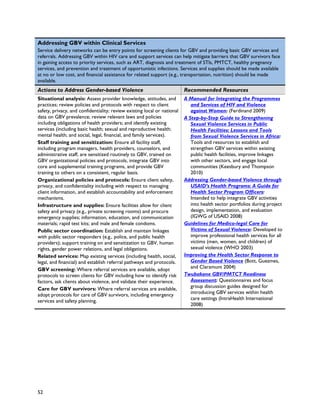
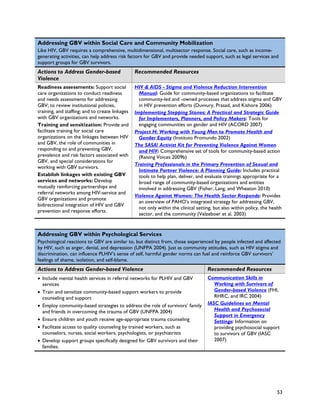
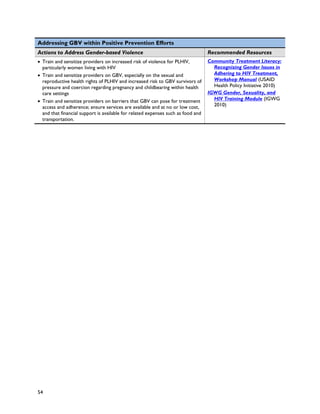
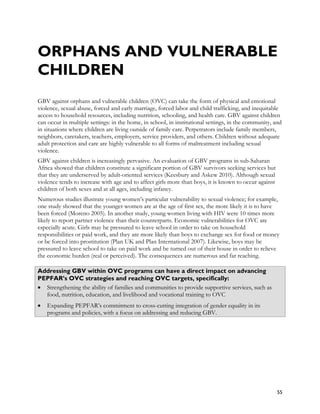
This guide is designed to help PEPFAR program managers address and respond to GBV within
HIV prevention, care, and treatment programs. It serves as a starting point for HIV programs and
services to contribute to a comprehensive response to GBV including through direct services for
GBV survivors, community mobilization to address the root causes of violence, capacity building
for service providers, and policy change and leadership to create an enabling environment for
preventing, addressing, and ultimately ending GBV. In addition to mobilizing a comprehensive
response to GBV, the issues, strategies, and actions presented are intended to reflect consensus-
based recommendations from public health experts, women’s groups, reference agencies such as
WHO and the Centers for Disease Control and Prevention (CDC), academic researchers,
development partners, and others. These include using an evidence- and rights-based, gender-
sensitive approach; fostering strong, functional linkages and integration within and between services
and programs; mobilizing communities to address harmful gender norms that contribute to violence;
coordinating across sectors; and monitoring and evaluating outcomes and impact to provide holistic
services that address the legal, health, education, economic, and other needs of survivors, their
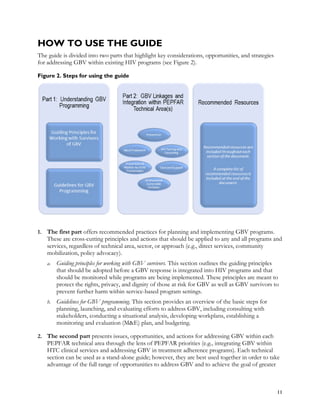
families, and communities (see Figure 1).
While there is increasing political momentum to end GBV, including through greater integration and
linkages with HIV programs, this guide was written with the understanding that HIV programs may
already be operating on limited budgets and within resource-constrained settings. This is not a
rationale for omitting or minimizing a response to GBV, but rather is an acknowledgment of the
fact that program planners and implementers will continue to have to do more within existing
budgets and rely on greater integration, coordination, and efficiencies within and across
development efforts. Therefore, this guide is not intended to be prescriptive, and it does not assume
that all programs can adopt all strategies and tactics presented here.
Instead, it aims to assist HIV program managers and implementers to first see and understand the
relationship between HIV and GBV. Next, it identifies opportunities for establishing linkages, for
example, by conducting sensitivity trainings on the relationship between GBV and HIV or
establishing relationships with women’s groups that are already working on GBV. Finally, it includes
information on integrating basic GBV response and prevention services into existing HIV programs,


                                                                                                      9
Figure 1. Comprehensive, multi-sectoral response to GBV


for example, training HTC and adherence counselors to offer GBV screening, counseling, and
referrals.
In short, this guide serves as a tool for program managers to not only begin to address GBV within
their programs, but also to plan for greater integration and coordination within country teams when
designing workplans and budgets. Ideally, this guide will catalyze dialogue, action, and resource
mobilization, building on PEPFAR programs and platforms for addressing GBV with national
governments, implementing partners, and other key stakeholders.

LIMITATIONS OF THE GUIDE
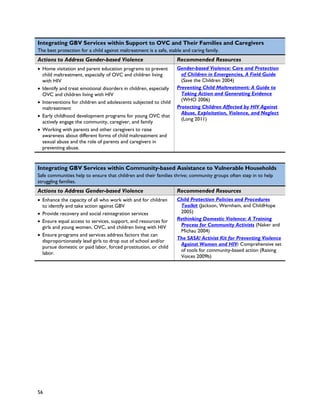
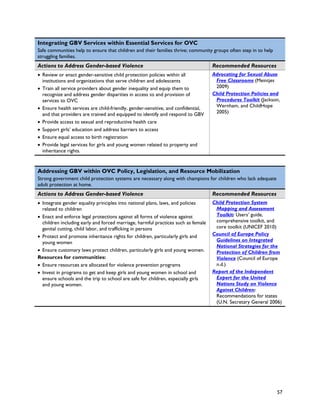
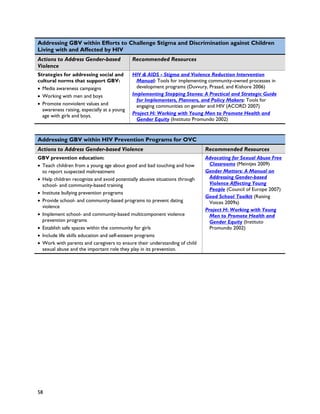
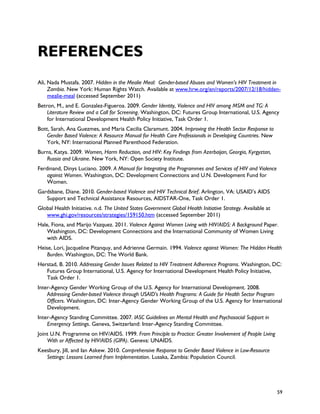
This guide represents a starting point for HIV programmers and planners who may have limited
exposure to or experience with GBV and integrated programs. As such, it does not address the two-
way integration of HIV services into existing GBV programs, although it should, at minimum, serve
as a basis for dialogue with GBV service providers. Nor does the guide provide comprehensive,
detailed technical information for implementing GBV services and programs; rather, it refers to
existing resources that have been developed by GBV experts. Finally, this guide does not address
GBV within the context of conflict, post-conflict, emergencies, disasters, and humanitarian
situations.


10
HOW TO USE THE GUIDE
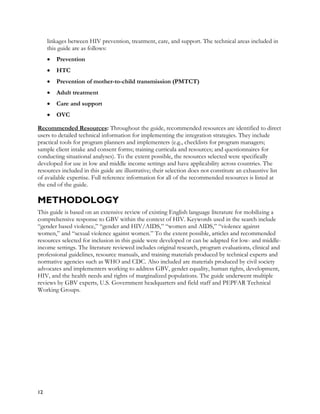
The guide is divided into two parts that highlight key considerations, opportunities, and strategies
for addressing GBV within existing HIV programs (see Figure 2).

Figure 2. Steps for using the guide


1. The first part offers recommended practices for planning and implementing GBV programs.
   These are cross-cutting principles and actions that should be applied to any and all programs and
   services, regardless of technical area, sector, or approach (e.g., direct services, community
   mobilization, policy advocacy).
   a.   Guiding principles for working with GBV survivors. This section outlines the guiding principles
        that should be adopted before a GBV response is integrated into HIV programs and that
        should be monitored while programs are being implemented. These principles are meant to
        protect the rights, privacy, and dignity of those at risk for GBV as well as GBV survivors to
        prevent further harm within service-based program settings.
   b.   Guidelines for GBV programming. This section provides an overview of the basic steps for
        planning, launching, and evaluating efforts to address GBV, including consulting with
        stakeholders, conducting a situational analysis, developing workplans, establishing a
        monitoring and evaluation (M&E) plan, and budgeting.

2. The second part presents issues, opportunities, and actions for addressing GBV within each
   PEPFAR technical area through the lens of PEPFAR priorities (e.g., integrating GBV within
   HTC clinical services and addressing GBV in treatment adherence programs). Each technical
   section can be used as a stand-alone guide; however, they are best used together in order to take
   advantage of the full range of opportunities to address GBV and to achieve the goal of greater


                                                                                                       11
linkages between HIV prevention, treatment, care, and support. The technical areas included in
     this guide are as follows:
     •   Prevention
     •   HTC
     •   Prevention of mother-to-child transmission (PMTCT)
     •   Adult treatment
     •   Care and support
     •   OVC

Recommended Resources: Throughout the guide, recommended resources are identified to direct
users to detailed technical information for implementing the integration strategies. They include
practical tools for program planners and implementers (e.g., checklists for program managers;
sample client intake and consent forms; training curricula and resources; and questionnaires for
conducting situational analyses). To the extent possible, the resources selected were specifically
developed for use in low and middle income settings and have applicability across countries. The
resources included in this guide are illustrative; their selection does not constitute an exhaustive list
of available expertise. Full reference information for all of the recommended resources is listed at
the end of the guide.

METHODOLOGY
This guide is based on an extensive review of existing English language literature for mobilizing a
comprehensive response to GBV within the context of HIV. Keywords used in the search include
“gender based violence,” “gender and HIV/AIDS,” “women and AIDS,” “violence against
women,” and “sexual violence against women.” To the extent possible, articles and recommended
resources selected for inclusion in this guide were developed or can be adapted for low- and middle-
income settings. The literature reviewed includes original research, program evaluations, clinical and
professional guidelines, resource manuals, and training materials produced by technical experts and
normative agencies such as WHO and CDC. Also included are materials produced by civil society
advocates and implementers working to address GBV, gender equality, human rights, development,
HIV, and the health needs and rights of marginalized populations. The guide underwent multiple
reviews by GBV experts, U.S. Government headquarters and field staff and PEPFAR Technical
Working Groups.


12
GUIDING PRINCIPLES FOR
WORKING WITH SURVIVORS
OF GENDER-BASED
VIOLENCE
All programs seeking to address GBV must first and foremost protect the dignity, rights, and well-
being of those at risk for, and survivors of, GBV. The following section outlines four fundamental
principles for integrating a GBV response into existing programs and specific actions for putting
these principles into practice. These principles are as follows:
•   Do no harm
•   Privacy, confidentiality, and informed consent
•   Meaningful engagement of people living with HIV (PLHIV), in particular women living with
    HIV and GBV survivors
•   Accountability and M&E.


                                                                                                     13
Do No Harm
Service Provision
Adherence to ethical codes of conduct is particularly relevant when working with GBV survivors, namely:
• Autonomy. The right of GBV survivors to make decisions on their own behalf. All steps taken in providing
  services are based on the informed consent of the survivor.
• Beneficence. The duty or obligation to act in the best interests of the survivor.
• Non-malfeasance. The duty or obligation to avoid harm to the survivor.
• Justice or fairness. Providing universal access to services without judgment or negative repercussions for the
  client (WHO 2003).

Actions               The principle of “do no harm” translates into awareness of the needs and wishes of the
                      client, displaying sensitivity and compassion, and maintaining objectivity (WHO 2003). This
                      should be reinforced through:
                      • Organizational policies to address violence and sexual harassment
                      • Codes of conduct
                      • Sensitization of staff on issues of power and control within the context of gender
                         inequality and in health service settings
                      • Ongoing training and support for communicating with GBV survivors, for example,
                         guidance on how to ask about violence and validate survivors’ experiences
                      • Hiring staff or trained volunteers from the same backgrounds as GBV survivors
                      • Safety planning for GBV survivors and their families.
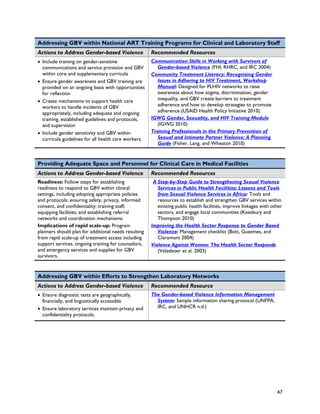
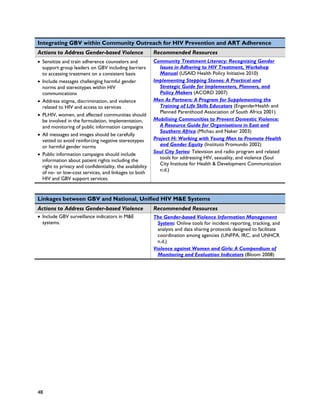
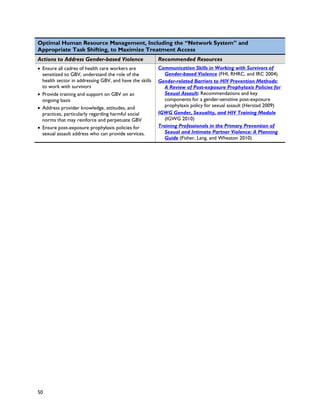
Recommended           A Step-by-Step Guide to Strengthening Sexual Violence Services in Public Health
Resources               Facilities: Lessons and Tools from Sexual Violence Services in Africa: Tools and
                        resources to establish and strengthen GBV services within existing public health facilities,
                        improve linkages with other sectors, and engage local communities (Keesbury and
                        Thompson 2010)
                      Communication Skills in Working with Survivors of Gender-based Violence: Training
                        manual (Family Health International [FHI], Reproductive Health for Refugees Consortium
                        [RHRC], and International Rescue Committee [IRC] 2004)
                      Improving the Health Sector Response to Gender Based Violence: Includes a
                        management checklist and tools for developing key policies and protocols, improving
                        danger assessments, and providing safety plans (Bott, Guezmes, and Claramunt 2004)


14
Do No Harm
Program Design
Program planners and implementers must be fully aware of the local context in which programs and services are
delivered to avoid further harm to GBV survivors or putting individuals at increased risk of violence and to protect
the safety of everyone involved. Programs, services, and messages must be developed in partnership with those
they are meant to serve and reviewed by primary stakeholders to avoid reinforcing harmful social norms and
ensure cultural sensitivity.
Actions               • Coordinate activities and messages to minimize duplication and gaps in response
                      • Commit to evaluation, openness to scrutiny, and external review
                      • Develop cultural and gender sensitivity and competence
                      • Stay updated on the evidence base regarding effective practices and the value of
                        participatory approaches
                      • Involve GBV survivors in decisions on accessibility, type and quality of services, and
                        communications materials (Inter-Agency Standing Committee [IASC] 2007).
Recommended           A Manual for Integrating the Programmes and Services of HIV and Violence against
Resources               Women: Stakeholder mapping tool (Ferdinand 2009)
                      A Step-by-Step Guide to Strengthening Sexual Violence Services in Public Health
                        Facilities: Lessons and Tools from Sexual Violence Services in Africa: Tools and
                        resources to establish and strengthen GBV services within existing public health facilities,
                        improve linkages with other sectors, and engage local communities (Keesbury and
                        Thompson 2010)
                      HIV & AIDS - Stigma and Violence Reduction Intervention Manual: Tools for
                        implementing community-owned processes in development programs (Duvvury, Prasad,
                        and Kishore 2006)
                      Improving the Health Sector Response to Gender Based Violence: Rapid situational
                        analysis tool; management checklist (Bott, Guezmes, and Claramunt 2004)
                      Virtual Knowledge Centre to End Violence against Women and Girls: Module on
                        programming essentials (U.N. Entity for Gender Equality and the Empowerment of
                        Women [UN Women] n.d.-a)


                                                                                                                   15
Do No Harm
Special Populations
Children and adolescents. Children and adolescents need age-specific services for post-rape care, reproductive
health, and HIV care and support that must include protocols and counseling that are developmentally appropriate.
Child and adolescent GBV survivors should be linked to child protective services where they exist.
Most-at-risk populations (MARPs). Sex workers, people who inject drugs, men who have sex with men
(MSM), and transgender people are among the most vulnerable to GBV and may face stigma, discrimination, and
violence perpetrated by the very personnel, such as health care workers and law enforcement officials, that are
charged with protecting their health and rights (Betron and Gonzalez-Figueroa 2009; Burns 2009; Sex Workers’
Rights Advocacy Network 2009). Stigma and discrimination against MARPs must be proactively addressed in HIV
programs so that these populations can access appropriate services.
Actions              • Conduct ongoing training with all staff on the rights of MARPs and special needs of each
                       group
                     • “Do more than train”; challenge stakeholders on issues of stigma and discrimination
                     • Establish safe virtual and physical spaces for specific MARP groups to seek information and
                       referrals for care and support
                     • Address gender barriers in accessing post-exposure prophylaxis.
Recommended          Comprehensive HIV Prevention for People Who Inject Drugs, Revised Guidance
Resources             (PEPFAR 2010)
                     Developing Services for Female Drug Users: Training module (Eurasian Harm Reduction
                      Network [EHRN] n.d.)
                     Gender-related Barriers to HIV Prevention Methods: A Review of Post-exposure
                      Prophylaxis Policies for Sexual Assault: Recommendations and key components for a
                      gender-sensitive post-exposure prophylaxis policy for sexual assault (Herstad 2009)
                     Identifying Violence Against Most-at-Risk Populations: A Focus on MSM and
                       Transgenders. Training Manual for Health Providers (Egremy, Betron, and Eckman
                       2009)
                     OVCSupport.net: Web portal (AIDSTAR-Two n.d.)
                     Protecting Children Affected by HIV Against Abuse, Exploitation, Violence and
                       Neglect (Long 2011)
                     Sex Work, Violence and HIV: A Guide for Programmes with Sex Workers (International
                       HIV/AIDS Alliance [IHAA] 2008)
                     Technical Guidance on Combination HIV Prevention: Men Who Have Sex with Men
                       (PEPFAR 2011)
                     Understanding Drug Related Stigma: Tools for Better Practice and Social Change
                      (Harm Reduction Coalition n.d.)


16
Privacy, Confidentiality, and Informed Consent
Privacy and confidentiality are essential for GBV survivors’ safety in any health care setting given that providers
can put the survivor’s safety at risk if they share sensitive information with partners, family members, or friends
without consent. A breach of confidentiality about pregnancy, rape, contraception, HIV status, or a history of
sexual abuse can put GBV survivors at risk of additional emotional, physical, or sexual violence. Moreover, those
who have already experienced violence need privacy in order to disclose those experiences to providers without
fear of retaliation from a perpetrator. To protect confidentiality and privacy, health programs need adequate
infrastructure and patient flow, as well as clear policies outlining when and where providers are allowed to
discuss sensitive information (Bott, Guezmes, and Claramunt 2004).
Actions               • Establish clear policies and protocols for privacy and confidentiality
                      • Designate a private consultation space
                      • Provide ongoing training for staff on protecting survivors’ privacy and confidentiality
                      • Create opportunities to talk with survivors without partners, children, family, or friends
                        present
                      • Ensure privacy of medical information, including storage of information and policies
                        regarding sharing information
                      • Train providers on obtaining informed consent, including ensuring that GBV survivors are
                        informed of their options and their rights
                      • Ensure printed materials are accessible for both literate and illiterate clients, are
                        provided in local language(s), and that interpreters are available as needed.
Recommended           A Step-by-Step Guide to Strengthening Sexual Violence Services in Public Health
Resource                Facilities: Lessons and Tools from Sexual Violence Services in Africa: Tools and
                        resources to establish and strengthen GBV services within existing public health facilities,
                        improve linkages with other sectors, and engage local communities (Keesbury and
                        Thompson 2010)
                      Improving the Health Sector Response to Gender Based Violence: Management
                        checklist and tools for ensuring privacy and strengthening confidentiality (Bott, Guezmes,
                        and Claramunt 2004)


Meaningful Engagement of PLHIV, Particularly Women Living with HIV and GBV
Survivors
The critical role of PLHIV in all aspects of the response is well established, as is community ownership and
women’s participation (UNAIDS 1999). Involving PLHIV, specifically women living with HIV, in program planning,
implementation, and evaluation is paramount regardless of the type of GBV response being provided, be it direct
services, community mobilization, or policy advocacy. Participatory processes can facilitate access to and
acceptance and uptake of services and can help confront stigma and discrimination. It allows programs to build on
direct experience and tailor services to individuals and the contexts in which they are offered.
Actions               • Provide training and ongoing support to empower individuals to participate in
                        organizational and community processes
                      • Create opportunities for participation, such as volunteering as counselors, advocates, and
                        health promoters
                      • Train and sensitize staff on greater involvement of PLHIV principle
                      • Plan for ongoing follow-up and communication with PLHIV.
Recommended           Greater Involvement of People with AIDS (GIPA) Good Practice Guide (IHAA and the
Resource               Global Network for People Living with HIV [GNP+] 2010)


                                                                                                                   17
Ensure Ongoing Quality Improvement and Assurance
As new programs and services are tested and launched, quality improvement and assurance mechanisms are
essential for ensuring that interventions are technically sound, implemented correctly, and meet the needs of the
people they are meant to serve, especially PLHIV, GBV survivors, communities, and other relevant stakeholders.
Quality assurance mechanisms for GBV services can include guidelines and protocols as well as data collection
tools also used for M&E. As with all GBV services, care should be taken to ensure the rights and safety of GBV
survivors and confidentiality when gathering client information and feedback used for quality assurance.
Actions               • Develop mechanisms to monitor violence as a result of HIV-related interventions
                      • Roll-out of guidelines and policies (e.g., HIV testing and counseling, PMTCT) should
                        include plans for monitoring adverse outcomes
                      • Allocate sufficient resources for M&E activities
                      • Include mechanisms for client and provider feedback
                      • Train staff involved in collecting data on how to obtain informed consent from clients
                      • Ensure confidentiality and anonymity of data during collection, storage, and dissemination
                      • Ensure participation of all stakeholders in M&E planning and activities
                      • Communicate results, including to clients and providers.
Recommended           A Manual for Integrating the Programmes and Services of HIV and Violence against
Resources               Women: Guide for designing an exit survey for HIV and violence against women related
                        needs at testing and counseling sites (Ferdinand 2009)
                      A Step-by-Step Guide to Strengthening Sexual Violence Services in Public Health
                        Facilities: Lessons and Tools from Sexual Violence Services in Africa: Tools and
                        resources to establish and strengthen GBV services within existing public health facilities,
                        improve linkages with other sectors, and engage local communities (Keesbury and
                        Thompson 2010)
                      Improving the Health Sector Response to Gender Based Violence: Data collection
                        tools (provider knowledge, attitudes, and practice); clinic observation tools; client exit
                        questionnaire; protocol for collecting qualitative information; random record review
                        protocol; management checklist (Bott, Guezmes, and Claramunt 2004)
                      Researching Violence Against Women, A Practical Guide for Researchers and
                        Activists: Tools for collecting and analyzing data (Ellsberg and Heise 2005)


18
GUIDELINES FOR GENDER-
BASED VIOLENCE
PROGRAMMING
Programming guides on GBV almost universally recommend a comprehensive, rights-based, multi-
sectoral approach that simultaneously addresses survivors’ immediate and long-term needs and
rights, the role of communities in preventing and responding to violence, and the legal and policy
environment in which violence occurs. Further, ensuring a relevant, effective, and sustainable
response requires systematic planning to ensure local relevance and appropriateness, achieve
community commitment and support, and make the best use of existing resources and expertise.
The following steps are intended to assist program planners in achieving these objectives:
•   Conduct a situational analysis
•   Employ a rights-based, gender-sensitive approach
•   Plan for and support community participation
•   Pay special attention to the needs of young people
•   Identify MARPs
•   Develop a workplan
•   Establish an M&E framework and plan
•   Budget.


                                                                                                 19
Conduct a Situational Analysis
A situational analysis is a fundamental step for understanding the extent to and context in which GBV takes place,
including its drivers, and the relationship between GBV and HIV infection and their impact on individuals, their
families, and communities. New programs and services must be developed with an understanding of existing
services and gaps across multiple sectors, including the health, legal, education, and social sectors.
Actions              Macro level:
                      • Identify data collection mechanisms such as demographic health surveys and
                        administrative statistics maintained by police, hospitals, and judicial and social service
                        agencies
                      • Collect and analyze epidemiological data on the prevalence of GBV, HIV, and other
                        sexually transmitted infections (STIs)
                      • Review and assess national, provincial, and local plans, laws, policies, and budgetary
                        allocations related to the prevention of and response to GBV, including property and
                        inheritance rights and access to sexual and reproductive health services.
                     Sectoral level:
                      • Assess sectoral responses (e.g., health, education, justice, social) to GBV such as
                        inclusion in sectoral plans and the presence of coordinating mechanisms.
                     Community level:
                      • Identify customary laws, traditional practices, and norms and responses that may increase
                        vulnerability to HIV and GBV
                      • Map existing services and programs and the level of coordination between them.
                     Institutional level:
                      • Conduct readiness and capacity assessments for integrating a response to GBV within
                        existing programs.
                     Individual level:
                      • Assess risk perception for HIV infection and STIs, awareness of and sensitization to GBV;
                        attitudes regarding gender roles and norms; and the use of and need for relevant
                        services.
Recommended          A Manual for Integrating the Programmes and Services of HIV and Violence against
Resources               Women: Tools for conducting a situational analysis and evaluation of the legal framework
                        (Ferdinand 2009)
                      A Step-by-Step Guide to Strengthening Sexual Violence Services in Public Health
                        Facilities: Lessons and Tools from Sexual Violence Services in Africa: Tools and
                        resources to establish and strengthen GBV services within existing public health facilities,
                        improve linkages with other sectors, and engage local communities (Keesbury and
                        Thompson 2010)
                     Improving the Health Sector Response to Gender Based Violence: Rapid situational
                        analysis tool (Bott, Guezmes, and Claramunt 2004)
                     Preventing Intimate Partner and Sexual Violence Against Women: List of potential
                        sources of data and information by data category (WHO and London School of Hygiene
                        and Tropical Medicine 2010, 64)
                     Twubakane GBV/PMTCT Readiness Assessment: Questionnaires and focus group
                        discussion guides designed for introducing GBV services within health care settings
                        (IntraHealth International 2008)


20
Use a Rights-based and Gender-sensitive Approach
Both GBV and HIV have strong links to human rights because violations of human rights contribute to
vulnerabilities, and both can lead to further violations such as stigma, discrimination, and violence. Vulnerability to
HIV and GBV can be traced to social, political, educational, and economic inequalities.
A rights-based, gender-sensitive approach to programming supports the empowerment and agency of affected
populations, particularly women, girls, and MARPs, and aims to upend the structural drivers of HIV and GBV,
including all forms of discrimination.
Actions               Principles of a rights-based approach to services:
                       • Participatory, nondiscriminatory, and a system for accountability
                       • Available to even the most marginalized groups, accessible (financially, geographically,
                         linguistically), acceptable, and of high quality
                       • Voluntary and noncoercive; premised on informed choice and informed decision-making
                       • Available with guarantees of privacy and confidentiality
                       • Evidence-based and developed in light of acquired experience about how to best address
                         the intersections between GBV and HIV (Women Won’t Wait 2010).
                      Principles of a gender-sensitive approach to programming:
                       • Work through community partnerships
                       • Support diversity and respect
                       • Foster accountability
                       • Promote respect for the rights of individuals and groups
                       • Empower women, girls, and communities
                       • Work with men and boys to transform harmful gender norms, attitudes, and behaviors
                       • Conduct gender analysis or gender assessments to identify the gender needs of women,
                         girls, men, boys, and MARPs (Inter-Agency Gender Working Group [IGWG] 2006).
Recommended           A Manual for Integrating Gender into Reproductive Health and HIV Programs: Six-
Resources                step process for enhancing gender-sensitive programming (Caro 2009)
                      An Essential Services Package for an Integrated Response to HIV and Violence
                         Against Women: Includes specific steps for providing a rights-based and gender-sensitive
                         approach within health, legal, humanitarian, and faith settings (Women Won’t Wait 2010)
                      Engaging Men and Boys in Changing Gender-based Inequity in Health: Evidence from
                         Program Interventions (WHO 2007a)
                      Gender and Sexual and Reproductive Health 101: Web course (Doggett, Krishna, and
                         Robles 2010)
                      IGWG Gender, Sexuality, and HIV Training Module (IGWG 2010)
                      International Guidelines on HIV/AIDS and Human Rights: Guidelines for states;
                         instructions for both policymakers and advocates, including how to ensure accountability
                         (UNAIDS 2006)
                      Virtual Knowledge Centre to End Violence against Women and Girls: Modules on
                         adopting human right-based approaches and ensuring gender responsiveness (UN
                         Women n.d.-a)


                                                                                                                      21
Ensure Community Participation in Program Planning, Implementation, and Evaluation
Plan for and support community participation throughout all phases of the program cycle including planning,
implementation, monitoring, evaluation, and program improvements.
Actions               • Include key stakeholders in program planning, implementation, and evaluation, with
                        particular consideration of the following groups:
                        – Women and girls
                        – PLHIV, especially women living with HIV
                        – GBV survivors
                        – Youth, especially girls and young women and including married adolescents and young
                           adults
                        – Most at-risk and marginalized populations (e.g., people who inject drugs, sex workers,
                           sexual minorities)
                        – Men and boys
                        – GBV experts, women’s groups, and youth-led and -serving organizations
                        – Community leaders
                        – Service providers (public, private, and nongovernmental organizations)
                        – Law enforcement
                        – Educators
                        – Health care providers
                        – Policymakers
                      • Conduct stakeholder analyses and needs assessments regarding, for example, the
                        prevalence of GBV, availability of services, and knowledge of protective laws and policies
                      • Initiate and support community dialogues
                      • Establish and support program advisory committees or consultations, whether on an ad
                        hoc or formal basis.
Recommended          A Manual for Integrating the Programmes and Services of HIV and Violence against
Resources               Women: Stakeholder mapping tool (Ferdinand 2009)
                     Greater Involvement of People with AIDS (GIPA) Good Practice Guide (IHAA and
                        GNP+ 2010)
                     HIV & AIDS - Stigma and Violence Reduction Intervention Manual: Tools for
                        implementing community-owned processes in development programs (Duvvury, Prasad,
                        and Kishore 2006)
                     Implementing Stepping Stones: A Practical and Strategic Guide for Implementers,
                        Planners, and Policy Makers: Tools for engaging communities on gender and HIV
                        (Agency for Cooperation and Research in Development [ACORD] 2007)
                     Project H: Working with Young Men to Promote Health and Gender Equity (Instituto
                        Promundo 2002)
                     The SASA! Activist Kit for Preventing Violence Against Women and HIV:
                        Comprehensive set of tools for community-based action (Raising Voices 2009b)


22
Pay Attention to the Special Needs of Children and Adolescents
GBV can occur throughout the lifecycle, even starting before birth in some cases. Understanding the scope of
GBV as it pertains to children and adolescents, including the settings in which GBV can occur and ensuring age-
appropriate prevention and response strategies, is necessary to help break the cycle of violence in communities.
Prenatal: Sex-selective abortion; battering during pregnancy (emotional and physical effects on the woman;
effects on birth outcome); coerced pregnancy (e.g., pregnancy as a result of rape).
Infancy: Female infanticide; child abandonment; emotional and physical abuse; rape; differential access to food
and medical care for female infants.
Childhood: Early and forced marriage; genital cutting and mutilation; abuse by family members and strangers;
incest; rape; differential access to food and medical care; child prostitution; parental abandonment; and forced
labor and child trafficking.
Adolescence: Dating and courtship violence; physical violence; intergenerational and transactional sex; sexual
abuse in schools and workplaces; rape (incest, “date rape,” coercion); forced prostitution; sexual harassment; and
trafficking in persons.
Reproductive: Sexual abuse of women, girls, and sexual minorities; marital rape; dowry abuse and murders;
partner homicide; psychological abuse; physical abuse; sexual abuse in the workplace; sexual harassment; rape;
abuse of women with disabilities.
Old-age: Abuse of widows; elder abuse.
Source: Heise, Pitanquy, and Germain 1994
Actions               • Situational analyses should include data on the prevalence and forms of GBV
                        disaggregated by sex, gender, age, marital status, and education level
                      • Review and assess legal and policy environments as they relate specifically to children and
                        young people (e.g., child protection policies; laws related to adolescent sexual and
                        reproductive health; and age of consent)
                      • Build capacity and strengthen referral systems to address child sexual abuse as it is one of
                        the most common forms of GBV experienced by children
                      • Raise awareness about the specific vulnerabilities of adolescent girls and young women to
                        GBV
                      • Promote child- and youth-friendly services
                      • Ensure access to sexual and reproductive health information and services for young
                        people
                      • Integrate GBV interventions within youth-specific services
                      • Involve youth in the program cycle
                      • Include married adolescents and young people, especially girls, as key stakeholders
                      • Engage girls and boys, in community mobilization strategies.
Recommended          Gender Matters: A Manual on Addressing Gender-based Violence Affecting Young
Resources              People (Council of Europe 2007)
                     Gender-based Violence: Care and Protection of Children in Emergencies, A Field
                       Guide (Save the Children 2004)
                     OVCSupport.net: Web portal (AIDSTAR-Two n.d.)
                     Protecting Children Affected by HIV Against Abuse, Exploitation, Violence, and
                        Neglect (Long 2011)
                     Report of the Independent Expert for the United Nations Study on Violence Against
                        Children: Addresses all forms of violence against children including GBV (U.N. Secretary
                        General 2006)
                     Women, Girls, Boys, and Men: Different Needs – Equal Opportunities: Gender
                        Handbook in Humanitarian Situations: Includes a series of questions on what to look
                        for or ask so that programs are designed and implemented with sensitivity to the
                        different needs of women, girls, boys, and men (IASC 2006)


                                                                                                                  23
Ensure Inclusion of MARPs
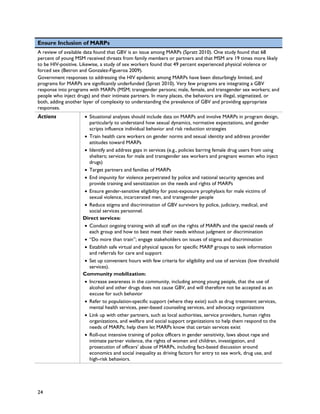
A review of available data found that GBV is an issue among MARPs (Spratt 2010). One study found that 68
percent of young MSM received threats from family members or partners and that MSM are 19 times more likely
to be HIV-positive. Likewise, a study of sex workers found that 49 percent experienced physical violence or
forced sex (Betron and Gonzalez-Figueroa 2009).
Government responses to addressing the HIV epidemic among MARPs have been disturbingly limited, and
programs for MARPs are significantly underfunded (Spratt 2010). Very few programs are integrating a GBV
response into programs with MARPs (MSM; transgender persons; male, female, and transgender sex workers; and
people who inject drugs) and their intimate partners. In many places, the behaviors are illegal, stigmatized, or
both, adding another layer of complexity to understanding the prevalence of GBV and providing appropriate
responses.
Actions             • Situational analyses should include data on MARPs and involve MARPs in program design,
                      particularly to understand how sexual dynamics, normative expectations, and gender
                      scripts influence individual behavior and risk reduction strategies
                    • Train health care workers on gender norms and sexual identity and address provider
                      attitudes toward MARPs
                    • Identify and address gaps in services (e.g., policies barring female drug users from using
                      shelters; services for male and transgender sex workers and pregnant women who inject
                      drugs)
                    • Target partners and families of MARPs
                    • End impunity for violence perpetrated by police and national security agencies and
                      provide training and sensitization on the needs and rights of MARPs
                    • Ensure gender-sensitive eligibility for post-exposure prophylaxis for male victims of
                      sexual violence, incarcerated men, and transgender people
                    • Reduce stigma and discrimination of GBV survivors by police, judiciary, medical, and
                      social services personnel.
                    Direct services:
                    • Conduct ongoing training with all staff on the rights of MARPs and the special needs of
                      each group and how to best meet their needs without judgment or discrimination
                    • “Do more than train”; engage stakeholders on issues of stigma and discrimination
                    • Establish safe virtual and physical spaces for specific MARP groups to seek information
                      and referrals for care and support
                    • Set up convenient hours with few criteria for eligibility and use of services (low threshold
                      services).
                    Community mobilization:
                    • Increase awareness in the community, including among young people, that the use of
                      alcohol and other drugs does not cause GBV, and will therefore not be accepted as an
                      excuse for such behavior
                    • Refer to population-specific support (where they exist) such as drug treatment services,
                      mental health services, peer-based counseling services, and advocacy organizations
                    • Link up with other partners, such as local authorities, service providers, human rights
                      organizations, and welfare and social support organizations to help them respond to the
                      needs of MARPs; help them let MARPs know that certain services exist
                    • Roll-out intensive training of police officers in gender sensitivity, laws about rape and
                      intimate partner violence, the rights of women and children, investigation, and
                      prosecution of officers’ abuse of MARPs, including fact-based discussion around
                      economics and social inequality as driving factors for entry to sex work, drug use, and
                      high-risk behaviors.


24
Ensure Inclusion of MARPs (continued)
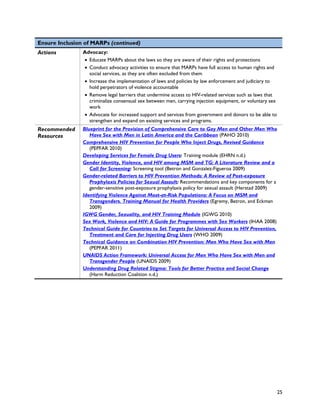
Actions         Advocacy:
                • Educate MARPs about the laws so they are aware of their rights and protections
                • Conduct advocacy activities to ensure that MARPs have full access to human rights and
                  social services, as they are often excluded from them
                • Increase the implementation of laws and policies by law enforcement and judiciary to
                  hold perpetrators of violence accountable
                • Remove legal barriers that undermine access to HIV-related services such as laws that
                  criminalize consensual sex between men, carrying injection equipment, or voluntary sex
                  work
                • Advocate for increased support and services from government and donors to be able to
                  strengthen and expand on existing services and programs.
Recommended     Blueprint for the Provision of Comprehensive Care to Gay Men and Other Men Who
Resources          Have Sex with Men in Latin America and the Caribbean (PAHO 2010)
                Comprehensive HIV Prevention for People Who Inject Drugs, Revised Guidance
                   (PEPFAR 2010)
                Developing Services for Female Drug Users: Training module (EHRN n.d.)
                Gender Identity, Violence, and HIV among MSM and TG: A Literature Review and a
                   Call for Screening: Screening tool (Betron and Gonzalez-Figueroa 2009)
                Gender-related Barriers to HIV Prevention Methods: A Review of Post-exposure
                   Prophylaxis Policies for Sexual Assault: Recommendations and key components for a
                   gender-sensitive post-exposure prophylaxis policy for sexual assault (Herstad 2009)
                Identifying Violence Against Most-at-Risk Populations: A Focus on MSM and
                   Transgenders. Training Manual for Health Providers (Egremy, Betron, and Eckman
                   2009)
                IGWG Gender, Sexuality, and HIV Training Module (IGWG 2010)
                Sex Work, Violence and HIV: A Guide for Programmes with Sex Workers (IHAA 2008)
                Technical Guide for Countries to Set Targets for Universal Access to HIV Prevention,
                   Treatment and Care for Injecting Drug Users (WHO 2009)
                Technical Guidance on Combination HIV Prevention: Men Who Have Sex with Men
                   (PEPFAR 2011)
                UNAIDS Action Framework: Universal Access for Men Who Have Sex with Men and
                   Transgender People (UNAIDS 2009)
                Understanding Drug Related Stigma: Tools for Better Practice and Social Change
                   (Harm Reduction Coalition n.d.)


                                                                                                           25
Develop a Workplan
Efforts to respond to and prevent GBV must be developed within the context of a comprehensive, multi-sectoral,
multilevel response, with interventions targeted at the individual, community, and policy levels. Because no single
program can address all of these needs, effective coordination is essential not only to avoid duplication of efforts
but also to ensure that individuals experiencing or at risk of GBV have access to services that are age-, sex- and
gender-appropriate and address their physical, psychological, emotional, and economic needs and well-being.
Actions              Policy environment: Develop, strengthen, and enforce protective laws and policies
                     Public sector: Improve health, education, social welfare, and judicial and legal systems
                     Direct services: Provide high-quality, compassionate services for GBV survivors
                     Community mobilization: Work with communities to support PLHIV and GBV
                     survivors and identify and address harmful norms and HIV- and gender-related stigma and
                     discrimination that perpetuate GBV
                     Coordination: Coordinate within and across sectors.
Recommended          A Manual for Integrating Gender into Reproductive Health and HIV Programs: Six-
Resources               step process for enhancing gender-sensitive programming (Caro 2009)
                     A Step-by-Step Guide to Strengthening Sexual Violence Services in Public Health
                        Facilities: Lessons and Tools from Sexual Violence Services in Africa: Tools and
                        resources to establish and strengthen GBV services within existing public health facilities,
                        improve linkages with other sectors, and engage local communities (Keesbury and
                        Thompson 2010)
                     Addressing Gender-based Violence through USAID’s Health Programs: A Guide for
                        Health Sector Program Officers: Planning tool for addressing GBV within different
                        types of health programs including community mobilization, communications for behavior
                        change, and health policy (IGWG of USAID 2008)
                     An Essential Services Package for an Integrated Response to HIV and Violence
                        Against Women: Outlines key actions for mobilizing an integrated response to GBV and
                        HIV within health care, school, humanitarian, faith, and legal settings (Women Won’t
                        Wait 2010)
                     Improving the Health Sector Response to Gender Based Violence: Step-by-step
                        guidance on addressing GBV within the health sector (Bott, Guezmes, and Claramunt
                        2004)
                     Preventing Intimate Partner and Sexual Violence Against Women: Planning guide
                        geared toward policymakers, program planners, and funding bodies (WHO and London
                        School of Hygiene and Tropical Medicine 2010)
                     Strategic Framework for the Prevention of and Response to Gender-based Violence in
                        Eastern, Southern and Central Africa: Program building blocks and sample activities
                        (USAID/Eastern and Central Africa and U.N. Children’s Fund [UNICEF]/East and
                        Southern Africa Regional Offices n.d.)
                     Virtual Knowledge Centre to End Violence against Women and Girls: Module on
                        programming essentials (UN Women n.d.-a)


26
Develop an M&E Plan
Although there has been an increase in services and programs designed to address GBV, there is a continuous
and ongoing need for evidence-based knowledge regarding effective GBV prevention, integrated GBV and HIV
programs, and scale up of services. Rigorous M&E plans are critical for tracking the prevalence of GBV; assessing
the effectiveness of related services and programs, including outcomes for GBV survivors; and determining the
impact of any given intervention. M&E processes and mechanisms create opportunities for community
engagement, for example, through focus groups to determine baseline attitudes and changes over time, or client
feedback surveys.
Actions               • Ensure data collection adheres to ethical and safety guidelines, including to ensure
                        confidentiality of client data
                      • Provide cross-sector training on complete and accurate data collection, including incident
                        reports which are essential for facilitating GBV survivors’ access to justice
                      • Coordinate data collection, record keeping and tracking between service providers and
                        across sectors
                      • Employ participatory methods, especially to analyze and reflect on data and findings in
                        order to translate them into program improvements
                      • Share evidence and findings with:
                        – Internal audiences (e.g., staff, GBV survivors)
                        – Partners in the response to GBV (e.g., advocacy organizations, and local governmental,
                          nongovernmental, and private sector partners)
                        – Communities
                        – Policymakers
                        – Media.
Recommended          Evaluating Services for Survivors of Domestic Violence and Sexual Assault (Riger et al.
Resources               2002)
                     Outcome Evaluation Strategies for Domestic Violence Service Programs Receiving
                        FVPSA Funding: A Practical Guide (Lyon and Sullivan 2007)
                     Researching Violence Against Women, A Practical Guide for Researchers and Activists
                        (Ellsberg and Heise 2005)
                     The Gender-based Violence Information Management System: Online tools for incident
                        reporting, tracking, and analysis and data sharing protocols designed to facilitate
                        coordination among agencies (U.N. Population Fund [UNFPA], IRC, and U.N. Refugee
                        Agency [UNHCR] n.d.)
                     Violence against Women and Girls: A Compendium of Monitoring and Evaluation
                        Indicators (Bloom 2008)


Develop a Budget
Dedicated resources are essential for operationalizing PEPFAR’s commitment to addressing and reducing GBV.
Analyses of budget allocations versus expenditures are also important for measuring and evaluating program
impact, costs, and benefits.
Actions               • Identify and prioritize the problem (e.g., the impact of GBV on accessing services; gaps in
                        stakeholder knowledge, attitudes, and practices)
                      • Identify associated costs and develop a budget for planned activities (e.g., additional
                        training; information, education and communication materials; communications
                        campaigns; and advocacy)
                      • Monitor the extent to which resources are used for intended purposes and reach
                        intended beneficiaries
                      • Evaluate the impact of the resources spent.


                                                                                                                    27
28
PREVENTION
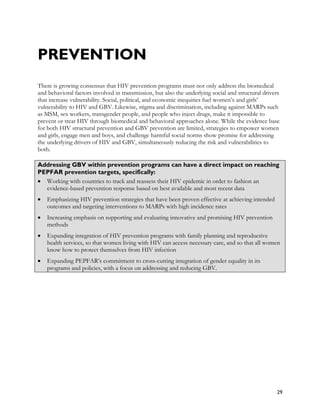
There is growing consensus that HIV prevention programs must not only address the biomedical
and behavioral factors involved in transmission, but also the underlying social and structural drivers
that increase vulnerability. Social, political, and economic inequities fuel women’s and girls’
vulnerability to HIV and GBV. Likewise, stigma and discrimination, including against MARPs such
as MSM, sex workers, transgender people, and people who inject drugs, make it impossible to
prevent or treat HIV through biomedical and behavioral approaches alone. While the evidence base
for both HIV structural prevention and GBV prevention are limited, strategies to empower women
and girls, engage men and boys, and challenge harmful social norms show promise for addressing
the underlying drivers of HIV and GBV, simultaneously reducing the risk and vulnerabilities to
both.

Addressing GBV within prevention programs can have a direct impact on reaching
PEPFAR prevention targets, specifically:
• Working with countries to track and reassess their HIV epidemic in order to fashion an
  evidence-based prevention response based on best available and most recent data
•   Emphasizing HIV prevention strategies that have been proven effective at achieving intended
    outcomes and targeting interventions to MARPs with high incidence rates
•   Increasing emphasis on supporting and evaluating innovative and promising HIV prevention
    methods
•   Expanding integration of HIV prevention programs with family planning and reproductive
    health services, so that women living with HIV can access necessary care, and so that all women
    know how to protect themselves from HIV infection
•   Expanding PEPFAR’s commitment to cross-cutting integration of gender equality in its
    programs and policies, with a focus on addressing and reducing GBV.


                                                                                                    29
Addressing GBV within Prevention Programs for the General Population
Combination HIV prevention strategies can simultaneously contribute to GBV prevention, dismantling the
structural drivers of both.
Actions to Address Gender-based Violence                                  Recommended Resources
Community-based actions:                                                  Gender-related Barriers to HIV
• Include GBV in HIV prevention curricula and peer education                Prevention Methods: A Review of
  programs and provide information about and access to GBV                  Post-exposure Prophylaxis Policies
  support services                                                          for Sexual Assault: Recommendations
                                                                            for increasing access (Herstad 2009)
• Mobilize communities on GBV and HIV, specifically, the links
  between the two and how harmful gender norms, beliefs, and              Handbook for Legislation on Violence
  practices contribute to both                                              against Women (U.N. Division for the
                                                                            Advancement of Women [UNDAW]
• Support life skills education for boys and girls through both in- and     2009)
  out-of-school programs.
                                                                          Implementing Stepping Stones: A
Health facility-based actions:                                              Practical and Strategic Guide for
• Raise awareness among all cadres of health care workers about             Implementers, Planners, and Policy
  GBV as a risk factor for HIV infection                                    Makers: Tools for promoting
                                                                            community awareness and life-skills
• Train and support health care providers to screen for violence
                                                                            education (ACORD 2007)
  where counseling and referral services exist
                                                                          Preventing Intimate Partner and Sexual
• Link GBV and HIV prevention and awareness programs with
                                                                            Violence Against Women: Evidence-
  voluntary medical adult male circumcision services
                                                                            based promising practices in violence
• Support GBV survivors in negotiating risk reduction behaviors such        prevention (WHO and London School
  as condom use                                                             of Hygiene and Tropical Medicine 2010)
• Ensure timely access to post-exposure prophylaxis                       Project H: Working with Young Men to
• Ensure access to female condoms.                                          Promote Health and Gender Equity
                                                                            (Instituto Promundo 2002)
Structural actions:
                                                                          The SASA! Activist Kit for Preventing
• Ensure protective laws and policies are in place and enforced to          Violence Against Women and HIV:
  prevent GBV                                                               Comprehensive set of tools for
• Challenge harmful gender norms, roles, and behaviors, and reduce          community-based action (Raising Voices
  acceptance of GBV                                                         2009b)
• Support girls’ and women’s access to education because increased        Training Professionals in the Primary
  educational attainment has been linked to increased protection            Prevention of Sexual and Intimate
  from HIV infection and violence                                           Partner Violence: A Planning Guide
• Promote women’s and girls’ economic security through livelihood           (Fisher, Lang, and Wheaton 2010)
  programs and ensure their property and inheritance rights
• Support research on female-initiated methods of HIV prevention
• Ensure policies are in place that promote linkages between GBV
  and HIV, and support programs that address harmful gender
  norms, beliefs, and practices that contribute to GBV and HIV.


30
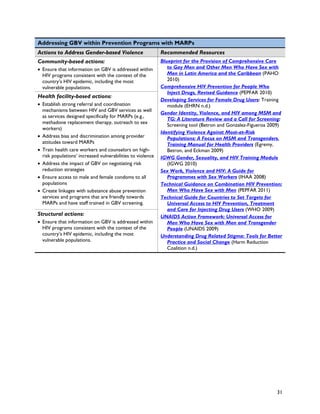
Addressing GBV within Prevention Programs with MARPs
Actions to Address Gender-based Violence                    Recommended Resources
Community-based actions:                                    Blueprint for the Provision of Comprehensive Care
• Ensure that information on GBV is addressed within           to Gay Men and Other Men Who Have Sex with
  HIV programs consistent with the context of the              Men in Latin America and the Caribbean (PAHO
  country’s HIV epidemic, including the most                   2010)
  vulnerable populations.                                   Comprehensive HIV Prevention for People Who
                                                               Inject Drugs, Revised Guidance (PEPFAR 2010)
Health facility-based actions:
                                                            Developing Services for Female Drug Users: Training
• Establish strong referral and coordination                   module (EHRN n.d.)
  mechanisms between HIV and GBV services as well
                                                            Gender Identity, Violence, and HIV among MSM and
  as services designed specifically for MARPs (e.g.,
                                                               TG: A Literature Review and a Call for Screening:
  methadone replacement therapy, outreach to sex
                                                               Screening tool (Betron and Gonzalez-Figueroa 2009)
  workers)
                                                            Identifying Violence Against Most-at-Risk
• Address bias and discrimination among provider               Populations: A Focus on MSM and Transgenders.
  attitudes toward MARPs                                       Training Manual for Health Providers (Egremy,
• Train health care workers and counselors on high-            Betron, and Eckman 2009)
  risk populations’ increased vulnerabilities to violence   IGWG Gender, Sexuality, and HIV Training Module
• Address the impact of GBV on negotiating risk                (IGWG 2010)
  reduction strategies                                      Sex Work, Violence and HIV: A Guide for
• Ensure access to male and female condoms to all              Programmes with Sex Workers (IHAA 2008)
  populations                                               Technical Guidance on Combination HIV Prevention:
• Create linkages with substance abuse prevention              Men Who Have Sex with Men (PEPFAR 2011)
  services and programs that are friendly towards           Technical Guide for Countries to Set Targets for
  MARPs and have staff trained in GBV screening.               Universal Access to HIV Prevention, Treatment
                                                               and Care for Injecting Drug Users (WHO 2009)
Structural actions:                                         UNAIDS Action Framework: Universal Access for
• Ensure that information on GBV is addressed within           Men Who Have Sex with Men and Transgender
  HIV programs consistent with the context of the              People (UNAIDS 2009)
  country’s HIV epidemic, including the most                Understanding Drug Related Stigma: Tools for Better
  vulnerable populations.                                      Practice and Social Change (Harm Reduction
                                                               Coalition n.d.)


                                                                                                              31
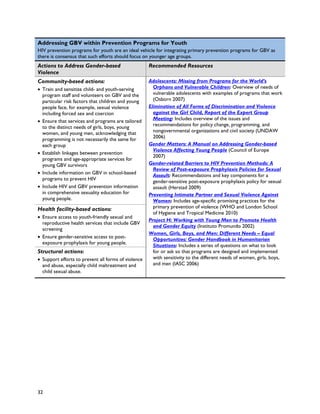
Addressing GBV within Prevention Programs for Youth
HIV prevention programs for youth are an ideal vehicle for integrating primary prevention programs for GBV as
there is consensus that such efforts should focus on younger age groups.
Actions to Address Gender-based                      Recommended Resources
Violence
Community-based actions:                             Adolescents: Missing from Programs for the World’s
• Train and sensitize child- and youth-serving         Orphans and Vulnerable Children: Overview of needs of
  program staff and volunteers on GBV and the          vulnerable adolescents with examples of programs that work
  particular risk factors that children and young      (Osborn 2007)
  people face, for example, sexual violence          Elimination of All Forms of Discrimination and Violence
  including forced sex and coercion                    against the Girl Child, Report of the Expert Group
• Ensure that services and programs are tailored       Meeting: Includes overview of the issues and
  to the distinct needs of girls, boys, young          recommendations for policy change, programming, and
  women, and young men, acknowledging that             nongovernmental organizations and civil society (UNDAW
  programming is not necessarily the same for          2006)
  each group                                         Gender Matters: A Manual on Addressing Gender-based
                                                       Violence Affecting Young People (Council of Europe
• Establish linkages between prevention
                                                       2007)
  programs and age-appropriate services for
  young GBV survivors                                Gender-related Barriers to HIV Prevention Methods: A
                                                       Review of Post-exposure Prophylaxis Policies for Sexual
• Include information on GBV in school-based
                                                       Assault: Recommendations and key components for a
  programs to prevent HIV
                                                       gender-sensitive post-exposure prophylaxis policy for sexual
• Include HIV and GBV prevention information           assault (Herstad 2009)
  in comprehensive sexuality education for           Preventing Intimate Partner and Sexual Violence Against
  young people.                                        Women: Includes age-specific promising practices for the
Health facility-based actions:                         primary prevention of violence (WHO and London School
                                                       of Hygiene and Tropical Medicine 2010)
• Ensure access to youth-friendly sexual and
                                                     Project H: Working with Young Men to Promote Health
  reproductive health services that include GBV
                                                       and Gender Equity (Instituto Promundo 2002)
  screening
                                                     Women, Girls, Boys, and Men: Different Needs – Equal
• Ensure gender-sensitive access to post-
                                                       Opportunities: Gender Handbook in Humanitarian
  exposure prophylaxis for young people.
                                                       Situations: Includes a series of questions on what to look
Structural actions:                                    for or ask so that programs are designed and implemented
• Support efforts to prevent all forms of violence     with sensitivity to the different needs of women, girls, boys,
  and abuse, especially child maltreatment and         and men (IASC 2006)
  child sexual abuse.


32
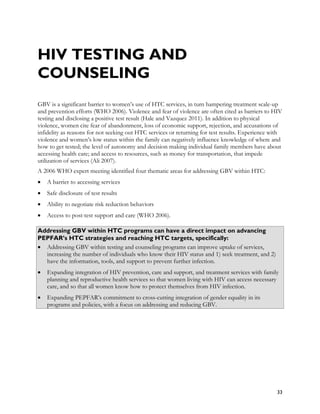
HIV TESTING AND
COUNSELING
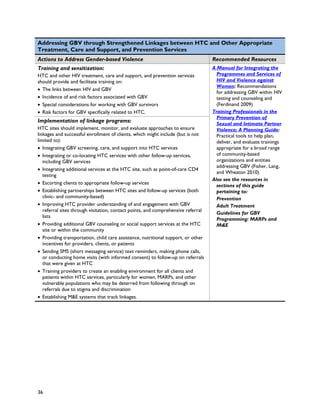
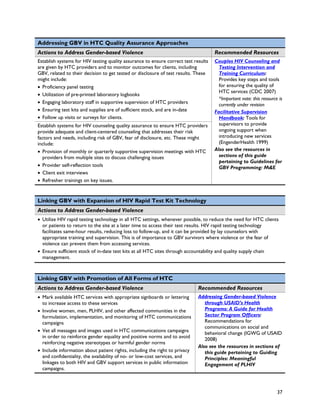
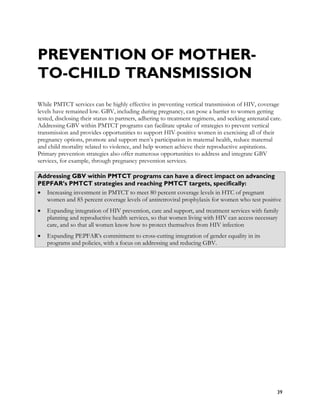
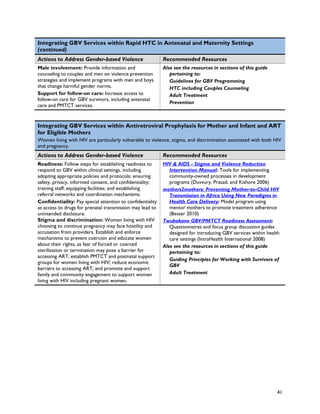
GBV is a significant barrier to women’s use of HTC services, in turn hampering treatment scale-up
and prevention efforts (WHO 2006). Violence and fear of violence are often cited as barriers to HIV
testing and disclosing a positive test result (Hale and Vazquez 2011). In addition to physical
violence, women cite fear of abandonment, loss of economic support, rejection, and accusations of
infidelity as reasons for not seeking out HTC services or returning for test results. Experience with
violence and women’s low status within the family can negatively influence knowledge of where and
how to get tested; the level of autonomy and decision making individual family members have about
accessing health care; and access to resources, such as money for transportation, that impede
utilization of services (Ali 2007).
A 2006 WHO expert meeting identified four thematic areas for addressing GBV within HTC:
•   A barrier to accessing services
•   Safe disclosure of test results
•   Ability to negotiate risk reduction behaviors
•   Access to post-test support and care (WHO 2006).

Addressing GBV within HTC programs can have a direct impact on advancing
PEPFAR’s HTC strategies and reaching HTC targets, specifically:
• Addressing GBV within testing and counseling programs can improve uptake of services,
  increasing the number of individuals who know their HIV status and 1) seek treatment, and 2)
  have the information, tools, and support to prevent further infection.
•   Expanding integration of HIV prevention, care and support, and treatment services with family
    planning and reproductive health services so that women living with HIV can access necessary
    care, and so that all women know how to protect themselves from HIV infection.
•   Expanding PEPFAR’s commitment to cross-cutting integration of gender equality in its
    programs and policies, with a focus on addressing and reducing GBV.


                                                                                                  33
Addressing GBV within Strategic Scale-up of Provider-initiated HTC and HTC in
Community and Clinical Settings
Actions to Address Gender-based Violence                                              Recommended Resources
Readiness:                                                                            A Manual for Integrating
• Assess and identify if and how GBV influences women’s and men’s access to             the Programmes and
  HTC services                                                                          Services of HIV and
                                                                                        Violence against Women:
• Assess community and policy environment to determine readiness to respond             Recommendations for
  to GBV in HTC programs                                                                integrating GBV services
• Establish linkages with police and law enforcement agencies.                          within voluntary counseling
Training:                                                                               and testing programs
                                                                                        (Ferdinand 2009)
• Ensure adequate training in GBV screening and referral for all HTC providers
                                                                                      A Step-by-Step Guide to
• Provide additional training as needed for issues on links between GBV and             Strengthening Sexual
  HTC.                                                                                  Violence Services in Public
HTC services:                                                                           Health Facilities: Lessons
• Ensure services are financially, geographically, and linguistically accessible to     and Tools from Sexual
  women and MARPs                                                                       Violence Services in Africa:
                                                                                        Tools and resources to
• Raise awareness about GBV within “male-friendly” services (i.e.,                      establish and strengthen
  mobile/outreach, evening/weekend hours)                                               GBV services within existing
• Utilize a family-centered approach that supports HTC for couples/partners and         public health facilities,
  children                                                                              improve linkages with other
• Provide adequate and appropriate space for HTC services that allows for safety        sectors, and engage local
  and privacy                                                                           communities (Keesbury and
• Ensure the “4 Cs” are adhered to: consent, confidentiality, counseling, and           Thompson 2010)
  correct test results                                                                Guidance on Couples HIV
                                                                                        Testing and Counseling
• Ensure that HTC services are not implementing mandatory testing or unlawful
                                                                                        (WHO Forthcoming)

  disclosure
                                                                                      Guidance on Provider-
• Consider integrating screening and counseling for GBV as part of HTC services
                                                                                        Initiated HIV Testing and
  where training and support are available; ensure counselors are equipped to
                                                                                        Counselling in Health
  deal with GBV if suspected
                                                                                        Facilities: Information on
• Ensure provision of quality services (see section: Addressing GBV in HTC              strategic scale-up of
  Quality Assurance Approaches).                                                        provider-initiated testing
Ensuring safe disclosure:                                                               and counseling, including
                                                                                        minimum information for
• Train and support HTC providers to identify women who fear violence as a
                                                                                        obtaining informed consent
  result of testing or disclosure and counsel them on how to address these fears
                                                                                        (WHO 2007b)
• Offer alternative models for disclosure including counselor-assisted disclosure
                                                                                      Guidelines for Medico-legal
• Provide couples/partner HTC to relieve burden on women for disclosing to              Care for Victims of Sexual
  male partners.                                                                        Violence (WHO 2003)
Linkages and referrals:                                                               Improving the Health Sector
• Establish referral networks and coordination mechanisms within the                    Response to Gender
  community and for GBV services                                                        Based Violence: Checklist
                                                                                        for conducting a situational
• Link clients proactively with GBV services as needed                                  analysis and step-by-step
• Refer women and marginalized populations to peer groups to provide ongoing            guidance for planning and
  psychosocial support                                                                  implementing GBV services
• Build support systems for GBV survivors where services do not exist                   (Bott, Guezmes, and
• Increase access to HTC by integrating HTC within GBV services.                        Claramunt 2004)


34
Addressing GBV within Strategic Scale-up of Provider-initiated HTC and HTC in
Community and Clinical Settings (continued)
Actions to Address Gender-based Violence                                           Recommended Resources
Risk-reduction:                                                                    Opening Up the HIV/AIDS
• Address violence as a barrier to negotiating risk reduction strategies and         Epidemic: Guidance on
  support survivors in developing strategies to protect themselves when              Encouraging Beneficial
  negotiating safer sexual relationships.                                            Disclosure, Ethical Partner
                                                                                     Counselling & Appropriate
                                                                                     Use of HIV Case-reporting
                                                                                     (UNAIDS 2000)
                                                                                   Training Professionals in the
                                                                                     Primary Prevention of
                                                                                     Sexual and Intimate Partner
                                                                                     Violence: A Planning Guide
                                                                                     (Fisher, Lang, and Wheaton
                                                                                     2010)


Integrating GBV within Couples HIV Testing and Counseling (CHTC)
Actions to Address Gender-based Violence                                           Recommended Resources
Increase availability of CHTC services:                                            AIDS Information Centre
• Train providers to deliver CHTC in all HTC settings                                Uganda: Model program for
                                                                                     addressing GBV within the
• Educate clients and patients about the benefits of CHTC services, including        context of couples counseling
  GBV prevention.                                                                    (AIDS Information Centre
Ensure quality CHTC service provision:                                               Uganda n.d.)
• Ensure that neither member of the couple (or polygamous family) has been         Couples HIV Counseling and
  coerced to attend CHTC; train HTC providers to identify signs that either          Testing Intervention and
  partner has been coerced to attend CHTC or potential violence within the           Training Curriculum (CDC
  couple; these partners should be met with individually before proceeding           2007)
  with CHTC; for couples where coercion or violence may be present, HTC              * Important note: this resource is
  providers may wish to recommend individual HTC or delay CHTC to a later            currently under revision
  time                                                                             Guidance on Couples HIV
• Offer the entire HTC service together, including learning their test results       Testing and Counseling
  together if couples presenting for CHTC have discussed this decision jointly;      (WHO Forthcoming)
  separating couples could suggest secrecy or distrust, and may put HTC            * See additional resources
  providers in a compromising position if they learn something about one             listed previously for HTC
  partner that the client is not willing to share with the other
• Confirm that both partners are ready to receive and to disclose their results
  together before the HTC provider reveals test results to the couple
• Offer both partners the opportunity to return to the HTC site (or refer to
  appropriate site) for additional counseling and support, either as individuals
  or as a couple
• Provide appropriate linkages and support for serodiscordant couples
• Provide additional follow-up to women in serodiscordant couples with
  special attention to HIV-positive women who are at increased risk for
  violence due to their HIV status.


                                                                                                                    35
Addressing GBV through Strengthened Linkages between HTC and Other Appropriate
Treatment, Care and Support, and Prevention Services
Actions to Address Gender-based Violence                                           Recommended Resources
Training and sensitization:                                                        A Manual for Integrating the
HTC and other HIV treatment, care and support, and prevention services               Programmes and Services of
should provide and facilitate training on:                                           HIV and Violence against
                                                                                     Women: Recommendations
• The links between HIV and GBV
                                                                                     for addressing GBV within HIV
• Incidence of and risk factors associated with GBV                                  testing and counseling and
• Special considerations for working with GBV survivors                              (Ferdinand 2009)
• Risk factors for GBV specifically related to HTC.                                Training Professionals in the
                                                                                     Primary Prevention of
Implementation of linkage programs:                                                  Sexual and Intimate Partner
HTC sites should implement, monitor, and evaluate approaches to ensure               Violence: A Planning Guide:
linkages and successful enrollment of clients, which might include (but is not       Practical tools to help plan,
limited to):                                                                         deliver, and evaluate trainings
• Integrating GBV screening, care, and support into HTC services                     appropriate for a broad range
• Integrating or co-locating HTC services with other follow-up services,             of community-based
   including GBV services                                                            organizations and entities
                                                                                     addressing GBV (Fisher, Lang,
• Integrating additional services at the HTC site, such as point-of-care CD4
                                                                                     and Wheaton 2010)
   testing
                                                                                   Also see the resources in
• Escorting clients to appropriate follow-up services
                                                                                     sections of this guide
• Establishing partnerships between HTC sites and follow-up services (both           pertaining to:
   clinic- and community-based)                                                      Prevention
• Improving HTC provider understanding of and engagement with GBV                    Adult Treatment
   referral sites through visitation, contact points, and comprehensive referral
                                                                                     Guidelines for GBV
   lists
                                                                                     Programming: MARPs and
• Providing additional GBV counseling or social support services at the HTC          M&E
   site or within the community
• Providing transportation, child care assistance, nutritional support, or other
   incentives for providers, clients, or patients
• Sending SMS (short messaging service) text reminders, making phone calls,
   or conducting home visits (with informed consent) to follow-up on referrals
   that were given at HTC
• Training providers to create an enabling environment for all clients and
   patients within HTC services, particularly for women, MARPs, and other
   vulnerable populations who may be deterred from following through on
   referrals due to stigma and discrimination
• Establishing M&E systems that track linkages.


36
Addressing GBV in HTC Quality Assurance Approaches
Actions to Address Gender-based Violence                                             Recommended Resources
Establish systems for HIV testing quality assurance to ensure correct test results   Couples HIV Counseling and
are given by HTC providers and to monitor outcomes for clients, including              Testing Intervention and
GBV, related to their decision to get tested or disclosure of test results. These      Training Curriculum:
might include:                                                                         Provides key steps and tools
• Proficiency panel testing                                                            for ensuring the quality of
                                                                                       HTC services (CDC 2007)
• Utilization of pre-printed laboratory logbooks
                                                                                       *Important note: this resource is
• Engaging laboratory staff in supportive supervision of HTC providers                 currently under revision
• Ensuring test kits and supplies are of sufficient stock, and are in-date           Facilitative Supervision
• Follow up visits or surveys for clients.                                             Handbook: Tools for
Establish systems for HIV counseling quality assurance to ensure HTC providers         supervisors to provide
provide adequate and client-centered counseling that addresses their risk              ongoing support when
factors and needs, including risk of GBV, fear of disclosure, etc. These might         introducing new services
include:                                                                               (EngenderHealth 1999)
• Provision of monthly or quarterly supportive supervision meetings with HTC         Also see the resources in
   providers from multiple sites to discuss challenging issues                         sections of this guide
                                                                                       pertaining to Guidelines for
• Provider self-reflection tools                                                       GBV Programming: M&E
• Client exit interviews
• Refresher trainings on key issues.


Linking GBV with Expansion of HIV Rapid Test Kit Technology
Actions to Address Gender-based Violence
• Utilize HIV rapid testing technology in all HTC settings, whenever possible, to reduce the need for HTC clients
  or patients to return to the site at a later time to access their test results. HIV rapid testing technology
  facilitates same-hour results, reducing loss to follow-up, and it can be provided by lay counselors with
  appropriate training and supervision. This is of importance to GBV survivors where violence or the fear of
  violence can prevent them from accessing services.
• Ensure sufficient stock of in-date test kits at all HTC sites through accountability and quality supply chain
  management.


Linking GBV with Promotion of All Forms of HTC
Actions to Address Gender-based Violence                                     Recommended Resources
• Mark available HTC services with appropriate signboards or lettering       Addressing Gender-based Violence
  to increase access to these services                                          through USAID’s Health
• Involve women, men, PLHIV, and other affected communities in the              Programs: A Guide for Health
  formulation, implementation, and monitoring of HTC communications             Sector Program Officers:
  campaigns                                                                     Recommendations for
                                                                                communications on social and
• Vet all messages and images used in HTC communications campaigns              behavioral change (IGWG of USAID
  in order to reinforce gender equality and positive norms and to avoid
                                                                                2008)
  reinforcing negative stereotypes or harmful gender norms
                                                                             Also see the resources in sections of
• Include information about patient rights, including the right to privacy      this guide pertaining to Guiding
  and confidentiality, the availability of no- or low-cost services, and        Principles: Meaningful
  linkages to both HIV and GBV support services in public information           Engagement of PLHIV
  campaigns.


                                                                                                                     37
38
PREVENTION OF MOTHER-
TO-CHILD TRANSMISSION
While PMTCT services can be highly effective in preventing vertical transmission of HIV, coverage
levels have remained low. GBV, including during pregnancy, can pose a barrier to women getting
tested, disclosing their status to partners, adhering to treatment regimens, and seeking antenatal care.
Addressing GBV within PMTCT programs can facilitate uptake of strategies to prevent vertical
transmission and provides opportunities to support HIV-positive women in exercising all of their
pregnancy options, promote and support men’s participation in maternal health, reduce maternal
and child mortality related to violence, and help women achieve their reproductive aspirations.
Primary prevention strategies also offer numerous opportunities to address and integrate GBV
services, for example, through pregnancy prevention services.

Addressing GBV within PMTCT programs can have a direct impact on advancing
PEPFAR’s PMTCT strategies and reaching PMTCT targets, specifically:
• Increasing investment in PMTCT to meet 80 percent coverage levels in HTC of pregnant
  women and 85 percent coverage levels of antiretroviral prophylaxis for women who test positive
•   Expanding integration of HIV prevention, care and support, and treatment services with family
    planning and reproductive health services, so that women living with HIV can access necessary
    care, and so that all women know how to protect themselves from HIV infection
•   Expanding PEPFAR’s commitment to cross-cutting integration of gender equality in its
    programs and policies, with a focus on addressing and reducing GBV.


                                                                                                      39
Integrating GBV Services within Rapid HTC in Antenatal and Maternity Settings
Pregnancy-related care offers an entry point for both HIV and GBV interventions and creates opportunities to
engage male partners and promote violence prevention strategies. However, GBV and unequal status within the
family and community can pose barriers to accessing health services, including emergency obstetric care.
Actions to Address Gender-based Violence                    Recommended Resources
Readiness: Follow steps for establishing readiness to       A Step-by-Step Guide to Strengthening Sexual
respond to GBV within clinical settings, including            Violence Services in Public Health Facilities:
adopting appropriate policies and protocols; ensuring         Lessons and Tools from Sexual Violence Services
safety, privacy, informed consent, and confidentiality;       in Africa: Tools and resources to establish and
training staff; equipping facilities; and establishing        strengthen GBV services within existing public health
referral networks and coordination mechanisms.                facilities, improve linkages with other sectors, and
Pregnancy-related violence, stigma, and                       engage local communities (Keesbury and Thompson
discrimination: Train and support staff in screening          2010)
for violence and identifying harmful consequences           Family Planning–Integrated HIV Services: A
including psychological and physical trauma that can lead     Framework for Integrating Family Planning and
to obstetric complications.                                   Antiretroviral Therapy Services (Farrell 2007)
Vulnerability to human rights abuses: Enact                 HIV & AIDS - Stigma and Violence Reduction
policies and enforcement mechanisms to prevent                Intervention Manual: Tools for implementing
coercion, forced termination of pregnancies, or forced        community-owned processes in development
sterilization of women living with HIV, and address           programs (Duvvury, Prasad, and Kishore 2006)
punitive laws and policies related to vertical              Improving the Health Sector Response to Gender
transmission.                                                 Based Violence (Bott, Guezmes, and Claramunt
HTC: Train providers on the linkages between GBV              2004)
and HIV, specifically how violence or the fear of           Linkages and Integration of Sexual and
violence can prevent women from assenting to HTC or           Reproductive Health, Rights, and HIV: The
returning for results, the importance of confidentiality;     Alliance Approach (IHAA 2009)
potential negative outcomes of disclosure, and              Men As Partners: A Program for Supplementing the
incidence of anxiety, depression, and stress when             Training of Life Skills Educators (EngenderHealth
learning about HIV status during pregnancy.                   and Planned Parenthood Association of South Africa
Risk reduction: Address violence as a barrier to              2001)
negotiating risk reduction strategies and support           mothers2mothers: Preventing Mother-to-Child HIV
survivors in developing strategies to protect themselves      Transmission in Africa Using New Paradigms in
when negotiating safer sexual relationships; consider         Health Care Delivery: Model program using mentor
ongoing risk of infection as part of HTC even if tested       mothers to promote treatment adherence (Besser
negative.                                                     2010)
Pregnancy options: Sensitize providers to respect           Technical Brief: Integrating Prevention of Mother-
and support pregnancy intentions of women living with         to-Child Transmission of HIV Interventions with
HIV, provide support and linkages to safe pregnancy and       Maternal, Newborn, and Child Health Services
motherhood services, and provide information on               (Stone-Jimenez et al. 2011)
access to safe abortion services where legal.
                                                            The One Man Can Action Kit: Tools for engaging
Ensure access to safe delivery services: Violence             men to address GBV (Sonke Gender Justice Network
or fear of violence may cause women to avoid hospitals        2006)
due to fear of involuntary disclosure.
                                                            The Pregnancy Intentions of HIV-positive Women:
Safe abortion and postabortion care:                          Forwarding the Research Agenda: Important
Complications of abortion are of particular concern for       background reading for understanding barriers to
women living with HIV given their potentially higher          access and stigma and discrimination (Harvard School
rates of morbidity due to unsafe abortion, and there is       of Public Health, WHO, and Harvard Center for
evidence to suggest that there are status, vulnerability,     Population and Development Studies 2010)
and stigma-related barriers that may compel women
                                                            Twubakane GBV/PMTCT Readiness Assessment:
living with HIV to undergo unsafe abortions. Access
                                                              Questionnaires and focus group discussion guides
should include accurate information on the legal status
                                                              designed for introducing GBV services within health
of abortion and health exceptions for seeking abortion.
                                                              care settings (IntraHealth International 2008)


40
Integrating GBV Services within Rapid HTC in Antenatal and Maternity Settings
(continued)
Actions to Address Gender-based Violence                    Recommended Resources
Male involvement: Provide information and                   Also see the resources in sections of this guide
counseling to couples and men on violence prevention           pertaining to:
strategies and implement programs with men and boys            Guidelines for GBV Programming
that change harmful gender norms.                              HTC including Couples Counseling
Support for follow-on care: Increase access to                 Adult Treatment
follow-on care for GBV survivors, including antenatal
                                                               Prevention
care and PMTCT services.


Integrating GBV Services within Antiretroviral Prophylaxis for Mother and Infant and ART
for Eligible Mothers
Women living with HIV are particularly vulnerable to violence, stigma, and discrimination associated with both HIV
and pregnancy.
Actions to Address Gender-based Violence                    Recommended Resources
Readiness: Follow steps for establishing readiness to       HIV & AIDS - Stigma and Violence Reduction
respond to GBV within clinical settings, including             Intervention Manual: Tools for implementing
adopting appropriate policies and protocols; ensuring          community-owned processes in development
safety, privacy, informed consent, and confidentiality;        programs (Duvvury, Prasad, and Kishore 2006)
training staff; equipping facilities; and establishing      mothers2mothers: Preventing Mother-to-Child HIV
referral networks and coordination mechanisms.                 Transmission in Africa Using New Paradigms in
Confidentiality: Pay special attention to confidentiality      Health Care Delivery: Model program using
as access to drugs for prenatal transmission may lead to       mentor mothers to promote treatment adherence
unintended disclosure.                                         (Besser 2010)
Stigma and discrimination: Women living with HIV            Twubakane GBV/PMTCT Readiness Assessment:
choosing to continue pregnancy may face hostility and          Questionnaires and focus group discussion guides
accusation from providers. Establish and enforce               designed for introducing GBV services within health
mechanisms to prevent coercion and educate women               care settings (IntraHealth International 2008)
about their rights, as fear of forced or coerced            Also see the resources in sections of this guide
sterilization or termination may pose a barrier for            pertaining to:
accessing ART; establish PMTCT and postnatal support
                                                               Guiding Principles for Working with Survivors of
groups for women living with HIV; reduce economic
                                                               GBV
barriers to accessing ART; and promote and support
family and community engagement to support women               Adult Treatment
living with HIV including pregnant women.


                                                                                                                41
Addressing GBV within Counseling and Support for Infant Feeding
Women’s choices related to infant feeding may inadvertently reveal their HIV status or subject them to stigma, for
example opting to use formula versus breastfeeding. Pressure to breastfeed or fear of stigma, discrimination, and
violence can also interfere with women’s feeding choices.
Actions to Address Gender-based Violence
Confidentiality: Ensure mechanisms are in place to protect confidentiality as choices regarding infant feeding may
have implications for disclosure within the family and community.
Support women’s feeding choices: Promote family and community support to challenge negative perceptions
based on infant feeding choices. Combine infant feeding support with referrals and support related to postpartum
health, family planning, and ART adherence.
ART: Provide support for access to antiretroviral prophylaxis during breastfeeding and ongoing access to ART for
women living with HIV.


Linking GBV to Wraparound Services such as Nutrition, Family Planning, Services for
Women Living with HIV, and Microeconomic Activities
Wrap around services, such as income-generating activities, can help address risk factors for GBV and provide
needed support, such as legal services and support groups for survivors.
Actions to Address Gender-based                   Recommended Resources
Violence
Readiness assessments: Support social             A Manual for Integrating the Programmes and Services of
care organizations in conducting readiness           HIV and Violence against Women: Tools for identifying
and needs assessments for addressing GBV             opportunities for linkages between GBV and HIV services
including knowledge, attitudes, and practices;       (Ferdinand 2009)
institutional policies; training; staffing; and    A Step-by-Step Guide to Strengthening Sexual Violence
linkages with GBV organizations and                  Services in Public Health Facilities: Lessons and Tools
networks.                                            from Sexual Violence Services in Africa: Tools and
Training and sensitization: Provide                  resources to establish and strengthen GBV services within
training for social care organizations on the        existing public health facilities, improve linkages with other
linkages between HIV and GBV, the role of            sectors, and engage local communities (Keesbury and
communities in addressing and preventing             Thompson 2010)
GBV, incidence and risk factors associated        Family Planning–Integrated HIV Services: A Framework for
with GBV, and special considerations for             Integrating Family Planning and Antiretroviral Therapy
working with survivors.                              Services (Farrell 2007)
Establish linkages with existing GBV              IMAGE Study Publication List 2005-2009: Model program for
services and networks: Develop mutually              integrating microfinance and GBV interventions (Small
reinforcing partnerships and referral                Enterprise Foundation n.d.)
networks among HIV-service and GBV                Improving the Health Sector Response to Gender Based
organizations and promote bidirectional              Violence: Tools for mapping available services (Bott, Guezmes,
integration of HIV and GBV prevention and            and Claramunt 2004)
response efforts.
                                                  Linkages and Integration of Sexual and Reproductive Health,
                                                     Rights, and HIV: The Alliance Approach (IHAA 2009)


42
Addressing GBV by Strengthening Linkages between PMTCT Programs and Care,
Treatment, and Support Services
Linking HIV services can contribute to increased access to services, for example, by making multiple services
available in a single setting. Linkages may create opportunities for efficiencies such as through joint training, support
groups for staff and clients, and information sharing.
Actions to Address Gender-based Violence                                               Recommended Resources
Readiness assessments: Support HIV programs and organizations in                       A Manual for Integrating the
conducting readiness and needs assessments for addressing GBV including                  Programmes and Services of
knowledge, attitudes, and practices; institutional policies; training; staffing; and     HIV and Violence against
linkages with GBV organizations and networks.                                            Women (Ferdinand 2009)
Training and sensitization: Provide training on the linkages between HIV               Training Professionals in the
and GBV, incidence and risk factors associated with GBV, and special                     Primary Prevention of
considerations for working with GBV survivors.                                           Sexual and Intimate Partner
Establish linkages with existing GBV services and networks: Develop                      Violence: A Planning Guide
mutually reinforcing partnerships and referral networks among HIV-service and            (Fisher, Lang, and Wheaton
GBV organizations and promote bidirectional integration of HIV and GBV                   2010)
prevention and response efforts.


Addressing GBV Within Family-centered ART and Care Programs
Actions to Address Gender-based Violence                                               Recommended Resources
• Train counselors to identify risk factors for violence within the family             * See previous resources for
• Use opportunities for partner involvement to provide information about                 PMTCT
  violence prevention strategies
• Encourage support for PLHIV within the family.


                                                                                                                      43
44
ADULT TREATMENT
Addressing GBV within the context of adult treatment programs can help break down barriers to
accessing ART that hamper treatment scale-up efforts toward universal access. GBV can pose
multiple barriers along the spectrum of services related to adult treatment including access to HTC,
PMTCT, and ART, as well as ART adherence, leading to worse patient outcomes and potential
development of HIV drug resistance (Herstad 2010; Ali 2007).

Addressing GBV within adult treatment programs can have a direct impact on
advancing PEPFAR’s adult treatment strategies and reaching treatment targets,
specifically:
• Directly supporting more than 4 million people on treatment, more than doubling the number
   of patients directly supported by PEPFAR in its first five years
•   Scaling up treatment with a particular focus on serving the sickest individuals, pregnant women,
    and those with HIV/tuberculosis coinfection; increasing support for country-level treatment
    capacity by strengthening health systems and expanding the number of trained health workers
•   Working with countries and international organizations to develop a shared global response to
    the burden of treatment costs in the developing world, and assisting countries in achieving their
    defined treatment targets
•   Expanding integration of HIV prevention, care and support, and treatment services with family
    planning and reproductive health services, so that women living with HIV can access necessary
    care, and so that all women know how to protect themselves from HIV infection
•   Expanding PEPFAR’s commitment to cross-cutting integration of gender equality in its
    programs and policies, with a focus on addressing and reducing GBV
•   Increasing the proportion of HIV-infected infants and children who receive treatment
    commensurate to their representation in a country’s overall epidemic, helping countries to meet
    national coverage levels of 65 percent for early infant diagnosis, and doubling the number of at-
    risk babies born HIV-free.


                                                                                                    45
Strengthening Political Commitment to Addressing both HIV and GBV
Addressing HIV with governments, policymakers, and leaders offers an entry point for raising awareness about and
commitment to ending GBV.
Actions to Address Gender-based              Recommended Resources
Violence
• Promote adoption of and adherence to       Combating Gender-based Violence: A Key to Achieving the
  international laws and policies against      MDGs: Advocacy guide (UNFPA, U.N. Development Fund for
  gender-based discrimination and              Women, and Office of the Special Adviser on Gender Issues and
  violence                                     Advancement of Women 2005)
• Strengthen national laws and policies      Good Practices in Legislation on Violence Against Women,
  related to gender equality and GBV           Report of the Expert Group Meeting and Handbook for
• Address both statutory and customary         Legislation on Violence against Women: Companion guides
  laws that discriminate based on sex or       (UNDAW 2008, 2009)
  sexual orientation                         International Guidelines on HIV/AIDS and Human Rights: Details
                                               the responsibilities of states for protecting human rights within the
• Ensure enforcement and accountability
                                               context of HIV (UNAIDS 2006)
• Promote community participation,
                                             Preventing Intimate Partner and Sexual Violence Against
  specifically of PLHIV and women, in
                                               Women: Guide for policymakers and program planners (WHO
  decision making and coordinating bodies
                                               and London School of Hygiene and Tropical Medicine 2010)
• Include GBV in national action plans,      UN Trust Fund to End Violence Against Women: Provides
  targets, and indicators related to HIV,      programmatic examples of local and national initiatives for raising
  treatment, and GBV.                          awareness, legal literacy, training, prevention, and research (UN
                                               Women n.d.-b)
                                             Virtual Knowledge Centre to End Violence against Women and
                                               Girls: Module on legislation (UN Women n.d.-a)


Addressing GBV within National HIV Policy and Clinical Guidelines
Actions to Address Gender-based              Recommended Resources
Violence
• Ensure national AIDS policies address      Child Protection Policies and Procedures Toolkit (Jackson,
  GBV                                           Wernham, and ChildHope 2005)
• Policies should include strong             Friends of the Chair of the United Nations Statistical
  multisector coordination, community           Commission on the Indicators on Violence Against Women:
  involvement, and participation of PLHIV       Proposed indicators for states (U.N. Secretary General 2009)
  and women                                  Gender-related Barriers to HIV Prevention Methods: A Review
• Guidelines should include protocols for       of Post-exposure Prophylaxis Policies for Sexual Assault:
  screening for and monitoring GBV              Recommendations and key components for a gender-sensitive
                                                post-exposure prophylaxis policy for sexual assault (Herstad
• Ensure availability and dissemination of
                                                2009)
  guidelines on post-exposure prophylaxis
  including who is eligible and who can      Guidelines for Medico-legal Care for Victims of Sexual Violence
  provide services.                             (WHO 2003)
                                             Post-exposure Prophylaxis to Prevent HIV Infection: Joint
                                                WHO/ILO Guidelines (WHO and International Labor
                                                Organization 2007)
                                             Violence against Women and Girls: A Compendium of
                                                Monitoring and Evaluation Indicators (Bloom 2008)


46
Addressing GBV within National ART Training Programs for Clinical and Laboratory Staff
Actions to Address Gender-based Violence              Recommended Resources
• Include training on gender-sensitive                Communication Skills in Working with Survivors of
  communications and service provision and GBV           Gender-based Violence (FHI, RHRC, and IRC 2004)
  within core and supplementary curricula             Community Treatment Literacy: Recognizing Gender
• Ensure gender awareness and GBV training are           Issues in Adhering to HIV Treatment, Workshop
  provided on an ongoing basis with opportunities        Manual: Designed for PLHIV networks to raise
  for reflection                                         awareness about how stigma, discrimination, gender
• Create mechanisms to support health care               inequality, and GBV create barriers to treatment
  workers to handle incidents of GBV                     adherence and how to develop strategies to promote
  appropriately, including adequate and ongoing          adherence (USAID Health Policy Initiative 2010)
  training, established guidelines and protocols,     IGWG Gender, Sexuality, and HIV Training Module
  and supervision                                        (IGWG 2010)
• Include gender sensitivity and GBV within           Training Professionals in the Primary Prevention of
  curricula guidelines for all health care workers.      Sexual and Intimate Partner Violence: A Planning
                                                         Guide (Fisher, Lang, and Wheaton 2010)


Providing Adequate Space and Personnel for Clinical Care in Medical Facilities
Actions to Address Gender-based Violence              Recommended Resources
Readiness: Follow steps for establishing               A Step-by-Step Guide to Strengthening Sexual Violence
readiness to respond to GBV within clinical              Services in Public Health Facilities: Lessons and Tools
settings, including adopting appropriate policies        from Sexual Violence Services in Africa: Tools and
and protocols; ensuring safety, privacy, informed        resources to establish and strengthen GBV services within
consent, and confidentiality; training staff;            existing public health facilities, improve linkages with other
equipping facilities; and establishing referral          sectors, and engage local communities (Keesbury and
networks and coordination mechanisms.                    Thompson 2010)
Implications of rapid scale-up: Program               Improving the Health Sector Response to Gender Based
planners should plan for additional needs resulting      Violence: Management checklist (Bott, Guezmes, and
from rapid scale-up of treatment access including        Claramunt 2004)
support services, ongoing training for counselors,    Violence Against Women: The Health Sector Responds
and emergency services and supplies for GBV              (Velzeboer et al. 2003)
survivors.


Addressing GBV within Efforts to Strengthen Laboratory Networks
Actions to Address Gender-based Violence              Recommended Resource
• Ensure diagnostic tests are geographically,         The Gender-based Violence Information Management
  financially, and linguistically accessible            System: Sample information sharing protocol (UNFPA,
• Ensure laboratory services maintain privacy and       IRC, and UNHCR n.d.)
  confidentiality protocols.


                                                                                                                    47
Integrating GBV within Community Outreach for HIV Prevention and ART Adherence
Actions to Address Gender-based Violence                   Recommended Resources
• Sensitize and train adherence counselors and             Community Treatment Literacy: Recognizing Gender
  support group leaders on GBV including barriers             Issues in Adhering to HIV Treatment, Workshop
  to accessing treatment on a consistent basis                Manual (USAID Health Policy Initiative 2010)
• Include messages challenging harmful gender              Implementing Stepping Stones: A Practical and
  norms and stereotypes within HIV                            Strategic Guide for Implementers, Planners, and
  communications                                              Policy Makers (ACORD 2007)
• Address stigma, discrimination, and violence             Men As Partners: A Program for Supplementing the
  related to HIV and access to services                       Training of Life Skills Educators (EngenderHealth and
                                                              Planned Parenthood Association of South Africa 2001)
• PLHIV, women, and affected communities should
  be involved in the formulation, implementation,          Mobilising Communities to Prevent Domestic Violence:
  and monitoring of public information campaigns              A Resource Guide for Organisations in East and
                                                              Southern Africa (Michau and Naker 2003)
• All messages and images should be carefully
  vetted to avoid reinforcing negative stereotypes         Project H: Working with Young Men to Promote Health
  or harmful gender norms                                     and Gender Equity (Instituto Promundo 2002)
                                                           Soul City Series: Television and radio program and related
• Public information campaigns should include
                                                              tools for addressing HIV, sexuality, and violence (Soul
  information about patient rights including the
                                                              City Institute for Health & Development Communication
  right to privacy and confidentiality, the availability
                                                              n.d.)
  of no- or low-cost services, and linkages to both
  HIV and GBV support services.


Linkages between GBV and National, Unified HIV M&E Systems
Actions to Address Gender-based Violence                   Recommended Resources
• Include GBV surveillance indicators in M&E               The Gender-based Violence Information Management
  systems.                                                   System: Online tools for incident reporting, tracking, and
                                                             analysis and data sharing protocols designed to facilitate
                                                             coordination among agencies (UNFPA, IRC, and UNHCR
                                                             n.d.)
                                                           Violence against Women and Girls: A Compendium of
                                                             Monitoring and Evaluation Indicators (Bloom 2008)


48
Effective Links among HIV Services, Including PMTCT and HTC
Linking HIV services can contribute to increased access to services, for example, by making multiple services
available in a single setting. Linkages may create opportunities for efficiencies such as through joint training, support
groups for staff and clients, and information sharing.
Actions to Address Gender-based Violence                      Recommended Resources
Readiness assessments: Support HIV programs                   A Manual for Integrating the Programmes and
and organizations in conducting readiness and needs             Services of HIV and Violence against Women
assessments for addressing GBV including knowledge,             (Ferdinand 2009)
attitudes, and practices; institutional policies; training;   An Essential Services Package for an Integrated
staffing; and linkages with GBV organizations and               Response to HIV and Violence Against Women:
networks.                                                       Details the full range of programs and services needed
Training and sensitization: Provide training on the             to end violence against women and HIV (Women
linkages between HIV and GBV, incidence and risk                Won’t Wait 2010)
factors associated with GBV, and special                      Technical Brief: Integrating Prevention of Mother-to-
considerations for working with GBV survivors.                  Child Transmission of HIV Interventions with
Establish linkages with existing GBV services                   Maternal, Newborn, and Child Health Services
and networks: Develop mutually reinforcing                      (Stone-Jimenez et al. 2011)
partnerships and referral networks among HIV-                 Training Professionals in the Primary Prevention of
service and GBV organizations and promote                       Sexual and Intimate Partner Violence: A Planning
bidirectional integration of HIV and GBV prevention             Guide (Fisher, Lang, and Wheaton 2010)
and response efforts.


Addressing GBV within HIV Treatment and Care Programs that Promote HIV Prevention
Actions to Address Gender-based Violence                      Recommended Resources
Risk reduction:                                               A Manual for Integrating the Programmes and
• Address violence as a barrier to negotiating risk              Services of HIV and Violence against Women
  reduction strategies and support survivors in                  (Ferdinand 2009)
  developing strategies to protect themselves when            Also see the resources in sections of this guide
  negotiating safer sexual relationships                         pertaining to:
• HTC must consider ongoing risk of infection even if            Prevention
  tested negative                                                HTC
• Address the special needs of serodiscordant                    Care and Support
  couples
• Provide access to female initiated methods of
  prevention.


                                                                                                                      49
Optimal Human Resource Management, Including the “Network System” and
Appropriate Task Shifting, to Maximize Treatment Access
Actions to Address Gender-based Violence                 Recommended Resources
• Ensure all cadres of health care workers are           Communication Skills in Working with Survivors of
  sensitized to GBV, understand the role of the             Gender-based Violence (FHI, RHRC, and IRC 2004)
  health sector in addressing GBV, and have the skills   Gender-related Barriers to HIV Prevention Methods:
  to work with survivors                                    A Review of Post-exposure Prophylaxis Policies for
• Provide training and support on GBV on an                 Sexual Assault: Recommendations and key
  ongoing basis                                             components for a gender-sensitive post-exposure
• Address provider knowledge, attitudes, and                prophylaxis policy for sexual assault (Herstad 2009)
  practices, particularly regarding harmful social       IGWG Gender, Sexuality, and HIV Training Module
  norms that may reinforce and perpetuate GBV               (IGWG 2010)
• Ensure post-exposure prophylaxis policies for          Training Professionals in the Primary Prevention of
  sexual assault address who can provide services.          Sexual and Intimate Partner Violence: A Planning
                                                            Guide (Fisher, Lang, and Wheaton 2010)


50
CARE AND SUPPORT
PLHIV are more likely than those not infected to experience GBV (WHO and UNAIDS 2010).
Violence or fear of violence can prevent PLHIV from seeking or accessing care and support services
consistently. Several studies among women living with HIV reveal large gaps between the number of
women living with HIV and the portion of those women receiving treatment, care, and support
(Lindsey 2003). HIV care and support services and networks provide a ready-made infrastructure for
screening PLHIV for violence, providing a minimum response to GBV survivors, linking them to
other basic health care services, and providing referrals. Linkages to organizations and programs that
address GBV can be mutually beneficial: strengthening health surveillance and referral networks,
creating efficiencies around shared strategies such as economic self-sufficiency, mobilizing a
comprehensive community-based response, and increasing successful programmatic outcomes and
sustained results.

Addressing GBV within care and support programs can have a direct impact on
advancing PEPFAR’s care and support strategies and reaching care and support
targets, specifically:
• Expanding integration of HIV prevention, care and support, and treatment services with family
   planning and reproductive health services, so that women living with HIV can access necessary
   care, and so that all women know how to protect themselves from HIV infection and have
   access to women-initiated prevention technologies such as female condoms and microbicides
   (once the latter are approved)
•   Expanding PEPFAR’s commitment to cross-cutting integration of gender equality in its
    programs and policies, with a focus on addressing and reducing gender-based violence.


                                                                                                   51
Addressing GBV within Clinical Services
Service delivery networks can be entry points for screening clients for GBV and providing basic GBV services and
referrals. Addressing GBV within HIV care and support services can help mitigate barriers that GBV survivors face
in gaining access to priority services, such as ART, diagnosis and treatment of STIs, PMTCT, healthy pregnancy
services, and prevention and treatment of opportunistic infections. Services and supplies should be made available
at no or low cost, and financial assistance for related support (e.g., transportation, nutrition) should be made
available.
Actions to Address Gender-based Violence                                  Recommended Resources
Situational analysis: Assess provider knowledge, attitudes, and           A Manual for Integrating the Programmes
practices; review policies and protocols with respect to client              and Services of HIV and Violence
safety, privacy, and confidentiality; review existing local or national      against Women: (Ferdinand 2009)
data on GBV prevalence; review relevant laws and policies                 A Step-by-Step Guide to Strengthening
including obligations of health providers; and identify existing             Sexual Violence Services in Public
services (including basic health; sexual and reproductive health;            Health Facilities: Lessons and Tools
mental health; and social, legal, financial, and family services).           from Sexual Violence Services in Africa:
Staff training and sensitization: Ensure all facility staff,                 Tools and resources to establish and
including program managers, health providers, counselors, and                strengthen GBV services within existing
administrative staff, are sensitized routinely to GBV, trained on            public health facilities, improve linkages
GBV organizational policies and protocols, integrate GBV into                with other sectors, and engage local
core and supplemental training programs, and provide GBV                     communities (Keesbury and Thompson
training to others on a consistent, regular basis.                           2010)
Organizational policies and protocols: Ensure client safety,              Addressing Gender-based Violence through
privacy, and confidentiality including with respect to managing              USAID’s Health Programs: A Guide for
client information, and establish accountability and enforcement             Health Sector Program Officers:
mechanisms.                                                                  Intended to help integrate GBV activities
Infrastructure and supplies: Ensure facilities allow for client              into health sector portfolios during project
safety and privacy (e.g., private screening rooms) and procure               design, implementation, and evaluation
emergency supplies; information, education, and communication                (IGWG of USAID 2008)
materials; rapid test kits; and male and female condoms.                  Guidelines for Medico-legal Care for
Public sector coordination: Establish and maintain linkages                  Victims of Sexual Violence: Developed to
with public sector responders (e.g., police, and public health               improve professional health services for all
providers); support training on and sensitization to GBV, human              victims (men, women, and children) of
rights, gender power relations, and legal obligations.                       sexual violence (WHO 2003)
Related services: Map existing services (including health, social,        Improving the Health Sector Response to
legal, and financial) and establish referral pathways and protocols.         Gender Based Violence (Bott, Guezmes,
GBV screening: Where referral services are available, adopt                  and Claramunt 2004)
protocols to screen clients for GBV including how to identify risk        Twubakane GBV/PMTCT Readiness
factors, ask clients about violence, and validate their experience.          Assessment: Questionnaires and focus
Care for GBV survivors: Where referral services are available,               group discussion guides designed for
adopt protocols for care of GBV survivors, including emergency               introducing GBV services within health
services and safety planning.                                                care settings (IntraHealth International
                                                                             2008)


52
Addressing GBV within Social Care and Community Mobilization
Like HIV, GBV requires a comprehensive, multidimensional, multisector response. Social care, such as income-
generating activities, can help address risk factors for GBV and provide needed support, such as legal services and
support groups for GBV survivors.
Actions to Address Gender-based                  Recommended Resources
Violence
Readiness assessments: Support social            HIV & AIDS - Stigma and Violence Reduction Intervention
care organizations to conduct readiness            Manual: Guide for community-based organizations to facilitate
and needs assessments for addressing               community-led and -owned processes that address stigma and GBV
GBV; to review institutional policies,             in HIV prevention efforts (Duvvury, Prasad, and Kishore 2006)
training, and staffing; and to create linkages   Implementing Stepping Stones: A Practical and Strategic Guide
with GBV organizations and networks.               for Implementers, Planners, and Policy Makers: Tools for
Training and sensitization: Provide and            engaging communities on gender and HIV (ACORD 2007)
facilitate training for social care              Project H: Working with Young Men to Promote Health and
organizations on the linkages between HIV          Gender Equity (Instituto Promundo 2002)
and GBV, the role of communities in              The SASA! Activist Kit for Preventing Violence Against Women
responding to and preventing GBV,                  and HIV: Comprehensive set of tools for community-based action
prevalence and risk factors associated with        (Raising Voices 2009b)
GBV, and special considerations for
                                                 Training Professionals in the Primary Prevention of Sexual and
working with GBV survivors.
                                                   Intimate Partner Violence: A Planning Guide: Includes practical
Establish linkages with existing GBV               tools to help plan, deliver, and evaluate trainings appropriate for a
services and networks: Develop                     broad range of community-based organizations and entities
mutually reinforcing partnerships and              involved in addressing GBV (Fisher, Lang, and Wheaton 2010)
referral networks among HIV-service and
                                                 Violence Against Women: The Health Sector Responds: Provides
GBV organizations and promote
                                                   an overview of PAHO’s integrated strategy for addressing GBV,
bidirectional integration of HIV and GBV
                                                   not only within the clinical setting, but also within policy, the health
prevention and response efforts.
                                                   sector, and the community (Velzeboer et al. 2003)


Addressing GBV within Psychological Services
Psychological reactions to GBV are similar to, but distinct from, those experienced by people infected and affected
by HIV, such as anger, denial, and depression (UNFPA 2004). Just as community attitudes, such as HIV stigma and
discrimination, can influence PLHIV’s sense of self, harmful gender norms can fuel and reinforce GBV survivors’
feelings of shame, isolation, and self-blame.
Actions to Address Gender-based Violence                                             Recommended Resources
• Include mental health services in referral networks for PLHIV and GBV              Communication Skills in
  services                                                                              Working with Survivors of
• Train and sensitize community-based support workers to provide                        Gender-based Violence (FHI,
  counseling and support                                                                RHRC, and IRC 2004)
• Employ community-based strategies to address the role of survivors’ family         IASC Guidelines on Mental
  and friends in overcoming the trauma of GBV (UNFPA 2004)                              Health and Psychosocial
                                                                                        Support in Emergency
• Ensure children and youth receive age-appropriate trauma counseling                   Settings: Information on
• Facilitate access to quality counseling by trained workers, such as                   providing psychosocial support
  counselors, nurses, social workers, psychologists, or psychiatrists                   to survivors of GBV (IASC
• Develop support groups specifically designed for GBV survivors and their              2007)
  families.


                                                                                                                        53
Addressing GBV within Positive Prevention Efforts
Actions to Address Gender-based Violence                                          Recommended Resources
• Train and sensitize providers on increased risk of violence for PLHIV,          Community Treatment Literacy:
  particularly women living with HIV                                                Recognizing Gender Issues in
• Train and sensitize providers on GBV, especially on the sexual and                Adhering to HIV Treatment,
  reproductive health rights of PLHIV and increased risk to GBV survivors of        Workshop Manual (USAID
  pressure and coercion regarding pregnancy and childbearing within health          Health Policy Initiative 2010)
  care settings                                                                   IGWG Gender, Sexuality, and
• Train and sensitize providers on barriers that GBV can pose for treatment         HIV Training Module (IGWG
  access and adherence; ensure services are available and at no or low cost,        2010)
  and that financial support is available for related expenses such as food and
  transportation.


54
ORPHANS AND VULNERABLE
CHILDREN
GBV against orphans and vulnerable children (OVC) can take the form of physical and emotional
violence, sexual abuse, forced and early marriage, forced labor and child trafficking, and inequitable
access to household resources, including nutrition, schooling, and health care. GBV against children
can occur in multiple settings: in the home, in school, in institutional settings, in the community, and
in situations where children are living outside of family care. Perpetrators include family members,
neighbors, caretakers, teachers, employers, service providers, and others. Children without adequate
adult protection and care are highly vulnerable to all forms of maltreatment including sexual
violence.
GBV against children is increasingly pervasive. An evaluation of GBV programs in sub-Saharan
Africa showed that children constitute a significant portion of GBV survivors seeking services but
that they are underserved by adult-oriented services (Keesbury and Askew 2010). Although sexual
violence tends to increase with age and to affect girls more than boys, it is known to occur against
children of both sexes and at all ages, including infancy.
Numerous studies illustrate young women’s particular vulnerability to sexual violence; for example,
one study showed that the younger women are at the age of first sex, the more likely it is to have
been forced (Moreno 2005). In another study, young women living with HIV were 10 times more
likely to report partner violence than their counterparts. Economic vulnerabilities for OVC are
especially acute. Girls may be pressured to leave school in order to take on household
responsibilities or paid work, and they are more likely than boys to exchange sex for food or money
or be forced into prostitution (Plan UK and Plan International 2007). Likewise, boys may be
pressured to leave school to take on paid work and be turned out of their house in order to relieve
the economic burden (real or perceived). The consequences are numerous and far reaching.

Addressing GBV within OVC programs can have a direct impact on advancing
PEPFAR’s OVC strategies and reaching OVC targets, specifically:
• Strengthening the ability of families and communities to provide supportive services, such as
  food, nutrition, education, and livelihood and vocational training to OVC
•   Expanding PEPFAR’s commitment to cross-cutting integration of gender equality in its
    programs and policies, with a focus on addressing and reducing GBV.


                                                                                                       55
Integrating GBV Services within Support to OVC and Their Families and Caregivers
The best protection for a child against maltreatment is a safe, stable and caring family.
Actions to Address Gender-based Violence                            Recommended Resources
• Home visitation and parent education programs to prevent          Gender-based Violence: Care and Protection
  child maltreatment, especially of OVC and children living           of Children in Emergencies, A Field Guide
  with HIV                                                            (Save the Children 2004)
• Identify and treat emotional disorders in children, especially    Preventing Child Maltreatment: A Guide to
  OVC and children living with HIV                                    Taking Action and Generating Evidence
• Interventions for children and adolescents subjected to child       (WHO 2006)
  maltreatment                                                      Protecting Children Affected by HIV Against
                                                                      Abuse, Exploitation, Violence, and Neglect
• Early childhood development programs for young OVC that
                                                                      (Long 2011)
  actively engage the community, caregiver, and family
• Working with parents and other caregivers to raise
  awareness about different forms of child maltreatment and
  sexual abuse and the role of parents and caregivers in
  preventing abuse.


Integrating GBV Services within Community-based Assistance to Vulnerable Households
Safe communities help to ensure that children and their families thrive; community groups often step in to help
struggling families.
Actions to Address Gender-based Violence                            Recommended Resources
• Enhance the capacity of all who work with and for children        Child Protection Policies and Procedures
  to identify and take action against GBV                            Toolkit (Jackson, Wernham, and ChildHope
• Provide recovery and social reintegration services                 2005)
• Ensure equal access to services, support, and resources for       Rethinking Domestic Violence: A Training
  girls and young women, OVC, and children living with HIV           Process for Community Activists (Naker and
                                                                     Michau 2004)
• Ensure programs and services address factors that can
                                                                    The SASA! Activist Kit for Preventing Violence
  disproportionately lead girls to drop out of school and/or
                                                                     Against Women and HIV: Comprehensive set
  pursue domestic or paid labor, forced prostitution, or child
                                                                     of tools for community-based action (Raising
  labor.
                                                                     Voices 2009b)


56
Integrating GBV Services within Essential Services for OVC
Safe communities help to ensure that children and their families thrive; community groups often step in to help
struggling families.
Actions to Address Gender-based Violence                                           Recommended Resources
• Review or enact gender-sensitive child protection policies within all            Advocating for Sexual Abuse
  institutions and organizations that serve children and adolescents                Free Classrooms (Meintjes
• Train all service providers about gender inequality and equip them to             2009)
  recognize and address gender disparities in access to and provision of           Child Protection Policies and
  services to OVC                                                                   Procedures Toolkit (Jackson,
• Ensure health services are child-friendly, gender-sensitive, and confidential,    Wernham, and ChildHope
  and that providers are trained and equipped to identify and respond to GBV        2005)
• Provide access to sexual and reproductive health care
• Support girls’ education and address barriers to access
• Ensure equal access to birth registration
• Provide legal services for girls and young women related to property and
  inheritance rights.


Addressing GBV within OVC Policy, Legislation, and Resource Mobilization
Strong government child protection systems are necessary along with champions for children who lack adequate
adult protection at home.
Actions to Address Gender-based Violence                                           Recommended Resources
• Integrate gender equality principles into national plans, laws, and policies     Child Protection System
  related to children                                                               Mapping and Assessment
• Enact and enforce legal protections against all forms of violence against         Toolkit: Users’ guide,
  children including early and forced marriage, harmful practices such as female    comprehensive toolkit, and
  genital cutting, child labor, and trafficking in persons                          core toolkit (UNICEF 2010)
• Protect and promote inheritance rights for children, particularly girls and      Council of Europe Policy
  young women                                                                       Guidelines on Integrated
                                                                                    National Strategies for the
• Ensure customary laws protect children, particularly girls and young women.       Protection of Children from
Resources for communities:                                                          Violence (Council of Europe
• Ensure resources are allocated for violence prevention programs                   n.d.)
• Invest in programs to get and keep girls and young women in school and           Report of the Independent
  ensure schools and the trip to school are safe for children, especially girls     Expert for the United
  and young women.                                                                  Nations Study on Violence
                                                                                    Against Children:
                                                                                    Recommendations for states
                                                                                    (U.N. Secretary General 2006)


                                                                                                                  57
Addressing GBV within Efforts to Challenge Stigma and Discrimination against Children
Living with and Affected by HIV
Actions to Address Gender-based              Recommended Resources
Violence
Strategies for addressing social and         HIV & AIDS - Stigma and Violence Reduction Intervention
cultural norms that support GBV:               Manual: Tools for implementing community-owned processes in
• Media awareness campaigns                    development programs (Duvvury, Prasad, and Kishore 2006)
• Working with men and boys                  Implementing Stepping Stones: A Practical and Strategic Guide
                                               for Implementers, Planners, and Policy Makers: Tools for
• Promote nonviolent values and                engaging communities on gender and HIV (ACORD 2007)
  awareness raising, especially at a young
  age with girls and boys.                   Project H: Working with Young Men to Promote Health and
                                               Gender Equity (Instituto Promundo 2002)


Addressing GBV within HIV Prevention Programs for OVC
Actions to Address Gender-based Violence                                     Recommended Resources
GBV prevention education:                                                    Advocating for Sexual Abuse Free
• Teach children from a young age about good and bad touching and how          Classrooms (Meintjes 2009)
  to report suspected maltreatment                                           Gender Matters: A Manual on
• Help children recognize and avoid potentially abusive situations through     Addressing Gender-based
  school- and community-based training                                         Violence Affecting Young
                                                                               People (Council of Europe 2007)
• Institute bullying prevention programs
                                                                             Good School Toolkit (Raising
• Provide school- and community-based programs to prevent dating               Voices 2009a)
  violence
                                                                             Project H: Working with Young
• Implement school- and community-based multicomponent violence                Men to Promote Health and
  prevention programs                                                          Gender Equity (Instituto
• Establish safe spaces within the community for girls                         Promundo 2002)
• Include life skills education and self-esteem programs
• Work with parents and caregivers to ensure their understanding of child
  sexual abuse and the important role they play in its prevention.


58
REFERENCES
Ali, Nada Mustafa. 2007. Hidden in the Mealie Meal: Gender-based Abuses and Women’s HIV Treatment in
     Zambia. New York: Human Rights Watch. Available at www.hrw.org/en/reports/2007/12/18/hidden-
     mealie-meal (accessed September 2011)
Betron, M., and E. Gonzalez-Figueroa. 2009. Gender Identity, Violence and HIV among MSM and TG: A
    Literature Review and a Call for Screening. Washington, DC: Futures Group International, U.S. Agency
    for International Development Health Policy Initiative, Task Order 1.
Bott, Sarah, Ana Guezmes, and Maria Cecilia Claramunt. 2004. Improving the Health Sector Response to
    Gender Based Violence: A Resource Manual for Health Care Professionals in Developing Countries. New
    York, NY: International Planned Parenthood Federation.
Burns, Katya. 2009. Women, Harm Reduction, and HIV: Key Findings from Azerbaijan, Georgia, Kyrgyztan,
   Russia and Ukraine. New York, NY: Open Society Institute.
Ferdinand, Dinys Luciano. 2009. A Manual for Integrating the Programmes and Services of HIV and Violence
    against Women. Washington, DC: Development Connections and U.N. Development Fund for
    Women.
Gardsbane, Diane. 2010. Gender-based Violence and HIV Technical Brief. Arlington, VA: USAID’s AIDS
   Support and Technical Assistance Resources, AIDSTAR-One, Task Order 1.
Global Health Initiative. n.d. The United States Government Global Health Initiative Strategy. Available at
   www.ghi.gov/resources/strategies/159150.htm (accessed September 2011)
Hale, Fiona, and Marijo Vazquez. 2011. Violence Against Women Living with HIV/AIDS: A Background Paper.
    Washington, DC: Development Connections and the International Community of Women Living
    with AIDS.
Heise, Lori, Jacqueline Pitanquy, and Adrienne Germain. 1994. Violence against Women: The Hidden Health
    Burden. Washington, DC: The World Bank.
Herstad, B. 2010. Addressing Gender Issues Related to HIV Treatment Adherence Programs. Washington, DC:
   Futures Group International, U.S. Agency for International Development Health Policy Initiative,
   Task Order 1.
Inter-Agency Gender Working Group of the U.S. Agency for International Development. 2008.
    Addressing Gender-based Violence through USAID's Health Programs: A Guide for Health Sector Program
    Officers. Washington, DC: Inter-Agency Gender Working Group of the U.S. Agency for International
    Development.
Inter-Agency Standing Committee. 2007. IASC Guidelines on Mental Health and Psychosocial Support in
    Emergency Settings. Geneva, Switzerland: Inter-Agency Standing Committee.
Joint U.N. Programme on HIV/AIDS. 1999. From Principle to Practice: Greater Involvement of People Living
    With or Affected by HIV/AIDS (GIPA). Geneva: UNAIDS.
Keesbury, Jill, and Ian Askew. 2010. Comprehensive Response to Gender Based Violence in Low-Resource
   Settings: Lessons Learned from Implementation. Lusaka, Zambia: Population Council.


                                                                                                              59
Keesbury, Jill, Lynne Elson, Mary Zama, and Lucy Ng’ang’a. 2011. PEPFAR Special Initiative on Sexual and
   Gender-based Violence: Final Evaluation. Lusaka, Zambia: Population Council.
Lantos, Tom, and Henry J. Hyde. 2008. United States Global Leadership Against HIV/AIDS, Tuberculosis and
    Malaria Act of 2008, Pub. L. No. 110-293, Section 101 122 Stat. 2925, 2926, 2928, 2929 and Section
    301, 122 Stat. 2950, 2955.
Lindsey, Elizabeth. 2003. HIV-infected Women and Their Families: Psychosocial Support and Related Issues, A
    Literature Review. Geneva, Switzerland: World Health Organization.
Morel-Seytoux, Sylvie, Clint Liveoak, Audrey Mwansa, Diana Prieto, and Jill Thompson. 2010.
   USAID/Zambia Gender-based Violence Programming Evaluation. Arlington, VA: DevTech Systems, Inc.
Moreno, Claudia. 2005. WHO Multi-country Study on Women's Health and Domestic Violence Against
   Women: Initial Results on Prevalence, Health Outcomes and Women's Responses. Geneva, Switzerland:
   World Health Organization.
Office of the U.S. Global AIDS Coordinator. 2009. The U.S. President's Emergency Plan for AIDS Relief Five-
    Year Strategy. Washington, DC: Office of the U.S. Global AIDS Coordinator.
Plan UK and Plan International. 2007. Because I am a Girl. The State of the World's Girls 2007. London: Plan
    UK.
Program on International Health and Human Rights and Harvard School of Public Health. 2009. Gender
   Based Violence and HIV Final DRAFT Report. Submitted to the U.N. Population Fund for review and
   discussion.
Sex Workers’ Rights Advocacy Network. 2009. Arrest the Violence: Human Rights Violations Against Sex
    Workers in 11 Countries in Central and Eastern Europe and Central Asia. Sex Workers’ Rights Advocacy
    Network in Central and Eastern Europe and Central Asia (SWAN).
Spratt, Kai. 2010. Technical Brief: Integrating Gender into Programs with Most-at-Risk Populations. Arlington,
    VA: USAID's AIDS Support and Technical Assistance Resources, AIDSTAR-One, Task Order 1.
U.N. Population Fund. 2004. Reproductive Health in Refugee Situations: An Interagency Field Manual. New
   York, NY: U.N. Population Fund.
Women Won’t Wait. 2010. An Essential Services Package for an Integrated Response to HIV and Violence
  against Women. Available at http://worldaids.org/fr/Principales-organisations/Les-
  femmes/Announcements/An-Essential-Services-Package-for-an-integrated-response-to-HIV-and-
  Violence-Against-Women (accessed August 2011)
World Health Organization. 2003. Guidelines for Medico-legal Care for Victims of Sexual Violence. Geneva,
  Switzerland: World Health Organization.
World Health Organization. 2006. Addressing Violence Against Women in HIV Testing and Counseling: A
  Meeting Report, Geneva, 16–18 January 2006. Geneva, Switzerland: World Health Organization.
World Health Organization and Joint U.N. Programme on HIV/AIDS. 2010. Addressing Violence Against
  Women and HIV/AIDS: What Works. Geneva: WHO.


60
RECOMMENDED RESOURCES
Agency for Cooperation and Research in Development. 2007. Implementing Stepping Stones: A Practical
   and Strategic Guide for Implementers, Planners, and Policy Makers. London: Agency for Cooperation and
   Research in Development. Available at www.acordinternational.org/silo/files/implementing-stepping-
   stones.pdf
AIDS Information Centre Uganda. n.d. Website. Available at www.aicug.org/
AIDSTAR-Two. n.d. OVCSupport.net. Available at www.ovcsupport.net/s/
Besser, Mitchell J. 2010. mothers2mothers: Preventing Mother-to-Child HIV Transmission in Africa Using New
    Paradigms in Health Care Delivery. Cape Town, South Africa: mothers2mothers. Available at
    www.m2m.org/media/publications/preventing-mtct-in-africa-using-new-paradigms-in-health-care-
    delivery.html
Betron, M., and E. Gonzalez-Figueroa. 2009. Gender Identity, Violence and HIV among MSM and TG: A
    Literature Review and a Call for Screening. Washington, DC: Futures Group International, U.S. Agency
    for International Development Health Policy Initiative, Task Order 1. Available at
    http://pdf.usaid.gov/pdf_docs/pnadu585.pdf
Bloom, Shelah S. 2008. Violence against Women and Girls: A Compendium of Monitoring and Evaluation
    Indicators. Nairobi, Kenya: U.S. Agency for International Development/East Africa, Inter-Agency
    Gender Working Group, and MEASURE Evaluation. Available at
    www.cpc.unc.edu/measure/publications/pdf/ms-08-30.pdf
Bott, Sarah, Ana Guezmes, and Maria Cecilia Claramunt. 2004. Improving the Health Sector Response to
    Gender Based Violence: A Resource Manual for Health Care Professionals in Developing Countries. New
    York, NY: International Planned Parenthood Federation. Available at www.ippfwhr.org/en/node/288
Caro, Deborah. 2009. A Manual for Integrating Gender into Reproductive Health and HIV Programs: From
   Commitment to Action. Washington, DC: Population Reference Bureau. Available at
   www.prb.org/igwg_media/manualintegrgendr09_eng.pdf
Centers for Disease Control and Prevention, National Center for STD HIV Viral Hepatitis and TB
   Prevention, Global AIDS Program. 2007. Couples HIV Counseling and Testing Intervention and Training
   Curriculum. Available at www.cdc.gov/globalaids/Resources/prevention/chct.html
Council of Europe. 2007. Gender Matters: A Manual on Addressing Gender-based Violence Affecting Young
   People. Budapest, Hungary: Directorate of Youth and Sport. Available at
   www.eycb.coe.int/gendermatters/pdf/Gender_matters_EN.pdf
Council of Europe. n.d. Policy Guidelines on Integrated National Strategies for the Protection of Children from
   Violence. Strasbourg, France: Council of Europe. Available at
   www.coe.int/t/dg3/children/news/guidelines/Recommendation%20CM%20A4%20protection%20of%2
   0children%20_ENG_BD.pdf
Doggett, Elizabeth, Aditi Krishna, and Omar Robles. 2010. “Gender and Sexual and Reproductive Health
   101.” Washington, DC: Futures Group International, Health Policy Initiative, Task Order 1. Available
   at www.globalhealthlearning.org/login.cfm


                                                                                                             61
Duvvury, Nata, Nandini Prasad, and Nanda Kishore. 2006. HIV & AIDS - Stigma and Violence Reduction
   Intervention Manual. Washington, DC: International Center for Research on Women. Available at
   www.kit.nl/-/INS/24158/Royal-Tropical-Institute/KIT-Information-and-Library-Services--/ILS-
   Information-services/ILS-Dossiers.pdf
Egremy, G., M. Betron, and A. Eckman. 2009. Identifying Violence Against Most-at-Risk Populations: A Focus
    on MSM and Transgenders. Training Manual for Health Providers. Washington, DC: Futures Group for
    the U.S. Agency for International Development. Available at
    www.healthpolicyinitiative.com/Publications/Documents/1097_1_GBV_MARPs_Workshop_Manual_
    FINAL_4_27_10_acc.pdf
Ellsberg, Mary, and Lori Heise. 2005. Researching Violence Against Women: A Practical Guide for Researchers
     and Activists. Washington, DC: World Health Organization, PATH. Available at
     www.path.org/files/GBV_rvaw_complete.pdf
EngenderHealth. 1999. Facilitative Supervision Handbook. New York, NY: EngenderHealth. Available at
   www.engenderhealth.org/pubs/quality/facilitative-supervision-handbook.php
EngenderHealth and Planned Parenthood Association of South Africa. 2001. Men As Partners. A Program
   for Supplementing the Training of Life Skills Educators, Second Edition. New York, NY: EngenderHealth.
   Available at www.engenderhealth.org/pubs/gender/ppasa-manual.php
Eurasian Harm Reduction Network. n.d. Developing Services for Female Drug Users. Available at
    www.harm-reduction.org/component/content/article/18-knowledge-hub/1746-developing-services-
    for-female-drug-users.html
Family Health International, Reproductive Health for Refugees Consortium, and International Rescue
   Committee. 2004. Communications Skills in Working with Survivors of Gender-based Violence. Available at
   www.rhrc.org/resources/gbv/comm_manual/comm_manual.pdf
Farrell, Betty L. 2007. Family Planning–Integrated HIV Services: A Framework for Integrating Family Planning
    and Antiretroviral Therapy Services. New York, NY: EngenderHealth/The Aquire Project. Available at
    www.acquireproject.org/fileadmin/user_upload/ACQUIRE/Publications/FP-HIV-
    Integration_framework_final.pdf
Ferdinand, Dinys Luciano. 2009. A Manual for Integrating the Programmes and Services of HIV and Violence
    against Women. Washington, DC: Development Connections and U.N. Development Fund for
    Women. Available at www.dvcn.org/uploads/client_70/files/ManualHIVVAWEN.pdf
Fisher, Deborah, Karen Lang, and Jocelyn Wheaton. 2010. Training Professionals in the Primary Prevention of
    Sexual and Intimate Partner Violence: A Planning Guide. Atlanta, GA: Centers for Disease Control and
    Prevention National Center for Injury Prevention and Control, Division of Violence Prevention.
    Available at www.cdc.gov/violenceprevention/pdf/Training_Practice_Guidelines.pdf
Harm Reduction Coalition. n.d. Understanding Drug Related Stigma: Tools for Better Practice and Social
   Change. New York, NY: Harm Reduction Coalition. Available at
   www.harmreduction.org/article.php?id=1134
Harvard School of Public Health, World Health Organization, and Harvard Center for Population and
   Development Studies. 2010. The Pregnancy Intentions of HIV-positive Women: Forwarding the Research
   Agenda, Conference Report, 17-19 March 2010. Cambridge, MA: Harvard School of Public Health,
   World Health Organization, and Harvard Center for Population and Development Studies.
   Available at
   www.hsph.harvard.edu/pihhr/files/homepage/news_and_events/pregnancy_intentions_full_report.pdf
Herstad, B. 2009. Gender-related Barriers to HIV Prevention Methods: A Review of Post-exposure Prophylaxis
   Policies for Sexual Assault. Washington, DC: Futures Group International, U.S. Agency for


62
International Development Health Policy Initiative, Task Order 1. Available at
    www.healthpolicyinitiative.com/Publications/Documents/1021_1_PEP_report_FINAL_1_26_10_acc.p
    df
Instituto Promundo. 2002. Project H: Working With Young Men to Promote Health and Gender Equity. Rio de
     Janeiro, Brazil: Instituto Promundo. Available at www.promundo.org.br/en/sem-categoria/program-h-
     manuals-download/
Inter-Agency Gender Working Group. 2010. IGWG Gender, Sexuality, and HIV Training Module.
    Available at
    www.healthpolicyinitiative.com/Publications/Documents/1408_1_IGWG_GSHIV_Module_Oct_2010
    _acc.pdf
Inter-Agency Gender Working Group of the U.S. Agency for International Development. 2008.
    Addressing Gender-based Violence through USAID's Health Programs: A Guide for Health Sector Program
    Officers. Washington, DC: Inter-Agency Gender Working Group of the U.S. Agency for International
    Development. Available at
    www.usaid.gov/our_work/global_health/pop/techareas/gender/gbv_guide.pdf
Inter-Agency Standing Committee. 2006. Women, Girls, Boys, and Men: Different Needs - Equal
    Opportunities: Gender Handbook in Humanitarian Situations. Geneva, Switzerland: Inter-Agency Standing
    Committee. Available at www.humanitarianinfo.org/iasc/downloadDoc.aspx?docID=3632&type=pdf
Inter-Agency Standing Committee. 2007. IASC Guidelines on Mental Health and Psychosocial Support in
    Emergency Settings. Geneva, Switzerland: Inter-Agency Standing Committee. Available at
    www.who.int/mental_health/emergencies/guidelines_iasc_mental_health_psychosocial_june_2007.pdf
International HIV/AIDS Alliance. 2008. Sex Work, Violence and HIV: A Guide for Programmes with Sex
    Workers. Hove, UK: International HIV/AIDS Alliance. Available at
    www.aidsalliance.org/publicationsdetails.aspx?id=308
International HIV/AIDS Alliance. 2009. Linkages and Integration of Sexual and Reproductive Health, Rights
    and HIV: The Alliance Approach. Brighton, UK: International HIV/AIDS Alliance. Available at
    www.aidsalliance.org/publicationsdetails.aspx?id=346
International HIV/AIDS Alliance and the Global Network for People Living with HIV. 2010. Greater
    Involvement of People Living with HIV (GIPA) Good Practice Guide. Hove, UK: International HIV/AIDS
    Alliance. Available at www.aidsalliance.org/includes/Publication/GPG-GIPA-English.pdf
IntraHealth International. 2008. Twubakane GBV/PMTCT Readiness Assessment. Chapel Hill, NC:
    IntraHealth International. Available at www.intrahealth.org/page/twubakane-gbvpmtct-readiness-
    assessment-toolkit
Jackson, Elanor, Marie Wernham, and ChildHope. 2005. Child Protection Policies and Procedures Toolkit.
    London, UK: Consortium for Street Children. Available at
    www.unicef.org/violencestudy/pdf/CP%20Manual%20-%20Introduction.pdf
Joint U.N. Programme on HIV/AIDS. 2000. Opening up the HIV/AIDS Epidemic: Guidance on Encouraging
    Beneficial Disclosure, Ethical Partner Counselling & Appropriate Use of HIV Case-reporting. Geneva,
    Switzerland: Joint U.N. Programme on HIV/AIDS. Available at http://data.unaids.org/publications/irc-
    pub05/jc488-openup_en.pdf
Joint U.N. Programme on HIV/AIDS. 2006. International Guidelines on HIV/AIDS and Human Rights.
    Geneva, Switzerland: Joint U.N. Programme on HIV/AIDS. Available at
    http://data.unaids.org/Publications/IRC-pub07/jc1252-internguidelines_en.pdf


                                                                                                            63
Joint U.N. Programme on HIV/AIDS. 2009. UNAIDS Action Framework: Universal Access for Men Who Have
    Sex with Men and Transgender People. Geneva, Switzerland: UNAIDS. Available at
    http://data.unaids.org/pub/report/2009/jc1720_action_framework_msm_en.pdf
Keesbury, Jill, and Jill Thompson. 2010. A Step-by-Step Guide to Strengthening Sexual Violence Services in
   Public Health Facilities: Lessons and Tools from Sexual Violence Services in Africa. Lusaka, Zambia:
   Population Council. Available at www.popcouncil.org/pdfs/2010HIV_PEPFAR_SGBV_Toolkit.pdf
Long, Siân. 2011. Protecting Children Affected by HIV Against Abuse, Exploitation, Violence, and Neglect.
   Arlington, VA: USAID’s AIDS Support and Technical Assistance Resources, AIDSTAR-One, Task
   Order 1. Available at www.aidstar-
   one.com/focus_areas/OVC/reports/protecting_children_affected_by_HIV
Lyon, Eleanor, and Cris Sullivan. 2007. Outcome Evaluation Strategies for Domestic Violence Service Programs
   Receiving FVPSA Funding: A Practical Guide. Harrisburg, PA: National Resource Center on Domestic
   Violence. Available at www.wscadv.org/docs/PE-FVPSAOutcomesManual.pdf
Meintjes, Berenice. 2009. Advocating for Sexual Abuse Free Classrooms. London, UK: Child Advocacy
   Project. Available at www.cindi.org.za/files/CAP_Sexual_Abuse_Free_Classrooms_Part5_030209.pdf
Michau, Lori, and Dipak Naker. 2003. Mobilising Communities to Prevent Domestic Violence: A Resource
   Guide for Organisations in East and Southern Africa. Kampala, Uganda: Raising Voices. Available at
   www.raisingvoices.org/women/mobilizing_communities.php
Naker, Dipak, and Lori Michau. 2004. Rethinking Domestic Violence: A Training Process for Community
   Activists. Kampala, Uganda: Raising Voices. Available at
   www.raisingvoices.org/women/domestic_violence.php
Osborn, Kathy. 2007. Adolescents: Missing from Programs for the World's Orphans and Vulnerable Children.
   Washington, DC: Advocates for Youth. Available at
   www.advocatesforyouth.org/publications/441?task=view
Pan American Health Organization. 2010. Blueprint for the Provision of Comprehensive Care to Gay Men and
    Other Men Who Have Sex with Men in Latin America and the Caribbean. Washington, DC: Pan
    American Health Organization. Available at
    http://new.paho.org/hq/index.php?option=com_content&task=view&id=2449&Itemid=1993
Raising Voices. 2009a. Good School Toolkit. Kampala, Uganda: Raising Voices. Available at
    www.raisingvoices.org/children/good_school_toolkit.php
Raising Voices. 2009b. The SASA! Activist Kit for Preventing Violence Against Women and HIV. Kampala,
    Uganda: Raising Voices. Available at www.raisingvoices.org/sasa/kit_download.php
Riger, Stephanie, Larry Bennett, Sharon Wasco, et al. 2002. Evaluating Services for Survivors of Domestic
    Violence and Sexual Assault. Thousand Oaks, CA: Sage Publications, Inc. Available from
    www.sagepub.com/books/Book225465/reviews
Save the Children. 2004. Gender-based Violence: Care and Protection of Children in Emergencies, A Field Guide.
    Westport, CT: Save the Children. Available at
    http://resourcecentre.savethechildren.se/content/library/documents/gender-based-violence-care-
    protection-children-emergencies-field-guide
Small Enterprise Foundation. n.d. IMAGE Study Publication List 2005-2009. Limpopo, South Africa: Small
   Enterprise Foundation. Available at www.sef.co.za/image-study
Sonke Gender Justice Network. 2006. The One Man Can Action Kit: Tools for Engaging Men to Address GBV.
   Cape Town, South Africa: Sonke Gender Justice Network. Available at
   www.genderjustice.org.za/onemancan/download-the-toolkit/2.html


64
Soul City Institute for Health & Development Communication. n.d. “Soul City Series.” Johannesburg:
    Soul City Institute for Health & Development Communication. Available at
    www.soulcity.org.za/projects/soul-city-series
Stone-Jimenez, Maryanne, Bisola Ojikutu, Mulamba Diese, and Cassandra Blazer. 2011. Technical Brief:
    Integrating Prevention of Mother-to-Child Transmission of HIV Interventions with Maternal, Newborn, and
    Child Health Services. Arlington, VA: USAID’s AIDS Support and Technical Assistance Resources,
    AIDSTAR-One, Task Order 1. Available at www.aidstar-
    one.com/focus_areas/pmtct/resources/technical_briefs/integrating_pmtct_mnch_services
U.N. Children’s Fund. 2010. “Child protection system mapping and assessment toolkit.” Available at
   www.unicef.org/protection/57929_58020.html
U.N. Division for the Advancement of Women. 2006. Elimination of All Forms of Discrimination and
   Violence against the Girl Child. Report of the Expert Group Meeting, Innocenti Research Centre, Florence
   Italy, September 2006. New York, NY: Division for the Advancement of Women, Department of
   Economic and Social Affairs. Available at www.un.org/womenwatch/daw/egm/elim-disc-viol-
   girlchild/EGM%20Report_FINAL.pdf
U.N. Division for the Advancement of Women. 2008. Good Practices in Legislation on Violence against
   Women, Report of the Expert Group Meeting. New York, NY: United Nations. Available at
   www.un.org/womenwatch/daw/egm/vaw_legislation_2008/Report%20EGMGPLVAW%20(final%2011.
   11.08).pdf
U.N. Division for the Advancement of Women. 2009. Handbook for Legislation on Violence against Women.
   New York, NY: United Nations. Available at www.un.org/womenwatch/daw/vaw/v-
   handbook.htm#handbook
U.N. Entity for Gender Equality and the Empowerment of Women (UN Women). n.d.-a. Virtual
   Knowledge Centre to End Violence against Women and Girls. Available at www.endvawnow.org/en/
U.N. Entity for Gender Equality and the Empowerment of Women (UN Women). n.d.-b. “UN Trust
   Fund to End Violence against Women.” Available at
   www.unifem.org/gender_issues/violence_against_women/trust_fund.php
U.N. Population Fund, International Rescue Committee, and U.N. Refugee Agency. n.d. “The Gender-
   based Violence Information Management System.” Available at http://gbvims.org
U.N. Population Fund, U.N. Development Fund for Women, and Office of the Special Adviser on
   Gender Issues and Advancement of Women. 2005. Combating Gender-based Violence: A Key to
   Achieving the MDGs. New York, NY: U.N. Population Fund, U.N. Development Fund for Women,
   and Office of the Special Adviser on Gender Issues and Advancement of Women. Available at
   www.unfpa.org/public/site/global/pid/1290
U.N. Secretary General. 2006. Report of the Independent Expert for the United Nations Study on Violence
   against Children. Promotion and Protection of the Rights of Children. United Nations General Assembly,
   Sixty-first session. A/61/299. Available at www.childcentre.info/projects/protection/dbaFile13486.pdf
U.N. Secretary General. 2009. Friends of the Chair of the United Nations Statistical Commission on the
   Indicators on Violence against Women. New York, NY: U.N. Economic and Social Council. Available at
   http://unstats.un.org/unsd/statcom/doc09/2009-13-GenderStats-E.pdf
U.S. Agency for International Development/Eastern and Central Africa and U.N. Children’s Fund/East
    and Southern Africa Regional Offices. n.d. Strategic Framework for the Prevention of and Response to
    Gender-based Violence in Eastern, Southern and Central Africa. Arlington, VA: U.S. Agency for
    International Development/Eastern and Central Africa and U.N. Children’s Fund/East and Southern
    Africa Regional Offices. Available at


                                                                                                              65
www.humanitarianreform.org/humanitarianreform/Portals/1/cluster%20approach%20page/clusters%2
     0pages/Gender/Gender%20Training/Handout%204.1%20GBV%20Strategic%20framework%20-
     %20final.pdf
U.S. Agency for International Development Health Policy Initiative. 2010. Community Treatment Literacy:
    Recognizing Gender Issues in Adhering to HIV Treatment, Workshop Manual. Washington, DC: Futures
    Group International, Health Policy Initiative, Task Order 1. Available at
    www.healthpolicyinitiative.com/index.cfm?ID=publications&get=pubID&pubID=1285
U.S. President’s Emergency Plan for AIDS Relief. 2010. Comprehensive HIV Prevention for People Who Inject
    Drugs, Revised Guidance. Available at www.pepfar.gov/documents/organization/144970.pdf
U.S. President’s Emergency Plan for AIDS Relief. 2011. Technical Guidance on Combination HIV Prevention.
    Available at www.pepfar.gov/documents/organization/164010.pdf
Velzeboer, Marijke, Mary Ellsberg, Carmen Clavel Arcas, and Claudia García-Moreno. 2003. Violence
    Against Women: The Health Sector Responds. Washington, DC: Pan American Health Organization.
    Available at www.paho.org/english/dpm/gpp/gh/VAWIntroduction.pdf
Women Won’t Wait. 2010. An Essential Services Package for an Integrated Response to HIV and Violence
  against Women. Available at http://worldaids.org/fr/Principales-organisations/Les-
  femmes/Announcements/An-Essential-Services-Package-for-an-integrated-response-to-HIV-and-
  Violence-Against-Women
World Health Organization. 2003. Guidelines for Medico-legal Care for Victims of Sexual Violence. Geneva,
  Switzerland: World Health Organization. Available at
  http://whqlibdoc.who.int/publications/2004/924154628X.pdf
World Health Organization. 2006. Preventing Child Maltreatment: A Guide to Taking Action and Generating
  Evidence. Geneva, Switzerland: World Health Organization. Available at
  www.who.int/violence_injury_prevention/publications/violence/child_maltreatment/en/index.html
World Health Organization. 2007a. Engaging Men and Boys in Changing Gender-based Inequity in Health:
  Evidence from Programme Interventions. Geneva, Switzerland: World Health Organization. Available at
  www.who.int/gender/documents/Engaging_men_boys.pdf
World Health Organization. 2007b. Guidance on HIV Provider-initiated HIV Testing and Counselling in Health
  Facilities. Geneva, Switzerland: World Health Organization. Available at
  www.who.int/hiv/pub/guidelines/9789241595568_en.pdf
World Health Organization. 2009. Technical Guide for Countries to Set Targets for Universal Access to HIV
  Prevention, Treatment and Care for Injecting Drug Users. Geneva, Switzerland: World Health
  Organization, U.N. Office on Drugs and Crime, and Joint U.N. Programme on HIV/AIDS. Available
  at www.who.int/hiv/pub/idu/targetsetting/en/index.html
World Health Organization. Forthcoming. Guidance on Couples HIV Testing and Counseling. Geneva,
  Switzerland: World Health Organization.
World Health Organization and International Labor Organization. 2007. Post-exposure Prophylaxis to
  Prevent HIV Infection: Joint WHO/ILO Guidelines on Post-exposure Prophylaxis to Prevent HIV Infection.
  Geneva, Switzerland: World Health Organization and International Labor Organization. Available at
  www.who.int/hiv/pub/guidelines/PEP/en/
World Health Organization and London School of Hygiene and Tropical Medicine. 2010. Preventing
  Intimate Partner and Sexual Violence Against Women: Taking Action and Generating Evidence. Geneva,
  Switzerland: World Health Organization. Available at
  http://whqlibdoc.who.int/publications/2010/9789241564007_eng.pdf


66
For more information, please visit aidstar-one.com.
AIDSTAR-One
        John Snow, Inc.
1616 Fort Myer Drive, 16th Floor
   Arlington, VA 22209 USA
     Phone: 703-528-7474
       Fax: 703-528-7480
  Email: info@aidstar-one.com
    Internet: aidstar-one.com

AIDSTAR-One Program Guide for Integrating GBV Prevention and Response in PEPFAR Programs

  • 1.
    | GENDER-BASED VIOLENCE AND HIV APROGRAM GUIDE FOR INTEGRATING GENDER- BASED VIOLENCE PREVENTION AND RESPONSE IN PEPFAR PROGRAMS ______________________________________________________________________________________ OCTOBER 2011 This publication was made possible through the support of the U.S. President’s Emergency Plan for AIDS Relief (PEPFAR) through the U.S. Agency for International Development under contract number GHH-I-00-07-00059-00, AIDS Support and Technical Assistance Resources (AIDSTAR-One) Project, Sector I, Task Order 1.
  • 3.
    GENDER-BASED VIOLENCE AND HIV APROGRAM GUIDE FOR INTEGRATING GENDER- BASED VIOLENCE PREVENTION AND RESPONSE IN PEPFAR PROGRAMS The authors' views expressed in this publication do not necessarily reflect the views of the U.S. Agency for International Development or the United States Government.
  • 4.
    AIDS Support andTechnical Assistance Resources Project AIDS Support and Technical Assistance Resources, Sector I, Task Order 1 (AIDSTAR-One) is funded by the U.S. President’s Emergency Plan for AIDS Relief (PEPFAR) through the U.S. Agency for International Development (USAID) under contract no. GHH-I-00–07–00059–00, funded January 31, 2008. AIDSTAR- One is implemented by John Snow, Inc., in collaboration with Broad Reach Healthcare, Encompass, LLC, International Center for Research on Women, MAP International, Mothers 2 Mothers, Social and Scientific Systems, Inc., University of Alabama at Birmingham, the White Ribbon Alliance for Safe Motherhood, and World Education. The project provides technical assistance services to the Office of HIV/AIDS and USG country teams in knowledge management, technical leadership, program sustainability, strategic planning, and program implementation support. Recommended Citation Khan, Alia. 2011. Gender-based Violence and HIV: A Program Guide for Integrating Gender-based Violence Prevention and Response in PEPFAR Programs. Arlington, VA: USAID’s AIDS Support and Technical Assistance Resources, AIDSTAR-One, Task Order 1. Acknowledgments Many thanks to the members of the U.S. President’s Emergency Plan for AIDS Relief (PEPFAR) Gender Technical Working Group for its leadership in conceptualizing and overseeing the development of this guide. Thanks also to the following individuals for their participation in the Technical Advisory Group consultations to develop this guide and for their thoughtful review and contributions: Avni Amin (World Health Organization [WHO]), Ginna Anderson (International Community of Women Living with HIV), Doris Bartel (CARE), Claudia Briones (UN Women), Manuel Contreras (International Center for Research on Women [ICRW]), Mary Ellen Duke (U.S. Agency for International Development [USAID]), Mary Ellsberg (ICRW), Diane Gardsbane (EnCompass LLC), Jill Gay (independent consultant), Jessie Gleckel (U.S. Health and Human Services Centers for Disease Control and Prevention [CDC]), Alessandra C. Guedes (Pan American Health Organization/WHO), Andrea Halverson (USAID), Daniela Ligiero (Office of the U.S. Global AIDS Coordinator), Ronnie Lovich (Save the Children), Lyn Messner (EnCompass LLC), Sasha Mital (CDC), Claudia Garcia Moreno (WHO), Kellie Moss (Kaiser Family Foundation), Patricia Poppe (Johns Hopkins University Center for Communication Programs), Diana Prieto (USAID), Samira Sami (CDC), Kai Spratt (USAID), and Pamela Wyville-Staples (USAID). Thanks to the following PEPFAR Technical Working Groups for reviewing relevant sections of the guide: HIV Testing and Counseling, Prevention of Mother-to- Child Transmission, Orphans and Vulnerable Children, Most at-Risk Populations, and Adult Treatment; and to the AIDSTAR-One Gender Team for their support in the development and publication of this guide. AIDSTAR-One John Snow, Inc. 1616 Fort Myer Drive, 16th Floor Arlington, VA 22209 USA Phone: 703-528-7474 Fax: 703-528-7480 E-mail: info@aidstar-one.com Internet: aidstar-one.com
  • 5.
    CONTENTS Acronyms............................................................................................................................................................................. v Introduction ........................................................................................................................................................................7 Why Link Gender-based Violence and HIV Programs? ....................................................................................... 7 The Case for Integrating Gender-based Violence Services ................................................................................ 8 About this Guide .......................................................................................................................................................... 9 Limitations of the Guide ........................................................................................................................................... 10 How to Use the Guide .............................................................................................................................................. 11 Methodology ................................................................................................................................................................ 12 Guiding Principles for Working with Survivors of Gender-based Violence ...................................................... 13 Guidelines for Gender-based Violence Programming ............................................................................................ 19 Prevention ......................................................................................................................................................................... 29 HIV Testing and Counseling .......................................................................................................................................... 33 Prevention of Mother-to-Child Transmission........................................................................................................... 39 Adult Treatment .............................................................................................................................................................. 45 Care and Support ............................................................................................................................................................ 51 Orphans and Vulnerable Children ............................................................................................................................... 55 References ......................................................................................................................................................................... 59 Recommended Resources ............................................................................................................................................. 61 iii
  • 6.
  • 7.
    ACRONYMS ACORD Agency for Cooperation and Research in Development ART antiretroviral therapy CDC Centers for Disease Control and Prevention CHTC couples HIV testing and counseling FHI Family Health International (now known as FHI 360) GBV gender-based violence GNP+ Global Network for People Living with HIV HTC HIV testing and counseling IASC Inter-Agency Standing Committee ICRW International Center for Research on Women IGWG Inter-Agency Gender Working Group IHAA International HIV/AIDS Alliance IPPF International Planned Parenthood Federation IRC International Rescue Committee M&E monitoring and evaluation MARP most-at-risk population MSM men who have sex with men OHA Office of HIV/AIDS OVC orphans and vulnerable children PAHO Pan American Health Organization PEPFAR U.S. President’s Emergency Plan for AIDS Relief PLHIV people living with HIV PMTCT prevention of mother-to-child transmission RHRC Reproductive Health for Refugees Consortium STI sexually transmitted infection UNAIDS Joint U.N. Programme on HIV/AIDS UNDAW U.N. Division for the Advancement of Women UNFPA U.N. Population Fund UNHCR U.N. Refugee Agency v
  • 8.
    UNICEF U.N. Children’s Fund UN Women U.N. Entity for Gender Equality and the Empowerment of Women USAID U.S. Agency for International Development WHO World Health Organization vi
  • 9.
    INTRODUCTION While there ismounting evidence that gender-based violence (GBV) is both a cause and consequence of HIV infection, programs and services designed to address these pandemics are largely fragmented. This guide offers a starting point for U.S. President’s Emergency Plan for AIDS Relief (PEPFAR) program managers to integrate a basic response to GBV within existing HIV programs and to establish linkages with other efforts that are addressing GBV. WHY LINK GENDER- Defining Gender-Based Violence In the broadest terms, “gender-based BASED VIOLENCE AND violence” is violence that is directed at an HIV PROGRAMS? individual based on his or her biological sex, gender identity, or his or her perceived Violence or the fear of violence can pose adherence to socially defined norms of formidable barriers to HIV prevention, care, masculinity and femininity. It includes physical, and treatment, limiting individuals’ ability to sexual, and psychological abuse; threats; learn their status and adopt and maintain coercion; arbitrary deprivation of liberty; and protective measures ranging from negotiating economic deprivation, whether occurring in safer sex to getting and staying on treatment to public or private life. remaining in school (Gardsbane 2010; World Health Organization [WHO] and the Joint U.N. GBV takes on many forms and can occur Programme on HIV/AIDS [UNAIDS] 2010). throughout the lifecycle, from the prenatal Similarly, violence can impede access to basic phase through childhood and adolescence, the health information and services, including HIV reproductive years, and old age (Moreno treatment, care, and support. Conversely, a 2005). Types of GBV include female positive test result can lead to stigma, infanticide; harmful traditional practices such discrimination, isolation, and violence in the as early and forced marriage, “honor” killings, home and community, magnifying the and female genital cutting; child sexual abuse vulnerabilities that women, girls, orphans and and slavery; trafficking in persons; sexual vulnerable children (OVC), and other at-risk coercion and abuse; neglect; domestic violence; populations already face in pursuing healthy, and elder abuse. satisfying, and productive lives (Hale and Women and girls are the most at risk and most Vazquez 2011). Research studies from India, affected by GBV. Consequently, the terms Kenya, Rwanda, South Africa, Tanzania, the “violence against women” and “gender-based United Kingdom, the United States, and violence” are often used interchangeably. Vietnam demonstrate that women who are However, boys and men can also experience HIV-positive are more at risk of violence than GBV, as can sexual and gender minorities, women who are HIV-negative, and that such as men who have sex with men and violence is a major contributing factor to HIV transgender persons. Regardless of the target, infection (Program on International Health and GBV is rooted in structural inequalities Human Rights and Harvard School of Public between men and women and is characterized Health 2009). by the use and abuse of physical, emotional, or financial power and control. 7
  • 10.
    Like HIV, GBVhas implications for almost every aspect of health and development from access to and use of health services to educational attainment, economic empowerment, and full enjoyment of human rights. The similarities between these two mutually reinforcing pandemics do not end there. Women, girls, and other at-risk populations’ distinct vulnerability to HIV and GBV are rooted in structural inequalities—i.e., unequal power relationships based on biological sex, gender identity, and sexual orientation—that are codified via cultural beliefs and societal norms and are reinforced in political and economic systems. Linking GBV and HIV efforts is both a necessary and a potentially powerful strategy for eliminating the structural drivers of each and achieving lasting results in the fight against HIV. Both require a comprehensive response: one that simultaneously addresses the biomedical, behavioral, and social risk factors and implications for affected populations. Both require well-coordinated, multi-sectoral efforts that address the multiple dimensions in which violence and HIV infection can affect peoples’ lives, including their health, education, social interactions, economic opportunities, safety, legal protections, and human rights. And both must be addressed on a continuous basis throughout the lifecycle to ensure lasting results. THE CASE FOR INTEGRATING GENDER-BASED VIOLENCE SERVICES Integrated health services provided within the context of well-coordinated referral networks and social services is a recognized strategy for meeting the unique health needs of women and children (Ferdinand 2009; Global Health Initiative n.d.; Women Won’t Wait 2010). While health services and programs may be fragmented, individual health and social needs are comprehensive, including multiple types of care (e.g., primary care, family planning and sexual and reproductive health, antenatal and maternal health care, child health) and social services (e.g., education, livelihood programs, legal assistance). Strengthening linkages and integration between and among services can increase access, which is a fundamental priority for individuals who already face barriers due to poverty, low social status, lack of education, stigma, discrimination, and GBV (Keesbury and Askew 2010; Morel-Seytoux et al. 2010). Emerging evidence regarding integrated programs has found that access to comprehensive services, whether through one-stop centers, co-location of services, or functional referral systems, among other strategies, can produce better outcomes for GBV survivors (Keesbury and Askew 2010). Training programs for different cadres of health care workers, police, and community leaders have been shown to increase individuals’ comfort level with respect to addressing GBV, paving the way for victim-centered services, community-based violence prevention efforts, increased utilization of HIV testing and counseling (HTC) services, and better adherence to antiretroviral therapy (ART): all essential elements for achieving lasting success in the fight against HIV (Keesbury et al. 2011). Research studies and program evaluations also point to challenges to integration, largely related to the pressure on already overburdened health systems (Keesbury et al. 2011). Health care worker shortages, burnout, poor infrastructure, lack of emergency equipment and supplies, long wait times, and inadequate geographic coverage must be addressed not only within the context of HIV prevention, care, and support, but in broader attempts to integrate services (Keesbury and Askew 2010; Keesbury et al. 2011). In addition, discriminatory norms, laws, and policies, for example, relating to HIV status, property rights, and high-risk behaviors, both statutory and customary, create an enabling environment for violence and pose barriers to receiving comprehensive, compassionate care that fully respects individuals’ dignity and rights (Spratt 2010). However, though challenges 8
  • 11.
    exist, this shouldnot be construed as an argument against integration. Rather, they identify clear priorities for ensuring that health and development efforts are gender sensitive, promote universal access to needed services, and respect and promote human rights. ABOUT THIS GUIDE The authorizing legislation for PEPFAR specifies that PEPFAR will support five high priority areas, including reducing GBV and coercion, challenging negative male norms, and expanding women’s legal rights and protections (Lantos and Hyde 2008). This legislation includes both programmatic and budgetary reporting requirements on gender-sensitive activities as well as inclusion of gender equality in partnership frameworks. Accordingly, PEPFAR’s five-year strategy aims to link HIV services to broader delivery mechanisms that improve health outcomes for women and children, including by expanding PEPFAR’s commitment to cross-cutting integration of gender equality in its programs and policies, with a renewed focus on addressing and reducing GBV (Office of the U.S. Global AIDS Coordinator 2009). Likewise, a focus on women, girls, and gender equality, including the prevention of and response to GBV, is a key priority of the U.S. Global Health Initiative (Global Health Initiative n.d.). This guide is designed to help PEPFAR program managers address and respond to GBV within HIV prevention, care, and treatment programs. It serves as a starting point for HIV programs and services to contribute to a comprehensive response to GBV including through direct services for GBV survivors, community mobilization to address the root causes of violence, capacity building for service providers, and policy change and leadership to create an enabling environment for preventing, addressing, and ultimately ending GBV. In addition to mobilizing a comprehensive response to GBV, the issues, strategies, and actions presented are intended to reflect consensus- based recommendations from public health experts, women’s groups, reference agencies such as WHO and the Centers for Disease Control and Prevention (CDC), academic researchers, development partners, and others. These include using an evidence- and rights-based, gender- sensitive approach; fostering strong, functional linkages and integration within and between services and programs; mobilizing communities to address harmful gender norms that contribute to violence; coordinating across sectors; and monitoring and evaluating outcomes and impact to provide holistic services that address the legal, health, education, economic, and other needs of survivors, their families, and communities (see Figure 1). While there is increasing political momentum to end GBV, including through greater integration and linkages with HIV programs, this guide was written with the understanding that HIV programs may already be operating on limited budgets and within resource-constrained settings. This is not a rationale for omitting or minimizing a response to GBV, but rather is an acknowledgment of the fact that program planners and implementers will continue to have to do more within existing budgets and rely on greater integration, coordination, and efficiencies within and across development efforts. Therefore, this guide is not intended to be prescriptive, and it does not assume that all programs can adopt all strategies and tactics presented here. Instead, it aims to assist HIV program managers and implementers to first see and understand the relationship between HIV and GBV. Next, it identifies opportunities for establishing linkages, for example, by conducting sensitivity trainings on the relationship between GBV and HIV or establishing relationships with women’s groups that are already working on GBV. Finally, it includes information on integrating basic GBV response and prevention services into existing HIV programs, 9
  • 12.
    Figure 1. Comprehensive,multi-sectoral response to GBV for example, training HTC and adherence counselors to offer GBV screening, counseling, and referrals. In short, this guide serves as a tool for program managers to not only begin to address GBV within their programs, but also to plan for greater integration and coordination within country teams when designing workplans and budgets. Ideally, this guide will catalyze dialogue, action, and resource mobilization, building on PEPFAR programs and platforms for addressing GBV with national governments, implementing partners, and other key stakeholders. LIMITATIONS OF THE GUIDE This guide represents a starting point for HIV programmers and planners who may have limited exposure to or experience with GBV and integrated programs. As such, it does not address the two- way integration of HIV services into existing GBV programs, although it should, at minimum, serve as a basis for dialogue with GBV service providers. Nor does the guide provide comprehensive, detailed technical information for implementing GBV services and programs; rather, it refers to existing resources that have been developed by GBV experts. Finally, this guide does not address GBV within the context of conflict, post-conflict, emergencies, disasters, and humanitarian situations. 10
  • 13.
    HOW TO USETHE GUIDE The guide is divided into two parts that highlight key considerations, opportunities, and strategies for addressing GBV within existing HIV programs (see Figure 2). Figure 2. Steps for using the guide 1. The first part offers recommended practices for planning and implementing GBV programs. These are cross-cutting principles and actions that should be applied to any and all programs and services, regardless of technical area, sector, or approach (e.g., direct services, community mobilization, policy advocacy). a. Guiding principles for working with GBV survivors. This section outlines the guiding principles that should be adopted before a GBV response is integrated into HIV programs and that should be monitored while programs are being implemented. These principles are meant to protect the rights, privacy, and dignity of those at risk for GBV as well as GBV survivors to prevent further harm within service-based program settings. b. Guidelines for GBV programming. This section provides an overview of the basic steps for planning, launching, and evaluating efforts to address GBV, including consulting with stakeholders, conducting a situational analysis, developing workplans, establishing a monitoring and evaluation (M&E) plan, and budgeting. 2. The second part presents issues, opportunities, and actions for addressing GBV within each PEPFAR technical area through the lens of PEPFAR priorities (e.g., integrating GBV within HTC clinical services and addressing GBV in treatment adherence programs). Each technical section can be used as a stand-alone guide; however, they are best used together in order to take advantage of the full range of opportunities to address GBV and to achieve the goal of greater 11
  • 14.
    linkages between HIVprevention, treatment, care, and support. The technical areas included in this guide are as follows: • Prevention • HTC • Prevention of mother-to-child transmission (PMTCT) • Adult treatment • Care and support • OVC Recommended Resources: Throughout the guide, recommended resources are identified to direct users to detailed technical information for implementing the integration strategies. They include practical tools for program planners and implementers (e.g., checklists for program managers; sample client intake and consent forms; training curricula and resources; and questionnaires for conducting situational analyses). To the extent possible, the resources selected were specifically developed for use in low and middle income settings and have applicability across countries. The resources included in this guide are illustrative; their selection does not constitute an exhaustive list of available expertise. Full reference information for all of the recommended resources is listed at the end of the guide. METHODOLOGY This guide is based on an extensive review of existing English language literature for mobilizing a comprehensive response to GBV within the context of HIV. Keywords used in the search include “gender based violence,” “gender and HIV/AIDS,” “women and AIDS,” “violence against women,” and “sexual violence against women.” To the extent possible, articles and recommended resources selected for inclusion in this guide were developed or can be adapted for low- and middle- income settings. The literature reviewed includes original research, program evaluations, clinical and professional guidelines, resource manuals, and training materials produced by technical experts and normative agencies such as WHO and CDC. Also included are materials produced by civil society advocates and implementers working to address GBV, gender equality, human rights, development, HIV, and the health needs and rights of marginalized populations. The guide underwent multiple reviews by GBV experts, U.S. Government headquarters and field staff and PEPFAR Technical Working Groups. 12
  • 15.
    GUIDING PRINCIPLES FOR WORKINGWITH SURVIVORS OF GENDER-BASED VIOLENCE All programs seeking to address GBV must first and foremost protect the dignity, rights, and well- being of those at risk for, and survivors of, GBV. The following section outlines four fundamental principles for integrating a GBV response into existing programs and specific actions for putting these principles into practice. These principles are as follows: • Do no harm • Privacy, confidentiality, and informed consent • Meaningful engagement of people living with HIV (PLHIV), in particular women living with HIV and GBV survivors • Accountability and M&E. 13
  • 16.
    Do No Harm ServiceProvision Adherence to ethical codes of conduct is particularly relevant when working with GBV survivors, namely: • Autonomy. The right of GBV survivors to make decisions on their own behalf. All steps taken in providing services are based on the informed consent of the survivor. • Beneficence. The duty or obligation to act in the best interests of the survivor. • Non-malfeasance. The duty or obligation to avoid harm to the survivor. • Justice or fairness. Providing universal access to services without judgment or negative repercussions for the client (WHO 2003). Actions The principle of “do no harm” translates into awareness of the needs and wishes of the client, displaying sensitivity and compassion, and maintaining objectivity (WHO 2003). This should be reinforced through: • Organizational policies to address violence and sexual harassment • Codes of conduct • Sensitization of staff on issues of power and control within the context of gender inequality and in health service settings • Ongoing training and support for communicating with GBV survivors, for example, guidance on how to ask about violence and validate survivors’ experiences • Hiring staff or trained volunteers from the same backgrounds as GBV survivors • Safety planning for GBV survivors and their families. Recommended A Step-by-Step Guide to Strengthening Sexual Violence Services in Public Health Resources Facilities: Lessons and Tools from Sexual Violence Services in Africa: Tools and resources to establish and strengthen GBV services within existing public health facilities, improve linkages with other sectors, and engage local communities (Keesbury and Thompson 2010) Communication Skills in Working with Survivors of Gender-based Violence: Training manual (Family Health International [FHI], Reproductive Health for Refugees Consortium [RHRC], and International Rescue Committee [IRC] 2004) Improving the Health Sector Response to Gender Based Violence: Includes a management checklist and tools for developing key policies and protocols, improving danger assessments, and providing safety plans (Bott, Guezmes, and Claramunt 2004) 14
  • 17.
    Do No Harm ProgramDesign Program planners and implementers must be fully aware of the local context in which programs and services are delivered to avoid further harm to GBV survivors or putting individuals at increased risk of violence and to protect the safety of everyone involved. Programs, services, and messages must be developed in partnership with those they are meant to serve and reviewed by primary stakeholders to avoid reinforcing harmful social norms and ensure cultural sensitivity. Actions • Coordinate activities and messages to minimize duplication and gaps in response • Commit to evaluation, openness to scrutiny, and external review • Develop cultural and gender sensitivity and competence • Stay updated on the evidence base regarding effective practices and the value of participatory approaches • Involve GBV survivors in decisions on accessibility, type and quality of services, and communications materials (Inter-Agency Standing Committee [IASC] 2007). Recommended A Manual for Integrating the Programmes and Services of HIV and Violence against Resources Women: Stakeholder mapping tool (Ferdinand 2009) A Step-by-Step Guide to Strengthening Sexual Violence Services in Public Health Facilities: Lessons and Tools from Sexual Violence Services in Africa: Tools and resources to establish and strengthen GBV services within existing public health facilities, improve linkages with other sectors, and engage local communities (Keesbury and Thompson 2010) HIV & AIDS - Stigma and Violence Reduction Intervention Manual: Tools for implementing community-owned processes in development programs (Duvvury, Prasad, and Kishore 2006) Improving the Health Sector Response to Gender Based Violence: Rapid situational analysis tool; management checklist (Bott, Guezmes, and Claramunt 2004) Virtual Knowledge Centre to End Violence against Women and Girls: Module on programming essentials (U.N. Entity for Gender Equality and the Empowerment of Women [UN Women] n.d.-a) 15
  • 18.
    Do No Harm SpecialPopulations Children and adolescents. Children and adolescents need age-specific services for post-rape care, reproductive health, and HIV care and support that must include protocols and counseling that are developmentally appropriate. Child and adolescent GBV survivors should be linked to child protective services where they exist. Most-at-risk populations (MARPs). Sex workers, people who inject drugs, men who have sex with men (MSM), and transgender people are among the most vulnerable to GBV and may face stigma, discrimination, and violence perpetrated by the very personnel, such as health care workers and law enforcement officials, that are charged with protecting their health and rights (Betron and Gonzalez-Figueroa 2009; Burns 2009; Sex Workers’ Rights Advocacy Network 2009). Stigma and discrimination against MARPs must be proactively addressed in HIV programs so that these populations can access appropriate services. Actions • Conduct ongoing training with all staff on the rights of MARPs and special needs of each group • “Do more than train”; challenge stakeholders on issues of stigma and discrimination • Establish safe virtual and physical spaces for specific MARP groups to seek information and referrals for care and support • Address gender barriers in accessing post-exposure prophylaxis. Recommended Comprehensive HIV Prevention for People Who Inject Drugs, Revised Guidance Resources (PEPFAR 2010) Developing Services for Female Drug Users: Training module (Eurasian Harm Reduction Network [EHRN] n.d.) Gender-related Barriers to HIV Prevention Methods: A Review of Post-exposure Prophylaxis Policies for Sexual Assault: Recommendations and key components for a gender-sensitive post-exposure prophylaxis policy for sexual assault (Herstad 2009) Identifying Violence Against Most-at-Risk Populations: A Focus on MSM and Transgenders. Training Manual for Health Providers (Egremy, Betron, and Eckman 2009) OVCSupport.net: Web portal (AIDSTAR-Two n.d.) Protecting Children Affected by HIV Against Abuse, Exploitation, Violence and Neglect (Long 2011) Sex Work, Violence and HIV: A Guide for Programmes with Sex Workers (International HIV/AIDS Alliance [IHAA] 2008) Technical Guidance on Combination HIV Prevention: Men Who Have Sex with Men (PEPFAR 2011) Understanding Drug Related Stigma: Tools for Better Practice and Social Change (Harm Reduction Coalition n.d.) 16
  • 19.
    Privacy, Confidentiality, andInformed Consent Privacy and confidentiality are essential for GBV survivors’ safety in any health care setting given that providers can put the survivor’s safety at risk if they share sensitive information with partners, family members, or friends without consent. A breach of confidentiality about pregnancy, rape, contraception, HIV status, or a history of sexual abuse can put GBV survivors at risk of additional emotional, physical, or sexual violence. Moreover, those who have already experienced violence need privacy in order to disclose those experiences to providers without fear of retaliation from a perpetrator. To protect confidentiality and privacy, health programs need adequate infrastructure and patient flow, as well as clear policies outlining when and where providers are allowed to discuss sensitive information (Bott, Guezmes, and Claramunt 2004). Actions • Establish clear policies and protocols for privacy and confidentiality • Designate a private consultation space • Provide ongoing training for staff on protecting survivors’ privacy and confidentiality • Create opportunities to talk with survivors without partners, children, family, or friends present • Ensure privacy of medical information, including storage of information and policies regarding sharing information • Train providers on obtaining informed consent, including ensuring that GBV survivors are informed of their options and their rights • Ensure printed materials are accessible for both literate and illiterate clients, are provided in local language(s), and that interpreters are available as needed. Recommended A Step-by-Step Guide to Strengthening Sexual Violence Services in Public Health Resource Facilities: Lessons and Tools from Sexual Violence Services in Africa: Tools and resources to establish and strengthen GBV services within existing public health facilities, improve linkages with other sectors, and engage local communities (Keesbury and Thompson 2010) Improving the Health Sector Response to Gender Based Violence: Management checklist and tools for ensuring privacy and strengthening confidentiality (Bott, Guezmes, and Claramunt 2004) Meaningful Engagement of PLHIV, Particularly Women Living with HIV and GBV Survivors The critical role of PLHIV in all aspects of the response is well established, as is community ownership and women’s participation (UNAIDS 1999). Involving PLHIV, specifically women living with HIV, in program planning, implementation, and evaluation is paramount regardless of the type of GBV response being provided, be it direct services, community mobilization, or policy advocacy. Participatory processes can facilitate access to and acceptance and uptake of services and can help confront stigma and discrimination. It allows programs to build on direct experience and tailor services to individuals and the contexts in which they are offered. Actions • Provide training and ongoing support to empower individuals to participate in organizational and community processes • Create opportunities for participation, such as volunteering as counselors, advocates, and health promoters • Train and sensitize staff on greater involvement of PLHIV principle • Plan for ongoing follow-up and communication with PLHIV. Recommended Greater Involvement of People with AIDS (GIPA) Good Practice Guide (IHAA and the Resource Global Network for People Living with HIV [GNP+] 2010) 17
  • 20.
    Ensure Ongoing QualityImprovement and Assurance As new programs and services are tested and launched, quality improvement and assurance mechanisms are essential for ensuring that interventions are technically sound, implemented correctly, and meet the needs of the people they are meant to serve, especially PLHIV, GBV survivors, communities, and other relevant stakeholders. Quality assurance mechanisms for GBV services can include guidelines and protocols as well as data collection tools also used for M&E. As with all GBV services, care should be taken to ensure the rights and safety of GBV survivors and confidentiality when gathering client information and feedback used for quality assurance. Actions • Develop mechanisms to monitor violence as a result of HIV-related interventions • Roll-out of guidelines and policies (e.g., HIV testing and counseling, PMTCT) should include plans for monitoring adverse outcomes • Allocate sufficient resources for M&E activities • Include mechanisms for client and provider feedback • Train staff involved in collecting data on how to obtain informed consent from clients • Ensure confidentiality and anonymity of data during collection, storage, and dissemination • Ensure participation of all stakeholders in M&E planning and activities • Communicate results, including to clients and providers. Recommended A Manual for Integrating the Programmes and Services of HIV and Violence against Resources Women: Guide for designing an exit survey for HIV and violence against women related needs at testing and counseling sites (Ferdinand 2009) A Step-by-Step Guide to Strengthening Sexual Violence Services in Public Health Facilities: Lessons and Tools from Sexual Violence Services in Africa: Tools and resources to establish and strengthen GBV services within existing public health facilities, improve linkages with other sectors, and engage local communities (Keesbury and Thompson 2010) Improving the Health Sector Response to Gender Based Violence: Data collection tools (provider knowledge, attitudes, and practice); clinic observation tools; client exit questionnaire; protocol for collecting qualitative information; random record review protocol; management checklist (Bott, Guezmes, and Claramunt 2004) Researching Violence Against Women, A Practical Guide for Researchers and Activists: Tools for collecting and analyzing data (Ellsberg and Heise 2005) 18
  • 21.
    GUIDELINES FOR GENDER- BASEDVIOLENCE PROGRAMMING Programming guides on GBV almost universally recommend a comprehensive, rights-based, multi- sectoral approach that simultaneously addresses survivors’ immediate and long-term needs and rights, the role of communities in preventing and responding to violence, and the legal and policy environment in which violence occurs. Further, ensuring a relevant, effective, and sustainable response requires systematic planning to ensure local relevance and appropriateness, achieve community commitment and support, and make the best use of existing resources and expertise. The following steps are intended to assist program planners in achieving these objectives: • Conduct a situational analysis • Employ a rights-based, gender-sensitive approach • Plan for and support community participation • Pay special attention to the needs of young people • Identify MARPs • Develop a workplan • Establish an M&E framework and plan • Budget. 19
  • 22.
    Conduct a SituationalAnalysis A situational analysis is a fundamental step for understanding the extent to and context in which GBV takes place, including its drivers, and the relationship between GBV and HIV infection and their impact on individuals, their families, and communities. New programs and services must be developed with an understanding of existing services and gaps across multiple sectors, including the health, legal, education, and social sectors. Actions Macro level: • Identify data collection mechanisms such as demographic health surveys and administrative statistics maintained by police, hospitals, and judicial and social service agencies • Collect and analyze epidemiological data on the prevalence of GBV, HIV, and other sexually transmitted infections (STIs) • Review and assess national, provincial, and local plans, laws, policies, and budgetary allocations related to the prevention of and response to GBV, including property and inheritance rights and access to sexual and reproductive health services. Sectoral level: • Assess sectoral responses (e.g., health, education, justice, social) to GBV such as inclusion in sectoral plans and the presence of coordinating mechanisms. Community level: • Identify customary laws, traditional practices, and norms and responses that may increase vulnerability to HIV and GBV • Map existing services and programs and the level of coordination between them. Institutional level: • Conduct readiness and capacity assessments for integrating a response to GBV within existing programs. Individual level: • Assess risk perception for HIV infection and STIs, awareness of and sensitization to GBV; attitudes regarding gender roles and norms; and the use of and need for relevant services. Recommended A Manual for Integrating the Programmes and Services of HIV and Violence against Resources Women: Tools for conducting a situational analysis and evaluation of the legal framework (Ferdinand 2009) A Step-by-Step Guide to Strengthening Sexual Violence Services in Public Health Facilities: Lessons and Tools from Sexual Violence Services in Africa: Tools and resources to establish and strengthen GBV services within existing public health facilities, improve linkages with other sectors, and engage local communities (Keesbury and Thompson 2010) Improving the Health Sector Response to Gender Based Violence: Rapid situational analysis tool (Bott, Guezmes, and Claramunt 2004) Preventing Intimate Partner and Sexual Violence Against Women: List of potential sources of data and information by data category (WHO and London School of Hygiene and Tropical Medicine 2010, 64) Twubakane GBV/PMTCT Readiness Assessment: Questionnaires and focus group discussion guides designed for introducing GBV services within health care settings (IntraHealth International 2008) 20
  • 23.
    Use a Rights-basedand Gender-sensitive Approach Both GBV and HIV have strong links to human rights because violations of human rights contribute to vulnerabilities, and both can lead to further violations such as stigma, discrimination, and violence. Vulnerability to HIV and GBV can be traced to social, political, educational, and economic inequalities. A rights-based, gender-sensitive approach to programming supports the empowerment and agency of affected populations, particularly women, girls, and MARPs, and aims to upend the structural drivers of HIV and GBV, including all forms of discrimination. Actions Principles of a rights-based approach to services: • Participatory, nondiscriminatory, and a system for accountability • Available to even the most marginalized groups, accessible (financially, geographically, linguistically), acceptable, and of high quality • Voluntary and noncoercive; premised on informed choice and informed decision-making • Available with guarantees of privacy and confidentiality • Evidence-based and developed in light of acquired experience about how to best address the intersections between GBV and HIV (Women Won’t Wait 2010). Principles of a gender-sensitive approach to programming: • Work through community partnerships • Support diversity and respect • Foster accountability • Promote respect for the rights of individuals and groups • Empower women, girls, and communities • Work with men and boys to transform harmful gender norms, attitudes, and behaviors • Conduct gender analysis or gender assessments to identify the gender needs of women, girls, men, boys, and MARPs (Inter-Agency Gender Working Group [IGWG] 2006). Recommended A Manual for Integrating Gender into Reproductive Health and HIV Programs: Six- Resources step process for enhancing gender-sensitive programming (Caro 2009) An Essential Services Package for an Integrated Response to HIV and Violence Against Women: Includes specific steps for providing a rights-based and gender-sensitive approach within health, legal, humanitarian, and faith settings (Women Won’t Wait 2010) Engaging Men and Boys in Changing Gender-based Inequity in Health: Evidence from Program Interventions (WHO 2007a) Gender and Sexual and Reproductive Health 101: Web course (Doggett, Krishna, and Robles 2010) IGWG Gender, Sexuality, and HIV Training Module (IGWG 2010) International Guidelines on HIV/AIDS and Human Rights: Guidelines for states; instructions for both policymakers and advocates, including how to ensure accountability (UNAIDS 2006) Virtual Knowledge Centre to End Violence against Women and Girls: Modules on adopting human right-based approaches and ensuring gender responsiveness (UN Women n.d.-a) 21
  • 24.
    Ensure Community Participationin Program Planning, Implementation, and Evaluation Plan for and support community participation throughout all phases of the program cycle including planning, implementation, monitoring, evaluation, and program improvements. Actions • Include key stakeholders in program planning, implementation, and evaluation, with particular consideration of the following groups: – Women and girls – PLHIV, especially women living with HIV – GBV survivors – Youth, especially girls and young women and including married adolescents and young adults – Most at-risk and marginalized populations (e.g., people who inject drugs, sex workers, sexual minorities) – Men and boys – GBV experts, women’s groups, and youth-led and -serving organizations – Community leaders – Service providers (public, private, and nongovernmental organizations) – Law enforcement – Educators – Health care providers – Policymakers • Conduct stakeholder analyses and needs assessments regarding, for example, the prevalence of GBV, availability of services, and knowledge of protective laws and policies • Initiate and support community dialogues • Establish and support program advisory committees or consultations, whether on an ad hoc or formal basis. Recommended A Manual for Integrating the Programmes and Services of HIV and Violence against Resources Women: Stakeholder mapping tool (Ferdinand 2009) Greater Involvement of People with AIDS (GIPA) Good Practice Guide (IHAA and GNP+ 2010) HIV & AIDS - Stigma and Violence Reduction Intervention Manual: Tools for implementing community-owned processes in development programs (Duvvury, Prasad, and Kishore 2006) Implementing Stepping Stones: A Practical and Strategic Guide for Implementers, Planners, and Policy Makers: Tools for engaging communities on gender and HIV (Agency for Cooperation and Research in Development [ACORD] 2007) Project H: Working with Young Men to Promote Health and Gender Equity (Instituto Promundo 2002) The SASA! Activist Kit for Preventing Violence Against Women and HIV: Comprehensive set of tools for community-based action (Raising Voices 2009b) 22
  • 25.
    Pay Attention tothe Special Needs of Children and Adolescents GBV can occur throughout the lifecycle, even starting before birth in some cases. Understanding the scope of GBV as it pertains to children and adolescents, including the settings in which GBV can occur and ensuring age- appropriate prevention and response strategies, is necessary to help break the cycle of violence in communities. Prenatal: Sex-selective abortion; battering during pregnancy (emotional and physical effects on the woman; effects on birth outcome); coerced pregnancy (e.g., pregnancy as a result of rape). Infancy: Female infanticide; child abandonment; emotional and physical abuse; rape; differential access to food and medical care for female infants. Childhood: Early and forced marriage; genital cutting and mutilation; abuse by family members and strangers; incest; rape; differential access to food and medical care; child prostitution; parental abandonment; and forced labor and child trafficking. Adolescence: Dating and courtship violence; physical violence; intergenerational and transactional sex; sexual abuse in schools and workplaces; rape (incest, “date rape,” coercion); forced prostitution; sexual harassment; and trafficking in persons. Reproductive: Sexual abuse of women, girls, and sexual minorities; marital rape; dowry abuse and murders; partner homicide; psychological abuse; physical abuse; sexual abuse in the workplace; sexual harassment; rape; abuse of women with disabilities. Old-age: Abuse of widows; elder abuse. Source: Heise, Pitanquy, and Germain 1994 Actions • Situational analyses should include data on the prevalence and forms of GBV disaggregated by sex, gender, age, marital status, and education level • Review and assess legal and policy environments as they relate specifically to children and young people (e.g., child protection policies; laws related to adolescent sexual and reproductive health; and age of consent) • Build capacity and strengthen referral systems to address child sexual abuse as it is one of the most common forms of GBV experienced by children • Raise awareness about the specific vulnerabilities of adolescent girls and young women to GBV • Promote child- and youth-friendly services • Ensure access to sexual and reproductive health information and services for young people • Integrate GBV interventions within youth-specific services • Involve youth in the program cycle • Include married adolescents and young people, especially girls, as key stakeholders • Engage girls and boys, in community mobilization strategies. Recommended Gender Matters: A Manual on Addressing Gender-based Violence Affecting Young Resources People (Council of Europe 2007) Gender-based Violence: Care and Protection of Children in Emergencies, A Field Guide (Save the Children 2004) OVCSupport.net: Web portal (AIDSTAR-Two n.d.) Protecting Children Affected by HIV Against Abuse, Exploitation, Violence, and Neglect (Long 2011) Report of the Independent Expert for the United Nations Study on Violence Against Children: Addresses all forms of violence against children including GBV (U.N. Secretary General 2006) Women, Girls, Boys, and Men: Different Needs – Equal Opportunities: Gender Handbook in Humanitarian Situations: Includes a series of questions on what to look for or ask so that programs are designed and implemented with sensitivity to the different needs of women, girls, boys, and men (IASC 2006) 23
  • 26.
    Ensure Inclusion ofMARPs A review of available data found that GBV is an issue among MARPs (Spratt 2010). One study found that 68 percent of young MSM received threats from family members or partners and that MSM are 19 times more likely to be HIV-positive. Likewise, a study of sex workers found that 49 percent experienced physical violence or forced sex (Betron and Gonzalez-Figueroa 2009). Government responses to addressing the HIV epidemic among MARPs have been disturbingly limited, and programs for MARPs are significantly underfunded (Spratt 2010). Very few programs are integrating a GBV response into programs with MARPs (MSM; transgender persons; male, female, and transgender sex workers; and people who inject drugs) and their intimate partners. In many places, the behaviors are illegal, stigmatized, or both, adding another layer of complexity to understanding the prevalence of GBV and providing appropriate responses. Actions • Situational analyses should include data on MARPs and involve MARPs in program design, particularly to understand how sexual dynamics, normative expectations, and gender scripts influence individual behavior and risk reduction strategies • Train health care workers on gender norms and sexual identity and address provider attitudes toward MARPs • Identify and address gaps in services (e.g., policies barring female drug users from using shelters; services for male and transgender sex workers and pregnant women who inject drugs) • Target partners and families of MARPs • End impunity for violence perpetrated by police and national security agencies and provide training and sensitization on the needs and rights of MARPs • Ensure gender-sensitive eligibility for post-exposure prophylaxis for male victims of sexual violence, incarcerated men, and transgender people • Reduce stigma and discrimination of GBV survivors by police, judiciary, medical, and social services personnel. Direct services: • Conduct ongoing training with all staff on the rights of MARPs and the special needs of each group and how to best meet their needs without judgment or discrimination • “Do more than train”; engage stakeholders on issues of stigma and discrimination • Establish safe virtual and physical spaces for specific MARP groups to seek information and referrals for care and support • Set up convenient hours with few criteria for eligibility and use of services (low threshold services). Community mobilization: • Increase awareness in the community, including among young people, that the use of alcohol and other drugs does not cause GBV, and will therefore not be accepted as an excuse for such behavior • Refer to population-specific support (where they exist) such as drug treatment services, mental health services, peer-based counseling services, and advocacy organizations • Link up with other partners, such as local authorities, service providers, human rights organizations, and welfare and social support organizations to help them respond to the needs of MARPs; help them let MARPs know that certain services exist • Roll-out intensive training of police officers in gender sensitivity, laws about rape and intimate partner violence, the rights of women and children, investigation, and prosecution of officers’ abuse of MARPs, including fact-based discussion around economics and social inequality as driving factors for entry to sex work, drug use, and high-risk behaviors. 24
  • 27.
    Ensure Inclusion ofMARPs (continued) Actions Advocacy: • Educate MARPs about the laws so they are aware of their rights and protections • Conduct advocacy activities to ensure that MARPs have full access to human rights and social services, as they are often excluded from them • Increase the implementation of laws and policies by law enforcement and judiciary to hold perpetrators of violence accountable • Remove legal barriers that undermine access to HIV-related services such as laws that criminalize consensual sex between men, carrying injection equipment, or voluntary sex work • Advocate for increased support and services from government and donors to be able to strengthen and expand on existing services and programs. Recommended Blueprint for the Provision of Comprehensive Care to Gay Men and Other Men Who Resources Have Sex with Men in Latin America and the Caribbean (PAHO 2010) Comprehensive HIV Prevention for People Who Inject Drugs, Revised Guidance (PEPFAR 2010) Developing Services for Female Drug Users: Training module (EHRN n.d.) Gender Identity, Violence, and HIV among MSM and TG: A Literature Review and a Call for Screening: Screening tool (Betron and Gonzalez-Figueroa 2009) Gender-related Barriers to HIV Prevention Methods: A Review of Post-exposure Prophylaxis Policies for Sexual Assault: Recommendations and key components for a gender-sensitive post-exposure prophylaxis policy for sexual assault (Herstad 2009) Identifying Violence Against Most-at-Risk Populations: A Focus on MSM and Transgenders. Training Manual for Health Providers (Egremy, Betron, and Eckman 2009) IGWG Gender, Sexuality, and HIV Training Module (IGWG 2010) Sex Work, Violence and HIV: A Guide for Programmes with Sex Workers (IHAA 2008) Technical Guide for Countries to Set Targets for Universal Access to HIV Prevention, Treatment and Care for Injecting Drug Users (WHO 2009) Technical Guidance on Combination HIV Prevention: Men Who Have Sex with Men (PEPFAR 2011) UNAIDS Action Framework: Universal Access for Men Who Have Sex with Men and Transgender People (UNAIDS 2009) Understanding Drug Related Stigma: Tools for Better Practice and Social Change (Harm Reduction Coalition n.d.) 25
  • 28.
    Develop a Workplan Effortsto respond to and prevent GBV must be developed within the context of a comprehensive, multi-sectoral, multilevel response, with interventions targeted at the individual, community, and policy levels. Because no single program can address all of these needs, effective coordination is essential not only to avoid duplication of efforts but also to ensure that individuals experiencing or at risk of GBV have access to services that are age-, sex- and gender-appropriate and address their physical, psychological, emotional, and economic needs and well-being. Actions Policy environment: Develop, strengthen, and enforce protective laws and policies Public sector: Improve health, education, social welfare, and judicial and legal systems Direct services: Provide high-quality, compassionate services for GBV survivors Community mobilization: Work with communities to support PLHIV and GBV survivors and identify and address harmful norms and HIV- and gender-related stigma and discrimination that perpetuate GBV Coordination: Coordinate within and across sectors. Recommended A Manual for Integrating Gender into Reproductive Health and HIV Programs: Six- Resources step process for enhancing gender-sensitive programming (Caro 2009) A Step-by-Step Guide to Strengthening Sexual Violence Services in Public Health Facilities: Lessons and Tools from Sexual Violence Services in Africa: Tools and resources to establish and strengthen GBV services within existing public health facilities, improve linkages with other sectors, and engage local communities (Keesbury and Thompson 2010) Addressing Gender-based Violence through USAID’s Health Programs: A Guide for Health Sector Program Officers: Planning tool for addressing GBV within different types of health programs including community mobilization, communications for behavior change, and health policy (IGWG of USAID 2008) An Essential Services Package for an Integrated Response to HIV and Violence Against Women: Outlines key actions for mobilizing an integrated response to GBV and HIV within health care, school, humanitarian, faith, and legal settings (Women Won’t Wait 2010) Improving the Health Sector Response to Gender Based Violence: Step-by-step guidance on addressing GBV within the health sector (Bott, Guezmes, and Claramunt 2004) Preventing Intimate Partner and Sexual Violence Against Women: Planning guide geared toward policymakers, program planners, and funding bodies (WHO and London School of Hygiene and Tropical Medicine 2010) Strategic Framework for the Prevention of and Response to Gender-based Violence in Eastern, Southern and Central Africa: Program building blocks and sample activities (USAID/Eastern and Central Africa and U.N. Children’s Fund [UNICEF]/East and Southern Africa Regional Offices n.d.) Virtual Knowledge Centre to End Violence against Women and Girls: Module on programming essentials (UN Women n.d.-a) 26
  • 29.
    Develop an M&EPlan Although there has been an increase in services and programs designed to address GBV, there is a continuous and ongoing need for evidence-based knowledge regarding effective GBV prevention, integrated GBV and HIV programs, and scale up of services. Rigorous M&E plans are critical for tracking the prevalence of GBV; assessing the effectiveness of related services and programs, including outcomes for GBV survivors; and determining the impact of any given intervention. M&E processes and mechanisms create opportunities for community engagement, for example, through focus groups to determine baseline attitudes and changes over time, or client feedback surveys. Actions • Ensure data collection adheres to ethical and safety guidelines, including to ensure confidentiality of client data • Provide cross-sector training on complete and accurate data collection, including incident reports which are essential for facilitating GBV survivors’ access to justice • Coordinate data collection, record keeping and tracking between service providers and across sectors • Employ participatory methods, especially to analyze and reflect on data and findings in order to translate them into program improvements • Share evidence and findings with: – Internal audiences (e.g., staff, GBV survivors) – Partners in the response to GBV (e.g., advocacy organizations, and local governmental, nongovernmental, and private sector partners) – Communities – Policymakers – Media. Recommended Evaluating Services for Survivors of Domestic Violence and Sexual Assault (Riger et al. Resources 2002) Outcome Evaluation Strategies for Domestic Violence Service Programs Receiving FVPSA Funding: A Practical Guide (Lyon and Sullivan 2007) Researching Violence Against Women, A Practical Guide for Researchers and Activists (Ellsberg and Heise 2005) The Gender-based Violence Information Management System: Online tools for incident reporting, tracking, and analysis and data sharing protocols designed to facilitate coordination among agencies (U.N. Population Fund [UNFPA], IRC, and U.N. Refugee Agency [UNHCR] n.d.) Violence against Women and Girls: A Compendium of Monitoring and Evaluation Indicators (Bloom 2008) Develop a Budget Dedicated resources are essential for operationalizing PEPFAR’s commitment to addressing and reducing GBV. Analyses of budget allocations versus expenditures are also important for measuring and evaluating program impact, costs, and benefits. Actions • Identify and prioritize the problem (e.g., the impact of GBV on accessing services; gaps in stakeholder knowledge, attitudes, and practices) • Identify associated costs and develop a budget for planned activities (e.g., additional training; information, education and communication materials; communications campaigns; and advocacy) • Monitor the extent to which resources are used for intended purposes and reach intended beneficiaries • Evaluate the impact of the resources spent. 27
  • 30.
  • 31.
    PREVENTION There is growingconsensus that HIV prevention programs must not only address the biomedical and behavioral factors involved in transmission, but also the underlying social and structural drivers that increase vulnerability. Social, political, and economic inequities fuel women’s and girls’ vulnerability to HIV and GBV. Likewise, stigma and discrimination, including against MARPs such as MSM, sex workers, transgender people, and people who inject drugs, make it impossible to prevent or treat HIV through biomedical and behavioral approaches alone. While the evidence base for both HIV structural prevention and GBV prevention are limited, strategies to empower women and girls, engage men and boys, and challenge harmful social norms show promise for addressing the underlying drivers of HIV and GBV, simultaneously reducing the risk and vulnerabilities to both. Addressing GBV within prevention programs can have a direct impact on reaching PEPFAR prevention targets, specifically: • Working with countries to track and reassess their HIV epidemic in order to fashion an evidence-based prevention response based on best available and most recent data • Emphasizing HIV prevention strategies that have been proven effective at achieving intended outcomes and targeting interventions to MARPs with high incidence rates • Increasing emphasis on supporting and evaluating innovative and promising HIV prevention methods • Expanding integration of HIV prevention programs with family planning and reproductive health services, so that women living with HIV can access necessary care, and so that all women know how to protect themselves from HIV infection • Expanding PEPFAR’s commitment to cross-cutting integration of gender equality in its programs and policies, with a focus on addressing and reducing GBV. 29
  • 32.
    Addressing GBV withinPrevention Programs for the General Population Combination HIV prevention strategies can simultaneously contribute to GBV prevention, dismantling the structural drivers of both. Actions to Address Gender-based Violence Recommended Resources Community-based actions: Gender-related Barriers to HIV • Include GBV in HIV prevention curricula and peer education Prevention Methods: A Review of programs and provide information about and access to GBV Post-exposure Prophylaxis Policies support services for Sexual Assault: Recommendations for increasing access (Herstad 2009) • Mobilize communities on GBV and HIV, specifically, the links between the two and how harmful gender norms, beliefs, and Handbook for Legislation on Violence practices contribute to both against Women (U.N. Division for the Advancement of Women [UNDAW] • Support life skills education for boys and girls through both in- and 2009) out-of-school programs. Implementing Stepping Stones: A Health facility-based actions: Practical and Strategic Guide for • Raise awareness among all cadres of health care workers about Implementers, Planners, and Policy GBV as a risk factor for HIV infection Makers: Tools for promoting community awareness and life-skills • Train and support health care providers to screen for violence education (ACORD 2007) where counseling and referral services exist Preventing Intimate Partner and Sexual • Link GBV and HIV prevention and awareness programs with Violence Against Women: Evidence- voluntary medical adult male circumcision services based promising practices in violence • Support GBV survivors in negotiating risk reduction behaviors such prevention (WHO and London School as condom use of Hygiene and Tropical Medicine 2010) • Ensure timely access to post-exposure prophylaxis Project H: Working with Young Men to • Ensure access to female condoms. Promote Health and Gender Equity (Instituto Promundo 2002) Structural actions: The SASA! Activist Kit for Preventing • Ensure protective laws and policies are in place and enforced to Violence Against Women and HIV: prevent GBV Comprehensive set of tools for • Challenge harmful gender norms, roles, and behaviors, and reduce community-based action (Raising Voices acceptance of GBV 2009b) • Support girls’ and women’s access to education because increased Training Professionals in the Primary educational attainment has been linked to increased protection Prevention of Sexual and Intimate from HIV infection and violence Partner Violence: A Planning Guide • Promote women’s and girls’ economic security through livelihood (Fisher, Lang, and Wheaton 2010) programs and ensure their property and inheritance rights • Support research on female-initiated methods of HIV prevention • Ensure policies are in place that promote linkages between GBV and HIV, and support programs that address harmful gender norms, beliefs, and practices that contribute to GBV and HIV. 30
  • 33.
    Addressing GBV withinPrevention Programs with MARPs Actions to Address Gender-based Violence Recommended Resources Community-based actions: Blueprint for the Provision of Comprehensive Care • Ensure that information on GBV is addressed within to Gay Men and Other Men Who Have Sex with HIV programs consistent with the context of the Men in Latin America and the Caribbean (PAHO country’s HIV epidemic, including the most 2010) vulnerable populations. Comprehensive HIV Prevention for People Who Inject Drugs, Revised Guidance (PEPFAR 2010) Health facility-based actions: Developing Services for Female Drug Users: Training • Establish strong referral and coordination module (EHRN n.d.) mechanisms between HIV and GBV services as well Gender Identity, Violence, and HIV among MSM and as services designed specifically for MARPs (e.g., TG: A Literature Review and a Call for Screening: methadone replacement therapy, outreach to sex Screening tool (Betron and Gonzalez-Figueroa 2009) workers) Identifying Violence Against Most-at-Risk • Address bias and discrimination among provider Populations: A Focus on MSM and Transgenders. attitudes toward MARPs Training Manual for Health Providers (Egremy, • Train health care workers and counselors on high- Betron, and Eckman 2009) risk populations’ increased vulnerabilities to violence IGWG Gender, Sexuality, and HIV Training Module • Address the impact of GBV on negotiating risk (IGWG 2010) reduction strategies Sex Work, Violence and HIV: A Guide for • Ensure access to male and female condoms to all Programmes with Sex Workers (IHAA 2008) populations Technical Guidance on Combination HIV Prevention: • Create linkages with substance abuse prevention Men Who Have Sex with Men (PEPFAR 2011) services and programs that are friendly towards Technical Guide for Countries to Set Targets for MARPs and have staff trained in GBV screening. Universal Access to HIV Prevention, Treatment and Care for Injecting Drug Users (WHO 2009) Structural actions: UNAIDS Action Framework: Universal Access for • Ensure that information on GBV is addressed within Men Who Have Sex with Men and Transgender HIV programs consistent with the context of the People (UNAIDS 2009) country’s HIV epidemic, including the most Understanding Drug Related Stigma: Tools for Better vulnerable populations. Practice and Social Change (Harm Reduction Coalition n.d.) 31
  • 34.
    Addressing GBV withinPrevention Programs for Youth HIV prevention programs for youth are an ideal vehicle for integrating primary prevention programs for GBV as there is consensus that such efforts should focus on younger age groups. Actions to Address Gender-based Recommended Resources Violence Community-based actions: Adolescents: Missing from Programs for the World’s • Train and sensitize child- and youth-serving Orphans and Vulnerable Children: Overview of needs of program staff and volunteers on GBV and the vulnerable adolescents with examples of programs that work particular risk factors that children and young (Osborn 2007) people face, for example, sexual violence Elimination of All Forms of Discrimination and Violence including forced sex and coercion against the Girl Child, Report of the Expert Group • Ensure that services and programs are tailored Meeting: Includes overview of the issues and to the distinct needs of girls, boys, young recommendations for policy change, programming, and women, and young men, acknowledging that nongovernmental organizations and civil society (UNDAW programming is not necessarily the same for 2006) each group Gender Matters: A Manual on Addressing Gender-based Violence Affecting Young People (Council of Europe • Establish linkages between prevention 2007) programs and age-appropriate services for young GBV survivors Gender-related Barriers to HIV Prevention Methods: A Review of Post-exposure Prophylaxis Policies for Sexual • Include information on GBV in school-based Assault: Recommendations and key components for a programs to prevent HIV gender-sensitive post-exposure prophylaxis policy for sexual • Include HIV and GBV prevention information assault (Herstad 2009) in comprehensive sexuality education for Preventing Intimate Partner and Sexual Violence Against young people. Women: Includes age-specific promising practices for the Health facility-based actions: primary prevention of violence (WHO and London School of Hygiene and Tropical Medicine 2010) • Ensure access to youth-friendly sexual and Project H: Working with Young Men to Promote Health reproductive health services that include GBV and Gender Equity (Instituto Promundo 2002) screening Women, Girls, Boys, and Men: Different Needs – Equal • Ensure gender-sensitive access to post- Opportunities: Gender Handbook in Humanitarian exposure prophylaxis for young people. Situations: Includes a series of questions on what to look Structural actions: for or ask so that programs are designed and implemented • Support efforts to prevent all forms of violence with sensitivity to the different needs of women, girls, boys, and abuse, especially child maltreatment and and men (IASC 2006) child sexual abuse. 32
  • 35.
    HIV TESTING AND COUNSELING GBVis a significant barrier to women’s use of HTC services, in turn hampering treatment scale-up and prevention efforts (WHO 2006). Violence and fear of violence are often cited as barriers to HIV testing and disclosing a positive test result (Hale and Vazquez 2011). In addition to physical violence, women cite fear of abandonment, loss of economic support, rejection, and accusations of infidelity as reasons for not seeking out HTC services or returning for test results. Experience with violence and women’s low status within the family can negatively influence knowledge of where and how to get tested; the level of autonomy and decision making individual family members have about accessing health care; and access to resources, such as money for transportation, that impede utilization of services (Ali 2007). A 2006 WHO expert meeting identified four thematic areas for addressing GBV within HTC: • A barrier to accessing services • Safe disclosure of test results • Ability to negotiate risk reduction behaviors • Access to post-test support and care (WHO 2006). Addressing GBV within HTC programs can have a direct impact on advancing PEPFAR’s HTC strategies and reaching HTC targets, specifically: • Addressing GBV within testing and counseling programs can improve uptake of services, increasing the number of individuals who know their HIV status and 1) seek treatment, and 2) have the information, tools, and support to prevent further infection. • Expanding integration of HIV prevention, care and support, and treatment services with family planning and reproductive health services so that women living with HIV can access necessary care, and so that all women know how to protect themselves from HIV infection. • Expanding PEPFAR’s commitment to cross-cutting integration of gender equality in its programs and policies, with a focus on addressing and reducing GBV. 33
  • 36.
    Addressing GBV withinStrategic Scale-up of Provider-initiated HTC and HTC in Community and Clinical Settings Actions to Address Gender-based Violence Recommended Resources Readiness: A Manual for Integrating • Assess and identify if and how GBV influences women’s and men’s access to the Programmes and HTC services Services of HIV and Violence against Women: • Assess community and policy environment to determine readiness to respond Recommendations for to GBV in HTC programs integrating GBV services • Establish linkages with police and law enforcement agencies. within voluntary counseling Training: and testing programs (Ferdinand 2009) • Ensure adequate training in GBV screening and referral for all HTC providers A Step-by-Step Guide to • Provide additional training as needed for issues on links between GBV and Strengthening Sexual HTC. Violence Services in Public HTC services: Health Facilities: Lessons • Ensure services are financially, geographically, and linguistically accessible to and Tools from Sexual women and MARPs Violence Services in Africa: Tools and resources to • Raise awareness about GBV within “male-friendly” services (i.e., establish and strengthen mobile/outreach, evening/weekend hours) GBV services within existing • Utilize a family-centered approach that supports HTC for couples/partners and public health facilities, children improve linkages with other • Provide adequate and appropriate space for HTC services that allows for safety sectors, and engage local and privacy communities (Keesbury and • Ensure the “4 Cs” are adhered to: consent, confidentiality, counseling, and Thompson 2010) correct test results Guidance on Couples HIV Testing and Counseling • Ensure that HTC services are not implementing mandatory testing or unlawful (WHO Forthcoming) disclosure Guidance on Provider- • Consider integrating screening and counseling for GBV as part of HTC services Initiated HIV Testing and where training and support are available; ensure counselors are equipped to Counselling in Health deal with GBV if suspected Facilities: Information on • Ensure provision of quality services (see section: Addressing GBV in HTC strategic scale-up of Quality Assurance Approaches). provider-initiated testing Ensuring safe disclosure: and counseling, including minimum information for • Train and support HTC providers to identify women who fear violence as a obtaining informed consent result of testing or disclosure and counsel them on how to address these fears (WHO 2007b) • Offer alternative models for disclosure including counselor-assisted disclosure Guidelines for Medico-legal • Provide couples/partner HTC to relieve burden on women for disclosing to Care for Victims of Sexual male partners. Violence (WHO 2003) Linkages and referrals: Improving the Health Sector • Establish referral networks and coordination mechanisms within the Response to Gender community and for GBV services Based Violence: Checklist for conducting a situational • Link clients proactively with GBV services as needed analysis and step-by-step • Refer women and marginalized populations to peer groups to provide ongoing guidance for planning and psychosocial support implementing GBV services • Build support systems for GBV survivors where services do not exist (Bott, Guezmes, and • Increase access to HTC by integrating HTC within GBV services. Claramunt 2004) 34
  • 37.
    Addressing GBV withinStrategic Scale-up of Provider-initiated HTC and HTC in Community and Clinical Settings (continued) Actions to Address Gender-based Violence Recommended Resources Risk-reduction: Opening Up the HIV/AIDS • Address violence as a barrier to negotiating risk reduction strategies and Epidemic: Guidance on support survivors in developing strategies to protect themselves when Encouraging Beneficial negotiating safer sexual relationships. Disclosure, Ethical Partner Counselling & Appropriate Use of HIV Case-reporting (UNAIDS 2000) Training Professionals in the Primary Prevention of Sexual and Intimate Partner Violence: A Planning Guide (Fisher, Lang, and Wheaton 2010) Integrating GBV within Couples HIV Testing and Counseling (CHTC) Actions to Address Gender-based Violence Recommended Resources Increase availability of CHTC services: AIDS Information Centre • Train providers to deliver CHTC in all HTC settings Uganda: Model program for addressing GBV within the • Educate clients and patients about the benefits of CHTC services, including context of couples counseling GBV prevention. (AIDS Information Centre Ensure quality CHTC service provision: Uganda n.d.) • Ensure that neither member of the couple (or polygamous family) has been Couples HIV Counseling and coerced to attend CHTC; train HTC providers to identify signs that either Testing Intervention and partner has been coerced to attend CHTC or potential violence within the Training Curriculum (CDC couple; these partners should be met with individually before proceeding 2007) with CHTC; for couples where coercion or violence may be present, HTC * Important note: this resource is providers may wish to recommend individual HTC or delay CHTC to a later currently under revision time Guidance on Couples HIV • Offer the entire HTC service together, including learning their test results Testing and Counseling together if couples presenting for CHTC have discussed this decision jointly; (WHO Forthcoming) separating couples could suggest secrecy or distrust, and may put HTC * See additional resources providers in a compromising position if they learn something about one listed previously for HTC partner that the client is not willing to share with the other • Confirm that both partners are ready to receive and to disclose their results together before the HTC provider reveals test results to the couple • Offer both partners the opportunity to return to the HTC site (or refer to appropriate site) for additional counseling and support, either as individuals or as a couple • Provide appropriate linkages and support for serodiscordant couples • Provide additional follow-up to women in serodiscordant couples with special attention to HIV-positive women who are at increased risk for violence due to their HIV status. 35
  • 38.
    Addressing GBV throughStrengthened Linkages between HTC and Other Appropriate Treatment, Care and Support, and Prevention Services Actions to Address Gender-based Violence Recommended Resources Training and sensitization: A Manual for Integrating the HTC and other HIV treatment, care and support, and prevention services Programmes and Services of should provide and facilitate training on: HIV and Violence against Women: Recommendations • The links between HIV and GBV for addressing GBV within HIV • Incidence of and risk factors associated with GBV testing and counseling and • Special considerations for working with GBV survivors (Ferdinand 2009) • Risk factors for GBV specifically related to HTC. Training Professionals in the Primary Prevention of Implementation of linkage programs: Sexual and Intimate Partner HTC sites should implement, monitor, and evaluate approaches to ensure Violence: A Planning Guide: linkages and successful enrollment of clients, which might include (but is not Practical tools to help plan, limited to): deliver, and evaluate trainings • Integrating GBV screening, care, and support into HTC services appropriate for a broad range • Integrating or co-locating HTC services with other follow-up services, of community-based including GBV services organizations and entities addressing GBV (Fisher, Lang, • Integrating additional services at the HTC site, such as point-of-care CD4 and Wheaton 2010) testing Also see the resources in • Escorting clients to appropriate follow-up services sections of this guide • Establishing partnerships between HTC sites and follow-up services (both pertaining to: clinic- and community-based) Prevention • Improving HTC provider understanding of and engagement with GBV Adult Treatment referral sites through visitation, contact points, and comprehensive referral Guidelines for GBV lists Programming: MARPs and • Providing additional GBV counseling or social support services at the HTC M&E site or within the community • Providing transportation, child care assistance, nutritional support, or other incentives for providers, clients, or patients • Sending SMS (short messaging service) text reminders, making phone calls, or conducting home visits (with informed consent) to follow-up on referrals that were given at HTC • Training providers to create an enabling environment for all clients and patients within HTC services, particularly for women, MARPs, and other vulnerable populations who may be deterred from following through on referrals due to stigma and discrimination • Establishing M&E systems that track linkages. 36
  • 39.
    Addressing GBV inHTC Quality Assurance Approaches Actions to Address Gender-based Violence Recommended Resources Establish systems for HIV testing quality assurance to ensure correct test results Couples HIV Counseling and are given by HTC providers and to monitor outcomes for clients, including Testing Intervention and GBV, related to their decision to get tested or disclosure of test results. These Training Curriculum: might include: Provides key steps and tools • Proficiency panel testing for ensuring the quality of HTC services (CDC 2007) • Utilization of pre-printed laboratory logbooks *Important note: this resource is • Engaging laboratory staff in supportive supervision of HTC providers currently under revision • Ensuring test kits and supplies are of sufficient stock, and are in-date Facilitative Supervision • Follow up visits or surveys for clients. Handbook: Tools for Establish systems for HIV counseling quality assurance to ensure HTC providers supervisors to provide provide adequate and client-centered counseling that addresses their risk ongoing support when factors and needs, including risk of GBV, fear of disclosure, etc. These might introducing new services include: (EngenderHealth 1999) • Provision of monthly or quarterly supportive supervision meetings with HTC Also see the resources in providers from multiple sites to discuss challenging issues sections of this guide pertaining to Guidelines for • Provider self-reflection tools GBV Programming: M&E • Client exit interviews • Refresher trainings on key issues. Linking GBV with Expansion of HIV Rapid Test Kit Technology Actions to Address Gender-based Violence • Utilize HIV rapid testing technology in all HTC settings, whenever possible, to reduce the need for HTC clients or patients to return to the site at a later time to access their test results. HIV rapid testing technology facilitates same-hour results, reducing loss to follow-up, and it can be provided by lay counselors with appropriate training and supervision. This is of importance to GBV survivors where violence or the fear of violence can prevent them from accessing services. • Ensure sufficient stock of in-date test kits at all HTC sites through accountability and quality supply chain management. Linking GBV with Promotion of All Forms of HTC Actions to Address Gender-based Violence Recommended Resources • Mark available HTC services with appropriate signboards or lettering Addressing Gender-based Violence to increase access to these services through USAID’s Health • Involve women, men, PLHIV, and other affected communities in the Programs: A Guide for Health formulation, implementation, and monitoring of HTC communications Sector Program Officers: campaigns Recommendations for communications on social and • Vet all messages and images used in HTC communications campaigns behavioral change (IGWG of USAID in order to reinforce gender equality and positive norms and to avoid 2008) reinforcing negative stereotypes or harmful gender norms Also see the resources in sections of • Include information about patient rights, including the right to privacy this guide pertaining to Guiding and confidentiality, the availability of no- or low-cost services, and Principles: Meaningful linkages to both HIV and GBV support services in public information Engagement of PLHIV campaigns. 37
  • 40.
  • 41.
    PREVENTION OF MOTHER- TO-CHILDTRANSMISSION While PMTCT services can be highly effective in preventing vertical transmission of HIV, coverage levels have remained low. GBV, including during pregnancy, can pose a barrier to women getting tested, disclosing their status to partners, adhering to treatment regimens, and seeking antenatal care. Addressing GBV within PMTCT programs can facilitate uptake of strategies to prevent vertical transmission and provides opportunities to support HIV-positive women in exercising all of their pregnancy options, promote and support men’s participation in maternal health, reduce maternal and child mortality related to violence, and help women achieve their reproductive aspirations. Primary prevention strategies also offer numerous opportunities to address and integrate GBV services, for example, through pregnancy prevention services. Addressing GBV within PMTCT programs can have a direct impact on advancing PEPFAR’s PMTCT strategies and reaching PMTCT targets, specifically: • Increasing investment in PMTCT to meet 80 percent coverage levels in HTC of pregnant women and 85 percent coverage levels of antiretroviral prophylaxis for women who test positive • Expanding integration of HIV prevention, care and support, and treatment services with family planning and reproductive health services, so that women living with HIV can access necessary care, and so that all women know how to protect themselves from HIV infection • Expanding PEPFAR’s commitment to cross-cutting integration of gender equality in its programs and policies, with a focus on addressing and reducing GBV. 39
  • 42.
    Integrating GBV Serviceswithin Rapid HTC in Antenatal and Maternity Settings Pregnancy-related care offers an entry point for both HIV and GBV interventions and creates opportunities to engage male partners and promote violence prevention strategies. However, GBV and unequal status within the family and community can pose barriers to accessing health services, including emergency obstetric care. Actions to Address Gender-based Violence Recommended Resources Readiness: Follow steps for establishing readiness to A Step-by-Step Guide to Strengthening Sexual respond to GBV within clinical settings, including Violence Services in Public Health Facilities: adopting appropriate policies and protocols; ensuring Lessons and Tools from Sexual Violence Services safety, privacy, informed consent, and confidentiality; in Africa: Tools and resources to establish and training staff; equipping facilities; and establishing strengthen GBV services within existing public health referral networks and coordination mechanisms. facilities, improve linkages with other sectors, and Pregnancy-related violence, stigma, and engage local communities (Keesbury and Thompson discrimination: Train and support staff in screening 2010) for violence and identifying harmful consequences Family Planning–Integrated HIV Services: A including psychological and physical trauma that can lead Framework for Integrating Family Planning and to obstetric complications. Antiretroviral Therapy Services (Farrell 2007) Vulnerability to human rights abuses: Enact HIV & AIDS - Stigma and Violence Reduction policies and enforcement mechanisms to prevent Intervention Manual: Tools for implementing coercion, forced termination of pregnancies, or forced community-owned processes in development sterilization of women living with HIV, and address programs (Duvvury, Prasad, and Kishore 2006) punitive laws and policies related to vertical Improving the Health Sector Response to Gender transmission. Based Violence (Bott, Guezmes, and Claramunt HTC: Train providers on the linkages between GBV 2004) and HIV, specifically how violence or the fear of Linkages and Integration of Sexual and violence can prevent women from assenting to HTC or Reproductive Health, Rights, and HIV: The returning for results, the importance of confidentiality; Alliance Approach (IHAA 2009) potential negative outcomes of disclosure, and Men As Partners: A Program for Supplementing the incidence of anxiety, depression, and stress when Training of Life Skills Educators (EngenderHealth learning about HIV status during pregnancy. and Planned Parenthood Association of South Africa Risk reduction: Address violence as a barrier to 2001) negotiating risk reduction strategies and support mothers2mothers: Preventing Mother-to-Child HIV survivors in developing strategies to protect themselves Transmission in Africa Using New Paradigms in when negotiating safer sexual relationships; consider Health Care Delivery: Model program using mentor ongoing risk of infection as part of HTC even if tested mothers to promote treatment adherence (Besser negative. 2010) Pregnancy options: Sensitize providers to respect Technical Brief: Integrating Prevention of Mother- and support pregnancy intentions of women living with to-Child Transmission of HIV Interventions with HIV, provide support and linkages to safe pregnancy and Maternal, Newborn, and Child Health Services motherhood services, and provide information on (Stone-Jimenez et al. 2011) access to safe abortion services where legal. The One Man Can Action Kit: Tools for engaging Ensure access to safe delivery services: Violence men to address GBV (Sonke Gender Justice Network or fear of violence may cause women to avoid hospitals 2006) due to fear of involuntary disclosure. The Pregnancy Intentions of HIV-positive Women: Safe abortion and postabortion care: Forwarding the Research Agenda: Important Complications of abortion are of particular concern for background reading for understanding barriers to women living with HIV given their potentially higher access and stigma and discrimination (Harvard School rates of morbidity due to unsafe abortion, and there is of Public Health, WHO, and Harvard Center for evidence to suggest that there are status, vulnerability, Population and Development Studies 2010) and stigma-related barriers that may compel women Twubakane GBV/PMTCT Readiness Assessment: living with HIV to undergo unsafe abortions. Access Questionnaires and focus group discussion guides should include accurate information on the legal status designed for introducing GBV services within health of abortion and health exceptions for seeking abortion. care settings (IntraHealth International 2008) 40
  • 43.
    Integrating GBV Serviceswithin Rapid HTC in Antenatal and Maternity Settings (continued) Actions to Address Gender-based Violence Recommended Resources Male involvement: Provide information and Also see the resources in sections of this guide counseling to couples and men on violence prevention pertaining to: strategies and implement programs with men and boys Guidelines for GBV Programming that change harmful gender norms. HTC including Couples Counseling Support for follow-on care: Increase access to Adult Treatment follow-on care for GBV survivors, including antenatal Prevention care and PMTCT services. Integrating GBV Services within Antiretroviral Prophylaxis for Mother and Infant and ART for Eligible Mothers Women living with HIV are particularly vulnerable to violence, stigma, and discrimination associated with both HIV and pregnancy. Actions to Address Gender-based Violence Recommended Resources Readiness: Follow steps for establishing readiness to HIV & AIDS - Stigma and Violence Reduction respond to GBV within clinical settings, including Intervention Manual: Tools for implementing adopting appropriate policies and protocols; ensuring community-owned processes in development safety, privacy, informed consent, and confidentiality; programs (Duvvury, Prasad, and Kishore 2006) training staff; equipping facilities; and establishing mothers2mothers: Preventing Mother-to-Child HIV referral networks and coordination mechanisms. Transmission in Africa Using New Paradigms in Confidentiality: Pay special attention to confidentiality Health Care Delivery: Model program using as access to drugs for prenatal transmission may lead to mentor mothers to promote treatment adherence unintended disclosure. (Besser 2010) Stigma and discrimination: Women living with HIV Twubakane GBV/PMTCT Readiness Assessment: choosing to continue pregnancy may face hostility and Questionnaires and focus group discussion guides accusation from providers. Establish and enforce designed for introducing GBV services within health mechanisms to prevent coercion and educate women care settings (IntraHealth International 2008) about their rights, as fear of forced or coerced Also see the resources in sections of this guide sterilization or termination may pose a barrier for pertaining to: accessing ART; establish PMTCT and postnatal support Guiding Principles for Working with Survivors of groups for women living with HIV; reduce economic GBV barriers to accessing ART; and promote and support family and community engagement to support women Adult Treatment living with HIV including pregnant women. 41
  • 44.
    Addressing GBV withinCounseling and Support for Infant Feeding Women’s choices related to infant feeding may inadvertently reveal their HIV status or subject them to stigma, for example opting to use formula versus breastfeeding. Pressure to breastfeed or fear of stigma, discrimination, and violence can also interfere with women’s feeding choices. Actions to Address Gender-based Violence Confidentiality: Ensure mechanisms are in place to protect confidentiality as choices regarding infant feeding may have implications for disclosure within the family and community. Support women’s feeding choices: Promote family and community support to challenge negative perceptions based on infant feeding choices. Combine infant feeding support with referrals and support related to postpartum health, family planning, and ART adherence. ART: Provide support for access to antiretroviral prophylaxis during breastfeeding and ongoing access to ART for women living with HIV. Linking GBV to Wraparound Services such as Nutrition, Family Planning, Services for Women Living with HIV, and Microeconomic Activities Wrap around services, such as income-generating activities, can help address risk factors for GBV and provide needed support, such as legal services and support groups for survivors. Actions to Address Gender-based Recommended Resources Violence Readiness assessments: Support social A Manual for Integrating the Programmes and Services of care organizations in conducting readiness HIV and Violence against Women: Tools for identifying and needs assessments for addressing GBV opportunities for linkages between GBV and HIV services including knowledge, attitudes, and practices; (Ferdinand 2009) institutional policies; training; staffing; and A Step-by-Step Guide to Strengthening Sexual Violence linkages with GBV organizations and Services in Public Health Facilities: Lessons and Tools networks. from Sexual Violence Services in Africa: Tools and Training and sensitization: Provide resources to establish and strengthen GBV services within training for social care organizations on the existing public health facilities, improve linkages with other linkages between HIV and GBV, the role of sectors, and engage local communities (Keesbury and communities in addressing and preventing Thompson 2010) GBV, incidence and risk factors associated Family Planning–Integrated HIV Services: A Framework for with GBV, and special considerations for Integrating Family Planning and Antiretroviral Therapy working with survivors. Services (Farrell 2007) Establish linkages with existing GBV IMAGE Study Publication List 2005-2009: Model program for services and networks: Develop mutually integrating microfinance and GBV interventions (Small reinforcing partnerships and referral Enterprise Foundation n.d.) networks among HIV-service and GBV Improving the Health Sector Response to Gender Based organizations and promote bidirectional Violence: Tools for mapping available services (Bott, Guezmes, integration of HIV and GBV prevention and and Claramunt 2004) response efforts. Linkages and Integration of Sexual and Reproductive Health, Rights, and HIV: The Alliance Approach (IHAA 2009) 42
  • 45.
    Addressing GBV byStrengthening Linkages between PMTCT Programs and Care, Treatment, and Support Services Linking HIV services can contribute to increased access to services, for example, by making multiple services available in a single setting. Linkages may create opportunities for efficiencies such as through joint training, support groups for staff and clients, and information sharing. Actions to Address Gender-based Violence Recommended Resources Readiness assessments: Support HIV programs and organizations in A Manual for Integrating the conducting readiness and needs assessments for addressing GBV including Programmes and Services of knowledge, attitudes, and practices; institutional policies; training; staffing; and HIV and Violence against linkages with GBV organizations and networks. Women (Ferdinand 2009) Training and sensitization: Provide training on the linkages between HIV Training Professionals in the and GBV, incidence and risk factors associated with GBV, and special Primary Prevention of considerations for working with GBV survivors. Sexual and Intimate Partner Establish linkages with existing GBV services and networks: Develop Violence: A Planning Guide mutually reinforcing partnerships and referral networks among HIV-service and (Fisher, Lang, and Wheaton GBV organizations and promote bidirectional integration of HIV and GBV 2010) prevention and response efforts. Addressing GBV Within Family-centered ART and Care Programs Actions to Address Gender-based Violence Recommended Resources • Train counselors to identify risk factors for violence within the family * See previous resources for • Use opportunities for partner involvement to provide information about PMTCT violence prevention strategies • Encourage support for PLHIV within the family. 43
  • 46.
  • 47.
    ADULT TREATMENT Addressing GBVwithin the context of adult treatment programs can help break down barriers to accessing ART that hamper treatment scale-up efforts toward universal access. GBV can pose multiple barriers along the spectrum of services related to adult treatment including access to HTC, PMTCT, and ART, as well as ART adherence, leading to worse patient outcomes and potential development of HIV drug resistance (Herstad 2010; Ali 2007). Addressing GBV within adult treatment programs can have a direct impact on advancing PEPFAR’s adult treatment strategies and reaching treatment targets, specifically: • Directly supporting more than 4 million people on treatment, more than doubling the number of patients directly supported by PEPFAR in its first five years • Scaling up treatment with a particular focus on serving the sickest individuals, pregnant women, and those with HIV/tuberculosis coinfection; increasing support for country-level treatment capacity by strengthening health systems and expanding the number of trained health workers • Working with countries and international organizations to develop a shared global response to the burden of treatment costs in the developing world, and assisting countries in achieving their defined treatment targets • Expanding integration of HIV prevention, care and support, and treatment services with family planning and reproductive health services, so that women living with HIV can access necessary care, and so that all women know how to protect themselves from HIV infection • Expanding PEPFAR’s commitment to cross-cutting integration of gender equality in its programs and policies, with a focus on addressing and reducing GBV • Increasing the proportion of HIV-infected infants and children who receive treatment commensurate to their representation in a country’s overall epidemic, helping countries to meet national coverage levels of 65 percent for early infant diagnosis, and doubling the number of at- risk babies born HIV-free. 45
  • 48.
    Strengthening Political Commitmentto Addressing both HIV and GBV Addressing HIV with governments, policymakers, and leaders offers an entry point for raising awareness about and commitment to ending GBV. Actions to Address Gender-based Recommended Resources Violence • Promote adoption of and adherence to Combating Gender-based Violence: A Key to Achieving the international laws and policies against MDGs: Advocacy guide (UNFPA, U.N. Development Fund for gender-based discrimination and Women, and Office of the Special Adviser on Gender Issues and violence Advancement of Women 2005) • Strengthen national laws and policies Good Practices in Legislation on Violence Against Women, related to gender equality and GBV Report of the Expert Group Meeting and Handbook for • Address both statutory and customary Legislation on Violence against Women: Companion guides laws that discriminate based on sex or (UNDAW 2008, 2009) sexual orientation International Guidelines on HIV/AIDS and Human Rights: Details the responsibilities of states for protecting human rights within the • Ensure enforcement and accountability context of HIV (UNAIDS 2006) • Promote community participation, Preventing Intimate Partner and Sexual Violence Against specifically of PLHIV and women, in Women: Guide for policymakers and program planners (WHO decision making and coordinating bodies and London School of Hygiene and Tropical Medicine 2010) • Include GBV in national action plans, UN Trust Fund to End Violence Against Women: Provides targets, and indicators related to HIV, programmatic examples of local and national initiatives for raising treatment, and GBV. awareness, legal literacy, training, prevention, and research (UN Women n.d.-b) Virtual Knowledge Centre to End Violence against Women and Girls: Module on legislation (UN Women n.d.-a) Addressing GBV within National HIV Policy and Clinical Guidelines Actions to Address Gender-based Recommended Resources Violence • Ensure national AIDS policies address Child Protection Policies and Procedures Toolkit (Jackson, GBV Wernham, and ChildHope 2005) • Policies should include strong Friends of the Chair of the United Nations Statistical multisector coordination, community Commission on the Indicators on Violence Against Women: involvement, and participation of PLHIV Proposed indicators for states (U.N. Secretary General 2009) and women Gender-related Barriers to HIV Prevention Methods: A Review • Guidelines should include protocols for of Post-exposure Prophylaxis Policies for Sexual Assault: screening for and monitoring GBV Recommendations and key components for a gender-sensitive post-exposure prophylaxis policy for sexual assault (Herstad • Ensure availability and dissemination of 2009) guidelines on post-exposure prophylaxis including who is eligible and who can Guidelines for Medico-legal Care for Victims of Sexual Violence provide services. (WHO 2003) Post-exposure Prophylaxis to Prevent HIV Infection: Joint WHO/ILO Guidelines (WHO and International Labor Organization 2007) Violence against Women and Girls: A Compendium of Monitoring and Evaluation Indicators (Bloom 2008) 46
  • 49.
    Addressing GBV withinNational ART Training Programs for Clinical and Laboratory Staff Actions to Address Gender-based Violence Recommended Resources • Include training on gender-sensitive Communication Skills in Working with Survivors of communications and service provision and GBV Gender-based Violence (FHI, RHRC, and IRC 2004) within core and supplementary curricula Community Treatment Literacy: Recognizing Gender • Ensure gender awareness and GBV training are Issues in Adhering to HIV Treatment, Workshop provided on an ongoing basis with opportunities Manual: Designed for PLHIV networks to raise for reflection awareness about how stigma, discrimination, gender • Create mechanisms to support health care inequality, and GBV create barriers to treatment workers to handle incidents of GBV adherence and how to develop strategies to promote appropriately, including adequate and ongoing adherence (USAID Health Policy Initiative 2010) training, established guidelines and protocols, IGWG Gender, Sexuality, and HIV Training Module and supervision (IGWG 2010) • Include gender sensitivity and GBV within Training Professionals in the Primary Prevention of curricula guidelines for all health care workers. Sexual and Intimate Partner Violence: A Planning Guide (Fisher, Lang, and Wheaton 2010) Providing Adequate Space and Personnel for Clinical Care in Medical Facilities Actions to Address Gender-based Violence Recommended Resources Readiness: Follow steps for establishing A Step-by-Step Guide to Strengthening Sexual Violence readiness to respond to GBV within clinical Services in Public Health Facilities: Lessons and Tools settings, including adopting appropriate policies from Sexual Violence Services in Africa: Tools and and protocols; ensuring safety, privacy, informed resources to establish and strengthen GBV services within consent, and confidentiality; training staff; existing public health facilities, improve linkages with other equipping facilities; and establishing referral sectors, and engage local communities (Keesbury and networks and coordination mechanisms. Thompson 2010) Implications of rapid scale-up: Program Improving the Health Sector Response to Gender Based planners should plan for additional needs resulting Violence: Management checklist (Bott, Guezmes, and from rapid scale-up of treatment access including Claramunt 2004) support services, ongoing training for counselors, Violence Against Women: The Health Sector Responds and emergency services and supplies for GBV (Velzeboer et al. 2003) survivors. Addressing GBV within Efforts to Strengthen Laboratory Networks Actions to Address Gender-based Violence Recommended Resource • Ensure diagnostic tests are geographically, The Gender-based Violence Information Management financially, and linguistically accessible System: Sample information sharing protocol (UNFPA, • Ensure laboratory services maintain privacy and IRC, and UNHCR n.d.) confidentiality protocols. 47
  • 50.
    Integrating GBV withinCommunity Outreach for HIV Prevention and ART Adherence Actions to Address Gender-based Violence Recommended Resources • Sensitize and train adherence counselors and Community Treatment Literacy: Recognizing Gender support group leaders on GBV including barriers Issues in Adhering to HIV Treatment, Workshop to accessing treatment on a consistent basis Manual (USAID Health Policy Initiative 2010) • Include messages challenging harmful gender Implementing Stepping Stones: A Practical and norms and stereotypes within HIV Strategic Guide for Implementers, Planners, and communications Policy Makers (ACORD 2007) • Address stigma, discrimination, and violence Men As Partners: A Program for Supplementing the related to HIV and access to services Training of Life Skills Educators (EngenderHealth and Planned Parenthood Association of South Africa 2001) • PLHIV, women, and affected communities should be involved in the formulation, implementation, Mobilising Communities to Prevent Domestic Violence: and monitoring of public information campaigns A Resource Guide for Organisations in East and Southern Africa (Michau and Naker 2003) • All messages and images should be carefully vetted to avoid reinforcing negative stereotypes Project H: Working with Young Men to Promote Health or harmful gender norms and Gender Equity (Instituto Promundo 2002) Soul City Series: Television and radio program and related • Public information campaigns should include tools for addressing HIV, sexuality, and violence (Soul information about patient rights including the City Institute for Health & Development Communication right to privacy and confidentiality, the availability n.d.) of no- or low-cost services, and linkages to both HIV and GBV support services. Linkages between GBV and National, Unified HIV M&E Systems Actions to Address Gender-based Violence Recommended Resources • Include GBV surveillance indicators in M&E The Gender-based Violence Information Management systems. System: Online tools for incident reporting, tracking, and analysis and data sharing protocols designed to facilitate coordination among agencies (UNFPA, IRC, and UNHCR n.d.) Violence against Women and Girls: A Compendium of Monitoring and Evaluation Indicators (Bloom 2008) 48
  • 51.
    Effective Links amongHIV Services, Including PMTCT and HTC Linking HIV services can contribute to increased access to services, for example, by making multiple services available in a single setting. Linkages may create opportunities for efficiencies such as through joint training, support groups for staff and clients, and information sharing. Actions to Address Gender-based Violence Recommended Resources Readiness assessments: Support HIV programs A Manual for Integrating the Programmes and and organizations in conducting readiness and needs Services of HIV and Violence against Women assessments for addressing GBV including knowledge, (Ferdinand 2009) attitudes, and practices; institutional policies; training; An Essential Services Package for an Integrated staffing; and linkages with GBV organizations and Response to HIV and Violence Against Women: networks. Details the full range of programs and services needed Training and sensitization: Provide training on the to end violence against women and HIV (Women linkages between HIV and GBV, incidence and risk Won’t Wait 2010) factors associated with GBV, and special Technical Brief: Integrating Prevention of Mother-to- considerations for working with GBV survivors. Child Transmission of HIV Interventions with Establish linkages with existing GBV services Maternal, Newborn, and Child Health Services and networks: Develop mutually reinforcing (Stone-Jimenez et al. 2011) partnerships and referral networks among HIV- Training Professionals in the Primary Prevention of service and GBV organizations and promote Sexual and Intimate Partner Violence: A Planning bidirectional integration of HIV and GBV prevention Guide (Fisher, Lang, and Wheaton 2010) and response efforts. Addressing GBV within HIV Treatment and Care Programs that Promote HIV Prevention Actions to Address Gender-based Violence Recommended Resources Risk reduction: A Manual for Integrating the Programmes and • Address violence as a barrier to negotiating risk Services of HIV and Violence against Women reduction strategies and support survivors in (Ferdinand 2009) developing strategies to protect themselves when Also see the resources in sections of this guide negotiating safer sexual relationships pertaining to: • HTC must consider ongoing risk of infection even if Prevention tested negative HTC • Address the special needs of serodiscordant Care and Support couples • Provide access to female initiated methods of prevention. 49
  • 52.
    Optimal Human ResourceManagement, Including the “Network System” and Appropriate Task Shifting, to Maximize Treatment Access Actions to Address Gender-based Violence Recommended Resources • Ensure all cadres of health care workers are Communication Skills in Working with Survivors of sensitized to GBV, understand the role of the Gender-based Violence (FHI, RHRC, and IRC 2004) health sector in addressing GBV, and have the skills Gender-related Barriers to HIV Prevention Methods: to work with survivors A Review of Post-exposure Prophylaxis Policies for • Provide training and support on GBV on an Sexual Assault: Recommendations and key ongoing basis components for a gender-sensitive post-exposure • Address provider knowledge, attitudes, and prophylaxis policy for sexual assault (Herstad 2009) practices, particularly regarding harmful social IGWG Gender, Sexuality, and HIV Training Module norms that may reinforce and perpetuate GBV (IGWG 2010) • Ensure post-exposure prophylaxis policies for Training Professionals in the Primary Prevention of sexual assault address who can provide services. Sexual and Intimate Partner Violence: A Planning Guide (Fisher, Lang, and Wheaton 2010) 50
  • 53.
    CARE AND SUPPORT PLHIVare more likely than those not infected to experience GBV (WHO and UNAIDS 2010). Violence or fear of violence can prevent PLHIV from seeking or accessing care and support services consistently. Several studies among women living with HIV reveal large gaps between the number of women living with HIV and the portion of those women receiving treatment, care, and support (Lindsey 2003). HIV care and support services and networks provide a ready-made infrastructure for screening PLHIV for violence, providing a minimum response to GBV survivors, linking them to other basic health care services, and providing referrals. Linkages to organizations and programs that address GBV can be mutually beneficial: strengthening health surveillance and referral networks, creating efficiencies around shared strategies such as economic self-sufficiency, mobilizing a comprehensive community-based response, and increasing successful programmatic outcomes and sustained results. Addressing GBV within care and support programs can have a direct impact on advancing PEPFAR’s care and support strategies and reaching care and support targets, specifically: • Expanding integration of HIV prevention, care and support, and treatment services with family planning and reproductive health services, so that women living with HIV can access necessary care, and so that all women know how to protect themselves from HIV infection and have access to women-initiated prevention technologies such as female condoms and microbicides (once the latter are approved) • Expanding PEPFAR’s commitment to cross-cutting integration of gender equality in its programs and policies, with a focus on addressing and reducing gender-based violence. 51
  • 54.
    Addressing GBV withinClinical Services Service delivery networks can be entry points for screening clients for GBV and providing basic GBV services and referrals. Addressing GBV within HIV care and support services can help mitigate barriers that GBV survivors face in gaining access to priority services, such as ART, diagnosis and treatment of STIs, PMTCT, healthy pregnancy services, and prevention and treatment of opportunistic infections. Services and supplies should be made available at no or low cost, and financial assistance for related support (e.g., transportation, nutrition) should be made available. Actions to Address Gender-based Violence Recommended Resources Situational analysis: Assess provider knowledge, attitudes, and A Manual for Integrating the Programmes practices; review policies and protocols with respect to client and Services of HIV and Violence safety, privacy, and confidentiality; review existing local or national against Women: (Ferdinand 2009) data on GBV prevalence; review relevant laws and policies A Step-by-Step Guide to Strengthening including obligations of health providers; and identify existing Sexual Violence Services in Public services (including basic health; sexual and reproductive health; Health Facilities: Lessons and Tools mental health; and social, legal, financial, and family services). from Sexual Violence Services in Africa: Staff training and sensitization: Ensure all facility staff, Tools and resources to establish and including program managers, health providers, counselors, and strengthen GBV services within existing administrative staff, are sensitized routinely to GBV, trained on public health facilities, improve linkages GBV organizational policies and protocols, integrate GBV into with other sectors, and engage local core and supplemental training programs, and provide GBV communities (Keesbury and Thompson training to others on a consistent, regular basis. 2010) Organizational policies and protocols: Ensure client safety, Addressing Gender-based Violence through privacy, and confidentiality including with respect to managing USAID’s Health Programs: A Guide for client information, and establish accountability and enforcement Health Sector Program Officers: mechanisms. Intended to help integrate GBV activities Infrastructure and supplies: Ensure facilities allow for client into health sector portfolios during project safety and privacy (e.g., private screening rooms) and procure design, implementation, and evaluation emergency supplies; information, education, and communication (IGWG of USAID 2008) materials; rapid test kits; and male and female condoms. Guidelines for Medico-legal Care for Public sector coordination: Establish and maintain linkages Victims of Sexual Violence: Developed to with public sector responders (e.g., police, and public health improve professional health services for all providers); support training on and sensitization to GBV, human victims (men, women, and children) of rights, gender power relations, and legal obligations. sexual violence (WHO 2003) Related services: Map existing services (including health, social, Improving the Health Sector Response to legal, and financial) and establish referral pathways and protocols. Gender Based Violence (Bott, Guezmes, GBV screening: Where referral services are available, adopt and Claramunt 2004) protocols to screen clients for GBV including how to identify risk Twubakane GBV/PMTCT Readiness factors, ask clients about violence, and validate their experience. Assessment: Questionnaires and focus Care for GBV survivors: Where referral services are available, group discussion guides designed for adopt protocols for care of GBV survivors, including emergency introducing GBV services within health services and safety planning. care settings (IntraHealth International 2008) 52
  • 55.
    Addressing GBV withinSocial Care and Community Mobilization Like HIV, GBV requires a comprehensive, multidimensional, multisector response. Social care, such as income- generating activities, can help address risk factors for GBV and provide needed support, such as legal services and support groups for GBV survivors. Actions to Address Gender-based Recommended Resources Violence Readiness assessments: Support social HIV & AIDS - Stigma and Violence Reduction Intervention care organizations to conduct readiness Manual: Guide for community-based organizations to facilitate and needs assessments for addressing community-led and -owned processes that address stigma and GBV GBV; to review institutional policies, in HIV prevention efforts (Duvvury, Prasad, and Kishore 2006) training, and staffing; and to create linkages Implementing Stepping Stones: A Practical and Strategic Guide with GBV organizations and networks. for Implementers, Planners, and Policy Makers: Tools for Training and sensitization: Provide and engaging communities on gender and HIV (ACORD 2007) facilitate training for social care Project H: Working with Young Men to Promote Health and organizations on the linkages between HIV Gender Equity (Instituto Promundo 2002) and GBV, the role of communities in The SASA! Activist Kit for Preventing Violence Against Women responding to and preventing GBV, and HIV: Comprehensive set of tools for community-based action prevalence and risk factors associated with (Raising Voices 2009b) GBV, and special considerations for Training Professionals in the Primary Prevention of Sexual and working with GBV survivors. Intimate Partner Violence: A Planning Guide: Includes practical Establish linkages with existing GBV tools to help plan, deliver, and evaluate trainings appropriate for a services and networks: Develop broad range of community-based organizations and entities mutually reinforcing partnerships and involved in addressing GBV (Fisher, Lang, and Wheaton 2010) referral networks among HIV-service and Violence Against Women: The Health Sector Responds: Provides GBV organizations and promote an overview of PAHO’s integrated strategy for addressing GBV, bidirectional integration of HIV and GBV not only within the clinical setting, but also within policy, the health prevention and response efforts. sector, and the community (Velzeboer et al. 2003) Addressing GBV within Psychological Services Psychological reactions to GBV are similar to, but distinct from, those experienced by people infected and affected by HIV, such as anger, denial, and depression (UNFPA 2004). Just as community attitudes, such as HIV stigma and discrimination, can influence PLHIV’s sense of self, harmful gender norms can fuel and reinforce GBV survivors’ feelings of shame, isolation, and self-blame. Actions to Address Gender-based Violence Recommended Resources • Include mental health services in referral networks for PLHIV and GBV Communication Skills in services Working with Survivors of • Train and sensitize community-based support workers to provide Gender-based Violence (FHI, counseling and support RHRC, and IRC 2004) • Employ community-based strategies to address the role of survivors’ family IASC Guidelines on Mental and friends in overcoming the trauma of GBV (UNFPA 2004) Health and Psychosocial Support in Emergency • Ensure children and youth receive age-appropriate trauma counseling Settings: Information on • Facilitate access to quality counseling by trained workers, such as providing psychosocial support counselors, nurses, social workers, psychologists, or psychiatrists to survivors of GBV (IASC • Develop support groups specifically designed for GBV survivors and their 2007) families. 53
  • 56.
    Addressing GBV withinPositive Prevention Efforts Actions to Address Gender-based Violence Recommended Resources • Train and sensitize providers on increased risk of violence for PLHIV, Community Treatment Literacy: particularly women living with HIV Recognizing Gender Issues in • Train and sensitize providers on GBV, especially on the sexual and Adhering to HIV Treatment, reproductive health rights of PLHIV and increased risk to GBV survivors of Workshop Manual (USAID pressure and coercion regarding pregnancy and childbearing within health Health Policy Initiative 2010) care settings IGWG Gender, Sexuality, and • Train and sensitize providers on barriers that GBV can pose for treatment HIV Training Module (IGWG access and adherence; ensure services are available and at no or low cost, 2010) and that financial support is available for related expenses such as food and transportation. 54
  • 57.
    ORPHANS AND VULNERABLE CHILDREN GBVagainst orphans and vulnerable children (OVC) can take the form of physical and emotional violence, sexual abuse, forced and early marriage, forced labor and child trafficking, and inequitable access to household resources, including nutrition, schooling, and health care. GBV against children can occur in multiple settings: in the home, in school, in institutional settings, in the community, and in situations where children are living outside of family care. Perpetrators include family members, neighbors, caretakers, teachers, employers, service providers, and others. Children without adequate adult protection and care are highly vulnerable to all forms of maltreatment including sexual violence. GBV against children is increasingly pervasive. An evaluation of GBV programs in sub-Saharan Africa showed that children constitute a significant portion of GBV survivors seeking services but that they are underserved by adult-oriented services (Keesbury and Askew 2010). Although sexual violence tends to increase with age and to affect girls more than boys, it is known to occur against children of both sexes and at all ages, including infancy. Numerous studies illustrate young women’s particular vulnerability to sexual violence; for example, one study showed that the younger women are at the age of first sex, the more likely it is to have been forced (Moreno 2005). In another study, young women living with HIV were 10 times more likely to report partner violence than their counterparts. Economic vulnerabilities for OVC are especially acute. Girls may be pressured to leave school in order to take on household responsibilities or paid work, and they are more likely than boys to exchange sex for food or money or be forced into prostitution (Plan UK and Plan International 2007). Likewise, boys may be pressured to leave school to take on paid work and be turned out of their house in order to relieve the economic burden (real or perceived). The consequences are numerous and far reaching. Addressing GBV within OVC programs can have a direct impact on advancing PEPFAR’s OVC strategies and reaching OVC targets, specifically: • Strengthening the ability of families and communities to provide supportive services, such as food, nutrition, education, and livelihood and vocational training to OVC • Expanding PEPFAR’s commitment to cross-cutting integration of gender equality in its programs and policies, with a focus on addressing and reducing GBV. 55
  • 58.
    Integrating GBV Serviceswithin Support to OVC and Their Families and Caregivers The best protection for a child against maltreatment is a safe, stable and caring family. Actions to Address Gender-based Violence Recommended Resources • Home visitation and parent education programs to prevent Gender-based Violence: Care and Protection child maltreatment, especially of OVC and children living of Children in Emergencies, A Field Guide with HIV (Save the Children 2004) • Identify and treat emotional disorders in children, especially Preventing Child Maltreatment: A Guide to OVC and children living with HIV Taking Action and Generating Evidence • Interventions for children and adolescents subjected to child (WHO 2006) maltreatment Protecting Children Affected by HIV Against Abuse, Exploitation, Violence, and Neglect • Early childhood development programs for young OVC that (Long 2011) actively engage the community, caregiver, and family • Working with parents and other caregivers to raise awareness about different forms of child maltreatment and sexual abuse and the role of parents and caregivers in preventing abuse. Integrating GBV Services within Community-based Assistance to Vulnerable Households Safe communities help to ensure that children and their families thrive; community groups often step in to help struggling families. Actions to Address Gender-based Violence Recommended Resources • Enhance the capacity of all who work with and for children Child Protection Policies and Procedures to identify and take action against GBV Toolkit (Jackson, Wernham, and ChildHope • Provide recovery and social reintegration services 2005) • Ensure equal access to services, support, and resources for Rethinking Domestic Violence: A Training girls and young women, OVC, and children living with HIV Process for Community Activists (Naker and Michau 2004) • Ensure programs and services address factors that can The SASA! Activist Kit for Preventing Violence disproportionately lead girls to drop out of school and/or Against Women and HIV: Comprehensive set pursue domestic or paid labor, forced prostitution, or child of tools for community-based action (Raising labor. Voices 2009b) 56
  • 59.
    Integrating GBV Serviceswithin Essential Services for OVC Safe communities help to ensure that children and their families thrive; community groups often step in to help struggling families. Actions to Address Gender-based Violence Recommended Resources • Review or enact gender-sensitive child protection policies within all Advocating for Sexual Abuse institutions and organizations that serve children and adolescents Free Classrooms (Meintjes • Train all service providers about gender inequality and equip them to 2009) recognize and address gender disparities in access to and provision of Child Protection Policies and services to OVC Procedures Toolkit (Jackson, • Ensure health services are child-friendly, gender-sensitive, and confidential, Wernham, and ChildHope and that providers are trained and equipped to identify and respond to GBV 2005) • Provide access to sexual and reproductive health care • Support girls’ education and address barriers to access • Ensure equal access to birth registration • Provide legal services for girls and young women related to property and inheritance rights. Addressing GBV within OVC Policy, Legislation, and Resource Mobilization Strong government child protection systems are necessary along with champions for children who lack adequate adult protection at home. Actions to Address Gender-based Violence Recommended Resources • Integrate gender equality principles into national plans, laws, and policies Child Protection System related to children Mapping and Assessment • Enact and enforce legal protections against all forms of violence against Toolkit: Users’ guide, children including early and forced marriage, harmful practices such as female comprehensive toolkit, and genital cutting, child labor, and trafficking in persons core toolkit (UNICEF 2010) • Protect and promote inheritance rights for children, particularly girls and Council of Europe Policy young women Guidelines on Integrated National Strategies for the • Ensure customary laws protect children, particularly girls and young women. Protection of Children from Resources for communities: Violence (Council of Europe • Ensure resources are allocated for violence prevention programs n.d.) • Invest in programs to get and keep girls and young women in school and Report of the Independent ensure schools and the trip to school are safe for children, especially girls Expert for the United and young women. Nations Study on Violence Against Children: Recommendations for states (U.N. Secretary General 2006) 57
  • 60.
    Addressing GBV withinEfforts to Challenge Stigma and Discrimination against Children Living with and Affected by HIV Actions to Address Gender-based Recommended Resources Violence Strategies for addressing social and HIV & AIDS - Stigma and Violence Reduction Intervention cultural norms that support GBV: Manual: Tools for implementing community-owned processes in • Media awareness campaigns development programs (Duvvury, Prasad, and Kishore 2006) • Working with men and boys Implementing Stepping Stones: A Practical and Strategic Guide for Implementers, Planners, and Policy Makers: Tools for • Promote nonviolent values and engaging communities on gender and HIV (ACORD 2007) awareness raising, especially at a young age with girls and boys. Project H: Working with Young Men to Promote Health and Gender Equity (Instituto Promundo 2002) Addressing GBV within HIV Prevention Programs for OVC Actions to Address Gender-based Violence Recommended Resources GBV prevention education: Advocating for Sexual Abuse Free • Teach children from a young age about good and bad touching and how Classrooms (Meintjes 2009) to report suspected maltreatment Gender Matters: A Manual on • Help children recognize and avoid potentially abusive situations through Addressing Gender-based school- and community-based training Violence Affecting Young People (Council of Europe 2007) • Institute bullying prevention programs Good School Toolkit (Raising • Provide school- and community-based programs to prevent dating Voices 2009a) violence Project H: Working with Young • Implement school- and community-based multicomponent violence Men to Promote Health and prevention programs Gender Equity (Instituto • Establish safe spaces within the community for girls Promundo 2002) • Include life skills education and self-esteem programs • Work with parents and caregivers to ensure their understanding of child sexual abuse and the important role they play in its prevention. 58
  • 61.
    REFERENCES Ali, Nada Mustafa.2007. Hidden in the Mealie Meal: Gender-based Abuses and Women’s HIV Treatment in Zambia. New York: Human Rights Watch. Available at www.hrw.org/en/reports/2007/12/18/hidden- mealie-meal (accessed September 2011) Betron, M., and E. Gonzalez-Figueroa. 2009. Gender Identity, Violence and HIV among MSM and TG: A Literature Review and a Call for Screening. Washington, DC: Futures Group International, U.S. Agency for International Development Health Policy Initiative, Task Order 1. Bott, Sarah, Ana Guezmes, and Maria Cecilia Claramunt. 2004. Improving the Health Sector Response to Gender Based Violence: A Resource Manual for Health Care Professionals in Developing Countries. New York, NY: International Planned Parenthood Federation. Burns, Katya. 2009. Women, Harm Reduction, and HIV: Key Findings from Azerbaijan, Georgia, Kyrgyztan, Russia and Ukraine. New York, NY: Open Society Institute. Ferdinand, Dinys Luciano. 2009. A Manual for Integrating the Programmes and Services of HIV and Violence against Women. Washington, DC: Development Connections and U.N. Development Fund for Women. Gardsbane, Diane. 2010. Gender-based Violence and HIV Technical Brief. Arlington, VA: USAID’s AIDS Support and Technical Assistance Resources, AIDSTAR-One, Task Order 1. Global Health Initiative. n.d. The United States Government Global Health Initiative Strategy. Available at www.ghi.gov/resources/strategies/159150.htm (accessed September 2011) Hale, Fiona, and Marijo Vazquez. 2011. Violence Against Women Living with HIV/AIDS: A Background Paper. Washington, DC: Development Connections and the International Community of Women Living with AIDS. Heise, Lori, Jacqueline Pitanquy, and Adrienne Germain. 1994. Violence against Women: The Hidden Health Burden. Washington, DC: The World Bank. Herstad, B. 2010. Addressing Gender Issues Related to HIV Treatment Adherence Programs. Washington, DC: Futures Group International, U.S. Agency for International Development Health Policy Initiative, Task Order 1. Inter-Agency Gender Working Group of the U.S. Agency for International Development. 2008. Addressing Gender-based Violence through USAID's Health Programs: A Guide for Health Sector Program Officers. Washington, DC: Inter-Agency Gender Working Group of the U.S. Agency for International Development. Inter-Agency Standing Committee. 2007. IASC Guidelines on Mental Health and Psychosocial Support in Emergency Settings. Geneva, Switzerland: Inter-Agency Standing Committee. Joint U.N. Programme on HIV/AIDS. 1999. From Principle to Practice: Greater Involvement of People Living With or Affected by HIV/AIDS (GIPA). Geneva: UNAIDS. Keesbury, Jill, and Ian Askew. 2010. Comprehensive Response to Gender Based Violence in Low-Resource Settings: Lessons Learned from Implementation. Lusaka, Zambia: Population Council. 59
  • 62.
    Keesbury, Jill, LynneElson, Mary Zama, and Lucy Ng’ang’a. 2011. PEPFAR Special Initiative on Sexual and Gender-based Violence: Final Evaluation. Lusaka, Zambia: Population Council. Lantos, Tom, and Henry J. Hyde. 2008. United States Global Leadership Against HIV/AIDS, Tuberculosis and Malaria Act of 2008, Pub. L. No. 110-293, Section 101 122 Stat. 2925, 2926, 2928, 2929 and Section 301, 122 Stat. 2950, 2955. Lindsey, Elizabeth. 2003. HIV-infected Women and Their Families: Psychosocial Support and Related Issues, A Literature Review. Geneva, Switzerland: World Health Organization. Morel-Seytoux, Sylvie, Clint Liveoak, Audrey Mwansa, Diana Prieto, and Jill Thompson. 2010. USAID/Zambia Gender-based Violence Programming Evaluation. Arlington, VA: DevTech Systems, Inc. Moreno, Claudia. 2005. WHO Multi-country Study on Women's Health and Domestic Violence Against Women: Initial Results on Prevalence, Health Outcomes and Women's Responses. Geneva, Switzerland: World Health Organization. Office of the U.S. Global AIDS Coordinator. 2009. The U.S. President's Emergency Plan for AIDS Relief Five- Year Strategy. Washington, DC: Office of the U.S. Global AIDS Coordinator. Plan UK and Plan International. 2007. Because I am a Girl. The State of the World's Girls 2007. London: Plan UK. Program on International Health and Human Rights and Harvard School of Public Health. 2009. Gender Based Violence and HIV Final DRAFT Report. Submitted to the U.N. Population Fund for review and discussion. Sex Workers’ Rights Advocacy Network. 2009. Arrest the Violence: Human Rights Violations Against Sex Workers in 11 Countries in Central and Eastern Europe and Central Asia. Sex Workers’ Rights Advocacy Network in Central and Eastern Europe and Central Asia (SWAN). Spratt, Kai. 2010. Technical Brief: Integrating Gender into Programs with Most-at-Risk Populations. Arlington, VA: USAID's AIDS Support and Technical Assistance Resources, AIDSTAR-One, Task Order 1. U.N. Population Fund. 2004. Reproductive Health in Refugee Situations: An Interagency Field Manual. New York, NY: U.N. Population Fund. Women Won’t Wait. 2010. An Essential Services Package for an Integrated Response to HIV and Violence against Women. Available at http://worldaids.org/fr/Principales-organisations/Les- femmes/Announcements/An-Essential-Services-Package-for-an-integrated-response-to-HIV-and- Violence-Against-Women (accessed August 2011) World Health Organization. 2003. Guidelines for Medico-legal Care for Victims of Sexual Violence. Geneva, Switzerland: World Health Organization. World Health Organization. 2006. Addressing Violence Against Women in HIV Testing and Counseling: A Meeting Report, Geneva, 16–18 January 2006. Geneva, Switzerland: World Health Organization. World Health Organization and Joint U.N. Programme on HIV/AIDS. 2010. Addressing Violence Against Women and HIV/AIDS: What Works. Geneva: WHO. 60
  • 63.
    RECOMMENDED RESOURCES Agency forCooperation and Research in Development. 2007. Implementing Stepping Stones: A Practical and Strategic Guide for Implementers, Planners, and Policy Makers. London: Agency for Cooperation and Research in Development. Available at www.acordinternational.org/silo/files/implementing-stepping- stones.pdf AIDS Information Centre Uganda. n.d. Website. Available at www.aicug.org/ AIDSTAR-Two. n.d. OVCSupport.net. Available at www.ovcsupport.net/s/ Besser, Mitchell J. 2010. mothers2mothers: Preventing Mother-to-Child HIV Transmission in Africa Using New Paradigms in Health Care Delivery. Cape Town, South Africa: mothers2mothers. Available at www.m2m.org/media/publications/preventing-mtct-in-africa-using-new-paradigms-in-health-care- delivery.html Betron, M., and E. Gonzalez-Figueroa. 2009. Gender Identity, Violence and HIV among MSM and TG: A Literature Review and a Call for Screening. Washington, DC: Futures Group International, U.S. Agency for International Development Health Policy Initiative, Task Order 1. Available at http://pdf.usaid.gov/pdf_docs/pnadu585.pdf Bloom, Shelah S. 2008. Violence against Women and Girls: A Compendium of Monitoring and Evaluation Indicators. Nairobi, Kenya: U.S. Agency for International Development/East Africa, Inter-Agency Gender Working Group, and MEASURE Evaluation. Available at www.cpc.unc.edu/measure/publications/pdf/ms-08-30.pdf Bott, Sarah, Ana Guezmes, and Maria Cecilia Claramunt. 2004. Improving the Health Sector Response to Gender Based Violence: A Resource Manual for Health Care Professionals in Developing Countries. New York, NY: International Planned Parenthood Federation. Available at www.ippfwhr.org/en/node/288 Caro, Deborah. 2009. A Manual for Integrating Gender into Reproductive Health and HIV Programs: From Commitment to Action. Washington, DC: Population Reference Bureau. Available at www.prb.org/igwg_media/manualintegrgendr09_eng.pdf Centers for Disease Control and Prevention, National Center for STD HIV Viral Hepatitis and TB Prevention, Global AIDS Program. 2007. Couples HIV Counseling and Testing Intervention and Training Curriculum. Available at www.cdc.gov/globalaids/Resources/prevention/chct.html Council of Europe. 2007. Gender Matters: A Manual on Addressing Gender-based Violence Affecting Young People. Budapest, Hungary: Directorate of Youth and Sport. Available at www.eycb.coe.int/gendermatters/pdf/Gender_matters_EN.pdf Council of Europe. n.d. Policy Guidelines on Integrated National Strategies for the Protection of Children from Violence. Strasbourg, France: Council of Europe. Available at www.coe.int/t/dg3/children/news/guidelines/Recommendation%20CM%20A4%20protection%20of%2 0children%20_ENG_BD.pdf Doggett, Elizabeth, Aditi Krishna, and Omar Robles. 2010. “Gender and Sexual and Reproductive Health 101.” Washington, DC: Futures Group International, Health Policy Initiative, Task Order 1. Available at www.globalhealthlearning.org/login.cfm 61
  • 64.
    Duvvury, Nata, NandiniPrasad, and Nanda Kishore. 2006. HIV & AIDS - Stigma and Violence Reduction Intervention Manual. Washington, DC: International Center for Research on Women. Available at www.kit.nl/-/INS/24158/Royal-Tropical-Institute/KIT-Information-and-Library-Services--/ILS- Information-services/ILS-Dossiers.pdf Egremy, G., M. Betron, and A. Eckman. 2009. Identifying Violence Against Most-at-Risk Populations: A Focus on MSM and Transgenders. Training Manual for Health Providers. Washington, DC: Futures Group for the U.S. Agency for International Development. Available at www.healthpolicyinitiative.com/Publications/Documents/1097_1_GBV_MARPs_Workshop_Manual_ FINAL_4_27_10_acc.pdf Ellsberg, Mary, and Lori Heise. 2005. Researching Violence Against Women: A Practical Guide for Researchers and Activists. Washington, DC: World Health Organization, PATH. Available at www.path.org/files/GBV_rvaw_complete.pdf EngenderHealth. 1999. Facilitative Supervision Handbook. New York, NY: EngenderHealth. Available at www.engenderhealth.org/pubs/quality/facilitative-supervision-handbook.php EngenderHealth and Planned Parenthood Association of South Africa. 2001. Men As Partners. A Program for Supplementing the Training of Life Skills Educators, Second Edition. New York, NY: EngenderHealth. Available at www.engenderhealth.org/pubs/gender/ppasa-manual.php Eurasian Harm Reduction Network. n.d. Developing Services for Female Drug Users. Available at www.harm-reduction.org/component/content/article/18-knowledge-hub/1746-developing-services- for-female-drug-users.html Family Health International, Reproductive Health for Refugees Consortium, and International Rescue Committee. 2004. Communications Skills in Working with Survivors of Gender-based Violence. Available at www.rhrc.org/resources/gbv/comm_manual/comm_manual.pdf Farrell, Betty L. 2007. Family Planning–Integrated HIV Services: A Framework for Integrating Family Planning and Antiretroviral Therapy Services. New York, NY: EngenderHealth/The Aquire Project. Available at www.acquireproject.org/fileadmin/user_upload/ACQUIRE/Publications/FP-HIV- Integration_framework_final.pdf Ferdinand, Dinys Luciano. 2009. A Manual for Integrating the Programmes and Services of HIV and Violence against Women. Washington, DC: Development Connections and U.N. Development Fund for Women. Available at www.dvcn.org/uploads/client_70/files/ManualHIVVAWEN.pdf Fisher, Deborah, Karen Lang, and Jocelyn Wheaton. 2010. Training Professionals in the Primary Prevention of Sexual and Intimate Partner Violence: A Planning Guide. Atlanta, GA: Centers for Disease Control and Prevention National Center for Injury Prevention and Control, Division of Violence Prevention. Available at www.cdc.gov/violenceprevention/pdf/Training_Practice_Guidelines.pdf Harm Reduction Coalition. n.d. Understanding Drug Related Stigma: Tools for Better Practice and Social Change. New York, NY: Harm Reduction Coalition. Available at www.harmreduction.org/article.php?id=1134 Harvard School of Public Health, World Health Organization, and Harvard Center for Population and Development Studies. 2010. The Pregnancy Intentions of HIV-positive Women: Forwarding the Research Agenda, Conference Report, 17-19 March 2010. Cambridge, MA: Harvard School of Public Health, World Health Organization, and Harvard Center for Population and Development Studies. Available at www.hsph.harvard.edu/pihhr/files/homepage/news_and_events/pregnancy_intentions_full_report.pdf Herstad, B. 2009. Gender-related Barriers to HIV Prevention Methods: A Review of Post-exposure Prophylaxis Policies for Sexual Assault. Washington, DC: Futures Group International, U.S. Agency for 62
  • 65.
    International Development HealthPolicy Initiative, Task Order 1. Available at www.healthpolicyinitiative.com/Publications/Documents/1021_1_PEP_report_FINAL_1_26_10_acc.p df Instituto Promundo. 2002. Project H: Working With Young Men to Promote Health and Gender Equity. Rio de Janeiro, Brazil: Instituto Promundo. Available at www.promundo.org.br/en/sem-categoria/program-h- manuals-download/ Inter-Agency Gender Working Group. 2010. IGWG Gender, Sexuality, and HIV Training Module. Available at www.healthpolicyinitiative.com/Publications/Documents/1408_1_IGWG_GSHIV_Module_Oct_2010 _acc.pdf Inter-Agency Gender Working Group of the U.S. Agency for International Development. 2008. Addressing Gender-based Violence through USAID's Health Programs: A Guide for Health Sector Program Officers. Washington, DC: Inter-Agency Gender Working Group of the U.S. Agency for International Development. Available at www.usaid.gov/our_work/global_health/pop/techareas/gender/gbv_guide.pdf Inter-Agency Standing Committee. 2006. Women, Girls, Boys, and Men: Different Needs - Equal Opportunities: Gender Handbook in Humanitarian Situations. Geneva, Switzerland: Inter-Agency Standing Committee. Available at www.humanitarianinfo.org/iasc/downloadDoc.aspx?docID=3632&type=pdf Inter-Agency Standing Committee. 2007. IASC Guidelines on Mental Health and Psychosocial Support in Emergency Settings. Geneva, Switzerland: Inter-Agency Standing Committee. Available at www.who.int/mental_health/emergencies/guidelines_iasc_mental_health_psychosocial_june_2007.pdf International HIV/AIDS Alliance. 2008. Sex Work, Violence and HIV: A Guide for Programmes with Sex Workers. Hove, UK: International HIV/AIDS Alliance. Available at www.aidsalliance.org/publicationsdetails.aspx?id=308 International HIV/AIDS Alliance. 2009. Linkages and Integration of Sexual and Reproductive Health, Rights and HIV: The Alliance Approach. Brighton, UK: International HIV/AIDS Alliance. Available at www.aidsalliance.org/publicationsdetails.aspx?id=346 International HIV/AIDS Alliance and the Global Network for People Living with HIV. 2010. Greater Involvement of People Living with HIV (GIPA) Good Practice Guide. Hove, UK: International HIV/AIDS Alliance. Available at www.aidsalliance.org/includes/Publication/GPG-GIPA-English.pdf IntraHealth International. 2008. Twubakane GBV/PMTCT Readiness Assessment. Chapel Hill, NC: IntraHealth International. Available at www.intrahealth.org/page/twubakane-gbvpmtct-readiness- assessment-toolkit Jackson, Elanor, Marie Wernham, and ChildHope. 2005. Child Protection Policies and Procedures Toolkit. London, UK: Consortium for Street Children. Available at www.unicef.org/violencestudy/pdf/CP%20Manual%20-%20Introduction.pdf Joint U.N. Programme on HIV/AIDS. 2000. Opening up the HIV/AIDS Epidemic: Guidance on Encouraging Beneficial Disclosure, Ethical Partner Counselling & Appropriate Use of HIV Case-reporting. Geneva, Switzerland: Joint U.N. Programme on HIV/AIDS. Available at http://data.unaids.org/publications/irc- pub05/jc488-openup_en.pdf Joint U.N. Programme on HIV/AIDS. 2006. International Guidelines on HIV/AIDS and Human Rights. Geneva, Switzerland: Joint U.N. Programme on HIV/AIDS. Available at http://data.unaids.org/Publications/IRC-pub07/jc1252-internguidelines_en.pdf 63
  • 66.
    Joint U.N. Programmeon HIV/AIDS. 2009. UNAIDS Action Framework: Universal Access for Men Who Have Sex with Men and Transgender People. Geneva, Switzerland: UNAIDS. Available at http://data.unaids.org/pub/report/2009/jc1720_action_framework_msm_en.pdf Keesbury, Jill, and Jill Thompson. 2010. A Step-by-Step Guide to Strengthening Sexual Violence Services in Public Health Facilities: Lessons and Tools from Sexual Violence Services in Africa. Lusaka, Zambia: Population Council. Available at www.popcouncil.org/pdfs/2010HIV_PEPFAR_SGBV_Toolkit.pdf Long, Siân. 2011. Protecting Children Affected by HIV Against Abuse, Exploitation, Violence, and Neglect. Arlington, VA: USAID’s AIDS Support and Technical Assistance Resources, AIDSTAR-One, Task Order 1. Available at www.aidstar- one.com/focus_areas/OVC/reports/protecting_children_affected_by_HIV Lyon, Eleanor, and Cris Sullivan. 2007. Outcome Evaluation Strategies for Domestic Violence Service Programs Receiving FVPSA Funding: A Practical Guide. Harrisburg, PA: National Resource Center on Domestic Violence. Available at www.wscadv.org/docs/PE-FVPSAOutcomesManual.pdf Meintjes, Berenice. 2009. Advocating for Sexual Abuse Free Classrooms. London, UK: Child Advocacy Project. Available at www.cindi.org.za/files/CAP_Sexual_Abuse_Free_Classrooms_Part5_030209.pdf Michau, Lori, and Dipak Naker. 2003. Mobilising Communities to Prevent Domestic Violence: A Resource Guide for Organisations in East and Southern Africa. Kampala, Uganda: Raising Voices. Available at www.raisingvoices.org/women/mobilizing_communities.php Naker, Dipak, and Lori Michau. 2004. Rethinking Domestic Violence: A Training Process for Community Activists. Kampala, Uganda: Raising Voices. Available at www.raisingvoices.org/women/domestic_violence.php Osborn, Kathy. 2007. Adolescents: Missing from Programs for the World's Orphans and Vulnerable Children. Washington, DC: Advocates for Youth. Available at www.advocatesforyouth.org/publications/441?task=view Pan American Health Organization. 2010. Blueprint for the Provision of Comprehensive Care to Gay Men and Other Men Who Have Sex with Men in Latin America and the Caribbean. Washington, DC: Pan American Health Organization. Available at http://new.paho.org/hq/index.php?option=com_content&task=view&id=2449&Itemid=1993 Raising Voices. 2009a. Good School Toolkit. Kampala, Uganda: Raising Voices. Available at www.raisingvoices.org/children/good_school_toolkit.php Raising Voices. 2009b. The SASA! Activist Kit for Preventing Violence Against Women and HIV. Kampala, Uganda: Raising Voices. Available at www.raisingvoices.org/sasa/kit_download.php Riger, Stephanie, Larry Bennett, Sharon Wasco, et al. 2002. Evaluating Services for Survivors of Domestic Violence and Sexual Assault. Thousand Oaks, CA: Sage Publications, Inc. Available from www.sagepub.com/books/Book225465/reviews Save the Children. 2004. Gender-based Violence: Care and Protection of Children in Emergencies, A Field Guide. Westport, CT: Save the Children. Available at http://resourcecentre.savethechildren.se/content/library/documents/gender-based-violence-care- protection-children-emergencies-field-guide Small Enterprise Foundation. n.d. IMAGE Study Publication List 2005-2009. Limpopo, South Africa: Small Enterprise Foundation. Available at www.sef.co.za/image-study Sonke Gender Justice Network. 2006. The One Man Can Action Kit: Tools for Engaging Men to Address GBV. Cape Town, South Africa: Sonke Gender Justice Network. Available at www.genderjustice.org.za/onemancan/download-the-toolkit/2.html 64
  • 67.
    Soul City Institutefor Health & Development Communication. n.d. “Soul City Series.” Johannesburg: Soul City Institute for Health & Development Communication. Available at www.soulcity.org.za/projects/soul-city-series Stone-Jimenez, Maryanne, Bisola Ojikutu, Mulamba Diese, and Cassandra Blazer. 2011. Technical Brief: Integrating Prevention of Mother-to-Child Transmission of HIV Interventions with Maternal, Newborn, and Child Health Services. Arlington, VA: USAID’s AIDS Support and Technical Assistance Resources, AIDSTAR-One, Task Order 1. Available at www.aidstar- one.com/focus_areas/pmtct/resources/technical_briefs/integrating_pmtct_mnch_services U.N. Children’s Fund. 2010. “Child protection system mapping and assessment toolkit.” Available at www.unicef.org/protection/57929_58020.html U.N. Division for the Advancement of Women. 2006. Elimination of All Forms of Discrimination and Violence against the Girl Child. Report of the Expert Group Meeting, Innocenti Research Centre, Florence Italy, September 2006. New York, NY: Division for the Advancement of Women, Department of Economic and Social Affairs. Available at www.un.org/womenwatch/daw/egm/elim-disc-viol- girlchild/EGM%20Report_FINAL.pdf U.N. Division for the Advancement of Women. 2008. Good Practices in Legislation on Violence against Women, Report of the Expert Group Meeting. New York, NY: United Nations. Available at www.un.org/womenwatch/daw/egm/vaw_legislation_2008/Report%20EGMGPLVAW%20(final%2011. 11.08).pdf U.N. Division for the Advancement of Women. 2009. Handbook for Legislation on Violence against Women. New York, NY: United Nations. Available at www.un.org/womenwatch/daw/vaw/v- handbook.htm#handbook U.N. Entity for Gender Equality and the Empowerment of Women (UN Women). n.d.-a. Virtual Knowledge Centre to End Violence against Women and Girls. Available at www.endvawnow.org/en/ U.N. Entity for Gender Equality and the Empowerment of Women (UN Women). n.d.-b. “UN Trust Fund to End Violence against Women.” Available at www.unifem.org/gender_issues/violence_against_women/trust_fund.php U.N. Population Fund, International Rescue Committee, and U.N. Refugee Agency. n.d. “The Gender- based Violence Information Management System.” Available at http://gbvims.org U.N. Population Fund, U.N. Development Fund for Women, and Office of the Special Adviser on Gender Issues and Advancement of Women. 2005. Combating Gender-based Violence: A Key to Achieving the MDGs. New York, NY: U.N. Population Fund, U.N. Development Fund for Women, and Office of the Special Adviser on Gender Issues and Advancement of Women. Available at www.unfpa.org/public/site/global/pid/1290 U.N. Secretary General. 2006. Report of the Independent Expert for the United Nations Study on Violence against Children. Promotion and Protection of the Rights of Children. United Nations General Assembly, Sixty-first session. A/61/299. Available at www.childcentre.info/projects/protection/dbaFile13486.pdf U.N. Secretary General. 2009. Friends of the Chair of the United Nations Statistical Commission on the Indicators on Violence against Women. New York, NY: U.N. Economic and Social Council. Available at http://unstats.un.org/unsd/statcom/doc09/2009-13-GenderStats-E.pdf U.S. Agency for International Development/Eastern and Central Africa and U.N. Children’s Fund/East and Southern Africa Regional Offices. n.d. Strategic Framework for the Prevention of and Response to Gender-based Violence in Eastern, Southern and Central Africa. Arlington, VA: U.S. Agency for International Development/Eastern and Central Africa and U.N. Children’s Fund/East and Southern Africa Regional Offices. Available at 65
  • 68.
    www.humanitarianreform.org/humanitarianreform/Portals/1/cluster%20approach%20page/clusters%2 0pages/Gender/Gender%20Training/Handout%204.1%20GBV%20Strategic%20framework%20- %20final.pdf U.S. Agency for International Development Health Policy Initiative. 2010. Community Treatment Literacy: Recognizing Gender Issues in Adhering to HIV Treatment, Workshop Manual. Washington, DC: Futures Group International, Health Policy Initiative, Task Order 1. Available at www.healthpolicyinitiative.com/index.cfm?ID=publications&get=pubID&pubID=1285 U.S. President’s Emergency Plan for AIDS Relief. 2010. Comprehensive HIV Prevention for People Who Inject Drugs, Revised Guidance. Available at www.pepfar.gov/documents/organization/144970.pdf U.S. President’s Emergency Plan for AIDS Relief. 2011. Technical Guidance on Combination HIV Prevention. Available at www.pepfar.gov/documents/organization/164010.pdf Velzeboer, Marijke, Mary Ellsberg, Carmen Clavel Arcas, and Claudia García-Moreno. 2003. Violence Against Women: The Health Sector Responds. Washington, DC: Pan American Health Organization. Available at www.paho.org/english/dpm/gpp/gh/VAWIntroduction.pdf Women Won’t Wait. 2010. An Essential Services Package for an Integrated Response to HIV and Violence against Women. Available at http://worldaids.org/fr/Principales-organisations/Les- femmes/Announcements/An-Essential-Services-Package-for-an-integrated-response-to-HIV-and- Violence-Against-Women World Health Organization. 2003. Guidelines for Medico-legal Care for Victims of Sexual Violence. Geneva, Switzerland: World Health Organization. Available at http://whqlibdoc.who.int/publications/2004/924154628X.pdf World Health Organization. 2006. Preventing Child Maltreatment: A Guide to Taking Action and Generating Evidence. Geneva, Switzerland: World Health Organization. Available at www.who.int/violence_injury_prevention/publications/violence/child_maltreatment/en/index.html World Health Organization. 2007a. Engaging Men and Boys in Changing Gender-based Inequity in Health: Evidence from Programme Interventions. Geneva, Switzerland: World Health Organization. Available at www.who.int/gender/documents/Engaging_men_boys.pdf World Health Organization. 2007b. Guidance on HIV Provider-initiated HIV Testing and Counselling in Health Facilities. Geneva, Switzerland: World Health Organization. Available at www.who.int/hiv/pub/guidelines/9789241595568_en.pdf World Health Organization. 2009. Technical Guide for Countries to Set Targets for Universal Access to HIV Prevention, Treatment and Care for Injecting Drug Users. Geneva, Switzerland: World Health Organization, U.N. Office on Drugs and Crime, and Joint U.N. Programme on HIV/AIDS. Available at www.who.int/hiv/pub/idu/targetsetting/en/index.html World Health Organization. Forthcoming. Guidance on Couples HIV Testing and Counseling. Geneva, Switzerland: World Health Organization. World Health Organization and International Labor Organization. 2007. Post-exposure Prophylaxis to Prevent HIV Infection: Joint WHO/ILO Guidelines on Post-exposure Prophylaxis to Prevent HIV Infection. Geneva, Switzerland: World Health Organization and International Labor Organization. Available at www.who.int/hiv/pub/guidelines/PEP/en/ World Health Organization and London School of Hygiene and Tropical Medicine. 2010. Preventing Intimate Partner and Sexual Violence Against Women: Taking Action and Generating Evidence. Geneva, Switzerland: World Health Organization. Available at http://whqlibdoc.who.int/publications/2010/9789241564007_eng.pdf 66
  • 69.
    For more information,please visit aidstar-one.com.
  • 70.
    AIDSTAR-One John Snow, Inc. 1616 Fort Myer Drive, 16th Floor Arlington, VA 22209 USA Phone: 703-528-7474 Fax: 703-528-7480 Email: info@aidstar-one.com Internet: aidstar-one.com