BASAVESHWAR ENGINEERING COLLEGE
BAGALKOT
Department Of Electronics And Communication Engineering
Technical Seminar Presentation
On
Al-powered Smart Traffic Management
Presenting By : Priya M Malaghan
USN: 2BA21EC070
Guidance of: Dr. Mamata.J.S HOD: Dr.J.D.Mallapur
INTRODUCTION
Urban traffic congestion is one of the major challenges faced by
modern cities, resulting in increased travel time, higher fuel
consumption, elevated levels of air pollution, and greater stress for
commuters. Traditional traffic management systems are often rigid
and lack the capability to adapt to real-time conditions, which leads
to inefficient traffic flow and delays.
In contrast, AI-powered smart traffic management systems offer
intelligent solutions by utilizing artificial intelligence to analyze real-
time traffic data and optimize control strategies dynamically. When
integrated with the Internet of Things (IoT), these systems can
monitor vehicles, control traffic signals, and detect incidents instantly
across urban networks.
Additionally, the use of big data analytics enhances predictive
modeling and long-term traffic planning, paving the way for more
efficient and sustainable urban mobility.
OBJECTIVE
Detect vehicles in live or recorded video
Estimate traffic density (Low, Medium, High)
Display real-time feedback using AI models
Implementation with MATLAB and JavaScript (TensorFlow.js)
What is AI-Powered Smart Traffic Management?
An AI-powered traffic management system uses intelligent algorithms to:
•Monitor real-time traffic conditions.
•Analyze road usage patterns.
•Control traffic signals adaptively.
•Predict congestion and suggest preventive measures.
•Improve emergency response times.
CORE COMPONENTS OF THE SYSTEM
a. Data Collection Layer
• CCTV Cameras with computer vision for vehicle detection.
• IoT Sensors to measure vehicle count, speed, and lane occupancy.
• GPS Data from vehicles and mobile apps.
b. Edge & Cloud AI Processing
• Real-time analytics on edge devices.
• Deep learning models for traffic pattern recognition.
• Reinforcement learning for dynamic signal control.
c. Smart Traffic Lights
• AI adjusts signal timing based on real-time demand.
• Green waves for smoother traffic flow.
d. Central Control Dashboard
• Displays live traffic maps and camera feeds.
• Sends alerts for congestion, accidents, or traffic violations.
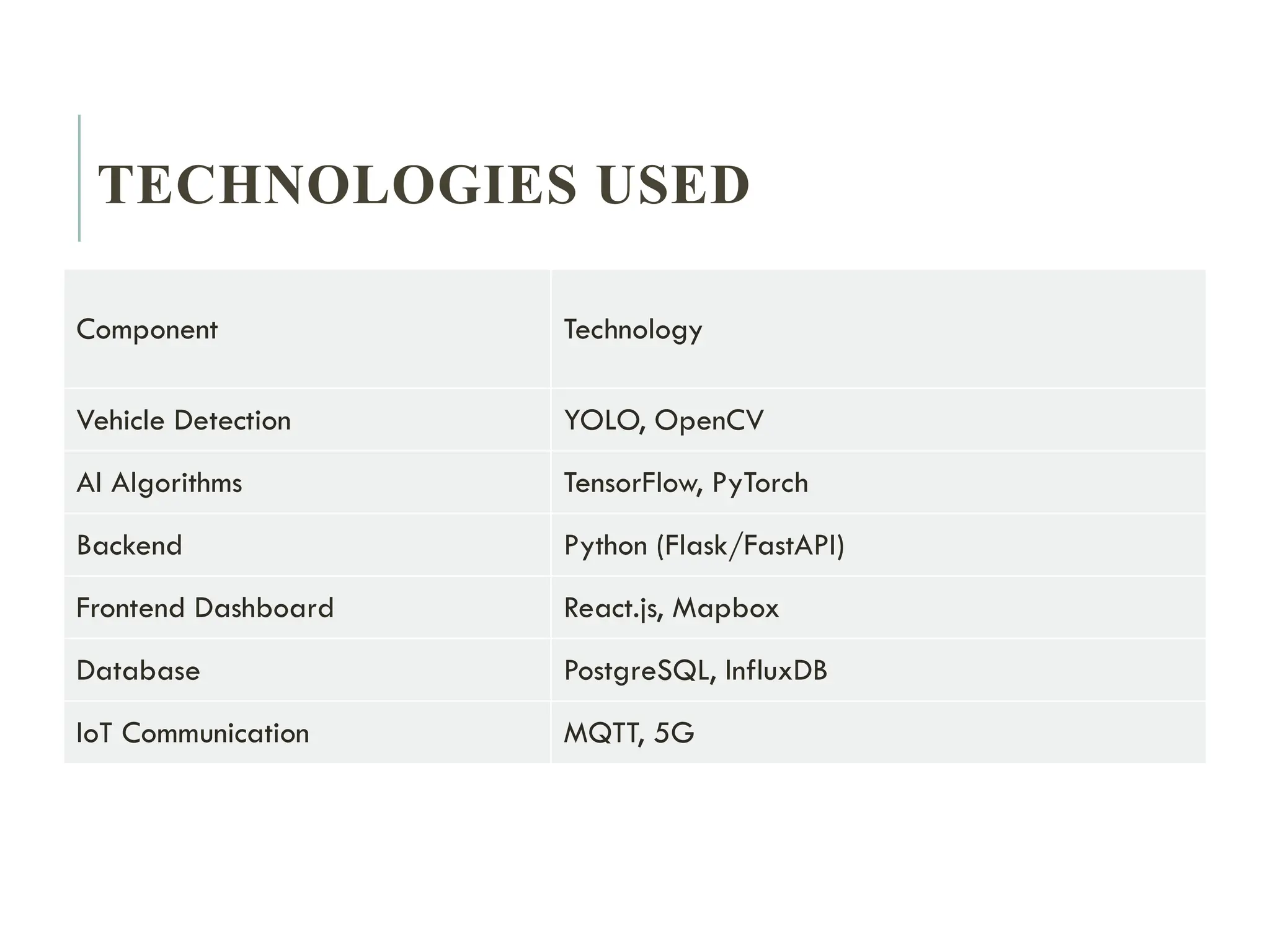
TECHNOLOGIES USED
Component Technology
Vehicle Detection YOLO, OpenCV
AI Algorithms TensorFlow, PyTorch
Backend Python (Flask/FastAPI)
Frontend Dashboard React.js, Mapbox
Database PostgreSQL, InfluxDB
IoT Communication MQTT, 5G
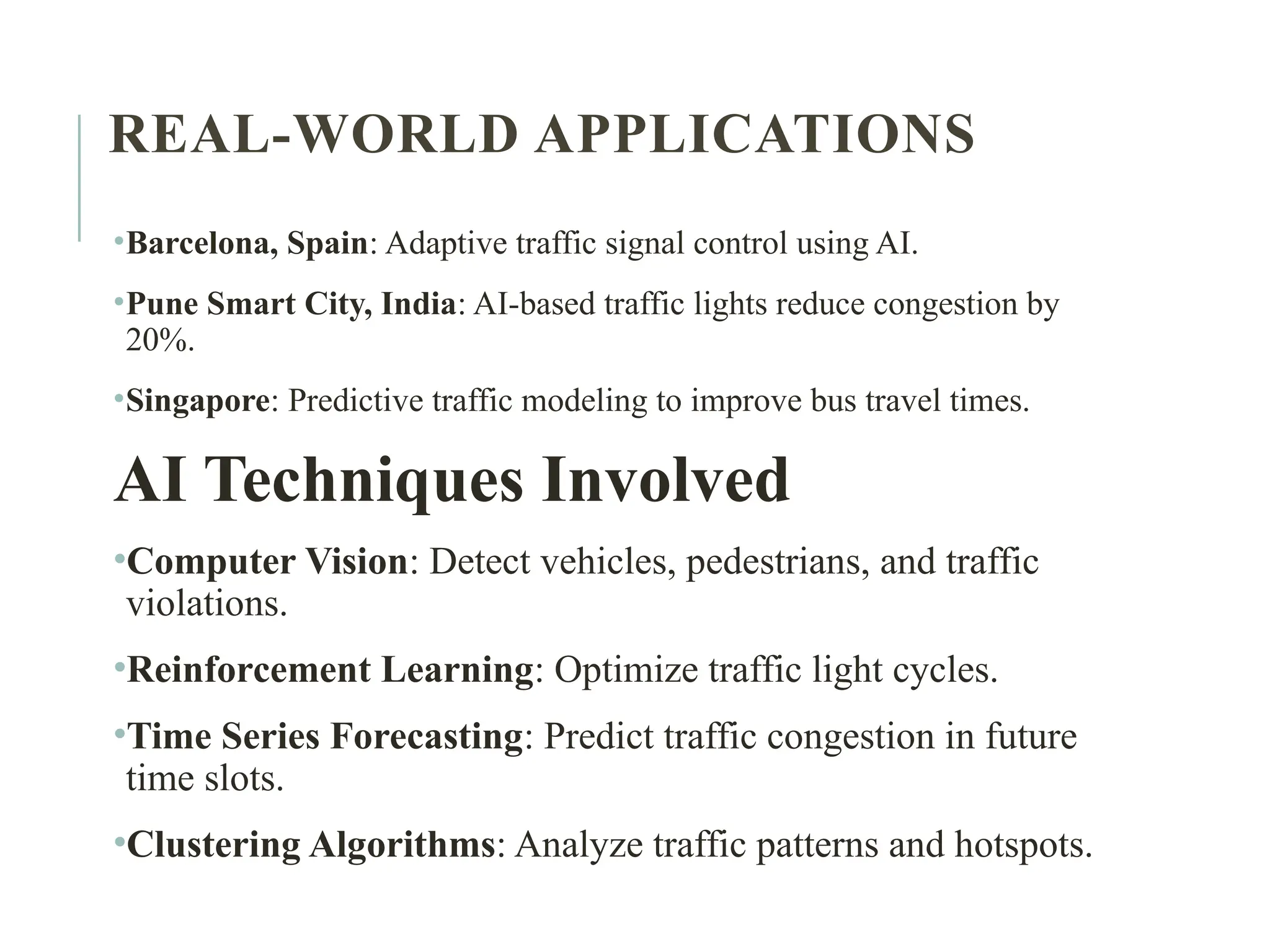
REAL-WORLD APPLICATIONS
•Barcelona, Spain: Adaptive traffic signal control using AI.
•Pune Smart City, India: AI-based traffic lights reduce congestion by
20%.
•Singapore: Predictive traffic modeling to improve bus travel times.
AI Techniques Involved
•Computer Vision: Detect vehicles, pedestrians, and traffic
violations.
•Reinforcement Learning: Optimize traffic light cycles.
•Time Series Forecasting: Predict traffic congestion in future
time slots.
•Clustering Algorithms: Analyze traffic patterns and hotspots.
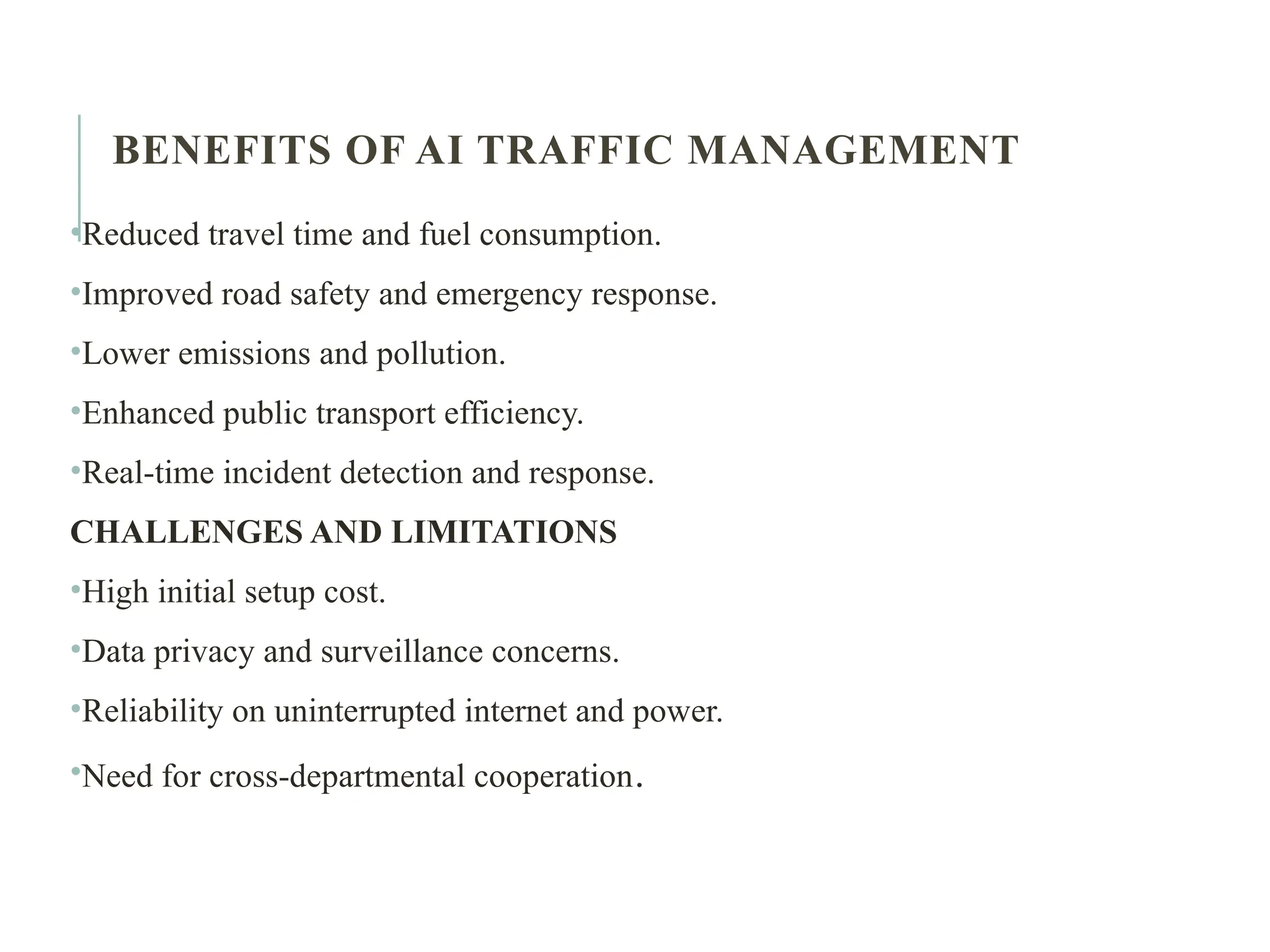
BENEFITS OF AI TRAFFIC MANAGEMENT
•Reduced travel time and fuel consumption.
•Improved road safety and emergency response.
•Lower emissions and pollution.
•Enhanced public transport efficiency.
•Real-time incident detection and response.
CHALLENGES AND LIMITATIONS
•High initial setup cost.
•Data privacy and surveillance concerns.
•Reliability on uninterrupted internet and power.
•Need for cross-departmental cooperation.
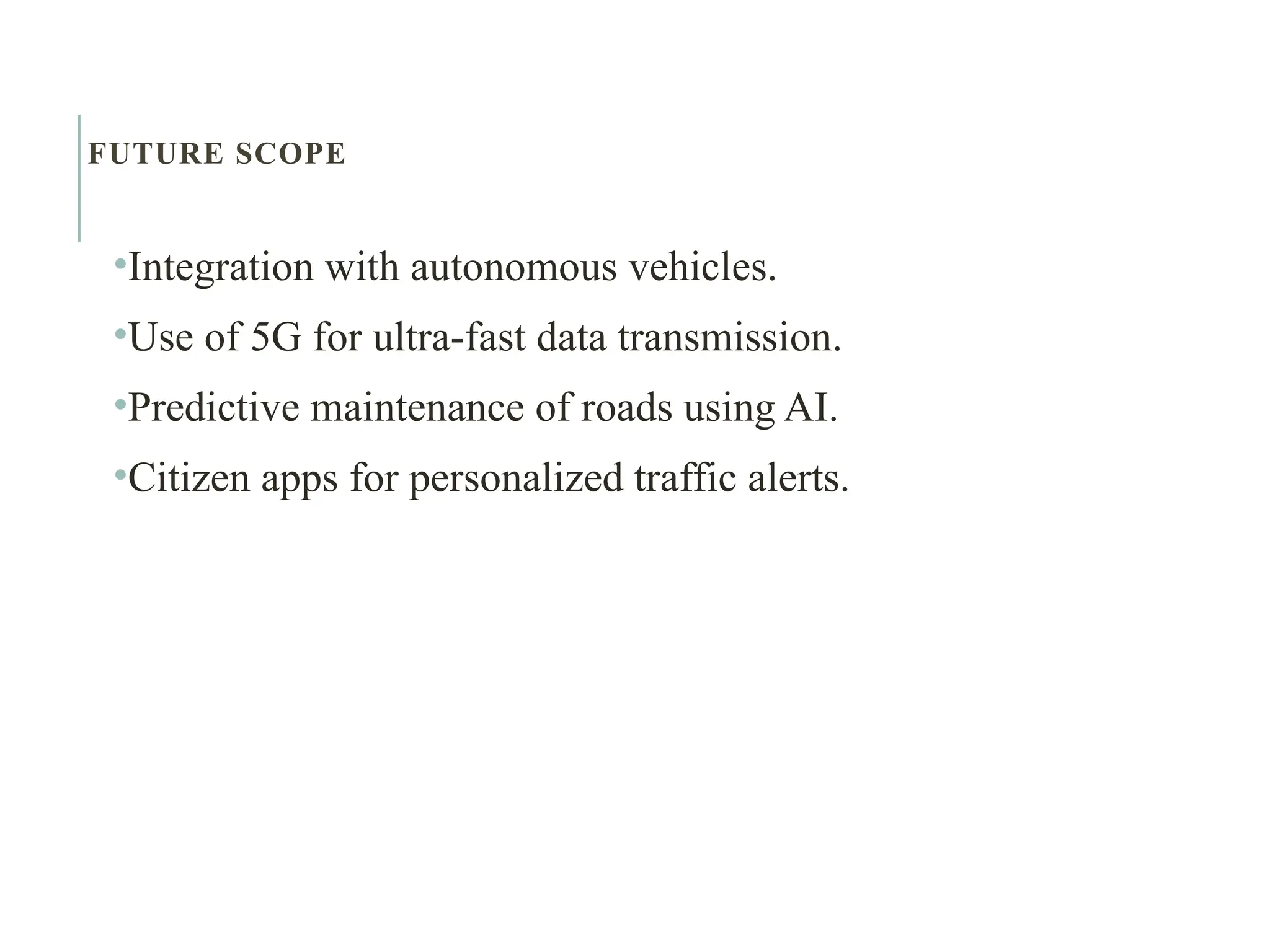
FUTURE SCOPE
•Integration with autonomous vehicles.
•Use of 5G for ultra-fast data transmission.
•Predictive maintenance of roads using AI.
•Citizen apps for personalized traffic alerts.
CONCLUSION
AI-powered smart traffic management is not just a
futuristic vision—it is a practical and scalable
solution to today’s traffic problems. With rapid
urbanization, the need for intelligent traffic
systems is more critical than ever. By embracing
AI, cities can become smarter, greener, and more
efficient.
.

AI_Traffic_Management_Presentation (2).pptx

  • 1.
    BASAVESHWAR ENGINEERING COLLEGE BAGALKOT DepartmentOf Electronics And Communication Engineering Technical Seminar Presentation On Al-powered Smart Traffic Management Presenting By : Priya M Malaghan USN: 2BA21EC070 Guidance of: Dr. Mamata.J.S HOD: Dr.J.D.Mallapur
  • 2.
    INTRODUCTION Urban traffic congestionis one of the major challenges faced by modern cities, resulting in increased travel time, higher fuel consumption, elevated levels of air pollution, and greater stress for commuters. Traditional traffic management systems are often rigid and lack the capability to adapt to real-time conditions, which leads to inefficient traffic flow and delays. In contrast, AI-powered smart traffic management systems offer intelligent solutions by utilizing artificial intelligence to analyze real- time traffic data and optimize control strategies dynamically. When integrated with the Internet of Things (IoT), these systems can monitor vehicles, control traffic signals, and detect incidents instantly across urban networks. Additionally, the use of big data analytics enhances predictive modeling and long-term traffic planning, paving the way for more efficient and sustainable urban mobility.
  • 3.
    OBJECTIVE Detect vehicles inlive or recorded video Estimate traffic density (Low, Medium, High) Display real-time feedback using AI models Implementation with MATLAB and JavaScript (TensorFlow.js) What is AI-Powered Smart Traffic Management? An AI-powered traffic management system uses intelligent algorithms to: •Monitor real-time traffic conditions. •Analyze road usage patterns. •Control traffic signals adaptively. •Predict congestion and suggest preventive measures. •Improve emergency response times.
  • 4.
    CORE COMPONENTS OFTHE SYSTEM a. Data Collection Layer • CCTV Cameras with computer vision for vehicle detection. • IoT Sensors to measure vehicle count, speed, and lane occupancy. • GPS Data from vehicles and mobile apps. b. Edge & Cloud AI Processing • Real-time analytics on edge devices. • Deep learning models for traffic pattern recognition. • Reinforcement learning for dynamic signal control. c. Smart Traffic Lights • AI adjusts signal timing based on real-time demand. • Green waves for smoother traffic flow. d. Central Control Dashboard • Displays live traffic maps and camera feeds. • Sends alerts for congestion, accidents, or traffic violations.
  • 5.
    TECHNOLOGIES USED Component Technology VehicleDetection YOLO, OpenCV AI Algorithms TensorFlow, PyTorch Backend Python (Flask/FastAPI) Frontend Dashboard React.js, Mapbox Database PostgreSQL, InfluxDB IoT Communication MQTT, 5G
  • 6.
    REAL-WORLD APPLICATIONS •Barcelona, Spain:Adaptive traffic signal control using AI. •Pune Smart City, India: AI-based traffic lights reduce congestion by 20%. •Singapore: Predictive traffic modeling to improve bus travel times. AI Techniques Involved •Computer Vision: Detect vehicles, pedestrians, and traffic violations. •Reinforcement Learning: Optimize traffic light cycles. •Time Series Forecasting: Predict traffic congestion in future time slots. •Clustering Algorithms: Analyze traffic patterns and hotspots.
  • 7.
    BENEFITS OF AITRAFFIC MANAGEMENT •Reduced travel time and fuel consumption. •Improved road safety and emergency response. •Lower emissions and pollution. •Enhanced public transport efficiency. •Real-time incident detection and response. CHALLENGES AND LIMITATIONS •High initial setup cost. •Data privacy and surveillance concerns. •Reliability on uninterrupted internet and power. •Need for cross-departmental cooperation.
  • 8.
    FUTURE SCOPE •Integration withautonomous vehicles. •Use of 5G for ultra-fast data transmission. •Predictive maintenance of roads using AI. •Citizen apps for personalized traffic alerts.
  • 9.
    CONCLUSION AI-powered smart trafficmanagement is not just a futuristic vision—it is a practical and scalable solution to today’s traffic problems. With rapid urbanization, the need for intelligent traffic systems is more critical than ever. By embracing AI, cities can become smarter, greener, and more efficient. .