CMR TECHNICAL CAMPUS
A
REALTIME PROJECT ON
AI BASED TEXT TO IMAGE CONVERTER
CONTENTS
• ABSTRACT
• INTRODUCTION
• EXISTING SYSTEM
• PROBLEM STATEMENT
• PROPOSED METHODOLOGY
• PROPOSED SYSTEM – ADVANTAGES
• REQUIREMENT ANALYSIS
• ARCHITECTURE
• IMPLEMENTATION
• OUTPUT
• CONCLUSION
ABSTRACT
We propose the development of an innovative web-based AI Image Generator, harnessing the
capabilities of HTML, CSS, and JavaScript to provide users with a seamless and interactive
experience. The primary goal is to leverage the advancements in Artificial Intelligence, specifically
OpenAI API to empower users in generating diverse and realistic images directly from their web
browsers. The proposed system will adopt a client-server architecture, where the AI model resides on
the server-side, while the web interface enables users to interact with it effortlessly.
INTRODUCTION
• In an era where technology continuously pushes the boundaries of innovation, Artificial
Intelligence (AI) stands as a beacon of transformative potential.
• Among its manifold applications, AI-driven image generation emerges as a captivating
frontier, offering unprecedented avenues for creativity and expression.
• Within this realm, our project embarks on a journey to explore the synthesis of art and
intelligence, delving into the fascinating world of AI image generation.
SOFTWARE REQUIREMENTS:
★ Web Browser: Google Chrome or any other
★ Coding Language: JavaScript
★ Front-End: Html, CSS.
SOFTWARE & HARDWARE
REQUIREMENTS
HARDWARE REQUIREMENTS
Processor : I5 OR above
Hard disk : 512 GB
RAM : 16 GB
• There are several existing systems for AI image generation, each with its own unique
approach and capabilities.
• Generative Adversarial Networks (GANs): GANs are perhaps the most popular
framework for generating images. They consist of two neural networks, a generator, and a
discriminator, trained in competition..
• Variational Autoencoders (VAEs): VAEs are another popular approach for generating
images. They consist of an encoder and a decoder. The encoder maps input images to a
latent space, and the decoder reconstructs images from the latent space.
EXISTING SYSTEM
While AI image generation systems have made significant advancements and are capable of
producing stunning results, they also come with certain disadvantages and limitations.
1.Quality Variation
2. Mode Collapse
3. Overfitting
4. Data Dependency
PROBLEM STATEMENT
The system is developed to generate images based on the description from the user and provide
artificial images which are realistic. The developed system provides a user friendly interface to
effortlessly create customized images on user inputs.
System Components:
A. Frontend Interface:
• User Input Interface: Provides a user-friendly interface for users to input textual.
• Preview Panel: Displays a preview of the generated images for users to review before finalizing
their selections.
• Feedback Mechanism: Includes features for users to provide feedback on generated images .
B. OpenAI API Integration:
The system interacts with the API to submit textual descriptions and receive corresponding
image outputs. Specifically, the system leverages models like DALL-E for generating images from
textual prompts.
PROPOSED SYSTEM
PROPOSED SYSTEM
C. Backend Processing:
• Text Processing Module: Processes the textual descriptions input by users.
• Image Generation Module: Utilizes a OpenAI model to generate images based on the
processed textual descriptions.
• Quality Control Mechanism: Implements mechanisms to ensure the quality and
relevance of generated.
• Performance Optimization: Utilizes OpenAI for processing and caching to optimize the
speed and efficiency of image generation
PROPOSED SYSTEM
(ADVANTAGES)
•Access to State-of-the-Art Models :OpenAI's API provides access to cutting-edge AI models,
such as DALL-E, which are trained on large datasets and capable of generating high-quality images
from textual descriptions.
•Scalability and Performance: By using OpenAI's infrastructure, developers benefit from the
scalability and performance optimizations provided by their API.
•Ease of Integration: OpenAI's API is designed to be developer-friendly, with clear documentation
and easy-to-use endpoints for interacting with AI models.
•Continuous Improvement:OpenAI regularly updates and improves their models based on new
research and data.
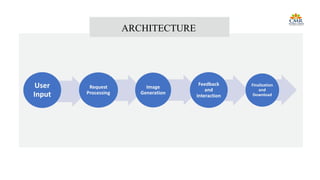
ARCHITECTURE
IMPLEMENTION
The implementation of an AI image generator using HTML, CSS, and JavaScript,is to
create a simple web interface that interacts with a backend API.
This web interface will allow users to input text descriptions, send the descriptions to the
backend, and display the generated images.
• It initializes the OpenAI API key.
• Defines a function generate_image that takes a text prompt, generates an image using the
DALL-E API, and returns the image data.
• Defines a function save_image that saves an image from a given URL to a local file.
• Uses these functions to generate an image from a sample prompt and save the result.
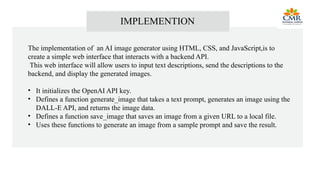
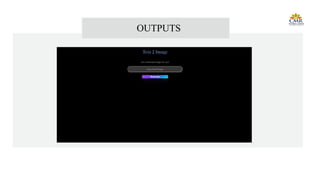
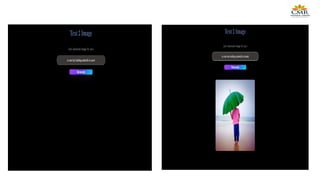
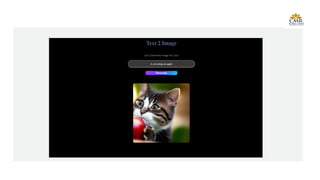
OUTPUTS
CONCLUSION
• AI image generation project represents a significant advancement in the field of AI-driven
content creation.
• It has the potential to revolutionize industries such as design, advertising, and entertainment
by providing powerful tools for generating custom images efficiently and creatively.
Thank you

AI BASED TEXT TO IMAGE CONVERTER .pptx

  • 1.
    CMR TECHNICAL CAMPUS A REALTIMEPROJECT ON AI BASED TEXT TO IMAGE CONVERTER
  • 3.
    CONTENTS • ABSTRACT • INTRODUCTION •EXISTING SYSTEM • PROBLEM STATEMENT • PROPOSED METHODOLOGY • PROPOSED SYSTEM – ADVANTAGES • REQUIREMENT ANALYSIS • ARCHITECTURE • IMPLEMENTATION • OUTPUT • CONCLUSION
  • 4.
    ABSTRACT We propose thedevelopment of an innovative web-based AI Image Generator, harnessing the capabilities of HTML, CSS, and JavaScript to provide users with a seamless and interactive experience. The primary goal is to leverage the advancements in Artificial Intelligence, specifically OpenAI API to empower users in generating diverse and realistic images directly from their web browsers. The proposed system will adopt a client-server architecture, where the AI model resides on the server-side, while the web interface enables users to interact with it effortlessly.
  • 5.
    INTRODUCTION • In anera where technology continuously pushes the boundaries of innovation, Artificial Intelligence (AI) stands as a beacon of transformative potential. • Among its manifold applications, AI-driven image generation emerges as a captivating frontier, offering unprecedented avenues for creativity and expression. • Within this realm, our project embarks on a journey to explore the synthesis of art and intelligence, delving into the fascinating world of AI image generation.
  • 6.
    SOFTWARE REQUIREMENTS: ★ WebBrowser: Google Chrome or any other ★ Coding Language: JavaScript ★ Front-End: Html, CSS. SOFTWARE & HARDWARE REQUIREMENTS HARDWARE REQUIREMENTS Processor : I5 OR above Hard disk : 512 GB RAM : 16 GB
  • 7.
    • There areseveral existing systems for AI image generation, each with its own unique approach and capabilities. • Generative Adversarial Networks (GANs): GANs are perhaps the most popular framework for generating images. They consist of two neural networks, a generator, and a discriminator, trained in competition.. • Variational Autoencoders (VAEs): VAEs are another popular approach for generating images. They consist of an encoder and a decoder. The encoder maps input images to a latent space, and the decoder reconstructs images from the latent space. EXISTING SYSTEM
  • 8.
    While AI imagegeneration systems have made significant advancements and are capable of producing stunning results, they also come with certain disadvantages and limitations. 1.Quality Variation 2. Mode Collapse 3. Overfitting 4. Data Dependency PROBLEM STATEMENT
  • 9.
    The system isdeveloped to generate images based on the description from the user and provide artificial images which are realistic. The developed system provides a user friendly interface to effortlessly create customized images on user inputs. System Components: A. Frontend Interface: • User Input Interface: Provides a user-friendly interface for users to input textual. • Preview Panel: Displays a preview of the generated images for users to review before finalizing their selections. • Feedback Mechanism: Includes features for users to provide feedback on generated images . B. OpenAI API Integration: The system interacts with the API to submit textual descriptions and receive corresponding image outputs. Specifically, the system leverages models like DALL-E for generating images from textual prompts. PROPOSED SYSTEM
  • 10.
    PROPOSED SYSTEM C. BackendProcessing: • Text Processing Module: Processes the textual descriptions input by users. • Image Generation Module: Utilizes a OpenAI model to generate images based on the processed textual descriptions. • Quality Control Mechanism: Implements mechanisms to ensure the quality and relevance of generated. • Performance Optimization: Utilizes OpenAI for processing and caching to optimize the speed and efficiency of image generation
  • 11.
    PROPOSED SYSTEM (ADVANTAGES) •Access toState-of-the-Art Models :OpenAI's API provides access to cutting-edge AI models, such as DALL-E, which are trained on large datasets and capable of generating high-quality images from textual descriptions. •Scalability and Performance: By using OpenAI's infrastructure, developers benefit from the scalability and performance optimizations provided by their API. •Ease of Integration: OpenAI's API is designed to be developer-friendly, with clear documentation and easy-to-use endpoints for interacting with AI models. •Continuous Improvement:OpenAI regularly updates and improves their models based on new research and data.
  • 12.
  • 13.
    IMPLEMENTION The implementation ofan AI image generator using HTML, CSS, and JavaScript,is to create a simple web interface that interacts with a backend API. This web interface will allow users to input text descriptions, send the descriptions to the backend, and display the generated images. • It initializes the OpenAI API key. • Defines a function generate_image that takes a text prompt, generates an image using the DALL-E API, and returns the image data. • Defines a function save_image that saves an image from a given URL to a local file. • Uses these functions to generate an image from a sample prompt and save the result.
  • 14.
  • 17.
    CONCLUSION • AI imagegeneration project represents a significant advancement in the field of AI-driven content creation. • It has the potential to revolutionize industries such as design, advertising, and entertainment by providing powerful tools for generating custom images efficiently and creatively.
  • 18.