Presented by startelelogic
Artificial Intelligence (AI) is a branch of computer science aimed at
creating systems that can perform tasks typically requiring human
intelligence, such as visual perception, speech recognition, decision-
making, and language translation. Machine Learning (ML), a subset of
AI, involves the development of algorithms that allow computers to learn
from and make decisions based on data. Unlike traditional software,
where tasks are explicitly programmed, ML models improve over time as
they are exposed to more data. In software development, AI and ML are
increasingly important, enhancing efficiency, accuracy, and fostering
innovation by automating routine tasks and enabling more
sophisticated analysis and decision-making.
AI and ML have a wide range of applications in software development,
fundamentally transforming how software is designed, developed, and
maintained. One significant application is in code generation and
assistance, where tools like GitHub Copilot and IntelliCode provide
developers with intelligent code suggestions, reducing the time required
to write code and minimizing errors. Another area is automated testing,
where AI-powered tools predict potential bugs and automate test
generation, improving code reliability and reducing the time spent on
manual testing. Predictive analytics is another critical application,
allowing project managers to forecast project timelines, identify risks,
and allocate resources more effectively. Natural Language Processing
(NLP) also plays a crucial role, enabling the development of advanced
chatbots and enhancing user experience through sentiment analysis
and better understanding of user queries.
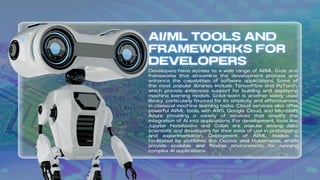
Developers have access to a wide range of AI/ML tools and
frameworks that streamline the development process and
enhance the capabilities of software applications. Some of
the most popular libraries include TensorFlow and PyTorch,
which provide extensive support for building and deploying
machine learning models. Scikit-learn is another widely used
library, particularly favored for its simplicity and effectiveness
in classical machine learning tasks. Cloud services also offer
powerful AI/ML tools, with AWS, Google Cloud, and Microsoft
Azure providing a variety of services that simplify the
integration of AI into applications. For development, tools like
Jupyter Notebooks and Colab are popular among data
scientists and developers for their ease of use in prototyping
and experimentation. Deployment of AI/ML models is
facilitated by platforms like Docker and Kubernetes, which
provide scalable and flexible environments for running
complex AI applications.
Several companies have successfully integrated AI/ML into their software
development processes, demonstrating the transformative power of these
technologies. Netflix, for example, uses machine learning algorithms to
personalize content recommendations for its users, significantly enhancing
user engagement and satisfaction. IBM Watson is another prominent
example, offering AI-driven solutions across various industries, including
healthcare and finance, where it helps in diagnosing diseases and making
financial predictions. In the automotive industry, autonomous vehicles
represent one of the most advanced applications of AI/ML. Companies like
Tesla utilize these technologies to develop self-driving cars that can
navigate complex environments, demonstrating how AI/ML can push the
boundaries of what is possible in software development.
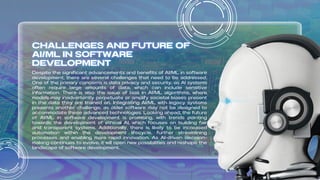
Despite the significant advancements and benefits of AI/ML in software
development, there are several challenges that need to be addressed.
One of the primary concerns is data privacy and security, as AI systems
often require large amounts of data, which can include sensitive
information. There is also the issue of bias in AI/ML algorithms, where
models may inadvertently perpetuate or amplify societal biases present
in the data they are trained on. Integrating AI/ML with legacy systems
presents another challenge, as older software may not be designed to
accommodate these advanced technologies. Looking ahead, the future
of AI/ML in software development is promising, with trends pointing
towards the development of ethical AI, which focuses on building fair
and transparent systems. Additionally, there is likely to be increased
automation within the development lifecycle, further streamlining
processes and enabling more rapid innovation. As AI-driven decision-
making continues to evolve, it will open new possibilities and reshape the
landscape of software development.
W W W . S T A R T E L E L O G I C . C O M

AI and Machine Learning in Software Development.pdf

  • 1.
  • 2.
    Artificial Intelligence (AI)is a branch of computer science aimed at creating systems that can perform tasks typically requiring human intelligence, such as visual perception, speech recognition, decision- making, and language translation. Machine Learning (ML), a subset of AI, involves the development of algorithms that allow computers to learn from and make decisions based on data. Unlike traditional software, where tasks are explicitly programmed, ML models improve over time as they are exposed to more data. In software development, AI and ML are increasingly important, enhancing efficiency, accuracy, and fostering innovation by automating routine tasks and enabling more sophisticated analysis and decision-making.
  • 3.
    AI and MLhave a wide range of applications in software development, fundamentally transforming how software is designed, developed, and maintained. One significant application is in code generation and assistance, where tools like GitHub Copilot and IntelliCode provide developers with intelligent code suggestions, reducing the time required to write code and minimizing errors. Another area is automated testing, where AI-powered tools predict potential bugs and automate test generation, improving code reliability and reducing the time spent on manual testing. Predictive analytics is another critical application, allowing project managers to forecast project timelines, identify risks, and allocate resources more effectively. Natural Language Processing (NLP) also plays a crucial role, enabling the development of advanced chatbots and enhancing user experience through sentiment analysis and better understanding of user queries.
  • 4.
    Developers have accessto a wide range of AI/ML tools and frameworks that streamline the development process and enhance the capabilities of software applications. Some of the most popular libraries include TensorFlow and PyTorch, which provide extensive support for building and deploying machine learning models. Scikit-learn is another widely used library, particularly favored for its simplicity and effectiveness in classical machine learning tasks. Cloud services also offer powerful AI/ML tools, with AWS, Google Cloud, and Microsoft Azure providing a variety of services that simplify the integration of AI into applications. For development, tools like Jupyter Notebooks and Colab are popular among data scientists and developers for their ease of use in prototyping and experimentation. Deployment of AI/ML models is facilitated by platforms like Docker and Kubernetes, which provide scalable and flexible environments for running complex AI applications.
  • 5.
    Several companies havesuccessfully integrated AI/ML into their software development processes, demonstrating the transformative power of these technologies. Netflix, for example, uses machine learning algorithms to personalize content recommendations for its users, significantly enhancing user engagement and satisfaction. IBM Watson is another prominent example, offering AI-driven solutions across various industries, including healthcare and finance, where it helps in diagnosing diseases and making financial predictions. In the automotive industry, autonomous vehicles represent one of the most advanced applications of AI/ML. Companies like Tesla utilize these technologies to develop self-driving cars that can navigate complex environments, demonstrating how AI/ML can push the boundaries of what is possible in software development.
  • 6.
    Despite the significantadvancements and benefits of AI/ML in software development, there are several challenges that need to be addressed. One of the primary concerns is data privacy and security, as AI systems often require large amounts of data, which can include sensitive information. There is also the issue of bias in AI/ML algorithms, where models may inadvertently perpetuate or amplify societal biases present in the data they are trained on. Integrating AI/ML with legacy systems presents another challenge, as older software may not be designed to accommodate these advanced technologies. Looking ahead, the future of AI/ML in software development is promising, with trends pointing towards the development of ethical AI, which focuses on building fair and transparent systems. Additionally, there is likely to be increased automation within the development lifecycle, further streamlining processes and enabling more rapid innovation. As AI-driven decision- making continues to evolve, it will open new possibilities and reshape the landscape of software development.
  • 7.
    W W W. S T A R T E L E L O G I C . C O M