README
Make a copy of this
presentation!
File > Make a copy > Entire presentation
⚠️
This document will be deleted in 30
days.
How to use this presentation
Customize and use it
however you’d like
Once you make a copy, you can edit this
just like any other Google Slides
presentation.
You can also download the presentation
as a PowerPoint and PDF, and more.
1 2 3
Try Plus AI for free
Get the Plus AI extensions to generate
and edit presentations directly in Google
Slides and PowerPoint.
Learn more and start your free trial at
plusdocs.com
Sign up for Plus AI to generate slides
without the watermark.
The Impact of Artificial
Intelligence on
Software Development
August 12, 2024
Agenda
•Introduction to Artificial Intelligence
•Evolution of AI Technologies
•Machine Learning and Deep Learning
•AI in Modern Software Development
•Case Study: GitHub Copilot
•AI Applications in Major Tech Companies
•Impact of AI on Software Quality and Efficiency
•Conclusion and Future Directions
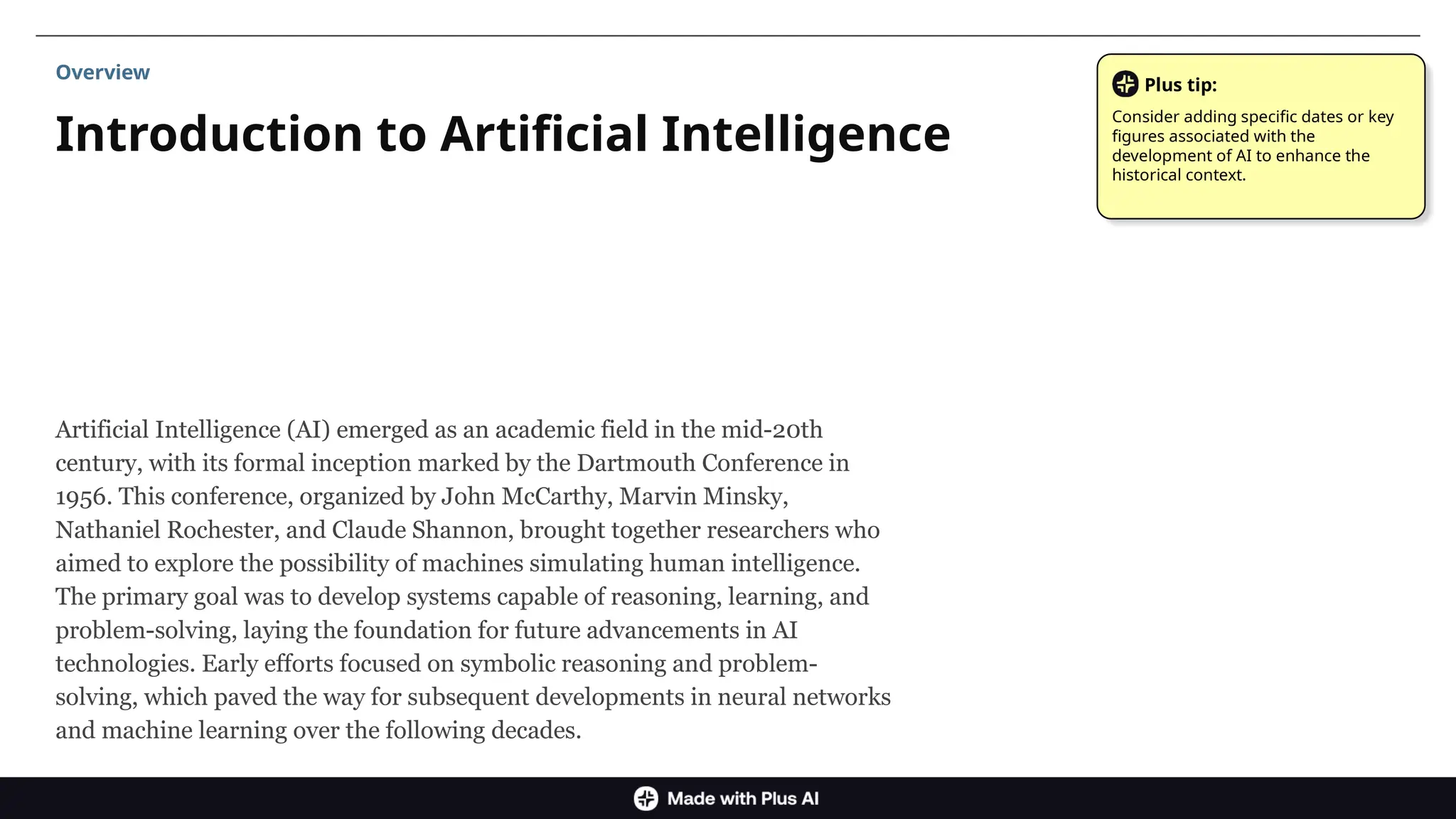
Artificial Intelligence (AI) emerged as an academic field in the mid-20th
century, with its formal inception marked by the Dartmouth Conference in
1956. This conference, organized by John McCarthy, Marvin Minsky,
Nathaniel Rochester, and Claude Shannon, brought together researchers who
aimed to explore the possibility of machines simulating human intelligence.
The primary goal was to develop systems capable of reasoning, learning, and
problem-solving, laying the foundation for future advancements in AI
technologies. Early efforts focused on symbolic reasoning and problem-
solving, which paved the way for subsequent developments in neural networks
and machine learning over the following decades.
Introduction to Artificial Intelligence
Overview
Plus tip:
Consider adding specific dates or key
figures associated with the
development of AI to enhance the
historical context.
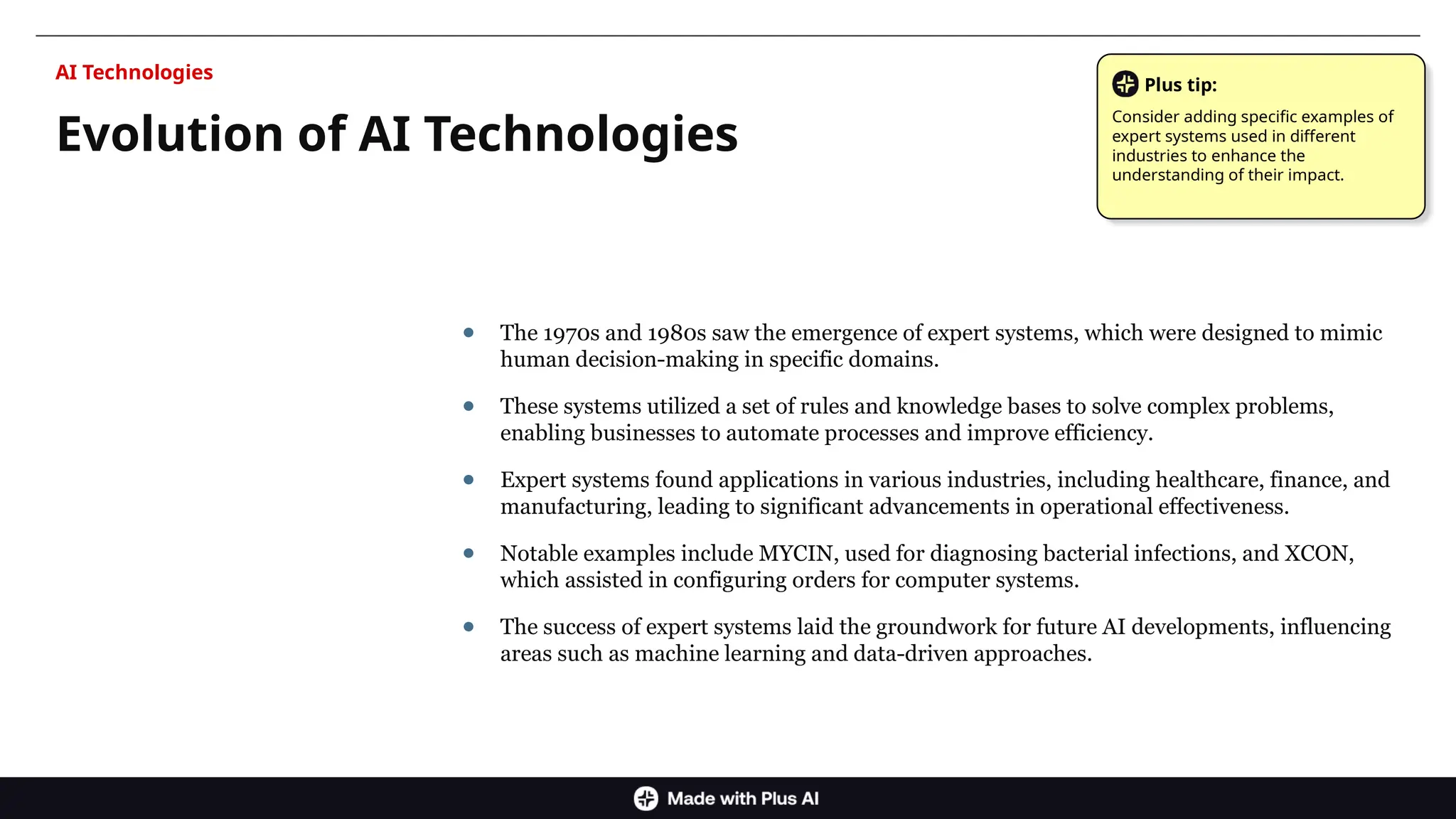
● The 1970s and 1980s saw the emergence of expert systems, which were designed to mimic
human decision-making in specific domains.
● These systems utilized a set of rules and knowledge bases to solve complex problems,
enabling businesses to automate processes and improve efficiency.
● Expert systems found applications in various industries, including healthcare, finance, and
manufacturing, leading to significant advancements in operational effectiveness.
● Notable examples include MYCIN, used for diagnosing bacterial infections, and XCON,
which assisted in configuring orders for computer systems.
● The success of expert systems laid the groundwork for future AI developments, influencing
areas such as machine learning and data-driven approaches.
Evolution of AI Technologies
AI Technologies
Plus tip:
Consider adding specific examples of
expert systems used in different
industries to enhance the
understanding of their impact.
Rise of Machine Learning in the 1990s ● The 1990s marked a significant shift towards machine learning as a dominant
AI approach.
● Advancements in algorithms, such as decision trees and support vector
machines, gained prominence.
● Increased availability of data from the internet propelled the development of
machine learning techniques.
Evolution into Deep Learning ● Deep learning emerged in the 2000s, leveraging neural networks with
multiple layers.
● Enhanced computational power from GPUs accelerated the training of deep
neural networks.
● Access to large datasets enabled breakthroughs in image and speech
recognition applications.
Machine Learning and Deep Learning
AI Evolution
Plus tip:
Consider adding specific examples of
machine learning applications from the
1990s and notable deep learning successes
in recent years for a more comprehensive
view.
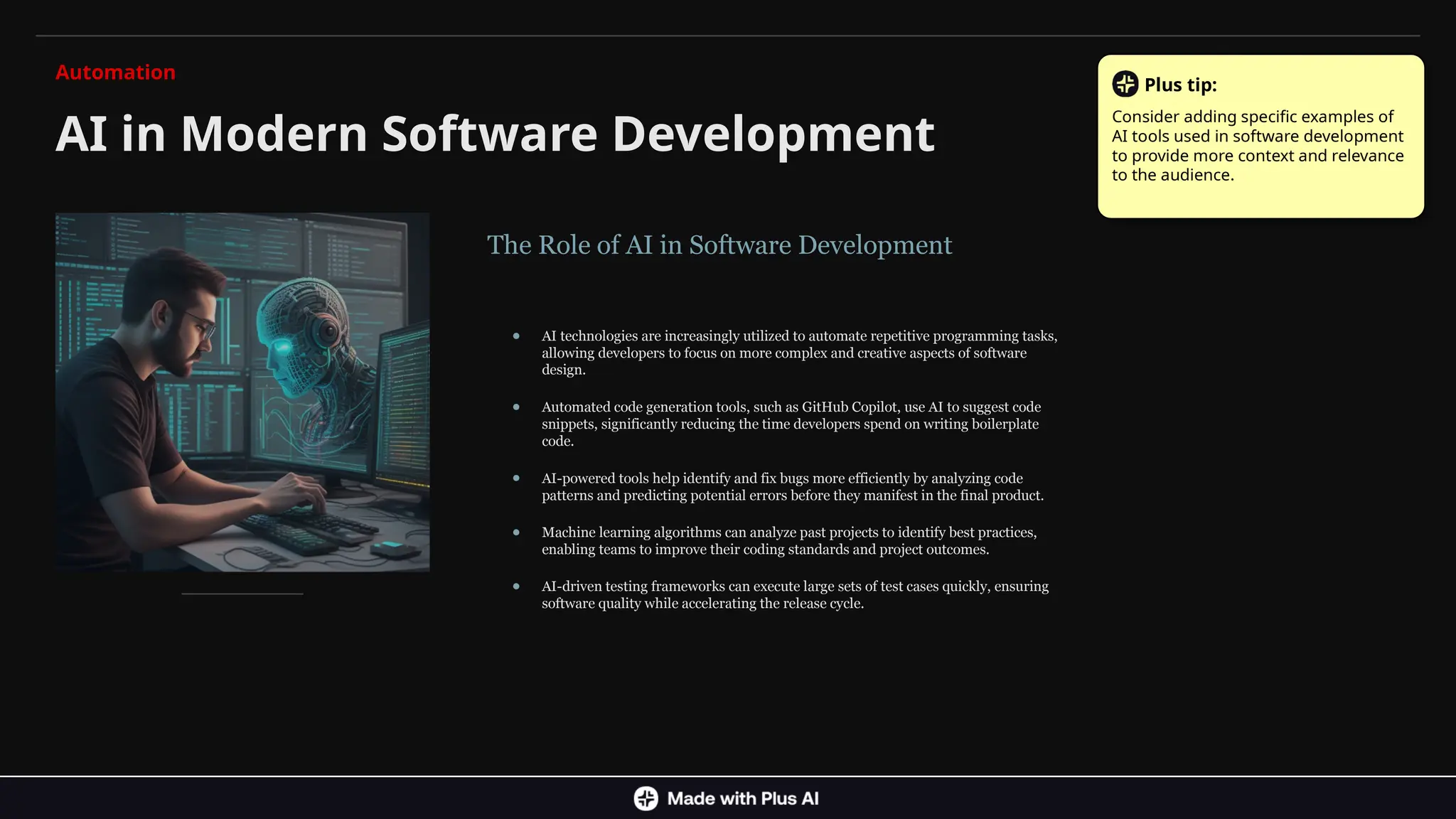
The Role of AI in Software Development
● AI technologies are increasingly utilized to automate repetitive programming tasks,
allowing developers to focus on more complex and creative aspects of software
design.
● Automated code generation tools, such as GitHub Copilot, use AI to suggest code
snippets, significantly reducing the time developers spend on writing boilerplate
code.
● AI-powered tools help identify and fix bugs more efficiently by analyzing code
patterns and predicting potential errors before they manifest in the final product.
● Machine learning algorithms can analyze past projects to identify best practices,
enabling teams to improve their coding standards and project outcomes.
● AI-driven testing frameworks can execute large sets of test cases quickly, ensuring
software quality while accelerating the release cycle.
AI in Modern Software Development
Automation
Plus tip:
Consider adding specific examples of
AI tools used in software development
to provide more context and relevance
to the audience.
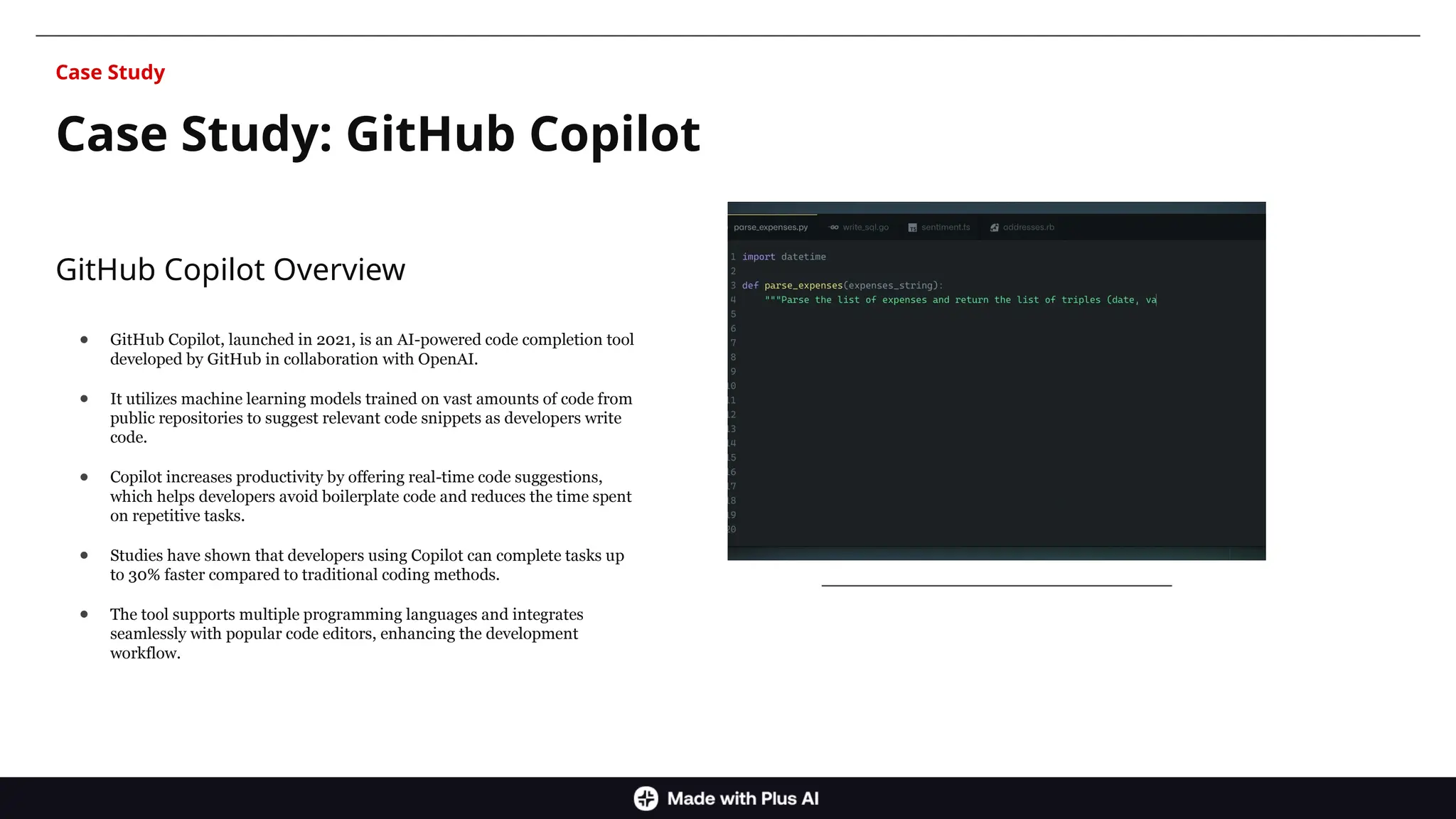
GitHub Copilot Overview
● GitHub Copilot, launched in 2021, is an AI-powered code completion tool
developed by GitHub in collaboration with OpenAI.
● It utilizes machine learning models trained on vast amounts of code from
public repositories to suggest relevant code snippets as developers write
code.
● Copilot increases productivity by offering real-time code suggestions,
which helps developers avoid boilerplate code and reduces the time spent
on repetitive tasks.
● Studies have shown that developers using Copilot can complete tasks up
to 30% faster compared to traditional coding methods.
● The tool supports multiple programming languages and integrates
seamlessly with popular code editors, enhancing the development
workflow.
Case Study: GitHub Copilot
Case Study
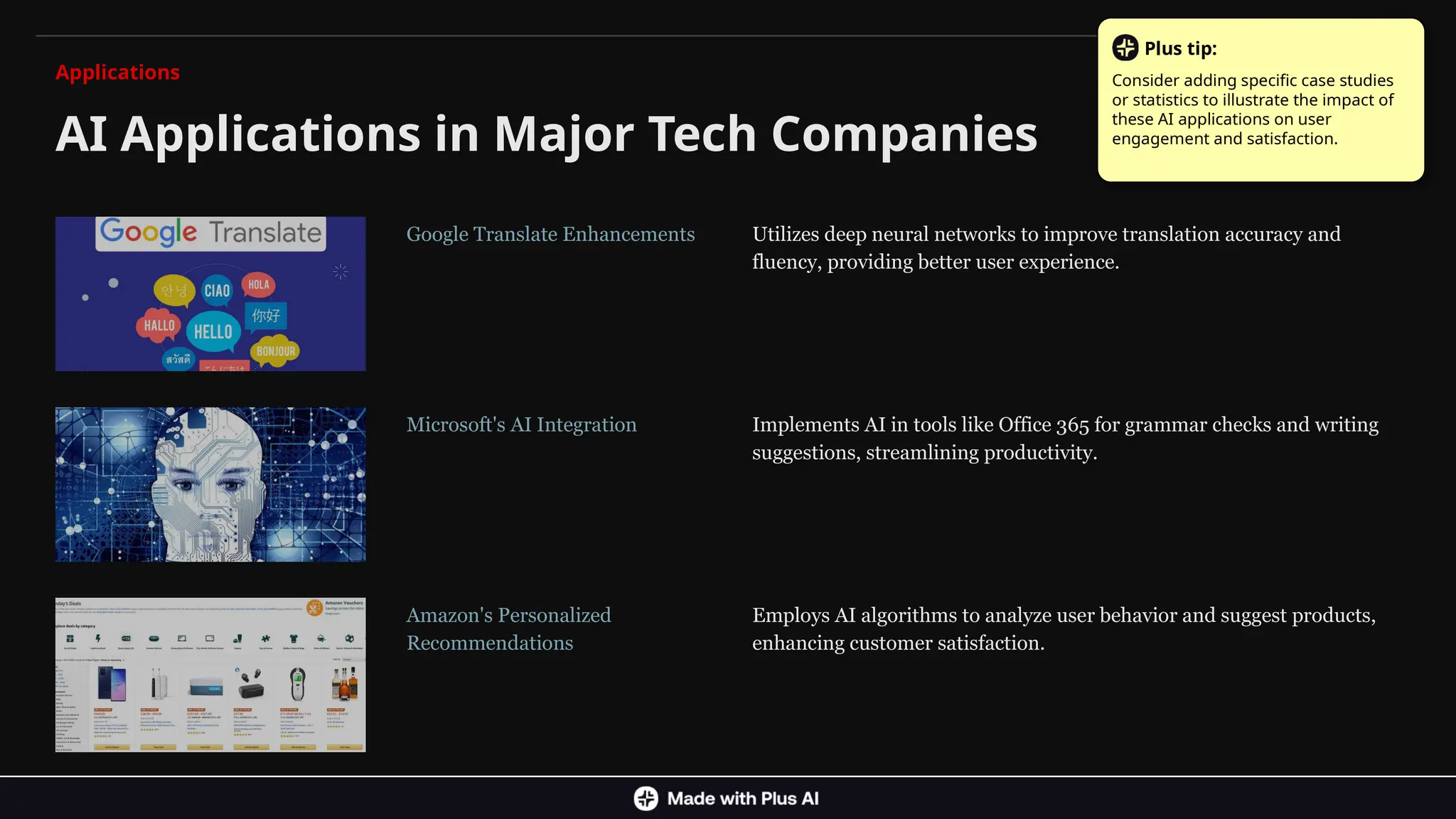
Microsoft's AI Integration Implements AI in tools like Office 365 for grammar checks and writing
suggestions, streamlining productivity.
Amazon's Personalized
Recommendations
Employs AI algorithms to analyze user behavior and suggest products,
enhancing customer satisfaction.
Google Translate Enhancements Utilizes deep neural networks to improve translation accuracy and
fluency, providing better user experience.
AI Applications in Major Tech Companies
Applications
Plus tip:
Consider adding specific case studies
or statistics to illustrate the impact of
these AI applications on user
engagement and satisfaction.
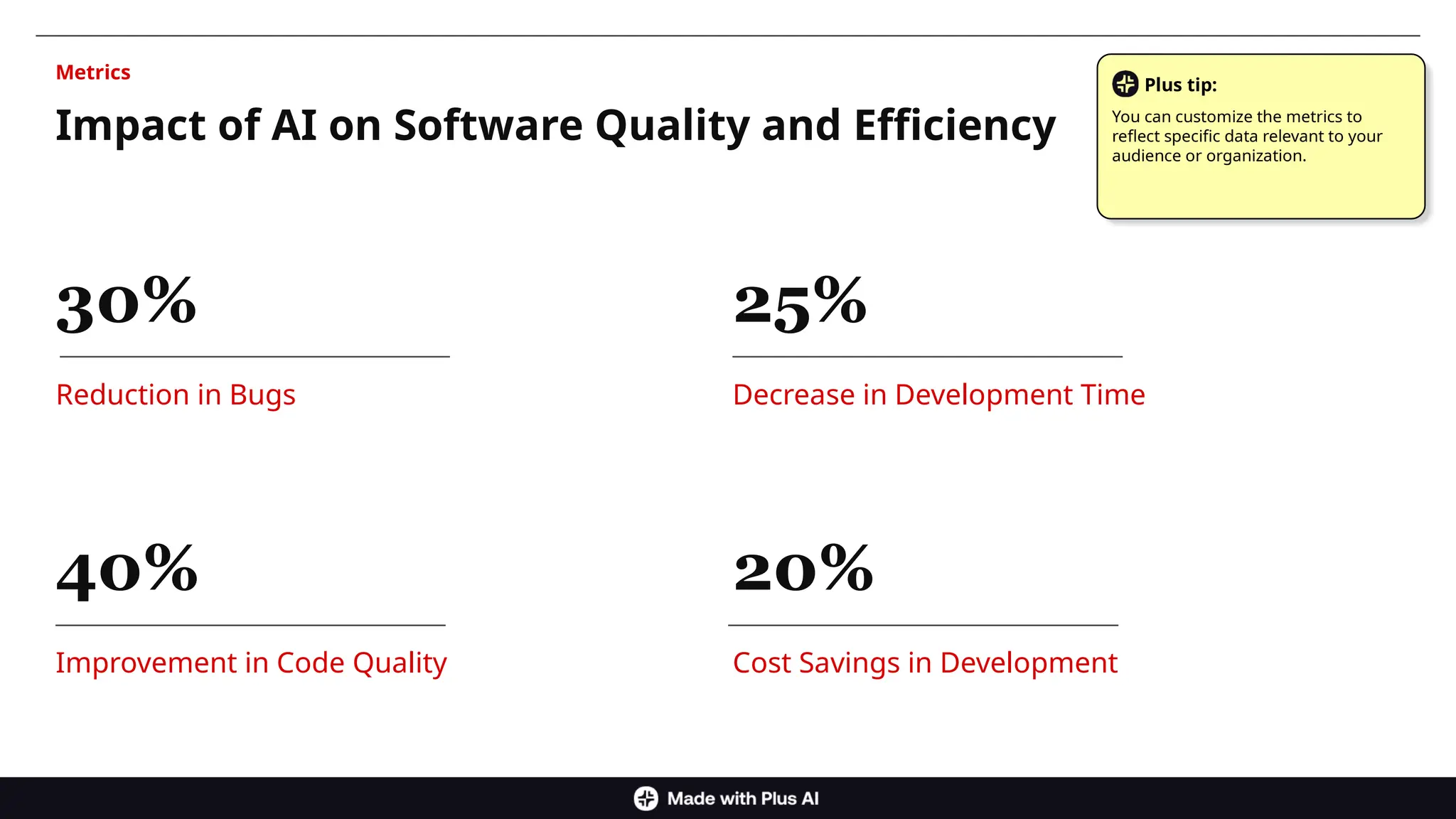
30%
Reduction in Bugs
25%
Decrease in Development Time
40%
Improvement in Code Quality
20%
Cost Savings in Development
Impact of AI on Software Quality and Efficiency
Metrics
Plus tip:
You can customize the metrics to
reflect specific data relevant to your
audience or organization.
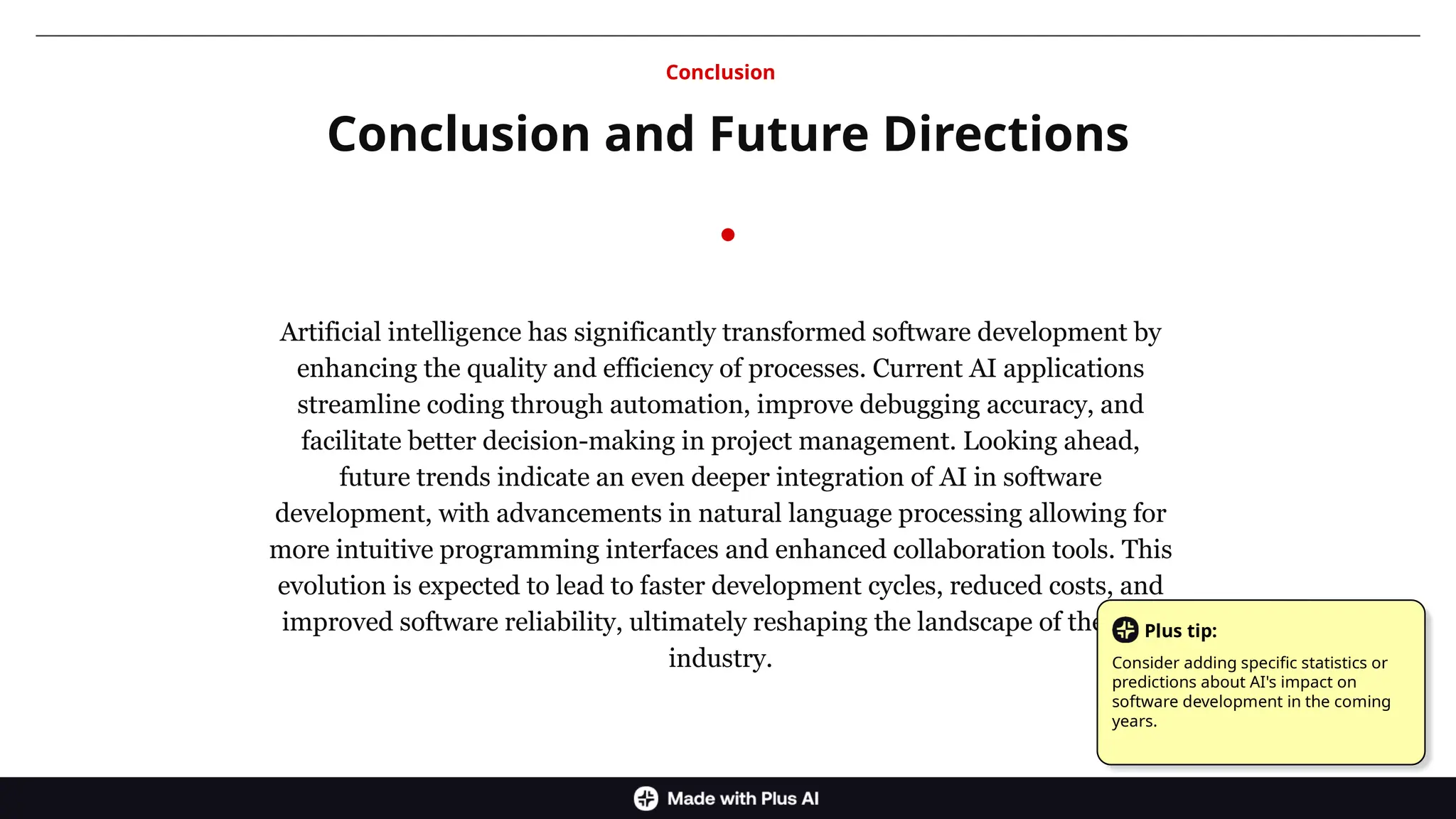
Artificial intelligence has significantly transformed software development by
enhancing the quality and efficiency of processes. Current AI applications
streamline coding through automation, improve debugging accuracy, and
facilitate better decision-making in project management. Looking ahead,
future trends indicate an even deeper integration of AI in software
development, with advancements in natural language processing allowing for
more intuitive programming interfaces and enhanced collaboration tools. This
evolution is expected to lead to faster development cycles, reduced costs, and
improved software reliability, ultimately reshaping the landscape of the tech
industry.
Conclusion and Future Directions
Conclusion
Plus tip:
Consider adding specific statistics or
predictions about AI's impact on
software development in the coming
years.
Thank you.

The Impact of Artificial Intelligence on Software Development.ppsx

  • 1.
    README Make a copyof this presentation! File > Make a copy > Entire presentation ⚠️ This document will be deleted in 30 days. How to use this presentation Customize and use it however you’d like Once you make a copy, you can edit this just like any other Google Slides presentation. You can also download the presentation as a PowerPoint and PDF, and more. 1 2 3 Try Plus AI for free Get the Plus AI extensions to generate and edit presentations directly in Google Slides and PowerPoint. Learn more and start your free trial at plusdocs.com Sign up for Plus AI to generate slides without the watermark.
  • 2.
    The Impact ofArtificial Intelligence on Software Development August 12, 2024
  • 3.
    Agenda •Introduction to ArtificialIntelligence •Evolution of AI Technologies •Machine Learning and Deep Learning •AI in Modern Software Development •Case Study: GitHub Copilot •AI Applications in Major Tech Companies •Impact of AI on Software Quality and Efficiency •Conclusion and Future Directions
  • 4.
    Artificial Intelligence (AI)emerged as an academic field in the mid-20th century, with its formal inception marked by the Dartmouth Conference in 1956. This conference, organized by John McCarthy, Marvin Minsky, Nathaniel Rochester, and Claude Shannon, brought together researchers who aimed to explore the possibility of machines simulating human intelligence. The primary goal was to develop systems capable of reasoning, learning, and problem-solving, laying the foundation for future advancements in AI technologies. Early efforts focused on symbolic reasoning and problem- solving, which paved the way for subsequent developments in neural networks and machine learning over the following decades. Introduction to Artificial Intelligence Overview Plus tip: Consider adding specific dates or key figures associated with the development of AI to enhance the historical context.
  • 5.
    ● The 1970sand 1980s saw the emergence of expert systems, which were designed to mimic human decision-making in specific domains. ● These systems utilized a set of rules and knowledge bases to solve complex problems, enabling businesses to automate processes and improve efficiency. ● Expert systems found applications in various industries, including healthcare, finance, and manufacturing, leading to significant advancements in operational effectiveness. ● Notable examples include MYCIN, used for diagnosing bacterial infections, and XCON, which assisted in configuring orders for computer systems. ● The success of expert systems laid the groundwork for future AI developments, influencing areas such as machine learning and data-driven approaches. Evolution of AI Technologies AI Technologies Plus tip: Consider adding specific examples of expert systems used in different industries to enhance the understanding of their impact.
  • 6.
    Rise of MachineLearning in the 1990s ● The 1990s marked a significant shift towards machine learning as a dominant AI approach. ● Advancements in algorithms, such as decision trees and support vector machines, gained prominence. ● Increased availability of data from the internet propelled the development of machine learning techniques. Evolution into Deep Learning ● Deep learning emerged in the 2000s, leveraging neural networks with multiple layers. ● Enhanced computational power from GPUs accelerated the training of deep neural networks. ● Access to large datasets enabled breakthroughs in image and speech recognition applications. Machine Learning and Deep Learning AI Evolution Plus tip: Consider adding specific examples of machine learning applications from the 1990s and notable deep learning successes in recent years for a more comprehensive view.
  • 7.
    The Role ofAI in Software Development ● AI technologies are increasingly utilized to automate repetitive programming tasks, allowing developers to focus on more complex and creative aspects of software design. ● Automated code generation tools, such as GitHub Copilot, use AI to suggest code snippets, significantly reducing the time developers spend on writing boilerplate code. ● AI-powered tools help identify and fix bugs more efficiently by analyzing code patterns and predicting potential errors before they manifest in the final product. ● Machine learning algorithms can analyze past projects to identify best practices, enabling teams to improve their coding standards and project outcomes. ● AI-driven testing frameworks can execute large sets of test cases quickly, ensuring software quality while accelerating the release cycle. AI in Modern Software Development Automation Plus tip: Consider adding specific examples of AI tools used in software development to provide more context and relevance to the audience.
  • 8.
    GitHub Copilot Overview ●GitHub Copilot, launched in 2021, is an AI-powered code completion tool developed by GitHub in collaboration with OpenAI. ● It utilizes machine learning models trained on vast amounts of code from public repositories to suggest relevant code snippets as developers write code. ● Copilot increases productivity by offering real-time code suggestions, which helps developers avoid boilerplate code and reduces the time spent on repetitive tasks. ● Studies have shown that developers using Copilot can complete tasks up to 30% faster compared to traditional coding methods. ● The tool supports multiple programming languages and integrates seamlessly with popular code editors, enhancing the development workflow. Case Study: GitHub Copilot Case Study
  • 9.
    Microsoft's AI IntegrationImplements AI in tools like Office 365 for grammar checks and writing suggestions, streamlining productivity. Amazon's Personalized Recommendations Employs AI algorithms to analyze user behavior and suggest products, enhancing customer satisfaction. Google Translate Enhancements Utilizes deep neural networks to improve translation accuracy and fluency, providing better user experience. AI Applications in Major Tech Companies Applications Plus tip: Consider adding specific case studies or statistics to illustrate the impact of these AI applications on user engagement and satisfaction.
  • 10.
    30% Reduction in Bugs 25% Decreasein Development Time 40% Improvement in Code Quality 20% Cost Savings in Development Impact of AI on Software Quality and Efficiency Metrics Plus tip: You can customize the metrics to reflect specific data relevant to your audience or organization.
  • 11.
    Artificial intelligence hassignificantly transformed software development by enhancing the quality and efficiency of processes. Current AI applications streamline coding through automation, improve debugging accuracy, and facilitate better decision-making in project management. Looking ahead, future trends indicate an even deeper integration of AI in software development, with advancements in natural language processing allowing for more intuitive programming interfaces and enhanced collaboration tools. This evolution is expected to lead to faster development cycles, reduced costs, and improved software reliability, ultimately reshaping the landscape of the tech industry. Conclusion and Future Directions Conclusion Plus tip: Consider adding specific statistics or predictions about AI's impact on software development in the coming years.
  • 12.