Attabira College , Attabira
Seminar Report on Agriculture
Guided By : - Submitted By : -
Mr. Paramananda Rath
Mr. Dilip Kumar Bohidar
Miss. Sipra Mishra
Name : Dayasagar Padhan
Class : +3 5th Semester
Roll No : S00522BOT017
CONTENT :
» Introduction
» Types
» Importance
» Challanges
» Products
» Conclusion
What is Agriculture ?
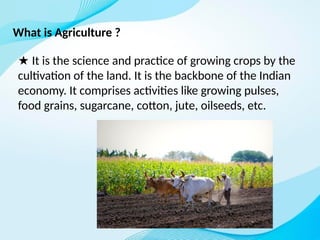
★ It is the science and practice of growing crops by the
cultivation of the land. It is the backbone of the Indian
economy. It comprises activities like growing pulses,
food grains, sugarcane, cotton, jute, oilseeds, etc.
Types Of Agriculture .
1 - Subsistence Farming : -
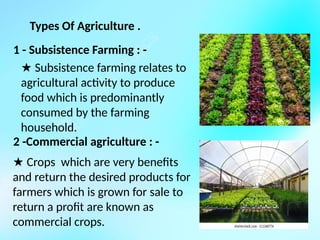
★ Subsistence farming relates to
agricultural activity to produce
food which is predominantly
consumed by the farming
household.
2 -Commercial agriculture : -
★ Crops which are very benefits
and return the desired products for
farmers which is grown for sale to
return a profit are known as
commercial crops.
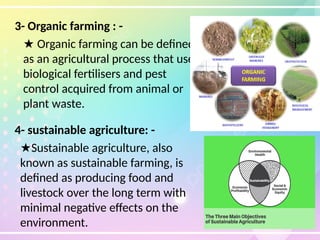
3- Organic farming : -
★ Organic farming can be defined
as an agricultural process that uses
biological fertilisers and pest
control acquired from animal or
plant waste.
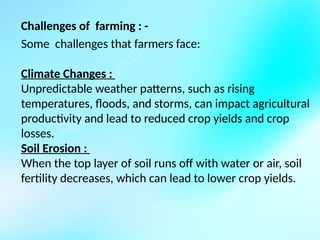
4- sustainable agriculture: -
★Sustainable agriculture, also
known as sustainable farming, is
defined as producing food and
livestock over the long term with
minimal negative effects on the
environment.
Importance of agriculture : -
Agriculture is important for many reasons,
including:
Food : Agriculture is the primary source of food
for the world's population.
Economic Developement : Agriculture is a major
contributor to a country's GDP and economy. It is
also a source of income for many people.
Employment: Agriculture provides direct
employment for farmers.
Environment : Agriculture helps maintain healthy
soil, clean air, and clean water.
Challenges of farming : -
Some challenges that farmers face:
Climate Changes :
Unpredictable weather patterns, such as rising
temperatures, floods, and storms, can impact agricultural
productivity and lead to reduced crop yields and crop
losses.
Soil Erosion :
When the top layer of soil runs off with water or air, soil
fertility decreases, which can lead to lower crop yields.
Water Scarcity :
In rainfed agriculture, water scarcity can be a major
challenge, especially in the summer, and can lead to
economic losses.
Pests and Disease :
Pests and diseases can spread quickly through crops,
causing significant damage and reducing yields.
Agricultural Products :
1 . Crops ( Grain , Fruits , Vegetable )
2 . Livestoke ( Meat , Dairy , polutry )
3 . Fiber ( Cotton , Wool )
4 . Biofuels
Conclusion :
→ Agriculture has given so much to society. But it
has its own pros and cons that we can't overlook.
Furthermore, the government is doing his every
bit to help in the growth and development of
agriculture; still, it needs to do something for the
negative impacts of agriculture.
Agriculture methods and agriculture process

Agriculture methods and agriculture process

  • 1.
    Attabira College ,Attabira Seminar Report on Agriculture Guided By : - Submitted By : - Mr. Paramananda Rath Mr. Dilip Kumar Bohidar Miss. Sipra Mishra Name : Dayasagar Padhan Class : +3 5th Semester Roll No : S00522BOT017
  • 2.
    CONTENT : » Introduction »Types » Importance » Challanges » Products » Conclusion
  • 3.
    What is Agriculture? ★ It is the science and practice of growing crops by the cultivation of the land. It is the backbone of the Indian economy. It comprises activities like growing pulses, food grains, sugarcane, cotton, jute, oilseeds, etc.
  • 4.
    Types Of Agriculture. 1 - Subsistence Farming : - ★ Subsistence farming relates to agricultural activity to produce food which is predominantly consumed by the farming household. 2 -Commercial agriculture : - ★ Crops which are very benefits and return the desired products for farmers which is grown for sale to return a profit are known as commercial crops.
  • 5.
    3- Organic farming: - ★ Organic farming can be defined as an agricultural process that uses biological fertilisers and pest control acquired from animal or plant waste. 4- sustainable agriculture: - ★Sustainable agriculture, also known as sustainable farming, is defined as producing food and livestock over the long term with minimal negative effects on the environment.
  • 6.
    Importance of agriculture: - Agriculture is important for many reasons, including: Food : Agriculture is the primary source of food for the world's population. Economic Developement : Agriculture is a major contributor to a country's GDP and economy. It is also a source of income for many people. Employment: Agriculture provides direct employment for farmers. Environment : Agriculture helps maintain healthy soil, clean air, and clean water.
  • 7.
    Challenges of farming: - Some challenges that farmers face: Climate Changes : Unpredictable weather patterns, such as rising temperatures, floods, and storms, can impact agricultural productivity and lead to reduced crop yields and crop losses. Soil Erosion : When the top layer of soil runs off with water or air, soil fertility decreases, which can lead to lower crop yields.
  • 8.
    Water Scarcity : Inrainfed agriculture, water scarcity can be a major challenge, especially in the summer, and can lead to economic losses. Pests and Disease : Pests and diseases can spread quickly through crops, causing significant damage and reducing yields.
  • 9.
    Agricultural Products : 1. Crops ( Grain , Fruits , Vegetable ) 2 . Livestoke ( Meat , Dairy , polutry ) 3 . Fiber ( Cotton , Wool ) 4 . Biofuels
  • 10.
    Conclusion : → Agriculturehas given so much to society. But it has its own pros and cons that we can't overlook. Furthermore, the government is doing his every bit to help in the growth and development of agriculture; still, it needs to do something for the negative impacts of agriculture.