AGILE SUPPLY CHAIN
Supply chain
management
Problems with the organization of
supply chains
• Lack of coordination between marketing and logistics:
• Getting rid of the stockpile: Prices are marked down, leads
to eroded brand equity and reduced customer loyalty.
• Too weak organization of international logistics, e.g. lack of
buffer stock before launching an innovative new product.
• Lack of integrated efforts and adaptation when products are
promoted by price offers or marketing campaigns
What is agility?
•Supply chain agility refers to a company's ability to
quickly adjust its strategy, particularly in
procurement, inventory management and
delivery to meet rapidly changing supply chain
requirements.
What is agility?
 Agility embraces organizational structure, information
systems, logistics process and MIND set..
 Agility must not be confused with lean where the focus is
reduction and elimination of waste
 Agility is defined as The ability of an organization to
respond rapidly to changes in demand, both in terms of
volume and variety
Fostering Agility
 Getting employees to acquire and enhance their
skills, and sharpen their ability to adapt
 prepares them not just for the environment they're in,
but also for times of adversity.
 Indeed, having an agile culture means that your
workforce has the unique ability to quickly adapt to new
technologies or business models
Unpredictable events might disturb the supply chains
•Unpredictable events change demand conditions
(Pandemics, terrorist attack, national strikes,
earthquakes, tsunami).
•Covid 19
•Tsunami in Japan 2011
•Pirates outside coast of Africa
Agility dimensions
 Supplier development and strong coordination and
collaboration in buyer-supplier relationships
 Establishment of E-hubs in the supply chain (Cisco)
in order to make all demand and supply data available
 Preparation for back-up and plan B
 AGILE supply chains RECOVER more quickly from
sudden setbacks
Companies can build agility into their
supply chains
•Share information!
•Develop collaborative relationships with supplier and
customer
• work together to design, components and products – and prepare common backup
plans
•Keep a small inventory of inexpensive, non-bulky
components that re often the cause of bottlenecks
•Build dependable logistics system enabling to regroup
quickly in response to un-expected needs.
Adaptation of The Supply Chain As
An Offensive Strategy
•Focus on changes in the market conditions:
•what are the political, social and technological trends that will affect the
market and demand pattern?
•Microsoft entered the video market in with Xbox
• The hardware production was sourced out to Flextronics in Singapore
• The Christmas market was urgent for a possible success
• Mexico and Hungary were selected as supplementary production sites in
order to increase the speed to the new markets
• Finally, China was selected for production in order to reduce unit costs
Building Adaptation In Supply
Chains
• It is the ability to adjust a supply chain's design to meet
structural shifts in the markets and modify supply network,
strategies, technologies, and products (Lee, 2004)
• The ability to spot trends:
• track economic changes, especially in developing countries
• Interpret the needs of your ultimate consumers not just your
immediate consumers
• Develop new suppliers that complement existing ones
Creating the right alignment
 Supply Chain Alignment enables the synchronization of
flows (physical flows and information flows) across the
components
 For any major supply chain transformation program to be
successful, Supply Chain Alignment must be a fundamental
cornerstone of the overall transformation.
 Supply Chain Alignment is needed both ‘intra-enterprise’
and ‘extra-enterprise’, i.e. both within the company and
across its supply chain eco system.
Agility
• Objectives:
• Respond to short-term changes in demand or supply quickly;
handle external disruptions smoothly.
• Methods:
• Promote flow of information with suppliers and customers
• Develop collaborative relationship with suppliers
• Build inventory buffers by maintaining and stockpile of
inexpensive but key components
• Draw up contingency plans and develop crisis management
Adaptability
•Objectives:
• Adjust supply chain’s design to meet structural shifts in markets;
modify supply network to strategies, product and technologies.
•Methods:
• Monitor economies all over the world to spot new supply bases and
markets
• Use intermediaries to develop fresh suppliers and logistics
infrastructure
• Evaluate needs of ultimate consumers. not just immediate
customers
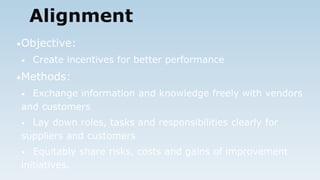
Alignment
•Objective:
• Create incentives for better performance
•Methods:
• Exchange information and knowledge freely with vendors
and customers
• Lay down roles, tasks and responsibilities clearly for
suppliers and customers
• Equitably share risks, costs and gains of improvement
initiatives.

agile supply chain.pptx

  • 1.
    AGILE SUPPLY CHAIN Supplychain management
  • 2.
    Problems with theorganization of supply chains • Lack of coordination between marketing and logistics: • Getting rid of the stockpile: Prices are marked down, leads to eroded brand equity and reduced customer loyalty. • Too weak organization of international logistics, e.g. lack of buffer stock before launching an innovative new product. • Lack of integrated efforts and adaptation when products are promoted by price offers or marketing campaigns
  • 3.
    What is agility? •Supplychain agility refers to a company's ability to quickly adjust its strategy, particularly in procurement, inventory management and delivery to meet rapidly changing supply chain requirements.
  • 4.
    What is agility? Agility embraces organizational structure, information systems, logistics process and MIND set..  Agility must not be confused with lean where the focus is reduction and elimination of waste  Agility is defined as The ability of an organization to respond rapidly to changes in demand, both in terms of volume and variety
  • 5.
    Fostering Agility  Gettingemployees to acquire and enhance their skills, and sharpen their ability to adapt  prepares them not just for the environment they're in, but also for times of adversity.  Indeed, having an agile culture means that your workforce has the unique ability to quickly adapt to new technologies or business models
  • 6.
    Unpredictable events mightdisturb the supply chains •Unpredictable events change demand conditions (Pandemics, terrorist attack, national strikes, earthquakes, tsunami). •Covid 19 •Tsunami in Japan 2011 •Pirates outside coast of Africa
  • 7.
    Agility dimensions  Supplierdevelopment and strong coordination and collaboration in buyer-supplier relationships  Establishment of E-hubs in the supply chain (Cisco) in order to make all demand and supply data available  Preparation for back-up and plan B  AGILE supply chains RECOVER more quickly from sudden setbacks
  • 8.
    Companies can buildagility into their supply chains •Share information! •Develop collaborative relationships with supplier and customer • work together to design, components and products – and prepare common backup plans •Keep a small inventory of inexpensive, non-bulky components that re often the cause of bottlenecks •Build dependable logistics system enabling to regroup quickly in response to un-expected needs.
  • 9.
    Adaptation of TheSupply Chain As An Offensive Strategy •Focus on changes in the market conditions: •what are the political, social and technological trends that will affect the market and demand pattern? •Microsoft entered the video market in with Xbox • The hardware production was sourced out to Flextronics in Singapore • The Christmas market was urgent for a possible success • Mexico and Hungary were selected as supplementary production sites in order to increase the speed to the new markets • Finally, China was selected for production in order to reduce unit costs
  • 10.
    Building Adaptation InSupply Chains • It is the ability to adjust a supply chain's design to meet structural shifts in the markets and modify supply network, strategies, technologies, and products (Lee, 2004) • The ability to spot trends: • track economic changes, especially in developing countries • Interpret the needs of your ultimate consumers not just your immediate consumers • Develop new suppliers that complement existing ones
  • 11.
    Creating the rightalignment  Supply Chain Alignment enables the synchronization of flows (physical flows and information flows) across the components  For any major supply chain transformation program to be successful, Supply Chain Alignment must be a fundamental cornerstone of the overall transformation.  Supply Chain Alignment is needed both ‘intra-enterprise’ and ‘extra-enterprise’, i.e. both within the company and across its supply chain eco system.
  • 12.
    Agility • Objectives: • Respondto short-term changes in demand or supply quickly; handle external disruptions smoothly. • Methods: • Promote flow of information with suppliers and customers • Develop collaborative relationship with suppliers • Build inventory buffers by maintaining and stockpile of inexpensive but key components • Draw up contingency plans and develop crisis management
  • 13.
    Adaptability •Objectives: • Adjust supplychain’s design to meet structural shifts in markets; modify supply network to strategies, product and technologies. •Methods: • Monitor economies all over the world to spot new supply bases and markets • Use intermediaries to develop fresh suppliers and logistics infrastructure • Evaluate needs of ultimate consumers. not just immediate customers
  • 14.
    Alignment •Objective: • Create incentivesfor better performance •Methods: • Exchange information and knowledge freely with vendors and customers • Lay down roles, tasks and responsibilities clearly for suppliers and customers • Equitably share risks, costs and gains of improvement initiatives.