Agile framework anti-
pattern risks and how to
avoid them
Niall McShane
Agile Practice Lead
3 risks of scaling Agile
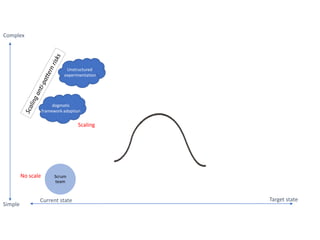
Scrum
team
No scale
Scaling
Complex
Simple
Current state Target state
Unstructured
experimentation
dogmatic
framework adoption
Scrum
team
No scale
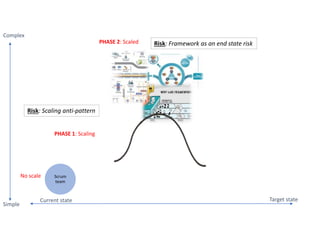
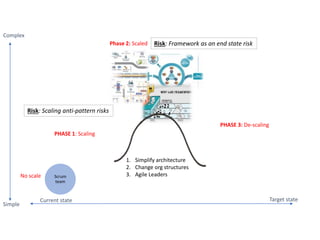
PHASE 2: Scaled
PHASE 1: Scaling
Risk: Scaling anti-pattern
Risk: Framework as an end state risk
Complex
Simple
Current state Target state
Scrum
team
No scale
Phase 2: Scaled
PHASE 3: De-scaling
Risk: Scaling anti-pattern risks
Risk: Framework as an end state risk
Complex
Simple
Current state Target state
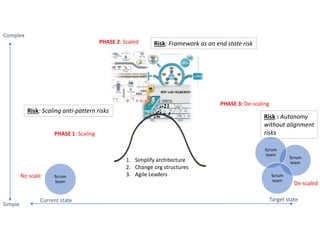
1. Simplify architecture
2. Change org structures
3. Agile Leaders
PHASE 1: Scaling
Scrum
team
No scale
Scrum
team
Scrum
team
Scrum
team
De-scaled
Risk: Scaling anti-pattern risks
Risk: Framework as an end state risk
Risk : Autonomy
without alignment
risks
Complex
Simple
Current state Target state
1. Simplify architecture
2. Change org structures
3. Agile Leaders
PHASE 2: Scaled
PHASE 1: Scaling
PHASE 3: De-scaling
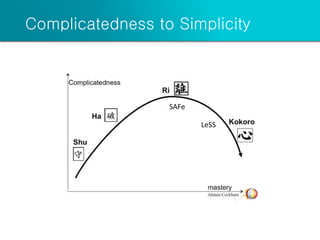
Complicatedness to Simplicity
SAFe
LeSS
Framework anti-patterns
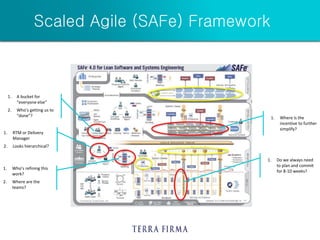
Scaled Agile (SAFe) Framework
1. A bucket for
“everyone else”
2. Who’s getting us to
“done”?
1. RTM or Delivery
Manager
2. Looks hierarchical?
1. Who’s refining this
work?
2. Where are the
teams?
1. Where is the
incentive to further
simplify?
1. Do we always need
to plan and commit
for 8-10 weeks?
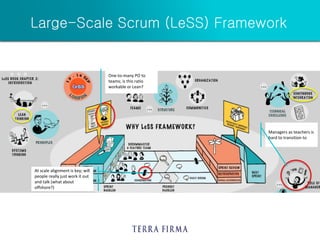
Large-Scale Scrum (LeSS) Framework
Managers as teachers is
hard to transition to
One-to-many PO to
teams; is this ratio
workable or Lean?
At scale alignment is key; will
people really just work it out
and talk (what about
offshore?)
How to scale using the best of SAFe
and LeSS
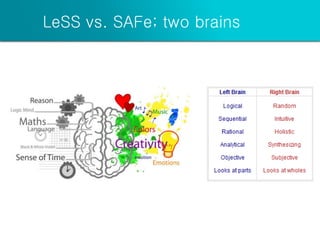
LeSS vs. SAFe; two brains
LeSS vs. SAFe; two personas
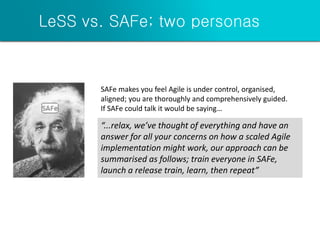
“...relax, we’ve thought of everything and have an
answer for all your concerns on how a scaled Agile
implementation might work, our approach can be
summarised as follows; train everyone in SAFe,
launch a release train, learn, then repeat”
SAFe makes you feel Agile is under control, organised,
aligned; you are thoroughly and comprehensively guided.
If SAFe could talk it would be saying…
LeSS vs. SAFe; two personas
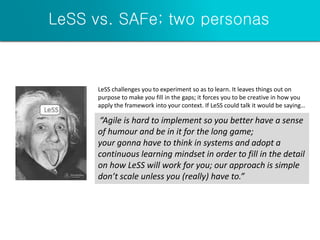
“Agile is hard to implement so you better have a sense
of humour and be in it for the long game;
your gonna have to think in systems and adopt a
continuous learning mindset in order to fill in the detail
on how LeSS will work for you; our approach is simple
don’t scale unless you (really) have to.”
LeSS challenges you to experiment so as to learn. It leaves things out on
purpose to make you fill in the gaps; it forces you to be creative in how you
apply the framework into your context. If LeSS could talk it would be saying…
LeSS (pure) - SAFe (pragmatic)
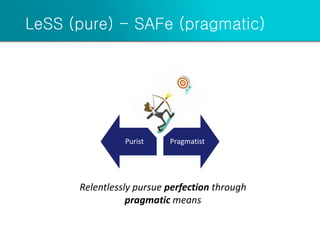
Purist Pragmatist
Relentlessly pursue perfection through
pragmatic means
Niall’s Pitch...
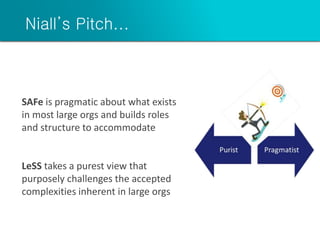
SAFe is pragmatic about what exists
in most large orgs and builds roles
and structure to accommodate
LeSS takes a purest view that
purposely challenges the accepted
complexities inherent in large orgs
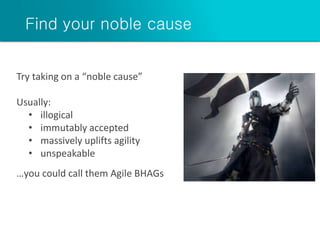
Find your noble cause
Try taking on a “noble cause”
Usually:
• illogical
• immutably accepted
• massively uplifts agility
• unspeakable
…you could call them Agile BHAGs
Noble Cause..?
cause
noun
1. a principle, aim, or movement to which one is
committed and which one is prepared to defend or
advocate.
"she devoted her whole adult life to the cause of deaf people"
synonyms: principle, ideal, belief (in), conviction
noble
adjective
1. having or showing fine personal qualities or high
moral principles
"the promotion of human rights was a noble
aspiration"
synonyms: righteous, virtuous, good, honourable,
honest, upstanding, decent, worthy, uncorrupted,
moral, ethical, reputable, unselfish, generous, self-
sacrificing, brave
LeSS Noble Causes to take up
• No scaling (or de-scale)
• No Undone work at the end of a sprint
• No Jira (or Rally etc.)
• No projects (or Project Managers)
• No dependencies (No red string)
• No managers (except the Product Manager)
• No test specialists
• No portfolio management
• No program kanban to "discover" work
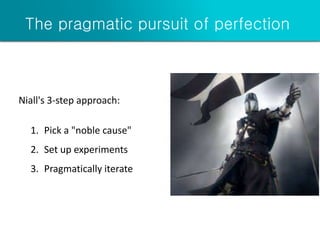
The pragmatic pursuit of perfection
Niall's 3-step approach:
1. Pick a "noble cause"
2. Set up experiments
3. Pragmatically iterate
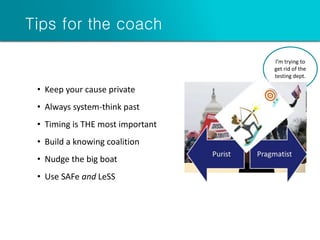
Tips for the coach
• Keep your cause private
• Always system-think past
• Timing is THE most important
• Build a knowing coalition
• Nudge the big boat
• Use SAFe and LeSS
I’m trying to
get rid of the
testing dept.

Agile Framework anti pattern risks and how to avoid them

  • 1.
    Agile framework anti- patternrisks and how to avoid them Niall McShane Agile Practice Lead
  • 2.
    3 risks ofscaling Agile
  • 3.
    Scrum team No scale Scaling Complex Simple Current stateTarget state Unstructured experimentation dogmatic framework adoption
  • 4.
    Scrum team No scale PHASE 2:Scaled PHASE 1: Scaling Risk: Scaling anti-pattern Risk: Framework as an end state risk Complex Simple Current state Target state
  • 5.
    Scrum team No scale Phase 2:Scaled PHASE 3: De-scaling Risk: Scaling anti-pattern risks Risk: Framework as an end state risk Complex Simple Current state Target state 1. Simplify architecture 2. Change org structures 3. Agile Leaders PHASE 1: Scaling
  • 6.
    Scrum team No scale Scrum team Scrum team Scrum team De-scaled Risk: Scalinganti-pattern risks Risk: Framework as an end state risk Risk : Autonomy without alignment risks Complex Simple Current state Target state 1. Simplify architecture 2. Change org structures 3. Agile Leaders PHASE 2: Scaled PHASE 1: Scaling PHASE 3: De-scaling
  • 7.
  • 8.
  • 9.
    Scaled Agile (SAFe)Framework 1. A bucket for “everyone else” 2. Who’s getting us to “done”? 1. RTM or Delivery Manager 2. Looks hierarchical? 1. Who’s refining this work? 2. Where are the teams? 1. Where is the incentive to further simplify? 1. Do we always need to plan and commit for 8-10 weeks?
  • 10.
    Large-Scale Scrum (LeSS)Framework Managers as teachers is hard to transition to One-to-many PO to teams; is this ratio workable or Lean? At scale alignment is key; will people really just work it out and talk (what about offshore?)
  • 11.
    How to scaleusing the best of SAFe and LeSS
  • 12.
    LeSS vs. SAFe;two brains
  • 13.
    LeSS vs. SAFe;two personas “...relax, we’ve thought of everything and have an answer for all your concerns on how a scaled Agile implementation might work, our approach can be summarised as follows; train everyone in SAFe, launch a release train, learn, then repeat” SAFe makes you feel Agile is under control, organised, aligned; you are thoroughly and comprehensively guided. If SAFe could talk it would be saying…
  • 14.
    LeSS vs. SAFe;two personas “Agile is hard to implement so you better have a sense of humour and be in it for the long game; your gonna have to think in systems and adopt a continuous learning mindset in order to fill in the detail on how LeSS will work for you; our approach is simple don’t scale unless you (really) have to.” LeSS challenges you to experiment so as to learn. It leaves things out on purpose to make you fill in the gaps; it forces you to be creative in how you apply the framework into your context. If LeSS could talk it would be saying…
  • 15.
    LeSS (pure) -SAFe (pragmatic) Purist Pragmatist Relentlessly pursue perfection through pragmatic means
  • 16.
    Niall’s Pitch... SAFe ispragmatic about what exists in most large orgs and builds roles and structure to accommodate LeSS takes a purest view that purposely challenges the accepted complexities inherent in large orgs
  • 17.
    Find your noblecause Try taking on a “noble cause” Usually: • illogical • immutably accepted • massively uplifts agility • unspeakable …you could call them Agile BHAGs
  • 18.
    Noble Cause..? cause noun 1. aprinciple, aim, or movement to which one is committed and which one is prepared to defend or advocate. "she devoted her whole adult life to the cause of deaf people" synonyms: principle, ideal, belief (in), conviction noble adjective 1. having or showing fine personal qualities or high moral principles "the promotion of human rights was a noble aspiration" synonyms: righteous, virtuous, good, honourable, honest, upstanding, decent, worthy, uncorrupted, moral, ethical, reputable, unselfish, generous, self- sacrificing, brave
  • 19.
    LeSS Noble Causesto take up • No scaling (or de-scale) • No Undone work at the end of a sprint • No Jira (or Rally etc.) • No projects (or Project Managers) • No dependencies (No red string) • No managers (except the Product Manager) • No test specialists • No portfolio management • No program kanban to "discover" work
  • 20.
    The pragmatic pursuitof perfection Niall's 3-step approach: 1. Pick a "noble cause" 2. Set up experiments 3. Pragmatically iterate
  • 21.
    Tips for thecoach • Keep your cause private • Always system-think past • Timing is THE most important • Build a knowing coalition • Nudge the big boat • Use SAFe and LeSS I’m trying to get rid of the testing dept.

Editor's Notes

  • #4 Phase 1. the decision to scale your agile At some point someone says it is a good idea to build a scaled agile model. If this is taking place in an organisation with a number of legacy applications (monoliths) then people start to create new and unique ways to adapt scrum-like frameworks for at-scale implementation. This usually results in an agile at scale framework (SAFe, LeSS, Nexus) being chosen as a target state for the org’s agile way of working. During phase the risks of scaling agile become apparent; namely people start experimenting without any coordination (chaos) or dogmatically adopt a framework without consideration of the context of the org.
  • #5 Phase 2: Scaled As the scale in number of agile teams grows problems with coordination, alignment, business engagement/involvement, releasing and operating working software all become exposed and have to be resolved. Problems at scale move from being complicated to complex and often the scaling framework has to help guide the org on how to implement for such complexity BUT… a good framework does more than that. A good framework “perturbs” the current state and challenge the org to keep simplifying its structures and architecture and ways of working toward a simplified target state. To get to this target state a de-scaling phase has to be undertaken. (see PHASE 3.)
  • #6 Phase 3: de-scaling To de-scale the org needs to simply its architecture, organisational structures and introduce new agile ways of working. De-scaling involves stopping doing scaled agile ceremonies and replacing them with the basics as teams become more autonomous; no longer needing elaborate alignment and coordination practice associated with scaled agile frameworks. De-coupling dependencies, further simplifying practices and having removed most boundaries between business and IT folk.
  • #7 De-scale organisations have fully autonomous teams each with there own way of working (post-framework); they are high-performing software teams continuously delivering business value in a steady and predictable manner. They can “turn on a dime for a dime” I recently visited an organisation in Melbourne that had successfully de-scaled itself. They wanted solutions to different problems; they had lost alignment and had little transparency across their 50 teams. Everyone seemed happy but had no common vision. Running cross-team projects was near impossible. So the risk of misaligned autonomy needs to be mitigated through maintaining guilds and communities of practice as well as minimal transparency reporting.
  • #16 Aspiring for the (probably) unachievable is at the heart of scaled agile.   LeSS starts with Scrum and encourages coaches NOT to add "extras" unless you (really) need to.  To tap into the power at the heart of scaled agile, practitioners must take on “noble causes”; be part purist and part pragmatist.   Such causes when looked at logically appear to be impractical (even silly), but if achieved would result in a step-change in agility for an organisation.   LeSS calls these unachievable visions; you could call them BHAGs 
  • #17 Aspiring for the (probably) unachievable is at the heart of scaled agile.   LeSS starts with Scrum and encourages coaches NOT to add "extras" unless you (really) need to.  To tap into the power at the heart of scaled agile, practitioners must take on “noble causes”; be part purist and part pragmatist.   Such causes when looked at logically appear to be impractical (even silly), but if achieved would result in a step-change in agility for an organisation.   LeSS calls these unachievable visions; you could call them BHAGs 
  • #18 Aspiring for the (probably) unachievable is at the heart of scaled agile.   LeSS starts with Scrum and encourages coaches NOT to add "extras" unless you (really) need to.  To tap into the power at the heart of scaled agile, practitioners must take on “noble causes”; be part purist and part pragmatist.   Such causes when looked at logically appear to be impractical (even silly), but if achieved would result in a step-change in agility for an organisation.   LeSS calls these unachievable visions; you could call them BHAGs 
  • #19 Aspiring for the (probably) unachievable is at the heart of scaled agile.   LeSS starts with Scrum and encourages coaches NOT to add "extras" unless you (really) need to.  To tap into the power at the heart of scaled agile, practitioners must take on “noble causes”; be part purist and part pragmatist.   Such causes when looked at logically appear to be impractical (even silly), but if achieved would result in a step-change in agility for an organisation.   LeSS calls these unachievable visions; you could call them BHAGs 
  • #21 Aspiring for the (probably) unachievable is at the heart of scaled agile.   LeSS starts with Scrum and encourages coaches NOT to add "extras" unless you (really) need to.  To tap into the power at the heart of scaled agile, practitioners must take on “noble causes”; be part purist and part pragmatist.   Such causes when looked at logically appear to be impractical (even silly), but if achieved would result in a step-change in agility for an organisation.   LeSS calls these unachievable visions; you could call them BHAGs