Agents of ChangeComputer simulations and empirical dataAndrzej NowakFlorida Atlantic UniversityWarsaw University
Bubble model of social changeBubbles of NEW apprear in the sea of OLD and growSocial influence underlies individual choices in social transitions
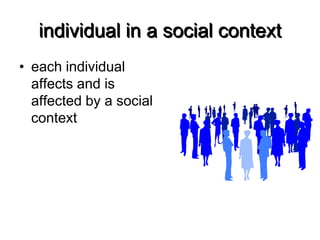
individual in a social contexteach individual affects and is affected by a social context
How can we conceptualize social influenceA number of people gathered in an auditoriumto vote on an issueThey can discuss their opinions with others before they voteHow will the discussion change the outcome of the vote?
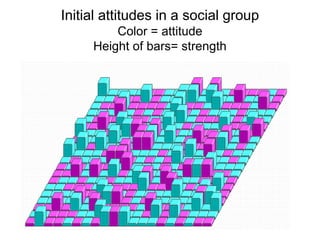
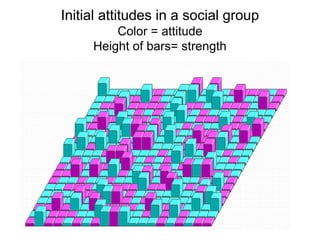
How social interactions change attitudes in a groupImagine that 400 individuals are to vote whether to privatize their companyThe individuals are sitting in a conference room. There are 20 rows of 20 seats in each row.Each individual comes with an attitude concerning privatizationIndividuals differ in strength: some are more persuasive than others
Initial attitudes in a social groupColor = attitudeHeight of bars= strength
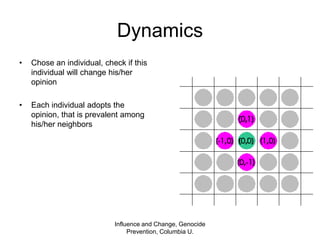
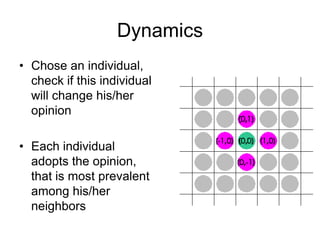
Influence and Change, Genocide Prevention, Columbia U.Dynamics Chose an individual, check if this individual will change his/her opinionEach individual adopts the opinion, that is prevalent among his/her neighbors
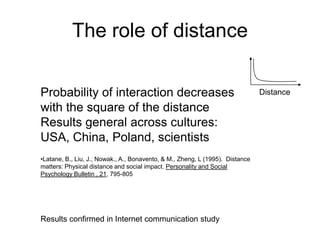
The role of distanceLatane, Bonavento, Nowak, LiuNProbability of interaction decreaseswith the square of the distanceResults general across cultures:USA, China, Poland, scientistsLatane, B., Liu, J., Nowak., A., Bonavento, & M., Zheng, L (1995).  Distance matters: Physical distance and social impact. Personality and Social Psychology Bulletin , 21, 795-805Results confirmed in Internet communication studyDistance
The role of leadersLeadershighly crediblestrongly connected
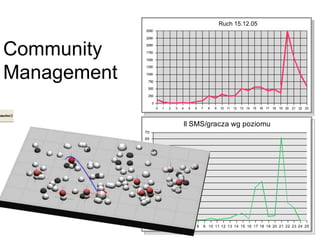
CommunityManagement
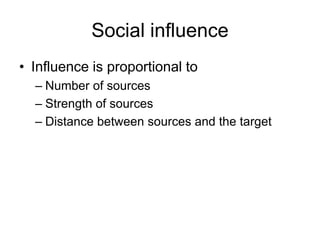
Social influenceInfluence is proportional to Number of sourcesStrength of sourcesDistance between sources and the target
Dynamics Chose an individual, check if this individual will change his/her opinionEach individual adopts the opinion, that is most prevalent among his/her neighbors
Initial attitudes in a social groupColor = attitudeHeight of bars= strength
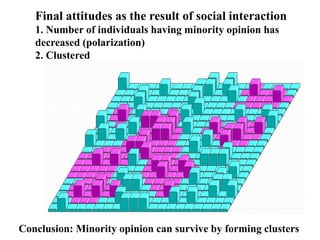
Final attitudes as the result of social interaction1. Number of individuals having minority opinion has decreased (polarization)2. ClusteredConclusion: Minority opinion can survive by forming clusters
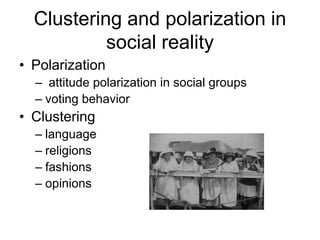
Clustering and polarization in social reality Polarization  attitude polarization in social groupsvoting behaviorClusteringlanguagereligions fashionsopinions
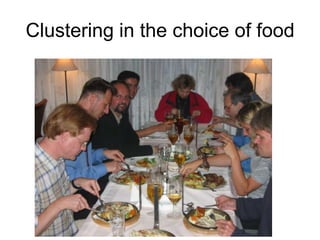
Clustering in the choice of food
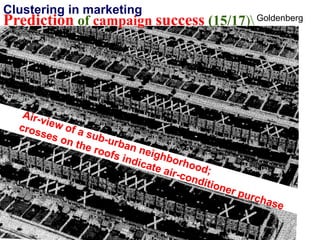
Clustering in marketing Prediction of campaign success (15/17)\GoldenbergAir-view of a sub-urban neighborhood; crosses on the roofs indicate air-conditioner purchase
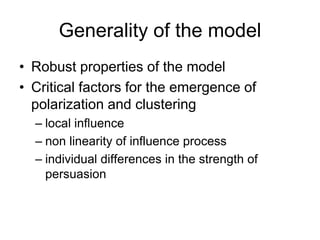
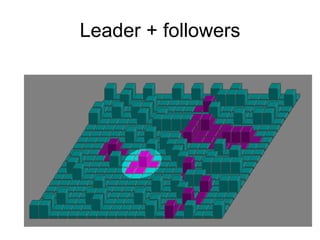
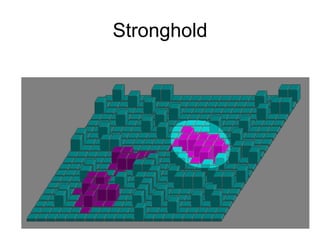
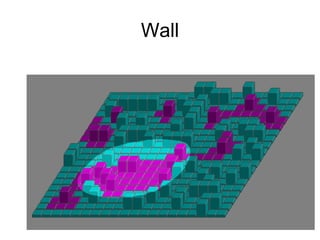
Generality of the modelRobust properties of the modelCritical factors for the emergence of polarization and clusteringlocal influencenon linearity of influence processindividual differences in the strength of persuasion
Leader + followers
Stronghold
Wall
Influence and Change, Genocide Prevention, Columbia U.Structure of contactsThe effects of social influence depend on the structure of contacts betwen individuals Opinion clusters follow communication patterns
Social influenceLeads to clusteringDevelopment of local pockets of coherent reality belief systems local culturecritical role of leaders
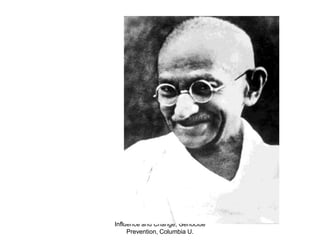
Influence and Change, Genocide Prevention, Columbia U.Minority influence insocial change
Influence and Change, Genocide Prevention, Columbia U.
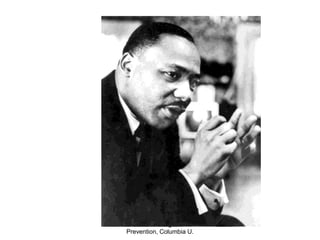
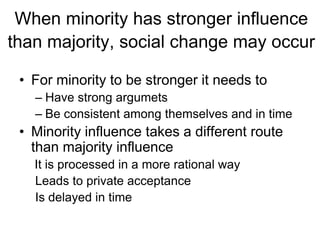
When minority has stronger influence than majority, social change may occurFor minority to be stronger it needs to Have strong argumets Be consistent among themselves and in timeMinority influence takes a different route than majority influence	 It is processed in a more rational wayLeads to private acceptanceIs delayed in time
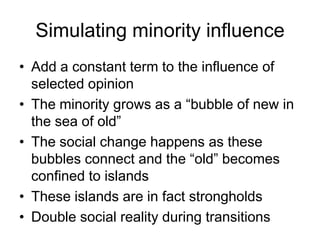
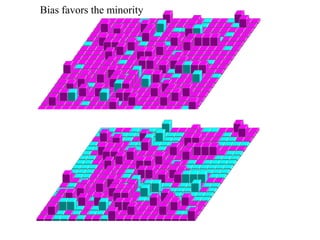
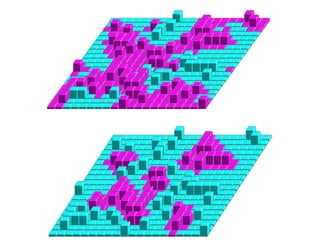
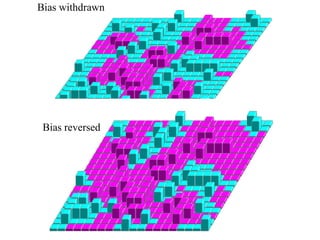
Simulating minority influenceAdd a constant term to the influence of selected opinionThe minority grows as a “bubble of new in the sea of old”The social change happens as these bubbles connect and the “old” becomes confined to islandsThese islands are in fact strongholdsDouble social reality during transitions
Bias favors the minority
Bias withdrawnBias reversed
ConclusionSocial transitions occus as „bubbles of new” in the „sea of old”They resemble a process of nucleation in physicsDuring the transition two distinct, separated in space, internally coherent realities exist. The transiton occurs as the island of new reality expand at the expence of the old reality
Influence and Change, Genocide Prevention, Columbia U.Practical advises for facilitating changeConcentrate on leaders and introduction of a  local changeIdentify leaders who are likely to adopt the new positionForm a social network connecting the leadersGive a lot of outside support in the beginning, gradually withdraw the support as the group growthForm a social network around the leadersForm a social network connecting the groupNatural experiment (1600 participants) shows the effectiveness of the method
Testing the theory
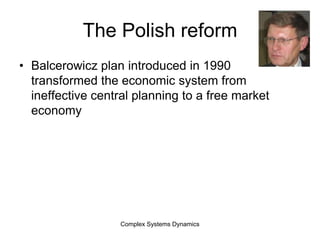
Complex Systems DynamicsThe Polish reformBalcerowicz plan introduced in 1990 transformed the economic system from ineffective central planning to a free market economy
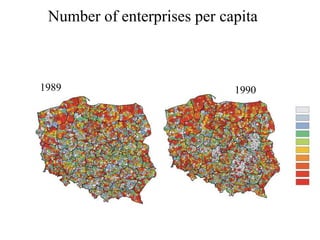
Number of enterprises per capita19891990
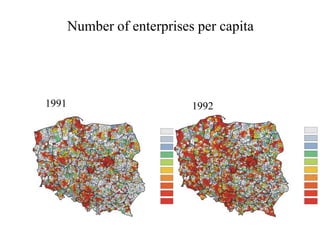
Number of enterprises per capita19911992
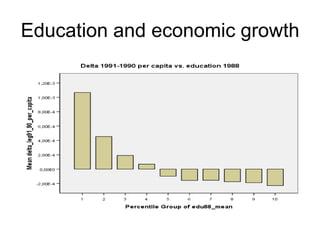
Education and economic growth
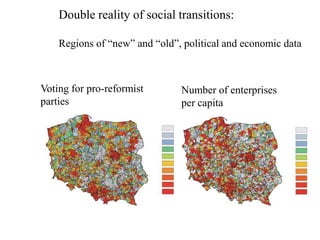
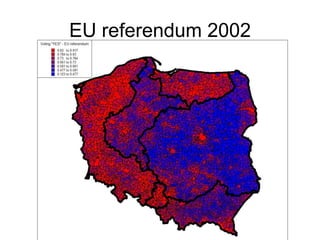
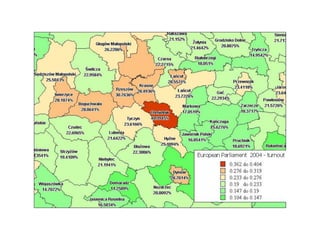
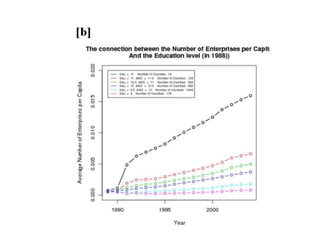
Double reality of social transitions:Regions of “new” and “old”, political and economic dataVoting for pro-reformistpartiesNumber of enterprises per capita
EU referendum 2002
Dynamics of the economic transitionThe critical importance of local processes – A global model cannot explan the dynamicsThe importance of the social factors in economic processes: education, culture, history, politicsThisapproach allows us to connect complex macroscopic collective trends to their simple local causes.Nowak A. Vallacher R.R., Kus, M., Urbaniak, J., (2005) The Dynamics of Societal Transition: Modeling Non-Linear Change in the Polish Economic System, International Journal of Sociology.Nowak, A,  Kus, M. Urbaniak J, Zarycki T. (2002)  Simulating the coordination of individual economic decisions. Physica A, 297, 613-630Yarri., G., Nowak A., Rakocy, K., Solomon S., (2008)  Microscopic Study Reveals the Singular Origins of Growth European Physics Journal B,  62, 4
Influence and Change, Genocide Prevention, Columbia U.As for prevention, they have developed an early-warning mechanism, which alerts the communities to trouble signs, and ways to immediately defuse the situation that is provoking the tension. For instance, the most recent cartoon riots did not spread to many parts of the north because Ashafa and Wuye immediately asked the head of the Christian Association of Nigeria in the states they work in, to go on the radio to condemn the explosive matter of the cartoons and asked the chief imams to accept the condemnation and appeal for calm.To sustain their initiatives in the states where they practice, Wuye and Ashafa set up committees and advisory councils comprising religious leaders and community heads to monitor peace-building efforts and provide feedback. Their initiatives have also been sustained through support from international donor, government, and religious organizations.
How to  build social capital?Sequence of actions where the next action builds on the previous oneEach action increases the level of trust among the local society, willingness for cooperation and the belief in success
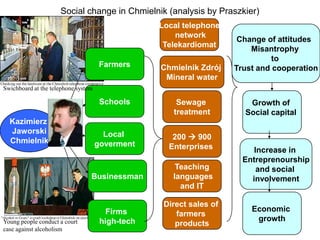
Social change in Chmielnik (analysis by Praszkier)Local telephone networkTelekardiomatChange of attitudesMisantrophytoTrust and cooperationFarmersChmielnik ZdrójMineral waterSwichboard at the telephone systemSchoolsSewage treatmentGrowth of Social capital Kazimierz JaworskiChmielnikLocal goverment200  900Enterprises Increase in Entreprenourshipand social involvementBusinessmanTeaching languages and IT Economic growthDirect sales of farmers productsFirmshigh-techYoung people conduct a court case against alcoholism
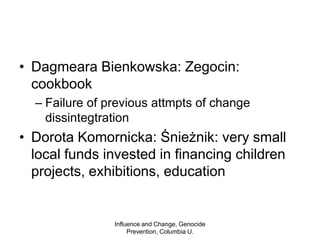
Influence and Change, Genocide Prevention, Columbia U.Dagmeara Bienkowska: Zegocin: cookbookFailure of previous attmpts of change dissintegtrationDorota Komornicka: Śnieżnik: very small local funds invested in financing children projects, exhibitions, education
Influence and Change, Genocide Prevention, Columbia U.Pastor James Wuye & Imam Mohammed Ashafa, Nigeria Deeply ingrained, intractable religious conflict, full of hate and eagerness to shed blood. Multiple lurking and conspicuous conflicts, including burning mosques, churches, killing, exiling, etc. Result: multiple conflicts over power and control, decreasing the region’s ability to develop.
Influence and Change, Genocide Prevention, Columbia U.Dimenensions of conflictConflict around the religious issues: unstructured, existing, and directConflict around building peace through education: unstructured, potential, and approached in a direct way (organizing Christian/Muslim camps, influencing the schools’ curriculum)
Influence and Change, Genocide Prevention, Columbia U.SolutionPastor James Wuye, a Christian priest, and Imam Mohammed Ashafa, a Muslim cleric, are bringing peace and peace-building education to Nigeria. In the past, they were members of militant youth groups, chasing, hating, and harming each other (e.g., James Wuye lost his arm in a clash with Mohammed Ashafa’s group). At some point, in a moment of mutual enlightenment, they understood that operating together they could bring peace and understanding between their respective religions.They are now using the power of their faith and the example of interfaith cooperation to prevent and intervene in religious and politically motivated conflicts in Nigeria, and especially to educate youth in building avenues to peaceful cooperation. Through TV programs and a portfolio of educational projects, they are changing the model of reacting to any stimulus with violence into a model of dialogue and understanding.
Influence and Change, Genocide Prevention, Columbia U.ResultsTheir other early-warning techniques include “deprogramming” of violent youth through Christian and Islamic instruction, which teaches forgiveness and nonviolence. They also help communities identify and use traditionally accepted peace-building methods that may have been forgotten or abandoned.To ensure that their ideas are passed on to the next generation, they have set up peace clubs in pre-school, primary, secondary, and tertiary institutions. Each child who goes through the training is encouraged to plant a tree to symbolize their commitment to building, and not destroying, their communities. They have also developed a peace-education curriculum, which is used in schools and by other organizations interested in peace-building, as well as the “Ethical Code for Religious Instructions in Schools.”
Influence and Change, Genocide Prevention, Columbia U.As for prevention, they have developed an early-warning mechanism, which alerts the communities to trouble signs, and ways to immediately defuse the situation that is provoking the tension. For instance, the most recent cartoon riots did not spread to many parts of the north because Ashafa and Wuye immediately asked the head of the Christian Association of Nigeria in the states they work in, to go on the radio to condemn the explosive matter of the cartoons and asked the chief imams to accept the condemnation and appeal for calm.To sustain their initiatives in the states where they practice, Wuye and Ashafa set up committees and advisory councils comprising religious leaders and community heads to monitor peace-building efforts and provide feedback. Their initiatives have also been sustained through support from international donor, government, and religious organizations.

agentsofchange1

  • 1.
    Agents of ChangeComputersimulations and empirical dataAndrzej NowakFlorida Atlantic UniversityWarsaw University
  • 2.
    Bubble model ofsocial changeBubbles of NEW apprear in the sea of OLD and growSocial influence underlies individual choices in social transitions
  • 3.
    individual in asocial contexteach individual affects and is affected by a social context
  • 4.
    How can weconceptualize social influenceA number of people gathered in an auditoriumto vote on an issueThey can discuss their opinions with others before they voteHow will the discussion change the outcome of the vote?
  • 5.
    How social interactionschange attitudes in a groupImagine that 400 individuals are to vote whether to privatize their companyThe individuals are sitting in a conference room. There are 20 rows of 20 seats in each row.Each individual comes with an attitude concerning privatizationIndividuals differ in strength: some are more persuasive than others
  • 6.
    Initial attitudes ina social groupColor = attitudeHeight of bars= strength
  • 7.
    Influence and Change,Genocide Prevention, Columbia U.Dynamics Chose an individual, check if this individual will change his/her opinionEach individual adopts the opinion, that is prevalent among his/her neighbors
  • 8.
    The role ofdistanceLatane, Bonavento, Nowak, LiuNProbability of interaction decreaseswith the square of the distanceResults general across cultures:USA, China, Poland, scientistsLatane, B., Liu, J., Nowak., A., Bonavento, & M., Zheng, L (1995). Distance matters: Physical distance and social impact. Personality and Social Psychology Bulletin , 21, 795-805Results confirmed in Internet communication studyDistance
  • 9.
    The role ofleadersLeadershighly crediblestrongly connected
  • 10.
  • 11.
    Social influenceInfluence isproportional to Number of sourcesStrength of sourcesDistance between sources and the target
  • 12.
    Dynamics Chose anindividual, check if this individual will change his/her opinionEach individual adopts the opinion, that is most prevalent among his/her neighbors
  • 13.
    Initial attitudes ina social groupColor = attitudeHeight of bars= strength
  • 14.
    Final attitudes asthe result of social interaction1. Number of individuals having minority opinion has decreased (polarization)2. ClusteredConclusion: Minority opinion can survive by forming clusters
  • 15.
    Clustering and polarizationin social reality Polarization attitude polarization in social groupsvoting behaviorClusteringlanguagereligions fashionsopinions
  • 16.
    Clustering in thechoice of food
  • 17.
    Clustering in marketingPrediction of campaign success (15/17)\GoldenbergAir-view of a sub-urban neighborhood; crosses on the roofs indicate air-conditioner purchase
  • 18.
    Generality of themodelRobust properties of the modelCritical factors for the emergence of polarization and clusteringlocal influencenon linearity of influence processindividual differences in the strength of persuasion
  • 19.
  • 20.
  • 21.
  • 22.
    Influence and Change,Genocide Prevention, Columbia U.Structure of contactsThe effects of social influence depend on the structure of contacts betwen individuals Opinion clusters follow communication patterns
  • 23.
    Social influenceLeads toclusteringDevelopment of local pockets of coherent reality belief systems local culturecritical role of leaders
  • 24.
    Influence and Change,Genocide Prevention, Columbia U.Minority influence insocial change
  • 25.
    Influence and Change,Genocide Prevention, Columbia U.
  • 26.
    Influence and Change,Genocide Prevention, Columbia U.
  • 27.
    When minority hasstronger influence than majority, social change may occurFor minority to be stronger it needs to Have strong argumets Be consistent among themselves and in timeMinority influence takes a different route than majority influence It is processed in a more rational wayLeads to private acceptanceIs delayed in time
  • 28.
    Simulating minority influenceAdda constant term to the influence of selected opinionThe minority grows as a “bubble of new in the sea of old”The social change happens as these bubbles connect and the “old” becomes confined to islandsThese islands are in fact strongholdsDouble social reality during transitions
  • 29.
  • 31.
  • 32.
    ConclusionSocial transitions occusas „bubbles of new” in the „sea of old”They resemble a process of nucleation in physicsDuring the transition two distinct, separated in space, internally coherent realities exist. The transiton occurs as the island of new reality expand at the expence of the old reality
  • 33.
    Influence and Change,Genocide Prevention, Columbia U.Practical advises for facilitating changeConcentrate on leaders and introduction of a local changeIdentify leaders who are likely to adopt the new positionForm a social network connecting the leadersGive a lot of outside support in the beginning, gradually withdraw the support as the group growthForm a social network around the leadersForm a social network connecting the groupNatural experiment (1600 participants) shows the effectiveness of the method
  • 34.
  • 35.
    Complex Systems DynamicsThePolish reformBalcerowicz plan introduced in 1990 transformed the economic system from ineffective central planning to a free market economy
  • 36.
    Number of enterprisesper capita19891990
  • 37.
    Number of enterprisesper capita19911992
  • 38.
  • 40.
    Double reality ofsocial transitions:Regions of “new” and “old”, political and economic dataVoting for pro-reformistpartiesNumber of enterprises per capita
  • 41.
  • 42.
    Dynamics of theeconomic transitionThe critical importance of local processes – A global model cannot explan the dynamicsThe importance of the social factors in economic processes: education, culture, history, politicsThisapproach allows us to connect complex macroscopic collective trends to their simple local causes.Nowak A. Vallacher R.R., Kus, M., Urbaniak, J., (2005) The Dynamics of Societal Transition: Modeling Non-Linear Change in the Polish Economic System, International Journal of Sociology.Nowak, A, Kus, M. Urbaniak J, Zarycki T. (2002) Simulating the coordination of individual economic decisions. Physica A, 297, 613-630Yarri., G., Nowak A., Rakocy, K., Solomon S., (2008) Microscopic Study Reveals the Singular Origins of Growth European Physics Journal B, 62, 4
  • 43.
    Influence and Change,Genocide Prevention, Columbia U.As for prevention, they have developed an early-warning mechanism, which alerts the communities to trouble signs, and ways to immediately defuse the situation that is provoking the tension. For instance, the most recent cartoon riots did not spread to many parts of the north because Ashafa and Wuye immediately asked the head of the Christian Association of Nigeria in the states they work in, to go on the radio to condemn the explosive matter of the cartoons and asked the chief imams to accept the condemnation and appeal for calm.To sustain their initiatives in the states where they practice, Wuye and Ashafa set up committees and advisory councils comprising religious leaders and community heads to monitor peace-building efforts and provide feedback. Their initiatives have also been sustained through support from international donor, government, and religious organizations.
  • 44.
    How to build social capital?Sequence of actions where the next action builds on the previous oneEach action increases the level of trust among the local society, willingness for cooperation and the belief in success
  • 45.
    Social change inChmielnik (analysis by Praszkier)Local telephone networkTelekardiomatChange of attitudesMisantrophytoTrust and cooperationFarmersChmielnik ZdrójMineral waterSwichboard at the telephone systemSchoolsSewage treatmentGrowth of Social capital Kazimierz JaworskiChmielnikLocal goverment200  900Enterprises Increase in Entreprenourshipand social involvementBusinessmanTeaching languages and IT Economic growthDirect sales of farmers productsFirmshigh-techYoung people conduct a court case against alcoholism
  • 47.
    Influence and Change,Genocide Prevention, Columbia U.Dagmeara Bienkowska: Zegocin: cookbookFailure of previous attmpts of change dissintegtrationDorota Komornicka: Śnieżnik: very small local funds invested in financing children projects, exhibitions, education
  • 48.
    Influence and Change,Genocide Prevention, Columbia U.Pastor James Wuye & Imam Mohammed Ashafa, Nigeria Deeply ingrained, intractable religious conflict, full of hate and eagerness to shed blood. Multiple lurking and conspicuous conflicts, including burning mosques, churches, killing, exiling, etc. Result: multiple conflicts over power and control, decreasing the region’s ability to develop.
  • 49.
    Influence and Change,Genocide Prevention, Columbia U.Dimenensions of conflictConflict around the religious issues: unstructured, existing, and directConflict around building peace through education: unstructured, potential, and approached in a direct way (organizing Christian/Muslim camps, influencing the schools’ curriculum)
  • 50.
    Influence and Change,Genocide Prevention, Columbia U.SolutionPastor James Wuye, a Christian priest, and Imam Mohammed Ashafa, a Muslim cleric, are bringing peace and peace-building education to Nigeria. In the past, they were members of militant youth groups, chasing, hating, and harming each other (e.g., James Wuye lost his arm in a clash with Mohammed Ashafa’s group). At some point, in a moment of mutual enlightenment, they understood that operating together they could bring peace and understanding between their respective religions.They are now using the power of their faith and the example of interfaith cooperation to prevent and intervene in religious and politically motivated conflicts in Nigeria, and especially to educate youth in building avenues to peaceful cooperation. Through TV programs and a portfolio of educational projects, they are changing the model of reacting to any stimulus with violence into a model of dialogue and understanding.
  • 51.
    Influence and Change,Genocide Prevention, Columbia U.ResultsTheir other early-warning techniques include “deprogramming” of violent youth through Christian and Islamic instruction, which teaches forgiveness and nonviolence. They also help communities identify and use traditionally accepted peace-building methods that may have been forgotten or abandoned.To ensure that their ideas are passed on to the next generation, they have set up peace clubs in pre-school, primary, secondary, and tertiary institutions. Each child who goes through the training is encouraged to plant a tree to symbolize their commitment to building, and not destroying, their communities. They have also developed a peace-education curriculum, which is used in schools and by other organizations interested in peace-building, as well as the “Ethical Code for Religious Instructions in Schools.”
  • 52.
    Influence and Change,Genocide Prevention, Columbia U.As for prevention, they have developed an early-warning mechanism, which alerts the communities to trouble signs, and ways to immediately defuse the situation that is provoking the tension. For instance, the most recent cartoon riots did not spread to many parts of the north because Ashafa and Wuye immediately asked the head of the Christian Association of Nigeria in the states they work in, to go on the radio to condemn the explosive matter of the cartoons and asked the chief imams to accept the condemnation and appeal for calm.To sustain their initiatives in the states where they practice, Wuye and Ashafa set up committees and advisory councils comprising religious leaders and community heads to monitor peace-building efforts and provide feedback. Their initiatives have also been sustained through support from international donor, government, and religious organizations.