ExchangeAssociation for Financial Professionals’ Monthly Magazine
July/August 2015
Plus:
Bombardier’s
strategy to improve
cash management
Results of the 2015
AFP Liquidity Survey
2 finance execs explain
their capex plans
How to maximize
shareholder value
Creating an international
investment program
Spending corporate cash,
treasurers must choose wisely
BIG
Decision
J.P. Morgan is the marketing name for the Treasury Services business of JPMorgan Chase Bank, N.A. and its affiliates worldwide.
© 2015 JPMorgan Chase & Co. All rights reserved. JPMorgan Chase Bank, N.A. Member FDIC.
To learn more about this topic, visit jpmorgan.com/optimizeyourcash to download a complimentary whitepaper titled
“A defining moment: New regulations and their impact on the definition of cash deposits” or speak to your J.P. Morgan
Treasury Services Representative.
yy How their cash management business is currently distributed across banking relationships, and whether
their deposits are supporting transactional flows
yy Speaking with banking partners about solutions to optimize the cash that is needed to fund payments and
increase their efficiency ratio, and alternatives for non-operating deposits, such as money market funds,
repo and commercial paper
yy Determining whether current investment policies support the anticipated changes for non-operating deposits
J.P. Morgan Treasury Services offers a range of cash
management, trade, liquidity and escrow solutions to
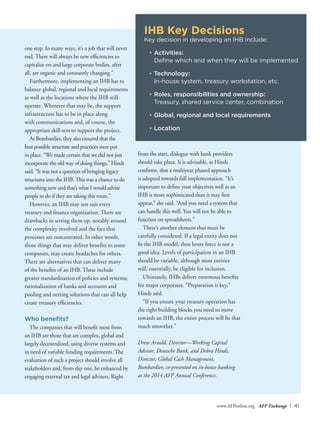
address working capital and efficiency challenges, enabling
corporate treasury functions to support the protection,
management and growth of their organizations.
For more information, please visit www.jpmorgan.com
New regulations are changing how cash deposits are classified, which will create a disparity in how banks and companies define
that cash. Importantly, there will be strict definitions for operating and non-operating cash, and the regulations, not the bank or
the company, will determine how deposits are classified, which will directly affect the value of deposits.
After the financial crisis, a primary goal of regulators was to ensure that banks could meet their liquidity needs in a stress environ-
ment. Regulators determined that only the cash required to fund a company’s upcoming payments would likely remain on deposit
during a time of stress—this cash is defined as operating cash. They also established that cash held in deposit accounts in excess of
operating cash would become scarce during a stress event and is defined as non-operating and classified as short-term wholesale
funding. Regulators now require banks to establish quantitative measures that substantiate deposits as operating or non-operating.
As the regulations phase in over the next few years, several things are likely. It’s expected that companies with large operating
flows and high volumes that use multiple bank products will have a higher percentage of their cash classified as operating.
Companies with limited flows, large spikes in balances and limited product usage will see more of their cash designated as non-
operating. Bank appetite for this type of cash will be limited given lower expected returns and increased costs. And, despite the
phase-in period, there will be increased market pressure on larger banks to conform now to the new rules.
Given this new reality, companies may want to consider:
How Will New Rules Affect Your Cash Deposits?
Now is the time to assess how to manage changes and explore ways to optimize your cash.
GrowManageProtect
www.AFPonline.org AFP Exchange I 1
July/August 2015 Volume 35	 Number 6	 www.AFPonline.orgcontents
features
22
Next Generation
Introducing finance business
partnering 2.0
Anders Liu-Lindberg
25
Making the Case
Employing zero-based budgeting
for manufacturing
Ron Giuntini
28
Cutting Clutter
Developing a risk-based debt
covenant checklist
Jeff Wallace and Jim Simpson
34
Small Gains
Results of the 2015 AFP
Liquidity Report
AFP Research Department
39
Moving Day
How Bombardier uses in-house
banking to improve cash management
Drew Arnold
42
Self-Control
A strategy for maximizing
shareholder value
Jonathan Hall, CTP
45
Let It Go
Are companies finally investing
cash reserves?
Andrew Deichler
48
History Repeats
The evolution and future of
cyber insurance
Bob Parisi
51
Perimeter Formula
Treasurers have a key role to
play in cybersecurity
Brad Deflin
54
Third Degree
How to work with your
bank to understand Basel III
implications
Michael Lenihan
58
Intrinsic Value
FASB is researching hedge
accounting changes
John Hintze
Exchange
2 I AFP Exchange July/August 2015
columns
10	 Global Treasurer
	 Establishing an international
	 investment program
	 Ivan Troufanov and Linda Ruiz-Zaiko
14	 Washington Watch
	 Complying with FBAR—just the FAQs
	 Ira Apfel
17	 Payments Essentials
	 ISO 20022 is a worthy endeavor
	 Andrew Deichler
19	 FP&A Foresights
	 Examining the FP&A value cycle
	 James Myers
64	 The Bottom Line
	 Happy New Year
	 Ira Apfel
departments
4	 From the President & CEO
62	 Highest Ranks
	 CFO, VP and other
	 executive appointments
63	 Advertising Index
	 Vendor contact information
		
AFP Member Profile
Opportunity Knocks
Jessica Cullinan never intended to
get into FP&A—but things changed
Jane Fitzgerald
July/August 2015 Volume 35 	 Number 6	 www.AFPonline.org
contents
Exchange
5
www.AFPonline.org AFP Exchange I 3
AFP Officers, Committees, Projects and Task Forces
AFP Exchange
Editorial Advisory Board
Chairman
• Suzanne S. Allen, CTP
	 Aevenia
Members
•	 Nancy C. Griffin
	 SunTrust Bank
•	 Kari Kingori
	 Laney College
•	 Florie Petti
	PwC
•	 Patrick Rittendale, CTP
	 Bank of America Merrill Lynch
•	 Michele L. Scott, CTP
	 International Paper Co.
•	 Joseph Tinucci, CTP, AAP
	 University of Colorado
•	 Karen O. Trickle
	 Journal Communications, Inc.
•	 Eileen Zicchino
	 JPMorgan Chase
AFP Officers
Chairman of the Board
•	 Anthony Scaglione, CTP, CPA
	 ABM Industries, Inc.
Vice Chairmen of the Board
•	 Jeff Johnson, CTP
	 Amesbury Truth
•	 Roberta Eiseman, CTP
	 Comcast Capital Corporation
Past Chairman of the Board
•	 Susan Glass, CTP
	 Hallmark Cards, Inc.
President and Chief Executive Officer
•	 James A. Kaitz
	 AFP
Board of Directors
•	 Ann Anthony, CTP
	 South Jersey Industries, Inc.
• Terry Crawford, CTP
	 AMC Entertainment Inc.
• Christopher Fulton, CTP
	 Skadden, Arps, Slate, Meagher & Flom LLP
• Jonathan Hall, CTP
	 WalMart Stores, Inc.
•	 Patricia Hui, CTP
	 Mentor Graphics Corp.
•	 Ferdinand Jahnel, CTP
	 Marsh & McLennan Companies, Inc.
•	 June Johnson, CTP, CPA
	 Z Capital Partners, LLC
• Jordan Krugman, CTP
	 Invesco Ltd.
•	 Anita Patterson, CTP
	 Cox Enterprises, Inc.
•	 Joan Piscitello, CTP
	 Iowa State University
• Matthew Skurbe
	 The Blackstone Group L.P.
•	 Adrienne Urban, CTP
	 World Fuel Services Corp
• Kristin Walle, CTP
	 ADP, Inc.
• Robert Whitaker, CTP
	 DHL Holdings (USA), Inc.
Committees, Projects,
Task Forces
Annual Conference Task Force
•	 Carole Hunt, CTP
	 Ameren Services Inc.
Audit Committee
•	 June Johnson, CTP, CPA
	 Z Capital Partners, LLC
Certification Committee
•	 Terri K. Mimms, CTP, FP&A
	 Purdue University
CTP Body of Knowledge Committee
•	 Tim Hesler, CTP
	 New York University
CIEBA of AFP
•	 Robin Diamonte
	 United Technologies Corporation
Treasury Advisory Group
• Sarah Schaus
	 Allianz Life Insurance Company, N. A.
Political Action Committee
• Alvin Rodack, CTP
The Ohio State University
Regional Association Task Force
• Kari Osborne, CTP
UMB Bank
CTC Forum Task Force
• Johan Nystedt
Levi Strauss & Co.
Download the full survey results. www.AFPonline.org/Liquidity
SAFETY IS STILL IN THE DRIVER’S SEAT
2015 AFP®
LIQUIDITY SURVEY
AFP, Association for Financial Professionals and the AFP logo are registered trademarks of the Association for Financial Professionals. © 8/15.
Underwritten by State Street Global Advisors
4 I AFP Exchange July/August 2015
President and Chief Executive Officer
James A. Kaitz
Editorial Content Director
Ira Apfel
Editor
Andrew Deichler
Publications Manager
Amy B. Cooley
Web Editor
Jane Fitzgerald
Contributing AFP Writers
Nilly Essaides
Advertising
Kevin Boyle
Sales Executive
AFP Exchange
4520 East-West Highway, Suite 750
Bethesda, MD 20814
T: 301.907.2862
F: 301.907.2864
www.AFPonline.org
Exchange@AFPonline.org
Dear AFP Members,
What is your talent acquisition strategy?
Every treasury and finance executive knows that great staff are hard to find—and
nearly as hard to retain. So why, then, do so many executives take a wait-and-see
approach? By wait-and-see I mean: “Wait until a valuable team member departs and
then see what the resumes look like after the opening is posted.”
Today’s treasury and finance leaders need a strategy to identify top talent in the
field—and a strategy to retain them. To devise a talent strategy, you need to ask
a number of critical questions. How are you engaging with your team? Are you
motivating and training them to become treasury and finance leaders? What are the
most important skills treasury and finance leaders of tomorrow need today? Treasury
and finance executives talk about the importance of communication, collaboration and
negotiation skills, but are you doing anything to train people in these areas?
AFP can help you begin to answer these questions and create your talent
acquisition strategy.
For starters, AFP offers a fantastic CTC Guide to Attracting & Retaining Talent. It
features eight treasurers discussing how they successfully build their teams.
As part of your strategy, you also need to figure out how to compensate staff. AFP’s
Annual Compensation Survey provides detailed job descriptions and salary information
for 20 different job titles. You can compare compensation levels based on experience,
education level and organizational characteristics.
After reading what your peers have to say and crafting a job description, you can visit
AFP’s Global Career Center. That’s where you’ll find nearly 2,000 qualified corporate
treasury and finance professionals to choose from. These are some of the best and
brightest minds in our field—and they’re ready to start adding value to your team today.
Last, but not least, there is AFP’s Annual Conference in Denver, October 18-21. In
addition to our popular three-day Executive Institute, we are proud to offer four executive
leadership sessions by and for treasury and finance executives. Leaders from McDonald’s,
Twitter and other top companies will discuss how they develop talent, lead through crisis,
create collaborative cultures, and build business partnerships.
Those are four steps you can take on the way to crafting your talent acquisition
strategy. The next steps are up to you.
Sincerely…
Jim Kaitz
President and CEO
From the President & CEO
Talking
Strategy
Exchange
About AFP®
Headquartered outside Washington, D.C., the
Association for Financial Professionals (AFP) is
the professional society that represents finance
executives globally. AFP established and
administers the Certified Treasury ProfessionalTM
and Certified Corporate FP&A ProfessionalTM
credentials, which set standards of excellence
in finance. The quarterly AFP Corporate Cash
Indicators® serve as a bellwether of economic
growth. The AFP Annual Conference is the
largest networking event for corporate finance
professionals in the world.
AFP, Association for Financial Professionals,
Certified Treasury Professional, and
Certified Corporate Financial Planning &
Analysis Professional are registered trademarks
of the Association for Financial Professionals.
©
2015 Association for Financial Professionals, Inc.
All Rights Reserved.
AFP Exchange, July/August 2015 (ISSN 1528-4077), is
published monthly for 10 months per year, bimonthly Jan/
Feb and July/Aug at $90 per year for nonmembers by the
Association for Financial Professionals, 4520 East-West
Highway, Suite 750, Bethesda, MD 20814. Periodicals postage
at Bethesda, MD, and additional mailing offices.
POSTMASTER: Send address changes to AFP Exchange,
4520 East-West Highway, Suite 750, Bethesda, MD 20814.
www.AFPonline.org AFP Exchange I 5
An unexpected work opportunity led Jessica Cullinan to alter her
career path.
“I actually started in the accounting department as a fund
accountant for a small company in Beltsville, Maryland,” she said.
“When an opportunity opened up as a financial analyst in the FP&A
department—which at the time consisted of two people, including the
open position—I thought it would be interesting to try something new.
I did, and I really liked it and my interests moved more toward finance
than accounting.”
Cullinan never looked back. She currently works as a manager of
financial planning and analysis at Connections Education, a provider of
virtual education solutions for students in grades K–12, in Baltimore.
She received her Bachelor of Science in Business Management from
Salisbury University and earned her MBA with a specialization in
finance from the University of Baltimore, a program that she credits
with setting her on the FP&A path. The new mom also enjoys
travelling, hiking, camping and running 5Ks with her husband.
AFP spoke with Cullinan.
AFP Member Profile
Jessica Cullinan never intended
to get into financial planning and
analysis—but things change.
Jane Fitzgerald
“What’s so
rewarding is
that the FP&A
department works
with everybody.
We touch a little
bit of everything,
so we build
relationships across
the company—
with marketing,
operations,
technology—not
just within a specific
department.”
Opportunity
Knocks
6 I AFP Exchange July/August 2015
AFP: How did you end up in your
current position?
I started my MBA program in 2007 and
I think that was a segue into determining
that I wanted to work in the finance field.
I had been working in finance/accounting
for a few years, but my MBA program is
where things started and led me to where I
am today. I started as a financial analyst at
Connections Education, and within a year,
I was promoted to manager.
AFP: What has been the greatest
influence on your career?
My MBA program is where I was able to
finally decide where I wanted to focus my
career, but Connections Education has also
had a huge impact as well. I’ve learned a
lot in the time that I’ve been here, and so
much of that is attributed to the company
promoting development in their employees.
They trust our judgment, so we’re not
micromanaged and have the freedom to
brainstorm new ideas, change processes or
develop processes to put in place.
AFP: Is there anything that helps you
deal with the challenge of not being able
to predict the future?
It goes back to building relationships.
I think that communication is the key
part of budgeting and forecasting. All
the departments need to collaborate and
communicate with each other to make sure
that their goals are in line with the goals
of other departments and the company’s
overall strategic plan. It’s important to have
meetings up front and talk about the vision
for the company, so that’s one of the first
things you want to do. It’s also important
to look at historical trends to see if you are
in line with history. If not, why? What’s
changing? What do you know about what is
different in the market?
AFP: Was there a specific project where
you were able to take the lead or
change processes?
When I first started at Connections
Education, I was assigned the task of
revamping the budgeting template. I was
trusted with rebuilding a tool that was used
company-wide. I had the freedom to put
my thoughts into something and create a
budgeting tool that was being used by all of
our employees. I worked on it from start to
finish—creating it, getting it implemented
and training. It was similar to something
that had been used in the past, but overall,
it was a huge change for the company since
it was a redesigned tool.
AFP: What are the most rewarding parts
of your job?
What’s so rewarding is that the FP&A
department works with everybody. We
touch a little bit of everything, so we build
relationships across the company—with
marketing, operations, technology—not just
within a specific department. Through those
relationships, we get to be hands-on with
building things that save time and money.
Sometimes it’s as simple as an Excel formula
or as big as building an automated tool
for somebody that can save eight hours of
manual labor. I think that’s really rewarding.
AFP: What’s your biggest work challenge
right now?
Forecasting is kind of an ongoing
challenge. Obviously with any budget or
forecast, you have to be forward-thinking,
which is really the nature of the FP&A
department. However, it’s always challenging
getting that information together and
thinking through how things will look over
the next year or two – or however long you’re
forecasting ahead. It can be a challenge
because you don’t know what the future
holds or what things will look like.
AFP Member Profile continued
www.AFPonline.org AFP Exchange I 7
AFP: What’s been your biggest challenge
in your career and how did you
overcome it?
This year, we were, as a company, tasked
with developing the FP&A department
because it’s a new department. There
was always a finance department and an
accounting department, but having an
FP&A-focused area is newer. We wanted
to develop the department, but it’s difficult
when you’re a small department. You’re
doing budgeting, forecasting, strategic plans
and all types of things that are typical in
FP&A departments, but at the same time,
you still need to hire people and reorganize
your area. It’s important to figure out what
things that we’re currently doing and asking
“What should we be doing? Where are our
opportunities?” Really developing what
our department, what our area should look
like. What services we should be providing.
It was a bit of a challenge to identify what
our area was, decide how we wanted it to
look as a department, and make it come
to fruition through the hiring process.
What helped us get through that was
that I worked closely with my immediate
supervisor and thought about what we
wanted to do as a department and worked
through it as a team.
AFP: How did you first get involved
with AFP?
Around the summer of 2014, I was
forwarded an email from our vice president
of finance regarding the FP&A certification,
and I was intrigued. I started researching
what the certification was all about and
thought that I would love to do it. I got
involved with AFP after hearing about this
exam. Since then, I became a member of
AFP and started the process of studying and
scheduling to take the exam in March. From
what I understand, it’s a new certification,
so it would be very exciting to be one of the
first classes to take the exam.
AFP: What do you find most valuable
about your membership?
First and foremost is the opportunity to
be taking the FP&A exam. I’ve also found
the AFP Compensation Survey is good to
have, especially if you’re in charge of hiring
a team. It allows you to see where you are
and if you’re line with the salary ranges for
the positions in the survey.
AFP: What are some of your hobbies
and interests outside of work?
Since I’m a new mom, that’s something
that’s on the forefront here. Aside from
that, my husband and I like to travel.
We’ve been to Greece, Italy, Ireland, and
all over the U.S. I would love to get to
Australia, but since we have a two-month-
old baby right now, that might not be for
another couple of years. We also enjoy
hiking and camping, and running some
5Ks around Maryland. We’re by no means
professional runners, but it is something
that we like to get out and do.
It’s important to figure out
what things that we’re currently
doing and asking “What should
we be doing? Where are our
opportunities?” Really developing
what our department, what our
area should look like.
8 I AFP Exchange July/August 2015
Bank of America Merrill Lynch Article
We all like to believe we wouldn’t be taken in by a fraudster—
but for a growing number of companies cyberattacks are a
fact of life. Believing that employees won’t be tricked by a
cybercriminal is a dangerous assumption when the stakes
are so high: Including substantial financial loss, attacks of this
nature can result in serious or even irreparable damage to the
reputation of a company. All it takes is for one person to make
an unauthorized payment that they believe a senior member of
the organization has requested.
According to data from the FBI’s Internet Crime Complaint
Center (IC3), over 2,000 companies fell victim to a particular
type of scam called the Business Email Compromise (BEC)
between October 2013 and December 2014. The total dollar
loss was almost $215 million.
Despite the scale of the threat, many companies are unprepared
for the possibility that they will fall victim to an attack. “In a
recent survey that asked corporate clients how they plan to deal
with cyber activity, a surprising 43% indicated that they currently
have no formalized plan in place,” comments Cindy Murray, head
of Global Treasury Product Platforms and Digital Channels at
Bank of America Merrill Lynch. “That’s an alarming percentage
and a call to action.”
The scam
Cybercriminals use a number of different schemes and
techniques to defraud their victims. Often these schemes
will include a phishing component, whereby employees are
persuaded to click on a link or attachment. As a result, malware
is downloaded onto the computer enabling the cybercriminal
to gain access to everything from user credentials to emails.
Phishing can be used to steal information which can support
other types of attacks, such as spoofing, whereby emails are sent
from a false address, or masquerading, where an email is sent
purporting to be from a senior executive within the company.
In this type of attack, scammers look at recent events in the
news or upcoming acquisitions—any type of corporate activity
that may be subject to secrecy and confidentiality, as well as
being urgent. The scammer then poses as a senior executive,
masquerading as the CEO or CFO of the company. Due to “legal
reasons,” the fraudster instructs the person they are contacting
to keep the instruction and information quiet. The ideal victim is
an individual who doesn’t want to appear inept to the senior
executive, and who transacts the instruction to seem competent
and worthy of the responsibility.
Even requests that may require involvement from multiple
departments to perform can be executed if a scammer
successfully impersonates the appropriate trading partner or
executive to one individual within the company. The internal
email trail then moves through the organization from the
legitimate employee, who gives instructions to other
departments or associates. They, in turn, assume that the
proper authentication and protocols have been followed and
process the requested instruction.
The solution
There are a number of measures that companies can put in
place to reduce the risk of payment fraud. Employees need
to be instructed to notify their Information Technology (IT)
and Information Security departments if suspicious emails are
coming in. They should not just ignore the emails. IT should be
regarded as the first line of defense and can put in place
filters to block these
email addresses that are known or suspected to be fraudulent.
Too many times, employees ignore or delete an email that
another employee may reply to or click on a link that
downloads malware into their PC.
Fraudsters are becoming ever more sophisticated in the
lengths they are going to make their messages sound
authentic, and to time them effectively. In a recent attack,
an email purporting to be from the CEO was sent at a time
when the CEO was out of the office—and not readily
available to confirm the accuracy of the request.
Fraudsters often have a wealth of information at their
fingertips that can help them impersonate executives
successfully—even without resorting to phishing.
Social media websites can provide a high level of detail
about specific individuals, which fraudsters may be able to
use in order to make messages sound more authentic.
Companies’ own websites can also furnish criminals with
the identity, job title and email addresses of their own staff.
Companies may have legitimate reasons for making this
information publicly available—but they should also be aware
that in doing so they may be putting their business at risk.
As a general rule, companies should not give out any more
information than they have to.
Payment fraud: Would you be fooled?
www.AFPonline.org AFP Exchange I 9
The power of global connections™
“Bank of America Merrill Lynch” is the marketing name for the global banking and global markets businesses of Bank of America Corporation. Lending, derivatives, and other commercial banking
activities are performed globally by banking affiliates of Bank of America Corporation, including Bank of America, N.A., Member FDIC. Securities, strategic advisory, and other investment banking
activities are performed globally by investment banking affiliates of Bank of America Corporation (“Investment Banking Affiliates”), including, in the United States, Merrill Lynch, Pierce, Fenner
& Smith Incorporated and Merrill Lynch Professional Clearing Corp., both of which are registered broker-dealers and Members of SIPC, and, in other jurisdictions, by locally registered entities.
Merrill Lynch, Pierce, Fenner & Smith Incorporated and Merrill Lynch Professional Clearing Corp. are registered as futures commission merchants with the CFTC and are members of the NFA.
Investment products offered by Investment Banking Affiliates: Are Not FDIC Insured • May Lose Value • Are Not Bank Guaranteed. ©2015 Bank of America Corporation 06-15-0978
The process
All companies have standard operating procedures, but not all
have procedures to cover non-standard requests. In order to
protect themselves from this type of attack, companies should
develop non-standard procedures, as well as a fraud plan that
is reviewed and tested regularly. Companies that educate their
employees about this topic are typically not the victims
of cybercrime.
Some examples of non-standard processes that can be developed
and tested are as follows:
yInstruct employees to be wary of any urgent or
confidential requests.
yNever respond by using the “reply” feature to the email
containing the non-standard request. Look up the individual’s
email address and validate it for accuracy. Inserting slight
alterations in an executive’s email address is a tactic
commonly used by fraudsters.
yAuthenticate non-standard requests outside of the channel
used to deliver the instructions. Beneficiary or address
changes from vendors should be validated by phone, or by
asking another individual at the company to create a new
email from their source documentation in order to confirm
the change.
yIncorporate dual authorization for all non-standard requests.
Regardless of the size of the company, dual authorization
should, at the minimum, be implemented for specific
transaction value thresholds. In order to determine that
threshold, companies should ask themselves how much
they can afford to lose.
The following points should also be considered when building
and testing a fraud plan:
yTime is of the essence when stopping fraudulent
payment requests.
yEmployees need to know what they should do if they are
suspicious of a fraudulent payment. Payments are hard to stop
due to deadlines—sometimes it’s within a matter of minutes.
yIn some cases, embarrassment may prevent staff from
immediately reporting fraud to their banks. However, it is
essential to alert banks so that proper action is taken to stop
the wire or prevent further wires from being sent
inappropriately. Once a machine has been compromised, it
should also be taken off the company’s network until it has
been cleaned of malware.
The test
If you believe your staff can’t be fooled by this type of ruse, test
them and find out. Set up a test by sending an employee a
non-standard request. Does your employee process the request?
It is important not only to test procedures, but also to share
recent fraud events with employees as part of an effective
fraud education program. Communicating these occurrences
is an integral part of any successful fraud prevention training.
Cybercriminals prey on companies where staff are not educated
and where the proper procedures and controls are not in place.
Scammers thrive on unpreparedness, as speed is an important
ingredient when successfully stealing a company’s assets.
By incorporating these best practices into their overall security
programs, companies can be better placed to protect against
payment fraud. Companies may have extensive fraud prevention
security measures, but can still fall victim to cybercrime if their
employees are the weakest link.
“Fraud is a serious matter and at Bank of America Merrill Lynch
we invest and use many resources and time to help clients
protect their businesses against fraud,” concludes Murray.
“However, fraud is a shared responsibility and client awareness
of all the schemes and tactics used in this environment is the
first line of defense in fighting fraud.”
Author
Mary Rosendahl
Global Digital Channels
Solutions Executive
Bank of America Merrill Lynch
10 I AFP Exchange July/August 2015
Global Treasurer
Foreign
AffairsEstablishing an international
investment program
and policy statement
Ivan Troufanov and Linda Ruiz-Zaiko
KEY INSIGHTS:
•	Treasury should be involved in global tax and repatriation strategy planning.
•	Some countries may severely limit security selection and even prohibit
	 some investments.
•	Benchmarks can be used as performance measurement but even more valuable
as an indication as to the investable universe for an international portfolio.
www.AFPonline.org AFP Exchange I 11
Ongoing turmoil in currency markets have had a direct impact on corporate profits. The
accumulation of cash offshore, coupled with the volatility of currency markets, make
international portfolios a timely topic. This article addresses euro-denominated international
portfolios held by American companies in offshore entities.
From a treasurer’s perspective there are several practical considerations when constructing an international
investment program. They include:
•	 A robust global cash flow forecasting system
•	 Establishing global tax and repatriation strategies
•	 Integrating foreign exchange risk and hedging strategies with the investment program
•	 Understanding local tax and regulatory requirements, and
•	 Reporting and accounting considerations.
Global cash flow forecast:
A systematic global cash forecast helps identify global
cash pools that are available for target investment
portfolios. Regular cash forecast updates help to avoid
surprises for change in cash and target investment
allocations around the globe.Treasury should establish
specific targets in global cash liquidity needs which are
helpful in outlining the immediate liquidity needs versus
longer-term strategic cash reserves.
Global tax and repatriation strategy:
Treasury should be involved in global tax and
repatriation strategy planning. Maintaining a regular
dialog with their global tax department helps avoid
surprises that could result in poorly timed, sub-optimal
global cash movements. It is critical to plan ahead with
respect to sizable global repatriations and reinvestments
so that markets are favorable for any liquidations.
FX rate risk and hedging strategy:
Together with global tax, treasury should
establish a foreign exchange risk strategy for the
international investment portfolios. Decisions should
be made as to implementing an active or passive
hedging strategy, placing foreign exchange gain/loss
limits, and the selections of hedging instruments
such as forward contracts, options, and option
combinations. The strategy should be linked to the
global corporate FX risk policy. Treasury should
establish a consistent method of tracking FX risk
strategy performance.
If hedging the portfolio’s currency exposure is
permitted, it becomes important to identify the
proper permissible hedging instruments. Futures
contracts may be used to hedge against market risk,
gain exposure to an underlying market or to hedge
against interest rates. Forward contracts may be used
to hedge or gain exposure to an increase in the value
of an asset, currency or deposit. Options may be used
to hedge or achieve exposure to a particular market
instead of using a physical security to hedge against
interest rates.
Local tax and regulatory requirements:
Understand local tax and compliance regulations
before deciding on the locations for global investment
portfolios. Some jurisdictions may significantly limit
the security selection available and even prohibit
investments in interest bearing securities. Include local
restrictions and limits in specific investment policy
to ensure compliance.The liquidity and availability
of investments, transaction costs and taxes should be
understood.They may impact the investment maturity
and turnover decisions of the portfolio.
12 I AFP Exchange July/August 2015
Global Treasurer continued
Reporting and accounting considerations:
Assess the reporting requirements, such as possible
global roll-up or stand-alone reporting. Determine the
functional currency and FX translation requirements
and the complexity of FX hedge accounting, in-house
expertise to support an active hedging strategy. The
portfolio’s currency translation risk or accounting risk.
FASB Statement No. 52, Foreign Currency Translation.
Currency hedge accounting for complex transactions will
be accounted for under SFAS 133 and/or IAS 39.
Establishing an international investment program requires
coordination among the treasury, international tax and
accounting groups to develop an efficient, risk-controlled
investment program. Key issues to be resolved among the
parties depend on the company’s international tax structure,
domiciles of the offshore entities, functional currencies or
the base currency of the portfolio which may be different
than the country that holds the portfolio. Like all investment
programs, the investment horizon, projected cash flows, risk
profile and the intended uses of the surplus balances are key
elements.The currency decision also entails coordination
with the company’s hedging policy.
The investment policy statement requires detailed
consultation with the corporate tax, external international
tax and legal. It is critical to consider the implications
of international structures and understand the types of
transactions or securities that may trigger IRC §956
US property or dividend. A loosely crafted IPS can
inadvertently trigger a tax event that can be exceptionally
costly to the corporation. Each corporation has a unique
legal and international structure, although there are
similarities that we will attempt to address.
Investment objectives
The key objectives of most offshore subsidiaries are
to invest in the functional currency of the legal entity in
investments that are (1) not subject to U.S. withholding tax,
or (2) not treated as invested in U.S. property under Internal
Revenue Code section 956. No amount of additional yield
can compensate for the cost of triggering U.S. withholding
taxes and disqualifying the cash as offshore assets.
Depending on the domicile of the offshore entity there may
be additional transaction costs and restrictions that should be
considered in the investment policy.
US § 956: Potential investments should be evaluated with
regard to any potential impact on U.S. withholding and
income taxes. At all times, investments that are considered
must generate income that is not treated as investment in
U.S. property and thus not subject to U.S. tax pursuant to
§ 956. Income that would be subpart F foreign personal
holding company income per § 954(b) should be reviewed.
The company should instruct their investment managers as
to the types of permissible investments. Foreign investments
that are subject to foreign withholding tax should be
kept at a minimum and periodically reviewed with their
international tax experts.
Offshore securities should carry at least one credit
quality rating to be eligible. The eurozone crisis put
renewed emphasis on sovereign risk. EU sovereign
ratings became stratified as individual countries were
scrutinized on their own merits and pricing of their
debt was shocked accordingly. Reactions to the sudden
fracturing of the EU credit rating façade generated
drastic changes to existing investment policies that had
relied on a regional definition rather than credit ratings.
This type of rigid modification is a somewhat permanent
means of mitigating a very fluid and dynamic situation.
Once a country or company has been placed on the
prohibited list it becomes very difficult to remove it from
that list once the trouble has passed. A better solution is
to place restrictions on each country’s specific sectors and
credit ratings.The guidelines should focus on the currency
denomination of the security, credit quality and duration.
The country of issue should not be a selection criteria
because it will be reflected in the credit rating.
Be specific about the acceptable credit quality with the
minimum short and long-term sovereign credit ratings
but don’t list countries that may be out of favor. High
quality ratings will screen out problematic countries.
Be specific about the acceptable credit
quality with the minimum short and
long-term sovereign credit ratings but
don’t list countries that may be out of
favor. High quality ratings will screen out
problematic countries.
www.AFPonline.org AFP Exchange I 13
Liquidity
Depth and liquidity of the market are important factors.
The availability of both primary issuance in the short-end
of the yield curve as well as availability of secondary issues
are also important considerations. In less liquid markets the
purchase of high-quality securities may be scarce and may
lead to a more conservative buy and hold approach or lower
turnover than in a more liquid, deep, tradeable market.
Corporate credit ratings: The ratings agencies have
a convention that has proven to provide opportunity
for sophisticated investors during the eurozone crisis.
Corporate entities domiciled in a specific country are
multinational corporations whose business and revenues
come from a broad range of countries, so their revenue
is not solely dependent on the state of the country of
domicile. Yet rating agencies ignore this fact and will not
rate a corporation higher than the sovereign’s credit rating
in which the company is headquartered.
Covered bonds: Covered bonds are senior, secured bank
obligations with favorable EU regulations. The bonds are
highly liquid, full-recourse debt. The Single Resolution
Mechanism (SRM) or European bail-in rules clarified the
safety of covered bonds.
The bail-in procedure reaffirmed that covered bonds
are the most senior, safest in the capital structure and
have preferential claim under a default. Senior bank paper
becomes subordinated, subject to prospective losses and
reducing its overall quality. Covered bonds are generally rated
higher than senior notes by the rating agencies.
Euro-denominated covered bonds must be issued by a
euro-area credit institution, held and settled in the euro
area. The cover pool must provide sufficient collateral
to cover bondholder claims over the term of the covered
bond. Bondholders must have a priority claim on the cover
pool in the event of default.
Euro ABS: Most of the euro-structured securities
market performed better than the U.S. namesakes.
The euro ABS market was not vulnerable to aggressive
U.S. underwriting practices and had adhered to stricter
underwriting standards. Euro ABS should have the issuer
residence within the euro area, strong credit enhancements,
availability of investor reports and modeling of the ABS.
Third-party cash-flow modeling tools should be available.
All counterparties to the transaction except the servicer
should have top ratings and full back-up servicing
provisions are in place. Any evaluation should look
through to the underlying claims against entities resident
in distressed countries.
Euro RMBS:The RMBS (residential mortgage-backed
securities) market differs substantially from country to
country based on different legal mortgage structures. Each
country within the EU has different rules and regulations
governing mortgages and bondholders with some
jurisdictions favoring homeowners over bondholders. Any
investments in RMBS should be made by an investment
manager with robust analytics, strong research capabilities
and thorough understanding of the different legal structures
and jurisdictions and laws protecting bondholders.
Benchmarks can be used as performance
measurements, but they are even more
valuable as indicators of the investable
universe for an international portfolio.
Benchmarks
Benchmarks can be used as performance measurements,
but they are even more valuable as indicators of the
investable universe for an international portfolio. For
example, the subsets of the Barclays Euro Aggregate Index
consist of fixed-rate, investment-grade bonds issued in
euro or legacy currencies of the European Monetary
Union. Excluded are convertible securities, perpetual notes,
warrants, linked bonds and structured securities.
The investment policy should also set the criteria
for the selection of an external money manager. Some
criteria might include a manager with extensive research
capabilities in the regional market. The manager should
be able to provide efficient trade execution during
illiquid markets and may need to cross-trade securities
to provide liquidity. Certain safeguards and compliance
policies should be in place to prevent abuse or self-
dealing with full disclosure and client permission.
Ivan Troufanov is assistant treasurer, BioMarin
Pharmaceutical Inc. Linda Ruiz-Zaiko is president of
Bridgebay Financial Investment Consultants.
14 I AFP Exchange July/August 2015
Washington Watch
M
any treasury and finance professionals have questions about
complying with FBAR—and the filing deadline was June 30.
Because there is still a great deal of confusion on several
aspects of the regulation, AFP staff and several corporate practitioner
members spoke with regulators from FinCEN and asked specific
compliance related questions.
The good news is this: 85 percent to 90 percent of unnecessary FBAR
(Foreign Bank Account Reporting) filings can be eliminated.
Why is this so? There are several reasons. First, according to the AFP-
FinCEN Q&A, named officers or any other employee on a Corporate
Certificate Bank Resolution for U.S. publicly-traded entities are exempt
from filing a personal FBAR. In addition, officers or employees of publicly
traded companies are not required to file FBAR over a foreign financial
account that is owned and maintained by the publicly traded company.
How to comply with
this complex regulation
Ira Apfel
FAQs
FBAR
www.AFPonline.org AFP Exchange I 15
Furthermore, if officers of a corporation have the authority
to expend funds with signature authority but no financial
interest of the company’s account, then they are required
to file FBAR. However, if they physically cannot, or have
the signature authority, to expend funds, then they’re not
required to file FBAR.
Below are more questions, followed by FinCEN answers:
Who must file FBAR?
QUESTION: In the preamble, FINCEN states that
“Signature Authority does not mean Supervisory
Approvals.” Guidance from FINCEN states that
“Supervisors who approve of the disposition of assets of a
subordinate, but cannot dispose of assets themselves, do
not have signature authority. We assume approve to mean
an internal company approval. Please confirm.
ANSWER: Confirmed. Internal approval is not a
payment approval for FBAR purposes. Therefore, this does
not constitute disposition of assets from a bank account.
QUESTION: Please confirm who must file an FBAR
from the following list if the organization is a non-
governmental organization or a privately held company
without any government oversight or regulatory
governance: Named officers on a Corporate Certificate
Bank Resolution?
ANSWER: No. Persons named on the general banking
resolution only need to file FBAR if their employer has also
given them signature authority on bank accounts or specific
access for the disposition of funds. If the individuals named
on the banking resolution cannot access banking systems
or communicate instructions on the movement of funds
legally or within company guidelines or policies then they
do not need to file FBAR.
QUESTION: If an individual or an officer of an
organization did not realize they were subject to FBAR
filings and needed to file previous-year FBARs, how far
back do they need to go?
ANSWER: Two to three years maximum, and the data
needs to be retained for five years. FinCEN will never ask
for data that is older than five years.
If individuals and officers did not know they were
subject to FBAR filing and therefore did not declare their
signatory authority on their previous year’s personal taxes,
do they need to re-file those previous year taxes? If yes, how
can they do that if the form 1040x does not provide a field
to correct overlooked FBAR information? Answer: IRS
counsel has advised that previous year taxes do not need to
be re-filed to correct missing FBAR information. The IRS
considers late filing of missing FBARs to the FinCEN to be
a reasonable effort toward honest disclosure.
If the above examples are for a U.S. publicly traded entity,
then the employee is exempt from filing a personal FBAR.
QUESTION: What about for accounts payable clerks
that transact on the foreign bank account with proper
controls where: one person initiates, and another person
approves money transfers?
ANSWER: Since the clerk is simply processing
payments in the payable system, and the clerk hands
off a payment file to the bank, this does not constitute
a reportable FBAR obligation. If the clerk logs on and
initiates a payment directly on the bank Web tool to a
foreign bank account, this is a direct payment and would
constitute a FBAR filing obligation.
QUESTION: Regarding the chain of command in
approving/effecting a payment from a corporation based
on the decision making hierarchy of an organization. If a
controller has authority to approve a purchase order and
the payment with enough internal signature authority at a
set dollar threshold, yet the controller has no authority over
the bank account, but has authority over the individual
that does, is this considered in scope for filing an FBAR?
ANSWER: This is part of the normal corporate governance
and does not constitute FBAR reporting obligation.
QUESTION: What about online bank account or
bank portal administrative “super users” that set up
users and ensure controls for the purpose of designating
money transfer personnel at a company?
ANSWER: FINCEN will have to review and provide
further guidance on this.
16 I AFP Exchange July/August 2015
Washington Watch continued
Confirmed. If the filer—the
person or organization—has 25
or more foreign bank accounts,
the total count of accounts and
the ownership is required when
filing. Account details and
balances are not required.
QUESTION: What if an account doesn’t have a person
as a signatory and relies on a corporate logo for their
account signatory?
ANSWER: The owner of the electronic signature or
logo is responsible and will have a reporting obligation.
QUESTION: What about tax personnel that send
foreign tax payments as debit transactions to foreign
bank accounts?
ANSWER: FINCEN will confer with IRS and give
guidance on this.
Average Balances
QUESTION: We have trouble getting the highest
average balance in our bank accounts from our bank and
we don’t have internal reporting that tracks this since the
information changes every minute. What is considered
prudent practice in this regard—using the bank’s best
value in terms of the highest amount per year?
ANSWER: FinCEN will confer with IRS to get
guidance on the using the general ledger as an alternate
source for the highest balance.
QUESTION: The guidance is clear: “A United States
person with a financial interest in 25 or more foreign
financial accounts should check the Yes box in Part I,
item 14a, and indicate the number of accounts in the
space provided. The United States person should not
complete Part II or Part III of the report but maintain
records of the information. If the group of entities
covered by a consolidated report has a financial interest
in 25 or more foreign financial accounts, the reporting
parent corporation need only complete Part V (for
consolidated reporting), items 34 through 42, for the
identity information of the account owners, but need not
complete the account information.” But the electronic
filing instructions are not clear to batch filers filing a
consolidated FBAR as to how to address this reduced
information requirement that pertains to Part V. How do
we truncate this information in the file layout? This will
help us to eliminate reporting highest average balance
information mentioned above.
ANSWER: Confirmed. If the filer—the person or
organization—has 25 or more foreign bank accounts, the
total count of accounts and the ownership is required when
filing. Account details and balances are not required.
However, account balance information must be available
for five years should FinCEN or the IRS ask for the details.
Also, all Bank Secrecy Act records should be kept for a
rolling five years as well.
Exemption Questions
QUESTION: Is an officer or an employee that works
for a company that is listed on a public exchange or an
ADR and with no financial interest exempt? Would the
subsidiary be included in the consolidated filing? What
about the individual—would he or she need to file?
ANSWER: Foreign companies with subsidiaries in
the United States, where the foreign parent is listed on a
U.S. public exchange via ADR, what specifically are the
exemptions? FinCEN and IRS will follow up on this
to confirm.
Disclaimer: Always consult your tax and legal advisers in dealing with any
federal regulation. This article is not meant to be legal or tax advice but a recap
from an AFP conversation with FinCEN.
www.AFPonline.org AFP Exchange I 17
Payments Essentials
ISO 20022 is no panacea, but it
is a worthwhile endeavor
Andrew Deichler
KEY HIGHLIGHTS:
•	ISO 20022 is a messaging standard for financial institutions. Its purpose is to simplify
	 international payments.
•	Because ISO 20022 is rolling out gradually and various jurisdictions are tweaking it, it is hard
for corporates to comply.
•	The main benefit of ISO 20022 is that it gives jurisdictions a common set of terms rather than
completely different standards.
MAGIC
ELIXIR
A
s is the case with all standards, the implementation of ISO 20022 has not been
without some turbulence. All around the globe, various stakeholders have been
making their own little changes to the system. Nevertheless, the standard is much
closer to being a solution to simplify international payments, and corporations can benefit
greatly from it.
Implementation in Canada
The Canadian Payments Association (CPA) has been prioritizing the modernization
of Canada’s payments system over the past several years, and a key focus of that has been
implementation of ISO 20022. Drawing on lessons learned from other jurisdictions, the CPA
is attempting to transition to ISO 20022 as smoothly as possible.
18 I AFP Exchange July/August 2015
Tom Morrison, director of treasury
operations for Suncor Energy, has
been party to discussions regarding
ISO 20022, which gathered
stakeholder input. However, the
actual implementation plan may
still be a long way off. “There’s
no definitive roadmap,” Morrison
explained. “There was discussion
around activities in 2015 to get to the
go-forward strategy. They’re actively
talking to the various stakeholders and
seeking input into requirements.”
Stakeholder input is essential to getting
a standard right. However, it can also
create a case of “too many cooks in the
kitchen,” which has been the case for
ISO 20022 during this gradual global
rollout. “Every stakeholder seems to want
their own little nuance of that standard,”
noted Magnus Carlsson, director of
treasury and payments for AFP. “But of
course, when you do that, that’s not a
standard anymore.”
This can create issues for corporate
treasurers who make regular payments
to all corners of the world, Carlsson
continued. “If you want to sign onto
this as a corporate, you would want to
know that this is a standard; that this is
not going to change,” he said. “You’re
not going to change your systems and
make all of these investments if this
thing is going to change.”
Further complications
Carlsson related the situation to
Europe using ISO 20022 for the
Single Euro Payments Area (SEPA).
“Within the different countries, there
are different nuances of the standard,”
he explained. “They’re already
encountering issues there.”
The CPA has had in-depth discussions
about which parts of the standard need
to be just that—standards, from which
there can be no deviation—and optional
components which are aligned with
ISO 20022 messaging formats but allow
some flexibility. As of now, there are no
clear answers. “Do you make remittance
details optional? Are the only things
you make mandatory the core payment
details—value date, dollar amount,
currency, etc.? And even within that,
how rigid do you make the standard?
That’s the challenge we have,” Morrison
said. It is expected that a number of
these questions will be answered when
the CPA publishes its new standard,
anticipated in early 2016.
Morrison, whose organization just
went live with SWIFT’s Alliance Lite2
this year, has faced some issues with
using ISO 20022. “Every country
seems to be slightly different,” he
said. “They each have a version of
the standard it seems to be more of a
guideline. It’s different by country, it’s
different by bank—it can be quite a
challenge to implement globally.”
However, Morrison was also quick
to point out the benefits of using
the standard, which was a key factor
in Suncor’s decision to implement
SWIFT. “At least we are starting
with a common set of terms across
jurisdictions rather than completely
different standards,” he said.
Currently, a U.S. stakeholder’s group,
consisting of the Federal Reserve, The
Clearing House, NACHA and X9, is
in the process of soliciting views from
the corporate world on ISO 20022.
Although the research is still going on,
Carlsson expects to hear that corporate
practitioners want to see remittance
data included in the standard. “Some
might see the remittance portion as
optional but if corporates are going
to sign onto this, they are looking for
a complete, ready-to-go package,”
he said. “And that includes the
remittance information because
going forward, you want to facilitate
straight-through processing.”
A key concern for Morrison and
other Canadian treasurers is what
happens to the old standards with
the advent of ISO 20022. “Do we
go from a current environment with
multiple standards and add in ISO
20022, which means corporates have
to support an additional standard in
implementation?” he asked. “Or do
we have a plan to migrate from the
previous standards and go with a single
standard globally? There’s no clarity
on that at this point in time, but in
Canada the CPA is considering the
implications of an additional standard.
Although as a corporate, until there
is more clarity, it’s tough to make
decisions about where you direct your
investment in technology.”
Looking ahead
The good clearly outweighs the bad
when it comes to ISO 20022; there are
just some kinks that need to be worked
out in Canada and other regions. Once
they are, Morrison and Carlsson expect
the process to run a lot smoother.
“The standard positions us as an
organization for future development,”
Morrison said. “I look at it as
modernizing our infrastructure. So
even though some of our banks can’t
support the standard to date, that’s the
direction the world seems to be going.
Having that already developed eases
the onboarding of new banks onto that
platform, rather than having multiple
point-to-point interfaces that all follow
a different standard.”
Payments Essentials
www.AFPonline.org AFP Exchange I 19
FP&AFORESIGHTS
KEY INSIGHTS:
•	FP&A’s role is to create a value
cycle, giving professionals the
	 opportunity and framework
	 to create real gains for the
	organization.
•	The challenge for FP&A is
	 to balance other job
	 requirements: consolidations,
	 budgeting, forecasting and
monthly reporting.
•	Between strategy and
	 business, FP&A’s role is to
	 lead in strategic partnering.
PurposeExamining
the FP&A
value cycle
James Myers
On
20 I AFP Exchange July/August 2015
Never before has an FP&A professional had so
much opportunity to change the course of history.
Uncertainty is becoming the norm, and companies
are struggling to be nimble, or they have become too dependent
on the past to create the future. While disruption—the latest
buzz word—creates winners, by definition there also are losers.
So how can FP&A professionals help their companies navigate
these uncertain times?
Ultimately, the amount of cash a business
generates dictates its success, so finance always
has a seat on the executive team. Now we are
seeing the role expand beyond the traditional
back-office accounting support function into
something more. We are seeing finance teams be
closer to the action, empowered to be creative
and suggest new ideas.
The great news is that all finance professionals
can use whatThe Lean Startup calls “validated
learning” to impact business decisions, supporting
executives with data and then guiding their
organization through times of uncertainty. FP&A
is becoming the strongest influencer, outside
the CEO.The cycle of strategic support, insight
generation and value creation drives business
direction, turn by turn, toward the ultimate goal.
FP&A’s three objectives
As FP&A professionals, high-value output
should be our ultimate objective, and to really
drive the value in an organization we must focus
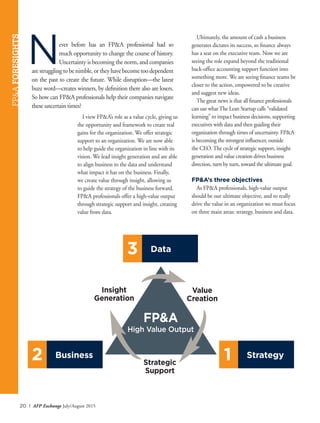
on three main areas: strategy, business and data.
FP&AFORESIGHTS
Business2 Strategy1
Data3
Value
Creation
Insight
Generation
Strategic
Support
FP&A
High Value Output
I view FP&A’s role as a value cycle, giving us
the opportunity and framework to create real
gains for the organization. We offer strategic
support to an organization. We are now able
to help guide the organization in line with its
vision. We lead insight generation and are able
to align business to the data and understand
what impact it has on the business. Finally,
we create value through insight, allowing us
to guide the strategy of the business forward.
FP&A professionals offer a high-value output
through strategic support and insight, creating
value from data.
3
www.AFPonline.org AFP Exchange I 21
The challenge is these are often in addition to
all the other requirements in our job description
that include consolidations, budgeting,
forecasting and monthly reporting. Yet, as we
accomplish these tasks at hand, we also need to
drive forward the value cycle as this is where the
real business value lies.
Strategy
The direction of the company, including the
long-term vision and shorter term missions
with tactical goals.
Business
The partners and customers externally and
sales and marketing organizations and go-to-
market teams internally.
Data
Data held in an organization internally or
from external sources. In larger organizations
there may be an operations or data analytics
group that manages this data, but they can be
found in many different departments.
Between strategy and business, FP&A’s role is
to lead in strategic partnering. What’s strategic
partnering? This takes the agreed strategy
and helps the organization translate it into
action, ultimately driving business success and
shareholder value in line with the vision.
Finance teams have always played a role here,
especially as they have adopted an independent
advisory role and have served as custodians of
their companies. Remaining independent from
the rest of the business can mean that ideas and
strategies are fresh and aligned to the vision. In
my experience, a key part of decision-making
is looking at new proposals from all angles.
Finance teams must remain independent to
ensure that they have a distinct perspective.
Between business and data we have insight
generation. The role here is to work on
translating business needs into queries. How
often do you get a request from the business to
pull a set of numbers together, and this inbound
request from the business doesn’t have many
details or doesn’t even make sense. It’s our role
to question the request and understand the true
need so that we understand the drivers and are
better equipped to find the right data to answer
the questions. Here I often go through a process
of problem diagnosis, customer analysis and data
identification. A great tool to help you with this
is the well-known “5 Whys” technique. Created
by Toyota Motors, the “5 Whys” is an iterative
question-asking technique used to explore the
cause-and-effect relationships underlying a
particular problem.
Finally, we have value creation. This is the
key learning that helps guide a business through
uncertainty. Decisions are now supported by
data. This learning ultimately can determine the
direction of the business and its vision, mission
and tactical goals. Value creation often takes the
form of data visualization, but there is wisdom
in knowing that only once we understand what
question we are trying to answer and figure out
the right data to answer that question, we will
be able to interpret the insight into business
direction. Too often I see FP&A professionals
creating reams of reporting without thinking,
“What question I am trying to answer?” or
“What action do I hope the business will take as
a result of my interpretation?”
In the perpetual cycle, value creation keeps
the spin going—between big data and strategy is
the sweet spot for FP&A. Successful companies
take a more analytical approach, moving away
from a gut feel to a “validated-learning” decision,
as entrepreneur Eric Reis calls it. With validated
learning, we can influence the direction and
strategy of a division, business group or enterprise.
The value cycle is our approach to redefine
FP&A’s role in the organization, to take a
leadership position and influence the direction and
outcome. It is our role to help facilitate this process
by taking the insight that we have generated
and convert this into more long-term strategic
thinking.That’s the place where true wisdom lives.
1
2
James Myers is a finance consultant for Hewlett-Packard.
22 I AFP Exchange July/August 2015
FP&A
Next
2.0
www.AFPonline.org AFP Exchange I 23
Introducing finance business partnering 2.0
KEY INSIGHTS:
•	Despite good intentions,
many finance business
	 partners fail to deliver
value.
•	Finance business partners
fail to deliver value because
their roles are ill-defined.
•	There are four functions
that all finance business
partners should perform—
no matter the organization
size or industry.
I
n practically every mid-size or large companies these days you will find
finance business partners, or business finance functions, with the purpose of
bringing finance closer to the business. However, despite all these functions
and teams have been created with good intentions many of them are not yet
yielding the value that was expected.
The main reason for this is that there is no clear definition of what activities a
business partner should engage in. Therefore, the position becomes a free-for-all
to put whatever job content in it a company or manager wants. So in many of
these positions you will find tasks like reporting, budgeting or even accounting-
related tasks. None of those should be at the core of what a finance business
partner does though.
We therefore need business partnering transformation and while it might be
something different depending on what function you work in I will try and
share here my views on what a finance business partner should be doing:
1.	All activities of the business partner must pass the value added test—are
they related to adding value to the bottom-line?
2.	The business partner should be connecting strategy with execution—
involvement with or driving major strategic or tactical initiatives such as
cost savings or revenue optimization projects.
3.	The business partner should be the focal point between the support
function and the business critical functions—meaning that the business
critical functions should have one point of contact into finance.
4.	The business partner will also be the one to present the numbers to the
business in order to ensure that there is one ultimate owner of the story
which Finance is sharing with the business.
Generation
Anders Liu-Lindberg
24 I AFP Exchange July/August 2015
FP&A
Above provides a high level framework for what a finance
business partner should do and what the company should
expect from the function. Before moving on to making a very
clear job description for the finance business partner 2.0, let’s
first take a look at what skills and attributes are needed to be
an effective finance business partner.
1.	Ability to work with strategic concepts that can drive a
company forward or even change the direction setting of
the company.
2.	Clearly measure and articulate the value they bring to
	 the business.
3.	Excellent communicator.
4.	Be a facilitator of finance in the business to make sure all
levels understand how they create value.
5.	Savvy with technology and use intelligent tools to analyse
financial and operational information.
6.	Recognized top finance talent as this is the finance position
with the highest potential impact.
Having defined the requirements to finance business
partnering and the skills needed to be a finance business
partner, let’s take a look at how you should then write the job
description or job ad for your future finance business partners.
The job
As a finance business partner you will work with top
management and functional leaders to create alignment
between strategy and execution. Depending on the size of the
company you might work across functions or specialize in
one or two functions, i.e., sales, operations, etc. You will act
as a facilitator who, with the company or functional strategy
in hand, works with functional leaders to translate strategy
into concrete actions. You will help the functional leader
measure the impact of the actions taken and report back to
management how the company or function is tracking on
executing the strategy. You report to the CFO or business
finance director yet your physical location is in the middle of
the business you are supporting.
Your main responsibilities include, but are not limited to:
•	 Participate in strategy meetings with management to
understand the direction setting of the company.
•	 Participate in target setting and ensure that both short
and long-term strategic priorities are catered for.
•	 Arrange and facilitate workshops with functional leaders to
create action plans on how to succeed with the strategy.
•	 Performance management of agreed upon actions to
ensure that each action can be measured on a concrete
outcome be it growth, savings, etc.
•	 Communicate performance throughout the organization
to ensure one set of numbers rather than each function
and management team making their own assumptions.
•	 Share best practices across the company, functions
	 and locations.
Personality and experience
As a person you are a natural communicator and find it easy
to engage with people no matter if they are senior leaders or
front line staff. You know your way around numbers and
know how to use latest technology and IT to present the data
in an easy to understand way. You cope very well with change
and people look to you as someone who is always on top of the
situation. You understand that you are there to support your
stakeholders and make them win. When they win you win and
the company will perform very well. Your previous experiences
include stints in other finance roles such as business controller,
financial analyst or even finance manager. However, you can
also come out of the frontline as having experience from the
business is equally important to that of financial experience.
Future career opportunities
The finance business partner is a very senior position in the
finance organization in the specialist track, but is typically a
last step before taking on a senior leadership role in finance or
for finance professionals to move into the frontline. Therefore,
there is a wide range of career opportunities open to the finance
business partner and this is also where the company tests its top
finance talents.
Now try and compare this job description/job ad with the
people you currently have sitting in your finance business
partner roles. Also use it to take a good look at who you are
recruiting in the future. Most likely you will have a match
with some of the characteristics, but only very few companies
have managed to fully nail it when it comes to setting up and
developing their business finance teams.
Your finance business partners are the key to finance
adding value to your company and now is the time to start
transforming your business finance team before they are deemed
irrelevant by the rest of the organization and retreats back into
the corner where finance professionals have usually come from.
Anders Liu-Lindberg is Regional Finance Business Partner,
Maersk Line, Copenhagen, Denmark
www.AFPonline.org AFP Exchange I 25
The business case
for employing
zero-based
budgeting for
manufacturing
Ron Giuntini
CASE
Makingthe
FP&A
KEY INSIGHTS:
•	Manufacturers incur annual warranty
	 management-related expenditures, as a
	 percentage of profit before tax, of as much as
20 percent. The warranty accrual incremental
budgeting process faces challenges when new
products are introduced.
•	Zero-based budgeting better addresses new
product introductions because budget inputs
are completely reset every budget cycle, with
new inputs captured to reflect a changing
	 business environment.
26 I AFP Exchange July/August 2015
FP&A
•	 Delivers a reasonable level of accuracy.
•	 Passes the muster of internal/external auditors.
But the warranty accrual incremental budgeting process
faces challenges when newly-designed products (NDP) are
introduced as part of the mix of warranted products. NDPs
are always defined as being recently delivered for the first
time to the marketplace. NDPs also contain a combination
of the following elements that differentiates them from
warranty cost drivers of previously designed products (PDP):
•	 Product design:
-	 Capabilities (e.g. NDP scan in 3D versus in 2D
for PDP)
-	 Reliability (e.g. NDP baseline failure of 2,000
hours of use versus 1,000 hours for PDP)
-	 Maintainability (e.g. NDP preventive
maintenance every 12 months versus six months
for PDP)
-	 Capacity (e.g. NDP gallons flow/hour of 50 versus
18 gallons for PDP)
•	 Different terms and conditions meeting product
owner expectations (e.g. NDP warranty duration of
four years versus two years for PDP).
•	 Volatility of warranty claim settlements, driven by the
production learning curve slope (e.g. warranty accruals
are 8 percent of revenues for the first 50 units of NDP
manufactured due to quality and engineering issues,
and then will decline to 2 percent starting at unit 200,
which then aligns with that of PDP). If learning-curve
projections are wrong, warranty claim settlements may
be dramatically affected.
•	 Relationship changes between the manufacturing
organization of NDP and its suppliers (e.g. parts
break-fix warranty cost responsibility is transferred
from the product manufacturer of PDP to the
production supplier of NDP, resulting in lower
accruals per unit).
The aforementioned may rule that the employment
of the incremental budgeting process is problematic
for budgeting warranty claim accruals, but a product
manufacturer should first understand the financial
materiality of those accruals. For example, leadership and/
or auditors may define the materiality threshold level as
being triggered when 20 percent of all warranted units
are NDP units, and/or when 30 percent of all warranty
U.S.-based product manufacturers incur annual warranty-
management related expenditures, as a percentage of
profit before tax, of 10 percent to 20 percent1
. That’s a
financially material impact upon the income statement.
As a result, the Securities and Exchange Commission
requires product manufacturers to publically report direct
and indirect costs related to warranty accruals, as well as
reserves and claim settlements.
This discussion will only focus on the implied/expressed
warranty of a never-employed product acquired through
the distribution channels of a manufacturer; the costs
related to an “extended warranty” will not be explored.
Note that a manufacturer can sell a warranted product
throughout the multiple levels of the supply chain. For
example, as a machine (e.g. combine), assembly employed
in a machine (e.g. engine), or a part employed in an
assembly (e.g. cylinder head).
SEC reporting requirements
Warranty driven expenditures, reported on financial
statements, can include the following, though the SEC
reporting requirements are vague:
•	 Upgrade/modification programs employed when
product performance guarantees are not met (e.g.
modification kit installed at no-cost to boost engine
performance to the level of product specification).
•	 Voluntary/mandated recall programs (e.g. a no-cost
replacement of a potentially defective airbag on a car).
•	 Goodwill initiatives (e.g. key customer’s product is
warranted an additional six months due to ongoing
reliability problems).
The most popular budget technique employed for
warranty claim accruals is the incremental budget, which
typically encompasses the following:
•	 Engages readily available analytic tools like Excel.
•	 Applies inputs from historical data sets such as claim
settlement expenses.
•	 Uses independent-demand forecasting techniques like
weighted averaging and trend.
•	 Does not consider that a black swan event may
occur and assumes the existence of a relatively stable
business environment (e.g. no major recall will occur).
•	 Efficiently manages the budget process and minimizes
levels of granularity to do so.
www.AFPonline.org AFP Exchange I 27
expenditures are driven by NDP units. Note that a unit of
warranted NDP can incur warranty claim settlement costs
that are 25 percent to 100 percent higher than that of a
unit of warranted PDP.
Once materiality levels are developed, the warranty
budgeting technique chosen can embrace one of the
following four scenarios:
1.	If warranted NDP do not meet the financial materiality
test, incremental budgeting can be continued to be
solely employed for both PDP and NDP, with an
understanding that the budgeting of accruals might be
slightly inaccurate compared to that of claim settlements.
2.	If warranted NDP do meet the financial materiality test,
an alternative should be chosen to replace incremental
budgeting in order to be more adaptive to a variety of
cost drivers and a more volatile business environment.
3.	A manufacturer can select to retain the incremental
budgeting process for warranted PDP and employ
an alternative budget technique exclusively for
warranted NDP.
4.	If warranted NDP do not meet the financial
materiality test, leadership may nonetheless seek an
alternative budget technique for the combination of
all warranted products.
One alternative budget technique to that of incremental
budgeting for warranted NDP is zero-based budgeting,
a technique in which budget inputs are completely
reset every budget cycle, with new inputs captured to
reflect a changing business environment. Note that ZBB
requires that a working business model, with simulation
capabilities, drives the selection of all its budget inputs.
The abandonment of all analytics that were performed in
the last budget cycle and starting from scratch in the next
budget cycle is not the modus operandi of ZBB.
There are several advantages to ZBB:
•	 Greater accuracy. Besides anecdotal experience,
the use of a significant number of budget inputs
tangentially invokes the Law of Large Numbers of
probability theory. Also, operational personnel from
the real world are involved and are accountable for the
validation of the inputted data sets.
•	 Greater adaptability. Easily enables changes to a
variety of inputs during multiple budget cycles and
non-stable business environments.
•	 Greater granularity. Imparts a higher level of
understanding as to the complexity of a warranty
program and its financial impact. Often an
“awakening” for leadership to dedicate greater
resources in this area to improve the efficiency and
effectiveness of the processes.
•	 Greater action orientation. Increases the ability of
an organization to identify unfavorable warranty cost
trends and engage in targeted changes, sooner rather
than later.
The business model driving zero-based warranty
budgeting includes such inputs as:
•	 Products/models types that will be warranted during
the forecasted period.
•	 Population size and value of warranted units.
•	 Customer solutions required to meet obligations of
the warranty terms and conditions.
•	 Processes and their activities required in delivering
customer solutions.
•	 Direct and indirect resources employed in each of the
solution-driven processes.
•	 Quantity requirements for each resource.
•	 Cost-estimating relationships.
The clarity and adaptability of a zero-based warranty
budgeting initiative creates a standard of excellence that
is hard to surpass. But a ZBWB project is not an easy
endeavor to undertake. It can be extremely inefficient and
even ineffective when the following are lacking:
•	 A detailed business model driving the budget.
•	 Analytical software with simulation capabilities.
•	 Oversight by seasoned operational and financial
professionals knowledgeable in warranty management.
•	 Support from leadership.
Despite these challenges, ZBWB should be considered
as the budgeting process of choice for product warranty
accruals, regardless of financial materiality.
Ron Giuntini is principal with Giuntini & Company Inc.
FOOTNOTES
1.	 Blended SEC 10K reporting and Warranty Week
analytics:
•	 Warranty claim expense as a % of revenue of 1%
	 to 3%.
•	 PBT as a % of revenue of 8% to 12%.
28 I AFP Exchange July/August 2015
Risk Management
KEY INSIGHTS:
•	The foundation of an effective debt
	 compliance program is a comprehensive
and prioritized covenant checklist—but
that’s easier said than done.
•	Lenders have two objectives: preserve
the status quo at debt issuance (e.g.,
existing credit conditions, security and
operations) and to be quickly informed
of any adverse changes to the status
quo so they can re-evaluate the credit
risk, agreement terms and pricing.
•	Best practice is to classify covenants
by lender objective and risk—not by the
legal categories of affirmative, negative,
financial and nonfinancial.
A
s many treasury and finance professionals will attest,
organizing covenants by the legal categories of
affirmative, negative, financial and nonfinancial is
not very helpful. A better approach is to classify covenants by
lender objective and risk. Using lender objectives is effective
because nearly every covenant can be easily classified into
nine logical lender objectives. Doing so facilitates the accurate
comparisons needed to eliminate repetitive covenants in the
same agreement and determine the controlling covenants of
multiple debt agreements.
Lenders tell borrowers which covenants are most important
to them by stipulating 0-3 day cure periods. The “independent
covenants” that are triggered by events and actions outside the
agreement should have the initial risk focus rather than the
“dependent covenants” that are triggered by the agreement’s
independent covenants. Finally, it is relatively easy to winnow
out the common boilerplate and “lender option” covenants.
The latter are actions or payment demands initiated by the
lender that the borrower must allow or pay.
The foundation of an effective and efficient debt compliance
program is a comprehensive and prioritized covenant checklist.
Developing one is a difficult, time-consuming task because it
is much more than summarizing the affirmative and negative
covenants sections of a debt agreement. Depending upon credit
risk, a senior credit agreement will have 80 to 100+ covenants,
with 35 percent to 50 percent of them scattered throughout the
agreement outside these two sections.
Clutter
Cutting
Developing a risk-based
debt covenant checklist
Jeff Wallace and Jim Simpson
www.AFPonline.org AFP Exchange I 29
Figure 1: Classified Covenants
Maintain
Collateral
and Security
Preserve
Assets and
Businesses
Minimize
Third Party
Claims
Allow
Specific
Limited Claims
Guarantees
Continuing
Reps and
Warranties
Subordinated
Debt and
Anti-Layering
Indebtedness
Securing
New Assets
and Subs
No Assets
and
A/R Sales
Cross-Default/
Cross-
Acceleration
Letters
of
Credit
Further
Assurances
Other
Restricted
Transactions
Compliance
with Laws and
Regulations
Liens
Springing
Liens
Business
Nature, IP,
Insurance, etc.
Material
Contracts
Sales and
Lease-Backs,
etc.
Classifying covenants by lender objectives
In general, lenders have two objectives. The first is to
preserve the status quo at debt issuance: the existing credit
conditions, security and operations. The second is to be
quickly informed of any adverse changes to the status quo
so they can re-evaluate the credit risk, the agreement terms,
and the pricing. More specifically, lenders use covenants to
maintain their collateral and security interests; to preserve the
borrower’s assets and business operations; and to minimize
third party claims, while allowing some limited claims. See
Figure 1.
In addition, lenders also require borrowers to make
payments; to meet performance benchmarks; to regularly
report results; to report material events quickly after they
occur; and to give themselves the option of doing certain
actions or demanding additional payments. See Figure 2.
Figure 2: Classified Payments
Make
Payments
Meet
Benchmarks
Report
Results
Report
Material
Events
Principal,
Interest
and Fees
Maintenance
Financial
Ratios
Financials,
Ratios and
Certifications
Events of
Default
Mandatory
Prepayments
Incurrence
Financial
Ratios
AR, AP and
Other Financial
Schedules
Change
of
Control
Make
Whole
Payments
Weekly/
Monthly
ABL Reports
Asset
Sales/Claim
Proceeds
Voluntary
Prepayments
Many
Other
MAEs
Lender
Options
Visitation and
Inspection
of Records
Payments
for Increased
Costs
30 I AFP Exchange July/August 2015
Risk Management continued
Risk defined by lender cure periods
Lenders aggregate the covenants into events of default
categories that have different cure periods based upon the
importance the lenders attach to their compliance. The
chart below summarizes how this is typically done for senior
credit agreements. See Figure 3.
Covenant violations related to the reps and invalid
security and collateral agreements are among the lenders’
most serious covenant violations. Yet, in our experience,
the reps and the security and collateral covenants (and any
related security and collateral agreement) rarely receive
more than cursory treatment in most debt compliance
programs. While companies do make every effort to provide
accurate reports to their lenders, few are aware that that an
inaccurate report can be an immediate event of default.
Lenders will add other events of default that do not
appear elsewhere in the agreement. They are standalone
covenants that must be included in the covenant checklist.
Common examples are:
•	Cross-Default		
•	Judgments
•	Cross-Acceleration	
•	 Cancellation of material contracts
•	 Guarantors’ default	
•	 ERISA events
•	Bankruptcy/insolvency	
•	 Governmental actions
•	 Change of control	
•	 Revocation of licenses
Further identifying covenant risk
A risk-based debt compliance program focuses on
the real, manageable risks by excluding the dependent
covenants, any not applicable boilerplate covenants, and the
lender option covenants.
Figure 3: Classified Default Categories
0
Days
Up to
3 Days
Up to
5-10 Days
Up to
30-60 Days
Specific
Events of
Default
Principal
Payments
Regular
Reporting
Compliance
with Laws and
Regulations
Continuing
Reps and
Warranties
Mandatory
Payments
Financial
Ratios
Commercial
and Material
Contracts
Security
and
Collateral
Interest
and
Fees
Notices
of EODs
and MACs
Preserving
Assets
Invalidity
of Credit
Permitted
Baskets
Administrative
Requirements
Incorrect
Deliverables
Restricted
Transactions
Subordinated
Debt and Liens
Restricted
Payments
www.AFPonline.org AFP Exchange I 31
Dependent Covenants:
Independent covenants are triggered by events or actions
outside the agreement, while dependent covenants are any
required actions following a triggering of an independent
covenant. A notice of an asset sale is an independent
covenant. The subsequent covenants requiring the
proceeds to be reinvested in similar assets within a certain
period of time or used to prepay the debt are dependent
covenants. Many notice requirements will have dependent
covenants, especially in covenant-lite deals. The latter will
often dependent incurrence covenants, requiring the pro
forma calculation of financial ratios against fixed limits.
The dependent covenants are not relevant if their
independent covenant has not been triggered. While
independent covenants represent the initial risk,
dependent covenants also pose a significant risk because
they are often forgotten.
Always when a covenant issue arises, the compliance
team must read the applicable debt agreement text to
ensure that all requirements are or will be satisfied.
Provided that there is such a commitment, then the
dependent covenants do not need to be monitored in the
quarterly compliance process.
Boilerplate covenants:
Nearly all debt agreements will have these kinds of
covenants:
•	 Preparing the books in accordance with GAAP
•	 Compliance with the Foreign Corrupt Practices Act,
the Patriot Act, etc.
•	 ERISA events
•	 Becoming an “Investment Company” per the
Investment Company Act of 1940
•	 Federal Reserve Board Regulation U on margin stock.
It is unnecessary to include the first two in the
debt compliance program if they are covered by the
company’s other compliance programs. If the company
has no defined benefit plans, the ERISA covenants are
simply not applicable. Similarly, there’s no chance that
any nonfinancial company will suddenly become an
investment company or start providing stock margin loans
to its customers. Banks include these two because they are
related to restrictions imposed by their regulators.
Lender option covenants:
Lender option covenants give the lender the right
to request certain information at any time or demand
additional payments based upon changed circumstances
independent of the borrower. These covenants include
the right to visit the borrower, inspect or audit the books,
and have discussions with management. They also include
additional payments due to changes in law or reserve
requirements that increase the lender’s borrowing costs.
Since these covenants are initiated by the lender and are not
triggered by borrower actions, they are not compliance risks
that can be managed. Of course, they need to be complied
with when they are initiated by the lender.
What remains
For debt compliance purposes, by excluding the above
covenants, we are left with a risk-based list of relevant,
controlling covenants organized by logical lender objectives.
Further risk analysis can be done, excluding the unlikely
covenants from the moderate to high risk covenants, provided
that the covenants deemed unlikely are periodically reviewed.
From this carefully vetted list, we can confidently develop a
multi-agreement quarterly questionnaire process to document
the compliance, a consolidated permitted baskets analysis,
and a consolidated calendar of the regularly scheduled
payment and document delivery due dates.
The covenant questionnaires, organized by objective and
subject provide a useful context to non-treasury/legal staff for
why these covenants are important and why they need to be
responsible for their compliance.
This checklist process identifies the covenants that need
to be regularly monitored without cluttering the debt
compliance program with covenants that are initially not or
really not relevant. However, in debt compliance the only
authority is the debt agreements, not the checklist. Just like a
map is not the territory.
So, whenever a covenant issue is raised, it is the compliance
team’s responsibility to research the applicable covenant text and
make sure that the company is in compliance with all of the
covenant’s requirements, including any dependent covenants.
Jeff Wallace and Jim Simpson are managing directors of Debt
Compliance Services LLC. www.debtcompliance.com.
32 I AFP Exchange July/August 2015
AFP, Association for Financial Professionals, the AFP logo, CTP and FP&A are registered trademarks of the Association for Financial Professionals. © 7/15.
Big data. Global outreach. More information at your fingertips than ever
before. Find new practical solutions to the challenges you face at the AFP
Annual Conference — the most important event in treasury and finance.
TM
Treasury
Management
FPA
Financial
Planning &
Analysis
PY
Payments
RM
Risk
Management
8 TRACKS130+ SESSIONS
» ROUNDTABLES
» WORKSHOPS
» CASE STUDIES
» PANEL DISCUSSIONS
» PRESENTATIONS
» INSPIRING STORIES
SESSION TYPES:
Opening General
Session
PRESIDENT
GEORGE W. BUSH
Tuesday General
Session
ITZHAK PERLMAN
GENERAL SESSION SPEAKERS:
www.AFPonline.org AFP Exchange I 33
COMPANIES IN ATTENDANCE INCLUDE:
» » » REGISTER BY SEPTEMBER 18 TO SAVE $200
www.AFPconference.org/2015
GTF
Global Treasury
& Finance
CD
Career
Development
CF
Corporate
Finance
PB
Pensions &
Benefits
30.3 CREDITS
Earn up to 30.3 CTP/CCM and FP&A
credits and 30 CPE credits.
As of 6/30/15. Subject to change.
Land O’Lakes / Merck / Alcoa / MGM Resorts International / Nordstrom / Pfizer / Visa
/ Discovery Communications / Whole Foods Market / Netflix / Ross Stores / Qualcomm
/ Kimberly-Clark / Hanesbrands / Northrop Grumman / Western Union / Caesars
Entertainment / Lowe’s / Delta Air Lines / Starbucks / Ralph Lauren / FedEx / Google
/ Starwood Hotels & Resorts / Costco / GameStop / Microsoft / Allstate / Cigna /
Rite Aid / Walmart / NRG Energy / McKesson / salesforce.com / Boeing / Owens Corning
/ Boston Scientific / Ingram Micro / Tractor Supply / Nationwide / Comcast / Barnes
& Noble / General Electric / Hormel Foods / Coca-Cola / Dick’s Sporting Goods / Estee
Lauder / Johnson & Johnson / Southwest Airlines / Amazon.com / Dow Chemical /
iHeartMedia / Time Warner Cable
34 I AFP Exchange July/August 2015
Research: 2015 AFP Liquidity Report
KEY INSIGHTS:
•	When it comes to corporate investing, treasury and finance professionals are growing
slightly less focused on safety.
•	Cash holdings are expected to increase due to improving operating cash flows.
•	Selecting a money fund is increasingly part of bank relationship management.
Results of the 2015 AFP
Liquidity Survey reveal
low returns, flat yields
AFP Research Department
SMALL
www.AFPonline.org AFP Exchange I 35
For the 936 treasury and finance
professionals who participated in this survey
in May, safety of principal remains paramount
as an investment objective, as has been the
case for most of the last decade. This year,
the share of finance professionals ranking
safety as the number one investment objective
dropped three percentage points to 65 percent.
Liquidity picked up the offset and increased
with 31 percent of survey respondents citing
liquidity as the primary investment objective.
Yield remains a distant third at 4 percent,
unchanged from last year.
The survey results reveal other key findings:
•	 70 percent of organizations maintain
written investment policies, down
	 6 percent from 2014
•	 80 percent of organizations with written
investment policies review their policies on
a regular basis.
•	 Two-thirds of all short-term investment
holdings are in vehicles with maturities of
30 days or less.
•	 80 percent of organizations anticipate
their organizations will maintain the
status quo with regard to their current
profile for maturity.
Bank deposits continue to be the investment
vehicles of choice, even though access to
unlimited FDIC insurance under theTransaction
Account Guarantee (TAG) program ended
almost three years ago. Currently, 56 percent of
all corporate cash holdings are still maintained at
banks—the largest share reported in the 10-year
history of the Liquidity Survey.
To assess the current and emerging trends in organizations’ cash and
short-term investment holdings, investment policies and strategies,
the Association for Financial Professionals conducted its 10th annual
AFP Liquidity Survey in May 2015. Underwritten by State Street Global
Advisors (SSGA), the 2015 AFP Liquidity Survey reveals that the short-term
investment landscape continues to be characterized by low-return and a
relatively flat yield in a continued low interest rate environment.
Short-term investments and
cash holdings
Nearly one-third of finance professionals
report an increase in their organizations’
cash holdings within the U.S. and 46
percent indicate no significant change
in the same. Fully 56 percent of finance
professionals report that in the past year their
organizations’ investments outside the U.S.
were unchanged—higher than the 42 percent
last year.
About half of corporate practitioners whose
organizations have non-U.S. cash holdings
report some changes in their companies’
average balances since May 2014. While a
greater share of finance professionals report
that their companies are increasing their
cash holdings outside the U.S. (27 percent)
than depleting them (17 percent) that
percentage is far less than the 44 percent of
finance professionals in last year’s survey. This
shift likely reflects the impact of economic
uncertainty in the Eurozone, sanctions
imposed on Russia, and general business
conditions in emerging markets.
Similar to past surveys, most organizations
that increased their cash holdings during the
past 12 months did so because they were
generating higher operating cash flow (cited by
72 percent of respondents). The second most
commonly cited driver of greater cash holdings
is generating additional revenues from the
acquisition of a new company (25 percent)
followed by a shortened/decreased working
capital cash conversion cycle (21 percent).
36 I AFP Exchange July/August 2015
For those companies that had decreased cash
holdings compared to a year ago, the primary
reasons for those smaller cash holdings include:
•	 Decreased operating cash flow (cited by 47
percent of respondents)
•	 Acquired company/subsidiary/and or
closed operations (32 percent)
•	 Increased capital expenditures (32 percent)
•	 Paid-back retired debt (18 percent).
Over 80 percent of survey respondents
from organizations that expect to increase
their cash holdings in the next 12 months
believe this will be the result primarily of
increased operating cash flows. Among those
finance professionals who anticipate their
organizations will decrease cash holdings
over the next 12 months, 39 percent see
such action as a result of increased capital
Leading Causes of the Net Change in Organization’s Cash Holdings
(Percent of Organizations with Increased or Decreased Cash Holdings in the Past 12 Months)
100%
80%
60%
40%
20%
0%
72%
25% 21%
47%
32% 32%
Increased holdings
Increasedoperating
cashflow
Increasedcapital
expenditures
Shortened/decreased
workingcapitalcash
conversioncycle
Acquiredcompanyor
subsidiary/launched
new
operations
Decreasedoperating
cashflow
Paidback/retireddebt
Decreased holdings
Decreasedcapital
expenditures
Acquiredcompanyor
subsidiary/launched
new
operations
18%19%
Primary Drivers of Anticipated Change in Short-Term Cash Balances over the Next 12 Months
(Percent of Organizations Anticipating an Increase or Decrease in Cash Holdings)
81%
17% 16%
39%
33% 27%
Increasedoperating
cashflow
Increasedcapital
expenditures
Shortened/decreased
workingcapitalcash
conversioncycle
Acquiredcompany
orsubsidiaryand/
orlaunchednew
operations
Decreasedoperating
cashflow
Decreasedcapital
expenditures
Increasedshare
repurchases/
dividends
Acquiredcompanyor
subsidiary/launched
new
operations
18%
14%
100%
80%
60%
40%
20%
0%
Increased holdings Decreased holdings
Research: 2015 AFP Liquidity Report
Source: AFP
www.AFPonline.org AFP Exchange I 37
expenditures. In addition, one-third of those
anticipating a decline in cash cite decreased
operating cash flow as a reason for a decline in
cash holdings.
Current allocations
The typical organization currently keeps
56 percent of its short-term investment
portfolio in bank deposits. That is an increase
of four percentage points from the 52 percent
reported in 2014 and the highest share
reported in the 10-year history of the AFP
Liquidity Survey.
Money market funds
Selecting a money fund is becoming part
of bank relationship management. In fact,
for the majority of organizations (54 percent)
Source: AFP
Current Percentage of Organization’s Short-Term Portfolio Allocated to Specific
Investment Vehicles
(Mean Percentage Distribution of Cash and Short-Term Investment Holdings)
100%
90%
80%
70%
60%
50%
40%
30%
20%
10%
0%
Percentage of short-term investments in bank deposits, MMFs and Treasury bills
Percentage of short-term investments in bank deposits
56%
	2006	 2007	 2008	 2009	 2010	 2011	 2012	 2013	 2014	 2016
23%
60%
27%
73%
25%
78%
37%
74%
51%
78%
42%
74%
51%
74%
50%
75%
52%
77%
56%
the most important factor when selecting a
fund was not the fund ratings as one might
suspect, but rather the fund sponsor taking a
role in the bank relationship mix and support.
Forty-six percent of finance professionals rank
fund ratings as the number one consideration
when selecting a fund, while 37 percent rank
counterparty risk of underlying instruments as
the primary deciding factor.
The second most important factor in
selecting a money market fund is yield
(cited by 39 percent of practitioners), closely
followed by both counter party risk and
diversification of underlying instruments.
More than half of finance professionals
cite ease of transacting with the fund and
accounting treatment as the third most
important criteria when selecting a fund.
A majority
of finance
professionals
indicate that
having a fund
sponsor take a
role in the bank
relationship mix
and support is
the number one
consideration
when selecting
a fund
38 I AFP Exchange July/August 2015
Conclusion
Results from the 2015 AFP Liquidity Survey
reveal a number of key messages:
•	 Safety of principal again ranks first among
investment objectives as has been the case
for most of the last ten years. But the
share of finance professionals citing safety
as the primary investment objective has
shrunk slightly from 68 percent in 2014
to 65 percent in 2015.
•	 The importance of liquidity as an
investment objective has grown; 31
percent of survey respondents cite
liquidity as an objective this year
compared to 28 percent in 2014.
•	 A majority of all corporate cash
holdings—56 percent—is still maintained
at banks. This is the largest share of cash
Primary Drivers to Select a Money Market Fund
(Percent of Organizations that Permit MMFs as an Investment Vehicle)
	
	 One	Two	Three
Fund sponsor is part of our overall bank relationship mix and support
	 54%	26%	 20%
Fund ratings	
	 46	33	 21
Counterparty risk of underlying instruments	
	 37	38	 25
Yield	
	 30	39	 30
Diversification of underlying instruments	
	 23	38	 40
Investment manager for separately managed accounts or manages other investment products for us	
	 20	35	 46
Accounting treatment of the fund	
	 18	27	 55
Ease of transaction process	
	 17	27	 56
Most Important
holdings held at banks in the 10-year
history of AFP’s Liquidity Survey.
•	 While bank products remain the largest
segment of investment options, current
survey results show a significant change
in the mix from previous years. Time
deposits are still the highest class within
the bank product category, but the share
of non-interest bearing deposit accounts
declined from 51 percent last year to 40
percent this year.
•	 With the SEC having finalized new rules
on certain money market funds, how will
companies accommodate those changes in
their short-term investment objectives? A
majority of survey respondents indicate that
their organizations are planning to make
changes in how they invest in prime MMFs.
Source: AFP
Research: 2015 AFP Liquidity Report
Liquidity
www.AFPonline.org AFP Exchange I 39
KEY INSIGHTS:
•	Implementing in-house banks are
challenging—set realistic timelines.
•	Use the creation of an in-house
	 bank as an opportunity to create
	 better processes—don’t just recreate
old ones.
•	In-house banks aren’t for every
	 treasury group. Alternatives include
greater standardization of policies and
systems, rationalization of banks and
accounts, and pooling and netting.
DAYHow Bombardier
uses in-house
banking to improve
cash management
Drew Arnold
Globalization has been the catalyst for more
complex cash flows, in multiple currencies
from multiple locations, and multiple legal
entities. The impact of this can create treasury and finance
structures that are disparate, multi-locational and, indeed,
complex. This has led some corporates to review their
structures as well as key performance indicators, and
implement structures that enable them to manage a whole
host of disciplines, including funding, risk management,
investment, liquidity management, payments and
collections and management information systems. In short,
they setup a so-called in-house bank (IHB).
MOVING
40 I AFP Exchange July/August 2015
Corporate Finance
At Deutsche Bank, we are increasingly
having discussions with our clients around such
structures, which are not exactly banks in the
true sense of the word, but offer the type of
services and adopt the characteristics associated
with a cash management-focused bank.
This structure is particularly relevant—and
effective—when the corporate in question has
a complex network of subsidiaries. Although
the corporate sets the IHB up, we have
worked with a number of clients on advising
them on the appropriate structure and services
they might need for a truly effective IHB.
One of our key clients, Bombardier,
was an early advocate of the concept, and
has been realizing the benefits. “We were
looking to consolidate a new treasury
workstation model, moving the center
of competence from Brussels to Zurich,”
said Debra Hinds, Bombardier’s Director,
Global Cash Management. “The overriding
theme was to seek out efficiencies and, quite
simply, to better manage and provide greater
transparency around our cash.”
In most cases, an IHB enables companies
like Bombardier to take the place of third-
party banks. The company’s subsidiaries open
accounts with the IHB, either in a single
functional currency or multiple currency
accounts. Subsidiaries can not only be granted
credit lines, but can also borrow and invest
with the IHB.
No easy task
While the pluses are many, it is not simple
to implement an IHB. “There are so many
considerations and so many people to align
in the process, so expectations have to be
tempered around timelines,” Hinds said. “You
are looking at many jurisdictions and with
that comes tax, legal and regulatory issues
that will vary across the regions. Once you
have made the decision to take this route to
financial efficiency, enthusiasm builds at a
pace that has to be managed.”
So what have been the benefits for
companies like Bombardier? In the post-
financial crisis world, efficiency has become
something of a mantra, but as Hinds reveals,
this is no mere buzz word. “We have been
able to achieve a much better level of cash
utilization,” she said. “Importantly, we have
also been able to rationalize FX transactions
executed locally and regionally. And we have
certainly been able to make better use of cash
on account, directing money in the pool
towards lending to entities. We are satisfied
that we have attained a far better way of
managing our cash.”
Certainly, those corporates that have already
used an IHB have moved from structures that
invariably resemble Gordian knots to more
streamlined and consolidated cashflows as well
as enhanced working capital management,
greater control and risk management and
better reporting.
But any corporate wanting to set up an
IHB has to fulfill a number of requirements,
not least of which is getting buy-in across
the organization and senior management
endorsement. An IHB is not something that
can be taken out of a box and plugged in. The
scope of the project has to be determined,
and the corporate has to ensure it has the
optimal technology and cross-organization
cooperation and service level agreements.
“It’s important to realize across the company
that this is an evolutionary—rather than
revolutionary—process,” Hinds said. It’s very
much one step at a time. In our case, it was
190 different accounts into the structure and
therefore not something that could be done in
www.AFPonline.org AFP Exchange I 41
one step. In many ways, it’s a job that will never
end. There will always be new efficiencies to
capitalize on and large corporate bodies, after
all, are organic and constantly changing.”
Furthermore, implementing an IHB has to
balance global, regional and local requirements
as well as the locations where the IHB will
operate. Wherever that may be, the support
infrastructure has to be in place along
with communications and, of course, the
appropriate skill-sets to support the project.
At Bombardier, they also ensured that the
best possible structure and practices were put
in place. “We made certain that we did not just
incorporate the old way of doing things,” Hinds
said. “It was not a question of bringing legacy
structures into the IHB.This was a chance to do
something new and that’s what I would advise
people to do if they are taking this route.”
However, an IHB may not suit every
treasury and finance organization. There are
drawbacks in setting them up, notably around
the complexity involved and the fact that
processes are concentrated. In other words,
those things that may deliver benefits to some
companies, may create headaches for others.
There are alternatives that can deliver many
of the benefits of an IHB. These include
greater standardization of policies and systems;
rationalization of banks and accounts and
pooling and netting solutions that can all help
create treasury efficiencies.
Who benefits?
The companies that will benefit most from
an IHB are those that are complex, global and
largely decentralized, using diverse systems and
in need of variable funding requirements. The
evaluation of such a project should involve all
stakeholders and, from day one, be enhanced by
engaging external tax and legal advisers. Right
from the start, dialogue with bank providers
should take place. It is advisable, as Hinds
confirms, that a multiyear phased approach
is adopted towards full implementation. “It’s
important to define your objectives well as an
IHB is more sophisticated than it may first
appear,” she said. “And you need a system that
can handle this well. You will not be able to
function on spreadsheets.”
There’s another element that must be
carefully considered. If a legal entity does not
fit the IHB model, then brute force is not a
good idea. Levels of participation in an IHB
should be variable, although most entities
will, essentially, be eligible for inclusion.
Ultimately, IHBs deliver enormous benefits
for major corporates. “Preparation is key,”
Hinds said.
“If you ensure your treasury operation has
the right building blocks you need to move
towards an IHB, the entire process will be that
much smoother.”
Drew Arnold, Director—Working Capital
Advisor, Deutsche Bank, and Debra Hinds,
Director, Global Cash Management,
Bombardier, co-presented on in-house banking
at the 2014 AFP Annual Conference.
IHB Key Decisions
Key decision in developing an IHB include:
•	Activities:
	 Define which and when they will be implemented
•	Technology:
	 In-house system, treasury workstation, etc.
•	Roles, responsibilities and ownership:
	 Treasury, shared service center, combination
•	Global, regional and local requirements
•	Location
42 I AFP Exchange July/August 2015
Corporate Finance
Maximizing shareholder value requires
corporate performance management discipline
In the final analysis, the purpose of
management is to maximize firm and
shareholder value.
Corporate performance management (CPM)
is, therefore, critically important in measuring
and managing firm and shareholder value.
Earnings per share, total shareholder return, sales
growth, economic profit (EP), EBITDA, ROE,
ROIC, EVA, etc. constitute the alphabet soup of
frequently-used CPM metrics.
Self-Control
Jonathan Hall
KEY INSIGHTS:
•	 Corporate performance management is
	 where business intelligence intersects with
	 monitoring and using KPIs to measure key
	 business processes in order to drive and
	 measure firm value.
•	 Key performance indicators are not measures of
shareholder value. They are metrics of the key
operating levers that result in the firm’s economic
profit or loss.
•	 Any metric setting requires an understanding
	 of the firm’s corporate culture, the governance
environment, and employee skills and weaknesses.
www.AFPonline.org AFP Exchange I 43
Shareholder value is created by
earning returns on both existing
and new investments in excess of
the capital required to fund the
investments, or in excess of the
opportunity costs within the market,
and to do so in excess of the economic
profits earned by the firm’s peer group.
The key word here is “economic”
instead of accounting-based profit.
Accounting and earnings-based
metrics have several issues. Even under
the watchful glare of GAAP, accounting-
based profits can be fairly easily
manufactured.These metrics not only
ignore the level of risk in the firm, they
ignore the working and fixed capital
investment required for the business
to function properly.They also ignore
dividend policy, and they ignore future
cash flow potential of the business.
In starting with accounting-based
metrics, various adjustments are required
to craft an economics-based view of the
business. For example, we should:
•	 Use an asset’s true economic
depreciation instead of an
accounting-based one
•	 Treat advertising, R&D and
training as the capital employed
that they truly are versus a
	 period expense
•	 Recognize the capital employed
equivalency of operating leases
instead of their traditional
operating expense treatment, etc.
Research studies show a significant
correlation of economic profit growth
to sustainable stock price appreciation.
This is in recognition of the increase in
firm value which results in shareholder
wealth and shareholder value creation
(SVC). SVC metrics most frequently
cited include: economic profit and EP
momentum and EVA as a trademarked
version of this metric; shareholder value
added; operating cash flow return on
market value of assets, and a few others.
Even the famed ROIC metric has
(as all metrics do) its pros and cons.
When compared to a firm’s weighted
average cost of capital (WACC) or
opportunity cost of capital (OCC),
ROIC can be a good directional
measure of value created. Some of
its shortcomings are that it does
not capture future value and it only
captures investor expectations relative
to historical performance based on
traditional accounting-based measures.
Additionally, an over reliance on
ROIC could result in unintended
consequences such as under-investment
in the firm as the company tries to
rationalize its capital base.
Where do KPIs fit in all of this?
Key performance indicators are not
measures of shareholder value. They
are, however, measures of things that
ultimately drive the CPM metrics of
firm and shareholder value. KPIs are
great for measuring and managing the
operating levers and dimensions of the
business. For example, units per hour,
calls per call center representative, sales
per employee and billable hours per
attorney. In retail, sales per labor hour
or sales per square foot are good key
performance metrics. The result of all
of this activity is captured primarily in
the financial statement, P&L, balance
sheet and cash flow.
KPIs, then, are meant to measure
the interrelationship between supplier
partnerships, the business’s core value-
adding activities, and the capabilities
and resources that support and drive
the firm’s value proposition supported
by, and impacting, the business’s cost
structures and revenue streams.
But which is best? And, how many
metrics should we use?
The debate between those who
support many CPM metrics versus those
who support “less is more” rages on.
According to a 2010 IBM Institute
for Business Value survey of more
than 1,900 global CFOs, respondents
use, on average, at least four different
corporate metrics. The most common
were: EBITDA, profit, sales, ROIC
growth and expense ratios. As well, the
use of a “balanced scorecard” continues
its steady pace of converts. The most
cited reasons for the use of multiple
metrics are the:
•	 Diversity of the types of businesses
under a corporate umbrella
•	 Level of employee experience
	 and skills
•	 Breadth and depth of the
business’ reach, functionally and
geographically
•	 Desire to capture sales, traditional
accounting-based earnings
measures and capital efficiency in
order to address the quarter-to-
quarter focus of “the street,” and
•	 Desire to provide various
stakeholders and constituents
	 a voice.
Which metric is best?
GAAP-based sales and earning
metrics are the most frequently cited by
CFOs, but are these the best metrics in
order to achieve management’s prime
objective of maximizing firm and
shareholder value?
As economist Sir Alfred Marshal
stated back in the early 1800s,
shareholder value is what remains
of profits after deducting interest
in capital. This is generally called
economic profit.
44 I AFP Exchange July/August 2015
Corporate Finance
the initiatives the firm launches to
accomplish its stated strategies, metrics
are established to measure performance.
Many books, articles, journals,
seminars, classes are devoted to
this topic alone. In my experience,
though, any metric setting requires an
understanding of the firm’s corporate
culture, the governance environment,
and employee skills and weaknesses.
The metric-setting process generally
starts with setting a baseline based on
historical results. Assessing the firm’s
past, present and future success vis-à-vis
certain metrics should be influenced by
an understanding of what competitors
in the marketplace are doing.
Unless you have a firm where one
or a few folks are making most of the
daily decisions, then all throughout
the OSIM process collaboration,
alignment and negotiation is
required—especially during the
metric-setting phase. During this
phase having a combined front-line
view, a middle-management view and
a senior/executive leadership view is
important.
Most important, however, is aligning
these perspectives. This alignment
process is where the sausage gets made;
it can get ugly. That’s okay. That said,
at the end of the day, with the various
perspectives heard and debated,
a decision must be made. Again,
depending on the firm’s corporate
culture and governance environment,
the final decision can be made by
the owner/founder, president/CEO,
COO, CFO, the executive leadership
committee, or some combination of
the above or by mid-management.
Given the dynamic nature of most
businesses and the marketplace in
which they operate, these metrics must
be reviewed frequently to ensure they
remain SMART.
The ‘holy grail’
Economic profit and other value-
based metrics, when used correctly, are
powerful performance management
tools that help drive shareholder
value. When these value-based
metrics are integrated and aligned
with key performance indicators
(KPIs) throughout all levels of the
organization and when they are aligned
with the firm’s capital structure strategy,
they become even more impactful in
maximizing shareholder value.
Keeping these three dimensions
aligned and integrated in a fluid business
environment, especially as the business
progresses through the various stages of
the business life cycle, is “the holy grail”
for CEOs, CFOs and their teams.
But it all starts with an effective
corporate performance management
discipline.
Jonathan Hall is Vice President, Finance
& Strategy/CFO, Walmart Services.
Source: Jonathan Hall.
ROE, ROA, ROIC, EPS, sales and
profit growth, etc. are great financial
KPIs, or key financial metrics.
These KFMs, however, are not great
corporate performance measures meant
to help gauge and manage firm and
shareholder value creation.
To be effective, all metrics, whether
KPIs/KFMs or CPM metrics should be
SMART: specific, simple, actionable,
relevant, timely and transparent.
Setting metrics
Now comes the hard part. Practically
speaking, how does this work? In
my experience, over the last two-
plus decades with four Fortune 200
companies and one mid-sized d firm,
what I have seen that works best can
be illustrated by the diagram below
and best described as a collaborative,
matrixed and alignment approach.
Based on the customer problem
you’re trying to solve, or the market
opportunity you’re trying to capture,
the leadership of the firm sets the firm’s
strategic objectives.Then, based on
the key drivers of the business and
Figure 1: O.S.I.M. Performance Framework
Strategies
Key
Initiatives
Processes
and
Tactics
Key
Performance
Indicators
(Metrics)
Objectives
Start
Feedback/
learning
Loop
Maximizing
Firm and
Shareholder
Value
(Measured by
CPM Metrics)
www.AFPonline.org AFP Exchange I 45
Treasury Essentials
GO
Let It
Are companies finally
investing their cash reserves?
Andrew Deichler
The economic recovery has been long and slow, but gradually businesses
are letting go of the cash they’ve been holding on to since the 2008-09
financial crisis.
For three consecutive fiscal quarters, U.S. businesses indicated that they were
shedding some of their cash holdings, according to the AFP Corporate Cash
Indicators®
(AFP CCI). While some companies appear to be taking a wait-and-see
approach with the economy, they are generally not holding cash tight to the chest
like they have in previous years.
KEY HIGHLIGHTS:
•	Confidence in the
recovery is building,
leading many
	 companies to invest
their cash reserves.
•	Some companies
are investing in new
technology out of
necessity, either to
improve their
	 productivity—or to
prevent major threats
like cyberfraud.
•	Budget cuts to state
and local govern-
ments continue to be
a problem for many
businesses that rely
on them, but new
sources of revenue
have emerged in the
past several years.
46 I AFP Exchange July/August 2015
Treasury Essentials
So the question is, as companies begin to
spend some of that cash, where is it going?
According to a recent survey of 781 U.S.
business owners and executives by BMO Harris
Bank, nearly 60 percent of companies plan on
making investments in their business this year.
Potential investments include the following:
•	 Expanding operations (31 percent)
•	 Upgrading/purchasing new equipment
	 (26 percent)
•	 Modernizing technology/systems
	 (23 percent)
•	 Hiring more employees (20 percent).
on to cash “very aggressively” throughout the
financial downturn. “The economy since 2008
has been a struggle for the schools, which are
funded primarily by real estate taxes,” he said.
“So we had to constrain ourselves immensely.”
But now, with the economy improving,
Gumdrop has undertaken a major initiative.
All of the schools that purchase books from
Gumdrop have different requirements for how
they want information presented on the outside
and interior of the books—how many numbers
go on the label, whether the author’s name is
fully spelled out, etc. Gumdrop is developing
a database that is essentially a “one-stop shop”
for all of this information. “We’ve invested over
the last two years about 12,000 programming
hours into this project,” Schnieders said.
The project will save Gumdrop a substantial
amount of money; up until this point, the
company had to go to other vendors for this
service. This technology initiative has also
led to Gumdrop hiring new employees across
the globe. Bethany, Mo., which is where the
company is headquartered, only has a few
qualified librarians that can catalog the data
in the system. “We don’t have a lot of talent
in that arena locally, so we had to broaden our
perspective,” he said. “We now have Canadian
and French catalogers working from home. So
we are expanding that very rapidly and looking
for tremendous growth in the fall.”
Avoiding the threats
In others cases, technology upgrades
are happening due to more unfortunate
circumstances, such as the uptick in
cyberthreats. “In every transaction—whether
you’re online, you’re calling a bank or you’re
paying with a credit card at the point of
sale—you’re exposed more and more to fraud,”
Anderson said. “So there’s a need to invest in
our own business systems to make sure we’re
doing everything we possibly can to keep
ourselves from becoming vulnerable targets.”
Businesses need to be proactive when it comes
to cybersecurity, because more and more their
“These people are feeling more
comfortable about the metrics of
the economy in the U.S., as well as
the broader economy.”
In speaking with corporate clients, Leslie
Anderson, senior vice president and head
of treasury and payment solutions, business
banking at BMO Harris Bank, has observed
an overall better sentiment about the economic
environment in recent months. “These people
are feeling more comfortable about the metrics
of the economy in the U.S., as well as the
broader economy,” she said.
Furthermore, on an individual basis,
corporate treasury and finance professionals
that Anderson has spoken with generally feel
that their companies are moving in the right
direction. “Metrics are stronger and more
consistent, versus some of the sporadic highs
and lows that we saw in 2013 and in some cases
the beginning of 2014,” she said.
Investing in technology
The improving economy is leading many
businesses to invest in new technology. Tom
Schnieders, CFO of Gumdrop Books, a major
distributor of books for school and public
libraries, told Exchange that his company held
www.AFPonline.org AFP Exchange I 47
customers expect them to be. “If fraud occurs for
any of my customers, it’s not just the occurrence
I have to worry about—it’s the reputational
damage that happens after that,” Anderson said.
“TheTarget breach shined a light on the issue.
This is not a one-transaction, hand-the-customer-
back-their-money issue.The question is, ‘Are you
safe to do business with anymore?’”
The impact of cuts, legislation
Budget cuts across municipal and state
governments were felt in across the private
sector during the recession. But for one
provider of behavioral health and human
services, a new revenue stream emerged from
President Obama’s signature health care law.
Joel Johnson, CEO and president of the
Human Resources Development Institute
(HRDI), told Exchange that during the
recession, his organization was focused on
cutting expenses and sustaining business
operations, while minimizing its cash
output. HRDI is largely government funded,
therefore, budget cuts at multiple city and
state governments forced the organization to
have to revise its processes.
Affordable Care Act (ACA) has created a
new customer base for the company. “With
federally funded and state funded grants for
the uninsured population, they now have
insurance and we have an opportunity to
provide care for them,” he said. “Also, the
expansion of Medicaid in many states and the
introduction of managed care health services
in Illinois has created a vast new payer mix for
us to provide services to different people. It’s
diversified our funding stream, affording us an
opportunity to grow.”
Over the last three years, HRDI has expanded
its footprint in Illinois and is looking at growth
opportunities for its operations in Alabama.
“We’re seeking acquisition opportunities to merge
with another entity. We are also investing in both
facility and technology improvement so that
we are compliant with the ACA and we make
our clinics desirable to not only the Medicaid
population that we’ve always served but the
commercial insurance population,” Johnson said.
There were of course mandatory expenses
that came along with the ACA as well; for
example, HRDI was required it to obtain
electronic health records. “That was a big
“You always hear that mantra of doing more with less,
but the reality is, you do less with less,” Johnson said.
“We looked at where we were bloated, where we could
afford to shift funds, and where we could streamline things
without impacting operations or quality.”
“You always hear that mantra of doing more
with less, but the reality is, you do less with
less,” Johnson said. “We looked at where we
were bloated, where we could afford to shift
funds, and where we could streamline things
without impacting operations or quality.”
Although budget cuts continue to be an
issue for HRDI, the implementation of the
investment that we had to make,” Johnson said.
Johnson noted that HRDI is gradually
moving from a human services model to
medical services model, which will likely result
in the organization’s revenue taking a hit in
2015. “But two to five years down the road,
the investment that we’re making now is going
to pay off,” he said.
48 I AFP Exchange July/August 2015
Cyber Insurance
The evolution and future of cyber insurance
REPEATS
History Bob Parisi
KEY INSIGHTS:
•	 Introduced in the late 1990s, cyber insurance has changed several times to adapt to market forces.
•	 The “modern” cyber insurance field dates to 2007, when massive data breaches started to occur.
•	 The biggest cyber insurance trend today: Cyberrisk is no longer viewed through the lenses of the
Internet or privacy.
www.AFPonline.org AFP Exchange I 49
Corporate treasury and finance professionals
increasingly are turning to cyber insurance
to mitigate cyberrisk. But understanding this
new liability product is no easy task. A closer look at
the history of cyber insurance will help explain how it is
defined and priced.
As early as the mid-1990s, the insurance market began
to recognize that cyberrisk didn’t align with traditional
property and casualty perils. But early efforts at insuring
this new risk suggest the industry didn’t entirely
comprehend what those risks were. For example, some
insurers simply adopted an approach that any Internet-
based exposure must be a professional services risk and
treated it no differently than they would a software
company’s errors and omissions risk.
Clarity entered the marketplace toward the end of
the 1990s when insurers were forced to address whether
various computer coding would recognize the year 2000.
Y2K, as it was known, revealed the extent to which the
economy was dependent upon technology—a reliance
that permeated nearly every level of personal and
commercial interaction from the obvious technology
sector to more subtle, traditional risks such as stop lights
and manufacturing.
The response was the creation of a new insurance
product, now commonly known as cyberinsurance.
Initially, cyber coverage focused on filling the gap
created by casualty underwriters, which took the
position that anyone with a website was a broadcaster
and hence forfeited advertising and personal injury
coverage in their commercial general liability policy. But
those early steps laid the groundwork for more modern
cyber insurance policies.
Market origins
The cyber market really began to take shape in 1998
and 1999 when several underwriters entered the market
with cyber products that responded to the new risks
created by the dot-com economy. Early policies took
the unique approach of blending property and casualty
coverages together in a single form.This was largely
because the carriers driving the development of the
coverage were predominately financial line underwriters
that didn’t realize that property and casualty policies were
typically written separately. Of course, those underwriters
would say that the real reason for blending the coverage
was to present a new and unique approach to match the
new economy. Regardless, the approach has stuck.
When the dot.com bubble burst in early 2000, the
cyber market had to once again evolve. Not only did a
number of companies seek to purchase the technology
from the now-failed dot-com companies, but corporate
computer use, in general, increased dramatically at this
time. As a result, the cyber market began focusing on
the growing enterprise risk companies faced from their
dependence upon technology. Policies were quickly
rewritten and re-launched. Underwriters saw an initial
surge in business, especially from click and mortar,
technology, and telecommunication firms and
financial institutions.
The second crisis to impact not just insurance
markets but the world took place in 2001 with the
September 11th terrorist attacks. As the country and the
world mourned, new insurance products didn’t seem
quite so important anymore.
Once again, events well beyond the control or
contemplation of the average underwriter saved
cyberinsurance. In 2002, the United States entered a bull
market that would last for five years. Companies looking
to grow and expand focused on updating their technology.
It was also at this time that identity theft became a
pressing concern. In 2003, the first state security breach
notification regulation became law in California, ushering
in what would become a patchwork quilt of privacy laws
blanketing the country. Suddenly companies were being
required to alert impacted residents of their state if they
had or thought they had somehow mishandled or exposed
their personal information. And just like that, cyber
insurance was back in business.
The impact of privacy notification laws upon the
demand for cyber insurance cannot be overstated. As
companies came to grips with the costs associated with
investigating a breach, sending notice, offering a remedy
to individuals, and dealing with the reputational hit, the
attraction of an insurance policy that would cover these
costs — and, in some cases, actually provide access to a
team of experts to assist in the handling of the event —
increased exponentially.
50 I AFP Exchange July/August 2015
Cyber Insurance
Such was the tailwind that cyber insurance underwriters
were riding when the bear market ended in 2007.
Post-2007: The present
For the past decade, cyber underwriters have rushed to fill
the demand for coverage, especially in the retail and health
care sectors, which have been hit by several mega-breaches
over the last several years. The cyber insurance market has
borne the brunt of these costs. And with no clear end in
sight, conventional wisdom would seem to be that we are
now living in a world in which revelation of such mega-
breaches is part of our daily lives. Thus the latest crisis
facing this market: Cyber underwriters are now seeking to
appropriately adapt their underwriting and risk analysis to
this new reality.
We also see an increasing awareness of the “other”
cyberrisk. To date, most of the discussion and purchase
of cyber insurance has focused on privacy or information
technology. In the last several years, however, companies have
come to the realization that their operations are so dependent
upon technology that a failure of any sort would imperil their
ability to conduct business.
Companies exploring cyber insurance are now asking
not just about the liability risks but about the direct loss
components of the coverage. While privacy and data
breaches remain a concern, all companies rely upon data and
technology to operate, be it point of sale, supply chain, or
assembly line. As such, companies are becoming increasingly
concerned about technology interruptions that could lead to
loss of revenue and the added expense of deploying backup
systems and continuity plans.
In addition, applicants have seen high-profile coverage
litigation and clarification from underwriters of traditional
property and casualty coverage that clearly state cyberrisks
will not be covered under their policies. Never before have
the coverage gaps between the cyberrisks a company faces
and the response of traditional property and casualty markets
been clearer.
Perhaps the biggest trend today is that cyberrisk is no
longer viewed simply through the lenses of the Internet or
even the wider lens of the privacy breach. Companies now
recognize cyberrisk to be an operational risk, whether the
focus is on the perils of handling and collecting confidential
information or the dependence upon technology in every
aspect of a company’s day-to-day operations. This is most
clearly seen in the increasing attention and focus on cyberrisk
by boards of directors.
Cyber underwriters are now adapting to this opportunity
in a variety of ways:
•	 First and foremost, they have developed and continue
to expand their coverage offerings to include the perils
arising from a technology failure. These include lost
revenue, breaches of privacy, and corruption of digital
assets, such as software or databases.
•	 Second, underwriters have evolved beyond simply offering
a risk transfer option, most notably in their response
to the needs of the small to midsize enterprise sector.
Underwriters now offer a variety of loss prevention and loss
mitigation services, including education, risk analytics, and
breach response consultation.
•	 Third, underwriters are addressing the gaps in coverage
that remain — for example, property damage where
the proximate cause is not a physical event but a
	 cyber occurrence.
•	 Fourth, cyber insurance brokers continue to evolve
their approach in assisting clients with cyberrisk. While
statistically significant actuarial data remains elusive
in this area, brokers are casting wider nets to develop
analytical tools that enable their clients to better evaluate
cyberrisk and better prepare for a more challenging
underwriting environment.
With each passing year, cyber insurance continues to
prove it is an effective vehicle for transferring a growing
and evolving risk. It is from its past that the cyber market
gains its greatest strength: The ability to adapt to the rapidly
and constantly changing nature of cyberrisk. While it is
impossible to foresee what the days ahead will hold, it is fair
to say that cyberrisk is here to stay and the cyber insurance
market will continue to evolve with it.
Bob Parisi is National Cyber Product Leader, Marsh.
“For the past decade, cyber underwriters
have rushed to fill the demand for
coverage, especially in the retail and
health care sectors, which have been hit
by several mega-breaches over the last
several years.”
www.AFPonline.org AFP Exchange I 51
Cyberrisk Management
Perimeter
FormulaHow to protect
perimeter operating
environments
from cyberrisk
Brad Deflin
KEY INSIGHTS:
•	The theft of personal information is the ultimate goal of nearly all of major
data breaches.
•	Businesses’ perimeter environment continues to expand, leaving companies
more vulnerable to cyberattacks than ever before.
•	Everyone in the business, and especially treasurers, have key roles to play
	 in cybersecurity.
ll ll ll l ll l ll ll ll l l ll ll ll l l ll ll ll l l ll ll lll
ll ll ll l ll l ll ll ll l l ll ll ll l l ll ll ll l l ll ll ll
52 I AFP Exchange July/August 2015
Cyberrisk Management
Like everything it touches, the internet has successfully
democratized cyber risk, and the theft of personal
information is the common goal of all cyberattacks today.
This holds true across target size and industry sector and is
independent of the final intent of the perpetrators.
Breaches at Target, Home Depot, J.P. Morgan, Anthem,
Sony, and most recently the U.S. government have one
ultimate goal. Unlike the IT security threats of just a few
years ago, modern cyberattacks are focused on individuals
and their personal information, including that of employees,
customers, patients, vendors and business associates.
How did we get here?
Smartphone and mobile computing began the internet’s
democratization of cyberrisk by driving information, activity
and value to the ever-expanding perimeter environments. The
mobile adoption rate far exceeds that of any other technology
in history, including TV, PCs, email, and the internet itself.
Since 2014, mobile traffic on the internet exceeded that
of the desktop and the delta between the two continues to
expand. To accommodate a seemingly insatiable appetite
for rich, ubiquitous access to data, internet “clouds” have
exacerbated the diffusion of information.
Investment in cybersecurity has traditionally taken place at
the enterprise level, with a focus on protecting server-centric
system architecture. Now, the richest targets are the least
defended, most vulnerable to attack and entirely unprepared
for the risks at hand today, much less the increasingly hostile
environment guaranteed for tomorrow.
Suddenly, for criminal syndicates, hacktivists, anarchists,
militaries and governments, personal information has
become the cyberattack target of choice. All of these
diverse organizations are re-deploying resources from
traditional methods of perpetration to cyber, and the level of
engineering, sophistication, and potential consequences are
increasing at dramatic rates.
What does the future hold?
With the tipping-point being mobile computing, technology
will increasingly surround our everyday lives and be part of most
all of our regular, daily activities. By average estimates, internet-
connected device count is doubling every year and a half.The
devices are increasingly “smart” and “aware”, and collect massive
amounts of individual-oriented data.
Big Data software can quickly sort, sift, and mine
enormous volumes of information and in the hands of
nefarious parties, makes a powerful tool for data exploitation.
Data is being stolen, collected, and curated for the assembly
and deployment of highly engineered attacks across large
volumes of targets.
Digital currency technology such as bitcoin now provides
anyone with anonymous, portable, and liquid wealth and
is driving crime for profit to the internet. IBM is creating
a digital cash and payment system that will give the same
attributes as bitcoin to all major currencies in the world, but
without the need for bitcoin itself.
The internet is the platform for crime and warfare of the
future, and personal information is at the center of
its exploitation.
Now, the greatest threat lies not with a “Cyber Armageddon”
scenario taking place within IT managed, server-centric
architecture, but with individual users and the fringe, or
perimeter environments of the network, where individuals
increasing engage online. According to a threat report by Intel,
low-level online extortion attacks nearly doubled in the first
quarter of 2015. In February, the U.S. Director of National
Intelligence, James Clapper, declared the “low-to-moderate”
threat environment to be the primary risk at hand.This
environment “will impose cumulative costs on U.S. economic
competitiveness and national security,” he said.
A new approach
While investment in defensive technology is still a
pre-requisite, the personalization of cyberrisk requires an
application of the social sciences to surviving in the digital
age. Individual awareness, behavior, and accountability
need to be addressed and applied beyond the workplace by
integrating best practices into our everyday lives to counter
the risks facing the enterprise today.
From a cybersecurity standpoint, a perimeter environment
includes any location where information technology is not
directly monitored and managed by IT. It can include remote
offices and branches, personal residences and vacation homes,
mobile locations and public networks.
With these concepts in mind, there are best practices
that all companies should be following. Companies need
to analyze the perimeter environments and be concerned
with remote locations, mobile users, and the supply chain as
ll ll l ll l ll ll ll l l ll ll ll l l ll ll ll l l ll ll l ll l ll ll ll l
www.AFPonline.org AFP Exchange I 53
potential weak points in the system. Think about people and
how they connect at the perimeter to add additional security
measures at that juncture.
IT can’t solve or sufficiently mitigate the problem alone;
partnership across the organization is essential. Buy-in across
the organization and visible leadership and support from
the top down are necessary to inculcate necessary change
and adoption. Firm wide, training must go beyond the
enterprise and IT-centric view, and address the issues from
an individual’s standpoint for empowerment beyond the
workplace to enhance effectiveness, buy-in, and long-term
retention. Organizations should have a plan in place with
roles and responsibilities, especially as it pertains to the
reporting process of a breach.
Lastly, companies should invest in the protection of
their employees’ homes and families from cyberrisk.This
recommendation may be the most economically rewarding
measure a firm can take, and is a direct application of the social
sciences requirement to effective defenses today. Additionally, it
can play a distinct role in optimally positioning the enterprise
for managing the risks of the future.
Today, cyberrisks that the enterprise and employees face
in the workplace are the same risks individuals face in
every other aspect of their daily lives. For all, technology
has become “mission critical” to regular, productive
activities. Partnering with your employees to address the
issues by focusing on individuals, as opposed to exclusively
focusing institutionally, and addressing cybersecurity as
a lifestyle can provide the impact and ROI needed for
increased effectiveness.
Next steps
Cybersecurity is a paramount concern at every level of
society on the planet. Unfortunately, especially in the U.S.,
privacy has been traded for “free” and as a result we live in
a “stalker economy”. The lack of a broad, individual level
of regard for personal information, and the actual value
at the aggregator’s level has created a spread so wide that
the economic arbitrage has fueled the creation of history’s
greatest fortunes over relatively very short periods of time. It
will require broad, institutional support to bring a change in
mindset for greater awareness and appreciation for the new
age of risk we face.
Any corporate leadership interested in leading the
enterprise toward increased levels of cybersecurity must
align strategy and investment with the issues as they apply
to individuals, the perimeter operating environments, and
the everyday activities of people in their personal lives.
Cyberrisk will never be eliminated and will look like a
cat-and-mouse game for a long time. However, the risk
can be managed and significantly mitigated, especially
with individual-oriented thinking, innovative technology
solutions that work in perimeter environments, and
the application of the measures across our personal and
professional lives.
Brad Deflin is president and founder atTotal Digital Security and
was a speaker at the CTC CorporateTreasurers Forum in Chicago.
l ll ll ll l l ll ll ll l l ll ll l ll l ll ll ll l l ll ll ll l l ll ll ll
The treasury department
should play a key role
here. Treasury knows
where the assets are, who
accesses them and how,
and the department can
be especially beneficial to
a collaborative partnership
with broad, organizational
risk-control functions.
The treasury department should play a key role here.
Treasury knows where the assets are, who accesses them and
how, and the department can be especially beneficial to a
collaborative partnership with broad, organizational risk-
control functions.
Treasury should also be closely following newly emerging
innovation in cybersecurity. After decades of stagnancy, a
new wave of entrepreneurs is disrupting the industry with
innovative solutions that are becoming increasing effective
and user-friendly.
54 I AFP Exchange July/August 2015
lll
Regulatory Risk: Basel III
KEY INSIGHTS:
•	Potential Basel III impacts for treasurers include increased
pricing, a shift from following certain industry segments
or markets, and potentially a reduction of certain services
within the bank.
•	Meet with your banks to discuss any potential impact.
•	Some banks may be rolling out new deposit products in
response to Basel III.
ThirdDegreeHow to work with your
banks to understand the
implications of Basel III
Michael Lenihan
www.AFPonline.org AFP Exchange I 55
So what is all this talk about Basel III and its imminent
downstream impact on corporations? Very quickly, banks
are taking important actions to strengthen their capital
structures—and that could indirectly impact corporate treasury
and finance. There is a lot of information out there which needs
to be synthesized and clarified for corporations to understand the
impact on them and what steps they need to take to be as prepared
as possible.
First, a little historical background to level-set your understanding
of the new regulations that are impacting the banking industry.
The BCBS, or Basel Committee on Banking Supervision, was
established in 1974 by the Bank for International Settlements, or
BIS, which itself was founded 44 years earlier in 1930 in Basel
Switzerland following the stock market crash of 1929. BIS acts as
a bank for 58 central banks and monetary authorities whose goals
are monetary and financial stability.
The objective in the formation in 1974 of the Basel Committee
was, and continues to be, the enhanced understanding of key
supervisory issues and improvement in the quality of banking
supervision worldwide.
Now, more than 40 years later, we are all becoming aware of the
three accords issued by the Basel Committee, each of which have
increasingly fostered the strengthening of the financial system. In
1988, Basel I established a set of minimal capital requirements for
banks in that year. Basel II, issued in 2004, was more comprehensive
in its capital requirement guidelines and established a new standard
for banking regulators to use when establishing new regulations
about how much capital banks need to put aside to guard against
the different types of financial and operational risks inherent in the
global banking system.
56 I AFP Exchange July/August 2015
Basel III, issued in 2009 and revised in 2013, is the last
accord issued to date and promotes an even more robust
banking system worldwide that was seriously challenged
by weaknesses exposed during the 2007-2008 global
financial crisis.
In the United States, the Basel standards have been
embraced within the Dodd Frank Wall Street Reform
and Consumer Protection Act, Section 165. Three
organizations in the United States have the responsibility
for the implementation and review of these standards,
namely the Board of Governors of The Federal Reserve
System, the Federal Deposit Insurance Corporation and
The Office of the Comptroller of the Currency.
Impact on treasury and finance
So why, now in 2015, would this be of concern to
corporate treasurers and CFOs? Is this not just a bank
issue? Actually, the implications to corporate clients of
banks potentially could be significant; the seriousness
will depend on a combination of your individual bank’s
ability to meet the requirements and on your company’s
use of specific services at that bank. This could take the
form of increased pricing, a shift from following certain
industry segments or markets, and potentially a reduction
of certain services within the bank that are preventing the
bank from meeting its capital and risk ratios.
Based on the new standards, each of your U.S. based
banks has a liquidity coverage ratio, or LCR, to meet and
also a Net Stable Funding Ratio, or NSFR, in order to
comply with the regulations. Both of these address two
potential stress periods, a short-term, 30-day and longer
term (one year) period when banks might be required
to meet withdrawal demands after an unexpected and
significant financial market event.
When assessing your banks’ ability to establish this
buffer, one type of capital should be on your radar.
The loss-absorbing qualities of certain types of a bank’s
capital determine the ‘tier’ of that capital. Tier 1 capital
is of high loss-absorbing quality and therefore has
higher qualities than Tier 2 capital which has less loss-
absorbing qualities. The higher the Tier 1 capital, the
better positioned your bank will be. This buffer they are
building should not be confused with typically known
loan loss reserves on a bank’s balance sheet. Those
reserves are viewed as expected losses. The buffers created
by Basil III requirements are considered ‘unexpected’ and
cannot be predicted.
If you as a corporate practitioner are using any of the
55 banks that are designated as globally or domestically
significant financial institutions, or GSIBs and DSIBs,
they are not only required to comply with stricter capital
ratio requirements, but also to submit an updated
emergency Resolution Plan each year to the Federal
Reserve’s Board of Governors.
With all of this, as a corporate treasurer or CFO,
you want to know how your banks will be pricing the
services you use now and most importantly, going
forward. You also need to assess and track each bank
in your bank group to be sure they are in compliance
and not increasing your counter party risk by being an
insufficiently capitalized bank. Corporate customers
who are leaving non-operating deposit balances may
be forcing their banks to either back those less stable
deposits with high-quality liquid assets, such as
government bonds, at a cost to the bank, or be asked by
the bank to move them elsewhere.
On the pricing side, it is being consistently reported
that banks in both the U.S and Europe have significantly
strengthened their capital however regulators’ demands
continue to steadily rise, placing increasing pressure on
banks to achieve sufficient profit margins. JPMorgan
Chase and Deutsche Bank recently have put focus on
the issues and challenges created by the LCR rules.
JPMorgan chairman and CEO Jamie Dimon said in
his recent annual letter to shareholders that “the cost of
committed but unused credit revolvers could increase
as much as 60 basis points as a result of new regulations
that impose liquidity and additional capital requirements
on such revolvers.”
Stacey Desrochers, CTP, treasurer of $1.8B Bruker
Corp., a medical research device manufacturer in
Billerica, Mass., said her treasury team has started to
meet with their banks to determine the impact on their
relationships, if any, but does not expect any significant
changes at this point. “One of our banks wanted to
discuss the size of our letter of credit line,” she said.
“With the implementation of Basel III rules they are
being assessed a higher capital charge for these lines.”
Regulatory Risk: Basel III
www.AFPonline.org AFP Exchange I 57
Money: good vs. bad
David A. Miller, based in New York City, is senior
vice president and treasurer of privately held Hunt
Companies. Together with its affiliates, Hunt owns or
manages more than 56,000 multifamily units, 4.9 million
square feet of office, retail and industrial properties,
and manage an $11 billion multifamily loan servicing
portfolio. Miller says that many of his primary bank
relationships have already approached him on the topic
of their LCR. “Throughout the last 12 months, our
banks have worked with us to identify the cash we have
on deposit as operational or non-operational,” he said.
“Based on the nature of our real estate business, all our
depository cash was determined as operational or ‘good’
money and look forward to growing the relationship. It
is imperative that corporate treasurers have a discussion
with their banks on this subject. It could significantly
alter your cash management approach should your
deposits be deemed non-operational or ‘bad’ money.”
With banks now segregating their customers’
balances into categories that produce lower or even
negative profit margins, banks will be seeking more
stable operating business from their customers. Some
banks that have invested heavily in different depository
services such as large lockbox networks, will have to
assess the types of deposits being made and the impact
on their capital ratios. So treasurers and CFOs, if not
already doing this, should begin to consider how to
more carefully divide up credit and operating services
to optimize the value and pricing of their most critical
bank relationships.
According to industry sources, some banks are rolling
out new deposit products. A senior product manager
responsible for liquidity management services at a
global bank, said they are preparing to offer a 31-day
notice time deposit account which produces deposits
that line up with the liquidity coverage ratio’s runoff
factors. When their client wants to make a withdrawal,
they inform the bank, and 31 days later it settles into
their account.
Other banks are now allowing ECR on non-US
balances to incent corporate customers to consolidate
their global operating balances with that bank.
At no time in our history have U.S. corporations
held such record high levels of cash, much of it in
bank deposits. Many treasurers have been comfortably
benefiting from offsetting bank fees with ECR and, in
this low interest rate environment, that was preferable
to placing it in more risky alternative short term
vehicles earning minimally better returns. That scenario
is already changing and many treasurers are seeking
alternatives and moving non-operating balances into
in more strategic term deposit products, government
securities or select money-market funds.
As banks formulate and refine their own strategies
to meet their deadlines of implementing the Basel III
mandates, corporate clients will need to be equally
nimble in reacting to any shifts that may impact their
business with their banks.
Michael Lenihan is president, TMXpert Group, LLC and
senior advisor at Montauk, a bfinance company
“Based on the nature of
our real estate business, all
our depository cash was
determined as operational
or ‘good’ money and look
forward to growing the
relationship. It is imperative
that corporate treasurers
have a discussion with their
banks on this subject. It could
significantly alter your cash
management approach should
your deposits be deemed
non-operational or ‘bad’ money.”
58 I AFP Exchange July/August 2015
Regulatory Risk: FASB
VALUE
Intrinsic
FASB is researching several hedge
accounting issues that could
impact how treasurers hedge
John Hintze
KEY INSIGHTS:
•	GAAP makes applying hedge account-
ing to reduce the offsetting derivative’s
impact on earnings, nearly impossible.
But relief could be on the way.
•	Under GAAP, current rules require
hedging the company’s change in
	 fair value or entire cash flow for
	 non-financial hedged items.
•	Many treasury and finance executives
are interested in seeing a solution that
ultimately becomes GAAP.
Agriculture
www.AFPonline.org AFP Exchange I 59
Egg prices reached a record high in early June as the bird flu took its toll,
wiping out more than 10 percent of laying hens in the United States. Crude
oil prices plummeted in 2014 to below $50 a barrel from well above $100
earlier in the year. Iron ore prices fell even further last year and, despite recovering
somewhat this year, are anticipated by prognosticators such as Goldman Sachs to fall
again, due to rising production and weak demand.
Yet such commodities are critical components of the products and services provided
by companies ranging from packaged food companies to industrial manufacturers
to airlines. Companies can use derivatives to hedge volatile commodity prices, but
current generally accepted accounting principles (GAAP) in the U.S. make applying
hedge accounting, to reduce the offsetting derivative’s impact on earnings, nearly
impossible. The Financial Accounting Standards Board feels their pain, and it’s setting
about again to provide some relief.
At a meeting in late February, the FASB directed its staff to research several hedge
accounting issues. On June 10, the staff presented the board with three potential
approaches to revise hedge accounting, and at the end of the month the board voted
for the second choice, to allow “contractually specified components to be designated
as a hedged item.” It anticipates issuing an exposure draft to seek industry comments
in the fourth quarter, and potentially issuing a new standard by year-end.
The components of finished goods mainly comprise commodity prices, and FASB’s
last effort to facilitate the application of hedge accounting when offsetting those prices
garnered significant support from companies.
“It’s a longstanding business practice of Cargill to economically hedge the
commodity price risk component of the elements of our net positions, made up of
physical long positions in commodity inventories and forward purchase and sale
contracts,” said Patrick C. Webster, Vice President and Controller Administrative
Division at Cargill. “Cargill believes that hedge accounting should be available to
reflect actual risk management activities of its businesses in its financial statements and
limit unnecessary volatility.”
Iron Ore
Crude Oil
60 I AFP Exchange July/August 2015
Regulatory Risk: FASB
That was from one of several
supportive comment letters submitted
in April 2011, when FASB last took a
look at revising hedge accounting by
requesting input on a discussion paper
addressing specific issues, including an
exposure draft on hedge accounting
that had recently been issued by the
International Accounting Standards
Board (IASB). Soon after, however,
the component issue was bumped
aside and FASB focused instead on
the classification, measurement and
impairment portions of its financial
instruments project. Nevertheless,
commodity prices haven’t gotten any
less volatile, and interest in a solution
permitting more hedge accounting
when applying hedges remains keen.
“I’ve heard from my clients that there’s
a lot of interest in seeing a solution that
ultimately becomes GAAP,” said William
Fellows, a partner in Deloitte’s advisory
practice who heads up derivative and
hedging services.
Key issue
The issue is key from a corporate
treasury perspective, because the
decision whether or not to seeking hedge
accounting treatment can determine the
shape and cost of the hedges treasury
executives seek to hedge risk.
The research by FASB’s staff will
almost certainly include a review of
comments made in 2011 as well as
the IASB’s final standard, issued a few
years ago. It increased the scope of the
hedged items that would be eligible
for hedge accounting, permitting
some risk components of nonfinancial
items to be designated as hedged
items providing they can be separately
identified and measured.
“The IASB’s accounting is likely
to impact some of the questions and
possible revisions FASB is looking
at, but my sense is the FASB won’t
wholly adopt what the IASB has
published,” Fellows said, adding
much rumination must still occur
before any new accounting language
is published.
In fact, requiring the designated
hedged item to be a contractually
specified component, the second of
three alternatives presented to the
board, represents a more restrictive
version of the IASB standard, which
more closely resembles the third
alternative. That alternative would
have permitted contractually specified
components as the hedged item as
well as components for which it is
a market convention to use as an
underlying basis for determining the
price of the overall product, such as a
commodity index.
The FASB staff actually
recommended the third alternative.
However, board members expressed
concerns that the less restrictive
language could open a “Pandora’s
Box” in terms of what could be used
as a hedge and complicate auditors’
and regulators’ tasks.
Marc Siegel, a FASB board member
with an investor background, said he
feared the less restrictive approach
would result in confusion around
what constitutes a market convention,
requiring accounting standard setters
to perpetually provide new guidance
to clarify matters.
“I think [companies] would just
write [the convention] into their
contracts if they felt it was important
enough to do anyway,” Siegel said.
FASB concerns
Board members expressed concern
that bigger players would have the
muscle to do that more easily, but
they concluded any advantage would
likely be short lived because a new
contractually specified component
would quickly permeate the market.
The board’s decision is likely
to disappoint some constituents.
Emerson Electric said in a comment
letter to the earlier discussion paper
that it does not believe risk needs
to be contractually specified to be
separately identifiable and contractual
specificity bears no relationship to
“My sense
is the FASB
won’t wholly
adopt what
the IASB has
published.”
www.AFPonline.org AFP Exchange I 61
the economic substance of the risk
exposure. Chief Accountant Richard
Schlueter said that many companies
may hedge economic exposures but
forego hedge accounting because
it results in earnings volatility that
reflect the underlying economics and
produces less meaningful information
under the hedge accounting umbrella,
while providing practical benefits
to financial-statement preparers
and better information for users. It
would also resolve the correlation and
contractual issues.
Hedge accounting should follow
the economics of the transaction and
the actual risks of the entity. Allowing
hedge designation of identifiable
components of risk will accomplish
that goal,” Schlueter wrote. “A
derivative may not exist that can hedge
all of the potential cash flow variability
of an item that contains a significant
commodity component, but an entity
will likely be able to enter into a
derivative that will exactly match the
pricing variability that stems from the
market price of that commodity.”
Fellows said that the IASB’s hedge
accounting amendment, issued in
November 2013, permits some of
the risk components of nonfinancial
items to be designated as hedged
items, providing the company can
separately identify and measure those
components.
“Under the revised version,
management must demonstrate an
economic relationship between the
hedge and the hedged item, so the
IASB largely removed the quantitative
threshold that existed under IAS 39,”
Fellows said. “Instead it’s based on
management’s own risk management
methodology.”
The first alternative the board
considered would have made it
easier to achieve an “effective” hedge,
currently necessary to benefit from
hedge accounting.
A major issue applying hedge
accounting under U.S. GAAP is
that current rules require hedging
the company’s change in fair value
or entire cash flow for non-financial
hedged items. An airline seeking
to hedge the price of jet fuel over
the next two years can use futures
contracts for Brent crude, heating
oil, or even jet fuel, and while those
contracts typically have shorter
durations, the correlation between the
hedge and the hedged item is decent.
However, the total purchase price
also includes the cost to transport
the fuel and costs such as taxes and
insurance premiums, reducing the
correlation enough so that achieving
the parameters for hedge accounting
may no longer be feasible.
Current GAAP requires hedges to
be highly effective, which in practice
means the change in the values or
cash flows of the hedging instrument
and the hedged item should be
within 80 percent and 125 percent of
each other. The alternative presented
by the FASB staff would have
expanded that threshold to within
60 percent and 167 percent, lowering
it to “reasonably effective” from
highly effective.
The staff noted, however, that
“simply lowering the effectiveness
threshold to reasonable effective…
would not resolve the core issues and
challenges with hedges of nonfinancial
commodities and other nonfinancial
items,” and the alternative gained
little support from board members.
The board also approved “enhanced
qualitative disclosures to describe
quantitative goals, if any, set to
achieve hedging objectives,” a part of
all three alternatives, to be included in
the exposure draft.
for investors. In addition, he said,
the documentation requirements can
be prohibitive.
Schlueter argued that making
hedge accounting available for
separately identifiable economic
elements of larger transactions would
appropriately move economic hedging
62 I AFP Exchange July/August 2015
Anand Kini appointed CFO of
NBCUniversal. Kini previously served as
executive vice president of strategy and
business insights.
James Heaney appointed CFO of Carnival
Cruise Line. Heaney previously served as
CFO of SeaWorld Entertainment.
Tom Callahan appointed CFO of Reader’s
Digest Association. Callahan previously
served as CFO of Forbes Media.
Andrew Clarke appointed CFO of C.H.
Robinson. Clarke previously served as
former president and CEO of Panther
Expedited Services.
Adam Satterfield appointed CFO of Old
Dominion Freight Line, effective at the
year’s end. Satterfield currently serves as
vice president and treasurer.
Automobile-financing firm Exeter Finance
has named Paige Wisdom to lead the
finance function, effective June 8. She joins
the company from Federal Home Loan
Mortgage Corp. (FHLMC/Freddie Mac).
Matthew J. Audette appointed CFO of
LPL Financial, effective Sept. 28. Audette
previously served as CFO of E*TRADE
Financial.
Michael A. Pizzi appointed CFO of
E*TRADE Financial. Pizzi previously
served as chief risk officer.
Casual apparel marketer Wolverine
Worldwide tapped Michael D. Stornant
as senior vice president, CFO and treasurer,
effective June 12.
Don Pearson appointed CFO at BWAY
Corporation. Pearson previously served as
senior vice president and CFO of
Sparton Corp.
Financial professionals recently promoted to the highest ranks of their organizations,
including treasurer and CFO appointments
Highest Ranks
Bob Barton appointed CFO of Porch.
Bob Barton previously served as CFO of A
Place for Mom.
Teri List-Stoll appointed CFO of Dick’s
Sporting Goods, effective in August. List-
Stoll previously served as CFO of Kraft
Foods Group.
Melba Bartels appointed CFO of
HomeStreet, effective Aug. 3. Bartels
previously served as CFO of the auto
finance and student lending division of
JPMorgan Chase.
Alison Cornell, CTP, appointed CFO of
International Flavors & Fragrances. Cornell
previously served as CFO of Covance.
Robert Schmitz appointed CFO of Flotek
Industries. Schmitz previously served as
corporate controller.
Shannon Okinaka appointed CFO of
Hawaiian Holdings and its wholly owned
subsidiary, Hawaiian Airlines. Okinaka
previously served as interim CFO.
Robert Mundy appointed CFO of
Packaging Corp. of America, effective
Sept. 1. Mundy previously served as CFO
of Verso.
David Styka appointed CFO of 3D
Systems. Styka previously served as chief
accounting officer.
Bobby Peavler appointed CFO and
treasurer of Celadon Peavler previously
served as principal accounting officer.
Mark Burford appointed CFO of
Cimarex Energy, effective in September.
Burford currently serves as vice president of
capital markets and planning.
Brian Harris appointed CFO of Griffon,
effective Aug. 1. Harris previously served as
chief accounting officer and controller.
Gabe Dalporto appointed CFO of
LendingTree. Dalporto previously served
as chief marketing officer and president
of mortgage.
J.D. Carlson appointed CFO of Penske
Automotive Group. Carlson previously
served as principal accounting officer.
David Jones appointed CFO of Iconix
Brand Group. Jones previously served as
CFO of Penske Automotive Group.
Bradley Holiday appointed CFO of
ZAGG. Holiday previously served as CFO
at Callaway Golf.
Steve Louden appointed CFO of Roku.
Louden previously served as treasurer
at Expedia.
Thomas Kampfer appointed CFO of
Multi-Fineline Electronix. Kampfer
previously served as president of CohuHD.
James Reagan appointed CFO of Leidos
Holdings. Previously, he was finance chief
at Vencore, a post he had held since 2012.
David Klein apointed CFO of
Constellation Brands, following the
firm’s filing of its Form 10-Q for the first
quarter. Klein previously headed finance for
Constellation’s beer division.
Bret Allan appointed CFO of Southcross
Energy Partners GP, LLC. Allan previously
served as treasurer and vice president,
finance, at Energy Transfer Partners.
Michael Tomsicek appointed CFO of
Abiomed. Tomsicek previously served as
CFO of Cubist Pharmaceuticals.
www.AFPonline.org AFP Exchange I 63
All advertisers in the current issue of Exchange are
identified below. Please tell them you saw their ads
in AFP Exchange.
Advertsing Index
Bank of America Merrill Lynch	 Pages 8-9
http://www.baml.com/treasurymanagement
BMO Harris	 Cover 4
http://www.bmoharris.com/treasurymanagement
JPMorgan	 Cover 2
https://www.jpmorgan.com/pages/cib/treasury-services
(212) 270-6000
Kevin Boyle
Sales Executive
kboyle@AFPonline.org
Frederick Crawford appointed CFO of
Aflac. Crawford previously served as CFO
of CNO Financial Group.
Frank Calderoni appointed CFO of Red
Hat. Calderoni previously served as CFO
of Cisco Systems.
Hoke Horne appointed CFO of Digital
River. Horne previously served as finance
chief of North America and vice president
of global commercial finance at Groupon.
Tony DiPippa appointed CFO of Edible
Arrangements. DiPippa previously served
as CFO of Cache.
Liam Stewart appointed CFO of
Macquarie Infrastructure Corp. Stewart
previously served as asset director of the
firm’s Atlantic aviation unit.
Greg Hazelton appointed CFO of
Northwest Natural Gas. Hazelton
previously served as vice president of
finance, controller, and treasurer at
Hawaiian Electric Industries.
Jeffrey Boyer appointed CFO of Pier
1 Imports. Boyer previously served as
CFO and chief administrative officer of
Tuesday Morning.
Amy Schwetz appointed CFO of
Peabody Energy. Schwetz previously
served as senior vice president of finance
and administration – Australia, vice
president of investor relations and
senior vice president of finance and
administration – Americas.
Hisham Kader appointed CFO and
managing director of W.P. Carey.
Kader previously served as chief
accounting officer.
ExchangeAssociation for Financial Professionals’ Monthly Magazine
July/August 2015
Plus:
Bombardier’s
strategy to improve
cash management
Results of the 2015 AFP
Liquidity Survey
2 finance execs explain
their capex plans
How Wal-Mart maximizes
shareholder value
Creating an international
investment program
Spending corporate cash,
treasurers must choose wisely
BIG
Decision
After you’ve finished reading this
issue, visit www.AFPonline.org/cequiz
and take the latest Exchange
CE Quiz. CE quizzes are offered
for several AFP’s publications and
allow CTP, CCM and FP&A holders
to test their knowledge on timely
industry topics. They are accepted
as credits for CTP, CCM and FP&A
recertification—the number of
credits varies by publication. An
online format allows for automatic
pass/fail notification.
Take the
Exchange
CE Quiz
AFP Exchange
Advertising
Contact
Information
64 I AFP Exchange July/August 2015
The Bottom Line
July is an auspicious month. It’s vacation
time for many. And for all Americans it’s the
month to celebrate our nation’s independence—not to
mention the Women’s World Cup triumph. (Sorry, non-U.S. AFP
members, had to get that one in!)
For many treasury and finance professionals, July is promising for an entirely
different reason: It marks the beginning of a new fiscal year. Close the books on 2015,
and look forward to a brand new fiscal year full of optimism and black ink. Hopefully.
If you have budgetary responsibilities you’ve probably been thinking about FY16
for a while. A wise man—my boss, actually—once said that the budget is more
than a series of line items. It’s a statement of how you manage your business. Your
projections indicate how you think you’ll earn money and spend it. Any budgetary
surprises, good or bad, indicate that you may not understand your business as well
as you think.
So how do you view your business? What will your treasury and finance group
spend its resources on? More importantly, what will your treasury and finance group
tell your management to spend the organization’s money on?
Regarding the latter question, you can read about two perspectives in this issue
of Exchange. On page 34, the results of the 2015 AFP Liquidity Survey, one figure
jumps out: 32 percent of organizations that decreased cash holdings compared to a
year ago did so because of increased capital expenditures. That ranked third behind
decreased operating cash (47 percent), and tied with M&A. Elsewhere this issue,
two treasury and finance executives discuss their organizations’ capital expenditure
plans and the role they played in making those strategic decisions.
Two articles, two spending approaches—one measured, the other more aggressive.
And there’s no single answer, of course. Whatever makes sense for your organization
is the right decision.
And what makes sense for treasury and finance, then, is to start the new fiscal year
by asking the right questions.
Happy
New Year
Ira Apfel
AFP,AssociationforFinancialProfessionalsandtheAFPlogoareregisteredtrademarksoftheAssociationforFinancialProfessionals.©2/15.
Hear from other Certified
Treasury Professionals.
Better career opportunities.
Increases job security.
Boosts relevancy and competency.
I earned the CTP to EXPAND MY
KNOWLEDGE of treasury and
finance beyond what my current
position required.
—Scott J. McFerren, CTP
Executive Director
CMS Energy Corporation
The CTP provides a WORLDWIDE
VIEW OF BEST PRACTICES
within treasury and the financial
world. It provides the ETHICAL
STANDARDS that are essential
and fundamental.
—Beatriz Saldivar, CTP
Executive Director, Global Treasury
& Payment Risk Solutions
Expertus Technologies
Learn More About the CTP.
www.CTPcert.org
My recent promotion was in
part due to my EXPANDED
KNOWLEDGE of Treasury and
my pursuit of this distinguished
certification.
—Deborah Director, CTP
Business Support Manager
Bank of America Merrill Lynch
The CTP has provided me more
AUTHORITATIVE ROLES and
RESPONSIBILITIES, and more
opportunities for advancement.
– Danielle L. Massey, CTP
Finance Manager
King & Spalding LLP
We’ll help you
look at the
bigger picture.
Our Treasury & Payment Solutions advisors
understand the dynamics of your industry.
From optimizing cash flow and improving
efficiency to mitigating risk, we can tailor
a program for every stage of your business
growth. At BMO Harris Commercial Bank,
we can help make your vision a reality.
bmoharris.com/treasuryandpayment
Banking products and services subject to bank and credit approval.
BMO Harris Commercial Bank is a trade name used by BMO Harris Bank N.A. Member FDIC.

AFP EX_JulyAugust-REV-flipbook-150dpi

  • 1.
    ExchangeAssociation for FinancialProfessionals’ Monthly Magazine July/August 2015 Plus: Bombardier’s strategy to improve cash management Results of the 2015 AFP Liquidity Survey 2 finance execs explain their capex plans How to maximize shareholder value Creating an international investment program Spending corporate cash, treasurers must choose wisely BIG Decision
  • 2.
    J.P. Morgan isthe marketing name for the Treasury Services business of JPMorgan Chase Bank, N.A. and its affiliates worldwide. © 2015 JPMorgan Chase & Co. All rights reserved. JPMorgan Chase Bank, N.A. Member FDIC. To learn more about this topic, visit jpmorgan.com/optimizeyourcash to download a complimentary whitepaper titled “A defining moment: New regulations and their impact on the definition of cash deposits” or speak to your J.P. Morgan Treasury Services Representative. yy How their cash management business is currently distributed across banking relationships, and whether their deposits are supporting transactional flows yy Speaking with banking partners about solutions to optimize the cash that is needed to fund payments and increase their efficiency ratio, and alternatives for non-operating deposits, such as money market funds, repo and commercial paper yy Determining whether current investment policies support the anticipated changes for non-operating deposits J.P. Morgan Treasury Services offers a range of cash management, trade, liquidity and escrow solutions to address working capital and efficiency challenges, enabling corporate treasury functions to support the protection, management and growth of their organizations. For more information, please visit www.jpmorgan.com New regulations are changing how cash deposits are classified, which will create a disparity in how banks and companies define that cash. Importantly, there will be strict definitions for operating and non-operating cash, and the regulations, not the bank or the company, will determine how deposits are classified, which will directly affect the value of deposits. After the financial crisis, a primary goal of regulators was to ensure that banks could meet their liquidity needs in a stress environ- ment. Regulators determined that only the cash required to fund a company’s upcoming payments would likely remain on deposit during a time of stress—this cash is defined as operating cash. They also established that cash held in deposit accounts in excess of operating cash would become scarce during a stress event and is defined as non-operating and classified as short-term wholesale funding. Regulators now require banks to establish quantitative measures that substantiate deposits as operating or non-operating. As the regulations phase in over the next few years, several things are likely. It’s expected that companies with large operating flows and high volumes that use multiple bank products will have a higher percentage of their cash classified as operating. Companies with limited flows, large spikes in balances and limited product usage will see more of their cash designated as non- operating. Bank appetite for this type of cash will be limited given lower expected returns and increased costs. And, despite the phase-in period, there will be increased market pressure on larger banks to conform now to the new rules. Given this new reality, companies may want to consider: How Will New Rules Affect Your Cash Deposits? Now is the time to assess how to manage changes and explore ways to optimize your cash. GrowManageProtect
  • 3.
    www.AFPonline.org AFP ExchangeI 1 July/August 2015 Volume 35 Number 6 www.AFPonline.orgcontents features 22 Next Generation Introducing finance business partnering 2.0 Anders Liu-Lindberg 25 Making the Case Employing zero-based budgeting for manufacturing Ron Giuntini 28 Cutting Clutter Developing a risk-based debt covenant checklist Jeff Wallace and Jim Simpson 34 Small Gains Results of the 2015 AFP Liquidity Report AFP Research Department 39 Moving Day How Bombardier uses in-house banking to improve cash management Drew Arnold 42 Self-Control A strategy for maximizing shareholder value Jonathan Hall, CTP 45 Let It Go Are companies finally investing cash reserves? Andrew Deichler 48 History Repeats The evolution and future of cyber insurance Bob Parisi 51 Perimeter Formula Treasurers have a key role to play in cybersecurity Brad Deflin 54 Third Degree How to work with your bank to understand Basel III implications Michael Lenihan 58 Intrinsic Value FASB is researching hedge accounting changes John Hintze Exchange
  • 4.
    2 I AFPExchange July/August 2015 columns 10 Global Treasurer Establishing an international investment program Ivan Troufanov and Linda Ruiz-Zaiko 14 Washington Watch Complying with FBAR—just the FAQs Ira Apfel 17 Payments Essentials ISO 20022 is a worthy endeavor Andrew Deichler 19 FP&A Foresights Examining the FP&A value cycle James Myers 64 The Bottom Line Happy New Year Ira Apfel departments 4 From the President & CEO 62 Highest Ranks CFO, VP and other executive appointments 63 Advertising Index Vendor contact information AFP Member Profile Opportunity Knocks Jessica Cullinan never intended to get into FP&A—but things changed Jane Fitzgerald July/August 2015 Volume 35 Number 6 www.AFPonline.org contents Exchange 5
  • 5.
    www.AFPonline.org AFP ExchangeI 3 AFP Officers, Committees, Projects and Task Forces AFP Exchange Editorial Advisory Board Chairman • Suzanne S. Allen, CTP Aevenia Members • Nancy C. Griffin SunTrust Bank • Kari Kingori Laney College • Florie Petti PwC • Patrick Rittendale, CTP Bank of America Merrill Lynch • Michele L. Scott, CTP International Paper Co. • Joseph Tinucci, CTP, AAP University of Colorado • Karen O. Trickle Journal Communications, Inc. • Eileen Zicchino JPMorgan Chase AFP Officers Chairman of the Board • Anthony Scaglione, CTP, CPA ABM Industries, Inc. Vice Chairmen of the Board • Jeff Johnson, CTP Amesbury Truth • Roberta Eiseman, CTP Comcast Capital Corporation Past Chairman of the Board • Susan Glass, CTP Hallmark Cards, Inc. President and Chief Executive Officer • James A. Kaitz AFP Board of Directors • Ann Anthony, CTP South Jersey Industries, Inc. • Terry Crawford, CTP AMC Entertainment Inc. • Christopher Fulton, CTP Skadden, Arps, Slate, Meagher & Flom LLP • Jonathan Hall, CTP WalMart Stores, Inc. • Patricia Hui, CTP Mentor Graphics Corp. • Ferdinand Jahnel, CTP Marsh & McLennan Companies, Inc. • June Johnson, CTP, CPA Z Capital Partners, LLC • Jordan Krugman, CTP Invesco Ltd. • Anita Patterson, CTP Cox Enterprises, Inc. • Joan Piscitello, CTP Iowa State University • Matthew Skurbe The Blackstone Group L.P. • Adrienne Urban, CTP World Fuel Services Corp • Kristin Walle, CTP ADP, Inc. • Robert Whitaker, CTP DHL Holdings (USA), Inc. Committees, Projects, Task Forces Annual Conference Task Force • Carole Hunt, CTP Ameren Services Inc. Audit Committee • June Johnson, CTP, CPA Z Capital Partners, LLC Certification Committee • Terri K. Mimms, CTP, FP&A Purdue University CTP Body of Knowledge Committee • Tim Hesler, CTP New York University CIEBA of AFP • Robin Diamonte United Technologies Corporation Treasury Advisory Group • Sarah Schaus Allianz Life Insurance Company, N. A. Political Action Committee • Alvin Rodack, CTP The Ohio State University Regional Association Task Force • Kari Osborne, CTP UMB Bank CTC Forum Task Force • Johan Nystedt Levi Strauss & Co. Download the full survey results. www.AFPonline.org/Liquidity SAFETY IS STILL IN THE DRIVER’S SEAT 2015 AFP® LIQUIDITY SURVEY AFP, Association for Financial Professionals and the AFP logo are registered trademarks of the Association for Financial Professionals. © 8/15. Underwritten by State Street Global Advisors
  • 6.
    4 I AFPExchange July/August 2015 President and Chief Executive Officer James A. Kaitz Editorial Content Director Ira Apfel Editor Andrew Deichler Publications Manager Amy B. Cooley Web Editor Jane Fitzgerald Contributing AFP Writers Nilly Essaides Advertising Kevin Boyle Sales Executive AFP Exchange 4520 East-West Highway, Suite 750 Bethesda, MD 20814 T: 301.907.2862 F: 301.907.2864 www.AFPonline.org Exchange@AFPonline.org Dear AFP Members, What is your talent acquisition strategy? Every treasury and finance executive knows that great staff are hard to find—and nearly as hard to retain. So why, then, do so many executives take a wait-and-see approach? By wait-and-see I mean: “Wait until a valuable team member departs and then see what the resumes look like after the opening is posted.” Today’s treasury and finance leaders need a strategy to identify top talent in the field—and a strategy to retain them. To devise a talent strategy, you need to ask a number of critical questions. How are you engaging with your team? Are you motivating and training them to become treasury and finance leaders? What are the most important skills treasury and finance leaders of tomorrow need today? Treasury and finance executives talk about the importance of communication, collaboration and negotiation skills, but are you doing anything to train people in these areas? AFP can help you begin to answer these questions and create your talent acquisition strategy. For starters, AFP offers a fantastic CTC Guide to Attracting & Retaining Talent. It features eight treasurers discussing how they successfully build their teams. As part of your strategy, you also need to figure out how to compensate staff. AFP’s Annual Compensation Survey provides detailed job descriptions and salary information for 20 different job titles. You can compare compensation levels based on experience, education level and organizational characteristics. After reading what your peers have to say and crafting a job description, you can visit AFP’s Global Career Center. That’s where you’ll find nearly 2,000 qualified corporate treasury and finance professionals to choose from. These are some of the best and brightest minds in our field—and they’re ready to start adding value to your team today. Last, but not least, there is AFP’s Annual Conference in Denver, October 18-21. In addition to our popular three-day Executive Institute, we are proud to offer four executive leadership sessions by and for treasury and finance executives. Leaders from McDonald’s, Twitter and other top companies will discuss how they develop talent, lead through crisis, create collaborative cultures, and build business partnerships. Those are four steps you can take on the way to crafting your talent acquisition strategy. The next steps are up to you. Sincerely… Jim Kaitz President and CEO From the President & CEO Talking Strategy Exchange About AFP® Headquartered outside Washington, D.C., the Association for Financial Professionals (AFP) is the professional society that represents finance executives globally. AFP established and administers the Certified Treasury ProfessionalTM and Certified Corporate FP&A ProfessionalTM credentials, which set standards of excellence in finance. The quarterly AFP Corporate Cash Indicators® serve as a bellwether of economic growth. The AFP Annual Conference is the largest networking event for corporate finance professionals in the world. AFP, Association for Financial Professionals, Certified Treasury Professional, and Certified Corporate Financial Planning & Analysis Professional are registered trademarks of the Association for Financial Professionals. © 2015 Association for Financial Professionals, Inc. All Rights Reserved. AFP Exchange, July/August 2015 (ISSN 1528-4077), is published monthly for 10 months per year, bimonthly Jan/ Feb and July/Aug at $90 per year for nonmembers by the Association for Financial Professionals, 4520 East-West Highway, Suite 750, Bethesda, MD 20814. Periodicals postage at Bethesda, MD, and additional mailing offices. POSTMASTER: Send address changes to AFP Exchange, 4520 East-West Highway, Suite 750, Bethesda, MD 20814.
  • 7.
    www.AFPonline.org AFP ExchangeI 5 An unexpected work opportunity led Jessica Cullinan to alter her career path. “I actually started in the accounting department as a fund accountant for a small company in Beltsville, Maryland,” she said. “When an opportunity opened up as a financial analyst in the FP&A department—which at the time consisted of two people, including the open position—I thought it would be interesting to try something new. I did, and I really liked it and my interests moved more toward finance than accounting.” Cullinan never looked back. She currently works as a manager of financial planning and analysis at Connections Education, a provider of virtual education solutions for students in grades K–12, in Baltimore. She received her Bachelor of Science in Business Management from Salisbury University and earned her MBA with a specialization in finance from the University of Baltimore, a program that she credits with setting her on the FP&A path. The new mom also enjoys travelling, hiking, camping and running 5Ks with her husband. AFP spoke with Cullinan. AFP Member Profile Jessica Cullinan never intended to get into financial planning and analysis—but things change. Jane Fitzgerald “What’s so rewarding is that the FP&A department works with everybody. We touch a little bit of everything, so we build relationships across the company— with marketing, operations, technology—not just within a specific department.” Opportunity Knocks
  • 8.
    6 I AFPExchange July/August 2015 AFP: How did you end up in your current position? I started my MBA program in 2007 and I think that was a segue into determining that I wanted to work in the finance field. I had been working in finance/accounting for a few years, but my MBA program is where things started and led me to where I am today. I started as a financial analyst at Connections Education, and within a year, I was promoted to manager. AFP: What has been the greatest influence on your career? My MBA program is where I was able to finally decide where I wanted to focus my career, but Connections Education has also had a huge impact as well. I’ve learned a lot in the time that I’ve been here, and so much of that is attributed to the company promoting development in their employees. They trust our judgment, so we’re not micromanaged and have the freedom to brainstorm new ideas, change processes or develop processes to put in place. AFP: Is there anything that helps you deal with the challenge of not being able to predict the future? It goes back to building relationships. I think that communication is the key part of budgeting and forecasting. All the departments need to collaborate and communicate with each other to make sure that their goals are in line with the goals of other departments and the company’s overall strategic plan. It’s important to have meetings up front and talk about the vision for the company, so that’s one of the first things you want to do. It’s also important to look at historical trends to see if you are in line with history. If not, why? What’s changing? What do you know about what is different in the market? AFP: Was there a specific project where you were able to take the lead or change processes? When I first started at Connections Education, I was assigned the task of revamping the budgeting template. I was trusted with rebuilding a tool that was used company-wide. I had the freedom to put my thoughts into something and create a budgeting tool that was being used by all of our employees. I worked on it from start to finish—creating it, getting it implemented and training. It was similar to something that had been used in the past, but overall, it was a huge change for the company since it was a redesigned tool. AFP: What are the most rewarding parts of your job? What’s so rewarding is that the FP&A department works with everybody. We touch a little bit of everything, so we build relationships across the company—with marketing, operations, technology—not just within a specific department. Through those relationships, we get to be hands-on with building things that save time and money. Sometimes it’s as simple as an Excel formula or as big as building an automated tool for somebody that can save eight hours of manual labor. I think that’s really rewarding. AFP: What’s your biggest work challenge right now? Forecasting is kind of an ongoing challenge. Obviously with any budget or forecast, you have to be forward-thinking, which is really the nature of the FP&A department. However, it’s always challenging getting that information together and thinking through how things will look over the next year or two – or however long you’re forecasting ahead. It can be a challenge because you don’t know what the future holds or what things will look like. AFP Member Profile continued
  • 9.
    www.AFPonline.org AFP ExchangeI 7 AFP: What’s been your biggest challenge in your career and how did you overcome it? This year, we were, as a company, tasked with developing the FP&A department because it’s a new department. There was always a finance department and an accounting department, but having an FP&A-focused area is newer. We wanted to develop the department, but it’s difficult when you’re a small department. You’re doing budgeting, forecasting, strategic plans and all types of things that are typical in FP&A departments, but at the same time, you still need to hire people and reorganize your area. It’s important to figure out what things that we’re currently doing and asking “What should we be doing? Where are our opportunities?” Really developing what our department, what our area should look like. What services we should be providing. It was a bit of a challenge to identify what our area was, decide how we wanted it to look as a department, and make it come to fruition through the hiring process. What helped us get through that was that I worked closely with my immediate supervisor and thought about what we wanted to do as a department and worked through it as a team. AFP: How did you first get involved with AFP? Around the summer of 2014, I was forwarded an email from our vice president of finance regarding the FP&A certification, and I was intrigued. I started researching what the certification was all about and thought that I would love to do it. I got involved with AFP after hearing about this exam. Since then, I became a member of AFP and started the process of studying and scheduling to take the exam in March. From what I understand, it’s a new certification, so it would be very exciting to be one of the first classes to take the exam. AFP: What do you find most valuable about your membership? First and foremost is the opportunity to be taking the FP&A exam. I’ve also found the AFP Compensation Survey is good to have, especially if you’re in charge of hiring a team. It allows you to see where you are and if you’re line with the salary ranges for the positions in the survey. AFP: What are some of your hobbies and interests outside of work? Since I’m a new mom, that’s something that’s on the forefront here. Aside from that, my husband and I like to travel. We’ve been to Greece, Italy, Ireland, and all over the U.S. I would love to get to Australia, but since we have a two-month- old baby right now, that might not be for another couple of years. We also enjoy hiking and camping, and running some 5Ks around Maryland. We’re by no means professional runners, but it is something that we like to get out and do. It’s important to figure out what things that we’re currently doing and asking “What should we be doing? Where are our opportunities?” Really developing what our department, what our area should look like.
  • 10.
    8 I AFPExchange July/August 2015 Bank of America Merrill Lynch Article We all like to believe we wouldn’t be taken in by a fraudster— but for a growing number of companies cyberattacks are a fact of life. Believing that employees won’t be tricked by a cybercriminal is a dangerous assumption when the stakes are so high: Including substantial financial loss, attacks of this nature can result in serious or even irreparable damage to the reputation of a company. All it takes is for one person to make an unauthorized payment that they believe a senior member of the organization has requested. According to data from the FBI’s Internet Crime Complaint Center (IC3), over 2,000 companies fell victim to a particular type of scam called the Business Email Compromise (BEC) between October 2013 and December 2014. The total dollar loss was almost $215 million. Despite the scale of the threat, many companies are unprepared for the possibility that they will fall victim to an attack. “In a recent survey that asked corporate clients how they plan to deal with cyber activity, a surprising 43% indicated that they currently have no formalized plan in place,” comments Cindy Murray, head of Global Treasury Product Platforms and Digital Channels at Bank of America Merrill Lynch. “That’s an alarming percentage and a call to action.” The scam Cybercriminals use a number of different schemes and techniques to defraud their victims. Often these schemes will include a phishing component, whereby employees are persuaded to click on a link or attachment. As a result, malware is downloaded onto the computer enabling the cybercriminal to gain access to everything from user credentials to emails. Phishing can be used to steal information which can support other types of attacks, such as spoofing, whereby emails are sent from a false address, or masquerading, where an email is sent purporting to be from a senior executive within the company. In this type of attack, scammers look at recent events in the news or upcoming acquisitions—any type of corporate activity that may be subject to secrecy and confidentiality, as well as being urgent. The scammer then poses as a senior executive, masquerading as the CEO or CFO of the company. Due to “legal reasons,” the fraudster instructs the person they are contacting to keep the instruction and information quiet. The ideal victim is an individual who doesn’t want to appear inept to the senior executive, and who transacts the instruction to seem competent and worthy of the responsibility. Even requests that may require involvement from multiple departments to perform can be executed if a scammer successfully impersonates the appropriate trading partner or executive to one individual within the company. The internal email trail then moves through the organization from the legitimate employee, who gives instructions to other departments or associates. They, in turn, assume that the proper authentication and protocols have been followed and process the requested instruction. The solution There are a number of measures that companies can put in place to reduce the risk of payment fraud. Employees need to be instructed to notify their Information Technology (IT) and Information Security departments if suspicious emails are coming in. They should not just ignore the emails. IT should be regarded as the first line of defense and can put in place filters to block these email addresses that are known or suspected to be fraudulent. Too many times, employees ignore or delete an email that another employee may reply to or click on a link that downloads malware into their PC. Fraudsters are becoming ever more sophisticated in the lengths they are going to make their messages sound authentic, and to time them effectively. In a recent attack, an email purporting to be from the CEO was sent at a time when the CEO was out of the office—and not readily available to confirm the accuracy of the request. Fraudsters often have a wealth of information at their fingertips that can help them impersonate executives successfully—even without resorting to phishing. Social media websites can provide a high level of detail about specific individuals, which fraudsters may be able to use in order to make messages sound more authentic. Companies’ own websites can also furnish criminals with the identity, job title and email addresses of their own staff. Companies may have legitimate reasons for making this information publicly available—but they should also be aware that in doing so they may be putting their business at risk. As a general rule, companies should not give out any more information than they have to. Payment fraud: Would you be fooled?
  • 11.
    www.AFPonline.org AFP ExchangeI 9 The power of global connections™ “Bank of America Merrill Lynch” is the marketing name for the global banking and global markets businesses of Bank of America Corporation. Lending, derivatives, and other commercial banking activities are performed globally by banking affiliates of Bank of America Corporation, including Bank of America, N.A., Member FDIC. Securities, strategic advisory, and other investment banking activities are performed globally by investment banking affiliates of Bank of America Corporation (“Investment Banking Affiliates”), including, in the United States, Merrill Lynch, Pierce, Fenner & Smith Incorporated and Merrill Lynch Professional Clearing Corp., both of which are registered broker-dealers and Members of SIPC, and, in other jurisdictions, by locally registered entities. Merrill Lynch, Pierce, Fenner & Smith Incorporated and Merrill Lynch Professional Clearing Corp. are registered as futures commission merchants with the CFTC and are members of the NFA. Investment products offered by Investment Banking Affiliates: Are Not FDIC Insured • May Lose Value • Are Not Bank Guaranteed. ©2015 Bank of America Corporation 06-15-0978 The process All companies have standard operating procedures, but not all have procedures to cover non-standard requests. In order to protect themselves from this type of attack, companies should develop non-standard procedures, as well as a fraud plan that is reviewed and tested regularly. Companies that educate their employees about this topic are typically not the victims of cybercrime. Some examples of non-standard processes that can be developed and tested are as follows: yInstruct employees to be wary of any urgent or confidential requests. yNever respond by using the “reply” feature to the email containing the non-standard request. Look up the individual’s email address and validate it for accuracy. Inserting slight alterations in an executive’s email address is a tactic commonly used by fraudsters. yAuthenticate non-standard requests outside of the channel used to deliver the instructions. Beneficiary or address changes from vendors should be validated by phone, or by asking another individual at the company to create a new email from their source documentation in order to confirm the change. yIncorporate dual authorization for all non-standard requests. Regardless of the size of the company, dual authorization should, at the minimum, be implemented for specific transaction value thresholds. In order to determine that threshold, companies should ask themselves how much they can afford to lose. The following points should also be considered when building and testing a fraud plan: yTime is of the essence when stopping fraudulent payment requests. yEmployees need to know what they should do if they are suspicious of a fraudulent payment. Payments are hard to stop due to deadlines—sometimes it’s within a matter of minutes. yIn some cases, embarrassment may prevent staff from immediately reporting fraud to their banks. However, it is essential to alert banks so that proper action is taken to stop the wire or prevent further wires from being sent inappropriately. Once a machine has been compromised, it should also be taken off the company’s network until it has been cleaned of malware. The test If you believe your staff can’t be fooled by this type of ruse, test them and find out. Set up a test by sending an employee a non-standard request. Does your employee process the request? It is important not only to test procedures, but also to share recent fraud events with employees as part of an effective fraud education program. Communicating these occurrences is an integral part of any successful fraud prevention training. Cybercriminals prey on companies where staff are not educated and where the proper procedures and controls are not in place. Scammers thrive on unpreparedness, as speed is an important ingredient when successfully stealing a company’s assets. By incorporating these best practices into their overall security programs, companies can be better placed to protect against payment fraud. Companies may have extensive fraud prevention security measures, but can still fall victim to cybercrime if their employees are the weakest link. “Fraud is a serious matter and at Bank of America Merrill Lynch we invest and use many resources and time to help clients protect their businesses against fraud,” concludes Murray. “However, fraud is a shared responsibility and client awareness of all the schemes and tactics used in this environment is the first line of defense in fighting fraud.” Author Mary Rosendahl Global Digital Channels Solutions Executive Bank of America Merrill Lynch
  • 12.
    10 I AFPExchange July/August 2015 Global Treasurer Foreign AffairsEstablishing an international investment program and policy statement Ivan Troufanov and Linda Ruiz-Zaiko KEY INSIGHTS: • Treasury should be involved in global tax and repatriation strategy planning. • Some countries may severely limit security selection and even prohibit some investments. • Benchmarks can be used as performance measurement but even more valuable as an indication as to the investable universe for an international portfolio.
  • 13.
    www.AFPonline.org AFP ExchangeI 11 Ongoing turmoil in currency markets have had a direct impact on corporate profits. The accumulation of cash offshore, coupled with the volatility of currency markets, make international portfolios a timely topic. This article addresses euro-denominated international portfolios held by American companies in offshore entities. From a treasurer’s perspective there are several practical considerations when constructing an international investment program. They include: • A robust global cash flow forecasting system • Establishing global tax and repatriation strategies • Integrating foreign exchange risk and hedging strategies with the investment program • Understanding local tax and regulatory requirements, and • Reporting and accounting considerations. Global cash flow forecast: A systematic global cash forecast helps identify global cash pools that are available for target investment portfolios. Regular cash forecast updates help to avoid surprises for change in cash and target investment allocations around the globe.Treasury should establish specific targets in global cash liquidity needs which are helpful in outlining the immediate liquidity needs versus longer-term strategic cash reserves. Global tax and repatriation strategy: Treasury should be involved in global tax and repatriation strategy planning. Maintaining a regular dialog with their global tax department helps avoid surprises that could result in poorly timed, sub-optimal global cash movements. It is critical to plan ahead with respect to sizable global repatriations and reinvestments so that markets are favorable for any liquidations. FX rate risk and hedging strategy: Together with global tax, treasury should establish a foreign exchange risk strategy for the international investment portfolios. Decisions should be made as to implementing an active or passive hedging strategy, placing foreign exchange gain/loss limits, and the selections of hedging instruments such as forward contracts, options, and option combinations. The strategy should be linked to the global corporate FX risk policy. Treasury should establish a consistent method of tracking FX risk strategy performance. If hedging the portfolio’s currency exposure is permitted, it becomes important to identify the proper permissible hedging instruments. Futures contracts may be used to hedge against market risk, gain exposure to an underlying market or to hedge against interest rates. Forward contracts may be used to hedge or gain exposure to an increase in the value of an asset, currency or deposit. Options may be used to hedge or achieve exposure to a particular market instead of using a physical security to hedge against interest rates. Local tax and regulatory requirements: Understand local tax and compliance regulations before deciding on the locations for global investment portfolios. Some jurisdictions may significantly limit the security selection available and even prohibit investments in interest bearing securities. Include local restrictions and limits in specific investment policy to ensure compliance.The liquidity and availability of investments, transaction costs and taxes should be understood.They may impact the investment maturity and turnover decisions of the portfolio.
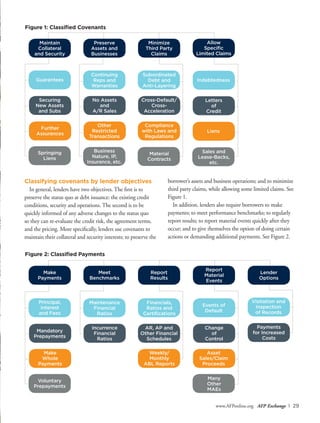
  • 14.
    12 I AFPExchange July/August 2015 Global Treasurer continued Reporting and accounting considerations: Assess the reporting requirements, such as possible global roll-up or stand-alone reporting. Determine the functional currency and FX translation requirements and the complexity of FX hedge accounting, in-house expertise to support an active hedging strategy. The portfolio’s currency translation risk or accounting risk. FASB Statement No. 52, Foreign Currency Translation. Currency hedge accounting for complex transactions will be accounted for under SFAS 133 and/or IAS 39. Establishing an international investment program requires coordination among the treasury, international tax and accounting groups to develop an efficient, risk-controlled investment program. Key issues to be resolved among the parties depend on the company’s international tax structure, domiciles of the offshore entities, functional currencies or the base currency of the portfolio which may be different than the country that holds the portfolio. Like all investment programs, the investment horizon, projected cash flows, risk profile and the intended uses of the surplus balances are key elements.The currency decision also entails coordination with the company’s hedging policy. The investment policy statement requires detailed consultation with the corporate tax, external international tax and legal. It is critical to consider the implications of international structures and understand the types of transactions or securities that may trigger IRC §956 US property or dividend. A loosely crafted IPS can inadvertently trigger a tax event that can be exceptionally costly to the corporation. Each corporation has a unique legal and international structure, although there are similarities that we will attempt to address. Investment objectives The key objectives of most offshore subsidiaries are to invest in the functional currency of the legal entity in investments that are (1) not subject to U.S. withholding tax, or (2) not treated as invested in U.S. property under Internal Revenue Code section 956. No amount of additional yield can compensate for the cost of triggering U.S. withholding taxes and disqualifying the cash as offshore assets. Depending on the domicile of the offshore entity there may be additional transaction costs and restrictions that should be considered in the investment policy. US § 956: Potential investments should be evaluated with regard to any potential impact on U.S. withholding and income taxes. At all times, investments that are considered must generate income that is not treated as investment in U.S. property and thus not subject to U.S. tax pursuant to § 956. Income that would be subpart F foreign personal holding company income per § 954(b) should be reviewed. The company should instruct their investment managers as to the types of permissible investments. Foreign investments that are subject to foreign withholding tax should be kept at a minimum and periodically reviewed with their international tax experts. Offshore securities should carry at least one credit quality rating to be eligible. The eurozone crisis put renewed emphasis on sovereign risk. EU sovereign ratings became stratified as individual countries were scrutinized on their own merits and pricing of their debt was shocked accordingly. Reactions to the sudden fracturing of the EU credit rating façade generated drastic changes to existing investment policies that had relied on a regional definition rather than credit ratings. This type of rigid modification is a somewhat permanent means of mitigating a very fluid and dynamic situation. Once a country or company has been placed on the prohibited list it becomes very difficult to remove it from that list once the trouble has passed. A better solution is to place restrictions on each country’s specific sectors and credit ratings.The guidelines should focus on the currency denomination of the security, credit quality and duration. The country of issue should not be a selection criteria because it will be reflected in the credit rating. Be specific about the acceptable credit quality with the minimum short and long-term sovereign credit ratings but don’t list countries that may be out of favor. High quality ratings will screen out problematic countries. Be specific about the acceptable credit quality with the minimum short and long-term sovereign credit ratings but don’t list countries that may be out of favor. High quality ratings will screen out problematic countries.
  • 15.
    www.AFPonline.org AFP ExchangeI 13 Liquidity Depth and liquidity of the market are important factors. The availability of both primary issuance in the short-end of the yield curve as well as availability of secondary issues are also important considerations. In less liquid markets the purchase of high-quality securities may be scarce and may lead to a more conservative buy and hold approach or lower turnover than in a more liquid, deep, tradeable market. Corporate credit ratings: The ratings agencies have a convention that has proven to provide opportunity for sophisticated investors during the eurozone crisis. Corporate entities domiciled in a specific country are multinational corporations whose business and revenues come from a broad range of countries, so their revenue is not solely dependent on the state of the country of domicile. Yet rating agencies ignore this fact and will not rate a corporation higher than the sovereign’s credit rating in which the company is headquartered. Covered bonds: Covered bonds are senior, secured bank obligations with favorable EU regulations. The bonds are highly liquid, full-recourse debt. The Single Resolution Mechanism (SRM) or European bail-in rules clarified the safety of covered bonds. The bail-in procedure reaffirmed that covered bonds are the most senior, safest in the capital structure and have preferential claim under a default. Senior bank paper becomes subordinated, subject to prospective losses and reducing its overall quality. Covered bonds are generally rated higher than senior notes by the rating agencies. Euro-denominated covered bonds must be issued by a euro-area credit institution, held and settled in the euro area. The cover pool must provide sufficient collateral to cover bondholder claims over the term of the covered bond. Bondholders must have a priority claim on the cover pool in the event of default. Euro ABS: Most of the euro-structured securities market performed better than the U.S. namesakes. The euro ABS market was not vulnerable to aggressive U.S. underwriting practices and had adhered to stricter underwriting standards. Euro ABS should have the issuer residence within the euro area, strong credit enhancements, availability of investor reports and modeling of the ABS. Third-party cash-flow modeling tools should be available. All counterparties to the transaction except the servicer should have top ratings and full back-up servicing provisions are in place. Any evaluation should look through to the underlying claims against entities resident in distressed countries. Euro RMBS:The RMBS (residential mortgage-backed securities) market differs substantially from country to country based on different legal mortgage structures. Each country within the EU has different rules and regulations governing mortgages and bondholders with some jurisdictions favoring homeowners over bondholders. Any investments in RMBS should be made by an investment manager with robust analytics, strong research capabilities and thorough understanding of the different legal structures and jurisdictions and laws protecting bondholders. Benchmarks can be used as performance measurements, but they are even more valuable as indicators of the investable universe for an international portfolio. Benchmarks Benchmarks can be used as performance measurements, but they are even more valuable as indicators of the investable universe for an international portfolio. For example, the subsets of the Barclays Euro Aggregate Index consist of fixed-rate, investment-grade bonds issued in euro or legacy currencies of the European Monetary Union. Excluded are convertible securities, perpetual notes, warrants, linked bonds and structured securities. The investment policy should also set the criteria for the selection of an external money manager. Some criteria might include a manager with extensive research capabilities in the regional market. The manager should be able to provide efficient trade execution during illiquid markets and may need to cross-trade securities to provide liquidity. Certain safeguards and compliance policies should be in place to prevent abuse or self- dealing with full disclosure and client permission. Ivan Troufanov is assistant treasurer, BioMarin Pharmaceutical Inc. Linda Ruiz-Zaiko is president of Bridgebay Financial Investment Consultants.
  • 16.
    14 I AFPExchange July/August 2015 Washington Watch M any treasury and finance professionals have questions about complying with FBAR—and the filing deadline was June 30. Because there is still a great deal of confusion on several aspects of the regulation, AFP staff and several corporate practitioner members spoke with regulators from FinCEN and asked specific compliance related questions. The good news is this: 85 percent to 90 percent of unnecessary FBAR (Foreign Bank Account Reporting) filings can be eliminated. Why is this so? There are several reasons. First, according to the AFP- FinCEN Q&A, named officers or any other employee on a Corporate Certificate Bank Resolution for U.S. publicly-traded entities are exempt from filing a personal FBAR. In addition, officers or employees of publicly traded companies are not required to file FBAR over a foreign financial account that is owned and maintained by the publicly traded company. How to comply with this complex regulation Ira Apfel FAQs FBAR
  • 17.
    www.AFPonline.org AFP ExchangeI 15 Furthermore, if officers of a corporation have the authority to expend funds with signature authority but no financial interest of the company’s account, then they are required to file FBAR. However, if they physically cannot, or have the signature authority, to expend funds, then they’re not required to file FBAR. Below are more questions, followed by FinCEN answers: Who must file FBAR? QUESTION: In the preamble, FINCEN states that “Signature Authority does not mean Supervisory Approvals.” Guidance from FINCEN states that “Supervisors who approve of the disposition of assets of a subordinate, but cannot dispose of assets themselves, do not have signature authority. We assume approve to mean an internal company approval. Please confirm. ANSWER: Confirmed. Internal approval is not a payment approval for FBAR purposes. Therefore, this does not constitute disposition of assets from a bank account. QUESTION: Please confirm who must file an FBAR from the following list if the organization is a non- governmental organization or a privately held company without any government oversight or regulatory governance: Named officers on a Corporate Certificate Bank Resolution? ANSWER: No. Persons named on the general banking resolution only need to file FBAR if their employer has also given them signature authority on bank accounts or specific access for the disposition of funds. If the individuals named on the banking resolution cannot access banking systems or communicate instructions on the movement of funds legally or within company guidelines or policies then they do not need to file FBAR. QUESTION: If an individual or an officer of an organization did not realize they were subject to FBAR filings and needed to file previous-year FBARs, how far back do they need to go? ANSWER: Two to three years maximum, and the data needs to be retained for five years. FinCEN will never ask for data that is older than five years. If individuals and officers did not know they were subject to FBAR filing and therefore did not declare their signatory authority on their previous year’s personal taxes, do they need to re-file those previous year taxes? If yes, how can they do that if the form 1040x does not provide a field to correct overlooked FBAR information? Answer: IRS counsel has advised that previous year taxes do not need to be re-filed to correct missing FBAR information. The IRS considers late filing of missing FBARs to the FinCEN to be a reasonable effort toward honest disclosure. If the above examples are for a U.S. publicly traded entity, then the employee is exempt from filing a personal FBAR. QUESTION: What about for accounts payable clerks that transact on the foreign bank account with proper controls where: one person initiates, and another person approves money transfers? ANSWER: Since the clerk is simply processing payments in the payable system, and the clerk hands off a payment file to the bank, this does not constitute a reportable FBAR obligation. If the clerk logs on and initiates a payment directly on the bank Web tool to a foreign bank account, this is a direct payment and would constitute a FBAR filing obligation. QUESTION: Regarding the chain of command in approving/effecting a payment from a corporation based on the decision making hierarchy of an organization. If a controller has authority to approve a purchase order and the payment with enough internal signature authority at a set dollar threshold, yet the controller has no authority over the bank account, but has authority over the individual that does, is this considered in scope for filing an FBAR? ANSWER: This is part of the normal corporate governance and does not constitute FBAR reporting obligation. QUESTION: What about online bank account or bank portal administrative “super users” that set up users and ensure controls for the purpose of designating money transfer personnel at a company? ANSWER: FINCEN will have to review and provide further guidance on this.
  • 18.
    16 I AFPExchange July/August 2015 Washington Watch continued Confirmed. If the filer—the person or organization—has 25 or more foreign bank accounts, the total count of accounts and the ownership is required when filing. Account details and balances are not required. QUESTION: What if an account doesn’t have a person as a signatory and relies on a corporate logo for their account signatory? ANSWER: The owner of the electronic signature or logo is responsible and will have a reporting obligation. QUESTION: What about tax personnel that send foreign tax payments as debit transactions to foreign bank accounts? ANSWER: FINCEN will confer with IRS and give guidance on this. Average Balances QUESTION: We have trouble getting the highest average balance in our bank accounts from our bank and we don’t have internal reporting that tracks this since the information changes every minute. What is considered prudent practice in this regard—using the bank’s best value in terms of the highest amount per year? ANSWER: FinCEN will confer with IRS to get guidance on the using the general ledger as an alternate source for the highest balance. QUESTION: The guidance is clear: “A United States person with a financial interest in 25 or more foreign financial accounts should check the Yes box in Part I, item 14a, and indicate the number of accounts in the space provided. The United States person should not complete Part II or Part III of the report but maintain records of the information. If the group of entities covered by a consolidated report has a financial interest in 25 or more foreign financial accounts, the reporting parent corporation need only complete Part V (for consolidated reporting), items 34 through 42, for the identity information of the account owners, but need not complete the account information.” But the electronic filing instructions are not clear to batch filers filing a consolidated FBAR as to how to address this reduced information requirement that pertains to Part V. How do we truncate this information in the file layout? This will help us to eliminate reporting highest average balance information mentioned above. ANSWER: Confirmed. If the filer—the person or organization—has 25 or more foreign bank accounts, the total count of accounts and the ownership is required when filing. Account details and balances are not required. However, account balance information must be available for five years should FinCEN or the IRS ask for the details. Also, all Bank Secrecy Act records should be kept for a rolling five years as well. Exemption Questions QUESTION: Is an officer or an employee that works for a company that is listed on a public exchange or an ADR and with no financial interest exempt? Would the subsidiary be included in the consolidated filing? What about the individual—would he or she need to file? ANSWER: Foreign companies with subsidiaries in the United States, where the foreign parent is listed on a U.S. public exchange via ADR, what specifically are the exemptions? FinCEN and IRS will follow up on this to confirm. Disclaimer: Always consult your tax and legal advisers in dealing with any federal regulation. This article is not meant to be legal or tax advice but a recap from an AFP conversation with FinCEN.
  • 19.
    www.AFPonline.org AFP ExchangeI 17 Payments Essentials ISO 20022 is no panacea, but it is a worthwhile endeavor Andrew Deichler KEY HIGHLIGHTS: • ISO 20022 is a messaging standard for financial institutions. Its purpose is to simplify international payments. • Because ISO 20022 is rolling out gradually and various jurisdictions are tweaking it, it is hard for corporates to comply. • The main benefit of ISO 20022 is that it gives jurisdictions a common set of terms rather than completely different standards. MAGIC ELIXIR A s is the case with all standards, the implementation of ISO 20022 has not been without some turbulence. All around the globe, various stakeholders have been making their own little changes to the system. Nevertheless, the standard is much closer to being a solution to simplify international payments, and corporations can benefit greatly from it. Implementation in Canada The Canadian Payments Association (CPA) has been prioritizing the modernization of Canada’s payments system over the past several years, and a key focus of that has been implementation of ISO 20022. Drawing on lessons learned from other jurisdictions, the CPA is attempting to transition to ISO 20022 as smoothly as possible.
  • 20.
    18 I AFPExchange July/August 2015 Tom Morrison, director of treasury operations for Suncor Energy, has been party to discussions regarding ISO 20022, which gathered stakeholder input. However, the actual implementation plan may still be a long way off. “There’s no definitive roadmap,” Morrison explained. “There was discussion around activities in 2015 to get to the go-forward strategy. They’re actively talking to the various stakeholders and seeking input into requirements.” Stakeholder input is essential to getting a standard right. However, it can also create a case of “too many cooks in the kitchen,” which has been the case for ISO 20022 during this gradual global rollout. “Every stakeholder seems to want their own little nuance of that standard,” noted Magnus Carlsson, director of treasury and payments for AFP. “But of course, when you do that, that’s not a standard anymore.” This can create issues for corporate treasurers who make regular payments to all corners of the world, Carlsson continued. “If you want to sign onto this as a corporate, you would want to know that this is a standard; that this is not going to change,” he said. “You’re not going to change your systems and make all of these investments if this thing is going to change.” Further complications Carlsson related the situation to Europe using ISO 20022 for the Single Euro Payments Area (SEPA). “Within the different countries, there are different nuances of the standard,” he explained. “They’re already encountering issues there.” The CPA has had in-depth discussions about which parts of the standard need to be just that—standards, from which there can be no deviation—and optional components which are aligned with ISO 20022 messaging formats but allow some flexibility. As of now, there are no clear answers. “Do you make remittance details optional? Are the only things you make mandatory the core payment details—value date, dollar amount, currency, etc.? And even within that, how rigid do you make the standard? That’s the challenge we have,” Morrison said. It is expected that a number of these questions will be answered when the CPA publishes its new standard, anticipated in early 2016. Morrison, whose organization just went live with SWIFT’s Alliance Lite2 this year, has faced some issues with using ISO 20022. “Every country seems to be slightly different,” he said. “They each have a version of the standard it seems to be more of a guideline. It’s different by country, it’s different by bank—it can be quite a challenge to implement globally.” However, Morrison was also quick to point out the benefits of using the standard, which was a key factor in Suncor’s decision to implement SWIFT. “At least we are starting with a common set of terms across jurisdictions rather than completely different standards,” he said. Currently, a U.S. stakeholder’s group, consisting of the Federal Reserve, The Clearing House, NACHA and X9, is in the process of soliciting views from the corporate world on ISO 20022. Although the research is still going on, Carlsson expects to hear that corporate practitioners want to see remittance data included in the standard. “Some might see the remittance portion as optional but if corporates are going to sign onto this, they are looking for a complete, ready-to-go package,” he said. “And that includes the remittance information because going forward, you want to facilitate straight-through processing.” A key concern for Morrison and other Canadian treasurers is what happens to the old standards with the advent of ISO 20022. “Do we go from a current environment with multiple standards and add in ISO 20022, which means corporates have to support an additional standard in implementation?” he asked. “Or do we have a plan to migrate from the previous standards and go with a single standard globally? There’s no clarity on that at this point in time, but in Canada the CPA is considering the implications of an additional standard. Although as a corporate, until there is more clarity, it’s tough to make decisions about where you direct your investment in technology.” Looking ahead The good clearly outweighs the bad when it comes to ISO 20022; there are just some kinks that need to be worked out in Canada and other regions. Once they are, Morrison and Carlsson expect the process to run a lot smoother. “The standard positions us as an organization for future development,” Morrison said. “I look at it as modernizing our infrastructure. So even though some of our banks can’t support the standard to date, that’s the direction the world seems to be going. Having that already developed eases the onboarding of new banks onto that platform, rather than having multiple point-to-point interfaces that all follow a different standard.” Payments Essentials
  • 21.
    www.AFPonline.org AFP ExchangeI 19 FP&AFORESIGHTS KEY INSIGHTS: • FP&A’s role is to create a value cycle, giving professionals the opportunity and framework to create real gains for the organization. • The challenge for FP&A is to balance other job requirements: consolidations, budgeting, forecasting and monthly reporting. • Between strategy and business, FP&A’s role is to lead in strategic partnering. PurposeExamining the FP&A value cycle James Myers On
  • 22.
    20 I AFPExchange July/August 2015 Never before has an FP&A professional had so much opportunity to change the course of history. Uncertainty is becoming the norm, and companies are struggling to be nimble, or they have become too dependent on the past to create the future. While disruption—the latest buzz word—creates winners, by definition there also are losers. So how can FP&A professionals help their companies navigate these uncertain times? Ultimately, the amount of cash a business generates dictates its success, so finance always has a seat on the executive team. Now we are seeing the role expand beyond the traditional back-office accounting support function into something more. We are seeing finance teams be closer to the action, empowered to be creative and suggest new ideas. The great news is that all finance professionals can use whatThe Lean Startup calls “validated learning” to impact business decisions, supporting executives with data and then guiding their organization through times of uncertainty. FP&A is becoming the strongest influencer, outside the CEO.The cycle of strategic support, insight generation and value creation drives business direction, turn by turn, toward the ultimate goal. FP&A’s three objectives As FP&A professionals, high-value output should be our ultimate objective, and to really drive the value in an organization we must focus on three main areas: strategy, business and data. FP&AFORESIGHTS Business2 Strategy1 Data3 Value Creation Insight Generation Strategic Support FP&A High Value Output I view FP&A’s role as a value cycle, giving us the opportunity and framework to create real gains for the organization. We offer strategic support to an organization. We are now able to help guide the organization in line with its vision. We lead insight generation and are able to align business to the data and understand what impact it has on the business. Finally, we create value through insight, allowing us to guide the strategy of the business forward. FP&A professionals offer a high-value output through strategic support and insight, creating value from data.
  • 23.
    3 www.AFPonline.org AFP ExchangeI 21 The challenge is these are often in addition to all the other requirements in our job description that include consolidations, budgeting, forecasting and monthly reporting. Yet, as we accomplish these tasks at hand, we also need to drive forward the value cycle as this is where the real business value lies. Strategy The direction of the company, including the long-term vision and shorter term missions with tactical goals. Business The partners and customers externally and sales and marketing organizations and go-to- market teams internally. Data Data held in an organization internally or from external sources. In larger organizations there may be an operations or data analytics group that manages this data, but they can be found in many different departments. Between strategy and business, FP&A’s role is to lead in strategic partnering. What’s strategic partnering? This takes the agreed strategy and helps the organization translate it into action, ultimately driving business success and shareholder value in line with the vision. Finance teams have always played a role here, especially as they have adopted an independent advisory role and have served as custodians of their companies. Remaining independent from the rest of the business can mean that ideas and strategies are fresh and aligned to the vision. In my experience, a key part of decision-making is looking at new proposals from all angles. Finance teams must remain independent to ensure that they have a distinct perspective. Between business and data we have insight generation. The role here is to work on translating business needs into queries. How often do you get a request from the business to pull a set of numbers together, and this inbound request from the business doesn’t have many details or doesn’t even make sense. It’s our role to question the request and understand the true need so that we understand the drivers and are better equipped to find the right data to answer the questions. Here I often go through a process of problem diagnosis, customer analysis and data identification. A great tool to help you with this is the well-known “5 Whys” technique. Created by Toyota Motors, the “5 Whys” is an iterative question-asking technique used to explore the cause-and-effect relationships underlying a particular problem. Finally, we have value creation. This is the key learning that helps guide a business through uncertainty. Decisions are now supported by data. This learning ultimately can determine the direction of the business and its vision, mission and tactical goals. Value creation often takes the form of data visualization, but there is wisdom in knowing that only once we understand what question we are trying to answer and figure out the right data to answer that question, we will be able to interpret the insight into business direction. Too often I see FP&A professionals creating reams of reporting without thinking, “What question I am trying to answer?” or “What action do I hope the business will take as a result of my interpretation?” In the perpetual cycle, value creation keeps the spin going—between big data and strategy is the sweet spot for FP&A. Successful companies take a more analytical approach, moving away from a gut feel to a “validated-learning” decision, as entrepreneur Eric Reis calls it. With validated learning, we can influence the direction and strategy of a division, business group or enterprise. The value cycle is our approach to redefine FP&A’s role in the organization, to take a leadership position and influence the direction and outcome. It is our role to help facilitate this process by taking the insight that we have generated and convert this into more long-term strategic thinking.That’s the place where true wisdom lives. 1 2 James Myers is a finance consultant for Hewlett-Packard.
  • 24.
    22 I AFPExchange July/August 2015 FP&A Next
  • 25.
    2.0 www.AFPonline.org AFP ExchangeI 23 Introducing finance business partnering 2.0 KEY INSIGHTS: • Despite good intentions, many finance business partners fail to deliver value. • Finance business partners fail to deliver value because their roles are ill-defined. • There are four functions that all finance business partners should perform— no matter the organization size or industry. I n practically every mid-size or large companies these days you will find finance business partners, or business finance functions, with the purpose of bringing finance closer to the business. However, despite all these functions and teams have been created with good intentions many of them are not yet yielding the value that was expected. The main reason for this is that there is no clear definition of what activities a business partner should engage in. Therefore, the position becomes a free-for-all to put whatever job content in it a company or manager wants. So in many of these positions you will find tasks like reporting, budgeting or even accounting- related tasks. None of those should be at the core of what a finance business partner does though. We therefore need business partnering transformation and while it might be something different depending on what function you work in I will try and share here my views on what a finance business partner should be doing: 1. All activities of the business partner must pass the value added test—are they related to adding value to the bottom-line? 2. The business partner should be connecting strategy with execution— involvement with or driving major strategic or tactical initiatives such as cost savings or revenue optimization projects. 3. The business partner should be the focal point between the support function and the business critical functions—meaning that the business critical functions should have one point of contact into finance. 4. The business partner will also be the one to present the numbers to the business in order to ensure that there is one ultimate owner of the story which Finance is sharing with the business. Generation Anders Liu-Lindberg
  • 26.
    24 I AFPExchange July/August 2015 FP&A Above provides a high level framework for what a finance business partner should do and what the company should expect from the function. Before moving on to making a very clear job description for the finance business partner 2.0, let’s first take a look at what skills and attributes are needed to be an effective finance business partner. 1. Ability to work with strategic concepts that can drive a company forward or even change the direction setting of the company. 2. Clearly measure and articulate the value they bring to the business. 3. Excellent communicator. 4. Be a facilitator of finance in the business to make sure all levels understand how they create value. 5. Savvy with technology and use intelligent tools to analyse financial and operational information. 6. Recognized top finance talent as this is the finance position with the highest potential impact. Having defined the requirements to finance business partnering and the skills needed to be a finance business partner, let’s take a look at how you should then write the job description or job ad for your future finance business partners. The job As a finance business partner you will work with top management and functional leaders to create alignment between strategy and execution. Depending on the size of the company you might work across functions or specialize in one or two functions, i.e., sales, operations, etc. You will act as a facilitator who, with the company or functional strategy in hand, works with functional leaders to translate strategy into concrete actions. You will help the functional leader measure the impact of the actions taken and report back to management how the company or function is tracking on executing the strategy. You report to the CFO or business finance director yet your physical location is in the middle of the business you are supporting. Your main responsibilities include, but are not limited to: • Participate in strategy meetings with management to understand the direction setting of the company. • Participate in target setting and ensure that both short and long-term strategic priorities are catered for. • Arrange and facilitate workshops with functional leaders to create action plans on how to succeed with the strategy. • Performance management of agreed upon actions to ensure that each action can be measured on a concrete outcome be it growth, savings, etc. • Communicate performance throughout the organization to ensure one set of numbers rather than each function and management team making their own assumptions. • Share best practices across the company, functions and locations. Personality and experience As a person you are a natural communicator and find it easy to engage with people no matter if they are senior leaders or front line staff. You know your way around numbers and know how to use latest technology and IT to present the data in an easy to understand way. You cope very well with change and people look to you as someone who is always on top of the situation. You understand that you are there to support your stakeholders and make them win. When they win you win and the company will perform very well. Your previous experiences include stints in other finance roles such as business controller, financial analyst or even finance manager. However, you can also come out of the frontline as having experience from the business is equally important to that of financial experience. Future career opportunities The finance business partner is a very senior position in the finance organization in the specialist track, but is typically a last step before taking on a senior leadership role in finance or for finance professionals to move into the frontline. Therefore, there is a wide range of career opportunities open to the finance business partner and this is also where the company tests its top finance talents. Now try and compare this job description/job ad with the people you currently have sitting in your finance business partner roles. Also use it to take a good look at who you are recruiting in the future. Most likely you will have a match with some of the characteristics, but only very few companies have managed to fully nail it when it comes to setting up and developing their business finance teams. Your finance business partners are the key to finance adding value to your company and now is the time to start transforming your business finance team before they are deemed irrelevant by the rest of the organization and retreats back into the corner where finance professionals have usually come from. Anders Liu-Lindberg is Regional Finance Business Partner, Maersk Line, Copenhagen, Denmark
  • 27.
    www.AFPonline.org AFP ExchangeI 25 The business case for employing zero-based budgeting for manufacturing Ron Giuntini CASE Makingthe FP&A KEY INSIGHTS: • Manufacturers incur annual warranty management-related expenditures, as a percentage of profit before tax, of as much as 20 percent. The warranty accrual incremental budgeting process faces challenges when new products are introduced. • Zero-based budgeting better addresses new product introductions because budget inputs are completely reset every budget cycle, with new inputs captured to reflect a changing business environment.
  • 28.
    26 I AFPExchange July/August 2015 FP&A • Delivers a reasonable level of accuracy. • Passes the muster of internal/external auditors. But the warranty accrual incremental budgeting process faces challenges when newly-designed products (NDP) are introduced as part of the mix of warranted products. NDPs are always defined as being recently delivered for the first time to the marketplace. NDPs also contain a combination of the following elements that differentiates them from warranty cost drivers of previously designed products (PDP): • Product design: - Capabilities (e.g. NDP scan in 3D versus in 2D for PDP) - Reliability (e.g. NDP baseline failure of 2,000 hours of use versus 1,000 hours for PDP) - Maintainability (e.g. NDP preventive maintenance every 12 months versus six months for PDP) - Capacity (e.g. NDP gallons flow/hour of 50 versus 18 gallons for PDP) • Different terms and conditions meeting product owner expectations (e.g. NDP warranty duration of four years versus two years for PDP). • Volatility of warranty claim settlements, driven by the production learning curve slope (e.g. warranty accruals are 8 percent of revenues for the first 50 units of NDP manufactured due to quality and engineering issues, and then will decline to 2 percent starting at unit 200, which then aligns with that of PDP). If learning-curve projections are wrong, warranty claim settlements may be dramatically affected. • Relationship changes between the manufacturing organization of NDP and its suppliers (e.g. parts break-fix warranty cost responsibility is transferred from the product manufacturer of PDP to the production supplier of NDP, resulting in lower accruals per unit). The aforementioned may rule that the employment of the incremental budgeting process is problematic for budgeting warranty claim accruals, but a product manufacturer should first understand the financial materiality of those accruals. For example, leadership and/ or auditors may define the materiality threshold level as being triggered when 20 percent of all warranted units are NDP units, and/or when 30 percent of all warranty U.S.-based product manufacturers incur annual warranty- management related expenditures, as a percentage of profit before tax, of 10 percent to 20 percent1 . That’s a financially material impact upon the income statement. As a result, the Securities and Exchange Commission requires product manufacturers to publically report direct and indirect costs related to warranty accruals, as well as reserves and claim settlements. This discussion will only focus on the implied/expressed warranty of a never-employed product acquired through the distribution channels of a manufacturer; the costs related to an “extended warranty” will not be explored. Note that a manufacturer can sell a warranted product throughout the multiple levels of the supply chain. For example, as a machine (e.g. combine), assembly employed in a machine (e.g. engine), or a part employed in an assembly (e.g. cylinder head). SEC reporting requirements Warranty driven expenditures, reported on financial statements, can include the following, though the SEC reporting requirements are vague: • Upgrade/modification programs employed when product performance guarantees are not met (e.g. modification kit installed at no-cost to boost engine performance to the level of product specification). • Voluntary/mandated recall programs (e.g. a no-cost replacement of a potentially defective airbag on a car). • Goodwill initiatives (e.g. key customer’s product is warranted an additional six months due to ongoing reliability problems). The most popular budget technique employed for warranty claim accruals is the incremental budget, which typically encompasses the following: • Engages readily available analytic tools like Excel. • Applies inputs from historical data sets such as claim settlement expenses. • Uses independent-demand forecasting techniques like weighted averaging and trend. • Does not consider that a black swan event may occur and assumes the existence of a relatively stable business environment (e.g. no major recall will occur). • Efficiently manages the budget process and minimizes levels of granularity to do so.
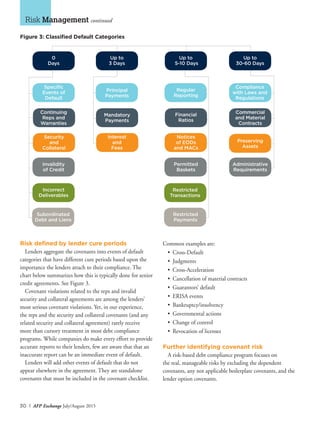
  • 29.
    www.AFPonline.org AFP ExchangeI 27 expenditures are driven by NDP units. Note that a unit of warranted NDP can incur warranty claim settlement costs that are 25 percent to 100 percent higher than that of a unit of warranted PDP. Once materiality levels are developed, the warranty budgeting technique chosen can embrace one of the following four scenarios: 1. If warranted NDP do not meet the financial materiality test, incremental budgeting can be continued to be solely employed for both PDP and NDP, with an understanding that the budgeting of accruals might be slightly inaccurate compared to that of claim settlements. 2. If warranted NDP do meet the financial materiality test, an alternative should be chosen to replace incremental budgeting in order to be more adaptive to a variety of cost drivers and a more volatile business environment. 3. A manufacturer can select to retain the incremental budgeting process for warranted PDP and employ an alternative budget technique exclusively for warranted NDP. 4. If warranted NDP do not meet the financial materiality test, leadership may nonetheless seek an alternative budget technique for the combination of all warranted products. One alternative budget technique to that of incremental budgeting for warranted NDP is zero-based budgeting, a technique in which budget inputs are completely reset every budget cycle, with new inputs captured to reflect a changing business environment. Note that ZBB requires that a working business model, with simulation capabilities, drives the selection of all its budget inputs. The abandonment of all analytics that were performed in the last budget cycle and starting from scratch in the next budget cycle is not the modus operandi of ZBB. There are several advantages to ZBB: • Greater accuracy. Besides anecdotal experience, the use of a significant number of budget inputs tangentially invokes the Law of Large Numbers of probability theory. Also, operational personnel from the real world are involved and are accountable for the validation of the inputted data sets. • Greater adaptability. Easily enables changes to a variety of inputs during multiple budget cycles and non-stable business environments. • Greater granularity. Imparts a higher level of understanding as to the complexity of a warranty program and its financial impact. Often an “awakening” for leadership to dedicate greater resources in this area to improve the efficiency and effectiveness of the processes. • Greater action orientation. Increases the ability of an organization to identify unfavorable warranty cost trends and engage in targeted changes, sooner rather than later. The business model driving zero-based warranty budgeting includes such inputs as: • Products/models types that will be warranted during the forecasted period. • Population size and value of warranted units. • Customer solutions required to meet obligations of the warranty terms and conditions. • Processes and their activities required in delivering customer solutions. • Direct and indirect resources employed in each of the solution-driven processes. • Quantity requirements for each resource. • Cost-estimating relationships. The clarity and adaptability of a zero-based warranty budgeting initiative creates a standard of excellence that is hard to surpass. But a ZBWB project is not an easy endeavor to undertake. It can be extremely inefficient and even ineffective when the following are lacking: • A detailed business model driving the budget. • Analytical software with simulation capabilities. • Oversight by seasoned operational and financial professionals knowledgeable in warranty management. • Support from leadership. Despite these challenges, ZBWB should be considered as the budgeting process of choice for product warranty accruals, regardless of financial materiality. Ron Giuntini is principal with Giuntini & Company Inc. FOOTNOTES 1. Blended SEC 10K reporting and Warranty Week analytics: • Warranty claim expense as a % of revenue of 1% to 3%. • PBT as a % of revenue of 8% to 12%.
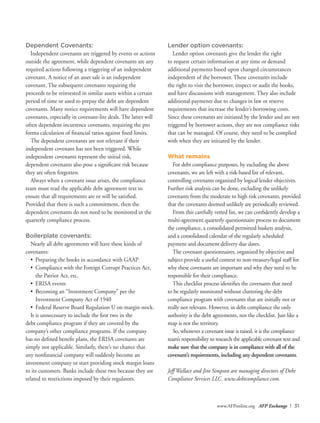
  • 30.
    28 I AFPExchange July/August 2015 Risk Management KEY INSIGHTS: • The foundation of an effective debt compliance program is a comprehensive and prioritized covenant checklist—but that’s easier said than done. • Lenders have two objectives: preserve the status quo at debt issuance (e.g., existing credit conditions, security and operations) and to be quickly informed of any adverse changes to the status quo so they can re-evaluate the credit risk, agreement terms and pricing. • Best practice is to classify covenants by lender objective and risk—not by the legal categories of affirmative, negative, financial and nonfinancial. A s many treasury and finance professionals will attest, organizing covenants by the legal categories of affirmative, negative, financial and nonfinancial is not very helpful. A better approach is to classify covenants by lender objective and risk. Using lender objectives is effective because nearly every covenant can be easily classified into nine logical lender objectives. Doing so facilitates the accurate comparisons needed to eliminate repetitive covenants in the same agreement and determine the controlling covenants of multiple debt agreements. Lenders tell borrowers which covenants are most important to them by stipulating 0-3 day cure periods. The “independent covenants” that are triggered by events and actions outside the agreement should have the initial risk focus rather than the “dependent covenants” that are triggered by the agreement’s independent covenants. Finally, it is relatively easy to winnow out the common boilerplate and “lender option” covenants. The latter are actions or payment demands initiated by the lender that the borrower must allow or pay. The foundation of an effective and efficient debt compliance program is a comprehensive and prioritized covenant checklist. Developing one is a difficult, time-consuming task because it is much more than summarizing the affirmative and negative covenants sections of a debt agreement. Depending upon credit risk, a senior credit agreement will have 80 to 100+ covenants, with 35 percent to 50 percent of them scattered throughout the agreement outside these two sections. Clutter Cutting Developing a risk-based debt covenant checklist Jeff Wallace and Jim Simpson
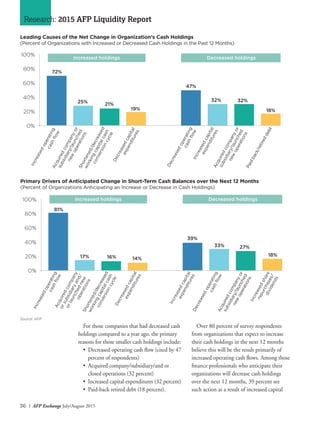
  • 31.
    www.AFPonline.org AFP ExchangeI 29 Figure 1: Classified Covenants Maintain Collateral and Security Preserve Assets and Businesses Minimize Third Party Claims Allow Specific Limited Claims Guarantees Continuing Reps and Warranties Subordinated Debt and Anti-Layering Indebtedness Securing New Assets and Subs No Assets and A/R Sales Cross-Default/ Cross- Acceleration Letters of Credit Further Assurances Other Restricted Transactions Compliance with Laws and Regulations Liens Springing Liens Business Nature, IP, Insurance, etc. Material Contracts Sales and Lease-Backs, etc. Classifying covenants by lender objectives In general, lenders have two objectives. The first is to preserve the status quo at debt issuance: the existing credit conditions, security and operations. The second is to be quickly informed of any adverse changes to the status quo so they can re-evaluate the credit risk, the agreement terms, and the pricing. More specifically, lenders use covenants to maintain their collateral and security interests; to preserve the borrower’s assets and business operations; and to minimize third party claims, while allowing some limited claims. See Figure 1. In addition, lenders also require borrowers to make payments; to meet performance benchmarks; to regularly report results; to report material events quickly after they occur; and to give themselves the option of doing certain actions or demanding additional payments. See Figure 2. Figure 2: Classified Payments Make Payments Meet Benchmarks Report Results Report Material Events Principal, Interest and Fees Maintenance Financial Ratios Financials, Ratios and Certifications Events of Default Mandatory Prepayments Incurrence Financial Ratios AR, AP and Other Financial Schedules Change of Control Make Whole Payments Weekly/ Monthly ABL Reports Asset Sales/Claim Proceeds Voluntary Prepayments Many Other MAEs Lender Options Visitation and Inspection of Records Payments for Increased Costs
  • 32.
    30 I AFPExchange July/August 2015 Risk Management continued Risk defined by lender cure periods Lenders aggregate the covenants into events of default categories that have different cure periods based upon the importance the lenders attach to their compliance. The chart below summarizes how this is typically done for senior credit agreements. See Figure 3. Covenant violations related to the reps and invalid security and collateral agreements are among the lenders’ most serious covenant violations. Yet, in our experience, the reps and the security and collateral covenants (and any related security and collateral agreement) rarely receive more than cursory treatment in most debt compliance programs. While companies do make every effort to provide accurate reports to their lenders, few are aware that that an inaccurate report can be an immediate event of default. Lenders will add other events of default that do not appear elsewhere in the agreement. They are standalone covenants that must be included in the covenant checklist. Common examples are: • Cross-Default • Judgments • Cross-Acceleration • Cancellation of material contracts • Guarantors’ default • ERISA events • Bankruptcy/insolvency • Governmental actions • Change of control • Revocation of licenses Further identifying covenant risk A risk-based debt compliance program focuses on the real, manageable risks by excluding the dependent covenants, any not applicable boilerplate covenants, and the lender option covenants. Figure 3: Classified Default Categories 0 Days Up to 3 Days Up to 5-10 Days Up to 30-60 Days Specific Events of Default Principal Payments Regular Reporting Compliance with Laws and Regulations Continuing Reps and Warranties Mandatory Payments Financial Ratios Commercial and Material Contracts Security and Collateral Interest and Fees Notices of EODs and MACs Preserving Assets Invalidity of Credit Permitted Baskets Administrative Requirements Incorrect Deliverables Restricted Transactions Subordinated Debt and Liens Restricted Payments
  • 33.
    www.AFPonline.org AFP ExchangeI 31 Dependent Covenants: Independent covenants are triggered by events or actions outside the agreement, while dependent covenants are any required actions following a triggering of an independent covenant. A notice of an asset sale is an independent covenant. The subsequent covenants requiring the proceeds to be reinvested in similar assets within a certain period of time or used to prepay the debt are dependent covenants. Many notice requirements will have dependent covenants, especially in covenant-lite deals. The latter will often dependent incurrence covenants, requiring the pro forma calculation of financial ratios against fixed limits. The dependent covenants are not relevant if their independent covenant has not been triggered. While independent covenants represent the initial risk, dependent covenants also pose a significant risk because they are often forgotten. Always when a covenant issue arises, the compliance team must read the applicable debt agreement text to ensure that all requirements are or will be satisfied. Provided that there is such a commitment, then the dependent covenants do not need to be monitored in the quarterly compliance process. Boilerplate covenants: Nearly all debt agreements will have these kinds of covenants: • Preparing the books in accordance with GAAP • Compliance with the Foreign Corrupt Practices Act, the Patriot Act, etc. • ERISA events • Becoming an “Investment Company” per the Investment Company Act of 1940 • Federal Reserve Board Regulation U on margin stock. It is unnecessary to include the first two in the debt compliance program if they are covered by the company’s other compliance programs. If the company has no defined benefit plans, the ERISA covenants are simply not applicable. Similarly, there’s no chance that any nonfinancial company will suddenly become an investment company or start providing stock margin loans to its customers. Banks include these two because they are related to restrictions imposed by their regulators. Lender option covenants: Lender option covenants give the lender the right to request certain information at any time or demand additional payments based upon changed circumstances independent of the borrower. These covenants include the right to visit the borrower, inspect or audit the books, and have discussions with management. They also include additional payments due to changes in law or reserve requirements that increase the lender’s borrowing costs. Since these covenants are initiated by the lender and are not triggered by borrower actions, they are not compliance risks that can be managed. Of course, they need to be complied with when they are initiated by the lender. What remains For debt compliance purposes, by excluding the above covenants, we are left with a risk-based list of relevant, controlling covenants organized by logical lender objectives. Further risk analysis can be done, excluding the unlikely covenants from the moderate to high risk covenants, provided that the covenants deemed unlikely are periodically reviewed. From this carefully vetted list, we can confidently develop a multi-agreement quarterly questionnaire process to document the compliance, a consolidated permitted baskets analysis, and a consolidated calendar of the regularly scheduled payment and document delivery due dates. The covenant questionnaires, organized by objective and subject provide a useful context to non-treasury/legal staff for why these covenants are important and why they need to be responsible for their compliance. This checklist process identifies the covenants that need to be regularly monitored without cluttering the debt compliance program with covenants that are initially not or really not relevant. However, in debt compliance the only authority is the debt agreements, not the checklist. Just like a map is not the territory. So, whenever a covenant issue is raised, it is the compliance team’s responsibility to research the applicable covenant text and make sure that the company is in compliance with all of the covenant’s requirements, including any dependent covenants. Jeff Wallace and Jim Simpson are managing directors of Debt Compliance Services LLC. www.debtcompliance.com.
  • 34.
    32 I AFPExchange July/August 2015 AFP, Association for Financial Professionals, the AFP logo, CTP and FP&A are registered trademarks of the Association for Financial Professionals. © 7/15. Big data. Global outreach. More information at your fingertips than ever before. Find new practical solutions to the challenges you face at the AFP Annual Conference — the most important event in treasury and finance. TM Treasury Management FPA Financial Planning & Analysis PY Payments RM Risk Management 8 TRACKS130+ SESSIONS » ROUNDTABLES » WORKSHOPS » CASE STUDIES » PANEL DISCUSSIONS » PRESENTATIONS » INSPIRING STORIES SESSION TYPES: Opening General Session PRESIDENT GEORGE W. BUSH Tuesday General Session ITZHAK PERLMAN GENERAL SESSION SPEAKERS:
  • 35.
    www.AFPonline.org AFP ExchangeI 33 COMPANIES IN ATTENDANCE INCLUDE: » » » REGISTER BY SEPTEMBER 18 TO SAVE $200 www.AFPconference.org/2015 GTF Global Treasury & Finance CD Career Development CF Corporate Finance PB Pensions & Benefits 30.3 CREDITS Earn up to 30.3 CTP/CCM and FP&A credits and 30 CPE credits. As of 6/30/15. Subject to change. Land O’Lakes / Merck / Alcoa / MGM Resorts International / Nordstrom / Pfizer / Visa / Discovery Communications / Whole Foods Market / Netflix / Ross Stores / Qualcomm / Kimberly-Clark / Hanesbrands / Northrop Grumman / Western Union / Caesars Entertainment / Lowe’s / Delta Air Lines / Starbucks / Ralph Lauren / FedEx / Google / Starwood Hotels & Resorts / Costco / GameStop / Microsoft / Allstate / Cigna / Rite Aid / Walmart / NRG Energy / McKesson / salesforce.com / Boeing / Owens Corning / Boston Scientific / Ingram Micro / Tractor Supply / Nationwide / Comcast / Barnes & Noble / General Electric / Hormel Foods / Coca-Cola / Dick’s Sporting Goods / Estee Lauder / Johnson & Johnson / Southwest Airlines / Amazon.com / Dow Chemical / iHeartMedia / Time Warner Cable
  • 36.
    34 I AFPExchange July/August 2015 Research: 2015 AFP Liquidity Report KEY INSIGHTS: • When it comes to corporate investing, treasury and finance professionals are growing slightly less focused on safety. • Cash holdings are expected to increase due to improving operating cash flows. • Selecting a money fund is increasingly part of bank relationship management. Results of the 2015 AFP Liquidity Survey reveal low returns, flat yields AFP Research Department SMALL
  • 37.
    www.AFPonline.org AFP ExchangeI 35 For the 936 treasury and finance professionals who participated in this survey in May, safety of principal remains paramount as an investment objective, as has been the case for most of the last decade. This year, the share of finance professionals ranking safety as the number one investment objective dropped three percentage points to 65 percent. Liquidity picked up the offset and increased with 31 percent of survey respondents citing liquidity as the primary investment objective. Yield remains a distant third at 4 percent, unchanged from last year. The survey results reveal other key findings: • 70 percent of organizations maintain written investment policies, down 6 percent from 2014 • 80 percent of organizations with written investment policies review their policies on a regular basis. • Two-thirds of all short-term investment holdings are in vehicles with maturities of 30 days or less. • 80 percent of organizations anticipate their organizations will maintain the status quo with regard to their current profile for maturity. Bank deposits continue to be the investment vehicles of choice, even though access to unlimited FDIC insurance under theTransaction Account Guarantee (TAG) program ended almost three years ago. Currently, 56 percent of all corporate cash holdings are still maintained at banks—the largest share reported in the 10-year history of the Liquidity Survey. To assess the current and emerging trends in organizations’ cash and short-term investment holdings, investment policies and strategies, the Association for Financial Professionals conducted its 10th annual AFP Liquidity Survey in May 2015. Underwritten by State Street Global Advisors (SSGA), the 2015 AFP Liquidity Survey reveals that the short-term investment landscape continues to be characterized by low-return and a relatively flat yield in a continued low interest rate environment. Short-term investments and cash holdings Nearly one-third of finance professionals report an increase in their organizations’ cash holdings within the U.S. and 46 percent indicate no significant change in the same. Fully 56 percent of finance professionals report that in the past year their organizations’ investments outside the U.S. were unchanged—higher than the 42 percent last year. About half of corporate practitioners whose organizations have non-U.S. cash holdings report some changes in their companies’ average balances since May 2014. While a greater share of finance professionals report that their companies are increasing their cash holdings outside the U.S. (27 percent) than depleting them (17 percent) that percentage is far less than the 44 percent of finance professionals in last year’s survey. This shift likely reflects the impact of economic uncertainty in the Eurozone, sanctions imposed on Russia, and general business conditions in emerging markets. Similar to past surveys, most organizations that increased their cash holdings during the past 12 months did so because they were generating higher operating cash flow (cited by 72 percent of respondents). The second most commonly cited driver of greater cash holdings is generating additional revenues from the acquisition of a new company (25 percent) followed by a shortened/decreased working capital cash conversion cycle (21 percent).
  • 38.
    36 I AFPExchange July/August 2015 For those companies that had decreased cash holdings compared to a year ago, the primary reasons for those smaller cash holdings include: • Decreased operating cash flow (cited by 47 percent of respondents) • Acquired company/subsidiary/and or closed operations (32 percent) • Increased capital expenditures (32 percent) • Paid-back retired debt (18 percent). Over 80 percent of survey respondents from organizations that expect to increase their cash holdings in the next 12 months believe this will be the result primarily of increased operating cash flows. Among those finance professionals who anticipate their organizations will decrease cash holdings over the next 12 months, 39 percent see such action as a result of increased capital Leading Causes of the Net Change in Organization’s Cash Holdings (Percent of Organizations with Increased or Decreased Cash Holdings in the Past 12 Months) 100% 80% 60% 40% 20% 0% 72% 25% 21% 47% 32% 32% Increased holdings Increasedoperating cashflow Increasedcapital expenditures Shortened/decreased workingcapitalcash conversioncycle Acquiredcompanyor subsidiary/launched new operations Decreasedoperating cashflow Paidback/retireddebt Decreased holdings Decreasedcapital expenditures Acquiredcompanyor subsidiary/launched new operations 18%19% Primary Drivers of Anticipated Change in Short-Term Cash Balances over the Next 12 Months (Percent of Organizations Anticipating an Increase or Decrease in Cash Holdings) 81% 17% 16% 39% 33% 27% Increasedoperating cashflow Increasedcapital expenditures Shortened/decreased workingcapitalcash conversioncycle Acquiredcompany orsubsidiaryand/ orlaunchednew operations Decreasedoperating cashflow Decreasedcapital expenditures Increasedshare repurchases/ dividends Acquiredcompanyor subsidiary/launched new operations 18% 14% 100% 80% 60% 40% 20% 0% Increased holdings Decreased holdings Research: 2015 AFP Liquidity Report Source: AFP
  • 39.
    www.AFPonline.org AFP ExchangeI 37 expenditures. In addition, one-third of those anticipating a decline in cash cite decreased operating cash flow as a reason for a decline in cash holdings. Current allocations The typical organization currently keeps 56 percent of its short-term investment portfolio in bank deposits. That is an increase of four percentage points from the 52 percent reported in 2014 and the highest share reported in the 10-year history of the AFP Liquidity Survey. Money market funds Selecting a money fund is becoming part of bank relationship management. In fact, for the majority of organizations (54 percent) Source: AFP Current Percentage of Organization’s Short-Term Portfolio Allocated to Specific Investment Vehicles (Mean Percentage Distribution of Cash and Short-Term Investment Holdings) 100% 90% 80% 70% 60% 50% 40% 30% 20% 10% 0% Percentage of short-term investments in bank deposits, MMFs and Treasury bills Percentage of short-term investments in bank deposits 56% 2006 2007 2008 2009 2010 2011 2012 2013 2014 2016 23% 60% 27% 73% 25% 78% 37% 74% 51% 78% 42% 74% 51% 74% 50% 75% 52% 77% 56% the most important factor when selecting a fund was not the fund ratings as one might suspect, but rather the fund sponsor taking a role in the bank relationship mix and support. Forty-six percent of finance professionals rank fund ratings as the number one consideration when selecting a fund, while 37 percent rank counterparty risk of underlying instruments as the primary deciding factor. The second most important factor in selecting a money market fund is yield (cited by 39 percent of practitioners), closely followed by both counter party risk and diversification of underlying instruments. More than half of finance professionals cite ease of transacting with the fund and accounting treatment as the third most important criteria when selecting a fund. A majority of finance professionals indicate that having a fund sponsor take a role in the bank relationship mix and support is the number one consideration when selecting a fund
  • 40.
    38 I AFPExchange July/August 2015 Conclusion Results from the 2015 AFP Liquidity Survey reveal a number of key messages: • Safety of principal again ranks first among investment objectives as has been the case for most of the last ten years. But the share of finance professionals citing safety as the primary investment objective has shrunk slightly from 68 percent in 2014 to 65 percent in 2015. • The importance of liquidity as an investment objective has grown; 31 percent of survey respondents cite liquidity as an objective this year compared to 28 percent in 2014. • A majority of all corporate cash holdings—56 percent—is still maintained at banks. This is the largest share of cash Primary Drivers to Select a Money Market Fund (Percent of Organizations that Permit MMFs as an Investment Vehicle) One Two Three Fund sponsor is part of our overall bank relationship mix and support 54% 26% 20% Fund ratings 46 33 21 Counterparty risk of underlying instruments 37 38 25 Yield 30 39 30 Diversification of underlying instruments 23 38 40 Investment manager for separately managed accounts or manages other investment products for us 20 35 46 Accounting treatment of the fund 18 27 55 Ease of transaction process 17 27 56 Most Important holdings held at banks in the 10-year history of AFP’s Liquidity Survey. • While bank products remain the largest segment of investment options, current survey results show a significant change in the mix from previous years. Time deposits are still the highest class within the bank product category, but the share of non-interest bearing deposit accounts declined from 51 percent last year to 40 percent this year. • With the SEC having finalized new rules on certain money market funds, how will companies accommodate those changes in their short-term investment objectives? A majority of survey respondents indicate that their organizations are planning to make changes in how they invest in prime MMFs. Source: AFP Research: 2015 AFP Liquidity Report
  • 41.
    Liquidity www.AFPonline.org AFP ExchangeI 39 KEY INSIGHTS: • Implementing in-house banks are challenging—set realistic timelines. • Use the creation of an in-house bank as an opportunity to create better processes—don’t just recreate old ones. • In-house banks aren’t for every treasury group. Alternatives include greater standardization of policies and systems, rationalization of banks and accounts, and pooling and netting. DAYHow Bombardier uses in-house banking to improve cash management Drew Arnold Globalization has been the catalyst for more complex cash flows, in multiple currencies from multiple locations, and multiple legal entities. The impact of this can create treasury and finance structures that are disparate, multi-locational and, indeed, complex. This has led some corporates to review their structures as well as key performance indicators, and implement structures that enable them to manage a whole host of disciplines, including funding, risk management, investment, liquidity management, payments and collections and management information systems. In short, they setup a so-called in-house bank (IHB). MOVING
  • 42.
    40 I AFPExchange July/August 2015 Corporate Finance At Deutsche Bank, we are increasingly having discussions with our clients around such structures, which are not exactly banks in the true sense of the word, but offer the type of services and adopt the characteristics associated with a cash management-focused bank. This structure is particularly relevant—and effective—when the corporate in question has a complex network of subsidiaries. Although the corporate sets the IHB up, we have worked with a number of clients on advising them on the appropriate structure and services they might need for a truly effective IHB. One of our key clients, Bombardier, was an early advocate of the concept, and has been realizing the benefits. “We were looking to consolidate a new treasury workstation model, moving the center of competence from Brussels to Zurich,” said Debra Hinds, Bombardier’s Director, Global Cash Management. “The overriding theme was to seek out efficiencies and, quite simply, to better manage and provide greater transparency around our cash.” In most cases, an IHB enables companies like Bombardier to take the place of third- party banks. The company’s subsidiaries open accounts with the IHB, either in a single functional currency or multiple currency accounts. Subsidiaries can not only be granted credit lines, but can also borrow and invest with the IHB. No easy task While the pluses are many, it is not simple to implement an IHB. “There are so many considerations and so many people to align in the process, so expectations have to be tempered around timelines,” Hinds said. “You are looking at many jurisdictions and with that comes tax, legal and regulatory issues that will vary across the regions. Once you have made the decision to take this route to financial efficiency, enthusiasm builds at a pace that has to be managed.” So what have been the benefits for companies like Bombardier? In the post- financial crisis world, efficiency has become something of a mantra, but as Hinds reveals, this is no mere buzz word. “We have been able to achieve a much better level of cash utilization,” she said. “Importantly, we have also been able to rationalize FX transactions executed locally and regionally. And we have certainly been able to make better use of cash on account, directing money in the pool towards lending to entities. We are satisfied that we have attained a far better way of managing our cash.” Certainly, those corporates that have already used an IHB have moved from structures that invariably resemble Gordian knots to more streamlined and consolidated cashflows as well as enhanced working capital management, greater control and risk management and better reporting. But any corporate wanting to set up an IHB has to fulfill a number of requirements, not least of which is getting buy-in across the organization and senior management endorsement. An IHB is not something that can be taken out of a box and plugged in. The scope of the project has to be determined, and the corporate has to ensure it has the optimal technology and cross-organization cooperation and service level agreements. “It’s important to realize across the company that this is an evolutionary—rather than revolutionary—process,” Hinds said. It’s very much one step at a time. In our case, it was 190 different accounts into the structure and therefore not something that could be done in
  • 43.
    www.AFPonline.org AFP ExchangeI 41 one step. In many ways, it’s a job that will never end. There will always be new efficiencies to capitalize on and large corporate bodies, after all, are organic and constantly changing.” Furthermore, implementing an IHB has to balance global, regional and local requirements as well as the locations where the IHB will operate. Wherever that may be, the support infrastructure has to be in place along with communications and, of course, the appropriate skill-sets to support the project. At Bombardier, they also ensured that the best possible structure and practices were put in place. “We made certain that we did not just incorporate the old way of doing things,” Hinds said. “It was not a question of bringing legacy structures into the IHB.This was a chance to do something new and that’s what I would advise people to do if they are taking this route.” However, an IHB may not suit every treasury and finance organization. There are drawbacks in setting them up, notably around the complexity involved and the fact that processes are concentrated. In other words, those things that may deliver benefits to some companies, may create headaches for others. There are alternatives that can deliver many of the benefits of an IHB. These include greater standardization of policies and systems; rationalization of banks and accounts and pooling and netting solutions that can all help create treasury efficiencies. Who benefits? The companies that will benefit most from an IHB are those that are complex, global and largely decentralized, using diverse systems and in need of variable funding requirements. The evaluation of such a project should involve all stakeholders and, from day one, be enhanced by engaging external tax and legal advisers. Right from the start, dialogue with bank providers should take place. It is advisable, as Hinds confirms, that a multiyear phased approach is adopted towards full implementation. “It’s important to define your objectives well as an IHB is more sophisticated than it may first appear,” she said. “And you need a system that can handle this well. You will not be able to function on spreadsheets.” There’s another element that must be carefully considered. If a legal entity does not fit the IHB model, then brute force is not a good idea. Levels of participation in an IHB should be variable, although most entities will, essentially, be eligible for inclusion. Ultimately, IHBs deliver enormous benefits for major corporates. “Preparation is key,” Hinds said. “If you ensure your treasury operation has the right building blocks you need to move towards an IHB, the entire process will be that much smoother.” Drew Arnold, Director—Working Capital Advisor, Deutsche Bank, and Debra Hinds, Director, Global Cash Management, Bombardier, co-presented on in-house banking at the 2014 AFP Annual Conference. IHB Key Decisions Key decision in developing an IHB include: • Activities: Define which and when they will be implemented • Technology: In-house system, treasury workstation, etc. • Roles, responsibilities and ownership: Treasury, shared service center, combination • Global, regional and local requirements • Location
  • 44.
    42 I AFPExchange July/August 2015 Corporate Finance Maximizing shareholder value requires corporate performance management discipline In the final analysis, the purpose of management is to maximize firm and shareholder value. Corporate performance management (CPM) is, therefore, critically important in measuring and managing firm and shareholder value. Earnings per share, total shareholder return, sales growth, economic profit (EP), EBITDA, ROE, ROIC, EVA, etc. constitute the alphabet soup of frequently-used CPM metrics. Self-Control Jonathan Hall KEY INSIGHTS: • Corporate performance management is where business intelligence intersects with monitoring and using KPIs to measure key business processes in order to drive and measure firm value. • Key performance indicators are not measures of shareholder value. They are metrics of the key operating levers that result in the firm’s economic profit or loss. • Any metric setting requires an understanding of the firm’s corporate culture, the governance environment, and employee skills and weaknesses.
  • 45.
    www.AFPonline.org AFP ExchangeI 43 Shareholder value is created by earning returns on both existing and new investments in excess of the capital required to fund the investments, or in excess of the opportunity costs within the market, and to do so in excess of the economic profits earned by the firm’s peer group. The key word here is “economic” instead of accounting-based profit. Accounting and earnings-based metrics have several issues. Even under the watchful glare of GAAP, accounting- based profits can be fairly easily manufactured.These metrics not only ignore the level of risk in the firm, they ignore the working and fixed capital investment required for the business to function properly.They also ignore dividend policy, and they ignore future cash flow potential of the business. In starting with accounting-based metrics, various adjustments are required to craft an economics-based view of the business. For example, we should: • Use an asset’s true economic depreciation instead of an accounting-based one • Treat advertising, R&D and training as the capital employed that they truly are versus a period expense • Recognize the capital employed equivalency of operating leases instead of their traditional operating expense treatment, etc. Research studies show a significant correlation of economic profit growth to sustainable stock price appreciation. This is in recognition of the increase in firm value which results in shareholder wealth and shareholder value creation (SVC). SVC metrics most frequently cited include: economic profit and EP momentum and EVA as a trademarked version of this metric; shareholder value added; operating cash flow return on market value of assets, and a few others. Even the famed ROIC metric has (as all metrics do) its pros and cons. When compared to a firm’s weighted average cost of capital (WACC) or opportunity cost of capital (OCC), ROIC can be a good directional measure of value created. Some of its shortcomings are that it does not capture future value and it only captures investor expectations relative to historical performance based on traditional accounting-based measures. Additionally, an over reliance on ROIC could result in unintended consequences such as under-investment in the firm as the company tries to rationalize its capital base. Where do KPIs fit in all of this? Key performance indicators are not measures of shareholder value. They are, however, measures of things that ultimately drive the CPM metrics of firm and shareholder value. KPIs are great for measuring and managing the operating levers and dimensions of the business. For example, units per hour, calls per call center representative, sales per employee and billable hours per attorney. In retail, sales per labor hour or sales per square foot are good key performance metrics. The result of all of this activity is captured primarily in the financial statement, P&L, balance sheet and cash flow. KPIs, then, are meant to measure the interrelationship between supplier partnerships, the business’s core value- adding activities, and the capabilities and resources that support and drive the firm’s value proposition supported by, and impacting, the business’s cost structures and revenue streams. But which is best? And, how many metrics should we use? The debate between those who support many CPM metrics versus those who support “less is more” rages on. According to a 2010 IBM Institute for Business Value survey of more than 1,900 global CFOs, respondents use, on average, at least four different corporate metrics. The most common were: EBITDA, profit, sales, ROIC growth and expense ratios. As well, the use of a “balanced scorecard” continues its steady pace of converts. The most cited reasons for the use of multiple metrics are the: • Diversity of the types of businesses under a corporate umbrella • Level of employee experience and skills • Breadth and depth of the business’ reach, functionally and geographically • Desire to capture sales, traditional accounting-based earnings measures and capital efficiency in order to address the quarter-to- quarter focus of “the street,” and • Desire to provide various stakeholders and constituents a voice. Which metric is best? GAAP-based sales and earning metrics are the most frequently cited by CFOs, but are these the best metrics in order to achieve management’s prime objective of maximizing firm and shareholder value? As economist Sir Alfred Marshal stated back in the early 1800s, shareholder value is what remains of profits after deducting interest in capital. This is generally called economic profit.
  • 46.
    44 I AFPExchange July/August 2015 Corporate Finance the initiatives the firm launches to accomplish its stated strategies, metrics are established to measure performance. Many books, articles, journals, seminars, classes are devoted to this topic alone. In my experience, though, any metric setting requires an understanding of the firm’s corporate culture, the governance environment, and employee skills and weaknesses. The metric-setting process generally starts with setting a baseline based on historical results. Assessing the firm’s past, present and future success vis-à-vis certain metrics should be influenced by an understanding of what competitors in the marketplace are doing. Unless you have a firm where one or a few folks are making most of the daily decisions, then all throughout the OSIM process collaboration, alignment and negotiation is required—especially during the metric-setting phase. During this phase having a combined front-line view, a middle-management view and a senior/executive leadership view is important. Most important, however, is aligning these perspectives. This alignment process is where the sausage gets made; it can get ugly. That’s okay. That said, at the end of the day, with the various perspectives heard and debated, a decision must be made. Again, depending on the firm’s corporate culture and governance environment, the final decision can be made by the owner/founder, president/CEO, COO, CFO, the executive leadership committee, or some combination of the above or by mid-management. Given the dynamic nature of most businesses and the marketplace in which they operate, these metrics must be reviewed frequently to ensure they remain SMART. The ‘holy grail’ Economic profit and other value- based metrics, when used correctly, are powerful performance management tools that help drive shareholder value. When these value-based metrics are integrated and aligned with key performance indicators (KPIs) throughout all levels of the organization and when they are aligned with the firm’s capital structure strategy, they become even more impactful in maximizing shareholder value. Keeping these three dimensions aligned and integrated in a fluid business environment, especially as the business progresses through the various stages of the business life cycle, is “the holy grail” for CEOs, CFOs and their teams. But it all starts with an effective corporate performance management discipline. Jonathan Hall is Vice President, Finance & Strategy/CFO, Walmart Services. Source: Jonathan Hall. ROE, ROA, ROIC, EPS, sales and profit growth, etc. are great financial KPIs, or key financial metrics. These KFMs, however, are not great corporate performance measures meant to help gauge and manage firm and shareholder value creation. To be effective, all metrics, whether KPIs/KFMs or CPM metrics should be SMART: specific, simple, actionable, relevant, timely and transparent. Setting metrics Now comes the hard part. Practically speaking, how does this work? In my experience, over the last two- plus decades with four Fortune 200 companies and one mid-sized d firm, what I have seen that works best can be illustrated by the diagram below and best described as a collaborative, matrixed and alignment approach. Based on the customer problem you’re trying to solve, or the market opportunity you’re trying to capture, the leadership of the firm sets the firm’s strategic objectives.Then, based on the key drivers of the business and Figure 1: O.S.I.M. Performance Framework Strategies Key Initiatives Processes and Tactics Key Performance Indicators (Metrics) Objectives Start Feedback/ learning Loop Maximizing Firm and Shareholder Value (Measured by CPM Metrics)
  • 47.
    www.AFPonline.org AFP ExchangeI 45 Treasury Essentials GO Let It Are companies finally investing their cash reserves? Andrew Deichler The economic recovery has been long and slow, but gradually businesses are letting go of the cash they’ve been holding on to since the 2008-09 financial crisis. For three consecutive fiscal quarters, U.S. businesses indicated that they were shedding some of their cash holdings, according to the AFP Corporate Cash Indicators® (AFP CCI). While some companies appear to be taking a wait-and-see approach with the economy, they are generally not holding cash tight to the chest like they have in previous years. KEY HIGHLIGHTS: • Confidence in the recovery is building, leading many companies to invest their cash reserves. • Some companies are investing in new technology out of necessity, either to improve their productivity—or to prevent major threats like cyberfraud. • Budget cuts to state and local govern- ments continue to be a problem for many businesses that rely on them, but new sources of revenue have emerged in the past several years.
  • 48.
    46 I AFPExchange July/August 2015 Treasury Essentials So the question is, as companies begin to spend some of that cash, where is it going? According to a recent survey of 781 U.S. business owners and executives by BMO Harris Bank, nearly 60 percent of companies plan on making investments in their business this year. Potential investments include the following: • Expanding operations (31 percent) • Upgrading/purchasing new equipment (26 percent) • Modernizing technology/systems (23 percent) • Hiring more employees (20 percent). on to cash “very aggressively” throughout the financial downturn. “The economy since 2008 has been a struggle for the schools, which are funded primarily by real estate taxes,” he said. “So we had to constrain ourselves immensely.” But now, with the economy improving, Gumdrop has undertaken a major initiative. All of the schools that purchase books from Gumdrop have different requirements for how they want information presented on the outside and interior of the books—how many numbers go on the label, whether the author’s name is fully spelled out, etc. Gumdrop is developing a database that is essentially a “one-stop shop” for all of this information. “We’ve invested over the last two years about 12,000 programming hours into this project,” Schnieders said. The project will save Gumdrop a substantial amount of money; up until this point, the company had to go to other vendors for this service. This technology initiative has also led to Gumdrop hiring new employees across the globe. Bethany, Mo., which is where the company is headquartered, only has a few qualified librarians that can catalog the data in the system. “We don’t have a lot of talent in that arena locally, so we had to broaden our perspective,” he said. “We now have Canadian and French catalogers working from home. So we are expanding that very rapidly and looking for tremendous growth in the fall.” Avoiding the threats In others cases, technology upgrades are happening due to more unfortunate circumstances, such as the uptick in cyberthreats. “In every transaction—whether you’re online, you’re calling a bank or you’re paying with a credit card at the point of sale—you’re exposed more and more to fraud,” Anderson said. “So there’s a need to invest in our own business systems to make sure we’re doing everything we possibly can to keep ourselves from becoming vulnerable targets.” Businesses need to be proactive when it comes to cybersecurity, because more and more their “These people are feeling more comfortable about the metrics of the economy in the U.S., as well as the broader economy.” In speaking with corporate clients, Leslie Anderson, senior vice president and head of treasury and payment solutions, business banking at BMO Harris Bank, has observed an overall better sentiment about the economic environment in recent months. “These people are feeling more comfortable about the metrics of the economy in the U.S., as well as the broader economy,” she said. Furthermore, on an individual basis, corporate treasury and finance professionals that Anderson has spoken with generally feel that their companies are moving in the right direction. “Metrics are stronger and more consistent, versus some of the sporadic highs and lows that we saw in 2013 and in some cases the beginning of 2014,” she said. Investing in technology The improving economy is leading many businesses to invest in new technology. Tom Schnieders, CFO of Gumdrop Books, a major distributor of books for school and public libraries, told Exchange that his company held
  • 49.
    www.AFPonline.org AFP ExchangeI 47 customers expect them to be. “If fraud occurs for any of my customers, it’s not just the occurrence I have to worry about—it’s the reputational damage that happens after that,” Anderson said. “TheTarget breach shined a light on the issue. This is not a one-transaction, hand-the-customer- back-their-money issue.The question is, ‘Are you safe to do business with anymore?’” The impact of cuts, legislation Budget cuts across municipal and state governments were felt in across the private sector during the recession. But for one provider of behavioral health and human services, a new revenue stream emerged from President Obama’s signature health care law. Joel Johnson, CEO and president of the Human Resources Development Institute (HRDI), told Exchange that during the recession, his organization was focused on cutting expenses and sustaining business operations, while minimizing its cash output. HRDI is largely government funded, therefore, budget cuts at multiple city and state governments forced the organization to have to revise its processes. Affordable Care Act (ACA) has created a new customer base for the company. “With federally funded and state funded grants for the uninsured population, they now have insurance and we have an opportunity to provide care for them,” he said. “Also, the expansion of Medicaid in many states and the introduction of managed care health services in Illinois has created a vast new payer mix for us to provide services to different people. It’s diversified our funding stream, affording us an opportunity to grow.” Over the last three years, HRDI has expanded its footprint in Illinois and is looking at growth opportunities for its operations in Alabama. “We’re seeking acquisition opportunities to merge with another entity. We are also investing in both facility and technology improvement so that we are compliant with the ACA and we make our clinics desirable to not only the Medicaid population that we’ve always served but the commercial insurance population,” Johnson said. There were of course mandatory expenses that came along with the ACA as well; for example, HRDI was required it to obtain electronic health records. “That was a big “You always hear that mantra of doing more with less, but the reality is, you do less with less,” Johnson said. “We looked at where we were bloated, where we could afford to shift funds, and where we could streamline things without impacting operations or quality.” “You always hear that mantra of doing more with less, but the reality is, you do less with less,” Johnson said. “We looked at where we were bloated, where we could afford to shift funds, and where we could streamline things without impacting operations or quality.” Although budget cuts continue to be an issue for HRDI, the implementation of the investment that we had to make,” Johnson said. Johnson noted that HRDI is gradually moving from a human services model to medical services model, which will likely result in the organization’s revenue taking a hit in 2015. “But two to five years down the road, the investment that we’re making now is going to pay off,” he said.
  • 50.
    48 I AFPExchange July/August 2015 Cyber Insurance The evolution and future of cyber insurance REPEATS History Bob Parisi KEY INSIGHTS: • Introduced in the late 1990s, cyber insurance has changed several times to adapt to market forces. • The “modern” cyber insurance field dates to 2007, when massive data breaches started to occur. • The biggest cyber insurance trend today: Cyberrisk is no longer viewed through the lenses of the Internet or privacy.
  • 51.
    www.AFPonline.org AFP ExchangeI 49 Corporate treasury and finance professionals increasingly are turning to cyber insurance to mitigate cyberrisk. But understanding this new liability product is no easy task. A closer look at the history of cyber insurance will help explain how it is defined and priced. As early as the mid-1990s, the insurance market began to recognize that cyberrisk didn’t align with traditional property and casualty perils. But early efforts at insuring this new risk suggest the industry didn’t entirely comprehend what those risks were. For example, some insurers simply adopted an approach that any Internet- based exposure must be a professional services risk and treated it no differently than they would a software company’s errors and omissions risk. Clarity entered the marketplace toward the end of the 1990s when insurers were forced to address whether various computer coding would recognize the year 2000. Y2K, as it was known, revealed the extent to which the economy was dependent upon technology—a reliance that permeated nearly every level of personal and commercial interaction from the obvious technology sector to more subtle, traditional risks such as stop lights and manufacturing. The response was the creation of a new insurance product, now commonly known as cyberinsurance. Initially, cyber coverage focused on filling the gap created by casualty underwriters, which took the position that anyone with a website was a broadcaster and hence forfeited advertising and personal injury coverage in their commercial general liability policy. But those early steps laid the groundwork for more modern cyber insurance policies. Market origins The cyber market really began to take shape in 1998 and 1999 when several underwriters entered the market with cyber products that responded to the new risks created by the dot-com economy. Early policies took the unique approach of blending property and casualty coverages together in a single form.This was largely because the carriers driving the development of the coverage were predominately financial line underwriters that didn’t realize that property and casualty policies were typically written separately. Of course, those underwriters would say that the real reason for blending the coverage was to present a new and unique approach to match the new economy. Regardless, the approach has stuck. When the dot.com bubble burst in early 2000, the cyber market had to once again evolve. Not only did a number of companies seek to purchase the technology from the now-failed dot-com companies, but corporate computer use, in general, increased dramatically at this time. As a result, the cyber market began focusing on the growing enterprise risk companies faced from their dependence upon technology. Policies were quickly rewritten and re-launched. Underwriters saw an initial surge in business, especially from click and mortar, technology, and telecommunication firms and financial institutions. The second crisis to impact not just insurance markets but the world took place in 2001 with the September 11th terrorist attacks. As the country and the world mourned, new insurance products didn’t seem quite so important anymore. Once again, events well beyond the control or contemplation of the average underwriter saved cyberinsurance. In 2002, the United States entered a bull market that would last for five years. Companies looking to grow and expand focused on updating their technology. It was also at this time that identity theft became a pressing concern. In 2003, the first state security breach notification regulation became law in California, ushering in what would become a patchwork quilt of privacy laws blanketing the country. Suddenly companies were being required to alert impacted residents of their state if they had or thought they had somehow mishandled or exposed their personal information. And just like that, cyber insurance was back in business. The impact of privacy notification laws upon the demand for cyber insurance cannot be overstated. As companies came to grips with the costs associated with investigating a breach, sending notice, offering a remedy to individuals, and dealing with the reputational hit, the attraction of an insurance policy that would cover these costs — and, in some cases, actually provide access to a team of experts to assist in the handling of the event — increased exponentially.
  • 52.
    50 I AFPExchange July/August 2015 Cyber Insurance Such was the tailwind that cyber insurance underwriters were riding when the bear market ended in 2007. Post-2007: The present For the past decade, cyber underwriters have rushed to fill the demand for coverage, especially in the retail and health care sectors, which have been hit by several mega-breaches over the last several years. The cyber insurance market has borne the brunt of these costs. And with no clear end in sight, conventional wisdom would seem to be that we are now living in a world in which revelation of such mega- breaches is part of our daily lives. Thus the latest crisis facing this market: Cyber underwriters are now seeking to appropriately adapt their underwriting and risk analysis to this new reality. We also see an increasing awareness of the “other” cyberrisk. To date, most of the discussion and purchase of cyber insurance has focused on privacy or information technology. In the last several years, however, companies have come to the realization that their operations are so dependent upon technology that a failure of any sort would imperil their ability to conduct business. Companies exploring cyber insurance are now asking not just about the liability risks but about the direct loss components of the coverage. While privacy and data breaches remain a concern, all companies rely upon data and technology to operate, be it point of sale, supply chain, or assembly line. As such, companies are becoming increasingly concerned about technology interruptions that could lead to loss of revenue and the added expense of deploying backup systems and continuity plans. In addition, applicants have seen high-profile coverage litigation and clarification from underwriters of traditional property and casualty coverage that clearly state cyberrisks will not be covered under their policies. Never before have the coverage gaps between the cyberrisks a company faces and the response of traditional property and casualty markets been clearer. Perhaps the biggest trend today is that cyberrisk is no longer viewed simply through the lenses of the Internet or even the wider lens of the privacy breach. Companies now recognize cyberrisk to be an operational risk, whether the focus is on the perils of handling and collecting confidential information or the dependence upon technology in every aspect of a company’s day-to-day operations. This is most clearly seen in the increasing attention and focus on cyberrisk by boards of directors. Cyber underwriters are now adapting to this opportunity in a variety of ways: • First and foremost, they have developed and continue to expand their coverage offerings to include the perils arising from a technology failure. These include lost revenue, breaches of privacy, and corruption of digital assets, such as software or databases. • Second, underwriters have evolved beyond simply offering a risk transfer option, most notably in their response to the needs of the small to midsize enterprise sector. Underwriters now offer a variety of loss prevention and loss mitigation services, including education, risk analytics, and breach response consultation. • Third, underwriters are addressing the gaps in coverage that remain — for example, property damage where the proximate cause is not a physical event but a cyber occurrence. • Fourth, cyber insurance brokers continue to evolve their approach in assisting clients with cyberrisk. While statistically significant actuarial data remains elusive in this area, brokers are casting wider nets to develop analytical tools that enable their clients to better evaluate cyberrisk and better prepare for a more challenging underwriting environment. With each passing year, cyber insurance continues to prove it is an effective vehicle for transferring a growing and evolving risk. It is from its past that the cyber market gains its greatest strength: The ability to adapt to the rapidly and constantly changing nature of cyberrisk. While it is impossible to foresee what the days ahead will hold, it is fair to say that cyberrisk is here to stay and the cyber insurance market will continue to evolve with it. Bob Parisi is National Cyber Product Leader, Marsh. “For the past decade, cyber underwriters have rushed to fill the demand for coverage, especially in the retail and health care sectors, which have been hit by several mega-breaches over the last several years.”
  • 53.
    www.AFPonline.org AFP ExchangeI 51 Cyberrisk Management Perimeter FormulaHow to protect perimeter operating environments from cyberrisk Brad Deflin KEY INSIGHTS: • The theft of personal information is the ultimate goal of nearly all of major data breaches. • Businesses’ perimeter environment continues to expand, leaving companies more vulnerable to cyberattacks than ever before. • Everyone in the business, and especially treasurers, have key roles to play in cybersecurity. ll ll ll l ll l ll ll ll l l ll ll ll l l ll ll ll l l ll ll lll ll ll ll l ll l ll ll ll l l ll ll ll l l ll ll ll l l ll ll ll
  • 54.
    52 I AFPExchange July/August 2015 Cyberrisk Management Like everything it touches, the internet has successfully democratized cyber risk, and the theft of personal information is the common goal of all cyberattacks today. This holds true across target size and industry sector and is independent of the final intent of the perpetrators. Breaches at Target, Home Depot, J.P. Morgan, Anthem, Sony, and most recently the U.S. government have one ultimate goal. Unlike the IT security threats of just a few years ago, modern cyberattacks are focused on individuals and their personal information, including that of employees, customers, patients, vendors and business associates. How did we get here? Smartphone and mobile computing began the internet’s democratization of cyberrisk by driving information, activity and value to the ever-expanding perimeter environments. The mobile adoption rate far exceeds that of any other technology in history, including TV, PCs, email, and the internet itself. Since 2014, mobile traffic on the internet exceeded that of the desktop and the delta between the two continues to expand. To accommodate a seemingly insatiable appetite for rich, ubiquitous access to data, internet “clouds” have exacerbated the diffusion of information. Investment in cybersecurity has traditionally taken place at the enterprise level, with a focus on protecting server-centric system architecture. Now, the richest targets are the least defended, most vulnerable to attack and entirely unprepared for the risks at hand today, much less the increasingly hostile environment guaranteed for tomorrow. Suddenly, for criminal syndicates, hacktivists, anarchists, militaries and governments, personal information has become the cyberattack target of choice. All of these diverse organizations are re-deploying resources from traditional methods of perpetration to cyber, and the level of engineering, sophistication, and potential consequences are increasing at dramatic rates. What does the future hold? With the tipping-point being mobile computing, technology will increasingly surround our everyday lives and be part of most all of our regular, daily activities. By average estimates, internet- connected device count is doubling every year and a half.The devices are increasingly “smart” and “aware”, and collect massive amounts of individual-oriented data. Big Data software can quickly sort, sift, and mine enormous volumes of information and in the hands of nefarious parties, makes a powerful tool for data exploitation. Data is being stolen, collected, and curated for the assembly and deployment of highly engineered attacks across large volumes of targets. Digital currency technology such as bitcoin now provides anyone with anonymous, portable, and liquid wealth and is driving crime for profit to the internet. IBM is creating a digital cash and payment system that will give the same attributes as bitcoin to all major currencies in the world, but without the need for bitcoin itself. The internet is the platform for crime and warfare of the future, and personal information is at the center of its exploitation. Now, the greatest threat lies not with a “Cyber Armageddon” scenario taking place within IT managed, server-centric architecture, but with individual users and the fringe, or perimeter environments of the network, where individuals increasing engage online. According to a threat report by Intel, low-level online extortion attacks nearly doubled in the first quarter of 2015. In February, the U.S. Director of National Intelligence, James Clapper, declared the “low-to-moderate” threat environment to be the primary risk at hand.This environment “will impose cumulative costs on U.S. economic competitiveness and national security,” he said. A new approach While investment in defensive technology is still a pre-requisite, the personalization of cyberrisk requires an application of the social sciences to surviving in the digital age. Individual awareness, behavior, and accountability need to be addressed and applied beyond the workplace by integrating best practices into our everyday lives to counter the risks facing the enterprise today. From a cybersecurity standpoint, a perimeter environment includes any location where information technology is not directly monitored and managed by IT. It can include remote offices and branches, personal residences and vacation homes, mobile locations and public networks. With these concepts in mind, there are best practices that all companies should be following. Companies need to analyze the perimeter environments and be concerned with remote locations, mobile users, and the supply chain as ll ll l ll l ll ll ll l l ll ll ll l l ll ll ll l l ll ll l ll l ll ll ll l
  • 55.
    www.AFPonline.org AFP ExchangeI 53 potential weak points in the system. Think about people and how they connect at the perimeter to add additional security measures at that juncture. IT can’t solve or sufficiently mitigate the problem alone; partnership across the organization is essential. Buy-in across the organization and visible leadership and support from the top down are necessary to inculcate necessary change and adoption. Firm wide, training must go beyond the enterprise and IT-centric view, and address the issues from an individual’s standpoint for empowerment beyond the workplace to enhance effectiveness, buy-in, and long-term retention. Organizations should have a plan in place with roles and responsibilities, especially as it pertains to the reporting process of a breach. Lastly, companies should invest in the protection of their employees’ homes and families from cyberrisk.This recommendation may be the most economically rewarding measure a firm can take, and is a direct application of the social sciences requirement to effective defenses today. Additionally, it can play a distinct role in optimally positioning the enterprise for managing the risks of the future. Today, cyberrisks that the enterprise and employees face in the workplace are the same risks individuals face in every other aspect of their daily lives. For all, technology has become “mission critical” to regular, productive activities. Partnering with your employees to address the issues by focusing on individuals, as opposed to exclusively focusing institutionally, and addressing cybersecurity as a lifestyle can provide the impact and ROI needed for increased effectiveness. Next steps Cybersecurity is a paramount concern at every level of society on the planet. Unfortunately, especially in the U.S., privacy has been traded for “free” and as a result we live in a “stalker economy”. The lack of a broad, individual level of regard for personal information, and the actual value at the aggregator’s level has created a spread so wide that the economic arbitrage has fueled the creation of history’s greatest fortunes over relatively very short periods of time. It will require broad, institutional support to bring a change in mindset for greater awareness and appreciation for the new age of risk we face. Any corporate leadership interested in leading the enterprise toward increased levels of cybersecurity must align strategy and investment with the issues as they apply to individuals, the perimeter operating environments, and the everyday activities of people in their personal lives. Cyberrisk will never be eliminated and will look like a cat-and-mouse game for a long time. However, the risk can be managed and significantly mitigated, especially with individual-oriented thinking, innovative technology solutions that work in perimeter environments, and the application of the measures across our personal and professional lives. Brad Deflin is president and founder atTotal Digital Security and was a speaker at the CTC CorporateTreasurers Forum in Chicago. l ll ll ll l l ll ll ll l l ll ll l ll l ll ll ll l l ll ll ll l l ll ll ll The treasury department should play a key role here. Treasury knows where the assets are, who accesses them and how, and the department can be especially beneficial to a collaborative partnership with broad, organizational risk-control functions. The treasury department should play a key role here. Treasury knows where the assets are, who accesses them and how, and the department can be especially beneficial to a collaborative partnership with broad, organizational risk- control functions. Treasury should also be closely following newly emerging innovation in cybersecurity. After decades of stagnancy, a new wave of entrepreneurs is disrupting the industry with innovative solutions that are becoming increasing effective and user-friendly.
  • 56.
    54 I AFPExchange July/August 2015 lll Regulatory Risk: Basel III KEY INSIGHTS: • Potential Basel III impacts for treasurers include increased pricing, a shift from following certain industry segments or markets, and potentially a reduction of certain services within the bank. • Meet with your banks to discuss any potential impact. • Some banks may be rolling out new deposit products in response to Basel III. ThirdDegreeHow to work with your banks to understand the implications of Basel III Michael Lenihan
  • 57.
    www.AFPonline.org AFP ExchangeI 55 So what is all this talk about Basel III and its imminent downstream impact on corporations? Very quickly, banks are taking important actions to strengthen their capital structures—and that could indirectly impact corporate treasury and finance. There is a lot of information out there which needs to be synthesized and clarified for corporations to understand the impact on them and what steps they need to take to be as prepared as possible. First, a little historical background to level-set your understanding of the new regulations that are impacting the banking industry. The BCBS, or Basel Committee on Banking Supervision, was established in 1974 by the Bank for International Settlements, or BIS, which itself was founded 44 years earlier in 1930 in Basel Switzerland following the stock market crash of 1929. BIS acts as a bank for 58 central banks and monetary authorities whose goals are monetary and financial stability. The objective in the formation in 1974 of the Basel Committee was, and continues to be, the enhanced understanding of key supervisory issues and improvement in the quality of banking supervision worldwide. Now, more than 40 years later, we are all becoming aware of the three accords issued by the Basel Committee, each of which have increasingly fostered the strengthening of the financial system. In 1988, Basel I established a set of minimal capital requirements for banks in that year. Basel II, issued in 2004, was more comprehensive in its capital requirement guidelines and established a new standard for banking regulators to use when establishing new regulations about how much capital banks need to put aside to guard against the different types of financial and operational risks inherent in the global banking system.
  • 58.
    56 I AFPExchange July/August 2015 Basel III, issued in 2009 and revised in 2013, is the last accord issued to date and promotes an even more robust banking system worldwide that was seriously challenged by weaknesses exposed during the 2007-2008 global financial crisis. In the United States, the Basel standards have been embraced within the Dodd Frank Wall Street Reform and Consumer Protection Act, Section 165. Three organizations in the United States have the responsibility for the implementation and review of these standards, namely the Board of Governors of The Federal Reserve System, the Federal Deposit Insurance Corporation and The Office of the Comptroller of the Currency. Impact on treasury and finance So why, now in 2015, would this be of concern to corporate treasurers and CFOs? Is this not just a bank issue? Actually, the implications to corporate clients of banks potentially could be significant; the seriousness will depend on a combination of your individual bank’s ability to meet the requirements and on your company’s use of specific services at that bank. This could take the form of increased pricing, a shift from following certain industry segments or markets, and potentially a reduction of certain services within the bank that are preventing the bank from meeting its capital and risk ratios. Based on the new standards, each of your U.S. based banks has a liquidity coverage ratio, or LCR, to meet and also a Net Stable Funding Ratio, or NSFR, in order to comply with the regulations. Both of these address two potential stress periods, a short-term, 30-day and longer term (one year) period when banks might be required to meet withdrawal demands after an unexpected and significant financial market event. When assessing your banks’ ability to establish this buffer, one type of capital should be on your radar. The loss-absorbing qualities of certain types of a bank’s capital determine the ‘tier’ of that capital. Tier 1 capital is of high loss-absorbing quality and therefore has higher qualities than Tier 2 capital which has less loss- absorbing qualities. The higher the Tier 1 capital, the better positioned your bank will be. This buffer they are building should not be confused with typically known loan loss reserves on a bank’s balance sheet. Those reserves are viewed as expected losses. The buffers created by Basil III requirements are considered ‘unexpected’ and cannot be predicted. If you as a corporate practitioner are using any of the 55 banks that are designated as globally or domestically significant financial institutions, or GSIBs and DSIBs, they are not only required to comply with stricter capital ratio requirements, but also to submit an updated emergency Resolution Plan each year to the Federal Reserve’s Board of Governors. With all of this, as a corporate treasurer or CFO, you want to know how your banks will be pricing the services you use now and most importantly, going forward. You also need to assess and track each bank in your bank group to be sure they are in compliance and not increasing your counter party risk by being an insufficiently capitalized bank. Corporate customers who are leaving non-operating deposit balances may be forcing their banks to either back those less stable deposits with high-quality liquid assets, such as government bonds, at a cost to the bank, or be asked by the bank to move them elsewhere. On the pricing side, it is being consistently reported that banks in both the U.S and Europe have significantly strengthened their capital however regulators’ demands continue to steadily rise, placing increasing pressure on banks to achieve sufficient profit margins. JPMorgan Chase and Deutsche Bank recently have put focus on the issues and challenges created by the LCR rules. JPMorgan chairman and CEO Jamie Dimon said in his recent annual letter to shareholders that “the cost of committed but unused credit revolvers could increase as much as 60 basis points as a result of new regulations that impose liquidity and additional capital requirements on such revolvers.” Stacey Desrochers, CTP, treasurer of $1.8B Bruker Corp., a medical research device manufacturer in Billerica, Mass., said her treasury team has started to meet with their banks to determine the impact on their relationships, if any, but does not expect any significant changes at this point. “One of our banks wanted to discuss the size of our letter of credit line,” she said. “With the implementation of Basel III rules they are being assessed a higher capital charge for these lines.” Regulatory Risk: Basel III
  • 59.
    www.AFPonline.org AFP ExchangeI 57 Money: good vs. bad David A. Miller, based in New York City, is senior vice president and treasurer of privately held Hunt Companies. Together with its affiliates, Hunt owns or manages more than 56,000 multifamily units, 4.9 million square feet of office, retail and industrial properties, and manage an $11 billion multifamily loan servicing portfolio. Miller says that many of his primary bank relationships have already approached him on the topic of their LCR. “Throughout the last 12 months, our banks have worked with us to identify the cash we have on deposit as operational or non-operational,” he said. “Based on the nature of our real estate business, all our depository cash was determined as operational or ‘good’ money and look forward to growing the relationship. It is imperative that corporate treasurers have a discussion with their banks on this subject. It could significantly alter your cash management approach should your deposits be deemed non-operational or ‘bad’ money.” With banks now segregating their customers’ balances into categories that produce lower or even negative profit margins, banks will be seeking more stable operating business from their customers. Some banks that have invested heavily in different depository services such as large lockbox networks, will have to assess the types of deposits being made and the impact on their capital ratios. So treasurers and CFOs, if not already doing this, should begin to consider how to more carefully divide up credit and operating services to optimize the value and pricing of their most critical bank relationships. According to industry sources, some banks are rolling out new deposit products. A senior product manager responsible for liquidity management services at a global bank, said they are preparing to offer a 31-day notice time deposit account which produces deposits that line up with the liquidity coverage ratio’s runoff factors. When their client wants to make a withdrawal, they inform the bank, and 31 days later it settles into their account. Other banks are now allowing ECR on non-US balances to incent corporate customers to consolidate their global operating balances with that bank. At no time in our history have U.S. corporations held such record high levels of cash, much of it in bank deposits. Many treasurers have been comfortably benefiting from offsetting bank fees with ECR and, in this low interest rate environment, that was preferable to placing it in more risky alternative short term vehicles earning minimally better returns. That scenario is already changing and many treasurers are seeking alternatives and moving non-operating balances into in more strategic term deposit products, government securities or select money-market funds. As banks formulate and refine their own strategies to meet their deadlines of implementing the Basel III mandates, corporate clients will need to be equally nimble in reacting to any shifts that may impact their business with their banks. Michael Lenihan is president, TMXpert Group, LLC and senior advisor at Montauk, a bfinance company “Based on the nature of our real estate business, all our depository cash was determined as operational or ‘good’ money and look forward to growing the relationship. It is imperative that corporate treasurers have a discussion with their banks on this subject. It could significantly alter your cash management approach should your deposits be deemed non-operational or ‘bad’ money.”
  • 60.
    58 I AFPExchange July/August 2015 Regulatory Risk: FASB VALUE Intrinsic FASB is researching several hedge accounting issues that could impact how treasurers hedge John Hintze KEY INSIGHTS: • GAAP makes applying hedge account- ing to reduce the offsetting derivative’s impact on earnings, nearly impossible. But relief could be on the way. • Under GAAP, current rules require hedging the company’s change in fair value or entire cash flow for non-financial hedged items. • Many treasury and finance executives are interested in seeing a solution that ultimately becomes GAAP. Agriculture
  • 61.
    www.AFPonline.org AFP ExchangeI 59 Egg prices reached a record high in early June as the bird flu took its toll, wiping out more than 10 percent of laying hens in the United States. Crude oil prices plummeted in 2014 to below $50 a barrel from well above $100 earlier in the year. Iron ore prices fell even further last year and, despite recovering somewhat this year, are anticipated by prognosticators such as Goldman Sachs to fall again, due to rising production and weak demand. Yet such commodities are critical components of the products and services provided by companies ranging from packaged food companies to industrial manufacturers to airlines. Companies can use derivatives to hedge volatile commodity prices, but current generally accepted accounting principles (GAAP) in the U.S. make applying hedge accounting, to reduce the offsetting derivative’s impact on earnings, nearly impossible. The Financial Accounting Standards Board feels their pain, and it’s setting about again to provide some relief. At a meeting in late February, the FASB directed its staff to research several hedge accounting issues. On June 10, the staff presented the board with three potential approaches to revise hedge accounting, and at the end of the month the board voted for the second choice, to allow “contractually specified components to be designated as a hedged item.” It anticipates issuing an exposure draft to seek industry comments in the fourth quarter, and potentially issuing a new standard by year-end. The components of finished goods mainly comprise commodity prices, and FASB’s last effort to facilitate the application of hedge accounting when offsetting those prices garnered significant support from companies. “It’s a longstanding business practice of Cargill to economically hedge the commodity price risk component of the elements of our net positions, made up of physical long positions in commodity inventories and forward purchase and sale contracts,” said Patrick C. Webster, Vice President and Controller Administrative Division at Cargill. “Cargill believes that hedge accounting should be available to reflect actual risk management activities of its businesses in its financial statements and limit unnecessary volatility.” Iron Ore Crude Oil
  • 62.
    60 I AFPExchange July/August 2015 Regulatory Risk: FASB That was from one of several supportive comment letters submitted in April 2011, when FASB last took a look at revising hedge accounting by requesting input on a discussion paper addressing specific issues, including an exposure draft on hedge accounting that had recently been issued by the International Accounting Standards Board (IASB). Soon after, however, the component issue was bumped aside and FASB focused instead on the classification, measurement and impairment portions of its financial instruments project. Nevertheless, commodity prices haven’t gotten any less volatile, and interest in a solution permitting more hedge accounting when applying hedges remains keen. “I’ve heard from my clients that there’s a lot of interest in seeing a solution that ultimately becomes GAAP,” said William Fellows, a partner in Deloitte’s advisory practice who heads up derivative and hedging services. Key issue The issue is key from a corporate treasury perspective, because the decision whether or not to seeking hedge accounting treatment can determine the shape and cost of the hedges treasury executives seek to hedge risk. The research by FASB’s staff will almost certainly include a review of comments made in 2011 as well as the IASB’s final standard, issued a few years ago. It increased the scope of the hedged items that would be eligible for hedge accounting, permitting some risk components of nonfinancial items to be designated as hedged items providing they can be separately identified and measured. “The IASB’s accounting is likely to impact some of the questions and possible revisions FASB is looking at, but my sense is the FASB won’t wholly adopt what the IASB has published,” Fellows said, adding much rumination must still occur before any new accounting language is published. In fact, requiring the designated hedged item to be a contractually specified component, the second of three alternatives presented to the board, represents a more restrictive version of the IASB standard, which more closely resembles the third alternative. That alternative would have permitted contractually specified components as the hedged item as well as components for which it is a market convention to use as an underlying basis for determining the price of the overall product, such as a commodity index. The FASB staff actually recommended the third alternative. However, board members expressed concerns that the less restrictive language could open a “Pandora’s Box” in terms of what could be used as a hedge and complicate auditors’ and regulators’ tasks. Marc Siegel, a FASB board member with an investor background, said he feared the less restrictive approach would result in confusion around what constitutes a market convention, requiring accounting standard setters to perpetually provide new guidance to clarify matters. “I think [companies] would just write [the convention] into their contracts if they felt it was important enough to do anyway,” Siegel said. FASB concerns Board members expressed concern that bigger players would have the muscle to do that more easily, but they concluded any advantage would likely be short lived because a new contractually specified component would quickly permeate the market. The board’s decision is likely to disappoint some constituents. Emerson Electric said in a comment letter to the earlier discussion paper that it does not believe risk needs to be contractually specified to be separately identifiable and contractual specificity bears no relationship to “My sense is the FASB won’t wholly adopt what the IASB has published.”
  • 63.
    www.AFPonline.org AFP ExchangeI 61 the economic substance of the risk exposure. Chief Accountant Richard Schlueter said that many companies may hedge economic exposures but forego hedge accounting because it results in earnings volatility that reflect the underlying economics and produces less meaningful information under the hedge accounting umbrella, while providing practical benefits to financial-statement preparers and better information for users. It would also resolve the correlation and contractual issues. Hedge accounting should follow the economics of the transaction and the actual risks of the entity. Allowing hedge designation of identifiable components of risk will accomplish that goal,” Schlueter wrote. “A derivative may not exist that can hedge all of the potential cash flow variability of an item that contains a significant commodity component, but an entity will likely be able to enter into a derivative that will exactly match the pricing variability that stems from the market price of that commodity.” Fellows said that the IASB’s hedge accounting amendment, issued in November 2013, permits some of the risk components of nonfinancial items to be designated as hedged items, providing the company can separately identify and measure those components. “Under the revised version, management must demonstrate an economic relationship between the hedge and the hedged item, so the IASB largely removed the quantitative threshold that existed under IAS 39,” Fellows said. “Instead it’s based on management’s own risk management methodology.” The first alternative the board considered would have made it easier to achieve an “effective” hedge, currently necessary to benefit from hedge accounting. A major issue applying hedge accounting under U.S. GAAP is that current rules require hedging the company’s change in fair value or entire cash flow for non-financial hedged items. An airline seeking to hedge the price of jet fuel over the next two years can use futures contracts for Brent crude, heating oil, or even jet fuel, and while those contracts typically have shorter durations, the correlation between the hedge and the hedged item is decent. However, the total purchase price also includes the cost to transport the fuel and costs such as taxes and insurance premiums, reducing the correlation enough so that achieving the parameters for hedge accounting may no longer be feasible. Current GAAP requires hedges to be highly effective, which in practice means the change in the values or cash flows of the hedging instrument and the hedged item should be within 80 percent and 125 percent of each other. The alternative presented by the FASB staff would have expanded that threshold to within 60 percent and 167 percent, lowering it to “reasonably effective” from highly effective. The staff noted, however, that “simply lowering the effectiveness threshold to reasonable effective… would not resolve the core issues and challenges with hedges of nonfinancial commodities and other nonfinancial items,” and the alternative gained little support from board members. The board also approved “enhanced qualitative disclosures to describe quantitative goals, if any, set to achieve hedging objectives,” a part of all three alternatives, to be included in the exposure draft. for investors. In addition, he said, the documentation requirements can be prohibitive. Schlueter argued that making hedge accounting available for separately identifiable economic elements of larger transactions would appropriately move economic hedging
  • 64.
    62 I AFPExchange July/August 2015 Anand Kini appointed CFO of NBCUniversal. Kini previously served as executive vice president of strategy and business insights. James Heaney appointed CFO of Carnival Cruise Line. Heaney previously served as CFO of SeaWorld Entertainment. Tom Callahan appointed CFO of Reader’s Digest Association. Callahan previously served as CFO of Forbes Media. Andrew Clarke appointed CFO of C.H. Robinson. Clarke previously served as former president and CEO of Panther Expedited Services. Adam Satterfield appointed CFO of Old Dominion Freight Line, effective at the year’s end. Satterfield currently serves as vice president and treasurer. Automobile-financing firm Exeter Finance has named Paige Wisdom to lead the finance function, effective June 8. She joins the company from Federal Home Loan Mortgage Corp. (FHLMC/Freddie Mac). Matthew J. Audette appointed CFO of LPL Financial, effective Sept. 28. Audette previously served as CFO of E*TRADE Financial. Michael A. Pizzi appointed CFO of E*TRADE Financial. Pizzi previously served as chief risk officer. Casual apparel marketer Wolverine Worldwide tapped Michael D. Stornant as senior vice president, CFO and treasurer, effective June 12. Don Pearson appointed CFO at BWAY Corporation. Pearson previously served as senior vice president and CFO of Sparton Corp. Financial professionals recently promoted to the highest ranks of their organizations, including treasurer and CFO appointments Highest Ranks Bob Barton appointed CFO of Porch. Bob Barton previously served as CFO of A Place for Mom. Teri List-Stoll appointed CFO of Dick’s Sporting Goods, effective in August. List- Stoll previously served as CFO of Kraft Foods Group. Melba Bartels appointed CFO of HomeStreet, effective Aug. 3. Bartels previously served as CFO of the auto finance and student lending division of JPMorgan Chase. Alison Cornell, CTP, appointed CFO of International Flavors & Fragrances. Cornell previously served as CFO of Covance. Robert Schmitz appointed CFO of Flotek Industries. Schmitz previously served as corporate controller. Shannon Okinaka appointed CFO of Hawaiian Holdings and its wholly owned subsidiary, Hawaiian Airlines. Okinaka previously served as interim CFO. Robert Mundy appointed CFO of Packaging Corp. of America, effective Sept. 1. Mundy previously served as CFO of Verso. David Styka appointed CFO of 3D Systems. Styka previously served as chief accounting officer. Bobby Peavler appointed CFO and treasurer of Celadon Peavler previously served as principal accounting officer. Mark Burford appointed CFO of Cimarex Energy, effective in September. Burford currently serves as vice president of capital markets and planning. Brian Harris appointed CFO of Griffon, effective Aug. 1. Harris previously served as chief accounting officer and controller. Gabe Dalporto appointed CFO of LendingTree. Dalporto previously served as chief marketing officer and president of mortgage. J.D. Carlson appointed CFO of Penske Automotive Group. Carlson previously served as principal accounting officer. David Jones appointed CFO of Iconix Brand Group. Jones previously served as CFO of Penske Automotive Group. Bradley Holiday appointed CFO of ZAGG. Holiday previously served as CFO at Callaway Golf. Steve Louden appointed CFO of Roku. Louden previously served as treasurer at Expedia. Thomas Kampfer appointed CFO of Multi-Fineline Electronix. Kampfer previously served as president of CohuHD. James Reagan appointed CFO of Leidos Holdings. Previously, he was finance chief at Vencore, a post he had held since 2012. David Klein apointed CFO of Constellation Brands, following the firm’s filing of its Form 10-Q for the first quarter. Klein previously headed finance for Constellation’s beer division. Bret Allan appointed CFO of Southcross Energy Partners GP, LLC. Allan previously served as treasurer and vice president, finance, at Energy Transfer Partners. Michael Tomsicek appointed CFO of Abiomed. Tomsicek previously served as CFO of Cubist Pharmaceuticals.
  • 65.
    www.AFPonline.org AFP ExchangeI 63 All advertisers in the current issue of Exchange are identified below. Please tell them you saw their ads in AFP Exchange. Advertsing Index Bank of America Merrill Lynch Pages 8-9 http://www.baml.com/treasurymanagement BMO Harris Cover 4 http://www.bmoharris.com/treasurymanagement JPMorgan Cover 2 https://www.jpmorgan.com/pages/cib/treasury-services (212) 270-6000 Kevin Boyle Sales Executive kboyle@AFPonline.org Frederick Crawford appointed CFO of Aflac. Crawford previously served as CFO of CNO Financial Group. Frank Calderoni appointed CFO of Red Hat. Calderoni previously served as CFO of Cisco Systems. Hoke Horne appointed CFO of Digital River. Horne previously served as finance chief of North America and vice president of global commercial finance at Groupon. Tony DiPippa appointed CFO of Edible Arrangements. DiPippa previously served as CFO of Cache. Liam Stewart appointed CFO of Macquarie Infrastructure Corp. Stewart previously served as asset director of the firm’s Atlantic aviation unit. Greg Hazelton appointed CFO of Northwest Natural Gas. Hazelton previously served as vice president of finance, controller, and treasurer at Hawaiian Electric Industries. Jeffrey Boyer appointed CFO of Pier 1 Imports. Boyer previously served as CFO and chief administrative officer of Tuesday Morning. Amy Schwetz appointed CFO of Peabody Energy. Schwetz previously served as senior vice president of finance and administration – Australia, vice president of investor relations and senior vice president of finance and administration – Americas. Hisham Kader appointed CFO and managing director of W.P. Carey. Kader previously served as chief accounting officer. ExchangeAssociation for Financial Professionals’ Monthly Magazine July/August 2015 Plus: Bombardier’s strategy to improve cash management Results of the 2015 AFP Liquidity Survey 2 finance execs explain their capex plans How Wal-Mart maximizes shareholder value Creating an international investment program Spending corporate cash, treasurers must choose wisely BIG Decision After you’ve finished reading this issue, visit www.AFPonline.org/cequiz and take the latest Exchange CE Quiz. CE quizzes are offered for several AFP’s publications and allow CTP, CCM and FP&A holders to test their knowledge on timely industry topics. They are accepted as credits for CTP, CCM and FP&A recertification—the number of credits varies by publication. An online format allows for automatic pass/fail notification. Take the Exchange CE Quiz AFP Exchange Advertising Contact Information
  • 66.
    64 I AFPExchange July/August 2015 The Bottom Line July is an auspicious month. It’s vacation time for many. And for all Americans it’s the month to celebrate our nation’s independence—not to mention the Women’s World Cup triumph. (Sorry, non-U.S. AFP members, had to get that one in!) For many treasury and finance professionals, July is promising for an entirely different reason: It marks the beginning of a new fiscal year. Close the books on 2015, and look forward to a brand new fiscal year full of optimism and black ink. Hopefully. If you have budgetary responsibilities you’ve probably been thinking about FY16 for a while. A wise man—my boss, actually—once said that the budget is more than a series of line items. It’s a statement of how you manage your business. Your projections indicate how you think you’ll earn money and spend it. Any budgetary surprises, good or bad, indicate that you may not understand your business as well as you think. So how do you view your business? What will your treasury and finance group spend its resources on? More importantly, what will your treasury and finance group tell your management to spend the organization’s money on? Regarding the latter question, you can read about two perspectives in this issue of Exchange. On page 34, the results of the 2015 AFP Liquidity Survey, one figure jumps out: 32 percent of organizations that decreased cash holdings compared to a year ago did so because of increased capital expenditures. That ranked third behind decreased operating cash (47 percent), and tied with M&A. Elsewhere this issue, two treasury and finance executives discuss their organizations’ capital expenditure plans and the role they played in making those strategic decisions. Two articles, two spending approaches—one measured, the other more aggressive. And there’s no single answer, of course. Whatever makes sense for your organization is the right decision. And what makes sense for treasury and finance, then, is to start the new fiscal year by asking the right questions. Happy New Year Ira Apfel
  • 67.
    AFP,AssociationforFinancialProfessionalsandtheAFPlogoareregisteredtrademarksoftheAssociationforFinancialProfessionals.©2/15. Hear from otherCertified Treasury Professionals. Better career opportunities. Increases job security. Boosts relevancy and competency. I earned the CTP to EXPAND MY KNOWLEDGE of treasury and finance beyond what my current position required. —Scott J. McFerren, CTP Executive Director CMS Energy Corporation The CTP provides a WORLDWIDE VIEW OF BEST PRACTICES within treasury and the financial world. It provides the ETHICAL STANDARDS that are essential and fundamental. —Beatriz Saldivar, CTP Executive Director, Global Treasury & Payment Risk Solutions Expertus Technologies Learn More About the CTP. www.CTPcert.org My recent promotion was in part due to my EXPANDED KNOWLEDGE of Treasury and my pursuit of this distinguished certification. —Deborah Director, CTP Business Support Manager Bank of America Merrill Lynch The CTP has provided me more AUTHORITATIVE ROLES and RESPONSIBILITIES, and more opportunities for advancement. – Danielle L. Massey, CTP Finance Manager King & Spalding LLP
  • 68.
    We’ll help you lookat the bigger picture. Our Treasury & Payment Solutions advisors understand the dynamics of your industry. From optimizing cash flow and improving efficiency to mitigating risk, we can tailor a program for every stage of your business growth. At BMO Harris Commercial Bank, we can help make your vision a reality. bmoharris.com/treasuryandpayment Banking products and services subject to bank and credit approval. BMO Harris Commercial Bank is a trade name used by BMO Harris Bank N.A. Member FDIC.