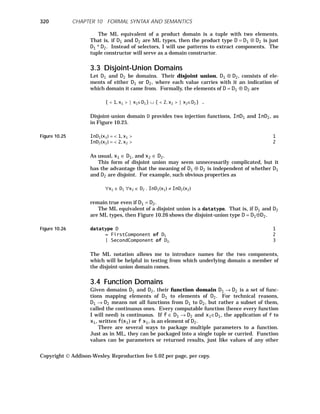
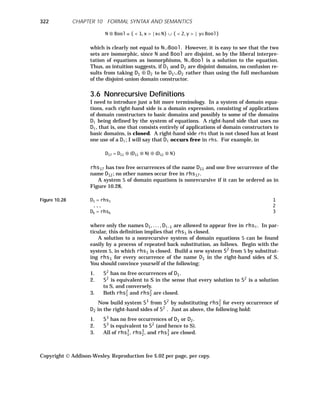
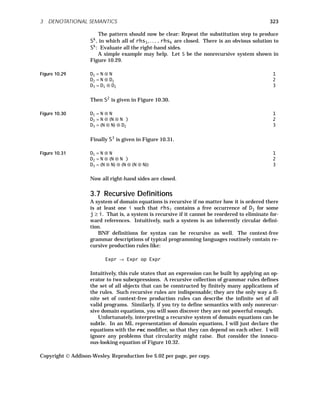
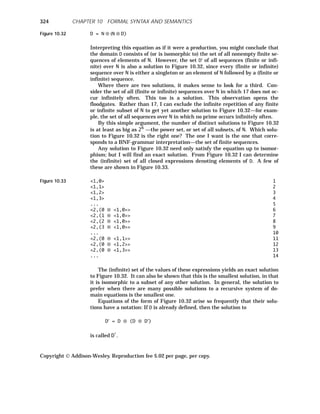
See discussions, stats, and author profiles for this publication at: https://www.researchgate.net/publication/220692467
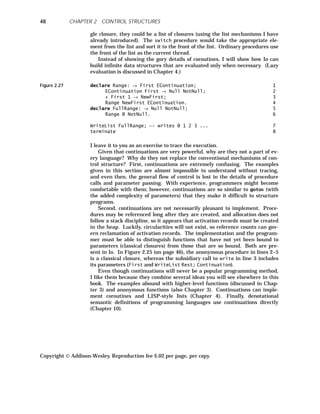
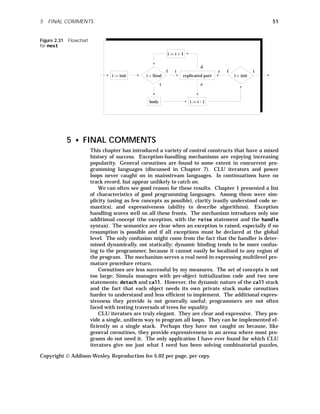
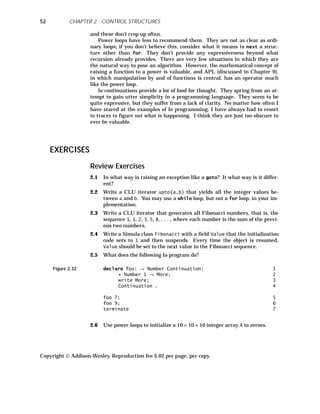
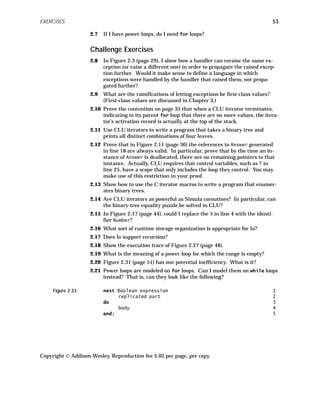
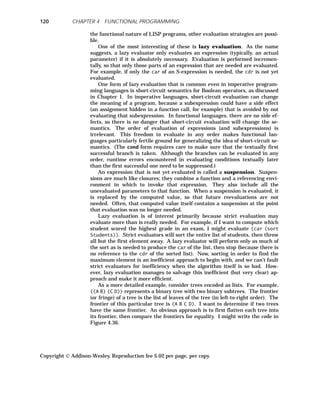
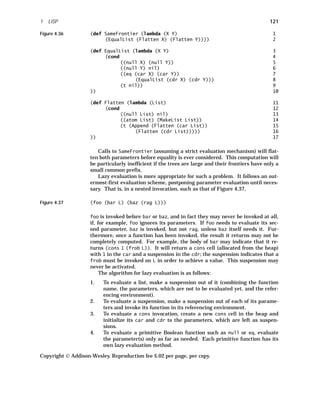
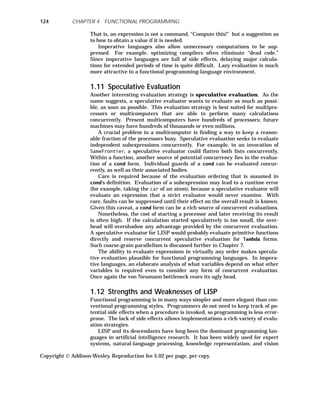
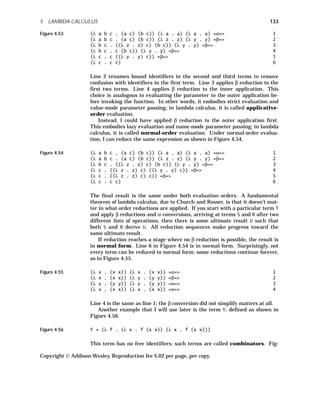
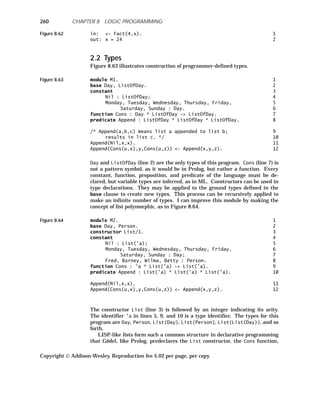
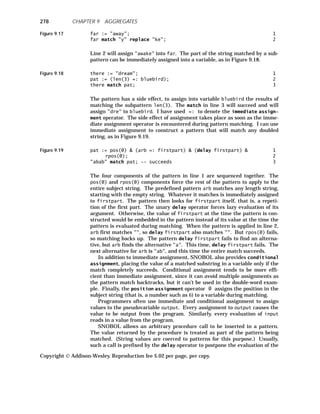
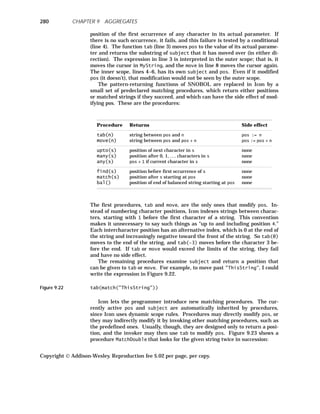
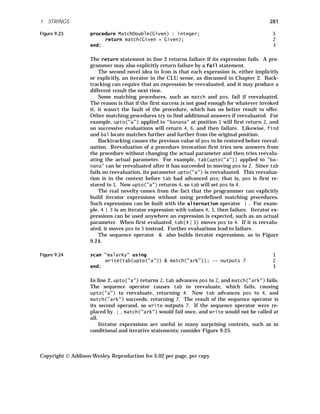
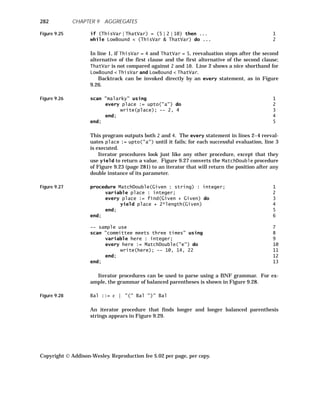
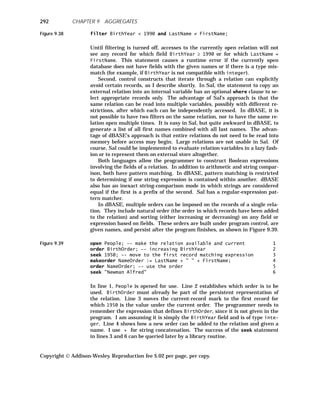
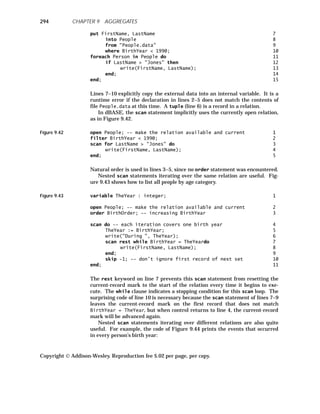
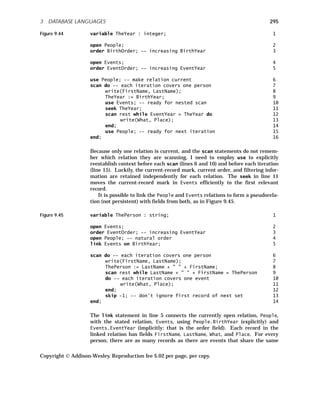
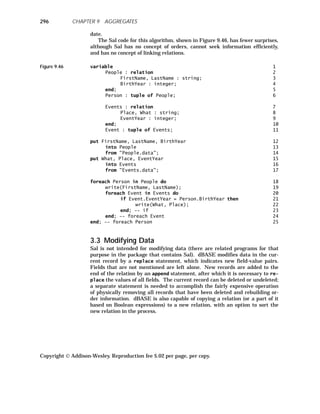
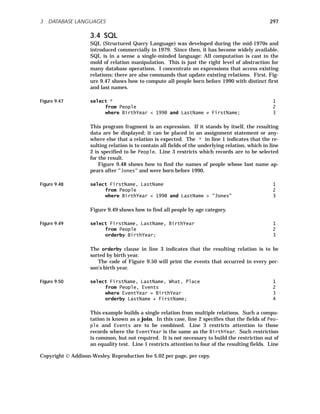
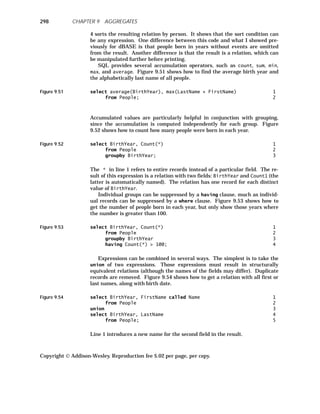
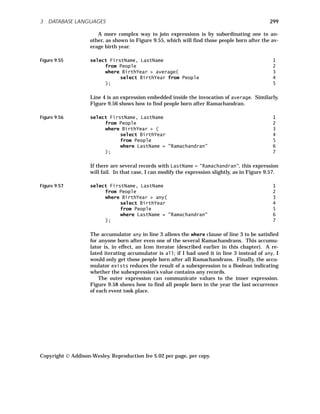
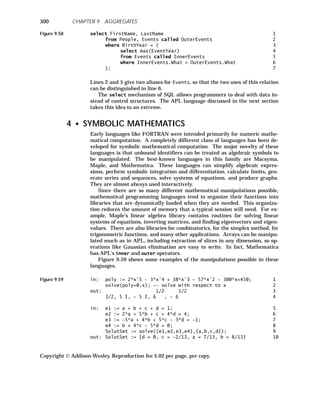
Advanced programming language design.
Book · January 1996
Source: DBLP
CITATIONS
41
READS
3,040
1 author:
Raphael Finkel
University of Kentucky
122 PUBLICATIONS 6,757 CITATIONS
SEE PROFILE
All content following this page was uploaded by Raphael Finkel on 16 December 2013.
The user has requested enhancement of the downloaded file.
ADVANCED PROGRAMMING
LANGUAGE DESIGN
Raphael A. Finkel
❖
UNIVERSITY OF KENTUCKY
▼▼
▲
Addison-Wesley Publishing Company
Menlo Park, California • Reading, Massachusetts
New York • Don Mills, Ontario • Harlow, U.K. • Amsterdam
Bonn • Paris • Milan • Madrid • Sydney • Singapore • Tokyo
Seoul • Taipei • Mexico City • San Juan, Puerto Rico
hhhhhhhhhhhhhhhhhhhhhhhhhhhhhhhhhhhh
On-line edition copyright  1996 by Addison-Wesley Publishing Company. Permission is granted to print or photo-
copy this document for a fee of $0.02 per page, per copy, payable to Addison-Wesley Publishing Company. All other rights
reserved.
Acquisitions Editor: J. Carter Shanklin
Editorial Assistant: Christine Kulke
Senior Production Editor: Teri Holden
Copy Editor: Nick Murray
Manufacturing Coordinator: Janet Weaver
Proofreader: Holly McLean-Aldis
Text Designer: Peter Vacek, Eigentype
Film Preparation: Lazer Touch, Inc.
Cover Designer: Yvo Riezebos
Printer: The Maple-Vail Book Manufacturing Group
Composition and Film Coordinator: Vivian McDougal
Copyright  1996 by Addison-Wesley Publishing Company
All rights reserved. No part of this publication may be reproduced, stored in a retrieval system, or
transmitted in any form or by any means, electronic, mechanical, photocopying, recording, or any
other media embodiments now known, or hereafter to become known, without the prior written
permission of the publisher. Manufactured in the United States of America. Published simultane-
ously in Canada.
Many of the designations used by manufacturers and sellers to distinguish their products are
claimed as trademarks. Where these designations appear in this book, and the publisher was
aware of a trademark claim, the designations have been printed in initial caps or all caps.
The programs and the applications presented in this book have been included for their instruc-
tional value. They have been tested with care but are not guaranteed for any particular purpose.
The publisher does not offer any warranties or representations, nor does it accept any liabilities
with respect to the programs or applications.
Library of Congress Cataloging-in-Publication Data
Finkel, Raphael A.
Advanced programming languages / Raphael A. Finkel.
p. cm.
Includes index.
ISBN 0-8053-1191-2
1. Programming languages (Electronic computers) I. Title.
QA76.7.F56 1995 95-36693
005.13--dc20 CIP
1 2 3 4 5 6 7 8 9—MA—99 98 97 96 95
▼▼
▲ Addison-Wesley Publishing Company, Inc.
2725 Sand Hill Road
Menlo Park, CA 94025
Dedicated to the memory of my father, Asher J.
Finkel, who first tickled my interest in
programming languages by announcing that he was
learning a language that could be read and written,
but not pronounced.
Preface
This book stems in part from courses taught at the University of Kentucky
and at the University of Wisconsin–Madison on programming language de-
sign. There are many good books that deal with the subject at an undergrad-
uate level, but there are few that are suitable for a one-semester graduate-
level course. This book is my attempt to fill that gap.
The goal of this course, and hence of this book, is to expose first-year grad-
uate students to a wide range of programming language paradigms and is-
sues, so that they can understand the literature on programming languages
and even conduct research in this field. It should improve the students’ ap-
preciation of the art of designing programming languages and, to a limited
degree, their skill in programming.
This book does not focus on any one language, or even on a few languages;
it mentions, at least in passing, over seventy languages, including well-
known ones (Algol, Pascal, C, C++, LISP, Ada, FORTRAN), important but less
known ones (ML, SR, Modula-3, SNOBOL), significant research languages
(CLU, Alphard, Linda), and little-known languages with important concepts
(Io, Go
..
del). Several languages are discussed in some depth, primarily to rein-
force particular programming paradigms. ML and LISP demonstrate func-
tional programming, Smalltalk and C++ demonstrate object-oriented
programming, and Prolog demonstrates logic programming.
Students are expected to have taken an undergraduate course in program-
ming languages before using this book. The first chapter includes a review of
much of the material on imperative programming languages that would be
covered in such a course. This review makes the book self-contained, and
also makes it accessible to advanced undergraduate students.
Most textbooks on programming languages cover the well-trodden areas of
the field. In contrast, this book tries to go beyond the standard territory,
making brief forays into regions that are under current research or that have
been proposed and even rejected in the past. There are many fascinating con-
structs that appear in very few, if any, production programming languages.
Some (like power loops) should most likely not be included in a programming
language. Others (like Io continuations) are so strange that it is not clear
how to program with them. Some (APL arrays) show alternative ways to
structure languages. These unusual ideas are important even though they do
not pass the test of current usage, because they elucidate important aspects
of programming language design, and they allow students to evaluate novel
concepts.
hhhhhhhhhhhhhhhhhhhhhhhhhhhhhhhhhhhh
On-line edition copyright  1996 by Addison-Wesley Publishing Company. Permission is
granted to print or photocopy this document for a fee of $0.02 per page, per copy, payable to Addi-
son-Wesley Publishing Company. All other rights reserved.
xi
Certain themes flow through the entire book. One is the interplay be-
tween what can be done at compile time and what must be deferred to run-
time. Actions performed at compile time make for more efficient and less
error-prone execution. Decisions deferred until runtime lead to greater flexi-
bility. Another theme is how patterns and pattern matching play a large role
in many ways in programming languages. Pattern matching is immediately
important for string manipulation, but it is also critical in steering logic pro-
gramming, helpful for extracting data from structures in ML, and for associ-
ating caller and callee in CSP. A third theme is the quest for uniformity. It is
very much like the mathematical urge to generalize. It can be seen in poly-
morphism, which generalizes the concept of type, and in overloading, which
begins by unifying operators and functions and then unifies disparate func-
tions under one roof. It can be seen in the homoiconic forms of LISP, in which
program and data are both presented in the same uniform way.
Two organizing principles suggest themselves for a book on programming
languages. The first is to deal separately with such issues as syntax, types,
encapsulation, parallelism, object-oriented programming, pattern matching,
dataflow, and so forth. Each section would introduce examples from all rele-
vant languages. The other potential organizing principle is to present indi-
vidual languages, more or less in full, and then to derive principles from
them.
This book steers a middle course. I have divided it into chapters, each of
which deals primarily with one of the subjects mentioned above. Most chap-
ters include an extended example from a particular language to set the stage.
This section may introduce language-specific features not directly relevant to
the subject of the chapter. The chapter then introduces related features from
other languages.
Because this book covers both central and unusual topics, the instructor of
a course using the book should pick and choose whatever topics are of per-
sonal interest. In general, the latter parts of chapters delve into stranger and
more novel variants of material presented earlier. The book is intended for a
one-semester course, but it is about 30 percent too long to cover fully in one
semester. It is not necessary to cover every chapter, nor to cover every section
of a chapter. Only Chapter 1 and the first seven sections of Chapter 3 are
critical for understanding the other chapters. Some instructors will want to
cover Chapter 4 before the discussion of ML in Chapter 3. Many instructors
will decide to omit dataflow (Chapter 6). Others will wish to omit denota-
tional semantics (in Chapter 10).
I have not described complete languages, and I may have failed to mention
your favorite language. I have selected representative programming lan-
guages that display particular programming paradigms or language features
clearly. These languages are not all generally available or even widely
known. The appendix lists all the languages I have mentioned and gives you
some pointers to the literature and to implementations and documentation
available on the Internet through anonymous ftp (file-transfer protocol).
The exercises at the end of each chapter serve two purposes. First, they
allow students to test their understanding of the subjects presented in the
text by working exercises directly related to the material. More importantly,
they push students beyond the confines of the material presented to consider
new situations and to evaluate new proposals. Subjects that are only hinted
Copyright  Addison-Wesley. Reproduction fee $.02 per page, per copy.
xii PREFACE
xiii
at in the text are developed more thoroughly in this latter type of exercise.
In order to create an appearance of uniformity, I have chosen to modify the
syntax of presented languages (in cases where the syntax is not the crucial is-
sue), so that language-specific syntax does not obscure the other points that I
am trying to make. For examples that do not depend on any particular lan-
guage, I have invented what I hope will be clear notation. It is derived
largely from Ada and some of its predecessors. This notation allows me to
standardize the syntactic form of language, so that the syntax does not ob-
scure the subject at hand. It is largely irrelevant whether a particular lan-
guage uses begin and end or { and } . On the other hand, in those cases
where I delve deeply into a language in current use (like ML, LISP, Prolog,
Smalltalk, and C++), I have preserved the actual language. Where reserved
words appear, I have placed them in bold monospace. Other program ex-
cerpts are in monospace font. I have also numbered examples so that instruc-
tors can refer to parts of them by line number. Each technical term that is
introduced in the text is printed in boldface the first time it appears. All
boldface entries are collected and defined in the glossary. I have tried to use a
consistent nomenclature throughout the book.
In order to relieve the formality common in textbooks, I have chosen to
write this book as a conversation between me, in the first singular person,
and you, in the second person. When I say we, I mean you and me together. I
hope you don’t mind.
Several supplemental items are available to assist the instructor in using
this text. Answers to the exercises are available from the publisher (ISBN:
0-201-49835-9) in a disk-based format. The figures from the text (in Adobe
Acrobat format), an Adobe Acrobat reader, and the entire text of this book are
available from the following site:
ftp://aw.com/cseng/authors/finkel
Please check the readme file for updates and changes. The complete text of
this book is intended for on-screen viewing free of charge; use of this material
in any other format is subject to a fee.
There are other good books on programming language design. I can par-
ticularly recommend the text by Pratt [Pratt 96] for elementary material and
the text by Louden [Louden 93] for advanced material. Other good books in-
clude those by Sebesta [Sebesta 93] and Sethi [Sethi 89].
I owe a debt of gratitude to the many people who helped me write this
book. Much of the underlying text is modified from course notes written by
Charles N. Fischer of the University of Wisconsin–Madison. Students in my
classes have submitted papers which I have used in preparing examples and
text; these include the following:
Copyright  Addison-Wesley. Reproduction fee $.02 per page, per copy.
PREFACE
Subject Student Year
Feng Luo 1992
Mike Rogers 1992
C++
Dataflow Chinya Ravishankar 1981
Go
..
del James Gary 1992
Lynx Michael Scott 1985
Mathematics languages Mary Sue Powers 1994
Miranda Manish Gupta 1992
Chinya Ravishankar 1981
Rao Surapaneni 1992
Post
CLP William Ralenkotter 1994
Rick Simkin 1981
K. Lakshman 1992
Manish Gupta 1992
Russell
Smalltalk/C++ Jonathan Edwards 1992
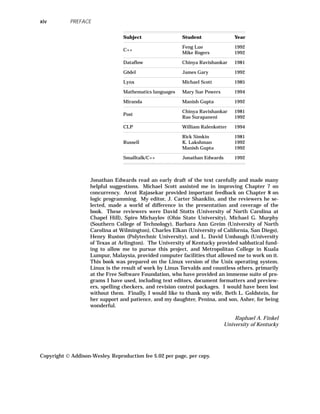
Jonathan Edwards read an early draft of the text carefully and made many
helpful suggestions. Michael Scott assisted me in improving Chapter 7 on
concurrency. Arcot Rajasekar provided important feedback on Chapter 8 on
logic programming. My editor, J. Carter Shanklin, and the reviewers he se-
lected, made a world of difference in the presentation and coverage of the
book. These reviewers were David Stotts (University of North Carolina at
Chapel Hill), Spiro Michaylov (Ohio State University), Michael G. Murphy
(Southern College of Technology), Barbara Ann Greim (University of North
Carolina at Wilmington), Charles Elkan (University of California, San Diego),
Henry Ruston (Polytechnic University), and L. David Umbaugh (University
of Texas at Arlington). The University of Kentucky provided sabbatical fund-
ing to allow me to pursue this project, and Metropolitan College in Kuala
Lumpur, Malaysia, provided computer facilities that allowed me to work on it.
This book was prepared on the Linux version of the Unix operating system.
Linux is the result of work by Linus Torvalds and countless others, primarily
at the Free Software Foundation, who have provided an immense suite of pro-
grams I have used, including text editors, document formatters and preview-
ers, spelling checkers, and revision control packages. I would have been lost
without them. Finally, I would like to thank my wife, Beth L. Goldstein, for
her support and patience, and my daughter, Penina, and son, Asher, for being
wonderful.
Raphael A. Finkel
University of Kentucky
Copyright  Addison-Wesley. Reproduction fee $.02 per page, per copy.
xiv PREFACE
h
hhhhhhhhhhhhhhhhhhhhhhhhhhhhhhhhhhhhhhhhhhhhhhhhhhhhhhhhhhhhhhhhhhhhhhhhhhhhhhhhhhhhhhhhhhh
Chapter 1 ❖
Introduction
The purpose of this book is to study the principles and innovations found in
modern programming languages. We will consider a wide variety of lan-
guages. The goal is not to become proficient in any of these languages, but to
learn what contributions each has made to the “state of the art” in language
design.
I will discuss various programming paradigms in this book. Some lan-
guages (such as Ada, Pascal, Modula-2) are imperative; they use variables,
assignments, and iteration. For imperative languages, I will dwell on such is-
sues as flow of control (Chapter 2) and data types (Chapter 3). Other lan-
guages (for example, LISP and FP) are functional; they have no variables,
assignments, or iteration, but model program execution as expression evalua-
tion. I discuss functional languages in Chapter 4. Other languages (for ex-
ample, Smalltalk and C++), represent the object-oriented paradigm, in
which data types are generalized to collections of data and associated rou-
tines (Chapter 5). Dataflow languages (Val, Sisal, and Post, Chapter 6) at-
tempt to gain speed by simultaneous execution of independent computations;
they require special computer architectures. A more common way to gain
speed is by concurrent programming (typified by languages such as SR and
Lynx, discussed in Chapter 7). Another major paradigm constitutes the
declarative languages such as Prolog and Go
..
del (Chapter 8); they view pro-
gramming as stating what is wanted and not necessarily how to compute it.
Aggregate languages (Chapter 9) form a a final loosely knit paradigm that
includes languages with special-purpose data formats, such as strings
(SNOBOL and Icon), arrays (APL), databases (dBASE and SQL), and mathe-
matical formulas (Mathematica and Maple).
In addition to studying actual programming language constructs, I will
present formal semantic models in Chapter 10. These models allow a precise
specification of what a program means, and provide the basis for reasoning
about the correctness of a program.
hhhhhhhhhhhhhhhhhhhhhhhhhhhhhhhhhhhh
On-line edition copyright  1996 by Addison-Wesley Publishing Company. Permission is
granted to print or photocopy this document for a fee of $0.02 per page, per copy, payable to Addi-
son-Wesley Publishing Company. All other rights reserved.
1
1 ◆ PROGRAMMING LANGUAGES AS
SOFTWARE TOOLS
Programming languages fit into a larger subject that might be termed soft-
ware tools. This subject includes such fields as interactive editors (text, pic-
ture, spreadsheet, bitmap, and so forth), data transformers (compilers,
assemblers, stream editors, macro processors, text formatters), operating sys-
tems, database management systems, and tools for program creation, testing,
and maintenance (script files, source-code management tools, debuggers).
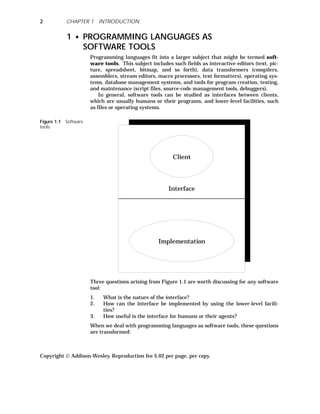
In general, software tools can be studied as interfaces between clients,
which are usually humans or their programs, and lower-level facilities, such
as files or operating systems.
Figure 1.1 Software
tools
Interface
Implementation
Client
Three questions arising from Figure 1.1 are worth discussing for any software
tool:
1. What is the nature of the interface?
2. How can the interface be implemented by using the lower-level facili-
ties?
3. How useful is the interface for humans or their agents?
When we deal with programming languages as software tools, these questions
are transformed:
Copyright  Addison-Wesley. Reproduction fee $.02 per page, per copy.
2 CHAPTER 1 INTRODUCTION
3
1. What is the structure (syntax) and meaning (semantics) of the program-
ming language constructs? Usually, I will use informal methods to show
what the constructs are and what they do. However, Chapter 10 pre-
sents formal methods for describing the semantics of programming lan-
guages.
2. How does the compiler writer deal with these constructs in order to
translate them into assembler or machine language? The subject of
compiler construction is large and fascinating, but is beyond the scope of
this book. I will occasionally touch on this topic to assure you that the
constructs can, in fact, be translated.
3. Is the programming language good for the programmer? More specifi-
cally, is it easy to use, expressive, readable? Does it protect the pro-
grammer from programming errors? Is it elegant? I spend a significant
amount of effort trying to evaluate programming languages and their
constructs in this way. This subject is both fascinating and difficult to
be objective about. Many languages have their own fan clubs, and dis-
cussions often revolve about an ill-defined sense of elegance.
Programming languages have a profound effect on the ways programmers
formulate solutions to problems. You will see that different paradigms im-
pose very different programming styles, but even more important, they
change the way the programmer looks at algorithms. I hope that this book
will expand your horizons in much the same way that your first exposure to
recursion opened up a new way of thinking. People have invented an amaz-
ing collection of elegant and expressive programming structures.
2 ◆ EVALUATING PROGRAMMING LANGUAGES
This book introduces you to some unusual languages and some unusual lan-
guage features. As you read about them, you might wonder how to evaluate
the quality of a feature or an entire language. Reasonable people disagree on
what makes for a great language, which is why so many novel ideas abound
in the arena of programming language design. At the risk of oversimplifica-
tion, I would like to present a short list of desiderata for programming lan-
guages [Butcher 91]. Feel free to disagree with them. Another excellent
discussion of this topic is found in Louden [Louden 93].
• Simplicity. There should be as few basic concepts as possible. Often the
job of the language designer is to discard elements that are superfluous,
error-prone, hard to read, or hard to compile. Many people consider PL/I,
for example, to be much too large a language. Some criticize Ada for the
same reason.
• Uniformity. The basic concepts should be applied consistently and uni-
versally. We should be able to use language features in different contexts
without changing their form. Non-uniformity can be annoying. In Pascal,
constants cannot be declared with values given by expressions, even
though expressions are accepted in all other contexts when a value is
needed. Non-uniformity can also be error-prone. In Pascal, some for
loops take a single statement as a body, but repeat loops can take any
number of statements. It is easy to forget to bracket multiple statements
in the body of a for loop.
Copyright  Addison-Wesley. Reproduction fee $.02 per page, per copy.
2 EVALUATING PROGRAMMING LANGUAGES
• Orthogonality. Independent functions should be controlled by indepen-
dent mechanisms. (In mathematics, independent vectors are called ‘‘or-
thogonal.’’)
• Abstraction. There should be a way to factor out recurring patterns.
(Abstraction generally means hiding details by constructing a ‘‘box’’
around them and permitting only limited inspection of its contents.)
• Clarity. Mechanisms should be well defined, and the outcome of code
should be easily predictable. People should be able to read programs in
the language and be able to understand them readily. Many people have
criticized C, for example, for the common confusion between the assign-
ment operator (=) and the equality test operator (==).
• Information hiding. Program units should have access only to the in-
formation they require. It is hard to write large programs without some
control over the extent to which one part of the program can influence an-
other part.
• Modularity. Interfaces between programming units should be stated ex-
plicitly.
• Safety. Semantic errors should be detectable, preferably at compile time.
An attempt to add values of dissimilar types usually indicates that the
programmer is confused. Languages like Awk and SNOBOL that silently
convert data types in order to apply operators tend to be error-prone.
• Expressiveness. A wide variety of programs should be expressible.1
Languages with coroutines, for example, can express algorithms for test-
ing complex structures for equality much better than languages without
coroutines. (Coroutines are discussed in Chapter 2.)
• Efficiency. Efficient code should be producible from the language, possi-
bly with the assistance of the programmer. Functional programming lan-
guages that rely heavily on recursion face the danger of inefficiency,
although there are compilation methods (such as eliminating tail recur-
sion) that make such languages perfectly acceptable. However, languages
that require interpretation instead of compilation (such as Tcl) tend to be
slow, although in many applications, speed is of minor concern.
3 ◆ BACKGROUND MATERIAL ON
PROGRAMMING LANGUAGES
Before showing you anything out of the ordinary, I want to make sure that
you are acquainted with the fundamental concepts that are covered in an un-
dergraduate course in programming languages. This section is intentionally
concise. If you need more details, you might profitably refer to the fine books
by Pratt [Pratt 96] and Louden [Louden 93].
hhhhhhhhhhhhhhhhhhhhhhhhhhhhhhhhhhhh
1
In a formal sense, all practical languages are Turing-complete; that is, they can express
exactly the same algorithms. However, the ease with which a programmer can come up with an
appropriate program is part of what I mean by expressiveness. Enumerating binary trees (see
Chapter 2) is quite difficult in most languages, but quite easy in CLU.
Copyright  Addison-Wesley. Reproduction fee $.02 per page, per copy.
4 CHAPTER 1 INTRODUCTION
5
3.1 Variables, Data Types, Literals, and
Expressions
I will repeatedly refer to the following example, which is designed to have a
little bit of everything in the way of types. A type is a set of values on which
the same operations are defined.
Figure 1.2 variable 1
First : pointer to integer; 2
Second : array 0..9 of 3
record 4
Third: character; 5
Fourth: integer; 6
Fifth : (Apple, Durian, Coconut, Sapodilla, 7
Mangosteen) 8
end; 9
begin 10
First := nil; 11
First := &Second[1].Fourth; 12
Firstˆ := 4; 13
Second[3].Fourth := (Firstˆ + Second[1].Fourth) * 14
Second[Firstˆ].Fourth; 15
Second[0] := [Third : ’x’; Fourth : 0; 16
Fifth : Sapodilla]; 17
end; 18
Imperative languages (such as Pascal and Ada) have variables, which are
named memory locations. Figure 1.2 introduces two variables, First (line 2)
and Second (lines 3–9). Programming languages often restrict the values that
may be placed in variables, both to ensure that compilers can generate accu-
rate code for manipulating those values and to prevent common programming
errors. The restrictions are generally in the form of type information. The
type of a variable is a restriction on the values it can hold and what opera-
tions may be applied to those values. For example, the type integer encom-
passes numeric whole-number values between some language-dependent (or
implementation-dependent) minimum and maximum value; values of this
type may act as operands in arithmetic operations such as addition. The
term integer is not set in bold monospace type, because in most languages,
predefined types are not reserved words, but ordinary identifiers that can be
given new meanings (although that is bad practice).
Researchers have developed various taxonomies to categorize types
[ISO/IEC 94; Meek 94]. I will present here a fairly simple taxonomy. A
primitive type is one that is not built out of other types. Standard primitive
types provided by most languages include integer, Boolean, character, real,
and sometimes string. Figure 1.2 uses both integer and character. Enu-
meration types are also primitive. The example uses an enumeration type in
lines 7–8; its values are restricted to the values specified. Enumeration types
often define the order of their enumeration constants. In Figure 1.2, however,
Copyright  Addison-Wesley. Reproduction fee $.02 per page, per copy.
3 BACKGROUND MATERIAL ON PROGRAMMING LANGUAGES
it makes no sense to consider one fruit greater than another.2
Structured types are built out of other types. Arrays, records, and
pointers are structured types.3
Figure 1.2 shows all three kinds of standard
structured types. The building blocks of a structured type are its compo-
nents. The component types go into making the structured type; component
values go into making the value of a structured type. The pointer type in line
2 of Figure 1.2 has one component type (integer); a pointer value has one
component value. There are ten component values of the array type in lines
3–9, each of a record type. Arrays are usually required to be homogeneous;
that is, all the component values must be of the same type. Arrays are in-
dexed by elements of an index type, usually either a subrange of integers,
characters, or an enumeration type. Therefore, an array has two component
types (the base type and the index type); it has as many component values as
there are members in the index type.
Flexible arrays do not have declared bounds; the bounds are set at run-
time, based on which elements of the array have been assigned values. Dy-
namic-sized arrays have declared bounds, but the bounds depend on the
runtime value of the bounds expressions. Languages that provide dynamic-
sized arrays provide syntax for discovering the lower and upper bounds in
each dimension.
Array slices, such as Second[3..5], are also components for purposes of
this discussion. Languages (like Ada) that allow array slices usually only al-
low slices in the last dimension. (APL does not have such a restriction.)
The components of the record type in lines 4–9 are of types character and
integer. Records are like arrays in that they have multiple component val-
ues. However, the values are indexed not by members of an index type but
rather by named fields. The component values need not be of the same type;
records are not required to be homogeneous. Languages for systems pro-
gramming sometimes allow the programmer to control exactly how many bits
are allocated to each field and how fields are packed into memory.
The choice is a less common structured type. It is like a record in that it
has component types, each selected by a field. However, it has only one com-
ponent value, which corresponds to exactly one of the component types.
Choices are often implemented by allocating as much space as the largest
component type needs. Some languages (like Simula) let the programmer re-
strict a variable to a particular component when the variable is declared. In
this case, only enough space is allocated for that component, and the compiler
disallows accesses to other components.
Which field is active in a choice value determines the operations that may
be applied to that value. There is usually some way for a program to deter-
mine at runtime which field is active in any value of the choice type; if not,
there is a danger that a value will be accidentally (or intentionally) treated as
belonging to a different field, which may have a different type. Often, lan-
guages provide a tagcase statement with branches in which the particular
variant is known both to the program and to the compiler. Pascal allows part
hhhhhhhhhhhhhhhhhhhhhhhhhhhhhhhhhhhh
2
In Southeast Asia, the durian is considered the king of fruits. My personal favorite is the
mangosteen.
3
Whether to call pointers primitive or structured is debatable. I choose to call them struc-
tured because they are built from another type.
Copyright  Addison-Wesley. Reproduction fee $.02 per page, per copy.
6 CHAPTER 1 INTRODUCTION
7
of a record to be a choice and the other fields to be active in any variant. One
of the latter fields indicates which variant is in use. It doesn’t make sense to
modify the value of that field without modifying the variant part as well.
A literal is a value, usually of a primitive type, expressly denoted in a
program. For example, 243 is an integer literal and Figure 1.2 has literals 0,
1, 3, 4, 9, and ’x’. Some values are provided as predeclared constants (that
is, identifiers with predefined and unchangeable values), such as false
(Boolean) and nil (pointer).
A constructor expressly denotes a value of a structured type. Figure 1.2
has a record constructor in lines 16–17.
An expression is a literal, a constructor, a constant, a variable, an invo-
cation of a value-returning procedure, a conditional expression, or an opera-
tor with operands that are themselves expressions. Figure 1.2 has
expressions in lines 11–17. An operator is a shorthand for an invocation of a
value-returning procedure whose parameters are the operands. Each opera-
tor has an arity, that is, the number of operands it expects. Common arities
are unary (one operand) and binary (two operands). Unary operators are
commonly written before their operand (such as -4 or &myVariable), but some
are traditionally written after the operand (such as ptrVariableˆ). Some-
times it is helpful to consider literals and constants to be nullary (no-operand)
operators. For example, true is a nullary operator of type Boolean.
Operators do not necessarily take only numeric operands. The derefer-
encing operator (ˆ), for example, produces the value pointed to by a pointer.
This operator is unary and postfix, that is, it follows its expression. You can
see it in Figure 1.2 in lines 13, 14, and 15. Some languages, such as
Gedanken, Ada, and Oberon-2, coerce pointers (repeatedly, if needed) to the
values they dereference if the context makes it clear which type is required.
The unary prefix referencing operator (&) in line 12 generates a pointer to a
value.
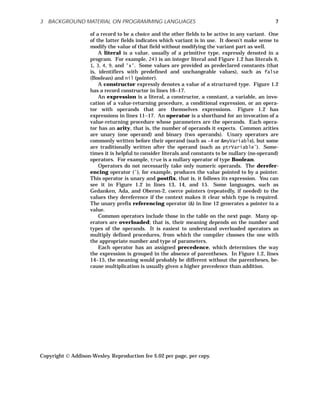
Common operators include those in the table on the next page. Many op-
erators are overloaded; that is, their meaning depends on the number and
types of the operands. It is easiest to understand overloaded operators as
multiply defined procedures, from which the compiler chooses the one with
the appropriate number and type of parameters.
Each operator has an assigned precedence, which determines the way
the expression is grouped in the absence of parentheses. In Figure 1.2, lines
14–15, the meaning would probably be different without the parentheses, be-
cause multiplication is usually given a higher precedence than addition.
Copyright  Addison-Wesley. Reproduction fee $.02 per page, per copy.
3 BACKGROUND MATERIAL ON PROGRAMMING LANGUAGES
Operator Left type Right type Result type Comments
+ - * integer integer integer
+ - * / real real real
/ integer integer real or integer
div mod integer integer integer
- numeric none same
** integer integer integer exponentiation
** numeric real real exponentiation
= any same Boolean
< > >= <= numeric same Boolean
+ string string string concatenation
˜ string pattern Boolean string match
and Boolean Boolean Boolean
or Boolean Boolean Boolean
not Boolean none Boolean
ˆ pointer none component
& any none pointer
Expressions evaluate to R-values. Variables and components of variables
of structured types also have an L-value, that is, an address where their R-
value is stored. The assignment statement (lines 11–17 in Figure 1.2) re-
quires an L-value on the left-hand side (L stands for “left”) and an R-value on
the right-hand side (R stands for “right”). In Figure 1.2, lines 11 and 12 show
a variable used for its L-value; the next lines show components used for their
L-values.
The types of the left-hand side and the right-hand side must be assign-
ment-compatible. If they are the same type, they are compatible. (What it
means to have the same type is discussed in Chapter 3.) If they are of differ-
ent types, the language may allow the value of the right-hand side to be im-
plicitly converted to the type of the left-hand side. Implicit type conversions
are called coercions. For example, Pascal will coerce integers to reals, but
not the reverse. Coercions are error-prone, because the target type may not
be able to represent all the values of the source type. For example, many
computers can store some large numbers precisely as integers but only impre-
cisely as reals.
Converting types, either explicitly (casting) or implicitly (coercing) can
sometimes change the data format. However, it is sometimes necessary to
treat an expression of one type as if it were of another type without any data-
format conversion. For example, a message might look like an array of char-
acters to one procedure, whereas another procedure must understand it as a
record with header and data fields. Wisconsin Modula introduced a noncon-
verting casting operator qua for this purpose. In C, which lacks such an oper-
ator, the programmer who wishes a nonconverting cast must cast a pointer to
the first type into a pointer to the second type; pointers have the same repre-
sentation no matter what they point to (in most C implementations). The fol-
lowing code shows both methods.
Copyright  Addison-Wesley. Reproduction fee $.02 per page, per copy.
8 CHAPTER 1 INTRODUCTION
9
Figure 1.3 type 1
FirstType = ... ; 2
SecondType = ... ; 3
SecondTypePtr = pointer to SecondType; 4
variable 5
F : FirstType; 6
S : SecondType; 7
begin 8
... 9
S := F qua SecondType; -- Wisconsin Modula 10
S := (SecondTypePtr(&F))ˆ; -- C 11
end; 12
Line 10 shows how F can be cast without conversion into the second type in
Wisconsin Modula. Line 11 shows the same thing for C, where I use the type
name SecondTypePtr as an explicit conversion routine. The referencing oper-
ator & produces a pointer to F. In both cases, if the two types disagree on
length of representation, chaos may ensue, because the number of bytes
copied by the assignment is the appropriate number for SecondType.
The Boolean operators and and or may have short-circuit semantics;
that is, the second operand is only evaluated if the first operand evaluates to
true (for and) or false (for or). This evaluation strategy is an example of
lazy evaluation, discussed in Chapter 4. Short-circuit operators allow the
programmer to combine tests, the second of which only makes sense if the
first succeeds. For example, I may want to first test if a pointer is nil, and
only if it is not, to test the value it points to.
Conditional expressions are built with an if construct. To make sure
that a conditional expression always has a value, each if must be matched by
both a then and an else. The expressions in the then and else parts must
have the same type. Here is an example:
Figure 1.4 write(if a > 0 then a else -a);
3.2 Control Constructs
Execution of imperative programming languages proceeds one statement at
a time. Statements can be simple or compound. Simple statements include
the assignment statement, procedure invocation, and goto. Compound state-
ments enclose other statements; they include conditional and iterative state-
ments, such as if, case, while, and for. Programming languages need some
syntax for delimiting enclosed statements in a compound statement. Some
languages, like Modula, provide closing syntax for each compound statement:
Figure 1.5 while Firstˆ < 10 do 1
Firstˆ := 2 * Firstˆ; 2
Second[0].Fourth := 1 + Second[0].Fourth; 3
end; 4
The end on line 4 closes the while on line 1. Other languages, like Pascal,
only allow a single statement to be included, but it may be a block state-
Copyright  Addison-Wesley. Reproduction fee $.02 per page, per copy.
3 BACKGROUND MATERIAL ON PROGRAMMING LANGUAGES
ment that encloses multiple statements surrounded by begin and end.
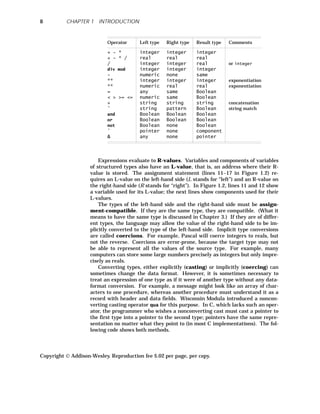
Syntax for the if statement can be confusing if there is no trailing end
syntax. If an if statement encloses another if statement in its then clause,
the else that follows might refer to either if. This problem is called the
“dangling-else” problem. In the following example, the else in line 4 could
match either the one in line 1 or line 2. Pascal specifies that the closer if
(line 2) is used.
Figure 1.6 if IntVar < 10 then 1
if IntVar < 20 then 2
IntVar := 0 3
else 4
IntVar := 1; 5
On the other hand, if if statements require a closing end, the problem cannot
arise:
Figure 1.7 if IntVar < 10 then 1
if IntVar < 20 then 2
IntVar := 0; 3
end 4
else 5
IntVar := 1; 6
end; 7
Here, the else in line 5 unambiguously matches the if in line 1. Closing syn-
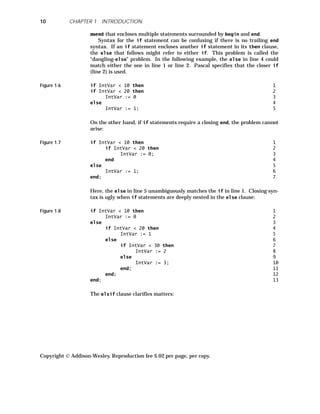
tax is ugly when if statements are deeply nested in the else clause:
Figure 1.8 if IntVar < 10 then 1
IntVar := 0 2
else 3
if IntVar < 20 then 4
IntVar := 1 5
else 6
if IntVar < 30 then 7
IntVar := 2 8
else 9
IntVar := 3; 10
end; 11
end; 12
end; 13
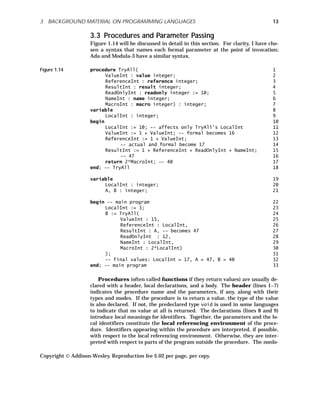
The elsif clause clarifies matters:
Copyright  Addison-Wesley. Reproduction fee $.02 per page, per copy.
10 CHAPTER 1 INTRODUCTION
11
Figure 1.9 if IntVar < 10 then 1
IntVar := 0 2
elsif IntVar < 20 then 3
IntVar := 1 4
elsif IntVar < 30 then 5
IntVar := 2 6
else 7
IntVar := 3; 8
end; 9
All the examples in this book use a closing end for compound statements. You
don’t have to worry about language-specific syntax issues when you are try-
ing to concentrate on semantics.
Some languages, like Russell and CSP, allow conditionals to have any
number of branches, each with its own Boolean condition, called a guard.
The guards may be evaluated in any order, and execution chooses any branch
whose guard evaluates to true. These conditionals are called nondetermin-
istic, since running the program a second time with the same input may re-
sult in a different branch being selected. In such languages, else means
“when all the guards are false.”
A wide range of iterative statements (loops) is available. An iterative
statement must indicate under what condition the iteration is to terminate
and when that condition is tested. The while loop tests an arbitrary Boolean
expression before each iteration.
When goto statements became unpopular because they lead to unreadable
and unmaintainable programs, languages tried to avoid all control jumps.
But loops often need to exit from the middle or to abandon the current itera-
tion and start the next one. The break and next statements were invented to
provide these facilities without reintroducing unconstrained control jumps.
An example of exiting the loop from the middle is the “n-and-a-half-times
loop”:
Figure 1.10 loop 1
read(input); 2
if input = 0 then break end; 3
if comment(input) then next end; 4
process(input); 5
end; 6
The break in line 3 terminates the loop when a sentinel indicating the end of
input is read. The next in line 4 abandons the current iteration if the input is
not to be processed. A similar statement found in Perl is redo, which restarts
the current iteration without updating any loop indices or checking termina-
tion conditions. The break, next, and redo statements can also take an inte-
ger or a loop label to specify the number of levels of loop they are to terminate
or iterate. In this case, they are called multilevel statements.
Many loops require control variables to be initialized before the first itera-
tion and updated after each iteration. Some languages (like C) provide syn-
tax that includes these steps explicitly, which makes the loops more readable
and less error-prone. However, such syntax blurs the distinction between def-
inite (for) and indefinite (while) iteration:
Copyright  Addison-Wesley. Reproduction fee $.02 per page, per copy.
3 BACKGROUND MATERIAL ON PROGRAMMING LANGUAGES
Figure 1.11 for a := 1; Ptr := Start -- initialization 1
while Ptr ≠ nil -- termination condition 2
updating a := a+1; Ptr := Ptrˆ.Next; -- after each iter. 3
do 4
... -- loop body 5
end; 6
Russell and CSP generalize the nondeterministic if statement into a non-
deterministic while loop with multiple branches. So long as any guard is
true, the loop is executed, and any branch whose guard is true is arbitrarily
selected and executed. The loop terminates when all guards are false. For
example, the algorithm to compute the greatest common divisor of two inte-
gers a and b can be written as follows:
Figure 1.12 while 1
when a < b => b := b - a; 2
when b < a => a := a - b; 3
end; 4
Each guard starts with the reserved word when and ends with the symbol => .
The loop terminates when a = b.
The case statement is used to select one of a set of options on the basis of
the value of some expression.4
Most languages require that the selection be
based on a criterion known at compile time (that is, the case labels must be
constant or constant ranges); this restriction allows compilers to generate ef-
ficient code. However, conditions that can only be evaluated at runtime also
make sense, as in the following example:
Figure 1.13 case a of 1
when 0 => Something(1); -- static unique guard 2
when 1..10 => Something(2); -- static guard 3
when b+12 => Something(3); -- dynamic unique guard 4
when b+13..b+20 => Something(4); -- dynamic guard 5
otherwise Something(5); -- guard of last resort 6
end; 7
Each guard tests the value of a. Lines 2 and 4 test this value for equality
with 0 and b+12; lines 3 and 5 test it for membership in a range. If the
guards (the selectors for the branches) overlap, the case statement is erro-
neous; this situation can be detected at compile time for static guards and at
runtime for dynamic guards. Most languages consider it to be a runtime er-
ror if none of the branches is selected and there is no otherwise clause.
hhhhhhhhhhhhhhhhhhhhhhhhhhhhhhhhhhhh
4
C. A. R. Hoare, who invented the case statement, says, “This was my first programming
language invention, of which I am still most proud.” [Hoare 73]
Copyright  Addison-Wesley. Reproduction fee $.02 per page, per copy.
12 CHAPTER 1 INTRODUCTION
13
3.3 Procedures and Parameter Passing
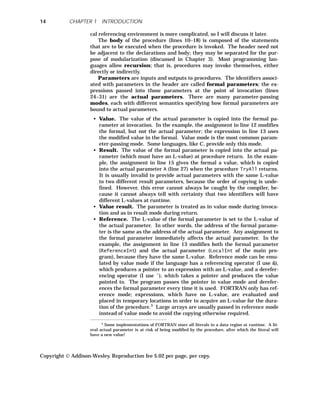
Figure 1.14 will be discussed in detail in this section. For clarity, I have cho-
sen a syntax that names each formal parameter at the point of invocation;
Ada and Modula-3 have a similar syntax.
Figure 1.14 procedure TryAll( 1
ValueInt : value integer; 2
ReferenceInt : reference integer; 3
ResultInt : result integer; 4
ReadOnlyInt : readonly integer := 10; 5
NameInt : name integer; 6
MacroInt : macro integer) : integer; 7
variable 8
LocalInt : integer; 9
begin 10
LocalInt := 10; -- affects only TryAll’s LocalInt 11
ValueInt := 1 + ValueInt; -- formal becomes 16 12
ReferenceInt := 1 + ValueInt; 13
-- actual and formal become 17 14
ResultInt := 1 + ReferenceInt + ReadOnlyInt + NameInt; 15
-- 47 16
return 2*MacroInt; -- 40 17
end; -- TryAll 18
variable 19
LocalInt : integer; 20
A, B : integer; 21
begin -- main program 22
LocalInt := 3; 23
B := TryAll( 24
ValueInt : 15, 25
ReferenceInt : LocalInt, 26
ResultInt : A, -- becomes 47 27
ReadOnlyInt : 12, 28
NameInt : LocalInt, 29
MacroInt : 2*LocalInt) 30
); 31
-- Final values: LocalInt = 17, A = 47, B = 40 32
end; -- main program 33
Procedures (often called functions if they return values) are usually de-
clared with a header, local declarations, and a body. The header (lines 1–7)
indicates the procedure name and the parameters, if any, along with their
types and modes. If the procedure is to return a value, the type of the value
is also declared. If not, the predeclared type void is used in some languages
to indicate that no value at all is returned. The declarations (lines 8 and 9)
introduce local meanings for identifiers. Together, the parameters and the lo-
cal identifiers constitute the local referencing environment of the proce-
dure. Identifiers appearing within the procedure are interpreted, if possible,
with respect to the local referencing environment. Otherwise, they are inter-
preted with respect to parts of the program outside the procedure. The nonlo-
Copyright  Addison-Wesley. Reproduction fee $.02 per page, per copy.
3 BACKGROUND MATERIAL ON PROGRAMMING LANGUAGES
cal referencing environment is more complicated, so I will discuss it later.
The body of the procedure (lines 10–18) is composed of the statements
that are to be executed when the procedure is invoked. The header need not
be adjacent to the declarations and body; they may be separated for the pur-
pose of modularization (discussed in Chapter 3). Most programming lan-
guages allow recursion; that is, procedures may invoke themselves, either
directly or indirectly.
Parameters are inputs and outputs to procedures. The identifiers associ-
ated with parameters in the header are called formal parameters; the ex-
pressions passed into those parameters at the point of invocation (lines
24–31) are the actual parameters. There are many parameter-passing
modes, each with different semantics specifying how formal parameters are
bound to actual parameters.
• Value. The value of the actual parameter is copied into the formal pa-
rameter at invocation. In the example, the assignment in line 12 modifies
the formal, but not the actual parameter; the expression in line 13 uses
the modified value in the formal. Value mode is the most common param-
eter-passing mode. Some languages, like C, provide only this mode.
• Result. The value of the formal parameter is copied into the actual pa-
rameter (which must have an L-value) at procedure return. In the exam-
ple, the assignment in line 15 gives the formal a value, which is copied
into the actual parameter A (line 27) when the procedure TryAll returns.
It is usually invalid to provide actual parameters with the same L-value
to two different result parameters, because the order of copying is unde-
fined. However, this error cannot always be caught by the compiler, be-
cause it cannot always tell with certainty that two identifiers will have
different L-values at runtime.
• Value result. The parameter is treated as in value mode during invoca-
tion and as in result mode during return.
• Reference. The L-value of the formal parameter is set to the L-value of
the actual parameter. In other words, the address of the formal parame-
ter is the same as the address of the actual parameter. Any assignment to
the formal parameter immediately affects the actual parameter. In the
example, the assignment in line 13 modifies both the formal parameter
(ReferenceInt) and the actual parameter (LocalInt of the main pro-
gram), because they have the same L-value. Reference mode can be emu-
lated by value mode if the language has a referencing operator (I use &),
which produces a pointer to an expression with an L-value, and a derefer-
encing operator (I use ˆ), which takes a pointer and produces the value
pointed to. The program passes the pointer in value mode and derefer-
ences the formal parameter every time it is used. FORTRAN only has ref-
erence mode; expressions, which have no L-value, are evaluated and
placed in temporary locations in order to acquire an L-value for the dura-
tion of the procedure.5
Large arrays are usually passed in reference mode
instead of value mode to avoid the copying otherwise required.
hhhhhhhhhhhhhhhhhhhhhhhhhhhhhhhhhhhh
5
Some implementations of FORTRAN store all literals in a data region at runtime. A lit-
eral actual parameter is at risk of being modified by the procedure, after which the literal will
have a new value!
Copyright  Addison-Wesley. Reproduction fee $.02 per page, per copy.
14 CHAPTER 1 INTRODUCTION
15
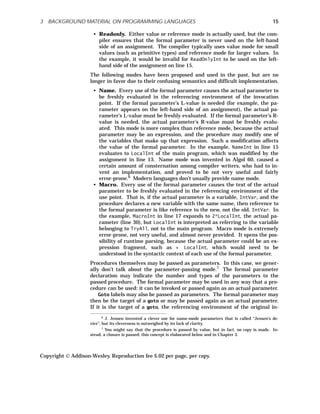
• Readonly. Either value or reference mode is actually used, but the com-
piler ensures that the formal parameter is never used on the left-hand
side of an assignment. The compiler typically uses value mode for small
values (such as primitive types) and reference mode for larger values. In
the example, it would be invalid for ReadOnlyInt to be used on the left-
hand side of the assignment on line 15.
The following modes have been proposed and used in the past, but are no
longer in favor due to their confusing semantics and difficult implementation.
• Name. Every use of the formal parameter causes the actual parameter to
be freshly evaluated in the referencing environment of the invocation
point. If the formal parameter’s L-value is needed (for example, the pa-
rameter appears on the left-hand side of an assignment), the actual pa-
rameter’s L-value must be freshly evaluated. If the formal parameter’s R-
value is needed, the actual parameter’s R-value must be freshly evalu-
ated. This mode is more complex than reference mode, because the actual
parameter may be an expression, and the procedure may modify one of
the variables that make up that expression. Such a modification affects
the value of the formal parameter. In the example, NameInt in line 15
evaluates to LocalInt of the main program, which was modified by the
assignment in line 13. Name mode was invented in Algol 60, caused a
certain amount of consternation among compiler writers, who had to in-
vent an implementation, and proved to be not very useful and fairly
error-prone.6
Modern languages don’t usually provide name mode.
• Macro. Every use of the formal parameter causes the text of the actual
parameter to be freshly evaluated in the referencing environment of the
use point. That is, if the actual parameter is a variable, IntVar, and the
procedure declares a new variable with the same name, then reference to
the formal parameter is like reference to the new, not the old, IntVar. In
the example, MacroInt in line 17 expands to 2*LocalInt, the actual pa-
rameter (line 30), but LocalInt is interpreted as referring to the variable
belonging to TryAll, not to the main program. Macro mode is extremely
error-prone, not very useful, and almost never provided. It opens the pos-
sibility of runtime parsing, because the actual parameter could be an ex-
pression fragment, such as + LocalInt, which would need to be
understood in the syntactic context of each use of the formal parameter.
Procedures themselves may be passed as parameters. In this case, we gener-
ally don’t talk about the parameter-passing mode.7
The formal parameter
declaration may indicate the number and types of the parameters to the
passed procedure. The formal parameter may be used in any way that a pro-
cedure can be used: it can be invoked or passed again as an actual parameter.
Goto labels may also be passed as parameters. The formal parameter may
then be the target of a goto or may be passed again as an actual parameter.
If it is the target of a goto, the referencing environment of the original in-
hhhhhhhhhhhhhhhhhhhhhhhhhhhhhhhhhhhh
6
J. Jensen invented a clever use for name-mode parameters that is called “Jensen’s de-
vice”, but its cleverness is outweighed by its lack of clarity.
7
You might say that the procedure is passed by value, but in fact, no copy is made. In-
stead, a closure is passed; this concept is elaborated below and in Chapter 3.
Copyright  Addison-Wesley. Reproduction fee $.02 per page, per copy.
3 BACKGROUND MATERIAL ON PROGRAMMING LANGUAGES
voker is restored, and intervening referencing environments are closed. (I
will discuss referencing environments shortly.) Implementing these seman-
tics correctly is complex, and few languages with block structure allow labels
to be passed as parameters.
Sometimes the programmer cannot predict how many parameters will be
provided. This situation arises particularly for input and output routines. If
there may be an arbitrary number of actual parameters of the same type,
they may be packaged into an array (perhaps an anonymous dynamic-sized
array built by a constructor). The formal parameter can be queried to dis-
cover how many elements were passed.
Ada, C++, and Common LISP provide default values, so that formal pa-
rameters that have no matching actuals can still have values; line 5 in Figure
1.14 provides a default value of 10 for parameter ReadOnlyInt in case it is not
provided by the call. A call can just omit an actual parameter to indicate that
it is missing. Only trailing parameters (that is, the parameters at the end of
the parameter list) may be omitted, so that the compiler can determine which
ones are missing. Other syntax is possible. For example, the procedure call
could still delimit missing parameters with commas (such as myProce-
dure(paramA,,paramC)). Alternatively, the call may explicitly associate for-
mal and actual parameters in any order. Lines 24–31 in Figure 1.14 use this
keyword (as opposed to positional) parameter-passing syntax for specifying
actuals. Keyword parameters make it easy to omit an actual parameter.
Languages differ in the syntax they use to return a value to the caller.
Line 17 of Figure 1.14 shows explicit return, in which the return statement
includes the value. The compiler can check that all returns specify a value of
the appropriate type and that the procedure does not terminate without re-
turning a value. Often the programmer introduces a local variable to con-
struct and manipulate the value before returning it; the actual return results
in an extra copy step. Implicit return uses the procedure identifier as a
write-only pseudovariable that is automatically returned when the procedure
finishes. The compiler cannot check that all execution paths set this variable,
and the programmer must be careful not to use the procedure identifier as an
ordinary variable, because such use may be misunderstood as a recursive pro-
cedure invocation. If the procedure needs to manipulate the value before it is
finalized, programmers usually introduce a local variable and copy it into the
write-only variable. Finally, identifier return introduces a new identifier or
identifiers in the procedure header to represent the returned values, as in the
following example:
Figure 1.15 procedure Double( 1
ValueInt : value integer) : integer RetVal; 2
begin 3
RetVal := ValueInt * 2; 4
if RetVal < 0 then RetVal := 0; end; 5
end; -- Double 6
Line 2 introduces the new identifier RetVal, and line 4 assigns it a value.
Line 5 treats it as an ordinary integer variable. Neither the program nor the
compiled code needs to copy the values from the new identifiers into return-
value cells.
Copyright  Addison-Wesley. Reproduction fee $.02 per page, per copy.
16 CHAPTER 1 INTRODUCTION
17
The new-identifier method makes it easy to describe procedures that re-
turn multiple values. Such procedures are invoked in a context of multiple
assignment, as in Figure 1.16. Here, procedure TwoVals returns two results,
which are assigned simultaneously to two variables in the multiple assign-
ment of line 8.
Figure 1.16 procedure TwoVals : integer Answer1, Answer2; 1
begin 2
Answer1 := 3; 3
Answer2 := 9; 4
end; 5
variable a, b : integer; 6
begin 7
a, b := TwoVals; 8
end; 9
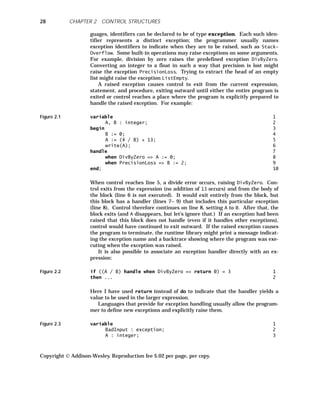
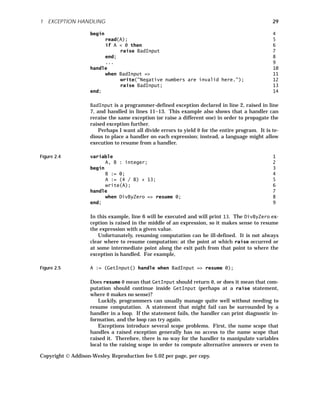
3.4 Block Structure
I will describe classic Algol block structure here; it has been adopted, with
modification, in many programming languages. A program is divided into
nested blocks, each of which introduces a new name scope. A name scope
is a region of program in which particular declarations of identifiers are in ef-
fect. A declaration maps an identifier to a meaning. We also say that it
binds the meaning to the identifier. The meanings can be variables, types,
constants, labels, procedures, or other concepts discussed elsewhere in the
book, such as modules (Chapter 3), classes (Chapter 5), and monitors (Chap-
ter 7). Traditionally, each nested name scope inherits all bindings from the
surrounding scope, except that if the same identifier is redefined in the
nested scope, the new declaration overrides the old declaration for the dura-
tion of the nested scope. Some languages, such as Ada and C++, allow de-
clared procedures to be overloaded; that is, the same name is bound to
multiple declarations at the same time, and the compiler chooses which is
meant by the number and types of the parameters.
The new declarations can be defined to take effect from the beginning of
the block (so that an earlier declaration, say of a variable, can refer to a later
declaration, perhaps of a type). More commonly, they take effect (are elabo-
rated) from the point in the block where the declaration appears. In the fol-
lowing example, I could define B in line 8 to be either real or integer,
depending on whether the outer declaration of T is hidden yet by the declara-
tion in line 10. Usually, languages either disallow such references or let the
new declaration take effect only after the point at which it appears. This de-
cision makes one-pass compilers easier to write.
Figure 1.17 type -- introduces outer block 1
T : real; 2
variable -- continues outer block 3
A : integer; 4
Copyright  Addison-Wesley. Reproduction fee $.02 per page, per copy.
3 BACKGROUND MATERIAL ON PROGRAMMING LANGUAGES
begin -- statements start 5
A := 4; 6
variable -- introduces nested block 7
B : T; -- real or integer? 8
type 9
T : integer; -- overrides outer declaration of T 10
begin 11
B := 3; -- coercion needed? 12
end -- nested block ends 13
end -- block ends 14
I use type, variable, or constant to introduce a new block, which includes a
new name scope (lines 1 and 7). After declarations introduce new identifiers
(including multiple instances of type, variable, or constant), the statements
in the name scope are delimited by begin and end.
Variables may be initialized to the value of some expression at the same
time they are declared. Pascal restricts initialization expressions to literals
and constants. Some languages allow arbitrary initialization expressions to
be evaluated at elaboration time; these expressions may even invoke proce-
dures.
Entering a new block just to introduce temporary declarations can be
helpful in structuring programs. More commonly, though, blocks are found as
the bodies of procedures. The identifiers introduced in the new block are all
the formal parameters and any types, constants, variables, labels, and proce-
dures defined within the procedure. A language is considered block-
structured if procedures introducing name scopes can nest. By this crite-
rion, C is not block-structured, but Pascal is.
An identifier is considered local to a name scope if it is introduced in that
name scope. Identifiers inherited from surrounding scopes are called nonlo-
cal. An identifier is global if it belongs to the outermost block of the pro-
gram. In FORTRAN, there are no global identifiers, and name scopes do not
nest. These restrictions help make FORTRAN efficient at runtime.
Although the declaration of an identifier may be clear from its defining
name scope, the instance of the identifier may not be. Every invocation of a
procedure introduces not only a new name scope, but also new instances of
variables themselves.8
A procedure may have many simultaneous instances,
because it may be invoked recursively. For local identifiers and global identi-
fiers, it is always clear which instance to use. For nonlocal identifiers, the
nonlocal referencing environment refers to the set of identifier bindings
dynamically in force during program execution. This set changes at every
procedure invocation and return, as well as when the program enters and ex-
its blocks, as illustrated in the following example.
hhhhhhhhhhhhhhhhhhhhhhhhhhhhhhhhhhhh
8
Although this discussion centers on variables, it also applies to labels and types, because
types may depend on runtime values. For example, an array type may have limits that are tak-
en from runtime values.
Copyright  Addison-Wesley. Reproduction fee $.02 per page, per copy.
18 CHAPTER 1 INTRODUCTION
19
Figure 1.18 procedure ProcA(value AParam : integer); 1
type AType : array 1..AParam of integer; 2
variable AVar1, AVar2 : integer; 3
procedure ProcB(value BParam : integer); 4
variable BVar1 : AType; 5
begin -- ProcB 6
... -- some statements 7
end; -- ProcB 8
begin -- ProcA 9
... -- some statements 10
end; -- ProcA 11
When ProcA is invoked, the new instance of ProcA elaborates a new set of for-
mal parameters (AParam), types (AType), variables (AVar1 and AVar2), and pro-
cedures (ProcB), which are inherited by nested procedure ProcB. When ProcB
is invoked, its new instance elaborates a new formal parameter (BParam) and
variable (BVar1), the latter of a type inherited from ProcA. ProcB may be in-
voked many times by ProcA and ProcB; each time, its new instance inherits
identifiers from the ProcA instance that elaborates the particular ProcB that
is invoked.
The situation becomes surprisingly complex when procedures (and labels)
are passed as parameters. They carry with them their nonlocal referencing
environment, so that when they are invoked, they may access nonlocal vari-
ables that are otherwise inaccessible in the program. A procedure in combi-
nation with its nonlocal referencing environment is called a closure.
Because this idea is unfamiliar to students who mainly use C (which has
no nested procedures, and therefore no nonlocal referencing environments), I
will present several examples.
Figure 1.19 procedure A(procedure X()); 1
variable Z : integer; 2
begin -- A 3
X(); 4
end; -- A 5
procedure B(S : integer); 6
variable Z : integer; 7
procedure C(); 8
begin -- C 9
write(Z); -- from lexical parent B 10
end; -- C 11
begin -- B 12
Z := S; 13
C(); 14
A(C); 15
end; -- B 16
B(3); 17
When B is called in line 17, it sets its local variable Z (line 7) to 3, the value of
formal parameter S. It then calls nested procedure C two times. The first
time is a direct call (line 14), and the second is indirect through a helper pro-
Copyright  Addison-Wesley. Reproduction fee $.02 per page, per copy.
3 BACKGROUND MATERIAL ON PROGRAMMING LANGUAGES
cedure A, which just relays the call (lines 15 and 4). In both cases, B is still
present, in the sense that its activation record is still on the central stack.
Procedure C needs B’s activation record, because C refers to B’s local variable
Z, which is only to be found in B’s activation record. In fact, C must access B’s
copy of Z during the second call, even though the intermediate procedure A
also has declared a local variable Z. In other words, C’s nonlocal referencing
environment is B, which elaborated C. When C is passed as an actual parame-
ter to A in line 15, a closure must be passed, so that when A invokes its formal
parameter X (which is actually C), the procedure it invokes can properly ac-
cess its nonlocal variables.
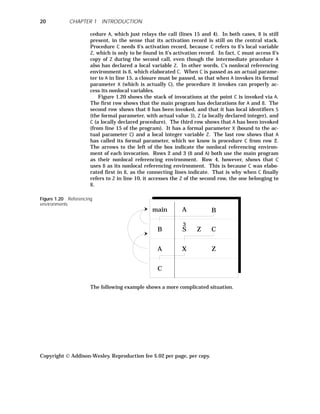
Figure 1.20 shows the stack of invocations at the point C is invoked via A.
The first row shows that the main program has declarations for A and B. The
second row shows that B has been invoked, and that it has local identifiers S
(the formal parameter, with actual value 3), Z (a locally declared integer), and
C (a locally declared procedure). The third row shows that A has been invoked
(from line 15 of the program). It has a formal parameter X (bound to the ac-
tual parameter C) and a local integer variable Z. The last row shows that A
has called its formal parameter, which we know is procedure C from row 2.
The arrows to the left of the box indicate the nonlocal referencing environ-
ment of each invocation. Rows 2 and 3 (B and A) both use the main program
as their nonlocal referencing environment. Row 4, however, shows that C
uses B as its nonlocal referencing environment. This is because C was elabo-
rated first in B, as the connecting lines indicate. That is why when C finally
refers to Z in line 10, it accesses the Z of the second row, the one belonging to
B.
Figure 1.20 Referencing
environments
3
Z
Z
C
X
C
S
B
B
A
A
main
The following example shows a more complicated situation.
Copyright  Addison-Wesley. Reproduction fee $.02 per page, per copy.
20 CHAPTER 1 INTRODUCTION
21
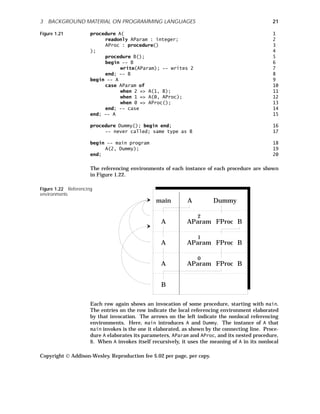
Figure 1.21 procedure A( 1
readonly AParam : integer; 2
AProc : procedure() 3
); 4
procedure B(); 5
begin -- B 6
write(AParam); -- writes 2 7
end; -- B 8
begin -- A 9
case AParam of 10
when 2 => A(1, B); 11
when 1 => A(0, AProc); 12
when 0 => AProc(); 13
end; -- case 14
end; -- A 15
procedure Dummy(); begin end; 16
-- never called; same type as B 17
begin -- main program 18
A(2, Dummy); 19
end; 20
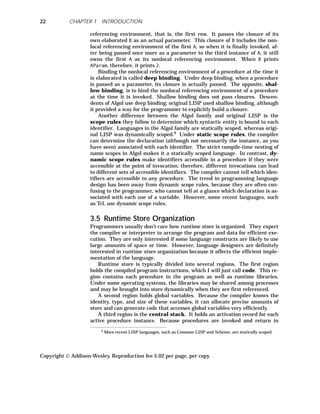
The referencing environments of each instance of each procedure are shown
in Figure 1.22.
Figure 1.22 Referencing
environments
0
1
2
AParam
AParam
AParam
B
A
A
B
B
B
FProc
FProc
FProc
A
Dummy
A
main
Each row again shows an invocation of some procedure, starting with main.
The entries on the row indicate the local referencing environment elaborated
by that invocation. The arrows on the left indicate the nonlocal referencing
environments. Here, main introduces A and Dummy. The instance of A that
main invokes is the one it elaborated, as shown by the connecting line. Proce-
dure A elaborates its parameters, AParam and AProc, and its nested procedure,
B. When A invokes itself recursively, it uses the meaning of A in its nonlocal
Copyright  Addison-Wesley. Reproduction fee $.02 per page, per copy.
3 BACKGROUND MATERIAL ON PROGRAMMING LANGUAGES
referencing environment, that is, the first row. It passes the closure of its
own elaborated B as an actual parameter. This closure of B includes the non-
local referencing environment of the first A, so when it is finally invoked, af-
ter being passed once more as a parameter to the third instance of A, it still
owns the first A as its nonlocal referencing environment. When B prints
AParam, therefore, it prints 2.
Binding the nonlocal referencing environment of a procedure at the time it
is elaborated is called deep binding. Under deep binding, when a procedure
is passed as a parameter, its closure is actually passed. The opposite, shal-
low binding, is to bind the nonlocal referencing environment of a procedure
at the time it is invoked. Shallow binding does not pass closures. Descen-
dents of Algol use deep binding; original LISP used shallow binding, although
it provided a way for the programmer to explicitly build a closure.
Another difference between the Algol family and original LISP is the
scope rules they follow to determine which syntactic entity is bound to each
identifier. Languages in the Algol family are statically scoped, whereas origi-
nal LISP was dynamically scoped.9
Under static scope rules, the compiler
can determine the declaration (although not necessarily the instance, as you
have seen) associated with each identifier. The strict compile-time nesting of
name scopes in Algol makes it a statically scoped language. In contrast, dy-
namic scope rules make identifiers accessible in a procedure if they were
accessible at the point of invocation; therefore, different invocations can lead
to different sets of accessible identifiers. The compiler cannot tell which iden-
tifiers are accessible to any procedure. The trend in programming language
design has been away from dynamic scope rules, because they are often con-
fusing to the programmer, who cannot tell at a glance which declaration is as-
sociated with each use of a variable. However, some recent languages, such
as Tcl, use dynamic scope rules.
3.5 Runtime Store Organization
Programmers usually don’t care how runtime store is organized. They expect
the compiler or interpreter to arrange the program and data for efficient exe-
cution. They are only interested if some language constructs are likely to use
large amounts of space or time. However, language designers are definitely
interested in runtime store organization because it affects the efficient imple-
mentation of the language.
Runtime store is typically divided into several regions. The first region
holds the compiled program instructions, which I will just call code. This re-
gion contains each procedure in the program as well as runtime libraries.
Under some operating systems, the libraries may be shared among processes
and may be brought into store dynamically when they are first referenced.
A second region holds global variables. Because the compiler knows the
identity, type, and size of these variables, it can allocate precise amounts of
store and can generate code that accesses global variables very efficiently.
A third region is the central stack. It holds an activation record for each
active procedure instance. Because procedures are invoked and return in
hhhhhhhhhhhhhhhhhhhhhhhhhhhhhhhhhhhh
9
More recent LISP languages, such as Common LISP and Scheme, are statically scoped.
Copyright  Addison-Wesley. Reproduction fee $.02 per page, per copy.
22 CHAPTER 1 INTRODUCTION
23
last-in, first-out order, a stack is appropriate. Each activation record
stores the return address, a pointer to the activation record of its invoker
(forming the dynamic chain), a pointer to the activation record of its nonlo-
cal referencing environment (forming the static chain), its parameters, its
local variables, and temporary locations needed during expression evaluation.
It is possible to represent the static chain in various ways; for simplicity, I
will just assume that it is a linked list of activation records. Dynamic-sized
arrays are typically represented by a fixed-size type descriptor (the size de-
pends only on the number of dimensions of the array, which is known by the
compiler) and a pointer to the value, which is placed in the activation record
after all static-sized local variables.
The central stack allows the compiler to generate efficient access code for
the variables stored there in a statically scoped language. Let me abbreviate
the phrase “accessed at a statically known offset” by the simpler but less pre-
cise “found.” Static-sized local variables are found in the current activation
record. Nonlocal variables are found in an activation record a certain dis-
tance from the front of the static chain; the compiler knows how many steps
to take in that chain. Pointers to the values of dynamic-sized local variables
are found in the current activation record; the values are interpreted accord-
ing to type descriptors found either in the current record (if the type is de-
clared locally) or in an activation record deeper on the static chain (for a
nonlocal type).
The fourth region of runtime store, called the heap, is used for dynamic
allocation of values accessed through pointers.10
These values do not follow a
stack discipline. This region of store expands as needed, getting increments
from the operating system when necessary. To avoid ever-increasing store re-
quirements for long-running programs, values are deallocated when they are
no longer needed. The space can later be reallocated to new values. Dealloca-
tion can be triggered by explicit program requests (such as Pascal’s dispose
procedure) or by automatic methods such as reference counts and garbage
collection. Reference counts indicate how many pointers are referencing each
value. Each assignment and parameter binding modifies these counts, and
each exit from a name scope reduces the counts for those variables that are
disappearing. When a count is reduced to 0, the value may be deallocated
and its space used for something else. Unfortunately, circular lists are never
deallocated, even when they are no longer accessible. Garbage collection
takes place when the store allocator notices that not much room is left. All
accessible structures are recursively traversed and marked, and then all un-
marked values are deallocated. The user often notices a distinct pause dur-
ing garbage collection. There are incremental and concurrent garbage
collection algorithms that reduce this interruption.
hhhhhhhhhhhhhhhhhhhhhhhhhhhhhhhhhhhh
10
Don’t confuse the heap with the treelike data structure of the same name.
Copyright  Addison-Wesley. Reproduction fee $.02 per page, per copy.
3 BACKGROUND MATERIAL ON PROGRAMMING LANGUAGES
4 ◆ FINAL COMMENTS
This chapter has attempted to introduce the study of programming languages
by placing it in the context of software tools in general. The background ma-
terial on programming languages is, of necessity, very concise. Its aim is to
lay the foundation for the concepts developed in the rest of this book.
The language concepts introduced here are in some sense the classical Al-
gol-like structures. They are developed in various directions in the following
chapters, each of which concentrates first on one programming language and
then shows ideas from a few others to flesh out the breadth of the topic.
Where appropriate, they end with a more mathematical treatment of the sub-
ject. Chapter 2 shows nonclassical control structures. Chapter 3 investigates
the concept of data type. It presents a detailed discussion of ML, which
shows how polymorphism can be incorporated in a statically typed language.
Because ML is mostly a functional language, you may want to read Chapter 4
before the section on ML in Chapter 3.
The next chapters are devoted to nonclassical paradigms, that is, lan-
guages not descended from Algol. Chapter 4 discusses functional program-
ming, concentrating on LISP. The concept of abstract data type is generalized
in several ways in the next three chapters. Chapter 5 introduces object-
oriented programming, concentrating on Smalltalk and C++. Chapter 6 dis-
cusses dataflow languages, concentrating on Val. Chapter 7 shows some of
the wide range of development of languages for concurrent programming. A
very different view of programming is presented in Chapter 8, which is is de-
voted to logic programming, concentrating on Prolog. Languages dealing
with special-purpose data aggregates, such as strings, arrays, databases, and
mathematical formulas, are discussed in Chapter 9. Finally, Chapter 10
shows several mathematical approaches to formalizing the syntax and se-
mantics of programming languages; although it uses imperative languages as
its model, such approaches have been used for the other language paradigms
as well.
EXERCISES
Review Exercises
1.1 In what ways does C (or pick another language) fall short of the criteria
in Section 2 for excellence?
1.2 How would you define the mod operator?
1.3 Show a code fragment in which short-circuit semantics for or yield a dif-
ferent result than complete-evaluation semantics.
1.4 Why do most languages with case statements prefer that the conditions
have compile-time values?
Copyright  Addison-Wesley. Reproduction fee $.02 per page, per copy.
24 CHAPTER 1 INTRODUCTION
25
1.5 Write a procedure that produces different results depending on whether
its parameters are passed by value, reference, or name mode.
1.6 FORTRAN only passes parameters in reference mode. C only passes
parameters in value mode. Pascal allows both modes. Show how you
can get the effect of reference mode in C and how you can get the effect
of value mode in FORTRAN by appropriate programming techniques.
In particular, show in both FORTRAN and C how to get the effect of the
following code.
Figure 1.23 variable X, Y : integer; 1
procedure Accept 2
(A : reference integer; B: value integer); 3
begin 4
A := B; 5
B := B+1; 6
end; -- Accept 7
X := 1; 8
Y := 2; 9
Accept(X, Y); 10
-- at this point, X should be 2, and Y should be 2 11
1.7 If a language does not allow recursion (FORTRAN II, for example, did
not), is there any need for a central stack?
1.8 C does not allow a procedure to be declared inside another procedure,
but Pascal does allow nested procedure declarations. What effect does
this choice have on runtime storage organization?
Challenge Exercises
1.9 Why are array slices usually allowed only in the last dimension?
1.10 Write a program that prints the index of the first all-zero row of an n × n
integer matrix M [Rubin 88]. The program should access each element of
the matrix at most once and should not access rows beyond the first all-
zero row and columns within a row beyond the first non-zero element.
It should have no variables except the matrix M and two loop indices Row
and Column. The program may not use goto, but it may use multilevel
break and next.
1.11 What is the meaning of a goto from a procedure when the target is out-
side the procedure?
1.12 Why do goto labels passed as parameters require closures?
1.13 Rewrite Figure 1.21 (page 21) so that procedure A takes a label instead
of a procedure. The rewritten example should behave the same as Fig-
ure 1.21.
Copyright  Addison-Wesley. Reproduction fee $.02 per page, per copy.
EXERCISES
1.14 What rules would you make if you wanted to allow programmers to mix
positional and keyword actual parameters?
1.15 The C language allows new name scopes to be introduced. However, C
is not generally considered a block-structured language. Why not?
1.16 The text claims that the compiler knows the size of all global variables.
Is this claim true for global dynamic-sized arrays?
Copyright  Addison-Wesley. Reproduction fee $.02 per page, per copy.
26 CHAPTER 1 INTRODUCTION
h
hhhhhhhhhhhhhhhhhhhhhhhhhhhhhhhhhhhhhhhhhhhhhhhhhhhhhhhhhhhhhhhhhhhhhhhhhhhhhhhhhhhhhhhhhhh
Chapter 2 ❖
Control Structures
Assembler language only provides goto and its conditional variants. Early
high-level languages such as FORTRAN relied heavily on goto, three-way
arithmetic branches, and many-way indexed branches. Algol introduced con-
trol structures that began to make goto obsolete. Under the banner of “struc-
tured programming,” computer scientists such as C. A. R. Hoare, Edsger W.
Dijkstra, Donald E. Knuth, and Ole-Johan Dahl showed how programs could
be written more clearly and elegantly with while and for loops, case state-
ments, and loops with internal exits [Knuth 71; Dahl 72]. One of the tenets of
structured programming is that procedures should be used heavily to modu-
larize effort. In this chapter we will explore control structures that are a lit-
tle out of the ordinary.
1 ◆ EXCEPTION HANDLING
If a procedure discovers that an erroneous situation (such as bad input) has
arisen, it needs to report that fact to its caller. One way to program this be-
havior is to have each procedure provide an error return and to check for that
return on each invocation. SNOBOL allows an explicit failure goto and suc-
cess goto on each statement, which makes this sort of programming conve-
nient. However, using a goto to deal with errors does not lead to clear
programs, and checking each procedure invocation for error returns makes
for verbose programs.
A control construct for dealing with error conditions was first proposed by
Goodenough [Goodenough 75] and has found its way into languages like Ada,
Mesa, CLU, ML, Eiffel, and Modula-3. I will use a syntax like Ada’s for de-
scribing this control structure.
When a procedure needs to indicate failure, it raises an exception. This
action causes control to transfer along a well-defined path in the program to
where the exception is handled. To embed this concept in programming lan-
hhhhhhhhhhhhhhhhhhhhhhhhhhhhhhhhhhhh
On-line edition copyright  1996 by Addison-Wesley Publishing Company. Permission is
granted to print or photocopy this document for a fee of $0.02 per page, per copy, payable to Addi-
son-Wesley Publishing Company. All other rights reserved.
27
guages, identifiers can be declared to be of type exception. Each such iden-
tifier represents a distinct exception; the programmer usually names
exception identifiers to indicate when they are to be raised, such as Stack-
Overflow. Some built-in operations may raise exceptions on some arguments.
For example, division by zero raises the predefined exception DivByZero.
Converting an integer to a float in such a way that precision is lost might
raise the exception PrecisionLoss. Trying to extract the head of an empty
list might raise the exception ListEmpty.
A raised exception causes control to exit from the current expression,
statement, and procedure, exiting outward until either the entire program is
exited or control reaches a place where the program is explicitly prepared to
handle the raised exception. For example:
Figure 2.1 variable 1
A, B : integer; 2
begin 3
B := 0; 4
A := (4 / B) + 13; 5
write(A); 6
handle 7
when DivByZero => A := 0; 8
when PrecisionLoss => B := 2; 9
end; 10
When control reaches line 5, a divide error occurs, raising DivByZero. Con-
trol exits from the expression (no addition of 13 occurs) and from the body of
the block (line 6 is not executed). It would exit entirely from the block, but
this block has a handler (lines 7− 9) that includes this particular exception
(line 8). Control therefore continues on line 8, setting A to 0. After that, the
block exits (and A disappears, but let’s ignore that.) If an exception had been
raised that this block does not handle (even if it handles other exceptions),
control would have continued to exit outward. If the raised exception causes
the program to terminate, the runtime library might print a message indicat-
ing the exception name and a backtrace showing where the program was exe-
cuting when the exception was raised.
It is also possible to associate an exception handler directly with an ex-
pression:
Figure 2.2 if ((A / B) handle when DivByZero => return 0) = 3 1
then ... 2
Here I have used return instead of do to indicate that the handler yields a
value to be used in the larger expression.
Languages that provide for exception handling usually allow the program-
mer to define new exceptions and explicitly raise them.
Figure 2.3 variable 1
BadInput : exception; 2
A : integer; 3
Copyright  Addison-Wesley. Reproduction fee $.02 per page, per copy.
28 CHAPTER 2 CONTROL STRUCTURES
29
begin 4
read(A); 5
if A < 0 then 6
raise BadInput 7
end; 8
... 9
handle 10
when BadInput => 11
write("Negative numbers are invalid here."); 12
raise BadInput; 13
end; 14
BadInput is a programmer-defined exception declared in line 2, raised in line
7, and handled in lines 11–13. This example also shows that a handler can
reraise the same exception (or raise a different one) in order to propagate the
raised exception further.
Perhaps I want all divide errors to yield 0 for the entire program. It is te-
dious to place a handler on each expression; instead, a language might allow
execution to resume from a handler.
Figure 2.4 variable 1
A, B : integer; 2
begin 3
B := 0; 4
A := (4 / B) + 13; 5
write(A); 6
handle 7
when DivByZero => resume 0; 8
end; 9
In this example, line 6 will be executed and will print 13. The DivByZero ex-
ception is raised in the middle of an expression, so it makes sense to resume
the expression with a given value.
Unfortunately, resuming computation can be ill-defined. It is not always
clear where to resume computation: at the point at which raise occurred or
at some intermediate point along the exit path from that point to where the
exception is handled. For example,
Figure 2.5 A := (GetInput() handle when BadInput => resume 0);
Does resume 0 mean that GetInput should return 0, or does it mean that com-
putation should continue inside GetInput (perhaps at a raise statement,
where 0 makes no sense)?
Luckily, programmers can usually manage quite well without needing to
resume computation. A statement that might fail can be surrounded by a
handler in a loop. If the statement fails, the handler can print diagnostic in-
formation, and the loop can try again.
Exceptions introduce several scope problems. First, the name scope that
handles a raised exception generally has no access to the name scope that
raised it. Therefore, there is no way for the handler to manipulate variables
local to the raising scope in order to compute alternative answers or even to
Copyright  Addison-Wesley. Reproduction fee $.02 per page, per copy.
1 EXCEPTION HANDLING
generate error messages that convey exactly which values were erroneous.
This problem is ameliorated in Modula-3, in which exceptions can take value-
mode parameters. The actual parameters are provided by the raise state-
ment, and the formal parameters are defined by the handle clause. Parame-
ters can be used to indicate where in the program the exception was raised
and what values led to the exceptional situation.
Second, programmer-defined exceptions may be visible in the raising
scope but not in the handling scope. The problem arises for programmer-
defined exceptions that exit the entire program (to a scope where only prede-
fined exceptions exist) and for “don’t-care” exception-handler patterns within
the program, as in line 4 below:
Figure 2.6 begin 1
... 2
handle 3
when _ => ... 4
end; 5
Such a handler might not be able to raise the exception further (unless the
programming language provides a predefined exception identifier Self that
holds the exception that was raised).
In some ways, raise statements are like goto statements to labels passed
as parameters. However, exceptions are far more disciplined than gotos, and
they do not require that the programmer pass targets as parameters.
Exceptions reduce the clarity of loop constructs. Every loop has an im-
plicit exit caused by an unhandled exception wresting control out of the loop.
Modula-3 unifies loops and exceptions by treating break as equivalent to
raise ExitException. Loop statements implicitly handle this exception and
exit the loop. Similarly, Modula-3 considers the return statement as equiva-
lent to raise ReturnException. The value returned by a function becomes
the parameter to ReturnException.
The exception mechanism I have shown binds exception handlers to
blocks. An alternative is to let raised exceptions throw the computation into
a failure state [Wong 90]. In failure state, ordinary statements are not exe-
cuted. Procedures can return while execution is in failure state, however.
Only the handle statement is executed in failure state; after it completes, fail-
ure state is no longer in force unless handle reraises an exception. The pro-
grammer may place handle statements in the middle of blocks, interspersed
with ordinary statements. The execution cost for this scheme may be fairly
high, however, because every statement must be compiled with a test to see if
execution is in failure state.
Exceptions are useful for more than handling error conditions. They also
provide a clean way for programs to exit multiple procedure invocations. For
example, an interactive editor might raise an exception in order to return to
the main command loop after performing a complex action.
Exceptions are not the only reasonable way to handle error conditions.
Sometimes it is easier for the programmer to have errors set a global variable
that the program may inspect later when it is convenient. For example, the
standard library packaged with C has a global variable errno that indicates
the most recent error that occurred in performing an operating-system call.
Copyright  Addison-Wesley. Reproduction fee $.02 per page, per copy.
30 CHAPTER 2 CONTROL STRUCTURES
31
The programmer can choose to ignore return values and inspect errno well
into the calculation, redirecting further effort if an error has occurred. The
program is likely to be more efficient and clearer than a program that sur-
rounds code with exception handlers. This point is especially important in
numerical computations on large data sets on highly pipelined computers.
Putting in the necessary tests to handle exceptions can slow down such com-
putations so much that they become useless, whereas hardware that sets a
flag when it discovers overflow, say, allows such computations to run at full
speed and lets the program notice rare problems after the fact.
Another way to treat errors is by generating error values, such as unde-
fined and positive_overflow, that are an integral part of arithmetic types.
Similarly, null_pointer_dereference and array_range_error can be error
values generated by the related mistakes. Expressions can evaluate to an er-
ror value instead of their normal results. These error values are propagated
(using specific rules) to produce a final result. For example, 1/0 yields the
value zero_divide, while 0*(1/0) yields undefined. Any operation involving
zero_divide yields undefined. Error values render the results of all compu-
tations well defined, guaranteeing that all valid evaluation orders produce
the same result.1
They also provide for a degree of error repair, since the pro-
gram can test for error values and perhaps transform them into something
meaningful. However, because the program can continue computing with er-
ror values, the error values finally produced may provide no indication of the
original errors. It can be quite difficult to debug programs when errors prop-
agate in this way. It would be far more helpful if the error value contained
extra information, such as the source file and line number where the error oc-
curred, which could propagate along with the error value itself.
2 ◆ COROUTINES
Consider the problem of comparing two binary trees to see if their nodes have
the same values in symmetric (also called in-order) traversal. For example,
the trees in Figure 2.7 compare as equal.
Figure 2.7 Equivalent
binary trees
E
E
D
D
C
C
B
A B
A
We could use a recursive procedure to store the symmetric-order traversal in
an array, call the procedure for each tree, and then compare the arrays, but it
is more elegant to advance independently in each tree, comparing as we go.
Such an algorithm is also far more efficient if the trees are unequal near the
hhhhhhhhhhhhhhhhhhhhhhhhhhhhhhhhhhhh
1
An error algebra with good numeric properties is discussed in [Wetherell 83].
Copyright  Addison-Wesley. Reproduction fee $.02 per page, per copy.
2 COROUTINES
beginning of the traversal. The problem is that each traversal needs its own
recursion stack. In most programming languages, this solution requires an
explicit stack for each tree and a program that replaces recursion with itera-
tion.
2.1 Coroutines in Simula
Simula provides explicit coroutines that have just the effect we need. Simula
classes are introduced in Chapter 3 as a way to implement abstract data
types. Here I will show you another use.
A class is a data type much like a record structure, but it may also contain
procedures and initialization code. When a variable is declared of that class
type, or when a value is created at runtime from the heap using a new call, an
instance of the class is created. This instance is often called an object; in
fact, the concept of object-oriented programming, discussed in Chapter 5, is
derived largely from Simula classes. After space is allocated (either on the
stack or the heap), the initialization code is run for this object. Programmers
usually use this facility to set up the object’s data fields. However, the initial-
ization code may suspend itself before it completes. I will call an object that
has not completed its initialization code an active object. An active object’s
fields may be inspected and modified, and its procedures may be called. In
addition, its initialization code can be resumed from the point it suspended.
Because the initialization can invoke arbitrary procedures that may sus-
pend at any point during their execution, each object needs its own stack un-
til its initialization has completed. An active object is therefore a coroutine,
that is, an execution thread that can pass control to other coroutines without
losing its current execution environment, such as its location within nested
name scopes and nested control structures.
Simula achieves this structure by introducing two new statements. The
call statement specifies a suspended active object, which is thereby allowed
to continue execution in its saved execution environment. The callers are
saved on a runtime stack. The detach statement suspends the current object
and returns control to the most recent object that invoked call. (This object
is found on the stack just mentioned.) The main program is treated as an ob-
ject for this purpose, but it must not invoke detach.
The program of Figure 2.8 solves the binary-tree equality puzzle. Simula
syntax is fairly similar to Ada syntax; the following is close to correct Simula,
although I have modified it somewhat so I don’t confuse syntactic with se-
mantic issues.
Figure 2.8 class Tree; -- used as a Pascal record 1
Value : char; 2
LeftChild, RightChild : pointer to Tree; 3
end; -- Tree 4
Copyright  Addison-Wesley. Reproduction fee $.02 per page, per copy.
32 CHAPTER 2 CONTROL STRUCTURES
33
class TreeSearch; -- used as a coroutine 5
MyTree : pointer to Tree; 6
CurrentNode : pointer to Tree; 7
Done : Boolean; -- true when tree exhausted 8
procedure Dive 9
(readonly Node : pointer to Tree); 10
begin 11
if Node ≠ nil then 12
Dive(Nodeˆ.LeftChild); 13
CurrentNode := Node; 14
detach; 15
Dive(Nodeˆ.RightChild); 16
end; 17
end; -- Dive 18
begin -- TreeSearch: initialization and coroutine 19
Done := false; 20
CurrentNode := nil; 21
detach; -- wait for initial values 22
Dive(MyTree); -- will detach at each node 23
Done := true; 24
end; -- TreeSearch 25
variable -- main 26
A, B : pointer to Tree; 27
ASearch, BSearch : pointer to TreeSearch; 28
Equal : Boolean; 29
begin -- main 30
... -- initialize A and B 31
new(ASearch); ASearchˆ.MyTree := A; 32
new(BSearch); BSearchˆ.MyTree := B; 33
while not (ASearchˆ.Done or BSearchˆ.Done or 34
ASearchˆ.CurrentNode ≠ BSearchˆ.CurrentNode) 35
do 36
call ASearchˆ; -- continues coroutine 37
call BSearchˆ; -- continues coroutine 38
end; 39
Equal := ASearchˆ.Done and BSearchˆ.Done; 40
end; 41
The new calls in lines 32–33 create new instances of TreeSearch and assign
them to ASearch and BSearch. Each of these instances detaches during ini-
tialization (line 22) to allow their local variables MyTree to be set (lines
32–33). Then they are repeatedly resumed by the main program (lines
37–38). The call statements in lines 37–38 are invalid after the coroutines
have finished (that is, after the initialization code of the class instances
ASearchˆ and BSearchˆ has finished line 24), but line 34 prevents such a mis-
take from occurring. The class instances for both the trees and the coroutines
are deallocated after control exits from the block at line 41, since all pointers
to those instances disappear at that point. (Garbage collection is used for
deallocation.)
Copyright  Addison-Wesley. Reproduction fee $.02 per page, per copy.
2 COROUTINES
2.2 Coroutines in CLU
The CLU language, designed by Barbara Liskov at MIT, provides a general-
ized for loop [Liskov 81]. The control variable takes on successive values
provided by a coroutine called an iterator. This iterator is similar in most
ways to an ordinary procedure, but it returns values via a yield statement.
When the for loop requires another value for the control variable, the itera-
tor is resumed from where it left off and is allowed to execute until it encoun-
ters another yield. If the iterator reaches the end of its code instead, the for
loop that relies on the iterator terminates. CLU’s yield is like Simula’s de-
tach, except that it also passes back a value. CLU’s for implicitly contains
the effect of Simula’s call.
A naive implementation of CLU would create a separate stack for each ac-
tive iterator instance. (The same iterator may have several active instances;
it does, for example, if there is a for nested within another for.) A coroutine
linkage, much like Simula’s call and detach, would ensure that each iterator
instance maintains its own context, so that it may be resumed properly.
The following program provides a simple example. CLU syntax is also
fairly close to Ada syntax; the following is almost valid CLU.
Figure 2.9 iterator B() : integer; -- yields 3, 4 1
begin 2
yield 3; 3
yield 4; 4
end; -- B 5
iterator C() : integer; -- yields 1, 2, 3 6
begin 7
yield 1; 8
yield 2; 9
yield 3; 10
end; -- C 11
iterator A() : integer; -- yields 10, 20, 30 12
variable 13
Answer : integer; 14
begin 15
for Answer := C() do -- ranges over 1, 2, 3 16
yield 10*Answer; 17
end; 18
end; -- A 19
variable 20
x, y : integer; 21
begin 22
for x := A() do -- ranges over 10, 20, 30 23
for y := B() do -- ranges over 3, 4 24
P(x, y); -- called 6 times 25
end; 26
end; 27
end; 28
The loop in line 23 iterates over the three values yielded by iterator A (lines
Copyright  Addison-Wesley. Reproduction fee $.02 per page, per copy.
34 CHAPTER 2 CONTROL STRUCTURES
35
12–19). For each of these values, the loop in line 24 iterates over the two val-
ues yielded by iterator B (lines 1–5). Iterator A itself introduces a loop that it-
erates over the three values yielded by iterator C (lines 6–11).
Happily, CLU can be implemented with a single stack. As a for loop be-
gins execution, some activation record (call it the parent) is active (although
not necessarily at the top of the stack). A new activation record for the itera-
tor is constructed and placed at the top of the stack. Whenever the body of
the loop is executing, the parent activation record is current, even though the
iterator’s activation record is higher on the stack. When the iterator is re-
sumed so that it can produce the next value for the control variable, its acti-
vation record again becomes current. Each new iterator invocation gets a
new activation record at the current stack top. Thus an activation record
fairly deep in the stack can be the parent of an activation record at the top of
the stack. Nonetheless, when an iterator terminates, indicating to its parent
for loop that there are no more values, the iterator’s activation record is cer-
tain to be at the top of the stack and may be reclaimed by simply adjusting
the top-of-stack pointer. (This claim is addressed in Exercise 2.10.)
For Figure 2.9, each time P is invoked, the runtime stack appears as fol-
lows. The arrows show the dynamic (child-parent) chain.
Figure 2.10 Runtime
CLU stack during
iterator execution
iterator C
procedure P
iterator B
iterator A
main
CLU iterators are often trivially equivalent to programs using ordinary
for loops. However, for some combinatorial algorithms, recursive CLU itera-
tors are much more powerful and allow truly elegant programs. One example
is the generation of all binary trees with n nodes. This problem can be solved
without CLU iterators, albeit with some complexity [Solomon 80]. Figure
2.11 presents a natural CLU implementation.
Copyright  Addison-Wesley. Reproduction fee $.02 per page, per copy.
2 COROUTINES
Figure 2.11 type Tree = 1
record 2
Left, Right : pointer to Node; 3
end; -- Tree; 4
iterator TreeGen(Size : integer) : pointer to Tree; 5
-- generate all trees with Size nodes 6
variable 7
Answer : Tree; 8
Root : integer; -- serial number of the root 9
begin 10
if Size = 0 then 11
yield nil; -- only the empty tree 12
else -- answer not empty 13
for Root := 1 to Size do 14
for Answer.Left := TreeGen(Root-1) do 15
for Answer.Right := TreeGen(Size-Root) 16
do 17
yield &Answer; 18
end; -- for Right 19
end; -- for Left 20
end; -- for Root 21
end -- answer not empty 22
end -- TreeGen 23
variable -- sample use of TreeGen 24
T : pointer to Tree; 25
begin 26
for T := TreeGen(10) do 27
TreePrint(T); 28
end; 29
end; 30
This marvelously compact program prints all binary trees of size 10. The
for loop in lines 27–29 invokes the iterator TreeGen(10) until no more values
are produced. TreeGen will produce 16,796 values before it terminates. It
works by recursion on the size of tree required. The simple case is to gener-
ate a tree of size 0; the yield in line 12 accomplishes this. If an instance of
TreeGen(0) is resumed after line 12, it falls through, thereby terminating its
parent loop. The other case requires that TreeGen iterate through all possi-
bilities of the root of the tree it will generate (line 14). Any one of the Size
nodes could be root. For each such possibility, there are Root-1 nodes on the
left and Size-Root nodes on the right. All combinations of the trees meeting
these specifications must be joined to produce the trees with Size nodes. The
nested loops starting in lines 15 and 16 iterate through all such combinations;
for each, yield in line 18 passes to the parent a reference to the solution. The
storage for the solution is in the local activation record of the iterator. As it-
erators terminate, their storage is released, so there is no need to explicitly
allocate or deallocate any storage for the resulting tree.
Copyright  Addison-Wesley. Reproduction fee $.02 per page, per copy.
36 CHAPTER 2 CONTROL STRUCTURES
37
2.3 Embedding CLU Iterators in C
Surprisingly, it is possible to implement CLU iterators using only the con-
structs available to a C programmer. This implementation clarifies CLU and
shows some interesting aspects of C.
The only machine-independent way to manipulate activation records in C
is to use the library routines setjmp and longjmp. They are intended to pro-
vide the equivalent of exception handling; they allow many levels of activa-
tion records to be terminated at once, jumping from an activation record at
the top of the stack directly back to one deep within the stack. I apply these
routines in a way probably unintended by their inventors: to resume an acti-
vation record higher on the stack than the invoker.
Setjmp(Buf) takes a snapshot of the current environment — registers,
stack pointers, program counter, and such — and places it in the Buf data
structure. Longjmp(Buf, ReturnValue) restores the registers from Buf, ef-
fectively restoring the exact context in which the setjmp was called. In fact,
it creates another return from the original setjmp call. In order to let the
program distinguish whether setjmp is returning the ordinary way or be-
cause of a longjmp, setjmp returns a 0 in the former case and ReturnValue in
the latter case. For this reason, setjmp is usually embedded in a conditional
or case statement to identify these cases and take appropriate action.
This facility is very like jumping to a label passed as a parameter, which
has the effect of unwinding the stack to the right activation record for the tar-
get of the goto. Setjmp can capture the situation before a procedure call, and
longjmp can be invoked from within a procedure; the call unwinds the stack
to its position when setjmp recorded the situation. Unbridled use of setjmp
and longjmp can be worse than an unconstrained goto. It allows such activi-
ties as jumping into a control structure (after all, the setjmp can be in the
middle of a loop or a branch of a conditional) or even jumping back to a proce-
dure that has exited.
This ability to break the rules makes it possible to implement CLU itera-
tors within the C language. My implementation is packaged as a set of C
macros, primarily iterFOR and iterYIELD. Whenever iterFOR is about to in-
voke an iterator, it performs setjmp to allow the iterator to come back to the
iterFOR via longjmp. Likewise, each iterYIELD performs setjmp to allow its
parent iterFOR to resume it via longjmp. The macros use a single global
variable (not visible to the programmer) to store a pointer to the associated
Buf structures in both these cases.
Now that the linkage between iterFOR and its iterator can be established,
two problems remain. They both concern managing space on the stack. Un-
fortunately, new activation records are placed on the stack immediately above
the invoker’s activation record, even if other activation records have been
placed there.
The first problem is that even in the simplest situation, with a single
iterFOR invoking a single iterator, we need padding on the stack between
their respective activation records. If there is no padding, then attempts by
iterFOR to resume the iterator fail. After all, iterFOR calls longjmp, and this
invocation places an activation record on the stack (since longjmp is also a
procedure). This activation record coincides with the iterator’s activation
record, destroying at least the arguments and quite likely other information
as well. Furthermore, any ordinary procedure calls invoked by the body of
Copyright  Addison-Wesley. Reproduction fee $.02 per page, per copy.
2 COROUTINES
the iterFOR need a place to put their activation records. I solve this problem
by invoking iterators via a Helper routine, which declares a local array just
for padding and then calls the iterator by a normal procedure invocation.
The second problem arises with nested iterFOR loops, which are, after all,
the interesting ones. Consider again Figure 2.9 introduced on page 34. Once
the outer for in line 23 has established an instance of A, and A in line 16 has
established an instance of C, the inner for in line 24 needs to put its instance
of B at the top of the stack. Main can’t directly invoke Helper, because that
would place the activation record for B exactly where the A is residing. I
therefore keep track of the iterator instance (in this case, C) that is currently
at the top of the stack so that I can resume it, not so it will yield its next
value, but so it will call Helper on my behalf to start B.
Figure 2.12 Runtime
C stack during
iterator execution
helper
helper
helper
helper
iterator C
procedure P
iterator B
iterator A
main
Figure 2.12 demonstrates the appearance of the runtime stack at the same
stage as the previous figure. Solid arrows pointing downward show to which
activation record each activation record returns control via longjmp. Dotted
arrows pointing downward show ordinary procedure returns. Solid arrows
pointing upward show which activation record actually started each new acti-
vation record. Dotted arrows pointing upward show the direction of longjmp
used to request new invocations.
Choosing to build iterators as C macros provides the ability to express
CLU coroutines at the cost of clarity. In particular, I made the following deci-
sions:
1. The value returned by an iterYIELD statement must be placed in a
global variable by the programmer; the macros do not attempt to trans-
mit these values.
2. The programmer must write the Helper routine. In the usual case, the
helper just declares a dummy local array and invokes the iterator proce-
dure, passing arguments through global variables. If there are several
different iterators to be called, Helper must distinguish which one is in-
tended.
Copyright  Addison-Wesley. Reproduction fee $.02 per page, per copy.
38 CHAPTER 2 CONTROL STRUCTURES
39
3. Any routine that includes an iterFOR and every iterator must invoke
iterSTART at the end of local declarations.
4. Instead of falling through, iterators must terminate with iterDONE.
5. The Helper routine does not provide enough padding to allow iterators
and their callers to invoke arbitrary subroutines while iterators are on
the stack. Procedures must be invoked from inside iterFOR loops by
calling iterSUB.
The macro package appears in Figure 2.13. (Note for the reader unfamil-
iar with C: the braces { and } act as begin and end; void is a type with no
values; declarations first give the type (such as int or jmp_buf *) and then
the identifier; the assignment operator is = ; the dereferencing operator is * ;
the referencing operator is & .)
Figure 2.13 #include <setjmp.h> 1
#define ITERMAXDEPTH 50 2
jmp_buf *GlobalJmpBuf; /* global pointer for linkage */ 3
jmp_buf *EnvironmentStack[ITERMAXDEPTH] = {0}, 4
**LastEnv = EnvironmentStack; 5
/* return values for longjmp */ 6
#define J_FIRST 0 /* original return from setjmp */ 7
#define J_YIELD 1 8
#define J_RESUME 2 9
#define J_CALLITER 3 10
#define J_DONE 4 11
#define J_CALLSUB 5 12
#define J_RETURN 6 13
/* iterSTART must be invoked after all local declarations 14
in any procedure with an iterFOR and in all iterators. 15
*/ 16
#define iterSTART  17
jmp_buf MyBuf, CallerBuf;  18
if (GlobalJmpBuf)  19
bcopy((char *)GlobalJmpBuf, (char *)CallerBuf,  20
sizeof(jmp_buf));  21
LastEnv++;  22
*LastEnv = &MyBuf; 23
Copyright  Addison-Wesley. Reproduction fee $.02 per page, per copy.
2 COROUTINES
/* Initialization gives global args to Helper. 24
Body is the body of the for loop. 25
*/ 26
#define iterFOR(Initialization, Body)  27
switch (setjmp(MyBuf)) {  28
case J_FIRST:  29
GlobalJmpBuf = MyBuf;  30
Initialization;  31
if (*LastEnv != MyBuf) 32
longjmp(**LastEnv, J_CALLITER);  33
else Helper();  34
case J_YIELD:  35
{ jmp_buf *Resume = GlobalJmpBuf;  36
Body;  37
longjmp(*Resume, J_RESUME);  38
}  39
case J_DONE: break;  40
} 41
/* No arguments; the value yielded must be passed 42
through globals. 43
*/ 44
#define iterYIELD  45
switch (setjmp(MyBuf)) {  46
case J_FIRST:  47
GlobalJmpBuf = &MyBuf;  48
longjmp(CallerBuf, J_YIELD);  49
case J_CALLITER:  50
Helper(); /* won’t return */  51
case J_CALLSUB:  52
{ jmp_buf *Return = GlobalJmpBuf;  53
Helper();  54
longjmp(*Return, J_RETURN);  55
}  56
case J_RESUME: break;  57
} 58
/* Every iterator must return via iterDONE; 59
a direct return is meaningless. 60
*/ 61
#define iterDONE  62
LastEnv--;  63
longjmp(CallerBuf, J_DONE) 64
Copyright  Addison-Wesley. Reproduction fee $.02 per page, per copy.
40 CHAPTER 2 CONTROL STRUCTURES
41
/* iterSUB(Initialization) invokes Helper to perform 65
subroutine work from an iterator or its user. 66
*/ 67
#define iterSUB(Initialization)  68
{ jmp_buf SubBuf;  69
switch (setjmp(SubBuf)) {  70
case J_FIRST:  71
Initialization;  72
if (*LastEnv != &MyBuf) {  73
GlobalJmpBuf = &SubBuf;  74
longjmp(**LastEnv, J_CALLSUB);  75
}  76
else Helper();  77
break;  78
case J_RETURN:  79
break;  80
}  81
} 82
The variables used to remember the stack of environments are
EnvironmentStack and LastEnv (lines 4 and 5). When an iterator starts, it
must save a copy of its parent’s Buf (lines 20–21); this code is in a conditional,
since iterStart is also called by noniterators that happen to invoke iterators.
An iterator is invoked through Helper (line 34) or by asking a more deeply
nested iterator to assist (line 33). Such calls for assistance always appear as
resumptions from iterYIELD (line 50).
iterSUB (line 68) invokes Helper from the top of the stack but expects a
normal return. Helper needs to be able to identify which subroutine is actu-
ally to be called by inspecting global variables. The flow of control travels to
the top of the stack (line 75), where it invokes Helper (line 54) and then re-
turns via a longjmp (line 55).
Figure 2.14 shows how to code Figure 2.9 (on page 34) using the C macros.
Figure 2.14 int AValue, BValue, CValue, mainX, mainY; 1
enum {CallA, CallB, CallC, CallPrint} HelpBy; 2
void Helper(){ 3
switch (HelpBy) { 4
case CallA: A(); break; 5
case CallB: B(); break; 6
case CallC: C(); break; 7
case CallPrint: 8
printf("%d %d0, mainX, mainY); break; 9
} 10
} 11
int B(){ 12
iterSTART; 13
BValue = 3; iterYIELD; 14
BValue = 4; iterYIELD; 15
iterDONE; 16
} 17
Copyright  Addison-Wesley. Reproduction fee $.02 per page, per copy.
2 COROUTINES
int C(){ 18
iterSTART; 19
CValue = 1; iterYIELD; 20
CValue = 2; iterYIELD; 21
CValue = 3; iterYIELD; 22
iterDONE; 23
} 24
int A(){ 25
int Answer; 26
iterSTART; 27
iterFOR ({HelpBy = CallC;} , { 28
Answer = 10 * CValue; 29
AValue = Answer; iterYIELD; 30
}); 31
iterDONE; 32
} 33
void main(){ 34
iterSTART; 35
iterFOR({HelpBy = CallA;} , { 36
mainX = AValue; 37
iterFOR ({HelpBy = CallB;} , { 38
mainY = BValue; 39
iterSUB( HelpBy = CallPrint ); 40
}); 41
}); 42
} 43
Line 1 introduces all the variables that need to be passed as parameters or as
results of yield statements. Lines 2–11 form the Helper routine that is
needed for invoking iterators as well as other routines, such as printf.
I cannot entirely recommend using these C macros; it is far better to use a
language that provides iterators directly for those situations (admittedly
rare) when recursive iterators are the best tool. After all, CLU iterators are
not at all hard to compile into fine code.
The C macros can be used (I have used them on several occasions), but
they leave a lot of room for errors. The programmer must pass parameters
and results to and from the iterators through global variables. All calls to it-
erators (via iterFOR) and to routines (via iterSUB) are funneled through a
single Helper routine. Helper needs to reserve adequate space (experience
shows that not much is needed) and must use global variables to distinguish
the reason it is being called. The programmer must be careful to use iterSUB
instead of direct calls inside iterFOR. The resulting programs are certainly
not elegant in appearance, although with some practice, they are not hard to
code and to read.
The C macros have other drawbacks. In some C implementations,
longjmp refuses to jump up the stack. Compile-time and hand-coded opti-
mizations that put variables in registers typically render them invisible to
setjmp, so iterators and routines that contain iterFOR must not be optimized.
There is a danger that interrupts may cause the stack to become garbled, be-
cause a program written in C cannot protect the top of the stack.
Copyright  Addison-Wesley. Reproduction fee $.02 per page, per copy.
42 CHAPTER 2 CONTROL STRUCTURES
43
2.4 Coroutines in Icon
Icon is discussed in some detail in Chapter 9. It generalizes CLU iterators by
providing expressions that can be reevaluated to give different results.
3 ◆ CONTINUATIONS: IO
FORTRAN demonstrates that is possible to build a perfectly usable program-
ming language with only procedure calls and conditional goto as control
structures. The Io language reflects the hope that a usable programming lan-
guage can result from only a single control structure: a goto with parameters.
I will call the targets of these jumps procedures even though they do not re-
turn to the calling point. The parameters passed to procedures are not re-
stricted to simple values. They may also be continuations, which represent
the remainder of the computation to be performed after the called procedure
is finished with its other work. Instead of returning, procedures just invoke
their continuation. Continuations are explored formally in Chapter 10; here I
will show you a practical use.
Io manages to build remarkably sophisticated facilities on such a simple
foundation. It can form data structures by embedding them in procedures,
and it can represent coroutines.
Io programs do not contain a sequence of statements. A program is a pro-
cedure call that is given the rest of the program as a continuation parameter.
A statement continuation is a closure; it includes a procedure, its environ-
ment, and even its parameters.
Io’s syntax is designed to make statement continuations easy to write. If a
statement continuation is the last parameter, which is the usual case, it is
separated from the other parameters by a semicolon, to remind the program-
mer of sequencing. Continuations and procedures in other parameter posi-
tions must be surrounded by parentheses. I will present Io by showing
examples from [Levien 89].
Figure 2.15 write 5; 1
write 6; 2
terminate 3
As you expect, this program prints 5 6. But I need to explain how it works.
The predeclared write procedure takes two parameters: a number and a con-
tinuation. The call in line 1 has 5 as its first parameter and write 6; termi-
nate as its second. The write procedure prints 5 and then invokes the
continuation. It is a call to another instance of write (line 2), with parame-
ters 6 and terminate. This instance prints 6 and then invokes the parame-
terless predeclared procedure terminate. This procedure does nothing. It
certainly doesn’t return, and it has no continuation to invoke.
Procedures can be declared as follows:
Figure 2.16 declare writeTwice: → Number; 1
write Number; write Number; terminate. 2
That is, the identifier writeTwice is associated with an anonymous procedure
Copyright  Addison-Wesley. Reproduction fee $.02 per page, per copy.
3 CONTINUATIONS: IO
(introduced by →) that takes a single formal parameter Number (the parame-
ter list is terminated by the first ;) and prints it twice. The period, . , indi-
cates the end of the declaration. This procedure is not very useful, because
execution will halt after it finishes. Procedures do not return. So I will mod-
ify it to take a continuation as well:
Figure 2.17 declare writeTwice: → Number Continuation; 1
write Number; write Number; Continuation. 2
writeTwice 7; 3
write 9; 4
terminate 5
Lines 1–2 declare writeTwice, and line 3 invokes it with a 7 and a continua-
tion composed of lines 4–5. Here is a trace of execution:
Figure 2.18 writeTwice 7 (write 9; terminate) -- called on line 3 1
Number := 7 2
Continuation := (write 9; terminate) 3
write 7 (write 7; write 9; terminate) -- called on line 2 4
-- writes 7 5
write 7 (write 9; terminate) -- called by write 6
-- writes 7 7
write 9 (terminate) -- called by write 8
-- writes 9 9
terminate -- called by write 10
Indented lines (such as lines 2–3) indicate the formal-actual bindings. I sur-
round parameters in parentheses for clarity.
Even arithmetic operations are built to take a continuation. The differ-
ence between a statement and an expression is that an expression continua-
tion expects a parameter, namely, the value of the expression. Consider the
following code, for example:
Figure 2.19 + 2 3 → Number; 1
write Number; 2
terminate 3
The + operator adds its parameters 2 and 3 and passes the resulting value 5
to its last parameter (→ Number; write Number; terminate), which prints the
5 and terminates. This expression continuation is an anonymous procedure;
that is, it is declared but not associated with an identifier. In general, an ex-
pression continuation is a procedure expecting a single parameter. The syn-
tax conspires to make this program look almost normal. The result of the
addition is apparently assigned to a variable Number, which is used in the fol-
lowing statements. In fact, the result of the addition is bound to the formal
parameter Number, whose scope continues to the end of the program.
Conditional operators are predeclared to take two statement continuations
corresponding to the two Boolean values true and false. For example, the
following code will print the numbers from 1 to 10.
Copyright  Addison-Wesley. Reproduction fee $.02 per page, per copy.
44 CHAPTER 2 CONTROL STRUCTURES
45
Figure 2.20 declare Count: → Start End Continuation; 1
write Start; 2
= Start End (Continuation); -- "then" clause 3
+ Start 1 → NewStart; -- "else clause" 4
Count NewStart End Continuation. 5
Count 1 10; terminate 6
Here is a trace of execution:
Figure 2.21 Count 1 10 terminate -- called on line 6 1
Start := 1 2
End := 10 3
Continuation := terminate 4
write 1 (= 1 10 terminate A:(+ 1 1 → NewStart; 5
Count NewStart 10; terminate) 6
-- writes 1 7
= 1 10 terminate A 8
-- called by write 9
A -- called by ‘=’ 10
+ 1 1 B:(→ NewStart; Count NewStart 10; terminate) 11
B 2 -- called by ‘+’ 12
Count 2 10 terminate -- called by B 13
...
Count 10 10 terminate 14
write 10 (= 10 10 terminate C:( 15
+ 1 1 → NewStart; Count NewStart 10; terminate.) 16
-- writes 10 17
= 10 10 terminate C 18
terminate 19
I have introduced the shorthand forms A (line 5), B (line 11), and C (line 15)
for conciseness.
Procedures can contain constants that are made available later:
Figure 2.22 declare TwoNumbers: → Client; 1
Client 34 53. 2
declare WritePair: → PairProc Continuation; 3
PairProc → x y; 4
write x; 5
write y; 6
Continuation. 7
WritePair TwoNumbers; 8
terminate 9
Line 8 invokes WritePair with two parameters: the first is a procedure
(twoNumbers), and the second is a continuation (terminate). WritePair in-
vokes its first parameter (line 4), passing the remainder of its body (lines 4–7)
as a procedure parameter with local variable Continuation bound to termi-
nate. TwoNumbers applies that procedure to parameters 34 and 53, causing
these numbers to be printed and then terminate to be called. Procedure
TwoNumbers can be generalized to contain any two numbers:
Copyright  Addison-Wesley. Reproduction fee $.02 per page, per copy.
3 CONTINUATIONS: IO
Figure 2.23 declare MakePair: → x y User Continuation; 1
User (→ Client; Client x y); Continuation. 2
MakePair 12 13 (WritePair); 3
terminate. 4
The execution trace is as follows:
Figure 2.24 MakePair 12 13 WritePair terminate 1
x := 12 2
y := 14 3
User := WritePair 4
Continuation := terminate 5
WritePair A:(→ Client; Client 12 13) terminate 6
PairProc := A 7
Continuation := terminate 8
A B:(→ x y; write x; write y; terminate); 9
Client := G 10
B 12 13 -- writes "12 13" then terminates. 11
Linked lists can be implemented by suitable cleverness as functions with
two parameters, both procedures. An empty list calls its first parameter,
which is a continuation. Other lists call the second parameter, passing two
new parameters that represent the first number in the list and the remainder
of the list. Here are the relevant declarations:
Figure 2.25 declare WriteList: → List Continuation; 1
List (Continuation) → First Rest; 2
write First; 3
WriteList Rest; 4
Continuation. 5
declare EmptyList: → Null NotNull; 6
Null. 7
declare Cons: → Number List EContinuation; 8
EContinuation → Null NotNull; 9
NotNull Number List. 10
Cons 1 EmptyList → List; 11
Cons 2 List → List; 12
WriteList List; 13
terminate 14
Here, Cons (the name is taken from LISP, described in Chapter 4) is meant to
combine a header element with the rest of a list to create a new list. Again,
the execution trace clarifies what happens:
Copyright  Addison-Wesley. Reproduction fee $.02 per page, per copy.
46 CHAPTER 2 CONTROL STRUCTURES
47
Figure 2.26 Cons 1 EmptyList A:( 1
→ List; Cons 2 List → List; WriteList List; 2
terminate) 3
Number := 1 4
List := EmptyList 5
EContinuation := A 6
A B:(→ Null NotNull; NotNull 1 EmptyList) 7
List := B 8
Cons 2 B C:(→ List; WriteList List; terminate) 9
Number := 2 10
List := B 11
EContinuation := C 12
C D:(→ Null NotNull; NotNull 2 B) 13
List := D 14
WriteList D terminate 15
List := D 16
Continuation := terminate 17
D terminate E:(→ First Rest; write First; 18
WriteList Rest; terminate) 19
Null := terminate 20
NotNull := E 21
E 2 B 22
First := 2 23
Rest := B 24
-- writes 2 25
WriteList B terminate 26
List := B 27
Continuation := terminate 28
B terminate F:(→ First Rest; write First; 29
WriteList Rest; terminate) 30
Null := terminate 31
NotNull := F 32
F 1 EmptyList 33
First := 1 34
Rest := EmptyList 35
-- writes 1 36
WriteList EmptyList terminate 37
List := EmptyList 38
Continuation := terminate 39
EmptyList terminate G:(→ First Rest; write First; 40
WriteList Rest; terminate) 41
Null := terminate 42
NotNull := G 43
terminate 44
Similar cleverness can produce a set of declarations for binary trees. Empty
trees call their first parameter. Other trees call their second parameter with
the key, left subtree, and the right subtree. Other data structures can be
built similarly.
Continuations are perfectly capable of handling coroutines. For example,
a global variable could hold the continuation of the thread that is not cur-
rently executing. I could define a switch procedure that saves its continua-
tion parameter in the global and invokes the old value of the global. It would
be more elegant to redesign statement continuations. Instead of being a sin-
Copyright  Addison-Wesley. Reproduction fee $.02 per page, per copy.
3 CONTINUATIONS: IO
gle closure, they could be a list of closures (using the list mechanisms I have
already introduced). The switch procedure would take the appropriate ele-
ment from the list and sort it to the front of the list. Ordinary procedures use
the front of the list as the current thread.
Instead of showing the gory details of coroutines, I will show how Io can
build infinite data structures that are evaluated only when necessary. (Lazy
evaluation is discussed in Chapter 4.)
Figure 2.27 declare Range: → First EContinuation; 1
EContinuation First → Null NotNull; 2
+ First 1 → NewFirst; 3
Range NewFirst EContinuation. 4
declare FullRange: → Null NotNull; 5
Range 0 NotNull. 6
WriteList FullRange; -- writes 0 1 2 3 ... 7
terminate 8
I leave it to you as an exercise to trace the execution.
Given that continuations are very powerful, why are they not a part of ev-
ery language? Why do they not replace the conventional mechanisms of con-
trol structure? First, continuations are extremely confusing. The examples
given in this section are almost impossible to understand without tracing,
and even then, the general flow of control is lost in the details of procedure
calls and parameter passing. With experience, programmers might become
comfortable with them; however, continuations are so similar to gotos (with
the added complexity of parameters) that they make it difficult to structure
programs.
Second, continuations are not necessarily pleasant to implement. Proce-
dures may be referenced long after they are created, and allocation does not
follow a stack discipline, so it appears that activation records must be created
in the heap. Luckily, circularities will not exist, so reference counts can gov-
ern reclamation of activation records. The implementation and the program-
mer must be able to distinguish functions that have not yet been bound to
parameters (classical closures) from those that are so bound. Both are pre-
sent in Io. In Figure 2.25 (on page 46), the anonymous procedure in lines 2–5
is a classical closure, whereas the subsidiary call to write in line 3 includes
its parameters (First and WriteList Rest; Continuation).
Even though continuations will never be a popular programming method,
I like them because they combine several ideas you will see elsewhere in this
book. The examples abound with higher-level functions (discussed in Chap-
ter 3) and anonymous functions (also Chapter 3). Continuations can imple-
ment coroutines and LISP-style lists (Chapter 4). Finally, denotational
semantic definitions of programming languages use continuations directly
(Chapter 10).
Copyright  Addison-Wesley. Reproduction fee $.02 per page, per copy.
48 CHAPTER 2 CONTROL STRUCTURES
49
4 ◆ POWER LOOPS
Although the programmer usually knows exactly how deeply loops must nest,
there are some problems for which the depth of nesting depends on the data.
Programmers usually turn to recursion to handle these cases; each level of
nesting is a new level of recursion. However, there is a clearer alternative
that can generate faster code. The alternative has recently2
been called
power loops [Mandl 90]. The idea is to have an array of control variables
and to build a loop that iterates over all control variables.
For example, the n-queens problem is to find all solutions to the puzzle of
placing n queens on an n × n chessboard so that no queen attacks any other.
Here is a straightforward solution:
Figure 2.28 variable 1
Queen : array 1 .. n of integer; 2
nest Column := 1 to n 3
for Queen[Column] := 1 to n do 4
if OkSoFar(Column) then 5
deeper; 6
end; -- if OkSoFar(Column) 7
end; -- for Queen[Column] 8
do 9
write(Queen[1..n]); 10
end; 11
Any solution will have exactly one queen in each column of the chessboard.
Line 2 establishes an array that will describe which row is occupied by the
queen in each column. The OkSoFar routine (line 5) checks to make sure that
the most recent queen does not attack (and therefore is not attacked by) any
of the previously placed queens. Line 3 introduces a set of nested loops. It ef-
fectively replicates lines 4–8 for each value of Column, placing the next replica
at the point marked by the deeper pseudostatement (line 6). There must be
exactly one deeper in a nest. Nested inside the innermost instance is the
body shown in line 10. If n = 3, for example, this program is equivalent to the
code of Figure 2.29.
hhhhhhhhhhhhhhhhhhhhhhhhhhhhhhhhhhhh
2
The Madcap language had power loops in the early 1960s [Wells 63].
Copyright  Addison-Wesley. Reproduction fee $.02 per page, per copy.
4 POWER LOOPS
Figure 2.29 for Queen[1] := 1 to n do 1
if OkSoFar(1) then 2
for Queen[2] := 1 to n do 3
if OkSoFar(2) then 4
for Queen[3] := 1 to n do 5
if OkSoFar(3) then 6
write(Queen[1..3]) 7
end; -- if 3 8
end; -- for 3 9
end; -- if 2 10
end; -- for 2 11
end; -- if 1 12
end; -- for 1 13
Nesting applies not only to loops, as Figure 2.30 shows.
Figure 2.30 nest Level := 1 to n 1
if SomeCondition(Level) then 2
deeper; 3
else 4
write("failed at level", Level); 5
end; 6
do 7
write("success!"); 8
end; 9
Of course, a programmer may place a nest inside another nest, either in the
replicated part (as in lines 2–6 of Figure 2.30) or in the body (line 8), but such
usage is likely to be confusing. If nest can be nested in the replicated part,
each deeper must indicate which nest it refers to.
It is not hard to generate efficient code for nest. Figure 2.31 is a flowchart
showing the generated code, where i is the nest control variable. The labels t
and f are the true and false exits of the conditionals. Label d is the exit
from the replicated part when it encounters deeper, and r is the reentry after
deeper. The fall-through exit from the replicated part is called e. If execu-
tion after deeper will just fall through (as in Figure 2.30), decrementing i
and checking i < init can be omitted.
Although power loops are elegant, they are subsumed by recursive proce-
dures, albeit with a loss of elegance and efficiency. Power loops are so rarely
helpful that languages should probably avoid them. It doesn’t make sense to
introduce a construct in a general-purpose language if it will only be used in a
handful of programs.
Copyright  Addison-Wesley. Reproduction fee $.02 per page, per copy.
50 CHAPTER 2 CONTROL STRUCTURES
51
Figure 2.31 Flowchart
for nest
r
i
e
d
t
t
f
f
body
i < init
i := i - 1
i := i + 1
replicated part
i > final
i := init
5 ◆ FINAL COMMENTS
This chapter has introduced a variety of control constructs that have a mixed
history of success. Exception-handling mechanisms are enjoying increasing
popularity. General coroutines are found to some extent in concurrent pro-
gramming languages (discussed in Chapter 7). CLU iterators and power
loops never caught on in mainstream languages. Io continuations have no
track record, but appear unlikely to catch on.
We can often see good reason for these results. Chapter 1 presented a list
of characteristics of good programming languages. Among them were sim-
plicity (using as few concepts as possible), clarity (easily understood code se-
mantics), and expressiveness (ability to describe algorithms). Exception
handling scores well on all these fronts. The mechanism introduces only one
additional concept (the exception, with the raise statement and the handle
syntax). The semantics are clear when an exception is raised, especially if no
resumption is possible and if all exceptions must be declared at the global
level. The only confusion might come from the fact that the handler is deter-
mined dynamically, not statically; dynamic binding tends to be more confus-
ing to the programmer, because it cannot easily be localized to any region of
the program. The mechanism serves a real need in expressing multilevel pre-
mature procedure return.
Coroutines are less successful by my measures. The set of concepts is not
too large; Simula manages with per-object initialization code and two new
statements: detach and call. However, the dynamic nature of the call stack
and the fact that each object needs its own private stack make coroutines
harder to understand and less efficient to implement. The additional expres-
siveness they provide is not generally useful; programmers are not often
faced with testing traversals of trees for equality.
CLU iterators are truly elegant. They are clear and expressive. They pro-
vide a single, uniform way to program all loops. They can be implemented ef-
ficiently on a single stack. Perhaps they have not caught on because, like
general coroutines, they provide expressiveness in an arena where most pro-
grams do not need it. The only application I have ever found for which CLU
iterators give me just what I need has been solving combinatorial puzzles,
Copyright  Addison-Wesley. Reproduction fee $.02 per page, per copy.
5 FINAL COMMENTS
and these don’t crop up often.
Power loops have less to recommend them. They are not as clear as ordi-
nary loops; if you don’t believe this, consider what it means to nest a struc-
ture other than for. They don’t provide any expressiveness beyond what
recursion already provides. There are very few situations in which they are
the natural way to pose an algorithm. However, the mathematical concept of
raising a function to a power is valuable, and APL (discussed in Chapter 9),
in which manipulation by and of functions is central, has an operator much
like the power loop.
Io continuations provide a lot of food for thought. They spring from an at-
tempt to gain utter simplicity in a programming language. They seem to be
quite expressive, but they suffer from a lack of clarity. No matter how often I
have stared at the examples of Io programming, I have always had to resort
to traces to figure out what is happening. I think they are just too obscure to
ever be valuable.
EXERCISES
Review Exercises
2.1 In what way is raising an exception like a goto? It what way is it differ-
ent?
2.2 Write a CLU iterator upto(a,b) that yields all the integer values be-
tween a and b. You may use a while loop, but not a for loop, in your im-
plementation.
2.3 Write a CLU iterator that generates all Fibonacci numbers, that is, the
sequence 1, 1, 2, 3, 5, 8, . . . , where each number is the sum of the previ-
ous two numbers.
2.4 Write a Simula class Fibonacci with a field Value that the initialization
code sets to 1 and then suspends. Every time the object is resumed,
Value should be set to the next value in the Fibonacci sequence.
2.5 What does the following Io program do?
Figure 2.32 declare foo: → Number Continuation; 1
+ Number 1 → More; 2
write More; 3
Continuation . 4
foo 7; 5
foo 9; 6
terminate 7
2.6 Use power loops to initialize a 10 × 10 × 10 integer array A to zeroes.
Copyright  Addison-Wesley. Reproduction fee $.02 per page, per copy.
52 CHAPTER 2 CONTROL STRUCTURES
53
2.7 If I have power loops, do I need for loops?
Challenge Exercises
2.8 In Figure 2.3 (page 29), I show how a handler can reraise the same ex-
ception (or raise a different one) in order to propagate the raised excep-
tion further. Would it make sense to define a language in which
exceptions were handled by the handler that raised them, not propa-
gated further?
2.9 What are the ramifications of letting exceptions be first-class values?
(First-class values are discussed in Chapter 3.)
2.10 Prove the contention on page 35 that when a CLU iterator terminates,
indicating to its parent for loop that there are no more values, the itera-
tor’s activation record is actually at the top of the stack.
2.11 Use CLU iterators to write a program that takes a binary tree and
prints all distinct combinations of four leaves.
2.12 Prove that in Figure 2.11 (page 36) the references to Answer generated
in line 18 are always valid. In particular, prove that by the time an in-
stance of Answer is deallocated, there are no remaining pointers to that
instance. Actually, CLU requires that control variables, such as T in
line 25, have a scope that only includes the loop they control. You may
make use of this restriction in your proof.
2.13 Show how to use the C iterator macros to write a program that enumer-
ates binary trees.
2.14 Are CLU iterators as powerful as Simula coroutines? In particular, can
the binary-tree equality puzzle be solved in CLU?
2.15 In Figure 2.17 (page 44), could I replace the 9 in line 4 with the identi-
fier Number?
2.16 What sort of runtime storage organization is appropriate for Io?
2.17 Does Io support recursion?
2.18 Show the execution trace of Figure 2.27 (page 48).
2.19 What is the meaning of a power loop for which the range is empty?
2.20 Figure 2.31 (page 51) has one potential inefficiency. What is it?
2.21 Power loops are modeled on for loops. Can I model them on while loops
instead? That is, can they look like the following?
Figure 2.33 nest Boolean expression 1
replicated part 2
do 3
body 4
end; 5
Copyright  Addison-Wesley. Reproduction fee $.02 per page, per copy.
EXERCISES
2.22 Does it make sense to place declarations inside the replicated part or
the body of a power loop?
Copyright  Addison-Wesley. Reproduction fee $.02 per page, per copy.
54 CHAPTER 2 CONTROL STRUCTURES
h
hhhhhhhhhhhhhhhhhhhhhhhhhhhhhhhhhhhhhhhhhhhhhhhhhhhhhhhhhhhhhhhhhhhhhhhhhhhhhhhhhhhhhhhhhhh
Chapter 3 ❖
Types
The evolution of modern programming languages is closely coupled with the
development (and formalization) of the concept of data type. At the machine-
language level, all values are untyped (that is, simply bit patterns). Assem-
bler-language programmers, however, usually recognize the fundamental dif-
ferences between addresses (considered relocatable) and data (considered
absolute). Hence they recognize that certain combinations of addresses and
data (for example, the sum of two addresses) are ill defined.
This assembler-language view of typing is flawed, however, because it
views type as a property of a datum rather than a property of the cell contain-
ing the datum. That is, whether or not an operation is meaningful can usu-
ally be determined only at runtime when the actual operand values are
available. An assembler will probably recognize the invalidity of an expres-
sion that adds two labels, while it will accept a code sequence that computes
exactly the same thing! This weakness has led to the introduction of tagged
architectures that include (at runtime) type information with a datum. Such
architectures can detect the label-addition error, because the add instruction
can detect that its operands are two addresses. Unfortunately, the type infor-
mation included with data is usually limited to the primitive types provided
by the architecture. Programmer-declared data types cannot receive the
same sort of automatic correctness checking.
FORTRAN and later high-level languages improved upon assembler lan-
guages by associating type information with the locations holding data rather
than the data itself. More generally, languages associate type information
with identifiers, which may be variables or formal parameters. When an at-
tribute such as a type is associated with an identifier, we say the the identi-
fier is bound to the attribute. Binding that takes place at compile time is
usually called static, and binding that takes place at runtime is called dy-
namic. Static-typed languages are those that bind types to identifiers at
compile time. Since types are known at compile time, the compiler can detect
a wide range of type errors (for example, an attempt to multiply two Boolean
hhhhhhhhhhhhhhhhhhhhhhhhhhhhhhhhhhhh
On-line edition copyright  1996 by Addison-Wesley Publishing Company. Permission is
granted to print or photocopy this document for a fee of $0.02 per page, per copy, payable to Addi-
son-Wesley Publishing Company. All other rights reserved.
55
variables).
High-level languages prior to Pascal usually limited their concepts of data
types to those provided directly by hardware (integers, reals, double precision
integers and reals, and blocks of contiguous locations). Two objects had dif-
ferent types if it was necessary to generate different code to manipulate
them. Pascal and later languages have taken a rather different approach,
based on the concept of abstract data types. In Pascal, the programmer can
give two objects different types even if they have the same representation and
use the same generated code. Type rules have shifted from concentrating on
what makes sense to the computer to what makes sense to the programmer.
1 ◆ DYNAMIC-TYPED LANGUAGES
It is possible to delay the binding of types to identifiers until runtime, leading
to dynamic-typed languages. Interpreted languages (like SNOBOL, APL, and
Awk) often bind types only at runtime. These languages have no type decla-
rations; the type of an identifier may change dynamically. These are different
from typeless languages, such as Bliss or BCPL, which have only one type of
datum, the cell or word.
Delaying the binding of a type to an identifier gains expressiveness at the
cost of efficiency, since runtime code must determine its type in order to ma-
nipulate its value appropriately. As an example of expressiveness, in dy-
namic-typed languages, arrays need not be homogeneous. As an example of
loss of efficiency, even in static-typed languages, the values of choice types re-
quire some runtime checking to ensure that the expected variant is present.
2 ◆ STRONG TYPING
One of the major achievements of Pascal was the emphasis it placed on the
definition of data types. It viewed the creation of programmer-declared data
types as an integral part of program development. Pascal introduced the con-
cept of strong typing to protect programmers from errors involving type mis-
matches. A strongly typed language provides rules that allow the
compiler to determine the type of every value (that is, every variable and ev-
ery expression).1
Assignments and actual-formal parameter binding involv-
ing inequivalent types are invalid, except for a limited number of automatic
conversions. The underlying philosophy is that different types represent dif-
ferent abstractions, so they ought to interact only in carefully controlled and
clearly correct ways.
hhhhhhhhhhhhhhhhhhhhhhhhhhhhhhhhhhhh
1
Actually, Pascal is not completely strongly typed. Procedure-valued parameters do not
specify the full procedure header, so it is possible to provide an actual parameter that does not
match the formal in number or type of parameters. Untagged record variants are another loop-
hole.
Copyright  Addison-Wesley. Reproduction fee $.02 per page, per copy.
56 CHAPTER 3 TYPES
57
3 ◆ TYPE EQUIVALENCE
The concept of strong typing relies on a definition of exactly when types are
equivalent. Surprisingly, the original definition of Pascal did not present a
definition of type equivalence. The issue can be framed by asking whether
the types T1 and T2 are equivalent in Figure 3.1:
Figure 3.1 type 1
T1, T2 = array[1..10] of real; 2
T3 = array[1..10] of real; 3
Structural equivalence states that two types are equivalent if, after all
type identifiers are replaced by their definitions, the same structure is ob-
tained. This definition is recursive, because the definitions of the type identi-
fiers may themselves contain type identifiers. It is also vague, because it
leaves open what “same structure” means. Everyone agrees that T1, T2, and
T3 are structurally equivalent. However, not everyone agrees that records re-
quire identical field names in order to have the same structure, or that arrays
require identical index ranges. In Figure 3.2, T4, T5, and T6 would be consid-
ered equivalent to T1 in some languages but not others:
Figure 3.2 type 1
T4 = array[2..11] of real; -- same length 2
T5 = array[2..10] of real; -- compatible index type 3
T6 = array[blue .. red] of real; -- incompatible 4
-- index type 5
Testing for structural equivalence is not always trivial, because recursive
types are possible. In Figure 3.3, types TA and TB are structurally equivalent,
as are TC and TD, although their expansions are infinite.
Figure 3.3 type 1
TA = pointer to TA; 2
TB = pointer to TB; 3
TC = 4
record 5
Data : integer; 6
Next : pointer to TC; 7
end; 8
TD = 9
record 10
Data : integer; 11
Next : pointer to TD; 12
end; 13
In contrast to structural equivalence, name equivalence states that two
variables are of the same type if they are declared with the same type name,
such as integer or some declared type. When a variable is declared using a
type constructor (that is, an expression that yields a type), its type is given
a new internal name for the sake of name equivalence. Type constructors in-
Copyright  Addison-Wesley. Reproduction fee $.02 per page, per copy.
3 TYPE EQUIVALENCE
clude the words array, record, and pointer to. Therefore, type equivalence
says that T1 and T3 above are different, as are TA and TB. There are different
interpretations possible when several variables are declared using a single
type constructor, such as T1 and T2 above. Ada is quite strict; it calls T1 and
T2 different. The current standard for Pascal is more lenient; it calls T1 and
T2 identical [ANSI 83]. This form of name equivalence is also called declara-
tion equivalence.
Name equivalence seems to be the better design because the mere fact
that two data types share the same structure does not mean they represent
the same abstraction. T1 might represent the batting averages of ten mem-
bers of the Milwaukee Brewers, while T3 might represent the grade-point av-
erage of ten students in an advanced programming language course. Given
this interpretation, we surely wouldn’t want T1 and T3 to be considered equiv-
alent!
Nonetheless, there are good reasons to use structural equivalence, even
though unrelated types may accidentally turn out to be equivalent. Applica-
tions that write out their values and try to read them in later (perhaps under
the control of a different program) deserve the same sort of type-safety pos-
sessed by programs that only manipulate values internally. Modula-2+,
which uses name equivalence, outputs both the type name and the type’s
structure for each value to prevent later readers from accidentally using the
same name with a different meaning. Anonymous types are assigned an in-
ternal name. Subtle bugs arise if a programmer moves code about, causing
the compiler to generate a different internal name for an anonymous type.
Modula-3, on the other hand, uses structural equivalence. It outputs the
type’s structure (but not its name) with each value output. There is no dan-
ger that rearranging a program will lead to type incompatibilities with data
written by a previous version of the program.
A language may allow assignment even though the type of the expression
and the type of the destination variable are not equivalent; they only need to
be assignment-compatible. For example, under name equivalence, two ar-
ray types might have the same structure but be inequivalent because they
are generated by different instances of the array type constructor. Nonethe-
less, the language may allow assignment if the types are close enough, for ex-
ample, if they are structurally equivalent. In a similar vein, two types may
be compatible with respect to any operation, such as addition, even though
they are not type-equivalent. It is often a quibble whether to say a language
uses name equivalence but has lax rules for compatibility or to say that it
uses structural equivalence. I will avoid the use of “compatibility” and just
talk about equivalence.
Modula-3’s rules for determining when two types are structurally equiva-
lent are fairly complex. If every value of one type is a value of the second,
then the first type is a called a “subtype” of the second. For example, a record
type TypeA is a subtype of another record type TypeB only if their fields have
the same names and the same order, and all of the types of the fields of TypeA
are subtypes of their counterparts in TypeB. An array type TypeA is a subtype
of another array type TypeB if they have the same number of dimensions of
the same size (although the range of indices may differ) and the same index
and component types. There are also rules for the subtype relation between
procedure and pointer types. If two types are subtypes of each other, they are
Copyright  Addison-Wesley. Reproduction fee $.02 per page, per copy.
58 CHAPTER 3 TYPES
59
equivalent. Assignment requires that the value being assigned be of a sub-
type of the target variable.2
After Pascal became popular, a weakness in its type system became appar-
ent. For example, given the code in Figure 3.4,
Figure 3.4 type 1
natural = 0 .. maxint; 2
you would expect natural numbers (which are a subrange of integers) to be
equivalent to integers, so that naturals and integers might be added or as-
signed. On the other hand, given the code of Figure 3.5,
Figure 3.5 type 1
feet = 0 .. maxint; 2
meters = 0 .. maxint; 3
you would probably expect feet and meters to be inequivalent. It turns out
in Pascal that subranges of an existing type (or a type identifier defined as
equal to another type identifier) are equivalent (subject to possible range re-
strictions). But I don’t want feet and meters to be equivalent.
Successors to Pascal (especially Ada) have attempted to generalize type
rules to allow types derived from an existing type to be considered inequiva-
lent. In such languages, one can declare a type to be a subtype of an existing
type, in which case the subtype and original type are type-equivalent. One
can also declare a type to be derived from an existing type, in which case the
derived and original types are not type equivalent. To implement feet and
meters as inequivalent, I could therefore create types as follows:
Figure 3.6 type 1
feet = derived integer range 0..maxint; 2
meters = derived integer range 0..maxint; 3
variable 4
imperial_length : feet; 5
metric_length : meters; 6
begin 7
metric_length := metric_length * 2; 8
end; 9
In order to make sure that values of a derived type that are stored by one
program and read by another maintain their type, Modula-3 brands each de-
rived type with a string literal. Branded values may only be read into vari-
ables with the same brand. In other words, the programmer may control
which derived types are considered structurally equivalent to each other.
There is a slight problem in line 8 in Figure 3.6. The operator * is de-
fined on integer and real, but I intentionally made meters a new type dis-
hhhhhhhhhhhhhhhhhhhhhhhhhhhhhhhhhhhh
2
The actual rule is more complex in order to account for range types and to allow pointer
assignments.
Copyright  Addison-Wesley. Reproduction fee $.02 per page, per copy.
3 TYPE EQUIVALENCE
tinct from integer. Similarly, 2 is a literal of type integer, not meters. Ada
solves this problem by overloading operators, procedures, and literals associ-
ated with a derived type. That is, when meters was created, a new set of
arithmetic operators and procedures (like sqrt) was created to take values of
type meters. Similarly, integer literals are allowed to serve also as meters
literals. The expression in line 8 is valid, but metric_length * impe-
rial_length involves a type mismatch.3
The compiler determines which version of an overloaded procedure, opera-
tor, and literal to use. Intuitively, it tries all possible combinations of inter-
pretations, and if exactly one satisfies all type rules, the expression is valid
and well defined. Naturally, a smart compiler won’t try all possible combina-
tions; the number could be exponential in the length of the expression. In-
stead, the compiler builds a collection of subtrees, each representing a
possible overload interpretation. When the root of the expression tree is
reached, either a unique overload resolution has been found, or the compiler
knows that no unique resolution is possible [Baker 82]. (If no appropriate
overloaded procedure can be found, it may still be possible to coerce the types
of the actual parameters to types that are accepted by a declared procedure.
However, type coercion is often surprising to the programmer and leads to
confusion.)
The concept of subtype can be generalized by allowing extensions and re-
ductions to existing types [Paaki 90]. For example, array types can be ex-
tended by increasing the index range and reduced by decreasing the index
range. Enumeration types can be extended by adding new enumeration con-
stants and reduced by removing enumeration constants. Record types can be
extended by adding new fields and reduced by removing fields. (Oberon al-
lows extension of record types.) Extending record types is very similar to the
concept of building subclasses in object-oriented programming, discussed in
Chapter 5.
The resulting types can be interconverted with the original types for pur-
poses of assignment and parameter passing. Conversion can be either by
casting or by coercion. In either case, conversion can ignore array elements
and record fields that are not needed in the target type and can set elements
and fields that are only known in the target type to an error value. It can
generate a runtime error if an enumeration value is unknown in the target
type.
The advantage of type extensions and reductions is much the same as that
of subclasses in object-oriented languages, discussed in Chapter 5: the new
type can make use of the software already developed for the existing type;
only new cases need to be specifically addressed in new software. A module
that extends or reduces an imported type does not force the module that ex-
ports the type to be recompiled.
hhhhhhhhhhhhhhhhhhhhhhhhhhhhhhhhhhhh
3
In Ada, a programmer can also overload operators, so one can declare a procedure that
takes a metric unit and an imperial unit, converts them, and then multiplies them.
Copyright  Addison-Wesley. Reproduction fee $.02 per page, per copy.
60 CHAPTER 3 TYPES
61
4 ◆ DIMENSIONS
The example involving meters and feet shows that types alone do not pre-
vent programming errors. I want to prohibit multiplying two feet values and
assigning the result back into a feet variable, because the type of the result
is square feet, not feet.
The AL language, intended for programming mechanical manipulators, in-
troduced a typelike attribute of expressions called dimension to prevent
such errors [Finkel 76]. This concept was first suggested by C. A. R. Hoare
[Hoare 73], and it has been extended in various ways since then. Recent re-
search has shown how to include dimensions in a polymorphic setting like
ML [Kennedy 94]. (Polymorphism in ML is discussed extensively later in this
chapter.) AL has four predeclared base dimensions: time, distance, angle,
and mass. Each base dimension has predeclared constants, such as second,
centimeter, and gram. The values of these constants are with respect to an
arbitrary set of units; the programmer only needs to know that the constants
are mutually consistent. For example, 60*second = minute. New dimen-
sions can be declared and built from the old ones. AL does not support pro-
grammer-declared base dimensions, but such an extension would be
reasonable. Other useful base dimensions would be electrical current (mea-
sured, for instance, in amps), temperature (degrees Kelvin), luminous inten-
sity (lumens), and currency (florin). In retrospect, angle may be a poor choice
for a base dimension; it is equivalent to the ratio of two distances: distance
along an arc and the radius of a circle. Figure 3.7 shows how dimensions are
used.
Figure 3.7 dimension 1
area = distance * distance; 2
velocity = distance / time; 3
constant 4
mile = 5280 * foot; -- foot is predeclared 5
acre = mile * mile / 640; 6
variable 7
d1, d2 : distance real; 8
a1 : area real; 9
v1 : velocity real; 10
begin 11
d1 := 30 * foot; 12
a1 := d1 * (2 * mile) + (4 * acre); 13
v1 := a1 / (5 * foot * 4 * minute); 14
d2 := 40; -- invalid: dimension error 15
d2 := d1 + v1; -- invalid: dimension error 16
write(d1/foot, "d1 in feet", 17
v1*hour/mile, "v1 in miles per hour"); 18
end; 19
In line 13, a1 is the area comprising 4 acres plus a region 30 feet by 2 miles.
In line 14, the compiler can check that the expression on the right-hand side
has the dimension of velocity, that is, distance/time, even though it is hard
for a human to come up with a simple interpretation of the expression.
Copyright  Addison-Wesley. Reproduction fee $.02 per page, per copy.
4 DIMENSIONS
In languages lacking a dimension feature, abstract data types, introduced
in the next section, can be used instead. The exercises explore this substitu-
tion.
5 ◆ ABSTRACT DATA TYPES
An abstract data type is a set of values and a set of procedures that manip-
ulate those values. An abstract data type is analogous to a built-in type,
which is also a set of values (such as integers) and operations (such as addi-
tion) on those values. Once a program has introduced an abstract data type,
variables can be declared of that type and values of the type can be passed to
the procedures that make up the type. The client of an abstract data type
(that is, a part of a program that uses that type, as opposed to the part of the
program that defines it) can create and manipulate values only by using pro-
cedures that the abstract data type allows. The structure of an abstract data
type (usually a record type) is hidden from the clients. Within the definition
of the abstract data type, however, procedures may make full use of that
structure.
An abstract data type can be seen as having two parts: the specification
and the implementation. The specification is needed by clients; it indicates
the name of the type and the headers of the associated procedures. It is not
necessary for the client to know the structure of the type or the body of the
procedures. The implementation includes the full description of the type and
the bodies of the procedures; it may include other procedures that are used as
subroutines but are not needed directly by clients.
This logical separation allows a programmer to concentrate on the issues
at hand. If the programmer is coding a client, there is no need to worry about
how the abstract data type is implemented. The implementer may upgrade
or even completely redesign the implementation, and the client should still
function correctly, so long as the specification still holds.
A popular example of an abstract data type is the stack. The procedures
that manipulate stacks are push, pop, and empty. Whether the implementa-
tion uses an array, a linked list, or a data file is irrelevant to the client and
may be hidden.
Abstract data types are used extensively in large programs for modularity
and abstraction. They put a barrier between the implementor of a set of rou-
tines and its clients. Changes in the implementation of an abstract data type
will not influence the clients so long as the specification is preserved. Ab-
stract data types also provide a clean extension mechanism for languages. If
a new data type is needed that cannot be effectively implemented with the ex-
isting primitive types and operations (for example, bitmaps for graphics), it
can be still specified and prototyped as a new abstract data type and then ef-
ficiently implemented and added to the environment.
In order to separate the specification from the implementation, program-
ming languages should provide a way to hide the implementation details from
client code. Languages like C and Pascal that have no hiding mechanism do
not cater to abstract data types, even though they permit the programmer to
declare new types. CLU, Ada, C++, and Modula-2 (as well as numerous other
languages) provide a name-scope technique that allows the programmer to
group the procedures and type declarations that make up an abstract data
Copyright  Addison-Wesley. Reproduction fee $.02 per page, per copy.
62 CHAPTER 3 TYPES
63
type and to give clients only a limited view of these declarations. All declara-
tions that make up an abstract data type are placed in a module.4
It is a
name scope in which the programmer has control over what identifiers are
imported from and exported to the surrounding name scope. Local identifiers
that are to be seen outside a module are exported; all other local identifiers
are invisible outside the module, which allows programmers to hide imple-
mentation details from the clients of the module. Identifiers from surround-
ing modules are not automatically inherited by a module. Instead, those that
are needed must be explicitly imported. These features allow name scopes
to selectively import identifiers they require and provide better documenta-
tion of what nonlocal identifiers a module will need. Some identifiers, like
the predeclared types integer and Boolean, may be declared pervasive,
which means that they are automatically imported into all nested name
scopes.
Languages that support abstract data types often allow modules to be par-
titioned into the specification part and the implementation part. (Ada, Mod-
ula-2, C++, and Oberon have this facility; CLU and Eiffel do not.) The
specification part contains declarations intended to be visible to clients of
the module; it may include constants, types, variables, and procedure head-
ers. The implementation part contains the bodies (that is, implementa-
tions) of procedures as well as other declarations that are private to the
module. Typically, the specification part is in a separate source file that is re-
ferred to both by clients and by the implementation part, each of which is in a
separate source file.
Partitioning modules into specification and implementation parts helps
support libraries of precompiled procedures and separate compilation. Only
the specification part of a module is needed to compile procedures that use
the module. The implementation part of the module need not be supplied un-
til link time. However, separating the parts can make it difficult for imple-
mentation programmers to find relevant declarations, since they might be in
either part. One reasonable solution is to join the parts for the convenience of
the implementor and extract just the specification part for the benefit of the
compiler or client-application programmer.
Figure 3.8 shows how a stack abstract data type might be programmed.
Figure 3.8 module Stack; 1
export 2
Push, Pop, Empty, StackType, MaxStackSize; 3
constant 4
MaxStackSize = 10; 5
hhhhhhhhhhhhhhhhhhhhhhhhhhhhhhhhhhhh
4
You can read a nice overview of language support for modules in [Calliss 91]. Modules are
used not only for abstract data types, but also for nesting name scopes, separate compilation, de-
vice control (in Modula, for example), and synchronization (monitors are discussed in Chapter 7).
Copyright  Addison-Wesley. Reproduction fee $.02 per page, per copy.
5 ABSTRACT DATA TYPES
type 6
private StackType = 7
record 8
Size : 0..MaxStackSize := 0; 9
Data : array 1..MaxStackSize of integer; 10
end; 11
-- details omitted for the following procedures 12
procedure Push(reference ThisStack : StackType; 13
readonly What : integer); 14
procedure Pop(reference ThisStack) : integer; 15
procedure Empty(readonly ThisStack) : Boolean; 16
end; -- Stack 17
In Figure 3.8, line 3 indicates that the module exports the three procedures.
It also exports the constant MaxStackSize, which the client may wish to con-
sult, and StackType, so the client may declare variables of this type. I as-
sume that integer and Boolean are pervasive. The code does not export
enumeration types or record types. Generally, exporting these types implies
exporting the enumeration constants and the record field names as well.
In Ada, the programmer can control to what extent the details of an ex-
ported type are visible to the module’s clients. By default, the entire struc-
ture of an exported type, such as its record field names, is visible. If the
exported type is declared as private, as in line 7, then only construction, de-
struction, assignment, equality, and inequality operations are available to the
client. Even these can be hidden if the exported type is declared limited
private. The only way the client can manipulate objects of limited private
types is to present them as actual parameters to the module’s procedures.
The programmer of the implementation may change the details of private
types, knowing that the change will not affect the correctness of the clients.
In Oberon, record types can be partly visible and partly private.
Languages differ in how programmers restrict identifier export. In some
languages, like Simula, all identifiers are exported unless explicitly hidden.
Others, like Eiffel, provide for different clients (which are other modules) to
import different sets of identifiers from the same module. The export line for
Eiffel might look as shown in Figure 3.9:
Figure 3.9 export 1
Push, Pop, Empty, StackType {ModuleA}, 2
MaxStackSize {ModuleA, ModuleB}; 3
Here, Push, Pop, and Empty are exported to all clients. Only ModuleA may im-
port StackType, and only two modules may import MaxStackSize. The mod-
ule can thereby ensure that no client makes unauthorized use of an exported
identifier. However, this approach of restricting exports requires that a mod-
ule be recompiled any time its client set changes, which can be cumbersome.
An alternative, found in Modula-2, is for client modules to selectively im-
port identifiers, as in Figure 3.10.
Copyright  Addison-Wesley. Reproduction fee $.02 per page, per copy.
64 CHAPTER 3 TYPES
65
Figure 3.10 from Stack import 1
Push, Pop, Empty, StackType; 2
This client has chosen not to import MaxStackSize. This approach of restrict-
ing imports is not as secure but requires less recompilation when programs
change.5
Very large programs sometimes face confusion when importing from sev-
eral modules; the same identifier may be imported from more than one mod-
ule. Languages often permit or require qualified identifiers to be used in
order to remove any ambiguity.
The principle of uniform reference suggests that clients should not be
able to discover algorithmic details of exporting modules. In particular, they
should not be able to distinguish whether an exported identifier is a constant,
a variable, or a parameterless function. However, in many languages, the
client can distinguish these identifiers. In C++, for example, parameterless
functions are special because they are invoked with parentheses surrounding
an empty list. Variables are special in that only they may be used on the left-
hand side of an assignment. In Eiffel, however, the syntax is the same for all
three, and exported variables are readonly, so the principle of uniform refer-
ence is upheld.
6 ◆ LABELS, PROCEDURES, AND TYPES AS
FIRST-CLASS VALUES
You are used to thinking of integers as values. But to what extent is a label
or a procedure a value? Can a type itself be a value? One way to address
these questions is to categorize values by what sort of manipulation they al-
low. The following chart distinguishes first, second, and third-class val-
ues.
Class of value
First Second Third
Manipulation
Pass value as a parameter yes yes no
Return value from a procedure yes no no
Assign value into a variable yes no no
Languages differ in how they treat labels, procedures, and types. For ex-
ample, procedures are third-class values in Ada, second-class values in Pas-
hhhhhhhhhhhhhhhhhhhhhhhhhhhhhhhhhhhh
5
The difference between restricting exports and restricting imports is identical to the dif-
ference between access lists and capability lists in operating systems.
Copyright  Addison-Wesley. Reproduction fee $.02 per page, per copy.
6 LABELS, PROCEDURES, AND TYPES AS FIRST-CLASS VALUES
cal, and first-class values in C and Modula-2. Labels are generally third-class
values, but they are second-class values in Algol-60.
Labels and procedures are similar in some ways. If a label is passed as a
parameter, then jumping to it must restore the central stack to its situation
when the label was elaborated. The value of a label passed as a parameter
must therefore include a reference to the central stack as well as a reference
to an instruction. In other words, a label is passed as a closure. Similarly,
procedures that are passed as parameters generally are passed as closures, so
that when they are invoked, they regain their nonlocal referencing environ-
ments. In both cases, the closure points to an activation record deeper on the
central stack than the called procedure’s activation record. Jumping to a
passed label causes the central stack to be unwound, removing intermediate
activation records. Invoking a passed procedure establishes its static chain to
point somewhere deep in the central stack.
Allowing labels and procedures to be first-class values is trickier. Such
values may be stored in variables and invoked at a time when the central
stack no longer contains the activation record to which they point. Figure
3.11 demonstrates the problem.
Figure 3.11 variable 1
ProcVar : procedure(); 2
procedure Outer(); 3
variable OuterVar : integer; 4
procedure Inner(); 5
begin -- Inner 6
write(OuterVar); 7
end; -- Inner 8
begin -- Outer 9
ProcVar := Inner; -- closure is assigned 10
end; -- Outer 11
begin -- main program 12
Outer(); 13
ProcVar(); 14
end; 15
By the time Inner is invoked (as the value of the procedure variable ProcVar
in line 14), its nonlocal referencing environment, the instance of Outer, has
been deactivated, because Outer has returned. I call this the dangling-
procedure problem. Languages take various stances in regard to the dan-
gling-procedure problem:
1. Treat any program that tries to invoke a closure with a dangling pointer
as erroneous, but don’t try to discover the error.
2. Prevent the bad situation from arising by language restrictions. Top-
level procedures do not need a nonlocal referencing environment. In C,
all procedures are top-level, so bad situations cannot arise. Modula-2
disallows assigning any but a top-level procedure as a value to a vari-
able; it forbids the assignment in line 10 above. Neither language treats
labels as first-class values.
Copyright  Addison-Wesley. Reproduction fee $.02 per page, per copy.
66 CHAPTER 3 TYPES
67
3. Prevent the bad situation from arising by expensive implementation.
The nice aspect of a central stack is that allocation and deallocation are
inexpensive and occur in a strict stack order as procedures are invoked
and return. This inexpensive mechanism can be replaced by activation
records that are allocated from the heap and are linked together. A ref-
erence-count mechanism suffices for reclamation, since there will be no
cycles. Activation, deactivation, and access to referencing environments
is likely to be slower than if a stack were used.
Labels as first-class values are frightening for another reason: they can be
stored in a variable and repeatedly invoked. Therefore, the procedure that
elaborates a label (that is, that defines the label) can return more than once,
because that label may be invoked repeatedly. Multiply-returning procedures
are certain to be confusing.
So far, I have only dealt with labels and procedures, but the same ques-
tions can also be asked about types. Types as parameters, type variables and
procedures that return types could be very useful. For example, an abstract
data type implementing stacks really ought to be parameterized by the type
of the stack element, rather than having it simply “wired in” as integer, as in
Figure 3.8 (page 63). Ada and C++ allow a limited form of type polymor-
phism, that is, the ability to partially specify a type when it is declared and
further specify it later. They implement polymorphism by permitting mod-
ules (that is, the name scopes that define abstract data types) to accept type
parameters. Such modules are called generic modules.6
A declaration of a
generic module creates a template for a set of actual modules. The stack ex-
ample can be rewritten as in Figure 3.12.
Figure 3.12 generic(type ElementType) module Stack; 1
export 2
Push, Pop, Empty, StackType, MaxStackSize; 3
constant 4
MaxStackSize = 10; 5
type 6
private StackType = 7
record 8
Size : 0..MaxStackSize := 0; 9
Data : array 1..MaxStackSize of ElementType; 10
end; 11
12
hhhhhhhhhhhhhhhhhhhhhhhhhhhhhhhhhhhh
6
Ada and C++ allow generic procedures in addition to generic modules.
Copyright  Addison-Wesley. Reproduction fee $.02 per page, per copy.
6 LABELS, PROCEDURES, AND TYPES AS FIRST-CLASS VALUES
-- details omitted for the following procedures 13
procedure Push(reference ThisStack : StackType; 14
readonly What : ElementType); 15
procedure Pop(reference ThisStack) : ElementType; 16
procedure Empty(readonly ThisStack) : Boolean; 17
end; -- Stack 18
module IntegerStack = Stack(integer); 19
To create an instance of a generic module, I instantiate it, as in line 19. In-
stantiation of generic modules in Ada and C++ is a compile-time, not a run-
time, operation — more like macro expansion than procedure invocation.
Compilers that support generic modules need to store the module text in or-
der to create instances.
The actual types that are substituted into the formal generic parameters
need not be built-in types like integer; program-defined types are also ac-
ceptable. However, the code of the generic module may require that the ac-
tual type satisfy certain requirements. For example, it might only make
sense to include pointer types, or array types, or numeric types. Ada provides
a way for generic modules to stipulate what sorts of types are acceptable. If
the constraint, for example, is that the actual type be numeric, then Ada will
permit operations like + inside the generic module; if there the constraint
only requires that assignment work, Ada will not allow the + operation.
Now, program-defined types may be numeric in spirit. For example, a com-
plex number can be represented by a record with two fields. Both Ada and
C++ allow operators like + to be overloaded to accept parameters of such
types, so that generic modules can accept these types as actual parameters
with a “numeric” flavor.
More general manipulation of types can also be desirable. Type construc-
tors like array or record can be viewed as predeclared, type-valued proce-
dures. It would be nice to be able to allow programmers to write such type
constructors. Although this is beyond the capabilities of today’s mainstream
languages, it is allowed in Russell, discussed later in this chapter. A much
fuller form of polymorphism is also seen in the ML language, the subject of
the next section.
7 ◆ ML
Now that I have covered some issues surrounding types, I will present a de-
tailed look at one of the most interesting strongly typed languages, ML
[Harper 89; Paulson 92]. ML, designed by Robin Milner, is a functional pro-
gramming language (the subject of Chapter 4), which means that procedure
calls do not have any side effects (changing values of variables) and that
there are no variables as such. Since the only reason to call a procedure is to
get its return value, all procedures are actually functions, and I will call them
that. Functions are first-class values: They can be passed as parameters, re-
turned as values from procedures, and embedded in data structures.
Higher-order functions (that is, functions returning other functions) are
used extensively. Function application is the most important control con-
Copyright  Addison-Wesley. Reproduction fee $.02 per page, per copy.
68 CHAPTER 3 TYPES
69
struct, and it is extremely uniform: all functions take exactly one parameter
and return exactly one result. Parameters and results can, however, be arbi-
trary structures, thereby achieving the effect of passing many parameters
and producing many results. Parameters to functions are evaluated before
invocation and are passed in value mode.
ML is an interactive language. An ML session is a dialogue of questions
and answers. Interaction is achieved by an incremental compiler, which
translates new code (typically new functions) and integrates it into already-
compiled code. Incremental compilers have some of the advantages of inter-
preted languages (fast turnaround for dialogues) and of compiled languages
(high execution speed).
ML is statically scoped. All identifiers are associated with meanings ac-
cording to where they occur in the program text, not according to runtime ex-
ecution paths. This design avoids name conflicts in large programs, because
identifier names can be hidden in local scopes, and it prevents accidental
damage to existing programs. Static scoping greatly improves the security
and, incidentally, the efficiency of an interactive language.
ML is strongly typed. Every ML expression has a statically determined
type. The type of an expression is usually inferred from the way it is used so
that type declarations are not necessary. This type inference property is
very useful in interactive use, when it would be distracting to have to provide
type information. However, it is always possible for the programmer to spec-
ify the type of any value. Adding redundant type information can be a good
documentation practice in large programs. Strong typing guarantees that ex-
pressions will not generate type errors at runtime. Static type checking pro-
motes safety; it detects at compile time a large proportion of bugs in programs
that make extensive use of the ML data-structuring capabilities (type check-
ing does not help so much in numerical or engineering programs, since there
is no concept of dimension). Usually, only truly “logical” bugs are left after
compilation.
ML has a polymorphic type mechanism. Type expressions may contain
type identifiers, which stand for arbitrary types. With such expressions,
the ML programmer can express the type of a function that behaves uni-
formly on a class of parameters of different (but structurally related) types.
For example, the length function, which computes the length of a list, has
type ’a list -> int, where ’a is a type identifier standing for any type.
Length can work on lists of any type (lists of integers, lists of functions, lists
of lists, and so forth), because it disregards the elements of the list. The poly-
morphic type mechanism gives ML much of the expressiveness of dynamic-
typed languages without the conceptual cost of runtime type errors or the
computational cost of runtime type checking.
ML has a rich collection of data types, and the programmer can define
new abstract data types. In fact, arrays are not part of the language defini-
tion; they can be considered as a predeclared abstract data type that just hap-
pens to be more efficient than its ML specification would lead one to believe.
ML has an exception-handling mechanism that allows programs to uni-
formly handle predeclared and programmer-declared exceptions. (Exception
handling is discussed in Chapter 2.) Exceptions can be selectively trapped,
and handlers can be specified.
Copyright  Addison-Wesley. Reproduction fee $.02 per page, per copy.
7 ML
ML programs can be grouped into separately compiled modules. Depen-
dencies among modules can be easily expressed, and the sharing of common
submodules is automatically guaranteed. ML keeps track of module versions
to detect compiled modules that are out of date.
I will describe some (by no means all!) of the features of SML, the Stan-
dard ML of New Jersey implementation [Appel 91]. I should warn you that I
have intentionally left out large parts of the language that do not pertain di-
rectly to the concept of type. For example, programming in the functional
style, which is natural to ML, is discussed in Chapter 4. If you find func-
tional programming confusing, you might want to read Chapter 4 before the
rest of this chapter. In addition, I do not discuss how ML implements ab-
stract data types, which is mostly similar to what I have covered earlier. I do
not dwell on one very significant type constructor: ref, which represents a
pointer to a value. Pointer types introduce variables into the language, be-
cause a program can associate an identifier with a pointer value, and the ob-
ject pointed to can be manipulated (assigned into and accessed). ML is
therefore not completely functional. The examples are syntactically correct
SML program fragments. I mark the user’s input by in and ML’s output by
out.
7.1 Expressions
ML is an expression-based language; all the standard programming con-
structs (conditionals, declarations, procedures, and so forth) are packaged as
expressions yielding values. Strictly speaking, there are no statements: even
operations that have side effects return values.
It is always meaningful to supply an arbitrary expression as the parame-
ter to a function (when the type constraints are satisfied) or to combine ex-
pressions to form larger expressions in the same way that simple constants
can be combined.
Arithmetic expressions have a fairly conventional appearance; the result
of evaluating an expression is presented by ML as a value and its type, sepa-
rated by a colon, as in Figure 3.13.
Figure 3.13 in: (3 + 5) * 2; 1
out: 16 : int 2
String expressions are straightforward (Figure 3.14).
Figure 3.14 in: "this is it"; 1
out: "this is it" : string 2
Tuples of values are enclosed in parentheses, and their elements are sepa-
rated by commas. The type of a tuple is described by the type constructor
* .7
hhhhhhhhhhhhhhhhhhhhhhhhhhhhhhhhhhhh
7
The * constructor, which usually denotes product, denotes here the set-theoretic Carte-
sian product of the values of the component types. A value in a Cartesian product is a compound
formed by selecting one value from each of its underlying component types. The number of val-
ues is the product of the number of values of the component types, which is one reason this set-
theoretic operation is called a product.
Copyright  Addison-Wesley. Reproduction fee $.02 per page, per copy.
70 CHAPTER 3 TYPES
71
Figure 3.15 in: (3,4); 1
out: (3,4) : int * int 2
in: (3,4,5); 3
out: (3,4,5) : int * int * int 4
Lists are enclosed in square brackets, and their elements are separated by
commas, as in Figure 3.16. The list type constructor is the word list after
the component type.
Figure 3.16 in: [1,2,3,4]; 1
out: [1,2,3,4] : int list 2
in: [(3,4),(5,6)]; 3
out: [(3,4),(5,6)] : (int * int) list 4
Conditional expressions have ordinary if syntax (as usual in expression-
based languages, else cannot be omitted), as in Figure 3.17.
Figure 3.17 in: if true then 3 else 4; 1
out: 3 : int 2
in: if (if 3 = 4 then false else true) 3
then false else true; 4
out: false : bool 5
The if part must be a Boolean expression. Two predeclared constants true
and false denote the Boolean values; the two binary Boolean operators
orelse and andalso have short-circuit semantics (described in Chapter 1).
7.2 Global Declarations
Values are bound to identifiers by declarations. Declarations can appear at
the top level, in which case their scope is global, or in blocks, in which case
they have a limited local scope spanning a single expression. I will first deal
with global declarations.
Declarations are not expressions. They establish bindings instead of re-
turning values. Value bindings are introduced by the keyword val; additional
value bindings are prefixed by and (Figure 3.18).
Figure 3.18 in: val a = 3 and 1
b = 5 and 2
c = 2; 3
out: val c = 2 : int 4
val b = 5 : int 5
val a = 3 : int 6
in: (a + b) div c; 7
out: 4 : int 8
In this case, I have declared the identifiers a, b, and c at the top level; they
Copyright  Addison-Wesley. Reproduction fee $.02 per page, per copy.
7 ML
will be accessible from now on unless I redeclare them. Value bindings
printed by ML are always prefixed by val, to distinguish them from type
bindings and module bindings.
Identifiers are not variables; they are named constants. All identifiers
must be initialized when introduced. The initial values determine their
types, which need not be given explicitly.
Value declarations are also used to declare functions, with the syntax
shown in Figure 3.19.
Figure 3.19 in: val f = fn x => x + 1; 1
out: val f = fn : int -> int 2
in: val g = fn (a,b) => (a + b) div 2; 3
out: val g = fn : (int * int) -> int 4
in: (f 3, g(8,4)); 5
out: (4,6) : int * int 6
The function f declared in line 1 has one formal parameter, x. The result of a
function is the value of its body, in this case x+1. The arrow -> (lines 2 and
4) is a type constructor that takes two types (the left operand is the type of
the parameter of the function, and the right operand is the type of its return
value) and returns the type that describes a function that takes such a pa-
rameter and returns such a result. In other words, functions have types that
can be described by a constructor syntax, which is necessary if functions are
to be first-class values and if all values are to have describable types. The
function g declared in line 3 has a single parameter, the tuple of integers for-
mally named a and b.
Parameters to functions do not generally need to be parenthesized (both in
declarations and applications): the simple juxtaposition of two expressions is
interpreted as a function application, that is, as invoking the function (the
first expression) with the given parameter (the second expression). Function
application is an invisible, high-precedence, binary operator; expressions like
f 3 + 4 are parsed like (f 3) + 4 and not like f (3 + 4). Parentheses are
needed in line 5, because g 8,4 would be interpreted as (g 8),4.
The identifiers f and g are bound to functions. Since functions are first-
class values, they can stand alone, without being applied to parameters (Fig-
ure 3.20).
Figure 3.20 in: (f, f 3); 1
out: (fn,4) : (int -> int) * int 2
in: val h = g; 3
out: val h = fn : (int * int) -> int 4
In line 1, f is both presented alone and applied to 3. Functional values,
shown in line 2, are always printed fn without showing their internal struc-
ture. In line 3, h is mapped to the function g. I could also have written line 3
as val h = fn (a,b) => g(a,b).
Copyright  Addison-Wesley. Reproduction fee $.02 per page, per copy.
72 CHAPTER 3 TYPES
73
Identifiers are statically scoped, and their values cannot change. When
new identifiers are declared, they may override previously declared identi-
fiers having the same name, but those other identifiers still exist and still re-
tain their old values. Consider Figure 3.21.
Figure 3.21 in: val a = 3; 1
out: val a = 3 : int 2
in: val f = fn x => a + x; 3
out: val f = fn : int -> int 4
in: val a = [1,2,3]; 5
out: val a = [1,2,3] : int list 6
in: f 1; 7
out: 4 : int 8
The function f declared in line 3 uses the top-level identifier a, which was
bound to 3 in line 1. Hence f is a function from integers to integers that re-
turns its parameter plus 3. Then a is redeclared at the top level (line 5) to be
a list of three integers; any subsequent reference to a will yield that list (un-
less it is redeclared again). But f is not affected at all: the old value of a was
frozen in f at the moment of its declaration, and f continues to add 3 to its ac-
tual parameter. The nonlocal referencing environment of f was bound when
it was first elaborated and is then fixed. In other words, ML uses deep bind-
ing.
Deep binding is consistent with static scoping of identifiers. It is quite
common in block-structured programming languages, but it is rarely used in
interactive languages like ML. The use of deep binding at the top level may
sometimes be counterintuitive. For example, if a function f calls a previously
declared function g, then redeclaring g (for example, to correct a bug) will not
change f, which will keep calling the old version of g.
The and keyword is used to introduce sets of independent declarations:
None of them uses the identifiers declared by the other bindings in the set;
however, a declaration often needs identifiers introduced by previous declara-
tions. The programmer may introduce such declarations sequentially, as in
Figure 3.22.
Figure 3.22 in: val a = 3; val b = 2 * a; 1
out: val a = 3 : int 2
val b = 6 : int 3
A function that expects a pair of elements can be converted to an infix op-
erator for convenience, as seen in line 2 of Figure 3.23.
Copyright  Addison-Wesley. Reproduction fee $.02 per page, per copy.
7 ML
Figure 3.23 in: val plus = fn (a,b) => a + b : int; 1
in: infix plus; 2
in: 4 plus 5; 3
out: 9 : int; 4
7.3 Local Declarations
Declarations can be made local by embedding them in a block (see Figure
3.24), which is formed by the keywords let (followed by the declarations), in
(followed by a single expression, the body), and end. The scope of the declara-
tion is limited to this body.
Figure 3.24 in: let 1
val a = 3 and b = 5 2
in 3
(a + b) div 2 4
end; 5
out: 4 : int 6
Here the identifiers a and b are mapped to the values 3 and 5 respectively for
the extent of the expression (a + b) div 2. No top-level binding is introduced;
the whole let construct is an expression whose value is the value of its body.
Just as in the global scope, identifiers can be locally redeclared, hiding the
previous declarations (whether local or not). It is convenient to think of each
redeclaration as introducing a new scope. Previous declarations are not af-
fected, as demonstrated in Figure 3.25.
Figure 3.25 in: val a = 3 and b = 5; 1
out: val b = 5 : int; 2
val a = 3 : int; 3
in: (let val a = 8 in a + b end, a); 4
out: (13,3) : int * int 5
The body of a block can access all the identifiers declared in the surrounding
environment (like b), unless they are redeclared (like a).
Declarations can be composed sequentially in local scopes just as in the
global scope, as shown in Figure 3.26.
Figure 3.26 in: let 1
val a = 3; 2
val b = 2 * a 3
in 4
(a,b) 5
end; 6
out: (3,6) : int * int 7
Copyright  Addison-Wesley. Reproduction fee $.02 per page, per copy.
74 CHAPTER 3 TYPES
75
7.4 Lists
Lists are homogeneous; that is, all their components must have the same
type. The component type may be anything, such as strings, lists of integers,
and functions from integers to Booleans.
Many functions dealing with lists can work on lists of any kind (for exam-
ple to compute the length); they do not have to be rewritten every time a new
kind of list is introduced. In other words, these functions are naturally poly-
morphic; they accept a parameter with a range of acceptable types and return
a result whose type depends on the type of the parameter. Other functions
are more restricted in what type of lists they accept; summing a list makes
sense for integer lists, but not for Boolean lists. However, because ML allows
functions to be passed as parameters, programmers can generalize such re-
stricted functions. For example, summing an integer list is a special case of a
more general function that accumulates a single result by scanning a list and
applying a commutative, associative operation repeatedly to its elements. In
particular, it is not hard to code a polymorphic accumulate function that can
be used to sum the elements of a list this way, as in Figure 3.27.
Figure 3.27 in: accumulate([3,4,5], fn (x,y) => x+y, 0); 1
out: 12 : int 2
Line 1 asks for the list [3,4,5] to be accumulated under integer summation,
whose identity value is 0. Implementing the accumulate function is left as an
exercise.
The fundamental list constructors are nil, the empty list, and the right-
associative binary operator :: (pronounced “cons,” based on LISP, discussed
in Chapter 4), which places an element (its left operand) at the head of a list
(its right operand). The square-brackets constructor for lists (for example,
[1,2,3]) is an abbreviation for a sequence of cons operations terminated by
nil: 1 :: (2 :: (3 :: nil)). Nil itself may be written []. ML always uses
the square-brackets notation when printing lists.
Expression Evaluates to
nil []
1 :: [2,3] [1,2,3]
1 :: 2 :: 3 :: nil [1,2,3]
Other predeclared operators on lists include
• null, which returns true if its parameter is nil, and false on any other
list.
• hd, which returns the first element of a nonempty list.
• tl, which strips the first element from the head of a nonempty list.
• @ (append), which concatenates lists.
Hd and tl are called selectors, because they allow the programmer to select a
component of a structure. Here are some examples that use the predeclared
operators.
Copyright  Addison-Wesley. Reproduction fee $.02 per page, per copy.
7 ML
Expression Evaluates to
null [] true
null [1,2,3] false
hd [1,2,3] 1
tl [1,2,3] [2,3]
[1,2] @ [] [1,2]
[] @ [3,4] [3,4]
[1,2] @ [3,4] [1,2,3,4]
Lists are discussed in greater depth in Chapter 4, which discusses functional
languages. They are interesting to us in this chapter because of their interac-
tion with ML’s type rules and with patterns.
7.5 Functions and Patterns
Because all functions take exactly one parameter, it is often necessary to pass
complicated structures in that parameter. The programmer may want the
formal parameter to show the structure and to name its components. ML
patterns provide this ability, as shown in Figure 3.28.
Figure 3.28 in: val plus = fn (a,b) => a + b;
I need to say a + b : int, as I will show later. Here, the function plus takes a
single parameter, which is expressed as a pattern showing that the parame-
ter must be a tuple with two elements, which are called formally a and b.8
This pattern does not force the actual parameter to be presented as an ex-
plicit tuple, as Figure 3.29 shows.
Figure 3.29 in: plus(3,4) 1
out: 7 : int 2
in: let 3
val x = (3,4) 4
in 5
plus x 6
end; 7
out: 7 : int 8
The first example (line 1) builds the actual parameter to plus explicitly from
two components, 3 and 4. The comma between them is the tuple constructor.
The syntax is contrived to remind the programmer that the intent is to pro-
vide two parameters.9
The second example presents a single variable x as the
actual parameter (line 6); the compiler can tell that it has the right type,
hhhhhhhhhhhhhhhhhhhhhhhhhhhhhhhhhhhh
8
The declaration is actually ambiguous; ML cannot determine which meaning of + is
meant.
9
In practice, a compiler can usually optimize away the extra pair constructions.
Copyright  Addison-Wesley. Reproduction fee $.02 per page, per copy.
76 CHAPTER 3 TYPES
77
namely int * int.
Figure 3.30 shows how the declaration of plus can be written in single-
parameter form.
Figure 3.30 in: val plus = fn x => 1
let 2
val (a,b) = x 3
in 4
a + b 5
end; 6
out: val plus = fn : int * int -> int
This example avoids a pattern for the formal parameter, now called x (line 1).
However, it introduces a pattern in line 3 to produce the same effect. This
pattern constrains x (retroactively) to be a pair, and it binds a and b to the
two components. Figure 3.31 also uses patterns, both in specifying formal pa-
rameters and in declaring identifiers.
Figure 3.31 in: val f = fn [x,y,z] => (x,y,z); 1
out: val f = fn : ’a list -> ’a * ’a * ’a 2
in: val (a,b,c) = f[1,2,3]; 3
out: val c = 3 : int 4
val b = 2 : int 5
val a = 1 : int 6
The function f (line 1) returns three values packaged as a tuple. The pattern
a,b,c in line 3 is used to unpack the result of f[1,2,3] into its components.
Patterns in ML come in many forms. For example, a pattern [a,b,c]
matches a list of exactly three elements, which are mapped to a, b, and c; a
pattern first::rest matches a nonempty list with its first element associ-
ated with first, and its other elements to rest. Similarly,
first::second::rest matches a list with at least two elements, and so forth.
The most common patterns are tuples like (a,b,c), but more complicated
patterns can be constructed by nesting, such as ([a,b],c,(d,e)::h). The
don’t-care pattern h matches any value without establishing any binding.
Patterns can conveniently replace selector operators for unpacking data.
Patterns allow functions to be coded using case analysis, that is, testing
the value of the parameter to determine which code to execute. This situa-
tion is most common in recursive functions, which must first test if the pa-
rameter is the base case, which is treated differently from other cases. ML
programs seldom need to use the if expression for this purpose. Instead, pat-
tern alternatives are used, as in Figure 3.32.
Figure 3.32 in: val rec summation = 1
fn nil => 0 2
| (head :: tail) => head + summation tail; 3
out: val summation = fn : int list -> int 4
The rec declaration in line 1 indicates that the scope of the declaration of
Copyright  Addison-Wesley. Reproduction fee $.02 per page, per copy.
7 ML
summation starts immediately, not after the declaration. This wide scope al-
lows the invocation of summation in line 3 to refer to this function itself. The
formal parameter is presented as a series of alternatives separated by the
| symbol. Each alternative gives a different pattern, thereby restricting the
allowable values of the actual parameter and naming its formal components.
The patterns are evaluated sequentially when the function is invoked. If a
pattern matches the actual parameter, the identifiers in the pattern act as
formal parameters that are bound to the respective parts of the actual param-
eter, and the corresponding action is executed. If several patterns match the
actual parameter, only the first matching one is activated. If all patterns fail
to match the actual parameter, a runtime exception occurs. In this case, the
first pattern requires that the parameter be an empty list; the second
matches any nonempty list and names its components head and tail.10
Patterns used for case analysis should obey several properties. First, they
must all be of the same type. In Figure 3.32, both nil and (head :: tail) are
of a list type with unspecified component type. ML disallows a declaration in
which the formal-parameter patterns cannot be unified into a single type.
Second, they should be exhaustive, covering all possible cases. The ML com-
piler will issue a warning if it detects a nonexhaustive match. (In the exam-
ple, omitting either of the two cases elicits such a warning.) Invoking a
function with a nonexhaustive match can lead to a Match exception being
raised (exceptions are discussed in Chapter 2). Third, good style dictates that
they should not overlap. The ML compiler issues a warning if it detects a re-
dundant match. The first matching pattern will be used when the function is
invoked.
Patterns are found in other languages as well. CSP (Chapter 7) and Pro-
log (Chapter 8) use patterns both for unpacking parameters and for introduc-
ing restrictions on their values. String-processing languages (Chapter 9) use
patterns for testing data and extracting components.
7.6 Polymorphic Types
A function is polymorphic when it can work uniformly over parameters of
different data types. For example, the function in Figure 3.33 computes the
length of a list.
Figure 3.33 in: val rec length = 1
fn nil => 0 2
| (h :: tail) => 1 + length tail; 3
out: val length = fn : ’a list -> int 4
in: (length [1,2,3], length ["a","b","c","d"]); 5
out: (3,4) : int * int 6
The type of length inferred by the compiler (line 4) contains a type identifier
(’a), indicating that any kind of list can be used, such as an integer list or a
hhhhhhhhhhhhhhhhhhhhhhhhhhhhhhhhhhhh
10
The parentheses in the second pattern are not needed; I put them in for the sake of clari-
ty. Parentheses are required in tuples, however.
Copyright  Addison-Wesley. Reproduction fee $.02 per page, per copy.
78 CHAPTER 3 TYPES
79
string list. A type identifier is any ordinary identifier prefixed by one or more
tic marks (’). For convenience, we can pronounce ’a as “alpha” and ’b as
“beta.”
A type is polymorphic if it contains type identifiers; otherwise it is
monomorphic. A type identifier can be mapped to any ML type and thereby
form an instance of that type. For example, int list is a monomorphic in-
stance of ’a list. Instances of polymorphic types may themselves be poly-
morphic. For example, (’b * ’c) list is a polymorphic instance of ’a list.
Several type identifiers can be used in a type, and each identifier can ap-
pear several times, expressing contextual relationships between components
of a type. For example, ’a * ’a is the type of all pairs having components of
the same type. Contextual constraints can also be expressed between param-
eters and results of functions, as in the identity function, which has type ’a
-> ’a, or the function in Figure 3.34, which swaps pairs:
Figure 3.34 in: val swap = fn (x,y) => (y,x); 1
out: val swap = fn : (’a * ’b) -> (’b * ’a) 2
in: swap ([],"abc"); 3
out: ("abc",[]) : string * (’a list) 4
The empty list [] is a polymorphic expression of type ’a list, because it can
be considered an empty integer list, an empty string list, or some other empty
list.
In printing out polymorphic types, ML uses the type identifiers ’a, ’b, and
so on in succession, starting again from ’a at every new top-level declaration.
Several primitive functions are polymorphic. For example, you have al-
ready encountered the list operators, whose types appear in the following
table.
Operator Type
nil ’a list
:: (’a * ’a list) -> ’a list
null (’a list) -> bool
hd (’a list) -> ’a
tl (’a list) -> (’a list)
@ (’a list * ’a list) -> (’a list)
If these operators were not polymorphic, a program would need different
primitive operators for all possible types of list elements. The ’a shared by
the two parameters of :: (cons) prevents any attempt to build lists containing
expressions of different types.
The user can always determine the type of any ML function or expression
by typing its name at the top level; the expression is evaluated and, as usual,
its type is printed after its value, as in Figure 3.35.
Copyright  Addison-Wesley. Reproduction fee $.02 per page, per copy.
7 ML
Figure 3.35 in: []; 1
out: [] : ’a list 2
in: hd; 3
out: fn : (’a list) -> ’a 4
7.7 Type Inference
A type can be a type identifier (’a, ’b, ...), or it can be constructed with type
constructors. Predeclared type constants, like int and bool, are actually
nullary type constructors. Polymorphic type constructors include -> , * ,
and list.
As a simple example of type inference, if I declare Identity = fn x =>
x, then Identity has type ’a -> ’a, because it returns unchanged expressions
of any type. If I have the application Identity 0, then since 0 is of type int,
this application of Identity is specialized to int -> int, and hence the value
of the application is of type int.
The following table summarizes the types assumed for a variety of literals
and operators, some of which are naturally polymorphic.
Expression Type
true bool
false bool
1 int
+ (int * int) -> int
= (’a * ’a) -> bool
nil ’a list
:: (’a * ’a list) -> ’a list
hd ’a list -> ’a
tl ’a list -> ’a list
null ’a list -> bool
A type expression may contain several occurrences of the same type iden-
tifier, allowing the programmer to specify type dependencies. Thus ’a -> ’a
represents a function whose parameter and result type are the same, al-
though it does not specify what that type is. In a type expression, all occur-
rences of a type identifier must represent the same type. Discovering that
type is done by an algorithm called unification; it finds the strongest com-
mon type constraint for (possibly polymorphic) types. For example, int ->
int and (int -> bool) -> (int -> bool) can be unified to ’a -> ’a. They can
also be unified to ’a -> ’b, but that is a weaker constraint. In fact, they can
be unified to the weakest possible type, ’a.
To perform polymorphic type inference, ML assigns a type identifier to
each expression whose type is unknown and then solves for the type identi-
fiers. The algorithm to solve for the type identifiers is based on repeatedly
applying constraints:
Copyright  Addison-Wesley. Reproduction fee $.02 per page, per copy.
80 CHAPTER 3 TYPES
81
1. All occurrences of the same identifier (under the scoping rules) have the
same type.
2. In a let rec declaration, all free occurrences of the declared identifier
(that is, those that are not bound by new declarations in nested name
scopes) have the same type.
3. In a conditional expression such as if B then branch1 else branch2, B
must have type bool, and branch1, branch2, and the total expression
have the same type. A shorthand expression for this constraint would
be if bool then ’a else ’a : ’a.
4. Function application: (’a -> ’b) ’a : ’b. This means that applying a
function to a parameter yields a result of the appropriate type. This
constraint can be used to derive the type of the parameter, the type of
the result, or the type of the function.
5. Function abstraction: fn ’a => ’b : ’a -> ’b. This means that an anony-
mous function has a type based on the type of its parameter and its re-
sult. Again, this constraint can be used to derive the type of the
parameter, the type of the result, or the type of the function.
Let me now illustrate type inference based on the code in Figure 3.36.
Figure 3.36 in: val rec length = fn AList => 1
if null AList then 2
0 3
else 4
1 + length(tl AList); 5
out: val length = fn : ’a list -> int
To begin, the following type constraints hold:
Expression Type
length ’t1 -> ’t2
AList ’t3
null AList bool
1 + length(tl AList)) int
Using the type of null, that is, ’a list -> bool, it must be that ’t3 = ’a
list, and because + returns int, it must be that length(tl AList) : int;
hence ’t2 = int. Now tl : ’a list -> ’a list, so tl AList : ’a list. There-
fore, length : ’a list -> int, which agrees with the intuitive declaration of a
length function.
Although type inference may appear trivial, interesting problems can
arise. Consider first self-application, as shown in Figure 3.37.
Copyright  Addison-Wesley. Reproduction fee $.02 per page, per copy.
7 ML
Figure 3.37 in: val F = fn x => x x; 1
out: Type clash in: (x x) 2
Looking for a: ’a 3
I have found a: ’a -> ’b 4
Here, F : ’a -> ’b, so x : ’a. Since (x x) : ’b, therefore x : ’a -> ’b, which
leads to the conclusion that ’a = ’a -> ’b, which has no (finite) solution. Un-
der the type inference rules, F has an invalid type.
Another interesting problem is illustrated in Figure 3.38.
Figure 3.38 in: val f1 = fn x => (x 3, x true); 1
out: Type clash in: (x true) 2
Looking for a: int 3
I have found a: bool 4
The problem is how to type the parameter x, which clearly is a function. ML
treats functions as first-class values, so passing a function as a parameter
isn’t a problem. The first application of x to 3 suggests a type of int -> ’a,
while the second application to true suggests bool -> ’b. You might be
tempted to generalize the type of x to ’c -> ’a, so any function would be valid
as a parameter to f. But, for example, not (of type bool -> bool) matches ’c
-> ’a, but not can’t take an integer parameter, as required in the first appli-
cation of x. Rather, ML must conclude that f can’t be typed using the rules
discussed above and hence is invalid.
Now consider the valid variant of f1 shown in Figure 3.39.
Figure 3.39 in: let 1
val f2 = fn x => x 2
in 3
((f2 3), (f2 true)) 4
end; 5
out: (3,true) : int * bool 6
Now f2’s type is ’a -> ’a, so both calls of f2 are valid. The significance is
that a parameter to a function, like x in f1, must have a single type that
works each time it appears. In this case, neither int -> ’a nor bool -> ’a
works. On the other hand, polymorphic functions like f2 can acquire differ-
ent inferred types each time they are used, as in line 4 of Figure 3.39.
Even with its polymorphism, ML is strongly typed. The compiler knows
the type of every value, even though that type may be expressed with respect
to type identifiers that are not yet constrained. Furthermore, ML is type-
safe; that is, whenever a program passes the compile-time type-checking
rules, no runtime type error is possible. This concept is familiar in monomor-
phic languages, but not in polymorphic languages.
The type mechanism of ML could be enhanced to allow f1 in Figure 3.38 to
be typed. ML could provide a choice type, composed of a fixed number of al-
ternatives, denoted by alt. Then f1 could be typed as ((int alt bool) -> ’a)
-> (’a * ’a). I could use datatype for this purpose, but it would not be as el-
egant.
Copyright  Addison-Wesley. Reproduction fee $.02 per page, per copy.
82 CHAPTER 3 TYPES
83
7.8 Higher-Order Functions
ML supports higher-order functions, that is, functions that take other func-
tions as parameters or deliver functions as results. Higher-order functions
are particularly useful to implement partial application, in which an invo-
cation provides only some of the expected parameters of a function, as in Fig-
ure 3.40.
Figure 3.40 in: val times = fn a => (fn b : int => a * b); 1
out: val times = fn : int -> (int -> int) 2
in: times 3 4; 3
out: 12 : int 4
in: val twice = times 2; 5
out: val twice = fn : int -> int 6
in: twice 4; 7
out: 8 : int 8
The type of times (lines 1–2) is unexpectedly complex, because I have chosen
to split the two parameters. (I explicitly indicate that b is of type int to re-
solve the * operator.) In line 3, times 3 4 is understood as (times 3) 4.
Times first takes the actual parameter 3 and returns a function from integers
to integers; this anonymous function is then applied to 4 to give the result 12.
This unusual definition allows me to provide only the first parameter to
times if I wish, leading to partial application. For example, I declare twice in
line 5 by calling times with only one parameter. When I wish to supply the
second parameter, I can do so, as in line 7.
The function-composition function, declared in Figure 3.41, is a good ex-
ample of partial application. It also has an interesting polymorphic type.
Figure 3.41 in: val compose = fn (f,g) => (fn x => f (g x)); 1
out: val compose = fn : 2
((’a -> ’b) * (’c -> ’a)) -> (’c -> ’b) 3
in: val fourTimes = compose(twice,twice); 4
out: val fourTimes = fn : int -> int 5
in: fourTimes 5; 6
out: 20 : int 7
Compose takes two functions f and g as parameters and returns a function
that when applied to a parameter x returns f (g x). Composing twice with
itself, by partially applying compose to the pair (twice,twice), produces a
function that multiplies numbers by four. Function composition is actually a
predeclared binary operator in ML written as o. The composition of f and g
can be written f o g.
Suppose now that I need to partially apply a function f that, like plus,
takes a pair of parameters. I could redeclare f as in Figure 3.42.
Copyright  Addison-Wesley. Reproduction fee $.02 per page, per copy.
7 ML
Figure 3.42 val f = fn a => (fn b => f(a,b))
Since I did not say rec, the use of f inside the declaration refers to the preex-
isting function f. The new f can be partially applied and uses the old f as ap-
propriate.
To make this conversion more systematic, I can write a function that
transforms any function of type (’a * ’b) -> ’c (that is, it requires a pair of
parameters) into a function of type ’a -> (’b -> ’c) (that is, it can be par-
tially applied). This conversion is usually called currying the function.11
Figure 3.43 declares a curry function.
Figure 3.43 in: val curry = fn f => (fn a => (fn b => f(a,b))); 1
out: val curry = fn : 2
((’a * ’b) -> ’c) -> (’a -> (’b -> ’c)) 3
in: val curryPlus = curry plus; 4
out: val curryPlus = fn : int -> (int -> int) 5
in: val successor = curryPlus 1; 6
out: val successor = fn : int -> int 7
The higher-order function curry (line 1) takes any function f defined on pairs
and two parameters a and b, and applies f to the pair (a,b). I have declared
curry so that it can be partially applied; it needs to be provided at least with
f, but not necessarily with a or b. When I partially apply curry to plus (line
4), I obtain a function curryPlus that works exactly like plus, but which can
be partially applied, as in line 6.
7.9 ML Types
The type of an expression indicates the set of values it may produce. Types
include primitive types (integer, real, Boolean, string) and structured types
(tuples, lists, functions, and pointers). An ML type only gives information
about attributes that can be computed at compile time and does not distin-
guish among different sets of values having the same structure. Hence the
set of positive integers is not a type, nor is the set of lists of length 3. In con-
trast, Pascal and Ada provide subtypes that restrict the range of allowable
values.
On the other hand, ML types can express structural relations within val-
ues, for example, that the right part of a pair must have the same type as the
left part of the pair, or that a function must return a value of the same type
as its parameter (whatever that type may be).
Types are described by recursively applied type constructors. Primitive
types like int are type constructors that take no parameters. Structured
types are built by type constructors like * (Cartesian product, for tuples),
list, -> (for functions), and ref (for pointers). Type constructors are usu-
ally infix or suffix: int * int, int list, int -> int, and int ref are the types
hhhhhhhhhhhhhhhhhhhhhhhhhhhhhhhhhhhh
11
Haskell B. Curry was a logician who popularized this idea.
Copyright  Addison-Wesley. Reproduction fee $.02 per page, per copy.
84 CHAPTER 3 TYPES
85
of integer pairs, lists, functions, and pointers. Type constructors can be arbi-
trarily nested. For example, (int -> int) list is the type of lists of integer-
to-integer functions.
Type identifiers can be used to express polymorphic types. Polymorphic
types are mostly useful as types of functions, although some nonfunctional
expressions, like [], of type ’a list, are also polymorphic. A typical example
of a polymorphic function is hd, of type ’a list -> ’a. The type of hd indi-
cates that it can accept any list and that the type of the result is the same as
the type of the elements of the list.
Every type denotes a type domain, which is the set of all values of the
given type. For example, int * int denotes the domain of integer pairs, and
int -> int denotes the domain of all integer functions. An expression can
have several types; that is, it can belong to several domains. For example,
the identity function fn x => x has type int -> int, because it maps any ex-
pression of type integer to itself, but it also has the type bool -> bool for a
similar reason. The most general polymorphic type for the identity function
is ’a -> ’a, because all the types of identity are instances of it. This last nota-
tion gives more information than the others, because it encompasses all the
types that the identity function can have and thus expresses all the ways that
the identity function can be used. Hence it is preferable to the others, al-
though the others are not wrong. The ML type checker always determines
the most general type for an expression, given the information contained in
that expression.
The programmer may append a type expression to a data expression in or-
der to indicate a type constraint, as in Figure 3.44.
Figure 3.44 in: 3 : int; 1
out: 3 : int 2
in: [(3,4), (5,6) : int * int]; 3
out: [(3,4),(5,6)] : (int * int) list 4
In this example, the type constraint has no effect. The compiler indepen-
dently infers the types and checks them against the given constraints. Any
attempt to constrain a type incorrectly will result in a type error, as shown in
Figure 3.45.
Figure 3.45 in: 3 : bool; 1
out: Type clash in: 3 : bool 2
Looking for a: bool 3
I have found a: int 4
However, a type constraint can restrict the types inferred by ML by con-
straining polymorphic expressions or functions, as in Figure 3.46.
Copyright  Addison-Wesley. Reproduction fee $.02 per page, per copy.
7 ML
Figure 3.46 in: [] : int list; 1
out: [] : int list 2
in: (fn x => x) : int -> int; 3
out: fn : int -> int 4
The type normally inferred for [] is ’a list, and for fn x => x, it is ’a -> ’a.
Type constraints can be used in declarations, as in Figure 3.47.
Figure 3.47 in: val (a : int) = 3; 1
in: val f = fn (a : int, b : int) => a+b; 2
in: val f = fn (a : int, b) => a+b; 3
in: val f = fn ((a,b) : int * int) => (a + b) : int; 4
The examples in lines 2, 3, and 4 are equivalent.
7.10 Constructed Types
A constructed type is a type for which constructors are available. Con-
structors can be used in patterns later to decompose data. You have already
seen examples of this dual usage with the tuple constructor and the list con-
structors nil and :: (cons).
A constructed type and its constructors should be considered as a single
conceptual unit. Whenever a new constructed type is declared, its construc-
tors are declared at the same time. Wherever a constructed type is known,
its constructors are also known.
The programmer can introduce new constructed types in a type declara-
tion. A type declaration introduces a new type name and the names of the
constructors for that type. Each of those constructors leads to a component,
whose type is also presented. The components together make up a choice
type, that is, a type whose values cover all the components. Syntactically,
components are separated by | . Each component starts with its constructor
name, followed by the keyword of and then the type of the component. The
keyword of and the component type can be omitted; in this case the construc-
tor is a constant of the new type.
For example, money can be a coin of some value (in cents), a bill of some
value (in dollars), a check drawn on some bank for some amount (in cents), or
the absence of money (see Figure 3.48).
Figure 3.48 in: datatype money = 1
nomoney | 2
coin of int | 3
bill of int | 4
check of string * int; -- (bank, cents) 5
Copyright  Addison-Wesley. Reproduction fee $.02 per page, per copy.
86 CHAPTER 3 TYPES
87
out: datatype money = 6
bill of int | 7
check of string * int | 8
coin of int | 9
nomoney 10
con nomoney : money 11
con coin = fn int -> money 12
con check = fn : (string * int) -> money 13
con bill = fn : int -> money 14
Here nomoney, coin, bill, and check are money constructors; nomoney is also
a money constant. Constructors can be used as ordinary functions in expres-
sions, as in Figure 3.49.
Figure 3.49 in: val 1
nickel = coin 5 and 2
dime = coin 10 and 3
quarter = coin 25; 4
out: val 5
quarter = coin 25 : money 6
dime = coin 10 : money 7
nickel = coin 5 : money 8
Figure 3.50 shows that they can also be used in patterns.
Figure 3.50 in: val amount = 1
fn nomoney => 0 2
| (coin cents) => cents 3
| (bill dollars) => 100 * dollars 4
| (check(bank,cents)) => cents; 5
out: val amount = fn : money -> int 6
Quarter is not a constructor, but an identifier with value coin 25 of type
money. I cannot add, say after line 4, a clause saying quarter => 25, because
quarter would be interpreted as a formal parameter, like cents.
A constructed type can be made entirely of constants, in which case it is
similar to an enumeration type, except there is no ordering relation among
the individual constants. A type can be composed of a single constructor, in
which case the type declaration can be considered as an abbreviation for the
type following of. Both these possibilities are shown in Figure 3.51.
Copyright  Addison-Wesley. Reproduction fee $.02 per page, per copy.
7 ML
Figure 3.51 in: datatype color = red | blue | yellow; 1
out: datatype color = blue | red | yellow 2
con yellow : color 3
con red : color 4
con blue : color 5
in: datatype point = point of int * int; 6
out: datatype point = point of int * int 7
con point = fn : (int * int) -> point 8
In the second example, I have overloaded the identifier point, which is both
the name of a type and a constructor that builds values of that type. Such
overloading is conventional in ML if there is only one constructor for a type.
There is no risk of ambiguity, since ML can always tell by context if a con-
structor or a type is intended.
A constructed-type declaration may involve type identifiers, in which case
the constructed type is polymorphic. All the type identifiers used on the right
side of the declaration must be listed on the left side as type parameters, as
shown in Figure 3.52.
Figure 3.52 in: datatype ’a predicate = 1
predicate of ’a -> bool; 2
out: datatype ’a predicate = predicate of ’a -> bool 3
con predicate = fn : (’a -> bool) -> (’a predicate) 4
in: predicate null; 5
out: predicate null : (’a list) predicate; 6
in: datatype (’a,’b) leftProjection = 7
leftProjection of (’a * ’b) -> ’a; 8
out: datatype (’a,’b) leftProjection = 9
leftProjection of (’a * ’b) -> ’a 10
con leftProjection = fn : 11
((’a * ’b) -> ’a) -> (’a,’b) leftProjection 12
In lines 1–2, predicate is declared as a type with one constructor, also called
predicate. This constructor turns Boolean-valued functions into objects of
type predicate. An example is shown in line 5, which applies the constructor
to null, which is a Boolean-valued function. The result, shown in line 6, is in
fact a predicate, with the polymorphic type somewhat constrained to ’a
list. In lines 7–8, leftProjection is declared as a type with one construc-
tor, also called leftProjection. This type is doubly polymorphic: it depends
on two type parameters. This constructor turns functions of type (’a * ’b)
-> ’a into objects of type leftProjection.
ML also allows recursive constructed types. Figure 3.53 shows how the
predeclared list type and the hd selector are declared:
Copyright  Addison-Wesley. Reproduction fee $.02 per page, per copy.
88 CHAPTER 3 TYPES
89
Figure 3.53 in: datatype ’a list = 1
nil | 2
:: of ’a * (’a list); 3
out: datatype ’a list = 4
nil | 5
:: of ’a * (’a list) 6
con nil : ’a list 7
con :: = fn : (’a * (’a list)) -> (’a list) 8
in: val hd = fn ::(head, rest) => head; 9
out: val hd = fn : (’a list) -> ’a 10
The pattern in line 9 indicates that hd may only be called on lists constructed
with the :: constructor; it is invalid to call it on nil.
In addition to constructed types, ML provides abstract data types through
a module mechanism. It permits the specification and the implementation
parts to be separated. Modules can be parameterized by types, in much the
same way as generic modules in Ada and C++.
Before leaving the subject of types, I will turn briefly to two other pro-
gramming languages that are closely related to ML but show how one might
extend its treatment of types.
8 ◆ MIRANDA
The Miranda language, designed by David Turner of the University of Kent,
shares many features with ML [Turner 85a, 86; Thompson 86]. It is strongly
typed, infers types from context, provides for abstract data types, and has
higher-order functions. It provides tuples and homogeneous lists, and compo-
nents of tuples are extracted by patterns. Operators are provided for cons
and append, as well as for list length, selection from a list by position, and set
difference.
Miranda differs from ML in some minor ways. It is purely functional;
there are no pointer types. Functions of more than one parameter are auto-
matically curried unless parentheses explicitly indicate a tuple. (ML also has
a declaration form that automatically curries, but I have not shown it.) The
scope rules in Miranda are dynamic, which means that functions may be ref-
erenced textually before they are declared. All declarations implicitly allow
recursion; there is no need for a rec keyword. Binary operators may be
passed as actual parameters in Miranda; they are equivalent to curried func-
tions that take two parameters.
Miranda has a nontraditional syntax in which indentation indicates
grouping and conditionals look like the one in Figure 3.54.
Figure 3.54 max = a, a>=b 1
= b, otherwise 2
However, my examples will follow ML syntax (modified as necessary) for con-
sistency.
Miranda provides some novel extensions to ML. First, evaluation is nor-
mally lazy. I discuss lazy evaluation in detail in Chapter 4; for now, let me
Copyright  Addison-Wesley. Reproduction fee $.02 per page, per copy.
8 MIRANDA
just say that expressions, particularly actual parameters, are not evaluated
until they must be, and then only as much as necessary. As Figure 3.55
shows, I can declare a function cond that does not need to evaluate all its pa-
rameters.
Figure 3.55 in: val cond = 1
fn true, x, y => x 2
| false, x, y => y; 3
out: val cond = fn : bool -> (’a -> (’a -> ’a)) 4
in: let val x=0 in cond x=0 0 1/x end 5
out: 0 : int 6
If cond evaluated all its parameters, the invocation in line 5 would generate
an exception as the program tries to divide 1 by 0. However, lazy evaluation
prevents the suspicious parameter from being evaluated until it is needed,
and it is never needed.
Miranda provides a concise syntax for specifying lists by enumerating
their components. Most simply, one can build a list by a shorthand, as in Fig-
ure 3.56.
Figure 3.56 in: [1..10]; 1
out: [1, 2, 3, 4, 5, 6, 7, 8, 9, 10] : int list 2
Infinite lists (Figure 3.57) are a bit more sophisticated.
Figure 3.57 in: [0..]; 1
out: [0, 1, 2, ...] : int list 2
in: val ones = 1 :: ones; 3
out: [1, 1, 1, ...] : int list 4
Line 3 declares ones recursively. I have arbitrarily decided to let the expres-
sion printer evaluate only the first three components of an infinite list.
The next step is to filter objects, whether finite or infinite, to restrict val-
ues. ZF-expressions (named after Zermelo and Fraenkel, founders of modern
set theory), also called list comprehensions, are built out of filters, as shown
in Figure 3.58.
Copyright  Addison-Wesley. Reproduction fee $.02 per page, per copy.
90 CHAPTER 3 TYPES
91
Figure 3.58 in: [n*n | n <- [1..5] ]; 1
out: [1, 4, 9, 16, 25] : int list 2
in: [ (a,b,c,n) | a,b,c,n <- [3..]; aˆn + bˆn = cˆn ]; 3
out: [ ... ] : (int * int * int * int) list 4
in: val QuickSort = 5
fn [] => [] 6
| (a :: rest) => 7
QuickSort [ b | b <- rest; b <= a ] @ 8
[a] @ 9
QuickSort [ b | b <- rest; b > a]; 10
out: val QuickSort = fn : ’a list -> ’a list 11
Line 1 evaluates to a list of 5 squares. Line 3 evaluates to an empty list (most
likely), but will take forever to compute. However, if the expression is evalu-
ated lazily, the infinite computation need not even start. Lines 5–10 repre-
sent the Quicksort algorithm concisely.
Infinite lists can be used to create lookup tables for caching the values of a
function. Caching allows a programmer to use a recursive algorithm but ap-
ply caching (also called dynamic programming and memoization) to change
an exponential-time algorithm into a linear-time one. For example, Fibonacci
numbers can be computed efficiently as shown in Figure 3.59.
Figure 3.59 in: val map = 1
fn function, [] => [] 2
| function, [a :: rest] => 3
(function a) :: (map function rest); 4
out: val map = fn : (’a -> ’b) -> (’a list -> ’b list) 5
in: val cache = map fib [0..] 6
and fib = 7
fn 0 = 1 8
| 1 => 1 9
| n => cache at (n-1) + cache at (n-2) 10
out: val fib = fn : int -> int 11
The map function (lines 1–4) applies a function to each member of a list, pro-
ducing a new list. The fib function (lines 7–10) uses the infinite object cache
(line 6), which is not evaluated until necessary. Line 10 calls for evaluating
just those elements of cache that are needed. (The at operator selects an ele-
ment from a list on the basis of its position.) The chart in Figure 3.60 shows
the order of events in evaluating fib 4.
Copyright  Addison-Wesley. Reproduction fee $.02 per page, per copy.
8 MIRANDA
Figure 3.60 fib 4 1
cache at 3 2
cache at 0 3
fib 0 returns 1; cache at 0 becomes 1 4
cache at 1 5
fib 1 returns 1; cache at 1 becomes 1 6
cache at 2 7
fib 2 8
cache at 1 returns 1 9
cache at 0 returns 1 10
fib 2 returns 2; cache at 2 becomes 2 11
fib 3 12
cache at 2 returns 2 13
cache at 1 returns 1 14
returns 3; cache at 3 becomes 3 15
cache at 2 returns 2 16
returns 5 17
Another way to express dynamic programming for computing Fibonacci num-
bers is described in Chapter 9 in the section on mathematics languages.
Lazy evaluation also makes it fairly easy to generate an infinite binary
tree with 7 at each node, as in Figure 3.61.
Figure 3.61 in: datatype ’a tree = 1
nil | 2
node of ’a * (’a tree) * (’a tree); 3
out: datatype ’a tree = 4
nil | 5
node of ’a * (’a tree) * (’a tree) 6
con nil : ’a tree 7
con node = fn : ’a -> 8
((’a tree) -> ((’a tree) -> (’a tree))) 9
in: val BigTree = node 7 BigTree BigTree; 10
out: node 7 ... ... : int tree 11
In Miranda, the programmer may introduce a named polymorphic type
much like ML’s datatype construct but without specifying constructors, as
Figure 3.62 shows.
Figure 3.62 in: type ’a BinOp = ’a -> (’a -> ’a); 1
out: type ’a BinOp = ’a -> (’a -> ’a) 2
in: BinOp int; 3
out: int -> (int -> int) 4
in: type ’a Matrix = ’a list list; 5
out: type ’a Matrix = ’a list list 6
Copyright  Addison-Wesley. Reproduction fee $.02 per page, per copy.
92 CHAPTER 3 TYPES
93
in: type BoolMatrix = Matrix bool; 7
out: type BoolMatrix = bool list list 8
in: val AMatrix = [[true, false] [false, false]] 9
: BoolMatrix; 10
out: val AMatrix = [[true, false] [false, false]] 11
: bool list list 12
in: val FirstRow = fn 13
[RowOne :: OtherRows] : BoolMatrix => RowOne; 14
out: val FirstRow = fn : 15
bool list list -> bool list 16
In line 1, BinOp is declared as a polymorphic type with one type parameter,
’a. Line 3 demonstrates that BinOp can be invoked with a parameter int,
leading to the type int -> (int -> int). Types derived from polymorphic
types may be used to constrain declarations, as seen trivially in lines 9–10
and not so trivially in lines 13–14.
Recursively defined types sometimes need to provide multiple ways of de-
riving the same object. For example, if I wish to declare integers as a recur-
sive data type with constructors succ and pred, I need to indicate that zero is
the same as succ(pred zero). Miranda allows the programmer to specify
simplification laws, as shown in Figure 3.63.
Figure 3.63 in: datatype MyInt = 1
zero | 2
pred of MyInt | 3
succ of MyInt 4
laws 5
pred(succ n) => n and succ(pred n) => n; 6
in: pred(pred(succ(zero)); 7
out: pred zero : MyInt 8
Simplification laws also allow the programmer to declare a rational-number
data type that stores numbers in their canonical form (see Figure 3.64).
Figure 3.64 in: datatype Rational = ratio of num * num 1
laws ratio (a,b) => 2
if b = 0 then 3
error "zero denominator" 4
elsif b < 0 then 5
ratio (-a,-b) 6
Copyright  Addison-Wesley. Reproduction fee $.02 per page, per copy.
8 MIRANDA
else 7
let 8
val gcd = fn (x,y) => 9
if a < b then gcd (a,b-a) 10
elsif b < a then gcd (a-b,b) 11
else a; 12
CommonPart = gcd (abs a, abs b) 13
in 14
if CommonPart > 1 then 15
ratio (a div CommonPart, 16
b div CommonPart); 17
else 18
nosimplify 19
end; 20
in: ratio (3,2); 21
out: ratio (3,2) : Rational 22
in: ratio (12,-3); 23
out: ratio (-4,1) : Rational 24
In line 19, nosimplify indicates that no law applies in that case.
9 ◆ RUSSELL
The Russell language predates ML but is quite similar in general flavor
[Demers 79; Boehm 86]. It was developed to explore the semantics of types,
in particular, to try to make types first-class values. Russell is strongly
typed, infers types from context, provides for abstract data types, and has
higher-order functions.
Russell differs from ML in some minor ways. Although it is statically
scoped, new function declarations do not override old ones of the same name
if the types differ; instead, the name becomes overloaded, and the number
and type of the actual parameters are used to distinguish which function is
meant in any particular context. (Redeclaration of identifiers other than
functions is not allowed at all.) Functions may be declared to be invoked as
prefix, suffix, or infix operators. Functions that take more than two parame-
ters may still be declared to be invoked with an infix operator; a given num-
ber of the parameters are placed before the operator, and the rest after. ML
only allows infix notation for binary functions. To prevent side effects in the
presence of variables (ref types), functions do not import identifiers mapped
to variables.
Russell’s nomenclature is nonstandard; what ML calls a type is a signa-
ture in Russell; an abstract data type (a collection of functions) is a type in
Russell. So when Russell succeeds in making types first-class values, it
doesn’t accomplish quite as much as we would expect. Russell’s syntax is
quite different from ML. For consistency, I will continue to use ML terminol-
ogy and syntax as I discuss Russell.
The principal difference between Russell and ML is that in Russell ab-
stract data types are first-class values, just like values, pointers, and func-
tions. That is, abstract data types may be passed as parameters, returned
from functions, and stored in identifiers. Abstract data type values can also
be manipulated after they have been constructed.
More specifically, Russell considers an abstract data type to be a collection
of functions that may be applied to objects of a particular domain. The
Boolean abstract data type includes the nullary functions true and false, bi-
nary operators such as and and or, and even statements such as if and
while, which have Boolean components. Manipulation of an abstract data
type means deleting or inserting functions in its definition.
The border between data and program becomes quite blurred if we look at
the world this way. After all, we are not used to treating control constructs
like while as functions that take two parameters, a Boolean and a statement,
95
and return a statement. We don’t usually consider a statement to be data at
all, since it cannot be read, written, or manipulated.12
The components of an abstract data type may be quite different from each
other. I could declare an abstract data type MyType that includes the Boolean
false as well as the integer 3 (both nullary functions). If I wish to distin-
guish which false is meant, I can qualify it by saying bool.false or My-
Type.false. (The . operator is a selector that extracts a given component of
a given abstract data type.)
I might declare a simple abstract data type of small integers as shown in
Figure 3.65.
Figure 3.65 val SmallInt = 1
type New = fn : void -> SmallInt -- constructor 2
and ":=" = fn : (SmallInt ref, SmallInt) -> SmallInt 3
-- assignment 4
and ValueOf = fn : SmallInt ref -> SmallInt -- deref 5
and alias = fn : (SmallInt ref, SmallInt ref) -> bool 6
-- pointer equality 7
and "<" = fn : (SmallInt,SmallInt) -> Boolean 8
... -- other comparisons, such as <= , =, >, >=, ≠ 9
and "-" = fn : (SmallInt, SmallInt) -> SmallInt 10
... -- other arithmetic, such as +, *, div, mod 11
and "0" : SmallInt -- constant 12
... -- other constants 1, 2, ... , 9 13
-- the rest are built by concatenation 14
and "ˆ" = fn : (SmallInt,SmallInt) -> SmallInt 15
-- concatenation 16
; 17
I use void in line 2 to indicate that the New function is nullary. The function
declarations are all missing their implementations.
Generally, one builds abstract data types with shorthand forms that ex-
pand out to such lists. For example, there are shorthands for declaring enu-
merations, records, choices, and new copies of existing abstract data types.
The lists generated by the shorthands contain functions with predefined bod-
ies.
Since abstract data types can be passed as parameters, the programmer
can build polymorphic functions that behave differently on values of different
abstract data types. It is common to pass both value-containing parameters
and type-containing parameters to functions. Figure 3.66 shows how to de-
clare a polymorphic Boolean function least that tells if a given value is the
smallest in its abstract data type.
hhhhhhhhhhhhhhhhhhhhhhhhhhhhhhhhhhhh
12
Some languages, like SNOBOL and APL, let strings be converted at runtime into state-
ments and then executed. Only LISP, discussed in Chapter 4, and Tcl, discussed in Chapter 9,
actually build programs out of the same stuff as data.
Copyright  Addison-Wesley. Reproduction fee $.02 per page, per copy.
9 RUSSELL
Figure 3.66 val least = 1
fn (value : bool, bool) => value = false 2
| (value : SmallInt, SmallInt) => value = SmallInt."0" 3
| (value : Other, Other : type) => false; 4
Line 2 applies when the first parameter is Boolean and the second parameter
so indicates. It returns true only if the first parameter has value false.
Line 3 applies when the first parameter is of type SmallInt. Line 4 applies to
all other types, so long as the type of the first parameter matches the value of
the second parameter. A call such as least("string", int) would fail be-
cause none of the alternatives would match.
Manipulations on an abstract data type include adding, replacing, and
deleting its functions. The programmer must provide a body for all replace-
ment functions. For example, I can build a version of the integer type that
counts how many times an assignment has been made on its values (Figure
3.67).
Figure 3.67 val InstrumentedInt = 1
record (Value : int, Count : int) 2
-- "record" expands to a list of functions 3
adding 4
Alloc = fn void => 5
let 6
val x = InstrumentedInt.new 7
in 8
count x := 0; 9
x -- returned from Alloc 10
end 11
and 12
Assign = fn 13
(IIVar : InstrumentedInt ref, 14
IIValue : InstrumentedInt) -> 15
( -- sequence of several statements 16
count IIValue := count IIValue + 1; 17
Value IIVar := Value IIValue; 18
) 19
and 20
GetCount = fn (IIValue : InstrumentedInt) -> 21
count IIValue 22
and 23
new = InstrumentedInt.Alloc -- new name 24
and 25
":=" = InstrumentedInt.Assign -- new name 26
and 27
ValueOf = ValueOf Value 28
hiding 29
Alloc, Assign, -- internal functions 30
Value, Count, -- fields (also functions); 31
Two abstract data types are considered to have the same type if they con-
tain the same function names (in any order) with equivalent parameter and
result types. This definition is a lax form of structural equivalence.
Copyright  Addison-Wesley. Reproduction fee $.02 per page, per copy.
96 CHAPTER 3 TYPES
97
10 ◆ DYNAMIC TYPING IN STATICALLY TYPED
LANGUAGES
It seems strange to include dynamic typing in otherwise statically typed lan-
guages, but there are situations in which the types of objects cannot be pre-
dicted at compile time. In fact, there are situations in which a program may
wish to create a new type during its computation.
An elegant proposal for escaping from static types is to introduce a prede-
clared type named dynamic [Abadi 91]. This method is used extensively in
Amber [Cardelli 86]. Values of this type are constructed by the polymorphic
predeclared function makeDynamic. They are implemented as a pair contain-
ing a value and a type description, as shown in Figure 3.68 (in an ML-like
syntax).
Figure 3.68 val A = makeDynamic 3; 1
val B = makeDynamic "a string"; 2
val C = makeDynamic A; 3
The value placed in A is 3, and its type description is int. The value placed in
B is "a string", and its type description is string. The value placed in C is
the pair representing A, and its type description is dynamic.
Values of dynamic type can be manipulated inside a typecase expression
that distinguishes the underlying types and assigns local names to the com-
ponent values, as in Figure 3.69.
Figure 3.69 val rec Stringify = fn Arg : dynamic => 1
typecase Arg 2
of s : string => ’"’ + s + ’"’ 3
| i : int => integerToString(i) 4
| f : ’a -> ’b => "function" 5
| (x, y) => "(" + (Stringify makeDynamic x) + 6
", " + (Stringify makeDynamic y) + ")" 7
| d : dynamic => Stringify d 8
| _ => "unknown"; 9
Stringify is a function that takes a dynamic-typed parameter Arg and re-
turns a string version of that parameter. It distinguishes the possible types
of Arg in a typecase expression with patterns both to capture the type and to
assign local identifiers to the components of the type. If the underlying type
is itself dynamic, Stringify recurses down to the underlying type (line 8). In
lines 6–7, makeDynamic is invoked to ensure that the parameters to Stringify
are of the right type, that is, dynamic.
Figure 3.70 shows a more complicated example that nests typecase ex-
pressions. The function Apply takes two curried dynamic parameters and in-
vokes the first one with the second one as a parameter, checking that such an
application is valid.
Copyright  Addison-Wesley. Reproduction fee $.02 per page, per copy.
10 DYNAMIC TYPING IN STATICALLY TYPED LANGUAGES
Figure 3.70 val rec Apply = 1
fn Function : dynamic => 2
fn Parameter : dynamic => 3
typecase Function 4
of f : ’a -> ’b => 5
typecase Parameter 6
of p : ’a => makeDynamic f(p); 7
Line 5 explicitly binds the type identifiers ’a and ’b so that ’a can be used
later in line 7 when the program checks for type equivalence. Line 7 needs to
invoke makeDynamic so that the return value of Apply (namely, dynamic) is
known to the compiler. In each typecase expression, if the actual type at
runtime is not matched by the guard, a type error has occurred. I could use
an explicit raise statement in a language with exception handling.
The dynamic type does not violate strong typing. The compiler still knows
the type of every value, because all the otherwise unknown types are lumped
together as the dynamic type. Runtime type checking is needed only in evalu-
ating the guards of a typecase expression. Within each branch, types are
again statically known.
It is possible to allow compile-time coercion of dynamic types. If a dynamic
value is used in a context where the compiler does not have any applicable
meaning, it may implicitly supply a typecase that distinguishes the mean-
ings that it knows how to handle, as shown in Figure 3.71.
Figure 3.71 in: write makeDynamic (4 + makeDynamic 6) 1
out: 10 : int 2
In line 1, the + operator has no overloaded meaning for integers plus dy-
namic values. The compiler realizes this fact and inserts an explicit typecase
to handle the one meaning it knows, integers plus integers. The predeclared
write function cannot handle dynamic types, either, so another typecase is
inserted for all the types that it can handle. In other words, the input is ex-
panded to that shown in Figure 3.72.
Figure 3.72 typecase makeDynamic 4 + 1
typecase makeDynamic 6 2
of i : int => i 3
end; 4
of 5
i : int => write i 6
r : real => write r 7
... 8
end; 9
The typecase expression in lines 2–4 has type int, so the + in line 1 is well
defined. In order to give write’s parameter a compile-time type, I had to
draw the write function into the outer typecase (in lines 6–8). Drawing
functions into the implicit typecase expressions can lead to an explosion of
code.
Copyright  Addison-Wesley. Reproduction fee $.02 per page, per copy.
98 CHAPTER 3 TYPES
99
It is much better to coerce at runtime, when the actual type is known for
each dynamic type. The program in Figure 3.72 would clearly use integer ad-
dition and printing of integers. Runtime coercion is still perfectly type-safe,
although some type errors won’t be discovered until runtime.
11 ◆ FINAL COMMENTS
The discussion of derived types and dimensions is part of a larger issue about
how restrictive a programming language needs to be in order to permit the
art of programming. One way to look at this question [Gauthier 92] is to no-
tice that on the one hand the real world is very restrictively typed, as stu-
dents of physics realize. One should not add apples and oranges, much less
volts and calories. On the other hand, the memory of most computers is com-
pletely untyped; everything is represented by bits (organized into equally un-
typed bytes or words). The programming language represents a platform for
describing the real world via the computer, so it properly lies somewhere be-
tween these extremes. It needs to balance type security with simplicity. Type
security demands that each different kind of value have its own type in order
to match the real world. For example, lists of exactly three elements are dif-
ferent from lists of four elements. Integers constrained to even numbers are
different from unconstrained integers. Simplicity demands that types be easy
to specify and that types be efficiently checked, preferably at compile time. It
is not so easy to include lengths or number-theoretic considerations in the
type description of lists and integers, respectively.
It is largely a matter of personal taste where this platform should be on
the spectrum ranging from restrictively typed, using strong typing and per-
haps providing derived types with dimensions, to lax, with dynamic typing
and easy coercion. Proponents of the restrictive style point with pride to the
clarity of their programs and the fact that sometimes they run correctly the
first time. Proponents of the lax style speak disparagingly of “bondage-and-
discipline” languages like Ada, and prefer the relative freedom of C.
Such taste is likely to change as a programmer changes. My first experi-
ence of programming (after plug-board computers) was in machine language,
not even assembler language. Later, I relished the intricacies of SNOBOL,
which is quite lax about typing. Algol was a real eye-opener, with its declared
types and its control structures. I now prefer strong typing; to me, an elegant
program is one that is readable the first time by a novice, not one that plays
unexpected tricks. Strong typing helps me to build such programs. Still, I
use C heavily because it is implemented so widely, and I often need to port my
programs across machines.
ML is an elegant language that shows how to make functions first-class
values and how to deal with type polymorphism and still be strongly typed.
Type inference relieves the programmer of careful type declarations. Mi-
randa extends these ideas with infinite lists and lazy evaluation. (There is
also a lazy variant of ML with similar extensions.) Russell even allows some
types to be manipulated in fairly simple ways. None of these languages truly
allows types themselves to be first-class values. Such an extension would
probably require runtime type checking or lose strong typing. (The exercises
explore this concept.)
Copyright  Addison-Wesley. Reproduction fee $.02 per page, per copy.
11 FINAL COMMENTS
Type systems are an area of active research. Integrating dimensions into
polymorphic languages like ML, for example, is being studied [Kennedy 94].
The SML variant of ML includes an experimental, higher-order extension of
the module system, in which generic modules can be parameterized by other
(possibly generic) modules.
Although I have intentionally avoided issues of syntax in this chapter, I
would like to point out that syntactic design certainly affects the ease with
which programmers can learn and use a language. Compare, for example,
identical types in C and ML:
C ML
int z z : int
int (*a)(char) a : (char -> int) ref
int (*((*b)(int)))(char) b : (int -> ((char -> int) ref))) ref
int (*c)(int (*)(char)) c : ((char -> int) ref -> int) ref
Although the C type expressions are shorter, I find them difficult to generate
and to understand.
EXERCISES
Review Exercises
3.1 What is the difference between the way Modula-2+ and Modula-3 han-
dle type equivalence for derived types?
3.2 If two types are name-equivalent, are they necessarily structurally
equivalent?
3.3 Would you consider First and Second in Figure 3.73 structurally equiv-
alent? Why or why not?
Figure 3.73 type 1
First = 2
record 3
A : integer; 4
B : record 5
B1, B2 : integer; 6
end; 7
end; 8
Second = 9
record 10
A: record 11
A1, A2 : integer; 12
end; 13
B : integer; 14
Copyright  Addison-Wesley. Reproduction fee $.02 per page, per copy.
100 CHAPTER 3 TYPES
101
end; 15
3.4 How can abstract data types be used to implement dimensions?
3.5 Why is instantiation of a generic module a compile-time operation, not a
runtime operation?
3.6 What sort of type equivalence does ML use — name equivalence, struc-
tural equivalence, or something else?
Challenge Exercises
3.7 Enumerate the possible values of type TA in Figure 3.3 (page 57).
3.8 Given that First and Second are not structurally equivalent in exercise
3.3, suggest an algorithm for testing structural equivalence.
3.9 Suggest an algorithm for compile-time dimension checking. Is runtime
dimension checking needed?
3.10 Explore adding dimensions to ML.
3.11 Write an accumulate procedure in ML that can be used to sum a list, as
suggested on page 75.
3.12 Show a valid use of leftProjection, introduced in Figure 3.52 (page
88).
3.13 Program QuickSort in ML.
3.14 Show how datatype in ML could give me the effect of f1 : ((int alt
bool) -> ’a) -> (’a * ’a), as suggested on page 82.
3.15 Use the dynamic type in an ML framework to declare a function Build-
Deep such that BuildDeep 2 produces a function of dynamic type int ->
(int -> int), BuildDeep 3 produces a function of dynamic type int ->
(int -> (int -> int)), and so forth. The produced functions should re-
turn the sum of all their parameters.
3.16 Generalize types in ML so that types are true first-class values. That is,
I should be able to build things of type type, or of type type -> int. De-
cide what the built-in functions on type type should be. Try to keep the
language strongly typed.
3.17 Extend ML so that there is a type expression. Devise reasonable func-
tions that use that type. These functions should have runtime (not just
compile-time) significance.
3.18 What is the type (in the ML sense) of least in Figure 3.66 (page 96)?
3.19 Can Io constructs (see Chapter 2) be represented in ML?
3.20 Show two types in Russell that are type-equivalent, but are neither
name-equivalent nor structurally equivalent.
3.21 Are all structurally equivalent types type-equivalent in Russell?
3.22 Russell prevents side effects in the presence of variables (ref types) by
prohibiting functions from importing identifiers mapped to variables.
Why is this rule important?
Copyright  Addison-Wesley. Reproduction fee $.02 per page, per copy.
EXERCISES
3.23 Russell also prohibits a block from exporting a value of a type declared
locally in that block. Why is this rule important in Russell? Should ML
also have such a rule? Can this rule be enforced at compile time?
Copyright  Addison-Wesley. Reproduction fee $.02 per page, per copy.
102 CHAPTER 3 TYPES
h
hhhhhhhhhhhhhhhhhhhhhhhhhhhhhhhhhhhhhhhhhhhhhhhhhhhhhhhhhhhhhhhhhhhhhhhhhhhhhhhhhhhhhhhhhhh
Chapter 4 ❖
Functional Programming
Most of the programming languages you are familiar with (Pascal, Ada, C)
are imperative languages. They emphasize a programming style in which
programs execute commands sequentially, use variables to organize memory,
and update variables with assignment statements. The result of a program
thus comprises the contents of all permanent variables (such as files) at the
end of execution.
Although imperative programming seems quite natural and matches the
execution process of most computer hardware, it has been criticized as funda-
mentally flawed. For example, John Backus (the designer of FORTRAN)
holds that almost all programming languages (from FORTRAN to Ada) ex-
hibit a “von Neumann bottleneck” in which programs follow too closely the
“fetch instruction/update memory” cycle of typical CPUs. These languages do
not lend themselves to simultaneous execution of different parts of the pro-
gram, because any command may depend on the changes to variables caused
by previous commands. (An enormous amount of effort has gone into creat-
ing algorithms that allow compilers to discover automatically to what extent
commands may be executed simultaneously.) Execution speed is therefore ul-
timately limited by the speed with which individual instructions can be exe-
cuted. Another effect of imperative programming is that to know the state of
a computation, one must know the values of all the variables. This is why
compilers that provide a postexecution dump of the values of all variables (or,
better yet, compilers that allow variables to be examined and changed during
debugging) are so handy.
In contrast, functional programming languages have no variables, no as-
signment statements, and no iterative constructs. This design is based on the
concept of mathematical functions, which are often defined by separation into
various cases, each of which is separately defined by appealing (possibly re-
cursively) to function applications. Figure 4.1 presents such a mathematical
definition.
hhhhhhhhhhhhhhhhhhhhhhhhhhhhhhhhhhhh
On-line edition copyright  1996 by Addison-Wesley Publishing Company. Permission is
granted to print or photocopy this document for a fee of $0.02 per page, per copy, payable to Addi-
son-Wesley Publishing Company. All other rights reserved.
103
Figure 4.1 f(n) = 1
1 if n = 1 2
f(3*n+1) if n is odd, n ≠ 1 3
f(n / 2) if n is even 4
In functional programming languages, such definitions are translated more
or less directly into the syntax of the language. (The Miranda syntax is re-
markably similar to this example.) The entire program is simply a function,
which is itself defined in terms of other functions.
Even though there are no variables, there are identifiers bound to values,
just as n is used in Figure 4.1. (When I use the term variable, I mean an
identifier whose value can be changed by an assignment statement.) Identi-
fiers generally acquire values through parameter binding. Variables are un-
necessary in this style of programming because the result of one function is
immediately passed as a parameter to another function. Because no vari-
ables are used, it is easy to define the effects (that is, the semantics) of a pro-
gram. Often, functions are recursive. Functions have no side effects; they
compute results without updating the values associated with variables.
Functions are usually first-class values in functional programming lan-
guages. (First-class values are discussed in Chapter 3.)
The ML language, introduced in Chapter 3, is almost entirely functional.
In that chapter, I concentrated on its type system, not on the way its lack of
variables leads to a different programming style. This chapter presents ex-
amples in LISP, ML, and FP to give you a feeling for functional programming.
Functional programming is an area of current research. There is a bien-
nial ACM Conference on LISP and Functional Programming.
1 ◆ LISP
LISP (List Processing language) was designed by John McCarthy at MIT in
1959. LISP actually represents a family of related languages, all sharing the
common core of ideas first espoused in LISP 1.5. The most popular versions
of LISP today are Scheme and Common LISP. Most dialects of LISP are not
purely functional (variables are used sometimes, and certain functions do
have side effects). I shall concentrate however on the functional flavor of pro-
gramming in LISP.
The fundamental values manipulated by LISP are called atoms. An atom
is either a number (integer or real) or a symbol that looks like a typical iden-
tifier (such as ABC or L10). Atoms can be structured into S-expressions,
which are recursively defined as either
1. An atom, or
2. (S1.S2), where S1 and S2 are S-expressions.
Figure 4.2 shows some S-expressions.
Figure 4.2 100 1
(A.B) 2
((10.AB).(XYZ.SSS)) 3
All S-expressions that are not atoms have two components: the head (called,
Copyright  Addison-Wesley. Reproduction fee $.02 per page, per copy.
104 CHAPTER 4 FUNCTIONAL PROGRAMMING
105
for historical reasons, the car), and the tail (called, for historical reasons, the
cdr1
). This definition leads to a simple runtime memory organization: nu-
meric atoms are placed in one computer word, symbolic atoms are repre-
sented by a pointer to a symbol table entry, and S-expressions are
represented by a pair of pointers to either atoms or subexpressions. Often, a
box notation is used. The atom A is represented as follows:
A
(A.B) is represented as follows:
B
A
((A.B).(C.D)) is represented as follows:
B
A D
C
The predefined symbol nil is used to represent the pointer to nothing. S-
expressions represent the class of simple binary trees.
LISP provides a few predefined functions to assemble and disassemble S-
expressions.
1. Car returns the head of a nonatomic S-expression. Thus car((A.B)) is
A, car(((C.B).D)) is (C.B), and car(A) is undefined (because A is an
atom). (These expressions are not syntactically correct LISP; I will in-
troduce function syntax shortly.)
2. Cdr returns the tail of a nonatomic S-expression. Thus cdr((A.B)) is B,
cdr(((C.B).D)) is D, and cdr(A) is undefined (because A is an atom).
3. Cons takes two S-expressions and builds a new S-expression composed
of the two parameters. That is, cons(x,y) = (x.y) for any x and y (ei-
ther atomic or not). Thus cons((A.B),C) = ((A.B).C). By definition,
car(cons(x,y)) is x, and cdr(cons(x,y)) is y. Cons allocates space
from the heap for the new cell that it needs.
Lists, the fundamental structured type in LISP, are a subset of the valid
S-expressions. In particular,
hhhhhhhhhhhhhhhhhhhhhhhhhhhhhhhhhhhh
1
The term car stands for “contents of address register,” and cdr stands for “contents of
decrement register.” These names refer to registers on the IBM 704 computer on which LISP
was first implemented.
Copyright  Addison-Wesley. Reproduction fee $.02 per page, per copy.
1 LISP
1. The empty list, (), is represented by the atom nil.
2. A list with one element, (A), is equivalent to cons(A,nil). A list (A B)
is equivalent to cons(A, cons(B,nil)). In general, the list (A B ... Z) is
equivalent to cons(A, (B ... Z)). That is, a list is extended by using cons
to add an element to its left end.
Lists that contain lists are allowed, and in fact are frequently used. For
example, ((A)) is the list that contains one element, namely the list (A).
((A)) is created by first building (A), which is cons(A,nil). Then (A) is
added to the empty list to make ((A)). So cons(cons(A,nil),nil) generates
((A)). Similarly, ((A B) () 11), which contains three elements, two of which
are lists, is equal to the expression in Figure 4.3.
Figure 4.3 cons(cons(A,cons(B,nil)), cons(nil, cons(11,nil)))
The only difference is that the former expression is a literal (parsed and con-
structed by the LISP compiler/interpreter), and the latter is a combination of
calls to runtime functions.
The Boolean values true and false are represented by the predefined
atoms t and nil. Two fundamental predicates (that is, Boolean-returning
functions) are eq and atom. Eq tests whether two atoms are the same (that is,
equal). Atom tests whether a given S-expression is atomic.
1.1 Function Syntax
Programs as well as data are represented as lists. That is, LISP is ho-
moiconic: Programs and data have the same representation. This property,
rarely found in programming languages, allows a LISP program to create or
modify other LISP functions. As you will see, it also allows the semantics of
LISP to be defined in a particularly simple and concise manner. (Tcl, dis-
cussed in Chapter 9, is also homoiconic and enjoys the same benefits.)
To allow programs to be represented as lists, LISP function invocations
aren’t represented in the usual form of FunctionName(arg1, arg2, ...), but
rather as (FunctionName arg1 arg2 ...). For example, the S-expression
(10.20) can be built by evaluating (cons 10 20).
When a list is evaluated, the first element of the list is looked up (in the
runtime symbol table) to find what function is to be executed. Except in spe-
cial cases (forms such as cond), the remaining list elements are evaluated and
passed to the function as actual parameters. The value computed by the body
of the function is then returned as the value of the list.
1.2 Forms
Should the call (cons A B) mean to join together the atoms A and B, or should
A and B be looked up in the symbol table in case they are formal parameters
in the current context? LISP evaluates all actual parameters, so A and B are
evaluated by looking them up in the symbol table. If I want A and B to be
treated as atoms rather than identifiers, I need to quote them, that is, pre-
vent their evaluation. The programmer can use quote, called as (quote arg),
Copyright  Addison-Wesley. Reproduction fee $.02 per page, per copy.
106 CHAPTER 4 FUNCTIONAL PROGRAMMING
107
to prevent evaluation. Quote is called a form, not a function,2
because it is
understood as a special case by the LISP interpreter. If it were a function, its
parameter would be evaluated, which is exactly what quote is designed to
prevent. The code in Figure 4.4 builds the S-expression (A.B).
Figure 4.4 (cons (quote A) (quote B))
Since programmers often need to quote parameters, LISP allows an abbrevi-
ated form of quote: ’A means the same as (quote A), so (cons ’A ’B) will also
build the S-expression of Figure 4.4.
To be effective, any programming language needs some form of conditional
evaluation mechanism. LISP uses the cond form. (Some dialects of LISP also
provide an if form.) Cond takes a sequence of one or more pairs (lists of two
elements) as parameters. Each pair is considered in turn. If the first compo-
nent of a pair evaluates to t, then the second component is evaluated and re-
turned as the value of cond (and all other pairs are ignored). If the first
component evaluates to nil (that is, false), then the second component is ig-
nored, and the next pair is considered. If all pairs are considered, and all
first components evaluate to nil, then cond returns nil as its value.
As an example, suppose I want to create a predicate that tests whether
some list bound to identifier L contains two or more elements. Figure 4.5
shows the code.
Figure 4.5 (cond 1
((atom L) nil) 2
((atom (cdr L)) nil) 3
(t t) 4
) 5
First, line 2 tests if L is an atom. If it is, it is the empty list (equal to nil),
which certainly doesn’t have two or more elements. Next, line 3 tests if
cdr(L) is an atom. Cdr gives the list that remains after stripping off its first
element. If cdr(L) is an atom, then the list had only one element, and the
predicate again returns false. In all other cases, the list must have had at
least two elements, so the predicate returns true. In most cases, the last pair
given to cond has t as its first component. Such a pair represents a kind of
else clause, covering all cases not included in earlier pairs.
1.3 Programmer-Defined Functions
Functions are first-class values in LISP (as in most functional programming
languages). In particular, they can be returned as the result of functions.
Therefore, LISP must allow the programmer to construct a function directly
without necessarily giving it a name. The function constructor in LISP there-
fore builds anonymous functions, that is, functions that are not yet bound
to names. To define a function, the programmer must provide a list contain-
ing three things: the form lambda, a list of the formal parameters, and the
hhhhhhhhhhhhhhhhhhhhhhhhhhhhhhhhhhhh
2
So you see that sometimes form is more important than function.
Copyright  Addison-Wesley. Reproduction fee $.02 per page, per copy.
1 LISP
body of the function in the form of an expression. The anonymous function in
Figure 4.6 makes a list with one element, passed in as a parameter.
Figure 4.6 (lambda (x) (cons x nil))
(The ML equivalent is fn x => x :: nil.) The formal parameter of the func-
tion is x. Parameters are passed in value mode. An implementation is likely
to use reference mode and avoid copying; reference mode is safe to use be-
cause there are no commands that can change the parameters’ values. Thus
the function call of Figure 4.7
Figure 4.7 ((lambda (x) (cons x nil)) 10)
binds 10 to the formal parameter x, yielding (cons 10 nil), which is (10). If
more than one parameter is provided, they are all evaluated and bound, in
left-to-right order, to the formal parameters. The expression in Figure 4.8,
for instance,
Figure 4.8 ((lambda (x y) (cons y x)) 10 20)
yields (20.10). It is an error if too many or too few actual parameters are
provided.
The anonymous function produced by the lambda form can be applied im-
mediately (as I have been doing), passed as a parameter to a function, or
bound to an identifier. Functions are bound to identifiers via the def form,
which takes as parameters the function identifier and its definition (as a
lambda form). Neither parameter should be quoted. Thus the expression in
Figure 4.9
Figure 4.9 (def MakeList (lambda (x) (cons x nil)) )
defines the MakeList function, and (MakeList ’AA) = (AA).
1.4 Scope Rules
The same identifier can be used as a function name or as a formal parameter
in one or more functions. LISP therefore needs a scope rule to say which dec-
laration is to be associated with each use of a symbol. Early dialects of LISP
(in particular, LISP 1.5) used dynamic scoping: As actual parameters are
bound to formal parameters, they are placed at the front of an association list
that acts as the runtime symbol table for formal parameters. The association
list is searched from front to back, so the most recent association of a value to
a formal parameter is always found. If a formal parameter identifier appears
more than once, the nearest (that is, most recent) binding of it is used. The
order of call, and not static nesting, determines which declaration of a symbol
is used. Consider Figure 4.10.
Copyright  Addison-Wesley. Reproduction fee $.02 per page, per copy.
108 CHAPTER 4 FUNCTIONAL PROGRAMMING
109
Figure 4.10 (def f1 (lambda (x y) (f2 11))) 1
(def f2 (lambda (x) (cons x y))) 2
(f1 1 2) 3
When f1 is called, x is bound to 1, and y is bound to 2. Then f1 calls f2,
which adds a new binding of 11 to x. Thus (cons x y) evaluates to (cons 11
2) = (11.2).
More recent dialects of LISP (including Common LISP and Scheme) use
static scope rules, although Common LISP permits individual identifiers to be
declared as dynamically scoped. Experience has shown that static scoping is
much easier for the programmer to understand and is therefore less error-
prone.
A program can also use the set function to change bindings in the associa-
tion list, as in Figure 4.11.
Figure 4.11 (def f3 (lambda (x) (cons x (cons (set ’x 111) x)))) 1
(f3 222) 2
Formal parameter x is initially bound to 222 and becomes the first parameter
to cons. Set binds 111 to x, and returns 111 as its value. The next appear-
ance of x is now mapped to 111, and so LISP evaluates (cons 222 (cons 111
111)) = (222.(111.111)). If a symbol appears more than once in the associa-
tion list, set updates its most recent binding. If a symbol isn’t in the associa-
tion list, it can’t be bound using set.
LISP 1.5 has a more complicated scope rule. Each atom has a property
list, which is a list (property name, value) pairs. An atom that has an APVAL
property is evaluated to the associated value regardless of the contents of the
association list. Function declarations are also stored in the property list un-
der the EXPR property. If no EXPR property is present, the association list is
searched, as shown in Figure 4.12.
Figure 4.12 (def f4 (lambda (x) (x 333 444) )) 1
(f4 ’cons) 2
When execution is in line 2, the body of the lambda form of line 1 is evaluated,
and x’s property list is searched for an EXPR entry. When none is found, the
association list is tried. The binding of cons to x is found, so (cons 333 444)
is evaluated.
The function get takes an atom and a property name and returns the
value bound to that name on the atom’s association list. If no binding is
found, nil is returned.
1.5 Programming
Programming in LISP has a different flavor from programming in imperative
languages. Recursion, rather than iteration, is emphasized. To perform a
computation on a list, it is convenient to extract the first element of the list
(using car), and then to recursively perform the computation on the remain-
der of the list.
Copyright  Addison-Wesley. Reproduction fee $.02 per page, per copy.
1 LISP
To give you an appreciation of this style of programming, I will present a
few examples. First, I will create an Append function that appends two lists
to form one. For example, (Append ’(1 2 3) ’(4 5 6)) = (1 2 3 4 5 6). (The
quote is needed to prevent (1 2 3) from being treated as a function call.) I
construct Append by considering cases. If the first list (call it L1) is empty
(that is, equal to nil), then the result is the second list (call it L2). Otherwise,
I add the first element of L1 to the list consisting of the remainder of L1 ap-
pended to L2. I therefore obtain the program shown in Figure 4.13.
Figure 4.13 (def Append (lambda (A1 A2) -- append lists A1 and A2 1
(cond 2
((null A1) A2) 3
(t (cons (car A1) (Append (cdr A1) A2)))) 4
)) 5
In line 3, null is a function that returns t only if its argument is nil. The list
returned by Append is a curious mixture of newly allocated storage (cons al-
ways returns a new cell) and storage belonging to A1 and A2. Neither actual
parameter is modified. The returned list contains new cells for all of A1’s ele-
ments, the last of which points to the first cell for A2. Figure 4.14 shows the
result of calling (Append ’(1 2 3) ’(4 5 6)).
Figure 4.14 Appending
lists
result
A2
A1
6
5
4
3
2
1
The Append function can be programmed very similarly in ML, as shown in
Figure 4.15.
Figure 4.15 val rec Append = 1
fn (nil, A2) => A2 2
| (A1, A2) => (hd A1 :: Append (tl A1, A2)); 3
The predeclared functions hd and tl are the same as LISP’s car and cdr; the
infix operator :: is the same as LISP’s cons. Instead of using a conditional
(ML has an if expression), I have chosen the more stylistic approach that
uses patterns to distinguish cases. More sophisticated patterns allow me to
avoid using hd and tl, as in Figure 4.16.
Copyright  Addison-Wesley. Reproduction fee $.02 per page, per copy.
110 CHAPTER 4 FUNCTIONAL PROGRAMMING
111
Figure 4.16 val rec Append = 1
fn (nil, A2) => A2 2
| (HA1 :: TA1, A2) => (HA1 :: Append (TA1, A2)); 3
Next, I will build a LISP function that takes a list and returns its reversal.
If the list is empty, the function returns the empty list; otherwise, the first el-
ement of the list will be the last element of the reversed list. I can make this
element into a list (using MakeList defined earlier) then append it to the end
of the reversal of the remainder of the list, arriving at the program shown in
Figure 4.17.
Figure 4.17 (def Reverse (lambda (R) -- reverse list R 1
(cond 2
((null R) R) 3
(t (Append (Reverse (cdr R)) (MakeList (car R)))) 4
) 5
)) 6
The returned list is completely built out of new cons cells. The ML equiva-
lent is given in Figure 4.18.
Figure 4.18 val rec Reverse = 1
fn nil => nil 2
| H :: T => Append(Reverse(T), [H]); 3
As you can see, ML’s ability to build formal parameters that correspond to
components of the actual parameters and its syntax for list construction ([H]
in line 3) give it a different feel from LISP, even though the underlying algo-
rithm is identical.
Reverse only reverses the top-level elements of a list; if the elements are
themselves lists, the lower-level lists aren’t reversed. For example, (Reverse
’(1 (2 3 4) 5))) = (5 (2 3 4) 1). I can define a related function, ReverseAll,
that reverses all lists, even if they appear as elements of another list; thus,
(ReverseAll ’(1 (2 3 4) 5)) = (5 (4 3 2) 1). First, I define the reversal of
any atom (including nil) as equal to that atom itself. Now when I append the
car of a list onto the end of the reversal of the remainder of the list, I make
sure to reverse the car first; thus, I have the code shown in Figure 4.19.
Figure 4.19 (def ReverseAll (lambda (RA) -- reverse RA and sublists 1
(cond 2
((atom RA) RA) 3
(t (Append 4
(ReverseAll (cdr RA)) 5
(MakeList (ReverseAll (car RA)) )))) 6
)) 7
This example cannot be directly translated into ML, because ML’s type
scheme requires that lists be homogeneous. A programmer can, however, in-
troduce a new ML datatype for nonhomogeneous lists; this idea is pursued in
Exercise 4.13.
Copyright  Addison-Wesley. Reproduction fee $.02 per page, per copy.
1 LISP
Figure 4.20 takes a list and doubles it; that is, it generates a list in which
every member of the original list appears twice.
Figure 4.20 (def Double (lambda (L) 1
(cond 2
((null L) nil) 3
(t (cons (car L) (cons (car L) 4
(Double (cdr L))))) 5
) 6
)) 7
Double can be generalized in the same way as Reverse; Exercises 4.6 and 4.7
explore several generalizations.
Figure 4.21 builds Mapcar, which is itself very useful for building other
functions. Mapcar takes two parameters, a function and a list, and returns
the list formed by applying that function to each member of the list.
Figure 4.21 (def Mapcar (lambda (F L) 1
(cond 2
((null L) nil) 3
(t (cons (F (car L)) (Mapcar F (cdr L)))) 4
) 5
)) 6
I can use MapCar to take a list L of integers and return a list of their squares,
as in Figure 4.22.
Figure 4.22 (MapCar (lambda (x) (* x x)) L)
As a final example, I will demonstrate a function Subsets that takes a set
of distinct atoms (represented as a list) and creates the set of all possible sub-
sets of the original set. That is, (Subsets ’(1 2 3)) = (nil (1) (2) (3) (1 2)
(1 3) (2 3) (1 2 3)). Because the lists represent sets, the order of the ele-
ments is unimportant, and any permutation of the list elements will be ac-
ceptable. Thus, (Subsets ’(1 2 3)) could also return (nil (3) (2) (1) (2 1)
(3 1) (3 2) (3 2 1))).
I first need a recursive definition of subset construction. That is, given a
list representing all subsets of {1, 2, . . . , n}, how can I create a list represent-
ing all subsets of {1, 2, . . . , n + 1}? It helps to notice that
Subsets({1, 2, . . . , n + 1}) will contain exactly twice as many elements as
Subsets({1, 2, . . . , n}). Moreover, the extended set will contain all the
elements of the original set plus n new sets created by inserting the element
n + 1 into each of the elements of the original set. For example, (Subsets ’(1
2)) = (nil (1) (2) (1 2)). Therefore (Subsets ’(1 2 3)) =
(Append (Subsets ’(1 2)) (Distribute (Subsets ’(1 2)) 3 ))
where (Distribute (Subsets ’(1 2)) 3) = ((3) (3 1) (3 2) (3 1 2)). Finally,
(Subsets nil) equals the list containing all subsets of the empty set, which is
Copyright  Addison-Wesley. Reproduction fee $.02 per page, per copy.
112 CHAPTER 4 FUNCTIONAL PROGRAMMING
113
(nil). I first define Distribute as shown in Figure 4.23.
Figure 4.23 (def Distribute (lambda (L E) -- put E in each elt of L 1
(cond 2
((null L) nil) 3
(t (cons (cons E (car L)) 4
(Distribute (cdr L) E)))) 5
)) 6
Distribute distributes element E through list L. If L is empty (line 3), there
are no sets on the list to distribute E into, so Distribute returns nil. Other-
wise (line 4), it takes the car of the list and conses E to it. It then joins the
new list to the result of distributing E through the remainder of the list.
In Figure 4.24, I create an Extend function that extends a list L, which
represents all subsets over n elements, to include element n + 1, E. It does
this by appending L to the list formed by distributing E through L.
Figure 4.24 (def Extend (lambda (L E) -- both L and L with E 1
(Append L (Distribute L E)) 2
)) 3
Finally, I can define Subsets itself. The set of all subsets of the empty set
(represented by nil) is the list containing only nil. For non-nil lists, I com-
pute the list of all subsets of the cdr of the list, then extend it by adding in
the car of the original list, obtaining the code in Figure 4.25.
Figure 4.25 (def Subsets (lambda (L) -- all subsets of L 1
(cond 2
((null L) (MakeList nil)) 3
(t (Extend (Subsets (cdr L)) (car L)))) 4
)) 5
1.6 Closures and Deep Binding
Because LISP functions are represented as lists, functions can be passed as
parameters to other functions and returned as the result of functions. In Fig-
ure 4.12 (page 109), it is important that cons be quoted in the call to f4, since
I don’t want it evaluated until its parameters are available.
Now consider a more interesting function, sc (self-compose), that takes a
function and returns a new function representing the given function com-
posed with itself. (That is, the new function has the effect of the old function
applied twice.) I could write sc as shown in Figure 4.26.
Figure 4.26 (def sc (lambda (F) (lambda (x) (F (F x)))))
This code isn’t quite right, because a call such as (sc car) will try to evaluate
the resulting lambda form prematurely. If I quote the lambda form to obtain
the code of Figure 4.27,
Copyright  Addison-Wesley. Reproduction fee $.02 per page, per copy.
1 LISP
Figure 4.27 (def sc (lambda (F) ’(lambda (x) (F (F x)))))
things still aren’t right, because now the binding of F will be lost; by the time
the internal lambda form is evaluated, sc has already returned, and its formal
parameter has lost its meaning. I want to retain the binding of F until it is
time to evaluate the lambda form returned by sc. To do this, I use a variant of
quote called function and create sc as in Figure 4.28.
Figure 4.28 (def sc (lambda (F) (function (lambda (x) (F (F x))))))
Function creates a closure in which the bindings in effect when the lambda
form is created are retained with the lambda form. The closure preserves the
binding of identifiers that are nonlocal to a routine until the routine is exe-
cuted. In other words, it produces a deep binding.
The Scheme dialect of LISP makes this example somewhat easier to code;
see Figure 4.29.
Figure 4.29 (define (sc F) 1
(lambda (x) (F (F x)))) 2
((sc car) ’((a b) c)) -- returns ’a 3
Scheme uses define as a shorthand that combines def and lambda; the
lambda in line 2 introduces deep binding by returning a closure.
In some ways building a closure is harder in LISP than in statically
scoped languages in which procedures are not first-class values. In statically
scoped languages in which procedures are not first-class values, scope rules
guarantee that an identifier cannot be referenced as a nonlocal in a part of
the program that is lexically outside the scope defining the identifier. For ex-
ample, assume that routine P, which is nested in routine Q, is passed as a
functional parameter. All calls to P (either directly or as a parameter) must
be completed before Q is terminated. Implementers can employ a simple
stack of activation records (each of which contains the local data for a particu-
lar routine activation). A closure is a pointer to the code for a routine and a
pointer to the proper activation record.
Chapter 3 introduced the dangling-procedure problem, in which the nonlo-
cal referencing environment of a procedure has been deallocated from the
central stack before the procedure is invoked. LISP encounters the same
problem. In sc, references to F will occur when the result of sc is invoked as
a function, which is after sc itself has returned. Unless special care is taken,
the binding of the formal parameter F is no longer in force at that point.
Deep binding solves the dangling-procedure problem by retaining a pointer in
the closure returned by sc that points to sc’s referencing environment, which
includes the binding for F. Consequently, sc’s referencing environment must
be retained until all such outstanding pointers are deallocated. The result is
that the referencing environments are linked together not as a simple stack,
but as a treelike structure, with a new branch formed whenever a closure is
created. Initially, the new branch is the same as the current association list,
but they diverge as soon as the caller returns, removing the bindings of its lo-
Copyright  Addison-Wesley. Reproduction fee $.02 per page, per copy.
114 CHAPTER 4 FUNCTIONAL PROGRAMMING
115
cal parameters from the association list. Because cons cells and environment
fragments have an indeterminate lifetime, most LISP implementations use
garbage collection to reclaim free runtime store.
The alternative to deep binding is shallow binding, in which all nonlocal
identifiers are resolved at the point of call. Under shallow binding, functions
need never carry any bindings with them, because the only bindings that are
used are those in effect when the function is actually evaluated. This simpli-
fication allows a simple stack of bindings to be used, but of course, functions
such as sc must be implemented differently. One (rather ugly) way to define
sc is to explicitly construct a function (using the list function, which makes
a list out of its parameters) rather than to simply parameterize it. That is, I
might code sc as in Figure 4.30.
Figure 4.30 (def sc (lambda (F) 1
(list ’lambda ’(x) (list F (list F ’x))))) 2
1.7 Identifier Lookup
Shallow and deep binding are also used (unfortunately, ambiguously) to de-
note two ways of implementing (as opposed to defining) identifier lookup in a
dynamically scoped language such as early versions of LISP. I will call them
shallow and deep search to avoid any confusion.
In block-structured languages with static scope rules, identifiers are
translated to addresses (or offsets within an activation record) at compile
time. In dynamically scoped languages like LISP, some runtime overhead to
fetch the current binding (that is, value) of a symbol is to be expected, but
this cost must be minimized to obtain reasonable performance. As you might
expect, linear search through an association list every time an identifier is
referenced is too inefficient to be practical.
A key insight is that an atom is actually represented as a pointer to its
property list. It is possible to store the value associated with an atom in its
property list, allowing fast access to the atom’s value.
The question is, what happens when a given atom is re-bound; that is, the
same identifier is re-bound as a formal parameter during application of a
lambda form? A deep-search implementation places the original, or top-level,
value of an atom in its property list. Re-bindings are pushed onto a runtime
stack when an atom is re-bound. This stack must be searched when the cur-
rent value of an atom is needed. (The first value found for that atom is the
right one.) The name deep search is appropriate, since LISP must usually
go deep into the stack to find out if an atom has been re-bound. The advan-
tage of deep search is that creating and freeing new bindings is fairly efficient
(and somewhat similar to pushing and popping an activation record in a con-
ventional block-structured language).
Shallow search makes lookup faster by storing the most recent binding
of an atom in its property list. Lookup is shallow indeed, but there is in-
creased overhead in invoking and returning from functions. In particular, for
each local identifier, the current value of that identifier (if there is one) must
be saved on the runtime stack before the new binding is stored in the atom’s
property list. When a function returns, the last bindings pushed on the stack
(if any) must be restored.
Copyright  Addison-Wesley. Reproduction fee $.02 per page, per copy.
1 LISP
Deciding between deep and shallow search as an implementation tech-
nique therefore amounts to choosing whether to optimize identifier lookup or
function invocation/return. The trend is toward shallow search, under the as-
sumption that identifiers are referenced more often than functions are in-
voked and return. Tests show that in most cases shallow search does lead to
faster execution.
As a final point, deep binding is compatible with shallow search. When a
function form is evaluated, rather than copying the entire environment, the
implementation copies only the bindings of selected nonlocal identifiers
whose bindings it needs to preserve. This idea is similar to import state-
ments found in imperative languages such as Modula-2. Function then cre-
ates a closure comprising the function body and the selected bindings. When
a closure is invoked, the selected bindings are reinstated (almost like a sec-
ond set of parameters), and then local bindings are created. Upon return,
both local and deep bindings are removed.
1.8 The Kernel of a LISP Interpreter
It is possible to define a LISP interpreter in terms of a few primitive func-
tions (car, cdr, cons, eq, atom, get, error, null), predefined identifiers (t,
nil), forms (cond, def, quote), and metanotions of lambda binding and func-
tion application. An interpreter is a compact and exact specification of what
any LISP program will compute. Few other languages can boast such a sim-
ple and elegant definition.
To simplify things, I will ignore fine points like deep binding, although
deep binding can be handled without undue complexity. Whenever I invoke
one of the primitive functions in the following functions, I assume that the re-
sult defined for that function is immediately computed, perhaps by a call to a
library routine. Otherwise, the interpreter would encounter infinite recur-
sion.
The interpreter is a function called Eval, shown in Figure 4.31.
Figure 4.31 (def Eval (lambda (List Env) -- evaluate List in Env 1
(cond 2
((null List) nil) 3
((atom List) 4
(cond 5
((get List (quote APVAL)) 6
(get List (quote APVAL))) 7
(t (Lookup List Env)))) 8
((eq (car List) (quote quote)) (car (cdr List))) 9
((eq (car List) (quote cond)) 10
(EvalCond (cdr List) Env)) 11
(t (Apply (car List) 12
(EvalList (cdr List) Env) Env))) 13
)) 14
Eval evaluates List in a given environment Env of identifier-value pairs. Val-
ues of atoms are looked up in their property lists (lines 6 and 7) or the envi-
ronment Env (line 8). The forms quote (line 9) and cond (lines 10–11) are
given special treatment. The eq function tests atoms for equality. (We don’t
Copyright  Addison-Wesley. Reproduction fee $.02 per page, per copy.
116 CHAPTER 4 FUNCTIONAL PROGRAMMING
117
need to be concerned about what eq does with nonatoms; distinguishing
pointer equality, shallow equality, and deep equality operations. These dis-
tinctions are discussed in Chapter 5.) All other lists are evaluated (lines
12–13) by applying the car of the list (a function) to a list of parameters eval-
uated in the current environment. Apply is defined as in Figure 4.32.
Figure 4.32 (def Apply (lambda (Fct Parms Env) -- apply Fct to Parms 1
(cond 2
((atom Fct) (cond 3
((eq Fct (quote car)) (car (car Parms))) 4
((eq Fct (quote cdr)) (cdr (car Parms))) 5
((eq Fct (quote cons)) 6
(cons (car Parms) (car (cdr Parms)))) 7
((eq Fct (quote get)) 8
(get (car Parms) (car (cdr Parms)))) 9
((eq Fct (quote atom)) (atom (car Parms))) 10
((eq Fct (quote error)) (error (car Parms))) 11
((eq Fct (quote eq)) 12
(eq (car Parms) (car (cdr Parms)))) 13
(t (cond 14
((get Fct (quote EXPR)) 15
(Apply (get Fct (quote EXPR)) 16
Parms Env)) 17
(t (Apply (Lookup Fct Env) 18
Parms Env))))) 19
) -- (atom Fct) 20
((eq (car Fct) (quote lambda)) 21
(Eval (car (cdr (cdr Fct))) 22
(Update (car (cdr Fct)) Parms Env))) 23
(t (Apply (Eval Fct Env) Parms Env))) 24
)) 25
If Fct is an atom (line 3), Apply first checks for each primitive function. If the
atom isn’t one of these, Apply checks its property list (lines 15–17), and then
its association list Env (lines 18–19). This step can lead to an infinite recur-
sion (that is, an undefined result) if Fct is a symbol bound to itself. If Fct is
nonatomic, Apply looks for a lambda form (line 21). If it sees one, it binds the
actual parameters to the formal lambda parameters (using Update), and then
evaluates the lambda body in the updated environment, which is discarded af-
terward. If a nonatomic form isn’t a lambda form, Apply attempts to simplify
Fct by evaluating it, and then applying the simplified function to the original
parameters (line 24). The remaining procedures, shown in Figure 4.33, are
straightforward.
Figure 4.33 (def EvalCond (lambda (Conds Env) -- evaluate cond 1
(cond 2
((null Conds) nil) -- could treat as error 3
((Eval (car (car Conds)) Env) 4
(Eval (car (cdr (car Conds))) Env)) 5
(t (EvalCond (cdr Conds) Env))) 6
)) 7
Copyright  Addison-Wesley. Reproduction fee $.02 per page, per copy.
1 LISP
(def EvalList (lambda (List Env) -- evaluate list 8
(cond 9
((null List) nil) 10
(t (cons (Eval (car List) Env) 11
(EvalList (cdr List) Env)))) 12
)) 13
(def Lookup (lambda (Id Env) -- lookup Id 14
(cond 15
((null Env) (error (quote UnboundVar))) 16
((eq Id (car (car Env))) (car (cdr (car Env)))) 17
(t (Lookup Id (cdr Env)))) 18
)) 19
(def Update (lambda (Formals Vals Env) -- bind parameters 20
(cond 21
((null Formals) 22
(cond ((null Vals) Env) 23
(t (error (quote ArgCount))))) 24
((null Vals) (error (quote ArgCount))) 25
(t (cons (cons (car Formals) 26
(cons (car Vals) nil)) 27
(Update (cdr Formals) (cdr Vals) Env))) 28
)) 29
Many of the above functions assume that their parameters are syntactically
well formed. For example, EvalCond (line 1) assumes Conds is a list of pairs.
Similarly, most functions assume their parameters are lists, properly termi-
nated by nil. A more careful interpreter would certainly check parameters
(as does Update in lines 20–29).
The top level of many LISP implementations is an infinite loop:
(loop (Print (Eval (Read))))
The built-in Read function returns an expression typed in by the user, Eval
derives a value from it, and Print displays that value. If the expression is a
new function definition, it is treated as a top-level declaration and is added to
the environment, so that later expressions can use it. Functions that are in-
troduced within bodies of other functions are problematic, because if they
modify the top-level environment, then function evaluation can have a side
effect, which is not appropriate for a functional language. Scheme avoids this
problem by forbidding function declarations except at the top level.
Any realistic LISP implementation would surely have more primitives
than the above interpreter assumes. Arithmetic, debugging, and I/O func-
tions are obvious omissions. Nevertheless, LISP has a remarkably small
framework. To understand LISP one needs to understand lambda binding,
function invocation, and a few primitive functions and forms (cond, for in-
stance, is required). Everything else can be viewed as a library of useful pre-
defined functions.
Consider how this situation contrasts with even so spartan a language as
Pascal, which has a very much larger conceptual framework. Not surpris-
Copyright  Addison-Wesley. Reproduction fee $.02 per page, per copy.
118 CHAPTER 4 FUNCTIONAL PROGRAMMING
119
ingly, semantic definitions for imperative languages like Pascal are a good
deal more complex than for LISP. Chapter 10 discusses the formal semantics
of imperative languages.
The Eval function is also known as a metacircular interpreter. Such
an interpreter goes a long way toward formally defining the semantics of the
language. If a question arises about the meaning of a LISP construct, it can
be answered by referring to the code of Eval. In a formal sense, however,
metacircular interpreters only give one fixed point to the equation
Meaning(Program) = Meaning(Interpret(Program))
There are other fixed points (for example, that all programs loop forever) that
aren’t helpful in defining the semantics of a language. We will return to this
subject in Chapter 10, which deals with the formal semantics of programming
languages.
1.9 Run-time List Evaluation
Not only is Eval expressible in LISP; it is also provided as a predeclared func-
tion in every LISP implementation. Programmers can take advantage of the
homoiconic nature of LISP to construct programs at runtime and then pass
them as parameters to Eval.
For example, say I would like to write a function Interpret that accepts
lists in the format of Figure 4.34.
Figure 4.34 ’(MyAdd (MyAdd 1 5) (MyMult 2 3))
Here, MyAdd means “add the two parameters and then double the result,” and
MyMult means “multiply the two parameters and then subtract one from the
result.” The input to Interpret may be an arbitrarily nested list. One way to
solve this puzzle is to program Interpret recursively. It would check to see if
the car of its parameter was an atom, MyAdd, or MyMult, and then apply the
appropriate arithmetic rule to the result of recursively interpreting the other
parameters. But Figure 4.35 shows a much more straightforward, nonrecur-
sive solution that takes advantage of Eval.
Figure 4.35 (def MyAdd (lambda (A B) (* (+ A B) 2)))
(def MyMult (lambda (A B) (- (* A B) 1)))
(def Interpret (lambda (L) (Eval L)))
(Interpret ’(MyAdd (MyAdd 1 5) (MyMult 2 3))) -- result is 34
The list to be interpreted is treated not as data, but as program, and Eval is
capable of executing programs.
1.10 Lazy Evaluation
Normally, a LISP evaluator operates by evaluating and binding actual param-
eters to formal parameters (first to last) and then evaluating function bodies.
If an actual parameter involves a function call, that function is invoked as the
parameter is evaluated. This strategy is known as strict evaluation. Given
Copyright  Addison-Wesley. Reproduction fee $.02 per page, per copy.
1 LISP
the functional nature of LISP programs, other evaluation strategies are possi-
ble.
One of the most interesting of these is lazy evaluation. As the name
suggests, a lazy evaluator only evaluates an expression (typically, an actual
parameter) if it is absolutely necessary. Evaluation is performed incremen-
tally, so that only those parts of an expression that are needed are evaluated.
For example, if only the car of an S-expression is needed, the cdr is not yet
evaluated.
One form of lazy evaluation that is common even in imperative program-
ming languages is short-circuit semantics for Boolean operators, as discussed
in Chapter 1. In imperative languages, short-circuit evaluation can change
the meaning of a program, because a subexpression could have a side effect
(an assignment hidden in a function call, for example) that is avoided by not
evaluating that subexpression. In functional languages, there are no side ef-
fects, so there is no danger that short-circuit evaluation will change the se-
mantics. The order of evaluation of expressions (and subexpressions) is
irrelevant. This freedom to evaluate in any order makes functional lan-
guages particularly fertile ground for generalizing the idea of short-circuit se-
mantics. (The cond form requires care to make sure that the textually first
successful branch is taken. Although the branches can be evaluated in any
order, runtime errors encountered in evaluating conditions textually later
than the first successful one need to be suppressed.)
An expression that is not yet evaluated is called a suspension. Suspen-
sions are much like closures; they combine a function and a referencing envi-
ronment in which to invoke that expression. They also include all the
unevaluated parameters to that function. When a suspension is evaluated, it
is replaced by the computed value, so that future reevaluations are not
needed. Often, that computed value itself contains a suspension at the point
that evaluation was no longer needed.
Lazy evaluation is of interest primarily because strict evaluation may
evaluate more than is really needed. For example, if I want to compute which
student scored the highest grade in an exam, I might evaluate (car (sort
Students)). Strict evaluators will sort the entire list of students, then throw
all but the first element away. A lazy evaluator will perform only as much of
the sort as is needed to produce the car of the list, then stop (because there is
no reference to the cdr of the sorted list). Now, sorting in order to find the
maximum element is an inefficient approach to begin with, and we can’t fault
strict evaluators for inefficiency when the algorithm itself is so bad. How-
ever, lazy evaluation manages to salvage this inefficient (but very clear) ap-
proach and make it more efficient.
As a more detailed example, consider trees encoded as lists. For example,
((A B) (C D)) represents a binary tree with two binary subtrees. The frontier
(or fringe) of a tree is the list of leaves of the tree (in left-to-right order). The
frontier of this particular tree is (A B C D). I want to determine if two trees
have the same frontier. An obvious approach is to first flatten each tree into
its frontier, then compare the frontiers for equality. I might write the code in
Figure 4.36.
Copyright  Addison-Wesley. Reproduction fee $.02 per page, per copy.
120 CHAPTER 4 FUNCTIONAL PROGRAMMING
121
Figure 4.36 (def SameFrontier (lambda (X Y) 1
(EqualList (Flatten X) (Flatten Y)))) 2
(def EqualList (lambda (X Y) 3
(cond 4
((null X) (null Y)) 5
((null Y) nil) 6
((eq (car X) (car Y)) 7
(EqualList (cdr X) (cdr Y))) 8
(t nil)) 9
)) 10
(def Flatten (lambda (List) 11
(cond 12
((null List) nil) 13
((atom List) (MakeList List)) 14
(t (Append (Flatten (car List)) 15
(Flatten (cdr List))))) 16
)) 17
Calls to SameFrontier (assuming a strict evaluation mechanism) will flat-
ten both parameters before equality is ever considered. This computation will
be particularly inefficient if the trees are large and their frontiers have only a
small common prefix.
Lazy evaluation is more appropriate for such a problem. It follows an out-
ermost-first evaluation scheme, postponing parameter evaluation until neces-
sary. That is, in a nested invocation, such as that of Figure 4.37,
Figure 4.37 (foo (bar L) (baz (rag L)))
foo is invoked before bar or baz, and in fact they may never be invoked at all,
if, for example, foo ignores its parameters. If foo needs to evaluate its sec-
ond parameter, baz is invoked, but not rag, unless baz itself needs it. Fur-
thermore, once a function has been invoked, the result it returns may not be
completely computed. For example, the body of bar may indicate that it re-
turns (cons 1 (frob L)). It will return a cons cell (allocated from the heap)
with 1 in the car and a suspension in the cdr; the suspension indicates that a
frob must be invoked on L in order to achieve a value. This suspension may
never be activated.
The algorithm for lazy evaluation is as follows:
1. To evaluate a list, make a suspension out of it (combining the function
name, the parameters, which are not to be evaluated yet, and the refer-
encing environment).
2. To evaluate a suspension, make a suspension out of each of its parame-
ters and invoke its function in its referencing environment.
3. To evaluate a cons invocation, create a new cons cell in the heap and
initialize its car and cdr to the parameters, which are left as suspen-
sions.
4. To evaluate a primitive Boolean function such as null or eq, evaluate
the parameter(s) only as far as needed. Each primitive function has its
own lazy evaluation method.
Copyright  Addison-Wesley. Reproduction fee $.02 per page, per copy.
1 LISP
Let me trace how a lazy evaluator might evaluate
(SameFrontier ’((A B) C) ’(B C (A D))) .
The trace in Figure 4.38 shows the evaluation steps.
Figure 4.38 Goal = (SameFrontier S1=’((A B) C) S2=’(B C (A D))) 1
=[S body] (EqualList E1=(Flatten S1) E2=(Flatten S2)) 2
=[E body] (cond ((null E1) .. ) .. ) .. ) 3
| E1 = (Flatten F1=S1) 4
| =[F body] (cond ((null S1) .. ) .. ) 5
| [S1 is neither null nor an atom] 6
| = (Append A1=(Flatten (car F1)) 7
| A2=(Flatten (cdr F1))) 8
| =[A body] (cond ((null A1) .. ) .. ) 9
| | A1 = (Flatten F2=(car F1)) 10
| | =[F body] (cond ((null F2) .. ) .. ) 11
| | | F2 = (car F1) = (car S1) = (car ’((A B) C)) 12
| | | = ’(A B) 13
| | [F2 is neither null nor an atom] 14
| | A1 = (Append A3=(Flatten (car F2)) 15
| | A4=(Flatten (cdr F2))) 16
| | =[A body] (cond ((null A3) .. ) .. ) 17
| | | A3 = (Flatten F3=(car F2)) 18
| | | =[F body] (cond ((null F3) .. ) .. ) 19
| | | | F3 = (car F2) = (car ’(A B)) = ’A 20
| | | [F3 is not null, but it is an atom] 21
| | | A3 = (MakeList F3) =[M body] (cons F3 nil) 22
| | | = ’(A) 23
| | [A3 is not null] 24
| | A1 = (cons (car A3) (Append (cdr A3) A4)) 25
| [A1 is not null] 26
| E1 = (cons (car A1) (Append (cdr A1) A2)) 27
[E1 is not null] 28
Goal = (cond ((null E2) .. ) .. ) 29
| E2 = (Flatten F4=S2) 30
| =[F body] (cond ((null F4) .. ) .. ) 31
| [F4 is not null or an atom] 32
| = (Append A5=(Flatten (car F4)) 33
| A6=(Flatten (cdr F4))) 34
| =[A body] (cond ((null A5) .. ) .. ) 35
| | A5 = (Flatten F5=(car F4)) 36
| | =[F body] (cond ((null F5) .. ) .. ) 37
| | | F5 = (car F4) = (car S2) 38
| | | = (car ’(B C (A D))) = ’B 39
| | [F5 is not null, but it is an atom] 40
| | A5 = (MakeList F5) =[M body] (cons ’B nil) = ’(B) 41
| [A5 is not null] 42
| E2 = (cons (car A5) (Append (cdr A5) A6)) 43
Copyright  Addison-Wesley. Reproduction fee $.02 per page, per copy.
122 CHAPTER 4 FUNCTIONAL PROGRAMMING
123
[E2 is not null] 44
Goal = (cond ((eq (car E1) (car E2)) .. ) .. ) 45
= (cond ((eq (car A1) (car A5)) .. ) .. ) 46
= (cond ((eq (car A3) ’B) .. ) .. ) 47
= (cond ((eq ’A ’B) .. ) .. ) 48
= (cond (t nil)) 49
= nil -- frontiers are different 50
The notation is concise, but I hope not too clumsy. I show that a formal pa-
rameter is bound to an actual parameter by the notation Formal=Actual, as
in S1=’((A B) C) in line 1. The names of the formal parameters (here, S) start
with the same letter as the name of the function (SameFrontier). I distin-
guish multiple parameters as well as new instances during recursive calls by
numeric suffixes. Simplification steps are marked in various ways. In line 2,
=[S body] means expanding a call by inserting the body of a function, in this
case, SameFrontier. I have used the declaration of Append from Figure 4.13
(page 110) whenever [A body] is mentioned. The ellipsis (..) shows where
evaluation of cond pauses in order to evaluate a subexpression. It only evalu-
ates the subexpression to the point that it can answer the condition in ques-
tion. For example, in line 9, it is necessary to discover if A1 is null. By line 25
A1 has been evaluated enough to answer the question, as reported in line 26.
These subordinate evaluations are indented. Line 27 continues the evalua-
tion of E1 started on line 4. It leaves the result in terms of A1 and A2, to be
further evaluated in lines 46–48.
Lazy evaluation is more difficult (and costly) to implement than strict
evaluation. The example shows that it has much of the flavor of coroutines
(see Chapter 2), with control automatically shifting as needed among many
computations in order to advance the computation.
An implementation of LISP might allow the programmer to select lazy
evaluation when desired; any evaluation strategy will produce the same re-
sult so long as the program is written in “pure” LISP. (Some dialects include
imperative facilities, which, as you have seen, can make the evaluation order
significant.) Automatic determination of the preferable evaluation strategy is
an open (and hard) problem.
Lazy evaluation is sometimes called “demand-driven evaluation” because
evaluation is triggered by a demand for a value. We conventionally view a
computation (very roughly) as first obtaining input values, then computing a
result using them, and finally printing that result. Demand-driven evalua-
tion reverses this view. Nothing happens until the evaluator sees a request to
write a result. This request initiates computations, which solicit input val-
ues. If no demand for output is seen, nothing is computed.3
Lazy evaluation also has a declarative, nonprocedural flavor. (Chapter 8
discusses logic programming, which is declarative.) Although LISP is cer-
tainly procedural (both imperative and functional languages are in the larger
category of procedural languages), lazy evaluation makes evaluation optional.
hhhhhhhhhhhhhhhhhhhhhhhhhhhhhhhhhhhh
3
This is similar to a folk myth concerning the benchmarking of an optimizing FORTRAN
compiler. The compiler was presented with a very complex program containing no write state-
ments. It optimized the program by generating no code!
Copyright  Addison-Wesley. Reproduction fee $.02 per page, per copy.
1 LISP
That is, an expression is not a command, “Compute this!” but a suggestion as
to how to obtain a value if it is needed.
Imperative languages also allow unnecessary computations to be sup-
pressed. For example, optimizing compilers often eliminate “dead code.”
Since imperative languages are full of side effects, delaying major calcula-
tions for extended periods of time is quite difficult. Lazy evaluation is much
more attractive in a functional programming-language environment.
1.11 Speculative Evaluation
Another interesting evaluation strategy is speculative evaluation. As the
name suggests, a speculative evaluator wants to evaluate as much as possi-
ble, as soon as possible. This evaluation strategy is best suited for multipro-
cessors or multicomputers that are able to perform many calculations
concurrently. Present multicomputers have hundreds of processors; future
machines may have hundreds of thousands or even millions.
A crucial problem in a multicomputer is finding a way to keep a reason-
able fraction of the processors busy. Speculative evaluation seeks to evaluate
independent subexpressions concurrently. For example, in an invocation of
SameFrontier, a speculative evaluator could flatten both lists concurrently.
Within a function, another source of potential concurrency lies in the evalua-
tion of a cond form. Individual guards of a cond can be evaluated concur-
rently, as well as their associated bodies.
Care is required because of the evaluation ordering that is assumed in
cond’s definition. Evaluation of a subexpression may lead to a runtime error
(for example, taking the car of an atom), because a speculative evaluator will
evaluate an expression that a strict evaluator would never examine. With
care, faults can be suppressed until their effect on the overall result is known.
Given this caveat, a cond form can be a rich source of concurrent evaluations.
Nonetheless, the cost of starting a processor and later receiving its result
is often high. If the calculation started speculatively is too small, the over-
head will overshadow any advantage provided by the concurrent evaluation.
A speculative evaluator for LISP would probably evaluate primitive functions
directly and reserve concurrent speculative evaluation for lambda forms.
Such coarse-grain parallelism is discussed further in Chapter 7.
The ability to evaluate expressions in virtually any order makes specula-
tive evaluation plausible for functional programming languages. In impera-
tive languages, an elaborate analysis of what variables depend on what other
variables is required even to consider any form of concurrent evaluation.
Once again the von Neumann bottleneck rears its ugly head.
1.12 Strengths and Weaknesses of LISP
Functional programming is in many ways simpler and more elegant than con-
ventional programming styles. Programmers do not need to keep track of po-
tential side effects when a procedure is invoked, so programming is less error-
prone. The lack of side effects allows implementations a rich variety of evalu-
ation strategies.
LISP and its descendants have long been the dominant programming lan-
guages in artificial intelligence research. It has been widely used for expert
systems, natural-language processing, knowledge representation, and vision
Copyright  Addison-Wesley. Reproduction fee $.02 per page, per copy.
124 CHAPTER 4 FUNCTIONAL PROGRAMMING
125
modeling. Only recently has Prolog, discussed in Chapter 8, attracted a sig-
nificant following in these areas. LISP is also the foundation of the widely
used Emacs text editor. Much of LISP’s success is due to its homoiconic na-
ture: A program can construct a data structure that it then executes. The se-
mantics of the core of LISP can be described in just a few pages of a
metacircular interpreter.
LISP was the first language to have an extensive program development
environment [Teitelman 81]. (Smalltalk, described in Chapter 5, was the sec-
ond. Such environments are widely available now for Ada, Pascal, and C++.)
Programs can be modified and extended by changing one function at a time
and then seeing what happens. This facility allows elaborate programs to
evolve and supports rapid prototyping, in which a working prototype is used
to evaluate the capabilities of a program. Later, the program is fleshed out by
completing its implementation and refining critical routines.
The most apparent weakness of the early dialects of LISP is their lack of
program and data structures. In LISP 1.5, there are no type-declaration fa-
cilities (although some LISP dialects have adopted facilities for data typing).
Certainly not everything fits LISP’s recursive, list-oriented view of the world.
For example, symbol tables are rarely implemented as lists.
Many LISP programmers view type checking as something that ought to
be done after a program is developed. In effect, type checking screens a pro-
gram for inconsistencies that may lead to runtime errors. In LISP, type
checking amounts generally to checking for appropriate structures in S-
expressions.
Most production LISP dialects (such as Interlisp, Franz LISP, Common
LISP, and Scheme) have greatly extended the spartan facilities provided in
LISP 1.5, leading to incompatibilities among LISP implementations. Indeed,
it is rare to transport large LISP programs between different implementa-
tions. This failure inhibits the interchange of software tools and research de-
velopments.
It would appear that the corrupting influences of von Neumann program-
ming are so pervasive that even functional languages like LISP can succumb.
Most LISP implementations even have a prog feature that allows an impera-
tive programming style! In addition, LISP has some decidedly nonfunctional
features, such as the set function and property lists. In fact, it has been said
that ‘‘LISP . . . is not a functional language at all. [The] success of LISP set
back the development of a properly functional style of programming by at
least ten years.’’ [Turner 85b]
2 ◆ FP
In comparison to typical block-structured languages, LISP 1.5 stands as a
paragon of simplicity. (On the other hand, Common LISP is as big as Ada.)
Nonetheless, Backus suggests that even simpler functional programming ap-
proaches may be desirable [Backus 78]. He thinks that LISP’s parameter-
binding and substitution rules are unnecessary and instead proposes a vari-
able-free programming style limited to single-parameter functions. (A pa-
rameter may, however, be a sequence, and functions may be curried.)
Further, LISP’s ability to combine functions in any form (since functions are
just S-expressions) is unnecessarily general. He compares this freedom to the
Copyright  Addison-Wesley. Reproduction fee $.02 per page, per copy.
2 FP
unrestricted use of goto statements in low-level imperative languages. In
contrast, Backus prefers a fixed set of higher-order functions that allow func-
tions to be combined in various ways, analogous to the fixed set of control
structures found in modern imperative languages. The result is the FP pro-
gramming language.
2.1 Definition of an FP Environment
An FP environment comprises the following:
1. A set of objects. An object is either an atom or a sequence, <x1 , . . . , xn
>, whose elements are objects, or ⊥ (“bottom”) representing “error,” or
“undefined.” Included as atoms are φ, the empty sequence (roughly
equivalent to nil in LISP), and T and F, representing true and false.
Any sequence containing ⊥ is equivalent to ⊥. That is, the sequence
constructor is bottom-preserving.
2. A set of functions (which are not objects) mapping objects into objects.
Functions may be primitive (predefined), defined (represented by a
name), or higher-order (a combination of functions and objects using a
predefined higher-order function). All functions are bottom-preserving;
f applied to ⊥ always yields ⊥.
3. An application operation that applies a function to an object, yielding an
object. Function f applied to object x is denoted as f:x. Here, x isn’t a
variable name (there are no variables!), but rather a placeholder for an
expression that will yield an object.
4. A set of higher-order functions used to combine existing functions and
objects into new functions. Typical higher-order functions include those
shown in Figure 4.39.
Figure 4.39 Composition 1
(f ° g):x ≡ f:(g:x) 2
Construction 3
[f1 , ... , fn ]:x ≡ <f1:x, ... ,fn:x> 4
Condition 5
(p → f;g):x ≡ 6
if p:x = T then 7
f:x 8
elsif p:x = F then 9
g:x 10
else 11
⊥ 12
The conditional form handles nicely a problem that arises with bottom-
preserving functions: One or the other branch of a conditional may be
undefined (bottom) while the value of the conditional is itself well de-
fined. If one tries to create a conditional function that takes a triple
representing the Boolean value, the true-part value and the false-part
value, then if any component is ⊥, so is the entire triple, forcing ⊥ as the
result. Since conditional is a higher-order function, the evaluator
doesn’t apply the “then function” or “else function” until the conditional
Copyright  Addison-Wesley. Reproduction fee $.02 per page, per copy.
126 CHAPTER 4 FUNCTIONAL PROGRAMMING
127
value has been evaluated and tested against T and F.
One of the advantages of restricting higher-order functions is that
they form an algebra, which allows forms to be manipulated in well-
defined ways. For example, Figure 4.40 is a theorem:
Figure 4.40 [f1 , ... ,fn ] ° g ≡ [f1 ° g, ... , fn ° g]
This theorem states that a composed function may be “distributed into”
or “factored from” a list of functions. Such algebraic theorems can be
viewed as the basis for automatic restructuring of FP programs, poten-
tially allowing sophisticated optimizations.
5. A set of definitions binding functions to identifiers. These identifiers
serve merely as abbreviations and placeholders; there is no concept of
redefinition or scoping.
2.2 Reduction Semantics
FP environments have a particularly simple semantics called reduction se-
mantics. An FP program is composed of a number of functions applied to ob-
jects. The meaning of such a program is defined by repeatedly reducing the
program by finding a function application and evaluating it. In some cases,
function evaluation may be nonterminating. Such functions diverge and are
considered undefined (that is, ⊥). There are only three kinds of valid func-
tions: primitive functions, defined functions, and higher-order functions.
Primitive functions are automatically evaluable. Defined functions are re-
duced by replacing their identifiers with their definitions. Higher-order func-
tions are reduced by substituting their definitions. If a function does not
belong to one of these three categories, it is invalid.
Reduction semantics have only a very weak form of identifier binding (de-
fined names map to functions) and employ no changes to hidden states.
There is clearly no way to cause side effects, so an evaluator can reduce a
function in any order. In fact, early FP languages were called “Red” (reduc-
tion) languages.
3 ◆ PERSISTENCE IN FUNCTIONAL LANGUAGES
A value is persistent if it is retained after the program that created it has
terminated. A database is a good example of persistent values. The conven-
tional way to make values persistent is to write them out to a file. Chapter 3
discusses the type-safety considerations of such values.
If persistent values are to be incorporated into a programming language,
we must be able to name such values and to be assured that once created,
they do not change. Functional languages can incorporate persistent values
in a natural way that avoids explicit input and output [Morrison 90].
Persistent values can be named by reference to a persistence root,
which is something like the root of a file-system hierarchy. All such values
are automatically saved after execution. If a value is structured, its compo-
nents are also preserved; in particular, other values pointed to by a persistent
value are also persistent. Using ML as an example, we might have the code
Copyright  Addison-Wesley. Reproduction fee $.02 per page, per copy.
3 PERSISTENCE IN FUNCTIONAL LANGUAGES
shown in Figure 4.41.
Figure 4.41 let 1
val persist(MyRoot) a.b.c = 3; 2
val persist(MyRoot) d.e; 3
in 4
a.b.c + d.e 5
end; 6
Here, the identifier a.b.c is introduced as persistent, under root MyRoot, and
is given the (permanent) value 3. The identifier d.e is not given a value; in-
stead, it gets its value from persistent storage, where it should already be de-
fined.
Since functional languages have no side effects, persistent values are im-
mutable, so there is no need to worry about getting consistent copies if two
programs access the values at the same time: such values cannot change. It
would be a runtime error to reintroduce the same identifier in a persistence
hierarchy. The only modification allowed is inserting an object into (and per-
haps removing an object from) the persistent store.
The possibility of lazy evaluation in functional programming languages
make them even more attractive for persistent store. An incompletely evalu-
ated value, that is, a suspension, can be saved in persistent store so long as
the environment on which it depends is also treated as persistent. If later
computation resolves, fully or partially, the suspension, it is safe to replace
the stored suspension with the resolved value. Future evaluations, either by
the same program or by other programs, will see effectively the same values.
One proposal for integrating persistence into a functional language is to
build an imperative command outside the language (at the operating-system
level, for example) [McNally 91]. The expression in Figure 4.42
Figure 4.42 persist ModuleA requires ModuleB, ModuleC
means that all identifiers exported from ModulaA are to be placed in persis-
tent store. Both ModuleB and ModuleC must already be in persistent store;
values in ModuleA may depend on them. If ModuleA is already in persistent
store, the new copy replaces it, but any pointers to the identifiers of the previ-
ous ModuleA are still valid. The old ModuleA becomes collectable; that is,
garbage collection routines may discard and reclaim the storage of any of its
values that are no longer pointed to.
4 ◆ LIMITATIONS OF FUNCTIONAL
LANGUAGES
The idea that variables are unnecessary is quite attractive. It is often suffi-
cient either to bind values through parameter binding or as constants for the
duration of a block. For example, in ML, the let construct allows an identi-
fier to be bound to a meaning, but there is no assignment as such. There are
situations, however, in which the inability to modify an existing value leads to
awkward or inefficient programs [Arvind 89; Yuen 91].
Copyright  Addison-Wesley. Reproduction fee $.02 per page, per copy.
128 CHAPTER 4 FUNCTIONAL PROGRAMMING
129
The first problem involves initializing complex data structures, particu-
larly two-dimensional arrays. For example, I might want an array A with the
properties shown in Figure 4.43.
Figure 4.43 A[0,j] = A[i, 0] = 1 ∀ 0 ≤ i < n, 0 ≤ j < n 1
A[i,j] = A[i, j-1] + A[i-1, j] + A[i-1, j-1] 2
∀ 0 < i < n, 0 < j < n 3
Short of embedding syntax for this elegant mathematical declaration into a
programming language, the most straightforward way to accomplish this ini-
tialization is with an imperative program that iterates as in Figure 4.44.
Figure 4.44 variable 1
sum, row, col : integer; 2
A : array [0..n-1, 0..n-1] of integer; 3
begin 4
for sum := 0 to 2*n-2 do 5
for row := max(0,sum-n+1) to min(n-1,sum) do 6
col := sum - row; 7
if row = 0 or col = 0 then 8
A[row, col] := 1 9
else 10
A[row,col] := A[row, col-1] + 11
A[row-1, col] + A[row-1, col-1] 12
end; 13
end; -- for row 14
end; -- for sum 15
end; 16
In a functional language, initialization is usually performed by recursion,
which returns the value that is to be associated with the identifier. But there
is no obvious recursive method that works here, for several reasons. First,
unlike lists, arrays are not generally built up by constructors acting on pieces.
The entire array is built at once.4
Second, the natural initialization order,
which is by a diagonal wavefront, does not lend itself either to generating
rows or columns independently and then combining them to make the array.
Third, special-purpose predeclared array constructor functions can only han-
dle simpler cases in which the value at each cell depends only on the cell’s in-
dices. For example, to build an array in which each cell has a value computed
as the sum of its row and column, we could employ such a function and in-
voke it as MakeArray(1, n, 1, n, (fn row, col => row+col)). That approach
fails here, because the value in a cell depends on other values within the ar-
ray.
One solution to this problem that largely preserves referential trans-
parency, that is, that references to an identifier should always produce the
same results, is to separate allocation of data from initialization. After the
array is built, a language could permit individual cells to be assigned values,
hhhhhhhhhhhhhhhhhhhhhhhhhhhhhhhhhhhh
4
APL, discussed in Chapter 9, allows arrays to be built piecemeal.
Copyright  Addison-Wesley. Reproduction fee $.02 per page, per copy.
4 LIMITATIONS OF FUNCTIONAL LANGUAGES
but only once each. Accesses to values that have not been initialized would be
erroneous. (In concurrent programming, discussed in Chapter 7, such ac-
cesses would block the thread that tries to access such a cell until the cell is
initialized.) Unfortunately, this solution requires that the language have as-
signment and that there be runtime checks for violations of the single-
assignment rule.
Initialized identifiers are not the only problem with functional languages.
A different problem arises if I want to summarize information in counters.
For example, I may have a function that returns values from 1 to 10, and I
want to invoke the function a million times with different parameters. I want
to know how often each of the possible return values appears. In an impera-
tive language, it is quite easy to store such results in an array that is initially
0 everywhere and updated after each function invocation. In a functional lan-
guage, there seems to be no alternative but to enter a new name scope after
each function call, getting a new array that is initialized to the old one except
for one position, where it is incremented. The only reasonable way to enter a
million name scopes is by recursion, and even that seems problematic. A so-
lution to the problem of summarizing information in a functional language is
found in the guardians in Post (discussed in Chapter 6) and in multiparadigm
languages like G-2.
Finally, functional languages sometimes lose nuances that are essential to
efficiency. For example, the Quicksort algorithm can be expressed elegantly
in Miranda (Chapter 3) as in Figure 4.45.
Figure 4.45 fun 1
QuickSort [] = [] 2
QuickSort (a :: rest) = 3
QuickSort [ b | b <- rest; b <= a ] @ 4
[a] @ 5
QuickSort [ b | b <- rest; b > a]; 6
However, this representation misses some important details. First, it is inef-
ficient to make two passes through the array to partition it into small and
large elements. Second, stack space can be conserved by recursing on the
smaller sublist, not always the first sublist (I assume the compiler is smart
enough to replace the tail recursion with iteration). Third, Quicksort should
sort elements in place; this implementation builds a new array. The first two
details can be programmed in the functional model, although perhaps awk-
wardly. The other is too intricately associated with concepts of swapping val-
ues in memory locations.
Copyright  Addison-Wesley. Reproduction fee $.02 per page, per copy.
130 CHAPTER 4 FUNCTIONAL PROGRAMMING
131
5 ◆ LAMBDA CALCULUS
The mathematician Alonzo Church designed the lambda calculus in the 1930s
as a way to express computation [Church 41]. LISP is a direct descendent of
this formalism, and ML owes much of its nature to a restricted version called
“typed lambda calculus.” In one sense, lambda calculus is a set of rules for
manipulating symbols; the symbols represent functions, parameters, and in-
vocations. In another sense, lambda calculus is a programming language; it
has given rise more or less directly to both LISP and ML.
The underlying ideas of lambda calculus are straightforward. Lambda
calculus has only three kinds of terms: identifiers (such as x), abstractions,
and applications. Abstractions represent functions of a single parameter.
They follow the notation shown in Figure 4.46.
Figure 4.46 (λ x . (* x 2)) -- Lambda calculus 1
(lambda (x) (* x 2)) -- LISP 2
fn x => x * 2 -- ML 3
In general, an abstraction has the form (λ x . T), where T is any term. Ap-
plications represent invoking a function with an actual parameter. A func-
tion F is invoked with actual parameter P by the notation (F P); both F and P
are any terms. Parentheses may be dropped; the precedence rules stipulate
that application and abstraction are grouped left to right and that application
has a higher precedence than abstraction. Therefore, the terms in Figure
4.47 are equivalent.
Figure 4.47 (λ x . ((λ y . q) x) z) -- fully parenthesized 1
λ x . (λ y . q) x z -- minimally parenthesized 2
Another notational convenience is that curried functions may be rewritten
without currying, as in Figure 4.48.
Figure 4.48 (λ x . (λ y . (λ z . T))) = (λ x y z . T)
Lambda calculus has a static scope rule. The abstraction (λ x . T) intro-
duces a new binding for the identifier x; the scope of this binding is the term
T. In the language of lambda calculus, x is bound in (λ x . T). An unbound
identifier in a term is called free in that term. It is possible to define the con-
cept of free identifiers in a recursive way: An identifier x is free in term T if
(1) the term is just the identifier x; (2) the term is an application (F P), and x
is free in F or in P; or (3) the term is an abstraction (λ y . T), and x is free in
T, and x is not y. Figure 4.49 presents some examples.
Copyright  Addison-Wesley. Reproduction fee $.02 per page, per copy.
5 LAMBDA CALCULUS
Figure 4.49 (λ x . y) (λ y . z) -- y and z are free; x is bound 1
(λ x . y) (y z) -- y and z are free; x is bound 2
(λ y . (y z)) -- z is free; y is bound 3
(λ x . (λ y . z)) -- z is free; x and y are bound 4
(λ x . (λ x . z)) -- z is free; x is bound 5
The example in line 5 introduces two different bindings for x. This situation
is analogous to an inner declaration that conflicts with an outer declaration.
As you expect, the meaning of x within any term is based on the closest en-
closing binding. The rules of lambda calculus, which you will see shortly, en-
sure that this interpretation is followed.
The heart of lambda calculus is the rule of Figure 4.50 that lets you sim-
plify a term.
Figure 4.50 (λ x . T) P =β=> {P / x} T
This formula says that applying a function (λ x . T) to an actual parameter P
yields the body T of the function, with all occurrences of the formal parameter
x replaced by the actual parameter P. This simplification is called β (beta)
reduction, and I denote it by the symbol =β=> . The notation {P / x} T can
be read as “P instead of x in T”. It is somewhat awkward to define this substi-
tution operator precisely. First, x may have bound occurrences in T that
should not be subject to substitution. These are like nested declarations of x,
which hide the outer declaration that we are trying to bind to P. Second, P
may have unbound instances of identifiers that are bound in T. These identi-
fiers must remain unbound in the substitution. To achieve this goal, such
identifiers need to be renamed in T before substitution takes place. Figure
4.51 shows some examples of substitution.
Figure 4.51 {a / b} b = a -- no renaming needed
{a / b} a = a -- no free instances of b
{a / b} (λ c . b) = (λ c . a) -- no renaming needed
{a / b} (λ b . b) = (λ z . z) -- b=>z; no free instances left
{a / b} ((λ b . b)(b c)) = (λ z . z)(a c) -- renamed bound b=>z
{(λ x . y) / x} (x y) = ((λ x . y) y)
The concept of renaming bound identifiers can be formalized; it is called α
(alpha) conversion (see Figure 4.52).
Figure 4.52 (λ x . T) =α=> (λ y . {y / x} T)
Be aware that α conversion requires that y not be free in T.
Figure 4.53 is a fairly complicated example that uses α-conversions and
β-reductions.5
hhhhhhhhhhhhhhhhhhhhhhhhhhhhhhhhhhhh
5
Modified from [Sethi 89].
Copyright  Addison-Wesley. Reproduction fee $.02 per page, per copy.
132 CHAPTER 4 FUNCTIONAL PROGRAMMING
133
Figure 4.53 (λ a b c . (a c) (b c)) (λ a . a) (λ a . a) =α=> 1
(λ a b c . (a c) (b c)) (λ z . z) (λ y . y) =β=> 2
(λ b c . ((λ z . z) c) (b c)) (λ y . y) =β=> 3
(λ b c . c (b c)) (λ y . y) =β=> 4
(λ c . c ((λ y . y) c)) =β=> 5
(λ c . c c) 6
Line 2 renames bound identifiers in the second and third terms to remove
confusion with identifiers in the first term. Line 3 applies β reduction to the
first two terms. Line 4 applies β reduction to the inner application. This
choice is analogous to evaluating the parameter to the outer application be-
fore invoking the function. In other words, it embodies strict evaluation and
value-mode parameter passing; in lambda calculus, it is called applicative-
order evaluation.
Instead, I could have applied β reduction to the outer application first.
This embodies lazy evaluation and name-mode parameter passing; in lambda
calculus, it is called normal-order evaluation. Under normal-order evalua-
tion, I can reduce the same expression as shown in Figure 4.54.
Figure 4.54 (λ a b c . (a c) (b c)) (λ a . a) (λ a . a) =α=> 1
(λ a b c . (a c) (b c)) (λ z . z) (λ y . y) =β=> 2
(λ b c . ((λ z . z) c) (b c)) (λ y . y) =β=> 3
(λ c . ((λ z . z) c) ((λ y . y) c)) =β=> 4
(λ c . ((λ z . z) c) c)) =β=> 5
(λ c . c c) 6
The final result is the same under both evaluation orders. A fundamental
theorem of lambda calculus, due to Church and Rosser, is that it doesn’t mat-
ter in what order reductions are applied. If you start with a particular term T
and apply β reductions and α conversions, arriving at terms S and R after two
different lists of operations, then there is some ultimate result U such that
both S and R derive U. All reduction sequences make progress toward the
same ultimate result.
If reduction reaches a stage where no β reduction is possible, the result is
in normal form. Line 6 in Figure 4.54 is in normal form. Surprisingly, not
every term can be reduced to normal form; some reductions continue forever,
as in Figure 4.55.
Figure 4.55 (λ x . (x x)) (λ x . (x x)) =α=> 1
(λ x . (x x)) (λ y . (y y)) =β=> 2
(λ y . (y y)) (λ y . (y y)) =α=> 3
(λ x . (x x)) (λ x . (x x)) =α=> 4
Line 4 is the same as line 1; the β conversion did not simplify matters at all.
Another example that I will use later is the term Y, defined as shown in
Figure 4.56.
Figure 4.56 Y = (λ f . (λ x . f (x x)) (λ x . f (x x)))
This term has no free identifiers; such terms are called combinators. Fig-
Copyright  Addison-Wesley. Reproduction fee $.02 per page, per copy.
5 LAMBDA CALCULUS
ure 4.57 shows that Y has an interesting property.
Figure 4.57 Y g = (λ f . (λ x . f (x x)) (λ x . f (x x))) g =β=> 1
(λ x . g (x x)) (λ x . g (x x)) =β=> 2
g ((λ x . g (x x)) (λ x . g (x x))) = 3
g (Y g) 4
Line 4 is surprising; it comes from noticing the similarity between lines 2 and
3. If we continue this “reduction,” we move from Y g to g (Y g) to g (g (Y g))
and so forth, expanding the result each time. Combinators like Y with the
property that Y g = g (Y g) are called fixed-point operators. I will use Y
later to define recursive functions.
A last simplification rule, shown in Figure 4.58, is called η (eta) conver-
sion.
Figure 4.58 (λ x . F x) =η=> F
We can only apply η conversion when F has no free occurrences of x. Figure
4.59 shows several η conversions.
Figure 4.59 (λ a b . (+ a b)) = 1
(λ a . (λ b . (+ a b))) = 2
(λ a . (λ b . (+ a) b))) =η=> 3
(λ a . (+ a)) =η=> 4
+ 5
To make a programming language from the lambda calculus requires very
little additional machinery. It is necessary to introduce predeclared identi-
fiers, such as true and if, which are called “constants.” The set of prede-
clared constants and their meanings distinguish one lambda calculus from
another. The meanings of constants are expressed by reduction rules, such as
if false T F => F
Here, if is a curried function of three parameters. This lambda calculus can
now be translated directly into ML:
Lambda calculus ML
F P F P
λ x . T fn x => T
if B T F if B then T else F
{A / x} T let val x = A in T end
Recursive function definitions require the combinator Y defined in Figure 4.56
(page 133). Consider the ML declaration in Figure 4.60.
Copyright  Addison-Wesley. Reproduction fee $.02 per page, per copy.
134 CHAPTER 4 FUNCTIONAL PROGRAMMING
135
Figure 4.60 let val rec Parity = fn x => 1
if x = 0 then 0 2
else if x = 1 then 1 3
else Parity (x - 2) 4
in 5
Parity 3 6
end; 7
It is not hard to express the body of Parity as a lambda term B, as shown in
Figure 4.61.
Figure 4.61 B = if (= x 0) 0 (if (= x 1) 1 (r (- x 2))
The form of this lambda term bears a strong resemblance to LISP’s parenthe-
sized syntax. I have introduced some new constants, such as the nullary op-
erators 0 and 1 (that is, classical constants), and the binary operators = and
- .6
The identifier r is free in this expression; I use it to refer to a recursive
call to the function itself. I now define Parity as shown in Figure 4.62, using
the fixed-point operator Y.
Figure 4.62 Parity = Y (λ r x . B)
To show that this definition makes sense, I need to perform some reductions;
see Figure 4.63.
Figure 4.63 Parity = Y (λ r x . B) = 1
(λ r x . B) Y (λ r x . B) = 2
(λ r x . B) Parity =β=> 3
(λ x . if (= x 0) 0 (if (= x 1) 1 (Parity (- x 2)) 4
Line 1 represents the definition of Parity. Line 2 comes from the fixed-point
nature of Y. Line 3 substitutes the definition of Parity back into the result.
Line 4 performs a single β reduction, using the definition of B. Together,
these lines show that Parity is in effect defined recursively.
The last step in turning lambda calculus into a programming language is
to introduce the concept of types. The constant 0 is meant to be used differ-
ently from the constant if; the former is nullary, and the latter takes three
parameters. In Figure 4.64, following the notation of ML, I can show the
types of the constants introduced so far.
hhhhhhhhhhhhhhhhhhhhhhhhhhhhhhhhhhhh
6
The fact that I now have - means that I must have an integer type as well.
Copyright  Addison-Wesley. Reproduction fee $.02 per page, per copy.
5 LAMBDA CALCULUS
Figure 4.64 0: int
1: int
+: int*int -> int
-: int*int -> int
=: int*int -> bool
if: bool*’a*’a -> ’a
Complicated types may be parenthesized, but parentheses may be dropped.
The precedence rules stipulate that * is grouped left-to-right and has high
precedence, whereas -> is grouped right-to-left and has low precedence. The
typed lambda calculus requires that abstractions include type information.
Figure 4.65 (λ x : t . T)
In Figure 4.65, t is some type indicator. Now it is possible to reject some mal-
formed expressions that were acceptable, but meaningless, before, as shown
in Figure 4.66.
Figure 4.66 λ x : int . x y 1
if 1 (x y) (y x) 2
if (= x y) 2 (= x z) 3
Line 1 is unacceptable because x is used in the body of the application as a
function, but has type int. Line 2 is invalid because 1 is not of type bool.
Line 3 is rejected because both branches of the if must have the same type,
but one is int and the other is bool. At this point, we have almost built the
ML programming language. All that is lacking is some syntactic elegance
(such as patterns), data types (lists are very useful for functional program-
ming), and the many parts of ML that I have not discussed at all.
Lambda calculus is valuable for several reasons. First, it gives a purely
mathematical, formal basis to the concept of programming, assigning a set of
rules that determine the meaning of a program. This ability to mathemati-
cally define the semantics of a programming language is investigated in more
detail in Chapter 10. Because all chains of reductions give rise to equivalent
results, the semantics are not affected by the order of evaluation. Second, it
introduces the concept of higher-order functions as a natural building block
for programming. Lambda abstraction builds an anonymous function that
can be applied or returned as the result of a function. Third, it gives rise to
the functional style of programming, because it has no need for variables.
The languages that are derived from lambda calculus, particularly LISP and
ML, have been quite successful. Insofar as a purely functional subset of these
languages is used, they lend themselves to lazy and speculative evaluation.
ML takes the concept of typed lambda calculus and infers types in order to
enforce strong typing.
Copyright  Addison-Wesley. Reproduction fee $.02 per page, per copy.
136 CHAPTER 4 FUNCTIONAL PROGRAMMING
137
EXERCISES
Review Exercises
4.1 Why is it natural for a language that has no variables to provide no iter-
ative control constructs?
4.2 If a language treats functions as first-class values, does the language
support higher-order functions?
4.3 In Figure 4.3 (page 106), I show that (cons (cons ’A (cons ’B nil))
(cons nil (cons 11 nil))) is the same as ((’A ’B) () 11). What is the
value of the following expression?
(cons (cons (cons ’A (cons ’B nil)) nil) (cons 11 nil))
4.4 In LISP, is parameter passing by value mode? If not, by what mode?
4.5 In Figure 4.25 (page 113), why introduce the function Extend?
4.6 Convert the Double function of Figure 4.20 (page 112) into ML.
4.7 Generalize the Double function of Figure 4.20 (page 112) so that it dou-
bles recursively within sublists as well as at the top level.
4.8 Generalize the answer to problem 4.7 to make a Multiple function that
accepts two parameters: a list L and a multiplier M, so that if M is 2, the
effect is like Double, but higher and lower integer multipliers also work.
4.9 Under what circumstances does it make a difference in what order the
parameters to a function are evaluated?
4.10 Reduce the following lambda expression to normal form.
(λ y . (λ z . x z (y z))) (λ a . (a b))
4.11 Reduce the lambda expressions given in Figure 4.67.
Figure 4.67 {a / b}(λ a . b)
{a / b}(λ b . a)
{a / b}(λ c . b)
{a / b}(λ b . c)
{a / b}(λ a . a)
{a / b}(λ b . b)
{a / b}(λ c . c)
Challenge Exercises
4.12 What does it mean for something to be a first-class value in a purely
functional language?
Copyright  Addison-Wesley. Reproduction fee $.02 per page, per copy.
EXERCISES
4.13 As suggested in the text (page 111), show how to use an ML datatype to
implement heterogeneous lists. You may assume that atoms are always
integers or nil. Implement both Reverse and ReverseAll. If you use
:: as a constructor for your list datatype, ML automatically overloads
the [] syntax for you.
4.14 What sort of runtime storage organization is appropriate for ML? Re-
strict your answer to the purely functional part of ML.
4.15 On page 114, I claim that building a closure is easy in statically scoped
languages in which procedures are not first-class values. Is it harder if
procedures are first-class values?
4.16 Does LISP really need garbage collection? Wouldn’t reference counts
suffice?
4.17 On page 116, I suggest that the implementation copy only the bindings
of selected nonlocal identifiers whose bindings it needs to preserve.
How does it know which ones?
4.18 On page 117, I say that the updated environment is discarded after a
lambda body is evaluated. But the example shows no explicit discard.
Explain.
4.19 How must the LISP interpreter be enhanced to deal with deep binding?
4.20 The trace of lazy evaluation in Figure 4.38 (starting on page 122) hap-
pened not to need to return to a partially evaluated result. Trace the
more interesting example
(SameFrontier ’(A B C) ’(A C D)),
which will need to do so.
4.21 In FP, the sequence constructor is bottom-preserving. Show how this re-
quirement precludes lazy evaluation.
4.22 To introduce persistence into a functional language, I have used an im-
perative command. Is an imperative style necessary?
4.23 Use the combinator Y to build a lambda-calculus definition of integer
multiplication that translates the ML program of Figure 4.68.
Figure 4.68 val rec Multiply = fn (x,y) => 1
if x = 0 then 0 else Multiply(x-1,y) + y; 2
4.24 What is the type of Y in Figure 4.56 (page 133)?
4.25 Write a lambda term that grows longer after each β reduction.
Copyright  Addison-Wesley. Reproduction fee $.02 per page, per copy.
138 CHAPTER 4 FUNCTIONAL PROGRAMMING
h
hhhhhhhhhhhhhhhhhhhhhhhhhhhhhhhhhhhhhhhhhhhhhhhhhhhhhhhhhhhhhhhhhhhhhhhhhhhhhhhhhhhhhhhhhhh
Chapter 5 ❖
Object-Oriented Programming
In the imperative programming paradigm that has dominated the way pro-
grammers think about solutions to problems for the past twenty years or so, a
program consists of one or more procedures that transfer control among
themselves and manipulate one or more data items to solve a problem. Ob-
ject-oriented programming (OOP) is a different paradigm based on Simula’s
classes. Many people like it because it allows code to be reused in an orga-
nized fashion.
Object-oriented programming is an area of current research. There is an
annual ACM Conference on Object-Oriented Programming Systems, Lan-
guages, and Applications (OOPSLA).
1 ◆ DEFINITIONS
An object-oriented program consists of one or more objects that interact
with one another to solve a problem. An object contains state information
(data, represented by other objects) and operations (code). Objects interact by
sending messages to each other. These messages are like procedure calls;
the procedures are called methods. Every object is an instance of a class,
which determines what data the object keeps as state information and what
messages the object understands. The protocol of the class is the set of mes-
sages that its instances understand.
Objects in object-oriented programming correspond to variables and con-
stants in structured programming. Classes in object-oriented programming
correspond to types: Every object of a particular class has the same structure
as every other object of that class.
Objects are a form of abstract data type, in that if two objects respond to
the same messages in the same way, there is no way to distinguish them.
Such objects may be freely interchanged. For example, I might have two
Stack objects that respond to push and pop messages. One object might inter-
hhhhhhhhhhhhhhhhhhhhhhhhhhhhhhhhhhhh
On-line edition copyright  1996 by Addison-Wesley Publishing Company. Permission is
granted to print or photocopy this document for a fee of $0.02 per page, per copy, payable to Addi-
son-Wesley Publishing Company. All other rights reserved.
139
nally use an array, the other a linked list. The two stack objects are indistin-
guishable to their clients. I might even have an array of stacks, some of
whose components are implemented one way, while others are implemented
the other way.
The term object-oriented has started to appear prominently in many ad-
vertisements, but people disagree about what object-oriented programming is
and is not. The consensus seems to be that a programming language must
support data encapsulation, inheritance, and overloading to be called an ob-
ject-oriented programming language.
Data encapsulation dictates that an object A that wishes to examine or
modify another object B may do so only in ways defined by B’s protocol. In
other words, the data associated with an object is hidden from public view.
Only the operations an object supports are known to its clients. Data encap-
sulation makes it unlikely that changes in the implementation of an object or
extensions to its protocol will cause failures in the code for unrelated objects.
As long as the object’s new protocol is a superset of its old one, code that relies
on the old protocol will continue to work correctly.
Inheritance allows one class to share the properties of another. For ex-
ample, Smalltalk includes the predefined class Magnitude, which defines sev-
eral operations, including max (maximum). Any class that inherits from
Magnitude, such as Integer, inherits this operation. The max operation for all
subclasses of Magnitude is thus defined in one place, so any enhancements or
corrections to the max operation become available automatically to all such
classes. Inheritance is used in practice for two purposes: (1) to indicate that
the new class specializes the old class, and (2) to allow the new class to use
code from the old class. Inheritance makes the job of enhancement and main-
tenance much easier.
Overloading dictates that the code invoked to perform an operation must
depend not only on the operation but on what sort of objects the operation is
to manipulate. For example, the max operation provided by the Magnitude
class is defined in terms of the > (greater than) operation. The > operation
performed to obtain the larger of two integers and the > operation performed
to obtain the larger of two real numbers are two different operations. Over-
loading ensures that the appropriate > operation is performed in each case.
Overloading makes it possible to define an operation such as max in an ab-
stract sense. So long as the parameters to the operation exhibit the appropri-
ate behavior (in this case, they define > ), the operation will succeed.
2 ◆ A SHORT EXAMPLE
The principal advantage claimed for object-oriented programming is that it
promotes reuse of valuable code. If an abstract data type has been imple-
mented as a class, then a related data type can be implemented as a subclass,
automatically reusing the code that still applies (by inheriting it) and redefin-
ing those operations that differ (by overloading the old names with new im-
plementations).
For example, consider the abstract type Collection, values of which are
unordered groups of integers, where individual integers may appear more
than once in a collection. Such an abstract data type would have several op-
erations, such as the following:
Copyright  Addison-Wesley. Reproduction fee $.02 per page, per copy.
140 CHAPTER 5 OBJECT-ORIENTED PROGRAMMING
141
insert(C : reference Collection;
what : value integer)
present(C : reference Collection;
what : value integer) : Boolean;
remove(C : reference Collection;
what : value integer)
write(C : reference Collection)
The implementation of collections could use a linked list or an array. Let’s
not worry about what to do if there is an error, such as inserting when there
is no more space, or removing an integer that is not in the collection; perhaps
an exception mechanism (discussed in Chapter 2) could be used.
Collections sometimes have special requirements. I might want, for exam-
ple, the related data type Set, which makes sure that an item is not inserted
multiple times. Object-oriented programming lets me declare a class Set as a
subclass of Collection, inheriting all the operations, but letting me reimple-
ment the insert routine.
A different related data type is Queue, which is different in two ways.
First, it must retain the order of inserted values. Second, the remove opera-
tion has a different form:
remove(Q : reference Queue) : integer;
I would define a class Queue as a subclass of Collection. Depending on the
implementation of Collection, I may be able to reuse most of its code or very
little. If I end up rewriting major amounts of code, I might decide to use the
Queue-friendly code in Collection in order to save duplication of effort.
Finally, I may wish to introduce the type InstrumentedQueue, which has
one additional operation:
report(I : reference InstrumentedQueue)
This operation writes the number of insertions and deletions that have been
performed on the given queue. In order to reuse the statistics-gathering facil-
ity in other programs, I might implement it as a new class Statistic with op-
erations increment and report (not to be confused with the report provided
by InstrumentedQueue). Objects of class InstrumentedQueue would contain
extra fields of type Statistic to hold the number of insertions and deletions.
The classes I have introduced form a tree, as shown in Figure 5.1.
Copyright  Addison-Wesley. Reproduction fee $.02 per page, per copy.
2 A SHORT EXAMPLE
Figure 5.1 Class
hierarchy
Statistic
InstrumentedQueue
Queue
Set
Collection
The solid lines indicate which classes are subclasses of others. The dashed
line indicates that InstrumentedQueue has local fields of class Statistic.
A value of class Collection has only the operations from that class. It
would not be appropriate to invoke a report operation on a Collection value.
If the compiler can tell the class of any variable, then it can determine which
operations are valid and which code to invoke. However, as you will see later,
there is good reason to postpone binding the actual value with variables. I
might want to invoke report on a variable and let it be decided at runtime
which version of report is to be invoked, if any. The compiler might therefore
need to generate code that decides at runtime which operations are valid and
which code to invoke. We will see that object-oriented programming lan-
guages differ in the extent to which they allow such deferred binding.
I might want to generalize these classes to allow elements to be not just
integers, but of any type, such as reals, records, and even other classes. In
other words, I might want to build polymorphic classes.
This chapter starts with a brief look at Simula, the ancestor of all object-
oriented programming languages, to introduce the concepts and the issues
surrounding object-oriented programming. I then turn to Smalltalk, a good
example of object-oriented programming, in which most binding is performed
at runtime. Smalltalk uses dynamic typing, deferred binding of operations,
and even deferred declaration of classes. Smalltalk is a “pure” language, in
the sense that everything in the language follows the object-oriented
paradigm. I also discuss C++, which is a hybrid language that adds support
for object-oriented programming to C. It uses static typing, static binding of
operations (by default), and static declaration of classes.
Copyright  Addison-Wesley. Reproduction fee $.02 per page, per copy.
142 CHAPTER 5 OBJECT-ORIENTED PROGRAMMING
143
3 ◆ SIMULA
Object-oriented programming began when Simula introduced a novel concept:
A record may contain a procedure field. Such records are called classes.1
As
an example, consider Figure 5.2.
Figure 5.2 class Stack; 1
Size : 0..MaxStackSize := 0; -- initialized 2
Data : array 0..MaxStackSize-1 of integer; 3
procedure Push(readonly What : integer); 4
begin 5
Data[Size] := What; 6
Size := Size+1; 7
end; -- Push; 8
procedure Pop() : integer; 9
begin 10
Size := Size-1; 11
return Data[Size]; 12
end -- Pop; 13
procedure Empty() : Boolean; 14
begin 15
return Size = 0; 16
end; -- Empty 17
end; -- Stack 18
variable 19
S1, S2 : Stack; 20
begin 21
S2 := S1; 22
S1.Push(34); 23
if not S2.Empty() then S2.Pop() end; 24
end; 25
Classes are like types; variables may be declared of a class type, as in line 20.
Each such declaration introduces a new instance of the class, that is, a new
object. The object contains fields that are variables (that is, instance vari-
ables) and fields that are procedures (that is, methods). Object variables can
be assigned (line 22); objects can be manipulated by their methods, which are
named just like fields (lines 23 and 24). The three methods of Stack all have
an implicit parameter: the stack object itself. Therefore, the call in line 23
implicitly acts on stack S1.
A problem with classes is that a binary operation, such as testing two
stacks for equality, must be performed by either the first or the second object,
taking the other object as a parameter, as shown in Figure 5.3.
hhhhhhhhhhhhhhhhhhhhhhhhhhhhhhhhhhhh
1
Simula’s classes are the ancestors of Pascal’s records and coroutines (Chapter 2), in addi-
tion to object-oriented programming.
Copyright  Addison-Wesley. Reproduction fee $.02 per page, per copy.
3 SIMULA
Figure 5.3 class Stack; 1
Size : 0..MaxStackSize := 0; -- initialized 2
Data : array 0..MaxStackSize-1 of integer; 3
procedure Equal(readonly Other : Stack) : Boolean; 4
begin 5
return Other.Size = Size and 6
Other.Data[0..Other.Size-1] = 7
Data[0..Size-1] -- equality of slices 8
end; -- Equal 9
... -- other procedures as before 10
end; -- Stack 11
variable 12
S1, S2 : Stack; 13
begin 14
if S1.Equal(S2) then ... 15
end; 16
In lines 6–7, fields Size and Data of the implicitly passed Stack have simple
names, but the variables of Other, which is explicitly passed, must be quali-
fied by the object intended. (If needed, the pseudovariable Self may be used
to name the implicit object explicitly.) Invoking the Equal method in line 15
shows how asymmetric the binary operation has become. The same problem
appears in Smalltalk, but is solved in C++, as you will see below.
In this example, I have allowed the Equal method of one object to access
the instance variables of another object of the same class. Object-oriented
languages differ in how much access they permit to instance variables and
how much the programmer can control that access. I will return to this issue
when I discuss C++.
Simula allows new classes to inherit instance variables and methods of old
classes. Subclasses raise the issues of assignment compatibility, overloading
of procedures, and dynamic binding of procedures, all of which are discussed
in detail below.
4 ◆ SMALLTALK
Smalltalk is the name of a family of programming languages developed at Xe-
rox PARC (Palo Alto Research Center) as part of the Dynabook project. Dyn-
abook was envisioned as the ultimate personal computer — small, portable,
with excellent graphics and virtually unlimited memory and computing
power. Smalltalk was designed as Dynabook’s programming language.
Smalltalk has gone through a long evolution, including Smalltalk-72,
Smalltalk-76, Smalltalk-78, and Smalltalk-80. Many individuals have con-
tributed to the development of its variants, most notably Alan Kay, Daniel In-
galls, and Peter Deutsch. I will consider only Smalltalk-80, and whenever I
say “Smalltalk,” I mean Smalltalk-80. A standard Smalltalk reference is
known as the Blue Book [Goldberg 83].
Copyright  Addison-Wesley. Reproduction fee $.02 per page, per copy.
144 CHAPTER 5 OBJECT-ORIENTED PROGRAMMING
145
Smalltalk is remarkable in many ways. It has a very elaborate program
development environment, with bit-mapped graphics and a variety of spe-
cially designed utilities for entering, browsing, saving, and debugging code.
Even though syntactic forms exist for entering entire programs, they are sel-
dom used. I will not discuss the program development environment at all.
Instead, my examples will be in the “file-in” syntax used for bringing pro-
grams in from text files.
My primary interest is in the object-oriented programming model that
Smalltalk presents. In Smalltalk, both data and program are represented as
objects. Integers are objects, complex data structures are objects, all
Smalltalk programs are encapsulated into objects. Objects interact through
messages, which are requests for an object to perform some operation.
Messages are philosophically different from conventional procedure and
function calls in that they request an operation rather than demanding it. An
object may act on a message, it may pass the message to another object, or it
may even ignore the message. Objects cannot directly access the contents of
other objects. An object can send a message requesting information about an-
other object’s internal state, but it cannot force the information to be pro-
vided. Objects thus represent a very tightly controlled encapsulation of data
and function.
Objects differ in their properties. Each object is an instance of some class.
A class specifies the local data (called instance variables) and routines
(called methods). Together, I will refer to instance variables and methods as
members. Smalltalk classes are direct descendants of the classes of Simula.
4.1 Assignment and Messages
Assignment binds an object to an identifier, as in Figure 5.4,
Figure 5.4 count := 10
which binds the integer object 10 (that is, the particular instance of the class
Integer that represents the number 10) to the identifier count. Count tem-
porarily acquires type integer. Smalltalk has no type declarations for vari-
ables, but objects are typed by their class. Assignment statements are also
expressions; they return the value of the right-hand side.
Literals are provided for some objects. These include numbers (integer or
real), single characters (for example, $M or $a, where $ quotes a single charac-
ter), strings (for example, ’hi there’), symbols (for example, #red, #left,
where # quotes symbols), and heterogeneous arrays (for example, #(1 $a
’xyz’)). Literals actually refer to unnamed objects of an appropriate class
that are initialized to the appropriate values. Literals are no different from
other objects — the protocol of their class defines the messages they will re-
spond to.
Smalltalk predefines several objects, including nil (the only instance of
class UndefinedObject), true (the only instance of class True), and false (the
only instance of class False).
Expressions illustrate the way Smalltalk uses messages to define interob-
ject communication. The expression 1+2 does not pass the values 1 and 2 to a
Copyright  Addison-Wesley. Reproduction fee $.02 per page, per copy.
4 SMALLTALK
+ operator to produce a result. Instead, the message selector + and the pa-
rameter 2 are sent as a message to the integer object represented by the lit-
eral 1. An integer object responds to a + message by adding the parameter
to its own value and returning a new object representing the correct sum.
The message selector + can be used in composing messages to other object
classes (for example, strings), so overloading of message selectors is trivially
provided. Ordinary usage is inverted — data aren’t sent to operators; rather
operators (and parameters) are sent to data. This inversion emphasizes
Smalltalk’s view that an object is an active entity, interacting with other ob-
jects via messages.
Smalltalk recognizes three classes of message selector: unary, binary, and
keyword. I will show unary and keyword selectors in bold font to make ex-
amples easier to read. A unary selector takes no parameters and appears af-
ter the object to which it is directed, as in x sqrt or theta sin.
Binary selectors look like ordinary operators; they are composed of one or
two non-alphanumeric characters. A message with a binary selector takes a
single parameter that follows the selector.
Keyword selectors allow one or more parameters to be included in a
message. A keyword selector is an identifier suffixed with : . For example,
the expression in Figure 5.5
Figure 5.5 anArray at: 3 put: ’xyz’
sends a message with two parameters to anArray (which happens to be an ar-
ray, as indicated by its name). The at:put: message specifies an array up-
date and is the standard way to access arrays (and symbol tables) in
Smalltalk. To read an array value, the program sends an at: message, such
as anArray at: 5. Unless parentheses are used, all keyword parameters are
gathered into a single message.
In the absence of parentheses, if unary, binary, and keyword selectors are
intermixed, unary selectors have the highest precedence, then binary selec-
tors, and finally keyword selectors. Parsing proceeds strictly from left to
right; there is no operator precedence. Figure 5.6, for instance,
Figure 5.6 anArray at: 2 + a * b abs squared
is interpreted as shown in Figure 5.7.
Figure 5.7 anArray at: ((2 + a) * ((b abs) squared))
An object that is sent a message is called the receiver of the message.
The response to a message is an object. A receiver often returns itself (possi-
bly after modifying its instance variables), but it may return a different object
entirely.
Copyright  Addison-Wesley. Reproduction fee $.02 per page, per copy.
146 CHAPTER 5 OBJECT-ORIENTED PROGRAMMING
147
4.2 Blocks
Smalltalk blocks represent a sequence of actions that are encapsulated into a
single object. Blocks are used to implement control structures as well as
functions. A block is a sequence of expressions, separated by periods and de-
limited by square brackets, as shown in Figure 5.8.
Figure 5.8 [index := index + 1. anArray at: index put: 0]
When a block expression is encountered, the statements in the block aren’t
immediately executed. For example, the code in Figure 5.9
Figure 5.9 incr := [index := index + 1. anArray at: index put: 0]
assigns the block to variable incr, but doesn’t perform the addition or array
update. The unary message selector value causes a block to be executed.
Thus incr value will increment index and zero an element of anArray. In
particular, [statement list] value directly executes the anonymous block.
The value returned by a block when it is evaluated is the value returned by
the last statement in the block.
Blocks are used in conditional and iterative constructs in an interesting
manner. Consider an if statement, which is coded in Smalltalk, by sending
two blocks (one for each branch) to a Boolean value, which selects the appro-
priate block and then executes it, as in Figure 5.10.
Figure 5.10 a < 0 1
ifTrue: [b := 0] 2
ifFalse: [b := a sqrt] 3
Our usual model of conditional statements has been inverted. A Boolean
value isn’t passed to an if statement; rather the if statement is passed to the
Boolean!
Repetitive execution is obtained by passing a loop body to an integer or to
a Boolean block, as in Figure 5.11.
Figure 5.11 4 timesRepeat: [x := x sin] 1
[a < b] whileTrue: [b := b sqrt] 2
The Boolean value a < b is enclosed in a block in line 2. The whileTrue: mes-
sage is only understood by blocks, not by Booleans. The reason for this design
is that the block can be reevaluated after each iteration, eventually resulting
in False and terminating the loop. A Boolean value is immutable, so it is
worthless for loop control.
Blocks can also take parameters and be used as functions. Block parame-
ters are prefixed with : and are separated from the block body by | , as in
Figure 5.12.
Copyright  Addison-Wesley. Reproduction fee $.02 per page, per copy.
4 SMALLTALK
Figure 5.12 [:elem | elem sqrt]
Parameters can be supplied by using one or more value: keyword selectors,
as in Figure 5.13.
Figure 5.13 [:elem | elem sqrt] value: 10 -- 10 sqrt
Anonymous blocks with parameters are handy for applying a function to an
array of elements. The keyword selector collect: creates an array by apply-
ing a block to each element of an array, as in Figure 5.14.
Figure 5.14 #(1 2 3 4) collect: [:elem | elem sqrt] 1
-- (1 1.414 1.732 2) 2
4.3 Classes and Methods
Since all objects are instances of classes, the properties of an object are de-
fined in its class definition. A class contains instance variables (each instance
of the class contains an instance of each of these variables) and instance
methods (each instance of the class responds to messages that invoke these
methods). Instance variables have values that are private to a single object.
Syntax rules require that instance variables begin with a lowercase letter.
(Uppercase letters are only used for shared variables, visible globally, such
as Object.)
Classes are themselves objects, and therefore are members (instances) of
some other class. For example, Integer belongs to Integer class. Integer
class is called a metaclass. All metaclasses belong to class Metaclass,
which is the only instance of Metaclass class, which is itself an instance of
Metaclass.
A new instance of a class is created by sending the message new to the cor-
responding class. Thus the code in Figure 5.15
Figure 5.15 anArray := Array new: 4
would create a new array object with 4 cells (each initialized to nil) and as-
sign it to anArray.
Programming languages that support abstract data types (and a class is a
glorified abstract data type) often allow the programmer to separate the de-
scription of a type (here, class) into a specification and implementation part.
Smalltalk does not let the programmer separate specification from implemen-
tation cleanly, but it does provide much of what you would expect from ab-
stract data types, particularly information hiding.
Figure 5.16 shows how to declare the abstract data type Stack.
Copyright  Addison-Wesley. Reproduction fee $.02 per page, per copy.
148 CHAPTER 5 OBJECT-ORIENTED PROGRAMMING
149
Figure 5.16 Object subclass: #Stack 1
instanceVariableNames: ’count elements’ 2
classVariableNames: ’MaxDepth’ 3
poolDictionaries: ’’ 4
category: ’Example’ 5
! 6
!Stack class methodsFor: ’creation’! 7
initialize -- sets default depth 8
MaxDepth := 100 9
! 10
new -- builds a new stack of default depth 11
ˆ super new init: MaxDepth 12
! 13
new: desiredDepth -- builds new stack of given depth 14
ˆ super new init: desiredDepth 15
! ! 16
!Stack methodsFor: ’initialization’! 17
init: depth 18
count := 0. 19
elements := Array new: depth 20
! ! 21
!Stack methodsFor: ’access’! 22
empty 23
ˆ count = 0 24
! 25
push: elem 26
count >= elements size 27
ifTrue: [self error: ’Stack overflow’] 28
ifFalse: [ 29
count := count + 1. elements at: count put: elem] 30
! 31
pop |top| 32
self empty 33
ifTrue: [self error: ’Stack is empty’] 34
ifFalse: [ 35
top := elements at: count. 36
count := count - 1. 37
ˆ top 38
] 39
! ! 40
The definition of a class first specifies its name (line 1), the names of the in-
stance variables (line 2), and some other things (lines 3− 6). For the stack ex-
ample, the instance variables are count and elements, the first an integer
counting how many elements are in the stack, and the second an array hold-
ing the stack items. Since Smalltalk is dynamically typed, these declarations
do not indicate any type.
Stack is a subclass of the class Object. You will see the implications of
subclasses later; for now, it suffices that class Object will respond to a mes-
sage of type subclass:instanceVariableNames:...category: and build a
Copyright  Addison-Wesley. Reproduction fee $.02 per page, per copy.
4 SMALLTALK
new class. The ! symbol in line 6 tells the Smalltalk interpreter to accept
the previous expression(s) and evaluate them. In this case, evaluating the ex-
pression leads to the definition of a new class.
Methods are categorized for documentation sake; I have separated meth-
ods for creation (lines 7–16), initialization (lines 17–21), and access (lines
22–40). These names are arbitrary and have no meaning to Smalltalk itself.
Consider first the init: method (lines 18–20), which initializes the in-
stance variables count and elements. This method takes a formal parameter
called depth. To create the elements array (line 20), it sends a message to
class Array using a keyword selector new: to define its extent. The init:
method will (by default) return the stack object to which the message is sent.
The empty method (lines 23–24) tests count to determine if the stack is
empty. The ˆ symbol explicitly names the object to be returned by the mes-
sage, superseding the default, which is to return the stack object itself.
The push: method (lines 26–30) first tests if elements is full. It does so by
sending the size message to the elements array and comparing the result
with the current count of elements. If the stack has overflowed, the method
generates a diagnostic by directing a message with the error: keyword selec-
tor and a string parameter to itself. The destination of this message is speci-
fied by the pseudovariable self. (Pseudovariables are readonly variables
with a Smalltalk-specific meaning.) As I will explain in detail later, all ob-
jects inherit the capability to respond to certain messages, including error:.
The push: message to a stack object can therefore elicit an error: message to
that same object.
Finally, pop: (lines 32–39) tests if the stack is empty by invoking the ob-
ject’s own empty method. If so, pop: issues an error message; otherwise, it
modifies count and returns the popped element. This method shows how to
declare variables such as top local to a method invocation.
It is the responsibility of each method that modifies instance variables to
make sure that it leaves the object in a consistent state. For example, the
push: method must adjust count as well as placing the new element in ele-
ments. In Chapter 7, you will see that the possibility of many simultaneous
actions on the same object makes it harder to keep the internal state consis-
tent.
You have probably noticed that some of these methods are declared as
Stack methods, and others are Stack class methods. In general, most meth-
ods will be instance methods (here, Stack methods). Messages for these
methods are sent to individual instances of the class. However, building a
new instance pertains to the class, not to instances. Messages for such meth-
ods are sent to the class object itself and invoke class methods. For this rea-
son, lines 7–16 are Stack class methods.
The new method not only creates a new instance but also sends it an init:
message to cause it to initialize itself. Creation is accomplished by super new.
The pseudovariable super has the same meaning as self, except that it ig-
nores local redefinitions of inherited methods. I need super here because I
am redefining new, and I want to make sure that I get the original meaning of
new in lines 12 and 15.
Just as there are class methods, there are also class variables, which are
shared by all instances of the class. Syntax rules require that class variables
begin with an upper-case letter. In line 3, I declare a single class variable,
Copyright  Addison-Wesley. Reproduction fee $.02 per page, per copy.
150 CHAPTER 5 OBJECT-ORIENTED PROGRAMMING
151
MaxDepth. I use it only in initializing new stacks (line 12) to build an array of
the required length. Although I only need a “class constant,” Smalltalk does
not provide either constants or readonly variables.
Class variables are conventionally initialized by a class method called
initialize (lines 8− 9). Initialize is called only once, just after the single
object corresponding to the class (such as Stack) is created.
A class can provide several alternative instance constructors. The exam-
ple shows both new (lines 11–12), which creates a stack with a default maxi-
mum depth, and new: (lines 14–15), which takes a parameter specifying the
maximum depth of the new instance. Overloading two selectors with the
same name causes no problems so long as one is unary and the other is key-
word.
4.4 Superclasses and Subclasses
There are two hierarchies of objects in Smalltalk. You have already seen one:
the hierarchy of instances and classes. Every object is an instance of some
class. Climbing up the hierarchy quickly leads to a cycle of Metaclass and
Metaclass class. The other, richer, hierarchy is built from the subclass and
superclass relations. Climbing up this hierarchy leads to Object, which has
no superclass. The Stack class of the previous example is a direct subclass of
Object.
Each new class is defined as a subclass of some existing class. A subclass
inherits all the members of its immediate superclass as well as those of its
indirect superclasses. You have already seen that instances of class Stack in-
herit the methods error: and new from Stack’s superclass Object. A subclass
may declare its own members and may introduce methods that override those
inherited from its superclass. When a reference to a message or a variable
appears in an object, it is resolved (if possible) in that object. Failing this, the
object’s superclass is considered, then the superclass of the superclass, up to
class Object. If no definition is found, a runtime error occurs.
Subclasses are used to extend or refine the protocol of an existing class.
In Figure 5.17, I define a subclass of Stack called IntegerStack. Inte-
gerStacks will limit stack elements to integers and will provide a new opera-
tion + , which adds corresponding elements of two stacks, yielding a new
stack, similar to vector addition.
I will add two additional methods, pos:, which returns the stack element
at a particular position, and currentDepth, which returns the current depth
of the stack. I need pos: and currentDepth because + can directly access
only its own stack, not the stack passed to it as a parameter. (The same
asymmetry of access plagues Simula, as discussed earlier.) I want these new
methods to be private to the class; they are to be used only by + , not by the
clients of the class. Unfortunately, Smalltalk does not provide a way to pre-
vent such misuse. Still, I have placed comments on lines 35 and 38 to indi-
cate my intent.
Copyright  Addison-Wesley. Reproduction fee $.02 per page, per copy.
4 SMALLTALK
Figure 5.17 Stack subclass: #IntegerStack 1
instanceVariableNames: ’’ 2
classVariableNames: ’’ 3
poolDictionaries: ’’ 4
category: ’Example’ 5
! 6
!IntegerStack methodsFor: ’access’! 7
push: elem 8
count >= elements size 9
ifTrue: [self error: ’Stack overflow’] 10
ifFalse: [ 11
elem class = Integer 12
ifTrue: [ 13
count := count + 1. 14
elements at: count put: elem 15
] 16
ifFalse: [self error: ’Can only push integers.’] 17
] 18
! 19
+ aStack |answer i| 20
(self currentDepth) = (aStack currentDepth) 21
ifFalse: [self error: 22
’Incompatible stacks for addition’] 23
ifTrue: [ 24
answer := IntegerStack init: (elements size). 25
i := 1. 26
self currentDepth timesRepeat: [ 27
answer push: 28
(elements at: i) + (aStack pos: i). 29
i := i + 1 30
]. 31
ˆ answer 32
] 33
! ! 34
pos: i -- a private method 35
ˆ elements at: i 36
! 37
currentDepth -- a private method 38
ˆ count 39
! 40
In line 12, the push: method checks that the class of the element about to be
pushed is, in fact, Integer. All objects answer the message class with the
class of which they are an instance. They inherit this ability from Object.
The class hierarchy based on the subclass relation is quite extensive. Fig-
ure 5.18 shows a part of the hierarchy.
Copyright  Addison-Wesley. Reproduction fee $.02 per page, per copy.
152 CHAPTER 5 OBJECT-ORIENTED PROGRAMMING
153
Figure 5.18 Object 1
| BlockContext 2
| Boolean 3
| | True 4
| | False 5
| Collection 6
| | Set 7
| | | Dictionary 8
| | | | SystemDictionary 9
| | | | IdentityDictionary 10
| | MappedCollection 11
| | Bag 12
| | SequenceableCollection 13
| | | OrderedCollection 14
| | | | SortedCollection 15
| | | Interval 16
| | | ArrayedCollection 17
| | | | CompiledMethod 18
| | | | ByteArray 19
| | | | String 20
| | | | | Symbol 21
| | | | Array 22
| | | LinkedList 23
| | | | Semaphore 24
| Magnitude 25
| | LookupKey 26
| | Number 27
| | | Integer 28
| | | Float 29
| | Date 30
| | Time 31
| | Character 32
| UndefinedObject 33
This hierarchy shows how different data types are related. For example, an
Integer is a kind of Number, but it has some extra methods (such as even, + ,
and printOn:base:) and some overriding methods (such as = ). A Number is a
kind of Magnitude, but it has its own extra methods (such as squared and
abs, which are actually defined in terms of methods of the subclasses). A
Magnitude is a sort of Object, but it has some extra methods (such as <= ).
Finally, an Object has no superclass, and provides methods for all other
classes (such as new and error:).
4.5 Implementation of Smalltalk
Smalltalk is designed to be portable. Ironically, Smalltalk has only recently
become widely available because of proprietary restrictions. Over 97 percent
of the Smalltalk package, including editors, compilers, and debuggers, is writ-
ten in Smalltalk. Smalltalk executes under a virtual machine that requires
6–12 KB of code. Creating a Smalltalk virtual machine for a new target ma-
chine takes about one staff-year.
The Smalltalk virtual machine consists of a storage manager, an inter-
preter, and a collection of primitive methods. The storage manager creates
Copyright  Addison-Wesley. Reproduction fee $.02 per page, per copy.
4 SMALLTALK
and frees all objects (it uses garbage collection), and provides access to fields
of objects. The manager also makes it possible to determine the class of any
object. Methods are compiled into an intermediate form called “bytecode”
(since each operation is represented in a single byte). The interpreter exe-
cutes bytecode to evaluate expressions and methods. Primitive methods,
such as I/O, arithmetic operations, and array indexing, are implemented di-
rectly in machine language for fast execution.
To understand how Smalltalk is implemented, you must understand how
objects, classes and messages/methods are implemented. Objects are repre-
sented uniformly; they contain a header field (indicating the size of the ob-
ject), a class (realized as a pointer to the corresponding class), and the
instance variables of the object. If an object is of a primitive type, the object
contains bit patterns defining the value of the object to the interpreter. In-
stance variables in a programmer-defined object are represented by pointers
to the objects that the instance variables represent. The only exception to
this rule is the primitive class SmallInteger, which is limited to the range
from −16384 to 16383. Smalltalk provides other integer classes, admitting
values as large as 2524288
. All objects are required to have an even address.
An odd address is an immediate representation of a SmallInteger, encoded
as the integer value concatenated with a low-order 1.
This representation of objects influences how operations are implemented.
In particular, consider assignment (that is, copying) of objects. Since most ob-
jects are accessed through a pointer, does a := b mean “copy b” or does it
mean “copy a pointer to b”? Smalltalk understands := to mean pointer copy-
ing; it is very fast. However, the class Object includes two copy methods:
shallowCopy and deepCopy. shallowCopy creates a new object, but pointers
in the new object reference the same objects as the pointers in the old object.
If b is assigned a shallow copy of variable a, and b contains an instance vari-
able s that is a stack, then both a and b will share the same stack. A message
to the stack that causes it to be changed (for example, pop) will be reflected in
both a and b. One the other hand, if a message to b causes its s to be as-
signed a different stack, this assignment won’t affect a’s instance variable s.
In contrast, deepCopy creates new copies of all instance variables in an ob-
ject. If b is assigned to variable a by deep copy, then a change to b’s instance
variables never affects a’s instance variables. Deep copying an object causes
all its instance variables to be deep copied, which can lead to infinite loops in
cyclic structures.
These distinctions also apply to equality testing. Smalltalk uses pointer
equality; it is possible to program shallow and deep equality operations as
well. Franz LISP provides all these operations, which can lead to confusion.
Classes are themselves objects, so they fit the same format as all other ob-
jects. For example, the class Stack is an object (of class Stack class). The
instance variables of a class are the variables that define the properties of a
class. Classes contain pointers to the superclass, class variables, and strings
representing the name of the class and its variables (for display purposes).
They also include “method dictionaries,” which are hash tables that allow
rapid access to methods. All messages are given a unique message code by
the Smalltalk compiler. This message code is searched for in the method dic-
tionaries of first the instance and then the class to determine if a correspond-
ing method exists. If it does, the dictionary contains a pointer to the bytecode
Copyright  Addison-Wesley. Reproduction fee $.02 per page, per copy.
154 CHAPTER 5 OBJECT-ORIENTED PROGRAMMING
155
(or primitive method) used to implement the method.
Messages are implemented in much the same way as ordinary procedure
calls. The main difference is that the method to which a message is ad-
dressed is determined by the receiver of the message rather than by the
sender. To transmit a message to an object, the sender pushes the object and
the message’s parameters (if any) onto the central stack. It then saves its
own state (such as the program counter) and passes control to the appropri-
ate bytecode, determined by the search described above. Space is allocated to
accommodate the parameters as well as temporary variables for the method.
A link to the caller (to allow return) is saved. A link is also created to the ob-
ject containing the method that handles the message; this link allows access
to instance (and indirectly) class variables, as well as class variables of super-
classes. This device is very similar to the static chain used to implement im-
perative languages.
A given method always knows at compile time in which class or superclass
a given variable is defined. As a result, all variables can be addressed at a
known offset relative to some object (either the object handling the message
or some superclass). Method execution is comparatively fast, since variable
names don’t need to be resolved at runtime. Once a method is finished, it
uses a saved link to return to the caller and returns a pointer to the object
computed by the method.
Bytecode is quite compact and reasonably efficient to execute. The main
cost is that all computation is done with messages, and all messages must be
resolved at runtime to determine the method that will handle the message.
Consider Figure 5.19.
Figure 5.19 a := b + c
This program translates to the following bytecode sequence:
1. Push the address of b (the receiver of the message) onto the central
stack.
2. Push the address of c (the parameter) onto the stack.
3. Construct a message with the message code for + . Search for that code
in b’s instance dictionary, then its class dictionary, then superclass dic-
tionaries in turn. Send the message to the method that is found.
4. Pop the result off the stack and store it as a.
In an ordinary compiler, this program translates to two or three instruc-
tions if b and c are simple integers. Smalltalk doesn’t know until runtime
what b and c are. In the case of SmallIntegers, things aren’t too bad. The
addresses of b and c encode their class membership, and a primitive method
can be invoked. Nonetheless, substantially more than two or three instruc-
tions have been executed.
For all classes other than SmallInteger, a dictionary must be consulted to
determine the method that will handle the message. For example, + might
be used to concatenate strings or add stacks. The advantage of a using a
primitive method is that the overhead of creating local space and linking to
the method’s object are avoided; the operation is performed directly on the ob-
jects on the central stack, and the resulting object replaces them.
Copyright  Addison-Wesley. Reproduction fee $.02 per page, per copy.
4 SMALLTALK
4.6 Subtle Features
Blocks are implemented by closures. Even though a block may be executed in
an environment quite different from its defining environment, it can still ac-
cess its nonlocal variables correctly. Thus Smalltalk uses deep binding.
Smalltalk manages to avoid the pitfall of accessing deallocated regions of a
stack by using a garbage collector instead of a stack (with its explicit release)
to manage object store. The anonymous method in Figure 5.20 prints 4.
Figure 5.20 |innerBlock outerBlock aVariable| 1
outerBlock := [ :aVariable | 2
innerBlock := [ 3
aVariable write -- write aVariable 4
] 5
] . 6
outerBlock value: 4 . 7
aVariable := 6 . -- Try to confuse the issue 8
innerBlock value -- writes 4 9
! 10
Smalltalk methods are perfectly capable of coercing their parameters; only
by looking at the documentation (or the implementation) can a programmer
be sure what types are accepted by a method and whether the method will co-
erce types.
Even more surprising is the become: method provided by Object (and
therefore available in all classes unless overridden). It is used as in Figure
5.21.
Figure 5.21 anObject become: anotherObject
After this message, all references to anObject and anotherObject are inter-
changed. Conventionally, anotherObject had no references before, so it now
acquires references. This facility can be used to build abstract data types
that change their implementation at some point. That is, in response to some
message, an object may execute the code in Figure 5.22.
Figure 5.22 self become: newObject
From that point on, all references to the old object are rerouted to the new ob-
ject, which could be of a different class entirely.
In many ways tree-structured inheritance rules are too restrictive. For
example, I might have a class DisplayItem that represents items that can be
graphically displayed on a screen. Objects of this class would respond to mes-
sages like rotate: or highlight. Another useful class might be Invento-
ryItem, which represents items that I might inventory. Objects of this class
would respond to messages like reportBacklog or nameSupplier. It would be
nice to allow some objects to be both DisplayItems and InventoryItems (for
example, a bumper or aircraft wing). This can only be done in Smalltalk 1.0
by making DisplayItem a subclass of InventoryItem or vice versa. Neither
alternative is attractive, because not all objects of one class necessarily belong
Copyright  Addison-Wesley. Reproduction fee $.02 per page, per copy.
156 CHAPTER 5 OBJECT-ORIENTED PROGRAMMING
157
to the other. (For example, I might be able to display a Saturn V rocket, but I
probably won’t have it in my inventory.)
A means of achieving multiple inheritance, in which a class is a direct
subclass of more than one superclass, was introduced in Smalltalk 2.0. It is
complicated to use (none of the built-in Smalltalk classes uses it), because
there can be name conflicts among the multiple ancestral lines. Smalltalk 2.0
notices such conflicts at runtime and declares a conflict error. Since all
classes are subclasses of Object, a class that inherits multiply sees Object
along two different ancestry lines. The programmer needs to indicate
whether such multiply defined ancestors are to be treated as a single ancestor
or whether both are wanted. In the latter case, every invocation of a multiply
defined method or access to a multiply defined instance variable must be
qualified to indicate which ancestor is meant. In Eiffel, the programmer may
rename inherited identifiers to avoid such name conflicts. Circular inheri-
tance is always disallowed.
5 ◆ C++
C++ was developed at AT&T by Bjarne Stroustrup, who wanted to write
event-driven simulations for which Simula would have been ideal but would
also have been too inefficient. The original version of the language was devel-
oped in 1980; at that time it was known as “C with Classes” and lacked a
number of its present features. The name C++ was coined by Rick Mascitti in
1983 as a pun on the C operator ++ , which increments its operand. C++ is
explicitly intended as the successor to C. (The same pun has been used to
name [incr Tcl], an object-oriented enhancement to Tcl.) C++ was imple-
mented for some time as a preprocessor that generated C. Full compilers are
now available. C++ has an ANSI standard and a standard reference, the
ARM [Ellis 90], which also includes some of the design rationale. Of particu-
lar interest is Meyers’ book [Meyers 92], which explains how to use some of
the language features and also why C++ does things the way it does.
5.1 The Consequences of Static Binding
Most of the differences between C++ and Smalltalk can be explained by the
fact that C++ is designed to be an efficient, compiled language. It performs as
much binding as possible statically, not dynamically. Unlike Smalltalk, C++
is a statically typed programming language. Every identifier in a C++ pro-
gram has a type associated with it by a declaration. That type can be either
an ordinary C type or a class.
One consequence of static typing is that C++ does not allow classes to be
introduced at runtime, unlike Smalltalk, in which introducing a class is a
runtime operation accomplished by an appropriate invocation to the super-
class. For this reason, the class hierarchy based on the subclass relation is
less extensive than in Smalltalk. It is common for C++ programs to build
many top-level classes, whereas in Smalltalk, all classes are subclasses, di-
rectly or indirectly, of the class Object.
Another consequence of static typing is that classes are not themselves ob-
jects. C++ programs have no hierarchy of instances and classes. In this re-
gard, C++ displays less uniformity (in the sense introduced in Chapter 1)
Copyright  Addison-Wesley. Reproduction fee $.02 per page, per copy.
5 C++
than Smalltalk. On the other hand, the result is perhaps easier to compre-
hend. C++ has no need to introduce metaclasses.
A third consequence of static typing is that polymorphism in C++ is much
more limited than in Smalltalk. It is not possible to build heterogeneous
stacks, for example, except by the awkward trick of declaring the elements to
be members of a statically declared choice type (in C++, called a “union”) or
by circumventing type checking by casting of pointers. However, C++ follows
Ada’s lead in providing generic classes. (Ada’s generic modules are discussed
in Chapter 3). I will show later how to implement a generic Stack class.
In order to generate efficient code, C++ tries as far as possible to bind
method invocations to methods at compile time. Every variable has a known
type (that is, its class), so the compiler can determine exactly which method is
intended by any invocation. If a subclass introduces an overriding method or
instance-variable declaration, then variables of that subclass use the new
method or instance variable. The programmer may still access the hidden
identifiers by qualifying accesses by the name of the superclass.
C++ must deal with variables declared to be of one class and assigned a
value of a subclass. In particular, any pointer variable may be assigned a
pointer to an object of its declared class C or any direct or indirect subclass
S.2
The compiler cannot tell whether this variable will be pointing to an ob-
ject of its declared class C; it may be dynamically assigned an object of sub-
class S. Therefore, the compiler cannot tell for certain which method to use if
S overrides a method of its superclass C. C++ solves this problem by distin-
guishing static and dynamic binding of methods.
By default, all binding is static. In order to force the compiler to generate
the more expensive code necessary to defer binding until runtime, the pro-
grammer must declare that the method in the superclass S is virtual. Ob-
jects of class S (and its subclasses) contain not only fields for the instance
variables, but also pointers to the code for all virtual methods.
It is also possible for the programmer to specify dynamic binding for a par-
ticular method and not have C implement that method at all. Such a method
is called pure virtual. In this case, subclasses of C are expected to provide
the method; it is erroneous to invoke a method that is not provided by an ob-
ject or one of its superclasses. For example, class Complex could be a subclass
of Magnitude, which could define a max operation. In Smalltalk, if you send a
max message to a Complex object, the inherited version of max will be automat-
ically invoked; all binding is dynamic. This method might in turn invoke the
> method, which is also provided by Magnitude. However, Magnitude’s ver-
sion of > is not meant to be invoked; it is meant to be overridden by a
method introduced in subclasses like Complex. Magnitude’s > method just
generates an error message. In C++, the > method would be declared as a
pure virtual method of Magnitude, and Complex would be obliged to provide it.
If the programmer knows that a particular pointer (declared to be point-
ing to a value of class C) in fact references a value of subclass S, a method spe-
cific to S may be invoked by fully qualifying it with the subclass name. This
hhhhhhhhhhhhhhhhhhhhhhhhhhhhhhhhhhhh
2
Simula has exactly the same problem and uses the same solution. However, in Simula,
all variables of object type are actually pointers to objects; in C++, a variable may either have a
stack-based value or point to a heap-based value.
Copyright  Addison-Wesley. Reproduction fee $.02 per page, per copy.
158 CHAPTER 5 OBJECT-ORIENTED PROGRAMMING
159
qualification leads to a runtime check to make sure the value is in fact of
class S.
5.2 Sample Classes
I will rely on examples to describe C++. The syntax of C++ is compatible with
the syntax of C; the examples use correct C++ syntax. The first example
shows how to introduce complex numbers in C++, even though the standard
C++ library already includes an implementation of complex numbers.
I first declare a new class Complex and make it a subclass of Magnitude,
which I will not show here. A Complex object contains two floating-point
numbers, one to hold the real part of the number and one to hold the imagi-
nary part. In Smalltalk, a program creates a new class dynamically by send-
ing a message to its intended superclass, in this case Magnitude. In C++, the
programmer creates a new class statically by declaring it, as in Figure 5.23.
Figure 5.23 class Complex : Magnitude { 1
double realPart; 2
double imaginaryPart; 3
}; 4
The braces { and } take the role of begin and end. The class Complex is de-
clared in line 1 to be a subclass of Magnitude. Top-level classes omit the colon
and the name of the superclass. Complex contains two instance variables, re-
alPart and imaginaryPart, both declared to be of type double. Instance vari-
ables are called “data members” in C++, and the methods are called “member
functions.” I will continue to follow Smalltalk nomenclature for consistency.
The first operation I will declare is to create and initialize a complex num-
ber. The Smalltalk class inherits a method called new from its superclass for
this purpose. The C++ compiler provides a default new function that is passed
a hidden parameter that specifies the amount of space to be allocated from
the heap; an explicit allocator function can be provided if the programmer de-
sires. Complex variables can also be allocated from the central stack in the
normal manner without recourse to the new function, as in Figure 5.24.
Figure 5.24 Complex *pz = new Complex; // allocated from the heap 1
Complex z; // allocated from the central stack 2
The comment delimiter in C++ is // . The * in line 1 declares pz as a
pointer type, pointing to objects of type Complex. The proper version of new is
specified by adding the class name.
I will rely on the defaults provided to allocate Complex objects; however, I
must provide a way to initialize such objects. In Smalltalk, I would establish
a real:imaginary: method to set the values of a Complex object. C++ allows
the program to provide an initializer (also called a ‘‘constructor’’) and a final-
izer (also called a ‘‘destructor’’) for each class. The initializer is called each
time an object of the class is created (either explicitly or implicitly, as when a
parameter is passed by value), and the finalizer is called whenever an in-
stance of the class goes out of scope or is explicitly freed. Initializers can be
used to establish values of instance variables; finalizers can be used to free
Copyright  Addison-Wesley. Reproduction fee $.02 per page, per copy.
5 C++
storage pointed to by instance variables. Both are good for gathering statis-
tics.
A reasonable declaration of Complex, including some procedure headers
that I will need later, is given in Figure 5.25.
Figure 5.25 class Complex { 1
private: // the following are generally hidden 2
double realPart; 3
double imaginaryPart; 4
public: // the following are generally visible 5
Complex(); // initializer 6
Complex(double,double); // another initializer 7
˜Complex(); // finalizer 8
Complex operator << (ostream); // write 9
int operator > (Complex); // compare 10
}; 11
Lines 6–10 introduce methods. C++ does not use a keyword procedure;
the presence of the parentheses for the parameter lists indicates that proce-
dures are being declared. The fact that the procedures in lines 6–7 have the
same name as the class is understood to mean that they are initializers. The
compiler resolves the overloaded initializer identifier by noting the number of
parameters and their types. The name of the finalizer is the name of the
class preceded by a tilde ˜ , as in line 8. Initializers and finalizers do not ex-
plicitly produce a result, so they are not given types. The operators << , used
for output, and > , used for numeric comparison, are overloaded as well (lines
9–10). The ostream type in line 9 is a class used for output and declared in a
standard library. Comparison returns an integer, because C++ does not
distinguish Booleans from integers. The operator procedures do not require
two parameters, because a Complex value is understood to be presented as the
left-hand operand.
So far, the example has only included the method headers, that is, the
specification of the methods. The implementation of each procedure (declara-
tions of local variables and the body) may be separated from the specification
to promote modularity. C++ also allows the implementation to be presented
immediately after the method specification (within the scope of the class dec-
laration). Immediate placement informs the compiler that the programmer
intends calls on such methods to be compiled with inline code. It is usually
better programming practice to separate the implementations from their
specifications, perhaps in a separate file. Figure 5.26 presents separate im-
plementations of the initializers specified in Figure 5.25:
Figure 5.26 Complex::Complex() 1
{ 2
realPart = 0; 3
imaginaryPart = 0; 4
}; 5
Copyright  Addison-Wesley. Reproduction fee $.02 per page, per copy.
160 CHAPTER 5 OBJECT-ORIENTED PROGRAMMING
161
Complex::Complex(double real, double imaginary) 6
{ 7
realPart = real; 8
imaginaryPart = imaginary; 9
}; 10
// sample usage in a declaration 11
Complex z1 = Complex(5.0, 7.0); 12
Complex z2; // will be initialized by Complex::Complex() 13
In lines 1 and 6, the procedure names are qualified by the class name. C++
uses :: instead of . to indicate qualification. In lines 3, 4, 8, and 9, in-
stance variables are named without any qualification; they refer to the vari-
ables in the instance for which the procedure is invoked.
The next operation (Figure 5.27) prints complex values; the specification is
in line 9 of Figure 5.25.
Figure 5.27 Complex Complex::operator << (ostream output) 1
{ 2
output << realPart; 3
if (imaginaryPart >= 0) { 4
output << ’+’; 5
(output << imaginaryPart) << "i"; 6
} 7
return *this; 8
}; 9
main() { // sample usage 10
z1 << cout; // cout is the standard output stream 11
} 12
The way I have defined the Complex operator << (line 1) requires that it out-
put complex values as shown in line 11, instead of the more stylistic cout <<
z. There is a way to define the operator that avoids this reversal, but it is
more complicated; I will show it later. Line 6 shows that the << operator for
doubles returns the stream; the stream is then given another << message
with a string parameter. Clearly, << is highly overloaded.
A Smalltalk > method for Complex must have access to the instance vari-
ables of both operands. That is, the object receiving the > message must be
able to inspect the instance variables of the parameter. But Smalltalk objects
never export instance variables. The IntegerStack example in Figure 5.17
(page 152) shows how to wrestle with this problem; I needed to define private
selector methods. Alternatively, I could have introduced a magnitude unary
operator. Neither solution is particularly elegant.
C++ addresses this concern by allowing the programmer to relax the walls
of separation between objects. Members can be declared public, protected, or
private. By default, instance variables are private. The procedures shown in
Figure 5.25 (page 160) are declared public. The following chart shows what
accesses are permitted for each level of security.
Copyright  Addison-Wesley. Reproduction fee $.02 per page, per copy.
5 C++
Same Friend Subclass Client
Smalltalk instance variables n — y n
Smalltalk methods y — y y
C++ public members y y y y
C++ protected members y y y n
C++ private members y y n n
Each entry shows whether a member of an object O of class C is exported to
various contexts. “Same” means other objects of the same class C. C++ allows
such contexts access to instance variables; Smalltalk does not. Therefore, the
> operator in C++ has permission to access the instance variables of its pa-
rameter. “Friends” are procedures or classes that class C declares to be its
friends. Friends are permitted to refer to all members of instances of C. More
restrictively, a method M may declare procedures and classes to be its friends;
those friends are permitted to invoke M even though M may be hidden to oth-
ers. “Subclass” refers to code within subclasses of C. Subclasses have access
to all members except for private ones in C++. “Clients” are instances of
classes unrelated to C.
The design of C++ makes it easier to deal with binary operations that take
two instances of the same class than in Smalltalk. All instance variables of
one instance are visible to the other. For example, the implementation of
> (the specification is in line 10 of Figure 5.25 on page 160) can inspect the
instance variables of its formal parameter right (see Figure 5.28).
Figure 5.28 int Complex::operator > (Complex right) 1
{ 2
double leftmag, rightmag; 3
leftmag = (realPart * realPart) + 4
(imaginaryPart * imaginaryPart); 5
leftmag = (right.realPart * right.realPart) + 6
(right.imaginaryPart * right.imaginaryPart); 7
return leftmag > rightmag; 8
} 9
C++ lets subclasses further restrict the visibility of identifiers by explicitly re-
declaring all inherited public and protected identifiers protected or private.
(Subclasses do not inherit private identifiers.)
Other security arrangements are possible. In Oberon-2, instance vari-
ables may be exported read-write, exported readonly, or not exported at all
[Reiser 92]. Oberon-2 does not distinguish between exports to other classes
and inheritance by subclasses.
Polymorphism in C++ is achieved by generic classes. A generic Stack
class that can be instantiated (at compile time) to become a class of any given
type, including a stack of stacks, can be written as in Figure 5.29.
Copyright  Addison-Wesley. Reproduction fee $.02 per page, per copy.
162 CHAPTER 5 OBJECT-ORIENTED PROGRAMMING
163
Figure 5.29 #define MAXSIZE 10 1
template <class BaseType> class Stack { 2
private: 3
BaseType elements[MAXSIZE]; 4
int count; 5
public: 6
Stack() { // initializer 7
count = 0; 8
} 9
void Push(BaseType element) { 10
elements[count] = element; 11
count = count + 1; 12
} 13
BaseType Pop() { 14
count = count - 1; 15
return(elements[count]); 16
} 17
int Empty() { 18
return(count == 0); 19
} 20
friend ostream 21
operator << (ostream output, Stack<BaseType> S) { 22
int index; 23
output << "["; 24
for (index = 0; index < S.count; index++) { 25
output << S.elements[index]; 26
if (index+1 == S.count) break; 27
output << ","; 28
} 29
output << "]"; 30
return(output); 31
} // << 32
}; // Stack 33
main(){ // sample usage 34
Stack<int> myIntStack; 35
Stack<float> myFloatStack; 36
Stack<Stack<int> > myRecursiveStack; 37
myIntStack.Push(4); 38
myIntStack.Push(8); 39
cout << myIntStack; // [4,8] 40
myFloatStack.Push(4.2); 41
cout << myFloatStack; // [4.2] 42
myRecursiveStack.Push(myIntStack); 43
cout << myRecursiveStack; // [[4,8]] 44
} 45
The definition in line 1 effectively declares MAXSIZE a constant with value 10.
The template declaration in line 2 indicates that Stack is parameterized by a
type (literally, by a class). I have ignored all error conditions in the methods
for simplicity’s sake. The declarations in lines 35–37 show how to supply pa-
rameters to the generic class; a generic class must have all parameters bound
in order to declare a variable. The compiler compiles a specific class sepa-
Copyright  Addison-Wesley. Reproduction fee $.02 per page, per copy.
5 C++
rately for each instantiation of the generic class. In this example, three spe-
cific classes are compiled. Line 37 shows that it is possible to declare stacks
of stacks of integer. (The extra space between the > characters is needed to
prevent the parser from misinterpreting them as the single >> operator.)
The header for the overloaded operator << (lines 21–32) is unusual; it is de-
clared to be a friend of ostream, so that the stream output routines have ac-
cess to the contents of the stack. The stack itself is passed as a parameter, so
that the output statements of lines 40, 42, and 44 can be written with cout on
the left, as is proper style in C++, not the right, as I have been doing previ-
ously.
6 ◆ FINAL COMMENTS
At first glance, object-oriented languages are just a fancy way of presenting
abstract data types. You could argue that they don’t present a new paradigm
of programming, but rather a structuring principle that languages of any sort
might employ. However, I would counter that Smalltalk and C++ have devel-
oped the concept of abstract data type into a new form of programming.
First, object-oriented programming provides a new view of types. The
type of an object is the protocol it accepts. Two objects are type-compatible if
they respond to the same set of messages. This view is highly abstract, be-
cause it doesn’t say the objects have the same form, only that they are func-
tionally interchangeable. There is no straightforward way to check type
compatibility.
Second, the nature of instantiation distinguishes a class from an abstract
data type exported from a module. Each instance is independent, with its
own data and procedures, although all instances may share common class
variables. Data types exported from a module may be instantiated, but the
exporting module itself cannot be. A module is much more of a static, com-
pile-time, passive entity. A class is more dynamic, with more runtime and ac-
tive qualities.
Third, the hierarchy of subclasses leads to a style of programming known
as programming by classification. The abstract data types are organized
into a tree, with the most abstract at the root and the most specified at the
leaves. Incremental modifications to a program are accomplished by intro-
ducing new subclasses of existing classes. Each new class automatically ac-
quires much of what it needs by reference to its superclass. Methods are
automatically overloaded. Programming by classification is an important tool
for achieving reuse of valuable code, and this tool goes well beyond the reuse
that comes from modularization into abstract data types.
Smalltalk is attractive in many ways. It provides a highly interactive and
integrated programming environment that uses the latest in computer tech-
nology (in short, a graphical user interface). Its object-oriented style provides
an interesting inversion of our usual view of programming. Objects are pre-
eminent, uniform, and autonomous. They cooperate by passing messages, but
no object controls any other. Objects are fairly robust, since the worst thing a
program can do is send one a message it can’t handle. In this case, the object
doesn’t fail, but rather ignores the message and issues an error.
Smalltalk is not without its problems, both real and perceived. It has only
recently become generally available for small machines. Smalltalk may have
Copyright  Addison-Wesley. Reproduction fee $.02 per page, per copy.
164 CHAPTER 5 OBJECT-ORIENTED PROGRAMMING
165
been too quick to abandon concepts common in imperative programming lan-
guages. For example, it makes no provision for named constants; you must
create a variable and then be careful not to change it. This shortcoming could
easily be overcome without injustice to the design of the language. Similarly,
it would be nice to introduce some type checking (even if dynamically
checked) by allowing variables to have a type (that is, a class) specifier. Pro-
grams would be easier to read and less error-prone. It might also make ma-
nipulation of variables more efficient, particularly for primitive types. As a
small step in this direction, Smalltalk suggests that identifiers like anInte-
ger or aStack be used conventionally for variables whose class is meant to be
fixed. Of course, an identifier named anInteger need not actually map to an
integer under Smalltalk’s rules. Finally, Smalltalk provides no control over
whether identifiers are exported (instance variables aren’t, methods are) or
inherited (all are). A finer level of control, such as that provided by C++,
could improve the safety of programs.
C++ fixes some of these problems. First, types and methods are bound at
compile time. Numeric values and code blocks are not objects at all. There is
no need to understand expressions as evaluated by messages sent to objects.
The result is that C++ programs execute quite efficiently, because they usu-
ally avoid Smalltalk’s dynamic method binding, use ordinary procedure invo-
cation, and use inline code to accomplish arithmetic. Second, members can be
individually controlled with regard to export and inheritability. The concept
of friends allows identifiers to be exported only to instances of particular
classes.
However, C++ suffers from its ancestry; C is notorious for being error-
prone (the operators for equality and assignment are easily confused, for ex-
ample), syntactically obscure (complicated types are hard for humans to
parse), and unsafe (loopholes allow all type checking to be circumvented).
Other object-oriented languages have been designed, of course. Best
known perhaps is Eiffel [Meyer 92]. Nor is C the only language that has been
extended to give it an object orientation. Other good examples include CLOS
(the Common LISP Object System) and [incr Tcl]. Some people believe that
Ada 95 will be the most widespread object-oriented programming language in
a few years. Even object-oriented COBOL has been considered [Clement 92].
EXERCISES
Review Exercises
5.1 What are the consequences in C++ of static typing?
5.2 Does an object in Smalltalk require its own private stack? In C++?
5.3 Write a class in Smalltalk and/or in C for rational numbers, that is,
numbers that can be represented by an integer numerator and denomi-
nator. Instance variables should include both the numerator and the
denominator. Your implementation should always reduce fractions to
their lowest terms. You must overload all arithmetic and conditional op-
erators.
Copyright  Addison-Wesley. Reproduction fee $.02 per page, per copy.
EXERCISES
5.4 Consider an array of stacks, some of whose components are imple-
mented one way, while others are implemented the other way. Is this a
homogeneous array?
5.5 How would you implement the array of stacks mentioned in Problem 5.4
in C++?
Challenge Exercises
5.6 Simula classes contain procedures. Unlike ordinary procedures, proce-
dures inside classes may not declare own variables, that is, variables
whose values are retained from one invocation to the next. If you want
to add such a feature, what would you like it to mean?
5.7 In Smalltalk, not everything is an object. Name three programming-
language entities that are not objects. Could Smalltalk be modified so
that they are objects?
5.8 Show how the timesRepeat: method in Figure 5.11 (page 147) could be
coded.
5.9 In line 12 of Figure 5.17 (page 152), show how an element of a different
class could masquerade as an Integer and bypass the type check.
5.10 True and False are subclasses of Boolean. Each has only one instance
(true and false, respectively). First, how can class True prevent other
instances from being created? Second, why not use the simpler organi-
zation in which Boolean has two instances? Hint: Consider the code for
ifTrue:ifFalse:.
5.11 Build a method for Block that accepts a for:from:to: message to im-
plement for loops. Don’t use whileTrue:.
5.12 Build a subclass of Block that accepts a for:in: message to implement
CLU-style iterators.
5.13 Defend Smalltalk’s design decision that error messages are to be gener-
ated by objects via messages to themselves, and that the error: method
is to be inherited from Object.
5.14 Why should Magnitude define methods like > but give them error-
generating code? In other words, what is the point of introducing pure
virtual methods?
5.15 In Smalltalk, a new class is constructed at runtime by sending a mes-
sage to its superclass. In C++, classes are constructed at compile time
by declaration. Show how the Smalltalk method is more powerful.
5.16 Enumerate what is missing in Smalltalk and in C++ for building ab-
stract data types.
5.17 What is the effect of a C++ class declaring that it is its own friend?
5.18 C is not block-structured. In particular, one cannot introduce a type
within a name scope. What complexities would be introduced if C++
were based on a block-structured language, and classes could be intro-
duced in a name scope?
Copyright  Addison-Wesley. Reproduction fee $.02 per page, per copy.
166 CHAPTER 5 OBJECT-ORIENTED PROGRAMMING
167
5.19 Is a class a first-class value, a second-class value, or neither, in
Smalltalk and in C++?
5.20 In C++, say there is a class A with a protected instance variable varA.
Subclasses B and C inherit this variable. May instances of B and C ac-
cess each other’s copy of varA?
5.21 In Figure 5.29 (page 163), I went to considerable trouble to allow output
statements to place cout on the left of the << operator. Why was this
so important for this example?
Copyright  Addison-Wesley. Reproduction fee $.02 per page, per copy.
EXERCISES
h
hhhhhhhhhhhhhhhhhhhhhhhhhhhhhhhhhhhhhhhhhhhhhhhhhhhhhhhhhhhhhhhhhhhhhhhhhhhhhhhhhhhhhhhhhhh
Chapter 6 ❖
Dataflow
There is some evidence that the next big wave of change to wash over pro-
gramming languages will be concurrency. Both architectures and languages
for concurrency have been around for some time. In this chapter, I will dis-
cuss the dataflow architectural concept and the languages that have been de-
signed to conform to it. Dataflow is one way to achieve concurrency,
particularly at the fine-grain level: It finds multiple operations that can be
undertaken concurrently within the evaluation of a single expression. Ideas
from dataflow have found their way into parallelizing compilers for more con-
ventional architectures, as well. The ideas here in some ways prepare for
Chapter 7, which deals with concurrent programming languages that work at
a coarser level of granularity.
Sequential execution is an essential characteristic of the von Neumann
computer architecture, in which programs and data are stored in a central
memory. The concepts embodied by classical architecture have not been di-
rectly applicable to the domain of parallel computation. Most programming
languages have evolved from von Neumann languages, designed specifically
for the von Neumann architecture, so programmers have been conditioned to
analyze problems and write programs in sequential fashion.
The dataflow approach was first suggested by Karp and Miller [Karp 66]
as an alternative to the von Neumann architectural and linguistic concepts.
Consider computation of the series of statements in Figure 6.1.
Figure 6.1 A := B*C + D/F; 1
G := H**2 + A; 2
A data-dependency graph called a dataflow graph represents the order-
ing of evaluation imposed by data dependencies. It encodes the fact that an
expression can’t be evaluated before its operands are evaluated. The dataflow
graph for Figure 6.1 appears in Figure 6.2.
hhhhhhhhhhhhhhhhhhhhhhhhhhhhhhhhhhhh
On-line edition copyright  1996 by Addison-Wesley Publishing Company. Permission is
granted to print or photocopy this document for a fee of $0.02 per page, per copy, payable to Addi-
son-Wesley Publishing Company. All other rights reserved.
169
Figure 6.2 Dataflow
graph
G
A
+
+
*
/
**
B
C
D
F
H
2
This graph represents a partial order on the evaluation sequence. In con-
trast, a typical von Neumann language will create a totally ordered instruc-
tion sequence to evaluate these statements, but such an order loses a
significant amount of potential concurrency. If more than one set of operands
is available, more than one expression should be evaluated concurrently.
In a dataflow computer, a program isn’t represented by a linear instruc-
tion sequence, but by a dataflow graph. Moreover, no single thread of control
moves from instruction to instruction demanding data, operating on it, and
producing new data. Rather, data flows to instructions, causing evaluation to
occur as soon as all operands are available. Data is sent along the arcs of the
dataflow graph in the form of tokens, which are created by computational
nodes and placed on output arcs. They are removed from the arcs when they
are accessed as input by other computational nodes. Concurrent execution is
a natural result of the fact that many tokens can be on the dataflow graph at
any time; the only constraint on evaluation order is the presence of tokens on
arcs in the graph.
Most computational nodes in a dataflow graph compute arithmetic results.
However, some sort of conditional structure is necessary. Loops are accommo-
dated in dataflow graphs by introducing nodes called valves that control the
flow of tokens within the graph. Two kinds of valves are commonly built: dis-
tributors and selectors. A distributor takes an input token and a Boolean
control token. It distributes the input token to one of two output arcs (labeled
T and F), as shown graphically in Figure 6.3.
Copyright  Addison-Wesley. Reproduction fee $.02 per page, per copy.
170 CHAPTER 6 DATAFLOW
171
Figure 6.3 Distributor
node
Boolean control token
arc
arc
False
True
Input token
Distributor
A selector uses a Boolean control token to accept one of two input tokens and
passes the selected token onto its output arc, as shown in Figure 6.4.
Figure 6.4 Selector
node
Boolean control token
arc
arc
True False
Output token
Selector
Viewing a computation as a dataflow graph leads directly to a functional
view of programming. Dataflow graphs do not include the notion of variables,
since there are no named memory cells holding values. Computation does not
produce side effects. Functional programming languages lend themselves to
various evaluation orders. Dataflow evaluators are typically speculative eval-
uators, since they are data-driven. Computations are triggered not by a de-
mand for values or data, but rather by their availability.
However, there are some important differences between dataflow and
functional programming. First, dataflow graphs have no simple concept of a
function that returns a value. One could surround part of a dataflow graph
with a boundary and call it a function, where all inbound arcs to the region
would be the parameters and all outgoing arcs would be the results. Such an
organization could lead to recursively defined dataflow graphs. Second, as
you saw in Chapter 4, functional programming languages rely heavily on re-
cursion, because they do not support iteration. However, dataflow manages
to support recursion by building cyclic graphs; an initial token may be placed
inside a cycle in order to allow the first iteration to proceed. Third, the values
placed on arcs are all simple values. It is easy to understand integers, reals,
and even Boolean values moving along the arcs, but values of structured
types such as records and arrays might take more underlying machinery.
Pointer types are most likely out of the question. Most important, function
types, which are so useful in functional programming, are not supported by
the dataflow graph formalism.
Copyright  Addison-Wesley. Reproduction fee $.02 per page, per copy.
DATAFLOW
1 ◆ DATAFLOW COMPUTERS
There are two classes of dataflow architectures. The first class is called
“static,” since such architectures do not support reentrant dataflow code (that
is, code that is used simultaneously in multiple places in the dataflow graph)
and recursion. The simple dataflow computer model introduced above is
static, as is the machine proposed by Dennis [Dennis 77].
The second class is called “dynamic.” Such machines support simultane-
ous multiple incarnations of an activity, recursion, and loop unfolding. In a
dynamic dataflow architecture, an arc may carry multiple tokens, and care is
taken to ensure that activities fire only upon receipt of matching tokens along
their input arcs. Tokens are labeled to distinguish values arising in different
contexts or from different incarnations of an activity. Two tokens match only
if their activity labels match. For example, I might wish to perform the com-
putation specified by a dataflow graph on each element of a vector of 1000
values. With a dynamic dataflow architecture, I can place 1000 tokens on the
input arc. Tokens are labeled to insure that values produced during the com-
putation can be ascribed to the appropriate input value.
The dynamic architecture outlined below is essentially that of the classical
Manchester Dataflow Computer [Gurd 85]. Modern dynamic dataflow archi-
tectures may look different. Tokens are labeled, but I leave out the specific
details of how the labels are generated or used, except that labels are
matched to identify matching tokens.
The architecture is schematically depicted in Figure 6.5. The machine op-
erates as a circular pipeline divided into four sections. The processing unit
receives packets containing operands and an instruction. The instruction is
executed on the accompanying operands, and the result tokens (after appro-
priate labeling) are placed back on the bus to be sent to the I/O switch. The
I/O Switch is included in the pipeline to serve as an I/O port. The matching
unit consists of associative token storage. When a token arrives at the
matching unit, the storage is searched for any tokens with the same label and
destination. If matches are discovered, these tokens are read out of the store,
and a packet is formed of all these tokens to be sent on to the program store.
The destination field of a token carries the address in the program store of
the instruction to which the token is directed.
Copyright  Addison-Wesley. Reproduction fee $.02 per page, per copy.
172 CHAPTER 6 DATAFLOW
173
Figure 6.5 Dataflow
architecture
Matching unit
I/O switch
Program store
Processing unit
If no match for the arriving token is found in the matching store, the to-
ken is written into storage and held in abeyance for matching tokens ex-
pected to arrive in the future. For unary operators, no matching is needed,
and the token can bypass the matching unit and proceed directly to the pro-
gram store. It is estimated that 55–70 percent of all tokens are able to bypass
the matching section.
When a packet of tokens reaches the program store, the instruction to
which the tokens are directed is accessed, and a packet is formed of the to-
kens and the instruction. This instruction is an opcode, the operands being
already available in the packet. Opcodes are elementary operations like addi-
tion and multiplication. The program store effectively holds the dataflow
graph. Instructions are vertices, and the arcs are represented by link fields
associated with each instruction to indicate the successor nodes in the
dataflow graph. The packet consisting of the operands, the opcode, and suc-
cessor information is then sent to the processing unit, and the operation of
the machine continues as described.
2 ◆ VAL
Val is a dataflow language developed at MIT by J. Dennis and others
[McGraw 82]. This language was originally designed for the static dataflow
architecture of Dennis, so it does not support dynamic dataflow features like
recursion. Val has been meticulously defined both by an axiomatic
[Ackerman 80] and a denotational [Gehani 80] semantics (these concepts are
discussed in Chapter 10.) Val is functional in nature, so side effects are ab-
sent. However, Val is strongly typed (using structural equivalence) and in-
tentionally looks more like conventional languages than LISP or FP does. In
fact, it looks much like ML (described in Chapter 3). For example, the Val
function in Figure 6.6 computes the mean and standard deviation for parame-
ters X, Y, and Z.
Copyright  Addison-Wesley. Reproduction fee $.02 per page, per copy.
2 VAL
Figure 6.6 function stats(X, Y, Z: real) : real, real; 1
let 2
Mean : real := (X+Y+Z)/3; 3
SD : real := sqrt((X − Mean)**2 + 4
(Y − Mean)**2 + (Z − Mean)**2)/3; 5
in 6
Mean, SD 7
end 8
end 9
In Val, functions return tuples of values. This syntax simplifies composition
of functions, as the values returned by one function can be immediately used
as parameters to a calling function.
Val has the usual scalar types (integer, real, Boolean, and character) as
well as arrays, records, and choice types. Arrays are all flexible, with only
the index type declared. A variety of array operations such as concatenation,
extension, and contraction are provided. During array construction, all ele-
ments of an array may be specified simultaneously, allowing all the evalua-
tions of array entries to proceed concurrently. Record construction is
patterned after array construction to promote concurrency. Val defines error
values, discussed in Chapter 2, so that the result of all computations is well
defined, no matter what the evaluation order.
Val appears to have an assignment statement, but this appearance is mis-
leading; like ML, identifiers can be bound in a block to values, but the binding
cannot be changed within that block. Such bindings get confusing when an
iterative loop is employed, since the program may need to update values be-
tween iterations. Val views each iteration as creating a new name-value
binding, with values from the previous iteration included in the computation
of the new loop values.
Structured values are viewed as single values, so array and record compo-
nents can never be individually modified. If you want to change an array ele-
ment, you must create a new array differing from the original in only one
element.
Val provides implicit concurrency. Operations that can execute indepen-
dently are evident (once the dataflow graph is built by the compiler) without
needing any explicit notation. Val achieves implicit concurrency by using
functional language features, and makes use of the fact that evaluation of a
function or expression has no side effects. If two operations do not depend on
the outcomes of each other, they can execute simultaneously. A source of side
effects in conventional languages is aliasing, whereby the same memory cell
can be referenced by more than one name. Reference-mode parameters,
pointers, and overlays can create aliases. All aliasing is forbidden in Val.
The fact that Val relies on implicit concurrency is justified on the grounds
that concurrency can be at a very low level (at the level, say, of individual
arithmetical operations), and it is unreasonable to expect the programmer to
specify concurrency details at this level.
In addition to implicit concurrency, Val provides explicit concurrency in
the forall expression, which concurrently evaluates an expression for all val-
ues in a range or structure. The width of parallelism is specified as a control
identifier that assumes all values in a given range. In addition to specifying
the control identifier and introducing a new name scope, loops also specify
Copyright  Addison-Wesley. Reproduction fee $.02 per page, per copy.
174 CHAPTER 6 DATAFLOW
175
how to merge the values from all the parallel streams into one result. There
are two ways to generate results: construct, which allows each parallel exe-
cution path to generate a value that becomes an element of an array of re-
sults, and accumulate, in which values from all the result streams are
merged into one result using one of a fixed set of associative binary operators
like + . (The operation specified by accumulate can be computed by an im-
plicit balanced binary tree, allowing the merged value to be produced in loga-
rithmic time.) Figure 6.7 clarifies these notions.
Figure 6.7 forall i in [1, 100] do 1
left: real := point[i].x_low; 2
bottom: real := point[i].y_low; 3
right: real := point[i].x_high; 4
top: real := point[i].y_high; 5
area: real := (right−left) * (top−bottom); 6
okay: Boolean := acceptable(area); 7
abort: Boolean := erroneous(area); 8
accumulate + if okay then area else 0.0 end; 9
accumulate or abort; 10
construct if okay then area else 0.0 end; 11
end 12
In this program, the forall produces 100 concurrent streams of execution.
Their results are merged using accumulate + to add all acceptable areas (line
9), accumulate or to determine if abort was true in any of the streams (line
10), and construct to create an array of elements calculated by a formula
(line 11). The entire forall expression returns a 3-tuple comprising those
three results.
The for expression implements loops that cannot execute in parallel be-
cause values produced in one iteration must be used in the next. The decision
concerning whether to continue loop iteration occurs within the loop body as a
conditional expression, as in Figure 6.8.
Copyright  Addison-Wesley. Reproduction fee $.02 per page, per copy.
2 VAL
Figure 6.8 for 1
a: real := 0.0; 2
b: real := 1.0; 3
do 4
let 5
c: real, done: Boolean := Compute(a, b); 6
in 7
if done then 8
c 9
else 10
iter 11
a := NewA(a, b); 12
b := NewB(a, b); 13
end 14
end 15
end 16
end 17
The identifiers a and b (lines 2 and 3) are loop parameters. During the first
iteration of the loop, the parameters have values 0.0 and 1.0. The Compute
invocation (line 6) returns two values, which are bound to c and done. If iter
is selected (lines 11–14), a new iteration is begun. New values for a and b are
evaluated for the next iteration. The binding in line 13 uses the old value of a
on the right-hand side. When done is true, the expression returns the value
bound to c (line 9).
A choice type is built as shown in Figure 6.9.
Figure 6.9 type list = 1
choice [ 2
empty : void; 3
nonempty : record [item : real; rest : list] 4
] 5
Void (line 3) is a predeclared type with no values. This example defines list
as an ordinary linked list, but with an interesting difference — it is recur-
sively defined without using pointers. Val disallows pointers because of alias-
ing issues. A list is therefore a recursive data structure rather than a
sequence of individual elements linked with pointers.
A value of a choice type is created by using a make constructor (Figure
6.10).
Figure 6.10 make list[empty : nil]
To guarantee type compatibility, the contents of a choice can only be accessed
via tagcase, as in Figure 6.11.
Copyright  Addison-Wesley. Reproduction fee $.02 per page, per copy.
176 CHAPTER 6 DATAFLOW
177
Figure 6.11 function IsEmpty(L : list) : Boolean; 1
tagcase L of 2
when tag empty => true 3
when nonempty => false 4
end 5
end 6
Val also has conditional expressions.
Because Val lacks side effects and provides error values, it is an ideal can-
didate for speculative evaluation. In some places, however, Val inhibits spec-
ulative evaluation to reduce unneeded computations. In particular, in if,
tagcase and for expressions, computations are not initiated until the control-
ling expression is computed and tested. Val uses a lazy evaluator for these
constructs. In contrast, components of ordinary expressions are assumed to
be data-driven, implying a speculative evaluator. Parameters to functions are
always fully evaluated before the function is invoked.
Evaluation order in Val is primarily dictated by efficiency and simplicity
concerns, allowing lazy, speculative, and strict evaluation to coexist. An in-
teresting problem arises if a computation fails to return any value (even an
error value), because it diverges (that is, loops forever). A lazy evaluator
avoids a diverging subcomputation if its result isn’t needed. A speculative
evaluator tries to compute everything, and unnecessary diverging subcompu-
tations proceed concurrently with other computations. A conventional evalu-
ator does not proceed beyond the diverging subcomputation. Thus, Val’s
evaluation rules can affect the results computed by otherwise equivalent con-
structs. For example, an if expression can’t be replaced by a call to an equiv-
alent function, because if evaluates only some of its components, while a
function evaluates all its parameters.
Val programs obey many of the laws of FP (Chapter 4), so many of the FP
theorems can be used to transform (and optimize) Val programs. Val differs
from FP in the way it handles error values, which can invalidate certain FP
theorems. FP functions are bottom-preserving, and ⊥ represents “error.” Val,
on the other hand, allows error values to be detected, and further computa-
tion can repair or ignore the error and produce an ordinary value. For exam-
ple, I might like to establish that in Val line 1 of Figure 6.12 is equivalent to
line 2.
Figure 6.12 H(if p(...) then F(...) else G(...) end) 1
if p(...) then H(F(...)) else H(G(...)) end 2
That is, that I can distribute a call of H into both arms of a conditional. This
theorem is true in bottom-preserving FP environments, but it isn’t true in
Val, because H(error_value) need not be error_value.
Copyright  Addison-Wesley. Reproduction fee $.02 per page, per copy.
2 VAL
3 ◆ SISAL
Val was one of the first serious attempts to produce a production-quality
dataflow language. A descendent of Val called Sisal was created to exploit the
capabilities of dynamic dataflow computers [McGraw 83]. A Sisal compiler
exists, with code generators for Vax, Crays, HEP multiprocessors, and the
Manchester dataflow computer.
The most obvious advantage of Sisal over Val is its support of recursion.
Recursive functions are useful and natural, especially in functional lan-
guages. Val’s rejection of recursion was a reflection of the design of early
static dataflow machines. Sisal also supports streams, which are needed for
ordinary sequential I/O and as a means of composing functions.
Sisal programs can be decomposed into distinct compilation units that ex-
plicitly import and export functions. Sisal also extends Val’s iterative and
parallel (forall) loop forms. They can return arrays or streams. Parallel
loops can also define explicit inner and outer products, making array manipu-
lation cleaner and potentially more efficient.
4 ◆ POST
Chinya V. Ravishankar developed Post as a Ph.D. thesis starting in 1981
[Ravishankar 89]. Post introduces several novel ideas. First, it lets the pro-
grammer determine the level of speculation in evaluation. As I mentioned
earlier, speculative evaluation can lead to nontermination under certain cir-
cumstances, but strictly lazy evaluation reduces parallelism. A second novel
concept is polychronous data structures that are partly synchronous
(must be available before used) and partly asynchronous (parts can be used
when ready). Third, Post provides communication between computational ac-
tivities in order to terminate speculative computation that may turn out to be
unnecessary. Communication between computations is not natural in purely
functional programming languages. Much of their semantic elegance derives
from their lack of side effects, so computations scheduled in parallel must not
depend on each other’s results. Further, a purely functional language per-
mits only deterministic computations and prohibits history-sensitivity.
Post was never fully implemented, but a prototype compiler was built. It
first builds a dataflow graph from the program and then converts that graph
into instructions for a dynamic dataflow machine. Post needs a dataflow ma-
chine (never implemented) that has a few special features, such as a “hold”
node for implementing lazy evaluation and a “terminate store” to help find
and remove terminated tokens.
4.1 Data Types
Values can be either primitive (integer, real, Boolean, char) or structured.
Structured values are constructed using the abstractions stream and tuple.
Both are sequences of values, but a tuple may be heterogeneous and is of
fixed length, while a stream is homogeneous and of unbounded length. All
operators and functions are automatically overloaded to apply to streams;
they create streams of results of pointwise application. Nested structures are
allowed; an element of a stream may itself be a stream.
Copyright  Addison-Wesley. Reproduction fee $.02 per page, per copy.
178 CHAPTER 6 DATAFLOW
179
After a finite set of values, streams continue with an infinite number of
eos (end of stream) values. The eos value may be used as an operand in
arithmetic, logical, and comparison operations. It acts as an identity with
arithmetic and logical operations. With comparison operations, eos may be
made to behave either as the minimal or maximal element by using different
comparison operations. Post has two predeclared functions that generate
streams of values: (1) stream(a,b) generates a stream of integers ranging
from a to b, followed by an infinite number of eos values; and (2) const(a)
generates an infinite stream of integers with value a.
Values are implemented by the target dataflow architecture as tokens con-
taining a name (identifying the arc in the dataflow graph), a value (typically,
a real number), and a label. The label is unexpectedly complicated, contain-
ing fields describing scope, index, and program-defined information. Each of
these three fields is a stack containing information pertaining to different dy-
namic scopes in the program. The scope field identifies those dynamic scopes.
The index field distinguishes elements of a stream. The program-defined
field permits the programmer to tag values so that computations tagged in a
particular way can be terminated; this facility allows Post to manage specula-
tive computation, as described below.
4.2 Programs
A program consists of a name, a parameter list (used as a pattern), and a tar-
get expression. The pattern is matched against input data and serves to bind
formal parameters to values in the input. The target expression generates a
value that is returned by the program. The target expression may introduce
a new name scope, with type definitions and identifier declarations. Post is
statically scoped. Figure 6.13 shows a simple program.
Figure 6.13 function AddNumbers{a,b,c}; 1
type a, b, c : int 2
in a+b+c 3
end; 4
The structure is much like a classical procedure declaration, with formal pa-
rameters (the pattern {a,b,c} in line 1), type declarations for the formal pa-
rameters (line 2), and a body (line 3).
The type declarations are separated from the pattern for clarity, because
the pattern can become complex. For example, {x,y,z,}* is a pattern that
repeats the template {x,y,z} indefinitely, matching three more values of the
input stream each time. On the other hand, {x,{y,}*,z} is a 3-tuple with a
stream as the second component. Figure 6.14 uses a pattern that matches a
stream.
Figure 6.14 function AddPairs{x,y,}*; 1
type x, y : int 2
in x+y 3
end; 4
This program outputs a stream consisting of the sums of adjacent values in
Copyright  Addison-Wesley. Reproduction fee $.02 per page, per copy.
4 POST
the input stream; the order of the output stream matches the order of the in-
put stream. If the input stream consists of an odd number of elements, y in
the final instance of the template matches an eos token, which is an identity
for arithmetic operations.
4.3 Synchrony Control
By using connectors other than a comma, the programmer may specify the
degree of synchrony required in pattern matching. The comma indicates
completely asynchronous matching; the actual parameters may be accessed
independently of each other. If the pattern uses only ˆ , matching is syn-
chronous: all elements must be present before any element is made available
to the target expression.1
If the pattern uses only ˜ , matching is sequential:
the ith element of the matched data structure is available only after all previ-
ous elements have arrived (even if they have not been accessed). Any or all of
these combinators may occur within a pattern. If several of them occur, ac-
cess is polychronous; precedence rules indicate how to group subpatterns in
the absence of parentheses.
In Figure 6.14, I could change the input pattern to {xˆy,}*, forcing pair-
wise synchronization of input elements. The program would compute the
same results, because + requires both operands before proceeding.
Sequential patterns are used for loops, as shown in the Figure 6.15.
Figure 6.15 function Largest{x˜}* init 0; 1
type x : int 2
in if Largest > x then Largest else x end 3
end; 4
This program finds the largest value in a stream of integers. It terminates
when the last instance of the target expression terminates; the value gener-
ated in this last instance is returned as the value of the program. The pro-
gram name is used to name the current value, initialized to 0 in line 1 and
compared with the next value in line 3. The dataflow graph corresponding to
this program has a cycle holding an initial token with value 0. Conditional
expressions, like the one in line 3, are evaluated speculatively. The result
from the branch that is not needed is discarded after evaluation is complete.2
An alternative syntax for conditionals is shown in Figure 6.16.
Figure 6.16 function OddSquares{x,}*; 1
type x : int 2
in [(x mod 2) ≠ 0] x*x 3
end;
Line 3 evaluates to x*x only if the condition in square brackets is true, that
hhhhhhhhhhhhhhhhhhhhhhhhhhhhhhhhhhhh
1
The concept of synchronization in concurrent programming languages is related; it is dis-
cussed in Chapter 7.
2
If conditionals were evaluated lazily, the programmer could hoist both branches out of the
conditional to force them to be evaluated speculatively.
Copyright  Addison-Wesley. Reproduction fee $.02 per page, per copy.
180 CHAPTER 6 DATAFLOW
181
is, when x is odd. For other instances, the expression evaluates to nil. All
nil values are removed from the resulting stream before it is returned.
4.4 Guardians
Guardians implement shared data. They look like procedures and act like
variables. In a sense, they are like objects in an object-oriented programming
language (discussed in Chapter 5). Assignment to the guardian invokes the
procedure with the given value as an actual parameter. The procedure com-
putes a stored value, which can differ from the value of the actual parameter.
When the program accesses the guardian’s value, it gets a copy of the current
stored value. Such access is lazy, in the sense that it occurs only after all
nonguardian values used in the expression have arrived. The guardian only
has one instance, which prevents simultaneous computations from attempt-
ing simultaneous assignment. For example, consider the program of Figure
6.17.
Figure 6.17 function LargestFactor{x,}*; 1
type x : int 2
guardian Largest{v} init 0; 3
type v : int 4
in if Largest < v then v else Largest end 5
end -- Largest 6
in Largest := if (N mod x) = 0 then x end 7
end; -- LargestFactor 8
LargestFactor(stream(2,99)); 9
This program finds the largest factor of N (a nonlocal variable) smaller than
100. Even though a new instance of LargestFactor is created for each ele-
ment of the input stream, there is only one instance of its local guardian,
Largest (lines 3–6). Each element of the input stream is tested by an in-
stance of line 7; the result is assigned into the guardian. The conditional ex-
pression in line 7 evaluates to nil if the Boolean is false; nil values are
filtered out and are not passed to the guardian. Each assignment invokes
Largest’s target expression (line 5). This expression computes a new value
for the guardian, namely, the largest value so far assigned to it. The value of
a program containing guardians is a tuple of the guardians’ final values; in
this case, there is only one guardian, so a single value is returned.
Because guardians may have different values if they are evaluated at dif-
ferent times, it is necessary to permit lazy evaluation of actual parameters
that are expressions involving guardians. Post allows parameters to be
passed in value mode (the default) or lazy value mode.
4.5 Speculative Computation
Speculative computation can be terminated by a combination of program-
defined labels and an explicit terminate statement. Any expression may be
labeled, and the value resulting from that expression carries the label until it
exits the scope in which the label is declared. An individual value may carry
many labels, since it may be composed of many components, each of which
Copyright  Addison-Wesley. Reproduction fee $.02 per page, per copy.
4 POST
may acquire multiple labels in different computations. Figure 6.18 is an ex-
ample of labeling.
Figure 6.18 function ReportEvens{x,}*; 1
type x : int; 2
label Even; 3
function AddLabel{y}; 4
type y : int 5
in 6
if (y mod 2) = 0 then 7
tag y with Even 8
else 9
y 10
end; 11
end; -- AddLabel 12
in [ AddLabel(x) haslabel Even ] x; 13
end; -- ReportEvens 14
This program returns only the even elements of the input stream. AddLabel
labels its parameter if the parameter is even (line 8). The body of Re-
portEvens in line 12 checks to see if its parameter, passed through AddLabel,
is labeled. If so, the parameter is returned; otherwise, the value nil is re-
turned (and then removed from the resulting stream).
If the program chooses to delete all tokens that have a particular label,
any computation they are involved in is thereby terminated. Figure 6.19
demonstrates termination.
Figure 6.19 function SomeFactor{x,}*; 1
type x : int; 2
guardian Factor{y}; 3
type y : int 4
in terminate y 5
end; -- Factor 6
in Factor := if (N mod x)=0 then x end; 7
end; -- SomeFactor 8
SomeFactor(stream(2,99)); 9
The program returns the first factor of N assigned to the guardian Factor; it
may return different values for different runs. For each input value, line 7
reports a factor, if any, to the guardian. The guardian Factor executes a ter-
minate statement and returns the value y (line 5). The terminate statement
does not specify a label in this case; all computation in the current scope
(which is implicitly given a scope label) is canceled. There is also a syntax
(not shown in this example) for specifying a program-defined label to control
termination.
Copyright  Addison-Wesley. Reproduction fee $.02 per page, per copy.
182 CHAPTER 6 DATAFLOW
183
5 ◆ FINAL COMMENTS
Val and Sisal look, at first glance, like ordinary imperative languages. What
makes them dataflow languages is that they are functional, so that specula-
tive evaluation is possible, and they provide for explicitly concurrent loop exe-
cutions.
Post was developed in reaction to this imperative appearance. It tries to
give the programmer a feeling of labeled tokens being routed on arcs. The
terminate statement only makes sense in such a context, for example. Al-
though Post is a worthy attempt to mirror dataflow architectures better than
Val or Sisal, the result is not particularly readable. Lack of clarity, in the
sense introduced in Chapter 1, is its major weakness.
In a sense, all these languages are failures, because dataflow computing
never became popular. Very few dataflow computers were ever built, and in-
terest in this field has mostly subsided. Still, it is instructive to see how ar-
chitectural design and programming language design influence each other.
Not only did dataflow architecture lead to new languages, but those lan-
guages dictated enhancements to the architecture (such as multiple-field la-
bel stacks on tokens). A similar interplay is now taking place between
architecture and languages as massively parallel and distributed computers
are becoming available. That is the subject of Chapter 7.
Dataflow has had some successes. Optimizing compilers for vector ma-
chines build dataflow graphs in order to schedule computations effectively.
The graphs indicate what dependencies constrain the order of evaluation.
From one point of view, you could say that dataflow has been quite suc-
cessful and is widely used. Spreadsheets incorporate a form of data-driven
computation to update values that depend on other values that may have
changed. The internal representation of a spreadsheet is very like a dataflow
graph. Strangely, the languages used in spreadsheet programming are quite
different from any of the languages described here. First, they are not linear;
that is, they are not organized as a text with a start, an ordered set of com-
mands, and an end. Instead, each cell of a spreadsheet (typically, a two-
dimensional grid of cells) is separately “programmed.” For a cell acting as a
leaf in the dataflow graph, the program indicates the value of that cell. For a
cell acting as a computation node, the program indicates how to recompute
the value of that cell based on the values of other cells. These other cells can
be named explicitly, but accumulation operators such as summation and aver-
aging can also specify a set of cells (generally, a contiguous one-dimensional
subset). This organization is reminiscent of declarative programming (the
subject of Chapter 8), in which there is no necessary order to the pieces that
together make up a program.
A second difference in spreadsheet programming is that the user can often
control to what extent computation is speculative. This control is specified as
the number of times to reevaluate each computational cell when one of its in-
puts changes. Zero means do not update; an infinite value means to reevalu-
ate until values do not change. In other words, the binding of evaluation
strategies, which is usually done at language-design time, and only occasion-
ally at compile time, can be deferred until runtime.
Copyright  Addison-Wesley. Reproduction fee $.02 per page, per copy.
5 FINAL COMMENTS
EXERCISES
Review Exercises
6.1 Draw a dataflow graph for the code of Figure 6.20.
Figure 6.20 (A + B) * (A + B + C)
6.2 Draw a dataflow graph for the code of Figure 6.21.
Figure 6.21 A := 0; 1
while A < 10 do 2
A := A + 3; 3
end; 4
6.3 How do nondataflow languages allow the programmer to specify evalua-
tion strategy?
Challenge Exercises
6.4 Draw a dataflow graph for the code of Figure 6.22.
Figure 6.22 procedure Orbit(A : integer) : integer; 1
begin 2
if A = 1 then 3
return 1; 4
elsif even(A) then 5
return Orbit(A/2); 6
else 7
return Orbit(3*A+1); 8
end; 9
end; 10
6.5 In Figure 6.15 (page 180), which version of > is meant on line 3? That
is, does eos act as the minimal or maximal element?
6.6 In Figure 6.18 (page 182), what would be the effect of changing line 13
as follows?
in [ AddLabel(x) haslabel Even] AddLabel(x)
6.7 Modify Figure 6.19 (page 182) so that speculative computation is not
terminated, but the first factor found is still returned.
6.8 In spreadsheets, how can reevaluating more than once have a different
effect from evaluating only once?
Copyright  Addison-Wesley. Reproduction fee $.02 per page, per copy.
184 CHAPTER 6 DATAFLOW
185
Copyright  Addison-Wesley. Reproduction fee $.02 per page, per copy.
EXERCISES
h
hhhhhhhhhhhhhhhhhhhhhhhhhhhhhhhhhhhhhhhhhhhhhhhhhhhhhhhhhhhhhhhhhhhhhhhhhhhhhhhhhhhhhhhhhhh
Chapter 7 ❖
Concurrent Programming
Architectural advances of recent years, coupled with the growing availability
of networked computers, have led to a new style of computing, called concur-
rent programming, that allows multiple computations to occur simultane-
ously in cooperation with each other. Many people distinguish two classes of
concurrent programming: Distributed programming refers to computa-
tions that do not share a common memory, and parallel programming
refers to computations that share a common memory. This distinction is not
always helpful, since it is possible to implement a distributed computation on
a shared-memory computer, and to implement a parallel computation on a
distributed-memory computer. It is up to the compiler and operating system
to implement on the underlying architecture whatever concurrency style the
programming language promotes. Terminology is less standard in the area of
concurrent programming than elsewhere, so I will be somewhat arbitrary, but
consistent, in my nomenclature.
A thread is a sequential computation that may interact with other simul-
taneous computations. A program that depends on a particular thread reach-
ing some point in computation before another thread continues must make
that dependency explicit; it is erroneous to assume anything about relative
speeds of execution. The reason for this rule is that the language does not
usually have much control over execution speeds. Individual threads may be
implemented by time-sharing a single CPU, and the scheduler may be outside
the control of the language (in the operating system). If threads are on differ-
ent CPUs, the CPUs may have different speeds or may have other work that
renders them slow in an unpredictable way. The communication expense for
cooperation among threads may be unpredictable. Threads might be dynami-
cally migrated from one CPU to another to improve performance, but with a
temporary delay.
The connection between programming languages and operating systems is
especially close in the area of concurrent programming. First, threads are
sometimes supported by the underlying operating system, so the language
hhhhhhhhhhhhhhhhhhhhhhhhhhhhhhhhhhhh
On-line edition copyright  1996 by Addison-Wesley Publishing Company. Permission is
granted to print or photocopy this document for a fee of $0.02 per page, per copy, payable to Addi-
son-Wesley Publishing Company. All other rights reserved.
187
implementation needs to make use of those facilities, and the language de-
signer may choose to present or to omit features, depending on the operating
system and what it can do. For example, a thread can be modeled by a Unix
process. Generally, Unix processes cannot share memory. However, some
versions of Unix, such as Solaris, offer threads within a single address space;
these threads do share memory. Second, operating systems themselves are
often multithreaded; the language design issues in this chapter are often
identical with operating-system design issues.
1 ◆ STARTING MULTIPLE THREADS
Syntax for starting multiple computations tends to be straightforward. In
Modula (I mean original Modula [Wirth 77], not Modula-2), a thread is
started by invoking a procedurelike object; when the “procedure” returns, the
thread disappears. Meanwhile, the computation that started the thread con-
tinues executing. The new thread may itself create other threads by invoking
them. Figure 7.1 shows a program that merge-sorts an array by recursively
creating threads.
Figure 7.1 type 1
DataArray = array whatever of integer; 2
thread MergeSort( 3
reference Tangled : DataArray; 4
value LowIndex, HighIndex : integer); 5
variable 6
MidPoint : integer := (LowIndex + HighIndex) div 2; 7
begin 8
if LowIndex + 1 < HighIndex then -- worth sorting 9
MergeSort(Tangled, LowIndex, MidPoint); 10
MergeSort(Tangled, MidPoint+1, HighIndex); 11
Merge(Tangled, 1, MidPoint, MidPoint+1, 12
HighIndex); 13
end; -- worth sorting 14
end; -- MergeSort 15
MergeSort is declared in line 3 as a thread, not a procedure. All invocations
of MergeSort, including the recursive ones on lines 10 and 11, create new
threads running instances of MergeSort that work independently of the main
program. Unfortunately, MergeSort fails to wait for its children to finish and
rushes ahead to line 12, merging the two halves of the array before they are
properly sorted. You will soon see mechanisms for synchronization that will
let me fix this bug.
Each thread gets its own stack. Variables declared locally to a thread are
like local variables in a procedure; each thread gets its own local variables.
Likewise, any procedures called from a thread (such as Merge, called in line
12) get new activation records on the thread’s stack. However, variables that
are outside the scope of the thread are shared among all threads in which
they are visible by normal scope rules. That is, the static chain in a thread’s
stack eventually points outside of the private stack of the thread into shared
stack. (Sometimes this arrangement is called a cactus stack, since the
Copyright  Addison-Wesley. Reproduction fee $.02 per page, per copy.
188 CHAPTER 7 CONCURRENT PROGRAMMING
189
stacks resemble the branches on a saguaro or cholla cactus.)
Some languages let threads be started by a cobegin statement. All the
statements within the cobegin are started as separate threads. This con-
struct includes an implicit synchronization step: The cobegin does not com-
plete until each of its children has completed. I could fix the MergeSort
program by surrounding lines 10 and 11 with cobegin and making MergeSort
an ordinary procedure.
Some languages, like Modula-3, present a fairly low-level view of threads.
A thread is started by a call to a fork procedure, which returns a thread iden-
tifier that can be used later for synchronization. Fork takes a procedure pa-
rameter that tells it what the thread should do.1
Usually, programming
languages restrict the parameter to fork to be a global procedure, so that cac-
tus stacks are not needed.
Other languages, like Ada, present a much higher-level view of threads.
Each thread runs in a module, exporting procedures that may be called by
other threads and importing types, procedures, and shared variables. If a
block contains a thread declaration, the thread is started when its declaration
is elaborated. The block does not complete until all threads started in it have
finished.
2 ◆ COOPERATION BY MEANS OF SHARED
VARIABLES
The MergeSort example shows that threads sometimes need to wait for each
other. We say that a waiting thread is blocked. Generally, there are two
reasons why threads need to block. First, they may be using variables that
are shared with other threads, and they need to take turns. Taking turns is
often called mutual exclusion, because while one thread is executing in-
structions that deal with the shared variables, all other threads must be ex-
cluded from such instructions. Second, they may need to wait for some
operation to complete in some other thread before they may reasonably do
their own work. We can explain the MergeSort example by either reason.
First, the variables in the Tangled array are shared between parents and
children. Second, it makes no sense to merge the two halves of Tangled until
they have been sorted.
2.1 Join
The simplest form of synchronization is to block until another thread com-
pletes. Such blocking is achieved by the join statement, which specifies
which thread is to be awaited. The thread that invokes join is blocked until
that thread has completed. Some languages, such as Modula-3, make join
an expression that evaluates to the value returned by the thread at the time
it terminates. Cobegin implicitly invokes join at the end of the compound
statement for each thread started by that statement.
hhhhhhhhhhhhhhhhhhhhhhhhhhhhhhhhhhhh
1
In Modula-3, the parameter is an object of a particular class that provides a method
called apply.
Copyright  Addison-Wesley. Reproduction fee $.02 per page, per copy.
2 COOPERATION BY MEANS OF SHARED VARIABLES
2.2 Semaphores
The heart of most synchronization methods is the semaphore. Its imple-
mentation (often hidden from the programmer) is shown in Figure 7.2.
Figure 7.2 type 1
Semaphore = 2
record -- fields initialized as shown 3
Value : integer := 1; 4
Waiters : queue of thread := empty; 5
end; 6
Semaphores have two operations, which are invoked by statements. (The op-
erations can be presented as procedure calls instead.) I call the first down
(sometimes people call it P, wait, or acquire). The second operation is up
(also called V, signal, or release):
• down S decrements S.Value (line 4). It then blocks the caller, saving its
identity in S.Waiters, if Value is now negative.
• up S increments S.Value. It unblocks the first waiting thread in
S.Waiters if Value is now nonpositive.
Both these operations are indivisible, that is, they complete in a thread in-
stantaneously so far as other threads are concerned. Therefore, only one
thread at a time can either up or down a particular semaphore at a time.
Semaphores can be used to implement mutual exclusion. All regions that
use the same shared variables are associated with a particular semaphore,
initialized with Value = 1. A thread that wishes to enter a region downs the
associated semaphore. It has now achieved mutual exclusion by acquiring an
exclusive lock. When the thread exits the region, it ups the same semaphore,
releasing the lock. The first thread to try to enter its region succeeds. An-
other thread that tries to enter while the first is still in its region will be
blocked. When the first thread leaves the region, the second thread is un-
blocked. Value is always either 0 or 1 (if only two threads are competing).
For this reason, semaphores used for mutual exclusion are often called bi-
nary semaphores.
Besides mutual exclusion, semaphores can also help achieve more complex
synchronization. If thread T needs to wait until thread S accomplishes some
goal, they can share a semaphore initialized with Value = 0. When S accom-
plishes its goal, it ups the semaphore. When T reaches the place where it
must wait, it downs the same semaphore. No matter which one reaches the
semaphore call first, T will not proceed until S has accomplished its goal.
2.3 Mutexes
Some languages, such as Modula-3, predeclare a mutex type that is imple-
mented by binary semaphores. The lock statement surrounds any state-
ments that must exclude other threads, as shown in Figure 7.3.
Copyright  Addison-Wesley. Reproduction fee $.02 per page, per copy.
190 CHAPTER 7 CONCURRENT PROGRAMMING
191
Figure 7.3 variable 1
A, B : integer; 2
AMutex, BMutex : mutex; 3
procedure Modify(); 4
begin 5
lock AMutex do 6
A := A + 1; 7
end; 8
lock BMutex do 9
B := B + 1; 10
end; 11
lock AMutex, BMutex do 12
A := A + B; 13
B := A; 14
end; 15
end; -- Modify 16
Variable A is protected by mutex AMutex, and B is protected by BMutex. The
lock statement (as in line 6) is equivalent to a down operation at the start and
an up operation at the end. Several threads may simultaneously execute in
Modify. However, a thread executing line 7 prevents any other thread from
executing any of lines 7, 13, and 14. It is possible for one thread to be at line
7 and another at line 10. I lock lines 7 and 10 because on many machines, in-
crementing requires several instructions, and if two threads execute those in-
structions at about the same time, the variable might get incremented only
once instead of twice. I lock lines 13 and 14 together to make sure that no
thread can intervene after line 13 and before line 14 to modify A. The multi-
ple lock in line 12 first locks AMutex, then BMutex. The order is important to
prevent deadlocks, as I will describe later.
2.4 Conditional Critical Regions
The Edison language has a way to program synchronization that is more ex-
pressive than mutexes but less error-prone than bare semaphores
[Brinch Hansen 80]. As I mentioned before, synchronization in general is the
desire to block an action until a particular condition becomes true.
A standard example that displays the need for synchronization is the
bounded buffer, which is an array that is filled by producer threads and
emptied by consumer threads. All producers and consumers must mutually
exclude each other while they are inspecting and modifying the variables that
make up the bounded buffer. In addition, when the buffer is full, producers
should block instead of busy waiting, which is repeatedly testing to see if
the buffer has room. Likewise, when the buffer is empty, consumers should
block. Figure 7.4 shows how to code this application with conditional critical
regions.
Copyright  Addison-Wesley. Reproduction fee $.02 per page, per copy.
2 COOPERATION BY MEANS OF SHARED VARIABLES
Figure 7.4 constant 1
Size = 10; -- capacity of the buffer 2
type 3
Datum = ... -- contents of the buffer 4
variable 5
Buffer : array 0..Size-1 of Datum; 6
InCount, OutCount : integer := 0; 7
procedure PutBuffer(value What : Datum); 8
begin 9
region Buffer, InCount, OutCount 10
await InCount - OutCount < Size do 11
Buffer[InCount mod Size] := What; 12
InCount := InCount + 1; 13
end; -- region 14
end -- PutBuffer; 15
procedure GetBuffer(result Answer : Datum); 16
begin 17
region Buffer, InCount, OutCount 18
await InCount - OutCount > 0 do 19
Answer := Buffer[OutCount mod Size]; 20
OutCount := OutCount + 1; 21
end; -- region 22
end GetBuffer; 23
The region statements starting in lines 10 and 18 are like lock statements,
except that they name variables to be protected, not mutexes, and they have
an await component. The compiler can check that shared variables are only
accessed within region statements, and it can invent appropriate mutexes.
The awaited condition is checked while the corresponding mutexes are held.
If the condition is false, the mutexes are released and the thread is blocked
(on an implicit semaphore). Whenever a thread exits from a region, all
threads in conflicting regions (those that use some of the same shared vari-
ables) that are blocked for conditions are unblocked, regain their mutexes,
and test their conditions again. This repeated rechecking of conditions can be
a major performance problem.
2.5 Monitors
One objection to using conditional critical regions is the cost of checking con-
ditions, which must occur whenever a thread leaves a region. A second objec-
tion is that code that modifies shared data may be scattered throughout a
program. The monitor construct, found in Modula and Mesa, was invented to
address both issues [Hoare 74; Lampson 80]. It acts both as a data-
abstraction device (providing modularity) and a synchronization device.
Monitors introduce a new name scope that contains shared data and the
procedures that are allowed to access the data. Procedures exported from the
monitor are mutually exclusive; that is, only one thread may execute an ex-
ported procedure from a particular monitor at a time.
The most straightforward use of monitors is to package all routines that
use a set of shared data (represented by a collection of variables) into a single
Copyright  Addison-Wesley. Reproduction fee $.02 per page, per copy.
192 CHAPTER 7 CONCURRENT PROGRAMMING
193
monitor. All accesses to those variables will be forced to use exported proce-
dures, because the variables themselves are hidden from the outside world.
For example, I can implement a shared counter that records the number of
times some interesting event has happened, as in Figure 7.5.
Figure 7.5 monitor Counter; 1
export RaiseCount, ReadCount; 2
variable Count : integer := 0; 3
procedure RaiseCount(); 4
begin 5
Count := Count + 1; 6
end; -- RaiseCount; 7
procedure ReadCount() : integer; 8
begin 9
return Count 10
end; -- ReadCount; 11
end; -- Counter 12
One way to picture the monitor is shown in Figure 7.5, which shows the mon-
itor as a floor plan of a building. When a thread tries to invoke an exported
procedure, it enters through the entrance queue, where it is blocked until the
exported procedure is free of any thread. Door 1 is unlocked only if there is
no thread in the main room. Door 2 is always unlocked; when it is opened to
let a thread out, door 1 is unlocked.
Figure 7.6 A simple
monitor
1 2
queue
Guard
procedures
Entrance
It is not hard to implement this kind of monitor using only binary
semaphores. Since the programmer does not need to remember the up and
down operations, monitors are easier and safer to use than bare semaphores.
In addition, all the code that can affect shared variables is packaged in one
place, so it is easier to check that the variables are properly used.
In order to program a bounded buffer, I also need a way to have threads
wait if conditions are not right. Instead of Boolean expressions, monitors in-
troduce the predeclared condition data type. The operations on conditions
are wait, signal, and broadcast. Using condition variables is more clumsy
than programming Boolean expressions in conditional critical regions, be-
cause the programmer must remember which variable is associated with each
situation and must also remember to signal the conditions when the time is
Copyright  Addison-Wesley. Reproduction fee $.02 per page, per copy.
2 COOPERATION BY MEANS OF SHARED VARIABLES
right. A bounded buffer can be programmed as in Figure 7.7.
Figure 7.7 monitor BoundedBuffer; 1
export GetBuffer, PutBuffer; 2
constant 3
Size = 10; -- capacity of the buffer 4
type 5
Datum = ... -- contents of the buffer 6
variable 7
Buffer : array 0:Size-1 of Datum; 8
InCount, OutCount : integer := 0; 9
NotEmpty, NotFull : condition; 10
procedure PutBuffer(value What : Datum); 11
begin 12
if InCount - OutCount = Size then 13
wait NotFull; 14
end; 15
Buffer[InCount mod Size] := What; 16
InCount := InCount + 1; 17
signal NotEmpty ; 18
end; -- PutBuffer; 19
procedure GetBuffer(result Answer : Datum); 20
begin 21
if InCount - OutCount = 0 then 22
wait NotEmpty; 23
end; 24
Answer := Buffer[OutCount mod Size]; 25
OutCount := OutCount + 1; 26
signal NotFull ; 27
end; -- GetBuffer; 28
end; -- BoundedBuffer; 29
The situations in which the buffer is not full or not empty are indicated by
the condition variables NotFull and NotEmpty. Consumers call GetBuffer
(line 20), which checks to see if the buffer is empty. If so, it waits on NotEmpty
(line 23). This operation releases mutual exclusion and blocks the thread. It
will remain blocked until some other thread signals NotEmpty. Producers do
exactly that in line 18. Signal has no effect on a condition for which no
thread is waiting, unlike up on a semaphore. The consumer can be sure when
it arrives at line 25 that the buffer is not empty, because either it was not
empty when the consumer called GetBuffer, and this routine excludes any
other threads from the monitor, or it was empty, but some producer has sig-
naled NotEmpty, and the consumer has been awakened and regained exclu-
sion.
This discussion raises some troubling questions. Exactly when does the
blocked consumer continue? If immediately, then there may be two threads
in the monitor at once, and mutual exclusion is ruined. If later, then by the
time the consumer continues, some other consumer may already have taken
Copyright  Addison-Wesley. Reproduction fee $.02 per page, per copy.
194 CHAPTER 7 CONCURRENT PROGRAMMING
195
the last datum, and the assumption on line 25 that the buffer is not empty is
wrong. If several consumers are waiting at the same time, which one or ones
are unblocked by a signal?
The definitions of monitors in the literature disagree on the answers to
these questions.
Figure 7.8 Monitors
with conditions
Entrance
procedures
Guard
queue
3 4
Condition queues
5 6 7 8
2
1
Urgent queue
Figure 7.8 expands Figure 7.6 (page 193) to show the effect of conditions. Ev-
ery condition has a condition queue (shown on the bottom of the monitor), and
there is one urgent queue (shown at the top of the monitor). All queues are
ordered first in, first out. Threads that are blocked are placed in these
queues according to the following rules:
1. New threads wait in the entrance queue. A new thread may enter
through door 1 if no thread is currently in the central region.
2. If a thread leaves the central region through door 2 (the exit), one
thread is allowed in through door 4 (from the urgent queue) if there is
one waiting there. If not, one thread is allowed through door 1 (from the
entrance queue) if there is one waiting there.
3. A thread that executes wait enters the door to the appropriate condition
queue (for example, 5 or 7).
4. When a thread executes signal, the signaled condition queue is in-
spected. If some thread is waiting in that queue, the signaler enters the
urgent queue (door 3), and one waiter is allowed into the central region
(door 6 or 8). If no thread is waiting in that queue, the signaler proceeds
without leaving the central region. The signal is ignored.
These rules assure that a waiting consumer is unblocked immediately when a
producer signals NotEmpty and that the producer is blocked in the urgent
queue until the consumer has taken the datum.
Programmers have noticed that signal is almost always the last operation
performed in an exported procedure. You can see this behavior in my pro-
ducer-consumer code (lines 18 and 27). The rules will often make the signaler
wait in the urgent queue and then return to the central region (acquiring ex-
clusion) just to get out of the monitor altogether (releasing exclusion). These
Copyright  Addison-Wesley. Reproduction fee $.02 per page, per copy.
2 COOPERATION BY MEANS OF SHARED VARIABLES
extra waits ands locks are inefficient. If signal is not the last operation, the
signaler can’t assume that the situation of shared variables is unchanged
across signal. While it was in the urgent queue, the thread that was un-
blocked is likely to have modified the variables. The result is that signal is
error-prone. For these reasons, some languages require that signal must be
the last operation of an exported procedure and must cause the signaling
thread to leave the monitor. Then the implementation doesn’t need an urgent
queue, and signalers never make invalid assumptions about shared data.
However, this restriction makes monitors less expressive. (Such monitors are
strictly less powerful in a theoretical sense.)
A related suggestion is to use broadcast instead of signal. Broadcast re-
leases all the members of the given condition queue. Since they can’t all be
allowed into the central region at once, most are placed in the urgent queue.
A released thread can no longer assume that the condition it has awaited is
still met by the time it resumes. Programs written with broadcast usually
replace the if statement in lines 13 and 22 of Figure 7.7 with a while loop to
retest the condition after wait returns.
Proper use of monitors follows the guideline that no thread should take
too long in the central region. It shouldn’t take too long for a thread that is
waiting in the entrance queue to get into the monitor and access the shared
variables. Any lengthy operation should relax exclusion by entering a condi-
tion queue or by doing its work outside the monitor. A fascinating violation of
this guideline arises if the thread in an exported procedure makes a call on a
procedure exported by another monitor. Under the rules, this thread is still
considered to be in the first monitor, preventing any other thread from enter-
ing. However, it may take a long time before it returns because it may be
forced to wait in the second monitor in a condition queue. (By the guideline,
it shouldn’t have to wait very long in either the entrance queue or the urgent
queue.) This delay in returning violates the guideline with respect to the first
monitor. The situation can even lead to deadlock if the condition it awaits in
the second monitor can be signaled only by a thread that is currently waiting
patiently to enter the first monitor.
Several solutions have been proposed to this nested-monitor problem
[Haddon 77]:
1. Disallow nested monitor calls.
2. Warn the programmer, but allow the bad situation to develop. That is,
nested monitor calls maintain exclusion on the old monitor while in the
new one.
3. Release exclusion on the old monitor and enforce it only on the new one.
When the thread is ready to return, it must wait in the urgent queue of
the first monitor until it can once again achieve exclusive use of the cen-
tral region.
4. Let the programmer decide whether the nested call should maintain ex-
clusion in the old monitor or not. By default, method 2 is used. The
programmer can say duckout to release exclusion while still in the mon-
itor and duckin to achieve exclusion again. These calls can bracket a
nested call to simulate method 3.
Although monitors represent an important advance over raw semaphores,
they do have significant problems. Monitors have been criticized for not pro-
Copyright  Addison-Wesley. Reproduction fee $.02 per page, per copy.
196 CHAPTER 7 CONCURRENT PROGRAMMING
197
viding any control over how the queues are ordered. The policy of treating
queues in first-in, first-out order is not always appropriate. For example, sev-
eral threads simultaneously in the urgent queue are like nested interrupts,
which are usually released in first-in, last-out (stack) order. Similarly, differ-
ent waiters in a condition queue may have different priorities, which could be
taken into account in selecting an order. Some people prefer a more general
mechanism for inspecting and reordering the various queues.
Monitors also display unexpected complexity with respect to nested calls.
It is not easy to describe the semantics of wait and signal without resorting
to pictures like Figure 7.8. Complexity is also introduced by the artificial use
of condition variables. The programmer is more likely to understand the un-
derlying condition (like InCount - OutCount > 0) than to represent that condi-
tion properly by judicious use of NotEmpty, including signal at the
appropriate places.
Another objection to monitors comes from their data-abstraction ability. If
I have several bounded buffers to implement, I would be tempted to build
only one monitor and to have the PutBuffer and GetBuffer procedures take a
parameter that describes which buffer is to be manipulated. This solution
has two drawbacks. One is that the buffer has an existence outside the moni-
tor and so might be inadvertently modified by a nonmonitor procedure. Ada
addresses this limitation by providing for variables to be exported from mod-
ules in an opaque fashion, so that they cannot be manipulated outside the
module. The other drawback is that using only one monitor is too conserva-
tive. Every manipulation of one buffer now excludes operations on all other
buffers, because mutual exclusion is governed by which monitor is entered,
not by which data structure is accessed. What we want is a monitor class
that can be instantiated once for each separate buffer.
Mesa addresses the problem of overconservatism in two different ways. A
monitor instance can be constructed dynamically for each buffer. However,
there is a large space and time penalty for building monitor instances. In-
stead, the programmer may place the data (the buffer) in a monitored record,
which is passed as a parameter to every exported procedure. The monitor
declaration indicates that it uses a mutex in that record instead of its own
mutex for mutual exclusion among threads executing exported procedures.
For example, the bounded buffer in Mesa might be programmed as shown in
Figure 7.9.
Figure 7.9 constant 1
Size = 10; -- capacity of the buffer 2
type 3
Datum = ... -- contents of a buffer 4
BufferType : 5
monitored record 6
Buffer : array 0:Size-1 of Datum; 7
InCount, OutCount : integer := 0; 8
NotEmpty, NotFull : condition; 9
end; 10
BufferPtrType : pointer to BufferType; 11
Copyright  Addison-Wesley. Reproduction fee $.02 per page, per copy.
2 COOPERATION BY MEANS OF SHARED VARIABLES
monitor BoundedBuffer; 12
locks BufferPtrˆ using BufferPtr : BufferPtrType; 13
export GetBuffer, PutBuffer; 14
procedure PutBuffer( 15
value What : Datum; 16
value BufferPtr : BufferPtrType); 17
begin 18
if BufferPtrˆ.InCount-BufferPtrˆ.OutCount = Size 19
then 20
wait BufferPtrˆ.NotFull; 21
end; 22
BufferPtrˆ.Buffer[BufferPtrˆ.InCount mod Size] 23
:= What; 24
BufferPtrˆ.InCount := BufferPtrˆ.InCount + 1; 25
signal BufferPtrˆ.NotEmpty ; 26
end; -- PutBuffer; 27
procedure GetBuffer 28
(result Answer : Datum; 29
value BufferPtr : BufferPtrType); 30
begin 31
if BufferPtrˆ.InCount - BufferPtrˆ.OutCount = 0 32
then 33
wait BufferPtrˆ.NotEmpty; 34
end; 35
Answer := BufferPtrˆ.Buffer 36
[BufferPtrˆ.OutCount mod Size]; 37
BufferPtrˆ.OutCount := BufferPtrˆ.OutCount + 1; 38
signal BufferPtrˆ.NotFull ; 39
end; -- GetBuffer; 40
end; -- BoundedBuffer; 41
The buffer type (lines 5–10) implicitly contains a mutex. BoundedBuffer is
written as a monitor, which means it implicitly acquires and releases that
mutex on entrance and exit from exported procedures and when waiting for
conditions. The monitor specifies that it locks BufferPtrˆ, which must be a
parameter to every exported procedure. Unfortunately, if an exported proce-
dure modifies its parameter BufferPtr, chaos can ensue, since the wrong mu-
tex will then be accessed.
Modula-3 goes farther in solving the problem of overconservatism in moni-
tors. It gives up on monitors entirely, providing only the building blocks out
of which the programmer can build the necessary structures. That is, Mod-
ula-3 has conditions and mutexes as ordinary data types. The wait state-
ment specifies both a condition and a mutex. As the thread begins to wait, it
releases the mutex. When the thread is awakened by either signal or broad-
cast, it regains the mutex. Exported procedures and condition variables may
be packaged into modules (to make monitors), data structures (so that each
bounded buffer is independently exclusive), or classes (to allow monitors to be
instantiated any number of times).
A serious objection to monitors is related to the guideline that exclusion
should not be in force for very long. The problem is that shared data might be
needed for a very long time. This is exactly the situation in the readers-
Copyright  Addison-Wesley. Reproduction fee $.02 per page, per copy.
198 CHAPTER 7 CONCURRENT PROGRAMMING
199
writers problem, in which some threads (the readers) need to read shared
data, and others (the writers) need to write those data. Writers must exclude
readers and all other writers. Readers must exclude only writers. Reading
and writing are time-consuming operations, but they always finish eventu-
ally. If we export Read and Write from the monitor, two readers cannot exe-
cute at the same time, which is too restrictive. Therefore, Read must not be a
monitor procedure; it must be external to the monitor. Proper use of Read
would call the exported procedures StartRead and EndRead around calls to
Read, but there is no assurance that a programmer will follow these rules.
Monitors can therefore fail to protect shared data adequately.
2.6 Crowd Monitors
Crowd monitors are a nice extension to monitors that address this last prob-
lem [Horn 77]. Crowd monitors distinguish exclusive procedures from ordi-
nary procedures within the monitor. Only exclusive procedures are mutually
exclusive. Ordinary procedures may be invoked only by activities that have
permission to do so; this permission is dynamically granted and revoked by
exclusive procedures. A skeleton of the crowd-monitor solution to the read-
ers-writers problem appears in Figure 7.10.
Figure 7.10 crowd monitor ReadWrite; 1
export StartRead, EndRead, Read, StartWrite, 2
EndWrite, Write; 3
variable 4
Readers : crowd Read; 5
Writers : crowd Read, Write; 6
exclusive procedure StartRead(); 7
... -- block the caller until reading is safe 8
enter Readers; 9
... 10
exclusive procedure EndRead(); 11
... 12
leave Readers; 13
... -- bookkeeping, maybe signal a waiting writer 14
exclusive procedure StartWrite(); 15
... -- block the caller until writing is safe 16
enter Writers; 17
... 18
exclusive procedure EndWrite(); 19
... 20
leave Writers; 21
... -- bookkeeping, maybe signal waiter 22
procedure Read(...); 23
... -- actually read from the shared data 24
Copyright  Addison-Wesley. Reproduction fee $.02 per page, per copy.
2 COOPERATION BY MEANS OF SHARED VARIABLES
procedure Write(...); 25
... -- actually modify the shared data 26
end; -- ReadWrite 27
In lines 5 and 6, I declare two crowds called Readers and Writers. Threads
can dynamically enter and leave these crowds. Any member of Readers may
access the Read procedure (lines 23–24), and any member of Writers may ac-
cess both the Read and the Write procedure (lines 25–26). Threads initially
belong to no crowds. The exclusive procedures decide when it is appropriate
for a thread to enter or leave a crowd. They may use conditions to wait for
the right situation. When the exclusive procedure decides to let a reader pro-
ceed, it executes enter for the Readers crowd (line 9). Similarly, a guard can
let a writer enter the Writers crowd (line 17). Although any thread may call
Read and Write, because they are exported from the monitor, a runtime check
prevents threads from calling them if the threads are not in appropriate
crowds. A member only of Readers may not call Write, but, a member of
Writers may call either Read or Write, since both are specified in the defini-
tion of Writers (line 6).
2.7 Event Counts and Sequencers
Mutual exclusion is not always desirable because it limits concurrency. It is
also unnecessary in some cases on physically distributed computers. In fact,
if one hasn’t yet implemented mutual exclusion, the method discussed here
can be used to build semaphores to provide mutual exclusion, too [Reed 79].
Those semaphores will even allow simultaneous down operations on several
semaphores.
The first type needed is the event count. An event count is implemented
as a nondecreasing integer variable. It keeps a count of the number of events
of interest to the program, such as the number of times a variable has been
modified. Event counts have three operations:
1. advance E is used to signal the occurrence of events associated with
event count E. It has the effect of incrementing E indivisibly.
2. read E is an expression that evaluates to the value of the event count E.
If read returns some number n, then at least n advance operations must
have happened. By the time this number is evaluated, the event count
may have been advanced again a number of times.
3. await E reaches v waits for the event count E to have the value v. It
blocks the calling thread until at least v advance operations have oc-
curred. It is acceptable if more than v advance operations have occurred
when the thread is finally unblocked. This overshoot could result from
very frequent advance operations.
These definitions allow both await and read to be concurrent with advance,
since the programmer won’t care if read gives a somewhat stale value or if
await waits a trifle too long.
Figure 7.11 shows how to encode the bounded buffer using event counts.
For the time being, I assume that there is only one producer and one con-
sumer.
Copyright  Addison-Wesley. Reproduction fee $.02 per page, per copy.
200 CHAPTER 7 CONCURRENT PROGRAMMING
201
Figure 7.11 -- other declarations as before 1
variable InEvents, OutEvents : eventcount := 0; 2
procedure PutBuffer(value What : Datum); 3
begin 4
await OutEvents reaches InCount − Size; 5
Buffer[InCount mod Size] := What; 6
advance InEvents; 7
InCount := InCount + 1; 8
end ; -- PutBuffer; 9
procedure GetBuffer(result Answer : Datum); 10
begin 11
await InEvents reaches OutCount; 12
Answer := Buffer[OutCount mod Size]; 13
advance OutEvents; 14
OutCount := OutCount + 1; 15
end; -- GetBuffer; 16
There is no need to worry that the consumer and producer will simultane-
ously access the same cell in Buffer. The producer will wait until the con-
sumer has taken the value from any cell before await in line 5 will allow it to
proceed to refill it. Similarly, the consumer knows that when it accesses a cell
of Buffer, the producer must have placed data there, or the await in line 12
would not have unblocked. Even if both advance operations (lines 7 and 14)
happen at the same time, there is no problem, because they deal with differ-
ent event counts. The bounded buffer may be used simultaneously by both
threads because it guarantees that the very same datum will never be
touched by both at once. I could have omitted InCount and OutCount, replac-
ing them with read InEvents and read OutEvents, respectively, but since
they are used for indices into Buffer, and read can return a stale value, I
used separate variables to make sure the right index was always computed.
The second data type for synchronization is the sequencer, which assigns
an arbitrary order to unordered events. A sequencer is implemented as a
nondecreasing integer variable, and has only one operation: ticket.
• ticket S is an expression that first evaluates to the current value of the
sequencer S and then increments S. This operation is indivisible.
Now I can implement a bounded buffer in which there are many produc-
ers. For simplicity, I will still have only one consumer. As before, consump-
tion and production need not exclude each other. Multiple producers will
take turns to make sure that they don’t write into the same cell in Buffer.
The new producer program is given in Figure 7.12.
Copyright  Addison-Wesley. Reproduction fee $.02 per page, per copy.
2 COOPERATION BY MEANS OF SHARED VARIABLES
Figure 7.12 variable ProducerTurn : sequencer := 0; 1
procedure PutBuffer(value What : Datum); 2
variable SequenceNumber : integer; 3
begin 4
SequenceNumber := ticket ProducerTurn; 5
await InEvents reaches SequenceNumber; 6
-- wait for turn 7
await OutEvents reaches SequenceNumber − Size; 8
-- wait for Buffer 9
Buffer[SequenceNumber mod Size] := What; 10
advance InEvents; 11
end ; -- PutBuffer; 12
Each producer must await its turn to produce. The ticket operator in line 5
orders active producers. There will be no wait in line 6 unless another pro-
ducer has just grabbed an earlier ticket and has not yet arrived at line 11.
The await in line 8 makes sure that the cell in Buffer that is about to be
overwritten has been consumed. The advance in line 11 tells waiting con-
sumers that this cell in Buffer may be consumed, and it tells waiting produc-
ers that this thread has finished its turn.
The await in line 6 might seem unnecessary. It’s there to make sure that
producers write cells of Buffer in order, so that consumers may assume that
when InCount is advanced in line 11, the next cell of Buffer has new data.
Unfortunately, one effect of this imposed sequential behavior on producers is
that separate cells of Buffer cannot be written simultaneously. If the cells
are large, producers may exclude each other for a long time.
2.8 Barriers
Some computations occur in phases, and threads that finish one phase must
wait until all have finished until any may proceed to the next phase. The
barrier type provides the necessary synchronization. It has one operation:
• meet B causes the thread to block on barrier B until all threads have exe-
cuted a meet statement on B.
An example of barrier synchronization is a bottom-up version of MergeSort,
shown in Figure 7.13.
Figure 7.13 constant UpperBound = ... -- size of array 1
type DataArray = array 0..UpperBound of integer; 2
variable 3
Tangled : DataArray; 4
MergeBarrier : barrier UpperBound div 2; 5
Copyright  Addison-Wesley. Reproduction fee $.02 per page, per copy.
202 CHAPTER 7 CONCURRENT PROGRAMMING
203
thread MergeSort(Start : integer); 6
variable Width : integer; 7
begin 8
Width := 1; 9
while Width < UpperBound+1 do -- a phase 10
-- Sort Tangled[Start .. Start+2*Width-1] 11
if Start mod Width = 0 -- participate 12
Merge(Tangled, Start, Start+Width-1, 13
Start+Width, Start+2*Width-1); 14
end; 15
meet MergeBarrier; -- ends phase 16
Width := 2 * Width; -- preparation for next phase 17
end; 18
end; -- MergeSort 19
begin -- main 20
for Start := 0 to UpperBound step 2 do 21
MergeSort(Start); -- creates a thread 22
end; 23
end; -- main 24
If UpperBound (line 1) is, say, 9, then line 22 starts five threads, each working
on a different two-element section of Tangled. Each thread enters the first
phase, sorting its own two-element section. Lines 13 and 14 sort that section,
assuming that the two subsections are already sorted. Each thread waits for
the phase to complete (line 16) before starting the next. MergeBarrier is de-
clared in line 5 with a capacity equal to the number of threads. Threads that
meet at the barrier wait until the full capacity of the barrier is reached. Only
half the threads active in one phase need to participate in the next phase;
they select themselves in line 12. Those that become inactive still participate
in the barrier in future phases in order to permit the active ones to make
progress.
Two-thread barriers can be implemented by shared variables and busy
waiting or by two semaphores. Multithread barriers can be built by various
combinations of two-thread barriers; there are also other ways to build them.
In most implementations, when the barrier is first initialized, it needs to
know exactly which threads will participate.
Some researchers have suggested that meet be split into two operations
[Gupta 89]. The first, arrive, indicates that the thread has finished the pre-
vious phase. The second, depart, indicates that the thread is about to start
the next phase. Between arrive and depart, the thread need not block if it
has useful work to do. Threads are blocked at depart until all threads have
arrived. This suggestion can increase the effective parallelism of a program
if there is significant work that can be done between phases. In the Merge-
Sort example, I could place arrive at line 16 and depart after line 17. Sepa-
rating arrive from depart, however, can lead to programming errors in
which the operations fail to balance. I am tempted to place depart after line
11, but then threads would depart before arriveing.
Copyright  Addison-Wesley. Reproduction fee $.02 per page, per copy.
2 COOPERATION BY MEANS OF SHARED VARIABLES
2.9 Performance Issues
Concurrent programs may fail not only because they contain programming
errors that lead to incorrect results, but also because they make no progress
due to blocking. They may also run more slowly than necessary because of
poor programming.
I have already mentioned that signal usually occurs as the last operation
in a monitor’s exported procedure. In Modula-3, where the exported proce-
dure must explicitly acquire a mutex, it is advisable to release the mutex be-
fore signaling. Otherwise, the awakened thread will try to acquire the
mutex and immediately block again. The same problem occurs with broad-
cast, but now many threads will try to acquire the mutex, and only one will
succeed. It may be preferable (although clumsier) to use signal and to have
each awakened thread signal the next one.
Starvation is a form of unfairness in which a thread fails to make
progress, even though other threads are executing, because of scheduling de-
cisions. Although starvation can be the fault of the thread scheduler, it is
more often a programming error. For example, a poorly programmed solution
to the readers-writers problem will block writers so long as there are any
readers. New readers can come and go, but so long as there are any readers,
all writers starve. The solution to starvation is to prevent new threads from
acquiring mutexes until old threads have completed. In the readers-writers
case, new readers can be kept out if any writers are waiting.
Deadlock occurs when a group of threads is blocked waiting for resources
(such as mutexes) held by other members of the group. For example, the code
of Figure 7.14 will deadlock.
Figure 7.14 variable 1
Mutex1, Mutex2 : mutex; 2
BarrierA : barrier; 3
procedure ThreadA(); 4
begin 5
lock Mutex1 do 6
lock Mutex2 do 7
-- anything 8
end; 9
end; 10
end; -- ThreadA 11
procedure ThreadB(); 12
begin 13
lock Mutex2 do 14
lock Mutex1 do 15
-- anything 16
end; 17
end; 18
end; -- ThreadB 19
ThreadA might reach line 7 just as ThreadB reaches line 15. Each will then
try to lock a mutex held by the other. Neither can make any progress.
Copyright  Addison-Wesley. Reproduction fee $.02 per page, per copy.
204 CHAPTER 7 CONCURRENT PROGRAMMING
205
The standard and simplest way to avoid deadlock is always to acquire re-
sources in the same order. If ThreadB would first lock Mutex1 and then Mu-
tex2, then there is no schedule that will lead to deadlock between these
threads. For this reason, languages that provide conditional critical regions
implicitly sort the necessary mutexes and acquire them in a standard order.
Of course, nested conditional critical regions can still deadlock.
Another way to deal with deadlock is to provide a way for wait statements
to be interrupted. Modula-3 provides a version of wait that will unblock if an
exception is raised in the thread. This exception can be raised by another
thread by the alert statement. The alert statement also sets a flag in the
alerted thread that it can inspect in case it is busy with a long computation
and is not waiting on a condition.
3 ◆ TRANSACTIONS: ARGUS
The concept of acquiring exclusion over data structures is often extended to
deal gracefully with failure. This behavior is especially important for pro-
grams that modify large shared databases. A transaction is a set of opera-
tions undertaken by a thread. Transactions have two important properties.
First, these operations are indivisible when taken as a whole. From the point
of view of other threads, either they have not started or they have all fin-
ished. Second, the transaction is recoverable; that is, it can either commit,
in which case all modifications to shared data take effect, or it can abort, in
which case none of its modifications takes effect. Because transactions are
indivisible, threads cannot see modifications performed by other transactions
that are still in progress.
For example, in an airline reservation database, a customer may wish to
exchange a seat on a given flight for a seat on another flight. The program
might give up the first seat and then reserve the second. If the second plane
is full, it is necessary to get back the initial seat, which may already have
been allocated to another passenger. If both actions (releasing the first seat
and reserving the second) are part of a transaction, then the program can just
abort when it fails to reserve the second seat. The first seat will still be re-
served by the original customer.
Transactions can be nested. In order to increase concurrency, programs
might want to start several threads as children of an initial thread. Each can
enter its own subtransaction. If any child thread fails, its own data modifica-
tions are recovered, but the parent transaction can still proceed. Unrelated
transactions do not see any data modifications until and unless the top-level
transaction commits.
Argus provides programming-language support for nested transactions
[Liskov 83a]. The statements comprising a transaction are the body of a
transaction statement. Of course, a procedure may be called from inside a
transaction, and the procedure may be recursive, so the lexical nature of
transaction entry does not limit the number of transactions. If the transac-
tion statements finish execution, the transaction commits. The statement
abort causes the current transaction to fail.
Data that are shared among threads must be built out of recoverable
types. Argus provides recoverable versions of primitive types, such as inte-
gers and arrays. Read and write locks are implicitly acquired when recover-
Copyright  Addison-Wesley. Reproduction fee $.02 per page, per copy.
3 TRANSACTIONS: ARGUS
able variables are accessed. (These locks are typically held until the
transaction completes.) If a lock cannot be granted immediately because of
conflicting locks held by other threads, the accessing thread is blocked. Dead-
lock is automatically detected and handled by aborting one or more transac-
tions. It is also possible for a program to explicitly acquire a read or write
lock and to avoid blocking if the lock is not currently grantable. Structured
types can be made recoverable by providing access procedures that use mu-
tual exclusion and ensure that exclusion is only released when the structure’s
value is internally consistent.
These facilities can be used to build, for example, a bounded buffer of inte-
gers for which GetBuffer does not necessarily get the oldest remaining data
[Weihl 90], as in Figure 7.15.
Figure 7.15 module BoundedBuffer; 1
export GetBuffer, PutBuffer; 2
type 3
Entry = recoverable -- choice type 4
Valid : integer; 5
Invalid : void; 6
end; 7
variable 8
Buffer : array of Entry -- flexible; 9
procedure PutBuffer(value What : integer); 10
begin 11
region Buffer do -- get exclusion 12
Append(Buffer, 13
MakeRecoverable(Entry, Valid, What)); 14
end; 15
end; -- PutBuffer; 16
procedure GetBuffer(result Answer : integer); 17
variable Item : Entry; 18
begin 19
region Buffer do -- get exclusion 20
loop -- iterate until success 21
for Item in Buffer do 22
tagcase Item of 23
when writeable Valid(Answer) 24
=> ChangeRecoverable 25
(Item, Invalid); 26
return; 27
-- releases exclusion 28
end; -- writeable 29
end; -- tagcase 30
end; -- for Item 31
Copyright  Addison-Wesley. Reproduction fee $.02 per page, per copy.
206 CHAPTER 7 CONCURRENT PROGRAMMING
207
duckout; -- release exclusion 32
sleep(); 33
duckin; -- regain exclusion 34
end; -- iterate until success 35
end; -- mutual exclusion 36
end; -- GetBuffer; 37
end; -- BoundedBuffer; 38
Enqueued integers are kept in the flexible array Buffer (line 9). Both Put-
Buffer and GetBuffer acquire mutual exclusion over the array by using re-
gion statements. Each item in the array is a recoverable object, which is a
choice type (lines 4–7). PutBuffer (lines 10–16) puts a new recoverable entry
in Buffer with the appropriate initial value. I use Append to add to the end of
a flexible array and MakeRecoverable to generate a new recoverable item
with an initial value. GetBuffer searches the array for an item on which it
can acquire a write lock and which is valid. I use a for loop (lines 22−31) to
scan through the flexible array. The tagcase statement (lines 23–30) checks
both the variant (I am interested only in Valid items) and whether a write
lock can be achieved. For those items where the variant is wrong or a write
lock cannot be achieved, the single branch of tagcase is not selected. For the
first item where the variant is correct and the write lock can be achieved,
GetBuffer stores the value in Answer (line 24), changes the value to Invalid
(Lines 25–26), and returns, releasing exclusion. If it fails to find such an
item, it releases exclusion, waits a while, then tries again (lines 32–34). Any
value returned by GetBuffer is guaranteed to have been placed there by a
transaction that is visible to the current one (that is, one that has committed
or is an ancestor of the current one) and not to have been removed by any ac-
tive or committed transaction. Invalid initial elements of the buffer can be
removed by a separate thread that repeatedly enters a top-level transaction
and removes elements that are writeable and invalid.
This example shows a few drawbacks to the way Argus deals with recover-
able types. Given the Argus facilities, it appears that the algorithm shown is
the most efficient that can be achieved. However, GetQueue is inefficient, be-
cause it needs to glance at all initial buffer entries, even if they are in use by
other transactions. It uses busy waiting in case it cannot find anything at the
moment. Programmers have no control over when commit and abort actually
make their changes, so it is possible for a consumer to get several items pro-
duced by the same producer out of order. Attempts to enhance the language
by adding transaction identifiers and explicit finalization code to be executed
upon commit or abort can relieve these shortcomings, but at the expense of
far more complicated programs [Weihl 90].
Copyright  Addison-Wesley. Reproduction fee $.02 per page, per copy.
3 TRANSACTIONS: ARGUS
4 ◆ COOPERATION BY PROCEDURE CALL
So far, I have described ways in which threads that cooperate through shared
variables can synchronize access to those variables. A different sort of coop-
eration is achieved by procedure calls. When one thread (the client) calls an-
other (the server), information can be passed in both directions through
parameters. Generally, parameters are restricted to value and result modes.
A single thread can act as a client with respect to some calls and a server
with respect to others.
4.1 Rendezvous
In Ada, SR, and Concurrent C, procedure calls between threads are handled
by a mechanism called a rendezvous, which is an explicit way for the server
to accept procedure calls from another thread. A thread executes within a
module. This module exports entries, which are the procedurelike identi-
fiers that may be invoked by other threads. The declaration of an entry in-
cludes a declaration of its formal parameters.
A server accepts a call from a client by an accept statement, which names
the entry and the formal parameters. The accept statement blocks until
some client invokes this procedure. At that time, the actuals provided by the
client are bound to the formals, and the server executes the body of the ac-
cept. The accept statement may be nested in a select statement, which
may enable several rendezvous, based on values of current variables and even
on the values of the actual parameters presented.
A client invokes a rendezvous by a syntax that looks like procedure call.
The client blocks until the server executes a matching accept statement and
either completes the body of that accept or explicitly releases the client. Fig-
ure 7.16 shows a bounded buffer (in Ada syntax).
Figure 7.16 task BoundedBuffer is 1
entry GetBuffer(Answer : out Datum); 2
entry PutBuffer(What : in Datum); 3
end; 4
task body BoundedBuffer is 5
Size := constant 10; -- capacity of the buffer 6
type Datum is ... -- contents of the buffer 7
Buffer : array (0..Size-1) of Datum; 8
InCount, OutCount : integer := 0; 9
entry GetBuffer(Answer : out Datum); 10
entry PutBuffer(What : in Datum); 11
Copyright  Addison-Wesley. Reproduction fee $.02 per page, per copy.
208 CHAPTER 7 CONCURRENT PROGRAMMING
209
begin -- body of BoundedBuffer 12
loop -- each iteration accepts one call 13
select 14
when InCount - OutCount > 0 => 15
accept GetBuffer(Answer) do 16
Answer := 17
Buffer[OutCount mod Size]; 18
return; 19
OutCount := OutCount + 1; 20
end; -- accept 21
or 22
when InCount - OutCount < Size => 23
accept PutBuffer(What) do 24
return; 25
Buffer[InCount mod Size] := What; 26
InCount := InCount + 1; 27
end; -- accept 28
end; -- select 29
end; -- loop 30
end; -- BoundedBuffer 31
BoundedBuffer is a task, that is, a module that contains a thread. Ada sepa-
rates the specification (lines 1–4) from the implementation (lines 5–31). This
module would be declared in the same block as a producer and a consumer
module. The entry declarations in lines 2–3 (repeated in lines 10–11) provide
procedurelike headers that clients of this module may call.
Each of the alternatives in the select statement (lines 14–29) is headed
by a Boolean guard. When BoundedBuffer executes the select command, the
guards are evaluated. Those that evaluate to true dictate which branches
are open. BoundedBuffer is then blocked until a client invokes a procedure
accepted by one of the open branches. If more than one client has already in-
voked such a procedure, then select is nondeterministic; one branch is arbi-
trarily chosen. It is up to the implementation to attempt to be fair, that is,
not to always prefer one branch over another.
The accept statements (lines 16–21 and 24–28) introduce new name
scopes in which the formal parameters are defined. A client remains blocked
until the rendezvous is finished or the server executes return (lines 19 and
25). I have placed the return statements as early as possible to allow the
client to proceed with its own activities.
There is no danger that InCount and OutCount will be simultaneously ac-
cessed by several threads, because they are not shared variables. Only
BoundedBuffer itself can access them. By the same token, it is not possible
for two rendezvous to be active simultaneously. Therefore, rendezvous have
less parallelism than can be obtained by, for instance, event counts.
Copyright  Addison-Wesley. Reproduction fee $.02 per page, per copy.
4 COOPERATION BY PROCEDURE CALL
Figure 7.17 Rendezvous
25
20
15
10
5
0
Time Producer Consumer
Bounded buffer
Figure 7.17 shows how the rendezvous code might execute. Time starts at the
top and progresses downward. Solid vertical lines indicate execution; spaces
indicate waiting. The producer invokes PutBuffer at time 1 and gets a re-
sponse at time 3. Between those times, the producer and the bounded buffer
are in rendezvous. The consumer invokes GetBuffer at time 5 and gets a re-
sponse at time 7. The producer makes its second call at time 9. This call is
still in progress when the consumer calls GetBuffer at time 10. The con-
sumer is blocked until the producer’s rendezvous finishes at time 10. The
consumer calls the bounded buffer again at time 16. The buffer is empty, so
its call is not accepted. The consumer is blocked until the following ren-
dezvous between the producer and bounded buffer finishes.
I have written BoundedBuffer as an unterminated loop. Ada terminates
all remaining threads in a name scope if all are blocked in calls, accept, or
select statements. Therefore, when the producer thread finishes, the con-
sumer will be allowed to consume all the remaining entries from the bounded
buffer. Then the consumer will block on a call to GetBuffer, and Bounded-
Buffer will block in the select statement. Both will be terminated.
SR and Concurrent C add extra features to Ada’s rendezvous to affect the
scheduler’s decision about which branch of select to prefer if several are
open and have incoming calls. Each branch can be given a numeric priority.
(Ada has the concept of static task priority, but not dynamic branch priority.)
If there are several waiting calls on a particular accept, they may be sorted
based on the values of the actual parameters. (In Ada, calls are processed
strictly in first-come, first-served order.) To show these features, in Figure
7.18 I have rewritten the select loop from Figure 7.16 to prefer producers to
consumers unless the buffer is nearly full, and to prefer low values of data to
high values.
Copyright  Addison-Wesley. Reproduction fee $.02 per page, per copy.
210 CHAPTER 7 CONCURRENT PROGRAMMING
211
Figure 7.18 select 1
priority -- high number is better 2
if Size - (InCount - OutCount) < 2 3
then 1 else 0 4
accept GetBuffer(Answer) 5
when InCount - OutCount > 0 6
do 7
Answer := Buffer[OutCount mod Size]; 8
return; 9
OutCount := OutCount + 1; 10
end; -- accept 11
or 12
priority -- high number is better 13
if Size - (InCount - OutCount) < 2 14
then 0 else 1 15
accept PutBuffer(What) 16
when InCount - OutCount < Size 17
sortedby (-What) -- prefer low values 18
do 19
return; 20
Buffer[InCount mod Size] := What 21
InCount := InCount + 1; 22
end; -- accept 23
end; -- select 24
The priority clauses (lines 2–4, 13–15) decide which branch to prefer if sev-
eral are open. In this case, the second branch has higher priority unless the
buffer is nearly full. I have placed the when guard (lines 6, 17) after the ac-
cept clause so that the guard can take advantage of the formal parameters
introduced by accept, even though this example doesn’t do so. (SR uses this
order.) The sortedby clause (line 18) reorders multiple calls to PutBuffer
based on the formal parameter What.
4.2 Remote Procedure Call (RPC)
If threads do not share variables (for example, if they are running on differ-
ent machines connected by a network), the only way they can cooperate is by
procedure call or messages. Rendezvous is one way of accepting procedure
calls. The only calls that are handled are those that match open accept
statements. Remote procedure call (RPC) means an invocation that is
handled not by accept statements, but by an ordinary exported procedure.
Such calls can cross compilation units, processes, computers, and even pro-
grams that are written at different times in different languages.
The model of computation for remote procedure calls is somewhat differ-
ent from what I have been discussing so far. Each address space may have
multiple threads, which may share variables in that address space, subject to
any scope rules the language imposes. Threads in separate address spaces do
not share variables.
A thread may invoke an exported procedure inside another address space
by a remote procedure call. There are two equivalent ways to picture the ef-
fect of such a call. You can imagine the thread migrating temporarily to the
address space of the server, performing the call there, and then returning to
Copyright  Addison-Wesley. Reproduction fee $.02 per page, per copy.
4 COOPERATION BY PROCEDURE CALL
the client’s address space. Address spaces thus share information by sending
their threads to visit other address spaces, bringing and returning data in
their parameters. Alternatively, you can imagine the calling thread sending a
message to the server and then blocking. A new service thread starts in the
server address space for the purpose of handling the call. When it finishes, it
sends results back to the blocked client thread, causing the client to awaken.
The service thread then terminates. The first view is simpler. The underly-
ing implementation is likely to use something closer to the second view.
In the DP (Distributed Processes) language of Brinch Hansen
[Brinch Hansen 78], each address space starts with one thread, which starts
running the main program of that address space. That thread cannot create
new threads, but it may wait for conditions (using an await statement). Re-
mote procedure calls are blocked until no thread is active in the server. A
thread is considered inactive if it has terminated or if it is blocked waiting for
a condition. It is active, however, if it is in the middle of a remote procedure
call to some other address space. Therefore, the programmer does not need to
be afraid that variables will suddenly have different values after a remote
procedure call returns; such a call is indivisible. An await relaxes exclusion,
though, allowing a client thread to visit. Therefore, data can change during
await, but await checks a Boolean condition that can prevent it from un-
blocking until the situation is appropriate.
Figure 7.19 is an implementation of a bounded buffer in DP.
Figure 7.19 -- declarations as in Figure 7.4 (page 192). 1
procedure PutBuffer(value What : Datum); 2
begin 3
await InCount - OutCount < Size do 4
Buffer[InCount mod Size] := What; 5
InCount := InCount + 1; 6
end; -- region 7
end -- PutBuffer; 8
procedure GetBuffer(result Answer : Datum); 9
begin 10
await InCount - OutCount < Size do 11
Answer := Buffer[OutCount mod Size]; 12
OutCount := OutCount + 1; 13
end; -- region 14
end GetBuffer; 15
This code is remarkably similar to Figure 7.4 (page 192). The only difference
is that there is no need to lock any mutexes, since the thread executing either
PutBuffer or GetBuffer is guaranteed exclusion in any case.
Languages like C that do not have remote procedure call built in can take
advantage of a stub compiler, which takes a specification of the exported
procedures and builds suitable code for both the client and the server
[Nelson 81]. One widely available stub compiler is Sun RPC, a remote-
Copyright  Addison-Wesley. Reproduction fee $.02 per page, per copy.
212 CHAPTER 7 CONCURRENT PROGRAMMING
213
procedure-call library designed by Sun Microsystems, Inc.2
This library in-
cludes procedures for both the client (c) and server (s) for establishing a con-
nection between them (c and s), sending a remote procedure call (c), receiving
a remote procedure call (s), sending a response (s), and receiving the response
(c). Parameters are transmitted in both directions in a machine-independent
data format called “External Data Representation” (XDR); the client and
server must call conversion routines to package and unpackage parameters to
and from this format.
Many experimental languages have been designed to offer RPC directly,
without explicit recourse to library packages. They all offer some mechanism
for establishing a connection between a client and server, typically involving
search through some name space (so the client can find a server) and connect-
ing to some interface (to make sure the client and the server agree on what
calls are valid). They might provide synchronization methods based on any of
the methods I have described earlier to control access to variables that are ac-
cessed by multiple threads in the same address space. They often include au-
tomatic transmission of structured parameters. Argus even allows the
parameters to contain pointer types. The runtime routines expand such val-
ues for transmission by traversing all the pointers. Argus also supports re-
mote invocation of CLU iterators and lets the invoked procedure raise
exceptions.
The compiler sees to it that remote procedure calls are packaged into mes-
sages in the client and unpackaged in the server by using a stub compiler. It
also tries to ensure that RPC is type-secure, that is, that the procedure
header in the server matches the call that the client is making. One mecha-
nism for type security is to represent the type of the procedure (that is, its
name and the types and modes of its parameters) as a string and then to de-
rive a hash value from that string [Scott 88]. These hash values can be com-
piled; they need not be computed at runtime. The hash value is sent in each
call message from client to server. The server checks that the hash value is
correct; if not, there is a type error. A related idea is to represent each type
as a tree, derive a polynomial from the tree, and evaluate the polynomial at a
special point to produce a hash value [Katzenelson 92].
4.3 Remote Evaluation (REV)
Remote procedure call only works if the server exports the procedure that the
client needs. But clients are often written long after the server, and they may
have needs that were not foreseen in the server. Some clients may need the
server to run specialized procedures that most clients would not be interested
in but which could run far more efficiently on the server than on a client, be-
cause the client would need to repeatedly invoke server routines remotely.
Remote evaluation (REV) is a technique that allows clients to send not
only parameters, but also procedures, to the server [Stamos 90]. The proce-
dures may refer to other procedures exported by the server. For example, a
mail-delivery server might export a procedure DeliverMail. A client that
wants to send a hundred identical messages could use RPC, invoking Deliv-
erMail a hundred times, each time passing the message. Alternatively, it
hhhhhhhhhhhhhhhhhhhhhhhhhhhhhhhhhhhh
2
2550 Garcia Avenue, Mountain View, California, 94043
Copyright  Addison-Wesley. Reproduction fee $.02 per page, per copy.
4 COOPERATION BY PROCEDURE CALL
could use REV, sending a small procedure to the server that invokes Deliver-
Mail a hundred times. The REV method is likely to be far more efficient. It
also frees the mail-server designer of worries that the set of procedures ex-
ported by the server is not exactly right for every client.
A programming-language implementation of REV must be able to deter-
mine whether the server exports enough operations to support an REV re-
quest; if not, it must decide how much code actually needs to be sent. At one
extreme, the procedure that is to be evaluated is itself exported by the server.
In that case, the client needs to send only the parameters and receive the re-
sults; REV becomes RPC. At the other extreme, not only does the server not
export the procedure, but several other procedures that it calls in turn are
also not exported. The client must bundle and send enough procedures to en-
sure that the server will be able to complete the REV request. Any nonlocal
variables needed by those procedures must also be bundled, and they must be
returned by the server to update the values in the client.
The client can bundle the procedures needed by an REV request either at
compile time or runtime. Compile-time bundling is more efficient but more
restrictive. To make a compile-time bundle, the compiler must know what
procedures are exported by the server, and it must traverse the invocation
graph of the invoked procedure to discover all the procedures that must be in-
cluded. To make a runtime bundle, the compiler must prepare the invocation
graph and keep it until runtime. When an REV request is encountered, the
client must query the server to discover its list of exported procedures and
traverse the invocation graph.
REV requests may be nested. A procedure that is sent from a client to a
server may contain another REV request to some other server. Compile-time
bundling is unlikely to work for nested requests, because the contents of the
nested bundle depend on the invocation graph in the server, which is not nec-
essarily available to the compiler of the client.
REV requests that pass procedures as parameters cause a special prob-
lem. Compile-time bundling might refuse to deal with such parameters un-
less their binding is known at compile time.
REV can cause a major security headache. The server must be protected
against misbehaving procedures that are sent to it. Authentication protocols
can be used to restrict clients to those on an approved list. Running the pro-
cedure in a separate thread on the server under some sort of time slicing can
protect the server against wasting all its time on a nonterminating computa-
tion. Giving that separate thread readonly access to server variables can pro-
tect the server against data corruption, but it restricts REV to operations that
do not need to modify server data. Interpreting the REV request in the
server instead of running it can allow the server to refuse potentially danger-
ous operations.
REV can be made implicit in every call and divorced from language de-
sign. The language runtime support can choose on every RPC whether to im-
plement the request by sending a message for RPC, sending a bundle for
REV, or requesting a bundle from the server for local evaluation. This deci-
sion can be based on statistics gathered during execution in an attempt to
balance communication and computational resources among machines
[Herrin 93]. The contents of the bundle need not include more than the pro-
cedure mentioned in the RPC; there is no need either at compile time or run-
Copyright  Addison-Wesley. Reproduction fee $.02 per page, per copy.
214 CHAPTER 7 CONCURRENT PROGRAMMING
215
time to deal with invocation graphs. Any procedure that cannot be resolved
locally can certainly be resolved remotely.
5 ◆ COOPERATION BY MESSAGES
Although a procedure-call syntax makes concurrent programming look super-
ficially like sequential programming, not all cooperation is easily shoehorned
into the procedure-call model. First, a single query might generate multiple
results spread over time. If the query is represented as a procedure call, then
the results must either be result parameters, which means the client is
blocked until the last result is ready, or the results are independent calls in
the other direction, which confuses the issue of which thread is client and
which is server. Second, some cooperation is unidirectional; there is no need
to block the client until the server receives, acts on, and responds to a call.
Third, some computations are best viewed as interactions among peers,
where no simple client-server hierarchy applies. Fourth, some computations
require multicast of the same data to groups of address spaces. It is wasteful
to program multicast as multiple procedure calls. Fifth, it might be necessary
to reply to requests in a different order from the order in which they arrive.
For these reasons, some experimental languages provide more primitive
message-passing notions instead of or in addition to RPC. Often, message
passing is provided as a library package to be used within some other lan-
guage such as C. Operating-system support is needed to make the individual
operations efficient. The following table indicates some of the facilities that
can be provided as simple language extensions or in library packages.
Operation Parameters Results
connect partner connection
group set of partners connection
send connection, data
receive connection data
reply data
forward connection
This list is neither complete (library packages often provide many more rou-
tines) nor required (many library packages have no group or forward opera-
tions, for example). Still, it provides a reasonable set of functions for message
passing.
The connect operation builds a connection, that is, a channel across which
communication takes place; thus, individual send operations need not specify
which process is to receive the message. Such a specification is given only
once. It might be as simple as a process identifier or as complex as giving a
process name or other characteristics to be looked up in a database. The
group operation builds a connection that leads to multiple recipients. This fa-
cility is helpful for multicast.
The send operation might be designed to block the sender until the mes-
sage can be copied to a safe place, until the message is sent, until the destina-
Copyright  Addison-Wesley. Reproduction fee $.02 per page, per copy.
5 COOPERATION BY MESSAGES
tion machine(s) receives it, until the destination thread(s) receives it, or until
a response arrives back to the sender from the destination thread(s). Seman-
tics that do not wait for the destination machine are usually called asyn-
chronous, and those that wait for a response are called synchronous. There
is a wide spectrum of synchronicity, so these terms are not very precise. The
data that are sent can be treated just as an array of characters, or they may
have associated type information.
The receive operation is used to accept incoming messages. It may be se-
lective; that is, it might only accept messages that arrive on a set of connec-
tions or messages that match some pattern. It might reorder messages based
on their contents. It might block until such a message arrives; it may have a
timeout period, after which it fails if no message arrives; or it may just enable
a receive but allow the thread to continue executing other statements.
The reply operation sends data back to the originator of the most recent
message. In some languages, such as SR and Hermes, the program can spec-
ify which message is being responded to, so replies need not follow the order
of receives. Packages that provide reply often have a single operation that
combines send and receive. The client uses send/receive and the server
uses receive followed by reply.
The forward operation redirects the most recent incoming message (or a
specified message) to a different destination. The recipient can then reply di-
rectly to the original sender. This facility is called delegation.
5.1 CSP
CSP (Communicating Sequential Processes) is a proposal made by
C. A. R. Hoare for message passing between threads that do not share vari-
ables [Hoare 78]. It is the framework upon which Occam was developed
[May 83]. Communication is accomplished by send and receive statements.
Although the send statement looks like a procedure invocation, in fact it is a
pattern specification, much like Prolog (discussed in Chapter 8). The pattern
is built out of an identifier and actual parameters. It is matched against a
pattern in a receive statement in the destination thread. Variables in the
receive pattern are like formal parameters; they acquire the values of the ac-
tual parameters in the matching send pattern. Patterns match if the pattern
name and the number of parameters are the same and all formal parameter
patterns match the actual parameter patterns. Matching is even used for the
assignment statements, as in the examples shown in Figure 7.20.
Figure 7.20 left := 3; 1
right := 4; 2
x := cons(left, right); -- assigns pattern "cons(3,4)" 3
form(right) := form(right+1); -- right := right+1 4
factor(cons(left,right)) := factor(cons(5,6)); 5
-- left := 5; right := 6 6
right = imply(); -- pattern with no parameters 7
muckle(left) := mickle(left+1); -- match error 8
Variables can hold pattern values, as in line 3. Here, cons is not a procedure
call, just a pattern constructor. Line 4 shows that matching the actual to the
formal is like an ordinary assignment. Line 5 shows that matching works re-
Copyright  Addison-Wesley. Reproduction fee $.02 per page, per copy.
216 CHAPTER 7 CONCURRENT PROGRAMMING
217
cursively. Patterns need not have parameters (line 7). If the pattern name
disagrees, match fails (line 8). In each of these cases (except the last), a re-
ceive in one thread with the pattern on the left-hand side would match a
send in another thread with the pattern on the right-hand side.
CSP’s control structures include Ada’s nondeterministic select and also a
nondeterministic while, which iterates open branches until no branch is
open. Guards can be Boolean expressions, but they may also have as a final
condition a send or receive statement. If the guard has such a statement, it
is called an output guard or an input guard. For implementation reasons,
original CSP did not allow output guards. It is hard, but not impossible, for
an implementation to pair communicating threads when several have both
send and receive guards open. Pairing is easier under the restriction that a
guarded send or receive can only be matched with an absolute (unguarded)
receive or send; some implementations of CSP make that restriction and al-
low output guards.
Figure 7.21 shows how a bounded buffer can be implemented in CSP, us-
ing both input and output guards.
Figure 7.21 type 1
Datum = ... -- contents of the buffer 2
thread BoundedBuffer; 3
constant 4
Size = 10; -- capacity of the buffer 5
variable 6
Buffer : array 0..Size-1 of Datum; 7
InCount, OutCount : integer := 0; 8
begin 9
while -- each iteration handles one interaction 10
when InCount - OutCount > 0 and 11
receive PutBuffer(Buffer[InCount mod Size]) 12
from Producer => 13
InCount := InCount + 1; 14
when InCount - OutCount < Size and 15
send TakeBuffer(Buffer[OutCount mod Size]) 16
to Consumer => 17
OutCount := OutCount + 1; 18
end; -- while 19
end; -- thread Buffer 20
thread Producer; 21
begin 22
loop 23
Value := ...; -- generate value 24
send PutBuffer(Value) to BoundedBuffer; 25
end; -- loop 26
end; -- Producer 27
Copyright  Addison-Wesley. Reproduction fee $.02 per page, per copy.
5 COOPERATION BY MESSAGES
thread Consumer; 28
begin 29
loop 30
receive TakeBuffer(Value) from BoundedBuffer; 31
...; -- use value 32
end; -- loop 33
end; -- Consumer 34
The Producer thread (lines 21–27) repeatedly generates a value and sends it
to the BoundedBuffer thread inside a PutBuffer pattern. This send blocks
Producer if BoundedBuffer is not able to accept the match immediately, ei-
ther because it is occupied with something else or because there is no match-
ing receive currently open. The Consumer thread (lines 28–34) repeatedly
receives a value from BoundedBuffer with a TakeBuffer pattern. This re-
ceive can block Consumer if BoundedBuffer does not have a matching send
currently open. BoundedBuffer spends all its time in a nondeterministic
while loop (lines 10–19) with two branches, one to accept data from Producer
(lines 11–14), and the other to feed data to Consumer (lines 15–18). Each
branch is guarded to make sure that the buffer situation allows it to be se-
lected. The first guard is an input guard, and the second is an output guard.
If the buffer is neither full nor empty, both guards will be open, and
whichever of Producer and Consumer is ready first will match its respective
receive or send statement. If both are ready, then the scheduler will select
one in an arbitrary, but in the long run fair, way. The while will always have
at least one branch open, so it will never terminate.
5.2 Lynx
Lynx is an experimental language implemented at the University of Wiscon-
sin and at the University of Rochester [Scott 84, 86]. Address spaces and
modules in Lynx reflect the structure of a multicomputer, that is, a dis-
tributed-memory machine. Each outermost module represents an address
space. As in DP, each address space begins executing a single thread. That
thread can create new threads locally and arrange for threads to be created in
response to messages from other processes. Threads in the same address
space do not execute simultaneously; a thread continues to execute until it
blocks, yielding control to some other thread. It is not an error for all threads
to be blocked waiting for a message to be sent or received.
Lynx is quite helpful for programming long-running processes (called
server processes) that provide assistance to ephemeral processes (called
client processes). Typically, server processes are programmed to build a
separate thread for each client process to keep track of the ongoing conversa-
tion between server and client processes. That thread may subdivide into
new threads if appropriate. Lexical scope rules determine what variables are
visible to any thread; the runtime organization uses a cactus stack.
Lynx provides two-way communication links as first-class values. A link
represents a two-way channel between address spaces. The program dynami-
cally binds links to address spaces and entries. Links can be used for recon-
figurable, type-checked connections between very loosely coupled processes
that are designed in isolation and compiled and loaded at disparate times.
Copyright  Addison-Wesley. Reproduction fee $.02 per page, per copy.
218 CHAPTER 7 CONCURRENT PROGRAMMING
219
A link variable accesses one end of a link, much as a pointer accesses an
object in Pascal. The only link constant is nolink. Built-in functions allow
new links to be created (both ends start by being bound to the creator’s ad-
dress space) and old ones to be destroyed. Neither end of a destroyed link is
usable.
Objects of any data type can be sent in messages. If a message includes
link variables or structures containing link variables, then the link ends ref-
erenced by those variables are moved to the receiving address space. This
method could be called “destructive value” mode, since the value is transmit-
ted, but becomes inaccessible at the sender. Link variables in the sender that
refer to those ends become dangling references; a runtime error results from
any attempt to use them.
Message transmission looks like RPC from the client’s point of view. The
client dispatches a request and waits for a reply from the server. From the
server’s point of view, messages may be received by rendezvous, using an ac-
cept statement, or by thread creation, in which a new service thread is built
to execute a procedure when a message arrives.
Servers decide dynamically which approach to use for each link. They ar-
range to receive requests by thread creation through the bind statement,
which binds a link to an exported procedure (I will call it an “entry”). This ar-
rangement is cancelled by unbind. A link may be simultaneously bound to
more than one entry and may even be used in accept statements. These pro-
visions make it possible for threads to multiplex independent conversations
on the same link. If a client invokes an entry via a link that is not currently
bound to that entry, the invocation blocks until the server either binds the
link to that entry, enters a rendezvous for that entry, or destroys the link.
When all threads in an address space are blocked, the runtime support
package attempts to receive a message on any link that is bound or is the
subject of an outstanding accept. Since messages are like RPC, they specify
the exported procedure that they are attempting to invoke. The name of the
procedure is matched against those of the active accepts and the bound links
to decide whether to resume a blocked thread or create a new one. Bindings
or accepts that cause ambiguity are runtime errors.
Lynx provides type-secure RPC in the fashion described earlier on page
213. Its exception-handling mechanism permits recovery from errors that
arise in the course of message passing, and allows one thread to interrupt an-
other.
Figure 7.22 shows how a bounded buffer can be programmed in Lynx.
Figure 7.22 constant 1
Size = 10; -- capacity of the buffer 2
type 3
Datum = ... -- contents of the buffer 4
variable 5
Buffer : array 0..Size-1 of Datum; 6
InCount, OutCount : integer := 0; 7
ParentLink, ProducerLink, ConsumerLink : link; 8
entry 9
Initialize(value link, link); -- for rendezvous 10
PutBuffer, GetBuffer; -- full header and bodies below 11
Copyright  Addison-Wesley. Reproduction fee $.02 per page, per copy.
5 COOPERATION BY MESSAGES
procedure PutBuffer(value What : Datum); 12
begin 13
Buffer[InCount mod Size] := What; 14
InCount := InCount + 1; 15
if InCount - OutCount = 1 then -- no longer empty 16
bind ConsumerLink to GetBuffer; 17
end; 18
if InCount - OutCount = Size then -- now full 19
unbind ProducerLink from PutBuffer; 20
end; 21
end -- PutBuffer; 22
procedure GetBuffer(result Answer : Datum); 23
begin 24
Answer := Buffer[OutCount mod Size]; 25
OutCount := OutCount + 1; 26
if InCount - OutCount = 0 then -- now empty 27
unbind ConsumerLink from GetBuffer; 28
end; 29
if InCount - OutCount = Size-1 then -- no longer full 30
bind ProducerLink to PutBuffer; 31
end; 32
end; -- GetBuffer 33
begin -- main 34
accept Initialize(ProducerLink, ConsumerLink) 35
on ParentLink; 36
bind ProducerLink to PutBuffer; 37
end; -- main 38
The program defines three entries (lines 9–11); one is for rendezvous, and the
others are handled by thread creation. This program begins with one thread
that executes accept (lines 35–36) to get values for the links to the producer
and consumer. It gets these values in a startup message from its parent, to
which it is connected by ParentLink. I ignore how ParentLink gets initial-
ized. Then the program binds ProducerLink (line 37) to its entry PutBuffer.
It makes no sense to bind ConsumerLink yet, because there is nothing yet to
consume. Then the main thread terminates. Incoming RPC will create new
threads as needed. Both PutBuffer and GetBuffer arrange for binding and
unbinding entries when the buffer gets full, empty, or no longer full or empty
(lines 16–21 and 27–32). PutBuffer and GetBuffer themselves do not need to
block if the buffer is not ready for them, because the pattern of bindings and
the nonpreemptive scheduler assure that they cannot be called unless the
state of the buffer permits them to proceed.
5.3 Linda
Like CSP, Linda also uses patterns instead of procedure calls in its messages
[Gelernter 85]. Unlike CSP, the send statement does not indicate the thread
to which data are to be sent, nor does receive indicate from which thread the
data are coming. Instead, send places the data in a global data pool that can
be accessed by any thread, and receive takes data from that pool. It is up to
the implementation to organize data so that threads running on multiple ma-
Copyright  Addison-Wesley. Reproduction fee $.02 per page, per copy.
220 CHAPTER 7 CONCURRENT PROGRAMMING
221
chines can find data in the global pool. Typically, implementations will hash
on the pattern name3
and store each bucket redundantly on n1/2
out of n ma-
chines. The receive pattern can include parameters that are variables (like
actual parameters in result mode, to be bound to values during matching),
constants (to selectively receive by restricting what data match this pattern),
and don’t-cares. Receive blocks the caller until matching data appears in the
pool, and then it indivisibly removes the matching data from the pool. There
is also a read statement with the same semantics as receive except that the
data are not removed from the pool.
A Linda implementation of the bounded buffer would be identical to the
CSP one in Figure 7.21 (page 217), except that the send and receive state-
ments would not indicate which thread was the intended partner. Multiple
producers and consumers could use the same code. However, such a bounded
buffer thread would be illogical in Linda, since the data pool itself is an un-
bounded buffer. Even if the bounded buffer is full, the producer would still be
able to repeatedly send the PutBuffer pattern. It would be more straightfor-
ward for the producer to just send a BufferData pattern and for the con-
sumer to receive that pattern. A truly bounded buffer can actually be
implemented in Linda; see the exercises for details.
The advantage of the Linda approach is that programs need not consider
the destination and synchronization aspects of each message that is passed.
If a particular destination thread is important, that can be coded into the pat-
tern, of course, but many applications will not need such explicit control.
One set of applications to which Linda is well suited involves problems
whose solutions create subproblems. All problems are placed in a “problem
heap” as they are generated. The heap is stored in the global pool. Each
thread repeatedly extracts a problem (using receive) and solves it, putting
any new subproblems back on the heap (using send). This situation is much
like a bounded buffer, but there is no concept of order connecting the ele-
ments of the buffer.
Linda is generally implemented as a library package added to some other
language, such as C. A more type-safe design called Lucinda, which combines
Linda with Russell, has also been devised [Butcher 91].
5.4 SR
The SR language was developed over a period of ten years by Gregory An-
drews at the University of Arizona [Andrews 88]. It contains features for
both distributed- and shared-memory concurrency.
SR modules are separately compiled. A module specification and its body
may be compiled separately. At runtime, modules are dynamically instanti-
ated and given initial actual parameters. By default, a new module shares
the address space of its creator, but it can be placed on any machine (physical
or virtual) instead.
Ordinary modules may import declaration modules. Each declaration
module may import other declaration modules and introduce constants,
hhhhhhhhhhhhhhhhhhhhhhhhhhhhhhhhhhhh
3
What I call the pattern name would actually be the first element of a tuple in Linda, but I
find CSP nomenclature a bit easier to understand.
Copyright  Addison-Wesley. Reproduction fee $.02 per page, per copy.
5 COOPERATION BY MESSAGES
types, variables, entries, and procedures. These may appear in any order, so
dynamic-sized arrays are easy to build. Declaration modules also have ini-
tialization code. The declaration modules are instantiated (at most once
each) and initialized at runtime in whatever order is dictated by the partial
order of imports. One copy is created dynamically per address space the first
time it is needed, so that threads in each space have access to the declara-
tions. Global variables imported from declaration modules should be treated
as readonly; modifying a global variable only affects the copy in the current
address space.
SR contains a wide variety of synchronization and communication meth-
ods. It provides synchronization by semaphores (implemented as a module
type with entries for up and down), and communication by rendezvous, RPC,
and messages. The client may choose whether to use synchronous or asyn-
chronous calls, that is, RPC or messages. The server may choose to receive
messages by thread creation or by rendezvous. It may inspect how many
calls are outstanding on any entry. The rendezvous accept statement4
in-
cludes both a synchronization (when) clause and a scheduling (sortedby)
clause, both of which may depend on the formal parameters of the call. Both
a reply and a forward statement are included.
Destinations for calls can be represented by pointers to modules, which
can even reference modules across machine boundaries. The declaration for
module pointers includes which module type they may reference. Every mod-
ule instance has a pseudovariable self that points to itself. Calls and replies
may pass module pointers, so communication paths may vary dynamically. In
addition, threads may invoke an entry imported from a declaration module.
Any module instance that imports that declaration module may receive such
an invocation.
In addition to initialization code, a module can be contain a thread decla-
ration, much as in Modula. The compiler converts that declaration to an
anonymous entry with no parameters; the act of instantiating the module im-
plicitly sends a message to that entry, which creates the new thread. A mod-
ule may also contain finalization code, which is invoked in any instance when
the instance is terminated. All instances are terminated when deadlock oc-
curs, as in Ada.
5.5 Object-Oriented Programming
The object-oriented paradigm (see Chapter 5) lends itself nicely to dis-
tributed-memory machines, because each object may reside entirely within a
single memory, and interaction between that object and the rest of the compu-
tation is entirely mediated by messages. There are several object-oriented
languages for concurrent programming. For example, DC++ is a version of
C++ with threads [Carr 93], Distributed Eiffel [Gunaseelan 92] and Eiffel
Linda [Jellinghaus 90] extend the object-oriented Eiffel language, and CST
(Concurrent Smalltalk) extends Smalltalk [Dally 89]. You can read a survey
of these languages and others in [M. Nelson 91].
hhhhhhhhhhhhhhhhhhhhhhhhhhhhhhhhhhhh
4
I am changing the keywords, as usual, for the sake of consistency.
Copyright  Addison-Wesley. Reproduction fee $.02 per page, per copy.
222 CHAPTER 7 CONCURRENT PROGRAMMING
223
To show you a concrete example, I will focus on the ALBA language
[Hernández 93], another example of an object-oriented concurrent program-
ming language. ALBA is strongly typed and is in many ways a typical object-
oriented language; that is, it provides classes and inheritance. What sets it
apart is its recognition that it executes in a distributed environment. Unfor-
tunately, the ALBA document is incomplete, so I have added further specifi-
cations of my own that the authors may not agree with.
There are no class variables, because different instances of a class are
likely to be in different memories. Instance variables, of course, exist. Any
number of threads may simultaneously execute methods in an object unless
the object is an instance of a serialized class, which allows only one thread
at a time. It is unclear whether serialized ALBA objects accept new threads
when the existing thread is blocked waiting for a call or when the existing
thread is in the middle of invoking a method in some other object.
Objects may be created at any time; their identity is stored in an instance
variable of their creator, so that the creator can send them messages. This
identity can be passed to other objects in a parameter in order to allow them
to invoke methods in the newly created object. Each object has a pseudovari-
able creator that points to the creator and self that points to itself.
When an object is created, the programmer has some control over where it
will be placed initially. The ALBA implementation does not dynamically
move objects once they are created, but techniques for such migration are
well understood [Artsy 89]. The class declaration may restrict its instances to
a subset of the machines, and the instance-creation request may further re-
strict the positioning. For this purpose, ALBA has a data type for sets of ma-
chine identifiers.
As in Ada, Lynx, and SR, ALBA objects can accept incoming messages by
rendezvous. Alternatively, an invocation of a method may be handled by
thread creation.
During execution of a method, two more pseudovariables are defined:
sender and reply. Typically, they are identical, pointing to the object that in-
voked the method. However, ALBA provides for delegation. A method may
be invoked with an explicit “reply-to” specification, which will be copied to the
recipient’s reply pseudovariable.
Figure 7.23 shows an ALBA implementation of merge sort.
Figure 7.23 type 1
DataArray = array whatever of integer; 2
class MergeSort; 3
method Done -- for rendezvous 4
(Sorted : DataArray; LowIndex, HighIndex : Integer); 5
method Sort -- thread-creating 6
(Tangled : DataArray; LowIndex, HighIndex : integer); 7
variable 8
MidPoint : integer := (LowIndex + HighIndex) div 2; 9
LeftChild, RightChild : MergeSort; 10
Responses : integer := 0; 11
Copyright  Addison-Wesley. Reproduction fee $.02 per page, per copy.
5 COOPERATION BY MESSAGES
begin -- method Sort 12
if LowIndex + 1 < HighIndex then -- worth sorting 13
MidPoint : integer := (LowIndex + HighIndex) div 2; 14
create LeftChild; 15
create RightChild; 16
send LeftChild.Sort(Tangled, 1, MidPoint); 17
send RightChild.Sort 18
(Tangled, MidPoint+1, HighIndex); 19
while Responses < 2 do 20
accept Done(Sorted, LowIndex, HighIndex) 21
from {LeftChild, RightChild} 22
do 23
Tangled[LowIndex .. HighIndex] := 24
Sorted[LowIndex .. HighIndex]; 25
Responses := Responses + 1; 26
end; -- accept 27
end -- while 28
Merge(Tangled, 1, MidPoint, MidPoint+1, 29
HighIndex); 30
end; -- worth sorting 31
send creator.Done(Tangled, 1, HighIndex); 32
destroy(self); 33
end; -- method Sort 34
end; -- class MergeSort 35
A client that wishes to sort an array creates an instance of MergeSort (I will
call it the “worker”) and invokes the thread-creating Sort method (lines
6–34). Because objects do not share memory, all parameters to Sort are
passed in value mode. The worker creates left and right child instances (lines
15–16); they are declared in line 10. The worker then invokes the Sort
method in the children on the appropriate regions of the array (lines 17–19).
These calls are marked send to indicate that the call is asynchronous; that is,
the caller need not wait for a response. Asynchronous calls are only allowed
on methods that do not return values. When the children are finished, they
will invoke the Done method in their creator, the worker. The worker accepts
these invocations in a rendezvous (lines 21–27), placing the result that comes
with the invocation back into a slice of the local array (lines 24–25). When it
has received both responses, the worker merges the two halves of the array
(lines 29–30). It then tells its own creator that it is done (line 32), providing
the sorted array as a parameter. This invocation of Done is asynchronous, but
it does not create a new thread, because it is accepted in a rendezvous by the
creator. The worker then destroys its instance (line 33), including all threads
that may currently be active. Its purpose has been accomplished.
ALBA supports multicast by letting a program asynchronously invoke a
non-value-returning method on any subset of the existing instances of a class.
The destination of an invocation can be an instance (the usual case), a set of
instances, or a class (all existing instances are sent the message). Ren-
dezvous can be selective by restricting attention to messages from a given in-
stance, a set of instances, or a class. In line 22, I have restricted attention to
the two children, although such a restriction is not necessary.
Copyright  Addison-Wesley. Reproduction fee $.02 per page, per copy.
224 CHAPTER 7 CONCURRENT PROGRAMMING
225
5.6 Data-Parallel Programming
Scientific applications often require similar computations across very large
data sets, which may represent a connected physical entity. For example, a
weather simulator might advance time in small increments while keeping
track of wind patterns, cloud cover, precipitation, sunlight-induced wind cur-
rents, and so forth over a large geographical area represented as intercon-
nected records, each covering a few square miles. Such applications often
strain the computational ability of any single computer, so they are pro-
grammed on shared-memory or distributed-memory computers. Each com-
puter is given a region of the data and computes as independently as possible
of the other computers. When necessary, computers exchange information
with others that deal with neighboring data. This style of computing is called
data-parallel computing with coarse-grain parallelism. That is, the ma-
chines work in parallel on different parts of the data, and they only coordi-
nate their activities on occasion.
Several languages have been implemented specifically to deal with coarse-
grain parallelism. Some, like PVM [Sunderam 89], are implemented as li-
brary packages to be invoked from any conventional language for passing
messages. Charm is a more complex language that extends C with dynami-
cally creatable threads that inhabit modules [Kalé 90]. Global variables can
be accessed only by a runtime procedure because they may be stored any-
where. The threads communicate both by messages (much like method invo-
cations in object-oriented programming) and through serialized modules that
accumulate data, creating such results as sums and averages.
The Canopy language is more complex yet. It is implemented as a library
package to be used by ordinary C programs. Unlike PVM and Charm, it im-
poses a distinctively data-parallel view on the programmer.
Data in Canopy are represented as records stored on a grid of sites. Grids
are dynamically constructed by calls to a runtime routine. Definition rou-
tines are provided for many standard topologies, such as three-dimensional
meshes, and the programmer may define any desired topology by using a
more primitive routine. A computation may use several different grids, al-
though using more than one is unusual. Each site in a grid has coordinates
and is connected to its neighbors by links. Data records are associated with
each site and each link.
The runtime support software arranges for sites to be located on physical
machines. Typically, there are far more sites than machines; a typical prob-
lem may have a million sites running on a hundred machines. The program-
mer has no control over the mapping of sites to machines, and there is no way
for a program to discover that mapping. Each machine has a complete copy
of all code and global data and has space to allocate site-local data.
Computation proceeds in phases. Each phase is initiated by a distin-
guished site called the controller, which executes the control program. Before
the first phase, the controller establishes the grids, site sets, mappings be-
tween grids, and record fields (local variables) that will be used. It then calls
CompleteDefinitions to activate these definitions. For each phase, the con-
trol program may initialize global variables by broadcasting a copy to all sites
(actually, to all machines). Individual sites should treat such global data as
readonly. The controller then invokes a procedure on each site in a grid or
subset of a grid by calling DoTask. Each such site gets its own thread to exe-
Copyright  Addison-Wesley. Reproduction fee $.02 per page, per copy.
5 COOPERATION BY MESSAGES
cute that procedure simultaneously with all other sites. (Actually, the imple-
mentation has each machine cycle through all the sites that reside on that
machine, but the programmer doesn’t need to know that.) When all sites
have finished, the control program resumes to begin the next phase.
The controller passes information to the sites and receives information
back from them via parameters of DoTask. These parameters are arranged in
triples, which represent the parameter-passing mode, the address of the pa-
rameter, and its length. (A true compiler, instead of a library package for C,
would not use addresses and would not need to be told the lengths.) The
modes available are value, procedure (that is, passing a procedure), and accu-
mulate, which combines results from all the sites and presents them to the
controller. The accumulation techniques include summation, maximum, and
minimum, and the programmer may provide other accumulation techniques.
The parameter-passing mode is presented as a pointer to a record that in-
cludes a routine that combines two values. This routine, which should be
commutative and associative, is repeatedly invoked as sites terminate. (The
implementation invokes it on the site’s own machine until it has exhausted
all its sites, and then repeatedly on the controller’s machine until all ma-
chines have reported values.)
During a phase, each thread has access not only to its own local variables
(those in the records associated with its site) and the local variables of its ad-
jacent links, but all local variables in every site and link. Canopy provides li-
brary routines that fetch and store the values of these variables. Fetches
return a pointer, which either points to the data itself, if it is on the same ma-
chine, or to a temporary copy, if it is not. Therefore, threads should treat
fetched data as readonly.
Sites can be described in various ways for the purpose of fetching and stor-
ing. The pseudovariable home is the thread’s own site. Site variables point to
sites. Their values can be computed based on a path from home or any other
site, or based on absolute site coordinates.
Synchronization is sometimes needed among threads to prevent conflicts
over local variables. For example, the sites may be arranged in a two-
dimensional grid, and each site may need read access to local variables owned
by adjacent sites. Canopy provides several alternative synchronization meth-
ods. First, the controller can choose to start only a subset of the sites during
each phase. For example, the sites in the two-dimensional grid may be “col-
ored” red or black as on a checkerboard. The controller can start only black
sites during one phase, and then red sites in the next. Then each thread is
assured that its neighbors are not active when it is. Second, the sites in a
grid can be given priorities. A thread may call a synchronize routine specify-
ing any site. This routine will block until that site has finished the current
phase if it is of higher priority than the thread’s own site. So the controller
can start all the sites in the two-dimensional grid, but assign black sites
higher priority than red sites. Each site will synchronize with its neighbors
before fetching their local variables. The effect is that black sites will execute
first, then red sites, but if the amount of computation varies across sites,
some black sites may still be executing when red sites elsewhere are already
in progress or even finished. Thus this technique allows greater parallelism
than the first one. Since it is so useful, Canopy provides a synchronized ver-
sion of the fetch routine that combines it with synchronize.
Copyright  Addison-Wesley. Reproduction fee $.02 per page, per copy.
226 CHAPTER 7 CONCURRENT PROGRAMMING
227
Good programming practice in Canopy suggests that a thread should only
update local variables on its home site, and that if it updates a local variable,
it should never read the same variable from another site that is currently ac-
tive. This second rule is achieved by using synchronized fetch for such vari-
ables, but the faster ordinary fetch for variables that are not modified locally.
Canopy programmers must be careful with global variables of the underly-
ing language, C. They can be used for readonly initialized data, but only if
the value is broadcast by the controller before the phase starts. If a site
writes into a global variable, the change is observable only by those sites that
happen to be on the same machine. A thread that uses a global variable for
communication between procedures runs the risk of having the variable over-
written by another site when the local machine chooses to suspend that
thread to achieve synchronization or to batch cross-machine communication.
6 ◆ FINAL COMMENTS
Concurrent programming has been studied for at least twenty years, but it
has been steadily gaining popularity. One reason is that high-performance
computers have turned increasingly to parallelism as a way of achieving a
high rate of computation. Another is that workstation clusters are increas-
ingly common in research environments. The former trend has led to in-
creased interest in threads that cooperate by shared variables; the latter
makes message passing attractive. Operating systems are being designed
that make shared variables meaningful across memories and that make mes-
sage passing fast within a single memory, so the correspondence between
physical architecture and programming language approach is not straightfor-
ward.
Languages that provide some modest extensions to successful sequential
languages, such as ML, C++, or even FORTRAN, might be more successful in
the long run than specialty languages, because they already have widespread
use and are perhaps easier to learn than completely new languages. Concur-
rent C, Concurrent Pascal, and HPF (High Performance FORTRAN) extend
standard imperative languages; CST (Concurrent Smalltalk), DC++, and Dis-
tributed Eiffel extend object-oriented languages.
High-level operations can go a long way toward efficient use of the under-
lying architecture without introducing concurrency explicitly into the lan-
guage. For example, FORTRAN 90 specifies vector and matrix operations
that a subroutine library may implement quite efficiently in a concurrent
fashion. As another example, speculative evaluation in functional program-
ming languages, as discussed in Chapter 4, can take advantage of implicit
concurrency.
Copyright  Addison-Wesley. Reproduction fee $.02 per page, per copy.
6 FINAL COMMENTS
EXERCISES
Review Exercises
7.1 What is the usual initial value for the Value field in a semaphore?
7.2 Show a code fragment that, if executed by two threads, can leave the
value of x either 0 or 14, depending on the order in which the two
threads interleave their execution. Don’t use any synchronization.
7.3 Show how to use each of the following methods to restrict a code frag-
ment C so that it can only be executed by one thread at a time:
semaphores, mutexes, conditional critical regions.
7.4 Make a deadlock situation with only one thread, using each of the fol-
lowing methods: semaphores, mutexes, conditional critical regions.
7.5 What will be the effect in a CSP program if I misspell a pattern in an in-
put guard?
Challenge Exercises
7.6 On page 189, I say that arguments to fork are usually restricted to
global procedures so that cactus stacks do not need to be built. What is
the connection between using global procedures and cactus stacks?
7.7 Does Ada require cactus stacks?
7.8 What will be the effect of a semaphore whose Value field is initialized to
2 if it is used for mutual exclusion?
7.9 What would be the use of a semaphore whose Value field is initialized to
-2 with two dummy threads initially enqueued on its Waiters field?
7.10 Show how to implement conditional critical regions using semaphores.
You will need an indivisible updown statement that ups one semaphore
and downs another, and upall which performs up until there are no
more threads blocked on the semaphore.
7.11 Show how to implement a capacity-2 barrier using two semaphores. You
may use different code for the two threads involved. Implement not
only meet, but also arrive and depart.
7.12 Show how to build a multiple-producer, multiple-consumer bounded
buffer using event counts and sequencers.
7.13 Figure 7.9 (page 197) shows a Mesa solution to the bounded buffers
problem. It assumes that signal only awakens one waiter. Actually,
Mesa provides only broadcast, not signal. Fix the code.
7.14 Show how to build semaphores with event counts and sequencers. The
up and down operations should not require mutual exclusion.
7.15 I suggest on page 213 representing the type of a procedure as a string in
order to implement type-secure RPC. What sort of type equivalence
does this method represent?
Copyright  Addison-Wesley. Reproduction fee $.02 per page, per copy.
228 CHAPTER 7 CONCURRENT PROGRAMMING
229
7.16 What are the ramifications of using REV in an environment where each
address space has several threads?
7.17 The CSP implementation of a bounded buffer Figure 7.21 (page 217)
uses both input and output guards. Can bounded buffers be imple-
mented without output guards? Without input guards? Without either?
7.18 On page 221, I suggest that a proper Linda implementation of the
bounded buffer (one that does not use an intermediate thread to hold
the data and is truly bounded) is possible. Show how. Hint: Use anti-
data to indicate an available slot in the buffer.
7.19 Languages like Lynx, ALBA, and SR allow servers to handle messages
either by rendezvous or by thread creation. Would it make sense to al-
low a single entry to be handled both ways?
Copyright  Addison-Wesley. Reproduction fee $.02 per page, per copy.
EXERCISES
h
hhhhhhhhhhhhhhhhhhhhhhhhhhhhhhhhhhhhhhhhhhhhhhhhhhhhhhhhhhhhhhhhhhhhhhhhhhhhhhhhhhhhhhhhhhh
Chapter 8 ❖
Logic Programming
Although LISP has long been the language of choice for artificial intelligence
(AI) research, other languages are increasingly common for some branches of
AI. C and C++ have become quite popular. Some AI programs are meant to
reason about the world, given some initial knowledge. Knowledge can be rep-
resented in property lists of LISP atoms, but it can also be stored as a set of
rules and facts. One form of reasoning is to try to derive new facts or to prove
or disprove conjectures from the current set of facts. Programs that follow
this approach are called “inference engines.”
In this chapter, I will present several languages intended for knowledge
representation and inference engines. These logic languages tend to be
declarative. Programs state goals and rules to achieve goals, but do not ex-
plicitly invoke those rules in order to achieve the goals. In contrast, both im-
perative and functional languages tend to be procedural; that is, programs
are organized around control structures such as iteration and procedure invo-
cation.
1 ◆ PROLOG
Prolog is a declarative programming language designed in 1972 by Philippe
Roussel and Alain Colmerauer of the University of Aix-Marseille and Robert
Kowalski at the University of Edinburgh. Prolog programs are related to
computations in a formal logic. A programmer first provides a database of
facts and rules of inference. Programs are formulated as assertions involving
facts in the database. Programs are executed by proving or disproving a par-
ticular assertion.
hhhhhhhhhhhhhhhhhhhhhhhhhhhhhhhhhhhh
On-line edition copyright  1996 by Addison-Wesley Publishing Company. Permission is
granted to print or photocopy this document for a fee of $0.02 per page, per copy, payable to Addi-
son-Wesley Publishing Company. All other rights reserved.
231
1.1 Terms, Predicates, and Queries
Elementary values in Prolog are called terms. Terms are either constants
(numbers like 43 and identifiers like parsley, starting with a lowercase let-
ter), variables (identifiers like X, starting with an uppercase letter), or struc-
tures (identifiers starting with a lowercase letter, followed by parameters that
are themselves terms, such as tasty(parsley)). The identifier that heads a
structure (like tasty) is called a functor, based on its similarity in appear-
ance to a function name. Figure 8.1 shows a sample term.
Figure 8.1 near(house, X, 22, distance(Y))
There are two constants (22 and house), two variables (X and Y), one unary
functor (distance), one 4-ary functor (near), and two structures (distance(Y)
and the whole term). This term has no inherent meaning; a program could
use it to mean that house is within 22 miles of some object X, and that the ac-
tual distance is Y miles.
Programs are built out of facts, rules, and queries, which are all based on
predicates. A predicate has the same form as a structure: a name in lower-
case followed by parameters, which must be terms. Predicates represent a
fact (actual or to be proven) relating the values of their parameters. I will of-
ten call the predicate name itself a predicate when there is no chance for con-
fusion.
Although structures and predicates have parameters and otherwise look
like function calls, this appearance is deceiving. Structures are used as pat-
terns, and predicates are used to define rules and facts and to pose queries.
Only in their role as queries are predicates at all like function calls.
A database is constructed out of facts and rules. To build a simple family-
relation database, I will start with constants representing people: tom, dick,
harry, jane, judy, and mary. I describe relationships among these people
with binary predicates: fatherOf, motherOf, parentOf, grandparentOf, and
siblingOf.
One of the hardest problems in reading Prolog programs is figuring out
what predicates are supposed to mean. The predicate motherOf(mary,judy)
could be taken to mean that Judy is the mother of Mary or that Mary is the
mother of Judy; the proper interpretation is up to the programmer. I follow
the convention that the first parameters represent the traditional inputs, and
the last parameters represent outputs, although Prolog does not make this
distinction. I therefore understand motherOf(mary,judy) to mean that the
mother of Mary is Judy. The predicate motherOf(mary,judy) may be true,
but motherOf(mary,tom) is very likely to be false.
My Prolog program begins by stating facts that define fundamental rela-
tions among the terms. Facts are predicates that are assumed true, such as
those in Figure 8.2.
Copyright  Addison-Wesley. Reproduction fee $.02 per page, per copy.
232 CHAPTER 8 LOGIC PROGRAMMING
233
Figure 8.2 fatherOf(tom,dick) . /* read: "father of tom is dick" */ 1
fatherOf(dick,harry) . 2
fatherOf(jane,harry) . 3
motherOf(tom,judy) . 4
motherOf(dick,mary) . 5
motherOf(jane,mary) . 6
The period is used to terminate facts and rules, which are allowed to cross
line boundaries.
Given this database of facts, I can form queries. A query is a request to
prove or disprove an assertion built of predicates. Interactive Prolog imple-
mentations expect that anything the user types in is a query. To input facts,
the user must type a pseudoquery that causes Prolog to load the user’s file of
facts. My examples just show facts and queries together; I distinguish
queries by prefixing them with the question symbol ?- , which is the usual
prompt in an interactive Prolog session. Prolog will determine if the queried
predicate is true or false and will reply Yes or No. Figure 8.3 shows an inter-
active example of queries (all examples in this chapter are in syntactically
correct Prolog).
Figure 8.3 in: ?- fatherOf(dick,harry) . 1
out: Yes 2
in: ?- fatherOf(harry,tom) . 3
out: No 4
Any predicate that Prolog cannot prove true is assumed to be false. In logic,
this rule is known as the closed-world assumption. When Prolog says No,
it means “not as far as can be proven.”
Queries can include variables, which are distinguished from constants by
their initial capital letter. A variable that appears in a query acts like an un-
known in an equation. Prolog tries to find an assignment to the variable that
will make the predicate true. The assignment is then reported as the result
of the query. In a sense, variables in queries are like result parameters, and
the rest of the parameters are like value parameters. Consider Figure 8.4.
Figure 8.4 in: ?- fatherOf(X,harry) . 1
out: X = dick ; 2
X = jane ; 3
No 4
Line 1 presents a query with one variable, X, and one constant, harry. It asks
for matches in the database to the given predicate name (fatherOf) that
match the constant second parameter (harry); the first parameter is to be re-
turned in the variable X. This query has two solutions. Prolog first presents
the first (line 2). The user may request another solution by typing ; (at the
end of line 2). When there are no more solutions, Prolog prints No. In the ex-
amples that follow, I omit the final No.
Variables may be placed in any number of parameters, as shown in Figure
8.5.
Copyright  Addison-Wesley. Reproduction fee $.02 per page, per copy.
1 PROLOG
Figure 8.5 in: ?- fatherOf(jane,X) . 1
out: X = harry 2
in: ?- motherOf(X,Y) . 3
out: X = tom, Y = judy; 4
X = dick, Y = mary; 5
X = jane, Y = mary 6
A complex query is built from multiple predicates joined by , , which rep-
resents logical and. Each predicate is then called a conjunct. Consider Fig-
ure 8.6.
Figure 8.6 in: ?- fatherOf(jane,X) , motherOf(jane,Y) . 1
out: X = harry, Y = mary 2
in: ?- fatherOf(tom,X) , fatherOf(X,harry) . 3
out: X = dick 4
The query in line 1 asks for both parents of jane; the query in line 3 asks for
the person who is both the father of tom and the son of harry. If a variable
appears more than once in a query, as X does in line 3, it must be replaced by
the same solution in all its occurrences.
What makes Prolog particularly interesting as a programming language is
that it allows us to write rules that define one predicate in terms of other
predicates. A rule is of the form shown in Figure 8.7.
Figure 8.7 predicate1(param,param, ...) :- 1
predicate2(param,param, ...) , ... , 2
predicateN(param,param, ...) . 3
The predicate on the left is called the head of the rule; the predicates on the
right form its body. A rule states that if the predicates in the body can all be
proved (they have a simultaneous solution), then the head is true. You can
read :- as if. Continuing Figure 8.2 (page 233), typical rules might include
those of Figure 8.8.
Figure 8.8 /* grandmotherOf(X,GM) means the grandmother of X is GM */ 1
grandmotherOf(X,GM) :- motherOf(M,GM) , motherOf(X,M) . 2
grandmotherOf(X,GM) :- motherOf(F,GM) , fatherOf(X,F) . 3
/* siblingOf(X,Y) means a sibling of X is Y */ 4
siblingOf(X,Y) :- motherOf(X,M) , fatherOf(X,F) , 5
motherOf(Y,M) , fatherOf(Y,F) , not(X = Y) . 6
There are two ways in which GM can be a grandmother of X, so there are two
alternative rules (lines 2–3). However, there is only one way for X and Y to be
siblings, although it is fairly complicated (lines 5–6). This rule introduces
variables M and F just to force X and Y to have the same parents.
Given these rules, I can pose the queries in Figure 8.9.
Copyright  Addison-Wesley. Reproduction fee $.02 per page, per copy.
234 CHAPTER 8 LOGIC PROGRAMMING
235
Figure 8.9 in: ?- grandmotherOf(tom,X) . 1
out: X = mary 2
in: ?- siblingOf(X,Y) . 3
out: X = dick, Y = jane; 4
X = jane, Y = dick 5
The query in line 3 generates two results because siblingOf is symmetric.
These examples begin to demonstrate the power of Prolog. The program-
mer states facts and rules, but queries don’t specify which facts and rules to
apply. This is why Prolog is called declarative.
Prolog attempts to satisfy a query by satisfying (that is, finding a way to
prove) each conjunct of the query. Rules are applied as necessary by substi-
tuting the body of a rule for its head. This process isn’t at all trivial, because
more than one rule may apply to the same predicate. Each rule is tried in
turn, which may lead to backtracking, in which alternative possibilities are
tried (recursively) if a particular possibility fails. The way Prolog selects
goals and subgoals during backtracking distinguish it from a more abstract
language, LP (for logic programming), which selects goals and subgoals non-
deterministically.
To demonstrate Prolog backtracking, I will return to the query grandmoth-
erOf(tom,X). The database is consulted to find either facts or rules with a
grandmotherOf predicate as the head. (A fact is a rule with the given predi-
cate as the head and true as the body.) The order of facts and rules is signifi-
cant in Prolog (but not in LP); they are scanned from first to last. This
ordering can affect the speed of a query and even determine if it will termi-
nate, as you will see soon. In this case, no facts match, but two rules define
grandmother. The first applicable rule is
grandmotherOf(X,GM) :- motherOf(M,GM) , motherOf(X,M) .
It is applicable because its head matches the query: they both use the binary
predicate grandmotherOf. To avoid confusion, Prolog renames any variables
in the rule that appear in the query. Since X appears in both, it is renamed in
the rule, perhaps to Y. Prolog then binds the rule’s Y (which is like a formal
parameter) to the query’s tom (which is like an actual parameter), and the
rule’s GM (a formal) to the query’s X (an actual). The rule effectively becomes
grandmotherOf(tom,X) :- motherOf(M,X) , motherOf(tom,M) .
This matching, renaming, and binding is called unification.
There is a new subgoal: to prove
motherOf(M,X) , motherOf(tom,M) .
The only applicable rules are facts involving motherOf. These facts are uni-
fied in turn with the first conjunct, motherOf(M,X). Each unification binds M
and X (in both conjuncts). For each unification, the second conjunct, which is
now fully bound, is matched against existing facts. No match succeeds, so
Copyright  Addison-Wesley. Reproduction fee $.02 per page, per copy.
1 PROLOG
Prolog backtracks to the point where the first grandmotherOf rule was se-
lected and tries the second rule instead. Unifying the query and the second
grandmotherOf rule gives rise to the new subgoal
motherOf(F,X) , fatherOf(tom,F) .
This subgoal can be satisfied with F = dick and GM = mary. If the second rule
had failed, the entire query would have failed, since no other rules apply.
The backtrack tree of Figure 8.10 shows these steps in more detail.
Figure 8.10 goal: grandmotherOf(tom,X) 1
rule: motherOf(M,X), motherOf(tom,M) 2
fact: motherOf(tom,judy) [M = tom, X = judy] 3
goal: motherOf(tom,tom) 4
fail 5
fact: motherOf(dick,mary) [M = dick, X = mary] 6
goal: motherOf(tom,dick) 7
fail 8
fact: motherOf(jane,mary) [M = jane, X = mary 9
goal: motherOf(tom,jane) 10
fail 11
fail 12
rule: motherOf(F,X), fatherOf(tom,F) 13
fact: motherOf(tom,judy) [F = tom, X = judy] 14
goal: fatherOf(tom,tom) 15
fail 16
fact: motherOf(dick,mary) [F = dick, X = mary] 17
goal: fatherOf(tom,dick) 18
succeed 19
succeed; F = dick, X = mary 20
succeed; X = mary 21
I have bound all identifiers based on the unification steps so far. For exam-
ple, in lines 2 and 13 I have changed GM to X.
The Prolog unification algorithm can be fooled by having it unify a vari-
able with a term containing that same variable, as in Figure 8.11.
Figure 8.11 strange(X) :- X = strange(X) . 1
in: ?- strange(Y) . 2
The variable Y in the query is unified with X in the rule in line 1, leading to Y
= strange(Y). The = constraint causes Y to be unified with strange(Y),
which represents a result, but one that cannot be displayed in a finite space.
Prolog will try to print the nonsense result, which begins strange(strange(.
It turns out to be relatively difficult to solve this “occur-check” problem and
prevent such mistaken unification, so most Prolog implementations don’t try.
They do, however, handle the easier situation encountered in Figure 8.12.
Copyright  Addison-Wesley. Reproduction fee $.02 per page, per copy.
236 CHAPTER 8 LOGIC PROGRAMMING
237
Figure 8.12 yellow(green(X)) :- X=puce . 1
in: ?- yellow(X) . 2
out: X = green(puce) . 3
The query lin line 2 matches the actual parameter X with the formal parame-
ter green(X). Since one X is actual and the other formal, Prolog does not con-
fuse them.
The backtracking algorithm can also be represented by a box model
[Byrd 80]. Each predicate is represented as a box with two inputs and two
outputs, as shown in Figure 8.13.
Figure 8.13 Box
model of a predicate
Fail
Start
Retry
Succeed
Predicate
The first invocation of a predicate enters from the left. If the predicate is sat-
isfied, control continues out to the right. If a different solution is required,
control reenters from the right. If there are no (more) solutions, control exits
to the left.
The logical and of two predicates is formed by joining them together, as in
Figure 8.14.
Figure 8.14 Logical
and of two predicates
Predicate 2
Fail
Start
Retry
Succeed
Predicate 1
The logical or of two predicates is formed by a different combination, shown
in Figure 8.15.
Figure 8.15 Logical
or of two predicates
Predicate 2
Predicate 1
Fail
Start
Retry
Succeed
When control returns from the right in a retry attempt, it goes to whichever
of the two predicates provided the most recent success.
The query grandmotherOf(tom,X) can be represented in Figure 8.16 in a
box model:
Copyright  Addison-Wesley. Reproduction fee $.02 per page, per copy.
1 PROLOG
Figure 8.16
Retry
Succeed
Fail
Start
grandmotherOf(X,GM)
fatherOf(X,F)
motherOf(X,M)
motherOf(F,GM)
motherOf(M,GM)
The box model shows execution paths and what happens when a goal suc-
ceeds or fails. It doesn’t show variable substitutions, however.
Backtracking examines the backtrack tree by depth-first search, that is, in
a top-down order. The order of alternatives tried when more than one rule or
fact can be applied can have a startling effect on the speed at which a query is
satisfied (or found to be unsatisfiable). Assume that an evaluator must go
through n levels of rules and facts to provide a solution for a query, and that
at each level, it must choose between two alternatives. If the right decision is
made at each point, the evaluator will operate in O(n) time, because only n
decisions are made. However, if the wrong decision is made at each point, it
is possible that O(2n
) time will be required, because there are that many dif-
ferent settings for the decisions. As a result, Prolog programmers tend to sort
rules and introduce other aids I will present shortly to help the evaluator
make the decisions. For example, the rules for grandmotherOf in Figure 8.8
(page 234) can be improved by reordering the bodies, as shown in the exer-
cises. Nonetheless, except in the case of recursive rules (in which an infinite
expansion of rules can occur), the issue is one of speed, not correctness.
1.2 Separating Logic and Control
A well-known textbook on data structures by Niklaus Wirth is titled
Algorithms + Data Structures = Programs [Wirth 76]. This equation defines
the programming model implicit in modern procedural languages. The pro-
gramming task is essentially to design data structures and the algorithms
that manipulate them.
An interesting alternative view is presented by Robert Kowalski in ‘‘Algo-
rithms = Logic + Control’’ [Kowalski 79]. This article proposes a declarative
programming view. The programmer first specifies the logic of an algorithm.
This component specifies what the result of the algorithm is to be. Then the
control component is defined; it specifies how an evaluator may proceed to ac-
tually produce an answer. The logic component is essential because it defines
what the programmer wants the program to generate. The control compo-
nent may be optional, since it controls how fast an answer may be obtained.
This represents a two-tiered approach in which you think first about getting
the correct answer, and then about making the computation sufficiently fast.
Prolog supports this view of programming; its facts and rules are essen-
tially the logic component of a program. The control component is largely
hidden in Prolog’s evaluator, although certain Prolog commands have been
devised to aid an evaluator, as you will see shortly.
Copyright  Addison-Wesley. Reproduction fee $.02 per page, per copy.
238 CHAPTER 8 LOGIC PROGRAMMING
239
In theory, a language that cleanly separates logic and control has great ad-
vantages over conventional languages, which thoroughly intermix the defini-
tion of what is wanted and how to compute it. The logic component is the
essential part of the program and often suffices to produce an answer. The
control component allows efficiency issues to be addressed. It may be com-
plex and detailed but can be ignored by most users of the program.
1.3 Axiomatic Data Types
One advantage of languages that support abstract data types is that the spec-
ification of an abstract data type can be separated from its implementation
details. Prolog carries this idea further still: you can specify an abstract data
type by axioms without any implementation at all. The axioms define the
properties of the abstract data type, which is all the programmer really cares
about. Of course, the evaluator must find some way to actually realize the op-
erations of an abstract data type, but since Prolog is declarative, this isn’t the
programmer’s concern!
I will show you how to define lists, a fundamental data structure of LISP,
as seen in Chapter 5, based on terms, predicates, facts, and rules. I define
the set of valid lists by indicating when cons generates a list, as in Figure
8.17.
Figure 8.17 isList(nil) . 1
isList(cons(_, T)) :- isList(T) . 2
Line 1 indicates that nil is a valid list, and line 2 shows that cons is a binary
functor that builds new lists if the second parameter is a list. Because the
body of this rule does not refer to the first parameter, I use the don’t-care
variable _ . If _ is used more than once in a rule or fact, each occurrence
represents a different don’t-care variable. If you want the same value to be
forced in two different positions, you must use an explicit variable name.
Line 2 shows that predicates can take parameters that are arbitrary terms,
including structures. Although you may be tempted to treat cons(_,T) as a
procedure call, it is only a structure. When it appears nested in the head of a
rule, it is treated as a pattern to be matched to a query.
Predicates specifying the car and cdr functors are easy, as shown in Fig-
ure 8.18.
Figure 8.18 /* car(X,Y) means the car of X is Y */ 1
car(cons(H,T),H) :- isList(T) . 2
/* cdr(X,Y) means the cdr of X is Y */ 3
cdr(cons(H,T),T) :- isList(T) . 4
Once again, the functor cons is used in the head of rules as a pattern. Using
these definitions, I can pose queries like those in Figure 8.19.
Copyright  Addison-Wesley. Reproduction fee $.02 per page, per copy.
1 PROLOG
Figure 8.19 in: ?- car(cons(2,cons(3,nil)),X) . 1
out: X = 2 2
in: ?- car(cons(a,b),X) . 3
out: No 4
in: ?- car(cons(X,nil),2) . 5
out: X = 2 6
in: ?- car(cons(a,X),a) . 7
out: X = nil; 8
X = cons(_1, nil); 9
X = cons(_2, cons(_1, nil)); 10
... 11
The first query (line 1) asks for the car of a particular valid list. The second
(line 3) asks for the car of an invalid list. It fails because the rules only allow
car to be applied to valid lists. The third query (line 5) inverts the question
by asking what has to be consed to a list to obtain a car of 2. The fourth
query (line 7) requests lists whose car is a. There are infinitely many an-
swers. Prolog invents internal temporary names for unbound results, which I
display as _1, _2, and so on (lines 9–10). I call such names don’t-care re-
sults.
In this example, both car and cdr can be used to form queries. However,
cons cannot be used that way; there are no rules with heads matching cons.
In other words, cons is a functor, whereas car and cdr are predicate names.
Stacks are frequently used to illustrate abstract data types, so let me pre-
sent an axiomatic definition of stacks in Figure 8.20.
Figure 8.20 isStack(nil) . 1
isStack(push(_,S)) :- isStack(S) . 2
top(push(Elem,S),Elem) :- isStack(S) . 3
pop(push(_,S),S) :- isStack(S) . 4
in: isStack(push(a,push(b,nil))) . 5
out: Yes 6
in: pop(push(a,push(b,nil)),X) . 7
out: X = push(b, nil) 8
I have used push as a functor, whereas top and pop are predicates. I leave
making pop a functor as an exercise. The Prolog definition of stacks is simi-
lar to that of lists, which shouldn’t be surprising, since lists are often used to
implement stacks in conventional languages. The stacks defined above are
heterogeneous. The exercises explore restricting stacks to hold only integers.
These examples show that Prolog can deal fairly directly with algebraic
specification of data types, a field pioneered by Guttag [Guttag 77]. In the no-
tation of algebraic specification, an integer stack looks like this:
Copyright  Addison-Wesley. Reproduction fee $.02 per page, per copy.
240 CHAPTER 8 LOGIC PROGRAMMING
241
Figure 8.21 type IntegerStack 1
operations 2
create: → IntegerStack 3
push: IntegerStack × integer → IntegerStack 4
pop: IntegerStack → IntegerStack 5
top: IntegerStack → integer 6
axioms 7
top(create) = error 8
top(push(S,I)) = I 9
pop(create) = error 10
pop(push(S,I)) = S 11
Operations are first defined by naming their input and output types. In pro-
cedural languages, the operations are analogous to the specification part of
an abstract data type. In Prolog, which has no need to distinguish input from
output, the operations can be predicates or functors. Operations that result
in IntegerStacks are called constructors; here, create, push, and pop are
all constructors. Actually, pop is a special kind of constructor because it re-
duces the amount of information; such constructors are called destructors.
Operations that do not result in the abstract data type are called inspectors;
here, top is the only inspector. The axioms are simplification rules. It is not
always easy to see what axioms are needed; a rule of thumb is that an axiom
is needed for all combinations of inspectors and non-destructive constructors
(lines 8 and 9) and all combinations of destructors and non-destructive con-
structors (lines 10 and 11). In Prolog, axioms are expressed as rules, which
means that inspectors (top) and destructors (pop) will be predicates, whereas
non-destructive constructors (push) will be functors.
An algebraic specification could in general be satisfied by many different
models. The axioms equate such elements as create and
pop(push(create,4)), which some models would keep distinct. If only those
elements that the axioms equate are considered equal, the resulting algebra
is called an initial algebra. If all elements are equated that cannot be dis-
tinguished by inspectors, the resulting algebra is called a final algebra. In
the case of stacks, these two algebras are the same. In an algebraic specifica-
tion of arrays, however, the order in which elements are assigned values does
not affect what an inspector returns, so the final algebra is more appropriate
than the initial algebra, which would distinguish arrays with the same ele-
ments that happen to have acquired the elements in a different order.
1.4 List Processing
Because lists are such a familiar and flexible data structure, Prolog provides
a notation for the structures that represent lists. Predefining lists also
makes their manipulation more efficient. Predefined arithmetic operators
are provided for much the same reason. In Prolog, lists are delimited by
brackets. The empty list is [], and [[a,b],[c,d,e]] is a list containing two
sublists (with 2 and 3 elements respectively). The notation [H | T] is used to
represent any list with car H and cdr T, as in Figure 8.22.
Copyright  Addison-Wesley. Reproduction fee $.02 per page, per copy.
1 PROLOG
Figure 8.22 p([1,2,3,4]) . 1
in: ?- p([X| Y]) . 2
out: X = 1, Y = [2,3,4] 3
in: ?- p([_,_,X| Y]) . 4
out: X = 3, Y = [4] 5
Using this notation, Figure 8.23 defines the list operation append in a manner
analogous to its definition in LISP (actually, append is often predefined).
Figure 8.23 /* append(A,B,C) means C is the list formed by 1
appending element B to the end of list A */ 2
append([],[],[]) . 3
append([],[H| T],[H| T]) . 4
append([X| L1],L2,[X| L3]) :- append(L1,L2,L3) . 5
in: ?- append([1,2],[3,4],S) . 6
out: S = [1,2,3,4] 7
The correspondence to the LISP definition of append is almost exact, except
that no explicit control structure is given. Instead, rules that characterize
append are defined; they allow Prolog to recognize (or build) correctly ap-
pended lists. A LISP-like approach to list manipulation can be used to struc-
ture Prolog rules. Thus I could define a list-membership predicate memberOf
(again, it is often predefined) as shown in Figure 8.24.
Figure 8.24 /* memberOf(X,L) means X is a member of list L */ 1
memberOf(X,[X| _]) . 2
memberOf(X,[_| Y]) :- memberOf(X,Y) . 3
in: ?- memberOf(4,[1,2,3]) . 4
out: No 5
in: ?- memberOf(4,[1,4,3]) . 6
out: Yes 7
This definition is strongly reminiscent of LISP’s tail recursion. However, Pro-
log’s declarative nature allows definitions that are quite foreign to LISP’s pro-
cedural nature. Consider the alternative definition of memberOf in Figure
8.25.
Figure 8.25 memberOf(X,L) :- append(_,[X| _],L) .
This definition says that X is a member of L exactly if there exists some list
that can be appended to a list beginning with X to form list L.
Although both definitions of memberOf are correct, the first one will proba-
bly be more efficiently executed, because it is somewhat more procedural in
flavor. In fact, Prolog definitions are often structured specifically to guide an
evaluator toward a more efficient evaluation of a query. Sorting is a good ex-
ample. The simplest abstract definition of a sort is a permutation of elements
Copyright  Addison-Wesley. Reproduction fee $.02 per page, per copy.
242 CHAPTER 8 LOGIC PROGRAMMING
243
that puts the elements in nondecreasing (or nonincreasing) order. This defi-
nition has a direct Prolog analogue, shown in Figure 8.26.
Figure 8.26 naiveSort(L1,L2) :- permutation(L1,L2) , inOrder(L2) . 1
permutation([],[]) . 2
permutation(L,[H| T]) :- append(V,[H| U],L) , 3
append(V,U,W) , permutation(W,T) . 4
inOrder([]) . 5
inOrder([_]) . 6
inOrder([A,B| T]) :- A =< B , inOrder([B| T]) . 7
Since a list with n distinct elements has n! permutations, the above definition
may well lead to long and tedious searches in an effort to find a sorting of a
list. An alternative is to define inOrder in a manner that leads to a more effi-
cient evaluation sequence. For example, using the infamous bubble sort
(shame on me!) as inspiration, I create the alternative definition in Figure
8.27.
Figure 8.27 bubbleSort(L,L) :- inOrder(L) . 1
bubbleSort(L1,L2) :- append(X,[A,B| Y],L1), A > B , 2
append(X,[B,A| Y],T), bubbleSort(T,L2) . 3
inOrder([]) . 4
inOrder([_]) . 5
inOrder([A,B| T]) :- A =< B , inOrder([B| T]) . 6
Actually, a trace of execution of bubbleSort will show that it always looks for
and then swaps the first out-of-order pair in the list. There are O(n2
) swaps,
each of which requires O(n) effort to discover by searching from the start of
the list. The result is an O(n3
) algorithm, which is worse than the O(n2
) ex-
pected for bubble sort.
1.5 Difference Lists
List processing can be expensive. The append operation must step to the end
of the first parameter in a recursive fashion before it can begin to construct
the result. Prolog programmers have invented a programming trick called a
difference list to alleviate this problem [Sterling 94]. Each list is repre-
sented in two pieces, which I will call listextra and extra. The actual list is
listextra with extra removed from the end. What extra information to
place at the end of a list is arbitrary and is based on convenience. For exam-
ple, the list [a,b] can be represented in many ways, including [a,b] [] and
[a,b,c,d] [c,d]. In general, I can represent the list as [a,b | Extra] [Ex-
tra] and not specify what Extra might be. The append routine can now be
written as a single, nonrecursive rule, as in Figure 8.28.
Copyright  Addison-Wesley. Reproduction fee $.02 per page, per copy.
1 PROLOG
Figure 8.28 append(diff(A,B), diff(B,C), diff(A,C)) . 1
in: ?- append(diff([1,2|X],X), diff([3,4|Y],Y), 2
diff(ListExtra,Extra)) . 3
out: X = [3,4|_1], 4
Y = _1, 5
ListExtra = [1,2,3,4|_1], 6
Extra = _1 7
The append predicate defined in line 1 takes three parameters, each of which
is a pattern representing a list in difference-list form. Figure 8.28 shows how
line 1 represents appending two lists by explicitly showing A, B, and C. Lines
2–3 use this definition to append [1,2] and [3,4]. Each of these lists is rep-
resented with a variable (X and Y) to represent the extra parts. Lines 4–5
show how these variables get bound during match. The result is represented
by (ListExtra,Extra), which (according to lines 6–7) is [1,2,3,4|_1] _1. So
long as I am willing to use difference-list form, I have not needed to perform
any recursion.
Figure 8.29 Difference
lists
(A,C)
(B,C)
(A,B)
C
B
A
1.6 Arithmetic
In Prolog, the infix equality predicate = can be used for two purposes. In α =
β, if α and β are both constants, literals, structures, or bound variables, then
the predicate succeeds or fails depending on whether or not the two operands
are identical. Thus 1 = 1 is true, [1,2] = [] is false, and X = 2 is true if X has
been bound to 2. This is the natural interpretation of the equality operator.
However, if α or β (or both) are unbound variables, then α = β succeeds and
binds them together. So the same symbol acts both as an equality operator
and as an assignment operator. Actually, the symbol introduces a constraint.
Figure 8.30 illustrates this point.
Copyright  Addison-Wesley. Reproduction fee $.02 per page, per copy.
244 CHAPTER 8 LOGIC PROGRAMMING
245
Figure 8.30 set(A,B) :- A=B . 1
in: ?- set(1,2) . 2
out: No 3
in: ?- set(X,2) . 4
out: X = 2 5
in: ?- set(3,X) . 6
out: X = 3 7
in: ?- set(Y,Z) . 8
out: Y = _1, Z = _1 9
For free (unbound) variables, = constrains the value of the variable, and this
binds it, as shown in lines 4 and 6. These values hold only for the duration of
the search for solutions, not afterward. Line 9 shows that Y and Z have been
bound together, both to the same don’t-care result.
For programmers accustomed to procedural programming, using = to
bind variables is familiar, but in Prolog a few pitfalls await the unwary. For
example, you will probably be surprised that the query (1+1) = 2 results in
No. In fact, in Prolog 1+1 doesn’t equal 2, because 1+1 is taken as an abbrevia-
tion for the structure +(1,1). This structure isn’t the same as the integer 2,
so the negative response is justified. Prolog doesn’t automatically evaluate
arithmetic expressions.
To force arithmetic expressions to be evaluated, Prolog provides the is op-
erator, which effects assignment. It first evaluates its second operand as an
arithmetic expression (it must not have any unbound variables), then tests
for equality, and (if necessary) binds the free variable in the first operand.
However, is will not invert expressions to bind free variables. Consider Fig-
ure 8.31.
Figure 8.31 in: ?- 1 is 2*2-3 . 1
out: Yes 2
in: ?- X is 2*2 . 3
out: X = 4 4
in: ?- 4 is X*3-7 . 5
out: Unbound variable in arithmetic expression. 6
As lines 5–6 show, Prolog avoids the complexity of solving arbitrary equa-
tions. (Metafont can solve linear equations, and mathematics languages like
Mathematica, discussed in Chapter 9, can handle a wide variety of equa-
tions.) Unfortunately, this restriction violates the symmetry between inputs
and outputs found in other Prolog constructs.
Copyright  Addison-Wesley. Reproduction fee $.02 per page, per copy.
1 PROLOG
1.7 Termination Issues
If free variables in queries may be bound only to a finite set of values, a Pro-
log evaluator should be able to prove or disprove any query. However, Prolog
allows recursive definitions (such as the ones I showed earlier for lists and
stacks) that imply infinite domains, as well as primitive objects (such as inte-
gers) with infinite domains. Not all queries will necessarily terminate. Pro-
log specifies that the order in which rules and facts are specified determines
the order in which an evaluator attempts to apply them in proofs. Bad orders
can sometimes lead to an infinite recursion. Suppose that I define the isList
predicate as in Figure 8.32.
Figure 8.32 isList(cons(H,T)) :- isList(T) . 1
isList(nil) . 2
A query like isList(nil) works fine, but isList(X) runs into a real snag.
The top-down evaluator will set X = cons(H,T) and try to prove isList(T).
To do this, it will set T = cons(H′,T′)1
and try to prove isList(T′), and so
forth. Eventually, the evaluator runs out of stack space. Putting the fact is-
List(nil) before the rule solves the problem.
Other problems may arise because of an inadequate set of rules. For ex-
ample, I might provide a definition for odd integers and ask if any odd integer
is equal to 2, as in Figure 8.33.
Figure 8.33 in: odd(1) . 1
odd(N) :- odd(M), N is M + 2 . 2
?- odd(2) . 3
out: [does not terminate] 4
The evaluator never finishes the query in line 3. It keeps generating odd
numbers (1, 3, ...) to match M in line 2, but none of them satisfies 2 is M + 2. It
doesn’t know that after considering 1, all succeeding odd numbers will be
greater than 2 and hence not equal to 2. The query is false, but Prolog has no
mechanism to prove it!
1.8 Resolution Proof Techniques
Prolog is designed to be amenable to a particular class of automatic proof
techniques termed “resolution techniques.” Resolution is a general infer-
ence rule shown in Figure 8.34.
hhhhhhhhhhhhhhhhhhhhhhhhhhhhhhhhhhhh
1
All variable names in a rule are local to that rule; hence, recursive applications cause no
naming conflicts.
Copyright  Addison-Wesley. Reproduction fee $.02 per page, per copy.
246 CHAPTER 8 LOGIC PROGRAMMING
247
Figure 8.34 if A1 ∧ . . . ∧ An ⇒ B1 ∨ . . . ∨ Bm ∨ C 1
and D1 ∧ . . . ∧ Dp ∧ C ⇒ E1 ∨ . . . ∨ Eq 2
then A1 ∧ . . . ∧ An ∧ D1 ∧ . . . ∧ Dp ⇒ B1 ∨ . . . ∨ Bm ∨ E1 ∨ . . . ∨ Eq 3
That is, if a term C appears on the right-hand side of one implication and on
the left-hand side of a second implication, it can be removed, and the two
rules can be joined. If C contains any free (that is, unbound) variables, these
must be unified (that is, matched). This resolution operation doesn’t appear
to lead to any great simplification. Fortunately, Prolog limits the form of
rules of inference to “Horn clauses,” which are those that have only one term
on the right-hand side of an implication (the head of a rule) and only ‘∧’ as a
connective. That is, Prolog rules of the form
A or B :- X, ... .
aren’t allowed. For Prolog, the resolution rule takes the form shown in Fig-
ure 8.35.
Figure 8.35 if A1 ∧ . . . ∧ An ⇒ C 1
and D1 ∧ . . . ∧ Dp ∧ C ⇒ E 2
then A1 ∧ . . . ∧ An ∧ D1 ∧ . . . ∧ Dp ⇒ E 3
This rule is the basis of the substitution technique employed earlier in top-
down evaluation. Still, this substitution appears to make things more, rather
than less complex. However, a Prolog fact F can be viewed as an implication
of the form true ⇒ F. When a fact is resolved, resolution in effect replaces a
term with true, and since true ∧ X ≡ X, this substitution does lead to a sim-
plification.
Resolution is interesting in that it doesn’t actually try to prove a query di-
rectly from known facts and rules. If
A1 ∧ . . . ∧ An ⇒ B
then
A1 ∧ . . . ∧ An ∧ ¬ B ⇒ false .
That is, if B is implied from known rules and facts, then ¬ B must lead to a
contradiction. If a resolution theorem-prover is asked to prove B, it intro-
duces ¬ B by introducing the implication B ⇒ false. It then manipulates
implications by resolution, trying to establish the implication true ⇒ false.
Resolution theorem-provers use this unintuitive approach because resolu-
tion is “refutation complete”; that is, if a set of rules and facts are contradic-
tory (that is, inconsistent), then resolution will always be able to conclude
that true ⇒ false. It doesn’t guarantee that an evaluator will not pursue
useless paths of unbounded length. Rather it says that if a finite resolution
path exists, a smart enough evaluator will find it.
Copyright  Addison-Wesley. Reproduction fee $.02 per page, per copy.
1 PROLOG
1.9 Control Aspects
So far I have emphasized the logic component of Prolog. The language also
contains features that exercise control over the evaluation process. Such fea-
tures in general compromise the otherwise declarative nature of Prolog. (Pro-
log also contains I/O, testing, and debugging features that are not purely
declarative.)
The most frequently used control operator is cut (represented by ! in
Prolog syntax). Cut terminates backtracking within a rule. (Cut is similar to
fence in SNOBOL, described in Chapter 9. SNOBOL patterns use a back-
track mechanism that is very similar to the one Prolog uses.) In particular, if
cut is encountered, all alternatives prior to cut in the rule are frozen, as
shown in the box model in Figure 8.36.
Figure 8.36 Cut
operator
Cut Predicate 2
Fail
Start
Retry
Succeed
Predicate 1
Prolog will not try alternative matches to earlier conjuncts of the rule’s body.
In fact, it will not try alternative rules to the rule that contains cut. Consider
Figure 8.37.
Figure 8.37 even(X) :- X=2 , X>0, !, X < 0 . 1
even(X) :- X=10 . 2
in: even(E) . 3
out: No 4
The query in line 3 matches the rule in line 1. The first conjunct binds X to 2,
the second succeeds, but the last conjunct fails. The cut prevents not only a
reevaluation of the first conjuncts (which wouldn’t find anything new in any
case) but also any attempt to use the rule of line 2, which would succeed.
Without the cut operation, Prolog would report that X = 10.
Cut can be useful in cases where once one rule is found to match, it is un-
necessary to try other rules. For example, recall the list membership predi-
cate, memberOf, shown in Figure 8.38.
Figure 8.38 memberOf(X,[X| _]) . 1
memberOf(X,[_| Y]) :- memberOf(X,Y) . 2
Since an element may appear in a list more than once, if a goal containing a
successful memberOf conjunct later fails, Prolog might try to resatisfy it by
looking for an alternative match to memberOf. In general this search will be
futile, since once an item is known to be in a list, backtracking can’t establish
anything new. Thus, we have Figure 8.39.
Copyright  Addison-Wesley. Reproduction fee $.02 per page, per copy.
248 CHAPTER 8 LOGIC PROGRAMMING
249
Figure 8.39 memberOf(X,[X| _]) :- ! . 1
memberOf(X,[_| Y]) :- memberOf(X,Y) . 2
This code implements our observation that once membership is established,
further backtracking should be avoided. Unfortunately, cut changes the
meaning of the memberOf rule. If the program uses this rule not to verify that
X is a member of some list L but to find a list L with X as a member, cut will
force X to be the first element in L, which prevents other perfectly good lists
from being formed.
Another control operator in Prolog is fail, which always fails; that is, it
can never be proven true. (Again, SNOBOL has an analogous fail pattern.)
A program may use fail to state that a goal can’t be established. For exam-
ple, given a predicate male(X), I might create the rule in Figure 8.40.
Figure 8.40 grandmotherOf(X,GM) :- male(GM) , fail .
This rule states that if GM is male, then GM can’t be anyone’s grandmother. In-
terestingly, this rule doesn’t achieve its intended purpose. The problem is
that backtracking takes effect, saying (in effect) that if this rule doesn’t work,
maybe some other rule will. To avoid backtracking, cut must added, as in
Figure 8.41.
Figure 8.41 grandmotherOf(GM,X) :- male(GM) , ! , fail .
Cut is often used in conjunction with fail when backtracking is to be sup-
pressed. Another use for fail is to create a sort of while loop, as in Figure
8.42.
Figure 8.42 while(X) :- cond(X) , body(X) , fail . 1
cond(X) :- memberOf(X, [1,2,3,7]) . 2
body(X) :- write(X) , write(’ ’) . 3
in: while(_) . 4
out: 1 2 3 7 5
No 6
Other more complex Prolog operators exist. For example, assert and re-
tract can be used to add or remove facts and rules from the database while
evaluation is in progress. These operators can be used to allow a program to
learn, but since they have the flavor of self-modifying code, they are poten-
tially very dangerous.
1.10 An Example of Control Programming
To illustrate some of the subtleties of programming in Prolog, I will consider
the canonical (mis-)example of recursive programming, factorial. The obvious
definition appears in Figure 8.43.
Copyright  Addison-Wesley. Reproduction fee $.02 per page, per copy.
1 PROLOG
Figure 8.43 fact(N,F) :- N >= 0, N =< 1 , F = 1 . 1
fact(N,F) :- N > 1 , M is N-1 , fact(M,G) , F is N*G . 2
This definition, though correct, is not entirely satisfactory. The problem is
that fact can be used in a surprisingly large number of ways, depending on
what values are bound (that is, input parameters) and what values are to be
computed (that is, output parameters). Possible combinations that should be
handled are the following:
1. Both N and F are bound: Fact should succeed or fail depending on
whether or not N! = F.
2. N is bound, but F is free: F should be correctly computed. Attempts to re-
satisfy fact to obtain a different value for F should fail (since N! is
unique for bound N).
3. F is bound, but N is free: If an integer N exists such that N! = F, it should
be computed; else fact should fail. Attempts to resatisfy fact to obtain
a different value for N should fail, except when F=1.
4. Both N and F are free: The initial solution fact(1,1) should be found.
Attempts to resatisfy fact to obtain different values for N and F should
succeed, producing monotonically increasing (N,F) pairs.
The program in Figure 8.43 works when N is bound, but not when it is
free. This isn’t too surprising, since the definition I chose is the one used in
languages that assume that N must be bound. The problem is that my defini-
tion gives no clue as to how to choose a value for N when it is free. I can take
a step toward a better solution by dealing with the simpler case in which N is
bound.2
The predeclared predicates bound and free (in some implementa-
tions nonvar and var) can be used to determine whether a parameter is
bound or not. That is, bound(X) is true whenever X is bound (even temporar-
ily, by resolution during backtrack) to a value. Consider Figure 8.44.
Figure 8.44 fact(0,1) . 1
fact(N,F) :- bound(N) , N > 0 , M is N-1 , 2
fact(M, G) , F is N*G . 3
fact(N,F) :- free(N) , bound(F) , fact(M,G) , N is M+1 , 4
F2 is N*G , F =< F2 , ! , F = F2 . 5
fact(N,F) :- free(N) , free(F) , fact(M,G) , N is M+1 , 6
F is N*G . 7
The rule in line 1 defines the base case for factorial. The rule in line 2 covers
the case where N is bound and greater than 0. Cut is used to prohibit back-
tracking, since N! is single-valued. The rule in line 3 covers the case where N
is bound and greater than 1. It recursively computes or verifies N!. The case
in which N is free but F is bound is more interesting. The rule in lines 4–5
covers this case. It computes factorial pairs (using the rule in lines 6–7) until
the factorial value is ≥ the bound value of F. At this point it cuts the back-
tracking. If the computed factorial value F2 is equal to F, it succeeds, and N is
correctly bound. Otherwise it fails, indicating that F isn’t a factorial value.
hhhhhhhhhhhhhhhhhhhhhhhhhhhhhhhhhhhh
2
This solution was provided by Bill Pugh.
Copyright  Addison-Wesley. Reproduction fee $.02 per page, per copy.
250 CHAPTER 8 LOGIC PROGRAMMING
251
Finally, the general case in which both N and F are free is considered in lines
1 and 6–7. Prolog first matches the base case of fact(0,0), then generates
the next solution, fact(1,1), from it, using the rule in lines 6–7. Successive
solutions are obtained by building upon the most recently discovered factorial
pair.
1.11 Negation
If a query cannot be satisfied by any binding of its free variables, Prolog con-
siders it false. Prolog has a built-in higher-order predicate not that tests for
unsatisfiability. (It is higher-order in that it takes a predicate, not a term, as
its parameter.) Consider Figure 8.45.
Figure 8.45 motherOf(nora, fatima) . 1
in: ?- not(motherOf(nora, jaleh)) . 2
out: Yes 3
in: ?- not(motherOf(nora, fatima)) . 4
out: No 5
Line 1 introduces a new fact. Line 2 tests to see if a particular fact is un-
known. Because it is, the response is Yes. Line 4 tests to see if a known fact
is unknown; it elicits No.
Under the closed-world assumption that facts that cannot be proved are
false, the facts and rules known to the program constitute the entire world;
no new facts or rules from “outside” will be added that might render a previ-
ously unprovable conclusion true. The closed-world assumption is an exam-
ple of nonmonotonic reasoning, which is a property of a logic in which
adding information (in the form of facts and rules) can reduce the number of
conclusions that can be proved.
It is only safe to use not with all parameters bound. Otherwise, unex-
pected results may occur, as in Figure 8.46.
Figure 8.46 motherOf(nora, fatima) . 1
in: ?- not(motherOf(X,jaleh)) . 2
out: X=_1 3
in: ?- not(motherOf(_,jaleh)) . 4
out: Yes 5
in: ?- not(motherOf(X, fatima)) . 6
out: No 7
in: ?- not(motherOf(nora, Y)) . 8
out: No 9
in: ?- not(motherOf(X, fatima)), X=jaleh . 10
out: No 11
Copyright  Addison-Wesley. Reproduction fee $.02 per page, per copy.
1 PROLOG
in: ?- X=jaleh, not(motherOf(X,fatima)) . 12
out: X=jaleh 13
In line 2, since no facts match motherOf(X,jaleh), any substitution for X
serves to satisfy its negation. Prolog returns a don’t-care result. Line 4 asks
the same query, without expecting a binding; it replaces the free variable X
with the don’t-care pattern _ . The result, Yes, shows that any substitution
works. The next two queries produce surprising results. Lines 6 and 8 pre-
sent queries where the free variable could be set to a known constant to make
the query fail (X could be nora in line 5, and Y could be fatima in line 7); all
other settings allow the query to succeed. If Prolog implemented construc-
tive negation, it would be able to report X ≠ nora in line 7 and Y ≠ fatima in
line 9. But most implementations of Prolog do not provide constructive nega-
tion. Prolog can’t even represent the answers by a single don’t-care result,
such as Y=_1, because at least one value is not part of the answer. Instead,
Prolog gives up and fails. Line 10 tries to suggest a reasonable result: X =
jaleh. However, Prolog binds variables from left to right in a query, and X is
unbound within the not predicate. Line 12 succeeds in binding X by reorder-
ing the query. In short, unbound variables inside not only give the expected
result if either all bindings succeed (as in line 2) or no bindings succeed. In-
termediate possibilities just lead to failure.
A different problem is shown by Figure 8.47.
Figure 8.47 blue(sky) . 1
in: not(not(blue(X)) . 2
out: X = _1 3
The query in line 2 begins by unifying blue(X) with blue(sky), binding X to
sky. This unification succeeds. The first not therefore fails, causing the
binding of X to be lost. The second not therefore succeeds, but X has no bind-
ing, so it is presented as a don’t-care result.
Negation in rules can also lead to anomalies, as shown in the rule in Fig-
ure 8.48.
Figure 8.48 wise(X) :- not(wise(X)) .
This rule appears to be a conundrum. A person is wise if that person is not
wise. In symbolic logic, there is a solution to this puzzle: everyone is wise.
The derivation in Figure 8.49 demonstrates this result.
Figure 8.49 ¬ wise(X) => wise(X) 1
¬ ¬ wise(X) ∨ wise(X) 2
wise(X) ∨ wise(X) 3
wise(X) 4
However, Prolog enters an unterminated loop when a query such as
wise(murali) is presented. In general, there is no completely accurate way
to handle logical negation, and most Prolog implementations don’t do very
Copyright  Addison-Wesley. Reproduction fee $.02 per page, per copy.
252 CHAPTER 8 LOGIC PROGRAMMING
253
well with it.
1.12 Other Evaluation Orders
Prolog programmers must sort rules to avoid infinite loops. They must also
sort the conjuncts within rules for the sake of efficiency. The naiveSort ex-
ample in Figure 8.26 (page 243) would fail to terminate if line 1 were written
as in Figure 8.50.
Figure 8.50 naiveSort(L1,L2) :- inOrder(L2) , permutation(L1,L2) .
The Prolog interpreter builds more and more fanciful values of L2 that have
nothing at all to do with L1 and fails on each one. Prolog programmers learn
to build rules so that the first conjunct generates potential solutions, and the
remaining conjuncts test them for acceptability. If the generator builds too
many unacceptable results, the rule will be very inefficient.
The fact that rule and conjunct order is so crucial to efficiency detracts
from the declarative nature of Prolog. It would be nice if the rules merely
stated the desired result, and if the implementation were able to dynamically
sort the rules and conjuncts to generate the result efficiently.
One proposal for a different evaluation strategy is found in Specint
[Darlington 90]. A static version of the idea, called “sideways information
passing,” appears in Datalog. The idea is to reorder the conjuncts as they are
satisfied, so that attention is directed to the first conjunct that has not yet
been satisfied. As each conjunct is satisfied, it is rotated to the end of the list
of conjuncts; it may be retested (and resatisfied) later if other conjuncts fail in
the meantime. The programmer can supply hints for each predicate that sug-
gest what parameters will satisfy that predicate. Predefined predicates have
their own hints. For example, Figure 8.51 gives a slightly different version of
naiveSort.
Figure 8.51 naiveSort(L1,L2) :- permutation(L1,L2) , inOrder(L2) . 1
permutation(X,Y) :- X = Y 2
permutation(X| Z,Y) :- delete(X,Y,T) , permutation(Z,T) 3
inOrder([]) . 4
inOrder([_]) . 5
inOrder([A,B| T]) :- A =< B , inOrder([B| T]) . 6
To evaluate naiveSort([1,3,2],result), the evaluator first tries to satisfy
the first conjunct of line 1. This conjunct brings it to line 2 to find an accept-
able permutation Y of X = [1,3,2]. By default, permutation will first try the
empty list for Y. It fails, because it satisfies neither line 2 nor line 3. How-
ever, the equality test of line 2 has a default hint: set Y to X. Now permuta-
tion(X,Y) is satisfied, so the Specint evaluator moves to the inOrder
conjunct of line 1, bringing it to line 6. In line 6, A is 1, B is 3, and T is [2].
The first conjunct succeeds, and inOrder is called recursively on [3,2]. In
the recursive call of line 6, A is 3, B is 2, and T is []. The first conjunct fails.
The hint for satisfying =< is to interchange the two values. Now line 6 suc-
Copyright  Addison-Wesley. Reproduction fee $.02 per page, per copy.
1 PROLOG
ceeds (after a brief further recursion), and the new values are backed up to
the first instance of line 6. Now A is 1, B is 2, and T is [3]. This instance
rechecks the first conjunct. It was previously satisfied, but values have
changed. Luckily, the new values still satisfy this conjunct. Evaluation re-
turns to line 1. Now L2 is [1,2,3], and the second conjunct is satisfied. The
first conjunct is rechecked. After several instantiations of line 3, this check is
satisfied. Specint ends up with something like insertion sort, using quadratic
time, instead of Prolog’s exponential-time evaluation.
Standard Prolog evaluation starts at the goal and moves to subgoals; this
approach is called top-down evaluation. Another evaluation order that has
been proposed is bottom-up evaluation. In its pure form, bottom-up evalua-
tion would mean starting with facts and deriving consequences, both direct
and indirect. But this sort of undirected evaluation is unlikely to tend toward
the desired goal. Luckily, bottom-up evaluation can be implemented in a
more directed fashion. Given a query, some preprocessing based on the top-
down tree can lead to insight concerning a reasonable ordering of the con-
juncts in the bodies of rules. This insight is based on sideways information
passing, which determines what information is passed in variables between
the conjuncts. The result is a transformed program that can be executed bot-
tom-up. The bottom-up approach leads to certain simplifications. In particu-
lar, the unification algorithm is not needed if every variable that appears in
the head of the rule also appears in its body. This restriction does not seem
unreasonable. Avoiding unification can be essential in some domains. In par-
ticular, strings can be introduced into Prolog with matching rules that match
"abcd" to A + B, matching any initial substring to A and the rest to B. Unifica-
tion is intractable in this setting.
1.13 Constraint-Logic Programming (CLP)
A small extension to Prolog’s evaluation mechanism simplifies programs like
factorial in Figure 8.44 (page 250). This extension, called constraint-logic
programming, or CLP, lets identifiers have a constrained status, which lies
between bound and free [Fruhwirth 92]. CLP(R) is Prolog with constraints
expressed with respect to real numbers.
A conjunct in CLP(R) such as X < 5 is merely checked if X is bound, but if X
is free or constrained, this conjunct introduces a constraint on X. If the new
constraint, in combination with previous constraints, makes a variable unsat-
isfiable, the evaluator must backtrack. The power of this idea can be seen in
Figure 8.52.
Figure 8.52 in: Nice(X, Y) :- X = 6 , Y < 5 . 1
?- Nice(A,B) . 2
out: A = 6, B < 5 3
in: ?- Nice(A,B) , B > 7 . 4
out: No 5
Line 2 is only satisfied by a restricted set of values; the output shows the ap-
plicable constraints. When I add a conflicting constraint in line 4, no results
can be found. Figure 8.53 is a factorial predicate.
Copyright  Addison-Wesley. Reproduction fee $.02 per page, per copy.
254 CHAPTER 8 LOGIC PROGRAMMING
255
Figure 8.53 fact(N,F) :- N <= 1 , F = 1 . 1
fact(N,F) :- N > 1 , M = N-1 , fact(M,G) , F = N*G . 2
Line 2 does not use the is predicate, because my intent is to introduce a con-
straint, not to perform arithmetic. The query fact(X,Y) elicits the following
solutions:
X ≤ 1, Y = 1
X = Y, 1 < Y ≤ 2.
2 < X ≤ 3, Y = X*(X-1)
3 < X ≤ 4, Y = X*(X-1)*(X-2)
4 < X ≤ 5, Y = X*(X-1)*(X-2)*(X-3)
...
If we add the constraint that all numbers are integers, not arbitrary reals,
then these values reduce to exact solutions. Figure 8.54 computes Fibonacci
numbers.
Figure 8.54 fib(0,1). 1
fib(1,1). 2
fib(N, X1 + X2) :- N > 1 , fib(N - 1, X1) , fib(N - 2, X2) . 3
This program works correctly no matter whether the parameters are free or
bound. Figure 8.55 shows how to multiply two complex numbers.
Figure 8.55 complexMultiply(c(R1, I1), c(R2, I2), c(R3, I3)) :- 1
R3 = R1 * R2 - I1 * I2 , 2
I3 = R1 * I2 + R2 * I1 . 3
The functor c is used as a pattern. We can give CLP(R) queries about com-
plexMultiply, as in Figure 8.56.
Figure 8.56 in: ?- complexMultiply(X, c(2,2), c(0,4)) 1
out: X = c(1,1) 2
in: ?- complexMultiply(X, Y, c(0,0)) 3
out: X = c(A,B), Y = c(C,D), A*C = B*D, A*D = -B*C 4
There are rare occasions when a term someFunctor(3 + 4) is meant to be dif-
ferent from the term someFunctor(4 + 3). CLP(R) allows the programmer to
prevent evaluation of the + operator in such cases by means of a quoting
mechanism.
As a final example of constraint-logic programming, consider the program
of Figure 8.57, which finds the circuits that can be built from two available
resistors in series and a single voltage source so that the drop in voltage
across the second resistor is between 14.5 and 16.25 volts [Jaffar 92]:
Copyright  Addison-Wesley. Reproduction fee $.02 per page, per copy.
1 PROLOG
Figure 8.57 /* available resistors */ 1
Resistor(10) . 2
Resistor(14) . 3
Resistor(27) . 4
Resistor(60) . 5
Resistor(100) . 6
/* available voltage sources */ 7
Voltage(10) . 8
Voltage(20) . 9
/* electrical law */ 10
Ohm(Voltage, Amperage, Resistance) :- 11
Voltage = Amperage * Resistance . 12
/* query about our circuit */ 13
?- 14.5 < V2, V2 < 16.25 , /* voltage constraints */ 14
Resistor(R1) , Resistor(R2), /* choice of resistors */ 15
Voltage(V) , /* choice of voltages */ 16
Ohm(V1,A1,R1) , Ohm(V2,A2,R2), /* electrical laws */ 17
A1 = A2, V = V1 + V2 . /* series circuit */ 18
An evaluator might choose to solve linear constraints before nonlinear ones in
order to achieve the three solutions.
1.14 Metaprogramming
Chapter 4 shows how a LISP interpreter may be written in LISP. Prolog pro-
vides a similar ability. As with LISP, the trick is to make the language ho-
moiconic, that is, to be able to treat programs as data. Programs are just sets
of rules (a fact is a rule with a body of true). The body of a rule is a comma-
separated list of predicates. In addition to the bracket-delimited lists shown
earlier, Prolog also accepts simple comma-separated lists.3
The head of a rule
is also a predicate, and the :- separator can be treated as an infix binary
predicate.
So a program is a set of predicates, and Prolog provides a way to inspect,
introduce, and delete the predicates that currently make up the program,
that is, to treat the program as data. The clause predicate is used for in-
specting rules, as in Figure 8.58.
Figure 8.58 grandmotherOf(X,GM) :- motherOf(M,GM) , motherOf(X,M) . 1
grandmotherOf(X,GM) :- motherOf(F,GM) , fatherOf(X,F) . 2
hhhhhhhhhhhhhhhhhhhhhhhhhhhhhhhhhhhh
3
Comma-separated lists are the underlying concept. The list a,b,c is equivalent to
a,(b,c). The bracketed list [H | T] is syntactic sugar for the predicate .(H,T), where the dot is
a binary cons functor.
Copyright  Addison-Wesley. Reproduction fee $.02 per page, per copy.
256 CHAPTER 8 LOGIC PROGRAMMING
257
in: ?- clause(grandmotherOf(A,B),Y). 3
out: A = _1, 4
B = _2, 5
Y = motherOf(_3 _2), motherOf(_1, _3); 6
A = _1, 7
B = _2, 8
Y = motherOf(_3, _2), fatherOf(_1, _3) 9
motherOf(janos,hette) . 10
in: ?- clause(MotherOf(X,Y),Z) . 11
out: X = janos, 12
Y = hette, 13
Z = true 14
Lines 1–2 reintroduce the grandmotherOf predicate that I used before. Line 3
asks for all rules that have a left-hand side matching grandmotherOf(A,B).
This line treats grandmotherOf(A,B) as a structure, not a predicate. Prolog
finds the two results shown, which are expressed in terms of don’t-care re-
sults. The result Y treats motherOf as a functor, not a predicate name. This
ability to interchange the treatment of structures and predicates is essential
in making Prolog homoiconic, because structures are data, whereas predi-
cates are program. Facts, such as the one shown in line 10, are also discov-
ered by clause; the second parameter to clause matches true for facts.
The clause predicate can be used to build an evaluation predicate eval, as
in Figure 8.59.
Figure 8.59 eval(true). 1
eval((A,B)) :- eval(A), eval(B). 2
eval(A) :- clause(A,B), eval(B). 3
This set of rules defines standard Prolog evaluation order. Line 1 is the base
case. Line 2 indicates how to evaluate a list of conjuncts. (The parenthesized
list notation (A,B) matches any list with at least two elements; the first
matches A, and the rest match B. This alternative list notation is not inter-
changeable with [A | B]; it is a historical relic.) Line 3 shows how to evaluate
a single conjunct that happens to match the left-hand side of some rule or
fact. (Some implementations of Prolog have a more generous implementation
of clause; for these, I would need to introduce cut at the start of the body of
line 2.)
The fact that you can write your own evaluator means that you can over-
ride the standard interpretation of conjuncts. Building new evaluators is
called metaprogramming. The ordinary Prolog evaluator remains available
to metaprograms as the call predicate. The exercises pursue these ideas.
So far, I have concentrated on the static aspect of Prolog, which treats
rules as an unchangeable set of givens. Prolog also allows rules to be intro-
duced and deleted during the execution of queries by using assert and re-
tract, as in Figure 8.60.
Copyright  Addison-Wesley. Reproduction fee $.02 per page, per copy.
1 PROLOG
Figure 8.60 allow(X) :- assert(person(zul)) , 1
assert(person(Y) :- Y=kealoha), person(X). 2
deny(X) :- retract(person(X)). 3
in: ?- person(X) . 4
out: No 5
in: allow(fred) . 6
out: No 7
in: ?- person(X) . 8
out: X = zul; 9
X = kealoha 10
in: ?- deny(beruria) . 11
out: No 12
in: ?- person(X) . 13
out: X = zul; 14
X = kealoha 15
in: ?- deny(zul) . 16
out: Yes 17
in: ?- person(X) . 18
out: X = kealoha 19
in: ?- deny(kealoha) . 20
out: No 21
in: ?- retract(person(X) :- Y) . 22
out: X = _1, 23
Y = _1 = kealoha 24
in: ?- person(X) . 25
out: No 26
Lines 1–3 introduce rules that, when evaluated, cause facts and rules to be
introduced and deleted. Lines 4–5 show that at the start, nobody is known to
be a person. The query in line 6 fails, but it still manages to execute two as-
sert conjuncts, which introduce new rules. It is valid to introduce duplicate
rules; Prolog does not automatically check for or remove duplicates. Lines
8–10 prove that new rules have been introduced. Evaluating the deny predi-
cate in line 11 tries to retract a rule that is not present; it fails. However,
deny(zul) (line 16) succeeds and does retract a rule. Line 20 tries to retract
the fact person(kealoha). However, this predicate does not correspond to
any fact, even though it is currently derivable that kealoha is a person. The
way to remove that derivation is by retracting the rule. Line 22 retracts the
first rule whose head is person(X). There is only one such rule, and retract
succeeds in removing it.
All asserted facts and rules are added to the top-level environment. In
fact, Prolog rules do not follow scope; there is only one environment. A pro-
gram can simulate dynamic scope for rules, however, by introducing new
Copyright  Addison-Wesley. Reproduction fee $.02 per page, per copy.
258 CHAPTER 8 LOGIC PROGRAMMING
259
rules in the first conjunct of a body and retracting those rules in the last con-
junct. The programmer must make sure that the rules are retracted in case
the intervening conjuncts fail. Also, the programmer must be careful not to
introduce rules with heads that already exist in the environment; such intro-
duced rules will be added to, not replace, existing rules, and retraction might
accidentally remove more rules than are intended.
2 ◆ GO
..
DEL
Go
..
del, developed by P. M. Hill, is intended to be the successor of Prolog
[Hill 94]. It borrows much of Prolog’s form, but attempts to address many of
the problems and deficiencies of Prolog. It provides modules to make the lan-
guage suitable for large projects, has a strong type system, permits enhanced
logical forms, and has more consistent search-pruning operators. Go
..
del also
directly supports integers, floats, rational numbers, strings, lists, and sets.
2.1 Program Structure
A program in Go
..
del consists of at least one module. Each module is divided
into several parts, most of which are optional.
• module names the module. Modules can also be declared closed (which
means the implementation is not provided, and may well be in a different
language), export (all definitions are exported to other modules), or local
(all definitions are private).
• import lists the modules whose declarations are imported.
• base declares types.
• constructor declares type constructors.
• constant declares constants.
• function lists functions and declares their type. (These are like functors
in Prolog.)
• predicate lists predicates and defines their type.
• delay lists conditions for controlling evaluation of predicates.
• proposition lists propositions.
• Finally, there is a list of rules.
For example, the module in Figure 8.61 calculates factorials.
Figure 8.61 module Factorial. 1
import Integers. 2
predicate Fact : Integer * Integer. 3
Fact(0,1). 4
Fact(1,1). 5
Fact(n,f) <- n > 1 & Fact(n-1,g) & f = g * n. 6
The module is named Factorial and imports types, functions, and predicates
from the (library) module Integers. It has one predicate, Fact, which has
two integer parameters. Three rules define Fact (lines 4–6). The program is
executed by supplying a query, as in Figure 8.62.
Copyright  Addison-Wesley. Reproduction fee $.02 per page, per copy.
2 GO
..
DEL
Figure 8.62 in: <- Fact(4,x). 1
out: x = 24 2
2.2 Types
Figure 8.63 illustrates construction of programmer-defined types.
Figure 8.63 module M1. 1
base Day, ListOfDay. 2
constant 3
Nil : ListOfDay; 4
Monday, Tuesday, Wednesday, Thursday, Friday, 5
Saturday, Sunday : Day. 6
function Cons : Day * ListOfDay -> ListOfDay. 7
predicate Append : ListOfDay * ListOfDay * ListOfDay. 8
/* Append(a,b,c) means list a appended to list b; 9
results in list c. */ 10
Append(Nil,x,x). 11
Append(Cons(u,x),y,Cons(u,z)) <- Append(x,y,z). 12
Day and ListOfDay (line 2) are the only types of this program. Cons (line 7) is
not a pattern symbol, as it would be in Prolog, but rather a function. Every
constant, function, proposition, and predicate of the language must be de-
clared, but variable types are inferred, as in ML. Constructors can be used in
type declarations. They may be applied to the ground types defined in the
base clause to create new types. This process can be recursively applied to
make an infinite number of types. I can improve this module by making the
concept of list polymorphic, as in Figure 8.64.
Figure 8.64 module M2. 1
base Day, Person. 2
constructor List/1. 3
constant 4
Nil : List(’a); 5
Monday, Tuesday, Wednesday, Thursday, Friday, 6
Saturday, Sunday : Day; 7
Fred, Barney, Wilma, Betty : Person. 8
function Cons : ’a * List(’a) -> List(’a). 9
predicate Append : List(’a) * List(’a) * List(’a). 10
Append(Nil,x,x). 11
Append(Cons(u,x),y,Cons(u,z)) <- Append(x,y,z). 12
The constructor List (line 3) is followed by an integer indicating its arity.
The identifier ’a in lines 5, 9, and 10 is a type identifier. The types for this
program are Day, Person, List(Day), List(Person), List(List(Day)), and so
forth.
LISP-like lists form such a common structure in declarative programming
that Go
..
del, like Prolog, predeclares the List constructor, the Cons function,
Copyright  Addison-Wesley. Reproduction fee $.02 per page, per copy.
260 CHAPTER 8 LOGIC PROGRAMMING
261
and the Nil constant. The constructors for lists are the same as in Prolog;
the list Cons(Fred,Cons(Bill,x)) can be written as [Fred, Bill | x].
2.3 Logic Programming
Unlike Prolog programs, Go
..
del programs are not limited to Horn clauses.
The following quantifiers and connectives are allowed.
Symbol Meaning
& conjunction (and)
/ disjunction (or)
˜ negation (not)
<- implication
-> right implication
<-> equivalence
all universal quantifier
some existential quantifier
The quantifiers have two parameters, a list of variables and the body, as in
Figure 8.65.
Figure 8.65 module Inclusion. 1
import Lists. 2
predicate IncludedIn : List(a) * List(a) 3
-- IncludedIn(a,b) means list a is included in list b. 4
IncludedIn(x,y) <- all [z] (MemberOf(z,y) <- MemberOf(z,x)). 5
-- MemberOf(a,b) means element a is a member of list b. 6
The rule in line 5 indicates that list x is included in list y if all members of x
are also members of y. This example also illustrates some of the use of mod-
ules. The predicate MemberOf (used in line 5) is declared in the imported
module Lists.
Queries are quite simple to write. For example, assume that a module has
been declared with the classic family relationship predicates and facts Fa-
therOf, MotherOf, ParentOf, AncestorOf, and so forth. Then the query “Does
everyone who has a mother also have a father?” can be written, as in Figure
8.66.
Figure 8.66 <- all [x] 1
(some [z] FatherOf(x,z) <- some [y] MotherOf(x,y))). 2
In practice, some is seldom used, because Go
..
del provides _ as a don’t-care
pattern. The above query can be written more simply as in Figure 8.67.
Copyright  Addison-Wesley. Reproduction fee $.02 per page, per copy.
2 GO
..
DEL
Figure 8.67 <- all [x] (FatherOf(x,_) <- MotherOf(x,_))
The quantifier some may also be used in queries to restrict the display of re-
sults to the variables of interest to the user. For example, the query in Figure
8.68
Figure 8.68 <- some [y] (ParentOf(x,y) & ParentOf(y,Jane)).
will display the value to which x is bound, but not y. The same query can be
written using the colon notation ( : is read “such that”), as in Figure 8.69.
Figure 8.69 <- x : ParentOf(x,y) & ParentOf(y,Jane).
2.4 Conditionals
Go
..
del allows the use of conditional statements primarily as a concession to
computational efficiency. The structure if condition then formula is logi-
cally equivalent to condition -> formula. The semantics of conditionals dif-
fer procedurally from implications, however. Unlike implications, the
evaluation of a conditional waits until the condition has no free variables.
If the condition and the formula share local variables, the form in Figure
8.70 is used.
Figure 8.70 if some [r1, ..., rn] condition then formula
This form is equivalent to that in Figure 8.71.
Figure 8.71 (some [r1, ..., rn] (condition & formula)) / 1
˜ some [r1, ..., rn] condition. 2
The if construct is defined similarly, but oddly enough, the rule for resolving
the dangling-else problem is contrary to standard convention.
The module for defining LISP-like association lists in Figure 8.72 illus-
trates conditionals.
Figure 8.72 module AssocList. 1
import Strings. 2
base PairType. 3
function Pair : Integer * String -> PairType. 4
predicate Lookup : Integer * String * List(PairType) 5
* List(PairType). 6
Copyright  Addison-Wesley. Reproduction fee $.02 per page, per copy.
262 CHAPTER 8 LOGIC PROGRAMMING
263
Lookup(key, value, assoc_list, new_assoc_list) <- 7
if some [v] 8
MemberOf(Pair(key,v), assoc_list) 9
then 10
value = v & 11
new_assoc_list = assoc_list 12
else 13
new_assoc_list = [Pair(key,value)| assoc_list]. 14
2.5 Control
Logic programming in its pure form allows the parameters of predicates to be
arbitrarily bound or unbound. As you saw in Prolog, it is often difficult (and
unnecessary) to write rules that cover all cases. Go
..
del uses something like
Prolog’s bound predicate, but it enhances it with a control structure that de-
lays evaluation of predicates until certain conditions are met. Predicates in a
conjunction can be processed like coroutines. For example, the definition of
Permutation in Figure 8.73 might be placed in the Lists module.
Figure 8.73 predicate Permutation : List(a) * List(a). 1
-- Permutation(a,b) means list a is 2
-- a permutation of list b 3
delay Permutation(x,y) until bound(x) / bound(y). 4
Permutation([],[]). 5
Permutation([x| y],[u| v]) <- 6
Delete(u,[x| y],z) & Permutation(z,v). 7
-- Delete(a,b,c) means deleting element a 8
-- from list b gives list c 9
The delay construct in line 4 causes Permutation to pause until one of its pa-
rameters is bound. If it is invoked with both parameters unbound and no
other predicates can be explored to bind one of the parameters, as in Figure
8.74, Permutation will fail. (This behavior is nonmonotonic.)
Figure 8.74 in: <- Permutation(x,y). 1
out: No 2
in: <- Permutation(x,y) & x = [1,2]. 3
out: x = [1,2], y = [1,2]; 4
x = [1,2], y = [2,1] 5
In line 1, neither parameter is bound, so the query fails. In line 3, evaluation
of Permutation delays until the second conjunct is evaluated. That conjunct
binds x to a value, so now Permutation may be invoked.
In order to build a sort program similar to naiveSort in Figure 8.26 (page
243), I will introduce in Figure 8.75 a Sorted predicate for the Lists module.
Copyright  Addison-Wesley. Reproduction fee $.02 per page, per copy.
2 GO
..
DEL
Figure 8.75 predicate Sorted : List(integer). 1
delay 2
Sorted([]) until true; 3
Sorted([_]) until true; 4
Sorted([x,[y| _]) until bound(x) & bound(y). 5
Sorted([]). 6
Sorted([_]). 7
Sorted([x,y| z]) <- x =< y & Sorted([y| z]). 8
The delay construct in line 2 takes multiple patterns, each of which may be
treated differently. If Sorted is invoked with a list of length 0 or 1, it will not
delay, even if the list element is not bound (lines 3–4). For more complex
lists, Sorted will be delayed until the first two elements of the list are both
bound. I can now use Sorted and Permutation to define a Sort module, as in
Figure 8.76.
Figure 8.76 module Sort. 1
import Lists. -- brings in Sorted and Permutation 2
predicate SlowSort : List(Integer) * List(Integer). 3
SlowSort(x,y) <- Sorted(y) & Permutation(x, y). 4
-- SlowSort(a,b) means list a is sorted to produce b. 5
SlowSort works if either x or y (or both) is bound. If y is bound, Sorted will
not be delayed. If Sorted succeeds, Permutation will either verify that x is a
permutation of y if x is bound or find all values of x that are permutations of
y. If y is not bound and x is, then Sorted(y) will delay, and Permutation will
instantiate y to a permutation of x. The entire permutation need not be pro-
duced before Sorted continues; only the first two elements of the permutation
are necessary. Perhaps these elements are enough to show that y is not
sorted, and this permutation may be abandoned. If the first two elements of y
are in order, Sorted makes a recursive call, which may again be delayed. At
this point, Permutation will continue producing more elements of the permu-
tation. If Sorted fails at any point, Permutation will backtrack to an alterna-
tive permutation. In effect, delay gives Go
..
del lazy evaluation, which makes
SlowSort much faster than Prolog’s equivalent naiveSort in Figure 8.26
(page 243). It is still a very poor sorting method, however.
The delay construct also helps the programmer to guarantee termination.
Consider the definition of Delete in Figure 8.77, which is needed to define
Permutation in Figure 8.73 (page 263).
Figure 8.77 -- Delete(a,b,c) means deleting element a 1
-- from list b gives list c 2
predicate Delete : a * List(a) * List(a). 3
delay Delete(_,y,z) until bound(y) / bound(z). 4
Delete(x,[x| y],y). 5
Delete(x,[y| z],[y| w]) <- Delete(x,z,w). 6
Without the delay in line 4, the query Permutation(x, [1, 2, 3]) would first
Copyright  Addison-Wesley. Reproduction fee $.02 per page, per copy.
264 CHAPTER 8 LOGIC PROGRAMMING
265
produce the answer x = [1, 2, 3] and then go into an infinite loop. With the
delay present, the six possible permutations are produced, and then Permu-
tation fails.
Go
..
del also allows the programmer to prune the backtrack search tree in a
fashion similar to Prolog’s cut, but in a more consistent fashion. The simplest
version of pruning is bar commit. Bar commit works like conjunction but with
the added meaning that only one solution will be found for the formula in its
scope (to its left); all branches arising from other statements for the same
predicate are pruned. The order of statement evaluation is not specified, so
bar commit lacks the sequential property of cut. For example, a Partition
predicate to be used in Quicksort is shown in Figure 8.78.
Figure 8.78 -- Partition(a,b,c,d) means list a partitioned about 1
-- element b results in lists c and d. 2
predicate Partition : List(Integer) * Integer * 3
List(Integer) * List(Integer) 4
delay 5
Partition([],_,_,_) until true; 6
Partition([u| _],y,_,_) until bound(u) & bound(y). 7
Partition([],y,[],[]) <- bar. 8
Partition([x| xs],y,[x| ls],rs) <- x =< y bar 9
Partition(xs,y,ls,rs). 10
Partition([x| xs],y,ls,[x| rs]) <- x > y bar 11
Partition(xs,y,ls,rs). 12
In this case, I use bar commit (I denote it just by bar in lines 8–11) because
the statements in the definition of Partition (lines 8–12) are mutually exclu-
sive, so it prunes useless computation. It is possible to use bar commit to
prune answers as well.
Go
..
del also provides singleton commit. A formula enclosed in curly brack-
ets { and } will only produce one answer. For example, the query {Permu-
tation([1,2,3], x)} will produce only one of the permutations instead of all
six.
The delay construct can prevent premature bar commits that could lead to
unexpected failures. Figure 8.79 shows how to code the Delete predicate dif-
ferently.
Figure 8.79 -- Delete(a,b,c) means deleting element a 1
1
-- from list b gives list c 2
2
predicate Delete : Integer * List(Integer) * List(Integer). 3
delay Delete(x,[u| _],_) until bound(x) & bound(u). 4
Delete(x,[x| y],y) <- bar . 5
Delete(x,[y| z],[y| w]) <- x ˜= y bar Delete(x,z,w). 6
If the program did not delay Delete until x was bound, the query Delete(x,
[1, 2, 3], y) & x = 2 could commit with x bound to 1, by line 5. Then x = 2
would fail, causing the entire query to fail, because the bar in line 6 prevents
backtracking for another binding to x.
Copyright  Addison-Wesley. Reproduction fee $.02 per page, per copy.
2 GO
..
DEL
3 ◆ FINAL COMMENTS
In some ways, Prolog is a hybrid of three ideas: LISP data structures, recur-
sive pattern matching as in SNOBOL, and resolution theorem-proving. As a
programming language, Prolog lacks mechanisms for structuring programs
and has no type facilities. It is hard to read Prolog programs, because the or-
der of parameters in predicates is not always obvious. This is a problem in
other languages, but it seems especially severe in Prolog. For all its short-
comings, Prolog is widely used, especially in Europe, for artificial intelligence
rule-based programs. It has been successfully used in such applications as
genetic sequence analysis, circuit design, and stock-market analysis.
Enhancements of Prolog to give it an understanding of constraints and to
organize search differently reduce the difficulty of writing clear and efficient
programs. Various constraint-based extensions to Prolog have been devel-
oped, including CLP(Σ*), which understands regular expressions
[Walinsky 89], and versions that deal with strings in general [Rajasekar 94].
Concurrent logic programming is an active research topic. All the con-
juncts in the body of a rule can be evaluated simultaneously, with bindings of
common variables communicated as they arise between otherwise indepen-
dent evaluators. This technique is called and-parallelism. Similarly, multiple
rules whose heads match a goal can be evaluated simultaneously; this tech-
nique is called or-parallelism. Research topics include the ramifications of
using shared and distributed memory, how to manage bindings for variables,
how much parallelism can be discovered by the compiler in ordinary Prolog
programs, and how the programmer can assist that task in extensions to Pro-
log. One such extension, called Guarded Horn Clauses, allows guard predi-
cates, much like the guards in Ada’s select statement (discussed in Chapter
7), to restrict the rules that are to be considered during concurrent evalua-
tion. Much of the literature on concurrent logic programming has been sur-
veyed by Shapiro [Shapiro 89].
Go
..
del manages to blend Prolog with strong typing, some type polymor-
phism, and modularization, while increasing the range of logical operators. It
also provides lazy evaluation, which makes some naive programs far more ef-
ficient. However, it is a much more complex language; one of Prolog’s advan-
tages is its relative simplicity.
There are other languages specifically intended for knowledge-based rea-
soning. In particular, OPS5 shares with Prolog and Go
..
del the concept of
rules, facts, and queries [Brownston 86]. It is based on an inference engine,
which repeatedly (1) determines which rules match existing facts, (2) selects
one of those rules based on some strategy, and then (3) applies the actions
specified in the selected rule, usually adding to or altering the set of facts.
Step 1 can be extremely costly, but step 3 can propagate changes to a data
structure to make step 1 reasonably efficient.
Copyright  Addison-Wesley. Reproduction fee $.02 per page, per copy.
266 CHAPTER 8 LOGIC PROGRAMMING
267
EXERCISES
Review Exercises
8.1 Figure 8.10 (page 236) shows the backtrack tree for the query grand-
motherOf(tom,X). Show the backtrack tree with the rules for grand-
motherOf in Figure 8.8 (page 234) reordered as in Figure 8.80.
Figure 8.80 grandmotherOf(X,GM) :- motherOf(X,M) , motherOf(M,GM) . 1
grandmotherOf(X,GM) :- fatherOf(X,F) , motherOf(F,GM) . 2
8.2 It appears that the rules on lines 3 and 4 of Figure 8.23 (page 242) can
be replaced by the single rule append([],X,X). Is this so?
8.3 What is the result of the query in Figure 8.81?
Figure 8.81 in: ?- append([1,2],X,[1,2,3,4]) .
8.4 Modify the eval rules in Figure 8.59 (page 257) so that bodies are inter-
preted from right to left, that is, with the last conjunct first.
8.5 Design a functor fraction with two parameters (the numerator and de-
nominator) and predicate lessThan that takes two fractions and is satis-
fied if the first fraction is less than the second. The lessThan predicate
does not need to be defined for unbound parameters.
Challenge Exercises
8.6 Does Prolog have static or dynamic scope rules for formal parameters?
8.7 Are predicates in Prolog first-, second-, or third-class values? How
about predicate names, functors, and terms?
8.8 Show how to build a stack containing {1,2,3} and to verify that it is a
stack, using the definitions of Figure 8.20 (page 240).
8.9 In Figure 8.20 (page 240), I defined nonhomogeneous stacks. Show how
the existence of a built-in integer predicate allows you to define integer
stacks.
8.10 In Figure 8.20 (page 240), pop is a predicate name. Rewrite this exam-
ple so that pop is a functor.
8.11 In Figure 8.26 (page 243), how many solutions are there to naive-
Sort([11,2,11],S)?
8.12 In Figure 8.26 (page 243), how many solutions are there to
naiveSort(S,[1,2])?
8.13 As an alternative to naiveSort and bubbleSort, encode insertionSort
in Prolog. Make sure your program works correctly in all four cases of
insertionSort(α,β), whether α or β is a constant or a variable.
Copyright  Addison-Wesley. Reproduction fee $.02 per page, per copy.
EXERCISES
8.14 In Figure 8.33 (page 246), modify the definition of odd so that odd(2)
evaluates to No instead of leading to an infinite computation.
8.15 In Chapter 2, a CLU program is shown for generating all binary trees
with n nodes. Write a Prolog program that accomplishes the same task.
8.16 Prolog’s cut operator is not quite the same as SNOBOL’s fence, which
only freezes alternatives selected within the current body, but does not
prohibit the evaluator from trying other rules whose heads match. How
can we achieve SNOBOL semantics in Prolog?
8.17 Modify the eval rules in Figure 8.59 (page 257) so that eval takes an
additional parameter, which matches a tree that shows the subgoals
that succeed leading to each result.
8.18 What is the complexity of SlowSort in Figure 8.76 (page 264) when x is
bound and y is free?
8.19 Write SlowSort from Figure 8.76 (page 264) using CLU iterators to
achieve the lazy evaluation needed.
Copyright  Addison-Wesley. Reproduction fee $.02 per page, per copy.
268 CHAPTER 8 LOGIC PROGRAMMING
h
hhhhhhhhhhhhhhhhhhhhhhhhhhhhhhhhhhhhhhhhhhhhhhhhhhhhhhhhhhhhhhhhhhhhhhhhhhhhhhhhhhhhhhhhhhh
Chapter 9 ❖
Aggregates
This chapter deals with language features for dealing with aggregates,
which are data that are structured according to some commonly useful orga-
nization, such as strings, arrays, and databases. Although many program-
ming languages provide general-purpose facilities to structure data (such as
records) and organize routines that manipulate the data (such as abstract
data types), some structures are so important that languages deal with them
specifically in order to make it easier to write clear and efficient programs.
In this chapter, I concentrate on strings, arrays, databases, and mathematical
formulas.
1 ◆ STRINGS
Most languages provide some facility for dealing with strings, that is, con-
nected groups of characters. Some languages, however, specialize in string
processing. This chapter will look at both elementary string operations and
more complex control and data structures introduced in specialized string-
processing languages.
1.1 Literals and Simple Operations
String literals are usually enclosed in double quotes ( " ). Some syntax is of-
ten provided to include unusual characters in string literals. For example,
the C language allows an escape character to precede special forms, such as
r for a carriage return, t for a tab, " for a double quote, and 023 for
the character whose internal representation is octal 23. One nice escape se-
quence that doesn’t exist in any language I know of skips to the next non-
white text without including the white space in the string. I use c to
represent this special form, as in Figure 9.1.
hhhhhhhhhhhhhhhhhhhhhhhhhhhhhhhhhhhh
On-line edition copyright  1996 by Addison-Wesley Publishing Company. Permission is
granted to print or photocopy this document for a fee of $0.02 per page, per copy, payable to Addi-
son-Wesley Publishing Company. All other rights reserved.
269
Figure 9.1 StringVar := "this is a very long string that c 1
I place on several lines, but it represents c 2
a string without line breaks or gaps." 3
Operations on strings are provided either by predefined procedures or by
operators in the language. The simplest operations on strings, such as copy-
ing, equality testing, and lexical comparison, are often provided as overloaded
meanings of := , = , and < . Another simple operation is concatenation, of-
ten represented by the overloaded operator + . (SNOBOL represents con-
catenation by an empty space operator, which is quite confusing, particularly
since the same invisible operator also represents pattern matching!) In addi-
tion, a few languages, such as ABC, provide operators for string repetition
("ho" * 3 is "hohoho"), string length, and arcane operations such as finding
the minimum character in a string.
Languages usually provide ways to convert other data types to strings.
This facility is particularly important for output, which is often a long string
computed from values of various types. Conversions to string are usually
separate functions for each type to be converted, but C has a single function
sprintf that can convert and concatenate any combination of basic types ac-
cording to a format string, as in Figure 9.2.
Figure 9.2 IntVar := 23; 1
sprintf(ResultString, 2
"Give me %d number%s between %5g and 10%c.", 3
IntVar, if IntVar = 1 then "" else "s" end, 4
4.5, ’0’"); 5
The format string in line 3 is copied to ResultString, but certain escapes pre-
fixed by % cause later actual parameters to be converted and inserted into
the string. The formats are specified by %d for integer, %s for string, %g for
float, and %c for character. Formats can include width specifiers, as shown by
%5g. This code places in ResultString the value
"Give me 23 numbers between 4.5 and 100."
A related and even simpler method is provided by Sal in the form of
edited strings [Sturgill 89]. Figure 9.3 is the edited string equivalent of Fig-
ure 9.2.
Figure 9.3 IntVar := 23; 1
ResultString := 2
’Give me {IntVar} numberc 3
{if IntVar = 1 then "" else "s" end} c 4
between {4.5:5} and 10{’0’}.’ 5
Expressions in braces are evaluated at runtime and formatted as appropriate
to their type and according to any width specification given. Edited strings
use a different set of delimiters from ordinary strings as a way to warn the
compiler to inspect them for included expressions, which the compiler inter-
prets to generate code. This code is executed when the edited string is first
Copyright  Addison-Wesley. Reproduction fee $.02 per page, per copy.
270 CHAPTER 9 AGGREGATES
271
evaluated; the result is an ordinary string that is not reevaluated later.
Edited strings are more type-secure than the sprintf function, because there
is no way to accidentally request that a value of some type be treated as a dif-
ferent type.
Languages often provide either a special syntax or a function call to ex-
tract substrings of a subject string based on position and length, as in Figure
9.4.
Figure 9.4 substr("A sample", 3, 4)
This string evaluates to "samp", starting at the third position of "A sample"
and continuing for 4 characters.
It is also common to provide for character or substring search. Search can
be designed to return a Boolean to indicate success, the position of the char-
acter or substring if found (0 otherwise), or a pointer to the character or sub-
string if found (nil otherwise), as in Figure 9.5.
Figure 9.5 CharSearch("sample string", ’s’) 1
StringSearch("Target string", "get") 2
The search in line 1 could return true, 1, or a pointer to the entire string.
The search in line 2 could return true, 4, or a pointer to the substring "get
string". There might also be variants to conduct the search from right to
left.
Slightly more complex than searching for characters is extracting data
from a string while converting types; see Figure 9.6.
Figure 9.6 MyString := "4 and 4 make 8 in base 10" 1
sscanf(MyString, "%d and %d make %g.", First, Second, 2
Third); -- First := 4, Second := 4, Third := 8.0 3
Here the formats are used not to convert from numeric data to string data,
but the reverse, to convert parts of the string into numeric data. The occur-
rences of %d in line 2 cause the substring "4" to be converted to the integer 4;
the %g format converts "8" to the real 8.0.
Another way to extract data from a string is to split it into fields based on
some character. Several languages (for example, ABC, Perl, and Sal) provide
a split procedure that takes a string and a set of characters considered to be
field separators and a string array (passed by result) into which the given
string is to be separated, as in Figure 9.7.
Figure 9.7 split("Veni, vidi, vici", ",", ResultArray)
This call would assign "Veni" into ResultArray[0], " vidi" into Result-
Array[1] (with the initial space), and " vici" into ResultArray[2].
Copyright  Addison-Wesley. Reproduction fee $.02 per page, per copy.
1 STRINGS
1.2 Representation
Usually, programmers don’t need to worry about how a language implementa-
tion represents strings. However, the representation can affect both the
speed of computation and the way the program must manipulate strings. For
example, C defines strings as consecutive characters terminated by a null (bi-
nary zero) character. This representation makes it slow to concatenate a
string to the end of another (the implementation must find the end of the sec-
ond string by a linear method) and does not allow nulls to be contained within
strings. It encourages a programming style in which a variable points into
the string and advances character by character until the terminating null is
seen.
Alternative representations have some advantages. If the length of the
string is encoded, perhaps in the first few bytes, then concatenation becomes
faster, and strings may contain null characters. If strings are declared with a
compile-time length, many operations become faster, and the compiler can
keep track of the length of intermediate strings in complex expressions.
However, some operations produce results whose length cannot be predicted.
For example, a substring operation might take a variable length parameter.
Therefore, languages in which strings are explicitly declared usually declare
the maximum length that the string value might attain. This information de-
termines storage requirements but does not dictate the length of particular
values put into storage.
One attractive proposal is to omit a string-length code at the start of the
storage area for a string, use a terminating null, but use the last byte of the
storage area to indicate the distance back to the terminating null [Bron 89].
If the string just fits in the storage area, so that the terminating null is in the
last place, the null looks like the number 0, indicating zero distance to the
terminating null. This representation makes it a bit harder for programs to
build new strings directly, but a reasonable library of string-building opera-
tions can circumvent this problem, and programs may still scan through
strings by using explicit pointers.
1.3 Pattern Matching
Sal, Awk, and Perl provide a match operator ˜ that compares a target string
to a regular expression. The result is Boolean, indicating success. A regular
expression is a string, where most characters match themselves, but some
characters and character combinations have special meanings. The following
table lists some of these special meanings; Perl has an even richer set.
Copyright  Addison-Wesley. Reproduction fee $.02 per page, per copy.
272 CHAPTER 9 AGGREGATES
273
Regular expression Matches
. any character
< start of word
> end of word
s white space
d a digit (like [0-9])
w a word
ˆ the beginning of the target string
$ the end of the target string
[abc...] any character in the set; ranges like: [3-7A-P]
[ˆabc...] any character not in the set
r1 | r2 either r1 or r2 (alternation)
r* zero or more r’s
r+ one or more r’s
r? zero or one r’s
r{3,5} match 3, 4, or 5 r’s
(r) match r, call it a group
2 string matched by the second group
Some of these expressions, like . and ‘s , match (and “use up”) a single
character. Others, like < and ˆ , do not use up any characters. For exam-
ple, the < expression matches the beginning of an alphanumeric region of
the string; it is used to signal the start of a word. Grouping a subpattern al-
lows you to refer to it later. Groups are numbered according to the left-to-
right order of their opening parentheses. Figure 9.8 shows some examples of
regular expressions.
Figure 9.8 "literal" -- matches "literal" 1
"l*iteral" -- matches "iteral", "literal", "lllliteral" ... 2
"(l | b)(i| o)b2" -- matches "libi", "lobo", "bibi", "bobo" 3
"[lb][io]b" -- matches "lib", "lob", "bib", "bob" 4
The match operator can return the start and length of the matched substring
via predeclared global variables or make them available through functions to
be called after the match. If several matches are possible, one match is cho-
sen. The usual rule is that * extends its match as far as possible and that
the alternatives indicated by | are tried in the order given. In Perl, the
search can be made insensitive to the case of the subject string, it can be
made to start either at the beginning of the string or where the previous
search left off, and it can be set not to extend the match as far as possible.
Slightly more sophisticated than matching a pattern is replacing the
matched substring with new contents. The new contents can depend on parts
of the matched patterns. Those parts are typically parenthesized groups,
numbered in the order of their opening parentheses, as in Figure 9.9.
Figure 9.9 MyString := "here is a nice sample"; 1
Substitute(MyString, "(i(s) )", "wa2"); 2
The Substitute procedure in line 2 assigns "here was a nice sample" to My-
Copyright  Addison-Wesley. Reproduction fee $.02 per page, per copy.
1 STRINGS
String. The ‘2’ in line 2 fills in what the second group, (s), matched,
namely, "s". Some languages provide sequences that can be placed in the
third parameter of Substitute to indicate the part of the target string before
the match, the entire matched part, and the part after the match, as in Fig-
ure 9.10.
Figure 9.10 MyString := "I think, therefore I am"; 1
Substitute(MyString, ",", " that ‘&’,"); 2
The expression ‘&’ in line 2 indicates the entire string, built up of the
parts before, during, and after the match. The substitution changes MyString
to "I think that I think, therefore I am, therefore I am".
1.4 Associative Arrays
Languages dealing with strings often provide a data type known as an asso-
ciative array, which is indexed by strings instead of by integers or other
scalar types. Associative arrays are usually implemented by hash tables. In
some languages, like Sal and SNOBOL, the declaration of such an array indi-
cates how large to make the hash table. If more elements are stored than the
hash table size, access will become progressively slower but will still work.
Other languages, like Perl, use extensible hashing and do not require any size
declaration. ABC uses binary trees instead of hashing, so that a program can
iterate through the array in key order. Other languages can only iterate in
an implementation-dependent order.
Associative arrays are quite helpful in database applications. For exam-
ple, to check for duplicates in a database with one field, say, StudentName, I
could use the Boolean associative array Present of Figure 9.11.
Figure 9.11 variable 1
Present : array string of Boolean; 2
ThisEntry : string; 3
loop 4
ThisEntry := GetNextEntryOfDatabase(); 5
if ThisEntry = "" then break end; -- exit loop 6
if defined Present[ThisEntry] then -- found duplicate 7
write("{ThisEntry} is a duplicate."); 8
end; 9
Present[ThisEntry] := true; 10
end; 11
In line 7, the defined operator indicates whether a value has been defined for
the particular index value given; it returns a Boolean. The assignment in
line 10 could just as easily use false; what counts is that some value is
placed in Present[ThisEntry].
Associative arrays often come with a control structure for iterating over
all index values that have been defined. Figure 9.12 continues the previous
example.
Copyright  Addison-Wesley. Reproduction fee $.02 per page, per copy.
274 CHAPTER 9 AGGREGATES
275
Figure 9.12 for Entry in Present do 1
write(Entry); 2
end; 3
1.5 Substrings as First-Class Values
Allowing substrings to be first-class values of a predeclared substring type
has several advantages [Hansen 92]. Substring values can record not only
their contents but also the identity of their base string. Dynamic allocation of
space for substrings can be handled by the language at runtime.
Each value of the substring type contains a base string (perhaps imple-
mented as a pointer) and the left and right positions in that string that de-
limit the substring. As with Icon, I understand positions to be between
characters of the string.
The primitive operations on substrings can be simple and few. Here is a
reasonable set of primitive operations:
• start(x). Returns a substring with the same base as x, with both left
and right set to left of x.
• base(x). Returns a substring with the same base as x, left set before the
first character of x, and right set to after the last character of x.
• next(x). Returns a substring with the same base as x, left set to right of
x, and right set one character after left if possible. Otherwise, right is set
to the same position as left.
• prev(x). Returns a substring with the same base as x, right set to left of
x, and left set one character before right if possible. Otherwise, left is set
to the same position as right.
• extent(x,y). If x and y have different base strings, returns an empty
substring of the empty base "". Otherwise, returns a substring with right
set to the right of y and left set to either left of x or right of y, whichever is
earlier in the base.
• x = y. The base strings of the two substrings are compared character by
character between their left and right positions. The result is true if and
only if the lengths are identical and the selected characters match exactly.
• x + y. Returns a substring containing a new base string that is the con-
catenation of the substrings x and y, and left and right at the beginning
and end of that new base string.
• x := y. The old value of x is discarded; x acquires the same value as y,
including the base string and the left and right positions.
Given these primitive operations, I can write a function that takes a sub-
string representing a word terminated by blanks and returns a substring rep-
resenting the next word, as in Figure 9.13 [Hansen 92].
Copyright  Addison-Wesley. Reproduction fee $.02 per page, per copy.
1 STRINGS
Figure 9.13 function NextWord(value aWord : substring) : substring; 1
begin 2
loop -- skip to end of word 3
aWord := next(aWord); 4
if aWord ≠ " " then break end; 5
end; 6
while next(aWord) ≠ "" and next(aWord) ≠ " " do 7
aWord := extent(aWord, next(aWord)); 8
end; 9
return aWord; 10
end; -- NextWord 11
The primitive substring operations can be used to build slightly more
sophisticated operations, such as rest, which returns all but the first charac-
ter of its substring parameter, and last, which returns just the last character
of its substring parameter. They can also be used to build Icon’s matching
procedures.
1.6 SNOBOL
SNOBOL was developed by Ralph E. Griswold and others at Bell Telephone
Laboratories around 1965 [Griswold 71]. It has a strange syntax, partially
because it was developed before Algol-like syntax became popular. Spaces act
as both the concatenation and the match operators. The only statement form
includes pattern match, replacement, and success and failure gotos. To avoid
confusion, I translate all the SNOBOL examples into an Ada-like syntax, us-
ing match and replace operators. SNOBOL uses dynamic typing and dy-
namic scope rules; its primitive data types are strings, integers, and reals.
The structured types include patterns (distinct from strings), nonhomoge-
neous arrays, and associative arrays.
Variables are not declared; all conceivable strings (even the empty string)
name variables. Initially, all variables have the value "". In a sense, there-
fore, all string values point to other strings, as in Figure 9.14.
Figure 9.14 somewhere := "over"; 1
over := "the"; 2
the := "rainbow"; 3
write(somewhereˆˆ); -- writes "rainbow" 4
SNOBOL is homoiconic, after a fashion. A program is a string, and it is
possible at runtime to compile a string and to branch to a label in it. How-
ever, this facility is much less attractive than LISP’s equal treatment of pro-
gram and data structure. SNOBOL has not been heavily used for artificial
intelligence programming.
SNOBOL patterns are like regular expressions, but more powerful. They
are structured values built recursively. The simplest patterns are string liter-
als and string-valued expressions, which match themselves. More complex
patterns are formed by sequencing (somewhat like and), alternation (some-
what like or), and by invoking pattern-returning predeclared functions. Pat-
terns are matched by a backtracking algorithm, trying earlier alternatives
first. Backtracking in pattern matching is very similar to backtracking in
Copyright  Addison-Wesley. Reproduction fee $.02 per page, per copy.
276 CHAPTER 9 AGGREGATES
277
logic programs (see Chapter 8). Consider Figure 9.15.
Figure 9.15 aString := "The boy stood on the burning deck, c 1
Eating peanuts by the peck."; 2
aPattern := ("ing" | "the") & " " & ("deck" | "peck"); 3
aString match aPattern; 4
The pattern in line 3 includes alternation, represented by | , and sequencing,
represented by & . The | operator indicates that if the pattern on its left
fails to match, the pattern on its right should be tried. The & operator indi-
cates that if the pattern on its left succeeds, the pattern on its right should
then be matched at the position following the match of the pattern on the left.
If the pattern on the right fails, the pattern on the left is retried. Line 4
would succeed, matching "ing deck". If forced to backtrack, it would match
"the peck".
The predeclared pattern-returning functions are as follows:
Pattern Matches
len(4) any string of 4 characters
tab(5) to position 5 of the string
rtab(6) to position 6 from the end of the string
pos(7) succeeds if at position 7; matches empty string
rpos(7) succeeds if at position 7 from right; matches empty string
any("abc") any character in the set
notany("abc") any character not in the set
span("abc") until a character not in the set
break("abc") until a character in the set
rem the remainder of the string
arb 0 chars, on reevaluation any 1 char, then 2, and so on
bal like arb, but not matching unbalanced parentheses
Special patterns control backtracking. The pattern fence succeeds, but
backtracking refuses to reevaluate it. It is equivalent to Prolog’s cut opera-
tor, except that it does not prevent alternatives elsewhere in the pattern from
being tried. The succeed pattern succeeds the first time and all succeeding
times; consider Figure 9.16.
Figure 9.16 "a string" match (succeed & "p")
This match will never terminate, because succeed will continue to retry, even
though "p" keeps failing. A related pattern is fail, which fails each time it is
attempted. It is used to force subsequent matches of the previous part of the
pattern, usually for the side effects that matching can produce. Finally,
abort causes the match attempt to terminate entirely with failure.
SNOBOL programmers often employ patterns for their side effects. The
matched substring may be replaced by a new string, as in Figure 9.17.
Copyright  Addison-Wesley. Reproduction fee $.02 per page, per copy.
1 STRINGS
Figure 9.17 far := "away"; 1
far match "y" replace "ke"; 2
Line 2 will assign "awake" into far. The part of the string matched by a sub-
pattern can be immediately assigned into a variable, as in Figure 9.18.
Figure 9.18 there := "dream"; 1
pat := (len(3) =: bluebird); 2
there match pat; 3
The pattern has a side effect, to assign into variable bluebird the results of
matching the subpattern len(3). The match in line 3 will succeed and will
assign "dre" to bluebird. I have used =: to denote the immediate assign-
ment operator. The side effect of assignment takes place as soon as the imme-
diate assignment operator is encountered during pattern matching. I can use
immediate assignment to construct a pattern that will match any doubled
string, as in Figure 9.19.
Figure 9.19 pat := pos(0) & (arb =: firstpart) & (delay firstpart) & 1
rpos(0); 2
"abab" match pat; -- succeeds 3
The four components of the pattern in line 1 are sequenced together. The
pos(0) and rpos(0) components force the rest of the pattern to apply to the
entire subject string. The predefined pattern arb matches any length string,
starting with the empty string. Whatever it matches is immediately assigned
to firstpart. The pattern then looks for firstpart itself, that is, a repeti-
tion of the first part. The unary delay operator forces lazy evaluation of its
argument. Otherwise, the value of firstpart at the time the pattern is con-
structed would be embedded in the pattern instead of its value at the time the
pattern is evaluated during matching. When the pattern is applied in line 2,
arb first matches "", so delay firstpart also matches "". But rpos(0) fails,
so matching backs up. The pattern delay firstpart fails to find an alterna-
tive, but arb finds the alternative "a". This time, delay firstpart fails. The
next alternative for arb is "ab", and this time the entire match succeeds.
In addition to immediate assignment, SNOBOL also provides conditional
assignment, placing the value of a matched substring in a variable only if the
match completely succeeds. Conditional assignment tends to be more effi-
cient than immediate assignment, since it can avoid multiple assignments as
the pattern match backtracks, but it can’t be used in the double-word exam-
ple. Finally, the position assignment operator @ assigns the position in the
subject string (that is, a number such as 6) to a variable during matching.
Programmers often use immediate and conditional assignment to assign
values to the pseudovariable output. Every assignment to output causes the
value to be output from the program. Similarly, every evaluation of input
reads in a value from the program.
SNOBOL allows an arbitrary procedure call to be inserted in a pattern.
The value returned by the procedure is treated as part of the pattern being
matched. (String values are coerced to patterns for this purpose.) Usually,
such a call is prefixed by the delay operator to postpone the evaluation of the
Copyright  Addison-Wesley. Reproduction fee $.02 per page, per copy.
278 CHAPTER 9 AGGREGATES
279
actual parameters and the invocation of the procedure until match time. If
the procedure fails, then that part of the pattern match fails, and backtrack-
ing takes over. Information resulting from the match so far can be passed to
the procedure via immediate assignment to global variables or to local vari-
ables passed as actual parameters.
1.7 Icon
Icon was developed by Ralph E. Griswold, one of the developers of SNOBOL,
in the late 1970s as a result of his dissatisfaction with how SNOBOL’s pat-
terns fit into the language [Griswold 80]. It retains the virtues of SNOBOL’s
pattern matching without a pattern data type. It is an expression-oriented
language, with each evaluation resulting in either a value (counted as a suc-
cess) or failure. Instead of using Boolean values, conditionals base their ac-
tions on the success or failure of evaluating their conditions.
The first novel idea in Icon is the scan statement. (I call it a statement,
even though all constructs in Icon are actually expressions, because it is usu-
ally not used for its value.) This statement introduces a name scope that cre-
ates a new binding for two predeclared variables, subject and pos, which
specify the current string being matched and the current position within the
string. Consider Figure 9.20 (I take liberties with actual Icon syntax to keep
my examples consistent).
Figure 9.20 scan "peristalsis" using 1
write("[" + move(4) + "]") 2
end; 3
This program prints "[peri]". The scan in line 1 maps subject to "peri-
stalsis" and sets pos initially to 1. The body of scan is in line 2; it implicitly
uses both subject and pos (modifying the latter). The predeclared procedure
move causes the position to be incremented, if subject is long enough, and if
it succeeds, it returns the substring of subject over which it has advanced.
The + operator is string concatenation. After the body, both subject and pos
revert to whatever values they had before. Figure 9.21 shows a more complex
nested example.
Figure 9.21 scan MyString using 1
loop -- each iteration deals with one word 2
scan tab(upto(" ")) using 3
if upto("-") then -- word has a hyphen 4
write(subject); 5
end; 6
end; -- scan tab(upto(" ")) 7
move(1); -- past " " 8
end; -- loop 9
end; -- scan MyString 10
This program prints out all space-delimited words in MyString that contain a
hyphen. The outer scan (lines 1–10) contains a loop that repeatedly advances
pos to a space, scans the intervening word (lines 3–7), and then moves past
the space (line 8). The predefined function upto (lines 3 and 4) returns the
Copyright  Addison-Wesley. Reproduction fee $.02 per page, per copy.
1 STRINGS
position of the first occurrence of any character in its actual parameter. If
there is no such occurrence, it fails, and this failure is tested by a conditional
(line 4). The function tab (line 3) moves pos to the value of its actual parame-
ter and returns the substring of subject that it has moved over (in either di-
rection). The expression in line 3 is interpreted in the outer scope; that is, it
moves the cursor in MyString, and the move in line 8 moves the cursor again.
The inner scope, lines 4–6, has its own subject and pos. Even if it modified
pos (it doesn’t), that modification would not be seen by the outer scope.
The pattern-returning functions of SNOBOL are replaced in Icon by a
small set of predeclared matching procedures, which return either positions
or matched strings if they succeed, and which can have the side effect of mod-
ifying pos. These are the procedures:
Procedure Returns Side effect
tab(n) string between pos and n pos := n
move(n) string between pos and pos + n pos := pos + n
upto(s) position of next character in s none
many(s) position after 0, 1, . . . characters in s none
any(s) pos + 1 if current character in s none
find(s) position before first occurrence of s none
match(s) position after s starting at pos none
bal() position of end of balanced string starting at pos none
The first procedures, tab and move, are the only ones that modify pos. In-
stead of numbering character positions, Icon indexes strings between charac-
ters, starting with 1 before the first character of a string. This convention
makes it unnecessary to say such things as “up to and including position 4.”
Each intercharacter position has an alternative index, which is 0 at the end of
the string and increasingly negative toward the front of the string. So tab(0)
moves to the end of the string, and tab(-3) moves before the character 3 be-
fore the end. If tab or move would exceed the limits of the string, they fail
and have no side effect.
The remaining procedures examine subject and return a position that
can be given to tab or move. For example, to move past "ThisString", I could
write the expression in Figure 9.22.
Figure 9.22 tab(match("ThisString"))
Icon lets the programmer introduce new matching procedures. The cur-
rently active pos and subject are automatically inherited by procedures,
since Icon uses dynamic scope rules. Procedures may directly modify pos, or
they may indirectly modify it by invoking other matching procedures, such as
the predefined ones. Usually, though, they are designed only to return a posi-
tion, and the invoker may then use tab to modify pos. Figure 9.23 shows a
procedure MatchDouble that looks for the given string twice in succession:
Copyright  Addison-Wesley. Reproduction fee $.02 per page, per copy.
280 CHAPTER 9 AGGREGATES
281
Figure 9.23 procedure MatchDouble(Given) : integer; 1
return match(Given + Given); 2
end; 3
The return statement in line 2 returns failure if its expression fails. A pro-
grammer may also explicitly return failure by a fail statement.
The second novel idea in Icon is that each expression is, either implicitly
or explicitly, an iterator in the CLU sense, as discussed in Chapter 2. Back-
tracking can require that an expression be reevaluated, and it may produce a
different result the next time.
Some matching procedures, such as match and pos, fail if reevaluated.
The reason is that if the first success is not good enough for whatever invoked
it, it wasn’t the fault of the procedure, which has no better result to offer.
Other matching procedures try to find additional answers if reevaluated. For
example, upto("a") applied to "banana" at position 1 will first return 2, and
on successive evaluations will return 4, 6, and then failure. Likewise, find
and bal locate matches further and further from the original position.
Backtracking causes the previous value of pos to be restored before reeval-
uation. Reevaluation of a procedure invocation first tries new answers from
the procedure without changing the actual parameter and then tries reevalu-
ating the actual parameter. For example, tab(upto("a")) applied to "ba-
nana" can be reevaluated after it has succeeded in moving pos to 2. Since tab
fails on reevaluation, its parameter upto("a") is reevaluated. This reevalua-
tion is in the context before tab had advanced pos; that is, pos is first re-
stored to 1. Now upto("a") returns 4, so tab will set pos to 4.
The real novelty comes from the fact that the programmer can explicitly
build iterator expressions without using predefined matching procedures.
Such expressions can be built with the alternation operator | . For exam-
ple, 4 | 3 is an iterator expression with values 4, 3, then failure. Iterator ex-
pressions can be used anywhere an expression is expected, such as an actual
parameter. When first evaluated, tab(4 | 3) moves pos to 4. If it is reevalu-
ated, it moves pos to 3 instead. Further evaluations lead to failure.
The sequence operator & also builds iterator expressions, as in Figure
9.24.
Figure 9.24 scan "malarky" using 1
write(tab(upto("a")) & match("ark")); -- outputs 7 2
end; 3
In line 2, upto("a") returns 2, tab advances pos to 2, and match("ark") fails.
The sequence operator causes tab to reevaluate, which fails, causing
upto("a") to reevaluate, returning 4. Now tab advances pos to 4, and
match("ark") succeeds, returning 7. The result of the sequence operator is
its second operand, so write outputs 7. If the sequence operator were re-
placed by ; , match("ark") would fail once, and write would not be called at
all.
Iterator expressions are useful in many surprising contexts, such as in
conditional and iterative statements; consider Figure 9.25.
Copyright  Addison-Wesley. Reproduction fee $.02 per page, per copy.
1 STRINGS
Figure 9.25 if (ThisVar| ThatVar) = (5 | 2 | 10) then ... 1
while LowBound < (ThisVar & ThatVar) do ... 2
In line 1, if ThisVar = 4 and ThatVar = 5, reevaluation stops after the second
alternative of the first clause and the first alternative of the second clause;
ThatVar is not compared against 2 and 10. Line 2 shows a nice shorthand for
LowBound < ThisVar and LowBound < ThatVar.
Backtrack can be invoked directly by an every statement, as in Figure
9.26.
Figure 9.26 scan "malarky" using 1
every place := upto("a") do 2
write(place); -- 2, 4 3
end; 4
end; 5
This program outputs both 2 and 4. The every statement in lines 2–4 reeval-
uates place := upto("a") until it fails; for each successful evaluation, line 3
is executed.
Iterator procedures look just like any other procedure, except that they
use yield to return a value. Figure 9.27 converts the MatchDouble procedure
of Figure 9.23 (page 281) to an iterator that will return the position after any
double instance of its parameter.
Figure 9.27 procedure MatchDouble(Given : string) : integer; 1
variable place : integer; 2
every place := find(Given + Given) do 3
yield place + 2*length(Given) 4
end; 5
end; 6
-- sample use 7
scan "committee meets three times" using 8
variable here : integer; 9
every here := MatchDouble("e") do 10
write(here); -- 10, 14, 22 11
end; 12
end; 13
Iterator procedures can be used to parse using a BNF grammar. For ex-
ample, the grammar of balanced parentheses is shown in Figure 9.28.
Figure 9.28 Bal ::= ε | "(" Bal ")" Bal
An iterator procedure that finds longer and longer balanced parenthesis
strings appears in Figure 9.29.
Copyright  Addison-Wesley. Reproduction fee $.02 per page, per copy.
282 CHAPTER 9 AGGREGATES
283
Figure 9.29 procedure Bal() : integer; 1
every 2
match("") | ( 3
tab(match("(")) & tab(Bal()) & 4
tab(match(")")) & tab(Bal()) 5
) 6
do 7
yield pos; 8
end; 9
end; 10
-- sample use 11
scan "()(())(" using 12
variable here : integer; 13
every here := Bal() do 14
write(here); -- 1, 3, 7 15
end; 16
end; 17
1.8 Homoiconic Use of Strings: Tcl
Several syntax rules in Tcl interact to make it homoiconic. Lists are repre-
sented as strings; the individual elements are delimited by white space. Ev-
ery string names a variable. The R-value of a variable is denoted by $ before
the string that represents the variable. (This rule makes Tcl programs error-
prone, because it is so easy to forget the $ .) Strings need not be delimited by
quotes unless they have embedded spaces. There are quotes ( { and } ) that
prevent any evaluation within a string, quotes ( " ) that allow evaluation, and
quotes ( [ and ] ) that force the string to be evaluated. Evaluating a string
means treating it as a series of commands delimited by end-of-line characters
or semicolons. Each command is the name of a procedure (many are prede-
clared; I will show them in bold monospace) followed by parameters. The
whole program is a string to be evaluated. Figure 9.30 shows a simple Tcl ex-
ample.
Figure 9.30 set a 4 -- a := 4 1
set b [expr $a + 5] -- b := 9 2
while {$b > 0} { 3
puts "b is now $b" 4
set b [expr $b - 2] 5
} 6
This program prints b is now 9 and then four more similar outputs. Line 1
is the assignment statement. It takes the name, not the R-value, of the vari-
able to be assigned. Line 2 shows the quotes that force evaluation: [ and ] .
The expr command evaluates any number of parameters as an arithmetic ex-
pression. It returns the value of that expression. Line 3 introduces the
quotes that prevent evaluation: { and } . The while command takes two
unevaluated strings, the first representing a conditional and the second rep-
resenting the body of the loop. It repeatedly invokes expr on the first param-
eter, and if the result is true, it evaluates the second parameter, thereby
Copyright  Addison-Wesley. Reproduction fee $.02 per page, per copy.
1 STRINGS
executing the body. The body contains end-of-line characters, allowing the
parser to separate it into individual statements. Line 4 shows the last kind of
quotes, which can build a string containing spaces, but which do not prevent
evaluation of such constructs as $b.
To see how Tcl is homoiconic, consider Figure 9.31, a less readable version
of the same program.
Figure 9.31 set a 4 -- a := 4 1
set rhs {expr $a +} -- rhs := "expr $a +" 2
set rhs [append rhs 5] -- rhs := "expr $a + 5" 3
set b [eval $rhs] -- b := 9 4
set cond {$b > 0} -- cond := "$b > 0" 5
set body { 6
puts "b is now $b" 7
set b [expr $b - 2] 8
} 9
while $cond $body 10
The condition and the body of the while loop in line 10 are the result of previ-
ous computations. Even commands can be computed, as in Figure 9.32.
Figure 9.32 set a ile -- a := "ile" 1
wh$a {$b > 0} {set b [expr $b - 2]} 2
Line 2 is actually a while command, because the first word evaluates to
while.
2 ◆ ARRAYS: APL
Arrays are especially important in mathematical computation. One of the
principal advances in FORTRAN 90 over earlier versions of FORTRAN is its
ability to manipulate arrays without dealing with the individual array ele-
ments. However, the best example of an array language is not FORTRAN,
but APL. The APL language was invented by Kenneth E. Iverson in the early
1960s and has had a small but devoted following ever since. It could be con-
sidered a single-minded language: All computation is cast in the mold of ar-
ray manipulation. Its practitioners point with pride at the conciseness of
their programs; detractors point with scorn at the unreadability of the same
programs. APL has long suffered from the fact that most of its operators are
not normal ASCII symbols, so ordinary keyboards are not adequate for repre-
senting APL programs. Dialects such as J and APL/11 use several ASCII
characters together to represent the unusual symbols. My examples expand
unusual symbols into keywords to help you read them.
APL programs must be studied; they cannot simply be read. Not only does
APL have an unusual character set, but it lacks control structures such as
while and conditionals.
APL’s greatest strength is its ability to handle arrays of any dimension
with the same operators that apply to scalars (which are zero-dimensional ar-
rays). The meaning is to apply the operator pointwise to each member of the
array. The resulting uniformity, along with the wealth of arithmetic opera-
Copyright  Addison-Wesley. Reproduction fee $.02 per page, per copy.
284 CHAPTER 9 AGGREGATES
285
tors, makes it quite a powerful language. Another contributor to uniformity
is that Booleans are represented (as in C) as numeric values: 0 means false
and 1 means true. Arrays of Booleans can therefore be manipulated by the
same means as arrays of numbers. Similarly, strings are treated as arrays of
characters and can also be handled identically to numeric arrays.
If an operator requires both operands to have the same dimension, it is of-
ten valid to apply that operator to operands of different dimension. For ex-
ample, x + y is the pointwise addition of elements of x with elements of y.
Suppose that y is a matrix (that is, two-dimensional) with bounds 5 and 6,
and that x is a scalar (zero-dimensional) with value 4. Then x will be coerced
to two dimensions to conform to y, and each cell of the coerced matrix will
have value 4. This kind of coercion is called spreading. The value x can be
spread to conform to y only if the bounds of the dimensions of x match the
bounds of the initial dimensions of y. In this example, x has no dimensions,
so the condition is trivially met. Most APL implementations only allow one-
dimensional quantities to be spread.
2.1 Operators and Meta-operators
APL is generally interpreted, not compiled. All operators are right-
associative and have the same precedence. Most operator symbols can be
used either as unary or as binary operators, often with different meanings.
To keep things clear, I use different keywords for the two meanings. Besides
ordinary operators such as + , APL has many unusual operators, including
the following:
Operator Meaning
x min y min(x,y) -- lesser value
floor x floor(x) -- greatest integer ≤ x
ceil x ceiling(x) -- least integer ≥ x
recip x 1/x -- reciprocal
sign x abs(x) / x -- sign of x
abs x abs(x) -- absolute value
x max y max(x,y) -- greater value
exp x exp(x) -- e to power x
x power y x ^y -- x to power y
x log y logarithm (base x) of y
ln x logarithm (base e) of x
x comb y C(y,x) -- number of combinations of y taken x at a time
fact x factorial(x) -- x can be fractional
x deal y x integers picked randomly (no replacement) from 1. . .y
rand x random integer from 1..ceiling(x)
x layout y array with dimensions x and initial value y
fill x one-dimensional array with initial values 1. . .x
shape x array of bounds of x
x drop y remove first x elements of y
x take y keep only first x elements of y
transpose x reverse the order of dimensions of x
x member y 0 or 1, depending on whether x is found in y
x cat y x concatenated with y (spread if necessary)
Copyright  Addison-Wesley. Reproduction fee $.02 per page, per copy.
2 ARRAYS: APL
ravel x array x reduced to one dimension (row-major)
x rotate y array y left-rotated in first dimension by x places
x matdiv y x / y, where both are matrices
matinv x inverse(x), where x is a matrix
x compress y only members of y in positions where x is true
If you call an operator a verb, then APL provides not only many verbs but
also a few adverbs that modify verbs. You might call adverbs meta-
operators, because they convert operators to new operators. Here are some
meta-operators, where v and w are the operators on which they act.
Adverb Meaning
x outer v y outer product with operator v on x and y
x v inner w y inner product with operators v and w on x and y
v accumulate x apply operator v to one-dimensional array x repeatedly
v scan x accumulate, generating all intermediate results
x v rank n y operator v applied to n-dim cells of x and y
x v birank n m y operator v applied to n-dim cells of x
and m-dim cells of y
n power v x operator v applied n times to x.
The operators v and w can be any binary operators, including programmer-
defined procedures. This ability to create new operators out of old ones is
quite powerful indeed. The power operator is equivalent in purpose to power
loops, described in Chapter 2.
Figure 9.33 presents some examples to help clarify this welter of opera-
tors.
Figure 9.33 in: 3 4 5 -- one-dimensional array 1
out: 3 4 5 2
in: a := 3 4 5 3
recip a -- applies pointwise to each element 4
out: .333333333 .25 .2 5
in: 3 + a -- 3 is spread to same dimension as a 6
out: 6 7 8 7
in: + accumulate a -- like 3 + 4 + 5 8
out: 12 9
in: - accumulate a -- like 3 - (4 - 5) 10
out: 4 11
in: - scan a -- 3, 3-4, 3-(4-5) 12
out: 3 -1 4 13
Copyright  Addison-Wesley. Reproduction fee $.02 per page, per copy.
286 CHAPTER 9 AGGREGATES
287
in: max accumulate a 14
out: 5 15
in: * accumulate recip a -- .333333333 * .25 * .2 16
out: .0166666667 17
in: a=a -- pointwise comparison 18
out: 1 1 1 19
in: ≠ accumulate a=a -- determine parity 20
out: 1 21
in: fill 4 22
out: 1 2 3 4 23
in: recip fill 4 24
out: 1 .5 .333333333 .25 25
in: (2 3) layout fill 6 26
out: 1 2 3 27
4 5 6 28
in: a := (2 3) layout fill 6 29
a[1,1] := 9 -- indices start at 1 30
a[2,] := 8 -- entire row; 8 is spread 31
a[,2] := 7 -- entire column; 7 is spread 32
a 33
out: 9 7 3 34
8 7 8 35
in: (2 3) layout (5 6) -- last parens not needed 36
out: 5 6 5 37
6 5 6 38
in: + accumulate (2 3) layout (5 6) 39
out: 16 17 40
in: + scan (2 3) layout (5 6) 41
out: 5 11 16 42
6 11 17 43
in: 1 rotate (3 2) layout fill 6 44
out: 3 4 45
5 6 46
1 2 47
in: (fill 4) + inner * (fill 4) 48
-- sum of products; last parens not needed 49
out: 30 50
in: (fill 2) + inner * ((2 3) layout fill 6) 51
-- sum of products 52
out: 9 12 15 53
Copyright  Addison-Wesley. Reproduction fee $.02 per page, per copy.
2 ARRAYS: APL
in: (fill 2) * inner + ((2 3) layout fill 6) 54
-- product of sums 55
out: 12 21 32 56
in: (fill 2) outer + (fill 2) 57
out: 2 3 58
3 4 59
in: (fill 2) outer * (fill 2) 60
out: 1 2 61
2 4 62
in: (1 2 3) cat (4 5 6) 63
out: (1 2 3 4 5 6) 64
in: (1 2 3) cat rank 0 (4 5 6) 65
out: 1 4 66
2 5 67
3 6 68
As you can see, APL allows a great many usual and unusual manipulations to
be performed readily. The computations lend themselves to vector-processing
hardware on modern supercomputers.
Although APL has no structured control structures, it does have goto, and
the label can be computed, as in Figure 9.34.
Figure 9.34 goto ((a > 0) cat (a < 0) cat (a=0)) compress 1
(positive cat negative cat zero) 2
Line 2 builds an array of labels (I ignore how labels are declared). Line 1
compresses that array to one element based on a Boolean array only one of
whose elements can be true. It then executes a goto to the selected label.
Figure 9.35 shows how to generate the first n Fibonacci numbers.
Figure 9.35 (n - 2) power 1
(right cat + accumulate -2 take right) -- OneStep 2
1 1 3
The power meta-operator replicates the anonymous operator given in line 2
(let me call it OneStep) n-2 times and then applies the resulting operator to
the array 1 1. OneStep uses the predeclared identifier right to refer to its
right-hand operand, which is an initial Fibonacci string. Since it has no oc-
currence of left, OneStep is unary. OneStep takes the last two elements of
the operand, since the left argument to take is a negative number. These last
two elements are summed by the accumulation and are then concatenated to
the previous sequence.
Copyright  Addison-Wesley. Reproduction fee $.02 per page, per copy.
288 CHAPTER 9 AGGREGATES
289
2.2 An APL Evaluator
One of the most delightful things about APL is that it lends itself to lazy eval-
uation. For example, transpose need not actually create a new array and fill
it with data; it needs only to wait until one of its values is required. It can
then convert the indices of the desired access into the nontransposed indices
and fetch the value from its operand. Likewise, the fill operator need not
actually build an array; it can easily return values when they are actually re-
quired. Although lazy evaluation will generally not be faster than full evalu-
ation, it can avoid allocating large amounts of space.
A lazy evaluator can be written for APL in an object-oriented language. In
Smalltalk nomenclature, the class Expression has instance variables dimen-
sion, bounds, and values. For example, (3 4) layout 4 can be represented by
an object in which dimension = 2 and bounds = (3 4). The instance variable
values caches the values that have already been computed, so they do not
need to be computed again. The Expression class has a method inRange:
that reports whether a given index expression is valid for the dimensions and
bounds given. It also provides methods store:at: and retrieve:at: for
caching computed values in values, a method write for displaying all values,
and methods dimension and bounds to report these instance variables.
The Expression class has subclasses for every operator. Each subclass
has methods for initialization (to set the dimension and bounds) and for ac-
cess at any index. For example, Fill sets dimension = 1. It can compute the
value at any valid index without needing to store any array. Subclasses like
Matinv that wish to cache computed values may do so via store:at:. The Ex-
pression class has methods for creating and initializing an instance of each
subclass. One final subclass of Expression is Spread, which is used to accom-
plish coercion to a higher dimension. It can be called explicitly, but it will
also be called implicitly by operators such as Plus when necessary.
Some of the examples above could be cast as shown in Figure 9.36 into
Smalltalk.
Figure 9.36 APL: fill 5 1
OOP: Expression fill: 5 2
APL: ≠ accumulate a=a 3
OOP: Expression accumulate: NotEqual of: 4
(Expression equal: a and: a) 5
APL: (fill 4) + inner * (fill 4) 6
OOP: Expression inner: Plus with: Times of: 7
(Expression fill: 4) and: (Expression fill: 4) 8
APL: (2 3) layout fill 6 9
OOP: Expression layout: #(2 3) with: 10
(Expression fill: 6) 11
In Line 2, the fill: method in Expression returns an instance of the Fill
subclass, suitably initialized. I have omitted an invocation to write that
would display all the values of this object. In lines 4–5, the accumulate:of:
method of Expression creates an instance of the Accumulate subclass and
Copyright  Addison-Wesley. Reproduction fee $.02 per page, per copy.
2 ARRAYS: APL
gives it both an operator, represented as the class NotEqual, and an expres-
sion to manipulate (all of line 5). If it needs to make calculations, it can in-
stantiate NotEqual as many times as needed and initialize those instances to
the appropriate values. Array literals such as #(2 3) (line 10) could be co-
erced to the appropriate constant Expression, or I could require that they be
explicitly converted by saying Expression constant: #(2 3).
2.3 Incremental Evaluation
In some applications, the same program is executed repeatedly on slightly dif-
ferent inputs. For example, spreadsheet programs are often reevaluated with
slightly different data. Functional programming languages have been de-
signed that can quickly evaluate expressions given new data expressed as a
modification of previous data [Yellin 91].
I want to show you how this idea can be embedded in an APL interpreter.
To keep the discussion simple, I do not use a lazy interpreter, and I assume
that the program is a single function with no internal variables. Given an old
value and a new value, a delta represents how to change the old value to the
new value. Of course, by value I mean an array of some shape. The delta and
the old value together are enough to completely specify the new value.
Every operator instance records the most recent value it has produced. It
provides that value to its caller as a delta. The ultimate caller is typically the
outer-level write routine, which uses the delta it receives to display the value
of the program. (It might even display the delta, if the user is interested in
that representation instead of the fully expanded result.) The first time the
program is run, the deltas show the difference between the void value (not
even a zero-dimensional array!) and the initial value.
In order for this scheme to be efficient, incremental computation should
usually not be more expensive than computing from scratch. If we are lucky,
incremental computation is very inexpensive. An occasional inefficient re-
computation is perfectly acceptable, though.
Achieving efficiency has two parts. First, the format for the deltas should
not be longer than the new value. If a value has changed in major ways, it is
better just to provide the new value outright. For APL arrays, a delta might
indicate dimensions to delete, indices within a dimension to delete, particular
values to change, and new indices within a dimension to add (with their val-
ues). For example, the delta from 1 3 4 5 7 to 1 2 4 5 might be represented as
“change at index 2 to value 2, delete index 5.”
Second, each operator and meta-operator should be implemented to take
advantage of deltas. For example, the + operator generates an output delta
that only includes indices where the input deltas indicate a change. The ac-
cumulate meta-operator could make use of an inverse to the operator it is
given, if one exists, in order to remove the effects of any deleted array ele-
ments before adding the effects of inserted elements.
Copyright  Addison-Wesley. Reproduction fee $.02 per page, per copy.
290 CHAPTER 9 AGGREGATES
291
3 ◆ DATABASE LANGUAGES
Databases are much more varied in structure than strings or arrays. The
range of languages designed for databases is also quite wide. Database lan-
guages tend to look like ordinary algebraic languages and are often Algol-
based. They integrate database operations by providing additional data types
and control constructs. Typically, programmers need to keep two “current lo-
cations” in mind: the current point of execution of the program, and the cur-
rent record of a database. In some languages, it is also necessary to keep the
current relation in mind.
3.1 Data Types
There are several ways to represent data in a database, known as hierarchi-
cal, network, and relational. I concentrate on relational databases, in which
information is stored in relations, which are persistent homogeneous arrays
of records.
My examples are taken from dBASE [Simpson 87], Sal [Sturgill 89], and a
higher-level language, SQL. My examples will be based on the relations
shown in Figure 9.37.
Figure 9.37 People : relation 1
FirstName, LastName : string; 2
BirthYear : integer; 3
end; 4
Events : relation 5
Place, What : string; 6
EventYear : integer; 7
end; 8
That is, People and Events are homogeneous persistent arrays of records
with the fields as shown. I have not limited the length of the string fields
(dBASE requires declaring the exact length; Sal does not, but does allow pat-
terns that restrict valid values) nor the range of the integer fields (dBASE re-
quires specifying the number of characters in a string version of the field; Sal
allows explicit range specification). The data specifications, known as
schemata, are usually stored in files, as are the relations themselves.
Schemata are built either interactively (dBASE) or by a specification file
(Sal).
In dBASE, a program that uses a relation opens it for use, at which time
the field names become defined. dBASE is dynamic-typed. Runtime func-
tions are available to determine the types of fields. In Sal, a program must
read the relation into a local relation variable before using it and must specify
which fields are to be read. Runtime type checking verifies that the specified
fields actually exist and are consistent with the uses to which they are put.
Both dBASE and Sal allow the programmer to restrict attention to those
records in a relation for which some Boolean expression holds. In dBASE,
there are two techniques for restriction. First, a filter statement causes
records to be invisible, as in Figure 9.38.
Copyright  Addison-Wesley. Reproduction fee $.02 per page, per copy.
3 DATABASE LANGUAGES
Figure 9.38 filter BirthYear < 1990 and LastName ≠ FirstName;
Until filtering is turned off, accesses to the currently open relation will not
see any record for which field BirthYear ≥ 1990 or for which LastName =
FirstName. This statement causes a runtime error if the currently open
database does not have fields with the given names or if there is a type mis-
match (for example, if BirthYear is not compatible with integer).
Second, control constructs that iterate through a relation can explicitly
avoid certain records, as I describe shortly. In Sal, the statement to copy an
external relation into an internal variable has an optional where clause to se-
lect appropriate records only. The advantage of Sal’s approach is that the
same relation can be read into multiple variables, possibly with different re-
strictions, after which each can be independently accessed. In dBASE, it is
not possible to have two filters on the same relation, nor to have the same re-
lation open multiple times. It is easy in Sal, but quite awkward in dBASE, to
generate a list of all first names combined with all last names. The advan-
tage of dBASE’s approach is that entire relations do not need to be read into
memory before access may begin. Large relations are not usable in Sal. Of
course, Sal could be implemented to evaluate relation variables in a lazy fash-
ion or to represent them on external store altogether.
Both languages allow the programmer to construct Boolean expressions
involving the fields of a relation. In addition to arithmetic and string compar-
ison, both have pattern matching. In dBASE, pattern matching is restricted
to determining if one string expression is contained within another. dBASE
also has an inexact string-comparison mode in which strings are considered
equal if the first is a prefix of the second. Sal has a regular-expression pat-
tern matcher.
In dBASE, multiple orders can be imposed on the records of a single rela-
tion. They include natural order (the order in which records have been added
to the relation) and sorting (either increasing or decreasing) on any field or
expression based on fields. These orders are built under program control, are
given names, and persist after the program finishes, as shown in Figure 9.39.
Figure 9.39 open People; -- make the relation available and current 1
order BirthOrder; -- increasing BirthYear 2
seek 1950; -- move to the first record matching expression 3
makeorder NameOrder := LastName + " " + FirstName; 4
order NameOrder; -- use the order 5
seek "Newman Alfred" 6
In line 1, People is opened for use. Line 2 establishes which order is to be
used. BirthOrder must already be part of the persistent representation of
the relation. Line 3 moves the current-record mark to the first record for
which 1950 is the value under the current order. The programmer needs to
remember the expression that defines BirthOrder, since it is not given in the
program. I am assuming it is simply the BirthYear field and is of type inte-
ger. Line 4 shows how a new order can be added to the relation and given a
name. I use + for string concatenation. The success of the seek statement
in lines 3 and 6 can be queried later by a library routine.
Copyright  Addison-Wesley. Reproduction fee $.02 per page, per copy.
292 CHAPTER 9 AGGREGATES
293
Some database languages, such as DMAWK [Sicheram 91], permit a field
to have multiple values within a single record. Each field is an implicit zero-
based array; the programmer can refer to FirstName[2], for example, to get a
person’s third name. DMAWK has the strange rule that omitting the sub-
script represents the last element of the array for R-values, but one past the
end for L-values. Assigning a nil value to a field deletes the field. Therefore,
in a record that is initially empty, Figure 9.40
Figure 9.40 FirstName := "Jones"; -- FirstName[0] := "Jones" 1
FirstName := FirstName; -- FirstName[1] := FirstName[0] 2
FirstName[1] := nil; -- delete FirstName[1] 3
FirstName := "Hamzah"; -- FirstName[1] := "Hamzah" 4
would have the effect of setting FirstName[0] and FirstName[1] both to
"Jones" (lines 1 and 2) before clearing the latter (line 3), later resetting the
latter to "Hamzah" (line 4).
Since database languages deal heavily with string data, they can take ad-
vantage of the data structures and string operations discussed earlier in this
chapter, particularly associative arrays and pattern matching. Sal, for exam-
ple, has both.
3.2 Control Structures
Control structures are needed for setting the current-record mark and for it-
erating through all relevant records in a relation. Sal has no methods for ex-
plicitly moving the current-record mark; it only provides for iteration.
In dBASE, seek uses the current order to search quickly for a record
whose order value matches the given expression. In addition, the program-
mer can undertake a search within a subset of the records for one whose
fields match any Boolean expression. Such a search is slower than seek, be-
cause the order information allows an O(log n) binary search, where n is the
number of records. Finally, dBASE provides a goto statement that sets the
current-record mark to any given record by serial number in the natural or-
der, and a skip statement that moves any number of records relative to the
current record in the current order. There are predeclared routines that indi-
cate the value of the current-record mark and the number of records in the
relation.
Iteration is accomplished in Sal by a foreach statement. In Sal, foreach
indicates which relation variable to use and names a control variable, as in
Figure 9.41.
Figure 9.41 variable 1
People : relation 2
FirstName, LastName : string; 3
BirthYear : integer; 4
end; 5
Person : tuple of People; 6
Copyright  Addison-Wesley. Reproduction fee $.02 per page, per copy.
3 DATABASE LANGUAGES
put FirstName, LastName 7
into People 8
from "People.data" 9
where BirthYear < 1990; 10
foreach Person in People do 11
if LastName > "Jones" then 12
write(FirstName, LastName); 13
end; 14
end; 15
Lines 7–10 explicitly copy the external data into an internal variable. It is a
runtime error if the declaration in lines 2–5 does not match the contents of
file People.data at this time. A tuple (line 6) is a record in a relation.
In dBASE, the scan statement implicitly uses the currently open relation,
as in Figure 9.42.
Figure 9.42 open People; -- make the relation available and current 1
1
filter BirthYear < 1990; 2
scan for LastName > "Jones" do 3
write(FirstName, LastName); 4
end; 5
Natural order is used in lines 3–5, since no order statement was encountered.
Nested scan statements iterating over the same relation are useful. Fig-
ure 9.43 shows how to list all people by age category.
Figure 9.43 variable TheYear : integer; 1
open People; -- make the relation available and current 2
order BirthOrder; -- increasing BirthYear 3
scan do -- each iteration covers one birth year 4
TheYear := BirthYear; 5
write("During ", TheYear); 6
scan rest while BirthYear = TheYeardo 7
write(FirstName, LastName); 8
end; 9
skip -1; -- don’t ignore first record of next set 10
end; 11
The rest keyword on line 7 prevents this scan statement from resetting the
current-record mark to the start of the relation every time it begins to exe-
cute. The while clause indicates a stopping condition for this scan loop. The
surprising code of line 10 is necessary because the scan statement of lines 7–9
leaves the current-record mark on the first record that does not match
BirthYear = TheYear, but when control returns to line 4, the current-record
mark will be advanced again.
Nested scan statements iterating over different relations are also quite
useful. For example, the code of Figure 9.44 prints the events that occurred
in every person’s birth year:
Copyright  Addison-Wesley. Reproduction fee $.02 per page, per copy.
294 CHAPTER 9 AGGREGATES
295
Figure 9.44 variable TheYear : integer; 1
open People; 2
order BirthOrder; -- increasing BirthYear 3
open Events; 4
order EventOrder; -- increasing EventYear 5
use People; -- make relation current 6
scan do -- each iteration covers one person 7
write(FirstName, LastName); 8
TheYear := BirthYear; 9
use Events; -- ready for nested scan 10
seek TheYear; 11
scan rest while EventYear = TheYear do 12
write(What, Place); 13
end; 14
use People; -- ready for next iteration 15
end; 16
Because only one relation is current, and the scan statements do not remem-
ber which relation they are scanning, I need to employ use to explicitly
reestablish context before each scan (lines 6 and 10) and before each iteration
(line 15). Luckily, the current-record mark, current order, and filtering infor-
mation are retained independently for each relation. The seek in line 11
moves the current-record mark in Events efficiently to the first relevant
record.
It is possible to link the People and Events relations to form a pseudorela-
tion (not persistent) with fields from both, as in Figure 9.45.
Figure 9.45 variable ThePerson : string; 1
open Events; 2
order EventOrder; -- increasing EventYear 3
open People; -- natural order 4
link Events on BirthYear; 5
scan do -- each iteration covers one person 6
write(FirstName, LastName); 7
ThePerson := LastName + " " + FirstName; 8
scan rest while LastName + " " + FirstName = ThePerson 9
do -- each iteration covers one event 10
write(What, Place); 11
end; 12
skip -1; -- don’t ignore first record of next set 13
end; 14
The link statement in line 5 connects the currently open relation, People,
with the stated relation, Events, using People.BirthYear (explicitly) and
Events.EventYear (implicitly: that is the order field). Each record in the
linked relation has fields FirstName, LastName, What, and Place. For every
person, there are as many records as there are events that share the same
Copyright  Addison-Wesley. Reproduction fee $.02 per page, per copy.
3 DATABASE LANGUAGES
date.
The Sal code for this algorithm, shown in Figure 9.46, has fewer surprises,
although Sal has no concept of orders, cannot seek information efficiently,
and has no concept of linking relations.
Figure 9.46 variable 1
People : relation 2
FirstName, LastName : string; 3
BirthYear : integer; 4
end; 5
Person : tuple of People; 6
Events : relation 7
Place, What : string; 8
EventYear : integer; 9
end; 10
Event : tuple of Events; 11
put FirstName, LastName, BirthYear 12
into People 13
from "People.data"; 14
put What, Place, EventYear 15
into Events 16
from "Events.data"; 17
foreach Person in People do 18
write(FirstName, LastName); 19
foreach Event in Events do 20
if Event.EventYear = Person.BirthYear then 21
write(What, Place); 22
end; -- if 23
end; -- foreach Event 24
end; -- foreach Person 25
3.3 Modifying Data
Sal is not intended for modifying data (there are related programs for that
purpose in the package that contains Sal). dBASE modifies data in the cur-
rent record by a replace statement, which indicates new field-value pairs.
Fields that are not mentioned are left alone. New records are added to the
end of the relation by an append statement, after which it is necessary to re-
place the values of all fields. The current record can be deleted or undeleted;
a separate statement is needed to accomplish the fairly expensive operation
of physically removing all records that have been deleted and rebuilding or-
der information. dBASE is also capable of copying a relation (or a part of it
based on Boolean expressions) to a new relation, with an option to sort the
new relation in the process.
Copyright  Addison-Wesley. Reproduction fee $.02 per page, per copy.
296 CHAPTER 9 AGGREGATES
297
3.4 SQL
SQL (Structured Query Language) was developed during the mid-1970s and
introduced commercially in 1979. Since then, it has become widely available.
SQL is in a sense a single-minded language: All computation is cast in the
mold of relation manipulation. This is just the right level of abstraction for
many database operations. I concentrate on expressions that access existing
relations; there are also commands that update existing relations. First, Fig-
ure 9.47 shows how to compute all people born before 1990 with distinct first
and last names.
Figure 9.47 select * 1
from People 2
where BirthYear < 1990 and LastName ≠ FirstName; 3
This program fragment is an expression. If it stands by itself, the resulting
data are be displayed; it can be placed in an assignment statement or any-
where else that a relation is expected. The * in line 1 indicates that the re-
sulting relation is to contain all fields of the underlying relation, which in line
2 is specified to be People. Line 3 restricts which records are to be selected
for the result.
Figure 9.48 shows how to find the names of people whose last name ap-
pears after "Jones" and were born before 1990.
Figure 9.48 select FirstName, LastName 1
from People 2
where BirthYear < 1990 and LastName > "Jones" 3
Figure 9.49 shows how to find all people by age category.
Figure 9.49 select FirstName, LastName, BirthYear 1
from People 2
orderby BirthYear; 3
The orderby clause in line 3 indicates that the resulting relation is to be
sorted by birth year.
The code of Figure 9.50 will print the events that occurred in every per-
son’s birth year.
Figure 9.50 select FirstName, LastName, What, Place 1
from People, Events 2
where EventYear = BirthYear 3
orderby LastName + FirstName; 4
This example builds a single relation from multiple relations. Such a compu-
tation is known as a join. In this case, line 2 specifies that the fields of Peo-
ple and Events are to be combined. Line 3 restricts attention to those
records where the EventYear is the same as the BirthYear. Such restriction
is common, but not required. It is not necessary to build the restriction out of
an equality test. Line 1 restricts attention to four of the resulting fields. Line
Copyright  Addison-Wesley. Reproduction fee $.02 per page, per copy.
3 DATABASE LANGUAGES
4 sorts the resulting relation by person. It shows that the sort condition can
be any expression. One difference between this code and what I showed pre-
viously for dBASE is that people born in years without events are omitted
from the result. Another difference is that the result is a relation, which can
be manipulated further before printing.
SQL provides several accumulation operators, such as count, sum, min,
max, and average. Figure 9.51 shows how to find the average birth year and
the alphabetically last name of all people.
Figure 9.51 select average(BirthYear), max(LastName + FirstName) 1
from People; 2
Accumulated values are particularly helpful in conjunction with grouping,
since the accumulation is computed independently for each group. Figure
9.52 shows how to count how many people were born in each year.
Figure 9.52 select BirthYear, Count(*) 1
from People 2
groupby BirthYear; 3
The * in line 1 refers to entire records instead of a particular field. The re-
sult of this expression is a relation with two fields: BirthYear and Count1 (the
latter is automatically named). The relation has one record for each distinct
value of BirthYear.
Individual groups can be suppressed by a having clause, much as individ-
ual records can be suppressed by a where clause. Figure 9.53 shows how to
get the number of people born in each year, but only show those years where
the number is greater than 100.
Figure 9.53 select BirthYear, Count(*) 1
from People 2
groupby BirthYear 3
having Count(*) > 100; 4
Expressions can be combined in several ways. The simplest is to take the
union of two expressions. Those expressions must result in structurally
equivalent relations (although the names of the fields may differ). Duplicate
records are removed. Figure 9.54 shows how to get a relation with all first or
last names, along with birth date.
Figure 9.54 select BirthYear, FirstName called Name 1
from People 2
union 3
select BirthYear, LastName 4
from People; 5
Line 1 introduces a new name for the second field in the result.
Copyright  Addison-Wesley. Reproduction fee $.02 per page, per copy.
298 CHAPTER 9 AGGREGATES
299
A more complex way to join expressions is by subordinating one to an-
other, as shown in Figure 9.55, which will find those people born after the av-
erage birth year.
Figure 9.55 select FirstName, LastName 1
from People 2
where BirthYear > average( 3
select BirthYear from People 4
); 5
Line 4 is an expression embedded inside the invocation of average. Similarly,
Figure 9.56 shows how to find people born after Ramachandran.
Figure 9.56 select FirstName, LastName 1
from People 2
where BirthYear > ( 3
select BirthYear 4
from People 5
where LastName = "Ramachandran" 6
); 7
If there are several records with LastName = "Ramachandran", this expression
will fail. In that case, I can modify the expression slightly, as in Figure 9.57.
Figure 9.57 select FirstName, LastName 1
from People 2
where BirthYear > any( 3
select BirthYear 4
from People 5
where LastName = "Ramachandran" 6
); 7
The accumulator any in line 3 allows the where clause of line 3 to be satisfied
for anyone born after even one of the several Ramachandrans. This accumu-
lator is, in effect, an Icon iterator (described earlier in this chapter). A re-
lated iterating accumulator is all; if I had used it in line 3 instead of any, I
would only get those people born after all Ramachandrans. Finally, the accu-
mulator exists reduces the result of a subexpression to a Boolean indicating
whether the subexpression’s value contains any records.
The outer expression can communicate values to the inner expression.
Figure 9.58 shows how to find all people born in the year the last occurrence
of each event took place.
Copyright  Addison-Wesley. Reproduction fee $.02 per page, per copy.
3 DATABASE LANGUAGES
Figure 9.58 select FirstName, LastName 1
from People, Events called OuterEvents 2
where BirthYear = ( 3
select max(EventYear) 4
from Events called InnerEvents 5
where InnerEvents.What = OuterEvents.What 6
); 7
Lines 2 and 5 give two aliases for Events, so that the two uses of this relation
can be distinguished in line 6.
The select mechanism of SQL allows programmers to deal with data in-
stead of control structures. The APL language discussed in the next section
takes this idea to an extreme.
4 ◆ SYMBOLIC MATHEMATICS
Early languages like FORTRAN were intended primarily for numeric mathe-
matical computation. A completely different class of languages has been de-
veloped for symbolic mathematical computation. The major novelty of these
languages is that unbound identifiers can be treated as algebraic symbols to
be manipulated. The best-known languages in this family are Macsyma,
Maple, and Mathematica. These languages can simplify algebraic expres-
sions, perform symbolic integration and differentiation, calculate limits, gen-
erate series and sequences, solve systems of equations, and produce graphs.
They are almost always used interactively.
Since there are so many different mathematical manipulations possible,
mathematical programming languages tend to organize their functions into
libraries that are dynamically loaded when they are needed. This organiza-
tion reduces the amount of memory that a typical session will need. For ex-
ample, Maple’s linear algebra library contains routines for solving linear
systems of equations, inverting matrices, and finding eigenvectors and eigen-
values. There are also libraries for combinatorics, for the simplex method, for
trigonometric functions, and many other applications. Arrays can be manipu-
lated much as in APL, including extraction of slices in any dimension, so op-
erations like Gaussian elimination are easy to write. In fact, Mathematica
has APL’s inner and outer operators.
Figure 9.59 shows some examples of the manipulations possible in these
languages.
Figure 9.59 in: poly := 2*xˆ5 - 3*xˆ4 + 38*xˆ3 - 57*xˆ2 - 300*x+450; 1
solve(poly=0,x); -- solve with respect to x 2
out: 1/2 1/2 3
3/2, 5 I, - 5 I, 6 , - 6 4
in: e1 := a + b + c + d = 1; 5
e2 := 2*a + 5*b + c + 4*d = 4; 6
e3 := -5*a + 4*b + 5*c - 3*d = -1; 7
e4 := b + 4*c - 5*d = 0; 8
SolutSet := solve({e1,e2,e3,e4},{a,b,c,d}); 9
out: SolutSet := {d = 0, c = -2/13, a = 7/13, b = 8/13} 10
Copyright  Addison-Wesley. Reproduction fee $.02 per page, per copy.
300 CHAPTER 9 AGGREGATES
301
in: f:=xˆ2 - yˆ2; 11
diff(f,x); 12
out: 2x 13
in: yˆ2 + 2*y; 14
factor(%+1); -- % means previous expression 15
out: 2 16
(1+y) 17
The output in lines 3–4 and lines 16–17 is carefully formatted over several
lines to look like typeset mathematics. Matrices are also displayed in multi-
ple lines. The identifier I in line 4 is the mathematical constant i, the square
root of −1. Not only can Maple differentiate polynomials (and other sorts of
expressions), it can also differentiate programmer-defined functions, as in
Figure 9.60.
Figure 9.60 f := procedure (x); 1
variable 2
i : integer; 3
result := 0; 4
begin 5
for i := 1 to 2 do 6
result := result + x ˆ i; 7
end; 8
return result; 9
end; 10
g := differentiate(f); 11
Line 11 assigns into g a procedure with the declaration shown in Figure 9.61.
Figure 9.61 procedure g(x); 1
variable 2
i : integer; 3
resultx := 0; 4
begin 5
for i := 1 to 2 do 6
resultx := resultx + i * x ˆ (i - 1); 7
end; 8
return resultx; 9
end; 10
Much more complicated examples are possible, involving trigonometric func-
tions, for example. The ability to differentiate programmer-defined functions
makes it possible to program Newton’s method for finding roots of functions,
as shown in Figure 9.62.
Copyright  Addison-Wesley. Reproduction fee $.02 per page, per copy.
4 SYMBOLIC MATHEMATICS
Figure 9.62 findRoot := procedure (f : procedure); 1
variable 2
result := 0; -- or any other initial guess 3
epsilon := 0.001; -- or any other desired precision 4
begin 5
while abs(f(result)) > epsilon do 6
result := result - f(a)/differentiate(f)(a); 7
end; 8
return result; 9
end; 10
The data types available in mathematical languages include integer, real,
arrays, strings, and lists, in addition to symbolic expressions. They also in-
clude arbitrarily large integers and fractions of arbitrarily large integers.
Maple also provides associative arrays, which are useful for storing values of
functions, and arrays with programmer-defined indexing functions, which
can introduce structure such as symmetry or triangularity in matrices and
can provide default values for arrays at indices that have not been given val-
ues. Maple implicitly associates an associative array called the remember
table with every procedure. The programmer can request that values com-
puted by the procedure be remembered in that array to short-circuit future
evaluations with the same parameters. In other words, dynamic program-
ming is trivial to add to any program, such as the one shown in Figure 9.63
for Fibonacci numbers.
Figure 9.63 Fibonacci := procedure[remember](n); 1
begin 2
Fibonacci(n-1) + Fibonacci(n-2); 3
end; 4
Fibonacci(0) := 0; -- assigns to the remember table 5
Fibonacci(1) := 1; -- assigns to the remember table 6
The option remember in line 1 causes Fibonacci to store and use previously
computed values. The assignments in lines 5 and 6 explicitly place values in
Fibonacci’s remember table, making it unnecessary to put special cases in
the body of the procedure itself.
5 ◆ FINAL COMMENTS
Languages that are aimed at special applications tend to concentrate on par-
ticular aggregates in order to help the programmer write clear and efficient
code. SNOBOL and Icon are particularly designed for applications that need
to read and manipulate textual data. The related scripting languages are
used to scan text files, extract information, print reports, construct input for
other programs, and collect output from other programs. Such languages in-
clude command interpreters like Csh, stream editors like Awk and Sed, and
interpreted languages such as Perl and Tcl. These languages generally have
many features for manipulating strings. Extensions to Prolog (see Chapter 8)
for dealing with strings are actively being researched, giving rise to lan-
guages such as CLP(Σ). The problem that string Prolog must grapple with is
Copyright  Addison-Wesley. Reproduction fee $.02 per page, per copy.
302 CHAPTER 9 AGGREGATES
303
that unification over strings is intractable (it is at least NP hard, although it
is decidable) [Rajasekar 94]. Which language to use depends, of course, on
what is available (Csh is only available under Unix), how fast the program
must run (interpreted programs are generally slower), and how sophisticated
the string manipulations need to be.
SNOBOL has some excellent points. The fact that backtracking is built
into the language frees the SNOBOL programmer from writing backtrack
code, which is tricky to get right. Patterns free the programmer from worry-
ing about maintaining an explicit variable for the focus of attention (the posi-
tion in the subject string that is being matched). Patterns can be assigned to
variables and used to build more complex patterns. In fact, the BNF for a
context-free (and even a context-sensitive) language can be represented di-
rectly in SNOBOL, so it is easy to write parsers.
SNOBOL also has some unfortunate points.
1. There are many ways to build patterns, and it takes a significant
amount of effort to learn how to use these methods. Patterns can grow
so complex that they become difficult to understand, debug, and main-
tain.
2. The programmer must remember the difference between pattern-
construction time and pattern-matching time. It is easy to write ineffi-
cient programs that construct patterns each time they are used instead
of saving them in pattern variables. Variables used in a pattern often
need to be marked for lazy evaluation.
3. The fact that side effects are an essential part of pattern application
makes programs unclear, especially if the pattern is stored in a pattern
variable and applied in a different part of the program.
4. Although patterns are something like procedures, they do not take pa-
rameters, and they do not introduce a name scope, so they are forced to
communicate and perform local computations through global variables.
5. The pattern-matching part of SNOBOL is mostly divorced from the rest
of the language. For example, a good way to find if the first comma in a
string Subject is at least 10 characters from the beginning is shown in
Figure 9.64 [Griswold 80].
Figure 9.64 Subject match ((break(",") @ here) & fence & 1
(delay ge(here,10))); 2
The ‘@’ operator assigns the position in Subject achieved by finding the
first comma. It is prevented from finding a later comma by the fence
operator. The ge integer-comparison procedure is invoked lazily to
make sure that here is current when the parameters to ge are evalu-
ated. This example shows how awkward it is to build programs that in-
volve both pattern matching and arithmetic.
The two novel ideas of Icon, the concept of scanning strings by matching
procedures and the idea of iterator expressions, are both unusual and power-
ful. However, this power has a price. The global nature of subject and pos,
and the fact that matching procedures have side effects on these pseudovari-
ables, can make programs hard to follow. It is possible to directly assign into
both subject and pos, which can wreak havoc, especially in a scan body. Al-
Copyright  Addison-Wesley. Reproduction fee $.02 per page, per copy.
5 FINAL COMMENTS
though Icon iterator expressions are as powerful as CLU iterators (and often
easier to encode), they are not general-purpose coroutines. They cannot be
used, for example, to solve the binary-tree equality puzzle from Chapter 2.
On the positive side, the concept of scanning strings is easily generalized
to scanning other data structures, such as trees. A programmer may intro-
duce matching procedures that inspect a subject of any type and modify posi-
tion variables to indicate progress. Instead of using scan, which is specific to
subject and pos, all that is needed is a new name scope with local variables
properly initialized, as in Figure 9.65.
Figure 9.65 variable 1
target : ... := ...; -- can be any data structure 2
position : ... := ...; -- in any representation 3
begin 4
... -- expression using matching procedures 5
end; 6
In fact, scan is just a name scope with variables subject and pos automati-
cally declared and initialized. It is not necessary to use scan, because all pre-
declared matching procedures have overloaded versions with more
parameters that explicitly specify the subject. So everything that is done au-
tomatically by scan and the matching procedures could be done (maybe with
increased clarity) by name scopes, explicit variables, and extra parameters.
Some adjustment would be needed to pass parameters like pos by reference
or value result mode; Icon only has value mode.
Arrays are primarily important in mathematical calculations. However,
APL shows that adequately powerful array operations can take the place of
control structures; it is possible to build very sophisticated nonmathematical
programs in APL. These programs may appear to be inefficient to execute,
with very large intermediate results, but clever evaluation techniques allow
APL interpreters to work in limited memory. Unfortunately, the programs
are difficult to read, especially in the natural APL syntax.
The simplest databases are just ASCII files, with one line per tuple.
Scripting languages like Awk, Sed, Perl, and Tcl often suffice to manipulate
these databases. More complex databases can be accessed through subrou-
tines in other languages. It is quite common to embed SQL calls, for instance,
in a C program. Commercial databases often come with their own languages.
dBASE, for example, is a generally Algol-like language interwoven with spe-
cific constructs for accessing databases. Paradox, in contrast, is built on an
object-oriented model.
Symbolic computation is important to mathematicians and engineers, and
especially to students in these disciplines. Languages like Mathematica and
Maple allow these users to construct symbolic equations, manipulate them,
and view their behavior graphically.
There are other aggregates that I have not covered in this chapter. In par-
ticular, specialty languages are very important for statistics, controlling ma-
chine tools, and text formatting.
Copyright  Addison-Wesley. Reproduction fee $.02 per page, per copy.
304 CHAPTER 9 AGGREGATES
305
EXERCISES
Review Exercises
9.1 In Icon, is the expression tab(4 | 3) equivalent to tab(4) | tab(3)?
9.2 Write a regular expression that matches either "begin" or "end".
9.3 Write a regular expression that matches any word starting with "pre"
and ending with "ion".
9.4 Modify the Icon program of example 21 on page 279 so that the final
word in MyString may continue to the end of MyString without a final
space character.
9.5 What is the Icon equivalent of SNOBOL’s fence pattern?
9.6 In dBASE, it is quite awkward to generate a list of all first names com-
bined with all last names in the People relation. Suggest how to man-
age such a feat.
9.7 Design an SQL expression that builds a relation containing the first
name of everyone born before all earthquakes in San Francisco.
9.8 Write a SNOBOL pattern that prints all contiguous substrings of the
subject and then fails.
Challenge Exercises
9.9 Referring to Figure 9.5 (page 271), design a variety of CharSearch that
finds the second s in "sample string".
9.10 Write a regular expression that matches all words that can be typed by
alternating hands on a standard qwerty keyboard.
9.11 Refer to Figure 9.11 (page 274), and suggest a better component type
than Boolean for Present.
9.12 Write a SNOBOL program that has the same effect as the Icon program
in Figure 9.20 (page 279).
9.13 Modify the Icon program of Figure 9.21 (page 279) so that it writes all
words that contain telephone numbers, that is, sequences of only digits
and an obligatory single hyphen.
9.14 The simple program for MatchDouble in Figure 9.23 (page 281) becomes
more complex if it doesn’t use concatenation. Show how to code it, using
neither concatenation nor explicit reference to pos.
9.15 Write an Icon program that generates all binary trees on n nodes, simi-
lar to the ones written in C and CLU in Chapter 2.
9.16 Why is it impossible to write an Icon program that solves the binary-
tree equality puzzle of Chapter 2?
9.17 Can Icon iterator expressions and iterator procedures be implemented
with a single stack?
Copyright  Addison-Wesley. Reproduction fee $.02 per page, per copy.
EXERCISES
9.18 Show how to implement rest and last, mentioned on page 276, using
the primitive substring operations.
9.19 Use primitive substring operations to implement Icon’s upto matching
procedure. Don’t worry about integrating your result into Icon’s back-
tracking mechanism.
9.20 Use primitive substring operations to build a function NewBase(x) that
returns a substring that is equal to x, has a new base, has left set to the
beginning of the new base, and right set to the end of the new base.
9.21 What is the subtle bug in Figure 9.45 (page 295)? How would you fix it?
9.22 Describe what the APL program in Figure 9.66 does.
Figure 9.66 in: n := 30 1
a := 1 ≠ or accumulate (1 1) drop 2
(transpose 0 = 3
(fill n) outer mod fill n) - 4
(fill n) outer = fill n 5
a compress 1 drop fill n 6
out: 2 3 5 7 11 13 17 19 23 29 7
9.23 In Figure 9.36 (page 289), the accumulate operator is represented by an
instance of the Accumulate class. What would be the response of this in-
stance to a dimension query and to a bounds query, given that the vari-
able a is currently bound to the three-dimensional array with bounds 2
3 4?
9.24 Does it make sense in APL to turn a lazy evaluator into an incremental
lazy evaluator?
Copyright  Addison-Wesley. Reproduction fee $.02 per page, per copy.
306 CHAPTER 9 AGGREGATES
h
hhhhhhhhhhhhhhhhhhhhhhhhhhhhhhhhhhhhhhhhhhhhhhhhhhhhhhhhhhhhhhhhhhhhhhhhhhhhhhhhhhhhhhhhhhh
Chapter 10 ❖
Formal Syntax and Semantics
1 ◆ SYNTAX
A programming language is defined by specifying its syntax (structure) and
its semantics (meaning). Syntax normally means context-free syntax be-
cause of the almost universal use of context-free grammars as a syntax-
specification mechanism. Syntax defines what sequences of symbols are
valid; syntactic validity is independent of any notion of what the symbols
mean. For example, a context-free syntax might say that A := B + C is syntac-
tically valid, while A := B +; is not.
Context-free grammars are described by productions in BNF (Backus-
Naur Form, or Backus Normal Form, named after John Backus and Peter
Naur, major designers of Algol-60). For example, part of the syntax of Pascal
is shown in Figure 10.1.
Figure 10.1 Program ::= program IDENTIFIER ( FileList ) ; 1
Declarations begin Statements end . 2
FileList ::= IDENTIFIER | IDENTIFIER , FileList 3
Declarations ::= ConstantDecs TypeDecs VarDecs ProcDecs 4
ConstantDecs ::= const ConstantDecList | ε 5
ConstantDecList ::= IDENTIFIER = Value; ConstantDecList | ε 6
The identifiers on the left-hand sides of the rules are called nonterminals.
Each rule shows how such a nonterminal can be expanded into a collection of
nonterminals (which require further expansion) and terminals, which are
lexical tokens of the programming language. In our example, program and
IDENTIFIER are terminals, and Program and Statements are nonterminals. I
use | to indicate alternatives and ε to indicate an empty string.
hhhhhhhhhhhhhhhhhhhhhhhhhhhhhhhhhhhh
On-line edition copyright  1996 by Addison-Wesley Publishing Company. Permission is
granted to print or photocopy this document for a fee of $0.02 per page, per copy, payable to Addi-
son-Wesley Publishing Company. All other rights reserved.
307
Sometimes, a clearer notation may be used for BNF; the purpose of nota-
tion, after all, is to specify ideas precisely and clearly. The FileList and Con-
stantDecList productions use recursion to represent arbitrarily long lists. I
can rewrite those productions as shown in Figure 10.2, introducing iteration
for the recursion.
Figure 10.2 FileList ::= [ IDENTIFIER +,] 1
ConstantDecList ::= [ IDENTIFIER = Value ; *] 2
Here I use brackets [ and ] to surround repeated groups. I end the group
either with * , which means 0 or more times (line 2), with + , which means 1
or more times (line 1), or with neither, which means 0 or 1 time. Optionally,
following the * or + is a string that is to be inserted between repetitions. So
line 1 means that there may be one or more identifiers, and if there are more
than one, they are separated by , characters. Line 2 means there may zero
or more constant declarations; each is terminated by the ; character. This
notation obscures whether the repeated items are to be associated to the left
or to the right. If this information is important, it can be specified in some
other way, or the productions can be written in the usual recursive fashion.
The BNF specification is helpful for each of the three software-tool aspects
of a programming language.
1. It helps the programming language designer specify exactly what the
language looks like.
2. It can be used by automatic compiler-generator tools to build the parser
for a compiler.
3. It guides the programmer in building syntactically correct programs.
BNF is inadequate to describe the syntax for some languages. For exam-
ple, Metafont dynamically modifies the meanings of input tokens, so that it is
not so easy to apply standard BNF.
BNF also fails to cover all of program structure. Type compatibility and
scoping rules (for example, that A := B + C is invalid if B or C is Boolean) can-
not be specified by context-free grammars. (Although context-sensitive gram-
mars suffice, they are never used in practice because they are hard to parse.)
Instead of calling this part of program structure static semantics, as has be-
come customary, let me call it advanced syntax. Advanced syntax aug-
ments context-free specifications and completes the definition of what valid
programs look like. Advanced syntax can be specified in two ways:
1. Informally via a programming language report, as is done for most pro-
gramming languages. An informal specification can be compact and
easy to read but is usually imprecise.
2. Formally (for example, via two-level van Wijngaarten grammars or at-
tribute grammars).
Attribute grammars are one popular method of formal specification of ad-
vanced syntax. They formalize the semantic checks often found in compilers.
As an example of attribute grammars, the production E ::= E + T might be
augmented with a type attribute for E and T and a predicate requiring type
compatibility, as shown in Figure 10.3.
Copyright  Addison-Wesley. Reproduction fee $.02 per page, per copy.
308 CHAPTER 10 FORMAL SYNTAX AND SEMANTICS
309
Figure 10.3 (E2.type = numeric) ∧ (T.type = numeric)
where E2 denotes the second occurrence of E in the production. Attribute
grammars are a reasonable blend of formality and readability, and they are
relatively easy to translate into compilers by standard techniques, but they
can still be rather verbose.
2 ◆ AXIOMATIC SEMANTICS
Semantics are used to specify what a program does (that is, what it com-
putes). These semantics are often specified very informally in a language
manual or report. Alternatively, a more formal operational semantics in-
terpreter model can be used. In such a model, a program state is defined, and
program execution is described in terms of changes to that state. For exam-
ple, the semantics of the statement A := 1 is that the state component corre-
sponding to A is changed to 1. The LISP interpreter presented in Chapter 4 is
operational in form. It defines the execution of a LISP program in terms of
the steps needed to convert it to a final reduced form, which is deemed the re-
sult of the computation. The Vienna Definition Language (VDL) embodies an
operational model in which abstract trees are traversed and decorated to
model program execution [Wegner 72]. VDL has been used to define the se-
mantics of PL/I, although the resulting definition is quite large and verbose.
Axiomatic semantics model execution at a more abstract level than op-
erational models [Gries 81]. The definitions are based on formally specified
predicates that relate program variables. Statements are defined by how
they modify these relations.
As an example of axiomatic definitions, the axiom defining var := exp usu-
ally states that a predicate involving var is true after statement execution if
and only if the predicate obtained by replacing all occurrences of var by exp is
true beforehand. For example, for y > 3 to be true after execution of the state-
ment y := x + 1, the predicate x + 1 > 3 would have to be true before the state-
ment is executed.
Similarly, y = 21 is true after execution of x := 1 if y = 21 is true before its
execution, which is a roundabout way of saying that changing x doesn’t affect
y. However, if x is an alias for y (for example, if x is a formal reference-mode
parameter bound to an actual parameter y), the axiom is invalid. In fact,
aliasing makes axiomatic definitions much more complex. This is one reason
why attempts to limit or ban aliasing are now common in modern language
designs (for example, Euclid and Ada).
The axiomatic approach is good for deriving proofs of program correctness,
because it avoids implementation details and concentrates on how relations
among variables are changed by statement execution. In the assignment ax-
iom, there is no concept of a location in memory being updated; rather, rela-
tions among variables are transformed by the assignment. Although axioms
can formalize important properties of the semantics of a programming lan-
guage, it is difficult to use them to define a language completely. For exam-
ple, they cannot easily model stack overflow or garbage collection.
Denotational semantics is more mathematical in form than operational
semantics, yet it still presents the notions of memory access and update that
are central to von Neumann languages. Because they rely upon notation and
Copyright  Addison-Wesley. Reproduction fee $.02 per page, per copy.
2 AXIOMATIC SEMANTICS
terminology drawn from mathematics, denotational definitions are often
fairly compact, especially in comparison with operational definitions. Denota-
tional techniques have become quite popular, and a definition for all of Ada
(excluding concurrency) has been written. Indeed, this definition was the ba-
sis for some early Ada compilers, which operated by implementing the deno-
tational representation of a given program.1
A significant amount of effort in
compiler research is directed toward finding automatic ways to convert deno-
tational representations to equivalent representations that map directly to or-
dinary machine code [Wand 82; Appel 85]. If this effort is successful, a
denotational definition (along with lexical and syntactic definitions) may be
sufficient to automatically produce a working compiler.
The field of axiomatic semantics was pioneered by C. A. R. Hoare
[Hoare 69]. The notation
{P} S {R}
is a mathematical proposition about the semantics of a program fragment S.
It means, ‘‘If predicate P is true before program S starts, and program S suc-
cessfully terminates, then predicate R will be true after S terminates.’’
The predicates (P and R) typically involve the values of program variables.
P is called the precondition and R the postcondition of the proposition
above. The precondition indicates the assumptions that the program may
make, and the postcondition represents the result of correct computation. If
P and R are chosen properly, such a proposition can mean that S is a condi-
tionally correct program, which means it is correct if it terminates.
Relatively strong conditions hold for very few program states; relatively
weak conditions hold for very many. The strongest possible condition is false
(it holds for no program state); the weakest possible condition is true (it holds
for every program state). A strong proposition is one with a weak precondi-
tion or a strong postcondition (or both); thus
{true} S {false}
is exceptionally strong. In fact, it is so strong that it is true only of nontermi-
nating programs. It says that no matter what holds before S is executed,
nothing at all holds afterward. Conversely,
{false} S {true}
is an exceptionally weak proposition, true of all programs. It says that given
unbelievable initial conditions, after S finishes, one can say nothing interest-
ing about the state of variables.
hhhhhhhhhhhhhhhhhhhhhhhhhhhhhhhhhhhh
1
The first Ada implementation to take this approach was the NYU Ada/Ed system, infa-
mous for its slowness. Its authors claim this slowness is due primarily to inefficient implemen-
tation of certain denotational functions.
Copyright  Addison-Wesley. Reproduction fee $.02 per page, per copy.
310 CHAPTER 10 FORMAL SYNTAX AND SEMANTICS
311
2.1 Axioms
The programming language designer can specify the meaning of control
structures by stating axioms, such as the axiom of assignment in Figure 10.4.
Figure 10.4 Axiom of assignment 1
{P[x → y]} x := y {P} 2
where 3
x is an identifier 4
y is an expression without side effects, possibly containing x 5
This notation says that to prove P after the assignment, one must first prove
a related predicate. P[x → y] means the predicate P with all references to x
replaced by references to y. For instance,
{y < 3 ∧ z < y} x := y {x < 3 ∧ z < y}
is a consequence of this axiom.
In addition to axioms, axiomatic semantics contain rules of inference,
which specify how to combine axioms to create provable propositions. They
have the form:
if X and Y then Z
That is, if one already knows X and Y, then proposition Z is proven as well.
Figure 10.5 shows some obvious rules of inference.
Figure 10.5 Rules of consequence 1
if {P} S {R} and R ⇒ Q then {P} S {Q} 2
if {P} S {R} and Q ⇒ P then {Q} S {R} 3
Since R ⇒ S means “R is stronger than S,” the rules of consequence say that
one may always weaken a postcondition or strengthen a precondition. In
other words, one may weaken a proposition that is already proven.
The easiest control structure to say anything about is the composition of
two statements, as in Figure 10.6.
Figure 10.6 Axiom of composition 1
if {P} S1 {Q} and {Q} S2 {R} then {P} S1; S2 {R} 2
Iteration with a while loop is also easy to describe, as shown in Figure
10.7.
Figure 10.7 Axiom of iteration 1
if {P ∧ B} S {P} then 2
{P} while B do S end {¬ B ∧ P} 3
That is, to prove that after the loop B will be false and that P still holds, it suf-
fices to show that each iteration through the loop preserves P, given that B
Copyright  Addison-Wesley. Reproduction fee $.02 per page, per copy.
2 AXIOMATIC SEMANTICS
holds at the outset of the loop. P is called an invariant of the loop, because
the loop does not cause it to become false.
Figure 10.8 presents an axiom for conditional statements.
Figure 10.8 Axiom of condition 1
if {P ∧ B} S {Q} and {P ∧ ¬B} T {Q} then 2
{P} if B then S else T end {Q} 3
2.2 A Simple Proof
I will now use these axioms to prove a simple program correct. The program
of Figure 10.9 is intended to find the quotient and remainder obtained by di-
viding a dividend by a divisor. It is not very efficient.
Figure 10.9 remainder := dividend; 1
quotient := 0; 2
while divisor ≤ remainder do 3
remainder := remainder - divisor; 4
quotient := quotient + 1 5
end; 6
I would like the predicate shown in Figure 10.10 to be true at the end of this
program.
Figure 10.10 {FINAL: remainder < divisor ∧ 1
dividend = remainder + (divisor * quotient)} 2
The proposition I must prove is {true} Divide {FINAL}. Figure 10.11 pre-
sents a proof.
Figure 10.11 true ⇒ dividend = dividend + divisor * 0 [algebra] 1
{dividend = dividend + divisor*0} remainder := dividend
{dividend = remainder + divisor*0} [assignment] 2
{dividend = remainder + divisor*0} quotient := 0
{dividend = remainder + divisor*quotient} [assignment] 3
{true} remainder := dividend {dividend = remainder+divisor*0}
[consequence, 1, 2] 4
{true} remainder := dividend; quotient := 0
{dividend = remainder+divisor*quotient}
[composition, 3, 4] 5
dividend = remainder+divisor*quotient ∧ divisor ≤ remainder ⇒
dividend=(remainder-divisor)+divisor*(1+quotient)
[algebra] 6
Copyright  Addison-Wesley. Reproduction fee $.02 per page, per copy.
312 CHAPTER 10 FORMAL SYNTAX AND SEMANTICS
313
{dividend=(remainder-divisor)+divisor*(1+quotient)}
remainder := remainder-divisor
{dividend=remainder+divisor*(1+quotient)} [assignment] 7
{dividend=remainder+divisor*(1+quotient)}
quotient := quotient+1
{dividend=remainder+divisor*quotient} [assignment] 8
{dividend=(remainder-divisor)+divisor*(1+quotient)}
remainder := remainder-divisor; quotient := quotient+1
{dividend=remainder+divisor*quotient}
[composition, 7, 8] 9
{dividend = remainder+divisor*quotient ∧ divisor ≤ remainder}
remainder := remainder-divisor; quotient := quotient+1
{dividend=remainder+divisor*quotient}
[consequence, 6, 9] 10
{dividend = remainder+divisor*quotient}
while divisor≤remainder do
remainder := remainder-divisor;
quotient := quotient+1
end
{remainder < divisor ∧
dividend=remainder+divisor*quotient}
[iteration, 10] 11
{true} Divide {FINAL} [composition, 5, 11] 12
This style of proof is not very enlightening. It is more instructive to deco-
rate the program with predicates in such a way that an interested reader (or
an automated theorem prover) can verify that each statement produces the
stated postcondition given the stated precondition. Each loop needs to be dec-
orated with an invariant. Figure 10.12 shows the same program with decora-
tions.
Figure 10.12 {true} 1
{dividend = dividend + divisor*0} 2
remainder := dividend; 3
{dividend = remainder + divisor*0} 4
quotient := 0; 5
{invariant: dividend = remainder + divisor*quotient} 6
while divisor ≤ remainder do 7
{dividend = (remainder − divisor) + 8
divisor * (quotient+1)} 9
remainder := remainder - divisor; 10
{dividend = remainder + divisor * (quotient + 1)} 11
quotient := quotient + 1 12
{dividend = remainder + divisor * quotient} 13
end; 14
{remainder<divisor ∧ 15
dividend = remainder + (divisor*quotient)} 16
Copyright  Addison-Wesley. Reproduction fee $.02 per page, per copy.
2 AXIOMATIC SEMANTICS
Unfortunately, the program is erroneous, even though I have managed to
prove it correct! What happens if dividend = 4 and divisor = -2? The while
loop never terminates. The program is only conditionally, not totally, correct.
The idea of axiomatic semantics has proved fruitful. It has been applied
not only to the constructs you have seen, but also to more complex ones such
as procedure and function call, break from a loop, and even goto. Figure
10.13 shows two examples of concurrent programming constructs to which it
has been applied [Owicki 76].
Figure 10.13 Parallel execution axiom 1
if ∀ 0 ≤ i ≤ n, {Pi} Si {Qi}, 2
and no variable free in Pi or Qi is changed in Sj≠i 3
and all variables in I(r) belong to resource r, 4
then 5
{P1 ∧ ... ∧ Pn ∧ I(r)} 6
resource r: cobegin S1 // ... // Sn coend 7
{Q1 ∧... ∧ Qn} 8
Critical section axiom 9
if I(r) is the invariant from the cobegin statement 10
and {I(r) ∧ P ∧ B} S {I(r) ∧ Q) 11
and no variable free in P or Q is changed in 12
another thread 13
then {P} region r await B do S end {Q} 14
The cobegin and region statements are described in Chapter 7. If the formal
axiomatic specification of a construct would suffice to make it intelligible, this
example should require no further clarification. However, it may help to
point out several facts.
• A resource is a set of shared variables.
• The region statement may only appear in a cobegin.
• Region statements for the same resource may not be nested.
The axiomatic method has given rise to an attitude summarized in the fol-
lowing tenets:
1. Programmers should be aware of the propositions that are meant to
hold at different stages of the program.
2. The precondition and the postcondition of each whole program should be
stated explicitly.
3. Students learning to program should write out the loop invariant explic-
itly for each loop.
4. Language constructs that do not have simple axioms (such as goto and
multiple assignment) should not be used.
5. Programmers should prove their programs correct.
6. Proof checkers should be built to assist programmers in proving their
programs correct. Such checkers should understand the axioms and
enough algebra so that only occasional decorations (such as loop invari-
ants) should be needed.
7. Programmers should develop their programs by starting with the post-
condition and working slowly backward, attempting to render it true.
Copyright  Addison-Wesley. Reproduction fee $.02 per page, per copy.
314 CHAPTER 10 FORMAL SYNTAX AND SEMANTICS
315
8. Programming languages should allow the programmer to explicitly
show loop invariants, preconditions and postconditions to procedure
calls, and other decorations, and the compiler should include a proof
checker.
This attitude has led to extensive research in programming language de-
sign (Alphard and Eiffel were designed with the last point in mind) and auto-
matic theorem provers. However, these tenets are not universally accepted.
The strong argument can be made, for example, that program proofs are only
as good as the precondition/postcondition specification, and that it is just as
easy to introduce a bug in the specifications as it is in the program. For ex-
ample, a sorting routine might have a postcondition that specifies the result
be sorted but might accidentally omit the requirement that the elements be a
permutation of the values in the input. Furthermore, it is hard to put much
faith in an automated proof that is so complex that no human is willing to fol-
low it.
2.3 Weakest Preconditions
The suggestion that a program can itself be developed by attention to the ax-
iomatic meaning of language constructs and that programmers should de-
velop their programs backward was elucidated by Edsger W. Dijkstra
[Dijkstra 75]. Instead of seeing the axioms as static relations between pre-
conditions and postconditions, Dijkstra introduced the concept of weakest
precondition. I will say that P = wp(S, Q) if the following statements hold:
• {P} S {Q}. That is, P is a precondition to S.
• S is guaranteed to terminate, given P. That is, S shows total correct-
ness, not just conditional correctness.
• If {R} S {Q}, then R ⇒ P. That is, P is the weakest precondition, so {P} S
{Q} is the strongest proposition that can be made given S and Q.
Weakest preconditions satisfy several properties:
1. For any statement S, wp(S, false) = false (law of the excluded mira-
cle).
2. If P ⇒ Q, then wp(S, P) ⇒ wp(S, Q) (related to the rules of consequence).
3. wp(S, P) ∧ wp(S, Q) = wp(S, P ∧ Q) (again, related to rules of conse-
quence).
The axioms shown earlier can be restated in terms of wp, as shown in Fig-
ure 10.14.
Figure 10.14 Empty statement 1
wp(skip, R) = R 2
Assignment statement 3
wp(x := y, R) = R[x → y] 4
Composition 5
wp(S1, S2) = wp(S1, wp(S2)) 6
Copyright  Addison-Wesley. Reproduction fee $.02 per page, per copy.
2 AXIOMATIC SEMANTICS
Condition 7
wp(if B then S else T end, R) = 8
B ⇒ wp(S, R) ∧ ¬ B ⇒ wp(T, R) 9
Iteration 10
wp(while B do S end, R) = 11
∃ i ≥ 0 such that Hi(R) 12
where 13
H0(R) = R ∧ ¬B 14
Hk(R) = wp(if B then S else skip end,Hk−1(R)) 15
Given these axioms, it is possible to start at the end of the program with the
final postcondition and to work backward attempting to prove the initial pre-
condition. With enough ingenuity, it is even possible to design the program in
the same order. Let us take a very simple example. I have two integer vari-
ables, x and y. I would like to sort them into the two variables a and b. A
proposition R that describes the desired result is shown in Figure 10.15.
Figure 10.15 R = a ≤ b ∧ ((a = x ∧ b = y) ∨ (a = y ∧ b = x))
My task is to find a program P such that wp(P,R) = true; that is, the initial
precondition should be trivial. In order to achieve equalities like a = x, I will
need to introduce some assignments. But I need two alternative sets of as-
signments, because I can’t force a to be the same as both x and y at once. I
will control those assignments by a conditional statement. The entire pro-
gram P will look like Figure 10.16.
Figure 10.16 P = if B then S else T end
I will determine B, S, and T shortly. The condition axiom gives me wp(P,R), as
in Figure 10.17.
Figure 10.17 wp(P,R) = B ⇒ wp(S,R) ∧ ¬ B ⇒ wp(T,R)
I will now make a leap of faith and assume that S should contain assignment
statements in order to force part of R to be true, as in Figure 10.18.
Figure 10.18 S = a := x; b := y;
The assignment statement axiom gives me wp(S,R), as shown in Figure
10.19.
Figure 10.19 wp(S,R) = x ≤ y ∧ ((x = x ∧ y = y) ∨ (x = y ∧ y = x)) 1
= x ≤ y 2
This equation tells me that statement S alone would almost serve as my pro-
gram, except that it would have a remaining precondition. A similar set of
assignments can force the other part of R to be true, as in Figure 10.20.
Copyright  Addison-Wesley. Reproduction fee $.02 per page, per copy.
316 CHAPTER 10 FORMAL SYNTAX AND SEMANTICS
317
Figure 10.20 T = a := y; b := x; 1
wp(T,R) = y ≤ x ∧ ((y = x ∧ x = y) ∨ (y = y ∧ x = x)) 2
= y ≤ x 3
I can now combine statements S and T into the conditional statement P, giv-
ing me Figure 10.21.
Figure 10.21 wp(P,R) = B ⇒ x ≤ y ∧ ¬ B ⇒ y ≤ x
I can now choose B to be x < y (it would also work if I chose x ≤ y). This choice
allows me to demonstrate that wp(P,R) is true. The entire program P is
shown in Figure 10.22.
Figure 10.22 if x < y then 1
a := x; 2
b := y; 3
else 4
a := y; 5
b := x; 6
end 7
Examples involving loops are even less intuitive. Although the concept of
weakest precondition is mathematically elegant, it has not caught on as a tool
for programmers.
3 ◆ DENOTATIONAL SEMANTICS
The study of denotational semantics was pioneered by Dana Scott and
Christopher Strachey of Oxford University, although many individuals have
contributed to its development. A denotational definition is composed of
three components: a syntactic domain, a semantic domain, and a number of
semantic functions. Semantic functions map elementary syntactic objects
(for example, numerals or identifiers) directly to their semantic values (inte-
gers, files, memory configurations, and so forth). Syntactic structures are de-
fined in terms of the composition of the meanings of their syntactic
constituents. This method represents a structured definitional mechanism in
which the meaning of a composite structure is a function of the meaning of
progressively simpler constituents. As you might guess, unstructured lan-
guage features (most notably gotos) are less easily modeled in a denotational
framework than structured features.
The syntactic domain contains the elementary tokens of a language as
well as an abstract syntax. The syntax specified by a conventional context-
free grammar is termed a concrete syntax because it specifies the exact
syntactic structure of programs as well as their phrase structure. That is, a
concrete syntax resolves issues of grouping, operator associativity, and so
forth. An abstract syntax is used to categorize the kinds of syntactic struc-
tures that exist. It need not worry about exact details of program representa-
tion or how substructures interact; these issues are handled by the concrete
syntax. Thus, in an abstract syntax, an if statement might be represented
by
Copyright  Addison-Wesley. Reproduction fee $.02 per page, per copy.
3 DENOTATIONAL SEMANTICS
Stmt → if Expr then Stmt else Stmt
without worrying that not all expressions or statements are valid in an if
statement or that if statements are closed by end to deal with the dangling-
else problem.
Semantic domains define the abstract objects a program manipulates.
These include integers (the mathematical variety, without size limits),
Booleans, and memories (modeled as functions mapping addresses to primi-
tive values). Semantic functions map abstract syntactic structures to corre-
sponding semantic objects. The meaning of a program is the semantic object
produced by the appropriate semantic function. For simple expressions, this
object might be an integer or real; for more complex programs it is a function
mapping input values to output values, or a function mapping memory before
execution to memory after execution.
Concrete examples will make this abstract discussion much clearer. I will
build a denotational description of a programming language by starting with
very simple ideas and enhancing them little by little. As a start, I present in
Figure 10.23 the semantics of binary literals—sequences of 0s and 1s. Be-
cause syntactic and semantic objects often have a similar representation (for
example, 0 can be a binary digit or the integer zero), I will follow the rule that
syntactic objects are always enclosed by [ and ] . The syntactic domain will
be named BinLit and defined by abstract syntax rules. The semantic domain
will be N, the natural numbers. The semantic function will be named E (for
“Expression”) and will map binary literals into natural numbers. The symbol
| separates alternative right-hand sides in productions.
Figure 10.23 Abstract syntax 1
BN ∈ BinLit 2
BN → Seq 3
Seq → 0 | 1 | Seq 0 | Seq 1 4
Semantic domain 5
N = {0,1,2, ...} 6
Semantic function 7
E: BinLit → N 8
E[0] = 0 9
E[1] = 1 10
E[Seq 0] = 2 × E[Seq] 11
E[Seq 1] = 2 × E[Seq] + 1 12
The operators used in the semantic function ( × , + , = ) are standard integer
operators.
I have made a small start at defining the semantics of a programming lan-
guage. At the heart of each denotational-semantics definition is a set of se-
mantic functions. The meaning of a program is, in general, a function
Copyright  Addison-Wesley. Reproduction fee $.02 per page, per copy.
318 CHAPTER 10 FORMAL SYNTAX AND SEMANTICS
319
(usually built up out of other functions) that maps program inputs to program
outputs. In the simple example so far, the programming language has no in-
put or output, so the semantic function just takes literals and produces num-
bers. I will refine this definition until I can describe a significant amount of a
programming language.
A summary of all the syntactic and semantic domains and the semantic
functions I introduce is at the end of this chapter for quick reference. First,
however, I need to introduce some background concepts and notation.
3.1 Domain Definitions
Denotational semantics is careful to specify the exact domains on which se-
mantic functions are defined. This specification is essential to guarantee that
only valid programs are ascribed a meaning. I will use the term domain to
mean a set of values constructed (or defined) in one of the ways discussed be-
low. This careful approach allows me to talk about actual sets and functions
as the denotations of syntactic objects while avoiding the paradoxes of set
theory.
I will always begin with a set of basic domains. For a simple program-
ming language, basic syntactic domains might include: Op, the finite domain
of operators; Id, the identifiers; and Numeral, the numerals. Basic semantic
domains include N, the natural numbers, and Bool, the domain of truth val-
ues. I can also define finite basic domains by enumeration (that is, by simply
listing the elements). For example the finite domain {true, false} defines
the basic semantic domain of Boolean values. I assume the basic domains are
familiar objects whose properties are well understood.
New domains can be defined by applying domain constructors to exist-
ing domains. I will show three domain constructors corresponding to Carte-
sian product, disjoint union, and functions. For each constructor, I will show
an ML equivalent. All the denotational semantic specifications I will show
can be coded (and tested) in ML (discussed in Chapter 3).
3.2 Product Domains
Given domains D1 and D2, their product domain, D = D1 ⊗ D2, consists of or-
dered pairs of elements of the component domains. That is,
x ∈ D1 ⊗ D2 ≡ x = < x1, x2 >
where x1 ∈ D1 and x2 ∈ D2.
Product domain D provides two selector functions, HdD (the head of a tu-
ple), and TlD (the tail). These behave in a fairly natural way, as shown in
Figure 10.24.
Figure 10.24 HdD(< x1, x2 >) = x1 1
TlD(< x1, x2 >) = x2 2
Again, x1∈D1, and x2∈D2. I will rarely need to mention these functions ex-
plicitly.
Copyright  Addison-Wesley. Reproduction fee $.02 per page, per copy.
3 DENOTATIONAL SEMANTICS
The ML equivalent of a product domain is a tuple with two elements.
That is, if D1 and D2 are ML types, then the product type D = D1 ⊗ D2 is just
D1 * D2. Instead of selectors, I will use patterns to extract components. The
tuple constructor will serve as a domain constructor.
3.3 Disjoint-Union Domains
Let D1 and D2 be domains. Their disjoint union, D1 ⊕ D2, consists of ele-
ments of either D1 or D2, where each value carries with it an indication of
which domain it came from. Formally, the elements of D = D1 ⊕ D2 are
{ < 1, x1 > | x1∈D1} ∪ { < 2, x2 > | x2∈D2} .
Disjoint-union domain D provides two injection functions, InD1 and InD2, as
in Figure 10.25.
Figure 10.25 InD1(x1) = < 1, x1 > 1
InD2(x2) = < 2, x2 > 2
As usual, x1 ∈ D1, and x2 ∈ D2.
This form of disjoint union may seem unnecessarily complicated, but it
has the advantage that the meaning of D1 ⊕ D2 is independent of whether D1
and D2 are disjoint. For example, such obvious properties as
∀x1 ∈ D1 ∀x2 ∈ D2 . InD1(x1) ≠ InD2(x2)
remain true even if D1 = D2.
The ML equivalent of a disjoint union is a datatype. That is, if D1 and D2
are ML types, then Figure 10.26 shows the disjoint-union type D = D1⊕D2.
Figure 10.26 datatype D 1
= FirstComponent of D1 2
| SecondComponent of D2; 3
The ML notation allows me to introduce names for the two components,
which will be helpful in testing from which underlying domain a member of
the disjoint-union domain comes.
3.4 Function Domains
Given domains D1 and D2, their function domain D1 → D2 is a set of func-
tions mapping elements of D1 to elements of D2. For technical reasons,
D1 → D2 means not all functions from D1 to D2, but rather a subset of them,
called the continuous ones. Every computable function (hence every function
I will need) is continuous. If f ∈ D1 → D2 and x1∈D1, the application of f to
x1, written f(x1) or f x1, is an element of D2.
There are several ways to package multiple parameters to a function.
Just as in ML, they can be packaged into a single tuple or curried. Function
values can be parameters or returned results, just like values of any other
Copyright  Addison-Wesley. Reproduction fee $.02 per page, per copy.
320 CHAPTER 10 FORMAL SYNTAX AND SEMANTICS
321
type.
I will need notation for a few simple functions. First, there is the constant
function. For example,
f(x:D) = 17
denotes the function in D → N that always produces the value 17.
Second, I will need a function that differs from an existing function on
only a single parameter value. Suppose f ∈ D1 → D2, x1 ∈ D1, and x2 ∈ D2.
Then
f[x1 ← x2]
denotes the function that differs from f only by producing result x2 on param-
eter x1; that is:
f[x1 ← x2] y = if y = x1 then x2 else f y
This simple device allows me to build up all almost-everywhere-constant
functions—functions that return the same result on all but finitely many dis-
tinct parameter values. This mechanism is particularly useful in modeling
declarations and memory updates.
3.5 Domain Equations
I will define a collection of domains D1, . . . , Dk by a system of formal equa-
tions, as in Figure 10.27.
Figure 10.27 D1 = rhs1 1
... 2
Dk = rhsk 3
Each right-hand side rhsi is a domain expression, built from basic domains
(and possibly from some of the Di themselves) using the domain constructors
given above.
For technical reasons, it is important that I not treat these formal equa-
tions as meaning strict equality. Instead, I use a somewhat more liberal in-
terpretation. I say that domains D1, . . . , Dk comprise a solution to the above
system of domain equations if, for each i, Di is isomorphic to the domain de-
noted by rhsi; that is, there exists a one-to-one, onto function between them.
While I have not shown that this liberal interpretation of domain equa-
tions is technically necessary, you can certainly appreciate its convenience.
Consider the single equation:
D = N ⊕ Bool .
Intuitively, the set N∪Bool has all the properties required of a solution to this
equation. The right-hand side of this equation denotes
Copyright  Addison-Wesley. Reproduction fee $.02 per page, per copy.
3 DENOTATIONAL SEMANTICS
N ⊕ Bool ≡ { < 1, x > |x∈N} ∪ { < 2, y > | y∈Bool}
which is clearly not equal to N∪Bool. However, it is easy to see that the two
sets are isomorphic, since N and Bool are disjoint, so by the liberal interpre-
tation of equations as isomorphisms, N∪Bool is a solution to the equation.
Thus, as intuition suggests, if D1 and D2 are disjoint domains, no confusion re-
sults from taking D1 ⊕ D2 to be D1∪D2 rather than using the full mechanism
of the disjoint-union domain constructor.
3.6 Nonrecursive Definitions
I need to introduce just a bit more terminology. In a system of domain equa-
tions, each right-hand side is a domain expression, consisting of applications
of domain constructors to basic domains and possibly to some of the domains
Di being defined by the system of equations. A right-hand side that uses no
Di, that is, one that consists entirely of applications of domain constructors to
basic domains, is closed. A right-hand side rhs that is not closed has at least
one use of a Di; I will say that Di occurs free in rhs. For example, in
D17 = D11 ⊕ (D11 ⊗ N) ⊕ (D12 ⊗ N)
rhs17 has two free occurrences of the name D11 and one free occurrence of the
name D12; no other names occur free in rhs17.
A system S of domain equations is nonrecursive if it can be ordered as in
Figure 10.28,
Figure 10.28 D1 = rhs1 1
... 2
Dk = rhsk 3
where only the names D1, . . . , Di−1 are allowed to appear free in rhsi. In par-
ticular, this definition implies that rhs1 is closed.
A solution to a nonrecursive system of domain equations S can be found
easily by a process of repeated back substitution, as follows. Begin with the
system S, in which rhs1 is closed. Build a new system S2
from S by substitut-
ing rhs1 for every occurrence of the name D1 in the right-hand sides of S.
You should convince yourself of the following:
1. S2
has no free occurrences of D1.
2. S2
is equivalent to S in the sense that every solution to S2
is a solution
to S, and conversely.
3. Both rhs2
1 and rhs2
2 are closed.
Now build system S3
from S2
by substituting rhs2
2 for every occurrence of
D2 in the right-hand sides of S2
. Just as above, the following hold:
1. S3
has no free occurrences of D1 or D2.
2. S3
is equivalent to S2
(and hence to S).
3. All of rhs3
1, rhs3
2, and rhs3
3 are closed.
Copyright  Addison-Wesley. Reproduction fee $.02 per page, per copy.
322 CHAPTER 10 FORMAL SYNTAX AND SEMANTICS
323
The pattern should now be clear: Repeat the substitution step to produce
Sk
, in which all of rhs1, . . . , rhsk are closed. There is an obvious solution to
Sk
: Evaluate all the right-hand sides.
A simple example may help. Let S be the nonrecursive system shown in
Figure 10.29.
Figure 10.29 D1 = N ⊗ N 1
D2 = N ⊕ D1 2
D3 = D1 ⊗ D2 3
Then S2
is given in Figure 10.30.
Figure 10.30 D1 = N ⊗ N 1
D2 = N ⊕ (N ⊗ N ) 2
D3 = (N ⊗ N) ⊗ D2 3
Finally S3
is given in Figure 10.31.
Figure 10.31 D1 = N ⊗ N 1
D2 = N ⊕ (N ⊗ N ) 2
D3 = (N ⊗ N) ⊗ (N ⊕ (N ⊗ N)) 3
Now all right-hand sides are closed.
3.7 Recursive Definitions
A system of domain equations is recursive if no matter how it is ordered there
is at least one i such that rhsi contains a free occurrence of Dj for some
j ≥ i. That is, a system is recursive if it cannot be reordered to eliminate for-
ward references. Intuitively, such a system is an inherently circular defini-
tion.
BNF definitions for syntax can be recursive as well. The context-free
grammar descriptions of typical programming languages routinely contain re-
cursive production rules like:
Expr → Expr op Expr
Intuitively, this rule states that an expression can be built by applying an op-
erator to two subexpressions. A recursive collection of grammar rules defines
the set of all objects that can be constructed by finitely many applications of
the rules. Such recursive rules are indispensable; they are the only way a fi-
nite set of context-free production rules can describe the infinite set of all
valid programs. Similarly, if you try to define semantics with only nonrecur-
sive domain equations, you will soon discover they are not powerful enough.
Unfortunately, interpreting a recursive system of domain equations can be
subtle. In an ML representation of domain equations, I will just declare the
equations with the rec modifier, so that they can depend on each other. I will
ignore any problems that circularity might raise. But consider the innocu-
ous-looking equation of Figure 10.32.
Copyright  Addison-Wesley. Reproduction fee $.02 per page, per copy.
3 DENOTATIONAL SEMANTICS
Figure 10.32 D = N ⊕ (N ⊗ D)
Interpreting this equation as if it were a production, you might conclude that
the domain D consists of (or is isomorphic to) the set of all nonempty finite se-
quences of elements of N. However, the set D′ of all sequences (finite or infi-
nite) over N is also a solution to Figure 10.32, since every (finite or infinite)
sequence over N is either a singleton or an element of N followed by a (finite or
infinite) sequence.
Where there are two solutions, it makes sense to look for a third. Con-
sider the set of all (finite or infinite) sequences over N in which 17 does not oc-
cur infinitely often. This too is a solution. This observation opens the
floodgates. Rather than 17, I can exclude the infinite repetition of any finite
or infinite subset of N to get yet another solution to Figure 10.32—for exam-
ple, the set of all sequences over N in which no prime occurs infinitely often.
By this simple argument, the number of distinct solutions to Figure 10.32
is at least as big as 2N
—the power set, or set of all subsets, of N. Which solu-
tion to Figure 10.32 is the right one? The one I want is the one that corre-
sponds to a BNF-grammar interpretation—the set of finite sequences.
Any solution to Figure 10.32 need only satisfy the equation up to isomor-
phism; but I will find an exact solution. From Figure 10.32 I can determine
the (infinite) set of all closed expressions denoting elements of D. A few of
these are shown in Figure 10.33.
Figure 10.33 <1,0> 1
<1,1> 2
<1,2> 3
<1,3> 4
... 5
<2,(0 ⊗ <1,0>> 6
<2,(1 ⊗ <1,0>> 7
<2,(2 ⊗ <1,0>> 8
<2,(3 ⊗ <1,0>> 9
... 10
<2,(0 ⊗ <1,1>> 11
<2,(0 ⊗ <1,2>> 12
<2,(0 ⊗ <1,3>> 13
... 14
The (infinite) set of the values of these expressions yields an exact solution
to Figure 10.32. It can also be shown that this is the smallest solution, in that
it is isomorphic to a subset of any other solution. In general, the solution to
prefer when there are many possible solutions to a recursive system of do-
main equations is the smallest one.
Equations of the form of Figure 10.32 arise so frequently that their solu-
tions have a notation: If D is already defined, then the solution to
D′ = D ⊕ (D ⊗ D′)
is called D*
.
Copyright  Addison-Wesley. Reproduction fee $.02 per page, per copy.
324 CHAPTER 10 FORMAL SYNTAX AND SEMANTICS
325
Function domains cause problems in recursive systems of domain equa-
tions. Even a simple recursive equation like
D = . . . ⊕ (D → D) ⊕ . . .
is suspect. Any solution to this equation would have the property that some
subset of itself was isomorphic to its own function space. Unfortunately, if a
set has more than one element, then the cardinality of its function space is
strictly greater than the cardinality of the set itself, so no such isomorphism
is possible!
Am I stuck? Not really. As mentioned above, I interpret D → D to mean
not all functions from D to D, but just a distinguished set of functions called
the continuous ones. There are sufficiently few continuous functions that the
above cardinality argument does not apply, but sufficiently many of them that
all functions computable by programming languages are continuous.
3.8 Expressions
Now that I have discussed domains, I can begin to create richer and more re-
alistic semantic functions. I first extend my definition of binary literals to in-
clude infix operators; see Figure 10.34.
Figure 10.34 Abstract syntax 1
T ∈ Exp 2
T → T + T 3
T → T - T 4
T → T * T 5
T → Seq 6
Seq → 0 | 1 | Seq 0 | Seq 1 7
Semantic domain 8
N = {0,1,2, ..., -1, -2, ...} 9
Semantic function 10
E: Exp → N 11
E[0] = 0 12
E[1] = 1 13
E[Seq 0] = 2 × E[Seq] 14
E[Seq 1] = 2 × E[Seq] + 1 15
E[T1 + T2] = E[T1] + E[T2] 16
E[T1 − T2] = E[T1] − E[T2] 17
E[T1 * T2] = E[T1] × E[T2] 18
This example can be specified in ML as shown in Figure 10.35.
Copyright  Addison-Wesley. Reproduction fee $.02 per page, per copy.
3 DENOTATIONAL SEMANTICS
Figure 10.35 -- abstract syntax 1
datatype Operator = plus | minus | times; 2
datatype Exp 3
= BinLit of int list -- [0,1] means 10 = 2 4
| Term of Exp*Operator*Exp; 5
-- semantic functions 6
val rec E = 7
fn BinLit([0]) => 0 8
| BinLit([1]) => 1 9
| BinLit(0 :: tail) => 2*E(BinLit(tail)) 10
| BinLit(1 :: tail) => 1+2*E(BinLit(tail)) 11
| Term(x, plus, y) => E(x) + E(y) 12
| Term(x, minus, y) => E(x) - E(y) 13
| Term(x, times, y) => E(x) * E(y); 14
Because it is easier to access the front of a list than the rear, I chose to let
BinLits (line 4) store least-significant bits at the front of the list. A benefit of
the ML description is that it can be given to an ML interpreter to check. For
instance, I have checked the code shown in Figure 10.36.
Figure 10.36 in: E(Term(BinLit([1,1]), plus, 1
BinLit([0,1]))); -- 3 + 2 2
out: 5 : int 3
To include division, I must define what division by zero means. To do so, I
augment the semantic domain with an error element, ⊥. That is, I now have
a domain of R = N ⊕ {⊥}, where R represents “results.” Because this is a dis-
joint-union domain, I can test which subdomain a given semantic element be-
longs to. I use the notation v?D to test if value v is in domain D. I also will
use the following concise conditional-expression notation:
b ⇒ x,y means if b then x else y
Errors must propagate through arithmetic operations, so I need to upgrade
the semantic functions. Figure 10.37 presents the denotation of expressions
with division.
Figure 10.37 Semantic domain 1
R = N ⊕ {⊥} 2
Copyright  Addison-Wesley. Reproduction fee $.02 per page, per copy.
326 CHAPTER 10 FORMAL SYNTAX AND SEMANTICS
327
Semantic function 3
E: Exp → R 4
E[0] = 0 5
E[1] = 1 6
E[Seq 0] = 2 × E[Seq] 7
E[Seq 1] = 2 × E[Seq] + 1 8
E[T1 + T2] = E[T1]?N ∧ E[T2]?N ⇒ E[T1] + E[T2], ⊥ 9
E[T1 − T2] = E[T1]?N ∧ E[T2]?N ⇒ E[T1] − E[T2], ⊥ 10
E[T1 * T2] = E[T1]?N ∧ E[T2]?N ⇒ E[T1] × E[T2], ⊥ 11
E[T1 / T2] = E[T1]?N ∧ E[T2]?N ⇒ (E[T2] = 0 ⇒ ⊥, E[T1] / E[T2]), ⊥ 12
This definition is unrealistic in that it ignores the finite range of computer
arithmetic. Since I have an error value, I can use it to represent range errors.
I will introduce a function range such that:
range: N → {minInt..maxInt} ⊕ {⊥}. 1
range(n) = minInt ≤ n ≤ maxInt ⇒ n, ⊥ 2
Figure 10.38 shows how to insert Range into the definition of E.
Figure 10.38 Semantic function 1
E: Exp → R 2
E[0] = 0 3
E[1] = 1 4
E[Seq 0] = E[Seq]?N ⇒ range(2 × E[Seq]), ⊥ 5
E[Seq 1] = E[Seq]?N ⇒ range(2 × E[Seq] + 1), ⊥ 6
E[T1 + T2] = E[T1]?N ∧ E[T2]?N ⇒ range(E[T1] + E[T2]), ⊥ 7
E[T1 − T2] = E[T1]?N ∧ E[T2]? ⇒ range(E[T1] − E[T2]), ⊥ 8
E[T1 * T2] = E[T1]?N ∧ E[T2]?N ⇒ range(E[T1] × E[T2]), ⊥ 9
E[T1/T2] = E[T1]?N ∧ E[T2]?N ⇒ 10
(E[T2] = 0 ⇒ ⊥, range(E[T1] / E[T2])), ⊥ 11
It is time to show the ML equivalent, given in Figure 10.39.
Figure 10.39 -- tools 1
val SayError = fn (str, result) => -- report error 2
( output(std_out, str); 3
result -- returned 4
); 5
-- limits 6
val MaxInt = 1000; -- or whatever 7
val MinInt = -1000; -- or whatever 8
Copyright  Addison-Wesley. Reproduction fee $.02 per page, per copy.
3 DENOTATIONAL SEMANTICS
-- abstract syntax 9
datatype Operator = plus | minus | times | divide; 10
datatype Exp 11
= BinLit of int list -- [0,1] means 10 = 2 12
| Term of Exp*Operator*Exp; 13
-- semantic domains 14
datatype R 15
= NaturalR of int 16
| ErrorR; 17
-- semantic functions 18
val Range = 19
fn NaturalR(a) => 20
if MinInt ≤ a and a ≤ MaxInt then 21
NaturalR(a) 22
else 23
SayError("overflow", ErrorR) 24
| _ => ErrorR; 25
val Add = 26
fn (NaturalR(a),NaturalR(b)) => NaturalR(a+b); 27
val Sub = 28
fn (NaturalR(a),NaturalR(b)) => NaturalR(a-b); 29
val Mul = 30
fn (NaturalR(a),NaturalR(b)) => NaturalR(a*b); 31
val Div = 32
fn (NaturalR(a),NaturalR(0)) => 33
SayError("Divide by zero", ErrorR) 34
| (NaturalR(a),NaturalR(b)) => 35
NaturalR(floor(real(a)/real(b))); 36
val rec E = 37
fn BinLit([0]) => NaturalR(0) 38
| BinLit([1]) => NaturalR(1) 39
| BinLit(0 :: tail) => 40
let val NaturalR(num) = E(BinLit(tail)) 41
in NaturalR(2*num) 42
end 43
| BinLit(1 :: tail) => 44
let val NaturalR(num) = E(BinLit(tail)) 45
in NaturalR(2*num + 1) 46
end 47
| Term(x, plus, y) => Range(Add(E(x), E(y))) 48
| Term(x, minus, y) => Range(Sub(E(x), E(y))) 49
| Term(x, times, y) => Range(Mul(E(x), E(y))) 50
| Term(x, divide, y) => Range(Div(E(x), E(y))); 51
I have introduced an error routine SayError (lines 2–5) so that a user can see
exactly what sort of error has occurred instead of just getting a result of ⊥.
The Range function (lines 19–25) not only checks ranges, but also makes sure
Copyright  Addison-Wesley. Reproduction fee $.02 per page, per copy.
328 CHAPTER 10 FORMAL SYNTAX AND SEMANTICS
329
that its parameter is a natural number. I have split out Add, Sub, Mul, and
Div (lines 26–36), so that they can check the types of their parameters. I
could have given them alternatives that return ⊥ if the types are not right.
The semantic function E (lines 37–51) needs to convert parameters of type
BinLit to results of type R.
Any realistic programming language will have more than one type, which
I illustrate by adding the semantic domain Bool corresponding to Booleans. I
also add the comparison operator = that can compare two integers or two
Booleans. The additions I need to upgrade Figure 10.38 are given in Figure
10.40.
Figure 10.40 Abstract syntax 1
T → T = T 2
Semantic domain 3
R = N ⊕ Bool ⊕ {⊥} 4
Semantic function 5
E[T1 = T2] = (E[T1]?N ∧ E[T2]?N) ∨ (E[T1]?Bool ∧ E[T2]?Bool) ⇒ 6
(E[T1] = E[T2]), ⊥ 7
3.9 Identifiers
I can now introduce predeclared identifiers, including true and false, max-
int, minint, and so forth. Let Id be the syntactic domain of identifiers, and
let L be a semantic lookup function such that L: Id → V, where
V = N ⊕ Bool ⊕ {udef}. That is, L returns an integer or Boolean value, or
udef if the identifier is undefined. The additions needed for Figure 10.40 are
given in Figure 10.41.
Figure 10.41 Abstract syntax 1
I ∈ Id 2
T → I 3
Semantic domains 4
V = N ⊕ Bool ⊕ {udef} 5
Semantic functions 6
L: Id → V 7
E[I] = L[I]?{udef} ⇒ ⊥, L[I] 8
Copyright  Addison-Wesley. Reproduction fee $.02 per page, per copy.
3 DENOTATIONAL SEMANTICS
3.10 Environments
The next step is to introduce programmer-defined named constants. This
step requires the concept of an environment that is updated when declara-
tions are made. An environment is a function that maps identifiers (drawn
from the syntactic domain) into results. I will denote the domain of environ-
ments as U, where U = Id → V and V = N ⊕ Bool ⊕ {udef} ⊕ {⊥}, as in Fig-
ure 10.42. If u ∈ U and I ∈ Id, then u[I] is an integer, Boolean, udef, or ⊥,
depending on how and whether I has been declared. I can incorporate the
definition of predeclared named constants by including them in u0, a prede-
fined environment. I no longer need the lookup function L.
Figure 10.42 Semantic domain 1
V = N ⊕ Bool ⊕ {udef} ⊕ {⊥} 2
U = Id → V 3
Semantic functions 4
E[I] = u0[I]?{udef} ⇒ ⊥, u0[I] 5
The environment approach is useful because environments can be computed
as the results of semantic functions (those that define the meaning of a local
constant declaration).
It is time to expand my abstract syntax for a program into a sequence of
declarations followed by an expression that yields the result of a program. I
can specify whatever I like for the meaning of a redefinition of an identifier.
In Figure 10.43, redefinitions will have no effect.
I will introduce two new semantic functions: D, which defines the semantic
effect of declarations, and M, which defines the meaning of a program. D is
curried; it maps a declaration and an old environment into a new environ-
ment in two steps. There is a major change to E; it now maps an expression
and an environment into a result. Pr is the syntactic domain of all programs;
Decls is the syntactic domain of declarations.
Figure 10.43 Abstract syntax 1
P ∈ Pr -- a program 2
T ∈ Exp -- an expression 3
I ∈ Id -- an identifier 4
Def ∈ Decls -- a declaration 5
P → Def T 6
Def → ε -- empty declaration 7
Def → I = T ; -- constant declaration 8
Def → Def Def -- declaration list 9
T → I -- identifier expression 10
Copyright  Addison-Wesley. Reproduction fee $.02 per page, per copy.
330 CHAPTER 10 FORMAL SYNTAX AND SEMANTICS
331
Semantic domains 11
R = N ⊕ Bool ⊕ {⊥} -- program results 12
V = N ⊕ Bool ⊕ {udef} ⊕ {⊥} -- lookup values 13
U = Id → V -- environments 14
Semantic functions 15
E: Exp → U → R 16
D: Decls → U → U 17
M: Pr → R 18
M[Def T] = E[T]u 19
where u = D[Def]u0. 20
D[ε]u = u 21
D[I = T]u = u[I]?{udef} ⇒ u[I ← e], u 22
where e = E[T]u. 23
D[Def1 Def2] u = D[Def2]v 24
where v = D[Def1]u. 25
E[I] = u[I] ?{udef} ⇒ ⊥, u[I] 26
E[0]u = 0 27
E[1]u = 1 28
E[Seq 0] u = E[Seq]u?N ⇒ range(2 × E[Seq]u), ⊥ 29
E[Seq 1] u = E[Seq]u?N ⇒ range(2 × E[Seq]u + 1), ⊥ 30
E[T1 + T2] u = E[T1]u?N ∧ E[T2]u?N ⇒ 31
range(E[T1] u + E[T2]u), ⊥ 32
E[T1 − T2] u = E[T1]u?N ∧ E[T2]u?N ⇒ 33
range(E[T1] u − E[T2]u), ⊥ 34
E[T1 * T2] u = E[T1]u?N ∧ E[T2]u?N ⇒ 35
range(E[T1] u × E[T2]u), ⊥ 36
E[T1 / T2] u = E[T1]u?N ∧ E[T2]u?N ⇒ 37
(E[T2] u = 0 ⇒ ⊥, range(E[T1] u / E[T2]u)), ⊥ 38
E[T1 = T2]u = (E[T1]u?N ∧ E[T2]u?N) ∨ (E[T1]u?Bool ∧ E[T2]u?Bool) ⇒ 39
(E[T1]u = E[T2]u), ⊥ 40
Lines 19–20 define the meaning of a program to be the value of the expres-
sion T in the environment u formed by modifying the initial environment u0
by the declarations. Lines 22–23 show how declarations modify a given envi-
ronment u by substituting the meaning of T for the identifier I in u. Multiple
declarations build the final environment in stages (lines 24–25).
Line 22 explicitly ignores attempts to redefine an identifier, but I can
make the language a bit more realistic. I will let a redefinition of an identi-
fier return an environment in which the identifier is bound to a new kind of
error value named redef. E of a redefined identifier will yield ⊥. I extend the
domain V of possible environment values to include redef. Figure 10.44
shows the differences.
Copyright  Addison-Wesley. Reproduction fee $.02 per page, per copy.
3 DENOTATIONAL SEMANTICS
Figure 10.44 Semantic domains 1
V = N ⊕ Bool ⊕ {⊥} ⊕ {udef} ⊕{redef} 2
Semantic functions 3
D[I = T]u = u[I]?{udef} ⇒ u[I ← e], u[I ← redef] 4
where e = E[T]u. 5
E[I]u = u[I]?({udef} ⊕ {redef}) ⇒ ⊥, u[I] 6
At this point I could add block structure, but since programs only compute
a single expression, scoping isn’t needed yet. Instead, I will put in variables.
3.11 Variables
I can model variables in several ways. The most general model employs an
environment that maps identifiers to locations and a store that maps loca-
tions to values. This is how most languages are implemented, and it would
allow me to model aliasing, reuse of storage, and so forth.
For the present, I’ll use a simpler interpreter model and continue to use
the environment function to map identifiers directly to values. I will also
store a flag that indicates if a value can be changed (that is, if it’s an L-value,
not an R-value). An interpreter does roughly the same thing, maintaining a
runtime symbol table for all program variables. From the semantic point of
view, the distinction between interpreters and compilers is irrelevant—what
is important is what the answer is, not how it’s produced. The interpreter ap-
proach will allow interesting variations. For example, an untyped language
(like Smalltalk) is just as easy to model as a strongly typed language.
I begin by extending the environment domain U as in Figure 10.45 to in-
clude an indication of how an identifier can be used:
U = Id → {var, const, uninit} ⊗ V
Uninit models the fact that after a variable is declared, it may be assigned to,
but not yet used. After a variable is assigned a value, its flag changes from
uninit to var. It is time to introduce statements. (In denotational for-
malisms, statements are usually called commands.) A statement maps an en-
vironment into a new environment (or ⊥). That is,
S: Stm → U → (U ⊕ {⊥})
where S is the semantic function for statements, and Stm is the syntactic do-
main of statements.
I will first add only variable declarations and assignment statements to
the programming language. Since there is no I/O, I will define the result of
the program to be the final value of an identifier that is mentioned in the pro-
gram header, as in Figure 10.45, which produces 1 as its result.
Copyright  Addison-Wesley. Reproduction fee $.02 per page, per copy.
332 CHAPTER 10 FORMAL SYNTAX AND SEMANTICS
333
Figure 10.45 program(x) 1
x : integer; 2
x := 1; 3
end 4
To simplify the definitions, I will use ∧ and ∨ as short-circuit operators:
Only those operands needed to determine the truth of an expression will be
evaluated. Thus,
e?N ∧ e > 0
is well defined even if e is a Boolean, in which case e > 0 is undefined.
Further, if some e ∈ D, where D = (D1 ⊗ D2) ⊕ D3, and D3 isn’t a product do-
main, then Hd(e)?D1 will be considered well defined (with the value false) if
e ∈ D3. That is, if e isn’t in a product domain, I will allow Hd(e) or Tl(e) to
be used in a domain test. This sloppiness should cause no confusion, since if
e isn’t in a product domain, then Hd(e) or Tl(e) isn’t in any domain. Use of
Hd(e) or Tl(e) in other than a domain test is invalid if e isn’t in a product do-
main.
Figure 10.46 presents a new language specification, building on the one in
Figure 10.43 (page 330).
Figure 10.46 Abstract syntax 1
P ∈ Pr -- a program 2
T ∈ Exp -- an expression 3
I ∈ Id -- an identifier 4
Def ∈ Decls -- a declaration 5
St ∈ Stm -- a statement 6
P → program (I) Def St end -- program 7
Def → ε -- empty declaration 8
Def → I = T; -- constant declaration 9
Def → I : integer; -- integer variable declaration 10
Def → I : Boolean; -- Boolean variable declaration 11
Def → Def Def -- declaration list 12
St → ε -- empty statement 13
St → I := T -- assignment statement 14
St → St St -- statement list 15
Semantic domains 16
R = N ⊕ Bool ⊕ {⊥} -- program results 17
V = N ⊕ Bool ⊕ {⊥} ⊕ {udef} ⊕{redef} -- id value 18
U = Id → {var, const, uninit} ⊗ V -- environments 19
Copyright  Addison-Wesley. Reproduction fee $.02 per page, per copy.
3 DENOTATIONAL SEMANTICS
Semantic functions 20
E: Exp → U → R 21
D: Decls → U → U 22
M: Pr → R 23
S: Stm → U → (U ⊕ {⊥}) 24
M[program (I) Def St end] = c?U ⇒ E[I]c, ⊥ 25
where u = D[Def]u0; c = S[St]u. 26
D[ε]u = u 27
D[I = T]u = u[I]?{udef} ⇒ u[I ← f], u[I ← redef] 28
where e = E[T]u; f = e?⊥ ⇒ ⊥, < const, e > . 29
D[I: integer]u = u[I]?{udef} ⇒ u[I ← e], u[I ← redef] 30
where e = <uninit, InN(0)> 31
D[I: Boolean]u = u[I]?{udef} ⇒ u[I ← e], u[I ← redef] 32
where e = <uninit, InBool(true)>. 33
D[Def1 Def2]u = D[Def2]v 34
where v = D[Def1]u. 35
E[I]u = v?({redef} ⊕ {udef} ⊕ {⊥}) ⇒ ⊥, 36
(Hd(v) = uninit ⇒ ⊥, Tl(v)) 37
where v = u[I]. 38
S[ε]u = u 39
S[I: = T]u = v?({redef}⊕{udef}⊕{⊥}) ∨ (Hd(v) = const) ∨ e?{⊥} ⇒ 40
⊥, (e?N ∧ Tl(v)?N) ∨ (e?Bool ∧ Tl(v)?Bool) ⇒ 41
u[I ← < var, e >], ⊥ 42
where e = E[T]u; v = u[I]. 43
S[St1 St2] u = g?U ⇒ S[St2]g, ⊥ 44
where g = S[St1]u. 45
The easiest way to read the semantic functions is to first look at the where
clauses to see the local shorthands. (These are like ML let blocks.) Then
look at the definition itself, following the case where no errors are encoun-
tered. Much of each definition necessarily deals with checking for error situ-
ations, which tend to confuse the central issue. When I describe definitions, I
will generally ignore all the error cases and concentrate on the usual case.
Lastly, assure yourself that the functions are given parameters of the correct
domains and produce results in the correct domains.
For example, lines 40–43 describe what an assignment does to the envi-
ronment u. Start with line 43. The local variable e stands for the value of
the right-hand side of the assignment in environment u, and v stands for the
meaning of the identifier on the left-hand side. This meaning is evaluated in
the same environment u, so if evaluating the right-hand side had a side effect
(it can’t yet, but it might later), that effect is ignored in determining the iden-
tifier’s meaning. Then (line 40) given that v is properly declared and not a
constant, given that e evaluates successfully, and given (line 41) that the ex-
pression and identifier are the same type, the statement creates a new envi-
ronment (line 42) that is just like the old one with the identifier reassigned.
To check domain consistency, I will ignore all error cases and write out
these few lines again in Figure 10.47.
Copyright  Addison-Wesley. Reproduction fee $.02 per page, per copy.
334 CHAPTER 10 FORMAL SYNTAX AND SEMANTICS
335
Figure 10.47 S[I: = T]u = u[I ← < var, e >] 1
where e = E[T]u. 2
Now I can painstakingly infer the type of S, as shown in Figure 10.48.
Figure 10.48 E: Exp → U → R 1
E[T]: U → R 2
e = E[T]u: R 3
e: V, since V is a superset of R 4
u: U 5
u: Id → {var, const, uninit} ⊗ V 6
u[I]: {var, const, uninit} ⊗ V 7
< var, e > : {var, const, uninit} ⊗ V 8
u[I ← < var, e >]: U 9
u[I ← < var, e >]: U ⊕ {⊥}, which is a superset of U 10
S: Stm → U → (U ⊕ {⊥}) 11
S[I: = T]: U → (U ⊕ {⊥}) 12
S[I: = T]u: U ⊕ {⊥} 13
Line 10 shows the type of the right-hand side of the equation in line 1, and
line 13 shows the type of the left-hand side. They match. It was necessary to
raise several types; see lines 4 and 10. If this example were coded in ML, I
would need to use explicit type converters.
Other notes on Figure 10.46: The value of 0 in line 31 is arbitrary since I
don’t allow access to variables with an uninit flag. In the definition of state-
ment execution (lines 43–44), as soon as a statement yields ⊥, all further
statement execution is abandoned.
As I suggested earlier, my definitions can easily be modified to handle un-
typed languages like Smalltalk. I would of course modify the variable-
declaration syntax to omit the type specification. A variable would assume
the type of the object assigned to it. The definitions of E and S would be writ-
ten as in Figure 10.49.
Figure 10.49 E[I]u = v?({redef} ⊕ {udef} ⊕ {⊥}) ⇒ ⊥, Tl(v) 1
where v = u[I]. 2
S[I: = T]u = v?({redef}⊕{⊥}) ∨ (Hd(v) = const) ∨ e?{⊥} ⇒ 3
⊥, u[I ← < var, e >] 4
where e = E[T]u; v = u[I]. 5
3.12 Conditional and Iterative Statements
Conditional execution and iterative execution for a fixed number of iterations
are readily modeled with the additions to the previous definition shown in
Figure 10.50.
Copyright  Addison-Wesley. Reproduction fee $.02 per page, per copy.
3 DENOTATIONAL SEMANTICS
Figure 10.50 Abstract syntax 1
St → if T then St else St 2
St → do T times St 3
Semantic functions 4
S[if T then St1 else St2]u = e?Bool ⇒ 5
(e ⇒ S[St1]u, S[St2]u), ⊥ 6
where e = E[T]u. 7
S[do T times St]u = e?N ⇒ vm , ⊥ 8
where e = E[T]u; m = max(0, e); v0 = u; 9
vi+1 = vi?U ⇒ S[St]vi, ⊥. 10
In lines 8–10, vi is the environment after i iterations of the loop.
The semantic definition of a while loop requires special care. The problem
is that some while loops will never terminate, and I would like a mathemati-
cally sound definition of all loops. I might try to build on the definition for
the do loop, but for nonterminating loops that would create an infinite se-
quence of intermediate environments (vi’s).
I will follow standard mathematical practice for dealing with infinite se-
quences and try to determine if a limit exists. I will then be able to conclude
that infinite loops have a value of ⊥, though the semantic function for while
loops will not always be computable (because of decidability issues). Follow-
ing Tennent, I will define a sequence of approximations to the meaning of a
while loop [Tennent 81].
Let p0 ≡ ⊥. This formula represents a while loop whose Boolean expres-
sion has been tested zero times. Since a loop can’t terminate until its Boolean
expression has evaluated to false, p0 represents the base state in which the
definition hasn’t yet established termination. Now I define pi+1 recursively,
as in Figure 10.51.
Figure 10.51 pi+1(u) = e?Bool ⇒ (e ⇒ (v?{⊥}⇒⊥, pi(v)), u), ⊥ 1
where e = E[T]u; v = S[St]u. 2
If a while loop terminates without error after exactly one evaluation of the
control expression (because the expression is initially false), p1(u) returns u
(the environment after zero iterations through the loop). In all other cases,
p1(u) returns ⊥.
If a while loop terminates without error after at most two evaluations of
the control expression, p2(u) returns v, the environment after loop termina-
tion. In all other cases, p2(u) returns ⊥. In general, if a loop terminates after
n iterations, pm(u) for m ≥ n will yield the environment after termination,
given an initial environment u. For all terminating loops, the limit of pi(u) as
i → ∞ is the environment after loop termination. If the loop doesn’t termi-
nate or encounters a runtime error, then all pi’s return ⊥, which is then triv-
ially the limit as i → ∞. The sequence of pi’s always converges, so the limit is
always defined. This leads to the definition of a while loop given in Figure
10.52.
Copyright  Addison-Wesley. Reproduction fee $.02 per page, per copy.
336 CHAPTER 10 FORMAL SYNTAX AND SEMANTICS
337
Figure 10.52 S[while T do St]u =
i→∞
lim pi(u) 1
where pi+1(w) = e?Bool ⇒ (e ⇒ (v?{⊥} ⇒ ⊥, pi(v)), w), ⊥; 2
e = E[T]w; v = S[St]w. 3
In general, the above limit is not computable (because the halting problem is
undecidable), but the limit can be computed for some infinite loops (and all fi-
nite loops). For example, it doesn’t take an oracle to decide that the loop in
Figure 10.53 has some problems.
Figure 10.53 while true do 1
x := x + 1 2
What does the denotational definition say about this loop? Assuming true
hasn’t been redefined, the semantic function is shown in Figure 10.54.
Figure 10.54 pi+1(u) = (true ⇒ (v?{⊥} ⇒ ⊥, pi(v)), u) = v?{⊥} ⇒ ⊥, pi(v) 1
where v = S[St]u. 2
Now, pi+1(u) is either equal to ⊥ or pi(v). Similarly, pi(v) is either equal to ⊥
or pi−1(v′). But p0(s) ≡ ⊥ for all s, so each pi must reduce to ⊥, so ⊥ is the
limit of the sequence. The loop fails either because x overflows or because the
loop doesn’t terminate. Since both failings are represented by ⊥, the denota-
tional definition has correctly handled this example.
3.13 Procedures
I now consider simple procedures of the abstract form shown in Figure 10.55.
Figure 10.55 procedure I; 1
St 2
Procedures are invoked by a call statement (for example, call I). Since
there are no scope rules yet, a procedure invocation is equivalent to macro
substitution and immediate execution of the procedure’s body. A procedure
can call another procedure, but I will forbid recursion for now. Since a proce-
dure name is a synonym for a list of statements, it represents a mapping from
an environment to an updated environment or to ⊥. The semantic domain for
procedure declarations is given in Figure 10.56.
Figure 10.56 Proc = U → (U ⊕ {⊥})
I need to upgrade the environment domain to include procedures, as well as
introduce a new flag opencall. I will set opencall when a procedure call is
in progress, but not yet completed. To prevent recursion, I will disallow in-
voking a procedure that has opencall set. The environment domain U is now
as shown in Figure 10.57.
Copyright  Addison-Wesley. Reproduction fee $.02 per page, per copy.
3 DENOTATIONAL SEMANTICS
Figure 10.57 V = N ⊕ Bool ⊕ Proc ⊕ {⊥} ⊕ {udef} ⊕{redef} -- id value 1
U = Id → {var, const, uninit, opencall} ⊗ V -- environments 2
These domain equations are recursive: U references Proc, and Proc refer-
ences U. Before, I used f[x ← y] to denote the function equal to f for all pa-
rameters except x, where y is to be returned. In the case that y is a member
of a product domain, I will extend the notation;
f[Hd[x ← y]]
will denote the function equal to f for all parameters except x, where
Hd(f(x)) = y, but Tl(f(x)) is unchanged; f[Tl[x ← y]] will have an analo-
gous definition. Figure 10.58 gives the new part of the definition, building on
Figure 10.46 (page 333).
Figure 10.58 Abstract syntax 1
Def → procedure I; St 2
St → call I 3
Semantic domains 4
Proc = U → (U ⊕ {⊥}) -- procedure declaration 5
V = N ⊕ Bool ⊕ Proc ⊕ {⊥} ⊕ {udef} ⊕{redef} -- id value 6
U = Id → {var, const, uninit, opencall} ⊗ V -- environments 7
Semantic functions 8
D[procedure I; St]u = u[I]?{udef} ⇒ u[I ← c], u[I ← redef] 9
where c = < const, InProc(S[St]) > . 10
S[call I]u = Tl(v)?Proc ∧ Hd(v) = const ∧ w?U ⇒ 11
w[Hd[I ← const]], ⊥ 12
where v = u[I]; w = Tl(v)(u[Hd[I ← opencall]]); 13
A procedure declaration (lines 9–10) updates the current environment u by
calculating the meaning of the body St and converting the result to domain
Proc (line 10). This result is used to build a meaning for I in the environ-
ment (line 9). The definition of procedure invocation in lines 11–13 first mod-
ifies I in the environment u to indicate the call is open, then applies the body
of procedure I (Tl(v) in line 13), storing the resulting environment in w. It
then returns w, but first restores the definition of I (line 12).
3.14 Functions
Functions, like procedures, execute a list of statements. They also return a
value by evaluating an expression immediately prior to return. For the pre-
sent, I will constrain functions to be nonrecursive. The abstract syntax of in-
teger functions will be as shown in Figure 10.59.
Copyright  Addison-Wesley. Reproduction fee $.02 per page, per copy.
338 CHAPTER 10 FORMAL SYNTAX AND SEMANTICS
339
Figure 10.59 integer function I; 1
St; 2
return(T) 3
Boolean functions have an analogous structure. Functions can be called to
yield a value via the eval operator (for example, eval F).
Introducing function calls into the language raises the specter of side ef-
fects. Since I am building a definition, I can handle side effects pretty much
as I wish. I might, for example, make them invalid and enforce this rule by
comparing the environment after function invocation with that in place be-
fore invocation. Any changes would indicate side effects and yield an error
result. Alternately, I could erase side effects by resuming execution after a
function call with the same environment in place before the call. Although
these alternatives are easy to denote, neither would be particularly easy for a
compiler writer to implement, especially after the language definition in-
cludes I/O.
In the interests of realism, I will bite the bullet and allow side effects. The
structure of the E function, which defines the meaning of expressions (which
must now include function calls), will change. It will return not only the re-
sult value but also an updated environment. I add this facility by defining
RR, the new domain of results:
RR = U ⊗ (N ⊕ Bool ⊕ {⊥})
The semantic domain for function calls is:
Func = U → RR
The semantic domain V is also extended to include Func.
The language allows constant declarations of the form I = T. Now that T
includes function calls, the definition of constants is complicated by the fact
that a call may induce side effects in the environment. This situation is un-
desirable (though it could be modeled, of course), so I will follow the lead of
most languages and assume that a function call in this context is forbidden by
the concrete syntax. Figure 10.60 shows what functions add to the definition
of Figure 10.46 (page 333).
Figure 10.60 Abstract syntax 1
Def → Integer function I; St; return(T); 2
Def → Boolean function I; St; return(T); 3
T → eval I -- function invocation 4
Copyright  Addison-Wesley. Reproduction fee $.02 per page, per copy.
3 DENOTATIONAL SEMANTICS
Semantic domains 5
RR = U ⊗ (N ⊕ Bool ⊕ {⊥}) -- expression result 6
Func = U → RR 7
V = N ⊕ Bool ⊕ Proc ⊕ Func {⊥} ⊕ {udef} ⊕{redef} -- id value 8
U = Id → {var, const, uninit, opencall} ⊗ V -- environments 9
Semantic functions 10
E: Exp → U → RR 11
M[program (I) Def St end] = c?U ⇒ Tl(E[I]c), ⊥ 12
where u = D[Def]u0; c = S[St]u. 13
D[I = T]u = u[I]?{udef} ⇒ u[I ← f], u[I ← redef] 14
where e = E[T]u; f = e?{⊥} ⇒ ⊥, < const, Tl(e) > . 15
D[Integer function I; St; return(T)]u = 16
u[I]?{udef} ⇒ u[I ← f], u[I ← redef] 17
where f = < const, InFunc(v) > ; c = S[St]; e(w) = E[T](c(w)); 18
v(w) = c(w)?{⊥} ∨ e(w)?{⊥} ⇒ ⊥, (Tl(e(w))?N ⇒ e(w), ⊥). 19
D[Boolean function I; St; return(T)]u = 20
u[I]?{udef} ⇒ u[I ← f], u[I ← redef] 21
where f = < const, InFunc(v) > ; c = S[St]; e(w) = E[T](c(w)); 22
v(w) = c(w)?{⊥} ∨ e(w)?{⊥} ⇒ ⊥, (Tl(e(w))?Bool ⇒ e(w), ⊥). 23
E[0]u = < u, 0 > 24
E[1]u = < u, 1 > 25
E[Seq 0] u = e?N ∧ range(2 × e)?N ⇒ < u, 2 × e > , ⊥ 26
where e = Tl(E[Seq]u). 27
E[Seq 1] u = e?N ∧ range(2 × e + 1)?N ⇒ < u, 2 × e + 1 > , ⊥ 28
where e = Tl(E[Seq]u). 29
E[T1 + T2] u = Tl(e)?N ∧ Tl(f)?N ∧ 30
range(Tl(e) + Tl(f))?N ⇒ < Hd(f), Tl(e) + Tl(f) > , ⊥ 31
where e = E[T1]u; f = E[T2]Hd(e). 32
E[T1 − T2] u = Tl(e)?N ∧ Tl(f)?N ∧ 33
range(Tl(e) − Tl(f))?N ⇒ < Hd(f), Tl(e) − Tl(f) > , ⊥ 34
where e = E[T1]u; f = E[T2]Hd(e). 35
E[T1 * T2] u = Tl(e)?N ∧ Tl(f)?N ∧ 36
range(Tl(e) × Tl(f))?N ⇒ < Hd(f), Tl(e) × Tl(f) > , ⊥ 37
where e = E[T1]u; f = E[T2]Hd(e). 38
E[T1 / T2] u = Tl(e)?N ∧ Tl(f)?N ∧ Tl(f)≠0 ∧ 39
range(Tl(e) / Tl(f))?N ⇒ < Hd(f), Tl(e)/Tl(f) > , ⊥ 40
where e = E[T1]u; f = E[T2]Hd(e). 41
E[T1 = T2] u = (Tl(e)?N ∧ Tl(f)?N) ∨ (Tl(e)?Bool ∧ Tl(f)?Bool) ⇒ 42
< Hd(f), (Tl(e) = Tl(f)) > , ⊥ 43
where e = E[T1]u; f = E[T2]Hd(e). 44
E[eval I]u = Tl(v)?Func ∧ Hd(v) = const ∧ w≠⊥ ⇒ 45
w[Hd[I ← const]], ⊥ 46
where v = u[I]; w = Tl(v)(u[Hd[I ← opencall]]). 47
E[I]u = v?({redef} ⊕ {⊥} ⊕{udef}) ⇒ ⊥, 48
(Hd(v) = uninit ⇒ ⊥, < u, Tl(v) >) 49
where v = u[I]. 50
Copyright  Addison-Wesley. Reproduction fee $.02 per page, per copy.
340 CHAPTER 10 FORMAL SYNTAX AND SEMANTICS
341
S[I: = T]u = v?({redef} ⊕ {⊥} ⊕{udef}) ∨ 51
(Hd(v) = const) ∨ e?{⊥} ⇒ ⊥, 52
(Tl(e)?N ∧ Tl(v)?N) ∨ (Tl(e)?Bool ∧ Tl(v)?Bool) ⇒ 53
Hd(e)[I ←< var, Tl(e) >], ⊥ 54
where e = E[T]u; v = u[I]. 55
S[if T then St1 else St2]u = 56
Tl(e)?Bool ⇒ (Tl(e) ⇒ S[St1]Hd(e), S[St2]Hd(e)), ⊥ 57
where e = E[T]u. 58
S[do T times St]u = Tl(e)?N ⇒ vm(Hd(e)), ⊥ 59
where e = E[T]u; m = max(0, Tl(e)); 60
v0(w) = w; vi+1(w) = vi(w)?U ⇒ S[St]vi(w), ⊥. 61
S[while T do St]u =
i → ∞
lim pi(u) 62
where p0(w) = ⊥; 63
pi+1(w) = Tl(e)?Bool ⇒ 64
(Tl(e) ⇒ (v?{⊥} ⇒ ⊥, pi(v)), Hd(e)), ⊥; 65
e = E[T]w; v = S[St]Hd(e). 66
In line 14, I assume that the concrete syntax forbids function calls in the defi-
nition of a constant.
3.15 Recursive Routines
The danger in allowing recursive routines is that the definitions may become
circular. As it stands, I define the meaning of a call in terms of the meaning
of its body. If recursion is allowed, the meaning of a routine’s body may itself
be defined in terms of any calls it contains. My current definition breaks this
potential circularity by forbidding calls of a routine (directly or indirectly)
from its own body.
I will generalize the definition of a subroutine call to allow calls of
bounded depth. The meaning of a routine with a maximum call depth of n
will be defined in terms of the meaning of the subroutine’s body with subse-
quent calls limited to a depth of n−1. The meaning of a call with a maximum
depth of zero is ⊥.
If a call to a routine will ever return, then it can be modeled by a call lim-
ited to depth n as long as n is sufficiently large. As n approaches ∞, the
bounded-call-depth model converges to the unbounded-call model if the latter
ever returns. But if a routine call doesn’t ever return, then the bounded-call-
depth model will always produce an error result ⊥, which is a correct defini-
tion of an infinite recursion. Thus the limit as n approaches ∞ of the
bounded-call-depth model is ⊥, which I will take as the definition of the
meaning of a call of unbounded depth that never returns. This approach par-
allels how I handled unbounded iteration, which isn’t surprising, given the
similarity of looping and subroutine call.
I will redefine U to replace the opencall flag with an integer representing
the maximum depth to which a given procedure or function can be called. If
this value is zero, the call is invalid. What used to be opencall is now repre-
sented by 0; the previous model always had a maximum call depth of 1. Fig-
ure 10.61 shows the necessary additions.
Copyright  Addison-Wesley. Reproduction fee $.02 per page, per copy.
3 DENOTATIONAL SEMANTICS
Figure 10.61 U = Id → ({var, const, uninit} ⊕ N) ⊗ V 1
S[call I]u = Tl(v)?Proc ⇒
i → ∞
lim pi(u, v), ⊥ 2
where v = u[I]; 3
p0(u′, v′) = ⊥; 4
pi+1(u′, v′) = Hd(v′) = const ⇒ (w?U ⇒ w[Hd[I ← const]], ⊥), 5
Hd(v′) > 0 ∧ y?U ⇒ y[Hd[I ← Hd(v′)]], ⊥; 6
w = Tl(v′)(u′[Hd[I ← i]]); 7
y = Tl(v′)(u′[Hd[I ← Hd(v′) − 1]]). 8
E[eval I]u = Tl(v)?Func ⇒
i → ∞
lim pi(u, v), ⊥ 9
where v = u[I]; 10
p0(u′, v′) = ⊥; 11
pi+1(u′, v′) = Hd(v′) = const ⇒ (w≠⊥{⊥}⇒{⊥} 12
w[Hd[I ← const]], ⊥), 13
Hd(v′) > 0 ∧ y≠⊥ ⇒ y[Hd[I ← Hd(v′)]], ⊥; 14
w = Tl(v′)(u′[Hd[I ← i]]); 15
y = Tl(v′)(u′[Hd[I ← Hd(v′) − 1]]). 16
3.16 Modeling Memory and Files
I am now ready to model variables more accurately. I will use a finite seman-
tic domain Loc to name addressable memory locations. A semantic domain
Mem will model memories as a mapping from Loc to an integer or Boolean
value or to error values uninitInt, uninitBool, unalloc:
Mem = Loc → N ⊕ Bool ⊕ uninitInt ⊕ uninitBool ⊕ unalloc
The uninitialized flag will now be in the memory mapping, not the environ-
ment mapping. Two different uninit flags are used to remember the type an
uninitialized location is expected to hold. If a memory location is marked as
unalloc, then it can be allocated for use (and possibly deallocated later). If
m ∈ Mem, then I define alloc as follows:
alloc(m) = any l ∈ Loc such that m(l) = unalloc
= ⊥ if no such l exists
Alloc specifies no particular memory allocation pattern; this definition allows
implementations the widest latitude in memory management.
I will model files as finite sequences over integers, Booleans, and eof, the
end-of-file flag. I define the semantic domain File as:
File = (N ⊕ Bool ⊕ eof) *
That is, a file is a potentially infinite string of typed values. My definitions
will never consider values in files following the first eof. Programs will now
take an input file and produce an output file (or ⊥). To model this semantics,
I will have a semantic domain State that consists of a memory and a pair of
files:
Copyright  Addison-Wesley. Reproduction fee $.02 per page, per copy.
342 CHAPTER 10 FORMAL SYNTAX AND SEMANTICS
343
State = Mem ⊗ File ⊗ File
At any point during execution, the current state is a combination of the cur-
rent memory contents, what is left of the input file, and what has been writ-
ten to the output file.
My definition of environments will now more nearly match the symbol ta-
bles found in conventional compilers. I will map identifiers to constant val-
ues, locations or routines:
V = N ⊕ Bool ⊕ Loc ⊕ Proc ⊕ Func ⊕ {⊥} ⊕ {udef} ⊕ {redef}
U = Id → V
Statements will take an environment and a state and will produce an up-
dated state or an error value. Declarations will take an environment and
state and will produce an updated environment and state (since memory allo-
cation, performed by declarations, will update the original state). Figure
10.62 shows the additions and changes to the formal definition.
Figure 10.62 Abstract syntax 1
P → program Def St end -- program 2
St → read I -- read statement 3
St → write T -- write statement 4
Semantic domains 5
State = Mem ⊗ File ⊗ File 6
RR = State ⊗ (N ⊕ Bool ⊕ {⊥}) 7
Proc = (U → State → (State ⊕ {⊥})) ⊗ Loc 8
Func = (U → State → RR) ⊗ Loc 9
Mem = Loc → N ⊕ Bool ⊕ {uninitInt} ⊕ {uninitBool} ⊕ 10
{unalloc} 11
File = (N ⊕ Bool ⊕ {eof}) * 12
V = N ⊕ Bool ⊕ Loc ⊕ Proc ⊕ Func ⊕ {⊥}⊕{udef}⊕{redef} 13
U = Id → V 14
Semantic functions 15
E: Exp → U → State → RR 16
D: Decls → (U ⊗ State) → (U ⊗ State) 17
M: Pr → File → File ⊕ {⊥} 18
S: Stm → U → State → (State ⊕ {⊥}) 19
E[0] u s = < s, 0 > 20
E[1] u s = < s, 1 > 21
E[Seq0] u s = e?N ∧ range(2 × e)?N ⇒ < s, 2 × e > , ⊥ 22
where e = Tl(E[Seq] u s). 23
E[Seq1] u s = e?N ∧ range(2 × e + 1)?N ⇒ < s, 2 × e + 1 > , ⊥ 24
where e = Tl(E[Seq] u s). 25
Copyright  Addison-Wesley. Reproduction fee $.02 per page, per copy.
3 DENOTATIONAL SEMANTICS
E[I] u s = v?({⊥} ⊕ {redef} ⊕ {udef}) ⇒ ⊥, 26
v?Loc ⇒ (m(v)?({uninitInt}⊕{uninitBool}) ⇒ ⊥, 27
< s, m(v) >), < s, v > 28
where v = u[I]; s = < m, i, o > . 29
E[T1 + T2] u s = Tl(e)?N ∧ Tl(f)?N ∧ 30
range(Tl(e) + Tl(f))?N ⇒ < Hd(f), Tl(e) + Tl(f) > , ⊥ 31
where e = E[T1] u s; f = E[T2] u Hd(e). 32
E[T1 − T2] u s = Tl(e)?N ∧ Tl(f)?N ∧ 33
range(Tl(e) − Tl(f))?N ⇒ < Hd(f), Tl(e) − Tl(f) > , ⊥ 34
where e = E[T1] u s; f = E[T2] u Hd(e). 35
E[T1 * T2] u s = Tl(e)?N ∧ Tl(f)?N ∧ 36
range(Tl(e) × Tl(f))?N ⇒ < Hd(f), Tl(e) × Tl(f) > , ⊥ 37
where e = E[T1] u s; f = E[T2] u Hd(e). 38
E[T1 / T2] u s = Tl(e)?N ∧ Tl(f)?N ∧ Tl(f) ≠ 0 ∧ 39
range(Tl(e)/Tl(f))?N ⇒ < Hd(f), Tl(e)/Tl(f) > , ⊥ 40
where e = E[T1] u s; f = E[T2] u Hd(e). 41
E[T1 = T2] u s = (Tl(e)?N ∧ Tl(f)?N) ∨ (Tl(e)?Bool ∧ Tl(f)?Bool) ⇒ 42
< Hd(f), (Tl(e) = Tl(f)) > , ⊥ 43
where e = E[T1] u s; f = E[T2] u Hd(e). 44
E[evalI] u s = v?Func ⇒
i → ∞
lim pi(s, v), ⊥ 45
where v = u[I]; p0(s′, v′) = ⊥; 46
pi+1(s′, v′) = m(l)?{uninitInt} ⇒ 47
(w?{⊥} ⇒ ⊥, w[Hd[l ← uninitInt]]); 48
m(l) > 0 ∧ y?{⊥} ⇒ ⊥, y[Hd[l ← m(l)]]; 49
s′ = < m, I, O > ; v′ = < f, l > ; w = fu < m[l ← i], I, O > ; 50
y = fu < m[l ← m(l) − 1], I, O > . 51
D[ε] < u, s > = < u, s > 52
D[I: integer] < u, s > = u[I]?{udef} ⇒ 53
(l ?{⊥} ⇒ < u[I ← ⊥], s > , < u[I ← l], 54
i< m[l ← uninitInt], i, o >>), < u[I ← redef], s > 55
where s = < m, i, o > ; l = alloc(m). 56
D[I: Boolean] < u, s > = u[I]?{udef} ⇒ 57
(l ?{⊥} ⇒ < u[I ← ⊥], s > , 58
< u[I ← l], < m[l ← uninitBool], i, o >>), 59
< u[I ← redef], s > 60
where s = < m, i, o > ; l = alloc(m). 61
D[Def1 Def2] < u, s > = D[Def2] < v, t > 62
where < v, t > = D[Def1] < u, s > . 63
D[I = T] < u, s > = u[I]?{udef} ⇒ < u[I ← f], s > , 64
< u[I ← redef], s > 65
where e = E[T] u s; f = e?{⊥} ⇒ ⊥, Tl(e). 66
D[procedure I; St] < u, s > = u[I]?{udef} ⇒ 67
(l ?{⊥} ⇒ < u[I ← ⊥], s > , < u[I ←< c, l >], 68
< m[l ← uninitInt], i, o >>), < u[I ← redef], s > 69
where c = S[St]; s = < m, i, o > ; l = alloc(m). 70
D[Integer function I; St; return(T)] < u, s > = 71
u[I]?{udef} ⇒ (l ?{⊥} ⇒ < u[I ← ⊥], s > , 72
< u[I ←< v, l >], < m[l ← uninitInt], i, o >>), 73
< u[I ← redef], s > 74
where s = < m, i, o > ; l = alloc(m); c = S[St]; 75
e(w, t) = E[T] w c(w, t); 76
v(w, t) = c(w, t)?{⊥} ∨ e(w, t)?{⊥} ⇒ ⊥, 77
(Tl(e(w, t))?N ⇒ e(w, t), ⊥). 78
Copyright  Addison-Wesley. Reproduction fee $.02 per page, per copy.
344 CHAPTER 10 FORMAL SYNTAX AND SEMANTICS
345
D[Boolean function I; St; return(T)] < u, s > = 79
u[I]?{udef} ⇒ (l ?{⊥} ⇒ < u[I ← ⊥], s > , 80
< u[I ←< v, l >], < m[l ← uninitInt], i, o >>), 81
< u[I ← redef], s > 82
where s = < m, i, o > ; l = alloc(m); c = S[St]; 83
e(w, t) = E[T] w c(w, t); 84
v(w, t) = c(w, t)?{⊥} ∨ e(w, t)?{⊥} ⇒ ⊥, 85
(Tl(e(w, t))?Bool ⇒ e(w, t), ⊥). 86
M[program Def St end]i = c?{⊥} ⇒ ⊥, Tl(Tl(c)) 87
where < u, s > = D[Def] < u0, < m0, i, eof >> ; 88
c = S[St] u s 89
S[ε] u s = s 90
S[St1 St2] u s = g?{⊥} ⇒ ⊥, S[St2] u g 91
where g = S[St1] u s. 92
S[I: = T] u s = v?Loc ∧ 93
((Tl(e)?N ∧ m(v)?N ⊕{uninitInt}) ∨ 94
(Tl(e)?Bool ∧ m(v)?Bool ⊕{uninitBool})) ⇒ 95
< m[v ← Tl(e) >], i, o > , ⊥ 96
where e = E[T] u s; Hd(e) = < m, i, o > ; v = u[I]. 97
S[read I] u s = v?Loc ∧ i≠eof ∧ 98
((Hd(i)?N ∧ m(v)?N ⊕{uninitInt}) ∨ 99
(Hd(i)?Bool ∧ m(v)?Bool ⊕{uninitBool})) ⇒ 100
< m[v ← Hd(i) >], Tl(i), o > , ⊥ 101
where s = < m, i, o > ; v = u[I]. 102
S[write T] u s = e?{⊥} ⇒ ⊥, < m, i, append(o, < Tl(e), eof >) > 103
where e = E[T] u s; Hd(e) = < m, i, o > . 104
S[if T then St1 else St2] u s = 105
Tl(e)?Bool ⇒ (Tl(e) ⇒ S[St1] u Hd(e), S[St2] u Hd(e)), ⊥ 106
where e = E[T] u s. 107
S[do T times St] u s = Tl(e)?N ⇒ vm(Hd(e)), ⊥ 108
where e = E[T] u s; m = max(0, Tl(e)); v0(w) = w; 109
vi+1(w) = vi(w)?{⊥} ⇒ ⊥, S[St] u vi(w). 110
S[while T do St] u s =
i → ∞
lim pi(s) 111
where p0(w) = ⊥; 112
pi+1(w) = Tl(e)?Bool ⇒ (Tl(e) ⇒ 113
(v?{⊥} ⇒ ⊥, pi(v)), Hd(e)), ⊥; 114
e = E[T] u w; v = S[St] u Hd(e). 115
S[call I] u s = v?Proc ⇒
i → ∞
lim pi(s, v), ⊥ 116
where v = u[I]; 117
p0(s′, v′) = ⊥; 118
pi+1(s′, v′) = m(l)?{uninitInt} ⇒ (w?{⊥} ⇒ ⊥, 119
w[Hd[l ← uninitInt]]), 120
m(l) > 0 ∧ y?{⊥} ⇒ ⊥, y[Hd[l ← m(l)]]; 121
s′ = < m, I, O > ; v′ = < f, l > ; w = f u < m[l ← i], I, O > ; 122
y = f u < m[l ← m(l) − 1], I, O > . 123
The syntax for programs (line 2) no longer needs an identifier in the header. I
assume integers and Booleans each require one location in memory. I still
forbid function calls in the definition of a constant. Append (line 102) concate-
nates two sequences, each terminated by eof. The initial memory configura-
tion, in which all locations map to unalloc, is m0 (line 87).
Copyright  Addison-Wesley. Reproduction fee $.02 per page, per copy.
3 DENOTATIONAL SEMANTICS
The location associated with procedures and functions (lines 8 and 9) is
used to hold the depth count, which appears in the definition of procedure
(lines 115–122) and function (lines 44–50) calls. This count is no longer kept
in the environment, because expressions and statements now update states,
not environments. If no calls of a routine are in progress, its associated mem-
ory location will contain uninitInt.
3.17 Blocks and Scoping
I will now model block structure and name scoping by adding a begin-end
block to the syntax, as in Figure 10.63.
Figure 10.63 St → begin Def St end
As in most block-structured languages, declarations within a block are lo-
cal to it, and local redefinition of a nonlocal identifier is allowed. Rather than
a single environment, I will employ a sequence of environments, with the first
environment representing local declarations, and the last environment repre-
senting the outermost (predeclared) declarations. The new semantic domain
UU = U* will represent this sequence of environments. All definitions will be
made in the head of the environment sequence, while lookup will proceed
through the sequence of environments, using the functions Top and Find,
shown in Figure 10.64.
Figure 10.64 Top: UU → U 1
Top(u) = u?U ⇒ u, Hd(u) 2
Find: UU → Id → V 3
Find(u)[I] = Top(u)[I]?{udef} ⇒ 4
(u?U ⇒ ⊥, Find(Tl(u))[I]), Top(u)[I] 5
Block structure introduces a memory-management issue. Most languages
specify that memory for local variables is created (or allocated) upon block en-
try and released upon block exit. To model allocation, I create a function Free
(Figure 10.65) that records the set of free memory locations.
Figure 10.65 Free: Mem → 2Loc
1
Free(m) = {l | m(l)=unalloc} 2
I will record free locations at block entry and reset them at block exit. Most
implementations do this by pushing and later popping locations from a run-
time stack. My definition, of course, does not require any particular imple-
mentation.
Figure 10.66 presents the definition of block structure, updating all defini-
tions that explicitly use environments so that they now use sequences of envi-
ronments. I also modify slightly the definition of the main program to put
predeclared identifiers in a scope outside that of the main program.
Copyright  Addison-Wesley. Reproduction fee $.02 per page, per copy.
346 CHAPTER 10 FORMAL SYNTAX AND SEMANTICS
347
Figure 10.66 Abstract syntax 1
St → begin Def St end 2
Semantic domains 3
UU = U * -- sequence of environments 4
Proc = (UU → State → (State ⊕ {⊥})) ⊗Loc 5
Func = (UU → State → RR) ⊗ Loc 6
Semantic functions 7
E: Exp → UU → State → RR 8
D: Decls → (UU ⊗ State) → (UU ⊗ State) 9
S: Stm → UU → State → (State ⊕ {⊥}) 10
S[begin Def St end] u s = c?{⊥} ⇒ ⊥, 11
< m[Free(Hd(s)) ← unalloc], i, o > 12
where < v, t > = D[Def] << ue, u > , s > ; 13
c = S[St] v t = < m, i, o > . 14
M[program Def St end]i = c?{⊥} ⇒ ⊥, Tl(Tl(c)) 15
where < u, s > = D[Def] << ue, u0 > , < m0, i, eof >> ; 16
c = S[St] u s. 17
E[I] u s = v?({⊥} ⊕ {redef} ⊕ {udef}) ⇒ ⊥, 18
v?Loc ⇒ (m(v)?({uninitInt}⊕{uninitBool}) ⇒ ⊥, 19
< s, m(v) >), < s, v > 20
where v = Find(u)[I]; s = < m, i, o > . 21
E[eval I] u s = v?Func ⇒
i → ∞
lim pi(s, v), ⊥ 22
where v = Find(u)[I]; 23
p0(s′, v′) = ⊥; 24
pi+1(s′, v′) = m(l)?{uninitInt} ⇒ (w?{⊥} ⇒ 25
⊥, w[Hd[l ← uninitInt]]), 26
m(l) > 0 ∧ y?{⊥} ⇒ ⊥, y[Hd[l ← m(l)]]; 27
s′ = < m, I, O > ; v′ = < f, l > ; 28
w = f u < m[l ← i], I, O > ; 29
y = f u < m[l ← m(l) − 1], I, O > . 30
D[I: integer] < u, s > = Hd(u)[I]?{udef} ⇒ 31
(l ?{⊥} ⇒ < u[Hd[I ← ⊥]], s > , < u[Hd[I ← l]], 32
< m[l ← uninitInt], i, o >>), < u[Hd[I ← redef]], s > 33
where s = < m, i, o > ; l = alloc(m). 34
D[I: Boolean] < u, s > = Hd(u)[I]?{udef} ⇒ 35
(l ?{⊥} ⇒ < u[Hd[[I ← ⊥]], s > , < u[Hd[[I ← l]], 36
< m[l ← uninitBool], i, o >>), < u[Hd[[I ← redef]], s > 37
where s = < m, i, o > ; l = alloc(m). 38
D[I = T] < u, s > = Hd(u)[I]?{udef} ⇒ < u[Hd[I ← f]], s > , 39
< u[Hd[I ← redef]], s > 40
where e = E[T] u s; f = e?{⊥} ⇒ ⊥, Tl(e). 41
Copyright  Addison-Wesley. Reproduction fee $.02 per page, per copy.
3 DENOTATIONAL SEMANTICS
D[procedure I; St] < u, s > = Hd(u)[I]?{udef} ⇒ 42
(l ?{⊥} ⇒ < u[Hd[I ← ⊥]], s > , < u[Hd[I ←< c, l >]], 43
< m[l ← uninitInt], i, o >>), < u[Hd[I ← redef]], s > 44
where c = S[St]; s = < m, i, o > ; l = alloc(m). 45
D[Integer function I; St; return(T)] < u, s > = 46
Hd(u)[I]?{udef} ⇒ (l ?{⊥} ⇒ < u[Hd[I ← ⊥]], s > , 47
< [Hd[I ←< v, l >]], < m[l ← uninitInt], i, o >>), 48
< u[Hd[I ← redef]], s > 49
where s = < m, i, o > ; l = alloc(m); c = S[St]; 50
e(w, t) = E[T] w c(w, t); 51
v(w, t) = c(w, t)?{⊥} ∨ e(w, t)?{⊥} ⇒ 52
⊥, (Tl(e(w, t))?N ⇒ e(w, t), ⊥). 53
D[Boolean function I; St; return(T)] < u, s > = 54
Hd(u)[I]?{udef} ⇒ (l ?{⊥} ⇒ < u[Hd[I ← ⊥]], s > , 55
< u[Hd[I ←< v, l >]], < m[l ← uninitInt], i, o >>), 56
< u[Hd[I ← redef]], s > 57
where s = < m, i, o > ; l = alloc(m); c = S[St]; 58
e(w, t) = E[T] w c(w, t); 59
v(w, t) = c(w, t)?{⊥} ∨ e(w, t)?{⊥} ⇒ ⊥, 60
(Tl(e(w, t))?Bool ⇒ e(w, t), ⊥). 61
S[I: = T] u s = 62
v?Loc ∧ ((Tl(e)?N ∧ m(v)?N ⊕{uninitInt}) ∨ 63
(Tl(e)?Bool ∧ m(v)?Bool ⊕{uninitBool})) ⇒ 64
< m[v ← Tl(e) >], i, o > , ⊥ 65
where e = E[T] u s; Hd(e) = < m, i, o > ; v = Find(u)[I]. 66
S[read I] u s = v?Loc ∧ i ≠ eof ∧ 67
((Hd(i)?N ∧ m(v)?N ⊕{uninitInt}) ∨ (Hd(i)?Bool ∧ 68
m(v)?Bool ⊕ {uninitBool})) ⇒ < m[v ← Hd(i) >], Tl(i), o > , ⊥ 69
where s = < m, i, o > ; v = Find(u)[I]. 70
S[call I] u s = v?Proc ⇒
i → ∞
lim pi(s, v), ⊥ 71
where v = Find(u)[I]; 72
p0(s′, v′) = ⊥; 73
pi+1(s′, v′) = m(l)?{uninitInt} ⇒ (w?{⊥} ⇒ ⊥, 74
w[Hd[l ← uninitInt]]), 75
m(l) > 0 ∧ y?{⊥} ⇒ ⊥, y[Hd[l ← m(l)]]; 76
s′ = < m, I, O > ; v′ = < f, l > ; 77
w = f u < m[l ← i], I, O > ; 78
y = f u < m[l ← m(l) − 1], I, O > . 79
In lines 13 and 16, ue is the empty environment in which all identifiers map
to udef.
3.18 Parameters
Now that I have scoping, I will turn my attention to procedures and func-
tions. As defined above, procedures and functions execute in the environ-
ment of the call, not the environment of definition. No environment is stored
with a procedure or function definition; rather, they use an environment pro-
vided at the point of call. In other words, I have provided dynamic scoping
and shallow binding, which is common in interpreted, but not in compiled,
languages. I will now refine the model to use the more common static model
of scoping.
Copyright  Addison-Wesley. Reproduction fee $.02 per page, per copy.
348 CHAPTER 10 FORMAL SYNTAX AND SEMANTICS
349
I will also include reference-mode parameters to illustrate how parameter
definition and binding are handled. The approach will be similar to that used
with blocks. However, when a procedure or function is called, I will provide
an initial local environment in which parameter names have been bound to
the locations associated with corresponding actual parameters. This ap-
proach allows the possibility of aliasing. I will be careful therefore not to re-
lease storage associated with formal parameters, since this storage will
belong to the actual parameters (which persist after the call). However, other
local definitions will be treated like locals declared in blocks and released af-
ter the call.
Figure 10.67 extends the syntax of routine definitions and calls to include
parameters:
Figure 10.67 Abstract syntax 1
Actuals ∈ Aparms 2
Formals ∈ Fparms 3
Def → procedure I ( Formals ); begin Def St end 4
Def → Integer function I ( Formals ); 5
Def St return(T); 6
Def → Boolean function I ( Formals ); 7
Def St return(T); 8
St → call I (Actuals) 9
T → eval I (Actuals) 10
Formals → I : integer; 11
Formals → I : Boolean; 12
Formals → ε 13
Formals → Formals Formals 14
Actuals → ε 15
Actuals → I 16
Actuals → Actuals Actuals 17
In the concrete syntax, a routine with no parameters may well omit parenthe-
ses, and actuals will be separated by commas. I don’t have to worry about
such details at the level of abstract syntax.
I will also create two new semantic functions, FP and AP, to define the
meaning of formal and actual parameters. Figure 10.68 shows the changes to
the definition.
Figure 10.68 Semantic domains 1
Parms = ((N ⊕ Bool) ⊗ Id ⊕ eol) * 2
Proc = (UU → State → (State ⊕ {⊥})) ⊗ Loc ⊗ Parms 3
Func = (UU → State → RR) ⊗ Loc ⊗ Parms 4
Semantic functions 5
FP: Fparms → Parms → Parms -- Formals 6
AP: Aparms → (UU ⊗Parms) → State → ((UU ⊗Parms) ⊕ {⊥}) 7
-- Actuals 8
Copyright  Addison-Wesley. Reproduction fee $.02 per page, per copy.
3 DENOTATIONAL SEMANTICS
FP[I: integer]p = append(p, << 0, I > , eol >) 9
FP[I: Boolean]p = append(p, << false, I > , eol >) 10
FP[ε]p = p 11
FP[Formals1 Formals2] p = FP[Formals2]q 12
where q = FP[Formals1]p. 13
AP[I] < u, p > s = v?Loc ∧ p≠eol ∧ 14
((Hd(pp)?N ∧ m(v)?N ⊕ {uninitInt}) ∨ (Hd(pp)?Bool ∧ 15
m(v)?Bool ⊕ {uninitBool})) ⇒ 16
< u[Hd[Tl(pp) ← v]], Tl(p) > , ⊥ 17
where v = Find(Tl(u))[I]; pp = Hd(p); s = < m, i, o > . 18
AP[ε] < u, p > s = < u, p > 19
AP[Actuals1 Actuals2] < u, p > s = q?{⊥} ⇒ ⊥, 20
AP[Actuals2] q s 21
where q = AP[Actuals1] < u, p > s. 22
D[procedure I (Formals); Def St] < u, s > = 23
Hd(u)[I]?{udef} ⇒ (l ?{⊥} ⇒ < u[Hd[I ← ⊥]], s > , 24
< uu, < m[l ← uninitInt], i, o >>), < u[Hd[I ← redef]], s > 25
where f(v, t) = S[St]v′t′; < v′, t′ > = D[Def] << v, uu > , t > ; 26
s = < m, i, o > ; l = alloc(m); 27
uu = u[Hd[I ←< f, l, p >]]; p = FP[Formals]eol. 28
D[Integer function(Formals) I; Def St return(T)] 29
< u, s > = Hd(u)[I]?{udef} ⇒ 30
(l ?{⊥} ⇒ < u[Hd[I ← ⊥]], s > , 31
< uu, < m[l ← uninitInt], i, o >>), < u[Hd[I ← redef]], s > 32
where s = < m, i, o > ; l = alloc(m); e(w, r) = E[T](w c(w, r)); 33
c(v, t) = S[St]v′t′; < v′, t′ > = D[Def] << v, uu > , t > ; 34
f(vv, tt) = c(vv, tt)?{⊥} ∨ e(vv, tt)?{⊥} ⇒ 35
⊥, (Tl(e(vv, tt))?N ⇒ e(vv, tt), ⊥); 36
uu = u[Hd[I ←< f, l, p >]]; p = FP[Formals]eol. 37
D[Boolean function(Formals) I; Def St return(T)] 38
< u, s > = Hd(u)[I]?{udef} ⇒ 39
(l ?{⊥} ⇒ < u[Hd[I ← ⊥]], s > , 40
< uu, < m[l ← uninitInt], i, o >>), < u[Hd[I ← redef]], s > 41
where s = < m, i, o > ; l = alloc(m); e(w, r) = E[T](w c(w, r)); 42
c(v, t) = S[St]v′t′; < v′, t′ > = D[Def] << v, uu > , t > ; 43
f(vv, tt) = c(vv, tt)?{⊥} ∨ e(vv, tt)?{⊥} ⇒ 44
⊥, (Tl(e(vv, tt))?Bool ⇒ e(vv, tt), ⊥); 45
uu = u[Hd[I ←< f, l, p >]]; p = FP[Formals]eol. 46
S[call I(Actuals)] u s = v?Proc ∧ 47
q≠⊥ ∧ Tl(q) = eol ⇒
i → ∞
lim pi(s, Hd(Hd(q))), ⊥ 48
where v = Find(u)[I] = < f, l, r > ; 49
p0(s′, u′) = ⊥; 50
pi+1(s′, u′) = m(l)?{uninitInt} ⇒ (w?{⊥} ⇒ ⊥, ww), 51
m(l) > 0 ∧ y?{⊥} ⇒ ⊥, yy; 52
q = AP[Actuals] << ue, u > , r > s; 53
s′ = < m, I, O > ; 54
w = f u′ < m[l ← i], I, O > ; 55
ww = w[Hd[l ← uninitInt]][Hd[Free(m) ← unalloc]]; 56
y = f u′ < m[l ← m(l) − 1], I, O > ; 57
yy = y[Hd[l ← m(l)]][Hd[Free(m) ← unalloc]]. 58
Copyright  Addison-Wesley. Reproduction fee $.02 per page, per copy.
350 CHAPTER 10 FORMAL SYNTAX AND SEMANTICS
351
E[eval I(Actuals)] u s = v?Func ∧ q ≠ ⊥ ∧ Tl(q) = eol ⇒ 59
i → ∞
lim pi(s, Hd(Hd(q))), ⊥ 60
where v = Find(u)[I] = < f, l, r > ; 61
p0(s′, u′) = ⊥; 62
pi+1(s′, u′) = m(l)?{uninitInt} ⇒ (w?{⊥} ⇒ ⊥, ww), 63
m(l) > 0 ∧ y?{⊥} ⇒ ⊥, yy; 64
q = AP[Actuals] << ue, u > , r > s; 65
s′ = < m, I, O > ; 66
w = f u′ < m[l ← i], I, O > ; 67
ww = w[Hd[l ← uninitInt]][Hd[Free(m) ← unalloc]]; 68
y = f u′ < m[l ← m(l) − 1], I, O > ; 69
yy = y[Hd[l ← m(l)]][Hd[Hd[Free(m) ← unalloc]]]. 70
The eol in line 2 represents “end of list.”
3.19 Continuations
The denotational approach is very structured; the meaning of a construct is
defined in terms of a composition of the meanings of the construct’s con-
stituents. The meaning of a program can be viewed as a top-down traversal
of an abstract syntax tree from the root (the program nonterminal) to the
leaves (identifiers, constants, and so forth). The meanings associated with
the leaves are then percolated back up to the root, where the meaning of the
whole program is determined.
This structured approach has problems with statements such as break or
goto that don’t readily fit the composition model. Further, it forces values to
percolate throughout the whole tree, even if this action is unnecessary. Con-
sider, for example, a stop statement. When stop is executed, I would like to
discontinue statement evaluation and immediately return to the main pro-
gram production, where the final result (the output file) is produced. But I
can’t; the meaning of stop must be composed with that of the remaining
statements (even though stop means one must ignore the remaining state-
ments!). As it stands, my definition of the meaning of a statement sequence
(see lines 90–91 in Figure 10.62, page 345) checks for error on the first state-
ment before evaluating the second. I could add another sort of value, like ⊥,
that indicates that execution should stop, even though there is no error. This
device would work but would be rather clumsy, as I would model stop not by
stopping but by continuing to traverse program statements while ignoring
them.
Continuations were invented to remedy these problems. A continuation
is a function passed as a parameter to every semantic function. The semantic
function determines its value as usual and then calls (directly or indirectly)
the continuation with its value as a parameter. This approach is quite clever
but is much less intuitive than the structured approach I have presented so
far.
I will first consider expression continuations, which have a semantic do-
main EC, defined as:
EC = (N ⊕ Bool) → State → R
The expression continuation takes a value and a state (since side effects in
Copyright  Addison-Wesley. Reproduction fee $.02 per page, per copy.
3 DENOTATIONAL SEMANTICS
evaluating the expression can change the state) and produces a result. The E
semantic function will now include an expression continuation as a parame-
ter:
E: Exp → UU → State → EC → R
E now produces a result rather than a state-result pair because state changes
are included in the continuation component. Figure 10.69 now redefines the
meaning of simple integer-valued bit strings. The expression continuation, k,
uses the value and state computed by the semantic function E.
Figure 10.69 Semantic functions 1
E[0] u s k = k(0, s) 2
E[1] u s k = k(1, s) 3
E[Seq 0] u s k = E[Seq] u s k1 4
where k1(r, t) = range(2 × r)?{⊥} ⇒ ⊥, k(2 × r, t). 5
E[Seq 1] u s k = E[Seq] u s k1 6
where k1(r, t) = range(2 × r + 1)?{⊥} ⇒ ⊥, k(2 × r + 1, t). 7
It is no longer necessary to test if a construct produces ⊥; if it does, the
construct returns ⊥ immediately. Otherwise, it calls its continuation parame-
ter with values it knows to be valid. To see how evaluation proceeds, consider
the following example. Evaluate E[111]ue s0 K, where ue and s0 are the empty
environment and initial state, and K(r,s)=r returns the final result.
1. E[111]ue s0 K = E[11]ue s0 k1, where
k1(r1, s1) = range(2 × r1 + 1)?{⊥} ⇒ ⊥, K(2 × r1 + 1, s1).
2. E[11]ue s0 k1 = E[1]ue s0 k2, where
k2(r2, s2) = range(2 × r2 + 1)?{⊥} ⇒ ⊥, k1(2 × r2 + 1, s2).
3. E[1]ue s0 k2 = k2(1, s0) = range(2 × 1 + 1)?{⊥} ⇒ ⊥, k1(2 × 1 + 1, s0) =
k1(3, s0) = range(2 × 3 + 1)?{⊥} ⇒ ⊥, K(2 × 3 + 1, s0) = K(7, s0) = 7.
Figure 10.70 shows how the binary operators are handled.
Figure 10.70 Semantic functions 1
E[T1 + T2] u s k = E[T1] u s k1 2
where k1(r1, s1) = r1?N ⇒ E[T2] u s1 k2, ⊥; 3
k2(r2, s2) = r2?N ∧ range(r1 + r2)?N ⇒ k(r1 + r2, s2), ⊥. 4
Consider this example: Compute E[22 + 33]ue s0 K, where again K(r, s) = r.
1. E[22 + 33]ue s0 K = E[22]ue s0 k1, where
k1(r1, s1) = r1?N ⇒ E[33] u s1 k2, k2(r2, s2) = r2?N and
range(r1 + r2)?N ⇒ k(r1 + r2, s2), ⊥.
2. E[22]ue s0 k1 = k1(22, s0) = 22?N ⇒ E[33]ue s0 k2, ⊥ =
E[33]ue s0 k2 = k2(33, s0) = 33?N and
range(22 + 33)?N ⇒ K(22 + 33, s0), ⊥ = K(55, s0) = 55.
The rest of the binary operators are similar in form, as shown in Figure
10.71.
Copyright  Addison-Wesley. Reproduction fee $.02 per page, per copy.
352 CHAPTER 10 FORMAL SYNTAX AND SEMANTICS
353
Figure 10.71 Semantic functions 1
E[T1 − T2] u s k = E[T1] u s k1 2
where k1(r1, s1) = r1?N ⇒ E[T2] u s1 k2, ⊥; 3
k2(r2, s2) = r2?N ∧ range(r1 − r2)?N ⇒ k(r1 − r2, s2), ⊥. 4
E[T1 * T2] u s k = E[T1] u s k1 5
where k1(r1, s1) = r1?N ⇒ E[T2] u s1 k2, ⊥; 6
k2(r2, s2) = r2?N ∧ range(r1 × r2)?N ⇒ k(r1 × r2, s2), ⊥. 7
E[T1/T2] u s k = E[T1] u s k1 8
where k1(r1, s1) = r1?N ⇒ E[T2] u s1 k2, ⊥; 9
k2(r2, s2) = r2?N ∧ r2≠0 ∧ range(r1/r2)?N ⇒ k(r1/r2, s2), ⊥. 10
E[T1 = T2] u s k = E[T1] u s k1 11
where k1(r1,s1) = E[T2] u s1 k2; 12
k2(r2, s2) = (r1?N ∧ r2?N) ∨ (r1?Bool ∧ r2?Bool) ⇒ 13
k(r1 = r2, s2), ⊥. 14
Identifier lookup is straightforward; see Figure 10.72.
Figure 10.72 E[I] u s k = v?({⊥} ⊕ {redef} ⊕ {udef}) ⇒ ⊥, 1
v?Loc ⇒ (m(v)?({uninitInt}⊕{uninitBool}) ⇒ 2
⊥, k(m(v), s)), k(v, s) 3
where v = Find(u)[I]; s = < m, i, o > . 4
To see how side effects are handled, I will introduce an assignment expression
similar to that found in C: I ← T is an expression that evaluates to T and (as a
side effect) sets I to T, as in Figure 10.73.
Figure 10.73 E[I ← T] u s k = E[T] u s k1 1
where k1(r, t) = v?Loc ∧ 2
((r?N ∧ m(v)?N ⊕ {uninitInt}) ∨ 3
(r?Bool ∧ m(v)?Bool ⊕ {uninitBool})) ⇒ 4
k(r, < m[v ← r], i, o >), ⊥. 5
t = < m, i, o > ; v = Find(u)[I]. 6
Consider this example: Compute E[I + I ← 0]u0 s0 K, where u0 and s0 contain a
variable I with value 10 and K(r, s) = r + Hd(s)(u0[I]) adds the final value of I to
the value of the expression.
1. E[I + I ← 0]u0 s0 K = E[I]u0 s0 k1, where
k1(r1, s1) = r1?N ⇒ E[I ← 0] u s1 k2, ⊥. k2(r2, s2) = r2?N.
range(r1 + r2)?N ⇒ K(r1 + r2, s2), ⊥.
2. E[I]u0 s0 k1 = v?({⊥} ⊕ {redef} ⊕ {udef}) ⇒ ⊥.
v?Loc ⇒(m(v)?({uninitInt}⊕{uninitBool}) ⇒ ⊥, k1(m(v), s0)), k1(v, s0),
where v = Find(u0)[I], s0 = < m, i, o >.
3. E[I]u0 s0 k1 = k1(m(v), s0) = k1(10, s0) = 10?N ⇒
E[I ← 0] u s0 k2, ⊥ = E[I ← 0] u s0 k2.
4. E[I ← 0]u0 s0 k2 = E[0]u0 s0 k3, where
k3(r, t) = v?Loc ∧ ((r?N ∧ m(v)?N ⊕ {uninitInt}) ∨
(r?Bool ∧ m(v)?Bool⊕{uninitBool})) ⇒ k2(r, < m[v ← r], i, o >), ⊥.
t = < m, i, o > , v = Find(u)[I].
Copyright  Addison-Wesley. Reproduction fee $.02 per page, per copy.
3 DENOTATIONAL SEMANTICS
5. E[0] u s0 k3 = k3(0, s0) = v?Loc ∧ ((0?N ∧ m(v)?N ⊕{uninitInt}) ∨
(0?Bool ∧ m(v)?Bool⊕{uninitBool})) ⇒ k2(0, < m[v ← 0], i, o >), ⊥.
s0 = < m, i, o > . v = Find(u)[I].
6. E[0] u s0 k3 = k2(0, < m[v ← 0], i, o >) = k2(0, ss0), where
ss0 = < m[v ← 0], i, o > . k2(0, ss0) = 0?N.
range(10 + 0)?N ⇒ K(0 + 10, ss0), ⊥ = K(0 + 10, ss0).
7. K(10, ss0) = 10 + Hd(ss0)(u0[I]) = 10 + 0 = 10.
Continuations execute in the state that is current when they are evalu-
ated, not in the state that is current when they are defined (that’s why they
take state as a parameter).
3.20 Statement Continuations
I am now ready to consider statement continuations, which are particularly
useful because they allow me to handle nonstructured control flows. I will
first define SC, the semantic domain of statement continuations (see Figure
10.74). I will also slightly alter EC, the semantic domain of expression contin-
uations. In both cases, the continuations will return Ans, the domain of pro-
gram answers, reflecting the fact that expressions and statements are not
executed in isolation, but rather in contexts in which they contribute to the fi-
nal answer to be computed by the whole program.
Figure 10.74 Semantic domains 1
Ans = File ⊕ {⊥} 2
EC = (N ⊕ Bool) → State → Ans 3
SC = State → Ans 4
Statement continuations take only one parameter because the only program
component updated by a statement is the state. Figure 10.75 extends the S
semantic function to include a statement continuation parameter. All seman-
tic functions now return Ans because they all execute by evaluating (directly
or indirectly) some continuation function. The values that change during the
computation of a semantic function (a result, environment, or state) are now
parameters to a continuation function.
Figure 10.75 Semantic functions 1
E: Exp → UU → State → EC → Ans 2
S: Stm → UU → State → SC → Ans 3
To see the utility of statement continuations, consider the definition of state-
ment composition in Figure 10.76.
Figure 10.76 S[St1 St2] u s c = S[St1] u s c′ 1
where c′(s′) = S[St2] u s′c. 2
The statement continuation has a fairly intuitive interpretation: what to exe-
cute after the current statement. The advantage of the continuation ap-
Copyright  Addison-Wesley. Reproduction fee $.02 per page, per copy.
354 CHAPTER 10 FORMAL SYNTAX AND SEMANTICS
355
proach is now evident. A statement need not execute its continuation if an
abnormal transfer of control is indicated. A stop statement executes by re-
turning an answer (the current value of the output file). Similarly, goto exe-
cutes by looking up (and executing) a statement continuation stored in the
environment as the value of the label!
I can now consider other statements, as shown in Figure 10.77.
Figure 10.77 S[ε] u s c = c(s) 1
S[I: = T] u s c = E[T] u s k 2
where k(r, t) = v?Loc ∧ 3
((r?N ∧ m(v)?N ⊕ {uninitInt}) ∨ 4
(r?Bool ∧ m(v)?Bool ⊕ uninitBool)) ⇒ 5
c(< m[v ← r], i, o >), ⊥; 6
t = < m, i, o > ; v = Find(u)[I]. 7
S[read I] u s c = v?Loc ∧ i ≠ eof ∧ 8
((Hd(i)?N ∧ m(v)?N ⊕ uninitInt) ∨ 9
(Hd(i)?Bool ∧ m(v)?Bool ⊕ uninitBool)) ⇒ 10
c(< m[v ← Hd(i)], Tl(i), o >), ⊥ 11
where s = < m, i, o > ; v = Find(u)[I]. 12
S[write T] u s c = E[T] u s k 13
where k(r, t) = c(< m, i, append(o, < r, eof >) >); t = < m, i, o > . 14
S[if T then St1 else St2] u s c = 15
E[T] u s k 16
where k(r, t) = r?Bool ⇒ (r ⇒ S[St1] u t c, S[St2] u t c), ⊥. 17
S[do T times St] u s c = E[T] u s k 18
where k(r, t) = r?N ⇒ vm(t), ⊥; 19
m = max(0, r); v0(s′) = c(s′); vi+1(s′) = S[St] u s′vi. 20
S[while T do St] u s c =
i → ∞
lim pi(s) 21
where p0(s′) = ⊥; pi+1(s′) = E[T] u s′ ki+1; 22
ki+1(r, t) = r?Bool ⇒ (r ⇒ S[St] u t pi, c(t)), ⊥ 23
3.21 Declaration Continuations
A declaration continuation will map an environment and state into an an-
swer. The D function will now take a declaration continuation from the do-
main DC, as in Figure 10.78.
Figure 10.78 DC = UU → State → Ans 1
D: Decls → UU → State → DC → Ans 2
Copyright  Addison-Wesley. Reproduction fee $.02 per page, per copy.
3 DENOTATIONAL SEMANTICS
D[I: integer] u s d = Hd(u)[I]?{udef} ⇒ 3
(l ?{⊥} ⇒ d(u[Hd[I ← ⊥]], s), 4
d(u[Hd[I ← l]], < m[l ← uninitInt], i, o >)), 5
d(u[Hd[I ← redef]], s) 6
where s = < m, i, o > ; l = alloc(m). 7
D[I: Boolean] u s d = Hd(u)[I]?{udef} ⇒ 8
(l ?{⊥} ⇒ d(u[Hd[I ← ⊥]], s), 9
d(u[Hd[I ← l]], < m[l ← uninitBool], i, o >)), 10
d(u[Hd[I ← redef]], s) 11
where s = < m, i, o > ; l = alloc(m). 12
D[I = T] u s d = E[T] u s k 13
where k(r, t) = Hd(u)[I]?{udef} ⇒ 14
d(u[Hd[I ← r]], t), d(u[Hd[I ← redef]], t). 15
The expression T (line 13) can be allowed to contain function calls. If evalua-
tion of T faults, E will simply return ⊥; otherwise, it executes the declaration
continuation (d) with the value that T returns and a possibly updated state.
Other definitions are given in Figure 10.79.
Figure 10.79 D[ε] u s d = d(u, s) 1
D[Def1 Def2] u s d = D[Def1] u s d′ 2
where d′(v, t) = D[Def2] v t d. 3
S[begin Def St end] u s c = D[Def] < ue, u > s d 4
where d(v, t) = S[St] v t c′; 5
c′(t′) = c(t′[Hd[Free(Hd(s)) ← unalloc]]). 6
3.22 Procedures, Functions, and
Parameters
I now define routines and parameters in the new continuation notation.
First, declarations need to be handled, using D, DC, FP, and FC (formal param-
eter continuation), as shown in Figure 10.80.
Figure 10.80 FC = Parms → Ans 1
FP: Fparms → Parms → FC → Ans 2
FP[I : integer] p f = f(append(p, << 0, I > , eol >)) 3
FP[I : Boolean] p f = f(append(p, << false, I > , eol >)) 4
FP[ε] p f = f(p) 5
FP[Formals1 Formals2] p f = FP[Formals1] p f′ 6
where f′(p′) = FP[Formals2]p′f. 7
Procedures are generalizations of statements, and, like all statements, take a
statement continuation as a parameter. This continuation is essentially the
return point of the procedure; see Figure 10.81.
Copyright  Addison-Wesley. Reproduction fee $.02 per page, per copy.
356 CHAPTER 10 FORMAL SYNTAX AND SEMANTICS
357
Figure 10.81 Proc = (U → State → SC → Ans) ⊗ Loc ⊗ Parms 1
D[procedure I (Formals); Def St] u s d = 2
FP[Formals]eol f, 3
where f(p) = Hd(u)[I]?{udef} ⇒ 4
(l ?{⊥} ⇒ d(u[Hd[I ← ⊥]], s), 5
d(uu, < m[l ← uninitInt], i, o >)), 6
d(u[Hd[I ← redef]], s); 7
s = < m, i, o > ; l = alloc(m); uu = u[Hd[I ←< r, l, p >]]; 8
r(v, t, cc) = D[Def] < v, uu > t d′; 9
d′(v′, t′) = S[St]v′t′c′; 10
c′(tt) = cc(tt[Hd[Free(t) ← unalloc]]). 11
Since functions are a generalization of expressions, they will now include an
expression continuation that represents the mechanism through which the
function’s value is returned, as in Figure 10.82.
Figure 10.82 Func = (U → State → EC → Ans) ⊗ Loc ⊗ Parms 1
D[Integer function(Formals) I; St; return(T)] u s d = 2
FP[Formals]eol f, 3
where f(p) = Hd(u)[I]?{udef} ⇒ 4
(l ?{⊥} ⇒ d(u[Hd[I ← ⊥]], s), 5
d(uu, < m[l ← uninitInt], i, o >)), 6
d(u[Hd[I ← redef]], s); 7
s = < m, i, o > ; l = alloc(m); uu = u[Hd[I ←< r, l, p >]]; 8
r(u′, s′, ec) = D[Def] < u′, uu > s′d′; 9
d′(v, t) = S[St] v t c; 10
c(v′, t′) = E[T]v′t′k; 11
k(r, tt) = r?N ⇒ ec(r, tt[Hd[Free(s′) ← unalloc]]), ⊥. 12
D[Boolean function(Formals) I; St; return(T)] u s d = 13
FP[Formals]eol f, 14
where f(p) = Hd(u)[I]?{udef} ⇒ 15
(l ?{⊥} ⇒ d(u[Hd[I ← ⊥]], s), 16
d(uu, < m[l ← uninitInt], i, o >)), 17
d(u[Hd[I ← redef]], s); 18
s = < m, i, o > ; l = alloc(m); uu = u[Hd[I ←< r, l, p >]]; 19
r(u′, s′, ec) = D[Def] < u′, uu > s′ d′; 20
d′(v, t) = S[St] v t c; 21
c(v′, t′) = E[T]v′ t′ k; 22
k(r, tt) = r?Bool ⇒ ec(r, tt[Hd[Free(s′) ← unalloc]]), ⊥. 23
Copyright  Addison-Wesley. Reproduction fee $.02 per page, per copy.
3 DENOTATIONAL SEMANTICS
It is time to consider actual-parameter evaluation and procedure and function
calls; see Figure 10.83. AC is the semantic domain of actual-parameter contin-
uations.
Figure 10.83 AC = UU → Parms → Ans 1
AP: Aparms → UU → Parms → State → AC → Ans 2
AP[I] u p s a = v?Loc ∧ p ≠ eol ∧ 3
((Hd(pp)?N ∧ m(v)?N ⊕ uninitInt) ∨ 4
(Hd(pp)?Bool ∧ m(v)?Bool ⊕ uninitBool)) ⇒ 5
a(u[Hd[Tl(pp) ← v]], Tl(p)), ⊥ 6
where v = Find(Tl(u))[I]; pp = Hd(p); s = < m, i, o > . 7
AP[ε] u p s a = a(u, p) 8
AP[Actuals1 Actuals2] u p s a = 9
AP[Actuals1] u p s a′ 10
where a′(u′, p′) = AP[Actuals2]u′ p′ s a. 11
S[call I(Actuals)] u s c = v?Proc ⇒ 12
AP[Actuals] < ue, u > r sa, ⊥ 13
where a(u′, q) = (q = eol) ⇒ 14
i → ∞
lim pi(s, Hd(u′)), ⊥; 15
v = Find(u)[I] = < f, l, r > ; 16
p0(s′, w) = ⊥; 17
pi+1(s′, w) = m(l) = uninitInt ⇒ 18
f w < m[l ← i], I, O > c1, 19
m(l) > 0 ⇒ f w < m[l ← m(l) − 1], I, O > c2, ⊥; 20
s′ =< m, I, O > ; 21
c1(t1) = c(t1[Hd[l <- uninitInt]]); 22
c2(t2) = c(t2[Hd[l <- m(l)]]). 23
E[eval I (Actuals)] u s k = v?Func ⇒ 24
AP[Actuals] < ue, u > r sa, ⊥ 25
where a(u′, q) = (q = eol) ⇒ 26
i → ∞
lim pi(s, Hd(u′)), ⊥; 27
v = Find(u)[I] = < f, l, r > ; 28
p0(s′, w) = ⊥; 29
pi+1(s′, w) = m(l) = uninitInt ⇒ 30
f w < m[l ← i], I, O > k1, 31
m(l) > 0 ⇒ f w < m[l ← m(l) − 1], I, O > k2, ⊥; 32
s′ = < m, I, O > ; 33
k1(r1, t1) = k(r1, t1[Hd[l ← uninitInt]]); 34
k2(r2, t2) = k(r1, t2[Hd[l ← m(l)]]). 35
Finally, I redefine the M function using continuations, as shown in Figure
10.84.
Copyright  Addison-Wesley. Reproduction fee $.02 per page, per copy.
358 CHAPTER 10 FORMAL SYNTAX AND SEMANTICS
359
Figure 10.84 M: Pr → File → Ans 1
M[program Def St end] i = 2
D[Def] < ue, u0 > < m0, i, eof > d 3
where d(v, t) = S[St] v tc; c(t′) = Tl(Tl(t′)). 4
3.23 Flow of Control
Now that I have the machinery of continuations in place, I can illustrate how
to implement statements that alter the flow of control. I begin with the stop
statement, which forces immediate termination of execution. Figure 10.85
shows the semantic function.
Figure 10.85 S[stop] u s c = Tl(Tl(s))
Stop returns the output file component of the current state. It avoids the nor-
mal flow of control by ignoring its continuation parameter.
A more interesting illustration is break, which I will use to exit any of the
structured statements in the language (if, do, while, begin-end). I will let
any of these statements be optionally labeled with an identifier, which will
follow normal scoping rules. I define break I to cause execution to immedi-
ately break out of the structure labeled with I and then to continue execution
with the normal successor to the labeled statement. If I isn’t declared as a la-
bel in the scope of the break, the statement produces an error value.
I extend V, the domain of environment contents, to include statement con-
tinuations:
U = Id → V
V = N ⊕ Bool ⊕ Loc ⊕ Proc ⊕ Func ⊕ SC ⊕ {⊥}⊕{udef}⊕{redef}
The meaning of a label on a structured statement will be the continuation as-
sociated with that statement. Figure 10.86 adds definitions for structured
statements with labels (the definitions for unlabeled statements are, of
course, retained).
Figure 10.86 S[I: if T thenSt1 else St2] u s c = E[T] uu s k 1
where k(r, t) = r?Bool ⇒ (r ⇒ S[St1] uu t c, S[St2] uu t c), ⊥; 2
uu = Hd(u)[I]?{udef} ⇒ u[Hd[I ← c′]], u[Hd[I ← redef]]; 3
c′(t′) = c(t′[Hd[Free(Hd(s)) ← unalloc]]). 4
S[I: do T times St] u s c = E[T] uu s k 5
where k(r, t) = r?N ⇒ vm(t), ⊥; 6
m = max(0, t); v0(s′) = c(s′); 7
vi+1(s′) = S[St] uu s′ vi; 8
uu = Hd(u)[I]?{udef} ⇒ u[Hd[I ← c′]], u[Hd[I ← redef]]; 9
c′(t′) = c(t′[Hd[Free(Hd(s)) ← unalloc]]). 10
S[I: while T do St] u s c =
i → ∞
lim pi(s) 11
where p0(s′) = ⊥; pi+1(s′) = E[T] uu s′ ki+1; 12
ki+1(r, t) = r?Bool ⇒ (r ⇒ S[St] uu t pi, c(t)), ⊥; 13
uu = Hd(u)[I]?{udef} ⇒ u[Hd[I ← c′]], u[Hd[I ← redef]]; 14
c′(t′) = c(t′[Hd[Free(Hd(s)) ← unalloc]]); 15
Copyright  Addison-Wesley. Reproduction fee $.02 per page, per copy.
3 DENOTATIONAL SEMANTICS
S[I: begin Def St end] u s c = 16
D[Def] < ue, uu > s d, 17
where d(v, t) = S[St] v t c′; 18
c′(t′) = c(t′[Hd[Free(Hd(s)) ← unalloc]]); 19
uu = Hd(u)[I]?{udef} ⇒ u[Hd[I ← c′]], u[Hd[I ← redef]]. 20
Break looks up its identifier, and if it is bound to a statement continuation, it
executes that continuation in the current state; see Figure 10.87.
Figure 10.87 S[break I] u s c = v?SC ⇒ v(s), ⊥ 1
where v = Find(u)[I]. 2
3.24 Summary of Syntactic and Semantic
Domains and Semantic Functions
The domains used in the denotational definitions in this chapter have been
upgraded during the progression of examples. Figure 10.88 lists the most re-
cent meanings.
Figure 10.88 Syntactic domains 1
BinLit: binary literals; nonterminals BN, Seq 2
Exp: expressions; nonterminal T 3
Id: identifiers; nonterminal I 4
Pr: programs; nonterminal P 5
Decls: declarations; nonterminal Def 6
Stm: statements; nonterminal St 7
Semantic domains 8
Basic: 9
N = {0, 1, 2, ...} (natural numbers) 10
Bool = {false, true} (Boolean values) 11
Complex: 12
Loc = {0, 1, . . . } -- finite domain of memory locations 13
Mem = Loc → N ⊕ Bool ⊕ {uninitInt} ⊕ {uninitBool} ⊕ 14
{unalloc} -- memory location 15
File = (N ⊕ Bool ⊕ {eof}) * -- contents of a file 16
R = N ⊕ Bool ⊕ {⊥} -- value of an expression 17
RR = State ⊗ (N ⊕ Bool ⊕ {⊥}) 18
-- result of function 19
State = Mem ⊗ File ⊗ File -- program state 20
Ans = File ⊕ {⊥} -- program result 21
V = N ⊕ Bool ⊕ Loc ⊕ Proc ⊕ Func ⊕ SC ⊕ {⊥} ⊕ {udef} ⊕ 22
{redef} -- value of an identifier 23
U = Id → V -- environment 24
UU = U * -- sequence of environments 25
Proc = (U → State → SC → Ans) ⊗ Loc ⊗ Parms 26
-- procedure 27
Func = (U → State → EC → Ans) ⊗ Loc ⊗ Parms 28
-- function 29
Copyright  Addison-Wesley. Reproduction fee $.02 per page, per copy.
360 CHAPTER 10 FORMAL SYNTAX AND SEMANTICS
361
Parms = ((N ⊕ Bool) ⊗ Id ⊕ eol) * -- parameters 30
SC = State → Ans -- statement continuation 31
EC = (N ⊕ Bool) → State → Ans -- expression contin. 32
DC = UU → State → Ans -- declaration continuation 33
AC = UU → Parms → Ans -- actual parameter contin. 34
FC = Parms → Ans -- formal parameter continuation 35
Semantic functions 36
L: Id → V -- lookup 37
E: Exp → UU → State → EC → Ans -- expression 38
S: Stm → UU → State → SC → Ans -- statement 39
D: Decls → UU → State → DC → Ans -- declaration 40
M: Pr → File → Ans -- program 41
FP: Fparms → Parms → Parms -- formal parameters 42
AP: Aparms → UU → Parms → State → AC → Ans 43
-- actual parameters 44
4 ◆ FINAL COMMENTS
This long (and somewhat tedious) exercise shows that it is possible to specify
exactly what a programming language designer allows in the syntax and
means by the constructs of the language. Such a specification can guide the
designer (to make sure that all cases are properly covered), the implementer
(to make sure that the compiler and runtime support live up to the specifica-
tions), and the programmer (to make sure that language constructs are used
as intended).
Formal specification can also be used to evaluate the clarity of a language.
If the axiomatic semantics of a construct are hard to build and hard to under-
stand, then perhaps the construct itself is hard to understand. For example,
a multiple assignment statement has this structure:
x, y, z := 13, 16, x + 3;
Three assignments are made simultaneously. However, x + 3 on the right-
hand side depends on x, which is on the left-hand side. The order of evalua-
tion makes a difference. It is not easy in axiomatic semantics to specify the
rule for multiple assignment for this reason. Perhaps that complexity is a
symptom that multiple assignment is itself an unclear concept.
As my brief forays into ML have shown, the specification can even be writ-
ten in a programming language so that it can be checked for syntax and
meaning. (Have you really read all the specifications? Did you find any mis-
takes?) Such a specification can even be used to interpret programs (written
in abstract syntax, of course), more as a way of debugging the specification
than understanding the meaning of the programs.
However, the fact that the specification is in a language, albeit a program-
ming language, seems to reduce the question of formally specifying one lan-
guage (the target) to specifying another (ML, for example). It requires that
someone who wants to understand the target language specification needs to
learn and understand some fairly complex notions, such as domain equations.
Copyright  Addison-Wesley. Reproduction fee $.02 per page, per copy.
4 FINAL COMMENTS
There is no guarantee that every error case has been dealt with, and the no-
tation is complex enough that such an omission would probably pass unno-
ticed.
The fact that I have succeeded in denoting standard features of a pro-
gramming language gives me no particular confidence that I could handle
such constructs as CLU coroutines (Chapter 2), ML higher-level functions
(Chapter 3), Prolog resolution (Chapter 8), Post guardians (Chapter 6),
SNOBOL patterns (Chapter 9), or Modula monitors (Chapter 7). An enor-
mous amount of cleverness is required to build denotational semantic defini-
tions. As you have seen, introducing a single concept into a language is likely
to modify the definitions for everything else. A typical modification involves
making functions like E even higher-order. The result is anything but
straightforward.
Several excellent books deal with programming language semantics. I can
especially recommend Tennent [Tennent 81] and Pagan [Pagan 81].
EXERCISES
Review Exercises
10.1 Describe the language (that is, the set of strings) generated by this BNF
grammar:
S ::= ( S ) S | ε
10.2 Show a different BNF grammar that generates exactly the same lan-
guage as the grammar in Exercise 10.1.
10.3 Write BNF productions for if statements.
10.4 An ambiguous grammar is one that generates strings that have more
than one parse tree. Is the grammar of Figure 10.89 ambiguous? Does
it have any other problems?
Figure 10.89 Expression ::= 1
Expression + Expression | 2
Expression * Expression | 3
INTEGER 4
10.5 Prove the program in Figure 10.90 correct.
Figure 10.90 {a < 3} 1
if a < 4 then x := 2 else x := 10 end; 2
{x = 2} 3
Copyright  Addison-Wesley. Reproduction fee $.02 per page, per copy.
362 CHAPTER 10 FORMAL SYNTAX AND SEMANTICS
363
10.6 Compute:
wp(if a < 4 then x := 2 else x := 10 end, x = 2)
Challenge Exercises
10.7 In Figure 10.43 (page 330), I specify that redefinition of an identifier has
no effect. Show how to modify the example so that redefinition hides
the previous definition.
10.8 In line 25 of Figure 10.46 (page 333), why check that c is a member of
U? What else could it be?
10.9 On page 331, I introduce redef. Why not just use udef for this pur-
pose?
10.10 How would you code the semantics of a while loop (see Figure 10.52,
page 337) in ML?
Copyright  Addison-Wesley. Reproduction fee $.02 per page, per copy.
EXERCISES
View publication stats

Advanced_programming_language_design.pdf

  • 1.
    See discussions, stats,and author profiles for this publication at: https://www.researchgate.net/publication/220692467 Advanced programming language design. Book · January 1996 Source: DBLP CITATIONS 41 READS 3,040 1 author: Raphael Finkel University of Kentucky 122 PUBLICATIONS 6,757 CITATIONS SEE PROFILE All content following this page was uploaded by Raphael Finkel on 16 December 2013. The user has requested enhancement of the downloaded file.
  • 2.
    ADVANCED PROGRAMMING LANGUAGE DESIGN RaphaelA. Finkel ❖ UNIVERSITY OF KENTUCKY ▼▼ ▲ Addison-Wesley Publishing Company Menlo Park, California • Reading, Massachusetts New York • Don Mills, Ontario • Harlow, U.K. • Amsterdam Bonn • Paris • Milan • Madrid • Sydney • Singapore • Tokyo Seoul • Taipei • Mexico City • San Juan, Puerto Rico hhhhhhhhhhhhhhhhhhhhhhhhhhhhhhhhhhhh On-line edition copyright  1996 by Addison-Wesley Publishing Company. Permission is granted to print or photo- copy this document for a fee of $0.02 per page, per copy, payable to Addison-Wesley Publishing Company. All other rights reserved.
  • 3.
    Acquisitions Editor: J.Carter Shanklin Editorial Assistant: Christine Kulke Senior Production Editor: Teri Holden Copy Editor: Nick Murray Manufacturing Coordinator: Janet Weaver Proofreader: Holly McLean-Aldis Text Designer: Peter Vacek, Eigentype Film Preparation: Lazer Touch, Inc. Cover Designer: Yvo Riezebos Printer: The Maple-Vail Book Manufacturing Group Composition and Film Coordinator: Vivian McDougal Copyright  1996 by Addison-Wesley Publishing Company All rights reserved. No part of this publication may be reproduced, stored in a retrieval system, or transmitted in any form or by any means, electronic, mechanical, photocopying, recording, or any other media embodiments now known, or hereafter to become known, without the prior written permission of the publisher. Manufactured in the United States of America. Published simultane- ously in Canada. Many of the designations used by manufacturers and sellers to distinguish their products are claimed as trademarks. Where these designations appear in this book, and the publisher was aware of a trademark claim, the designations have been printed in initial caps or all caps. The programs and the applications presented in this book have been included for their instruc- tional value. They have been tested with care but are not guaranteed for any particular purpose. The publisher does not offer any warranties or representations, nor does it accept any liabilities with respect to the programs or applications. Library of Congress Cataloging-in-Publication Data Finkel, Raphael A. Advanced programming languages / Raphael A. Finkel. p. cm. Includes index. ISBN 0-8053-1191-2 1. Programming languages (Electronic computers) I. Title. QA76.7.F56 1995 95-36693 005.13--dc20 CIP 1 2 3 4 5 6 7 8 9—MA—99 98 97 96 95 ▼▼ ▲ Addison-Wesley Publishing Company, Inc. 2725 Sand Hill Road Menlo Park, CA 94025
  • 4.
    Dedicated to thememory of my father, Asher J. Finkel, who first tickled my interest in programming languages by announcing that he was learning a language that could be read and written, but not pronounced.
  • 5.
    Preface This book stemsin part from courses taught at the University of Kentucky and at the University of Wisconsin–Madison on programming language de- sign. There are many good books that deal with the subject at an undergrad- uate level, but there are few that are suitable for a one-semester graduate- level course. This book is my attempt to fill that gap. The goal of this course, and hence of this book, is to expose first-year grad- uate students to a wide range of programming language paradigms and is- sues, so that they can understand the literature on programming languages and even conduct research in this field. It should improve the students’ ap- preciation of the art of designing programming languages and, to a limited degree, their skill in programming. This book does not focus on any one language, or even on a few languages; it mentions, at least in passing, over seventy languages, including well- known ones (Algol, Pascal, C, C++, LISP, Ada, FORTRAN), important but less known ones (ML, SR, Modula-3, SNOBOL), significant research languages (CLU, Alphard, Linda), and little-known languages with important concepts (Io, Go .. del). Several languages are discussed in some depth, primarily to rein- force particular programming paradigms. ML and LISP demonstrate func- tional programming, Smalltalk and C++ demonstrate object-oriented programming, and Prolog demonstrates logic programming. Students are expected to have taken an undergraduate course in program- ming languages before using this book. The first chapter includes a review of much of the material on imperative programming languages that would be covered in such a course. This review makes the book self-contained, and also makes it accessible to advanced undergraduate students. Most textbooks on programming languages cover the well-trodden areas of the field. In contrast, this book tries to go beyond the standard territory, making brief forays into regions that are under current research or that have been proposed and even rejected in the past. There are many fascinating con- structs that appear in very few, if any, production programming languages. Some (like power loops) should most likely not be included in a programming language. Others (like Io continuations) are so strange that it is not clear how to program with them. Some (APL arrays) show alternative ways to structure languages. These unusual ideas are important even though they do not pass the test of current usage, because they elucidate important aspects of programming language design, and they allow students to evaluate novel concepts. hhhhhhhhhhhhhhhhhhhhhhhhhhhhhhhhhhhh On-line edition copyright  1996 by Addison-Wesley Publishing Company. Permission is granted to print or photocopy this document for a fee of $0.02 per page, per copy, payable to Addi- son-Wesley Publishing Company. All other rights reserved. xi
  • 6.
    Certain themes flowthrough the entire book. One is the interplay be- tween what can be done at compile time and what must be deferred to run- time. Actions performed at compile time make for more efficient and less error-prone execution. Decisions deferred until runtime lead to greater flexi- bility. Another theme is how patterns and pattern matching play a large role in many ways in programming languages. Pattern matching is immediately important for string manipulation, but it is also critical in steering logic pro- gramming, helpful for extracting data from structures in ML, and for associ- ating caller and callee in CSP. A third theme is the quest for uniformity. It is very much like the mathematical urge to generalize. It can be seen in poly- morphism, which generalizes the concept of type, and in overloading, which begins by unifying operators and functions and then unifies disparate func- tions under one roof. It can be seen in the homoiconic forms of LISP, in which program and data are both presented in the same uniform way. Two organizing principles suggest themselves for a book on programming languages. The first is to deal separately with such issues as syntax, types, encapsulation, parallelism, object-oriented programming, pattern matching, dataflow, and so forth. Each section would introduce examples from all rele- vant languages. The other potential organizing principle is to present indi- vidual languages, more or less in full, and then to derive principles from them. This book steers a middle course. I have divided it into chapters, each of which deals primarily with one of the subjects mentioned above. Most chap- ters include an extended example from a particular language to set the stage. This section may introduce language-specific features not directly relevant to the subject of the chapter. The chapter then introduces related features from other languages. Because this book covers both central and unusual topics, the instructor of a course using the book should pick and choose whatever topics are of per- sonal interest. In general, the latter parts of chapters delve into stranger and more novel variants of material presented earlier. The book is intended for a one-semester course, but it is about 30 percent too long to cover fully in one semester. It is not necessary to cover every chapter, nor to cover every section of a chapter. Only Chapter 1 and the first seven sections of Chapter 3 are critical for understanding the other chapters. Some instructors will want to cover Chapter 4 before the discussion of ML in Chapter 3. Many instructors will decide to omit dataflow (Chapter 6). Others will wish to omit denota- tional semantics (in Chapter 10). I have not described complete languages, and I may have failed to mention your favorite language. I have selected representative programming lan- guages that display particular programming paradigms or language features clearly. These languages are not all generally available or even widely known. The appendix lists all the languages I have mentioned and gives you some pointers to the literature and to implementations and documentation available on the Internet through anonymous ftp (file-transfer protocol). The exercises at the end of each chapter serve two purposes. First, they allow students to test their understanding of the subjects presented in the text by working exercises directly related to the material. More importantly, they push students beyond the confines of the material presented to consider new situations and to evaluate new proposals. Subjects that are only hinted Copyright  Addison-Wesley. Reproduction fee $.02 per page, per copy. xii PREFACE
  • 7.
    xiii at in thetext are developed more thoroughly in this latter type of exercise. In order to create an appearance of uniformity, I have chosen to modify the syntax of presented languages (in cases where the syntax is not the crucial is- sue), so that language-specific syntax does not obscure the other points that I am trying to make. For examples that do not depend on any particular lan- guage, I have invented what I hope will be clear notation. It is derived largely from Ada and some of its predecessors. This notation allows me to standardize the syntactic form of language, so that the syntax does not ob- scure the subject at hand. It is largely irrelevant whether a particular lan- guage uses begin and end or { and } . On the other hand, in those cases where I delve deeply into a language in current use (like ML, LISP, Prolog, Smalltalk, and C++), I have preserved the actual language. Where reserved words appear, I have placed them in bold monospace. Other program ex- cerpts are in monospace font. I have also numbered examples so that instruc- tors can refer to parts of them by line number. Each technical term that is introduced in the text is printed in boldface the first time it appears. All boldface entries are collected and defined in the glossary. I have tried to use a consistent nomenclature throughout the book. In order to relieve the formality common in textbooks, I have chosen to write this book as a conversation between me, in the first singular person, and you, in the second person. When I say we, I mean you and me together. I hope you don’t mind. Several supplemental items are available to assist the instructor in using this text. Answers to the exercises are available from the publisher (ISBN: 0-201-49835-9) in a disk-based format. The figures from the text (in Adobe Acrobat format), an Adobe Acrobat reader, and the entire text of this book are available from the following site: ftp://aw.com/cseng/authors/finkel Please check the readme file for updates and changes. The complete text of this book is intended for on-screen viewing free of charge; use of this material in any other format is subject to a fee. There are other good books on programming language design. I can par- ticularly recommend the text by Pratt [Pratt 96] for elementary material and the text by Louden [Louden 93] for advanced material. Other good books in- clude those by Sebesta [Sebesta 93] and Sethi [Sethi 89]. I owe a debt of gratitude to the many people who helped me write this book. Much of the underlying text is modified from course notes written by Charles N. Fischer of the University of Wisconsin–Madison. Students in my classes have submitted papers which I have used in preparing examples and text; these include the following: Copyright  Addison-Wesley. Reproduction fee $.02 per page, per copy. PREFACE
  • 8.
    Subject Student Year FengLuo 1992 Mike Rogers 1992 C++ Dataflow Chinya Ravishankar 1981 Go .. del James Gary 1992 Lynx Michael Scott 1985 Mathematics languages Mary Sue Powers 1994 Miranda Manish Gupta 1992 Chinya Ravishankar 1981 Rao Surapaneni 1992 Post CLP William Ralenkotter 1994 Rick Simkin 1981 K. Lakshman 1992 Manish Gupta 1992 Russell Smalltalk/C++ Jonathan Edwards 1992 Jonathan Edwards read an early draft of the text carefully and made many helpful suggestions. Michael Scott assisted me in improving Chapter 7 on concurrency. Arcot Rajasekar provided important feedback on Chapter 8 on logic programming. My editor, J. Carter Shanklin, and the reviewers he se- lected, made a world of difference in the presentation and coverage of the book. These reviewers were David Stotts (University of North Carolina at Chapel Hill), Spiro Michaylov (Ohio State University), Michael G. Murphy (Southern College of Technology), Barbara Ann Greim (University of North Carolina at Wilmington), Charles Elkan (University of California, San Diego), Henry Ruston (Polytechnic University), and L. David Umbaugh (University of Texas at Arlington). The University of Kentucky provided sabbatical fund- ing to allow me to pursue this project, and Metropolitan College in Kuala Lumpur, Malaysia, provided computer facilities that allowed me to work on it. This book was prepared on the Linux version of the Unix operating system. Linux is the result of work by Linus Torvalds and countless others, primarily at the Free Software Foundation, who have provided an immense suite of pro- grams I have used, including text editors, document formatters and preview- ers, spelling checkers, and revision control packages. I would have been lost without them. Finally, I would like to thank my wife, Beth L. Goldstein, for her support and patience, and my daughter, Penina, and son, Asher, for being wonderful. Raphael A. Finkel University of Kentucky Copyright  Addison-Wesley. Reproduction fee $.02 per page, per copy. xiv PREFACE
  • 9.
    h hhhhhhhhhhhhhhhhhhhhhhhhhhhhhhhhhhhhhhhhhhhhhhhhhhhhhhhhhhhhhhhhhhhhhhhhhhhhhhhhhhhhhhhhhhh Chapter 1 ❖ Introduction Thepurpose of this book is to study the principles and innovations found in modern programming languages. We will consider a wide variety of lan- guages. The goal is not to become proficient in any of these languages, but to learn what contributions each has made to the “state of the art” in language design. I will discuss various programming paradigms in this book. Some lan- guages (such as Ada, Pascal, Modula-2) are imperative; they use variables, assignments, and iteration. For imperative languages, I will dwell on such is- sues as flow of control (Chapter 2) and data types (Chapter 3). Other lan- guages (for example, LISP and FP) are functional; they have no variables, assignments, or iteration, but model program execution as expression evalua- tion. I discuss functional languages in Chapter 4. Other languages (for ex- ample, Smalltalk and C++), represent the object-oriented paradigm, in which data types are generalized to collections of data and associated rou- tines (Chapter 5). Dataflow languages (Val, Sisal, and Post, Chapter 6) at- tempt to gain speed by simultaneous execution of independent computations; they require special computer architectures. A more common way to gain speed is by concurrent programming (typified by languages such as SR and Lynx, discussed in Chapter 7). Another major paradigm constitutes the declarative languages such as Prolog and Go .. del (Chapter 8); they view pro- gramming as stating what is wanted and not necessarily how to compute it. Aggregate languages (Chapter 9) form a a final loosely knit paradigm that includes languages with special-purpose data formats, such as strings (SNOBOL and Icon), arrays (APL), databases (dBASE and SQL), and mathe- matical formulas (Mathematica and Maple). In addition to studying actual programming language constructs, I will present formal semantic models in Chapter 10. These models allow a precise specification of what a program means, and provide the basis for reasoning about the correctness of a program. hhhhhhhhhhhhhhhhhhhhhhhhhhhhhhhhhhhh On-line edition copyright  1996 by Addison-Wesley Publishing Company. Permission is granted to print or photocopy this document for a fee of $0.02 per page, per copy, payable to Addi- son-Wesley Publishing Company. All other rights reserved. 1
  • 10.
    1 ◆ PROGRAMMINGLANGUAGES AS SOFTWARE TOOLS Programming languages fit into a larger subject that might be termed soft- ware tools. This subject includes such fields as interactive editors (text, pic- ture, spreadsheet, bitmap, and so forth), data transformers (compilers, assemblers, stream editors, macro processors, text formatters), operating sys- tems, database management systems, and tools for program creation, testing, and maintenance (script files, source-code management tools, debuggers). In general, software tools can be studied as interfaces between clients, which are usually humans or their programs, and lower-level facilities, such as files or operating systems. Figure 1.1 Software tools Interface Implementation Client Three questions arising from Figure 1.1 are worth discussing for any software tool: 1. What is the nature of the interface? 2. How can the interface be implemented by using the lower-level facili- ties? 3. How useful is the interface for humans or their agents? When we deal with programming languages as software tools, these questions are transformed: Copyright  Addison-Wesley. Reproduction fee $.02 per page, per copy. 2 CHAPTER 1 INTRODUCTION
  • 11.
    3 1. What isthe structure (syntax) and meaning (semantics) of the program- ming language constructs? Usually, I will use informal methods to show what the constructs are and what they do. However, Chapter 10 pre- sents formal methods for describing the semantics of programming lan- guages. 2. How does the compiler writer deal with these constructs in order to translate them into assembler or machine language? The subject of compiler construction is large and fascinating, but is beyond the scope of this book. I will occasionally touch on this topic to assure you that the constructs can, in fact, be translated. 3. Is the programming language good for the programmer? More specifi- cally, is it easy to use, expressive, readable? Does it protect the pro- grammer from programming errors? Is it elegant? I spend a significant amount of effort trying to evaluate programming languages and their constructs in this way. This subject is both fascinating and difficult to be objective about. Many languages have their own fan clubs, and dis- cussions often revolve about an ill-defined sense of elegance. Programming languages have a profound effect on the ways programmers formulate solutions to problems. You will see that different paradigms im- pose very different programming styles, but even more important, they change the way the programmer looks at algorithms. I hope that this book will expand your horizons in much the same way that your first exposure to recursion opened up a new way of thinking. People have invented an amaz- ing collection of elegant and expressive programming structures. 2 ◆ EVALUATING PROGRAMMING LANGUAGES This book introduces you to some unusual languages and some unusual lan- guage features. As you read about them, you might wonder how to evaluate the quality of a feature or an entire language. Reasonable people disagree on what makes for a great language, which is why so many novel ideas abound in the arena of programming language design. At the risk of oversimplifica- tion, I would like to present a short list of desiderata for programming lan- guages [Butcher 91]. Feel free to disagree with them. Another excellent discussion of this topic is found in Louden [Louden 93]. • Simplicity. There should be as few basic concepts as possible. Often the job of the language designer is to discard elements that are superfluous, error-prone, hard to read, or hard to compile. Many people consider PL/I, for example, to be much too large a language. Some criticize Ada for the same reason. • Uniformity. The basic concepts should be applied consistently and uni- versally. We should be able to use language features in different contexts without changing their form. Non-uniformity can be annoying. In Pascal, constants cannot be declared with values given by expressions, even though expressions are accepted in all other contexts when a value is needed. Non-uniformity can also be error-prone. In Pascal, some for loops take a single statement as a body, but repeat loops can take any number of statements. It is easy to forget to bracket multiple statements in the body of a for loop. Copyright  Addison-Wesley. Reproduction fee $.02 per page, per copy. 2 EVALUATING PROGRAMMING LANGUAGES
  • 12.
    • Orthogonality. Independentfunctions should be controlled by indepen- dent mechanisms. (In mathematics, independent vectors are called ‘‘or- thogonal.’’) • Abstraction. There should be a way to factor out recurring patterns. (Abstraction generally means hiding details by constructing a ‘‘box’’ around them and permitting only limited inspection of its contents.) • Clarity. Mechanisms should be well defined, and the outcome of code should be easily predictable. People should be able to read programs in the language and be able to understand them readily. Many people have criticized C, for example, for the common confusion between the assign- ment operator (=) and the equality test operator (==). • Information hiding. Program units should have access only to the in- formation they require. It is hard to write large programs without some control over the extent to which one part of the program can influence an- other part. • Modularity. Interfaces between programming units should be stated ex- plicitly. • Safety. Semantic errors should be detectable, preferably at compile time. An attempt to add values of dissimilar types usually indicates that the programmer is confused. Languages like Awk and SNOBOL that silently convert data types in order to apply operators tend to be error-prone. • Expressiveness. A wide variety of programs should be expressible.1 Languages with coroutines, for example, can express algorithms for test- ing complex structures for equality much better than languages without coroutines. (Coroutines are discussed in Chapter 2.) • Efficiency. Efficient code should be producible from the language, possi- bly with the assistance of the programmer. Functional programming lan- guages that rely heavily on recursion face the danger of inefficiency, although there are compilation methods (such as eliminating tail recur- sion) that make such languages perfectly acceptable. However, languages that require interpretation instead of compilation (such as Tcl) tend to be slow, although in many applications, speed is of minor concern. 3 ◆ BACKGROUND MATERIAL ON PROGRAMMING LANGUAGES Before showing you anything out of the ordinary, I want to make sure that you are acquainted with the fundamental concepts that are covered in an un- dergraduate course in programming languages. This section is intentionally concise. If you need more details, you might profitably refer to the fine books by Pratt [Pratt 96] and Louden [Louden 93]. hhhhhhhhhhhhhhhhhhhhhhhhhhhhhhhhhhhh 1 In a formal sense, all practical languages are Turing-complete; that is, they can express exactly the same algorithms. However, the ease with which a programmer can come up with an appropriate program is part of what I mean by expressiveness. Enumerating binary trees (see Chapter 2) is quite difficult in most languages, but quite easy in CLU. Copyright  Addison-Wesley. Reproduction fee $.02 per page, per copy. 4 CHAPTER 1 INTRODUCTION
  • 13.
    5 3.1 Variables, DataTypes, Literals, and Expressions I will repeatedly refer to the following example, which is designed to have a little bit of everything in the way of types. A type is a set of values on which the same operations are defined. Figure 1.2 variable 1 First : pointer to integer; 2 Second : array 0..9 of 3 record 4 Third: character; 5 Fourth: integer; 6 Fifth : (Apple, Durian, Coconut, Sapodilla, 7 Mangosteen) 8 end; 9 begin 10 First := nil; 11 First := &Second[1].Fourth; 12 Firstˆ := 4; 13 Second[3].Fourth := (Firstˆ + Second[1].Fourth) * 14 Second[Firstˆ].Fourth; 15 Second[0] := [Third : ’x’; Fourth : 0; 16 Fifth : Sapodilla]; 17 end; 18 Imperative languages (such as Pascal and Ada) have variables, which are named memory locations. Figure 1.2 introduces two variables, First (line 2) and Second (lines 3–9). Programming languages often restrict the values that may be placed in variables, both to ensure that compilers can generate accu- rate code for manipulating those values and to prevent common programming errors. The restrictions are generally in the form of type information. The type of a variable is a restriction on the values it can hold and what opera- tions may be applied to those values. For example, the type integer encom- passes numeric whole-number values between some language-dependent (or implementation-dependent) minimum and maximum value; values of this type may act as operands in arithmetic operations such as addition. The term integer is not set in bold monospace type, because in most languages, predefined types are not reserved words, but ordinary identifiers that can be given new meanings (although that is bad practice). Researchers have developed various taxonomies to categorize types [ISO/IEC 94; Meek 94]. I will present here a fairly simple taxonomy. A primitive type is one that is not built out of other types. Standard primitive types provided by most languages include integer, Boolean, character, real, and sometimes string. Figure 1.2 uses both integer and character. Enu- meration types are also primitive. The example uses an enumeration type in lines 7–8; its values are restricted to the values specified. Enumeration types often define the order of their enumeration constants. In Figure 1.2, however, Copyright  Addison-Wesley. Reproduction fee $.02 per page, per copy. 3 BACKGROUND MATERIAL ON PROGRAMMING LANGUAGES
  • 14.
    it makes nosense to consider one fruit greater than another.2 Structured types are built out of other types. Arrays, records, and pointers are structured types.3 Figure 1.2 shows all three kinds of standard structured types. The building blocks of a structured type are its compo- nents. The component types go into making the structured type; component values go into making the value of a structured type. The pointer type in line 2 of Figure 1.2 has one component type (integer); a pointer value has one component value. There are ten component values of the array type in lines 3–9, each of a record type. Arrays are usually required to be homogeneous; that is, all the component values must be of the same type. Arrays are in- dexed by elements of an index type, usually either a subrange of integers, characters, or an enumeration type. Therefore, an array has two component types (the base type and the index type); it has as many component values as there are members in the index type. Flexible arrays do not have declared bounds; the bounds are set at run- time, based on which elements of the array have been assigned values. Dy- namic-sized arrays have declared bounds, but the bounds depend on the runtime value of the bounds expressions. Languages that provide dynamic- sized arrays provide syntax for discovering the lower and upper bounds in each dimension. Array slices, such as Second[3..5], are also components for purposes of this discussion. Languages (like Ada) that allow array slices usually only al- low slices in the last dimension. (APL does not have such a restriction.) The components of the record type in lines 4–9 are of types character and integer. Records are like arrays in that they have multiple component val- ues. However, the values are indexed not by members of an index type but rather by named fields. The component values need not be of the same type; records are not required to be homogeneous. Languages for systems pro- gramming sometimes allow the programmer to control exactly how many bits are allocated to each field and how fields are packed into memory. The choice is a less common structured type. It is like a record in that it has component types, each selected by a field. However, it has only one com- ponent value, which corresponds to exactly one of the component types. Choices are often implemented by allocating as much space as the largest component type needs. Some languages (like Simula) let the programmer re- strict a variable to a particular component when the variable is declared. In this case, only enough space is allocated for that component, and the compiler disallows accesses to other components. Which field is active in a choice value determines the operations that may be applied to that value. There is usually some way for a program to deter- mine at runtime which field is active in any value of the choice type; if not, there is a danger that a value will be accidentally (or intentionally) treated as belonging to a different field, which may have a different type. Often, lan- guages provide a tagcase statement with branches in which the particular variant is known both to the program and to the compiler. Pascal allows part hhhhhhhhhhhhhhhhhhhhhhhhhhhhhhhhhhhh 2 In Southeast Asia, the durian is considered the king of fruits. My personal favorite is the mangosteen. 3 Whether to call pointers primitive or structured is debatable. I choose to call them struc- tured because they are built from another type. Copyright  Addison-Wesley. Reproduction fee $.02 per page, per copy. 6 CHAPTER 1 INTRODUCTION
  • 15.
    7 of a recordto be a choice and the other fields to be active in any variant. One of the latter fields indicates which variant is in use. It doesn’t make sense to modify the value of that field without modifying the variant part as well. A literal is a value, usually of a primitive type, expressly denoted in a program. For example, 243 is an integer literal and Figure 1.2 has literals 0, 1, 3, 4, 9, and ’x’. Some values are provided as predeclared constants (that is, identifiers with predefined and unchangeable values), such as false (Boolean) and nil (pointer). A constructor expressly denotes a value of a structured type. Figure 1.2 has a record constructor in lines 16–17. An expression is a literal, a constructor, a constant, a variable, an invo- cation of a value-returning procedure, a conditional expression, or an opera- tor with operands that are themselves expressions. Figure 1.2 has expressions in lines 11–17. An operator is a shorthand for an invocation of a value-returning procedure whose parameters are the operands. Each opera- tor has an arity, that is, the number of operands it expects. Common arities are unary (one operand) and binary (two operands). Unary operators are commonly written before their operand (such as -4 or &myVariable), but some are traditionally written after the operand (such as ptrVariableˆ). Some- times it is helpful to consider literals and constants to be nullary (no-operand) operators. For example, true is a nullary operator of type Boolean. Operators do not necessarily take only numeric operands. The derefer- encing operator (ˆ), for example, produces the value pointed to by a pointer. This operator is unary and postfix, that is, it follows its expression. You can see it in Figure 1.2 in lines 13, 14, and 15. Some languages, such as Gedanken, Ada, and Oberon-2, coerce pointers (repeatedly, if needed) to the values they dereference if the context makes it clear which type is required. The unary prefix referencing operator (&) in line 12 generates a pointer to a value. Common operators include those in the table on the next page. Many op- erators are overloaded; that is, their meaning depends on the number and types of the operands. It is easiest to understand overloaded operators as multiply defined procedures, from which the compiler chooses the one with the appropriate number and type of parameters. Each operator has an assigned precedence, which determines the way the expression is grouped in the absence of parentheses. In Figure 1.2, lines 14–15, the meaning would probably be different without the parentheses, be- cause multiplication is usually given a higher precedence than addition. Copyright  Addison-Wesley. Reproduction fee $.02 per page, per copy. 3 BACKGROUND MATERIAL ON PROGRAMMING LANGUAGES
  • 16.
    Operator Left typeRight type Result type Comments + - * integer integer integer + - * / real real real / integer integer real or integer div mod integer integer integer - numeric none same ** integer integer integer exponentiation ** numeric real real exponentiation = any same Boolean < > >= <= numeric same Boolean + string string string concatenation ˜ string pattern Boolean string match and Boolean Boolean Boolean or Boolean Boolean Boolean not Boolean none Boolean ˆ pointer none component & any none pointer Expressions evaluate to R-values. Variables and components of variables of structured types also have an L-value, that is, an address where their R- value is stored. The assignment statement (lines 11–17 in Figure 1.2) re- quires an L-value on the left-hand side (L stands for “left”) and an R-value on the right-hand side (R stands for “right”). In Figure 1.2, lines 11 and 12 show a variable used for its L-value; the next lines show components used for their L-values. The types of the left-hand side and the right-hand side must be assign- ment-compatible. If they are the same type, they are compatible. (What it means to have the same type is discussed in Chapter 3.) If they are of differ- ent types, the language may allow the value of the right-hand side to be im- plicitly converted to the type of the left-hand side. Implicit type conversions are called coercions. For example, Pascal will coerce integers to reals, but not the reverse. Coercions are error-prone, because the target type may not be able to represent all the values of the source type. For example, many computers can store some large numbers precisely as integers but only impre- cisely as reals. Converting types, either explicitly (casting) or implicitly (coercing) can sometimes change the data format. However, it is sometimes necessary to treat an expression of one type as if it were of another type without any data- format conversion. For example, a message might look like an array of char- acters to one procedure, whereas another procedure must understand it as a record with header and data fields. Wisconsin Modula introduced a noncon- verting casting operator qua for this purpose. In C, which lacks such an oper- ator, the programmer who wishes a nonconverting cast must cast a pointer to the first type into a pointer to the second type; pointers have the same repre- sentation no matter what they point to (in most C implementations). The fol- lowing code shows both methods. Copyright  Addison-Wesley. Reproduction fee $.02 per page, per copy. 8 CHAPTER 1 INTRODUCTION
  • 17.
    9 Figure 1.3 type1 FirstType = ... ; 2 SecondType = ... ; 3 SecondTypePtr = pointer to SecondType; 4 variable 5 F : FirstType; 6 S : SecondType; 7 begin 8 ... 9 S := F qua SecondType; -- Wisconsin Modula 10 S := (SecondTypePtr(&F))ˆ; -- C 11 end; 12 Line 10 shows how F can be cast without conversion into the second type in Wisconsin Modula. Line 11 shows the same thing for C, where I use the type name SecondTypePtr as an explicit conversion routine. The referencing oper- ator & produces a pointer to F. In both cases, if the two types disagree on length of representation, chaos may ensue, because the number of bytes copied by the assignment is the appropriate number for SecondType. The Boolean operators and and or may have short-circuit semantics; that is, the second operand is only evaluated if the first operand evaluates to true (for and) or false (for or). This evaluation strategy is an example of lazy evaluation, discussed in Chapter 4. Short-circuit operators allow the programmer to combine tests, the second of which only makes sense if the first succeeds. For example, I may want to first test if a pointer is nil, and only if it is not, to test the value it points to. Conditional expressions are built with an if construct. To make sure that a conditional expression always has a value, each if must be matched by both a then and an else. The expressions in the then and else parts must have the same type. Here is an example: Figure 1.4 write(if a > 0 then a else -a); 3.2 Control Constructs Execution of imperative programming languages proceeds one statement at a time. Statements can be simple or compound. Simple statements include the assignment statement, procedure invocation, and goto. Compound state- ments enclose other statements; they include conditional and iterative state- ments, such as if, case, while, and for. Programming languages need some syntax for delimiting enclosed statements in a compound statement. Some languages, like Modula, provide closing syntax for each compound statement: Figure 1.5 while Firstˆ < 10 do 1 Firstˆ := 2 * Firstˆ; 2 Second[0].Fourth := 1 + Second[0].Fourth; 3 end; 4 The end on line 4 closes the while on line 1. Other languages, like Pascal, only allow a single statement to be included, but it may be a block state- Copyright  Addison-Wesley. Reproduction fee $.02 per page, per copy. 3 BACKGROUND MATERIAL ON PROGRAMMING LANGUAGES
  • 18.
    ment that enclosesmultiple statements surrounded by begin and end. Syntax for the if statement can be confusing if there is no trailing end syntax. If an if statement encloses another if statement in its then clause, the else that follows might refer to either if. This problem is called the “dangling-else” problem. In the following example, the else in line 4 could match either the one in line 1 or line 2. Pascal specifies that the closer if (line 2) is used. Figure 1.6 if IntVar < 10 then 1 if IntVar < 20 then 2 IntVar := 0 3 else 4 IntVar := 1; 5 On the other hand, if if statements require a closing end, the problem cannot arise: Figure 1.7 if IntVar < 10 then 1 if IntVar < 20 then 2 IntVar := 0; 3 end 4 else 5 IntVar := 1; 6 end; 7 Here, the else in line 5 unambiguously matches the if in line 1. Closing syn- tax is ugly when if statements are deeply nested in the else clause: Figure 1.8 if IntVar < 10 then 1 IntVar := 0 2 else 3 if IntVar < 20 then 4 IntVar := 1 5 else 6 if IntVar < 30 then 7 IntVar := 2 8 else 9 IntVar := 3; 10 end; 11 end; 12 end; 13 The elsif clause clarifies matters: Copyright  Addison-Wesley. Reproduction fee $.02 per page, per copy. 10 CHAPTER 1 INTRODUCTION
  • 19.
    11 Figure 1.9 ifIntVar < 10 then 1 IntVar := 0 2 elsif IntVar < 20 then 3 IntVar := 1 4 elsif IntVar < 30 then 5 IntVar := 2 6 else 7 IntVar := 3; 8 end; 9 All the examples in this book use a closing end for compound statements. You don’t have to worry about language-specific syntax issues when you are try- ing to concentrate on semantics. Some languages, like Russell and CSP, allow conditionals to have any number of branches, each with its own Boolean condition, called a guard. The guards may be evaluated in any order, and execution chooses any branch whose guard evaluates to true. These conditionals are called nondetermin- istic, since running the program a second time with the same input may re- sult in a different branch being selected. In such languages, else means “when all the guards are false.” A wide range of iterative statements (loops) is available. An iterative statement must indicate under what condition the iteration is to terminate and when that condition is tested. The while loop tests an arbitrary Boolean expression before each iteration. When goto statements became unpopular because they lead to unreadable and unmaintainable programs, languages tried to avoid all control jumps. But loops often need to exit from the middle or to abandon the current itera- tion and start the next one. The break and next statements were invented to provide these facilities without reintroducing unconstrained control jumps. An example of exiting the loop from the middle is the “n-and-a-half-times loop”: Figure 1.10 loop 1 read(input); 2 if input = 0 then break end; 3 if comment(input) then next end; 4 process(input); 5 end; 6 The break in line 3 terminates the loop when a sentinel indicating the end of input is read. The next in line 4 abandons the current iteration if the input is not to be processed. A similar statement found in Perl is redo, which restarts the current iteration without updating any loop indices or checking termina- tion conditions. The break, next, and redo statements can also take an inte- ger or a loop label to specify the number of levels of loop they are to terminate or iterate. In this case, they are called multilevel statements. Many loops require control variables to be initialized before the first itera- tion and updated after each iteration. Some languages (like C) provide syn- tax that includes these steps explicitly, which makes the loops more readable and less error-prone. However, such syntax blurs the distinction between def- inite (for) and indefinite (while) iteration: Copyright  Addison-Wesley. Reproduction fee $.02 per page, per copy. 3 BACKGROUND MATERIAL ON PROGRAMMING LANGUAGES
  • 20.
    Figure 1.11 fora := 1; Ptr := Start -- initialization 1 while Ptr ≠ nil -- termination condition 2 updating a := a+1; Ptr := Ptrˆ.Next; -- after each iter. 3 do 4 ... -- loop body 5 end; 6 Russell and CSP generalize the nondeterministic if statement into a non- deterministic while loop with multiple branches. So long as any guard is true, the loop is executed, and any branch whose guard is true is arbitrarily selected and executed. The loop terminates when all guards are false. For example, the algorithm to compute the greatest common divisor of two inte- gers a and b can be written as follows: Figure 1.12 while 1 when a < b => b := b - a; 2 when b < a => a := a - b; 3 end; 4 Each guard starts with the reserved word when and ends with the symbol => . The loop terminates when a = b. The case statement is used to select one of a set of options on the basis of the value of some expression.4 Most languages require that the selection be based on a criterion known at compile time (that is, the case labels must be constant or constant ranges); this restriction allows compilers to generate ef- ficient code. However, conditions that can only be evaluated at runtime also make sense, as in the following example: Figure 1.13 case a of 1 when 0 => Something(1); -- static unique guard 2 when 1..10 => Something(2); -- static guard 3 when b+12 => Something(3); -- dynamic unique guard 4 when b+13..b+20 => Something(4); -- dynamic guard 5 otherwise Something(5); -- guard of last resort 6 end; 7 Each guard tests the value of a. Lines 2 and 4 test this value for equality with 0 and b+12; lines 3 and 5 test it for membership in a range. If the guards (the selectors for the branches) overlap, the case statement is erro- neous; this situation can be detected at compile time for static guards and at runtime for dynamic guards. Most languages consider it to be a runtime er- ror if none of the branches is selected and there is no otherwise clause. hhhhhhhhhhhhhhhhhhhhhhhhhhhhhhhhhhhh 4 C. A. R. Hoare, who invented the case statement, says, “This was my first programming language invention, of which I am still most proud.” [Hoare 73] Copyright  Addison-Wesley. Reproduction fee $.02 per page, per copy. 12 CHAPTER 1 INTRODUCTION
  • 21.
    13 3.3 Procedures andParameter Passing Figure 1.14 will be discussed in detail in this section. For clarity, I have cho- sen a syntax that names each formal parameter at the point of invocation; Ada and Modula-3 have a similar syntax. Figure 1.14 procedure TryAll( 1 ValueInt : value integer; 2 ReferenceInt : reference integer; 3 ResultInt : result integer; 4 ReadOnlyInt : readonly integer := 10; 5 NameInt : name integer; 6 MacroInt : macro integer) : integer; 7 variable 8 LocalInt : integer; 9 begin 10 LocalInt := 10; -- affects only TryAll’s LocalInt 11 ValueInt := 1 + ValueInt; -- formal becomes 16 12 ReferenceInt := 1 + ValueInt; 13 -- actual and formal become 17 14 ResultInt := 1 + ReferenceInt + ReadOnlyInt + NameInt; 15 -- 47 16 return 2*MacroInt; -- 40 17 end; -- TryAll 18 variable 19 LocalInt : integer; 20 A, B : integer; 21 begin -- main program 22 LocalInt := 3; 23 B := TryAll( 24 ValueInt : 15, 25 ReferenceInt : LocalInt, 26 ResultInt : A, -- becomes 47 27 ReadOnlyInt : 12, 28 NameInt : LocalInt, 29 MacroInt : 2*LocalInt) 30 ); 31 -- Final values: LocalInt = 17, A = 47, B = 40 32 end; -- main program 33 Procedures (often called functions if they return values) are usually de- clared with a header, local declarations, and a body. The header (lines 1–7) indicates the procedure name and the parameters, if any, along with their types and modes. If the procedure is to return a value, the type of the value is also declared. If not, the predeclared type void is used in some languages to indicate that no value at all is returned. The declarations (lines 8 and 9) introduce local meanings for identifiers. Together, the parameters and the lo- cal identifiers constitute the local referencing environment of the proce- dure. Identifiers appearing within the procedure are interpreted, if possible, with respect to the local referencing environment. Otherwise, they are inter- preted with respect to parts of the program outside the procedure. The nonlo- Copyright  Addison-Wesley. Reproduction fee $.02 per page, per copy. 3 BACKGROUND MATERIAL ON PROGRAMMING LANGUAGES
  • 22.
    cal referencing environmentis more complicated, so I will discuss it later. The body of the procedure (lines 10–18) is composed of the statements that are to be executed when the procedure is invoked. The header need not be adjacent to the declarations and body; they may be separated for the pur- pose of modularization (discussed in Chapter 3). Most programming lan- guages allow recursion; that is, procedures may invoke themselves, either directly or indirectly. Parameters are inputs and outputs to procedures. The identifiers associ- ated with parameters in the header are called formal parameters; the ex- pressions passed into those parameters at the point of invocation (lines 24–31) are the actual parameters. There are many parameter-passing modes, each with different semantics specifying how formal parameters are bound to actual parameters. • Value. The value of the actual parameter is copied into the formal pa- rameter at invocation. In the example, the assignment in line 12 modifies the formal, but not the actual parameter; the expression in line 13 uses the modified value in the formal. Value mode is the most common param- eter-passing mode. Some languages, like C, provide only this mode. • Result. The value of the formal parameter is copied into the actual pa- rameter (which must have an L-value) at procedure return. In the exam- ple, the assignment in line 15 gives the formal a value, which is copied into the actual parameter A (line 27) when the procedure TryAll returns. It is usually invalid to provide actual parameters with the same L-value to two different result parameters, because the order of copying is unde- fined. However, this error cannot always be caught by the compiler, be- cause it cannot always tell with certainty that two identifiers will have different L-values at runtime. • Value result. The parameter is treated as in value mode during invoca- tion and as in result mode during return. • Reference. The L-value of the formal parameter is set to the L-value of the actual parameter. In other words, the address of the formal parame- ter is the same as the address of the actual parameter. Any assignment to the formal parameter immediately affects the actual parameter. In the example, the assignment in line 13 modifies both the formal parameter (ReferenceInt) and the actual parameter (LocalInt of the main pro- gram), because they have the same L-value. Reference mode can be emu- lated by value mode if the language has a referencing operator (I use &), which produces a pointer to an expression with an L-value, and a derefer- encing operator (I use ˆ), which takes a pointer and produces the value pointed to. The program passes the pointer in value mode and derefer- ences the formal parameter every time it is used. FORTRAN only has ref- erence mode; expressions, which have no L-value, are evaluated and placed in temporary locations in order to acquire an L-value for the dura- tion of the procedure.5 Large arrays are usually passed in reference mode instead of value mode to avoid the copying otherwise required. hhhhhhhhhhhhhhhhhhhhhhhhhhhhhhhhhhhh 5 Some implementations of FORTRAN store all literals in a data region at runtime. A lit- eral actual parameter is at risk of being modified by the procedure, after which the literal will have a new value! Copyright  Addison-Wesley. Reproduction fee $.02 per page, per copy. 14 CHAPTER 1 INTRODUCTION
  • 23.
    15 • Readonly. Eithervalue or reference mode is actually used, but the com- piler ensures that the formal parameter is never used on the left-hand side of an assignment. The compiler typically uses value mode for small values (such as primitive types) and reference mode for larger values. In the example, it would be invalid for ReadOnlyInt to be used on the left- hand side of the assignment on line 15. The following modes have been proposed and used in the past, but are no longer in favor due to their confusing semantics and difficult implementation. • Name. Every use of the formal parameter causes the actual parameter to be freshly evaluated in the referencing environment of the invocation point. If the formal parameter’s L-value is needed (for example, the pa- rameter appears on the left-hand side of an assignment), the actual pa- rameter’s L-value must be freshly evaluated. If the formal parameter’s R- value is needed, the actual parameter’s R-value must be freshly evalu- ated. This mode is more complex than reference mode, because the actual parameter may be an expression, and the procedure may modify one of the variables that make up that expression. Such a modification affects the value of the formal parameter. In the example, NameInt in line 15 evaluates to LocalInt of the main program, which was modified by the assignment in line 13. Name mode was invented in Algol 60, caused a certain amount of consternation among compiler writers, who had to in- vent an implementation, and proved to be not very useful and fairly error-prone.6 Modern languages don’t usually provide name mode. • Macro. Every use of the formal parameter causes the text of the actual parameter to be freshly evaluated in the referencing environment of the use point. That is, if the actual parameter is a variable, IntVar, and the procedure declares a new variable with the same name, then reference to the formal parameter is like reference to the new, not the old, IntVar. In the example, MacroInt in line 17 expands to 2*LocalInt, the actual pa- rameter (line 30), but LocalInt is interpreted as referring to the variable belonging to TryAll, not to the main program. Macro mode is extremely error-prone, not very useful, and almost never provided. It opens the pos- sibility of runtime parsing, because the actual parameter could be an ex- pression fragment, such as + LocalInt, which would need to be understood in the syntactic context of each use of the formal parameter. Procedures themselves may be passed as parameters. In this case, we gener- ally don’t talk about the parameter-passing mode.7 The formal parameter declaration may indicate the number and types of the parameters to the passed procedure. The formal parameter may be used in any way that a pro- cedure can be used: it can be invoked or passed again as an actual parameter. Goto labels may also be passed as parameters. The formal parameter may then be the target of a goto or may be passed again as an actual parameter. If it is the target of a goto, the referencing environment of the original in- hhhhhhhhhhhhhhhhhhhhhhhhhhhhhhhhhhhh 6 J. Jensen invented a clever use for name-mode parameters that is called “Jensen’s de- vice”, but its cleverness is outweighed by its lack of clarity. 7 You might say that the procedure is passed by value, but in fact, no copy is made. In- stead, a closure is passed; this concept is elaborated below and in Chapter 3. Copyright  Addison-Wesley. Reproduction fee $.02 per page, per copy. 3 BACKGROUND MATERIAL ON PROGRAMMING LANGUAGES
  • 24.
    voker is restored,and intervening referencing environments are closed. (I will discuss referencing environments shortly.) Implementing these seman- tics correctly is complex, and few languages with block structure allow labels to be passed as parameters. Sometimes the programmer cannot predict how many parameters will be provided. This situation arises particularly for input and output routines. If there may be an arbitrary number of actual parameters of the same type, they may be packaged into an array (perhaps an anonymous dynamic-sized array built by a constructor). The formal parameter can be queried to dis- cover how many elements were passed. Ada, C++, and Common LISP provide default values, so that formal pa- rameters that have no matching actuals can still have values; line 5 in Figure 1.14 provides a default value of 10 for parameter ReadOnlyInt in case it is not provided by the call. A call can just omit an actual parameter to indicate that it is missing. Only trailing parameters (that is, the parameters at the end of the parameter list) may be omitted, so that the compiler can determine which ones are missing. Other syntax is possible. For example, the procedure call could still delimit missing parameters with commas (such as myProce- dure(paramA,,paramC)). Alternatively, the call may explicitly associate for- mal and actual parameters in any order. Lines 24–31 in Figure 1.14 use this keyword (as opposed to positional) parameter-passing syntax for specifying actuals. Keyword parameters make it easy to omit an actual parameter. Languages differ in the syntax they use to return a value to the caller. Line 17 of Figure 1.14 shows explicit return, in which the return statement includes the value. The compiler can check that all returns specify a value of the appropriate type and that the procedure does not terminate without re- turning a value. Often the programmer introduces a local variable to con- struct and manipulate the value before returning it; the actual return results in an extra copy step. Implicit return uses the procedure identifier as a write-only pseudovariable that is automatically returned when the procedure finishes. The compiler cannot check that all execution paths set this variable, and the programmer must be careful not to use the procedure identifier as an ordinary variable, because such use may be misunderstood as a recursive pro- cedure invocation. If the procedure needs to manipulate the value before it is finalized, programmers usually introduce a local variable and copy it into the write-only variable. Finally, identifier return introduces a new identifier or identifiers in the procedure header to represent the returned values, as in the following example: Figure 1.15 procedure Double( 1 ValueInt : value integer) : integer RetVal; 2 begin 3 RetVal := ValueInt * 2; 4 if RetVal < 0 then RetVal := 0; end; 5 end; -- Double 6 Line 2 introduces the new identifier RetVal, and line 4 assigns it a value. Line 5 treats it as an ordinary integer variable. Neither the program nor the compiled code needs to copy the values from the new identifiers into return- value cells. Copyright  Addison-Wesley. Reproduction fee $.02 per page, per copy. 16 CHAPTER 1 INTRODUCTION
  • 25.
    17 The new-identifier methodmakes it easy to describe procedures that re- turn multiple values. Such procedures are invoked in a context of multiple assignment, as in Figure 1.16. Here, procedure TwoVals returns two results, which are assigned simultaneously to two variables in the multiple assign- ment of line 8. Figure 1.16 procedure TwoVals : integer Answer1, Answer2; 1 begin 2 Answer1 := 3; 3 Answer2 := 9; 4 end; 5 variable a, b : integer; 6 begin 7 a, b := TwoVals; 8 end; 9 3.4 Block Structure I will describe classic Algol block structure here; it has been adopted, with modification, in many programming languages. A program is divided into nested blocks, each of which introduces a new name scope. A name scope is a region of program in which particular declarations of identifiers are in ef- fect. A declaration maps an identifier to a meaning. We also say that it binds the meaning to the identifier. The meanings can be variables, types, constants, labels, procedures, or other concepts discussed elsewhere in the book, such as modules (Chapter 3), classes (Chapter 5), and monitors (Chap- ter 7). Traditionally, each nested name scope inherits all bindings from the surrounding scope, except that if the same identifier is redefined in the nested scope, the new declaration overrides the old declaration for the dura- tion of the nested scope. Some languages, such as Ada and C++, allow de- clared procedures to be overloaded; that is, the same name is bound to multiple declarations at the same time, and the compiler chooses which is meant by the number and types of the parameters. The new declarations can be defined to take effect from the beginning of the block (so that an earlier declaration, say of a variable, can refer to a later declaration, perhaps of a type). More commonly, they take effect (are elabo- rated) from the point in the block where the declaration appears. In the fol- lowing example, I could define B in line 8 to be either real or integer, depending on whether the outer declaration of T is hidden yet by the declara- tion in line 10. Usually, languages either disallow such references or let the new declaration take effect only after the point at which it appears. This de- cision makes one-pass compilers easier to write. Figure 1.17 type -- introduces outer block 1 T : real; 2 variable -- continues outer block 3 A : integer; 4 Copyright  Addison-Wesley. Reproduction fee $.02 per page, per copy. 3 BACKGROUND MATERIAL ON PROGRAMMING LANGUAGES
  • 26.
    begin -- statementsstart 5 A := 4; 6 variable -- introduces nested block 7 B : T; -- real or integer? 8 type 9 T : integer; -- overrides outer declaration of T 10 begin 11 B := 3; -- coercion needed? 12 end -- nested block ends 13 end -- block ends 14 I use type, variable, or constant to introduce a new block, which includes a new name scope (lines 1 and 7). After declarations introduce new identifiers (including multiple instances of type, variable, or constant), the statements in the name scope are delimited by begin and end. Variables may be initialized to the value of some expression at the same time they are declared. Pascal restricts initialization expressions to literals and constants. Some languages allow arbitrary initialization expressions to be evaluated at elaboration time; these expressions may even invoke proce- dures. Entering a new block just to introduce temporary declarations can be helpful in structuring programs. More commonly, though, blocks are found as the bodies of procedures. The identifiers introduced in the new block are all the formal parameters and any types, constants, variables, labels, and proce- dures defined within the procedure. A language is considered block- structured if procedures introducing name scopes can nest. By this crite- rion, C is not block-structured, but Pascal is. An identifier is considered local to a name scope if it is introduced in that name scope. Identifiers inherited from surrounding scopes are called nonlo- cal. An identifier is global if it belongs to the outermost block of the pro- gram. In FORTRAN, there are no global identifiers, and name scopes do not nest. These restrictions help make FORTRAN efficient at runtime. Although the declaration of an identifier may be clear from its defining name scope, the instance of the identifier may not be. Every invocation of a procedure introduces not only a new name scope, but also new instances of variables themselves.8 A procedure may have many simultaneous instances, because it may be invoked recursively. For local identifiers and global identi- fiers, it is always clear which instance to use. For nonlocal identifiers, the nonlocal referencing environment refers to the set of identifier bindings dynamically in force during program execution. This set changes at every procedure invocation and return, as well as when the program enters and ex- its blocks, as illustrated in the following example. hhhhhhhhhhhhhhhhhhhhhhhhhhhhhhhhhhhh 8 Although this discussion centers on variables, it also applies to labels and types, because types may depend on runtime values. For example, an array type may have limits that are tak- en from runtime values. Copyright  Addison-Wesley. Reproduction fee $.02 per page, per copy. 18 CHAPTER 1 INTRODUCTION
  • 27.
    19 Figure 1.18 procedureProcA(value AParam : integer); 1 type AType : array 1..AParam of integer; 2 variable AVar1, AVar2 : integer; 3 procedure ProcB(value BParam : integer); 4 variable BVar1 : AType; 5 begin -- ProcB 6 ... -- some statements 7 end; -- ProcB 8 begin -- ProcA 9 ... -- some statements 10 end; -- ProcA 11 When ProcA is invoked, the new instance of ProcA elaborates a new set of for- mal parameters (AParam), types (AType), variables (AVar1 and AVar2), and pro- cedures (ProcB), which are inherited by nested procedure ProcB. When ProcB is invoked, its new instance elaborates a new formal parameter (BParam) and variable (BVar1), the latter of a type inherited from ProcA. ProcB may be in- voked many times by ProcA and ProcB; each time, its new instance inherits identifiers from the ProcA instance that elaborates the particular ProcB that is invoked. The situation becomes surprisingly complex when procedures (and labels) are passed as parameters. They carry with them their nonlocal referencing environment, so that when they are invoked, they may access nonlocal vari- ables that are otherwise inaccessible in the program. A procedure in combi- nation with its nonlocal referencing environment is called a closure. Because this idea is unfamiliar to students who mainly use C (which has no nested procedures, and therefore no nonlocal referencing environments), I will present several examples. Figure 1.19 procedure A(procedure X()); 1 variable Z : integer; 2 begin -- A 3 X(); 4 end; -- A 5 procedure B(S : integer); 6 variable Z : integer; 7 procedure C(); 8 begin -- C 9 write(Z); -- from lexical parent B 10 end; -- C 11 begin -- B 12 Z := S; 13 C(); 14 A(C); 15 end; -- B 16 B(3); 17 When B is called in line 17, it sets its local variable Z (line 7) to 3, the value of formal parameter S. It then calls nested procedure C two times. The first time is a direct call (line 14), and the second is indirect through a helper pro- Copyright  Addison-Wesley. Reproduction fee $.02 per page, per copy. 3 BACKGROUND MATERIAL ON PROGRAMMING LANGUAGES
  • 28.
    cedure A, whichjust relays the call (lines 15 and 4). In both cases, B is still present, in the sense that its activation record is still on the central stack. Procedure C needs B’s activation record, because C refers to B’s local variable Z, which is only to be found in B’s activation record. In fact, C must access B’s copy of Z during the second call, even though the intermediate procedure A also has declared a local variable Z. In other words, C’s nonlocal referencing environment is B, which elaborated C. When C is passed as an actual parame- ter to A in line 15, a closure must be passed, so that when A invokes its formal parameter X (which is actually C), the procedure it invokes can properly ac- cess its nonlocal variables. Figure 1.20 shows the stack of invocations at the point C is invoked via A. The first row shows that the main program has declarations for A and B. The second row shows that B has been invoked, and that it has local identifiers S (the formal parameter, with actual value 3), Z (a locally declared integer), and C (a locally declared procedure). The third row shows that A has been invoked (from line 15 of the program). It has a formal parameter X (bound to the ac- tual parameter C) and a local integer variable Z. The last row shows that A has called its formal parameter, which we know is procedure C from row 2. The arrows to the left of the box indicate the nonlocal referencing environ- ment of each invocation. Rows 2 and 3 (B and A) both use the main program as their nonlocal referencing environment. Row 4, however, shows that C uses B as its nonlocal referencing environment. This is because C was elabo- rated first in B, as the connecting lines indicate. That is why when C finally refers to Z in line 10, it accesses the Z of the second row, the one belonging to B. Figure 1.20 Referencing environments 3 Z Z C X C S B B A A main The following example shows a more complicated situation. Copyright  Addison-Wesley. Reproduction fee $.02 per page, per copy. 20 CHAPTER 1 INTRODUCTION
  • 29.
    21 Figure 1.21 procedureA( 1 readonly AParam : integer; 2 AProc : procedure() 3 ); 4 procedure B(); 5 begin -- B 6 write(AParam); -- writes 2 7 end; -- B 8 begin -- A 9 case AParam of 10 when 2 => A(1, B); 11 when 1 => A(0, AProc); 12 when 0 => AProc(); 13 end; -- case 14 end; -- A 15 procedure Dummy(); begin end; 16 -- never called; same type as B 17 begin -- main program 18 A(2, Dummy); 19 end; 20 The referencing environments of each instance of each procedure are shown in Figure 1.22. Figure 1.22 Referencing environments 0 1 2 AParam AParam AParam B A A B B B FProc FProc FProc A Dummy A main Each row again shows an invocation of some procedure, starting with main. The entries on the row indicate the local referencing environment elaborated by that invocation. The arrows on the left indicate the nonlocal referencing environments. Here, main introduces A and Dummy. The instance of A that main invokes is the one it elaborated, as shown by the connecting line. Proce- dure A elaborates its parameters, AParam and AProc, and its nested procedure, B. When A invokes itself recursively, it uses the meaning of A in its nonlocal Copyright  Addison-Wesley. Reproduction fee $.02 per page, per copy. 3 BACKGROUND MATERIAL ON PROGRAMMING LANGUAGES
  • 30.
    referencing environment, thatis, the first row. It passes the closure of its own elaborated B as an actual parameter. This closure of B includes the non- local referencing environment of the first A, so when it is finally invoked, af- ter being passed once more as a parameter to the third instance of A, it still owns the first A as its nonlocal referencing environment. When B prints AParam, therefore, it prints 2. Binding the nonlocal referencing environment of a procedure at the time it is elaborated is called deep binding. Under deep binding, when a procedure is passed as a parameter, its closure is actually passed. The opposite, shal- low binding, is to bind the nonlocal referencing environment of a procedure at the time it is invoked. Shallow binding does not pass closures. Descen- dents of Algol use deep binding; original LISP used shallow binding, although it provided a way for the programmer to explicitly build a closure. Another difference between the Algol family and original LISP is the scope rules they follow to determine which syntactic entity is bound to each identifier. Languages in the Algol family are statically scoped, whereas origi- nal LISP was dynamically scoped.9 Under static scope rules, the compiler can determine the declaration (although not necessarily the instance, as you have seen) associated with each identifier. The strict compile-time nesting of name scopes in Algol makes it a statically scoped language. In contrast, dy- namic scope rules make identifiers accessible in a procedure if they were accessible at the point of invocation; therefore, different invocations can lead to different sets of accessible identifiers. The compiler cannot tell which iden- tifiers are accessible to any procedure. The trend in programming language design has been away from dynamic scope rules, because they are often con- fusing to the programmer, who cannot tell at a glance which declaration is as- sociated with each use of a variable. However, some recent languages, such as Tcl, use dynamic scope rules. 3.5 Runtime Store Organization Programmers usually don’t care how runtime store is organized. They expect the compiler or interpreter to arrange the program and data for efficient exe- cution. They are only interested if some language constructs are likely to use large amounts of space or time. However, language designers are definitely interested in runtime store organization because it affects the efficient imple- mentation of the language. Runtime store is typically divided into several regions. The first region holds the compiled program instructions, which I will just call code. This re- gion contains each procedure in the program as well as runtime libraries. Under some operating systems, the libraries may be shared among processes and may be brought into store dynamically when they are first referenced. A second region holds global variables. Because the compiler knows the identity, type, and size of these variables, it can allocate precise amounts of store and can generate code that accesses global variables very efficiently. A third region is the central stack. It holds an activation record for each active procedure instance. Because procedures are invoked and return in hhhhhhhhhhhhhhhhhhhhhhhhhhhhhhhhhhhh 9 More recent LISP languages, such as Common LISP and Scheme, are statically scoped. Copyright  Addison-Wesley. Reproduction fee $.02 per page, per copy. 22 CHAPTER 1 INTRODUCTION
  • 31.
    23 last-in, first-out order,a stack is appropriate. Each activation record stores the return address, a pointer to the activation record of its invoker (forming the dynamic chain), a pointer to the activation record of its nonlo- cal referencing environment (forming the static chain), its parameters, its local variables, and temporary locations needed during expression evaluation. It is possible to represent the static chain in various ways; for simplicity, I will just assume that it is a linked list of activation records. Dynamic-sized arrays are typically represented by a fixed-size type descriptor (the size de- pends only on the number of dimensions of the array, which is known by the compiler) and a pointer to the value, which is placed in the activation record after all static-sized local variables. The central stack allows the compiler to generate efficient access code for the variables stored there in a statically scoped language. Let me abbreviate the phrase “accessed at a statically known offset” by the simpler but less pre- cise “found.” Static-sized local variables are found in the current activation record. Nonlocal variables are found in an activation record a certain dis- tance from the front of the static chain; the compiler knows how many steps to take in that chain. Pointers to the values of dynamic-sized local variables are found in the current activation record; the values are interpreted accord- ing to type descriptors found either in the current record (if the type is de- clared locally) or in an activation record deeper on the static chain (for a nonlocal type). The fourth region of runtime store, called the heap, is used for dynamic allocation of values accessed through pointers.10 These values do not follow a stack discipline. This region of store expands as needed, getting increments from the operating system when necessary. To avoid ever-increasing store re- quirements for long-running programs, values are deallocated when they are no longer needed. The space can later be reallocated to new values. Dealloca- tion can be triggered by explicit program requests (such as Pascal’s dispose procedure) or by automatic methods such as reference counts and garbage collection. Reference counts indicate how many pointers are referencing each value. Each assignment and parameter binding modifies these counts, and each exit from a name scope reduces the counts for those variables that are disappearing. When a count is reduced to 0, the value may be deallocated and its space used for something else. Unfortunately, circular lists are never deallocated, even when they are no longer accessible. Garbage collection takes place when the store allocator notices that not much room is left. All accessible structures are recursively traversed and marked, and then all un- marked values are deallocated. The user often notices a distinct pause dur- ing garbage collection. There are incremental and concurrent garbage collection algorithms that reduce this interruption. hhhhhhhhhhhhhhhhhhhhhhhhhhhhhhhhhhhh 10 Don’t confuse the heap with the treelike data structure of the same name. Copyright  Addison-Wesley. Reproduction fee $.02 per page, per copy. 3 BACKGROUND MATERIAL ON PROGRAMMING LANGUAGES
  • 32.
    4 ◆ FINALCOMMENTS This chapter has attempted to introduce the study of programming languages by placing it in the context of software tools in general. The background ma- terial on programming languages is, of necessity, very concise. Its aim is to lay the foundation for the concepts developed in the rest of this book. The language concepts introduced here are in some sense the classical Al- gol-like structures. They are developed in various directions in the following chapters, each of which concentrates first on one programming language and then shows ideas from a few others to flesh out the breadth of the topic. Where appropriate, they end with a more mathematical treatment of the sub- ject. Chapter 2 shows nonclassical control structures. Chapter 3 investigates the concept of data type. It presents a detailed discussion of ML, which shows how polymorphism can be incorporated in a statically typed language. Because ML is mostly a functional language, you may want to read Chapter 4 before the section on ML in Chapter 3. The next chapters are devoted to nonclassical paradigms, that is, lan- guages not descended from Algol. Chapter 4 discusses functional program- ming, concentrating on LISP. The concept of abstract data type is generalized in several ways in the next three chapters. Chapter 5 introduces object- oriented programming, concentrating on Smalltalk and C++. Chapter 6 dis- cusses dataflow languages, concentrating on Val. Chapter 7 shows some of the wide range of development of languages for concurrent programming. A very different view of programming is presented in Chapter 8, which is is de- voted to logic programming, concentrating on Prolog. Languages dealing with special-purpose data aggregates, such as strings, arrays, databases, and mathematical formulas, are discussed in Chapter 9. Finally, Chapter 10 shows several mathematical approaches to formalizing the syntax and se- mantics of programming languages; although it uses imperative languages as its model, such approaches have been used for the other language paradigms as well. EXERCISES Review Exercises 1.1 In what ways does C (or pick another language) fall short of the criteria in Section 2 for excellence? 1.2 How would you define the mod operator? 1.3 Show a code fragment in which short-circuit semantics for or yield a dif- ferent result than complete-evaluation semantics. 1.4 Why do most languages with case statements prefer that the conditions have compile-time values? Copyright  Addison-Wesley. Reproduction fee $.02 per page, per copy. 24 CHAPTER 1 INTRODUCTION
  • 33.
    25 1.5 Write aprocedure that produces different results depending on whether its parameters are passed by value, reference, or name mode. 1.6 FORTRAN only passes parameters in reference mode. C only passes parameters in value mode. Pascal allows both modes. Show how you can get the effect of reference mode in C and how you can get the effect of value mode in FORTRAN by appropriate programming techniques. In particular, show in both FORTRAN and C how to get the effect of the following code. Figure 1.23 variable X, Y : integer; 1 procedure Accept 2 (A : reference integer; B: value integer); 3 begin 4 A := B; 5 B := B+1; 6 end; -- Accept 7 X := 1; 8 Y := 2; 9 Accept(X, Y); 10 -- at this point, X should be 2, and Y should be 2 11 1.7 If a language does not allow recursion (FORTRAN II, for example, did not), is there any need for a central stack? 1.8 C does not allow a procedure to be declared inside another procedure, but Pascal does allow nested procedure declarations. What effect does this choice have on runtime storage organization? Challenge Exercises 1.9 Why are array slices usually allowed only in the last dimension? 1.10 Write a program that prints the index of the first all-zero row of an n × n integer matrix M [Rubin 88]. The program should access each element of the matrix at most once and should not access rows beyond the first all- zero row and columns within a row beyond the first non-zero element. It should have no variables except the matrix M and two loop indices Row and Column. The program may not use goto, but it may use multilevel break and next. 1.11 What is the meaning of a goto from a procedure when the target is out- side the procedure? 1.12 Why do goto labels passed as parameters require closures? 1.13 Rewrite Figure 1.21 (page 21) so that procedure A takes a label instead of a procedure. The rewritten example should behave the same as Fig- ure 1.21. Copyright  Addison-Wesley. Reproduction fee $.02 per page, per copy. EXERCISES
  • 34.
    1.14 What ruleswould you make if you wanted to allow programmers to mix positional and keyword actual parameters? 1.15 The C language allows new name scopes to be introduced. However, C is not generally considered a block-structured language. Why not? 1.16 The text claims that the compiler knows the size of all global variables. Is this claim true for global dynamic-sized arrays? Copyright  Addison-Wesley. Reproduction fee $.02 per page, per copy. 26 CHAPTER 1 INTRODUCTION
  • 35.
    h hhhhhhhhhhhhhhhhhhhhhhhhhhhhhhhhhhhhhhhhhhhhhhhhhhhhhhhhhhhhhhhhhhhhhhhhhhhhhhhhhhhhhhhhhhh Chapter 2 ❖ ControlStructures Assembler language only provides goto and its conditional variants. Early high-level languages such as FORTRAN relied heavily on goto, three-way arithmetic branches, and many-way indexed branches. Algol introduced con- trol structures that began to make goto obsolete. Under the banner of “struc- tured programming,” computer scientists such as C. A. R. Hoare, Edsger W. Dijkstra, Donald E. Knuth, and Ole-Johan Dahl showed how programs could be written more clearly and elegantly with while and for loops, case state- ments, and loops with internal exits [Knuth 71; Dahl 72]. One of the tenets of structured programming is that procedures should be used heavily to modu- larize effort. In this chapter we will explore control structures that are a lit- tle out of the ordinary. 1 ◆ EXCEPTION HANDLING If a procedure discovers that an erroneous situation (such as bad input) has arisen, it needs to report that fact to its caller. One way to program this be- havior is to have each procedure provide an error return and to check for that return on each invocation. SNOBOL allows an explicit failure goto and suc- cess goto on each statement, which makes this sort of programming conve- nient. However, using a goto to deal with errors does not lead to clear programs, and checking each procedure invocation for error returns makes for verbose programs. A control construct for dealing with error conditions was first proposed by Goodenough [Goodenough 75] and has found its way into languages like Ada, Mesa, CLU, ML, Eiffel, and Modula-3. I will use a syntax like Ada’s for de- scribing this control structure. When a procedure needs to indicate failure, it raises an exception. This action causes control to transfer along a well-defined path in the program to where the exception is handled. To embed this concept in programming lan- hhhhhhhhhhhhhhhhhhhhhhhhhhhhhhhhhhhh On-line edition copyright  1996 by Addison-Wesley Publishing Company. Permission is granted to print or photocopy this document for a fee of $0.02 per page, per copy, payable to Addi- son-Wesley Publishing Company. All other rights reserved. 27
  • 36.
    guages, identifiers canbe declared to be of type exception. Each such iden- tifier represents a distinct exception; the programmer usually names exception identifiers to indicate when they are to be raised, such as Stack- Overflow. Some built-in operations may raise exceptions on some arguments. For example, division by zero raises the predefined exception DivByZero. Converting an integer to a float in such a way that precision is lost might raise the exception PrecisionLoss. Trying to extract the head of an empty list might raise the exception ListEmpty. A raised exception causes control to exit from the current expression, statement, and procedure, exiting outward until either the entire program is exited or control reaches a place where the program is explicitly prepared to handle the raised exception. For example: Figure 2.1 variable 1 A, B : integer; 2 begin 3 B := 0; 4 A := (4 / B) + 13; 5 write(A); 6 handle 7 when DivByZero => A := 0; 8 when PrecisionLoss => B := 2; 9 end; 10 When control reaches line 5, a divide error occurs, raising DivByZero. Con- trol exits from the expression (no addition of 13 occurs) and from the body of the block (line 6 is not executed). It would exit entirely from the block, but this block has a handler (lines 7− 9) that includes this particular exception (line 8). Control therefore continues on line 8, setting A to 0. After that, the block exits (and A disappears, but let’s ignore that.) If an exception had been raised that this block does not handle (even if it handles other exceptions), control would have continued to exit outward. If the raised exception causes the program to terminate, the runtime library might print a message indicat- ing the exception name and a backtrace showing where the program was exe- cuting when the exception was raised. It is also possible to associate an exception handler directly with an ex- pression: Figure 2.2 if ((A / B) handle when DivByZero => return 0) = 3 1 then ... 2 Here I have used return instead of do to indicate that the handler yields a value to be used in the larger expression. Languages that provide for exception handling usually allow the program- mer to define new exceptions and explicitly raise them. Figure 2.3 variable 1 BadInput : exception; 2 A : integer; 3 Copyright  Addison-Wesley. Reproduction fee $.02 per page, per copy. 28 CHAPTER 2 CONTROL STRUCTURES
  • 37.
    29 begin 4 read(A); 5 ifA < 0 then 6 raise BadInput 7 end; 8 ... 9 handle 10 when BadInput => 11 write("Negative numbers are invalid here."); 12 raise BadInput; 13 end; 14 BadInput is a programmer-defined exception declared in line 2, raised in line 7, and handled in lines 11–13. This example also shows that a handler can reraise the same exception (or raise a different one) in order to propagate the raised exception further. Perhaps I want all divide errors to yield 0 for the entire program. It is te- dious to place a handler on each expression; instead, a language might allow execution to resume from a handler. Figure 2.4 variable 1 A, B : integer; 2 begin 3 B := 0; 4 A := (4 / B) + 13; 5 write(A); 6 handle 7 when DivByZero => resume 0; 8 end; 9 In this example, line 6 will be executed and will print 13. The DivByZero ex- ception is raised in the middle of an expression, so it makes sense to resume the expression with a given value. Unfortunately, resuming computation can be ill-defined. It is not always clear where to resume computation: at the point at which raise occurred or at some intermediate point along the exit path from that point to where the exception is handled. For example, Figure 2.5 A := (GetInput() handle when BadInput => resume 0); Does resume 0 mean that GetInput should return 0, or does it mean that com- putation should continue inside GetInput (perhaps at a raise statement, where 0 makes no sense)? Luckily, programmers can usually manage quite well without needing to resume computation. A statement that might fail can be surrounded by a handler in a loop. If the statement fails, the handler can print diagnostic in- formation, and the loop can try again. Exceptions introduce several scope problems. First, the name scope that handles a raised exception generally has no access to the name scope that raised it. Therefore, there is no way for the handler to manipulate variables local to the raising scope in order to compute alternative answers or even to Copyright  Addison-Wesley. Reproduction fee $.02 per page, per copy. 1 EXCEPTION HANDLING
  • 38.
    generate error messagesthat convey exactly which values were erroneous. This problem is ameliorated in Modula-3, in which exceptions can take value- mode parameters. The actual parameters are provided by the raise state- ment, and the formal parameters are defined by the handle clause. Parame- ters can be used to indicate where in the program the exception was raised and what values led to the exceptional situation. Second, programmer-defined exceptions may be visible in the raising scope but not in the handling scope. The problem arises for programmer- defined exceptions that exit the entire program (to a scope where only prede- fined exceptions exist) and for “don’t-care” exception-handler patterns within the program, as in line 4 below: Figure 2.6 begin 1 ... 2 handle 3 when _ => ... 4 end; 5 Such a handler might not be able to raise the exception further (unless the programming language provides a predefined exception identifier Self that holds the exception that was raised). In some ways, raise statements are like goto statements to labels passed as parameters. However, exceptions are far more disciplined than gotos, and they do not require that the programmer pass targets as parameters. Exceptions reduce the clarity of loop constructs. Every loop has an im- plicit exit caused by an unhandled exception wresting control out of the loop. Modula-3 unifies loops and exceptions by treating break as equivalent to raise ExitException. Loop statements implicitly handle this exception and exit the loop. Similarly, Modula-3 considers the return statement as equiva- lent to raise ReturnException. The value returned by a function becomes the parameter to ReturnException. The exception mechanism I have shown binds exception handlers to blocks. An alternative is to let raised exceptions throw the computation into a failure state [Wong 90]. In failure state, ordinary statements are not exe- cuted. Procedures can return while execution is in failure state, however. Only the handle statement is executed in failure state; after it completes, fail- ure state is no longer in force unless handle reraises an exception. The pro- grammer may place handle statements in the middle of blocks, interspersed with ordinary statements. The execution cost for this scheme may be fairly high, however, because every statement must be compiled with a test to see if execution is in failure state. Exceptions are useful for more than handling error conditions. They also provide a clean way for programs to exit multiple procedure invocations. For example, an interactive editor might raise an exception in order to return to the main command loop after performing a complex action. Exceptions are not the only reasonable way to handle error conditions. Sometimes it is easier for the programmer to have errors set a global variable that the program may inspect later when it is convenient. For example, the standard library packaged with C has a global variable errno that indicates the most recent error that occurred in performing an operating-system call. Copyright  Addison-Wesley. Reproduction fee $.02 per page, per copy. 30 CHAPTER 2 CONTROL STRUCTURES
  • 39.
    31 The programmer canchoose to ignore return values and inspect errno well into the calculation, redirecting further effort if an error has occurred. The program is likely to be more efficient and clearer than a program that sur- rounds code with exception handlers. This point is especially important in numerical computations on large data sets on highly pipelined computers. Putting in the necessary tests to handle exceptions can slow down such com- putations so much that they become useless, whereas hardware that sets a flag when it discovers overflow, say, allows such computations to run at full speed and lets the program notice rare problems after the fact. Another way to treat errors is by generating error values, such as unde- fined and positive_overflow, that are an integral part of arithmetic types. Similarly, null_pointer_dereference and array_range_error can be error values generated by the related mistakes. Expressions can evaluate to an er- ror value instead of their normal results. These error values are propagated (using specific rules) to produce a final result. For example, 1/0 yields the value zero_divide, while 0*(1/0) yields undefined. Any operation involving zero_divide yields undefined. Error values render the results of all compu- tations well defined, guaranteeing that all valid evaluation orders produce the same result.1 They also provide for a degree of error repair, since the pro- gram can test for error values and perhaps transform them into something meaningful. However, because the program can continue computing with er- ror values, the error values finally produced may provide no indication of the original errors. It can be quite difficult to debug programs when errors prop- agate in this way. It would be far more helpful if the error value contained extra information, such as the source file and line number where the error oc- curred, which could propagate along with the error value itself. 2 ◆ COROUTINES Consider the problem of comparing two binary trees to see if their nodes have the same values in symmetric (also called in-order) traversal. For example, the trees in Figure 2.7 compare as equal. Figure 2.7 Equivalent binary trees E E D D C C B A B A We could use a recursive procedure to store the symmetric-order traversal in an array, call the procedure for each tree, and then compare the arrays, but it is more elegant to advance independently in each tree, comparing as we go. Such an algorithm is also far more efficient if the trees are unequal near the hhhhhhhhhhhhhhhhhhhhhhhhhhhhhhhhhhhh 1 An error algebra with good numeric properties is discussed in [Wetherell 83]. Copyright  Addison-Wesley. Reproduction fee $.02 per page, per copy. 2 COROUTINES
  • 40.
    beginning of thetraversal. The problem is that each traversal needs its own recursion stack. In most programming languages, this solution requires an explicit stack for each tree and a program that replaces recursion with itera- tion. 2.1 Coroutines in Simula Simula provides explicit coroutines that have just the effect we need. Simula classes are introduced in Chapter 3 as a way to implement abstract data types. Here I will show you another use. A class is a data type much like a record structure, but it may also contain procedures and initialization code. When a variable is declared of that class type, or when a value is created at runtime from the heap using a new call, an instance of the class is created. This instance is often called an object; in fact, the concept of object-oriented programming, discussed in Chapter 5, is derived largely from Simula classes. After space is allocated (either on the stack or the heap), the initialization code is run for this object. Programmers usually use this facility to set up the object’s data fields. However, the initial- ization code may suspend itself before it completes. I will call an object that has not completed its initialization code an active object. An active object’s fields may be inspected and modified, and its procedures may be called. In addition, its initialization code can be resumed from the point it suspended. Because the initialization can invoke arbitrary procedures that may sus- pend at any point during their execution, each object needs its own stack un- til its initialization has completed. An active object is therefore a coroutine, that is, an execution thread that can pass control to other coroutines without losing its current execution environment, such as its location within nested name scopes and nested control structures. Simula achieves this structure by introducing two new statements. The call statement specifies a suspended active object, which is thereby allowed to continue execution in its saved execution environment. The callers are saved on a runtime stack. The detach statement suspends the current object and returns control to the most recent object that invoked call. (This object is found on the stack just mentioned.) The main program is treated as an ob- ject for this purpose, but it must not invoke detach. The program of Figure 2.8 solves the binary-tree equality puzzle. Simula syntax is fairly similar to Ada syntax; the following is close to correct Simula, although I have modified it somewhat so I don’t confuse syntactic with se- mantic issues. Figure 2.8 class Tree; -- used as a Pascal record 1 Value : char; 2 LeftChild, RightChild : pointer to Tree; 3 end; -- Tree 4 Copyright  Addison-Wesley. Reproduction fee $.02 per page, per copy. 32 CHAPTER 2 CONTROL STRUCTURES
  • 41.
    33 class TreeSearch; --used as a coroutine 5 MyTree : pointer to Tree; 6 CurrentNode : pointer to Tree; 7 Done : Boolean; -- true when tree exhausted 8 procedure Dive 9 (readonly Node : pointer to Tree); 10 begin 11 if Node ≠ nil then 12 Dive(Nodeˆ.LeftChild); 13 CurrentNode := Node; 14 detach; 15 Dive(Nodeˆ.RightChild); 16 end; 17 end; -- Dive 18 begin -- TreeSearch: initialization and coroutine 19 Done := false; 20 CurrentNode := nil; 21 detach; -- wait for initial values 22 Dive(MyTree); -- will detach at each node 23 Done := true; 24 end; -- TreeSearch 25 variable -- main 26 A, B : pointer to Tree; 27 ASearch, BSearch : pointer to TreeSearch; 28 Equal : Boolean; 29 begin -- main 30 ... -- initialize A and B 31 new(ASearch); ASearchˆ.MyTree := A; 32 new(BSearch); BSearchˆ.MyTree := B; 33 while not (ASearchˆ.Done or BSearchˆ.Done or 34 ASearchˆ.CurrentNode ≠ BSearchˆ.CurrentNode) 35 do 36 call ASearchˆ; -- continues coroutine 37 call BSearchˆ; -- continues coroutine 38 end; 39 Equal := ASearchˆ.Done and BSearchˆ.Done; 40 end; 41 The new calls in lines 32–33 create new instances of TreeSearch and assign them to ASearch and BSearch. Each of these instances detaches during ini- tialization (line 22) to allow their local variables MyTree to be set (lines 32–33). Then they are repeatedly resumed by the main program (lines 37–38). The call statements in lines 37–38 are invalid after the coroutines have finished (that is, after the initialization code of the class instances ASearchˆ and BSearchˆ has finished line 24), but line 34 prevents such a mis- take from occurring. The class instances for both the trees and the coroutines are deallocated after control exits from the block at line 41, since all pointers to those instances disappear at that point. (Garbage collection is used for deallocation.) Copyright  Addison-Wesley. Reproduction fee $.02 per page, per copy. 2 COROUTINES
  • 42.
    2.2 Coroutines inCLU The CLU language, designed by Barbara Liskov at MIT, provides a general- ized for loop [Liskov 81]. The control variable takes on successive values provided by a coroutine called an iterator. This iterator is similar in most ways to an ordinary procedure, but it returns values via a yield statement. When the for loop requires another value for the control variable, the itera- tor is resumed from where it left off and is allowed to execute until it encoun- ters another yield. If the iterator reaches the end of its code instead, the for loop that relies on the iterator terminates. CLU’s yield is like Simula’s de- tach, except that it also passes back a value. CLU’s for implicitly contains the effect of Simula’s call. A naive implementation of CLU would create a separate stack for each ac- tive iterator instance. (The same iterator may have several active instances; it does, for example, if there is a for nested within another for.) A coroutine linkage, much like Simula’s call and detach, would ensure that each iterator instance maintains its own context, so that it may be resumed properly. The following program provides a simple example. CLU syntax is also fairly close to Ada syntax; the following is almost valid CLU. Figure 2.9 iterator B() : integer; -- yields 3, 4 1 begin 2 yield 3; 3 yield 4; 4 end; -- B 5 iterator C() : integer; -- yields 1, 2, 3 6 begin 7 yield 1; 8 yield 2; 9 yield 3; 10 end; -- C 11 iterator A() : integer; -- yields 10, 20, 30 12 variable 13 Answer : integer; 14 begin 15 for Answer := C() do -- ranges over 1, 2, 3 16 yield 10*Answer; 17 end; 18 end; -- A 19 variable 20 x, y : integer; 21 begin 22 for x := A() do -- ranges over 10, 20, 30 23 for y := B() do -- ranges over 3, 4 24 P(x, y); -- called 6 times 25 end; 26 end; 27 end; 28 The loop in line 23 iterates over the three values yielded by iterator A (lines Copyright  Addison-Wesley. Reproduction fee $.02 per page, per copy. 34 CHAPTER 2 CONTROL STRUCTURES
  • 43.
    35 12–19). For eachof these values, the loop in line 24 iterates over the two val- ues yielded by iterator B (lines 1–5). Iterator A itself introduces a loop that it- erates over the three values yielded by iterator C (lines 6–11). Happily, CLU can be implemented with a single stack. As a for loop be- gins execution, some activation record (call it the parent) is active (although not necessarily at the top of the stack). A new activation record for the itera- tor is constructed and placed at the top of the stack. Whenever the body of the loop is executing, the parent activation record is current, even though the iterator’s activation record is higher on the stack. When the iterator is re- sumed so that it can produce the next value for the control variable, its acti- vation record again becomes current. Each new iterator invocation gets a new activation record at the current stack top. Thus an activation record fairly deep in the stack can be the parent of an activation record at the top of the stack. Nonetheless, when an iterator terminates, indicating to its parent for loop that there are no more values, the iterator’s activation record is cer- tain to be at the top of the stack and may be reclaimed by simply adjusting the top-of-stack pointer. (This claim is addressed in Exercise 2.10.) For Figure 2.9, each time P is invoked, the runtime stack appears as fol- lows. The arrows show the dynamic (child-parent) chain. Figure 2.10 Runtime CLU stack during iterator execution iterator C procedure P iterator B iterator A main CLU iterators are often trivially equivalent to programs using ordinary for loops. However, for some combinatorial algorithms, recursive CLU itera- tors are much more powerful and allow truly elegant programs. One example is the generation of all binary trees with n nodes. This problem can be solved without CLU iterators, albeit with some complexity [Solomon 80]. Figure 2.11 presents a natural CLU implementation. Copyright  Addison-Wesley. Reproduction fee $.02 per page, per copy. 2 COROUTINES
  • 44.
    Figure 2.11 typeTree = 1 record 2 Left, Right : pointer to Node; 3 end; -- Tree; 4 iterator TreeGen(Size : integer) : pointer to Tree; 5 -- generate all trees with Size nodes 6 variable 7 Answer : Tree; 8 Root : integer; -- serial number of the root 9 begin 10 if Size = 0 then 11 yield nil; -- only the empty tree 12 else -- answer not empty 13 for Root := 1 to Size do 14 for Answer.Left := TreeGen(Root-1) do 15 for Answer.Right := TreeGen(Size-Root) 16 do 17 yield &Answer; 18 end; -- for Right 19 end; -- for Left 20 end; -- for Root 21 end -- answer not empty 22 end -- TreeGen 23 variable -- sample use of TreeGen 24 T : pointer to Tree; 25 begin 26 for T := TreeGen(10) do 27 TreePrint(T); 28 end; 29 end; 30 This marvelously compact program prints all binary trees of size 10. The for loop in lines 27–29 invokes the iterator TreeGen(10) until no more values are produced. TreeGen will produce 16,796 values before it terminates. It works by recursion on the size of tree required. The simple case is to gener- ate a tree of size 0; the yield in line 12 accomplishes this. If an instance of TreeGen(0) is resumed after line 12, it falls through, thereby terminating its parent loop. The other case requires that TreeGen iterate through all possi- bilities of the root of the tree it will generate (line 14). Any one of the Size nodes could be root. For each such possibility, there are Root-1 nodes on the left and Size-Root nodes on the right. All combinations of the trees meeting these specifications must be joined to produce the trees with Size nodes. The nested loops starting in lines 15 and 16 iterate through all such combinations; for each, yield in line 18 passes to the parent a reference to the solution. The storage for the solution is in the local activation record of the iterator. As it- erators terminate, their storage is released, so there is no need to explicitly allocate or deallocate any storage for the resulting tree. Copyright  Addison-Wesley. Reproduction fee $.02 per page, per copy. 36 CHAPTER 2 CONTROL STRUCTURES
  • 45.
    37 2.3 Embedding CLUIterators in C Surprisingly, it is possible to implement CLU iterators using only the con- structs available to a C programmer. This implementation clarifies CLU and shows some interesting aspects of C. The only machine-independent way to manipulate activation records in C is to use the library routines setjmp and longjmp. They are intended to pro- vide the equivalent of exception handling; they allow many levels of activa- tion records to be terminated at once, jumping from an activation record at the top of the stack directly back to one deep within the stack. I apply these routines in a way probably unintended by their inventors: to resume an acti- vation record higher on the stack than the invoker. Setjmp(Buf) takes a snapshot of the current environment — registers, stack pointers, program counter, and such — and places it in the Buf data structure. Longjmp(Buf, ReturnValue) restores the registers from Buf, ef- fectively restoring the exact context in which the setjmp was called. In fact, it creates another return from the original setjmp call. In order to let the program distinguish whether setjmp is returning the ordinary way or be- cause of a longjmp, setjmp returns a 0 in the former case and ReturnValue in the latter case. For this reason, setjmp is usually embedded in a conditional or case statement to identify these cases and take appropriate action. This facility is very like jumping to a label passed as a parameter, which has the effect of unwinding the stack to the right activation record for the tar- get of the goto. Setjmp can capture the situation before a procedure call, and longjmp can be invoked from within a procedure; the call unwinds the stack to its position when setjmp recorded the situation. Unbridled use of setjmp and longjmp can be worse than an unconstrained goto. It allows such activi- ties as jumping into a control structure (after all, the setjmp can be in the middle of a loop or a branch of a conditional) or even jumping back to a proce- dure that has exited. This ability to break the rules makes it possible to implement CLU itera- tors within the C language. My implementation is packaged as a set of C macros, primarily iterFOR and iterYIELD. Whenever iterFOR is about to in- voke an iterator, it performs setjmp to allow the iterator to come back to the iterFOR via longjmp. Likewise, each iterYIELD performs setjmp to allow its parent iterFOR to resume it via longjmp. The macros use a single global variable (not visible to the programmer) to store a pointer to the associated Buf structures in both these cases. Now that the linkage between iterFOR and its iterator can be established, two problems remain. They both concern managing space on the stack. Un- fortunately, new activation records are placed on the stack immediately above the invoker’s activation record, even if other activation records have been placed there. The first problem is that even in the simplest situation, with a single iterFOR invoking a single iterator, we need padding on the stack between their respective activation records. If there is no padding, then attempts by iterFOR to resume the iterator fail. After all, iterFOR calls longjmp, and this invocation places an activation record on the stack (since longjmp is also a procedure). This activation record coincides with the iterator’s activation record, destroying at least the arguments and quite likely other information as well. Furthermore, any ordinary procedure calls invoked by the body of Copyright  Addison-Wesley. Reproduction fee $.02 per page, per copy. 2 COROUTINES
  • 46.
    the iterFOR needa place to put their activation records. I solve this problem by invoking iterators via a Helper routine, which declares a local array just for padding and then calls the iterator by a normal procedure invocation. The second problem arises with nested iterFOR loops, which are, after all, the interesting ones. Consider again Figure 2.9 introduced on page 34. Once the outer for in line 23 has established an instance of A, and A in line 16 has established an instance of C, the inner for in line 24 needs to put its instance of B at the top of the stack. Main can’t directly invoke Helper, because that would place the activation record for B exactly where the A is residing. I therefore keep track of the iterator instance (in this case, C) that is currently at the top of the stack so that I can resume it, not so it will yield its next value, but so it will call Helper on my behalf to start B. Figure 2.12 Runtime C stack during iterator execution helper helper helper helper iterator C procedure P iterator B iterator A main Figure 2.12 demonstrates the appearance of the runtime stack at the same stage as the previous figure. Solid arrows pointing downward show to which activation record each activation record returns control via longjmp. Dotted arrows pointing downward show ordinary procedure returns. Solid arrows pointing upward show which activation record actually started each new acti- vation record. Dotted arrows pointing upward show the direction of longjmp used to request new invocations. Choosing to build iterators as C macros provides the ability to express CLU coroutines at the cost of clarity. In particular, I made the following deci- sions: 1. The value returned by an iterYIELD statement must be placed in a global variable by the programmer; the macros do not attempt to trans- mit these values. 2. The programmer must write the Helper routine. In the usual case, the helper just declares a dummy local array and invokes the iterator proce- dure, passing arguments through global variables. If there are several different iterators to be called, Helper must distinguish which one is in- tended. Copyright  Addison-Wesley. Reproduction fee $.02 per page, per copy. 38 CHAPTER 2 CONTROL STRUCTURES
  • 47.
    39 3. Any routinethat includes an iterFOR and every iterator must invoke iterSTART at the end of local declarations. 4. Instead of falling through, iterators must terminate with iterDONE. 5. The Helper routine does not provide enough padding to allow iterators and their callers to invoke arbitrary subroutines while iterators are on the stack. Procedures must be invoked from inside iterFOR loops by calling iterSUB. The macro package appears in Figure 2.13. (Note for the reader unfamil- iar with C: the braces { and } act as begin and end; void is a type with no values; declarations first give the type (such as int or jmp_buf *) and then the identifier; the assignment operator is = ; the dereferencing operator is * ; the referencing operator is & .) Figure 2.13 #include <setjmp.h> 1 #define ITERMAXDEPTH 50 2 jmp_buf *GlobalJmpBuf; /* global pointer for linkage */ 3 jmp_buf *EnvironmentStack[ITERMAXDEPTH] = {0}, 4 **LastEnv = EnvironmentStack; 5 /* return values for longjmp */ 6 #define J_FIRST 0 /* original return from setjmp */ 7 #define J_YIELD 1 8 #define J_RESUME 2 9 #define J_CALLITER 3 10 #define J_DONE 4 11 #define J_CALLSUB 5 12 #define J_RETURN 6 13 /* iterSTART must be invoked after all local declarations 14 in any procedure with an iterFOR and in all iterators. 15 */ 16 #define iterSTART 17 jmp_buf MyBuf, CallerBuf; 18 if (GlobalJmpBuf) 19 bcopy((char *)GlobalJmpBuf, (char *)CallerBuf, 20 sizeof(jmp_buf)); 21 LastEnv++; 22 *LastEnv = &MyBuf; 23 Copyright  Addison-Wesley. Reproduction fee $.02 per page, per copy. 2 COROUTINES
  • 48.
    /* Initialization givesglobal args to Helper. 24 Body is the body of the for loop. 25 */ 26 #define iterFOR(Initialization, Body) 27 switch (setjmp(MyBuf)) { 28 case J_FIRST: 29 GlobalJmpBuf = MyBuf; 30 Initialization; 31 if (*LastEnv != MyBuf) 32 longjmp(**LastEnv, J_CALLITER); 33 else Helper(); 34 case J_YIELD: 35 { jmp_buf *Resume = GlobalJmpBuf; 36 Body; 37 longjmp(*Resume, J_RESUME); 38 } 39 case J_DONE: break; 40 } 41 /* No arguments; the value yielded must be passed 42 through globals. 43 */ 44 #define iterYIELD 45 switch (setjmp(MyBuf)) { 46 case J_FIRST: 47 GlobalJmpBuf = &MyBuf; 48 longjmp(CallerBuf, J_YIELD); 49 case J_CALLITER: 50 Helper(); /* won’t return */ 51 case J_CALLSUB: 52 { jmp_buf *Return = GlobalJmpBuf; 53 Helper(); 54 longjmp(*Return, J_RETURN); 55 } 56 case J_RESUME: break; 57 } 58 /* Every iterator must return via iterDONE; 59 a direct return is meaningless. 60 */ 61 #define iterDONE 62 LastEnv--; 63 longjmp(CallerBuf, J_DONE) 64 Copyright  Addison-Wesley. Reproduction fee $.02 per page, per copy. 40 CHAPTER 2 CONTROL STRUCTURES
  • 49.
    41 /* iterSUB(Initialization) invokesHelper to perform 65 subroutine work from an iterator or its user. 66 */ 67 #define iterSUB(Initialization) 68 { jmp_buf SubBuf; 69 switch (setjmp(SubBuf)) { 70 case J_FIRST: 71 Initialization; 72 if (*LastEnv != &MyBuf) { 73 GlobalJmpBuf = &SubBuf; 74 longjmp(**LastEnv, J_CALLSUB); 75 } 76 else Helper(); 77 break; 78 case J_RETURN: 79 break; 80 } 81 } 82 The variables used to remember the stack of environments are EnvironmentStack and LastEnv (lines 4 and 5). When an iterator starts, it must save a copy of its parent’s Buf (lines 20–21); this code is in a conditional, since iterStart is also called by noniterators that happen to invoke iterators. An iterator is invoked through Helper (line 34) or by asking a more deeply nested iterator to assist (line 33). Such calls for assistance always appear as resumptions from iterYIELD (line 50). iterSUB (line 68) invokes Helper from the top of the stack but expects a normal return. Helper needs to be able to identify which subroutine is actu- ally to be called by inspecting global variables. The flow of control travels to the top of the stack (line 75), where it invokes Helper (line 54) and then re- turns via a longjmp (line 55). Figure 2.14 shows how to code Figure 2.9 (on page 34) using the C macros. Figure 2.14 int AValue, BValue, CValue, mainX, mainY; 1 enum {CallA, CallB, CallC, CallPrint} HelpBy; 2 void Helper(){ 3 switch (HelpBy) { 4 case CallA: A(); break; 5 case CallB: B(); break; 6 case CallC: C(); break; 7 case CallPrint: 8 printf("%d %d0, mainX, mainY); break; 9 } 10 } 11 int B(){ 12 iterSTART; 13 BValue = 3; iterYIELD; 14 BValue = 4; iterYIELD; 15 iterDONE; 16 } 17 Copyright  Addison-Wesley. Reproduction fee $.02 per page, per copy. 2 COROUTINES
  • 50.
    int C(){ 18 iterSTART;19 CValue = 1; iterYIELD; 20 CValue = 2; iterYIELD; 21 CValue = 3; iterYIELD; 22 iterDONE; 23 } 24 int A(){ 25 int Answer; 26 iterSTART; 27 iterFOR ({HelpBy = CallC;} , { 28 Answer = 10 * CValue; 29 AValue = Answer; iterYIELD; 30 }); 31 iterDONE; 32 } 33 void main(){ 34 iterSTART; 35 iterFOR({HelpBy = CallA;} , { 36 mainX = AValue; 37 iterFOR ({HelpBy = CallB;} , { 38 mainY = BValue; 39 iterSUB( HelpBy = CallPrint ); 40 }); 41 }); 42 } 43 Line 1 introduces all the variables that need to be passed as parameters or as results of yield statements. Lines 2–11 form the Helper routine that is needed for invoking iterators as well as other routines, such as printf. I cannot entirely recommend using these C macros; it is far better to use a language that provides iterators directly for those situations (admittedly rare) when recursive iterators are the best tool. After all, CLU iterators are not at all hard to compile into fine code. The C macros can be used (I have used them on several occasions), but they leave a lot of room for errors. The programmer must pass parameters and results to and from the iterators through global variables. All calls to it- erators (via iterFOR) and to routines (via iterSUB) are funneled through a single Helper routine. Helper needs to reserve adequate space (experience shows that not much is needed) and must use global variables to distinguish the reason it is being called. The programmer must be careful to use iterSUB instead of direct calls inside iterFOR. The resulting programs are certainly not elegant in appearance, although with some practice, they are not hard to code and to read. The C macros have other drawbacks. In some C implementations, longjmp refuses to jump up the stack. Compile-time and hand-coded opti- mizations that put variables in registers typically render them invisible to setjmp, so iterators and routines that contain iterFOR must not be optimized. There is a danger that interrupts may cause the stack to become garbled, be- cause a program written in C cannot protect the top of the stack. Copyright  Addison-Wesley. Reproduction fee $.02 per page, per copy. 42 CHAPTER 2 CONTROL STRUCTURES
  • 51.
    43 2.4 Coroutines inIcon Icon is discussed in some detail in Chapter 9. It generalizes CLU iterators by providing expressions that can be reevaluated to give different results. 3 ◆ CONTINUATIONS: IO FORTRAN demonstrates that is possible to build a perfectly usable program- ming language with only procedure calls and conditional goto as control structures. The Io language reflects the hope that a usable programming lan- guage can result from only a single control structure: a goto with parameters. I will call the targets of these jumps procedures even though they do not re- turn to the calling point. The parameters passed to procedures are not re- stricted to simple values. They may also be continuations, which represent the remainder of the computation to be performed after the called procedure is finished with its other work. Instead of returning, procedures just invoke their continuation. Continuations are explored formally in Chapter 10; here I will show you a practical use. Io manages to build remarkably sophisticated facilities on such a simple foundation. It can form data structures by embedding them in procedures, and it can represent coroutines. Io programs do not contain a sequence of statements. A program is a pro- cedure call that is given the rest of the program as a continuation parameter. A statement continuation is a closure; it includes a procedure, its environ- ment, and even its parameters. Io’s syntax is designed to make statement continuations easy to write. If a statement continuation is the last parameter, which is the usual case, it is separated from the other parameters by a semicolon, to remind the program- mer of sequencing. Continuations and procedures in other parameter posi- tions must be surrounded by parentheses. I will present Io by showing examples from [Levien 89]. Figure 2.15 write 5; 1 write 6; 2 terminate 3 As you expect, this program prints 5 6. But I need to explain how it works. The predeclared write procedure takes two parameters: a number and a con- tinuation. The call in line 1 has 5 as its first parameter and write 6; termi- nate as its second. The write procedure prints 5 and then invokes the continuation. It is a call to another instance of write (line 2), with parame- ters 6 and terminate. This instance prints 6 and then invokes the parame- terless predeclared procedure terminate. This procedure does nothing. It certainly doesn’t return, and it has no continuation to invoke. Procedures can be declared as follows: Figure 2.16 declare writeTwice: → Number; 1 write Number; write Number; terminate. 2 That is, the identifier writeTwice is associated with an anonymous procedure Copyright  Addison-Wesley. Reproduction fee $.02 per page, per copy. 3 CONTINUATIONS: IO
  • 52.
    (introduced by →)that takes a single formal parameter Number (the parame- ter list is terminated by the first ;) and prints it twice. The period, . , indi- cates the end of the declaration. This procedure is not very useful, because execution will halt after it finishes. Procedures do not return. So I will mod- ify it to take a continuation as well: Figure 2.17 declare writeTwice: → Number Continuation; 1 write Number; write Number; Continuation. 2 writeTwice 7; 3 write 9; 4 terminate 5 Lines 1–2 declare writeTwice, and line 3 invokes it with a 7 and a continua- tion composed of lines 4–5. Here is a trace of execution: Figure 2.18 writeTwice 7 (write 9; terminate) -- called on line 3 1 Number := 7 2 Continuation := (write 9; terminate) 3 write 7 (write 7; write 9; terminate) -- called on line 2 4 -- writes 7 5 write 7 (write 9; terminate) -- called by write 6 -- writes 7 7 write 9 (terminate) -- called by write 8 -- writes 9 9 terminate -- called by write 10 Indented lines (such as lines 2–3) indicate the formal-actual bindings. I sur- round parameters in parentheses for clarity. Even arithmetic operations are built to take a continuation. The differ- ence between a statement and an expression is that an expression continua- tion expects a parameter, namely, the value of the expression. Consider the following code, for example: Figure 2.19 + 2 3 → Number; 1 write Number; 2 terminate 3 The + operator adds its parameters 2 and 3 and passes the resulting value 5 to its last parameter (→ Number; write Number; terminate), which prints the 5 and terminates. This expression continuation is an anonymous procedure; that is, it is declared but not associated with an identifier. In general, an ex- pression continuation is a procedure expecting a single parameter. The syn- tax conspires to make this program look almost normal. The result of the addition is apparently assigned to a variable Number, which is used in the fol- lowing statements. In fact, the result of the addition is bound to the formal parameter Number, whose scope continues to the end of the program. Conditional operators are predeclared to take two statement continuations corresponding to the two Boolean values true and false. For example, the following code will print the numbers from 1 to 10. Copyright  Addison-Wesley. Reproduction fee $.02 per page, per copy. 44 CHAPTER 2 CONTROL STRUCTURES
  • 53.
    45 Figure 2.20 declareCount: → Start End Continuation; 1 write Start; 2 = Start End (Continuation); -- "then" clause 3 + Start 1 → NewStart; -- "else clause" 4 Count NewStart End Continuation. 5 Count 1 10; terminate 6 Here is a trace of execution: Figure 2.21 Count 1 10 terminate -- called on line 6 1 Start := 1 2 End := 10 3 Continuation := terminate 4 write 1 (= 1 10 terminate A:(+ 1 1 → NewStart; 5 Count NewStart 10; terminate) 6 -- writes 1 7 = 1 10 terminate A 8 -- called by write 9 A -- called by ‘=’ 10 + 1 1 B:(→ NewStart; Count NewStart 10; terminate) 11 B 2 -- called by ‘+’ 12 Count 2 10 terminate -- called by B 13 ... Count 10 10 terminate 14 write 10 (= 10 10 terminate C:( 15 + 1 1 → NewStart; Count NewStart 10; terminate.) 16 -- writes 10 17 = 10 10 terminate C 18 terminate 19 I have introduced the shorthand forms A (line 5), B (line 11), and C (line 15) for conciseness. Procedures can contain constants that are made available later: Figure 2.22 declare TwoNumbers: → Client; 1 Client 34 53. 2 declare WritePair: → PairProc Continuation; 3 PairProc → x y; 4 write x; 5 write y; 6 Continuation. 7 WritePair TwoNumbers; 8 terminate 9 Line 8 invokes WritePair with two parameters: the first is a procedure (twoNumbers), and the second is a continuation (terminate). WritePair in- vokes its first parameter (line 4), passing the remainder of its body (lines 4–7) as a procedure parameter with local variable Continuation bound to termi- nate. TwoNumbers applies that procedure to parameters 34 and 53, causing these numbers to be printed and then terminate to be called. Procedure TwoNumbers can be generalized to contain any two numbers: Copyright  Addison-Wesley. Reproduction fee $.02 per page, per copy. 3 CONTINUATIONS: IO
  • 54.
    Figure 2.23 declareMakePair: → x y User Continuation; 1 User (→ Client; Client x y); Continuation. 2 MakePair 12 13 (WritePair); 3 terminate. 4 The execution trace is as follows: Figure 2.24 MakePair 12 13 WritePair terminate 1 x := 12 2 y := 14 3 User := WritePair 4 Continuation := terminate 5 WritePair A:(→ Client; Client 12 13) terminate 6 PairProc := A 7 Continuation := terminate 8 A B:(→ x y; write x; write y; terminate); 9 Client := G 10 B 12 13 -- writes "12 13" then terminates. 11 Linked lists can be implemented by suitable cleverness as functions with two parameters, both procedures. An empty list calls its first parameter, which is a continuation. Other lists call the second parameter, passing two new parameters that represent the first number in the list and the remainder of the list. Here are the relevant declarations: Figure 2.25 declare WriteList: → List Continuation; 1 List (Continuation) → First Rest; 2 write First; 3 WriteList Rest; 4 Continuation. 5 declare EmptyList: → Null NotNull; 6 Null. 7 declare Cons: → Number List EContinuation; 8 EContinuation → Null NotNull; 9 NotNull Number List. 10 Cons 1 EmptyList → List; 11 Cons 2 List → List; 12 WriteList List; 13 terminate 14 Here, Cons (the name is taken from LISP, described in Chapter 4) is meant to combine a header element with the rest of a list to create a new list. Again, the execution trace clarifies what happens: Copyright  Addison-Wesley. Reproduction fee $.02 per page, per copy. 46 CHAPTER 2 CONTROL STRUCTURES
  • 55.
    47 Figure 2.26 Cons1 EmptyList A:( 1 → List; Cons 2 List → List; WriteList List; 2 terminate) 3 Number := 1 4 List := EmptyList 5 EContinuation := A 6 A B:(→ Null NotNull; NotNull 1 EmptyList) 7 List := B 8 Cons 2 B C:(→ List; WriteList List; terminate) 9 Number := 2 10 List := B 11 EContinuation := C 12 C D:(→ Null NotNull; NotNull 2 B) 13 List := D 14 WriteList D terminate 15 List := D 16 Continuation := terminate 17 D terminate E:(→ First Rest; write First; 18 WriteList Rest; terminate) 19 Null := terminate 20 NotNull := E 21 E 2 B 22 First := 2 23 Rest := B 24 -- writes 2 25 WriteList B terminate 26 List := B 27 Continuation := terminate 28 B terminate F:(→ First Rest; write First; 29 WriteList Rest; terminate) 30 Null := terminate 31 NotNull := F 32 F 1 EmptyList 33 First := 1 34 Rest := EmptyList 35 -- writes 1 36 WriteList EmptyList terminate 37 List := EmptyList 38 Continuation := terminate 39 EmptyList terminate G:(→ First Rest; write First; 40 WriteList Rest; terminate) 41 Null := terminate 42 NotNull := G 43 terminate 44 Similar cleverness can produce a set of declarations for binary trees. Empty trees call their first parameter. Other trees call their second parameter with the key, left subtree, and the right subtree. Other data structures can be built similarly. Continuations are perfectly capable of handling coroutines. For example, a global variable could hold the continuation of the thread that is not cur- rently executing. I could define a switch procedure that saves its continua- tion parameter in the global and invokes the old value of the global. It would be more elegant to redesign statement continuations. Instead of being a sin- Copyright  Addison-Wesley. Reproduction fee $.02 per page, per copy. 3 CONTINUATIONS: IO
  • 56.
    gle closure, theycould be a list of closures (using the list mechanisms I have already introduced). The switch procedure would take the appropriate ele- ment from the list and sort it to the front of the list. Ordinary procedures use the front of the list as the current thread. Instead of showing the gory details of coroutines, I will show how Io can build infinite data structures that are evaluated only when necessary. (Lazy evaluation is discussed in Chapter 4.) Figure 2.27 declare Range: → First EContinuation; 1 EContinuation First → Null NotNull; 2 + First 1 → NewFirst; 3 Range NewFirst EContinuation. 4 declare FullRange: → Null NotNull; 5 Range 0 NotNull. 6 WriteList FullRange; -- writes 0 1 2 3 ... 7 terminate 8 I leave it to you as an exercise to trace the execution. Given that continuations are very powerful, why are they not a part of ev- ery language? Why do they not replace the conventional mechanisms of con- trol structure? First, continuations are extremely confusing. The examples given in this section are almost impossible to understand without tracing, and even then, the general flow of control is lost in the details of procedure calls and parameter passing. With experience, programmers might become comfortable with them; however, continuations are so similar to gotos (with the added complexity of parameters) that they make it difficult to structure programs. Second, continuations are not necessarily pleasant to implement. Proce- dures may be referenced long after they are created, and allocation does not follow a stack discipline, so it appears that activation records must be created in the heap. Luckily, circularities will not exist, so reference counts can gov- ern reclamation of activation records. The implementation and the program- mer must be able to distinguish functions that have not yet been bound to parameters (classical closures) from those that are so bound. Both are pre- sent in Io. In Figure 2.25 (on page 46), the anonymous procedure in lines 2–5 is a classical closure, whereas the subsidiary call to write in line 3 includes its parameters (First and WriteList Rest; Continuation). Even though continuations will never be a popular programming method, I like them because they combine several ideas you will see elsewhere in this book. The examples abound with higher-level functions (discussed in Chap- ter 3) and anonymous functions (also Chapter 3). Continuations can imple- ment coroutines and LISP-style lists (Chapter 4). Finally, denotational semantic definitions of programming languages use continuations directly (Chapter 10). Copyright  Addison-Wesley. Reproduction fee $.02 per page, per copy. 48 CHAPTER 2 CONTROL STRUCTURES
  • 57.
    49 4 ◆ POWERLOOPS Although the programmer usually knows exactly how deeply loops must nest, there are some problems for which the depth of nesting depends on the data. Programmers usually turn to recursion to handle these cases; each level of nesting is a new level of recursion. However, there is a clearer alternative that can generate faster code. The alternative has recently2 been called power loops [Mandl 90]. The idea is to have an array of control variables and to build a loop that iterates over all control variables. For example, the n-queens problem is to find all solutions to the puzzle of placing n queens on an n × n chessboard so that no queen attacks any other. Here is a straightforward solution: Figure 2.28 variable 1 Queen : array 1 .. n of integer; 2 nest Column := 1 to n 3 for Queen[Column] := 1 to n do 4 if OkSoFar(Column) then 5 deeper; 6 end; -- if OkSoFar(Column) 7 end; -- for Queen[Column] 8 do 9 write(Queen[1..n]); 10 end; 11 Any solution will have exactly one queen in each column of the chessboard. Line 2 establishes an array that will describe which row is occupied by the queen in each column. The OkSoFar routine (line 5) checks to make sure that the most recent queen does not attack (and therefore is not attacked by) any of the previously placed queens. Line 3 introduces a set of nested loops. It ef- fectively replicates lines 4–8 for each value of Column, placing the next replica at the point marked by the deeper pseudostatement (line 6). There must be exactly one deeper in a nest. Nested inside the innermost instance is the body shown in line 10. If n = 3, for example, this program is equivalent to the code of Figure 2.29. hhhhhhhhhhhhhhhhhhhhhhhhhhhhhhhhhhhh 2 The Madcap language had power loops in the early 1960s [Wells 63]. Copyright  Addison-Wesley. Reproduction fee $.02 per page, per copy. 4 POWER LOOPS
  • 58.
    Figure 2.29 forQueen[1] := 1 to n do 1 if OkSoFar(1) then 2 for Queen[2] := 1 to n do 3 if OkSoFar(2) then 4 for Queen[3] := 1 to n do 5 if OkSoFar(3) then 6 write(Queen[1..3]) 7 end; -- if 3 8 end; -- for 3 9 end; -- if 2 10 end; -- for 2 11 end; -- if 1 12 end; -- for 1 13 Nesting applies not only to loops, as Figure 2.30 shows. Figure 2.30 nest Level := 1 to n 1 if SomeCondition(Level) then 2 deeper; 3 else 4 write("failed at level", Level); 5 end; 6 do 7 write("success!"); 8 end; 9 Of course, a programmer may place a nest inside another nest, either in the replicated part (as in lines 2–6 of Figure 2.30) or in the body (line 8), but such usage is likely to be confusing. If nest can be nested in the replicated part, each deeper must indicate which nest it refers to. It is not hard to generate efficient code for nest. Figure 2.31 is a flowchart showing the generated code, where i is the nest control variable. The labels t and f are the true and false exits of the conditionals. Label d is the exit from the replicated part when it encounters deeper, and r is the reentry after deeper. The fall-through exit from the replicated part is called e. If execu- tion after deeper will just fall through (as in Figure 2.30), decrementing i and checking i < init can be omitted. Although power loops are elegant, they are subsumed by recursive proce- dures, albeit with a loss of elegance and efficiency. Power loops are so rarely helpful that languages should probably avoid them. It doesn’t make sense to introduce a construct in a general-purpose language if it will only be used in a handful of programs. Copyright  Addison-Wesley. Reproduction fee $.02 per page, per copy. 50 CHAPTER 2 CONTROL STRUCTURES
  • 59.
    51 Figure 2.31 Flowchart fornest r i e d t t f f body i < init i := i - 1 i := i + 1 replicated part i > final i := init 5 ◆ FINAL COMMENTS This chapter has introduced a variety of control constructs that have a mixed history of success. Exception-handling mechanisms are enjoying increasing popularity. General coroutines are found to some extent in concurrent pro- gramming languages (discussed in Chapter 7). CLU iterators and power loops never caught on in mainstream languages. Io continuations have no track record, but appear unlikely to catch on. We can often see good reason for these results. Chapter 1 presented a list of characteristics of good programming languages. Among them were sim- plicity (using as few concepts as possible), clarity (easily understood code se- mantics), and expressiveness (ability to describe algorithms). Exception handling scores well on all these fronts. The mechanism introduces only one additional concept (the exception, with the raise statement and the handle syntax). The semantics are clear when an exception is raised, especially if no resumption is possible and if all exceptions must be declared at the global level. The only confusion might come from the fact that the handler is deter- mined dynamically, not statically; dynamic binding tends to be more confus- ing to the programmer, because it cannot easily be localized to any region of the program. The mechanism serves a real need in expressing multilevel pre- mature procedure return. Coroutines are less successful by my measures. The set of concepts is not too large; Simula manages with per-object initialization code and two new statements: detach and call. However, the dynamic nature of the call stack and the fact that each object needs its own private stack make coroutines harder to understand and less efficient to implement. The additional expres- siveness they provide is not generally useful; programmers are not often faced with testing traversals of trees for equality. CLU iterators are truly elegant. They are clear and expressive. They pro- vide a single, uniform way to program all loops. They can be implemented ef- ficiently on a single stack. Perhaps they have not caught on because, like general coroutines, they provide expressiveness in an arena where most pro- grams do not need it. The only application I have ever found for which CLU iterators give me just what I need has been solving combinatorial puzzles, Copyright  Addison-Wesley. Reproduction fee $.02 per page, per copy. 5 FINAL COMMENTS
  • 60.
    and these don’tcrop up often. Power loops have less to recommend them. They are not as clear as ordi- nary loops; if you don’t believe this, consider what it means to nest a struc- ture other than for. They don’t provide any expressiveness beyond what recursion already provides. There are very few situations in which they are the natural way to pose an algorithm. However, the mathematical concept of raising a function to a power is valuable, and APL (discussed in Chapter 9), in which manipulation by and of functions is central, has an operator much like the power loop. Io continuations provide a lot of food for thought. They spring from an at- tempt to gain utter simplicity in a programming language. They seem to be quite expressive, but they suffer from a lack of clarity. No matter how often I have stared at the examples of Io programming, I have always had to resort to traces to figure out what is happening. I think they are just too obscure to ever be valuable. EXERCISES Review Exercises 2.1 In what way is raising an exception like a goto? It what way is it differ- ent? 2.2 Write a CLU iterator upto(a,b) that yields all the integer values be- tween a and b. You may use a while loop, but not a for loop, in your im- plementation. 2.3 Write a CLU iterator that generates all Fibonacci numbers, that is, the sequence 1, 1, 2, 3, 5, 8, . . . , where each number is the sum of the previ- ous two numbers. 2.4 Write a Simula class Fibonacci with a field Value that the initialization code sets to 1 and then suspends. Every time the object is resumed, Value should be set to the next value in the Fibonacci sequence. 2.5 What does the following Io program do? Figure 2.32 declare foo: → Number Continuation; 1 + Number 1 → More; 2 write More; 3 Continuation . 4 foo 7; 5 foo 9; 6 terminate 7 2.6 Use power loops to initialize a 10 × 10 × 10 integer array A to zeroes. Copyright  Addison-Wesley. Reproduction fee $.02 per page, per copy. 52 CHAPTER 2 CONTROL STRUCTURES
  • 61.
    53 2.7 If Ihave power loops, do I need for loops? Challenge Exercises 2.8 In Figure 2.3 (page 29), I show how a handler can reraise the same ex- ception (or raise a different one) in order to propagate the raised excep- tion further. Would it make sense to define a language in which exceptions were handled by the handler that raised them, not propa- gated further? 2.9 What are the ramifications of letting exceptions be first-class values? (First-class values are discussed in Chapter 3.) 2.10 Prove the contention on page 35 that when a CLU iterator terminates, indicating to its parent for loop that there are no more values, the itera- tor’s activation record is actually at the top of the stack. 2.11 Use CLU iterators to write a program that takes a binary tree and prints all distinct combinations of four leaves. 2.12 Prove that in Figure 2.11 (page 36) the references to Answer generated in line 18 are always valid. In particular, prove that by the time an in- stance of Answer is deallocated, there are no remaining pointers to that instance. Actually, CLU requires that control variables, such as T in line 25, have a scope that only includes the loop they control. You may make use of this restriction in your proof. 2.13 Show how to use the C iterator macros to write a program that enumer- ates binary trees. 2.14 Are CLU iterators as powerful as Simula coroutines? In particular, can the binary-tree equality puzzle be solved in CLU? 2.15 In Figure 2.17 (page 44), could I replace the 9 in line 4 with the identi- fier Number? 2.16 What sort of runtime storage organization is appropriate for Io? 2.17 Does Io support recursion? 2.18 Show the execution trace of Figure 2.27 (page 48). 2.19 What is the meaning of a power loop for which the range is empty? 2.20 Figure 2.31 (page 51) has one potential inefficiency. What is it? 2.21 Power loops are modeled on for loops. Can I model them on while loops instead? That is, can they look like the following? Figure 2.33 nest Boolean expression 1 replicated part 2 do 3 body 4 end; 5 Copyright  Addison-Wesley. Reproduction fee $.02 per page, per copy. EXERCISES
  • 62.
    2.22 Does itmake sense to place declarations inside the replicated part or the body of a power loop? Copyright  Addison-Wesley. Reproduction fee $.02 per page, per copy. 54 CHAPTER 2 CONTROL STRUCTURES
  • 63.
    h hhhhhhhhhhhhhhhhhhhhhhhhhhhhhhhhhhhhhhhhhhhhhhhhhhhhhhhhhhhhhhhhhhhhhhhhhhhhhhhhhhhhhhhhhhh Chapter 3 ❖ Types Theevolution of modern programming languages is closely coupled with the development (and formalization) of the concept of data type. At the machine- language level, all values are untyped (that is, simply bit patterns). Assem- bler-language programmers, however, usually recognize the fundamental dif- ferences between addresses (considered relocatable) and data (considered absolute). Hence they recognize that certain combinations of addresses and data (for example, the sum of two addresses) are ill defined. This assembler-language view of typing is flawed, however, because it views type as a property of a datum rather than a property of the cell contain- ing the datum. That is, whether or not an operation is meaningful can usu- ally be determined only at runtime when the actual operand values are available. An assembler will probably recognize the invalidity of an expres- sion that adds two labels, while it will accept a code sequence that computes exactly the same thing! This weakness has led to the introduction of tagged architectures that include (at runtime) type information with a datum. Such architectures can detect the label-addition error, because the add instruction can detect that its operands are two addresses. Unfortunately, the type infor- mation included with data is usually limited to the primitive types provided by the architecture. Programmer-declared data types cannot receive the same sort of automatic correctness checking. FORTRAN and later high-level languages improved upon assembler lan- guages by associating type information with the locations holding data rather than the data itself. More generally, languages associate type information with identifiers, which may be variables or formal parameters. When an at- tribute such as a type is associated with an identifier, we say the the identi- fier is bound to the attribute. Binding that takes place at compile time is usually called static, and binding that takes place at runtime is called dy- namic. Static-typed languages are those that bind types to identifiers at compile time. Since types are known at compile time, the compiler can detect a wide range of type errors (for example, an attempt to multiply two Boolean hhhhhhhhhhhhhhhhhhhhhhhhhhhhhhhhhhhh On-line edition copyright  1996 by Addison-Wesley Publishing Company. Permission is granted to print or photocopy this document for a fee of $0.02 per page, per copy, payable to Addi- son-Wesley Publishing Company. All other rights reserved. 55
  • 64.
    variables). High-level languages priorto Pascal usually limited their concepts of data types to those provided directly by hardware (integers, reals, double precision integers and reals, and blocks of contiguous locations). Two objects had dif- ferent types if it was necessary to generate different code to manipulate them. Pascal and later languages have taken a rather different approach, based on the concept of abstract data types. In Pascal, the programmer can give two objects different types even if they have the same representation and use the same generated code. Type rules have shifted from concentrating on what makes sense to the computer to what makes sense to the programmer. 1 ◆ DYNAMIC-TYPED LANGUAGES It is possible to delay the binding of types to identifiers until runtime, leading to dynamic-typed languages. Interpreted languages (like SNOBOL, APL, and Awk) often bind types only at runtime. These languages have no type decla- rations; the type of an identifier may change dynamically. These are different from typeless languages, such as Bliss or BCPL, which have only one type of datum, the cell or word. Delaying the binding of a type to an identifier gains expressiveness at the cost of efficiency, since runtime code must determine its type in order to ma- nipulate its value appropriately. As an example of expressiveness, in dy- namic-typed languages, arrays need not be homogeneous. As an example of loss of efficiency, even in static-typed languages, the values of choice types re- quire some runtime checking to ensure that the expected variant is present. 2 ◆ STRONG TYPING One of the major achievements of Pascal was the emphasis it placed on the definition of data types. It viewed the creation of programmer-declared data types as an integral part of program development. Pascal introduced the con- cept of strong typing to protect programmers from errors involving type mis- matches. A strongly typed language provides rules that allow the compiler to determine the type of every value (that is, every variable and ev- ery expression).1 Assignments and actual-formal parameter binding involv- ing inequivalent types are invalid, except for a limited number of automatic conversions. The underlying philosophy is that different types represent dif- ferent abstractions, so they ought to interact only in carefully controlled and clearly correct ways. hhhhhhhhhhhhhhhhhhhhhhhhhhhhhhhhhhhh 1 Actually, Pascal is not completely strongly typed. Procedure-valued parameters do not specify the full procedure header, so it is possible to provide an actual parameter that does not match the formal in number or type of parameters. Untagged record variants are another loop- hole. Copyright  Addison-Wesley. Reproduction fee $.02 per page, per copy. 56 CHAPTER 3 TYPES
  • 65.
    57 3 ◆ TYPEEQUIVALENCE The concept of strong typing relies on a definition of exactly when types are equivalent. Surprisingly, the original definition of Pascal did not present a definition of type equivalence. The issue can be framed by asking whether the types T1 and T2 are equivalent in Figure 3.1: Figure 3.1 type 1 T1, T2 = array[1..10] of real; 2 T3 = array[1..10] of real; 3 Structural equivalence states that two types are equivalent if, after all type identifiers are replaced by their definitions, the same structure is ob- tained. This definition is recursive, because the definitions of the type identi- fiers may themselves contain type identifiers. It is also vague, because it leaves open what “same structure” means. Everyone agrees that T1, T2, and T3 are structurally equivalent. However, not everyone agrees that records re- quire identical field names in order to have the same structure, or that arrays require identical index ranges. In Figure 3.2, T4, T5, and T6 would be consid- ered equivalent to T1 in some languages but not others: Figure 3.2 type 1 T4 = array[2..11] of real; -- same length 2 T5 = array[2..10] of real; -- compatible index type 3 T6 = array[blue .. red] of real; -- incompatible 4 -- index type 5 Testing for structural equivalence is not always trivial, because recursive types are possible. In Figure 3.3, types TA and TB are structurally equivalent, as are TC and TD, although their expansions are infinite. Figure 3.3 type 1 TA = pointer to TA; 2 TB = pointer to TB; 3 TC = 4 record 5 Data : integer; 6 Next : pointer to TC; 7 end; 8 TD = 9 record 10 Data : integer; 11 Next : pointer to TD; 12 end; 13 In contrast to structural equivalence, name equivalence states that two variables are of the same type if they are declared with the same type name, such as integer or some declared type. When a variable is declared using a type constructor (that is, an expression that yields a type), its type is given a new internal name for the sake of name equivalence. Type constructors in- Copyright  Addison-Wesley. Reproduction fee $.02 per page, per copy. 3 TYPE EQUIVALENCE
  • 66.
    clude the wordsarray, record, and pointer to. Therefore, type equivalence says that T1 and T3 above are different, as are TA and TB. There are different interpretations possible when several variables are declared using a single type constructor, such as T1 and T2 above. Ada is quite strict; it calls T1 and T2 different. The current standard for Pascal is more lenient; it calls T1 and T2 identical [ANSI 83]. This form of name equivalence is also called declara- tion equivalence. Name equivalence seems to be the better design because the mere fact that two data types share the same structure does not mean they represent the same abstraction. T1 might represent the batting averages of ten mem- bers of the Milwaukee Brewers, while T3 might represent the grade-point av- erage of ten students in an advanced programming language course. Given this interpretation, we surely wouldn’t want T1 and T3 to be considered equiv- alent! Nonetheless, there are good reasons to use structural equivalence, even though unrelated types may accidentally turn out to be equivalent. Applica- tions that write out their values and try to read them in later (perhaps under the control of a different program) deserve the same sort of type-safety pos- sessed by programs that only manipulate values internally. Modula-2+, which uses name equivalence, outputs both the type name and the type’s structure for each value to prevent later readers from accidentally using the same name with a different meaning. Anonymous types are assigned an in- ternal name. Subtle bugs arise if a programmer moves code about, causing the compiler to generate a different internal name for an anonymous type. Modula-3, on the other hand, uses structural equivalence. It outputs the type’s structure (but not its name) with each value output. There is no dan- ger that rearranging a program will lead to type incompatibilities with data written by a previous version of the program. A language may allow assignment even though the type of the expression and the type of the destination variable are not equivalent; they only need to be assignment-compatible. For example, under name equivalence, two ar- ray types might have the same structure but be inequivalent because they are generated by different instances of the array type constructor. Nonethe- less, the language may allow assignment if the types are close enough, for ex- ample, if they are structurally equivalent. In a similar vein, two types may be compatible with respect to any operation, such as addition, even though they are not type-equivalent. It is often a quibble whether to say a language uses name equivalence but has lax rules for compatibility or to say that it uses structural equivalence. I will avoid the use of “compatibility” and just talk about equivalence. Modula-3’s rules for determining when two types are structurally equiva- lent are fairly complex. If every value of one type is a value of the second, then the first type is a called a “subtype” of the second. For example, a record type TypeA is a subtype of another record type TypeB only if their fields have the same names and the same order, and all of the types of the fields of TypeA are subtypes of their counterparts in TypeB. An array type TypeA is a subtype of another array type TypeB if they have the same number of dimensions of the same size (although the range of indices may differ) and the same index and component types. There are also rules for the subtype relation between procedure and pointer types. If two types are subtypes of each other, they are Copyright  Addison-Wesley. Reproduction fee $.02 per page, per copy. 58 CHAPTER 3 TYPES
  • 67.
    59 equivalent. Assignment requiresthat the value being assigned be of a sub- type of the target variable.2 After Pascal became popular, a weakness in its type system became appar- ent. For example, given the code in Figure 3.4, Figure 3.4 type 1 natural = 0 .. maxint; 2 you would expect natural numbers (which are a subrange of integers) to be equivalent to integers, so that naturals and integers might be added or as- signed. On the other hand, given the code of Figure 3.5, Figure 3.5 type 1 feet = 0 .. maxint; 2 meters = 0 .. maxint; 3 you would probably expect feet and meters to be inequivalent. It turns out in Pascal that subranges of an existing type (or a type identifier defined as equal to another type identifier) are equivalent (subject to possible range re- strictions). But I don’t want feet and meters to be equivalent. Successors to Pascal (especially Ada) have attempted to generalize type rules to allow types derived from an existing type to be considered inequiva- lent. In such languages, one can declare a type to be a subtype of an existing type, in which case the subtype and original type are type-equivalent. One can also declare a type to be derived from an existing type, in which case the derived and original types are not type equivalent. To implement feet and meters as inequivalent, I could therefore create types as follows: Figure 3.6 type 1 feet = derived integer range 0..maxint; 2 meters = derived integer range 0..maxint; 3 variable 4 imperial_length : feet; 5 metric_length : meters; 6 begin 7 metric_length := metric_length * 2; 8 end; 9 In order to make sure that values of a derived type that are stored by one program and read by another maintain their type, Modula-3 brands each de- rived type with a string literal. Branded values may only be read into vari- ables with the same brand. In other words, the programmer may control which derived types are considered structurally equivalent to each other. There is a slight problem in line 8 in Figure 3.6. The operator * is de- fined on integer and real, but I intentionally made meters a new type dis- hhhhhhhhhhhhhhhhhhhhhhhhhhhhhhhhhhhh 2 The actual rule is more complex in order to account for range types and to allow pointer assignments. Copyright  Addison-Wesley. Reproduction fee $.02 per page, per copy. 3 TYPE EQUIVALENCE
  • 68.
    tinct from integer.Similarly, 2 is a literal of type integer, not meters. Ada solves this problem by overloading operators, procedures, and literals associ- ated with a derived type. That is, when meters was created, a new set of arithmetic operators and procedures (like sqrt) was created to take values of type meters. Similarly, integer literals are allowed to serve also as meters literals. The expression in line 8 is valid, but metric_length * impe- rial_length involves a type mismatch.3 The compiler determines which version of an overloaded procedure, opera- tor, and literal to use. Intuitively, it tries all possible combinations of inter- pretations, and if exactly one satisfies all type rules, the expression is valid and well defined. Naturally, a smart compiler won’t try all possible combina- tions; the number could be exponential in the length of the expression. In- stead, the compiler builds a collection of subtrees, each representing a possible overload interpretation. When the root of the expression tree is reached, either a unique overload resolution has been found, or the compiler knows that no unique resolution is possible [Baker 82]. (If no appropriate overloaded procedure can be found, it may still be possible to coerce the types of the actual parameters to types that are accepted by a declared procedure. However, type coercion is often surprising to the programmer and leads to confusion.) The concept of subtype can be generalized by allowing extensions and re- ductions to existing types [Paaki 90]. For example, array types can be ex- tended by increasing the index range and reduced by decreasing the index range. Enumeration types can be extended by adding new enumeration con- stants and reduced by removing enumeration constants. Record types can be extended by adding new fields and reduced by removing fields. (Oberon al- lows extension of record types.) Extending record types is very similar to the concept of building subclasses in object-oriented programming, discussed in Chapter 5. The resulting types can be interconverted with the original types for pur- poses of assignment and parameter passing. Conversion can be either by casting or by coercion. In either case, conversion can ignore array elements and record fields that are not needed in the target type and can set elements and fields that are only known in the target type to an error value. It can generate a runtime error if an enumeration value is unknown in the target type. The advantage of type extensions and reductions is much the same as that of subclasses in object-oriented languages, discussed in Chapter 5: the new type can make use of the software already developed for the existing type; only new cases need to be specifically addressed in new software. A module that extends or reduces an imported type does not force the module that ex- ports the type to be recompiled. hhhhhhhhhhhhhhhhhhhhhhhhhhhhhhhhhhhh 3 In Ada, a programmer can also overload operators, so one can declare a procedure that takes a metric unit and an imperial unit, converts them, and then multiplies them. Copyright  Addison-Wesley. Reproduction fee $.02 per page, per copy. 60 CHAPTER 3 TYPES
  • 69.
    61 4 ◆ DIMENSIONS Theexample involving meters and feet shows that types alone do not pre- vent programming errors. I want to prohibit multiplying two feet values and assigning the result back into a feet variable, because the type of the result is square feet, not feet. The AL language, intended for programming mechanical manipulators, in- troduced a typelike attribute of expressions called dimension to prevent such errors [Finkel 76]. This concept was first suggested by C. A. R. Hoare [Hoare 73], and it has been extended in various ways since then. Recent re- search has shown how to include dimensions in a polymorphic setting like ML [Kennedy 94]. (Polymorphism in ML is discussed extensively later in this chapter.) AL has four predeclared base dimensions: time, distance, angle, and mass. Each base dimension has predeclared constants, such as second, centimeter, and gram. The values of these constants are with respect to an arbitrary set of units; the programmer only needs to know that the constants are mutually consistent. For example, 60*second = minute. New dimen- sions can be declared and built from the old ones. AL does not support pro- grammer-declared base dimensions, but such an extension would be reasonable. Other useful base dimensions would be electrical current (mea- sured, for instance, in amps), temperature (degrees Kelvin), luminous inten- sity (lumens), and currency (florin). In retrospect, angle may be a poor choice for a base dimension; it is equivalent to the ratio of two distances: distance along an arc and the radius of a circle. Figure 3.7 shows how dimensions are used. Figure 3.7 dimension 1 area = distance * distance; 2 velocity = distance / time; 3 constant 4 mile = 5280 * foot; -- foot is predeclared 5 acre = mile * mile / 640; 6 variable 7 d1, d2 : distance real; 8 a1 : area real; 9 v1 : velocity real; 10 begin 11 d1 := 30 * foot; 12 a1 := d1 * (2 * mile) + (4 * acre); 13 v1 := a1 / (5 * foot * 4 * minute); 14 d2 := 40; -- invalid: dimension error 15 d2 := d1 + v1; -- invalid: dimension error 16 write(d1/foot, "d1 in feet", 17 v1*hour/mile, "v1 in miles per hour"); 18 end; 19 In line 13, a1 is the area comprising 4 acres plus a region 30 feet by 2 miles. In line 14, the compiler can check that the expression on the right-hand side has the dimension of velocity, that is, distance/time, even though it is hard for a human to come up with a simple interpretation of the expression. Copyright  Addison-Wesley. Reproduction fee $.02 per page, per copy. 4 DIMENSIONS
  • 70.
    In languages lackinga dimension feature, abstract data types, introduced in the next section, can be used instead. The exercises explore this substitu- tion. 5 ◆ ABSTRACT DATA TYPES An abstract data type is a set of values and a set of procedures that manip- ulate those values. An abstract data type is analogous to a built-in type, which is also a set of values (such as integers) and operations (such as addi- tion) on those values. Once a program has introduced an abstract data type, variables can be declared of that type and values of the type can be passed to the procedures that make up the type. The client of an abstract data type (that is, a part of a program that uses that type, as opposed to the part of the program that defines it) can create and manipulate values only by using pro- cedures that the abstract data type allows. The structure of an abstract data type (usually a record type) is hidden from the clients. Within the definition of the abstract data type, however, procedures may make full use of that structure. An abstract data type can be seen as having two parts: the specification and the implementation. The specification is needed by clients; it indicates the name of the type and the headers of the associated procedures. It is not necessary for the client to know the structure of the type or the body of the procedures. The implementation includes the full description of the type and the bodies of the procedures; it may include other procedures that are used as subroutines but are not needed directly by clients. This logical separation allows a programmer to concentrate on the issues at hand. If the programmer is coding a client, there is no need to worry about how the abstract data type is implemented. The implementer may upgrade or even completely redesign the implementation, and the client should still function correctly, so long as the specification still holds. A popular example of an abstract data type is the stack. The procedures that manipulate stacks are push, pop, and empty. Whether the implementa- tion uses an array, a linked list, or a data file is irrelevant to the client and may be hidden. Abstract data types are used extensively in large programs for modularity and abstraction. They put a barrier between the implementor of a set of rou- tines and its clients. Changes in the implementation of an abstract data type will not influence the clients so long as the specification is preserved. Ab- stract data types also provide a clean extension mechanism for languages. If a new data type is needed that cannot be effectively implemented with the ex- isting primitive types and operations (for example, bitmaps for graphics), it can be still specified and prototyped as a new abstract data type and then ef- ficiently implemented and added to the environment. In order to separate the specification from the implementation, program- ming languages should provide a way to hide the implementation details from client code. Languages like C and Pascal that have no hiding mechanism do not cater to abstract data types, even though they permit the programmer to declare new types. CLU, Ada, C++, and Modula-2 (as well as numerous other languages) provide a name-scope technique that allows the programmer to group the procedures and type declarations that make up an abstract data Copyright  Addison-Wesley. Reproduction fee $.02 per page, per copy. 62 CHAPTER 3 TYPES
  • 71.
    63 type and togive clients only a limited view of these declarations. All declara- tions that make up an abstract data type are placed in a module.4 It is a name scope in which the programmer has control over what identifiers are imported from and exported to the surrounding name scope. Local identifiers that are to be seen outside a module are exported; all other local identifiers are invisible outside the module, which allows programmers to hide imple- mentation details from the clients of the module. Identifiers from surround- ing modules are not automatically inherited by a module. Instead, those that are needed must be explicitly imported. These features allow name scopes to selectively import identifiers they require and provide better documenta- tion of what nonlocal identifiers a module will need. Some identifiers, like the predeclared types integer and Boolean, may be declared pervasive, which means that they are automatically imported into all nested name scopes. Languages that support abstract data types often allow modules to be par- titioned into the specification part and the implementation part. (Ada, Mod- ula-2, C++, and Oberon have this facility; CLU and Eiffel do not.) The specification part contains declarations intended to be visible to clients of the module; it may include constants, types, variables, and procedure head- ers. The implementation part contains the bodies (that is, implementa- tions) of procedures as well as other declarations that are private to the module. Typically, the specification part is in a separate source file that is re- ferred to both by clients and by the implementation part, each of which is in a separate source file. Partitioning modules into specification and implementation parts helps support libraries of precompiled procedures and separate compilation. Only the specification part of a module is needed to compile procedures that use the module. The implementation part of the module need not be supplied un- til link time. However, separating the parts can make it difficult for imple- mentation programmers to find relevant declarations, since they might be in either part. One reasonable solution is to join the parts for the convenience of the implementor and extract just the specification part for the benefit of the compiler or client-application programmer. Figure 3.8 shows how a stack abstract data type might be programmed. Figure 3.8 module Stack; 1 export 2 Push, Pop, Empty, StackType, MaxStackSize; 3 constant 4 MaxStackSize = 10; 5 hhhhhhhhhhhhhhhhhhhhhhhhhhhhhhhhhhhh 4 You can read a nice overview of language support for modules in [Calliss 91]. Modules are used not only for abstract data types, but also for nesting name scopes, separate compilation, de- vice control (in Modula, for example), and synchronization (monitors are discussed in Chapter 7). Copyright  Addison-Wesley. Reproduction fee $.02 per page, per copy. 5 ABSTRACT DATA TYPES
  • 72.
    type 6 private StackType= 7 record 8 Size : 0..MaxStackSize := 0; 9 Data : array 1..MaxStackSize of integer; 10 end; 11 -- details omitted for the following procedures 12 procedure Push(reference ThisStack : StackType; 13 readonly What : integer); 14 procedure Pop(reference ThisStack) : integer; 15 procedure Empty(readonly ThisStack) : Boolean; 16 end; -- Stack 17 In Figure 3.8, line 3 indicates that the module exports the three procedures. It also exports the constant MaxStackSize, which the client may wish to con- sult, and StackType, so the client may declare variables of this type. I as- sume that integer and Boolean are pervasive. The code does not export enumeration types or record types. Generally, exporting these types implies exporting the enumeration constants and the record field names as well. In Ada, the programmer can control to what extent the details of an ex- ported type are visible to the module’s clients. By default, the entire struc- ture of an exported type, such as its record field names, is visible. If the exported type is declared as private, as in line 7, then only construction, de- struction, assignment, equality, and inequality operations are available to the client. Even these can be hidden if the exported type is declared limited private. The only way the client can manipulate objects of limited private types is to present them as actual parameters to the module’s procedures. The programmer of the implementation may change the details of private types, knowing that the change will not affect the correctness of the clients. In Oberon, record types can be partly visible and partly private. Languages differ in how programmers restrict identifier export. In some languages, like Simula, all identifiers are exported unless explicitly hidden. Others, like Eiffel, provide for different clients (which are other modules) to import different sets of identifiers from the same module. The export line for Eiffel might look as shown in Figure 3.9: Figure 3.9 export 1 Push, Pop, Empty, StackType {ModuleA}, 2 MaxStackSize {ModuleA, ModuleB}; 3 Here, Push, Pop, and Empty are exported to all clients. Only ModuleA may im- port StackType, and only two modules may import MaxStackSize. The mod- ule can thereby ensure that no client makes unauthorized use of an exported identifier. However, this approach of restricting exports requires that a mod- ule be recompiled any time its client set changes, which can be cumbersome. An alternative, found in Modula-2, is for client modules to selectively im- port identifiers, as in Figure 3.10. Copyright  Addison-Wesley. Reproduction fee $.02 per page, per copy. 64 CHAPTER 3 TYPES
  • 73.
    65 Figure 3.10 fromStack import 1 Push, Pop, Empty, StackType; 2 This client has chosen not to import MaxStackSize. This approach of restrict- ing imports is not as secure but requires less recompilation when programs change.5 Very large programs sometimes face confusion when importing from sev- eral modules; the same identifier may be imported from more than one mod- ule. Languages often permit or require qualified identifiers to be used in order to remove any ambiguity. The principle of uniform reference suggests that clients should not be able to discover algorithmic details of exporting modules. In particular, they should not be able to distinguish whether an exported identifier is a constant, a variable, or a parameterless function. However, in many languages, the client can distinguish these identifiers. In C++, for example, parameterless functions are special because they are invoked with parentheses surrounding an empty list. Variables are special in that only they may be used on the left- hand side of an assignment. In Eiffel, however, the syntax is the same for all three, and exported variables are readonly, so the principle of uniform refer- ence is upheld. 6 ◆ LABELS, PROCEDURES, AND TYPES AS FIRST-CLASS VALUES You are used to thinking of integers as values. But to what extent is a label or a procedure a value? Can a type itself be a value? One way to address these questions is to categorize values by what sort of manipulation they al- low. The following chart distinguishes first, second, and third-class val- ues. Class of value First Second Third Manipulation Pass value as a parameter yes yes no Return value from a procedure yes no no Assign value into a variable yes no no Languages differ in how they treat labels, procedures, and types. For ex- ample, procedures are third-class values in Ada, second-class values in Pas- hhhhhhhhhhhhhhhhhhhhhhhhhhhhhhhhhhhh 5 The difference between restricting exports and restricting imports is identical to the dif- ference between access lists and capability lists in operating systems. Copyright  Addison-Wesley. Reproduction fee $.02 per page, per copy. 6 LABELS, PROCEDURES, AND TYPES AS FIRST-CLASS VALUES
  • 74.
    cal, and first-classvalues in C and Modula-2. Labels are generally third-class values, but they are second-class values in Algol-60. Labels and procedures are similar in some ways. If a label is passed as a parameter, then jumping to it must restore the central stack to its situation when the label was elaborated. The value of a label passed as a parameter must therefore include a reference to the central stack as well as a reference to an instruction. In other words, a label is passed as a closure. Similarly, procedures that are passed as parameters generally are passed as closures, so that when they are invoked, they regain their nonlocal referencing environ- ments. In both cases, the closure points to an activation record deeper on the central stack than the called procedure’s activation record. Jumping to a passed label causes the central stack to be unwound, removing intermediate activation records. Invoking a passed procedure establishes its static chain to point somewhere deep in the central stack. Allowing labels and procedures to be first-class values is trickier. Such values may be stored in variables and invoked at a time when the central stack no longer contains the activation record to which they point. Figure 3.11 demonstrates the problem. Figure 3.11 variable 1 ProcVar : procedure(); 2 procedure Outer(); 3 variable OuterVar : integer; 4 procedure Inner(); 5 begin -- Inner 6 write(OuterVar); 7 end; -- Inner 8 begin -- Outer 9 ProcVar := Inner; -- closure is assigned 10 end; -- Outer 11 begin -- main program 12 Outer(); 13 ProcVar(); 14 end; 15 By the time Inner is invoked (as the value of the procedure variable ProcVar in line 14), its nonlocal referencing environment, the instance of Outer, has been deactivated, because Outer has returned. I call this the dangling- procedure problem. Languages take various stances in regard to the dan- gling-procedure problem: 1. Treat any program that tries to invoke a closure with a dangling pointer as erroneous, but don’t try to discover the error. 2. Prevent the bad situation from arising by language restrictions. Top- level procedures do not need a nonlocal referencing environment. In C, all procedures are top-level, so bad situations cannot arise. Modula-2 disallows assigning any but a top-level procedure as a value to a vari- able; it forbids the assignment in line 10 above. Neither language treats labels as first-class values. Copyright  Addison-Wesley. Reproduction fee $.02 per page, per copy. 66 CHAPTER 3 TYPES
  • 75.
    67 3. Prevent thebad situation from arising by expensive implementation. The nice aspect of a central stack is that allocation and deallocation are inexpensive and occur in a strict stack order as procedures are invoked and return. This inexpensive mechanism can be replaced by activation records that are allocated from the heap and are linked together. A ref- erence-count mechanism suffices for reclamation, since there will be no cycles. Activation, deactivation, and access to referencing environments is likely to be slower than if a stack were used. Labels as first-class values are frightening for another reason: they can be stored in a variable and repeatedly invoked. Therefore, the procedure that elaborates a label (that is, that defines the label) can return more than once, because that label may be invoked repeatedly. Multiply-returning procedures are certain to be confusing. So far, I have only dealt with labels and procedures, but the same ques- tions can also be asked about types. Types as parameters, type variables and procedures that return types could be very useful. For example, an abstract data type implementing stacks really ought to be parameterized by the type of the stack element, rather than having it simply “wired in” as integer, as in Figure 3.8 (page 63). Ada and C++ allow a limited form of type polymor- phism, that is, the ability to partially specify a type when it is declared and further specify it later. They implement polymorphism by permitting mod- ules (that is, the name scopes that define abstract data types) to accept type parameters. Such modules are called generic modules.6 A declaration of a generic module creates a template for a set of actual modules. The stack ex- ample can be rewritten as in Figure 3.12. Figure 3.12 generic(type ElementType) module Stack; 1 export 2 Push, Pop, Empty, StackType, MaxStackSize; 3 constant 4 MaxStackSize = 10; 5 type 6 private StackType = 7 record 8 Size : 0..MaxStackSize := 0; 9 Data : array 1..MaxStackSize of ElementType; 10 end; 11 12 hhhhhhhhhhhhhhhhhhhhhhhhhhhhhhhhhhhh 6 Ada and C++ allow generic procedures in addition to generic modules. Copyright  Addison-Wesley. Reproduction fee $.02 per page, per copy. 6 LABELS, PROCEDURES, AND TYPES AS FIRST-CLASS VALUES
  • 76.
    -- details omittedfor the following procedures 13 procedure Push(reference ThisStack : StackType; 14 readonly What : ElementType); 15 procedure Pop(reference ThisStack) : ElementType; 16 procedure Empty(readonly ThisStack) : Boolean; 17 end; -- Stack 18 module IntegerStack = Stack(integer); 19 To create an instance of a generic module, I instantiate it, as in line 19. In- stantiation of generic modules in Ada and C++ is a compile-time, not a run- time, operation — more like macro expansion than procedure invocation. Compilers that support generic modules need to store the module text in or- der to create instances. The actual types that are substituted into the formal generic parameters need not be built-in types like integer; program-defined types are also ac- ceptable. However, the code of the generic module may require that the ac- tual type satisfy certain requirements. For example, it might only make sense to include pointer types, or array types, or numeric types. Ada provides a way for generic modules to stipulate what sorts of types are acceptable. If the constraint, for example, is that the actual type be numeric, then Ada will permit operations like + inside the generic module; if there the constraint only requires that assignment work, Ada will not allow the + operation. Now, program-defined types may be numeric in spirit. For example, a com- plex number can be represented by a record with two fields. Both Ada and C++ allow operators like + to be overloaded to accept parameters of such types, so that generic modules can accept these types as actual parameters with a “numeric” flavor. More general manipulation of types can also be desirable. Type construc- tors like array or record can be viewed as predeclared, type-valued proce- dures. It would be nice to be able to allow programmers to write such type constructors. Although this is beyond the capabilities of today’s mainstream languages, it is allowed in Russell, discussed later in this chapter. A much fuller form of polymorphism is also seen in the ML language, the subject of the next section. 7 ◆ ML Now that I have covered some issues surrounding types, I will present a de- tailed look at one of the most interesting strongly typed languages, ML [Harper 89; Paulson 92]. ML, designed by Robin Milner, is a functional pro- gramming language (the subject of Chapter 4), which means that procedure calls do not have any side effects (changing values of variables) and that there are no variables as such. Since the only reason to call a procedure is to get its return value, all procedures are actually functions, and I will call them that. Functions are first-class values: They can be passed as parameters, re- turned as values from procedures, and embedded in data structures. Higher-order functions (that is, functions returning other functions) are used extensively. Function application is the most important control con- Copyright  Addison-Wesley. Reproduction fee $.02 per page, per copy. 68 CHAPTER 3 TYPES
  • 77.
    69 struct, and itis extremely uniform: all functions take exactly one parameter and return exactly one result. Parameters and results can, however, be arbi- trary structures, thereby achieving the effect of passing many parameters and producing many results. Parameters to functions are evaluated before invocation and are passed in value mode. ML is an interactive language. An ML session is a dialogue of questions and answers. Interaction is achieved by an incremental compiler, which translates new code (typically new functions) and integrates it into already- compiled code. Incremental compilers have some of the advantages of inter- preted languages (fast turnaround for dialogues) and of compiled languages (high execution speed). ML is statically scoped. All identifiers are associated with meanings ac- cording to where they occur in the program text, not according to runtime ex- ecution paths. This design avoids name conflicts in large programs, because identifier names can be hidden in local scopes, and it prevents accidental damage to existing programs. Static scoping greatly improves the security and, incidentally, the efficiency of an interactive language. ML is strongly typed. Every ML expression has a statically determined type. The type of an expression is usually inferred from the way it is used so that type declarations are not necessary. This type inference property is very useful in interactive use, when it would be distracting to have to provide type information. However, it is always possible for the programmer to spec- ify the type of any value. Adding redundant type information can be a good documentation practice in large programs. Strong typing guarantees that ex- pressions will not generate type errors at runtime. Static type checking pro- motes safety; it detects at compile time a large proportion of bugs in programs that make extensive use of the ML data-structuring capabilities (type check- ing does not help so much in numerical or engineering programs, since there is no concept of dimension). Usually, only truly “logical” bugs are left after compilation. ML has a polymorphic type mechanism. Type expressions may contain type identifiers, which stand for arbitrary types. With such expressions, the ML programmer can express the type of a function that behaves uni- formly on a class of parameters of different (but structurally related) types. For example, the length function, which computes the length of a list, has type ’a list -> int, where ’a is a type identifier standing for any type. Length can work on lists of any type (lists of integers, lists of functions, lists of lists, and so forth), because it disregards the elements of the list. The poly- morphic type mechanism gives ML much of the expressiveness of dynamic- typed languages without the conceptual cost of runtime type errors or the computational cost of runtime type checking. ML has a rich collection of data types, and the programmer can define new abstract data types. In fact, arrays are not part of the language defini- tion; they can be considered as a predeclared abstract data type that just hap- pens to be more efficient than its ML specification would lead one to believe. ML has an exception-handling mechanism that allows programs to uni- formly handle predeclared and programmer-declared exceptions. (Exception handling is discussed in Chapter 2.) Exceptions can be selectively trapped, and handlers can be specified. Copyright  Addison-Wesley. Reproduction fee $.02 per page, per copy. 7 ML
  • 78.
    ML programs canbe grouped into separately compiled modules. Depen- dencies among modules can be easily expressed, and the sharing of common submodules is automatically guaranteed. ML keeps track of module versions to detect compiled modules that are out of date. I will describe some (by no means all!) of the features of SML, the Stan- dard ML of New Jersey implementation [Appel 91]. I should warn you that I have intentionally left out large parts of the language that do not pertain di- rectly to the concept of type. For example, programming in the functional style, which is natural to ML, is discussed in Chapter 4. If you find func- tional programming confusing, you might want to read Chapter 4 before the rest of this chapter. In addition, I do not discuss how ML implements ab- stract data types, which is mostly similar to what I have covered earlier. I do not dwell on one very significant type constructor: ref, which represents a pointer to a value. Pointer types introduce variables into the language, be- cause a program can associate an identifier with a pointer value, and the ob- ject pointed to can be manipulated (assigned into and accessed). ML is therefore not completely functional. The examples are syntactically correct SML program fragments. I mark the user’s input by in and ML’s output by out. 7.1 Expressions ML is an expression-based language; all the standard programming con- structs (conditionals, declarations, procedures, and so forth) are packaged as expressions yielding values. Strictly speaking, there are no statements: even operations that have side effects return values. It is always meaningful to supply an arbitrary expression as the parame- ter to a function (when the type constraints are satisfied) or to combine ex- pressions to form larger expressions in the same way that simple constants can be combined. Arithmetic expressions have a fairly conventional appearance; the result of evaluating an expression is presented by ML as a value and its type, sepa- rated by a colon, as in Figure 3.13. Figure 3.13 in: (3 + 5) * 2; 1 out: 16 : int 2 String expressions are straightforward (Figure 3.14). Figure 3.14 in: "this is it"; 1 out: "this is it" : string 2 Tuples of values are enclosed in parentheses, and their elements are sepa- rated by commas. The type of a tuple is described by the type constructor * .7 hhhhhhhhhhhhhhhhhhhhhhhhhhhhhhhhhhhh 7 The * constructor, which usually denotes product, denotes here the set-theoretic Carte- sian product of the values of the component types. A value in a Cartesian product is a compound formed by selecting one value from each of its underlying component types. The number of val- ues is the product of the number of values of the component types, which is one reason this set- theoretic operation is called a product. Copyright  Addison-Wesley. Reproduction fee $.02 per page, per copy. 70 CHAPTER 3 TYPES
  • 79.
    71 Figure 3.15 in:(3,4); 1 out: (3,4) : int * int 2 in: (3,4,5); 3 out: (3,4,5) : int * int * int 4 Lists are enclosed in square brackets, and their elements are separated by commas, as in Figure 3.16. The list type constructor is the word list after the component type. Figure 3.16 in: [1,2,3,4]; 1 out: [1,2,3,4] : int list 2 in: [(3,4),(5,6)]; 3 out: [(3,4),(5,6)] : (int * int) list 4 Conditional expressions have ordinary if syntax (as usual in expression- based languages, else cannot be omitted), as in Figure 3.17. Figure 3.17 in: if true then 3 else 4; 1 out: 3 : int 2 in: if (if 3 = 4 then false else true) 3 then false else true; 4 out: false : bool 5 The if part must be a Boolean expression. Two predeclared constants true and false denote the Boolean values; the two binary Boolean operators orelse and andalso have short-circuit semantics (described in Chapter 1). 7.2 Global Declarations Values are bound to identifiers by declarations. Declarations can appear at the top level, in which case their scope is global, or in blocks, in which case they have a limited local scope spanning a single expression. I will first deal with global declarations. Declarations are not expressions. They establish bindings instead of re- turning values. Value bindings are introduced by the keyword val; additional value bindings are prefixed by and (Figure 3.18). Figure 3.18 in: val a = 3 and 1 b = 5 and 2 c = 2; 3 out: val c = 2 : int 4 val b = 5 : int 5 val a = 3 : int 6 in: (a + b) div c; 7 out: 4 : int 8 In this case, I have declared the identifiers a, b, and c at the top level; they Copyright  Addison-Wesley. Reproduction fee $.02 per page, per copy. 7 ML
  • 80.
    will be accessiblefrom now on unless I redeclare them. Value bindings printed by ML are always prefixed by val, to distinguish them from type bindings and module bindings. Identifiers are not variables; they are named constants. All identifiers must be initialized when introduced. The initial values determine their types, which need not be given explicitly. Value declarations are also used to declare functions, with the syntax shown in Figure 3.19. Figure 3.19 in: val f = fn x => x + 1; 1 out: val f = fn : int -> int 2 in: val g = fn (a,b) => (a + b) div 2; 3 out: val g = fn : (int * int) -> int 4 in: (f 3, g(8,4)); 5 out: (4,6) : int * int 6 The function f declared in line 1 has one formal parameter, x. The result of a function is the value of its body, in this case x+1. The arrow -> (lines 2 and 4) is a type constructor that takes two types (the left operand is the type of the parameter of the function, and the right operand is the type of its return value) and returns the type that describes a function that takes such a pa- rameter and returns such a result. In other words, functions have types that can be described by a constructor syntax, which is necessary if functions are to be first-class values and if all values are to have describable types. The function g declared in line 3 has a single parameter, the tuple of integers for- mally named a and b. Parameters to functions do not generally need to be parenthesized (both in declarations and applications): the simple juxtaposition of two expressions is interpreted as a function application, that is, as invoking the function (the first expression) with the given parameter (the second expression). Function application is an invisible, high-precedence, binary operator; expressions like f 3 + 4 are parsed like (f 3) + 4 and not like f (3 + 4). Parentheses are needed in line 5, because g 8,4 would be interpreted as (g 8),4. The identifiers f and g are bound to functions. Since functions are first- class values, they can stand alone, without being applied to parameters (Fig- ure 3.20). Figure 3.20 in: (f, f 3); 1 out: (fn,4) : (int -> int) * int 2 in: val h = g; 3 out: val h = fn : (int * int) -> int 4 In line 1, f is both presented alone and applied to 3. Functional values, shown in line 2, are always printed fn without showing their internal struc- ture. In line 3, h is mapped to the function g. I could also have written line 3 as val h = fn (a,b) => g(a,b). Copyright  Addison-Wesley. Reproduction fee $.02 per page, per copy. 72 CHAPTER 3 TYPES
  • 81.
    73 Identifiers are staticallyscoped, and their values cannot change. When new identifiers are declared, they may override previously declared identi- fiers having the same name, but those other identifiers still exist and still re- tain their old values. Consider Figure 3.21. Figure 3.21 in: val a = 3; 1 out: val a = 3 : int 2 in: val f = fn x => a + x; 3 out: val f = fn : int -> int 4 in: val a = [1,2,3]; 5 out: val a = [1,2,3] : int list 6 in: f 1; 7 out: 4 : int 8 The function f declared in line 3 uses the top-level identifier a, which was bound to 3 in line 1. Hence f is a function from integers to integers that re- turns its parameter plus 3. Then a is redeclared at the top level (line 5) to be a list of three integers; any subsequent reference to a will yield that list (un- less it is redeclared again). But f is not affected at all: the old value of a was frozen in f at the moment of its declaration, and f continues to add 3 to its ac- tual parameter. The nonlocal referencing environment of f was bound when it was first elaborated and is then fixed. In other words, ML uses deep bind- ing. Deep binding is consistent with static scoping of identifiers. It is quite common in block-structured programming languages, but it is rarely used in interactive languages like ML. The use of deep binding at the top level may sometimes be counterintuitive. For example, if a function f calls a previously declared function g, then redeclaring g (for example, to correct a bug) will not change f, which will keep calling the old version of g. The and keyword is used to introduce sets of independent declarations: None of them uses the identifiers declared by the other bindings in the set; however, a declaration often needs identifiers introduced by previous declara- tions. The programmer may introduce such declarations sequentially, as in Figure 3.22. Figure 3.22 in: val a = 3; val b = 2 * a; 1 out: val a = 3 : int 2 val b = 6 : int 3 A function that expects a pair of elements can be converted to an infix op- erator for convenience, as seen in line 2 of Figure 3.23. Copyright  Addison-Wesley. Reproduction fee $.02 per page, per copy. 7 ML
  • 82.
    Figure 3.23 in:val plus = fn (a,b) => a + b : int; 1 in: infix plus; 2 in: 4 plus 5; 3 out: 9 : int; 4 7.3 Local Declarations Declarations can be made local by embedding them in a block (see Figure 3.24), which is formed by the keywords let (followed by the declarations), in (followed by a single expression, the body), and end. The scope of the declara- tion is limited to this body. Figure 3.24 in: let 1 val a = 3 and b = 5 2 in 3 (a + b) div 2 4 end; 5 out: 4 : int 6 Here the identifiers a and b are mapped to the values 3 and 5 respectively for the extent of the expression (a + b) div 2. No top-level binding is introduced; the whole let construct is an expression whose value is the value of its body. Just as in the global scope, identifiers can be locally redeclared, hiding the previous declarations (whether local or not). It is convenient to think of each redeclaration as introducing a new scope. Previous declarations are not af- fected, as demonstrated in Figure 3.25. Figure 3.25 in: val a = 3 and b = 5; 1 out: val b = 5 : int; 2 val a = 3 : int; 3 in: (let val a = 8 in a + b end, a); 4 out: (13,3) : int * int 5 The body of a block can access all the identifiers declared in the surrounding environment (like b), unless they are redeclared (like a). Declarations can be composed sequentially in local scopes just as in the global scope, as shown in Figure 3.26. Figure 3.26 in: let 1 val a = 3; 2 val b = 2 * a 3 in 4 (a,b) 5 end; 6 out: (3,6) : int * int 7 Copyright  Addison-Wesley. Reproduction fee $.02 per page, per copy. 74 CHAPTER 3 TYPES
  • 83.
    75 7.4 Lists Lists arehomogeneous; that is, all their components must have the same type. The component type may be anything, such as strings, lists of integers, and functions from integers to Booleans. Many functions dealing with lists can work on lists of any kind (for exam- ple to compute the length); they do not have to be rewritten every time a new kind of list is introduced. In other words, these functions are naturally poly- morphic; they accept a parameter with a range of acceptable types and return a result whose type depends on the type of the parameter. Other functions are more restricted in what type of lists they accept; summing a list makes sense for integer lists, but not for Boolean lists. However, because ML allows functions to be passed as parameters, programmers can generalize such re- stricted functions. For example, summing an integer list is a special case of a more general function that accumulates a single result by scanning a list and applying a commutative, associative operation repeatedly to its elements. In particular, it is not hard to code a polymorphic accumulate function that can be used to sum the elements of a list this way, as in Figure 3.27. Figure 3.27 in: accumulate([3,4,5], fn (x,y) => x+y, 0); 1 out: 12 : int 2 Line 1 asks for the list [3,4,5] to be accumulated under integer summation, whose identity value is 0. Implementing the accumulate function is left as an exercise. The fundamental list constructors are nil, the empty list, and the right- associative binary operator :: (pronounced “cons,” based on LISP, discussed in Chapter 4), which places an element (its left operand) at the head of a list (its right operand). The square-brackets constructor for lists (for example, [1,2,3]) is an abbreviation for a sequence of cons operations terminated by nil: 1 :: (2 :: (3 :: nil)). Nil itself may be written []. ML always uses the square-brackets notation when printing lists. Expression Evaluates to nil [] 1 :: [2,3] [1,2,3] 1 :: 2 :: 3 :: nil [1,2,3] Other predeclared operators on lists include • null, which returns true if its parameter is nil, and false on any other list. • hd, which returns the first element of a nonempty list. • tl, which strips the first element from the head of a nonempty list. • @ (append), which concatenates lists. Hd and tl are called selectors, because they allow the programmer to select a component of a structure. Here are some examples that use the predeclared operators. Copyright  Addison-Wesley. Reproduction fee $.02 per page, per copy. 7 ML
  • 84.
    Expression Evaluates to null[] true null [1,2,3] false hd [1,2,3] 1 tl [1,2,3] [2,3] [1,2] @ [] [1,2] [] @ [3,4] [3,4] [1,2] @ [3,4] [1,2,3,4] Lists are discussed in greater depth in Chapter 4, which discusses functional languages. They are interesting to us in this chapter because of their interac- tion with ML’s type rules and with patterns. 7.5 Functions and Patterns Because all functions take exactly one parameter, it is often necessary to pass complicated structures in that parameter. The programmer may want the formal parameter to show the structure and to name its components. ML patterns provide this ability, as shown in Figure 3.28. Figure 3.28 in: val plus = fn (a,b) => a + b; I need to say a + b : int, as I will show later. Here, the function plus takes a single parameter, which is expressed as a pattern showing that the parame- ter must be a tuple with two elements, which are called formally a and b.8 This pattern does not force the actual parameter to be presented as an ex- plicit tuple, as Figure 3.29 shows. Figure 3.29 in: plus(3,4) 1 out: 7 : int 2 in: let 3 val x = (3,4) 4 in 5 plus x 6 end; 7 out: 7 : int 8 The first example (line 1) builds the actual parameter to plus explicitly from two components, 3 and 4. The comma between them is the tuple constructor. The syntax is contrived to remind the programmer that the intent is to pro- vide two parameters.9 The second example presents a single variable x as the actual parameter (line 6); the compiler can tell that it has the right type, hhhhhhhhhhhhhhhhhhhhhhhhhhhhhhhhhhhh 8 The declaration is actually ambiguous; ML cannot determine which meaning of + is meant. 9 In practice, a compiler can usually optimize away the extra pair constructions. Copyright  Addison-Wesley. Reproduction fee $.02 per page, per copy. 76 CHAPTER 3 TYPES
  • 85.
    77 namely int *int. Figure 3.30 shows how the declaration of plus can be written in single- parameter form. Figure 3.30 in: val plus = fn x => 1 let 2 val (a,b) = x 3 in 4 a + b 5 end; 6 out: val plus = fn : int * int -> int This example avoids a pattern for the formal parameter, now called x (line 1). However, it introduces a pattern in line 3 to produce the same effect. This pattern constrains x (retroactively) to be a pair, and it binds a and b to the two components. Figure 3.31 also uses patterns, both in specifying formal pa- rameters and in declaring identifiers. Figure 3.31 in: val f = fn [x,y,z] => (x,y,z); 1 out: val f = fn : ’a list -> ’a * ’a * ’a 2 in: val (a,b,c) = f[1,2,3]; 3 out: val c = 3 : int 4 val b = 2 : int 5 val a = 1 : int 6 The function f (line 1) returns three values packaged as a tuple. The pattern a,b,c in line 3 is used to unpack the result of f[1,2,3] into its components. Patterns in ML come in many forms. For example, a pattern [a,b,c] matches a list of exactly three elements, which are mapped to a, b, and c; a pattern first::rest matches a nonempty list with its first element associ- ated with first, and its other elements to rest. Similarly, first::second::rest matches a list with at least two elements, and so forth. The most common patterns are tuples like (a,b,c), but more complicated patterns can be constructed by nesting, such as ([a,b],c,(d,e)::h). The don’t-care pattern h matches any value without establishing any binding. Patterns can conveniently replace selector operators for unpacking data. Patterns allow functions to be coded using case analysis, that is, testing the value of the parameter to determine which code to execute. This situa- tion is most common in recursive functions, which must first test if the pa- rameter is the base case, which is treated differently from other cases. ML programs seldom need to use the if expression for this purpose. Instead, pat- tern alternatives are used, as in Figure 3.32. Figure 3.32 in: val rec summation = 1 fn nil => 0 2 | (head :: tail) => head + summation tail; 3 out: val summation = fn : int list -> int 4 The rec declaration in line 1 indicates that the scope of the declaration of Copyright  Addison-Wesley. Reproduction fee $.02 per page, per copy. 7 ML
  • 86.
    summation starts immediately,not after the declaration. This wide scope al- lows the invocation of summation in line 3 to refer to this function itself. The formal parameter is presented as a series of alternatives separated by the | symbol. Each alternative gives a different pattern, thereby restricting the allowable values of the actual parameter and naming its formal components. The patterns are evaluated sequentially when the function is invoked. If a pattern matches the actual parameter, the identifiers in the pattern act as formal parameters that are bound to the respective parts of the actual param- eter, and the corresponding action is executed. If several patterns match the actual parameter, only the first matching one is activated. If all patterns fail to match the actual parameter, a runtime exception occurs. In this case, the first pattern requires that the parameter be an empty list; the second matches any nonempty list and names its components head and tail.10 Patterns used for case analysis should obey several properties. First, they must all be of the same type. In Figure 3.32, both nil and (head :: tail) are of a list type with unspecified component type. ML disallows a declaration in which the formal-parameter patterns cannot be unified into a single type. Second, they should be exhaustive, covering all possible cases. The ML com- piler will issue a warning if it detects a nonexhaustive match. (In the exam- ple, omitting either of the two cases elicits such a warning.) Invoking a function with a nonexhaustive match can lead to a Match exception being raised (exceptions are discussed in Chapter 2). Third, good style dictates that they should not overlap. The ML compiler issues a warning if it detects a re- dundant match. The first matching pattern will be used when the function is invoked. Patterns are found in other languages as well. CSP (Chapter 7) and Pro- log (Chapter 8) use patterns both for unpacking parameters and for introduc- ing restrictions on their values. String-processing languages (Chapter 9) use patterns for testing data and extracting components. 7.6 Polymorphic Types A function is polymorphic when it can work uniformly over parameters of different data types. For example, the function in Figure 3.33 computes the length of a list. Figure 3.33 in: val rec length = 1 fn nil => 0 2 | (h :: tail) => 1 + length tail; 3 out: val length = fn : ’a list -> int 4 in: (length [1,2,3], length ["a","b","c","d"]); 5 out: (3,4) : int * int 6 The type of length inferred by the compiler (line 4) contains a type identifier (’a), indicating that any kind of list can be used, such as an integer list or a hhhhhhhhhhhhhhhhhhhhhhhhhhhhhhhhhhhh 10 The parentheses in the second pattern are not needed; I put them in for the sake of clari- ty. Parentheses are required in tuples, however. Copyright  Addison-Wesley. Reproduction fee $.02 per page, per copy. 78 CHAPTER 3 TYPES
  • 87.
    79 string list. Atype identifier is any ordinary identifier prefixed by one or more tic marks (’). For convenience, we can pronounce ’a as “alpha” and ’b as “beta.” A type is polymorphic if it contains type identifiers; otherwise it is monomorphic. A type identifier can be mapped to any ML type and thereby form an instance of that type. For example, int list is a monomorphic in- stance of ’a list. Instances of polymorphic types may themselves be poly- morphic. For example, (’b * ’c) list is a polymorphic instance of ’a list. Several type identifiers can be used in a type, and each identifier can ap- pear several times, expressing contextual relationships between components of a type. For example, ’a * ’a is the type of all pairs having components of the same type. Contextual constraints can also be expressed between param- eters and results of functions, as in the identity function, which has type ’a -> ’a, or the function in Figure 3.34, which swaps pairs: Figure 3.34 in: val swap = fn (x,y) => (y,x); 1 out: val swap = fn : (’a * ’b) -> (’b * ’a) 2 in: swap ([],"abc"); 3 out: ("abc",[]) : string * (’a list) 4 The empty list [] is a polymorphic expression of type ’a list, because it can be considered an empty integer list, an empty string list, or some other empty list. In printing out polymorphic types, ML uses the type identifiers ’a, ’b, and so on in succession, starting again from ’a at every new top-level declaration. Several primitive functions are polymorphic. For example, you have al- ready encountered the list operators, whose types appear in the following table. Operator Type nil ’a list :: (’a * ’a list) -> ’a list null (’a list) -> bool hd (’a list) -> ’a tl (’a list) -> (’a list) @ (’a list * ’a list) -> (’a list) If these operators were not polymorphic, a program would need different primitive operators for all possible types of list elements. The ’a shared by the two parameters of :: (cons) prevents any attempt to build lists containing expressions of different types. The user can always determine the type of any ML function or expression by typing its name at the top level; the expression is evaluated and, as usual, its type is printed after its value, as in Figure 3.35. Copyright  Addison-Wesley. Reproduction fee $.02 per page, per copy. 7 ML
  • 88.
    Figure 3.35 in:[]; 1 out: [] : ’a list 2 in: hd; 3 out: fn : (’a list) -> ’a 4 7.7 Type Inference A type can be a type identifier (’a, ’b, ...), or it can be constructed with type constructors. Predeclared type constants, like int and bool, are actually nullary type constructors. Polymorphic type constructors include -> , * , and list. As a simple example of type inference, if I declare Identity = fn x => x, then Identity has type ’a -> ’a, because it returns unchanged expressions of any type. If I have the application Identity 0, then since 0 is of type int, this application of Identity is specialized to int -> int, and hence the value of the application is of type int. The following table summarizes the types assumed for a variety of literals and operators, some of which are naturally polymorphic. Expression Type true bool false bool 1 int + (int * int) -> int = (’a * ’a) -> bool nil ’a list :: (’a * ’a list) -> ’a list hd ’a list -> ’a tl ’a list -> ’a list null ’a list -> bool A type expression may contain several occurrences of the same type iden- tifier, allowing the programmer to specify type dependencies. Thus ’a -> ’a represents a function whose parameter and result type are the same, al- though it does not specify what that type is. In a type expression, all occur- rences of a type identifier must represent the same type. Discovering that type is done by an algorithm called unification; it finds the strongest com- mon type constraint for (possibly polymorphic) types. For example, int -> int and (int -> bool) -> (int -> bool) can be unified to ’a -> ’a. They can also be unified to ’a -> ’b, but that is a weaker constraint. In fact, they can be unified to the weakest possible type, ’a. To perform polymorphic type inference, ML assigns a type identifier to each expression whose type is unknown and then solves for the type identi- fiers. The algorithm to solve for the type identifiers is based on repeatedly applying constraints: Copyright  Addison-Wesley. Reproduction fee $.02 per page, per copy. 80 CHAPTER 3 TYPES
  • 89.
    81 1. All occurrencesof the same identifier (under the scoping rules) have the same type. 2. In a let rec declaration, all free occurrences of the declared identifier (that is, those that are not bound by new declarations in nested name scopes) have the same type. 3. In a conditional expression such as if B then branch1 else branch2, B must have type bool, and branch1, branch2, and the total expression have the same type. A shorthand expression for this constraint would be if bool then ’a else ’a : ’a. 4. Function application: (’a -> ’b) ’a : ’b. This means that applying a function to a parameter yields a result of the appropriate type. This constraint can be used to derive the type of the parameter, the type of the result, or the type of the function. 5. Function abstraction: fn ’a => ’b : ’a -> ’b. This means that an anony- mous function has a type based on the type of its parameter and its re- sult. Again, this constraint can be used to derive the type of the parameter, the type of the result, or the type of the function. Let me now illustrate type inference based on the code in Figure 3.36. Figure 3.36 in: val rec length = fn AList => 1 if null AList then 2 0 3 else 4 1 + length(tl AList); 5 out: val length = fn : ’a list -> int To begin, the following type constraints hold: Expression Type length ’t1 -> ’t2 AList ’t3 null AList bool 1 + length(tl AList)) int Using the type of null, that is, ’a list -> bool, it must be that ’t3 = ’a list, and because + returns int, it must be that length(tl AList) : int; hence ’t2 = int. Now tl : ’a list -> ’a list, so tl AList : ’a list. There- fore, length : ’a list -> int, which agrees with the intuitive declaration of a length function. Although type inference may appear trivial, interesting problems can arise. Consider first self-application, as shown in Figure 3.37. Copyright  Addison-Wesley. Reproduction fee $.02 per page, per copy. 7 ML
  • 90.
    Figure 3.37 in:val F = fn x => x x; 1 out: Type clash in: (x x) 2 Looking for a: ’a 3 I have found a: ’a -> ’b 4 Here, F : ’a -> ’b, so x : ’a. Since (x x) : ’b, therefore x : ’a -> ’b, which leads to the conclusion that ’a = ’a -> ’b, which has no (finite) solution. Un- der the type inference rules, F has an invalid type. Another interesting problem is illustrated in Figure 3.38. Figure 3.38 in: val f1 = fn x => (x 3, x true); 1 out: Type clash in: (x true) 2 Looking for a: int 3 I have found a: bool 4 The problem is how to type the parameter x, which clearly is a function. ML treats functions as first-class values, so passing a function as a parameter isn’t a problem. The first application of x to 3 suggests a type of int -> ’a, while the second application to true suggests bool -> ’b. You might be tempted to generalize the type of x to ’c -> ’a, so any function would be valid as a parameter to f. But, for example, not (of type bool -> bool) matches ’c -> ’a, but not can’t take an integer parameter, as required in the first appli- cation of x. Rather, ML must conclude that f can’t be typed using the rules discussed above and hence is invalid. Now consider the valid variant of f1 shown in Figure 3.39. Figure 3.39 in: let 1 val f2 = fn x => x 2 in 3 ((f2 3), (f2 true)) 4 end; 5 out: (3,true) : int * bool 6 Now f2’s type is ’a -> ’a, so both calls of f2 are valid. The significance is that a parameter to a function, like x in f1, must have a single type that works each time it appears. In this case, neither int -> ’a nor bool -> ’a works. On the other hand, polymorphic functions like f2 can acquire differ- ent inferred types each time they are used, as in line 4 of Figure 3.39. Even with its polymorphism, ML is strongly typed. The compiler knows the type of every value, even though that type may be expressed with respect to type identifiers that are not yet constrained. Furthermore, ML is type- safe; that is, whenever a program passes the compile-time type-checking rules, no runtime type error is possible. This concept is familiar in monomor- phic languages, but not in polymorphic languages. The type mechanism of ML could be enhanced to allow f1 in Figure 3.38 to be typed. ML could provide a choice type, composed of a fixed number of al- ternatives, denoted by alt. Then f1 could be typed as ((int alt bool) -> ’a) -> (’a * ’a). I could use datatype for this purpose, but it would not be as el- egant. Copyright  Addison-Wesley. Reproduction fee $.02 per page, per copy. 82 CHAPTER 3 TYPES
  • 91.
    83 7.8 Higher-Order Functions MLsupports higher-order functions, that is, functions that take other func- tions as parameters or deliver functions as results. Higher-order functions are particularly useful to implement partial application, in which an invo- cation provides only some of the expected parameters of a function, as in Fig- ure 3.40. Figure 3.40 in: val times = fn a => (fn b : int => a * b); 1 out: val times = fn : int -> (int -> int) 2 in: times 3 4; 3 out: 12 : int 4 in: val twice = times 2; 5 out: val twice = fn : int -> int 6 in: twice 4; 7 out: 8 : int 8 The type of times (lines 1–2) is unexpectedly complex, because I have chosen to split the two parameters. (I explicitly indicate that b is of type int to re- solve the * operator.) In line 3, times 3 4 is understood as (times 3) 4. Times first takes the actual parameter 3 and returns a function from integers to integers; this anonymous function is then applied to 4 to give the result 12. This unusual definition allows me to provide only the first parameter to times if I wish, leading to partial application. For example, I declare twice in line 5 by calling times with only one parameter. When I wish to supply the second parameter, I can do so, as in line 7. The function-composition function, declared in Figure 3.41, is a good ex- ample of partial application. It also has an interesting polymorphic type. Figure 3.41 in: val compose = fn (f,g) => (fn x => f (g x)); 1 out: val compose = fn : 2 ((’a -> ’b) * (’c -> ’a)) -> (’c -> ’b) 3 in: val fourTimes = compose(twice,twice); 4 out: val fourTimes = fn : int -> int 5 in: fourTimes 5; 6 out: 20 : int 7 Compose takes two functions f and g as parameters and returns a function that when applied to a parameter x returns f (g x). Composing twice with itself, by partially applying compose to the pair (twice,twice), produces a function that multiplies numbers by four. Function composition is actually a predeclared binary operator in ML written as o. The composition of f and g can be written f o g. Suppose now that I need to partially apply a function f that, like plus, takes a pair of parameters. I could redeclare f as in Figure 3.42. Copyright  Addison-Wesley. Reproduction fee $.02 per page, per copy. 7 ML
  • 92.
    Figure 3.42 valf = fn a => (fn b => f(a,b)) Since I did not say rec, the use of f inside the declaration refers to the preex- isting function f. The new f can be partially applied and uses the old f as ap- propriate. To make this conversion more systematic, I can write a function that transforms any function of type (’a * ’b) -> ’c (that is, it requires a pair of parameters) into a function of type ’a -> (’b -> ’c) (that is, it can be par- tially applied). This conversion is usually called currying the function.11 Figure 3.43 declares a curry function. Figure 3.43 in: val curry = fn f => (fn a => (fn b => f(a,b))); 1 out: val curry = fn : 2 ((’a * ’b) -> ’c) -> (’a -> (’b -> ’c)) 3 in: val curryPlus = curry plus; 4 out: val curryPlus = fn : int -> (int -> int) 5 in: val successor = curryPlus 1; 6 out: val successor = fn : int -> int 7 The higher-order function curry (line 1) takes any function f defined on pairs and two parameters a and b, and applies f to the pair (a,b). I have declared curry so that it can be partially applied; it needs to be provided at least with f, but not necessarily with a or b. When I partially apply curry to plus (line 4), I obtain a function curryPlus that works exactly like plus, but which can be partially applied, as in line 6. 7.9 ML Types The type of an expression indicates the set of values it may produce. Types include primitive types (integer, real, Boolean, string) and structured types (tuples, lists, functions, and pointers). An ML type only gives information about attributes that can be computed at compile time and does not distin- guish among different sets of values having the same structure. Hence the set of positive integers is not a type, nor is the set of lists of length 3. In con- trast, Pascal and Ada provide subtypes that restrict the range of allowable values. On the other hand, ML types can express structural relations within val- ues, for example, that the right part of a pair must have the same type as the left part of the pair, or that a function must return a value of the same type as its parameter (whatever that type may be). Types are described by recursively applied type constructors. Primitive types like int are type constructors that take no parameters. Structured types are built by type constructors like * (Cartesian product, for tuples), list, -> (for functions), and ref (for pointers). Type constructors are usu- ally infix or suffix: int * int, int list, int -> int, and int ref are the types hhhhhhhhhhhhhhhhhhhhhhhhhhhhhhhhhhhh 11 Haskell B. Curry was a logician who popularized this idea. Copyright  Addison-Wesley. Reproduction fee $.02 per page, per copy. 84 CHAPTER 3 TYPES
  • 93.
    85 of integer pairs,lists, functions, and pointers. Type constructors can be arbi- trarily nested. For example, (int -> int) list is the type of lists of integer- to-integer functions. Type identifiers can be used to express polymorphic types. Polymorphic types are mostly useful as types of functions, although some nonfunctional expressions, like [], of type ’a list, are also polymorphic. A typical example of a polymorphic function is hd, of type ’a list -> ’a. The type of hd indi- cates that it can accept any list and that the type of the result is the same as the type of the elements of the list. Every type denotes a type domain, which is the set of all values of the given type. For example, int * int denotes the domain of integer pairs, and int -> int denotes the domain of all integer functions. An expression can have several types; that is, it can belong to several domains. For example, the identity function fn x => x has type int -> int, because it maps any ex- pression of type integer to itself, but it also has the type bool -> bool for a similar reason. The most general polymorphic type for the identity function is ’a -> ’a, because all the types of identity are instances of it. This last nota- tion gives more information than the others, because it encompasses all the types that the identity function can have and thus expresses all the ways that the identity function can be used. Hence it is preferable to the others, al- though the others are not wrong. The ML type checker always determines the most general type for an expression, given the information contained in that expression. The programmer may append a type expression to a data expression in or- der to indicate a type constraint, as in Figure 3.44. Figure 3.44 in: 3 : int; 1 out: 3 : int 2 in: [(3,4), (5,6) : int * int]; 3 out: [(3,4),(5,6)] : (int * int) list 4 In this example, the type constraint has no effect. The compiler indepen- dently infers the types and checks them against the given constraints. Any attempt to constrain a type incorrectly will result in a type error, as shown in Figure 3.45. Figure 3.45 in: 3 : bool; 1 out: Type clash in: 3 : bool 2 Looking for a: bool 3 I have found a: int 4 However, a type constraint can restrict the types inferred by ML by con- straining polymorphic expressions or functions, as in Figure 3.46. Copyright  Addison-Wesley. Reproduction fee $.02 per page, per copy. 7 ML
  • 94.
    Figure 3.46 in:[] : int list; 1 out: [] : int list 2 in: (fn x => x) : int -> int; 3 out: fn : int -> int 4 The type normally inferred for [] is ’a list, and for fn x => x, it is ’a -> ’a. Type constraints can be used in declarations, as in Figure 3.47. Figure 3.47 in: val (a : int) = 3; 1 in: val f = fn (a : int, b : int) => a+b; 2 in: val f = fn (a : int, b) => a+b; 3 in: val f = fn ((a,b) : int * int) => (a + b) : int; 4 The examples in lines 2, 3, and 4 are equivalent. 7.10 Constructed Types A constructed type is a type for which constructors are available. Con- structors can be used in patterns later to decompose data. You have already seen examples of this dual usage with the tuple constructor and the list con- structors nil and :: (cons). A constructed type and its constructors should be considered as a single conceptual unit. Whenever a new constructed type is declared, its construc- tors are declared at the same time. Wherever a constructed type is known, its constructors are also known. The programmer can introduce new constructed types in a type declara- tion. A type declaration introduces a new type name and the names of the constructors for that type. Each of those constructors leads to a component, whose type is also presented. The components together make up a choice type, that is, a type whose values cover all the components. Syntactically, components are separated by | . Each component starts with its constructor name, followed by the keyword of and then the type of the component. The keyword of and the component type can be omitted; in this case the construc- tor is a constant of the new type. For example, money can be a coin of some value (in cents), a bill of some value (in dollars), a check drawn on some bank for some amount (in cents), or the absence of money (see Figure 3.48). Figure 3.48 in: datatype money = 1 nomoney | 2 coin of int | 3 bill of int | 4 check of string * int; -- (bank, cents) 5 Copyright  Addison-Wesley. Reproduction fee $.02 per page, per copy. 86 CHAPTER 3 TYPES
  • 95.
    87 out: datatype money= 6 bill of int | 7 check of string * int | 8 coin of int | 9 nomoney 10 con nomoney : money 11 con coin = fn int -> money 12 con check = fn : (string * int) -> money 13 con bill = fn : int -> money 14 Here nomoney, coin, bill, and check are money constructors; nomoney is also a money constant. Constructors can be used as ordinary functions in expres- sions, as in Figure 3.49. Figure 3.49 in: val 1 nickel = coin 5 and 2 dime = coin 10 and 3 quarter = coin 25; 4 out: val 5 quarter = coin 25 : money 6 dime = coin 10 : money 7 nickel = coin 5 : money 8 Figure 3.50 shows that they can also be used in patterns. Figure 3.50 in: val amount = 1 fn nomoney => 0 2 | (coin cents) => cents 3 | (bill dollars) => 100 * dollars 4 | (check(bank,cents)) => cents; 5 out: val amount = fn : money -> int 6 Quarter is not a constructor, but an identifier with value coin 25 of type money. I cannot add, say after line 4, a clause saying quarter => 25, because quarter would be interpreted as a formal parameter, like cents. A constructed type can be made entirely of constants, in which case it is similar to an enumeration type, except there is no ordering relation among the individual constants. A type can be composed of a single constructor, in which case the type declaration can be considered as an abbreviation for the type following of. Both these possibilities are shown in Figure 3.51. Copyright  Addison-Wesley. Reproduction fee $.02 per page, per copy. 7 ML
  • 96.
    Figure 3.51 in:datatype color = red | blue | yellow; 1 out: datatype color = blue | red | yellow 2 con yellow : color 3 con red : color 4 con blue : color 5 in: datatype point = point of int * int; 6 out: datatype point = point of int * int 7 con point = fn : (int * int) -> point 8 In the second example, I have overloaded the identifier point, which is both the name of a type and a constructor that builds values of that type. Such overloading is conventional in ML if there is only one constructor for a type. There is no risk of ambiguity, since ML can always tell by context if a con- structor or a type is intended. A constructed-type declaration may involve type identifiers, in which case the constructed type is polymorphic. All the type identifiers used on the right side of the declaration must be listed on the left side as type parameters, as shown in Figure 3.52. Figure 3.52 in: datatype ’a predicate = 1 predicate of ’a -> bool; 2 out: datatype ’a predicate = predicate of ’a -> bool 3 con predicate = fn : (’a -> bool) -> (’a predicate) 4 in: predicate null; 5 out: predicate null : (’a list) predicate; 6 in: datatype (’a,’b) leftProjection = 7 leftProjection of (’a * ’b) -> ’a; 8 out: datatype (’a,’b) leftProjection = 9 leftProjection of (’a * ’b) -> ’a 10 con leftProjection = fn : 11 ((’a * ’b) -> ’a) -> (’a,’b) leftProjection 12 In lines 1–2, predicate is declared as a type with one constructor, also called predicate. This constructor turns Boolean-valued functions into objects of type predicate. An example is shown in line 5, which applies the constructor to null, which is a Boolean-valued function. The result, shown in line 6, is in fact a predicate, with the polymorphic type somewhat constrained to ’a list. In lines 7–8, leftProjection is declared as a type with one construc- tor, also called leftProjection. This type is doubly polymorphic: it depends on two type parameters. This constructor turns functions of type (’a * ’b) -> ’a into objects of type leftProjection. ML also allows recursive constructed types. Figure 3.53 shows how the predeclared list type and the hd selector are declared: Copyright  Addison-Wesley. Reproduction fee $.02 per page, per copy. 88 CHAPTER 3 TYPES
  • 97.
    89 Figure 3.53 in:datatype ’a list = 1 nil | 2 :: of ’a * (’a list); 3 out: datatype ’a list = 4 nil | 5 :: of ’a * (’a list) 6 con nil : ’a list 7 con :: = fn : (’a * (’a list)) -> (’a list) 8 in: val hd = fn ::(head, rest) => head; 9 out: val hd = fn : (’a list) -> ’a 10 The pattern in line 9 indicates that hd may only be called on lists constructed with the :: constructor; it is invalid to call it on nil. In addition to constructed types, ML provides abstract data types through a module mechanism. It permits the specification and the implementation parts to be separated. Modules can be parameterized by types, in much the same way as generic modules in Ada and C++. Before leaving the subject of types, I will turn briefly to two other pro- gramming languages that are closely related to ML but show how one might extend its treatment of types. 8 ◆ MIRANDA The Miranda language, designed by David Turner of the University of Kent, shares many features with ML [Turner 85a, 86; Thompson 86]. It is strongly typed, infers types from context, provides for abstract data types, and has higher-order functions. It provides tuples and homogeneous lists, and compo- nents of tuples are extracted by patterns. Operators are provided for cons and append, as well as for list length, selection from a list by position, and set difference. Miranda differs from ML in some minor ways. It is purely functional; there are no pointer types. Functions of more than one parameter are auto- matically curried unless parentheses explicitly indicate a tuple. (ML also has a declaration form that automatically curries, but I have not shown it.) The scope rules in Miranda are dynamic, which means that functions may be ref- erenced textually before they are declared. All declarations implicitly allow recursion; there is no need for a rec keyword. Binary operators may be passed as actual parameters in Miranda; they are equivalent to curried func- tions that take two parameters. Miranda has a nontraditional syntax in which indentation indicates grouping and conditionals look like the one in Figure 3.54. Figure 3.54 max = a, a>=b 1 = b, otherwise 2 However, my examples will follow ML syntax (modified as necessary) for con- sistency. Miranda provides some novel extensions to ML. First, evaluation is nor- mally lazy. I discuss lazy evaluation in detail in Chapter 4; for now, let me Copyright  Addison-Wesley. Reproduction fee $.02 per page, per copy. 8 MIRANDA
  • 98.
    just say thatexpressions, particularly actual parameters, are not evaluated until they must be, and then only as much as necessary. As Figure 3.55 shows, I can declare a function cond that does not need to evaluate all its pa- rameters. Figure 3.55 in: val cond = 1 fn true, x, y => x 2 | false, x, y => y; 3 out: val cond = fn : bool -> (’a -> (’a -> ’a)) 4 in: let val x=0 in cond x=0 0 1/x end 5 out: 0 : int 6 If cond evaluated all its parameters, the invocation in line 5 would generate an exception as the program tries to divide 1 by 0. However, lazy evaluation prevents the suspicious parameter from being evaluated until it is needed, and it is never needed. Miranda provides a concise syntax for specifying lists by enumerating their components. Most simply, one can build a list by a shorthand, as in Fig- ure 3.56. Figure 3.56 in: [1..10]; 1 out: [1, 2, 3, 4, 5, 6, 7, 8, 9, 10] : int list 2 Infinite lists (Figure 3.57) are a bit more sophisticated. Figure 3.57 in: [0..]; 1 out: [0, 1, 2, ...] : int list 2 in: val ones = 1 :: ones; 3 out: [1, 1, 1, ...] : int list 4 Line 3 declares ones recursively. I have arbitrarily decided to let the expres- sion printer evaluate only the first three components of an infinite list. The next step is to filter objects, whether finite or infinite, to restrict val- ues. ZF-expressions (named after Zermelo and Fraenkel, founders of modern set theory), also called list comprehensions, are built out of filters, as shown in Figure 3.58. Copyright  Addison-Wesley. Reproduction fee $.02 per page, per copy. 90 CHAPTER 3 TYPES
  • 99.
    91 Figure 3.58 in:[n*n | n <- [1..5] ]; 1 out: [1, 4, 9, 16, 25] : int list 2 in: [ (a,b,c,n) | a,b,c,n <- [3..]; aˆn + bˆn = cˆn ]; 3 out: [ ... ] : (int * int * int * int) list 4 in: val QuickSort = 5 fn [] => [] 6 | (a :: rest) => 7 QuickSort [ b | b <- rest; b <= a ] @ 8 [a] @ 9 QuickSort [ b | b <- rest; b > a]; 10 out: val QuickSort = fn : ’a list -> ’a list 11 Line 1 evaluates to a list of 5 squares. Line 3 evaluates to an empty list (most likely), but will take forever to compute. However, if the expression is evalu- ated lazily, the infinite computation need not even start. Lines 5–10 repre- sent the Quicksort algorithm concisely. Infinite lists can be used to create lookup tables for caching the values of a function. Caching allows a programmer to use a recursive algorithm but ap- ply caching (also called dynamic programming and memoization) to change an exponential-time algorithm into a linear-time one. For example, Fibonacci numbers can be computed efficiently as shown in Figure 3.59. Figure 3.59 in: val map = 1 fn function, [] => [] 2 | function, [a :: rest] => 3 (function a) :: (map function rest); 4 out: val map = fn : (’a -> ’b) -> (’a list -> ’b list) 5 in: val cache = map fib [0..] 6 and fib = 7 fn 0 = 1 8 | 1 => 1 9 | n => cache at (n-1) + cache at (n-2) 10 out: val fib = fn : int -> int 11 The map function (lines 1–4) applies a function to each member of a list, pro- ducing a new list. The fib function (lines 7–10) uses the infinite object cache (line 6), which is not evaluated until necessary. Line 10 calls for evaluating just those elements of cache that are needed. (The at operator selects an ele- ment from a list on the basis of its position.) The chart in Figure 3.60 shows the order of events in evaluating fib 4. Copyright  Addison-Wesley. Reproduction fee $.02 per page, per copy. 8 MIRANDA
  • 100.
    Figure 3.60 fib4 1 cache at 3 2 cache at 0 3 fib 0 returns 1; cache at 0 becomes 1 4 cache at 1 5 fib 1 returns 1; cache at 1 becomes 1 6 cache at 2 7 fib 2 8 cache at 1 returns 1 9 cache at 0 returns 1 10 fib 2 returns 2; cache at 2 becomes 2 11 fib 3 12 cache at 2 returns 2 13 cache at 1 returns 1 14 returns 3; cache at 3 becomes 3 15 cache at 2 returns 2 16 returns 5 17 Another way to express dynamic programming for computing Fibonacci num- bers is described in Chapter 9 in the section on mathematics languages. Lazy evaluation also makes it fairly easy to generate an infinite binary tree with 7 at each node, as in Figure 3.61. Figure 3.61 in: datatype ’a tree = 1 nil | 2 node of ’a * (’a tree) * (’a tree); 3 out: datatype ’a tree = 4 nil | 5 node of ’a * (’a tree) * (’a tree) 6 con nil : ’a tree 7 con node = fn : ’a -> 8 ((’a tree) -> ((’a tree) -> (’a tree))) 9 in: val BigTree = node 7 BigTree BigTree; 10 out: node 7 ... ... : int tree 11 In Miranda, the programmer may introduce a named polymorphic type much like ML’s datatype construct but without specifying constructors, as Figure 3.62 shows. Figure 3.62 in: type ’a BinOp = ’a -> (’a -> ’a); 1 out: type ’a BinOp = ’a -> (’a -> ’a) 2 in: BinOp int; 3 out: int -> (int -> int) 4 in: type ’a Matrix = ’a list list; 5 out: type ’a Matrix = ’a list list 6 Copyright  Addison-Wesley. Reproduction fee $.02 per page, per copy. 92 CHAPTER 3 TYPES
  • 101.
    93 in: type BoolMatrix= Matrix bool; 7 out: type BoolMatrix = bool list list 8 in: val AMatrix = [[true, false] [false, false]] 9 : BoolMatrix; 10 out: val AMatrix = [[true, false] [false, false]] 11 : bool list list 12 in: val FirstRow = fn 13 [RowOne :: OtherRows] : BoolMatrix => RowOne; 14 out: val FirstRow = fn : 15 bool list list -> bool list 16 In line 1, BinOp is declared as a polymorphic type with one type parameter, ’a. Line 3 demonstrates that BinOp can be invoked with a parameter int, leading to the type int -> (int -> int). Types derived from polymorphic types may be used to constrain declarations, as seen trivially in lines 9–10 and not so trivially in lines 13–14. Recursively defined types sometimes need to provide multiple ways of de- riving the same object. For example, if I wish to declare integers as a recur- sive data type with constructors succ and pred, I need to indicate that zero is the same as succ(pred zero). Miranda allows the programmer to specify simplification laws, as shown in Figure 3.63. Figure 3.63 in: datatype MyInt = 1 zero | 2 pred of MyInt | 3 succ of MyInt 4 laws 5 pred(succ n) => n and succ(pred n) => n; 6 in: pred(pred(succ(zero)); 7 out: pred zero : MyInt 8 Simplification laws also allow the programmer to declare a rational-number data type that stores numbers in their canonical form (see Figure 3.64). Figure 3.64 in: datatype Rational = ratio of num * num 1 laws ratio (a,b) => 2 if b = 0 then 3 error "zero denominator" 4 elsif b < 0 then 5 ratio (-a,-b) 6 Copyright  Addison-Wesley. Reproduction fee $.02 per page, per copy. 8 MIRANDA
  • 102.
    else 7 let 8 valgcd = fn (x,y) => 9 if a < b then gcd (a,b-a) 10 elsif b < a then gcd (a-b,b) 11 else a; 12 CommonPart = gcd (abs a, abs b) 13 in 14 if CommonPart > 1 then 15 ratio (a div CommonPart, 16 b div CommonPart); 17 else 18 nosimplify 19 end; 20 in: ratio (3,2); 21 out: ratio (3,2) : Rational 22 in: ratio (12,-3); 23 out: ratio (-4,1) : Rational 24 In line 19, nosimplify indicates that no law applies in that case. 9 ◆ RUSSELL The Russell language predates ML but is quite similar in general flavor [Demers 79; Boehm 86]. It was developed to explore the semantics of types, in particular, to try to make types first-class values. Russell is strongly typed, infers types from context, provides for abstract data types, and has higher-order functions. Russell differs from ML in some minor ways. Although it is statically scoped, new function declarations do not override old ones of the same name if the types differ; instead, the name becomes overloaded, and the number and type of the actual parameters are used to distinguish which function is meant in any particular context. (Redeclaration of identifiers other than functions is not allowed at all.) Functions may be declared to be invoked as prefix, suffix, or infix operators. Functions that take more than two parame- ters may still be declared to be invoked with an infix operator; a given num- ber of the parameters are placed before the operator, and the rest after. ML only allows infix notation for binary functions. To prevent side effects in the presence of variables (ref types), functions do not import identifiers mapped to variables. Russell’s nomenclature is nonstandard; what ML calls a type is a signa- ture in Russell; an abstract data type (a collection of functions) is a type in Russell. So when Russell succeeds in making types first-class values, it doesn’t accomplish quite as much as we would expect. Russell’s syntax is quite different from ML. For consistency, I will continue to use ML terminol- ogy and syntax as I discuss Russell. The principal difference between Russell and ML is that in Russell ab- stract data types are first-class values, just like values, pointers, and func- tions. That is, abstract data types may be passed as parameters, returned from functions, and stored in identifiers. Abstract data type values can also be manipulated after they have been constructed. More specifically, Russell considers an abstract data type to be a collection of functions that may be applied to objects of a particular domain. The Boolean abstract data type includes the nullary functions true and false, bi- nary operators such as and and or, and even statements such as if and while, which have Boolean components. Manipulation of an abstract data type means deleting or inserting functions in its definition. The border between data and program becomes quite blurred if we look at the world this way. After all, we are not used to treating control constructs like while as functions that take two parameters, a Boolean and a statement,
  • 103.
    95 and return astatement. We don’t usually consider a statement to be data at all, since it cannot be read, written, or manipulated.12 The components of an abstract data type may be quite different from each other. I could declare an abstract data type MyType that includes the Boolean false as well as the integer 3 (both nullary functions). If I wish to distin- guish which false is meant, I can qualify it by saying bool.false or My- Type.false. (The . operator is a selector that extracts a given component of a given abstract data type.) I might declare a simple abstract data type of small integers as shown in Figure 3.65. Figure 3.65 val SmallInt = 1 type New = fn : void -> SmallInt -- constructor 2 and ":=" = fn : (SmallInt ref, SmallInt) -> SmallInt 3 -- assignment 4 and ValueOf = fn : SmallInt ref -> SmallInt -- deref 5 and alias = fn : (SmallInt ref, SmallInt ref) -> bool 6 -- pointer equality 7 and "<" = fn : (SmallInt,SmallInt) -> Boolean 8 ... -- other comparisons, such as <= , =, >, >=, ≠ 9 and "-" = fn : (SmallInt, SmallInt) -> SmallInt 10 ... -- other arithmetic, such as +, *, div, mod 11 and "0" : SmallInt -- constant 12 ... -- other constants 1, 2, ... , 9 13 -- the rest are built by concatenation 14 and "ˆ" = fn : (SmallInt,SmallInt) -> SmallInt 15 -- concatenation 16 ; 17 I use void in line 2 to indicate that the New function is nullary. The function declarations are all missing their implementations. Generally, one builds abstract data types with shorthand forms that ex- pand out to such lists. For example, there are shorthands for declaring enu- merations, records, choices, and new copies of existing abstract data types. The lists generated by the shorthands contain functions with predefined bod- ies. Since abstract data types can be passed as parameters, the programmer can build polymorphic functions that behave differently on values of different abstract data types. It is common to pass both value-containing parameters and type-containing parameters to functions. Figure 3.66 shows how to de- clare a polymorphic Boolean function least that tells if a given value is the smallest in its abstract data type. hhhhhhhhhhhhhhhhhhhhhhhhhhhhhhhhhhhh 12 Some languages, like SNOBOL and APL, let strings be converted at runtime into state- ments and then executed. Only LISP, discussed in Chapter 4, and Tcl, discussed in Chapter 9, actually build programs out of the same stuff as data. Copyright  Addison-Wesley. Reproduction fee $.02 per page, per copy. 9 RUSSELL
  • 104.
    Figure 3.66 valleast = 1 fn (value : bool, bool) => value = false 2 | (value : SmallInt, SmallInt) => value = SmallInt."0" 3 | (value : Other, Other : type) => false; 4 Line 2 applies when the first parameter is Boolean and the second parameter so indicates. It returns true only if the first parameter has value false. Line 3 applies when the first parameter is of type SmallInt. Line 4 applies to all other types, so long as the type of the first parameter matches the value of the second parameter. A call such as least("string", int) would fail be- cause none of the alternatives would match. Manipulations on an abstract data type include adding, replacing, and deleting its functions. The programmer must provide a body for all replace- ment functions. For example, I can build a version of the integer type that counts how many times an assignment has been made on its values (Figure 3.67). Figure 3.67 val InstrumentedInt = 1 record (Value : int, Count : int) 2 -- "record" expands to a list of functions 3 adding 4 Alloc = fn void => 5 let 6 val x = InstrumentedInt.new 7 in 8 count x := 0; 9 x -- returned from Alloc 10 end 11 and 12 Assign = fn 13 (IIVar : InstrumentedInt ref, 14 IIValue : InstrumentedInt) -> 15 ( -- sequence of several statements 16 count IIValue := count IIValue + 1; 17 Value IIVar := Value IIValue; 18 ) 19 and 20 GetCount = fn (IIValue : InstrumentedInt) -> 21 count IIValue 22 and 23 new = InstrumentedInt.Alloc -- new name 24 and 25 ":=" = InstrumentedInt.Assign -- new name 26 and 27 ValueOf = ValueOf Value 28 hiding 29 Alloc, Assign, -- internal functions 30 Value, Count, -- fields (also functions); 31 Two abstract data types are considered to have the same type if they con- tain the same function names (in any order) with equivalent parameter and result types. This definition is a lax form of structural equivalence. Copyright  Addison-Wesley. Reproduction fee $.02 per page, per copy. 96 CHAPTER 3 TYPES
  • 105.
    97 10 ◆ DYNAMICTYPING IN STATICALLY TYPED LANGUAGES It seems strange to include dynamic typing in otherwise statically typed lan- guages, but there are situations in which the types of objects cannot be pre- dicted at compile time. In fact, there are situations in which a program may wish to create a new type during its computation. An elegant proposal for escaping from static types is to introduce a prede- clared type named dynamic [Abadi 91]. This method is used extensively in Amber [Cardelli 86]. Values of this type are constructed by the polymorphic predeclared function makeDynamic. They are implemented as a pair contain- ing a value and a type description, as shown in Figure 3.68 (in an ML-like syntax). Figure 3.68 val A = makeDynamic 3; 1 val B = makeDynamic "a string"; 2 val C = makeDynamic A; 3 The value placed in A is 3, and its type description is int. The value placed in B is "a string", and its type description is string. The value placed in C is the pair representing A, and its type description is dynamic. Values of dynamic type can be manipulated inside a typecase expression that distinguishes the underlying types and assigns local names to the com- ponent values, as in Figure 3.69. Figure 3.69 val rec Stringify = fn Arg : dynamic => 1 typecase Arg 2 of s : string => ’"’ + s + ’"’ 3 | i : int => integerToString(i) 4 | f : ’a -> ’b => "function" 5 | (x, y) => "(" + (Stringify makeDynamic x) + 6 ", " + (Stringify makeDynamic y) + ")" 7 | d : dynamic => Stringify d 8 | _ => "unknown"; 9 Stringify is a function that takes a dynamic-typed parameter Arg and re- turns a string version of that parameter. It distinguishes the possible types of Arg in a typecase expression with patterns both to capture the type and to assign local identifiers to the components of the type. If the underlying type is itself dynamic, Stringify recurses down to the underlying type (line 8). In lines 6–7, makeDynamic is invoked to ensure that the parameters to Stringify are of the right type, that is, dynamic. Figure 3.70 shows a more complicated example that nests typecase ex- pressions. The function Apply takes two curried dynamic parameters and in- vokes the first one with the second one as a parameter, checking that such an application is valid. Copyright  Addison-Wesley. Reproduction fee $.02 per page, per copy. 10 DYNAMIC TYPING IN STATICALLY TYPED LANGUAGES
  • 106.
    Figure 3.70 valrec Apply = 1 fn Function : dynamic => 2 fn Parameter : dynamic => 3 typecase Function 4 of f : ’a -> ’b => 5 typecase Parameter 6 of p : ’a => makeDynamic f(p); 7 Line 5 explicitly binds the type identifiers ’a and ’b so that ’a can be used later in line 7 when the program checks for type equivalence. Line 7 needs to invoke makeDynamic so that the return value of Apply (namely, dynamic) is known to the compiler. In each typecase expression, if the actual type at runtime is not matched by the guard, a type error has occurred. I could use an explicit raise statement in a language with exception handling. The dynamic type does not violate strong typing. The compiler still knows the type of every value, because all the otherwise unknown types are lumped together as the dynamic type. Runtime type checking is needed only in evalu- ating the guards of a typecase expression. Within each branch, types are again statically known. It is possible to allow compile-time coercion of dynamic types. If a dynamic value is used in a context where the compiler does not have any applicable meaning, it may implicitly supply a typecase that distinguishes the mean- ings that it knows how to handle, as shown in Figure 3.71. Figure 3.71 in: write makeDynamic (4 + makeDynamic 6) 1 out: 10 : int 2 In line 1, the + operator has no overloaded meaning for integers plus dy- namic values. The compiler realizes this fact and inserts an explicit typecase to handle the one meaning it knows, integers plus integers. The predeclared write function cannot handle dynamic types, either, so another typecase is inserted for all the types that it can handle. In other words, the input is ex- panded to that shown in Figure 3.72. Figure 3.72 typecase makeDynamic 4 + 1 typecase makeDynamic 6 2 of i : int => i 3 end; 4 of 5 i : int => write i 6 r : real => write r 7 ... 8 end; 9 The typecase expression in lines 2–4 has type int, so the + in line 1 is well defined. In order to give write’s parameter a compile-time type, I had to draw the write function into the outer typecase (in lines 6–8). Drawing functions into the implicit typecase expressions can lead to an explosion of code. Copyright  Addison-Wesley. Reproduction fee $.02 per page, per copy. 98 CHAPTER 3 TYPES
  • 107.
    99 It is muchbetter to coerce at runtime, when the actual type is known for each dynamic type. The program in Figure 3.72 would clearly use integer ad- dition and printing of integers. Runtime coercion is still perfectly type-safe, although some type errors won’t be discovered until runtime. 11 ◆ FINAL COMMENTS The discussion of derived types and dimensions is part of a larger issue about how restrictive a programming language needs to be in order to permit the art of programming. One way to look at this question [Gauthier 92] is to no- tice that on the one hand the real world is very restrictively typed, as stu- dents of physics realize. One should not add apples and oranges, much less volts and calories. On the other hand, the memory of most computers is com- pletely untyped; everything is represented by bits (organized into equally un- typed bytes or words). The programming language represents a platform for describing the real world via the computer, so it properly lies somewhere be- tween these extremes. It needs to balance type security with simplicity. Type security demands that each different kind of value have its own type in order to match the real world. For example, lists of exactly three elements are dif- ferent from lists of four elements. Integers constrained to even numbers are different from unconstrained integers. Simplicity demands that types be easy to specify and that types be efficiently checked, preferably at compile time. It is not so easy to include lengths or number-theoretic considerations in the type description of lists and integers, respectively. It is largely a matter of personal taste where this platform should be on the spectrum ranging from restrictively typed, using strong typing and per- haps providing derived types with dimensions, to lax, with dynamic typing and easy coercion. Proponents of the restrictive style point with pride to the clarity of their programs and the fact that sometimes they run correctly the first time. Proponents of the lax style speak disparagingly of “bondage-and- discipline” languages like Ada, and prefer the relative freedom of C. Such taste is likely to change as a programmer changes. My first experi- ence of programming (after plug-board computers) was in machine language, not even assembler language. Later, I relished the intricacies of SNOBOL, which is quite lax about typing. Algol was a real eye-opener, with its declared types and its control structures. I now prefer strong typing; to me, an elegant program is one that is readable the first time by a novice, not one that plays unexpected tricks. Strong typing helps me to build such programs. Still, I use C heavily because it is implemented so widely, and I often need to port my programs across machines. ML is an elegant language that shows how to make functions first-class values and how to deal with type polymorphism and still be strongly typed. Type inference relieves the programmer of careful type declarations. Mi- randa extends these ideas with infinite lists and lazy evaluation. (There is also a lazy variant of ML with similar extensions.) Russell even allows some types to be manipulated in fairly simple ways. None of these languages truly allows types themselves to be first-class values. Such an extension would probably require runtime type checking or lose strong typing. (The exercises explore this concept.) Copyright  Addison-Wesley. Reproduction fee $.02 per page, per copy. 11 FINAL COMMENTS
  • 108.
    Type systems arean area of active research. Integrating dimensions into polymorphic languages like ML, for example, is being studied [Kennedy 94]. The SML variant of ML includes an experimental, higher-order extension of the module system, in which generic modules can be parameterized by other (possibly generic) modules. Although I have intentionally avoided issues of syntax in this chapter, I would like to point out that syntactic design certainly affects the ease with which programmers can learn and use a language. Compare, for example, identical types in C and ML: C ML int z z : int int (*a)(char) a : (char -> int) ref int (*((*b)(int)))(char) b : (int -> ((char -> int) ref))) ref int (*c)(int (*)(char)) c : ((char -> int) ref -> int) ref Although the C type expressions are shorter, I find them difficult to generate and to understand. EXERCISES Review Exercises 3.1 What is the difference between the way Modula-2+ and Modula-3 han- dle type equivalence for derived types? 3.2 If two types are name-equivalent, are they necessarily structurally equivalent? 3.3 Would you consider First and Second in Figure 3.73 structurally equiv- alent? Why or why not? Figure 3.73 type 1 First = 2 record 3 A : integer; 4 B : record 5 B1, B2 : integer; 6 end; 7 end; 8 Second = 9 record 10 A: record 11 A1, A2 : integer; 12 end; 13 B : integer; 14 Copyright  Addison-Wesley. Reproduction fee $.02 per page, per copy. 100 CHAPTER 3 TYPES
  • 109.
    101 end; 15 3.4 Howcan abstract data types be used to implement dimensions? 3.5 Why is instantiation of a generic module a compile-time operation, not a runtime operation? 3.6 What sort of type equivalence does ML use — name equivalence, struc- tural equivalence, or something else? Challenge Exercises 3.7 Enumerate the possible values of type TA in Figure 3.3 (page 57). 3.8 Given that First and Second are not structurally equivalent in exercise 3.3, suggest an algorithm for testing structural equivalence. 3.9 Suggest an algorithm for compile-time dimension checking. Is runtime dimension checking needed? 3.10 Explore adding dimensions to ML. 3.11 Write an accumulate procedure in ML that can be used to sum a list, as suggested on page 75. 3.12 Show a valid use of leftProjection, introduced in Figure 3.52 (page 88). 3.13 Program QuickSort in ML. 3.14 Show how datatype in ML could give me the effect of f1 : ((int alt bool) -> ’a) -> (’a * ’a), as suggested on page 82. 3.15 Use the dynamic type in an ML framework to declare a function Build- Deep such that BuildDeep 2 produces a function of dynamic type int -> (int -> int), BuildDeep 3 produces a function of dynamic type int -> (int -> (int -> int)), and so forth. The produced functions should re- turn the sum of all their parameters. 3.16 Generalize types in ML so that types are true first-class values. That is, I should be able to build things of type type, or of type type -> int. De- cide what the built-in functions on type type should be. Try to keep the language strongly typed. 3.17 Extend ML so that there is a type expression. Devise reasonable func- tions that use that type. These functions should have runtime (not just compile-time) significance. 3.18 What is the type (in the ML sense) of least in Figure 3.66 (page 96)? 3.19 Can Io constructs (see Chapter 2) be represented in ML? 3.20 Show two types in Russell that are type-equivalent, but are neither name-equivalent nor structurally equivalent. 3.21 Are all structurally equivalent types type-equivalent in Russell? 3.22 Russell prevents side effects in the presence of variables (ref types) by prohibiting functions from importing identifiers mapped to variables. Why is this rule important? Copyright  Addison-Wesley. Reproduction fee $.02 per page, per copy. EXERCISES
  • 110.
    3.23 Russell alsoprohibits a block from exporting a value of a type declared locally in that block. Why is this rule important in Russell? Should ML also have such a rule? Can this rule be enforced at compile time? Copyright  Addison-Wesley. Reproduction fee $.02 per page, per copy. 102 CHAPTER 3 TYPES
  • 111.
    h hhhhhhhhhhhhhhhhhhhhhhhhhhhhhhhhhhhhhhhhhhhhhhhhhhhhhhhhhhhhhhhhhhhhhhhhhhhhhhhhhhhhhhhhhhh Chapter 4 ❖ FunctionalProgramming Most of the programming languages you are familiar with (Pascal, Ada, C) are imperative languages. They emphasize a programming style in which programs execute commands sequentially, use variables to organize memory, and update variables with assignment statements. The result of a program thus comprises the contents of all permanent variables (such as files) at the end of execution. Although imperative programming seems quite natural and matches the execution process of most computer hardware, it has been criticized as funda- mentally flawed. For example, John Backus (the designer of FORTRAN) holds that almost all programming languages (from FORTRAN to Ada) ex- hibit a “von Neumann bottleneck” in which programs follow too closely the “fetch instruction/update memory” cycle of typical CPUs. These languages do not lend themselves to simultaneous execution of different parts of the pro- gram, because any command may depend on the changes to variables caused by previous commands. (An enormous amount of effort has gone into creat- ing algorithms that allow compilers to discover automatically to what extent commands may be executed simultaneously.) Execution speed is therefore ul- timately limited by the speed with which individual instructions can be exe- cuted. Another effect of imperative programming is that to know the state of a computation, one must know the values of all the variables. This is why compilers that provide a postexecution dump of the values of all variables (or, better yet, compilers that allow variables to be examined and changed during debugging) are so handy. In contrast, functional programming languages have no variables, no as- signment statements, and no iterative constructs. This design is based on the concept of mathematical functions, which are often defined by separation into various cases, each of which is separately defined by appealing (possibly re- cursively) to function applications. Figure 4.1 presents such a mathematical definition. hhhhhhhhhhhhhhhhhhhhhhhhhhhhhhhhhhhh On-line edition copyright  1996 by Addison-Wesley Publishing Company. Permission is granted to print or photocopy this document for a fee of $0.02 per page, per copy, payable to Addi- son-Wesley Publishing Company. All other rights reserved. 103
  • 112.
    Figure 4.1 f(n)= 1 1 if n = 1 2 f(3*n+1) if n is odd, n ≠ 1 3 f(n / 2) if n is even 4 In functional programming languages, such definitions are translated more or less directly into the syntax of the language. (The Miranda syntax is re- markably similar to this example.) The entire program is simply a function, which is itself defined in terms of other functions. Even though there are no variables, there are identifiers bound to values, just as n is used in Figure 4.1. (When I use the term variable, I mean an identifier whose value can be changed by an assignment statement.) Identi- fiers generally acquire values through parameter binding. Variables are un- necessary in this style of programming because the result of one function is immediately passed as a parameter to another function. Because no vari- ables are used, it is easy to define the effects (that is, the semantics) of a pro- gram. Often, functions are recursive. Functions have no side effects; they compute results without updating the values associated with variables. Functions are usually first-class values in functional programming lan- guages. (First-class values are discussed in Chapter 3.) The ML language, introduced in Chapter 3, is almost entirely functional. In that chapter, I concentrated on its type system, not on the way its lack of variables leads to a different programming style. This chapter presents ex- amples in LISP, ML, and FP to give you a feeling for functional programming. Functional programming is an area of current research. There is a bien- nial ACM Conference on LISP and Functional Programming. 1 ◆ LISP LISP (List Processing language) was designed by John McCarthy at MIT in 1959. LISP actually represents a family of related languages, all sharing the common core of ideas first espoused in LISP 1.5. The most popular versions of LISP today are Scheme and Common LISP. Most dialects of LISP are not purely functional (variables are used sometimes, and certain functions do have side effects). I shall concentrate however on the functional flavor of pro- gramming in LISP. The fundamental values manipulated by LISP are called atoms. An atom is either a number (integer or real) or a symbol that looks like a typical iden- tifier (such as ABC or L10). Atoms can be structured into S-expressions, which are recursively defined as either 1. An atom, or 2. (S1.S2), where S1 and S2 are S-expressions. Figure 4.2 shows some S-expressions. Figure 4.2 100 1 (A.B) 2 ((10.AB).(XYZ.SSS)) 3 All S-expressions that are not atoms have two components: the head (called, Copyright  Addison-Wesley. Reproduction fee $.02 per page, per copy. 104 CHAPTER 4 FUNCTIONAL PROGRAMMING
  • 113.
    105 for historical reasons,the car), and the tail (called, for historical reasons, the cdr1 ). This definition leads to a simple runtime memory organization: nu- meric atoms are placed in one computer word, symbolic atoms are repre- sented by a pointer to a symbol table entry, and S-expressions are represented by a pair of pointers to either atoms or subexpressions. Often, a box notation is used. The atom A is represented as follows: A (A.B) is represented as follows: B A ((A.B).(C.D)) is represented as follows: B A D C The predefined symbol nil is used to represent the pointer to nothing. S- expressions represent the class of simple binary trees. LISP provides a few predefined functions to assemble and disassemble S- expressions. 1. Car returns the head of a nonatomic S-expression. Thus car((A.B)) is A, car(((C.B).D)) is (C.B), and car(A) is undefined (because A is an atom). (These expressions are not syntactically correct LISP; I will in- troduce function syntax shortly.) 2. Cdr returns the tail of a nonatomic S-expression. Thus cdr((A.B)) is B, cdr(((C.B).D)) is D, and cdr(A) is undefined (because A is an atom). 3. Cons takes two S-expressions and builds a new S-expression composed of the two parameters. That is, cons(x,y) = (x.y) for any x and y (ei- ther atomic or not). Thus cons((A.B),C) = ((A.B).C). By definition, car(cons(x,y)) is x, and cdr(cons(x,y)) is y. Cons allocates space from the heap for the new cell that it needs. Lists, the fundamental structured type in LISP, are a subset of the valid S-expressions. In particular, hhhhhhhhhhhhhhhhhhhhhhhhhhhhhhhhhhhh 1 The term car stands for “contents of address register,” and cdr stands for “contents of decrement register.” These names refer to registers on the IBM 704 computer on which LISP was first implemented. Copyright  Addison-Wesley. Reproduction fee $.02 per page, per copy. 1 LISP
  • 114.
    1. The emptylist, (), is represented by the atom nil. 2. A list with one element, (A), is equivalent to cons(A,nil). A list (A B) is equivalent to cons(A, cons(B,nil)). In general, the list (A B ... Z) is equivalent to cons(A, (B ... Z)). That is, a list is extended by using cons to add an element to its left end. Lists that contain lists are allowed, and in fact are frequently used. For example, ((A)) is the list that contains one element, namely the list (A). ((A)) is created by first building (A), which is cons(A,nil). Then (A) is added to the empty list to make ((A)). So cons(cons(A,nil),nil) generates ((A)). Similarly, ((A B) () 11), which contains three elements, two of which are lists, is equal to the expression in Figure 4.3. Figure 4.3 cons(cons(A,cons(B,nil)), cons(nil, cons(11,nil))) The only difference is that the former expression is a literal (parsed and con- structed by the LISP compiler/interpreter), and the latter is a combination of calls to runtime functions. The Boolean values true and false are represented by the predefined atoms t and nil. Two fundamental predicates (that is, Boolean-returning functions) are eq and atom. Eq tests whether two atoms are the same (that is, equal). Atom tests whether a given S-expression is atomic. 1.1 Function Syntax Programs as well as data are represented as lists. That is, LISP is ho- moiconic: Programs and data have the same representation. This property, rarely found in programming languages, allows a LISP program to create or modify other LISP functions. As you will see, it also allows the semantics of LISP to be defined in a particularly simple and concise manner. (Tcl, dis- cussed in Chapter 9, is also homoiconic and enjoys the same benefits.) To allow programs to be represented as lists, LISP function invocations aren’t represented in the usual form of FunctionName(arg1, arg2, ...), but rather as (FunctionName arg1 arg2 ...). For example, the S-expression (10.20) can be built by evaluating (cons 10 20). When a list is evaluated, the first element of the list is looked up (in the runtime symbol table) to find what function is to be executed. Except in spe- cial cases (forms such as cond), the remaining list elements are evaluated and passed to the function as actual parameters. The value computed by the body of the function is then returned as the value of the list. 1.2 Forms Should the call (cons A B) mean to join together the atoms A and B, or should A and B be looked up in the symbol table in case they are formal parameters in the current context? LISP evaluates all actual parameters, so A and B are evaluated by looking them up in the symbol table. If I want A and B to be treated as atoms rather than identifiers, I need to quote them, that is, pre- vent their evaluation. The programmer can use quote, called as (quote arg), Copyright  Addison-Wesley. Reproduction fee $.02 per page, per copy. 106 CHAPTER 4 FUNCTIONAL PROGRAMMING
  • 115.
    107 to prevent evaluation.Quote is called a form, not a function,2 because it is understood as a special case by the LISP interpreter. If it were a function, its parameter would be evaluated, which is exactly what quote is designed to prevent. The code in Figure 4.4 builds the S-expression (A.B). Figure 4.4 (cons (quote A) (quote B)) Since programmers often need to quote parameters, LISP allows an abbrevi- ated form of quote: ’A means the same as (quote A), so (cons ’A ’B) will also build the S-expression of Figure 4.4. To be effective, any programming language needs some form of conditional evaluation mechanism. LISP uses the cond form. (Some dialects of LISP also provide an if form.) Cond takes a sequence of one or more pairs (lists of two elements) as parameters. Each pair is considered in turn. If the first compo- nent of a pair evaluates to t, then the second component is evaluated and re- turned as the value of cond (and all other pairs are ignored). If the first component evaluates to nil (that is, false), then the second component is ig- nored, and the next pair is considered. If all pairs are considered, and all first components evaluate to nil, then cond returns nil as its value. As an example, suppose I want to create a predicate that tests whether some list bound to identifier L contains two or more elements. Figure 4.5 shows the code. Figure 4.5 (cond 1 ((atom L) nil) 2 ((atom (cdr L)) nil) 3 (t t) 4 ) 5 First, line 2 tests if L is an atom. If it is, it is the empty list (equal to nil), which certainly doesn’t have two or more elements. Next, line 3 tests if cdr(L) is an atom. Cdr gives the list that remains after stripping off its first element. If cdr(L) is an atom, then the list had only one element, and the predicate again returns false. In all other cases, the list must have had at least two elements, so the predicate returns true. In most cases, the last pair given to cond has t as its first component. Such a pair represents a kind of else clause, covering all cases not included in earlier pairs. 1.3 Programmer-Defined Functions Functions are first-class values in LISP (as in most functional programming languages). In particular, they can be returned as the result of functions. Therefore, LISP must allow the programmer to construct a function directly without necessarily giving it a name. The function constructor in LISP there- fore builds anonymous functions, that is, functions that are not yet bound to names. To define a function, the programmer must provide a list contain- ing three things: the form lambda, a list of the formal parameters, and the hhhhhhhhhhhhhhhhhhhhhhhhhhhhhhhhhhhh 2 So you see that sometimes form is more important than function. Copyright  Addison-Wesley. Reproduction fee $.02 per page, per copy. 1 LISP
  • 116.
    body of thefunction in the form of an expression. The anonymous function in Figure 4.6 makes a list with one element, passed in as a parameter. Figure 4.6 (lambda (x) (cons x nil)) (The ML equivalent is fn x => x :: nil.) The formal parameter of the func- tion is x. Parameters are passed in value mode. An implementation is likely to use reference mode and avoid copying; reference mode is safe to use be- cause there are no commands that can change the parameters’ values. Thus the function call of Figure 4.7 Figure 4.7 ((lambda (x) (cons x nil)) 10) binds 10 to the formal parameter x, yielding (cons 10 nil), which is (10). If more than one parameter is provided, they are all evaluated and bound, in left-to-right order, to the formal parameters. The expression in Figure 4.8, for instance, Figure 4.8 ((lambda (x y) (cons y x)) 10 20) yields (20.10). It is an error if too many or too few actual parameters are provided. The anonymous function produced by the lambda form can be applied im- mediately (as I have been doing), passed as a parameter to a function, or bound to an identifier. Functions are bound to identifiers via the def form, which takes as parameters the function identifier and its definition (as a lambda form). Neither parameter should be quoted. Thus the expression in Figure 4.9 Figure 4.9 (def MakeList (lambda (x) (cons x nil)) ) defines the MakeList function, and (MakeList ’AA) = (AA). 1.4 Scope Rules The same identifier can be used as a function name or as a formal parameter in one or more functions. LISP therefore needs a scope rule to say which dec- laration is to be associated with each use of a symbol. Early dialects of LISP (in particular, LISP 1.5) used dynamic scoping: As actual parameters are bound to formal parameters, they are placed at the front of an association list that acts as the runtime symbol table for formal parameters. The association list is searched from front to back, so the most recent association of a value to a formal parameter is always found. If a formal parameter identifier appears more than once, the nearest (that is, most recent) binding of it is used. The order of call, and not static nesting, determines which declaration of a symbol is used. Consider Figure 4.10. Copyright  Addison-Wesley. Reproduction fee $.02 per page, per copy. 108 CHAPTER 4 FUNCTIONAL PROGRAMMING
  • 117.
    109 Figure 4.10 (deff1 (lambda (x y) (f2 11))) 1 (def f2 (lambda (x) (cons x y))) 2 (f1 1 2) 3 When f1 is called, x is bound to 1, and y is bound to 2. Then f1 calls f2, which adds a new binding of 11 to x. Thus (cons x y) evaluates to (cons 11 2) = (11.2). More recent dialects of LISP (including Common LISP and Scheme) use static scope rules, although Common LISP permits individual identifiers to be declared as dynamically scoped. Experience has shown that static scoping is much easier for the programmer to understand and is therefore less error- prone. A program can also use the set function to change bindings in the associa- tion list, as in Figure 4.11. Figure 4.11 (def f3 (lambda (x) (cons x (cons (set ’x 111) x)))) 1 (f3 222) 2 Formal parameter x is initially bound to 222 and becomes the first parameter to cons. Set binds 111 to x, and returns 111 as its value. The next appear- ance of x is now mapped to 111, and so LISP evaluates (cons 222 (cons 111 111)) = (222.(111.111)). If a symbol appears more than once in the associa- tion list, set updates its most recent binding. If a symbol isn’t in the associa- tion list, it can’t be bound using set. LISP 1.5 has a more complicated scope rule. Each atom has a property list, which is a list (property name, value) pairs. An atom that has an APVAL property is evaluated to the associated value regardless of the contents of the association list. Function declarations are also stored in the property list un- der the EXPR property. If no EXPR property is present, the association list is searched, as shown in Figure 4.12. Figure 4.12 (def f4 (lambda (x) (x 333 444) )) 1 (f4 ’cons) 2 When execution is in line 2, the body of the lambda form of line 1 is evaluated, and x’s property list is searched for an EXPR entry. When none is found, the association list is tried. The binding of cons to x is found, so (cons 333 444) is evaluated. The function get takes an atom and a property name and returns the value bound to that name on the atom’s association list. If no binding is found, nil is returned. 1.5 Programming Programming in LISP has a different flavor from programming in imperative languages. Recursion, rather than iteration, is emphasized. To perform a computation on a list, it is convenient to extract the first element of the list (using car), and then to recursively perform the computation on the remain- der of the list. Copyright  Addison-Wesley. Reproduction fee $.02 per page, per copy. 1 LISP
  • 118.
    To give youan appreciation of this style of programming, I will present a few examples. First, I will create an Append function that appends two lists to form one. For example, (Append ’(1 2 3) ’(4 5 6)) = (1 2 3 4 5 6). (The quote is needed to prevent (1 2 3) from being treated as a function call.) I construct Append by considering cases. If the first list (call it L1) is empty (that is, equal to nil), then the result is the second list (call it L2). Otherwise, I add the first element of L1 to the list consisting of the remainder of L1 ap- pended to L2. I therefore obtain the program shown in Figure 4.13. Figure 4.13 (def Append (lambda (A1 A2) -- append lists A1 and A2 1 (cond 2 ((null A1) A2) 3 (t (cons (car A1) (Append (cdr A1) A2)))) 4 )) 5 In line 3, null is a function that returns t only if its argument is nil. The list returned by Append is a curious mixture of newly allocated storage (cons al- ways returns a new cell) and storage belonging to A1 and A2. Neither actual parameter is modified. The returned list contains new cells for all of A1’s ele- ments, the last of which points to the first cell for A2. Figure 4.14 shows the result of calling (Append ’(1 2 3) ’(4 5 6)). Figure 4.14 Appending lists result A2 A1 6 5 4 3 2 1 The Append function can be programmed very similarly in ML, as shown in Figure 4.15. Figure 4.15 val rec Append = 1 fn (nil, A2) => A2 2 | (A1, A2) => (hd A1 :: Append (tl A1, A2)); 3 The predeclared functions hd and tl are the same as LISP’s car and cdr; the infix operator :: is the same as LISP’s cons. Instead of using a conditional (ML has an if expression), I have chosen the more stylistic approach that uses patterns to distinguish cases. More sophisticated patterns allow me to avoid using hd and tl, as in Figure 4.16. Copyright  Addison-Wesley. Reproduction fee $.02 per page, per copy. 110 CHAPTER 4 FUNCTIONAL PROGRAMMING
  • 119.
    111 Figure 4.16 valrec Append = 1 fn (nil, A2) => A2 2 | (HA1 :: TA1, A2) => (HA1 :: Append (TA1, A2)); 3 Next, I will build a LISP function that takes a list and returns its reversal. If the list is empty, the function returns the empty list; otherwise, the first el- ement of the list will be the last element of the reversed list. I can make this element into a list (using MakeList defined earlier) then append it to the end of the reversal of the remainder of the list, arriving at the program shown in Figure 4.17. Figure 4.17 (def Reverse (lambda (R) -- reverse list R 1 (cond 2 ((null R) R) 3 (t (Append (Reverse (cdr R)) (MakeList (car R)))) 4 ) 5 )) 6 The returned list is completely built out of new cons cells. The ML equiva- lent is given in Figure 4.18. Figure 4.18 val rec Reverse = 1 fn nil => nil 2 | H :: T => Append(Reverse(T), [H]); 3 As you can see, ML’s ability to build formal parameters that correspond to components of the actual parameters and its syntax for list construction ([H] in line 3) give it a different feel from LISP, even though the underlying algo- rithm is identical. Reverse only reverses the top-level elements of a list; if the elements are themselves lists, the lower-level lists aren’t reversed. For example, (Reverse ’(1 (2 3 4) 5))) = (5 (2 3 4) 1). I can define a related function, ReverseAll, that reverses all lists, even if they appear as elements of another list; thus, (ReverseAll ’(1 (2 3 4) 5)) = (5 (4 3 2) 1). First, I define the reversal of any atom (including nil) as equal to that atom itself. Now when I append the car of a list onto the end of the reversal of the remainder of the list, I make sure to reverse the car first; thus, I have the code shown in Figure 4.19. Figure 4.19 (def ReverseAll (lambda (RA) -- reverse RA and sublists 1 (cond 2 ((atom RA) RA) 3 (t (Append 4 (ReverseAll (cdr RA)) 5 (MakeList (ReverseAll (car RA)) )))) 6 )) 7 This example cannot be directly translated into ML, because ML’s type scheme requires that lists be homogeneous. A programmer can, however, in- troduce a new ML datatype for nonhomogeneous lists; this idea is pursued in Exercise 4.13. Copyright  Addison-Wesley. Reproduction fee $.02 per page, per copy. 1 LISP
  • 120.
    Figure 4.20 takesa list and doubles it; that is, it generates a list in which every member of the original list appears twice. Figure 4.20 (def Double (lambda (L) 1 (cond 2 ((null L) nil) 3 (t (cons (car L) (cons (car L) 4 (Double (cdr L))))) 5 ) 6 )) 7 Double can be generalized in the same way as Reverse; Exercises 4.6 and 4.7 explore several generalizations. Figure 4.21 builds Mapcar, which is itself very useful for building other functions. Mapcar takes two parameters, a function and a list, and returns the list formed by applying that function to each member of the list. Figure 4.21 (def Mapcar (lambda (F L) 1 (cond 2 ((null L) nil) 3 (t (cons (F (car L)) (Mapcar F (cdr L)))) 4 ) 5 )) 6 I can use MapCar to take a list L of integers and return a list of their squares, as in Figure 4.22. Figure 4.22 (MapCar (lambda (x) (* x x)) L) As a final example, I will demonstrate a function Subsets that takes a set of distinct atoms (represented as a list) and creates the set of all possible sub- sets of the original set. That is, (Subsets ’(1 2 3)) = (nil (1) (2) (3) (1 2) (1 3) (2 3) (1 2 3)). Because the lists represent sets, the order of the ele- ments is unimportant, and any permutation of the list elements will be ac- ceptable. Thus, (Subsets ’(1 2 3)) could also return (nil (3) (2) (1) (2 1) (3 1) (3 2) (3 2 1))). I first need a recursive definition of subset construction. That is, given a list representing all subsets of {1, 2, . . . , n}, how can I create a list represent- ing all subsets of {1, 2, . . . , n + 1}? It helps to notice that Subsets({1, 2, . . . , n + 1}) will contain exactly twice as many elements as Subsets({1, 2, . . . , n}). Moreover, the extended set will contain all the elements of the original set plus n new sets created by inserting the element n + 1 into each of the elements of the original set. For example, (Subsets ’(1 2)) = (nil (1) (2) (1 2)). Therefore (Subsets ’(1 2 3)) = (Append (Subsets ’(1 2)) (Distribute (Subsets ’(1 2)) 3 )) where (Distribute (Subsets ’(1 2)) 3) = ((3) (3 1) (3 2) (3 1 2)). Finally, (Subsets nil) equals the list containing all subsets of the empty set, which is Copyright  Addison-Wesley. Reproduction fee $.02 per page, per copy. 112 CHAPTER 4 FUNCTIONAL PROGRAMMING
  • 121.
    113 (nil). I firstdefine Distribute as shown in Figure 4.23. Figure 4.23 (def Distribute (lambda (L E) -- put E in each elt of L 1 (cond 2 ((null L) nil) 3 (t (cons (cons E (car L)) 4 (Distribute (cdr L) E)))) 5 )) 6 Distribute distributes element E through list L. If L is empty (line 3), there are no sets on the list to distribute E into, so Distribute returns nil. Other- wise (line 4), it takes the car of the list and conses E to it. It then joins the new list to the result of distributing E through the remainder of the list. In Figure 4.24, I create an Extend function that extends a list L, which represents all subsets over n elements, to include element n + 1, E. It does this by appending L to the list formed by distributing E through L. Figure 4.24 (def Extend (lambda (L E) -- both L and L with E 1 (Append L (Distribute L E)) 2 )) 3 Finally, I can define Subsets itself. The set of all subsets of the empty set (represented by nil) is the list containing only nil. For non-nil lists, I com- pute the list of all subsets of the cdr of the list, then extend it by adding in the car of the original list, obtaining the code in Figure 4.25. Figure 4.25 (def Subsets (lambda (L) -- all subsets of L 1 (cond 2 ((null L) (MakeList nil)) 3 (t (Extend (Subsets (cdr L)) (car L)))) 4 )) 5 1.6 Closures and Deep Binding Because LISP functions are represented as lists, functions can be passed as parameters to other functions and returned as the result of functions. In Fig- ure 4.12 (page 109), it is important that cons be quoted in the call to f4, since I don’t want it evaluated until its parameters are available. Now consider a more interesting function, sc (self-compose), that takes a function and returns a new function representing the given function com- posed with itself. (That is, the new function has the effect of the old function applied twice.) I could write sc as shown in Figure 4.26. Figure 4.26 (def sc (lambda (F) (lambda (x) (F (F x))))) This code isn’t quite right, because a call such as (sc car) will try to evaluate the resulting lambda form prematurely. If I quote the lambda form to obtain the code of Figure 4.27, Copyright  Addison-Wesley. Reproduction fee $.02 per page, per copy. 1 LISP
  • 122.
    Figure 4.27 (defsc (lambda (F) ’(lambda (x) (F (F x))))) things still aren’t right, because now the binding of F will be lost; by the time the internal lambda form is evaluated, sc has already returned, and its formal parameter has lost its meaning. I want to retain the binding of F until it is time to evaluate the lambda form returned by sc. To do this, I use a variant of quote called function and create sc as in Figure 4.28. Figure 4.28 (def sc (lambda (F) (function (lambda (x) (F (F x)))))) Function creates a closure in which the bindings in effect when the lambda form is created are retained with the lambda form. The closure preserves the binding of identifiers that are nonlocal to a routine until the routine is exe- cuted. In other words, it produces a deep binding. The Scheme dialect of LISP makes this example somewhat easier to code; see Figure 4.29. Figure 4.29 (define (sc F) 1 (lambda (x) (F (F x)))) 2 ((sc car) ’((a b) c)) -- returns ’a 3 Scheme uses define as a shorthand that combines def and lambda; the lambda in line 2 introduces deep binding by returning a closure. In some ways building a closure is harder in LISP than in statically scoped languages in which procedures are not first-class values. In statically scoped languages in which procedures are not first-class values, scope rules guarantee that an identifier cannot be referenced as a nonlocal in a part of the program that is lexically outside the scope defining the identifier. For ex- ample, assume that routine P, which is nested in routine Q, is passed as a functional parameter. All calls to P (either directly or as a parameter) must be completed before Q is terminated. Implementers can employ a simple stack of activation records (each of which contains the local data for a particu- lar routine activation). A closure is a pointer to the code for a routine and a pointer to the proper activation record. Chapter 3 introduced the dangling-procedure problem, in which the nonlo- cal referencing environment of a procedure has been deallocated from the central stack before the procedure is invoked. LISP encounters the same problem. In sc, references to F will occur when the result of sc is invoked as a function, which is after sc itself has returned. Unless special care is taken, the binding of the formal parameter F is no longer in force at that point. Deep binding solves the dangling-procedure problem by retaining a pointer in the closure returned by sc that points to sc’s referencing environment, which includes the binding for F. Consequently, sc’s referencing environment must be retained until all such outstanding pointers are deallocated. The result is that the referencing environments are linked together not as a simple stack, but as a treelike structure, with a new branch formed whenever a closure is created. Initially, the new branch is the same as the current association list, but they diverge as soon as the caller returns, removing the bindings of its lo- Copyright  Addison-Wesley. Reproduction fee $.02 per page, per copy. 114 CHAPTER 4 FUNCTIONAL PROGRAMMING
  • 123.
    115 cal parameters fromthe association list. Because cons cells and environment fragments have an indeterminate lifetime, most LISP implementations use garbage collection to reclaim free runtime store. The alternative to deep binding is shallow binding, in which all nonlocal identifiers are resolved at the point of call. Under shallow binding, functions need never carry any bindings with them, because the only bindings that are used are those in effect when the function is actually evaluated. This simpli- fication allows a simple stack of bindings to be used, but of course, functions such as sc must be implemented differently. One (rather ugly) way to define sc is to explicitly construct a function (using the list function, which makes a list out of its parameters) rather than to simply parameterize it. That is, I might code sc as in Figure 4.30. Figure 4.30 (def sc (lambda (F) 1 (list ’lambda ’(x) (list F (list F ’x))))) 2 1.7 Identifier Lookup Shallow and deep binding are also used (unfortunately, ambiguously) to de- note two ways of implementing (as opposed to defining) identifier lookup in a dynamically scoped language such as early versions of LISP. I will call them shallow and deep search to avoid any confusion. In block-structured languages with static scope rules, identifiers are translated to addresses (or offsets within an activation record) at compile time. In dynamically scoped languages like LISP, some runtime overhead to fetch the current binding (that is, value) of a symbol is to be expected, but this cost must be minimized to obtain reasonable performance. As you might expect, linear search through an association list every time an identifier is referenced is too inefficient to be practical. A key insight is that an atom is actually represented as a pointer to its property list. It is possible to store the value associated with an atom in its property list, allowing fast access to the atom’s value. The question is, what happens when a given atom is re-bound; that is, the same identifier is re-bound as a formal parameter during application of a lambda form? A deep-search implementation places the original, or top-level, value of an atom in its property list. Re-bindings are pushed onto a runtime stack when an atom is re-bound. This stack must be searched when the cur- rent value of an atom is needed. (The first value found for that atom is the right one.) The name deep search is appropriate, since LISP must usually go deep into the stack to find out if an atom has been re-bound. The advan- tage of deep search is that creating and freeing new bindings is fairly efficient (and somewhat similar to pushing and popping an activation record in a con- ventional block-structured language). Shallow search makes lookup faster by storing the most recent binding of an atom in its property list. Lookup is shallow indeed, but there is in- creased overhead in invoking and returning from functions. In particular, for each local identifier, the current value of that identifier (if there is one) must be saved on the runtime stack before the new binding is stored in the atom’s property list. When a function returns, the last bindings pushed on the stack (if any) must be restored. Copyright  Addison-Wesley. Reproduction fee $.02 per page, per copy. 1 LISP
  • 124.
    Deciding between deepand shallow search as an implementation tech- nique therefore amounts to choosing whether to optimize identifier lookup or function invocation/return. The trend is toward shallow search, under the as- sumption that identifiers are referenced more often than functions are in- voked and return. Tests show that in most cases shallow search does lead to faster execution. As a final point, deep binding is compatible with shallow search. When a function form is evaluated, rather than copying the entire environment, the implementation copies only the bindings of selected nonlocal identifiers whose bindings it needs to preserve. This idea is similar to import state- ments found in imperative languages such as Modula-2. Function then cre- ates a closure comprising the function body and the selected bindings. When a closure is invoked, the selected bindings are reinstated (almost like a sec- ond set of parameters), and then local bindings are created. Upon return, both local and deep bindings are removed. 1.8 The Kernel of a LISP Interpreter It is possible to define a LISP interpreter in terms of a few primitive func- tions (car, cdr, cons, eq, atom, get, error, null), predefined identifiers (t, nil), forms (cond, def, quote), and metanotions of lambda binding and func- tion application. An interpreter is a compact and exact specification of what any LISP program will compute. Few other languages can boast such a sim- ple and elegant definition. To simplify things, I will ignore fine points like deep binding, although deep binding can be handled without undue complexity. Whenever I invoke one of the primitive functions in the following functions, I assume that the re- sult defined for that function is immediately computed, perhaps by a call to a library routine. Otherwise, the interpreter would encounter infinite recur- sion. The interpreter is a function called Eval, shown in Figure 4.31. Figure 4.31 (def Eval (lambda (List Env) -- evaluate List in Env 1 (cond 2 ((null List) nil) 3 ((atom List) 4 (cond 5 ((get List (quote APVAL)) 6 (get List (quote APVAL))) 7 (t (Lookup List Env)))) 8 ((eq (car List) (quote quote)) (car (cdr List))) 9 ((eq (car List) (quote cond)) 10 (EvalCond (cdr List) Env)) 11 (t (Apply (car List) 12 (EvalList (cdr List) Env) Env))) 13 )) 14 Eval evaluates List in a given environment Env of identifier-value pairs. Val- ues of atoms are looked up in their property lists (lines 6 and 7) or the envi- ronment Env (line 8). The forms quote (line 9) and cond (lines 10–11) are given special treatment. The eq function tests atoms for equality. (We don’t Copyright  Addison-Wesley. Reproduction fee $.02 per page, per copy. 116 CHAPTER 4 FUNCTIONAL PROGRAMMING
  • 125.
    117 need to beconcerned about what eq does with nonatoms; distinguishing pointer equality, shallow equality, and deep equality operations. These dis- tinctions are discussed in Chapter 5.) All other lists are evaluated (lines 12–13) by applying the car of the list (a function) to a list of parameters eval- uated in the current environment. Apply is defined as in Figure 4.32. Figure 4.32 (def Apply (lambda (Fct Parms Env) -- apply Fct to Parms 1 (cond 2 ((atom Fct) (cond 3 ((eq Fct (quote car)) (car (car Parms))) 4 ((eq Fct (quote cdr)) (cdr (car Parms))) 5 ((eq Fct (quote cons)) 6 (cons (car Parms) (car (cdr Parms)))) 7 ((eq Fct (quote get)) 8 (get (car Parms) (car (cdr Parms)))) 9 ((eq Fct (quote atom)) (atom (car Parms))) 10 ((eq Fct (quote error)) (error (car Parms))) 11 ((eq Fct (quote eq)) 12 (eq (car Parms) (car (cdr Parms)))) 13 (t (cond 14 ((get Fct (quote EXPR)) 15 (Apply (get Fct (quote EXPR)) 16 Parms Env)) 17 (t (Apply (Lookup Fct Env) 18 Parms Env))))) 19 ) -- (atom Fct) 20 ((eq (car Fct) (quote lambda)) 21 (Eval (car (cdr (cdr Fct))) 22 (Update (car (cdr Fct)) Parms Env))) 23 (t (Apply (Eval Fct Env) Parms Env))) 24 )) 25 If Fct is an atom (line 3), Apply first checks for each primitive function. If the atom isn’t one of these, Apply checks its property list (lines 15–17), and then its association list Env (lines 18–19). This step can lead to an infinite recur- sion (that is, an undefined result) if Fct is a symbol bound to itself. If Fct is nonatomic, Apply looks for a lambda form (line 21). If it sees one, it binds the actual parameters to the formal lambda parameters (using Update), and then evaluates the lambda body in the updated environment, which is discarded af- terward. If a nonatomic form isn’t a lambda form, Apply attempts to simplify Fct by evaluating it, and then applying the simplified function to the original parameters (line 24). The remaining procedures, shown in Figure 4.33, are straightforward. Figure 4.33 (def EvalCond (lambda (Conds Env) -- evaluate cond 1 (cond 2 ((null Conds) nil) -- could treat as error 3 ((Eval (car (car Conds)) Env) 4 (Eval (car (cdr (car Conds))) Env)) 5 (t (EvalCond (cdr Conds) Env))) 6 )) 7 Copyright  Addison-Wesley. Reproduction fee $.02 per page, per copy. 1 LISP
  • 126.
    (def EvalList (lambda(List Env) -- evaluate list 8 (cond 9 ((null List) nil) 10 (t (cons (Eval (car List) Env) 11 (EvalList (cdr List) Env)))) 12 )) 13 (def Lookup (lambda (Id Env) -- lookup Id 14 (cond 15 ((null Env) (error (quote UnboundVar))) 16 ((eq Id (car (car Env))) (car (cdr (car Env)))) 17 (t (Lookup Id (cdr Env)))) 18 )) 19 (def Update (lambda (Formals Vals Env) -- bind parameters 20 (cond 21 ((null Formals) 22 (cond ((null Vals) Env) 23 (t (error (quote ArgCount))))) 24 ((null Vals) (error (quote ArgCount))) 25 (t (cons (cons (car Formals) 26 (cons (car Vals) nil)) 27 (Update (cdr Formals) (cdr Vals) Env))) 28 )) 29 Many of the above functions assume that their parameters are syntactically well formed. For example, EvalCond (line 1) assumes Conds is a list of pairs. Similarly, most functions assume their parameters are lists, properly termi- nated by nil. A more careful interpreter would certainly check parameters (as does Update in lines 20–29). The top level of many LISP implementations is an infinite loop: (loop (Print (Eval (Read)))) The built-in Read function returns an expression typed in by the user, Eval derives a value from it, and Print displays that value. If the expression is a new function definition, it is treated as a top-level declaration and is added to the environment, so that later expressions can use it. Functions that are in- troduced within bodies of other functions are problematic, because if they modify the top-level environment, then function evaluation can have a side effect, which is not appropriate for a functional language. Scheme avoids this problem by forbidding function declarations except at the top level. Any realistic LISP implementation would surely have more primitives than the above interpreter assumes. Arithmetic, debugging, and I/O func- tions are obvious omissions. Nevertheless, LISP has a remarkably small framework. To understand LISP one needs to understand lambda binding, function invocation, and a few primitive functions and forms (cond, for in- stance, is required). Everything else can be viewed as a library of useful pre- defined functions. Consider how this situation contrasts with even so spartan a language as Pascal, which has a very much larger conceptual framework. Not surpris- Copyright  Addison-Wesley. Reproduction fee $.02 per page, per copy. 118 CHAPTER 4 FUNCTIONAL PROGRAMMING
  • 127.
    119 ingly, semantic definitionsfor imperative languages like Pascal are a good deal more complex than for LISP. Chapter 10 discusses the formal semantics of imperative languages. The Eval function is also known as a metacircular interpreter. Such an interpreter goes a long way toward formally defining the semantics of the language. If a question arises about the meaning of a LISP construct, it can be answered by referring to the code of Eval. In a formal sense, however, metacircular interpreters only give one fixed point to the equation Meaning(Program) = Meaning(Interpret(Program)) There are other fixed points (for example, that all programs loop forever) that aren’t helpful in defining the semantics of a language. We will return to this subject in Chapter 10, which deals with the formal semantics of programming languages. 1.9 Run-time List Evaluation Not only is Eval expressible in LISP; it is also provided as a predeclared func- tion in every LISP implementation. Programmers can take advantage of the homoiconic nature of LISP to construct programs at runtime and then pass them as parameters to Eval. For example, say I would like to write a function Interpret that accepts lists in the format of Figure 4.34. Figure 4.34 ’(MyAdd (MyAdd 1 5) (MyMult 2 3)) Here, MyAdd means “add the two parameters and then double the result,” and MyMult means “multiply the two parameters and then subtract one from the result.” The input to Interpret may be an arbitrarily nested list. One way to solve this puzzle is to program Interpret recursively. It would check to see if the car of its parameter was an atom, MyAdd, or MyMult, and then apply the appropriate arithmetic rule to the result of recursively interpreting the other parameters. But Figure 4.35 shows a much more straightforward, nonrecur- sive solution that takes advantage of Eval. Figure 4.35 (def MyAdd (lambda (A B) (* (+ A B) 2))) (def MyMult (lambda (A B) (- (* A B) 1))) (def Interpret (lambda (L) (Eval L))) (Interpret ’(MyAdd (MyAdd 1 5) (MyMult 2 3))) -- result is 34 The list to be interpreted is treated not as data, but as program, and Eval is capable of executing programs. 1.10 Lazy Evaluation Normally, a LISP evaluator operates by evaluating and binding actual param- eters to formal parameters (first to last) and then evaluating function bodies. If an actual parameter involves a function call, that function is invoked as the parameter is evaluated. This strategy is known as strict evaluation. Given Copyright  Addison-Wesley. Reproduction fee $.02 per page, per copy. 1 LISP
  • 128.
    the functional natureof LISP programs, other evaluation strategies are possi- ble. One of the most interesting of these is lazy evaluation. As the name suggests, a lazy evaluator only evaluates an expression (typically, an actual parameter) if it is absolutely necessary. Evaluation is performed incremen- tally, so that only those parts of an expression that are needed are evaluated. For example, if only the car of an S-expression is needed, the cdr is not yet evaluated. One form of lazy evaluation that is common even in imperative program- ming languages is short-circuit semantics for Boolean operators, as discussed in Chapter 1. In imperative languages, short-circuit evaluation can change the meaning of a program, because a subexpression could have a side effect (an assignment hidden in a function call, for example) that is avoided by not evaluating that subexpression. In functional languages, there are no side ef- fects, so there is no danger that short-circuit evaluation will change the se- mantics. The order of evaluation of expressions (and subexpressions) is irrelevant. This freedom to evaluate in any order makes functional lan- guages particularly fertile ground for generalizing the idea of short-circuit se- mantics. (The cond form requires care to make sure that the textually first successful branch is taken. Although the branches can be evaluated in any order, runtime errors encountered in evaluating conditions textually later than the first successful one need to be suppressed.) An expression that is not yet evaluated is called a suspension. Suspen- sions are much like closures; they combine a function and a referencing envi- ronment in which to invoke that expression. They also include all the unevaluated parameters to that function. When a suspension is evaluated, it is replaced by the computed value, so that future reevaluations are not needed. Often, that computed value itself contains a suspension at the point that evaluation was no longer needed. Lazy evaluation is of interest primarily because strict evaluation may evaluate more than is really needed. For example, if I want to compute which student scored the highest grade in an exam, I might evaluate (car (sort Students)). Strict evaluators will sort the entire list of students, then throw all but the first element away. A lazy evaluator will perform only as much of the sort as is needed to produce the car of the list, then stop (because there is no reference to the cdr of the sorted list). Now, sorting in order to find the maximum element is an inefficient approach to begin with, and we can’t fault strict evaluators for inefficiency when the algorithm itself is so bad. How- ever, lazy evaluation manages to salvage this inefficient (but very clear) ap- proach and make it more efficient. As a more detailed example, consider trees encoded as lists. For example, ((A B) (C D)) represents a binary tree with two binary subtrees. The frontier (or fringe) of a tree is the list of leaves of the tree (in left-to-right order). The frontier of this particular tree is (A B C D). I want to determine if two trees have the same frontier. An obvious approach is to first flatten each tree into its frontier, then compare the frontiers for equality. I might write the code in Figure 4.36. Copyright  Addison-Wesley. Reproduction fee $.02 per page, per copy. 120 CHAPTER 4 FUNCTIONAL PROGRAMMING
  • 129.
    121 Figure 4.36 (defSameFrontier (lambda (X Y) 1 (EqualList (Flatten X) (Flatten Y)))) 2 (def EqualList (lambda (X Y) 3 (cond 4 ((null X) (null Y)) 5 ((null Y) nil) 6 ((eq (car X) (car Y)) 7 (EqualList (cdr X) (cdr Y))) 8 (t nil)) 9 )) 10 (def Flatten (lambda (List) 11 (cond 12 ((null List) nil) 13 ((atom List) (MakeList List)) 14 (t (Append (Flatten (car List)) 15 (Flatten (cdr List))))) 16 )) 17 Calls to SameFrontier (assuming a strict evaluation mechanism) will flat- ten both parameters before equality is ever considered. This computation will be particularly inefficient if the trees are large and their frontiers have only a small common prefix. Lazy evaluation is more appropriate for such a problem. It follows an out- ermost-first evaluation scheme, postponing parameter evaluation until neces- sary. That is, in a nested invocation, such as that of Figure 4.37, Figure 4.37 (foo (bar L) (baz (rag L))) foo is invoked before bar or baz, and in fact they may never be invoked at all, if, for example, foo ignores its parameters. If foo needs to evaluate its sec- ond parameter, baz is invoked, but not rag, unless baz itself needs it. Fur- thermore, once a function has been invoked, the result it returns may not be completely computed. For example, the body of bar may indicate that it re- turns (cons 1 (frob L)). It will return a cons cell (allocated from the heap) with 1 in the car and a suspension in the cdr; the suspension indicates that a frob must be invoked on L in order to achieve a value. This suspension may never be activated. The algorithm for lazy evaluation is as follows: 1. To evaluate a list, make a suspension out of it (combining the function name, the parameters, which are not to be evaluated yet, and the refer- encing environment). 2. To evaluate a suspension, make a suspension out of each of its parame- ters and invoke its function in its referencing environment. 3. To evaluate a cons invocation, create a new cons cell in the heap and initialize its car and cdr to the parameters, which are left as suspen- sions. 4. To evaluate a primitive Boolean function such as null or eq, evaluate the parameter(s) only as far as needed. Each primitive function has its own lazy evaluation method. Copyright  Addison-Wesley. Reproduction fee $.02 per page, per copy. 1 LISP
  • 130.
    Let me tracehow a lazy evaluator might evaluate (SameFrontier ’((A B) C) ’(B C (A D))) . The trace in Figure 4.38 shows the evaluation steps. Figure 4.38 Goal = (SameFrontier S1=’((A B) C) S2=’(B C (A D))) 1 =[S body] (EqualList E1=(Flatten S1) E2=(Flatten S2)) 2 =[E body] (cond ((null E1) .. ) .. ) .. ) 3 | E1 = (Flatten F1=S1) 4 | =[F body] (cond ((null S1) .. ) .. ) 5 | [S1 is neither null nor an atom] 6 | = (Append A1=(Flatten (car F1)) 7 | A2=(Flatten (cdr F1))) 8 | =[A body] (cond ((null A1) .. ) .. ) 9 | | A1 = (Flatten F2=(car F1)) 10 | | =[F body] (cond ((null F2) .. ) .. ) 11 | | | F2 = (car F1) = (car S1) = (car ’((A B) C)) 12 | | | = ’(A B) 13 | | [F2 is neither null nor an atom] 14 | | A1 = (Append A3=(Flatten (car F2)) 15 | | A4=(Flatten (cdr F2))) 16 | | =[A body] (cond ((null A3) .. ) .. ) 17 | | | A3 = (Flatten F3=(car F2)) 18 | | | =[F body] (cond ((null F3) .. ) .. ) 19 | | | | F3 = (car F2) = (car ’(A B)) = ’A 20 | | | [F3 is not null, but it is an atom] 21 | | | A3 = (MakeList F3) =[M body] (cons F3 nil) 22 | | | = ’(A) 23 | | [A3 is not null] 24 | | A1 = (cons (car A3) (Append (cdr A3) A4)) 25 | [A1 is not null] 26 | E1 = (cons (car A1) (Append (cdr A1) A2)) 27 [E1 is not null] 28 Goal = (cond ((null E2) .. ) .. ) 29 | E2 = (Flatten F4=S2) 30 | =[F body] (cond ((null F4) .. ) .. ) 31 | [F4 is not null or an atom] 32 | = (Append A5=(Flatten (car F4)) 33 | A6=(Flatten (cdr F4))) 34 | =[A body] (cond ((null A5) .. ) .. ) 35 | | A5 = (Flatten F5=(car F4)) 36 | | =[F body] (cond ((null F5) .. ) .. ) 37 | | | F5 = (car F4) = (car S2) 38 | | | = (car ’(B C (A D))) = ’B 39 | | [F5 is not null, but it is an atom] 40 | | A5 = (MakeList F5) =[M body] (cons ’B nil) = ’(B) 41 | [A5 is not null] 42 | E2 = (cons (car A5) (Append (cdr A5) A6)) 43 Copyright  Addison-Wesley. Reproduction fee $.02 per page, per copy. 122 CHAPTER 4 FUNCTIONAL PROGRAMMING
  • 131.
    123 [E2 is notnull] 44 Goal = (cond ((eq (car E1) (car E2)) .. ) .. ) 45 = (cond ((eq (car A1) (car A5)) .. ) .. ) 46 = (cond ((eq (car A3) ’B) .. ) .. ) 47 = (cond ((eq ’A ’B) .. ) .. ) 48 = (cond (t nil)) 49 = nil -- frontiers are different 50 The notation is concise, but I hope not too clumsy. I show that a formal pa- rameter is bound to an actual parameter by the notation Formal=Actual, as in S1=’((A B) C) in line 1. The names of the formal parameters (here, S) start with the same letter as the name of the function (SameFrontier). I distin- guish multiple parameters as well as new instances during recursive calls by numeric suffixes. Simplification steps are marked in various ways. In line 2, =[S body] means expanding a call by inserting the body of a function, in this case, SameFrontier. I have used the declaration of Append from Figure 4.13 (page 110) whenever [A body] is mentioned. The ellipsis (..) shows where evaluation of cond pauses in order to evaluate a subexpression. It only evalu- ates the subexpression to the point that it can answer the condition in ques- tion. For example, in line 9, it is necessary to discover if A1 is null. By line 25 A1 has been evaluated enough to answer the question, as reported in line 26. These subordinate evaluations are indented. Line 27 continues the evalua- tion of E1 started on line 4. It leaves the result in terms of A1 and A2, to be further evaluated in lines 46–48. Lazy evaluation is more difficult (and costly) to implement than strict evaluation. The example shows that it has much of the flavor of coroutines (see Chapter 2), with control automatically shifting as needed among many computations in order to advance the computation. An implementation of LISP might allow the programmer to select lazy evaluation when desired; any evaluation strategy will produce the same re- sult so long as the program is written in “pure” LISP. (Some dialects include imperative facilities, which, as you have seen, can make the evaluation order significant.) Automatic determination of the preferable evaluation strategy is an open (and hard) problem. Lazy evaluation is sometimes called “demand-driven evaluation” because evaluation is triggered by a demand for a value. We conventionally view a computation (very roughly) as first obtaining input values, then computing a result using them, and finally printing that result. Demand-driven evalua- tion reverses this view. Nothing happens until the evaluator sees a request to write a result. This request initiates computations, which solicit input val- ues. If no demand for output is seen, nothing is computed.3 Lazy evaluation also has a declarative, nonprocedural flavor. (Chapter 8 discusses logic programming, which is declarative.) Although LISP is cer- tainly procedural (both imperative and functional languages are in the larger category of procedural languages), lazy evaluation makes evaluation optional. hhhhhhhhhhhhhhhhhhhhhhhhhhhhhhhhhhhh 3 This is similar to a folk myth concerning the benchmarking of an optimizing FORTRAN compiler. The compiler was presented with a very complex program containing no write state- ments. It optimized the program by generating no code! Copyright  Addison-Wesley. Reproduction fee $.02 per page, per copy. 1 LISP
  • 132.
    That is, anexpression is not a command, “Compute this!” but a suggestion as to how to obtain a value if it is needed. Imperative languages also allow unnecessary computations to be sup- pressed. For example, optimizing compilers often eliminate “dead code.” Since imperative languages are full of side effects, delaying major calcula- tions for extended periods of time is quite difficult. Lazy evaluation is much more attractive in a functional programming-language environment. 1.11 Speculative Evaluation Another interesting evaluation strategy is speculative evaluation. As the name suggests, a speculative evaluator wants to evaluate as much as possi- ble, as soon as possible. This evaluation strategy is best suited for multipro- cessors or multicomputers that are able to perform many calculations concurrently. Present multicomputers have hundreds of processors; future machines may have hundreds of thousands or even millions. A crucial problem in a multicomputer is finding a way to keep a reason- able fraction of the processors busy. Speculative evaluation seeks to evaluate independent subexpressions concurrently. For example, in an invocation of SameFrontier, a speculative evaluator could flatten both lists concurrently. Within a function, another source of potential concurrency lies in the evalua- tion of a cond form. Individual guards of a cond can be evaluated concur- rently, as well as their associated bodies. Care is required because of the evaluation ordering that is assumed in cond’s definition. Evaluation of a subexpression may lead to a runtime error (for example, taking the car of an atom), because a speculative evaluator will evaluate an expression that a strict evaluator would never examine. With care, faults can be suppressed until their effect on the overall result is known. Given this caveat, a cond form can be a rich source of concurrent evaluations. Nonetheless, the cost of starting a processor and later receiving its result is often high. If the calculation started speculatively is too small, the over- head will overshadow any advantage provided by the concurrent evaluation. A speculative evaluator for LISP would probably evaluate primitive functions directly and reserve concurrent speculative evaluation for lambda forms. Such coarse-grain parallelism is discussed further in Chapter 7. The ability to evaluate expressions in virtually any order makes specula- tive evaluation plausible for functional programming languages. In impera- tive languages, an elaborate analysis of what variables depend on what other variables is required even to consider any form of concurrent evaluation. Once again the von Neumann bottleneck rears its ugly head. 1.12 Strengths and Weaknesses of LISP Functional programming is in many ways simpler and more elegant than con- ventional programming styles. Programmers do not need to keep track of po- tential side effects when a procedure is invoked, so programming is less error- prone. The lack of side effects allows implementations a rich variety of evalu- ation strategies. LISP and its descendants have long been the dominant programming lan- guages in artificial intelligence research. It has been widely used for expert systems, natural-language processing, knowledge representation, and vision Copyright  Addison-Wesley. Reproduction fee $.02 per page, per copy. 124 CHAPTER 4 FUNCTIONAL PROGRAMMING
  • 133.
    125 modeling. Only recentlyhas Prolog, discussed in Chapter 8, attracted a sig- nificant following in these areas. LISP is also the foundation of the widely used Emacs text editor. Much of LISP’s success is due to its homoiconic na- ture: A program can construct a data structure that it then executes. The se- mantics of the core of LISP can be described in just a few pages of a metacircular interpreter. LISP was the first language to have an extensive program development environment [Teitelman 81]. (Smalltalk, described in Chapter 5, was the sec- ond. Such environments are widely available now for Ada, Pascal, and C++.) Programs can be modified and extended by changing one function at a time and then seeing what happens. This facility allows elaborate programs to evolve and supports rapid prototyping, in which a working prototype is used to evaluate the capabilities of a program. Later, the program is fleshed out by completing its implementation and refining critical routines. The most apparent weakness of the early dialects of LISP is their lack of program and data structures. In LISP 1.5, there are no type-declaration fa- cilities (although some LISP dialects have adopted facilities for data typing). Certainly not everything fits LISP’s recursive, list-oriented view of the world. For example, symbol tables are rarely implemented as lists. Many LISP programmers view type checking as something that ought to be done after a program is developed. In effect, type checking screens a pro- gram for inconsistencies that may lead to runtime errors. In LISP, type checking amounts generally to checking for appropriate structures in S- expressions. Most production LISP dialects (such as Interlisp, Franz LISP, Common LISP, and Scheme) have greatly extended the spartan facilities provided in LISP 1.5, leading to incompatibilities among LISP implementations. Indeed, it is rare to transport large LISP programs between different implementa- tions. This failure inhibits the interchange of software tools and research de- velopments. It would appear that the corrupting influences of von Neumann program- ming are so pervasive that even functional languages like LISP can succumb. Most LISP implementations even have a prog feature that allows an impera- tive programming style! In addition, LISP has some decidedly nonfunctional features, such as the set function and property lists. In fact, it has been said that ‘‘LISP . . . is not a functional language at all. [The] success of LISP set back the development of a properly functional style of programming by at least ten years.’’ [Turner 85b] 2 ◆ FP In comparison to typical block-structured languages, LISP 1.5 stands as a paragon of simplicity. (On the other hand, Common LISP is as big as Ada.) Nonetheless, Backus suggests that even simpler functional programming ap- proaches may be desirable [Backus 78]. He thinks that LISP’s parameter- binding and substitution rules are unnecessary and instead proposes a vari- able-free programming style limited to single-parameter functions. (A pa- rameter may, however, be a sequence, and functions may be curried.) Further, LISP’s ability to combine functions in any form (since functions are just S-expressions) is unnecessarily general. He compares this freedom to the Copyright  Addison-Wesley. Reproduction fee $.02 per page, per copy. 2 FP
  • 134.
    unrestricted use ofgoto statements in low-level imperative languages. In contrast, Backus prefers a fixed set of higher-order functions that allow func- tions to be combined in various ways, analogous to the fixed set of control structures found in modern imperative languages. The result is the FP pro- gramming language. 2.1 Definition of an FP Environment An FP environment comprises the following: 1. A set of objects. An object is either an atom or a sequence, <x1 , . . . , xn >, whose elements are objects, or ⊥ (“bottom”) representing “error,” or “undefined.” Included as atoms are φ, the empty sequence (roughly equivalent to nil in LISP), and T and F, representing true and false. Any sequence containing ⊥ is equivalent to ⊥. That is, the sequence constructor is bottom-preserving. 2. A set of functions (which are not objects) mapping objects into objects. Functions may be primitive (predefined), defined (represented by a name), or higher-order (a combination of functions and objects using a predefined higher-order function). All functions are bottom-preserving; f applied to ⊥ always yields ⊥. 3. An application operation that applies a function to an object, yielding an object. Function f applied to object x is denoted as f:x. Here, x isn’t a variable name (there are no variables!), but rather a placeholder for an expression that will yield an object. 4. A set of higher-order functions used to combine existing functions and objects into new functions. Typical higher-order functions include those shown in Figure 4.39. Figure 4.39 Composition 1 (f ° g):x ≡ f:(g:x) 2 Construction 3 [f1 , ... , fn ]:x ≡ <f1:x, ... ,fn:x> 4 Condition 5 (p → f;g):x ≡ 6 if p:x = T then 7 f:x 8 elsif p:x = F then 9 g:x 10 else 11 ⊥ 12 The conditional form handles nicely a problem that arises with bottom- preserving functions: One or the other branch of a conditional may be undefined (bottom) while the value of the conditional is itself well de- fined. If one tries to create a conditional function that takes a triple representing the Boolean value, the true-part value and the false-part value, then if any component is ⊥, so is the entire triple, forcing ⊥ as the result. Since conditional is a higher-order function, the evaluator doesn’t apply the “then function” or “else function” until the conditional Copyright  Addison-Wesley. Reproduction fee $.02 per page, per copy. 126 CHAPTER 4 FUNCTIONAL PROGRAMMING
  • 135.
    127 value has beenevaluated and tested against T and F. One of the advantages of restricting higher-order functions is that they form an algebra, which allows forms to be manipulated in well- defined ways. For example, Figure 4.40 is a theorem: Figure 4.40 [f1 , ... ,fn ] ° g ≡ [f1 ° g, ... , fn ° g] This theorem states that a composed function may be “distributed into” or “factored from” a list of functions. Such algebraic theorems can be viewed as the basis for automatic restructuring of FP programs, poten- tially allowing sophisticated optimizations. 5. A set of definitions binding functions to identifiers. These identifiers serve merely as abbreviations and placeholders; there is no concept of redefinition or scoping. 2.2 Reduction Semantics FP environments have a particularly simple semantics called reduction se- mantics. An FP program is composed of a number of functions applied to ob- jects. The meaning of such a program is defined by repeatedly reducing the program by finding a function application and evaluating it. In some cases, function evaluation may be nonterminating. Such functions diverge and are considered undefined (that is, ⊥). There are only three kinds of valid func- tions: primitive functions, defined functions, and higher-order functions. Primitive functions are automatically evaluable. Defined functions are re- duced by replacing their identifiers with their definitions. Higher-order func- tions are reduced by substituting their definitions. If a function does not belong to one of these three categories, it is invalid. Reduction semantics have only a very weak form of identifier binding (de- fined names map to functions) and employ no changes to hidden states. There is clearly no way to cause side effects, so an evaluator can reduce a function in any order. In fact, early FP languages were called “Red” (reduc- tion) languages. 3 ◆ PERSISTENCE IN FUNCTIONAL LANGUAGES A value is persistent if it is retained after the program that created it has terminated. A database is a good example of persistent values. The conven- tional way to make values persistent is to write them out to a file. Chapter 3 discusses the type-safety considerations of such values. If persistent values are to be incorporated into a programming language, we must be able to name such values and to be assured that once created, they do not change. Functional languages can incorporate persistent values in a natural way that avoids explicit input and output [Morrison 90]. Persistent values can be named by reference to a persistence root, which is something like the root of a file-system hierarchy. All such values are automatically saved after execution. If a value is structured, its compo- nents are also preserved; in particular, other values pointed to by a persistent value are also persistent. Using ML as an example, we might have the code Copyright  Addison-Wesley. Reproduction fee $.02 per page, per copy. 3 PERSISTENCE IN FUNCTIONAL LANGUAGES
  • 136.
    shown in Figure4.41. Figure 4.41 let 1 val persist(MyRoot) a.b.c = 3; 2 val persist(MyRoot) d.e; 3 in 4 a.b.c + d.e 5 end; 6 Here, the identifier a.b.c is introduced as persistent, under root MyRoot, and is given the (permanent) value 3. The identifier d.e is not given a value; in- stead, it gets its value from persistent storage, where it should already be de- fined. Since functional languages have no side effects, persistent values are im- mutable, so there is no need to worry about getting consistent copies if two programs access the values at the same time: such values cannot change. It would be a runtime error to reintroduce the same identifier in a persistence hierarchy. The only modification allowed is inserting an object into (and per- haps removing an object from) the persistent store. The possibility of lazy evaluation in functional programming languages make them even more attractive for persistent store. An incompletely evalu- ated value, that is, a suspension, can be saved in persistent store so long as the environment on which it depends is also treated as persistent. If later computation resolves, fully or partially, the suspension, it is safe to replace the stored suspension with the resolved value. Future evaluations, either by the same program or by other programs, will see effectively the same values. One proposal for integrating persistence into a functional language is to build an imperative command outside the language (at the operating-system level, for example) [McNally 91]. The expression in Figure 4.42 Figure 4.42 persist ModuleA requires ModuleB, ModuleC means that all identifiers exported from ModulaA are to be placed in persis- tent store. Both ModuleB and ModuleC must already be in persistent store; values in ModuleA may depend on them. If ModuleA is already in persistent store, the new copy replaces it, but any pointers to the identifiers of the previ- ous ModuleA are still valid. The old ModuleA becomes collectable; that is, garbage collection routines may discard and reclaim the storage of any of its values that are no longer pointed to. 4 ◆ LIMITATIONS OF FUNCTIONAL LANGUAGES The idea that variables are unnecessary is quite attractive. It is often suffi- cient either to bind values through parameter binding or as constants for the duration of a block. For example, in ML, the let construct allows an identi- fier to be bound to a meaning, but there is no assignment as such. There are situations, however, in which the inability to modify an existing value leads to awkward or inefficient programs [Arvind 89; Yuen 91]. Copyright  Addison-Wesley. Reproduction fee $.02 per page, per copy. 128 CHAPTER 4 FUNCTIONAL PROGRAMMING
  • 137.
    129 The first probleminvolves initializing complex data structures, particu- larly two-dimensional arrays. For example, I might want an array A with the properties shown in Figure 4.43. Figure 4.43 A[0,j] = A[i, 0] = 1 ∀ 0 ≤ i < n, 0 ≤ j < n 1 A[i,j] = A[i, j-1] + A[i-1, j] + A[i-1, j-1] 2 ∀ 0 < i < n, 0 < j < n 3 Short of embedding syntax for this elegant mathematical declaration into a programming language, the most straightforward way to accomplish this ini- tialization is with an imperative program that iterates as in Figure 4.44. Figure 4.44 variable 1 sum, row, col : integer; 2 A : array [0..n-1, 0..n-1] of integer; 3 begin 4 for sum := 0 to 2*n-2 do 5 for row := max(0,sum-n+1) to min(n-1,sum) do 6 col := sum - row; 7 if row = 0 or col = 0 then 8 A[row, col] := 1 9 else 10 A[row,col] := A[row, col-1] + 11 A[row-1, col] + A[row-1, col-1] 12 end; 13 end; -- for row 14 end; -- for sum 15 end; 16 In a functional language, initialization is usually performed by recursion, which returns the value that is to be associated with the identifier. But there is no obvious recursive method that works here, for several reasons. First, unlike lists, arrays are not generally built up by constructors acting on pieces. The entire array is built at once.4 Second, the natural initialization order, which is by a diagonal wavefront, does not lend itself either to generating rows or columns independently and then combining them to make the array. Third, special-purpose predeclared array constructor functions can only han- dle simpler cases in which the value at each cell depends only on the cell’s in- dices. For example, to build an array in which each cell has a value computed as the sum of its row and column, we could employ such a function and in- voke it as MakeArray(1, n, 1, n, (fn row, col => row+col)). That approach fails here, because the value in a cell depends on other values within the ar- ray. One solution to this problem that largely preserves referential trans- parency, that is, that references to an identifier should always produce the same results, is to separate allocation of data from initialization. After the array is built, a language could permit individual cells to be assigned values, hhhhhhhhhhhhhhhhhhhhhhhhhhhhhhhhhhhh 4 APL, discussed in Chapter 9, allows arrays to be built piecemeal. Copyright  Addison-Wesley. Reproduction fee $.02 per page, per copy. 4 LIMITATIONS OF FUNCTIONAL LANGUAGES
  • 138.
    but only onceeach. Accesses to values that have not been initialized would be erroneous. (In concurrent programming, discussed in Chapter 7, such ac- cesses would block the thread that tries to access such a cell until the cell is initialized.) Unfortunately, this solution requires that the language have as- signment and that there be runtime checks for violations of the single- assignment rule. Initialized identifiers are not the only problem with functional languages. A different problem arises if I want to summarize information in counters. For example, I may have a function that returns values from 1 to 10, and I want to invoke the function a million times with different parameters. I want to know how often each of the possible return values appears. In an impera- tive language, it is quite easy to store such results in an array that is initially 0 everywhere and updated after each function invocation. In a functional lan- guage, there seems to be no alternative but to enter a new name scope after each function call, getting a new array that is initialized to the old one except for one position, where it is incremented. The only reasonable way to enter a million name scopes is by recursion, and even that seems problematic. A so- lution to the problem of summarizing information in a functional language is found in the guardians in Post (discussed in Chapter 6) and in multiparadigm languages like G-2. Finally, functional languages sometimes lose nuances that are essential to efficiency. For example, the Quicksort algorithm can be expressed elegantly in Miranda (Chapter 3) as in Figure 4.45. Figure 4.45 fun 1 QuickSort [] = [] 2 QuickSort (a :: rest) = 3 QuickSort [ b | b <- rest; b <= a ] @ 4 [a] @ 5 QuickSort [ b | b <- rest; b > a]; 6 However, this representation misses some important details. First, it is inef- ficient to make two passes through the array to partition it into small and large elements. Second, stack space can be conserved by recursing on the smaller sublist, not always the first sublist (I assume the compiler is smart enough to replace the tail recursion with iteration). Third, Quicksort should sort elements in place; this implementation builds a new array. The first two details can be programmed in the functional model, although perhaps awk- wardly. The other is too intricately associated with concepts of swapping val- ues in memory locations. Copyright  Addison-Wesley. Reproduction fee $.02 per page, per copy. 130 CHAPTER 4 FUNCTIONAL PROGRAMMING
  • 139.
    131 5 ◆ LAMBDACALCULUS The mathematician Alonzo Church designed the lambda calculus in the 1930s as a way to express computation [Church 41]. LISP is a direct descendent of this formalism, and ML owes much of its nature to a restricted version called “typed lambda calculus.” In one sense, lambda calculus is a set of rules for manipulating symbols; the symbols represent functions, parameters, and in- vocations. In another sense, lambda calculus is a programming language; it has given rise more or less directly to both LISP and ML. The underlying ideas of lambda calculus are straightforward. Lambda calculus has only three kinds of terms: identifiers (such as x), abstractions, and applications. Abstractions represent functions of a single parameter. They follow the notation shown in Figure 4.46. Figure 4.46 (λ x . (* x 2)) -- Lambda calculus 1 (lambda (x) (* x 2)) -- LISP 2 fn x => x * 2 -- ML 3 In general, an abstraction has the form (λ x . T), where T is any term. Ap- plications represent invoking a function with an actual parameter. A func- tion F is invoked with actual parameter P by the notation (F P); both F and P are any terms. Parentheses may be dropped; the precedence rules stipulate that application and abstraction are grouped left to right and that application has a higher precedence than abstraction. Therefore, the terms in Figure 4.47 are equivalent. Figure 4.47 (λ x . ((λ y . q) x) z) -- fully parenthesized 1 λ x . (λ y . q) x z -- minimally parenthesized 2 Another notational convenience is that curried functions may be rewritten without currying, as in Figure 4.48. Figure 4.48 (λ x . (λ y . (λ z . T))) = (λ x y z . T) Lambda calculus has a static scope rule. The abstraction (λ x . T) intro- duces a new binding for the identifier x; the scope of this binding is the term T. In the language of lambda calculus, x is bound in (λ x . T). An unbound identifier in a term is called free in that term. It is possible to define the con- cept of free identifiers in a recursive way: An identifier x is free in term T if (1) the term is just the identifier x; (2) the term is an application (F P), and x is free in F or in P; or (3) the term is an abstraction (λ y . T), and x is free in T, and x is not y. Figure 4.49 presents some examples. Copyright  Addison-Wesley. Reproduction fee $.02 per page, per copy. 5 LAMBDA CALCULUS
  • 140.
    Figure 4.49 (λx . y) (λ y . z) -- y and z are free; x is bound 1 (λ x . y) (y z) -- y and z are free; x is bound 2 (λ y . (y z)) -- z is free; y is bound 3 (λ x . (λ y . z)) -- z is free; x and y are bound 4 (λ x . (λ x . z)) -- z is free; x is bound 5 The example in line 5 introduces two different bindings for x. This situation is analogous to an inner declaration that conflicts with an outer declaration. As you expect, the meaning of x within any term is based on the closest en- closing binding. The rules of lambda calculus, which you will see shortly, en- sure that this interpretation is followed. The heart of lambda calculus is the rule of Figure 4.50 that lets you sim- plify a term. Figure 4.50 (λ x . T) P =β=> {P / x} T This formula says that applying a function (λ x . T) to an actual parameter P yields the body T of the function, with all occurrences of the formal parameter x replaced by the actual parameter P. This simplification is called β (beta) reduction, and I denote it by the symbol =β=> . The notation {P / x} T can be read as “P instead of x in T”. It is somewhat awkward to define this substi- tution operator precisely. First, x may have bound occurrences in T that should not be subject to substitution. These are like nested declarations of x, which hide the outer declaration that we are trying to bind to P. Second, P may have unbound instances of identifiers that are bound in T. These identi- fiers must remain unbound in the substitution. To achieve this goal, such identifiers need to be renamed in T before substitution takes place. Figure 4.51 shows some examples of substitution. Figure 4.51 {a / b} b = a -- no renaming needed {a / b} a = a -- no free instances of b {a / b} (λ c . b) = (λ c . a) -- no renaming needed {a / b} (λ b . b) = (λ z . z) -- b=>z; no free instances left {a / b} ((λ b . b)(b c)) = (λ z . z)(a c) -- renamed bound b=>z {(λ x . y) / x} (x y) = ((λ x . y) y) The concept of renaming bound identifiers can be formalized; it is called α (alpha) conversion (see Figure 4.52). Figure 4.52 (λ x . T) =α=> (λ y . {y / x} T) Be aware that α conversion requires that y not be free in T. Figure 4.53 is a fairly complicated example that uses α-conversions and β-reductions.5 hhhhhhhhhhhhhhhhhhhhhhhhhhhhhhhhhhhh 5 Modified from [Sethi 89]. Copyright  Addison-Wesley. Reproduction fee $.02 per page, per copy. 132 CHAPTER 4 FUNCTIONAL PROGRAMMING
  • 141.
    133 Figure 4.53 (λa b c . (a c) (b c)) (λ a . a) (λ a . a) =α=> 1 (λ a b c . (a c) (b c)) (λ z . z) (λ y . y) =β=> 2 (λ b c . ((λ z . z) c) (b c)) (λ y . y) =β=> 3 (λ b c . c (b c)) (λ y . y) =β=> 4 (λ c . c ((λ y . y) c)) =β=> 5 (λ c . c c) 6 Line 2 renames bound identifiers in the second and third terms to remove confusion with identifiers in the first term. Line 3 applies β reduction to the first two terms. Line 4 applies β reduction to the inner application. This choice is analogous to evaluating the parameter to the outer application be- fore invoking the function. In other words, it embodies strict evaluation and value-mode parameter passing; in lambda calculus, it is called applicative- order evaluation. Instead, I could have applied β reduction to the outer application first. This embodies lazy evaluation and name-mode parameter passing; in lambda calculus, it is called normal-order evaluation. Under normal-order evalua- tion, I can reduce the same expression as shown in Figure 4.54. Figure 4.54 (λ a b c . (a c) (b c)) (λ a . a) (λ a . a) =α=> 1 (λ a b c . (a c) (b c)) (λ z . z) (λ y . y) =β=> 2 (λ b c . ((λ z . z) c) (b c)) (λ y . y) =β=> 3 (λ c . ((λ z . z) c) ((λ y . y) c)) =β=> 4 (λ c . ((λ z . z) c) c)) =β=> 5 (λ c . c c) 6 The final result is the same under both evaluation orders. A fundamental theorem of lambda calculus, due to Church and Rosser, is that it doesn’t mat- ter in what order reductions are applied. If you start with a particular term T and apply β reductions and α conversions, arriving at terms S and R after two different lists of operations, then there is some ultimate result U such that both S and R derive U. All reduction sequences make progress toward the same ultimate result. If reduction reaches a stage where no β reduction is possible, the result is in normal form. Line 6 in Figure 4.54 is in normal form. Surprisingly, not every term can be reduced to normal form; some reductions continue forever, as in Figure 4.55. Figure 4.55 (λ x . (x x)) (λ x . (x x)) =α=> 1 (λ x . (x x)) (λ y . (y y)) =β=> 2 (λ y . (y y)) (λ y . (y y)) =α=> 3 (λ x . (x x)) (λ x . (x x)) =α=> 4 Line 4 is the same as line 1; the β conversion did not simplify matters at all. Another example that I will use later is the term Y, defined as shown in Figure 4.56. Figure 4.56 Y = (λ f . (λ x . f (x x)) (λ x . f (x x))) This term has no free identifiers; such terms are called combinators. Fig- Copyright  Addison-Wesley. Reproduction fee $.02 per page, per copy. 5 LAMBDA CALCULUS
  • 142.
    ure 4.57 showsthat Y has an interesting property. Figure 4.57 Y g = (λ f . (λ x . f (x x)) (λ x . f (x x))) g =β=> 1 (λ x . g (x x)) (λ x . g (x x)) =β=> 2 g ((λ x . g (x x)) (λ x . g (x x))) = 3 g (Y g) 4 Line 4 is surprising; it comes from noticing the similarity between lines 2 and 3. If we continue this “reduction,” we move from Y g to g (Y g) to g (g (Y g)) and so forth, expanding the result each time. Combinators like Y with the property that Y g = g (Y g) are called fixed-point operators. I will use Y later to define recursive functions. A last simplification rule, shown in Figure 4.58, is called η (eta) conver- sion. Figure 4.58 (λ x . F x) =η=> F We can only apply η conversion when F has no free occurrences of x. Figure 4.59 shows several η conversions. Figure 4.59 (λ a b . (+ a b)) = 1 (λ a . (λ b . (+ a b))) = 2 (λ a . (λ b . (+ a) b))) =η=> 3 (λ a . (+ a)) =η=> 4 + 5 To make a programming language from the lambda calculus requires very little additional machinery. It is necessary to introduce predeclared identi- fiers, such as true and if, which are called “constants.” The set of prede- clared constants and their meanings distinguish one lambda calculus from another. The meanings of constants are expressed by reduction rules, such as if false T F => F Here, if is a curried function of three parameters. This lambda calculus can now be translated directly into ML: Lambda calculus ML F P F P λ x . T fn x => T if B T F if B then T else F {A / x} T let val x = A in T end Recursive function definitions require the combinator Y defined in Figure 4.56 (page 133). Consider the ML declaration in Figure 4.60. Copyright  Addison-Wesley. Reproduction fee $.02 per page, per copy. 134 CHAPTER 4 FUNCTIONAL PROGRAMMING
  • 143.
    135 Figure 4.60 letval rec Parity = fn x => 1 if x = 0 then 0 2 else if x = 1 then 1 3 else Parity (x - 2) 4 in 5 Parity 3 6 end; 7 It is not hard to express the body of Parity as a lambda term B, as shown in Figure 4.61. Figure 4.61 B = if (= x 0) 0 (if (= x 1) 1 (r (- x 2)) The form of this lambda term bears a strong resemblance to LISP’s parenthe- sized syntax. I have introduced some new constants, such as the nullary op- erators 0 and 1 (that is, classical constants), and the binary operators = and - .6 The identifier r is free in this expression; I use it to refer to a recursive call to the function itself. I now define Parity as shown in Figure 4.62, using the fixed-point operator Y. Figure 4.62 Parity = Y (λ r x . B) To show that this definition makes sense, I need to perform some reductions; see Figure 4.63. Figure 4.63 Parity = Y (λ r x . B) = 1 (λ r x . B) Y (λ r x . B) = 2 (λ r x . B) Parity =β=> 3 (λ x . if (= x 0) 0 (if (= x 1) 1 (Parity (- x 2)) 4 Line 1 represents the definition of Parity. Line 2 comes from the fixed-point nature of Y. Line 3 substitutes the definition of Parity back into the result. Line 4 performs a single β reduction, using the definition of B. Together, these lines show that Parity is in effect defined recursively. The last step in turning lambda calculus into a programming language is to introduce the concept of types. The constant 0 is meant to be used differ- ently from the constant if; the former is nullary, and the latter takes three parameters. In Figure 4.64, following the notation of ML, I can show the types of the constants introduced so far. hhhhhhhhhhhhhhhhhhhhhhhhhhhhhhhhhhhh 6 The fact that I now have - means that I must have an integer type as well. Copyright  Addison-Wesley. Reproduction fee $.02 per page, per copy. 5 LAMBDA CALCULUS
  • 144.
    Figure 4.64 0:int 1: int +: int*int -> int -: int*int -> int =: int*int -> bool if: bool*’a*’a -> ’a Complicated types may be parenthesized, but parentheses may be dropped. The precedence rules stipulate that * is grouped left-to-right and has high precedence, whereas -> is grouped right-to-left and has low precedence. The typed lambda calculus requires that abstractions include type information. Figure 4.65 (λ x : t . T) In Figure 4.65, t is some type indicator. Now it is possible to reject some mal- formed expressions that were acceptable, but meaningless, before, as shown in Figure 4.66. Figure 4.66 λ x : int . x y 1 if 1 (x y) (y x) 2 if (= x y) 2 (= x z) 3 Line 1 is unacceptable because x is used in the body of the application as a function, but has type int. Line 2 is invalid because 1 is not of type bool. Line 3 is rejected because both branches of the if must have the same type, but one is int and the other is bool. At this point, we have almost built the ML programming language. All that is lacking is some syntactic elegance (such as patterns), data types (lists are very useful for functional program- ming), and the many parts of ML that I have not discussed at all. Lambda calculus is valuable for several reasons. First, it gives a purely mathematical, formal basis to the concept of programming, assigning a set of rules that determine the meaning of a program. This ability to mathemati- cally define the semantics of a programming language is investigated in more detail in Chapter 10. Because all chains of reductions give rise to equivalent results, the semantics are not affected by the order of evaluation. Second, it introduces the concept of higher-order functions as a natural building block for programming. Lambda abstraction builds an anonymous function that can be applied or returned as the result of a function. Third, it gives rise to the functional style of programming, because it has no need for variables. The languages that are derived from lambda calculus, particularly LISP and ML, have been quite successful. Insofar as a purely functional subset of these languages is used, they lend themselves to lazy and speculative evaluation. ML takes the concept of typed lambda calculus and infers types in order to enforce strong typing. Copyright  Addison-Wesley. Reproduction fee $.02 per page, per copy. 136 CHAPTER 4 FUNCTIONAL PROGRAMMING
  • 145.
    137 EXERCISES Review Exercises 4.1 Whyis it natural for a language that has no variables to provide no iter- ative control constructs? 4.2 If a language treats functions as first-class values, does the language support higher-order functions? 4.3 In Figure 4.3 (page 106), I show that (cons (cons ’A (cons ’B nil)) (cons nil (cons 11 nil))) is the same as ((’A ’B) () 11). What is the value of the following expression? (cons (cons (cons ’A (cons ’B nil)) nil) (cons 11 nil)) 4.4 In LISP, is parameter passing by value mode? If not, by what mode? 4.5 In Figure 4.25 (page 113), why introduce the function Extend? 4.6 Convert the Double function of Figure 4.20 (page 112) into ML. 4.7 Generalize the Double function of Figure 4.20 (page 112) so that it dou- bles recursively within sublists as well as at the top level. 4.8 Generalize the answer to problem 4.7 to make a Multiple function that accepts two parameters: a list L and a multiplier M, so that if M is 2, the effect is like Double, but higher and lower integer multipliers also work. 4.9 Under what circumstances does it make a difference in what order the parameters to a function are evaluated? 4.10 Reduce the following lambda expression to normal form. (λ y . (λ z . x z (y z))) (λ a . (a b)) 4.11 Reduce the lambda expressions given in Figure 4.67. Figure 4.67 {a / b}(λ a . b) {a / b}(λ b . a) {a / b}(λ c . b) {a / b}(λ b . c) {a / b}(λ a . a) {a / b}(λ b . b) {a / b}(λ c . c) Challenge Exercises 4.12 What does it mean for something to be a first-class value in a purely functional language? Copyright  Addison-Wesley. Reproduction fee $.02 per page, per copy. EXERCISES
  • 146.
    4.13 As suggestedin the text (page 111), show how to use an ML datatype to implement heterogeneous lists. You may assume that atoms are always integers or nil. Implement both Reverse and ReverseAll. If you use :: as a constructor for your list datatype, ML automatically overloads the [] syntax for you. 4.14 What sort of runtime storage organization is appropriate for ML? Re- strict your answer to the purely functional part of ML. 4.15 On page 114, I claim that building a closure is easy in statically scoped languages in which procedures are not first-class values. Is it harder if procedures are first-class values? 4.16 Does LISP really need garbage collection? Wouldn’t reference counts suffice? 4.17 On page 116, I suggest that the implementation copy only the bindings of selected nonlocal identifiers whose bindings it needs to preserve. How does it know which ones? 4.18 On page 117, I say that the updated environment is discarded after a lambda body is evaluated. But the example shows no explicit discard. Explain. 4.19 How must the LISP interpreter be enhanced to deal with deep binding? 4.20 The trace of lazy evaluation in Figure 4.38 (starting on page 122) hap- pened not to need to return to a partially evaluated result. Trace the more interesting example (SameFrontier ’(A B C) ’(A C D)), which will need to do so. 4.21 In FP, the sequence constructor is bottom-preserving. Show how this re- quirement precludes lazy evaluation. 4.22 To introduce persistence into a functional language, I have used an im- perative command. Is an imperative style necessary? 4.23 Use the combinator Y to build a lambda-calculus definition of integer multiplication that translates the ML program of Figure 4.68. Figure 4.68 val rec Multiply = fn (x,y) => 1 if x = 0 then 0 else Multiply(x-1,y) + y; 2 4.24 What is the type of Y in Figure 4.56 (page 133)? 4.25 Write a lambda term that grows longer after each β reduction. Copyright  Addison-Wesley. Reproduction fee $.02 per page, per copy. 138 CHAPTER 4 FUNCTIONAL PROGRAMMING
  • 147.
    h hhhhhhhhhhhhhhhhhhhhhhhhhhhhhhhhhhhhhhhhhhhhhhhhhhhhhhhhhhhhhhhhhhhhhhhhhhhhhhhhhhhhhhhhhhh Chapter 5 ❖ Object-OrientedProgramming In the imperative programming paradigm that has dominated the way pro- grammers think about solutions to problems for the past twenty years or so, a program consists of one or more procedures that transfer control among themselves and manipulate one or more data items to solve a problem. Ob- ject-oriented programming (OOP) is a different paradigm based on Simula’s classes. Many people like it because it allows code to be reused in an orga- nized fashion. Object-oriented programming is an area of current research. There is an annual ACM Conference on Object-Oriented Programming Systems, Lan- guages, and Applications (OOPSLA). 1 ◆ DEFINITIONS An object-oriented program consists of one or more objects that interact with one another to solve a problem. An object contains state information (data, represented by other objects) and operations (code). Objects interact by sending messages to each other. These messages are like procedure calls; the procedures are called methods. Every object is an instance of a class, which determines what data the object keeps as state information and what messages the object understands. The protocol of the class is the set of mes- sages that its instances understand. Objects in object-oriented programming correspond to variables and con- stants in structured programming. Classes in object-oriented programming correspond to types: Every object of a particular class has the same structure as every other object of that class. Objects are a form of abstract data type, in that if two objects respond to the same messages in the same way, there is no way to distinguish them. Such objects may be freely interchanged. For example, I might have two Stack objects that respond to push and pop messages. One object might inter- hhhhhhhhhhhhhhhhhhhhhhhhhhhhhhhhhhhh On-line edition copyright  1996 by Addison-Wesley Publishing Company. Permission is granted to print or photocopy this document for a fee of $0.02 per page, per copy, payable to Addi- son-Wesley Publishing Company. All other rights reserved. 139
  • 148.
    nally use anarray, the other a linked list. The two stack objects are indistin- guishable to their clients. I might even have an array of stacks, some of whose components are implemented one way, while others are implemented the other way. The term object-oriented has started to appear prominently in many ad- vertisements, but people disagree about what object-oriented programming is and is not. The consensus seems to be that a programming language must support data encapsulation, inheritance, and overloading to be called an ob- ject-oriented programming language. Data encapsulation dictates that an object A that wishes to examine or modify another object B may do so only in ways defined by B’s protocol. In other words, the data associated with an object is hidden from public view. Only the operations an object supports are known to its clients. Data encap- sulation makes it unlikely that changes in the implementation of an object or extensions to its protocol will cause failures in the code for unrelated objects. As long as the object’s new protocol is a superset of its old one, code that relies on the old protocol will continue to work correctly. Inheritance allows one class to share the properties of another. For ex- ample, Smalltalk includes the predefined class Magnitude, which defines sev- eral operations, including max (maximum). Any class that inherits from Magnitude, such as Integer, inherits this operation. The max operation for all subclasses of Magnitude is thus defined in one place, so any enhancements or corrections to the max operation become available automatically to all such classes. Inheritance is used in practice for two purposes: (1) to indicate that the new class specializes the old class, and (2) to allow the new class to use code from the old class. Inheritance makes the job of enhancement and main- tenance much easier. Overloading dictates that the code invoked to perform an operation must depend not only on the operation but on what sort of objects the operation is to manipulate. For example, the max operation provided by the Magnitude class is defined in terms of the > (greater than) operation. The > operation performed to obtain the larger of two integers and the > operation performed to obtain the larger of two real numbers are two different operations. Over- loading ensures that the appropriate > operation is performed in each case. Overloading makes it possible to define an operation such as max in an ab- stract sense. So long as the parameters to the operation exhibit the appropri- ate behavior (in this case, they define > ), the operation will succeed. 2 ◆ A SHORT EXAMPLE The principal advantage claimed for object-oriented programming is that it promotes reuse of valuable code. If an abstract data type has been imple- mented as a class, then a related data type can be implemented as a subclass, automatically reusing the code that still applies (by inheriting it) and redefin- ing those operations that differ (by overloading the old names with new im- plementations). For example, consider the abstract type Collection, values of which are unordered groups of integers, where individual integers may appear more than once in a collection. Such an abstract data type would have several op- erations, such as the following: Copyright  Addison-Wesley. Reproduction fee $.02 per page, per copy. 140 CHAPTER 5 OBJECT-ORIENTED PROGRAMMING
  • 149.
    141 insert(C : referenceCollection; what : value integer) present(C : reference Collection; what : value integer) : Boolean; remove(C : reference Collection; what : value integer) write(C : reference Collection) The implementation of collections could use a linked list or an array. Let’s not worry about what to do if there is an error, such as inserting when there is no more space, or removing an integer that is not in the collection; perhaps an exception mechanism (discussed in Chapter 2) could be used. Collections sometimes have special requirements. I might want, for exam- ple, the related data type Set, which makes sure that an item is not inserted multiple times. Object-oriented programming lets me declare a class Set as a subclass of Collection, inheriting all the operations, but letting me reimple- ment the insert routine. A different related data type is Queue, which is different in two ways. First, it must retain the order of inserted values. Second, the remove opera- tion has a different form: remove(Q : reference Queue) : integer; I would define a class Queue as a subclass of Collection. Depending on the implementation of Collection, I may be able to reuse most of its code or very little. If I end up rewriting major amounts of code, I might decide to use the Queue-friendly code in Collection in order to save duplication of effort. Finally, I may wish to introduce the type InstrumentedQueue, which has one additional operation: report(I : reference InstrumentedQueue) This operation writes the number of insertions and deletions that have been performed on the given queue. In order to reuse the statistics-gathering facil- ity in other programs, I might implement it as a new class Statistic with op- erations increment and report (not to be confused with the report provided by InstrumentedQueue). Objects of class InstrumentedQueue would contain extra fields of type Statistic to hold the number of insertions and deletions. The classes I have introduced form a tree, as shown in Figure 5.1. Copyright  Addison-Wesley. Reproduction fee $.02 per page, per copy. 2 A SHORT EXAMPLE
  • 150.
    Figure 5.1 Class hierarchy Statistic InstrumentedQueue Queue Set Collection Thesolid lines indicate which classes are subclasses of others. The dashed line indicates that InstrumentedQueue has local fields of class Statistic. A value of class Collection has only the operations from that class. It would not be appropriate to invoke a report operation on a Collection value. If the compiler can tell the class of any variable, then it can determine which operations are valid and which code to invoke. However, as you will see later, there is good reason to postpone binding the actual value with variables. I might want to invoke report on a variable and let it be decided at runtime which version of report is to be invoked, if any. The compiler might therefore need to generate code that decides at runtime which operations are valid and which code to invoke. We will see that object-oriented programming lan- guages differ in the extent to which they allow such deferred binding. I might want to generalize these classes to allow elements to be not just integers, but of any type, such as reals, records, and even other classes. In other words, I might want to build polymorphic classes. This chapter starts with a brief look at Simula, the ancestor of all object- oriented programming languages, to introduce the concepts and the issues surrounding object-oriented programming. I then turn to Smalltalk, a good example of object-oriented programming, in which most binding is performed at runtime. Smalltalk uses dynamic typing, deferred binding of operations, and even deferred declaration of classes. Smalltalk is a “pure” language, in the sense that everything in the language follows the object-oriented paradigm. I also discuss C++, which is a hybrid language that adds support for object-oriented programming to C. It uses static typing, static binding of operations (by default), and static declaration of classes. Copyright  Addison-Wesley. Reproduction fee $.02 per page, per copy. 142 CHAPTER 5 OBJECT-ORIENTED PROGRAMMING
  • 151.
    143 3 ◆ SIMULA Object-orientedprogramming began when Simula introduced a novel concept: A record may contain a procedure field. Such records are called classes.1 As an example, consider Figure 5.2. Figure 5.2 class Stack; 1 Size : 0..MaxStackSize := 0; -- initialized 2 Data : array 0..MaxStackSize-1 of integer; 3 procedure Push(readonly What : integer); 4 begin 5 Data[Size] := What; 6 Size := Size+1; 7 end; -- Push; 8 procedure Pop() : integer; 9 begin 10 Size := Size-1; 11 return Data[Size]; 12 end -- Pop; 13 procedure Empty() : Boolean; 14 begin 15 return Size = 0; 16 end; -- Empty 17 end; -- Stack 18 variable 19 S1, S2 : Stack; 20 begin 21 S2 := S1; 22 S1.Push(34); 23 if not S2.Empty() then S2.Pop() end; 24 end; 25 Classes are like types; variables may be declared of a class type, as in line 20. Each such declaration introduces a new instance of the class, that is, a new object. The object contains fields that are variables (that is, instance vari- ables) and fields that are procedures (that is, methods). Object variables can be assigned (line 22); objects can be manipulated by their methods, which are named just like fields (lines 23 and 24). The three methods of Stack all have an implicit parameter: the stack object itself. Therefore, the call in line 23 implicitly acts on stack S1. A problem with classes is that a binary operation, such as testing two stacks for equality, must be performed by either the first or the second object, taking the other object as a parameter, as shown in Figure 5.3. hhhhhhhhhhhhhhhhhhhhhhhhhhhhhhhhhhhh 1 Simula’s classes are the ancestors of Pascal’s records and coroutines (Chapter 2), in addi- tion to object-oriented programming. Copyright  Addison-Wesley. Reproduction fee $.02 per page, per copy. 3 SIMULA
  • 152.
    Figure 5.3 classStack; 1 Size : 0..MaxStackSize := 0; -- initialized 2 Data : array 0..MaxStackSize-1 of integer; 3 procedure Equal(readonly Other : Stack) : Boolean; 4 begin 5 return Other.Size = Size and 6 Other.Data[0..Other.Size-1] = 7 Data[0..Size-1] -- equality of slices 8 end; -- Equal 9 ... -- other procedures as before 10 end; -- Stack 11 variable 12 S1, S2 : Stack; 13 begin 14 if S1.Equal(S2) then ... 15 end; 16 In lines 6–7, fields Size and Data of the implicitly passed Stack have simple names, but the variables of Other, which is explicitly passed, must be quali- fied by the object intended. (If needed, the pseudovariable Self may be used to name the implicit object explicitly.) Invoking the Equal method in line 15 shows how asymmetric the binary operation has become. The same problem appears in Smalltalk, but is solved in C++, as you will see below. In this example, I have allowed the Equal method of one object to access the instance variables of another object of the same class. Object-oriented languages differ in how much access they permit to instance variables and how much the programmer can control that access. I will return to this issue when I discuss C++. Simula allows new classes to inherit instance variables and methods of old classes. Subclasses raise the issues of assignment compatibility, overloading of procedures, and dynamic binding of procedures, all of which are discussed in detail below. 4 ◆ SMALLTALK Smalltalk is the name of a family of programming languages developed at Xe- rox PARC (Palo Alto Research Center) as part of the Dynabook project. Dyn- abook was envisioned as the ultimate personal computer — small, portable, with excellent graphics and virtually unlimited memory and computing power. Smalltalk was designed as Dynabook’s programming language. Smalltalk has gone through a long evolution, including Smalltalk-72, Smalltalk-76, Smalltalk-78, and Smalltalk-80. Many individuals have con- tributed to the development of its variants, most notably Alan Kay, Daniel In- galls, and Peter Deutsch. I will consider only Smalltalk-80, and whenever I say “Smalltalk,” I mean Smalltalk-80. A standard Smalltalk reference is known as the Blue Book [Goldberg 83]. Copyright  Addison-Wesley. Reproduction fee $.02 per page, per copy. 144 CHAPTER 5 OBJECT-ORIENTED PROGRAMMING
  • 153.
    145 Smalltalk is remarkablein many ways. It has a very elaborate program development environment, with bit-mapped graphics and a variety of spe- cially designed utilities for entering, browsing, saving, and debugging code. Even though syntactic forms exist for entering entire programs, they are sel- dom used. I will not discuss the program development environment at all. Instead, my examples will be in the “file-in” syntax used for bringing pro- grams in from text files. My primary interest is in the object-oriented programming model that Smalltalk presents. In Smalltalk, both data and program are represented as objects. Integers are objects, complex data structures are objects, all Smalltalk programs are encapsulated into objects. Objects interact through messages, which are requests for an object to perform some operation. Messages are philosophically different from conventional procedure and function calls in that they request an operation rather than demanding it. An object may act on a message, it may pass the message to another object, or it may even ignore the message. Objects cannot directly access the contents of other objects. An object can send a message requesting information about an- other object’s internal state, but it cannot force the information to be pro- vided. Objects thus represent a very tightly controlled encapsulation of data and function. Objects differ in their properties. Each object is an instance of some class. A class specifies the local data (called instance variables) and routines (called methods). Together, I will refer to instance variables and methods as members. Smalltalk classes are direct descendants of the classes of Simula. 4.1 Assignment and Messages Assignment binds an object to an identifier, as in Figure 5.4, Figure 5.4 count := 10 which binds the integer object 10 (that is, the particular instance of the class Integer that represents the number 10) to the identifier count. Count tem- porarily acquires type integer. Smalltalk has no type declarations for vari- ables, but objects are typed by their class. Assignment statements are also expressions; they return the value of the right-hand side. Literals are provided for some objects. These include numbers (integer or real), single characters (for example, $M or $a, where $ quotes a single charac- ter), strings (for example, ’hi there’), symbols (for example, #red, #left, where # quotes symbols), and heterogeneous arrays (for example, #(1 $a ’xyz’)). Literals actually refer to unnamed objects of an appropriate class that are initialized to the appropriate values. Literals are no different from other objects — the protocol of their class defines the messages they will re- spond to. Smalltalk predefines several objects, including nil (the only instance of class UndefinedObject), true (the only instance of class True), and false (the only instance of class False). Expressions illustrate the way Smalltalk uses messages to define interob- ject communication. The expression 1+2 does not pass the values 1 and 2 to a Copyright  Addison-Wesley. Reproduction fee $.02 per page, per copy. 4 SMALLTALK
  • 154.
    + operator toproduce a result. Instead, the message selector + and the pa- rameter 2 are sent as a message to the integer object represented by the lit- eral 1. An integer object responds to a + message by adding the parameter to its own value and returning a new object representing the correct sum. The message selector + can be used in composing messages to other object classes (for example, strings), so overloading of message selectors is trivially provided. Ordinary usage is inverted — data aren’t sent to operators; rather operators (and parameters) are sent to data. This inversion emphasizes Smalltalk’s view that an object is an active entity, interacting with other ob- jects via messages. Smalltalk recognizes three classes of message selector: unary, binary, and keyword. I will show unary and keyword selectors in bold font to make ex- amples easier to read. A unary selector takes no parameters and appears af- ter the object to which it is directed, as in x sqrt or theta sin. Binary selectors look like ordinary operators; they are composed of one or two non-alphanumeric characters. A message with a binary selector takes a single parameter that follows the selector. Keyword selectors allow one or more parameters to be included in a message. A keyword selector is an identifier suffixed with : . For example, the expression in Figure 5.5 Figure 5.5 anArray at: 3 put: ’xyz’ sends a message with two parameters to anArray (which happens to be an ar- ray, as indicated by its name). The at:put: message specifies an array up- date and is the standard way to access arrays (and symbol tables) in Smalltalk. To read an array value, the program sends an at: message, such as anArray at: 5. Unless parentheses are used, all keyword parameters are gathered into a single message. In the absence of parentheses, if unary, binary, and keyword selectors are intermixed, unary selectors have the highest precedence, then binary selec- tors, and finally keyword selectors. Parsing proceeds strictly from left to right; there is no operator precedence. Figure 5.6, for instance, Figure 5.6 anArray at: 2 + a * b abs squared is interpreted as shown in Figure 5.7. Figure 5.7 anArray at: ((2 + a) * ((b abs) squared)) An object that is sent a message is called the receiver of the message. The response to a message is an object. A receiver often returns itself (possi- bly after modifying its instance variables), but it may return a different object entirely. Copyright  Addison-Wesley. Reproduction fee $.02 per page, per copy. 146 CHAPTER 5 OBJECT-ORIENTED PROGRAMMING
  • 155.
    147 4.2 Blocks Smalltalk blocksrepresent a sequence of actions that are encapsulated into a single object. Blocks are used to implement control structures as well as functions. A block is a sequence of expressions, separated by periods and de- limited by square brackets, as shown in Figure 5.8. Figure 5.8 [index := index + 1. anArray at: index put: 0] When a block expression is encountered, the statements in the block aren’t immediately executed. For example, the code in Figure 5.9 Figure 5.9 incr := [index := index + 1. anArray at: index put: 0] assigns the block to variable incr, but doesn’t perform the addition or array update. The unary message selector value causes a block to be executed. Thus incr value will increment index and zero an element of anArray. In particular, [statement list] value directly executes the anonymous block. The value returned by a block when it is evaluated is the value returned by the last statement in the block. Blocks are used in conditional and iterative constructs in an interesting manner. Consider an if statement, which is coded in Smalltalk, by sending two blocks (one for each branch) to a Boolean value, which selects the appro- priate block and then executes it, as in Figure 5.10. Figure 5.10 a < 0 1 ifTrue: [b := 0] 2 ifFalse: [b := a sqrt] 3 Our usual model of conditional statements has been inverted. A Boolean value isn’t passed to an if statement; rather the if statement is passed to the Boolean! Repetitive execution is obtained by passing a loop body to an integer or to a Boolean block, as in Figure 5.11. Figure 5.11 4 timesRepeat: [x := x sin] 1 [a < b] whileTrue: [b := b sqrt] 2 The Boolean value a < b is enclosed in a block in line 2. The whileTrue: mes- sage is only understood by blocks, not by Booleans. The reason for this design is that the block can be reevaluated after each iteration, eventually resulting in False and terminating the loop. A Boolean value is immutable, so it is worthless for loop control. Blocks can also take parameters and be used as functions. Block parame- ters are prefixed with : and are separated from the block body by | , as in Figure 5.12. Copyright  Addison-Wesley. Reproduction fee $.02 per page, per copy. 4 SMALLTALK
  • 156.
    Figure 5.12 [:elem| elem sqrt] Parameters can be supplied by using one or more value: keyword selectors, as in Figure 5.13. Figure 5.13 [:elem | elem sqrt] value: 10 -- 10 sqrt Anonymous blocks with parameters are handy for applying a function to an array of elements. The keyword selector collect: creates an array by apply- ing a block to each element of an array, as in Figure 5.14. Figure 5.14 #(1 2 3 4) collect: [:elem | elem sqrt] 1 -- (1 1.414 1.732 2) 2 4.3 Classes and Methods Since all objects are instances of classes, the properties of an object are de- fined in its class definition. A class contains instance variables (each instance of the class contains an instance of each of these variables) and instance methods (each instance of the class responds to messages that invoke these methods). Instance variables have values that are private to a single object. Syntax rules require that instance variables begin with a lowercase letter. (Uppercase letters are only used for shared variables, visible globally, such as Object.) Classes are themselves objects, and therefore are members (instances) of some other class. For example, Integer belongs to Integer class. Integer class is called a metaclass. All metaclasses belong to class Metaclass, which is the only instance of Metaclass class, which is itself an instance of Metaclass. A new instance of a class is created by sending the message new to the cor- responding class. Thus the code in Figure 5.15 Figure 5.15 anArray := Array new: 4 would create a new array object with 4 cells (each initialized to nil) and as- sign it to anArray. Programming languages that support abstract data types (and a class is a glorified abstract data type) often allow the programmer to separate the de- scription of a type (here, class) into a specification and implementation part. Smalltalk does not let the programmer separate specification from implemen- tation cleanly, but it does provide much of what you would expect from ab- stract data types, particularly information hiding. Figure 5.16 shows how to declare the abstract data type Stack. Copyright  Addison-Wesley. Reproduction fee $.02 per page, per copy. 148 CHAPTER 5 OBJECT-ORIENTED PROGRAMMING
  • 157.
    149 Figure 5.16 Objectsubclass: #Stack 1 instanceVariableNames: ’count elements’ 2 classVariableNames: ’MaxDepth’ 3 poolDictionaries: ’’ 4 category: ’Example’ 5 ! 6 !Stack class methodsFor: ’creation’! 7 initialize -- sets default depth 8 MaxDepth := 100 9 ! 10 new -- builds a new stack of default depth 11 ˆ super new init: MaxDepth 12 ! 13 new: desiredDepth -- builds new stack of given depth 14 ˆ super new init: desiredDepth 15 ! ! 16 !Stack methodsFor: ’initialization’! 17 init: depth 18 count := 0. 19 elements := Array new: depth 20 ! ! 21 !Stack methodsFor: ’access’! 22 empty 23 ˆ count = 0 24 ! 25 push: elem 26 count >= elements size 27 ifTrue: [self error: ’Stack overflow’] 28 ifFalse: [ 29 count := count + 1. elements at: count put: elem] 30 ! 31 pop |top| 32 self empty 33 ifTrue: [self error: ’Stack is empty’] 34 ifFalse: [ 35 top := elements at: count. 36 count := count - 1. 37 ˆ top 38 ] 39 ! ! 40 The definition of a class first specifies its name (line 1), the names of the in- stance variables (line 2), and some other things (lines 3− 6). For the stack ex- ample, the instance variables are count and elements, the first an integer counting how many elements are in the stack, and the second an array hold- ing the stack items. Since Smalltalk is dynamically typed, these declarations do not indicate any type. Stack is a subclass of the class Object. You will see the implications of subclasses later; for now, it suffices that class Object will respond to a mes- sage of type subclass:instanceVariableNames:...category: and build a Copyright  Addison-Wesley. Reproduction fee $.02 per page, per copy. 4 SMALLTALK
  • 158.
    new class. The! symbol in line 6 tells the Smalltalk interpreter to accept the previous expression(s) and evaluate them. In this case, evaluating the ex- pression leads to the definition of a new class. Methods are categorized for documentation sake; I have separated meth- ods for creation (lines 7–16), initialization (lines 17–21), and access (lines 22–40). These names are arbitrary and have no meaning to Smalltalk itself. Consider first the init: method (lines 18–20), which initializes the in- stance variables count and elements. This method takes a formal parameter called depth. To create the elements array (line 20), it sends a message to class Array using a keyword selector new: to define its extent. The init: method will (by default) return the stack object to which the message is sent. The empty method (lines 23–24) tests count to determine if the stack is empty. The ˆ symbol explicitly names the object to be returned by the mes- sage, superseding the default, which is to return the stack object itself. The push: method (lines 26–30) first tests if elements is full. It does so by sending the size message to the elements array and comparing the result with the current count of elements. If the stack has overflowed, the method generates a diagnostic by directing a message with the error: keyword selec- tor and a string parameter to itself. The destination of this message is speci- fied by the pseudovariable self. (Pseudovariables are readonly variables with a Smalltalk-specific meaning.) As I will explain in detail later, all ob- jects inherit the capability to respond to certain messages, including error:. The push: message to a stack object can therefore elicit an error: message to that same object. Finally, pop: (lines 32–39) tests if the stack is empty by invoking the ob- ject’s own empty method. If so, pop: issues an error message; otherwise, it modifies count and returns the popped element. This method shows how to declare variables such as top local to a method invocation. It is the responsibility of each method that modifies instance variables to make sure that it leaves the object in a consistent state. For example, the push: method must adjust count as well as placing the new element in ele- ments. In Chapter 7, you will see that the possibility of many simultaneous actions on the same object makes it harder to keep the internal state consis- tent. You have probably noticed that some of these methods are declared as Stack methods, and others are Stack class methods. In general, most meth- ods will be instance methods (here, Stack methods). Messages for these methods are sent to individual instances of the class. However, building a new instance pertains to the class, not to instances. Messages for such meth- ods are sent to the class object itself and invoke class methods. For this rea- son, lines 7–16 are Stack class methods. The new method not only creates a new instance but also sends it an init: message to cause it to initialize itself. Creation is accomplished by super new. The pseudovariable super has the same meaning as self, except that it ig- nores local redefinitions of inherited methods. I need super here because I am redefining new, and I want to make sure that I get the original meaning of new in lines 12 and 15. Just as there are class methods, there are also class variables, which are shared by all instances of the class. Syntax rules require that class variables begin with an upper-case letter. In line 3, I declare a single class variable, Copyright  Addison-Wesley. Reproduction fee $.02 per page, per copy. 150 CHAPTER 5 OBJECT-ORIENTED PROGRAMMING
  • 159.
    151 MaxDepth. I useit only in initializing new stacks (line 12) to build an array of the required length. Although I only need a “class constant,” Smalltalk does not provide either constants or readonly variables. Class variables are conventionally initialized by a class method called initialize (lines 8− 9). Initialize is called only once, just after the single object corresponding to the class (such as Stack) is created. A class can provide several alternative instance constructors. The exam- ple shows both new (lines 11–12), which creates a stack with a default maxi- mum depth, and new: (lines 14–15), which takes a parameter specifying the maximum depth of the new instance. Overloading two selectors with the same name causes no problems so long as one is unary and the other is key- word. 4.4 Superclasses and Subclasses There are two hierarchies of objects in Smalltalk. You have already seen one: the hierarchy of instances and classes. Every object is an instance of some class. Climbing up the hierarchy quickly leads to a cycle of Metaclass and Metaclass class. The other, richer, hierarchy is built from the subclass and superclass relations. Climbing up this hierarchy leads to Object, which has no superclass. The Stack class of the previous example is a direct subclass of Object. Each new class is defined as a subclass of some existing class. A subclass inherits all the members of its immediate superclass as well as those of its indirect superclasses. You have already seen that instances of class Stack in- herit the methods error: and new from Stack’s superclass Object. A subclass may declare its own members and may introduce methods that override those inherited from its superclass. When a reference to a message or a variable appears in an object, it is resolved (if possible) in that object. Failing this, the object’s superclass is considered, then the superclass of the superclass, up to class Object. If no definition is found, a runtime error occurs. Subclasses are used to extend or refine the protocol of an existing class. In Figure 5.17, I define a subclass of Stack called IntegerStack. Inte- gerStacks will limit stack elements to integers and will provide a new opera- tion + , which adds corresponding elements of two stacks, yielding a new stack, similar to vector addition. I will add two additional methods, pos:, which returns the stack element at a particular position, and currentDepth, which returns the current depth of the stack. I need pos: and currentDepth because + can directly access only its own stack, not the stack passed to it as a parameter. (The same asymmetry of access plagues Simula, as discussed earlier.) I want these new methods to be private to the class; they are to be used only by + , not by the clients of the class. Unfortunately, Smalltalk does not provide a way to pre- vent such misuse. Still, I have placed comments on lines 35 and 38 to indi- cate my intent. Copyright  Addison-Wesley. Reproduction fee $.02 per page, per copy. 4 SMALLTALK
  • 160.
    Figure 5.17 Stacksubclass: #IntegerStack 1 instanceVariableNames: ’’ 2 classVariableNames: ’’ 3 poolDictionaries: ’’ 4 category: ’Example’ 5 ! 6 !IntegerStack methodsFor: ’access’! 7 push: elem 8 count >= elements size 9 ifTrue: [self error: ’Stack overflow’] 10 ifFalse: [ 11 elem class = Integer 12 ifTrue: [ 13 count := count + 1. 14 elements at: count put: elem 15 ] 16 ifFalse: [self error: ’Can only push integers.’] 17 ] 18 ! 19 + aStack |answer i| 20 (self currentDepth) = (aStack currentDepth) 21 ifFalse: [self error: 22 ’Incompatible stacks for addition’] 23 ifTrue: [ 24 answer := IntegerStack init: (elements size). 25 i := 1. 26 self currentDepth timesRepeat: [ 27 answer push: 28 (elements at: i) + (aStack pos: i). 29 i := i + 1 30 ]. 31 ˆ answer 32 ] 33 ! ! 34 pos: i -- a private method 35 ˆ elements at: i 36 ! 37 currentDepth -- a private method 38 ˆ count 39 ! 40 In line 12, the push: method checks that the class of the element about to be pushed is, in fact, Integer. All objects answer the message class with the class of which they are an instance. They inherit this ability from Object. The class hierarchy based on the subclass relation is quite extensive. Fig- ure 5.18 shows a part of the hierarchy. Copyright  Addison-Wesley. Reproduction fee $.02 per page, per copy. 152 CHAPTER 5 OBJECT-ORIENTED PROGRAMMING
  • 161.
    153 Figure 5.18 Object1 | BlockContext 2 | Boolean 3 | | True 4 | | False 5 | Collection 6 | | Set 7 | | | Dictionary 8 | | | | SystemDictionary 9 | | | | IdentityDictionary 10 | | MappedCollection 11 | | Bag 12 | | SequenceableCollection 13 | | | OrderedCollection 14 | | | | SortedCollection 15 | | | Interval 16 | | | ArrayedCollection 17 | | | | CompiledMethod 18 | | | | ByteArray 19 | | | | String 20 | | | | | Symbol 21 | | | | Array 22 | | | LinkedList 23 | | | | Semaphore 24 | Magnitude 25 | | LookupKey 26 | | Number 27 | | | Integer 28 | | | Float 29 | | Date 30 | | Time 31 | | Character 32 | UndefinedObject 33 This hierarchy shows how different data types are related. For example, an Integer is a kind of Number, but it has some extra methods (such as even, + , and printOn:base:) and some overriding methods (such as = ). A Number is a kind of Magnitude, but it has its own extra methods (such as squared and abs, which are actually defined in terms of methods of the subclasses). A Magnitude is a sort of Object, but it has some extra methods (such as <= ). Finally, an Object has no superclass, and provides methods for all other classes (such as new and error:). 4.5 Implementation of Smalltalk Smalltalk is designed to be portable. Ironically, Smalltalk has only recently become widely available because of proprietary restrictions. Over 97 percent of the Smalltalk package, including editors, compilers, and debuggers, is writ- ten in Smalltalk. Smalltalk executes under a virtual machine that requires 6–12 KB of code. Creating a Smalltalk virtual machine for a new target ma- chine takes about one staff-year. The Smalltalk virtual machine consists of a storage manager, an inter- preter, and a collection of primitive methods. The storage manager creates Copyright  Addison-Wesley. Reproduction fee $.02 per page, per copy. 4 SMALLTALK
  • 162.
    and frees allobjects (it uses garbage collection), and provides access to fields of objects. The manager also makes it possible to determine the class of any object. Methods are compiled into an intermediate form called “bytecode” (since each operation is represented in a single byte). The interpreter exe- cutes bytecode to evaluate expressions and methods. Primitive methods, such as I/O, arithmetic operations, and array indexing, are implemented di- rectly in machine language for fast execution. To understand how Smalltalk is implemented, you must understand how objects, classes and messages/methods are implemented. Objects are repre- sented uniformly; they contain a header field (indicating the size of the ob- ject), a class (realized as a pointer to the corresponding class), and the instance variables of the object. If an object is of a primitive type, the object contains bit patterns defining the value of the object to the interpreter. In- stance variables in a programmer-defined object are represented by pointers to the objects that the instance variables represent. The only exception to this rule is the primitive class SmallInteger, which is limited to the range from −16384 to 16383. Smalltalk provides other integer classes, admitting values as large as 2524288 . All objects are required to have an even address. An odd address is an immediate representation of a SmallInteger, encoded as the integer value concatenated with a low-order 1. This representation of objects influences how operations are implemented. In particular, consider assignment (that is, copying) of objects. Since most ob- jects are accessed through a pointer, does a := b mean “copy b” or does it mean “copy a pointer to b”? Smalltalk understands := to mean pointer copy- ing; it is very fast. However, the class Object includes two copy methods: shallowCopy and deepCopy. shallowCopy creates a new object, but pointers in the new object reference the same objects as the pointers in the old object. If b is assigned a shallow copy of variable a, and b contains an instance vari- able s that is a stack, then both a and b will share the same stack. A message to the stack that causes it to be changed (for example, pop) will be reflected in both a and b. One the other hand, if a message to b causes its s to be as- signed a different stack, this assignment won’t affect a’s instance variable s. In contrast, deepCopy creates new copies of all instance variables in an ob- ject. If b is assigned to variable a by deep copy, then a change to b’s instance variables never affects a’s instance variables. Deep copying an object causes all its instance variables to be deep copied, which can lead to infinite loops in cyclic structures. These distinctions also apply to equality testing. Smalltalk uses pointer equality; it is possible to program shallow and deep equality operations as well. Franz LISP provides all these operations, which can lead to confusion. Classes are themselves objects, so they fit the same format as all other ob- jects. For example, the class Stack is an object (of class Stack class). The instance variables of a class are the variables that define the properties of a class. Classes contain pointers to the superclass, class variables, and strings representing the name of the class and its variables (for display purposes). They also include “method dictionaries,” which are hash tables that allow rapid access to methods. All messages are given a unique message code by the Smalltalk compiler. This message code is searched for in the method dic- tionaries of first the instance and then the class to determine if a correspond- ing method exists. If it does, the dictionary contains a pointer to the bytecode Copyright  Addison-Wesley. Reproduction fee $.02 per page, per copy. 154 CHAPTER 5 OBJECT-ORIENTED PROGRAMMING
  • 163.
    155 (or primitive method)used to implement the method. Messages are implemented in much the same way as ordinary procedure calls. The main difference is that the method to which a message is ad- dressed is determined by the receiver of the message rather than by the sender. To transmit a message to an object, the sender pushes the object and the message’s parameters (if any) onto the central stack. It then saves its own state (such as the program counter) and passes control to the appropri- ate bytecode, determined by the search described above. Space is allocated to accommodate the parameters as well as temporary variables for the method. A link to the caller (to allow return) is saved. A link is also created to the ob- ject containing the method that handles the message; this link allows access to instance (and indirectly) class variables, as well as class variables of super- classes. This device is very similar to the static chain used to implement im- perative languages. A given method always knows at compile time in which class or superclass a given variable is defined. As a result, all variables can be addressed at a known offset relative to some object (either the object handling the message or some superclass). Method execution is comparatively fast, since variable names don’t need to be resolved at runtime. Once a method is finished, it uses a saved link to return to the caller and returns a pointer to the object computed by the method. Bytecode is quite compact and reasonably efficient to execute. The main cost is that all computation is done with messages, and all messages must be resolved at runtime to determine the method that will handle the message. Consider Figure 5.19. Figure 5.19 a := b + c This program translates to the following bytecode sequence: 1. Push the address of b (the receiver of the message) onto the central stack. 2. Push the address of c (the parameter) onto the stack. 3. Construct a message with the message code for + . Search for that code in b’s instance dictionary, then its class dictionary, then superclass dic- tionaries in turn. Send the message to the method that is found. 4. Pop the result off the stack and store it as a. In an ordinary compiler, this program translates to two or three instruc- tions if b and c are simple integers. Smalltalk doesn’t know until runtime what b and c are. In the case of SmallIntegers, things aren’t too bad. The addresses of b and c encode their class membership, and a primitive method can be invoked. Nonetheless, substantially more than two or three instruc- tions have been executed. For all classes other than SmallInteger, a dictionary must be consulted to determine the method that will handle the message. For example, + might be used to concatenate strings or add stacks. The advantage of a using a primitive method is that the overhead of creating local space and linking to the method’s object are avoided; the operation is performed directly on the ob- jects on the central stack, and the resulting object replaces them. Copyright  Addison-Wesley. Reproduction fee $.02 per page, per copy. 4 SMALLTALK
  • 164.
    4.6 Subtle Features Blocksare implemented by closures. Even though a block may be executed in an environment quite different from its defining environment, it can still ac- cess its nonlocal variables correctly. Thus Smalltalk uses deep binding. Smalltalk manages to avoid the pitfall of accessing deallocated regions of a stack by using a garbage collector instead of a stack (with its explicit release) to manage object store. The anonymous method in Figure 5.20 prints 4. Figure 5.20 |innerBlock outerBlock aVariable| 1 outerBlock := [ :aVariable | 2 innerBlock := [ 3 aVariable write -- write aVariable 4 ] 5 ] . 6 outerBlock value: 4 . 7 aVariable := 6 . -- Try to confuse the issue 8 innerBlock value -- writes 4 9 ! 10 Smalltalk methods are perfectly capable of coercing their parameters; only by looking at the documentation (or the implementation) can a programmer be sure what types are accepted by a method and whether the method will co- erce types. Even more surprising is the become: method provided by Object (and therefore available in all classes unless overridden). It is used as in Figure 5.21. Figure 5.21 anObject become: anotherObject After this message, all references to anObject and anotherObject are inter- changed. Conventionally, anotherObject had no references before, so it now acquires references. This facility can be used to build abstract data types that change their implementation at some point. That is, in response to some message, an object may execute the code in Figure 5.22. Figure 5.22 self become: newObject From that point on, all references to the old object are rerouted to the new ob- ject, which could be of a different class entirely. In many ways tree-structured inheritance rules are too restrictive. For example, I might have a class DisplayItem that represents items that can be graphically displayed on a screen. Objects of this class would respond to mes- sages like rotate: or highlight. Another useful class might be Invento- ryItem, which represents items that I might inventory. Objects of this class would respond to messages like reportBacklog or nameSupplier. It would be nice to allow some objects to be both DisplayItems and InventoryItems (for example, a bumper or aircraft wing). This can only be done in Smalltalk 1.0 by making DisplayItem a subclass of InventoryItem or vice versa. Neither alternative is attractive, because not all objects of one class necessarily belong Copyright  Addison-Wesley. Reproduction fee $.02 per page, per copy. 156 CHAPTER 5 OBJECT-ORIENTED PROGRAMMING
  • 165.
    157 to the other.(For example, I might be able to display a Saturn V rocket, but I probably won’t have it in my inventory.) A means of achieving multiple inheritance, in which a class is a direct subclass of more than one superclass, was introduced in Smalltalk 2.0. It is complicated to use (none of the built-in Smalltalk classes uses it), because there can be name conflicts among the multiple ancestral lines. Smalltalk 2.0 notices such conflicts at runtime and declares a conflict error. Since all classes are subclasses of Object, a class that inherits multiply sees Object along two different ancestry lines. The programmer needs to indicate whether such multiply defined ancestors are to be treated as a single ancestor or whether both are wanted. In the latter case, every invocation of a multiply defined method or access to a multiply defined instance variable must be qualified to indicate which ancestor is meant. In Eiffel, the programmer may rename inherited identifiers to avoid such name conflicts. Circular inheri- tance is always disallowed. 5 ◆ C++ C++ was developed at AT&T by Bjarne Stroustrup, who wanted to write event-driven simulations for which Simula would have been ideal but would also have been too inefficient. The original version of the language was devel- oped in 1980; at that time it was known as “C with Classes” and lacked a number of its present features. The name C++ was coined by Rick Mascitti in 1983 as a pun on the C operator ++ , which increments its operand. C++ is explicitly intended as the successor to C. (The same pun has been used to name [incr Tcl], an object-oriented enhancement to Tcl.) C++ was imple- mented for some time as a preprocessor that generated C. Full compilers are now available. C++ has an ANSI standard and a standard reference, the ARM [Ellis 90], which also includes some of the design rationale. Of particu- lar interest is Meyers’ book [Meyers 92], which explains how to use some of the language features and also why C++ does things the way it does. 5.1 The Consequences of Static Binding Most of the differences between C++ and Smalltalk can be explained by the fact that C++ is designed to be an efficient, compiled language. It performs as much binding as possible statically, not dynamically. Unlike Smalltalk, C++ is a statically typed programming language. Every identifier in a C++ pro- gram has a type associated with it by a declaration. That type can be either an ordinary C type or a class. One consequence of static typing is that C++ does not allow classes to be introduced at runtime, unlike Smalltalk, in which introducing a class is a runtime operation accomplished by an appropriate invocation to the super- class. For this reason, the class hierarchy based on the subclass relation is less extensive than in Smalltalk. It is common for C++ programs to build many top-level classes, whereas in Smalltalk, all classes are subclasses, di- rectly or indirectly, of the class Object. Another consequence of static typing is that classes are not themselves ob- jects. C++ programs have no hierarchy of instances and classes. In this re- gard, C++ displays less uniformity (in the sense introduced in Chapter 1) Copyright  Addison-Wesley. Reproduction fee $.02 per page, per copy. 5 C++
  • 166.
    than Smalltalk. Onthe other hand, the result is perhaps easier to compre- hend. C++ has no need to introduce metaclasses. A third consequence of static typing is that polymorphism in C++ is much more limited than in Smalltalk. It is not possible to build heterogeneous stacks, for example, except by the awkward trick of declaring the elements to be members of a statically declared choice type (in C++, called a “union”) or by circumventing type checking by casting of pointers. However, C++ follows Ada’s lead in providing generic classes. (Ada’s generic modules are discussed in Chapter 3). I will show later how to implement a generic Stack class. In order to generate efficient code, C++ tries as far as possible to bind method invocations to methods at compile time. Every variable has a known type (that is, its class), so the compiler can determine exactly which method is intended by any invocation. If a subclass introduces an overriding method or instance-variable declaration, then variables of that subclass use the new method or instance variable. The programmer may still access the hidden identifiers by qualifying accesses by the name of the superclass. C++ must deal with variables declared to be of one class and assigned a value of a subclass. In particular, any pointer variable may be assigned a pointer to an object of its declared class C or any direct or indirect subclass S.2 The compiler cannot tell whether this variable will be pointing to an ob- ject of its declared class C; it may be dynamically assigned an object of sub- class S. Therefore, the compiler cannot tell for certain which method to use if S overrides a method of its superclass C. C++ solves this problem by distin- guishing static and dynamic binding of methods. By default, all binding is static. In order to force the compiler to generate the more expensive code necessary to defer binding until runtime, the pro- grammer must declare that the method in the superclass S is virtual. Ob- jects of class S (and its subclasses) contain not only fields for the instance variables, but also pointers to the code for all virtual methods. It is also possible for the programmer to specify dynamic binding for a par- ticular method and not have C implement that method at all. Such a method is called pure virtual. In this case, subclasses of C are expected to provide the method; it is erroneous to invoke a method that is not provided by an ob- ject or one of its superclasses. For example, class Complex could be a subclass of Magnitude, which could define a max operation. In Smalltalk, if you send a max message to a Complex object, the inherited version of max will be automat- ically invoked; all binding is dynamic. This method might in turn invoke the > method, which is also provided by Magnitude. However, Magnitude’s ver- sion of > is not meant to be invoked; it is meant to be overridden by a method introduced in subclasses like Complex. Magnitude’s > method just generates an error message. In C++, the > method would be declared as a pure virtual method of Magnitude, and Complex would be obliged to provide it. If the programmer knows that a particular pointer (declared to be point- ing to a value of class C) in fact references a value of subclass S, a method spe- cific to S may be invoked by fully qualifying it with the subclass name. This hhhhhhhhhhhhhhhhhhhhhhhhhhhhhhhhhhhh 2 Simula has exactly the same problem and uses the same solution. However, in Simula, all variables of object type are actually pointers to objects; in C++, a variable may either have a stack-based value or point to a heap-based value. Copyright  Addison-Wesley. Reproduction fee $.02 per page, per copy. 158 CHAPTER 5 OBJECT-ORIENTED PROGRAMMING
  • 167.
    159 qualification leads toa runtime check to make sure the value is in fact of class S. 5.2 Sample Classes I will rely on examples to describe C++. The syntax of C++ is compatible with the syntax of C; the examples use correct C++ syntax. The first example shows how to introduce complex numbers in C++, even though the standard C++ library already includes an implementation of complex numbers. I first declare a new class Complex and make it a subclass of Magnitude, which I will not show here. A Complex object contains two floating-point numbers, one to hold the real part of the number and one to hold the imagi- nary part. In Smalltalk, a program creates a new class dynamically by send- ing a message to its intended superclass, in this case Magnitude. In C++, the programmer creates a new class statically by declaring it, as in Figure 5.23. Figure 5.23 class Complex : Magnitude { 1 double realPart; 2 double imaginaryPart; 3 }; 4 The braces { and } take the role of begin and end. The class Complex is de- clared in line 1 to be a subclass of Magnitude. Top-level classes omit the colon and the name of the superclass. Complex contains two instance variables, re- alPart and imaginaryPart, both declared to be of type double. Instance vari- ables are called “data members” in C++, and the methods are called “member functions.” I will continue to follow Smalltalk nomenclature for consistency. The first operation I will declare is to create and initialize a complex num- ber. The Smalltalk class inherits a method called new from its superclass for this purpose. The C++ compiler provides a default new function that is passed a hidden parameter that specifies the amount of space to be allocated from the heap; an explicit allocator function can be provided if the programmer de- sires. Complex variables can also be allocated from the central stack in the normal manner without recourse to the new function, as in Figure 5.24. Figure 5.24 Complex *pz = new Complex; // allocated from the heap 1 Complex z; // allocated from the central stack 2 The comment delimiter in C++ is // . The * in line 1 declares pz as a pointer type, pointing to objects of type Complex. The proper version of new is specified by adding the class name. I will rely on the defaults provided to allocate Complex objects; however, I must provide a way to initialize such objects. In Smalltalk, I would establish a real:imaginary: method to set the values of a Complex object. C++ allows the program to provide an initializer (also called a ‘‘constructor’’) and a final- izer (also called a ‘‘destructor’’) for each class. The initializer is called each time an object of the class is created (either explicitly or implicitly, as when a parameter is passed by value), and the finalizer is called whenever an in- stance of the class goes out of scope or is explicitly freed. Initializers can be used to establish values of instance variables; finalizers can be used to free Copyright  Addison-Wesley. Reproduction fee $.02 per page, per copy. 5 C++
  • 168.
    storage pointed toby instance variables. Both are good for gathering statis- tics. A reasonable declaration of Complex, including some procedure headers that I will need later, is given in Figure 5.25. Figure 5.25 class Complex { 1 private: // the following are generally hidden 2 double realPart; 3 double imaginaryPart; 4 public: // the following are generally visible 5 Complex(); // initializer 6 Complex(double,double); // another initializer 7 ˜Complex(); // finalizer 8 Complex operator << (ostream); // write 9 int operator > (Complex); // compare 10 }; 11 Lines 6–10 introduce methods. C++ does not use a keyword procedure; the presence of the parentheses for the parameter lists indicates that proce- dures are being declared. The fact that the procedures in lines 6–7 have the same name as the class is understood to mean that they are initializers. The compiler resolves the overloaded initializer identifier by noting the number of parameters and their types. The name of the finalizer is the name of the class preceded by a tilde ˜ , as in line 8. Initializers and finalizers do not ex- plicitly produce a result, so they are not given types. The operators << , used for output, and > , used for numeric comparison, are overloaded as well (lines 9–10). The ostream type in line 9 is a class used for output and declared in a standard library. Comparison returns an integer, because C++ does not distinguish Booleans from integers. The operator procedures do not require two parameters, because a Complex value is understood to be presented as the left-hand operand. So far, the example has only included the method headers, that is, the specification of the methods. The implementation of each procedure (declara- tions of local variables and the body) may be separated from the specification to promote modularity. C++ also allows the implementation to be presented immediately after the method specification (within the scope of the class dec- laration). Immediate placement informs the compiler that the programmer intends calls on such methods to be compiled with inline code. It is usually better programming practice to separate the implementations from their specifications, perhaps in a separate file. Figure 5.26 presents separate im- plementations of the initializers specified in Figure 5.25: Figure 5.26 Complex::Complex() 1 { 2 realPart = 0; 3 imaginaryPart = 0; 4 }; 5 Copyright  Addison-Wesley. Reproduction fee $.02 per page, per copy. 160 CHAPTER 5 OBJECT-ORIENTED PROGRAMMING
  • 169.
    161 Complex::Complex(double real, doubleimaginary) 6 { 7 realPart = real; 8 imaginaryPart = imaginary; 9 }; 10 // sample usage in a declaration 11 Complex z1 = Complex(5.0, 7.0); 12 Complex z2; // will be initialized by Complex::Complex() 13 In lines 1 and 6, the procedure names are qualified by the class name. C++ uses :: instead of . to indicate qualification. In lines 3, 4, 8, and 9, in- stance variables are named without any qualification; they refer to the vari- ables in the instance for which the procedure is invoked. The next operation (Figure 5.27) prints complex values; the specification is in line 9 of Figure 5.25. Figure 5.27 Complex Complex::operator << (ostream output) 1 { 2 output << realPart; 3 if (imaginaryPart >= 0) { 4 output << ’+’; 5 (output << imaginaryPart) << "i"; 6 } 7 return *this; 8 }; 9 main() { // sample usage 10 z1 << cout; // cout is the standard output stream 11 } 12 The way I have defined the Complex operator << (line 1) requires that it out- put complex values as shown in line 11, instead of the more stylistic cout << z. There is a way to define the operator that avoids this reversal, but it is more complicated; I will show it later. Line 6 shows that the << operator for doubles returns the stream; the stream is then given another << message with a string parameter. Clearly, << is highly overloaded. A Smalltalk > method for Complex must have access to the instance vari- ables of both operands. That is, the object receiving the > message must be able to inspect the instance variables of the parameter. But Smalltalk objects never export instance variables. The IntegerStack example in Figure 5.17 (page 152) shows how to wrestle with this problem; I needed to define private selector methods. Alternatively, I could have introduced a magnitude unary operator. Neither solution is particularly elegant. C++ addresses this concern by allowing the programmer to relax the walls of separation between objects. Members can be declared public, protected, or private. By default, instance variables are private. The procedures shown in Figure 5.25 (page 160) are declared public. The following chart shows what accesses are permitted for each level of security. Copyright  Addison-Wesley. Reproduction fee $.02 per page, per copy. 5 C++
  • 170.
    Same Friend SubclassClient Smalltalk instance variables n — y n Smalltalk methods y — y y C++ public members y y y y C++ protected members y y y n C++ private members y y n n Each entry shows whether a member of an object O of class C is exported to various contexts. “Same” means other objects of the same class C. C++ allows such contexts access to instance variables; Smalltalk does not. Therefore, the > operator in C++ has permission to access the instance variables of its pa- rameter. “Friends” are procedures or classes that class C declares to be its friends. Friends are permitted to refer to all members of instances of C. More restrictively, a method M may declare procedures and classes to be its friends; those friends are permitted to invoke M even though M may be hidden to oth- ers. “Subclass” refers to code within subclasses of C. Subclasses have access to all members except for private ones in C++. “Clients” are instances of classes unrelated to C. The design of C++ makes it easier to deal with binary operations that take two instances of the same class than in Smalltalk. All instance variables of one instance are visible to the other. For example, the implementation of > (the specification is in line 10 of Figure 5.25 on page 160) can inspect the instance variables of its formal parameter right (see Figure 5.28). Figure 5.28 int Complex::operator > (Complex right) 1 { 2 double leftmag, rightmag; 3 leftmag = (realPart * realPart) + 4 (imaginaryPart * imaginaryPart); 5 leftmag = (right.realPart * right.realPart) + 6 (right.imaginaryPart * right.imaginaryPart); 7 return leftmag > rightmag; 8 } 9 C++ lets subclasses further restrict the visibility of identifiers by explicitly re- declaring all inherited public and protected identifiers protected or private. (Subclasses do not inherit private identifiers.) Other security arrangements are possible. In Oberon-2, instance vari- ables may be exported read-write, exported readonly, or not exported at all [Reiser 92]. Oberon-2 does not distinguish between exports to other classes and inheritance by subclasses. Polymorphism in C++ is achieved by generic classes. A generic Stack class that can be instantiated (at compile time) to become a class of any given type, including a stack of stacks, can be written as in Figure 5.29. Copyright  Addison-Wesley. Reproduction fee $.02 per page, per copy. 162 CHAPTER 5 OBJECT-ORIENTED PROGRAMMING
  • 171.
    163 Figure 5.29 #defineMAXSIZE 10 1 template <class BaseType> class Stack { 2 private: 3 BaseType elements[MAXSIZE]; 4 int count; 5 public: 6 Stack() { // initializer 7 count = 0; 8 } 9 void Push(BaseType element) { 10 elements[count] = element; 11 count = count + 1; 12 } 13 BaseType Pop() { 14 count = count - 1; 15 return(elements[count]); 16 } 17 int Empty() { 18 return(count == 0); 19 } 20 friend ostream 21 operator << (ostream output, Stack<BaseType> S) { 22 int index; 23 output << "["; 24 for (index = 0; index < S.count; index++) { 25 output << S.elements[index]; 26 if (index+1 == S.count) break; 27 output << ","; 28 } 29 output << "]"; 30 return(output); 31 } // << 32 }; // Stack 33 main(){ // sample usage 34 Stack<int> myIntStack; 35 Stack<float> myFloatStack; 36 Stack<Stack<int> > myRecursiveStack; 37 myIntStack.Push(4); 38 myIntStack.Push(8); 39 cout << myIntStack; // [4,8] 40 myFloatStack.Push(4.2); 41 cout << myFloatStack; // [4.2] 42 myRecursiveStack.Push(myIntStack); 43 cout << myRecursiveStack; // [[4,8]] 44 } 45 The definition in line 1 effectively declares MAXSIZE a constant with value 10. The template declaration in line 2 indicates that Stack is parameterized by a type (literally, by a class). I have ignored all error conditions in the methods for simplicity’s sake. The declarations in lines 35–37 show how to supply pa- rameters to the generic class; a generic class must have all parameters bound in order to declare a variable. The compiler compiles a specific class sepa- Copyright  Addison-Wesley. Reproduction fee $.02 per page, per copy. 5 C++
  • 172.
    rately for eachinstantiation of the generic class. In this example, three spe- cific classes are compiled. Line 37 shows that it is possible to declare stacks of stacks of integer. (The extra space between the > characters is needed to prevent the parser from misinterpreting them as the single >> operator.) The header for the overloaded operator << (lines 21–32) is unusual; it is de- clared to be a friend of ostream, so that the stream output routines have ac- cess to the contents of the stack. The stack itself is passed as a parameter, so that the output statements of lines 40, 42, and 44 can be written with cout on the left, as is proper style in C++, not the right, as I have been doing previ- ously. 6 ◆ FINAL COMMENTS At first glance, object-oriented languages are just a fancy way of presenting abstract data types. You could argue that they don’t present a new paradigm of programming, but rather a structuring principle that languages of any sort might employ. However, I would counter that Smalltalk and C++ have devel- oped the concept of abstract data type into a new form of programming. First, object-oriented programming provides a new view of types. The type of an object is the protocol it accepts. Two objects are type-compatible if they respond to the same set of messages. This view is highly abstract, be- cause it doesn’t say the objects have the same form, only that they are func- tionally interchangeable. There is no straightforward way to check type compatibility. Second, the nature of instantiation distinguishes a class from an abstract data type exported from a module. Each instance is independent, with its own data and procedures, although all instances may share common class variables. Data types exported from a module may be instantiated, but the exporting module itself cannot be. A module is much more of a static, com- pile-time, passive entity. A class is more dynamic, with more runtime and ac- tive qualities. Third, the hierarchy of subclasses leads to a style of programming known as programming by classification. The abstract data types are organized into a tree, with the most abstract at the root and the most specified at the leaves. Incremental modifications to a program are accomplished by intro- ducing new subclasses of existing classes. Each new class automatically ac- quires much of what it needs by reference to its superclass. Methods are automatically overloaded. Programming by classification is an important tool for achieving reuse of valuable code, and this tool goes well beyond the reuse that comes from modularization into abstract data types. Smalltalk is attractive in many ways. It provides a highly interactive and integrated programming environment that uses the latest in computer tech- nology (in short, a graphical user interface). Its object-oriented style provides an interesting inversion of our usual view of programming. Objects are pre- eminent, uniform, and autonomous. They cooperate by passing messages, but no object controls any other. Objects are fairly robust, since the worst thing a program can do is send one a message it can’t handle. In this case, the object doesn’t fail, but rather ignores the message and issues an error. Smalltalk is not without its problems, both real and perceived. It has only recently become generally available for small machines. Smalltalk may have Copyright  Addison-Wesley. Reproduction fee $.02 per page, per copy. 164 CHAPTER 5 OBJECT-ORIENTED PROGRAMMING
  • 173.
    165 been too quickto abandon concepts common in imperative programming lan- guages. For example, it makes no provision for named constants; you must create a variable and then be careful not to change it. This shortcoming could easily be overcome without injustice to the design of the language. Similarly, it would be nice to introduce some type checking (even if dynamically checked) by allowing variables to have a type (that is, a class) specifier. Pro- grams would be easier to read and less error-prone. It might also make ma- nipulation of variables more efficient, particularly for primitive types. As a small step in this direction, Smalltalk suggests that identifiers like anInte- ger or aStack be used conventionally for variables whose class is meant to be fixed. Of course, an identifier named anInteger need not actually map to an integer under Smalltalk’s rules. Finally, Smalltalk provides no control over whether identifiers are exported (instance variables aren’t, methods are) or inherited (all are). A finer level of control, such as that provided by C++, could improve the safety of programs. C++ fixes some of these problems. First, types and methods are bound at compile time. Numeric values and code blocks are not objects at all. There is no need to understand expressions as evaluated by messages sent to objects. The result is that C++ programs execute quite efficiently, because they usu- ally avoid Smalltalk’s dynamic method binding, use ordinary procedure invo- cation, and use inline code to accomplish arithmetic. Second, members can be individually controlled with regard to export and inheritability. The concept of friends allows identifiers to be exported only to instances of particular classes. However, C++ suffers from its ancestry; C is notorious for being error- prone (the operators for equality and assignment are easily confused, for ex- ample), syntactically obscure (complicated types are hard for humans to parse), and unsafe (loopholes allow all type checking to be circumvented). Other object-oriented languages have been designed, of course. Best known perhaps is Eiffel [Meyer 92]. Nor is C the only language that has been extended to give it an object orientation. Other good examples include CLOS (the Common LISP Object System) and [incr Tcl]. Some people believe that Ada 95 will be the most widespread object-oriented programming language in a few years. Even object-oriented COBOL has been considered [Clement 92]. EXERCISES Review Exercises 5.1 What are the consequences in C++ of static typing? 5.2 Does an object in Smalltalk require its own private stack? In C++? 5.3 Write a class in Smalltalk and/or in C for rational numbers, that is, numbers that can be represented by an integer numerator and denomi- nator. Instance variables should include both the numerator and the denominator. Your implementation should always reduce fractions to their lowest terms. You must overload all arithmetic and conditional op- erators. Copyright  Addison-Wesley. Reproduction fee $.02 per page, per copy. EXERCISES
  • 174.
    5.4 Consider anarray of stacks, some of whose components are imple- mented one way, while others are implemented the other way. Is this a homogeneous array? 5.5 How would you implement the array of stacks mentioned in Problem 5.4 in C++? Challenge Exercises 5.6 Simula classes contain procedures. Unlike ordinary procedures, proce- dures inside classes may not declare own variables, that is, variables whose values are retained from one invocation to the next. If you want to add such a feature, what would you like it to mean? 5.7 In Smalltalk, not everything is an object. Name three programming- language entities that are not objects. Could Smalltalk be modified so that they are objects? 5.8 Show how the timesRepeat: method in Figure 5.11 (page 147) could be coded. 5.9 In line 12 of Figure 5.17 (page 152), show how an element of a different class could masquerade as an Integer and bypass the type check. 5.10 True and False are subclasses of Boolean. Each has only one instance (true and false, respectively). First, how can class True prevent other instances from being created? Second, why not use the simpler organi- zation in which Boolean has two instances? Hint: Consider the code for ifTrue:ifFalse:. 5.11 Build a method for Block that accepts a for:from:to: message to im- plement for loops. Don’t use whileTrue:. 5.12 Build a subclass of Block that accepts a for:in: message to implement CLU-style iterators. 5.13 Defend Smalltalk’s design decision that error messages are to be gener- ated by objects via messages to themselves, and that the error: method is to be inherited from Object. 5.14 Why should Magnitude define methods like > but give them error- generating code? In other words, what is the point of introducing pure virtual methods? 5.15 In Smalltalk, a new class is constructed at runtime by sending a mes- sage to its superclass. In C++, classes are constructed at compile time by declaration. Show how the Smalltalk method is more powerful. 5.16 Enumerate what is missing in Smalltalk and in C++ for building ab- stract data types. 5.17 What is the effect of a C++ class declaring that it is its own friend? 5.18 C is not block-structured. In particular, one cannot introduce a type within a name scope. What complexities would be introduced if C++ were based on a block-structured language, and classes could be intro- duced in a name scope? Copyright  Addison-Wesley. Reproduction fee $.02 per page, per copy. 166 CHAPTER 5 OBJECT-ORIENTED PROGRAMMING
  • 175.
    167 5.19 Is aclass a first-class value, a second-class value, or neither, in Smalltalk and in C++? 5.20 In C++, say there is a class A with a protected instance variable varA. Subclasses B and C inherit this variable. May instances of B and C ac- cess each other’s copy of varA? 5.21 In Figure 5.29 (page 163), I went to considerable trouble to allow output statements to place cout on the left of the << operator. Why was this so important for this example? Copyright  Addison-Wesley. Reproduction fee $.02 per page, per copy. EXERCISES
  • 177.
    h hhhhhhhhhhhhhhhhhhhhhhhhhhhhhhhhhhhhhhhhhhhhhhhhhhhhhhhhhhhhhhhhhhhhhhhhhhhhhhhhhhhhhhhhhhh Chapter 6 ❖ Dataflow Thereis some evidence that the next big wave of change to wash over pro- gramming languages will be concurrency. Both architectures and languages for concurrency have been around for some time. In this chapter, I will dis- cuss the dataflow architectural concept and the languages that have been de- signed to conform to it. Dataflow is one way to achieve concurrency, particularly at the fine-grain level: It finds multiple operations that can be undertaken concurrently within the evaluation of a single expression. Ideas from dataflow have found their way into parallelizing compilers for more con- ventional architectures, as well. The ideas here in some ways prepare for Chapter 7, which deals with concurrent programming languages that work at a coarser level of granularity. Sequential execution is an essential characteristic of the von Neumann computer architecture, in which programs and data are stored in a central memory. The concepts embodied by classical architecture have not been di- rectly applicable to the domain of parallel computation. Most programming languages have evolved from von Neumann languages, designed specifically for the von Neumann architecture, so programmers have been conditioned to analyze problems and write programs in sequential fashion. The dataflow approach was first suggested by Karp and Miller [Karp 66] as an alternative to the von Neumann architectural and linguistic concepts. Consider computation of the series of statements in Figure 6.1. Figure 6.1 A := B*C + D/F; 1 G := H**2 + A; 2 A data-dependency graph called a dataflow graph represents the order- ing of evaluation imposed by data dependencies. It encodes the fact that an expression can’t be evaluated before its operands are evaluated. The dataflow graph for Figure 6.1 appears in Figure 6.2. hhhhhhhhhhhhhhhhhhhhhhhhhhhhhhhhhhhh On-line edition copyright  1996 by Addison-Wesley Publishing Company. Permission is granted to print or photocopy this document for a fee of $0.02 per page, per copy, payable to Addi- son-Wesley Publishing Company. All other rights reserved. 169
  • 178.
    Figure 6.2 Dataflow graph G A + + * / ** B C D F H 2 Thisgraph represents a partial order on the evaluation sequence. In con- trast, a typical von Neumann language will create a totally ordered instruc- tion sequence to evaluate these statements, but such an order loses a significant amount of potential concurrency. If more than one set of operands is available, more than one expression should be evaluated concurrently. In a dataflow computer, a program isn’t represented by a linear instruc- tion sequence, but by a dataflow graph. Moreover, no single thread of control moves from instruction to instruction demanding data, operating on it, and producing new data. Rather, data flows to instructions, causing evaluation to occur as soon as all operands are available. Data is sent along the arcs of the dataflow graph in the form of tokens, which are created by computational nodes and placed on output arcs. They are removed from the arcs when they are accessed as input by other computational nodes. Concurrent execution is a natural result of the fact that many tokens can be on the dataflow graph at any time; the only constraint on evaluation order is the presence of tokens on arcs in the graph. Most computational nodes in a dataflow graph compute arithmetic results. However, some sort of conditional structure is necessary. Loops are accommo- dated in dataflow graphs by introducing nodes called valves that control the flow of tokens within the graph. Two kinds of valves are commonly built: dis- tributors and selectors. A distributor takes an input token and a Boolean control token. It distributes the input token to one of two output arcs (labeled T and F), as shown graphically in Figure 6.3. Copyright  Addison-Wesley. Reproduction fee $.02 per page, per copy. 170 CHAPTER 6 DATAFLOW
  • 179.
    171 Figure 6.3 Distributor node Booleancontrol token arc arc False True Input token Distributor A selector uses a Boolean control token to accept one of two input tokens and passes the selected token onto its output arc, as shown in Figure 6.4. Figure 6.4 Selector node Boolean control token arc arc True False Output token Selector Viewing a computation as a dataflow graph leads directly to a functional view of programming. Dataflow graphs do not include the notion of variables, since there are no named memory cells holding values. Computation does not produce side effects. Functional programming languages lend themselves to various evaluation orders. Dataflow evaluators are typically speculative eval- uators, since they are data-driven. Computations are triggered not by a de- mand for values or data, but rather by their availability. However, there are some important differences between dataflow and functional programming. First, dataflow graphs have no simple concept of a function that returns a value. One could surround part of a dataflow graph with a boundary and call it a function, where all inbound arcs to the region would be the parameters and all outgoing arcs would be the results. Such an organization could lead to recursively defined dataflow graphs. Second, as you saw in Chapter 4, functional programming languages rely heavily on re- cursion, because they do not support iteration. However, dataflow manages to support recursion by building cyclic graphs; an initial token may be placed inside a cycle in order to allow the first iteration to proceed. Third, the values placed on arcs are all simple values. It is easy to understand integers, reals, and even Boolean values moving along the arcs, but values of structured types such as records and arrays might take more underlying machinery. Pointer types are most likely out of the question. Most important, function types, which are so useful in functional programming, are not supported by the dataflow graph formalism. Copyright  Addison-Wesley. Reproduction fee $.02 per page, per copy. DATAFLOW
  • 180.
    1 ◆ DATAFLOWCOMPUTERS There are two classes of dataflow architectures. The first class is called “static,” since such architectures do not support reentrant dataflow code (that is, code that is used simultaneously in multiple places in the dataflow graph) and recursion. The simple dataflow computer model introduced above is static, as is the machine proposed by Dennis [Dennis 77]. The second class is called “dynamic.” Such machines support simultane- ous multiple incarnations of an activity, recursion, and loop unfolding. In a dynamic dataflow architecture, an arc may carry multiple tokens, and care is taken to ensure that activities fire only upon receipt of matching tokens along their input arcs. Tokens are labeled to distinguish values arising in different contexts or from different incarnations of an activity. Two tokens match only if their activity labels match. For example, I might wish to perform the com- putation specified by a dataflow graph on each element of a vector of 1000 values. With a dynamic dataflow architecture, I can place 1000 tokens on the input arc. Tokens are labeled to insure that values produced during the com- putation can be ascribed to the appropriate input value. The dynamic architecture outlined below is essentially that of the classical Manchester Dataflow Computer [Gurd 85]. Modern dynamic dataflow archi- tectures may look different. Tokens are labeled, but I leave out the specific details of how the labels are generated or used, except that labels are matched to identify matching tokens. The architecture is schematically depicted in Figure 6.5. The machine op- erates as a circular pipeline divided into four sections. The processing unit receives packets containing operands and an instruction. The instruction is executed on the accompanying operands, and the result tokens (after appro- priate labeling) are placed back on the bus to be sent to the I/O switch. The I/O Switch is included in the pipeline to serve as an I/O port. The matching unit consists of associative token storage. When a token arrives at the matching unit, the storage is searched for any tokens with the same label and destination. If matches are discovered, these tokens are read out of the store, and a packet is formed of all these tokens to be sent on to the program store. The destination field of a token carries the address in the program store of the instruction to which the token is directed. Copyright  Addison-Wesley. Reproduction fee $.02 per page, per copy. 172 CHAPTER 6 DATAFLOW
  • 181.
    173 Figure 6.5 Dataflow architecture Matchingunit I/O switch Program store Processing unit If no match for the arriving token is found in the matching store, the to- ken is written into storage and held in abeyance for matching tokens ex- pected to arrive in the future. For unary operators, no matching is needed, and the token can bypass the matching unit and proceed directly to the pro- gram store. It is estimated that 55–70 percent of all tokens are able to bypass the matching section. When a packet of tokens reaches the program store, the instruction to which the tokens are directed is accessed, and a packet is formed of the to- kens and the instruction. This instruction is an opcode, the operands being already available in the packet. Opcodes are elementary operations like addi- tion and multiplication. The program store effectively holds the dataflow graph. Instructions are vertices, and the arcs are represented by link fields associated with each instruction to indicate the successor nodes in the dataflow graph. The packet consisting of the operands, the opcode, and suc- cessor information is then sent to the processing unit, and the operation of the machine continues as described. 2 ◆ VAL Val is a dataflow language developed at MIT by J. Dennis and others [McGraw 82]. This language was originally designed for the static dataflow architecture of Dennis, so it does not support dynamic dataflow features like recursion. Val has been meticulously defined both by an axiomatic [Ackerman 80] and a denotational [Gehani 80] semantics (these concepts are discussed in Chapter 10.) Val is functional in nature, so side effects are ab- sent. However, Val is strongly typed (using structural equivalence) and in- tentionally looks more like conventional languages than LISP or FP does. In fact, it looks much like ML (described in Chapter 3). For example, the Val function in Figure 6.6 computes the mean and standard deviation for parame- ters X, Y, and Z. Copyright  Addison-Wesley. Reproduction fee $.02 per page, per copy. 2 VAL
  • 182.
    Figure 6.6 functionstats(X, Y, Z: real) : real, real; 1 let 2 Mean : real := (X+Y+Z)/3; 3 SD : real := sqrt((X − Mean)**2 + 4 (Y − Mean)**2 + (Z − Mean)**2)/3; 5 in 6 Mean, SD 7 end 8 end 9 In Val, functions return tuples of values. This syntax simplifies composition of functions, as the values returned by one function can be immediately used as parameters to a calling function. Val has the usual scalar types (integer, real, Boolean, and character) as well as arrays, records, and choice types. Arrays are all flexible, with only the index type declared. A variety of array operations such as concatenation, extension, and contraction are provided. During array construction, all ele- ments of an array may be specified simultaneously, allowing all the evalua- tions of array entries to proceed concurrently. Record construction is patterned after array construction to promote concurrency. Val defines error values, discussed in Chapter 2, so that the result of all computations is well defined, no matter what the evaluation order. Val appears to have an assignment statement, but this appearance is mis- leading; like ML, identifiers can be bound in a block to values, but the binding cannot be changed within that block. Such bindings get confusing when an iterative loop is employed, since the program may need to update values be- tween iterations. Val views each iteration as creating a new name-value binding, with values from the previous iteration included in the computation of the new loop values. Structured values are viewed as single values, so array and record compo- nents can never be individually modified. If you want to change an array ele- ment, you must create a new array differing from the original in only one element. Val provides implicit concurrency. Operations that can execute indepen- dently are evident (once the dataflow graph is built by the compiler) without needing any explicit notation. Val achieves implicit concurrency by using functional language features, and makes use of the fact that evaluation of a function or expression has no side effects. If two operations do not depend on the outcomes of each other, they can execute simultaneously. A source of side effects in conventional languages is aliasing, whereby the same memory cell can be referenced by more than one name. Reference-mode parameters, pointers, and overlays can create aliases. All aliasing is forbidden in Val. The fact that Val relies on implicit concurrency is justified on the grounds that concurrency can be at a very low level (at the level, say, of individual arithmetical operations), and it is unreasonable to expect the programmer to specify concurrency details at this level. In addition to implicit concurrency, Val provides explicit concurrency in the forall expression, which concurrently evaluates an expression for all val- ues in a range or structure. The width of parallelism is specified as a control identifier that assumes all values in a given range. In addition to specifying the control identifier and introducing a new name scope, loops also specify Copyright  Addison-Wesley. Reproduction fee $.02 per page, per copy. 174 CHAPTER 6 DATAFLOW
  • 183.
    175 how to mergethe values from all the parallel streams into one result. There are two ways to generate results: construct, which allows each parallel exe- cution path to generate a value that becomes an element of an array of re- sults, and accumulate, in which values from all the result streams are merged into one result using one of a fixed set of associative binary operators like + . (The operation specified by accumulate can be computed by an im- plicit balanced binary tree, allowing the merged value to be produced in loga- rithmic time.) Figure 6.7 clarifies these notions. Figure 6.7 forall i in [1, 100] do 1 left: real := point[i].x_low; 2 bottom: real := point[i].y_low; 3 right: real := point[i].x_high; 4 top: real := point[i].y_high; 5 area: real := (right−left) * (top−bottom); 6 okay: Boolean := acceptable(area); 7 abort: Boolean := erroneous(area); 8 accumulate + if okay then area else 0.0 end; 9 accumulate or abort; 10 construct if okay then area else 0.0 end; 11 end 12 In this program, the forall produces 100 concurrent streams of execution. Their results are merged using accumulate + to add all acceptable areas (line 9), accumulate or to determine if abort was true in any of the streams (line 10), and construct to create an array of elements calculated by a formula (line 11). The entire forall expression returns a 3-tuple comprising those three results. The for expression implements loops that cannot execute in parallel be- cause values produced in one iteration must be used in the next. The decision concerning whether to continue loop iteration occurs within the loop body as a conditional expression, as in Figure 6.8. Copyright  Addison-Wesley. Reproduction fee $.02 per page, per copy. 2 VAL
  • 184.
    Figure 6.8 for1 a: real := 0.0; 2 b: real := 1.0; 3 do 4 let 5 c: real, done: Boolean := Compute(a, b); 6 in 7 if done then 8 c 9 else 10 iter 11 a := NewA(a, b); 12 b := NewB(a, b); 13 end 14 end 15 end 16 end 17 The identifiers a and b (lines 2 and 3) are loop parameters. During the first iteration of the loop, the parameters have values 0.0 and 1.0. The Compute invocation (line 6) returns two values, which are bound to c and done. If iter is selected (lines 11–14), a new iteration is begun. New values for a and b are evaluated for the next iteration. The binding in line 13 uses the old value of a on the right-hand side. When done is true, the expression returns the value bound to c (line 9). A choice type is built as shown in Figure 6.9. Figure 6.9 type list = 1 choice [ 2 empty : void; 3 nonempty : record [item : real; rest : list] 4 ] 5 Void (line 3) is a predeclared type with no values. This example defines list as an ordinary linked list, but with an interesting difference — it is recur- sively defined without using pointers. Val disallows pointers because of alias- ing issues. A list is therefore a recursive data structure rather than a sequence of individual elements linked with pointers. A value of a choice type is created by using a make constructor (Figure 6.10). Figure 6.10 make list[empty : nil] To guarantee type compatibility, the contents of a choice can only be accessed via tagcase, as in Figure 6.11. Copyright  Addison-Wesley. Reproduction fee $.02 per page, per copy. 176 CHAPTER 6 DATAFLOW
  • 185.
    177 Figure 6.11 functionIsEmpty(L : list) : Boolean; 1 tagcase L of 2 when tag empty => true 3 when nonempty => false 4 end 5 end 6 Val also has conditional expressions. Because Val lacks side effects and provides error values, it is an ideal can- didate for speculative evaluation. In some places, however, Val inhibits spec- ulative evaluation to reduce unneeded computations. In particular, in if, tagcase and for expressions, computations are not initiated until the control- ling expression is computed and tested. Val uses a lazy evaluator for these constructs. In contrast, components of ordinary expressions are assumed to be data-driven, implying a speculative evaluator. Parameters to functions are always fully evaluated before the function is invoked. Evaluation order in Val is primarily dictated by efficiency and simplicity concerns, allowing lazy, speculative, and strict evaluation to coexist. An in- teresting problem arises if a computation fails to return any value (even an error value), because it diverges (that is, loops forever). A lazy evaluator avoids a diverging subcomputation if its result isn’t needed. A speculative evaluator tries to compute everything, and unnecessary diverging subcompu- tations proceed concurrently with other computations. A conventional evalu- ator does not proceed beyond the diverging subcomputation. Thus, Val’s evaluation rules can affect the results computed by otherwise equivalent con- structs. For example, an if expression can’t be replaced by a call to an equiv- alent function, because if evaluates only some of its components, while a function evaluates all its parameters. Val programs obey many of the laws of FP (Chapter 4), so many of the FP theorems can be used to transform (and optimize) Val programs. Val differs from FP in the way it handles error values, which can invalidate certain FP theorems. FP functions are bottom-preserving, and ⊥ represents “error.” Val, on the other hand, allows error values to be detected, and further computa- tion can repair or ignore the error and produce an ordinary value. For exam- ple, I might like to establish that in Val line 1 of Figure 6.12 is equivalent to line 2. Figure 6.12 H(if p(...) then F(...) else G(...) end) 1 if p(...) then H(F(...)) else H(G(...)) end 2 That is, that I can distribute a call of H into both arms of a conditional. This theorem is true in bottom-preserving FP environments, but it isn’t true in Val, because H(error_value) need not be error_value. Copyright  Addison-Wesley. Reproduction fee $.02 per page, per copy. 2 VAL
  • 186.
    3 ◆ SISAL Valwas one of the first serious attempts to produce a production-quality dataflow language. A descendent of Val called Sisal was created to exploit the capabilities of dynamic dataflow computers [McGraw 83]. A Sisal compiler exists, with code generators for Vax, Crays, HEP multiprocessors, and the Manchester dataflow computer. The most obvious advantage of Sisal over Val is its support of recursion. Recursive functions are useful and natural, especially in functional lan- guages. Val’s rejection of recursion was a reflection of the design of early static dataflow machines. Sisal also supports streams, which are needed for ordinary sequential I/O and as a means of composing functions. Sisal programs can be decomposed into distinct compilation units that ex- plicitly import and export functions. Sisal also extends Val’s iterative and parallel (forall) loop forms. They can return arrays or streams. Parallel loops can also define explicit inner and outer products, making array manipu- lation cleaner and potentially more efficient. 4 ◆ POST Chinya V. Ravishankar developed Post as a Ph.D. thesis starting in 1981 [Ravishankar 89]. Post introduces several novel ideas. First, it lets the pro- grammer determine the level of speculation in evaluation. As I mentioned earlier, speculative evaluation can lead to nontermination under certain cir- cumstances, but strictly lazy evaluation reduces parallelism. A second novel concept is polychronous data structures that are partly synchronous (must be available before used) and partly asynchronous (parts can be used when ready). Third, Post provides communication between computational ac- tivities in order to terminate speculative computation that may turn out to be unnecessary. Communication between computations is not natural in purely functional programming languages. Much of their semantic elegance derives from their lack of side effects, so computations scheduled in parallel must not depend on each other’s results. Further, a purely functional language per- mits only deterministic computations and prohibits history-sensitivity. Post was never fully implemented, but a prototype compiler was built. It first builds a dataflow graph from the program and then converts that graph into instructions for a dynamic dataflow machine. Post needs a dataflow ma- chine (never implemented) that has a few special features, such as a “hold” node for implementing lazy evaluation and a “terminate store” to help find and remove terminated tokens. 4.1 Data Types Values can be either primitive (integer, real, Boolean, char) or structured. Structured values are constructed using the abstractions stream and tuple. Both are sequences of values, but a tuple may be heterogeneous and is of fixed length, while a stream is homogeneous and of unbounded length. All operators and functions are automatically overloaded to apply to streams; they create streams of results of pointwise application. Nested structures are allowed; an element of a stream may itself be a stream. Copyright  Addison-Wesley. Reproduction fee $.02 per page, per copy. 178 CHAPTER 6 DATAFLOW
  • 187.
    179 After a finiteset of values, streams continue with an infinite number of eos (end of stream) values. The eos value may be used as an operand in arithmetic, logical, and comparison operations. It acts as an identity with arithmetic and logical operations. With comparison operations, eos may be made to behave either as the minimal or maximal element by using different comparison operations. Post has two predeclared functions that generate streams of values: (1) stream(a,b) generates a stream of integers ranging from a to b, followed by an infinite number of eos values; and (2) const(a) generates an infinite stream of integers with value a. Values are implemented by the target dataflow architecture as tokens con- taining a name (identifying the arc in the dataflow graph), a value (typically, a real number), and a label. The label is unexpectedly complicated, contain- ing fields describing scope, index, and program-defined information. Each of these three fields is a stack containing information pertaining to different dy- namic scopes in the program. The scope field identifies those dynamic scopes. The index field distinguishes elements of a stream. The program-defined field permits the programmer to tag values so that computations tagged in a particular way can be terminated; this facility allows Post to manage specula- tive computation, as described below. 4.2 Programs A program consists of a name, a parameter list (used as a pattern), and a tar- get expression. The pattern is matched against input data and serves to bind formal parameters to values in the input. The target expression generates a value that is returned by the program. The target expression may introduce a new name scope, with type definitions and identifier declarations. Post is statically scoped. Figure 6.13 shows a simple program. Figure 6.13 function AddNumbers{a,b,c}; 1 type a, b, c : int 2 in a+b+c 3 end; 4 The structure is much like a classical procedure declaration, with formal pa- rameters (the pattern {a,b,c} in line 1), type declarations for the formal pa- rameters (line 2), and a body (line 3). The type declarations are separated from the pattern for clarity, because the pattern can become complex. For example, {x,y,z,}* is a pattern that repeats the template {x,y,z} indefinitely, matching three more values of the input stream each time. On the other hand, {x,{y,}*,z} is a 3-tuple with a stream as the second component. Figure 6.14 uses a pattern that matches a stream. Figure 6.14 function AddPairs{x,y,}*; 1 type x, y : int 2 in x+y 3 end; 4 This program outputs a stream consisting of the sums of adjacent values in Copyright  Addison-Wesley. Reproduction fee $.02 per page, per copy. 4 POST
  • 188.
    the input stream;the order of the output stream matches the order of the in- put stream. If the input stream consists of an odd number of elements, y in the final instance of the template matches an eos token, which is an identity for arithmetic operations. 4.3 Synchrony Control By using connectors other than a comma, the programmer may specify the degree of synchrony required in pattern matching. The comma indicates completely asynchronous matching; the actual parameters may be accessed independently of each other. If the pattern uses only ˆ , matching is syn- chronous: all elements must be present before any element is made available to the target expression.1 If the pattern uses only ˜ , matching is sequential: the ith element of the matched data structure is available only after all previ- ous elements have arrived (even if they have not been accessed). Any or all of these combinators may occur within a pattern. If several of them occur, ac- cess is polychronous; precedence rules indicate how to group subpatterns in the absence of parentheses. In Figure 6.14, I could change the input pattern to {xˆy,}*, forcing pair- wise synchronization of input elements. The program would compute the same results, because + requires both operands before proceeding. Sequential patterns are used for loops, as shown in the Figure 6.15. Figure 6.15 function Largest{x˜}* init 0; 1 type x : int 2 in if Largest > x then Largest else x end 3 end; 4 This program finds the largest value in a stream of integers. It terminates when the last instance of the target expression terminates; the value gener- ated in this last instance is returned as the value of the program. The pro- gram name is used to name the current value, initialized to 0 in line 1 and compared with the next value in line 3. The dataflow graph corresponding to this program has a cycle holding an initial token with value 0. Conditional expressions, like the one in line 3, are evaluated speculatively. The result from the branch that is not needed is discarded after evaluation is complete.2 An alternative syntax for conditionals is shown in Figure 6.16. Figure 6.16 function OddSquares{x,}*; 1 type x : int 2 in [(x mod 2) ≠ 0] x*x 3 end; Line 3 evaluates to x*x only if the condition in square brackets is true, that hhhhhhhhhhhhhhhhhhhhhhhhhhhhhhhhhhhh 1 The concept of synchronization in concurrent programming languages is related; it is dis- cussed in Chapter 7. 2 If conditionals were evaluated lazily, the programmer could hoist both branches out of the conditional to force them to be evaluated speculatively. Copyright  Addison-Wesley. Reproduction fee $.02 per page, per copy. 180 CHAPTER 6 DATAFLOW
  • 189.
    181 is, when xis odd. For other instances, the expression evaluates to nil. All nil values are removed from the resulting stream before it is returned. 4.4 Guardians Guardians implement shared data. They look like procedures and act like variables. In a sense, they are like objects in an object-oriented programming language (discussed in Chapter 5). Assignment to the guardian invokes the procedure with the given value as an actual parameter. The procedure com- putes a stored value, which can differ from the value of the actual parameter. When the program accesses the guardian’s value, it gets a copy of the current stored value. Such access is lazy, in the sense that it occurs only after all nonguardian values used in the expression have arrived. The guardian only has one instance, which prevents simultaneous computations from attempt- ing simultaneous assignment. For example, consider the program of Figure 6.17. Figure 6.17 function LargestFactor{x,}*; 1 type x : int 2 guardian Largest{v} init 0; 3 type v : int 4 in if Largest < v then v else Largest end 5 end -- Largest 6 in Largest := if (N mod x) = 0 then x end 7 end; -- LargestFactor 8 LargestFactor(stream(2,99)); 9 This program finds the largest factor of N (a nonlocal variable) smaller than 100. Even though a new instance of LargestFactor is created for each ele- ment of the input stream, there is only one instance of its local guardian, Largest (lines 3–6). Each element of the input stream is tested by an in- stance of line 7; the result is assigned into the guardian. The conditional ex- pression in line 7 evaluates to nil if the Boolean is false; nil values are filtered out and are not passed to the guardian. Each assignment invokes Largest’s target expression (line 5). This expression computes a new value for the guardian, namely, the largest value so far assigned to it. The value of a program containing guardians is a tuple of the guardians’ final values; in this case, there is only one guardian, so a single value is returned. Because guardians may have different values if they are evaluated at dif- ferent times, it is necessary to permit lazy evaluation of actual parameters that are expressions involving guardians. Post allows parameters to be passed in value mode (the default) or lazy value mode. 4.5 Speculative Computation Speculative computation can be terminated by a combination of program- defined labels and an explicit terminate statement. Any expression may be labeled, and the value resulting from that expression carries the label until it exits the scope in which the label is declared. An individual value may carry many labels, since it may be composed of many components, each of which Copyright  Addison-Wesley. Reproduction fee $.02 per page, per copy. 4 POST
  • 190.
    may acquire multiplelabels in different computations. Figure 6.18 is an ex- ample of labeling. Figure 6.18 function ReportEvens{x,}*; 1 type x : int; 2 label Even; 3 function AddLabel{y}; 4 type y : int 5 in 6 if (y mod 2) = 0 then 7 tag y with Even 8 else 9 y 10 end; 11 end; -- AddLabel 12 in [ AddLabel(x) haslabel Even ] x; 13 end; -- ReportEvens 14 This program returns only the even elements of the input stream. AddLabel labels its parameter if the parameter is even (line 8). The body of Re- portEvens in line 12 checks to see if its parameter, passed through AddLabel, is labeled. If so, the parameter is returned; otherwise, the value nil is re- turned (and then removed from the resulting stream). If the program chooses to delete all tokens that have a particular label, any computation they are involved in is thereby terminated. Figure 6.19 demonstrates termination. Figure 6.19 function SomeFactor{x,}*; 1 type x : int; 2 guardian Factor{y}; 3 type y : int 4 in terminate y 5 end; -- Factor 6 in Factor := if (N mod x)=0 then x end; 7 end; -- SomeFactor 8 SomeFactor(stream(2,99)); 9 The program returns the first factor of N assigned to the guardian Factor; it may return different values for different runs. For each input value, line 7 reports a factor, if any, to the guardian. The guardian Factor executes a ter- minate statement and returns the value y (line 5). The terminate statement does not specify a label in this case; all computation in the current scope (which is implicitly given a scope label) is canceled. There is also a syntax (not shown in this example) for specifying a program-defined label to control termination. Copyright  Addison-Wesley. Reproduction fee $.02 per page, per copy. 182 CHAPTER 6 DATAFLOW
  • 191.
    183 5 ◆ FINALCOMMENTS Val and Sisal look, at first glance, like ordinary imperative languages. What makes them dataflow languages is that they are functional, so that specula- tive evaluation is possible, and they provide for explicitly concurrent loop exe- cutions. Post was developed in reaction to this imperative appearance. It tries to give the programmer a feeling of labeled tokens being routed on arcs. The terminate statement only makes sense in such a context, for example. Al- though Post is a worthy attempt to mirror dataflow architectures better than Val or Sisal, the result is not particularly readable. Lack of clarity, in the sense introduced in Chapter 1, is its major weakness. In a sense, all these languages are failures, because dataflow computing never became popular. Very few dataflow computers were ever built, and in- terest in this field has mostly subsided. Still, it is instructive to see how ar- chitectural design and programming language design influence each other. Not only did dataflow architecture lead to new languages, but those lan- guages dictated enhancements to the architecture (such as multiple-field la- bel stacks on tokens). A similar interplay is now taking place between architecture and languages as massively parallel and distributed computers are becoming available. That is the subject of Chapter 7. Dataflow has had some successes. Optimizing compilers for vector ma- chines build dataflow graphs in order to schedule computations effectively. The graphs indicate what dependencies constrain the order of evaluation. From one point of view, you could say that dataflow has been quite suc- cessful and is widely used. Spreadsheets incorporate a form of data-driven computation to update values that depend on other values that may have changed. The internal representation of a spreadsheet is very like a dataflow graph. Strangely, the languages used in spreadsheet programming are quite different from any of the languages described here. First, they are not linear; that is, they are not organized as a text with a start, an ordered set of com- mands, and an end. Instead, each cell of a spreadsheet (typically, a two- dimensional grid of cells) is separately “programmed.” For a cell acting as a leaf in the dataflow graph, the program indicates the value of that cell. For a cell acting as a computation node, the program indicates how to recompute the value of that cell based on the values of other cells. These other cells can be named explicitly, but accumulation operators such as summation and aver- aging can also specify a set of cells (generally, a contiguous one-dimensional subset). This organization is reminiscent of declarative programming (the subject of Chapter 8), in which there is no necessary order to the pieces that together make up a program. A second difference in spreadsheet programming is that the user can often control to what extent computation is speculative. This control is specified as the number of times to reevaluate each computational cell when one of its in- puts changes. Zero means do not update; an infinite value means to reevalu- ate until values do not change. In other words, the binding of evaluation strategies, which is usually done at language-design time, and only occasion- ally at compile time, can be deferred until runtime. Copyright  Addison-Wesley. Reproduction fee $.02 per page, per copy. 5 FINAL COMMENTS
  • 192.
    EXERCISES Review Exercises 6.1 Drawa dataflow graph for the code of Figure 6.20. Figure 6.20 (A + B) * (A + B + C) 6.2 Draw a dataflow graph for the code of Figure 6.21. Figure 6.21 A := 0; 1 while A < 10 do 2 A := A + 3; 3 end; 4 6.3 How do nondataflow languages allow the programmer to specify evalua- tion strategy? Challenge Exercises 6.4 Draw a dataflow graph for the code of Figure 6.22. Figure 6.22 procedure Orbit(A : integer) : integer; 1 begin 2 if A = 1 then 3 return 1; 4 elsif even(A) then 5 return Orbit(A/2); 6 else 7 return Orbit(3*A+1); 8 end; 9 end; 10 6.5 In Figure 6.15 (page 180), which version of > is meant on line 3? That is, does eos act as the minimal or maximal element? 6.6 In Figure 6.18 (page 182), what would be the effect of changing line 13 as follows? in [ AddLabel(x) haslabel Even] AddLabel(x) 6.7 Modify Figure 6.19 (page 182) so that speculative computation is not terminated, but the first factor found is still returned. 6.8 In spreadsheets, how can reevaluating more than once have a different effect from evaluating only once? Copyright  Addison-Wesley. Reproduction fee $.02 per page, per copy. 184 CHAPTER 6 DATAFLOW
  • 193.
    185 Copyright  Addison-Wesley.Reproduction fee $.02 per page, per copy. EXERCISES
  • 195.
    h hhhhhhhhhhhhhhhhhhhhhhhhhhhhhhhhhhhhhhhhhhhhhhhhhhhhhhhhhhhhhhhhhhhhhhhhhhhhhhhhhhhhhhhhhhh Chapter 7 ❖ ConcurrentProgramming Architectural advances of recent years, coupled with the growing availability of networked computers, have led to a new style of computing, called concur- rent programming, that allows multiple computations to occur simultane- ously in cooperation with each other. Many people distinguish two classes of concurrent programming: Distributed programming refers to computa- tions that do not share a common memory, and parallel programming refers to computations that share a common memory. This distinction is not always helpful, since it is possible to implement a distributed computation on a shared-memory computer, and to implement a parallel computation on a distributed-memory computer. It is up to the compiler and operating system to implement on the underlying architecture whatever concurrency style the programming language promotes. Terminology is less standard in the area of concurrent programming than elsewhere, so I will be somewhat arbitrary, but consistent, in my nomenclature. A thread is a sequential computation that may interact with other simul- taneous computations. A program that depends on a particular thread reach- ing some point in computation before another thread continues must make that dependency explicit; it is erroneous to assume anything about relative speeds of execution. The reason for this rule is that the language does not usually have much control over execution speeds. Individual threads may be implemented by time-sharing a single CPU, and the scheduler may be outside the control of the language (in the operating system). If threads are on differ- ent CPUs, the CPUs may have different speeds or may have other work that renders them slow in an unpredictable way. The communication expense for cooperation among threads may be unpredictable. Threads might be dynami- cally migrated from one CPU to another to improve performance, but with a temporary delay. The connection between programming languages and operating systems is especially close in the area of concurrent programming. First, threads are sometimes supported by the underlying operating system, so the language hhhhhhhhhhhhhhhhhhhhhhhhhhhhhhhhhhhh On-line edition copyright  1996 by Addison-Wesley Publishing Company. Permission is granted to print or photocopy this document for a fee of $0.02 per page, per copy, payable to Addi- son-Wesley Publishing Company. All other rights reserved. 187
  • 196.
    implementation needs tomake use of those facilities, and the language de- signer may choose to present or to omit features, depending on the operating system and what it can do. For example, a thread can be modeled by a Unix process. Generally, Unix processes cannot share memory. However, some versions of Unix, such as Solaris, offer threads within a single address space; these threads do share memory. Second, operating systems themselves are often multithreaded; the language design issues in this chapter are often identical with operating-system design issues. 1 ◆ STARTING MULTIPLE THREADS Syntax for starting multiple computations tends to be straightforward. In Modula (I mean original Modula [Wirth 77], not Modula-2), a thread is started by invoking a procedurelike object; when the “procedure” returns, the thread disappears. Meanwhile, the computation that started the thread con- tinues executing. The new thread may itself create other threads by invoking them. Figure 7.1 shows a program that merge-sorts an array by recursively creating threads. Figure 7.1 type 1 DataArray = array whatever of integer; 2 thread MergeSort( 3 reference Tangled : DataArray; 4 value LowIndex, HighIndex : integer); 5 variable 6 MidPoint : integer := (LowIndex + HighIndex) div 2; 7 begin 8 if LowIndex + 1 < HighIndex then -- worth sorting 9 MergeSort(Tangled, LowIndex, MidPoint); 10 MergeSort(Tangled, MidPoint+1, HighIndex); 11 Merge(Tangled, 1, MidPoint, MidPoint+1, 12 HighIndex); 13 end; -- worth sorting 14 end; -- MergeSort 15 MergeSort is declared in line 3 as a thread, not a procedure. All invocations of MergeSort, including the recursive ones on lines 10 and 11, create new threads running instances of MergeSort that work independently of the main program. Unfortunately, MergeSort fails to wait for its children to finish and rushes ahead to line 12, merging the two halves of the array before they are properly sorted. You will soon see mechanisms for synchronization that will let me fix this bug. Each thread gets its own stack. Variables declared locally to a thread are like local variables in a procedure; each thread gets its own local variables. Likewise, any procedures called from a thread (such as Merge, called in line 12) get new activation records on the thread’s stack. However, variables that are outside the scope of the thread are shared among all threads in which they are visible by normal scope rules. That is, the static chain in a thread’s stack eventually points outside of the private stack of the thread into shared stack. (Sometimes this arrangement is called a cactus stack, since the Copyright  Addison-Wesley. Reproduction fee $.02 per page, per copy. 188 CHAPTER 7 CONCURRENT PROGRAMMING
  • 197.
    189 stacks resemble thebranches on a saguaro or cholla cactus.) Some languages let threads be started by a cobegin statement. All the statements within the cobegin are started as separate threads. This con- struct includes an implicit synchronization step: The cobegin does not com- plete until each of its children has completed. I could fix the MergeSort program by surrounding lines 10 and 11 with cobegin and making MergeSort an ordinary procedure. Some languages, like Modula-3, present a fairly low-level view of threads. A thread is started by a call to a fork procedure, which returns a thread iden- tifier that can be used later for synchronization. Fork takes a procedure pa- rameter that tells it what the thread should do.1 Usually, programming languages restrict the parameter to fork to be a global procedure, so that cac- tus stacks are not needed. Other languages, like Ada, present a much higher-level view of threads. Each thread runs in a module, exporting procedures that may be called by other threads and importing types, procedures, and shared variables. If a block contains a thread declaration, the thread is started when its declaration is elaborated. The block does not complete until all threads started in it have finished. 2 ◆ COOPERATION BY MEANS OF SHARED VARIABLES The MergeSort example shows that threads sometimes need to wait for each other. We say that a waiting thread is blocked. Generally, there are two reasons why threads need to block. First, they may be using variables that are shared with other threads, and they need to take turns. Taking turns is often called mutual exclusion, because while one thread is executing in- structions that deal with the shared variables, all other threads must be ex- cluded from such instructions. Second, they may need to wait for some operation to complete in some other thread before they may reasonably do their own work. We can explain the MergeSort example by either reason. First, the variables in the Tangled array are shared between parents and children. Second, it makes no sense to merge the two halves of Tangled until they have been sorted. 2.1 Join The simplest form of synchronization is to block until another thread com- pletes. Such blocking is achieved by the join statement, which specifies which thread is to be awaited. The thread that invokes join is blocked until that thread has completed. Some languages, such as Modula-3, make join an expression that evaluates to the value returned by the thread at the time it terminates. Cobegin implicitly invokes join at the end of the compound statement for each thread started by that statement. hhhhhhhhhhhhhhhhhhhhhhhhhhhhhhhhhhhh 1 In Modula-3, the parameter is an object of a particular class that provides a method called apply. Copyright  Addison-Wesley. Reproduction fee $.02 per page, per copy. 2 COOPERATION BY MEANS OF SHARED VARIABLES
  • 198.
    2.2 Semaphores The heartof most synchronization methods is the semaphore. Its imple- mentation (often hidden from the programmer) is shown in Figure 7.2. Figure 7.2 type 1 Semaphore = 2 record -- fields initialized as shown 3 Value : integer := 1; 4 Waiters : queue of thread := empty; 5 end; 6 Semaphores have two operations, which are invoked by statements. (The op- erations can be presented as procedure calls instead.) I call the first down (sometimes people call it P, wait, or acquire). The second operation is up (also called V, signal, or release): • down S decrements S.Value (line 4). It then blocks the caller, saving its identity in S.Waiters, if Value is now negative. • up S increments S.Value. It unblocks the first waiting thread in S.Waiters if Value is now nonpositive. Both these operations are indivisible, that is, they complete in a thread in- stantaneously so far as other threads are concerned. Therefore, only one thread at a time can either up or down a particular semaphore at a time. Semaphores can be used to implement mutual exclusion. All regions that use the same shared variables are associated with a particular semaphore, initialized with Value = 1. A thread that wishes to enter a region downs the associated semaphore. It has now achieved mutual exclusion by acquiring an exclusive lock. When the thread exits the region, it ups the same semaphore, releasing the lock. The first thread to try to enter its region succeeds. An- other thread that tries to enter while the first is still in its region will be blocked. When the first thread leaves the region, the second thread is un- blocked. Value is always either 0 or 1 (if only two threads are competing). For this reason, semaphores used for mutual exclusion are often called bi- nary semaphores. Besides mutual exclusion, semaphores can also help achieve more complex synchronization. If thread T needs to wait until thread S accomplishes some goal, they can share a semaphore initialized with Value = 0. When S accom- plishes its goal, it ups the semaphore. When T reaches the place where it must wait, it downs the same semaphore. No matter which one reaches the semaphore call first, T will not proceed until S has accomplished its goal. 2.3 Mutexes Some languages, such as Modula-3, predeclare a mutex type that is imple- mented by binary semaphores. The lock statement surrounds any state- ments that must exclude other threads, as shown in Figure 7.3. Copyright  Addison-Wesley. Reproduction fee $.02 per page, per copy. 190 CHAPTER 7 CONCURRENT PROGRAMMING
  • 199.
    191 Figure 7.3 variable1 A, B : integer; 2 AMutex, BMutex : mutex; 3 procedure Modify(); 4 begin 5 lock AMutex do 6 A := A + 1; 7 end; 8 lock BMutex do 9 B := B + 1; 10 end; 11 lock AMutex, BMutex do 12 A := A + B; 13 B := A; 14 end; 15 end; -- Modify 16 Variable A is protected by mutex AMutex, and B is protected by BMutex. The lock statement (as in line 6) is equivalent to a down operation at the start and an up operation at the end. Several threads may simultaneously execute in Modify. However, a thread executing line 7 prevents any other thread from executing any of lines 7, 13, and 14. It is possible for one thread to be at line 7 and another at line 10. I lock lines 7 and 10 because on many machines, in- crementing requires several instructions, and if two threads execute those in- structions at about the same time, the variable might get incremented only once instead of twice. I lock lines 13 and 14 together to make sure that no thread can intervene after line 13 and before line 14 to modify A. The multi- ple lock in line 12 first locks AMutex, then BMutex. The order is important to prevent deadlocks, as I will describe later. 2.4 Conditional Critical Regions The Edison language has a way to program synchronization that is more ex- pressive than mutexes but less error-prone than bare semaphores [Brinch Hansen 80]. As I mentioned before, synchronization in general is the desire to block an action until a particular condition becomes true. A standard example that displays the need for synchronization is the bounded buffer, which is an array that is filled by producer threads and emptied by consumer threads. All producers and consumers must mutually exclude each other while they are inspecting and modifying the variables that make up the bounded buffer. In addition, when the buffer is full, producers should block instead of busy waiting, which is repeatedly testing to see if the buffer has room. Likewise, when the buffer is empty, consumers should block. Figure 7.4 shows how to code this application with conditional critical regions. Copyright  Addison-Wesley. Reproduction fee $.02 per page, per copy. 2 COOPERATION BY MEANS OF SHARED VARIABLES
  • 200.
    Figure 7.4 constant1 Size = 10; -- capacity of the buffer 2 type 3 Datum = ... -- contents of the buffer 4 variable 5 Buffer : array 0..Size-1 of Datum; 6 InCount, OutCount : integer := 0; 7 procedure PutBuffer(value What : Datum); 8 begin 9 region Buffer, InCount, OutCount 10 await InCount - OutCount < Size do 11 Buffer[InCount mod Size] := What; 12 InCount := InCount + 1; 13 end; -- region 14 end -- PutBuffer; 15 procedure GetBuffer(result Answer : Datum); 16 begin 17 region Buffer, InCount, OutCount 18 await InCount - OutCount > 0 do 19 Answer := Buffer[OutCount mod Size]; 20 OutCount := OutCount + 1; 21 end; -- region 22 end GetBuffer; 23 The region statements starting in lines 10 and 18 are like lock statements, except that they name variables to be protected, not mutexes, and they have an await component. The compiler can check that shared variables are only accessed within region statements, and it can invent appropriate mutexes. The awaited condition is checked while the corresponding mutexes are held. If the condition is false, the mutexes are released and the thread is blocked (on an implicit semaphore). Whenever a thread exits from a region, all threads in conflicting regions (those that use some of the same shared vari- ables) that are blocked for conditions are unblocked, regain their mutexes, and test their conditions again. This repeated rechecking of conditions can be a major performance problem. 2.5 Monitors One objection to using conditional critical regions is the cost of checking con- ditions, which must occur whenever a thread leaves a region. A second objec- tion is that code that modifies shared data may be scattered throughout a program. The monitor construct, found in Modula and Mesa, was invented to address both issues [Hoare 74; Lampson 80]. It acts both as a data- abstraction device (providing modularity) and a synchronization device. Monitors introduce a new name scope that contains shared data and the procedures that are allowed to access the data. Procedures exported from the monitor are mutually exclusive; that is, only one thread may execute an ex- ported procedure from a particular monitor at a time. The most straightforward use of monitors is to package all routines that use a set of shared data (represented by a collection of variables) into a single Copyright  Addison-Wesley. Reproduction fee $.02 per page, per copy. 192 CHAPTER 7 CONCURRENT PROGRAMMING
  • 201.
    193 monitor. All accessesto those variables will be forced to use exported proce- dures, because the variables themselves are hidden from the outside world. For example, I can implement a shared counter that records the number of times some interesting event has happened, as in Figure 7.5. Figure 7.5 monitor Counter; 1 export RaiseCount, ReadCount; 2 variable Count : integer := 0; 3 procedure RaiseCount(); 4 begin 5 Count := Count + 1; 6 end; -- RaiseCount; 7 procedure ReadCount() : integer; 8 begin 9 return Count 10 end; -- ReadCount; 11 end; -- Counter 12 One way to picture the monitor is shown in Figure 7.5, which shows the mon- itor as a floor plan of a building. When a thread tries to invoke an exported procedure, it enters through the entrance queue, where it is blocked until the exported procedure is free of any thread. Door 1 is unlocked only if there is no thread in the main room. Door 2 is always unlocked; when it is opened to let a thread out, door 1 is unlocked. Figure 7.6 A simple monitor 1 2 queue Guard procedures Entrance It is not hard to implement this kind of monitor using only binary semaphores. Since the programmer does not need to remember the up and down operations, monitors are easier and safer to use than bare semaphores. In addition, all the code that can affect shared variables is packaged in one place, so it is easier to check that the variables are properly used. In order to program a bounded buffer, I also need a way to have threads wait if conditions are not right. Instead of Boolean expressions, monitors in- troduce the predeclared condition data type. The operations on conditions are wait, signal, and broadcast. Using condition variables is more clumsy than programming Boolean expressions in conditional critical regions, be- cause the programmer must remember which variable is associated with each situation and must also remember to signal the conditions when the time is Copyright  Addison-Wesley. Reproduction fee $.02 per page, per copy. 2 COOPERATION BY MEANS OF SHARED VARIABLES
  • 202.
    right. A boundedbuffer can be programmed as in Figure 7.7. Figure 7.7 monitor BoundedBuffer; 1 export GetBuffer, PutBuffer; 2 constant 3 Size = 10; -- capacity of the buffer 4 type 5 Datum = ... -- contents of the buffer 6 variable 7 Buffer : array 0:Size-1 of Datum; 8 InCount, OutCount : integer := 0; 9 NotEmpty, NotFull : condition; 10 procedure PutBuffer(value What : Datum); 11 begin 12 if InCount - OutCount = Size then 13 wait NotFull; 14 end; 15 Buffer[InCount mod Size] := What; 16 InCount := InCount + 1; 17 signal NotEmpty ; 18 end; -- PutBuffer; 19 procedure GetBuffer(result Answer : Datum); 20 begin 21 if InCount - OutCount = 0 then 22 wait NotEmpty; 23 end; 24 Answer := Buffer[OutCount mod Size]; 25 OutCount := OutCount + 1; 26 signal NotFull ; 27 end; -- GetBuffer; 28 end; -- BoundedBuffer; 29 The situations in which the buffer is not full or not empty are indicated by the condition variables NotFull and NotEmpty. Consumers call GetBuffer (line 20), which checks to see if the buffer is empty. If so, it waits on NotEmpty (line 23). This operation releases mutual exclusion and blocks the thread. It will remain blocked until some other thread signals NotEmpty. Producers do exactly that in line 18. Signal has no effect on a condition for which no thread is waiting, unlike up on a semaphore. The consumer can be sure when it arrives at line 25 that the buffer is not empty, because either it was not empty when the consumer called GetBuffer, and this routine excludes any other threads from the monitor, or it was empty, but some producer has sig- naled NotEmpty, and the consumer has been awakened and regained exclu- sion. This discussion raises some troubling questions. Exactly when does the blocked consumer continue? If immediately, then there may be two threads in the monitor at once, and mutual exclusion is ruined. If later, then by the time the consumer continues, some other consumer may already have taken Copyright  Addison-Wesley. Reproduction fee $.02 per page, per copy. 194 CHAPTER 7 CONCURRENT PROGRAMMING
  • 203.
    195 the last datum,and the assumption on line 25 that the buffer is not empty is wrong. If several consumers are waiting at the same time, which one or ones are unblocked by a signal? The definitions of monitors in the literature disagree on the answers to these questions. Figure 7.8 Monitors with conditions Entrance procedures Guard queue 3 4 Condition queues 5 6 7 8 2 1 Urgent queue Figure 7.8 expands Figure 7.6 (page 193) to show the effect of conditions. Ev- ery condition has a condition queue (shown on the bottom of the monitor), and there is one urgent queue (shown at the top of the monitor). All queues are ordered first in, first out. Threads that are blocked are placed in these queues according to the following rules: 1. New threads wait in the entrance queue. A new thread may enter through door 1 if no thread is currently in the central region. 2. If a thread leaves the central region through door 2 (the exit), one thread is allowed in through door 4 (from the urgent queue) if there is one waiting there. If not, one thread is allowed through door 1 (from the entrance queue) if there is one waiting there. 3. A thread that executes wait enters the door to the appropriate condition queue (for example, 5 or 7). 4. When a thread executes signal, the signaled condition queue is in- spected. If some thread is waiting in that queue, the signaler enters the urgent queue (door 3), and one waiter is allowed into the central region (door 6 or 8). If no thread is waiting in that queue, the signaler proceeds without leaving the central region. The signal is ignored. These rules assure that a waiting consumer is unblocked immediately when a producer signals NotEmpty and that the producer is blocked in the urgent queue until the consumer has taken the datum. Programmers have noticed that signal is almost always the last operation performed in an exported procedure. You can see this behavior in my pro- ducer-consumer code (lines 18 and 27). The rules will often make the signaler wait in the urgent queue and then return to the central region (acquiring ex- clusion) just to get out of the monitor altogether (releasing exclusion). These Copyright  Addison-Wesley. Reproduction fee $.02 per page, per copy. 2 COOPERATION BY MEANS OF SHARED VARIABLES
  • 204.
    extra waits andslocks are inefficient. If signal is not the last operation, the signaler can’t assume that the situation of shared variables is unchanged across signal. While it was in the urgent queue, the thread that was un- blocked is likely to have modified the variables. The result is that signal is error-prone. For these reasons, some languages require that signal must be the last operation of an exported procedure and must cause the signaling thread to leave the monitor. Then the implementation doesn’t need an urgent queue, and signalers never make invalid assumptions about shared data. However, this restriction makes monitors less expressive. (Such monitors are strictly less powerful in a theoretical sense.) A related suggestion is to use broadcast instead of signal. Broadcast re- leases all the members of the given condition queue. Since they can’t all be allowed into the central region at once, most are placed in the urgent queue. A released thread can no longer assume that the condition it has awaited is still met by the time it resumes. Programs written with broadcast usually replace the if statement in lines 13 and 22 of Figure 7.7 with a while loop to retest the condition after wait returns. Proper use of monitors follows the guideline that no thread should take too long in the central region. It shouldn’t take too long for a thread that is waiting in the entrance queue to get into the monitor and access the shared variables. Any lengthy operation should relax exclusion by entering a condi- tion queue or by doing its work outside the monitor. A fascinating violation of this guideline arises if the thread in an exported procedure makes a call on a procedure exported by another monitor. Under the rules, this thread is still considered to be in the first monitor, preventing any other thread from enter- ing. However, it may take a long time before it returns because it may be forced to wait in the second monitor in a condition queue. (By the guideline, it shouldn’t have to wait very long in either the entrance queue or the urgent queue.) This delay in returning violates the guideline with respect to the first monitor. The situation can even lead to deadlock if the condition it awaits in the second monitor can be signaled only by a thread that is currently waiting patiently to enter the first monitor. Several solutions have been proposed to this nested-monitor problem [Haddon 77]: 1. Disallow nested monitor calls. 2. Warn the programmer, but allow the bad situation to develop. That is, nested monitor calls maintain exclusion on the old monitor while in the new one. 3. Release exclusion on the old monitor and enforce it only on the new one. When the thread is ready to return, it must wait in the urgent queue of the first monitor until it can once again achieve exclusive use of the cen- tral region. 4. Let the programmer decide whether the nested call should maintain ex- clusion in the old monitor or not. By default, method 2 is used. The programmer can say duckout to release exclusion while still in the mon- itor and duckin to achieve exclusion again. These calls can bracket a nested call to simulate method 3. Although monitors represent an important advance over raw semaphores, they do have significant problems. Monitors have been criticized for not pro- Copyright  Addison-Wesley. Reproduction fee $.02 per page, per copy. 196 CHAPTER 7 CONCURRENT PROGRAMMING
  • 205.
    197 viding any controlover how the queues are ordered. The policy of treating queues in first-in, first-out order is not always appropriate. For example, sev- eral threads simultaneously in the urgent queue are like nested interrupts, which are usually released in first-in, last-out (stack) order. Similarly, differ- ent waiters in a condition queue may have different priorities, which could be taken into account in selecting an order. Some people prefer a more general mechanism for inspecting and reordering the various queues. Monitors also display unexpected complexity with respect to nested calls. It is not easy to describe the semantics of wait and signal without resorting to pictures like Figure 7.8. Complexity is also introduced by the artificial use of condition variables. The programmer is more likely to understand the un- derlying condition (like InCount - OutCount > 0) than to represent that condi- tion properly by judicious use of NotEmpty, including signal at the appropriate places. Another objection to monitors comes from their data-abstraction ability. If I have several bounded buffers to implement, I would be tempted to build only one monitor and to have the PutBuffer and GetBuffer procedures take a parameter that describes which buffer is to be manipulated. This solution has two drawbacks. One is that the buffer has an existence outside the moni- tor and so might be inadvertently modified by a nonmonitor procedure. Ada addresses this limitation by providing for variables to be exported from mod- ules in an opaque fashion, so that they cannot be manipulated outside the module. The other drawback is that using only one monitor is too conserva- tive. Every manipulation of one buffer now excludes operations on all other buffers, because mutual exclusion is governed by which monitor is entered, not by which data structure is accessed. What we want is a monitor class that can be instantiated once for each separate buffer. Mesa addresses the problem of overconservatism in two different ways. A monitor instance can be constructed dynamically for each buffer. However, there is a large space and time penalty for building monitor instances. In- stead, the programmer may place the data (the buffer) in a monitored record, which is passed as a parameter to every exported procedure. The monitor declaration indicates that it uses a mutex in that record instead of its own mutex for mutual exclusion among threads executing exported procedures. For example, the bounded buffer in Mesa might be programmed as shown in Figure 7.9. Figure 7.9 constant 1 Size = 10; -- capacity of the buffer 2 type 3 Datum = ... -- contents of a buffer 4 BufferType : 5 monitored record 6 Buffer : array 0:Size-1 of Datum; 7 InCount, OutCount : integer := 0; 8 NotEmpty, NotFull : condition; 9 end; 10 BufferPtrType : pointer to BufferType; 11 Copyright  Addison-Wesley. Reproduction fee $.02 per page, per copy. 2 COOPERATION BY MEANS OF SHARED VARIABLES
  • 206.
    monitor BoundedBuffer; 12 locksBufferPtrˆ using BufferPtr : BufferPtrType; 13 export GetBuffer, PutBuffer; 14 procedure PutBuffer( 15 value What : Datum; 16 value BufferPtr : BufferPtrType); 17 begin 18 if BufferPtrˆ.InCount-BufferPtrˆ.OutCount = Size 19 then 20 wait BufferPtrˆ.NotFull; 21 end; 22 BufferPtrˆ.Buffer[BufferPtrˆ.InCount mod Size] 23 := What; 24 BufferPtrˆ.InCount := BufferPtrˆ.InCount + 1; 25 signal BufferPtrˆ.NotEmpty ; 26 end; -- PutBuffer; 27 procedure GetBuffer 28 (result Answer : Datum; 29 value BufferPtr : BufferPtrType); 30 begin 31 if BufferPtrˆ.InCount - BufferPtrˆ.OutCount = 0 32 then 33 wait BufferPtrˆ.NotEmpty; 34 end; 35 Answer := BufferPtrˆ.Buffer 36 [BufferPtrˆ.OutCount mod Size]; 37 BufferPtrˆ.OutCount := BufferPtrˆ.OutCount + 1; 38 signal BufferPtrˆ.NotFull ; 39 end; -- GetBuffer; 40 end; -- BoundedBuffer; 41 The buffer type (lines 5–10) implicitly contains a mutex. BoundedBuffer is written as a monitor, which means it implicitly acquires and releases that mutex on entrance and exit from exported procedures and when waiting for conditions. The monitor specifies that it locks BufferPtrˆ, which must be a parameter to every exported procedure. Unfortunately, if an exported proce- dure modifies its parameter BufferPtr, chaos can ensue, since the wrong mu- tex will then be accessed. Modula-3 goes farther in solving the problem of overconservatism in moni- tors. It gives up on monitors entirely, providing only the building blocks out of which the programmer can build the necessary structures. That is, Mod- ula-3 has conditions and mutexes as ordinary data types. The wait state- ment specifies both a condition and a mutex. As the thread begins to wait, it releases the mutex. When the thread is awakened by either signal or broad- cast, it regains the mutex. Exported procedures and condition variables may be packaged into modules (to make monitors), data structures (so that each bounded buffer is independently exclusive), or classes (to allow monitors to be instantiated any number of times). A serious objection to monitors is related to the guideline that exclusion should not be in force for very long. The problem is that shared data might be needed for a very long time. This is exactly the situation in the readers- Copyright  Addison-Wesley. Reproduction fee $.02 per page, per copy. 198 CHAPTER 7 CONCURRENT PROGRAMMING
  • 207.
    199 writers problem, inwhich some threads (the readers) need to read shared data, and others (the writers) need to write those data. Writers must exclude readers and all other writers. Readers must exclude only writers. Reading and writing are time-consuming operations, but they always finish eventu- ally. If we export Read and Write from the monitor, two readers cannot exe- cute at the same time, which is too restrictive. Therefore, Read must not be a monitor procedure; it must be external to the monitor. Proper use of Read would call the exported procedures StartRead and EndRead around calls to Read, but there is no assurance that a programmer will follow these rules. Monitors can therefore fail to protect shared data adequately. 2.6 Crowd Monitors Crowd monitors are a nice extension to monitors that address this last prob- lem [Horn 77]. Crowd monitors distinguish exclusive procedures from ordi- nary procedures within the monitor. Only exclusive procedures are mutually exclusive. Ordinary procedures may be invoked only by activities that have permission to do so; this permission is dynamically granted and revoked by exclusive procedures. A skeleton of the crowd-monitor solution to the read- ers-writers problem appears in Figure 7.10. Figure 7.10 crowd monitor ReadWrite; 1 export StartRead, EndRead, Read, StartWrite, 2 EndWrite, Write; 3 variable 4 Readers : crowd Read; 5 Writers : crowd Read, Write; 6 exclusive procedure StartRead(); 7 ... -- block the caller until reading is safe 8 enter Readers; 9 ... 10 exclusive procedure EndRead(); 11 ... 12 leave Readers; 13 ... -- bookkeeping, maybe signal a waiting writer 14 exclusive procedure StartWrite(); 15 ... -- block the caller until writing is safe 16 enter Writers; 17 ... 18 exclusive procedure EndWrite(); 19 ... 20 leave Writers; 21 ... -- bookkeeping, maybe signal waiter 22 procedure Read(...); 23 ... -- actually read from the shared data 24 Copyright  Addison-Wesley. Reproduction fee $.02 per page, per copy. 2 COOPERATION BY MEANS OF SHARED VARIABLES
  • 208.
    procedure Write(...); 25 ...-- actually modify the shared data 26 end; -- ReadWrite 27 In lines 5 and 6, I declare two crowds called Readers and Writers. Threads can dynamically enter and leave these crowds. Any member of Readers may access the Read procedure (lines 23–24), and any member of Writers may ac- cess both the Read and the Write procedure (lines 25–26). Threads initially belong to no crowds. The exclusive procedures decide when it is appropriate for a thread to enter or leave a crowd. They may use conditions to wait for the right situation. When the exclusive procedure decides to let a reader pro- ceed, it executes enter for the Readers crowd (line 9). Similarly, a guard can let a writer enter the Writers crowd (line 17). Although any thread may call Read and Write, because they are exported from the monitor, a runtime check prevents threads from calling them if the threads are not in appropriate crowds. A member only of Readers may not call Write, but, a member of Writers may call either Read or Write, since both are specified in the defini- tion of Writers (line 6). 2.7 Event Counts and Sequencers Mutual exclusion is not always desirable because it limits concurrency. It is also unnecessary in some cases on physically distributed computers. In fact, if one hasn’t yet implemented mutual exclusion, the method discussed here can be used to build semaphores to provide mutual exclusion, too [Reed 79]. Those semaphores will even allow simultaneous down operations on several semaphores. The first type needed is the event count. An event count is implemented as a nondecreasing integer variable. It keeps a count of the number of events of interest to the program, such as the number of times a variable has been modified. Event counts have three operations: 1. advance E is used to signal the occurrence of events associated with event count E. It has the effect of incrementing E indivisibly. 2. read E is an expression that evaluates to the value of the event count E. If read returns some number n, then at least n advance operations must have happened. By the time this number is evaluated, the event count may have been advanced again a number of times. 3. await E reaches v waits for the event count E to have the value v. It blocks the calling thread until at least v advance operations have oc- curred. It is acceptable if more than v advance operations have occurred when the thread is finally unblocked. This overshoot could result from very frequent advance operations. These definitions allow both await and read to be concurrent with advance, since the programmer won’t care if read gives a somewhat stale value or if await waits a trifle too long. Figure 7.11 shows how to encode the bounded buffer using event counts. For the time being, I assume that there is only one producer and one con- sumer. Copyright  Addison-Wesley. Reproduction fee $.02 per page, per copy. 200 CHAPTER 7 CONCURRENT PROGRAMMING
  • 209.
    201 Figure 7.11 --other declarations as before 1 variable InEvents, OutEvents : eventcount := 0; 2 procedure PutBuffer(value What : Datum); 3 begin 4 await OutEvents reaches InCount − Size; 5 Buffer[InCount mod Size] := What; 6 advance InEvents; 7 InCount := InCount + 1; 8 end ; -- PutBuffer; 9 procedure GetBuffer(result Answer : Datum); 10 begin 11 await InEvents reaches OutCount; 12 Answer := Buffer[OutCount mod Size]; 13 advance OutEvents; 14 OutCount := OutCount + 1; 15 end; -- GetBuffer; 16 There is no need to worry that the consumer and producer will simultane- ously access the same cell in Buffer. The producer will wait until the con- sumer has taken the value from any cell before await in line 5 will allow it to proceed to refill it. Similarly, the consumer knows that when it accesses a cell of Buffer, the producer must have placed data there, or the await in line 12 would not have unblocked. Even if both advance operations (lines 7 and 14) happen at the same time, there is no problem, because they deal with differ- ent event counts. The bounded buffer may be used simultaneously by both threads because it guarantees that the very same datum will never be touched by both at once. I could have omitted InCount and OutCount, replac- ing them with read InEvents and read OutEvents, respectively, but since they are used for indices into Buffer, and read can return a stale value, I used separate variables to make sure the right index was always computed. The second data type for synchronization is the sequencer, which assigns an arbitrary order to unordered events. A sequencer is implemented as a nondecreasing integer variable, and has only one operation: ticket. • ticket S is an expression that first evaluates to the current value of the sequencer S and then increments S. This operation is indivisible. Now I can implement a bounded buffer in which there are many produc- ers. For simplicity, I will still have only one consumer. As before, consump- tion and production need not exclude each other. Multiple producers will take turns to make sure that they don’t write into the same cell in Buffer. The new producer program is given in Figure 7.12. Copyright  Addison-Wesley. Reproduction fee $.02 per page, per copy. 2 COOPERATION BY MEANS OF SHARED VARIABLES
  • 210.
    Figure 7.12 variableProducerTurn : sequencer := 0; 1 procedure PutBuffer(value What : Datum); 2 variable SequenceNumber : integer; 3 begin 4 SequenceNumber := ticket ProducerTurn; 5 await InEvents reaches SequenceNumber; 6 -- wait for turn 7 await OutEvents reaches SequenceNumber − Size; 8 -- wait for Buffer 9 Buffer[SequenceNumber mod Size] := What; 10 advance InEvents; 11 end ; -- PutBuffer; 12 Each producer must await its turn to produce. The ticket operator in line 5 orders active producers. There will be no wait in line 6 unless another pro- ducer has just grabbed an earlier ticket and has not yet arrived at line 11. The await in line 8 makes sure that the cell in Buffer that is about to be overwritten has been consumed. The advance in line 11 tells waiting con- sumers that this cell in Buffer may be consumed, and it tells waiting produc- ers that this thread has finished its turn. The await in line 6 might seem unnecessary. It’s there to make sure that producers write cells of Buffer in order, so that consumers may assume that when InCount is advanced in line 11, the next cell of Buffer has new data. Unfortunately, one effect of this imposed sequential behavior on producers is that separate cells of Buffer cannot be written simultaneously. If the cells are large, producers may exclude each other for a long time. 2.8 Barriers Some computations occur in phases, and threads that finish one phase must wait until all have finished until any may proceed to the next phase. The barrier type provides the necessary synchronization. It has one operation: • meet B causes the thread to block on barrier B until all threads have exe- cuted a meet statement on B. An example of barrier synchronization is a bottom-up version of MergeSort, shown in Figure 7.13. Figure 7.13 constant UpperBound = ... -- size of array 1 type DataArray = array 0..UpperBound of integer; 2 variable 3 Tangled : DataArray; 4 MergeBarrier : barrier UpperBound div 2; 5 Copyright  Addison-Wesley. Reproduction fee $.02 per page, per copy. 202 CHAPTER 7 CONCURRENT PROGRAMMING
  • 211.
    203 thread MergeSort(Start :integer); 6 variable Width : integer; 7 begin 8 Width := 1; 9 while Width < UpperBound+1 do -- a phase 10 -- Sort Tangled[Start .. Start+2*Width-1] 11 if Start mod Width = 0 -- participate 12 Merge(Tangled, Start, Start+Width-1, 13 Start+Width, Start+2*Width-1); 14 end; 15 meet MergeBarrier; -- ends phase 16 Width := 2 * Width; -- preparation for next phase 17 end; 18 end; -- MergeSort 19 begin -- main 20 for Start := 0 to UpperBound step 2 do 21 MergeSort(Start); -- creates a thread 22 end; 23 end; -- main 24 If UpperBound (line 1) is, say, 9, then line 22 starts five threads, each working on a different two-element section of Tangled. Each thread enters the first phase, sorting its own two-element section. Lines 13 and 14 sort that section, assuming that the two subsections are already sorted. Each thread waits for the phase to complete (line 16) before starting the next. MergeBarrier is de- clared in line 5 with a capacity equal to the number of threads. Threads that meet at the barrier wait until the full capacity of the barrier is reached. Only half the threads active in one phase need to participate in the next phase; they select themselves in line 12. Those that become inactive still participate in the barrier in future phases in order to permit the active ones to make progress. Two-thread barriers can be implemented by shared variables and busy waiting or by two semaphores. Multithread barriers can be built by various combinations of two-thread barriers; there are also other ways to build them. In most implementations, when the barrier is first initialized, it needs to know exactly which threads will participate. Some researchers have suggested that meet be split into two operations [Gupta 89]. The first, arrive, indicates that the thread has finished the pre- vious phase. The second, depart, indicates that the thread is about to start the next phase. Between arrive and depart, the thread need not block if it has useful work to do. Threads are blocked at depart until all threads have arrived. This suggestion can increase the effective parallelism of a program if there is significant work that can be done between phases. In the Merge- Sort example, I could place arrive at line 16 and depart after line 17. Sepa- rating arrive from depart, however, can lead to programming errors in which the operations fail to balance. I am tempted to place depart after line 11, but then threads would depart before arriveing. Copyright  Addison-Wesley. Reproduction fee $.02 per page, per copy. 2 COOPERATION BY MEANS OF SHARED VARIABLES
  • 212.
    2.9 Performance Issues Concurrentprograms may fail not only because they contain programming errors that lead to incorrect results, but also because they make no progress due to blocking. They may also run more slowly than necessary because of poor programming. I have already mentioned that signal usually occurs as the last operation in a monitor’s exported procedure. In Modula-3, where the exported proce- dure must explicitly acquire a mutex, it is advisable to release the mutex be- fore signaling. Otherwise, the awakened thread will try to acquire the mutex and immediately block again. The same problem occurs with broad- cast, but now many threads will try to acquire the mutex, and only one will succeed. It may be preferable (although clumsier) to use signal and to have each awakened thread signal the next one. Starvation is a form of unfairness in which a thread fails to make progress, even though other threads are executing, because of scheduling de- cisions. Although starvation can be the fault of the thread scheduler, it is more often a programming error. For example, a poorly programmed solution to the readers-writers problem will block writers so long as there are any readers. New readers can come and go, but so long as there are any readers, all writers starve. The solution to starvation is to prevent new threads from acquiring mutexes until old threads have completed. In the readers-writers case, new readers can be kept out if any writers are waiting. Deadlock occurs when a group of threads is blocked waiting for resources (such as mutexes) held by other members of the group. For example, the code of Figure 7.14 will deadlock. Figure 7.14 variable 1 Mutex1, Mutex2 : mutex; 2 BarrierA : barrier; 3 procedure ThreadA(); 4 begin 5 lock Mutex1 do 6 lock Mutex2 do 7 -- anything 8 end; 9 end; 10 end; -- ThreadA 11 procedure ThreadB(); 12 begin 13 lock Mutex2 do 14 lock Mutex1 do 15 -- anything 16 end; 17 end; 18 end; -- ThreadB 19 ThreadA might reach line 7 just as ThreadB reaches line 15. Each will then try to lock a mutex held by the other. Neither can make any progress. Copyright  Addison-Wesley. Reproduction fee $.02 per page, per copy. 204 CHAPTER 7 CONCURRENT PROGRAMMING
  • 213.
    205 The standard andsimplest way to avoid deadlock is always to acquire re- sources in the same order. If ThreadB would first lock Mutex1 and then Mu- tex2, then there is no schedule that will lead to deadlock between these threads. For this reason, languages that provide conditional critical regions implicitly sort the necessary mutexes and acquire them in a standard order. Of course, nested conditional critical regions can still deadlock. Another way to deal with deadlock is to provide a way for wait statements to be interrupted. Modula-3 provides a version of wait that will unblock if an exception is raised in the thread. This exception can be raised by another thread by the alert statement. The alert statement also sets a flag in the alerted thread that it can inspect in case it is busy with a long computation and is not waiting on a condition. 3 ◆ TRANSACTIONS: ARGUS The concept of acquiring exclusion over data structures is often extended to deal gracefully with failure. This behavior is especially important for pro- grams that modify large shared databases. A transaction is a set of opera- tions undertaken by a thread. Transactions have two important properties. First, these operations are indivisible when taken as a whole. From the point of view of other threads, either they have not started or they have all fin- ished. Second, the transaction is recoverable; that is, it can either commit, in which case all modifications to shared data take effect, or it can abort, in which case none of its modifications takes effect. Because transactions are indivisible, threads cannot see modifications performed by other transactions that are still in progress. For example, in an airline reservation database, a customer may wish to exchange a seat on a given flight for a seat on another flight. The program might give up the first seat and then reserve the second. If the second plane is full, it is necessary to get back the initial seat, which may already have been allocated to another passenger. If both actions (releasing the first seat and reserving the second) are part of a transaction, then the program can just abort when it fails to reserve the second seat. The first seat will still be re- served by the original customer. Transactions can be nested. In order to increase concurrency, programs might want to start several threads as children of an initial thread. Each can enter its own subtransaction. If any child thread fails, its own data modifica- tions are recovered, but the parent transaction can still proceed. Unrelated transactions do not see any data modifications until and unless the top-level transaction commits. Argus provides programming-language support for nested transactions [Liskov 83a]. The statements comprising a transaction are the body of a transaction statement. Of course, a procedure may be called from inside a transaction, and the procedure may be recursive, so the lexical nature of transaction entry does not limit the number of transactions. If the transac- tion statements finish execution, the transaction commits. The statement abort causes the current transaction to fail. Data that are shared among threads must be built out of recoverable types. Argus provides recoverable versions of primitive types, such as inte- gers and arrays. Read and write locks are implicitly acquired when recover- Copyright  Addison-Wesley. Reproduction fee $.02 per page, per copy. 3 TRANSACTIONS: ARGUS
  • 214.
    able variables areaccessed. (These locks are typically held until the transaction completes.) If a lock cannot be granted immediately because of conflicting locks held by other threads, the accessing thread is blocked. Dead- lock is automatically detected and handled by aborting one or more transac- tions. It is also possible for a program to explicitly acquire a read or write lock and to avoid blocking if the lock is not currently grantable. Structured types can be made recoverable by providing access procedures that use mu- tual exclusion and ensure that exclusion is only released when the structure’s value is internally consistent. These facilities can be used to build, for example, a bounded buffer of inte- gers for which GetBuffer does not necessarily get the oldest remaining data [Weihl 90], as in Figure 7.15. Figure 7.15 module BoundedBuffer; 1 export GetBuffer, PutBuffer; 2 type 3 Entry = recoverable -- choice type 4 Valid : integer; 5 Invalid : void; 6 end; 7 variable 8 Buffer : array of Entry -- flexible; 9 procedure PutBuffer(value What : integer); 10 begin 11 region Buffer do -- get exclusion 12 Append(Buffer, 13 MakeRecoverable(Entry, Valid, What)); 14 end; 15 end; -- PutBuffer; 16 procedure GetBuffer(result Answer : integer); 17 variable Item : Entry; 18 begin 19 region Buffer do -- get exclusion 20 loop -- iterate until success 21 for Item in Buffer do 22 tagcase Item of 23 when writeable Valid(Answer) 24 => ChangeRecoverable 25 (Item, Invalid); 26 return; 27 -- releases exclusion 28 end; -- writeable 29 end; -- tagcase 30 end; -- for Item 31 Copyright  Addison-Wesley. Reproduction fee $.02 per page, per copy. 206 CHAPTER 7 CONCURRENT PROGRAMMING
  • 215.
    207 duckout; -- releaseexclusion 32 sleep(); 33 duckin; -- regain exclusion 34 end; -- iterate until success 35 end; -- mutual exclusion 36 end; -- GetBuffer; 37 end; -- BoundedBuffer; 38 Enqueued integers are kept in the flexible array Buffer (line 9). Both Put- Buffer and GetBuffer acquire mutual exclusion over the array by using re- gion statements. Each item in the array is a recoverable object, which is a choice type (lines 4–7). PutBuffer (lines 10–16) puts a new recoverable entry in Buffer with the appropriate initial value. I use Append to add to the end of a flexible array and MakeRecoverable to generate a new recoverable item with an initial value. GetBuffer searches the array for an item on which it can acquire a write lock and which is valid. I use a for loop (lines 22−31) to scan through the flexible array. The tagcase statement (lines 23–30) checks both the variant (I am interested only in Valid items) and whether a write lock can be achieved. For those items where the variant is wrong or a write lock cannot be achieved, the single branch of tagcase is not selected. For the first item where the variant is correct and the write lock can be achieved, GetBuffer stores the value in Answer (line 24), changes the value to Invalid (Lines 25–26), and returns, releasing exclusion. If it fails to find such an item, it releases exclusion, waits a while, then tries again (lines 32–34). Any value returned by GetBuffer is guaranteed to have been placed there by a transaction that is visible to the current one (that is, one that has committed or is an ancestor of the current one) and not to have been removed by any ac- tive or committed transaction. Invalid initial elements of the buffer can be removed by a separate thread that repeatedly enters a top-level transaction and removes elements that are writeable and invalid. This example shows a few drawbacks to the way Argus deals with recover- able types. Given the Argus facilities, it appears that the algorithm shown is the most efficient that can be achieved. However, GetQueue is inefficient, be- cause it needs to glance at all initial buffer entries, even if they are in use by other transactions. It uses busy waiting in case it cannot find anything at the moment. Programmers have no control over when commit and abort actually make their changes, so it is possible for a consumer to get several items pro- duced by the same producer out of order. Attempts to enhance the language by adding transaction identifiers and explicit finalization code to be executed upon commit or abort can relieve these shortcomings, but at the expense of far more complicated programs [Weihl 90]. Copyright  Addison-Wesley. Reproduction fee $.02 per page, per copy. 3 TRANSACTIONS: ARGUS
  • 216.
    4 ◆ COOPERATIONBY PROCEDURE CALL So far, I have described ways in which threads that cooperate through shared variables can synchronize access to those variables. A different sort of coop- eration is achieved by procedure calls. When one thread (the client) calls an- other (the server), information can be passed in both directions through parameters. Generally, parameters are restricted to value and result modes. A single thread can act as a client with respect to some calls and a server with respect to others. 4.1 Rendezvous In Ada, SR, and Concurrent C, procedure calls between threads are handled by a mechanism called a rendezvous, which is an explicit way for the server to accept procedure calls from another thread. A thread executes within a module. This module exports entries, which are the procedurelike identi- fiers that may be invoked by other threads. The declaration of an entry in- cludes a declaration of its formal parameters. A server accepts a call from a client by an accept statement, which names the entry and the formal parameters. The accept statement blocks until some client invokes this procedure. At that time, the actuals provided by the client are bound to the formals, and the server executes the body of the ac- cept. The accept statement may be nested in a select statement, which may enable several rendezvous, based on values of current variables and even on the values of the actual parameters presented. A client invokes a rendezvous by a syntax that looks like procedure call. The client blocks until the server executes a matching accept statement and either completes the body of that accept or explicitly releases the client. Fig- ure 7.16 shows a bounded buffer (in Ada syntax). Figure 7.16 task BoundedBuffer is 1 entry GetBuffer(Answer : out Datum); 2 entry PutBuffer(What : in Datum); 3 end; 4 task body BoundedBuffer is 5 Size := constant 10; -- capacity of the buffer 6 type Datum is ... -- contents of the buffer 7 Buffer : array (0..Size-1) of Datum; 8 InCount, OutCount : integer := 0; 9 entry GetBuffer(Answer : out Datum); 10 entry PutBuffer(What : in Datum); 11 Copyright  Addison-Wesley. Reproduction fee $.02 per page, per copy. 208 CHAPTER 7 CONCURRENT PROGRAMMING
  • 217.
    209 begin -- bodyof BoundedBuffer 12 loop -- each iteration accepts one call 13 select 14 when InCount - OutCount > 0 => 15 accept GetBuffer(Answer) do 16 Answer := 17 Buffer[OutCount mod Size]; 18 return; 19 OutCount := OutCount + 1; 20 end; -- accept 21 or 22 when InCount - OutCount < Size => 23 accept PutBuffer(What) do 24 return; 25 Buffer[InCount mod Size] := What; 26 InCount := InCount + 1; 27 end; -- accept 28 end; -- select 29 end; -- loop 30 end; -- BoundedBuffer 31 BoundedBuffer is a task, that is, a module that contains a thread. Ada sepa- rates the specification (lines 1–4) from the implementation (lines 5–31). This module would be declared in the same block as a producer and a consumer module. The entry declarations in lines 2–3 (repeated in lines 10–11) provide procedurelike headers that clients of this module may call. Each of the alternatives in the select statement (lines 14–29) is headed by a Boolean guard. When BoundedBuffer executes the select command, the guards are evaluated. Those that evaluate to true dictate which branches are open. BoundedBuffer is then blocked until a client invokes a procedure accepted by one of the open branches. If more than one client has already in- voked such a procedure, then select is nondeterministic; one branch is arbi- trarily chosen. It is up to the implementation to attempt to be fair, that is, not to always prefer one branch over another. The accept statements (lines 16–21 and 24–28) introduce new name scopes in which the formal parameters are defined. A client remains blocked until the rendezvous is finished or the server executes return (lines 19 and 25). I have placed the return statements as early as possible to allow the client to proceed with its own activities. There is no danger that InCount and OutCount will be simultaneously ac- cessed by several threads, because they are not shared variables. Only BoundedBuffer itself can access them. By the same token, it is not possible for two rendezvous to be active simultaneously. Therefore, rendezvous have less parallelism than can be obtained by, for instance, event counts. Copyright  Addison-Wesley. Reproduction fee $.02 per page, per copy. 4 COOPERATION BY PROCEDURE CALL
  • 218.
    Figure 7.17 Rendezvous 25 20 15 10 5 0 TimeProducer Consumer Bounded buffer Figure 7.17 shows how the rendezvous code might execute. Time starts at the top and progresses downward. Solid vertical lines indicate execution; spaces indicate waiting. The producer invokes PutBuffer at time 1 and gets a re- sponse at time 3. Between those times, the producer and the bounded buffer are in rendezvous. The consumer invokes GetBuffer at time 5 and gets a re- sponse at time 7. The producer makes its second call at time 9. This call is still in progress when the consumer calls GetBuffer at time 10. The con- sumer is blocked until the producer’s rendezvous finishes at time 10. The consumer calls the bounded buffer again at time 16. The buffer is empty, so its call is not accepted. The consumer is blocked until the following ren- dezvous between the producer and bounded buffer finishes. I have written BoundedBuffer as an unterminated loop. Ada terminates all remaining threads in a name scope if all are blocked in calls, accept, or select statements. Therefore, when the producer thread finishes, the con- sumer will be allowed to consume all the remaining entries from the bounded buffer. Then the consumer will block on a call to GetBuffer, and Bounded- Buffer will block in the select statement. Both will be terminated. SR and Concurrent C add extra features to Ada’s rendezvous to affect the scheduler’s decision about which branch of select to prefer if several are open and have incoming calls. Each branch can be given a numeric priority. (Ada has the concept of static task priority, but not dynamic branch priority.) If there are several waiting calls on a particular accept, they may be sorted based on the values of the actual parameters. (In Ada, calls are processed strictly in first-come, first-served order.) To show these features, in Figure 7.18 I have rewritten the select loop from Figure 7.16 to prefer producers to consumers unless the buffer is nearly full, and to prefer low values of data to high values. Copyright  Addison-Wesley. Reproduction fee $.02 per page, per copy. 210 CHAPTER 7 CONCURRENT PROGRAMMING
  • 219.
    211 Figure 7.18 select1 priority -- high number is better 2 if Size - (InCount - OutCount) < 2 3 then 1 else 0 4 accept GetBuffer(Answer) 5 when InCount - OutCount > 0 6 do 7 Answer := Buffer[OutCount mod Size]; 8 return; 9 OutCount := OutCount + 1; 10 end; -- accept 11 or 12 priority -- high number is better 13 if Size - (InCount - OutCount) < 2 14 then 0 else 1 15 accept PutBuffer(What) 16 when InCount - OutCount < Size 17 sortedby (-What) -- prefer low values 18 do 19 return; 20 Buffer[InCount mod Size] := What 21 InCount := InCount + 1; 22 end; -- accept 23 end; -- select 24 The priority clauses (lines 2–4, 13–15) decide which branch to prefer if sev- eral are open. In this case, the second branch has higher priority unless the buffer is nearly full. I have placed the when guard (lines 6, 17) after the ac- cept clause so that the guard can take advantage of the formal parameters introduced by accept, even though this example doesn’t do so. (SR uses this order.) The sortedby clause (line 18) reorders multiple calls to PutBuffer based on the formal parameter What. 4.2 Remote Procedure Call (RPC) If threads do not share variables (for example, if they are running on differ- ent machines connected by a network), the only way they can cooperate is by procedure call or messages. Rendezvous is one way of accepting procedure calls. The only calls that are handled are those that match open accept statements. Remote procedure call (RPC) means an invocation that is handled not by accept statements, but by an ordinary exported procedure. Such calls can cross compilation units, processes, computers, and even pro- grams that are written at different times in different languages. The model of computation for remote procedure calls is somewhat differ- ent from what I have been discussing so far. Each address space may have multiple threads, which may share variables in that address space, subject to any scope rules the language imposes. Threads in separate address spaces do not share variables. A thread may invoke an exported procedure inside another address space by a remote procedure call. There are two equivalent ways to picture the ef- fect of such a call. You can imagine the thread migrating temporarily to the address space of the server, performing the call there, and then returning to Copyright  Addison-Wesley. Reproduction fee $.02 per page, per copy. 4 COOPERATION BY PROCEDURE CALL
  • 220.
    the client’s addressspace. Address spaces thus share information by sending their threads to visit other address spaces, bringing and returning data in their parameters. Alternatively, you can imagine the calling thread sending a message to the server and then blocking. A new service thread starts in the server address space for the purpose of handling the call. When it finishes, it sends results back to the blocked client thread, causing the client to awaken. The service thread then terminates. The first view is simpler. The underly- ing implementation is likely to use something closer to the second view. In the DP (Distributed Processes) language of Brinch Hansen [Brinch Hansen 78], each address space starts with one thread, which starts running the main program of that address space. That thread cannot create new threads, but it may wait for conditions (using an await statement). Re- mote procedure calls are blocked until no thread is active in the server. A thread is considered inactive if it has terminated or if it is blocked waiting for a condition. It is active, however, if it is in the middle of a remote procedure call to some other address space. Therefore, the programmer does not need to be afraid that variables will suddenly have different values after a remote procedure call returns; such a call is indivisible. An await relaxes exclusion, though, allowing a client thread to visit. Therefore, data can change during await, but await checks a Boolean condition that can prevent it from un- blocking until the situation is appropriate. Figure 7.19 is an implementation of a bounded buffer in DP. Figure 7.19 -- declarations as in Figure 7.4 (page 192). 1 procedure PutBuffer(value What : Datum); 2 begin 3 await InCount - OutCount < Size do 4 Buffer[InCount mod Size] := What; 5 InCount := InCount + 1; 6 end; -- region 7 end -- PutBuffer; 8 procedure GetBuffer(result Answer : Datum); 9 begin 10 await InCount - OutCount < Size do 11 Answer := Buffer[OutCount mod Size]; 12 OutCount := OutCount + 1; 13 end; -- region 14 end GetBuffer; 15 This code is remarkably similar to Figure 7.4 (page 192). The only difference is that there is no need to lock any mutexes, since the thread executing either PutBuffer or GetBuffer is guaranteed exclusion in any case. Languages like C that do not have remote procedure call built in can take advantage of a stub compiler, which takes a specification of the exported procedures and builds suitable code for both the client and the server [Nelson 81]. One widely available stub compiler is Sun RPC, a remote- Copyright  Addison-Wesley. Reproduction fee $.02 per page, per copy. 212 CHAPTER 7 CONCURRENT PROGRAMMING
  • 221.
    213 procedure-call library designedby Sun Microsystems, Inc.2 This library in- cludes procedures for both the client (c) and server (s) for establishing a con- nection between them (c and s), sending a remote procedure call (c), receiving a remote procedure call (s), sending a response (s), and receiving the response (c). Parameters are transmitted in both directions in a machine-independent data format called “External Data Representation” (XDR); the client and server must call conversion routines to package and unpackage parameters to and from this format. Many experimental languages have been designed to offer RPC directly, without explicit recourse to library packages. They all offer some mechanism for establishing a connection between a client and server, typically involving search through some name space (so the client can find a server) and connect- ing to some interface (to make sure the client and the server agree on what calls are valid). They might provide synchronization methods based on any of the methods I have described earlier to control access to variables that are ac- cessed by multiple threads in the same address space. They often include au- tomatic transmission of structured parameters. Argus even allows the parameters to contain pointer types. The runtime routines expand such val- ues for transmission by traversing all the pointers. Argus also supports re- mote invocation of CLU iterators and lets the invoked procedure raise exceptions. The compiler sees to it that remote procedure calls are packaged into mes- sages in the client and unpackaged in the server by using a stub compiler. It also tries to ensure that RPC is type-secure, that is, that the procedure header in the server matches the call that the client is making. One mecha- nism for type security is to represent the type of the procedure (that is, its name and the types and modes of its parameters) as a string and then to de- rive a hash value from that string [Scott 88]. These hash values can be com- piled; they need not be computed at runtime. The hash value is sent in each call message from client to server. The server checks that the hash value is correct; if not, there is a type error. A related idea is to represent each type as a tree, derive a polynomial from the tree, and evaluate the polynomial at a special point to produce a hash value [Katzenelson 92]. 4.3 Remote Evaluation (REV) Remote procedure call only works if the server exports the procedure that the client needs. But clients are often written long after the server, and they may have needs that were not foreseen in the server. Some clients may need the server to run specialized procedures that most clients would not be interested in but which could run far more efficiently on the server than on a client, be- cause the client would need to repeatedly invoke server routines remotely. Remote evaluation (REV) is a technique that allows clients to send not only parameters, but also procedures, to the server [Stamos 90]. The proce- dures may refer to other procedures exported by the server. For example, a mail-delivery server might export a procedure DeliverMail. A client that wants to send a hundred identical messages could use RPC, invoking Deliv- erMail a hundred times, each time passing the message. Alternatively, it hhhhhhhhhhhhhhhhhhhhhhhhhhhhhhhhhhhh 2 2550 Garcia Avenue, Mountain View, California, 94043 Copyright  Addison-Wesley. Reproduction fee $.02 per page, per copy. 4 COOPERATION BY PROCEDURE CALL
  • 222.
    could use REV,sending a small procedure to the server that invokes Deliver- Mail a hundred times. The REV method is likely to be far more efficient. It also frees the mail-server designer of worries that the set of procedures ex- ported by the server is not exactly right for every client. A programming-language implementation of REV must be able to deter- mine whether the server exports enough operations to support an REV re- quest; if not, it must decide how much code actually needs to be sent. At one extreme, the procedure that is to be evaluated is itself exported by the server. In that case, the client needs to send only the parameters and receive the re- sults; REV becomes RPC. At the other extreme, not only does the server not export the procedure, but several other procedures that it calls in turn are also not exported. The client must bundle and send enough procedures to en- sure that the server will be able to complete the REV request. Any nonlocal variables needed by those procedures must also be bundled, and they must be returned by the server to update the values in the client. The client can bundle the procedures needed by an REV request either at compile time or runtime. Compile-time bundling is more efficient but more restrictive. To make a compile-time bundle, the compiler must know what procedures are exported by the server, and it must traverse the invocation graph of the invoked procedure to discover all the procedures that must be in- cluded. To make a runtime bundle, the compiler must prepare the invocation graph and keep it until runtime. When an REV request is encountered, the client must query the server to discover its list of exported procedures and traverse the invocation graph. REV requests may be nested. A procedure that is sent from a client to a server may contain another REV request to some other server. Compile-time bundling is unlikely to work for nested requests, because the contents of the nested bundle depend on the invocation graph in the server, which is not nec- essarily available to the compiler of the client. REV requests that pass procedures as parameters cause a special prob- lem. Compile-time bundling might refuse to deal with such parameters un- less their binding is known at compile time. REV can cause a major security headache. The server must be protected against misbehaving procedures that are sent to it. Authentication protocols can be used to restrict clients to those on an approved list. Running the pro- cedure in a separate thread on the server under some sort of time slicing can protect the server against wasting all its time on a nonterminating computa- tion. Giving that separate thread readonly access to server variables can pro- tect the server against data corruption, but it restricts REV to operations that do not need to modify server data. Interpreting the REV request in the server instead of running it can allow the server to refuse potentially danger- ous operations. REV can be made implicit in every call and divorced from language de- sign. The language runtime support can choose on every RPC whether to im- plement the request by sending a message for RPC, sending a bundle for REV, or requesting a bundle from the server for local evaluation. This deci- sion can be based on statistics gathered during execution in an attempt to balance communication and computational resources among machines [Herrin 93]. The contents of the bundle need not include more than the pro- cedure mentioned in the RPC; there is no need either at compile time or run- Copyright  Addison-Wesley. Reproduction fee $.02 per page, per copy. 214 CHAPTER 7 CONCURRENT PROGRAMMING
  • 223.
    215 time to dealwith invocation graphs. Any procedure that cannot be resolved locally can certainly be resolved remotely. 5 ◆ COOPERATION BY MESSAGES Although a procedure-call syntax makes concurrent programming look super- ficially like sequential programming, not all cooperation is easily shoehorned into the procedure-call model. First, a single query might generate multiple results spread over time. If the query is represented as a procedure call, then the results must either be result parameters, which means the client is blocked until the last result is ready, or the results are independent calls in the other direction, which confuses the issue of which thread is client and which is server. Second, some cooperation is unidirectional; there is no need to block the client until the server receives, acts on, and responds to a call. Third, some computations are best viewed as interactions among peers, where no simple client-server hierarchy applies. Fourth, some computations require multicast of the same data to groups of address spaces. It is wasteful to program multicast as multiple procedure calls. Fifth, it might be necessary to reply to requests in a different order from the order in which they arrive. For these reasons, some experimental languages provide more primitive message-passing notions instead of or in addition to RPC. Often, message passing is provided as a library package to be used within some other lan- guage such as C. Operating-system support is needed to make the individual operations efficient. The following table indicates some of the facilities that can be provided as simple language extensions or in library packages. Operation Parameters Results connect partner connection group set of partners connection send connection, data receive connection data reply data forward connection This list is neither complete (library packages often provide many more rou- tines) nor required (many library packages have no group or forward opera- tions, for example). Still, it provides a reasonable set of functions for message passing. The connect operation builds a connection, that is, a channel across which communication takes place; thus, individual send operations need not specify which process is to receive the message. Such a specification is given only once. It might be as simple as a process identifier or as complex as giving a process name or other characteristics to be looked up in a database. The group operation builds a connection that leads to multiple recipients. This fa- cility is helpful for multicast. The send operation might be designed to block the sender until the mes- sage can be copied to a safe place, until the message is sent, until the destina- Copyright  Addison-Wesley. Reproduction fee $.02 per page, per copy. 5 COOPERATION BY MESSAGES
  • 224.
    tion machine(s) receivesit, until the destination thread(s) receives it, or until a response arrives back to the sender from the destination thread(s). Seman- tics that do not wait for the destination machine are usually called asyn- chronous, and those that wait for a response are called synchronous. There is a wide spectrum of synchronicity, so these terms are not very precise. The data that are sent can be treated just as an array of characters, or they may have associated type information. The receive operation is used to accept incoming messages. It may be se- lective; that is, it might only accept messages that arrive on a set of connec- tions or messages that match some pattern. It might reorder messages based on their contents. It might block until such a message arrives; it may have a timeout period, after which it fails if no message arrives; or it may just enable a receive but allow the thread to continue executing other statements. The reply operation sends data back to the originator of the most recent message. In some languages, such as SR and Hermes, the program can spec- ify which message is being responded to, so replies need not follow the order of receives. Packages that provide reply often have a single operation that combines send and receive. The client uses send/receive and the server uses receive followed by reply. The forward operation redirects the most recent incoming message (or a specified message) to a different destination. The recipient can then reply di- rectly to the original sender. This facility is called delegation. 5.1 CSP CSP (Communicating Sequential Processes) is a proposal made by C. A. R. Hoare for message passing between threads that do not share vari- ables [Hoare 78]. It is the framework upon which Occam was developed [May 83]. Communication is accomplished by send and receive statements. Although the send statement looks like a procedure invocation, in fact it is a pattern specification, much like Prolog (discussed in Chapter 8). The pattern is built out of an identifier and actual parameters. It is matched against a pattern in a receive statement in the destination thread. Variables in the receive pattern are like formal parameters; they acquire the values of the ac- tual parameters in the matching send pattern. Patterns match if the pattern name and the number of parameters are the same and all formal parameter patterns match the actual parameter patterns. Matching is even used for the assignment statements, as in the examples shown in Figure 7.20. Figure 7.20 left := 3; 1 right := 4; 2 x := cons(left, right); -- assigns pattern "cons(3,4)" 3 form(right) := form(right+1); -- right := right+1 4 factor(cons(left,right)) := factor(cons(5,6)); 5 -- left := 5; right := 6 6 right = imply(); -- pattern with no parameters 7 muckle(left) := mickle(left+1); -- match error 8 Variables can hold pattern values, as in line 3. Here, cons is not a procedure call, just a pattern constructor. Line 4 shows that matching the actual to the formal is like an ordinary assignment. Line 5 shows that matching works re- Copyright  Addison-Wesley. Reproduction fee $.02 per page, per copy. 216 CHAPTER 7 CONCURRENT PROGRAMMING
  • 225.
    217 cursively. Patterns neednot have parameters (line 7). If the pattern name disagrees, match fails (line 8). In each of these cases (except the last), a re- ceive in one thread with the pattern on the left-hand side would match a send in another thread with the pattern on the right-hand side. CSP’s control structures include Ada’s nondeterministic select and also a nondeterministic while, which iterates open branches until no branch is open. Guards can be Boolean expressions, but they may also have as a final condition a send or receive statement. If the guard has such a statement, it is called an output guard or an input guard. For implementation reasons, original CSP did not allow output guards. It is hard, but not impossible, for an implementation to pair communicating threads when several have both send and receive guards open. Pairing is easier under the restriction that a guarded send or receive can only be matched with an absolute (unguarded) receive or send; some implementations of CSP make that restriction and al- low output guards. Figure 7.21 shows how a bounded buffer can be implemented in CSP, us- ing both input and output guards. Figure 7.21 type 1 Datum = ... -- contents of the buffer 2 thread BoundedBuffer; 3 constant 4 Size = 10; -- capacity of the buffer 5 variable 6 Buffer : array 0..Size-1 of Datum; 7 InCount, OutCount : integer := 0; 8 begin 9 while -- each iteration handles one interaction 10 when InCount - OutCount > 0 and 11 receive PutBuffer(Buffer[InCount mod Size]) 12 from Producer => 13 InCount := InCount + 1; 14 when InCount - OutCount < Size and 15 send TakeBuffer(Buffer[OutCount mod Size]) 16 to Consumer => 17 OutCount := OutCount + 1; 18 end; -- while 19 end; -- thread Buffer 20 thread Producer; 21 begin 22 loop 23 Value := ...; -- generate value 24 send PutBuffer(Value) to BoundedBuffer; 25 end; -- loop 26 end; -- Producer 27 Copyright  Addison-Wesley. Reproduction fee $.02 per page, per copy. 5 COOPERATION BY MESSAGES
  • 226.
    thread Consumer; 28 begin29 loop 30 receive TakeBuffer(Value) from BoundedBuffer; 31 ...; -- use value 32 end; -- loop 33 end; -- Consumer 34 The Producer thread (lines 21–27) repeatedly generates a value and sends it to the BoundedBuffer thread inside a PutBuffer pattern. This send blocks Producer if BoundedBuffer is not able to accept the match immediately, ei- ther because it is occupied with something else or because there is no match- ing receive currently open. The Consumer thread (lines 28–34) repeatedly receives a value from BoundedBuffer with a TakeBuffer pattern. This re- ceive can block Consumer if BoundedBuffer does not have a matching send currently open. BoundedBuffer spends all its time in a nondeterministic while loop (lines 10–19) with two branches, one to accept data from Producer (lines 11–14), and the other to feed data to Consumer (lines 15–18). Each branch is guarded to make sure that the buffer situation allows it to be se- lected. The first guard is an input guard, and the second is an output guard. If the buffer is neither full nor empty, both guards will be open, and whichever of Producer and Consumer is ready first will match its respective receive or send statement. If both are ready, then the scheduler will select one in an arbitrary, but in the long run fair, way. The while will always have at least one branch open, so it will never terminate. 5.2 Lynx Lynx is an experimental language implemented at the University of Wiscon- sin and at the University of Rochester [Scott 84, 86]. Address spaces and modules in Lynx reflect the structure of a multicomputer, that is, a dis- tributed-memory machine. Each outermost module represents an address space. As in DP, each address space begins executing a single thread. That thread can create new threads locally and arrange for threads to be created in response to messages from other processes. Threads in the same address space do not execute simultaneously; a thread continues to execute until it blocks, yielding control to some other thread. It is not an error for all threads to be blocked waiting for a message to be sent or received. Lynx is quite helpful for programming long-running processes (called server processes) that provide assistance to ephemeral processes (called client processes). Typically, server processes are programmed to build a separate thread for each client process to keep track of the ongoing conversa- tion between server and client processes. That thread may subdivide into new threads if appropriate. Lexical scope rules determine what variables are visible to any thread; the runtime organization uses a cactus stack. Lynx provides two-way communication links as first-class values. A link represents a two-way channel between address spaces. The program dynami- cally binds links to address spaces and entries. Links can be used for recon- figurable, type-checked connections between very loosely coupled processes that are designed in isolation and compiled and loaded at disparate times. Copyright  Addison-Wesley. Reproduction fee $.02 per page, per copy. 218 CHAPTER 7 CONCURRENT PROGRAMMING
  • 227.
    219 A link variableaccesses one end of a link, much as a pointer accesses an object in Pascal. The only link constant is nolink. Built-in functions allow new links to be created (both ends start by being bound to the creator’s ad- dress space) and old ones to be destroyed. Neither end of a destroyed link is usable. Objects of any data type can be sent in messages. If a message includes link variables or structures containing link variables, then the link ends ref- erenced by those variables are moved to the receiving address space. This method could be called “destructive value” mode, since the value is transmit- ted, but becomes inaccessible at the sender. Link variables in the sender that refer to those ends become dangling references; a runtime error results from any attempt to use them. Message transmission looks like RPC from the client’s point of view. The client dispatches a request and waits for a reply from the server. From the server’s point of view, messages may be received by rendezvous, using an ac- cept statement, or by thread creation, in which a new service thread is built to execute a procedure when a message arrives. Servers decide dynamically which approach to use for each link. They ar- range to receive requests by thread creation through the bind statement, which binds a link to an exported procedure (I will call it an “entry”). This ar- rangement is cancelled by unbind. A link may be simultaneously bound to more than one entry and may even be used in accept statements. These pro- visions make it possible for threads to multiplex independent conversations on the same link. If a client invokes an entry via a link that is not currently bound to that entry, the invocation blocks until the server either binds the link to that entry, enters a rendezvous for that entry, or destroys the link. When all threads in an address space are blocked, the runtime support package attempts to receive a message on any link that is bound or is the subject of an outstanding accept. Since messages are like RPC, they specify the exported procedure that they are attempting to invoke. The name of the procedure is matched against those of the active accepts and the bound links to decide whether to resume a blocked thread or create a new one. Bindings or accepts that cause ambiguity are runtime errors. Lynx provides type-secure RPC in the fashion described earlier on page 213. Its exception-handling mechanism permits recovery from errors that arise in the course of message passing, and allows one thread to interrupt an- other. Figure 7.22 shows how a bounded buffer can be programmed in Lynx. Figure 7.22 constant 1 Size = 10; -- capacity of the buffer 2 type 3 Datum = ... -- contents of the buffer 4 variable 5 Buffer : array 0..Size-1 of Datum; 6 InCount, OutCount : integer := 0; 7 ParentLink, ProducerLink, ConsumerLink : link; 8 entry 9 Initialize(value link, link); -- for rendezvous 10 PutBuffer, GetBuffer; -- full header and bodies below 11 Copyright  Addison-Wesley. Reproduction fee $.02 per page, per copy. 5 COOPERATION BY MESSAGES
  • 228.
    procedure PutBuffer(value What: Datum); 12 begin 13 Buffer[InCount mod Size] := What; 14 InCount := InCount + 1; 15 if InCount - OutCount = 1 then -- no longer empty 16 bind ConsumerLink to GetBuffer; 17 end; 18 if InCount - OutCount = Size then -- now full 19 unbind ProducerLink from PutBuffer; 20 end; 21 end -- PutBuffer; 22 procedure GetBuffer(result Answer : Datum); 23 begin 24 Answer := Buffer[OutCount mod Size]; 25 OutCount := OutCount + 1; 26 if InCount - OutCount = 0 then -- now empty 27 unbind ConsumerLink from GetBuffer; 28 end; 29 if InCount - OutCount = Size-1 then -- no longer full 30 bind ProducerLink to PutBuffer; 31 end; 32 end; -- GetBuffer 33 begin -- main 34 accept Initialize(ProducerLink, ConsumerLink) 35 on ParentLink; 36 bind ProducerLink to PutBuffer; 37 end; -- main 38 The program defines three entries (lines 9–11); one is for rendezvous, and the others are handled by thread creation. This program begins with one thread that executes accept (lines 35–36) to get values for the links to the producer and consumer. It gets these values in a startup message from its parent, to which it is connected by ParentLink. I ignore how ParentLink gets initial- ized. Then the program binds ProducerLink (line 37) to its entry PutBuffer. It makes no sense to bind ConsumerLink yet, because there is nothing yet to consume. Then the main thread terminates. Incoming RPC will create new threads as needed. Both PutBuffer and GetBuffer arrange for binding and unbinding entries when the buffer gets full, empty, or no longer full or empty (lines 16–21 and 27–32). PutBuffer and GetBuffer themselves do not need to block if the buffer is not ready for them, because the pattern of bindings and the nonpreemptive scheduler assure that they cannot be called unless the state of the buffer permits them to proceed. 5.3 Linda Like CSP, Linda also uses patterns instead of procedure calls in its messages [Gelernter 85]. Unlike CSP, the send statement does not indicate the thread to which data are to be sent, nor does receive indicate from which thread the data are coming. Instead, send places the data in a global data pool that can be accessed by any thread, and receive takes data from that pool. It is up to the implementation to organize data so that threads running on multiple ma- Copyright  Addison-Wesley. Reproduction fee $.02 per page, per copy. 220 CHAPTER 7 CONCURRENT PROGRAMMING
  • 229.
    221 chines can finddata in the global pool. Typically, implementations will hash on the pattern name3 and store each bucket redundantly on n1/2 out of n ma- chines. The receive pattern can include parameters that are variables (like actual parameters in result mode, to be bound to values during matching), constants (to selectively receive by restricting what data match this pattern), and don’t-cares. Receive blocks the caller until matching data appears in the pool, and then it indivisibly removes the matching data from the pool. There is also a read statement with the same semantics as receive except that the data are not removed from the pool. A Linda implementation of the bounded buffer would be identical to the CSP one in Figure 7.21 (page 217), except that the send and receive state- ments would not indicate which thread was the intended partner. Multiple producers and consumers could use the same code. However, such a bounded buffer thread would be illogical in Linda, since the data pool itself is an un- bounded buffer. Even if the bounded buffer is full, the producer would still be able to repeatedly send the PutBuffer pattern. It would be more straightfor- ward for the producer to just send a BufferData pattern and for the con- sumer to receive that pattern. A truly bounded buffer can actually be implemented in Linda; see the exercises for details. The advantage of the Linda approach is that programs need not consider the destination and synchronization aspects of each message that is passed. If a particular destination thread is important, that can be coded into the pat- tern, of course, but many applications will not need such explicit control. One set of applications to which Linda is well suited involves problems whose solutions create subproblems. All problems are placed in a “problem heap” as they are generated. The heap is stored in the global pool. Each thread repeatedly extracts a problem (using receive) and solves it, putting any new subproblems back on the heap (using send). This situation is much like a bounded buffer, but there is no concept of order connecting the ele- ments of the buffer. Linda is generally implemented as a library package added to some other language, such as C. A more type-safe design called Lucinda, which combines Linda with Russell, has also been devised [Butcher 91]. 5.4 SR The SR language was developed over a period of ten years by Gregory An- drews at the University of Arizona [Andrews 88]. It contains features for both distributed- and shared-memory concurrency. SR modules are separately compiled. A module specification and its body may be compiled separately. At runtime, modules are dynamically instanti- ated and given initial actual parameters. By default, a new module shares the address space of its creator, but it can be placed on any machine (physical or virtual) instead. Ordinary modules may import declaration modules. Each declaration module may import other declaration modules and introduce constants, hhhhhhhhhhhhhhhhhhhhhhhhhhhhhhhhhhhh 3 What I call the pattern name would actually be the first element of a tuple in Linda, but I find CSP nomenclature a bit easier to understand. Copyright  Addison-Wesley. Reproduction fee $.02 per page, per copy. 5 COOPERATION BY MESSAGES
  • 230.
    types, variables, entries,and procedures. These may appear in any order, so dynamic-sized arrays are easy to build. Declaration modules also have ini- tialization code. The declaration modules are instantiated (at most once each) and initialized at runtime in whatever order is dictated by the partial order of imports. One copy is created dynamically per address space the first time it is needed, so that threads in each space have access to the declara- tions. Global variables imported from declaration modules should be treated as readonly; modifying a global variable only affects the copy in the current address space. SR contains a wide variety of synchronization and communication meth- ods. It provides synchronization by semaphores (implemented as a module type with entries for up and down), and communication by rendezvous, RPC, and messages. The client may choose whether to use synchronous or asyn- chronous calls, that is, RPC or messages. The server may choose to receive messages by thread creation or by rendezvous. It may inspect how many calls are outstanding on any entry. The rendezvous accept statement4 in- cludes both a synchronization (when) clause and a scheduling (sortedby) clause, both of which may depend on the formal parameters of the call. Both a reply and a forward statement are included. Destinations for calls can be represented by pointers to modules, which can even reference modules across machine boundaries. The declaration for module pointers includes which module type they may reference. Every mod- ule instance has a pseudovariable self that points to itself. Calls and replies may pass module pointers, so communication paths may vary dynamically. In addition, threads may invoke an entry imported from a declaration module. Any module instance that imports that declaration module may receive such an invocation. In addition to initialization code, a module can be contain a thread decla- ration, much as in Modula. The compiler converts that declaration to an anonymous entry with no parameters; the act of instantiating the module im- plicitly sends a message to that entry, which creates the new thread. A mod- ule may also contain finalization code, which is invoked in any instance when the instance is terminated. All instances are terminated when deadlock oc- curs, as in Ada. 5.5 Object-Oriented Programming The object-oriented paradigm (see Chapter 5) lends itself nicely to dis- tributed-memory machines, because each object may reside entirely within a single memory, and interaction between that object and the rest of the compu- tation is entirely mediated by messages. There are several object-oriented languages for concurrent programming. For example, DC++ is a version of C++ with threads [Carr 93], Distributed Eiffel [Gunaseelan 92] and Eiffel Linda [Jellinghaus 90] extend the object-oriented Eiffel language, and CST (Concurrent Smalltalk) extends Smalltalk [Dally 89]. You can read a survey of these languages and others in [M. Nelson 91]. hhhhhhhhhhhhhhhhhhhhhhhhhhhhhhhhhhhh 4 I am changing the keywords, as usual, for the sake of consistency. Copyright  Addison-Wesley. Reproduction fee $.02 per page, per copy. 222 CHAPTER 7 CONCURRENT PROGRAMMING
  • 231.
    223 To show youa concrete example, I will focus on the ALBA language [Hernández 93], another example of an object-oriented concurrent program- ming language. ALBA is strongly typed and is in many ways a typical object- oriented language; that is, it provides classes and inheritance. What sets it apart is its recognition that it executes in a distributed environment. Unfor- tunately, the ALBA document is incomplete, so I have added further specifi- cations of my own that the authors may not agree with. There are no class variables, because different instances of a class are likely to be in different memories. Instance variables, of course, exist. Any number of threads may simultaneously execute methods in an object unless the object is an instance of a serialized class, which allows only one thread at a time. It is unclear whether serialized ALBA objects accept new threads when the existing thread is blocked waiting for a call or when the existing thread is in the middle of invoking a method in some other object. Objects may be created at any time; their identity is stored in an instance variable of their creator, so that the creator can send them messages. This identity can be passed to other objects in a parameter in order to allow them to invoke methods in the newly created object. Each object has a pseudovari- able creator that points to the creator and self that points to itself. When an object is created, the programmer has some control over where it will be placed initially. The ALBA implementation does not dynamically move objects once they are created, but techniques for such migration are well understood [Artsy 89]. The class declaration may restrict its instances to a subset of the machines, and the instance-creation request may further re- strict the positioning. For this purpose, ALBA has a data type for sets of ma- chine identifiers. As in Ada, Lynx, and SR, ALBA objects can accept incoming messages by rendezvous. Alternatively, an invocation of a method may be handled by thread creation. During execution of a method, two more pseudovariables are defined: sender and reply. Typically, they are identical, pointing to the object that in- voked the method. However, ALBA provides for delegation. A method may be invoked with an explicit “reply-to” specification, which will be copied to the recipient’s reply pseudovariable. Figure 7.23 shows an ALBA implementation of merge sort. Figure 7.23 type 1 DataArray = array whatever of integer; 2 class MergeSort; 3 method Done -- for rendezvous 4 (Sorted : DataArray; LowIndex, HighIndex : Integer); 5 method Sort -- thread-creating 6 (Tangled : DataArray; LowIndex, HighIndex : integer); 7 variable 8 MidPoint : integer := (LowIndex + HighIndex) div 2; 9 LeftChild, RightChild : MergeSort; 10 Responses : integer := 0; 11 Copyright  Addison-Wesley. Reproduction fee $.02 per page, per copy. 5 COOPERATION BY MESSAGES
  • 232.
    begin -- methodSort 12 if LowIndex + 1 < HighIndex then -- worth sorting 13 MidPoint : integer := (LowIndex + HighIndex) div 2; 14 create LeftChild; 15 create RightChild; 16 send LeftChild.Sort(Tangled, 1, MidPoint); 17 send RightChild.Sort 18 (Tangled, MidPoint+1, HighIndex); 19 while Responses < 2 do 20 accept Done(Sorted, LowIndex, HighIndex) 21 from {LeftChild, RightChild} 22 do 23 Tangled[LowIndex .. HighIndex] := 24 Sorted[LowIndex .. HighIndex]; 25 Responses := Responses + 1; 26 end; -- accept 27 end -- while 28 Merge(Tangled, 1, MidPoint, MidPoint+1, 29 HighIndex); 30 end; -- worth sorting 31 send creator.Done(Tangled, 1, HighIndex); 32 destroy(self); 33 end; -- method Sort 34 end; -- class MergeSort 35 A client that wishes to sort an array creates an instance of MergeSort (I will call it the “worker”) and invokes the thread-creating Sort method (lines 6–34). Because objects do not share memory, all parameters to Sort are passed in value mode. The worker creates left and right child instances (lines 15–16); they are declared in line 10. The worker then invokes the Sort method in the children on the appropriate regions of the array (lines 17–19). These calls are marked send to indicate that the call is asynchronous; that is, the caller need not wait for a response. Asynchronous calls are only allowed on methods that do not return values. When the children are finished, they will invoke the Done method in their creator, the worker. The worker accepts these invocations in a rendezvous (lines 21–27), placing the result that comes with the invocation back into a slice of the local array (lines 24–25). When it has received both responses, the worker merges the two halves of the array (lines 29–30). It then tells its own creator that it is done (line 32), providing the sorted array as a parameter. This invocation of Done is asynchronous, but it does not create a new thread, because it is accepted in a rendezvous by the creator. The worker then destroys its instance (line 33), including all threads that may currently be active. Its purpose has been accomplished. ALBA supports multicast by letting a program asynchronously invoke a non-value-returning method on any subset of the existing instances of a class. The destination of an invocation can be an instance (the usual case), a set of instances, or a class (all existing instances are sent the message). Ren- dezvous can be selective by restricting attention to messages from a given in- stance, a set of instances, or a class. In line 22, I have restricted attention to the two children, although such a restriction is not necessary. Copyright  Addison-Wesley. Reproduction fee $.02 per page, per copy. 224 CHAPTER 7 CONCURRENT PROGRAMMING
  • 233.
    225 5.6 Data-Parallel Programming Scientificapplications often require similar computations across very large data sets, which may represent a connected physical entity. For example, a weather simulator might advance time in small increments while keeping track of wind patterns, cloud cover, precipitation, sunlight-induced wind cur- rents, and so forth over a large geographical area represented as intercon- nected records, each covering a few square miles. Such applications often strain the computational ability of any single computer, so they are pro- grammed on shared-memory or distributed-memory computers. Each com- puter is given a region of the data and computes as independently as possible of the other computers. When necessary, computers exchange information with others that deal with neighboring data. This style of computing is called data-parallel computing with coarse-grain parallelism. That is, the ma- chines work in parallel on different parts of the data, and they only coordi- nate their activities on occasion. Several languages have been implemented specifically to deal with coarse- grain parallelism. Some, like PVM [Sunderam 89], are implemented as li- brary packages to be invoked from any conventional language for passing messages. Charm is a more complex language that extends C with dynami- cally creatable threads that inhabit modules [Kalé 90]. Global variables can be accessed only by a runtime procedure because they may be stored any- where. The threads communicate both by messages (much like method invo- cations in object-oriented programming) and through serialized modules that accumulate data, creating such results as sums and averages. The Canopy language is more complex yet. It is implemented as a library package to be used by ordinary C programs. Unlike PVM and Charm, it im- poses a distinctively data-parallel view on the programmer. Data in Canopy are represented as records stored on a grid of sites. Grids are dynamically constructed by calls to a runtime routine. Definition rou- tines are provided for many standard topologies, such as three-dimensional meshes, and the programmer may define any desired topology by using a more primitive routine. A computation may use several different grids, al- though using more than one is unusual. Each site in a grid has coordinates and is connected to its neighbors by links. Data records are associated with each site and each link. The runtime support software arranges for sites to be located on physical machines. Typically, there are far more sites than machines; a typical prob- lem may have a million sites running on a hundred machines. The program- mer has no control over the mapping of sites to machines, and there is no way for a program to discover that mapping. Each machine has a complete copy of all code and global data and has space to allocate site-local data. Computation proceeds in phases. Each phase is initiated by a distin- guished site called the controller, which executes the control program. Before the first phase, the controller establishes the grids, site sets, mappings be- tween grids, and record fields (local variables) that will be used. It then calls CompleteDefinitions to activate these definitions. For each phase, the con- trol program may initialize global variables by broadcasting a copy to all sites (actually, to all machines). Individual sites should treat such global data as readonly. The controller then invokes a procedure on each site in a grid or subset of a grid by calling DoTask. Each such site gets its own thread to exe- Copyright  Addison-Wesley. Reproduction fee $.02 per page, per copy. 5 COOPERATION BY MESSAGES
  • 234.
    cute that proceduresimultaneously with all other sites. (Actually, the imple- mentation has each machine cycle through all the sites that reside on that machine, but the programmer doesn’t need to know that.) When all sites have finished, the control program resumes to begin the next phase. The controller passes information to the sites and receives information back from them via parameters of DoTask. These parameters are arranged in triples, which represent the parameter-passing mode, the address of the pa- rameter, and its length. (A true compiler, instead of a library package for C, would not use addresses and would not need to be told the lengths.) The modes available are value, procedure (that is, passing a procedure), and accu- mulate, which combines results from all the sites and presents them to the controller. The accumulation techniques include summation, maximum, and minimum, and the programmer may provide other accumulation techniques. The parameter-passing mode is presented as a pointer to a record that in- cludes a routine that combines two values. This routine, which should be commutative and associative, is repeatedly invoked as sites terminate. (The implementation invokes it on the site’s own machine until it has exhausted all its sites, and then repeatedly on the controller’s machine until all ma- chines have reported values.) During a phase, each thread has access not only to its own local variables (those in the records associated with its site) and the local variables of its ad- jacent links, but all local variables in every site and link. Canopy provides li- brary routines that fetch and store the values of these variables. Fetches return a pointer, which either points to the data itself, if it is on the same ma- chine, or to a temporary copy, if it is not. Therefore, threads should treat fetched data as readonly. Sites can be described in various ways for the purpose of fetching and stor- ing. The pseudovariable home is the thread’s own site. Site variables point to sites. Their values can be computed based on a path from home or any other site, or based on absolute site coordinates. Synchronization is sometimes needed among threads to prevent conflicts over local variables. For example, the sites may be arranged in a two- dimensional grid, and each site may need read access to local variables owned by adjacent sites. Canopy provides several alternative synchronization meth- ods. First, the controller can choose to start only a subset of the sites during each phase. For example, the sites in the two-dimensional grid may be “col- ored” red or black as on a checkerboard. The controller can start only black sites during one phase, and then red sites in the next. Then each thread is assured that its neighbors are not active when it is. Second, the sites in a grid can be given priorities. A thread may call a synchronize routine specify- ing any site. This routine will block until that site has finished the current phase if it is of higher priority than the thread’s own site. So the controller can start all the sites in the two-dimensional grid, but assign black sites higher priority than red sites. Each site will synchronize with its neighbors before fetching their local variables. The effect is that black sites will execute first, then red sites, but if the amount of computation varies across sites, some black sites may still be executing when red sites elsewhere are already in progress or even finished. Thus this technique allows greater parallelism than the first one. Since it is so useful, Canopy provides a synchronized ver- sion of the fetch routine that combines it with synchronize. Copyright  Addison-Wesley. Reproduction fee $.02 per page, per copy. 226 CHAPTER 7 CONCURRENT PROGRAMMING
  • 235.
    227 Good programming practicein Canopy suggests that a thread should only update local variables on its home site, and that if it updates a local variable, it should never read the same variable from another site that is currently ac- tive. This second rule is achieved by using synchronized fetch for such vari- ables, but the faster ordinary fetch for variables that are not modified locally. Canopy programmers must be careful with global variables of the underly- ing language, C. They can be used for readonly initialized data, but only if the value is broadcast by the controller before the phase starts. If a site writes into a global variable, the change is observable only by those sites that happen to be on the same machine. A thread that uses a global variable for communication between procedures runs the risk of having the variable over- written by another site when the local machine chooses to suspend that thread to achieve synchronization or to batch cross-machine communication. 6 ◆ FINAL COMMENTS Concurrent programming has been studied for at least twenty years, but it has been steadily gaining popularity. One reason is that high-performance computers have turned increasingly to parallelism as a way of achieving a high rate of computation. Another is that workstation clusters are increas- ingly common in research environments. The former trend has led to in- creased interest in threads that cooperate by shared variables; the latter makes message passing attractive. Operating systems are being designed that make shared variables meaningful across memories and that make mes- sage passing fast within a single memory, so the correspondence between physical architecture and programming language approach is not straightfor- ward. Languages that provide some modest extensions to successful sequential languages, such as ML, C++, or even FORTRAN, might be more successful in the long run than specialty languages, because they already have widespread use and are perhaps easier to learn than completely new languages. Concur- rent C, Concurrent Pascal, and HPF (High Performance FORTRAN) extend standard imperative languages; CST (Concurrent Smalltalk), DC++, and Dis- tributed Eiffel extend object-oriented languages. High-level operations can go a long way toward efficient use of the under- lying architecture without introducing concurrency explicitly into the lan- guage. For example, FORTRAN 90 specifies vector and matrix operations that a subroutine library may implement quite efficiently in a concurrent fashion. As another example, speculative evaluation in functional program- ming languages, as discussed in Chapter 4, can take advantage of implicit concurrency. Copyright  Addison-Wesley. Reproduction fee $.02 per page, per copy. 6 FINAL COMMENTS
  • 236.
    EXERCISES Review Exercises 7.1 Whatis the usual initial value for the Value field in a semaphore? 7.2 Show a code fragment that, if executed by two threads, can leave the value of x either 0 or 14, depending on the order in which the two threads interleave their execution. Don’t use any synchronization. 7.3 Show how to use each of the following methods to restrict a code frag- ment C so that it can only be executed by one thread at a time: semaphores, mutexes, conditional critical regions. 7.4 Make a deadlock situation with only one thread, using each of the fol- lowing methods: semaphores, mutexes, conditional critical regions. 7.5 What will be the effect in a CSP program if I misspell a pattern in an in- put guard? Challenge Exercises 7.6 On page 189, I say that arguments to fork are usually restricted to global procedures so that cactus stacks do not need to be built. What is the connection between using global procedures and cactus stacks? 7.7 Does Ada require cactus stacks? 7.8 What will be the effect of a semaphore whose Value field is initialized to 2 if it is used for mutual exclusion? 7.9 What would be the use of a semaphore whose Value field is initialized to -2 with two dummy threads initially enqueued on its Waiters field? 7.10 Show how to implement conditional critical regions using semaphores. You will need an indivisible updown statement that ups one semaphore and downs another, and upall which performs up until there are no more threads blocked on the semaphore. 7.11 Show how to implement a capacity-2 barrier using two semaphores. You may use different code for the two threads involved. Implement not only meet, but also arrive and depart. 7.12 Show how to build a multiple-producer, multiple-consumer bounded buffer using event counts and sequencers. 7.13 Figure 7.9 (page 197) shows a Mesa solution to the bounded buffers problem. It assumes that signal only awakens one waiter. Actually, Mesa provides only broadcast, not signal. Fix the code. 7.14 Show how to build semaphores with event counts and sequencers. The up and down operations should not require mutual exclusion. 7.15 I suggest on page 213 representing the type of a procedure as a string in order to implement type-secure RPC. What sort of type equivalence does this method represent? Copyright  Addison-Wesley. Reproduction fee $.02 per page, per copy. 228 CHAPTER 7 CONCURRENT PROGRAMMING
  • 237.
    229 7.16 What arethe ramifications of using REV in an environment where each address space has several threads? 7.17 The CSP implementation of a bounded buffer Figure 7.21 (page 217) uses both input and output guards. Can bounded buffers be imple- mented without output guards? Without input guards? Without either? 7.18 On page 221, I suggest that a proper Linda implementation of the bounded buffer (one that does not use an intermediate thread to hold the data and is truly bounded) is possible. Show how. Hint: Use anti- data to indicate an available slot in the buffer. 7.19 Languages like Lynx, ALBA, and SR allow servers to handle messages either by rendezvous or by thread creation. Would it make sense to al- low a single entry to be handled both ways? Copyright  Addison-Wesley. Reproduction fee $.02 per page, per copy. EXERCISES
  • 239.
    h hhhhhhhhhhhhhhhhhhhhhhhhhhhhhhhhhhhhhhhhhhhhhhhhhhhhhhhhhhhhhhhhhhhhhhhhhhhhhhhhhhhhhhhhhhh Chapter 8 ❖ LogicProgramming Although LISP has long been the language of choice for artificial intelligence (AI) research, other languages are increasingly common for some branches of AI. C and C++ have become quite popular. Some AI programs are meant to reason about the world, given some initial knowledge. Knowledge can be rep- resented in property lists of LISP atoms, but it can also be stored as a set of rules and facts. One form of reasoning is to try to derive new facts or to prove or disprove conjectures from the current set of facts. Programs that follow this approach are called “inference engines.” In this chapter, I will present several languages intended for knowledge representation and inference engines. These logic languages tend to be declarative. Programs state goals and rules to achieve goals, but do not ex- plicitly invoke those rules in order to achieve the goals. In contrast, both im- perative and functional languages tend to be procedural; that is, programs are organized around control structures such as iteration and procedure invo- cation. 1 ◆ PROLOG Prolog is a declarative programming language designed in 1972 by Philippe Roussel and Alain Colmerauer of the University of Aix-Marseille and Robert Kowalski at the University of Edinburgh. Prolog programs are related to computations in a formal logic. A programmer first provides a database of facts and rules of inference. Programs are formulated as assertions involving facts in the database. Programs are executed by proving or disproving a par- ticular assertion. hhhhhhhhhhhhhhhhhhhhhhhhhhhhhhhhhhhh On-line edition copyright  1996 by Addison-Wesley Publishing Company. Permission is granted to print or photocopy this document for a fee of $0.02 per page, per copy, payable to Addi- son-Wesley Publishing Company. All other rights reserved. 231
  • 240.
    1.1 Terms, Predicates,and Queries Elementary values in Prolog are called terms. Terms are either constants (numbers like 43 and identifiers like parsley, starting with a lowercase let- ter), variables (identifiers like X, starting with an uppercase letter), or struc- tures (identifiers starting with a lowercase letter, followed by parameters that are themselves terms, such as tasty(parsley)). The identifier that heads a structure (like tasty) is called a functor, based on its similarity in appear- ance to a function name. Figure 8.1 shows a sample term. Figure 8.1 near(house, X, 22, distance(Y)) There are two constants (22 and house), two variables (X and Y), one unary functor (distance), one 4-ary functor (near), and two structures (distance(Y) and the whole term). This term has no inherent meaning; a program could use it to mean that house is within 22 miles of some object X, and that the ac- tual distance is Y miles. Programs are built out of facts, rules, and queries, which are all based on predicates. A predicate has the same form as a structure: a name in lower- case followed by parameters, which must be terms. Predicates represent a fact (actual or to be proven) relating the values of their parameters. I will of- ten call the predicate name itself a predicate when there is no chance for con- fusion. Although structures and predicates have parameters and otherwise look like function calls, this appearance is deceiving. Structures are used as pat- terns, and predicates are used to define rules and facts and to pose queries. Only in their role as queries are predicates at all like function calls. A database is constructed out of facts and rules. To build a simple family- relation database, I will start with constants representing people: tom, dick, harry, jane, judy, and mary. I describe relationships among these people with binary predicates: fatherOf, motherOf, parentOf, grandparentOf, and siblingOf. One of the hardest problems in reading Prolog programs is figuring out what predicates are supposed to mean. The predicate motherOf(mary,judy) could be taken to mean that Judy is the mother of Mary or that Mary is the mother of Judy; the proper interpretation is up to the programmer. I follow the convention that the first parameters represent the traditional inputs, and the last parameters represent outputs, although Prolog does not make this distinction. I therefore understand motherOf(mary,judy) to mean that the mother of Mary is Judy. The predicate motherOf(mary,judy) may be true, but motherOf(mary,tom) is very likely to be false. My Prolog program begins by stating facts that define fundamental rela- tions among the terms. Facts are predicates that are assumed true, such as those in Figure 8.2. Copyright  Addison-Wesley. Reproduction fee $.02 per page, per copy. 232 CHAPTER 8 LOGIC PROGRAMMING
  • 241.
    233 Figure 8.2 fatherOf(tom,dick). /* read: "father of tom is dick" */ 1 fatherOf(dick,harry) . 2 fatherOf(jane,harry) . 3 motherOf(tom,judy) . 4 motherOf(dick,mary) . 5 motherOf(jane,mary) . 6 The period is used to terminate facts and rules, which are allowed to cross line boundaries. Given this database of facts, I can form queries. A query is a request to prove or disprove an assertion built of predicates. Interactive Prolog imple- mentations expect that anything the user types in is a query. To input facts, the user must type a pseudoquery that causes Prolog to load the user’s file of facts. My examples just show facts and queries together; I distinguish queries by prefixing them with the question symbol ?- , which is the usual prompt in an interactive Prolog session. Prolog will determine if the queried predicate is true or false and will reply Yes or No. Figure 8.3 shows an inter- active example of queries (all examples in this chapter are in syntactically correct Prolog). Figure 8.3 in: ?- fatherOf(dick,harry) . 1 out: Yes 2 in: ?- fatherOf(harry,tom) . 3 out: No 4 Any predicate that Prolog cannot prove true is assumed to be false. In logic, this rule is known as the closed-world assumption. When Prolog says No, it means “not as far as can be proven.” Queries can include variables, which are distinguished from constants by their initial capital letter. A variable that appears in a query acts like an un- known in an equation. Prolog tries to find an assignment to the variable that will make the predicate true. The assignment is then reported as the result of the query. In a sense, variables in queries are like result parameters, and the rest of the parameters are like value parameters. Consider Figure 8.4. Figure 8.4 in: ?- fatherOf(X,harry) . 1 out: X = dick ; 2 X = jane ; 3 No 4 Line 1 presents a query with one variable, X, and one constant, harry. It asks for matches in the database to the given predicate name (fatherOf) that match the constant second parameter (harry); the first parameter is to be re- turned in the variable X. This query has two solutions. Prolog first presents the first (line 2). The user may request another solution by typing ; (at the end of line 2). When there are no more solutions, Prolog prints No. In the ex- amples that follow, I omit the final No. Variables may be placed in any number of parameters, as shown in Figure 8.5. Copyright  Addison-Wesley. Reproduction fee $.02 per page, per copy. 1 PROLOG
  • 242.
    Figure 8.5 in:?- fatherOf(jane,X) . 1 out: X = harry 2 in: ?- motherOf(X,Y) . 3 out: X = tom, Y = judy; 4 X = dick, Y = mary; 5 X = jane, Y = mary 6 A complex query is built from multiple predicates joined by , , which rep- resents logical and. Each predicate is then called a conjunct. Consider Fig- ure 8.6. Figure 8.6 in: ?- fatherOf(jane,X) , motherOf(jane,Y) . 1 out: X = harry, Y = mary 2 in: ?- fatherOf(tom,X) , fatherOf(X,harry) . 3 out: X = dick 4 The query in line 1 asks for both parents of jane; the query in line 3 asks for the person who is both the father of tom and the son of harry. If a variable appears more than once in a query, as X does in line 3, it must be replaced by the same solution in all its occurrences. What makes Prolog particularly interesting as a programming language is that it allows us to write rules that define one predicate in terms of other predicates. A rule is of the form shown in Figure 8.7. Figure 8.7 predicate1(param,param, ...) :- 1 predicate2(param,param, ...) , ... , 2 predicateN(param,param, ...) . 3 The predicate on the left is called the head of the rule; the predicates on the right form its body. A rule states that if the predicates in the body can all be proved (they have a simultaneous solution), then the head is true. You can read :- as if. Continuing Figure 8.2 (page 233), typical rules might include those of Figure 8.8. Figure 8.8 /* grandmotherOf(X,GM) means the grandmother of X is GM */ 1 grandmotherOf(X,GM) :- motherOf(M,GM) , motherOf(X,M) . 2 grandmotherOf(X,GM) :- motherOf(F,GM) , fatherOf(X,F) . 3 /* siblingOf(X,Y) means a sibling of X is Y */ 4 siblingOf(X,Y) :- motherOf(X,M) , fatherOf(X,F) , 5 motherOf(Y,M) , fatherOf(Y,F) , not(X = Y) . 6 There are two ways in which GM can be a grandmother of X, so there are two alternative rules (lines 2–3). However, there is only one way for X and Y to be siblings, although it is fairly complicated (lines 5–6). This rule introduces variables M and F just to force X and Y to have the same parents. Given these rules, I can pose the queries in Figure 8.9. Copyright  Addison-Wesley. Reproduction fee $.02 per page, per copy. 234 CHAPTER 8 LOGIC PROGRAMMING
  • 243.
    235 Figure 8.9 in:?- grandmotherOf(tom,X) . 1 out: X = mary 2 in: ?- siblingOf(X,Y) . 3 out: X = dick, Y = jane; 4 X = jane, Y = dick 5 The query in line 3 generates two results because siblingOf is symmetric. These examples begin to demonstrate the power of Prolog. The program- mer states facts and rules, but queries don’t specify which facts and rules to apply. This is why Prolog is called declarative. Prolog attempts to satisfy a query by satisfying (that is, finding a way to prove) each conjunct of the query. Rules are applied as necessary by substi- tuting the body of a rule for its head. This process isn’t at all trivial, because more than one rule may apply to the same predicate. Each rule is tried in turn, which may lead to backtracking, in which alternative possibilities are tried (recursively) if a particular possibility fails. The way Prolog selects goals and subgoals during backtracking distinguish it from a more abstract language, LP (for logic programming), which selects goals and subgoals non- deterministically. To demonstrate Prolog backtracking, I will return to the query grandmoth- erOf(tom,X). The database is consulted to find either facts or rules with a grandmotherOf predicate as the head. (A fact is a rule with the given predi- cate as the head and true as the body.) The order of facts and rules is signifi- cant in Prolog (but not in LP); they are scanned from first to last. This ordering can affect the speed of a query and even determine if it will termi- nate, as you will see soon. In this case, no facts match, but two rules define grandmother. The first applicable rule is grandmotherOf(X,GM) :- motherOf(M,GM) , motherOf(X,M) . It is applicable because its head matches the query: they both use the binary predicate grandmotherOf. To avoid confusion, Prolog renames any variables in the rule that appear in the query. Since X appears in both, it is renamed in the rule, perhaps to Y. Prolog then binds the rule’s Y (which is like a formal parameter) to the query’s tom (which is like an actual parameter), and the rule’s GM (a formal) to the query’s X (an actual). The rule effectively becomes grandmotherOf(tom,X) :- motherOf(M,X) , motherOf(tom,M) . This matching, renaming, and binding is called unification. There is a new subgoal: to prove motherOf(M,X) , motherOf(tom,M) . The only applicable rules are facts involving motherOf. These facts are uni- fied in turn with the first conjunct, motherOf(M,X). Each unification binds M and X (in both conjuncts). For each unification, the second conjunct, which is now fully bound, is matched against existing facts. No match succeeds, so Copyright  Addison-Wesley. Reproduction fee $.02 per page, per copy. 1 PROLOG
  • 244.
    Prolog backtracks tothe point where the first grandmotherOf rule was se- lected and tries the second rule instead. Unifying the query and the second grandmotherOf rule gives rise to the new subgoal motherOf(F,X) , fatherOf(tom,F) . This subgoal can be satisfied with F = dick and GM = mary. If the second rule had failed, the entire query would have failed, since no other rules apply. The backtrack tree of Figure 8.10 shows these steps in more detail. Figure 8.10 goal: grandmotherOf(tom,X) 1 rule: motherOf(M,X), motherOf(tom,M) 2 fact: motherOf(tom,judy) [M = tom, X = judy] 3 goal: motherOf(tom,tom) 4 fail 5 fact: motherOf(dick,mary) [M = dick, X = mary] 6 goal: motherOf(tom,dick) 7 fail 8 fact: motherOf(jane,mary) [M = jane, X = mary 9 goal: motherOf(tom,jane) 10 fail 11 fail 12 rule: motherOf(F,X), fatherOf(tom,F) 13 fact: motherOf(tom,judy) [F = tom, X = judy] 14 goal: fatherOf(tom,tom) 15 fail 16 fact: motherOf(dick,mary) [F = dick, X = mary] 17 goal: fatherOf(tom,dick) 18 succeed 19 succeed; F = dick, X = mary 20 succeed; X = mary 21 I have bound all identifiers based on the unification steps so far. For exam- ple, in lines 2 and 13 I have changed GM to X. The Prolog unification algorithm can be fooled by having it unify a vari- able with a term containing that same variable, as in Figure 8.11. Figure 8.11 strange(X) :- X = strange(X) . 1 in: ?- strange(Y) . 2 The variable Y in the query is unified with X in the rule in line 1, leading to Y = strange(Y). The = constraint causes Y to be unified with strange(Y), which represents a result, but one that cannot be displayed in a finite space. Prolog will try to print the nonsense result, which begins strange(strange(. It turns out to be relatively difficult to solve this “occur-check” problem and prevent such mistaken unification, so most Prolog implementations don’t try. They do, however, handle the easier situation encountered in Figure 8.12. Copyright  Addison-Wesley. Reproduction fee $.02 per page, per copy. 236 CHAPTER 8 LOGIC PROGRAMMING
  • 245.
    237 Figure 8.12 yellow(green(X)):- X=puce . 1 in: ?- yellow(X) . 2 out: X = green(puce) . 3 The query lin line 2 matches the actual parameter X with the formal parame- ter green(X). Since one X is actual and the other formal, Prolog does not con- fuse them. The backtracking algorithm can also be represented by a box model [Byrd 80]. Each predicate is represented as a box with two inputs and two outputs, as shown in Figure 8.13. Figure 8.13 Box model of a predicate Fail Start Retry Succeed Predicate The first invocation of a predicate enters from the left. If the predicate is sat- isfied, control continues out to the right. If a different solution is required, control reenters from the right. If there are no (more) solutions, control exits to the left. The logical and of two predicates is formed by joining them together, as in Figure 8.14. Figure 8.14 Logical and of two predicates Predicate 2 Fail Start Retry Succeed Predicate 1 The logical or of two predicates is formed by a different combination, shown in Figure 8.15. Figure 8.15 Logical or of two predicates Predicate 2 Predicate 1 Fail Start Retry Succeed When control returns from the right in a retry attempt, it goes to whichever of the two predicates provided the most recent success. The query grandmotherOf(tom,X) can be represented in Figure 8.16 in a box model: Copyright  Addison-Wesley. Reproduction fee $.02 per page, per copy. 1 PROLOG
  • 246.
    Figure 8.16 Retry Succeed Fail Start grandmotherOf(X,GM) fatherOf(X,F) motherOf(X,M) motherOf(F,GM) motherOf(M,GM) The boxmodel shows execution paths and what happens when a goal suc- ceeds or fails. It doesn’t show variable substitutions, however. Backtracking examines the backtrack tree by depth-first search, that is, in a top-down order. The order of alternatives tried when more than one rule or fact can be applied can have a startling effect on the speed at which a query is satisfied (or found to be unsatisfiable). Assume that an evaluator must go through n levels of rules and facts to provide a solution for a query, and that at each level, it must choose between two alternatives. If the right decision is made at each point, the evaluator will operate in O(n) time, because only n decisions are made. However, if the wrong decision is made at each point, it is possible that O(2n ) time will be required, because there are that many dif- ferent settings for the decisions. As a result, Prolog programmers tend to sort rules and introduce other aids I will present shortly to help the evaluator make the decisions. For example, the rules for grandmotherOf in Figure 8.8 (page 234) can be improved by reordering the bodies, as shown in the exer- cises. Nonetheless, except in the case of recursive rules (in which an infinite expansion of rules can occur), the issue is one of speed, not correctness. 1.2 Separating Logic and Control A well-known textbook on data structures by Niklaus Wirth is titled Algorithms + Data Structures = Programs [Wirth 76]. This equation defines the programming model implicit in modern procedural languages. The pro- gramming task is essentially to design data structures and the algorithms that manipulate them. An interesting alternative view is presented by Robert Kowalski in ‘‘Algo- rithms = Logic + Control’’ [Kowalski 79]. This article proposes a declarative programming view. The programmer first specifies the logic of an algorithm. This component specifies what the result of the algorithm is to be. Then the control component is defined; it specifies how an evaluator may proceed to ac- tually produce an answer. The logic component is essential because it defines what the programmer wants the program to generate. The control compo- nent may be optional, since it controls how fast an answer may be obtained. This represents a two-tiered approach in which you think first about getting the correct answer, and then about making the computation sufficiently fast. Prolog supports this view of programming; its facts and rules are essen- tially the logic component of a program. The control component is largely hidden in Prolog’s evaluator, although certain Prolog commands have been devised to aid an evaluator, as you will see shortly. Copyright  Addison-Wesley. Reproduction fee $.02 per page, per copy. 238 CHAPTER 8 LOGIC PROGRAMMING
  • 247.
    239 In theory, alanguage that cleanly separates logic and control has great ad- vantages over conventional languages, which thoroughly intermix the defini- tion of what is wanted and how to compute it. The logic component is the essential part of the program and often suffices to produce an answer. The control component allows efficiency issues to be addressed. It may be com- plex and detailed but can be ignored by most users of the program. 1.3 Axiomatic Data Types One advantage of languages that support abstract data types is that the spec- ification of an abstract data type can be separated from its implementation details. Prolog carries this idea further still: you can specify an abstract data type by axioms without any implementation at all. The axioms define the properties of the abstract data type, which is all the programmer really cares about. Of course, the evaluator must find some way to actually realize the op- erations of an abstract data type, but since Prolog is declarative, this isn’t the programmer’s concern! I will show you how to define lists, a fundamental data structure of LISP, as seen in Chapter 5, based on terms, predicates, facts, and rules. I define the set of valid lists by indicating when cons generates a list, as in Figure 8.17. Figure 8.17 isList(nil) . 1 isList(cons(_, T)) :- isList(T) . 2 Line 1 indicates that nil is a valid list, and line 2 shows that cons is a binary functor that builds new lists if the second parameter is a list. Because the body of this rule does not refer to the first parameter, I use the don’t-care variable _ . If _ is used more than once in a rule or fact, each occurrence represents a different don’t-care variable. If you want the same value to be forced in two different positions, you must use an explicit variable name. Line 2 shows that predicates can take parameters that are arbitrary terms, including structures. Although you may be tempted to treat cons(_,T) as a procedure call, it is only a structure. When it appears nested in the head of a rule, it is treated as a pattern to be matched to a query. Predicates specifying the car and cdr functors are easy, as shown in Fig- ure 8.18. Figure 8.18 /* car(X,Y) means the car of X is Y */ 1 car(cons(H,T),H) :- isList(T) . 2 /* cdr(X,Y) means the cdr of X is Y */ 3 cdr(cons(H,T),T) :- isList(T) . 4 Once again, the functor cons is used in the head of rules as a pattern. Using these definitions, I can pose queries like those in Figure 8.19. Copyright  Addison-Wesley. Reproduction fee $.02 per page, per copy. 1 PROLOG
  • 248.
    Figure 8.19 in:?- car(cons(2,cons(3,nil)),X) . 1 out: X = 2 2 in: ?- car(cons(a,b),X) . 3 out: No 4 in: ?- car(cons(X,nil),2) . 5 out: X = 2 6 in: ?- car(cons(a,X),a) . 7 out: X = nil; 8 X = cons(_1, nil); 9 X = cons(_2, cons(_1, nil)); 10 ... 11 The first query (line 1) asks for the car of a particular valid list. The second (line 3) asks for the car of an invalid list. It fails because the rules only allow car to be applied to valid lists. The third query (line 5) inverts the question by asking what has to be consed to a list to obtain a car of 2. The fourth query (line 7) requests lists whose car is a. There are infinitely many an- swers. Prolog invents internal temporary names for unbound results, which I display as _1, _2, and so on (lines 9–10). I call such names don’t-care re- sults. In this example, both car and cdr can be used to form queries. However, cons cannot be used that way; there are no rules with heads matching cons. In other words, cons is a functor, whereas car and cdr are predicate names. Stacks are frequently used to illustrate abstract data types, so let me pre- sent an axiomatic definition of stacks in Figure 8.20. Figure 8.20 isStack(nil) . 1 isStack(push(_,S)) :- isStack(S) . 2 top(push(Elem,S),Elem) :- isStack(S) . 3 pop(push(_,S),S) :- isStack(S) . 4 in: isStack(push(a,push(b,nil))) . 5 out: Yes 6 in: pop(push(a,push(b,nil)),X) . 7 out: X = push(b, nil) 8 I have used push as a functor, whereas top and pop are predicates. I leave making pop a functor as an exercise. The Prolog definition of stacks is simi- lar to that of lists, which shouldn’t be surprising, since lists are often used to implement stacks in conventional languages. The stacks defined above are heterogeneous. The exercises explore restricting stacks to hold only integers. These examples show that Prolog can deal fairly directly with algebraic specification of data types, a field pioneered by Guttag [Guttag 77]. In the no- tation of algebraic specification, an integer stack looks like this: Copyright  Addison-Wesley. Reproduction fee $.02 per page, per copy. 240 CHAPTER 8 LOGIC PROGRAMMING
  • 249.
    241 Figure 8.21 typeIntegerStack 1 operations 2 create: → IntegerStack 3 push: IntegerStack × integer → IntegerStack 4 pop: IntegerStack → IntegerStack 5 top: IntegerStack → integer 6 axioms 7 top(create) = error 8 top(push(S,I)) = I 9 pop(create) = error 10 pop(push(S,I)) = S 11 Operations are first defined by naming their input and output types. In pro- cedural languages, the operations are analogous to the specification part of an abstract data type. In Prolog, which has no need to distinguish input from output, the operations can be predicates or functors. Operations that result in IntegerStacks are called constructors; here, create, push, and pop are all constructors. Actually, pop is a special kind of constructor because it re- duces the amount of information; such constructors are called destructors. Operations that do not result in the abstract data type are called inspectors; here, top is the only inspector. The axioms are simplification rules. It is not always easy to see what axioms are needed; a rule of thumb is that an axiom is needed for all combinations of inspectors and non-destructive constructors (lines 8 and 9) and all combinations of destructors and non-destructive con- structors (lines 10 and 11). In Prolog, axioms are expressed as rules, which means that inspectors (top) and destructors (pop) will be predicates, whereas non-destructive constructors (push) will be functors. An algebraic specification could in general be satisfied by many different models. The axioms equate such elements as create and pop(push(create,4)), which some models would keep distinct. If only those elements that the axioms equate are considered equal, the resulting algebra is called an initial algebra. If all elements are equated that cannot be dis- tinguished by inspectors, the resulting algebra is called a final algebra. In the case of stacks, these two algebras are the same. In an algebraic specifica- tion of arrays, however, the order in which elements are assigned values does not affect what an inspector returns, so the final algebra is more appropriate than the initial algebra, which would distinguish arrays with the same ele- ments that happen to have acquired the elements in a different order. 1.4 List Processing Because lists are such a familiar and flexible data structure, Prolog provides a notation for the structures that represent lists. Predefining lists also makes their manipulation more efficient. Predefined arithmetic operators are provided for much the same reason. In Prolog, lists are delimited by brackets. The empty list is [], and [[a,b],[c,d,e]] is a list containing two sublists (with 2 and 3 elements respectively). The notation [H | T] is used to represent any list with car H and cdr T, as in Figure 8.22. Copyright  Addison-Wesley. Reproduction fee $.02 per page, per copy. 1 PROLOG
  • 250.
    Figure 8.22 p([1,2,3,4]). 1 in: ?- p([X| Y]) . 2 out: X = 1, Y = [2,3,4] 3 in: ?- p([_,_,X| Y]) . 4 out: X = 3, Y = [4] 5 Using this notation, Figure 8.23 defines the list operation append in a manner analogous to its definition in LISP (actually, append is often predefined). Figure 8.23 /* append(A,B,C) means C is the list formed by 1 appending element B to the end of list A */ 2 append([],[],[]) . 3 append([],[H| T],[H| T]) . 4 append([X| L1],L2,[X| L3]) :- append(L1,L2,L3) . 5 in: ?- append([1,2],[3,4],S) . 6 out: S = [1,2,3,4] 7 The correspondence to the LISP definition of append is almost exact, except that no explicit control structure is given. Instead, rules that characterize append are defined; they allow Prolog to recognize (or build) correctly ap- pended lists. A LISP-like approach to list manipulation can be used to struc- ture Prolog rules. Thus I could define a list-membership predicate memberOf (again, it is often predefined) as shown in Figure 8.24. Figure 8.24 /* memberOf(X,L) means X is a member of list L */ 1 memberOf(X,[X| _]) . 2 memberOf(X,[_| Y]) :- memberOf(X,Y) . 3 in: ?- memberOf(4,[1,2,3]) . 4 out: No 5 in: ?- memberOf(4,[1,4,3]) . 6 out: Yes 7 This definition is strongly reminiscent of LISP’s tail recursion. However, Pro- log’s declarative nature allows definitions that are quite foreign to LISP’s pro- cedural nature. Consider the alternative definition of memberOf in Figure 8.25. Figure 8.25 memberOf(X,L) :- append(_,[X| _],L) . This definition says that X is a member of L exactly if there exists some list that can be appended to a list beginning with X to form list L. Although both definitions of memberOf are correct, the first one will proba- bly be more efficiently executed, because it is somewhat more procedural in flavor. In fact, Prolog definitions are often structured specifically to guide an evaluator toward a more efficient evaluation of a query. Sorting is a good ex- ample. The simplest abstract definition of a sort is a permutation of elements Copyright  Addison-Wesley. Reproduction fee $.02 per page, per copy. 242 CHAPTER 8 LOGIC PROGRAMMING
  • 251.
    243 that puts theelements in nondecreasing (or nonincreasing) order. This defi- nition has a direct Prolog analogue, shown in Figure 8.26. Figure 8.26 naiveSort(L1,L2) :- permutation(L1,L2) , inOrder(L2) . 1 permutation([],[]) . 2 permutation(L,[H| T]) :- append(V,[H| U],L) , 3 append(V,U,W) , permutation(W,T) . 4 inOrder([]) . 5 inOrder([_]) . 6 inOrder([A,B| T]) :- A =< B , inOrder([B| T]) . 7 Since a list with n distinct elements has n! permutations, the above definition may well lead to long and tedious searches in an effort to find a sorting of a list. An alternative is to define inOrder in a manner that leads to a more effi- cient evaluation sequence. For example, using the infamous bubble sort (shame on me!) as inspiration, I create the alternative definition in Figure 8.27. Figure 8.27 bubbleSort(L,L) :- inOrder(L) . 1 bubbleSort(L1,L2) :- append(X,[A,B| Y],L1), A > B , 2 append(X,[B,A| Y],T), bubbleSort(T,L2) . 3 inOrder([]) . 4 inOrder([_]) . 5 inOrder([A,B| T]) :- A =< B , inOrder([B| T]) . 6 Actually, a trace of execution of bubbleSort will show that it always looks for and then swaps the first out-of-order pair in the list. There are O(n2 ) swaps, each of which requires O(n) effort to discover by searching from the start of the list. The result is an O(n3 ) algorithm, which is worse than the O(n2 ) ex- pected for bubble sort. 1.5 Difference Lists List processing can be expensive. The append operation must step to the end of the first parameter in a recursive fashion before it can begin to construct the result. Prolog programmers have invented a programming trick called a difference list to alleviate this problem [Sterling 94]. Each list is repre- sented in two pieces, which I will call listextra and extra. The actual list is listextra with extra removed from the end. What extra information to place at the end of a list is arbitrary and is based on convenience. For exam- ple, the list [a,b] can be represented in many ways, including [a,b] [] and [a,b,c,d] [c,d]. In general, I can represent the list as [a,b | Extra] [Ex- tra] and not specify what Extra might be. The append routine can now be written as a single, nonrecursive rule, as in Figure 8.28. Copyright  Addison-Wesley. Reproduction fee $.02 per page, per copy. 1 PROLOG
  • 252.
    Figure 8.28 append(diff(A,B),diff(B,C), diff(A,C)) . 1 in: ?- append(diff([1,2|X],X), diff([3,4|Y],Y), 2 diff(ListExtra,Extra)) . 3 out: X = [3,4|_1], 4 Y = _1, 5 ListExtra = [1,2,3,4|_1], 6 Extra = _1 7 The append predicate defined in line 1 takes three parameters, each of which is a pattern representing a list in difference-list form. Figure 8.28 shows how line 1 represents appending two lists by explicitly showing A, B, and C. Lines 2–3 use this definition to append [1,2] and [3,4]. Each of these lists is rep- resented with a variable (X and Y) to represent the extra parts. Lines 4–5 show how these variables get bound during match. The result is represented by (ListExtra,Extra), which (according to lines 6–7) is [1,2,3,4|_1] _1. So long as I am willing to use difference-list form, I have not needed to perform any recursion. Figure 8.29 Difference lists (A,C) (B,C) (A,B) C B A 1.6 Arithmetic In Prolog, the infix equality predicate = can be used for two purposes. In α = β, if α and β are both constants, literals, structures, or bound variables, then the predicate succeeds or fails depending on whether or not the two operands are identical. Thus 1 = 1 is true, [1,2] = [] is false, and X = 2 is true if X has been bound to 2. This is the natural interpretation of the equality operator. However, if α or β (or both) are unbound variables, then α = β succeeds and binds them together. So the same symbol acts both as an equality operator and as an assignment operator. Actually, the symbol introduces a constraint. Figure 8.30 illustrates this point. Copyright  Addison-Wesley. Reproduction fee $.02 per page, per copy. 244 CHAPTER 8 LOGIC PROGRAMMING
  • 253.
    245 Figure 8.30 set(A,B):- A=B . 1 in: ?- set(1,2) . 2 out: No 3 in: ?- set(X,2) . 4 out: X = 2 5 in: ?- set(3,X) . 6 out: X = 3 7 in: ?- set(Y,Z) . 8 out: Y = _1, Z = _1 9 For free (unbound) variables, = constrains the value of the variable, and this binds it, as shown in lines 4 and 6. These values hold only for the duration of the search for solutions, not afterward. Line 9 shows that Y and Z have been bound together, both to the same don’t-care result. For programmers accustomed to procedural programming, using = to bind variables is familiar, but in Prolog a few pitfalls await the unwary. For example, you will probably be surprised that the query (1+1) = 2 results in No. In fact, in Prolog 1+1 doesn’t equal 2, because 1+1 is taken as an abbrevia- tion for the structure +(1,1). This structure isn’t the same as the integer 2, so the negative response is justified. Prolog doesn’t automatically evaluate arithmetic expressions. To force arithmetic expressions to be evaluated, Prolog provides the is op- erator, which effects assignment. It first evaluates its second operand as an arithmetic expression (it must not have any unbound variables), then tests for equality, and (if necessary) binds the free variable in the first operand. However, is will not invert expressions to bind free variables. Consider Fig- ure 8.31. Figure 8.31 in: ?- 1 is 2*2-3 . 1 out: Yes 2 in: ?- X is 2*2 . 3 out: X = 4 4 in: ?- 4 is X*3-7 . 5 out: Unbound variable in arithmetic expression. 6 As lines 5–6 show, Prolog avoids the complexity of solving arbitrary equa- tions. (Metafont can solve linear equations, and mathematics languages like Mathematica, discussed in Chapter 9, can handle a wide variety of equa- tions.) Unfortunately, this restriction violates the symmetry between inputs and outputs found in other Prolog constructs. Copyright  Addison-Wesley. Reproduction fee $.02 per page, per copy. 1 PROLOG
  • 254.
    1.7 Termination Issues Iffree variables in queries may be bound only to a finite set of values, a Pro- log evaluator should be able to prove or disprove any query. However, Prolog allows recursive definitions (such as the ones I showed earlier for lists and stacks) that imply infinite domains, as well as primitive objects (such as inte- gers) with infinite domains. Not all queries will necessarily terminate. Pro- log specifies that the order in which rules and facts are specified determines the order in which an evaluator attempts to apply them in proofs. Bad orders can sometimes lead to an infinite recursion. Suppose that I define the isList predicate as in Figure 8.32. Figure 8.32 isList(cons(H,T)) :- isList(T) . 1 isList(nil) . 2 A query like isList(nil) works fine, but isList(X) runs into a real snag. The top-down evaluator will set X = cons(H,T) and try to prove isList(T). To do this, it will set T = cons(H′,T′)1 and try to prove isList(T′), and so forth. Eventually, the evaluator runs out of stack space. Putting the fact is- List(nil) before the rule solves the problem. Other problems may arise because of an inadequate set of rules. For ex- ample, I might provide a definition for odd integers and ask if any odd integer is equal to 2, as in Figure 8.33. Figure 8.33 in: odd(1) . 1 odd(N) :- odd(M), N is M + 2 . 2 ?- odd(2) . 3 out: [does not terminate] 4 The evaluator never finishes the query in line 3. It keeps generating odd numbers (1, 3, ...) to match M in line 2, but none of them satisfies 2 is M + 2. It doesn’t know that after considering 1, all succeeding odd numbers will be greater than 2 and hence not equal to 2. The query is false, but Prolog has no mechanism to prove it! 1.8 Resolution Proof Techniques Prolog is designed to be amenable to a particular class of automatic proof techniques termed “resolution techniques.” Resolution is a general infer- ence rule shown in Figure 8.34. hhhhhhhhhhhhhhhhhhhhhhhhhhhhhhhhhhhh 1 All variable names in a rule are local to that rule; hence, recursive applications cause no naming conflicts. Copyright  Addison-Wesley. Reproduction fee $.02 per page, per copy. 246 CHAPTER 8 LOGIC PROGRAMMING
  • 255.
    247 Figure 8.34 ifA1 ∧ . . . ∧ An ⇒ B1 ∨ . . . ∨ Bm ∨ C 1 and D1 ∧ . . . ∧ Dp ∧ C ⇒ E1 ∨ . . . ∨ Eq 2 then A1 ∧ . . . ∧ An ∧ D1 ∧ . . . ∧ Dp ⇒ B1 ∨ . . . ∨ Bm ∨ E1 ∨ . . . ∨ Eq 3 That is, if a term C appears on the right-hand side of one implication and on the left-hand side of a second implication, it can be removed, and the two rules can be joined. If C contains any free (that is, unbound) variables, these must be unified (that is, matched). This resolution operation doesn’t appear to lead to any great simplification. Fortunately, Prolog limits the form of rules of inference to “Horn clauses,” which are those that have only one term on the right-hand side of an implication (the head of a rule) and only ‘∧’ as a connective. That is, Prolog rules of the form A or B :- X, ... . aren’t allowed. For Prolog, the resolution rule takes the form shown in Fig- ure 8.35. Figure 8.35 if A1 ∧ . . . ∧ An ⇒ C 1 and D1 ∧ . . . ∧ Dp ∧ C ⇒ E 2 then A1 ∧ . . . ∧ An ∧ D1 ∧ . . . ∧ Dp ⇒ E 3 This rule is the basis of the substitution technique employed earlier in top- down evaluation. Still, this substitution appears to make things more, rather than less complex. However, a Prolog fact F can be viewed as an implication of the form true ⇒ F. When a fact is resolved, resolution in effect replaces a term with true, and since true ∧ X ≡ X, this substitution does lead to a sim- plification. Resolution is interesting in that it doesn’t actually try to prove a query di- rectly from known facts and rules. If A1 ∧ . . . ∧ An ⇒ B then A1 ∧ . . . ∧ An ∧ ¬ B ⇒ false . That is, if B is implied from known rules and facts, then ¬ B must lead to a contradiction. If a resolution theorem-prover is asked to prove B, it intro- duces ¬ B by introducing the implication B ⇒ false. It then manipulates implications by resolution, trying to establish the implication true ⇒ false. Resolution theorem-provers use this unintuitive approach because resolu- tion is “refutation complete”; that is, if a set of rules and facts are contradic- tory (that is, inconsistent), then resolution will always be able to conclude that true ⇒ false. It doesn’t guarantee that an evaluator will not pursue useless paths of unbounded length. Rather it says that if a finite resolution path exists, a smart enough evaluator will find it. Copyright  Addison-Wesley. Reproduction fee $.02 per page, per copy. 1 PROLOG
  • 256.
    1.9 Control Aspects Sofar I have emphasized the logic component of Prolog. The language also contains features that exercise control over the evaluation process. Such fea- tures in general compromise the otherwise declarative nature of Prolog. (Pro- log also contains I/O, testing, and debugging features that are not purely declarative.) The most frequently used control operator is cut (represented by ! in Prolog syntax). Cut terminates backtracking within a rule. (Cut is similar to fence in SNOBOL, described in Chapter 9. SNOBOL patterns use a back- track mechanism that is very similar to the one Prolog uses.) In particular, if cut is encountered, all alternatives prior to cut in the rule are frozen, as shown in the box model in Figure 8.36. Figure 8.36 Cut operator Cut Predicate 2 Fail Start Retry Succeed Predicate 1 Prolog will not try alternative matches to earlier conjuncts of the rule’s body. In fact, it will not try alternative rules to the rule that contains cut. Consider Figure 8.37. Figure 8.37 even(X) :- X=2 , X>0, !, X < 0 . 1 even(X) :- X=10 . 2 in: even(E) . 3 out: No 4 The query in line 3 matches the rule in line 1. The first conjunct binds X to 2, the second succeeds, but the last conjunct fails. The cut prevents not only a reevaluation of the first conjuncts (which wouldn’t find anything new in any case) but also any attempt to use the rule of line 2, which would succeed. Without the cut operation, Prolog would report that X = 10. Cut can be useful in cases where once one rule is found to match, it is un- necessary to try other rules. For example, recall the list membership predi- cate, memberOf, shown in Figure 8.38. Figure 8.38 memberOf(X,[X| _]) . 1 memberOf(X,[_| Y]) :- memberOf(X,Y) . 2 Since an element may appear in a list more than once, if a goal containing a successful memberOf conjunct later fails, Prolog might try to resatisfy it by looking for an alternative match to memberOf. In general this search will be futile, since once an item is known to be in a list, backtracking can’t establish anything new. Thus, we have Figure 8.39. Copyright  Addison-Wesley. Reproduction fee $.02 per page, per copy. 248 CHAPTER 8 LOGIC PROGRAMMING
  • 257.
    249 Figure 8.39 memberOf(X,[X|_]) :- ! . 1 memberOf(X,[_| Y]) :- memberOf(X,Y) . 2 This code implements our observation that once membership is established, further backtracking should be avoided. Unfortunately, cut changes the meaning of the memberOf rule. If the program uses this rule not to verify that X is a member of some list L but to find a list L with X as a member, cut will force X to be the first element in L, which prevents other perfectly good lists from being formed. Another control operator in Prolog is fail, which always fails; that is, it can never be proven true. (Again, SNOBOL has an analogous fail pattern.) A program may use fail to state that a goal can’t be established. For exam- ple, given a predicate male(X), I might create the rule in Figure 8.40. Figure 8.40 grandmotherOf(X,GM) :- male(GM) , fail . This rule states that if GM is male, then GM can’t be anyone’s grandmother. In- terestingly, this rule doesn’t achieve its intended purpose. The problem is that backtracking takes effect, saying (in effect) that if this rule doesn’t work, maybe some other rule will. To avoid backtracking, cut must added, as in Figure 8.41. Figure 8.41 grandmotherOf(GM,X) :- male(GM) , ! , fail . Cut is often used in conjunction with fail when backtracking is to be sup- pressed. Another use for fail is to create a sort of while loop, as in Figure 8.42. Figure 8.42 while(X) :- cond(X) , body(X) , fail . 1 cond(X) :- memberOf(X, [1,2,3,7]) . 2 body(X) :- write(X) , write(’ ’) . 3 in: while(_) . 4 out: 1 2 3 7 5 No 6 Other more complex Prolog operators exist. For example, assert and re- tract can be used to add or remove facts and rules from the database while evaluation is in progress. These operators can be used to allow a program to learn, but since they have the flavor of self-modifying code, they are poten- tially very dangerous. 1.10 An Example of Control Programming To illustrate some of the subtleties of programming in Prolog, I will consider the canonical (mis-)example of recursive programming, factorial. The obvious definition appears in Figure 8.43. Copyright  Addison-Wesley. Reproduction fee $.02 per page, per copy. 1 PROLOG
  • 258.
    Figure 8.43 fact(N,F):- N >= 0, N =< 1 , F = 1 . 1 fact(N,F) :- N > 1 , M is N-1 , fact(M,G) , F is N*G . 2 This definition, though correct, is not entirely satisfactory. The problem is that fact can be used in a surprisingly large number of ways, depending on what values are bound (that is, input parameters) and what values are to be computed (that is, output parameters). Possible combinations that should be handled are the following: 1. Both N and F are bound: Fact should succeed or fail depending on whether or not N! = F. 2. N is bound, but F is free: F should be correctly computed. Attempts to re- satisfy fact to obtain a different value for F should fail (since N! is unique for bound N). 3. F is bound, but N is free: If an integer N exists such that N! = F, it should be computed; else fact should fail. Attempts to resatisfy fact to obtain a different value for N should fail, except when F=1. 4. Both N and F are free: The initial solution fact(1,1) should be found. Attempts to resatisfy fact to obtain different values for N and F should succeed, producing monotonically increasing (N,F) pairs. The program in Figure 8.43 works when N is bound, but not when it is free. This isn’t too surprising, since the definition I chose is the one used in languages that assume that N must be bound. The problem is that my defini- tion gives no clue as to how to choose a value for N when it is free. I can take a step toward a better solution by dealing with the simpler case in which N is bound.2 The predeclared predicates bound and free (in some implementa- tions nonvar and var) can be used to determine whether a parameter is bound or not. That is, bound(X) is true whenever X is bound (even temporar- ily, by resolution during backtrack) to a value. Consider Figure 8.44. Figure 8.44 fact(0,1) . 1 fact(N,F) :- bound(N) , N > 0 , M is N-1 , 2 fact(M, G) , F is N*G . 3 fact(N,F) :- free(N) , bound(F) , fact(M,G) , N is M+1 , 4 F2 is N*G , F =< F2 , ! , F = F2 . 5 fact(N,F) :- free(N) , free(F) , fact(M,G) , N is M+1 , 6 F is N*G . 7 The rule in line 1 defines the base case for factorial. The rule in line 2 covers the case where N is bound and greater than 0. Cut is used to prohibit back- tracking, since N! is single-valued. The rule in line 3 covers the case where N is bound and greater than 1. It recursively computes or verifies N!. The case in which N is free but F is bound is more interesting. The rule in lines 4–5 covers this case. It computes factorial pairs (using the rule in lines 6–7) until the factorial value is ≥ the bound value of F. At this point it cuts the back- tracking. If the computed factorial value F2 is equal to F, it succeeds, and N is correctly bound. Otherwise it fails, indicating that F isn’t a factorial value. hhhhhhhhhhhhhhhhhhhhhhhhhhhhhhhhhhhh 2 This solution was provided by Bill Pugh. Copyright  Addison-Wesley. Reproduction fee $.02 per page, per copy. 250 CHAPTER 8 LOGIC PROGRAMMING
  • 259.
    251 Finally, the generalcase in which both N and F are free is considered in lines 1 and 6–7. Prolog first matches the base case of fact(0,0), then generates the next solution, fact(1,1), from it, using the rule in lines 6–7. Successive solutions are obtained by building upon the most recently discovered factorial pair. 1.11 Negation If a query cannot be satisfied by any binding of its free variables, Prolog con- siders it false. Prolog has a built-in higher-order predicate not that tests for unsatisfiability. (It is higher-order in that it takes a predicate, not a term, as its parameter.) Consider Figure 8.45. Figure 8.45 motherOf(nora, fatima) . 1 in: ?- not(motherOf(nora, jaleh)) . 2 out: Yes 3 in: ?- not(motherOf(nora, fatima)) . 4 out: No 5 Line 1 introduces a new fact. Line 2 tests to see if a particular fact is un- known. Because it is, the response is Yes. Line 4 tests to see if a known fact is unknown; it elicits No. Under the closed-world assumption that facts that cannot be proved are false, the facts and rules known to the program constitute the entire world; no new facts or rules from “outside” will be added that might render a previ- ously unprovable conclusion true. The closed-world assumption is an exam- ple of nonmonotonic reasoning, which is a property of a logic in which adding information (in the form of facts and rules) can reduce the number of conclusions that can be proved. It is only safe to use not with all parameters bound. Otherwise, unex- pected results may occur, as in Figure 8.46. Figure 8.46 motherOf(nora, fatima) . 1 in: ?- not(motherOf(X,jaleh)) . 2 out: X=_1 3 in: ?- not(motherOf(_,jaleh)) . 4 out: Yes 5 in: ?- not(motherOf(X, fatima)) . 6 out: No 7 in: ?- not(motherOf(nora, Y)) . 8 out: No 9 in: ?- not(motherOf(X, fatima)), X=jaleh . 10 out: No 11 Copyright  Addison-Wesley. Reproduction fee $.02 per page, per copy. 1 PROLOG
  • 260.
    in: ?- X=jaleh,not(motherOf(X,fatima)) . 12 out: X=jaleh 13 In line 2, since no facts match motherOf(X,jaleh), any substitution for X serves to satisfy its negation. Prolog returns a don’t-care result. Line 4 asks the same query, without expecting a binding; it replaces the free variable X with the don’t-care pattern _ . The result, Yes, shows that any substitution works. The next two queries produce surprising results. Lines 6 and 8 pre- sent queries where the free variable could be set to a known constant to make the query fail (X could be nora in line 5, and Y could be fatima in line 7); all other settings allow the query to succeed. If Prolog implemented construc- tive negation, it would be able to report X ≠ nora in line 7 and Y ≠ fatima in line 9. But most implementations of Prolog do not provide constructive nega- tion. Prolog can’t even represent the answers by a single don’t-care result, such as Y=_1, because at least one value is not part of the answer. Instead, Prolog gives up and fails. Line 10 tries to suggest a reasonable result: X = jaleh. However, Prolog binds variables from left to right in a query, and X is unbound within the not predicate. Line 12 succeeds in binding X by reorder- ing the query. In short, unbound variables inside not only give the expected result if either all bindings succeed (as in line 2) or no bindings succeed. In- termediate possibilities just lead to failure. A different problem is shown by Figure 8.47. Figure 8.47 blue(sky) . 1 in: not(not(blue(X)) . 2 out: X = _1 3 The query in line 2 begins by unifying blue(X) with blue(sky), binding X to sky. This unification succeeds. The first not therefore fails, causing the binding of X to be lost. The second not therefore succeeds, but X has no bind- ing, so it is presented as a don’t-care result. Negation in rules can also lead to anomalies, as shown in the rule in Fig- ure 8.48. Figure 8.48 wise(X) :- not(wise(X)) . This rule appears to be a conundrum. A person is wise if that person is not wise. In symbolic logic, there is a solution to this puzzle: everyone is wise. The derivation in Figure 8.49 demonstrates this result. Figure 8.49 ¬ wise(X) => wise(X) 1 ¬ ¬ wise(X) ∨ wise(X) 2 wise(X) ∨ wise(X) 3 wise(X) 4 However, Prolog enters an unterminated loop when a query such as wise(murali) is presented. In general, there is no completely accurate way to handle logical negation, and most Prolog implementations don’t do very Copyright  Addison-Wesley. Reproduction fee $.02 per page, per copy. 252 CHAPTER 8 LOGIC PROGRAMMING
  • 261.
    253 well with it. 1.12Other Evaluation Orders Prolog programmers must sort rules to avoid infinite loops. They must also sort the conjuncts within rules for the sake of efficiency. The naiveSort ex- ample in Figure 8.26 (page 243) would fail to terminate if line 1 were written as in Figure 8.50. Figure 8.50 naiveSort(L1,L2) :- inOrder(L2) , permutation(L1,L2) . The Prolog interpreter builds more and more fanciful values of L2 that have nothing at all to do with L1 and fails on each one. Prolog programmers learn to build rules so that the first conjunct generates potential solutions, and the remaining conjuncts test them for acceptability. If the generator builds too many unacceptable results, the rule will be very inefficient. The fact that rule and conjunct order is so crucial to efficiency detracts from the declarative nature of Prolog. It would be nice if the rules merely stated the desired result, and if the implementation were able to dynamically sort the rules and conjuncts to generate the result efficiently. One proposal for a different evaluation strategy is found in Specint [Darlington 90]. A static version of the idea, called “sideways information passing,” appears in Datalog. The idea is to reorder the conjuncts as they are satisfied, so that attention is directed to the first conjunct that has not yet been satisfied. As each conjunct is satisfied, it is rotated to the end of the list of conjuncts; it may be retested (and resatisfied) later if other conjuncts fail in the meantime. The programmer can supply hints for each predicate that sug- gest what parameters will satisfy that predicate. Predefined predicates have their own hints. For example, Figure 8.51 gives a slightly different version of naiveSort. Figure 8.51 naiveSort(L1,L2) :- permutation(L1,L2) , inOrder(L2) . 1 permutation(X,Y) :- X = Y 2 permutation(X| Z,Y) :- delete(X,Y,T) , permutation(Z,T) 3 inOrder([]) . 4 inOrder([_]) . 5 inOrder([A,B| T]) :- A =< B , inOrder([B| T]) . 6 To evaluate naiveSort([1,3,2],result), the evaluator first tries to satisfy the first conjunct of line 1. This conjunct brings it to line 2 to find an accept- able permutation Y of X = [1,3,2]. By default, permutation will first try the empty list for Y. It fails, because it satisfies neither line 2 nor line 3. How- ever, the equality test of line 2 has a default hint: set Y to X. Now permuta- tion(X,Y) is satisfied, so the Specint evaluator moves to the inOrder conjunct of line 1, bringing it to line 6. In line 6, A is 1, B is 3, and T is [2]. The first conjunct succeeds, and inOrder is called recursively on [3,2]. In the recursive call of line 6, A is 3, B is 2, and T is []. The first conjunct fails. The hint for satisfying =< is to interchange the two values. Now line 6 suc- Copyright  Addison-Wesley. Reproduction fee $.02 per page, per copy. 1 PROLOG
  • 262.
    ceeds (after abrief further recursion), and the new values are backed up to the first instance of line 6. Now A is 1, B is 2, and T is [3]. This instance rechecks the first conjunct. It was previously satisfied, but values have changed. Luckily, the new values still satisfy this conjunct. Evaluation re- turns to line 1. Now L2 is [1,2,3], and the second conjunct is satisfied. The first conjunct is rechecked. After several instantiations of line 3, this check is satisfied. Specint ends up with something like insertion sort, using quadratic time, instead of Prolog’s exponential-time evaluation. Standard Prolog evaluation starts at the goal and moves to subgoals; this approach is called top-down evaluation. Another evaluation order that has been proposed is bottom-up evaluation. In its pure form, bottom-up evalua- tion would mean starting with facts and deriving consequences, both direct and indirect. But this sort of undirected evaluation is unlikely to tend toward the desired goal. Luckily, bottom-up evaluation can be implemented in a more directed fashion. Given a query, some preprocessing based on the top- down tree can lead to insight concerning a reasonable ordering of the con- juncts in the bodies of rules. This insight is based on sideways information passing, which determines what information is passed in variables between the conjuncts. The result is a transformed program that can be executed bot- tom-up. The bottom-up approach leads to certain simplifications. In particu- lar, the unification algorithm is not needed if every variable that appears in the head of the rule also appears in its body. This restriction does not seem unreasonable. Avoiding unification can be essential in some domains. In par- ticular, strings can be introduced into Prolog with matching rules that match "abcd" to A + B, matching any initial substring to A and the rest to B. Unifica- tion is intractable in this setting. 1.13 Constraint-Logic Programming (CLP) A small extension to Prolog’s evaluation mechanism simplifies programs like factorial in Figure 8.44 (page 250). This extension, called constraint-logic programming, or CLP, lets identifiers have a constrained status, which lies between bound and free [Fruhwirth 92]. CLP(R) is Prolog with constraints expressed with respect to real numbers. A conjunct in CLP(R) such as X < 5 is merely checked if X is bound, but if X is free or constrained, this conjunct introduces a constraint on X. If the new constraint, in combination with previous constraints, makes a variable unsat- isfiable, the evaluator must backtrack. The power of this idea can be seen in Figure 8.52. Figure 8.52 in: Nice(X, Y) :- X = 6 , Y < 5 . 1 ?- Nice(A,B) . 2 out: A = 6, B < 5 3 in: ?- Nice(A,B) , B > 7 . 4 out: No 5 Line 2 is only satisfied by a restricted set of values; the output shows the ap- plicable constraints. When I add a conflicting constraint in line 4, no results can be found. Figure 8.53 is a factorial predicate. Copyright  Addison-Wesley. Reproduction fee $.02 per page, per copy. 254 CHAPTER 8 LOGIC PROGRAMMING
  • 263.
    255 Figure 8.53 fact(N,F):- N <= 1 , F = 1 . 1 fact(N,F) :- N > 1 , M = N-1 , fact(M,G) , F = N*G . 2 Line 2 does not use the is predicate, because my intent is to introduce a con- straint, not to perform arithmetic. The query fact(X,Y) elicits the following solutions: X ≤ 1, Y = 1 X = Y, 1 < Y ≤ 2. 2 < X ≤ 3, Y = X*(X-1) 3 < X ≤ 4, Y = X*(X-1)*(X-2) 4 < X ≤ 5, Y = X*(X-1)*(X-2)*(X-3) ... If we add the constraint that all numbers are integers, not arbitrary reals, then these values reduce to exact solutions. Figure 8.54 computes Fibonacci numbers. Figure 8.54 fib(0,1). 1 fib(1,1). 2 fib(N, X1 + X2) :- N > 1 , fib(N - 1, X1) , fib(N - 2, X2) . 3 This program works correctly no matter whether the parameters are free or bound. Figure 8.55 shows how to multiply two complex numbers. Figure 8.55 complexMultiply(c(R1, I1), c(R2, I2), c(R3, I3)) :- 1 R3 = R1 * R2 - I1 * I2 , 2 I3 = R1 * I2 + R2 * I1 . 3 The functor c is used as a pattern. We can give CLP(R) queries about com- plexMultiply, as in Figure 8.56. Figure 8.56 in: ?- complexMultiply(X, c(2,2), c(0,4)) 1 out: X = c(1,1) 2 in: ?- complexMultiply(X, Y, c(0,0)) 3 out: X = c(A,B), Y = c(C,D), A*C = B*D, A*D = -B*C 4 There are rare occasions when a term someFunctor(3 + 4) is meant to be dif- ferent from the term someFunctor(4 + 3). CLP(R) allows the programmer to prevent evaluation of the + operator in such cases by means of a quoting mechanism. As a final example of constraint-logic programming, consider the program of Figure 8.57, which finds the circuits that can be built from two available resistors in series and a single voltage source so that the drop in voltage across the second resistor is between 14.5 and 16.25 volts [Jaffar 92]: Copyright  Addison-Wesley. Reproduction fee $.02 per page, per copy. 1 PROLOG
  • 264.
    Figure 8.57 /*available resistors */ 1 Resistor(10) . 2 Resistor(14) . 3 Resistor(27) . 4 Resistor(60) . 5 Resistor(100) . 6 /* available voltage sources */ 7 Voltage(10) . 8 Voltage(20) . 9 /* electrical law */ 10 Ohm(Voltage, Amperage, Resistance) :- 11 Voltage = Amperage * Resistance . 12 /* query about our circuit */ 13 ?- 14.5 < V2, V2 < 16.25 , /* voltage constraints */ 14 Resistor(R1) , Resistor(R2), /* choice of resistors */ 15 Voltage(V) , /* choice of voltages */ 16 Ohm(V1,A1,R1) , Ohm(V2,A2,R2), /* electrical laws */ 17 A1 = A2, V = V1 + V2 . /* series circuit */ 18 An evaluator might choose to solve linear constraints before nonlinear ones in order to achieve the three solutions. 1.14 Metaprogramming Chapter 4 shows how a LISP interpreter may be written in LISP. Prolog pro- vides a similar ability. As with LISP, the trick is to make the language ho- moiconic, that is, to be able to treat programs as data. Programs are just sets of rules (a fact is a rule with a body of true). The body of a rule is a comma- separated list of predicates. In addition to the bracket-delimited lists shown earlier, Prolog also accepts simple comma-separated lists.3 The head of a rule is also a predicate, and the :- separator can be treated as an infix binary predicate. So a program is a set of predicates, and Prolog provides a way to inspect, introduce, and delete the predicates that currently make up the program, that is, to treat the program as data. The clause predicate is used for in- specting rules, as in Figure 8.58. Figure 8.58 grandmotherOf(X,GM) :- motherOf(M,GM) , motherOf(X,M) . 1 grandmotherOf(X,GM) :- motherOf(F,GM) , fatherOf(X,F) . 2 hhhhhhhhhhhhhhhhhhhhhhhhhhhhhhhhhhhh 3 Comma-separated lists are the underlying concept. The list a,b,c is equivalent to a,(b,c). The bracketed list [H | T] is syntactic sugar for the predicate .(H,T), where the dot is a binary cons functor. Copyright  Addison-Wesley. Reproduction fee $.02 per page, per copy. 256 CHAPTER 8 LOGIC PROGRAMMING
  • 265.
    257 in: ?- clause(grandmotherOf(A,B),Y).3 out: A = _1, 4 B = _2, 5 Y = motherOf(_3 _2), motherOf(_1, _3); 6 A = _1, 7 B = _2, 8 Y = motherOf(_3, _2), fatherOf(_1, _3) 9 motherOf(janos,hette) . 10 in: ?- clause(MotherOf(X,Y),Z) . 11 out: X = janos, 12 Y = hette, 13 Z = true 14 Lines 1–2 reintroduce the grandmotherOf predicate that I used before. Line 3 asks for all rules that have a left-hand side matching grandmotherOf(A,B). This line treats grandmotherOf(A,B) as a structure, not a predicate. Prolog finds the two results shown, which are expressed in terms of don’t-care re- sults. The result Y treats motherOf as a functor, not a predicate name. This ability to interchange the treatment of structures and predicates is essential in making Prolog homoiconic, because structures are data, whereas predi- cates are program. Facts, such as the one shown in line 10, are also discov- ered by clause; the second parameter to clause matches true for facts. The clause predicate can be used to build an evaluation predicate eval, as in Figure 8.59. Figure 8.59 eval(true). 1 eval((A,B)) :- eval(A), eval(B). 2 eval(A) :- clause(A,B), eval(B). 3 This set of rules defines standard Prolog evaluation order. Line 1 is the base case. Line 2 indicates how to evaluate a list of conjuncts. (The parenthesized list notation (A,B) matches any list with at least two elements; the first matches A, and the rest match B. This alternative list notation is not inter- changeable with [A | B]; it is a historical relic.) Line 3 shows how to evaluate a single conjunct that happens to match the left-hand side of some rule or fact. (Some implementations of Prolog have a more generous implementation of clause; for these, I would need to introduce cut at the start of the body of line 2.) The fact that you can write your own evaluator means that you can over- ride the standard interpretation of conjuncts. Building new evaluators is called metaprogramming. The ordinary Prolog evaluator remains available to metaprograms as the call predicate. The exercises pursue these ideas. So far, I have concentrated on the static aspect of Prolog, which treats rules as an unchangeable set of givens. Prolog also allows rules to be intro- duced and deleted during the execution of queries by using assert and re- tract, as in Figure 8.60. Copyright  Addison-Wesley. Reproduction fee $.02 per page, per copy. 1 PROLOG
  • 266.
    Figure 8.60 allow(X):- assert(person(zul)) , 1 assert(person(Y) :- Y=kealoha), person(X). 2 deny(X) :- retract(person(X)). 3 in: ?- person(X) . 4 out: No 5 in: allow(fred) . 6 out: No 7 in: ?- person(X) . 8 out: X = zul; 9 X = kealoha 10 in: ?- deny(beruria) . 11 out: No 12 in: ?- person(X) . 13 out: X = zul; 14 X = kealoha 15 in: ?- deny(zul) . 16 out: Yes 17 in: ?- person(X) . 18 out: X = kealoha 19 in: ?- deny(kealoha) . 20 out: No 21 in: ?- retract(person(X) :- Y) . 22 out: X = _1, 23 Y = _1 = kealoha 24 in: ?- person(X) . 25 out: No 26 Lines 1–3 introduce rules that, when evaluated, cause facts and rules to be introduced and deleted. Lines 4–5 show that at the start, nobody is known to be a person. The query in line 6 fails, but it still manages to execute two as- sert conjuncts, which introduce new rules. It is valid to introduce duplicate rules; Prolog does not automatically check for or remove duplicates. Lines 8–10 prove that new rules have been introduced. Evaluating the deny predi- cate in line 11 tries to retract a rule that is not present; it fails. However, deny(zul) (line 16) succeeds and does retract a rule. Line 20 tries to retract the fact person(kealoha). However, this predicate does not correspond to any fact, even though it is currently derivable that kealoha is a person. The way to remove that derivation is by retracting the rule. Line 22 retracts the first rule whose head is person(X). There is only one such rule, and retract succeeds in removing it. All asserted facts and rules are added to the top-level environment. In fact, Prolog rules do not follow scope; there is only one environment. A pro- gram can simulate dynamic scope for rules, however, by introducing new Copyright  Addison-Wesley. Reproduction fee $.02 per page, per copy. 258 CHAPTER 8 LOGIC PROGRAMMING
  • 267.
    259 rules in thefirst conjunct of a body and retracting those rules in the last con- junct. The programmer must make sure that the rules are retracted in case the intervening conjuncts fail. Also, the programmer must be careful not to introduce rules with heads that already exist in the environment; such intro- duced rules will be added to, not replace, existing rules, and retraction might accidentally remove more rules than are intended. 2 ◆ GO .. DEL Go .. del, developed by P. M. Hill, is intended to be the successor of Prolog [Hill 94]. It borrows much of Prolog’s form, but attempts to address many of the problems and deficiencies of Prolog. It provides modules to make the lan- guage suitable for large projects, has a strong type system, permits enhanced logical forms, and has more consistent search-pruning operators. Go .. del also directly supports integers, floats, rational numbers, strings, lists, and sets. 2.1 Program Structure A program in Go .. del consists of at least one module. Each module is divided into several parts, most of which are optional. • module names the module. Modules can also be declared closed (which means the implementation is not provided, and may well be in a different language), export (all definitions are exported to other modules), or local (all definitions are private). • import lists the modules whose declarations are imported. • base declares types. • constructor declares type constructors. • constant declares constants. • function lists functions and declares their type. (These are like functors in Prolog.) • predicate lists predicates and defines their type. • delay lists conditions for controlling evaluation of predicates. • proposition lists propositions. • Finally, there is a list of rules. For example, the module in Figure 8.61 calculates factorials. Figure 8.61 module Factorial. 1 import Integers. 2 predicate Fact : Integer * Integer. 3 Fact(0,1). 4 Fact(1,1). 5 Fact(n,f) <- n > 1 & Fact(n-1,g) & f = g * n. 6 The module is named Factorial and imports types, functions, and predicates from the (library) module Integers. It has one predicate, Fact, which has two integer parameters. Three rules define Fact (lines 4–6). The program is executed by supplying a query, as in Figure 8.62. Copyright  Addison-Wesley. Reproduction fee $.02 per page, per copy. 2 GO .. DEL
  • 268.
    Figure 8.62 in:<- Fact(4,x). 1 out: x = 24 2 2.2 Types Figure 8.63 illustrates construction of programmer-defined types. Figure 8.63 module M1. 1 base Day, ListOfDay. 2 constant 3 Nil : ListOfDay; 4 Monday, Tuesday, Wednesday, Thursday, Friday, 5 Saturday, Sunday : Day. 6 function Cons : Day * ListOfDay -> ListOfDay. 7 predicate Append : ListOfDay * ListOfDay * ListOfDay. 8 /* Append(a,b,c) means list a appended to list b; 9 results in list c. */ 10 Append(Nil,x,x). 11 Append(Cons(u,x),y,Cons(u,z)) <- Append(x,y,z). 12 Day and ListOfDay (line 2) are the only types of this program. Cons (line 7) is not a pattern symbol, as it would be in Prolog, but rather a function. Every constant, function, proposition, and predicate of the language must be de- clared, but variable types are inferred, as in ML. Constructors can be used in type declarations. They may be applied to the ground types defined in the base clause to create new types. This process can be recursively applied to make an infinite number of types. I can improve this module by making the concept of list polymorphic, as in Figure 8.64. Figure 8.64 module M2. 1 base Day, Person. 2 constructor List/1. 3 constant 4 Nil : List(’a); 5 Monday, Tuesday, Wednesday, Thursday, Friday, 6 Saturday, Sunday : Day; 7 Fred, Barney, Wilma, Betty : Person. 8 function Cons : ’a * List(’a) -> List(’a). 9 predicate Append : List(’a) * List(’a) * List(’a). 10 Append(Nil,x,x). 11 Append(Cons(u,x),y,Cons(u,z)) <- Append(x,y,z). 12 The constructor List (line 3) is followed by an integer indicating its arity. The identifier ’a in lines 5, 9, and 10 is a type identifier. The types for this program are Day, Person, List(Day), List(Person), List(List(Day)), and so forth. LISP-like lists form such a common structure in declarative programming that Go .. del, like Prolog, predeclares the List constructor, the Cons function, Copyright  Addison-Wesley. Reproduction fee $.02 per page, per copy. 260 CHAPTER 8 LOGIC PROGRAMMING
  • 269.
    261 and the Nilconstant. The constructors for lists are the same as in Prolog; the list Cons(Fred,Cons(Bill,x)) can be written as [Fred, Bill | x]. 2.3 Logic Programming Unlike Prolog programs, Go .. del programs are not limited to Horn clauses. The following quantifiers and connectives are allowed. Symbol Meaning & conjunction (and) / disjunction (or) ˜ negation (not) <- implication -> right implication <-> equivalence all universal quantifier some existential quantifier The quantifiers have two parameters, a list of variables and the body, as in Figure 8.65. Figure 8.65 module Inclusion. 1 import Lists. 2 predicate IncludedIn : List(a) * List(a) 3 -- IncludedIn(a,b) means list a is included in list b. 4 IncludedIn(x,y) <- all [z] (MemberOf(z,y) <- MemberOf(z,x)). 5 -- MemberOf(a,b) means element a is a member of list b. 6 The rule in line 5 indicates that list x is included in list y if all members of x are also members of y. This example also illustrates some of the use of mod- ules. The predicate MemberOf (used in line 5) is declared in the imported module Lists. Queries are quite simple to write. For example, assume that a module has been declared with the classic family relationship predicates and facts Fa- therOf, MotherOf, ParentOf, AncestorOf, and so forth. Then the query “Does everyone who has a mother also have a father?” can be written, as in Figure 8.66. Figure 8.66 <- all [x] 1 (some [z] FatherOf(x,z) <- some [y] MotherOf(x,y))). 2 In practice, some is seldom used, because Go .. del provides _ as a don’t-care pattern. The above query can be written more simply as in Figure 8.67. Copyright  Addison-Wesley. Reproduction fee $.02 per page, per copy. 2 GO .. DEL
  • 270.
    Figure 8.67 <-all [x] (FatherOf(x,_) <- MotherOf(x,_)) The quantifier some may also be used in queries to restrict the display of re- sults to the variables of interest to the user. For example, the query in Figure 8.68 Figure 8.68 <- some [y] (ParentOf(x,y) & ParentOf(y,Jane)). will display the value to which x is bound, but not y. The same query can be written using the colon notation ( : is read “such that”), as in Figure 8.69. Figure 8.69 <- x : ParentOf(x,y) & ParentOf(y,Jane). 2.4 Conditionals Go .. del allows the use of conditional statements primarily as a concession to computational efficiency. The structure if condition then formula is logi- cally equivalent to condition -> formula. The semantics of conditionals dif- fer procedurally from implications, however. Unlike implications, the evaluation of a conditional waits until the condition has no free variables. If the condition and the formula share local variables, the form in Figure 8.70 is used. Figure 8.70 if some [r1, ..., rn] condition then formula This form is equivalent to that in Figure 8.71. Figure 8.71 (some [r1, ..., rn] (condition & formula)) / 1 ˜ some [r1, ..., rn] condition. 2 The if construct is defined similarly, but oddly enough, the rule for resolving the dangling-else problem is contrary to standard convention. The module for defining LISP-like association lists in Figure 8.72 illus- trates conditionals. Figure 8.72 module AssocList. 1 import Strings. 2 base PairType. 3 function Pair : Integer * String -> PairType. 4 predicate Lookup : Integer * String * List(PairType) 5 * List(PairType). 6 Copyright  Addison-Wesley. Reproduction fee $.02 per page, per copy. 262 CHAPTER 8 LOGIC PROGRAMMING
  • 271.
    263 Lookup(key, value, assoc_list,new_assoc_list) <- 7 if some [v] 8 MemberOf(Pair(key,v), assoc_list) 9 then 10 value = v & 11 new_assoc_list = assoc_list 12 else 13 new_assoc_list = [Pair(key,value)| assoc_list]. 14 2.5 Control Logic programming in its pure form allows the parameters of predicates to be arbitrarily bound or unbound. As you saw in Prolog, it is often difficult (and unnecessary) to write rules that cover all cases. Go .. del uses something like Prolog’s bound predicate, but it enhances it with a control structure that de- lays evaluation of predicates until certain conditions are met. Predicates in a conjunction can be processed like coroutines. For example, the definition of Permutation in Figure 8.73 might be placed in the Lists module. Figure 8.73 predicate Permutation : List(a) * List(a). 1 -- Permutation(a,b) means list a is 2 -- a permutation of list b 3 delay Permutation(x,y) until bound(x) / bound(y). 4 Permutation([],[]). 5 Permutation([x| y],[u| v]) <- 6 Delete(u,[x| y],z) & Permutation(z,v). 7 -- Delete(a,b,c) means deleting element a 8 -- from list b gives list c 9 The delay construct in line 4 causes Permutation to pause until one of its pa- rameters is bound. If it is invoked with both parameters unbound and no other predicates can be explored to bind one of the parameters, as in Figure 8.74, Permutation will fail. (This behavior is nonmonotonic.) Figure 8.74 in: <- Permutation(x,y). 1 out: No 2 in: <- Permutation(x,y) & x = [1,2]. 3 out: x = [1,2], y = [1,2]; 4 x = [1,2], y = [2,1] 5 In line 1, neither parameter is bound, so the query fails. In line 3, evaluation of Permutation delays until the second conjunct is evaluated. That conjunct binds x to a value, so now Permutation may be invoked. In order to build a sort program similar to naiveSort in Figure 8.26 (page 243), I will introduce in Figure 8.75 a Sorted predicate for the Lists module. Copyright  Addison-Wesley. Reproduction fee $.02 per page, per copy. 2 GO .. DEL
  • 272.
    Figure 8.75 predicateSorted : List(integer). 1 delay 2 Sorted([]) until true; 3 Sorted([_]) until true; 4 Sorted([x,[y| _]) until bound(x) & bound(y). 5 Sorted([]). 6 Sorted([_]). 7 Sorted([x,y| z]) <- x =< y & Sorted([y| z]). 8 The delay construct in line 2 takes multiple patterns, each of which may be treated differently. If Sorted is invoked with a list of length 0 or 1, it will not delay, even if the list element is not bound (lines 3–4). For more complex lists, Sorted will be delayed until the first two elements of the list are both bound. I can now use Sorted and Permutation to define a Sort module, as in Figure 8.76. Figure 8.76 module Sort. 1 import Lists. -- brings in Sorted and Permutation 2 predicate SlowSort : List(Integer) * List(Integer). 3 SlowSort(x,y) <- Sorted(y) & Permutation(x, y). 4 -- SlowSort(a,b) means list a is sorted to produce b. 5 SlowSort works if either x or y (or both) is bound. If y is bound, Sorted will not be delayed. If Sorted succeeds, Permutation will either verify that x is a permutation of y if x is bound or find all values of x that are permutations of y. If y is not bound and x is, then Sorted(y) will delay, and Permutation will instantiate y to a permutation of x. The entire permutation need not be pro- duced before Sorted continues; only the first two elements of the permutation are necessary. Perhaps these elements are enough to show that y is not sorted, and this permutation may be abandoned. If the first two elements of y are in order, Sorted makes a recursive call, which may again be delayed. At this point, Permutation will continue producing more elements of the permu- tation. If Sorted fails at any point, Permutation will backtrack to an alterna- tive permutation. In effect, delay gives Go .. del lazy evaluation, which makes SlowSort much faster than Prolog’s equivalent naiveSort in Figure 8.26 (page 243). It is still a very poor sorting method, however. The delay construct also helps the programmer to guarantee termination. Consider the definition of Delete in Figure 8.77, which is needed to define Permutation in Figure 8.73 (page 263). Figure 8.77 -- Delete(a,b,c) means deleting element a 1 -- from list b gives list c 2 predicate Delete : a * List(a) * List(a). 3 delay Delete(_,y,z) until bound(y) / bound(z). 4 Delete(x,[x| y],y). 5 Delete(x,[y| z],[y| w]) <- Delete(x,z,w). 6 Without the delay in line 4, the query Permutation(x, [1, 2, 3]) would first Copyright  Addison-Wesley. Reproduction fee $.02 per page, per copy. 264 CHAPTER 8 LOGIC PROGRAMMING
  • 273.
    265 produce the answerx = [1, 2, 3] and then go into an infinite loop. With the delay present, the six possible permutations are produced, and then Permu- tation fails. Go .. del also allows the programmer to prune the backtrack search tree in a fashion similar to Prolog’s cut, but in a more consistent fashion. The simplest version of pruning is bar commit. Bar commit works like conjunction but with the added meaning that only one solution will be found for the formula in its scope (to its left); all branches arising from other statements for the same predicate are pruned. The order of statement evaluation is not specified, so bar commit lacks the sequential property of cut. For example, a Partition predicate to be used in Quicksort is shown in Figure 8.78. Figure 8.78 -- Partition(a,b,c,d) means list a partitioned about 1 -- element b results in lists c and d. 2 predicate Partition : List(Integer) * Integer * 3 List(Integer) * List(Integer) 4 delay 5 Partition([],_,_,_) until true; 6 Partition([u| _],y,_,_) until bound(u) & bound(y). 7 Partition([],y,[],[]) <- bar. 8 Partition([x| xs],y,[x| ls],rs) <- x =< y bar 9 Partition(xs,y,ls,rs). 10 Partition([x| xs],y,ls,[x| rs]) <- x > y bar 11 Partition(xs,y,ls,rs). 12 In this case, I use bar commit (I denote it just by bar in lines 8–11) because the statements in the definition of Partition (lines 8–12) are mutually exclu- sive, so it prunes useless computation. It is possible to use bar commit to prune answers as well. Go .. del also provides singleton commit. A formula enclosed in curly brack- ets { and } will only produce one answer. For example, the query {Permu- tation([1,2,3], x)} will produce only one of the permutations instead of all six. The delay construct can prevent premature bar commits that could lead to unexpected failures. Figure 8.79 shows how to code the Delete predicate dif- ferently. Figure 8.79 -- Delete(a,b,c) means deleting element a 1 1 -- from list b gives list c 2 2 predicate Delete : Integer * List(Integer) * List(Integer). 3 delay Delete(x,[u| _],_) until bound(x) & bound(u). 4 Delete(x,[x| y],y) <- bar . 5 Delete(x,[y| z],[y| w]) <- x ˜= y bar Delete(x,z,w). 6 If the program did not delay Delete until x was bound, the query Delete(x, [1, 2, 3], y) & x = 2 could commit with x bound to 1, by line 5. Then x = 2 would fail, causing the entire query to fail, because the bar in line 6 prevents backtracking for another binding to x. Copyright  Addison-Wesley. Reproduction fee $.02 per page, per copy. 2 GO .. DEL
  • 274.
    3 ◆ FINALCOMMENTS In some ways, Prolog is a hybrid of three ideas: LISP data structures, recur- sive pattern matching as in SNOBOL, and resolution theorem-proving. As a programming language, Prolog lacks mechanisms for structuring programs and has no type facilities. It is hard to read Prolog programs, because the or- der of parameters in predicates is not always obvious. This is a problem in other languages, but it seems especially severe in Prolog. For all its short- comings, Prolog is widely used, especially in Europe, for artificial intelligence rule-based programs. It has been successfully used in such applications as genetic sequence analysis, circuit design, and stock-market analysis. Enhancements of Prolog to give it an understanding of constraints and to organize search differently reduce the difficulty of writing clear and efficient programs. Various constraint-based extensions to Prolog have been devel- oped, including CLP(Σ*), which understands regular expressions [Walinsky 89], and versions that deal with strings in general [Rajasekar 94]. Concurrent logic programming is an active research topic. All the con- juncts in the body of a rule can be evaluated simultaneously, with bindings of common variables communicated as they arise between otherwise indepen- dent evaluators. This technique is called and-parallelism. Similarly, multiple rules whose heads match a goal can be evaluated simultaneously; this tech- nique is called or-parallelism. Research topics include the ramifications of using shared and distributed memory, how to manage bindings for variables, how much parallelism can be discovered by the compiler in ordinary Prolog programs, and how the programmer can assist that task in extensions to Pro- log. One such extension, called Guarded Horn Clauses, allows guard predi- cates, much like the guards in Ada’s select statement (discussed in Chapter 7), to restrict the rules that are to be considered during concurrent evalua- tion. Much of the literature on concurrent logic programming has been sur- veyed by Shapiro [Shapiro 89]. Go .. del manages to blend Prolog with strong typing, some type polymor- phism, and modularization, while increasing the range of logical operators. It also provides lazy evaluation, which makes some naive programs far more ef- ficient. However, it is a much more complex language; one of Prolog’s advan- tages is its relative simplicity. There are other languages specifically intended for knowledge-based rea- soning. In particular, OPS5 shares with Prolog and Go .. del the concept of rules, facts, and queries [Brownston 86]. It is based on an inference engine, which repeatedly (1) determines which rules match existing facts, (2) selects one of those rules based on some strategy, and then (3) applies the actions specified in the selected rule, usually adding to or altering the set of facts. Step 1 can be extremely costly, but step 3 can propagate changes to a data structure to make step 1 reasonably efficient. Copyright  Addison-Wesley. Reproduction fee $.02 per page, per copy. 266 CHAPTER 8 LOGIC PROGRAMMING
  • 275.
    267 EXERCISES Review Exercises 8.1 Figure8.10 (page 236) shows the backtrack tree for the query grand- motherOf(tom,X). Show the backtrack tree with the rules for grand- motherOf in Figure 8.8 (page 234) reordered as in Figure 8.80. Figure 8.80 grandmotherOf(X,GM) :- motherOf(X,M) , motherOf(M,GM) . 1 grandmotherOf(X,GM) :- fatherOf(X,F) , motherOf(F,GM) . 2 8.2 It appears that the rules on lines 3 and 4 of Figure 8.23 (page 242) can be replaced by the single rule append([],X,X). Is this so? 8.3 What is the result of the query in Figure 8.81? Figure 8.81 in: ?- append([1,2],X,[1,2,3,4]) . 8.4 Modify the eval rules in Figure 8.59 (page 257) so that bodies are inter- preted from right to left, that is, with the last conjunct first. 8.5 Design a functor fraction with two parameters (the numerator and de- nominator) and predicate lessThan that takes two fractions and is satis- fied if the first fraction is less than the second. The lessThan predicate does not need to be defined for unbound parameters. Challenge Exercises 8.6 Does Prolog have static or dynamic scope rules for formal parameters? 8.7 Are predicates in Prolog first-, second-, or third-class values? How about predicate names, functors, and terms? 8.8 Show how to build a stack containing {1,2,3} and to verify that it is a stack, using the definitions of Figure 8.20 (page 240). 8.9 In Figure 8.20 (page 240), I defined nonhomogeneous stacks. Show how the existence of a built-in integer predicate allows you to define integer stacks. 8.10 In Figure 8.20 (page 240), pop is a predicate name. Rewrite this exam- ple so that pop is a functor. 8.11 In Figure 8.26 (page 243), how many solutions are there to naive- Sort([11,2,11],S)? 8.12 In Figure 8.26 (page 243), how many solutions are there to naiveSort(S,[1,2])? 8.13 As an alternative to naiveSort and bubbleSort, encode insertionSort in Prolog. Make sure your program works correctly in all four cases of insertionSort(α,β), whether α or β is a constant or a variable. Copyright  Addison-Wesley. Reproduction fee $.02 per page, per copy. EXERCISES
  • 276.
    8.14 In Figure8.33 (page 246), modify the definition of odd so that odd(2) evaluates to No instead of leading to an infinite computation. 8.15 In Chapter 2, a CLU program is shown for generating all binary trees with n nodes. Write a Prolog program that accomplishes the same task. 8.16 Prolog’s cut operator is not quite the same as SNOBOL’s fence, which only freezes alternatives selected within the current body, but does not prohibit the evaluator from trying other rules whose heads match. How can we achieve SNOBOL semantics in Prolog? 8.17 Modify the eval rules in Figure 8.59 (page 257) so that eval takes an additional parameter, which matches a tree that shows the subgoals that succeed leading to each result. 8.18 What is the complexity of SlowSort in Figure 8.76 (page 264) when x is bound and y is free? 8.19 Write SlowSort from Figure 8.76 (page 264) using CLU iterators to achieve the lazy evaluation needed. Copyright  Addison-Wesley. Reproduction fee $.02 per page, per copy. 268 CHAPTER 8 LOGIC PROGRAMMING
  • 277.
    h hhhhhhhhhhhhhhhhhhhhhhhhhhhhhhhhhhhhhhhhhhhhhhhhhhhhhhhhhhhhhhhhhhhhhhhhhhhhhhhhhhhhhhhhhhh Chapter 9 ❖ Aggregates Thischapter deals with language features for dealing with aggregates, which are data that are structured according to some commonly useful orga- nization, such as strings, arrays, and databases. Although many program- ming languages provide general-purpose facilities to structure data (such as records) and organize routines that manipulate the data (such as abstract data types), some structures are so important that languages deal with them specifically in order to make it easier to write clear and efficient programs. In this chapter, I concentrate on strings, arrays, databases, and mathematical formulas. 1 ◆ STRINGS Most languages provide some facility for dealing with strings, that is, con- nected groups of characters. Some languages, however, specialize in string processing. This chapter will look at both elementary string operations and more complex control and data structures introduced in specialized string- processing languages. 1.1 Literals and Simple Operations String literals are usually enclosed in double quotes ( " ). Some syntax is of- ten provided to include unusual characters in string literals. For example, the C language allows an escape character to precede special forms, such as r for a carriage return, t for a tab, " for a double quote, and 023 for the character whose internal representation is octal 23. One nice escape se- quence that doesn’t exist in any language I know of skips to the next non- white text without including the white space in the string. I use c to represent this special form, as in Figure 9.1. hhhhhhhhhhhhhhhhhhhhhhhhhhhhhhhhhhhh On-line edition copyright  1996 by Addison-Wesley Publishing Company. Permission is granted to print or photocopy this document for a fee of $0.02 per page, per copy, payable to Addi- son-Wesley Publishing Company. All other rights reserved. 269
  • 278.
    Figure 9.1 StringVar:= "this is a very long string that c 1 I place on several lines, but it represents c 2 a string without line breaks or gaps." 3 Operations on strings are provided either by predefined procedures or by operators in the language. The simplest operations on strings, such as copy- ing, equality testing, and lexical comparison, are often provided as overloaded meanings of := , = , and < . Another simple operation is concatenation, of- ten represented by the overloaded operator + . (SNOBOL represents con- catenation by an empty space operator, which is quite confusing, particularly since the same invisible operator also represents pattern matching!) In addi- tion, a few languages, such as ABC, provide operators for string repetition ("ho" * 3 is "hohoho"), string length, and arcane operations such as finding the minimum character in a string. Languages usually provide ways to convert other data types to strings. This facility is particularly important for output, which is often a long string computed from values of various types. Conversions to string are usually separate functions for each type to be converted, but C has a single function sprintf that can convert and concatenate any combination of basic types ac- cording to a format string, as in Figure 9.2. Figure 9.2 IntVar := 23; 1 sprintf(ResultString, 2 "Give me %d number%s between %5g and 10%c.", 3 IntVar, if IntVar = 1 then "" else "s" end, 4 4.5, ’0’"); 5 The format string in line 3 is copied to ResultString, but certain escapes pre- fixed by % cause later actual parameters to be converted and inserted into the string. The formats are specified by %d for integer, %s for string, %g for float, and %c for character. Formats can include width specifiers, as shown by %5g. This code places in ResultString the value "Give me 23 numbers between 4.5 and 100." A related and even simpler method is provided by Sal in the form of edited strings [Sturgill 89]. Figure 9.3 is the edited string equivalent of Fig- ure 9.2. Figure 9.3 IntVar := 23; 1 ResultString := 2 ’Give me {IntVar} numberc 3 {if IntVar = 1 then "" else "s" end} c 4 between {4.5:5} and 10{’0’}.’ 5 Expressions in braces are evaluated at runtime and formatted as appropriate to their type and according to any width specification given. Edited strings use a different set of delimiters from ordinary strings as a way to warn the compiler to inspect them for included expressions, which the compiler inter- prets to generate code. This code is executed when the edited string is first Copyright  Addison-Wesley. Reproduction fee $.02 per page, per copy. 270 CHAPTER 9 AGGREGATES
  • 279.
    271 evaluated; the resultis an ordinary string that is not reevaluated later. Edited strings are more type-secure than the sprintf function, because there is no way to accidentally request that a value of some type be treated as a dif- ferent type. Languages often provide either a special syntax or a function call to ex- tract substrings of a subject string based on position and length, as in Figure 9.4. Figure 9.4 substr("A sample", 3, 4) This string evaluates to "samp", starting at the third position of "A sample" and continuing for 4 characters. It is also common to provide for character or substring search. Search can be designed to return a Boolean to indicate success, the position of the char- acter or substring if found (0 otherwise), or a pointer to the character or sub- string if found (nil otherwise), as in Figure 9.5. Figure 9.5 CharSearch("sample string", ’s’) 1 StringSearch("Target string", "get") 2 The search in line 1 could return true, 1, or a pointer to the entire string. The search in line 2 could return true, 4, or a pointer to the substring "get string". There might also be variants to conduct the search from right to left. Slightly more complex than searching for characters is extracting data from a string while converting types; see Figure 9.6. Figure 9.6 MyString := "4 and 4 make 8 in base 10" 1 sscanf(MyString, "%d and %d make %g.", First, Second, 2 Third); -- First := 4, Second := 4, Third := 8.0 3 Here the formats are used not to convert from numeric data to string data, but the reverse, to convert parts of the string into numeric data. The occur- rences of %d in line 2 cause the substring "4" to be converted to the integer 4; the %g format converts "8" to the real 8.0. Another way to extract data from a string is to split it into fields based on some character. Several languages (for example, ABC, Perl, and Sal) provide a split procedure that takes a string and a set of characters considered to be field separators and a string array (passed by result) into which the given string is to be separated, as in Figure 9.7. Figure 9.7 split("Veni, vidi, vici", ",", ResultArray) This call would assign "Veni" into ResultArray[0], " vidi" into Result- Array[1] (with the initial space), and " vici" into ResultArray[2]. Copyright  Addison-Wesley. Reproduction fee $.02 per page, per copy. 1 STRINGS
  • 280.
    1.2 Representation Usually, programmersdon’t need to worry about how a language implementa- tion represents strings. However, the representation can affect both the speed of computation and the way the program must manipulate strings. For example, C defines strings as consecutive characters terminated by a null (bi- nary zero) character. This representation makes it slow to concatenate a string to the end of another (the implementation must find the end of the sec- ond string by a linear method) and does not allow nulls to be contained within strings. It encourages a programming style in which a variable points into the string and advances character by character until the terminating null is seen. Alternative representations have some advantages. If the length of the string is encoded, perhaps in the first few bytes, then concatenation becomes faster, and strings may contain null characters. If strings are declared with a compile-time length, many operations become faster, and the compiler can keep track of the length of intermediate strings in complex expressions. However, some operations produce results whose length cannot be predicted. For example, a substring operation might take a variable length parameter. Therefore, languages in which strings are explicitly declared usually declare the maximum length that the string value might attain. This information de- termines storage requirements but does not dictate the length of particular values put into storage. One attractive proposal is to omit a string-length code at the start of the storage area for a string, use a terminating null, but use the last byte of the storage area to indicate the distance back to the terminating null [Bron 89]. If the string just fits in the storage area, so that the terminating null is in the last place, the null looks like the number 0, indicating zero distance to the terminating null. This representation makes it a bit harder for programs to build new strings directly, but a reasonable library of string-building opera- tions can circumvent this problem, and programs may still scan through strings by using explicit pointers. 1.3 Pattern Matching Sal, Awk, and Perl provide a match operator ˜ that compares a target string to a regular expression. The result is Boolean, indicating success. A regular expression is a string, where most characters match themselves, but some characters and character combinations have special meanings. The following table lists some of these special meanings; Perl has an even richer set. Copyright  Addison-Wesley. Reproduction fee $.02 per page, per copy. 272 CHAPTER 9 AGGREGATES
  • 281.
    273 Regular expression Matches .any character < start of word > end of word s white space d a digit (like [0-9]) w a word ˆ the beginning of the target string $ the end of the target string [abc...] any character in the set; ranges like: [3-7A-P] [ˆabc...] any character not in the set r1 | r2 either r1 or r2 (alternation) r* zero or more r’s r+ one or more r’s r? zero or one r’s r{3,5} match 3, 4, or 5 r’s (r) match r, call it a group 2 string matched by the second group Some of these expressions, like . and ‘s , match (and “use up”) a single character. Others, like < and ˆ , do not use up any characters. For exam- ple, the < expression matches the beginning of an alphanumeric region of the string; it is used to signal the start of a word. Grouping a subpattern al- lows you to refer to it later. Groups are numbered according to the left-to- right order of their opening parentheses. Figure 9.8 shows some examples of regular expressions. Figure 9.8 "literal" -- matches "literal" 1 "l*iteral" -- matches "iteral", "literal", "lllliteral" ... 2 "(l | b)(i| o)b2" -- matches "libi", "lobo", "bibi", "bobo" 3 "[lb][io]b" -- matches "lib", "lob", "bib", "bob" 4 The match operator can return the start and length of the matched substring via predeclared global variables or make them available through functions to be called after the match. If several matches are possible, one match is cho- sen. The usual rule is that * extends its match as far as possible and that the alternatives indicated by | are tried in the order given. In Perl, the search can be made insensitive to the case of the subject string, it can be made to start either at the beginning of the string or where the previous search left off, and it can be set not to extend the match as far as possible. Slightly more sophisticated than matching a pattern is replacing the matched substring with new contents. The new contents can depend on parts of the matched patterns. Those parts are typically parenthesized groups, numbered in the order of their opening parentheses, as in Figure 9.9. Figure 9.9 MyString := "here is a nice sample"; 1 Substitute(MyString, "(i(s) )", "wa2"); 2 The Substitute procedure in line 2 assigns "here was a nice sample" to My- Copyright  Addison-Wesley. Reproduction fee $.02 per page, per copy. 1 STRINGS
  • 282.
    String. The ‘2’in line 2 fills in what the second group, (s), matched, namely, "s". Some languages provide sequences that can be placed in the third parameter of Substitute to indicate the part of the target string before the match, the entire matched part, and the part after the match, as in Fig- ure 9.10. Figure 9.10 MyString := "I think, therefore I am"; 1 Substitute(MyString, ",", " that ‘&’,"); 2 The expression ‘&’ in line 2 indicates the entire string, built up of the parts before, during, and after the match. The substitution changes MyString to "I think that I think, therefore I am, therefore I am". 1.4 Associative Arrays Languages dealing with strings often provide a data type known as an asso- ciative array, which is indexed by strings instead of by integers or other scalar types. Associative arrays are usually implemented by hash tables. In some languages, like Sal and SNOBOL, the declaration of such an array indi- cates how large to make the hash table. If more elements are stored than the hash table size, access will become progressively slower but will still work. Other languages, like Perl, use extensible hashing and do not require any size declaration. ABC uses binary trees instead of hashing, so that a program can iterate through the array in key order. Other languages can only iterate in an implementation-dependent order. Associative arrays are quite helpful in database applications. For exam- ple, to check for duplicates in a database with one field, say, StudentName, I could use the Boolean associative array Present of Figure 9.11. Figure 9.11 variable 1 Present : array string of Boolean; 2 ThisEntry : string; 3 loop 4 ThisEntry := GetNextEntryOfDatabase(); 5 if ThisEntry = "" then break end; -- exit loop 6 if defined Present[ThisEntry] then -- found duplicate 7 write("{ThisEntry} is a duplicate."); 8 end; 9 Present[ThisEntry] := true; 10 end; 11 In line 7, the defined operator indicates whether a value has been defined for the particular index value given; it returns a Boolean. The assignment in line 10 could just as easily use false; what counts is that some value is placed in Present[ThisEntry]. Associative arrays often come with a control structure for iterating over all index values that have been defined. Figure 9.12 continues the previous example. Copyright  Addison-Wesley. Reproduction fee $.02 per page, per copy. 274 CHAPTER 9 AGGREGATES
  • 283.
    275 Figure 9.12 forEntry in Present do 1 write(Entry); 2 end; 3 1.5 Substrings as First-Class Values Allowing substrings to be first-class values of a predeclared substring type has several advantages [Hansen 92]. Substring values can record not only their contents but also the identity of their base string. Dynamic allocation of space for substrings can be handled by the language at runtime. Each value of the substring type contains a base string (perhaps imple- mented as a pointer) and the left and right positions in that string that de- limit the substring. As with Icon, I understand positions to be between characters of the string. The primitive operations on substrings can be simple and few. Here is a reasonable set of primitive operations: • start(x). Returns a substring with the same base as x, with both left and right set to left of x. • base(x). Returns a substring with the same base as x, left set before the first character of x, and right set to after the last character of x. • next(x). Returns a substring with the same base as x, left set to right of x, and right set one character after left if possible. Otherwise, right is set to the same position as left. • prev(x). Returns a substring with the same base as x, right set to left of x, and left set one character before right if possible. Otherwise, left is set to the same position as right. • extent(x,y). If x and y have different base strings, returns an empty substring of the empty base "". Otherwise, returns a substring with right set to the right of y and left set to either left of x or right of y, whichever is earlier in the base. • x = y. The base strings of the two substrings are compared character by character between their left and right positions. The result is true if and only if the lengths are identical and the selected characters match exactly. • x + y. Returns a substring containing a new base string that is the con- catenation of the substrings x and y, and left and right at the beginning and end of that new base string. • x := y. The old value of x is discarded; x acquires the same value as y, including the base string and the left and right positions. Given these primitive operations, I can write a function that takes a sub- string representing a word terminated by blanks and returns a substring rep- resenting the next word, as in Figure 9.13 [Hansen 92]. Copyright  Addison-Wesley. Reproduction fee $.02 per page, per copy. 1 STRINGS
  • 284.
    Figure 9.13 functionNextWord(value aWord : substring) : substring; 1 begin 2 loop -- skip to end of word 3 aWord := next(aWord); 4 if aWord ≠ " " then break end; 5 end; 6 while next(aWord) ≠ "" and next(aWord) ≠ " " do 7 aWord := extent(aWord, next(aWord)); 8 end; 9 return aWord; 10 end; -- NextWord 11 The primitive substring operations can be used to build slightly more sophisticated operations, such as rest, which returns all but the first charac- ter of its substring parameter, and last, which returns just the last character of its substring parameter. They can also be used to build Icon’s matching procedures. 1.6 SNOBOL SNOBOL was developed by Ralph E. Griswold and others at Bell Telephone Laboratories around 1965 [Griswold 71]. It has a strange syntax, partially because it was developed before Algol-like syntax became popular. Spaces act as both the concatenation and the match operators. The only statement form includes pattern match, replacement, and success and failure gotos. To avoid confusion, I translate all the SNOBOL examples into an Ada-like syntax, us- ing match and replace operators. SNOBOL uses dynamic typing and dy- namic scope rules; its primitive data types are strings, integers, and reals. The structured types include patterns (distinct from strings), nonhomoge- neous arrays, and associative arrays. Variables are not declared; all conceivable strings (even the empty string) name variables. Initially, all variables have the value "". In a sense, there- fore, all string values point to other strings, as in Figure 9.14. Figure 9.14 somewhere := "over"; 1 over := "the"; 2 the := "rainbow"; 3 write(somewhereˆˆ); -- writes "rainbow" 4 SNOBOL is homoiconic, after a fashion. A program is a string, and it is possible at runtime to compile a string and to branch to a label in it. How- ever, this facility is much less attractive than LISP’s equal treatment of pro- gram and data structure. SNOBOL has not been heavily used for artificial intelligence programming. SNOBOL patterns are like regular expressions, but more powerful. They are structured values built recursively. The simplest patterns are string liter- als and string-valued expressions, which match themselves. More complex patterns are formed by sequencing (somewhat like and), alternation (some- what like or), and by invoking pattern-returning predeclared functions. Pat- terns are matched by a backtracking algorithm, trying earlier alternatives first. Backtracking in pattern matching is very similar to backtracking in Copyright  Addison-Wesley. Reproduction fee $.02 per page, per copy. 276 CHAPTER 9 AGGREGATES
  • 285.
    277 logic programs (seeChapter 8). Consider Figure 9.15. Figure 9.15 aString := "The boy stood on the burning deck, c 1 Eating peanuts by the peck."; 2 aPattern := ("ing" | "the") & " " & ("deck" | "peck"); 3 aString match aPattern; 4 The pattern in line 3 includes alternation, represented by | , and sequencing, represented by & . The | operator indicates that if the pattern on its left fails to match, the pattern on its right should be tried. The & operator indi- cates that if the pattern on its left succeeds, the pattern on its right should then be matched at the position following the match of the pattern on the left. If the pattern on the right fails, the pattern on the left is retried. Line 4 would succeed, matching "ing deck". If forced to backtrack, it would match "the peck". The predeclared pattern-returning functions are as follows: Pattern Matches len(4) any string of 4 characters tab(5) to position 5 of the string rtab(6) to position 6 from the end of the string pos(7) succeeds if at position 7; matches empty string rpos(7) succeeds if at position 7 from right; matches empty string any("abc") any character in the set notany("abc") any character not in the set span("abc") until a character not in the set break("abc") until a character in the set rem the remainder of the string arb 0 chars, on reevaluation any 1 char, then 2, and so on bal like arb, but not matching unbalanced parentheses Special patterns control backtracking. The pattern fence succeeds, but backtracking refuses to reevaluate it. It is equivalent to Prolog’s cut opera- tor, except that it does not prevent alternatives elsewhere in the pattern from being tried. The succeed pattern succeeds the first time and all succeeding times; consider Figure 9.16. Figure 9.16 "a string" match (succeed & "p") This match will never terminate, because succeed will continue to retry, even though "p" keeps failing. A related pattern is fail, which fails each time it is attempted. It is used to force subsequent matches of the previous part of the pattern, usually for the side effects that matching can produce. Finally, abort causes the match attempt to terminate entirely with failure. SNOBOL programmers often employ patterns for their side effects. The matched substring may be replaced by a new string, as in Figure 9.17. Copyright  Addison-Wesley. Reproduction fee $.02 per page, per copy. 1 STRINGS
  • 286.
    Figure 9.17 far:= "away"; 1 far match "y" replace "ke"; 2 Line 2 will assign "awake" into far. The part of the string matched by a sub- pattern can be immediately assigned into a variable, as in Figure 9.18. Figure 9.18 there := "dream"; 1 pat := (len(3) =: bluebird); 2 there match pat; 3 The pattern has a side effect, to assign into variable bluebird the results of matching the subpattern len(3). The match in line 3 will succeed and will assign "dre" to bluebird. I have used =: to denote the immediate assign- ment operator. The side effect of assignment takes place as soon as the imme- diate assignment operator is encountered during pattern matching. I can use immediate assignment to construct a pattern that will match any doubled string, as in Figure 9.19. Figure 9.19 pat := pos(0) & (arb =: firstpart) & (delay firstpart) & 1 rpos(0); 2 "abab" match pat; -- succeeds 3 The four components of the pattern in line 1 are sequenced together. The pos(0) and rpos(0) components force the rest of the pattern to apply to the entire subject string. The predefined pattern arb matches any length string, starting with the empty string. Whatever it matches is immediately assigned to firstpart. The pattern then looks for firstpart itself, that is, a repeti- tion of the first part. The unary delay operator forces lazy evaluation of its argument. Otherwise, the value of firstpart at the time the pattern is con- structed would be embedded in the pattern instead of its value at the time the pattern is evaluated during matching. When the pattern is applied in line 2, arb first matches "", so delay firstpart also matches "". But rpos(0) fails, so matching backs up. The pattern delay firstpart fails to find an alterna- tive, but arb finds the alternative "a". This time, delay firstpart fails. The next alternative for arb is "ab", and this time the entire match succeeds. In addition to immediate assignment, SNOBOL also provides conditional assignment, placing the value of a matched substring in a variable only if the match completely succeeds. Conditional assignment tends to be more effi- cient than immediate assignment, since it can avoid multiple assignments as the pattern match backtracks, but it can’t be used in the double-word exam- ple. Finally, the position assignment operator @ assigns the position in the subject string (that is, a number such as 6) to a variable during matching. Programmers often use immediate and conditional assignment to assign values to the pseudovariable output. Every assignment to output causes the value to be output from the program. Similarly, every evaluation of input reads in a value from the program. SNOBOL allows an arbitrary procedure call to be inserted in a pattern. The value returned by the procedure is treated as part of the pattern being matched. (String values are coerced to patterns for this purpose.) Usually, such a call is prefixed by the delay operator to postpone the evaluation of the Copyright  Addison-Wesley. Reproduction fee $.02 per page, per copy. 278 CHAPTER 9 AGGREGATES
  • 287.
    279 actual parameters andthe invocation of the procedure until match time. If the procedure fails, then that part of the pattern match fails, and backtrack- ing takes over. Information resulting from the match so far can be passed to the procedure via immediate assignment to global variables or to local vari- ables passed as actual parameters. 1.7 Icon Icon was developed by Ralph E. Griswold, one of the developers of SNOBOL, in the late 1970s as a result of his dissatisfaction with how SNOBOL’s pat- terns fit into the language [Griswold 80]. It retains the virtues of SNOBOL’s pattern matching without a pattern data type. It is an expression-oriented language, with each evaluation resulting in either a value (counted as a suc- cess) or failure. Instead of using Boolean values, conditionals base their ac- tions on the success or failure of evaluating their conditions. The first novel idea in Icon is the scan statement. (I call it a statement, even though all constructs in Icon are actually expressions, because it is usu- ally not used for its value.) This statement introduces a name scope that cre- ates a new binding for two predeclared variables, subject and pos, which specify the current string being matched and the current position within the string. Consider Figure 9.20 (I take liberties with actual Icon syntax to keep my examples consistent). Figure 9.20 scan "peristalsis" using 1 write("[" + move(4) + "]") 2 end; 3 This program prints "[peri]". The scan in line 1 maps subject to "peri- stalsis" and sets pos initially to 1. The body of scan is in line 2; it implicitly uses both subject and pos (modifying the latter). The predeclared procedure move causes the position to be incremented, if subject is long enough, and if it succeeds, it returns the substring of subject over which it has advanced. The + operator is string concatenation. After the body, both subject and pos revert to whatever values they had before. Figure 9.21 shows a more complex nested example. Figure 9.21 scan MyString using 1 loop -- each iteration deals with one word 2 scan tab(upto(" ")) using 3 if upto("-") then -- word has a hyphen 4 write(subject); 5 end; 6 end; -- scan tab(upto(" ")) 7 move(1); -- past " " 8 end; -- loop 9 end; -- scan MyString 10 This program prints out all space-delimited words in MyString that contain a hyphen. The outer scan (lines 1–10) contains a loop that repeatedly advances pos to a space, scans the intervening word (lines 3–7), and then moves past the space (line 8). The predefined function upto (lines 3 and 4) returns the Copyright  Addison-Wesley. Reproduction fee $.02 per page, per copy. 1 STRINGS
  • 288.
    position of thefirst occurrence of any character in its actual parameter. If there is no such occurrence, it fails, and this failure is tested by a conditional (line 4). The function tab (line 3) moves pos to the value of its actual parame- ter and returns the substring of subject that it has moved over (in either di- rection). The expression in line 3 is interpreted in the outer scope; that is, it moves the cursor in MyString, and the move in line 8 moves the cursor again. The inner scope, lines 4–6, has its own subject and pos. Even if it modified pos (it doesn’t), that modification would not be seen by the outer scope. The pattern-returning functions of SNOBOL are replaced in Icon by a small set of predeclared matching procedures, which return either positions or matched strings if they succeed, and which can have the side effect of mod- ifying pos. These are the procedures: Procedure Returns Side effect tab(n) string between pos and n pos := n move(n) string between pos and pos + n pos := pos + n upto(s) position of next character in s none many(s) position after 0, 1, . . . characters in s none any(s) pos + 1 if current character in s none find(s) position before first occurrence of s none match(s) position after s starting at pos none bal() position of end of balanced string starting at pos none The first procedures, tab and move, are the only ones that modify pos. In- stead of numbering character positions, Icon indexes strings between charac- ters, starting with 1 before the first character of a string. This convention makes it unnecessary to say such things as “up to and including position 4.” Each intercharacter position has an alternative index, which is 0 at the end of the string and increasingly negative toward the front of the string. So tab(0) moves to the end of the string, and tab(-3) moves before the character 3 be- fore the end. If tab or move would exceed the limits of the string, they fail and have no side effect. The remaining procedures examine subject and return a position that can be given to tab or move. For example, to move past "ThisString", I could write the expression in Figure 9.22. Figure 9.22 tab(match("ThisString")) Icon lets the programmer introduce new matching procedures. The cur- rently active pos and subject are automatically inherited by procedures, since Icon uses dynamic scope rules. Procedures may directly modify pos, or they may indirectly modify it by invoking other matching procedures, such as the predefined ones. Usually, though, they are designed only to return a posi- tion, and the invoker may then use tab to modify pos. Figure 9.23 shows a procedure MatchDouble that looks for the given string twice in succession: Copyright  Addison-Wesley. Reproduction fee $.02 per page, per copy. 280 CHAPTER 9 AGGREGATES
  • 289.
    281 Figure 9.23 procedureMatchDouble(Given) : integer; 1 return match(Given + Given); 2 end; 3 The return statement in line 2 returns failure if its expression fails. A pro- grammer may also explicitly return failure by a fail statement. The second novel idea in Icon is that each expression is, either implicitly or explicitly, an iterator in the CLU sense, as discussed in Chapter 2. Back- tracking can require that an expression be reevaluated, and it may produce a different result the next time. Some matching procedures, such as match and pos, fail if reevaluated. The reason is that if the first success is not good enough for whatever invoked it, it wasn’t the fault of the procedure, which has no better result to offer. Other matching procedures try to find additional answers if reevaluated. For example, upto("a") applied to "banana" at position 1 will first return 2, and on successive evaluations will return 4, 6, and then failure. Likewise, find and bal locate matches further and further from the original position. Backtracking causes the previous value of pos to be restored before reeval- uation. Reevaluation of a procedure invocation first tries new answers from the procedure without changing the actual parameter and then tries reevalu- ating the actual parameter. For example, tab(upto("a")) applied to "ba- nana" can be reevaluated after it has succeeded in moving pos to 2. Since tab fails on reevaluation, its parameter upto("a") is reevaluated. This reevalua- tion is in the context before tab had advanced pos; that is, pos is first re- stored to 1. Now upto("a") returns 4, so tab will set pos to 4. The real novelty comes from the fact that the programmer can explicitly build iterator expressions without using predefined matching procedures. Such expressions can be built with the alternation operator | . For exam- ple, 4 | 3 is an iterator expression with values 4, 3, then failure. Iterator ex- pressions can be used anywhere an expression is expected, such as an actual parameter. When first evaluated, tab(4 | 3) moves pos to 4. If it is reevalu- ated, it moves pos to 3 instead. Further evaluations lead to failure. The sequence operator & also builds iterator expressions, as in Figure 9.24. Figure 9.24 scan "malarky" using 1 write(tab(upto("a")) & match("ark")); -- outputs 7 2 end; 3 In line 2, upto("a") returns 2, tab advances pos to 2, and match("ark") fails. The sequence operator causes tab to reevaluate, which fails, causing upto("a") to reevaluate, returning 4. Now tab advances pos to 4, and match("ark") succeeds, returning 7. The result of the sequence operator is its second operand, so write outputs 7. If the sequence operator were re- placed by ; , match("ark") would fail once, and write would not be called at all. Iterator expressions are useful in many surprising contexts, such as in conditional and iterative statements; consider Figure 9.25. Copyright  Addison-Wesley. Reproduction fee $.02 per page, per copy. 1 STRINGS
  • 290.
    Figure 9.25 if(ThisVar| ThatVar) = (5 | 2 | 10) then ... 1 while LowBound < (ThisVar & ThatVar) do ... 2 In line 1, if ThisVar = 4 and ThatVar = 5, reevaluation stops after the second alternative of the first clause and the first alternative of the second clause; ThatVar is not compared against 2 and 10. Line 2 shows a nice shorthand for LowBound < ThisVar and LowBound < ThatVar. Backtrack can be invoked directly by an every statement, as in Figure 9.26. Figure 9.26 scan "malarky" using 1 every place := upto("a") do 2 write(place); -- 2, 4 3 end; 4 end; 5 This program outputs both 2 and 4. The every statement in lines 2–4 reeval- uates place := upto("a") until it fails; for each successful evaluation, line 3 is executed. Iterator procedures look just like any other procedure, except that they use yield to return a value. Figure 9.27 converts the MatchDouble procedure of Figure 9.23 (page 281) to an iterator that will return the position after any double instance of its parameter. Figure 9.27 procedure MatchDouble(Given : string) : integer; 1 variable place : integer; 2 every place := find(Given + Given) do 3 yield place + 2*length(Given) 4 end; 5 end; 6 -- sample use 7 scan "committee meets three times" using 8 variable here : integer; 9 every here := MatchDouble("e") do 10 write(here); -- 10, 14, 22 11 end; 12 end; 13 Iterator procedures can be used to parse using a BNF grammar. For ex- ample, the grammar of balanced parentheses is shown in Figure 9.28. Figure 9.28 Bal ::= ε | "(" Bal ")" Bal An iterator procedure that finds longer and longer balanced parenthesis strings appears in Figure 9.29. Copyright  Addison-Wesley. Reproduction fee $.02 per page, per copy. 282 CHAPTER 9 AGGREGATES
  • 291.
    283 Figure 9.29 procedureBal() : integer; 1 every 2 match("") | ( 3 tab(match("(")) & tab(Bal()) & 4 tab(match(")")) & tab(Bal()) 5 ) 6 do 7 yield pos; 8 end; 9 end; 10 -- sample use 11 scan "()(())(" using 12 variable here : integer; 13 every here := Bal() do 14 write(here); -- 1, 3, 7 15 end; 16 end; 17 1.8 Homoiconic Use of Strings: Tcl Several syntax rules in Tcl interact to make it homoiconic. Lists are repre- sented as strings; the individual elements are delimited by white space. Ev- ery string names a variable. The R-value of a variable is denoted by $ before the string that represents the variable. (This rule makes Tcl programs error- prone, because it is so easy to forget the $ .) Strings need not be delimited by quotes unless they have embedded spaces. There are quotes ( { and } ) that prevent any evaluation within a string, quotes ( " ) that allow evaluation, and quotes ( [ and ] ) that force the string to be evaluated. Evaluating a string means treating it as a series of commands delimited by end-of-line characters or semicolons. Each command is the name of a procedure (many are prede- clared; I will show them in bold monospace) followed by parameters. The whole program is a string to be evaluated. Figure 9.30 shows a simple Tcl ex- ample. Figure 9.30 set a 4 -- a := 4 1 set b [expr $a + 5] -- b := 9 2 while {$b > 0} { 3 puts "b is now $b" 4 set b [expr $b - 2] 5 } 6 This program prints b is now 9 and then four more similar outputs. Line 1 is the assignment statement. It takes the name, not the R-value, of the vari- able to be assigned. Line 2 shows the quotes that force evaluation: [ and ] . The expr command evaluates any number of parameters as an arithmetic ex- pression. It returns the value of that expression. Line 3 introduces the quotes that prevent evaluation: { and } . The while command takes two unevaluated strings, the first representing a conditional and the second rep- resenting the body of the loop. It repeatedly invokes expr on the first param- eter, and if the result is true, it evaluates the second parameter, thereby Copyright  Addison-Wesley. Reproduction fee $.02 per page, per copy. 1 STRINGS
  • 292.
    executing the body.The body contains end-of-line characters, allowing the parser to separate it into individual statements. Line 4 shows the last kind of quotes, which can build a string containing spaces, but which do not prevent evaluation of such constructs as $b. To see how Tcl is homoiconic, consider Figure 9.31, a less readable version of the same program. Figure 9.31 set a 4 -- a := 4 1 set rhs {expr $a +} -- rhs := "expr $a +" 2 set rhs [append rhs 5] -- rhs := "expr $a + 5" 3 set b [eval $rhs] -- b := 9 4 set cond {$b > 0} -- cond := "$b > 0" 5 set body { 6 puts "b is now $b" 7 set b [expr $b - 2] 8 } 9 while $cond $body 10 The condition and the body of the while loop in line 10 are the result of previ- ous computations. Even commands can be computed, as in Figure 9.32. Figure 9.32 set a ile -- a := "ile" 1 wh$a {$b > 0} {set b [expr $b - 2]} 2 Line 2 is actually a while command, because the first word evaluates to while. 2 ◆ ARRAYS: APL Arrays are especially important in mathematical computation. One of the principal advances in FORTRAN 90 over earlier versions of FORTRAN is its ability to manipulate arrays without dealing with the individual array ele- ments. However, the best example of an array language is not FORTRAN, but APL. The APL language was invented by Kenneth E. Iverson in the early 1960s and has had a small but devoted following ever since. It could be con- sidered a single-minded language: All computation is cast in the mold of ar- ray manipulation. Its practitioners point with pride at the conciseness of their programs; detractors point with scorn at the unreadability of the same programs. APL has long suffered from the fact that most of its operators are not normal ASCII symbols, so ordinary keyboards are not adequate for repre- senting APL programs. Dialects such as J and APL/11 use several ASCII characters together to represent the unusual symbols. My examples expand unusual symbols into keywords to help you read them. APL programs must be studied; they cannot simply be read. Not only does APL have an unusual character set, but it lacks control structures such as while and conditionals. APL’s greatest strength is its ability to handle arrays of any dimension with the same operators that apply to scalars (which are zero-dimensional ar- rays). The meaning is to apply the operator pointwise to each member of the array. The resulting uniformity, along with the wealth of arithmetic opera- Copyright  Addison-Wesley. Reproduction fee $.02 per page, per copy. 284 CHAPTER 9 AGGREGATES
  • 293.
    285 tors, makes itquite a powerful language. Another contributor to uniformity is that Booleans are represented (as in C) as numeric values: 0 means false and 1 means true. Arrays of Booleans can therefore be manipulated by the same means as arrays of numbers. Similarly, strings are treated as arrays of characters and can also be handled identically to numeric arrays. If an operator requires both operands to have the same dimension, it is of- ten valid to apply that operator to operands of different dimension. For ex- ample, x + y is the pointwise addition of elements of x with elements of y. Suppose that y is a matrix (that is, two-dimensional) with bounds 5 and 6, and that x is a scalar (zero-dimensional) with value 4. Then x will be coerced to two dimensions to conform to y, and each cell of the coerced matrix will have value 4. This kind of coercion is called spreading. The value x can be spread to conform to y only if the bounds of the dimensions of x match the bounds of the initial dimensions of y. In this example, x has no dimensions, so the condition is trivially met. Most APL implementations only allow one- dimensional quantities to be spread. 2.1 Operators and Meta-operators APL is generally interpreted, not compiled. All operators are right- associative and have the same precedence. Most operator symbols can be used either as unary or as binary operators, often with different meanings. To keep things clear, I use different keywords for the two meanings. Besides ordinary operators such as + , APL has many unusual operators, including the following: Operator Meaning x min y min(x,y) -- lesser value floor x floor(x) -- greatest integer ≤ x ceil x ceiling(x) -- least integer ≥ x recip x 1/x -- reciprocal sign x abs(x) / x -- sign of x abs x abs(x) -- absolute value x max y max(x,y) -- greater value exp x exp(x) -- e to power x x power y x ^y -- x to power y x log y logarithm (base x) of y ln x logarithm (base e) of x x comb y C(y,x) -- number of combinations of y taken x at a time fact x factorial(x) -- x can be fractional x deal y x integers picked randomly (no replacement) from 1. . .y rand x random integer from 1..ceiling(x) x layout y array with dimensions x and initial value y fill x one-dimensional array with initial values 1. . .x shape x array of bounds of x x drop y remove first x elements of y x take y keep only first x elements of y transpose x reverse the order of dimensions of x x member y 0 or 1, depending on whether x is found in y x cat y x concatenated with y (spread if necessary) Copyright  Addison-Wesley. Reproduction fee $.02 per page, per copy. 2 ARRAYS: APL
  • 294.
    ravel x arrayx reduced to one dimension (row-major) x rotate y array y left-rotated in first dimension by x places x matdiv y x / y, where both are matrices matinv x inverse(x), where x is a matrix x compress y only members of y in positions where x is true If you call an operator a verb, then APL provides not only many verbs but also a few adverbs that modify verbs. You might call adverbs meta- operators, because they convert operators to new operators. Here are some meta-operators, where v and w are the operators on which they act. Adverb Meaning x outer v y outer product with operator v on x and y x v inner w y inner product with operators v and w on x and y v accumulate x apply operator v to one-dimensional array x repeatedly v scan x accumulate, generating all intermediate results x v rank n y operator v applied to n-dim cells of x and y x v birank n m y operator v applied to n-dim cells of x and m-dim cells of y n power v x operator v applied n times to x. The operators v and w can be any binary operators, including programmer- defined procedures. This ability to create new operators out of old ones is quite powerful indeed. The power operator is equivalent in purpose to power loops, described in Chapter 2. Figure 9.33 presents some examples to help clarify this welter of opera- tors. Figure 9.33 in: 3 4 5 -- one-dimensional array 1 out: 3 4 5 2 in: a := 3 4 5 3 recip a -- applies pointwise to each element 4 out: .333333333 .25 .2 5 in: 3 + a -- 3 is spread to same dimension as a 6 out: 6 7 8 7 in: + accumulate a -- like 3 + 4 + 5 8 out: 12 9 in: - accumulate a -- like 3 - (4 - 5) 10 out: 4 11 in: - scan a -- 3, 3-4, 3-(4-5) 12 out: 3 -1 4 13 Copyright  Addison-Wesley. Reproduction fee $.02 per page, per copy. 286 CHAPTER 9 AGGREGATES
  • 295.
    287 in: max accumulatea 14 out: 5 15 in: * accumulate recip a -- .333333333 * .25 * .2 16 out: .0166666667 17 in: a=a -- pointwise comparison 18 out: 1 1 1 19 in: ≠ accumulate a=a -- determine parity 20 out: 1 21 in: fill 4 22 out: 1 2 3 4 23 in: recip fill 4 24 out: 1 .5 .333333333 .25 25 in: (2 3) layout fill 6 26 out: 1 2 3 27 4 5 6 28 in: a := (2 3) layout fill 6 29 a[1,1] := 9 -- indices start at 1 30 a[2,] := 8 -- entire row; 8 is spread 31 a[,2] := 7 -- entire column; 7 is spread 32 a 33 out: 9 7 3 34 8 7 8 35 in: (2 3) layout (5 6) -- last parens not needed 36 out: 5 6 5 37 6 5 6 38 in: + accumulate (2 3) layout (5 6) 39 out: 16 17 40 in: + scan (2 3) layout (5 6) 41 out: 5 11 16 42 6 11 17 43 in: 1 rotate (3 2) layout fill 6 44 out: 3 4 45 5 6 46 1 2 47 in: (fill 4) + inner * (fill 4) 48 -- sum of products; last parens not needed 49 out: 30 50 in: (fill 2) + inner * ((2 3) layout fill 6) 51 -- sum of products 52 out: 9 12 15 53 Copyright  Addison-Wesley. Reproduction fee $.02 per page, per copy. 2 ARRAYS: APL
  • 296.
    in: (fill 2)* inner + ((2 3) layout fill 6) 54 -- product of sums 55 out: 12 21 32 56 in: (fill 2) outer + (fill 2) 57 out: 2 3 58 3 4 59 in: (fill 2) outer * (fill 2) 60 out: 1 2 61 2 4 62 in: (1 2 3) cat (4 5 6) 63 out: (1 2 3 4 5 6) 64 in: (1 2 3) cat rank 0 (4 5 6) 65 out: 1 4 66 2 5 67 3 6 68 As you can see, APL allows a great many usual and unusual manipulations to be performed readily. The computations lend themselves to vector-processing hardware on modern supercomputers. Although APL has no structured control structures, it does have goto, and the label can be computed, as in Figure 9.34. Figure 9.34 goto ((a > 0) cat (a < 0) cat (a=0)) compress 1 (positive cat negative cat zero) 2 Line 2 builds an array of labels (I ignore how labels are declared). Line 1 compresses that array to one element based on a Boolean array only one of whose elements can be true. It then executes a goto to the selected label. Figure 9.35 shows how to generate the first n Fibonacci numbers. Figure 9.35 (n - 2) power 1 (right cat + accumulate -2 take right) -- OneStep 2 1 1 3 The power meta-operator replicates the anonymous operator given in line 2 (let me call it OneStep) n-2 times and then applies the resulting operator to the array 1 1. OneStep uses the predeclared identifier right to refer to its right-hand operand, which is an initial Fibonacci string. Since it has no oc- currence of left, OneStep is unary. OneStep takes the last two elements of the operand, since the left argument to take is a negative number. These last two elements are summed by the accumulation and are then concatenated to the previous sequence. Copyright  Addison-Wesley. Reproduction fee $.02 per page, per copy. 288 CHAPTER 9 AGGREGATES
  • 297.
    289 2.2 An APLEvaluator One of the most delightful things about APL is that it lends itself to lazy eval- uation. For example, transpose need not actually create a new array and fill it with data; it needs only to wait until one of its values is required. It can then convert the indices of the desired access into the nontransposed indices and fetch the value from its operand. Likewise, the fill operator need not actually build an array; it can easily return values when they are actually re- quired. Although lazy evaluation will generally not be faster than full evalu- ation, it can avoid allocating large amounts of space. A lazy evaluator can be written for APL in an object-oriented language. In Smalltalk nomenclature, the class Expression has instance variables dimen- sion, bounds, and values. For example, (3 4) layout 4 can be represented by an object in which dimension = 2 and bounds = (3 4). The instance variable values caches the values that have already been computed, so they do not need to be computed again. The Expression class has a method inRange: that reports whether a given index expression is valid for the dimensions and bounds given. It also provides methods store:at: and retrieve:at: for caching computed values in values, a method write for displaying all values, and methods dimension and bounds to report these instance variables. The Expression class has subclasses for every operator. Each subclass has methods for initialization (to set the dimension and bounds) and for ac- cess at any index. For example, Fill sets dimension = 1. It can compute the value at any valid index without needing to store any array. Subclasses like Matinv that wish to cache computed values may do so via store:at:. The Ex- pression class has methods for creating and initializing an instance of each subclass. One final subclass of Expression is Spread, which is used to accom- plish coercion to a higher dimension. It can be called explicitly, but it will also be called implicitly by operators such as Plus when necessary. Some of the examples above could be cast as shown in Figure 9.36 into Smalltalk. Figure 9.36 APL: fill 5 1 OOP: Expression fill: 5 2 APL: ≠ accumulate a=a 3 OOP: Expression accumulate: NotEqual of: 4 (Expression equal: a and: a) 5 APL: (fill 4) + inner * (fill 4) 6 OOP: Expression inner: Plus with: Times of: 7 (Expression fill: 4) and: (Expression fill: 4) 8 APL: (2 3) layout fill 6 9 OOP: Expression layout: #(2 3) with: 10 (Expression fill: 6) 11 In Line 2, the fill: method in Expression returns an instance of the Fill subclass, suitably initialized. I have omitted an invocation to write that would display all the values of this object. In lines 4–5, the accumulate:of: method of Expression creates an instance of the Accumulate subclass and Copyright  Addison-Wesley. Reproduction fee $.02 per page, per copy. 2 ARRAYS: APL
  • 298.
    gives it bothan operator, represented as the class NotEqual, and an expres- sion to manipulate (all of line 5). If it needs to make calculations, it can in- stantiate NotEqual as many times as needed and initialize those instances to the appropriate values. Array literals such as #(2 3) (line 10) could be co- erced to the appropriate constant Expression, or I could require that they be explicitly converted by saying Expression constant: #(2 3). 2.3 Incremental Evaluation In some applications, the same program is executed repeatedly on slightly dif- ferent inputs. For example, spreadsheet programs are often reevaluated with slightly different data. Functional programming languages have been de- signed that can quickly evaluate expressions given new data expressed as a modification of previous data [Yellin 91]. I want to show you how this idea can be embedded in an APL interpreter. To keep the discussion simple, I do not use a lazy interpreter, and I assume that the program is a single function with no internal variables. Given an old value and a new value, a delta represents how to change the old value to the new value. Of course, by value I mean an array of some shape. The delta and the old value together are enough to completely specify the new value. Every operator instance records the most recent value it has produced. It provides that value to its caller as a delta. The ultimate caller is typically the outer-level write routine, which uses the delta it receives to display the value of the program. (It might even display the delta, if the user is interested in that representation instead of the fully expanded result.) The first time the program is run, the deltas show the difference between the void value (not even a zero-dimensional array!) and the initial value. In order for this scheme to be efficient, incremental computation should usually not be more expensive than computing from scratch. If we are lucky, incremental computation is very inexpensive. An occasional inefficient re- computation is perfectly acceptable, though. Achieving efficiency has two parts. First, the format for the deltas should not be longer than the new value. If a value has changed in major ways, it is better just to provide the new value outright. For APL arrays, a delta might indicate dimensions to delete, indices within a dimension to delete, particular values to change, and new indices within a dimension to add (with their val- ues). For example, the delta from 1 3 4 5 7 to 1 2 4 5 might be represented as “change at index 2 to value 2, delete index 5.” Second, each operator and meta-operator should be implemented to take advantage of deltas. For example, the + operator generates an output delta that only includes indices where the input deltas indicate a change. The ac- cumulate meta-operator could make use of an inverse to the operator it is given, if one exists, in order to remove the effects of any deleted array ele- ments before adding the effects of inserted elements. Copyright  Addison-Wesley. Reproduction fee $.02 per page, per copy. 290 CHAPTER 9 AGGREGATES
  • 299.
    291 3 ◆ DATABASELANGUAGES Databases are much more varied in structure than strings or arrays. The range of languages designed for databases is also quite wide. Database lan- guages tend to look like ordinary algebraic languages and are often Algol- based. They integrate database operations by providing additional data types and control constructs. Typically, programmers need to keep two “current lo- cations” in mind: the current point of execution of the program, and the cur- rent record of a database. In some languages, it is also necessary to keep the current relation in mind. 3.1 Data Types There are several ways to represent data in a database, known as hierarchi- cal, network, and relational. I concentrate on relational databases, in which information is stored in relations, which are persistent homogeneous arrays of records. My examples are taken from dBASE [Simpson 87], Sal [Sturgill 89], and a higher-level language, SQL. My examples will be based on the relations shown in Figure 9.37. Figure 9.37 People : relation 1 FirstName, LastName : string; 2 BirthYear : integer; 3 end; 4 Events : relation 5 Place, What : string; 6 EventYear : integer; 7 end; 8 That is, People and Events are homogeneous persistent arrays of records with the fields as shown. I have not limited the length of the string fields (dBASE requires declaring the exact length; Sal does not, but does allow pat- terns that restrict valid values) nor the range of the integer fields (dBASE re- quires specifying the number of characters in a string version of the field; Sal allows explicit range specification). The data specifications, known as schemata, are usually stored in files, as are the relations themselves. Schemata are built either interactively (dBASE) or by a specification file (Sal). In dBASE, a program that uses a relation opens it for use, at which time the field names become defined. dBASE is dynamic-typed. Runtime func- tions are available to determine the types of fields. In Sal, a program must read the relation into a local relation variable before using it and must specify which fields are to be read. Runtime type checking verifies that the specified fields actually exist and are consistent with the uses to which they are put. Both dBASE and Sal allow the programmer to restrict attention to those records in a relation for which some Boolean expression holds. In dBASE, there are two techniques for restriction. First, a filter statement causes records to be invisible, as in Figure 9.38. Copyright  Addison-Wesley. Reproduction fee $.02 per page, per copy. 3 DATABASE LANGUAGES
  • 300.
    Figure 9.38 filterBirthYear < 1990 and LastName ≠ FirstName; Until filtering is turned off, accesses to the currently open relation will not see any record for which field BirthYear ≥ 1990 or for which LastName = FirstName. This statement causes a runtime error if the currently open database does not have fields with the given names or if there is a type mis- match (for example, if BirthYear is not compatible with integer). Second, control constructs that iterate through a relation can explicitly avoid certain records, as I describe shortly. In Sal, the statement to copy an external relation into an internal variable has an optional where clause to se- lect appropriate records only. The advantage of Sal’s approach is that the same relation can be read into multiple variables, possibly with different re- strictions, after which each can be independently accessed. In dBASE, it is not possible to have two filters on the same relation, nor to have the same re- lation open multiple times. It is easy in Sal, but quite awkward in dBASE, to generate a list of all first names combined with all last names. The advan- tage of dBASE’s approach is that entire relations do not need to be read into memory before access may begin. Large relations are not usable in Sal. Of course, Sal could be implemented to evaluate relation variables in a lazy fash- ion or to represent them on external store altogether. Both languages allow the programmer to construct Boolean expressions involving the fields of a relation. In addition to arithmetic and string compar- ison, both have pattern matching. In dBASE, pattern matching is restricted to determining if one string expression is contained within another. dBASE also has an inexact string-comparison mode in which strings are considered equal if the first is a prefix of the second. Sal has a regular-expression pat- tern matcher. In dBASE, multiple orders can be imposed on the records of a single rela- tion. They include natural order (the order in which records have been added to the relation) and sorting (either increasing or decreasing) on any field or expression based on fields. These orders are built under program control, are given names, and persist after the program finishes, as shown in Figure 9.39. Figure 9.39 open People; -- make the relation available and current 1 order BirthOrder; -- increasing BirthYear 2 seek 1950; -- move to the first record matching expression 3 makeorder NameOrder := LastName + " " + FirstName; 4 order NameOrder; -- use the order 5 seek "Newman Alfred" 6 In line 1, People is opened for use. Line 2 establishes which order is to be used. BirthOrder must already be part of the persistent representation of the relation. Line 3 moves the current-record mark to the first record for which 1950 is the value under the current order. The programmer needs to remember the expression that defines BirthOrder, since it is not given in the program. I am assuming it is simply the BirthYear field and is of type inte- ger. Line 4 shows how a new order can be added to the relation and given a name. I use + for string concatenation. The success of the seek statement in lines 3 and 6 can be queried later by a library routine. Copyright  Addison-Wesley. Reproduction fee $.02 per page, per copy. 292 CHAPTER 9 AGGREGATES
  • 301.
    293 Some database languages,such as DMAWK [Sicheram 91], permit a field to have multiple values within a single record. Each field is an implicit zero- based array; the programmer can refer to FirstName[2], for example, to get a person’s third name. DMAWK has the strange rule that omitting the sub- script represents the last element of the array for R-values, but one past the end for L-values. Assigning a nil value to a field deletes the field. Therefore, in a record that is initially empty, Figure 9.40 Figure 9.40 FirstName := "Jones"; -- FirstName[0] := "Jones" 1 FirstName := FirstName; -- FirstName[1] := FirstName[0] 2 FirstName[1] := nil; -- delete FirstName[1] 3 FirstName := "Hamzah"; -- FirstName[1] := "Hamzah" 4 would have the effect of setting FirstName[0] and FirstName[1] both to "Jones" (lines 1 and 2) before clearing the latter (line 3), later resetting the latter to "Hamzah" (line 4). Since database languages deal heavily with string data, they can take ad- vantage of the data structures and string operations discussed earlier in this chapter, particularly associative arrays and pattern matching. Sal, for exam- ple, has both. 3.2 Control Structures Control structures are needed for setting the current-record mark and for it- erating through all relevant records in a relation. Sal has no methods for ex- plicitly moving the current-record mark; it only provides for iteration. In dBASE, seek uses the current order to search quickly for a record whose order value matches the given expression. In addition, the program- mer can undertake a search within a subset of the records for one whose fields match any Boolean expression. Such a search is slower than seek, be- cause the order information allows an O(log n) binary search, where n is the number of records. Finally, dBASE provides a goto statement that sets the current-record mark to any given record by serial number in the natural or- der, and a skip statement that moves any number of records relative to the current record in the current order. There are predeclared routines that indi- cate the value of the current-record mark and the number of records in the relation. Iteration is accomplished in Sal by a foreach statement. In Sal, foreach indicates which relation variable to use and names a control variable, as in Figure 9.41. Figure 9.41 variable 1 People : relation 2 FirstName, LastName : string; 3 BirthYear : integer; 4 end; 5 Person : tuple of People; 6 Copyright  Addison-Wesley. Reproduction fee $.02 per page, per copy. 3 DATABASE LANGUAGES
  • 302.
    put FirstName, LastName7 into People 8 from "People.data" 9 where BirthYear < 1990; 10 foreach Person in People do 11 if LastName > "Jones" then 12 write(FirstName, LastName); 13 end; 14 end; 15 Lines 7–10 explicitly copy the external data into an internal variable. It is a runtime error if the declaration in lines 2–5 does not match the contents of file People.data at this time. A tuple (line 6) is a record in a relation. In dBASE, the scan statement implicitly uses the currently open relation, as in Figure 9.42. Figure 9.42 open People; -- make the relation available and current 1 1 filter BirthYear < 1990; 2 scan for LastName > "Jones" do 3 write(FirstName, LastName); 4 end; 5 Natural order is used in lines 3–5, since no order statement was encountered. Nested scan statements iterating over the same relation are useful. Fig- ure 9.43 shows how to list all people by age category. Figure 9.43 variable TheYear : integer; 1 open People; -- make the relation available and current 2 order BirthOrder; -- increasing BirthYear 3 scan do -- each iteration covers one birth year 4 TheYear := BirthYear; 5 write("During ", TheYear); 6 scan rest while BirthYear = TheYeardo 7 write(FirstName, LastName); 8 end; 9 skip -1; -- don’t ignore first record of next set 10 end; 11 The rest keyword on line 7 prevents this scan statement from resetting the current-record mark to the start of the relation every time it begins to exe- cute. The while clause indicates a stopping condition for this scan loop. The surprising code of line 10 is necessary because the scan statement of lines 7–9 leaves the current-record mark on the first record that does not match BirthYear = TheYear, but when control returns to line 4, the current-record mark will be advanced again. Nested scan statements iterating over different relations are also quite useful. For example, the code of Figure 9.44 prints the events that occurred in every person’s birth year: Copyright  Addison-Wesley. Reproduction fee $.02 per page, per copy. 294 CHAPTER 9 AGGREGATES
  • 303.
    295 Figure 9.44 variableTheYear : integer; 1 open People; 2 order BirthOrder; -- increasing BirthYear 3 open Events; 4 order EventOrder; -- increasing EventYear 5 use People; -- make relation current 6 scan do -- each iteration covers one person 7 write(FirstName, LastName); 8 TheYear := BirthYear; 9 use Events; -- ready for nested scan 10 seek TheYear; 11 scan rest while EventYear = TheYear do 12 write(What, Place); 13 end; 14 use People; -- ready for next iteration 15 end; 16 Because only one relation is current, and the scan statements do not remem- ber which relation they are scanning, I need to employ use to explicitly reestablish context before each scan (lines 6 and 10) and before each iteration (line 15). Luckily, the current-record mark, current order, and filtering infor- mation are retained independently for each relation. The seek in line 11 moves the current-record mark in Events efficiently to the first relevant record. It is possible to link the People and Events relations to form a pseudorela- tion (not persistent) with fields from both, as in Figure 9.45. Figure 9.45 variable ThePerson : string; 1 open Events; 2 order EventOrder; -- increasing EventYear 3 open People; -- natural order 4 link Events on BirthYear; 5 scan do -- each iteration covers one person 6 write(FirstName, LastName); 7 ThePerson := LastName + " " + FirstName; 8 scan rest while LastName + " " + FirstName = ThePerson 9 do -- each iteration covers one event 10 write(What, Place); 11 end; 12 skip -1; -- don’t ignore first record of next set 13 end; 14 The link statement in line 5 connects the currently open relation, People, with the stated relation, Events, using People.BirthYear (explicitly) and Events.EventYear (implicitly: that is the order field). Each record in the linked relation has fields FirstName, LastName, What, and Place. For every person, there are as many records as there are events that share the same Copyright  Addison-Wesley. Reproduction fee $.02 per page, per copy. 3 DATABASE LANGUAGES
  • 304.
    date. The Sal codefor this algorithm, shown in Figure 9.46, has fewer surprises, although Sal has no concept of orders, cannot seek information efficiently, and has no concept of linking relations. Figure 9.46 variable 1 People : relation 2 FirstName, LastName : string; 3 BirthYear : integer; 4 end; 5 Person : tuple of People; 6 Events : relation 7 Place, What : string; 8 EventYear : integer; 9 end; 10 Event : tuple of Events; 11 put FirstName, LastName, BirthYear 12 into People 13 from "People.data"; 14 put What, Place, EventYear 15 into Events 16 from "Events.data"; 17 foreach Person in People do 18 write(FirstName, LastName); 19 foreach Event in Events do 20 if Event.EventYear = Person.BirthYear then 21 write(What, Place); 22 end; -- if 23 end; -- foreach Event 24 end; -- foreach Person 25 3.3 Modifying Data Sal is not intended for modifying data (there are related programs for that purpose in the package that contains Sal). dBASE modifies data in the cur- rent record by a replace statement, which indicates new field-value pairs. Fields that are not mentioned are left alone. New records are added to the end of the relation by an append statement, after which it is necessary to re- place the values of all fields. The current record can be deleted or undeleted; a separate statement is needed to accomplish the fairly expensive operation of physically removing all records that have been deleted and rebuilding or- der information. dBASE is also capable of copying a relation (or a part of it based on Boolean expressions) to a new relation, with an option to sort the new relation in the process. Copyright  Addison-Wesley. Reproduction fee $.02 per page, per copy. 296 CHAPTER 9 AGGREGATES
  • 305.
    297 3.4 SQL SQL (StructuredQuery Language) was developed during the mid-1970s and introduced commercially in 1979. Since then, it has become widely available. SQL is in a sense a single-minded language: All computation is cast in the mold of relation manipulation. This is just the right level of abstraction for many database operations. I concentrate on expressions that access existing relations; there are also commands that update existing relations. First, Fig- ure 9.47 shows how to compute all people born before 1990 with distinct first and last names. Figure 9.47 select * 1 from People 2 where BirthYear < 1990 and LastName ≠ FirstName; 3 This program fragment is an expression. If it stands by itself, the resulting data are be displayed; it can be placed in an assignment statement or any- where else that a relation is expected. The * in line 1 indicates that the re- sulting relation is to contain all fields of the underlying relation, which in line 2 is specified to be People. Line 3 restricts which records are to be selected for the result. Figure 9.48 shows how to find the names of people whose last name ap- pears after "Jones" and were born before 1990. Figure 9.48 select FirstName, LastName 1 from People 2 where BirthYear < 1990 and LastName > "Jones" 3 Figure 9.49 shows how to find all people by age category. Figure 9.49 select FirstName, LastName, BirthYear 1 from People 2 orderby BirthYear; 3 The orderby clause in line 3 indicates that the resulting relation is to be sorted by birth year. The code of Figure 9.50 will print the events that occurred in every per- son’s birth year. Figure 9.50 select FirstName, LastName, What, Place 1 from People, Events 2 where EventYear = BirthYear 3 orderby LastName + FirstName; 4 This example builds a single relation from multiple relations. Such a compu- tation is known as a join. In this case, line 2 specifies that the fields of Peo- ple and Events are to be combined. Line 3 restricts attention to those records where the EventYear is the same as the BirthYear. Such restriction is common, but not required. It is not necessary to build the restriction out of an equality test. Line 1 restricts attention to four of the resulting fields. Line Copyright  Addison-Wesley. Reproduction fee $.02 per page, per copy. 3 DATABASE LANGUAGES
  • 306.
    4 sorts theresulting relation by person. It shows that the sort condition can be any expression. One difference between this code and what I showed pre- viously for dBASE is that people born in years without events are omitted from the result. Another difference is that the result is a relation, which can be manipulated further before printing. SQL provides several accumulation operators, such as count, sum, min, max, and average. Figure 9.51 shows how to find the average birth year and the alphabetically last name of all people. Figure 9.51 select average(BirthYear), max(LastName + FirstName) 1 from People; 2 Accumulated values are particularly helpful in conjunction with grouping, since the accumulation is computed independently for each group. Figure 9.52 shows how to count how many people were born in each year. Figure 9.52 select BirthYear, Count(*) 1 from People 2 groupby BirthYear; 3 The * in line 1 refers to entire records instead of a particular field. The re- sult of this expression is a relation with two fields: BirthYear and Count1 (the latter is automatically named). The relation has one record for each distinct value of BirthYear. Individual groups can be suppressed by a having clause, much as individ- ual records can be suppressed by a where clause. Figure 9.53 shows how to get the number of people born in each year, but only show those years where the number is greater than 100. Figure 9.53 select BirthYear, Count(*) 1 from People 2 groupby BirthYear 3 having Count(*) > 100; 4 Expressions can be combined in several ways. The simplest is to take the union of two expressions. Those expressions must result in structurally equivalent relations (although the names of the fields may differ). Duplicate records are removed. Figure 9.54 shows how to get a relation with all first or last names, along with birth date. Figure 9.54 select BirthYear, FirstName called Name 1 from People 2 union 3 select BirthYear, LastName 4 from People; 5 Line 1 introduces a new name for the second field in the result. Copyright  Addison-Wesley. Reproduction fee $.02 per page, per copy. 298 CHAPTER 9 AGGREGATES
  • 307.
    299 A more complexway to join expressions is by subordinating one to an- other, as shown in Figure 9.55, which will find those people born after the av- erage birth year. Figure 9.55 select FirstName, LastName 1 from People 2 where BirthYear > average( 3 select BirthYear from People 4 ); 5 Line 4 is an expression embedded inside the invocation of average. Similarly, Figure 9.56 shows how to find people born after Ramachandran. Figure 9.56 select FirstName, LastName 1 from People 2 where BirthYear > ( 3 select BirthYear 4 from People 5 where LastName = "Ramachandran" 6 ); 7 If there are several records with LastName = "Ramachandran", this expression will fail. In that case, I can modify the expression slightly, as in Figure 9.57. Figure 9.57 select FirstName, LastName 1 from People 2 where BirthYear > any( 3 select BirthYear 4 from People 5 where LastName = "Ramachandran" 6 ); 7 The accumulator any in line 3 allows the where clause of line 3 to be satisfied for anyone born after even one of the several Ramachandrans. This accumu- lator is, in effect, an Icon iterator (described earlier in this chapter). A re- lated iterating accumulator is all; if I had used it in line 3 instead of any, I would only get those people born after all Ramachandrans. Finally, the accu- mulator exists reduces the result of a subexpression to a Boolean indicating whether the subexpression’s value contains any records. The outer expression can communicate values to the inner expression. Figure 9.58 shows how to find all people born in the year the last occurrence of each event took place. Copyright  Addison-Wesley. Reproduction fee $.02 per page, per copy. 3 DATABASE LANGUAGES
  • 308.
    Figure 9.58 selectFirstName, LastName 1 from People, Events called OuterEvents 2 where BirthYear = ( 3 select max(EventYear) 4 from Events called InnerEvents 5 where InnerEvents.What = OuterEvents.What 6 ); 7 Lines 2 and 5 give two aliases for Events, so that the two uses of this relation can be distinguished in line 6. The select mechanism of SQL allows programmers to deal with data in- stead of control structures. The APL language discussed in the next section takes this idea to an extreme. 4 ◆ SYMBOLIC MATHEMATICS Early languages like FORTRAN were intended primarily for numeric mathe- matical computation. A completely different class of languages has been de- veloped for symbolic mathematical computation. The major novelty of these languages is that unbound identifiers can be treated as algebraic symbols to be manipulated. The best-known languages in this family are Macsyma, Maple, and Mathematica. These languages can simplify algebraic expres- sions, perform symbolic integration and differentiation, calculate limits, gen- erate series and sequences, solve systems of equations, and produce graphs. They are almost always used interactively. Since there are so many different mathematical manipulations possible, mathematical programming languages tend to organize their functions into libraries that are dynamically loaded when they are needed. This organiza- tion reduces the amount of memory that a typical session will need. For ex- ample, Maple’s linear algebra library contains routines for solving linear systems of equations, inverting matrices, and finding eigenvectors and eigen- values. There are also libraries for combinatorics, for the simplex method, for trigonometric functions, and many other applications. Arrays can be manipu- lated much as in APL, including extraction of slices in any dimension, so op- erations like Gaussian elimination are easy to write. In fact, Mathematica has APL’s inner and outer operators. Figure 9.59 shows some examples of the manipulations possible in these languages. Figure 9.59 in: poly := 2*xˆ5 - 3*xˆ4 + 38*xˆ3 - 57*xˆ2 - 300*x+450; 1 solve(poly=0,x); -- solve with respect to x 2 out: 1/2 1/2 3 3/2, 5 I, - 5 I, 6 , - 6 4 in: e1 := a + b + c + d = 1; 5 e2 := 2*a + 5*b + c + 4*d = 4; 6 e3 := -5*a + 4*b + 5*c - 3*d = -1; 7 e4 := b + 4*c - 5*d = 0; 8 SolutSet := solve({e1,e2,e3,e4},{a,b,c,d}); 9 out: SolutSet := {d = 0, c = -2/13, a = 7/13, b = 8/13} 10 Copyright  Addison-Wesley. Reproduction fee $.02 per page, per copy. 300 CHAPTER 9 AGGREGATES
  • 309.
    301 in: f:=xˆ2 -yˆ2; 11 diff(f,x); 12 out: 2x 13 in: yˆ2 + 2*y; 14 factor(%+1); -- % means previous expression 15 out: 2 16 (1+y) 17 The output in lines 3–4 and lines 16–17 is carefully formatted over several lines to look like typeset mathematics. Matrices are also displayed in multi- ple lines. The identifier I in line 4 is the mathematical constant i, the square root of −1. Not only can Maple differentiate polynomials (and other sorts of expressions), it can also differentiate programmer-defined functions, as in Figure 9.60. Figure 9.60 f := procedure (x); 1 variable 2 i : integer; 3 result := 0; 4 begin 5 for i := 1 to 2 do 6 result := result + x ˆ i; 7 end; 8 return result; 9 end; 10 g := differentiate(f); 11 Line 11 assigns into g a procedure with the declaration shown in Figure 9.61. Figure 9.61 procedure g(x); 1 variable 2 i : integer; 3 resultx := 0; 4 begin 5 for i := 1 to 2 do 6 resultx := resultx + i * x ˆ (i - 1); 7 end; 8 return resultx; 9 end; 10 Much more complicated examples are possible, involving trigonometric func- tions, for example. The ability to differentiate programmer-defined functions makes it possible to program Newton’s method for finding roots of functions, as shown in Figure 9.62. Copyright  Addison-Wesley. Reproduction fee $.02 per page, per copy. 4 SYMBOLIC MATHEMATICS
  • 310.
    Figure 9.62 findRoot:= procedure (f : procedure); 1 variable 2 result := 0; -- or any other initial guess 3 epsilon := 0.001; -- or any other desired precision 4 begin 5 while abs(f(result)) > epsilon do 6 result := result - f(a)/differentiate(f)(a); 7 end; 8 return result; 9 end; 10 The data types available in mathematical languages include integer, real, arrays, strings, and lists, in addition to symbolic expressions. They also in- clude arbitrarily large integers and fractions of arbitrarily large integers. Maple also provides associative arrays, which are useful for storing values of functions, and arrays with programmer-defined indexing functions, which can introduce structure such as symmetry or triangularity in matrices and can provide default values for arrays at indices that have not been given val- ues. Maple implicitly associates an associative array called the remember table with every procedure. The programmer can request that values com- puted by the procedure be remembered in that array to short-circuit future evaluations with the same parameters. In other words, dynamic program- ming is trivial to add to any program, such as the one shown in Figure 9.63 for Fibonacci numbers. Figure 9.63 Fibonacci := procedure[remember](n); 1 begin 2 Fibonacci(n-1) + Fibonacci(n-2); 3 end; 4 Fibonacci(0) := 0; -- assigns to the remember table 5 Fibonacci(1) := 1; -- assigns to the remember table 6 The option remember in line 1 causes Fibonacci to store and use previously computed values. The assignments in lines 5 and 6 explicitly place values in Fibonacci’s remember table, making it unnecessary to put special cases in the body of the procedure itself. 5 ◆ FINAL COMMENTS Languages that are aimed at special applications tend to concentrate on par- ticular aggregates in order to help the programmer write clear and efficient code. SNOBOL and Icon are particularly designed for applications that need to read and manipulate textual data. The related scripting languages are used to scan text files, extract information, print reports, construct input for other programs, and collect output from other programs. Such languages in- clude command interpreters like Csh, stream editors like Awk and Sed, and interpreted languages such as Perl and Tcl. These languages generally have many features for manipulating strings. Extensions to Prolog (see Chapter 8) for dealing with strings are actively being researched, giving rise to lan- guages such as CLP(Σ). The problem that string Prolog must grapple with is Copyright  Addison-Wesley. Reproduction fee $.02 per page, per copy. 302 CHAPTER 9 AGGREGATES
  • 311.
    303 that unification overstrings is intractable (it is at least NP hard, although it is decidable) [Rajasekar 94]. Which language to use depends, of course, on what is available (Csh is only available under Unix), how fast the program must run (interpreted programs are generally slower), and how sophisticated the string manipulations need to be. SNOBOL has some excellent points. The fact that backtracking is built into the language frees the SNOBOL programmer from writing backtrack code, which is tricky to get right. Patterns free the programmer from worry- ing about maintaining an explicit variable for the focus of attention (the posi- tion in the subject string that is being matched). Patterns can be assigned to variables and used to build more complex patterns. In fact, the BNF for a context-free (and even a context-sensitive) language can be represented di- rectly in SNOBOL, so it is easy to write parsers. SNOBOL also has some unfortunate points. 1. There are many ways to build patterns, and it takes a significant amount of effort to learn how to use these methods. Patterns can grow so complex that they become difficult to understand, debug, and main- tain. 2. The programmer must remember the difference between pattern- construction time and pattern-matching time. It is easy to write ineffi- cient programs that construct patterns each time they are used instead of saving them in pattern variables. Variables used in a pattern often need to be marked for lazy evaluation. 3. The fact that side effects are an essential part of pattern application makes programs unclear, especially if the pattern is stored in a pattern variable and applied in a different part of the program. 4. Although patterns are something like procedures, they do not take pa- rameters, and they do not introduce a name scope, so they are forced to communicate and perform local computations through global variables. 5. The pattern-matching part of SNOBOL is mostly divorced from the rest of the language. For example, a good way to find if the first comma in a string Subject is at least 10 characters from the beginning is shown in Figure 9.64 [Griswold 80]. Figure 9.64 Subject match ((break(",") @ here) & fence & 1 (delay ge(here,10))); 2 The ‘@’ operator assigns the position in Subject achieved by finding the first comma. It is prevented from finding a later comma by the fence operator. The ge integer-comparison procedure is invoked lazily to make sure that here is current when the parameters to ge are evalu- ated. This example shows how awkward it is to build programs that in- volve both pattern matching and arithmetic. The two novel ideas of Icon, the concept of scanning strings by matching procedures and the idea of iterator expressions, are both unusual and power- ful. However, this power has a price. The global nature of subject and pos, and the fact that matching procedures have side effects on these pseudovari- ables, can make programs hard to follow. It is possible to directly assign into both subject and pos, which can wreak havoc, especially in a scan body. Al- Copyright  Addison-Wesley. Reproduction fee $.02 per page, per copy. 5 FINAL COMMENTS
  • 312.
    though Icon iteratorexpressions are as powerful as CLU iterators (and often easier to encode), they are not general-purpose coroutines. They cannot be used, for example, to solve the binary-tree equality puzzle from Chapter 2. On the positive side, the concept of scanning strings is easily generalized to scanning other data structures, such as trees. A programmer may intro- duce matching procedures that inspect a subject of any type and modify posi- tion variables to indicate progress. Instead of using scan, which is specific to subject and pos, all that is needed is a new name scope with local variables properly initialized, as in Figure 9.65. Figure 9.65 variable 1 target : ... := ...; -- can be any data structure 2 position : ... := ...; -- in any representation 3 begin 4 ... -- expression using matching procedures 5 end; 6 In fact, scan is just a name scope with variables subject and pos automati- cally declared and initialized. It is not necessary to use scan, because all pre- declared matching procedures have overloaded versions with more parameters that explicitly specify the subject. So everything that is done au- tomatically by scan and the matching procedures could be done (maybe with increased clarity) by name scopes, explicit variables, and extra parameters. Some adjustment would be needed to pass parameters like pos by reference or value result mode; Icon only has value mode. Arrays are primarily important in mathematical calculations. However, APL shows that adequately powerful array operations can take the place of control structures; it is possible to build very sophisticated nonmathematical programs in APL. These programs may appear to be inefficient to execute, with very large intermediate results, but clever evaluation techniques allow APL interpreters to work in limited memory. Unfortunately, the programs are difficult to read, especially in the natural APL syntax. The simplest databases are just ASCII files, with one line per tuple. Scripting languages like Awk, Sed, Perl, and Tcl often suffice to manipulate these databases. More complex databases can be accessed through subrou- tines in other languages. It is quite common to embed SQL calls, for instance, in a C program. Commercial databases often come with their own languages. dBASE, for example, is a generally Algol-like language interwoven with spe- cific constructs for accessing databases. Paradox, in contrast, is built on an object-oriented model. Symbolic computation is important to mathematicians and engineers, and especially to students in these disciplines. Languages like Mathematica and Maple allow these users to construct symbolic equations, manipulate them, and view their behavior graphically. There are other aggregates that I have not covered in this chapter. In par- ticular, specialty languages are very important for statistics, controlling ma- chine tools, and text formatting. Copyright  Addison-Wesley. Reproduction fee $.02 per page, per copy. 304 CHAPTER 9 AGGREGATES
  • 313.
    305 EXERCISES Review Exercises 9.1 InIcon, is the expression tab(4 | 3) equivalent to tab(4) | tab(3)? 9.2 Write a regular expression that matches either "begin" or "end". 9.3 Write a regular expression that matches any word starting with "pre" and ending with "ion". 9.4 Modify the Icon program of example 21 on page 279 so that the final word in MyString may continue to the end of MyString without a final space character. 9.5 What is the Icon equivalent of SNOBOL’s fence pattern? 9.6 In dBASE, it is quite awkward to generate a list of all first names com- bined with all last names in the People relation. Suggest how to man- age such a feat. 9.7 Design an SQL expression that builds a relation containing the first name of everyone born before all earthquakes in San Francisco. 9.8 Write a SNOBOL pattern that prints all contiguous substrings of the subject and then fails. Challenge Exercises 9.9 Referring to Figure 9.5 (page 271), design a variety of CharSearch that finds the second s in "sample string". 9.10 Write a regular expression that matches all words that can be typed by alternating hands on a standard qwerty keyboard. 9.11 Refer to Figure 9.11 (page 274), and suggest a better component type than Boolean for Present. 9.12 Write a SNOBOL program that has the same effect as the Icon program in Figure 9.20 (page 279). 9.13 Modify the Icon program of Figure 9.21 (page 279) so that it writes all words that contain telephone numbers, that is, sequences of only digits and an obligatory single hyphen. 9.14 The simple program for MatchDouble in Figure 9.23 (page 281) becomes more complex if it doesn’t use concatenation. Show how to code it, using neither concatenation nor explicit reference to pos. 9.15 Write an Icon program that generates all binary trees on n nodes, simi- lar to the ones written in C and CLU in Chapter 2. 9.16 Why is it impossible to write an Icon program that solves the binary- tree equality puzzle of Chapter 2? 9.17 Can Icon iterator expressions and iterator procedures be implemented with a single stack? Copyright  Addison-Wesley. Reproduction fee $.02 per page, per copy. EXERCISES
  • 314.
    9.18 Show howto implement rest and last, mentioned on page 276, using the primitive substring operations. 9.19 Use primitive substring operations to implement Icon’s upto matching procedure. Don’t worry about integrating your result into Icon’s back- tracking mechanism. 9.20 Use primitive substring operations to build a function NewBase(x) that returns a substring that is equal to x, has a new base, has left set to the beginning of the new base, and right set to the end of the new base. 9.21 What is the subtle bug in Figure 9.45 (page 295)? How would you fix it? 9.22 Describe what the APL program in Figure 9.66 does. Figure 9.66 in: n := 30 1 a := 1 ≠ or accumulate (1 1) drop 2 (transpose 0 = 3 (fill n) outer mod fill n) - 4 (fill n) outer = fill n 5 a compress 1 drop fill n 6 out: 2 3 5 7 11 13 17 19 23 29 7 9.23 In Figure 9.36 (page 289), the accumulate operator is represented by an instance of the Accumulate class. What would be the response of this in- stance to a dimension query and to a bounds query, given that the vari- able a is currently bound to the three-dimensional array with bounds 2 3 4? 9.24 Does it make sense in APL to turn a lazy evaluator into an incremental lazy evaluator? Copyright  Addison-Wesley. Reproduction fee $.02 per page, per copy. 306 CHAPTER 9 AGGREGATES
  • 315.
    h hhhhhhhhhhhhhhhhhhhhhhhhhhhhhhhhhhhhhhhhhhhhhhhhhhhhhhhhhhhhhhhhhhhhhhhhhhhhhhhhhhhhhhhhhhh Chapter 10 ❖ FormalSyntax and Semantics 1 ◆ SYNTAX A programming language is defined by specifying its syntax (structure) and its semantics (meaning). Syntax normally means context-free syntax be- cause of the almost universal use of context-free grammars as a syntax- specification mechanism. Syntax defines what sequences of symbols are valid; syntactic validity is independent of any notion of what the symbols mean. For example, a context-free syntax might say that A := B + C is syntac- tically valid, while A := B +; is not. Context-free grammars are described by productions in BNF (Backus- Naur Form, or Backus Normal Form, named after John Backus and Peter Naur, major designers of Algol-60). For example, part of the syntax of Pascal is shown in Figure 10.1. Figure 10.1 Program ::= program IDENTIFIER ( FileList ) ; 1 Declarations begin Statements end . 2 FileList ::= IDENTIFIER | IDENTIFIER , FileList 3 Declarations ::= ConstantDecs TypeDecs VarDecs ProcDecs 4 ConstantDecs ::= const ConstantDecList | ε 5 ConstantDecList ::= IDENTIFIER = Value; ConstantDecList | ε 6 The identifiers on the left-hand sides of the rules are called nonterminals. Each rule shows how such a nonterminal can be expanded into a collection of nonterminals (which require further expansion) and terminals, which are lexical tokens of the programming language. In our example, program and IDENTIFIER are terminals, and Program and Statements are nonterminals. I use | to indicate alternatives and ε to indicate an empty string. hhhhhhhhhhhhhhhhhhhhhhhhhhhhhhhhhhhh On-line edition copyright  1996 by Addison-Wesley Publishing Company. Permission is granted to print or photocopy this document for a fee of $0.02 per page, per copy, payable to Addi- son-Wesley Publishing Company. All other rights reserved. 307
  • 316.
    Sometimes, a clearernotation may be used for BNF; the purpose of nota- tion, after all, is to specify ideas precisely and clearly. The FileList and Con- stantDecList productions use recursion to represent arbitrarily long lists. I can rewrite those productions as shown in Figure 10.2, introducing iteration for the recursion. Figure 10.2 FileList ::= [ IDENTIFIER +,] 1 ConstantDecList ::= [ IDENTIFIER = Value ; *] 2 Here I use brackets [ and ] to surround repeated groups. I end the group either with * , which means 0 or more times (line 2), with + , which means 1 or more times (line 1), or with neither, which means 0 or 1 time. Optionally, following the * or + is a string that is to be inserted between repetitions. So line 1 means that there may be one or more identifiers, and if there are more than one, they are separated by , characters. Line 2 means there may zero or more constant declarations; each is terminated by the ; character. This notation obscures whether the repeated items are to be associated to the left or to the right. If this information is important, it can be specified in some other way, or the productions can be written in the usual recursive fashion. The BNF specification is helpful for each of the three software-tool aspects of a programming language. 1. It helps the programming language designer specify exactly what the language looks like. 2. It can be used by automatic compiler-generator tools to build the parser for a compiler. 3. It guides the programmer in building syntactically correct programs. BNF is inadequate to describe the syntax for some languages. For exam- ple, Metafont dynamically modifies the meanings of input tokens, so that it is not so easy to apply standard BNF. BNF also fails to cover all of program structure. Type compatibility and scoping rules (for example, that A := B + C is invalid if B or C is Boolean) can- not be specified by context-free grammars. (Although context-sensitive gram- mars suffice, they are never used in practice because they are hard to parse.) Instead of calling this part of program structure static semantics, as has be- come customary, let me call it advanced syntax. Advanced syntax aug- ments context-free specifications and completes the definition of what valid programs look like. Advanced syntax can be specified in two ways: 1. Informally via a programming language report, as is done for most pro- gramming languages. An informal specification can be compact and easy to read but is usually imprecise. 2. Formally (for example, via two-level van Wijngaarten grammars or at- tribute grammars). Attribute grammars are one popular method of formal specification of ad- vanced syntax. They formalize the semantic checks often found in compilers. As an example of attribute grammars, the production E ::= E + T might be augmented with a type attribute for E and T and a predicate requiring type compatibility, as shown in Figure 10.3. Copyright  Addison-Wesley. Reproduction fee $.02 per page, per copy. 308 CHAPTER 10 FORMAL SYNTAX AND SEMANTICS
  • 317.
    309 Figure 10.3 (E2.type= numeric) ∧ (T.type = numeric) where E2 denotes the second occurrence of E in the production. Attribute grammars are a reasonable blend of formality and readability, and they are relatively easy to translate into compilers by standard techniques, but they can still be rather verbose. 2 ◆ AXIOMATIC SEMANTICS Semantics are used to specify what a program does (that is, what it com- putes). These semantics are often specified very informally in a language manual or report. Alternatively, a more formal operational semantics in- terpreter model can be used. In such a model, a program state is defined, and program execution is described in terms of changes to that state. For exam- ple, the semantics of the statement A := 1 is that the state component corre- sponding to A is changed to 1. The LISP interpreter presented in Chapter 4 is operational in form. It defines the execution of a LISP program in terms of the steps needed to convert it to a final reduced form, which is deemed the re- sult of the computation. The Vienna Definition Language (VDL) embodies an operational model in which abstract trees are traversed and decorated to model program execution [Wegner 72]. VDL has been used to define the se- mantics of PL/I, although the resulting definition is quite large and verbose. Axiomatic semantics model execution at a more abstract level than op- erational models [Gries 81]. The definitions are based on formally specified predicates that relate program variables. Statements are defined by how they modify these relations. As an example of axiomatic definitions, the axiom defining var := exp usu- ally states that a predicate involving var is true after statement execution if and only if the predicate obtained by replacing all occurrences of var by exp is true beforehand. For example, for y > 3 to be true after execution of the state- ment y := x + 1, the predicate x + 1 > 3 would have to be true before the state- ment is executed. Similarly, y = 21 is true after execution of x := 1 if y = 21 is true before its execution, which is a roundabout way of saying that changing x doesn’t affect y. However, if x is an alias for y (for example, if x is a formal reference-mode parameter bound to an actual parameter y), the axiom is invalid. In fact, aliasing makes axiomatic definitions much more complex. This is one reason why attempts to limit or ban aliasing are now common in modern language designs (for example, Euclid and Ada). The axiomatic approach is good for deriving proofs of program correctness, because it avoids implementation details and concentrates on how relations among variables are changed by statement execution. In the assignment ax- iom, there is no concept of a location in memory being updated; rather, rela- tions among variables are transformed by the assignment. Although axioms can formalize important properties of the semantics of a programming lan- guage, it is difficult to use them to define a language completely. For exam- ple, they cannot easily model stack overflow or garbage collection. Denotational semantics is more mathematical in form than operational semantics, yet it still presents the notions of memory access and update that are central to von Neumann languages. Because they rely upon notation and Copyright  Addison-Wesley. Reproduction fee $.02 per page, per copy. 2 AXIOMATIC SEMANTICS
  • 318.
    terminology drawn frommathematics, denotational definitions are often fairly compact, especially in comparison with operational definitions. Denota- tional techniques have become quite popular, and a definition for all of Ada (excluding concurrency) has been written. Indeed, this definition was the ba- sis for some early Ada compilers, which operated by implementing the deno- tational representation of a given program.1 A significant amount of effort in compiler research is directed toward finding automatic ways to convert deno- tational representations to equivalent representations that map directly to or- dinary machine code [Wand 82; Appel 85]. If this effort is successful, a denotational definition (along with lexical and syntactic definitions) may be sufficient to automatically produce a working compiler. The field of axiomatic semantics was pioneered by C. A. R. Hoare [Hoare 69]. The notation {P} S {R} is a mathematical proposition about the semantics of a program fragment S. It means, ‘‘If predicate P is true before program S starts, and program S suc- cessfully terminates, then predicate R will be true after S terminates.’’ The predicates (P and R) typically involve the values of program variables. P is called the precondition and R the postcondition of the proposition above. The precondition indicates the assumptions that the program may make, and the postcondition represents the result of correct computation. If P and R are chosen properly, such a proposition can mean that S is a condi- tionally correct program, which means it is correct if it terminates. Relatively strong conditions hold for very few program states; relatively weak conditions hold for very many. The strongest possible condition is false (it holds for no program state); the weakest possible condition is true (it holds for every program state). A strong proposition is one with a weak precondi- tion or a strong postcondition (or both); thus {true} S {false} is exceptionally strong. In fact, it is so strong that it is true only of nontermi- nating programs. It says that no matter what holds before S is executed, nothing at all holds afterward. Conversely, {false} S {true} is an exceptionally weak proposition, true of all programs. It says that given unbelievable initial conditions, after S finishes, one can say nothing interest- ing about the state of variables. hhhhhhhhhhhhhhhhhhhhhhhhhhhhhhhhhhhh 1 The first Ada implementation to take this approach was the NYU Ada/Ed system, infa- mous for its slowness. Its authors claim this slowness is due primarily to inefficient implemen- tation of certain denotational functions. Copyright  Addison-Wesley. Reproduction fee $.02 per page, per copy. 310 CHAPTER 10 FORMAL SYNTAX AND SEMANTICS
  • 319.
    311 2.1 Axioms The programminglanguage designer can specify the meaning of control structures by stating axioms, such as the axiom of assignment in Figure 10.4. Figure 10.4 Axiom of assignment 1 {P[x → y]} x := y {P} 2 where 3 x is an identifier 4 y is an expression without side effects, possibly containing x 5 This notation says that to prove P after the assignment, one must first prove a related predicate. P[x → y] means the predicate P with all references to x replaced by references to y. For instance, {y < 3 ∧ z < y} x := y {x < 3 ∧ z < y} is a consequence of this axiom. In addition to axioms, axiomatic semantics contain rules of inference, which specify how to combine axioms to create provable propositions. They have the form: if X and Y then Z That is, if one already knows X and Y, then proposition Z is proven as well. Figure 10.5 shows some obvious rules of inference. Figure 10.5 Rules of consequence 1 if {P} S {R} and R ⇒ Q then {P} S {Q} 2 if {P} S {R} and Q ⇒ P then {Q} S {R} 3 Since R ⇒ S means “R is stronger than S,” the rules of consequence say that one may always weaken a postcondition or strengthen a precondition. In other words, one may weaken a proposition that is already proven. The easiest control structure to say anything about is the composition of two statements, as in Figure 10.6. Figure 10.6 Axiom of composition 1 if {P} S1 {Q} and {Q} S2 {R} then {P} S1; S2 {R} 2 Iteration with a while loop is also easy to describe, as shown in Figure 10.7. Figure 10.7 Axiom of iteration 1 if {P ∧ B} S {P} then 2 {P} while B do S end {¬ B ∧ P} 3 That is, to prove that after the loop B will be false and that P still holds, it suf- fices to show that each iteration through the loop preserves P, given that B Copyright  Addison-Wesley. Reproduction fee $.02 per page, per copy. 2 AXIOMATIC SEMANTICS
  • 320.
    holds at theoutset of the loop. P is called an invariant of the loop, because the loop does not cause it to become false. Figure 10.8 presents an axiom for conditional statements. Figure 10.8 Axiom of condition 1 if {P ∧ B} S {Q} and {P ∧ ¬B} T {Q} then 2 {P} if B then S else T end {Q} 3 2.2 A Simple Proof I will now use these axioms to prove a simple program correct. The program of Figure 10.9 is intended to find the quotient and remainder obtained by di- viding a dividend by a divisor. It is not very efficient. Figure 10.9 remainder := dividend; 1 quotient := 0; 2 while divisor ≤ remainder do 3 remainder := remainder - divisor; 4 quotient := quotient + 1 5 end; 6 I would like the predicate shown in Figure 10.10 to be true at the end of this program. Figure 10.10 {FINAL: remainder < divisor ∧ 1 dividend = remainder + (divisor * quotient)} 2 The proposition I must prove is {true} Divide {FINAL}. Figure 10.11 pre- sents a proof. Figure 10.11 true ⇒ dividend = dividend + divisor * 0 [algebra] 1 {dividend = dividend + divisor*0} remainder := dividend {dividend = remainder + divisor*0} [assignment] 2 {dividend = remainder + divisor*0} quotient := 0 {dividend = remainder + divisor*quotient} [assignment] 3 {true} remainder := dividend {dividend = remainder+divisor*0} [consequence, 1, 2] 4 {true} remainder := dividend; quotient := 0 {dividend = remainder+divisor*quotient} [composition, 3, 4] 5 dividend = remainder+divisor*quotient ∧ divisor ≤ remainder ⇒ dividend=(remainder-divisor)+divisor*(1+quotient) [algebra] 6 Copyright  Addison-Wesley. Reproduction fee $.02 per page, per copy. 312 CHAPTER 10 FORMAL SYNTAX AND SEMANTICS
  • 321.
    313 {dividend=(remainder-divisor)+divisor*(1+quotient)} remainder := remainder-divisor {dividend=remainder+divisor*(1+quotient)}[assignment] 7 {dividend=remainder+divisor*(1+quotient)} quotient := quotient+1 {dividend=remainder+divisor*quotient} [assignment] 8 {dividend=(remainder-divisor)+divisor*(1+quotient)} remainder := remainder-divisor; quotient := quotient+1 {dividend=remainder+divisor*quotient} [composition, 7, 8] 9 {dividend = remainder+divisor*quotient ∧ divisor ≤ remainder} remainder := remainder-divisor; quotient := quotient+1 {dividend=remainder+divisor*quotient} [consequence, 6, 9] 10 {dividend = remainder+divisor*quotient} while divisor≤remainder do remainder := remainder-divisor; quotient := quotient+1 end {remainder < divisor ∧ dividend=remainder+divisor*quotient} [iteration, 10] 11 {true} Divide {FINAL} [composition, 5, 11] 12 This style of proof is not very enlightening. It is more instructive to deco- rate the program with predicates in such a way that an interested reader (or an automated theorem prover) can verify that each statement produces the stated postcondition given the stated precondition. Each loop needs to be dec- orated with an invariant. Figure 10.12 shows the same program with decora- tions. Figure 10.12 {true} 1 {dividend = dividend + divisor*0} 2 remainder := dividend; 3 {dividend = remainder + divisor*0} 4 quotient := 0; 5 {invariant: dividend = remainder + divisor*quotient} 6 while divisor ≤ remainder do 7 {dividend = (remainder − divisor) + 8 divisor * (quotient+1)} 9 remainder := remainder - divisor; 10 {dividend = remainder + divisor * (quotient + 1)} 11 quotient := quotient + 1 12 {dividend = remainder + divisor * quotient} 13 end; 14 {remainder<divisor ∧ 15 dividend = remainder + (divisor*quotient)} 16 Copyright  Addison-Wesley. Reproduction fee $.02 per page, per copy. 2 AXIOMATIC SEMANTICS
  • 322.
    Unfortunately, the programis erroneous, even though I have managed to prove it correct! What happens if dividend = 4 and divisor = -2? The while loop never terminates. The program is only conditionally, not totally, correct. The idea of axiomatic semantics has proved fruitful. It has been applied not only to the constructs you have seen, but also to more complex ones such as procedure and function call, break from a loop, and even goto. Figure 10.13 shows two examples of concurrent programming constructs to which it has been applied [Owicki 76]. Figure 10.13 Parallel execution axiom 1 if ∀ 0 ≤ i ≤ n, {Pi} Si {Qi}, 2 and no variable free in Pi or Qi is changed in Sj≠i 3 and all variables in I(r) belong to resource r, 4 then 5 {P1 ∧ ... ∧ Pn ∧ I(r)} 6 resource r: cobegin S1 // ... // Sn coend 7 {Q1 ∧... ∧ Qn} 8 Critical section axiom 9 if I(r) is the invariant from the cobegin statement 10 and {I(r) ∧ P ∧ B} S {I(r) ∧ Q) 11 and no variable free in P or Q is changed in 12 another thread 13 then {P} region r await B do S end {Q} 14 The cobegin and region statements are described in Chapter 7. If the formal axiomatic specification of a construct would suffice to make it intelligible, this example should require no further clarification. However, it may help to point out several facts. • A resource is a set of shared variables. • The region statement may only appear in a cobegin. • Region statements for the same resource may not be nested. The axiomatic method has given rise to an attitude summarized in the fol- lowing tenets: 1. Programmers should be aware of the propositions that are meant to hold at different stages of the program. 2. The precondition and the postcondition of each whole program should be stated explicitly. 3. Students learning to program should write out the loop invariant explic- itly for each loop. 4. Language constructs that do not have simple axioms (such as goto and multiple assignment) should not be used. 5. Programmers should prove their programs correct. 6. Proof checkers should be built to assist programmers in proving their programs correct. Such checkers should understand the axioms and enough algebra so that only occasional decorations (such as loop invari- ants) should be needed. 7. Programmers should develop their programs by starting with the post- condition and working slowly backward, attempting to render it true. Copyright  Addison-Wesley. Reproduction fee $.02 per page, per copy. 314 CHAPTER 10 FORMAL SYNTAX AND SEMANTICS
  • 323.
    315 8. Programming languagesshould allow the programmer to explicitly show loop invariants, preconditions and postconditions to procedure calls, and other decorations, and the compiler should include a proof checker. This attitude has led to extensive research in programming language de- sign (Alphard and Eiffel were designed with the last point in mind) and auto- matic theorem provers. However, these tenets are not universally accepted. The strong argument can be made, for example, that program proofs are only as good as the precondition/postcondition specification, and that it is just as easy to introduce a bug in the specifications as it is in the program. For ex- ample, a sorting routine might have a postcondition that specifies the result be sorted but might accidentally omit the requirement that the elements be a permutation of the values in the input. Furthermore, it is hard to put much faith in an automated proof that is so complex that no human is willing to fol- low it. 2.3 Weakest Preconditions The suggestion that a program can itself be developed by attention to the ax- iomatic meaning of language constructs and that programmers should de- velop their programs backward was elucidated by Edsger W. Dijkstra [Dijkstra 75]. Instead of seeing the axioms as static relations between pre- conditions and postconditions, Dijkstra introduced the concept of weakest precondition. I will say that P = wp(S, Q) if the following statements hold: • {P} S {Q}. That is, P is a precondition to S. • S is guaranteed to terminate, given P. That is, S shows total correct- ness, not just conditional correctness. • If {R} S {Q}, then R ⇒ P. That is, P is the weakest precondition, so {P} S {Q} is the strongest proposition that can be made given S and Q. Weakest preconditions satisfy several properties: 1. For any statement S, wp(S, false) = false (law of the excluded mira- cle). 2. If P ⇒ Q, then wp(S, P) ⇒ wp(S, Q) (related to the rules of consequence). 3. wp(S, P) ∧ wp(S, Q) = wp(S, P ∧ Q) (again, related to rules of conse- quence). The axioms shown earlier can be restated in terms of wp, as shown in Fig- ure 10.14. Figure 10.14 Empty statement 1 wp(skip, R) = R 2 Assignment statement 3 wp(x := y, R) = R[x → y] 4 Composition 5 wp(S1, S2) = wp(S1, wp(S2)) 6 Copyright  Addison-Wesley. Reproduction fee $.02 per page, per copy. 2 AXIOMATIC SEMANTICS
  • 324.
    Condition 7 wp(if Bthen S else T end, R) = 8 B ⇒ wp(S, R) ∧ ¬ B ⇒ wp(T, R) 9 Iteration 10 wp(while B do S end, R) = 11 ∃ i ≥ 0 such that Hi(R) 12 where 13 H0(R) = R ∧ ¬B 14 Hk(R) = wp(if B then S else skip end,Hk−1(R)) 15 Given these axioms, it is possible to start at the end of the program with the final postcondition and to work backward attempting to prove the initial pre- condition. With enough ingenuity, it is even possible to design the program in the same order. Let us take a very simple example. I have two integer vari- ables, x and y. I would like to sort them into the two variables a and b. A proposition R that describes the desired result is shown in Figure 10.15. Figure 10.15 R = a ≤ b ∧ ((a = x ∧ b = y) ∨ (a = y ∧ b = x)) My task is to find a program P such that wp(P,R) = true; that is, the initial precondition should be trivial. In order to achieve equalities like a = x, I will need to introduce some assignments. But I need two alternative sets of as- signments, because I can’t force a to be the same as both x and y at once. I will control those assignments by a conditional statement. The entire pro- gram P will look like Figure 10.16. Figure 10.16 P = if B then S else T end I will determine B, S, and T shortly. The condition axiom gives me wp(P,R), as in Figure 10.17. Figure 10.17 wp(P,R) = B ⇒ wp(S,R) ∧ ¬ B ⇒ wp(T,R) I will now make a leap of faith and assume that S should contain assignment statements in order to force part of R to be true, as in Figure 10.18. Figure 10.18 S = a := x; b := y; The assignment statement axiom gives me wp(S,R), as shown in Figure 10.19. Figure 10.19 wp(S,R) = x ≤ y ∧ ((x = x ∧ y = y) ∨ (x = y ∧ y = x)) 1 = x ≤ y 2 This equation tells me that statement S alone would almost serve as my pro- gram, except that it would have a remaining precondition. A similar set of assignments can force the other part of R to be true, as in Figure 10.20. Copyright  Addison-Wesley. Reproduction fee $.02 per page, per copy. 316 CHAPTER 10 FORMAL SYNTAX AND SEMANTICS
  • 325.
    317 Figure 10.20 T= a := y; b := x; 1 wp(T,R) = y ≤ x ∧ ((y = x ∧ x = y) ∨ (y = y ∧ x = x)) 2 = y ≤ x 3 I can now combine statements S and T into the conditional statement P, giv- ing me Figure 10.21. Figure 10.21 wp(P,R) = B ⇒ x ≤ y ∧ ¬ B ⇒ y ≤ x I can now choose B to be x < y (it would also work if I chose x ≤ y). This choice allows me to demonstrate that wp(P,R) is true. The entire program P is shown in Figure 10.22. Figure 10.22 if x < y then 1 a := x; 2 b := y; 3 else 4 a := y; 5 b := x; 6 end 7 Examples involving loops are even less intuitive. Although the concept of weakest precondition is mathematically elegant, it has not caught on as a tool for programmers. 3 ◆ DENOTATIONAL SEMANTICS The study of denotational semantics was pioneered by Dana Scott and Christopher Strachey of Oxford University, although many individuals have contributed to its development. A denotational definition is composed of three components: a syntactic domain, a semantic domain, and a number of semantic functions. Semantic functions map elementary syntactic objects (for example, numerals or identifiers) directly to their semantic values (inte- gers, files, memory configurations, and so forth). Syntactic structures are de- fined in terms of the composition of the meanings of their syntactic constituents. This method represents a structured definitional mechanism in which the meaning of a composite structure is a function of the meaning of progressively simpler constituents. As you might guess, unstructured lan- guage features (most notably gotos) are less easily modeled in a denotational framework than structured features. The syntactic domain contains the elementary tokens of a language as well as an abstract syntax. The syntax specified by a conventional context- free grammar is termed a concrete syntax because it specifies the exact syntactic structure of programs as well as their phrase structure. That is, a concrete syntax resolves issues of grouping, operator associativity, and so forth. An abstract syntax is used to categorize the kinds of syntactic struc- tures that exist. It need not worry about exact details of program representa- tion or how substructures interact; these issues are handled by the concrete syntax. Thus, in an abstract syntax, an if statement might be represented by Copyright  Addison-Wesley. Reproduction fee $.02 per page, per copy. 3 DENOTATIONAL SEMANTICS
  • 326.
    Stmt → ifExpr then Stmt else Stmt without worrying that not all expressions or statements are valid in an if statement or that if statements are closed by end to deal with the dangling- else problem. Semantic domains define the abstract objects a program manipulates. These include integers (the mathematical variety, without size limits), Booleans, and memories (modeled as functions mapping addresses to primi- tive values). Semantic functions map abstract syntactic structures to corre- sponding semantic objects. The meaning of a program is the semantic object produced by the appropriate semantic function. For simple expressions, this object might be an integer or real; for more complex programs it is a function mapping input values to output values, or a function mapping memory before execution to memory after execution. Concrete examples will make this abstract discussion much clearer. I will build a denotational description of a programming language by starting with very simple ideas and enhancing them little by little. As a start, I present in Figure 10.23 the semantics of binary literals—sequences of 0s and 1s. Be- cause syntactic and semantic objects often have a similar representation (for example, 0 can be a binary digit or the integer zero), I will follow the rule that syntactic objects are always enclosed by [ and ] . The syntactic domain will be named BinLit and defined by abstract syntax rules. The semantic domain will be N, the natural numbers. The semantic function will be named E (for “Expression”) and will map binary literals into natural numbers. The symbol | separates alternative right-hand sides in productions. Figure 10.23 Abstract syntax 1 BN ∈ BinLit 2 BN → Seq 3 Seq → 0 | 1 | Seq 0 | Seq 1 4 Semantic domain 5 N = {0,1,2, ...} 6 Semantic function 7 E: BinLit → N 8 E[0] = 0 9 E[1] = 1 10 E[Seq 0] = 2 × E[Seq] 11 E[Seq 1] = 2 × E[Seq] + 1 12 The operators used in the semantic function ( × , + , = ) are standard integer operators. I have made a small start at defining the semantics of a programming lan- guage. At the heart of each denotational-semantics definition is a set of se- mantic functions. The meaning of a program is, in general, a function Copyright  Addison-Wesley. Reproduction fee $.02 per page, per copy. 318 CHAPTER 10 FORMAL SYNTAX AND SEMANTICS
  • 327.
    319 (usually built upout of other functions) that maps program inputs to program outputs. In the simple example so far, the programming language has no in- put or output, so the semantic function just takes literals and produces num- bers. I will refine this definition until I can describe a significant amount of a programming language. A summary of all the syntactic and semantic domains and the semantic functions I introduce is at the end of this chapter for quick reference. First, however, I need to introduce some background concepts and notation. 3.1 Domain Definitions Denotational semantics is careful to specify the exact domains on which se- mantic functions are defined. This specification is essential to guarantee that only valid programs are ascribed a meaning. I will use the term domain to mean a set of values constructed (or defined) in one of the ways discussed be- low. This careful approach allows me to talk about actual sets and functions as the denotations of syntactic objects while avoiding the paradoxes of set theory. I will always begin with a set of basic domains. For a simple program- ming language, basic syntactic domains might include: Op, the finite domain of operators; Id, the identifiers; and Numeral, the numerals. Basic semantic domains include N, the natural numbers, and Bool, the domain of truth val- ues. I can also define finite basic domains by enumeration (that is, by simply listing the elements). For example the finite domain {true, false} defines the basic semantic domain of Boolean values. I assume the basic domains are familiar objects whose properties are well understood. New domains can be defined by applying domain constructors to exist- ing domains. I will show three domain constructors corresponding to Carte- sian product, disjoint union, and functions. For each constructor, I will show an ML equivalent. All the denotational semantic specifications I will show can be coded (and tested) in ML (discussed in Chapter 3). 3.2 Product Domains Given domains D1 and D2, their product domain, D = D1 ⊗ D2, consists of or- dered pairs of elements of the component domains. That is, x ∈ D1 ⊗ D2 ≡ x = < x1, x2 > where x1 ∈ D1 and x2 ∈ D2. Product domain D provides two selector functions, HdD (the head of a tu- ple), and TlD (the tail). These behave in a fairly natural way, as shown in Figure 10.24. Figure 10.24 HdD(< x1, x2 >) = x1 1 TlD(< x1, x2 >) = x2 2 Again, x1∈D1, and x2∈D2. I will rarely need to mention these functions ex- plicitly. Copyright  Addison-Wesley. Reproduction fee $.02 per page, per copy. 3 DENOTATIONAL SEMANTICS
  • 328.
    The ML equivalentof a product domain is a tuple with two elements. That is, if D1 and D2 are ML types, then the product type D = D1 ⊗ D2 is just D1 * D2. Instead of selectors, I will use patterns to extract components. The tuple constructor will serve as a domain constructor. 3.3 Disjoint-Union Domains Let D1 and D2 be domains. Their disjoint union, D1 ⊕ D2, consists of ele- ments of either D1 or D2, where each value carries with it an indication of which domain it came from. Formally, the elements of D = D1 ⊕ D2 are { < 1, x1 > | x1∈D1} ∪ { < 2, x2 > | x2∈D2} . Disjoint-union domain D provides two injection functions, InD1 and InD2, as in Figure 10.25. Figure 10.25 InD1(x1) = < 1, x1 > 1 InD2(x2) = < 2, x2 > 2 As usual, x1 ∈ D1, and x2 ∈ D2. This form of disjoint union may seem unnecessarily complicated, but it has the advantage that the meaning of D1 ⊕ D2 is independent of whether D1 and D2 are disjoint. For example, such obvious properties as ∀x1 ∈ D1 ∀x2 ∈ D2 . InD1(x1) ≠ InD2(x2) remain true even if D1 = D2. The ML equivalent of a disjoint union is a datatype. That is, if D1 and D2 are ML types, then Figure 10.26 shows the disjoint-union type D = D1⊕D2. Figure 10.26 datatype D 1 = FirstComponent of D1 2 | SecondComponent of D2; 3 The ML notation allows me to introduce names for the two components, which will be helpful in testing from which underlying domain a member of the disjoint-union domain comes. 3.4 Function Domains Given domains D1 and D2, their function domain D1 → D2 is a set of func- tions mapping elements of D1 to elements of D2. For technical reasons, D1 → D2 means not all functions from D1 to D2, but rather a subset of them, called the continuous ones. Every computable function (hence every function I will need) is continuous. If f ∈ D1 → D2 and x1∈D1, the application of f to x1, written f(x1) or f x1, is an element of D2. There are several ways to package multiple parameters to a function. Just as in ML, they can be packaged into a single tuple or curried. Function values can be parameters or returned results, just like values of any other Copyright  Addison-Wesley. Reproduction fee $.02 per page, per copy. 320 CHAPTER 10 FORMAL SYNTAX AND SEMANTICS
  • 329.
    321 type. I will neednotation for a few simple functions. First, there is the constant function. For example, f(x:D) = 17 denotes the function in D → N that always produces the value 17. Second, I will need a function that differs from an existing function on only a single parameter value. Suppose f ∈ D1 → D2, x1 ∈ D1, and x2 ∈ D2. Then f[x1 ← x2] denotes the function that differs from f only by producing result x2 on param- eter x1; that is: f[x1 ← x2] y = if y = x1 then x2 else f y This simple device allows me to build up all almost-everywhere-constant functions—functions that return the same result on all but finitely many dis- tinct parameter values. This mechanism is particularly useful in modeling declarations and memory updates. 3.5 Domain Equations I will define a collection of domains D1, . . . , Dk by a system of formal equa- tions, as in Figure 10.27. Figure 10.27 D1 = rhs1 1 ... 2 Dk = rhsk 3 Each right-hand side rhsi is a domain expression, built from basic domains (and possibly from some of the Di themselves) using the domain constructors given above. For technical reasons, it is important that I not treat these formal equa- tions as meaning strict equality. Instead, I use a somewhat more liberal in- terpretation. I say that domains D1, . . . , Dk comprise a solution to the above system of domain equations if, for each i, Di is isomorphic to the domain de- noted by rhsi; that is, there exists a one-to-one, onto function between them. While I have not shown that this liberal interpretation of domain equa- tions is technically necessary, you can certainly appreciate its convenience. Consider the single equation: D = N ⊕ Bool . Intuitively, the set N∪Bool has all the properties required of a solution to this equation. The right-hand side of this equation denotes Copyright  Addison-Wesley. Reproduction fee $.02 per page, per copy. 3 DENOTATIONAL SEMANTICS
  • 330.
    N ⊕ Bool≡ { < 1, x > |x∈N} ∪ { < 2, y > | y∈Bool} which is clearly not equal to N∪Bool. However, it is easy to see that the two sets are isomorphic, since N and Bool are disjoint, so by the liberal interpre- tation of equations as isomorphisms, N∪Bool is a solution to the equation. Thus, as intuition suggests, if D1 and D2 are disjoint domains, no confusion re- sults from taking D1 ⊕ D2 to be D1∪D2 rather than using the full mechanism of the disjoint-union domain constructor. 3.6 Nonrecursive Definitions I need to introduce just a bit more terminology. In a system of domain equa- tions, each right-hand side is a domain expression, consisting of applications of domain constructors to basic domains and possibly to some of the domains Di being defined by the system of equations. A right-hand side that uses no Di, that is, one that consists entirely of applications of domain constructors to basic domains, is closed. A right-hand side rhs that is not closed has at least one use of a Di; I will say that Di occurs free in rhs. For example, in D17 = D11 ⊕ (D11 ⊗ N) ⊕ (D12 ⊗ N) rhs17 has two free occurrences of the name D11 and one free occurrence of the name D12; no other names occur free in rhs17. A system S of domain equations is nonrecursive if it can be ordered as in Figure 10.28, Figure 10.28 D1 = rhs1 1 ... 2 Dk = rhsk 3 where only the names D1, . . . , Di−1 are allowed to appear free in rhsi. In par- ticular, this definition implies that rhs1 is closed. A solution to a nonrecursive system of domain equations S can be found easily by a process of repeated back substitution, as follows. Begin with the system S, in which rhs1 is closed. Build a new system S2 from S by substitut- ing rhs1 for every occurrence of the name D1 in the right-hand sides of S. You should convince yourself of the following: 1. S2 has no free occurrences of D1. 2. S2 is equivalent to S in the sense that every solution to S2 is a solution to S, and conversely. 3. Both rhs2 1 and rhs2 2 are closed. Now build system S3 from S2 by substituting rhs2 2 for every occurrence of D2 in the right-hand sides of S2 . Just as above, the following hold: 1. S3 has no free occurrences of D1 or D2. 2. S3 is equivalent to S2 (and hence to S). 3. All of rhs3 1, rhs3 2, and rhs3 3 are closed. Copyright  Addison-Wesley. Reproduction fee $.02 per page, per copy. 322 CHAPTER 10 FORMAL SYNTAX AND SEMANTICS
  • 331.
    323 The pattern shouldnow be clear: Repeat the substitution step to produce Sk , in which all of rhs1, . . . , rhsk are closed. There is an obvious solution to Sk : Evaluate all the right-hand sides. A simple example may help. Let S be the nonrecursive system shown in Figure 10.29. Figure 10.29 D1 = N ⊗ N 1 D2 = N ⊕ D1 2 D3 = D1 ⊗ D2 3 Then S2 is given in Figure 10.30. Figure 10.30 D1 = N ⊗ N 1 D2 = N ⊕ (N ⊗ N ) 2 D3 = (N ⊗ N) ⊗ D2 3 Finally S3 is given in Figure 10.31. Figure 10.31 D1 = N ⊗ N 1 D2 = N ⊕ (N ⊗ N ) 2 D3 = (N ⊗ N) ⊗ (N ⊕ (N ⊗ N)) 3 Now all right-hand sides are closed. 3.7 Recursive Definitions A system of domain equations is recursive if no matter how it is ordered there is at least one i such that rhsi contains a free occurrence of Dj for some j ≥ i. That is, a system is recursive if it cannot be reordered to eliminate for- ward references. Intuitively, such a system is an inherently circular defini- tion. BNF definitions for syntax can be recursive as well. The context-free grammar descriptions of typical programming languages routinely contain re- cursive production rules like: Expr → Expr op Expr Intuitively, this rule states that an expression can be built by applying an op- erator to two subexpressions. A recursive collection of grammar rules defines the set of all objects that can be constructed by finitely many applications of the rules. Such recursive rules are indispensable; they are the only way a fi- nite set of context-free production rules can describe the infinite set of all valid programs. Similarly, if you try to define semantics with only nonrecur- sive domain equations, you will soon discover they are not powerful enough. Unfortunately, interpreting a recursive system of domain equations can be subtle. In an ML representation of domain equations, I will just declare the equations with the rec modifier, so that they can depend on each other. I will ignore any problems that circularity might raise. But consider the innocu- ous-looking equation of Figure 10.32. Copyright  Addison-Wesley. Reproduction fee $.02 per page, per copy. 3 DENOTATIONAL SEMANTICS
  • 332.
    Figure 10.32 D= N ⊕ (N ⊗ D) Interpreting this equation as if it were a production, you might conclude that the domain D consists of (or is isomorphic to) the set of all nonempty finite se- quences of elements of N. However, the set D′ of all sequences (finite or infi- nite) over N is also a solution to Figure 10.32, since every (finite or infinite) sequence over N is either a singleton or an element of N followed by a (finite or infinite) sequence. Where there are two solutions, it makes sense to look for a third. Con- sider the set of all (finite or infinite) sequences over N in which 17 does not oc- cur infinitely often. This too is a solution. This observation opens the floodgates. Rather than 17, I can exclude the infinite repetition of any finite or infinite subset of N to get yet another solution to Figure 10.32—for exam- ple, the set of all sequences over N in which no prime occurs infinitely often. By this simple argument, the number of distinct solutions to Figure 10.32 is at least as big as 2N —the power set, or set of all subsets, of N. Which solu- tion to Figure 10.32 is the right one? The one I want is the one that corre- sponds to a BNF-grammar interpretation—the set of finite sequences. Any solution to Figure 10.32 need only satisfy the equation up to isomor- phism; but I will find an exact solution. From Figure 10.32 I can determine the (infinite) set of all closed expressions denoting elements of D. A few of these are shown in Figure 10.33. Figure 10.33 <1,0> 1 <1,1> 2 <1,2> 3 <1,3> 4 ... 5 <2,(0 ⊗ <1,0>> 6 <2,(1 ⊗ <1,0>> 7 <2,(2 ⊗ <1,0>> 8 <2,(3 ⊗ <1,0>> 9 ... 10 <2,(0 ⊗ <1,1>> 11 <2,(0 ⊗ <1,2>> 12 <2,(0 ⊗ <1,3>> 13 ... 14 The (infinite) set of the values of these expressions yields an exact solution to Figure 10.32. It can also be shown that this is the smallest solution, in that it is isomorphic to a subset of any other solution. In general, the solution to prefer when there are many possible solutions to a recursive system of do- main equations is the smallest one. Equations of the form of Figure 10.32 arise so frequently that their solu- tions have a notation: If D is already defined, then the solution to D′ = D ⊕ (D ⊗ D′) is called D* . Copyright  Addison-Wesley. Reproduction fee $.02 per page, per copy. 324 CHAPTER 10 FORMAL SYNTAX AND SEMANTICS
  • 333.
    325 Function domains causeproblems in recursive systems of domain equa- tions. Even a simple recursive equation like D = . . . ⊕ (D → D) ⊕ . . . is suspect. Any solution to this equation would have the property that some subset of itself was isomorphic to its own function space. Unfortunately, if a set has more than one element, then the cardinality of its function space is strictly greater than the cardinality of the set itself, so no such isomorphism is possible! Am I stuck? Not really. As mentioned above, I interpret D → D to mean not all functions from D to D, but just a distinguished set of functions called the continuous ones. There are sufficiently few continuous functions that the above cardinality argument does not apply, but sufficiently many of them that all functions computable by programming languages are continuous. 3.8 Expressions Now that I have discussed domains, I can begin to create richer and more re- alistic semantic functions. I first extend my definition of binary literals to in- clude infix operators; see Figure 10.34. Figure 10.34 Abstract syntax 1 T ∈ Exp 2 T → T + T 3 T → T - T 4 T → T * T 5 T → Seq 6 Seq → 0 | 1 | Seq 0 | Seq 1 7 Semantic domain 8 N = {0,1,2, ..., -1, -2, ...} 9 Semantic function 10 E: Exp → N 11 E[0] = 0 12 E[1] = 1 13 E[Seq 0] = 2 × E[Seq] 14 E[Seq 1] = 2 × E[Seq] + 1 15 E[T1 + T2] = E[T1] + E[T2] 16 E[T1 − T2] = E[T1] − E[T2] 17 E[T1 * T2] = E[T1] × E[T2] 18 This example can be specified in ML as shown in Figure 10.35. Copyright  Addison-Wesley. Reproduction fee $.02 per page, per copy. 3 DENOTATIONAL SEMANTICS
  • 334.
    Figure 10.35 --abstract syntax 1 datatype Operator = plus | minus | times; 2 datatype Exp 3 = BinLit of int list -- [0,1] means 10 = 2 4 | Term of Exp*Operator*Exp; 5 -- semantic functions 6 val rec E = 7 fn BinLit([0]) => 0 8 | BinLit([1]) => 1 9 | BinLit(0 :: tail) => 2*E(BinLit(tail)) 10 | BinLit(1 :: tail) => 1+2*E(BinLit(tail)) 11 | Term(x, plus, y) => E(x) + E(y) 12 | Term(x, minus, y) => E(x) - E(y) 13 | Term(x, times, y) => E(x) * E(y); 14 Because it is easier to access the front of a list than the rear, I chose to let BinLits (line 4) store least-significant bits at the front of the list. A benefit of the ML description is that it can be given to an ML interpreter to check. For instance, I have checked the code shown in Figure 10.36. Figure 10.36 in: E(Term(BinLit([1,1]), plus, 1 BinLit([0,1]))); -- 3 + 2 2 out: 5 : int 3 To include division, I must define what division by zero means. To do so, I augment the semantic domain with an error element, ⊥. That is, I now have a domain of R = N ⊕ {⊥}, where R represents “results.” Because this is a dis- joint-union domain, I can test which subdomain a given semantic element be- longs to. I use the notation v?D to test if value v is in domain D. I also will use the following concise conditional-expression notation: b ⇒ x,y means if b then x else y Errors must propagate through arithmetic operations, so I need to upgrade the semantic functions. Figure 10.37 presents the denotation of expressions with division. Figure 10.37 Semantic domain 1 R = N ⊕ {⊥} 2 Copyright  Addison-Wesley. Reproduction fee $.02 per page, per copy. 326 CHAPTER 10 FORMAL SYNTAX AND SEMANTICS
  • 335.
    327 Semantic function 3 E:Exp → R 4 E[0] = 0 5 E[1] = 1 6 E[Seq 0] = 2 × E[Seq] 7 E[Seq 1] = 2 × E[Seq] + 1 8 E[T1 + T2] = E[T1]?N ∧ E[T2]?N ⇒ E[T1] + E[T2], ⊥ 9 E[T1 − T2] = E[T1]?N ∧ E[T2]?N ⇒ E[T1] − E[T2], ⊥ 10 E[T1 * T2] = E[T1]?N ∧ E[T2]?N ⇒ E[T1] × E[T2], ⊥ 11 E[T1 / T2] = E[T1]?N ∧ E[T2]?N ⇒ (E[T2] = 0 ⇒ ⊥, E[T1] / E[T2]), ⊥ 12 This definition is unrealistic in that it ignores the finite range of computer arithmetic. Since I have an error value, I can use it to represent range errors. I will introduce a function range such that: range: N → {minInt..maxInt} ⊕ {⊥}. 1 range(n) = minInt ≤ n ≤ maxInt ⇒ n, ⊥ 2 Figure 10.38 shows how to insert Range into the definition of E. Figure 10.38 Semantic function 1 E: Exp → R 2 E[0] = 0 3 E[1] = 1 4 E[Seq 0] = E[Seq]?N ⇒ range(2 × E[Seq]), ⊥ 5 E[Seq 1] = E[Seq]?N ⇒ range(2 × E[Seq] + 1), ⊥ 6 E[T1 + T2] = E[T1]?N ∧ E[T2]?N ⇒ range(E[T1] + E[T2]), ⊥ 7 E[T1 − T2] = E[T1]?N ∧ E[T2]? ⇒ range(E[T1] − E[T2]), ⊥ 8 E[T1 * T2] = E[T1]?N ∧ E[T2]?N ⇒ range(E[T1] × E[T2]), ⊥ 9 E[T1/T2] = E[T1]?N ∧ E[T2]?N ⇒ 10 (E[T2] = 0 ⇒ ⊥, range(E[T1] / E[T2])), ⊥ 11 It is time to show the ML equivalent, given in Figure 10.39. Figure 10.39 -- tools 1 val SayError = fn (str, result) => -- report error 2 ( output(std_out, str); 3 result -- returned 4 ); 5 -- limits 6 val MaxInt = 1000; -- or whatever 7 val MinInt = -1000; -- or whatever 8 Copyright  Addison-Wesley. Reproduction fee $.02 per page, per copy. 3 DENOTATIONAL SEMANTICS
  • 336.
    -- abstract syntax9 datatype Operator = plus | minus | times | divide; 10 datatype Exp 11 = BinLit of int list -- [0,1] means 10 = 2 12 | Term of Exp*Operator*Exp; 13 -- semantic domains 14 datatype R 15 = NaturalR of int 16 | ErrorR; 17 -- semantic functions 18 val Range = 19 fn NaturalR(a) => 20 if MinInt ≤ a and a ≤ MaxInt then 21 NaturalR(a) 22 else 23 SayError("overflow", ErrorR) 24 | _ => ErrorR; 25 val Add = 26 fn (NaturalR(a),NaturalR(b)) => NaturalR(a+b); 27 val Sub = 28 fn (NaturalR(a),NaturalR(b)) => NaturalR(a-b); 29 val Mul = 30 fn (NaturalR(a),NaturalR(b)) => NaturalR(a*b); 31 val Div = 32 fn (NaturalR(a),NaturalR(0)) => 33 SayError("Divide by zero", ErrorR) 34 | (NaturalR(a),NaturalR(b)) => 35 NaturalR(floor(real(a)/real(b))); 36 val rec E = 37 fn BinLit([0]) => NaturalR(0) 38 | BinLit([1]) => NaturalR(1) 39 | BinLit(0 :: tail) => 40 let val NaturalR(num) = E(BinLit(tail)) 41 in NaturalR(2*num) 42 end 43 | BinLit(1 :: tail) => 44 let val NaturalR(num) = E(BinLit(tail)) 45 in NaturalR(2*num + 1) 46 end 47 | Term(x, plus, y) => Range(Add(E(x), E(y))) 48 | Term(x, minus, y) => Range(Sub(E(x), E(y))) 49 | Term(x, times, y) => Range(Mul(E(x), E(y))) 50 | Term(x, divide, y) => Range(Div(E(x), E(y))); 51 I have introduced an error routine SayError (lines 2–5) so that a user can see exactly what sort of error has occurred instead of just getting a result of ⊥. The Range function (lines 19–25) not only checks ranges, but also makes sure Copyright  Addison-Wesley. Reproduction fee $.02 per page, per copy. 328 CHAPTER 10 FORMAL SYNTAX AND SEMANTICS
  • 337.
    329 that its parameteris a natural number. I have split out Add, Sub, Mul, and Div (lines 26–36), so that they can check the types of their parameters. I could have given them alternatives that return ⊥ if the types are not right. The semantic function E (lines 37–51) needs to convert parameters of type BinLit to results of type R. Any realistic programming language will have more than one type, which I illustrate by adding the semantic domain Bool corresponding to Booleans. I also add the comparison operator = that can compare two integers or two Booleans. The additions I need to upgrade Figure 10.38 are given in Figure 10.40. Figure 10.40 Abstract syntax 1 T → T = T 2 Semantic domain 3 R = N ⊕ Bool ⊕ {⊥} 4 Semantic function 5 E[T1 = T2] = (E[T1]?N ∧ E[T2]?N) ∨ (E[T1]?Bool ∧ E[T2]?Bool) ⇒ 6 (E[T1] = E[T2]), ⊥ 7 3.9 Identifiers I can now introduce predeclared identifiers, including true and false, max- int, minint, and so forth. Let Id be the syntactic domain of identifiers, and let L be a semantic lookup function such that L: Id → V, where V = N ⊕ Bool ⊕ {udef}. That is, L returns an integer or Boolean value, or udef if the identifier is undefined. The additions needed for Figure 10.40 are given in Figure 10.41. Figure 10.41 Abstract syntax 1 I ∈ Id 2 T → I 3 Semantic domains 4 V = N ⊕ Bool ⊕ {udef} 5 Semantic functions 6 L: Id → V 7 E[I] = L[I]?{udef} ⇒ ⊥, L[I] 8 Copyright  Addison-Wesley. Reproduction fee $.02 per page, per copy. 3 DENOTATIONAL SEMANTICS
  • 338.
    3.10 Environments The nextstep is to introduce programmer-defined named constants. This step requires the concept of an environment that is updated when declara- tions are made. An environment is a function that maps identifiers (drawn from the syntactic domain) into results. I will denote the domain of environ- ments as U, where U = Id → V and V = N ⊕ Bool ⊕ {udef} ⊕ {⊥}, as in Fig- ure 10.42. If u ∈ U and I ∈ Id, then u[I] is an integer, Boolean, udef, or ⊥, depending on how and whether I has been declared. I can incorporate the definition of predeclared named constants by including them in u0, a prede- fined environment. I no longer need the lookup function L. Figure 10.42 Semantic domain 1 V = N ⊕ Bool ⊕ {udef} ⊕ {⊥} 2 U = Id → V 3 Semantic functions 4 E[I] = u0[I]?{udef} ⇒ ⊥, u0[I] 5 The environment approach is useful because environments can be computed as the results of semantic functions (those that define the meaning of a local constant declaration). It is time to expand my abstract syntax for a program into a sequence of declarations followed by an expression that yields the result of a program. I can specify whatever I like for the meaning of a redefinition of an identifier. In Figure 10.43, redefinitions will have no effect. I will introduce two new semantic functions: D, which defines the semantic effect of declarations, and M, which defines the meaning of a program. D is curried; it maps a declaration and an old environment into a new environ- ment in two steps. There is a major change to E; it now maps an expression and an environment into a result. Pr is the syntactic domain of all programs; Decls is the syntactic domain of declarations. Figure 10.43 Abstract syntax 1 P ∈ Pr -- a program 2 T ∈ Exp -- an expression 3 I ∈ Id -- an identifier 4 Def ∈ Decls -- a declaration 5 P → Def T 6 Def → ε -- empty declaration 7 Def → I = T ; -- constant declaration 8 Def → Def Def -- declaration list 9 T → I -- identifier expression 10 Copyright  Addison-Wesley. Reproduction fee $.02 per page, per copy. 330 CHAPTER 10 FORMAL SYNTAX AND SEMANTICS
  • 339.
    331 Semantic domains 11 R= N ⊕ Bool ⊕ {⊥} -- program results 12 V = N ⊕ Bool ⊕ {udef} ⊕ {⊥} -- lookup values 13 U = Id → V -- environments 14 Semantic functions 15 E: Exp → U → R 16 D: Decls → U → U 17 M: Pr → R 18 M[Def T] = E[T]u 19 where u = D[Def]u0. 20 D[ε]u = u 21 D[I = T]u = u[I]?{udef} ⇒ u[I ← e], u 22 where e = E[T]u. 23 D[Def1 Def2] u = D[Def2]v 24 where v = D[Def1]u. 25 E[I] = u[I] ?{udef} ⇒ ⊥, u[I] 26 E[0]u = 0 27 E[1]u = 1 28 E[Seq 0] u = E[Seq]u?N ⇒ range(2 × E[Seq]u), ⊥ 29 E[Seq 1] u = E[Seq]u?N ⇒ range(2 × E[Seq]u + 1), ⊥ 30 E[T1 + T2] u = E[T1]u?N ∧ E[T2]u?N ⇒ 31 range(E[T1] u + E[T2]u), ⊥ 32 E[T1 − T2] u = E[T1]u?N ∧ E[T2]u?N ⇒ 33 range(E[T1] u − E[T2]u), ⊥ 34 E[T1 * T2] u = E[T1]u?N ∧ E[T2]u?N ⇒ 35 range(E[T1] u × E[T2]u), ⊥ 36 E[T1 / T2] u = E[T1]u?N ∧ E[T2]u?N ⇒ 37 (E[T2] u = 0 ⇒ ⊥, range(E[T1] u / E[T2]u)), ⊥ 38 E[T1 = T2]u = (E[T1]u?N ∧ E[T2]u?N) ∨ (E[T1]u?Bool ∧ E[T2]u?Bool) ⇒ 39 (E[T1]u = E[T2]u), ⊥ 40 Lines 19–20 define the meaning of a program to be the value of the expres- sion T in the environment u formed by modifying the initial environment u0 by the declarations. Lines 22–23 show how declarations modify a given envi- ronment u by substituting the meaning of T for the identifier I in u. Multiple declarations build the final environment in stages (lines 24–25). Line 22 explicitly ignores attempts to redefine an identifier, but I can make the language a bit more realistic. I will let a redefinition of an identi- fier return an environment in which the identifier is bound to a new kind of error value named redef. E of a redefined identifier will yield ⊥. I extend the domain V of possible environment values to include redef. Figure 10.44 shows the differences. Copyright  Addison-Wesley. Reproduction fee $.02 per page, per copy. 3 DENOTATIONAL SEMANTICS
  • 340.
    Figure 10.44 Semanticdomains 1 V = N ⊕ Bool ⊕ {⊥} ⊕ {udef} ⊕{redef} 2 Semantic functions 3 D[I = T]u = u[I]?{udef} ⇒ u[I ← e], u[I ← redef] 4 where e = E[T]u. 5 E[I]u = u[I]?({udef} ⊕ {redef}) ⇒ ⊥, u[I] 6 At this point I could add block structure, but since programs only compute a single expression, scoping isn’t needed yet. Instead, I will put in variables. 3.11 Variables I can model variables in several ways. The most general model employs an environment that maps identifiers to locations and a store that maps loca- tions to values. This is how most languages are implemented, and it would allow me to model aliasing, reuse of storage, and so forth. For the present, I’ll use a simpler interpreter model and continue to use the environment function to map identifiers directly to values. I will also store a flag that indicates if a value can be changed (that is, if it’s an L-value, not an R-value). An interpreter does roughly the same thing, maintaining a runtime symbol table for all program variables. From the semantic point of view, the distinction between interpreters and compilers is irrelevant—what is important is what the answer is, not how it’s produced. The interpreter ap- proach will allow interesting variations. For example, an untyped language (like Smalltalk) is just as easy to model as a strongly typed language. I begin by extending the environment domain U as in Figure 10.45 to in- clude an indication of how an identifier can be used: U = Id → {var, const, uninit} ⊗ V Uninit models the fact that after a variable is declared, it may be assigned to, but not yet used. After a variable is assigned a value, its flag changes from uninit to var. It is time to introduce statements. (In denotational for- malisms, statements are usually called commands.) A statement maps an en- vironment into a new environment (or ⊥). That is, S: Stm → U → (U ⊕ {⊥}) where S is the semantic function for statements, and Stm is the syntactic do- main of statements. I will first add only variable declarations and assignment statements to the programming language. Since there is no I/O, I will define the result of the program to be the final value of an identifier that is mentioned in the pro- gram header, as in Figure 10.45, which produces 1 as its result. Copyright  Addison-Wesley. Reproduction fee $.02 per page, per copy. 332 CHAPTER 10 FORMAL SYNTAX AND SEMANTICS
  • 341.
    333 Figure 10.45 program(x)1 x : integer; 2 x := 1; 3 end 4 To simplify the definitions, I will use ∧ and ∨ as short-circuit operators: Only those operands needed to determine the truth of an expression will be evaluated. Thus, e?N ∧ e > 0 is well defined even if e is a Boolean, in which case e > 0 is undefined. Further, if some e ∈ D, where D = (D1 ⊗ D2) ⊕ D3, and D3 isn’t a product do- main, then Hd(e)?D1 will be considered well defined (with the value false) if e ∈ D3. That is, if e isn’t in a product domain, I will allow Hd(e) or Tl(e) to be used in a domain test. This sloppiness should cause no confusion, since if e isn’t in a product domain, then Hd(e) or Tl(e) isn’t in any domain. Use of Hd(e) or Tl(e) in other than a domain test is invalid if e isn’t in a product do- main. Figure 10.46 presents a new language specification, building on the one in Figure 10.43 (page 330). Figure 10.46 Abstract syntax 1 P ∈ Pr -- a program 2 T ∈ Exp -- an expression 3 I ∈ Id -- an identifier 4 Def ∈ Decls -- a declaration 5 St ∈ Stm -- a statement 6 P → program (I) Def St end -- program 7 Def → ε -- empty declaration 8 Def → I = T; -- constant declaration 9 Def → I : integer; -- integer variable declaration 10 Def → I : Boolean; -- Boolean variable declaration 11 Def → Def Def -- declaration list 12 St → ε -- empty statement 13 St → I := T -- assignment statement 14 St → St St -- statement list 15 Semantic domains 16 R = N ⊕ Bool ⊕ {⊥} -- program results 17 V = N ⊕ Bool ⊕ {⊥} ⊕ {udef} ⊕{redef} -- id value 18 U = Id → {var, const, uninit} ⊗ V -- environments 19 Copyright  Addison-Wesley. Reproduction fee $.02 per page, per copy. 3 DENOTATIONAL SEMANTICS
  • 342.
    Semantic functions 20 E:Exp → U → R 21 D: Decls → U → U 22 M: Pr → R 23 S: Stm → U → (U ⊕ {⊥}) 24 M[program (I) Def St end] = c?U ⇒ E[I]c, ⊥ 25 where u = D[Def]u0; c = S[St]u. 26 D[ε]u = u 27 D[I = T]u = u[I]?{udef} ⇒ u[I ← f], u[I ← redef] 28 where e = E[T]u; f = e?⊥ ⇒ ⊥, < const, e > . 29 D[I: integer]u = u[I]?{udef} ⇒ u[I ← e], u[I ← redef] 30 where e = <uninit, InN(0)> 31 D[I: Boolean]u = u[I]?{udef} ⇒ u[I ← e], u[I ← redef] 32 where e = <uninit, InBool(true)>. 33 D[Def1 Def2]u = D[Def2]v 34 where v = D[Def1]u. 35 E[I]u = v?({redef} ⊕ {udef} ⊕ {⊥}) ⇒ ⊥, 36 (Hd(v) = uninit ⇒ ⊥, Tl(v)) 37 where v = u[I]. 38 S[ε]u = u 39 S[I: = T]u = v?({redef}⊕{udef}⊕{⊥}) ∨ (Hd(v) = const) ∨ e?{⊥} ⇒ 40 ⊥, (e?N ∧ Tl(v)?N) ∨ (e?Bool ∧ Tl(v)?Bool) ⇒ 41 u[I ← < var, e >], ⊥ 42 where e = E[T]u; v = u[I]. 43 S[St1 St2] u = g?U ⇒ S[St2]g, ⊥ 44 where g = S[St1]u. 45 The easiest way to read the semantic functions is to first look at the where clauses to see the local shorthands. (These are like ML let blocks.) Then look at the definition itself, following the case where no errors are encoun- tered. Much of each definition necessarily deals with checking for error situ- ations, which tend to confuse the central issue. When I describe definitions, I will generally ignore all the error cases and concentrate on the usual case. Lastly, assure yourself that the functions are given parameters of the correct domains and produce results in the correct domains. For example, lines 40–43 describe what an assignment does to the envi- ronment u. Start with line 43. The local variable e stands for the value of the right-hand side of the assignment in environment u, and v stands for the meaning of the identifier on the left-hand side. This meaning is evaluated in the same environment u, so if evaluating the right-hand side had a side effect (it can’t yet, but it might later), that effect is ignored in determining the iden- tifier’s meaning. Then (line 40) given that v is properly declared and not a constant, given that e evaluates successfully, and given (line 41) that the ex- pression and identifier are the same type, the statement creates a new envi- ronment (line 42) that is just like the old one with the identifier reassigned. To check domain consistency, I will ignore all error cases and write out these few lines again in Figure 10.47. Copyright  Addison-Wesley. Reproduction fee $.02 per page, per copy. 334 CHAPTER 10 FORMAL SYNTAX AND SEMANTICS
  • 343.
    335 Figure 10.47 S[I:= T]u = u[I ← < var, e >] 1 where e = E[T]u. 2 Now I can painstakingly infer the type of S, as shown in Figure 10.48. Figure 10.48 E: Exp → U → R 1 E[T]: U → R 2 e = E[T]u: R 3 e: V, since V is a superset of R 4 u: U 5 u: Id → {var, const, uninit} ⊗ V 6 u[I]: {var, const, uninit} ⊗ V 7 < var, e > : {var, const, uninit} ⊗ V 8 u[I ← < var, e >]: U 9 u[I ← < var, e >]: U ⊕ {⊥}, which is a superset of U 10 S: Stm → U → (U ⊕ {⊥}) 11 S[I: = T]: U → (U ⊕ {⊥}) 12 S[I: = T]u: U ⊕ {⊥} 13 Line 10 shows the type of the right-hand side of the equation in line 1, and line 13 shows the type of the left-hand side. They match. It was necessary to raise several types; see lines 4 and 10. If this example were coded in ML, I would need to use explicit type converters. Other notes on Figure 10.46: The value of 0 in line 31 is arbitrary since I don’t allow access to variables with an uninit flag. In the definition of state- ment execution (lines 43–44), as soon as a statement yields ⊥, all further statement execution is abandoned. As I suggested earlier, my definitions can easily be modified to handle un- typed languages like Smalltalk. I would of course modify the variable- declaration syntax to omit the type specification. A variable would assume the type of the object assigned to it. The definitions of E and S would be writ- ten as in Figure 10.49. Figure 10.49 E[I]u = v?({redef} ⊕ {udef} ⊕ {⊥}) ⇒ ⊥, Tl(v) 1 where v = u[I]. 2 S[I: = T]u = v?({redef}⊕{⊥}) ∨ (Hd(v) = const) ∨ e?{⊥} ⇒ 3 ⊥, u[I ← < var, e >] 4 where e = E[T]u; v = u[I]. 5 3.12 Conditional and Iterative Statements Conditional execution and iterative execution for a fixed number of iterations are readily modeled with the additions to the previous definition shown in Figure 10.50. Copyright  Addison-Wesley. Reproduction fee $.02 per page, per copy. 3 DENOTATIONAL SEMANTICS
  • 344.
    Figure 10.50 Abstractsyntax 1 St → if T then St else St 2 St → do T times St 3 Semantic functions 4 S[if T then St1 else St2]u = e?Bool ⇒ 5 (e ⇒ S[St1]u, S[St2]u), ⊥ 6 where e = E[T]u. 7 S[do T times St]u = e?N ⇒ vm , ⊥ 8 where e = E[T]u; m = max(0, e); v0 = u; 9 vi+1 = vi?U ⇒ S[St]vi, ⊥. 10 In lines 8–10, vi is the environment after i iterations of the loop. The semantic definition of a while loop requires special care. The problem is that some while loops will never terminate, and I would like a mathemati- cally sound definition of all loops. I might try to build on the definition for the do loop, but for nonterminating loops that would create an infinite se- quence of intermediate environments (vi’s). I will follow standard mathematical practice for dealing with infinite se- quences and try to determine if a limit exists. I will then be able to conclude that infinite loops have a value of ⊥, though the semantic function for while loops will not always be computable (because of decidability issues). Follow- ing Tennent, I will define a sequence of approximations to the meaning of a while loop [Tennent 81]. Let p0 ≡ ⊥. This formula represents a while loop whose Boolean expres- sion has been tested zero times. Since a loop can’t terminate until its Boolean expression has evaluated to false, p0 represents the base state in which the definition hasn’t yet established termination. Now I define pi+1 recursively, as in Figure 10.51. Figure 10.51 pi+1(u) = e?Bool ⇒ (e ⇒ (v?{⊥}⇒⊥, pi(v)), u), ⊥ 1 where e = E[T]u; v = S[St]u. 2 If a while loop terminates without error after exactly one evaluation of the control expression (because the expression is initially false), p1(u) returns u (the environment after zero iterations through the loop). In all other cases, p1(u) returns ⊥. If a while loop terminates without error after at most two evaluations of the control expression, p2(u) returns v, the environment after loop termina- tion. In all other cases, p2(u) returns ⊥. In general, if a loop terminates after n iterations, pm(u) for m ≥ n will yield the environment after termination, given an initial environment u. For all terminating loops, the limit of pi(u) as i → ∞ is the environment after loop termination. If the loop doesn’t termi- nate or encounters a runtime error, then all pi’s return ⊥, which is then triv- ially the limit as i → ∞. The sequence of pi’s always converges, so the limit is always defined. This leads to the definition of a while loop given in Figure 10.52. Copyright  Addison-Wesley. Reproduction fee $.02 per page, per copy. 336 CHAPTER 10 FORMAL SYNTAX AND SEMANTICS
  • 345.
    337 Figure 10.52 S[whileT do St]u = i→∞ lim pi(u) 1 where pi+1(w) = e?Bool ⇒ (e ⇒ (v?{⊥} ⇒ ⊥, pi(v)), w), ⊥; 2 e = E[T]w; v = S[St]w. 3 In general, the above limit is not computable (because the halting problem is undecidable), but the limit can be computed for some infinite loops (and all fi- nite loops). For example, it doesn’t take an oracle to decide that the loop in Figure 10.53 has some problems. Figure 10.53 while true do 1 x := x + 1 2 What does the denotational definition say about this loop? Assuming true hasn’t been redefined, the semantic function is shown in Figure 10.54. Figure 10.54 pi+1(u) = (true ⇒ (v?{⊥} ⇒ ⊥, pi(v)), u) = v?{⊥} ⇒ ⊥, pi(v) 1 where v = S[St]u. 2 Now, pi+1(u) is either equal to ⊥ or pi(v). Similarly, pi(v) is either equal to ⊥ or pi−1(v′). But p0(s) ≡ ⊥ for all s, so each pi must reduce to ⊥, so ⊥ is the limit of the sequence. The loop fails either because x overflows or because the loop doesn’t terminate. Since both failings are represented by ⊥, the denota- tional definition has correctly handled this example. 3.13 Procedures I now consider simple procedures of the abstract form shown in Figure 10.55. Figure 10.55 procedure I; 1 St 2 Procedures are invoked by a call statement (for example, call I). Since there are no scope rules yet, a procedure invocation is equivalent to macro substitution and immediate execution of the procedure’s body. A procedure can call another procedure, but I will forbid recursion for now. Since a proce- dure name is a synonym for a list of statements, it represents a mapping from an environment to an updated environment or to ⊥. The semantic domain for procedure declarations is given in Figure 10.56. Figure 10.56 Proc = U → (U ⊕ {⊥}) I need to upgrade the environment domain to include procedures, as well as introduce a new flag opencall. I will set opencall when a procedure call is in progress, but not yet completed. To prevent recursion, I will disallow in- voking a procedure that has opencall set. The environment domain U is now as shown in Figure 10.57. Copyright  Addison-Wesley. Reproduction fee $.02 per page, per copy. 3 DENOTATIONAL SEMANTICS
  • 346.
    Figure 10.57 V= N ⊕ Bool ⊕ Proc ⊕ {⊥} ⊕ {udef} ⊕{redef} -- id value 1 U = Id → {var, const, uninit, opencall} ⊗ V -- environments 2 These domain equations are recursive: U references Proc, and Proc refer- ences U. Before, I used f[x ← y] to denote the function equal to f for all pa- rameters except x, where y is to be returned. In the case that y is a member of a product domain, I will extend the notation; f[Hd[x ← y]] will denote the function equal to f for all parameters except x, where Hd(f(x)) = y, but Tl(f(x)) is unchanged; f[Tl[x ← y]] will have an analo- gous definition. Figure 10.58 gives the new part of the definition, building on Figure 10.46 (page 333). Figure 10.58 Abstract syntax 1 Def → procedure I; St 2 St → call I 3 Semantic domains 4 Proc = U → (U ⊕ {⊥}) -- procedure declaration 5 V = N ⊕ Bool ⊕ Proc ⊕ {⊥} ⊕ {udef} ⊕{redef} -- id value 6 U = Id → {var, const, uninit, opencall} ⊗ V -- environments 7 Semantic functions 8 D[procedure I; St]u = u[I]?{udef} ⇒ u[I ← c], u[I ← redef] 9 where c = < const, InProc(S[St]) > . 10 S[call I]u = Tl(v)?Proc ∧ Hd(v) = const ∧ w?U ⇒ 11 w[Hd[I ← const]], ⊥ 12 where v = u[I]; w = Tl(v)(u[Hd[I ← opencall]]); 13 A procedure declaration (lines 9–10) updates the current environment u by calculating the meaning of the body St and converting the result to domain Proc (line 10). This result is used to build a meaning for I in the environ- ment (line 9). The definition of procedure invocation in lines 11–13 first mod- ifies I in the environment u to indicate the call is open, then applies the body of procedure I (Tl(v) in line 13), storing the resulting environment in w. It then returns w, but first restores the definition of I (line 12). 3.14 Functions Functions, like procedures, execute a list of statements. They also return a value by evaluating an expression immediately prior to return. For the pre- sent, I will constrain functions to be nonrecursive. The abstract syntax of in- teger functions will be as shown in Figure 10.59. Copyright  Addison-Wesley. Reproduction fee $.02 per page, per copy. 338 CHAPTER 10 FORMAL SYNTAX AND SEMANTICS
  • 347.
    339 Figure 10.59 integerfunction I; 1 St; 2 return(T) 3 Boolean functions have an analogous structure. Functions can be called to yield a value via the eval operator (for example, eval F). Introducing function calls into the language raises the specter of side ef- fects. Since I am building a definition, I can handle side effects pretty much as I wish. I might, for example, make them invalid and enforce this rule by comparing the environment after function invocation with that in place be- fore invocation. Any changes would indicate side effects and yield an error result. Alternately, I could erase side effects by resuming execution after a function call with the same environment in place before the call. Although these alternatives are easy to denote, neither would be particularly easy for a compiler writer to implement, especially after the language definition in- cludes I/O. In the interests of realism, I will bite the bullet and allow side effects. The structure of the E function, which defines the meaning of expressions (which must now include function calls), will change. It will return not only the re- sult value but also an updated environment. I add this facility by defining RR, the new domain of results: RR = U ⊗ (N ⊕ Bool ⊕ {⊥}) The semantic domain for function calls is: Func = U → RR The semantic domain V is also extended to include Func. The language allows constant declarations of the form I = T. Now that T includes function calls, the definition of constants is complicated by the fact that a call may induce side effects in the environment. This situation is un- desirable (though it could be modeled, of course), so I will follow the lead of most languages and assume that a function call in this context is forbidden by the concrete syntax. Figure 10.60 shows what functions add to the definition of Figure 10.46 (page 333). Figure 10.60 Abstract syntax 1 Def → Integer function I; St; return(T); 2 Def → Boolean function I; St; return(T); 3 T → eval I -- function invocation 4 Copyright  Addison-Wesley. Reproduction fee $.02 per page, per copy. 3 DENOTATIONAL SEMANTICS
  • 348.
    Semantic domains 5 RR= U ⊗ (N ⊕ Bool ⊕ {⊥}) -- expression result 6 Func = U → RR 7 V = N ⊕ Bool ⊕ Proc ⊕ Func {⊥} ⊕ {udef} ⊕{redef} -- id value 8 U = Id → {var, const, uninit, opencall} ⊗ V -- environments 9 Semantic functions 10 E: Exp → U → RR 11 M[program (I) Def St end] = c?U ⇒ Tl(E[I]c), ⊥ 12 where u = D[Def]u0; c = S[St]u. 13 D[I = T]u = u[I]?{udef} ⇒ u[I ← f], u[I ← redef] 14 where e = E[T]u; f = e?{⊥} ⇒ ⊥, < const, Tl(e) > . 15 D[Integer function I; St; return(T)]u = 16 u[I]?{udef} ⇒ u[I ← f], u[I ← redef] 17 where f = < const, InFunc(v) > ; c = S[St]; e(w) = E[T](c(w)); 18 v(w) = c(w)?{⊥} ∨ e(w)?{⊥} ⇒ ⊥, (Tl(e(w))?N ⇒ e(w), ⊥). 19 D[Boolean function I; St; return(T)]u = 20 u[I]?{udef} ⇒ u[I ← f], u[I ← redef] 21 where f = < const, InFunc(v) > ; c = S[St]; e(w) = E[T](c(w)); 22 v(w) = c(w)?{⊥} ∨ e(w)?{⊥} ⇒ ⊥, (Tl(e(w))?Bool ⇒ e(w), ⊥). 23 E[0]u = < u, 0 > 24 E[1]u = < u, 1 > 25 E[Seq 0] u = e?N ∧ range(2 × e)?N ⇒ < u, 2 × e > , ⊥ 26 where e = Tl(E[Seq]u). 27 E[Seq 1] u = e?N ∧ range(2 × e + 1)?N ⇒ < u, 2 × e + 1 > , ⊥ 28 where e = Tl(E[Seq]u). 29 E[T1 + T2] u = Tl(e)?N ∧ Tl(f)?N ∧ 30 range(Tl(e) + Tl(f))?N ⇒ < Hd(f), Tl(e) + Tl(f) > , ⊥ 31 where e = E[T1]u; f = E[T2]Hd(e). 32 E[T1 − T2] u = Tl(e)?N ∧ Tl(f)?N ∧ 33 range(Tl(e) − Tl(f))?N ⇒ < Hd(f), Tl(e) − Tl(f) > , ⊥ 34 where e = E[T1]u; f = E[T2]Hd(e). 35 E[T1 * T2] u = Tl(e)?N ∧ Tl(f)?N ∧ 36 range(Tl(e) × Tl(f))?N ⇒ < Hd(f), Tl(e) × Tl(f) > , ⊥ 37 where e = E[T1]u; f = E[T2]Hd(e). 38 E[T1 / T2] u = Tl(e)?N ∧ Tl(f)?N ∧ Tl(f)≠0 ∧ 39 range(Tl(e) / Tl(f))?N ⇒ < Hd(f), Tl(e)/Tl(f) > , ⊥ 40 where e = E[T1]u; f = E[T2]Hd(e). 41 E[T1 = T2] u = (Tl(e)?N ∧ Tl(f)?N) ∨ (Tl(e)?Bool ∧ Tl(f)?Bool) ⇒ 42 < Hd(f), (Tl(e) = Tl(f)) > , ⊥ 43 where e = E[T1]u; f = E[T2]Hd(e). 44 E[eval I]u = Tl(v)?Func ∧ Hd(v) = const ∧ w≠⊥ ⇒ 45 w[Hd[I ← const]], ⊥ 46 where v = u[I]; w = Tl(v)(u[Hd[I ← opencall]]). 47 E[I]u = v?({redef} ⊕ {⊥} ⊕{udef}) ⇒ ⊥, 48 (Hd(v) = uninit ⇒ ⊥, < u, Tl(v) >) 49 where v = u[I]. 50 Copyright  Addison-Wesley. Reproduction fee $.02 per page, per copy. 340 CHAPTER 10 FORMAL SYNTAX AND SEMANTICS
  • 349.
    341 S[I: = T]u= v?({redef} ⊕ {⊥} ⊕{udef}) ∨ 51 (Hd(v) = const) ∨ e?{⊥} ⇒ ⊥, 52 (Tl(e)?N ∧ Tl(v)?N) ∨ (Tl(e)?Bool ∧ Tl(v)?Bool) ⇒ 53 Hd(e)[I ←< var, Tl(e) >], ⊥ 54 where e = E[T]u; v = u[I]. 55 S[if T then St1 else St2]u = 56 Tl(e)?Bool ⇒ (Tl(e) ⇒ S[St1]Hd(e), S[St2]Hd(e)), ⊥ 57 where e = E[T]u. 58 S[do T times St]u = Tl(e)?N ⇒ vm(Hd(e)), ⊥ 59 where e = E[T]u; m = max(0, Tl(e)); 60 v0(w) = w; vi+1(w) = vi(w)?U ⇒ S[St]vi(w), ⊥. 61 S[while T do St]u = i → ∞ lim pi(u) 62 where p0(w) = ⊥; 63 pi+1(w) = Tl(e)?Bool ⇒ 64 (Tl(e) ⇒ (v?{⊥} ⇒ ⊥, pi(v)), Hd(e)), ⊥; 65 e = E[T]w; v = S[St]Hd(e). 66 In line 14, I assume that the concrete syntax forbids function calls in the defi- nition of a constant. 3.15 Recursive Routines The danger in allowing recursive routines is that the definitions may become circular. As it stands, I define the meaning of a call in terms of the meaning of its body. If recursion is allowed, the meaning of a routine’s body may itself be defined in terms of any calls it contains. My current definition breaks this potential circularity by forbidding calls of a routine (directly or indirectly) from its own body. I will generalize the definition of a subroutine call to allow calls of bounded depth. The meaning of a routine with a maximum call depth of n will be defined in terms of the meaning of the subroutine’s body with subse- quent calls limited to a depth of n−1. The meaning of a call with a maximum depth of zero is ⊥. If a call to a routine will ever return, then it can be modeled by a call lim- ited to depth n as long as n is sufficiently large. As n approaches ∞, the bounded-call-depth model converges to the unbounded-call model if the latter ever returns. But if a routine call doesn’t ever return, then the bounded-call- depth model will always produce an error result ⊥, which is a correct defini- tion of an infinite recursion. Thus the limit as n approaches ∞ of the bounded-call-depth model is ⊥, which I will take as the definition of the meaning of a call of unbounded depth that never returns. This approach par- allels how I handled unbounded iteration, which isn’t surprising, given the similarity of looping and subroutine call. I will redefine U to replace the opencall flag with an integer representing the maximum depth to which a given procedure or function can be called. If this value is zero, the call is invalid. What used to be opencall is now repre- sented by 0; the previous model always had a maximum call depth of 1. Fig- ure 10.61 shows the necessary additions. Copyright  Addison-Wesley. Reproduction fee $.02 per page, per copy. 3 DENOTATIONAL SEMANTICS
  • 350.
    Figure 10.61 U= Id → ({var, const, uninit} ⊕ N) ⊗ V 1 S[call I]u = Tl(v)?Proc ⇒ i → ∞ lim pi(u, v), ⊥ 2 where v = u[I]; 3 p0(u′, v′) = ⊥; 4 pi+1(u′, v′) = Hd(v′) = const ⇒ (w?U ⇒ w[Hd[I ← const]], ⊥), 5 Hd(v′) > 0 ∧ y?U ⇒ y[Hd[I ← Hd(v′)]], ⊥; 6 w = Tl(v′)(u′[Hd[I ← i]]); 7 y = Tl(v′)(u′[Hd[I ← Hd(v′) − 1]]). 8 E[eval I]u = Tl(v)?Func ⇒ i → ∞ lim pi(u, v), ⊥ 9 where v = u[I]; 10 p0(u′, v′) = ⊥; 11 pi+1(u′, v′) = Hd(v′) = const ⇒ (w≠⊥{⊥}⇒{⊥} 12 w[Hd[I ← const]], ⊥), 13 Hd(v′) > 0 ∧ y≠⊥ ⇒ y[Hd[I ← Hd(v′)]], ⊥; 14 w = Tl(v′)(u′[Hd[I ← i]]); 15 y = Tl(v′)(u′[Hd[I ← Hd(v′) − 1]]). 16 3.16 Modeling Memory and Files I am now ready to model variables more accurately. I will use a finite seman- tic domain Loc to name addressable memory locations. A semantic domain Mem will model memories as a mapping from Loc to an integer or Boolean value or to error values uninitInt, uninitBool, unalloc: Mem = Loc → N ⊕ Bool ⊕ uninitInt ⊕ uninitBool ⊕ unalloc The uninitialized flag will now be in the memory mapping, not the environ- ment mapping. Two different uninit flags are used to remember the type an uninitialized location is expected to hold. If a memory location is marked as unalloc, then it can be allocated for use (and possibly deallocated later). If m ∈ Mem, then I define alloc as follows: alloc(m) = any l ∈ Loc such that m(l) = unalloc = ⊥ if no such l exists Alloc specifies no particular memory allocation pattern; this definition allows implementations the widest latitude in memory management. I will model files as finite sequences over integers, Booleans, and eof, the end-of-file flag. I define the semantic domain File as: File = (N ⊕ Bool ⊕ eof) * That is, a file is a potentially infinite string of typed values. My definitions will never consider values in files following the first eof. Programs will now take an input file and produce an output file (or ⊥). To model this semantics, I will have a semantic domain State that consists of a memory and a pair of files: Copyright  Addison-Wesley. Reproduction fee $.02 per page, per copy. 342 CHAPTER 10 FORMAL SYNTAX AND SEMANTICS
  • 351.
    343 State = Mem⊗ File ⊗ File At any point during execution, the current state is a combination of the cur- rent memory contents, what is left of the input file, and what has been writ- ten to the output file. My definition of environments will now more nearly match the symbol ta- bles found in conventional compilers. I will map identifiers to constant val- ues, locations or routines: V = N ⊕ Bool ⊕ Loc ⊕ Proc ⊕ Func ⊕ {⊥} ⊕ {udef} ⊕ {redef} U = Id → V Statements will take an environment and a state and will produce an up- dated state or an error value. Declarations will take an environment and state and will produce an updated environment and state (since memory allo- cation, performed by declarations, will update the original state). Figure 10.62 shows the additions and changes to the formal definition. Figure 10.62 Abstract syntax 1 P → program Def St end -- program 2 St → read I -- read statement 3 St → write T -- write statement 4 Semantic domains 5 State = Mem ⊗ File ⊗ File 6 RR = State ⊗ (N ⊕ Bool ⊕ {⊥}) 7 Proc = (U → State → (State ⊕ {⊥})) ⊗ Loc 8 Func = (U → State → RR) ⊗ Loc 9 Mem = Loc → N ⊕ Bool ⊕ {uninitInt} ⊕ {uninitBool} ⊕ 10 {unalloc} 11 File = (N ⊕ Bool ⊕ {eof}) * 12 V = N ⊕ Bool ⊕ Loc ⊕ Proc ⊕ Func ⊕ {⊥}⊕{udef}⊕{redef} 13 U = Id → V 14 Semantic functions 15 E: Exp → U → State → RR 16 D: Decls → (U ⊗ State) → (U ⊗ State) 17 M: Pr → File → File ⊕ {⊥} 18 S: Stm → U → State → (State ⊕ {⊥}) 19 E[0] u s = < s, 0 > 20 E[1] u s = < s, 1 > 21 E[Seq0] u s = e?N ∧ range(2 × e)?N ⇒ < s, 2 × e > , ⊥ 22 where e = Tl(E[Seq] u s). 23 E[Seq1] u s = e?N ∧ range(2 × e + 1)?N ⇒ < s, 2 × e + 1 > , ⊥ 24 where e = Tl(E[Seq] u s). 25 Copyright  Addison-Wesley. Reproduction fee $.02 per page, per copy. 3 DENOTATIONAL SEMANTICS
  • 352.
    E[I] u s= v?({⊥} ⊕ {redef} ⊕ {udef}) ⇒ ⊥, 26 v?Loc ⇒ (m(v)?({uninitInt}⊕{uninitBool}) ⇒ ⊥, 27 < s, m(v) >), < s, v > 28 where v = u[I]; s = < m, i, o > . 29 E[T1 + T2] u s = Tl(e)?N ∧ Tl(f)?N ∧ 30 range(Tl(e) + Tl(f))?N ⇒ < Hd(f), Tl(e) + Tl(f) > , ⊥ 31 where e = E[T1] u s; f = E[T2] u Hd(e). 32 E[T1 − T2] u s = Tl(e)?N ∧ Tl(f)?N ∧ 33 range(Tl(e) − Tl(f))?N ⇒ < Hd(f), Tl(e) − Tl(f) > , ⊥ 34 where e = E[T1] u s; f = E[T2] u Hd(e). 35 E[T1 * T2] u s = Tl(e)?N ∧ Tl(f)?N ∧ 36 range(Tl(e) × Tl(f))?N ⇒ < Hd(f), Tl(e) × Tl(f) > , ⊥ 37 where e = E[T1] u s; f = E[T2] u Hd(e). 38 E[T1 / T2] u s = Tl(e)?N ∧ Tl(f)?N ∧ Tl(f) ≠ 0 ∧ 39 range(Tl(e)/Tl(f))?N ⇒ < Hd(f), Tl(e)/Tl(f) > , ⊥ 40 where e = E[T1] u s; f = E[T2] u Hd(e). 41 E[T1 = T2] u s = (Tl(e)?N ∧ Tl(f)?N) ∨ (Tl(e)?Bool ∧ Tl(f)?Bool) ⇒ 42 < Hd(f), (Tl(e) = Tl(f)) > , ⊥ 43 where e = E[T1] u s; f = E[T2] u Hd(e). 44 E[evalI] u s = v?Func ⇒ i → ∞ lim pi(s, v), ⊥ 45 where v = u[I]; p0(s′, v′) = ⊥; 46 pi+1(s′, v′) = m(l)?{uninitInt} ⇒ 47 (w?{⊥} ⇒ ⊥, w[Hd[l ← uninitInt]]); 48 m(l) > 0 ∧ y?{⊥} ⇒ ⊥, y[Hd[l ← m(l)]]; 49 s′ = < m, I, O > ; v′ = < f, l > ; w = fu < m[l ← i], I, O > ; 50 y = fu < m[l ← m(l) − 1], I, O > . 51 D[ε] < u, s > = < u, s > 52 D[I: integer] < u, s > = u[I]?{udef} ⇒ 53 (l ?{⊥} ⇒ < u[I ← ⊥], s > , < u[I ← l], 54 i< m[l ← uninitInt], i, o >>), < u[I ← redef], s > 55 where s = < m, i, o > ; l = alloc(m). 56 D[I: Boolean] < u, s > = u[I]?{udef} ⇒ 57 (l ?{⊥} ⇒ < u[I ← ⊥], s > , 58 < u[I ← l], < m[l ← uninitBool], i, o >>), 59 < u[I ← redef], s > 60 where s = < m, i, o > ; l = alloc(m). 61 D[Def1 Def2] < u, s > = D[Def2] < v, t > 62 where < v, t > = D[Def1] < u, s > . 63 D[I = T] < u, s > = u[I]?{udef} ⇒ < u[I ← f], s > , 64 < u[I ← redef], s > 65 where e = E[T] u s; f = e?{⊥} ⇒ ⊥, Tl(e). 66 D[procedure I; St] < u, s > = u[I]?{udef} ⇒ 67 (l ?{⊥} ⇒ < u[I ← ⊥], s > , < u[I ←< c, l >], 68 < m[l ← uninitInt], i, o >>), < u[I ← redef], s > 69 where c = S[St]; s = < m, i, o > ; l = alloc(m). 70 D[Integer function I; St; return(T)] < u, s > = 71 u[I]?{udef} ⇒ (l ?{⊥} ⇒ < u[I ← ⊥], s > , 72 < u[I ←< v, l >], < m[l ← uninitInt], i, o >>), 73 < u[I ← redef], s > 74 where s = < m, i, o > ; l = alloc(m); c = S[St]; 75 e(w, t) = E[T] w c(w, t); 76 v(w, t) = c(w, t)?{⊥} ∨ e(w, t)?{⊥} ⇒ ⊥, 77 (Tl(e(w, t))?N ⇒ e(w, t), ⊥). 78 Copyright  Addison-Wesley. Reproduction fee $.02 per page, per copy. 344 CHAPTER 10 FORMAL SYNTAX AND SEMANTICS
  • 353.
    345 D[Boolean function I;St; return(T)] < u, s > = 79 u[I]?{udef} ⇒ (l ?{⊥} ⇒ < u[I ← ⊥], s > , 80 < u[I ←< v, l >], < m[l ← uninitInt], i, o >>), 81 < u[I ← redef], s > 82 where s = < m, i, o > ; l = alloc(m); c = S[St]; 83 e(w, t) = E[T] w c(w, t); 84 v(w, t) = c(w, t)?{⊥} ∨ e(w, t)?{⊥} ⇒ ⊥, 85 (Tl(e(w, t))?Bool ⇒ e(w, t), ⊥). 86 M[program Def St end]i = c?{⊥} ⇒ ⊥, Tl(Tl(c)) 87 where < u, s > = D[Def] < u0, < m0, i, eof >> ; 88 c = S[St] u s 89 S[ε] u s = s 90 S[St1 St2] u s = g?{⊥} ⇒ ⊥, S[St2] u g 91 where g = S[St1] u s. 92 S[I: = T] u s = v?Loc ∧ 93 ((Tl(e)?N ∧ m(v)?N ⊕{uninitInt}) ∨ 94 (Tl(e)?Bool ∧ m(v)?Bool ⊕{uninitBool})) ⇒ 95 < m[v ← Tl(e) >], i, o > , ⊥ 96 where e = E[T] u s; Hd(e) = < m, i, o > ; v = u[I]. 97 S[read I] u s = v?Loc ∧ i≠eof ∧ 98 ((Hd(i)?N ∧ m(v)?N ⊕{uninitInt}) ∨ 99 (Hd(i)?Bool ∧ m(v)?Bool ⊕{uninitBool})) ⇒ 100 < m[v ← Hd(i) >], Tl(i), o > , ⊥ 101 where s = < m, i, o > ; v = u[I]. 102 S[write T] u s = e?{⊥} ⇒ ⊥, < m, i, append(o, < Tl(e), eof >) > 103 where e = E[T] u s; Hd(e) = < m, i, o > . 104 S[if T then St1 else St2] u s = 105 Tl(e)?Bool ⇒ (Tl(e) ⇒ S[St1] u Hd(e), S[St2] u Hd(e)), ⊥ 106 where e = E[T] u s. 107 S[do T times St] u s = Tl(e)?N ⇒ vm(Hd(e)), ⊥ 108 where e = E[T] u s; m = max(0, Tl(e)); v0(w) = w; 109 vi+1(w) = vi(w)?{⊥} ⇒ ⊥, S[St] u vi(w). 110 S[while T do St] u s = i → ∞ lim pi(s) 111 where p0(w) = ⊥; 112 pi+1(w) = Tl(e)?Bool ⇒ (Tl(e) ⇒ 113 (v?{⊥} ⇒ ⊥, pi(v)), Hd(e)), ⊥; 114 e = E[T] u w; v = S[St] u Hd(e). 115 S[call I] u s = v?Proc ⇒ i → ∞ lim pi(s, v), ⊥ 116 where v = u[I]; 117 p0(s′, v′) = ⊥; 118 pi+1(s′, v′) = m(l)?{uninitInt} ⇒ (w?{⊥} ⇒ ⊥, 119 w[Hd[l ← uninitInt]]), 120 m(l) > 0 ∧ y?{⊥} ⇒ ⊥, y[Hd[l ← m(l)]]; 121 s′ = < m, I, O > ; v′ = < f, l > ; w = f u < m[l ← i], I, O > ; 122 y = f u < m[l ← m(l) − 1], I, O > . 123 The syntax for programs (line 2) no longer needs an identifier in the header. I assume integers and Booleans each require one location in memory. I still forbid function calls in the definition of a constant. Append (line 102) concate- nates two sequences, each terminated by eof. The initial memory configura- tion, in which all locations map to unalloc, is m0 (line 87). Copyright  Addison-Wesley. Reproduction fee $.02 per page, per copy. 3 DENOTATIONAL SEMANTICS
  • 354.
    The location associatedwith procedures and functions (lines 8 and 9) is used to hold the depth count, which appears in the definition of procedure (lines 115–122) and function (lines 44–50) calls. This count is no longer kept in the environment, because expressions and statements now update states, not environments. If no calls of a routine are in progress, its associated mem- ory location will contain uninitInt. 3.17 Blocks and Scoping I will now model block structure and name scoping by adding a begin-end block to the syntax, as in Figure 10.63. Figure 10.63 St → begin Def St end As in most block-structured languages, declarations within a block are lo- cal to it, and local redefinition of a nonlocal identifier is allowed. Rather than a single environment, I will employ a sequence of environments, with the first environment representing local declarations, and the last environment repre- senting the outermost (predeclared) declarations. The new semantic domain UU = U* will represent this sequence of environments. All definitions will be made in the head of the environment sequence, while lookup will proceed through the sequence of environments, using the functions Top and Find, shown in Figure 10.64. Figure 10.64 Top: UU → U 1 Top(u) = u?U ⇒ u, Hd(u) 2 Find: UU → Id → V 3 Find(u)[I] = Top(u)[I]?{udef} ⇒ 4 (u?U ⇒ ⊥, Find(Tl(u))[I]), Top(u)[I] 5 Block structure introduces a memory-management issue. Most languages specify that memory for local variables is created (or allocated) upon block en- try and released upon block exit. To model allocation, I create a function Free (Figure 10.65) that records the set of free memory locations. Figure 10.65 Free: Mem → 2Loc 1 Free(m) = {l | m(l)=unalloc} 2 I will record free locations at block entry and reset them at block exit. Most implementations do this by pushing and later popping locations from a run- time stack. My definition, of course, does not require any particular imple- mentation. Figure 10.66 presents the definition of block structure, updating all defini- tions that explicitly use environments so that they now use sequences of envi- ronments. I also modify slightly the definition of the main program to put predeclared identifiers in a scope outside that of the main program. Copyright  Addison-Wesley. Reproduction fee $.02 per page, per copy. 346 CHAPTER 10 FORMAL SYNTAX AND SEMANTICS
  • 355.
    347 Figure 10.66 Abstractsyntax 1 St → begin Def St end 2 Semantic domains 3 UU = U * -- sequence of environments 4 Proc = (UU → State → (State ⊕ {⊥})) ⊗Loc 5 Func = (UU → State → RR) ⊗ Loc 6 Semantic functions 7 E: Exp → UU → State → RR 8 D: Decls → (UU ⊗ State) → (UU ⊗ State) 9 S: Stm → UU → State → (State ⊕ {⊥}) 10 S[begin Def St end] u s = c?{⊥} ⇒ ⊥, 11 < m[Free(Hd(s)) ← unalloc], i, o > 12 where < v, t > = D[Def] << ue, u > , s > ; 13 c = S[St] v t = < m, i, o > . 14 M[program Def St end]i = c?{⊥} ⇒ ⊥, Tl(Tl(c)) 15 where < u, s > = D[Def] << ue, u0 > , < m0, i, eof >> ; 16 c = S[St] u s. 17 E[I] u s = v?({⊥} ⊕ {redef} ⊕ {udef}) ⇒ ⊥, 18 v?Loc ⇒ (m(v)?({uninitInt}⊕{uninitBool}) ⇒ ⊥, 19 < s, m(v) >), < s, v > 20 where v = Find(u)[I]; s = < m, i, o > . 21 E[eval I] u s = v?Func ⇒ i → ∞ lim pi(s, v), ⊥ 22 where v = Find(u)[I]; 23 p0(s′, v′) = ⊥; 24 pi+1(s′, v′) = m(l)?{uninitInt} ⇒ (w?{⊥} ⇒ 25 ⊥, w[Hd[l ← uninitInt]]), 26 m(l) > 0 ∧ y?{⊥} ⇒ ⊥, y[Hd[l ← m(l)]]; 27 s′ = < m, I, O > ; v′ = < f, l > ; 28 w = f u < m[l ← i], I, O > ; 29 y = f u < m[l ← m(l) − 1], I, O > . 30 D[I: integer] < u, s > = Hd(u)[I]?{udef} ⇒ 31 (l ?{⊥} ⇒ < u[Hd[I ← ⊥]], s > , < u[Hd[I ← l]], 32 < m[l ← uninitInt], i, o >>), < u[Hd[I ← redef]], s > 33 where s = < m, i, o > ; l = alloc(m). 34 D[I: Boolean] < u, s > = Hd(u)[I]?{udef} ⇒ 35 (l ?{⊥} ⇒ < u[Hd[[I ← ⊥]], s > , < u[Hd[[I ← l]], 36 < m[l ← uninitBool], i, o >>), < u[Hd[[I ← redef]], s > 37 where s = < m, i, o > ; l = alloc(m). 38 D[I = T] < u, s > = Hd(u)[I]?{udef} ⇒ < u[Hd[I ← f]], s > , 39 < u[Hd[I ← redef]], s > 40 where e = E[T] u s; f = e?{⊥} ⇒ ⊥, Tl(e). 41 Copyright  Addison-Wesley. Reproduction fee $.02 per page, per copy. 3 DENOTATIONAL SEMANTICS
  • 356.
    D[procedure I; St]< u, s > = Hd(u)[I]?{udef} ⇒ 42 (l ?{⊥} ⇒ < u[Hd[I ← ⊥]], s > , < u[Hd[I ←< c, l >]], 43 < m[l ← uninitInt], i, o >>), < u[Hd[I ← redef]], s > 44 where c = S[St]; s = < m, i, o > ; l = alloc(m). 45 D[Integer function I; St; return(T)] < u, s > = 46 Hd(u)[I]?{udef} ⇒ (l ?{⊥} ⇒ < u[Hd[I ← ⊥]], s > , 47 < [Hd[I ←< v, l >]], < m[l ← uninitInt], i, o >>), 48 < u[Hd[I ← redef]], s > 49 where s = < m, i, o > ; l = alloc(m); c = S[St]; 50 e(w, t) = E[T] w c(w, t); 51 v(w, t) = c(w, t)?{⊥} ∨ e(w, t)?{⊥} ⇒ 52 ⊥, (Tl(e(w, t))?N ⇒ e(w, t), ⊥). 53 D[Boolean function I; St; return(T)] < u, s > = 54 Hd(u)[I]?{udef} ⇒ (l ?{⊥} ⇒ < u[Hd[I ← ⊥]], s > , 55 < u[Hd[I ←< v, l >]], < m[l ← uninitInt], i, o >>), 56 < u[Hd[I ← redef]], s > 57 where s = < m, i, o > ; l = alloc(m); c = S[St]; 58 e(w, t) = E[T] w c(w, t); 59 v(w, t) = c(w, t)?{⊥} ∨ e(w, t)?{⊥} ⇒ ⊥, 60 (Tl(e(w, t))?Bool ⇒ e(w, t), ⊥). 61 S[I: = T] u s = 62 v?Loc ∧ ((Tl(e)?N ∧ m(v)?N ⊕{uninitInt}) ∨ 63 (Tl(e)?Bool ∧ m(v)?Bool ⊕{uninitBool})) ⇒ 64 < m[v ← Tl(e) >], i, o > , ⊥ 65 where e = E[T] u s; Hd(e) = < m, i, o > ; v = Find(u)[I]. 66 S[read I] u s = v?Loc ∧ i ≠ eof ∧ 67 ((Hd(i)?N ∧ m(v)?N ⊕{uninitInt}) ∨ (Hd(i)?Bool ∧ 68 m(v)?Bool ⊕ {uninitBool})) ⇒ < m[v ← Hd(i) >], Tl(i), o > , ⊥ 69 where s = < m, i, o > ; v = Find(u)[I]. 70 S[call I] u s = v?Proc ⇒ i → ∞ lim pi(s, v), ⊥ 71 where v = Find(u)[I]; 72 p0(s′, v′) = ⊥; 73 pi+1(s′, v′) = m(l)?{uninitInt} ⇒ (w?{⊥} ⇒ ⊥, 74 w[Hd[l ← uninitInt]]), 75 m(l) > 0 ∧ y?{⊥} ⇒ ⊥, y[Hd[l ← m(l)]]; 76 s′ = < m, I, O > ; v′ = < f, l > ; 77 w = f u < m[l ← i], I, O > ; 78 y = f u < m[l ← m(l) − 1], I, O > . 79 In lines 13 and 16, ue is the empty environment in which all identifiers map to udef. 3.18 Parameters Now that I have scoping, I will turn my attention to procedures and func- tions. As defined above, procedures and functions execute in the environ- ment of the call, not the environment of definition. No environment is stored with a procedure or function definition; rather, they use an environment pro- vided at the point of call. In other words, I have provided dynamic scoping and shallow binding, which is common in interpreted, but not in compiled, languages. I will now refine the model to use the more common static model of scoping. Copyright  Addison-Wesley. Reproduction fee $.02 per page, per copy. 348 CHAPTER 10 FORMAL SYNTAX AND SEMANTICS
  • 357.
    349 I will alsoinclude reference-mode parameters to illustrate how parameter definition and binding are handled. The approach will be similar to that used with blocks. However, when a procedure or function is called, I will provide an initial local environment in which parameter names have been bound to the locations associated with corresponding actual parameters. This ap- proach allows the possibility of aliasing. I will be careful therefore not to re- lease storage associated with formal parameters, since this storage will belong to the actual parameters (which persist after the call). However, other local definitions will be treated like locals declared in blocks and released af- ter the call. Figure 10.67 extends the syntax of routine definitions and calls to include parameters: Figure 10.67 Abstract syntax 1 Actuals ∈ Aparms 2 Formals ∈ Fparms 3 Def → procedure I ( Formals ); begin Def St end 4 Def → Integer function I ( Formals ); 5 Def St return(T); 6 Def → Boolean function I ( Formals ); 7 Def St return(T); 8 St → call I (Actuals) 9 T → eval I (Actuals) 10 Formals → I : integer; 11 Formals → I : Boolean; 12 Formals → ε 13 Formals → Formals Formals 14 Actuals → ε 15 Actuals → I 16 Actuals → Actuals Actuals 17 In the concrete syntax, a routine with no parameters may well omit parenthe- ses, and actuals will be separated by commas. I don’t have to worry about such details at the level of abstract syntax. I will also create two new semantic functions, FP and AP, to define the meaning of formal and actual parameters. Figure 10.68 shows the changes to the definition. Figure 10.68 Semantic domains 1 Parms = ((N ⊕ Bool) ⊗ Id ⊕ eol) * 2 Proc = (UU → State → (State ⊕ {⊥})) ⊗ Loc ⊗ Parms 3 Func = (UU → State → RR) ⊗ Loc ⊗ Parms 4 Semantic functions 5 FP: Fparms → Parms → Parms -- Formals 6 AP: Aparms → (UU ⊗Parms) → State → ((UU ⊗Parms) ⊕ {⊥}) 7 -- Actuals 8 Copyright  Addison-Wesley. Reproduction fee $.02 per page, per copy. 3 DENOTATIONAL SEMANTICS
  • 358.
    FP[I: integer]p =append(p, << 0, I > , eol >) 9 FP[I: Boolean]p = append(p, << false, I > , eol >) 10 FP[ε]p = p 11 FP[Formals1 Formals2] p = FP[Formals2]q 12 where q = FP[Formals1]p. 13 AP[I] < u, p > s = v?Loc ∧ p≠eol ∧ 14 ((Hd(pp)?N ∧ m(v)?N ⊕ {uninitInt}) ∨ (Hd(pp)?Bool ∧ 15 m(v)?Bool ⊕ {uninitBool})) ⇒ 16 < u[Hd[Tl(pp) ← v]], Tl(p) > , ⊥ 17 where v = Find(Tl(u))[I]; pp = Hd(p); s = < m, i, o > . 18 AP[ε] < u, p > s = < u, p > 19 AP[Actuals1 Actuals2] < u, p > s = q?{⊥} ⇒ ⊥, 20 AP[Actuals2] q s 21 where q = AP[Actuals1] < u, p > s. 22 D[procedure I (Formals); Def St] < u, s > = 23 Hd(u)[I]?{udef} ⇒ (l ?{⊥} ⇒ < u[Hd[I ← ⊥]], s > , 24 < uu, < m[l ← uninitInt], i, o >>), < u[Hd[I ← redef]], s > 25 where f(v, t) = S[St]v′t′; < v′, t′ > = D[Def] << v, uu > , t > ; 26 s = < m, i, o > ; l = alloc(m); 27 uu = u[Hd[I ←< f, l, p >]]; p = FP[Formals]eol. 28 D[Integer function(Formals) I; Def St return(T)] 29 < u, s > = Hd(u)[I]?{udef} ⇒ 30 (l ?{⊥} ⇒ < u[Hd[I ← ⊥]], s > , 31 < uu, < m[l ← uninitInt], i, o >>), < u[Hd[I ← redef]], s > 32 where s = < m, i, o > ; l = alloc(m); e(w, r) = E[T](w c(w, r)); 33 c(v, t) = S[St]v′t′; < v′, t′ > = D[Def] << v, uu > , t > ; 34 f(vv, tt) = c(vv, tt)?{⊥} ∨ e(vv, tt)?{⊥} ⇒ 35 ⊥, (Tl(e(vv, tt))?N ⇒ e(vv, tt), ⊥); 36 uu = u[Hd[I ←< f, l, p >]]; p = FP[Formals]eol. 37 D[Boolean function(Formals) I; Def St return(T)] 38 < u, s > = Hd(u)[I]?{udef} ⇒ 39 (l ?{⊥} ⇒ < u[Hd[I ← ⊥]], s > , 40 < uu, < m[l ← uninitInt], i, o >>), < u[Hd[I ← redef]], s > 41 where s = < m, i, o > ; l = alloc(m); e(w, r) = E[T](w c(w, r)); 42 c(v, t) = S[St]v′t′; < v′, t′ > = D[Def] << v, uu > , t > ; 43 f(vv, tt) = c(vv, tt)?{⊥} ∨ e(vv, tt)?{⊥} ⇒ 44 ⊥, (Tl(e(vv, tt))?Bool ⇒ e(vv, tt), ⊥); 45 uu = u[Hd[I ←< f, l, p >]]; p = FP[Formals]eol. 46 S[call I(Actuals)] u s = v?Proc ∧ 47 q≠⊥ ∧ Tl(q) = eol ⇒ i → ∞ lim pi(s, Hd(Hd(q))), ⊥ 48 where v = Find(u)[I] = < f, l, r > ; 49 p0(s′, u′) = ⊥; 50 pi+1(s′, u′) = m(l)?{uninitInt} ⇒ (w?{⊥} ⇒ ⊥, ww), 51 m(l) > 0 ∧ y?{⊥} ⇒ ⊥, yy; 52 q = AP[Actuals] << ue, u > , r > s; 53 s′ = < m, I, O > ; 54 w = f u′ < m[l ← i], I, O > ; 55 ww = w[Hd[l ← uninitInt]][Hd[Free(m) ← unalloc]]; 56 y = f u′ < m[l ← m(l) − 1], I, O > ; 57 yy = y[Hd[l ← m(l)]][Hd[Free(m) ← unalloc]]. 58 Copyright  Addison-Wesley. Reproduction fee $.02 per page, per copy. 350 CHAPTER 10 FORMAL SYNTAX AND SEMANTICS
  • 359.
    351 E[eval I(Actuals)] us = v?Func ∧ q ≠ ⊥ ∧ Tl(q) = eol ⇒ 59 i → ∞ lim pi(s, Hd(Hd(q))), ⊥ 60 where v = Find(u)[I] = < f, l, r > ; 61 p0(s′, u′) = ⊥; 62 pi+1(s′, u′) = m(l)?{uninitInt} ⇒ (w?{⊥} ⇒ ⊥, ww), 63 m(l) > 0 ∧ y?{⊥} ⇒ ⊥, yy; 64 q = AP[Actuals] << ue, u > , r > s; 65 s′ = < m, I, O > ; 66 w = f u′ < m[l ← i], I, O > ; 67 ww = w[Hd[l ← uninitInt]][Hd[Free(m) ← unalloc]]; 68 y = f u′ < m[l ← m(l) − 1], I, O > ; 69 yy = y[Hd[l ← m(l)]][Hd[Hd[Free(m) ← unalloc]]]. 70 The eol in line 2 represents “end of list.” 3.19 Continuations The denotational approach is very structured; the meaning of a construct is defined in terms of a composition of the meanings of the construct’s con- stituents. The meaning of a program can be viewed as a top-down traversal of an abstract syntax tree from the root (the program nonterminal) to the leaves (identifiers, constants, and so forth). The meanings associated with the leaves are then percolated back up to the root, where the meaning of the whole program is determined. This structured approach has problems with statements such as break or goto that don’t readily fit the composition model. Further, it forces values to percolate throughout the whole tree, even if this action is unnecessary. Con- sider, for example, a stop statement. When stop is executed, I would like to discontinue statement evaluation and immediately return to the main pro- gram production, where the final result (the output file) is produced. But I can’t; the meaning of stop must be composed with that of the remaining statements (even though stop means one must ignore the remaining state- ments!). As it stands, my definition of the meaning of a statement sequence (see lines 90–91 in Figure 10.62, page 345) checks for error on the first state- ment before evaluating the second. I could add another sort of value, like ⊥, that indicates that execution should stop, even though there is no error. This device would work but would be rather clumsy, as I would model stop not by stopping but by continuing to traverse program statements while ignoring them. Continuations were invented to remedy these problems. A continuation is a function passed as a parameter to every semantic function. The semantic function determines its value as usual and then calls (directly or indirectly) the continuation with its value as a parameter. This approach is quite clever but is much less intuitive than the structured approach I have presented so far. I will first consider expression continuations, which have a semantic do- main EC, defined as: EC = (N ⊕ Bool) → State → R The expression continuation takes a value and a state (since side effects in Copyright  Addison-Wesley. Reproduction fee $.02 per page, per copy. 3 DENOTATIONAL SEMANTICS
  • 360.
    evaluating the expressioncan change the state) and produces a result. The E semantic function will now include an expression continuation as a parame- ter: E: Exp → UU → State → EC → R E now produces a result rather than a state-result pair because state changes are included in the continuation component. Figure 10.69 now redefines the meaning of simple integer-valued bit strings. The expression continuation, k, uses the value and state computed by the semantic function E. Figure 10.69 Semantic functions 1 E[0] u s k = k(0, s) 2 E[1] u s k = k(1, s) 3 E[Seq 0] u s k = E[Seq] u s k1 4 where k1(r, t) = range(2 × r)?{⊥} ⇒ ⊥, k(2 × r, t). 5 E[Seq 1] u s k = E[Seq] u s k1 6 where k1(r, t) = range(2 × r + 1)?{⊥} ⇒ ⊥, k(2 × r + 1, t). 7 It is no longer necessary to test if a construct produces ⊥; if it does, the construct returns ⊥ immediately. Otherwise, it calls its continuation parame- ter with values it knows to be valid. To see how evaluation proceeds, consider the following example. Evaluate E[111]ue s0 K, where ue and s0 are the empty environment and initial state, and K(r,s)=r returns the final result. 1. E[111]ue s0 K = E[11]ue s0 k1, where k1(r1, s1) = range(2 × r1 + 1)?{⊥} ⇒ ⊥, K(2 × r1 + 1, s1). 2. E[11]ue s0 k1 = E[1]ue s0 k2, where k2(r2, s2) = range(2 × r2 + 1)?{⊥} ⇒ ⊥, k1(2 × r2 + 1, s2). 3. E[1]ue s0 k2 = k2(1, s0) = range(2 × 1 + 1)?{⊥} ⇒ ⊥, k1(2 × 1 + 1, s0) = k1(3, s0) = range(2 × 3 + 1)?{⊥} ⇒ ⊥, K(2 × 3 + 1, s0) = K(7, s0) = 7. Figure 10.70 shows how the binary operators are handled. Figure 10.70 Semantic functions 1 E[T1 + T2] u s k = E[T1] u s k1 2 where k1(r1, s1) = r1?N ⇒ E[T2] u s1 k2, ⊥; 3 k2(r2, s2) = r2?N ∧ range(r1 + r2)?N ⇒ k(r1 + r2, s2), ⊥. 4 Consider this example: Compute E[22 + 33]ue s0 K, where again K(r, s) = r. 1. E[22 + 33]ue s0 K = E[22]ue s0 k1, where k1(r1, s1) = r1?N ⇒ E[33] u s1 k2, k2(r2, s2) = r2?N and range(r1 + r2)?N ⇒ k(r1 + r2, s2), ⊥. 2. E[22]ue s0 k1 = k1(22, s0) = 22?N ⇒ E[33]ue s0 k2, ⊥ = E[33]ue s0 k2 = k2(33, s0) = 33?N and range(22 + 33)?N ⇒ K(22 + 33, s0), ⊥ = K(55, s0) = 55. The rest of the binary operators are similar in form, as shown in Figure 10.71. Copyright  Addison-Wesley. Reproduction fee $.02 per page, per copy. 352 CHAPTER 10 FORMAL SYNTAX AND SEMANTICS
  • 361.
    353 Figure 10.71 Semanticfunctions 1 E[T1 − T2] u s k = E[T1] u s k1 2 where k1(r1, s1) = r1?N ⇒ E[T2] u s1 k2, ⊥; 3 k2(r2, s2) = r2?N ∧ range(r1 − r2)?N ⇒ k(r1 − r2, s2), ⊥. 4 E[T1 * T2] u s k = E[T1] u s k1 5 where k1(r1, s1) = r1?N ⇒ E[T2] u s1 k2, ⊥; 6 k2(r2, s2) = r2?N ∧ range(r1 × r2)?N ⇒ k(r1 × r2, s2), ⊥. 7 E[T1/T2] u s k = E[T1] u s k1 8 where k1(r1, s1) = r1?N ⇒ E[T2] u s1 k2, ⊥; 9 k2(r2, s2) = r2?N ∧ r2≠0 ∧ range(r1/r2)?N ⇒ k(r1/r2, s2), ⊥. 10 E[T1 = T2] u s k = E[T1] u s k1 11 where k1(r1,s1) = E[T2] u s1 k2; 12 k2(r2, s2) = (r1?N ∧ r2?N) ∨ (r1?Bool ∧ r2?Bool) ⇒ 13 k(r1 = r2, s2), ⊥. 14 Identifier lookup is straightforward; see Figure 10.72. Figure 10.72 E[I] u s k = v?({⊥} ⊕ {redef} ⊕ {udef}) ⇒ ⊥, 1 v?Loc ⇒ (m(v)?({uninitInt}⊕{uninitBool}) ⇒ 2 ⊥, k(m(v), s)), k(v, s) 3 where v = Find(u)[I]; s = < m, i, o > . 4 To see how side effects are handled, I will introduce an assignment expression similar to that found in C: I ← T is an expression that evaluates to T and (as a side effect) sets I to T, as in Figure 10.73. Figure 10.73 E[I ← T] u s k = E[T] u s k1 1 where k1(r, t) = v?Loc ∧ 2 ((r?N ∧ m(v)?N ⊕ {uninitInt}) ∨ 3 (r?Bool ∧ m(v)?Bool ⊕ {uninitBool})) ⇒ 4 k(r, < m[v ← r], i, o >), ⊥. 5 t = < m, i, o > ; v = Find(u)[I]. 6 Consider this example: Compute E[I + I ← 0]u0 s0 K, where u0 and s0 contain a variable I with value 10 and K(r, s) = r + Hd(s)(u0[I]) adds the final value of I to the value of the expression. 1. E[I + I ← 0]u0 s0 K = E[I]u0 s0 k1, where k1(r1, s1) = r1?N ⇒ E[I ← 0] u s1 k2, ⊥. k2(r2, s2) = r2?N. range(r1 + r2)?N ⇒ K(r1 + r2, s2), ⊥. 2. E[I]u0 s0 k1 = v?({⊥} ⊕ {redef} ⊕ {udef}) ⇒ ⊥. v?Loc ⇒(m(v)?({uninitInt}⊕{uninitBool}) ⇒ ⊥, k1(m(v), s0)), k1(v, s0), where v = Find(u0)[I], s0 = < m, i, o >. 3. E[I]u0 s0 k1 = k1(m(v), s0) = k1(10, s0) = 10?N ⇒ E[I ← 0] u s0 k2, ⊥ = E[I ← 0] u s0 k2. 4. E[I ← 0]u0 s0 k2 = E[0]u0 s0 k3, where k3(r, t) = v?Loc ∧ ((r?N ∧ m(v)?N ⊕ {uninitInt}) ∨ (r?Bool ∧ m(v)?Bool⊕{uninitBool})) ⇒ k2(r, < m[v ← r], i, o >), ⊥. t = < m, i, o > , v = Find(u)[I]. Copyright  Addison-Wesley. Reproduction fee $.02 per page, per copy. 3 DENOTATIONAL SEMANTICS
  • 362.
    5. E[0] us0 k3 = k3(0, s0) = v?Loc ∧ ((0?N ∧ m(v)?N ⊕{uninitInt}) ∨ (0?Bool ∧ m(v)?Bool⊕{uninitBool})) ⇒ k2(0, < m[v ← 0], i, o >), ⊥. s0 = < m, i, o > . v = Find(u)[I]. 6. E[0] u s0 k3 = k2(0, < m[v ← 0], i, o >) = k2(0, ss0), where ss0 = < m[v ← 0], i, o > . k2(0, ss0) = 0?N. range(10 + 0)?N ⇒ K(0 + 10, ss0), ⊥ = K(0 + 10, ss0). 7. K(10, ss0) = 10 + Hd(ss0)(u0[I]) = 10 + 0 = 10. Continuations execute in the state that is current when they are evalu- ated, not in the state that is current when they are defined (that’s why they take state as a parameter). 3.20 Statement Continuations I am now ready to consider statement continuations, which are particularly useful because they allow me to handle nonstructured control flows. I will first define SC, the semantic domain of statement continuations (see Figure 10.74). I will also slightly alter EC, the semantic domain of expression contin- uations. In both cases, the continuations will return Ans, the domain of pro- gram answers, reflecting the fact that expressions and statements are not executed in isolation, but rather in contexts in which they contribute to the fi- nal answer to be computed by the whole program. Figure 10.74 Semantic domains 1 Ans = File ⊕ {⊥} 2 EC = (N ⊕ Bool) → State → Ans 3 SC = State → Ans 4 Statement continuations take only one parameter because the only program component updated by a statement is the state. Figure 10.75 extends the S semantic function to include a statement continuation parameter. All seman- tic functions now return Ans because they all execute by evaluating (directly or indirectly) some continuation function. The values that change during the computation of a semantic function (a result, environment, or state) are now parameters to a continuation function. Figure 10.75 Semantic functions 1 E: Exp → UU → State → EC → Ans 2 S: Stm → UU → State → SC → Ans 3 To see the utility of statement continuations, consider the definition of state- ment composition in Figure 10.76. Figure 10.76 S[St1 St2] u s c = S[St1] u s c′ 1 where c′(s′) = S[St2] u s′c. 2 The statement continuation has a fairly intuitive interpretation: what to exe- cute after the current statement. The advantage of the continuation ap- Copyright  Addison-Wesley. Reproduction fee $.02 per page, per copy. 354 CHAPTER 10 FORMAL SYNTAX AND SEMANTICS
  • 363.
    355 proach is nowevident. A statement need not execute its continuation if an abnormal transfer of control is indicated. A stop statement executes by re- turning an answer (the current value of the output file). Similarly, goto exe- cutes by looking up (and executing) a statement continuation stored in the environment as the value of the label! I can now consider other statements, as shown in Figure 10.77. Figure 10.77 S[ε] u s c = c(s) 1 S[I: = T] u s c = E[T] u s k 2 where k(r, t) = v?Loc ∧ 3 ((r?N ∧ m(v)?N ⊕ {uninitInt}) ∨ 4 (r?Bool ∧ m(v)?Bool ⊕ uninitBool)) ⇒ 5 c(< m[v ← r], i, o >), ⊥; 6 t = < m, i, o > ; v = Find(u)[I]. 7 S[read I] u s c = v?Loc ∧ i ≠ eof ∧ 8 ((Hd(i)?N ∧ m(v)?N ⊕ uninitInt) ∨ 9 (Hd(i)?Bool ∧ m(v)?Bool ⊕ uninitBool)) ⇒ 10 c(< m[v ← Hd(i)], Tl(i), o >), ⊥ 11 where s = < m, i, o > ; v = Find(u)[I]. 12 S[write T] u s c = E[T] u s k 13 where k(r, t) = c(< m, i, append(o, < r, eof >) >); t = < m, i, o > . 14 S[if T then St1 else St2] u s c = 15 E[T] u s k 16 where k(r, t) = r?Bool ⇒ (r ⇒ S[St1] u t c, S[St2] u t c), ⊥. 17 S[do T times St] u s c = E[T] u s k 18 where k(r, t) = r?N ⇒ vm(t), ⊥; 19 m = max(0, r); v0(s′) = c(s′); vi+1(s′) = S[St] u s′vi. 20 S[while T do St] u s c = i → ∞ lim pi(s) 21 where p0(s′) = ⊥; pi+1(s′) = E[T] u s′ ki+1; 22 ki+1(r, t) = r?Bool ⇒ (r ⇒ S[St] u t pi, c(t)), ⊥ 23 3.21 Declaration Continuations A declaration continuation will map an environment and state into an an- swer. The D function will now take a declaration continuation from the do- main DC, as in Figure 10.78. Figure 10.78 DC = UU → State → Ans 1 D: Decls → UU → State → DC → Ans 2 Copyright  Addison-Wesley. Reproduction fee $.02 per page, per copy. 3 DENOTATIONAL SEMANTICS
  • 364.
    D[I: integer] us d = Hd(u)[I]?{udef} ⇒ 3 (l ?{⊥} ⇒ d(u[Hd[I ← ⊥]], s), 4 d(u[Hd[I ← l]], < m[l ← uninitInt], i, o >)), 5 d(u[Hd[I ← redef]], s) 6 where s = < m, i, o > ; l = alloc(m). 7 D[I: Boolean] u s d = Hd(u)[I]?{udef} ⇒ 8 (l ?{⊥} ⇒ d(u[Hd[I ← ⊥]], s), 9 d(u[Hd[I ← l]], < m[l ← uninitBool], i, o >)), 10 d(u[Hd[I ← redef]], s) 11 where s = < m, i, o > ; l = alloc(m). 12 D[I = T] u s d = E[T] u s k 13 where k(r, t) = Hd(u)[I]?{udef} ⇒ 14 d(u[Hd[I ← r]], t), d(u[Hd[I ← redef]], t). 15 The expression T (line 13) can be allowed to contain function calls. If evalua- tion of T faults, E will simply return ⊥; otherwise, it executes the declaration continuation (d) with the value that T returns and a possibly updated state. Other definitions are given in Figure 10.79. Figure 10.79 D[ε] u s d = d(u, s) 1 D[Def1 Def2] u s d = D[Def1] u s d′ 2 where d′(v, t) = D[Def2] v t d. 3 S[begin Def St end] u s c = D[Def] < ue, u > s d 4 where d(v, t) = S[St] v t c′; 5 c′(t′) = c(t′[Hd[Free(Hd(s)) ← unalloc]]). 6 3.22 Procedures, Functions, and Parameters I now define routines and parameters in the new continuation notation. First, declarations need to be handled, using D, DC, FP, and FC (formal param- eter continuation), as shown in Figure 10.80. Figure 10.80 FC = Parms → Ans 1 FP: Fparms → Parms → FC → Ans 2 FP[I : integer] p f = f(append(p, << 0, I > , eol >)) 3 FP[I : Boolean] p f = f(append(p, << false, I > , eol >)) 4 FP[ε] p f = f(p) 5 FP[Formals1 Formals2] p f = FP[Formals1] p f′ 6 where f′(p′) = FP[Formals2]p′f. 7 Procedures are generalizations of statements, and, like all statements, take a statement continuation as a parameter. This continuation is essentially the return point of the procedure; see Figure 10.81. Copyright  Addison-Wesley. Reproduction fee $.02 per page, per copy. 356 CHAPTER 10 FORMAL SYNTAX AND SEMANTICS
  • 365.
    357 Figure 10.81 Proc= (U → State → SC → Ans) ⊗ Loc ⊗ Parms 1 D[procedure I (Formals); Def St] u s d = 2 FP[Formals]eol f, 3 where f(p) = Hd(u)[I]?{udef} ⇒ 4 (l ?{⊥} ⇒ d(u[Hd[I ← ⊥]], s), 5 d(uu, < m[l ← uninitInt], i, o >)), 6 d(u[Hd[I ← redef]], s); 7 s = < m, i, o > ; l = alloc(m); uu = u[Hd[I ←< r, l, p >]]; 8 r(v, t, cc) = D[Def] < v, uu > t d′; 9 d′(v′, t′) = S[St]v′t′c′; 10 c′(tt) = cc(tt[Hd[Free(t) ← unalloc]]). 11 Since functions are a generalization of expressions, they will now include an expression continuation that represents the mechanism through which the function’s value is returned, as in Figure 10.82. Figure 10.82 Func = (U → State → EC → Ans) ⊗ Loc ⊗ Parms 1 D[Integer function(Formals) I; St; return(T)] u s d = 2 FP[Formals]eol f, 3 where f(p) = Hd(u)[I]?{udef} ⇒ 4 (l ?{⊥} ⇒ d(u[Hd[I ← ⊥]], s), 5 d(uu, < m[l ← uninitInt], i, o >)), 6 d(u[Hd[I ← redef]], s); 7 s = < m, i, o > ; l = alloc(m); uu = u[Hd[I ←< r, l, p >]]; 8 r(u′, s′, ec) = D[Def] < u′, uu > s′d′; 9 d′(v, t) = S[St] v t c; 10 c(v′, t′) = E[T]v′t′k; 11 k(r, tt) = r?N ⇒ ec(r, tt[Hd[Free(s′) ← unalloc]]), ⊥. 12 D[Boolean function(Formals) I; St; return(T)] u s d = 13 FP[Formals]eol f, 14 where f(p) = Hd(u)[I]?{udef} ⇒ 15 (l ?{⊥} ⇒ d(u[Hd[I ← ⊥]], s), 16 d(uu, < m[l ← uninitInt], i, o >)), 17 d(u[Hd[I ← redef]], s); 18 s = < m, i, o > ; l = alloc(m); uu = u[Hd[I ←< r, l, p >]]; 19 r(u′, s′, ec) = D[Def] < u′, uu > s′ d′; 20 d′(v, t) = S[St] v t c; 21 c(v′, t′) = E[T]v′ t′ k; 22 k(r, tt) = r?Bool ⇒ ec(r, tt[Hd[Free(s′) ← unalloc]]), ⊥. 23 Copyright  Addison-Wesley. Reproduction fee $.02 per page, per copy. 3 DENOTATIONAL SEMANTICS
  • 366.
    It is timeto consider actual-parameter evaluation and procedure and function calls; see Figure 10.83. AC is the semantic domain of actual-parameter contin- uations. Figure 10.83 AC = UU → Parms → Ans 1 AP: Aparms → UU → Parms → State → AC → Ans 2 AP[I] u p s a = v?Loc ∧ p ≠ eol ∧ 3 ((Hd(pp)?N ∧ m(v)?N ⊕ uninitInt) ∨ 4 (Hd(pp)?Bool ∧ m(v)?Bool ⊕ uninitBool)) ⇒ 5 a(u[Hd[Tl(pp) ← v]], Tl(p)), ⊥ 6 where v = Find(Tl(u))[I]; pp = Hd(p); s = < m, i, o > . 7 AP[ε] u p s a = a(u, p) 8 AP[Actuals1 Actuals2] u p s a = 9 AP[Actuals1] u p s a′ 10 where a′(u′, p′) = AP[Actuals2]u′ p′ s a. 11 S[call I(Actuals)] u s c = v?Proc ⇒ 12 AP[Actuals] < ue, u > r sa, ⊥ 13 where a(u′, q) = (q = eol) ⇒ 14 i → ∞ lim pi(s, Hd(u′)), ⊥; 15 v = Find(u)[I] = < f, l, r > ; 16 p0(s′, w) = ⊥; 17 pi+1(s′, w) = m(l) = uninitInt ⇒ 18 f w < m[l ← i], I, O > c1, 19 m(l) > 0 ⇒ f w < m[l ← m(l) − 1], I, O > c2, ⊥; 20 s′ =< m, I, O > ; 21 c1(t1) = c(t1[Hd[l <- uninitInt]]); 22 c2(t2) = c(t2[Hd[l <- m(l)]]). 23 E[eval I (Actuals)] u s k = v?Func ⇒ 24 AP[Actuals] < ue, u > r sa, ⊥ 25 where a(u′, q) = (q = eol) ⇒ 26 i → ∞ lim pi(s, Hd(u′)), ⊥; 27 v = Find(u)[I] = < f, l, r > ; 28 p0(s′, w) = ⊥; 29 pi+1(s′, w) = m(l) = uninitInt ⇒ 30 f w < m[l ← i], I, O > k1, 31 m(l) > 0 ⇒ f w < m[l ← m(l) − 1], I, O > k2, ⊥; 32 s′ = < m, I, O > ; 33 k1(r1, t1) = k(r1, t1[Hd[l ← uninitInt]]); 34 k2(r2, t2) = k(r1, t2[Hd[l ← m(l)]]). 35 Finally, I redefine the M function using continuations, as shown in Figure 10.84. Copyright  Addison-Wesley. Reproduction fee $.02 per page, per copy. 358 CHAPTER 10 FORMAL SYNTAX AND SEMANTICS
  • 367.
    359 Figure 10.84 M:Pr → File → Ans 1 M[program Def St end] i = 2 D[Def] < ue, u0 > < m0, i, eof > d 3 where d(v, t) = S[St] v tc; c(t′) = Tl(Tl(t′)). 4 3.23 Flow of Control Now that I have the machinery of continuations in place, I can illustrate how to implement statements that alter the flow of control. I begin with the stop statement, which forces immediate termination of execution. Figure 10.85 shows the semantic function. Figure 10.85 S[stop] u s c = Tl(Tl(s)) Stop returns the output file component of the current state. It avoids the nor- mal flow of control by ignoring its continuation parameter. A more interesting illustration is break, which I will use to exit any of the structured statements in the language (if, do, while, begin-end). I will let any of these statements be optionally labeled with an identifier, which will follow normal scoping rules. I define break I to cause execution to immedi- ately break out of the structure labeled with I and then to continue execution with the normal successor to the labeled statement. If I isn’t declared as a la- bel in the scope of the break, the statement produces an error value. I extend V, the domain of environment contents, to include statement con- tinuations: U = Id → V V = N ⊕ Bool ⊕ Loc ⊕ Proc ⊕ Func ⊕ SC ⊕ {⊥}⊕{udef}⊕{redef} The meaning of a label on a structured statement will be the continuation as- sociated with that statement. Figure 10.86 adds definitions for structured statements with labels (the definitions for unlabeled statements are, of course, retained). Figure 10.86 S[I: if T thenSt1 else St2] u s c = E[T] uu s k 1 where k(r, t) = r?Bool ⇒ (r ⇒ S[St1] uu t c, S[St2] uu t c), ⊥; 2 uu = Hd(u)[I]?{udef} ⇒ u[Hd[I ← c′]], u[Hd[I ← redef]]; 3 c′(t′) = c(t′[Hd[Free(Hd(s)) ← unalloc]]). 4 S[I: do T times St] u s c = E[T] uu s k 5 where k(r, t) = r?N ⇒ vm(t), ⊥; 6 m = max(0, t); v0(s′) = c(s′); 7 vi+1(s′) = S[St] uu s′ vi; 8 uu = Hd(u)[I]?{udef} ⇒ u[Hd[I ← c′]], u[Hd[I ← redef]]; 9 c′(t′) = c(t′[Hd[Free(Hd(s)) ← unalloc]]). 10 S[I: while T do St] u s c = i → ∞ lim pi(s) 11 where p0(s′) = ⊥; pi+1(s′) = E[T] uu s′ ki+1; 12 ki+1(r, t) = r?Bool ⇒ (r ⇒ S[St] uu t pi, c(t)), ⊥; 13 uu = Hd(u)[I]?{udef} ⇒ u[Hd[I ← c′]], u[Hd[I ← redef]]; 14 c′(t′) = c(t′[Hd[Free(Hd(s)) ← unalloc]]); 15 Copyright  Addison-Wesley. Reproduction fee $.02 per page, per copy. 3 DENOTATIONAL SEMANTICS
  • 368.
    S[I: begin DefSt end] u s c = 16 D[Def] < ue, uu > s d, 17 where d(v, t) = S[St] v t c′; 18 c′(t′) = c(t′[Hd[Free(Hd(s)) ← unalloc]]); 19 uu = Hd(u)[I]?{udef} ⇒ u[Hd[I ← c′]], u[Hd[I ← redef]]. 20 Break looks up its identifier, and if it is bound to a statement continuation, it executes that continuation in the current state; see Figure 10.87. Figure 10.87 S[break I] u s c = v?SC ⇒ v(s), ⊥ 1 where v = Find(u)[I]. 2 3.24 Summary of Syntactic and Semantic Domains and Semantic Functions The domains used in the denotational definitions in this chapter have been upgraded during the progression of examples. Figure 10.88 lists the most re- cent meanings. Figure 10.88 Syntactic domains 1 BinLit: binary literals; nonterminals BN, Seq 2 Exp: expressions; nonterminal T 3 Id: identifiers; nonterminal I 4 Pr: programs; nonterminal P 5 Decls: declarations; nonterminal Def 6 Stm: statements; nonterminal St 7 Semantic domains 8 Basic: 9 N = {0, 1, 2, ...} (natural numbers) 10 Bool = {false, true} (Boolean values) 11 Complex: 12 Loc = {0, 1, . . . } -- finite domain of memory locations 13 Mem = Loc → N ⊕ Bool ⊕ {uninitInt} ⊕ {uninitBool} ⊕ 14 {unalloc} -- memory location 15 File = (N ⊕ Bool ⊕ {eof}) * -- contents of a file 16 R = N ⊕ Bool ⊕ {⊥} -- value of an expression 17 RR = State ⊗ (N ⊕ Bool ⊕ {⊥}) 18 -- result of function 19 State = Mem ⊗ File ⊗ File -- program state 20 Ans = File ⊕ {⊥} -- program result 21 V = N ⊕ Bool ⊕ Loc ⊕ Proc ⊕ Func ⊕ SC ⊕ {⊥} ⊕ {udef} ⊕ 22 {redef} -- value of an identifier 23 U = Id → V -- environment 24 UU = U * -- sequence of environments 25 Proc = (U → State → SC → Ans) ⊗ Loc ⊗ Parms 26 -- procedure 27 Func = (U → State → EC → Ans) ⊗ Loc ⊗ Parms 28 -- function 29 Copyright  Addison-Wesley. Reproduction fee $.02 per page, per copy. 360 CHAPTER 10 FORMAL SYNTAX AND SEMANTICS
  • 369.
    361 Parms = ((N⊕ Bool) ⊗ Id ⊕ eol) * -- parameters 30 SC = State → Ans -- statement continuation 31 EC = (N ⊕ Bool) → State → Ans -- expression contin. 32 DC = UU → State → Ans -- declaration continuation 33 AC = UU → Parms → Ans -- actual parameter contin. 34 FC = Parms → Ans -- formal parameter continuation 35 Semantic functions 36 L: Id → V -- lookup 37 E: Exp → UU → State → EC → Ans -- expression 38 S: Stm → UU → State → SC → Ans -- statement 39 D: Decls → UU → State → DC → Ans -- declaration 40 M: Pr → File → Ans -- program 41 FP: Fparms → Parms → Parms -- formal parameters 42 AP: Aparms → UU → Parms → State → AC → Ans 43 -- actual parameters 44 4 ◆ FINAL COMMENTS This long (and somewhat tedious) exercise shows that it is possible to specify exactly what a programming language designer allows in the syntax and means by the constructs of the language. Such a specification can guide the designer (to make sure that all cases are properly covered), the implementer (to make sure that the compiler and runtime support live up to the specifica- tions), and the programmer (to make sure that language constructs are used as intended). Formal specification can also be used to evaluate the clarity of a language. If the axiomatic semantics of a construct are hard to build and hard to under- stand, then perhaps the construct itself is hard to understand. For example, a multiple assignment statement has this structure: x, y, z := 13, 16, x + 3; Three assignments are made simultaneously. However, x + 3 on the right- hand side depends on x, which is on the left-hand side. The order of evalua- tion makes a difference. It is not easy in axiomatic semantics to specify the rule for multiple assignment for this reason. Perhaps that complexity is a symptom that multiple assignment is itself an unclear concept. As my brief forays into ML have shown, the specification can even be writ- ten in a programming language so that it can be checked for syntax and meaning. (Have you really read all the specifications? Did you find any mis- takes?) Such a specification can even be used to interpret programs (written in abstract syntax, of course), more as a way of debugging the specification than understanding the meaning of the programs. However, the fact that the specification is in a language, albeit a program- ming language, seems to reduce the question of formally specifying one lan- guage (the target) to specifying another (ML, for example). It requires that someone who wants to understand the target language specification needs to learn and understand some fairly complex notions, such as domain equations. Copyright  Addison-Wesley. Reproduction fee $.02 per page, per copy. 4 FINAL COMMENTS
  • 370.
    There is noguarantee that every error case has been dealt with, and the no- tation is complex enough that such an omission would probably pass unno- ticed. The fact that I have succeeded in denoting standard features of a pro- gramming language gives me no particular confidence that I could handle such constructs as CLU coroutines (Chapter 2), ML higher-level functions (Chapter 3), Prolog resolution (Chapter 8), Post guardians (Chapter 6), SNOBOL patterns (Chapter 9), or Modula monitors (Chapter 7). An enor- mous amount of cleverness is required to build denotational semantic defini- tions. As you have seen, introducing a single concept into a language is likely to modify the definitions for everything else. A typical modification involves making functions like E even higher-order. The result is anything but straightforward. Several excellent books deal with programming language semantics. I can especially recommend Tennent [Tennent 81] and Pagan [Pagan 81]. EXERCISES Review Exercises 10.1 Describe the language (that is, the set of strings) generated by this BNF grammar: S ::= ( S ) S | ε 10.2 Show a different BNF grammar that generates exactly the same lan- guage as the grammar in Exercise 10.1. 10.3 Write BNF productions for if statements. 10.4 An ambiguous grammar is one that generates strings that have more than one parse tree. Is the grammar of Figure 10.89 ambiguous? Does it have any other problems? Figure 10.89 Expression ::= 1 Expression + Expression | 2 Expression * Expression | 3 INTEGER 4 10.5 Prove the program in Figure 10.90 correct. Figure 10.90 {a < 3} 1 if a < 4 then x := 2 else x := 10 end; 2 {x = 2} 3 Copyright  Addison-Wesley. Reproduction fee $.02 per page, per copy. 362 CHAPTER 10 FORMAL SYNTAX AND SEMANTICS
  • 371.
    363 10.6 Compute: wp(if a< 4 then x := 2 else x := 10 end, x = 2) Challenge Exercises 10.7 In Figure 10.43 (page 330), I specify that redefinition of an identifier has no effect. Show how to modify the example so that redefinition hides the previous definition. 10.8 In line 25 of Figure 10.46 (page 333), why check that c is a member of U? What else could it be? 10.9 On page 331, I introduce redef. Why not just use udef for this pur- pose? 10.10 How would you code the semantics of a while loop (see Figure 10.52, page 337) in ML? Copyright  Addison-Wesley. Reproduction fee $.02 per page, per copy. EXERCISES View publication stats View publication stats