Programming Languages Principles And Practices 3rd Edition Kenneth C Louden
Programming Languages Principles And Practices 3rd Edition Kenneth C Louden
Programming Languages Principles And Practices 3rd Edition Kenneth C Louden
Programming Languages Principles And Practices 3rd Edition Kenneth C Louden
Programming Languages Principles And Practices 3rd Edition Kenneth C Louden
1.
Programming Languages PrinciplesAnd Practices
3rd Edition Kenneth C Louden download
https://ebookbell.com/product/programming-languages-principles-
and-practices-3rd-edition-kenneth-c-louden-2492800
Explore and download more ebooks at ebookbell.com
Kenneth C. Louden
SanJose State University
Kenneth A. Lambert
Washington and Lee University
Principles and Practice
Third Edition
Programming
Languages
Australia • Brazil • Japan • Korea • Mexico • Singapore • Spain • United Kingdom • United States
C7729_fm.indd i
C7729_fm.indd i 03/01/11 10:51 AM
03/01/11 10:51 AM
4.
This an electronicversion of the print textbook. Due to electronic rights
restrictions, some third party content may be suppressed. Editorial
review has deemed that any suppres ed content does not materially
affect the overall learning experience. The publisher reserves the
right to remove content from this title at any time if subsequent
rights restrictions require it. For valuable information on pricing, previous
editions, changes to current editions, and alternate formats, please visit
www.cengage.com/highered to search by ISBN#, author, title, or keyword
for materials in your areas of interest.
s
is
Preface
This book isan introduction to the broad field of programming languages. It combines a general
presentation of principles with considerable detail about many modern languages. Unlike many intro-
ductory texts, it contains significant material on implementation issues, the theoretical foundations of
programming languages, and a large number of exercises. All of these features make this text a useful
bridge to compiler courses and to the theoretical study of programming languages. However, it is a text
specifically designed for an advanced undergraduate programming languages survey course that covers
most of the programming languages requirements specified in the 2001 ACM/IEEE-CS Joint Curriculum
Task Force Report, and the CS8 course of the 1978 ACM Curriculum.
Our goals in preparing this new edition are to bring the language-specific material in line with the
changes in the popularity and use of programming languages since the publication of the second edition
in 2003, to improve and expand the coverage in certain areas, and to improve the presentation and
usefulness of the examples and exercises, while retaining as much of the original text and organization as
possible. We are also mindful of the findings and recommendations of the ACM SIGPLAN Programming
Language Curriculum Workshop [2008], which reaffirm the centrality of the study of programming
languages in the computer science curriculum. We believe that the new edition of our book will help
students to achieve the objectives and outcomes described in the report, which was compiled by the
leading teachers in our field.
To complete this book, students do not have to know any one particular language. However, experi-
ence with at least one language is necessary. A certain degree of computational sophistication, such as
that provided by a course in data structures (CS2) and a discrete mathematics course, is also expected.
A course in computer organization, which provides some coverage of assembly language programming
and virtual machines, would be useful but is not essential. Major languages used in this edition include C,
C++, Smalltalk, Java, Ada, ML, Haskell, Scheme, and Prolog; many other languages are discussed
more briefly.
Overview and Organization
In most cases, each chapter largely is independent of the others without artificially restricting the material
in each. Cross references in the text allow the student or instructor to fill in any gaps that might arise even
if a particular chapter or section is skipped.
Chapter 1 surveys the concepts studied in later chapters, provides an overview of the history of
programming languages, and introduces the idea of abstraction and the concept of different language
paradigms.
C7729_fm.indd v
C7729_fm.indd v 03/01/11 10:51 AM
03/01/11 10:51 AM
9.
vi Preface
Chapter 2provides an overview of language design criteria. Chapter 2 could serve well as a
culminating chapter for the book, but we find it arouses interest in later topics when covered here.
Chapters 3, 4, and 5 concretely address three major language paradigms, beginning with the
function-oriented paradigm in Chapter 3. Scheme, ML, and Haskell are covered in some detail. This
chapter also introduces the lambda calculus. Chapter 4, on logic programming, offers an extended
section on Prolog, and devotes another section to the functional logic language Curry. Chapter 5 deals
with the object-oriented paradigm. We use Smalltalk to introduce the concepts in this chapter. Individual
sections also feature Java and C++.
Chapter 6 treats syntax in some detail, including the use of BNF, EBNF, and syntax diagrams.
A brief section treats recursive definitions (like BNF) as set equations to be solved, a technique that
recurs periodically throughout the text. One section is devoted to recursive-descent parsing and the use of
parsing tools. The final section of this chapter begins a multi-chapter case study that develops a parser for
a small language similar to Ada.
Chapters 7, 8, 9, and 10 cover the central semantic issues of programming languages: declaration,
allocation, evaluation; the symbol table and runtime environment as semantic functions; data types and
type checking; procedure activation and parameter passing; and exceptions and exception handling.
Chapter 11 gives an overview of modules and abstract data types, including language mechanisms
for equational, or algebraic, specification.
Chapter 12 introduces the three principal methods of formal semantics: operational, denotational,
and axiomatic. This is somewhat unique among introductory texts in that it gives enough detail to provide
a real flavor for the methods.
Chapter 13 discusses the major ways parallelism has been introduced into programming languages:
coroutines, threads, semaphores, monitors, and message passing, with examples primarily from Java and
Ada. Its final section surveys recent efforts to introduce parallelism into LISP and Prolog, and the use of
message passing to support parallel programming in the functional language Erlang.
Use as a Text
Like any programming languages text, this one covers a great deal of material. It should be possible to
cover all of it in a two-semester or two-quarter sequence. Alternatively, there are two other, very dif-
ferent ways of delivering this material. They could loosely be called the “principles” approach and the
“paradigm” approach. Two suggested organizations of these approaches in a semester-long course are as
follows:
The principles approach: Chapters 1, 2, 3, 6, 7, 8, 9, and 10.
The paradigm approach: Chapters 1, 2, 3, 4, 5, 6, 7, 8, and 13. If there is extra time, selected topics
from the remaining chapters.
Summary of Changes between the Second
and Third Editions
The most obvious change from the second edition is the shifting of the three chapters on non-imperative
programming languages to a much earlier position in the book (from Chapters 10-12 to Chapters 3-5,
with the chapter on object-oriented programming now coming after those on functional and logic
C7729_fm.indd vi
C7729_fm.indd vi 03/01/11 10:51 AM
03/01/11 10:51 AM
10.
Preface vii
programming). Asa consequence, the chapters on syntax and semantics now appear a bit later
(Chapters 6-10 instead of 4-8). There are several reasons for this rearrangement:
1. By being exposed early to programming languages and paradigms that they
may not have seen, students will gain perspective on the language and para-
digm that they already have used, and thus become aware of their power and
their limitations.
2. Students will have an opportunity to write programs in one or more new lang-
uages much earlier in the course, thus giving them an opportunity to become
proficient in alternative styles of programming.
3. The practical experience with some interesting and powerful new languages
early in the course will build students’ motivation for examining the more
theoretical topics explored later, in the chapters on syntax and semantics.
Additional significant changes are as follows:
• The material on the history of programming languages in Chapter 2 has been
condensed and moved to Chapter 1, thus shortening the book by one chapter.
A brief discussion of machine language and assembly language has also been
added to this chapter.
• A case study on the design of Python, a popular general-purpose scripting
language, now follows the case study on C++ in Chapter 2. The two case
studies illustrate the tradeoffs that occur when designing new languages.
• The chapter on object-oriented programming is now the last of the three
chapters on programming paradigms instead of the first one. The order of these
chapters now reflects the increasing complexity of the underlying models of
computation of each programming paradigm (functions, logic, objects).
• The section on Scheme in the chapter on functional programming has been
substantially rewritten and expanded.
• Object-oriented programming in Chapter 5 is now introduced with Smalltalk
rather than Java. This new order of presentation will allow students to learn
how a language was cleanly built around object-oriented concepts, before they
see the tradeoffs and compromises that designers had to make in designing
Java and C++.
• The section on Java in the chapter on object-oriented programming has been
updated to include a discussion of interfaces, generic collections, and iterators.
• The section on logical constraint languages in the chapter on logic programming
has been replaced with a discussion of the functional logic language Curry.
• Beginning in Chapter 6, on syntax, and extending through the Chapters 7-10,
on semantics, new end-of-chapter sections present a case study of a parser for
a small language that resembles Ada. The design of this software is presented
C7729_fm.indd vii
C7729_fm.indd vii 03/01/11 10:51 AM
03/01/11 10:51 AM
11.
viii Preface
incrementally, startingwith a raw syntax analyzer and adding features to
handle static semantic analysis, such as scope analysis and type checking. This
new case study will give students extra practical experience with the concepts
they learn in each of these chapters.
• A brief discussion of Erlang, a functional programming language that
uses message passing to support concurrent processing, has been added to
Chapter 13 on parallel programming.
Instructor and Student Resources
The following supplemental materials are available when this book is used in a classroom setting. All of
the resources available with this book are provided to the instructor on a single CD-ROM, and most are
also available at login.cengage.com.
• Electronic Instructor’s Manual. The Instructor’s Manual that accompanies
this textbook includes additional instructional material to assist in class prepa-
ration, including items such as Sample Syllabi, Chapter Outlines, Technical
Notes, Lecture Notes, Quick Quizzes, Teaching Tips, Discussion Topics, and
Sample Midterm and Final Projects.
• ExamView®
. This textbook is accompanied by ExamView, a powerful test-
ing software package that allows instructors to create and administer printed,
computer (LAN-based), and Internet exams. ExamView includes hundreds of
questions that correspond to the topics covered in this text, enabling students
to generate detailed study guides that include page references for further
review. The computer-based and Internet testing components allow students
to take exams at their computers, and also save the instructor time by grading
each exam automatically.
• PowerPoint Presentations. This book comes with Microsoft PowerPoint
slides for each chapter. These are included as a teaching aid for classroom
presentation and can be made available to students on the network for chapter
review or printed for classroom distribution. Instructors can add their own
slides for additional topics they introduce to the class.
• Solution Files. Selected answers for many of the exercises at the end of
each chapter may be found on the Instructor Resources CD-ROM, or at
login.cengage.com. Many are programming exercises (most rather short)
focusing on languages discussed in the text. Conceptual exercises range from
short-answer questions that test understanding of the material to longer, essay-
style exercises and challenging “thought” questions. A few moments’ reflec-
tion should give the reader adequate insight into the potential difficulty of a
particular exercise. Further knowledge can be gained by reading the on-line
answers, which are treated as an extension of the text and sometimes provide
additional information beyond that required to solve the problem. Occasionally
C7729_fm.indd viii
C7729_fm.indd viii 03/01/11 10:51 AM
03/01/11 10:51 AM
12.
Preface ix
the answerto an exercise on a particular language requires the reader to con-
sult a language reference manual or have knowledge of the language not spe-
cifically covered in the text. Complete program examples are available through
www.cengage.com. The author’s Web site, at home.wlu.edu/˜lambertk, also
contains links to free, downloadable translators for all the major languages
discussed in the book, many of which were used to test the examples.
• Distance Learning. Course Technology is proud to present online test banks
in WebCT and Blackboard, to provide the most complete and dynamic learn-
ing experience possible. Instructors are encouraged to make the most of the
course, both online and offline. For more information on how to access your
online test bank, contact your local Course Technology sales representative.
Acknowledgments
Ken Louden would like to thank all those persons too numerous to mention who, over the years, have
emailed him with comments, corrections, and suggestions. He remains grateful to the many students in
his CS 152 sections at San Jose State University for their direct and indirect contributions to the first and
second editions, and to his colleagues at San Jose State, Michael Beeson, Cay Horstmann, and Vinh Phat,
who read and commented on individual chapters in the first edition.
Ken Lambert would like to thank his colleagues at Washington and Lee University, Tom Whaley,
Simon Levy, and Joshua Stough, and his students in Computer Science 312, for many productive discus-
sions of programming language issues and problems. He also greatly appreciates the work of the reviewers
of this edition: Karina Assiter, Wentworth Institute of Technology; Dave Musicant, Carleton College;
Amar Raheja, California State Polytechnic University, Pomona; Christino Tamon, Clarkson University.
He would be grateful to receive reports of errors and any other comments from readers at
lambertk@wlu.edu.
Ken Lambert offers special thanks to all the people at Course Technology who helped make the third
edition a reality, including Brandi Shailer, Acquisitions Editor; Alyssa Pratt, Senior Product Manager;
Ann Shaffer, Development Editor; Jennifer Feltri, Content Project Manager. Also, thanks to Amrin Sahay,
of Integra Software Services, for overseeing the process of transforming the manuscript into the printed
book. Many thanks to Chris Scriver, MQA Project Leader, for ably overseeing the quality assurance
testing, as well as to Teresa Storch and Serge Palladino, quality assurance testers, for their many helpful
suggestions and corrections.
Finally, both authors would like to thank their wives and children for their love and support.
Notes and References
The report of the ACM SIGPLAN Programming Language Curriculum Workshop appears in SIGPLAN
Notices, Volume 43, Number 11, November, 2008.
C7729_fm.indd ix
C7729_fm.indd ix 03/01/11 10:51 AM
03/01/11 10:51 AM
13.
1
1.1 The Originsof Programming Languages 3
1.2 Abstractions in Programming Languages 8
1.3 Computational Paradigms 15
1.4 Language Definition 16
1.5 Language Translation 18
1.6 The Future of Programming Languages 19
Introduction
C H A P T E R
1
C7729_ch01.indd 1
C7729_ch01.indd 1 03/01/11 8:54 AM
03/01/11 8:54 AM
14.
C H AP T E R
1 Introduction
How we communicate influences how we think, and vice versa. Similarly, how we program computers
influences how we think about computation, and vice versa. Over the last several decades, programmers
have, collectively, accumulated a great deal of experience in the design and use of programming
languages. Although we still don’t completely understand all aspects of the design of programming
languages, the basic principles and concepts now belong to the fundamental body of knowledge of
computer science. A study of these principles is as essential to the programmer and computer scientist
as the knowledge of a particular programming language such as C or Java. Without this knowledge it is
impossible to gain the needed perspective and insight into the effect that programming languages and
their design have on the way that we solve problems with computers and the ways that we think about
computers and computation.
It is the goal of this text to introduce the major principles and concepts underlying programming
languages. Although this book does not give a survey of programming languages, specific languages
are used as examples and illustrations of major concepts. These languages include C, C++, Ada,
Java, Python, Haskell, Scheme, and Prolog, among others. You do not need to be familiar with all of
these languages in order to understand the language concepts being illustrated. However, you should
be experienced with at least one programming language and have some general knowledge of data
structures, algorithms, and computational processes.
In this chapter, we will introduce the basic notions of programming languages and outline some
of the basic concepts. Figure 1.1 shows a rough timeline for the creation of several of the major
programming languages that appear in our discussion. Note that some of the languages are embedded in
a family tree, indicating their evolutionary relationships.
C7729_ch01.indd 2
C7729_ch01.indd 2 03/01/11 8:54 AM
03/01/11 8:54 AM
15.
1.1 The Originsof Programming Languages 3
Figure 1.1 A programming language timeline
ML Miranda
Prolog
C
Simula
PL/I Modula 2 Modula 3
ALGOL Pascal Ada
Lisp Scheme Common Lisp
COBOL
FORTRAN
Assembly
language
1950 1960 1970 1980 1990 2000 2010
Smalltalk Java
C++
Ruby
Python
Perl
Haskell
1.1 The Origins of Programming Languages
A definition often advanced for a programming language is “a notation for communicating to a computer
what we want it to do,” but this definition is inadequate. Before the middle of the 1940s, computer operators
“hardwired” their programs. That is, they set switches to adjust the internal wiring of a computer to perform
the requested tasks. This effectively communicated to the computer what computations were desired, but
programming, if it could be called that, consisted of the expensive and error-prone activity of taking down
the hardware to restructure it. This section examines the origins and emergence of programming languages,
which allowed computer users to solve problems without having to become hardware engineers.
1.1.1 Machine Language and the First Stored Programs
A major advance in computer design occurred in the late 1940s, when John von Neumann had the
idea that a computer should be permanently hardwired with a small set of general-purpose operations
[Schneider and Gersting, 2010]. The operator could then input into the computer a series of binary codes
that would organize the basic hardware operations to solve more-specific problems. Instead of turning off
the computer to reconfigure its circuits, the operator could flip switches to enter these codes, expressed
in machine language, into computer memory. At this point, computer operators became the first true
programmers, who developed software—the machine code—to solve problems with computers.
Figure 1.2 shows the code for a short machine language program for the LC-3 machine architecture
[Patt and Patel, 2003].
C7729_ch01.indd 3
C7729_ch01.indd 3 03/01/11 8:54 AM
03/01/11 8:54 AM
16.
4 CHAPTER 1Introduction
0010001000000100
0010010000000100
0001011001000010
0011011000000011
1111000000100101
0000000000000101
0000000000000110
0000000000000000
Figure 1.2 A machine language program
In this program, each line of code contains 16 bits or binary digits. A line of 16 bits represents either a
single machine language instruction or a single data value. The last three lines of code happen to repre-
sent data values—the integers 5, 6, and 0—using 16-bit twos complement notation. The first five lines
of code represent program instructions. Program execution begins with the first line of code, which is
fetched from memory, decoded (interpreted), and executed. Control then moves to the next line of code,
and the process is repeated, until a special halt instruction is reached.
To decode or interpret an instruction, the programmer (and the hardware) must recognize the first
4 bits of the line of code as an opcode, which indicates the type of operation to be performed. The
remaining 12 bits contain codes for the instruction’s operands. The operand codes are either the num-
bers of machine registers or relate to the addresses of other data or instructions stored in memory. For
example, the first instruction, 0010001000000100, contains an opcode and codes for two operands.
The opcode 0010 says, “copy a number from a memory location to a machine register” (machine reg-
isters are high-speed memory cells that hold data for arithmetic and logic computations). The number
of the register, 001, is found in the next 3 bits. The remaining 9 bits represent an integer offset from the
address of the next instruction. During instruction execution, the machine adds this integer offset to the
next instruction’s address to obtain the address of the current instruction’s second operand (remember
that both instructions and data are stored in memory). In this case, the machine adds the binary num-
ber 100 (4 in binary) to the number 1 (the address of the next instruction) to obtain the binary number
101 (5 in binary), which is the address of the sixth line of code. The bits in this line of code, in turn,
represent the number to be copied into the register.
We said earlier that execution stops when a halt instruction is reached. In our program example, that
instruction is the fifth line of code, 1111000000100101. The halt instruction prevents the machine from
continuing to execute the lines of code below it, which represent data values rather than instructions for
the program.
As you might expect, machine language programming is not for the meek. Despite the improvement
on the earlier method of reconfiguring the hardware, programmers were still faced with the tedious and
error-prone tasks of manually translating their designs for solutions to binary machine code and loading
this code into computer memory.
1.1.2 Assembly Language, Symbolic Codes, and Software Tools
The early programmers realized that it would be a tremendous help to use mnemonic symbols for
the instruction codes and memory locations, so they developed assembly language for this purpose.
C7729_ch01.indd 4
C7729_ch01.indd 4 03/01/11 8:54 AM
03/01/11 8:54 AM
17.
1.1 The Originsof Programming Languages 5
This type of language relies on software tools to automate some of the tasks of the programmer.
A program called an assembler translates the symbolic assembly language code to binary machine
code. For example, let’s say that the first instruction in the program of Figure 1.2 reads:
LD R1, FIRST
in assembly language. The mnemonic symbol LD (short for “load”) translates to the binary opcode 0010
seen in line 1 of Figure 1.2. The symbols R1 and FIRST translate to the register number 001 and the data
address offset 000000100, respectively. After translation, another program, called a loader, automati-
cally loads the machine code for this instruction into computer memory.
Programmers also used a pair of new input devices—a keypunch machine to type their assembly
language codes and a card reader to read the resulting punched cards into memory for the assembler.
These two devices were the forerunners of today’s software text editors. These new hardware and soft-
ware tools made it much easier for programmers to develop and modify their programs. For example, to
insert a new line of code between two existing lines of code, the programmer now could put a new card
into the keypunch, enter the code, and insert the card into the stack of cards at the appropriate position.
The assembler and loader would then update all of the address references in the program, a task that
machine language programmers once had to perform manually. Moreover, the assembler was able to
catch some errors, such as incorrect instruction formats and incorrect address calculations, which could
not be discovered until run time in the pre-assembler era.
Figure 1.3 shows the machine language program of Figure 1.2 after it has been “disassembled” into
the LC-3 assembly language. It is now possible for a human being to read what the program does. The
program adds the numbers in the variables FIRST and SECOND and stores the result in the variable SUM. In
this code, the symbolic labels FIRST, SECOND, and SUM name memory locations containing data, the labels
R1, R2, and R3 name machine registers, and the labels LD, ADD, ST, and HALT name opcodes. The program
is also commented (the text following each semicolon) to clarify what it does for the human reader.
.ORIG x3000 ; Address (in hexadecimal) of the first instruction
LD R1, FIRST ; Copy the number in memory location FIRST to register R1
LD R2, SECOND ; Copy the number in memory location SECOND to register R2
ADD R3, R2, R1 ; Add the numbers in R1 and R2 and place the sum in
; register R3
ST R3, SUM ; Copy the number in R3 to memory location SUM
HALT ; Halt the program
FIRST .FILL #5 ; Location FIRST contains decimal 5
SECOND .FILL #6 ; Location SECOND contains decimal 6
SUM .BLKW #1 ; Location SUM (contains 0 by default)
.END ; End of program
Figure 1.3 An assembly language program that adds two numbers
Although the use of mnemonic symbols represents an advance on binary machine codes, assembly
language still has some shortcomings. The assembly language code in Figure 1.3 allows the programmer
to represent the abstract mathematical idea, “Let FIRST be 5, SECOND be 6, and SUM be FIRST +
SECOND” as a sequence of human-readable machine instructions. Many of these instructions must move
C7729_ch01.indd 5
C7729_ch01.indd 5 03/01/11 8:54 AM
03/01/11 8:54 AM
18.
6 CHAPTER 1Introduction
data from variables/memory locations to machine registers and back again, however; assembly language
lacks the more powerful abstraction capability of conventional mathematical notation. An abstraction
is a notation or way of expressing ideas that makes them concise, simple, and easy for the human mind
to grasp. The philosopher/mathematician A. N. Whitehead emphasized the power of abstract notation
in 1911: “By relieving the brain of all unnecessary work, a good notation sets it free to concentrate on
more advanced problems....Civilization advances by extending the number of important operations
which we can perform without thinking about them.” In the case of assembly language, the programmer
must still do the hard work of translating the abstract ideas of a problem domain to the concrete and
machine-dependent notation of a program.
A second major shortcoming of assembly language is due to the fact that each particular type of
computer hardware architecture has its own machine language instruction set, and thus requires its own
dialect of assembly language. Therefore, any assembly language program has to be rewritten to port it to
different types of machines.
The first assembly languages appeared in the 1950s. They are still used today, whenever very low-
level system tools must be written, or whenever code segments must be optimized by hand for efficiency.
You will likely have exposure to assembly language programming if you take a course in computer orga-
nization, where the concepts and principles of machine architecture are explored.
1.1.3 FORTRAN and Algebraic Notation
Unlike assembly language, high-level languages, such as C, Java, and Python, support notations closer
to the abstractions, such as algebraic expressions, used in mathematics and science. For example, the
following code segment in C or Java is equivalent to the assembly language program for adding two
numbers shown earlier:
int first = 5;
int second = 6;
int sum = first + second;
One of the precursors of these high-level languages was FORTRAN, an acronym for FORmula
TRANslation language. John Backus developed FORTRAN in the early 1950s for a particular type of
IBM computer. In some respects, early FORTRAN code was similar to assembly language. It reflected
the architecture of a particular type of machine and lacked the structured control statements and data
structures of later high-level languages. However, FORTRAN did appeal to scientists and engineers,
who enjoyed its support for algebraic notation and floating-point numbers. The language has undergone
numerous revisions in the last few decades, and now supports many of the features that are associated
with other languages descending from its original version.
1.1.4 The ALGOL Family: Structured Abstractions
and Machine Independence
Soon after FORTRAN was introduced, programmers realized that languages with still higher levels of
abstraction would improve their ability to write concise, understandable instructions. Moreover, they
wished to write these high-level instructions for different machine architectures with no changes. In the
late 1950s, an international committee of computer scientists (which included John Backus) agreed on
C7729_ch01.indd 6
C7729_ch01.indd 6 03/01/11 8:54 AM
03/01/11 8:54 AM
19.
1.1 The Originsof Programming Languages 7
a definition of a new language whose purpose was to satisfy both of these requirements. This language
became ALGOL (an acronym for ALGOrithmic Language). Its first incarnation, ALGOL-60, was released
in 1960.
ALGOL provided first of all a standard notation for computer scientists to publish algorithms in jour-
nals. As such, the language included notations for structured control statements for sequencing (begin-end
blocks), loops (the for loop), and selection (the if and if-else statements). These types of statements
have appeared in more or less the same form in every high-level language since. Likewise, elegant notations
for expressing data of different numeric types (integer and float) as well as the array data structure were
available. Finally, support for procedures, including recursive procedures, was provided. These structured
abstractions, and more, are explored in detail later in this chapter and in later chapters of this book.
The ALGOL committee also achieved machine independence for program execution on computers
by requiring that each type of hardware provide an ALGOL compiler. This program translated standard
ALGOL programs to the machine code of a particular machine.
ALGOL was one of the first programming languages to receive a formal specification or definition.
Its published report included a grammar that defined its features, both for the programmer who used it
and for the compiler writer who translated it.
A very large number of high-level languages are descended from ALGOL. Niklaus Wirth created
one of the early ones, Pascal, as a language for teaching programming in the 1970s. Another, Ada, was
developed in the 1980s as a language for embedded applications for the U.S. Department of Defense. The
designers of ALGOL’s descendants typically added features for further structuring data and large units of
code, as well as support for controlling access to these resources within a large program.
1.1.5 Computation Without the von Neumann Architecture
Although programs written in high-level languages became independent of particular makes and models
of computers, these languages still echoed, at a higher level of abstraction, the underlying architecture
of the von Neumann model of a machine. This model consists of an area of memory where both pro-
grams and data are stored and a separate central processing unit that sequentially executes instructions
fetched from memory. Most modern programming languages still retain the flavor of this single processor
model of computation. For the first five decades of computing (from 1950 to 2000), the improvements in
processor speed (as expressed in Moore’s Law, which states that hardware speeds increase by a factor of
2 every 18 months) and the increasing abstraction in programming languages supported the conversion
of the industrial age into the information age. However, this steady progress in language abstraction and
hardware performance eventually ran into separate roadblocks.
On the hardware side, engineers began, around the year 2005, to reach the limits of the improve-
ments predicted by Moore’s Law. Over the years, they had increased processor performance by
shortening the distance between processor components, but as components were packed more tightly
onto a processor chip, the amount of heat generated during execution increased. Engineers mitigated this
problem by factoring some computations, such as floating-point arithmetic and graphics/image process-
ing, out to dedicated processors, such as the math coprocessor introduced in the 1980s and the graphics
processor first released in the 1990s. Within the last few years, most desktop and laptop computers have
been built with multicore architectures. A multicore architecture divides the central processing unit
(CPU) into two or more general-purpose processors, each with its own specialized memory, as well as
memory that is shared among them. Although each “core” in a multicore processor is slower than the
C7729_ch01.indd 7
C7729_ch01.indd 7 03/01/11 8:54 AM
03/01/11 8:54 AM
20.
8 CHAPTER 1Introduction
CPU of a traditional single-processor machine, their collaboration to carry out computations in parallel
can potentially break the roadblock presented by the limits of Moore’s Law.
On the language side, despite the efforts of designers to provide higher levels of abstraction for
von Neumann computing, two problems remained. First, the model of computation, which relied upon
changes to the values of variables, continued to make very large programs difficult to debug and correct.
Second, the single-processor model of computation, which assumes a sequence of instructions that
share a single processor and memory space, cannot be easily mapped to the new hardware architectures,
whose multiple CPUs execute in parallel. The solution to these problems is the insight that programming
languages need not be based on any particular model of hardware, but need only support models of
computation suitable for various styles of problem solving.
The mathematician Alonzo Church developed one such model of computation in the late 1930s. This
model, called the lambda calculus, was based on the theory of recursive functions. In the late 1950s,
John McCarthy, a computer scientist at M.I.T. and later at Stanford, created the programming language
Lisp to construct programs using the functional model of computation. Although a Lisp interpreter trans-
lated Lisp code to machine code that actually ran on a von Neumann machine (the only kind of machine
available at that time), there was nothing about the Lisp notation that entailed a von Neumann model of
computation. We shall explore how this is the case in detail in later chapters. Meanwhile, researchers
have developed languages modeled on other non–von Neumann models of computing. One such model
is formal logic with automatic theorem proving. Another involves the interaction of objects via message
passing. We examine these models of computing, which lend themselves to parallel processing, and the
languages that implement them in later chapters.
1.2 Abstractions in Programming Languages
We have noted the essential role that abstraction plays in making programs easier for people to read.
In this section, we briefly describe common abstractions that programming languages provide to
express computation and give an indication of where they are studied in more detail in subsequent
chapters. Programming language abstractions fall into two general categories: data abstraction and
control abstraction. Data abstractions simplify for human users the behavior and attributes of data, such
as numbers, character strings, and search trees. Control abstractions simplify properties of the transfer
of control, that is, the modification of the execution path of a program based on the situation at hand.
Examples of control abstractions are loops, conditional statements, and procedure calls.
Abstractions also are categorized in terms of levels, which can be viewed as measures of the amount
of information contained (and hidden) in the abstraction. Basic abstractions collect the most localized
machine information. Structured abstractions collect intermediate information about the structure of a
program. Unit abstractions collect large-scale information in a program.
In the following sections, we classify common abstractions according to these levels of abstraction,
for both data abstraction and control abstraction.
1.2.1 Data: Basic Abstractions
Basic data abstractions in programming languages hide the internal representation of common data values
in a computer. For example, integer data values are often stored in a computer using a two’s complement
representation. On some machines, the integer value -64 is an abstraction of the 16-bit twos complement
C7729_ch01.indd 8
C7729_ch01.indd 8 03/01/11 8:54 AM
03/01/11 8:54 AM
21.
1.2 Abstractions inProgramming Languages 9
value 1111111111000000. Similarly, a real or floating-point data value is usually provided, which hides
the IEEE single- or double-precision machine representation of such numbers. These values are also
called “primitive” or “atomic,” because the programmer cannot normally access the component parts or
bits of their internal representation [Patt and Patel, 2003].
Another basic data abstraction is the use of symbolic names to hide locations in computer memory
that contain data values. Such named locations are called variables. The kind of data value is also given a
name and is called a data type. Data types of basic data values are usually given names that are varia-
tions of their corresponding mathematical values, such as int, double, and float. Variables are given
names and data types using a declaration, such as the Pascal:
var x : integer;
or the equivalent C declaration:
int x;
In this example, x is established as the name of a variable and is given the data type integer.
Finally, standard operations, such as addition and multiplication, on basic data types are also
provided. Data types are studied in Chapter 8 and declarations in Chapter 7.
1.2.2 Data: Structured Abstractions
The data structure is the principal method for collecting related data values into a single unit. For
example, an employee record may consist of a name, address, phone number, and salary, each of which
may be a different data type, but together represent the employee’s information as a whole.
Another example is that of a group of items, all of which have the same data type and which need to
be kept together for purposes of sorting or searching. A typical data structure provided by programming
languages is the array, which collects data into a sequence of individually indexed items. Variables can
name a data structure in a declaration, as in the C:
int a[10];
which establishes the variable a as the name of an array of ten integer values.
Yet another example is the text file, which is an abstraction that represents a sequence of characters
for transfer to and from an external storage device. A text file’s structure is independent of the type of
storage medium, which can be a magnetic disk, an optical disc (CD or DVD), a solid-state device (flash
stick), or even the keyboard and console window.
Like primitive data values, a data structure is an abstraction that hides a group of component parts,
allowing the programmer to view them as one thing. Unlike primitive data values, however, data structures
provide the programmer with the means of constructing them from their component parts (which can
include other data structures as well as primitive values) and also the means of accessing and modifying
these components. The different ways of creating and using structured types are examined in Chapter 8.
1.2.3 Data: Unit Abstractions
In a large program, it is useful and even necessary to group related data and operations on these data
together, either in separate files or in separate language structures within a file. Typically, such abstrac-
tions include access conventions and restrictions that support information hiding. These mechanisms
C7729_ch01.indd 9
C7729_ch01.indd 9 03/01/11 8:54 AM
03/01/11 8:54 AM
22.
10 CHAPTER 1Introduction
vary widely from language to language, but they allow the programmer to define new data types
(data and operations) that hide information in much the same manner as the basic data types of the lan-
guage. Thus, the unit abstraction is often associated with the concept of an abstract data type, broadly
defined as a set of data values and the operations on those values. Its main characteristic is the separation
of an interface (the set of operations available to the user) from its implementation (the internal repre-
sentation of data values and operations). Examples of large-scale unit abstractions include the module of
ML, Haskell, and Python and the package of Lisp, Ada, and Java. Another, smaller-scale example of a
unit abstraction is the class mechanism of object-oriented languages. In this text, we study modules and
abstract data types in Chapter 11, whereas classes (and their relation to abstract data types) are studied in
Chapter 5.
An additional property of a unit data abstraction that has become increasingly important is its
reusability—the ability to reuse the data abstraction in different programs, thus saving the cost of writ-
ing abstractions from scratch for each program. Typically, such data abstractions represent components
(operationally complete pieces of a program or user interface) and are entered into a library of available
components. As such, unit data abstractions become the basis for language library mechanisms (the
library mechanism itself, as well as certain standard libraries, may or may not be part of the language
itself). The combination of units (their interoperability) is enhanced by providing standard conventions
for their interfaces. Many interface standards have been developed, either independently of the program-
ming language, or sometimes tied to a specific language. Most of these apply to the class structure of
object-oriented languages, since classes have proven to be more flexible for reuse than most other lan-
guage structures (see the next section and Chapter 5).
When programmers are given a new software resource to use, they typically study its
application programming interface (API). An API gives the programmer only enough information
about the resource’s classes, methods, functions, and performance characteristics to be able to use that
resource effectively. An example of an API is Java’s Swing Toolkit for graphical user interfaces, as
defined in the package javax.swing. The set of APIs of a modern programming language, such as
Java or Python, is usually organized for easy reference in a set of Web pages called a doc. When Java
or Python programmers develop a new library or package of code, they create the API for that resource
using a software tool specifically designed to generate a doc.
1.2.4 Control: Basic Abstractions
Typical basic control abstractions are those statements in a language that combine a few machine
instructions into an abstract statement that is easier to understand than the machine instructions. We have
already mentioned the algebraic notation of the arithmetic and assignment expressions, as, for example:
SUM = FIRST + SECOND
This code fetches the values of the variables FIRST and SECOND, adds these values, and stores the result
in the location named by SUM. This type of control is examined in Chapters 7 and 9.
The term syntactic sugar is used to refer to any mechanism that allows the programmer to replace
a complex notation with a simpler, shorthand notation. For example, the extended assignment operation
x += 10 is shorthand for the equivalent but slightly more complex expression x = x + 10, in C, Java,
and Python.
C7729_ch01.indd 10
C7729_ch01.indd 10 03/01/11 8:54 AM
03/01/11 8:54 AM
23.
1.2 Abstractions inProgramming Languages 11
1.2.5 Control: Structured Abstractions
Structured control abstractions divide a program into groups of instructions that are nested within tests
that govern their execution. They, thus, help the programmer to express the logic of the primary control
structures of sequencing, selection, and iteration (loops). At the machine level, the processor executes
a sequence of instructions simply by advancing a program counter through the instructions’ memory
addresses. Selection and iteration are accomplished by the use of branch instructions to memory
locations other than the next one. To illustrate these ideas, Figure 1.4 shows an LC-3 assembly language
code segment that computes the sum of the absolute values of 10 integers in an array named LIST.
Comments have been added to aid the reader.
LEA R1, LIST ; Load the base address of the array (the first cell)
AND R2, R2, #0 ; Set the sum to 0
AND R3, R3, #0 ; Set the counter to 10 (to count down)
ADD R3, R3, #10
WHILE LDR R4, R1, #0 ; Top of the loop: load the datum from the current
; array cell
BRZP INC ; If it’s >= 0, skip next two steps
NOT R4, R4 ; It was < 0, so negate it using twos complement
; operations
ADD R4, R4, #1
INC ADD R2, R2, R4 ; Increment the sum
ADD R1, R1, #1 ; Increment the address to move to the next array
; cell
ADD R3, R3, #-1 ; Decrement the counter
BRP WHILE ; Goto the top of the loop if the counter > 0
ST R2, SUM ; Store the sum in memory
Figure 1.4 An array-based loop in assembly language
If the comments were not included, even a competent LC-3 programmer probably would not be able to
tell at a glance what this algorithm does. Compare this assembly language code with the use of the struc-
tured if and for statements in the functionally equivalent C++ or Java code in Figure 1.5.
int sum = 0;
for (int i = 0; i < 10; i++){
int data = list[i];
if (data < 0)
data = -data;
sum += data;
}
Figure 1.5 An array-based loop in C++ or Java
Structured selection and loop mechanisms are studied in Chapter 9.
C7729_ch01.indd 11
C7729_ch01.indd 11 03/01/11 8:54 AM
03/01/11 8:54 AM
24.
12 CHAPTER 1Introduction
Another structured form of iteration is provided by an iterator. Typically found in object-oriented
languages, an iterator is an object that is associated with a collection, such as an array, a list, a set, or a
tree. The programmer opens an iterator on a collection and then visits all of its elements by running the
iterator’s methods in the context of a loop. For example, the following Java code segment uses an iterator
to print the contents of a list, called exampleList, of strings:
Iterator<String> iter = exampleList.iterator()
while (iter.hasNext())
System.out.println(iter.next());
The iterator-based traversal of a collection is such a common loop pattern that some languages, such as
Java, provide syntactic sugar for it, in the form of an enhanced for loop:
for (String s : exampleList)
System.out.println(s);
We can use this type of loop to further simplify the Java code for computing the sum of either an array or
a list of integers, as follows:
int sum = 0;
for (int data : list){
if (data < 0)
data = -data;
sum += data;
}
Iterators are covered in detail in Chapter 5.
Another powerful mechanism for structuring control is the procedure, sometimes also called a
subprogram or subroutine. This allows a programmer to consider a sequence of actions as a single
action that can be called or invoked from many other points in a program. Procedural abstraction involves
two things. First, a procedure must be defined by giving it a name and associating with it the actions that
are to be performed. This is called procedure declaration, and it is similar to variable and type declara-
tion, mentioned earlier. Second, the procedure must actually be called at the point where the actions are
to be performed. This is sometimes also referred to as procedure invocation or procedure activation.
As an example, consider the sample code fragment that computes the greatest common divisor of
integers u and v. We can make this into a procedure in Ada with the procedure declaration as given in
Figure 1.6.
procedure gcd(u, v: in integer; x: out integer) is
y, t, z: integer;
begin
z := u;
y := v;
loop
exit when y = 0;
Figure 1.6 An Ada gcd procedure (continues)
C7729_ch01.indd 12
C7729_ch01.indd 12 03/01/11 8:54 AM
03/01/11 8:54 AM
25.
1.2 Abstractions inProgramming Languages 13
t := y;
y := z mod y;
z := t;
end loop;
x := z;
end gcd;
Figure 1.6 An Ada gcd procedure
In this code, we see the procedure header in the first line. Here u, v, and x are parameters to the
procedure—that is, things that can change from call to call. This procedure can now be called by simply
naming it and supplying appropriate actual parameters or arguments, as in:
gcd (8, 18, d);
which gives d the value 2. (The parameter x is given the out label in line 1 to indicate that its value is
computed by the procedure itself and will change the value of the corresponding actual parameter of
the caller.)
The system implementation of a procedure call is a more complex mechanism than selection or
looping, since it requires the storing of information about the condition of the program at the point of the
call and the way the called procedure operates. Such information is stored in a runtime environment.
Procedure calls, parameters, and runtime environments are all studied in Chapter 10.
An abstraction mechanism closely related to procedures is the function, which can be viewed simply
as a procedure that returns a value or result to its caller. For example, the Ada code for the gcd procedure
in Figure 1.6 can more appropriately be written as a function as given in Figure 1.7. Note that the gcd
function uses a recursive strategy to eliminate the loop that appeared in the earlier version. The use of
recursion further exploits the abstraction mechanism of the subroutine to simplify the code.
function gcd(u, v: in integer) return integer is
begin
if v = 0
return u;
else
return gcd(v, u mod v);
end if;
end gcd;
Figure 1.7 An Ada gcd function
The importance of functions is much greater than the correspondence to procedures implies, since
functions can be written in such a way that they correspond more closely to the mathematical abstraction
of a function. Thus, unlike procedures, functions can be understood independently of the von Neumann
concept of a computer or runtime environment. Moreover, functions can be combined into higher-level
abstractions known as higher-order functions. Such functions are capable of accepting other func-
tions as arguments and returning functions as values. An example of a higher-order function is a map.
(continued)
C7729_ch01.indd 13
C7729_ch01.indd 13 03/01/11 8:54 AM
03/01/11 8:54 AM
26.
14 CHAPTER 1Introduction
This function expects another function and a collection, usually a list, as arguments. The map builds and
returns a list of the results of applying the argument function to each element in the argument list. The
next example shows how the map function is used in Scheme, a dialect of Lisp, to build a list of the abso-
lute values of the numbers in another list. The first argument to map is the function abs, which returns the
absolute value of its argument. The second argument to map is a list constructed by the function list.
(map abs (list 33 -10 66 88 -4)) ; Returns (33 10 66 88 4)
Another higher-order function is named reduce. Like map, reduce expects another function and
a list as arguments. However, unlike map, this function boils the values in the list down to a single value
by repeatedly applying its argument function to these values. For example, the following function call
uses both map and reduce to simplify the computation of the sum of the absolute values of a list of
numbers:
(reduce + (map abs (list 33 -10 66 88 -4)) ; Returns 201
In this code, the list function first builds a list of numbers. This list is then fed with the abs function to
the map function, which returns a list of absolute values. This list, in turn, is passed with the + function
(meaning add two numbers) to the reduce function. The reduce function uses + to essentially add up
all the list’s numbers and return the result.
The extensive use of functions is the basis of the functional programming paradigm and the func-
tional languages mentioned later in this chapter, and is discussed in detail in Chapter 3.
1.2.6 Control: Unit Abstractions
Control can also be abstracted to include a collection of procedures that provide logically related services
to other parts of a program and that form a unit, or stand-alone, part of the program. For example, a data
management program may require the computation of statistical indices for stored data, such as mean,
median, and standard deviation. The procedures that provide these operations can be collected into a
program unit that can be translated separately and used by other parts of the program through a carefully
controlled interface. This allows the program to be understood as a whole without needing to know the
details of the services provided by the unit.
Note that what we have just described is essentially the same as a unit-level data abstraction, and is
usually implemented using the same kind of module or package language mechanism. The only differ-
ence is that here the focus is on the operations rather than the data, but the goals of reusability and library
building remain the same.
One kind of control abstraction that is difficult to fit into any one abstraction level is that of parallel
programming mechanisms. Many modern computers have several processors or processing elements and
are capable of processing different pieces of data simultaneously. A number of programming languages
include mechanisms that allow for the parallel execution of parts of programs, as well as providing for syn-
chronization and communication among such program parts. Java has mechanisms for declaring threads
(separately executed control paths within the Java system) and processes (other programs executing out-
side the Java system). Ada provides the task mechanism for parallel execution. Ada’s tasks are essentially a
unit abstraction, whereas Java’s threads and processes are classes and so are structured abstractions, albeit
part of the standard java.lang package. Other languages provide different levels of parallel abstractions,
even down to the statement level. Parallel programming mechanisms are surveyed in Chapter 13.
C7729_ch01.indd 14
C7729_ch01.indd 14 03/01/11 8:54 AM
03/01/11 8:54 AM
27.
1.3 Computational Paradigms15
1.3 Computational Paradigms
Programming languages began by imitating and abstracting the operations of a computer. It is not surpris-
ing that the kind of computer for which they were written had a significant effect on their design. In most
cases, the computer in question was the von Neumann model mentioned in Section 1.1: a single central
processing unit that sequentially executes instructions that operate on values stored in memory. These are
typical features of a language based on the von Neumann model: variables represent memory locations,
and assignment allows the program to operate on these memory locations.
A programming language that is characterized by these three properties—the sequential execution of
instructions, the use of variables representing memory locations, and the use of assignment to change the
values of variables—is called an imperative language, because its primary feature is a sequence of state-
ments that represent commands, or imperatives.
Most programming languages today are imperative, but, as we mentioned earlier, it is not necessary
for a programming language to describe computation in this way. Indeed, the requirement that computa-
tion be described as a sequence of instructions, each operating on a single piece of data, is sometimes
referred to as the von Neumann bottleneck. This bottleneck restricts the ability of a language to provide
either parallel computation, that is, computation that can be applied to many different pieces of data
simultaneously, or nondeterministic computation, computation that does not depend on order.1
Thus, it is
reasonable to ask if there are ways to describe computation that are less dependent on the von Neumann
model of a computer. Indeed there are, and these will be described shortly. Imperative programming lan-
guages actually represent only one paradigm, or pattern, for programming languages.
Two alternative paradigms for describing computation come from mathematics. The functional para-
digm is based on the abstract notion of a function as studied in the lambda calculus. The logic paradigm
is based on symbolic logic. Each of these will be the subject of a subsequent chapter. The importance of
these paradigms is their correspondence to mathematical foundations, which allows them to describe pro-
gram behavior abstractly and precisely. This, in turn, makes it much easier to determine if a program will
execute correctly (even without a complete theoretical analysis), and makes it possible to write concise
code for highly complex tasks.
A fourth programming paradigm, the object-oriented paradigm, has acquired enormous importance
over the last 20 years. Object-oriented languages allow programmers to write reusable code that oper-
ates in a way that mimics the behavior of objects in the real world; as a result, programmers can use
their natural intuition about the world to understand the behavior of a program and construct appropri-
ate code. In a sense, the object-oriented paradigm is an extension of the imperative paradigm, in that it
relies primarily on the same sequential execution with a changing set of memory locations, particularly
in the implementation of objects. The difference is that the resulting programs consist of a large number
of very small pieces whose interactions are carefully controlled and yet easily changed. Moreover, at
a higher level of abstraction, the interaction among objects via message passing can map nicely to the
collaboration of parallel processors, each with its own area of memory. The object-oriented paradigm has
essentially become a new standard, much as the imperative paradigm was in the past, and so will feature
prominently throughout this book.
Later in this book, an entire chapter is devoted to each of these paradigms.
1
Parallel and nondeterministic computations are related concepts; see Chapter 13.
C7729_ch01.indd 15
C7729_ch01.indd 15 03/01/11 8:54 AM
03/01/11 8:54 AM
28.
16 CHAPTER 1Introduction
1.4 Language Definition
Documentation for the early programming languages was written in an informal way, in ordinary
English. However, as we saw earlier in this chapter, programmers soon became aware of the need for
more precise descriptions of a language, to the point of needing formal definitions of the kind found in
mathematics. For example, without a clear notion of the meaning of programming language constructs,
a programmer has no clear idea of what computation is actually being performed. Moreover, it should be
possible to reason mathematically about programs, and to do this requires formal verification or proof of
the behavior of a program. Without a formal definition of a language this is impossible.
But there are other compelling reasons for the need for a formal definition. We have already men-
tioned the need for machine or implementation independence. The best way to achieve this is through
standardization, which requires an independent and precise language definition that is universally
accepted. Standards organizations such as ANSI (American National Standards Institute) and ISO
(International Organization for Standardization) have published definitions for many languages, includ-
ing C, C++, Ada, Common Lisp, and Prolog.
A further reason for a formal definition is that, inevitably in the programming process, difficult
questions arise about program behavior and interaction. Programmers need an adequate way to answer
such questions besides the often-used trial-and-error process: it can happen that such questions need to be
answered already at the design stage and may result in major design changes.
Finally, the requirements of a formal definition ensure discipline when a language is being designed.
Often a language designer will not realize the consequences of design decisions until he or she is required
to produce a clear definition.
Language definition can be loosely divided into two parts: syntax, or structure, and semantics, or
meaning. We discuss each of these categories in turn.
1.4.1 Language Syntax
The syntax of a programming language is in many ways like the grammar of a natural language. It is the
description of the ways different parts of the language may be combined to form phrases and, ultimately,
sentences. As an example, the syntax of the if statement in C may be described in words as follows:
P R O P E R T Y: An if statement consists of the word “if” followed by an expression inside
parentheses, followed by a statement, followed by an optional else part consisting of the
word “else” and another statement.
The description of language syntax is one of the areas where formal definitions have gained accep-
tance, and the syntax of all languages is now given using a grammar. For example, a grammar rule for
the C if statement can be written as follows:
<if-statement> ::= if (<expression>) <statement>
[else <statement>]
or (using special characters and formatting):
if-statement → if (expression) statement
[else statement]
C7729_ch01.indd 16
C7729_ch01.indd 16 03/01/11 8:54 AM
03/01/11 8:54 AM
29.
1.4 Language Definition17
The lexical structure of a programming language is the structure of the language’s words, which are
usually called tokens. Thus, lexical structure is similar to spelling in a natural language. In the example
of a C if statement, the words if and else are tokens. Other tokens in programming languages include
identifiers (or names), symbols for operations, such as + and * and special punctuation symbols such as
the semicolon (;) and the period (.).
In this book, we shall consider syntax and lexical structure together; a more detailed study can be
found in Chapter 6.
1.4.2 Language Semantics
Syntax represents only the surface structure of a language and, thus, is only a small part of a language
definition. The semantics, or meaning, of a language is much more complex and difficult to describe
precisely. The first difficulty is that “meaning” can be defined in many different ways. Typically, describ-
ing the meaning of a piece of code involves describing the effects of executing the code, but there is no
standard way to do this. Moreover, the meaning of a particular mechanism may involve interactions with
other mechanisms in the language, so that a comprehensive description of its meaning in all contexts may
become extremely complex.
To continue with our example of the C if statement, its semantics may be described in words as
follows (adapted from Kernighan and Richie [1988]):
An if statement is executed by first evaluating its expression, which must have an arithmetic or pointer
type, including all side effects, and if it compares unequal to 0, the statement following the expression is
executed. If there is an else part, and the expression is 0, the statement following the “else” is executed.
This description itself points out some of the difficulty in specifying semantics, even for a simple
mechanism such as the if statement. The description makes no mention of what happens if the condition
evaluates to 0, but there is no else part (presumably nothing happens; that is, the program continues at
the point after the if statement). Another important question is whether the if statement is “safe” in the
sense that there are no other language mechanisms that may permit the statements inside an if statement
to be executed without the corresponding evaluation of the if expression. If so, then the if-statement
provides adequate protection from errors during execution, such as division by zero:
if (x != 0) y = 1 / x;
Otherwise, additional protection mechanisms may be necessary (or at least the programmer must be
aware of the possibility of circumventing the if expression).
The alternative to this informal description of semantics is to use a formal method. However, no
generally accepted method, analogous to the use of context-free grammars for syntax, exists here either.
Indeed, it is still not customary for a formal definition of the semantics of a programming language
to be given at all. Nevertheless, several notational systems for formal definitions have been developed
and are increasingly in use. These include operational semantics, denotational semantics, and
axiomatic semantics.
Language semantics are implicit in many of the chapters of this book, but semantic issues are more
specifically addressed in Chapters 7 and 11. Chapter 12 discusses formal methods of semantic definition,
including operational, denotational, and axiomatic semantics.
C7729_ch01.indd 17
C7729_ch01.indd 17 03/01/11 8:54 AM
03/01/11 8:54 AM
30.
18 CHAPTER 1Introduction
1.5 Language Translation
For a programming language to be useful, it must have a translator—that is, a program that accepts
other programs written in the language in question and that either executes them directly or trans-
forms them into a form suitable for execution. A translator that executes a program directly is called an
interpreter, while a translator that produces an equivalent program in a form suitable for execution is
called a compiler.
As shown in Figure 1-8, interpretation is a one-step process, in which both the program and the input
are provided to the interpreter, and the output is obtained.
source
code
input interpreter output
Figure 1.8 The interpretation process
An interpreter can be viewed as a simulator for a machine whose “machine language” is the
language being translated.
Compilation, on the other hand, is at least a two-step process: the original program (or source
program) is input to the compiler, and a new program (or target program) is output from the compiler.
This target program may then be executed, if it is in a form suitable for direct execution (i.e., in machine
language). More commonly, the target language is assembly language, and the target program must be
translated by an assembler into an object program, and then linked with other object programs, and
loaded into appropriate memory locations before it can be executed. Sometimes the target language is
even another programming language, in which case a compiler for that language must be used to obtain
an executable object program.
Alternatively, the target language is a form of low-level code known as byte code. After a compiler
translates a program’s source code to byte code, the byte code version of the program is executed by an
interpreter. This interpreter, called a virtual machine, is written differently for different hardware archi-
tectures, whereas the byte code, like the source language, is machine-independent. Languages such as
Java and Python compile to byte code and execute on virtual machines, whereas languages such as C and
C++ compile to native machine code and execute directly on hardware.
The compilation process can be visualized as shown in Figure 1.9.
C7729_ch01.indd 18
C7729_ch01.indd 18 03/01/11 8:54 AM
03/01/11 8:54 AM
31.
1.6 The Futureof Programming Languages 19
executable
code
input processor output
source
code
target
code
compile
further
translation
executable
code
Figure 1.9 The compilation process
It is important to keep in mind that a language and the translator for that language are two different
things. It is possible for a language to be defined by the behavior of a particular interpreter or compiler
(a so-called definitional translator), but this is not common (and may even be problematic, in view of
the need for a formal definition, as discussed in the last section). More often, a language definition exists
independently, and a translator may or may not adhere closely to the language definition (one hopes the
former). When writing programs one must always be aware of those features and properties that depend
on a specific translator and are not part of the language definition. There are significant advantages to be
gained from avoiding nonstandard features as much as possible.
A complete discussion of language translation can be found in compiler texts, but we will examine
the basic front end of this process in Chapters 6–10.
1.6 The Future of Programming Languages
In the 1960s, some computer scientists dreamed of a single universal programming language that would
meet the needs of all computer users. Attempts to design and implement such a language, however,
resulted in frustration and failure. In the late 1970s and early 1980s, a different dream emerged—a dream
that programming languages themselves would become obsolete, that new specification languages
would be developed that would allow computer users to just say what they wanted to a system that would
then find out how to implement the requirements. A succinct exposition of this view is contained in
Winograd [1979]:
Just as high-level languages enabled the programmer to escape from the intricacies of a machine’s
order code, higher level programming systems can provide help in understanding and manipulating
complex systems and components. We need to shift our attention away from the detailed specification
of algorithms, towards the description of the properties of the packages and objects with which
we build. A new generation of programming tools will be based on the attitude that what we say
in a programming system should be primarily declarative, not imperative: the fundamental use of a
programming system is not in creating sequences of instructions for accomplishing tasks (or carrying
out algorithms), but in expressing and manipulating descriptions of computational processes and the
objects on which they are carried out. (Ibid., p. 393)
C7729_ch01.indd 19
C7729_ch01.indd 19 03/01/11 8:54 AM
03/01/11 8:54 AM
32.
20 CHAPTER 1Introduction
In a sense, Winograd is just describing what logic programming languages attempt to do. As you will
see in Chapter 4, however, even though these languages can be used for quick prototyping, program-
mers still need to specify algorithms step by step when efficiency is needed. Little progress has been
made in designing systems that can on their own construct algorithms to accomplish a set of given
requirements.
Programming has, thus, not become obsolete. In a sense it has become even more important, since it
now can occur at so many different levels, from assembly language to specification language. And with
the development of faster, cheaper, and easier-to-use computers, there is a tremendous demand for more
and better programs to solve a variety of problems.
What’s the future of programming language design? Predicting the future is notoriously difficult,
but it is still possible to extrapolate from recent trends. Two of the most interesting perspectives on the
evolution of programming languages in the last 20 years come from a pair of second-generation Lisp
programmers, Richard Gabriel and Paul Graham.
In his essay “The End of History and the Last Programming Language” [Gabriel 1996 ], Gabriel is
puzzled by the fact that very high-level, mathematically elegant languages such as Lisp have not caught
on in industry, whereas less elegant and even semantically unsafe languages such as C and C++ have
become the standard. His explanation is that the popularity of a programming language is much more a
function of the context of its use than of any of its intrinsic properties. To illustrate this point, he likens
the spread of C in the programming community to that of a virus. The simple footprint of the C com-
piler and runtime environment and its connection to the UNIX operating system has allowed it to spread
rapidly to many hardware platforms. Its conventional syntax and lack of mathematical elegance have
appealed to a very wide range of programmers, many of whom may not necessarily have much math-
ematical sophistication. For these reasons, Gabriel concludes that C will be the ultimate survivor among
programming languages well into the future.
Graham, writing a decade later in his book Hacker and Painters [Graham 2004] sees a different trend
developing. He believes that major recent languages, such as Java, Python, and Ruby, have added features
that move them further away from C and closer to Lisp. However, like C in an earlier era, each of these
languages has quickly migrated into new technology areas, such as Web-based client/server applications
and mobile devices. What then of Lisp itself? Like most writers on programming languages, Graham
classifies them on a continuum, from fairly low level (C) to fairly high level (Java, Python, Ruby). But
he then asks two interesting questions: If there is a range of language levels, which languages are at
the highest level? And if there is a language at the highest level, and it still exists, why wouldn’t people
prefer to write their programs in it? Not surprisingly, Graham claims that Lisp, after 50 years, always has
been and still is the highest-level language. He then argues, in a similar manner to Gabriel, that Lisp’s
virtues have been recognized only by the best programmers and by the designers of the aforementioned
recent languages. However, Graham believes that the future of Lisp may lie in the rapid development of
server-side applications.
Figure 1.10 shows some statistics on the relative popularity of programming languages since 2000.
The statistics, which include the number of posts on these languages on comp.lang newsgroups for the
years 2009, 2003, and 2000, lend some support to Graham’s and Gabriel’s analyses. (Comp newsgroups,
originally formed on Usenet, provide a forum for discussing issues in technology, computing, and
programming.)
C7729_ch01.indd 20
C7729_ch01.indd 20 03/01/11 8:54 AM
03/01/11 8:54 AM
33.
Exercises 21
Mar 2009(100d) Feb 2003 (133 d) Jan 2000 (365d)
news.tuwien.ac.at news.individual.net tele.dk
posts language posts language posts language
1 14110 python 59814 java 229034 java
2 13268 c 44242 c++ 114769 basic
3 9554 c++ 27054 c 113001 perl
4 9057 ruby 24438 python 102261 c++
5 9054 java 23590 perl 79139 javascript
6 5981 lisp 18993 javascript 70135 c
Figure 1.10 Popularity of programming languages (source: www.complang.tuwien.ac.at/anton/comp.lang-statistics/)
One thing is clear. As long as new computer technologies arise, there will be room for new languages
and new ideas, and the study of programming languages will remain as fascinating and exciting as it is
today.
Exercises
1.1 Explain why von Neumann’s idea of storing a program in computer memory represented an
advance for the operators of computers.
1.2 State a difficulty that machine language programmers faced when (a) translating their ideas into
machine code, and (b) loading their code by hand into computer memory.
1.3 List at least three ways in which the use of assembly language represented an improvement for
programmers over machine language.
1.4 An abstraction allows programmers to say more with less in their code. Justify this statement
with two examples.
1.5 ALGOL was one of the first programming languages to achieve machine independence, but not
independence from the von Neumann model of computation. Explain how this is so.
1.6 The languages Scheme, C++, Java, and Python have an integer data type and a string data type.
Explain how values of these types are abstractions of more complex data elements, using at least
one of these languages as an example.
1.7 Explain the difference between a data structure and an abstract data type (ADT), using at least
two examples.
1.8 Define a recursive factorial function in any of the following languages (or in any language for
which you have a translator): (a) Scheme, (b) C++, (c) Java, (d) Ada, or (e) Python.
1.9 Assembly language uses branch instructions to implement loops and selection statements.
Explain why a for loop and an if statement in high-level languages represent an improvement
on this assembly language technique.
1.10 What is the difference between the use of an index-based loop and the use of an iterator with an
array? Give an example to support your answer.
1.11 List three reasons one would package code in a procedure or function to solve a problem.
1.12 What role do parameters play in the definition and use of procedures and functions?
C7729_ch01.indd 21
C7729_ch01.indd 21 03/01/11 8:54 AM
03/01/11 8:54 AM
34.
22 CHAPTER 1Introduction
1.13 In what sense does recursion provide additional abstraction capability to function definitions?
Give an example to support your answer.
1.14 Explain what the map function does in a functional language. How does it provide additional
abstraction capability in a programming language?
1.15 Which three properties characterize imperative programming languages?
1.16 How do the three properties in your answer to question 1.15 reflect the von Neumann model of
computing?
1.17 Give two examples of lexical errors in a program, using the language of your choice.
1.18 Give two examples of syntax errors in a program, using the language of your choice.
1.19 Give two examples of semantic errors in a program, using the language of your choice.
1.20 Give one example of a logic error in a program, using the language of your choice.
1.21 Java and Python programs are translated to byte code that runs on a virtual machine. Discuss the
advantages and disadvantages of this implementation strategy, as opposed to that of C++, whose
programs translate to machine code.
Notes and References
The quote from A. N. Whitehead in Section 1.1 is in Whitehead [1911]. An early description of the von
Neumann architecture and the use of a program stored as data to control the execution of a computer is in
Burks, Goldstine, and von Neumann [1947]. A gentle introduction to the von Neumann architecture, and
the evolution of computer hardware and programming languages is in Schneider and Gersting [2010].
References for the major programming languages used or mentioned in this text are as follows.
The LC-3 machine architecture, instruction set, and assembly language are discussed in Patt and Patel
[2003]. The history of FORTRAN is given in Backus [1981]; of Algol60 in Naur [1981] and Perlis
[1981]; of Lisp in McCarthy [1981], Steele and Gabriel [1996], and Graham [2002]; of COBOL in
Sammet [1981]; of Simula67 in Nygaard and Dahl [1981]; of BASIC in Kurtz [1981]; of PL/I in Radin
[1981]; of SNOBOL in Griswold [1981]; of APL in Falkoff and Iverson [1981]; of Pascal in Wirth
[1996]; of C in Ritchie [1996]; of C++ in Stroustrup [1994] [1996]; of Smalltalk in Kay [1996]; of Ada
in Whitaker [1996]; of Prolog in Colmerauer and Roussel [1996]; of Algol68 in Lindsey [1996]; and of
CLU in Liskov [1996]. A reference for the C programming language is Kernighan and Ritchie [1988].
The latest C standard is ISO 9899 [1999]. C++ is described in Stroustrup [1994] [1997], and Ellis and
Stroustrup [1990]; an introductory text is Lambert and Nance [2001]; the international standard for C++
is ISO 14882-1 [1998]. Java is described in many books, including Horstmann [2006] and Lambert and
Osborne [2010]; the Java language specification is given in Gosling, Joy, Steele, and Bracha [2005]. Ada
exists in three versions: The original is sometimes called Ada83, and is described by its reference manual
(ANSI-1815A [1983]); newer versions are Ada95 and Ada20052
, and are described by their international
standard (ISO 8652 [1995, 2007]). A standard text for Ada is Barnes [2006]. An introductory text on
Python is Lambert [2010]. Common Lisp is presented in Graham [1996] and Seibel [2005]. Scheme is
described in Dybvig [1996] and Abelson and Sussman [1996]; a language definition can be found in
2
Since Ada95/2005 is an extension of Ada83, we will indicate only those features that are specifically Ada95/2005 when they are
not part of Ada83.
C7729_ch01.indd 22
C7729_ch01.indd 22 03/01/11 8:54 AM
03/01/11 8:54 AM
35.
Notes and References23
Abelson et al. [1998]. Haskell is covered in Hudak [2000] and Thompson [1999]. The ML functional
language (related to Haskell) is covered in Paulson [1996] and Ullman [1997]. The standard reference
for Prolog is Clocksin and Mellish [1994]. The logic paradigm is discussed in Kowalski [1979], and the
functional paradigm in Backus [1978] and Hudak [1989]. Smalltalk is presented in Lambert and Osborne
[1997]. Ruby is described in Flanagan and Matsumoto [2008] and in Black [2009]. Erlang is discussed in
Armstrong [2007].
Language translation techniques are described in Aho, Lam, Sethi, and Ullman [2006] and
Louden [1997].
Richard Gabriel’s essay on the last programming language appears in Gabriel [1996], which also
includes a number of interesting essays on design patterns. Paul Graham’s essay on high-level languages
appears in Graham [2004], where he also discusses the similarities between the best programmers and
great artists.
C7729_ch01.indd 23
C7729_ch01.indd 23 03/01/11 8:54 AM
03/01/11 8:54 AM
36.
25
2.1 Historical Overview27
2.2 Efficiency 28
2.3 Regularity 30
2.4 Security 33
2.5 Extensibility 34
2.6 C++: An Object-Oriented Extension of C 35
2.7 Python: A General-Purpose Scripting Language 38
Language Design Criteria
C H A P T E R
2
C7729_ch02.indd 25
C7729_ch02.indd 25 03/01/11 8:59 AM
03/01/11 8:59 AM
37.
C H AP T E R
2 Language Design Criteria
What is good programming language design? By what criteria do we judge it? Chapter 1 emphasized
human readability and mechanisms for abstraction and complexity control as key requirements for a
modern programming language. Judging a language by these criteria is difficult, however, because the
success or failure of a language often depends on complex interactions among many language mecha-
nisms. Defining the “success” or “failure” of a programming language is also complex; for now, let’s say
that a language is successful if it satisfies any or all of the following criteria:
1. Achieves the goals of its designers
2. Attains widespread use in an application area
3. Serves as a model for other languages that are themselves successful
Practical matters not directly connected to language definition also have a major effect on the
success or failure of a language. These include the availability, price, and quality of translators. Politics,
geography, timing, and markets also have an effect. The C programming language has been a success at
least partially because of the success of the UNIX operating system, which supported its use. COBOL,
though chiefly ignored by the computer science community, continues as a significant language because
of its use in industry, and because of the large number of legacy applications (old applications that
continue to be maintained). The language Ada achieved immediate influence because of its required use
in certain U.S. Defense Department projects. Java and Python have achieved importance through the
growth of the Internet and the free distribution of these languages and their programming environments.
The Smalltalk language never came into widespread use, but most successful object-oriented languages
borrowed a large number of features from it.
Languages succeed for as many different reasons as they fail. Some language designers argue that an
individual or small group of individuals have a better chance of creating a successful language because
they can impose a uniform design concept. This was true, for example, with Pascal, C, C++, APL,
SNOBOL, and LISP, but languages designed by committees, such as COBOL, Algol, and Ada, have also
been successful.
When creating a new language, it’s essential to decide on an overall goal for the language, and then
keep that goal in mind throughout the entire design process. This is particularly important for special-
purpose languages, such as database languages, graphics languages, and real-time languages, because
the particular abstractions for the target application area must be built into the language design. However,
it is true for general-purpose languages as well. For example, the designers of FORTRAN focused on
efficient execution, whereas the designers of COBOL set out to provide an English-like nontechnical
readability. Algol60 was designed to provide a block-structured language for describing algorithms and
C7729_ch02.indd 26
C7729_ch02.indd 26 03/01/11 8:59 AM
03/01/11 8:59 AM
38.
2.1 Historical Overview27
Pascal was designed to provide a simple instructional language to promote top-down design. Finally,
the designer of C++ focused on the users’ needs for greater abstraction while preserving efficiency and
compatibility with C.
Nevertheless, it is still extremely difficult to describe good programming language design. Even
noted computer scientists and successful language designers offer conflicting advice. Niklaus Wirth,
the designer of Pascal, advises that simplicity is paramount (Wirth [1974]). C. A. R. Hoare, a promi-
nent computer scientist and co-designer of a number of languages, emphasizes the design of individual
language constructs (Hoare [1973]). Bjarne Stroustrup, the designer of C++, notes that a language cannot
be merely a collection of “neat” features (Stroustrup [1994], page 7). Fred Brooks, a computer science
pioneer, maintains that language design is similar to any other design problem, such as designing a
building (Brooks [1996]).
In this chapter, we introduce some general design criteria and present a set of more detailed prin-
ciples as potential aids to the language designer and ultimately the language user. We also give some
specific examples to emphasize possible good and bad choices, with the understanding that there often is
no general agreement on these issues.
2.1 Historical Overview
In the early days of programming, machines were extremely slow and memory was scarce. Program
speed and memory usage were, therefore, the prime concerns. Also, some programmers still did not
trust compilers to produce efficient executable code (code that required the fewest number of machine
instructions and the smallest amount of memory). Thus, one principal design criterion really mattered:
efficiency of execution. For example, FORTRAN was specifically designed to allow the programmer
to generate compact code that executed quickly. Indeed, with the exception of algebraic expressions,
early FORTRAN code more or less directly mapped to machine code, thus minimizing the amount of
translation that the compiler would have to perform. Judging by today’s standards, creating a high-level
programming language that required the programmer to write code nearly as complicated as machine
code might seem counterproductive. After all, the whole point of a high-level programming language
is to make life easier for the programmer. In the early days of programming, however, writability—the
quality of a language that enables a programmer to use it to express a computation clearly, correctly,
concisely, and quickly—was always subservient to efficiency. Moreover, at the time that FORTRAN was
developed, programmers were less concerned about creating programs that were easy for people to read
and write, because programs at that time tended to be short, written by one or a few programmers, and
rarely revised or updated except by their creators.
By the time COBOL and Algol60 came on the scene, in the 1960s, languages were judged by other
criteria than simply the efficiency of the compiled code. For example, Algol60 was designed to be suit-
able for expressing algorithms in a logically clear and concise way—in other words, unlike FORTRAN,
it was designed for easy reading and writing by people. To achieve this design goal, Algol60’s designers
incorporated block structure, structured control statements, a more structured array type, and recursion.
These features of the language were very effective. For example, C. A. R. Hoare understood how to
express his QUICKSORT algorithm clearly only after learning Algol60.
COBOL’s designers attempted to improve the readability of programs by trying to make them look
like ordinary written English. In fact, the designers did not achieve their goal. Readers were not able to
C7729_ch02.indd 27
C7729_ch02.indd 27 03/01/11 8:59 AM
03/01/11 8:59 AM
39.
28 CHAPTER 2Language Design Criteria
easily understand the logic or behavior of COBOL programs. They tended to be so long and verbose that
they were harder to read than programs written in more formalized code. But human readability was,
perhaps for the first time, a clearly stated design goal.
In the 1970s and early 1980s, language designers placed a greater emphasis on simplicity and
abstraction, as exhibited by Pascal, C, Euclid, CLU, Modula-2, and Ada. Reliability also became an
important design goal. To make their languages more reliable, designers introduced mathematical
definitions for language constructs and added mechanisms to allow a translator to partially prove the
correctness of a program as it performed the translation. However, such program verification systems
had limited success, primarily because they necessitated a much more complex language design and
translator, and made programming in the language more difficult than it would be otherwise. However,
these efforts did lead to one important related development, strong data typing, which has since become
standard in most languages.
In the 1980s and 1990s, language designers continued to strive for logical or mathematical preci-
sion. In fact, some attempted to make logic into a programming language itself. Interest in functional
languages has also been rekindled with the development of ML and Haskell and the continued popularity
of Lisp/Scheme.
However, the most influential design criterion of the last 25 years has come from the object-oriented
approach to abstraction. As the popularity of the object-oriented languages C++, Java, and Python soared,
language designers became ever more focused on abstraction mechanisms that support the modeling of
real-word objects, the use of libraries to extend language mechanisms to accomplish specific tasks, and
the use of object-oriented techniques to increase the flexibility and reuse of existing code.
Thus, we see that design goals have changed through the years, as a response both to experience
with previous language designs and to the changing nature of the problems addressed by computer
science. Still, readability, abstraction, and complexity control remain central to nearly every design
decision.
Despite the importance of readability, programmers still want their code to be efficient. Today’s
programs process enormous data objects (think movies and Web searches) and must run on miniature
computers (think smart phones and tablets). In the next section, we explore the continuing relevance of
this criterion to language design.
2.2 Efficiency
Language designers nearly always claim that their new languages support efficient programs, but
what does that really mean? Language designers usually think of the efficiency of the target code first.
That is, they strive for a language design that allows a translator to generate efficient executable code.
For example, a designer interested in efficient executable code might focus on statically typed vari-
ables, because the data type of such a variable need not be checked at runtime. Consider the following
Java code segment, which declares and initializes the variables i and s and then uses them in later
computations.
int i = 10;
String s = "My information";
// Do something with i and s
C7729_ch02.indd 28
C7729_ch02.indd 28 03/01/11 8:59 AM
03/01/11 8:59 AM
40.
2.2 Efficiency 29
Becausethe data types of these two variables are known at compile time, the compiler can guarantee
that only integer and string operations will be performed on them. Thus, the runtime system need not
pause to check the types of these values before executing the operations.
In contrast, the equivalent code in Python simply assigns values to typeless variables:
i = 10
s = "My information"
# Do something with i and s
The absence of a type specification at compile time forces the runtime system to check the type of a
Python variable’s value before executing any operations on it. This causes execution to proceed more
slowly than it would if the language were statically typed.
As another example, the early dialects of FORTRAN supported static storage allocation only. This
meant that the memory requirements for all data declarations and subroutine calls had to be known at
compile time. The number of positions in an array had to be declared as a constant, and a subroutine
could not be recursive (a nonrecursive subroutine needs only one block of memory or activation record
for its single activation, whereas a recursive routine requires potentially many activation records, whose
number will vary with the number of recursive calls). This restriction allowed the memory for the pro-
gram to be formatted just once, at load time, thus saving processing time as well as memory. In contrast,
most modern languages require dynamic memory allocation at runtime, both for recursive subroutines
and for arrays whose sizes cannot be determined until runtime. This support mechanism, whether it takes
the form of a system stack or a system heap (to be discussed in Chapters 7 and 10), can incur substantial
costs in memory and processing time.
Another view of efficiency is programmer efficiency: How quickly and easily can a person read and
write a program in a particular language? A programmer’s efficiency is greatly affected by a language’s
expressiveness: How easy is it to express complex processes and structures? Or, to put it another way:
How easily can the design in the programmer’s head be mapped to actual program code? This is clearly
related to the language’s abstraction mechanisms. The structured control statements of Algol and its suc-
cessors are wonderful examples of this kind of expressiveness. If the programmer can describe making a
choice or repeating a series of steps in plain English, the translation (by hand) of this thought process to
the appropriate if statement or while loop is almost automatic.
The conciseness of the syntax also contributes to a language’s programming efficiency. Languages
that require a complex syntax are often considered less efficient in this regard. For designers especially
concerned with programmer efficiency, Python is an ideal language. Its syntax is extremely concise. For
example, unlike most languages, which use statement terminators such as the semicolon and block delim-
iters such as the curly braces in control statements, Python uses just indentation and the colon. Figure 2.1
shows equivalent multiway if statements in Python and C to illustrate this difference.
C7729_ch02.indd 29
C7729_ch02.indd 29 03/01/11 8:59 AM
03/01/11 8:59 AM
41.
30 CHAPTER 2Language Design Criteria
C Python
if (x > 0){ if x > 0.0:
numSolns = 2; numSolns = 2
r1 = sqrt (x); r1 = sqrt(x)
r2 = - r1; r2 = -r1
} elif x = 0.0:
else if (x == 0){ numSolns = 1
numSolns = 1; r1 = 0.0
r1 = 0.0; else:
} numSolns = 0
else
numSolns = 0;
Figure 2.1 Comparing the syntax of multiway if statements in C and Python
The absence of explicit data types in variable declarations in some languages allows for more concise
code, and the support for recursion and dynamic data structures in most languages provides an extra layer
of abstraction between the programmer and the machine. Of course, an exclusive focus on programmer
efficiency can compromise other language principles, such as efficiency of execution and reliability.
Indeed, reliability can be viewed as an efficiency issue itself. A program that is not reliable can incur
many extra costs—modifications required to isolate or remove the erroneous behavior, extra testing time,
plus the time required to correct the effects of the erroneous behavior. If the program is unreliable, it
may even result in a complete waste of the development and coding time. This kind of inefficiency is a
resource consumption issue in software engineering. In this sense, programmer efficiency also depends
on the ease with which errors can be found and corrected and new features added. Viewed in this way, the
ease of initially writing code is a less important part of efficiency. Software engineers estimate that 90%
of their time is spent on debugging and maintenance, and only 10% on the original coding of a program.
Thus, maintainability may ultimately be the most important index of programming language efficiency.
Among the features of a programming language that help to make programs readable and maintain-
able, probably the most important is the concept of regularity. We turn to this in the next section.
2.3 Regularity
Regularity is a somewhat ill-defined quality. Generally, however, it refers to how well the features of a
language are integrated. Greater regularity implies fewer unusual restrictions on the use of particular con-
structs, fewer strange interactions between constructs, and fewer surprises in general in the way language
features behave. Programmers usually take the regularity of a language for granted, until some feature
causes a program to behave in a manner that astonishes them. For this reason, languages that satisfy the
criterion of regularity are said to adhere to a principle of least astonishment.
Often regularity is subdivided into three concepts that are more well-defined: generality, orthogonal
design, and uniformity. A language achieves generality by avoiding special cases in the availabil-
ity or use of constructs and by combining closely related constructs into a single more general one.
Orthogonal is a term borrowed from mathematics, where it refers to lines that are perpendicular.
More generally, it is sometimes used to refer to two things that travel in independent directions, or that
C7729_ch02.indd 30
C7729_ch02.indd 30 03/01/11 8:59 AM
03/01/11 8:59 AM
42.
2.3 Regularity 31
functionin completely separate spheres. In computer science, an orthogonal design allows language
constructs to be combined in any meaningful way, with no unexpected restrictions or behavior arising as
a result of the interaction of the constructs, or the context of use. The term uniformity refers to a design
in which similar things look similar and have similar meanings and, inversely, in which different things
look different.
These dimensions of regularity are explained with examples in the following sections. As you will
see, the distinctions between the three are sometimes more a matter of viewpoint than actual substance,
and you can always classify a feature or construct as irregular if it lacks just one of these qualities.
2.3.1 Generality
A language with generality avoids special cases wherever possible. The following examples illustrate
this point.
Procedures and functions Function and procedure definitions can be nested in other function and
procedure definitions in Pascal. They can also be passed as parameters to other functions and procedures.
However, Pascal functions and procedures cannot be assigned to variables or stored in data structures. In
C, one can create pointers to functions to treat them as data, but one cannot nest function definitions. By
contrast, Python and most functional languages, such as Scheme and Haskell, have a completely general
way of treating functions (nested functions definitions and functions as first-class data objects).
Operators In C, two structures or arrays cannot be directly compared using the equality operator ==,
but must be compared element by element. Thus, the equality operator lacks generality. This restriction
has been removed in Smalltalk, Ada, Python, and (partially) in C++ and Java. More generally, many
languages have no facility for extending the use of predefined operators (like == or +) to new data
types. Some languages, however, such as Haskell, permit overloading of existing operators and allow
new operators to be created by the user. In such languages, operators can be viewed as having achieved
complete generality.
Constants In Pascal, the values assigned to constants may not be computed by expressions, while in
Modula-2, these computing expressions may not include function calls. Ada, however, has a completely
general constant declaration facility.
2.3.2 Orthogonality
In a language that is truly orthogonal, language constructs do not behave differently in different contexts.
Thus, restrictions that are context dependent are considered nonorthogonal, while restrictions that apply
regardless of context exhibit a mere lack of generality. Here are some examples of lack of orthogonality:
Function return types In Pascal, functions can return only scalar or pointer types as values. In C
and C++, values of all data types, except array types, can be returned from a function (indeed, arrays are
treated in C and C++ differently from all other types). In Ada, Python, and most functional languages,
this lack of orthogonality is removed.
C7729_ch02.indd 31
C7729_ch02.indd 31 03/01/11 8:59 AM
03/01/11 8:59 AM
43.
32 CHAPTER 2Language Design Criteria
Placement of variable declarations In C, local variables can only be defined at the beginning
of a block (compound statement),1
while in C++ variable definitions can occur at any point inside a block
(but, of course, before any uses).
Primitive and reference types In Java, values of scalar types (char, int, float, and so forth)
are not objects, but all other values are objects. Scalar types are called primitive types, whereas object
types are called reference types. Primitive types use value semantics, meaning that a value is copied
during assignment. Reference types use reference semantics, meaning that assignment produces two
references to the same object. Also, in Java, collections of objects are treated differently from collections
of primitive types. Among Java’s collections, only arrays can contain primitive values. Primitive values
must be placed in special wrapper objects before insertion into other types of collections. In Smalltalk
and Python, by contrast, all values are objects and all types are reference types. Thus, these languages use
reference semantics only, and collections of objects are treated in an orthogonal manner.
Orthogonality was a major design goal of Algol68, and it remains the best example of a language
where constructs can be combined in all meaningful ways.
2.3.3 Uniformity
The term uniformity refers to the consistency of appearance and behavior of language constructs.
A language is uniform when similar things look similar or behave in a similar manner, but lacks
uniformity when dissimilar things actually look similar or behave similarly when they should not. Here
are some examples of the lack of uniformity.
The extra semicolon In C++, a semicolon is necessary after a class definition, but forbidden after
a function definition:
class A { ... } ; // semicolon required
int f () { ... } // semicolon forbidden
The reason the semicolon must appear after a class definition is that the programmer can include a list of
variable names before the semicolon, if so desired, as is the case with struct declarations in C.
Using assignment to return a value In Pascal, return statements in functions look like
assignments to variables. This is a case where different things should look different, but instead look
confusingly alike. For example:
function f : boolean;
begin
...
f := true;
end;
Most other languages use a dedicated return statement for returning values from functions.
1
The ISO C Standard (ISO 9899 [1999]) removed this restriction.
C7729_ch02.indd 32
C7729_ch02.indd 32 03/01/11 8:59 AM
03/01/11 8:59 AM
44.
2.4 Security 33
2.3.4Causes of Irregularities
Why do languages exhibit such irregularities at all? Surely the language designers did not intentionally
set out to create strange restrictions, interactions, and confusions. Indeed, many irregularities are case
studies in the difficulties of language design.
Take, for example, the problem with the semicolon in the C++ class declaration, noted as a lack
of uniformity above. Since the designers of C++ attempted to deviate from C as little as possible, this
irregularity was an essential byproduct of the need to be compatible with C. The lack of generality of
functions in C and Pascal was similarly unavoidable, since both of these languages opt for a simple stack-
based runtime environment (as explained in Chapter 10). Without some restriction on functions, a more
general environment would have been required, and that would in turn have compromised the simplicity
and efficiency of implementations. The irregularity of primitive types and reference types in Java is also
the result of the designer’s concern with efficiency.
On the other hand, it is worth noting that too great a focus on a particular goal, such as generality or
orthogonality, can itself be dangerous. A case in point is Algol68. While this language was largely suc-
cessful in meeting the goals of generality and orthogonality, many language designers believe that these
qualities led to an unnecessarily obscure and complex language.
So how do you tell if a lack of regularity is reasonable? Consider the basic design goals of the
language, and then think about how they would be compromised if the irregularity were removed. If you
cannot justify a lack of regularity in this way, then it is probably a design flaw.
2.4 Security
As we have seen, the reliability of a programming language can be seriously affected if restrictions are
not imposed on certain features. In Pascal, for instance, pointers are specifically restricted to reduce secu-
rity problems, while in C they are much less restricted and, thus, much more prone to misuse and error. In
Java, by contrast, pointers have been eliminated altogether (they are implicit in all object allocation), but
at some cost of a more complicated runtime environment.
Security is closely related to reliability. A language designed with an eye toward security both
discourages programming errors and allows errors to be discovered and reported. A concern for security
led language designers to introduce types, type checking, and variable declarations into programming
languages. The idea was to “maximize the number of errors that could not be made” by the programmer
(Hoare [1981]).
However, an exclusive focus on security can compromise both the expressiveness and conciseness of
a language, and typically forces the programmer to laboriously specify as many things as possible in the
actual code. For example, LISP and Python programmers often believe that static type-checking and vari-
able declarations make it difficult to program complex operations or provide generic utilities that work
for a wide variety of data. On the other hand, in industrial, commercial, and defense applications, there is
often a need to provide additional language features for security. Perhaps the real issue is how to design
languages that are secure and that also allow for maximum expressiveness and generality. Examples of
an advance in this direction are the languages ML and Haskell, which are functional in approach, allow
multityped objects, do not require declarations, and yet perform static type-checking.
Strong typing, whether static or dynamic, is only one component of safety. Several modern lan-
guages, such as Python, Lisp, and Java, go well beyond this and are considered to be semantically safe.
C7729_ch02.indd 33
C7729_ch02.indd 33 03/01/11 8:59 AM
03/01/11 8:59 AM
45.
34 CHAPTER 2Language Design Criteria
That is, these languages prevent a programmer from compiling or executing any statements or expres-
sions that violate the definition of the language. By contrast, languages such as C and C++ are not
semantically safe. For example, an array index out of bounds error causes either a compile-time error
or a runtime error in Python, Lisp, and Java, whereas the same error can go undetected in C and C++.
Likewise, in languages such as C and C++, the programmer’s failure to recycle dynamic storage can
cause memory leaks, whereas in Python, Lisp, and Java, automatic garbage collection prevents this type
of situation from ever occurring.
2.5 Extensibility
An extensible language allows the user to add features to it. Most languages are extensible at least to
some degree. For example, almost all languages allow the programmer to define new data types and
new operations (functions or procedures). Some languages allow the programmer to include these new
resources in a larger program unit, such as a package or module. The new data types and operations have
the same syntax and behavior as the built-in ones.
The designers of modern languages such as Java and Python also extend the built-in features of the
language by providing new releases on a regular basis. These language extensions typically are back-
ward-compatible with programs written in earlier versions of the language, so as not to disturb legacy
code; occasionally, however, some earlier features become “deprecated,” meaning that they may not be
supported in future releases of the language.
Very few languages allow the programmer to add new syntax and semantics to the language itself.
One example is LISP (see Graham [2002]). Not only can Lisp programmers add new functions, classes,
data types, and packages to the base language, they can also extend Lisp’s syntax and semantics via a
macro facility. A macro specifies the syntax of a piece of code that expands to other, standard Lisp code
when the interpreter or compiler encounters the first piece of code in a program. The expanded code may
then be evaluated according to new semantic rules. For example, Common Lisp includes a quite general
do loop for iteration but no simple while loop. That’s no problem for the Lisp programmer, who simply
defines a macro that tells the interpreter what to do when it encounters a while loop in a program.
Specifically, the interpreter or compiler uses the macro to generate the code for an equivalent do loop
wherever a while loop occurs in a program. Figure 2.2 shows LISP code segments for a do loop and an
equivalent while loop that compute the greatest common divisor of two integers a and b.
(do () (while (> b 0)
((= 0 b)) (let ((temp b))
(let ((temp b)) (setf b (mod a b))
(setf b (mod a b)) (setf a temp)))
(setf a temp)))
Figure 2.2 A Lisp do loop and a Lisp while loop for computing the greatest common divisor of a and b
Most readers will understand what the while loop in Figure 2.2 does without knowing Lisp, for
it is very similar in structure to the while loop of C++, Java, or Python. However, the do loop is more
complicated. The empty parentheses on the first line omit the variable initializers and updates that would
normally go there. The Boolean expression on the second line denotes a termination condition rather
C7729_ch02.indd 34
C7729_ch02.indd 34 03/01/11 8:59 AM
03/01/11 8:59 AM
46.
2.6 C++: AnObject-Oriented Extension of C 35
than a continuation condition. The rest of the code is the body of the loop. The while loop in Figure 2.3
would clearly be a simpler and better fit for this problem, but it does not already exist in Lisp.
Figure 2.3 shows the code for a macro definition that would enable Lisp to translate a while loop to
an equivalent do loop.
(defmacro while (condition &rest body)
'(do ()
((not ,condition))
,@body))
Figure 2.3 A Lisp macro that defines how to translate a Lisp while loop to a Lisp do loop
This code extends the syntax of the language by adding a new keyword, while, to it and telling the
interpreter/compiler what to do with the rest of the code following the keyword in the expression. In this
case, an expression that includes the keyword do and its appropriate remaining elements is substituted for
the while loop’s code during interpretation or compilation. LISP, thus, allows programmers to become
designers of their own little languages when the syntax and semantics of the base language do not quite
suit their purposes. Graham [2004] and Seibel [2005] provide excellent discussions of this powerful
capability.
We now conclude this chapter with two case studies, where we briefly examine the design goals and
criteria of two language developers, Bjarne Stroustup [1994; 1996] and Guido van Rossum [2003]. They
are primarily responsible for the popular languages C++ and Python, respectively.
2.6 C++: An Object-Oriented Extension of C
Bjarne Stroustrup’s interest in designing a new programming language came from his experience as
a graduate student at Cambridge University, England, in the 1970s. His research focused on a simula-
tor for software running on a distributed system (a simulator is a program that models the behavior of
a real-world object; in this case, the simulator pretended to be an actual set of distributed computers).
Stroustrup first wrote this simulator in Simula67, because he found its abstraction mechanisms (primarily
the class construct) to be ideal for expressing the conceptual organization of his particular simulator. In
addition, he found the strong type-checking of Simula to be of considerable help in correcting concep-
tual flaws in the program design. He also found that the larger his program grew, the more helpful these
features became.
Unfortunately, he also found that his large program was hard to compile and link in a reasonable
time, and so slow as to be virtually impossible to run. The compilation and linking problems were
annoying, but the runtime problems were catastrophic, since he was unable to obtain the runtime data
necessary to complete his PhD thesis. After some study, he concluded that the runtime inefficiencies
were an inherent part of Simula67, and that he would have to abandon that language in order to complete
the project. He then rewrote his entire program in BCPL (a low-level predecessor of C), which was a
language totally unsuited for the proper expression of the abstractions in his program. This effort was
such a painful experience that he felt he should never again attempt such a project with the languages that
were then in existence.
C7729_ch02.indd 35
C7729_ch02.indd 35 03/01/11 8:59 AM
03/01/11 8:59 AM
47.
36 CHAPTER 2Language Design Criteria
But, in 1979, as a new employee at Bell Labs in New Jersey, Stroustrup was faced with a similar task:
simulating a UNIX kernel distributed over a local area network. Realizing that a new programming language
was necessary, he decided to base it on C, with which he had become familiar at Bell Labs (considered the
home of C and UNIX), and to add the class construct from Simula67 that he had found so useful.
Stroustrup chose C because of its flexibility, efficiency, availability, and portability (Stroustrup [1994],
page 43). These qualities also fit nicely with the following design goals of the new language (ibid., page 23):
1. Support for good program development in the form of classes, inheritance,
and strong type-checking
2. Efficient execution on the order of C or BCPL
3. Highly portable, easily implemented, and easily interfaced with other tools
2.6.1 C++: First Implementations
Stroustrup’s first implementation of the new language came in 1979–80, in the form of a preprocessor,
named Cpre, which transformed the code into ordinary C. The language itself, called C with Classes,
added features that met most of the three goals listed above. Stroustrup called it a “medium success”
(ibid., page 63). However, it did not include several important features, such as dynamic binding of
methods (or virtual functions, as explained Chapters 5 and 9), type parameters (or templates, as explained
in Chapters 5 and 9), or general overloading (as explained in Chapter 7). Stroustrup decided to expand
the language in these and other directions, and to replace the preprocessor by a more sophisticated
true compiler (which still generated C code as its target, for portability). The language that emerged in
1985 was called C++. Its compiler, Cfront, is still the basis for many compilers today. Stroustrup also
expanded on the basic goals of the language development effort, to explicitly include the following goals:
1. C compatibility should be maintained as far as practical, but should not be an
end in itself (“there would be no gratuitous incompatibilities,” ibid., page 101).
2. The language should undergo incremental development based firmly in
practical experience. That is, C++ should undergo an evolution driven by real
programming problems, not theoretical arguments, while at the same time
avoiding “featurism” (adding cool features just because it is possible).
3. Any added feature must entail zero cost in runtime efficiency, or, at the
very least, zero cost to programs that do not use the new feature (the
“zero-overhead” rule, ibid., page 121).
4. The language should not force any one style of programming on a program-
mer; that is, C++ should be a “multiparadigm” language.
5. The language should maintain and strengthen its stronger type-checking
(unlike C). (“No implicit violations of the static type system,” ibid., page 201.)
6. The language should be learnable in stages; that is, it should be possible to
program in C++ using some of its features, without knowing anything about
other, unused, features.
7. The language should maintain its compatibility with other systems and languages.
C7729_ch02.indd 36
C7729_ch02.indd 36 03/01/11 8:59 AM
03/01/11 8:59 AM
48.
2.6 C++: AnObject-Oriented Extension of C 37
At this stage in its development, the language included dynamic binding, function and operator overload-
ing, and improved type-checking, but not type parameters, exceptions, or multiple inheritance. These
would all come later.
2.6.2 C++: Growth
In late 1985, Stroustrup published the first edition of his book on C++. In the meantime, Cpre and Cfront
had already been distributed for educational purposes essentially at no cost, and interest in the language
had begun to grow in industry. Thus, a first commercial implementation was made available in 1986.
In 1987, the first conference specifically on C++ was organized by USENIX (the UNIX users’ associa-
tion). By October 1988, Stroustrup estimates that there were about 15,000 users of the language, with
PC versions of C++ compilers appearing that same year. Between October 1979, when Stroustrup first
began using Cpre himself and October 1991, Stroustrup estimates that the number of C++ users doubled
every seven and a half months. The success of the language indicated to Stroustrup and others that a
concerted attempt at creating a standard language definition was necessary, including possible extensions
that had not yet been implemented.
2.6.3 C++: Standardization
Because C++ was rapidly growing in use, was continuing to evolve, and had a number of different imple-
mentations, the standardization presented a problem. Moreover, because of the growing user pool, there
was some pressure to undertake and complete the effort as quickly as possible. At the same time, Stroustrup
felt that the evolution of the language was not yet complete and should be given some more time.
Nevertheless, Stroustrup produced a reference manual in 1989 (the Annotated Reference Manual, or
ARM; Ellis and Stroustrup [1990]) that included all of C++ up to that point, including proposals for new
exception-handling and template (type parameter) mechanisms (multiple inheritance had already been
added to the language and Cfront that same year). In 1990 and 1991, respectively, ANSI and ISO stan-
dards committees were convened; these soon combined their efforts and accepted the ARM as the “base
document” for the standardization effort.
Then began a long process of clarifying the existing language, producing precise descriptions of its
features, and adding features and mechanisms (mostly of a minor nature after the ARM) whose utility
was agreed upon. In 1994, a major development was the addition of a standard library of containers and
algorithms (the Standard Template Library, or STL). The standards committees produced two drafts of
proposed standards in April 1995 and October 1996 before adopting a proposed standard in November
1997. This proposal became the actual ANSI/ISO standard in August 1998.
2.6.4 C++: Retrospective
Why was C++ such a success? First of all, it came on the scene just as interest in object-oriented
techniques was exploding. Its straightforward syntax, based on C, was tied to no particular operating envi-
ronment. The semantics of C++ incurred no performance penalty. These qualities allowed C++ to bring
object-oriented features into the mainstream of computing. The popularity of C++ was also enhanced by
its flexibility, its hybrid nature, and the willingness of its designer to extend its features based on practical
experience. (Stroustrup lists Algol68, CLU, Ada, and ML as major influences after C and Simula67).
C7729_ch02.indd 37
C7729_ch02.indd 37 03/01/11 8:59 AM
03/01/11 8:59 AM
49.
38 CHAPTER 2Language Design Criteria
Is it possible to point to any “mistakes” in the design of C++? Many people consider C++ to be, like
Ada and PL/I before it, a “kitchen-sink” language, with too many features and too many ways of doing
similar things. Stroustrup justifies the size of C++ as follows (Stroustrup [1994], page 199):
The fundamental reason for the size of C++ is that it supports more than one way of writing programs. . . .
This flexibility is naturally distasteful to people who believe that there is exactly one right way of doing
things. . . . C++ is part of a trend towards greater language complexity to deal with the even greater
complexity of the programming tasks attempted.
Stroustrup does, however, list one fact in the “biggest mistake” category (ibid., page 200)—namely, that
C++ was first defined and implemented without any standard library (even without strings). This was, of
course, corrected with the 1998 C++ standard. However, Java has shown that new languages must include
an extensive library with graphics, user interfaces, networking, and concurrency. That is perhaps the big-
gest challenge for the C++ community in the future. Stroustrup himself comments (ibid., page 208): “In
the future, I expect to see the major activity and progress shift from the language proper . . . to the tools,
environments, libraries, applications, etc., that depend on it and build on it.”
2.7 Python: A General-Purpose Scripting Language
Guido van Rossum was part of a team at Centrum voor Wiskunde en Informatica (CWI) in The
Netherlands that worked on the design and implementation of the programming language ABC in the
mid-1980s. The target users of ABC were scientists and engineers who were not necessarily trained in
programming or software development. In 1986, van Rossum brought his ideas from working on ABC to
another project at CWI, called Amoeba. Ameoba was a distributed operating system in need of a script-
ing language. Naming this new language Python, van Rossum developed a translator and virtual machine
for it. Another of his goals was to allow Python to act as a bridge between systems languages such as
C and shell or scripting languages such as Perl. Consequently, he set out to make Python’s syntax simpler
and cleaner than that of ABC and other scripting languages. He also planned to include a set of powerful
built-in data types, such as strings, lists, tuples (a type of immutable list), and dictionaries. The diction-
ary, essentially a set of key/value pairs implemented via hashing, was modeled on a similar structure in
Smalltalk but not present in other languages in the 1980s. The dictionary, which was also later imple-
mented by Java’s map classes, proved especially useful for representing collections of objects organized
by content or association rather than by position.
2.7.1 Python: Simplicity, Regularity, and Extensibility
Python is easy for nonprogrammers to learn and use in part because it is based on a small but powerful
set of primitive operations and data types that can be easily extended. The novice first learns this small
set of resources and then extends them by either defining new resources or importing resources from
libraries defined by others who work in the relevant domain. However, unlike in some other languages,
each new unit of abstraction, whether it is the function, the class, or the module, retains a simple,
regular syntax. These features reduce the cognitive overload on the programmer, whether a novice or
an expert. Guido van Rossum believed that lay people (that is, professionals who are nonprogrammers,
but also students who just want to learn programming) should be able to get their programs up and
C7729_ch02.indd 38
C7729_ch02.indd 38 03/01/11 8:59 AM
03/01/11 8:59 AM
50.
2.7 Python: AGeneral-Purpose Scripting Language 39
running quickly; a simple, regular syntax and a set of powerful data types and libraries has helped to
achieve that design goal.
2.7.2 Python: Interactivity and Portability
A principal pragmatic consideration in the design of Python was the need to create a language for users
who do not typically write large systems, but instead write short programs to experiment and try out their
ideas. Guido van Rossum saw that a development cycle that provides immediate feedback with minimal
overhead for input/output operations would be essential for these users. Thus, Python can be run in two
modes: expressions or statements can be run in a Python shell for maximum interactivity, or they can
be composed into longer scripts that are saved in files to be run from a terminal command prompt. The
difference in interactivity here is just one of degree; in either case, a programmer can try out ideas very
quickly and then add the results to an existing body of code. This experimental style in fact supports the
iterative growth of reasonably large-scale systems, which can be developed, tested, and integrated in a
bottom-up manner.
Another consideration in the design of Python was the diversity of the intended audience for the
new language. The ideal language for this group of programmers would run on any hardware platform
and support any application area. These goals are accomplished in two ways. First, the Python compiler
translates source code to machine-independent byte code. A Python virtual machine (PVM) or runtime
environment is provided for each major hardware platform currently in use, so the source code and the
byte code can migrate to new platforms without changes. Second, application-specific libraries support
programs that must access databases, networks, the Web, graphical user interfaces, and other resources
and technologies. Over the years, many of these libraries have become integral parts of new Python
releases, with new ones being added on a regular basis.
2.7.3 Python: Dynamic Typing vs. Finger Typing
In our discussion thus far, we have seen that Python appears to combine the elements of simple, regular
syntax found in Lisp (although without the prefix, fully parenthesized expressions), Lisp’s interactiv-
ity and extensibility, and the support of portability, object orientation, and modern application libraries
found in Java. All of these features serve to bridge the gap, as van Rossum intended, between a systems
language like C and a shell language like Perl. However, there is one other language element that, in van
Rossum’s opinion, makes the difference between fast, easy program development and slow, tedious cod-
ing. Most conventional languages, such as Ada, C, C++, and Java, are statically typed. In these languages,
the programmer must specify (and actually type on the keyboard) the data type of each new variable,
parameter, function return value, and component nested within a data structure. According to van
Rossum, this restriction might have a place in developing safe, production-quality system software. In
the context of writing short, experimental programs, however, static typing inevitably results in needless
finger typing by the programmer. This excess work requirement, in turn, hampers programmer produc-
tivity. Instead of helping to realize the goal of saying more with less, static typing forces the programmer
to say less with more.
Guido van Rossum’s solution to this problem was to incorporate in Python the dynamic typing
mechanism found in Lisp and Smalltalk. According to this scheme, all variables are untyped: any
variable can name any thing, but all things or values have a type. The checking of their types does occur
C7729_ch02.indd 39
C7729_ch02.indd 39 03/01/11 8:59 AM
03/01/11 8:59 AM
51.
40 CHAPTER 2Language Design Criteria
but is deferred until runtime. In the case of Python, the PVM examines the types of the operands before
running any primitive operation on them. If a type error is encountered, an exception is always raised.
Thus, it is not correct to say that Python and other dynamically typed languages are weakly typed; the
types of all values are checked at runtime.
The real benefit of deferring type checking until runtime is that there is less overhead for the pro-
grammer, who can get a code segment up and running much faster. The absence of manifest or explicit
types in Python programs also helps to reduce their size; 20,000 lines of C++ code might be replaced by
5,000 lines of Python code. According to van Rossum, when you can say more with less, your code is not
only easier to develop but also easier to maintain.
2.7.4 Python: Retrospective
Certainly van Rossum did not intend Python to replace languages such as C or C++ in developing large or
time-critical systems. Because Python does not translate to native machine code and must be type-checked
at runtime, it would not be suitable for time-critical applications. Likewise, the absence of static type check-
ing can also be a liability in the testing and verification of a large software system. For example, the fact
that no type errors happen to be caught during execution does not imply that they do not exist. Thorough
testing of all possible branches of a program is required in order to verify that no type errors exist.
Python has penetrated into many of the application areas that Java took by storm in the late 1990s
and in the first decade of the present century. Python’s design goal of ease of use for a novice or nonpro-
grammer has largely been achieved. The language is now in widespread use, and van Rossum notes that
it has made some inroads as an introductory teaching language in schools, colleges, and universities. The
support for starting simple, getting immediate results, and extending solutions to any imaginable applica-
tion area continues to be the major source of Python’s appeal.
Exercises
2.1 Provide examples of one feature (in a language of your choice) that promotes and one feature
that violates each of the following design principles:
• Efficiency
• Extensibility
• Regularity
• Security
2.2 Provide one example each of orthogonality, generality, and uniformity in the language of your choice.
2.3 Ada includes a loop . . . exit construct. PL/I also includes a similar loop . . . break construct.
Is there a similar construct in Python or Java? Are these constructs examples of any of the design
principles?
2.4 In Java, integers can be assigned to real variables, but not vice versa. What design principle does
this violate? In C, this restriction does not exist. What design principle does this violate?
2.5 Choose a feature from a programming language of your choice that you think should be
removed. Why should the feature be removed? What problems might arise as a result of the
removal?
C7729_ch02.indd 40
C7729_ch02.indd 40 03/01/11 8:59 AM
03/01/11 8:59 AM
was in thisscene that the bass singer Castelmary, the Sir Tristan of a
performance of "Martha" at the Metropolitan Opera House, February
10, 1897, was stricken with heart failure and dropped dead upon the
stage.
A capital quartet opens Act II, in the farmhouse, and leads to the
spinning-wheel quartet, "Di vederlo" (What a charming occupation).
There is a duet between Lady Harriet and Lionel, in which their
growing attraction for each other finds expression, "Il suo sguardo è
dolce tanto" (To his eye, mine gently meeting). Then follows "Qui
sola, vergin rosa" ('Tis the last rose of summer), the words a poem
by Tom Moore, the music an old Irish air, "The Groves of Blarney," to
which Moore adapted "The Last Rose of Summer." A new and
effective touch is given to the old song by Flotow in having the tenor
join with the soprano at the close. Moreover, the words and music fit
so perfectly into the situation on the stage that for Flotow to have
"lifted" and interpolated them into his opera was a master-stroke. To
it "Martha" owes much of its popularity.
[Listen]
'Tis the last rose of summer, left blooming alone,
There is a duet for Lady Harriet and Lionel, "Ah! ride del mio pianto"
(She is laughing at my sorrow). The scene ends with another
quartet, one of the most beautiful numbers of the score, and known
as the "Good Night Quartet," "Dormi pur, ma il mio riposo" (Cruel
one, may dreams transport thee).
Act III, played in a hunting park in Richmond forest, on the left a
small inn, opens with a song in praise of porter, the "Canzone del
54.
Porter" by Plunkett,"Chi mi dirà?" (Will you tell me). The pièces de
résistance of this act are the "M'apparì";
[Listen]
a solo for Nancy, "Il tuo stral nel lanciar" (Huntress fair, hastens
where); Martha's song, "Qui tranquilla almen poss'io" (Here in
deepest forest shadows); and the stirring quintet with chorus.
[Listen]
In Act IV there are a solo for Plunkett, "Il mio Lionel perirà" (Soon
my Lionel will perish), and a repetition of some of the sprightly
music of the fair scene.
It is not without considerable hesitation that I have classed "Martha"
as a French opera. For Flotow was born in Teutendorf, April 27,
1812, and died in Darmstadt January 24, 1883. Moreover, "Martha,"
was produced in Vienna, and his next best-known work, "Alessandro
Stradella," in Hamburg (1844).
The music of "Martha," however, has an elegance that not only is
quite unlike any music that has come out of Germany, but is typically
French. Flotow, in fact, was French in his musical training, and both
the plot and score of "Martha" were French in origin. The composer
studied composition in Paris under Reicha, 1827-30, leaving Paris
55.
solely on accountof the July revolution, and returning in 1835, to
remain until the revolution in March, 1848, once more drove him
away. After living in Paris again, 1863-8, he settled near Vienna,
making, however, frequent visits to that city, the French capital, and
Italy.
During his second stay in Paris he composed for the Grand Opéra
the first act of a ballet, "Harriette, ou la Servante de Greenwiche."
This ballet, the text by Vernoy and St. George, was for Adèle
Dumilâtre. The reason Flotow was entrusted with only one of the
three acts was the short time in which it was necessary to complete
the score. The other acts were assigned, one each, to Robert
Bergmüller and Édouard Deldevez. Of this ballet, written and
composed for a French dancer and a French audience, "Martha" is
an adaptation. This accounts for its being so typically French and not
in the slightest degree German. Flotow's opera "Alessandro
Stradella" also is French in origin. It is adapted from a one-act pièce
lyrique, brought out by him in Paris, in 1837. Few works produced so
long ago as "Martha" have its freshness, vivacity, and charm. Pre-
eminently graceful, it yet carries in a large auditorium like the
Metropolitan, where so many operas of the lighter variety have been
lost in space.
56.
T
Charles François Gounod
(1818-1893)
HEcomposer of "Faust" was born in Paris, June 17, 1818. His
father had, in 1783, won the second prix de Rome for painting at
the École des Beaux Arts. In 1837, the son won the second prix de
Rome for music, and two years later captured the grand prix de
Rome, by twenty-five votes out of twenty-seven, at the Paris
Conservatoire. His instructors there had been Reicha in harmony,
Halévy in counterpoint and fugue, and Leseur in composition.
Gounod's first works, in Rome and after his return from there, were
religious. At one time he even thought of becoming an abbé, and on
the title-page of one of his published works he is called Abbé Charles
Gounod. A performance of his "Messe Solenelle" in London evoked
so much praise from both English and French critics that the Grand
Opéra commissioned him to write an opera. The result was "Sapho,"
performed April 16, 1851, without success. It was his "Faust" which
gave him European fame. "Faust" and his "Roméo et Juliette" (both
of which see) suffice for the purposes of this book, none of his other
operas having made a decided success.
"La Rédemption," and "Mors et Vita," Birmingham, England, 1882
and 1885, are his best-known religious compositions. They are
"sacred trilogies." Gounod died, Paris, October 17, 1893.
In Dr. Theodore Baker's Biographical Dictionary of Musicians
Gounod's merits as a composer are summed up as follows:
"Gounod's compositions are of highly poetic order, more spiritualistic
than realistic; in his finest lyrico-dramatic moments he is akin to
Weber, and his modulation even reminds of Wagner; his
instrumentation and orchestration are frequently original and
57.
masterly." These wordsare as true today as when they were written,
seventeen years ago.
FAUST
Opera, in five acts, by Gounod; words by Barbier and
Carré. Produced, Théâtre Lyrique, Paris, March 19,
1859, with Miolan-Carvalho as Marguerite; Grand
Opéra, Paris, March 3, 1869, with Christine Nilsson as
Marguerite, Colin as Faust, and Faure as
Méphistophélès. London, Her Majesty's Theatre, June
11, 1863; Royal Italian Opera, Covent Garden, July 2,
1863, in Italian, as "Faust e Margherita"; Her Majesty's
Theatre, January 23, 1864, in an English version by
Chorley, for which, Santley being the Valentine,
Gounod composed what was destined to become one
of the most popular numbers of the opera, "Even
bravest heart may swell" ("Dio possente"). New York,
Academy of Music, November 26, 1863, in Italian, with
Clara Louise Kellogg (Margherita), Henrietta Sulzer
(Siebel), Fanny Stockton (Martha), Francesco
Mazzoleni (Faust), Hannibal Biachi (Méphistophélès),
G. Yppolito (Valentine), D. Coletti (Wagner).
Metropolitan Opera House, opening night, October 22,
1883, with Nilsson, Scalchi, Lablache, Campanini,
Novara, Del Puente.
Characters
Faust, a learned doctor Tenor
Méphistophélès, Satan Bass
Marguerite Soprano
Valentine, a soldier, brother to
Marguerite
Baritone
58.
Siebel, a villageyouth, in love
with Marguerite
Mezzo-
Soprano
Wagner, a student Baritone
Martha Schwerlein, neighbour to
Marguerite
Mezzo-
Soprano
Students, soldiers, villagers, angels, demons,
Cleopatra, Laïs, Helen of Troy, and others.
Time—16th Century.
Place—Germany.
Copyright photo by Dupont
59.
Plançon as Méphistophélèsin “Faust”
Popular in this country from the night of its American production,
Gounod's "Faust" nevertheless did not fully come into its own here
until during the Maurice Grau régime at the Metropolitan Opera
House. Sung in French by great artists, every one of whom was
familiar with the traditions of the Grand Opéra, Paris, the work was
given so often that William J. Henderson cleverly suggested
"Faustspielhaus" as an appropriate substitute for the name of New
York's yellow brick temple of opera; a mot which led Krehbiel, in a
delightful vein of banter, to exclaim, "Henderson, your German jokes
are better than your serious German!"
Several distinguished singers have been heard in this country in the
rôle of Faust. It is doubtful if that beautiful lyric number, Faust's
romance, "Salut! demeure chaste et pure" (Hail to the dwelling
chaste and pure), ever has been delivered here with more exquisite
vocal phrasing than by Campanini, who sang the Italian version, in
which the romance becomes "Salve! dimora casta e pura." That was
in the old Academy of Music days, with Christine Nilsson as
Marguerite, which she had sung at the revival of the work by the
Paris Grand Opéra. The more impassioned outbursts of the Faust
rôle also were sung with fervid expression by Campanini, so great an
artist, in the best Italian manner, that he had no Italian successor
until Caruso appeared upon the scene.
Yet, in spite of the Faust of these two Italian artists, Jean de Reszke
remains the ideal Faust of memory. With a personal appearance
distinguished beyond that of any other operatic artist who has been
heard here, an inborn chivalry of deportment that made him a lover
after the heart of every woman, and a refinement of musical
expression that clarified every rôle he undertook, his Faust was the
most finished portrayal of that character in opera that has been
heard here. Jean de Reszke's great distinction was that everything
he did was in perfect taste. Haven't you seen Faust after Faust keep
his hat on while making love to Marguerite? Jean de Reszke, a
60.
gentleman, removed hisbefore ever he breathed of romance.
Muratore is an admirable Faust, with all the refinements of phrasing
and acting that characterize the best traditions of the Grand Opéra,
Paris.
Great tenors do not, as a rule, arrive in quick succession. In this
country we have had two distinct tenor eras and now are in a third.
We had the era of Italo Campanini, from 1873 until his voice became
impaired, about 1880. Not until eleven years later, 1891, did opera in
America become so closely associated with another tenor, that there
may be said to have begun the era of Jean de Reszke. It lasted until
that artist's voluntary retirement. We are now in the era of Enrico
Caruso, whose repertoire includes Faust in French.
Christine Nilsson, Adelina Patti, Melba, Eames, Calvé, have been
among the famous Marguerites heard here. Nilsson and Eames may
have seemed possessed of too much natural reserve for the rôle; but
Gounod's librettists made Marguerite more refined than Goethe's
Gretchen. Patti acted the part with great simplicity and sang it
flawlessly. In fact her singing of the ballad "Il était un roi de Thulé"
(There once was a king of Thule) was a perfect example of the
artistically artless in song. It seemed to come from her lips merely
because it chanced to be running through her head. Melba's type of
beauty was somewhat mature for the impersonation of the
character, but her voice lent itself beautifully to it. Calvé's Marguerite
is recalled as a logically developed character from first note to last,
and as one of the most original and interesting of Marguerites. But
Americans insisted on Calvé's doing nothing but Carmen. When she
sang in "Faust" she appeared to them a Carmen masquerading as
Marguerite. So back to Carmen she had to go. Sembrich and Farrar
are other Marguerites identified with the Metropolitan Opera House.
Plançon unquestionably was the finest Méphistophélès in the history
of the opera in America up to the present time—vivid, sonorous, and
satanically polished or fantastical, as the rôle demanded.
61.
Gounod's librettists, MichelCarré and Jules Barbier, with a true Gallic
gift for practicable stage effect, did not seek to utilize the whole of
Goethe's "Faust" for their book, but contented themselves with the
love story of Faust and Marguerite, which also happens to have been
entirely original with the author of the play, since it does not occur in
the legends. But because the opera does not deal with the whole of
"Faust," Germany, where Gounod's work enjoys great popularity,
refuses to accept it under the same title as the play, and calls it
"Margarethe" after the heroine.
As reconstructed for the Grand Opéra, where it was brought out ten
years after its production at the Théâtre Lyrique, "Faust" develops as
follows:
There is a brief prelude. A ff on a single note, then mysterious,
chromatic chords, and then the melody which Gounod composed for
Santley.
Act I. Faust's study. The philosopher is discovered alone, seated at a
table on which an open tome lies before him. His lamp flickers in its
socket. Night is about turning to dawn.
Faust despairs of solving the riddle of the universe. Aged, his pursuit
of science vain, he seizes a flask of poison, pours it into a crystal
goblet, and is about to drain it, when, day having dawned, the
cheerful song of young women on their way to work arrests him.
The song dies away. Again he raises the goblet, only to pause once
more, as he hears a chorus of labourers, with whose voices those of
the women unite. Faust, beside himself at these sounds of joy and
youth, curses life and advancing age, and calls upon Satan to aid
him.
There is a flash of red light and out of it, up through the floor, rises
Méphistophélès, garbed as a cavalier, and in vivid red. Alternately
suave, satirical, and demoniacal in bearing, he offers to Faust wealth
and power. The philosopher, however, wants neither, unless with the
gift also is granted youth. "Je veux la jeunesse" (What I long for is
62.
youth). That iseasy for his tempter, if the aged philosopher, with
pen dipped in his blood, will but sign away his soul. Faust hesitates.
At a gesture from Méphistophélès the scene at the back opens and
discloses Marguerite seated at her spinning-wheel, her long blond
braid falling down her back. "Ô Merveille!" (A miracle!) exclaims
Faust, at once signs the parchment, and drains to the vision of
Marguerite a goblet proffered him by Méphistophélès. The scene
fades away, the philosopher's garb drops off Faust. The grey beard
and all other marks of old age vanish. He stands revealed a youthful
gallant, eager for adventure, instead of the disappointed scholar
weary of life. There is an impetuous duet for Faust and
Méphistophélès: "À moi les plaisirs" ('Tis pleasure I covet). They
dash out of the cell-like study in which Faust vainly has devoted
himself to science.
Act II. Outside of one of the city gates. To the left is an inn, bearing
as a sign a carved image of Bacchus astride a keg. It is kermis time.
There are students, among them Wagner, burghers old and young,
soldiers, maidens, and matrons.
The act opens with a chorus. "Faust" has been given so often that
this chorus probably is accepted by most people as a commonplace.
In point of fact it is an admirable piece of characterization. The
groups of people are effectively differentiated in the score. The
toothless chatter of the old men (in high falsetto) is an especially
amusing detail. In the end the choral groups are deftly united.
Valentine and Siebel join the kermis throng. The former is examining
a medallion which his sister, Marguerite, has given him as a charm
against harm in battle. He sings a cavatina. It is this number which
Gounod composed for Santley. As most if not all the performances of
"Faust" in America, up to the time Grau introduced the custom of
giving opera in the language of the original score, were in Italian,
this cavatina is familiarly known as the "Dio possente" (To thee, O
Father!). In French it is "À toi, Seigneur et Roi des Cieux" (To Thee,
O God, and King of Heaven). Both in the Italian and French,
Valentine prays to Heaven to protect his sister during his absence. In
63.
English, "Even bravestheart may swell," the number relates chiefly
to Valentine's ambitions as a soldier.
Wagner mounts a table and starts the "Song of the Rat." After a few
lines he is interrupted by the sudden appearance of Méphistophélès,
who, after a brief parley, sings "Le veau d'or" (The golden calf), a
cynical dissertation on man's worship of mammon. He reads the
hands of those about him. To Siebel he prophesies that every flower
he touches shall wither. Rejecting the wine proffered him by Wagner,
he strikes with his sword the sign of the inn, the keg, astride of
which sits Bacchus. Like a stream of wine fire flows from the keg
into the goblet held under the spout by Méphistophélès, who raising
the vessel, pledges the health of Marguerite.
This angers Valentine and leads to the "Scène des épées" (The
scene of the swords). Valentine unsheathes his blade.
Méphistophélès, with his sword describes a circle about himself.
Valentine makes a pass at his foe. As the thrust carries his sword
into the magic circle, the blade breaks. He stands in impotent rage,
while Méphistophélès mocks him. At last, realizing who his opponent
is, Valentine grasps his sword by its broken end, and extends the
cruciform hilt toward the red cavalier. The other soldiers follow their
leader's example. Méphistophélès, no longer mocking, cowers before
the cross-shaped sword hilts held toward him, and slinks away. A
sonorous chorus, "Puisque tu brises le fer" (Since you have broken
the blade) for Valentine and his followers distinguishes this scene.
The crowd gathers for the kermis dance—"the waltz from Faust,"
familiar the world round, and undulating through the score to the
end of the gay scene, which also concludes the act. While the crowd
is dancing and singing, Méphistophélès enters with Faust. Marguerite
approaches. She is on her way from church, prayerbook in hand.
Siebel seeks to join her. But every time the youth steps toward her
he confronts the grinning yet sinister visage of Méphistophélès, who
dexterously manages to get in his way. Meanwhile Faust has joined
her. There is a brief colloquy. He offers his arm and conduct through
the crowd. She modestly declines. The episode, though short, is
64.
charmingly melodious. Thephrases for Marguerite can be made to
express coyness, yet also show that she is not wholly displeased
with the attention paid her by the handsome stranger. She goes her
way. The dance continues. "Valsons toujours" (Waltz alway!).
Act III. Marguerite's garden. At the back a wall with a wicket door.
To the left a bower. On the right Marguerite's house, with a bow
window facing the audience. Trees, shrubs, flower beds, etc.
Siebel enters by the wicket. Stopping at one of the flower beds and
about to pluck a nosegay, he sings the graceful "Faites-lui mes
aveux" (Bear my avowal to her). But when he culls a flower, it
shrivels in his hand, as Méphistophélès had predicted. The boy is
much perturbed. Seeing, however, a little font with holy water
suspended by the wall of the house, he dips his fingers in it. Now
the flowers no longer shrivel as he culls them. He arranges them in a
bouquet, which he lays on the house step, where he hopes
Marguerite will see it. He then leaves.
Faust enters with Méphistophélès, but bids the latter withdraw, as if
he sensed the incongruity of his presence near the home of a
maiden so pure as Marguerite. The tempter having gone, Faust
proceeds to apostrophize Marguerite's dwelling in the exquisite
romance, "Salut! demeure chaste et pure."
[Listen]
Méphistophélès returns. With him he brings a casket of jewels and a
handsome bouquet. With these he replaces Siebel's flowers. The two
men then withdraw into a shadowy recess of the garden to await
Marguerite's return.
65.
She enters bythe wicket. Her thoughts are with the handsome
stranger—above her in station, therefore the more flattering and
fascinating in her eyes—who addressed her at the kermis. Pensively
she seats herself at her spinning-wheel and, while turning it, without
much concentration of mind on her work, sings "Le Roi de Thulé,"
the ballad of the King of Thule, her thoughts, however, returning to
Faust before she resumes and finishes the number, which is set in
the simple fashion of a folk-song.
Approaching the house, and about to enter, she sees the flowers,
stops to admire them, and to bestow a thought of compassion upon
Siebel for his unrequited devotion, then sees and hesitatingly opens
the casket of jewels. Their appeal to her feminine vanity is too great
to permit her to return them at once to the casket. Decking herself
out in them, she regards herself and the sparkling gems in the
handglass that came with them, then bursts into the brilliant "Air des
Bijoux" (Jewel Song):
[Listen]
Ah! je ris de me voir
Si belle en ce miroir!...
Est-ce toi, Marguerite?
(Ah! I laugh just to view—
Marguerite! Is it you?—
Such a belle in the glass!...)
one of the most brilliant airs for coloratura soprano, affording the
greatest contrast to the folklike ballad which preceded it, and
making with it one of the most effective scenes in opera for a
soprano who can rise to its demands: the chaste simplicity required
66.
for the ballad,the joyous abandon and faultless execution of
elaborate embellishments involved in the "Air des Bijoux." When well
done, the scene is brilliantly successful; for, added to its own
conspicuous merit, is the fact that, save for the very brief episode in
Act II, this is the first time in two and a half acts that the limpid and
grateful tones of a solo high soprano have fallen upon the ear.
Martha, the neighbour and companion of Marguerite, joins her. In
the manner of the average duenna, whose chief duty in opera is to
encourage love affairs, however fraught with peril to her charge, she
is not at all disturbed by the gift of the jewels or by the entrance
upon the scene of Faust and Méphistophélès. Nor, when the latter
tells her that her husband has been killed in the wars, does she
hesitate, after a few exclamations of rather forced grief, to seek
consolation on the arm of the flatterer in red, who leads her off into
the garden, leaving Faust with Marguerite. During the scene
immediately ensuing the two couples are sometimes in view,
sometimes lost to sight in the garden. The music is a quartet,
beginning with Faust's "Prenez mon bras un moment" (Pray lean
upon mine arm). It is artistically individualized. The couples and
each member thereof are deftly characterized in Gounod's score.
For a moment Méphistophélès holds the stage alone. Standing by a
bed of flowers in an attitude of benediction, he invokes their subtle
perfume to lull Marguerite into a false sense of security. "Il était
temps!" (It was the hour), begins the soliloquy. For a moment, as it
ends, the flowers glow. Méphistophélès withdraws into the shadows.
Faust and Marguerite appear. Marguerite plucks the petals of a
flower: "He loves me—he loves me not—he loves!" There are two
ravishing duets for the lovers, "Laisse-moi contempler ton visage"
(Let me gaze upon thy beauty), and "Ô nuit d'amour ... ciel radieux!"
67.
[Listen]
(Oh, night oflove! oh, starlit sky!). The music fairly enmeshes the
listener in its enchanting measures.
[Listen]
Faust and Marguerite part, agreeing to meet on the morrow—"Oui,
demain! des l'aurore!" (Yes, tomorrow! at dawn!). She enters the
house. Faust turns to leave the garden. He is confronted by
Méphistophélès, who points to the window. The casement is opened
by Marguerite, who believes she is alone. Kneeling in the window,
she gazes out upon the night flooded with moonlight. "Il m'aime; ...
Ah! presse ton retour, cher bien-aimé! Viens!" (He loves me; ah!
haste your return, dearly beloved! Come!).
With a cry, Faust rushes to the open casement, sinks upon his
knees. Marguerite, with an ecstatic exclamation, leans out of the
embrasure and allows him to take her into his arms. Her head rests
upon his shoulder.
At the wicket is Méphistophélès, shaking with laughter.
Act IV. The first scene in this act takes place in Marguerite's room.
No wonder Méphistophélès laughed when he saw her in Faust's
arms. She has been betrayed and deserted. The faithful Siebel,
however, still offers her his love—"Si la bonheur à sourire t'invite"
(When all was young and pleasant, May was blooming)—but
68.
Marguerite still lovesthe man who betrayed her, and hopes against
hope that he will return.
This episode is followed by the cathedral scene. Marguerite has
entered the edifice and knelt to pray. But, invisible to her,
Méphistophélès stands beside her and reminds her of her guilt. A
chorus of invisible demons calls to her accusingly. Méphistophélès
foretells her doom. The "Dies iræ," accompanied on the organ, is
heard. Marguerite's voice joins with those of the worshippers. But
Méphistophélès, when the chant is ended, calls out that for her, a
lost one, there yawns the abyss. She flees in terror. This is one of
the most significant episodes of the work.
Now comes a scene in the street, in front of Marguerite's house. The
soldiers return from war and sing their familiar chorus, "Gloire
immortelle" (Glory immortal). Valentine, forewarned by Siebel's
troubled mien that all is not well with Marguerite, goes into the
house. Faust and Méphistophélès come upon the scene. Facing the
house, and accompanying himself on his guitar, the red gallant sings
an offensive serenade. Valentine, aroused by the insult, which he
correctly interprets as aimed at his sister, rushes out. There is a
spirited trio, "Redouble, ô Dieu puissant" (Give double strength,
great God on high). Valentine smashes the guitar with his sword,
then attacks Faust, whose sword-thrust, guided by Méphistophélès,
mortally wounds Marguerite's brother. Marguerite comes into the
street, throws herself over Valentine's body. With his dying breath
her brother curses her.
Sometimes the order of the scenes in this act is changed. It may
open with the street scene, where the girls at the fountain hold
themselves aloof from Marguerite. Here the brief meeting between
the girl and Siebel takes place. Marguerite then goes into the house;
the soldiers return, etc. The act then ends with the cathedral scene.
Act V. When Gounod revised "Faust" for the Grand Opéra, Paris, the
traditions of that house demanded a more elaborate ballet than the
dance in the kermis scene afforded. Consequently the authors
69.
reached beyond thelove story of Faust and Marguerite into the
second part of Goethe's drama and utilized the legendary revels of
Walpurgis Night (eve of May 1st) on the Brocken, the highest point
of the Hartz mountains. Here Faust meets the courtesans of
antiquity—Laïs, Cleopatra, Helen of Troy, Phryne. "Les Nubiennes,"
"Cléopatra et la Coupe d'Or" (Cleopatra and the Goblet of Gold), "Les
Troyennes" (The Troyan Women), "Variation," and "Dance de
Phryne" are the dances in this ballet. More frequently than not the
scene is omitted. To connect it with the main story, there comes to
Faust, in the midst of the revels, a vision of Marguerite. Around her
neck he beholds a red line, "like the cut of an axe." He commands
Méphistophélès to take him to her.
They find her in prison, condemned to death for killing her child.
There is an impassioned duet for Faust and Marguerite. He begs her
to make her escape with him. But her mind is wandering. In
snatches of melody from preceding scenes, she recalls the episode
at the kermis, the night in the garden. She sees Méphistophélès,
senses his identity with the arch-fiend. There is a superb trio, in
which Marguerite ecstatically calls upon angels to intervene and save
her—"Anges purs! Anges radieux!" (Angels pure, radiant, bright).
[Listen]
The voices mount higher and higher, Marguerite's soaring to a
splendid climax. She dies.
"Condemned!" cries Méphistophélès.
"Saved," chant ethereal voices.
70.
The rear wallof the prison opens. Angels are seen bearing
Marguerite heavenward. Faust falls on his knees in prayer.
Méphistophélès turns away, "barred by the shining sword of an
archangel."
During the ten years that elapsed between the productions at the
Théâtre Lyrique and the Grand Opéra, "Faust" had only thirty-seven
performances. Within eight years (1887) after it was introduced to
the Grand Opéra, it had 1000 performances there. From 1901-1910
it was given nearly 3000 times in Germany. After the score had been
declined by several publishers, it was brought out by Choudens, who
paid Gounod 10,000 francs ($2000) for it, and made a fortune out of
the venture. For the English rights the composer is said to have
received only £40 ($200) and then only upon the insistence of
Chorley, the author of the English version.
ROMÉO ET JULIETTE
ROMEO AND JULIET
Opera in five acts, by Gounod; words by Barbier and
Carré, after the tragedy by Shakespeare. Produced
Paris, Théâtre Lyrique, April 27, 1867; January, 1873,
taken over by the Opéra Comique; Grand Opéra,
November 28, 1888. London, Covent Garden, in
Italian, July 11, 1867. New York, Academy of Music,
November 15, 1867, with Minnie Hauck as Juliet;
Metropolitan Opera House, December 14, 1891, with
Eames (Juliet), Jean de Reszke (Romeo), Édouard de
Reszke (Friar Lawrence). Chicago, December 15, 1916,
with Muratore as Romeo and Galli-Curci as Juliet.
Characters
The Duke of Verona Bass
Count Paris Baritone
71.
Count Capulet Bass
Juliet,his daughter Soprano
Gertrude, her nurse Mezzo-Soprano
Tybalt, Capulet's nephew Tenor
Romeo, a Montague Tenor
Mercutio Baritone
Benvolio, Romeo's page Soprano
Gregory, a Capulet retainer Baritone
Friar Lawrence Bass
Nobles and ladies of Verona, citizens, soldiers, monks,
and pages.
Time—14th Century.
Place—Verona.
Having gone to Goethe for "Faust," Gounod's librettists, Barbier and
Carré, went to Shakespeare for "Roméo et Juliette," which, like
"Faust," reached the Paris Grand Opéra by way of the Théâtre
Lyrique. Mme. Miolan-Carvalho, the original Marguerite, also created
Juliette.
"Roméo et Juliette" has been esteemed more highly in France than
elsewhere. In America, save for performances in New Orleans, it was
only during the Grau régime at the Metropolitan Opera House, when
it was given in French with casts familiar with the traditions of the
Grand Opéra, that it can be said regularly to have held a place in the
repertoire. Eames is remembered as a singularly beautiful Juliette,
vocally and personally; Capoul, Jean de Reszke, and Saléza, as
Roméos; Édouard de Reszke as Frère Laurent.
Nicolini, who became Adelina Patti's second husband, sang Roméo at
the Grand Opéra to her Juliette. She was then the Marquise de Caux,
her marriage to the Marquis having been brought about by the
Empress Eugénie. But that this marriage was not to last long, and
that the Romeo and Juliet were as much in love with each other in
72.
actual life ason the stage, was revealed one night to a Grand Opéra
audience, when, during the balcony scene, prima donna and tenor—
so the record says—imprinted twenty-nine real kisses on each
other's lips.
The libretto is in five acts and follows closely, often even to the text,
Shakespeare's tragedy. There is a prologue in which the characters
and chorus briefly rehearse the story that is to unfold itself.
Act I. The grand hall in the palace of the Capulets. A fête is in
progress. The chorus sings gay measures. Tybalt speaks to Paris of
Juliet, who at that moment appears with her father. Capulet bids the
guests welcome and to be of good cheer—"Soyez les bienvenus,
amis" (Be ye welcome, friends), and "Allons! jeunes gens! Allons!
belles dames!" (Bestir ye, young nobles! And ye, too, fair ladies!).
Romeo, Mercutio, Benvolio, and half-a-dozen followers come
masked. Despite the deadly feud between the two houses, they,
Montagues, have ventured to come as maskers to the fête of the
Capulets. Mercutio sings of Queen Mab, a number as gossamerlike in
the opera as the monologue is in the play; hardly ever sung as it
should be, because the rôle of Mercutio rarely is assigned to a
baritone capable of doing justice to the airy measures of "Mab, la
reine des mensonges" (Mab, Queen Mab, the fairies' midwife).
The Montagues withdraw to another part of the palace. Juliet returns
with Gertrude, her nurse. Full of high spirits, she sings the graceful
and animated waltz, "Dans ce rêve, qui m'enivre" (Fair is the tender
dream of youth).
[Listen]
73.
The nurse iscalled away. Romeo, wandering in, meets Juliet. Their
love, as in the play, is instantaneous. Romeo addresses her in
passionate accents, "Ange adorable" (Angel! adored one). His
addresses, Juliet's replies, make a charming duo.
Upon the re-entry of Tybalt, Romeo, who had removed his mask,
again adjusts it. But Tybalt suspects who he is, and from the
utterance of his suspicions, Juliet learns that the handsome youth, to
whom her heart has gone out, is none other than Romeo, scion of
the Montagues, the sworn enemies of her house. The fiery Tybalt is
for attacking Romeo and his followers then and there. But old
Capulet, respecting the laws of hospitality, orders that the fête
proceed.
Act II. The garden of the Capulets. The window of Juliet's
apartment, and the balcony, upon which it gives. Romeo's page,
Stephano, a character introduced by the librettists, holds a ladder by
which Romeo ascends to the balcony. Stephano leaves, bearing the
ladder with him.
Romeo sings, "Ah! lève-toi, soleil" (Ah! fairest dawn arise). The
window opens, Juliet comes out upon the balcony. Romeo conceals
himself. From her soliloquy he learns that, although he is a
Montague, she loves him. He discloses his presence. The
interchange of pledges is exquisite. Lest the sweetness of so much
love music become too cloying, the librettists interrupt it with an
episode. The Capulet retainer, Gregory, and servants of the house,
suspecting that an intruder is in the garden, for they have seen
Stephano speeding away, search unsuccessfully and depart.
The nurse calls. Juliet re-enters her apartment. Romeo sings, "Ô nuit
divine" (Oh, night divine). Juliet again steals out upon the balcony.
"Ah! je te l'ai dit, je t'adore!" (Ah, I have told you that I adore you),
sings Romeo. There is a beautiful duet, "Ah! ne fuis pas encore!"
(Ah, do not flee again). A brief farewell. The curtain falls upon the
"balcony scene."
74.
Act III, PartI. Friar Lawrence's cell. Here takes place the wedding of
Romeo and Juliet, the good friar hoping that their union may lead to
peace between the two great Veronese houses of Montague and
Capulet. There are in this part of the act Friar Lawrence's prayer,
"Dieu, qui fis l'homme à ton image" (God, who made man in Thine
image); a trio, in which the friar chants the rubric, and the pair
respond; and an effective final quartet for Juliet, Gertrude, Romeo,
and Friar Lawrence.
Part II. A street near Capulet's house. Stephano, having vainly
sought Romeo, and thinking he still may be in concealment in
Capulet's garden, sings a ditty likely to rouse the temper of the
Capulet household, and bring its retainers into the street, thus
affording Romeo a chance to get away. The ditty is "Que fais-tu,
blanche tourterelle" (Gentle dove, why art thou clinging?). Gregory
and Stephano draw and fight. The scene develops, as in the play.
Friends of the two rival houses appear. Mercutio fights Tybalt and is
slain, and is avenged by Romeo, who kills Tybalt, Juliet's kinsman,
and, in consequence, is banished from Verona by the Duke.
75.
Photo copyright, 1916,by Victor Georg
Galli-Curci as Juliette in “Roméo et Juliette”
Act IV. It is the room of Juliet, to which Romeo has found access, in
order to bid her farewell, before he goes into exile. The lingering
adieux, the impassioned accents in which the despair of parting is
expressed—these find eloquent utterance in the music. There is the
duet, "Nuit d'hyménée, Ô douce nuit d'amour" (Night hymeneal,
sweetest night of love). Romeo hears the lark, sure sign of
approaching day, but Juliet protests. "Non, non, ce n'est pas le jour"
(No, no! 'Tis not yet the day). Yet the parting time cannot be put off
longer. Romeo: "Ah! reste! reste encore dans mes bras enlacés" (Ah!
76.
rest! rest oncemore within mine entwining arms); then both, "Il faut
partir, hélas" (Now we must part, alas).
Hardly has Romeo gone when Gertrude runs in to warn Juliet that
her father is approaching with Friar Lawrence. Tybalt's dying wish,
whispered into old Capulet's ear, was that the marriage between
Juliet and the noble whom Capulet has chosen for her husband,
Count Paris, be speeded. Juliet's father comes to bid her prepare for
the marriage. Neither she, the friar, nor the nurse dare tell Capulet
of her secret nuptials with Romeo. This gives significance to the
quartet, "Ne crains rien" (I fear no more). Capulet withdraws,
leaving, as he supposes, Friar Lawrence to explain to Juliet the
details of the ceremony. It is then the friar, in the dramatic, "Buvez
donc ce breuvage" (Drink then of this philtre), gives her the potion,
upon drinking which she shall appear as dead.
The scene changes to the grand hall of the palace. Guests arrive for
the nuptials. There is occasion for the ballet, so essential for a
production at the Grand Opéra. Juliet drains the vial, falls as if dead.
Act V. The tomb of the Capulets. Romeo, having heard in his exile
that his beloved is no more, breaks into the tomb. She, recovering
from the effects of the philtre, finds him dying, plunges a dagger
into her breast, and expires with him.
In the music there is an effective prelude. Romeo, on entering the
tomb, sings, "Ô ma femme! ô ma bien aimée" (O wife, dearly
beloved). Juliet, not yet aware that Romeo has taken poison, and
Romeo forgetting for the moment that death's cold hand already is
reaching out for him, they sing, "Viens fuyons au bout du monde"
(Come, let us fly to the ends of the earth). Then Romeo begins to
feel the effect of the poison, and tells Juliet what he has done.
"Console-toi, pauvre âme" (Console thyself, sad heart). But Juliet will
not live without him, and while he, in his wandering mind, hears the
lark, as at their last parting, she stabs herself.
77.
As "Roméo etJuliette" contains much beautiful music, people may
wonder why it lags so far behind "Faust" in popularity. One reason is
that, in the layout of the libretto the authors deliberately sought to
furnish Gounod with another "Faust," and so challenged comparison.
Even Stephano, a character of their creation, was intended to give
the same balance to the cast that Siebel does to that of "Faust." In a
performance of Shakespeare's play it is possible to act the scene of
parting without making it too much the duplication of the balcony
scene, which it appears to be in the opera. The "balcony scene" is
an obvious attempt to create another "garden scene." But in "Faust,"
what would be the too long-drawn-out sweetness of too much love
music is overcome, in the most natural manner, by the brilliant
"Jewel Song," and by Méphistophélès's sinister invocation of the
flowers. In "Roméo et Juliette," on the other hand, the interruption
afforded by Gregory and the chorus is too artificial not to be merely
disturbing.
It should be said again, however, that French audiences regard the
work with far more favour than we do. "In France," says Storck, in
his Opernbuch, "the work, perhaps not unjustly, is regarded as
Gounod's best achievement, and has correspondingly numerous
performances."
78.
Ambroise Thomas
MIGNON
Opera inthree acts by Ambroise Thomas, words,
based on Goethe's "Wilhelm Meister," by Barbier and
Carré. Produced, Opéra Comique, Paris, November 17,
1866. London, Drury Lane, July 5, 1870. New York,
Academy of Music, November 22, 1871, with Nilsson,
Duval (Filina), Mlle. Ronconi (Frederick) and Capoul;
Metropolitan Opera House, October 21, 1883, with
Nilsson, Capoul, and Scalchi (Frederick).
Characters
Mignon, stolen in childhood
from an Italian castle
Mezzo-Soprano
Philine, an actress Soprano
Frédéric, a young nobleman
Buffo Tenor or
Contralto
Wilhelm, a student on his
travels
Tenor
Laertes, an actor Tenor
Lothario Bass
Giarno, a gypsy Bass
Antonio, a servant Bass
Townspeople, gypsies, actors and actresses, servants,
etc.
Time—Late 18th Century.
79.
Place—Acts I andII, Germany. Act III, Italy.
Notwithstanding the popularity of two airs in "Mignon"—"Connais-tu
le pays?" and the "Polonaise"—the opera is given here but
infrequently. It is a work of delicate texture; of charm rather than
passion; with a story that is, perhaps, too ingenuous to appeal to
the sophisticated audience of the modern opera house. Moreover the
"Connais-tu le pays" was at one time done to death here, both by
concert singers and amateurs. Italian composers are fortunate in
having written music so difficult technically that none but the most
accomplished singers can risk it.
The early performances of "Mignon" in this country were in Italian,
and were more successful than the later revivals in French, by which
time the opera had become somewhat passé. From these early
impressions we are accustomed to call Philine by her Italian
equivalent of Filina. Frédéric, since Trebelli appeared in the rôle in
London, has become a contralto instead of a buffo tenor part. The
"Rondo Gavotte" in Act II, composed for her by Thomas, has since
then been a fixture in the score. She appeared in the rôle at the
Metropolitan Opera House, December 5, 1883, with Nilsson and
Capoul.
Act I. Courtyard of a German inn. Chorus of townspeople and
travellers. Lothario, a wandering minstrel, sings, accompanying
himself on his harp, "Fugitif et tremblant" (A lonely wanderer). Filina
and Laertes, on the way with their troupe to give a theatrical
performance in a neighbouring castle, appear on a balcony. Mignon
is sleeping on straw in the back of a gypsy cart. Giarno, chief of the
gypsy band, rouses her. She refuses to dance. He threatens her with
a stick. Lothario and Wilhelm protect her. Mignon divides a bouquet
of wild flowers between them.
Laertes, who has come down from the balcony, engages Wilhelm in
conversation. Filina joins them. Wilhelm is greatly impressed with
her blonde beauty. He does not protest when Laertes takes from him
80.
the wild flowershe has received from Mignon and hands them to
Filina.
When Filina and Laertes have gone, there is a scene between
Wilhelm and Mignon. The girl tells him of dim memories of her
childhood—the land from which she was abducted. It is at this point
she sings "Connais-tu le pays" (Knowest thou the land). Wilhelm
decides to purchase her freedom, and enters the inn with Giarno to
conclude the negotiations. Lothario, who is about to wander on, has
been attracted to her, and, before leaving, bids her farewell. They
have the charming duet, "Légères hirondelles" (O swallows, lightly
gliding). There is a scene for Filina and Frédéric, a booby, who is in
love with her. Filina is after better game. She is setting her cap for
Wilhelm. Lothario wishes to take Mignon with him. But Wilhelm fears
for her safety with the old man, whose mind sometimes appears to
wander. Moreover Mignon ardently desires to remain in the service
of Wilhelm who has freed her from bondage to the gypsies, and,
when Wilhelm declines to let her go with Lothario, is enraptured,
until she sees her wild flowers in Filina's hand. For already she is
passionately in love with Wilhelm, and jealous when Filina invites
him to attend the theatricals at the castle. Wilhelm waves adieu to
Filina, as she drives away. Lothario, pensive, remains seated.
Mignon's gaze is directed toward Wilhelm.
Act II. Filina's boudoir at the castle. The actress sings of her
pleasure in these elegant surroundings and of Wilhelm. Laertes is
heard without, singing a madrigal to Filina, "Belle, ayez pitié de
nous" (Fair one, pity take on us).
He ushers in Wilhelm and Mignon, then withdraws. Mignon,
pretending to fall asleep, watches Wilhelm and Filina. While Wilhelm
hands to the actress various toilet accessories, they sing a graceful
duet, "Je crois entendre les doux compliments" (Pray, let me hear
now the sweetest of phrases). Meanwhile Mignon's heart is
tormented with jealousy. When Wilhelm and Filina leave the boudoir
the girl dons one of Filina's costumes, seats herself at the mirror and
puts on rouge and other cosmetics, as she has seen Filina do. In a
81.
spirit of abandonshe sings a "Styrienne," "Je connais un pauvre
enfant" (A gypsy lad I well do know). She then withdraws into an
adjoining room. Frédéric enters the boudoir in search of Filina. He
sings the gavotte, "Me voici dans son boudoir" (Here am I in her
boudoir). Wilhelm comes in, in search of Mignon. The men meet.
There is an exchange of jealous accusations. They are about to
fight, when Mignon rushes between them. Frédéric recognizes
Filina's costume on her, and goes off laughing. Wilhelm, realizing the
awkward situation that may arise from the girl's following him about,
tells her they must part. "Adieu, Mignon, courage" (Farewell,
Mignon, have courage). She bids him a sad farewell. Filina re-enters.
Her sarcastic references to Mignon's attire wound the girl to the
quick. When Wilhelm leads out the actress on his arm, Mignon
exclaims: "That woman! I loathe her!"
The second scene of this act is laid in the castle park. Mignon, driven
to distraction, is about to throw herself into the lake, when she hears
the strains of a harp. Lothario, who has wandered into the park, is
playing. There is an exchange of affection, almost paternal on his
part, almost filial on hers, in their duet, "As-tu souffert? As-tu
pleureé?" (Hast thou known sorrow? Hast thou wept?). Mignon
hears applause and acclaim from the conservatory for Filina's acting.
In jealous rage she cries out that she wishes the building might be
struck by lightning and destroyed by fire; then runs off and
disappears among the trees. Lothario vaguely repeats her words.
"'Fire,' she said! Ah, 'fire! fire!'" Through the trees he wanders off in
the direction of the conservatory, just as its doors are thrown open
and the guests and actors issue forth.
They have been playing "A Midsummer Night's Dream," and Filina,
flushed with success, sings the brilliant "Polonaise," "Je suis Titania"
(Behold Titania, fair and gay). Mignon appears. Wilhelm, who has
sadly missed her, greets her with so much joy that Filina sends her
into the conservatory in search of the wild flowers given to Wilhelm
the day before. Soon after Mignon has entered the conservatory it is
seen to be in flames. Lothario, obedient to her jealous wish, has set
82.
it on fire.At the risk of his life Wilhelm rushes into the burning
building and reappears with Mignon's fainting form in his arms. He
places her on a grassy bank. Her hand still holds a bunch of
withered flowers.
Act III. Gallery in an Italian castle, to which Wilhelm has brought
Mignon and Lothario. Mignon has been dangerously ill. A boating
chorus is heard from the direction of a lake below. Lothario, standing
by the door of Mignon's sick-room, sings a lullaby, "De son cœur j'ai
calmé la fièvre" (I've soothed the throbbing of her aching heart).
Wilhelm tells Lothario that they are in the Cipriani castle, which he
intends to buy for Mignon. At the name of the castle Lothario is
strangely agitated.
Wilhelm has heard Mignon utter his own name in her aberrations
during her illness. He sings, "Elle ne croyait pas" (She does not
know). When she enters the gallery from her sick-room and looks
out on the landscape, she is haunted by memories. There is a duet
for Mignon and Wilhelm, "Je suis heureuse, l'air m'enivre" (Now I
rejoice, life reawakens). Filina's voice is heard outside. The girl is
violently agitated. But Wilhelm reassures her.
In the scenes that follow, Lothario, his reason restored by being
again in familiar surroundings, recognizes in the place his own castle
and in Mignon his daughter, whose loss had unsettled his mind and
sent him, in minstrel's disguise, wandering in search of her. The
opera closes with a trio for Mignon, Wilhelm, and Lothario. In it is
heard the refrain of "Connais-tu le pays."
"Hamlet," the words by Barbier and Carré, based on Shakespeare's
tragedy, is another opera by Ambroise Thomas. It ranks high in
France, where it was produced at the Grand Opéra, March 9, 1868,
with Nilsson as Ophelia and Faure in the title rôle; but outside of
France it never secured any approach to the popularity that
83.
"Mignon" at onetime enjoyed. It was produced in London, in Italian,
as "Amleto," Covent Garden, June 19, 1869, with Nilsson and
Santley. In America, where it was produced in the Academy of
Music, March 22, 1872, with Nilsson, Cary, Brignoli, Barré, and
Jamet, it has met the fate of practically all operas in which the
principal character is a baritone—esteem from musicians, but
indifference on the part of the public. It was revived in 1892 for
Lasalle, and by the Chicago Opera Company for Ruffo.
The opera contains in Act I, a love duet for Hamlet and Ophelia, and
the scene between Hamlet and his father's Ghost; in Act II, the
scene with the players, with a drinking song for Hamlet; in Act III,
the soliloquy, "To be or not to be," and the scene between Hamlet
and the Queen; in Act IV, Ophelia's mad scene and suicide by
drowning; in Act V, the scene in the graveyard, with a totally
different ending to the opera from that to the play. Hamlet voices a
touching song to Ophelia's memory; then, stung by the Ghost's
reproachful look, stabs the King, as whose successor he is
proclaimed by the people.
Following is the distribution of voices: Hamlet, baritone; Claudius,
King of Denmark, bass; Laertes, Polonius's son, tenor; Ghost of the
dead King, bass; Polonius, bass; Gertrude, Queen of Denmark,
Hamlet's mother, mezzo-soprano; and Ophelia, Polonius's daughter,
soprano.
Ambroise Thomas was born at Metz, August 5, 1811; died at Paris,
February 12, 1896. He studied at the Paris Conservatory, where, in
1832, he won the grand prix de Rome. In 1871 he became director
of the Conservatory, being considered Auber's immediate successor,
although the post was held for a few days by the communist
Salvador Daniel, who was killed in battle, May 23d.
84.
Georges Bizet
CARMEN
Opera infour acts by Georges Bizet; words by Henri
Meilhac and Ludovic Halévy, founded on the novel by
Prosper Mérimée. Produced, Opéra Comique, Paris,
March 3, 1875, the title rôle being created by Galli-
Marié. Her Majesty's Theatre, London, in Italian, June
22, 1878; same theatre, February 5, 1879, in English;
same theatre, November 8, 1886, in French, with Galli-
Marié. Minnie Hauck, who created Carmen, in London,
also created the rôle in America, October 23, 1879, at
the Academy of Music, New York, with Campanini (Don
José), Del Puente (Escamillo), and Mme. Sinico
(Micaela). The first New Orleans Carmen, January 14,
1881, was Mme. Ambré. Calvé made her New York
début as Carmen at the Metropolitan Opera House,
December 20, 1893, with Jean de Reszke (Don José),
and Eames (Micaela). Bressler-Gianoli, and afterwards
Calvé, sang the rôle at the Manhattan Opera House.
Farrar made her first appearance as Carmen at the
Metropolitan Opera House, November 19, 1914.
Campanini, Jean de Reszke, and Caruso are the most
famous Don Josés who have appeared in this country;
but the rôle also has been admirably interpreted by
Saléza and Dalmorès. No singer has approached Emma
Eames as Micaela; nor has any interpreter of Escamillo
equalled Del Puente, who had the range and quality of
voice and buoyancy of action which the rôle requires.
85.
Welcome to ourwebsite – the perfect destination for book lovers and
knowledge seekers. We believe that every book holds a new world,
offering opportunities for learning, discovery, and personal growth.
That’s why we are dedicated to bringing you a diverse collection of
books, ranging from classic literature and specialized publications to
self-development guides and children's books.
More than just a book-buying platform, we strive to be a bridge
connecting you with timeless cultural and intellectual values. With an
elegant, user-friendly interface and a smart search system, you can
quickly find the books that best suit your interests. Additionally,
our special promotions and home delivery services help you save time
and fully enjoy the joy of reading.
Join us on a journey of knowledge exploration, passion nurturing, and
personal growth every day!
ebookbell.com
![Preface
This book is an introduction to the broad field of programming languages. It combines a general
presentation of principles with considerable detail about many modern languages. Unlike many intro-
ductory texts, it contains significant material on implementation issues, the theoretical foundations of
programming languages, and a large number of exercises. All of these features make this text a useful
bridge to compiler courses and to the theoretical study of programming languages. However, it is a text
specifically designed for an advanced undergraduate programming languages survey course that covers
most of the programming languages requirements specified in the 2001 ACM/IEEE-CS Joint Curriculum
Task Force Report, and the CS8 course of the 1978 ACM Curriculum.
Our goals in preparing this new edition are to bring the language-specific material in line with the
changes in the popularity and use of programming languages since the publication of the second edition
in 2003, to improve and expand the coverage in certain areas, and to improve the presentation and
usefulness of the examples and exercises, while retaining as much of the original text and organization as
possible. We are also mindful of the findings and recommendations of the ACM SIGPLAN Programming
Language Curriculum Workshop [2008], which reaffirm the centrality of the study of programming
languages in the computer science curriculum. We believe that the new edition of our book will help
students to achieve the objectives and outcomes described in the report, which was compiled by the
leading teachers in our field.
To complete this book, students do not have to know any one particular language. However, experi-
ence with at least one language is necessary. A certain degree of computational sophistication, such as
that provided by a course in data structures (CS2) and a discrete mathematics course, is also expected.
A course in computer organization, which provides some coverage of assembly language programming
and virtual machines, would be useful but is not essential. Major languages used in this edition include C,
C++, Smalltalk, Java, Ada, ML, Haskell, Scheme, and Prolog; many other languages are discussed
more briefly.
Overview and Organization
In most cases, each chapter largely is independent of the others without artificially restricting the material
in each. Cross references in the text allow the student or instructor to fill in any gaps that might arise even
if a particular chapter or section is skipped.
Chapter 1 surveys the concepts studied in later chapters, provides an overview of the history of
programming languages, and introduces the idea of abstraction and the concept of different language
paradigms.
C7729_fm.indd v
C7729_fm.indd v 03/01/11 10:51 AM
03/01/11 10:51 AM](https://image.slidesharecdn.com/1246400-250518165037-48165d7b/85/Programming-Languages-Principles-And-Practices-3rd-Edition-Kenneth-C-Louden-8-320.jpg)
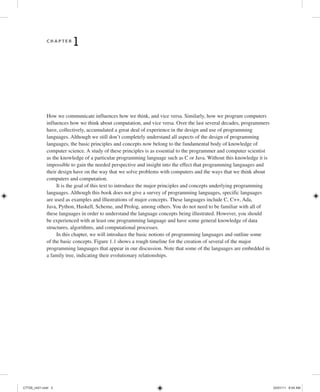
![1.1 The Origins of Programming Languages 3
Figure 1.1 A programming language timeline
ML Miranda
Prolog
C
Simula
PL/I Modula 2 Modula 3
ALGOL Pascal Ada
Lisp Scheme Common Lisp
COBOL
FORTRAN
Assembly
language
1950 1960 1970 1980 1990 2000 2010
Smalltalk Java
C++
Ruby
Python
Perl
Haskell
1.1 The Origins of Programming Languages
A definition often advanced for a programming language is “a notation for communicating to a computer
what we want it to do,” but this definition is inadequate. Before the middle of the 1940s, computer operators
“hardwired” their programs. That is, they set switches to adjust the internal wiring of a computer to perform
the requested tasks. This effectively communicated to the computer what computations were desired, but
programming, if it could be called that, consisted of the expensive and error-prone activity of taking down
the hardware to restructure it. This section examines the origins and emergence of programming languages,
which allowed computer users to solve problems without having to become hardware engineers.
1.1.1 Machine Language and the First Stored Programs
A major advance in computer design occurred in the late 1940s, when John von Neumann had the
idea that a computer should be permanently hardwired with a small set of general-purpose operations
[Schneider and Gersting, 2010]. The operator could then input into the computer a series of binary codes
that would organize the basic hardware operations to solve more-specific problems. Instead of turning off
the computer to reconfigure its circuits, the operator could flip switches to enter these codes, expressed
in machine language, into computer memory. At this point, computer operators became the first true
programmers, who developed software—the machine code—to solve problems with computers.
Figure 1.2 shows the code for a short machine language program for the LC-3 machine architecture
[Patt and Patel, 2003].
C7729_ch01.indd 3
C7729_ch01.indd 3 03/01/11 8:54 AM
03/01/11 8:54 AM](https://image.slidesharecdn.com/1246400-250518165037-48165d7b/85/Programming-Languages-Principles-And-Practices-3rd-Edition-Kenneth-C-Louden-15-320.jpg)
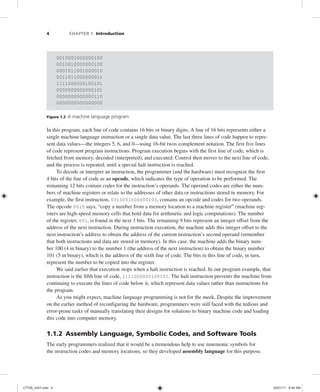
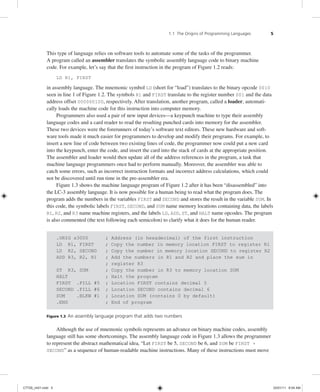
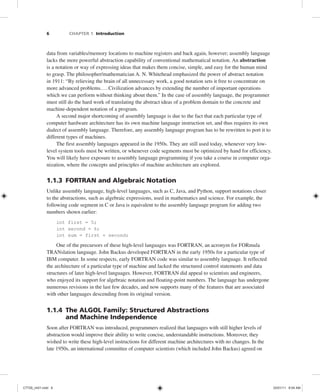
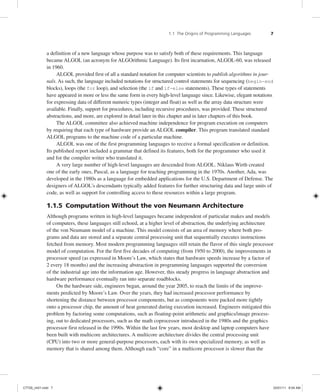
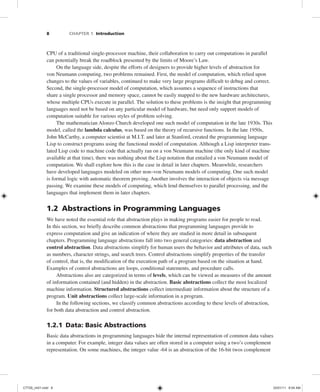
![1.2 Abstractions in Programming Languages 9
value 1111111111000000. Similarly, a real or floating-point data value is usually provided, which hides
the IEEE single- or double-precision machine representation of such numbers. These values are also
called “primitive” or “atomic,” because the programmer cannot normally access the component parts or
bits of their internal representation [Patt and Patel, 2003].
Another basic data abstraction is the use of symbolic names to hide locations in computer memory
that contain data values. Such named locations are called variables. The kind of data value is also given a
name and is called a data type. Data types of basic data values are usually given names that are varia-
tions of their corresponding mathematical values, such as int, double, and float. Variables are given
names and data types using a declaration, such as the Pascal:
var x : integer;
or the equivalent C declaration:
int x;
In this example, x is established as the name of a variable and is given the data type integer.
Finally, standard operations, such as addition and multiplication, on basic data types are also
provided. Data types are studied in Chapter 8 and declarations in Chapter 7.
1.2.2 Data: Structured Abstractions
The data structure is the principal method for collecting related data values into a single unit. For
example, an employee record may consist of a name, address, phone number, and salary, each of which
may be a different data type, but together represent the employee’s information as a whole.
Another example is that of a group of items, all of which have the same data type and which need to
be kept together for purposes of sorting or searching. A typical data structure provided by programming
languages is the array, which collects data into a sequence of individually indexed items. Variables can
name a data structure in a declaration, as in the C:
int a[10];
which establishes the variable a as the name of an array of ten integer values.
Yet another example is the text file, which is an abstraction that represents a sequence of characters
for transfer to and from an external storage device. A text file’s structure is independent of the type of
storage medium, which can be a magnetic disk, an optical disc (CD or DVD), a solid-state device (flash
stick), or even the keyboard and console window.
Like primitive data values, a data structure is an abstraction that hides a group of component parts,
allowing the programmer to view them as one thing. Unlike primitive data values, however, data structures
provide the programmer with the means of constructing them from their component parts (which can
include other data structures as well as primitive values) and also the means of accessing and modifying
these components. The different ways of creating and using structured types are examined in Chapter 8.
1.2.3 Data: Unit Abstractions
In a large program, it is useful and even necessary to group related data and operations on these data
together, either in separate files or in separate language structures within a file. Typically, such abstrac-
tions include access conventions and restrictions that support information hiding. These mechanisms
C7729_ch01.indd 9
C7729_ch01.indd 9 03/01/11 8:54 AM
03/01/11 8:54 AM](https://image.slidesharecdn.com/1246400-250518165037-48165d7b/85/Programming-Languages-Principles-And-Practices-3rd-Edition-Kenneth-C-Louden-21-320.jpg)
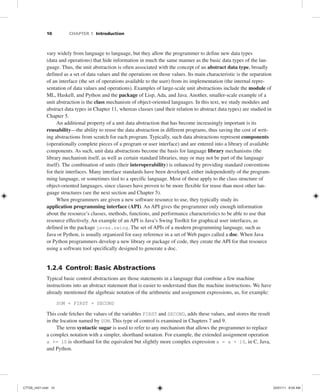
![1.2 Abstractions in Programming Languages 11
1.2.5 Control: Structured Abstractions
Structured control abstractions divide a program into groups of instructions that are nested within tests
that govern their execution. They, thus, help the programmer to express the logic of the primary control
structures of sequencing, selection, and iteration (loops). At the machine level, the processor executes
a sequence of instructions simply by advancing a program counter through the instructions’ memory
addresses. Selection and iteration are accomplished by the use of branch instructions to memory
locations other than the next one. To illustrate these ideas, Figure 1.4 shows an LC-3 assembly language
code segment that computes the sum of the absolute values of 10 integers in an array named LIST.
Comments have been added to aid the reader.
LEA R1, LIST ; Load the base address of the array (the first cell)
AND R2, R2, #0 ; Set the sum to 0
AND R3, R3, #0 ; Set the counter to 10 (to count down)
ADD R3, R3, #10
WHILE LDR R4, R1, #0 ; Top of the loop: load the datum from the current
; array cell
BRZP INC ; If it’s >= 0, skip next two steps
NOT R4, R4 ; It was < 0, so negate it using twos complement
; operations
ADD R4, R4, #1
INC ADD R2, R2, R4 ; Increment the sum
ADD R1, R1, #1 ; Increment the address to move to the next array
; cell
ADD R3, R3, #-1 ; Decrement the counter
BRP WHILE ; Goto the top of the loop if the counter > 0
ST R2, SUM ; Store the sum in memory
Figure 1.4 An array-based loop in assembly language
If the comments were not included, even a competent LC-3 programmer probably would not be able to
tell at a glance what this algorithm does. Compare this assembly language code with the use of the struc-
tured if and for statements in the functionally equivalent C++ or Java code in Figure 1.5.
int sum = 0;
for (int i = 0; i < 10; i++){
int data = list[i];
if (data < 0)
data = -data;
sum += data;
}
Figure 1.5 An array-based loop in C++ or Java
Structured selection and loop mechanisms are studied in Chapter 9.
C7729_ch01.indd 11
C7729_ch01.indd 11 03/01/11 8:54 AM
03/01/11 8:54 AM](https://image.slidesharecdn.com/1246400-250518165037-48165d7b/85/Programming-Languages-Principles-And-Practices-3rd-Edition-Kenneth-C-Louden-23-320.jpg)
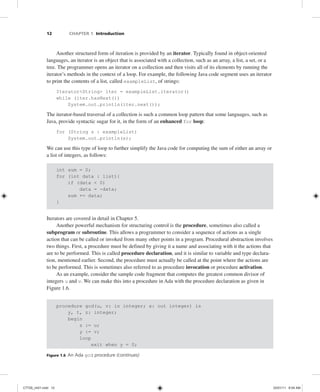
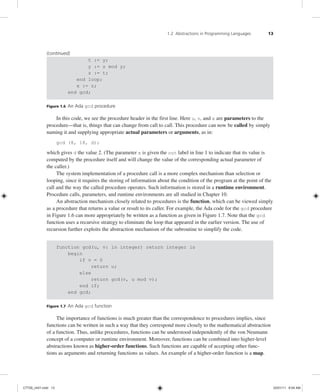
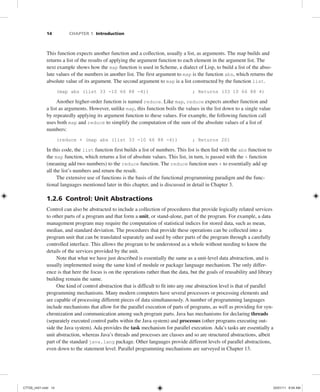
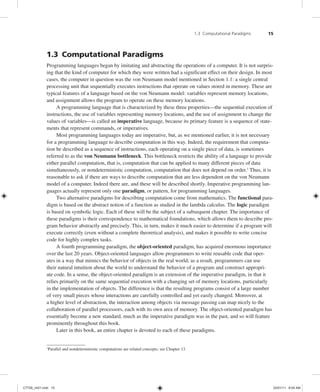
![16 CHAPTER 1 Introduction
1.4 Language Definition
Documentation for the early programming languages was written in an informal way, in ordinary
English. However, as we saw earlier in this chapter, programmers soon became aware of the need for
more precise descriptions of a language, to the point of needing formal definitions of the kind found in
mathematics. For example, without a clear notion of the meaning of programming language constructs,
a programmer has no clear idea of what computation is actually being performed. Moreover, it should be
possible to reason mathematically about programs, and to do this requires formal verification or proof of
the behavior of a program. Without a formal definition of a language this is impossible.
But there are other compelling reasons for the need for a formal definition. We have already men-
tioned the need for machine or implementation independence. The best way to achieve this is through
standardization, which requires an independent and precise language definition that is universally
accepted. Standards organizations such as ANSI (American National Standards Institute) and ISO
(International Organization for Standardization) have published definitions for many languages, includ-
ing C, C++, Ada, Common Lisp, and Prolog.
A further reason for a formal definition is that, inevitably in the programming process, difficult
questions arise about program behavior and interaction. Programmers need an adequate way to answer
such questions besides the often-used trial-and-error process: it can happen that such questions need to be
answered already at the design stage and may result in major design changes.
Finally, the requirements of a formal definition ensure discipline when a language is being designed.
Often a language designer will not realize the consequences of design decisions until he or she is required
to produce a clear definition.
Language definition can be loosely divided into two parts: syntax, or structure, and semantics, or
meaning. We discuss each of these categories in turn.
1.4.1 Language Syntax
The syntax of a programming language is in many ways like the grammar of a natural language. It is the
description of the ways different parts of the language may be combined to form phrases and, ultimately,
sentences. As an example, the syntax of the if statement in C may be described in words as follows:
P R O P E R T Y: An if statement consists of the word “if” followed by an expression inside
parentheses, followed by a statement, followed by an optional else part consisting of the
word “else” and another statement.
The description of language syntax is one of the areas where formal definitions have gained accep-
tance, and the syntax of all languages is now given using a grammar. For example, a grammar rule for
the C if statement can be written as follows:
<if-statement> ::= if (<expression>) <statement>
[else <statement>]
or (using special characters and formatting):
if-statement → if (expression) statement
[else statement]
C7729_ch01.indd 16
C7729_ch01.indd 16 03/01/11 8:54 AM
03/01/11 8:54 AM](https://image.slidesharecdn.com/1246400-250518165037-48165d7b/85/Programming-Languages-Principles-And-Practices-3rd-Edition-Kenneth-C-Louden-28-320.jpg)
![1.4 Language Definition 17
The lexical structure of a programming language is the structure of the language’s words, which are
usually called tokens. Thus, lexical structure is similar to spelling in a natural language. In the example
of a C if statement, the words if and else are tokens. Other tokens in programming languages include
identifiers (or names), symbols for operations, such as + and * and special punctuation symbols such as
the semicolon (;) and the period (.).
In this book, we shall consider syntax and lexical structure together; a more detailed study can be
found in Chapter 6.
1.4.2 Language Semantics
Syntax represents only the surface structure of a language and, thus, is only a small part of a language
definition. The semantics, or meaning, of a language is much more complex and difficult to describe
precisely. The first difficulty is that “meaning” can be defined in many different ways. Typically, describ-
ing the meaning of a piece of code involves describing the effects of executing the code, but there is no
standard way to do this. Moreover, the meaning of a particular mechanism may involve interactions with
other mechanisms in the language, so that a comprehensive description of its meaning in all contexts may
become extremely complex.
To continue with our example of the C if statement, its semantics may be described in words as
follows (adapted from Kernighan and Richie [1988]):
An if statement is executed by first evaluating its expression, which must have an arithmetic or pointer
type, including all side effects, and if it compares unequal to 0, the statement following the expression is
executed. If there is an else part, and the expression is 0, the statement following the “else” is executed.
This description itself points out some of the difficulty in specifying semantics, even for a simple
mechanism such as the if statement. The description makes no mention of what happens if the condition
evaluates to 0, but there is no else part (presumably nothing happens; that is, the program continues at
the point after the if statement). Another important question is whether the if statement is “safe” in the
sense that there are no other language mechanisms that may permit the statements inside an if statement
to be executed without the corresponding evaluation of the if expression. If so, then the if-statement
provides adequate protection from errors during execution, such as division by zero:
if (x != 0) y = 1 / x;
Otherwise, additional protection mechanisms may be necessary (or at least the programmer must be
aware of the possibility of circumventing the if expression).
The alternative to this informal description of semantics is to use a formal method. However, no
generally accepted method, analogous to the use of context-free grammars for syntax, exists here either.
Indeed, it is still not customary for a formal definition of the semantics of a programming language
to be given at all. Nevertheless, several notational systems for formal definitions have been developed
and are increasingly in use. These include operational semantics, denotational semantics, and
axiomatic semantics.
Language semantics are implicit in many of the chapters of this book, but semantic issues are more
specifically addressed in Chapters 7 and 11. Chapter 12 discusses formal methods of semantic definition,
including operational, denotational, and axiomatic semantics.
C7729_ch01.indd 17
C7729_ch01.indd 17 03/01/11 8:54 AM
03/01/11 8:54 AM](https://image.slidesharecdn.com/1246400-250518165037-48165d7b/85/Programming-Languages-Principles-And-Practices-3rd-Edition-Kenneth-C-Louden-29-320.jpg)
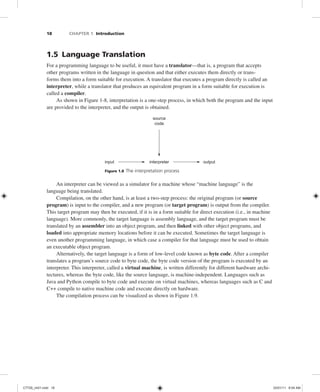
![1.6 The Future of Programming Languages 19
executable
code
input processor output
source
code
target
code
compile
further
translation
executable
code
Figure 1.9 The compilation process
It is important to keep in mind that a language and the translator for that language are two different
things. It is possible for a language to be defined by the behavior of a particular interpreter or compiler
(a so-called definitional translator), but this is not common (and may even be problematic, in view of
the need for a formal definition, as discussed in the last section). More often, a language definition exists
independently, and a translator may or may not adhere closely to the language definition (one hopes the
former). When writing programs one must always be aware of those features and properties that depend
on a specific translator and are not part of the language definition. There are significant advantages to be
gained from avoiding nonstandard features as much as possible.
A complete discussion of language translation can be found in compiler texts, but we will examine
the basic front end of this process in Chapters 6–10.
1.6 The Future of Programming Languages
In the 1960s, some computer scientists dreamed of a single universal programming language that would
meet the needs of all computer users. Attempts to design and implement such a language, however,
resulted in frustration and failure. In the late 1970s and early 1980s, a different dream emerged—a dream
that programming languages themselves would become obsolete, that new specification languages
would be developed that would allow computer users to just say what they wanted to a system that would
then find out how to implement the requirements. A succinct exposition of this view is contained in
Winograd [1979]:
Just as high-level languages enabled the programmer to escape from the intricacies of a machine’s
order code, higher level programming systems can provide help in understanding and manipulating
complex systems and components. We need to shift our attention away from the detailed specification
of algorithms, towards the description of the properties of the packages and objects with which
we build. A new generation of programming tools will be based on the attitude that what we say
in a programming system should be primarily declarative, not imperative: the fundamental use of a
programming system is not in creating sequences of instructions for accomplishing tasks (or carrying
out algorithms), but in expressing and manipulating descriptions of computational processes and the
objects on which they are carried out. (Ibid., p. 393)
C7729_ch01.indd 19
C7729_ch01.indd 19 03/01/11 8:54 AM
03/01/11 8:54 AM](https://image.slidesharecdn.com/1246400-250518165037-48165d7b/85/Programming-Languages-Principles-And-Practices-3rd-Edition-Kenneth-C-Louden-31-320.jpg)
![20 CHAPTER 1 Introduction
In a sense, Winograd is just describing what logic programming languages attempt to do. As you will
see in Chapter 4, however, even though these languages can be used for quick prototyping, program-
mers still need to specify algorithms step by step when efficiency is needed. Little progress has been
made in designing systems that can on their own construct algorithms to accomplish a set of given
requirements.
Programming has, thus, not become obsolete. In a sense it has become even more important, since it
now can occur at so many different levels, from assembly language to specification language. And with
the development of faster, cheaper, and easier-to-use computers, there is a tremendous demand for more
and better programs to solve a variety of problems.
What’s the future of programming language design? Predicting the future is notoriously difficult,
but it is still possible to extrapolate from recent trends. Two of the most interesting perspectives on the
evolution of programming languages in the last 20 years come from a pair of second-generation Lisp
programmers, Richard Gabriel and Paul Graham.
In his essay “The End of History and the Last Programming Language” [Gabriel 1996 ], Gabriel is
puzzled by the fact that very high-level, mathematically elegant languages such as Lisp have not caught
on in industry, whereas less elegant and even semantically unsafe languages such as C and C++ have
become the standard. His explanation is that the popularity of a programming language is much more a
function of the context of its use than of any of its intrinsic properties. To illustrate this point, he likens
the spread of C in the programming community to that of a virus. The simple footprint of the C com-
piler and runtime environment and its connection to the UNIX operating system has allowed it to spread
rapidly to many hardware platforms. Its conventional syntax and lack of mathematical elegance have
appealed to a very wide range of programmers, many of whom may not necessarily have much math-
ematical sophistication. For these reasons, Gabriel concludes that C will be the ultimate survivor among
programming languages well into the future.
Graham, writing a decade later in his book Hacker and Painters [Graham 2004] sees a different trend
developing. He believes that major recent languages, such as Java, Python, and Ruby, have added features
that move them further away from C and closer to Lisp. However, like C in an earlier era, each of these
languages has quickly migrated into new technology areas, such as Web-based client/server applications
and mobile devices. What then of Lisp itself? Like most writers on programming languages, Graham
classifies them on a continuum, from fairly low level (C) to fairly high level (Java, Python, Ruby). But
he then asks two interesting questions: If there is a range of language levels, which languages are at
the highest level? And if there is a language at the highest level, and it still exists, why wouldn’t people
prefer to write their programs in it? Not surprisingly, Graham claims that Lisp, after 50 years, always has
been and still is the highest-level language. He then argues, in a similar manner to Gabriel, that Lisp’s
virtues have been recognized only by the best programmers and by the designers of the aforementioned
recent languages. However, Graham believes that the future of Lisp may lie in the rapid development of
server-side applications.
Figure 1.10 shows some statistics on the relative popularity of programming languages since 2000.
The statistics, which include the number of posts on these languages on comp.lang newsgroups for the
years 2009, 2003, and 2000, lend some support to Graham’s and Gabriel’s analyses. (Comp newsgroups,
originally formed on Usenet, provide a forum for discussing issues in technology, computing, and
programming.)
C7729_ch01.indd 20
C7729_ch01.indd 20 03/01/11 8:54 AM
03/01/11 8:54 AM](https://image.slidesharecdn.com/1246400-250518165037-48165d7b/85/Programming-Languages-Principles-And-Practices-3rd-Edition-Kenneth-C-Louden-32-320.jpg)
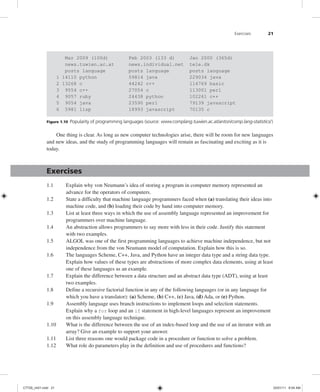
![22 CHAPTER 1 Introduction
1.13 In what sense does recursion provide additional abstraction capability to function definitions?
Give an example to support your answer.
1.14 Explain what the map function does in a functional language. How does it provide additional
abstraction capability in a programming language?
1.15 Which three properties characterize imperative programming languages?
1.16 How do the three properties in your answer to question 1.15 reflect the von Neumann model of
computing?
1.17 Give two examples of lexical errors in a program, using the language of your choice.
1.18 Give two examples of syntax errors in a program, using the language of your choice.
1.19 Give two examples of semantic errors in a program, using the language of your choice.
1.20 Give one example of a logic error in a program, using the language of your choice.
1.21 Java and Python programs are translated to byte code that runs on a virtual machine. Discuss the
advantages and disadvantages of this implementation strategy, as opposed to that of C++, whose
programs translate to machine code.
Notes and References
The quote from A. N. Whitehead in Section 1.1 is in Whitehead [1911]. An early description of the von
Neumann architecture and the use of a program stored as data to control the execution of a computer is in
Burks, Goldstine, and von Neumann [1947]. A gentle introduction to the von Neumann architecture, and
the evolution of computer hardware and programming languages is in Schneider and Gersting [2010].
References for the major programming languages used or mentioned in this text are as follows.
The LC-3 machine architecture, instruction set, and assembly language are discussed in Patt and Patel
[2003]. The history of FORTRAN is given in Backus [1981]; of Algol60 in Naur [1981] and Perlis
[1981]; of Lisp in McCarthy [1981], Steele and Gabriel [1996], and Graham [2002]; of COBOL in
Sammet [1981]; of Simula67 in Nygaard and Dahl [1981]; of BASIC in Kurtz [1981]; of PL/I in Radin
[1981]; of SNOBOL in Griswold [1981]; of APL in Falkoff and Iverson [1981]; of Pascal in Wirth
[1996]; of C in Ritchie [1996]; of C++ in Stroustrup [1994] [1996]; of Smalltalk in Kay [1996]; of Ada
in Whitaker [1996]; of Prolog in Colmerauer and Roussel [1996]; of Algol68 in Lindsey [1996]; and of
CLU in Liskov [1996]. A reference for the C programming language is Kernighan and Ritchie [1988].
The latest C standard is ISO 9899 [1999]. C++ is described in Stroustrup [1994] [1997], and Ellis and
Stroustrup [1990]; an introductory text is Lambert and Nance [2001]; the international standard for C++
is ISO 14882-1 [1998]. Java is described in many books, including Horstmann [2006] and Lambert and
Osborne [2010]; the Java language specification is given in Gosling, Joy, Steele, and Bracha [2005]. Ada
exists in three versions: The original is sometimes called Ada83, and is described by its reference manual
(ANSI-1815A [1983]); newer versions are Ada95 and Ada20052
, and are described by their international
standard (ISO 8652 [1995, 2007]). A standard text for Ada is Barnes [2006]. An introductory text on
Python is Lambert [2010]. Common Lisp is presented in Graham [1996] and Seibel [2005]. Scheme is
described in Dybvig [1996] and Abelson and Sussman [1996]; a language definition can be found in
2
Since Ada95/2005 is an extension of Ada83, we will indicate only those features that are specifically Ada95/2005 when they are
not part of Ada83.
C7729_ch01.indd 22
C7729_ch01.indd 22 03/01/11 8:54 AM
03/01/11 8:54 AM](https://image.slidesharecdn.com/1246400-250518165037-48165d7b/85/Programming-Languages-Principles-And-Practices-3rd-Edition-Kenneth-C-Louden-34-320.jpg)
![Notes and References 23
Abelson et al. [1998]. Haskell is covered in Hudak [2000] and Thompson [1999]. The ML functional
language (related to Haskell) is covered in Paulson [1996] and Ullman [1997]. The standard reference
for Prolog is Clocksin and Mellish [1994]. The logic paradigm is discussed in Kowalski [1979], and the
functional paradigm in Backus [1978] and Hudak [1989]. Smalltalk is presented in Lambert and Osborne
[1997]. Ruby is described in Flanagan and Matsumoto [2008] and in Black [2009]. Erlang is discussed in
Armstrong [2007].
Language translation techniques are described in Aho, Lam, Sethi, and Ullman [2006] and
Louden [1997].
Richard Gabriel’s essay on the last programming language appears in Gabriel [1996], which also
includes a number of interesting essays on design patterns. Paul Graham’s essay on high-level languages
appears in Graham [2004], where he also discusses the similarities between the best programmers and
great artists.
C7729_ch01.indd 23
C7729_ch01.indd 23 03/01/11 8:54 AM
03/01/11 8:54 AM](https://image.slidesharecdn.com/1246400-250518165037-48165d7b/85/Programming-Languages-Principles-And-Practices-3rd-Edition-Kenneth-C-Louden-35-320.jpg)
![2.1 Historical Overview 27
Pascal was designed to provide a simple instructional language to promote top-down design. Finally,
the designer of C++ focused on the users’ needs for greater abstraction while preserving efficiency and
compatibility with C.
Nevertheless, it is still extremely difficult to describe good programming language design. Even
noted computer scientists and successful language designers offer conflicting advice. Niklaus Wirth,
the designer of Pascal, advises that simplicity is paramount (Wirth [1974]). C. A. R. Hoare, a promi-
nent computer scientist and co-designer of a number of languages, emphasizes the design of individual
language constructs (Hoare [1973]). Bjarne Stroustrup, the designer of C++, notes that a language cannot
be merely a collection of “neat” features (Stroustrup [1994], page 7). Fred Brooks, a computer science
pioneer, maintains that language design is similar to any other design problem, such as designing a
building (Brooks [1996]).
In this chapter, we introduce some general design criteria and present a set of more detailed prin-
ciples as potential aids to the language designer and ultimately the language user. We also give some
specific examples to emphasize possible good and bad choices, with the understanding that there often is
no general agreement on these issues.
2.1 Historical Overview
In the early days of programming, machines were extremely slow and memory was scarce. Program
speed and memory usage were, therefore, the prime concerns. Also, some programmers still did not
trust compilers to produce efficient executable code (code that required the fewest number of machine
instructions and the smallest amount of memory). Thus, one principal design criterion really mattered:
efficiency of execution. For example, FORTRAN was specifically designed to allow the programmer
to generate compact code that executed quickly. Indeed, with the exception of algebraic expressions,
early FORTRAN code more or less directly mapped to machine code, thus minimizing the amount of
translation that the compiler would have to perform. Judging by today’s standards, creating a high-level
programming language that required the programmer to write code nearly as complicated as machine
code might seem counterproductive. After all, the whole point of a high-level programming language
is to make life easier for the programmer. In the early days of programming, however, writability—the
quality of a language that enables a programmer to use it to express a computation clearly, correctly,
concisely, and quickly—was always subservient to efficiency. Moreover, at the time that FORTRAN was
developed, programmers were less concerned about creating programs that were easy for people to read
and write, because programs at that time tended to be short, written by one or a few programmers, and
rarely revised or updated except by their creators.
By the time COBOL and Algol60 came on the scene, in the 1960s, languages were judged by other
criteria than simply the efficiency of the compiled code. For example, Algol60 was designed to be suit-
able for expressing algorithms in a logically clear and concise way—in other words, unlike FORTRAN,
it was designed for easy reading and writing by people. To achieve this design goal, Algol60’s designers
incorporated block structure, structured control statements, a more structured array type, and recursion.
These features of the language were very effective. For example, C. A. R. Hoare understood how to
express his QUICKSORT algorithm clearly only after learning Algol60.
COBOL’s designers attempted to improve the readability of programs by trying to make them look
like ordinary written English. In fact, the designers did not achieve their goal. Readers were not able to
C7729_ch02.indd 27
C7729_ch02.indd 27 03/01/11 8:59 AM
03/01/11 8:59 AM](https://image.slidesharecdn.com/1246400-250518165037-48165d7b/85/Programming-Languages-Principles-And-Practices-3rd-Edition-Kenneth-C-Louden-38-320.jpg)
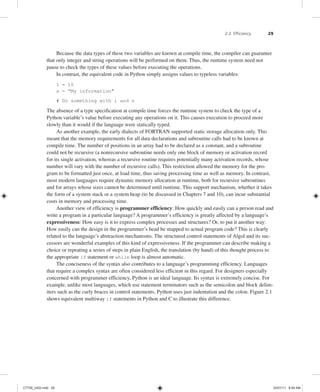
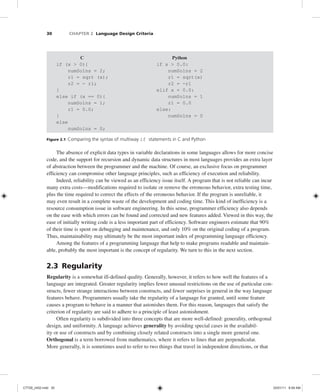
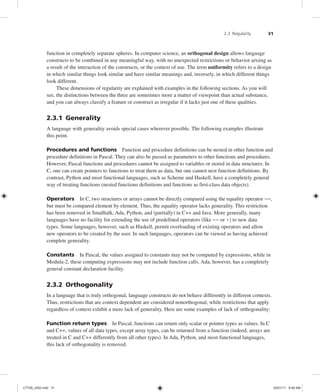
![32 CHAPTER 2 Language Design Criteria
Placement of variable declarations In C, local variables can only be defined at the beginning
of a block (compound statement),1
while in C++ variable definitions can occur at any point inside a block
(but, of course, before any uses).
Primitive and reference types In Java, values of scalar types (char, int, float, and so forth)
are not objects, but all other values are objects. Scalar types are called primitive types, whereas object
types are called reference types. Primitive types use value semantics, meaning that a value is copied
during assignment. Reference types use reference semantics, meaning that assignment produces two
references to the same object. Also, in Java, collections of objects are treated differently from collections
of primitive types. Among Java’s collections, only arrays can contain primitive values. Primitive values
must be placed in special wrapper objects before insertion into other types of collections. In Smalltalk
and Python, by contrast, all values are objects and all types are reference types. Thus, these languages use
reference semantics only, and collections of objects are treated in an orthogonal manner.
Orthogonality was a major design goal of Algol68, and it remains the best example of a language
where constructs can be combined in all meaningful ways.
2.3.3 Uniformity
The term uniformity refers to the consistency of appearance and behavior of language constructs.
A language is uniform when similar things look similar or behave in a similar manner, but lacks
uniformity when dissimilar things actually look similar or behave similarly when they should not. Here
are some examples of the lack of uniformity.
The extra semicolon In C++, a semicolon is necessary after a class definition, but forbidden after
a function definition:
class A { ... } ; // semicolon required
int f () { ... } // semicolon forbidden
The reason the semicolon must appear after a class definition is that the programmer can include a list of
variable names before the semicolon, if so desired, as is the case with struct declarations in C.
Using assignment to return a value In Pascal, return statements in functions look like
assignments to variables. This is a case where different things should look different, but instead look
confusingly alike. For example:
function f : boolean;
begin
...
f := true;
end;
Most other languages use a dedicated return statement for returning values from functions.
1
The ISO C Standard (ISO 9899 [1999]) removed this restriction.
C7729_ch02.indd 32
C7729_ch02.indd 32 03/01/11 8:59 AM
03/01/11 8:59 AM](https://image.slidesharecdn.com/1246400-250518165037-48165d7b/85/Programming-Languages-Principles-And-Practices-3rd-Edition-Kenneth-C-Louden-43-320.jpg)
![2.4 Security 33
2.3.4 Causes of Irregularities
Why do languages exhibit such irregularities at all? Surely the language designers did not intentionally
set out to create strange restrictions, interactions, and confusions. Indeed, many irregularities are case
studies in the difficulties of language design.
Take, for example, the problem with the semicolon in the C++ class declaration, noted as a lack
of uniformity above. Since the designers of C++ attempted to deviate from C as little as possible, this
irregularity was an essential byproduct of the need to be compatible with C. The lack of generality of
functions in C and Pascal was similarly unavoidable, since both of these languages opt for a simple stack-
based runtime environment (as explained in Chapter 10). Without some restriction on functions, a more
general environment would have been required, and that would in turn have compromised the simplicity
and efficiency of implementations. The irregularity of primitive types and reference types in Java is also
the result of the designer’s concern with efficiency.
On the other hand, it is worth noting that too great a focus on a particular goal, such as generality or
orthogonality, can itself be dangerous. A case in point is Algol68. While this language was largely suc-
cessful in meeting the goals of generality and orthogonality, many language designers believe that these
qualities led to an unnecessarily obscure and complex language.
So how do you tell if a lack of regularity is reasonable? Consider the basic design goals of the
language, and then think about how they would be compromised if the irregularity were removed. If you
cannot justify a lack of regularity in this way, then it is probably a design flaw.
2.4 Security
As we have seen, the reliability of a programming language can be seriously affected if restrictions are
not imposed on certain features. In Pascal, for instance, pointers are specifically restricted to reduce secu-
rity problems, while in C they are much less restricted and, thus, much more prone to misuse and error. In
Java, by contrast, pointers have been eliminated altogether (they are implicit in all object allocation), but
at some cost of a more complicated runtime environment.
Security is closely related to reliability. A language designed with an eye toward security both
discourages programming errors and allows errors to be discovered and reported. A concern for security
led language designers to introduce types, type checking, and variable declarations into programming
languages. The idea was to “maximize the number of errors that could not be made” by the programmer
(Hoare [1981]).
However, an exclusive focus on security can compromise both the expressiveness and conciseness of
a language, and typically forces the programmer to laboriously specify as many things as possible in the
actual code. For example, LISP and Python programmers often believe that static type-checking and vari-
able declarations make it difficult to program complex operations or provide generic utilities that work
for a wide variety of data. On the other hand, in industrial, commercial, and defense applications, there is
often a need to provide additional language features for security. Perhaps the real issue is how to design
languages that are secure and that also allow for maximum expressiveness and generality. Examples of
an advance in this direction are the languages ML and Haskell, which are functional in approach, allow
multityped objects, do not require declarations, and yet perform static type-checking.
Strong typing, whether static or dynamic, is only one component of safety. Several modern lan-
guages, such as Python, Lisp, and Java, go well beyond this and are considered to be semantically safe.
C7729_ch02.indd 33
C7729_ch02.indd 33 03/01/11 8:59 AM
03/01/11 8:59 AM](https://image.slidesharecdn.com/1246400-250518165037-48165d7b/85/Programming-Languages-Principles-And-Practices-3rd-Edition-Kenneth-C-Louden-44-320.jpg)
![34 CHAPTER 2 Language Design Criteria
That is, these languages prevent a programmer from compiling or executing any statements or expres-
sions that violate the definition of the language. By contrast, languages such as C and C++ are not
semantically safe. For example, an array index out of bounds error causes either a compile-time error
or a runtime error in Python, Lisp, and Java, whereas the same error can go undetected in C and C++.
Likewise, in languages such as C and C++, the programmer’s failure to recycle dynamic storage can
cause memory leaks, whereas in Python, Lisp, and Java, automatic garbage collection prevents this type
of situation from ever occurring.
2.5 Extensibility
An extensible language allows the user to add features to it. Most languages are extensible at least to
some degree. For example, almost all languages allow the programmer to define new data types and
new operations (functions or procedures). Some languages allow the programmer to include these new
resources in a larger program unit, such as a package or module. The new data types and operations have
the same syntax and behavior as the built-in ones.
The designers of modern languages such as Java and Python also extend the built-in features of the
language by providing new releases on a regular basis. These language extensions typically are back-
ward-compatible with programs written in earlier versions of the language, so as not to disturb legacy
code; occasionally, however, some earlier features become “deprecated,” meaning that they may not be
supported in future releases of the language.
Very few languages allow the programmer to add new syntax and semantics to the language itself.
One example is LISP (see Graham [2002]). Not only can Lisp programmers add new functions, classes,
data types, and packages to the base language, they can also extend Lisp’s syntax and semantics via a
macro facility. A macro specifies the syntax of a piece of code that expands to other, standard Lisp code
when the interpreter or compiler encounters the first piece of code in a program. The expanded code may
then be evaluated according to new semantic rules. For example, Common Lisp includes a quite general
do loop for iteration but no simple while loop. That’s no problem for the Lisp programmer, who simply
defines a macro that tells the interpreter what to do when it encounters a while loop in a program.
Specifically, the interpreter or compiler uses the macro to generate the code for an equivalent do loop
wherever a while loop occurs in a program. Figure 2.2 shows LISP code segments for a do loop and an
equivalent while loop that compute the greatest common divisor of two integers a and b.
(do () (while (> b 0)
((= 0 b)) (let ((temp b))
(let ((temp b)) (setf b (mod a b))
(setf b (mod a b)) (setf a temp)))
(setf a temp)))
Figure 2.2 A Lisp do loop and a Lisp while loop for computing the greatest common divisor of a and b
Most readers will understand what the while loop in Figure 2.2 does without knowing Lisp, for
it is very similar in structure to the while loop of C++, Java, or Python. However, the do loop is more
complicated. The empty parentheses on the first line omit the variable initializers and updates that would
normally go there. The Boolean expression on the second line denotes a termination condition rather
C7729_ch02.indd 34
C7729_ch02.indd 34 03/01/11 8:59 AM
03/01/11 8:59 AM](https://image.slidesharecdn.com/1246400-250518165037-48165d7b/85/Programming-Languages-Principles-And-Practices-3rd-Edition-Kenneth-C-Louden-45-320.jpg)
![2.6 C++: An Object-Oriented Extension of C 35
than a continuation condition. The rest of the code is the body of the loop. The while loop in Figure 2.3
would clearly be a simpler and better fit for this problem, but it does not already exist in Lisp.
Figure 2.3 shows the code for a macro definition that would enable Lisp to translate a while loop to
an equivalent do loop.
(defmacro while (condition &rest body)
'(do ()
((not ,condition))
,@body))
Figure 2.3 A Lisp macro that defines how to translate a Lisp while loop to a Lisp do loop
This code extends the syntax of the language by adding a new keyword, while, to it and telling the
interpreter/compiler what to do with the rest of the code following the keyword in the expression. In this
case, an expression that includes the keyword do and its appropriate remaining elements is substituted for
the while loop’s code during interpretation or compilation. LISP, thus, allows programmers to become
designers of their own little languages when the syntax and semantics of the base language do not quite
suit their purposes. Graham [2004] and Seibel [2005] provide excellent discussions of this powerful
capability.
We now conclude this chapter with two case studies, where we briefly examine the design goals and
criteria of two language developers, Bjarne Stroustup [1994; 1996] and Guido van Rossum [2003]. They
are primarily responsible for the popular languages C++ and Python, respectively.
2.6 C++: An Object-Oriented Extension of C
Bjarne Stroustrup’s interest in designing a new programming language came from his experience as
a graduate student at Cambridge University, England, in the 1970s. His research focused on a simula-
tor for software running on a distributed system (a simulator is a program that models the behavior of
a real-world object; in this case, the simulator pretended to be an actual set of distributed computers).
Stroustrup first wrote this simulator in Simula67, because he found its abstraction mechanisms (primarily
the class construct) to be ideal for expressing the conceptual organization of his particular simulator. In
addition, he found the strong type-checking of Simula to be of considerable help in correcting concep-
tual flaws in the program design. He also found that the larger his program grew, the more helpful these
features became.
Unfortunately, he also found that his large program was hard to compile and link in a reasonable
time, and so slow as to be virtually impossible to run. The compilation and linking problems were
annoying, but the runtime problems were catastrophic, since he was unable to obtain the runtime data
necessary to complete his PhD thesis. After some study, he concluded that the runtime inefficiencies
were an inherent part of Simula67, and that he would have to abandon that language in order to complete
the project. He then rewrote his entire program in BCPL (a low-level predecessor of C), which was a
language totally unsuited for the proper expression of the abstractions in his program. This effort was
such a painful experience that he felt he should never again attempt such a project with the languages that
were then in existence.
C7729_ch02.indd 35
C7729_ch02.indd 35 03/01/11 8:59 AM
03/01/11 8:59 AM](https://image.slidesharecdn.com/1246400-250518165037-48165d7b/85/Programming-Languages-Principles-And-Practices-3rd-Edition-Kenneth-C-Louden-46-320.jpg)
![36 CHAPTER 2 Language Design Criteria
But, in 1979, as a new employee at Bell Labs in New Jersey, Stroustrup was faced with a similar task:
simulating a UNIX kernel distributed over a local area network. Realizing that a new programming language
was necessary, he decided to base it on C, with which he had become familiar at Bell Labs (considered the
home of C and UNIX), and to add the class construct from Simula67 that he had found so useful.
Stroustrup chose C because of its flexibility, efficiency, availability, and portability (Stroustrup [1994],
page 43). These qualities also fit nicely with the following design goals of the new language (ibid., page 23):
1. Support for good program development in the form of classes, inheritance,
and strong type-checking
2. Efficient execution on the order of C or BCPL
3. Highly portable, easily implemented, and easily interfaced with other tools
2.6.1 C++: First Implementations
Stroustrup’s first implementation of the new language came in 1979–80, in the form of a preprocessor,
named Cpre, which transformed the code into ordinary C. The language itself, called C with Classes,
added features that met most of the three goals listed above. Stroustrup called it a “medium success”
(ibid., page 63). However, it did not include several important features, such as dynamic binding of
methods (or virtual functions, as explained Chapters 5 and 9), type parameters (or templates, as explained
in Chapters 5 and 9), or general overloading (as explained in Chapter 7). Stroustrup decided to expand
the language in these and other directions, and to replace the preprocessor by a more sophisticated
true compiler (which still generated C code as its target, for portability). The language that emerged in
1985 was called C++. Its compiler, Cfront, is still the basis for many compilers today. Stroustrup also
expanded on the basic goals of the language development effort, to explicitly include the following goals:
1. C compatibility should be maintained as far as practical, but should not be an
end in itself (“there would be no gratuitous incompatibilities,” ibid., page 101).
2. The language should undergo incremental development based firmly in
practical experience. That is, C++ should undergo an evolution driven by real
programming problems, not theoretical arguments, while at the same time
avoiding “featurism” (adding cool features just because it is possible).
3. Any added feature must entail zero cost in runtime efficiency, or, at the
very least, zero cost to programs that do not use the new feature (the
“zero-overhead” rule, ibid., page 121).
4. The language should not force any one style of programming on a program-
mer; that is, C++ should be a “multiparadigm” language.
5. The language should maintain and strengthen its stronger type-checking
(unlike C). (“No implicit violations of the static type system,” ibid., page 201.)
6. The language should be learnable in stages; that is, it should be possible to
program in C++ using some of its features, without knowing anything about
other, unused, features.
7. The language should maintain its compatibility with other systems and languages.
C7729_ch02.indd 36
C7729_ch02.indd 36 03/01/11 8:59 AM
03/01/11 8:59 AM](https://image.slidesharecdn.com/1246400-250518165037-48165d7b/85/Programming-Languages-Principles-And-Practices-3rd-Edition-Kenneth-C-Louden-47-320.jpg)
![2.6 C++: An Object-Oriented Extension of C 37
At this stage in its development, the language included dynamic binding, function and operator overload-
ing, and improved type-checking, but not type parameters, exceptions, or multiple inheritance. These
would all come later.
2.6.2 C++: Growth
In late 1985, Stroustrup published the first edition of his book on C++. In the meantime, Cpre and Cfront
had already been distributed for educational purposes essentially at no cost, and interest in the language
had begun to grow in industry. Thus, a first commercial implementation was made available in 1986.
In 1987, the first conference specifically on C++ was organized by USENIX (the UNIX users’ associa-
tion). By October 1988, Stroustrup estimates that there were about 15,000 users of the language, with
PC versions of C++ compilers appearing that same year. Between October 1979, when Stroustrup first
began using Cpre himself and October 1991, Stroustrup estimates that the number of C++ users doubled
every seven and a half months. The success of the language indicated to Stroustrup and others that a
concerted attempt at creating a standard language definition was necessary, including possible extensions
that had not yet been implemented.
2.6.3 C++: Standardization
Because C++ was rapidly growing in use, was continuing to evolve, and had a number of different imple-
mentations, the standardization presented a problem. Moreover, because of the growing user pool, there
was some pressure to undertake and complete the effort as quickly as possible. At the same time, Stroustrup
felt that the evolution of the language was not yet complete and should be given some more time.
Nevertheless, Stroustrup produced a reference manual in 1989 (the Annotated Reference Manual, or
ARM; Ellis and Stroustrup [1990]) that included all of C++ up to that point, including proposals for new
exception-handling and template (type parameter) mechanisms (multiple inheritance had already been
added to the language and Cfront that same year). In 1990 and 1991, respectively, ANSI and ISO stan-
dards committees were convened; these soon combined their efforts and accepted the ARM as the “base
document” for the standardization effort.
Then began a long process of clarifying the existing language, producing precise descriptions of its
features, and adding features and mechanisms (mostly of a minor nature after the ARM) whose utility
was agreed upon. In 1994, a major development was the addition of a standard library of containers and
algorithms (the Standard Template Library, or STL). The standards committees produced two drafts of
proposed standards in April 1995 and October 1996 before adopting a proposed standard in November
1997. This proposal became the actual ANSI/ISO standard in August 1998.
2.6.4 C++: Retrospective
Why was C++ such a success? First of all, it came on the scene just as interest in object-oriented
techniques was exploding. Its straightforward syntax, based on C, was tied to no particular operating envi-
ronment. The semantics of C++ incurred no performance penalty. These qualities allowed C++ to bring
object-oriented features into the mainstream of computing. The popularity of C++ was also enhanced by
its flexibility, its hybrid nature, and the willingness of its designer to extend its features based on practical
experience. (Stroustrup lists Algol68, CLU, Ada, and ML as major influences after C and Simula67).
C7729_ch02.indd 37
C7729_ch02.indd 37 03/01/11 8:59 AM
03/01/11 8:59 AM](https://image.slidesharecdn.com/1246400-250518165037-48165d7b/85/Programming-Languages-Principles-And-Practices-3rd-Edition-Kenneth-C-Louden-48-320.jpg)
![38 CHAPTER 2 Language Design Criteria
Is it possible to point to any “mistakes” in the design of C++? Many people consider C++ to be, like
Ada and PL/I before it, a “kitchen-sink” language, with too many features and too many ways of doing
similar things. Stroustrup justifies the size of C++ as follows (Stroustrup [1994], page 199):
The fundamental reason for the size of C++ is that it supports more than one way of writing programs. . . .
This flexibility is naturally distasteful to people who believe that there is exactly one right way of doing
things. . . . C++ is part of a trend towards greater language complexity to deal with the even greater
complexity of the programming tasks attempted.
Stroustrup does, however, list one fact in the “biggest mistake” category (ibid., page 200)—namely, that
C++ was first defined and implemented without any standard library (even without strings). This was, of
course, corrected with the 1998 C++ standard. However, Java has shown that new languages must include
an extensive library with graphics, user interfaces, networking, and concurrency. That is perhaps the big-
gest challenge for the C++ community in the future. Stroustrup himself comments (ibid., page 208): “In
the future, I expect to see the major activity and progress shift from the language proper . . . to the tools,
environments, libraries, applications, etc., that depend on it and build on it.”
2.7 Python: A General-Purpose Scripting Language
Guido van Rossum was part of a team at Centrum voor Wiskunde en Informatica (CWI) in The
Netherlands that worked on the design and implementation of the programming language ABC in the
mid-1980s. The target users of ABC were scientists and engineers who were not necessarily trained in
programming or software development. In 1986, van Rossum brought his ideas from working on ABC to
another project at CWI, called Amoeba. Ameoba was a distributed operating system in need of a script-
ing language. Naming this new language Python, van Rossum developed a translator and virtual machine
for it. Another of his goals was to allow Python to act as a bridge between systems languages such as
C and shell or scripting languages such as Perl. Consequently, he set out to make Python’s syntax simpler
and cleaner than that of ABC and other scripting languages. He also planned to include a set of powerful
built-in data types, such as strings, lists, tuples (a type of immutable list), and dictionaries. The diction-
ary, essentially a set of key/value pairs implemented via hashing, was modeled on a similar structure in
Smalltalk but not present in other languages in the 1980s. The dictionary, which was also later imple-
mented by Java’s map classes, proved especially useful for representing collections of objects organized
by content or association rather than by position.
2.7.1 Python: Simplicity, Regularity, and Extensibility
Python is easy for nonprogrammers to learn and use in part because it is based on a small but powerful
set of primitive operations and data types that can be easily extended. The novice first learns this small
set of resources and then extends them by either defining new resources or importing resources from
libraries defined by others who work in the relevant domain. However, unlike in some other languages,
each new unit of abstraction, whether it is the function, the class, or the module, retains a simple,
regular syntax. These features reduce the cognitive overload on the programmer, whether a novice or
an expert. Guido van Rossum believed that lay people (that is, professionals who are nonprogrammers,
but also students who just want to learn programming) should be able to get their programs up and
C7729_ch02.indd 38
C7729_ch02.indd 38 03/01/11 8:59 AM
03/01/11 8:59 AM](https://image.slidesharecdn.com/1246400-250518165037-48165d7b/85/Programming-Languages-Principles-And-Practices-3rd-Edition-Kenneth-C-Louden-49-320.jpg)
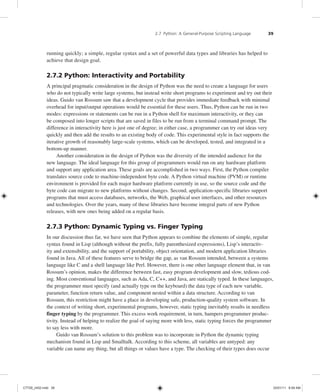
![was in this scene that the bass singer Castelmary, the Sir Tristan of a
performance of "Martha" at the Metropolitan Opera House, February
10, 1897, was stricken with heart failure and dropped dead upon the
stage.
A capital quartet opens Act II, in the farmhouse, and leads to the
spinning-wheel quartet, "Di vederlo" (What a charming occupation).
There is a duet between Lady Harriet and Lionel, in which their
growing attraction for each other finds expression, "Il suo sguardo è
dolce tanto" (To his eye, mine gently meeting). Then follows "Qui
sola, vergin rosa" ('Tis the last rose of summer), the words a poem
by Tom Moore, the music an old Irish air, "The Groves of Blarney," to
which Moore adapted "The Last Rose of Summer." A new and
effective touch is given to the old song by Flotow in having the tenor
join with the soprano at the close. Moreover, the words and music fit
so perfectly into the situation on the stage that for Flotow to have
"lifted" and interpolated them into his opera was a master-stroke. To
it "Martha" owes much of its popularity.
[Listen]
'Tis the last rose of summer, left blooming alone,
There is a duet for Lady Harriet and Lionel, "Ah! ride del mio pianto"
(She is laughing at my sorrow). The scene ends with another
quartet, one of the most beautiful numbers of the score, and known
as the "Good Night Quartet," "Dormi pur, ma il mio riposo" (Cruel
one, may dreams transport thee).
Act III, played in a hunting park in Richmond forest, on the left a
small inn, opens with a song in praise of porter, the "Canzone del](https://image.slidesharecdn.com/1246400-250518165037-48165d7b/85/Programming-Languages-Principles-And-Practices-3rd-Edition-Kenneth-C-Louden-53-320.jpg)
![Porter" by Plunkett, "Chi mi dirà?" (Will you tell me). The pièces de
résistance of this act are the "M'apparì";
[Listen]
a solo for Nancy, "Il tuo stral nel lanciar" (Huntress fair, hastens
where); Martha's song, "Qui tranquilla almen poss'io" (Here in
deepest forest shadows); and the stirring quintet with chorus.
[Listen]
In Act IV there are a solo for Plunkett, "Il mio Lionel perirà" (Soon
my Lionel will perish), and a repetition of some of the sprightly
music of the fair scene.
It is not without considerable hesitation that I have classed "Martha"
as a French opera. For Flotow was born in Teutendorf, April 27,
1812, and died in Darmstadt January 24, 1883. Moreover, "Martha,"
was produced in Vienna, and his next best-known work, "Alessandro
Stradella," in Hamburg (1844).
The music of "Martha," however, has an elegance that not only is
quite unlike any music that has come out of Germany, but is typically
French. Flotow, in fact, was French in his musical training, and both
the plot and score of "Martha" were French in origin. The composer
studied composition in Paris under Reicha, 1827-30, leaving Paris](https://image.slidesharecdn.com/1246400-250518165037-48165d7b/85/Programming-Languages-Principles-And-Practices-3rd-Edition-Kenneth-C-Louden-54-320.jpg)
![charmingly melodious. The phrases for Marguerite can be made to
express coyness, yet also show that she is not wholly displeased
with the attention paid her by the handsome stranger. She goes her
way. The dance continues. "Valsons toujours" (Waltz alway!).
Act III. Marguerite's garden. At the back a wall with a wicket door.
To the left a bower. On the right Marguerite's house, with a bow
window facing the audience. Trees, shrubs, flower beds, etc.
Siebel enters by the wicket. Stopping at one of the flower beds and
about to pluck a nosegay, he sings the graceful "Faites-lui mes
aveux" (Bear my avowal to her). But when he culls a flower, it
shrivels in his hand, as Méphistophélès had predicted. The boy is
much perturbed. Seeing, however, a little font with holy water
suspended by the wall of the house, he dips his fingers in it. Now
the flowers no longer shrivel as he culls them. He arranges them in a
bouquet, which he lays on the house step, where he hopes
Marguerite will see it. He then leaves.
Faust enters with Méphistophélès, but bids the latter withdraw, as if
he sensed the incongruity of his presence near the home of a
maiden so pure as Marguerite. The tempter having gone, Faust
proceeds to apostrophize Marguerite's dwelling in the exquisite
romance, "Salut! demeure chaste et pure."
[Listen]
Méphistophélès returns. With him he brings a casket of jewels and a
handsome bouquet. With these he replaces Siebel's flowers. The two
men then withdraw into a shadowy recess of the garden to await
Marguerite's return.](https://image.slidesharecdn.com/1246400-250518165037-48165d7b/85/Programming-Languages-Principles-And-Practices-3rd-Edition-Kenneth-C-Louden-64-320.jpg)
![She enters by the wicket. Her thoughts are with the handsome
stranger—above her in station, therefore the more flattering and
fascinating in her eyes—who addressed her at the kermis. Pensively
she seats herself at her spinning-wheel and, while turning it, without
much concentration of mind on her work, sings "Le Roi de Thulé,"
the ballad of the King of Thule, her thoughts, however, returning to
Faust before she resumes and finishes the number, which is set in
the simple fashion of a folk-song.
Approaching the house, and about to enter, she sees the flowers,
stops to admire them, and to bestow a thought of compassion upon
Siebel for his unrequited devotion, then sees and hesitatingly opens
the casket of jewels. Their appeal to her feminine vanity is too great
to permit her to return them at once to the casket. Decking herself
out in them, she regards herself and the sparkling gems in the
handglass that came with them, then bursts into the brilliant "Air des
Bijoux" (Jewel Song):
[Listen]
Ah! je ris de me voir
Si belle en ce miroir!...
Est-ce toi, Marguerite?
(Ah! I laugh just to view—
Marguerite! Is it you?—
Such a belle in the glass!...)
one of the most brilliant airs for coloratura soprano, affording the
greatest contrast to the folklike ballad which preceded it, and
making with it one of the most effective scenes in opera for a
soprano who can rise to its demands: the chaste simplicity required](https://image.slidesharecdn.com/1246400-250518165037-48165d7b/85/Programming-Languages-Principles-And-Practices-3rd-Edition-Kenneth-C-Louden-65-320.jpg)
![[Listen]
(Oh, night of love! oh, starlit sky!). The music fairly enmeshes the
listener in its enchanting measures.
[Listen]
Faust and Marguerite part, agreeing to meet on the morrow—"Oui,
demain! des l'aurore!" (Yes, tomorrow! at dawn!). She enters the
house. Faust turns to leave the garden. He is confronted by
Méphistophélès, who points to the window. The casement is opened
by Marguerite, who believes she is alone. Kneeling in the window,
she gazes out upon the night flooded with moonlight. "Il m'aime; ...
Ah! presse ton retour, cher bien-aimé! Viens!" (He loves me; ah!
haste your return, dearly beloved! Come!).
With a cry, Faust rushes to the open casement, sinks upon his
knees. Marguerite, with an ecstatic exclamation, leans out of the
embrasure and allows him to take her into his arms. Her head rests
upon his shoulder.
At the wicket is Méphistophélès, shaking with laughter.
Act IV. The first scene in this act takes place in Marguerite's room.
No wonder Méphistophélès laughed when he saw her in Faust's
arms. She has been betrayed and deserted. The faithful Siebel,
however, still offers her his love—"Si la bonheur à sourire t'invite"
(When all was young and pleasant, May was blooming)—but](https://image.slidesharecdn.com/1246400-250518165037-48165d7b/85/Programming-Languages-Principles-And-Practices-3rd-Edition-Kenneth-C-Louden-67-320.jpg)
![reached beyond the love story of Faust and Marguerite into the
second part of Goethe's drama and utilized the legendary revels of
Walpurgis Night (eve of May 1st) on the Brocken, the highest point
of the Hartz mountains. Here Faust meets the courtesans of
antiquity—Laïs, Cleopatra, Helen of Troy, Phryne. "Les Nubiennes,"
"Cléopatra et la Coupe d'Or" (Cleopatra and the Goblet of Gold), "Les
Troyennes" (The Troyan Women), "Variation," and "Dance de
Phryne" are the dances in this ballet. More frequently than not the
scene is omitted. To connect it with the main story, there comes to
Faust, in the midst of the revels, a vision of Marguerite. Around her
neck he beholds a red line, "like the cut of an axe." He commands
Méphistophélès to take him to her.
They find her in prison, condemned to death for killing her child.
There is an impassioned duet for Faust and Marguerite. He begs her
to make her escape with him. But her mind is wandering. In
snatches of melody from preceding scenes, she recalls the episode
at the kermis, the night in the garden. She sees Méphistophélès,
senses his identity with the arch-fiend. There is a superb trio, in
which Marguerite ecstatically calls upon angels to intervene and save
her—"Anges purs! Anges radieux!" (Angels pure, radiant, bright).
[Listen]
The voices mount higher and higher, Marguerite's soaring to a
splendid climax. She dies.
"Condemned!" cries Méphistophélès.
"Saved," chant ethereal voices.](https://image.slidesharecdn.com/1246400-250518165037-48165d7b/85/Programming-Languages-Principles-And-Practices-3rd-Edition-Kenneth-C-Louden-69-320.jpg)
![actual life as on the stage, was revealed one night to a Grand Opéra
audience, when, during the balcony scene, prima donna and tenor—
so the record says—imprinted twenty-nine real kisses on each
other's lips.
The libretto is in five acts and follows closely, often even to the text,
Shakespeare's tragedy. There is a prologue in which the characters
and chorus briefly rehearse the story that is to unfold itself.
Act I. The grand hall in the palace of the Capulets. A fête is in
progress. The chorus sings gay measures. Tybalt speaks to Paris of
Juliet, who at that moment appears with her father. Capulet bids the
guests welcome and to be of good cheer—"Soyez les bienvenus,
amis" (Be ye welcome, friends), and "Allons! jeunes gens! Allons!
belles dames!" (Bestir ye, young nobles! And ye, too, fair ladies!).
Romeo, Mercutio, Benvolio, and half-a-dozen followers come
masked. Despite the deadly feud between the two houses, they,
Montagues, have ventured to come as maskers to the fête of the
Capulets. Mercutio sings of Queen Mab, a number as gossamerlike in
the opera as the monologue is in the play; hardly ever sung as it
should be, because the rôle of Mercutio rarely is assigned to a
baritone capable of doing justice to the airy measures of "Mab, la
reine des mensonges" (Mab, Queen Mab, the fairies' midwife).
The Montagues withdraw to another part of the palace. Juliet returns
with Gertrude, her nurse. Full of high spirits, she sings the graceful
and animated waltz, "Dans ce rêve, qui m'enivre" (Fair is the tender
dream of youth).
[Listen]](https://image.slidesharecdn.com/1246400-250518165037-48165d7b/85/Programming-Languages-Principles-And-Practices-3rd-Edition-Kenneth-C-Louden-72-320.jpg)