ATLS
(Advanced Trauma Life Support)
Primary and Secondary Survey
Muhammed Bilshad
Muhammed Danish
Muhammed Nihal
IDENTIFICATION OF SEVERE TRAUMA
● The severely injured patient, with multiple injuries to different ent body systems, poses
unique diagnostic and treatment challenges. The early assessment and management of
severe trauma begins in the prehospital environment
● Forewarning the receiving hospital allows the activation of the trauma team to prepare for
the patient’s arrival.
● Key information in the pre-alert includes basic demographic information (age and gender),
mechanism of injury, injuries identified and vital signs, including respiratory rate, pulse,
blood pressure and Glasgow Coma Scale (GCS).
● Patients who are identified before reaching hospital as having sustained, or are at high
risk of sustaining, severe multisystem trauma should generate trauma team activation in
the receiving hospital.
ROLE OF THE TRAUMA TEAM
● All hospitals managing severe trauma should have a dedicated trauma team that is
available immediately to attend and manage patients presenting with severe trauma.
● The composition of the team will depend on doctors from the emergency department,
anaesthetics and/or critical care, trauma and orthopaedics and general surgery.
● Hospitals managing large volumes of cases of severe multisystem trauma are
recognising the need for an enhanced trauma team activation for the most severely
injured patients – the so-called ‘code red trauma call’
● Patients identifed before reaching hospital as being haemodynamically unstable or
having acute airway compromise may initiate ‘code red’, triggering the automatic
attendance of the most senior clinicians from each discipline prior to the patient’s arrival
The cABCDE of trauma care
● c - Control of massive external haemorrhage
● A - Airway with cervical spine protection
● B - Breathing and ventilation
● C - Circulation and haemorrhage control: apply a pelvic binder and do not
remove until a pelvic fracture is excluded
● D - Disability (neurological status)
● E - Exposure (assess for other injuries)
c: Exsanguinating external haemorrhage
● Bleeding must be controlled immediately by the application of packs and
pressure directly onto the bleeding wound and proximal artery.
● Failure to control bleeding in the limb by direct pressure with surgical
dressings should be followed by the application of a tourniquet proximal to the
wound.
● Once a tourniquet is applied the limb becomes ischaemic; therefore, the
length of time for which the tourniquet is applied must be recorded on the
patient and the patient requires urgent surgical control of the bleeding in order
to reperfuse the limb.
PRIMARY SURVEY
The primary survey aims to identify and manage the most immediately life-
threatening pathologies frst and follows cABCDE.
A: Airway with cervical spine control
● All trauma patients should have their cervical spine immobilised and protected
throughout. An immediate assessment of the patient’s airway is made.
● A compromised airway requires a stepwise progression, frst clearing the
airway by suctioning secretions or blood, followed by simple airway
manoeuvres such as a jaw thrust, chin lift and insertion of an oropharyngeal
or nasopharyngeal airway.
● Advanced airway manoeuvres necessitate the insertion of a cufed
endotracheal tube.
● Equipment and expertise for achieving a surgical airway must be readily
available.
B: Breathing and ventilation
● All patients should receive high-fow oxygen. Life-threatening chest pathology
such as tension pneumothorax, massive haemothorax and fail segment
should be diagnosed and managed immediately.
● Equipment and expertise for rapid insertion of intercostal chest drains should
be available.
C: Circulation and haemorrhage control
● All patients require adequate intravenous (IV) access with at least two large-bore
IV cannulae.
● Blood should be taken for cross-match and laboratory assessment, including
haemoglobin and venous lactate.
● An assessment of the haemodynamic status should be made to identify shocked
patients
● A pelvic binder should be applied to all haemodynamically unstable patients
following blunt trauma and not removed until after a pelvic fracture has been
excluded.
● Hypotensive trauma patients are treated as hypovolaemic until proven otherwise.
C: Circulation and haemorrhage control
● The initial aim of resuscitation is to maintain the blood supply to the vital organs:
the brain, heart and kidneys.
● This can be achieved with a target systolic blood pressure of 70–90 mmHg,
although a higher pressure of >90 mmHg should be the target if a head injury is
suspected. Small boluses of IV fuids should be administered to achieve this target.
● Excessive IV crystalloid or colloid solutions should be avoided because they cause
haemodilution, increase coagulopathy and increase the risk of adult respiratory
distress syndrome.
● Severely injured hypovolaemic patients should be resuscitated with blood and
blood products, not crystalloid/colloid fluids.
C: Circulation and haemorrhage control
● Tranexamic acid: Tranexamic acid is an antifibrinolytie drug that reduces the risk of
mortality from bleeding in both blunt and penetrating trauma. One gram is given
intravenously over 10 minutes, followed by a further 1-g dose over 8 hours.It needs
to be administered as carly as possible and ideally within the first hour from injury.
● Identification and management of haemorrhage: The sites of major haemorrhage
in trauma patients are the chest, abdomen, pelvis and long bones, and external
haemorrhage. Computed tomography (CT) from the head to pelvis with IV contrast,
the so-called whole-body CT" (WBCT), is the gold standard investigation in patients
with signs or symptoms of multiple injury. A focused abdominal sonography for
trauma (FAST) scan may also be useful in this scenario to locate the major source of
haemorrhage.
D: Disability and E: Exposure
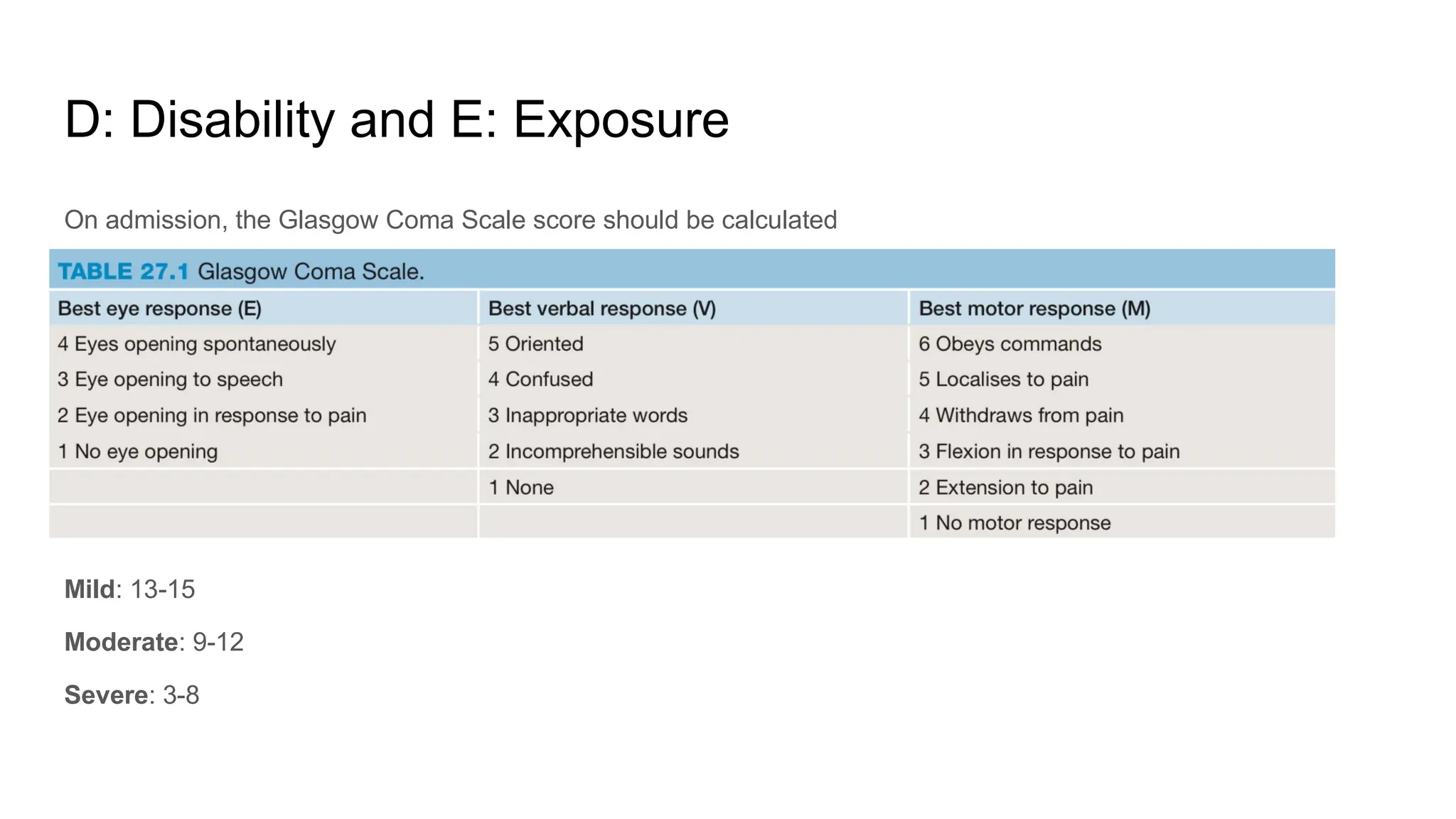
On admission, the Glasgow Coma Scale score should be calculated
Mild: 13-15
Moderate: 9-12
Severe: 3-8
D: Disability and E: Exposure
● The pupils assessed for size and reaction to light and the patient is observed to determine whether
they are moving all four limbs.
● The core temperature must be recorded.
● Patients are managed with cervical spine protection (cervical collar and blocks) and protection of
the thoracolumbar spine using standard log roll techniques until a spinal injury has been excluded.
● The patient must be adequately exposed to allow a thorough and systematic clinical examination
during the secondary survey but they must be kept warm. Trauma patients are frequently
hypothermic and this will further increase coagulopathy.
● Every effort should be made to maintain normal temperature by minimising unnecessary exposure
of the patient and by using warmed blankets and trolleys and warmed fluids during resuscitation.
● Log-rolling patients with severe pelvic fractures may harm the patient by disturbing established
blood clots. Log-rolling should not occur until a pelvic fracture has been radiographically excluded.
SECONDARY SURVEY
● All severely injured patients require a detailed top-to-toe examination after
life-threatening injuries have been identified and managed during the primary
survey.
● Patients may be intubated and unresponsive at this point, limiting the
accuracy of clinical examination. Such patients should have a 'tertiary survey'
when extubated and alert to identify any missed 'minor' injuries, such as a
scaphoid fracture in the wrist or a rotator cuff tear in the shoulder:
THANK YOU

ADVANCED TRAUMA LIFE SUPPORT (ATLS) PRINCIPLES - SEMINAR

  • 1.
    ATLS (Advanced Trauma LifeSupport) Primary and Secondary Survey Muhammed Bilshad Muhammed Danish Muhammed Nihal
  • 2.
    IDENTIFICATION OF SEVERETRAUMA ● The severely injured patient, with multiple injuries to different ent body systems, poses unique diagnostic and treatment challenges. The early assessment and management of severe trauma begins in the prehospital environment ● Forewarning the receiving hospital allows the activation of the trauma team to prepare for the patient’s arrival. ● Key information in the pre-alert includes basic demographic information (age and gender), mechanism of injury, injuries identified and vital signs, including respiratory rate, pulse, blood pressure and Glasgow Coma Scale (GCS). ● Patients who are identified before reaching hospital as having sustained, or are at high risk of sustaining, severe multisystem trauma should generate trauma team activation in the receiving hospital.
  • 3.
    ROLE OF THETRAUMA TEAM ● All hospitals managing severe trauma should have a dedicated trauma team that is available immediately to attend and manage patients presenting with severe trauma. ● The composition of the team will depend on doctors from the emergency department, anaesthetics and/or critical care, trauma and orthopaedics and general surgery. ● Hospitals managing large volumes of cases of severe multisystem trauma are recognising the need for an enhanced trauma team activation for the most severely injured patients – the so-called ‘code red trauma call’ ● Patients identifed before reaching hospital as being haemodynamically unstable or having acute airway compromise may initiate ‘code red’, triggering the automatic attendance of the most senior clinicians from each discipline prior to the patient’s arrival
  • 4.
    The cABCDE oftrauma care ● c - Control of massive external haemorrhage ● A - Airway with cervical spine protection ● B - Breathing and ventilation ● C - Circulation and haemorrhage control: apply a pelvic binder and do not remove until a pelvic fracture is excluded ● D - Disability (neurological status) ● E - Exposure (assess for other injuries)
  • 5.
    c: Exsanguinating externalhaemorrhage ● Bleeding must be controlled immediately by the application of packs and pressure directly onto the bleeding wound and proximal artery. ● Failure to control bleeding in the limb by direct pressure with surgical dressings should be followed by the application of a tourniquet proximal to the wound. ● Once a tourniquet is applied the limb becomes ischaemic; therefore, the length of time for which the tourniquet is applied must be recorded on the patient and the patient requires urgent surgical control of the bleeding in order to reperfuse the limb.
  • 6.
    PRIMARY SURVEY The primarysurvey aims to identify and manage the most immediately life- threatening pathologies frst and follows cABCDE.
  • 7.
    A: Airway withcervical spine control ● All trauma patients should have their cervical spine immobilised and protected throughout. An immediate assessment of the patient’s airway is made. ● A compromised airway requires a stepwise progression, frst clearing the airway by suctioning secretions or blood, followed by simple airway manoeuvres such as a jaw thrust, chin lift and insertion of an oropharyngeal or nasopharyngeal airway. ● Advanced airway manoeuvres necessitate the insertion of a cufed endotracheal tube. ● Equipment and expertise for achieving a surgical airway must be readily available.
  • 8.
    B: Breathing andventilation ● All patients should receive high-fow oxygen. Life-threatening chest pathology such as tension pneumothorax, massive haemothorax and fail segment should be diagnosed and managed immediately. ● Equipment and expertise for rapid insertion of intercostal chest drains should be available.
  • 9.
    C: Circulation andhaemorrhage control ● All patients require adequate intravenous (IV) access with at least two large-bore IV cannulae. ● Blood should be taken for cross-match and laboratory assessment, including haemoglobin and venous lactate. ● An assessment of the haemodynamic status should be made to identify shocked patients ● A pelvic binder should be applied to all haemodynamically unstable patients following blunt trauma and not removed until after a pelvic fracture has been excluded. ● Hypotensive trauma patients are treated as hypovolaemic until proven otherwise.
  • 10.
    C: Circulation andhaemorrhage control ● The initial aim of resuscitation is to maintain the blood supply to the vital organs: the brain, heart and kidneys. ● This can be achieved with a target systolic blood pressure of 70–90 mmHg, although a higher pressure of >90 mmHg should be the target if a head injury is suspected. Small boluses of IV fuids should be administered to achieve this target. ● Excessive IV crystalloid or colloid solutions should be avoided because they cause haemodilution, increase coagulopathy and increase the risk of adult respiratory distress syndrome. ● Severely injured hypovolaemic patients should be resuscitated with blood and blood products, not crystalloid/colloid fluids.
  • 11.
    C: Circulation andhaemorrhage control ● Tranexamic acid: Tranexamic acid is an antifibrinolytie drug that reduces the risk of mortality from bleeding in both blunt and penetrating trauma. One gram is given intravenously over 10 minutes, followed by a further 1-g dose over 8 hours.It needs to be administered as carly as possible and ideally within the first hour from injury. ● Identification and management of haemorrhage: The sites of major haemorrhage in trauma patients are the chest, abdomen, pelvis and long bones, and external haemorrhage. Computed tomography (CT) from the head to pelvis with IV contrast, the so-called whole-body CT" (WBCT), is the gold standard investigation in patients with signs or symptoms of multiple injury. A focused abdominal sonography for trauma (FAST) scan may also be useful in this scenario to locate the major source of haemorrhage.
  • 12.
    D: Disability andE: Exposure On admission, the Glasgow Coma Scale score should be calculated Mild: 13-15 Moderate: 9-12 Severe: 3-8
  • 13.
    D: Disability andE: Exposure ● The pupils assessed for size and reaction to light and the patient is observed to determine whether they are moving all four limbs. ● The core temperature must be recorded. ● Patients are managed with cervical spine protection (cervical collar and blocks) and protection of the thoracolumbar spine using standard log roll techniques until a spinal injury has been excluded. ● The patient must be adequately exposed to allow a thorough and systematic clinical examination during the secondary survey but they must be kept warm. Trauma patients are frequently hypothermic and this will further increase coagulopathy. ● Every effort should be made to maintain normal temperature by minimising unnecessary exposure of the patient and by using warmed blankets and trolleys and warmed fluids during resuscitation. ● Log-rolling patients with severe pelvic fractures may harm the patient by disturbing established blood clots. Log-rolling should not occur until a pelvic fracture has been radiographically excluded.
  • 14.
    SECONDARY SURVEY ● Allseverely injured patients require a detailed top-to-toe examination after life-threatening injuries have been identified and managed during the primary survey. ● Patients may be intubated and unresponsive at this point, limiting the accuracy of clinical examination. Such patients should have a 'tertiary survey' when extubated and alert to identify any missed 'minor' injuries, such as a scaphoid fracture in the wrist or a rotator cuff tear in the shoulder:
  • 15.