Advanced Full Stack Development: Scaling,
Deployment, and Maintenance
Introduction
In the evolving landscape of web development, the role of a full stack
developer has become increasingly significant. Full stack developers are
responsible for both the front-end and back-end aspects of web
applications. While building a functional application is essential, ensuring
that it can scale, be deployed efficiently, and maintained effectively is
critical for its long-term success. This article delves into advanced aspects
of full stack development, focusing on scaling, deployment, and
maintenance.
Understanding Full Stack Development
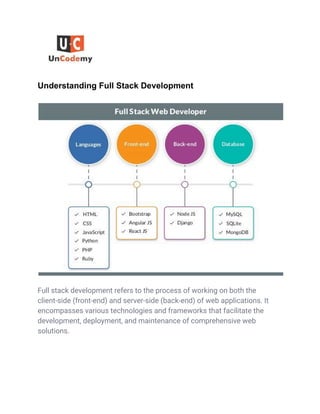
Full stack development refers to the process of working on both the
client-side (front-end) and server-side (back-end) of web applications. It
encompasses various technologies and frameworks that facilitate the
development, deployment, and maintenance of comprehensive web
solutions.
Core Components of Full Stack Development
Front-End Development:
Server: Handles client requests and responses.
Databases: Storage of application data (SQL, NoSQL).
Server-Side Languages: Node.js, Python, Ruby, Java, PHP.
Frameworks: Express.js, Django, Ruby on Rails, Spring.
DevOps and Deployment:
CI/CD Pipelines: Continuous Integration and Deployment.
Containerization: Docker, Kubernetes.
Cloud Services: AWS, Azure, Google Cloud.
Maintenance:
Monitoring: Performance tracking and error reporting.
Updates: Regularly updating dependencies and software.
Scaling Full Stack Applications
Scaling refers to the capability of an application to handle increased loads
by adding resources. It ensures that your application remains performant
and reliable under high traffic conditions.
Types of Scaling
Vertical Scaling:
Definition: Adding more power (CPU, RAM) to an existing server.
Pros: Simpler to implement, no need for code changes.
Cons: Limited by the capacity of a single machine, potential single point of
failure.
Horizontal Scaling:
Definition: Adding more servers to handle the load.
Pros: Better fault tolerance, can handle much larger loads.
Cons: More complex to implement, requires load balancing and distributed
computing considerations.
Techniques for Effective Scaling
Load Balancing:
Role: Distributes incoming network traffic across multiple servers.
Tools: Nginx, HAProxy, AWS Elastic Load Balancer.
Benefit: Enhances availability and reliability by preventing any single server
from becoming a bottleneck.
Database Sharding:
Purpose: Temporarily storing data to reduce server load and improve
response times.
Tools: Redis, Memcached.
Benefit: Reduces database load by serving data from the cache.
Microservices Architecture:
Key Deployment Considerations
Environment Configuration:
Development, Staging, Production: Separate environments for testing and
final deployment.
Consistency: Ensuring configurations are consistent across environments
to avoid discrepancies.
Continuous Integration/Continuous Deployment (CI/CD):
CI: Automatically integrating code changes into a shared repository.
CD automates the deployment of code updates to
production.
Tools: Jenkins, GitLab CI, CircleCI, Travis CI.
Benefit: Reduces manual errors, accelerates release cycles.
Containerization and Orchestration:
Containers: Encapsulate applications and their dependencies (Docker).
Orchestration: Manages containerized applications (Kubernetes, Docker
Swarm).
Advantage: Ensures consistency across development and production
environments, simplifies scaling.
Serverless Architecture:
Definition: Running applications without managing servers.
Providers include AWS Lambda, Azure Functions, and
Google Cloud Functions.
Benefit: Automatically scales with load, reduces operational complexity.
Blue-Green Deployment:
Method: Running two identical production environments (blue and green).
One is live (green) while the other (blue) is used for testing new versions.
Advantage: Minimizes downtime, easy rollback if issues arise.
Canary Deployment:
Technique: Gradually rolling out updates to a small subset of users before a
full deployment.
Benefit: Allows for monitoring and rollback in case of issues.
Deployment Tools and Platforms
Platform as a Service (PaaS):
Examples: Heroku, Google App Engine, AWS Elastic Beanstalk.
Pros: Simplifies deployment, handles infrastructure management.
Cons: Can be more expensive, less control over the underlying
infrastructure.
Infrastructure as a Service (IaaS):
Examples: AWS EC2, Microsoft Azure, Google Cloud Compute Engine.
Pros: High flexibility and control over the environment.
Cons: Requires more management and configuration.
Version Control and Code Management:
Systems: Git (GitHub, GitLab, Bitbucket).
Importance: Facilitates collaboration, code review, and tracking changes.
Maintenance of Full Stack Applications
Maintenance involves ensuring that your application remains functional,
secure, and efficient after deployment. It encompasses various activities,
including monitoring, updating, and optimizing the application.
Monitoring and Logging
Importance:
Purpose: Tracking application performance and identifying issues.
Tools: Prometheus, Grafana, ELK Stack (Elasticsearch, Logstash, Kibana),
Datadog.
Benefit: Proactive identification and resolution of issues, ensuring high
availability.
Key Metrics:
Performance: Response times, throughput.
Availability: Uptime, downtime.
Errors: Rate and types of errors.
Regular Updates
Software Dependencies:
Why: Keeping libraries and frameworks up-to-date to avoid security
vulnerabilities and bugs.
Tools: Dependabot, npm audit.
Approach: Regularly reviewing and applying updates.
Application Code:
Why: Addressing bugs, adding new features, improving performance.
Practice: Implementing a regular release schedule and patching critical
issues promptly.
Security Practices
Authentication and Authorization:
Purpose: Identifying and mitigating security vulnerabilities.
Tools: OWASP ZAP, Burp Suite.
Frequency: Conducting audits periodically and after significant changes.
Performance Optimization
Code Optimization:
Techniques: Minimizing redundant operations, optimizing algorithms, code
refactoring.
Benefit: Reduces load and improves response times.
Database Optimization:
Indexes: Proper indexing to speed up queries.
Query Optimization: Analyzing and improving slow queries.
Asset Management:
Conclusion
Advanced full stack development encompasses a wide range of skills and
knowledge areas, from building and deploying applications to scaling and
maintaining them. Mastering these aspects ensures that web applications
remain performant, reliable, and secure, capable of meeting user demands
and adapting to changing requirements. By focusing on effective scaling
strategies, robust deployment processes, and thorough maintenance
practices, full stack developers can deliver high-quality web solutions that
stand the test of time. For those looking to enhance their skills in this field,
a Full Stack Development Training Institute in Agra, Dehradun, Moradabad,
Mumbai, Delhi, Noida and all cities in India can provide comprehensive
education and practical experience.

Advanced Full Stack Development: Scaling, Deployment, and Maintenance

  • 1.
    Advanced Full StackDevelopment: Scaling, Deployment, and Maintenance Introduction In the evolving landscape of web development, the role of a full stack developer has become increasingly significant. Full stack developers are responsible for both the front-end and back-end aspects of web applications. While building a functional application is essential, ensuring that it can scale, be deployed efficiently, and maintained effectively is critical for its long-term success. This article delves into advanced aspects of full stack development, focusing on scaling, deployment, and maintenance.
  • 2.
    Understanding Full StackDevelopment Full stack development refers to the process of working on both the client-side (front-end) and server-side (back-end) of web applications. It encompasses various technologies and frameworks that facilitate the development, deployment, and maintenance of comprehensive web solutions.
  • 3.
    Core Components ofFull Stack Development Front-End Development: Server: Handles client requests and responses. Databases: Storage of application data (SQL, NoSQL). Server-Side Languages: Node.js, Python, Ruby, Java, PHP. Frameworks: Express.js, Django, Ruby on Rails, Spring. DevOps and Deployment: CI/CD Pipelines: Continuous Integration and Deployment. Containerization: Docker, Kubernetes. Cloud Services: AWS, Azure, Google Cloud. Maintenance: Monitoring: Performance tracking and error reporting. Updates: Regularly updating dependencies and software. Scaling Full Stack Applications Scaling refers to the capability of an application to handle increased loads by adding resources. It ensures that your application remains performant and reliable under high traffic conditions.
  • 4.
    Types of Scaling VerticalScaling: Definition: Adding more power (CPU, RAM) to an existing server. Pros: Simpler to implement, no need for code changes. Cons: Limited by the capacity of a single machine, potential single point of failure. Horizontal Scaling: Definition: Adding more servers to handle the load. Pros: Better fault tolerance, can handle much larger loads. Cons: More complex to implement, requires load balancing and distributed computing considerations. Techniques for Effective Scaling Load Balancing: Role: Distributes incoming network traffic across multiple servers. Tools: Nginx, HAProxy, AWS Elastic Load Balancer. Benefit: Enhances availability and reliability by preventing any single server from becoming a bottleneck.
  • 5.
    Database Sharding: Purpose: Temporarilystoring data to reduce server load and improve response times. Tools: Redis, Memcached. Benefit: Reduces database load by serving data from the cache. Microservices Architecture: Key Deployment Considerations Environment Configuration: Development, Staging, Production: Separate environments for testing and final deployment. Consistency: Ensuring configurations are consistent across environments to avoid discrepancies. Continuous Integration/Continuous Deployment (CI/CD): CI: Automatically integrating code changes into a shared repository. CD automates the deployment of code updates to production. Tools: Jenkins, GitLab CI, CircleCI, Travis CI. Benefit: Reduces manual errors, accelerates release cycles. Containerization and Orchestration:
  • 6.
    Containers: Encapsulate applicationsand their dependencies (Docker). Orchestration: Manages containerized applications (Kubernetes, Docker Swarm). Advantage: Ensures consistency across development and production environments, simplifies scaling. Serverless Architecture: Definition: Running applications without managing servers. Providers include AWS Lambda, Azure Functions, and Google Cloud Functions. Benefit: Automatically scales with load, reduces operational complexity. Blue-Green Deployment: Method: Running two identical production environments (blue and green). One is live (green) while the other (blue) is used for testing new versions. Advantage: Minimizes downtime, easy rollback if issues arise. Canary Deployment: Technique: Gradually rolling out updates to a small subset of users before a full deployment. Benefit: Allows for monitoring and rollback in case of issues.
  • 7.
    Deployment Tools andPlatforms Platform as a Service (PaaS): Examples: Heroku, Google App Engine, AWS Elastic Beanstalk. Pros: Simplifies deployment, handles infrastructure management. Cons: Can be more expensive, less control over the underlying infrastructure. Infrastructure as a Service (IaaS): Examples: AWS EC2, Microsoft Azure, Google Cloud Compute Engine. Pros: High flexibility and control over the environment. Cons: Requires more management and configuration. Version Control and Code Management: Systems: Git (GitHub, GitLab, Bitbucket). Importance: Facilitates collaboration, code review, and tracking changes. Maintenance of Full Stack Applications Maintenance involves ensuring that your application remains functional, secure, and efficient after deployment. It encompasses various activities, including monitoring, updating, and optimizing the application.
  • 8.
    Monitoring and Logging Importance: Purpose:Tracking application performance and identifying issues. Tools: Prometheus, Grafana, ELK Stack (Elasticsearch, Logstash, Kibana), Datadog. Benefit: Proactive identification and resolution of issues, ensuring high availability. Key Metrics: Performance: Response times, throughput. Availability: Uptime, downtime. Errors: Rate and types of errors. Regular Updates Software Dependencies: Why: Keeping libraries and frameworks up-to-date to avoid security vulnerabilities and bugs. Tools: Dependabot, npm audit. Approach: Regularly reviewing and applying updates.
  • 9.
    Application Code: Why: Addressingbugs, adding new features, improving performance. Practice: Implementing a regular release schedule and patching critical issues promptly. Security Practices Authentication and Authorization: Purpose: Identifying and mitigating security vulnerabilities. Tools: OWASP ZAP, Burp Suite. Frequency: Conducting audits periodically and after significant changes. Performance Optimization Code Optimization: Techniques: Minimizing redundant operations, optimizing algorithms, code refactoring. Benefit: Reduces load and improves response times. Database Optimization: Indexes: Proper indexing to speed up queries. Query Optimization: Analyzing and improving slow queries. Asset Management:
  • 10.
    Conclusion Advanced full stackdevelopment encompasses a wide range of skills and knowledge areas, from building and deploying applications to scaling and maintaining them. Mastering these aspects ensures that web applications remain performant, reliable, and secure, capable of meeting user demands and adapting to changing requirements. By focusing on effective scaling strategies, robust deployment processes, and thorough maintenance practices, full stack developers can deliver high-quality web solutions that stand the test of time. For those looking to enhance their skills in this field, a Full Stack Development Training Institute in Agra, Dehradun, Moradabad, Mumbai, Delhi, Noida and all cities in India can provide comprehensive education and practical experience.