University of Vocational Technology
Faculty of Engineering Technology
B.Tech in Construction Technology & Resource Management
Construction Technology II
(CT 40607)
 Modern day people use more than 65 million
plastic water bottles per year. These bottle are
made of petroleum product (PET) polyethylene
terephthalate.
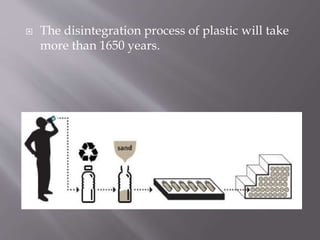
 The disintegration process of plastic will take
more than 1650 years.
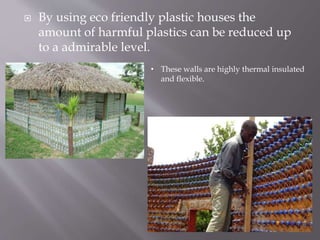
 By using eco friendly plastic houses the
amount of harmful plastics can be reduced up
to a admirable level.
• These walls are highly thermal insulated
and flexible.
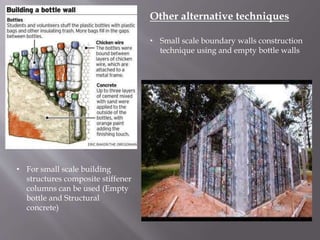
Other alternative techniques
• Small scale boundary walls construction
technique using and empty bottle walls
• For small scale building
structures composite stiffener
columns can be used (Empty
bottle and Structural
concrete)
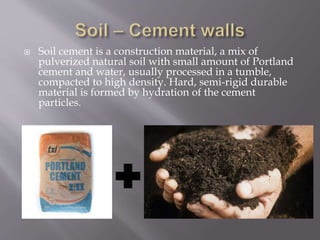
 Soil cement is a construction material, a mix of
pulverized natural soil with small amount of Portland
cement and water, usually processed in a tumble,
compacted to high density. Hard, semi-rigid durable
material is formed by hydration of the cement
particles.
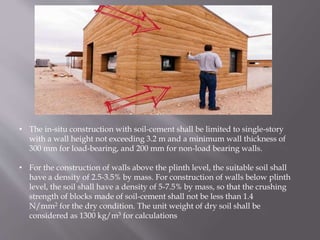
• The in-situ construction with soil-cement shall be limited to single-story
with a wall height not exceeding 3.2 m and a minimum wall thickness of
300 mm for load-bearing, and 200 mm for non-load bearing walls.
• For the construction of walls above the plinth level, the suitable soil shall
have a density of 2.5-3.5% by mass. For construction of walls below plinth
level, the soil shall have a density of 5-7.5% by mass, so that the crushing
strength of blocks made of soil-cement shall not be less than 1.4
N/mm2 for the dry condition. The unit weight of dry soil shall be
considered as 1300 kg/m3 for calculations
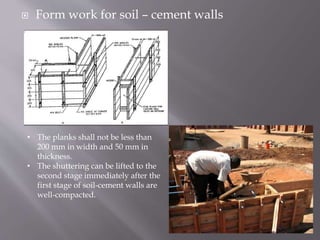
 Form work for soil – cement walls
• The planks shall not be less than
200 mm in width and 50 mm in
thickness.
• The shuttering can be lifted to the
second stage immediately after the
first stage of soil-cement walls are
well-compacted.
 Preparation of Soil
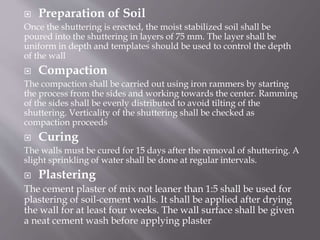
Once the shuttering is erected, the moist stabilized soil shall be
poured into the shuttering in layers of 75 mm. The layer shall be
uniform in depth and templates should be used to control the depth
of the wall
 Compaction
The compaction shall be carried out using iron rammers by starting
the process from the sides and working towards the center. Ramming
of the sides shall be evenly distributed to avoid tilting of the
shuttering. Verticality of the shuttering shall be checked as
compaction proceeds
 Curing
The walls must be cured for 15 days after the removal of shuttering. A
slight sprinkling of water shall be done at regular intervals.
 Plastering
The cement plaster of mix not leaner than 1:5 shall be used for
plastering of soil-cement walls. It shall be applied after drying
the wall for at least four weeks. The wall surface shall be given
a neat cement wash before applying plaster
Group – 01
CTRM/19/B1/04
CTRM/19/B1/14
CTRM/19/B1/22
CTRM/19/B1/30

Advanced construction technologies.pptx

  • 1.
    University of VocationalTechnology Faculty of Engineering Technology B.Tech in Construction Technology & Resource Management Construction Technology II (CT 40607)
  • 2.
     Modern daypeople use more than 65 million plastic water bottles per year. These bottle are made of petroleum product (PET) polyethylene terephthalate.
  • 3.
     The disintegrationprocess of plastic will take more than 1650 years.
  • 4.
     By usingeco friendly plastic houses the amount of harmful plastics can be reduced up to a admirable level. • These walls are highly thermal insulated and flexible.
  • 5.
    Other alternative techniques •Small scale boundary walls construction technique using and empty bottle walls • For small scale building structures composite stiffener columns can be used (Empty bottle and Structural concrete)
  • 6.
     Soil cementis a construction material, a mix of pulverized natural soil with small amount of Portland cement and water, usually processed in a tumble, compacted to high density. Hard, semi-rigid durable material is formed by hydration of the cement particles.
  • 7.
    • The in-situconstruction with soil-cement shall be limited to single-story with a wall height not exceeding 3.2 m and a minimum wall thickness of 300 mm for load-bearing, and 200 mm for non-load bearing walls. • For the construction of walls above the plinth level, the suitable soil shall have a density of 2.5-3.5% by mass. For construction of walls below plinth level, the soil shall have a density of 5-7.5% by mass, so that the crushing strength of blocks made of soil-cement shall not be less than 1.4 N/mm2 for the dry condition. The unit weight of dry soil shall be considered as 1300 kg/m3 for calculations
  • 8.
     Form workfor soil – cement walls • The planks shall not be less than 200 mm in width and 50 mm in thickness. • The shuttering can be lifted to the second stage immediately after the first stage of soil-cement walls are well-compacted.
  • 9.
     Preparation ofSoil Once the shuttering is erected, the moist stabilized soil shall be poured into the shuttering in layers of 75 mm. The layer shall be uniform in depth and templates should be used to control the depth of the wall  Compaction The compaction shall be carried out using iron rammers by starting the process from the sides and working towards the center. Ramming of the sides shall be evenly distributed to avoid tilting of the shuttering. Verticality of the shuttering shall be checked as compaction proceeds  Curing The walls must be cured for 15 days after the removal of shuttering. A slight sprinkling of water shall be done at regular intervals.  Plastering The cement plaster of mix not leaner than 1:5 shall be used for plastering of soil-cement walls. It shall be applied after drying the wall for at least four weeks. The wall surface shall be given a neat cement wash before applying plaster
  • 10.