Advanced Bookkeeping
Course
asic
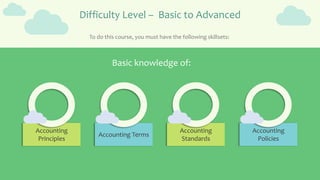
Difficulty Level – Basic to Advanced
To do this course, you must have the following skillsets:
Basic knowledge of:
Accounting
Principles
Accounting Terms
Accounting
Standards
Accounting
Policies
Participants
will be able to
implement:
Course Objectives
• Understand bookkeeping, objectives and advantages
• Bookkeeping and how it ties in with accounting
• Understand basic accounting terms
• Understand rules of accounting
• Double entry system
• Understand journal, ledger, trial balance and final accounts
preparation
• Explain assets, liabilities, revenue and expenditure
• To learn the process of making adjustments in books
• To prepare financial statements
What will you learn in this course?
Preparation of
journal entries,
ledgers , trial
balances &
financial
accounts
Basic
accounting
concepts &
double entry
system of
bookkeeping
Understand
accounting
assumptions,
concepts,
principles &
rules
Process of
making
adjustments in
books &
closure of
accounts
Are there any course requirements or prerequisites?
 Basic Accounting Knowledge would
be an added benefit { ex: golden
rules of accounting}
Who are the target students?
 Student, professional or businessman who want to have
proper knowledge of all the fundamentals of accounting
By the end of the course, you will have the following skill sets
 Hands-on regarding practical and real-life
scenario of bookkeeping system and preparation
of financial statements
Course Contents
• Introduction of book-keeping and accountancy
• Basic accounting terminologies
• Accounting concepts, conventions and principles and Indian accounting standards concepts and objectives
• Meaning and fundamentals of double entry book-keeping system
• Classification of accounts and accounting equations rules
• Source documents required for accounting
• Journal
• Subsidiary books
• Ledger
• Bank reconciliation statement
• Trial balance
• Errors and their rectification
• Depreciation, provisions and reserves
• Balance sheet items
• Cash flow
• Case study

Advanced Book-Keeping ppt.pptx

  • 1.
  • 2.
    asic Difficulty Level –Basic to Advanced To do this course, you must have the following skillsets: Basic knowledge of: Accounting Principles Accounting Terms Accounting Standards Accounting Policies
  • 3.
    Participants will be ableto implement: Course Objectives • Understand bookkeeping, objectives and advantages • Bookkeeping and how it ties in with accounting • Understand basic accounting terms • Understand rules of accounting • Double entry system • Understand journal, ledger, trial balance and final accounts preparation • Explain assets, liabilities, revenue and expenditure • To learn the process of making adjustments in books • To prepare financial statements
  • 4.
    What will youlearn in this course? Preparation of journal entries, ledgers , trial balances & financial accounts Basic accounting concepts & double entry system of bookkeeping Understand accounting assumptions, concepts, principles & rules Process of making adjustments in books & closure of accounts
  • 5.
    Are there anycourse requirements or prerequisites?  Basic Accounting Knowledge would be an added benefit { ex: golden rules of accounting}
  • 6.
    Who are thetarget students?  Student, professional or businessman who want to have proper knowledge of all the fundamentals of accounting
  • 7.
    By the endof the course, you will have the following skill sets  Hands-on regarding practical and real-life scenario of bookkeeping system and preparation of financial statements
  • 8.
    Course Contents • Introductionof book-keeping and accountancy • Basic accounting terminologies • Accounting concepts, conventions and principles and Indian accounting standards concepts and objectives • Meaning and fundamentals of double entry book-keeping system • Classification of accounts and accounting equations rules • Source documents required for accounting • Journal • Subsidiary books • Ledger • Bank reconciliation statement • Trial balance • Errors and their rectification • Depreciation, provisions and reserves • Balance sheet items • Cash flow • Case study