Sentence patterns
Just about all sentences in the English
language fall into ten patterns determined by
the presence and functions of nouns, verbs,
adjectives, and adverbs.
The patterns are most easily classified
according to the type of verb used:
Verb of being
Verb of being patterns (1, 2, 3) use a form of
the verb to be as the main verb in the sentence.
- is are was were has been
have been had been
Linking verb
 Linking verb patterns (4, 5) use one of
the linking verbs as the main verb in
the sentence. The linking verb is
followed by a noun or adjective
functioning as a subjective
complement.
-smell taste look feel
seem become appear
grow
Action verb
 Action verb patterns (6, 7, 8, 9, 10)
use one of the many action verbs as
the main verb in the sentence. The
action verb may be either transitive
(take a direct object) or intransitive
(not take a direct object).
-see jump embrace write
imagine buy plummet think
etc.
Terms
 Terms used to identify various parts of
each sentence pattern include the
following:
 NP = noun phrase
 This abbreviation refers to a headword
noun and its modifiers ("noun phrase")
functioning as a subject, direct object,
indirect object, subjective complement,
or objective complement.
 • NP1, NP2, NP3, etc. = designations
for different noun phrase functions
Numbers in sequential order are
used with each NP
 Numbers in sequential order are used
with each NP to designate its
difference from or similarity to other
NPs before and after it.
 • V-be = verb of being
 • LV = linking verb
 • V-int = intransitive verb
 • V-tr = transitive verb
 • ADV/TP = adverbial of time or
place
 • ADJ = adjective
THE TEN SENTENCE PATTERNS
1. NP1 + V-be + ADV/TP
 The verb of being is followed by an
adverb indicating where or when.
The adverbial indicating
where or when may be a
prepositional phrase.
2. NP1 + V-be + ADJ
 The verb of being is followed by an
adjective that functions as the
subjective complement.
The adjectival functioning as
the subjective complement
may be a prepositional
phrase.
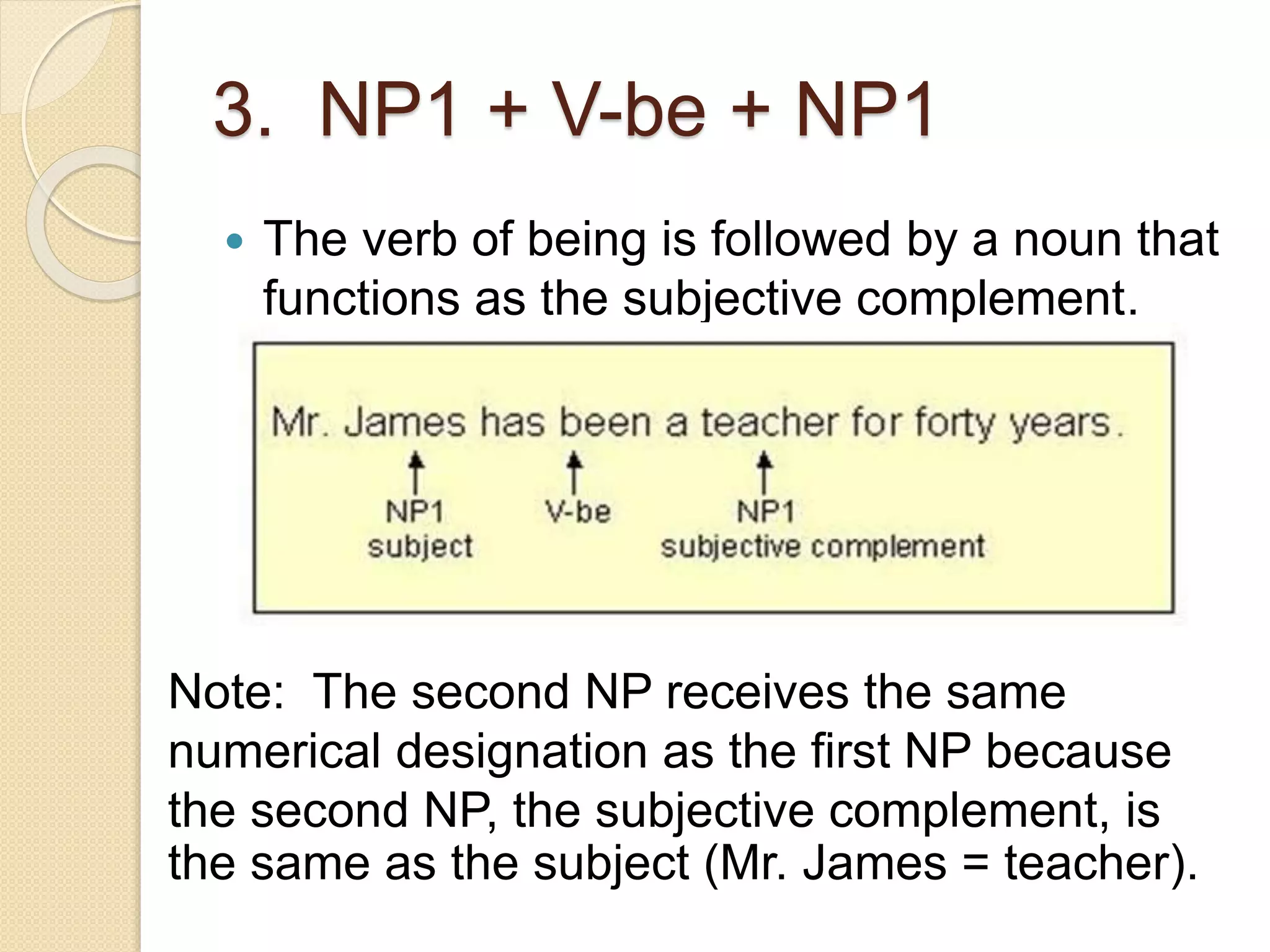
3. NP1 + V-be + NP1
 The verb of being is followed by a noun that
functions as the subjective complement.
Note: The second NP receives the same
numerical designation as the first NP because
the second NP, the subjective complement, is
the same as the subject (Mr. James = teacher).
4. NP1 + LV + ADJ
 The linking verb is followed by an adjective
functioning as a subjective complement.
 The adjectival functioning as the subjective
complement may be a prepositional phrase.
5. NP1 + LV + NP1
 The linking verb is followed by a noun
functioning as a subjective
complement.
Note: The second NP receives the same
numerical designation as the first NP because
the second NP, the subjective complement, is
the same as the subject (Joan = Buddhist).
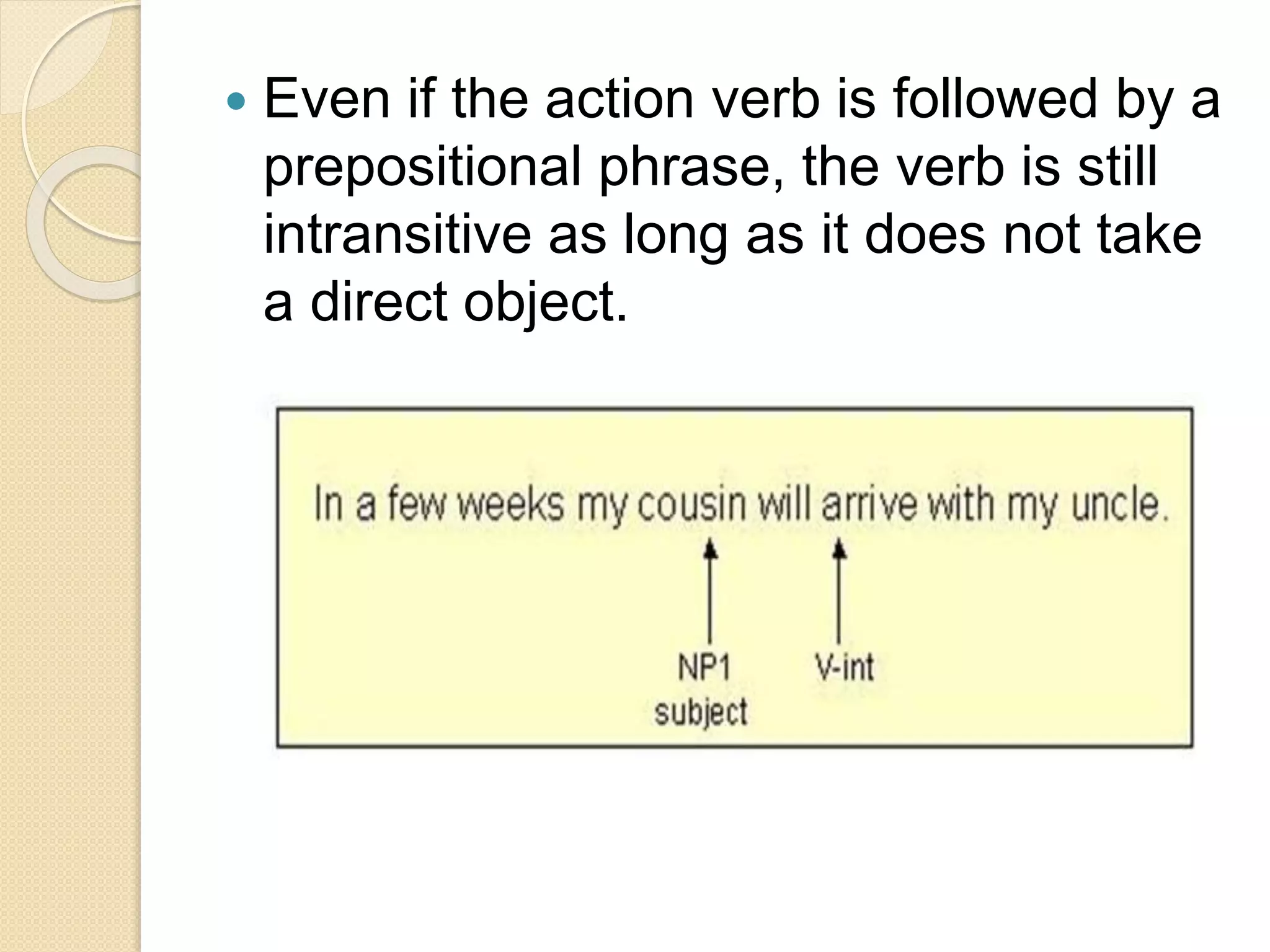
6. NP1 + V-int
 The action verb takes no direct
object.
 Even if the action verb is followed by a
prepositional phrase, the verb is still
intransitive as long as it does not take
a direct object.
7. NP1 + V-tr + NP2
 The action verb is followed by a direct
object.
Note: The second NP, the direct object, receives
a different numerical designation (NP2) because
it is not the same as the subject (NP1).
8. NP1 + V-tr + NP2 + NP3
 The action verb is followed by an
indirect object and then a direct object.
Note: The indirect object and the direct object
each receive a new numerical designation
because each is different from the other and
both are different from the subject.
9. NP1 + V-tr + NP2 + ADJ
 The action verb is followed by a direct object. The
direct object is followed by an adjective functioning
as an objective complement.
Note: The second NP, the direct object,
receives a different numerical designation
(NP2) because it is not the same as the
subject (NP1).
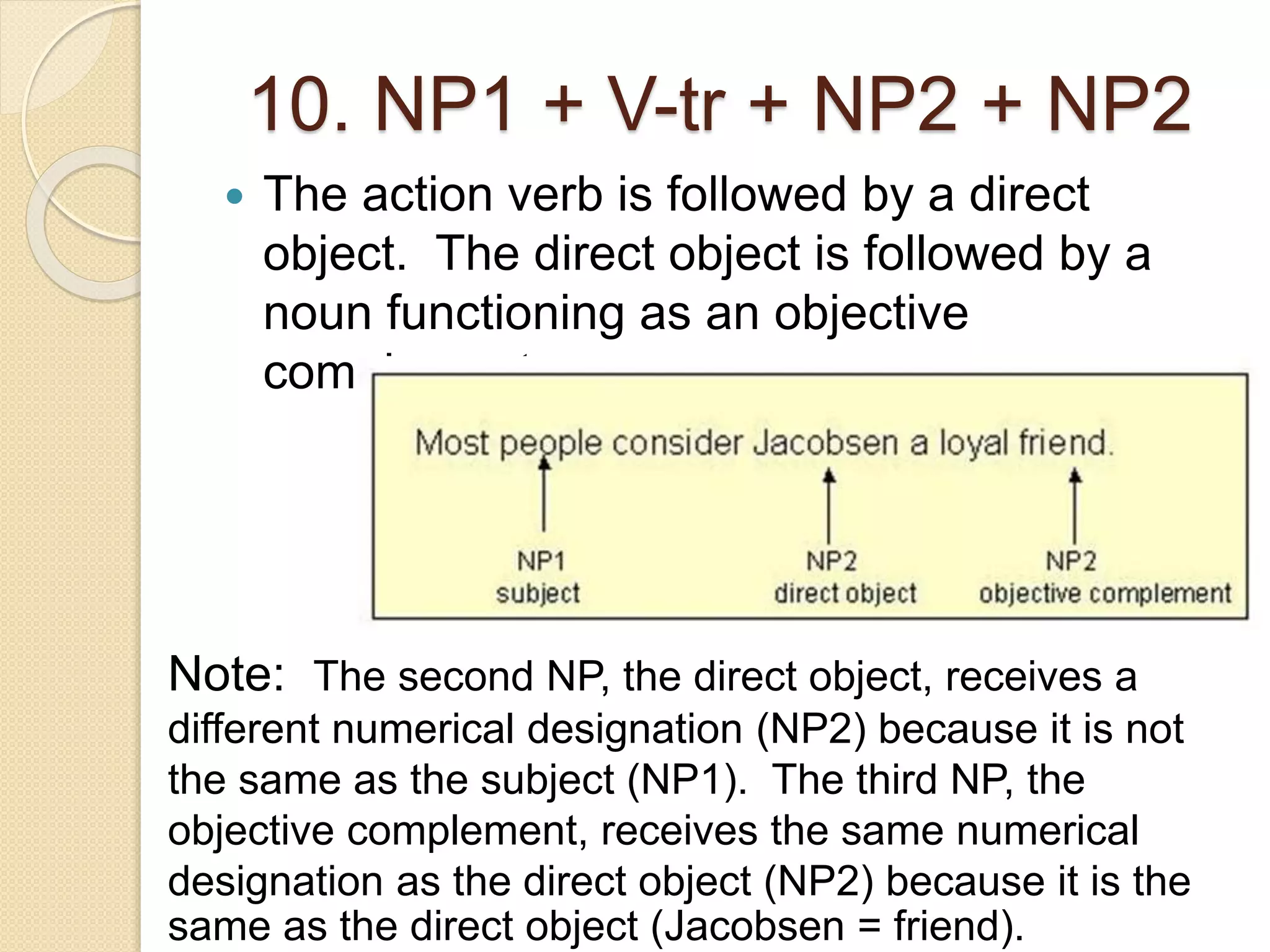
10. NP1 + V-tr + NP2 + NP2
 The action verb is followed by a direct
object. The direct object is followed by a
noun functioning as an objective
complement.
Note: The second NP, the direct object, receives a
different numerical designation (NP2) because it is not
the same as the subject (NP1). The third NP, the
objective complement, receives the same numerical
designation as the direct object (NP2) because it is the
same as the direct object (Jacobsen = friend).
THE END

Advance english 3[1]

  • 1.
    Sentence patterns Just aboutall sentences in the English language fall into ten patterns determined by the presence and functions of nouns, verbs, adjectives, and adverbs. The patterns are most easily classified according to the type of verb used: Verb of being Verb of being patterns (1, 2, 3) use a form of the verb to be as the main verb in the sentence. - is are was were has been have been had been
  • 2.
    Linking verb  Linkingverb patterns (4, 5) use one of the linking verbs as the main verb in the sentence. The linking verb is followed by a noun or adjective functioning as a subjective complement. -smell taste look feel seem become appear grow
  • 3.
    Action verb  Actionverb patterns (6, 7, 8, 9, 10) use one of the many action verbs as the main verb in the sentence. The action verb may be either transitive (take a direct object) or intransitive (not take a direct object). -see jump embrace write imagine buy plummet think etc.
  • 4.
    Terms  Terms usedto identify various parts of each sentence pattern include the following:  NP = noun phrase  This abbreviation refers to a headword noun and its modifiers ("noun phrase") functioning as a subject, direct object, indirect object, subjective complement, or objective complement.  • NP1, NP2, NP3, etc. = designations for different noun phrase functions
  • 5.
    Numbers in sequentialorder are used with each NP  Numbers in sequential order are used with each NP to designate its difference from or similarity to other NPs before and after it.  • V-be = verb of being  • LV = linking verb  • V-int = intransitive verb  • V-tr = transitive verb  • ADV/TP = adverbial of time or place  • ADJ = adjective
  • 6.
    THE TEN SENTENCEPATTERNS 1. NP1 + V-be + ADV/TP  The verb of being is followed by an adverb indicating where or when.
  • 7.
    The adverbial indicating whereor when may be a prepositional phrase.
  • 8.
    2. NP1 +V-be + ADJ  The verb of being is followed by an adjective that functions as the subjective complement.
  • 9.
    The adjectival functioningas the subjective complement may be a prepositional phrase.
  • 10.
    3. NP1 +V-be + NP1  The verb of being is followed by a noun that functions as the subjective complement. Note: The second NP receives the same numerical designation as the first NP because the second NP, the subjective complement, is the same as the subject (Mr. James = teacher).
  • 11.
    4. NP1 +LV + ADJ  The linking verb is followed by an adjective functioning as a subjective complement.
  • 12.
     The adjectivalfunctioning as the subjective complement may be a prepositional phrase.
  • 13.
    5. NP1 +LV + NP1  The linking verb is followed by a noun functioning as a subjective complement. Note: The second NP receives the same numerical designation as the first NP because the second NP, the subjective complement, is the same as the subject (Joan = Buddhist).
  • 14.
    6. NP1 +V-int  The action verb takes no direct object.
  • 15.
     Even ifthe action verb is followed by a prepositional phrase, the verb is still intransitive as long as it does not take a direct object.
  • 16.
    7. NP1 +V-tr + NP2  The action verb is followed by a direct object. Note: The second NP, the direct object, receives a different numerical designation (NP2) because it is not the same as the subject (NP1).
  • 17.
    8. NP1 +V-tr + NP2 + NP3  The action verb is followed by an indirect object and then a direct object. Note: The indirect object and the direct object each receive a new numerical designation because each is different from the other and both are different from the subject.
  • 18.
    9. NP1 +V-tr + NP2 + ADJ  The action verb is followed by a direct object. The direct object is followed by an adjective functioning as an objective complement. Note: The second NP, the direct object, receives a different numerical designation (NP2) because it is not the same as the subject (NP1).
  • 19.
    10. NP1 +V-tr + NP2 + NP2  The action verb is followed by a direct object. The direct object is followed by a noun functioning as an objective complement. Note: The second NP, the direct object, receives a different numerical designation (NP2) because it is not the same as the subject (NP1). The third NP, the objective complement, receives the same numerical designation as the direct object (NP2) because it is the same as the direct object (Jacobsen = friend).
  • 20.