3
Introduction
This research work of syntax subject, have as the aims, explain the meant of adverbials, the types
of adverbial, and the use of them.
And relate about verb phrase, the level of the verb phrase, the mobility of adverbials. And
ellipsis.
4
Adverbials and other related matters.
Adverb- can be single words, or they can be phrases or clauses that are used to modify verbs,
adjective. They tell us when, how, in what manner, or to what extent an action is.
Adverbial is a word or group of words function as an adverb.
Adjunct Adverbials in the verb phrase
Adjunct adverbials are words, phrases and clauses that modify an entire clause by providing
additional information about time, place, manner, condition, purpose, reason, result and
concession. (Briton.2010:7).
According to Hopper (1999) the eleventh grammatical function that noun phrases perform is
the adjunct adverbial. An adjunct adverbial is a word, phrase, or clause that modifies an entire
clause by providing additional information about time, place, manner, condition, purpose,
reason, result, and concession.
For example, the following italicized noun phrases function as adjunct adverbials:
Today the children woke up early.
Yesterday the children slept in late.
We decided to go home.
They cannot be used to sub categorize the verb but rather than they give additional through not
essential information.
The adjunct adverbials tend to answer questions like: where?, when?, why?, how?, how long?,
what for? How often?, how many times?.
You have already encountered PPѕ functioning as modifiers in the VP. Examples are:
Beside a stream
[1] Old Sam Sunbathed
5
[2] Max spotted those wildcats
Like a maniac
In the spring
With his binoculars
As mentioned, since the (italicised) PPѕ are optional and can occur with almost any verb, they
cannot be used to sub-categorize the verb. They are not functioning as complements they give
additional, though not essential, information, where a constituent functions as the PPs in
[1] and [2], are functioning, it is said to function as an Adjunct adverbial. (Roberts.1997:101)
The following phrases are generally known as adjunct adverbial in the verb phrase:
 Prepositional phrase(PP)
It noticeable the prepositional phrases are just giving additional information (not necessary)
expressing a wide range of ideas.
Examples:
He was rather extravagant in the bazaar.
John was a doctor for three years.
They were at the market at seven.
William gave Mary the Bleach on the birthday.
 Adverbial Phrase (AdvP)
Adverbs can have functions other than that of adverbial. They can modify adjectives within
Adjective Phrase( AP).
Examples:
Marry sunbathed frequently.
He spotted the wild cats quite accidentally.
She put it under the bed surreptitiously.
Many adverbs are not identified as such by their -ly inflection, in particular the interrogatives
adverbs: how, where, why, when and adverbs relating to time such as: now, there, here,
again, still, yet, already, seldom, often, ever and never.
6
Examples:
I finished my work already.
I won’t travel alone again.
He will come back now.
 Noun phrases(NP)
Some noun phrases can also function as adjunct adverbials like: last year, yesterday,
tomorrow, tonight, the day after tomorrow.
Examples:
I quitted my studies last year.
My brother visited me the day before.
I am travelling tomorrow.
Predicative adjuncts
According to Roberts (1991:102) are expressions which predicates describe or tell attributes
something of noun phrase/direct object.
Examples:
They have painted the house red.
He walked slowly down the road.
The first example, the adjunct “slowly” expresses the manner of walking, whereas in second
example, the house is red, as a result of painting thus “red”, is used both adverbially and
predicatively.
Schematically we may represent the internal relations inside of Verb Phrase of second
example as following:
Paint [NP the house] [Adv red]
Direct object
Adverbial
7
Predicative
Verb Phrase
According to Chomsky (1957.p15) the lowest part of clause is the verb phrase, the domain in
which the (verbal), predicate and its arguments are base generated.
According to Chalker & Edmund (1993.417) verb phrase are sequence of words normally
containing the verb and its complementation and form with the noun phrase, a sentence.
Kinds of Adjunct adverbials in the verb phrase.
There are many kinds of adjunct adverbial:
Manner Adjuncts (Adverbs of manner)
Examples:
 she moved slowly and spoke quietly
 Simon drinks his pints like a demon.
Slowly and quietly are the adjunct adverbial in the phrase.
 Simon drinks his pints like a demon
Like a demon Is adjunct adverbial in the phrase
Place Adjuncts (Adverbs of place)
Examples:
 Here the situation is completely different
 She buries all her toys wherever Ollie at buries his
 Here and wherever Ollie at buries his are place adjunct of this verb phrase.
Frequency adjunct (adverbs of frequency)
Examples:
 She comes here often;
8
 Every Tuesday, the shop opens at eight o’clock.
Often and Every Tuesday are frequency adjunct of this verb phrase
Time adjunct (Adverb of time)
Examples:
 The alarm went off again yesterday.
 In the morning, he will veto the bill.
Yesterday and in the morning are time adjunct of this verb phrase
Reason adjuncts (Adverb of reason)
Examples:
 As it Friday, you can stay up another hour;
 Expect the tent to leak because it’s been in my garage for 30 years.
As it’s Friday and because it’s been in my garage for 30 years. Are reason adjunct of this
verb phrase
Degree Adjuncts (adverbs of degree)
Examples:
 You’re not as poor as you could have been;
 She is smart as she is brilliant.
Levels of the verb phrase
As a meaning Syntactic trees give a clear representation of the syntactic makeup of a sentence.
By observing a sentence which has been “broken down” into its constituents by means of a
syntactic tree, we can see how each part acts on the others to fit together full sentence.
(JOHNSON.2005)
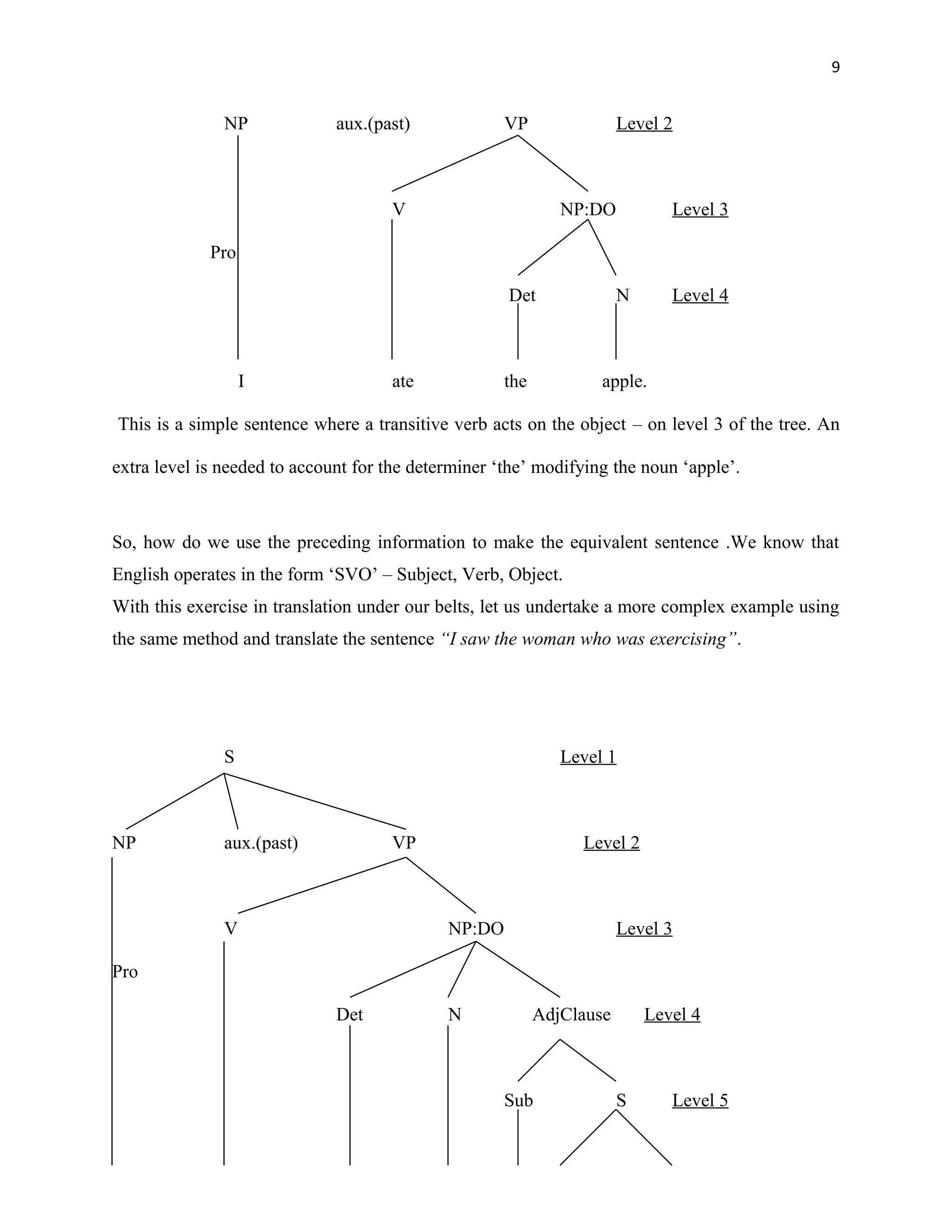
As an example, let us take the English sentence “I ate the apple” and arrange it in a syntactic
tree.
S Level 1
9
NP aux.(past) VP Level 2
V NP:DO Level 3
Pro
Det N Level 4
I ate the apple.
This is a simple sentence where a transitive verb acts on the object – on level 3 of the tree. An
extra level is needed to account for the determiner ‘the’ modifying the noun ‘apple’.
So, how do we use the preceding information to make the equivalent sentence .We know that
English operates in the form ‘SVO’ – Subject, Verb, Object.
With this exercise in translation under our belts, let us undertake a more complex example using
the same method and translate the sentence “I saw the woman who was exercising”.
S Level 1
NP aux.(past) VP Level 2
V NP:DO Level 3
Pro
Det N AdjClause Level 4
Sub S Level 5
10
(she)
I saw the woman who was exercising.
The mobility of adverbials
A very prominent characteristic of adverbials is that they can appear in all sorts of positions in
the sentence, not just following the Vgrp and its complements. Indeed, they very fact that you
can move a PP around a sentence is a sure sign that it is functioning as an adverbial and note as
the complement of the Vgrp.
Examples:
Which positions can surreptitiously occupy in [1]
[1] She put it under the bed.
[2] Surreptitiously, she put it under the bed.
[3] She surreptitiously put it under the bed.
[4] She put it surreptitiously under the bed.
[5]she put it under the bed surreptitiously.
The position of the adjunct in [5], of course, poses no problem for the analysis of adjuncts as
modifiers of VP within a higher VP. And neither is position in [3], what would you suggest as
the appropriate phrase-marker for[3]? We can simply analyse surreptitiously as a PRECEDING
sister of VP within another VP as in [6].
[6] s
NP VP1
PRO Advp VP2
Adv
11
She Surreptitiously put it under the bed
To discuss the aspect of adverbials and its implication, important through it is. I shall not attempt
to represent these ‘displaced’ adverbials in phrase-markers; instead, I shall adopt a standard
representation in which adjunct adverbials are always sisters of a VP within a higher VP.
(Roberts. 1997:108)
Phrasal verbs
According to Chalker & Edmund (1993.297) Phrasal Verbs are A multi-word of a verb plus one
or more particles and operating syntactically as a single unity.
PPs function as adjunct or complements within VP must be distinguished for another apparently
similar structure.
Consider the difference between [1] and [2].
[1] He called up the street.
[2] He called up the boss.
In [1] up the street is a PP functioning as an adjunct modifying a VP that consists of intransitive
Vgrp called. By contrast, you will have noticed that the string up the boss does not form a unit of
sense in [2]. Up belongs more with call to form the phrasal verb call up.
If called up is the Vgrp of [2]. The function of NP the boss it must be either a subject-predicative
or direct object. Then call up is a transitive phrasal verb.
Can be represented as in [3].
[3] S
NP VP1
PRO Vgrp NP
[trans]
[phrasal]
The called up the boss
12
There are many such phrasal verbs in English- some more idiomatic than others, some transitive,
some intransitive.
Examples
Transitive: call off, look up, put down, hand over.
Intransitive: give up, give in, drink up.
(Roberts.1997:109)
Ellipsis
According to Chalker & Edmund (1993.131) ellipsis is the omission of a word or words from the
speech or writing that can be covered by the hearer or reader for contextual cues.
According to Roberts (1997.112) ellipsis are elements capable of being understood in the
context of their use.
Ellipsis creates acceptable, but nonetheless grammatically incomplete sentences.
Even subjects can be ellipted, as in:
[1] Visited Madame Sosostris this morning.
(Almost certainly the ellipted subject is I.) but we would not want to say, simply because the
utterance of [1] is acceptable in certain contexts, that subject NP are grammatically optional.
The grammatical of sentences versus the acceptability of utterances(that is, the acceptability of
uttering a particular sentence in a context).
Syntax is concerned with the form of sentences, without taking into account the effects of
uttering sentences in a context.
For example; we can represent this elliptical sentence:
[2] William gave the bleach
S
NP VP
N Vgrp NP NP
13
[ditrans]
William gave the bleach
Where indicates an ellipted element, in this case an NP functioning as indirect object.
Before leaving ellipsis, it is worth spending a little time considering how ellipsis interacts with
the analysis decisions about sub-categorisation.
Conclusion
By the end of the research, concluded that adjunct adverbials is a word, phrase, or clause that
modifies an entire clause by providing additional information about time, place, manner,
condition, purpose, reason, result, and concession.
They are not functioning as complements they give additional, though not essential, information,
where a constituent functions as the PPs are functioning, it is said to function as an Adjunct
adverbial.
Prepositional phrase(PP), Adverbial Phrase (AdvP), Noun phrases(NP), Predicative adjuncts are
generally known as adjunct adverbial in the verb phrase.
Verb Phrase is the lowest part of clause is the verb phrase, the domain in which the (verbal),
predicate and its arguments are base generated. And the Kinds of Adjunct adverbials in the verb
phrase are: Manner Adjuncts (Adverbs of manner), Place Adjuncts (Adverbs of place),
Frequency adjunct (adverbs of frequency), Time adjunct (Adverb of time), Reason adjuncts
(Adverb of reason) and Degree Adjuncts (adverbs of degree).
Levels of the verb phrase
The mobility of adverbials, adverbials can appear in all sorts of positions in the sentence, not just
following the Vgrp and its complements.
Phrasal verbs are A multi-word of a verb plus one or more particles and operating syntactically
as a single unity.PPs function as adjunct or complements within VP must be distinguished for
another apparently similar structure.
E
e
E
e
14
And ellipsis is the omission of a word or words from the speech or writing that can be covered
by the hearer or reader for contextual cues. Ellipsis creates acceptable, but nonetheless
grammatically incomplete sentences.
Bibliography
ROBERTS, Noel Burton (1997) An Introduction to English Syntax. 2nd
edition, Longman,pps
101,102, 108,109,112.
CHOMSCKY, Noam (1957) Syntax Structure London: Mouton.p15
HOPPER, Paul J. 1999. A short course in grammar. New York: W. W. Norton & Company.
BRITON, Laurel J,& Donna M. Britol.(2010) the linguistic structure of modern English, 2nd
edition. John Benjamin publishing company, pp 7.
CHALKER, Sylvia & Edmund Weiner. Dictionary of English Grammar. Oxford 1993. Pps
131,297,417.
JOHNSON.Philip(2005) Syntax – Using a Syntactic Tree Diagram in English. Gyeongsang
National University, South Korea.

Adverbials and other related matters work 2015

  • 1.
    3 Introduction This research workof syntax subject, have as the aims, explain the meant of adverbials, the types of adverbial, and the use of them. And relate about verb phrase, the level of the verb phrase, the mobility of adverbials. And ellipsis.
  • 2.
    4 Adverbials and otherrelated matters. Adverb- can be single words, or they can be phrases or clauses that are used to modify verbs, adjective. They tell us when, how, in what manner, or to what extent an action is. Adverbial is a word or group of words function as an adverb. Adjunct Adverbials in the verb phrase Adjunct adverbials are words, phrases and clauses that modify an entire clause by providing additional information about time, place, manner, condition, purpose, reason, result and concession. (Briton.2010:7). According to Hopper (1999) the eleventh grammatical function that noun phrases perform is the adjunct adverbial. An adjunct adverbial is a word, phrase, or clause that modifies an entire clause by providing additional information about time, place, manner, condition, purpose, reason, result, and concession. For example, the following italicized noun phrases function as adjunct adverbials: Today the children woke up early. Yesterday the children slept in late. We decided to go home. They cannot be used to sub categorize the verb but rather than they give additional through not essential information. The adjunct adverbials tend to answer questions like: where?, when?, why?, how?, how long?, what for? How often?, how many times?. You have already encountered PPѕ functioning as modifiers in the VP. Examples are: Beside a stream [1] Old Sam Sunbathed
  • 3.
    5 [2] Max spottedthose wildcats Like a maniac In the spring With his binoculars As mentioned, since the (italicised) PPѕ are optional and can occur with almost any verb, they cannot be used to sub-categorize the verb. They are not functioning as complements they give additional, though not essential, information, where a constituent functions as the PPs in [1] and [2], are functioning, it is said to function as an Adjunct adverbial. (Roberts.1997:101) The following phrases are generally known as adjunct adverbial in the verb phrase:  Prepositional phrase(PP) It noticeable the prepositional phrases are just giving additional information (not necessary) expressing a wide range of ideas. Examples: He was rather extravagant in the bazaar. John was a doctor for three years. They were at the market at seven. William gave Mary the Bleach on the birthday.  Adverbial Phrase (AdvP) Adverbs can have functions other than that of adverbial. They can modify adjectives within Adjective Phrase( AP). Examples: Marry sunbathed frequently. He spotted the wild cats quite accidentally. She put it under the bed surreptitiously. Many adverbs are not identified as such by their -ly inflection, in particular the interrogatives adverbs: how, where, why, when and adverbs relating to time such as: now, there, here, again, still, yet, already, seldom, often, ever and never.
  • 4.
    6 Examples: I finished mywork already. I won’t travel alone again. He will come back now.  Noun phrases(NP) Some noun phrases can also function as adjunct adverbials like: last year, yesterday, tomorrow, tonight, the day after tomorrow. Examples: I quitted my studies last year. My brother visited me the day before. I am travelling tomorrow. Predicative adjuncts According to Roberts (1991:102) are expressions which predicates describe or tell attributes something of noun phrase/direct object. Examples: They have painted the house red. He walked slowly down the road. The first example, the adjunct “slowly” expresses the manner of walking, whereas in second example, the house is red, as a result of painting thus “red”, is used both adverbially and predicatively. Schematically we may represent the internal relations inside of Verb Phrase of second example as following: Paint [NP the house] [Adv red] Direct object Adverbial
  • 5.
    7 Predicative Verb Phrase According toChomsky (1957.p15) the lowest part of clause is the verb phrase, the domain in which the (verbal), predicate and its arguments are base generated. According to Chalker & Edmund (1993.417) verb phrase are sequence of words normally containing the verb and its complementation and form with the noun phrase, a sentence. Kinds of Adjunct adverbials in the verb phrase. There are many kinds of adjunct adverbial: Manner Adjuncts (Adverbs of manner) Examples:  she moved slowly and spoke quietly  Simon drinks his pints like a demon. Slowly and quietly are the adjunct adverbial in the phrase.  Simon drinks his pints like a demon Like a demon Is adjunct adverbial in the phrase Place Adjuncts (Adverbs of place) Examples:  Here the situation is completely different  She buries all her toys wherever Ollie at buries his  Here and wherever Ollie at buries his are place adjunct of this verb phrase. Frequency adjunct (adverbs of frequency) Examples:  She comes here often;
  • 6.
    8  Every Tuesday,the shop opens at eight o’clock. Often and Every Tuesday are frequency adjunct of this verb phrase Time adjunct (Adverb of time) Examples:  The alarm went off again yesterday.  In the morning, he will veto the bill. Yesterday and in the morning are time adjunct of this verb phrase Reason adjuncts (Adverb of reason) Examples:  As it Friday, you can stay up another hour;  Expect the tent to leak because it’s been in my garage for 30 years. As it’s Friday and because it’s been in my garage for 30 years. Are reason adjunct of this verb phrase Degree Adjuncts (adverbs of degree) Examples:  You’re not as poor as you could have been;  She is smart as she is brilliant. Levels of the verb phrase As a meaning Syntactic trees give a clear representation of the syntactic makeup of a sentence. By observing a sentence which has been “broken down” into its constituents by means of a syntactic tree, we can see how each part acts on the others to fit together full sentence. (JOHNSON.2005) As an example, let us take the English sentence “I ate the apple” and arrange it in a syntactic tree. S Level 1
  • 7.
    9 NP aux.(past) VPLevel 2 V NP:DO Level 3 Pro Det N Level 4 I ate the apple. This is a simple sentence where a transitive verb acts on the object – on level 3 of the tree. An extra level is needed to account for the determiner ‘the’ modifying the noun ‘apple’. So, how do we use the preceding information to make the equivalent sentence .We know that English operates in the form ‘SVO’ – Subject, Verb, Object. With this exercise in translation under our belts, let us undertake a more complex example using the same method and translate the sentence “I saw the woman who was exercising”. S Level 1 NP aux.(past) VP Level 2 V NP:DO Level 3 Pro Det N AdjClause Level 4 Sub S Level 5
  • 8.
    10 (she) I saw thewoman who was exercising. The mobility of adverbials A very prominent characteristic of adverbials is that they can appear in all sorts of positions in the sentence, not just following the Vgrp and its complements. Indeed, they very fact that you can move a PP around a sentence is a sure sign that it is functioning as an adverbial and note as the complement of the Vgrp. Examples: Which positions can surreptitiously occupy in [1] [1] She put it under the bed. [2] Surreptitiously, she put it under the bed. [3] She surreptitiously put it under the bed. [4] She put it surreptitiously under the bed. [5]she put it under the bed surreptitiously. The position of the adjunct in [5], of course, poses no problem for the analysis of adjuncts as modifiers of VP within a higher VP. And neither is position in [3], what would you suggest as the appropriate phrase-marker for[3]? We can simply analyse surreptitiously as a PRECEDING sister of VP within another VP as in [6]. [6] s NP VP1 PRO Advp VP2 Adv
  • 9.
    11 She Surreptitiously putit under the bed To discuss the aspect of adverbials and its implication, important through it is. I shall not attempt to represent these ‘displaced’ adverbials in phrase-markers; instead, I shall adopt a standard representation in which adjunct adverbials are always sisters of a VP within a higher VP. (Roberts. 1997:108) Phrasal verbs According to Chalker & Edmund (1993.297) Phrasal Verbs are A multi-word of a verb plus one or more particles and operating syntactically as a single unity. PPs function as adjunct or complements within VP must be distinguished for another apparently similar structure. Consider the difference between [1] and [2]. [1] He called up the street. [2] He called up the boss. In [1] up the street is a PP functioning as an adjunct modifying a VP that consists of intransitive Vgrp called. By contrast, you will have noticed that the string up the boss does not form a unit of sense in [2]. Up belongs more with call to form the phrasal verb call up. If called up is the Vgrp of [2]. The function of NP the boss it must be either a subject-predicative or direct object. Then call up is a transitive phrasal verb. Can be represented as in [3]. [3] S NP VP1 PRO Vgrp NP [trans] [phrasal] The called up the boss
  • 10.
    12 There are manysuch phrasal verbs in English- some more idiomatic than others, some transitive, some intransitive. Examples Transitive: call off, look up, put down, hand over. Intransitive: give up, give in, drink up. (Roberts.1997:109) Ellipsis According to Chalker & Edmund (1993.131) ellipsis is the omission of a word or words from the speech or writing that can be covered by the hearer or reader for contextual cues. According to Roberts (1997.112) ellipsis are elements capable of being understood in the context of their use. Ellipsis creates acceptable, but nonetheless grammatically incomplete sentences. Even subjects can be ellipted, as in: [1] Visited Madame Sosostris this morning. (Almost certainly the ellipted subject is I.) but we would not want to say, simply because the utterance of [1] is acceptable in certain contexts, that subject NP are grammatically optional. The grammatical of sentences versus the acceptability of utterances(that is, the acceptability of uttering a particular sentence in a context). Syntax is concerned with the form of sentences, without taking into account the effects of uttering sentences in a context. For example; we can represent this elliptical sentence: [2] William gave the bleach S NP VP N Vgrp NP NP
  • 11.
    13 [ditrans] William gave thebleach Where indicates an ellipted element, in this case an NP functioning as indirect object. Before leaving ellipsis, it is worth spending a little time considering how ellipsis interacts with the analysis decisions about sub-categorisation. Conclusion By the end of the research, concluded that adjunct adverbials is a word, phrase, or clause that modifies an entire clause by providing additional information about time, place, manner, condition, purpose, reason, result, and concession. They are not functioning as complements they give additional, though not essential, information, where a constituent functions as the PPs are functioning, it is said to function as an Adjunct adverbial. Prepositional phrase(PP), Adverbial Phrase (AdvP), Noun phrases(NP), Predicative adjuncts are generally known as adjunct adverbial in the verb phrase. Verb Phrase is the lowest part of clause is the verb phrase, the domain in which the (verbal), predicate and its arguments are base generated. And the Kinds of Adjunct adverbials in the verb phrase are: Manner Adjuncts (Adverbs of manner), Place Adjuncts (Adverbs of place), Frequency adjunct (adverbs of frequency), Time adjunct (Adverb of time), Reason adjuncts (Adverb of reason) and Degree Adjuncts (adverbs of degree). Levels of the verb phrase The mobility of adverbials, adverbials can appear in all sorts of positions in the sentence, not just following the Vgrp and its complements. Phrasal verbs are A multi-word of a verb plus one or more particles and operating syntactically as a single unity.PPs function as adjunct or complements within VP must be distinguished for another apparently similar structure. E e E e
  • 12.
    14 And ellipsis isthe omission of a word or words from the speech or writing that can be covered by the hearer or reader for contextual cues. Ellipsis creates acceptable, but nonetheless grammatically incomplete sentences. Bibliography ROBERTS, Noel Burton (1997) An Introduction to English Syntax. 2nd edition, Longman,pps 101,102, 108,109,112. CHOMSCKY, Noam (1957) Syntax Structure London: Mouton.p15 HOPPER, Paul J. 1999. A short course in grammar. New York: W. W. Norton & Company. BRITON, Laurel J,& Donna M. Britol.(2010) the linguistic structure of modern English, 2nd edition. John Benjamin publishing company, pp 7. CHALKER, Sylvia & Edmund Weiner. Dictionary of English Grammar. Oxford 1993. Pps 131,297,417. JOHNSON.Philip(2005) Syntax – Using a Syntactic Tree Diagram in English. Gyeongsang National University, South Korea.