• Conception of decision making as a series
of analytical steps
• The model focuses on two aspects:
– identifying the problem
– implementing the solution
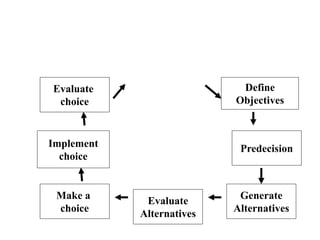
Define
Objectives
Predecision
Generate
Alternatives
Evaluate
Alternatives
Make a
choice
Implement
choice
Evaluate
choice
Programmed vs Non-
Programmed Decisions
• Programmed decisions are highly routine
decisions usually made by lower level
workers alone. (Time to re-order toner
for the copy machine)
• Non-programmed decisions -- Decisions
about a novel problem. There is no set
course of action. (Identifying the cause of
some rare disease)
Certain vs Uncertain Decisions
• The degree of risk involved in making the
decision. The means the continuum
ranges from
– complete uncertainty (no risk) to
– complete uncertainty (high risk)
• The point is to minimize risk by
obtaining information
Rational-Economic Model
• A model in which decision makers
consider all possible solutions before
selecting the optimal one. Presumes
• We are entirely rational and logical
• We have complete and perfect
information
• We can process all this information
Bounded Rationality Model
• A model that realizes that humans have a
limited view of the problem, do not have
perfect information or all the alternatives
• We accept a solution that is good enough
• This is called satisficing or settling for the
decision that meets the criteria but may
not meet them optimally
Image Theory
• Following your gut instinct. This model
says we make decisions intuitively, by
going through a two-step process. Step
one is the compatibility test. Does the
alternative feel right?
• Step 2: Profitability test - Which of the
alternatives that feel right is best?
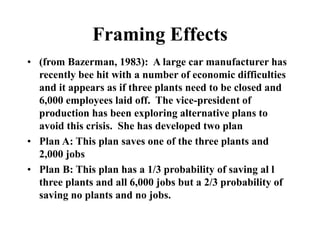
Framing Effects
• (from Bazerman, 1983): A large car manufacturer has
recently bee hit with a number of economic difficulties
and it appears as if three plants need to be closed and
6,000 employees laid off. The vice-president of
production has been exploring alternative plans to
avoid this crisis. She has developed two plan
• Plan A: This plan saves one of the three plants and
2,000 jobs
• Plan B: This plan has a 1/3 probability of saving al l
three plants and all 6,000 jobs but a 2/3 probability of
saving no plants and no jobs.
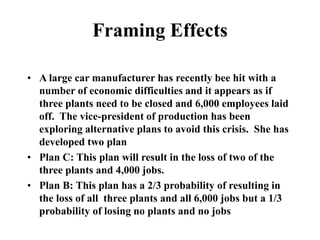
Framing Effects
• A large car manufacturer has recently bee hit with a
number of economic difficulties and it appears as if
three plants need to be closed and 6,000 employees laid
off. The vice-president of production has been
exploring alternative plans to avoid this crisis. She has
developed two plan
• Plan C: This plan will result in the loss of two of the
three plants and 4,000 jobs.
• Plan B: This plan has a 2/3 probability of resulting in
the loss of all three plants and all 6,000 jobs but a 1/3
probability of losing no plants and no jobs
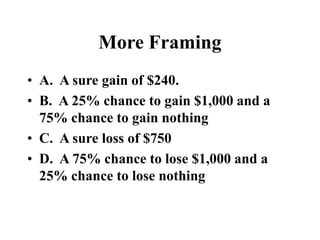
More Framing
• A. A sure gain of $240.
• B. A 25% chance to gain $1,000 and a
75% chance to gain nothing
• C. A sure loss of $750
• D. A 75% chance to lose $1,000 and a
25% chance to lose nothing
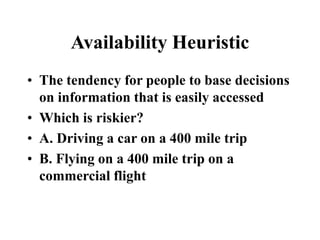
Availability Heuristic
• The tendency for people to base decisions
on information that is easily accessed
• Which is riskier?
• A. Driving a car on a 400 mile trip
• B. Flying on a 400 mile trip on a
commercial flight
Availability Heuristic
• You are traveling in the Middle East.
Which is the greater worry?
• A. Being hurt in an auto accident
• B. Being hurt in a terrorist attack
Representativeness Heuristic
• The tendency to perceive other in stereotypical
ways if they appear to be typical of the category
to which they belong
• Mark is finishing his MBS at a prestigious
university. He is very interested in the arts and
at one time considered a career as a musician.
Mark is most likely to take a job
• A. In the management of the arts
• B. With a management consulting firm
Other Cognitive Biases
• Anchoring -- People develop estimates based on
initial information. When that information
turns out to be wrong, people make
adjustments to their decisions but not enough
to overcome the impact of the initial piece of
information.
• Confirmation bias -- We tend to focus only on
evidence that supports our decisions.
• Overconfidence -- Because of confirmation
bias, we are more confident than we are
correct.
Backwards and Forwards

adsad(1).ppt

  • 1.
    • Conception ofdecision making as a series of analytical steps • The model focuses on two aspects: – identifying the problem – implementing the solution
  • 2.
  • 3.
    Programmed vs Non- ProgrammedDecisions • Programmed decisions are highly routine decisions usually made by lower level workers alone. (Time to re-order toner for the copy machine) • Non-programmed decisions -- Decisions about a novel problem. There is no set course of action. (Identifying the cause of some rare disease)
  • 4.
    Certain vs UncertainDecisions • The degree of risk involved in making the decision. The means the continuum ranges from – complete uncertainty (no risk) to – complete uncertainty (high risk) • The point is to minimize risk by obtaining information
  • 5.
    Rational-Economic Model • Amodel in which decision makers consider all possible solutions before selecting the optimal one. Presumes • We are entirely rational and logical • We have complete and perfect information • We can process all this information
  • 6.
    Bounded Rationality Model •A model that realizes that humans have a limited view of the problem, do not have perfect information or all the alternatives • We accept a solution that is good enough • This is called satisficing or settling for the decision that meets the criteria but may not meet them optimally
  • 7.
    Image Theory • Followingyour gut instinct. This model says we make decisions intuitively, by going through a two-step process. Step one is the compatibility test. Does the alternative feel right? • Step 2: Profitability test - Which of the alternatives that feel right is best?
  • 8.
    Framing Effects • (fromBazerman, 1983): A large car manufacturer has recently bee hit with a number of economic difficulties and it appears as if three plants need to be closed and 6,000 employees laid off. The vice-president of production has been exploring alternative plans to avoid this crisis. She has developed two plan • Plan A: This plan saves one of the three plants and 2,000 jobs • Plan B: This plan has a 1/3 probability of saving al l three plants and all 6,000 jobs but a 2/3 probability of saving no plants and no jobs.
  • 9.
    Framing Effects • Alarge car manufacturer has recently bee hit with a number of economic difficulties and it appears as if three plants need to be closed and 6,000 employees laid off. The vice-president of production has been exploring alternative plans to avoid this crisis. She has developed two plan • Plan C: This plan will result in the loss of two of the three plants and 4,000 jobs. • Plan B: This plan has a 2/3 probability of resulting in the loss of all three plants and all 6,000 jobs but a 1/3 probability of losing no plants and no jobs
  • 10.
    More Framing • A.A sure gain of $240. • B. A 25% chance to gain $1,000 and a 75% chance to gain nothing • C. A sure loss of $750 • D. A 75% chance to lose $1,000 and a 25% chance to lose nothing
  • 11.
    Availability Heuristic • Thetendency for people to base decisions on information that is easily accessed • Which is riskier? • A. Driving a car on a 400 mile trip • B. Flying on a 400 mile trip on a commercial flight
  • 12.
    Availability Heuristic • Youare traveling in the Middle East. Which is the greater worry? • A. Being hurt in an auto accident • B. Being hurt in a terrorist attack
  • 13.
    Representativeness Heuristic • Thetendency to perceive other in stereotypical ways if they appear to be typical of the category to which they belong • Mark is finishing his MBS at a prestigious university. He is very interested in the arts and at one time considered a career as a musician. Mark is most likely to take a job • A. In the management of the arts • B. With a management consulting firm
  • 14.
    Other Cognitive Biases •Anchoring -- People develop estimates based on initial information. When that information turns out to be wrong, people make adjustments to their decisions but not enough to overcome the impact of the initial piece of information. • Confirmation bias -- We tend to focus only on evidence that supports our decisions. • Overconfidence -- Because of confirmation bias, we are more confident than we are correct.
  • 15.