GOOD MORNING EVERYONE
TEAM MEMBER
• TANTZEWEY
• MUHD HAZIQ BIN HASHIM
• SITI QAISARA BINTI ALI NU HIDHIR
• VISHNU
What is adjective?
• Adjective describe nouns
• Adjective give us more information about nouns
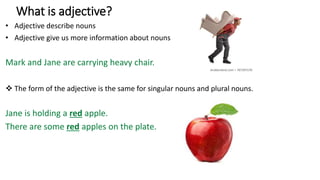
Mark and Jane are carrying heavy chair.
 The form of the adjective is the same for singular nouns and plural nouns.
Jane is holding a red apple.
There are some red apples on the plate.
• Before nouns I have some new shoes.
• After link verbs  The car is old .
Jane is feeling cold .
(appear , be , become , feel , get , look , seem , smell , taste)
Most adjectives are used in both position.
Certain adjectives are used only before the nouns.
(elder , eldest , live , main)
My elder sister is a teacher.
My sister is elder.
Certain adjectives are used only after a link verb.
(afraid , alone , ashamed , asleep , awake)
He seems afraid.
She is alone for Christmas.
He feels ashamed.
USE OF COMPARATIVE ADJECTIVE
1. We use comparative adjectives to compare 2 or more things, people or
places.
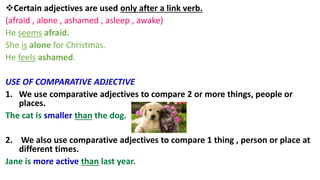
The cat is smaller than the dog.
2. We also use comparative adjectives to compare 1 thing , person or place at
different times.
Jane is more active than last year.
3. For most one-syllable adjectives: (we add – er )
Mr. Jones is taller than me.
4 . For one syllable adjectives ending in ‘e’: (we add –r)
Gold is rarer than silver.
Adjective Comparative adjective
Hard Harder
Tall Taller
Short Shorter
Small Smaller
Adjective Comparative adjective
Nice Nicer
Fine Finer
Rare Rarer
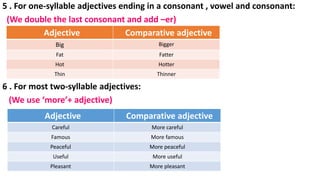
5 . For one-syllable adjectives ending in a consonant , vowel and consonant:
(We double the last consonant and add –er)
6 . For most two-syllable adjectives:
(We use ‘more’+ adjective)
Adjective Comparative adjective
Big Bigger
Fat Fatter
Hot Hotter
Thin Thinner
Adjective Comparative adjective
Careful More careful
Famous More famous
Peaceful More peaceful
Useful More useful
Pleasant More pleasant
7 . Two syllable adjectives ending in ‘y’:
(We change the ‘y’ to ‘I’ and add –er)
Jane is feeling happier than yesterday.
8 . Two-syllable adjectives ending in ‘er’ , ‘le’ or ‘ow’
(We usually add –er)
Mark is cleverer than the other students.
Adjective Comparative adjective
Busy Busier
Easy Easier
Funny Funnier
Happy Happier
Adjective Comparative adjective
Clever Cleverer
Gentle Gentler
Narrow Narrower
9 . Adjectives with 3 or more syllables:
(We always use ‘more’ + adjective)
Jane thinks that drawing is more enjoyable than studying.
10 . Some comparative adjectives are irregular:
I think that Messi is a better football player than Ronaldo.
Adjective Comparative adjective
Complicated More complicated
Enjoyable More enjoyable
Interesting More interesting
Adjective Comparative adjective
Good Better
Bad Worse
Far Further/Farther
Old Older/Elder
Fill in the blanks with the adjectives in brackets:
1.Tom is _____ his brother.(old)
2.This problem is _____ that problem.(easy)
3.I lost my key yesterday , I need to be _____(careful)
4.A notebook is _______ a laptop.(cheap)
5.Canada is_______ Argentina.(cold)
FORMATION
WE CAN USE SUFFIEXTO CHANGE NOUNS AND
VERBS INTO ADJECTIVES, ORTO CHANGETHE
MEANING OF AN ADJECTIVE
• The Suffix -less usually means without
something whilst the suffix – ful usually
means to have something
Example:
(with hope) hopeful <hope> hopeless
(without hope)
• Not all words can be made into adjectives
pairs like this
Example:
homeless (but not: homefull)
• The suffix – ish changes nouns and
adjectives into adjectives that mean like
something.
Example:
Don’t be childish. (like a child)
The jacket is a bluish colour. (like blue)
• For materials we can add –en to nouns to
create adjective that mean made of.
Example:
A wooden chair
A woolen jumper
• When added to a verb, -able creates
adjectives that express ability.
Example:
Is that water drinkable?
SPELLING RULES
We don’t normally add or take away letters, we
simply add the suffix to the end of the word.
However, there are some exceptions:
• We double the final conconant in words that have
a short stressed vowel before the final consonant.
Example:
sun > sunny
• A –y at the end of a word changes to –I
Example:
bounty > bountiful
• An –e at the end of a word is dropped when the
suffix begins with a vowel, but –ee, -oe, -ye remain
unchanged.
Example:
fortune > fortunate
TABLEADJECTIVES FORVERBS
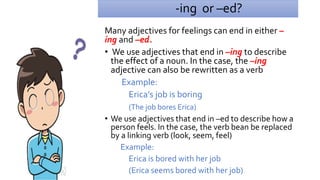
-ing or –ed?
Many adjectives for feelings can end in either –
ing and –ed.
• We use adjectives that end in –ing to describe
the effect of a noun. In the case, the –ing
adjective can also be rewritten as a verb
Example:
Erica’s job is boring
(The job bores Erica)
• We use adjectives that end in –ed to describe how a
person feels. In the case, the verb bean be replaced
by a linking verb (look, seem, feel)
Example:
Erica is bored with her job
(Erica seems bored with her job)
OPPOSITEADJECTIVES
dis-, in- and un-
Most of the adjectives in English have an opposite
adjectives
Example:
big/small, hot/cold, ….
If prefixes il-, im- and ir- are only used before particular
letters. il- comes before words that start with an-m or a –
dis-, in- and un-
The prefixes il-, im- and ir- are only used
before particular letters. il- comes before
words that start with an –l, im- comes
before words that start with an –m or a –p
and ir- comes before words that start
an -r
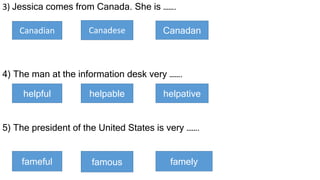
Choose the correct adjective to complete the sentence
1) It’s going to be ……….. tomorrow.
2) Robert thinks football is ………
Sunny Sunned Sunning
Bored Boring Borish
3) Jessica comes from Canada. She is …….
4) The man at the information desk very …….
5) The president of the United States is very …….
Canadian Canadese Canadan
helpful helpable helpative
fameful famous famely
ADJECTIVES.pptx

ADJECTIVES.pptx

  • 1.
    GOOD MORNING EVERYONE TEAMMEMBER • TANTZEWEY • MUHD HAZIQ BIN HASHIM • SITI QAISARA BINTI ALI NU HIDHIR • VISHNU
  • 2.
    What is adjective? •Adjective describe nouns • Adjective give us more information about nouns Mark and Jane are carrying heavy chair.  The form of the adjective is the same for singular nouns and plural nouns. Jane is holding a red apple. There are some red apples on the plate.
  • 3.
    • Before nounsI have some new shoes. • After link verbs  The car is old . Jane is feeling cold . (appear , be , become , feel , get , look , seem , smell , taste) Most adjectives are used in both position. Certain adjectives are used only before the nouns. (elder , eldest , live , main) My elder sister is a teacher. My sister is elder.
  • 4.
    Certain adjectives areused only after a link verb. (afraid , alone , ashamed , asleep , awake) He seems afraid. She is alone for Christmas. He feels ashamed. USE OF COMPARATIVE ADJECTIVE 1. We use comparative adjectives to compare 2 or more things, people or places. The cat is smaller than the dog. 2. We also use comparative adjectives to compare 1 thing , person or place at different times. Jane is more active than last year.
  • 5.
    3. For mostone-syllable adjectives: (we add – er ) Mr. Jones is taller than me. 4 . For one syllable adjectives ending in ‘e’: (we add –r) Gold is rarer than silver. Adjective Comparative adjective Hard Harder Tall Taller Short Shorter Small Smaller Adjective Comparative adjective Nice Nicer Fine Finer Rare Rarer
  • 6.
    5 . Forone-syllable adjectives ending in a consonant , vowel and consonant: (We double the last consonant and add –er) 6 . For most two-syllable adjectives: (We use ‘more’+ adjective) Adjective Comparative adjective Big Bigger Fat Fatter Hot Hotter Thin Thinner Adjective Comparative adjective Careful More careful Famous More famous Peaceful More peaceful Useful More useful Pleasant More pleasant
  • 7.
    7 . Twosyllable adjectives ending in ‘y’: (We change the ‘y’ to ‘I’ and add –er) Jane is feeling happier than yesterday. 8 . Two-syllable adjectives ending in ‘er’ , ‘le’ or ‘ow’ (We usually add –er) Mark is cleverer than the other students. Adjective Comparative adjective Busy Busier Easy Easier Funny Funnier Happy Happier Adjective Comparative adjective Clever Cleverer Gentle Gentler Narrow Narrower
  • 8.
    9 . Adjectiveswith 3 or more syllables: (We always use ‘more’ + adjective) Jane thinks that drawing is more enjoyable than studying. 10 . Some comparative adjectives are irregular: I think that Messi is a better football player than Ronaldo. Adjective Comparative adjective Complicated More complicated Enjoyable More enjoyable Interesting More interesting Adjective Comparative adjective Good Better Bad Worse Far Further/Farther Old Older/Elder
  • 9.
    Fill in theblanks with the adjectives in brackets: 1.Tom is _____ his brother.(old) 2.This problem is _____ that problem.(easy) 3.I lost my key yesterday , I need to be _____(careful) 4.A notebook is _______ a laptop.(cheap) 5.Canada is_______ Argentina.(cold)
  • 10.
    FORMATION WE CAN USESUFFIEXTO CHANGE NOUNS AND VERBS INTO ADJECTIVES, ORTO CHANGETHE MEANING OF AN ADJECTIVE
  • 11.
    • The Suffix-less usually means without something whilst the suffix – ful usually means to have something Example: (with hope) hopeful <hope> hopeless (without hope) • Not all words can be made into adjectives pairs like this Example: homeless (but not: homefull)
  • 12.
    • The suffix– ish changes nouns and adjectives into adjectives that mean like something. Example: Don’t be childish. (like a child) The jacket is a bluish colour. (like blue) • For materials we can add –en to nouns to create adjective that mean made of. Example: A wooden chair A woolen jumper • When added to a verb, -able creates adjectives that express ability. Example: Is that water drinkable?
  • 13.
    SPELLING RULES We don’tnormally add or take away letters, we simply add the suffix to the end of the word. However, there are some exceptions: • We double the final conconant in words that have a short stressed vowel before the final consonant. Example: sun > sunny • A –y at the end of a word changes to –I Example: bounty > bountiful • An –e at the end of a word is dropped when the suffix begins with a vowel, but –ee, -oe, -ye remain unchanged. Example: fortune > fortunate
  • 14.
  • 16.
    -ing or –ed? Manyadjectives for feelings can end in either – ing and –ed. • We use adjectives that end in –ing to describe the effect of a noun. In the case, the –ing adjective can also be rewritten as a verb Example: Erica’s job is boring (The job bores Erica) • We use adjectives that end in –ed to describe how a person feels. In the case, the verb bean be replaced by a linking verb (look, seem, feel) Example: Erica is bored with her job (Erica seems bored with her job)
  • 17.
    OPPOSITEADJECTIVES dis-, in- andun- Most of the adjectives in English have an opposite adjectives Example: big/small, hot/cold, …. If prefixes il-, im- and ir- are only used before particular letters. il- comes before words that start with an-m or a –
  • 19.
    dis-, in- andun- The prefixes il-, im- and ir- are only used before particular letters. il- comes before words that start with an –l, im- comes before words that start with an –m or a –p and ir- comes before words that start an -r
  • 20.
    Choose the correctadjective to complete the sentence 1) It’s going to be ……….. tomorrow. 2) Robert thinks football is ……… Sunny Sunned Sunning Bored Boring Borish
  • 21.
    3) Jessica comesfrom Canada. She is ……. 4) The man at the information desk very ……. 5) The president of the United States is very ……. Canadian Canadese Canadan helpful helpable helpative fameful famous famely