Additive
Manufacturing
Management
In Aircraft
Presented By:
ASHISH KUMAR CHAURASIYA
214122007
Manufacturing Management (PR606)
M. Tech, 2nd Semester, Jan-2023 Manufacturing
Technology
Department of Production Engineering
National Institute of Technology Tiruchirappalli,
Tamil Nadu - 620015
CONTENTS
Impact of additive manufacturing on aircraft supply chain performance
Rethinking reverse logistics: role of additive manufacturing technology in
metal remanufacturing
A: Research Paper Summary
RQ1. How can the impact of AM on aircraft spare parts SCs be assessed?
RQ2. How can the overall performance difference between CM(Conventional
manufacturing) and AM implemented SC systems be captured?
• System Dynamics is a mathematical modelling technique used to solve complex and
dynamic problems. SD is a computer-aided simulation approach for complex problem
solving.
• Understanding the AM’s future capabilities through inventory management mechanisms
and feedback links understandings.
• Developing SD models to analyze and assess both AM and CM spare parts inventory
management policies and gain insights on the SC performance.
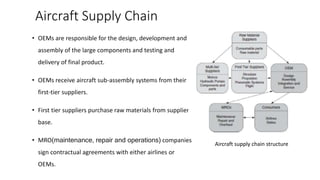
Aircraft Supply Chain
• OEMs are responsible for the design, development and
assembly of the large components and testing and
delivery of final product.
• OEMs receive aircraft sub-assembly systems from their
first-tier suppliers.
• First tier suppliers purchase raw materials from supplier
base.
• MRO(maintenance, repair and operations) companies
sign contractual agreements with either airlines or
OEMs.
Aircraft supply chain structure
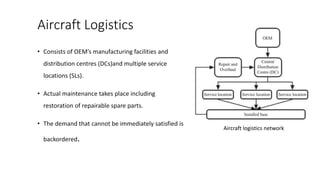
Aircraft Logistics
• Consists of OEM’s manufacturing facilities and
distribution centres (DCs)and multiple service
locations (SLs).
• Actual maintenance takes place including
restoration of repairable spare parts.
• The demand that cannot be immediately satisfied is
backordered.
Aircraft logistics network
AM implemented Aircraft SC
• AM technology is of strategic importance in the aircraft SC as it has uncertain demand and short life
cycles.
• Helps the companies to adapt to changing technology trends.
• AM will soon overcome present technological bottlenecks, enhancing its capabilities.
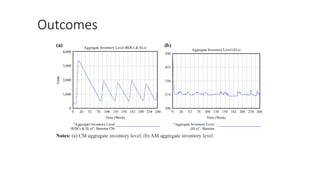
• When AM is implemented in the SC network, there is no inventory centralization in the RDCs.
• Every SL has an AM machine installed.
• The OEM is still part of the network, but is now procuring raw materials for the AM machines
Outcomes
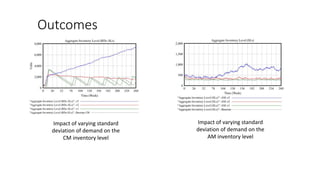
Outcomes
Impact of varying standard
deviation of demand on the
AM inventory level
Impact of varying standard
deviation of demand on the
CM inventory level
B: Research Paper Summary
• In-house access to production grade metal AM systems for SMEs is a major
challenge.
• Integrating Directed Energy Deposition with machining and grinding into Hybrid
AM is well suited for remanufacturing of metal parts.
• Machine shops that cannot adopt AM can propose a model for decision making
regarding integrating AM remanufacturing technology within their existing
reverse logistics system.
• They find that SMEs can participate in the evolving AM economy through
remanufacturing services using significantly lower investment costs.
Directed Energy Deposition
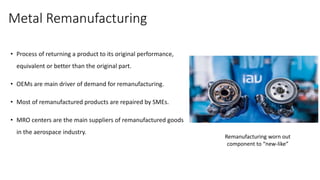
Metal Remanufacturing
• Process of returning a product to its original performance,
equivalent or better than the original part.
• OEMs are main driver of demand for remanufacturing.
• Most of remanufactured products are repaired by SMEs.
• MRO centers are the main suppliers of remanufactured goods
in the aerospace industry.
Remanufacturing worn out
component to “new-like”
Reverse Logistics
• Retrieving used products and components from customers and returning them to a
processing facility.
• Has potential to achieve value recovery from used products.
• Implementation of remanufacturing and repair services require appropriate reverse
logistics infrastructures.
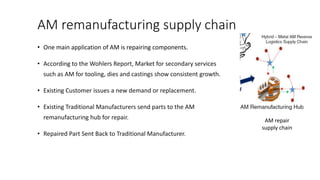
AM remanufacturing supply chain
• One main application of AM is repairing components.
• According to the Wohlers Report, Market for secondary services
such as AM for tooling, dies and castings show consistent growth.
• Existing Customer issues a new demand or replacement.
• Existing Traditional Manufacturers send parts to the AM
remanufacturing hub for repair.
• Repaired Part Sent Back to Traditional Manufacturer.
AM repair
supply chain
Modelling for remanufacturing hubs
• UFL(uncapacitated facility location) and p-median model are used to determine the number of
hubs and their locations using the repair demand, fixed costs and transportation costs.
• UFL model, a fixed cost is associated with establishing each NF.
• p-Median model the number NFs is provided prior to determining their locations.
UFL results for optimal AM
remanufacturing hub locations
p-Median results for AM
remanufacturing hub locations
Outcomes
• Fixed cost is lower in the reverse logistics supply chain when compared to the
hybrid AM production supply chain.
• Costs using CNC and DED method are much lower than that any other AM
metal printers.
• Similar approach can be followed to Locate Maintenance, Repair and Overhaul
centers for aerospace
REFERENCES
1.Appleton, R.W. (2014), “Additive manufacturing overview for the United States Marine
Corps”, technical report, RW Appleton and Company, Sterling Heights, MI.
2. ASTM F2792-12a (2012), Standard Terminology for Additive Manufacturing Technologies,
ASTM International, West Conshohocken, PA, available at: www.astm.org
3.Baumers, M. (2012), “Economic aspects of additive manufacturing: benefits, costs and
energy consumption”, doctoral dissertation, Loughborough University, Leicestershire.
4. Bhat, C.R., Paleti, R. and Singh, P. (2014), “A spatial multivariate count model for firm
location decisions”, Journal of Regional Science, Vol. 54 No. 3, pp. 462-502.
5.Caterpillar (2015), “Caterpillar invests $6.4 million to enhance machining capabilities of its
Reman facility”, available at: www.remancouncil.org/files/jk59pG/Shrewsbury-Investment-
PressRelease_111014.pdf (accessed September 7, 2017).
6.Chen, L., Olhager, J. and Tang, O. (2014), “Manufacturing facility location and
sustainability: a literature review and research agenda”, International Journal of Production
Economics, Vol. 149, pp. 154-163, available at:
www.sciencedirect.com/science/article/pii/S0925527313002399
7.Chen, Y., Zhou, C. and Lao, J. (2011), “A layerless additive manufacturing process based on
CNC accumulation”, Rapid Prototyping Journal, Vol. 17 No. 3, pp. 218-227
THANK YOU!

Additve Manufacturing Management.pptx

  • 1.
    Additive Manufacturing Management In Aircraft Presented By: ASHISHKUMAR CHAURASIYA 214122007 Manufacturing Management (PR606) M. Tech, 2nd Semester, Jan-2023 Manufacturing Technology Department of Production Engineering National Institute of Technology Tiruchirappalli, Tamil Nadu - 620015
  • 2.
    CONTENTS Impact of additivemanufacturing on aircraft supply chain performance Rethinking reverse logistics: role of additive manufacturing technology in metal remanufacturing
  • 3.
    A: Research PaperSummary RQ1. How can the impact of AM on aircraft spare parts SCs be assessed? RQ2. How can the overall performance difference between CM(Conventional manufacturing) and AM implemented SC systems be captured? • System Dynamics is a mathematical modelling technique used to solve complex and dynamic problems. SD is a computer-aided simulation approach for complex problem solving. • Understanding the AM’s future capabilities through inventory management mechanisms and feedback links understandings. • Developing SD models to analyze and assess both AM and CM spare parts inventory management policies and gain insights on the SC performance.
  • 4.
    Aircraft Supply Chain •OEMs are responsible for the design, development and assembly of the large components and testing and delivery of final product. • OEMs receive aircraft sub-assembly systems from their first-tier suppliers. • First tier suppliers purchase raw materials from supplier base. • MRO(maintenance, repair and operations) companies sign contractual agreements with either airlines or OEMs. Aircraft supply chain structure
  • 5.
    Aircraft Logistics • Consistsof OEM’s manufacturing facilities and distribution centres (DCs)and multiple service locations (SLs). • Actual maintenance takes place including restoration of repairable spare parts. • The demand that cannot be immediately satisfied is backordered. Aircraft logistics network
  • 6.
    AM implemented AircraftSC • AM technology is of strategic importance in the aircraft SC as it has uncertain demand and short life cycles. • Helps the companies to adapt to changing technology trends. • AM will soon overcome present technological bottlenecks, enhancing its capabilities. • When AM is implemented in the SC network, there is no inventory centralization in the RDCs. • Every SL has an AM machine installed. • The OEM is still part of the network, but is now procuring raw materials for the AM machines
  • 7.
  • 8.
    Outcomes Impact of varyingstandard deviation of demand on the AM inventory level Impact of varying standard deviation of demand on the CM inventory level
  • 9.
    B: Research PaperSummary • In-house access to production grade metal AM systems for SMEs is a major challenge. • Integrating Directed Energy Deposition with machining and grinding into Hybrid AM is well suited for remanufacturing of metal parts. • Machine shops that cannot adopt AM can propose a model for decision making regarding integrating AM remanufacturing technology within their existing reverse logistics system. • They find that SMEs can participate in the evolving AM economy through remanufacturing services using significantly lower investment costs.
  • 10.
  • 11.
    Metal Remanufacturing • Processof returning a product to its original performance, equivalent or better than the original part. • OEMs are main driver of demand for remanufacturing. • Most of remanufactured products are repaired by SMEs. • MRO centers are the main suppliers of remanufactured goods in the aerospace industry. Remanufacturing worn out component to “new-like”
  • 12.
    Reverse Logistics • Retrievingused products and components from customers and returning them to a processing facility. • Has potential to achieve value recovery from used products. • Implementation of remanufacturing and repair services require appropriate reverse logistics infrastructures.
  • 13.
    AM remanufacturing supplychain • One main application of AM is repairing components. • According to the Wohlers Report, Market for secondary services such as AM for tooling, dies and castings show consistent growth. • Existing Customer issues a new demand or replacement. • Existing Traditional Manufacturers send parts to the AM remanufacturing hub for repair. • Repaired Part Sent Back to Traditional Manufacturer. AM repair supply chain
  • 14.
    Modelling for remanufacturinghubs • UFL(uncapacitated facility location) and p-median model are used to determine the number of hubs and their locations using the repair demand, fixed costs and transportation costs. • UFL model, a fixed cost is associated with establishing each NF. • p-Median model the number NFs is provided prior to determining their locations. UFL results for optimal AM remanufacturing hub locations p-Median results for AM remanufacturing hub locations
  • 15.
    Outcomes • Fixed costis lower in the reverse logistics supply chain when compared to the hybrid AM production supply chain. • Costs using CNC and DED method are much lower than that any other AM metal printers. • Similar approach can be followed to Locate Maintenance, Repair and Overhaul centers for aerospace
  • 16.
    REFERENCES 1.Appleton, R.W. (2014),“Additive manufacturing overview for the United States Marine Corps”, technical report, RW Appleton and Company, Sterling Heights, MI. 2. ASTM F2792-12a (2012), Standard Terminology for Additive Manufacturing Technologies, ASTM International, West Conshohocken, PA, available at: www.astm.org 3.Baumers, M. (2012), “Economic aspects of additive manufacturing: benefits, costs and energy consumption”, doctoral dissertation, Loughborough University, Leicestershire. 4. Bhat, C.R., Paleti, R. and Singh, P. (2014), “A spatial multivariate count model for firm location decisions”, Journal of Regional Science, Vol. 54 No. 3, pp. 462-502. 5.Caterpillar (2015), “Caterpillar invests $6.4 million to enhance machining capabilities of its Reman facility”, available at: www.remancouncil.org/files/jk59pG/Shrewsbury-Investment- PressRelease_111014.pdf (accessed September 7, 2017). 6.Chen, L., Olhager, J. and Tang, O. (2014), “Manufacturing facility location and sustainability: a literature review and research agenda”, International Journal of Production Economics, Vol. 149, pp. 154-163, available at: www.sciencedirect.com/science/article/pii/S0925527313002399 7.Chen, Y., Zhou, C. and Lao, J. (2011), “A layerless additive manufacturing process based on CNC accumulation”, Rapid Prototyping Journal, Vol. 17 No. 3, pp. 218-227
  • 17.

Editor's Notes

  • #4 Research gap
  • #5 An aircraft SC consists of numerous stakeholders operating globally attempting to meet supply with demand. (OEMs) such as Boeing or Airbus are responsible for the design, development and assembly of the large components, including testing and delivery of final product to their customers i.e. airlines or nations (in the case of – fighter aircraft). OEMs receive aircraft sub-assembly systems such as engines and landing gears from their first-tier suppliers, which, in turn, purchase raw materials or manufacturing products from their supplier base. MRO companies sign contractual agreements with either airlines or OEMs, depending on the type of network they operate in order to provide after-sales service. Efficient management of spare parts has severe cost implications to companies holding significant spare parts inventory. The aircraft sector where, due to high quality and safety standards, preventive maintenance of aircraft is of paramount importance.
  • #6 Consists of OEM’s manufacturing facilities and distribution centres (DCs) enables inventory pooling by aggregating the demand of multiple service locations (SLs). SLs are located adjacent to the installed aircraft bases (airports), where the actual maintenance takes place including restoration of repairable spare parts. Upon a failure, defective parts are removed and replaced by functioning ones, if they are available. The part removed can either be immediately sent to the closest repair shop or scrapped. Both DCs and SLs maintain stock to satisfy the non-stationary demand for spare parts If an SL experiences a stock out, the required quantities can be delivered to it from the nearest DC. The demand that cannot be immediately satisfied is backordered.
  • #7  The freedom of design AM facilitates the production of both highly customized and optimized products. This helps the companies to adapt to changing technology trends. Manufacturing industry experts believe that AM will soon overcome present technological bottlenecks and enhance its capabilities. Also it will gradually replace current CM techniques. When AM is implemented in the SC network, there is no inventory centralisation in the Regional Development Centres, as they are not a part of the logistics network. Also each Service Location has an AM machine installed, which can meet the demand for spare parts without the need for issuing purchase orders. The OEM is still part of the network, but is now procuring raw materials for the AM machines, instead of finished parts.
  • #8 Reasons for the observed behavior- significant reduction in the AM inventory levels is mainly because of the reduced lead time and the unique SC configuration. AM machines are installed on-site and this co-location reduces the delivery lead time of the finished spare parts to almost zero. So varying service level does not have a significant impact on the inventory level. AM impacts the design stage, changes in the production decoupling point, supporting the localization of production and offering the opportunity of manufacturing parts on demand. This benefits the SC entirely. Secondary outcome is associated with reduction in CO2 emissions . drastic reduction in logistics operations are observed under AM implementation. This increases the environmental sustainability which is another positive outcome of AM implementation.
  • #9 In CM scenarios, longer replenishment lead time along with larger batch ordering to avoid stock-outs intensifies the need for maintaining higher stock levels. But the AM implementation reduces inventory holding costs and also has the potential to minimize SC complexity and the costs associated with complexity. The potential benefits of AM are explored where production volumes are low and coupled with unexpected surges in demand.
  • #10 The paper aims to discuss the issues That the adoption of metal additive manufacturing for production has continuously grown but in-house access to production grade metal AM systems for small and medium enterprises is a major challenge due to costs of acquiring metal AM systems, specifically powder bed fusion AM. Integrating DED process with conventional processes such as machining and grinding into Hybrid AM is well suited for remanufacturing of metal parts. The paper proposes to the ……………………………………………………………………………………………………………………………………….considering the inherent advantages of AM technologies in “rapid manufacturing”
  • #12 Remanufacturing is defined as the process of returning a product to its original performance or better than the original part. Remanufacturing demand is increasing because of increasing prices of new goods. Also parts with shorter life cycles face the most concern with competing prices of new products. Original equipment manufacturers are seeking ways to reduce costs of warranty claims and replace parts for customers and so depend majorly on remanufacturing. Firms save about 30–50 percent from remanufactured parts instead of manufacturing new. In the aerospace sector, maintenance, repair and overhaul centers are the main suppliers of remanufactured goods.
  • #13 Reverse logistics is retrieving used products and components from customers and returning them to a processing facility. The reverse logistics process has the potential to achieve value recovery from used products. implementation of remanufacturing and repair services require effort in setting up an appropriate reverse logistics infrastructures to manage the flow of used and returned products It was found that product recovery in most cases could be efficiently integrated into existing logistics of the SMEs
  • #14 One of the four main application of AM is repairing components. For example- The laser melting deposition LMD is being used for AM of large titanium components with higher quality repair and superior control defects. Market for secondary services such as AM for tooling, dies and castings show consistent growth rates according to the Wohlers Report. These continued growths imply opportunities for manufacturers to add AM services into their market, for both manufacturing and remanufacturing processes.
  • #15 Uncapacitated facility location and p-median model are used to determine the number of hubs and their locations using the SME-machine shop remanufacturing demand, the location of current machine shops, the fixed cost of implementing AM remanufacturing technology, AM repair cost per part, and transportation cost between the hubs and the machine shops as inputs In the UFL model, a fixed cost is associated with establishing each NF, while in the p-median model the number, p, of NFs is provided prior to determining their locations.
  • #16 high-value parts results in fewer remanufacturing hubs needed fixed cost for remanufacturing hubs is less than for manufacturing hubs; and although transportation costs is doubled in the reverse supply chain, there is minimal impact on the increase in average transportation cost per hub annually. Fixed cost, the main driver of AM manufacturing, has lower impact in the overall remanufacturing scenario given the lower fixed costs associated with DED than other metal AM technologies. Finally, it should be noted that the CNC machine dedicated to DED hybrid AM can also be used as a stand-alone CNC machine, thereby increasing the resources available to SMEs for traditional manufacturing. Similar approach can be followed to Locate Maintainence, Repair and Overhaul centres for aerospace