Energy Access Program in
Developing Asia and a Proposal for
Myanmar
Pradeep Tharakan, PhD
Energy Specialist (Climate Change)
Southeast Asia Energy Division (SEEN),
Asian Development Bank, Manila
1
June 2013
2
OUTLINE
• ADB’s Energy for All Program
• Some recent examples of ongoing energy
access support programs
• A proposal for technical assistance to
Myanmar
ADB’s Response: Energy for All Program
3
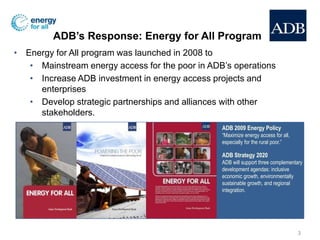
• Energy for All program was launched in 2008 to
• Mainstream energy access for the poor in ADB’s operations
• Increase ADB investment in energy access projects and
enterprises
• Develop strategic partnerships and alliances with other
stakeholders.
ADB 2009 Energy Policy
“Maximize energy access for all,
especially for the rural poor.”
ADB Strategy 2020
ADB will support three complementary
development agendas: inclusive
economic growth, environmentally
sustainable growth, and regional
integration.
ADB’s Response: Energy for All Partnership
4
Source: IEA 2012
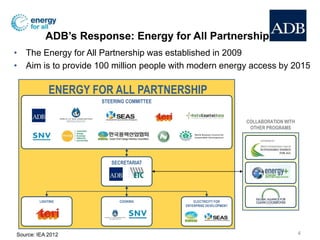
• The Energy for All Partnership was established in 2009
• Aim is to provide 100 million people with modern energy access by 2015
COOKING
LIGHTING ELECTRICITY FOR
ENTERPRISE DEVELOPMENT
SECRETARIAT
ENERGY FOR ALL PARTNERSHIP
COLLABORATION WITH
OTHER PROGRAMS
STEERING COMMITTEE
Energy for All: Donors and Supporters
5
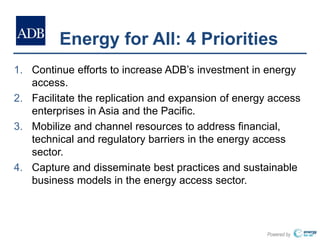
1. Continue efforts to increase ADB’s investment in energy
access.
2. Facilitate the replication and expansion of energy access
enterprises in Asia and the Pacific.
3. Mobilize and channel resources to address financial,
technical and regulatory barriers in the energy access
sector.
4. Capture and disseminate best practices and sustainable
business models in the energy access sector.
Energy for All: 4 Priorities
Powered by
 Primary actors in the energy access space:
o Proponent (energy access enterprises,
government, private-public partnerships, etc.)
o Enabler (incubators, donor programs, brokers,
etc.)
o Investor (equity funds, commercial banks,
financial institutions, etc.)
Energy for All
Partnership
Powered by
KNOWLEDGE MANAGEMENT
 Energy for All website
o Knowledge hub of best practices and business
models
o Idea exchange and concept refinement
o Identifying funding opportunities
 Identify credible projects (CTI-PFAN, New
Ventures)
o Utilizing in-country teams to identify credible
projects, provide relevant capacity building
services, and facilitate investment
CAPACITY BUILDING
 Incubation (SELCO India)
o Incubation models for energy access
Energy for All
Ongoing Activities
Powered by
Marketing & Outreach
PROJECT DEVELOPMENT
 Technology Transfer (Inensus, Power Source)
o Technology transfer of mini-grid
management system
PROMOTING PARTNERSHIPS
 Web-based investment facilitation (Impact
Investment Exchange)
o Building an online investment platform for
energy access enterprises
 Partnerships with investors and financial
institutions
o Referral of energy access enterprises in the
investment portfolio
Energy for All
Ongoing Activities
Powered by
Investment Facilitation
Project Development
Energy for All
in Action – Simpa Networks
Powered by
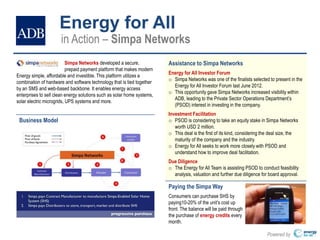
Simpa Networks developed a secure,
prepaid payment platform that makes modern
Energy simple, affordable and investible. This platform utilizes a
combination of hardware and software technology that is tied together
by an SMS and web-based backbone. It enables energy access
enterprises to sell clean energy solutions such as solar home systems,
solar electric microgrids, UPS systems and more.
Assistance to Simpa Networks
Energy for All Investor Forum
o Simpa Networks was one of the finalists selected to present in the
Energy for All Investor Forum last June 2012.
o This opportunity gave Simpa Networks increased visibility within
ADB, leading to the Private Sector Operations Department’s
(PSOD) interest in investing in the company.
Investment Facilitation
o PSOD is considering to take an equity stake in Simpa Networks
worth USD 2 million.
o This deal is the first of its kind, considering the deal size, the
maturity of the company and the industry.
o Energy for All seeks to work more closely with PSOD and
understand how to improve deal facilitation.
Due Diligence
o The Energy for All Team is assisting PSOD to conduct feasibility
analysis, valuation and further due diligence for board approval.
Business Model
Paying the Simpa Way
Consumers can purchase SHS by
paying10-20% of the unit’s cost up
front. The balance will be paid through
the purchase of energy credits every
month.
Energy for All
in Action – Scaling up Energy Access in Sumba Island
Powered by
Objectives:
• Promotion of small scale
renewable energy
deployment in Eastern
Indonesia using a case study
approach in one island.
• Partnership with MEMR,
PLN and governments of
NTT, and Sumba.
• Build on prior and ongoing
work (HIVOS, World Bank)
Scope and Approach
• Grants funds of $3.0 million to
be used for consulting inputs
and output based aid
programs.
• 3-yr implementation period
• Outputs:
– Detailed energy access plan for
Sumba developed.
– Priority investment projects to be
developed by small independent
power producers identified and
prepared.
– Implementation of ongoing and
planned energy access programs
financed by the government
strengthened.
Ongoing Activities
• Off grid micro hydro (Hivos)
• Solar home systems (>30.000 SEHEN)
• Increase hydro for the grid (PLN)
• Wind turbine preparation for the grid
(Sewatama) and off grid wind (IBEKA)
• Solar pumping pilot (YSS)
• > 100 biogas digestors in 2012
• More to come… (biomass GE, solar PV, ..)
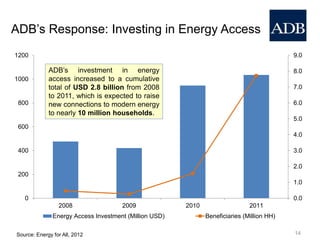
ADB’s Response: Investing in Energy Access
14
Source: Energy for All, 2012
0.0
1.0
2.0
3.0
4.0
5.0
6.0
7.0
8.0
9.0
0
200
400
600
800
1000
1200
2008 2009 2010 2011
Energy Access Investment (Million USD) Beneficiaries (Million HH)
ADB’s investment in energy
access increased to a cumulative
total of USD 2.8 billion from 2008
to 2011, which is expected to raise
new connections to modern energy
to nearly 10 million households.
15
Proposed ADB Technical
Assistance for Off-grid Renewable
Energy Access in Myanmar
Background
• The Directorate of Industrial Planning, Ministry of Industry (MOI)
presented a project proposal for rural energy development at the
Myanmar Development Cooperation Forum (MDCF) held in Nay
Pyi Taw (19–20 January 2013)
• MOI chairs the Rural Energy Development Supporting
Committee
• Ongoing efforts (2011–2013) to provide energy access in 591
remote villages
• Implementation of micro-hydro, solar, biogas/biomass
gasification, small wind power systems in remote, off-grid areas,
primarily to provide power to schools and other public facilities in
those areas.
• MOI aims to provide such systems to a further 103 villages and is
seeking funding from bilateral or multi-lateral donors to continue
with the program during 2014–2018.
Key Considerations
• Sustainable approaches that allow for adequate O&M,
and replacement costs.
• Business models that combine capital subsidies
(viability gap financing) with partial cost recovery.
• Draw on domestic manufacturing and fabrication
expertise – rebuild RE equipment supply chains
• Electricity is one of two considerations, what about
cooking fuels and improved cook stoves ?
Suggested Approach?
• Support some pilot installations - not to demonstrate
technology, but models of public procurement, public-
private partnerships, and viability gap financing models
• Also demonstrate systematic energy access planning
approaches – select 1-2 regions
• Link up with ADB’s $12 million grant for “Enhancing
Rural Livelihoods and Incomes Project” – block grants to
village tracts to undertake priority small scale rural
infrastructure and livelihood subprojects based on village
development plans
Suggested Approach?
• ADB is mobilizing about 1.5-2.0 million USD to carry out
this work
• MOI is convening a workshop in Nay Pyi Taw on June 4
(Tuesday: 8 am – 12 noon)
• Purpose of the workshop: To develop an appropriate
implementation approach and to identify partners
ADB GMS Env Operations Center
20
GMS Interactive Atlas
21
Thank you
ptharakan@adb.org
22

ADB_MYA_RE_Presentation_31_May2013_FINAL.ppt

  • 1.
    Energy Access Programin Developing Asia and a Proposal for Myanmar Pradeep Tharakan, PhD Energy Specialist (Climate Change) Southeast Asia Energy Division (SEEN), Asian Development Bank, Manila 1 June 2013
  • 2.
    2 OUTLINE • ADB’s Energyfor All Program • Some recent examples of ongoing energy access support programs • A proposal for technical assistance to Myanmar
  • 3.
    ADB’s Response: Energyfor All Program 3 • Energy for All program was launched in 2008 to • Mainstream energy access for the poor in ADB’s operations • Increase ADB investment in energy access projects and enterprises • Develop strategic partnerships and alliances with other stakeholders. ADB 2009 Energy Policy “Maximize energy access for all, especially for the rural poor.” ADB Strategy 2020 ADB will support three complementary development agendas: inclusive economic growth, environmentally sustainable growth, and regional integration.
  • 4.
    ADB’s Response: Energyfor All Partnership 4 Source: IEA 2012 • The Energy for All Partnership was established in 2009 • Aim is to provide 100 million people with modern energy access by 2015 COOKING LIGHTING ELECTRICITY FOR ENTERPRISE DEVELOPMENT SECRETARIAT ENERGY FOR ALL PARTNERSHIP COLLABORATION WITH OTHER PROGRAMS STEERING COMMITTEE
  • 5.
    Energy for All:Donors and Supporters 5
  • 6.
    1. Continue effortsto increase ADB’s investment in energy access. 2. Facilitate the replication and expansion of energy access enterprises in Asia and the Pacific. 3. Mobilize and channel resources to address financial, technical and regulatory barriers in the energy access sector. 4. Capture and disseminate best practices and sustainable business models in the energy access sector. Energy for All: 4 Priorities Powered by
  • 7.
     Primary actorsin the energy access space: o Proponent (energy access enterprises, government, private-public partnerships, etc.) o Enabler (incubators, donor programs, brokers, etc.) o Investor (equity funds, commercial banks, financial institutions, etc.) Energy for All Partnership Powered by
  • 8.
    KNOWLEDGE MANAGEMENT  Energyfor All website o Knowledge hub of best practices and business models o Idea exchange and concept refinement o Identifying funding opportunities  Identify credible projects (CTI-PFAN, New Ventures) o Utilizing in-country teams to identify credible projects, provide relevant capacity building services, and facilitate investment CAPACITY BUILDING  Incubation (SELCO India) o Incubation models for energy access Energy for All Ongoing Activities Powered by Marketing & Outreach
  • 9.
    PROJECT DEVELOPMENT  TechnologyTransfer (Inensus, Power Source) o Technology transfer of mini-grid management system PROMOTING PARTNERSHIPS  Web-based investment facilitation (Impact Investment Exchange) o Building an online investment platform for energy access enterprises  Partnerships with investors and financial institutions o Referral of energy access enterprises in the investment portfolio Energy for All Ongoing Activities Powered by Investment Facilitation Project Development
  • 10.
    Energy for All inAction – Simpa Networks Powered by Simpa Networks developed a secure, prepaid payment platform that makes modern Energy simple, affordable and investible. This platform utilizes a combination of hardware and software technology that is tied together by an SMS and web-based backbone. It enables energy access enterprises to sell clean energy solutions such as solar home systems, solar electric microgrids, UPS systems and more. Assistance to Simpa Networks Energy for All Investor Forum o Simpa Networks was one of the finalists selected to present in the Energy for All Investor Forum last June 2012. o This opportunity gave Simpa Networks increased visibility within ADB, leading to the Private Sector Operations Department’s (PSOD) interest in investing in the company. Investment Facilitation o PSOD is considering to take an equity stake in Simpa Networks worth USD 2 million. o This deal is the first of its kind, considering the deal size, the maturity of the company and the industry. o Energy for All seeks to work more closely with PSOD and understand how to improve deal facilitation. Due Diligence o The Energy for All Team is assisting PSOD to conduct feasibility analysis, valuation and further due diligence for board approval. Business Model Paying the Simpa Way Consumers can purchase SHS by paying10-20% of the unit’s cost up front. The balance will be paid through the purchase of energy credits every month.
  • 11.
    Energy for All inAction – Scaling up Energy Access in Sumba Island Powered by Objectives: • Promotion of small scale renewable energy deployment in Eastern Indonesia using a case study approach in one island. • Partnership with MEMR, PLN and governments of NTT, and Sumba. • Build on prior and ongoing work (HIVOS, World Bank)
  • 12.
    Scope and Approach •Grants funds of $3.0 million to be used for consulting inputs and output based aid programs. • 3-yr implementation period • Outputs: – Detailed energy access plan for Sumba developed. – Priority investment projects to be developed by small independent power producers identified and prepared. – Implementation of ongoing and planned energy access programs financed by the government strengthened.
  • 13.
    Ongoing Activities • Offgrid micro hydro (Hivos) • Solar home systems (>30.000 SEHEN) • Increase hydro for the grid (PLN) • Wind turbine preparation for the grid (Sewatama) and off grid wind (IBEKA) • Solar pumping pilot (YSS) • > 100 biogas digestors in 2012 • More to come… (biomass GE, solar PV, ..)
  • 14.
    ADB’s Response: Investingin Energy Access 14 Source: Energy for All, 2012 0.0 1.0 2.0 3.0 4.0 5.0 6.0 7.0 8.0 9.0 0 200 400 600 800 1000 1200 2008 2009 2010 2011 Energy Access Investment (Million USD) Beneficiaries (Million HH) ADB’s investment in energy access increased to a cumulative total of USD 2.8 billion from 2008 to 2011, which is expected to raise new connections to modern energy to nearly 10 million households.
  • 15.
    15 Proposed ADB Technical Assistancefor Off-grid Renewable Energy Access in Myanmar
  • 16.
    Background • The Directorateof Industrial Planning, Ministry of Industry (MOI) presented a project proposal for rural energy development at the Myanmar Development Cooperation Forum (MDCF) held in Nay Pyi Taw (19–20 January 2013) • MOI chairs the Rural Energy Development Supporting Committee • Ongoing efforts (2011–2013) to provide energy access in 591 remote villages • Implementation of micro-hydro, solar, biogas/biomass gasification, small wind power systems in remote, off-grid areas, primarily to provide power to schools and other public facilities in those areas. • MOI aims to provide such systems to a further 103 villages and is seeking funding from bilateral or multi-lateral donors to continue with the program during 2014–2018.
  • 17.
    Key Considerations • Sustainableapproaches that allow for adequate O&M, and replacement costs. • Business models that combine capital subsidies (viability gap financing) with partial cost recovery. • Draw on domestic manufacturing and fabrication expertise – rebuild RE equipment supply chains • Electricity is one of two considerations, what about cooking fuels and improved cook stoves ?
  • 18.
    Suggested Approach? • Supportsome pilot installations - not to demonstrate technology, but models of public procurement, public- private partnerships, and viability gap financing models • Also demonstrate systematic energy access planning approaches – select 1-2 regions • Link up with ADB’s $12 million grant for “Enhancing Rural Livelihoods and Incomes Project” – block grants to village tracts to undertake priority small scale rural infrastructure and livelihood subprojects based on village development plans
  • 19.
    Suggested Approach? • ADBis mobilizing about 1.5-2.0 million USD to carry out this work • MOI is convening a workshop in Nay Pyi Taw on June 4 (Tuesday: 8 am – 12 noon) • Purpose of the workshop: To develop an appropriate implementation approach and to identify partners
  • 20.
    ADB GMS EnvOperations Center 20
  • 21.
  • 22.