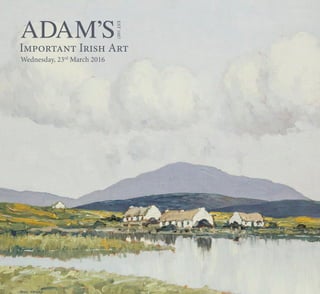
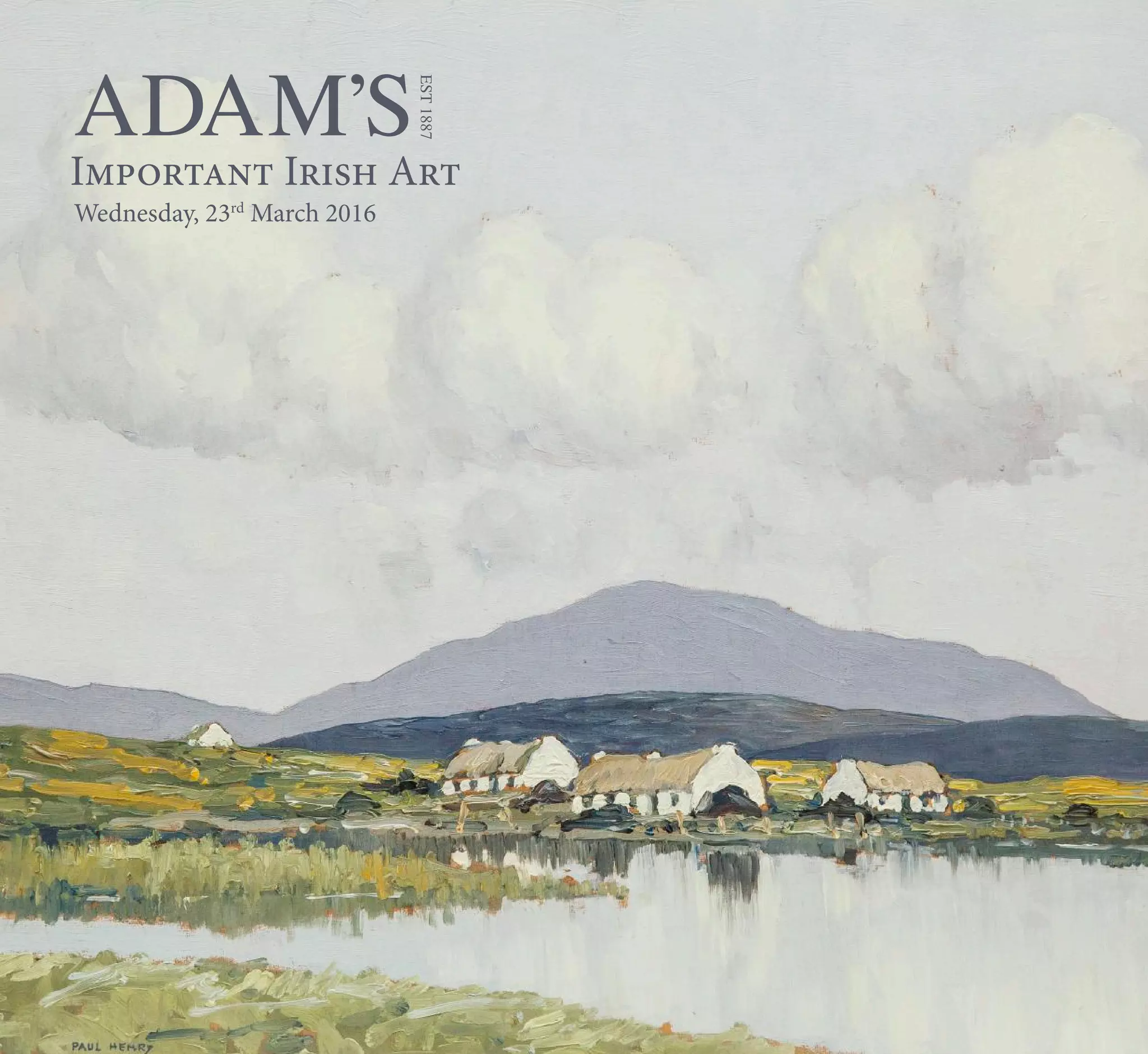
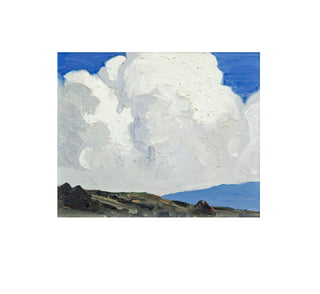
ADAM’S
EST1887
Important Irish Art
Wednesday, 23rd
March 2016
ADAM’SEst.1887
IMPORTANT IRISH ART
Auction
Wednesday 23rd
March 2016 at 6pm
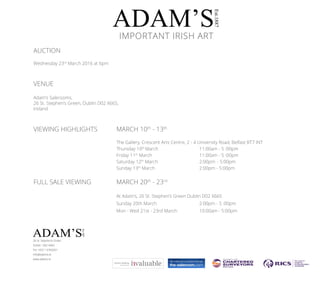
AUCTION
Wednesday 23rd
March 2016 at 6pm
VENUE
Adam’s Salerooms,
26 St. Stephen’s Green, Dublin D02 X665,
Ireland
VIEWING HIGHLIGHTS 		 MARCH 10th
- 13th
					The Gallery, Crescent Arts Centre, 2 - 4 University Road, Belfast BT7 INT		
					Thursday 10th
March 			 11:00am - 5 :00pm		
					Friday 11th
March			 11:00am - 5 :00pm
					Saturday 12th
March			 2:00pm	 - 5:00pm
					Sunday 13th
March			 2:00pm - 5:00pm
FULL SALE VIEWING		 MARCH 20th
- 23rd
					At Adam’s, 26 St. Stephen’s Green Dublin D02 X665					
					Sunday 20th March 			2:00pm - 5 :00pm
					 Mon - Wed 21st - 23rd March		 10:00am - 5:00pm
					
ADAM’S
Est.1887
26 St. Stephen’s Green
Dublin D02 X665
Tel +353 1 6760261
info@adams.ie
www.adams.ie
IMPORTANT IRISH ART
ADAM’S
Est.1887
CONTACTS
Brian Coyle FSCSI FRICS
CHAIRMAN
Nick Nicholson
CONSULTANT
n.nicholson@adams.ie
James O’Halloran BA FSCSI FRICS
MANAGING DIRECTOR
j.ohalloran@adams.ie
Kieran O’Boyle BA Hdip ASCSI
ASSOCIATE DIRECTOR
k.oboyle@adams.ie
Stuart Cole MSCSI MRICS
DIRECTOR
s.cole@adams.ie
Katie McGale BComm Intl MPhil
FINE ART DEPARTMENT
katie@adams.ie
David Britton BBS ACA
DIRECTOR
d.britton@adams.ie
Amy McNamara BA MPhil
FINE ART DEPARTMENT
amymcnamara@adams.ie
Eamon O’Connor BA
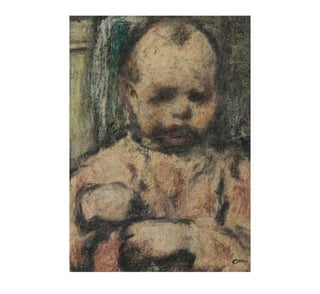
DIRECTOR
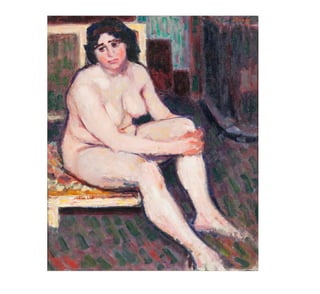
e.oconnor@adams.ie
Adam Pearson BA
FINE ART DEPARTMENT
a.pearson@adams.ie
Ronan Flanagan
FINE ART DEPARTMENT
r.flanagan@adams.ie
IMPORTANT INFORMATION FOR PURCHASERS
1.	 ESTIMATES AND RESERVES
These are shown below each lot in this sale. All amounts shown are in Euro. The figures shown are provided merely as a guide to prospective purchasers. They are approximate prices which are
expected, are not definitive and are subject to revision. Reserves, if any, will not be any higher than the lower estimate.
2.	 PADDLE BIDDING
All intending purchasers must register for a paddle number before the auction. Please allow time for registration. Potential purchasers are recommended to register on viewing days.
3.	 PAYMENT, DELIVERY AND PURCHASERS PREMIUM
Thursday 24th March 2016. Under no circumstances will delivery of purchases be given whilst the auction is in progress. All purchases must be paid for and removed from the premises not later
than Thursday 24th March 2016 at the purchaser’s risk and expense. After this time all uncollected lots will be removed to commercial storage and additional charges will apply.
Auctioneers commission on purchases is charged at the rate of 20% (exclusive of VAT). Terms: Strictly cash, bankers draft or cheque drawn on an Irish bank. Cheques will take a minimum of five
workings days to clear the bank, unless they have been vouched to our satisfaction prior to the sale, or you have a previous cheque payment history with Adam’s. Purchasers wishing to pay by credit
card (Visa & MasterCard) may do so, however, it should be noted that such payments will be subject to an administrative fee of 1.5% on the invoice total. American Express is subject to a charge of
3.65% on the invoice total. Debit cards including laser card payments are not subject to a surcharge, there are however daily limits on Laser card payments. Bank Transfer details on request. Please
ensure all bank charges are paid in addition to the invoice total, in order to avoid delays in the release of items.
Goods will only be released upon clearance through the bank of all monies due. Artists Resale Rights (Droit de Suite) is NOT payable by purchasers.
4.	 VAT REGULATIONS
All lots are sold within the auctioneers VAT margin scheme. Revenue Regulations require that the buyers premium must be invoiced at a rate which is inclusive of VAT. This is not recoverable by any
VAT registered buyer.
5.	 It is up to the bidder to satisfy themselves prior to buying as to the condition of a lot. Whilst we make certain observations on the lot, which are intended to be as helpful as possible, refer-
ences in the condition report to damage or restoration are for guidance only and should be evaluated by personal inspection by the bidder or a knowledgeable representative. The absence of such a
reference does not imply that an item is free from defects or restoration, nor does a reference to particular defects imply the absence of any others. The condition report is an expression of opinion
only and must not be treated as a statement of fact.
Please ensure that condition report requests are submitted before 12 noon on Saturday 19th March as we cannot guarantee that they will be dealt with after this time.
6.	 ABSENTEE BIDS
We are happy to execute absentee or written bids for bidders who are unable to attend and can arrange for bidding to be conducted by telephone. However, these services are subject to special
conditions (see conditions of sale in this catalogue). All arrangements for absentee and telephone bidding must be made before 5pm on the day prior to sale. Cancellation of bids must be confirmed
before this time and cannot be guaranteed after the auction as commenced.
Bidding by telephone may be booked on lots with a minimum estimate of €500. Early booking is advisable as availability of lines cannot be guaranteed.
7.	ACKNOWLEDGMENTS
We would like to acknowledge, with thanks, the assistance of Catherine Marshall, Karen Reihill, Dr. Roisin Kennedy, Nora Hickey, Dr. Paul Caffery, Dickon Hall, Fiana Griffin,
Medb Ruane, Ciarán Mac Gonigal. Dr. S.B. Kennedy.
8. 	 ALL LOTS ARE BEING SOLD UNDER THE CONDITIONS OF SALE AS PRINTED IN THIS CATALOGUE AND ON DISPLAY IN THE SALEROOMS.
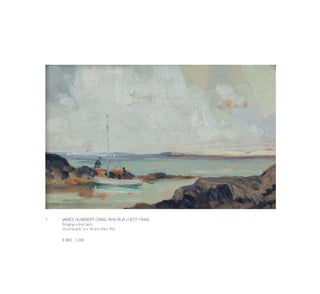
1	 JAMES HUMBERT CRAIG RHA RUA (1877-1944)
Bringing in the Catch
Oil on board, 12 x 18.5cm (4¾ x 7½’’)
€ 800 - 1,200
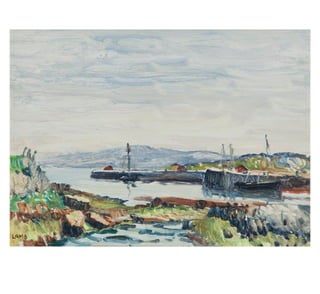
2	 CHARLES LAMB RHA (1893-1964)
Sruthán Harbour, Carraroe
Oil on board, 25 x 34.5cm (9¾ x 13¾’’)
Signed
Provenance: The artist’s family
€ 2,000 - 3,000
Born in Portadown, Co. Armagh, Charles Lamb initially studied life drawing at night at the Belfast School of Art before winning a scholarship
to study full time at the Metropolitan School of Art in Dublin in 1917.
In 1921 Lamb visited Carraroe in Connemara for the first time. Charles Lamb, like Henry, Keating and MacGonigal had a deep attachment to
the West of Ireland, especially the area around Carraroe where he settled in 1935 and ran a painting school during summer months. From
the mid-1930s he concentrated on depicting landscape, working rapidly on a warm-toned surface whilst trying to capture the changing
mood and light of Connemara. His vision which is characteristically contemplative is characterised by broad brushwork and restrained
impasto.
He also lived and worked in Brittany for a time during the 1920s, where the locals and way of life came to be the focus of his subject matter,
as the people of Connemara did while he worked there. He exhibited in London, New York, Chicago, Los Angeles as well as regularly at the
RUA and RHA where he became a member in 1930 and 1938 respectively. In 1947 a solo show was held at CEMA, Belfast, and a retrospec-
tive of his work was held in 1969 at the Hugh Lane Gallery, Dublin. Significant works can be found in the National Gallery of Ireland, Hugh
Lane Gallery and Ulster Museum.
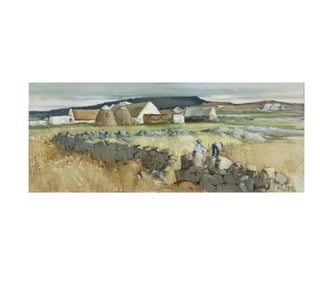
3	 CECIL MAGUIRE RUA (B.1930)
Figures in Hayfield with Cottages
Oil on canvas, 37.5 x 91cm (14¾ x 35¾’’)
Signed
€ 4,000 - 6,000
Born in Lurgan in 1930, Maguire graduated from the Queen’s University Belfast in 1951. He then took an English teaching post at Lurgan
College. He became a member of the Royal Ulster Academy in 1974, winning both the Silver Medal (1964, 1967) and the Gold Medal
there (1993). In 1971 he began exhibiting at the Royal Hibernian Academy in Dublin and between 1982 and 1992 he exhibited at the
Oriel Gallery in Dublin in a series of solo exhibitions. In 1981 he retired from teaching at Lurgan College to concentrate on painting and
travelling.
Maguire now divides his time between Italy, Belfast and the West of Ireland but lives and works for a great part of the year in Round-
stone, Connemara - an area that has always been the inspiration for much of his work.
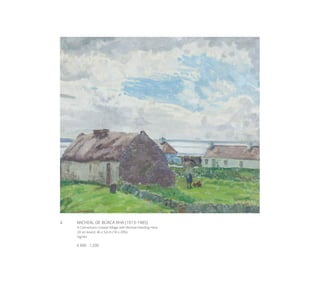
4	 MICHEÁL DE BÚRCA RHA (1913-1985)
A Connemara Coastal Village with Woman Feeding Hens
Oil on board, 46 x 52cm (18 x 20½)
Signed
€ 800 - 1,200
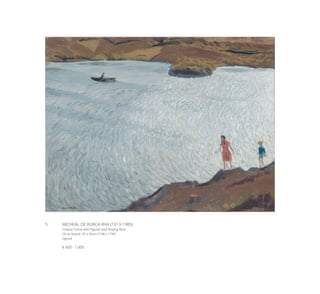
5	 MICHEÁL DE BÚRCA RHA (1913-1985)
Coastal Scene with Figures and Rowing Boat
Oil on board, 35 x 45cm (13¾ x 17¾’’)
Signed
€ 600 - 1,000
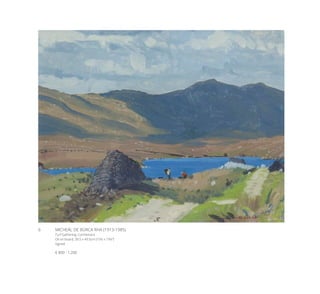
6	 MICHEÁL DE BÚRCA RHA (1913-1985)
Turf Gathering, Connemara
Oil on board, 39.5 x 49.5cm (15½ x 19½’’)
Signed
€ 800 - 1,200
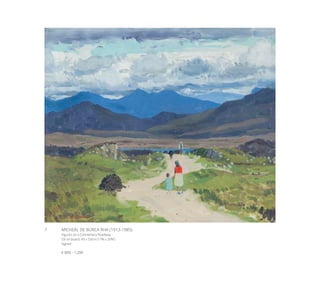
7	 MICHEÁL DE BÚRCA RHA (1913-1985)
Figures on a Connemara Roadway
Oil on board, 45 x 53cm (17¾ x 20¾’’)
Signed
€ 800 - 1,200
8	 PAUL HENRY RHA (1877-1958)
Cumulus Clouds, Dugort
Oil on board, 12.5 x 15.5cm (5 x 6¼’’)
Provenance: Mrs R. C. Booth; private collection; Sale, Sotheby’s, Chester, November 1989.
Exhibited: “Paintings Of Irish Life: Mr & Mrs Paul Henry” Pollocks Gallery Belfast, March 1911 Cat. No. 1
	 “Paintings Frances Baker, Grace Henry, Paul Henry, Casimir Dunn Markiewicz and George Russell”
	 Leinster Hall, Dublin Oct 1911, Cat. No. 20. under title “Clouds”
	 “Paul Henry: Paintings And Charcoals” Waddington Gallery Feb/March 1952 Cat. No. 23, Lent by Mrs. Booth
	 “Paul Henry Retrospective Exhibition” Ritchie Hendriks Gallery, Dublin Belfast Museum and Art Gallery 		
	 Belfast, May - July 1957, Cat. No. 49 under title “Cumlus Clouds” Lent by Mrs RC Booth, one of two works lent 	
	 by her.
Literature: S. B. Kennedy, Paul Henry: with a catalogue of the Paintings, Drawings, Illustrations, Yale University Press,
New Haven & London, p. 155, catalogue number 301.
This picture typifies Paul Henry’s style when he first went to Achill Island in Co. Mayo in 1910. It is therefore one of his
very first Achill pictures. Typically for the time, he has used heavy impasto throughout and one can well see the cumu-
lous clouds which so often feature in his work. Even the immediate foreground has been briskly painted and there is
little or no detailing in the scene. Dugort is situated north-east of the village of Keel. It was to Dugort that Henry went on
his arrival in Achill, but even then he found that the place ‘swarmed with tourists’, and the next morning he took a jaunt-
ing car to Keel, which delighted him. ‘As I wandered round and through the village, and out on the road that led through
Pullough, and looked down on Dooagh and to the noble cliffs of Achill Head, I felt that here I must stay smoehow or
another. I would not go farther’, he wrote. (Paul Henry, An Irish Portrait, Batsford, London, 1951, p. 3). The mountain at
the right side of the painting is unnamed, but rises to a height of two hundred and fourteen metres. Slievemore, which
dominates the landscape of Achill, is immediately to the left.
There are two Sotheby’s labels on the reverse and a label of the Dawson Gallery, Dublin, as the framer.
Dr. S.B. Kennedy
€ 6,000 - 10,000
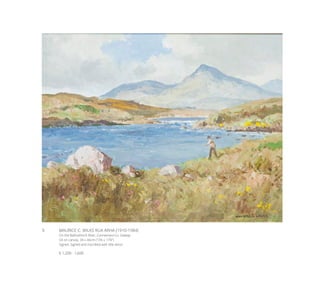
9	 MAURICE C. WILKS RUA ARHA (1910-1984)
On the Ballinahinch River, Connemara Co. Galway
Oil on canvas, 34 x 44cm (13½ x 17¼”)
Signed. Signed and inscribed with title verso
€ 1,200 - 1,600
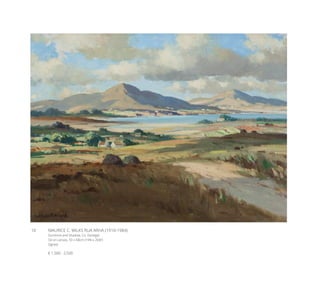
10	 MAURICE C. WILKS RUA ARHA (1910-1984)
Sunshine and Shadow, Co. Donegal
Oil on canvas, 50 x 68cm (19¾ x 26¾’’)
Signed
€ 1,500 - 2,500
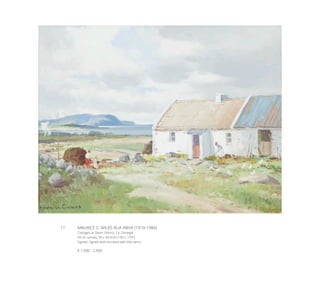
11	 MAURICE C. WILKS RUA ARHA (1910-1984)
Cottages at Glenn District, Co. Donegal
Oil on canvas, 34 x 44.5cm (13½ x 17½”)
Signed. Signed and inscribed with title verso
€ 1,500 - 2,500
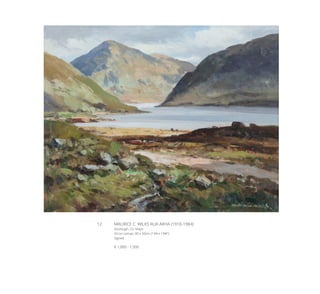
12	 MAURICE C. WILKS RUA ARHA (1910-1984)
Doolough, Co. Mayo
Oil on canvas, 40 x 50cm (15¾ x 19¾’’)
Signed
€ 1,000 - 1,500
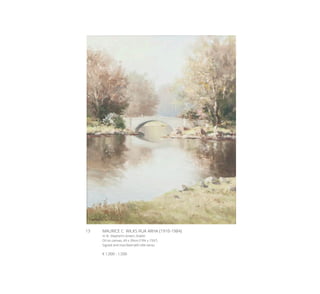
13	 MAURICE C. WILKS RUA ARHA (1910-1984)
In St. Stephen’s Green, Dublin
Oil on canvas, 49 x 39cm (19¼ x 15½”)
Signed and inscribed with title verso
€ 1,000 - 1,500
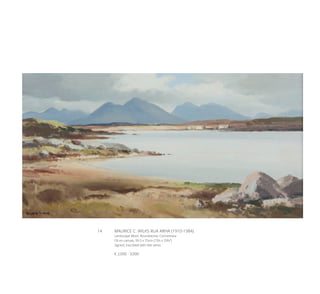
14	 MAURICE C. WILKS RUA ARHA (1910-1984)
Landscape Moor, Roundstone, Connemara
Oil on canvas, 39.5 x 75cm (15½ x 29½”)
Signed, inscribed with title verso
€ 2,000 - 3,000
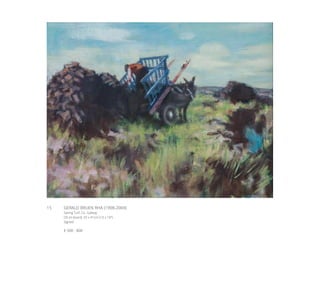
15	 GERALD BRUEN RHA (1908-2004)
Saving Turf, Co. Galway
Oil on board, 33 x 41cm (13 x 16’’)
Signed
€ 500 - 800
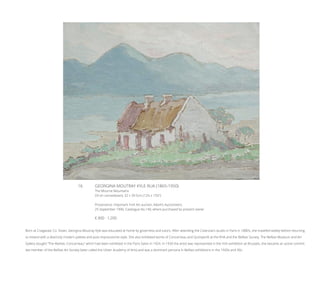
16	 GEORGINA MOUTRAY KYLE RUA (1865-1950)
The Mourne Mountains
Oil on canvasboard, 32 x 39.5cm (12½ x 15½”)
Provenance: Important Irish Art auction, Adam’s Auctioneers,
25 September 1996, Catalogue No.140, where purchased by present owner
€ 800 - 1,200
Born at Craigavad, Co. Down, Georgina Moutray Kyle was educated at home by governess and tutors. After attending the Colarossi’s studio in Paris in 1880’s, she travelled widely before returning
to Ireland with a distinctly modern palette and post-impressionist style. She also exhibited works of Concarneau and Quimperlé at the RHA and the Belfast Society. The Belfast Museum and Art
Gallery bought “The Market, Concarneau” which had been exhibited in the Paris Salon in 1924. In 1930 the artist was represented in the Irish exhibition at Brussels, she became an active commit-
tee member of the Belfast Art Society (later called the Ulster Academy of Arts) and was a dominant persona in Belfast exhibitions in the 1920s and 30s.
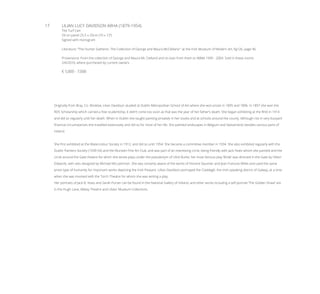
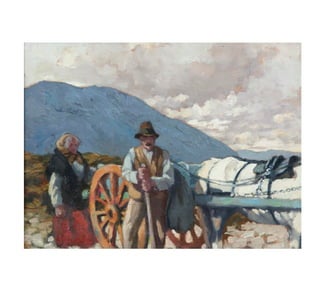
17	 LILIAN LUCY DAVIDSON ARHA (1879-1954)
The Turf Cart
Oil on panel 25.5 x 33cm (10 x 13”)
Signed with monogram
Literature: “The Hunter Gatherer, The Collection of George and Maura McClelland “ at the Irish Museum of Modern Art, fig126, page 96.
Provenance: From the collection of George and Maura Mc Clelland and on loan from them to IMMA 1999 - 2004. Sold in these rooms
2/6/2010, where purchesed by current owners.
€ 5,000 - 7,000
Originally from Bray, Co. Wicklow, Lilian Davidson studied at Dublin Metropolitan School of Art where she won prizes in 1895 and 1896. In 1897 she won the
RDS Scholarship which carried a free studentship, it didn’t come too soon as that was the year of her father’s death. She began exhibiting at the RHA in 1914
and did so regularly until her death. When in Dublin she taught painting privately in her studio and at schools around the county. Although not in very buoyant
financial circumstances she travelled extensively and did so for most of her life. She painted landscapes in Belgium and Switzerland, besides various parts of
Ireland.
She first exhibited at the Watercolour Society in 1912, and did so until 1954. She became a committee member in 1934. She also exhibited regularly with the
Dublin Painters Society (1939-54) and the Munster Fine Art Club, and was part of an interesting circle, being friendly with Jack Yeats whom she painted and the
circle around the Gate theatre for which she wrote plays under the pseudonym of Ulick Burke, her most famous play ‘Bride’ was directed in the Gate by Hilton
Edwards, with sets designed by Michael McLiammoir. She was certainly aware of the works of Honore Daumier and Jean Francois Millet and used the same
proto type of humanity for important works depicting the Irish Peasant. Lillian Davidson portrayed the Claddagh, the Irish-speaking district of Galway, at a time
when she was involved with the Torch Theatre for whom she was writing a play.
Her portraits of Jack B. Yeats and Sarah Purser can be found in the National Gallery of Ireland, and other works including a self portrait ‘The Golden Shawl’ are
in the Hugh Lane, Abbey Theatre and Ulster Museum Collections.
18	 MARGARET CLARKE RHA (1888-1961)
Coltsfoot, Greystones
Oil on panel, 46 x 56cm (18 x 22”)
Signed
Exhibited: David Clarke Retrospective, The Frederick Gallery, Dublin, Cat. No. 62 (label verso) where purchased
Margaret Clarke was born and educated in Newry. In 1906 she was awarded a scholarship to the DMSA, where she became one of
Orpen’s star pupils, and won many prizes. Her fellow students included Beatrice Glenavy, James Sleator, Kathleen Fox, Leo Whelan,
Patrick Tuohy and Harry Clarke, whom she married in 1915.
Margaret excelled at portrait painting. Her dispassionate, searching eye enabled her to reveal the deep nature, the “true self “ of the
sitter, even when painting her own family. She was commissioned to paint many notable figures of the times, including Eamon De Val-
era, Dr. John Charles McQuaid and Dermod O’Brien (President of the RHA). Strong-minded and independent, she particularly enjoyed
the artistic and intellectual freedom of genre painting such as “The Ghost Sonate” (Ulster Museum)’ based on a play by Strindberg, or
“Bathtime at the Creche” (National Gallery). Her outstanding ability as a draughtswoman can be appreciated in all her work.
Like so many women artists she had to combine devotion to her career with the care of her family, and after Harry’s death, with much
of the responsibility for the studios on a greatly reduced income. Genre paintings became a luxury rarely affordable. In later life she
loved to paint delightful, simple vases of flowers or scenes from the Wicklow hills. She died in Dublin in 1961.
Fiana Griffin
€ 400 - 600
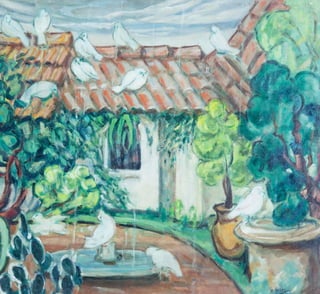
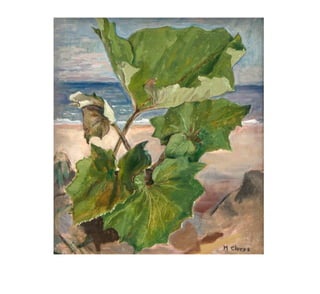
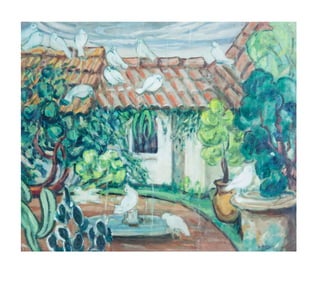
19	 GRACE HENRY HRHA (1868-1923)
Doves in Tuscany
Oil on canvas, 51 x 61cm (20¼ x 24”)
Signed
€ 6,000 - 10,000
Grace Henry (nee Mitchell) was born in comfortable surroundings to a Church of Scotland Minister, the second youngest of ten children. She lived and studied in
London, Brussels and Paris where she met and married Paul Henry in 1903.They returned to England and lived in Surrey for several years, both deeply influenced
by the avant garde Post Impressionist mood of the time. As a couple they spent almost a decade from 1912 living on Achill Island, a career defining period for
both of them, but particularly for her husband. The seeds of separation were sown in these years, as Grace began to travel frequently to Dublin and London and
to exhibit separately in Belfast in the 1920s.They founded the Dublin Painters Society with 6 other artists in 1920 but by the mid 1920s had separated from each
other, although they never divorced.
In the 1930s she spent more of her time abroad but continued to show her work in Irish art exhibitions. During the Second World War she returned to the west of
Ireland, and exhibited regularly at galleries in Dublin and at the Royal Hibernian Academy. Her bold use of paint and fluid brushstrokes simplified the composition
of her paintings to its essential elements, leaving at their core the humanity and humble spirit of the figures within them, so often inspired by the noble islanders
she came across on Achill.
Her works are included in major collections such as the National Gallery of Ireland, Hugh Lane Gallery, Trinity College Dublin, University College Dublin, Ulster
Museum and Crawford Gallery.
20	 MARY SWANZY HRHA (1882 - 1978)
Flower Market
Oil on canvas, 46 x 36cm (18 x 14”)
Signed
Exhibited: Irish Women Artists 1870-1970, Adam’s, Dublin, July 2014; AVA Gallery, Clandeboye Aug-Sept 2014,
Cat. No. 24
Literature: Irish Women Artists 1870-1970, illustrated p.33
€ 1,000 - 2,000
Mary Swanzy took classes at the RHA and Metropolitan School of Art in her home town of Dublin before travelling to Paris to work in various artists’ studios.
Although mainly based in Dublin in her early career, she spent much of her time travelling around Eastern Europe and North America. In 1926 she moved to
London but continued to show in Ireland at the Dawson Gallery and Royal Hibernian Academy, and in 1949 was elected an Honorary Member of the RHA.
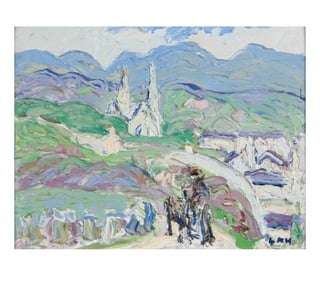
21	 LETITIA MARION HAMILTON RHA (1878-1964)
Clifden, Connemara
Oil on canvas board, 19 x 25.25cm (7½ x 10’’)
Signed with initials
€ 3,000 - 5,000
Originally from Co. Meath, Letitia Hamilton studied at the Dublin Metropolitan School of Art where she was taught by William Orpen, continuing her studies at
the Slade School of Art in London and with Frank Brangwyn. She exhibited annually at the RHA from 1909, and was elected a member in 1944. In the 1920s she
exhibited a number of times at the Paris Salon as well as at the Goupil Gallery, Walker Gallery, International Society of Sculptors, Painters and Gravers, Royal
Society of British Artist’s and Scottish Society of Women Artist in Edinburgh. She was also one of the founder members of the Society of Dublin Painters in 1920.
In 1945 Hamilton had a solo show at Victor Waddington Galleries in Dublin, and another in 1948, the same year that she won a bronze medal at the Olympic
Games art section in London. She went on to have three solo shows at the Dawson Gallery in the following years. Hamilton’s work can be found in major collec-
tions such as the National Gallery of Ireland, Ulster Museum, Crawford Gallery, Hugh Lane Gallery, Office of Public Works, VHI, Wesley College and City Gallery of
Art in Limerick.
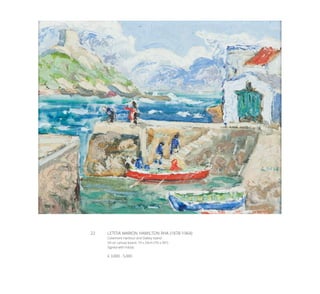
22	 LETITIA MARION HAMILTON RHA (1878-1964)
Coliemore Harbour and Dalkey Island
Oil on canvas board, 19 x 24cm (7½ x 9½’’)
Signed with initials
€ 3,000 - 5,000
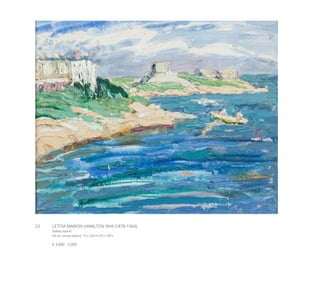
23	 LETITIA MARION HAMILTON RHA (1878-1964)
Dalkey Island
Oil on canvas board, 19 x 24cm (7½ x 9½’’)
€ 3,000 - 5,000
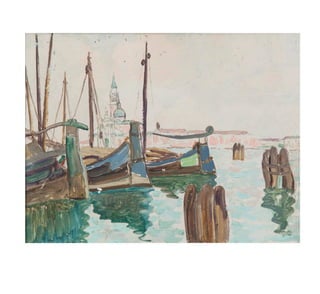
24	 LETITIA MARION HAMILTON RHA (1878-1964)
Moored Sailing Boats, Venice
Oil on Board, 30 x 39cm (11¾ x 15¼’’)
Original Artist’ label verso
€ 2,000 - 4,000
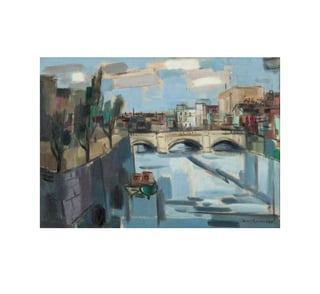
25	 NORAH MCGUINNESS HRHA (1901 - 1980)
The Liffey
Oil on canvas, 41 x 56cm (16¼ x 22”)
Signed
Provenance: Dawson Gallery, Dublin, inscribed with title on label verso. Sold Important Irish Art Sale these
rooms 23rd March 2005, Cat. No.106, where purchased by the current owner.
Exhibited: Thought to be exhibited ‘Norah McGuinness Exhibition’, Dawson Gallery 1959, catalogue No.8
under title ‘Liffey’
Terence de Vere wrote of McGuinness:-
“Norah McGuinness, like the majority of our better artists, was born in Northern Ireland; but her art
training began in the Dublin College of Art. From there she went to London and then to Paris, where she
worked in the studio of Andre L’Hote.The Paris experience might have been decisive as it was the case of
Evie Hone and Mainie Jellett who worked in the same studio. The coincidence was fruitful in another way.
These artists joined forces to inaugurate the annual exhibition of Living Art, a rival to the Royal Hibernian
Academy’s exhibitions which, they believed, had become sterile. But L’Hote, as a painter, did not have any
permanent effect on McGuinness. She was by nature the least cubist of beings. One might as well have
tried to imprison the painters of baroque in a pattern of rigid squares. Her style is more reminiscent of
Vlaminck. She is essentially decorative; and there is no element of cerebration in her work. It is free-flow-
ing and, usually, joyous. Her colour sense is where she is most reminiscent of Vlaminck. The later sombre
Norah McGuinness is more impressive than the earlier. But essentially her art is decorative, and in her
drawing she is always witty, gay and inventive.”
€ 7,000 - 10,000
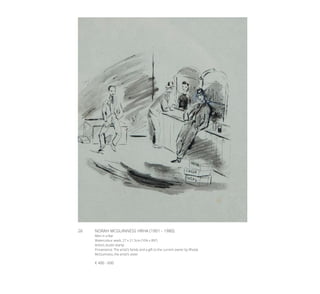
26	 NORAH MCGUINNESS HRHA (1901 - 1980)
Men in a Bar
Watercolour wash, 27 x 21.5cm (10¼ x 8½’’)
Artist’s studio stamp
Provenance: The artist’s family and a gift to the current owner by Rhoda
McGuinness, the artist’s sister
€ 400 - 600
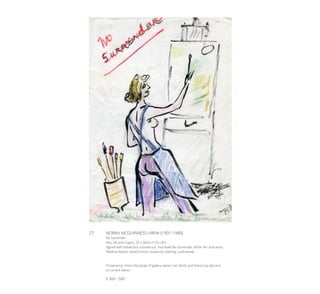
27	 NORAH MCGUINNESS HRHA (1901-1980)
No Surrender
Pen, ink and crayon, 29 x 20cm (11½ x 8’’)
Signed with initials but crossed out. Inscribed ‘No Surrender, All for Art’ and verso
‘Medical Advice: Avoid friction caused by clothing’. (unframed)
Provenance: From the estate of gallery owner Leo Smith and thence by descent
to current owner.
€ 300 - 500
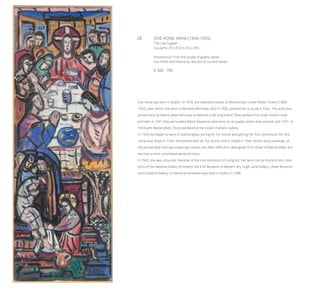
28	 EVIE HONE HRHA (1894-1955)
The Last Supper
Gouache, 25 x 8.5cm (10 x 3½”)
Provenance: From the estate of gallery owner
Leo Smith and thence by descent to current owner.
€ 500 - 700
Evie Hone was born in Dublin. In 1918, she attended classes at Westminster under Walter Sickert (1860-
1942), after which she went to Bernard Meninsky, who in 1920, advised her to study in Paris. The artist was
joined there by Mainie Jellett who was to become a life long friend. They worked first under André Lhote
and later in 1921 they persuaded Albert Gleizes to take them on as pupils, where they worked until 1931. In
1924 with Mainie Jellett, Hone exhibited at the Dublin Painters Gallery.
In 1933 she began to work in stained glass, joining An Tur Gloine and getting her first commission for Ard-
carne near Boyle in 1934. She worked with An Tur Gloine until it closed in 1944. Hone’s early paintings, of
the period when she was exploring Cubism, are often difficult to distinguish from those of Mainie Jellett, but
she had a more committed sense of colour.
In 1943, she was a founder member of the Irish exhibition of Living Art. Her work can be found in the collec-
tions of the National Gallery of Ireland, the Irish Museum of Modern Art, Hugh Lane Gallery, Ulster Museum
and Crawford Gallery. A memorial exhibition was held in Dublin in 1958.
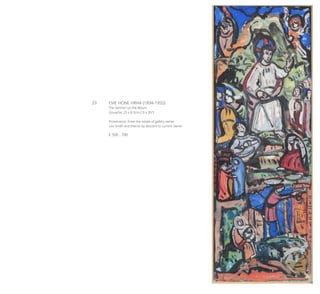
29	 EVIE HONE HRHA (1894-1955)
The Sermon on the Mount
Gouache, 25 x 8.5cm (10 x 3½’’)
Provenance: From the estate of gallery owner
Leo Smith and thence by descent to current owner.
€ 500 - 700
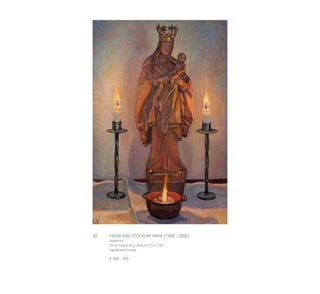
30	 HILDA VAN STOCKUM HRHA (1908 - 2006)
Madonna
Oil on board, 43 x 28.5cm (17 x 11¼”)
Signed with initials
€ 500 - 700
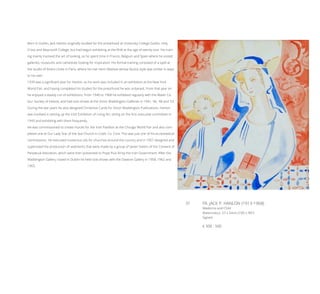
31	 FR. JACK P. HANLON (1913-1968)
Madonna and Child
Watercolour, 27 x 24cm (10½ x 9½”)
Signed
€ 300 - 500
Born in Dublin, Jack Hanlon originally studied for the priesthood at University College Dublin, Holy
Cross and Maynooth College, but had begun exhibiting at the RHA at the age of twenty-one. His train-
ing mainly involved the art of looking, as he spent time in France, Belgium and Spain where he visited
galleries, museums and cathedrals looking for inspiration. His formal training consisted of a spell at
the studio of Andre Lhote in Paris, where he met Henri Matisse whose fauvist style was similar in ways
to his own.
1939 was a significant year for Hanlon, as his work was included in an exhibition at the New York
World Fair, and having completed his studies for the priesthood he was ordained. From that year on
he enjoyed a steady run of exhibitions. From 1940 to 1968 he exhibited regularly with the Water Co-
lour Society of Ireland, and had solo shows at the Victor Waddington Galleries in 1941, ’46, ’48 and ’53.
During the war years he also designed Christmas Cards for Victor Waddington Publications. Hanlon
was involved in setting up the Irish Exhibition of Living Art, sitting on the first executive committee in
1943 and exhibiting with them frequently.
He was commissioned to create murals for the Irish Pavillion at the Chicago World Fair and also com-
pleted one at Our Lady Star of the Sea Church in Cobh, Co. Cork. This was just one of his ecclesiastical
commissions. He executed numerous oils for churches around the country and in 1957 designed and
supervised the production of vestments that were made by a group of seven Sisters of the Convent of
Perpetual Adoration, which were then presented to Pope Pius XII by the Irish Government. After the
Waddington Gallery closed in Dublin he held solo shows with the Dawson Gallery in 1958, 1962 and
1965.
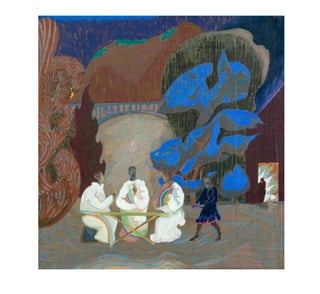
32	 PATRICK PYE RHA (B.1929)
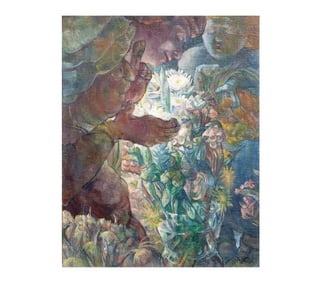
Three Angels Appear to Abraham
Oil and tempera on board, 62.5 x 60cm (24½ x 23½’’)
€ 2,000 - 3,000
Patrick Pye was born in England but grew up in Dublin. He started painting in 1943 under the sculptor Oisin Kelly, and later studied at
the National College of Art. In 1957 he won the Mainie Jellett Scholarship, which enabled him to travel extensively in Europe. It was
while on visit to the National Museum in Barcelona that he became influenced by Romanesque Catalan art, and this turned his attention
to Christian iconography. He also studied stained glass at the Jan Van Eyck Academy in Holland under Alberrt Troost.
Patrick Pye has completed many major commissions on religious themes, including those at Glenstal Abbey, Co. Limerick; Church of
the Ressurrection, Belfast; Convent of Mercy, Cookstown, Co.Tyrone; and Fossa chapel, Killarney. A triptych illustrating man’s expulsion
from the Garden of Eden hangs at Bank of Ireland headquaters on Baggot Street in Dublin, and he made the Stations of the Cross for
Ballycasheen church in Killarney.
Pye’s faith has provided an underlying context for most of his work, although this is not always evident. In 2005 Pye was awarded a D.Phil
by Maynooth University. He is founding member of Aosdana, of which he became a member in 1981. He lives and works in Tallaght,
Dublin.
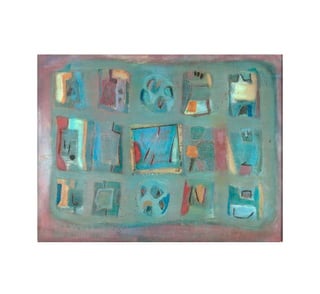
33	 TONY O’MALLEY HRHA (1913 - 2003)
The Field History Callan
Mixed media on board, 91 x 120cm (35¾ x 47¼”)
Signed, inscribed and dated June 1979
Full complete work verso
Field History Callan is one of many paintings in which Tony O’Malley celebrated the richness of his natural surroundings in Callan.
Callan was his birthplace and the place where he grew up. Although living in Cornwall where he formed part of the St Ives group, with
Patrick Heron, Peter Lanyon and Terry Frost in the 1960s, 70s and 80s, he returned there every summer with his wife Jane. This signed
and dated work was found on the reverse of another painting, not untypical of O’Malley during this period of his life when he was
often obliged to paint on both sides of whatever ground, cardboard, burlap or hardboard, was available to him. Thus there are even
paintings by him to be found on the reverse of discarded, cut-up boards previously used by other artists, notably Breon O’Casey and,
at least once, on board used by Francis Bacon.
The painting, Field History Callan is made up of a series of small panels - another trope of O’Malley’s, often created by gluing pages from
a sketch book onto his board and painting over the final arrangement to give them unity and coherence. Here the painted forms come
straight out of his deep understanding of the ceaseless activity of the fields in summer, the rustle of grasses as small animals and
insects carry out their daily routines, the sounds and movements of different birds, together with tantalising glimpses of the creatures
themselves. However nature was not the only source of inspiration for this and much of O’Malley’s work about Callan and County
Kilkenny. The proliferation of archaeological remains from prehistory as well as more recent history from the medieval Norman pres-
ence in the area inspired his brush and his imagination too and there are forms in this painting that could be the outlines of the floors
of ancient monasteries, vying for position with the paw marks of a badger or some other wild creature.
The overlying, cool, grey palette gives an impression of philosophical detachment when compared to the harsher clarities of his earlier
Irish landscapes and with the explosion of colours that were to dominate his work in the 1980s. It connects this work to a number of
paintings about Kilkenny’s history which also date from this time, and acts like a veil, separating past and present.
Painted in 1979, this work comes one year after George McClelland had agreed to act as O’Malley’s agent and while that arrangement
did not last long, it was to plunge the artist into a round of exhibitions and publicity over the next decade that transformed his reputa-
tion and his career, and enabled him to return to live, permanently outside Callan, which he did until his death in 2003.
Catherine Marshall
February 2016
€ 15,000 - 20,000
Image of picture verso
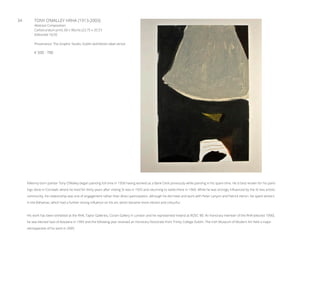
34	 TONY O’MALLEY HRHA (1913-2003)
Abstract Composition
Carborundum print, 60 x 90cms (23.75 x 35.5”)
Editioned 16/35
Provenance: The Graphic Studio, Dublin (exhibition label verso)
€ 500 - 700
Kilkenny born painter Tony O’Malley began painting full time in 1958 having worked as a Bank Clerk previously while painting in his spare time. He is best known for his paint-
ings done in Cornwall, where he lived for thirty years after visiting St Ives in 1955 and returning to settle there in 1960. While he was strongly influenced by the St Ives artistic
community, his relationship was one of engagement rather than direct participation, although he did meet and work with Peter Lanyon and Patrick Heron. He spent winters
in the Bahamas, which had a further strong influence on his art, which became more vibrant and colourful.
His work has been exhibited at the RHA, Taylor Galleries, Coram Gallery in London and he represented Ireland at ROSC ‘80. An honorary member of the RHA (elected 1990),
he was elected Saoi of Aosdana in 1993 and the following year received an Honorary Doctorate from Trinity College Dublin. The Irish Museum of Modern Art held a major
retrospective of his work in 2005.
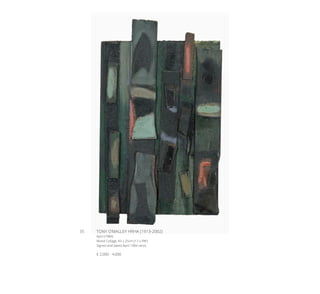
35	 TONY O’MALLEY HRHA (1913-2002)
April (1984)
Wood Collage, 43 x 25cm (17 x 9¾’’)
Signed and dated April 1984 verso
€ 2,000 - 4,000
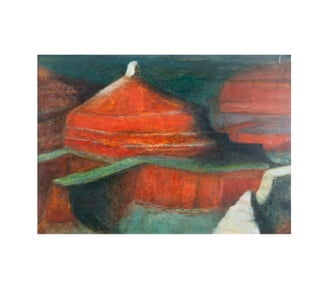
36	 GWEN O’DOWD (B.1957)
Grand Canyon Series (1994)
Oil on card, 70 x 99.5cm (27½ x 39¼”)
Signed, inscribed and dated verso
Gwen O’Dowd, born in Dublin in 1957 is one of Ireland’s foremost contemporary artists. She has received many awards and prizes and is a
member of Aosdana. She is represented by Hillsboro Fine Art in Dublin, (www.hillsborofineart.com).
Medb Ruane writing of O’Dowd’s paintings in her Grand Canyon series, in ‘Time of Shaking, Art for Amnesty,’ (Irish Museum of Modern Art),
notes: “O’Dowd creates her visual encounters by working through surface details from a series of structural planes which both organise the
composition and toughen up the two-dimensional limits of the canvas. She sections these planes like an architectural anatomist, sometimes
making transverse slices, sometimes cutting downwards from sky to bedrock. ...Close up, her use of mediums with oil, textures the surfaces
so that they have both a craggy feel and a pointed sense of a landscape where nothing is ever still.”
“Her formal concerns have always been rooted deeply in the tradition of landscape painting, yet the specific locales from which she has drawn
inspiration, the modes of addressing them, and the metaphoric import of the resulting series of paintings have varied considerably over the
years. Among the aspects of the landscape O’Dowd has registered over the past decade are the ecological devastation of the Gulf War, the
epic grandeur of the Grand Canyon and, most recently, the mythically sexualised landscape of rural Ireland.”
€ 2,000 - 3,000
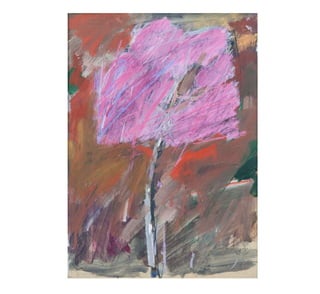
37	 BASIL BLACKSHAW HRHA RUA (B.1932)
Tree (2)
Oil and mixed media on board, 40.5 x 30.5cm (16 x 12’’)
Signed and inscribed with title verso
€ 1,000 - 2,000
Basil Blackshaw was born in Co. Antrim but brought up in Co. Down, and studied at Belfast College of Art, where he received a
scholarship that enabled him to travel to Paris for further study in 1951. His upbringing brought him close one of his favoured
subjects – loose yet evocative equine scenes are prominent in his oeuvre. A major retrospective of Blackshaws work was held
in 1974 at the Arts Council Gallery in Belfast, and another in 1995 was organised by the Arts Council of Northern Ireland. The
latter was exhibited at the Ormeau Baths, Royal Hibernian Academy, Crawford Municipal Gallery, and a selection of the works
travelled to the United States for a further tour. More recently a retrospective was held at The Fenton Gallery in Cork (2005).
He is a member of Aosdána, RUA and Associate Member of the RHA. His works can be found in the collections of the Irish
Museum of Modern Art, Ulster Museum, University College Cork, Trinity College Dublin, University of Ulster, AIB, and Bank of
Ireland
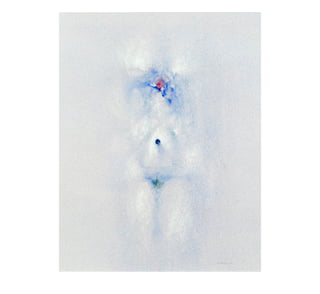
38	 LOUIS LE BROCQUY HRHA (1916-2012)
Being (W1459)
Watercolour, 64 x 49cm (23½ x 18½’’)
Signed and dated (19)’98
Provenance: With the Taylor Galleries, Dublin (label verso)
€ 10,000 - 15,000
A self taught artist, Louis le Brocquy was born in Dublin and abandoned his job working in a lab in 1938 to pursue a career in painting. In 1947 le Brocquy
moved to London which was to be his base for the next ten years, and showed his work in Paris, New York and Italy. He married Anne Madden in 1958 and
began dividing his time between France and Ireland.
Considered the most important Irish artist of the second half of the 20th Century, a progression of styles comparable to that of Picasso is apparent in le
Brocquy’s paintings. He has played a significant role in the Irish art world, helping to found the Irish Exhibition of Living Art in 1943, and receiving two honorary
doctorates – one from Trinity College and the other from University College Dublin. A multitalented artist, he is also known for his tapestries, prints and illus-
trations, and has received international acclaim with retrospectives held in France, Spain, Japan, Australia and the US.
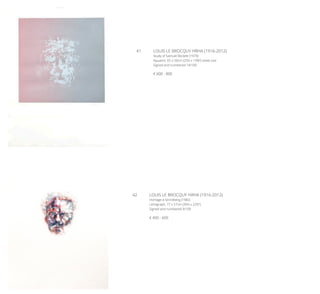
41	 LOUIS LE BROCQUY HRHA (1916-2012)
Study of Samuel Beckett (1979)
Aquatint, 65 x 50cm (25½ x 19¾”) sheet size
Signed and numbered 14/100
€ 600 - 800
42	 LOUIS LE BROCQUY HRHA (1916-2012)
Homage à Strindberg (1982)
Lithograph, 77 x 57cm (30¼ x 22½”)
Signed and numbered 9/100
€ 400 - 600
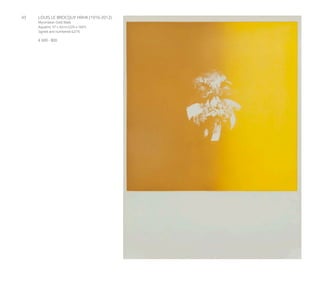
43	 LOUIS LE BROCQUY HRHA (1916-2012)
Mycenaean Gold Mask
Aquatint, 57 x 42cm (22½ x 16½’’)
Signed and numbered 62/75
€ 600 - 800
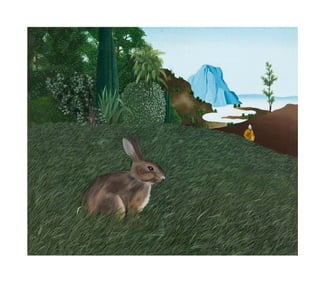
44	 MARTIN GALE RHA (B.1949)
Looking for the Lost dog
Oil on canvas, 76 x 91.5cm (30 x 36”)
Inscribed with title verso
Original Artist’s label giving title “The Lost Dog”
€ 3,000 - 5,000
English born Martin Gale moved to Ireland as a child and studied in Dublin at the National College of Art. His first solo show came just two
years after he graduated and was held at the Neptune Gallery in Dublin in 1975. In 1980 Gale represented Ireland at the XI Biennale de Paris,
Nice, Lisbon, Finland, and had a solo show at the Taylor Galleries where he has continually exhibited since. Gale is a member of Aosdána and
was elected a member of the RHA in 1996. A major retrospective of his work was held at the Academy’s Gallagher Gallery in 2004, moving to
the Ulster Museum in Belfast the following year. His landscapes are a unique take on the tradition of photo-realism, and most often it is the
contemporary figures occupying them that are the true subject of his work.
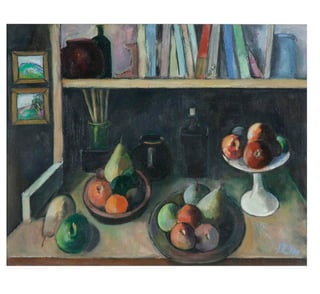
45	 PETER COLLIS RHA (1929-2012)
Studio Still Life
Oil on canvas on board, 48.5 x 58.5 cm (19 x 23’’)
Signed
Provenance: With Solomon Gallery, Dublin
€ 2,000 - 4,000
Born in London in 1929, Peter Collis studied drawing and painting at Epsom College of Art between 1949 and 1952. He moved to Ireland in 1969
working for the Shell Oil company. His canvasses are characterised by a powerful and dramatic style influenced by masters such as Paul Cezanne,
whom he adored, and Maurice de Vlaminck. In contrast to the traditional realistic depictions of the Irish countryside, Collis employed a bold brush
and brought a strong expressive energy to his landscapes.
He was particularly fond of Killiney, and its bay, and of the Wicklow countryside. The Sugar Loaf mountain became a familiar motif in his work. He
also composed striking still lifes, of groups of green pears and vivid red apples, with a distinctive European quality.
In 1990, he was elected a full member of the Royal Hibernian Academy, having first exhibited there in 1971. He also exhibited regularly at the
Royal Academy Summer show in London. In Dublin, Collis was represented by the Solomon Gallery in Dublin and by the John Martin Gallery in
London. He died in 2012.
His paintings are found in many public collections, including those of AIB, Bank of Ireland, Limerick University, University College Dublin, the Office
of Public Works and in many private collections.
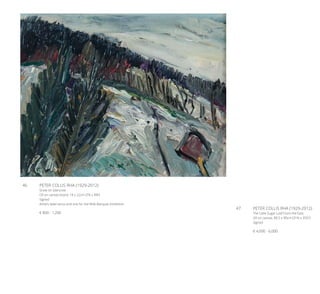
46	 PETER COLLIS RHA (1929-2012)
Snow on Glencree
Oil on canvas board, 18 x 22cm (7¼ x 8¾’’)
Signed
Artist’s label verso and one for the RHA Banquet Exhibition
€ 800 - 1,200
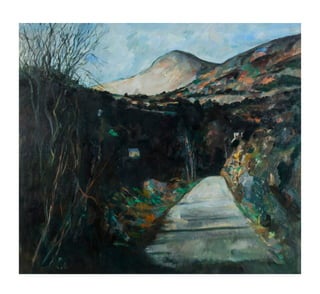
47	 PETER COLLIS RHA (1929-2012)
The Little Sugar Loaf From the East
Oil on canvas, 80.5 x 90cm (31¾ x 35½”)
Signed
€ 4,000 - 6,000
48	 JACK BUTLER YEATS RHA (1871-1957)
Man Reading (1945)
Oil on panel, 23 x 36cm (9 x 14’’)
Signed, also inscribed verso
Provenance: Private Collection, purchased directly from Victor Waddington Gallery, Dublin.
Literature: Pyle, Hilary, Jack B. Yeats - A Catalogue Raisonne of the Oil Paintings No.719.
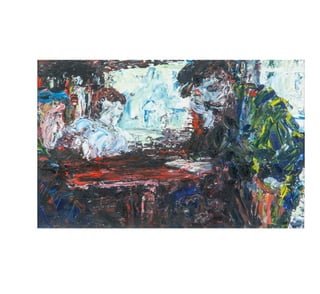
Man Reading depicts a scene of quiet contemplation in a public house in the middle of the day. Three oddly congenial companions
stand at the bar. A view of the empty street outside and the semi-circular shaped fanlights of its Georgian doorways are clearly
discernible. One of the men stands reading with his hand in his pocket. His other hand supports his head as he gazes in close
concentration at the pages of his book. The barmaid and another customer look on, each lost in their own thoughts.
The theme of the public house was a recurring one in Jack Yeats’s work and as Hilary Pyle has noted ‘bartenders were as inter-
esting to him as the people drinking in the pubs’. In this work the barmaid appears suitably sympathetic and aloof allowing her
customers to enjoy their solitude. The way in which the work is constructed is deliberately at odds with its calm subject. Its vigour
and complexity intensifies the sense of silence that pervades the picture. The cold blue light that emanates from the window sev-
ers the composition transforming the woman into a pale ghostlike figure. Her pallor contrasts with the strong red of the counter
and the cacophony of colours that make up the profile of the man on the left and the jacket and trousers of the reader. Flecks
of strong reds, yellows, blues and pinks bring vibrancy and immediacy to this vista of repose. The counter acts both as a physical
barrier between the three and as a symbol of the emotional neutrality provided by the commercial premises in which they have
come together. The dominant form of the window can be read as an allusion both to the outside world and to the inner thoughts
and concerns of the figures.
In the mid 1920s Yeats painted a number of pub interiors including The Railway Bar (1924, Private Collection) and The Bar (1925,
Private Collection). In the mid 1940s he returned to the subject with this work and several others such as Bartender Reading a Letter
(1943, Private Collection) and The Quiet Man (1943, Private Collection). The latter, like Man Reading, are daytime scenes in which
both staff and customers enjoy the tranquil and peaceful ambiance of a deserted pub. The emphasis is not on drinking but on the
dark cool interior of this liminal space that is both public and intensely private. Like other features of modernity such as the railway
carriage, the theatre, the tram and the shop, the public house allowed Yeats the opportunity of observing his fellow men and
women engaged in the informal rituals of social interaction associated with such spaces. For Yeats and clearly for the figures in
this painting, a pub was not a place to get drunk in, but a refuge where one could think, read or converse and while away an hour
or two in a hospitable atmosphere.
Dr.Roisin Kennedy
February 2016
€ 60,000 - 90,000
49	 JACK BUTLER YEATS RHA (1871 - 1957)
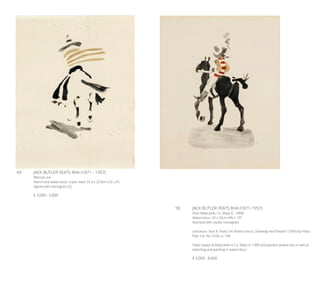
Mexican Joe
Stencil and watercolour, a pair, each 25.4 x 22.8cm (10 x 9”)
Signed with monogram (2)
€ 3,000 - 5,000
50	 JACK BUTLER YEATS RHA (1871-1957)
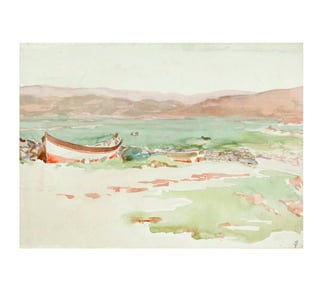
Near Ballycastle, Co. Mayo (C. 1909)
Watercolour, 24 x 33cm (9¾ x 13’’)
Stamped with studio monogram
Literature: “Jack B. Yeats: His Watercolours, Drawings And Pastels” (1993) by Hilary
Pyle. Cat. No. 652b, p. 158
Yeats stayed at Ballycastle in Co. Mayo in 1909 and painted several oils as well as
sketching and painting in watercolour.
€ 5,000 - 8,000
51	 JACK BUTLER YEATS RHA (1871-1957)
The Well (1921)
Oil on panel, 23 x 35.5cm (9 x 14”)
Signed
Exhibited:
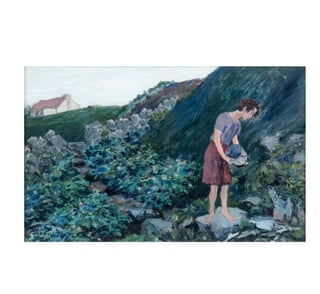
’2nd Annual Exhibition’, The Society of Dublin Painters, April 1921
‘Jack B Yeats Exhibition ‘Paintings of Irish Life’ Gieves Art Gallery London 7th-18th January 1924, Cat No 33.
‘9th Annual Exhibition’ The Society of Independent Artists, New York, 1925
‘Jack B Yeats Exhibition’ Victor Waddington Galleries, London, 8th-31st March 1973, Cat No. 2
Literature: Hilary Pyle ‘Jack B Yeats’ - A catalogue raisonné of the oil paintings, London, 1992, p.130 Cat No. 149, illustrated.
The period around which this work was painted was one of increased output and strength of subject matter. Yeats’ major works of this period
include “Singing the Dark Rosaleen”, “A Westerly Wind”, “The Circus” and “The Island Funeral”.
In 1921, the year of the present work, Yeats was travelling about the West of Ireland and in particular Co. Galway and Co. Sligo which in all likely-
hood is the location for the well.
Hilary Pyle has written:
A young girl with bare feet has come along a hilly path through a gap in the stone wall from the cottage seen on the brow of the slope in the back-
ground. She stands on a large stone to the right of the painting, about to let a tin can down into the water. The scene is a simple one, the rocky
ground with its weedy vegetation, and the broken light of a typical Irish day, described realistically; yet the ritualistic pose and gesture of the girl
seem to anticipate the metaphorical paintings of the 1940s with their theme of water and its spiritual significance.
€ 40,000 - 60,000
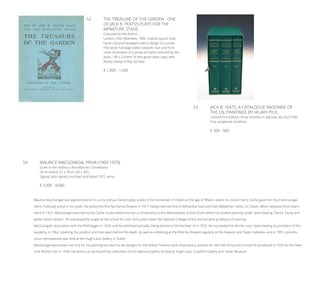
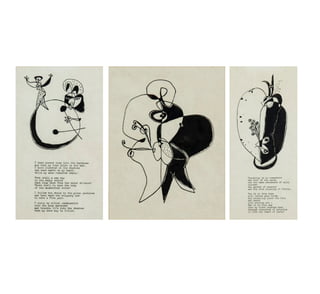
52	 THE TREASURE OF THE GARDEN. ONE
OF JACK B. YEATS’S PLAYS FOR THE
	 MINIATURE STAGE.
Coloured by the Author.
London, Elkin Mathews, 1902, original quarto blue
hand-coloured wrappers with a design of a pirate.
The seven full-page plates towards rear and front
cover illustration of a pirate all hand-coloured by the
artist, 190 x 224mm. A very good clean copy, with
library stamp of Ray Da Silva.
€ 1,000 - 1,500
53	 JACK B. YEATS: A CATALOGUE RAISONNE OF
THE OIL PAINTINGS BY HILARY PYLE,
Limited First Edition, three volumes in slipcase, No.262/1500.
Fine unopened condition.
€ 300 - 500
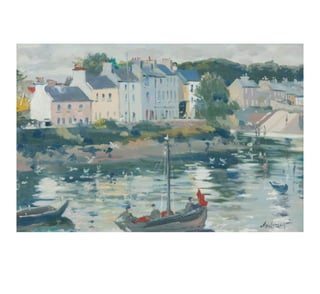
54	 MAURICE MACGONIGAL PRHA (1900-1979)
Quiet in the Harbour, Roundstone, Connemara
Oil on board, 51 x 76cm (20 x 30’’)
Signed, also signed, inscribed and dated 1972 verso
€ 5,000 - 8,000
Maurice MacGonigal was apprenticed to his uncle Joshua Clarke’s glass studio in his hometown of Dublin at the age of fifteen, where his cousin Harry Clarke gave him much encourage-
ment. Politically active in his youth, he joined the first Na Fianna Éireann in 1917, being interned first in Kilmainhal Gaol and then Ballykinlar Camp, Co. Down. When released from intern-
ment in 1921, MacGonigal returned to the Clarke studio before he won a scholarship to the Metropolitan School of Art where he studied painting under Sean Keating, Patrick Touhy and
James Sinton Sleator. He subsequently taught at the school for over thirty years (later the National College of Art) and became professor of painting.
MacGonigal’s association with the RHA began in 1924, and he exhibited annually, being elected a full member of in 1933. He succeeded his former tutor Sean Keating as president of the
academy in 1962, retaining the position until two years before his death. As well as exhibiting at the RHA he showed regularly at the Dawson and Taylor Galleries, and in 1991 a posthu-
mous retrospective was held at the Hugh Lane Gallery in Dublin.
MacGonigal was known not only for his painting but also his set designs for the Abbey Theatre, book illustrations, posters for the Irish Army and a mural he produced in 1939 for the New
York World’s Fair in 1939. His works can be found the collections of the National Gallery of Ireland, Hugh Lane, Crawford Gallery and Ulster Museum
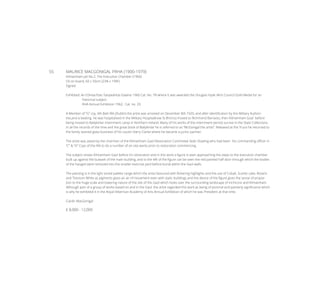
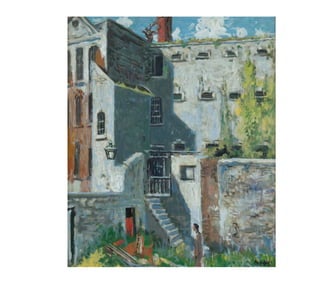
55	 MAURICE MACGONIGAL PRHA (1900-1979)
Kilmainham Jail No.2. The Execution Chamber (1960)
Oil on board, 60 x 50cm (23¾ x 19¾’’)
Signed
Exhibited: An tOireachtas Taispeántas Ealaíne 1960 Cat. No. 78 where it was awarded the Douglas Hyde /Arts Council Gold Medal for an 		
	 historical subject.
	 RHA Annual Exhibition 1962; Cat. no. 20.
A Member of “G” coy, 4th.Batt IRA (Dublin) the artist was arrested on December 8th.1920, and after identification by the Military Authori-
ties,and a beating he was hospitalised in the Military Hospital(now St.Brícins) moved to Richmond Barracks, then Kilmainham Goal before
being moved to Ballykinlar internment camp in Northern Ireland. Many of his works of the internment period survive in the State Collections.
In all the records of the time and the great book of Ballykinlar he is referred to as “McGonigal the artist”. Released at the Truce he returned to
the family stained glass business of his cousin Harry Clarke where he became a junior partner.
The artist was asked by the chairman of the Kilmainham Gaol Restoration Committee Seán Dowling who had been his commanding officer in
“C” & “G” Coys of the IRA to do a number of on site works prior to restoration commencing.
The subject shows Kilmainham Gaol before it’s restoration and in this work a figure is seen approaching the steps to the execution chamber
built up against the bulwark of the main building, and to the left of the figure can be seen the red painted half door through which the bodies
of the hanged were removed into the smaller exercise yard before burial within the Gaol walls.
The painting is in the light toned palette range which the artist favoured with flickering highlights and the use of Cobalt, Scarlet Lake, Alizarin
and Titanium White as pigments gives an air of movement even with static buildings and the device of the figure gives the sense of propor-
tion to the huge scale and towering nature of the site of the Gaol which looks over the surrounding landscape of Inchicore and Kilmainham.
Although part of a group of works based on and in the Gaol, the artist regarded this work as being of pictorial and painterly significance which
is why he exhibited it in the Royal Hibernian Academy of Arts Annual Exhibition of which he was President at that time.
Ciarán MacGonigal
€ 8,000 - 12,000
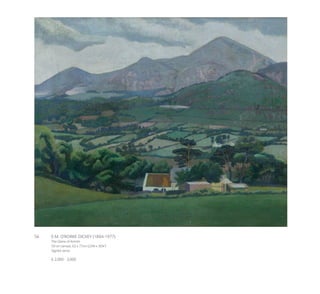
56	 E.M. O’RORKE DICKEY (1894-1977)
The Glens of Antrim
Oil on canvas, 63 x 77cm (23¾ x 30¼’’)
Signed verso
€ 2,000 - 3,000
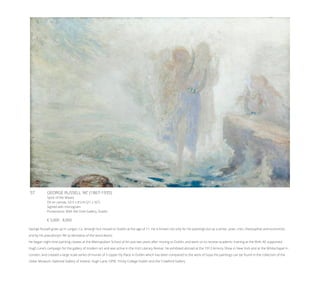
57	 GEORGE RUSSELL ‘AE’ (1867-1935)
Spirit of the Waves
Oil on canvas, 53.5 x 81cm (21 x 32’’)
Signed with monogram
Provenance: With the Oriel Gallery, Dublin
€ 5,000 - 8,000
George Russell grew up in Lurgan, Co. Amargh but moved to Dublin at the age of 11. He is known not only for his paintings but as a writer, poet, critic, theosophist and economist,
and by his pseudonym ‘AE’ (a derivative of the word Aeon).
He began night time painting classes at the Metropolitan School of Art just two years after moving to Dublin, and went on to receive academic training at the RHA. AE supported
Hugh Lane’s campaign for the gallery of modern art and was active in the Irish Literary Revival. He exhibited abroad at the 1913 Armory Show in New York and at the Whitechapel in
London, and created a large scale series of murals of 3 Upper Ely Place in Dublin which has been compared to the work of Goya.His paintings can be found in the collection of the
Ulster Museum, National Gallery of Ireland, Hugh Lane, OPW, Trinity College Dublin and the Crawford Gallery.
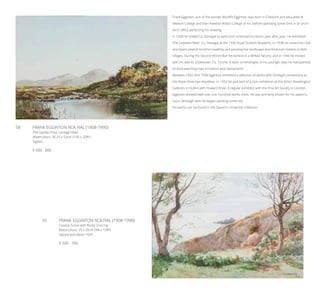
58	 FRANK EGGINTON RCA FIAL (1908-1990)
The Garden Pool, Lackagh River
Watercolour, 36.25 x 53cm (14¼ x 20¾’’)
Signed
€ 600 - 800
59	 FRANK EGGINTON RCA FIAL (1908-1990)
Coastal Scene with Rocky Outcrop
Watercolour, 25 x 35cm (9¾ x 13¾’’)
Signed and dated 1929
€ 500 - 700
	
Frank Egginton, son of the painter Wycliffe Egginton, was born in Cheshire and educated at
Newton College and then Newton Abbot College of Art, before spending some time in an archi-
tect’s office perfecting his drawing.
In 1930 he visited Co. Donegal to paint and continued to return year after year. He exhibited
The Calabber River, Co. Donegal at the 1936 Royal Scottish Academy. In 1938 he visited the USA
and spent several months travelling and painting the landscape and American Indians in their
villages. During the Second World War he worked in a Belfast factory, and in 1946 he moved
with his wife to Cookstown, Co. Tyrone. A keen ornithologist, in his younger days he had painted
on bird-watching trips in Iceland and Switzerland.
Between 1932 and 1938 Egginton exhibited a selection of works with Donegal connections at
the Royal Hibernian Academy. In 1952 he was part of a joint exhibition at the Victor Waddington
Galleries in Dublin with Howard Knee. A regular exhibitor with the Fine Art Society in London,
Egginton showed well over one hundred works there. He was primarily known for his waterco-
lours, although later he began painting some oils.
His works can be found in the Queen’s University collection.
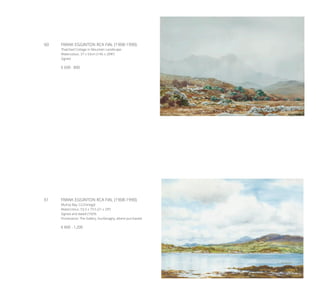
60	 FRANK EGGINTON RCA FIAL (1908-1990)
Thatched Cottage in Mountain Landscape
Watercolour, 37 x 53cm (14½ x 20¾’’)
Signed
€ 600 - 800
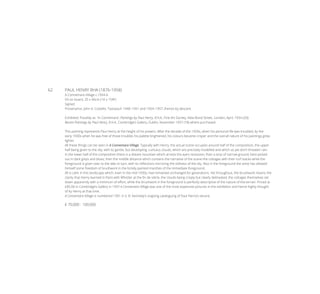
61	 FRANK EGGINTON RCA FIAL (1908-1990)
Mulroy Bay, Co.Donegal
Watercolour, 53.5 x 73.5 (21 x 29’’)
Signed and dated (19)76
Provenance: The Gallery, Dunfanaghy, where purchased.
€ 800 - 1,200
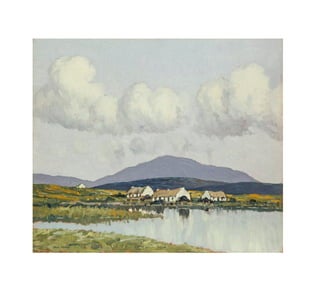
62	 PAUL HENRY RHA (1876-1958)
A Connemara Village c.1934-6
Oil on board, 35 x 40cm (14 x 15¾”)
Signed
Provenance: John A. Costello, Taoiseach 1948–1951 and 1954–1957, thence by descent.
Exhibited: Possibly as ‘In Connemara’: Paintings by Paul Henry, R.H.A., Fine Art Society, New Bond Street, London, April, 1934 (20);
Recent Paintings by Paul Henry, R.H.A., Combridge’s Gallery, Dublin, November 1937 (18) where purchased.
This painting represents Paul Henry at the height of his powers. After the decade of the 1920s, when his personal life was troubled, by the
early 1930s when he was free of those troubles his palette brightened, his colours became crisper and the overall nature of his paintings grew
lighter.
All these things can be seen in A Connemara Village. Typically with Henry, the actual scene occupies around half of the composition, the upper
half being given to the sky, with its gentle, but developing, cumulus clouds, which are precisely modelled and which as yet don’t threaten rain.
In the lower half of the composition there is a distant mountain which arrests the eye’s recession; then a strip of narrow ground, here picked
out in dark greys and blues; then the middle distance which contains the narrative of the scene-the cottages with their turf stacks-while the
foreground is given over to the lake or tarn, with its reflections mirroring the stillness of the sky. Also in the foreground the artist has allowed
himself some freedom of brushwork in the briskly painted marshes of the immediate foreground.
All is calm in this landscape which, even in the mid-1930s, had remained unchanged for generations. Yet throughout, the brushwork retains the
clarity that Henry learned in Paris with Whistler at the fin de siècle, the clouds being crisply but clearly delineated, the cottages themselves set
down apparently with a minimum of effort, while the brushwork in the foreground is perfectly descriptive of the nature of the terrain. Priced at
£85.00 in Combridge’s Gallery in 1937 A Connemara Village was one of the most expensive pictures in the exhibition and hence highly thought
of by Henry at that time.
A Connemara Village is numbered 1301 in S. B. Kennedy’s ongoing cataloguing of Paul Henry’s oeuvre.
€ 70,000 - 100,000
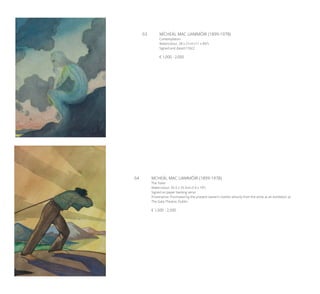
63	 MÍCHEÁL MAC LIAMMÓIR (1899-1978)
Contemplation
Watercolour, 28 x 21cm (11 x 8¼’’)
Signed and dated (19)22
€ 1,000 - 2,000
64	 MCHEÁL MAC LIAMMÓIR (1899-1978)
The Toiler
Watercolour, 35.5 x 25.3cm (14 x 10’’)
Signed on paper backing verso
Provenance: Purchased by the present owner’s mother directly from the artist at an exhibition at
The Gate Theatre, Dublin.
€ 1,500 - 2,500
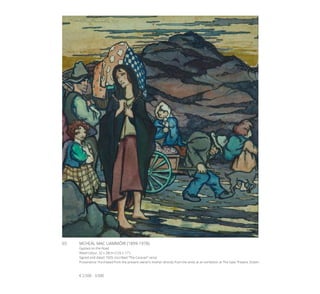
65	 MCHEÁL MAC LIAMMÓIR (1899-1978)
Gypsies on the Road
Watercolour, 32 x 28cm (12½ x 11’’)
Signed and dated 1929, inscribed “The Caravan” verso
Provenance: Purchased from the present owner’s mother directly from the artist at an exhibition at The Gate Theatre, Dublin.
€ 2,500 - 3,500
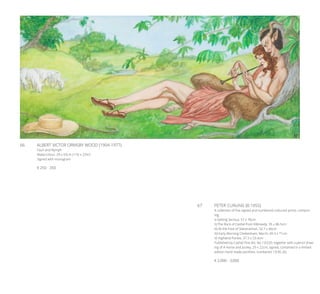
66	 ALBERT VICTOR ORMSBY WOOD (1904-1977)
Faun and Nymph
Watercolour, 29 x 65cm (11½ x 25½’’)
Signed with monogram
€ 250 - 350
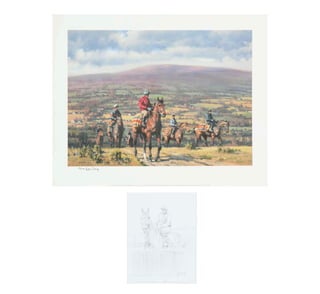
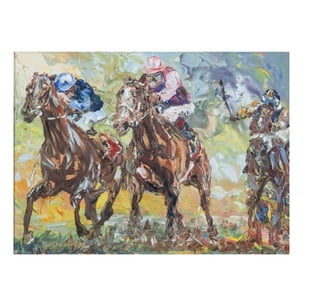
67	 PETER CURLING (B.1955)
A collection of five signed and numbered coloured prints, compris-
ing:
I) Getting Serious, 57 x 76cm
II) The Rock of Cashel from Kilbreedy, 35 x 86.5cm
III) At the Foot of Slievenamon, 52.7 x 66cm
IV) Early Morning Cheltenham, March, 49.3 x 71cm
V) Highland Ponies, 37.3 x 53.4cm
Published by Cashel Fine Art, No.13/220; together with a pencil draw-
ing of A Horse and Jockey, 29 x 22cm, signed, contained in a limited
edition hand made portfolio, numbered 13/30. (6)
€ 2,000 - 3,000
68	 WILLIAM CONOR RHA PRUA OBE (1884-1968)
The Sulky Child
Wax Crayon on Paper, 47.5 x 34 cm (18¾ x 13½”)
Signed
Provenance: With The Bell Gallery (label verso)
€ 2,000 - 3,000
William Conor was born in Belfast and studied graphic design at the Government School of Design and was then apprenticed to a poster
designer. He exhibited at the RHA for the first time in 1918 and continued to do so until the year before his death. During both World Wars
Conor was commissioned by the British Government to produce records of soldiers in the form of sketches, some of which were included
in an exhibition of war artists at the National Gallery of London in 1941.
He spent a number of years in London in the 1920s where he met Sir John Lavery and Augustus John, and in 1926 travelled to America to
undertake various portrait commissions. Conor was the first Irishman to become a member of the Royal Institute of oil painters. He was a
founder member of Ulster Academy (later the RUA) and was president from 1957 to 1964. He was elected RHA in 1947 and awarded the
OBE in 1952.
His works can be found in major collections including the Ulster Museum, Hugh Lane Municipal Gallery, Crawford Municipal Gallery, Impe-
rial War Museum in London, The Victoria and Albert Museum in London and the Brooklyn Museum in New York.
69	 RODERIC O’CONOR (1860 - 1940)
Nu Brun, Assis (1913)
Oil on canvas, 65 x 54cm (25½ x 21¼”)
Signed and dated (19)13
Atelier stamp verso
Exhibited: “Roderic O’Conor - Shades of a Master”, The Hunt Museum, June - Aug 2003, Cat No. 19
Provenance: Hotel Drovot, Paris ‘Vente O’Conor’ Feb 1956; Sotheby’s London 2/11/1983 Lot 72 where
purchased by current owners
Literature: “Roderic O’Connor” (1992) by Jonathan Benington Cat. No. 164; “Shades of a Master” Hunt
Museum 2003 (illustrated)
Nora Hickey writing in “Shades of a Master” (2003) said of this picture:- “The influence of Gauguin and
the Fauves is apparent in the accentuated outline of this studio nude and the broad directional brush-
strokes of the background, which recall O’Conor’s earlier feathered brushwork and striped paintings.
The sorrowful expression, a common feature of O’Conor’s nudes and sympathetic treatment of the
subject invite the viewer to empathise with the sitter.”
O’Conor was friendly with Gauguin and included a work called “Te nave nave fenua” (Delightful land)
amongst his important art collection which also included works by Renoir, Derain, Bonnard, Manet,
Toulouse-Lautrec and Modigliani amongst many of the other greats. He was not only a great collector
but “he was an innovator who had significant influence on his contemporaries and a younger generation
of English artists in Paris such as the painter Matthew Smith who referred to O’Conor as his master”.
€ 8,000 - 12,000
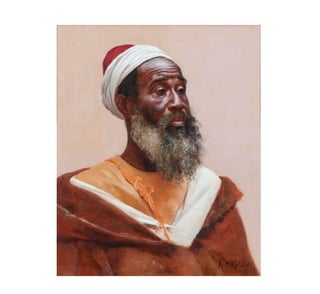
70	 ALOYSIUS O’KELLY (1853-1936)
Lord Of The Suns
Oil on canvas, 55 x 46cm (21¼ x 18’’)
Signed
Provenance: Important Irish Art Sale, These Rooms 1st April 2009. Cat. No. 58.
Where purchased by current owner.
Litarature: “Aloysius O’Kelly; Art, Nation, Empire” 2010 by Niamh O’Sullivan. Cat.
No. 54.
€ 3,000 - 5,000
Aloysius O’Kelly was born in Dublin but moved to London at a young age. In 1874 he became one of the first Irish artists to study at the École des Beaux-Arts in Paris,
where he received his training from Orientalist painter Jean-Léon Gérome and Léon Bonnall. O’Kelly was also one of the initial Irish artists to spend time painting in
Brittany, where he met Jules Bastien-Lepage.
During the 1880s he was appointed specialist artist to the Illustrated London News, and travelled around Ireland as a political illustrator highlighting the Land League.
O’Kelly is possibly best known for his painting depicting Northern African scenes – a popular subject among European Romantic painters. In an unusual move, O’Kelly
emigrated to New York in 1895 and changed his name to Arthur Oakley. Following this he continued to visit and exhibit in France, as well as in Chicago, Milwaukee
and New York where he was a member of the Watercolour Club.
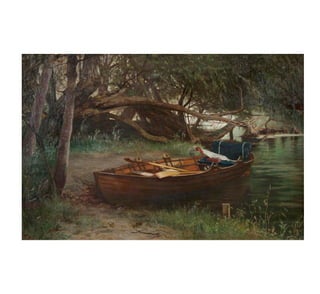
71	 AUGUSTUS NICHOLAS BURKE RHA (1839-1891)
A Study on the Thames
Oil on canvas, 61.5 x 92cm (24¼ x 36¼”)
Signed, Inscribed verso
Exhibited: Dublin RHA 1880 NO.201
Born in Knocknagur, Co Galway, the son of William Burke and his wife Fanny, only daughter of Thomas Tucker of Sussex. Educated
mostly in London, Burke began his artistic career there and from 1863 exhibited at the Royal Academy where he continued to show
his work until his untimely death at the age of 53. Walter Strickland notes that in 1869 he took up residence in Dublin with his wife
Dottie, living first at No. 2 Leinster Street and later at No. 6, St. Stephen’s Green. He was elected an Associate of the Royal Hibernian
Academy in July 1871 and a Member in August that same year. Strickland notes that Burke “painted landscapes and subjects and a
few portraits”. Two of his paintings – ‘A Connemara Landscape’ (1865) (NGI No.587) and ‘A Connemara Girl’ (NGI No.1212) are in the
collection of the National Gallery of Ireland.
€ 8,000 - 12,000
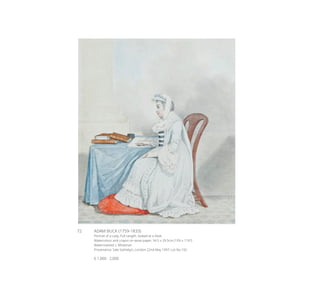
72	 ADAM BUCK (1759-1833)
Portrait of a Lady, Full Length, Seated at a Desk
Watercolour and crayon on wove paper, 34.5 x 29.5cm (13½ x 11½’’)
Watermarked: J. Whatman
Provenance: Sale Sotheby’s, London 22nd May 1997, Lot No.192.
€ 1,000 - 2,000
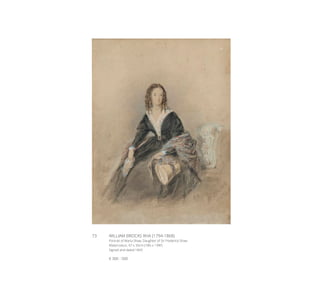
73	 WILLIAM BROCAS RHA (1794-1868)
Portrait of Maria Shaw, Daughter of Sir Frederick Shaw
Watercolour, 47 x 35cm (18½ x 13¾’’)
Signed and dated 1843
€ 300 - 500
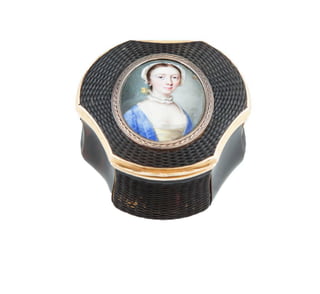
74	 NATHANIEL HONE THE ELDER RA (1718-1784)
A Portrait of a Young Lady in a Blue Dress with Bonnet and a Neck Ruff, Bust Length
Enamel, 4.3 x 3.7cm
Signed and Dated 1750. Set within a gold mount and a triform tortoise shell pannelled snuff box with basket weave panels.
This beautifully painted portrait of an unknown young lady shows her in simple country dress. She wears a white lace ruff at her neck which is tied up
with a yellow ribbon. It matches the ribbon on her linen cap which is also edged with lace. The lacing across the stomacher, also in yellow, is another
reference to rustic or ‘peasant’ dress. The sitter wears a pearl drop earring which adds to the overall elegance of the portrait. The rural simplicity of
the dress is a form of fanciful costume. It was a popular form of fancy dress for portraiture and for attending masquerade balls in the mid-eighteenth
century. Nathaniel Hone several enamel portraits in fanciful dress and a comparable portrait of a woman in masquerade costume, also dated 1750, is
in the collection of the Fitzwilliam Museum, Cambridge.
Miniature portraits painted on enamel, such as this one, were intimate, private images that recorded an accurate likeness of the sitter. They were also
decorative ornamental objects, part of fashionable dress and personal adornment. Enamels were either worn as jewellery, in lockets or brooches, or
set into gold boxes such as snuff boxes, or as in this case, the portrait is set into an elaborate gold-mounted tortoise-shell bonbonniere. The simplicity
of the portrait contrasts with the complex shape of the tortoise-shell box which is an unusual hexagonal shape with alternating plain and decorated
scalloped sides. During the eighteenth century a bonbonniere was a highly desirable luxury object. These expensive accessories were essentially
decorative but could be put to practical use. They were used to contain sweets, or other types of confectionary, such as sweetmeats or cachous pills
which were used to sweeten the breath.
The artist Nathaniel Hone was born in Dublin but spent most of his career working in London. He occupies a significant place in the history of Irish
and English miniature portrait painting. After the decline of Christian Friedrich Zincke, during the early 1740s, Hone succeeded him as the foremost
enamellist. Hone did numerous enamel miniature portraits during the 1750s but he is best remembered as an oil painter, founder member of the
Royal Academy and for his disputes with Sir Joshua Reynolds. His direct naturalistic approach to painting miniature portraits owed much to Hogarth
and Hudson’s work and they predict his later development as a portraitist in oils.
Dr Paul Caffrey
€ 3,000 - 5,000
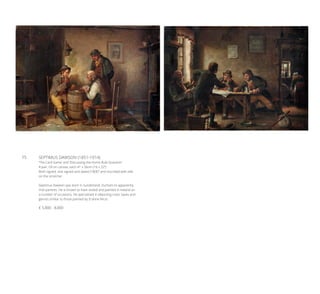
75	 SEPTIMUS DAWSON (1851-1914)
‘The Card Game’ and ‘Discussing the Home Rule Question’
A pair, Oil on canvas, each 41 x 56cm (16 x 22’’)
Both signed, one signed and dated (18)’87 and inscribed with title
on the stretcher
Septimus Dawson was born in Sunderland, Durham to apparently
Irish parents. He is known to have visited and painted in Ireland on
a number of occasions. He specialised in depicting rustic types and
genres similar to those painted by Erskine Nicol.
€ 5,000 - 8,000
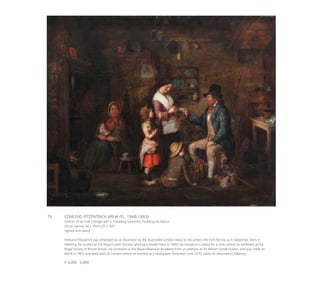
76	 EDMUND FITZPATRICK ARHA (FL. 1848-1883)
Interior of an Irish Cottage with a Travelling Salesman Peddling his Wares
Oil on canvas, 64 x 76cm (25 x 30’’)
Signed and dated
Edmund Fitzpatrick was employed as an illustrator by the Illustrated London News to document the Irish famine as it happened. Born in
Kilkenny, he studied at the Royal Dublin Society, winning a medal there in 1843. He moved to London for a time, where he exhibited at the
Royal Society of British Artists. He exhibited at the Royal Hibernian Academy from an address as 45 William Street Dublin, and was made an
ARHA in 1862 and went back to London where he worked as a newspaper illustrator until 1870, when he returned to Kilkenny.
€ 4,000 - 6,000
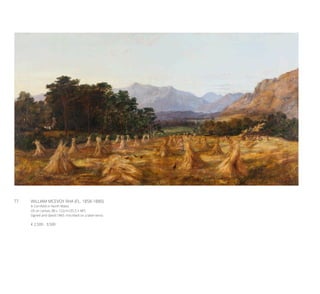
77	 WILLIAM MCEVOY RHA (FL. 1858-1880)
A Cornfield in North Wales
Oil on canvas, 88 x 122cm (35.5 x 48”)
Signed and dated 1865. Inscribed on a label verso
€ 2,500 - 3,500
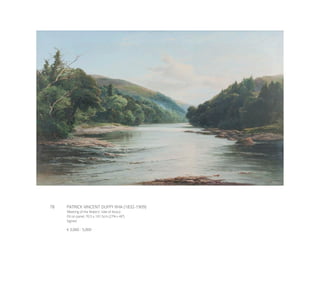
78	 PATRICK VINCENT DUFFY RHA (1832-1909)
‘Meeting of the Waters’, Vale of Avoca
Oil on panel, 70.5 x 101.5cm (27¾ x 40”)
Signed
€ 3,000 - 5,000
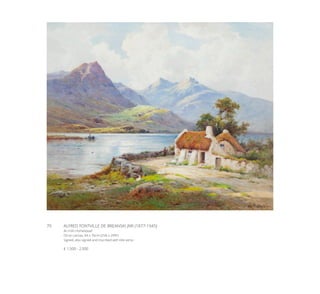
79	 ALFRED FONTVILLE DE BREANSKI JNR (1877-1945)
An Irish Homestead
Oil on canvas, 64 x 76cm (25¼ x 29¾’’)
Signed, also signed and inscribed with title verso
€ 1,500 - 2,500
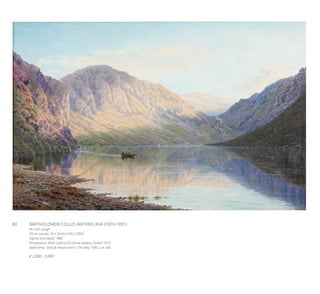
80	 BARTHOLOMEW COLLES WATKINS RHA (1833-1891)
An Irish Lough
Oil on canvas, 34 x 52cm (13½ x 20½’’)
Signed and dated 1880
Provenance: With Cynthia O’Connor Gallery, Dublin 1977
label verso. Sold at these rooms 17th May 1990, Lot 108.
€ 2,000 - 3,000
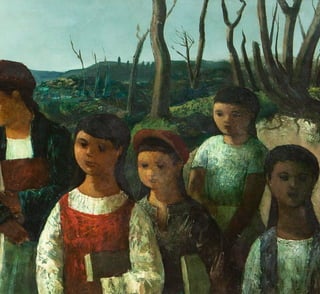
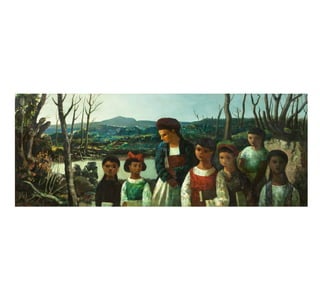
81	 DANIEL O’NEILL (1920 - 1974)
Figures in a Landscape
Oil on board, 30 x 76cm (11.75 x 30”)
Signed, inscribed with title verso
Exhibited: The Waddington Gallery Montreal (Gallery label verso)
Provenance: Irish Art Sale in these rooms December 1996, Cat. No.59 where purchased by current owner. (Detail featured on
front cover of catalogue.)
As one of Victor Waddington’s most successful young painters, Daniel O’Neill was awarded regular solo and group exhibitions,
as well as a ready outlet for his work. For twelve years, this patronage allowed him to continue to produce paintings without the
burden of having to seek promotion or critical response. However, when Waddington left Dublin for London in 1956, this was to
change.
For Waddington, the opening of his new Cork St Gallery in London presented new challenges. He had also become interested
in the work of the St. Ives painters, as well as in the international abstract movement and while he continued to deal in the
work of O’Neill, and Jack Yeats, Irish painting was no longer his chief focus. He did, however, continue his promotion of O’Neill,
albeit on a smaller scale, and organised two more solo exhibitions for him at the Dawson Gallery, Dublin during 1960 and 1963.
Subsequently, he also arranged for two shows at The Gallerie Waddington, in Montreal.
The invitation card to the Montreal exhibition suggests that the first of these shows was held during the late 1950s, as the
image on the invitation is typical of the work O’Neill was creating at this time. Interviewed by An Irishman’s Diary - during the
preview of his 1963 exhibition at the Dawson Gallery, O’Neill made mention of his recent show at the Montreal Gallery. This
reference suggests that it is probable that the second Montreal exhibition was held during 1961 or 1962.
Figures in a Landscape was one of the paintings exhibited in Montreal which happily made its way back to Ireland, in the 1990s.
Maureen O’Neill recalled that when he was asked what he painted, O’Neill usually gave the cryptic response that, ‘he painted
landscapes with people and people in landscapes’.This particular work bears some comparison with an earlier work Knockalla
Hills, painted in 1951, which is in The Ulster Museum collection. Both works have a similar mountain range backdrop and are
alike in the treatment of the skeletal trees and in the depiction of the silvery fallen tree limbs and grasses.
The unusual format (for O’Neill) is well and cleverly exploited in the various compositional devices he has created. The horizon-
tal landscape is relieved by the vertical trees going out of the picture plane on either side, while the figures are re-emphasising
the linear in their positioning. The six children, shepherded by a young woman, gaze outwards, while the energetic treatment of
their dress contrasts with the solemnity of their facial expression.
The colour throughout is harmonious and muted giving unity and a timeless mood to the piece, while O’Neill’s masterly use of
impasto and glaze techniques impart interest to the various elements, inviting the viewer to re-interpret the meaning of the
scene. Daniel O’Neill had created a pictorial world of his own and it was commented by the critic from The Irish Times that it
was ‘as strange and exotic as any Xanadu, rich in colour and sensuous in quality’, while The Irish Independent critic remarked:
‘rich with humanity, he makes the unequivocal statement in paint; his colour glowing yet controlled’.
Anne-Marie Keaveney
€ 15,000 - 20,000
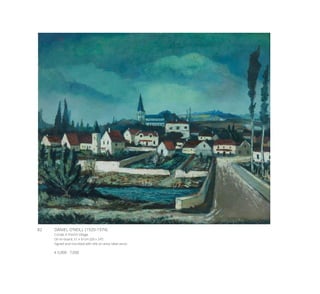
82	 DANIEL O’NEILL (1920-1974)
Condé, A French Village
Oil on board, 51 x 61cm (20 x 24’’)
Signed and inscribed with title on artist label verso
€ 5,000 - 7,000
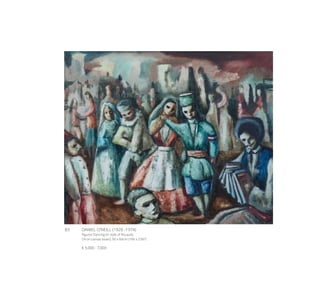
83	 DANIEL O’NEILL (1920 -1974)
Figures Dancing (in style of Rouault)
Oil on canvas board, 50 x 60cm (19½ x 23½”)
€ 5,000 - 7,000
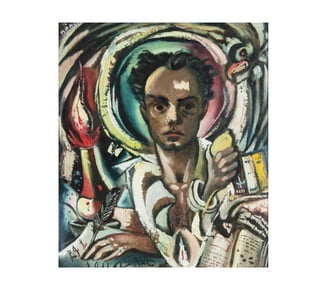
84	 DANIEL O’NEIL (1920-1974)
Portrait of the Writer Laurence James Ludovici
Oil on board, 57 x 48.25cm (22½ x 19’’)
Signed
Provenance: Sold in these rooms ‘Important Irish Art’ sale, 11th December 1996, Catalogue No.63
Following the success of a joint exhibition with Gerard Dillon at the Contemporary Picture Gallery in 1943 and a solo exhibition
in 1946 at Victor Waddington’s gallery, O’Neill received critical acclaim in Dublin and his native city, Belfast. His popularity led
to private commissions and a contract from Victor Waddington, which continued till the late 1960’s. With Waddington’s help,
O’Neill also met new patrons and his work was seen in America, United Kingdom, Sweden, and Holland.
The sitter, Laurence James Ludovici was a non-fiction American writer whose focus in the late 1940’s was the subject of
Anesthesia and Penicillin. There were significant advances in monitoring Anesthesia following scientific discoveries in the 19th
century which led to modern anesthetic techniques, moreover as a direct result of the war Penicillin was mass-produced and
by 1944, the benefits of the medicine were advertised on public buildings throughout Europe. This portrait may have resulted
from the writer’s published findings on Anesthesia or his published manuscript ‘Fleming, Discover of Penicillin’ in 1952.
Admiring the Italian Renaissance painters, O’Neill’s depictions of the sitter gazing directly at the viewer with a narrative element
in a formal setting are characteristics of Florentine portraiture during the 1500’s. The lemon, bird and notebook may symbol-
ize longevity, experimentation and mortality. The date and initials under the quill pen suggest the writer’s published medical
findings.
When this painting was first sold in these salerooms in 1996 (11 December, Lot 63) it was illustrated in black and white. Cata-
logue details state that it was ‘painted at Bryansford, Co. Down’. After his marriage to Eileen Lyle in 1943, the O’Neills moved to
a small mining town of Conlig in Co. Down where O’Neill became known in the locality.
It is doubtful if O’Neill knew the sitter personally so it is likely this portrait was a private commission from an American collector
who had viewed his paintings from the mid 1940’s. O’Neill had shown several works in a group exhibition in association with
the American Artists Galleries, in New York in 1947 and once more in 1948 in a group show held in Los Angeles. In addition
to these exhibitions in 1950, Victor Waddington organized a traveling group exhibition in America, which included O’Neill and
his friends Gerard Dillon and George Campbell in association with the Institute of Contemporary Art, Boston, and ‘New Irish
Painters.’
Dr Theodore Goodman who assisted in the selection of the artists to show in the New York exhibition in 1947 reviewed
O’Neill’s first one-man exhibition in October 1946 at the Waddington Galleries, ‘There is another side to O’Neill’s art which is
worthy of mention, his gift of portraiture. I have only seen one of his portraits, the one of Lady Nelson, but he has succeeded
in the most difficult thing in portraiture, expressing personality and at the same time composing a painting.’
Karen Reihill
€ 6,000 - 8,000
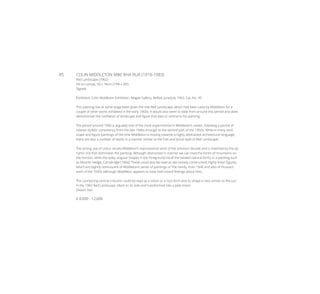
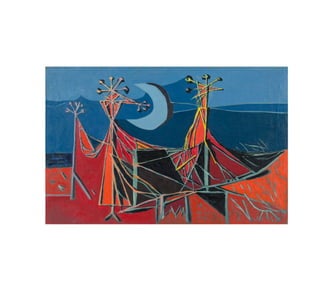
85	 COLIN MIDDLETON MBE RHA RUA (1910-1983)
Red Landscape (1962)
Oil on canvas, 50 x 76cm (19¾ x 30’’)
Signed
Exhibited: Colin Middleton Exhibition, Magee Gallery, Belfast June/July 1962, Cat. No. 45
This painting has at some stage been given the title Red Landscape, which had been used by Middleton for a
couple of other works exhibited in the early 1960s. It would also seem to date from around this period and does
demonstrate the conflation of landscape and figure that was so central to his painting.
The period around 1960 is arguably one of the most experimental in Middleton’s career, following a period of
relative stylistic consistency from the late 1940s through to the second part of the 1950s. While in many land-
scape and figure paintings of the time Middleton is moving towards a highly abstracted architectural language,
there are also a number of works in a manner similar to the free and lyrical style of Red Landscape.
The strong use of colour recalls Middleton’s expressionist work of the previous decade and is matched by the dy-
namic line that dominates the painting. Although abstracted in manner we can read the forms of mountains on
the horizon, while the spiky, angular shapes in the foreground recall the twisted natural forms in a painting such
as Moonlit Hedge, Carnalridge (1960). These could also be read as two loosely constructed, highly linear figures,
which are slightly reminiscent of Middleton’s series of paintings of The Family, from 1940 and also of Picasso’s
work of the 1930s (although Middleton appears to have held mixed feelings about him).
The connecting central crescent could be read as a moon or a rock form and its shape is very similar to the sun
in the 1962 Red Landscape, tilted on its side and transformed into a pale moon.
Dickon Hall
€ 8,000 - 12,000
86	 NEVILL JOHNSON RHA RUA (1911-1999)
Orpheus
Acrylic on paper laid on board, 38 x 38.5cm (15 x 15’’)
Signed and dated 1978, Tom Caldwell Gallery label verso
€ 1,500 - 2,500
87	 COLIN MIDDLETON MBE RHA RUA (1910-1983)
Dandelions in a Landscape
Oil on panel, 17.5 x 20.5cm (7 x 8”)
Signed with monogram. Another abstract Composition verso.
Still life paintings occur rarely in Colin Middleton’s work, with a small number of flower paintings in the late 1930s and
very early 1940s, and then a series of more gestural and abstracted paintings of sunflowers in the 1960s, but occasion-
ally he also integrated flowers as a crucial detail within the landscape, as in the present painting or in Edge of the Fields
(1957). Both these paintings use the bright colour and strong, flattened leaf forms to assert the surface of the canvas
and to add drama to the distance into which the landscape stretches.
Dickon Hall
€ 3,000 - 5,000
88	 COLIN MIDDLETON MBE RHA RUA (1910-1983)
Miel
Indian ink and wash, 21 x 19.5cm (8¼ x 7¼’’)
Signed with monogram, inscribed and dated 20 April ‘73
€ 500 - 800
89	 COLIN MIDDLETON MBE RHA RUA (1910-1983)
Enjoying a Puff
Pen and ink, 24 x 19cm (9½ x 7½’’)
Signed and dated 2 Nov 1947
€ 400 - 500
89A	 COLIN MIDDLETON MBE RHA RUA (1910-1983)
Holy Thursday (Sitges)
Ink and wash, 18 x 20cm (7 x 7¾’’)
Signed with monogram, inscribed and dated 20 April ‘73
€ 500 - 800
90	 COLIN MIDDLETON MBE RHA RUA (1910-1983)
A Series of Four, with Poems
Pen, ink and type, 26 x 16cm (10¼ x 6¼’’)
Colin Middleton was deeply involved in the world of poetry as well as that of art. His second
wife, Kathleen, was a recognised poet, and he numbered many leading Irish poets among
his friends, including John Hewitt, Seamus Heaney and Michael Longley; the latter two wrote
poems inspired by Middleton’s painting and he also provided drawings to accompany Heaney’s
Sweeney Astray.
Middleton himself wrote poetry for much of his life and in 1947 John Hewitt encouraged Robert
Greacen to include his work in an Anthology of Modern Irish Poetry. Although his writing was
undoubtedly an independent activity, its themes and ideas do often relate to his painting. Ac-
cording to Michael Longley, who has written with great insight on Middleton, “he claims…that his
poetry has now become a philosophical aid to the painter, a catalyst.” (Michael Longley, ‘Colin
Middleton’, Dublin Magazine, 1967)
€ 1,200 - 1,800
91	 COLIN MIDDLETON MBE RHA RUA (1910-1983)
Matchboxes
Pen and ink, 19 x 18cm (7½ x 7’’)
Signed with monogram and dated 20 April ‘73
This is a study for “Judy-Wilderness Series” sold in these rooms 3/12/2008 Cat. No. 48
€ 500 - 800
92	 ARTHUR ARMSTRONG RHA (1924-1996)
Green Sea
Mixed media, 48 x 37.5cm (18½ x 14¾’’)
Signed, inscribed with title verso
€ 600 - 800
Arthur Armstrong was a landscape and still life painter. Born on 12 January 1924 at
Carrickfergus, Co. Antrim, Arthur Charlton Armstrong was the son of a house painter,
Charlton Armstrong, and remembered his father painting pictures with paint remnants
from various jobs. With his family, Armstrong left Carrickfergus for Belfast where he
attended Strandtown Primary School, but devoted a lot of his time to painting pictures.
At Queen’s University, he studied Political Science and then switched to Architecture. Af-
ter just two years, he left, and spent six months taking evening classes at Belfast College
of Art, meeting Gerard Dillon and then meeting George Campbell and Daniel O’Neill,
contemporaries in Belfast.
Armstrong first exhibited at the Grafton Gallery in 1950. His paintings from the late
1950s moved towards an abstract style, more concerned with a play of textures and an
interlocking of quantities and areas of colour. He was a prolific artist and his distinctive
style of using plaster on large works is easily identifiable.
Moving from London to Dublin in 1962, he shared a house with Dillon in Ranelagh. He
first exhibited at the Royal Hibernian Academy in 1962, giving the Ritchie Hendricks
Gallery as his address, up until 1995 he contributed a total of seventy-four works there.
In the late 1960s, he designed posters for the Abbey Theatre, and worked with Dillon
and Campbell on settings for ‘Juno and the Paycock’ in the Abbey, whilst teaching paint-
ing part time at the National College of Art.
A bachelor, he died in a Dublin hospital on 13 January 1996.
93	 GEORGE CAMPBELL RHA (1917-1979)
Play of Shapes
Mixed media, 73.5 x 53.25cm (29 x 21’’)
Signed
€ 1,000 - 2,000
94	 GEORGE CAMPBELL RHA (1917-1979)
Street Musicians, St. Palo
Watercolour and crayon, 48.25 x 63.5cm (19 x 25’’)
Signed. Original artist’s label verso
€ 1,500 - 2,500
Born in Arklow, Co. Wicklow, George Campbell went to school in Dublin and moved to Belfast with his family. A self taught artist, he began painting in
1941 during the air raids. By 1944 he had developed his own style and held two shows – one with his brother Arthur at the Mol Gallery in Belfast, and
another at John Lamb’s Gallery in Portadown with Gerard Dillon, with whom he travelled to Connemara in the following years.
In 1946 Campbell held his first solo show at the Victor Waddington Galleries in Dublin, and repeatedly at the RHA from the following year. He also
appeared in a group show in 1948, along with Dillon, Daniel O’Neill and Nevill Johnson at Heal’s Mansard Gallery, London. In 1951 Campbell made his
first trip to Spain and returned annually for 6 months until his death. The country had a profound influence on both the subject matter and use of co-
lour in his work. He had shows in Madrid, Malaga, Torremolinos and Gibraltar, as well as exhibiting regularly with the Ritchie Hendriks from 1957 and
later with the Tom Caldwell Galleries. In 1964 Campbell was elected a member of the RHA. He was made a Knight Commander of Spain by the Spanish
government in 1978, and has had a major roundabout named after him near Malaga in 2006.
95	 BRIAN BOURKE HRHA (B.1936)
Portrait of L.D. No.2
Oil on canvas and wood, 51 x 45cm (canvas 35.5 x 30cm)
20 x 17.75” (canvas 14 x 11.75”)
Signed, also signed, inscribed and dated 1970
€ 1,000 - 1,500
96	 NEIL SHAWCROSS RHA RUA (B.1940)
Columbia Talkie Needles
Watercolour, 58 x 73cm (22.75 x 28.75”)
Signed and dated 1987
€ 800 - 1,200
97	 NEIL SHAWCROSS RHA RUA (B.1940)
Vase of Yellow Flowers
Watercolour, 57.5 x 47cm (22½ x 18½”)
Signed and dated 1986
Originally from Lancashire in England, Neil Shawcross is Senior Lecturer at the Belfast
College of Art. In 1966
he won the Gallagher Portrait Prize and the RUA Conor Award in 1975 and 1999. Shaw-
cross has exhibited regularly
at both the RHA and RUA throughout his career, and has taught extensively in the US and
worked with special needs
children.
€ 1,000 - 1,500
98	 CHARLES BRADY HRHA (1926-1997)
Pink Ball of Wool
Oil on board, 109.2 x 124.5cm (43 x 49”)
Signed
€ 2,000 - 3,000
99	 CHARLES BRADY HRHA (1926-1997)
Farm Buildings
Oil on canvasboard, 26 x 34cm (10¼ x 13¼”)
Signed
Provenance: Taylor Galleries, Dublin, exhibition label verso
€ 2,000 - 4,000
100	 GUY HANSCOMB (B.1968)
Foggy Day, Military Road, Wicklow
Oil on canvas, 50.5 x 76cm (19¾ x 30”)
Signed with monogram
Exhibited: Guy Hanscomb Exhibition, 2001, The Frederick Gallery, Dub-
lin, Catalogue No.3. Where purchesed by current owner.
€ 700 - 1,000
Guy Hanscomb was born in London in 1968. Hanscomb trained at the New Orleans Academy of Fine Art, USA and Chelsea College of Art, London.
Drawing inspiration from wilderness landscapes, Guy travelled extensively in Europe, America, Asia and Australia before coming to Ireland in 1999.
Captivated by the wide, open spaces of the Wicklow Mountains, Guy settled in Glenn na Smol and landscapes soon became increasingly prevalent in his work.
His paintings are distinguished by a subtle use of light and colour and their quietly atmospheric quality is enlivened by an inventive use of composition. Deserted
beaches and moorlands are a favourite and evocative subject. Wide expanses of empty space or broad horizons are often depicted with a resultant tendency
towards abstraction. Guy seeks to capture the transient atmospheric effects that are so characteristic of the Irish landscape. Momentary as well as seasonal varia-
tions in light and colour provide an endless source of inspiration.
These two works (Lots 100 & 101) were bought at Guy’s first solo exhibition at The Frederick Gallery in October 2001 which was a complete sell-out.
101	 GUY HANSCOMB (B.1968)
Reservoir from Glassamucky Brakes
Oil on canvas, 61 x 61cm (24 x 24”)
Signed with monogram
Exhibited: Guy Hanscomb Exhibition, 2001, The Frederick gallery, Dublin, Cata-
logue No.46. Where purchesed by current owner.
€ 600 - 800
102	 TERENCE P. FLANAGAN PRUA RHA (1929-2011)
Blackwood
Oil on board, 60 x 122cm (24 x 48’’)
Signed
Exhibited: The Ritchie Hendriks Gallery, September 1965, where
purchased by Don Carroll of P.J.Carrolls.
€ 2,000 - 4,000
Terence P. Flanagan was born in Enniskillen, Co. Fermanagh, and studied at the Belfast College of Art. After teaching art at St. Mary’s College of Education for twenty-eight
years and holding the position of Head of Art Department for seventeen, he decided to focus his attention on painting full time. Flanagan was elected an RUA member in
1964 and served as president from 1977-1983. In 1964 he held his first solo exhibition with the Hendriks Gallery in Dublin and he started exhibiting at the RHA the following
year.
In the same year he began his presidential role, the Arts Council Gallery in Belfast mounted a retrospective of his work, and in 1994/5 a major retrospective was held at the
Ulster Museum and travelled to the Hugh Lane in Dublin and the Stadsmuseum in Gothenburg, Sweden. A further retrospective took place at the F.E. McWilliam Gallery &
Studio in 2010, the year before he died.
103	 TERENCE P. FLANAGAN PRUA RHA (1929-2011)
Gortahork Bog
Oil on board, 25.5 x 28cm (10 x 11’’)
Signed
€ 1,000 - 2,000
104	 BRIAN BALLARD RUA (B.1943)
On the Lagan
Oil on board, 26 x 36cm (10¼ x 14¼’’)
Signed and dated ‘88
€ 1,000 - 1,500
Born in 1943, Brian Ballard studied in his home town at Belfast College of Art and went on to further studies at Liverpool College of Art. Best known for his
modern treatment of the traditional genres of the still life, the nude and the landscape, and his distinctive use of bold yet evocative colour, he now works mainly
in Belfast and on Inishfree Island off the coast of Donegal.
Examples of his work can be found in the collections of the Arts Council of Ireland, Art Council of Northern Ireland, Great Southern Hotels, AIB, Crawford Munici-
pal Gallery and the Ulster Museum.
105	 BRIAN BALLARD RUA (B.1943)
White Lady and Teapot
Oil on canvas, 40 x 50cm (15¾ x 19¾’’)
Signed and dated (19)’91. Inscribed with title verso
€ 1,000 - 1,500
106	 MICHAEL O’DEA PRHA (B.1958)
The Charge (Sherrif Street)
Acrylic on paper, 76 x 106.5cm (30 x 42”)
Signed and dated 1995
Exhibited Royal Hibernian Academy annual exhibition 1995 Cat. No. 274 where it won the Taylor de Vere Prize for a work in any medium.
€ 1,000 - 2,000
107	 PATRICK COLLINS HRHA (1910 - 1994)
Heads of Miró in Paris
Set of six drawings framed as one
Each signed, inscribed and dated (19)’72. (6)
John Montague in his autobiography mentions bringing Patrick Collins along to an opening at the well-known Galerie Maeght, Rue Tehe-
ran in Paris. Among the major artists that were there was ‘Miró’ and they all adjourned to a nearby ‘friendly cafe’.
“Paddy became very silent, and embarrassed us by producing a little sketchbook, where he began to make rough pencil portraits of his
companions, like a street artist. The artists concerned were a bit disconcerted, but, being French-trained, they were too polite to com-
ment. We questioned him afterwards as discreetly as we could, where he thought he was, and what was he doing. Humbly, Paddy replied,
“I found myself among the gods, and felt I had to make a note of it”.
These presumably are some of the sketches from that night.
€ 600 - 800
108	 BARRIE COOKE HRHA (1931-2014)
Root Underground
Watercolour, 48 x 62.5cm (18¾ x 24½’’)
Signed, inscribed and dated ‘64
Provenance: With David Hendriks Gallery, Dublin, November
1975, where purchased by Brian Dunlop.
€ 500 - 700
BARRIE COOKE HRHA (1931-2014) EASTER RISING SERIES, 1966 (LOTS 109 - 116)
Barrie Cooke was born in Cheshire in 1931. After a childhood spent in England and Bermuda he moved to the United States to study Art History at
Harvard University. Subsequently he studied drawing and painting at Skowhegan in Maine before moving to a small cottage in County Clare, in 1954.
The following year he held his first solo exhibition in Dublin and received a scholarship to study with Oskar Kokoschka in Salzburg. He represented
Ireland at the Paris Biennale in 1963.
Although based in Ireland since the 1950s, Cooke’s frequent trips to countries such as Lapland, Borneo, Malaya and New Zealand has imbued his
expressionist, semi-abstract paintings with a wide range of pictorial imagery.
This fuses with his immersion in the water-rich landscape of Ireland and his interest in marine life and fishing. In contrast, Cooke also painted many
nudes and portraits as well as producing several sculptures. A member of Aosdána he exhibited widely throughout Europe, the USA and Canada
and New Zealand. Major retrospectives were held in the Douglas Hyde Gallery, Dublin (1986), the Haags Gemeentemuseum, The Hague (1992), LAC,
Perpignan, France (1995), the Royal Hibernian Academy Gallagher Gallery (2003) and The Irish Museum of Modern Art in 2011 on the occasion of his
80th birthday. His paintings are represented in the Irish Museum of Modern Art, the Ulster Museum, the Stedelijk Museum, Amsterdam, the Haags
Gemeentemuseum, and in many other collections worldwide. Cooke won the Marten Toonder Award in 1988, and the Irish-American Cultural Insti-
tute’s O’Malley Award in 2002.
This series of works lots 109 - 116 of the Easter Rising are unusual in the artist’s oeuvre and date from 1966, the first major anniversary of the 1916
Rising. It has been suggested that Cooke painted this series for an exhibition of work by invited artists at the Hugh Lane Municipal Gallery of Art, Dub-
lin, to celebrate the 50th year celebrations of the Easter Rising.
109	 BARRIE COOKE HRHA (1931-2014)
Execution of Connolly
Oil on board, 34 x 35cm (13¼ x 13¾’’)
Signed, inscribed with title and dated 1966 verso
Provenance: The artist’s family
€ 1,500 - 2,500
110	 BARRIE COOKE HRHA (1931-2014)
Two Boys at... (?) (Sic)
Oil on board, 23 x 23cm (9 x 9’’)
Signed, inscribed with title and dated 1966 verso
Provenance: The artist’s family
€ 800 - 1,200
111	 BARRIE COOKE HRHA (1931-2014)
Fire in the GPO
Oil on board, 23 x 23cm (9 x 9’’)
Signed, inscribed with title and dated 1966 verso
Provenance: The artist’s family
€ 800 - 1,200
112	 BARRIE COOKE HRHA (1931-2014)
Fires on the Liffey
Oil on board, 34 x 35cm (13¼ x 13¾’’)
Signed, inscribed with title and dated 1966 verso
Provenance: The artist’s family
€ 1,000 - 2,000
113	 BARRIE COOKE HRHA (1931-2014)
Boland’s Bakery
Oil on board, 23 x23cm (9 x 9’’)
Signed, inscribed with title and date 1966 verso
Provenance: The artist’s family
€ 800 - 1,200
114	 BARRIE COOKE HRHA (1931-2014)
Shooting at St. Stephen’s Green
Oil on board, 23 x23cm (9 x 9’’)
Signed, inscribed with title and date 1966 verso
Provenance: The artist’s family
€ 800 - 1,200
115	 BARRIE COOKE HRHA (1931-2014)
Baggot Street Bridge
Oil on board, 23 x23cm (9 x 9’’)
Signed, inscribed with title and date 1966 verso
Provenance: The artist’s family
€ 800 - 1,200
116	 BARRIE COOKE HRHA (1931-2014)
Baggot Street Bridge
Oil on board, 23 x23cm (9 x 9’’)
Signed, inscribed with title and date 1966 verso
Provenance: The artist’s family
€ 800 - 1,200
117	 GARY TRIMBLE ARHA (1929-1979)
Eamon de Valera, President of Ireland
Bronze, 28cm high (11’’), raised on a rectangular limestone base,
42cm high overall (16½’’)
Signed, from an edition of nine
€ 4,000 - 6,000
118	 RORY BRESLIN (B.1963)
Michael Collins
Bronze bust, 60cm (23½”) high
Signed, dated 2010 & No 1/3
€ 6,000 - 10,000
119	 EILIS O’CONNELL (B.1953)
Lily Pad
Bronze, 76cm wide (30’’)
€ 1,500 - 2,500
120	 ROBIN BUICK RHA (B.1940)
The Dancer
Bronze, 84cm high (33”)
Signed and numbered 2/9
€ 3,000 - 5,000
121	 SANDRA BELL (B.1954)
Fanfare
Bronze, 56cm high (22’’)
Signed and dated ‘99, No.3/8
€ 2,000 - 3,000
122	 SANDRA BELL (B.1954)
Harp Figure
Bronze, 55cm high (21½’’)
Signed and dated ‘98, No.4/8
€ 1,500 - 2,500
123	 JOHN MCKENNA (20TH/21ST CENTURY)
The Irish Wolfhound
Bronze, 18cm long (7’’ long)
Signed and dated (19)’92
Inscribed on a label ‘’Handmade from old Irish coins and bronze set on
recycled marble from old churches etc.’’
€ 400 - 600
124	 AFTER OISÍN KELLY RHA (1915-1981)
Female Red Grouse
Painted Earthenware, 15.5cm (6”) high. Kilkenny Design Workshops stamp
After the original by Oisín Kelly and hand painted by Marie Hennessy;
Together with another smaller model of a “Wren”. (2)
In 1964, a year after Kilkenny Design Workshops (KDW) were set up, Oisin was appointed ‘Design Co-ordinator’ at KDW and
under contract to work two days a week which enabled him to give up his teaching job. These stoneware pieces were cast from
Oisín’s original model and later hand-painted by Marie Hennessy and were very popular when sold in the Kilkenny Design Shop
in Nassau Street.
This lot is being sold in aid of Oxfam Ireland.
€ 120 - 150
125	 PATRICK HICKEY HRHA (1927-1998)
Months of the Year, January - December
A set of twelve monochrome and coloured etchings, 49.5 x 33cm (19½ x 13”)
Each signed, inscribed with month and
numbered 30/30 (12)
Provenance: Taylor Galleries, Dawson Street, Dublin 2 labels verso
This lot is being sold in aid of Cheeverstown Charity
€ 1,000 - 2,000
Patrick Hickey was born in Bannu, India, now Pakistan. His Father was a Colonel in the Indian Army, 1st Punjab Regiment. After attending Ampleforth College, Yorkshire, he moved to Dublin in 1948
to study architecture at University college Dublin. After graduating he worked for the architect Michael Scott. In 1957 he won an Italian state scholarship and studied etching and lithography at the
Scuola del Libro, Urbino. In 1961 he helped found the Graphic studio in Upper Mount Street, Dublin.
Hickey produced watercolours, etchings and lithographs, and showed a grasp for natural forms. His interest in Japanese painting is reflected in works like ‘Illustration to William Butler Yeats’, with its
use of gold and silver.
In 1961 he was much to the fore in the founding in Dublin of the Graphic Studio in an Upper Mount Street basement. In 1965 the Italian government held a competition to illustrate Dante’s Divine
comedy, and Hickey’s eighteen inferno etchings won second prize. In 1967, while living in Dublin, he designed the 5d and 1s stamps issued by the Department of Post and Telegraphs. He also taught
part-time in the architecture department at UCD, and later became head of painting at the National College of Art & Design.
An authority on Irish delftware, he organized the exhibition of eighteenth century pieces in Castletown House, Co.Kilkenny, part of the 1971 Rosc programme. Bogland, Wicklow was his first exhibit, in
1972, at the Royal Hibernian Academy. Hickey’s only exhibition held outside of Ireland was at the Purdhoe Gallery, London in 1974.
Sadly in 1973, he was diagnosed with Parkinson’s disease.
Throughout the 1980’s, he exhibited at the Taylor Galleries, Dublin. A retrospective of his work was held at the Royal Institute of the Architects of Ireland in 1994, and later at the Graphic Studio Gal-
lery. He was elected a member of Aosdana in 1981, and served on the board of the Kilkenny Design Workshops. He died at his home in Monsksotown, Co. Dublin in 1998. An exhibition of landscape
prints from the 1970s was held at the Graphic Studio Gallery in 2000.
126	 MICHAEL FARRELL (1940-2000)
Untitled, Miss O’Murphy Series
Colour lithograph, 57.5 x 77.5cm (22¾ x 30½”),
unframed
Signed and dated (19)’78, numbered artist’s proof,
and inscribed “pour Bjöurn a Marmö”
We thank The Taylor Gallery for their help in cata-
loguing this lot.
€ 300 - 500
Born in Kells, Co. Meath, Michael Farrell studied in London at St. Martin’s School of Art and later at Colchester College of Art. Visits to Donegal, London, Paris and New York in the
mid-1960s resulted in an innovative body of work, related to Celtic themes. His diverse range evolves from an objective, abstract formalism, exemplified in the Celtic and Pressé
works, to a more subjective figurative expression evidenced in the Pressé Politique and Miss O’Murphy/Madonna Irlanda series. As an artist he was concerned with issues sur-
rounding Irish identity, culture, history and politics.
He has received a number of awards internationally over the past four decades, and was elected a member of Aosdána in 1987. His work is included in important collections
both in Ireland and abroad, for example the Irish Museum of Modern Art, the Hugh Lane Gallery, the Ulster Museum, the City Museum of Manchester Art Gallery, and the Pom-
pidou Centre and Musée d’Art Modern in Paris.
127	 MICHAEL FARRELL (1940-2000)
Les Nouvelles Coupes De Boucherie A La Mode Irlandaise or The Very
First Real Irish Political Picture
Etching with aquatint, 36.5x 35cm (14¼ x 13¾”), unframed
Signed, inscribed ‘Miss O’Murphy’, dated (19)’82 and numbered 62/80
€ 200 - 300
128	 EDWIN HAYES RHA RI ROI (1819-1904)
‘Padstow Harbour from Pumps’ and ‘Fresh Water, Isle of Wight’
A pair, oil on board, 14.5 x 23cm (5¾ x9’’)
Both signed, also inscribed verso, one dated 1893
€ 3,000 - 5,000
129	 EDWIN HAYES RHA RI ROI (1819-1904)
Fishing Boats off the Coast, in choppy seas
Oil on canvas, 76 x 127cm (30 x 50”)
Signed and dated 1874
Provenance: Sale Christies London 1981, where purchased.
€ 8,000 - 12,000
130	 EDWIN HAYES RHA RI ROI (1819-1904)
‘Off the Scheldt’ and ‘Mouth of the Scheldt’
A pair, oil on canvas, 25.5 x 41cm (10 x 16’’)
Both signed
€ 2,000 - 3,000
131	 EDWIN HAYES RHA RI ROI (1819-1904)
French Luggers Entering Calais Harbour
Oil on board, 17.7 x 27.4cm (7 x 10¾’’)
Signed, also signed and inscribed on label verso
€ 1,500 - 2,000
132	 THOMAS ROSE MILES RCA (FL.1869-1910)
Homeward Bound off Whitby
Oil on canvas, 69 x 90cm (27 x 35½”)
Signed and inscribed with title verso
€ 3,000 - 5,000
133	 GEORGE MOUNSEY WHEATLEY ATKINSON (1806-1884)
Blackrock Castle, Cork and the River Lee by Moonlight
Oil on canvas, 61 x 86.5cm (24 x 34”)
Signed
€ 3,000 - 5,000
Born in Queenstown, now Cobh, Co. Cork, George Mounsey Wheatley Atkinson trained as a carpenter, later becoming Captain Atkinson as Government Surveyor of Shipping and Em-
igrants. When he began painting, it is no surprise that marine scenes were his subject of choice, and although self taught he exhibited at the Royal Hibernian Academy from 1842. His
works became widely known through lithographs published by W. Scraggs of Cork and Atkinson’s own son G. M. Atkinson.
133A	 WILLIAM CRAMPTON GORE RHA (1871-1946)
Chickens by Farmyard Door
Oil on board, 24.75 x 31cm
Signed
€ 1,000 - 1,500
William Crampton Gore was born in Enniskillen Co. Fermanagh. Initially Gore studied medicine at Trinity College Dublin but abandoned his studies in 1901 for painting. He studied at the
Slade school in London under the guidance of Henry Tonks and then was in Paris. He travelled extensively in India, New York, and Italy before returning to the Slade where he met William
Orpen. Orpen depicted him in his painting “A Mere Fracture” and later Gore shared a studio with Augustus John. He first exhibited at the RHA in 1905 and showed over one hundred works
until 1939.
His subject matter looks to scenes of Achill Island, Donegal, and French scenes. His landscapes were described as being crisp and breezy. His interior scenes were described as being “defi-
nitely instructive” (The Studio Jan 1919). The Dublin Magazine (Oct - Dec 1946) described him as “a delightful urbane painter, with a rich sense of colour somewhat reminiscent of Pissarro,
and at times of Osborne, especially in his interiors. There is a rightness and absence of strain in his composition”. He remained most of his life in France after his marriage in 1923, but
continued to paint themes of Irish scenes.
134	 CUTHBERT EDMUND SWAN (1870-1931)
Bengal Tigers
Oil on canvas, 50 x 75cm (19¾ x 29½”)
Signed
€ 4,000 - 6,000
135	 NASSAU BLAIR BROWN (1867-1940)
“Charmer”; “Skipaway”; and “Skipoker”
A set of three, oil on canvas, each 42 x 54.5cm
Signed and dated 1904
€ 3,000 - 5,000
136	 WILLIAM GILLARD (1812-1897)
Cattle in a Mountainous Landscape
Oil on canvas, 47 x 91.5cm (18½ x 36’’)
Signed
€ 2,500 - 3,500
137	 ALFRED GREY RHA (1845-1926)
Cattle Watering in a River Landscape
Oil on canvas, 61 x 91.5cm (24 x 36’’)
Signed
Early prints of this painting are known to exist.
€ 3,000 - 5,000
Little information exists in relation to Alfred Grey, which is surprising when one notes the quantity of work which he exhibited at the RHA during his career. With the
exception of four random years during the sixty year period in which he worked, (1864-1934), Grey showed an average of eight paintings annually – a total by the
end of his life of almost 500 works, and was elected RHA in 1871. He lived all his life in the inner northside of Dublin city, yet the subject matter which he painted
could not be more entrenched in country life, particularly Scottish rural life. He mainly painted animals such as goats, highland cattle and sheep in a Scottish setting.
He was the son of the painter Charles Grey, and brother of painters Edwin Landseer, Gregor, James and Charles Malcolm Grey. During the early part of his career
Alfred visited Scotland with his father and, was inspired, as were his brothers though not quite as prolifically, to uphold a family tradition which traded in Victorian
values and sentiment, qualities which also infuse many of his Irish views. His style of painting demonstrates a strong debt to the quasi-heroic, highland landscapes of
Edwin Landseer. At Queen Victoria’s request Alfred painted a number of her favourite views in the neighbourhood of Mar Lodge.
138	 IRISH SCHOOL, 19TH CENTURY
Girl at a Well
Oil on canvas, 40 x 30cm (15¾ x 11¾’’)
€ 600 - 1,000
139	 ATTRIBUTED TO JOSEPH PATRICK HAVERTY RHA (1794-
1864)
The Limerick Piper (Patrick O’Brien)
Oil on canvas, 73 x 65.5cm (28¾ x 25¾’’)
This is a version of the painting by Haverty, 1844, in the National Gallery of
Ireland.
€ 3,000 - 5,000
140	 CHARLES COLLINS (C. 1680-1744)
Still Life with a Basket of Flowers and Two Parrots on Steps
Oil on canvas, 105 x 80 cm
Signed and dated, 1741
Charles Collins is an artist emerging from obscurity as more paintings have been discovered or re-attributed to him.
Strickland merely quotes Walpoles reference to him, and the Hume Sale and pays little attention to the picture in the
National Gallery of Ireland. We can now see that he was a decorative artist of ability.
€ 4,000 - 6,000
141	 ATTRIBUTED TO RICHARD CARVER (D.1754)
A Mountainous Wooded Landscape with Figures and Deer
Oil on canvas, 65 x 90cm (25 x 37¼’’)
Provenance: Sale Christie’s, London 14th May 2004, Lot No.104.
€ 2,000 - 4,000
142	 JAMES ARTHUR O’CONNOR (1792-1841)
A Seaside Stroll
Oil on panel, 24.5 x 30cm (9¾ x 11¾’’)
Signed and dated 1834 (lower right)
Provenance: Sale Christie’s Belfast 21st May 1997, Lot No.51
€ 3,000 - 5,000
143	 ALEXANDER WILLIAMS RHA (1846-1930)
At Malahide, Co. Dublin
Watercolour, 24 x 43cm (9½ x 16¾’’)
Signed. Title inscribed on artist’s label verso
€ 400 - 600
144	 HENRY ALBERT HARTLAND (1840 - 1893)
Mountain Landscape
Watercolour, 40.5 x 73.5cm (16 x 29”)
Signed
€ 400 - 600
145	 WILLIAM NICHOLL (1794-1840)
Ballymacarret Near Belfast
Pencil watercolour and bodycolour, 34 x 51.5cm (13½ x 20¼’’)
Provenance: With the Bell Gallery; Christie’s Belfast. 21st May 1997,
Lot No.57.
€ 700 - 1,000
146	 JOHN HENRY CAMPBELL (1757-1829)
A Winter Landscape with Figures
Watercolour, 31 x 47cm (11¾ x 18¼’’)
Provenance: With Gorry Gallery, Dublin 2011.
€ 1,500 - 2,500
147	 WILLIAM PERCY FRENCH (1854-1920)
St. Moritz
Watercolour, 35 x 25cm (13¾ x 10’’)
Signed, inscribed and dated 1914
€ 1,000 - 1,500
148	 WILLIAM PERCY FRENCH (1854-1920)
River Landscape, West of Ireland
Watercolour, 12.5 x 21cm (5 x 8¼’’)
Signed and dated (18)’88
€ 1,000 - 1,500
149	 WILLIAM PERCY FRENCH (1854-1920)
Heather on the Bog
Watercolour, 16 x 24.5cm (6¼ x 9½’’)
Signed
€ 1,000 - 1,500
150	 WILLIAM PERCY FRENCH (1854-1920)
Sun Breaking Through, West of Ireland
Watercolour, 16 x 24.5cm (6¼ x 9½’’)
Signed
€ 1,000 - 1,500
151	 ESTELLA FRANCES SOLOMONS HRHA (1882-1968)
Volendam (1911)
Oil on canvas, mounted on board, 26.5 x 36.5cm (10½ x 14¼”)
Inscribed with title and dated 1911 verso,
Provenance: From the Artist’s Studio and thence from the estate of the late Geoffrey O’Connor, Kerry
Exhibited: “Estella Solomons” Exhibition, Crawford Gallery, Cork, May/June 1986, Cat. No. 153
€ 500 - 800
152	 ESTELLA FRANCES SOLOMONS HRHA (1882-1968)
Laru (1911)
Oil on canvas mounted on board, 26.5 x 36.5cm (10½ x 14 ¼”)
Inscribed with title and dated May 11 verso
Provenance: From the Artist’s Studio and thence from the estate of the late Geoffrey O’Connor, Kerry
€ 500 - 800
153	 ESTELLA FRANCES SOLOMONS HRHA (1882-1968)
The Writer
Oil on canvas, 76 x 54.5cm (30 x 21½”)
Provenance: The Artist’s Estate. Important Irish Art Sale, these rooms, December 2001, Cat. No. 77 where purchased by current owner
Exhibited: Estella Solomons Exhibition, The Crawford Gallery, Cork, May/June 1986, Cat. No. 16
€ 800 - 1,200
Born in Dublin in 1882, Estella attended the Royal Hibernian Academy Schools under Walter Osborne, and entered the Metropolitan
School of Art, where she became a pupil of William Orpen. In 1906, she visited the Rembrandt tercentenary exhibition in Amsterdam,
which was a significant event for her. Despite being taught by William Orpen, she was never a formula painter and painted by inclination
and sympathy, not by chequebook. She abandoned the Old-Masterish and academician’s style of working because it weighed her femi-
nine love of spontaneity. Estella was no publicist, her talent was a refined, rather private one exercised more for her own pleasure than
for the public’s.
154	 HARRY KERNOFF RHA (1900-1974)
Portrait of a Gentleman
Conté on paper, 36.5 x 29.5cm (14¼ x 11½”)
Signed
It has been suggested that this is a portrait of the writer Austin Clarke.
€ 400 - 600
155	 HARRY KERNOFF RHA (1900-1974)
Portrait of a Gentleman
Pastel on paper, 48 x 35cm (19 x 19¾”)
Signed and dated 2-43 (February 1943)
€ 300 - 500
Born in London to Russian Jewish and Spanish parents, Harry Kernoff moved to
Dublin at the age of fourteen and made it his home for life. Kernoff spend his
days as an apprentice in his father’s furniture business, taking night classes at the
Dublin Metropolitan School of Art under Sean Keating, and becoming the first night
student to win the Taylor Art Scholarship in 1923. He first exhibited at the RHA just
three years later, and continued to do so until the year of his death, becoming a
full member of the academy in 1935. In that same year he held the first of three
solo shows at the Victor Waddington Galleries (the others being in 1937 and 1940).
International attention came in 1939 when he represented Ireland at the New York
World’s Fair.
Kernoff was active in many facets of the visual arts scene, designing set and
costumes for Dublin theatre productions, and executing portraits of literary figures
and actors. He is best known through his many woodcuts and graphics which
have been reproduced continually since their production and many of his works
have become somewhat iconic, with a firm place in modern Irish popular culture,
through his honest depiction of Dublin and her people.
156	 DEREK HILL HRHA (1916-2000)
Portrait of a Gentleman
Oil on canvas, 38 x 43.5 cm (15 x 17¼’’)
Signed with monogram
€ 800 - 1,200
Derek Hill was born in Southampton, England, and spent most of the 1930s travelling around Europe. During his travels he studied art in museums and made a living by
creating theatre designs for productions in London, Paris, Vienna, Munich and the former USSR.
Returning to Britain in 1938/9 Hill began focusing on painting, and in 1956 Hill began regular visits to the Island of Tory where he was captivated by the simple way of life.
He owned a painting hut on the island and he set up an artist’s community where he taught painting to locals, as well as creating his own works.During his career Hill has
also curated exhibitions, and retrospectives of his work have been held at the Whitechapel, Ulster Museum, Hugh Lane, and Irish Museum of Modern Art.
157	 MAURICE C. WILKS RUA ARHA (1911-1984)
Portrait of a Lady, wearing black dress and jacket holding a
green scarf
Oil on canvas, 74 x 61cm (29 x 24’’)
Signed
€ 1,000 - 2,000
158	 SARAH HENRIETTA PURSER HRHA (1848-
1943)
Life Study: Young Woman with Hand on Hip
Charcoal and white chalk on paper, 61 x 44cm (24 x
17½’’)
Signed
€ 800 - 1,200
159	 SIR WILLIAM ORPEN RA RHA (1878-1931)
Male and Female Nude Studies - double sided
Pencil on paper, 42 x 28cm (16½ x 11’’)
€ 800 - 1,000
160	 OLIVE HENRY RUA (1902 - 1989)
Boy with Hoop by a Gate
Oil on canvas, 51 x 41cm (20 x 16”)
Signed
Belfast artist Olive Henry is known not only for her painting but also her photography and stained glass. After taking evening classes at the Belfast School of Art she was apprenticed
to the glass company WF Clokey & Co. Ltd where she worked for more than half a century. Henry had an interest in photography from an early age and won various awards for her
photographs.
She also wrote a column for Amateur Photography in the 1930s. Her paintings were exhibited at the Oireachtas, Royal Ulster Academy, the Irish Exhibition of Living Art, Water Colour
Society of Ireland and the National Society in London. Additionally she had an important joint show with Violet McAdoo at Belfast Museum and Gallery in 1944. Henry enjoyed travel-
ling and made trips to Brittany, America and Belgium, where she won an international scholarship in 1957. Following the bombing of the Ulster Hospital for Women and Children in
1941, the Ulster Academy published a portfolio of Henry’s lithographs in order to raise money. She was a founding member of the Ulster Society of Women Artists, and president of
the society from 1979 to 1981.
€ 200 - 400
161	 HARRY ROBERTSON CRAIG RHA (1916-1984)
The Road to Leenane
Oil on canvas, 63.5 x 76.2 (25 x 30”)
Signed. Signed again and inscribed with title verso
€ 1,500 - 2,500
162	 BERNIE MARKEY (20TH CENTURY)
The Black Skirt
Oil on board, 34 x 39cm (13¼ x 15¼)
Signed
€ 600 - 800
163	 DONAGH HURLEY (C. 20TH)
The Ballet Dancer
Oil on canvas, 81.5 x 46cm (32 x 18’’)
Signed and dated 1947
€ 250 - 350
164	 COLIN WATSON (B.1966)
La Femme du Marakesh
Mixed media on paper, 37 x 26cm (14½ x 10¼’’)
Signed with initials. Signed again, inscribed with title and dated 2004 verso
Exhibited: “British And Irish Works
On Paper”, (1900 - 2000)
Pyms Gallery London June/July 2004 Cat. No. 46 (full page illustration)
€ 1,200 - 1,800
165	 PIET SLIUS (1929-2008)
Two Figures
Monochrome wash, 36 x 26cm (14¼ x 10¼’’)
Signed
€ 250 - 350
166	 BRETT MCENTAGGART RHA (B.1939)
Haystacks
Oil on board, 34 x 49cm (13½ x 19¼’’)
Signed
€ 500 - 800
167	 FERGUS O’RYAN RHA (1911-1989)
Currach on a Beach, Ballyconnelly, Connemara
Oil on canvas, 23.5 x 49cm (9¼ x 19¼”)
Signed and inscribed “Ballyconelly, Connemara” verso
€ 700 - 1,000
Fergus O’Ryan was born in Limerick in 1911 and studied under Richard Butcher at the Limerick School of Art before attending the Dublin Metropolitan School of Art. He is listed as first
exhibiting at the RHA in 1938 and from then he exhibited almost every year until 1984.
O’Ryan held solo shows at the Victor Waddington Galleries in Dublin in 1950 and in 1954. In 1952 he provided the illustrations for Patricia Lynch’s Tales of Enchantment, and in 1953 he
designed a stamp to mark An Tostal. In 1956 he won the President Hyde Gold Medal Award at the Oireachtas exhibition. In 1959 he was appointed an associate of the RHA, becoming a
full member in 1960. 

O’Ryan’s works are included in the collections of the Crawford Municipal Gallery in Cork and Dublin City Gallery, the Hugh Lane.
168	 FERGUS O’RYAN RHA (1911-1989)
Canal at Mount Street, Dublin
Oil on board, 40 x 61cm (15¾ x 24’’)
Signed. Inscribed with title verso
€ 800 - 1,200
169	 FERGUS O’RYAN RHA (1911-1989)
Brittas River, Co. Wicklow
Oil on board, 24.5 x 34cm (9¾ x 13½’’)
Signed. Inscribed with title and dated ‘72 verso
€ 500 - 700
170	 FERGUS O’RYAN RHA (1911-1989)
The Shelbourne Hotel from St. Stephen’s Green
Oil on board, 31 x 41cm (12 x 16’’)
Signed. Inscribed with title verso
€ 800 - 1,200
171	 FERGUS O’RYAN RHA (1910-1989)
Millstream Autumn
Oil on board, 34.5 x 46cm (13½ x 18’’)
Signed
€ 600 - 800
172	 PATRICK LEONARD HRHA (1918-2005)
Skerries - After the Tennis match, Sun Setting
Oil on canvas board, 50 x 39cm (19¾ x 15¼”)
Signed. Signed, inscribed with title and dated 11
June ‘85 verso.
Also inscribed RHA ‘96 verso
€ 800 - 1,200
173	 MARIE CARROLL (20TH/21ST CENTURY)
Gathering Turf
Oil on board, 91.5 x 61cm (36 x 24”)
Signed
€ 600 - 800
174	 LIAM O’NEILL (B.1954)
Hometurn
Oil on canvas, 45 x 61cm (17¾ x 24’’)
Signed
€ 4,000 - 6,000
175	 MARKEY ROBINSON (1918-1999)
By the Church
Gouache, 33 x 50cm (13 x 19½”)
Signed
€ 800 - 1,200
176	 MARKEY ROBINSON (1918-1999)
On the Seine
Gouache, 32 x 50cm (12½ x 19½”)
Signed
€ 700 - 1,000
177	 GLADYS MACCABE HROI, FRSA, HRUA, MA (B.1918)
Donegal Market Scene
Oil on board, 48 x 59cm (18¾ x 23¼”)
Signed
Provenance: Commissioned by the present owner through Stables Gallery, Co. Derry in 1991
€ 2,000 - 3,000
178	 JOHN LUKE RUA (1906 - 1975)
Ballygally Castle
Watercolour, 25.5 x 37.5cm (10 x 15”)
Exhibited: “John Luke Exhibition” Feb/ March 1980, The Bell Gallery, Cata-
logue No. 67, where purchased by present owner. Certificate signed by the
artist’s sister verso.
€ 800 - 1,200
179	 HANS ITEN RUA (1874-1930)
Portstewart, North Antrim Coast
Off-set coloured lithograph, 29 x 39cm (11½ x 15¼”)
Signed and dated 1920
Original Exhibition label from Hurst & Co. Belfast verso
€ 300 - 500
180	 JOHN SKELTON (1924-2009)
Sunlit Stone, The Abbey, Kill O’ The Grange, Dublin
Watercolour, 35 x 45cm (13¾ x 17¾”)
Signed. Inscribed with title on artist’s label verso
€ 300 - 500
181	 TOM CARR HRHA HRUA ARWS (1909-1999)
Farmstead with Cattle Grazing
Watercolour, 36 x 56cm (14¼ x 22’’)
Signed
Tom Carr was born in Belfast and studied at the Slade School of Art in London. He exhibited in various galleries
in London where he remained for several years, and in 1933 took part in a group exhibition where the artists
declared themselves to be ‘Objective Abstractionists’. In 1939 he returned to Northern Ireland where he had
regular shows at the Tom Caldwell Gallery in Belfast. In the 1980’s two major retrospectives of Carr’s work were
held, one at the Ulster Museum (1983) and one at the RHA (1989).
€ 1,200 - 1,800
182	 TOM CARR HRHA HRUA ARWS (1909 - 1999)
Swans
Watercolour, 38 x 54cms (15 x 21½”)
Signed
€ 300 - 500
183	 CLEMENT MCALEER RUA (B.1949)
Yard at Narrow Water
Mixed media on paper, 56 x 71cm (22 x 28’’)
Signed. Signed again and inscribed with title verso
€ 600 - 1,000
184	 ARTHUR K. MADERSON (B.1942)
Market Scene
Oil on board, 53 x 48cm (21 x 19”)
Signed. Signed again and inscribed with title verso
€ 1,000 - 2,000
185	 RICHARD KINGSTON RHA RUA (1922-2003)
The Forge
Oil on board, 73.5 x 57cm (29 x 22½’’)
Signed, inscribed with title verso
€ 1,500 - 2,500
186	 NORMAN J. MCCAIG (1929-2001)
Winter, Avoca Wicklow (1982)
Oil on board, 25.5 x 30.5cm (10 x 12’’)
Signed
€ 700 - 1,000
187	 NORMAN TEELING (B.1944)
Grafton Street
Oil on canvas, 88.5 x 88.5cm (35 x 35”)
Signed
€ 1,000 - 1,500
188	 KENNETH WEBB RWA FRSA RUA (B.1927)
Bog Cutting
Oil on canvas, 60 x 50cm (23¾ x 19¾’’)
Signed, inscribed with title verso and ‘No.21’
€ 4,000 - 6,000
189	 JOHN KIRWAN (B.1956)
Yachting On Dublin Bay
Oil on board, 25 x 36cm (9¾ x 14¼”)
Signed and dated 1998
€ 500 - 800
190	 SEÁN O’SULLIVAN RHA (1906-1964)
St. Audeons Gate
Ink and pencil drawing, 31.5 x 20.5cm (12½ x 8”)
Signed, inscribed with title and dated 1927
€ 500 - 700
191	 KENNETH WEBB RWA FRSA RUA (B.1927)
Low Tide at Sandycove, Co. Dublin
Oil on canvas. 40 x 101cm (15¾ x 39¾)
Signed
€ 5,000 - 8,000
192	 MARK O’NEILL (B.1963)
Georgian Interior
Oil on board, 57 x 92cm (22½ x 36”)
Signed and dated 1993
€ 4,000 - 6,000
193	 MARK O’NEILL (B.1963)
Galvanised Red
Oil on board, 44 x 56.5cm (17¼ x 22¼’’)
Signed and dated 2008. Signed again and inscribed with title verso
€ 5,000 - 7,000
194	 BRIAN FERRAN HRUA HRHA (B.1940)
Betsy Gray 4 and Betsy Grey 8
A pair, oil on board. 30.5 x 30.5cm (12 x 12”)
Signed and dated 1989
Provenace: The Gordon Gallery, Derry
€ 500 - 800
195	 EDWARD DELANEY RHA (1930-2009)
Project, No.6 (1976)
Mixed media on board, 97 x 75cm (38¼ x 29½’’)
Provenance: With David Hendriks Gallery, Dublin
€ 600 - 1,000
196	 MARTIN MOONEY (B.1960)
Flowers in Chinese Vase
Oil on canvas board, 23.5 x 17cm (9¼ x 6¾”)
Signed with initials
€ 1,000 - 1,500
197	 VIVIENNE ST. CLAIR COLLINS (C. 20TH/21ST)
Oranges and Blue
Oil on board, 34 x 41cm (13¾ x 16’’)
Signed
Provenance: With Greenlane Gallery, Dingle
€ 400 - 600
198	 VIVIENNE ST. CLAIR COLLINS (C. 20TH/21ST)
The Demesne
Oil on board, 19 x 25cm (7½ x 9¾’’)
Provenance: With Greenlane Gallery, Dingle
€ 150 - 250
199	 PAULINE BEWICK (B.1935)
‘Stained Glass Studio’ and ‘Regine’s Looms’ (1988)
A pair, Indian ink and watercolour, 28 x 37cm (11 x 14½’’)
Signed (2)
€ 1,000 - 1,500
200	 GERARD MARJORAM (B.1936)
Near Roundwood, Co. Wicklow
Oil on canvas, 25.5 x 36cm (14 x 10’’)
Signed
€ 250 - 350
201	 GERARD MARJORAM (B.1936)
Lake Scene
Oil on canvas, 30 x 41cm (12 x 16’’)
Signed
€ 250 - 300
203	 JOHN DINAN (20TH/ 21ST CENTURY)
Country Village Scene with Church
Oil on canvas board, 49 x 59cm (19¼ x 23¼”)
Signed
€ 700 - 1,000
204	 JOHN DINAN (20TH/ 21ST CENTURY)
Open Hillside Landscape with Castle Ruins
Oil on canvas, 24 x 34cm (9½ x 13½”)
Signed
€ 400 - 600
205	 CHARLIE CULLEN
Nude Studies
Mixed media on paper, 38 x 56cm (15 x 22’’)
€ 200 - 300
206	 CHARLIE CULLEN
Platform
Graphite on paper, 76 x 56cm (30 x 22’’)
Signed and dated 13/4/78
€ 250 - 350
207	 MICHAEL MULCAHY (B.1952)
‘I am I, You are You’
Diptych, pencil and watercolour on paper, 55 x 35cm (21½ x 13¼’’)
Signed with initials and inscribed
€ 300 - 500
208	 BRIAN MAGUIRE (B.1951)
Self Portrait
Mixed media on paper, 42 x 38cm (16½ x 15’’)
Signed; together with a limited edition screenprint entitled ‘Design for blow-up plastic
monument for Grafton Street, Dublin’, 45 x 33cm, signed, dated 12/81 and numbered
4/50. (2)
€ 250 - 400
209	 BRIAN MAGUIRE (B.1951)
Drawing of A
Mixed media on paper, 51 x 46cm (20 x 18’’)
Signed, inscribed indistinctly and dated March ‘80
€ 300 - 500
210	 KATHY PRENDERGAST (B.1958)
Map Series with Figure
Mixed media, 17.5 x 12.5cm (6¾ x 5”)
Signed and dated March 1980 vero and inscribed ‘To Paul
Another Gift for a Gift’
Provenance: A gift from the artist to the present owner
€ 400 - 600
211	 MARGARET STOKES (1915-1996)
The Terrace
Woodcut print, 42 x 30.5cm (16¼ x 12”)
Signed, inscribed with title, dated (19)’82 and num-
bered 4/25
Provenance: Margaret Stokes Retrospective Exhibition,
The Kennedy Gallery, 12 Harcourt Street, Dublin 2,
March 1997, Catalogue No.26
€ 150 - 250
	 CONCLUSION OF SALE
General Terms and Conditions of Business
The Auctioneer carries on business on the following terms and conditions and on such other terms or conditions as may be expressly agreed with the Auctioneer or set out in any relevant Catalogue. Conditions 12-21
relate mainly to buyers and conditions 22-32 relate mainly to sellers. Words and phrases with special meanings are defined in condition 1. Buyers and sellers are requested to read carefully the Cataloguing Practice and
Catalogue Explanation contained in condition 2.
DEFINITIONS AND GENERAL CONDITIONS
DEFINITIONS
1. In these conditions the following words and expressions shall have the following meaings:
‘Auctioneer’ – James Adam & Sons.
‘Auctioneer’s Commission’ – The commission payable to the Auctioneer by the buyer and seller as speci-
fied in conditions 13 and 25.
‘Catalogue’ – Any advertisement, brochure, estimate, price list or other
publication.
‘Forgery’ – A Lot which was made with the intention of deceiving with regard to authorship, culture,
source, origin, date, age or period and which is not shown to be such in the description therefore in the
Catalogue and the market value for which at the date of the auction was substantially less than it would
have been had the Lot been in accordance with the Catalogue description.
‘Hammer Price’ – The price at which a Lot is knocked down by the Auctioneer to the buyer.
‘Lot’ – Any item which is deposited with the Auctioneer with a view to its sale at auction and, in particular,
the item or items described against any Lot number in any Catalogue.
‘Proceeds of Sale’ – The net amount due to the seller being the Hammer Price of the Lot after deducting
the Auctioneer’s Commission thereon under condition 25 the seller’s contribution towards insurance
under condition 26, such VAT as is chargeable and any other amounts due by the seller to the Auctioneer
in whatever capacity howsoever arising.
‘Registration Form or Register’ – The registration form (or, in the case of persons who have previously
attended at auctions held by the Auctioneer and completed registration forms, the register maintained by
the Auctioneer which is compiled from such registration forms) to be completed and signed by each pro-
spective buyer or, where the Auctioneer has acknowledged pursuant to condition 12 that a bidder is act-
ing as agent on behalf of a named principal, each such bidder prior to the commencement of an auction.
‘Sale Order Form’ – The sale order form to be completed and signed by each seller prior to the commence-
ment of an auction.
‘Total Amount Due’ – The Hammer Price of the Lot sold, the Auctioneer’s Commission due thereon under
condition 13, such VAT as is chargeable and any additional interest, expenses or charges due hereunder.
‘V.A.T.’ – Value Added Tax.
Cataloguing Practice and Catalogue Explanations
2. Terms used in Catalogues have the following meanings and the Cataloguing Practice is as follows:
The first name or names and surname of the artist;
In the opinion of the Auctioneer a work by the artist.
The initials of the first name(s) and the surname of the artist;
In the opinion of the Auctioneer a work of the period of the artist and which may be in whole or in part
the work of the artist.
The surname only of the artist;
In the opinion of the Auctioneer a work of the school or by one of the followers of the artist or in his style.
The surname of the artist preceded by ‘after’;
In the opinion of the Auctioneer a copy of the work of the artist.
‘Signed’/’Dated’/’lnscribed’;
In the opinion of the Auctioneer the work has been signed/dated/inscribed by the artist.
‘With Signature’/’with date’/’with inscription’;
In the opinion of the Auctioneer the work has been signed/dated/inscribed by a person other than the
artist.
‘Attributed to’;
In the opinion of the Auctioneer probably a work of the artist.
‘Studio of/Workshop of’
In the opinion of the Auctioneer a work executed in the studio of the artist and possibly under his supervision.
‘Circle of’;
In the opinion of the Auctioneer a work of the period of the artist and showing his influence.
‘Follower of’;
In the opinion of the Auctioneer a work executed in the artist’s style yet not necessarily by a pupil.
‘Manner of’;
In the opinion of the Auctioneer a work executed in artist’s style but of a later date.
‘*’;
None of the terms above are appropriate but in the Auctioneer’s opinion the work is a work by the artist
named.
GENERAL CONDITIONS
Auctioneer Acting as Agent
3. The Auctioneer is selling as agent for the seller unless it is specifically stated to the contrary. The Auctioneer
as agent for the seller is not responsible for any default by the seller or the buyer.
Auctioneer Bidding on behalf of Buyer
4. It is suggested that the interests of prospective buyers are best protected and served by the buyers attend-
ing at an auction. However, the Auctioneer will, if instructed, execute bids on behalf of a prospective buyer.
Neither the Auctioneer nor its employees, servants or agents shall be responsible for any neglect or default in
executing bids or failing to execute bids.
Admission to Auctions
5. The Auctioneer shall have the right exercisable in its absolute discretion to refuse admission to its premises
or attendance at its auctions by any person.
Acceptance of Bids
6. The Auctioneer shall have the right exercisable in its absolute discretion to refuse any bids, advance the bid-
ding in any manner it may decide, withdraw or divide any Lot, combine any two or more Lots and, in the case
of a dispute, to put any Lot up for auction again.
Indemnities
7. Any indemnity given under these conditions shall extend to all actions, proceedings, claims, demands,
costs and expenses whatever and howsoever incurred or suffered by the person entitled to the benefit of
the indemnity and the Auctioneer declares itself to be a trustee of the benefit of every such indemnity for its
employees, servants or agents to the extent that such indemnity is expressed to be for their benefit.
Representations in Catalogues
8. Representations or statements made by the Auctioneer in any Catalogue as to contribution, authorship,
genuineness, source, origin, date, age, provenance, condition or estimated selling price or value is a statement
of opinion only. Neither the Auctioneer nor its employees, servants or agents shall be responsible for the accu-
racy of any such opinions. Every person interested in a Lot must exercise and rely on their own judgment and
opinion as to such matters.
9. The headings of the conditions herein contained are inserted for convenience of reference only and are not
intended to be part of, or to effect, the meaning or interpretation thereof.
Governing Law
10. These conditions shall be governed by and construed in accordance with Irish Law.
DEFINITIONS AND GENERAL CONDITIONS
DEFINITIONS
1. In these conditions the following words and expressions shall have the following meaings:
‘Auctioneer’ – James Adam & Sons.
‘Auctioneer’s Commission’ – The commission payable to the Auctioneer by the buyer and seller as specified
in conditions 13 and 25.
‘Catalogue’ – Any advertisement, brochure, estimate, price list or other
publication.
‘Forgery’ – A Lot which was made with the intention of deceiving with regard to authorship, culture, source,
origin, date, age or period and which is not shown to be such in the description therefore in the Catalogue
and the market value for which at the date of the auction was substantially less than it would have been
had the Lot been in accordance with the Catalogue description.
‘Hammer Price’ – The price at which a Lot is knocked down by the Auctioneer to the buyer.
‘Lot’ – Any item which is deposited with the Auctioneer with a view to its sale at auction and, in particular,
the item or items described against any Lot number in any Catalogue.
‘Proceeds of Sale’ – The net amount due to the seller being the Hammer Price of the Lot after deducting the
Auctioneer’s Commission thereon under condition 25 the seller’s contribution towards insurance under con-
dition 26, such VAT as is chargeable and any other amounts due by the seller to the Auctioneer in whatever
capacity howsoever arising.
‘Registration Form or Register’ – The registration form (or, in the case of persons who have previously
attended at auctions held by the Auctioneer and completed registration forms, the register maintained by
the Auctioneer which is compiled from such registration forms) to be completed and signed by each pro-
spective buyer or, where the Auctioneer has acknowledged pursuant to condition 12 that a bidder is acting
as agent on behalf of a named principal, each such bidder prior to the commencement of an auction.
‘Sale Order Form’ – The sale order form to be completed and signed by each seller prior to the commence-
ment of an auction.
‘Total Amount Due’ – The Hammer Price of the Lot sold, the Auctioneer’s Commission due thereon under
condition 13, such VAT as is chargeable and any additional interest, expenses or charges due hereunder.
‘V.A.T.’ – Value Added Tax.
Cataloguing Practice and Catalogue Explanations
2. Terms used in Catalogues have the following meanings and the Cataloguing Practice is as follows:
The first name or names and surname of the artist;
In the opinion of the Auctioneer a work by the artist.
The initials of the first name(s) and the surname of the artist;
In the opinion of the Auctioneer a work of the period of the artist and which may be in whole or in part the
work of the artist.
The surname only of the artist;
In the opinion of the Auctioneer a work of the school or by one of the followers of the artist or in his style.
The surname of the artist preceded by ‘after’;
In the opinion of the Auctioneer a copy of the work of the artist.
‘Signed’/’Dated’/’lnscribed’;
In the opinion of the Auctioneer the work has been signed/dated/inscribed by the artist.
‘With Signature’/’with date’/’with inscription’;
In the opinion of the Auctioneer the work has been signed/dated/inscribed by a person other than the
artist.
‘Attributed to’;
In the opinion of the Auctioneer probably a work of the artist.
‘Studio of/Workshop of’
In the opinion of the Auctioneer a work executed in the studio of the artist and possibly under his supervi-
sion.
‘Circle of’;
In the opinion of the Auctioneer a work of the period of the artist and showing his influence.
‘Follower of’;
In the opinion of the Auctioneer a work executed in the artist’s style yet not necessarily by a pupil.
‘Manner of’;
In the opinion of the Auctioneer a work executed in artist’s style but of a later date.
‘*’;
None of the terms above are appropriate but in the Auctioneer’s opinion the work is a work by the artist
named.
GENERAL CONDITIONS
Auctioneer Acting as Agent
3. The Auctioneer is selling as agent for the seller unless it is specifically stated to the contrary. The
Auctioneer as agent for the seller is not responsible for any default by the seller or the buyer.
Auctioneer Bidding on behalf of Buyer
4. It is suggested that the interests of prospective buyers are best protected and served by the buyers
attending at an auction. However, the Auctioneer will, if instructed, execute bids on behalf of a prospective
buyer. Neither the Auctioneer nor its employees, servants or agents shall be responsible for any neglect or
default in executing bids or failing to execute bids.
Admission to Auctions
5. The Auctioneer shall have the right exercisable in its absolute discretion to refuse admission to its premis-
es or attendance at its auctions by any person.
Acceptance of Bids
6. The Auctioneer shall have the right exercisable in its absolute discretion to refuse any bids, advance the
bidding in any manner it may decide, withdraw or divide any Lot, combine any two or more Lots and, in the
case of a dispute, to put any Lot up for auction again.
Indemnities
7. Any indemnity given under these conditions shall extend to all actions, proceedings, claims, demands,
costs and expenses whatever and howsoever incurred or suffered by the person entitled to the benefit of
the indemnity and the Auctioneer declares itself to be a trustee of the benefit of every such indemnity for its
employees, servants or agents to the extent that such indemnity is expressed to be for their benefit.
Representations in Catalogues
8. Representations or statements made by the Auctioneer in any Catalogue as to contribution, authorship,
genuineness, source, origin, date, age, provenance, condition or estimated selling price or value is a state-
ment of opinion only. Neither the Auctioneer nor its employees, servants or agents shall be responsible for
the accuracy of any such opinions. Every person interested in a Lot must exercise and rely on their own judg-
ment and opinion as to such matters.
9. The headings of the conditions herein contained are inserted for convenience of reference only and are
not intended to be part of, or to effect, the meaning or interpretation thereof.
Governing Law
10. These conditions shall be governed by and construed in accordance with Irish Law.
Notices
11. Any notice or other communication required to be given by the Auctioneer hereunder to a buyer or a
seller shall, where required, be in writing and shall be sufficiently given if delivered by hand or sent by post
to, in the case of the buyer, the address of the buyer specified in the Registration Form or Register, and in
the case of the seller, the address of the seller specified in the Sale Order Form or to such other address
as the buyer or seller (as appropriate) may notify the Auctioneer in writing. Every notice or communication
given in accordance with this condition shall be deemed to have been received if delivered by hand on the
day and time of delivery and if delivered by post three (3) business days after posting.
The Buyer
12. The buyer shall be the highest bidder acceptable to the Auctioneer who buys at the Hammer Price. Any
dispute which may arise with regard to bidding or the acceptance of bids shall be settled by the Auctioneer.
Every bidder shall be deemed to act as principal unless the Auctioneer has prior to the auction, acknowl-
edged in writing that a bidder is acting as agent on behalf of a named principal.
Commission
13. The buyer shall pay the Auctioneer a commission at the rate of 20%, exclusive of V.A.T..
Payment
14. Unless credit terms have been agreed with the Auctioneer before the auction the buyer of a Lot
shall pay to the Auctioneer within one (1) day from the date of the auction the Total Amount Due.
Notwithstanding this, the Auctioneer may, in its sole discretion, require a buyer to pay a deposit of 25%
of the Total Amount Due at the conclusion of the auction.
The Auctioneer may apply any payments received by a buyer towards any sums owing from that buyer
to the Auctioneer on any account whatever regardless of any directions of the buyer or his agent in that
regard whether express or implied.
The Auctioneer shall only accept payment from successful bidders in cash or by the bidder’s own cheque.
Cheques drawn by third parties, whether in the Auctioneer’s favour or requiring endorsement, shall not
be accepted.
Reservation of Title
15. Notwithstanding delivery or passing of risk to the buyer the ownership of a Lot shall not pass to the
buyer until he has paid to the Auctioneer the Total Amount Due.
Collection of Purchases
16. The buyer shall at his own expense collect the Lot purchased not later than seven (7) days after the
date of the auction but (unless credit terms have been agreed with the Auctioneer pursuant to condition
14) not before payment to the Auctioneer of the Total Amount Due.
The buyer shall be responsible for any removal, storage and insurance charges in respect of any Lot
which is not taken away within seven (7) days after the date of the auction.
The purchased Lot shall be at the buyer’s risk in all respects from the earlier of the time of collection or
the expiry of one (1) day from the date of the auction. Neither the Auctioneer nor its employees, servants
or agents shall thereafter be liable for any loss or damage of any kind howsoever caused while a pur-
chased Lot remains in its custody or control after such time.
Packaging and Handling of Purchased Lots
17. Purchased Lots may be packed and handled by the Auctioneer, its employees, servants or agents.
Where this is done it is undertaken solely as a courtesy to buyers and at the discretion of the Auctioneer.
Under no circumstances shall the Auctioneer, its employees, servants or agents be liable for damage of
any kind and howsoever caused to glass or frames nor shall the Auctioneer be liable for the errors or
omissions of, or for any damage caused by, any packers or shippers which the Auctioneer has recom-
mended.
Non-Payment or Failure to Collect Purchased Lots
18. If a buyer fails to pay for and/or collect any purchased Lot by the dates herein specified for payment
and collection the Auctioneer shall, in its absolute discretion and without prejudice to any other rights
or remedies it may have, be entitled to exercise one or more of the following rights or remedies without
further notice to the buyer:
(a) To issue court proceedings for damages for breach of contract;
(b) To rescind the sale of that Lot or any other Lots sold to the buyer whether at that or at any other
auction;
(c) To resell the Lot or cause it to be resold whether by public auction or private sale. In the event that
there is a deficiency between the Total Amount Due by the buyer and the amount received by the
Auctioneer on such resale after deduction of any necessary expenses the difference shall be paid to the
Auctioneer by the buyer. Any surplus arising shall belong to the seller.
(d) To store (whether at the Auctioneer’s premises or elsewhere) and insure thepurchased Lot at the
expense of the buyer.
(e) To charge interest on the Total Amount Due at the rate of 2% over and above the base rate from time
to time of Bank of Ireland or if there be no such rate, the nearest equivalent thereto as determined by
the Auctioneer in its absolute discretion from the date on which payment is due hereunder to the date
of actual payment.
(f) To retain that Lot or any other Lot purchased by the buyer whether at the same or any other auction
and release same to the buyer only after payment to the Auctioneer of the Total Amount Due.
(g) To apply any sums which the Auctioneer received in respect of Lots being sold by the buyer towards
settlement of the Total Amount Due.
(h) To exercise a lien on any property of the buyer in the possession of the Auctioneer or whatever rea-
son.
Liability of Auctioneer and Seller
19. Prior to auction ample opportunity is given for the inspection of the Lots on sale and each buyer by
making a bid acknowledges that he has, by exercising and relying on his own judgment, satisfied him-
self as to the physical condition, age and Catalogue description of each Lot (including but not restricted
to whether the Lot is damaged or has been repaired or restored). All Lots are sold with all faults and
imperfections and errors of description. None of the seller, the Auctioneer nor any of their employees,
servants or agents shall be responsible for any error of description or for the condition or authenticity
of any Lot. No warranty whatsoever is given by the seller or Auctioneer or by any of their employees,
servants or agents in respect of any Lot and any condition or warranty express or implied by statute or
otherwise is hereby specifically excluded.
Forgeries
20. Any amount paid by a buyer in respect of a Lot which, if it is proved within three (3) years of the date of the
auction at which it was purchased, to have been a Forgery shall be refunded to the seller subject to the provi-
sions hereof, provided that:
(a) The Lot has been returned by the buyer to the Auctioneer within three (3) years of 	 the date of the auc-
tion in the same condition in which it was at the time of the auction together with evidence proving that it is a
Forgery, the number of the Lot and the date of the auction at which it was purchased;
(b) The Auctioneer is satisfied that the Lot is a Forgery and that the buyer has and is able to transfer good and
marketable title to the Lot free from any third party claims;
FURTHER PROVIDED THAT the buyer shall have no rights hereunder if:
(i) The description of the Lot in the Catalogue at the time of the auction was in accordance with the then general-
ly accepted opinion of scholars or experts or fairly indicated that there was a conflict of such opinion;
(ii) The only method of establishing at the time of the auction in question that the Lot was a Forgery would have
been by means of scientific processes which were not generally accepted for use until after the date of the auc-
tion or which were unreasonably expensive or impractical.
The buyer’s sole entitlement under this condition is to a refund of the actual amount paid by him in respect of
the Lot. Under no circumstances shall the Auctioneer be liable for any damage, loss (including consequential,
indirect or economic loss) or expense suffered or incurred by the buyer by reason of the Lot being a Forgery.
The benefit of this condition shall be solely and exclusively for the buyer and shall not be assignable. The buyer
shall for the purpose of this condition be the person to whom the original invoice in respect of the sale of the Lot
is made.
Photographs
21. The buyer authorises the Auctioneer at any time to make use of any photographs or illustrations of the Lot
purchased by the buyer for such purposes as the Auctioneer may require.
CONDITIONS WHICH MAINLY CONCERN THE SELLER
Auctioneer’s Discretion
22. With regard to the sale of any Lot the Auctioneer shall have the following powers exercisable solely in the
discretion of the Auctioneer:
(i) To decide whether to offer any Lot for sale or not;
(ii) To decide whether a particular Lot is suitable for sale by the Auctioneer and, if so, to determine which auction,
the place and date of sale, the conditions of sale and the manner in which such sale should be conducted;
(iii) To determine the description of any Lot in a Catalogue.
(iv) To decide whether the views of any expert shall be obtained and to submit Lots for examination by any such
experts.
(v) To determine what illustration of a Lot (if any) is to be included in the Catalogue.
Seller’s Warranty and Indemnity
23. The seller warrants to the Auctioneer and to the buyer that he is the true owner of the Lot or is legally autho-
rised to sell the Lot on behalf of the true owner and can transfer good and marketable title to the Lot free from
any third party claims. As regards Lots not held by the Auctioneer on its premises or under its control the seller
warrants and undertakes to the Auctioneer and the buyer that the Lot will be available and in a deliverable state
on demand by the Auctioneer or buyer. The seller shall indemnify the Auctioneer and the buyer or any of their
respective employees, servants or agents against any loss or damage suffered by any of them in consequence of
any breach of the above warranties or undertakings by the seller.
Reserves
24. Subject to the Auctioneer’s discretion, the seller shall be entitled prior to the auction to place a reserve on
any Lot. All reserves must be agreed in advance by the Auctioneer and entered on the Sale Order Form or sub-
sequently be confirmed in writing to the Auctioneer prior to auction. This also applies to changes in reserves.
A reserve may not be placed upon any Lots under IR£100 in value. The reserve shall be the minimum Hammer
Price at which the Lot may be sold by the Auctioneer. A reserve once in place may only be changed with the
consent of the Auctioneer. A commission shall be charged on the ‘knock-down’ bid for Lots which fail to reach
the reserve price. Such commission shall be 5% of the ‘knock-down’ bid. This commission and any VAT payable
thereon must be paid before removal of the Lot after the auction. The minimum commission hereunder shall be
IR £25. The Auctioneer may in its sole discretion sell a Lot at a Hammer Price below the reserve therefore but in
such case the Proceeds of Sale to which the seller shall be entitled shall be the same as they would have been
had the sale been at the reverse.
Unless a reserve has been placed on a Lot in accordance with the provisions set out above such Lot shall be put
up for sale without reserve.
26 St. Stephens Green
Dublin 2
+353 1 6760261
adams.ie
A DISTINGUISHED ULSTER COLLECTION
Sale Date April 6th
2016
To include fine Irish and continental furniture, important clocks, silver, glass,
old master and Irish paintings, watercolors and sporting prints, Dutch delft-
ware, servers, other porcelain and interesting objects of virtu.
Catalogue available online soon at www.adams.ie
THE HISTORY SALE
Including political, literary and military history, this
important auction will continue to be the best place to
sell rare and unique Irish historical items.
We are now inviting entries. To consign please contact
Kieran O’Boyle at +353 1 6760261 or k.oboyle@adams.ie
26 St. Stephens Green
Dublin 2
+353 1 6760261
adams.ie
A
Armstrong, Arthur		 92
B
Ballard, Brian		 104, 105
Bell, Sandra		 121, 122
Bewick, Pauline		 199
Blackshaw, Basil		 37
Bourke, Brian		 95
Brady, Charles		 98, 99
Breslin, Rory		 118		
		
Brocas, William		 73
Brown, Nassau Blair		 135
Bruen, Gerald		 15
Buick, Robin		 120
Burke, Augustus Nicholas	 71
Buck, Adam		 72
C
Campbell, George		 93, 94
Campbell, John Henry		 146
Carr, Tom			 181, 182
Carroll, Marie		 173
Carver, Richard		 141
Clarke, Margaret		 18
Collins, Charles		 140
Collins, Patrick		 107
Collis, Peter		 45-47
Conor, William		 68
Cooke, Barrie		 108-116
Craig, Harry Robertson		 161
Crampton Gore, William	 133A
Cullen, Charlie		 205, 206
Curling, Peter		 67
D
Davidson, Lilian Lucy		 17
Dawson, Septimus		 75
De Breanski Jnr, Alfred Fontville	 79
de Búrca, Micheál		 4-7
Delaney, Edward		 195
Dinan, John		 203, 204
Duffy, Patrick Vincent		 78
E
Egginton, Frank		 58-61
F
Farrell, Michael		 126, 127
Ferran, Brian		 194
Fitzpatrick, Edmund		 76
Flanagan, Terence P.		 103
French, William Percy		 147-150
G
Gale, Martin		 44
Gillard, William		 136
Grey, Alfred		 137
H
Hamilton, Letitia M		 21-24
Hanlon, Fr Jack P.		 31
Hanscomb, Guy		 100, 101	
Hartland, Albert		 144
Haverty, Joseph Patrick		 139
Hayes, Edwin		 128-131
Henry, Olive		 160
Henry, Grace		 19
Henry, Paul			 8, 62
Hickey, Patrick		 125
Hill, Derek			156
Hone, Evie			 28, 29
Hone the Elder, Nathaniel 	 74
Humbert Craig, James		 1
Hurley, Donagh		 163
I
Irish School		 138
Iten, Hans			 179
J
Johnson, Nevill		 86
K
Kelly, Oisín			 124
Kernoff, Harry		 154, 155
Kingston, Richard		 185
Kirwan, John		 189
L
Lamb, Charles		 2
Le Brocquy, Louis		 38-43	
Leonard, Patrick		 172
Luke, John			178
M
MacCabe, Gladys		 177
MacGonigal, Maurice		 54, 55
Mac Liammhóir, Micheál	 63-65
Maderson, Arthur K.		 184
Maguire, Brian		 208, 209
Marjoram, Gerard		 200, 201
Markey, Bernie		 162
McAleer, Clement		 183
McCaig, Norman J.		 186
McEntaggart, Brett		 166
McEvoy, William		 77
McGuinness, Norah		 25-27
McGuire, Cecil		 3
McKenna, John		 123
Middleton, Colin		 85, 87-91
Miles, Thomas Rose		 132
Mooney, Martin		 196
Mountray Kyle, Georgina	 16
Mulcahy, Michael		 207
N
Nicholl, William			145
O
O’Connell, Eilis			 119
O’Connor, James Arthur		 142
O’Conor, Roderic			 69
O’Dea, Michael			106	
O’Dowd, Gwen			36
O’Kelly, Aloysius			70
O’Malley, Tony			33-35
O’Neill, Daniel			81-84
O’Neill, Liam			174
O’Neill, Mark			 192, 193
Ormsby Wood, Albert Victor		 66
O’Rorke Dicke, E. M.			 56
O’Ryan, Fergus			 168-171
Orpen, Sir William			 159
O’Sullivan, Seán			 190
P
Prendergast, Kathy			 210
Purser, Sarah Henrietta		 158
Pye, Patrick				32
R
Robinson, Markey			 175, 176
Russell ‘AE’, George			 57
S
Shawcross, Neil			 96, 97
Skelton, John			180
Slius, Piet				165
Solomons, Estella Frances		 152, 153
St. Clair Collins, Vivienne		 197, 198
Stokes, Margaret			 211
Swan, Cuthbert Edmund		 134
Swanzy, Mary			 20
T
Teeling, Norman			 187
Trimble, Gary			117
V
Van Stockum, Hilda			 30
W
Watkins, Bartholomew Colles		 80
Watson, Colin			164
Webb, Kenneth			 188, 191
Wheatley Atkinson, George Mounsey	 133
Wilks, Maurice C.			 9-14, 157
Williams, Alexander			 143
Y
Yeats, Jack Butler			 48-53
Adams Important Irish Art 23rd March 2016

Adams Important Irish Art 23rd March 2016

  • 1.
  • 3.
  • 7.
    AUCTION Wednesday 23rd March 2016at 6pm VENUE Adam’s Salerooms, 26 St. Stephen’s Green, Dublin D02 X665, Ireland VIEWING HIGHLIGHTS MARCH 10th - 13th The Gallery, Crescent Arts Centre, 2 - 4 University Road, Belfast BT7 INT Thursday 10th March 11:00am - 5 :00pm Friday 11th March 11:00am - 5 :00pm Saturday 12th March 2:00pm - 5:00pm Sunday 13th March 2:00pm - 5:00pm FULL SALE VIEWING MARCH 20th - 23rd At Adam’s, 26 St. Stephen’s Green Dublin D02 X665 Sunday 20th March 2:00pm - 5 :00pm Mon - Wed 21st - 23rd March 10:00am - 5:00pm ADAM’S Est.1887 26 St. Stephen’s Green Dublin D02 X665 Tel +353 1 6760261 info@adams.ie www.adams.ie IMPORTANT IRISH ART ADAM’S Est.1887
  • 8.
    CONTACTS Brian Coyle FSCSIFRICS CHAIRMAN Nick Nicholson CONSULTANT n.nicholson@adams.ie James O’Halloran BA FSCSI FRICS MANAGING DIRECTOR j.ohalloran@adams.ie Kieran O’Boyle BA Hdip ASCSI ASSOCIATE DIRECTOR k.oboyle@adams.ie Stuart Cole MSCSI MRICS DIRECTOR s.cole@adams.ie Katie McGale BComm Intl MPhil FINE ART DEPARTMENT katie@adams.ie David Britton BBS ACA DIRECTOR d.britton@adams.ie Amy McNamara BA MPhil FINE ART DEPARTMENT amymcnamara@adams.ie Eamon O’Connor BA DIRECTOR e.oconnor@adams.ie Adam Pearson BA FINE ART DEPARTMENT a.pearson@adams.ie Ronan Flanagan FINE ART DEPARTMENT r.flanagan@adams.ie
  • 10.
    IMPORTANT INFORMATION FORPURCHASERS 1. ESTIMATES AND RESERVES These are shown below each lot in this sale. All amounts shown are in Euro. The figures shown are provided merely as a guide to prospective purchasers. They are approximate prices which are expected, are not definitive and are subject to revision. Reserves, if any, will not be any higher than the lower estimate. 2. PADDLE BIDDING All intending purchasers must register for a paddle number before the auction. Please allow time for registration. Potential purchasers are recommended to register on viewing days. 3. PAYMENT, DELIVERY AND PURCHASERS PREMIUM Thursday 24th March 2016. Under no circumstances will delivery of purchases be given whilst the auction is in progress. All purchases must be paid for and removed from the premises not later than Thursday 24th March 2016 at the purchaser’s risk and expense. After this time all uncollected lots will be removed to commercial storage and additional charges will apply. Auctioneers commission on purchases is charged at the rate of 20% (exclusive of VAT). Terms: Strictly cash, bankers draft or cheque drawn on an Irish bank. Cheques will take a minimum of five workings days to clear the bank, unless they have been vouched to our satisfaction prior to the sale, or you have a previous cheque payment history with Adam’s. Purchasers wishing to pay by credit card (Visa & MasterCard) may do so, however, it should be noted that such payments will be subject to an administrative fee of 1.5% on the invoice total. American Express is subject to a charge of 3.65% on the invoice total. Debit cards including laser card payments are not subject to a surcharge, there are however daily limits on Laser card payments. Bank Transfer details on request. Please ensure all bank charges are paid in addition to the invoice total, in order to avoid delays in the release of items. Goods will only be released upon clearance through the bank of all monies due. Artists Resale Rights (Droit de Suite) is NOT payable by purchasers. 4. VAT REGULATIONS All lots are sold within the auctioneers VAT margin scheme. Revenue Regulations require that the buyers premium must be invoiced at a rate which is inclusive of VAT. This is not recoverable by any VAT registered buyer. 5. It is up to the bidder to satisfy themselves prior to buying as to the condition of a lot. Whilst we make certain observations on the lot, which are intended to be as helpful as possible, refer- ences in the condition report to damage or restoration are for guidance only and should be evaluated by personal inspection by the bidder or a knowledgeable representative. The absence of such a reference does not imply that an item is free from defects or restoration, nor does a reference to particular defects imply the absence of any others. The condition report is an expression of opinion only and must not be treated as a statement of fact. Please ensure that condition report requests are submitted before 12 noon on Saturday 19th March as we cannot guarantee that they will be dealt with after this time. 6. ABSENTEE BIDS We are happy to execute absentee or written bids for bidders who are unable to attend and can arrange for bidding to be conducted by telephone. However, these services are subject to special conditions (see conditions of sale in this catalogue). All arrangements for absentee and telephone bidding must be made before 5pm on the day prior to sale. Cancellation of bids must be confirmed before this time and cannot be guaranteed after the auction as commenced. Bidding by telephone may be booked on lots with a minimum estimate of €500. Early booking is advisable as availability of lines cannot be guaranteed. 7. ACKNOWLEDGMENTS We would like to acknowledge, with thanks, the assistance of Catherine Marshall, Karen Reihill, Dr. Roisin Kennedy, Nora Hickey, Dr. Paul Caffery, Dickon Hall, Fiana Griffin, Medb Ruane, Ciarán Mac Gonigal. Dr. S.B. Kennedy. 8. ALL LOTS ARE BEING SOLD UNDER THE CONDITIONS OF SALE AS PRINTED IN THIS CATALOGUE AND ON DISPLAY IN THE SALEROOMS.
  • 11.
    1 JAMES HUMBERTCRAIG RHA RUA (1877-1944) Bringing in the Catch Oil on board, 12 x 18.5cm (4¾ x 7½’’) € 800 - 1,200
  • 12.
    2 CHARLES LAMBRHA (1893-1964) Sruthán Harbour, Carraroe Oil on board, 25 x 34.5cm (9¾ x 13¾’’) Signed Provenance: The artist’s family € 2,000 - 3,000 Born in Portadown, Co. Armagh, Charles Lamb initially studied life drawing at night at the Belfast School of Art before winning a scholarship to study full time at the Metropolitan School of Art in Dublin in 1917. In 1921 Lamb visited Carraroe in Connemara for the first time. Charles Lamb, like Henry, Keating and MacGonigal had a deep attachment to the West of Ireland, especially the area around Carraroe where he settled in 1935 and ran a painting school during summer months. From the mid-1930s he concentrated on depicting landscape, working rapidly on a warm-toned surface whilst trying to capture the changing mood and light of Connemara. His vision which is characteristically contemplative is characterised by broad brushwork and restrained impasto. He also lived and worked in Brittany for a time during the 1920s, where the locals and way of life came to be the focus of his subject matter, as the people of Connemara did while he worked there. He exhibited in London, New York, Chicago, Los Angeles as well as regularly at the RUA and RHA where he became a member in 1930 and 1938 respectively. In 1947 a solo show was held at CEMA, Belfast, and a retrospec- tive of his work was held in 1969 at the Hugh Lane Gallery, Dublin. Significant works can be found in the National Gallery of Ireland, Hugh Lane Gallery and Ulster Museum.
  • 14.
    3 CECIL MAGUIRERUA (B.1930) Figures in Hayfield with Cottages Oil on canvas, 37.5 x 91cm (14¾ x 35¾’’) Signed € 4,000 - 6,000 Born in Lurgan in 1930, Maguire graduated from the Queen’s University Belfast in 1951. He then took an English teaching post at Lurgan College. He became a member of the Royal Ulster Academy in 1974, winning both the Silver Medal (1964, 1967) and the Gold Medal there (1993). In 1971 he began exhibiting at the Royal Hibernian Academy in Dublin and between 1982 and 1992 he exhibited at the Oriel Gallery in Dublin in a series of solo exhibitions. In 1981 he retired from teaching at Lurgan College to concentrate on painting and travelling. Maguire now divides his time between Italy, Belfast and the West of Ireland but lives and works for a great part of the year in Round- stone, Connemara - an area that has always been the inspiration for much of his work.
  • 16.
    4 MICHEÁL DEBÚRCA RHA (1913-1985) A Connemara Coastal Village with Woman Feeding Hens Oil on board, 46 x 52cm (18 x 20½) Signed € 800 - 1,200
  • 17.
    5 MICHEÁL DEBÚRCA RHA (1913-1985) Coastal Scene with Figures and Rowing Boat Oil on board, 35 x 45cm (13¾ x 17¾’’) Signed € 600 - 1,000
  • 18.
    6 MICHEÁL DEBÚRCA RHA (1913-1985) Turf Gathering, Connemara Oil on board, 39.5 x 49.5cm (15½ x 19½’’) Signed € 800 - 1,200
  • 19.
    7 MICHEÁL DEBÚRCA RHA (1913-1985) Figures on a Connemara Roadway Oil on board, 45 x 53cm (17¾ x 20¾’’) Signed € 800 - 1,200
  • 20.
    8 PAUL HENRYRHA (1877-1958) Cumulus Clouds, Dugort Oil on board, 12.5 x 15.5cm (5 x 6¼’’) Provenance: Mrs R. C. Booth; private collection; Sale, Sotheby’s, Chester, November 1989. Exhibited: “Paintings Of Irish Life: Mr & Mrs Paul Henry” Pollocks Gallery Belfast, March 1911 Cat. No. 1 “Paintings Frances Baker, Grace Henry, Paul Henry, Casimir Dunn Markiewicz and George Russell” Leinster Hall, Dublin Oct 1911, Cat. No. 20. under title “Clouds” “Paul Henry: Paintings And Charcoals” Waddington Gallery Feb/March 1952 Cat. No. 23, Lent by Mrs. Booth “Paul Henry Retrospective Exhibition” Ritchie Hendriks Gallery, Dublin Belfast Museum and Art Gallery Belfast, May - July 1957, Cat. No. 49 under title “Cumlus Clouds” Lent by Mrs RC Booth, one of two works lent by her. Literature: S. B. Kennedy, Paul Henry: with a catalogue of the Paintings, Drawings, Illustrations, Yale University Press, New Haven & London, p. 155, catalogue number 301. This picture typifies Paul Henry’s style when he first went to Achill Island in Co. Mayo in 1910. It is therefore one of his very first Achill pictures. Typically for the time, he has used heavy impasto throughout and one can well see the cumu- lous clouds which so often feature in his work. Even the immediate foreground has been briskly painted and there is little or no detailing in the scene. Dugort is situated north-east of the village of Keel. It was to Dugort that Henry went on his arrival in Achill, but even then he found that the place ‘swarmed with tourists’, and the next morning he took a jaunt- ing car to Keel, which delighted him. ‘As I wandered round and through the village, and out on the road that led through Pullough, and looked down on Dooagh and to the noble cliffs of Achill Head, I felt that here I must stay smoehow or another. I would not go farther’, he wrote. (Paul Henry, An Irish Portrait, Batsford, London, 1951, p. 3). The mountain at the right side of the painting is unnamed, but rises to a height of two hundred and fourteen metres. Slievemore, which dominates the landscape of Achill, is immediately to the left. There are two Sotheby’s labels on the reverse and a label of the Dawson Gallery, Dublin, as the framer. Dr. S.B. Kennedy € 6,000 - 10,000
  • 22.
    9 MAURICE C.WILKS RUA ARHA (1910-1984) On the Ballinahinch River, Connemara Co. Galway Oil on canvas, 34 x 44cm (13½ x 17¼”) Signed. Signed and inscribed with title verso € 1,200 - 1,600
  • 23.
    10 MAURICE C.WILKS RUA ARHA (1910-1984) Sunshine and Shadow, Co. Donegal Oil on canvas, 50 x 68cm (19¾ x 26¾’’) Signed € 1,500 - 2,500
  • 24.
    11 MAURICE C.WILKS RUA ARHA (1910-1984) Cottages at Glenn District, Co. Donegal Oil on canvas, 34 x 44.5cm (13½ x 17½”) Signed. Signed and inscribed with title verso € 1,500 - 2,500
  • 25.
    12 MAURICE C.WILKS RUA ARHA (1910-1984) Doolough, Co. Mayo Oil on canvas, 40 x 50cm (15¾ x 19¾’’) Signed € 1,000 - 1,500
  • 26.
    13 MAURICE C.WILKS RUA ARHA (1910-1984) In St. Stephen’s Green, Dublin Oil on canvas, 49 x 39cm (19¼ x 15½”) Signed and inscribed with title verso € 1,000 - 1,500
  • 27.
    14 MAURICE C.WILKS RUA ARHA (1910-1984) Landscape Moor, Roundstone, Connemara Oil on canvas, 39.5 x 75cm (15½ x 29½”) Signed, inscribed with title verso € 2,000 - 3,000
  • 28.
    15 GERALD BRUENRHA (1908-2004) Saving Turf, Co. Galway Oil on board, 33 x 41cm (13 x 16’’) Signed € 500 - 800
  • 29.
    16 GEORGINA MOUTRAYKYLE RUA (1865-1950) The Mourne Mountains Oil on canvasboard, 32 x 39.5cm (12½ x 15½”) Provenance: Important Irish Art auction, Adam’s Auctioneers, 25 September 1996, Catalogue No.140, where purchased by present owner € 800 - 1,200 Born at Craigavad, Co. Down, Georgina Moutray Kyle was educated at home by governess and tutors. After attending the Colarossi’s studio in Paris in 1880’s, she travelled widely before returning to Ireland with a distinctly modern palette and post-impressionist style. She also exhibited works of Concarneau and Quimperlé at the RHA and the Belfast Society. The Belfast Museum and Art Gallery bought “The Market, Concarneau” which had been exhibited in the Paris Salon in 1924. In 1930 the artist was represented in the Irish exhibition at Brussels, she became an active commit- tee member of the Belfast Art Society (later called the Ulster Academy of Arts) and was a dominant persona in Belfast exhibitions in the 1920s and 30s.
  • 30.
    17 LILIAN LUCYDAVIDSON ARHA (1879-1954) The Turf Cart Oil on panel 25.5 x 33cm (10 x 13”) Signed with monogram Literature: “The Hunter Gatherer, The Collection of George and Maura McClelland “ at the Irish Museum of Modern Art, fig126, page 96. Provenance: From the collection of George and Maura Mc Clelland and on loan from them to IMMA 1999 - 2004. Sold in these rooms 2/6/2010, where purchesed by current owners. € 5,000 - 7,000 Originally from Bray, Co. Wicklow, Lilian Davidson studied at Dublin Metropolitan School of Art where she won prizes in 1895 and 1896. In 1897 she won the RDS Scholarship which carried a free studentship, it didn’t come too soon as that was the year of her father’s death. She began exhibiting at the RHA in 1914 and did so regularly until her death. When in Dublin she taught painting privately in her studio and at schools around the county. Although not in very buoyant financial circumstances she travelled extensively and did so for most of her life. She painted landscapes in Belgium and Switzerland, besides various parts of Ireland. She first exhibited at the Watercolour Society in 1912, and did so until 1954. She became a committee member in 1934. She also exhibited regularly with the Dublin Painters Society (1939-54) and the Munster Fine Art Club, and was part of an interesting circle, being friendly with Jack Yeats whom she painted and the circle around the Gate theatre for which she wrote plays under the pseudonym of Ulick Burke, her most famous play ‘Bride’ was directed in the Gate by Hilton Edwards, with sets designed by Michael McLiammoir. She was certainly aware of the works of Honore Daumier and Jean Francois Millet and used the same proto type of humanity for important works depicting the Irish Peasant. Lillian Davidson portrayed the Claddagh, the Irish-speaking district of Galway, at a time when she was involved with the Torch Theatre for whom she was writing a play. Her portraits of Jack B. Yeats and Sarah Purser can be found in the National Gallery of Ireland, and other works including a self portrait ‘The Golden Shawl’ are in the Hugh Lane, Abbey Theatre and Ulster Museum Collections.
  • 32.
    18 MARGARET CLARKERHA (1888-1961) Coltsfoot, Greystones Oil on panel, 46 x 56cm (18 x 22”) Signed Exhibited: David Clarke Retrospective, The Frederick Gallery, Dublin, Cat. No. 62 (label verso) where purchased Margaret Clarke was born and educated in Newry. In 1906 she was awarded a scholarship to the DMSA, where she became one of Orpen’s star pupils, and won many prizes. Her fellow students included Beatrice Glenavy, James Sleator, Kathleen Fox, Leo Whelan, Patrick Tuohy and Harry Clarke, whom she married in 1915. Margaret excelled at portrait painting. Her dispassionate, searching eye enabled her to reveal the deep nature, the “true self “ of the sitter, even when painting her own family. She was commissioned to paint many notable figures of the times, including Eamon De Val- era, Dr. John Charles McQuaid and Dermod O’Brien (President of the RHA). Strong-minded and independent, she particularly enjoyed the artistic and intellectual freedom of genre painting such as “The Ghost Sonate” (Ulster Museum)’ based on a play by Strindberg, or “Bathtime at the Creche” (National Gallery). Her outstanding ability as a draughtswoman can be appreciated in all her work. Like so many women artists she had to combine devotion to her career with the care of her family, and after Harry’s death, with much of the responsibility for the studios on a greatly reduced income. Genre paintings became a luxury rarely affordable. In later life she loved to paint delightful, simple vases of flowers or scenes from the Wicklow hills. She died in Dublin in 1961. Fiana Griffin € 400 - 600
  • 34.
    19 GRACE HENRYHRHA (1868-1923) Doves in Tuscany Oil on canvas, 51 x 61cm (20¼ x 24”) Signed € 6,000 - 10,000 Grace Henry (nee Mitchell) was born in comfortable surroundings to a Church of Scotland Minister, the second youngest of ten children. She lived and studied in London, Brussels and Paris where she met and married Paul Henry in 1903.They returned to England and lived in Surrey for several years, both deeply influenced by the avant garde Post Impressionist mood of the time. As a couple they spent almost a decade from 1912 living on Achill Island, a career defining period for both of them, but particularly for her husband. The seeds of separation were sown in these years, as Grace began to travel frequently to Dublin and London and to exhibit separately in Belfast in the 1920s.They founded the Dublin Painters Society with 6 other artists in 1920 but by the mid 1920s had separated from each other, although they never divorced. In the 1930s she spent more of her time abroad but continued to show her work in Irish art exhibitions. During the Second World War she returned to the west of Ireland, and exhibited regularly at galleries in Dublin and at the Royal Hibernian Academy. Her bold use of paint and fluid brushstrokes simplified the composition of her paintings to its essential elements, leaving at their core the humanity and humble spirit of the figures within them, so often inspired by the noble islanders she came across on Achill. Her works are included in major collections such as the National Gallery of Ireland, Hugh Lane Gallery, Trinity College Dublin, University College Dublin, Ulster Museum and Crawford Gallery.
  • 36.
    20 MARY SWANZYHRHA (1882 - 1978) Flower Market Oil on canvas, 46 x 36cm (18 x 14”) Signed Exhibited: Irish Women Artists 1870-1970, Adam’s, Dublin, July 2014; AVA Gallery, Clandeboye Aug-Sept 2014, Cat. No. 24 Literature: Irish Women Artists 1870-1970, illustrated p.33 € 1,000 - 2,000 Mary Swanzy took classes at the RHA and Metropolitan School of Art in her home town of Dublin before travelling to Paris to work in various artists’ studios. Although mainly based in Dublin in her early career, she spent much of her time travelling around Eastern Europe and North America. In 1926 she moved to London but continued to show in Ireland at the Dawson Gallery and Royal Hibernian Academy, and in 1949 was elected an Honorary Member of the RHA.
  • 38.
    21 LETITIA MARIONHAMILTON RHA (1878-1964) Clifden, Connemara Oil on canvas board, 19 x 25.25cm (7½ x 10’’) Signed with initials € 3,000 - 5,000 Originally from Co. Meath, Letitia Hamilton studied at the Dublin Metropolitan School of Art where she was taught by William Orpen, continuing her studies at the Slade School of Art in London and with Frank Brangwyn. She exhibited annually at the RHA from 1909, and was elected a member in 1944. In the 1920s she exhibited a number of times at the Paris Salon as well as at the Goupil Gallery, Walker Gallery, International Society of Sculptors, Painters and Gravers, Royal Society of British Artist’s and Scottish Society of Women Artist in Edinburgh. She was also one of the founder members of the Society of Dublin Painters in 1920. In 1945 Hamilton had a solo show at Victor Waddington Galleries in Dublin, and another in 1948, the same year that she won a bronze medal at the Olympic Games art section in London. She went on to have three solo shows at the Dawson Gallery in the following years. Hamilton’s work can be found in major collec- tions such as the National Gallery of Ireland, Ulster Museum, Crawford Gallery, Hugh Lane Gallery, Office of Public Works, VHI, Wesley College and City Gallery of Art in Limerick.
  • 40.
    22 LETITIA MARIONHAMILTON RHA (1878-1964) Coliemore Harbour and Dalkey Island Oil on canvas board, 19 x 24cm (7½ x 9½’’) Signed with initials € 3,000 - 5,000
  • 41.
    23 LETITIA MARIONHAMILTON RHA (1878-1964) Dalkey Island Oil on canvas board, 19 x 24cm (7½ x 9½’’) € 3,000 - 5,000
  • 42.
    24 LETITIA MARIONHAMILTON RHA (1878-1964) Moored Sailing Boats, Venice Oil on Board, 30 x 39cm (11¾ x 15¼’’) Original Artist’ label verso € 2,000 - 4,000
  • 44.
    25 NORAH MCGUINNESSHRHA (1901 - 1980) The Liffey Oil on canvas, 41 x 56cm (16¼ x 22”) Signed Provenance: Dawson Gallery, Dublin, inscribed with title on label verso. Sold Important Irish Art Sale these rooms 23rd March 2005, Cat. No.106, where purchased by the current owner. Exhibited: Thought to be exhibited ‘Norah McGuinness Exhibition’, Dawson Gallery 1959, catalogue No.8 under title ‘Liffey’ Terence de Vere wrote of McGuinness:- “Norah McGuinness, like the majority of our better artists, was born in Northern Ireland; but her art training began in the Dublin College of Art. From there she went to London and then to Paris, where she worked in the studio of Andre L’Hote.The Paris experience might have been decisive as it was the case of Evie Hone and Mainie Jellett who worked in the same studio. The coincidence was fruitful in another way. These artists joined forces to inaugurate the annual exhibition of Living Art, a rival to the Royal Hibernian Academy’s exhibitions which, they believed, had become sterile. But L’Hote, as a painter, did not have any permanent effect on McGuinness. She was by nature the least cubist of beings. One might as well have tried to imprison the painters of baroque in a pattern of rigid squares. Her style is more reminiscent of Vlaminck. She is essentially decorative; and there is no element of cerebration in her work. It is free-flow- ing and, usually, joyous. Her colour sense is where she is most reminiscent of Vlaminck. The later sombre Norah McGuinness is more impressive than the earlier. But essentially her art is decorative, and in her drawing she is always witty, gay and inventive.” € 7,000 - 10,000
  • 46.
    26 NORAH MCGUINNESSHRHA (1901 - 1980) Men in a Bar Watercolour wash, 27 x 21.5cm (10¼ x 8½’’) Artist’s studio stamp Provenance: The artist’s family and a gift to the current owner by Rhoda McGuinness, the artist’s sister € 400 - 600
  • 47.
    27 NORAH MCGUINNESSHRHA (1901-1980) No Surrender Pen, ink and crayon, 29 x 20cm (11½ x 8’’) Signed with initials but crossed out. Inscribed ‘No Surrender, All for Art’ and verso ‘Medical Advice: Avoid friction caused by clothing’. (unframed) Provenance: From the estate of gallery owner Leo Smith and thence by descent to current owner. € 300 - 500
  • 48.
    28 EVIE HONEHRHA (1894-1955) The Last Supper Gouache, 25 x 8.5cm (10 x 3½”) Provenance: From the estate of gallery owner Leo Smith and thence by descent to current owner. € 500 - 700 Evie Hone was born in Dublin. In 1918, she attended classes at Westminster under Walter Sickert (1860- 1942), after which she went to Bernard Meninsky, who in 1920, advised her to study in Paris. The artist was joined there by Mainie Jellett who was to become a life long friend. They worked first under André Lhote and later in 1921 they persuaded Albert Gleizes to take them on as pupils, where they worked until 1931. In 1924 with Mainie Jellett, Hone exhibited at the Dublin Painters Gallery. In 1933 she began to work in stained glass, joining An Tur Gloine and getting her first commission for Ard- carne near Boyle in 1934. She worked with An Tur Gloine until it closed in 1944. Hone’s early paintings, of the period when she was exploring Cubism, are often difficult to distinguish from those of Mainie Jellett, but she had a more committed sense of colour. In 1943, she was a founder member of the Irish exhibition of Living Art. Her work can be found in the collec- tions of the National Gallery of Ireland, the Irish Museum of Modern Art, Hugh Lane Gallery, Ulster Museum and Crawford Gallery. A memorial exhibition was held in Dublin in 1958.
  • 49.
    29 EVIE HONEHRHA (1894-1955) The Sermon on the Mount Gouache, 25 x 8.5cm (10 x 3½’’) Provenance: From the estate of gallery owner Leo Smith and thence by descent to current owner. € 500 - 700
  • 50.
    30 HILDA VANSTOCKUM HRHA (1908 - 2006) Madonna Oil on board, 43 x 28.5cm (17 x 11¼”) Signed with initials € 500 - 700
  • 51.
    31 FR. JACKP. HANLON (1913-1968) Madonna and Child Watercolour, 27 x 24cm (10½ x 9½”) Signed € 300 - 500 Born in Dublin, Jack Hanlon originally studied for the priesthood at University College Dublin, Holy Cross and Maynooth College, but had begun exhibiting at the RHA at the age of twenty-one. His train- ing mainly involved the art of looking, as he spent time in France, Belgium and Spain where he visited galleries, museums and cathedrals looking for inspiration. His formal training consisted of a spell at the studio of Andre Lhote in Paris, where he met Henri Matisse whose fauvist style was similar in ways to his own. 1939 was a significant year for Hanlon, as his work was included in an exhibition at the New York World Fair, and having completed his studies for the priesthood he was ordained. From that year on he enjoyed a steady run of exhibitions. From 1940 to 1968 he exhibited regularly with the Water Co- lour Society of Ireland, and had solo shows at the Victor Waddington Galleries in 1941, ’46, ’48 and ’53. During the war years he also designed Christmas Cards for Victor Waddington Publications. Hanlon was involved in setting up the Irish Exhibition of Living Art, sitting on the first executive committee in 1943 and exhibiting with them frequently. He was commissioned to create murals for the Irish Pavillion at the Chicago World Fair and also com- pleted one at Our Lady Star of the Sea Church in Cobh, Co. Cork. This was just one of his ecclesiastical commissions. He executed numerous oils for churches around the country and in 1957 designed and supervised the production of vestments that were made by a group of seven Sisters of the Convent of Perpetual Adoration, which were then presented to Pope Pius XII by the Irish Government. After the Waddington Gallery closed in Dublin he held solo shows with the Dawson Gallery in 1958, 1962 and 1965.
  • 52.
    32 PATRICK PYERHA (B.1929) Three Angels Appear to Abraham Oil and tempera on board, 62.5 x 60cm (24½ x 23½’’) € 2,000 - 3,000 Patrick Pye was born in England but grew up in Dublin. He started painting in 1943 under the sculptor Oisin Kelly, and later studied at the National College of Art. In 1957 he won the Mainie Jellett Scholarship, which enabled him to travel extensively in Europe. It was while on visit to the National Museum in Barcelona that he became influenced by Romanesque Catalan art, and this turned his attention to Christian iconography. He also studied stained glass at the Jan Van Eyck Academy in Holland under Alberrt Troost. Patrick Pye has completed many major commissions on religious themes, including those at Glenstal Abbey, Co. Limerick; Church of the Ressurrection, Belfast; Convent of Mercy, Cookstown, Co.Tyrone; and Fossa chapel, Killarney. A triptych illustrating man’s expulsion from the Garden of Eden hangs at Bank of Ireland headquaters on Baggot Street in Dublin, and he made the Stations of the Cross for Ballycasheen church in Killarney. Pye’s faith has provided an underlying context for most of his work, although this is not always evident. In 2005 Pye was awarded a D.Phil by Maynooth University. He is founding member of Aosdana, of which he became a member in 1981. He lives and works in Tallaght, Dublin.
  • 54.
    33 TONY O’MALLEYHRHA (1913 - 2003) The Field History Callan Mixed media on board, 91 x 120cm (35¾ x 47¼”) Signed, inscribed and dated June 1979 Full complete work verso Field History Callan is one of many paintings in which Tony O’Malley celebrated the richness of his natural surroundings in Callan. Callan was his birthplace and the place where he grew up. Although living in Cornwall where he formed part of the St Ives group, with Patrick Heron, Peter Lanyon and Terry Frost in the 1960s, 70s and 80s, he returned there every summer with his wife Jane. This signed and dated work was found on the reverse of another painting, not untypical of O’Malley during this period of his life when he was often obliged to paint on both sides of whatever ground, cardboard, burlap or hardboard, was available to him. Thus there are even paintings by him to be found on the reverse of discarded, cut-up boards previously used by other artists, notably Breon O’Casey and, at least once, on board used by Francis Bacon. The painting, Field History Callan is made up of a series of small panels - another trope of O’Malley’s, often created by gluing pages from a sketch book onto his board and painting over the final arrangement to give them unity and coherence. Here the painted forms come straight out of his deep understanding of the ceaseless activity of the fields in summer, the rustle of grasses as small animals and insects carry out their daily routines, the sounds and movements of different birds, together with tantalising glimpses of the creatures themselves. However nature was not the only source of inspiration for this and much of O’Malley’s work about Callan and County Kilkenny. The proliferation of archaeological remains from prehistory as well as more recent history from the medieval Norman pres- ence in the area inspired his brush and his imagination too and there are forms in this painting that could be the outlines of the floors of ancient monasteries, vying for position with the paw marks of a badger or some other wild creature. The overlying, cool, grey palette gives an impression of philosophical detachment when compared to the harsher clarities of his earlier Irish landscapes and with the explosion of colours that were to dominate his work in the 1980s. It connects this work to a number of paintings about Kilkenny’s history which also date from this time, and acts like a veil, separating past and present. Painted in 1979, this work comes one year after George McClelland had agreed to act as O’Malley’s agent and while that arrangement did not last long, it was to plunge the artist into a round of exhibitions and publicity over the next decade that transformed his reputa- tion and his career, and enabled him to return to live, permanently outside Callan, which he did until his death in 2003. Catherine Marshall February 2016 € 15,000 - 20,000 Image of picture verso
  • 56.
    34 TONY O’MALLEYHRHA (1913-2003) Abstract Composition Carborundum print, 60 x 90cms (23.75 x 35.5”) Editioned 16/35 Provenance: The Graphic Studio, Dublin (exhibition label verso) € 500 - 700 Kilkenny born painter Tony O’Malley began painting full time in 1958 having worked as a Bank Clerk previously while painting in his spare time. He is best known for his paint- ings done in Cornwall, where he lived for thirty years after visiting St Ives in 1955 and returning to settle there in 1960. While he was strongly influenced by the St Ives artistic community, his relationship was one of engagement rather than direct participation, although he did meet and work with Peter Lanyon and Patrick Heron. He spent winters in the Bahamas, which had a further strong influence on his art, which became more vibrant and colourful. His work has been exhibited at the RHA, Taylor Galleries, Coram Gallery in London and he represented Ireland at ROSC ‘80. An honorary member of the RHA (elected 1990), he was elected Saoi of Aosdana in 1993 and the following year received an Honorary Doctorate from Trinity College Dublin. The Irish Museum of Modern Art held a major retrospective of his work in 2005.
  • 57.
    35 TONY O’MALLEYHRHA (1913-2002) April (1984) Wood Collage, 43 x 25cm (17 x 9¾’’) Signed and dated April 1984 verso € 2,000 - 4,000
  • 58.
    36 GWEN O’DOWD(B.1957) Grand Canyon Series (1994) Oil on card, 70 x 99.5cm (27½ x 39¼”) Signed, inscribed and dated verso Gwen O’Dowd, born in Dublin in 1957 is one of Ireland’s foremost contemporary artists. She has received many awards and prizes and is a member of Aosdana. She is represented by Hillsboro Fine Art in Dublin, (www.hillsborofineart.com). Medb Ruane writing of O’Dowd’s paintings in her Grand Canyon series, in ‘Time of Shaking, Art for Amnesty,’ (Irish Museum of Modern Art), notes: “O’Dowd creates her visual encounters by working through surface details from a series of structural planes which both organise the composition and toughen up the two-dimensional limits of the canvas. She sections these planes like an architectural anatomist, sometimes making transverse slices, sometimes cutting downwards from sky to bedrock. ...Close up, her use of mediums with oil, textures the surfaces so that they have both a craggy feel and a pointed sense of a landscape where nothing is ever still.” “Her formal concerns have always been rooted deeply in the tradition of landscape painting, yet the specific locales from which she has drawn inspiration, the modes of addressing them, and the metaphoric import of the resulting series of paintings have varied considerably over the years. Among the aspects of the landscape O’Dowd has registered over the past decade are the ecological devastation of the Gulf War, the epic grandeur of the Grand Canyon and, most recently, the mythically sexualised landscape of rural Ireland.” € 2,000 - 3,000
  • 60.
    37 BASIL BLACKSHAWHRHA RUA (B.1932) Tree (2) Oil and mixed media on board, 40.5 x 30.5cm (16 x 12’’) Signed and inscribed with title verso € 1,000 - 2,000 Basil Blackshaw was born in Co. Antrim but brought up in Co. Down, and studied at Belfast College of Art, where he received a scholarship that enabled him to travel to Paris for further study in 1951. His upbringing brought him close one of his favoured subjects – loose yet evocative equine scenes are prominent in his oeuvre. A major retrospective of Blackshaws work was held in 1974 at the Arts Council Gallery in Belfast, and another in 1995 was organised by the Arts Council of Northern Ireland. The latter was exhibited at the Ormeau Baths, Royal Hibernian Academy, Crawford Municipal Gallery, and a selection of the works travelled to the United States for a further tour. More recently a retrospective was held at The Fenton Gallery in Cork (2005). He is a member of Aosdána, RUA and Associate Member of the RHA. His works can be found in the collections of the Irish Museum of Modern Art, Ulster Museum, University College Cork, Trinity College Dublin, University of Ulster, AIB, and Bank of Ireland
  • 62.
    38 LOUIS LEBROCQUY HRHA (1916-2012) Being (W1459) Watercolour, 64 x 49cm (23½ x 18½’’) Signed and dated (19)’98 Provenance: With the Taylor Galleries, Dublin (label verso) € 10,000 - 15,000 A self taught artist, Louis le Brocquy was born in Dublin and abandoned his job working in a lab in 1938 to pursue a career in painting. In 1947 le Brocquy moved to London which was to be his base for the next ten years, and showed his work in Paris, New York and Italy. He married Anne Madden in 1958 and began dividing his time between France and Ireland. Considered the most important Irish artist of the second half of the 20th Century, a progression of styles comparable to that of Picasso is apparent in le Brocquy’s paintings. He has played a significant role in the Irish art world, helping to found the Irish Exhibition of Living Art in 1943, and receiving two honorary doctorates – one from Trinity College and the other from University College Dublin. A multitalented artist, he is also known for his tapestries, prints and illus- trations, and has received international acclaim with retrospectives held in France, Spain, Japan, Australia and the US.
  • 64.
    41 LOUIS LEBROCQUY HRHA (1916-2012) Study of Samuel Beckett (1979) Aquatint, 65 x 50cm (25½ x 19¾”) sheet size Signed and numbered 14/100 € 600 - 800 42 LOUIS LE BROCQUY HRHA (1916-2012) Homage à Strindberg (1982) Lithograph, 77 x 57cm (30¼ x 22½”) Signed and numbered 9/100 € 400 - 600
  • 65.
    43 LOUIS LEBROCQUY HRHA (1916-2012) Mycenaean Gold Mask Aquatint, 57 x 42cm (22½ x 16½’’) Signed and numbered 62/75 € 600 - 800
  • 66.
    44 MARTIN GALERHA (B.1949) Looking for the Lost dog Oil on canvas, 76 x 91.5cm (30 x 36”) Inscribed with title verso Original Artist’s label giving title “The Lost Dog” € 3,000 - 5,000 English born Martin Gale moved to Ireland as a child and studied in Dublin at the National College of Art. His first solo show came just two years after he graduated and was held at the Neptune Gallery in Dublin in 1975. In 1980 Gale represented Ireland at the XI Biennale de Paris, Nice, Lisbon, Finland, and had a solo show at the Taylor Galleries where he has continually exhibited since. Gale is a member of Aosdána and was elected a member of the RHA in 1996. A major retrospective of his work was held at the Academy’s Gallagher Gallery in 2004, moving to the Ulster Museum in Belfast the following year. His landscapes are a unique take on the tradition of photo-realism, and most often it is the contemporary figures occupying them that are the true subject of his work.
  • 68.
    45 PETER COLLISRHA (1929-2012) Studio Still Life Oil on canvas on board, 48.5 x 58.5 cm (19 x 23’’) Signed Provenance: With Solomon Gallery, Dublin € 2,000 - 4,000 Born in London in 1929, Peter Collis studied drawing and painting at Epsom College of Art between 1949 and 1952. He moved to Ireland in 1969 working for the Shell Oil company. His canvasses are characterised by a powerful and dramatic style influenced by masters such as Paul Cezanne, whom he adored, and Maurice de Vlaminck. In contrast to the traditional realistic depictions of the Irish countryside, Collis employed a bold brush and brought a strong expressive energy to his landscapes. He was particularly fond of Killiney, and its bay, and of the Wicklow countryside. The Sugar Loaf mountain became a familiar motif in his work. He also composed striking still lifes, of groups of green pears and vivid red apples, with a distinctive European quality. In 1990, he was elected a full member of the Royal Hibernian Academy, having first exhibited there in 1971. He also exhibited regularly at the Royal Academy Summer show in London. In Dublin, Collis was represented by the Solomon Gallery in Dublin and by the John Martin Gallery in London. He died in 2012. His paintings are found in many public collections, including those of AIB, Bank of Ireland, Limerick University, University College Dublin, the Office of Public Works and in many private collections.
  • 70.
    46 PETER COLLISRHA (1929-2012) Snow on Glencree Oil on canvas board, 18 x 22cm (7¼ x 8¾’’) Signed Artist’s label verso and one for the RHA Banquet Exhibition € 800 - 1,200 47 PETER COLLIS RHA (1929-2012) The Little Sugar Loaf From the East Oil on canvas, 80.5 x 90cm (31¾ x 35½”) Signed € 4,000 - 6,000
  • 72.
    48 JACK BUTLERYEATS RHA (1871-1957) Man Reading (1945) Oil on panel, 23 x 36cm (9 x 14’’) Signed, also inscribed verso Provenance: Private Collection, purchased directly from Victor Waddington Gallery, Dublin. Literature: Pyle, Hilary, Jack B. Yeats - A Catalogue Raisonne of the Oil Paintings No.719. Man Reading depicts a scene of quiet contemplation in a public house in the middle of the day. Three oddly congenial companions stand at the bar. A view of the empty street outside and the semi-circular shaped fanlights of its Georgian doorways are clearly discernible. One of the men stands reading with his hand in his pocket. His other hand supports his head as he gazes in close concentration at the pages of his book. The barmaid and another customer look on, each lost in their own thoughts. The theme of the public house was a recurring one in Jack Yeats’s work and as Hilary Pyle has noted ‘bartenders were as inter- esting to him as the people drinking in the pubs’. In this work the barmaid appears suitably sympathetic and aloof allowing her customers to enjoy their solitude. The way in which the work is constructed is deliberately at odds with its calm subject. Its vigour and complexity intensifies the sense of silence that pervades the picture. The cold blue light that emanates from the window sev- ers the composition transforming the woman into a pale ghostlike figure. Her pallor contrasts with the strong red of the counter and the cacophony of colours that make up the profile of the man on the left and the jacket and trousers of the reader. Flecks of strong reds, yellows, blues and pinks bring vibrancy and immediacy to this vista of repose. The counter acts both as a physical barrier between the three and as a symbol of the emotional neutrality provided by the commercial premises in which they have come together. The dominant form of the window can be read as an allusion both to the outside world and to the inner thoughts and concerns of the figures. In the mid 1920s Yeats painted a number of pub interiors including The Railway Bar (1924, Private Collection) and The Bar (1925, Private Collection). In the mid 1940s he returned to the subject with this work and several others such as Bartender Reading a Letter (1943, Private Collection) and The Quiet Man (1943, Private Collection). The latter, like Man Reading, are daytime scenes in which both staff and customers enjoy the tranquil and peaceful ambiance of a deserted pub. The emphasis is not on drinking but on the dark cool interior of this liminal space that is both public and intensely private. Like other features of modernity such as the railway carriage, the theatre, the tram and the shop, the public house allowed Yeats the opportunity of observing his fellow men and women engaged in the informal rituals of social interaction associated with such spaces. For Yeats and clearly for the figures in this painting, a pub was not a place to get drunk in, but a refuge where one could think, read or converse and while away an hour or two in a hospitable atmosphere. Dr.Roisin Kennedy February 2016 € 60,000 - 90,000
  • 74.
    49 JACK BUTLERYEATS RHA (1871 - 1957) Mexican Joe Stencil and watercolour, a pair, each 25.4 x 22.8cm (10 x 9”) Signed with monogram (2) € 3,000 - 5,000 50 JACK BUTLER YEATS RHA (1871-1957) Near Ballycastle, Co. Mayo (C. 1909) Watercolour, 24 x 33cm (9¾ x 13’’) Stamped with studio monogram Literature: “Jack B. Yeats: His Watercolours, Drawings And Pastels” (1993) by Hilary Pyle. Cat. No. 652b, p. 158 Yeats stayed at Ballycastle in Co. Mayo in 1909 and painted several oils as well as sketching and painting in watercolour. € 5,000 - 8,000
  • 76.
    51 JACK BUTLERYEATS RHA (1871-1957) The Well (1921) Oil on panel, 23 x 35.5cm (9 x 14”) Signed Exhibited: ’2nd Annual Exhibition’, The Society of Dublin Painters, April 1921 ‘Jack B Yeats Exhibition ‘Paintings of Irish Life’ Gieves Art Gallery London 7th-18th January 1924, Cat No 33. ‘9th Annual Exhibition’ The Society of Independent Artists, New York, 1925 ‘Jack B Yeats Exhibition’ Victor Waddington Galleries, London, 8th-31st March 1973, Cat No. 2 Literature: Hilary Pyle ‘Jack B Yeats’ - A catalogue raisonné of the oil paintings, London, 1992, p.130 Cat No. 149, illustrated. The period around which this work was painted was one of increased output and strength of subject matter. Yeats’ major works of this period include “Singing the Dark Rosaleen”, “A Westerly Wind”, “The Circus” and “The Island Funeral”. In 1921, the year of the present work, Yeats was travelling about the West of Ireland and in particular Co. Galway and Co. Sligo which in all likely- hood is the location for the well. Hilary Pyle has written: A young girl with bare feet has come along a hilly path through a gap in the stone wall from the cottage seen on the brow of the slope in the back- ground. She stands on a large stone to the right of the painting, about to let a tin can down into the water. The scene is a simple one, the rocky ground with its weedy vegetation, and the broken light of a typical Irish day, described realistically; yet the ritualistic pose and gesture of the girl seem to anticipate the metaphorical paintings of the 1940s with their theme of water and its spiritual significance. € 40,000 - 60,000
  • 78.
    52 THE TREASUREOF THE GARDEN. ONE OF JACK B. YEATS’S PLAYS FOR THE MINIATURE STAGE. Coloured by the Author. London, Elkin Mathews, 1902, original quarto blue hand-coloured wrappers with a design of a pirate. The seven full-page plates towards rear and front cover illustration of a pirate all hand-coloured by the artist, 190 x 224mm. A very good clean copy, with library stamp of Ray Da Silva. € 1,000 - 1,500 53 JACK B. YEATS: A CATALOGUE RAISONNE OF THE OIL PAINTINGS BY HILARY PYLE, Limited First Edition, three volumes in slipcase, No.262/1500. Fine unopened condition. € 300 - 500 54 MAURICE MACGONIGAL PRHA (1900-1979) Quiet in the Harbour, Roundstone, Connemara Oil on board, 51 x 76cm (20 x 30’’) Signed, also signed, inscribed and dated 1972 verso € 5,000 - 8,000 Maurice MacGonigal was apprenticed to his uncle Joshua Clarke’s glass studio in his hometown of Dublin at the age of fifteen, where his cousin Harry Clarke gave him much encourage- ment. Politically active in his youth, he joined the first Na Fianna Éireann in 1917, being interned first in Kilmainhal Gaol and then Ballykinlar Camp, Co. Down. When released from intern- ment in 1921, MacGonigal returned to the Clarke studio before he won a scholarship to the Metropolitan School of Art where he studied painting under Sean Keating, Patrick Touhy and James Sinton Sleator. He subsequently taught at the school for over thirty years (later the National College of Art) and became professor of painting. MacGonigal’s association with the RHA began in 1924, and he exhibited annually, being elected a full member of in 1933. He succeeded his former tutor Sean Keating as president of the academy in 1962, retaining the position until two years before his death. As well as exhibiting at the RHA he showed regularly at the Dawson and Taylor Galleries, and in 1991 a posthu- mous retrospective was held at the Hugh Lane Gallery in Dublin. MacGonigal was known not only for his painting but also his set designs for the Abbey Theatre, book illustrations, posters for the Irish Army and a mural he produced in 1939 for the New York World’s Fair in 1939. His works can be found the collections of the National Gallery of Ireland, Hugh Lane, Crawford Gallery and Ulster Museum
  • 80.
    55 MAURICE MACGONIGALPRHA (1900-1979) Kilmainham Jail No.2. The Execution Chamber (1960) Oil on board, 60 x 50cm (23¾ x 19¾’’) Signed Exhibited: An tOireachtas Taispeántas Ealaíne 1960 Cat. No. 78 where it was awarded the Douglas Hyde /Arts Council Gold Medal for an historical subject. RHA Annual Exhibition 1962; Cat. no. 20. A Member of “G” coy, 4th.Batt IRA (Dublin) the artist was arrested on December 8th.1920, and after identification by the Military Authori- ties,and a beating he was hospitalised in the Military Hospital(now St.Brícins) moved to Richmond Barracks, then Kilmainham Goal before being moved to Ballykinlar internment camp in Northern Ireland. Many of his works of the internment period survive in the State Collections. In all the records of the time and the great book of Ballykinlar he is referred to as “McGonigal the artist”. Released at the Truce he returned to the family stained glass business of his cousin Harry Clarke where he became a junior partner. The artist was asked by the chairman of the Kilmainham Gaol Restoration Committee Seán Dowling who had been his commanding officer in “C” & “G” Coys of the IRA to do a number of on site works prior to restoration commencing. The subject shows Kilmainham Gaol before it’s restoration and in this work a figure is seen approaching the steps to the execution chamber built up against the bulwark of the main building, and to the left of the figure can be seen the red painted half door through which the bodies of the hanged were removed into the smaller exercise yard before burial within the Gaol walls. The painting is in the light toned palette range which the artist favoured with flickering highlights and the use of Cobalt, Scarlet Lake, Alizarin and Titanium White as pigments gives an air of movement even with static buildings and the device of the figure gives the sense of propor- tion to the huge scale and towering nature of the site of the Gaol which looks over the surrounding landscape of Inchicore and Kilmainham. Although part of a group of works based on and in the Gaol, the artist regarded this work as being of pictorial and painterly significance which is why he exhibited it in the Royal Hibernian Academy of Arts Annual Exhibition of which he was President at that time. Ciarán MacGonigal € 8,000 - 12,000
  • 82.
    56 E.M. O’RORKEDICKEY (1894-1977) The Glens of Antrim Oil on canvas, 63 x 77cm (23¾ x 30¼’’) Signed verso € 2,000 - 3,000
  • 83.
    57 GEORGE RUSSELL‘AE’ (1867-1935) Spirit of the Waves Oil on canvas, 53.5 x 81cm (21 x 32’’) Signed with monogram Provenance: With the Oriel Gallery, Dublin € 5,000 - 8,000 George Russell grew up in Lurgan, Co. Amargh but moved to Dublin at the age of 11. He is known not only for his paintings but as a writer, poet, critic, theosophist and economist, and by his pseudonym ‘AE’ (a derivative of the word Aeon). He began night time painting classes at the Metropolitan School of Art just two years after moving to Dublin, and went on to receive academic training at the RHA. AE supported Hugh Lane’s campaign for the gallery of modern art and was active in the Irish Literary Revival. He exhibited abroad at the 1913 Armory Show in New York and at the Whitechapel in London, and created a large scale series of murals of 3 Upper Ely Place in Dublin which has been compared to the work of Goya.His paintings can be found in the collection of the Ulster Museum, National Gallery of Ireland, Hugh Lane, OPW, Trinity College Dublin and the Crawford Gallery.
  • 84.
    58 FRANK EGGINTONRCA FIAL (1908-1990) The Garden Pool, Lackagh River Watercolour, 36.25 x 53cm (14¼ x 20¾’’) Signed € 600 - 800 59 FRANK EGGINTON RCA FIAL (1908-1990) Coastal Scene with Rocky Outcrop Watercolour, 25 x 35cm (9¾ x 13¾’’) Signed and dated 1929 € 500 - 700 Frank Egginton, son of the painter Wycliffe Egginton, was born in Cheshire and educated at Newton College and then Newton Abbot College of Art, before spending some time in an archi- tect’s office perfecting his drawing. In 1930 he visited Co. Donegal to paint and continued to return year after year. He exhibited The Calabber River, Co. Donegal at the 1936 Royal Scottish Academy. In 1938 he visited the USA and spent several months travelling and painting the landscape and American Indians in their villages. During the Second World War he worked in a Belfast factory, and in 1946 he moved with his wife to Cookstown, Co. Tyrone. A keen ornithologist, in his younger days he had painted on bird-watching trips in Iceland and Switzerland. Between 1932 and 1938 Egginton exhibited a selection of works with Donegal connections at the Royal Hibernian Academy. In 1952 he was part of a joint exhibition at the Victor Waddington Galleries in Dublin with Howard Knee. A regular exhibitor with the Fine Art Society in London, Egginton showed well over one hundred works there. He was primarily known for his waterco- lours, although later he began painting some oils. His works can be found in the Queen’s University collection.
  • 85.
    60 FRANK EGGINTONRCA FIAL (1908-1990) Thatched Cottage in Mountain Landscape Watercolour, 37 x 53cm (14½ x 20¾’’) Signed € 600 - 800 61 FRANK EGGINTON RCA FIAL (1908-1990) Mulroy Bay, Co.Donegal Watercolour, 53.5 x 73.5 (21 x 29’’) Signed and dated (19)76 Provenance: The Gallery, Dunfanaghy, where purchased. € 800 - 1,200
  • 86.
    62 PAUL HENRYRHA (1876-1958) A Connemara Village c.1934-6 Oil on board, 35 x 40cm (14 x 15¾”) Signed Provenance: John A. Costello, Taoiseach 1948–1951 and 1954–1957, thence by descent. Exhibited: Possibly as ‘In Connemara’: Paintings by Paul Henry, R.H.A., Fine Art Society, New Bond Street, London, April, 1934 (20); Recent Paintings by Paul Henry, R.H.A., Combridge’s Gallery, Dublin, November 1937 (18) where purchased. This painting represents Paul Henry at the height of his powers. After the decade of the 1920s, when his personal life was troubled, by the early 1930s when he was free of those troubles his palette brightened, his colours became crisper and the overall nature of his paintings grew lighter. All these things can be seen in A Connemara Village. Typically with Henry, the actual scene occupies around half of the composition, the upper half being given to the sky, with its gentle, but developing, cumulus clouds, which are precisely modelled and which as yet don’t threaten rain. In the lower half of the composition there is a distant mountain which arrests the eye’s recession; then a strip of narrow ground, here picked out in dark greys and blues; then the middle distance which contains the narrative of the scene-the cottages with their turf stacks-while the foreground is given over to the lake or tarn, with its reflections mirroring the stillness of the sky. Also in the foreground the artist has allowed himself some freedom of brushwork in the briskly painted marshes of the immediate foreground. All is calm in this landscape which, even in the mid-1930s, had remained unchanged for generations. Yet throughout, the brushwork retains the clarity that Henry learned in Paris with Whistler at the fin de siècle, the clouds being crisply but clearly delineated, the cottages themselves set down apparently with a minimum of effort, while the brushwork in the foreground is perfectly descriptive of the nature of the terrain. Priced at £85.00 in Combridge’s Gallery in 1937 A Connemara Village was one of the most expensive pictures in the exhibition and hence highly thought of by Henry at that time. A Connemara Village is numbered 1301 in S. B. Kennedy’s ongoing cataloguing of Paul Henry’s oeuvre. € 70,000 - 100,000
  • 88.
    63 MÍCHEÁL MACLIAMMÓIR (1899-1978) Contemplation Watercolour, 28 x 21cm (11 x 8¼’’) Signed and dated (19)22 € 1,000 - 2,000 64 MCHEÁL MAC LIAMMÓIR (1899-1978) The Toiler Watercolour, 35.5 x 25.3cm (14 x 10’’) Signed on paper backing verso Provenance: Purchased by the present owner’s mother directly from the artist at an exhibition at The Gate Theatre, Dublin. € 1,500 - 2,500
  • 89.
    65 MCHEÁL MACLIAMMÓIR (1899-1978) Gypsies on the Road Watercolour, 32 x 28cm (12½ x 11’’) Signed and dated 1929, inscribed “The Caravan” verso Provenance: Purchased from the present owner’s mother directly from the artist at an exhibition at The Gate Theatre, Dublin. € 2,500 - 3,500
  • 90.
    66 ALBERT VICTORORMSBY WOOD (1904-1977) Faun and Nymph Watercolour, 29 x 65cm (11½ x 25½’’) Signed with monogram € 250 - 350 67 PETER CURLING (B.1955) A collection of five signed and numbered coloured prints, compris- ing: I) Getting Serious, 57 x 76cm II) The Rock of Cashel from Kilbreedy, 35 x 86.5cm III) At the Foot of Slievenamon, 52.7 x 66cm IV) Early Morning Cheltenham, March, 49.3 x 71cm V) Highland Ponies, 37.3 x 53.4cm Published by Cashel Fine Art, No.13/220; together with a pencil draw- ing of A Horse and Jockey, 29 x 22cm, signed, contained in a limited edition hand made portfolio, numbered 13/30. (6) € 2,000 - 3,000
  • 92.
    68 WILLIAM CONORRHA PRUA OBE (1884-1968) The Sulky Child Wax Crayon on Paper, 47.5 x 34 cm (18¾ x 13½”) Signed Provenance: With The Bell Gallery (label verso) € 2,000 - 3,000 William Conor was born in Belfast and studied graphic design at the Government School of Design and was then apprenticed to a poster designer. He exhibited at the RHA for the first time in 1918 and continued to do so until the year before his death. During both World Wars Conor was commissioned by the British Government to produce records of soldiers in the form of sketches, some of which were included in an exhibition of war artists at the National Gallery of London in 1941. He spent a number of years in London in the 1920s where he met Sir John Lavery and Augustus John, and in 1926 travelled to America to undertake various portrait commissions. Conor was the first Irishman to become a member of the Royal Institute of oil painters. He was a founder member of Ulster Academy (later the RUA) and was president from 1957 to 1964. He was elected RHA in 1947 and awarded the OBE in 1952. His works can be found in major collections including the Ulster Museum, Hugh Lane Municipal Gallery, Crawford Municipal Gallery, Impe- rial War Museum in London, The Victoria and Albert Museum in London and the Brooklyn Museum in New York.
  • 94.
    69 RODERIC O’CONOR(1860 - 1940) Nu Brun, Assis (1913) Oil on canvas, 65 x 54cm (25½ x 21¼”) Signed and dated (19)13 Atelier stamp verso Exhibited: “Roderic O’Conor - Shades of a Master”, The Hunt Museum, June - Aug 2003, Cat No. 19 Provenance: Hotel Drovot, Paris ‘Vente O’Conor’ Feb 1956; Sotheby’s London 2/11/1983 Lot 72 where purchased by current owners Literature: “Roderic O’Connor” (1992) by Jonathan Benington Cat. No. 164; “Shades of a Master” Hunt Museum 2003 (illustrated) Nora Hickey writing in “Shades of a Master” (2003) said of this picture:- “The influence of Gauguin and the Fauves is apparent in the accentuated outline of this studio nude and the broad directional brush- strokes of the background, which recall O’Conor’s earlier feathered brushwork and striped paintings. The sorrowful expression, a common feature of O’Conor’s nudes and sympathetic treatment of the subject invite the viewer to empathise with the sitter.” O’Conor was friendly with Gauguin and included a work called “Te nave nave fenua” (Delightful land) amongst his important art collection which also included works by Renoir, Derain, Bonnard, Manet, Toulouse-Lautrec and Modigliani amongst many of the other greats. He was not only a great collector but “he was an innovator who had significant influence on his contemporaries and a younger generation of English artists in Paris such as the painter Matthew Smith who referred to O’Conor as his master”. € 8,000 - 12,000
  • 96.
    70 ALOYSIUS O’KELLY(1853-1936) Lord Of The Suns Oil on canvas, 55 x 46cm (21¼ x 18’’) Signed Provenance: Important Irish Art Sale, These Rooms 1st April 2009. Cat. No. 58. Where purchased by current owner. Litarature: “Aloysius O’Kelly; Art, Nation, Empire” 2010 by Niamh O’Sullivan. Cat. No. 54. € 3,000 - 5,000 Aloysius O’Kelly was born in Dublin but moved to London at a young age. In 1874 he became one of the first Irish artists to study at the École des Beaux-Arts in Paris, where he received his training from Orientalist painter Jean-Léon Gérome and Léon Bonnall. O’Kelly was also one of the initial Irish artists to spend time painting in Brittany, where he met Jules Bastien-Lepage. During the 1880s he was appointed specialist artist to the Illustrated London News, and travelled around Ireland as a political illustrator highlighting the Land League. O’Kelly is possibly best known for his painting depicting Northern African scenes – a popular subject among European Romantic painters. In an unusual move, O’Kelly emigrated to New York in 1895 and changed his name to Arthur Oakley. Following this he continued to visit and exhibit in France, as well as in Chicago, Milwaukee and New York where he was a member of the Watercolour Club.
  • 98.
    71 AUGUSTUS NICHOLASBURKE RHA (1839-1891) A Study on the Thames Oil on canvas, 61.5 x 92cm (24¼ x 36¼”) Signed, Inscribed verso Exhibited: Dublin RHA 1880 NO.201 Born in Knocknagur, Co Galway, the son of William Burke and his wife Fanny, only daughter of Thomas Tucker of Sussex. Educated mostly in London, Burke began his artistic career there and from 1863 exhibited at the Royal Academy where he continued to show his work until his untimely death at the age of 53. Walter Strickland notes that in 1869 he took up residence in Dublin with his wife Dottie, living first at No. 2 Leinster Street and later at No. 6, St. Stephen’s Green. He was elected an Associate of the Royal Hibernian Academy in July 1871 and a Member in August that same year. Strickland notes that Burke “painted landscapes and subjects and a few portraits”. Two of his paintings – ‘A Connemara Landscape’ (1865) (NGI No.587) and ‘A Connemara Girl’ (NGI No.1212) are in the collection of the National Gallery of Ireland. € 8,000 - 12,000
  • 100.
    72 ADAM BUCK(1759-1833) Portrait of a Lady, Full Length, Seated at a Desk Watercolour and crayon on wove paper, 34.5 x 29.5cm (13½ x 11½’’) Watermarked: J. Whatman Provenance: Sale Sotheby’s, London 22nd May 1997, Lot No.192. € 1,000 - 2,000
  • 101.
    73 WILLIAM BROCASRHA (1794-1868) Portrait of Maria Shaw, Daughter of Sir Frederick Shaw Watercolour, 47 x 35cm (18½ x 13¾’’) Signed and dated 1843 € 300 - 500
  • 102.
    74 NATHANIEL HONETHE ELDER RA (1718-1784) A Portrait of a Young Lady in a Blue Dress with Bonnet and a Neck Ruff, Bust Length Enamel, 4.3 x 3.7cm Signed and Dated 1750. Set within a gold mount and a triform tortoise shell pannelled snuff box with basket weave panels. This beautifully painted portrait of an unknown young lady shows her in simple country dress. She wears a white lace ruff at her neck which is tied up with a yellow ribbon. It matches the ribbon on her linen cap which is also edged with lace. The lacing across the stomacher, also in yellow, is another reference to rustic or ‘peasant’ dress. The sitter wears a pearl drop earring which adds to the overall elegance of the portrait. The rural simplicity of the dress is a form of fanciful costume. It was a popular form of fancy dress for portraiture and for attending masquerade balls in the mid-eighteenth century. Nathaniel Hone several enamel portraits in fanciful dress and a comparable portrait of a woman in masquerade costume, also dated 1750, is in the collection of the Fitzwilliam Museum, Cambridge. Miniature portraits painted on enamel, such as this one, were intimate, private images that recorded an accurate likeness of the sitter. They were also decorative ornamental objects, part of fashionable dress and personal adornment. Enamels were either worn as jewellery, in lockets or brooches, or set into gold boxes such as snuff boxes, or as in this case, the portrait is set into an elaborate gold-mounted tortoise-shell bonbonniere. The simplicity of the portrait contrasts with the complex shape of the tortoise-shell box which is an unusual hexagonal shape with alternating plain and decorated scalloped sides. During the eighteenth century a bonbonniere was a highly desirable luxury object. These expensive accessories were essentially decorative but could be put to practical use. They were used to contain sweets, or other types of confectionary, such as sweetmeats or cachous pills which were used to sweeten the breath. The artist Nathaniel Hone was born in Dublin but spent most of his career working in London. He occupies a significant place in the history of Irish and English miniature portrait painting. After the decline of Christian Friedrich Zincke, during the early 1740s, Hone succeeded him as the foremost enamellist. Hone did numerous enamel miniature portraits during the 1750s but he is best remembered as an oil painter, founder member of the Royal Academy and for his disputes with Sir Joshua Reynolds. His direct naturalistic approach to painting miniature portraits owed much to Hogarth and Hudson’s work and they predict his later development as a portraitist in oils. Dr Paul Caffrey € 3,000 - 5,000
  • 104.
    75 SEPTIMUS DAWSON(1851-1914) ‘The Card Game’ and ‘Discussing the Home Rule Question’ A pair, Oil on canvas, each 41 x 56cm (16 x 22’’) Both signed, one signed and dated (18)’87 and inscribed with title on the stretcher Septimus Dawson was born in Sunderland, Durham to apparently Irish parents. He is known to have visited and painted in Ireland on a number of occasions. He specialised in depicting rustic types and genres similar to those painted by Erskine Nicol. € 5,000 - 8,000
  • 105.
    76 EDMUND FITZPATRICKARHA (FL. 1848-1883) Interior of an Irish Cottage with a Travelling Salesman Peddling his Wares Oil on canvas, 64 x 76cm (25 x 30’’) Signed and dated Edmund Fitzpatrick was employed as an illustrator by the Illustrated London News to document the Irish famine as it happened. Born in Kilkenny, he studied at the Royal Dublin Society, winning a medal there in 1843. He moved to London for a time, where he exhibited at the Royal Society of British Artists. He exhibited at the Royal Hibernian Academy from an address as 45 William Street Dublin, and was made an ARHA in 1862 and went back to London where he worked as a newspaper illustrator until 1870, when he returned to Kilkenny. € 4,000 - 6,000
  • 106.
    77 WILLIAM MCEVOYRHA (FL. 1858-1880) A Cornfield in North Wales Oil on canvas, 88 x 122cm (35.5 x 48”) Signed and dated 1865. Inscribed on a label verso € 2,500 - 3,500
  • 107.
    78 PATRICK VINCENTDUFFY RHA (1832-1909) ‘Meeting of the Waters’, Vale of Avoca Oil on panel, 70.5 x 101.5cm (27¾ x 40”) Signed € 3,000 - 5,000
  • 108.
    79 ALFRED FONTVILLEDE BREANSKI JNR (1877-1945) An Irish Homestead Oil on canvas, 64 x 76cm (25¼ x 29¾’’) Signed, also signed and inscribed with title verso € 1,500 - 2,500
  • 109.
    80 BARTHOLOMEW COLLESWATKINS RHA (1833-1891) An Irish Lough Oil on canvas, 34 x 52cm (13½ x 20½’’) Signed and dated 1880 Provenance: With Cynthia O’Connor Gallery, Dublin 1977 label verso. Sold at these rooms 17th May 1990, Lot 108. € 2,000 - 3,000
  • 110.
    81 DANIEL O’NEILL(1920 - 1974) Figures in a Landscape Oil on board, 30 x 76cm (11.75 x 30”) Signed, inscribed with title verso Exhibited: The Waddington Gallery Montreal (Gallery label verso) Provenance: Irish Art Sale in these rooms December 1996, Cat. No.59 where purchased by current owner. (Detail featured on front cover of catalogue.) As one of Victor Waddington’s most successful young painters, Daniel O’Neill was awarded regular solo and group exhibitions, as well as a ready outlet for his work. For twelve years, this patronage allowed him to continue to produce paintings without the burden of having to seek promotion or critical response. However, when Waddington left Dublin for London in 1956, this was to change. For Waddington, the opening of his new Cork St Gallery in London presented new challenges. He had also become interested in the work of the St. Ives painters, as well as in the international abstract movement and while he continued to deal in the work of O’Neill, and Jack Yeats, Irish painting was no longer his chief focus. He did, however, continue his promotion of O’Neill, albeit on a smaller scale, and organised two more solo exhibitions for him at the Dawson Gallery, Dublin during 1960 and 1963. Subsequently, he also arranged for two shows at The Gallerie Waddington, in Montreal. The invitation card to the Montreal exhibition suggests that the first of these shows was held during the late 1950s, as the image on the invitation is typical of the work O’Neill was creating at this time. Interviewed by An Irishman’s Diary - during the preview of his 1963 exhibition at the Dawson Gallery, O’Neill made mention of his recent show at the Montreal Gallery. This reference suggests that it is probable that the second Montreal exhibition was held during 1961 or 1962. Figures in a Landscape was one of the paintings exhibited in Montreal which happily made its way back to Ireland, in the 1990s. Maureen O’Neill recalled that when he was asked what he painted, O’Neill usually gave the cryptic response that, ‘he painted landscapes with people and people in landscapes’.This particular work bears some comparison with an earlier work Knockalla Hills, painted in 1951, which is in The Ulster Museum collection. Both works have a similar mountain range backdrop and are alike in the treatment of the skeletal trees and in the depiction of the silvery fallen tree limbs and grasses. The unusual format (for O’Neill) is well and cleverly exploited in the various compositional devices he has created. The horizon- tal landscape is relieved by the vertical trees going out of the picture plane on either side, while the figures are re-emphasising the linear in their positioning. The six children, shepherded by a young woman, gaze outwards, while the energetic treatment of their dress contrasts with the solemnity of their facial expression. The colour throughout is harmonious and muted giving unity and a timeless mood to the piece, while O’Neill’s masterly use of impasto and glaze techniques impart interest to the various elements, inviting the viewer to re-interpret the meaning of the scene. Daniel O’Neill had created a pictorial world of his own and it was commented by the critic from The Irish Times that it was ‘as strange and exotic as any Xanadu, rich in colour and sensuous in quality’, while The Irish Independent critic remarked: ‘rich with humanity, he makes the unequivocal statement in paint; his colour glowing yet controlled’. Anne-Marie Keaveney € 15,000 - 20,000
  • 112.
    82 DANIEL O’NEILL(1920-1974) Condé, A French Village Oil on board, 51 x 61cm (20 x 24’’) Signed and inscribed with title on artist label verso € 5,000 - 7,000
  • 113.
    83 DANIEL O’NEILL(1920 -1974) Figures Dancing (in style of Rouault) Oil on canvas board, 50 x 60cm (19½ x 23½”) € 5,000 - 7,000
  • 114.
    84 DANIEL O’NEIL(1920-1974) Portrait of the Writer Laurence James Ludovici Oil on board, 57 x 48.25cm (22½ x 19’’) Signed Provenance: Sold in these rooms ‘Important Irish Art’ sale, 11th December 1996, Catalogue No.63 Following the success of a joint exhibition with Gerard Dillon at the Contemporary Picture Gallery in 1943 and a solo exhibition in 1946 at Victor Waddington’s gallery, O’Neill received critical acclaim in Dublin and his native city, Belfast. His popularity led to private commissions and a contract from Victor Waddington, which continued till the late 1960’s. With Waddington’s help, O’Neill also met new patrons and his work was seen in America, United Kingdom, Sweden, and Holland. The sitter, Laurence James Ludovici was a non-fiction American writer whose focus in the late 1940’s was the subject of Anesthesia and Penicillin. There were significant advances in monitoring Anesthesia following scientific discoveries in the 19th century which led to modern anesthetic techniques, moreover as a direct result of the war Penicillin was mass-produced and by 1944, the benefits of the medicine were advertised on public buildings throughout Europe. This portrait may have resulted from the writer’s published findings on Anesthesia or his published manuscript ‘Fleming, Discover of Penicillin’ in 1952. Admiring the Italian Renaissance painters, O’Neill’s depictions of the sitter gazing directly at the viewer with a narrative element in a formal setting are characteristics of Florentine portraiture during the 1500’s. The lemon, bird and notebook may symbol- ize longevity, experimentation and mortality. The date and initials under the quill pen suggest the writer’s published medical findings. When this painting was first sold in these salerooms in 1996 (11 December, Lot 63) it was illustrated in black and white. Cata- logue details state that it was ‘painted at Bryansford, Co. Down’. After his marriage to Eileen Lyle in 1943, the O’Neills moved to a small mining town of Conlig in Co. Down where O’Neill became known in the locality. It is doubtful if O’Neill knew the sitter personally so it is likely this portrait was a private commission from an American collector who had viewed his paintings from the mid 1940’s. O’Neill had shown several works in a group exhibition in association with the American Artists Galleries, in New York in 1947 and once more in 1948 in a group show held in Los Angeles. In addition to these exhibitions in 1950, Victor Waddington organized a traveling group exhibition in America, which included O’Neill and his friends Gerard Dillon and George Campbell in association with the Institute of Contemporary Art, Boston, and ‘New Irish Painters.’ Dr Theodore Goodman who assisted in the selection of the artists to show in the New York exhibition in 1947 reviewed O’Neill’s first one-man exhibition in October 1946 at the Waddington Galleries, ‘There is another side to O’Neill’s art which is worthy of mention, his gift of portraiture. I have only seen one of his portraits, the one of Lady Nelson, but he has succeeded in the most difficult thing in portraiture, expressing personality and at the same time composing a painting.’ Karen Reihill € 6,000 - 8,000
  • 116.
    85 COLIN MIDDLETONMBE RHA RUA (1910-1983) Red Landscape (1962) Oil on canvas, 50 x 76cm (19¾ x 30’’) Signed Exhibited: Colin Middleton Exhibition, Magee Gallery, Belfast June/July 1962, Cat. No. 45 This painting has at some stage been given the title Red Landscape, which had been used by Middleton for a couple of other works exhibited in the early 1960s. It would also seem to date from around this period and does demonstrate the conflation of landscape and figure that was so central to his painting. The period around 1960 is arguably one of the most experimental in Middleton’s career, following a period of relative stylistic consistency from the late 1940s through to the second part of the 1950s. While in many land- scape and figure paintings of the time Middleton is moving towards a highly abstracted architectural language, there are also a number of works in a manner similar to the free and lyrical style of Red Landscape. The strong use of colour recalls Middleton’s expressionist work of the previous decade and is matched by the dy- namic line that dominates the painting. Although abstracted in manner we can read the forms of mountains on the horizon, while the spiky, angular shapes in the foreground recall the twisted natural forms in a painting such as Moonlit Hedge, Carnalridge (1960). These could also be read as two loosely constructed, highly linear figures, which are slightly reminiscent of Middleton’s series of paintings of The Family, from 1940 and also of Picasso’s work of the 1930s (although Middleton appears to have held mixed feelings about him). The connecting central crescent could be read as a moon or a rock form and its shape is very similar to the sun in the 1962 Red Landscape, tilted on its side and transformed into a pale moon. Dickon Hall € 8,000 - 12,000
  • 118.
    86 NEVILL JOHNSONRHA RUA (1911-1999) Orpheus Acrylic on paper laid on board, 38 x 38.5cm (15 x 15’’) Signed and dated 1978, Tom Caldwell Gallery label verso € 1,500 - 2,500
  • 120.
    87 COLIN MIDDLETONMBE RHA RUA (1910-1983) Dandelions in a Landscape Oil on panel, 17.5 x 20.5cm (7 x 8”) Signed with monogram. Another abstract Composition verso. Still life paintings occur rarely in Colin Middleton’s work, with a small number of flower paintings in the late 1930s and very early 1940s, and then a series of more gestural and abstracted paintings of sunflowers in the 1960s, but occasion- ally he also integrated flowers as a crucial detail within the landscape, as in the present painting or in Edge of the Fields (1957). Both these paintings use the bright colour and strong, flattened leaf forms to assert the surface of the canvas and to add drama to the distance into which the landscape stretches. Dickon Hall € 3,000 - 5,000
  • 122.
    88 COLIN MIDDLETONMBE RHA RUA (1910-1983) Miel Indian ink and wash, 21 x 19.5cm (8¼ x 7¼’’) Signed with monogram, inscribed and dated 20 April ‘73 € 500 - 800 89 COLIN MIDDLETON MBE RHA RUA (1910-1983) Enjoying a Puff Pen and ink, 24 x 19cm (9½ x 7½’’) Signed and dated 2 Nov 1947 € 400 - 500
  • 123.
    89A COLIN MIDDLETONMBE RHA RUA (1910-1983) Holy Thursday (Sitges) Ink and wash, 18 x 20cm (7 x 7¾’’) Signed with monogram, inscribed and dated 20 April ‘73 € 500 - 800
  • 124.
    90 COLIN MIDDLETONMBE RHA RUA (1910-1983) A Series of Four, with Poems Pen, ink and type, 26 x 16cm (10¼ x 6¼’’) Colin Middleton was deeply involved in the world of poetry as well as that of art. His second wife, Kathleen, was a recognised poet, and he numbered many leading Irish poets among his friends, including John Hewitt, Seamus Heaney and Michael Longley; the latter two wrote poems inspired by Middleton’s painting and he also provided drawings to accompany Heaney’s Sweeney Astray. Middleton himself wrote poetry for much of his life and in 1947 John Hewitt encouraged Robert Greacen to include his work in an Anthology of Modern Irish Poetry. Although his writing was undoubtedly an independent activity, its themes and ideas do often relate to his painting. Ac- cording to Michael Longley, who has written with great insight on Middleton, “he claims…that his poetry has now become a philosophical aid to the painter, a catalyst.” (Michael Longley, ‘Colin Middleton’, Dublin Magazine, 1967) € 1,200 - 1,800 91 COLIN MIDDLETON MBE RHA RUA (1910-1983) Matchboxes Pen and ink, 19 x 18cm (7½ x 7’’) Signed with monogram and dated 20 April ‘73 This is a study for “Judy-Wilderness Series” sold in these rooms 3/12/2008 Cat. No. 48 € 500 - 800
  • 126.
    92 ARTHUR ARMSTRONGRHA (1924-1996) Green Sea Mixed media, 48 x 37.5cm (18½ x 14¾’’) Signed, inscribed with title verso € 600 - 800 Arthur Armstrong was a landscape and still life painter. Born on 12 January 1924 at Carrickfergus, Co. Antrim, Arthur Charlton Armstrong was the son of a house painter, Charlton Armstrong, and remembered his father painting pictures with paint remnants from various jobs. With his family, Armstrong left Carrickfergus for Belfast where he attended Strandtown Primary School, but devoted a lot of his time to painting pictures. At Queen’s University, he studied Political Science and then switched to Architecture. Af- ter just two years, he left, and spent six months taking evening classes at Belfast College of Art, meeting Gerard Dillon and then meeting George Campbell and Daniel O’Neill, contemporaries in Belfast. Armstrong first exhibited at the Grafton Gallery in 1950. His paintings from the late 1950s moved towards an abstract style, more concerned with a play of textures and an interlocking of quantities and areas of colour. He was a prolific artist and his distinctive style of using plaster on large works is easily identifiable. Moving from London to Dublin in 1962, he shared a house with Dillon in Ranelagh. He first exhibited at the Royal Hibernian Academy in 1962, giving the Ritchie Hendricks Gallery as his address, up until 1995 he contributed a total of seventy-four works there. In the late 1960s, he designed posters for the Abbey Theatre, and worked with Dillon and Campbell on settings for ‘Juno and the Paycock’ in the Abbey, whilst teaching paint- ing part time at the National College of Art. A bachelor, he died in a Dublin hospital on 13 January 1996.
  • 127.
    93 GEORGE CAMPBELLRHA (1917-1979) Play of Shapes Mixed media, 73.5 x 53.25cm (29 x 21’’) Signed € 1,000 - 2,000
  • 128.
    94 GEORGE CAMPBELLRHA (1917-1979) Street Musicians, St. Palo Watercolour and crayon, 48.25 x 63.5cm (19 x 25’’) Signed. Original artist’s label verso € 1,500 - 2,500 Born in Arklow, Co. Wicklow, George Campbell went to school in Dublin and moved to Belfast with his family. A self taught artist, he began painting in 1941 during the air raids. By 1944 he had developed his own style and held two shows – one with his brother Arthur at the Mol Gallery in Belfast, and another at John Lamb’s Gallery in Portadown with Gerard Dillon, with whom he travelled to Connemara in the following years. In 1946 Campbell held his first solo show at the Victor Waddington Galleries in Dublin, and repeatedly at the RHA from the following year. He also appeared in a group show in 1948, along with Dillon, Daniel O’Neill and Nevill Johnson at Heal’s Mansard Gallery, London. In 1951 Campbell made his first trip to Spain and returned annually for 6 months until his death. The country had a profound influence on both the subject matter and use of co- lour in his work. He had shows in Madrid, Malaga, Torremolinos and Gibraltar, as well as exhibiting regularly with the Ritchie Hendriks from 1957 and later with the Tom Caldwell Galleries. In 1964 Campbell was elected a member of the RHA. He was made a Knight Commander of Spain by the Spanish government in 1978, and has had a major roundabout named after him near Malaga in 2006.
  • 130.
    95 BRIAN BOURKEHRHA (B.1936) Portrait of L.D. No.2 Oil on canvas and wood, 51 x 45cm (canvas 35.5 x 30cm) 20 x 17.75” (canvas 14 x 11.75”) Signed, also signed, inscribed and dated 1970 € 1,000 - 1,500
  • 132.
    96 NEIL SHAWCROSSRHA RUA (B.1940) Columbia Talkie Needles Watercolour, 58 x 73cm (22.75 x 28.75”) Signed and dated 1987 € 800 - 1,200 97 NEIL SHAWCROSS RHA RUA (B.1940) Vase of Yellow Flowers Watercolour, 57.5 x 47cm (22½ x 18½”) Signed and dated 1986 Originally from Lancashire in England, Neil Shawcross is Senior Lecturer at the Belfast College of Art. In 1966 he won the Gallagher Portrait Prize and the RUA Conor Award in 1975 and 1999. Shaw- cross has exhibited regularly at both the RHA and RUA throughout his career, and has taught extensively in the US and worked with special needs children. € 1,000 - 1,500
  • 134.
    98 CHARLES BRADYHRHA (1926-1997) Pink Ball of Wool Oil on board, 109.2 x 124.5cm (43 x 49”) Signed € 2,000 - 3,000
  • 135.
    99 CHARLES BRADYHRHA (1926-1997) Farm Buildings Oil on canvasboard, 26 x 34cm (10¼ x 13¼”) Signed Provenance: Taylor Galleries, Dublin, exhibition label verso € 2,000 - 4,000
  • 136.
    100 GUY HANSCOMB(B.1968) Foggy Day, Military Road, Wicklow Oil on canvas, 50.5 x 76cm (19¾ x 30”) Signed with monogram Exhibited: Guy Hanscomb Exhibition, 2001, The Frederick Gallery, Dub- lin, Catalogue No.3. Where purchesed by current owner. € 700 - 1,000 Guy Hanscomb was born in London in 1968. Hanscomb trained at the New Orleans Academy of Fine Art, USA and Chelsea College of Art, London. Drawing inspiration from wilderness landscapes, Guy travelled extensively in Europe, America, Asia and Australia before coming to Ireland in 1999. Captivated by the wide, open spaces of the Wicklow Mountains, Guy settled in Glenn na Smol and landscapes soon became increasingly prevalent in his work. His paintings are distinguished by a subtle use of light and colour and their quietly atmospheric quality is enlivened by an inventive use of composition. Deserted beaches and moorlands are a favourite and evocative subject. Wide expanses of empty space or broad horizons are often depicted with a resultant tendency towards abstraction. Guy seeks to capture the transient atmospheric effects that are so characteristic of the Irish landscape. Momentary as well as seasonal varia- tions in light and colour provide an endless source of inspiration. These two works (Lots 100 & 101) were bought at Guy’s first solo exhibition at The Frederick Gallery in October 2001 which was a complete sell-out.
  • 137.
    101 GUY HANSCOMB(B.1968) Reservoir from Glassamucky Brakes Oil on canvas, 61 x 61cm (24 x 24”) Signed with monogram Exhibited: Guy Hanscomb Exhibition, 2001, The Frederick gallery, Dublin, Cata- logue No.46. Where purchesed by current owner. € 600 - 800
  • 138.
    102 TERENCE P.FLANAGAN PRUA RHA (1929-2011) Blackwood Oil on board, 60 x 122cm (24 x 48’’) Signed Exhibited: The Ritchie Hendriks Gallery, September 1965, where purchased by Don Carroll of P.J.Carrolls. € 2,000 - 4,000 Terence P. Flanagan was born in Enniskillen, Co. Fermanagh, and studied at the Belfast College of Art. After teaching art at St. Mary’s College of Education for twenty-eight years and holding the position of Head of Art Department for seventeen, he decided to focus his attention on painting full time. Flanagan was elected an RUA member in 1964 and served as president from 1977-1983. In 1964 he held his first solo exhibition with the Hendriks Gallery in Dublin and he started exhibiting at the RHA the following year. In the same year he began his presidential role, the Arts Council Gallery in Belfast mounted a retrospective of his work, and in 1994/5 a major retrospective was held at the Ulster Museum and travelled to the Hugh Lane in Dublin and the Stadsmuseum in Gothenburg, Sweden. A further retrospective took place at the F.E. McWilliam Gallery & Studio in 2010, the year before he died.
  • 139.
    103 TERENCE P.FLANAGAN PRUA RHA (1929-2011) Gortahork Bog Oil on board, 25.5 x 28cm (10 x 11’’) Signed € 1,000 - 2,000
  • 140.
    104 BRIAN BALLARDRUA (B.1943) On the Lagan Oil on board, 26 x 36cm (10¼ x 14¼’’) Signed and dated ‘88 € 1,000 - 1,500 Born in 1943, Brian Ballard studied in his home town at Belfast College of Art and went on to further studies at Liverpool College of Art. Best known for his modern treatment of the traditional genres of the still life, the nude and the landscape, and his distinctive use of bold yet evocative colour, he now works mainly in Belfast and on Inishfree Island off the coast of Donegal. Examples of his work can be found in the collections of the Arts Council of Ireland, Art Council of Northern Ireland, Great Southern Hotels, AIB, Crawford Munici- pal Gallery and the Ulster Museum.
  • 141.
    105 BRIAN BALLARDRUA (B.1943) White Lady and Teapot Oil on canvas, 40 x 50cm (15¾ x 19¾’’) Signed and dated (19)’91. Inscribed with title verso € 1,000 - 1,500
  • 142.
    106 MICHAEL O’DEAPRHA (B.1958) The Charge (Sherrif Street) Acrylic on paper, 76 x 106.5cm (30 x 42”) Signed and dated 1995 Exhibited Royal Hibernian Academy annual exhibition 1995 Cat. No. 274 where it won the Taylor de Vere Prize for a work in any medium. € 1,000 - 2,000
  • 144.
    107 PATRICK COLLINSHRHA (1910 - 1994) Heads of Miró in Paris Set of six drawings framed as one Each signed, inscribed and dated (19)’72. (6) John Montague in his autobiography mentions bringing Patrick Collins along to an opening at the well-known Galerie Maeght, Rue Tehe- ran in Paris. Among the major artists that were there was ‘Miró’ and they all adjourned to a nearby ‘friendly cafe’. “Paddy became very silent, and embarrassed us by producing a little sketchbook, where he began to make rough pencil portraits of his companions, like a street artist. The artists concerned were a bit disconcerted, but, being French-trained, they were too polite to com- ment. We questioned him afterwards as discreetly as we could, where he thought he was, and what was he doing. Humbly, Paddy replied, “I found myself among the gods, and felt I had to make a note of it”. These presumably are some of the sketches from that night. € 600 - 800
  • 145.
    108 BARRIE COOKEHRHA (1931-2014) Root Underground Watercolour, 48 x 62.5cm (18¾ x 24½’’) Signed, inscribed and dated ‘64 Provenance: With David Hendriks Gallery, Dublin, November 1975, where purchased by Brian Dunlop. € 500 - 700
  • 146.
    BARRIE COOKE HRHA(1931-2014) EASTER RISING SERIES, 1966 (LOTS 109 - 116) Barrie Cooke was born in Cheshire in 1931. After a childhood spent in England and Bermuda he moved to the United States to study Art History at Harvard University. Subsequently he studied drawing and painting at Skowhegan in Maine before moving to a small cottage in County Clare, in 1954. The following year he held his first solo exhibition in Dublin and received a scholarship to study with Oskar Kokoschka in Salzburg. He represented Ireland at the Paris Biennale in 1963. Although based in Ireland since the 1950s, Cooke’s frequent trips to countries such as Lapland, Borneo, Malaya and New Zealand has imbued his expressionist, semi-abstract paintings with a wide range of pictorial imagery. This fuses with his immersion in the water-rich landscape of Ireland and his interest in marine life and fishing. In contrast, Cooke also painted many nudes and portraits as well as producing several sculptures. A member of Aosdána he exhibited widely throughout Europe, the USA and Canada and New Zealand. Major retrospectives were held in the Douglas Hyde Gallery, Dublin (1986), the Haags Gemeentemuseum, The Hague (1992), LAC, Perpignan, France (1995), the Royal Hibernian Academy Gallagher Gallery (2003) and The Irish Museum of Modern Art in 2011 on the occasion of his 80th birthday. His paintings are represented in the Irish Museum of Modern Art, the Ulster Museum, the Stedelijk Museum, Amsterdam, the Haags Gemeentemuseum, and in many other collections worldwide. Cooke won the Marten Toonder Award in 1988, and the Irish-American Cultural Insti- tute’s O’Malley Award in 2002. This series of works lots 109 - 116 of the Easter Rising are unusual in the artist’s oeuvre and date from 1966, the first major anniversary of the 1916 Rising. It has been suggested that Cooke painted this series for an exhibition of work by invited artists at the Hugh Lane Municipal Gallery of Art, Dub- lin, to celebrate the 50th year celebrations of the Easter Rising. 109 BARRIE COOKE HRHA (1931-2014) Execution of Connolly Oil on board, 34 x 35cm (13¼ x 13¾’’) Signed, inscribed with title and dated 1966 verso Provenance: The artist’s family € 1,500 - 2,500
  • 148.
    110 BARRIE COOKEHRHA (1931-2014) Two Boys at... (?) (Sic) Oil on board, 23 x 23cm (9 x 9’’) Signed, inscribed with title and dated 1966 verso Provenance: The artist’s family € 800 - 1,200
  • 149.
    111 BARRIE COOKEHRHA (1931-2014) Fire in the GPO Oil on board, 23 x 23cm (9 x 9’’) Signed, inscribed with title and dated 1966 verso Provenance: The artist’s family € 800 - 1,200
  • 150.
    112 BARRIE COOKEHRHA (1931-2014) Fires on the Liffey Oil on board, 34 x 35cm (13¼ x 13¾’’) Signed, inscribed with title and dated 1966 verso Provenance: The artist’s family € 1,000 - 2,000
  • 152.
    113 BARRIE COOKEHRHA (1931-2014) Boland’s Bakery Oil on board, 23 x23cm (9 x 9’’) Signed, inscribed with title and date 1966 verso Provenance: The artist’s family € 800 - 1,200
  • 153.
    114 BARRIE COOKEHRHA (1931-2014) Shooting at St. Stephen’s Green Oil on board, 23 x23cm (9 x 9’’) Signed, inscribed with title and date 1966 verso Provenance: The artist’s family € 800 - 1,200
  • 154.
    115 BARRIE COOKEHRHA (1931-2014) Baggot Street Bridge Oil on board, 23 x23cm (9 x 9’’) Signed, inscribed with title and date 1966 verso Provenance: The artist’s family € 800 - 1,200
  • 155.
    116 BARRIE COOKEHRHA (1931-2014) Baggot Street Bridge Oil on board, 23 x23cm (9 x 9’’) Signed, inscribed with title and date 1966 verso Provenance: The artist’s family € 800 - 1,200
  • 156.
    117 GARY TRIMBLEARHA (1929-1979) Eamon de Valera, President of Ireland Bronze, 28cm high (11’’), raised on a rectangular limestone base, 42cm high overall (16½’’) Signed, from an edition of nine € 4,000 - 6,000
  • 157.
    118 RORY BRESLIN(B.1963) Michael Collins Bronze bust, 60cm (23½”) high Signed, dated 2010 & No 1/3 € 6,000 - 10,000
  • 158.
    119 EILIS O’CONNELL(B.1953) Lily Pad Bronze, 76cm wide (30’’) € 1,500 - 2,500
  • 159.
    120 ROBIN BUICKRHA (B.1940) The Dancer Bronze, 84cm high (33”) Signed and numbered 2/9 € 3,000 - 5,000
  • 160.
    121 SANDRA BELL(B.1954) Fanfare Bronze, 56cm high (22’’) Signed and dated ‘99, No.3/8 € 2,000 - 3,000
  • 161.
    122 SANDRA BELL(B.1954) Harp Figure Bronze, 55cm high (21½’’) Signed and dated ‘98, No.4/8 € 1,500 - 2,500
  • 162.
    123 JOHN MCKENNA(20TH/21ST CENTURY) The Irish Wolfhound Bronze, 18cm long (7’’ long) Signed and dated (19)’92 Inscribed on a label ‘’Handmade from old Irish coins and bronze set on recycled marble from old churches etc.’’ € 400 - 600
  • 163.
    124 AFTER OISÍNKELLY RHA (1915-1981) Female Red Grouse Painted Earthenware, 15.5cm (6”) high. Kilkenny Design Workshops stamp After the original by Oisín Kelly and hand painted by Marie Hennessy; Together with another smaller model of a “Wren”. (2) In 1964, a year after Kilkenny Design Workshops (KDW) were set up, Oisin was appointed ‘Design Co-ordinator’ at KDW and under contract to work two days a week which enabled him to give up his teaching job. These stoneware pieces were cast from Oisín’s original model and later hand-painted by Marie Hennessy and were very popular when sold in the Kilkenny Design Shop in Nassau Street. This lot is being sold in aid of Oxfam Ireland. € 120 - 150
  • 164.
    125 PATRICK HICKEYHRHA (1927-1998) Months of the Year, January - December A set of twelve monochrome and coloured etchings, 49.5 x 33cm (19½ x 13”) Each signed, inscribed with month and numbered 30/30 (12) Provenance: Taylor Galleries, Dawson Street, Dublin 2 labels verso This lot is being sold in aid of Cheeverstown Charity € 1,000 - 2,000 Patrick Hickey was born in Bannu, India, now Pakistan. His Father was a Colonel in the Indian Army, 1st Punjab Regiment. After attending Ampleforth College, Yorkshire, he moved to Dublin in 1948 to study architecture at University college Dublin. After graduating he worked for the architect Michael Scott. In 1957 he won an Italian state scholarship and studied etching and lithography at the Scuola del Libro, Urbino. In 1961 he helped found the Graphic studio in Upper Mount Street, Dublin. Hickey produced watercolours, etchings and lithographs, and showed a grasp for natural forms. His interest in Japanese painting is reflected in works like ‘Illustration to William Butler Yeats’, with its use of gold and silver. In 1961 he was much to the fore in the founding in Dublin of the Graphic Studio in an Upper Mount Street basement. In 1965 the Italian government held a competition to illustrate Dante’s Divine comedy, and Hickey’s eighteen inferno etchings won second prize. In 1967, while living in Dublin, he designed the 5d and 1s stamps issued by the Department of Post and Telegraphs. He also taught part-time in the architecture department at UCD, and later became head of painting at the National College of Art & Design. An authority on Irish delftware, he organized the exhibition of eighteenth century pieces in Castletown House, Co.Kilkenny, part of the 1971 Rosc programme. Bogland, Wicklow was his first exhibit, in 1972, at the Royal Hibernian Academy. Hickey’s only exhibition held outside of Ireland was at the Purdhoe Gallery, London in 1974. Sadly in 1973, he was diagnosed with Parkinson’s disease. Throughout the 1980’s, he exhibited at the Taylor Galleries, Dublin. A retrospective of his work was held at the Royal Institute of the Architects of Ireland in 1994, and later at the Graphic Studio Gal- lery. He was elected a member of Aosdana in 1981, and served on the board of the Kilkenny Design Workshops. He died at his home in Monsksotown, Co. Dublin in 1998. An exhibition of landscape prints from the 1970s was held at the Graphic Studio Gallery in 2000.
  • 166.
    126 MICHAEL FARRELL(1940-2000) Untitled, Miss O’Murphy Series Colour lithograph, 57.5 x 77.5cm (22¾ x 30½”), unframed Signed and dated (19)’78, numbered artist’s proof, and inscribed “pour Bjöurn a Marmö” We thank The Taylor Gallery for their help in cata- loguing this lot. € 300 - 500 Born in Kells, Co. Meath, Michael Farrell studied in London at St. Martin’s School of Art and later at Colchester College of Art. Visits to Donegal, London, Paris and New York in the mid-1960s resulted in an innovative body of work, related to Celtic themes. His diverse range evolves from an objective, abstract formalism, exemplified in the Celtic and Pressé works, to a more subjective figurative expression evidenced in the Pressé Politique and Miss O’Murphy/Madonna Irlanda series. As an artist he was concerned with issues sur- rounding Irish identity, culture, history and politics. He has received a number of awards internationally over the past four decades, and was elected a member of Aosdána in 1987. His work is included in important collections both in Ireland and abroad, for example the Irish Museum of Modern Art, the Hugh Lane Gallery, the Ulster Museum, the City Museum of Manchester Art Gallery, and the Pom- pidou Centre and Musée d’Art Modern in Paris.
  • 167.
    127 MICHAEL FARRELL(1940-2000) Les Nouvelles Coupes De Boucherie A La Mode Irlandaise or The Very First Real Irish Political Picture Etching with aquatint, 36.5x 35cm (14¼ x 13¾”), unframed Signed, inscribed ‘Miss O’Murphy’, dated (19)’82 and numbered 62/80 € 200 - 300
  • 168.
    128 EDWIN HAYESRHA RI ROI (1819-1904) ‘Padstow Harbour from Pumps’ and ‘Fresh Water, Isle of Wight’ A pair, oil on board, 14.5 x 23cm (5¾ x9’’) Both signed, also inscribed verso, one dated 1893 € 3,000 - 5,000
  • 170.
    129 EDWIN HAYESRHA RI ROI (1819-1904) Fishing Boats off the Coast, in choppy seas Oil on canvas, 76 x 127cm (30 x 50”) Signed and dated 1874 Provenance: Sale Christies London 1981, where purchased. € 8,000 - 12,000
  • 172.
    130 EDWIN HAYESRHA RI ROI (1819-1904) ‘Off the Scheldt’ and ‘Mouth of the Scheldt’ A pair, oil on canvas, 25.5 x 41cm (10 x 16’’) Both signed € 2,000 - 3,000
  • 173.
    131 EDWIN HAYESRHA RI ROI (1819-1904) French Luggers Entering Calais Harbour Oil on board, 17.7 x 27.4cm (7 x 10¾’’) Signed, also signed and inscribed on label verso € 1,500 - 2,000
  • 174.
    132 THOMAS ROSEMILES RCA (FL.1869-1910) Homeward Bound off Whitby Oil on canvas, 69 x 90cm (27 x 35½”) Signed and inscribed with title verso € 3,000 - 5,000
  • 175.
    133 GEORGE MOUNSEYWHEATLEY ATKINSON (1806-1884) Blackrock Castle, Cork and the River Lee by Moonlight Oil on canvas, 61 x 86.5cm (24 x 34”) Signed € 3,000 - 5,000 Born in Queenstown, now Cobh, Co. Cork, George Mounsey Wheatley Atkinson trained as a carpenter, later becoming Captain Atkinson as Government Surveyor of Shipping and Em- igrants. When he began painting, it is no surprise that marine scenes were his subject of choice, and although self taught he exhibited at the Royal Hibernian Academy from 1842. His works became widely known through lithographs published by W. Scraggs of Cork and Atkinson’s own son G. M. Atkinson.
  • 176.
    133A WILLIAM CRAMPTONGORE RHA (1871-1946) Chickens by Farmyard Door Oil on board, 24.75 x 31cm Signed € 1,000 - 1,500 William Crampton Gore was born in Enniskillen Co. Fermanagh. Initially Gore studied medicine at Trinity College Dublin but abandoned his studies in 1901 for painting. He studied at the Slade school in London under the guidance of Henry Tonks and then was in Paris. He travelled extensively in India, New York, and Italy before returning to the Slade where he met William Orpen. Orpen depicted him in his painting “A Mere Fracture” and later Gore shared a studio with Augustus John. He first exhibited at the RHA in 1905 and showed over one hundred works until 1939. His subject matter looks to scenes of Achill Island, Donegal, and French scenes. His landscapes were described as being crisp and breezy. His interior scenes were described as being “defi- nitely instructive” (The Studio Jan 1919). The Dublin Magazine (Oct - Dec 1946) described him as “a delightful urbane painter, with a rich sense of colour somewhat reminiscent of Pissarro, and at times of Osborne, especially in his interiors. There is a rightness and absence of strain in his composition”. He remained most of his life in France after his marriage in 1923, but continued to paint themes of Irish scenes.
  • 177.
    134 CUTHBERT EDMUNDSWAN (1870-1931) Bengal Tigers Oil on canvas, 50 x 75cm (19¾ x 29½”) Signed € 4,000 - 6,000
  • 178.
    135 NASSAU BLAIRBROWN (1867-1940) “Charmer”; “Skipaway”; and “Skipoker” A set of three, oil on canvas, each 42 x 54.5cm Signed and dated 1904 € 3,000 - 5,000
  • 179.
    136 WILLIAM GILLARD(1812-1897) Cattle in a Mountainous Landscape Oil on canvas, 47 x 91.5cm (18½ x 36’’) Signed € 2,500 - 3,500
  • 180.
    137 ALFRED GREYRHA (1845-1926) Cattle Watering in a River Landscape Oil on canvas, 61 x 91.5cm (24 x 36’’) Signed Early prints of this painting are known to exist. € 3,000 - 5,000 Little information exists in relation to Alfred Grey, which is surprising when one notes the quantity of work which he exhibited at the RHA during his career. With the exception of four random years during the sixty year period in which he worked, (1864-1934), Grey showed an average of eight paintings annually – a total by the end of his life of almost 500 works, and was elected RHA in 1871. He lived all his life in the inner northside of Dublin city, yet the subject matter which he painted could not be more entrenched in country life, particularly Scottish rural life. He mainly painted animals such as goats, highland cattle and sheep in a Scottish setting. He was the son of the painter Charles Grey, and brother of painters Edwin Landseer, Gregor, James and Charles Malcolm Grey. During the early part of his career Alfred visited Scotland with his father and, was inspired, as were his brothers though not quite as prolifically, to uphold a family tradition which traded in Victorian values and sentiment, qualities which also infuse many of his Irish views. His style of painting demonstrates a strong debt to the quasi-heroic, highland landscapes of Edwin Landseer. At Queen Victoria’s request Alfred painted a number of her favourite views in the neighbourhood of Mar Lodge.
  • 182.
    138 IRISH SCHOOL,19TH CENTURY Girl at a Well Oil on canvas, 40 x 30cm (15¾ x 11¾’’) € 600 - 1,000
  • 183.
    139 ATTRIBUTED TOJOSEPH PATRICK HAVERTY RHA (1794- 1864) The Limerick Piper (Patrick O’Brien) Oil on canvas, 73 x 65.5cm (28¾ x 25¾’’) This is a version of the painting by Haverty, 1844, in the National Gallery of Ireland. € 3,000 - 5,000
  • 184.
    140 CHARLES COLLINS(C. 1680-1744) Still Life with a Basket of Flowers and Two Parrots on Steps Oil on canvas, 105 x 80 cm Signed and dated, 1741 Charles Collins is an artist emerging from obscurity as more paintings have been discovered or re-attributed to him. Strickland merely quotes Walpoles reference to him, and the Hume Sale and pays little attention to the picture in the National Gallery of Ireland. We can now see that he was a decorative artist of ability. € 4,000 - 6,000
  • 186.
    141 ATTRIBUTED TORICHARD CARVER (D.1754) A Mountainous Wooded Landscape with Figures and Deer Oil on canvas, 65 x 90cm (25 x 37¼’’) Provenance: Sale Christie’s, London 14th May 2004, Lot No.104. € 2,000 - 4,000
  • 187.
    142 JAMES ARTHURO’CONNOR (1792-1841) A Seaside Stroll Oil on panel, 24.5 x 30cm (9¾ x 11¾’’) Signed and dated 1834 (lower right) Provenance: Sale Christie’s Belfast 21st May 1997, Lot No.51 € 3,000 - 5,000
  • 188.
    143 ALEXANDER WILLIAMSRHA (1846-1930) At Malahide, Co. Dublin Watercolour, 24 x 43cm (9½ x 16¾’’) Signed. Title inscribed on artist’s label verso € 400 - 600
  • 189.
    144 HENRY ALBERTHARTLAND (1840 - 1893) Mountain Landscape Watercolour, 40.5 x 73.5cm (16 x 29”) Signed € 400 - 600
  • 190.
    145 WILLIAM NICHOLL(1794-1840) Ballymacarret Near Belfast Pencil watercolour and bodycolour, 34 x 51.5cm (13½ x 20¼’’) Provenance: With the Bell Gallery; Christie’s Belfast. 21st May 1997, Lot No.57. € 700 - 1,000
  • 191.
    146 JOHN HENRYCAMPBELL (1757-1829) A Winter Landscape with Figures Watercolour, 31 x 47cm (11¾ x 18¼’’) Provenance: With Gorry Gallery, Dublin 2011. € 1,500 - 2,500
  • 192.
    147 WILLIAM PERCYFRENCH (1854-1920) St. Moritz Watercolour, 35 x 25cm (13¾ x 10’’) Signed, inscribed and dated 1914 € 1,000 - 1,500
  • 193.
    148 WILLIAM PERCYFRENCH (1854-1920) River Landscape, West of Ireland Watercolour, 12.5 x 21cm (5 x 8¼’’) Signed and dated (18)’88 € 1,000 - 1,500
  • 194.
    149 WILLIAM PERCYFRENCH (1854-1920) Heather on the Bog Watercolour, 16 x 24.5cm (6¼ x 9½’’) Signed € 1,000 - 1,500
  • 195.
    150 WILLIAM PERCYFRENCH (1854-1920) Sun Breaking Through, West of Ireland Watercolour, 16 x 24.5cm (6¼ x 9½’’) Signed € 1,000 - 1,500
  • 196.
    151 ESTELLA FRANCESSOLOMONS HRHA (1882-1968) Volendam (1911) Oil on canvas, mounted on board, 26.5 x 36.5cm (10½ x 14¼”) Inscribed with title and dated 1911 verso, Provenance: From the Artist’s Studio and thence from the estate of the late Geoffrey O’Connor, Kerry Exhibited: “Estella Solomons” Exhibition, Crawford Gallery, Cork, May/June 1986, Cat. No. 153 € 500 - 800
  • 197.
    152 ESTELLA FRANCESSOLOMONS HRHA (1882-1968) Laru (1911) Oil on canvas mounted on board, 26.5 x 36.5cm (10½ x 14 ¼”) Inscribed with title and dated May 11 verso Provenance: From the Artist’s Studio and thence from the estate of the late Geoffrey O’Connor, Kerry € 500 - 800
  • 198.
    153 ESTELLA FRANCESSOLOMONS HRHA (1882-1968) The Writer Oil on canvas, 76 x 54.5cm (30 x 21½”) Provenance: The Artist’s Estate. Important Irish Art Sale, these rooms, December 2001, Cat. No. 77 where purchased by current owner Exhibited: Estella Solomons Exhibition, The Crawford Gallery, Cork, May/June 1986, Cat. No. 16 € 800 - 1,200 Born in Dublin in 1882, Estella attended the Royal Hibernian Academy Schools under Walter Osborne, and entered the Metropolitan School of Art, where she became a pupil of William Orpen. In 1906, she visited the Rembrandt tercentenary exhibition in Amsterdam, which was a significant event for her. Despite being taught by William Orpen, she was never a formula painter and painted by inclination and sympathy, not by chequebook. She abandoned the Old-Masterish and academician’s style of working because it weighed her femi- nine love of spontaneity. Estella was no publicist, her talent was a refined, rather private one exercised more for her own pleasure than for the public’s.
  • 200.
    154 HARRY KERNOFFRHA (1900-1974) Portrait of a Gentleman Conté on paper, 36.5 x 29.5cm (14¼ x 11½”) Signed It has been suggested that this is a portrait of the writer Austin Clarke. € 400 - 600
  • 201.
    155 HARRY KERNOFFRHA (1900-1974) Portrait of a Gentleman Pastel on paper, 48 x 35cm (19 x 19¾”) Signed and dated 2-43 (February 1943) € 300 - 500 Born in London to Russian Jewish and Spanish parents, Harry Kernoff moved to Dublin at the age of fourteen and made it his home for life. Kernoff spend his days as an apprentice in his father’s furniture business, taking night classes at the Dublin Metropolitan School of Art under Sean Keating, and becoming the first night student to win the Taylor Art Scholarship in 1923. He first exhibited at the RHA just three years later, and continued to do so until the year of his death, becoming a full member of the academy in 1935. In that same year he held the first of three solo shows at the Victor Waddington Galleries (the others being in 1937 and 1940). International attention came in 1939 when he represented Ireland at the New York World’s Fair. Kernoff was active in many facets of the visual arts scene, designing set and costumes for Dublin theatre productions, and executing portraits of literary figures and actors. He is best known through his many woodcuts and graphics which have been reproduced continually since their production and many of his works have become somewhat iconic, with a firm place in modern Irish popular culture, through his honest depiction of Dublin and her people.
  • 202.
    156 DEREK HILLHRHA (1916-2000) Portrait of a Gentleman Oil on canvas, 38 x 43.5 cm (15 x 17¼’’) Signed with monogram € 800 - 1,200 Derek Hill was born in Southampton, England, and spent most of the 1930s travelling around Europe. During his travels he studied art in museums and made a living by creating theatre designs for productions in London, Paris, Vienna, Munich and the former USSR. Returning to Britain in 1938/9 Hill began focusing on painting, and in 1956 Hill began regular visits to the Island of Tory where he was captivated by the simple way of life. He owned a painting hut on the island and he set up an artist’s community where he taught painting to locals, as well as creating his own works.During his career Hill has also curated exhibitions, and retrospectives of his work have been held at the Whitechapel, Ulster Museum, Hugh Lane, and Irish Museum of Modern Art.
  • 203.
    157 MAURICE C.WILKS RUA ARHA (1911-1984) Portrait of a Lady, wearing black dress and jacket holding a green scarf Oil on canvas, 74 x 61cm (29 x 24’’) Signed € 1,000 - 2,000
  • 204.
    158 SARAH HENRIETTAPURSER HRHA (1848- 1943) Life Study: Young Woman with Hand on Hip Charcoal and white chalk on paper, 61 x 44cm (24 x 17½’’) Signed € 800 - 1,200 159 SIR WILLIAM ORPEN RA RHA (1878-1931) Male and Female Nude Studies - double sided Pencil on paper, 42 x 28cm (16½ x 11’’) € 800 - 1,000
  • 205.
    160 OLIVE HENRYRUA (1902 - 1989) Boy with Hoop by a Gate Oil on canvas, 51 x 41cm (20 x 16”) Signed Belfast artist Olive Henry is known not only for her painting but also her photography and stained glass. After taking evening classes at the Belfast School of Art she was apprenticed to the glass company WF Clokey & Co. Ltd where she worked for more than half a century. Henry had an interest in photography from an early age and won various awards for her photographs. She also wrote a column for Amateur Photography in the 1930s. Her paintings were exhibited at the Oireachtas, Royal Ulster Academy, the Irish Exhibition of Living Art, Water Colour Society of Ireland and the National Society in London. Additionally she had an important joint show with Violet McAdoo at Belfast Museum and Gallery in 1944. Henry enjoyed travel- ling and made trips to Brittany, America and Belgium, where she won an international scholarship in 1957. Following the bombing of the Ulster Hospital for Women and Children in 1941, the Ulster Academy published a portfolio of Henry’s lithographs in order to raise money. She was a founding member of the Ulster Society of Women Artists, and president of the society from 1979 to 1981. € 200 - 400
  • 206.
    161 HARRY ROBERTSONCRAIG RHA (1916-1984) The Road to Leenane Oil on canvas, 63.5 x 76.2 (25 x 30”) Signed. Signed again and inscribed with title verso € 1,500 - 2,500
  • 208.
    162 BERNIE MARKEY(20TH CENTURY) The Black Skirt Oil on board, 34 x 39cm (13¼ x 15¼) Signed € 600 - 800
  • 209.
    163 DONAGH HURLEY(C. 20TH) The Ballet Dancer Oil on canvas, 81.5 x 46cm (32 x 18’’) Signed and dated 1947 € 250 - 350
  • 210.
    164 COLIN WATSON(B.1966) La Femme du Marakesh Mixed media on paper, 37 x 26cm (14½ x 10¼’’) Signed with initials. Signed again, inscribed with title and dated 2004 verso Exhibited: “British And Irish Works On Paper”, (1900 - 2000) Pyms Gallery London June/July 2004 Cat. No. 46 (full page illustration) € 1,200 - 1,800 165 PIET SLIUS (1929-2008) Two Figures Monochrome wash, 36 x 26cm (14¼ x 10¼’’) Signed € 250 - 350
  • 212.
    166 BRETT MCENTAGGARTRHA (B.1939) Haystacks Oil on board, 34 x 49cm (13½ x 19¼’’) Signed € 500 - 800
  • 213.
    167 FERGUS O’RYANRHA (1911-1989) Currach on a Beach, Ballyconnelly, Connemara Oil on canvas, 23.5 x 49cm (9¼ x 19¼”) Signed and inscribed “Ballyconelly, Connemara” verso € 700 - 1,000 Fergus O’Ryan was born in Limerick in 1911 and studied under Richard Butcher at the Limerick School of Art before attending the Dublin Metropolitan School of Art. He is listed as first exhibiting at the RHA in 1938 and from then he exhibited almost every year until 1984. O’Ryan held solo shows at the Victor Waddington Galleries in Dublin in 1950 and in 1954. In 1952 he provided the illustrations for Patricia Lynch’s Tales of Enchantment, and in 1953 he designed a stamp to mark An Tostal. In 1956 he won the President Hyde Gold Medal Award at the Oireachtas exhibition. In 1959 he was appointed an associate of the RHA, becoming a full member in 1960. 

O’Ryan’s works are included in the collections of the Crawford Municipal Gallery in Cork and Dublin City Gallery, the Hugh Lane.
  • 214.
    168 FERGUS O’RYANRHA (1911-1989) Canal at Mount Street, Dublin Oil on board, 40 x 61cm (15¾ x 24’’) Signed. Inscribed with title verso € 800 - 1,200
  • 215.
    169 FERGUS O’RYANRHA (1911-1989) Brittas River, Co. Wicklow Oil on board, 24.5 x 34cm (9¾ x 13½’’) Signed. Inscribed with title and dated ‘72 verso € 500 - 700
  • 216.
    170 FERGUS O’RYANRHA (1911-1989) The Shelbourne Hotel from St. Stephen’s Green Oil on board, 31 x 41cm (12 x 16’’) Signed. Inscribed with title verso € 800 - 1,200
  • 217.
    171 FERGUS O’RYANRHA (1910-1989) Millstream Autumn Oil on board, 34.5 x 46cm (13½ x 18’’) Signed € 600 - 800
  • 218.
    172 PATRICK LEONARDHRHA (1918-2005) Skerries - After the Tennis match, Sun Setting Oil on canvas board, 50 x 39cm (19¾ x 15¼”) Signed. Signed, inscribed with title and dated 11 June ‘85 verso. Also inscribed RHA ‘96 verso € 800 - 1,200
  • 219.
    173 MARIE CARROLL(20TH/21ST CENTURY) Gathering Turf Oil on board, 91.5 x 61cm (36 x 24”) Signed € 600 - 800
  • 220.
    174 LIAM O’NEILL(B.1954) Hometurn Oil on canvas, 45 x 61cm (17¾ x 24’’) Signed € 4,000 - 6,000
  • 222.
    175 MARKEY ROBINSON(1918-1999) By the Church Gouache, 33 x 50cm (13 x 19½”) Signed € 800 - 1,200 176 MARKEY ROBINSON (1918-1999) On the Seine Gouache, 32 x 50cm (12½ x 19½”) Signed € 700 - 1,000
  • 223.
    177 GLADYS MACCABEHROI, FRSA, HRUA, MA (B.1918) Donegal Market Scene Oil on board, 48 x 59cm (18¾ x 23¼”) Signed Provenance: Commissioned by the present owner through Stables Gallery, Co. Derry in 1991 € 2,000 - 3,000
  • 224.
    178 JOHN LUKERUA (1906 - 1975) Ballygally Castle Watercolour, 25.5 x 37.5cm (10 x 15”) Exhibited: “John Luke Exhibition” Feb/ March 1980, The Bell Gallery, Cata- logue No. 67, where purchased by present owner. Certificate signed by the artist’s sister verso. € 800 - 1,200 179 HANS ITEN RUA (1874-1930) Portstewart, North Antrim Coast Off-set coloured lithograph, 29 x 39cm (11½ x 15¼”) Signed and dated 1920 Original Exhibition label from Hurst & Co. Belfast verso € 300 - 500
  • 225.
    180 JOHN SKELTON(1924-2009) Sunlit Stone, The Abbey, Kill O’ The Grange, Dublin Watercolour, 35 x 45cm (13¾ x 17¾”) Signed. Inscribed with title on artist’s label verso € 300 - 500
  • 226.
    181 TOM CARRHRHA HRUA ARWS (1909-1999) Farmstead with Cattle Grazing Watercolour, 36 x 56cm (14¼ x 22’’) Signed Tom Carr was born in Belfast and studied at the Slade School of Art in London. He exhibited in various galleries in London where he remained for several years, and in 1933 took part in a group exhibition where the artists declared themselves to be ‘Objective Abstractionists’. In 1939 he returned to Northern Ireland where he had regular shows at the Tom Caldwell Gallery in Belfast. In the 1980’s two major retrospectives of Carr’s work were held, one at the Ulster Museum (1983) and one at the RHA (1989). € 1,200 - 1,800
  • 228.
    182 TOM CARRHRHA HRUA ARWS (1909 - 1999) Swans Watercolour, 38 x 54cms (15 x 21½”) Signed € 300 - 500
  • 229.
    183 CLEMENT MCALEERRUA (B.1949) Yard at Narrow Water Mixed media on paper, 56 x 71cm (22 x 28’’) Signed. Signed again and inscribed with title verso € 600 - 1,000
  • 230.
    184 ARTHUR K.MADERSON (B.1942) Market Scene Oil on board, 53 x 48cm (21 x 19”) Signed. Signed again and inscribed with title verso € 1,000 - 2,000
  • 231.
    185 RICHARD KINGSTONRHA RUA (1922-2003) The Forge Oil on board, 73.5 x 57cm (29 x 22½’’) Signed, inscribed with title verso € 1,500 - 2,500
  • 232.
    186 NORMAN J.MCCAIG (1929-2001) Winter, Avoca Wicklow (1982) Oil on board, 25.5 x 30.5cm (10 x 12’’) Signed € 700 - 1,000
  • 233.
    187 NORMAN TEELING(B.1944) Grafton Street Oil on canvas, 88.5 x 88.5cm (35 x 35”) Signed € 1,000 - 1,500
  • 234.
    188 KENNETH WEBBRWA FRSA RUA (B.1927) Bog Cutting Oil on canvas, 60 x 50cm (23¾ x 19¾’’) Signed, inscribed with title verso and ‘No.21’ € 4,000 - 6,000
  • 235.
    189 JOHN KIRWAN(B.1956) Yachting On Dublin Bay Oil on board, 25 x 36cm (9¾ x 14¼”) Signed and dated 1998 € 500 - 800
  • 236.
    190 SEÁN O’SULLIVANRHA (1906-1964) St. Audeons Gate Ink and pencil drawing, 31.5 x 20.5cm (12½ x 8”) Signed, inscribed with title and dated 1927 € 500 - 700
  • 237.
    191 KENNETH WEBBRWA FRSA RUA (B.1927) Low Tide at Sandycove, Co. Dublin Oil on canvas. 40 x 101cm (15¾ x 39¾) Signed € 5,000 - 8,000
  • 238.
    192 MARK O’NEILL(B.1963) Georgian Interior Oil on board, 57 x 92cm (22½ x 36”) Signed and dated 1993 € 4,000 - 6,000
  • 239.
    193 MARK O’NEILL(B.1963) Galvanised Red Oil on board, 44 x 56.5cm (17¼ x 22¼’’) Signed and dated 2008. Signed again and inscribed with title verso € 5,000 - 7,000
  • 240.
    194 BRIAN FERRANHRUA HRHA (B.1940) Betsy Gray 4 and Betsy Grey 8 A pair, oil on board. 30.5 x 30.5cm (12 x 12”) Signed and dated 1989 Provenace: The Gordon Gallery, Derry € 500 - 800
  • 241.
    195 EDWARD DELANEYRHA (1930-2009) Project, No.6 (1976) Mixed media on board, 97 x 75cm (38¼ x 29½’’) Provenance: With David Hendriks Gallery, Dublin € 600 - 1,000
  • 242.
    196 MARTIN MOONEY(B.1960) Flowers in Chinese Vase Oil on canvas board, 23.5 x 17cm (9¼ x 6¾”) Signed with initials € 1,000 - 1,500
  • 243.
    197 VIVIENNE ST.CLAIR COLLINS (C. 20TH/21ST) Oranges and Blue Oil on board, 34 x 41cm (13¾ x 16’’) Signed Provenance: With Greenlane Gallery, Dingle € 400 - 600 198 VIVIENNE ST. CLAIR COLLINS (C. 20TH/21ST) The Demesne Oil on board, 19 x 25cm (7½ x 9¾’’) Provenance: With Greenlane Gallery, Dingle € 150 - 250
  • 244.
    199 PAULINE BEWICK(B.1935) ‘Stained Glass Studio’ and ‘Regine’s Looms’ (1988) A pair, Indian ink and watercolour, 28 x 37cm (11 x 14½’’) Signed (2) € 1,000 - 1,500
  • 246.
    200 GERARD MARJORAM(B.1936) Near Roundwood, Co. Wicklow Oil on canvas, 25.5 x 36cm (14 x 10’’) Signed € 250 - 350
  • 247.
    201 GERARD MARJORAM(B.1936) Lake Scene Oil on canvas, 30 x 41cm (12 x 16’’) Signed € 250 - 300
  • 248.
    203 JOHN DINAN(20TH/ 21ST CENTURY) Country Village Scene with Church Oil on canvas board, 49 x 59cm (19¼ x 23¼”) Signed € 700 - 1,000
  • 249.
    204 JOHN DINAN(20TH/ 21ST CENTURY) Open Hillside Landscape with Castle Ruins Oil on canvas, 24 x 34cm (9½ x 13½”) Signed € 400 - 600
  • 250.
    205 CHARLIE CULLEN NudeStudies Mixed media on paper, 38 x 56cm (15 x 22’’) € 200 - 300 206 CHARLIE CULLEN Platform Graphite on paper, 76 x 56cm (30 x 22’’) Signed and dated 13/4/78 € 250 - 350
  • 251.
    207 MICHAEL MULCAHY(B.1952) ‘I am I, You are You’ Diptych, pencil and watercolour on paper, 55 x 35cm (21½ x 13¼’’) Signed with initials and inscribed € 300 - 500
  • 252.
    208 BRIAN MAGUIRE(B.1951) Self Portrait Mixed media on paper, 42 x 38cm (16½ x 15’’) Signed; together with a limited edition screenprint entitled ‘Design for blow-up plastic monument for Grafton Street, Dublin’, 45 x 33cm, signed, dated 12/81 and numbered 4/50. (2) € 250 - 400
  • 253.
    209 BRIAN MAGUIRE(B.1951) Drawing of A Mixed media on paper, 51 x 46cm (20 x 18’’) Signed, inscribed indistinctly and dated March ‘80 € 300 - 500
  • 254.
    210 KATHY PRENDERGAST(B.1958) Map Series with Figure Mixed media, 17.5 x 12.5cm (6¾ x 5”) Signed and dated March 1980 vero and inscribed ‘To Paul Another Gift for a Gift’ Provenance: A gift from the artist to the present owner € 400 - 600
  • 255.
    211 MARGARET STOKES(1915-1996) The Terrace Woodcut print, 42 x 30.5cm (16¼ x 12”) Signed, inscribed with title, dated (19)’82 and num- bered 4/25 Provenance: Margaret Stokes Retrospective Exhibition, The Kennedy Gallery, 12 Harcourt Street, Dublin 2, March 1997, Catalogue No.26 € 150 - 250 CONCLUSION OF SALE
  • 256.
    General Terms andConditions of Business The Auctioneer carries on business on the following terms and conditions and on such other terms or conditions as may be expressly agreed with the Auctioneer or set out in any relevant Catalogue. Conditions 12-21 relate mainly to buyers and conditions 22-32 relate mainly to sellers. Words and phrases with special meanings are defined in condition 1. Buyers and sellers are requested to read carefully the Cataloguing Practice and Catalogue Explanation contained in condition 2. DEFINITIONS AND GENERAL CONDITIONS DEFINITIONS 1. In these conditions the following words and expressions shall have the following meaings: ‘Auctioneer’ – James Adam & Sons. ‘Auctioneer’s Commission’ – The commission payable to the Auctioneer by the buyer and seller as speci- fied in conditions 13 and 25. ‘Catalogue’ – Any advertisement, brochure, estimate, price list or other publication. ‘Forgery’ – A Lot which was made with the intention of deceiving with regard to authorship, culture, source, origin, date, age or period and which is not shown to be such in the description therefore in the Catalogue and the market value for which at the date of the auction was substantially less than it would have been had the Lot been in accordance with the Catalogue description. ‘Hammer Price’ – The price at which a Lot is knocked down by the Auctioneer to the buyer. ‘Lot’ – Any item which is deposited with the Auctioneer with a view to its sale at auction and, in particular, the item or items described against any Lot number in any Catalogue. ‘Proceeds of Sale’ – The net amount due to the seller being the Hammer Price of the Lot after deducting the Auctioneer’s Commission thereon under condition 25 the seller’s contribution towards insurance under condition 26, such VAT as is chargeable and any other amounts due by the seller to the Auctioneer in whatever capacity howsoever arising. ‘Registration Form or Register’ – The registration form (or, in the case of persons who have previously attended at auctions held by the Auctioneer and completed registration forms, the register maintained by the Auctioneer which is compiled from such registration forms) to be completed and signed by each pro- spective buyer or, where the Auctioneer has acknowledged pursuant to condition 12 that a bidder is act- ing as agent on behalf of a named principal, each such bidder prior to the commencement of an auction. ‘Sale Order Form’ – The sale order form to be completed and signed by each seller prior to the commence- ment of an auction. ‘Total Amount Due’ – The Hammer Price of the Lot sold, the Auctioneer’s Commission due thereon under condition 13, such VAT as is chargeable and any additional interest, expenses or charges due hereunder. ‘V.A.T.’ – Value Added Tax. Cataloguing Practice and Catalogue Explanations 2. Terms used in Catalogues have the following meanings and the Cataloguing Practice is as follows: The first name or names and surname of the artist; In the opinion of the Auctioneer a work by the artist. The initials of the first name(s) and the surname of the artist; In the opinion of the Auctioneer a work of the period of the artist and which may be in whole or in part the work of the artist. The surname only of the artist; In the opinion of the Auctioneer a work of the school or by one of the followers of the artist or in his style. The surname of the artist preceded by ‘after’; In the opinion of the Auctioneer a copy of the work of the artist. ‘Signed’/’Dated’/’lnscribed’; In the opinion of the Auctioneer the work has been signed/dated/inscribed by the artist. ‘With Signature’/’with date’/’with inscription’; In the opinion of the Auctioneer the work has been signed/dated/inscribed by a person other than the artist. ‘Attributed to’; In the opinion of the Auctioneer probably a work of the artist. ‘Studio of/Workshop of’ In the opinion of the Auctioneer a work executed in the studio of the artist and possibly under his supervision. ‘Circle of’; In the opinion of the Auctioneer a work of the period of the artist and showing his influence. ‘Follower of’; In the opinion of the Auctioneer a work executed in the artist’s style yet not necessarily by a pupil. ‘Manner of’; In the opinion of the Auctioneer a work executed in artist’s style but of a later date. ‘*’; None of the terms above are appropriate but in the Auctioneer’s opinion the work is a work by the artist named. GENERAL CONDITIONS Auctioneer Acting as Agent 3. The Auctioneer is selling as agent for the seller unless it is specifically stated to the contrary. The Auctioneer as agent for the seller is not responsible for any default by the seller or the buyer. Auctioneer Bidding on behalf of Buyer 4. It is suggested that the interests of prospective buyers are best protected and served by the buyers attend- ing at an auction. However, the Auctioneer will, if instructed, execute bids on behalf of a prospective buyer. Neither the Auctioneer nor its employees, servants or agents shall be responsible for any neglect or default in executing bids or failing to execute bids. Admission to Auctions 5. The Auctioneer shall have the right exercisable in its absolute discretion to refuse admission to its premises or attendance at its auctions by any person. Acceptance of Bids 6. The Auctioneer shall have the right exercisable in its absolute discretion to refuse any bids, advance the bid- ding in any manner it may decide, withdraw or divide any Lot, combine any two or more Lots and, in the case of a dispute, to put any Lot up for auction again. Indemnities 7. Any indemnity given under these conditions shall extend to all actions, proceedings, claims, demands, costs and expenses whatever and howsoever incurred or suffered by the person entitled to the benefit of the indemnity and the Auctioneer declares itself to be a trustee of the benefit of every such indemnity for its employees, servants or agents to the extent that such indemnity is expressed to be for their benefit. Representations in Catalogues 8. Representations or statements made by the Auctioneer in any Catalogue as to contribution, authorship, genuineness, source, origin, date, age, provenance, condition or estimated selling price or value is a statement of opinion only. Neither the Auctioneer nor its employees, servants or agents shall be responsible for the accu- racy of any such opinions. Every person interested in a Lot must exercise and rely on their own judgment and opinion as to such matters. 9. The headings of the conditions herein contained are inserted for convenience of reference only and are not intended to be part of, or to effect, the meaning or interpretation thereof. Governing Law 10. These conditions shall be governed by and construed in accordance with Irish Law.
  • 257.
    DEFINITIONS AND GENERALCONDITIONS DEFINITIONS 1. In these conditions the following words and expressions shall have the following meaings: ‘Auctioneer’ – James Adam & Sons. ‘Auctioneer’s Commission’ – The commission payable to the Auctioneer by the buyer and seller as specified in conditions 13 and 25. ‘Catalogue’ – Any advertisement, brochure, estimate, price list or other publication. ‘Forgery’ – A Lot which was made with the intention of deceiving with regard to authorship, culture, source, origin, date, age or period and which is not shown to be such in the description therefore in the Catalogue and the market value for which at the date of the auction was substantially less than it would have been had the Lot been in accordance with the Catalogue description. ‘Hammer Price’ – The price at which a Lot is knocked down by the Auctioneer to the buyer. ‘Lot’ – Any item which is deposited with the Auctioneer with a view to its sale at auction and, in particular, the item or items described against any Lot number in any Catalogue. ‘Proceeds of Sale’ – The net amount due to the seller being the Hammer Price of the Lot after deducting the Auctioneer’s Commission thereon under condition 25 the seller’s contribution towards insurance under con- dition 26, such VAT as is chargeable and any other amounts due by the seller to the Auctioneer in whatever capacity howsoever arising. ‘Registration Form or Register’ – The registration form (or, in the case of persons who have previously attended at auctions held by the Auctioneer and completed registration forms, the register maintained by the Auctioneer which is compiled from such registration forms) to be completed and signed by each pro- spective buyer or, where the Auctioneer has acknowledged pursuant to condition 12 that a bidder is acting as agent on behalf of a named principal, each such bidder prior to the commencement of an auction. ‘Sale Order Form’ – The sale order form to be completed and signed by each seller prior to the commence- ment of an auction. ‘Total Amount Due’ – The Hammer Price of the Lot sold, the Auctioneer’s Commission due thereon under condition 13, such VAT as is chargeable and any additional interest, expenses or charges due hereunder. ‘V.A.T.’ – Value Added Tax. Cataloguing Practice and Catalogue Explanations 2. Terms used in Catalogues have the following meanings and the Cataloguing Practice is as follows: The first name or names and surname of the artist; In the opinion of the Auctioneer a work by the artist. The initials of the first name(s) and the surname of the artist; In the opinion of the Auctioneer a work of the period of the artist and which may be in whole or in part the work of the artist. The surname only of the artist; In the opinion of the Auctioneer a work of the school or by one of the followers of the artist or in his style. The surname of the artist preceded by ‘after’; In the opinion of the Auctioneer a copy of the work of the artist. ‘Signed’/’Dated’/’lnscribed’; In the opinion of the Auctioneer the work has been signed/dated/inscribed by the artist. ‘With Signature’/’with date’/’with inscription’; In the opinion of the Auctioneer the work has been signed/dated/inscribed by a person other than the artist. ‘Attributed to’; In the opinion of the Auctioneer probably a work of the artist. ‘Studio of/Workshop of’ In the opinion of the Auctioneer a work executed in the studio of the artist and possibly under his supervi- sion. ‘Circle of’; In the opinion of the Auctioneer a work of the period of the artist and showing his influence. ‘Follower of’; In the opinion of the Auctioneer a work executed in the artist’s style yet not necessarily by a pupil. ‘Manner of’; In the opinion of the Auctioneer a work executed in artist’s style but of a later date. ‘*’; None of the terms above are appropriate but in the Auctioneer’s opinion the work is a work by the artist named. GENERAL CONDITIONS Auctioneer Acting as Agent 3. The Auctioneer is selling as agent for the seller unless it is specifically stated to the contrary. The Auctioneer as agent for the seller is not responsible for any default by the seller or the buyer. Auctioneer Bidding on behalf of Buyer 4. It is suggested that the interests of prospective buyers are best protected and served by the buyers attending at an auction. However, the Auctioneer will, if instructed, execute bids on behalf of a prospective buyer. Neither the Auctioneer nor its employees, servants or agents shall be responsible for any neglect or default in executing bids or failing to execute bids. Admission to Auctions 5. The Auctioneer shall have the right exercisable in its absolute discretion to refuse admission to its premis- es or attendance at its auctions by any person. Acceptance of Bids 6. The Auctioneer shall have the right exercisable in its absolute discretion to refuse any bids, advance the bidding in any manner it may decide, withdraw or divide any Lot, combine any two or more Lots and, in the case of a dispute, to put any Lot up for auction again. Indemnities 7. Any indemnity given under these conditions shall extend to all actions, proceedings, claims, demands, costs and expenses whatever and howsoever incurred or suffered by the person entitled to the benefit of the indemnity and the Auctioneer declares itself to be a trustee of the benefit of every such indemnity for its employees, servants or agents to the extent that such indemnity is expressed to be for their benefit. Representations in Catalogues 8. Representations or statements made by the Auctioneer in any Catalogue as to contribution, authorship, genuineness, source, origin, date, age, provenance, condition or estimated selling price or value is a state- ment of opinion only. Neither the Auctioneer nor its employees, servants or agents shall be responsible for the accuracy of any such opinions. Every person interested in a Lot must exercise and rely on their own judg- ment and opinion as to such matters. 9. The headings of the conditions herein contained are inserted for convenience of reference only and are not intended to be part of, or to effect, the meaning or interpretation thereof. Governing Law 10. These conditions shall be governed by and construed in accordance with Irish Law. Notices 11. Any notice or other communication required to be given by the Auctioneer hereunder to a buyer or a seller shall, where required, be in writing and shall be sufficiently given if delivered by hand or sent by post to, in the case of the buyer, the address of the buyer specified in the Registration Form or Register, and in the case of the seller, the address of the seller specified in the Sale Order Form or to such other address as the buyer or seller (as appropriate) may notify the Auctioneer in writing. Every notice or communication given in accordance with this condition shall be deemed to have been received if delivered by hand on the day and time of delivery and if delivered by post three (3) business days after posting. The Buyer 12. The buyer shall be the highest bidder acceptable to the Auctioneer who buys at the Hammer Price. Any dispute which may arise with regard to bidding or the acceptance of bids shall be settled by the Auctioneer. Every bidder shall be deemed to act as principal unless the Auctioneer has prior to the auction, acknowl- edged in writing that a bidder is acting as agent on behalf of a named principal.
  • 258.
    Commission 13. The buyershall pay the Auctioneer a commission at the rate of 20%, exclusive of V.A.T.. Payment 14. Unless credit terms have been agreed with the Auctioneer before the auction the buyer of a Lot shall pay to the Auctioneer within one (1) day from the date of the auction the Total Amount Due. Notwithstanding this, the Auctioneer may, in its sole discretion, require a buyer to pay a deposit of 25% of the Total Amount Due at the conclusion of the auction. The Auctioneer may apply any payments received by a buyer towards any sums owing from that buyer to the Auctioneer on any account whatever regardless of any directions of the buyer or his agent in that regard whether express or implied. The Auctioneer shall only accept payment from successful bidders in cash or by the bidder’s own cheque. Cheques drawn by third parties, whether in the Auctioneer’s favour or requiring endorsement, shall not be accepted. Reservation of Title 15. Notwithstanding delivery or passing of risk to the buyer the ownership of a Lot shall not pass to the buyer until he has paid to the Auctioneer the Total Amount Due. Collection of Purchases 16. The buyer shall at his own expense collect the Lot purchased not later than seven (7) days after the date of the auction but (unless credit terms have been agreed with the Auctioneer pursuant to condition 14) not before payment to the Auctioneer of the Total Amount Due. The buyer shall be responsible for any removal, storage and insurance charges in respect of any Lot which is not taken away within seven (7) days after the date of the auction. The purchased Lot shall be at the buyer’s risk in all respects from the earlier of the time of collection or the expiry of one (1) day from the date of the auction. Neither the Auctioneer nor its employees, servants or agents shall thereafter be liable for any loss or damage of any kind howsoever caused while a pur- chased Lot remains in its custody or control after such time. Packaging and Handling of Purchased Lots 17. Purchased Lots may be packed and handled by the Auctioneer, its employees, servants or agents. Where this is done it is undertaken solely as a courtesy to buyers and at the discretion of the Auctioneer. Under no circumstances shall the Auctioneer, its employees, servants or agents be liable for damage of any kind and howsoever caused to glass or frames nor shall the Auctioneer be liable for the errors or omissions of, or for any damage caused by, any packers or shippers which the Auctioneer has recom- mended. Non-Payment or Failure to Collect Purchased Lots 18. If a buyer fails to pay for and/or collect any purchased Lot by the dates herein specified for payment and collection the Auctioneer shall, in its absolute discretion and without prejudice to any other rights or remedies it may have, be entitled to exercise one or more of the following rights or remedies without further notice to the buyer: (a) To issue court proceedings for damages for breach of contract; (b) To rescind the sale of that Lot or any other Lots sold to the buyer whether at that or at any other auction; (c) To resell the Lot or cause it to be resold whether by public auction or private sale. In the event that there is a deficiency between the Total Amount Due by the buyer and the amount received by the Auctioneer on such resale after deduction of any necessary expenses the difference shall be paid to the Auctioneer by the buyer. Any surplus arising shall belong to the seller. (d) To store (whether at the Auctioneer’s premises or elsewhere) and insure thepurchased Lot at the expense of the buyer. (e) To charge interest on the Total Amount Due at the rate of 2% over and above the base rate from time to time of Bank of Ireland or if there be no such rate, the nearest equivalent thereto as determined by the Auctioneer in its absolute discretion from the date on which payment is due hereunder to the date of actual payment. (f) To retain that Lot or any other Lot purchased by the buyer whether at the same or any other auction and release same to the buyer only after payment to the Auctioneer of the Total Amount Due. (g) To apply any sums which the Auctioneer received in respect of Lots being sold by the buyer towards settlement of the Total Amount Due. (h) To exercise a lien on any property of the buyer in the possession of the Auctioneer or whatever rea- son. Liability of Auctioneer and Seller 19. Prior to auction ample opportunity is given for the inspection of the Lots on sale and each buyer by making a bid acknowledges that he has, by exercising and relying on his own judgment, satisfied him- self as to the physical condition, age and Catalogue description of each Lot (including but not restricted to whether the Lot is damaged or has been repaired or restored). All Lots are sold with all faults and imperfections and errors of description. None of the seller, the Auctioneer nor any of their employees, servants or agents shall be responsible for any error of description or for the condition or authenticity of any Lot. No warranty whatsoever is given by the seller or Auctioneer or by any of their employees, servants or agents in respect of any Lot and any condition or warranty express or implied by statute or otherwise is hereby specifically excluded. Forgeries 20. Any amount paid by a buyer in respect of a Lot which, if it is proved within three (3) years of the date of the auction at which it was purchased, to have been a Forgery shall be refunded to the seller subject to the provi- sions hereof, provided that: (a) The Lot has been returned by the buyer to the Auctioneer within three (3) years of the date of the auc- tion in the same condition in which it was at the time of the auction together with evidence proving that it is a Forgery, the number of the Lot and the date of the auction at which it was purchased; (b) The Auctioneer is satisfied that the Lot is a Forgery and that the buyer has and is able to transfer good and marketable title to the Lot free from any third party claims; FURTHER PROVIDED THAT the buyer shall have no rights hereunder if: (i) The description of the Lot in the Catalogue at the time of the auction was in accordance with the then general- ly accepted opinion of scholars or experts or fairly indicated that there was a conflict of such opinion; (ii) The only method of establishing at the time of the auction in question that the Lot was a Forgery would have been by means of scientific processes which were not generally accepted for use until after the date of the auc- tion or which were unreasonably expensive or impractical. The buyer’s sole entitlement under this condition is to a refund of the actual amount paid by him in respect of the Lot. Under no circumstances shall the Auctioneer be liable for any damage, loss (including consequential, indirect or economic loss) or expense suffered or incurred by the buyer by reason of the Lot being a Forgery. The benefit of this condition shall be solely and exclusively for the buyer and shall not be assignable. The buyer shall for the purpose of this condition be the person to whom the original invoice in respect of the sale of the Lot is made. Photographs 21. The buyer authorises the Auctioneer at any time to make use of any photographs or illustrations of the Lot purchased by the buyer for such purposes as the Auctioneer may require. CONDITIONS WHICH MAINLY CONCERN THE SELLER Auctioneer’s Discretion 22. With regard to the sale of any Lot the Auctioneer shall have the following powers exercisable solely in the discretion of the Auctioneer: (i) To decide whether to offer any Lot for sale or not; (ii) To decide whether a particular Lot is suitable for sale by the Auctioneer and, if so, to determine which auction, the place and date of sale, the conditions of sale and the manner in which such sale should be conducted; (iii) To determine the description of any Lot in a Catalogue. (iv) To decide whether the views of any expert shall be obtained and to submit Lots for examination by any such experts. (v) To determine what illustration of a Lot (if any) is to be included in the Catalogue. Seller’s Warranty and Indemnity 23. The seller warrants to the Auctioneer and to the buyer that he is the true owner of the Lot or is legally autho- rised to sell the Lot on behalf of the true owner and can transfer good and marketable title to the Lot free from any third party claims. As regards Lots not held by the Auctioneer on its premises or under its control the seller warrants and undertakes to the Auctioneer and the buyer that the Lot will be available and in a deliverable state on demand by the Auctioneer or buyer. The seller shall indemnify the Auctioneer and the buyer or any of their respective employees, servants or agents against any loss or damage suffered by any of them in consequence of any breach of the above warranties or undertakings by the seller. Reserves 24. Subject to the Auctioneer’s discretion, the seller shall be entitled prior to the auction to place a reserve on any Lot. All reserves must be agreed in advance by the Auctioneer and entered on the Sale Order Form or sub- sequently be confirmed in writing to the Auctioneer prior to auction. This also applies to changes in reserves. A reserve may not be placed upon any Lots under IR£100 in value. The reserve shall be the minimum Hammer Price at which the Lot may be sold by the Auctioneer. A reserve once in place may only be changed with the consent of the Auctioneer. A commission shall be charged on the ‘knock-down’ bid for Lots which fail to reach the reserve price. Such commission shall be 5% of the ‘knock-down’ bid. This commission and any VAT payable thereon must be paid before removal of the Lot after the auction. The minimum commission hereunder shall be IR £25. The Auctioneer may in its sole discretion sell a Lot at a Hammer Price below the reserve therefore but in such case the Proceeds of Sale to which the seller shall be entitled shall be the same as they would have been had the sale been at the reverse. Unless a reserve has been placed on a Lot in accordance with the provisions set out above such Lot shall be put up for sale without reserve.
  • 260.
    26 St. StephensGreen Dublin 2 +353 1 6760261 adams.ie A DISTINGUISHED ULSTER COLLECTION Sale Date April 6th 2016 To include fine Irish and continental furniture, important clocks, silver, glass, old master and Irish paintings, watercolors and sporting prints, Dutch delft- ware, servers, other porcelain and interesting objects of virtu. Catalogue available online soon at www.adams.ie
  • 261.
    THE HISTORY SALE Includingpolitical, literary and military history, this important auction will continue to be the best place to sell rare and unique Irish historical items. We are now inviting entries. To consign please contact Kieran O’Boyle at +353 1 6760261 or k.oboyle@adams.ie 26 St. Stephens Green Dublin 2 +353 1 6760261 adams.ie
  • 262.
    A Armstrong, Arthur 92 B Ballard,Brian 104, 105 Bell, Sandra 121, 122 Bewick, Pauline 199 Blackshaw, Basil 37 Bourke, Brian 95 Brady, Charles 98, 99 Breslin, Rory 118 Brocas, William 73 Brown, Nassau Blair 135 Bruen, Gerald 15 Buick, Robin 120 Burke, Augustus Nicholas 71 Buck, Adam 72 C Campbell, George 93, 94 Campbell, John Henry 146 Carr, Tom 181, 182 Carroll, Marie 173 Carver, Richard 141 Clarke, Margaret 18 Collins, Charles 140 Collins, Patrick 107 Collis, Peter 45-47 Conor, William 68 Cooke, Barrie 108-116 Craig, Harry Robertson 161 Crampton Gore, William 133A Cullen, Charlie 205, 206 Curling, Peter 67 D Davidson, Lilian Lucy 17 Dawson, Septimus 75 De Breanski Jnr, Alfred Fontville 79 de Búrca, Micheál 4-7 Delaney, Edward 195 Dinan, John 203, 204 Duffy, Patrick Vincent 78 E Egginton, Frank 58-61 F Farrell, Michael 126, 127 Ferran, Brian 194 Fitzpatrick, Edmund 76 Flanagan, Terence P. 103 French, William Percy 147-150 G Gale, Martin 44 Gillard, William 136 Grey, Alfred 137 H Hamilton, Letitia M 21-24 Hanlon, Fr Jack P. 31 Hanscomb, Guy 100, 101 Hartland, Albert 144 Haverty, Joseph Patrick 139 Hayes, Edwin 128-131 Henry, Olive 160 Henry, Grace 19 Henry, Paul 8, 62 Hickey, Patrick 125 Hill, Derek 156 Hone, Evie 28, 29 Hone the Elder, Nathaniel 74 Humbert Craig, James 1 Hurley, Donagh 163 I Irish School 138 Iten, Hans 179 J Johnson, Nevill 86 K Kelly, Oisín 124 Kernoff, Harry 154, 155 Kingston, Richard 185 Kirwan, John 189 L Lamb, Charles 2 Le Brocquy, Louis 38-43 Leonard, Patrick 172 Luke, John 178 M MacCabe, Gladys 177 MacGonigal, Maurice 54, 55 Mac Liammhóir, Micheál 63-65 Maderson, Arthur K. 184 Maguire, Brian 208, 209 Marjoram, Gerard 200, 201 Markey, Bernie 162 McAleer, Clement 183 McCaig, Norman J. 186 McEntaggart, Brett 166 McEvoy, William 77 McGuinness, Norah 25-27 McGuire, Cecil 3 McKenna, John 123 Middleton, Colin 85, 87-91 Miles, Thomas Rose 132 Mooney, Martin 196 Mountray Kyle, Georgina 16 Mulcahy, Michael 207 N Nicholl, William 145 O O’Connell, Eilis 119 O’Connor, James Arthur 142 O’Conor, Roderic 69 O’Dea, Michael 106 O’Dowd, Gwen 36 O’Kelly, Aloysius 70 O’Malley, Tony 33-35 O’Neill, Daniel 81-84 O’Neill, Liam 174 O’Neill, Mark 192, 193 Ormsby Wood, Albert Victor 66 O’Rorke Dicke, E. M. 56 O’Ryan, Fergus 168-171 Orpen, Sir William 159 O’Sullivan, Seán 190 P Prendergast, Kathy 210 Purser, Sarah Henrietta 158 Pye, Patrick 32 R Robinson, Markey 175, 176 Russell ‘AE’, George 57 S Shawcross, Neil 96, 97 Skelton, John 180 Slius, Piet 165 Solomons, Estella Frances 152, 153 St. Clair Collins, Vivienne 197, 198 Stokes, Margaret 211 Swan, Cuthbert Edmund 134 Swanzy, Mary 20 T Teeling, Norman 187 Trimble, Gary 117 V Van Stockum, Hilda 30 W Watkins, Bartholomew Colles 80 Watson, Colin 164 Webb, Kenneth 188, 191 Wheatley Atkinson, George Mounsey 133 Wilks, Maurice C. 9-14, 157 Williams, Alexander 143 Y Yeats, Jack Butler 48-53