i
ADAMA SCIENCE AND TECHNOLOGY UNIVERSITY
SCHOOL OF GRADUATE STUDY
COURSE: THEORY AND PROPERTIES OF
NANOMATERIALS (Phys 7012)
NAME: FIKADU TAKELE Id No: PGR/1829/11
DEPARTMENT: APPLIED PHYSICS (PhD in Material Physics)
Submitted to: MADHUSUDHAN (PhD)
Submission date 29/11/2018
1
Natural Nanomaterials: Organic, Inorganic and Biological Origin
Classification of nanomaterials based on their origin: Apart from dimension and material-
based classifications, nanomaterials (NMs) and nanostructured materials (NSMs) can also be
classified as natural or synthetic, based on their origin.
(i) Natural nanomaterials are produced in nature either by biological species or through
anthropogenic activities. The production of artificial surfaces with exclusive micro and nanoscale
templates and properties for technological applications are readily available from natural sources.
Naturally occurring nanomaterials are present throughout the Earth’s spheres (i.e., in the
hydrosphere, atmosphere, lithosphere and even in the biosphere), regardless of human actions.
Earth is comprised of nanomaterials that are naturally formed and are present in the Earth’s
spheres, such as the atmosphere, which includes the whole of troposphere, the hydrosphere,
which includes oceans, lakes, rivers, groundwater and hydrothermal vents, the lithosphere, which
is comprised of rocks, soils, magma or lava at particular stages of evolution and the biosphere,
which covers micro-organisms and higher organisms, including humans.
(ii) Synthetic (engineered) nanomaterials are produced by mechanical grinding, engine
exhaust and smoke, or are synthesized by physical, chemical, biological or hybrid methods. The
question of risk assessment strategies has arisen in recent times as there is increased fabrication
and subsequent release of engineered nanomaterials as well as their usage in consumer products
and industrial applications. These risk assessment strategies are highly helpful in forecasting the
behavior and fate of engineered nanomaterials in various environmental media. The major
challenge among engineered nanomaterials is whether existing knowledge is enough to forecast
their behavior or if they exhibit a distinct environment related behavior, different from natural
nanomaterials. Currently, different sources related to potential applications are used for the
production of engineered nanomaterials.
Most current nanoparticles (NPs) and nanostructured materials (NSMs) can be organized into
four material-based categories (the references refer to recent reviews on these different
categories of nanomaterials).
2
(i) Carbon-based nanomaterials: Generally, these nanomaterials contain carbon, and are found
in morphologies such as hollow tubes, ellipsoids or spheres. Fullerenes (C60), carbon nanotubes
(CNTs), carbon nanofibers, carbon black, graphene (Gr), and carbon onions are included under
the carbon-based NMs category. Laser ablation, arc discharge, and chemical vapor deposition
(CVD) are the important production methods for these carbon- based materials fabrication
(except carbon black).
(ii) Inorganic-based nanomaterials: These nanomaterials include metal and metal oxide
nanomaterials and nanostructured materials. These NMs can be synthesized into metals such as
Au or Ag NPs, metal oxides such as TiO2 and ZnO NPs, and semiconductors such as silicon and
ceramics.
(iii) Organic-based nanomaterials: These include NMs made mostly from organic matter,
excluding carbon-based or inorganic-based NMs. The utilization of noncovalent (weak)
interactions for the self-assembly and design of molecules helps to transform the organic NMs
into desired structures such as dendrimers, micelles, liposomes and polymer NPs.
(iv) Composite-based nanomaterials: Composite NMs are multiphase NPs and nanostructured
materials (NSMs) with one phase on the nanoscale dimension that can either combine NPs with
other NPs or NPs combined with larger or with bulk-type materials (e.g., hybrid nanofibers) or
more complicated structures, such as a metalorganic frameworks. The composites may be any
combinations of carbon-based, metal-based, or organic-based NMs with any form of metal,
ceramic, or polymer bulk materials.
Sources of nanomaterials
Sources of nanomaterials can be classified into three main categories based on their origin: (i)
incidental nanomaterials, which are produced incidentally as a byproduct of industrial processes
such as nanoparticles produced from vehicle engine exhaust,welding fumes, combustion
processes and even some natural process such as forest fires; (ii) engineered nanomaterials,
which have been manufactured by humans to have certain required properties for desired
applications and (iii) naturally produced nanomaterials, which can be found in the bodies of
3
organisms, insects, plants, animals and human bodies. However, the distinctions between
naturally occurring, incidental, and manufactured NPs are often blurred. In some cases, for
example, incidental NMs can be considered as a subcategory of natural NMs.
Molecules are made up of atoms, which are the basic structural components of all living and
nonliving organisms in nature. Atoms and molecules have been naturally manipulated several
times to create intricate NPs and NSMs that continually contribute to life on earth. Incidental and
naturally occurring NMs are continuously being formed within and distributed throughout
ground and surface water, the oceans, continental soil, and the atmosphere. One of the main
differences between incidental and engineered NMs is that the morphology of engineered NMs
can usually be better controlled as compared to incidental NMs; additionally, engineered NMs
can be purposely designed to exploit novel features that stem from their small size. It is known
that metal NPs may be spontaneously generated from synthetic objects, which implies that
humans have long been in direct contact with synthetic NMs and that macroscale objects are also
a potential source of incidental nanoparticles in the environment.
Incidental nanomaterials
Photochemical reactions, volcanic eruptions, and forest fires are some of the natural processes
that lead to the production of natural NPs as mentioned. In addition, skin and hair shedding of
plants and animals, which is frequent in nature, contributes to NP composition in nature. Dust
storms, volcanic eruptions, and forest fires are events of natural origin that are reported to
produce high quantities of nanoparticulate matter that significantly affect worldwide air quality.
Similarly, transportation, industrial operations, and charcoal burning are some of the human
activities that lead to the emergence of synthetic NPs. Only about 10% of overall aerosols in the
atmosphere are generated by human activity, whereas the naturally generated ones amount to
90% of atmospheric aerosols.
Naturally produced nanomaterials
Apart from incidental and engineered nanomaterials, nanoparticles and nanostructure materials
are present in living organisms ranging from microorganisms, such as bacteria, algae and viruses,
to complex organisms, such as plants, insects, birds, animals and humans. Recent developments
in the equipment to visualize nanomaterials help in identifying the morphology of these naturally
formed NMs, which will eventually lead to the better understanding of these organisms. The
4
knowledge about the nanostructures present in microorganisms is important for the further use of
these organisms for beneficial biomedical applications. Insects have nanostructures that are
formed via an evolutionary process which helps them to survive in harsh living conditions.
Plants also utilize the nutrients available in soil and water for their growth which leads to the
accumulation of these biominerals in nano-form. Animals and small insects utilize
nanostructures for their protection from predatory organisms as well as in their lightweight wings
via nanowax coatings.
Similarly, humans also possess organs that are primarily contructed by nanostructures, such as
bones. Antibodies, enzymes and other secretions that are highly beneficial for the proper
function of humans are found to be in nanometer size range. It can be also noted that the genetic
material (DNA or RNA), which is important for the cell formation and function of all living
cells, are nanostructures. This clearly shows that nanostructures are the basic foundation for all
life forms on Earth. The following sections aim at listing the nanostructures that are present in
living organisms.
Nano-organisms: Nanoscale organisms, commonly known as nano-organisms are found all
around us and even inside our bodies. The category “nano-organisms” are naturally occurring
nanomaterials that include a massive range of organisms, for example, nanobacteria, viruses as
well as fungi, algae, and yeast that can produce nanoparticles in their bodies.
Viruses: Viruses are the largest structurally characterized molecular assemblies known to date,
which can be a non-living crystal and a living organism inside host cells. Generally, they are
considered to be harmful as they cause disease in bacteria, plants, animals and humans.
Advances in molecular biology have increased the possibility to genetically tailor viruses for use
as catalysts and bio-scaffolds. Nanosize, monodispersity, distinct shapes, selective permeability
to smaller molecules, composition controllability by genome manipulation, self-assembly and
polyvalence, rapid growth, and stability towards pH and temperature, are properties that make
viruses a unique category among NMs.
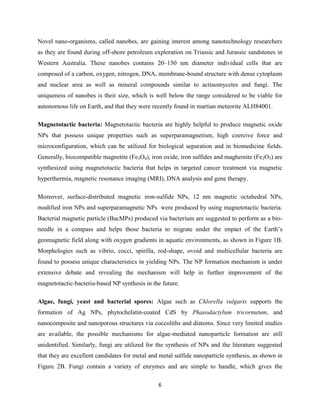
Viral NPs, as shown in Figure 1A, can be prepared from viruses by removing their genetic
material and making them “nanocargoes” for targeted drug delivery. Saunders et al. described
5
the development of viral NPs using RNA-removed cowpea mosaic virus through a proteolytic
process. The nanocages or protein capsids were used to encapsulate drugs, genes, enzymes or
proteins for targeted delivery with biocompatibility and bioavailability. Recent research efforts
have focused on using viral NPs as conjugation templates to produce novel nanostructures and
cages for compound encapsulation. Plant viruses have been found to be nontoxic towards human
cells at required dosages for effective administration of the drug load.
Figure 1: (A) Negatively stained rotavirus with complete (long arrow) and empty (short arrow)
particles in swine feces, (B) TEM image of a magnetotactic bacterium,
Nanobacteria and nanobes: Generally, bacteria will bind to soluble, toxic heavy metals and
precipitate them to their surface, producing metal NPs. These are called as nanobacteria and are
highly useful in the biosynthesis of low toxicity NPs. Pseudomonas stutzeri A259 is the first
bacteria to be used to produce Ag NPs. Later, many metal NPs, such as gold, alloy NPs,
nonmagnetic oxide NPs, and metal sulfide quantum dots such as CdS and ZnS, were synthesized
using different strains of bacteria. Other than bacteria, actinomycetes such as Thermomonospora
sp and Rhodococcus sp. are also used to produce NPs. This bacteria-mediated NP formation was
found to be highly useful in a nanomedicine application as they were found to reduce potential
cellular toxicity. However, the major drawbacks of these NPs are that they require more time for
synthesis, are difficult to filter, and produce a low yield of NPs, as compared to chemical
synthesis.
6
Novel nano-organisms, called nanobes, are gaining interest among nanotechnology researchers
as they are found during off-shore petroleum exploration on Triassic and Jurassic sandstones in
Western Australia. These nanobes contains 20–150 nm diameter individual cells that are
composed of a carbon, oxygen, nitrogen, DNA, membrane-bound structure with dense cytoplasm
and nuclear area as well as mineral compounds similar to actinomycetes and fungi. The
uniqueness of nanobes is their size, which is well below the range considered to be viable for
autonomous life on Earth, and that they were recently found in martian meteorite ALH84001.
Magnetotactic bacteria: Magnetotactic bacteria are highly helpful to produce magnetic oxide
NPs that possess unique properties such as superparamagnetism, high coercive force and
microconfiguration, which can be utilized for biological separation and in biomedicine fields.
Generally, biocompatible magnetite (Fe3O4), iron oxide, iron sulfides and maghemite (Fe2O3) are
synthesized using magnetotactic bacteria that helps in targeted cancer treatment via magnetic
hyperthermia, magnetic resonance imaging (MRI), DNA analysis and gene therapy.
Moreover, surface-distributed magnetic iron-sulfide NPs, 12 nm magnetic octahedral NPs,
modified iron NPs and superparamagnetic NPs were produced by using magnetotactic bacteria.
Bacterial magnetic particle (BacMPs) produced via bacterium are suggested to perform as a bio-
needle in a compass and helps those bacteria to migrate under the impact of the Earth’s
geomagnetic field along with oxygen gradients in aquatic environments, as shown in Figure 1B.
Morphologies such as vibrio, cocci, spirilla, rod-shape, ovoid and multicellular bacteria are
found to possess unique characteristics in yielding NPs. The NP formation mechanism is under
extensive debate and revealing the mechanism will help in further improvement of the
magnetotactic-bacteria-based NP synthesis in the future.
Algae, fungi, yeast and bacterial spores: Algae such as Chlorella vulgaris supports the
formation of Ag NPs, phytochelatin-coated CdS by Phaeodactylum tricornutum, and
nanocomposite and nanoporous structures via coccoliths and diatoms. Since very limited studies
are available, the possible mechanisms for algae-mediated nanoparticle formation are still
unidentified. Similarly, fungi are utilized for the synthesis of NPs and the literature suggested
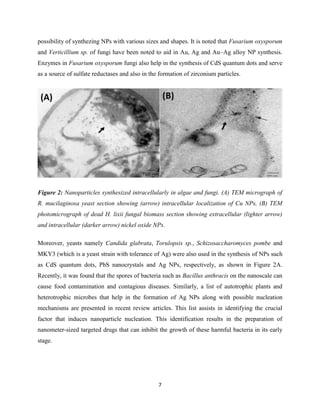
that they are excellent candidates for metal and metal sulfide nanoparticle synthesis, as shown in
Figure 2B. Fungi contain a variety of enzymes and are simple to handle, which gives the
7
possibility of synthezing NPs with various sizes and shapes. It is noted that Fusarium oxysporum
and Verticillium sp. of fungi have been noted to aid in Au, Ag and Au–Ag alloy NP synthesis.
Enzymes in Fusarium oxysporum fungi also help in the synthesis of CdS quantum dots and serve
as a source of sulfate reductases and also in the formation of zirconium particles.
Figure 2: Nanoparticles synthesized intracellularly in algae and fungi. (A) TEM micrograph of
R. mucilaginosa yeast section showing (arrow) intracellular localization of Cu NPs, (B) TEM
photomicrograph of dead H. lixii fungal biomass section showing extracellular (lighter arrow)
and intracellular (darker arrow) nickel oxide NPs.
Moreover, yeasts namely Candida glabrata, Torulopsis sp., Schizosaccharomyces pombe and
MKY3 (which is a yeast strain with tolerance of Ag) were also used in the synthesis of NPs such
as CdS quantum dots, PbS nanocrystals and Ag NPs, respectively, as shown in Figure 2A.
Recently, it was found that the spores of bacteria such as Bacillus anthracis on the nanoscale can
cause food contamination and contagious diseases. Similarly, a list of autotrophic plants and
heterotrophic microbes that help in the formation of Ag NPs along with possible nucleation
mechanisms are presented in recent review articles. This list assists in identifying the crucial
factor that induces nanoparticle nucleation. This identification results in the preparation of
nanometer-sized targeted drugs that can inhibit the growth of these harmful bacteria in its early
stage.
8
Nanoparticles and nanostructures in plants
Wood is made of natural fibers that are considered as cellular hierarchical bio-composites.
Natural fibers are composites of cellulosic-fibrils at the nanoscale level. The simplest form of
nanometer-sized cellulosic-fibrils are 100–1000 nm long, containing both crystalline and
amorphous segments. The unique strength and extreme performance properties of various natural
fibers such as wood are attributed to their elementary hierarchical structure with nanofibrillar
components. The isolation of nanocellulose from natural sources is possible through
nanotechnology, which requires combined methodologies including mechanical, chemical and
other processes. The resulting cellulose nanofibers could have distinct morphologies such as a
rod-like NPs (whiskers) or an entangled network (nanofibers). Plant surfaces, especially leaves,
contain nanostructures that are used for numerous purposes such as insects sliding, mechanical
stability, increased visible light and harmful UV reflection and radiation absorption respectively
as shown in Figure 3.
The most famous nanostructure property in plants is the superhydrophobicity in lotus leaves that
helps in self-cleaning and super-wettability of the leaves. Many studies in the literature have
suggested that stacks of nanostructures are responsible for the circular layer in plants and insects
which allows them to float on water without sinking. Based on these reports, many artificial
superhydrophobic materials with self-cleaning ability have been manufactured through
electrodeposition, photolithography and colloidal systems with unique morphology and
roughness. These superhydrophobic materials were useful in applications such as water
treatment, wettability switchers, smart actuators, transparent coatings and electrodes.
9
Figure 3: Photographs and the scanning electron microscope images of various bio-prototypes
bearing superhydrophobic surfaces. (a) Photograph of a lotus leaf; (b) SEM image of the lotus
leaf surface. The inset is a SEM image of a typical 5–9 μm micropapillae covering the surface
with fine branch-like nanostructures,. (c) Photograph of a red rose and (d) SEM image of a rose
petal surface. The inset is a magnified SEM image of the microcapillary arrays.
The most famous nanostructure property in plants is the superhydrophobicity in lotus leaves that
helps in self-cleaning and super-wettability of the leaves. Many studies in the literature have
suggested that stacks of nanostructures are responsible for the circular layer in plants and insects
which allows them to float on water without sinking. Based on these reports, many artificial
superhydrophobic materials with self-cleaning ability have been manufactured through
electrodeposition, photolithography and colloidal systems with unique morphology and
10
roughness. These superhydrophobic materials were useful in applications such as water
treatment, wettability switchers, smart actuators, transparent coatings and electrodes.
Nanoparticles and nanostructures in insects
Insect wing membranes are comprised of building materials with 0.5 μm to 1 mm thickness.
Additionally, the insect wings are formed by a complex vein system which gives superior
stability to the entire wing structure. Long chain crystalline chitin polymer is the basic
framework of insect wings that provides membrane support and allows for bearing forces on
them during flight. Resilin enhances the wing’s flexibility and is a unique component that is
found in between the junctions of the vein and the wing. The routine and longer colonization
flights were supported by the vein system along with their weightless wing material . Insect wing
surfaces demonstrate a rough and highly ordered structure comprised of micro- and nanoscale
properties to minimize their mass and protect them against wetting and pollutants. A methodical
terminology to explain the structural properties of insect cuticles was developed and mentioned
in a review by Byun et al. The review focused on describing the structures using SEM images
and highlights distinct insect wing morphologies.
Generally, the characteristics of wax crystals that exist on the wing surfaces are described by the
terms “Setae”, “denticles” and “fractal”. The setae are needle or hair like structures with a high
aspect ratio; a denticle is structured with morphology ranging from smaller hemispherical to
taller fractal; pillars are fine irregular nanoscale projections. SEM images and photographs of
various insect species and orders are provided. It is observed that wood termite
(Schedorhinotermes sp.) and cicada (Meimuna microdon) wings are concealed by a denticle
layer, while hornet (Vespa sp.) wings are covered by multiple setae. The water contact angles
(WCA) are observed to be less than 150° for both the structures and are not considered as
superhydrophobic. Conversely, a WCA greater than 150° was exhibited by the wing of the
grasshopper (Acrida cinerea cinerea), dragonfly (Hemicordulia tau) and butterfly species
(Papilio xuthus) over their surface. The literature also show that species with sophisticated
fractal and layered cuticle patterns possess superhydrophobic properties. These structural types
are composed of the hierarchical structure which may be responsible for increasing the surface
hydrophobicity. Moreover, the colors of butterflies are attributed to their fine wing structure.
11
Indeed, the literature reveals that they possess nanostructures in multilayers which act as
diffraction gratings, induce interference, and consequently iridescence.
Nanoparticles and nanostructures in animals and birds
Animals (insects belonging to Kingdom Animalia) such as flies, spiders, and geckos with
varying body weight can attach along ceilings and move along vertical walls. The interaction of
their patterned surface structure with the substrate profile gives efficient ability and mechanism
for attachment to the insect’s legs. An intense inverse scaling effect in these attachment devices
are exposed via an extensive microscopic study. It has been shown that adhesion is ensured by
sub-micrometric devices whereas flies and beetles rely on terminal setae that are of micrometer
dimensions. The principle of contact mechanics, which shows that the adhesion leads to the
splitting of contacts into finer subcontacts, helps to clearly explain the insect body weight to
setae trend. The natural adhesive system uses this principle for their design and may be
incorporated in future practical applications.
Research on attachment and mechanism of insects walking on ceilings using their hairy
attachment systems began 300 years ago and continues today. Electrostatic forces, sticking
fluids, and microsuckers are the proposed reasons that explain the insect’s attachment
mechanism. Some of these theories have been rejected based on experimental data and
combination of secretion-mediated capillary attractive forces and molecular interactions or van
der Waals interactions leads to adhesion. This may be due to the production of secretory fluids in
the contact area by some animals (insects), whereas others do not (spiders, geckos), which makes
the basic force in the physical form contribute to their adhesion. In recent reports, the reason for
adhesion of gecko setae is due to van der Waals interaction through strong evidence and rejects
the capillary adhesion mechanisms. It was predicted that application of contact mechanics may
help in smaller setae array endings by releasing greater adhesive strength. The beautiful color
patterns of peacock feathers are also known to be due to the cross-sectional arrangement of their
feather frills as shown in Figure 4.
12
Figure 4: (A) Photograph of peacock feathers showing various colors and patterns. (B) Cross-
sectional SEM images of the transverse (top) and longitudinal (bottom) sectionals of green
barbule cortex.
Mollusk shells consists of “nacre”, which is a hierarchical nanocomposite. Nacre is designed by
alternating micrometer-sized and sub-micrometer CaCO3 aragonite platelets, which are separated
by a thin layer of bio-macromolecular “glue”. Enhanced stiffness, impact resistance, strength,
and toughness are some of the mechanical properties that enable using nacre’s unique design.
The nacreous effect is caused by the thin layer of a rough surface with groovy nanostructures.
Other than the nacreous effect, gecko feet have the capability to walk on ceilings against gravity
and even on wet or slippery surfaces. This property is linked to the nanometer-sized hair-like
structures in their feet that are aligned in a series of a small ridges with a projection of 200 nm
width in each hair. This increases the total surface area of gecko feet and leads to a van der
Waals interaction mediated strong surface adhesion . Similarly, the crystalline composite of
CaCO3 crystals and protein that are aligned in a column and layers of calcite forms the thin and
strong eggshell. During the eggshell formation, the CaCO3 NPs begin as an amorphous mineral
which is transformed by the c-type lectin proteins into ordered crystals. The crystal
transformation is initiated by the attachment of proteins towards ACC NPs and later detach when
the crystal continues to grow.
Nanoparticles and nanostructures in the human body
The human body consists of nanostructures without which normal function of the body is
impossible. It is formed by nanostructures such as bones, enzymes, proteins, antibodies and
13
DNA. A list of nanostructures that exist in the human body is presented in Table 1. Even some
works categorize bone as a nanomaterial comprised of hierarchical inorganic nanohydroxyapatite
and organic collagen. Additionally, microorganisms such as viruses and bacteria are
nanostructures that can cause diseases in humans.
Table 1: List of nanostructured particles associated with the human body.
Nanostructure size
glucose
DNA
average size of protein (rubisco monomer)
haemoglobin
micelle
ribosomes
enzymes and antibodies
1 nm
2.2–2.6 nm
3–6 nm
6.5 nm
13 nm
25 nm
2–200 nm
Bone nanostructures
The inimitable combination of natural bone with precise and carefully engineered interfaces and
mechanical properties is due to their nanoscale to macroscopic architectural design and
dimensions. The interaction of micro/nanoscale components with the extracellular matrix (ECM)
within the stem cells includes influential stem cell behavior through sources of passive
mechanical force. A wide structural protein spectrum and polysaccharides of different length
scales with dominating nanometer-sized collagen fibrils strands of 35–60 nm diameter and a
micrometer range length comprise the main building blocks of the ECM.
Bone is a multifaceted composite with numerous hierarchical levels as shown in Figure 5. The
cortical bone with a compact shell and the spongiosa or trabecular bone with a porous core are
the two important parts of bone tissue (Figure 5a). Repeating osteon units together forms cortical
bone whereas an interconnecting trabeculae framework with bone marrow and free space helps
to form cancellous bone. Likewise, calcium phosphate crystals and collagen fibers are
specifically arranged to form the trabeculae and osteon units. The collagen molecules are
periodically arranged with gaps of 47 and 60 nm to form collagen fibrils (Figure 5b). The gaps
in collagen fibrils are embedded with hydroxyapatite (HA) crystals to increase the bone rigidity
14
(Figure 5c). The hierarchical organization with nanometer to centimeter magnitude and structure
of the ECM and cells determines the properties of bone tissues.
Figure 5: The macro- and microstructure of bone and its components with nanostructured
materials employed in the regeneration of bone. (a) Macroscopic bone details with a dense
cortical shell and cancellous bone with pores at both ends. (b) Repeating osteon units within
cortical bone. (c) Collagen fibers (100–2000 nm) comprised of collagen fibrils.
DNA nanostructures
DNA is the genetic blueprint repository of living organisms. It helps in the synthesis of protein,
which is essential for the activities of living organisms. Mono-phosphorylated deoxyribose sugar
attached with nitrogenated aromatic nucleobase is called a nucleotide, and this is the basic
structural unit of DNA. DNA possesses diverse sequence information storage mechanisms with
2.86 bits per linear nanometer density. A-DNA, B-DNA, and Z-DNA are three types of DNA
classification based on the base-paring between the strands. B-DNA is a right-handed double-
helical DNA structure whereas A-DNA is a comparatively short, more-compact, righthanded
double-helical structure, and Z-DNA is a left-handeddouble-helical DNA formed with long
polypurine stretches. These DNAs are nanostructures in organisms and their interactions with
other NMs play a major role in nanomaterial drug formulations.
Thus, in recent years, research on artificial DNA nanostructures have escalated in the field of
bionanotechnology. A phosphate backbone with negative charge, nucleobases with metal
chelates, and the hydrophobic core with aromatic rings are the chemical handles that are
responsible for the formation of self-assembled nanostructures through interaction with inorganic
15
NMs. The formation of DNA-templated metal nanostructures is possible by localizing transition
metal cations on DNA to act as precursors and chemical handles. DNA nanostructures and DNA
attached to NPs have been synthesized for various applications including nanobarcoding and
DNA sensors. Research in this area has advanced to include active self-reconfiguration of 1, 2 or
3-dimensional DNA-based nanoscale architectures for drug delivery, molecular electronics and
logics. Recent developments in DNA technologies such as Holliday junction elucidation and
crossovers help in the virtual assemblage of any DNA structures through DNA origami. An
extensive review on DNA origami, their functions and potential has been reported in. They
mentioned that NP-templated DNA and hybridization- based DNA are revolutionary particles
that will create a positive impact on future biomedical fields.

ADAMA PhD.pdf

  • 1.
    i ADAMA SCIENCE ANDTECHNOLOGY UNIVERSITY SCHOOL OF GRADUATE STUDY COURSE: THEORY AND PROPERTIES OF NANOMATERIALS (Phys 7012) NAME: FIKADU TAKELE Id No: PGR/1829/11 DEPARTMENT: APPLIED PHYSICS (PhD in Material Physics) Submitted to: MADHUSUDHAN (PhD) Submission date 29/11/2018
  • 2.
    1 Natural Nanomaterials: Organic,Inorganic and Biological Origin Classification of nanomaterials based on their origin: Apart from dimension and material- based classifications, nanomaterials (NMs) and nanostructured materials (NSMs) can also be classified as natural or synthetic, based on their origin. (i) Natural nanomaterials are produced in nature either by biological species or through anthropogenic activities. The production of artificial surfaces with exclusive micro and nanoscale templates and properties for technological applications are readily available from natural sources. Naturally occurring nanomaterials are present throughout the Earth’s spheres (i.e., in the hydrosphere, atmosphere, lithosphere and even in the biosphere), regardless of human actions. Earth is comprised of nanomaterials that are naturally formed and are present in the Earth’s spheres, such as the atmosphere, which includes the whole of troposphere, the hydrosphere, which includes oceans, lakes, rivers, groundwater and hydrothermal vents, the lithosphere, which is comprised of rocks, soils, magma or lava at particular stages of evolution and the biosphere, which covers micro-organisms and higher organisms, including humans. (ii) Synthetic (engineered) nanomaterials are produced by mechanical grinding, engine exhaust and smoke, or are synthesized by physical, chemical, biological or hybrid methods. The question of risk assessment strategies has arisen in recent times as there is increased fabrication and subsequent release of engineered nanomaterials as well as their usage in consumer products and industrial applications. These risk assessment strategies are highly helpful in forecasting the behavior and fate of engineered nanomaterials in various environmental media. The major challenge among engineered nanomaterials is whether existing knowledge is enough to forecast their behavior or if they exhibit a distinct environment related behavior, different from natural nanomaterials. Currently, different sources related to potential applications are used for the production of engineered nanomaterials. Most current nanoparticles (NPs) and nanostructured materials (NSMs) can be organized into four material-based categories (the references refer to recent reviews on these different categories of nanomaterials).
  • 3.
    2 (i) Carbon-based nanomaterials:Generally, these nanomaterials contain carbon, and are found in morphologies such as hollow tubes, ellipsoids or spheres. Fullerenes (C60), carbon nanotubes (CNTs), carbon nanofibers, carbon black, graphene (Gr), and carbon onions are included under the carbon-based NMs category. Laser ablation, arc discharge, and chemical vapor deposition (CVD) are the important production methods for these carbon- based materials fabrication (except carbon black). (ii) Inorganic-based nanomaterials: These nanomaterials include metal and metal oxide nanomaterials and nanostructured materials. These NMs can be synthesized into metals such as Au or Ag NPs, metal oxides such as TiO2 and ZnO NPs, and semiconductors such as silicon and ceramics. (iii) Organic-based nanomaterials: These include NMs made mostly from organic matter, excluding carbon-based or inorganic-based NMs. The utilization of noncovalent (weak) interactions for the self-assembly and design of molecules helps to transform the organic NMs into desired structures such as dendrimers, micelles, liposomes and polymer NPs. (iv) Composite-based nanomaterials: Composite NMs are multiphase NPs and nanostructured materials (NSMs) with one phase on the nanoscale dimension that can either combine NPs with other NPs or NPs combined with larger or with bulk-type materials (e.g., hybrid nanofibers) or more complicated structures, such as a metalorganic frameworks. The composites may be any combinations of carbon-based, metal-based, or organic-based NMs with any form of metal, ceramic, or polymer bulk materials. Sources of nanomaterials Sources of nanomaterials can be classified into three main categories based on their origin: (i) incidental nanomaterials, which are produced incidentally as a byproduct of industrial processes such as nanoparticles produced from vehicle engine exhaust,welding fumes, combustion processes and even some natural process such as forest fires; (ii) engineered nanomaterials, which have been manufactured by humans to have certain required properties for desired applications and (iii) naturally produced nanomaterials, which can be found in the bodies of
  • 4.
    3 organisms, insects, plants,animals and human bodies. However, the distinctions between naturally occurring, incidental, and manufactured NPs are often blurred. In some cases, for example, incidental NMs can be considered as a subcategory of natural NMs. Molecules are made up of atoms, which are the basic structural components of all living and nonliving organisms in nature. Atoms and molecules have been naturally manipulated several times to create intricate NPs and NSMs that continually contribute to life on earth. Incidental and naturally occurring NMs are continuously being formed within and distributed throughout ground and surface water, the oceans, continental soil, and the atmosphere. One of the main differences between incidental and engineered NMs is that the morphology of engineered NMs can usually be better controlled as compared to incidental NMs; additionally, engineered NMs can be purposely designed to exploit novel features that stem from their small size. It is known that metal NPs may be spontaneously generated from synthetic objects, which implies that humans have long been in direct contact with synthetic NMs and that macroscale objects are also a potential source of incidental nanoparticles in the environment. Incidental nanomaterials Photochemical reactions, volcanic eruptions, and forest fires are some of the natural processes that lead to the production of natural NPs as mentioned. In addition, skin and hair shedding of plants and animals, which is frequent in nature, contributes to NP composition in nature. Dust storms, volcanic eruptions, and forest fires are events of natural origin that are reported to produce high quantities of nanoparticulate matter that significantly affect worldwide air quality. Similarly, transportation, industrial operations, and charcoal burning are some of the human activities that lead to the emergence of synthetic NPs. Only about 10% of overall aerosols in the atmosphere are generated by human activity, whereas the naturally generated ones amount to 90% of atmospheric aerosols. Naturally produced nanomaterials Apart from incidental and engineered nanomaterials, nanoparticles and nanostructure materials are present in living organisms ranging from microorganisms, such as bacteria, algae and viruses, to complex organisms, such as plants, insects, birds, animals and humans. Recent developments in the equipment to visualize nanomaterials help in identifying the morphology of these naturally formed NMs, which will eventually lead to the better understanding of these organisms. The
  • 5.
    4 knowledge about thenanostructures present in microorganisms is important for the further use of these organisms for beneficial biomedical applications. Insects have nanostructures that are formed via an evolutionary process which helps them to survive in harsh living conditions. Plants also utilize the nutrients available in soil and water for their growth which leads to the accumulation of these biominerals in nano-form. Animals and small insects utilize nanostructures for their protection from predatory organisms as well as in their lightweight wings via nanowax coatings. Similarly, humans also possess organs that are primarily contructed by nanostructures, such as bones. Antibodies, enzymes and other secretions that are highly beneficial for the proper function of humans are found to be in nanometer size range. It can be also noted that the genetic material (DNA or RNA), which is important for the cell formation and function of all living cells, are nanostructures. This clearly shows that nanostructures are the basic foundation for all life forms on Earth. The following sections aim at listing the nanostructures that are present in living organisms. Nano-organisms: Nanoscale organisms, commonly known as nano-organisms are found all around us and even inside our bodies. The category “nano-organisms” are naturally occurring nanomaterials that include a massive range of organisms, for example, nanobacteria, viruses as well as fungi, algae, and yeast that can produce nanoparticles in their bodies. Viruses: Viruses are the largest structurally characterized molecular assemblies known to date, which can be a non-living crystal and a living organism inside host cells. Generally, they are considered to be harmful as they cause disease in bacteria, plants, animals and humans. Advances in molecular biology have increased the possibility to genetically tailor viruses for use as catalysts and bio-scaffolds. Nanosize, monodispersity, distinct shapes, selective permeability to smaller molecules, composition controllability by genome manipulation, self-assembly and polyvalence, rapid growth, and stability towards pH and temperature, are properties that make viruses a unique category among NMs. Viral NPs, as shown in Figure 1A, can be prepared from viruses by removing their genetic material and making them “nanocargoes” for targeted drug delivery. Saunders et al. described
  • 6.
    5 the development ofviral NPs using RNA-removed cowpea mosaic virus through a proteolytic process. The nanocages or protein capsids were used to encapsulate drugs, genes, enzymes or proteins for targeted delivery with biocompatibility and bioavailability. Recent research efforts have focused on using viral NPs as conjugation templates to produce novel nanostructures and cages for compound encapsulation. Plant viruses have been found to be nontoxic towards human cells at required dosages for effective administration of the drug load. Figure 1: (A) Negatively stained rotavirus with complete (long arrow) and empty (short arrow) particles in swine feces, (B) TEM image of a magnetotactic bacterium, Nanobacteria and nanobes: Generally, bacteria will bind to soluble, toxic heavy metals and precipitate them to their surface, producing metal NPs. These are called as nanobacteria and are highly useful in the biosynthesis of low toxicity NPs. Pseudomonas stutzeri A259 is the first bacteria to be used to produce Ag NPs. Later, many metal NPs, such as gold, alloy NPs, nonmagnetic oxide NPs, and metal sulfide quantum dots such as CdS and ZnS, were synthesized using different strains of bacteria. Other than bacteria, actinomycetes such as Thermomonospora sp and Rhodococcus sp. are also used to produce NPs. This bacteria-mediated NP formation was found to be highly useful in a nanomedicine application as they were found to reduce potential cellular toxicity. However, the major drawbacks of these NPs are that they require more time for synthesis, are difficult to filter, and produce a low yield of NPs, as compared to chemical synthesis.
  • 7.
    6 Novel nano-organisms, callednanobes, are gaining interest among nanotechnology researchers as they are found during off-shore petroleum exploration on Triassic and Jurassic sandstones in Western Australia. These nanobes contains 20–150 nm diameter individual cells that are composed of a carbon, oxygen, nitrogen, DNA, membrane-bound structure with dense cytoplasm and nuclear area as well as mineral compounds similar to actinomycetes and fungi. The uniqueness of nanobes is their size, which is well below the range considered to be viable for autonomous life on Earth, and that they were recently found in martian meteorite ALH84001. Magnetotactic bacteria: Magnetotactic bacteria are highly helpful to produce magnetic oxide NPs that possess unique properties such as superparamagnetism, high coercive force and microconfiguration, which can be utilized for biological separation and in biomedicine fields. Generally, biocompatible magnetite (Fe3O4), iron oxide, iron sulfides and maghemite (Fe2O3) are synthesized using magnetotactic bacteria that helps in targeted cancer treatment via magnetic hyperthermia, magnetic resonance imaging (MRI), DNA analysis and gene therapy. Moreover, surface-distributed magnetic iron-sulfide NPs, 12 nm magnetic octahedral NPs, modified iron NPs and superparamagnetic NPs were produced by using magnetotactic bacteria. Bacterial magnetic particle (BacMPs) produced via bacterium are suggested to perform as a bio- needle in a compass and helps those bacteria to migrate under the impact of the Earth’s geomagnetic field along with oxygen gradients in aquatic environments, as shown in Figure 1B. Morphologies such as vibrio, cocci, spirilla, rod-shape, ovoid and multicellular bacteria are found to possess unique characteristics in yielding NPs. The NP formation mechanism is under extensive debate and revealing the mechanism will help in further improvement of the magnetotactic-bacteria-based NP synthesis in the future. Algae, fungi, yeast and bacterial spores: Algae such as Chlorella vulgaris supports the formation of Ag NPs, phytochelatin-coated CdS by Phaeodactylum tricornutum, and nanocomposite and nanoporous structures via coccoliths and diatoms. Since very limited studies are available, the possible mechanisms for algae-mediated nanoparticle formation are still unidentified. Similarly, fungi are utilized for the synthesis of NPs and the literature suggested that they are excellent candidates for metal and metal sulfide nanoparticle synthesis, as shown in Figure 2B. Fungi contain a variety of enzymes and are simple to handle, which gives the
  • 8.
    7 possibility of synthezingNPs with various sizes and shapes. It is noted that Fusarium oxysporum and Verticillium sp. of fungi have been noted to aid in Au, Ag and Au–Ag alloy NP synthesis. Enzymes in Fusarium oxysporum fungi also help in the synthesis of CdS quantum dots and serve as a source of sulfate reductases and also in the formation of zirconium particles. Figure 2: Nanoparticles synthesized intracellularly in algae and fungi. (A) TEM micrograph of R. mucilaginosa yeast section showing (arrow) intracellular localization of Cu NPs, (B) TEM photomicrograph of dead H. lixii fungal biomass section showing extracellular (lighter arrow) and intracellular (darker arrow) nickel oxide NPs. Moreover, yeasts namely Candida glabrata, Torulopsis sp., Schizosaccharomyces pombe and MKY3 (which is a yeast strain with tolerance of Ag) were also used in the synthesis of NPs such as CdS quantum dots, PbS nanocrystals and Ag NPs, respectively, as shown in Figure 2A. Recently, it was found that the spores of bacteria such as Bacillus anthracis on the nanoscale can cause food contamination and contagious diseases. Similarly, a list of autotrophic plants and heterotrophic microbes that help in the formation of Ag NPs along with possible nucleation mechanisms are presented in recent review articles. This list assists in identifying the crucial factor that induces nanoparticle nucleation. This identification results in the preparation of nanometer-sized targeted drugs that can inhibit the growth of these harmful bacteria in its early stage.
  • 9.
    8 Nanoparticles and nanostructuresin plants Wood is made of natural fibers that are considered as cellular hierarchical bio-composites. Natural fibers are composites of cellulosic-fibrils at the nanoscale level. The simplest form of nanometer-sized cellulosic-fibrils are 100–1000 nm long, containing both crystalline and amorphous segments. The unique strength and extreme performance properties of various natural fibers such as wood are attributed to their elementary hierarchical structure with nanofibrillar components. The isolation of nanocellulose from natural sources is possible through nanotechnology, which requires combined methodologies including mechanical, chemical and other processes. The resulting cellulose nanofibers could have distinct morphologies such as a rod-like NPs (whiskers) or an entangled network (nanofibers). Plant surfaces, especially leaves, contain nanostructures that are used for numerous purposes such as insects sliding, mechanical stability, increased visible light and harmful UV reflection and radiation absorption respectively as shown in Figure 3. The most famous nanostructure property in plants is the superhydrophobicity in lotus leaves that helps in self-cleaning and super-wettability of the leaves. Many studies in the literature have suggested that stacks of nanostructures are responsible for the circular layer in plants and insects which allows them to float on water without sinking. Based on these reports, many artificial superhydrophobic materials with self-cleaning ability have been manufactured through electrodeposition, photolithography and colloidal systems with unique morphology and roughness. These superhydrophobic materials were useful in applications such as water treatment, wettability switchers, smart actuators, transparent coatings and electrodes.
  • 10.
    9 Figure 3: Photographsand the scanning electron microscope images of various bio-prototypes bearing superhydrophobic surfaces. (a) Photograph of a lotus leaf; (b) SEM image of the lotus leaf surface. The inset is a SEM image of a typical 5–9 μm micropapillae covering the surface with fine branch-like nanostructures,. (c) Photograph of a red rose and (d) SEM image of a rose petal surface. The inset is a magnified SEM image of the microcapillary arrays. The most famous nanostructure property in plants is the superhydrophobicity in lotus leaves that helps in self-cleaning and super-wettability of the leaves. Many studies in the literature have suggested that stacks of nanostructures are responsible for the circular layer in plants and insects which allows them to float on water without sinking. Based on these reports, many artificial superhydrophobic materials with self-cleaning ability have been manufactured through electrodeposition, photolithography and colloidal systems with unique morphology and
  • 11.
    10 roughness. These superhydrophobicmaterials were useful in applications such as water treatment, wettability switchers, smart actuators, transparent coatings and electrodes. Nanoparticles and nanostructures in insects Insect wing membranes are comprised of building materials with 0.5 μm to 1 mm thickness. Additionally, the insect wings are formed by a complex vein system which gives superior stability to the entire wing structure. Long chain crystalline chitin polymer is the basic framework of insect wings that provides membrane support and allows for bearing forces on them during flight. Resilin enhances the wing’s flexibility and is a unique component that is found in between the junctions of the vein and the wing. The routine and longer colonization flights were supported by the vein system along with their weightless wing material . Insect wing surfaces demonstrate a rough and highly ordered structure comprised of micro- and nanoscale properties to minimize their mass and protect them against wetting and pollutants. A methodical terminology to explain the structural properties of insect cuticles was developed and mentioned in a review by Byun et al. The review focused on describing the structures using SEM images and highlights distinct insect wing morphologies. Generally, the characteristics of wax crystals that exist on the wing surfaces are described by the terms “Setae”, “denticles” and “fractal”. The setae are needle or hair like structures with a high aspect ratio; a denticle is structured with morphology ranging from smaller hemispherical to taller fractal; pillars are fine irregular nanoscale projections. SEM images and photographs of various insect species and orders are provided. It is observed that wood termite (Schedorhinotermes sp.) and cicada (Meimuna microdon) wings are concealed by a denticle layer, while hornet (Vespa sp.) wings are covered by multiple setae. The water contact angles (WCA) are observed to be less than 150° for both the structures and are not considered as superhydrophobic. Conversely, a WCA greater than 150° was exhibited by the wing of the grasshopper (Acrida cinerea cinerea), dragonfly (Hemicordulia tau) and butterfly species (Papilio xuthus) over their surface. The literature also show that species with sophisticated fractal and layered cuticle patterns possess superhydrophobic properties. These structural types are composed of the hierarchical structure which may be responsible for increasing the surface hydrophobicity. Moreover, the colors of butterflies are attributed to their fine wing structure.
  • 12.
    11 Indeed, the literaturereveals that they possess nanostructures in multilayers which act as diffraction gratings, induce interference, and consequently iridescence. Nanoparticles and nanostructures in animals and birds Animals (insects belonging to Kingdom Animalia) such as flies, spiders, and geckos with varying body weight can attach along ceilings and move along vertical walls. The interaction of their patterned surface structure with the substrate profile gives efficient ability and mechanism for attachment to the insect’s legs. An intense inverse scaling effect in these attachment devices are exposed via an extensive microscopic study. It has been shown that adhesion is ensured by sub-micrometric devices whereas flies and beetles rely on terminal setae that are of micrometer dimensions. The principle of contact mechanics, which shows that the adhesion leads to the splitting of contacts into finer subcontacts, helps to clearly explain the insect body weight to setae trend. The natural adhesive system uses this principle for their design and may be incorporated in future practical applications. Research on attachment and mechanism of insects walking on ceilings using their hairy attachment systems began 300 years ago and continues today. Electrostatic forces, sticking fluids, and microsuckers are the proposed reasons that explain the insect’s attachment mechanism. Some of these theories have been rejected based on experimental data and combination of secretion-mediated capillary attractive forces and molecular interactions or van der Waals interactions leads to adhesion. This may be due to the production of secretory fluids in the contact area by some animals (insects), whereas others do not (spiders, geckos), which makes the basic force in the physical form contribute to their adhesion. In recent reports, the reason for adhesion of gecko setae is due to van der Waals interaction through strong evidence and rejects the capillary adhesion mechanisms. It was predicted that application of contact mechanics may help in smaller setae array endings by releasing greater adhesive strength. The beautiful color patterns of peacock feathers are also known to be due to the cross-sectional arrangement of their feather frills as shown in Figure 4.
  • 13.
    12 Figure 4: (A)Photograph of peacock feathers showing various colors and patterns. (B) Cross- sectional SEM images of the transverse (top) and longitudinal (bottom) sectionals of green barbule cortex. Mollusk shells consists of “nacre”, which is a hierarchical nanocomposite. Nacre is designed by alternating micrometer-sized and sub-micrometer CaCO3 aragonite platelets, which are separated by a thin layer of bio-macromolecular “glue”. Enhanced stiffness, impact resistance, strength, and toughness are some of the mechanical properties that enable using nacre’s unique design. The nacreous effect is caused by the thin layer of a rough surface with groovy nanostructures. Other than the nacreous effect, gecko feet have the capability to walk on ceilings against gravity and even on wet or slippery surfaces. This property is linked to the nanometer-sized hair-like structures in their feet that are aligned in a series of a small ridges with a projection of 200 nm width in each hair. This increases the total surface area of gecko feet and leads to a van der Waals interaction mediated strong surface adhesion . Similarly, the crystalline composite of CaCO3 crystals and protein that are aligned in a column and layers of calcite forms the thin and strong eggshell. During the eggshell formation, the CaCO3 NPs begin as an amorphous mineral which is transformed by the c-type lectin proteins into ordered crystals. The crystal transformation is initiated by the attachment of proteins towards ACC NPs and later detach when the crystal continues to grow. Nanoparticles and nanostructures in the human body The human body consists of nanostructures without which normal function of the body is impossible. It is formed by nanostructures such as bones, enzymes, proteins, antibodies and
  • 14.
    13 DNA. A listof nanostructures that exist in the human body is presented in Table 1. Even some works categorize bone as a nanomaterial comprised of hierarchical inorganic nanohydroxyapatite and organic collagen. Additionally, microorganisms such as viruses and bacteria are nanostructures that can cause diseases in humans. Table 1: List of nanostructured particles associated with the human body. Nanostructure size glucose DNA average size of protein (rubisco monomer) haemoglobin micelle ribosomes enzymes and antibodies 1 nm 2.2–2.6 nm 3–6 nm 6.5 nm 13 nm 25 nm 2–200 nm Bone nanostructures The inimitable combination of natural bone with precise and carefully engineered interfaces and mechanical properties is due to their nanoscale to macroscopic architectural design and dimensions. The interaction of micro/nanoscale components with the extracellular matrix (ECM) within the stem cells includes influential stem cell behavior through sources of passive mechanical force. A wide structural protein spectrum and polysaccharides of different length scales with dominating nanometer-sized collagen fibrils strands of 35–60 nm diameter and a micrometer range length comprise the main building blocks of the ECM. Bone is a multifaceted composite with numerous hierarchical levels as shown in Figure 5. The cortical bone with a compact shell and the spongiosa or trabecular bone with a porous core are the two important parts of bone tissue (Figure 5a). Repeating osteon units together forms cortical bone whereas an interconnecting trabeculae framework with bone marrow and free space helps to form cancellous bone. Likewise, calcium phosphate crystals and collagen fibers are specifically arranged to form the trabeculae and osteon units. The collagen molecules are periodically arranged with gaps of 47 and 60 nm to form collagen fibrils (Figure 5b). The gaps in collagen fibrils are embedded with hydroxyapatite (HA) crystals to increase the bone rigidity
  • 15.
    14 (Figure 5c). Thehierarchical organization with nanometer to centimeter magnitude and structure of the ECM and cells determines the properties of bone tissues. Figure 5: The macro- and microstructure of bone and its components with nanostructured materials employed in the regeneration of bone. (a) Macroscopic bone details with a dense cortical shell and cancellous bone with pores at both ends. (b) Repeating osteon units within cortical bone. (c) Collagen fibers (100–2000 nm) comprised of collagen fibrils. DNA nanostructures DNA is the genetic blueprint repository of living organisms. It helps in the synthesis of protein, which is essential for the activities of living organisms. Mono-phosphorylated deoxyribose sugar attached with nitrogenated aromatic nucleobase is called a nucleotide, and this is the basic structural unit of DNA. DNA possesses diverse sequence information storage mechanisms with 2.86 bits per linear nanometer density. A-DNA, B-DNA, and Z-DNA are three types of DNA classification based on the base-paring between the strands. B-DNA is a right-handed double- helical DNA structure whereas A-DNA is a comparatively short, more-compact, righthanded double-helical structure, and Z-DNA is a left-handeddouble-helical DNA formed with long polypurine stretches. These DNAs are nanostructures in organisms and their interactions with other NMs play a major role in nanomaterial drug formulations. Thus, in recent years, research on artificial DNA nanostructures have escalated in the field of bionanotechnology. A phosphate backbone with negative charge, nucleobases with metal chelates, and the hydrophobic core with aromatic rings are the chemical handles that are responsible for the formation of self-assembled nanostructures through interaction with inorganic
  • 16.
    15 NMs. The formationof DNA-templated metal nanostructures is possible by localizing transition metal cations on DNA to act as precursors and chemical handles. DNA nanostructures and DNA attached to NPs have been synthesized for various applications including nanobarcoding and DNA sensors. Research in this area has advanced to include active self-reconfiguration of 1, 2 or 3-dimensional DNA-based nanoscale architectures for drug delivery, molecular electronics and logics. Recent developments in DNA technologies such as Holliday junction elucidation and crossovers help in the virtual assemblage of any DNA structures through DNA origami. An extensive review on DNA origami, their functions and potential has been reported in. They mentioned that NP-templated DNA and hybridization- based DNA are revolutionary particles that will create a positive impact on future biomedical fields.