Wang	
  Hua	


Founding	
  Partner,	
  Innova1on	
  Works	


February	
  2010	


                                                       Innovation Works Confidential and Proprietary
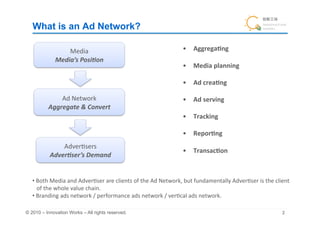
What is an Ad Network?	

                    Media	
                                                                  •  Aggrega&ng	
  
                Media’s	
  Posi0on	
                                                                                             •  Media	
  planning	
  

                                                                                             •  Ad	
  crea&ng	
  

                Ad	
  Network	
                                                              •  Ad	
  serving	
  
            Aggregate	
  &	
  Convert	
  	
                                                                                             •  Tracking	
  

                                                                                             •  Repor&ng	
  
                 Adver+sers	
  
                                                                                             •  Transac&on	
  
             Adver0ser’s	
  Demand	


   • 	
  Both	
  Media	
  and	
  Adver+ser	
  are	
  clients	
  of	
  the	
  Ad	
  Network,	
  but	
  fundamentally	
  Adver+ser	
  is	
  the	
  client	


  of	
  the	
  whole	
  value	
  chain.	
  
   • 	
  Branding	
  ads	
  network	
  /	
  performance	
  ads	
  network	
  /	
  ver+cal	
  ads	
  network.	

© 2010 – Innovation Works – All rights reserved.
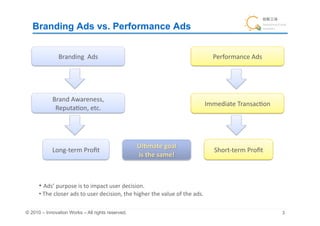
Branding Ads vs. Performance Ads	


                   Branding	
  	
  Ads	
                                                                                Performance	
  Ads	


               Brand	
  Awareness,	
  	
  
                                                                                                                    Immediate	
  Transac+on	
                Reputa+on,	
  etc.	


              Long-­‐term	
  Profit	
                                                                                    Short-­‐term	
  Profit	


      •  Ads’	
  purpose	
  is	
  to	
  impact	
  user	
  decision.	
  
      • 	
  The	
  closer	
  ads	
  to	
  user	
  decision,	
  the	
  higher	
  the	
  value	
  of	
  the	
  ads.	
  

© 2010 – Innovation Works – All rights reserved.
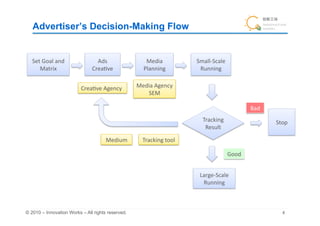
Advertiser’s Decision-Making Flow	


   Set	
  Goal	
  and	
           Ads	
                  Media	
             Small-­‐Scale	
  
      Matrix	
                  Crea+ve	
               Planning	
            Running	


                            Crea+ve	
  Agency	
      Media	
  Agency	
  
                                                        SEM	
  	

                                                                                                            Bad	
                                                                                Tracking	
  	
                      Stop	
                                                                                 Result	
  	

                                      Medium	
          Tracking	
  tool	

                                                                                                   Good	


                                                                              Large-­‐Scale	
  
                                                                               Running	


© 2010 – Innovation Works – All rights reserved.
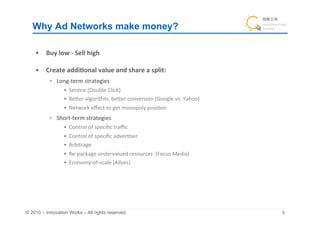
Why Ad Networks make money?	

    •  Buy	
  low	
  -­‐	
  Sell	
  high	
  

    •  Create	
  addi&onal	
  value	
  and	
  share	
  a	
  split:	
  	
  
              Long-­‐term	
  strategies	
  
                     •  Service	
  (Double	
  Click)	
  
                     •  BeQer	
  algorithm,	
  beQer	
  conversion	
  (Google	
  vs.	
  Yahoo)	
  
                     •  Network	
  effect	
  to	
  get	
  monopoly	
  posi+on	
  
              Short-­‐term	
  strategies	
  
                     •  Control	
  of	
  specific	
  traffic	
  
                     •  Control	
  of	
  specific	
  adver+ser	
  
                     •  Arbitrage	
  	
  
                     •  Re-­‐package	
  undervalued	
  resources	
  	
  (Focus	
  Media)	
  
                     •  Economy-­‐of-­‐scale	
  (Allyes)	


© 2010 – Innovation Works – All rights reserved.
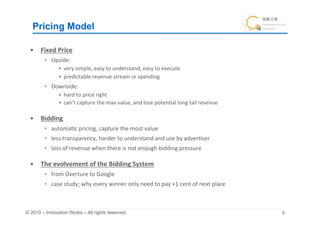
Pricing Model	

  •  Fixed	
  Price	
  
          Upside:	
  	
  
             •  very	
  simple,	
  easy	
  to	
  understand,	
  easy	
  to	
  execute	
  
             •  predictable	
  revenue	
  stream	
  or	
  spending	
  
          Downside:	
  
             •  hard	
  to	
  price	
  right	
  
             •  can’t	
  capture	
  the	
  max	
  value,	
  and	
  lose	
  poten+al	
  long	
  tail	
  revenue	
  

  •  Bidding	
  
          automa+c	
  pricing,	
  capture	
  the	
  most	
  value	
  
          less	
  transparency,	
  harder	
  to	
  understand	
  and	
  use	
  by	
  adver+ser	
  
          loss	
  of	
  revenue	
  when	
  there	
  is	
  not	
  enough	
  bidding	
  pressure	
  

  •  The	
  evolvement	
  of	
  the	
  Bidding	
  System	
  
          from	
  Overture	
  to	
  Google	
  
          case	
  study;	
  why	
  every	
  winner	
  only	
  need	
  to	
  pay	
  +1	
  cent	
  of	
  next	
  place	


© 2010 – Innovation Works – All rights reserved.
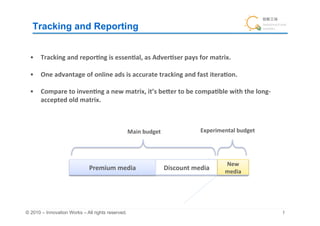
Tracking and Reporting	


  •  Tracking	
  and	
  repor&ng	
  is	
  essen&al,	
  as	
  Adver&ser	
  pays	
  for	
  matrix.	
  

  •  One	
  advantage	
  of	
  online	
  ads	
  is	
  accurate	
  tracking	
  and	
  fast	
  itera&on.	
  

  •  Compare	
  to	
  inven&ng	
  a	
  new	
  matrix,	
  it’s	
  beIer	
  to	
  be	
  compa&ble	
  with	
  the	
  long-­‐
     accepted	
  old	
  matrix.	


                                                  Main	
  budget	
                    Experimental	
  budget	


                                                                                                   New	
  
                               Premium	
  media	
                   Discount	
  media	
            media	


© 2010 – Innovation Works – All rights reserved.
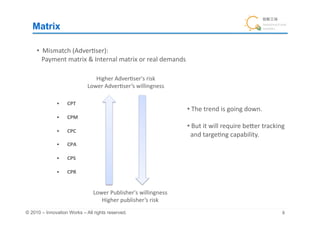
Matrix	

     • 	
  	
  Mismatch	
  (Adver+ser):	


  Payment	
  matrix	
  &	
  Internal	
  matrix	
  or	
  real	
  demands	

                                   Higher	
  Adver+ser's	
  risk	
  
                                Lower	
  Adver+ser’s	
  willingness	

               •     CPT	
  
                                                                                      • 	
  The	
  trend	
  is	
  going	
  down.	
  
               •     CPM	
  
                                                                                      • 	
  But	
  it	
  will	
  require	
  beQer	
  tracking	
  
               •     CPC	


  and	
  targe+ng	
  capability.	
  
               •     CPA	
  

               •     CPS	
  

               •     CPR	


                                   Lower	
  Publisher's	
  willingness	
  
                                      Higher	
  publisher’s	
  risk	
© 2010 – Innovation Works – All rights reserved.
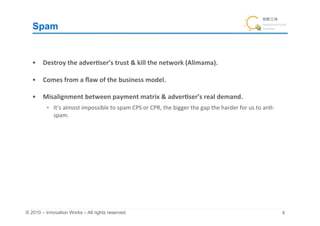
Spam	


   •  Destroy	
  the	
  adver&ser’s	
  trust	
  &	
  kill	
  the	
  network	
  (Alimama).	
  

   •  Comes	
  from	
  a	
  flaw	
  of	
  the	
  business	
  model.	
  

   •  Misalignment	
  between	
  payment	
  matrix	
  &	
  adver&ser’s	
  real	
  demand.	
  
            It’s	
  almost	
  impossible	
  to	
  spam	
  CPS	
  or	
  CPR,	
  the	
  bigger	
  the	
  gap	
  the	
  harder	
  for	
  us	
  to	
  an+-­‐
             spam.	


© 2010 – Innovation Works – All rights reserved.
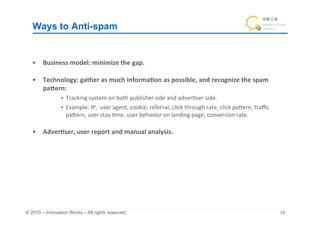
Ways to Anti-spam	


   •  Business	
  model:	
  minimize	
  the	
  gap.	
  

   •  Technology:	
  gather	
  as	
  much	
  informa&on	
  as	
  possible,	
  and	
  recognize	
  the	
  spam	
  
      paIern:	
  	
  
                •  Tracking	
  system	
  on	
  both	
  publisher	
  side	
  and	
  adver+ser	
  side.	
  
                •  Example:	
  IP,	
  	
  user	
  agent,	
  cookie,	
  referral,	
  click	
  through	
  rate,	
  click	
  paQern,	
  traffic	
  
                   paQern,	
  user	
  stay	
  +me,	
  user	
  behavior	
  on	
  landing	
  page,	
  conversion	
  rate.	
  

   •  Adver&ser,	
  user	
  report	
  and	
  manual	
  analysis.	


© 2010 – Innovation Works – All rights reserved.
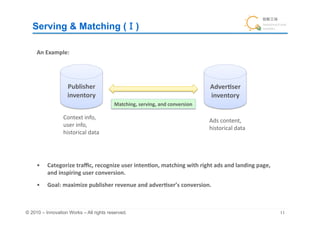
Serving & Matching ( )	

     An	
  Example:	


                    Publisher	
                                                                  Adver&ser	
  
                    inventory	
                                                                  inventory	
                                              Matching,	
  serving,	
  and	
  conversion	

                  Context	
  info,	
  
                                                                                                 Ads	
  content,	
  
                  user	
  info,	
  
                                                                                                 historical	
  data	
                  historical	
  data	


     •    Categorize	
  traffic,	
  recognize	
  user	
  inten&on,	
  matching	
  with	
  right	
  ads	
  and	
  landing	
  page,	
  
          and	
  inspiring	
  user	
  conversion.	
  	
  
     •    Goal:	
  maximize	
  publisher	
  revenue	
  and	
  adver&ser’s	
  conversion.	


© 2010 – Innovation Works – All rights reserved.
Serving & Matching ( )	


    •  Contextual	
  targe&ng,	
  behavioral	
  targe&ng,	
  profile	
  targe&ng:	
  
             Contextual	
  targe+ng:	
  
                •  Upside:	


  No	
  need	
  of	
  addi+onal	
  informa+on,	
  current	
  user	
  status,	
  best	
  matching	
  when	
  user	
  
                               have	
  clear	
  intension	
  
                •  Downside:	


  No	
  individual	
  informa+on,	
  worse	
  when	
  user	
  does	
  not	
  have	
  clear	
  intension	


  (e.g.	
  MySpace)	
  
             Profile	
  targe+ng,	
  Behavioral	
  targe+ng:	
  
                •  Upside:	


  BeQer	
  when	
  user	
  haven’t	
  clear	
  intension	
  
                •  Downside:	


  No	
  user	
  current	
  status	
  informa+on,	
  need	
  specific	
  user	
  privacy	
  data,	
  hard	
  to	
  get.	


© 2010 – Innovation Works – All rights reserved.
Serving & Matching ( )	


    •  Currently	
  good	
  ad	
  networks	
  normally	
  use	
  all	
  three	
  methods.	
  

    •  Matching	
  quality	
  depends	
  not	
  only	
  on	
  quality	
  of	
  algorithm,	
  but	
  also	
  quality	
  of	
  
       publisher	
  inventory,	
  ads	
  inventory	
  size	
  and	
  data	
  size.	
  

    •  Normally,	
  beIer	
  algorithm	
  and	
  more	
  input	
  get	
  beIer	
  result,	
  but	
  must	
  balance	
  
       with	
  cost	
  and	
  speed.	

    •  Ads	
  format,	
  	
  ad	
  quality,	
  landing	
  page	
  quality,	
  serving	
  quality	
  have	
  big	
  impact	
  
       (e.g.	
  ads	
  similar	
  with	
  main	
  content).	


© 2010 – Innovation Works – All rights reserved.
Serving & Matching ( )	


    •  Example	
  system	
  on	
  slide	
  11.	
  

    •  Star&ng	
  from	
  contextual	
  targe&ng,	
  now	
  have	
  profile	
  and	
  behavioral	
  targe&ng,	
  
       support	
  mul&ple	
  form	
  bidding,	
  CPC	
  and	
  CPM	
  bidding.	
  

    •  Revenue	
  =	
  Traffic	
  x	
  RPM	
  

    •  RPM	
  =	
  CPC	
  x	
  CTR	
  x	
  Quality	
  Score	
  (conversion)	
  

    •  Extract	
  keywords,	
  calculate	
  eCPM,	
  trial	
  running,	
  refine	
  eCPM,	
  adjust	
  with	
  
       conversion	
  score.	


© 2010 – Innovation Works – All rights reserved.
Ads Front-End	


    •  Normally	
  includes	
  ads	
  crea&on,	
  media	
  planning,	
  report	
  and	
  transac&on	
  part.	
  

    •  Could	
  be	
  internal	
  facing	
  or	
  external	
  facing.	
  

    •  Help	
  user	
  create	
  and	
  manage	
  campaign,	
  simplify	
  user	
  decision	
  making.	


© 2010 – Innovation Works – All rights reserved.

Ad Network Essentials

  • 1.
    Wang  Hua       Founding  Partner,  Innova1on  Works         February  2010 Innovation Works Confidential and Proprietary
  • 2.
    What is anAd Network? Media   •  Aggrega&ng   Media’s  Posi0on •  Media  planning   •  Ad  crea&ng   Ad  Network   •  Ad  serving   Aggregate  &  Convert   •  Tracking   •  Repor&ng   Adver+sers   •  Transac&on   Adver0ser’s  Demand •   Both  Media  and  Adver+ser  are  clients  of  the  Ad  Network,  but  fundamentally  Adver+ser  is  the  client          of  the  whole  value  chain.   •   Branding  ads  network  /  performance  ads  network  /  ver+cal  ads  network. © 2010 – Innovation Works – All rights reserved.
  • 3.
    Branding Ads vs.Performance Ads Branding    Ads Performance  Ads Brand  Awareness,     Immediate  Transac+on Reputa+on,  etc. Long-­‐term  Profit Short-­‐term  Profit •  Ads’  purpose  is  to  impact  user  decision.   •   The  closer  ads  to  user  decision,  the  higher  the  value  of  the  ads.   © 2010 – Innovation Works – All rights reserved.
  • 4.
    Advertiser’s Decision-Making Flow Set  Goal  and   Ads   Media   Small-­‐Scale   Matrix Crea+ve Planning Running Crea+ve  Agency Media  Agency   SEM   Bad Tracking     Stop Result   Medium Tracking  tool Good Large-­‐Scale   Running © 2010 – Innovation Works – All rights reserved.
  • 5.
    Why Ad Networksmake money? •  Buy  low  -­‐  Sell  high   •  Create  addi&onal  value  and  share  a  split:       Long-­‐term  strategies   •  Service  (Double  Click)   •  BeQer  algorithm,  beQer  conversion  (Google  vs.  Yahoo)   •  Network  effect  to  get  monopoly  posi+on     Short-­‐term  strategies   •  Control  of  specific  traffic   •  Control  of  specific  adver+ser   •  Arbitrage     •  Re-­‐package  undervalued  resources    (Focus  Media)   •  Economy-­‐of-­‐scale  (Allyes)   © 2010 – Innovation Works – All rights reserved.
  • 6.
    Pricing Model •  Fixed  Price     Upside:     •  very  simple,  easy  to  understand,  easy  to  execute   •  predictable  revenue  stream  or  spending     Downside:   •  hard  to  price  right   •  can’t  capture  the  max  value,  and  lose  poten+al  long  tail  revenue   •  Bidding     automa+c  pricing,  capture  the  most  value     less  transparency,  harder  to  understand  and  use  by  adver+ser     loss  of  revenue  when  there  is  not  enough  bidding  pressure   •  The  evolvement  of  the  Bidding  System     from  Overture  to  Google     case  study;  why  every  winner  only  need  to  pay  +1  cent  of  next  place     © 2010 – Innovation Works – All rights reserved.
  • 7.
    Tracking and Reporting •  Tracking  and  repor&ng  is  essen&al,  as  Adver&ser  pays  for  matrix.   •  One  advantage  of  online  ads  is  accurate  tracking  and  fast  itera&on.   •  Compare  to  inven&ng  a  new  matrix,  it’s  beIer  to  be  compa&ble  with  the  long-­‐ accepted  old  matrix. Main  budget Experimental  budget New   Premium  media Discount  media media © 2010 – Innovation Works – All rights reserved.
  • 8.
    Matrix •     Mismatch  (Adver+ser):          Payment  matrix  &  Internal  matrix  or  real  demands Higher  Adver+ser's  risk   Lower  Adver+ser’s  willingness •  CPT   •   The  trend  is  going  down.   •  CPM   •   But  it  will  require  beQer  tracking   •  CPC      and  targe+ng  capability.   •  CPA   •  CPS   •  CPR   Lower  Publisher's  willingness   Higher  publisher’s  risk © 2010 – Innovation Works – All rights reserved.
  • 9.
    Spam •  Destroy  the  adver&ser’s  trust  &  kill  the  network  (Alimama).   •  Comes  from  a  flaw  of  the  business  model.   •  Misalignment  between  payment  matrix  &  adver&ser’s  real  demand.     It’s  almost  impossible  to  spam  CPS  or  CPR,  the  bigger  the  gap  the  harder  for  us  to  an+-­‐ spam.   © 2010 – Innovation Works – All rights reserved.
  • 10.
    Ways to Anti-spam •  Business  model:  minimize  the  gap.   •  Technology:  gather  as  much  informa&on  as  possible,  and  recognize  the  spam   paIern:     •  Tracking  system  on  both  publisher  side  and  adver+ser  side.   •  Example:  IP,    user  agent,  cookie,  referral,  click  through  rate,  click  paQern,  traffic   paQern,  user  stay  +me,  user  behavior  on  landing  page,  conversion  rate.   •  Adver&ser,  user  report  and  manual  analysis. © 2010 – Innovation Works – All rights reserved.
  • 11.
    Serving & Matching( ) An  Example: Publisher   Adver&ser   inventory inventory Matching,  serving,  and  conversion Context  info,   Ads  content,   user  info,   historical  data historical  data •  Categorize  traffic,  recognize  user  inten&on,  matching  with  right  ads  and  landing  page,   and  inspiring  user  conversion.     •  Goal:  maximize  publisher  revenue  and  adver&ser’s  conversion.   © 2010 – Innovation Works – All rights reserved.
  • 12.
    Serving & Matching( ) •  Contextual  targe&ng,  behavioral  targe&ng,  profile  targe&ng:     Contextual  targe+ng:   •  Upside:            No  need  of  addi+onal  informa+on,  current  user  status,  best  matching  when  user   have  clear  intension   •  Downside:            No  individual  informa+on,  worse  when  user  does  not  have  clear  intension      (e.g.  MySpace)     Profile  targe+ng,  Behavioral  targe+ng:   •  Upside:            BeQer  when  user  haven’t  clear  intension   •  Downside:      No  user  current  status  informa+on,  need  specific  user  privacy  data,  hard  to  get.   © 2010 – Innovation Works – All rights reserved.
  • 13.
    Serving & Matching( ) •  Currently  good  ad  networks  normally  use  all  three  methods.   •  Matching  quality  depends  not  only  on  quality  of  algorithm,  but  also  quality  of   publisher  inventory,  ads  inventory  size  and  data  size.   •  Normally,  beIer  algorithm  and  more  input  get  beIer  result,  but  must  balance   with  cost  and  speed. •  Ads  format,    ad  quality,  landing  page  quality,  serving  quality  have  big  impact   (e.g.  ads  similar  with  main  content).   © 2010 – Innovation Works – All rights reserved.
  • 14.
    Serving & Matching( ) •  Example  system  on  slide  11.   •  Star&ng  from  contextual  targe&ng,  now  have  profile  and  behavioral  targe&ng,   support  mul&ple  form  bidding,  CPC  and  CPM  bidding.   •  Revenue  =  Traffic  x  RPM   •  RPM  =  CPC  x  CTR  x  Quality  Score  (conversion)   •  Extract  keywords,  calculate  eCPM,  trial  running,  refine  eCPM,  adjust  with   conversion  score.     © 2010 – Innovation Works – All rights reserved.
  • 15.
    Ads Front-End •  Normally  includes  ads  crea&on,  media  planning,  report  and  transac&on  part.   •  Could  be  internal  facing  or  external  facing.   •  Help  user  create  and  manage  campaign,  simplify  user  decision  making.   © 2010 – Innovation Works – All rights reserved.