ACTIVITY 3 - ANALYSING CONTENT AND LANGUAGE INTEGRATION.pptx
1.
MASTER IN BILINGUALEDUCATION
Subject: Evaluation and Assessment
Activity 3: Analysing Content and Language
Integration in an Assessment Activity
Presented by: Trujillo Masfil, Anthony Gian Paul
2.
1. PURPOSE
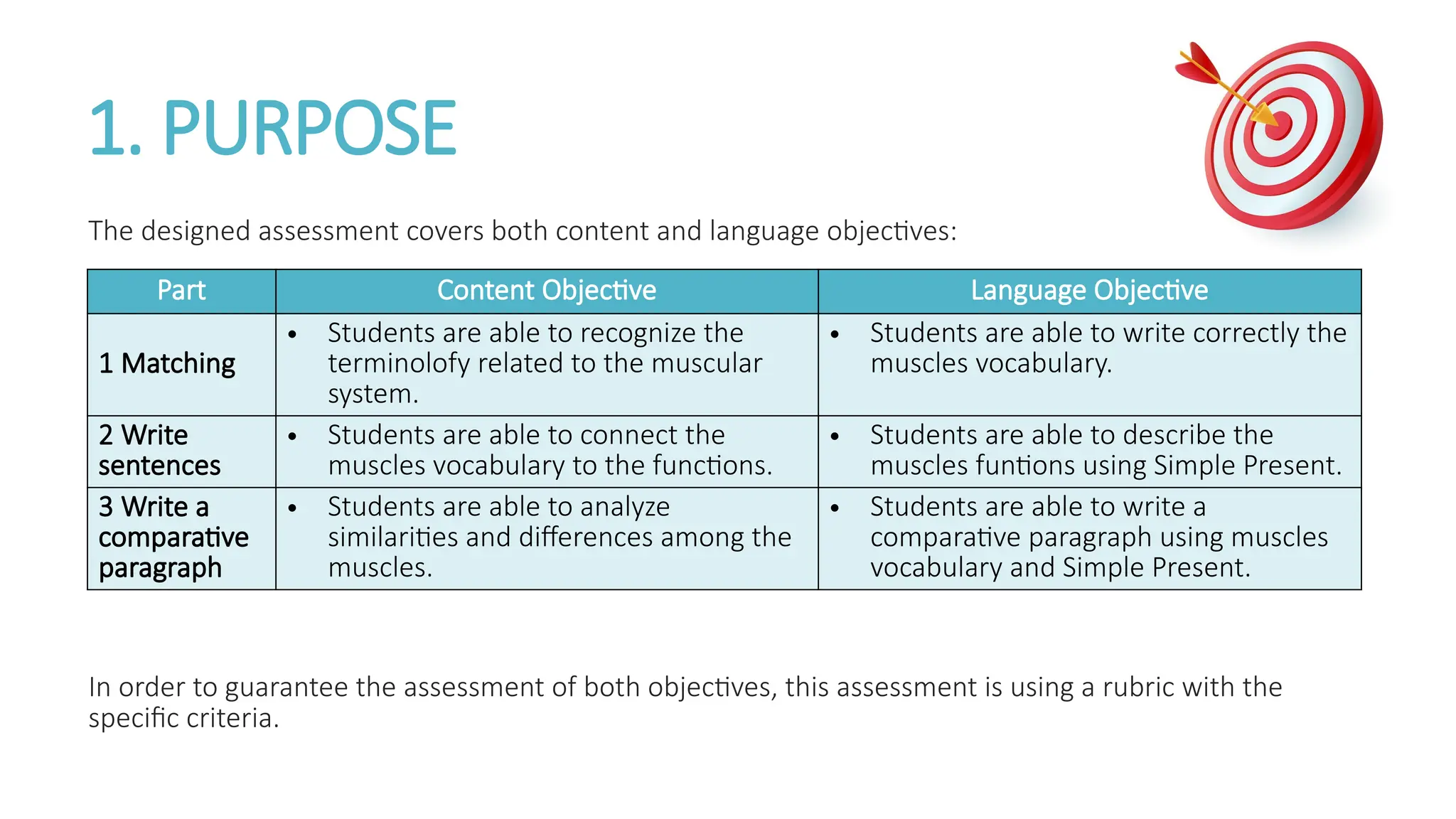
The designedassessment covers both content and language objectives:
In order to guarantee the assessment of both objectives, this assessment is using a rubric with the
specific criteria.
Part Content Objective Language Objective
1 Matching
• Students are able to recognize the
terminolofy related to the muscular
system.
• Students are able to write correctly the
muscles vocabulary.
2 Write
sentences
• Students are able to connect the
muscles vocabulary to the functions.
• Students are able to describe the
muscles funtions using Simple Present.
3 Write a
comparative
paragraph
• Students are able to analyze
similarities and differences among the
muscles.
• Students are able to write a
comparative paragraph using muscles
vocabulary and Simple Present.
3.
2. USE
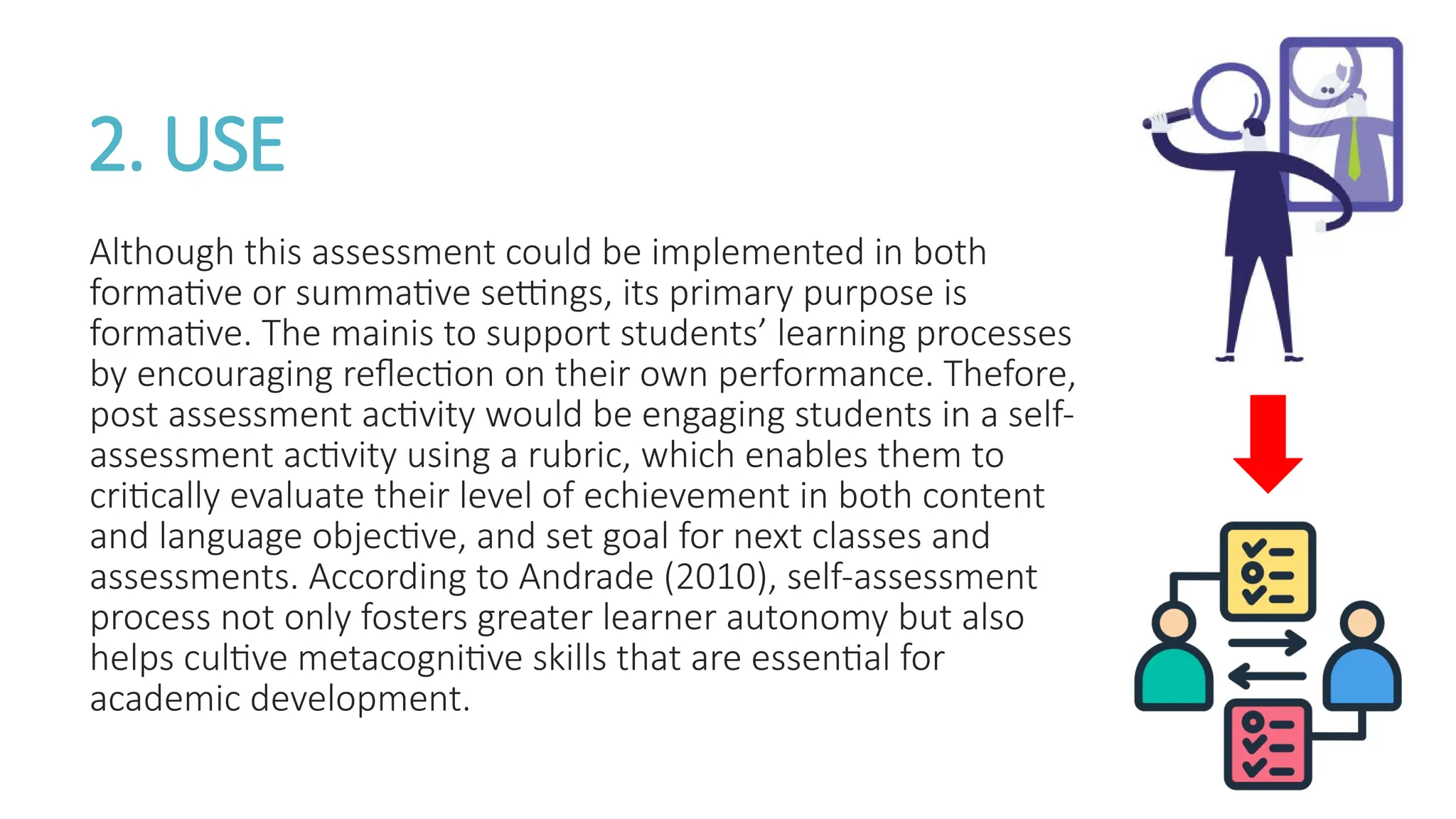
Although thisassessment could be implemented in both
formative or summative settings, its primary purpose is
formative. The mainis to support students’ learning processes
by encouraging reflection on their own performance. Thefore,
post assessment activity would be engaging students in a self-
assessment activity using a rubric, which enables them to
critically evaluate their level of echievement in both content
and language objective, and set goal for next classes and
assessments. According to Andrade (2010), self-assessment
process not only fosters greater learner autonomy but also
helps cultive metacognitive skills that are essential for
academic development.
4.
3. ASSESSMENT METHOD
Basedon the design and purpose of the created assessment activity, it was intended to offer
students an opportunity to reflect on their understanding of both: content: muscles and their
functions, and in language: the Simple Present. Since this assessment takes place early in the
unit “The Body Systems”, and The Muscular System is one of them, the use of formative
assessment is more appropriate tan a summative one.
Formative assessment is more effective at early stages of instruction, as it promotes ongoing
feedback and allows students to monitor and regulate their own learning. William (2018)
emphasizes that formative assessment is not simply gathering information for the teacher, but
about involving students actively in the learning process. In this case, self-assessment
encourages laerners to reflect at their own pace, which is especially helpful for younger
learners who may not yet be comfortable giving feedback to peers.
Moreover, self-assessment promotes learner autonomy and self regulation. According to
Panadero, Andrade, and Brookhart (2018), engaging students in self-assessment processess
fosters metacognition, enhances motivation, and supports the development of learning
strategies. By reflecting on their progress using rubrics or guided questions, learners become
more aware of their strengths and areas to improve.
5.
4. KEY USESOF LANGUAGE (Part 1)
Key uses are the essential functions of language at the text, sentence and word level
that students need to understand, produce, or manipulate to complete the
assessment effectively. Based on The Muscular System Worksheet, these are the
necessary key uses of language:
1. Text Level
- To understand the organization of matching exercises, sentence
writing, and a short paragraph.
- To recognize different types of text functions: description for part 2
and comparison for part 3.
-To be aware that the main goal is to identify, describe, and compare
muscles and their functions using structured written responses.
6.
4. KEY USESOF LANGUAGE (Part 2)
3. Word Level
-To identify key muscles vocabulary and verbs like “bíceps”, “heart”,
“voluntary”, “involuntary”, “function”, “lift”, or “pump”.
-To use the correct subject when describing muscles: “they” or “it”.
-To use the correct action verbs like “move”, “help”, “support”, “lift”, etc.
2. Sentence Level
-To describe functions of muscles. For example: “The heart pumps
blood” and “The bíceps help us lift things”
-Third Person singular/Plural. For example: The brain helps us to think.
-In Part 3: connector like “while”, “but”, “both”, “because” to compare
voluntary and involuntary muscles.
7.
5. BALANCE: CONTENTAND
LANGUAGE OBJECTIVES
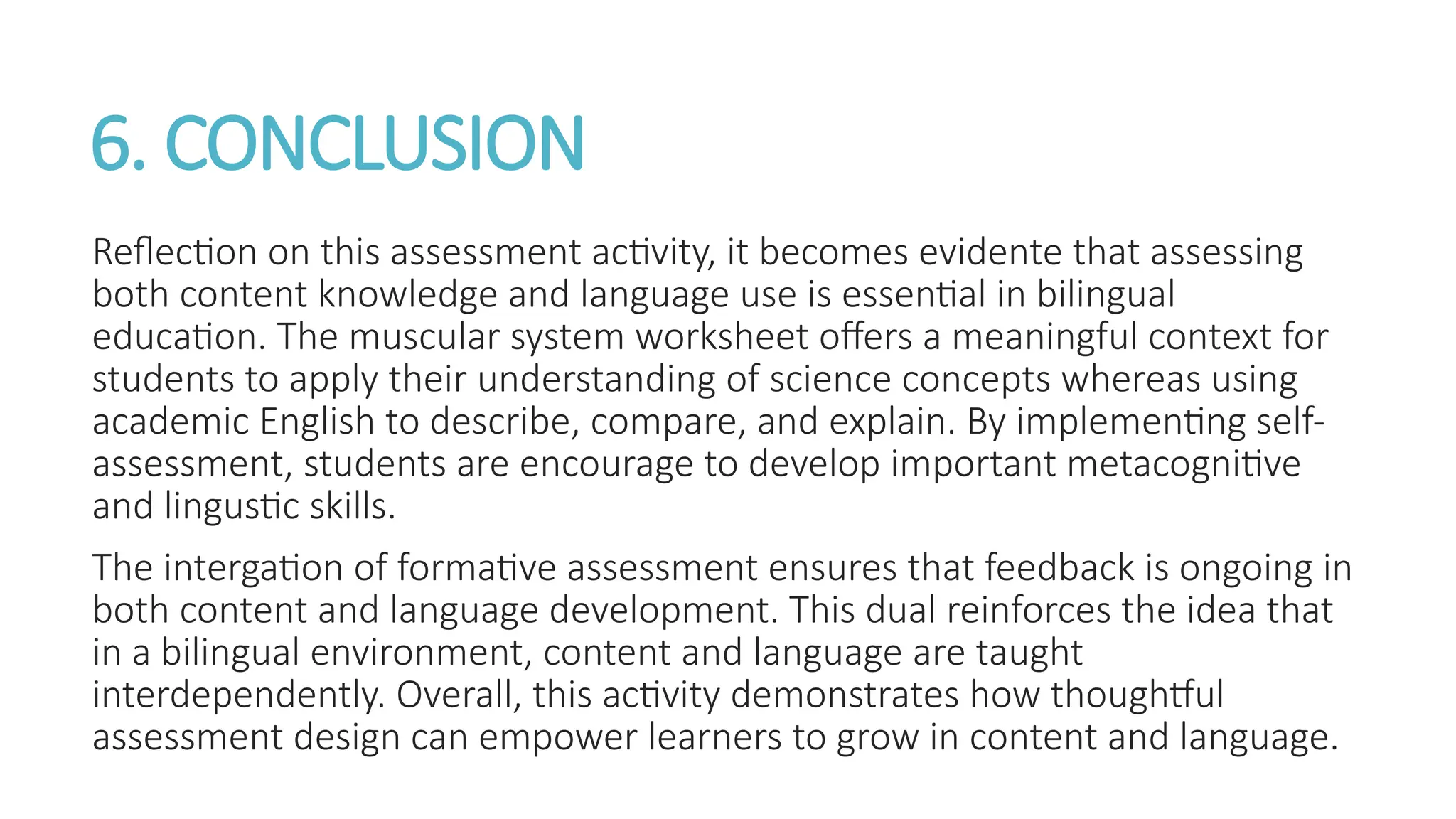
To balance and integrate both content and language objectives in this activity, the
teacher would guide students to do so through self-assessment using a structures
rubric. The rubric Will include clear descriptors for both content understanding and
language use.
Students Will be motivated to reflect on their performances by comparing their
answers to modeled examples and rubric criteria. This reflection supports
metacognitive awareness, helping students recognize their strengths and áreas for
improvement in both science content and English language development.
Heritage and Heritage (2013) emphasize, self-assessment fosters learners autonomy
and deeper engament when students are guided to monitor their own learning
against clear golas. By making both content and language objectvives visible in the
rubric, students can assess also how weel they can communicate.
8.
6. CONCLUSION
Reflection onthis assessment activity, it becomes evidente that assessing
both content knowledge and language use is essential in bilingual
education. The muscular system worksheet offers a meaningful context for
students to apply their understanding of science concepts whereas using
academic English to describe, compare, and explain. By implementing self-
assessment, students are encourage to develop important metacognitive
and lingustic skills.
The intergation of formative assessment ensures that feedback is ongoing in
both content and language development. This dual reinforces the idea that
in a bilingual environment, content and language are taught
interdependently. Overall, this activity demonstrates how thoughtful
assessment design can empower learners to grow in content and language.
9.
REFERENCES
•Andrade, H. (2010).Students as the definitive source of formative assessment:
Academic self-assessment and the self-regulation of learning. Handbook of formative
assessment, 90-105. Routledge.
•Heritage, M. & Heritage, J. (2013). Teacher questioning: The epicenter of instruction
and assessement. Applied Measurement in Education, 26(3), 176-190.
https://doi.org/10.1080/08957347.2013.793190
•Panadero, E., Andrade, H., & Brookhart, S. M. (2018). Focusing self-regulated learning
and formative assessment: A roadmap of where we are, how we got here, and where
we are going. Australian Educational Researcher, 45(1), 13-31.
https://doi.org/10.1007/s13384-018-0258-y
•William, D. (2018). Embedded formative assessment (2nd ed.). Solution Tree Press.