Name: Calvin Jhon C. Labial Course/Year: BS in Aeronautical Engineering
Engr. Ferdinand Lazala Engineering Management
Chapter 1
1. Why are engineers considered an important segment of the society?
Engineers are considered an important segment of society because of their
significant contributions to the development of the world's technological advancement.
Even in prehistoric times, engineers proved their importance in the community. Their
research, design and development, and capability to construct tools and equipment
proved that their outputs are very much needed in society.
2. What are expected of engineers in general?
Engineers are expected to develop and provide practical solutions to every
problem today. They are expected to perform their jobs effectively and efficiently. Year by
year, the expectation of engineers exponentially rises. Thus, their output needs
improvements; old ones to be new and efficient.
3. In what current concerns are engineering outputs needed?
Engineering outputs are needed in these particular concerns:
1. The production of food for fast growing world population
2. The elimination of air and water pollution
3. Solid waste disposal and materials recycling
4. The reduction of noise in various forms (e.g., sonic booms in aircraft)
5. Supplying the increasing demand for energy
6. Supplying the increasing demand for mobility
7. Preventing and solving crime
8. Meeting the increasing demand for communication facilities.
9. Technological Advancement
4. In what areas are engineers currently involved?
Engineers are currently involved in the following areas:
1. Research – where they engaged in the process of learning and using
theories
2. Design and development – where they make the researched and studied
products into finished physical item.
3. Testing – where they test the ability of the product/prototype.
4. Manufacturing – where they in charge in production of the product.
5. Construction – where they in charge of the quality of the construction
process (civil engineers).
6. Sales – where they assist the customer’s needs.
7. Consulting – where they work as consultant and give suggestion about
their technical expertise.
8. Government – where they perform any various tasks in regulating,
monitoring, and controlling activities of various institutions.
9. Teaching – where they teach engineering courses and later become
deans, presidents and etc.
10.Management – where they manage people performing different tasks.
5. How may organizations be classified according to the engineering jobs
performed?
Organizations may be classified according to the following:
1. Level One – those with minimal engineering jobs like retailing firms
2. Level Two – those with a moderate degree of engineering jobs like
transportation companies
3. Level Three – those with a high degree of engineering jobs like
construction firms.
6. Which organization level requires the highest management skills for
engineer managers?
Level three firms provide the most significant opportunity for engineers to become
presidents. Therefore, it requires the highest management skills.
7. What is engineering management?
Engineering management refers to the activity combining “technical knowledge
with the ability to organize and coordinate worker power, materials, machinery, and
money.”
8. How may one define management?
Management may be defined as the “creative problem solving-process of planning,
organizing, leading, and controlling an organization’s resources to achieve its mission and
objectives.”
9. What qualifications must an engineer manager have?
The engineer manager must have the following qualifications:
1. A bachelor’s degree in engineering from a reputable school. In some
cases, a master’s degree in engineering or business management is
required.
2. A few years’ experience in engineering job.
3. Training in supervision.
4. Special training in engineering management.
10.How may one become a successful engineer manager?
There are at least three general preconditions to become a successful engineer
manager. They are as follows:
1. Ability – the capacity to achieve organizational objectives effectively and
efficiently.
2. Motivation to manage – motivated to manage other people so that they
can contribute to the realization of the organization’s objectives.
3. Opportunity – The opportunity for successful management requires two:
• Obtaining a suitable managerial job
• Finding a supporting climate once on the job
Suggested Items for Research
1. List of ten Engineers who became president or general manager of a
large company:
Geronimo Z. Velasco
Ronnie Velasco was a mechanical engineer who won the 1977 Management Man
of the Year award, as well as the first president of Philippine National Oil Company
(PNOC). He was the chairman of Republic Glass Holdings Corp, which used to own the
pioneer factory that supplied 70 percent of Philippine glass requirements for home and
building construction since the year 1956. The firm then sold its shares in Republic-Asahi
Glass Corp. to its Japanese partner Asahi Glass in the year 2001. He also served as
energy minister from the years-1978 to 1986, wherein he implemented the strategic goal
of reducing the dependence of the Philippines on imported oil.
Diosdado “Dado” Banatao
This Filipino is a high-tech entrepreneur and innovator in Silicon Valley California.
He is an electrical engineering cum laude graduate from the Mapua Institute of
Technology, a prestigious engineering school in the Philippines. He also has a master’s
degree in electrical engineering and computer science in Stanford University.
Lucio Tan
He is a science and history buff who studied chemical engineering at Far Eastern
University in the Philippines, as a working student. According to a Philstar article, he said
he attended night and Sunday classes. He is a self made tycoon, who continues to read
nonstop until now. He is ranked as the third richest billionaire in the Philippines for 2016,
with a net worth of US$4Billion.
David Consunji
Consunji is a civil engineering graduate from the University of the Philippines, a
prestigious university in the Philippines. He is ranked by Forbes as the fifth richest
billionaire in the Philippines with a net worth of US$3 Billion. He is big in construction with
DMCI, as well as infrastructure, real estate, minin and power.
Francis Chua
Chua is an industrial engineering, cum laude graduate from the University of the
Philippines. He is president of the Philippine Chamber of Commerce & Industry (PCCI)
and is also former member of the UP Board of Regents.
Ramon S. Ang
Ang is a mechanical engineering graduate from Far Eastern University and is the
Vice- Chairman, President and Chief Operating Officer of San Miguel Corporation. He is
transforming San Miguel Corp. form a beer giant into a more diversified conglomerate
that has huge investments in infrastructure, energy, and other fields. Because of his bold
and strategic reforms, beer and foods now constitutes only 20 percent of San Miguel’s
total business. He is also Chairman of Cyber Bay Corporation and Eagle Cement
Corporation.
Henry Lim Bon Liong
Lim is a mechanical engineering graduate from the University of the Philippines.
He is a leader in Philippine paper products with Sterling Paper Group. In the past years,
he is being known as a pioneer of hybrid rice technology, with his SL Agritech Corp, he
is working to promote Philippine rice self-sufficiency.
Fernando Bayani
Fernando is a mechanical engineering graduate of Mapua. He is formerly known
as the Metro Manila Development Authority (MMDA) chairman, and the mayor of
Marikina, a city in the Philippines. Before he entered the world of politics, he was the
founder of the BF Group of Companies, with construction, steel, manufacturing and real
estate businesses.
Greg C. Garland
Garland started at Phillips as a project engineer in 1980 and began steadily
working his way up through the company: from project to sales engineer, then a business
service manager, and development director. He serves as an executive-level director in
a half-dozen companies, is a director of the American Chemistry Council, and is a
member of Texas A&M’s Chemical Engineering Industrial Advisory Board.
Andrew N. Liveris
Liveris studied chemical engineering in Australia, where he also began his career
with Dow Chemical in 1976. After working in the company’s engineering, manufacturing,
sales, and marketing divisons on several continents, he was unanimously elected CEO
on the strength of his plan to renew and transform the company. (His plan directly lead to
a sixfold growth in share value.) A noted champion of the manufacturing sector, Liveris
published a similar plan for reestablishing American manufacturing in “Make it in America:
The Case for Re-Inventing The Economy”. President Obama named him Co-Chair of his
Advanced Manufacturing Partnership
initiative.
Case 1: Alma Electronics
Knowledge in electronics and electrical components is critical in an electronics
assembly plant because they will know how the industry works, equipping them with the
engineering skills necessary to design, assess and improve electrical systems. Thus, the
suitable courses for Mr. Mallari's sons are Bachelor of Science in Electronics Engineering,
Bachelor of Science in Electrical Engineering, and Bachelor of Science in Industrial
Engineering. His son, that will take electronics engineer, will have knowledge in
electronics. The other son that will take electrical engineering will know about the large-
scale production, transmission, and distribution of electrical power. The one that will take
industrial engineer will be responsible for the quality and improvement of the processes
involved in the plant.
Chapter 2
1. Can the engineer manager avoid making management decision? Why or why
not?
Yes, they can avoid making a management decision. Because doing so is also a
decision made up by that engineer manager, but these types of managers are dangerous
and should be removed from their position as soon as possible.
2. When a problem becomes apparent and the engineer manager chooses to
ignore it, is he making a decision? Explain your answer.
Yes, as manager he or she is making a decision and is responsible for the
outcome. The engineer manager made a decision to ignore the problem as he evaluated
that the problem is very hard to solve.
3. Why is proper diagnosis of the problem important?
It is important to properly diagnose the problem because if the engineer manager
fails to do in this aspect, it is almost impossible to succeed in the next following steps.
Identification of the problem is tantamount to having the problem half-solved.
4. What are the components of the environment from the point of view of the
decision-maker? What do they consist of?
The components of the environment from the point of view of the decision-maker
are Internal and external environment. Internal environment consists of Organizational,
Marketing, Personnel, Production, and Financial Aspects, while external aspect consists
of the government, engineers, labor unions, suppliers, banks, public, competitors and
clients.
5. How may one develop viable alternatives in problem solving?
To develop viable alternatives in problem solving you need to do the following:
1. First, by preparing a list of alternative solution.
2. Then determine the viability of each solution.
3. Lastly, revise the list by striking out those which are not viable.
6. How may alternative solutions be evaluated?
Alternative solutions may be evaluated depending on the nature of the problem,
the objectives of the firm, and the nature of alternatives presented. Each alternative must
be analyzed and evaluated in terms of its value, cost, and risk characteristics.
7. Why is it important for those who will involve in implementation to
understand and accept the solution to the problem?
It is important for those who will involve in implementation to understand and
accept the solution to the problem Because it is important for the manager to ensure
results and provide information for future decision-making and on order to do this, it
should be assured that the solution selected for implementation are in keeping with the
goals and objective originally specified.
8. What are the approaches in solving problems?
Qualitative evaluation and Quantitative evaluation. The former refers to evaluation
using intuition and subjective judgement, while the latter refers to evaluation using rational
and analytical techniques.
9. What quantitative techniques are useful in decision-making?
The quantitative techniques that are useful in decision-making are the
following:
1. Inventory models
2. Queuing theory
3. Network models
4. forecasting
5. Regression analysis
6. Simulation
7. Linear programming
8. Sampling theory
9. Statistical decision theory
10.What is the purpose of Bayesian analysis?
The purpose of Bayesian analysis is to revise and update the initial assessments
of the event probabilities generated by alternative solutions.
Suggested Items for Research
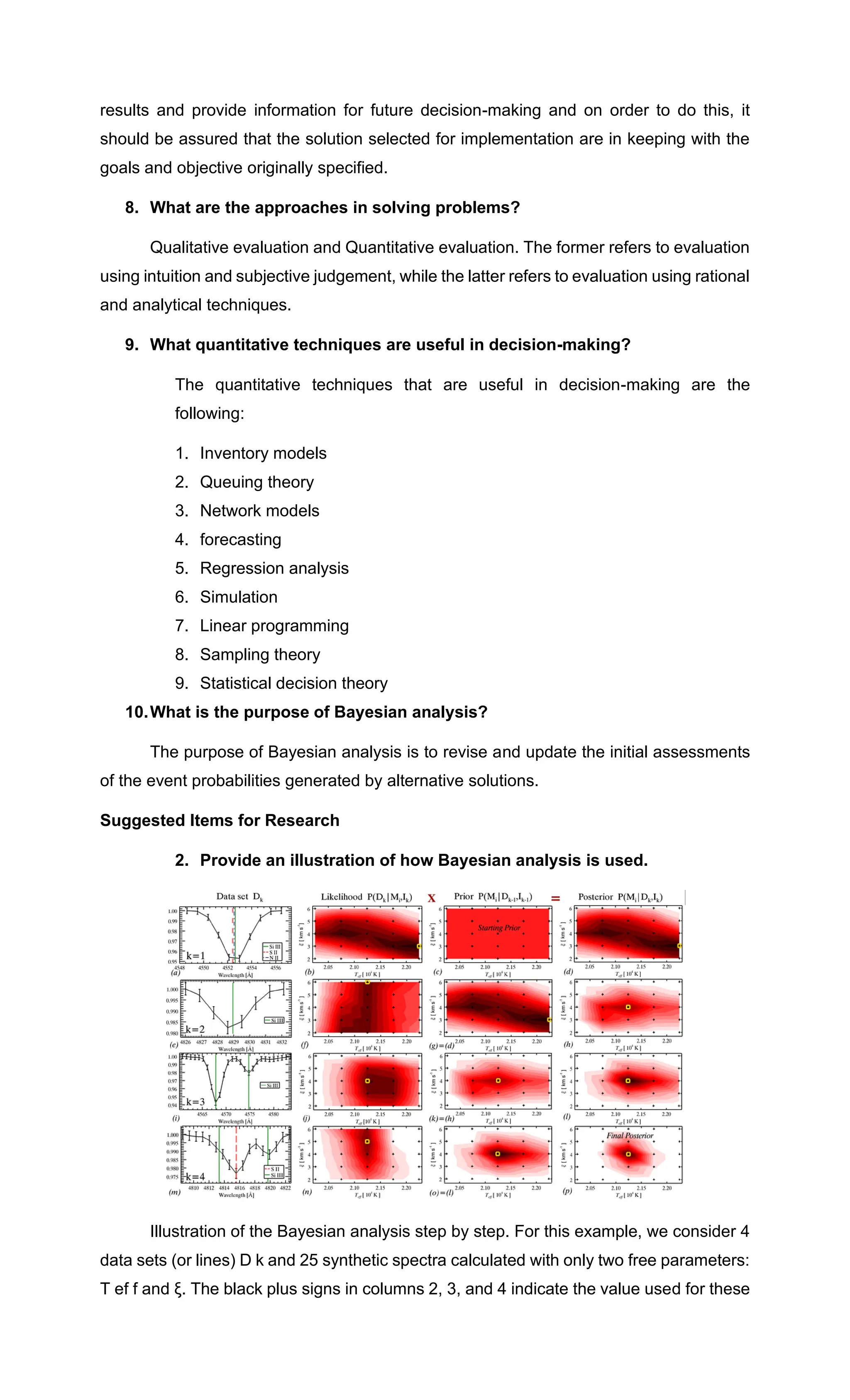
2. Provide an illustration of how Bayesian analysis is used.
Illustration of the Bayesian analysis step by step. For this example, we consider 4
data sets (or lines) D k and 25 synthetic spectra calculated with only two free parameters:
T ef f and ξ. The black plus signs in columns 2, 3, and 4 indicate the value used for these
two parameters. The colour of the surface contours is scaled to the relative probability of
each distribution: the dark red regions being the most probable and the white ones the
less probable. The yellow squares indicate the global maximum of each distribution. The
first column shows every data set considered, and the second column the likelihood
obtained for each data set as in Equation 4. The third column represents the prior
probability distribution known at each step k, and the last column shows the posterior
probability distribution which is the normalised product of the prior and the likelihood of a
given step k. The method goes as follow: considering the first line k = 1 (in (a)), we
calculate its likelihood using Equation 4 (in (b)), and use, as a first prior, a flat distribution
(in (c)) assuming we have no knowledge of the best pair [T ef f , ξ]. We then apply the
Bayes theorem (Eq. 3) and obtain the first posterior probability distribution (in (d)). For the
next data set (k = 2), we perform the same operation but we use the posterior distribution
of the previous step (in (d)) as a new prior distribution (in (g)) since our " state of
knowledge " has been changed after the first step. In the end, the final posterior probability
distribution (in (p)) represents the solution combining all the information given by the 4
lines. Note that since the method can be summarized as a series of products, the order
in which we consider the data sets have no influence on the shape of the final posterior
distribution (see Fig. A1).
Case 2 R.E. Construction
Engineer Estabillo's diagnosis of the problem was a good thing. If he did not notice
the problem, it would go bad to the firm. If he pushed the situation to do it alone, he might
be overfatigued and later affect his health. The next thing he should do is analyze the
environment; he should at least know if there are funds available if he is going to expand
his firm. The next thing he should do is to develop and implement alternatives. There are
two choices that I can suggest to him: First, broaden his knowledge about managing huge
firms; Second, hire someone who can help him manage and supervise. The best thing he
should do would be to do both. Acquiring more knowledge about the firm will improve his
decision-making. Since hiring someone is urgent, he should do it to help him in the
management responsibilities and also lighten the workload.

Activity 1 Engineering Management Management

  • 1.
    Name: Calvin JhonC. Labial Course/Year: BS in Aeronautical Engineering Engr. Ferdinand Lazala Engineering Management Chapter 1 1. Why are engineers considered an important segment of the society? Engineers are considered an important segment of society because of their significant contributions to the development of the world's technological advancement. Even in prehistoric times, engineers proved their importance in the community. Their research, design and development, and capability to construct tools and equipment proved that their outputs are very much needed in society. 2. What are expected of engineers in general? Engineers are expected to develop and provide practical solutions to every problem today. They are expected to perform their jobs effectively and efficiently. Year by year, the expectation of engineers exponentially rises. Thus, their output needs improvements; old ones to be new and efficient. 3. In what current concerns are engineering outputs needed? Engineering outputs are needed in these particular concerns: 1. The production of food for fast growing world population 2. The elimination of air and water pollution 3. Solid waste disposal and materials recycling 4. The reduction of noise in various forms (e.g., sonic booms in aircraft) 5. Supplying the increasing demand for energy 6. Supplying the increasing demand for mobility 7. Preventing and solving crime 8. Meeting the increasing demand for communication facilities. 9. Technological Advancement 4. In what areas are engineers currently involved? Engineers are currently involved in the following areas: 1. Research – where they engaged in the process of learning and using theories 2. Design and development – where they make the researched and studied products into finished physical item. 3. Testing – where they test the ability of the product/prototype. 4. Manufacturing – where they in charge in production of the product. 5. Construction – where they in charge of the quality of the construction process (civil engineers). 6. Sales – where they assist the customer’s needs. 7. Consulting – where they work as consultant and give suggestion about their technical expertise. 8. Government – where they perform any various tasks in regulating, monitoring, and controlling activities of various institutions.
  • 2.
    9. Teaching –where they teach engineering courses and later become deans, presidents and etc. 10.Management – where they manage people performing different tasks. 5. How may organizations be classified according to the engineering jobs performed? Organizations may be classified according to the following: 1. Level One – those with minimal engineering jobs like retailing firms 2. Level Two – those with a moderate degree of engineering jobs like transportation companies 3. Level Three – those with a high degree of engineering jobs like construction firms. 6. Which organization level requires the highest management skills for engineer managers? Level three firms provide the most significant opportunity for engineers to become presidents. Therefore, it requires the highest management skills. 7. What is engineering management? Engineering management refers to the activity combining “technical knowledge with the ability to organize and coordinate worker power, materials, machinery, and money.” 8. How may one define management? Management may be defined as the “creative problem solving-process of planning, organizing, leading, and controlling an organization’s resources to achieve its mission and objectives.” 9. What qualifications must an engineer manager have? The engineer manager must have the following qualifications: 1. A bachelor’s degree in engineering from a reputable school. In some cases, a master’s degree in engineering or business management is required. 2. A few years’ experience in engineering job. 3. Training in supervision. 4. Special training in engineering management. 10.How may one become a successful engineer manager? There are at least three general preconditions to become a successful engineer manager. They are as follows: 1. Ability – the capacity to achieve organizational objectives effectively and efficiently. 2. Motivation to manage – motivated to manage other people so that they can contribute to the realization of the organization’s objectives. 3. Opportunity – The opportunity for successful management requires two:
  • 3.
    • Obtaining asuitable managerial job • Finding a supporting climate once on the job Suggested Items for Research 1. List of ten Engineers who became president or general manager of a large company: Geronimo Z. Velasco Ronnie Velasco was a mechanical engineer who won the 1977 Management Man of the Year award, as well as the first president of Philippine National Oil Company (PNOC). He was the chairman of Republic Glass Holdings Corp, which used to own the pioneer factory that supplied 70 percent of Philippine glass requirements for home and building construction since the year 1956. The firm then sold its shares in Republic-Asahi Glass Corp. to its Japanese partner Asahi Glass in the year 2001. He also served as energy minister from the years-1978 to 1986, wherein he implemented the strategic goal of reducing the dependence of the Philippines on imported oil. Diosdado “Dado” Banatao This Filipino is a high-tech entrepreneur and innovator in Silicon Valley California. He is an electrical engineering cum laude graduate from the Mapua Institute of Technology, a prestigious engineering school in the Philippines. He also has a master’s degree in electrical engineering and computer science in Stanford University. Lucio Tan He is a science and history buff who studied chemical engineering at Far Eastern University in the Philippines, as a working student. According to a Philstar article, he said he attended night and Sunday classes. He is a self made tycoon, who continues to read nonstop until now. He is ranked as the third richest billionaire in the Philippines for 2016, with a net worth of US$4Billion. David Consunji Consunji is a civil engineering graduate from the University of the Philippines, a prestigious university in the Philippines. He is ranked by Forbes as the fifth richest billionaire in the Philippines with a net worth of US$3 Billion. He is big in construction with DMCI, as well as infrastructure, real estate, minin and power. Francis Chua Chua is an industrial engineering, cum laude graduate from the University of the Philippines. He is president of the Philippine Chamber of Commerce & Industry (PCCI) and is also former member of the UP Board of Regents. Ramon S. Ang Ang is a mechanical engineering graduate from Far Eastern University and is the Vice- Chairman, President and Chief Operating Officer of San Miguel Corporation. He is transforming San Miguel Corp. form a beer giant into a more diversified conglomerate that has huge investments in infrastructure, energy, and other fields. Because of his bold and strategic reforms, beer and foods now constitutes only 20 percent of San Miguel’s
  • 4.
    total business. Heis also Chairman of Cyber Bay Corporation and Eagle Cement Corporation. Henry Lim Bon Liong Lim is a mechanical engineering graduate from the University of the Philippines. He is a leader in Philippine paper products with Sterling Paper Group. In the past years, he is being known as a pioneer of hybrid rice technology, with his SL Agritech Corp, he is working to promote Philippine rice self-sufficiency. Fernando Bayani Fernando is a mechanical engineering graduate of Mapua. He is formerly known as the Metro Manila Development Authority (MMDA) chairman, and the mayor of Marikina, a city in the Philippines. Before he entered the world of politics, he was the founder of the BF Group of Companies, with construction, steel, manufacturing and real estate businesses. Greg C. Garland Garland started at Phillips as a project engineer in 1980 and began steadily working his way up through the company: from project to sales engineer, then a business service manager, and development director. He serves as an executive-level director in a half-dozen companies, is a director of the American Chemistry Council, and is a member of Texas A&M’s Chemical Engineering Industrial Advisory Board. Andrew N. Liveris Liveris studied chemical engineering in Australia, where he also began his career with Dow Chemical in 1976. After working in the company’s engineering, manufacturing, sales, and marketing divisons on several continents, he was unanimously elected CEO on the strength of his plan to renew and transform the company. (His plan directly lead to a sixfold growth in share value.) A noted champion of the manufacturing sector, Liveris published a similar plan for reestablishing American manufacturing in “Make it in America: The Case for Re-Inventing The Economy”. President Obama named him Co-Chair of his Advanced Manufacturing Partnership initiative. Case 1: Alma Electronics Knowledge in electronics and electrical components is critical in an electronics assembly plant because they will know how the industry works, equipping them with the engineering skills necessary to design, assess and improve electrical systems. Thus, the suitable courses for Mr. Mallari's sons are Bachelor of Science in Electronics Engineering, Bachelor of Science in Electrical Engineering, and Bachelor of Science in Industrial Engineering. His son, that will take electronics engineer, will have knowledge in electronics. The other son that will take electrical engineering will know about the large- scale production, transmission, and distribution of electrical power. The one that will take industrial engineer will be responsible for the quality and improvement of the processes involved in the plant.
  • 5.
    Chapter 2 1. Canthe engineer manager avoid making management decision? Why or why not? Yes, they can avoid making a management decision. Because doing so is also a decision made up by that engineer manager, but these types of managers are dangerous and should be removed from their position as soon as possible. 2. When a problem becomes apparent and the engineer manager chooses to ignore it, is he making a decision? Explain your answer. Yes, as manager he or she is making a decision and is responsible for the outcome. The engineer manager made a decision to ignore the problem as he evaluated that the problem is very hard to solve. 3. Why is proper diagnosis of the problem important? It is important to properly diagnose the problem because if the engineer manager fails to do in this aspect, it is almost impossible to succeed in the next following steps. Identification of the problem is tantamount to having the problem half-solved. 4. What are the components of the environment from the point of view of the decision-maker? What do they consist of? The components of the environment from the point of view of the decision-maker are Internal and external environment. Internal environment consists of Organizational, Marketing, Personnel, Production, and Financial Aspects, while external aspect consists of the government, engineers, labor unions, suppliers, banks, public, competitors and clients. 5. How may one develop viable alternatives in problem solving? To develop viable alternatives in problem solving you need to do the following: 1. First, by preparing a list of alternative solution. 2. Then determine the viability of each solution. 3. Lastly, revise the list by striking out those which are not viable. 6. How may alternative solutions be evaluated? Alternative solutions may be evaluated depending on the nature of the problem, the objectives of the firm, and the nature of alternatives presented. Each alternative must be analyzed and evaluated in terms of its value, cost, and risk characteristics. 7. Why is it important for those who will involve in implementation to understand and accept the solution to the problem? It is important for those who will involve in implementation to understand and accept the solution to the problem Because it is important for the manager to ensure
  • 6.
    results and provideinformation for future decision-making and on order to do this, it should be assured that the solution selected for implementation are in keeping with the goals and objective originally specified. 8. What are the approaches in solving problems? Qualitative evaluation and Quantitative evaluation. The former refers to evaluation using intuition and subjective judgement, while the latter refers to evaluation using rational and analytical techniques. 9. What quantitative techniques are useful in decision-making? The quantitative techniques that are useful in decision-making are the following: 1. Inventory models 2. Queuing theory 3. Network models 4. forecasting 5. Regression analysis 6. Simulation 7. Linear programming 8. Sampling theory 9. Statistical decision theory 10.What is the purpose of Bayesian analysis? The purpose of Bayesian analysis is to revise and update the initial assessments of the event probabilities generated by alternative solutions. Suggested Items for Research 2. Provide an illustration of how Bayesian analysis is used. Illustration of the Bayesian analysis step by step. For this example, we consider 4 data sets (or lines) D k and 25 synthetic spectra calculated with only two free parameters: T ef f and ξ. The black plus signs in columns 2, 3, and 4 indicate the value used for these
  • 7.
    two parameters. Thecolour of the surface contours is scaled to the relative probability of each distribution: the dark red regions being the most probable and the white ones the less probable. The yellow squares indicate the global maximum of each distribution. The first column shows every data set considered, and the second column the likelihood obtained for each data set as in Equation 4. The third column represents the prior probability distribution known at each step k, and the last column shows the posterior probability distribution which is the normalised product of the prior and the likelihood of a given step k. The method goes as follow: considering the first line k = 1 (in (a)), we calculate its likelihood using Equation 4 (in (b)), and use, as a first prior, a flat distribution (in (c)) assuming we have no knowledge of the best pair [T ef f , ξ]. We then apply the Bayes theorem (Eq. 3) and obtain the first posterior probability distribution (in (d)). For the next data set (k = 2), we perform the same operation but we use the posterior distribution of the previous step (in (d)) as a new prior distribution (in (g)) since our " state of knowledge " has been changed after the first step. In the end, the final posterior probability distribution (in (p)) represents the solution combining all the information given by the 4 lines. Note that since the method can be summarized as a series of products, the order in which we consider the data sets have no influence on the shape of the final posterior distribution (see Fig. A1). Case 2 R.E. Construction Engineer Estabillo's diagnosis of the problem was a good thing. If he did not notice the problem, it would go bad to the firm. If he pushed the situation to do it alone, he might be overfatigued and later affect his health. The next thing he should do is analyze the environment; he should at least know if there are funds available if he is going to expand his firm. The next thing he should do is to develop and implement alternatives. There are two choices that I can suggest to him: First, broaden his knowledge about managing huge firms; Second, hire someone who can help him manage and supervise. The best thing he should do would be to do both. Acquiring more knowledge about the firm will improve his decision-making. Since hiring someone is urgent, he should do it to help him in the management responsibilities and also lighten the workload.