© 2015 American Society of Plant Biologists© 2015 American Society of Plant Biologists
“How to be a great teacher”
Mary Williams, ASPB
July 2015
@PlantTeaching
© 2015 American Society of Plant Biologists
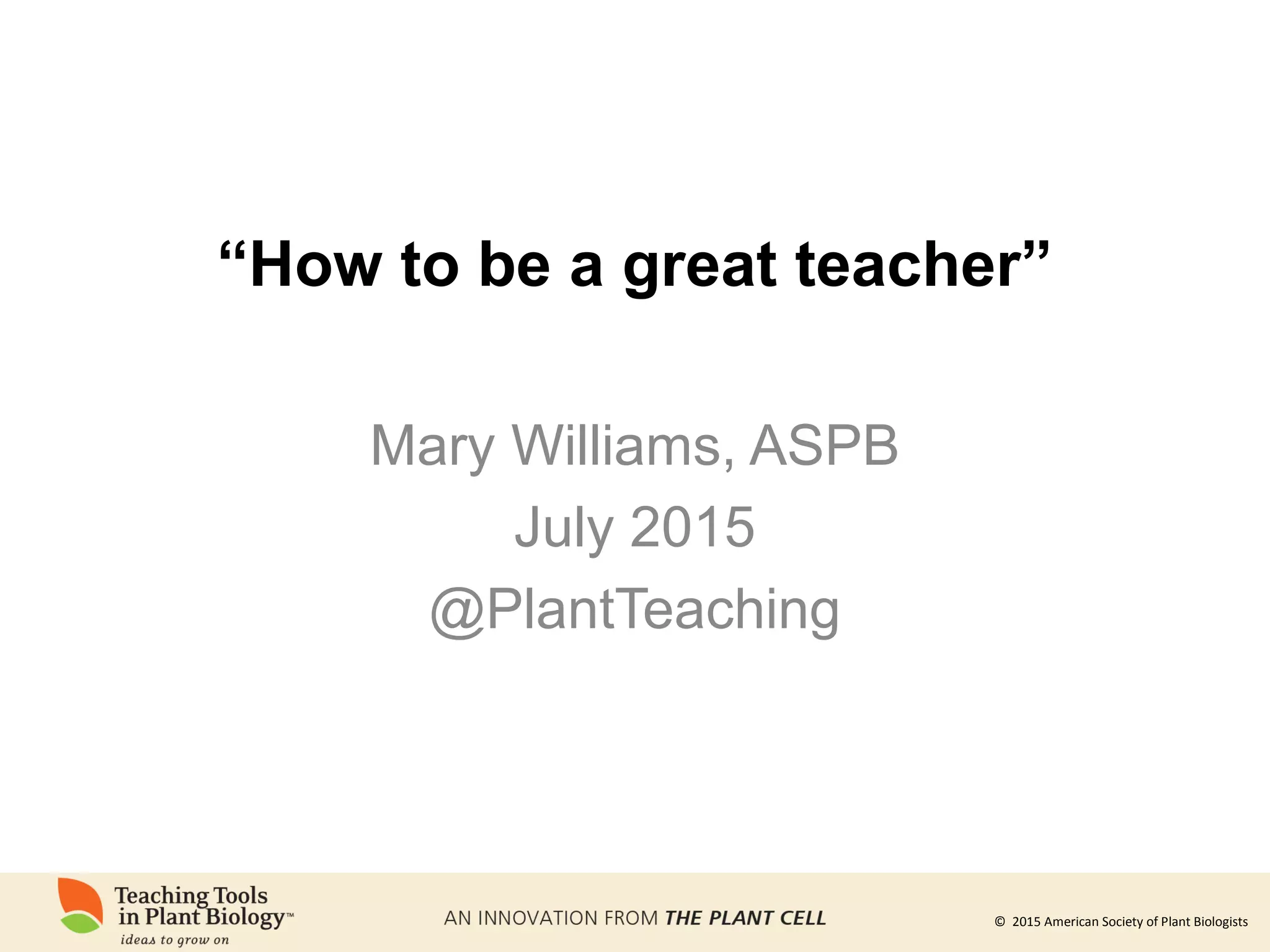
TASK1. Think about a teacher you
had that influenced your career
What did that teacher to
that made him or her
memorable? How would
you describe the
characteristics of a great
teacher?
T-P-S
© 2015 American Society of Plant Biologists
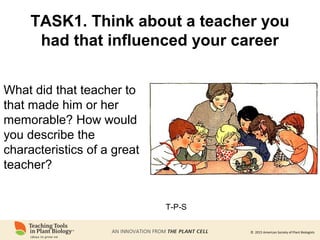
TASK1. Think about a teacher you
had that influenced your career
What did that teacher to
that made him or her
memorable? How would
you describe the
characteristics of a great
teacher?
T-P-S
Note: This is a Think-Pair-Share activity, one of
the easiest active learning strategies to
implement.
Each student thinks about a great teacher they
had, then turns to their neighbor and the pairs
discuss their recollections and discusses what
traits they think are important for great teaching.
Finally, I call on the class to share traits, which
we list on the next slide (or, even better, a black
board).
© 2015 American Society of Plant Biologists
What “makes” a great teacher?
© 2015 American Society of Plant Biologists
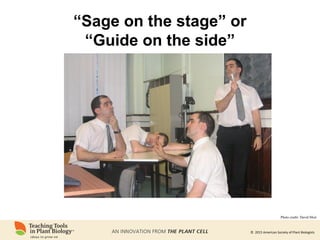
“Sage on the stage” or
“Guide on the side”
Photo credit: David Muir
© 2015 American Society of Plant Biologists
Most new teachers say they
spent too much time focusing on
the content of their teaching and
not enough on student
outcomes, assessment and
engagement
© 2015 American Society of Plant Biologists
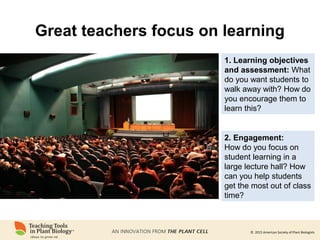
Great teachers focus on learning
2. Engagement:
How do you focus on
student learning in a
large lecture hall? How
can you help students
get the most out of class
time?
1. Learning objectives
and assessment: What
do you want students to
walk away with? How do
you encourage them to
learn this?
© 2015 American Society of Plant Biologists
Great teachers
•Define learning
objectives
•Communicate and
practice learning
objectives
•Assess based on
learning objectives
© 2015 American Society of Plant Biologists
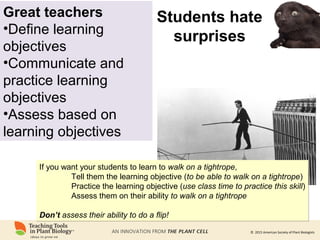
Great teachers
•Define learning
objectives
•Communicate and
practice learning
objectives
•Assess based on
learning objectives
Students hate
surprises
If you want your students to learn to walk on a tightrope,
Tell them the learning objective (to be able to walk on a tightrope)
Practice the learning objective (use class time to practice this skill)
Assess them on their ability to walk on a tightrope
Don’t assess their ability to do a flip!
If you want your students to learn to walk on a tightrope,
Tell them the learning objective (to be able to walk on a tightrope)
Practice the learning objective (use class time to practice this skill)
Assess them on their ability to walk on a tightrope
Don’t assess their ability to do a flip!
© 2015 American Society of Plant Biologists
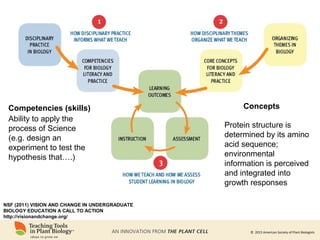
Ability to apply
the process of
science
ConceptsCompetencies (skills)
NSF (2011) VISION AND CHANGE IN UNDERGRADUATE
BIOLOGY EDUCATION A CALL TO ACTION
http://visionandchange.org/
Ability to apply the
process of Science
(e.g. design an
experiment to test the
hypothesis that….)
Protein structure is
determined by its amino
acid sequence;
environmental
information is perceived
and integrated into
growth responses
© 2015 American Society of Plant Biologists
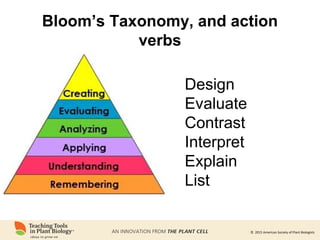
Bloom’s Taxonomy, and action
verbs
Design
Evaluate
Contrast
Interpret
Explain
List
© 2015 American Society of Plant Biologists
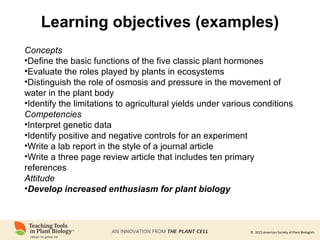
Learning objectives (examples)
Concepts
•Define the basic functions of the five classic plant hormones
•Evaluate the roles played by plants in ecosystems
•Distinguish the role of osmosis and pressure in the movement of
water in the plant body
•Identify the limitations to agricultural yields under various conditions
Competencies
•Interpret genetic data
•Identify positive and negative controls for an experiment
•Write a lab report in the style of a journal article
•Write a three page review article that includes ten primary
references
Attitude
•Develop increased enthusiasm for plant biology
© 2015 American Society of Plant Biologists
What do you want your students to
know / be able to do?
1. Write two learning objectives for a lecture you would give
to first year students on (pick one).
• Plant evolution and diversity
• Photosynthesis
• Plant nutrition and the role of plants in nutrient cycles
• Plant anatomy and development
• Interactions between plants and insects and / or pathogens
• Plant hormones
2. Write down how you could assess student’s achievement of these
objectives
© 2015 American Society of Plant Biologists
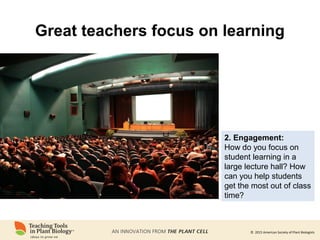
Great teachers focus on learning
2. Engagement:
How do you focus on
student learning in a
large lecture hall? How
can you help students
get the most out of class
time?
© 2015 American Society of Plant Biologists
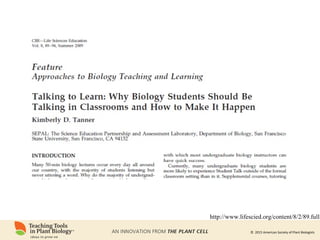
http://www.lifescied.org/content/8/2/89.full
© 2015 American Society of Plant Biologists
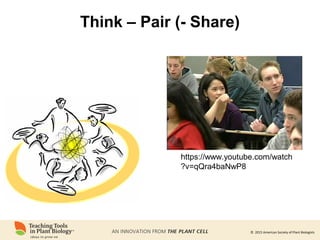
Think – Pair (- Share)
https://www.youtube.com/watch
?v=qQra4baNwP8
© 2015 American Society of Plant Biologists
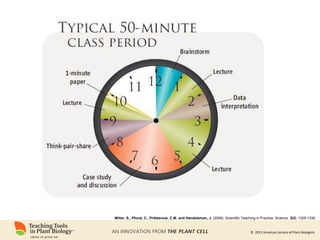
Miller, S., Pfund, C., Pribbenow, C.M. and Handelsman, J. (2008). Scientific Teaching in Practice. Science. 322: 1329-1330.
© 2015 American Society of Plant Biologists
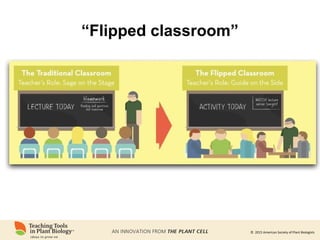
“Flipped classroom”
© 2015 American Society of Plant Biologists
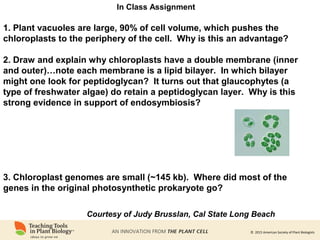
In Class Assignment
1. Plant vacuoles are large, 90% of cell volume, which pushes the
chloroplasts to the periphery of the cell. Why is this an advantage?
2. Draw and explain why chloroplasts have a double membrane (inner
and outer)…note each membrane is a lipid bilayer. In which bilayer
might one look for peptidoglycan? It turns out that glaucophytes (a
type of freshwater algae) do retain a peptidoglycan layer. Why is this
strong evidence in support of endosymbiosis?
3. Chloroplast genomes are small (~145 kb). Where did most of the
genes in the original photosynthetic prokaryote go?
Courtesy of Judy Brusslan, Cal State Long Beach
© 2015 American Society of Plant Biologists
How do you engage students during
a lecture period?
Write a think – pair – share question that would help students
engage in your plant biology lesson
© 2015 American Society of Plant Biologists
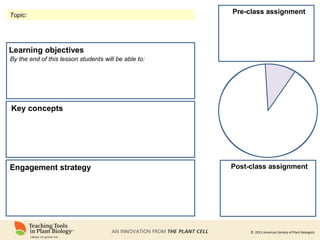
Learning objectives
Pre-class assignment
Post-class assignment
Topic:
By the end of this lesson students will be able to:
Key concepts
Engagement strategy
© 2015 American Society of Plant Biologists
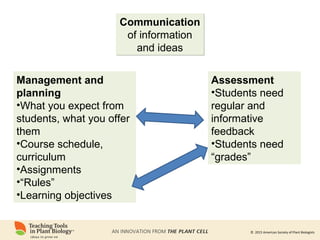
Communication
of information
and ideas
Communication
of information
and ideas
Management and
planning
•What you expect from
students, what you offer
them
•Course schedule,
curriculum
•Assignments
•“Rules”
•Learning objectives
Assessment
•Students need
regular and
informative
feedback
•Students need
“grades”
© 2015 American Society of Plant Biologists
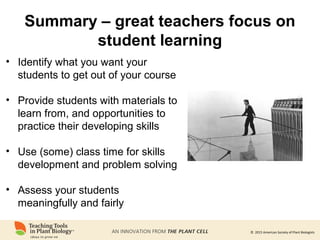
Summary – great teachers focus on
student learning
• Identify what you want your
students to get out of your course
• Provide students with materials to
learn from, and opportunities to
practice their developing skills
• Use (some) class time for skills
development and problem solving
• Assess your students
meaningfully and fairly

Active learning in plant biology lectures

  • 1.
    © 2015 AmericanSociety of Plant Biologists© 2015 American Society of Plant Biologists “How to be a great teacher” Mary Williams, ASPB July 2015 @PlantTeaching
  • 2.
    © 2015 AmericanSociety of Plant Biologists TASK1. Think about a teacher you had that influenced your career What did that teacher to that made him or her memorable? How would you describe the characteristics of a great teacher? T-P-S
  • 3.
    © 2015 AmericanSociety of Plant Biologists TASK1. Think about a teacher you had that influenced your career What did that teacher to that made him or her memorable? How would you describe the characteristics of a great teacher? T-P-S Note: This is a Think-Pair-Share activity, one of the easiest active learning strategies to implement. Each student thinks about a great teacher they had, then turns to their neighbor and the pairs discuss their recollections and discusses what traits they think are important for great teaching. Finally, I call on the class to share traits, which we list on the next slide (or, even better, a black board).
  • 4.
    © 2015 AmericanSociety of Plant Biologists What “makes” a great teacher?
  • 5.
    © 2015 AmericanSociety of Plant Biologists “Sage on the stage” or “Guide on the side” Photo credit: David Muir
  • 6.
    © 2015 AmericanSociety of Plant Biologists Most new teachers say they spent too much time focusing on the content of their teaching and not enough on student outcomes, assessment and engagement
  • 7.
    © 2015 AmericanSociety of Plant Biologists Great teachers focus on learning 2. Engagement: How do you focus on student learning in a large lecture hall? How can you help students get the most out of class time? 1. Learning objectives and assessment: What do you want students to walk away with? How do you encourage them to learn this?
  • 8.
    © 2015 AmericanSociety of Plant Biologists Great teachers •Define learning objectives •Communicate and practice learning objectives •Assess based on learning objectives
  • 9.
    © 2015 AmericanSociety of Plant Biologists Great teachers •Define learning objectives •Communicate and practice learning objectives •Assess based on learning objectives Students hate surprises If you want your students to learn to walk on a tightrope, Tell them the learning objective (to be able to walk on a tightrope) Practice the learning objective (use class time to practice this skill) Assess them on their ability to walk on a tightrope Don’t assess their ability to do a flip! If you want your students to learn to walk on a tightrope, Tell them the learning objective (to be able to walk on a tightrope) Practice the learning objective (use class time to practice this skill) Assess them on their ability to walk on a tightrope Don’t assess their ability to do a flip!
  • 10.
    © 2015 AmericanSociety of Plant Biologists
  • 11.
    © 2015 AmericanSociety of Plant Biologists Ability to apply the process of science ConceptsCompetencies (skills) NSF (2011) VISION AND CHANGE IN UNDERGRADUATE BIOLOGY EDUCATION A CALL TO ACTION http://visionandchange.org/ Ability to apply the process of Science (e.g. design an experiment to test the hypothesis that….) Protein structure is determined by its amino acid sequence; environmental information is perceived and integrated into growth responses
  • 12.
    © 2015 AmericanSociety of Plant Biologists Bloom’s Taxonomy, and action verbs Design Evaluate Contrast Interpret Explain List
  • 13.
    © 2015 AmericanSociety of Plant Biologists Learning objectives (examples) Concepts •Define the basic functions of the five classic plant hormones •Evaluate the roles played by plants in ecosystems •Distinguish the role of osmosis and pressure in the movement of water in the plant body •Identify the limitations to agricultural yields under various conditions Competencies •Interpret genetic data •Identify positive and negative controls for an experiment •Write a lab report in the style of a journal article •Write a three page review article that includes ten primary references Attitude •Develop increased enthusiasm for plant biology
  • 14.
    © 2015 AmericanSociety of Plant Biologists What do you want your students to know / be able to do? 1. Write two learning objectives for a lecture you would give to first year students on (pick one). • Plant evolution and diversity • Photosynthesis • Plant nutrition and the role of plants in nutrient cycles • Plant anatomy and development • Interactions between plants and insects and / or pathogens • Plant hormones 2. Write down how you could assess student’s achievement of these objectives
  • 15.
    © 2015 AmericanSociety of Plant Biologists Great teachers focus on learning 2. Engagement: How do you focus on student learning in a large lecture hall? How can you help students get the most out of class time?
  • 16.
    © 2015 AmericanSociety of Plant Biologists http://www.lifescied.org/content/8/2/89.full
  • 17.
    © 2015 AmericanSociety of Plant Biologists Think – Pair (- Share) https://www.youtube.com/watch ?v=qQra4baNwP8
  • 18.
    © 2015 AmericanSociety of Plant Biologists Miller, S., Pfund, C., Pribbenow, C.M. and Handelsman, J. (2008). Scientific Teaching in Practice. Science. 322: 1329-1330.
  • 19.
    © 2015 AmericanSociety of Plant Biologists “Flipped classroom”
  • 20.
    © 2015 AmericanSociety of Plant Biologists In Class Assignment 1. Plant vacuoles are large, 90% of cell volume, which pushes the chloroplasts to the periphery of the cell. Why is this an advantage? 2. Draw and explain why chloroplasts have a double membrane (inner and outer)…note each membrane is a lipid bilayer. In which bilayer might one look for peptidoglycan? It turns out that glaucophytes (a type of freshwater algae) do retain a peptidoglycan layer. Why is this strong evidence in support of endosymbiosis? 3. Chloroplast genomes are small (~145 kb). Where did most of the genes in the original photosynthetic prokaryote go? Courtesy of Judy Brusslan, Cal State Long Beach
  • 21.
    © 2015 AmericanSociety of Plant Biologists How do you engage students during a lecture period? Write a think – pair – share question that would help students engage in your plant biology lesson
  • 22.
    © 2015 AmericanSociety of Plant Biologists Learning objectives Pre-class assignment Post-class assignment Topic: By the end of this lesson students will be able to: Key concepts Engagement strategy
  • 23.
    © 2015 AmericanSociety of Plant Biologists Communication of information and ideas Communication of information and ideas Management and planning •What you expect from students, what you offer them •Course schedule, curriculum •Assignments •“Rules” •Learning objectives Assessment •Students need regular and informative feedback •Students need “grades”
  • 24.
    © 2015 AmericanSociety of Plant Biologists Summary – great teachers focus on student learning • Identify what you want your students to get out of your course • Provide students with materials to learn from, and opportunities to practice their developing skills • Use (some) class time for skills development and problem solving • Assess your students meaningfully and fairly

Editor's Notes

  • #5 Need ¼ size sheets of paper
  • #6 Engage and encourage, facilitate, coach