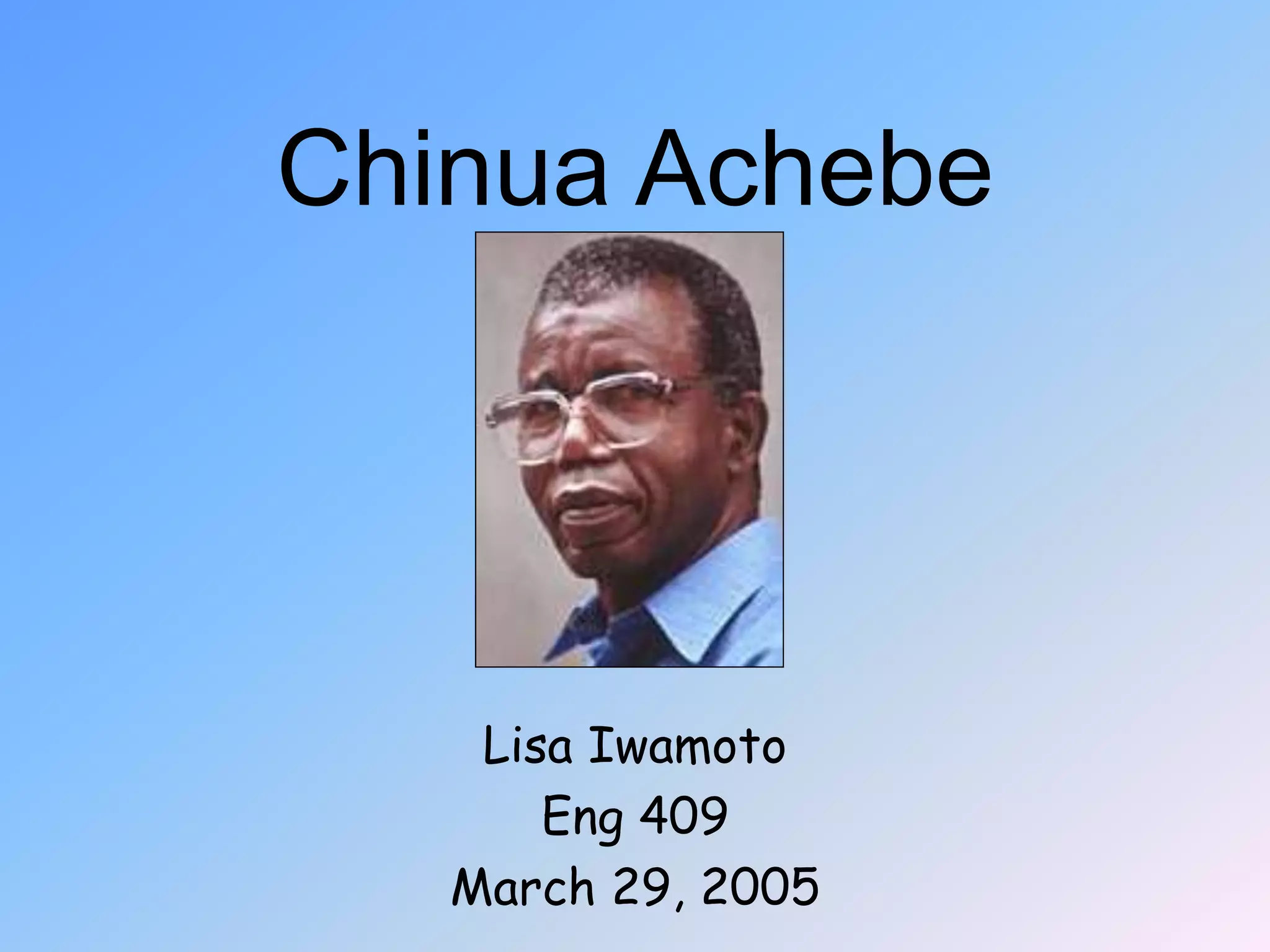
Chinua Achebe
Lisa Iwamoto
Eng 409
March 29, 2005
Timeline: Albert Chinualumogu Achebe
• Born on Nov. 16, 1930 in Ogidi, Nigeria
• Parents raised him with Igbo traditions, but were devout Protestants
• 1944-1947 – attended Government College in Umuahia
• 1948-1953 – attended University College in Ibadan
– Rejected his christened name for Prince Albert (husband of Queen Victoria)
• 1953 – earned B.A. at London University
• 1958 – Things Fall Apart – his first, best known novel (translated into 50
languages, sold 3 million copies)
• Sept. 10, 1961 – married Christie Chinwe Okoli (has 4 children)
• 1964 - Arrow of God (won New Statesmen-Jock Campbell Award)
• 1967 – appointed Senior Research Fellow at Univ. of Nigeria, Nsukka
and began lecturing abroad
– Univ. of Mass., Amherst, Univ. of Conn., Dartmouth Univ., Bard Univ.
• 1975 – The African Writer and the English Language
• 1981 – Headed English dept. and Univ. of Nigeria
• 1990 – paralyzed from waist down in a serious car accident
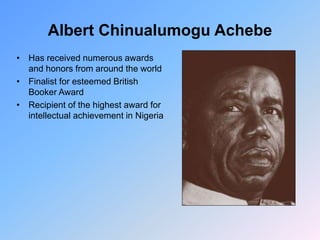
Albert Chinualumogu Achebe
• Has received numerous awards
and honors from around the world
• Finalist for esteemed British
Booker Award
• Recipient of the highest award for
intellectual achievement in Nigeria
“The African Writer and the English Language”
• Major problem – defining African literature
– “…you cannot cram African literature into a small, near definition. I do not
see African literature as one unit but as a group of associated units – in
fact the sum of all the national and ethnic literatures of Africa” (428).
– National literature: “one that takes the whole nation for its province and
has a realized or potential audience throughout its territory…a literature
that is written in the national language” (428).
– Ethnic literature: “one which is available only to one ethnic group within
the nation” (428).
• eg. The national literature of Nigeria is the literature written in English and the
ethnic literature are Hausa, Ibo, Yoruba, Efik, Edo, etc.
– No defined group should be excluded from “African literature”
“The African Writer and the English Language”
• Why is the national literature of Nigeria and many other African
countries is, or will be, written in English?
– “…these nations were created in the first place by the intervention of the
British which, I hasten to add, is not saying that the peoples comprising
these nations were invented by the British” (429).
• What impact has colonialism had on Africa?
– “Colonialism in Africa disrupted many things, but it did create big
political units where there were small, scattered ones before” (429).
• Unified countries of Africa
– Some ethnic groups were divided into 2 or 3 powers
– “But on the whole it did bring together many peoples that had hitherto
gone their several ways. And it gave them a language with which to talk
to one another. If it failed to give them a song, it at least gave them a
tongue, for sighing” (429).
“The African Writer and the English Language”
• “There is certainly a great advantage to writing in a world language”
(430).
– Excellent writers and their work will be closed to the rest of the world
– Africans can learn English well enough to be able to use it effectively in
creative writing
• But not well enough to use it like a native speaker (“I hope not”)
– “The price a world language must be prepared to pay is submission to
many different kinds of use” (432).
• People can use a second language as effectively as their first
– Many are happier with first, but majority are not writers
– Eg. Olaudah Equiano
• Should Africans write in English?
– Yes, there is no other way.
– “It will have to be a new English, still in full communion with its ancestral
home but altered to suit its new African surroundings” (433).

Achebe.ppt

  • 1.
  • 2.
    Timeline: Albert ChinualumoguAchebe • Born on Nov. 16, 1930 in Ogidi, Nigeria • Parents raised him with Igbo traditions, but were devout Protestants • 1944-1947 – attended Government College in Umuahia • 1948-1953 – attended University College in Ibadan – Rejected his christened name for Prince Albert (husband of Queen Victoria) • 1953 – earned B.A. at London University • 1958 – Things Fall Apart – his first, best known novel (translated into 50 languages, sold 3 million copies) • Sept. 10, 1961 – married Christie Chinwe Okoli (has 4 children) • 1964 - Arrow of God (won New Statesmen-Jock Campbell Award) • 1967 – appointed Senior Research Fellow at Univ. of Nigeria, Nsukka and began lecturing abroad – Univ. of Mass., Amherst, Univ. of Conn., Dartmouth Univ., Bard Univ. • 1975 – The African Writer and the English Language • 1981 – Headed English dept. and Univ. of Nigeria • 1990 – paralyzed from waist down in a serious car accident
  • 3.
    Albert Chinualumogu Achebe •Has received numerous awards and honors from around the world • Finalist for esteemed British Booker Award • Recipient of the highest award for intellectual achievement in Nigeria
  • 4.
    “The African Writerand the English Language” • Major problem – defining African literature – “…you cannot cram African literature into a small, near definition. I do not see African literature as one unit but as a group of associated units – in fact the sum of all the national and ethnic literatures of Africa” (428). – National literature: “one that takes the whole nation for its province and has a realized or potential audience throughout its territory…a literature that is written in the national language” (428). – Ethnic literature: “one which is available only to one ethnic group within the nation” (428). • eg. The national literature of Nigeria is the literature written in English and the ethnic literature are Hausa, Ibo, Yoruba, Efik, Edo, etc. – No defined group should be excluded from “African literature”
  • 5.
    “The African Writerand the English Language” • Why is the national literature of Nigeria and many other African countries is, or will be, written in English? – “…these nations were created in the first place by the intervention of the British which, I hasten to add, is not saying that the peoples comprising these nations were invented by the British” (429). • What impact has colonialism had on Africa? – “Colonialism in Africa disrupted many things, but it did create big political units where there were small, scattered ones before” (429). • Unified countries of Africa – Some ethnic groups were divided into 2 or 3 powers – “But on the whole it did bring together many peoples that had hitherto gone their several ways. And it gave them a language with which to talk to one another. If it failed to give them a song, it at least gave them a tongue, for sighing” (429).
  • 6.
    “The African Writerand the English Language” • “There is certainly a great advantage to writing in a world language” (430). – Excellent writers and their work will be closed to the rest of the world – Africans can learn English well enough to be able to use it effectively in creative writing • But not well enough to use it like a native speaker (“I hope not”) – “The price a world language must be prepared to pay is submission to many different kinds of use” (432). • People can use a second language as effectively as their first – Many are happier with first, but majority are not writers – Eg. Olaudah Equiano • Should Africans write in English? – Yes, there is no other way. – “It will have to be a new English, still in full communion with its ancestral home but altered to suit its new African surroundings” (433).