Anaesthesia for Adult
Congenital Heart
Disease
Davina Wong
Summary - aims
• You won’t be an expert in ACHD
• You will have an idea of the population
• You will have a framework to manage acute
presentations
• You will be aware of some specific problems
which cause most problems
• You will know where to go to ask for help
Why is it your problem?
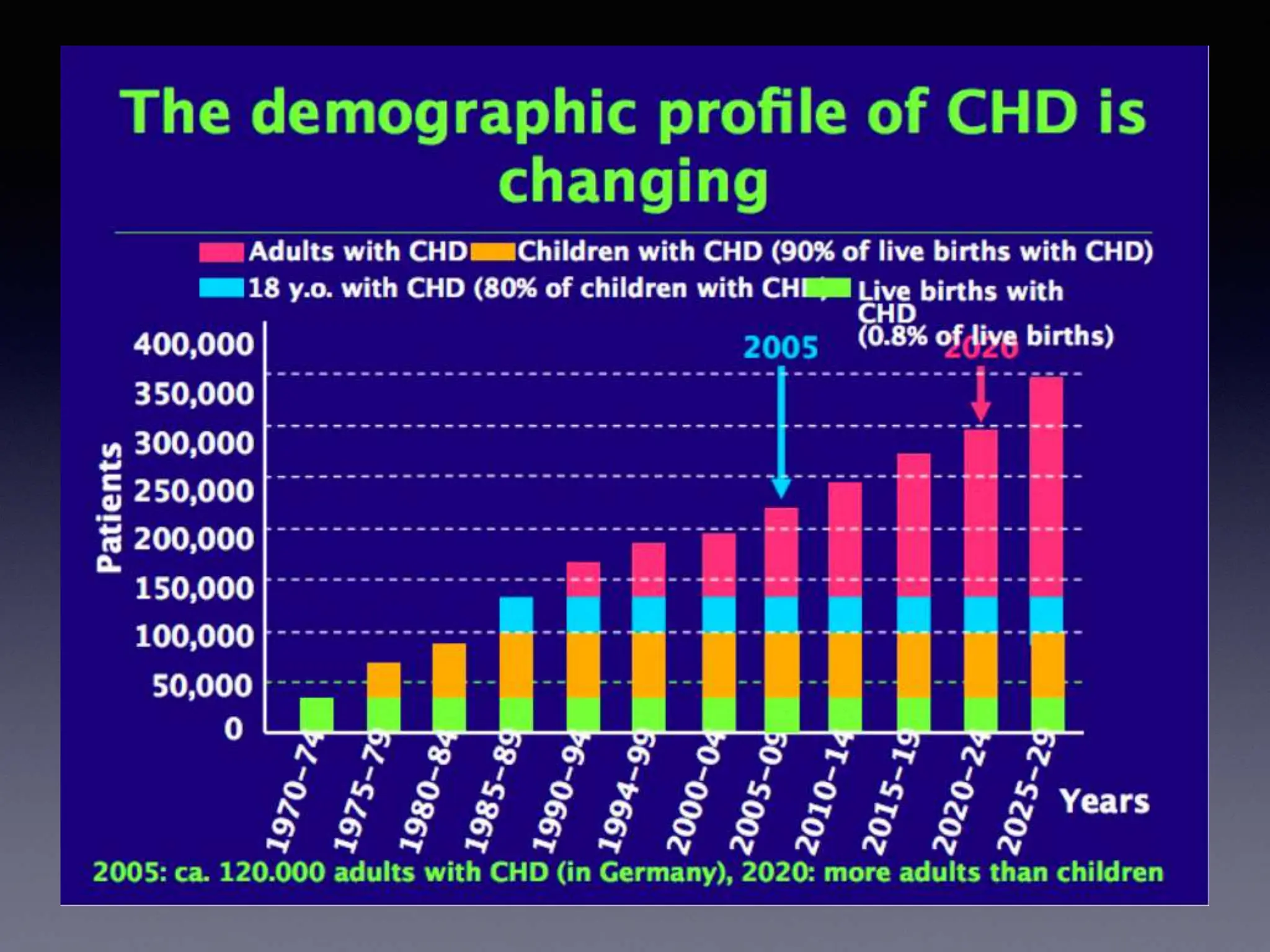
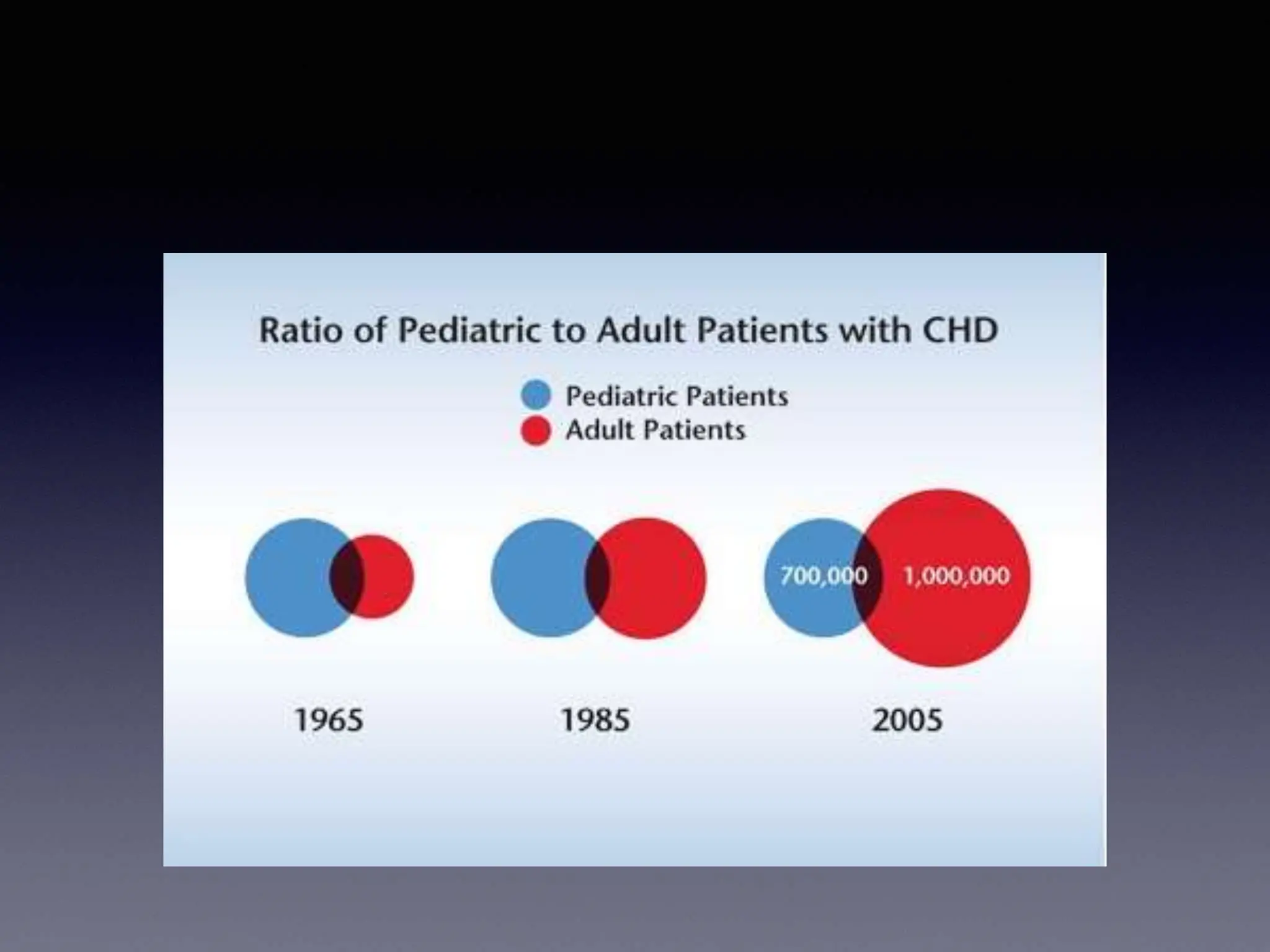
• Commonest congenital lesion
• Predicted to rise by 10% in next 10 years
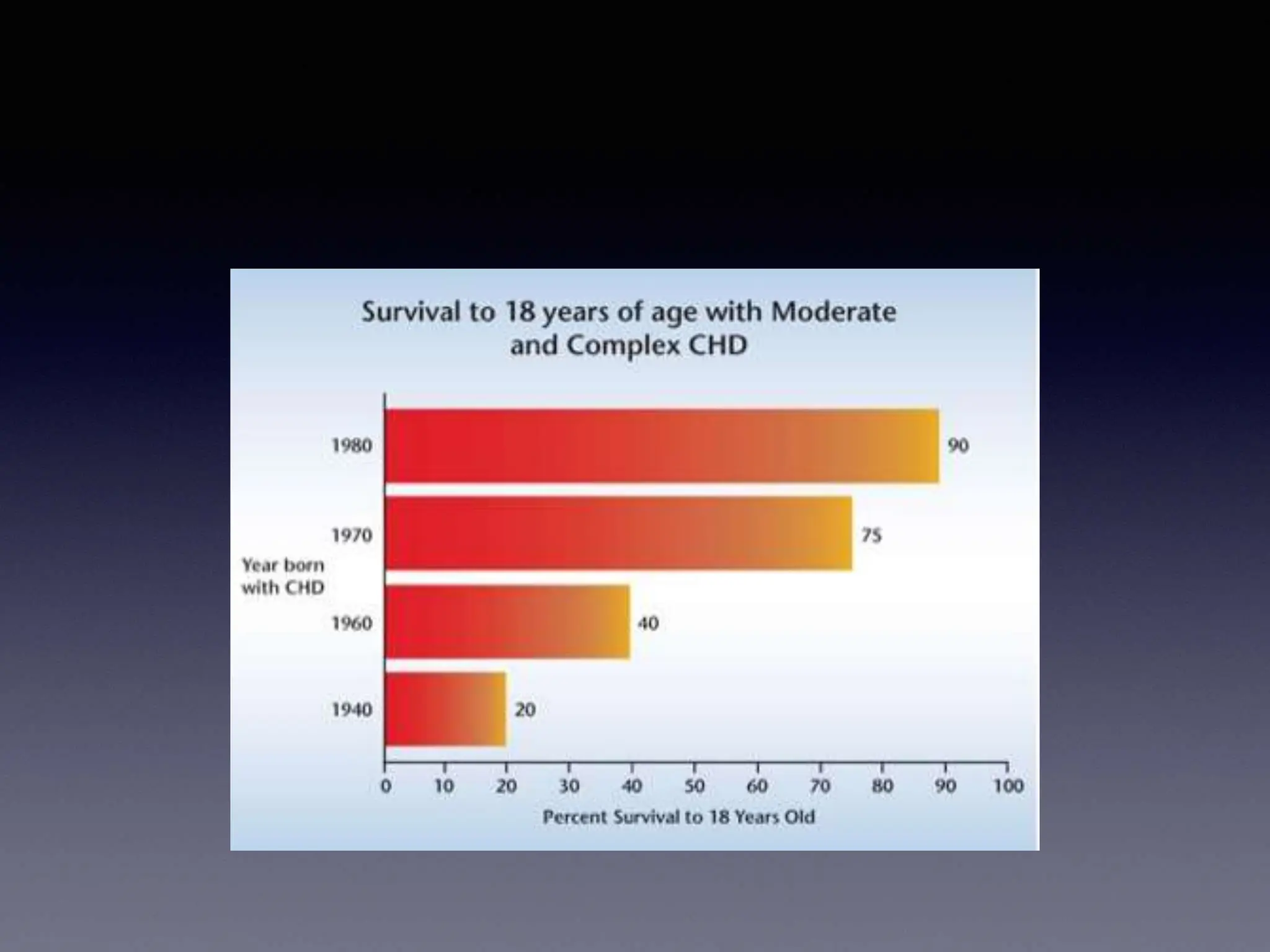
• 90% survive to adulthood and beyond
• Wherever you end up working, you will see
increasing numbers of ACHD patients presenting
as emergencies
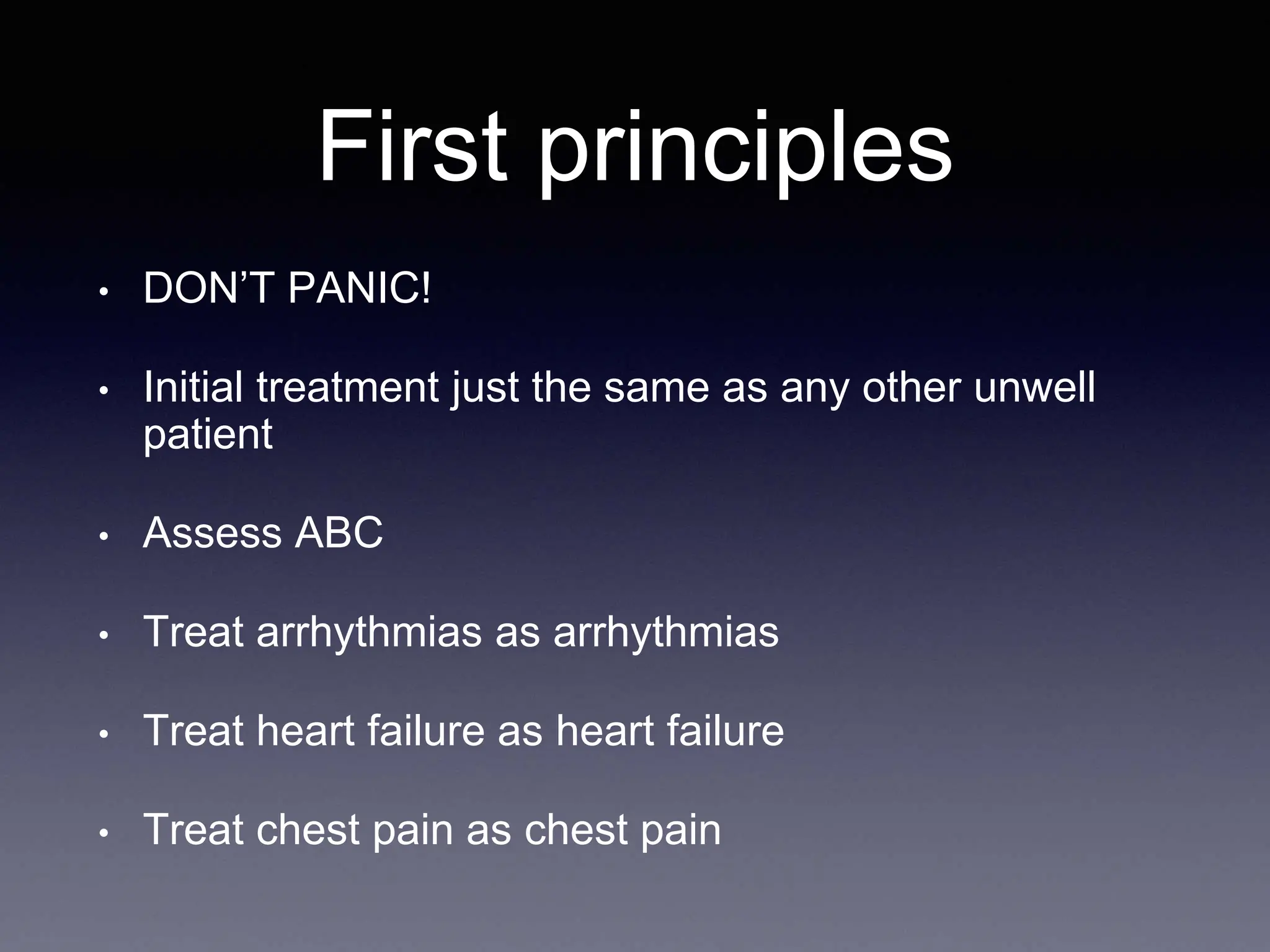
First principles
• DON’T PANIC!
• Initial treatment just the same as any other unwell
patient
• Assess ABC
• Treat arrhythmias as arrhythmias
• Treat heart failure as heart failure
• Treat chest pain as chest pain
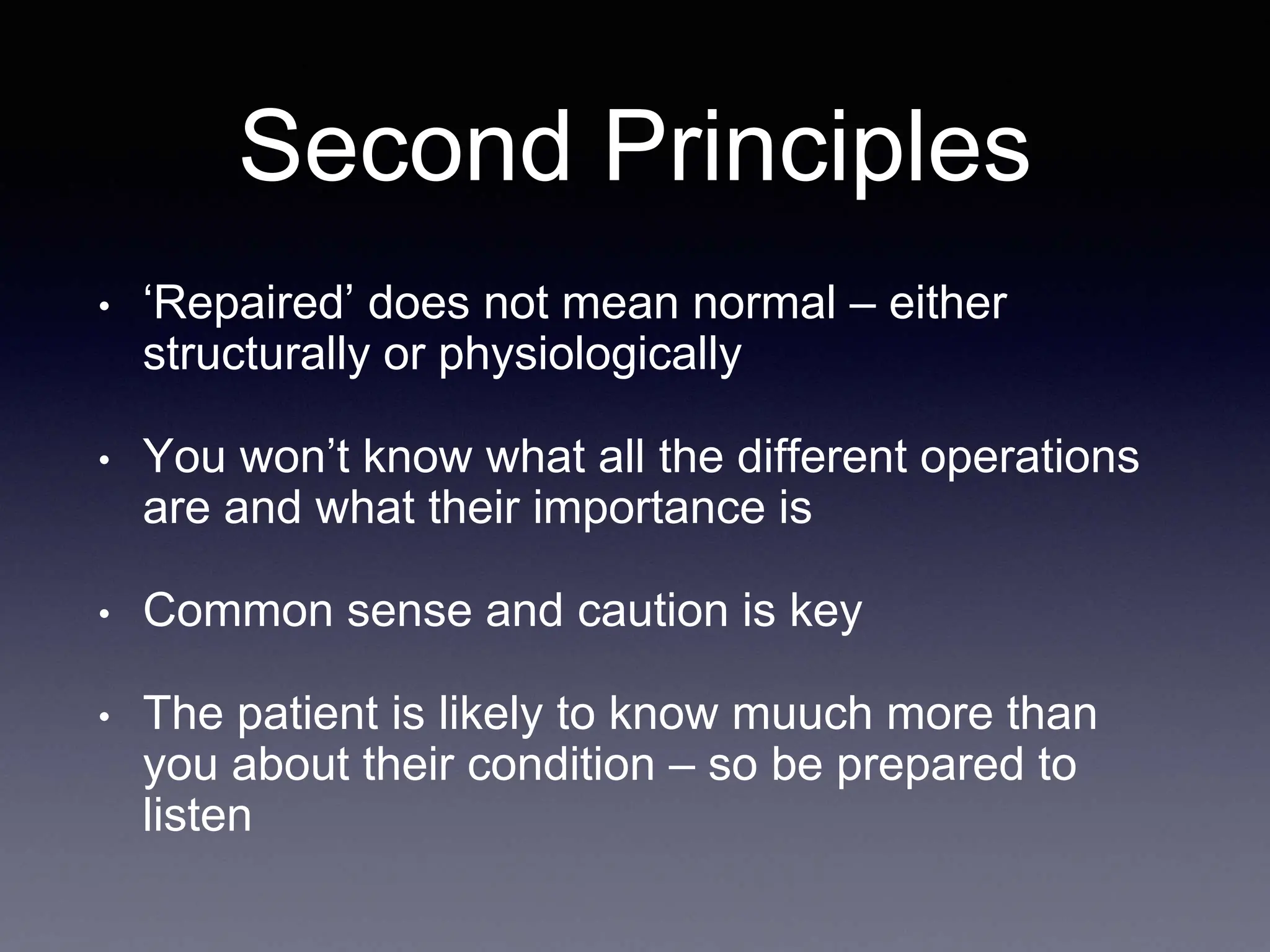
Second Principles
• ‘Repaired’ does not mean normal – either
structurally or physiologically
• You won’t know what all the different operations
are and what their importance is
• Common sense and caution is key
• The patient is likely to know muuch more than
you about their condition – so be prepared to
listen
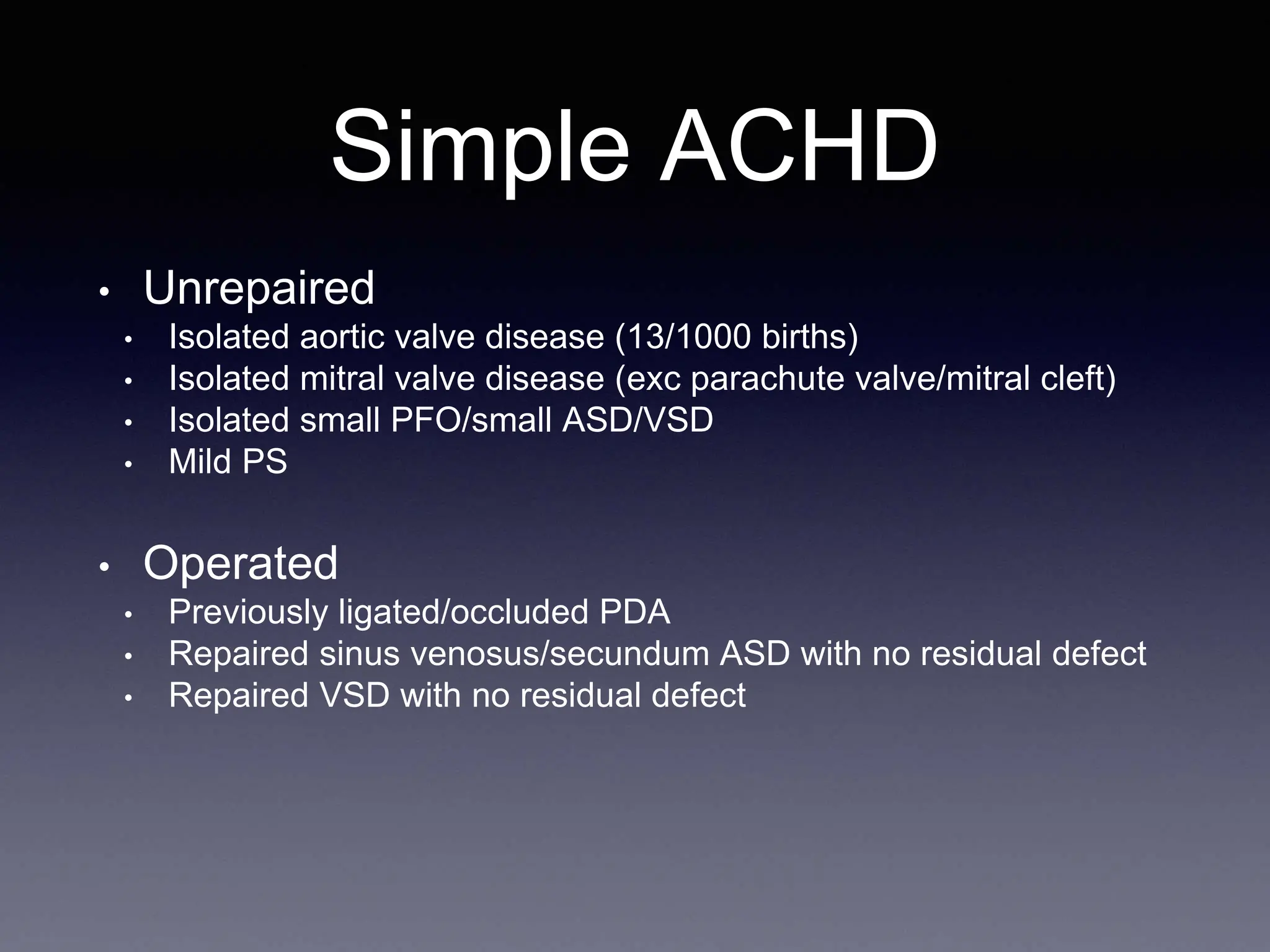
Simple ACHD
• Unrepaired
• Isolated aortic valve disease (13/1000 births)
• Isolated mitral valve disease (exc parachute valve/mitral cleft)
• Isolated small PFO/small ASD/VSD
• Mild PS
• Operated
• Previously ligated/occluded PDA
• Repaired sinus venosus/secundum ASD with no residual defect
• Repaired VSD with no residual defect
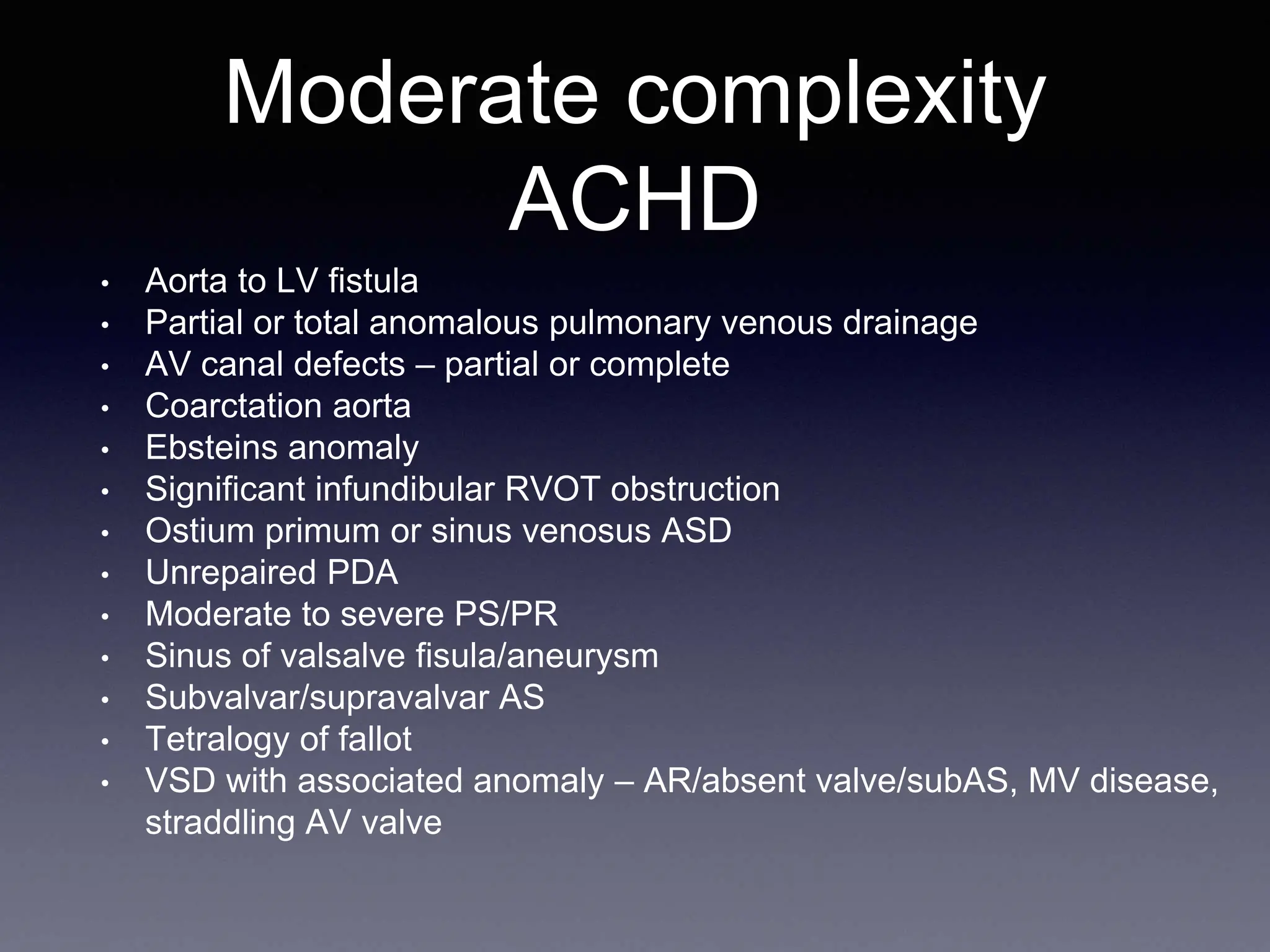
Moderate complexity
ACHD
• Aorta to LV fistula
• Partial or total anomalous pulmonary venous drainage
• AV canal defects – partial or complete
• Coarctation aorta
• Ebsteins anomaly
• Significant infundibular RVOT obstruction
• Ostium primum or sinus venosus ASD
• Unrepaired PDA
• Moderate to severe PS/PR
• Sinus of valsalve fisula/aneurysm
• Subvalvar/supravalvar AS
• Tetralogy of fallot
• VSD with associated anomaly – AR/absent valve/subAS, MV disease,
straddling AV valve
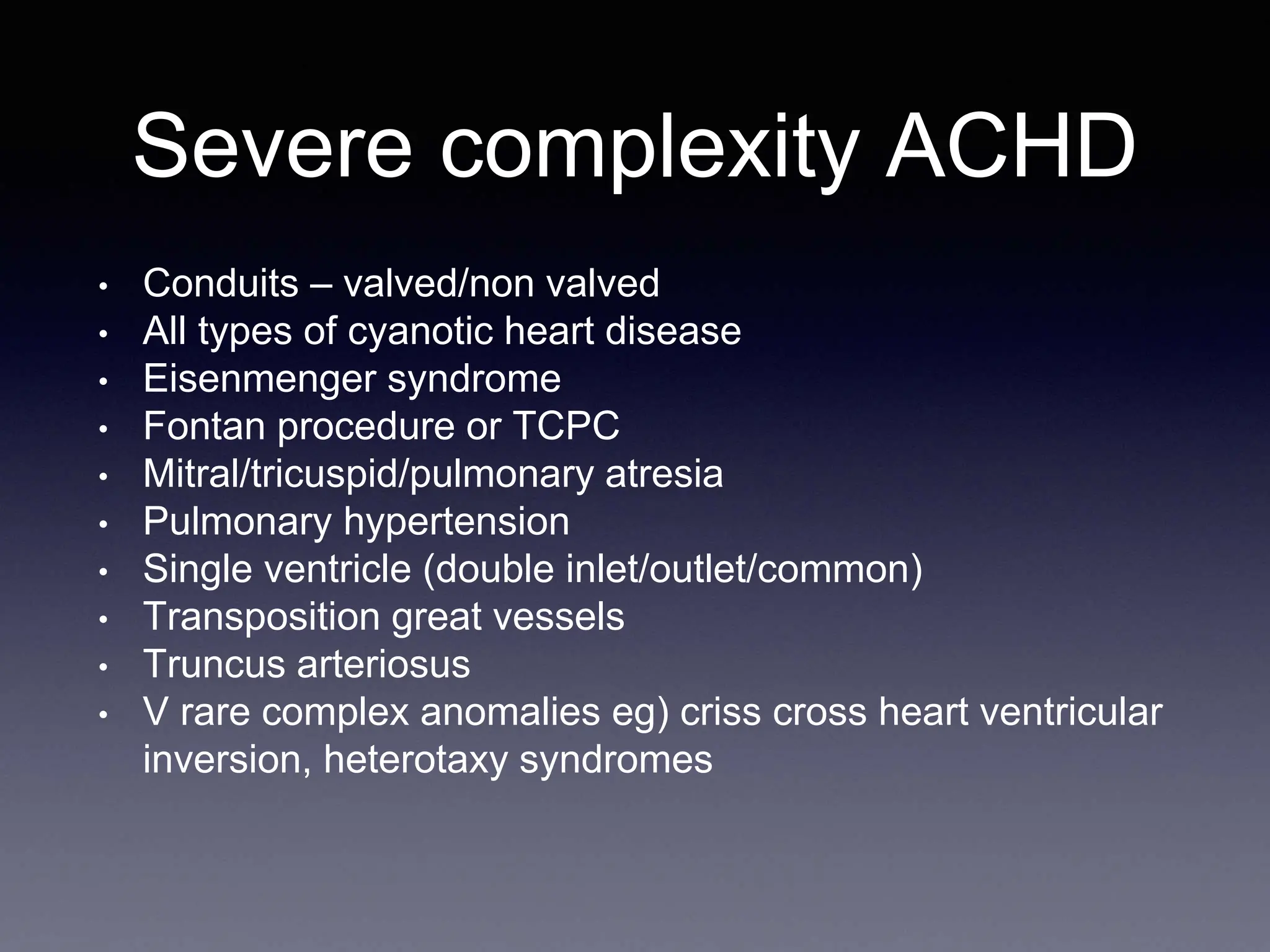
Severe complexity ACHD
• Conduits – valved/non valved
• All types of cyanotic heart disease
• Eisenmenger syndrome
• Fontan procedure or TCPC
• Mitral/tricuspid/pulmonary atresia
• Pulmonary hypertension
• Single ventricle (double inlet/outlet/common)
• Transposition great vessels
• Truncus arteriosus
• V rare complex anomalies eg) criss cross heart ventricular
inversion, heterotaxy syndromes
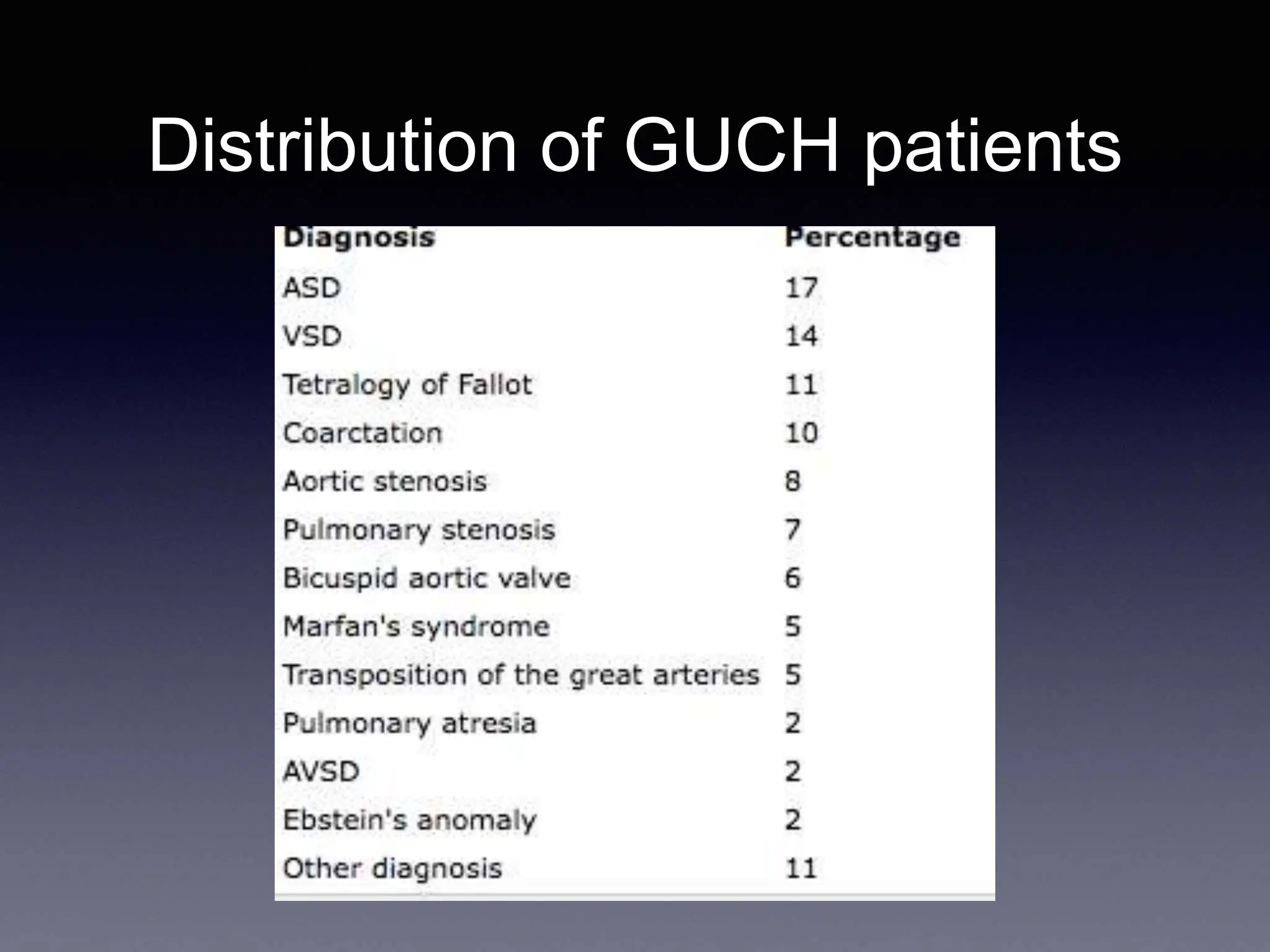
Distribution of GUCH patients
Pre-operative assessment-
history
• Original pathology
• Previous surgery (shunts, residual lesion) - current anatomy
• Secondary effects - embolism
risk/thrombosis/ischaemia/ventricular dysfunction/changes to
pulmonary vasculature/ECG abnormalities
• Additional co-morbid disease - e.g. atherosclerosis, diabetes
• Anticoagulation
• Non cardiac - anxiety/depression, renal abnormalities
Red flags
• Cardiac muscle
• Valves
• Coronary circulation
• ECG abnormalities
• Pulmonary vasculature
Examination
• Airway
• Breathing
• Circulation
Investigations
• Bloods
• CXR
• ECG
• ECHO
• Angiography
• CPEX
Pre-operative preparation
• iv fluids
• Relative anaemia
Operative
• Anaesthetic drug choice
• Line positions
• TOE
• Inhalational vs intravenous induction
• Control of CO2 vs IPPV
• Regional vs general anaesthetic
• Fastidious care of intravenous lines – air emboli
Post-operative
• Location
• Resuming regular medications
• Thromboprophylaxis
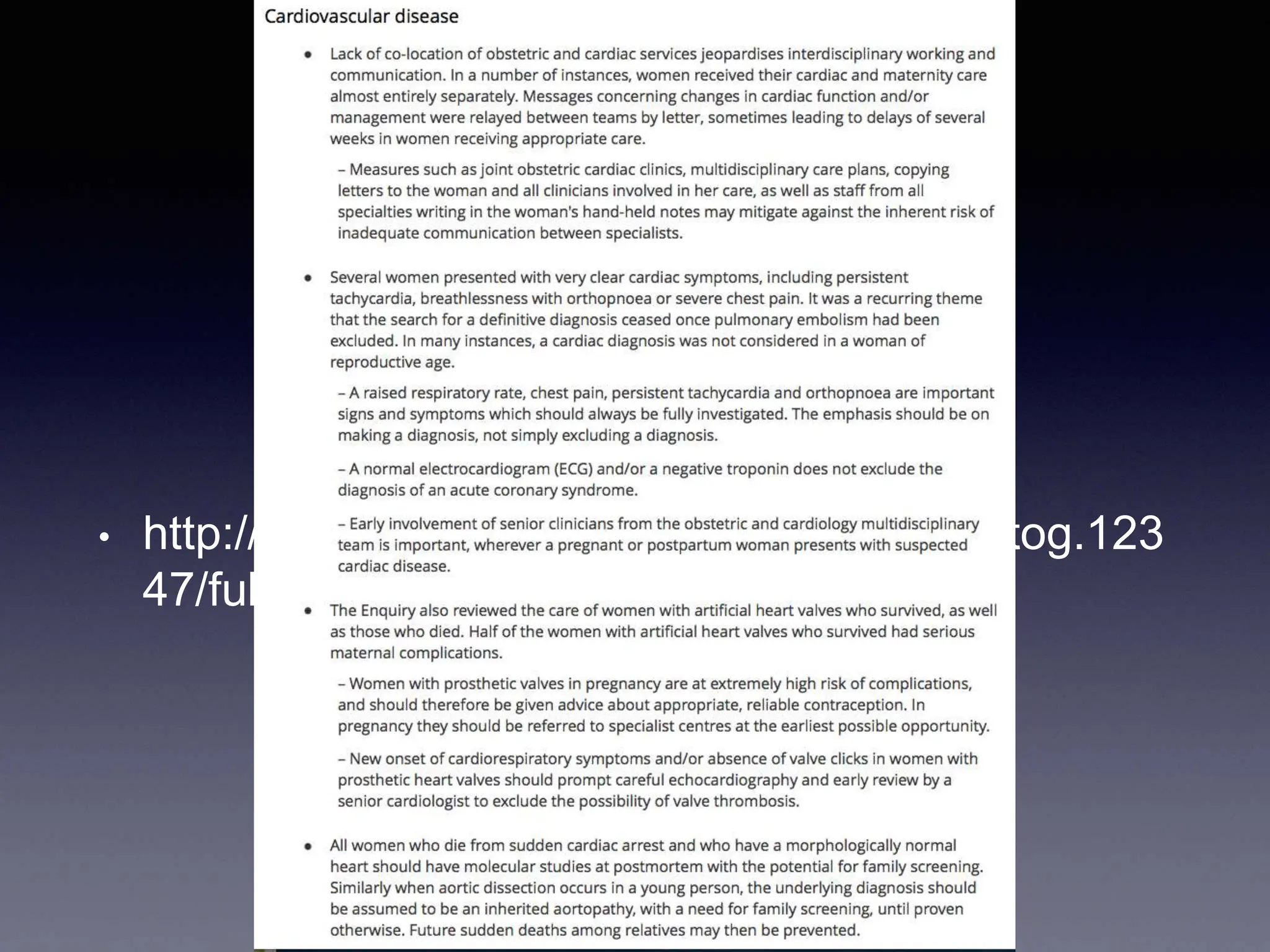
Pregnancy and
Contraception
• OCP not recommended for patients with
cyanosis, severe PAH or Fontan
• Early ambulation/compression stockings with all
patients with intracardiac right-to-left shunt
• Subcut/LMWH for prolonged bed rest. Full
anticoagulation for high risk patient
• Pre-pregnancy consultation with ACHD expert for
labour management/postpartum period
management
• Care plan should be made available to all
providers
• Those receiving chronic anticoagulation with
warfarin should receive prepregnancy
counselling to enable them to make an informed
decision about maternal and foetal risk
Highest risk
• Higher overall risk of maternal cardiac death,
neonatal death/spontaneous abortion, preterm birth
fetal growth restriction and longer hospital stay
• NHYA III or IV
• High BMI
• Prior medication use
• Severe dilation aorta
• Pulmonary hypertension
• http://onlinelibrary.wiley.com/doi/10.1111/tog.123
47/full
Summary
• ACHD patients very heterogeneous
• Some anaesthetic considerations
• Special considerations

ACHD anaesthesia PowerPoint presentation.pptx

  • 1.
    Anaesthesia for Adult CongenitalHeart Disease Davina Wong
  • 2.
    Summary - aims •You won’t be an expert in ACHD • You will have an idea of the population • You will have a framework to manage acute presentations • You will be aware of some specific problems which cause most problems • You will know where to go to ask for help
  • 3.
    Why is ityour problem? • Commonest congenital lesion • Predicted to rise by 10% in next 10 years • 90% survive to adulthood and beyond • Wherever you end up working, you will see increasing numbers of ACHD patients presenting as emergencies
  • 7.
    First principles • DON’TPANIC! • Initial treatment just the same as any other unwell patient • Assess ABC • Treat arrhythmias as arrhythmias • Treat heart failure as heart failure • Treat chest pain as chest pain
  • 8.
    Second Principles • ‘Repaired’does not mean normal – either structurally or physiologically • You won’t know what all the different operations are and what their importance is • Common sense and caution is key • The patient is likely to know muuch more than you about their condition – so be prepared to listen
  • 9.
    Simple ACHD • Unrepaired •Isolated aortic valve disease (13/1000 births) • Isolated mitral valve disease (exc parachute valve/mitral cleft) • Isolated small PFO/small ASD/VSD • Mild PS • Operated • Previously ligated/occluded PDA • Repaired sinus venosus/secundum ASD with no residual defect • Repaired VSD with no residual defect
  • 10.
    Moderate complexity ACHD • Aortato LV fistula • Partial or total anomalous pulmonary venous drainage • AV canal defects – partial or complete • Coarctation aorta • Ebsteins anomaly • Significant infundibular RVOT obstruction • Ostium primum or sinus venosus ASD • Unrepaired PDA • Moderate to severe PS/PR • Sinus of valsalve fisula/aneurysm • Subvalvar/supravalvar AS • Tetralogy of fallot • VSD with associated anomaly – AR/absent valve/subAS, MV disease, straddling AV valve
  • 11.
    Severe complexity ACHD •Conduits – valved/non valved • All types of cyanotic heart disease • Eisenmenger syndrome • Fontan procedure or TCPC • Mitral/tricuspid/pulmonary atresia • Pulmonary hypertension • Single ventricle (double inlet/outlet/common) • Transposition great vessels • Truncus arteriosus • V rare complex anomalies eg) criss cross heart ventricular inversion, heterotaxy syndromes
  • 12.
  • 15.
    Pre-operative assessment- history • Originalpathology • Previous surgery (shunts, residual lesion) - current anatomy • Secondary effects - embolism risk/thrombosis/ischaemia/ventricular dysfunction/changes to pulmonary vasculature/ECG abnormalities • Additional co-morbid disease - e.g. atherosclerosis, diabetes • Anticoagulation • Non cardiac - anxiety/depression, renal abnormalities
  • 16.
    Red flags • Cardiacmuscle • Valves • Coronary circulation • ECG abnormalities • Pulmonary vasculature
  • 17.
  • 18.
    Investigations • Bloods • CXR •ECG • ECHO • Angiography • CPEX
  • 19.
    Pre-operative preparation • ivfluids • Relative anaemia
  • 20.
    Operative • Anaesthetic drugchoice • Line positions • TOE • Inhalational vs intravenous induction • Control of CO2 vs IPPV • Regional vs general anaesthetic • Fastidious care of intravenous lines – air emboli
  • 21.
    Post-operative • Location • Resumingregular medications • Thromboprophylaxis
  • 22.
    Pregnancy and Contraception • OCPnot recommended for patients with cyanosis, severe PAH or Fontan • Early ambulation/compression stockings with all patients with intracardiac right-to-left shunt • Subcut/LMWH for prolonged bed rest. Full anticoagulation for high risk patient
  • 23.
    • Pre-pregnancy consultationwith ACHD expert for labour management/postpartum period management • Care plan should be made available to all providers • Those receiving chronic anticoagulation with warfarin should receive prepregnancy counselling to enable them to make an informed decision about maternal and foetal risk
  • 24.
    Highest risk • Higheroverall risk of maternal cardiac death, neonatal death/spontaneous abortion, preterm birth fetal growth restriction and longer hospital stay • NHYA III or IV • High BMI • Prior medication use • Severe dilation aorta • Pulmonary hypertension
  • 25.
  • 26.
    Summary • ACHD patientsvery heterogeneous • Some anaesthetic considerations • Special considerations

Editor's Notes

  • #2 10% learning difficulties
  • #3 7/1000 at birth, 90% survival into adulthood. Estimated 2 million in USA in 2010. (3 x number of paediatric patients) Mild/moderate/severe
  • #6 3:1 adults to kids Rising by 5% per year
  • #7 Many lost to follow up Perceived lack of cardiac symptoms Ignorance regarding need for long-term surveillance Lack of access due to travel and insurance barriers Misconception that cardiac disease has been ‘cured’ by surgery 1:5 deaths
  • #10 Can be cared for in the periphery, need to be seen once at ACHD centre to assess need to follow up.
  • #11 Should be seen periodically at ACHD centre
  • #17 Cyanotic congenital heart disease NYHA III or IV Severe systemic ventricular dysfunction (EF<35%) Severe Left sided heart obstructive lesions PH can be primary or secondary - severe Complex – residual heart failure, valve disease, need for anticoagulation, malignant arrhythmias
  • #18 Previous intubations – subglottic stenosis, previous trachys Restrictive lung disease secondary to thoracotomy Pulses present?
  • #19 Bloods – FBC, u and es, clotting