Accounting Concepts and
Conventions: Foundations
of Financial Reporting
Dr. U. Praveen
Assistant Professor
Department of B Com IT
Sri Ramakrishna College of Arts & Science
Coimbatore
What Are Accounting Concepts?
Accounting concepts are the basic assumptions and fundamental
principles that form the bedrock for preparing accurate financial
statements. These concepts ensure uniformity and clarity in
financial reporting across organizations of all sizes and industries.
They provide a standardized framework that accountants worldwide
follow, making financial information comparable and reliable for
decision-makers.
Core Examples Include:
• Business Entity Concept
• Money Measurement Concept
• Going Concern Concept
• Accounting Period Concept
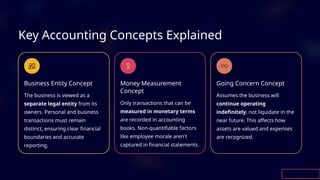
Key Accounting Concepts Explained
Business Entity Concept
The business is viewed as a
separate legal entity from its
owners. Personal and business
transactions must remain
distinct, ensuring clear financial
boundaries and accurate
reporting.
Money Measurement
Concept
Only transactions that can be
measured in monetary terms
are recorded in accounting
books. Non-quantifiable factors
like employee morale aren't
captured in financial statements.
Going Concern Concept
Assumes the business will
continue operating
indefinitely, not liquidate in the
near future. This affects how
assets are valued and expenses
are recognized.
More Essential Concepts
1
Accounting Period Concept
Financial performance is
measured and reported for
specific time periods such as
quarterly or annually, enabling
consistent performance tracking
and comparison.
2
Dual Aspect Concept
Every financial transaction
affects at least two accounts,
maintaining the fundamental
accounting equation: Assets =
Liabilities + Equity. This creates
the foundation for double-entry
bookkeeping.
3
Matching Concept
Expenses must be matched to
the revenues they help
generate within the same
accounting period, ensuring
accurate profit calculation and
preventing distorted financial
results.
What Are Accounting Conventions?
Accounting conventions are generally accepted guidelines that fill the gaps where
formal accounting standards don't provide explicit rules. While not legally binding,
these conventions are widely followed across the industry to ensure consistency,
reliability, and comparability in financial reporting.
Conservatism
Consistency
Full Disclosure
Materiality
Conservatism & Consistency Conventions
Conservatism Convention
When facing uncertainty, accountants should record the lower value to avoid overstating assets or income. This
principle protects stakeholders from overly optimistic projections.
Real Example: When inventory market value drops below purchase cost, it's valued at the lower market
price to reflect realistic worth.
Consistency Convention
Businesses must use the same accounting methods across reporting periods. This enables meaningful year-
over-year comparisons and helps stakeholders identify genuine trends versus accounting changes.
Why It Matters: Changing depreciation methods every year would make it impossible to track true
performance changes.
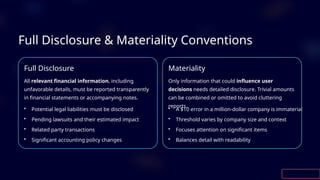
Full Disclosure & Materiality Conventions
Full Disclosure
All relevant financial information, including
unfavorable details, must be reported transparently
in financial statements or accompanying notes.
• Potential legal liabilities must be disclosed
• Pending lawsuits and their estimated impact
• Related party transactions
• Significant accounting policy changes
Materiality
Only information that could influence user
decisions needs detailed disclosure. Trivial amounts
can be combined or omitted to avoid cluttering
reports.
• A $10 error in a million-dollar company is immaterial
• Threshold varies by company size and context
• Focuses attention on significant items
• Balances detail with readability
Why Concepts and Conventions Matter
Universal Language
These principles provide a common
framework that accountants
worldwide understand and follow,
enabling seamless cross-border
business and investment.
Informed Decision-Making
Investors, managers, creditors, and
regulators rely on standardized
financial information to make
confident, data-driven decisions
about resource allocation.
Preventing Manipulation
Established conventions help prevent
creative accounting and financial
statement manipulation, protecting
stakeholders and maintaining market
integrity.
Real-World Impact: Consistency in Action
The Power of Standardization
Imagine trying to compare the profitability of two companies
when one uses FIFO inventory valuation and the other uses
LIFO, changing methods each year. The result? Complete chaos
and meaningless comparisons.
"Consistency allows investors to track performance trends
reliably over time, while conservatism protects stakeholders
by preventing overly optimistic financial statements that
could mislead decision-makers."
These conventions create the trust and transparency that
modern financial markets depend upon.
The Backbone of Accounting Integrity
Creating Order from
Complexity
Accounting concepts and conventions
transform the chaos of business
transactions into structured,
comprehensible financial statements
that tell a clear story.
Ensuring Quality Standards
These principles guarantee that
financial statements are clear,
comparable, and credible across
industries, countries, and time periods.
Essential Knowledge
Mastering these foundational principles
is absolutely essential for anyone
involved in business, finance, investing,
or financial management roles.

Accounting Concepts and Conventions.pptx

  • 1.
    Accounting Concepts and Conventions:Foundations of Financial Reporting Dr. U. Praveen Assistant Professor Department of B Com IT Sri Ramakrishna College of Arts & Science Coimbatore
  • 2.
    What Are AccountingConcepts? Accounting concepts are the basic assumptions and fundamental principles that form the bedrock for preparing accurate financial statements. These concepts ensure uniformity and clarity in financial reporting across organizations of all sizes and industries. They provide a standardized framework that accountants worldwide follow, making financial information comparable and reliable for decision-makers. Core Examples Include: • Business Entity Concept • Money Measurement Concept • Going Concern Concept • Accounting Period Concept
  • 3.
    Key Accounting ConceptsExplained Business Entity Concept The business is viewed as a separate legal entity from its owners. Personal and business transactions must remain distinct, ensuring clear financial boundaries and accurate reporting. Money Measurement Concept Only transactions that can be measured in monetary terms are recorded in accounting books. Non-quantifiable factors like employee morale aren't captured in financial statements. Going Concern Concept Assumes the business will continue operating indefinitely, not liquidate in the near future. This affects how assets are valued and expenses are recognized.
  • 4.
    More Essential Concepts 1 AccountingPeriod Concept Financial performance is measured and reported for specific time periods such as quarterly or annually, enabling consistent performance tracking and comparison. 2 Dual Aspect Concept Every financial transaction affects at least two accounts, maintaining the fundamental accounting equation: Assets = Liabilities + Equity. This creates the foundation for double-entry bookkeeping. 3 Matching Concept Expenses must be matched to the revenues they help generate within the same accounting period, ensuring accurate profit calculation and preventing distorted financial results.
  • 5.
    What Are AccountingConventions? Accounting conventions are generally accepted guidelines that fill the gaps where formal accounting standards don't provide explicit rules. While not legally binding, these conventions are widely followed across the industry to ensure consistency, reliability, and comparability in financial reporting. Conservatism Consistency Full Disclosure Materiality
  • 6.
    Conservatism & ConsistencyConventions Conservatism Convention When facing uncertainty, accountants should record the lower value to avoid overstating assets or income. This principle protects stakeholders from overly optimistic projections. Real Example: When inventory market value drops below purchase cost, it's valued at the lower market price to reflect realistic worth. Consistency Convention Businesses must use the same accounting methods across reporting periods. This enables meaningful year- over-year comparisons and helps stakeholders identify genuine trends versus accounting changes. Why It Matters: Changing depreciation methods every year would make it impossible to track true performance changes.
  • 7.
    Full Disclosure &Materiality Conventions Full Disclosure All relevant financial information, including unfavorable details, must be reported transparently in financial statements or accompanying notes. • Potential legal liabilities must be disclosed • Pending lawsuits and their estimated impact • Related party transactions • Significant accounting policy changes Materiality Only information that could influence user decisions needs detailed disclosure. Trivial amounts can be combined or omitted to avoid cluttering reports. • A $10 error in a million-dollar company is immaterial • Threshold varies by company size and context • Focuses attention on significant items • Balances detail with readability
  • 8.
    Why Concepts andConventions Matter Universal Language These principles provide a common framework that accountants worldwide understand and follow, enabling seamless cross-border business and investment. Informed Decision-Making Investors, managers, creditors, and regulators rely on standardized financial information to make confident, data-driven decisions about resource allocation. Preventing Manipulation Established conventions help prevent creative accounting and financial statement manipulation, protecting stakeholders and maintaining market integrity.
  • 9.
    Real-World Impact: Consistencyin Action The Power of Standardization Imagine trying to compare the profitability of two companies when one uses FIFO inventory valuation and the other uses LIFO, changing methods each year. The result? Complete chaos and meaningless comparisons. "Consistency allows investors to track performance trends reliably over time, while conservatism protects stakeholders by preventing overly optimistic financial statements that could mislead decision-makers." These conventions create the trust and transparency that modern financial markets depend upon.
  • 10.
    The Backbone ofAccounting Integrity Creating Order from Complexity Accounting concepts and conventions transform the chaos of business transactions into structured, comprehensible financial statements that tell a clear story. Ensuring Quality Standards These principles guarantee that financial statements are clear, comparable, and credible across industries, countries, and time periods. Essential Knowledge Mastering these foundational principles is absolutely essential for anyone involved in business, finance, investing, or financial management roles.