Accessibility Forum Webcast   October 29, 2002 Our thanks to the National Science Foundation for hosting this event
Introduction to the October, 2002 Accessibility Forum Webcast Mary Mitchell Deputy Associate Administrator (Acting) Office of Electronic Government and Technology (GSA)
Accessibility Forum Webcast Agenda Overview (1 of 4) 10:00 AM - Welcome and Introduction Mary Mitchell (GSA) 10:10 AM - Agenda Review Jack Corley (Forum Staff) 10:15 AM - Accessibility in the International Community Teleconference participants from Europe and Japan 11:00 AM - Forum Projects Review Bill Hetzner and Jim Kindrick (Forum Staff)
Agenda Overview (2 of 4) 11:45 AM - ATIA / ITI / Forum Interoperability Project Plan Chris Hofstader (Forum Council / Freedom Scientific)  12:00 PM - Forum Director’s Address Terry Weaver (GSA) 12:15 PM - Break for Lunch 1:15 PM - OMB Update Lesley Field (Office of Federal Procurement Policy)
Agenda Overview (3 of 4) 1:35 PM - Panel: Advocacy / Consumer Perspective on the Progress of 508 2:35 PM - Review of Government Agency Surveys and Interviews Terry Weaver (GSA) Joy Gatewood-Fulton (Forum Staff)
Agenda Overview (4 of 4) 3:05 PM - Creative Technological Compliance with Section 508 Across Various Agencies Dave Gardy, TV Worldwide 3:35 PM - “New Business” Mary Beth Janes (Council Chair, Apple) 3:45 PM - Closing remarks Skip Crane (Forum Staff) 4:00 PM - Reception
Accessibility in the International Community
Participants Hiroshi Kawamura Director of the International and Information Departments Japanese Society for Rehabilitation of Persons with Disabilities Inmaculada Placencia Porrero Applications Relating to the Disabled and Elderly Information Society Directorate General European Commission Judy Brewer Director, Web Accessibility Initiative (WAI) World Wide Web Consortium (W3C) Moderator - Skip Crane (Forum Staff)
Accessibility Forum Projects Bill Hetzner Jim Kindrick
Outline Background to the current Project Resource Documents Plans for reviewing the current Project Resource Documents Next steps Overview of the Objective Measures Resource Documents Overview of the AT-E&IT Interoperability Resource Documents
Background to the Current Resource Documents (1 of 2) Produced by Project Teams made up of Forum Members (started August, 2001) Two Teams: Objective Measures and AT-E&IT Interoperability Each has over 50 people signed up Work conducted: Biweekly Teleconferences Email Discussions and Message Board Working sessions at Forum Meetings
Background to the Current Resource Documents (2 of 2) Conducted Project Workshops (September 23-25, 2002)  Strategic Management Council provided schedule direction  Participants attending provided input on form and content Focused Resource Documents on technical clarity and shared understanding The basis for deriving assistance materials or guidelines Voice of the Customer
Plans for Reviewing the Resource Document Documents released 10/22-10/23/02 for Forum Review URL sent via email to every Forum Member Review ends 11/8/02 Comments and issues can be submitted via email to Project Teams Project Teams will consider and incorporate input as appropriate Final Resource Documents to be released 12/02/02
Next Steps Listening to the Voice of the Customer Interviews with Federal requiring officials Inputs from the Office of Federal Procurement Policy Inputs from Section 508 Coordinators Getting direction from the Strategic Management   Council
Objective Measures Resource Documents: Purpose Analysis of the Standard Organized by Technical Sections of the Standard Scope of specific Technical Provisions Focus on clarification and common understanding   Many iterations to develop ‘Analysis Template’
Objective Measures Resource Documents: Organization Template for Analysis of the Standard   Terms and Definitions   Assumptions   Outstanding Issues/Clarifications  Measurement Preconditions  Data Collection or Measurement Methods  Related Resources  Comments and Suggestions
Objective Measures Resource Documents: Steps Taken Preliminary Analysis  Produced as discussion starter for Team  Based on available materials: ‘Naive’ Perspective  Initial Analysis  Incorporated inputs from Project Team dialogue  Included research on related resources  Review with Access Board Staff Clarification for outstanding issues Validation of definitions and assumptions
Objective Measures Resource Documents: Content (1 of 2) 1194.21 Software and Operating Systems  12 Provisions:  10 Definitions, 19 Assumptions, 12 Clarifications  1194.22 Web-based intranet and internet information and applications  16 Provisions:  10 Definitions, 24 Assumptions, 3 Clarifications  1194.23 Telecommunication products  14 Provisions:  2 Definitions, 27 Assumptions, 11 Clarifications
Objective Measures Resource Documents: Content (2 of 2) 1194.24 Video and multimedia products  5 Provisions:  13 Definitions, 8 Assumptions  1194.25 Self contained, closed products information and applications  13 Provisions:  5 Definitions, 25 Assumptions, 4 Clarifications  1194.26 Desktop and portable computers  4 Provisions:  1 Clarification
AT-E&IT Interoperability Projects Overview General changes from September Workshops Dropped “Questions” sections from all documents. Redundant in concept, if not practice, with Objective Measures Questions may be part of subsequent tools Common outline (almost) Applicable Interoperability Provisions Interoperability as it applies to technical section How E&IT products work with AT Changing face of current products Suggestions for realizing interoperability in current products
AT-E&IT Interoperability Projects Detail (1 of 4) 1194.21 Software and O/S Most mature, most vetted Includes GNOME Accessibility Framework, Java Accessibility, Linux Accessibility, Microsoft Active Accessibility, and W3C DOM More? Additional section on Evaluation Copies A catalyst for the ATIA/ITI/Forum activity
AT-E&IT Interoperability Projects Detail (2 of 4) 1194.22 Web-based Information and Applications NEW Some input from the working group Concern that the technology is changing too fast to keep up No “changing face” section Needs broad review 1194.23 Telecommunication Products Fairly mature Input primarily from working group Needs broader review
AT-E&IT Interoperability Projects Detail (3 of 4) 1194.24 Video and Multimedia Somewhat mature Input from small working group Needs broader review 1194.25 Self-contained, Closed Systems No interoperability requirements, by definition Functions associated with self-contained, closed systems are part of other technical sections.
AT-E&IT Interoperability Projects Detail (4 of 4) 1194.26 Desktop and Personal Computers Only one provision addresses interoperability NEW Needs broad review
Summary Reviewed the development of the Project Resource Documents Completed review of these documents with the Project Teams Posted documents for review and comment by all Forum members Preparing for next steps
ATIA / ITI / Forum  Interoperability Working Group  Mission and Goals Chris Hofstader
Short Term Goals (1 of 2) Identify the areas where Assistive Technology applications and Electronic Information Technology applications need to provide a standard means of communication where by applications and assistive technology applications will be able to interoperate.  Create a set of functional descriptions which describe this communication.  Determine any changes needed to existing operating systems to accommodate the full set of communication needs.
Short Term Goals  (2 of 2) Work with the existing operating systems owners to affect any needed changes.  Work with application developers to understand and use the accessibility communication vehicles in their applications, both EIT and AT.  Forward any issues brought before the Working Group that fall outside the area of traditional software to the appropriate group working on those issues.  e.g. Web issues will be referred to the W3C/WAI.
Medium/Long Term Goal Once the short term goals are reached medium or long term goals can be addressed.  Possible Accessibility API that would be adopted by all platforms
Process   (1 of 2) Proposal will be reviewed and agreed to by ATIA and ITI (done). Working Group will be established and members confirmed (done). A public meeting will be held to obtain the initial set of issues,   requirements (done). Monthly 2 hour teleconferences will be conducted.  Expect most of the work will occur outside of the teleconferences via e-mail. Working Group meetings will convene via teleconferences.
Process  (2 of 2) Face to face Working Group meetings will be conducted.  Proposed for ATIA conference in Orlando in January.  TBD in July 2003. Agreement will be by consensus. Quarterly public feedback will be sought. Final report will be posted for public review. Begin the process again for Medium and Long Term Goals.
Work Plan   Deliverables - Set of functional descriptions needed between AT/ EIT Software applications Set of needed changes to the present existing systems Desired schedule for implementing those changes Final Report To be determined based on public input of requirements and issues
Obtain Issues, Concerns and Requirements  (1 of 2)  Determine which are applicable and which we can address.  Those that   are already being addressed by other organization will be sent to those  organizations for resolution.  e.g. V2, Linux Standards, W3C/WAI.   Consulting support helps us to not make decisions in a vacuum, and not to address areas already covered by other efforts.
Obtain Issues, Concerns and Requirements  (2 of 2) Identify functional requirements needed by AT Identify functional requirements of EIT Evaluate the present operating systems for that support in MAC OS, Linux, Windows Determine any changes needed to each of those systems, if any. Describe desired schedule to implementation of those changes.  Provide a final report that can be used by AT and EIT vendors to maximize interoperability.
Future Events 1/18/03 - Working Group meetings face to face proposed for ATIA conference in Orlando in January 7/15/03 - Working Group meetings face to face TBD if necessary 9/30/04 - Public posting of the final report 10/07/04 - Begin the process again for Medium and Long Term Goals
Program Director’s Address Terry Weaver Director for the Center for IT Accommodations, GSA
GSA Perspective Forum has been and continues to be a valuable experience as … An unparalleled community of stakeholders A resource of expertise A place to network and share ideas Work to date has been recognized. Future activities should lead to tools that … Facilitate the requiring and procurement process Simplify compliance assessment Allow for and encourage innovation and change
Applicability Assistant Tool Connect the world of purchasing to the appropriate segments of 508 requirements. Define in marketplace terms the functional or feature descriptions for potential product characteristics. Connect functions and features of products (as appropriate), as expressed in the marketplace, to the appropriate parts of the standards.
Procurement Assessment Assistant Tool Mature the Applicability Assistant Tool to … Provide sample RFP language.  Provide example practical and understandable technical evaluation criteria for each relevant part of the standard.
By the Next Forum Meeting Have … Applicability Assistant and Procurement Assessment Assistant Tools developed to the proof-of-concept stage.  A defined maintenance process that enables the addition of new evaluation techniques. Plans for using tools for simplifying compliance assessment.
Accessibility Forum Webcast   October 29, 2002 Webcast will resume at 1:15 PM EST LUNCH BREAK
OMB Update   Lesley Field
Panel: Advocacy / Consumer Perspective on the Progress of 508
Participants Brenda Battat, Self Help for Hard of Hearing People (SHHH) Jim House, Telecommunications for the Deaf, Inc. Dave Poehlman, American Council of the Blind (ACB) Joy Relton, American Foundation for the Blind (AFB) Moderator - Skip Crane
Comments from Brenda Battat – SHHH (1 of 3) Great need for more consumer education on 508. Complaint process may not work;  employee hesitant to complain due to impact on career. More "technical" consumers should be involved where decisions are being made regarding evaluating products.
Comments from Brenda Battat – SHHH (2 of 3) We should go back to the Access Board to learn the intention of the provisions and what they mean. Neither Federal agencies nor vendors want to take responsibility for signing off on products conforming to the 508 standard.
Comments from Brenda Battat – SHHH (3 of 3) Still no clear and simple way to evaluate products for conformance to 508. Most 508 attention focused on accessible websites and screen readers, but there is more to 508.
Comments from Jim House –  TDI (1 of 4) TDI promotes equal access to telecommunications and media for people who are deaf, hard of hearing, late-deafened or deaf-blind.  On the Internet, we have applications for both telecommunications AND media.
Comments from Jim House – TDI (2 of 4) Video Relay  Video Interpreting  Video Conferencing Telecommunications: Barriers: VoIP Technology IM closely resembles TTY but it is not completely real-time No way to receive incoming calls unless you are online E-Mail and pagers  Instant Messaging (IM)  Chat Rooms  IP-Relay
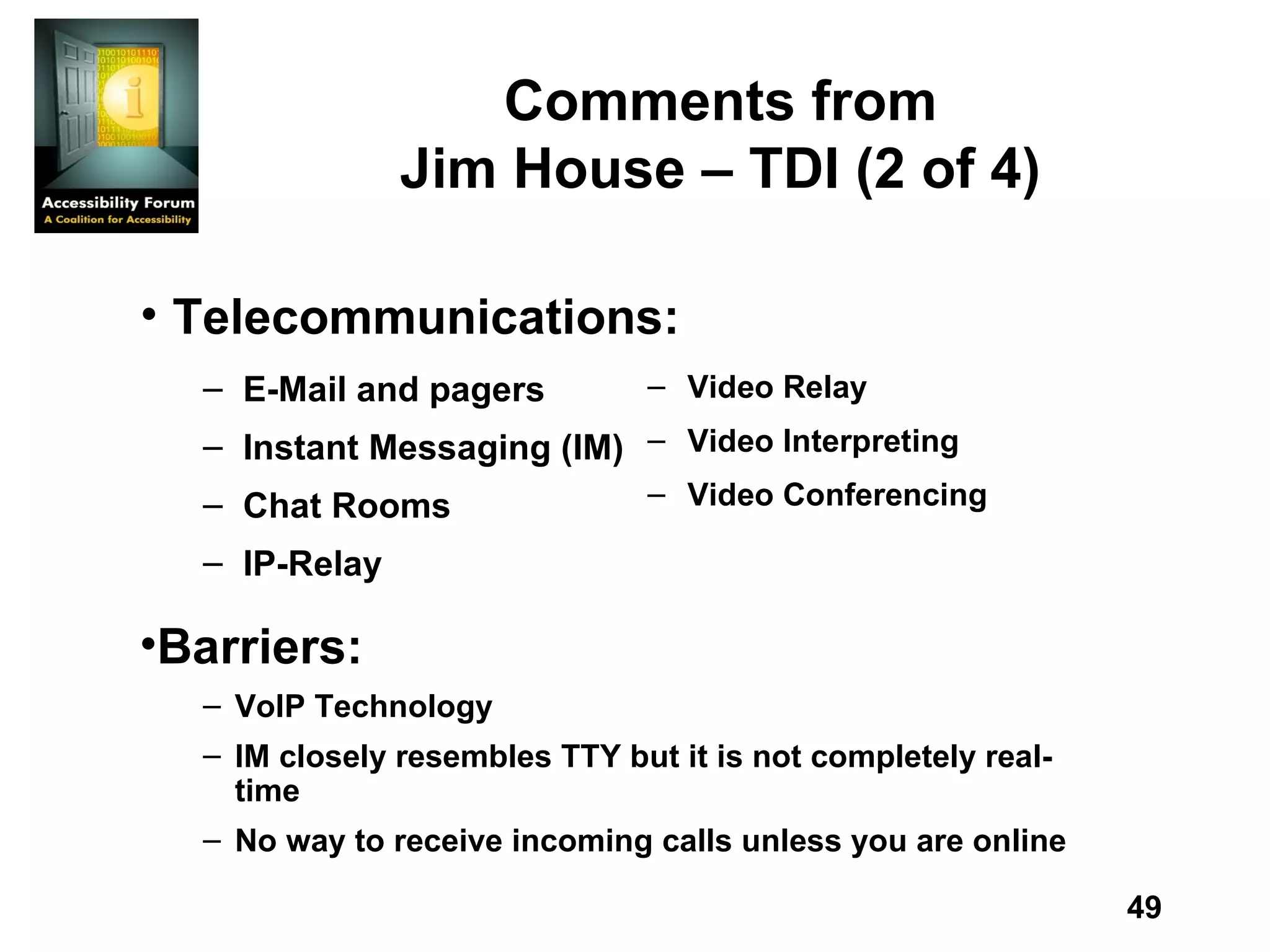
Comments from Jim House –TDI (3 of 4) Media: Wealth of information in text and graphics Ease of publishing your own information  Barriers: Current broadband policy and economics limits use of full-motion video Virtual lack of captioning on commercial website streaming video (News media, entertainment clips, etc.) Audio files lack transcripts or captions
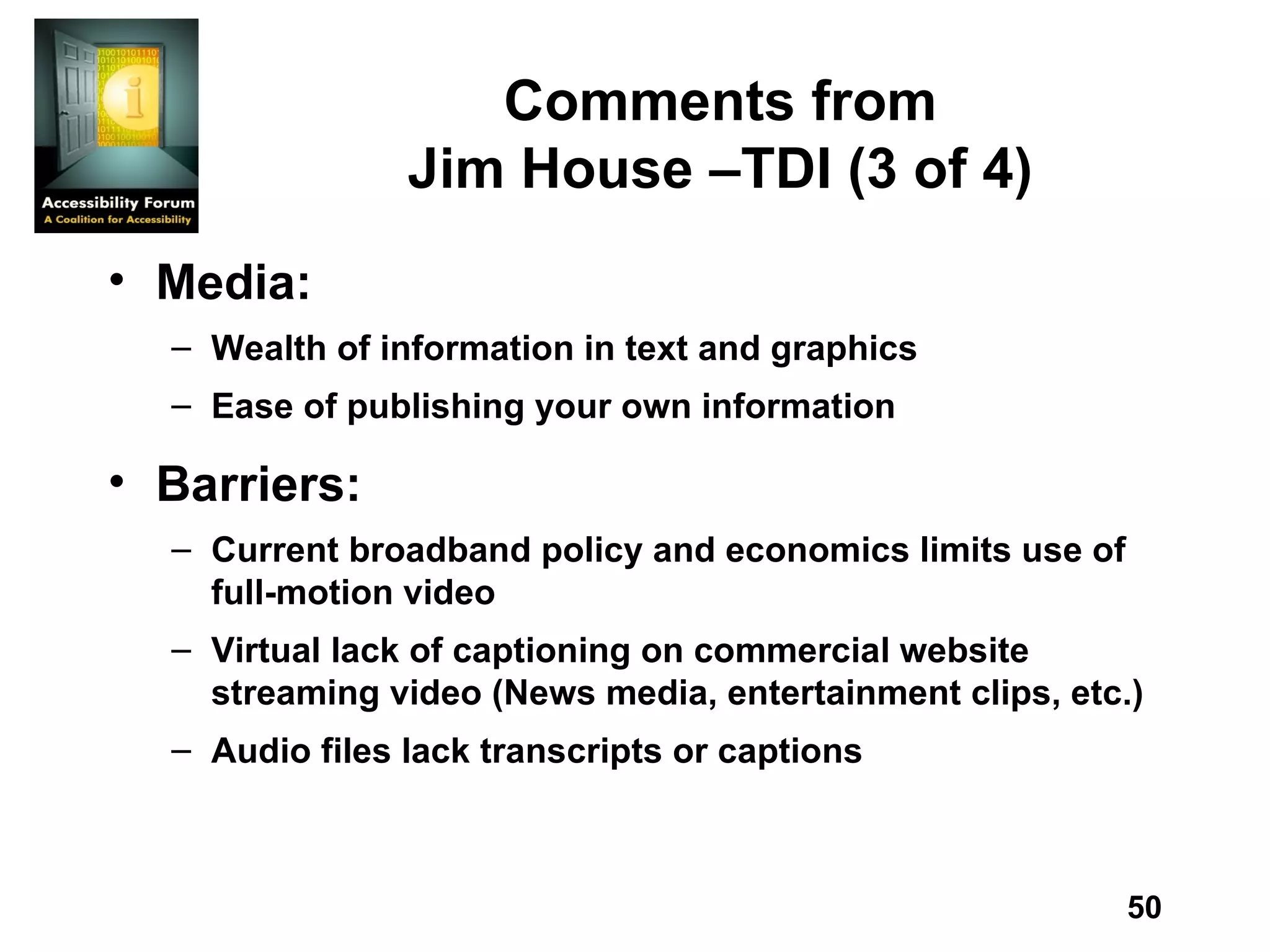
Comments from Jim House –  TDI (4 of 4) Government issues: Regulations do not keep pace with technology Courts divided on access rules in private sector Many agencies are complying with 508, but others are trying to avoid compliance TDI has learned some agencies are polling audience requirements to see if they can avoid captioning.
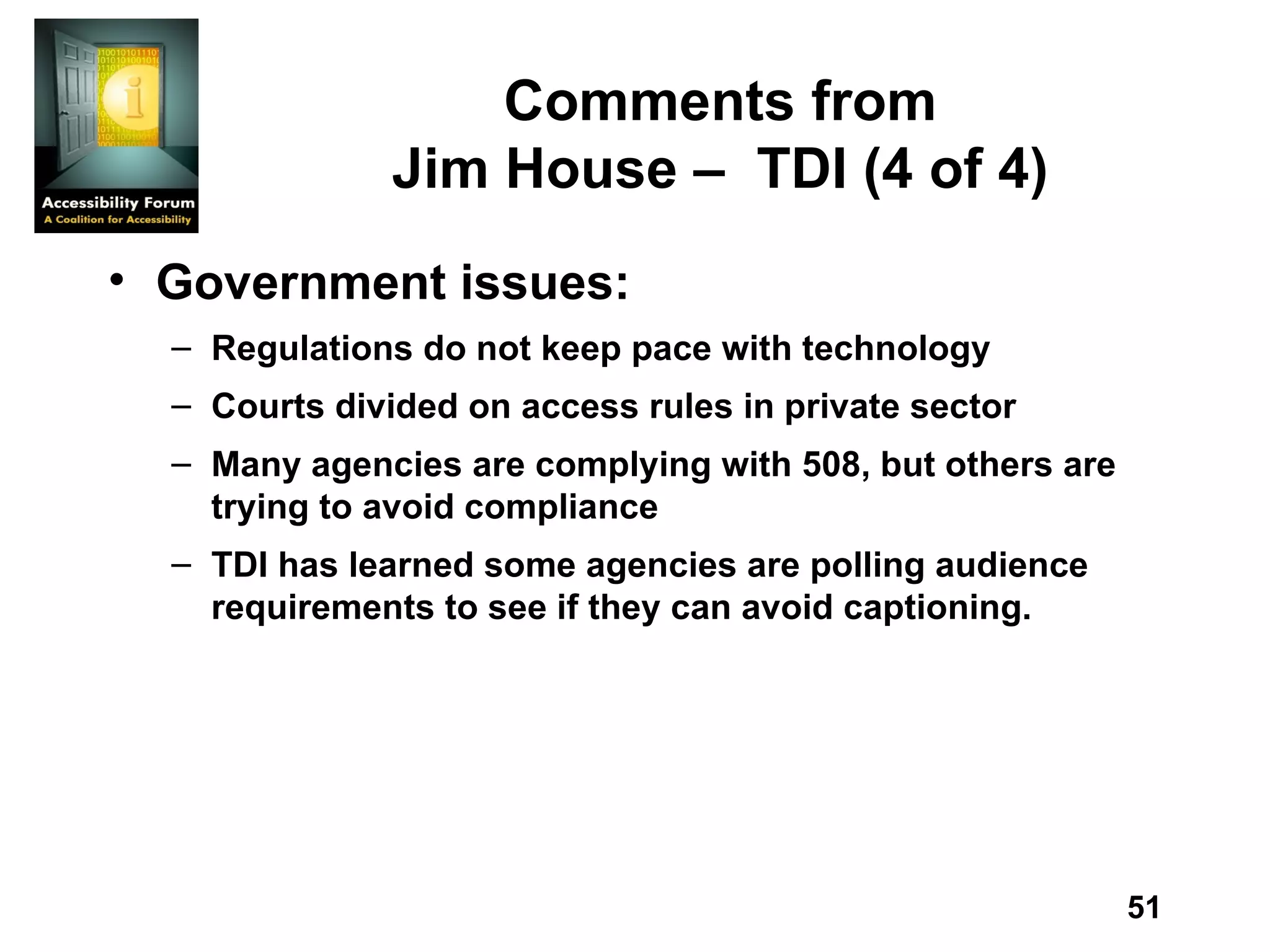
Comments from David Poehlman – ACB (1 of 4) Areas of progress since the advent of Section 508 standards … Sectors that have shown positive results and advances Websites are better Good tools which use verifiable means to test for section 508 compliance are helpful Lots of talk and generated interest Web development people seem to be much more interested at least at the government level
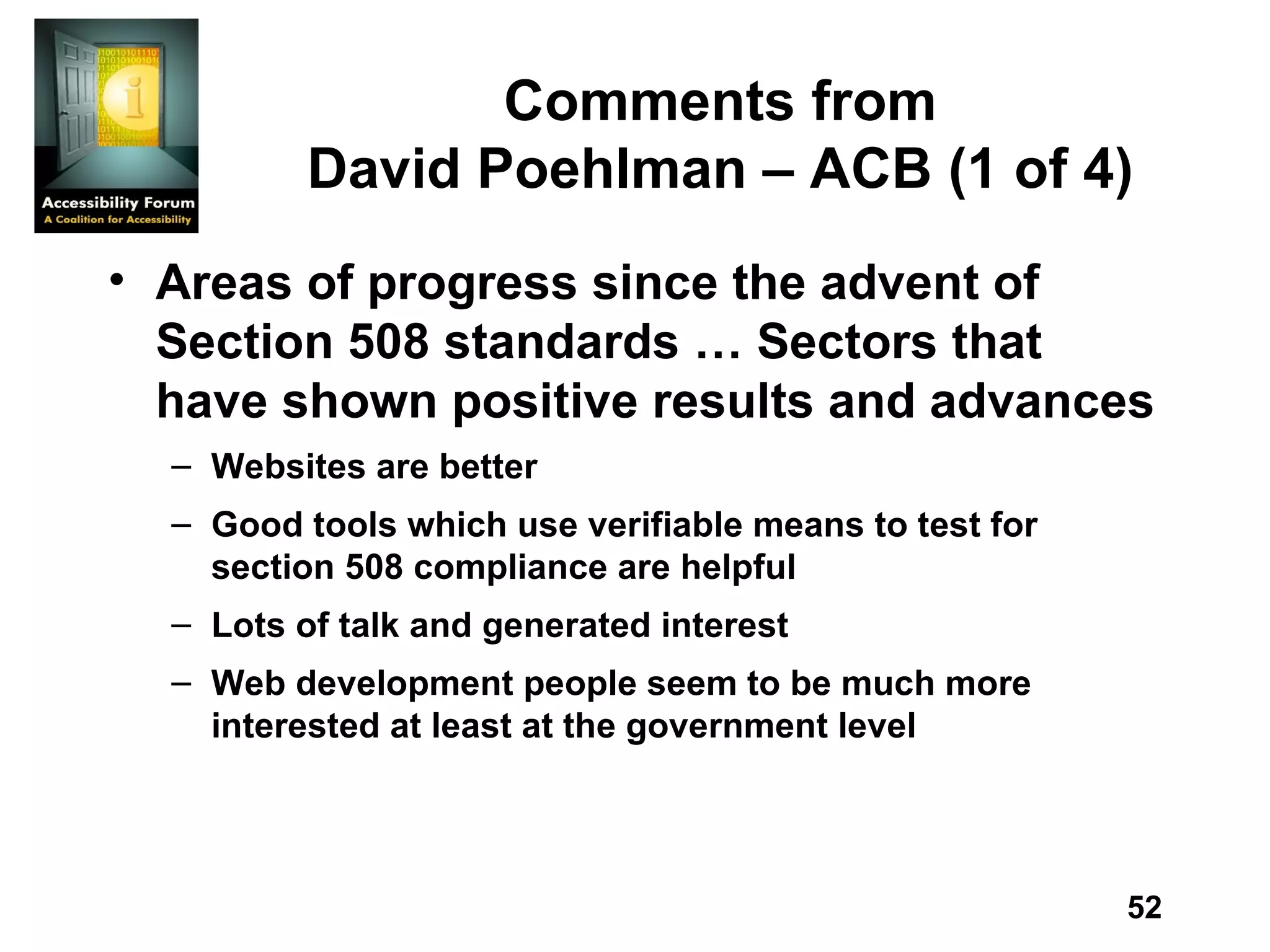
Comments from David Poehlman – ACB (2 of 4) Shortcomings … needs for continuing improvement Accessible content needs to be provided in electronic form Many people (including those who should) still do not know the meaning of section 508 and the standards We need more of the human in the equation and less of the legal Inaccessible software remains a big problem for federal employees Human resources and financial packages keep promising to become accessible in the next release but never get there
Comments from David Poehlman – ACB (3 of 4) Shortcomings … needs for continuing improvement Real lack of enforcement of accessibility  Bidders with products that do not fulfill the promise must start being turned down Makers of accessible hardware and software must start getting the nod Documentation must be more accessible
Comments from David Poehlman – ACB (4 of 4) Activities being pursued that we hope will prove fruitful Entering an FCC formal complaint on cell phone access Federal Government should enforce section 255 access requirements for telephone equipment as a 508 matter. Involved in the Accessibility Forum and other initiatives. Building an informal network of people involved with 508 Compare notes and make strategic decisions. Educating our members to their rights and that should produce more expectations and demand. Expressing concerns about specific sites to web masters and agencies. Draw more attention to compliance.
Comments from Joy Relton – AFB
Review of Government Agency Surveys and Interviews   Terry Weaver Joy Gatewood-Fulton
The Accessibility Forum: Interviews Interviews with Federal Agencies regarding the Procurement Challenges of Section 508: acquiring accessible Electronic and Information Technology.
Section 508 - Interviews with Government Procurement (1 of 2) Nine agencies interviewed: from Depts. of HHS, Commerce, Treasury, and Defense. Purpose: to gather best practices in procuring accessible E&IT and to determine if agencies need further guidance in implementing Section 508.
Section 508 - Interviews with Government Procurement (2 of 2) Interviews were Confidential, with data presented in an aggregate form only. Range Section 508 applicability to a purchase VPAT’s What 508 information do they require from vendors Comments Other
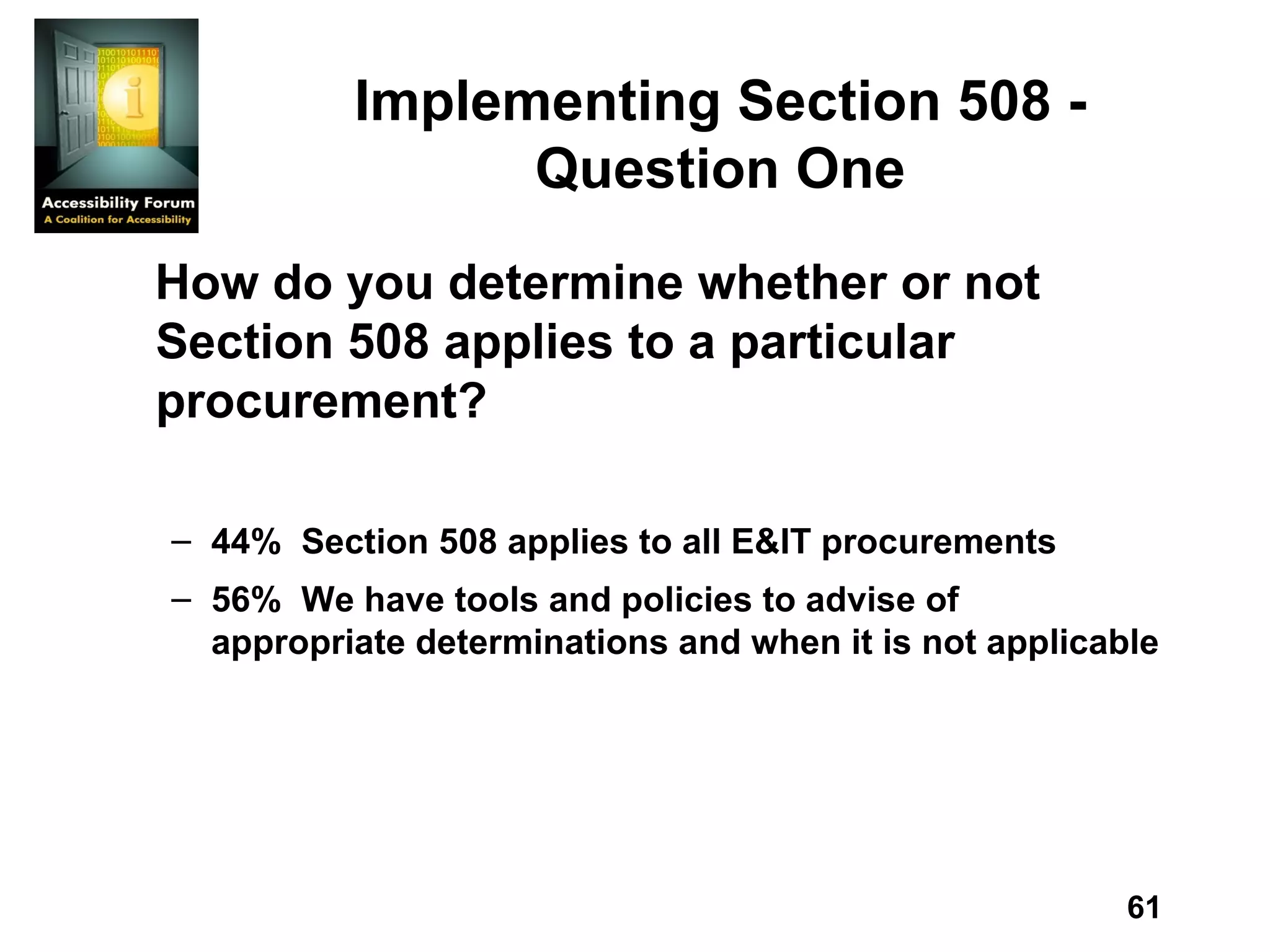
Implementing Section 508 - Question One How do you determine whether or not Section 508 applies to a particular procurement? 44%  Section 508 applies to all E&IT procurements 56%  We have tools and policies to advise of appropriate determinations and when it is not applicable
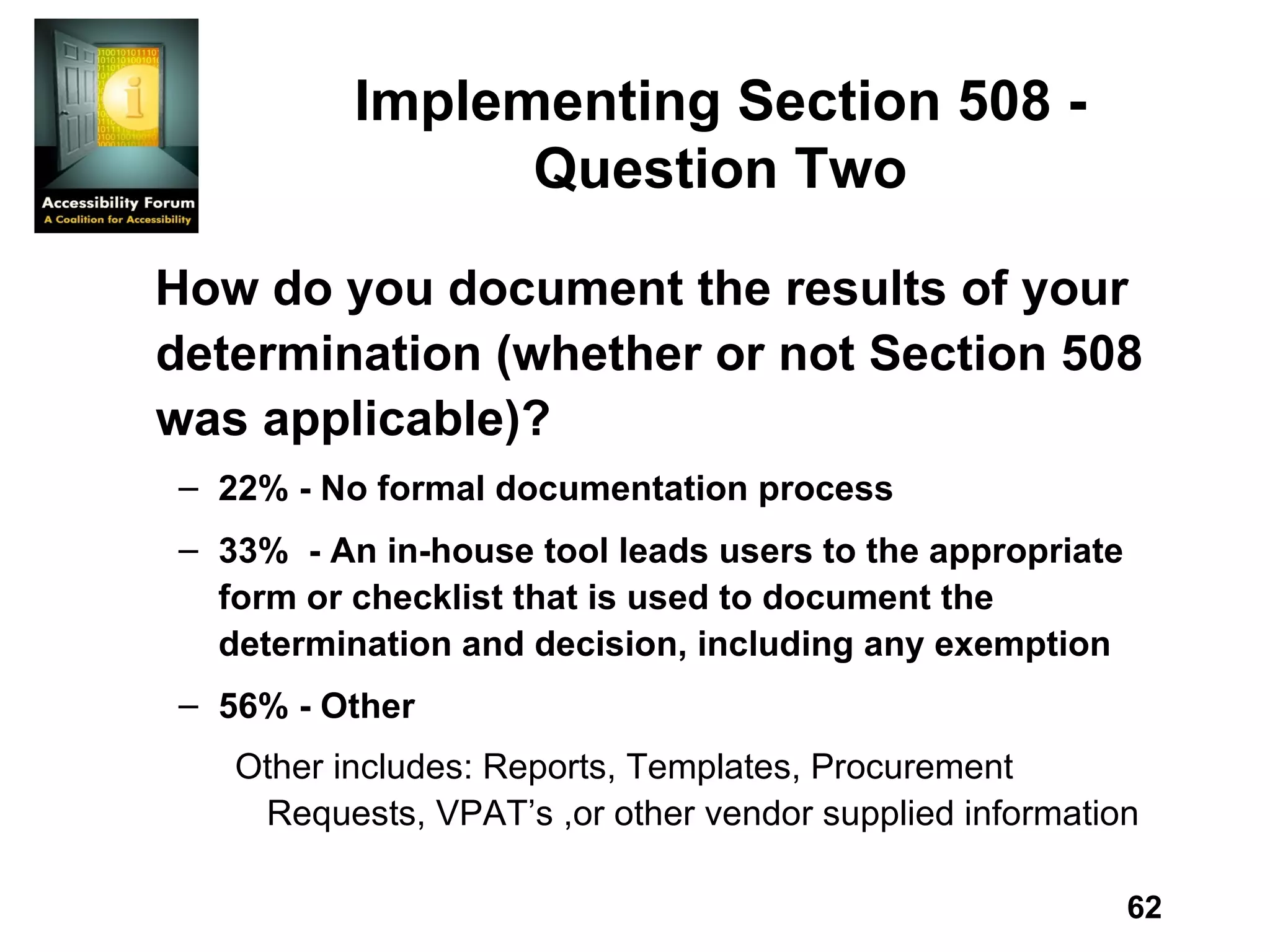
Implementing Section 508 - Question Two How do you document the results of your determination (whether or not Section 508 was applicable)? 22% - No formal documentation process 33%  - An in-house tool leads users to the appropriate form or checklist that is used to document the determination and decision, including any exemption 56% - Other Other includes: Reports, Templates, Procurement Requests, VPAT’s ,or other vendor supplied information
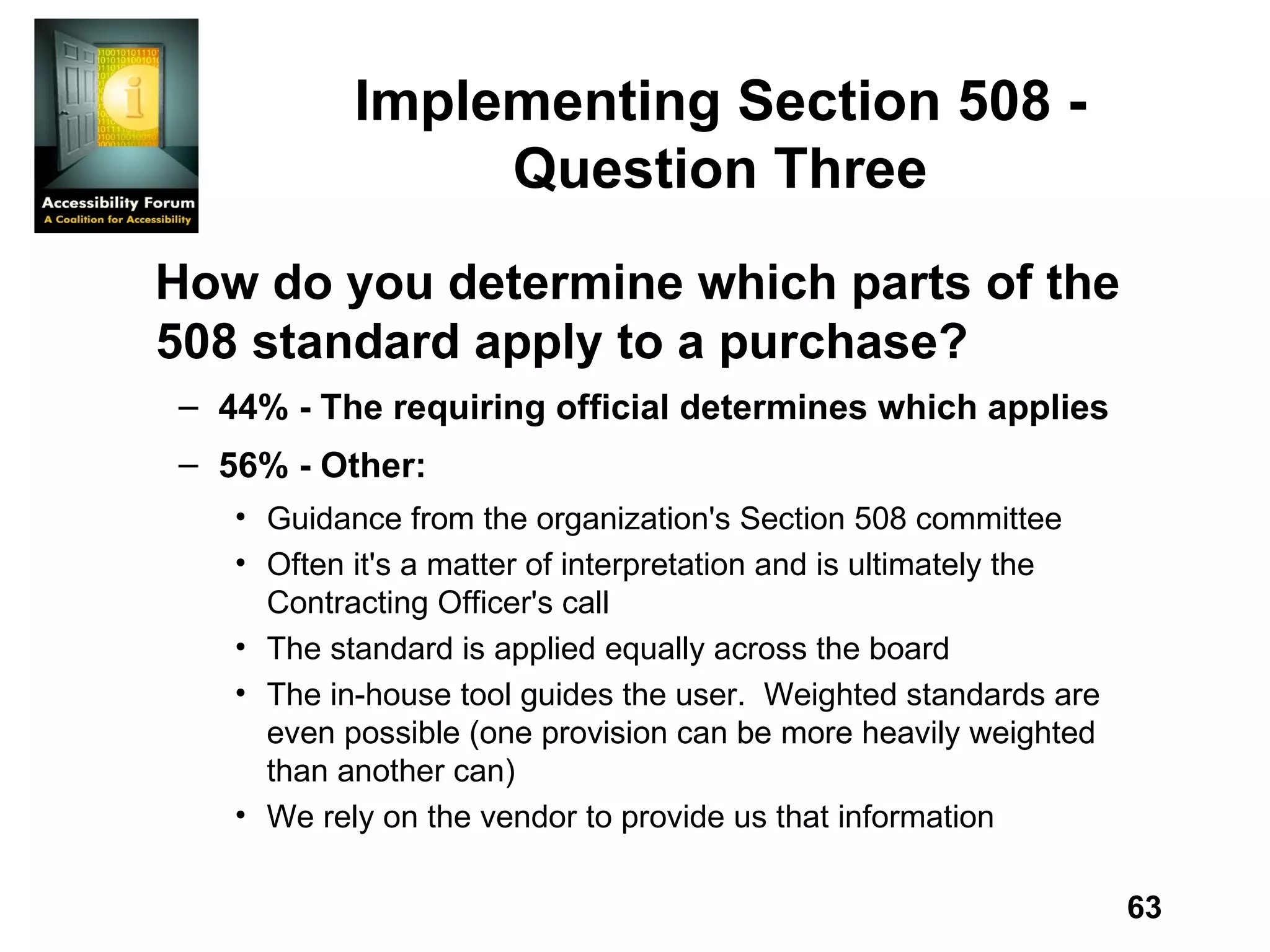
Implementing Section 508 - Question Three How do you determine which parts of the 508 standard apply to a purchase? 44% - The requiring official determines which applies 56% - Other: Guidance from the organization's Section 508 committee Often it's a matter of interpretation and is ultimately the Contracting Officer's call The standard is applied equally across the board The in-house tool guides the user.  Weighted standards are even possible (one provision can be more heavily weighted than another can) We rely on the vendor to provide us that information
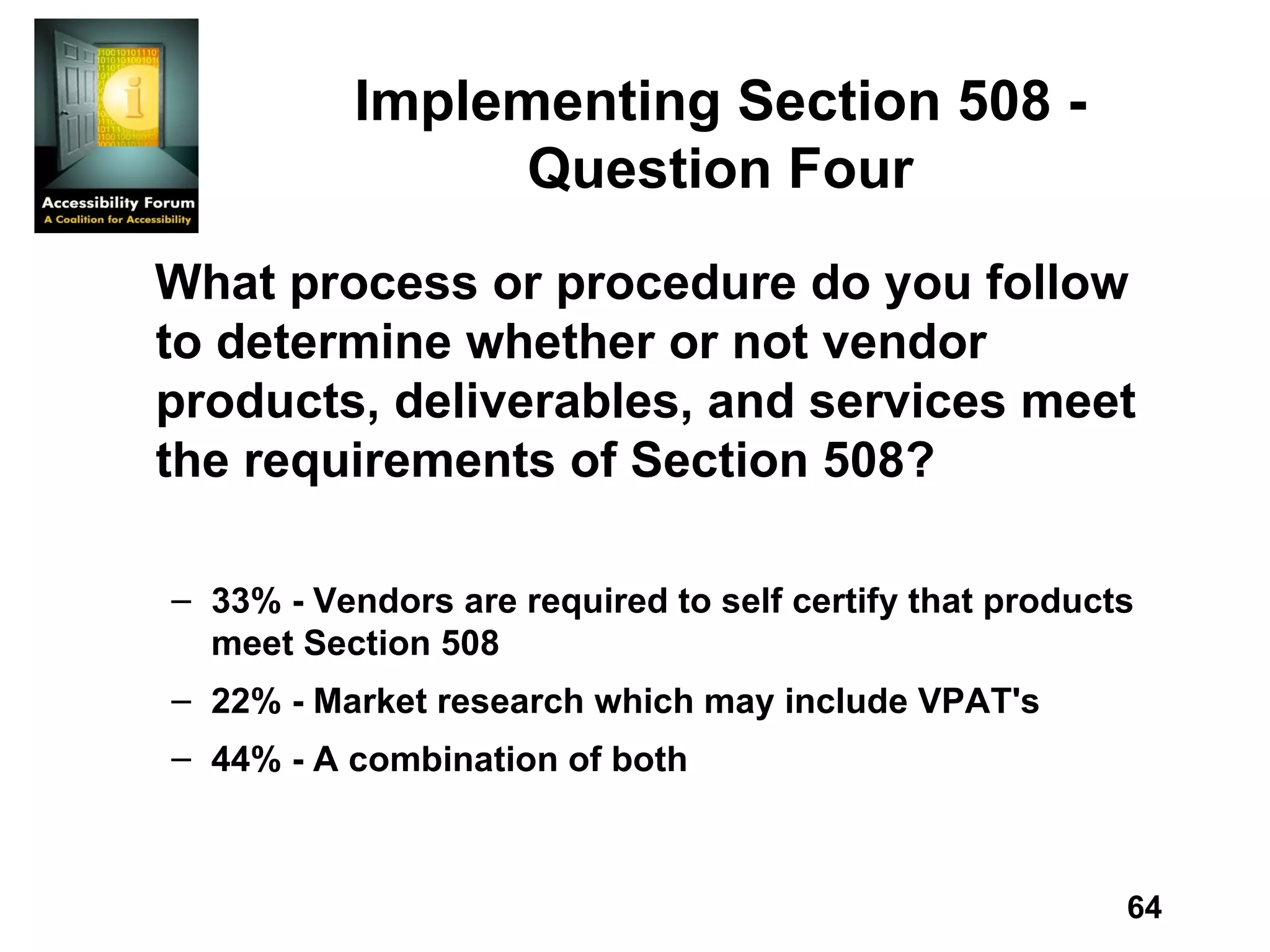
Implementing Section 508 - Question Four What process or procedure do you follow to determine whether or not vendor products, deliverables, and services meet the requirements of Section 508? 33% - Vendors are required to self certify that products meet Section 508 22% - Market research which may include VPAT's 44% - A combination of both
Implementing Section 508 - Question Five What Information do you require of Offerors / Vendors? 33% - Self-Certification Language 33% - VPAT/template 22% - Vendor must complete our template 11% - Vendor must offer information about how their products meet Section 508 standards somewhere on their website, in brochures or handouts, in a standard template or VPAT format
Implementing Section 508 - Question Six How often do you use the Voluntary Product Accessibility Template (VPAT) in your assessment of a vendor’s products, deliverables, and services? 44% - Never 22% - Always 33% - Sometimes, when available
Implementing Section 508 - Question Six-A Is the VPAT the primary source of information? 44% - N/A - never use 44% - Yes 11% - No
Implementing Section 508 - Question Seven What other sources of information do you use? 44% - Market research 33% - N/A 11% - We also may test the product 11% - Our own template
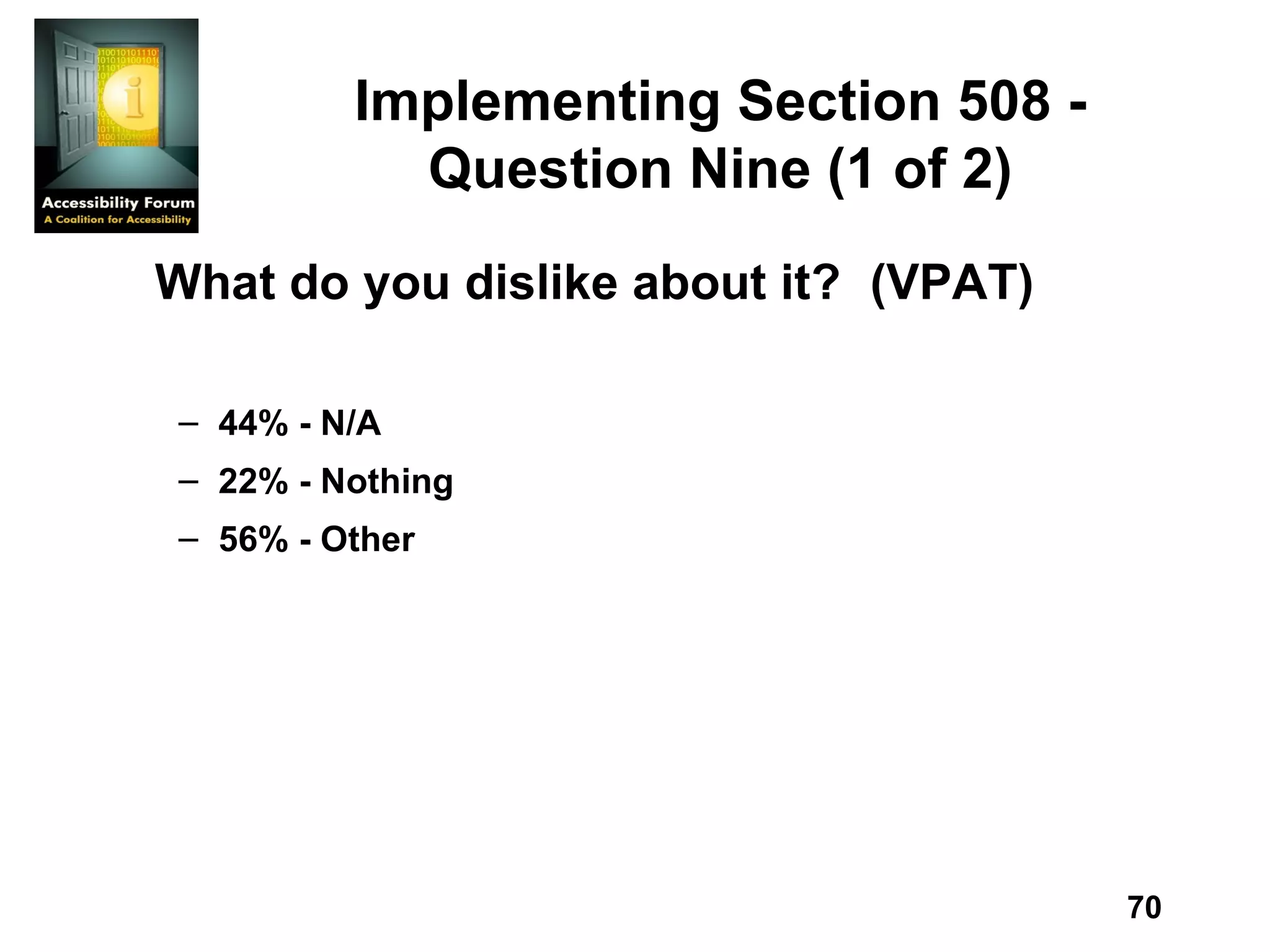
Implementing Section 508 - Question Eight If the VPAT is used, we would like to follow up with some questions on how well it is working for you. What do you like about it? 44% - N/A 33%  - Everything - easy to read and all the information is on one page 22%  - Nothing
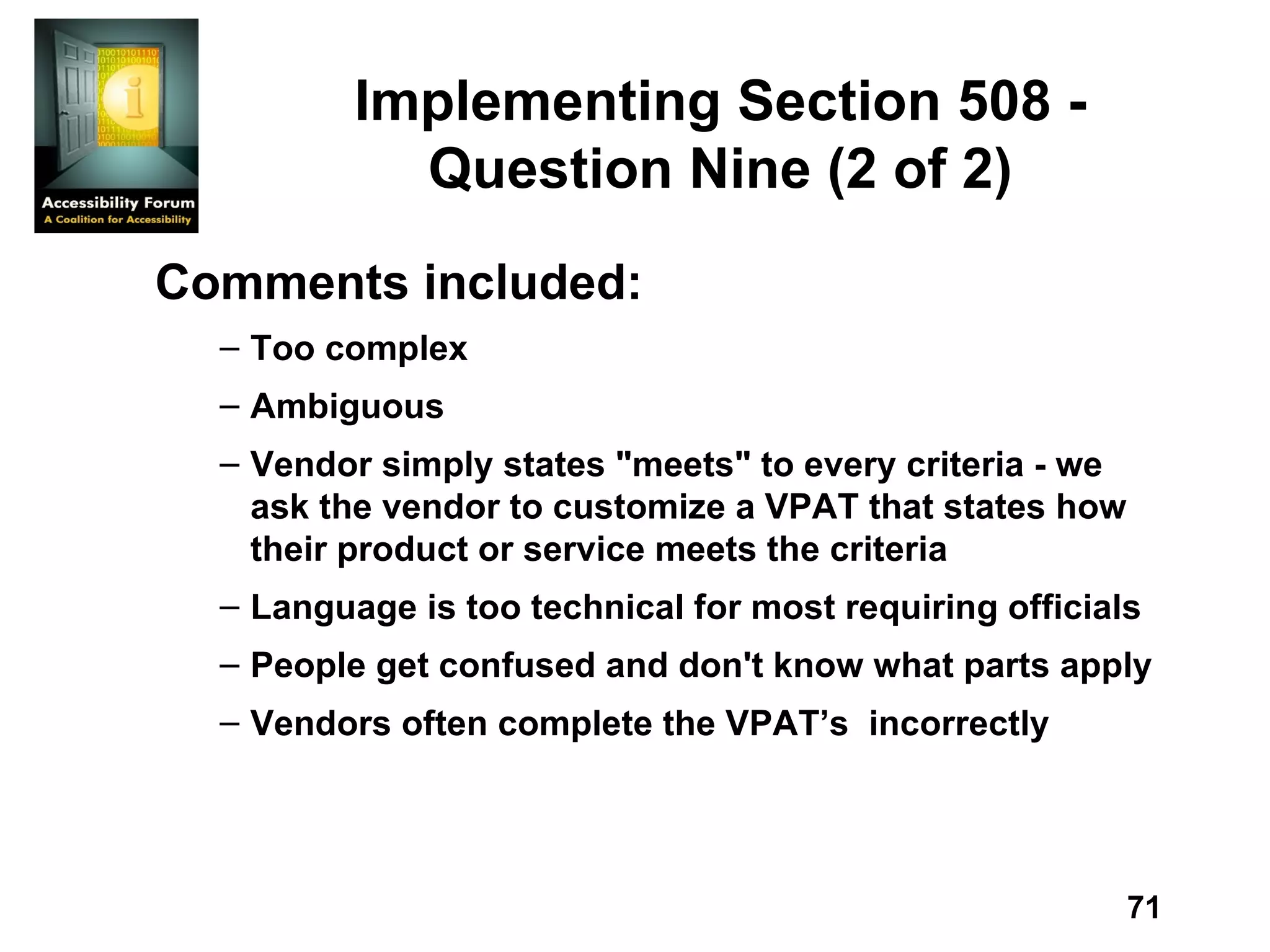
Implementing Section 508 - Question Nine (1 of 2) What do you dislike about it? (VPAT) 44% - N/A 22% - Nothing 56% - Other
Implementing Section 508 - Question Nine (2 of 2) Comments included: Too complex Ambiguous Vendor simply states "meets" to every criteria - we ask the vendor to customize a VPAT that states how their product or service meets the criteria Language is too technical for most requiring officials People get confused and don't know what parts apply Vendors often complete the VPAT’s  incorrectly
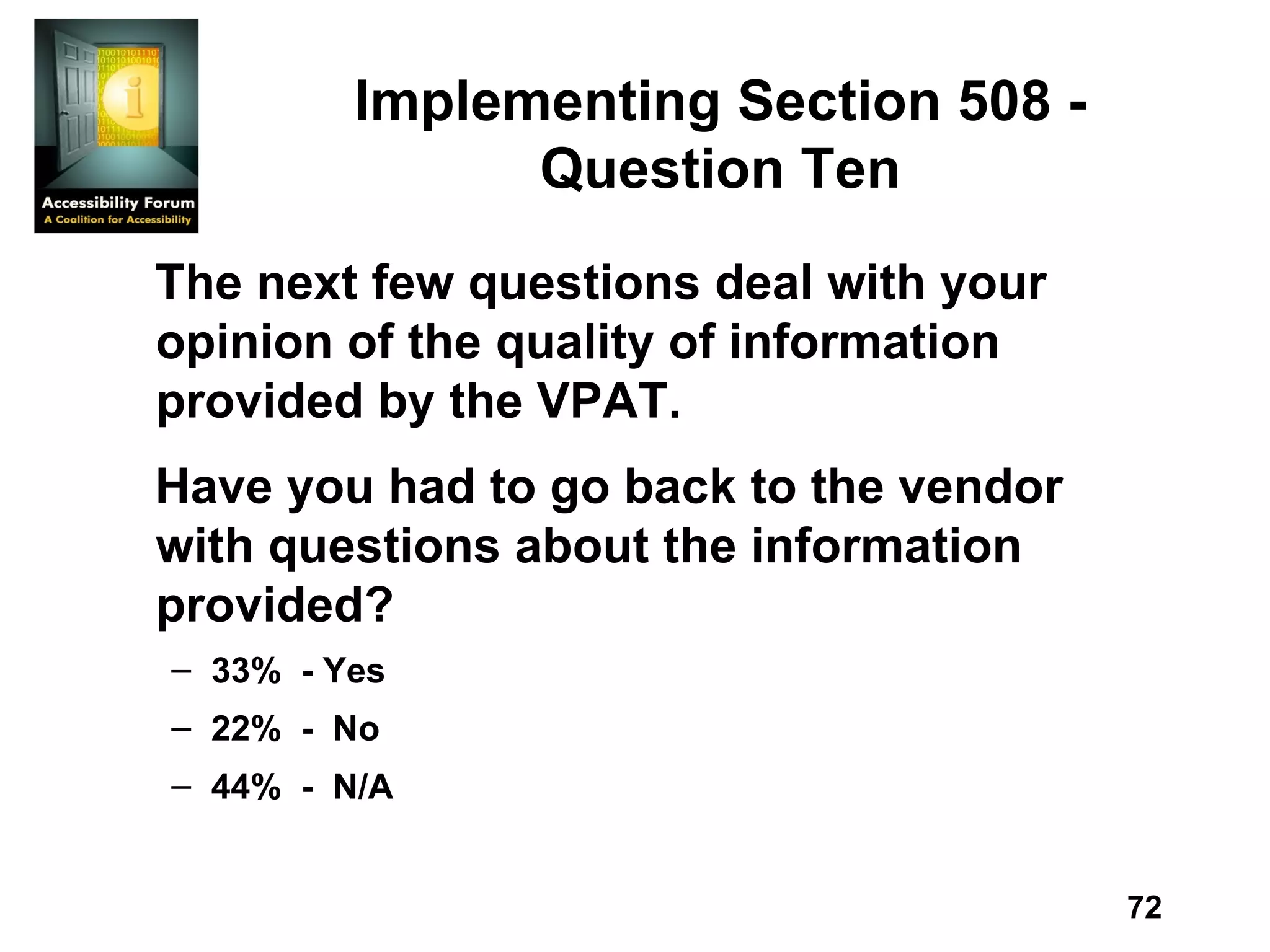
Implementing Section 508 - Question Ten The next few questions deal with your opinion of the quality of information provided by the VPAT. Have you had to go back to the vendor with questions about the information provided? 33%  - Yes 22%  -  No 44%  -  N/A
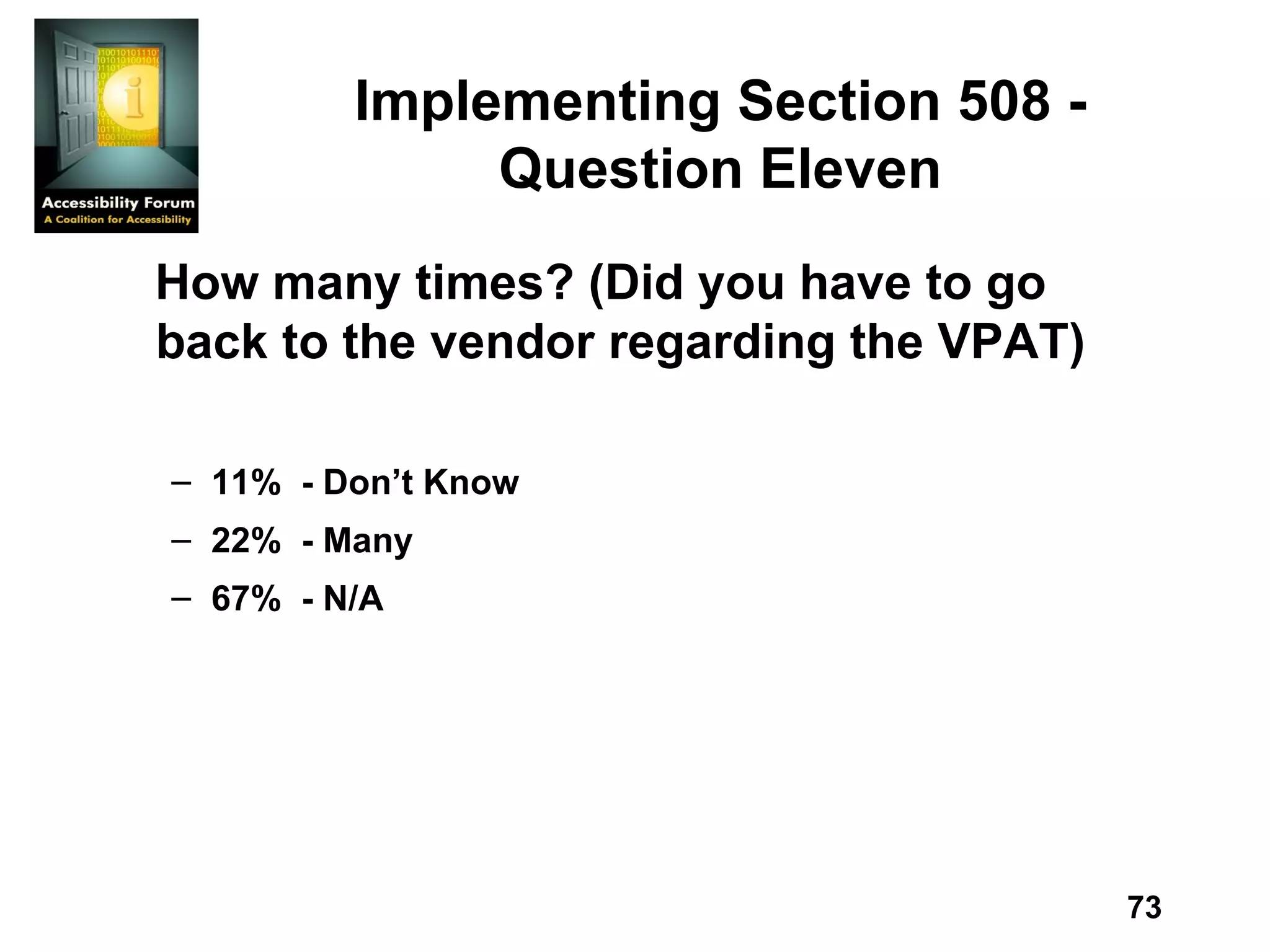
Implementing Section 508 - Question Eleven How many times? (Did you have to go back to the vendor regarding the VPAT) 11%  - Don’t Know 22%  - Many 67%  - N/A
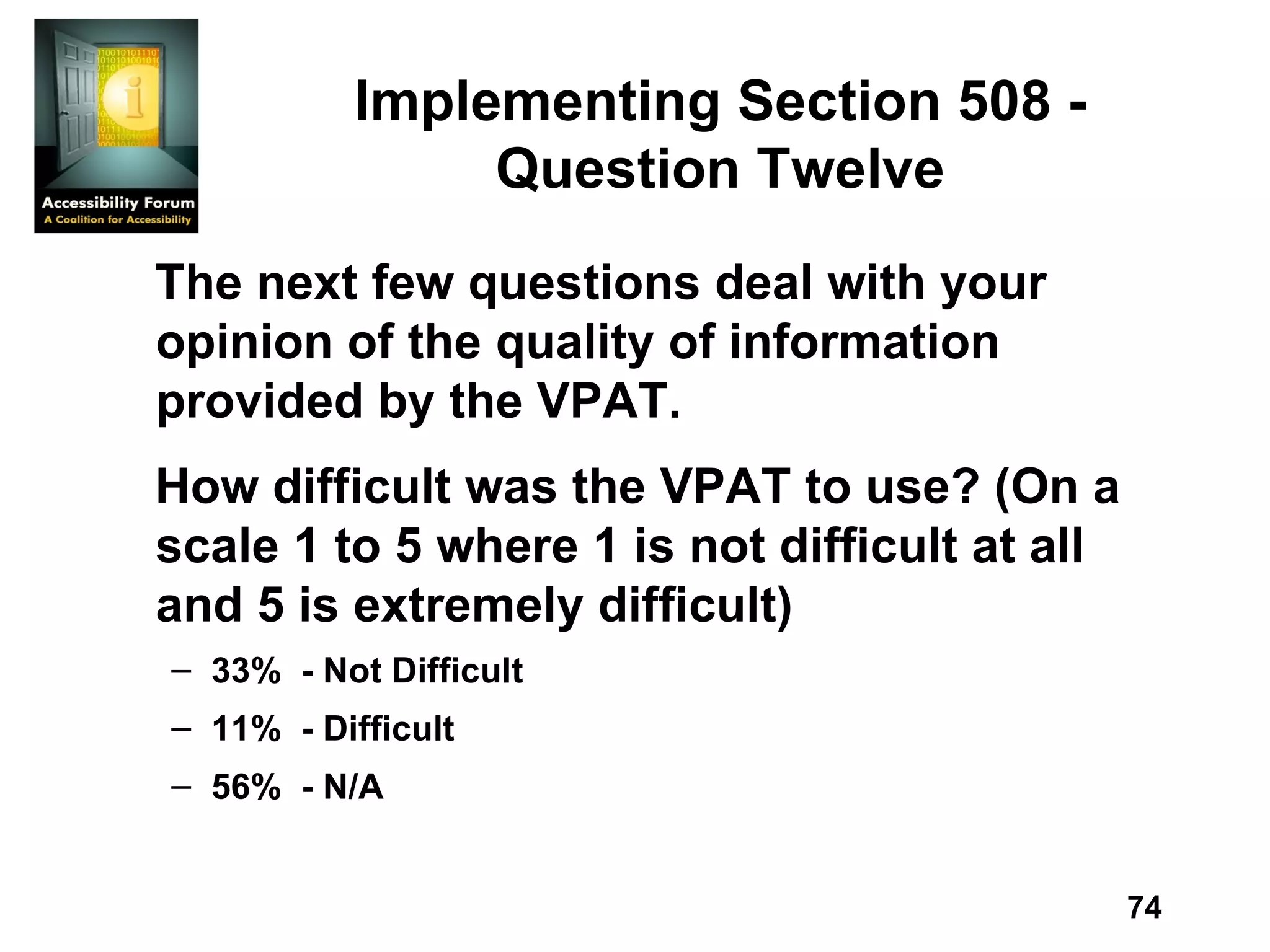
Implementing Section 508 - Question Twelve The next few questions deal with your opinion of the quality of information provided by the VPAT. How difficult was the VPAT to use? (On a scale 1 to 5 where 1 is not difficult at all and 5 is extremely difficult) 33%  - Not Difficult 11%  - Difficult 56%  - N/A
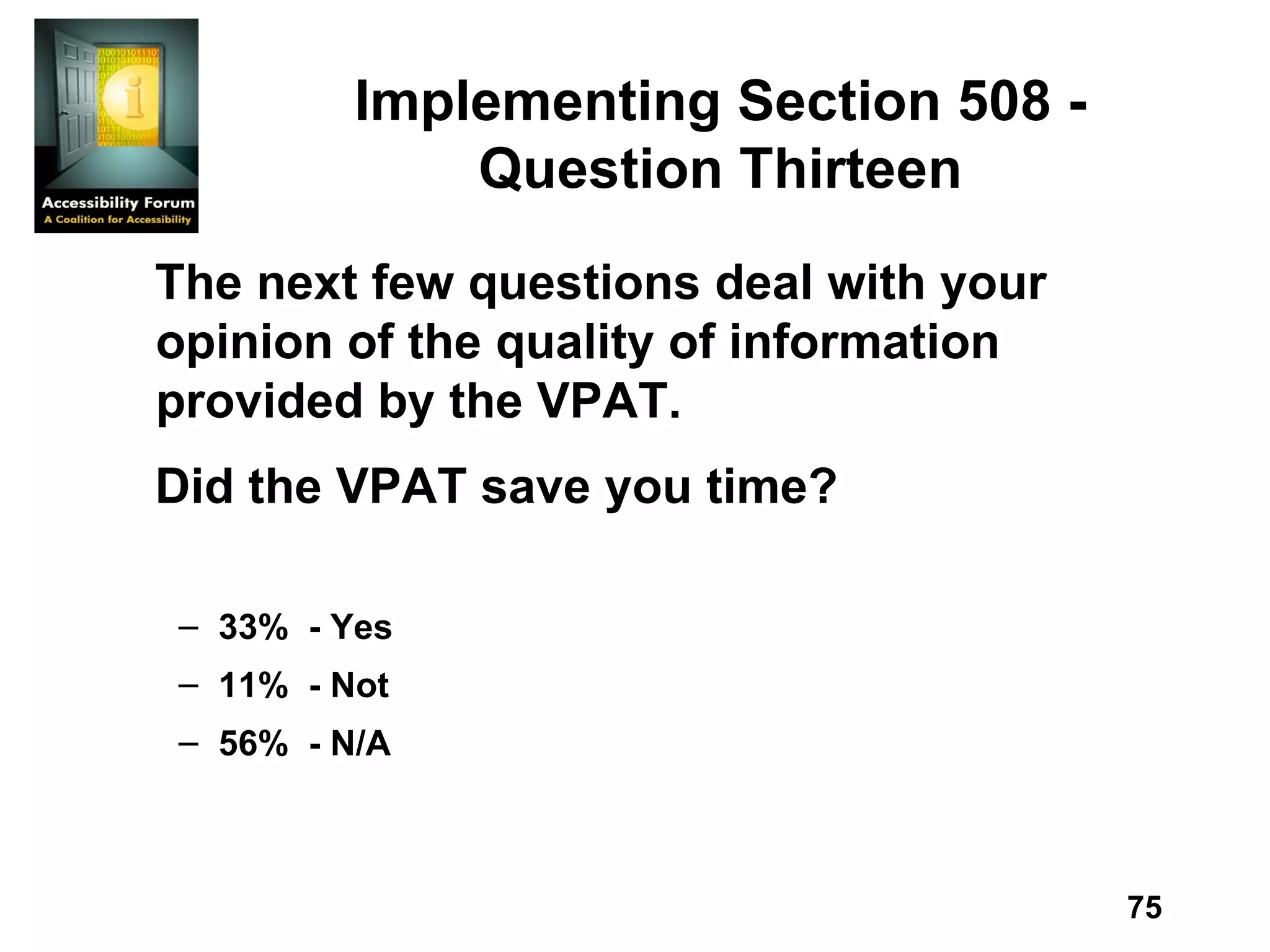
Implementing Section 508 - Question Thirteen The next few questions deal with your opinion of the quality of information provided by the VPAT. Did the VPAT save you time? 33%  - Yes 11%  - Not 56%  - N/A
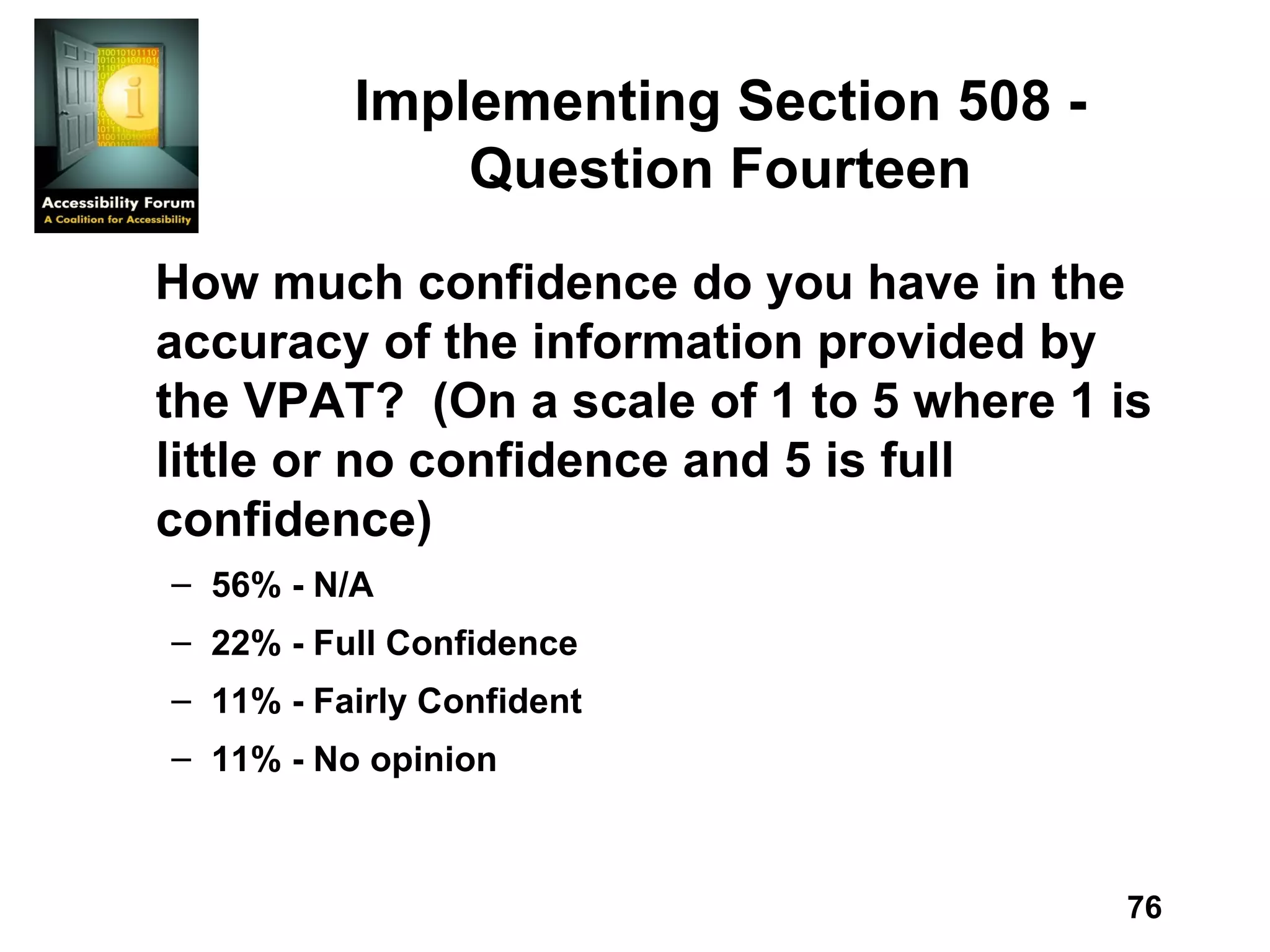
Implementing Section 508 - Question Fourteen How much confidence do you have in the accuracy of the information provided by the VPAT?  (On a scale of 1 to 5 where 1 is little or no confidence and 5 is full confidence) 56% - N/A 22% - Full Confidence 11% - Fairly Confident 11% - No opinion
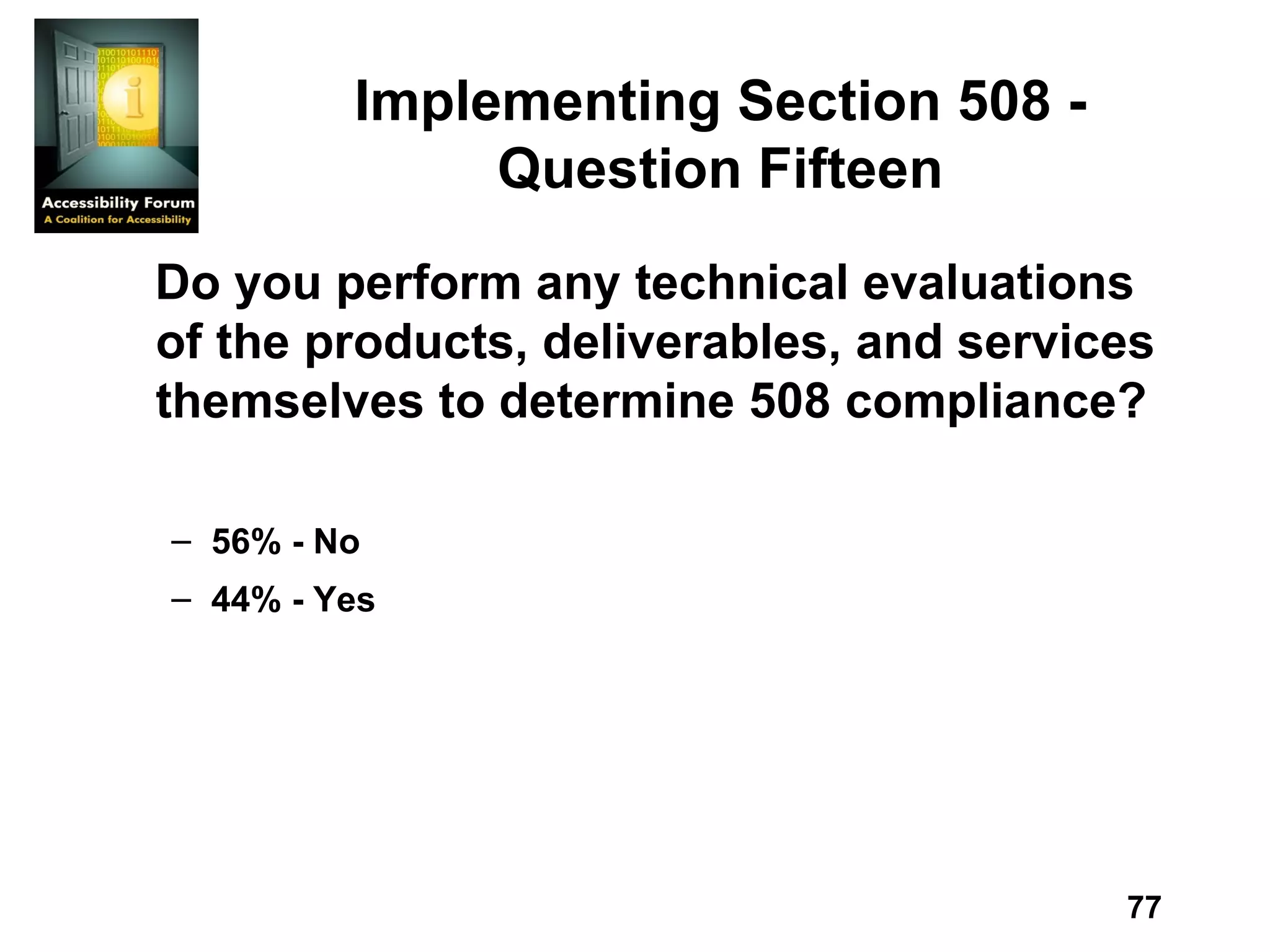
Implementing Section 508 - Question Fifteen Do you perform any technical evaluations of the products, deliverables, and services themselves to determine 508 compliance? 56% - No 44% - Yes
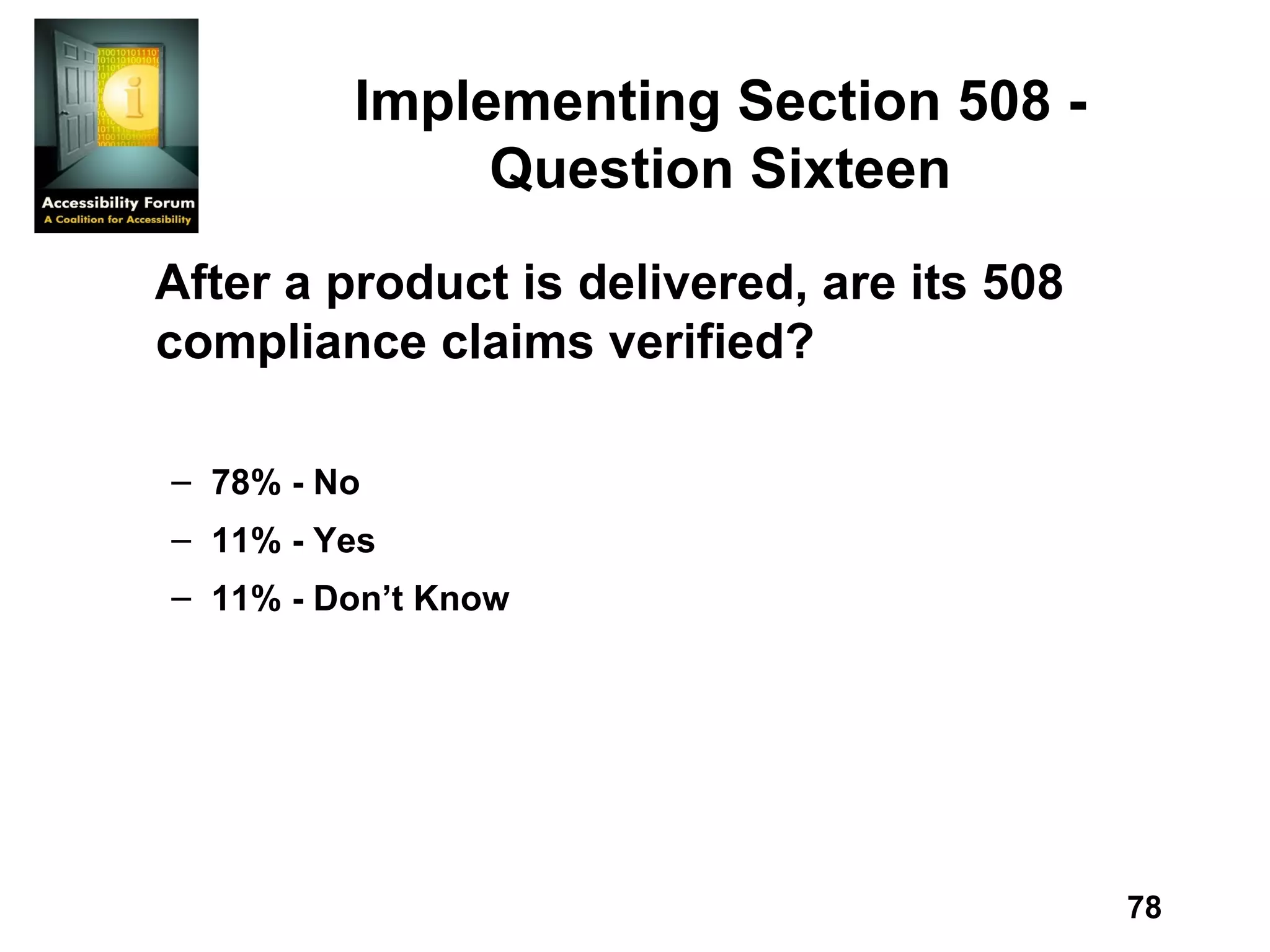
Implementing Section 508 - Question Sixteen After a product is delivered, are its 508 compliance claims verified? 78% - No 11% - Yes 11% - Don’t Know
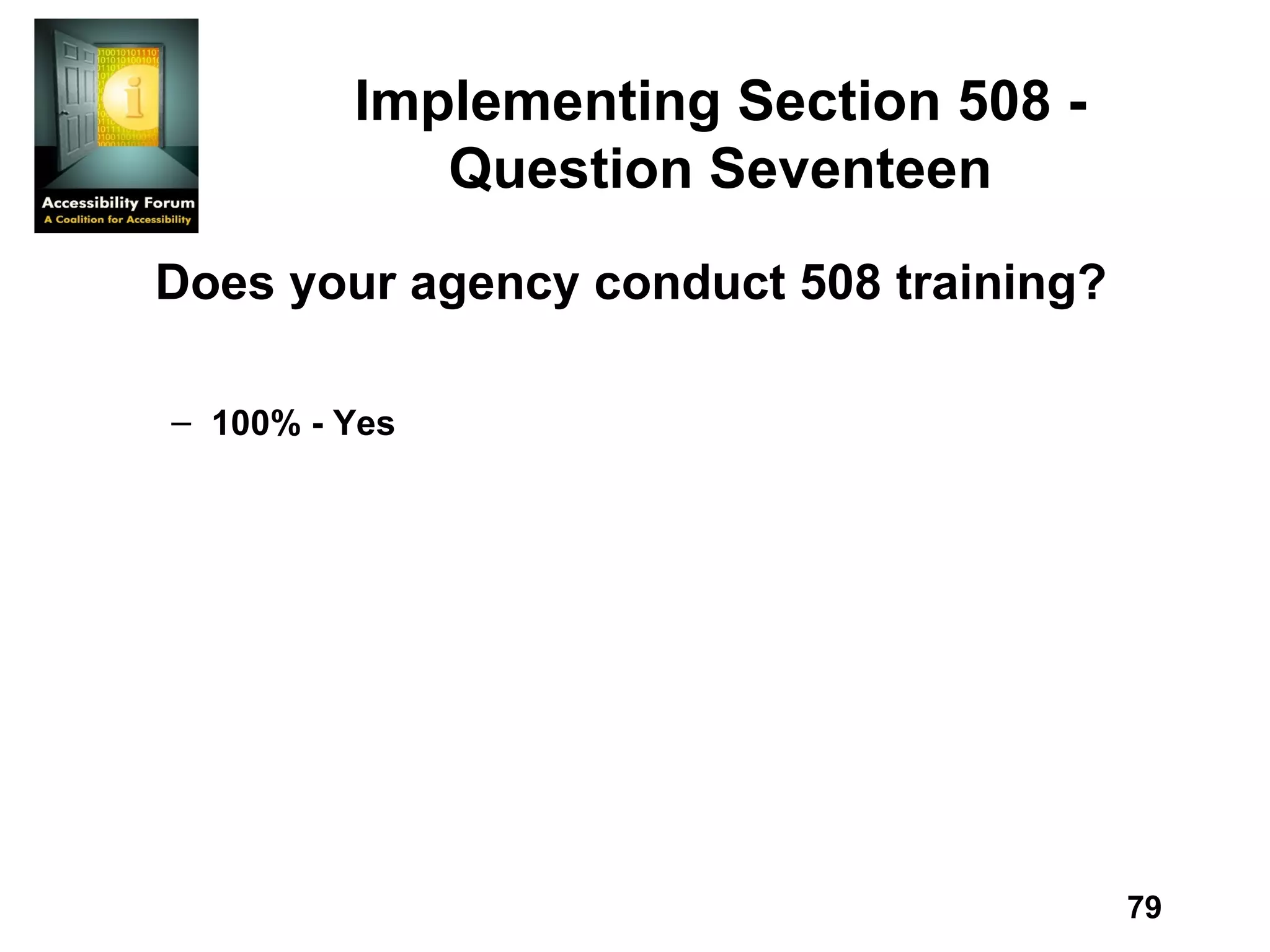
Implementing Section 508 - Question Seventeen Does your agency conduct 508 training? 100% - Yes
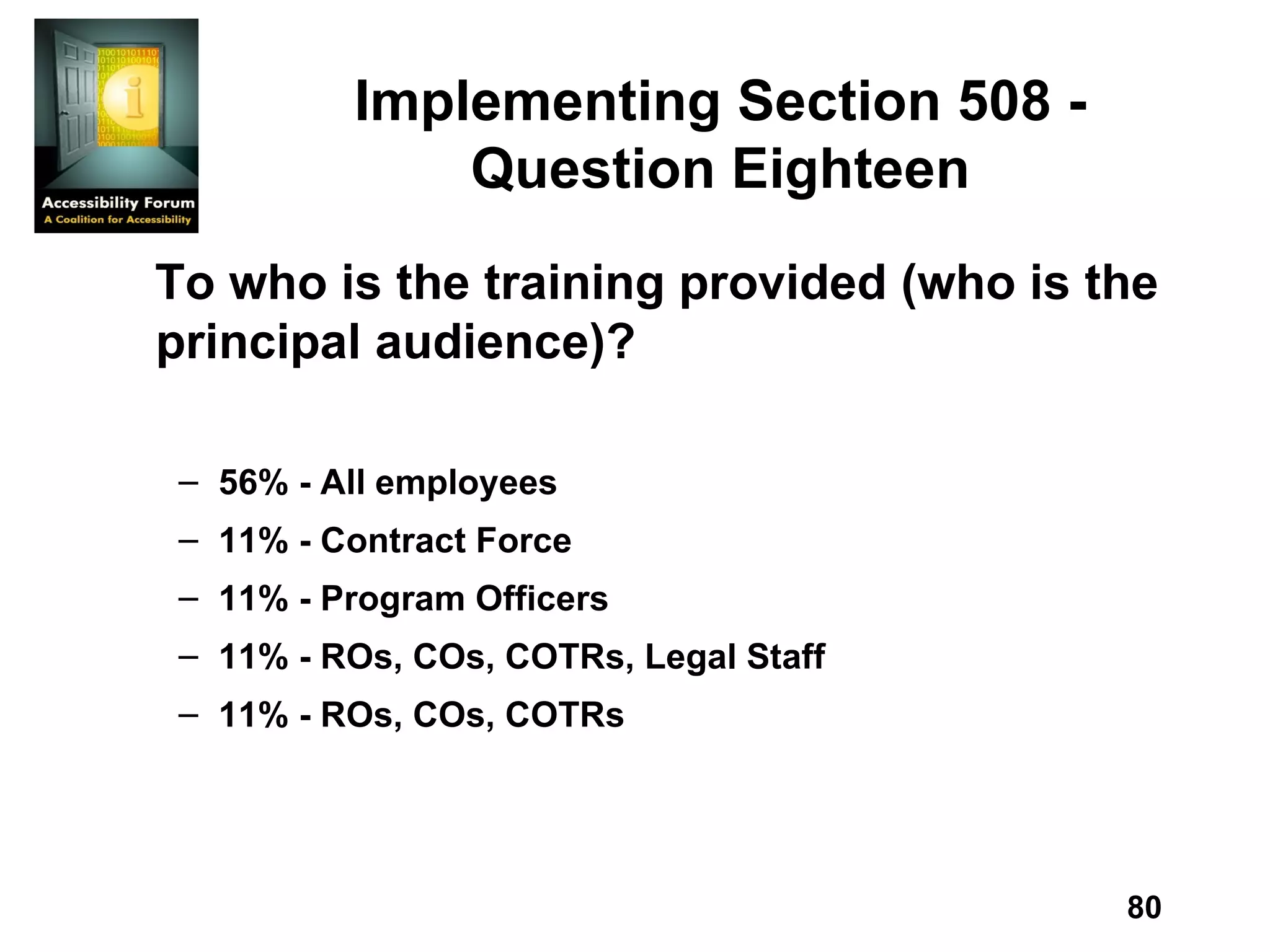
Implementing Section 508 - Question Eighteen To who is the training provided (who is the principal audience)? 56% - All employees 11% - Contract Force 11% - Program Officers 11% - ROs, COs, COTRs, Legal Staff 11% - ROs, COs, COTRs
Implementing Section 508 - Question Nineteen (1 of 2) Do you think there is any area where additional training is required? 44% - No 56% - Yes Comments: Yes, eventually we would like to spread out to the program offices. Yes, more should be done for general employees since anyone can be an RO at any time.  May explore doing this as part of the new employee orientation.
Implementing Section 508 - Question Nineteen (2 of 2) More Comments Make this training ongoing and part of a regular awareness programs. Many RO’s need training tailored to the products they are responsible to buy for the agency. The current training tends to handle the subject too broadly without enough hands-on examples.  Small and disadvantaged businesses as well as value added and reseller vendors don’t understand 508. Future surveys will help us determine this.
Implementing Section 508 - Question Twenty What could raise your level of confidence in what you’re buying meets 508 requirements? Another way to ask this question might be “What information or other resources are lacking or would be helpful to you in determining whether or not an offeror can meet the requirements of Section 508?” 44% - Some sort of logo, icon or other labeling program to confirm that the product is compliant would help.  Like the UL laboratories icon on electrical products.  If the products were certified as Section 508 compliant by an impartial 3rd party testing lab.
Implementing Section 508 - Question Twenty-one Do you have any examples of particularly good vendor responses regarding 508 requirements? (Could you provide us with a copy of anything that have been or can be sanitized and would represent good examples)? 33% - No 22% - Dell 11% - We have an database of customized VPAT’s, but they were proprietary to each purchase 11% - Oracle 11% - Acrobat and Dell have good VPATs 11% - Ricoh, Canon, and Sharp
Implementing Section 508 - Question Twenty-two Have you made any purchases where the award decision has hinged on 508 requirements? If yes, what kinds of products and services were purchased? 78% - No 22% - Don’t Know 11% - Yes We recently needed to buy thousands of printers and one vendor said that they could not provide printers that were compliant.  We approached another vendor who provided printers that are compliant.  We have had similar experiences with copying machines.
Implementing Section 508 - Question Twenty-three What is your biggest challenge in doing a 508 compliant purchase? (What would make your job easier in dealing with Section 508)? 22% - Lack of dedicated resources (money and staff) to do justice to the 508 requirements 22% - Simply having a bigger pool of 508 compliant products 22% - What would be really helpful would be a seal of approval from an agency or independent body as to how well a product or service met Section 508 requirements.  The example of the Green Star Energy logo used by EPA comes to mind.
Agencies Best Practices Pages (1 of 2) DOE: http://www.eren.doe.gov/websitestandards/508.html#B NOAA: http://www.nws.noaa.gov/sec508/ ARNET/FAR: http://www.arnet.gov/far/far_faqframe.html
Agencies Best Practices Pages (2 of 2) GSA - the definitive guide and “buy accessible” portal http://www.section508.gov Usability.gov The recent recipient of a Hammer award http://www.usability.gov
The Accessibility Forum: Interviews Interviews with Federal Agencies regarding the Procurement Challenges of Section 508: acquiring accessible Electronic and Information Technology Interviews conducted over August - September 2002 Interviews conducted by Forum staff and GSA Staff
Creative Technological Compliance With Section 508 Across Various Agencies   Dave Gardy
The Able TV Channel on the TVWorldwide.com Network Developed proprietary “Webcapting sm ” process in 2000 “ Aimcasts” to demographic attracts NCR, Microsoft and Sun Microsystems and  2000 Democratic Convention Largest Internet archive of streaming video on disability and captioned video streaming Pioneering solutions provider for Section 508 streaming media challenges
The Able TV Channel on the TVWorldwide.com Network Tapped years of streaming video and production expertise to perfect applications for captioning of archived video using MAGPIE in concert with proprietary compression techniques Deployed this technology in Internet TV programming targeted to the community of those with disabilities… yielding valuable feedback
The Able TV Channel on the TVWorldwide.com Network Took lessons learned from feedback on archived captioned video and researched solutions for captioning challenges in live webcasting applications such as latency and synchronization Developed “WEBCAPTING sm ” Live captioned video streaming by optimizing encoder of stenographer to work with webcast encoder with captioning resident to actual video stream
Able TV Adds Audio Description and Text Search for Complete Solution During video compression process, Able TV and TVWorldwide.com technicians add narrated description to audio track. This can also be done in live webcast production with narrator on site, “miked” into audio mixer.  Text search allows captioning to be searched for specific word and moves to that point in the video presentation, advancing the slide if present
Able TV adds TVWorldwide.com “Globalshow sm ” Format Interactive Video/Powerpoint In addition to captioning and audio description, viewer can now access power point slides of video presentation in separate HTML window as speaker gives presentation on video.  Participant can ask questions  via chat and e-mail Interactive testing and instant accreditation “ Globeshow” can be done  live or archived.
TVWorldwide.com and Accessibility TVWorldwide.com utilizes accessibility features to bring Section 508 solutions to government agency applications for Internet TV audience of those with disabilities and others in live and archived form. Here are some examples shown from a CD-ROM. GSA Accessibility Forum FDA Webcast on Electronic Submissions SBA Alpha Entrepreneur Program Dept. of Veteran’s Affairs “VA Reports”
Other TVWorldwide.com Projects for Government Agencies NIST Conference on IT Accessibility ITTATC Section 508 webcast series U.S. Chemical Safety Board National Oceanic and Atmospheric Administration IDEAS conference/ Department of Agriculture
“ New Business” Mary Beth Janes SMC Chair
New Business Next Forum meeting Status of SMC Nominating Committee
Closing remarks Thank you!
The Accessibility Forum thanks ED RENIKER  for his service, dedication, and commitment!

Accessibility Forum Webcast 2002

  • 1.
    Accessibility Forum Webcast October 29, 2002 Our thanks to the National Science Foundation for hosting this event
  • 2.
    Introduction to theOctober, 2002 Accessibility Forum Webcast Mary Mitchell Deputy Associate Administrator (Acting) Office of Electronic Government and Technology (GSA)
  • 3.
    Accessibility Forum WebcastAgenda Overview (1 of 4) 10:00 AM - Welcome and Introduction Mary Mitchell (GSA) 10:10 AM - Agenda Review Jack Corley (Forum Staff) 10:15 AM - Accessibility in the International Community Teleconference participants from Europe and Japan 11:00 AM - Forum Projects Review Bill Hetzner and Jim Kindrick (Forum Staff)
  • 4.
    Agenda Overview (2of 4) 11:45 AM - ATIA / ITI / Forum Interoperability Project Plan Chris Hofstader (Forum Council / Freedom Scientific) 12:00 PM - Forum Director’s Address Terry Weaver (GSA) 12:15 PM - Break for Lunch 1:15 PM - OMB Update Lesley Field (Office of Federal Procurement Policy)
  • 5.
    Agenda Overview (3of 4) 1:35 PM - Panel: Advocacy / Consumer Perspective on the Progress of 508 2:35 PM - Review of Government Agency Surveys and Interviews Terry Weaver (GSA) Joy Gatewood-Fulton (Forum Staff)
  • 6.
    Agenda Overview (4of 4) 3:05 PM - Creative Technological Compliance with Section 508 Across Various Agencies Dave Gardy, TV Worldwide 3:35 PM - “New Business” Mary Beth Janes (Council Chair, Apple) 3:45 PM - Closing remarks Skip Crane (Forum Staff) 4:00 PM - Reception
  • 7.
    Accessibility in theInternational Community
  • 8.
    Participants Hiroshi KawamuraDirector of the International and Information Departments Japanese Society for Rehabilitation of Persons with Disabilities Inmaculada Placencia Porrero Applications Relating to the Disabled and Elderly Information Society Directorate General European Commission Judy Brewer Director, Web Accessibility Initiative (WAI) World Wide Web Consortium (W3C) Moderator - Skip Crane (Forum Staff)
  • 9.
    Accessibility Forum ProjectsBill Hetzner Jim Kindrick
  • 10.
    Outline Background tothe current Project Resource Documents Plans for reviewing the current Project Resource Documents Next steps Overview of the Objective Measures Resource Documents Overview of the AT-E&IT Interoperability Resource Documents
  • 11.
    Background to theCurrent Resource Documents (1 of 2) Produced by Project Teams made up of Forum Members (started August, 2001) Two Teams: Objective Measures and AT-E&IT Interoperability Each has over 50 people signed up Work conducted: Biweekly Teleconferences Email Discussions and Message Board Working sessions at Forum Meetings
  • 12.
    Background to theCurrent Resource Documents (2 of 2) Conducted Project Workshops (September 23-25, 2002) Strategic Management Council provided schedule direction Participants attending provided input on form and content Focused Resource Documents on technical clarity and shared understanding The basis for deriving assistance materials or guidelines Voice of the Customer
  • 13.
    Plans for Reviewingthe Resource Document Documents released 10/22-10/23/02 for Forum Review URL sent via email to every Forum Member Review ends 11/8/02 Comments and issues can be submitted via email to Project Teams Project Teams will consider and incorporate input as appropriate Final Resource Documents to be released 12/02/02
  • 14.
    Next Steps Listeningto the Voice of the Customer Interviews with Federal requiring officials Inputs from the Office of Federal Procurement Policy Inputs from Section 508 Coordinators Getting direction from the Strategic Management Council
  • 15.
    Objective Measures ResourceDocuments: Purpose Analysis of the Standard Organized by Technical Sections of the Standard Scope of specific Technical Provisions Focus on clarification and common understanding Many iterations to develop ‘Analysis Template’
  • 16.
    Objective Measures ResourceDocuments: Organization Template for Analysis of the Standard Terms and Definitions Assumptions Outstanding Issues/Clarifications Measurement Preconditions Data Collection or Measurement Methods Related Resources Comments and Suggestions
  • 17.
    Objective Measures ResourceDocuments: Steps Taken Preliminary Analysis Produced as discussion starter for Team Based on available materials: ‘Naive’ Perspective Initial Analysis Incorporated inputs from Project Team dialogue Included research on related resources Review with Access Board Staff Clarification for outstanding issues Validation of definitions and assumptions
  • 18.
    Objective Measures ResourceDocuments: Content (1 of 2) 1194.21 Software and Operating Systems 12 Provisions: 10 Definitions, 19 Assumptions, 12 Clarifications 1194.22 Web-based intranet and internet information and applications 16 Provisions: 10 Definitions, 24 Assumptions, 3 Clarifications 1194.23 Telecommunication products 14 Provisions: 2 Definitions, 27 Assumptions, 11 Clarifications
  • 19.
    Objective Measures ResourceDocuments: Content (2 of 2) 1194.24 Video and multimedia products 5 Provisions: 13 Definitions, 8 Assumptions 1194.25 Self contained, closed products information and applications 13 Provisions: 5 Definitions, 25 Assumptions, 4 Clarifications 1194.26 Desktop and portable computers 4 Provisions: 1 Clarification
  • 20.
    AT-E&IT Interoperability ProjectsOverview General changes from September Workshops Dropped “Questions” sections from all documents. Redundant in concept, if not practice, with Objective Measures Questions may be part of subsequent tools Common outline (almost) Applicable Interoperability Provisions Interoperability as it applies to technical section How E&IT products work with AT Changing face of current products Suggestions for realizing interoperability in current products
  • 21.
    AT-E&IT Interoperability ProjectsDetail (1 of 4) 1194.21 Software and O/S Most mature, most vetted Includes GNOME Accessibility Framework, Java Accessibility, Linux Accessibility, Microsoft Active Accessibility, and W3C DOM More? Additional section on Evaluation Copies A catalyst for the ATIA/ITI/Forum activity
  • 22.
    AT-E&IT Interoperability ProjectsDetail (2 of 4) 1194.22 Web-based Information and Applications NEW Some input from the working group Concern that the technology is changing too fast to keep up No “changing face” section Needs broad review 1194.23 Telecommunication Products Fairly mature Input primarily from working group Needs broader review
  • 23.
    AT-E&IT Interoperability ProjectsDetail (3 of 4) 1194.24 Video and Multimedia Somewhat mature Input from small working group Needs broader review 1194.25 Self-contained, Closed Systems No interoperability requirements, by definition Functions associated with self-contained, closed systems are part of other technical sections.
  • 24.
    AT-E&IT Interoperability ProjectsDetail (4 of 4) 1194.26 Desktop and Personal Computers Only one provision addresses interoperability NEW Needs broad review
  • 25.
    Summary Reviewed thedevelopment of the Project Resource Documents Completed review of these documents with the Project Teams Posted documents for review and comment by all Forum members Preparing for next steps
  • 26.
    ATIA / ITI/ Forum Interoperability Working Group Mission and Goals Chris Hofstader
  • 27.
    Short Term Goals(1 of 2) Identify the areas where Assistive Technology applications and Electronic Information Technology applications need to provide a standard means of communication where by applications and assistive technology applications will be able to interoperate. Create a set of functional descriptions which describe this communication. Determine any changes needed to existing operating systems to accommodate the full set of communication needs.
  • 28.
    Short Term Goals (2 of 2) Work with the existing operating systems owners to affect any needed changes. Work with application developers to understand and use the accessibility communication vehicles in their applications, both EIT and AT. Forward any issues brought before the Working Group that fall outside the area of traditional software to the appropriate group working on those issues. e.g. Web issues will be referred to the W3C/WAI.
  • 29.
    Medium/Long Term GoalOnce the short term goals are reached medium or long term goals can be addressed. Possible Accessibility API that would be adopted by all platforms
  • 30.
    Process (1 of 2) Proposal will be reviewed and agreed to by ATIA and ITI (done). Working Group will be established and members confirmed (done). A public meeting will be held to obtain the initial set of issues, requirements (done). Monthly 2 hour teleconferences will be conducted. Expect most of the work will occur outside of the teleconferences via e-mail. Working Group meetings will convene via teleconferences.
  • 31.
    Process (2of 2) Face to face Working Group meetings will be conducted. Proposed for ATIA conference in Orlando in January. TBD in July 2003. Agreement will be by consensus. Quarterly public feedback will be sought. Final report will be posted for public review. Begin the process again for Medium and Long Term Goals.
  • 32.
    Work Plan Deliverables - Set of functional descriptions needed between AT/ EIT Software applications Set of needed changes to the present existing systems Desired schedule for implementing those changes Final Report To be determined based on public input of requirements and issues
  • 33.
    Obtain Issues, Concernsand Requirements (1 of 2) Determine which are applicable and which we can address. Those that are already being addressed by other organization will be sent to those organizations for resolution. e.g. V2, Linux Standards, W3C/WAI. Consulting support helps us to not make decisions in a vacuum, and not to address areas already covered by other efforts.
  • 34.
    Obtain Issues, Concernsand Requirements (2 of 2) Identify functional requirements needed by AT Identify functional requirements of EIT Evaluate the present operating systems for that support in MAC OS, Linux, Windows Determine any changes needed to each of those systems, if any. Describe desired schedule to implementation of those changes. Provide a final report that can be used by AT and EIT vendors to maximize interoperability.
  • 35.
    Future Events 1/18/03- Working Group meetings face to face proposed for ATIA conference in Orlando in January 7/15/03 - Working Group meetings face to face TBD if necessary 9/30/04 - Public posting of the final report 10/07/04 - Begin the process again for Medium and Long Term Goals
  • 36.
    Program Director’s AddressTerry Weaver Director for the Center for IT Accommodations, GSA
  • 37.
    GSA Perspective Forumhas been and continues to be a valuable experience as … An unparalleled community of stakeholders A resource of expertise A place to network and share ideas Work to date has been recognized. Future activities should lead to tools that … Facilitate the requiring and procurement process Simplify compliance assessment Allow for and encourage innovation and change
  • 38.
    Applicability Assistant ToolConnect the world of purchasing to the appropriate segments of 508 requirements. Define in marketplace terms the functional or feature descriptions for potential product characteristics. Connect functions and features of products (as appropriate), as expressed in the marketplace, to the appropriate parts of the standards.
  • 39.
    Procurement Assessment AssistantTool Mature the Applicability Assistant Tool to … Provide sample RFP language. Provide example practical and understandable technical evaluation criteria for each relevant part of the standard.
  • 40.
    By the NextForum Meeting Have … Applicability Assistant and Procurement Assessment Assistant Tools developed to the proof-of-concept stage. A defined maintenance process that enables the addition of new evaluation techniques. Plans for using tools for simplifying compliance assessment.
  • 41.
    Accessibility Forum Webcast October 29, 2002 Webcast will resume at 1:15 PM EST LUNCH BREAK
  • 42.
    OMB Update Lesley Field
  • 43.
    Panel: Advocacy /Consumer Perspective on the Progress of 508
  • 44.
    Participants Brenda Battat,Self Help for Hard of Hearing People (SHHH) Jim House, Telecommunications for the Deaf, Inc. Dave Poehlman, American Council of the Blind (ACB) Joy Relton, American Foundation for the Blind (AFB) Moderator - Skip Crane
  • 45.
    Comments from BrendaBattat – SHHH (1 of 3) Great need for more consumer education on 508. Complaint process may not work; employee hesitant to complain due to impact on career. More "technical" consumers should be involved where decisions are being made regarding evaluating products.
  • 46.
    Comments from BrendaBattat – SHHH (2 of 3) We should go back to the Access Board to learn the intention of the provisions and what they mean. Neither Federal agencies nor vendors want to take responsibility for signing off on products conforming to the 508 standard.
  • 47.
    Comments from BrendaBattat – SHHH (3 of 3) Still no clear and simple way to evaluate products for conformance to 508. Most 508 attention focused on accessible websites and screen readers, but there is more to 508.
  • 48.
    Comments from JimHouse – TDI (1 of 4) TDI promotes equal access to telecommunications and media for people who are deaf, hard of hearing, late-deafened or deaf-blind. On the Internet, we have applications for both telecommunications AND media.
  • 49.
    Comments from JimHouse – TDI (2 of 4) Video Relay Video Interpreting Video Conferencing Telecommunications: Barriers: VoIP Technology IM closely resembles TTY but it is not completely real-time No way to receive incoming calls unless you are online E-Mail and pagers Instant Messaging (IM) Chat Rooms IP-Relay
  • 50.
    Comments from JimHouse –TDI (3 of 4) Media: Wealth of information in text and graphics Ease of publishing your own information Barriers: Current broadband policy and economics limits use of full-motion video Virtual lack of captioning on commercial website streaming video (News media, entertainment clips, etc.) Audio files lack transcripts or captions
  • 51.
    Comments from JimHouse – TDI (4 of 4) Government issues: Regulations do not keep pace with technology Courts divided on access rules in private sector Many agencies are complying with 508, but others are trying to avoid compliance TDI has learned some agencies are polling audience requirements to see if they can avoid captioning.
  • 52.
    Comments from DavidPoehlman – ACB (1 of 4) Areas of progress since the advent of Section 508 standards … Sectors that have shown positive results and advances Websites are better Good tools which use verifiable means to test for section 508 compliance are helpful Lots of talk and generated interest Web development people seem to be much more interested at least at the government level
  • 53.
    Comments from DavidPoehlman – ACB (2 of 4) Shortcomings … needs for continuing improvement Accessible content needs to be provided in electronic form Many people (including those who should) still do not know the meaning of section 508 and the standards We need more of the human in the equation and less of the legal Inaccessible software remains a big problem for federal employees Human resources and financial packages keep promising to become accessible in the next release but never get there
  • 54.
    Comments from DavidPoehlman – ACB (3 of 4) Shortcomings … needs for continuing improvement Real lack of enforcement of accessibility Bidders with products that do not fulfill the promise must start being turned down Makers of accessible hardware and software must start getting the nod Documentation must be more accessible
  • 55.
    Comments from DavidPoehlman – ACB (4 of 4) Activities being pursued that we hope will prove fruitful Entering an FCC formal complaint on cell phone access Federal Government should enforce section 255 access requirements for telephone equipment as a 508 matter. Involved in the Accessibility Forum and other initiatives. Building an informal network of people involved with 508 Compare notes and make strategic decisions. Educating our members to their rights and that should produce more expectations and demand. Expressing concerns about specific sites to web masters and agencies. Draw more attention to compliance.
  • 56.
    Comments from JoyRelton – AFB
  • 57.
    Review of GovernmentAgency Surveys and Interviews Terry Weaver Joy Gatewood-Fulton
  • 58.
    The Accessibility Forum:Interviews Interviews with Federal Agencies regarding the Procurement Challenges of Section 508: acquiring accessible Electronic and Information Technology.
  • 59.
    Section 508 -Interviews with Government Procurement (1 of 2) Nine agencies interviewed: from Depts. of HHS, Commerce, Treasury, and Defense. Purpose: to gather best practices in procuring accessible E&IT and to determine if agencies need further guidance in implementing Section 508.
  • 60.
    Section 508 -Interviews with Government Procurement (2 of 2) Interviews were Confidential, with data presented in an aggregate form only. Range Section 508 applicability to a purchase VPAT’s What 508 information do they require from vendors Comments Other
  • 61.
    Implementing Section 508- Question One How do you determine whether or not Section 508 applies to a particular procurement? 44% Section 508 applies to all E&IT procurements 56% We have tools and policies to advise of appropriate determinations and when it is not applicable
  • 62.
    Implementing Section 508- Question Two How do you document the results of your determination (whether or not Section 508 was applicable)? 22% - No formal documentation process 33% - An in-house tool leads users to the appropriate form or checklist that is used to document the determination and decision, including any exemption 56% - Other Other includes: Reports, Templates, Procurement Requests, VPAT’s ,or other vendor supplied information
  • 63.
    Implementing Section 508- Question Three How do you determine which parts of the 508 standard apply to a purchase? 44% - The requiring official determines which applies 56% - Other: Guidance from the organization's Section 508 committee Often it's a matter of interpretation and is ultimately the Contracting Officer's call The standard is applied equally across the board The in-house tool guides the user. Weighted standards are even possible (one provision can be more heavily weighted than another can) We rely on the vendor to provide us that information
  • 64.
    Implementing Section 508- Question Four What process or procedure do you follow to determine whether or not vendor products, deliverables, and services meet the requirements of Section 508? 33% - Vendors are required to self certify that products meet Section 508 22% - Market research which may include VPAT's 44% - A combination of both
  • 65.
    Implementing Section 508- Question Five What Information do you require of Offerors / Vendors? 33% - Self-Certification Language 33% - VPAT/template 22% - Vendor must complete our template 11% - Vendor must offer information about how their products meet Section 508 standards somewhere on their website, in brochures or handouts, in a standard template or VPAT format
  • 66.
    Implementing Section 508- Question Six How often do you use the Voluntary Product Accessibility Template (VPAT) in your assessment of a vendor’s products, deliverables, and services? 44% - Never 22% - Always 33% - Sometimes, when available
  • 67.
    Implementing Section 508- Question Six-A Is the VPAT the primary source of information? 44% - N/A - never use 44% - Yes 11% - No
  • 68.
    Implementing Section 508- Question Seven What other sources of information do you use? 44% - Market research 33% - N/A 11% - We also may test the product 11% - Our own template
  • 69.
    Implementing Section 508- Question Eight If the VPAT is used, we would like to follow up with some questions on how well it is working for you. What do you like about it? 44% - N/A 33% - Everything - easy to read and all the information is on one page 22% - Nothing
  • 70.
    Implementing Section 508- Question Nine (1 of 2) What do you dislike about it? (VPAT) 44% - N/A 22% - Nothing 56% - Other
  • 71.
    Implementing Section 508- Question Nine (2 of 2) Comments included: Too complex Ambiguous Vendor simply states "meets" to every criteria - we ask the vendor to customize a VPAT that states how their product or service meets the criteria Language is too technical for most requiring officials People get confused and don't know what parts apply Vendors often complete the VPAT’s incorrectly
  • 72.
    Implementing Section 508- Question Ten The next few questions deal with your opinion of the quality of information provided by the VPAT. Have you had to go back to the vendor with questions about the information provided? 33% - Yes 22% - No 44% - N/A
  • 73.
    Implementing Section 508- Question Eleven How many times? (Did you have to go back to the vendor regarding the VPAT) 11% - Don’t Know 22% - Many 67% - N/A
  • 74.
    Implementing Section 508- Question Twelve The next few questions deal with your opinion of the quality of information provided by the VPAT. How difficult was the VPAT to use? (On a scale 1 to 5 where 1 is not difficult at all and 5 is extremely difficult) 33% - Not Difficult 11% - Difficult 56% - N/A
  • 75.
    Implementing Section 508- Question Thirteen The next few questions deal with your opinion of the quality of information provided by the VPAT. Did the VPAT save you time? 33% - Yes 11% - Not 56% - N/A
  • 76.
    Implementing Section 508- Question Fourteen How much confidence do you have in the accuracy of the information provided by the VPAT? (On a scale of 1 to 5 where 1 is little or no confidence and 5 is full confidence) 56% - N/A 22% - Full Confidence 11% - Fairly Confident 11% - No opinion
  • 77.
    Implementing Section 508- Question Fifteen Do you perform any technical evaluations of the products, deliverables, and services themselves to determine 508 compliance? 56% - No 44% - Yes
  • 78.
    Implementing Section 508- Question Sixteen After a product is delivered, are its 508 compliance claims verified? 78% - No 11% - Yes 11% - Don’t Know
  • 79.
    Implementing Section 508- Question Seventeen Does your agency conduct 508 training? 100% - Yes
  • 80.
    Implementing Section 508- Question Eighteen To who is the training provided (who is the principal audience)? 56% - All employees 11% - Contract Force 11% - Program Officers 11% - ROs, COs, COTRs, Legal Staff 11% - ROs, COs, COTRs
  • 81.
    Implementing Section 508- Question Nineteen (1 of 2) Do you think there is any area where additional training is required? 44% - No 56% - Yes Comments: Yes, eventually we would like to spread out to the program offices. Yes, more should be done for general employees since anyone can be an RO at any time. May explore doing this as part of the new employee orientation.
  • 82.
    Implementing Section 508- Question Nineteen (2 of 2) More Comments Make this training ongoing and part of a regular awareness programs. Many RO’s need training tailored to the products they are responsible to buy for the agency. The current training tends to handle the subject too broadly without enough hands-on examples. Small and disadvantaged businesses as well as value added and reseller vendors don’t understand 508. Future surveys will help us determine this.
  • 83.
    Implementing Section 508- Question Twenty What could raise your level of confidence in what you’re buying meets 508 requirements? Another way to ask this question might be “What information or other resources are lacking or would be helpful to you in determining whether or not an offeror can meet the requirements of Section 508?” 44% - Some sort of logo, icon or other labeling program to confirm that the product is compliant would help. Like the UL laboratories icon on electrical products. If the products were certified as Section 508 compliant by an impartial 3rd party testing lab.
  • 84.
    Implementing Section 508- Question Twenty-one Do you have any examples of particularly good vendor responses regarding 508 requirements? (Could you provide us with a copy of anything that have been or can be sanitized and would represent good examples)? 33% - No 22% - Dell 11% - We have an database of customized VPAT’s, but they were proprietary to each purchase 11% - Oracle 11% - Acrobat and Dell have good VPATs 11% - Ricoh, Canon, and Sharp
  • 85.
    Implementing Section 508- Question Twenty-two Have you made any purchases where the award decision has hinged on 508 requirements? If yes, what kinds of products and services were purchased? 78% - No 22% - Don’t Know 11% - Yes We recently needed to buy thousands of printers and one vendor said that they could not provide printers that were compliant. We approached another vendor who provided printers that are compliant. We have had similar experiences with copying machines.
  • 86.
    Implementing Section 508- Question Twenty-three What is your biggest challenge in doing a 508 compliant purchase? (What would make your job easier in dealing with Section 508)? 22% - Lack of dedicated resources (money and staff) to do justice to the 508 requirements 22% - Simply having a bigger pool of 508 compliant products 22% - What would be really helpful would be a seal of approval from an agency or independent body as to how well a product or service met Section 508 requirements. The example of the Green Star Energy logo used by EPA comes to mind.
  • 87.
    Agencies Best PracticesPages (1 of 2) DOE: http://www.eren.doe.gov/websitestandards/508.html#B NOAA: http://www.nws.noaa.gov/sec508/ ARNET/FAR: http://www.arnet.gov/far/far_faqframe.html
  • 88.
    Agencies Best PracticesPages (2 of 2) GSA - the definitive guide and “buy accessible” portal http://www.section508.gov Usability.gov The recent recipient of a Hammer award http://www.usability.gov
  • 89.
    The Accessibility Forum:Interviews Interviews with Federal Agencies regarding the Procurement Challenges of Section 508: acquiring accessible Electronic and Information Technology Interviews conducted over August - September 2002 Interviews conducted by Forum staff and GSA Staff
  • 90.
    Creative Technological ComplianceWith Section 508 Across Various Agencies Dave Gardy
  • 91.
    The Able TVChannel on the TVWorldwide.com Network Developed proprietary “Webcapting sm ” process in 2000 “ Aimcasts” to demographic attracts NCR, Microsoft and Sun Microsystems and 2000 Democratic Convention Largest Internet archive of streaming video on disability and captioned video streaming Pioneering solutions provider for Section 508 streaming media challenges
  • 92.
    The Able TVChannel on the TVWorldwide.com Network Tapped years of streaming video and production expertise to perfect applications for captioning of archived video using MAGPIE in concert with proprietary compression techniques Deployed this technology in Internet TV programming targeted to the community of those with disabilities… yielding valuable feedback
  • 93.
    The Able TVChannel on the TVWorldwide.com Network Took lessons learned from feedback on archived captioned video and researched solutions for captioning challenges in live webcasting applications such as latency and synchronization Developed “WEBCAPTING sm ” Live captioned video streaming by optimizing encoder of stenographer to work with webcast encoder with captioning resident to actual video stream
  • 94.
    Able TV AddsAudio Description and Text Search for Complete Solution During video compression process, Able TV and TVWorldwide.com technicians add narrated description to audio track. This can also be done in live webcast production with narrator on site, “miked” into audio mixer. Text search allows captioning to be searched for specific word and moves to that point in the video presentation, advancing the slide if present
  • 95.
    Able TV addsTVWorldwide.com “Globalshow sm ” Format Interactive Video/Powerpoint In addition to captioning and audio description, viewer can now access power point slides of video presentation in separate HTML window as speaker gives presentation on video. Participant can ask questions via chat and e-mail Interactive testing and instant accreditation “ Globeshow” can be done live or archived.
  • 96.
    TVWorldwide.com and AccessibilityTVWorldwide.com utilizes accessibility features to bring Section 508 solutions to government agency applications for Internet TV audience of those with disabilities and others in live and archived form. Here are some examples shown from a CD-ROM. GSA Accessibility Forum FDA Webcast on Electronic Submissions SBA Alpha Entrepreneur Program Dept. of Veteran’s Affairs “VA Reports”
  • 97.
    Other TVWorldwide.com Projectsfor Government Agencies NIST Conference on IT Accessibility ITTATC Section 508 webcast series U.S. Chemical Safety Board National Oceanic and Atmospheric Administration IDEAS conference/ Department of Agriculture
  • 98.
    “ New Business”Mary Beth Janes SMC Chair
  • 99.
    New Business NextForum meeting Status of SMC Nominating Committee
  • 100.
  • 101.
    The Accessibility Forumthanks ED RENIKER for his service, dedication, and commitment!

Editor's Notes

  • #2 This slide posted during Mary Mitchell’s remarks
  • #9 Thanks to Judy for putting these people together.
  • #37 The stated mission of The Forum is to identify, prioritize, and conduct projects that assist government in making informed decisions about Section 508 related procurement, and allow government, industry, and users to communicate and highlight areas where further effort is needed. As the sponsor we would like to challenge the Forum leadership to have the Forum take steps to recommend and define some specific tools that would facilitate the procurement process for government agencies and vendors alike. For example, the Section 508 coordinators have told us they would be very interested in having … Applicability Assistant Tool Procurement Assessment Tool for requiring and procuring officials We think these kinds of tools will be significant to both purchasers and providers.
  • #38 Work to date has been recognized --- refer to reviews with Access Board and section 508 working group
  • #40 You may want to say that this would provide sample language for inclusion in RFPs as well as example approaches for evaluating and verifying responses Hetzner: automated is another potentially explosive word. Mature the Applicability Tool into a Procurement Assessment Assistant might be better.
  • #41 So what is the challenge …. (slide) I realize the Council has had no insight yet to these ideas and it is appropriate that they do. So I have asked Mary Beth Janes as Council Chair to convene a Council meeting as soon as possible to review these ideas. (Q&A as you wish) Consideration: can you or do you wish to describe how you see the Forum as an active agent in this work beyond 3/31/2003? During Q&A you are quite likely to get a question about the future of the Forum; this might provide a good basis for any comments you can make in that respect.
  • #42 This slide posted during Mary Mitchell’s remarks
  • #102 This slide posted during Mary Mitchell’s remarks