Acceptance, Accessible,
Actionable and Auditable
A model for the digital transformation and excellence in analytics
Alban Gérôme
@albangerome
Data Festival London
15 June 2018
"Le doute, morne oiseau, nous
frappe de son aile...
Et l'horizon s'enfuit d'une fuite
éternelle !..."
"Doubt, dismal bird, beat us
down with its wing...
- And the horizon rushes away in
endless flight!..."
Arthur Rimbaud, Sun and Flesh
(Credo in Unam)@albangerome
Endemic misestimating
• “More than half of senior executives experienced a backlog of at least
two years on critical new analytics applications.”
• 4 in 5 of Fortune 1000 companies claim that their big data
investments are successful
• 1 in 4 claim they have started seeing signs of a data driven culture
@albangerome
Cheap data storage
• “You cannot improve what you cannot manage” has lead to an ever
increasing appetite for data, driving the cost of data storage down
• Intelligence agencies notorious for collecting data with little
discrimination
• Historical data is good, useless historical data costs little so let’s
collect data without discrimination
@albangerome
Losing support
• Projects need key supporters from the start to protect resources
allocation from demands from other competing projects
• Complex, multi-disciplinary projects get split into smaller parts and
the projects moves only as fast the lowest prioritised part
• A new project comes along with better prospects of success and
steals a key supporter and then three, ten
@albangerome
IT cannot implement analytics
• Analytics tagging is mostly Javascript, IT has Javascript developers but
IT is not competent to deliver an analytics implementation. You will
need one or several implementation consultants
• The vendor is only too happy to sell you premium consultancy
services. Independent consultants are cheaper but this still causes
delays and budget overruns
• The implementation is never “done”, it evolves because customers
expectations and technology evolve
@albangerome
Multiple versions of the truth
• 2 managers find discrepancies in analytics data and end up blaming
the tool
• Senior management recognises that the organisation needs a single
version of the truth, i.e. a dedicated analytics team
• Building a team from only internal or only external has advantages
and disadvantages
@albangerome
First reporting outage
• IT developers pushed code changes live and broke analytics reporting
in spite of following a rigorous testing procedure
• Broken analytics tends not to produce errors, it pushes garbage data
in the reports or even no data instead
• IT believes that breaking analytics is no big deal but the analytics
team should be the guardian of the data quality
@albangerome
Rebuilding trust
• The analytics department is expected to monitor a large and
increasing number of metrics
• The stakeholders beginning to ask for a lot of analytics data, a sign of
regained trust
• The stakeholders are no longer asking for actionable insight. The
analytics team should welcome this with a sigh of relief, this is a bad
sign
@albangerome
First data analyst leaves
• The analytics team is treated like a cost-centre. This means a small
team without prospects of promotions or opportunities to develop
team leadership skills
• Each day will consist of monitoring hundreds of metrics, producing
daily, weekly, monthly reports and huge data extracts that the
stakeholders barely exploit
• Head of analysts without analytics experience only counting the days
until their next rotation, never read of a book on analytics, complete
unknown in the analytics community
@albangerome
Data cherry-picking
• Pick only the data that confirms prior beliefs, discard the rest on
grounds of potential implementation issues
• Blaming how the data was captured is much easier than questioning
one’s beliefs when the data contradicts them
• Data cherry-picking makes them look data-driven but they are really
data-justified, biased and they get away with it because the CXOs are
either naïve or complacent and too few of them lead this by example
@albangerome
Unwanted conservatorship
• Spending ones resources for the benefits of another team at the
expense of one’s own ideas and projects can only meet resistance
• The incumbent teams want to retain autonomy of decision-making,
claim credit and use the analytics purely as a support team
• Implementing the analytics’ team ideas undermines their relevance
and if given free rein, could usher something resembling holacracy
@albangerome
Apple juice anyone?
• If making apple juice is harder than expected, perhaps something is
blocking at the bottom of the press
• Collecting ever more data and fancy data visualisations may not be
the solution
• People make decisions based on emotions and then justify them with
data but we are supposed to have a data-driven decision process
@albangerome
Inspiration in strange places
To create a fire, you will need three elements
• Oxygen
• Fuel
• Heat
You will not achieve self-combustion until you reach a certain heat
threshold. Remove one of these three items and a fire will stop
@albangerome
Accessible
• John Gall wrote “Some complex systems actually work but building a
complex one from scratch never works. You have to start over,
beginning with a working simple system.”
@albangerome
Accessible
• John Gall wrote “Some complex data capture implementations
actually work but building a complex one from scratch never works.
You have to start over, beginning with a working simple
implementation.”
• With too much data captured, one faces an increased noise to signal
ratio. Beware analysis paralysis
• Gradually increase the number of data points you collect data for and
only give access to that data to people who need that data. This
allows people to become more data literate at their pace
@albangerome
Actionable
• The CXOs must lead the digital transformation by example and stop
tolerating data-justified recommendations. They will strive to become
a data-informed organisation rather than just a data-driven one
• You need an analytics centre of excellence with a steer from the other
teams. The analytics experts will focus on complex finding actionable
insight and rotate between teams to gain operational experience
• The incumbent teams will need “moles” or “canaries”, i.e. junior data
analysts doing the reporting and metrics monitoring. Data quality is
every teams’ concern
@albangerome
Auditable
• Although a lack trust can be a very handy excuse for not
implementing recommendations, trust in analytics data is key
• Implement alerts, introduce tests in the developers test suites to
check the integrity of the analytics tracking, ask your “moles” and
“canaries” to report any issues they spot
• All recommendations must document why you are tracking these
data points, the data sources, the date ranges, how the data was
cleaned and processed to ensure reproducibility
@albangerome
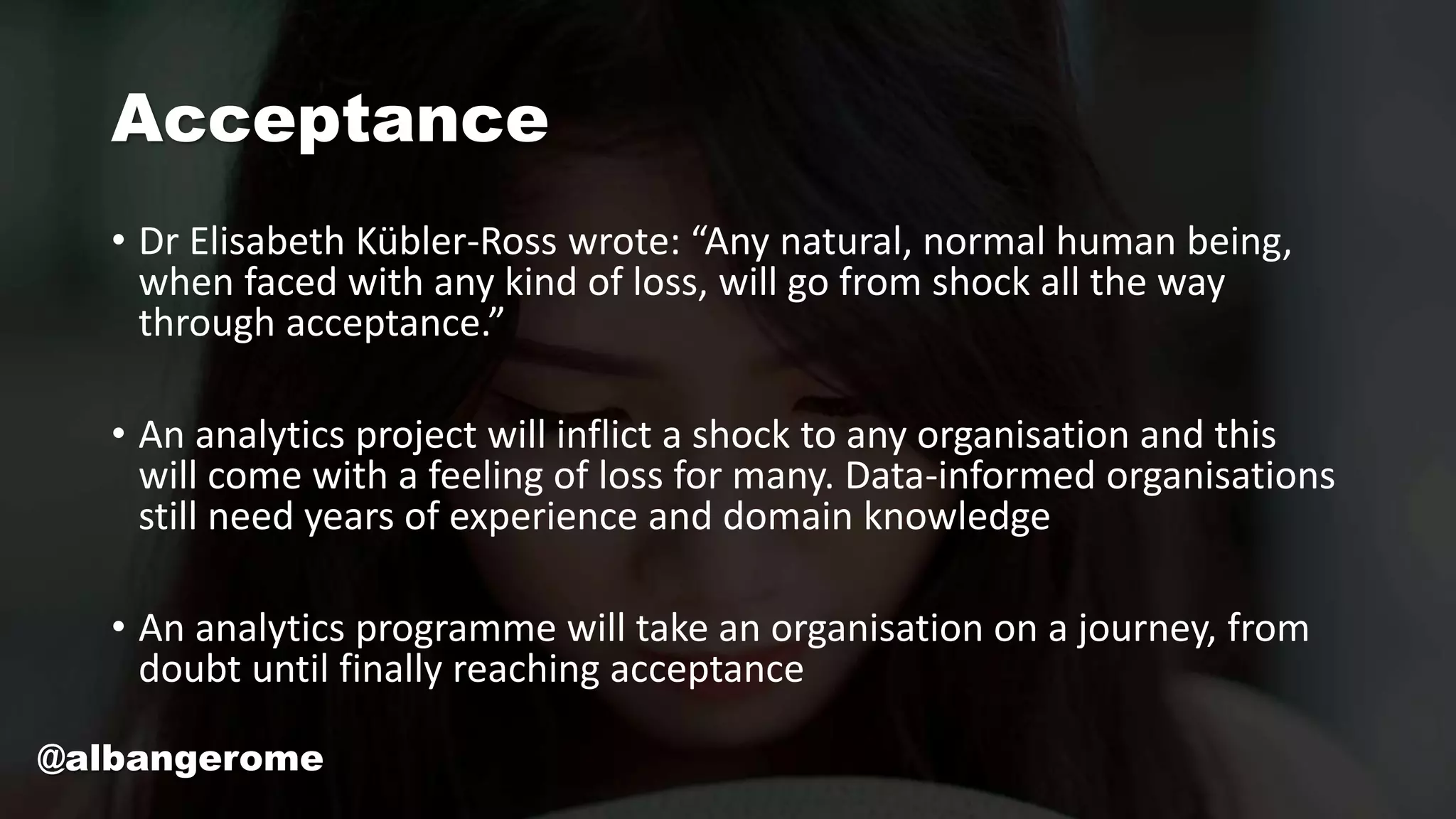
Acceptance
• Dr Elisabeth Kübler-Ross wrote: “Any natural, normal human being,
when faced with any kind of loss, will go from shock all the way
through acceptance.”
• An analytics project will inflict a shock to any organisation and this
will come with a feeling of loss for many. Data-informed organisations
still need years of experience and domain knowledge
• An analytics programme will take an organisation on a journey, from
doubt until finally reaching acceptance
@albangerome
You need all four
• The digital transformation must be accessible, actionable, auditable
and achieve acceptance
• Having all four will not usher the digital transformation until there is
widespread acceptance all the way to the C-suite
• If you lose one of the four A’s, you can wave your digital
transformation goodbye
@albangerome
“The most beautiful people we
have known are those who have
known defeat, known suffering,
known struggle, known loss, and
have found their way out of the
depths. These persons have an
appreciation, a sensitivity, and an
understanding of life that fills them
with compassion, gentleness, and a
deep loving concern. Beautiful
people do not just happen.”
Dr Elisabeth Kübler-Ross
@albangerome
The data-informed
stakeholder does
not just happen
@albangerome
Thank you!
http://www.albangerome.com
@albangerome
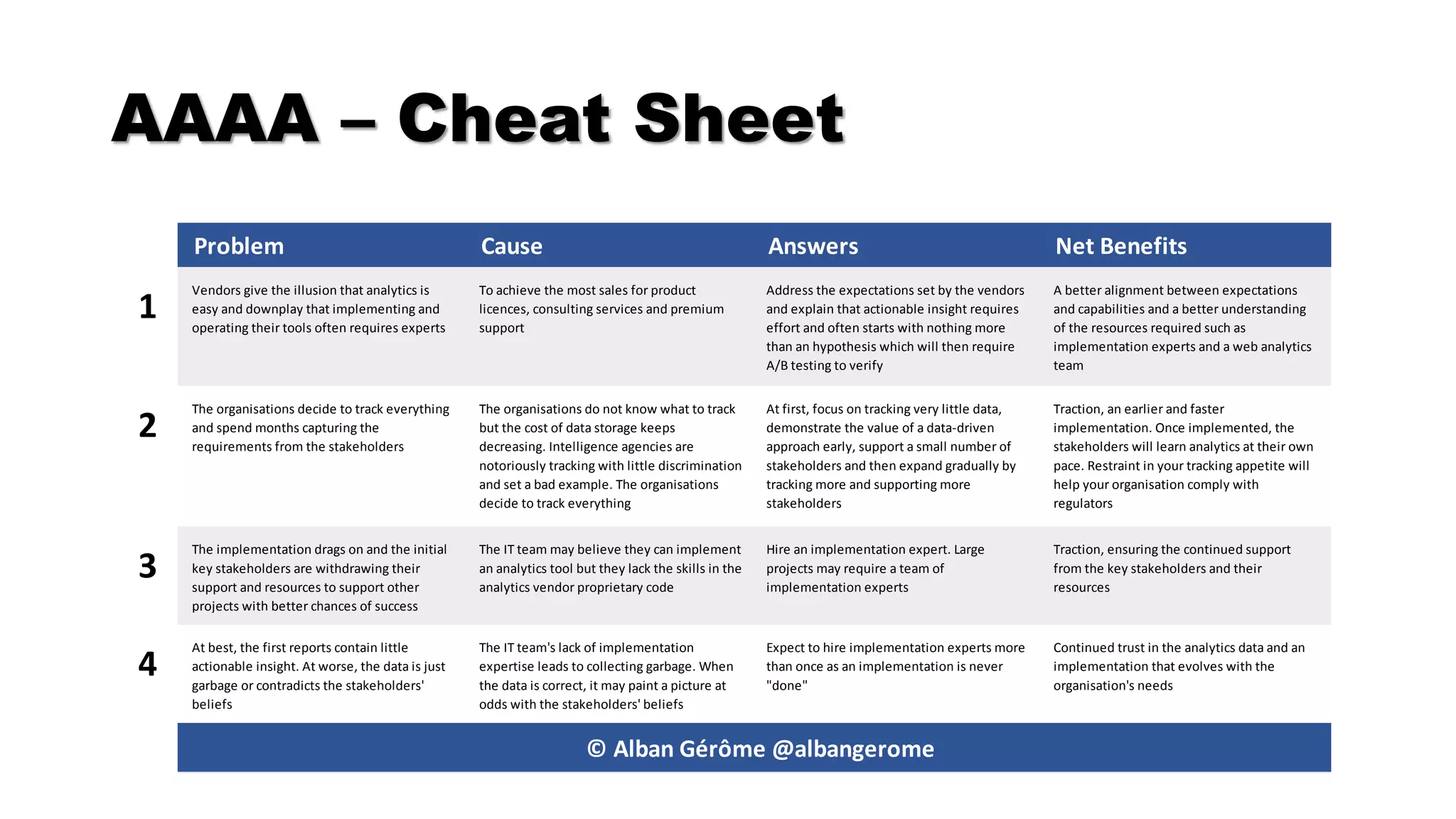
AAAA – Cheat Sheet
Problem Cause Answers Net Benefits
1
Vendors give the illusion that analytics is
easy and downplay that implementing and
operating their tools often requires experts
To achieve the most sales for product
licences, consulting services and premium
support
Address the expectations set by the vendors
and explain that actionable insight requires
effort and often starts with nothing more
than an hypothesis which will then require
A/B testing to verify
A better alignment between expectations
and capabilities and a better understanding
of the resources required such as
implementation experts and a web analytics
team
2
The organisations decide to track everything
and spend months capturing the
requirements from the stakeholders
The organisations do not know what to track
but the cost of data storage keeps
decreasing. Intelligence agencies are
notoriously tracking with little discrimination
and set a bad example. The organisations
decide to track everything
At first, focus on tracking very little data,
demonstrate the value of a data-driven
approach early, support a small number of
stakeholders and then expand gradually by
tracking more and supporting more
stakeholders
Traction, an earlier and faster
implementation. Once implemented, the
stakeholders will learn analytics at their own
pace. Restraint in your tracking appetite will
help your organisation comply with
regulators
3
The implementation drags on and the initial
key stakeholders are withdrawing their
support and resources to support other
projects with better chances of success
The IT team may believe they can implement
an analytics tool but they lack the skills in the
analytics vendor proprietary code
Hire an implementation expert. Large
projects may require a team of
implementation experts
Traction, ensuring the continued support
from the key stakeholders and their
resources
4
At best, the first reports contain little
actionable insight. At worse, the data is just
garbage or contradicts the stakeholders'
beliefs
The IT team's lack of implementation
expertise leads to collecting garbage. When
the data is correct, it may paint a picture at
odds with the stakeholders' beliefs
Expect to hire implementation experts more
than once as an implementation is never
"done"
Continued trust in the analytics data and an
implementation that evolves with the
organisation's needs
© Alban Gérôme @albangerome
AAAA – Cheat Sheet
Problem Cause Answers Net Benefits
5
Two stakeholders extract data that should
match but it does not and by a wide margin
too. The organisation does not know who to
trust anymore.
The stakeholders lack experience with the
analytics tool and data literacy too
You will also need a web analytics
department
A single version of the truth
6
The stakeholders hide correct but
unflattering data. The organisation suspects
that their stakeholders lack objectivity
The stakeholders leverage the perception
that analytics is scientific and therefore the
whole and accurate truth
The head of the analytics department should
report to the C-suite directly, the COO or the
CEO preferably
Reporting impartiality
7
Who should be in the analytics department?
Internal staff or external experts?
Internal staff have operational knowledge
often struggle with analytics and make
mistakes when extracting data. External
experts can use data but often do not know
which data could have a commercial impact
Create a hub and spoke model, the
incumbent teams who need analytics data
will nominate a junior web analyst. Rotate
the junior analysts between teams if
possible. In the analytics team, you need
external talent who will start spending time
in other teams to gain operational
experience
The actionable insight is better aligned with
the business objectives and strategy. The
incumbent teams will stop become
responsible for their own reporting and free
the hub to focus on analysis
© Alban Gérôme @albangerome
AAAA – Cheat Sheet
Problem Cause Answers Net Benefits
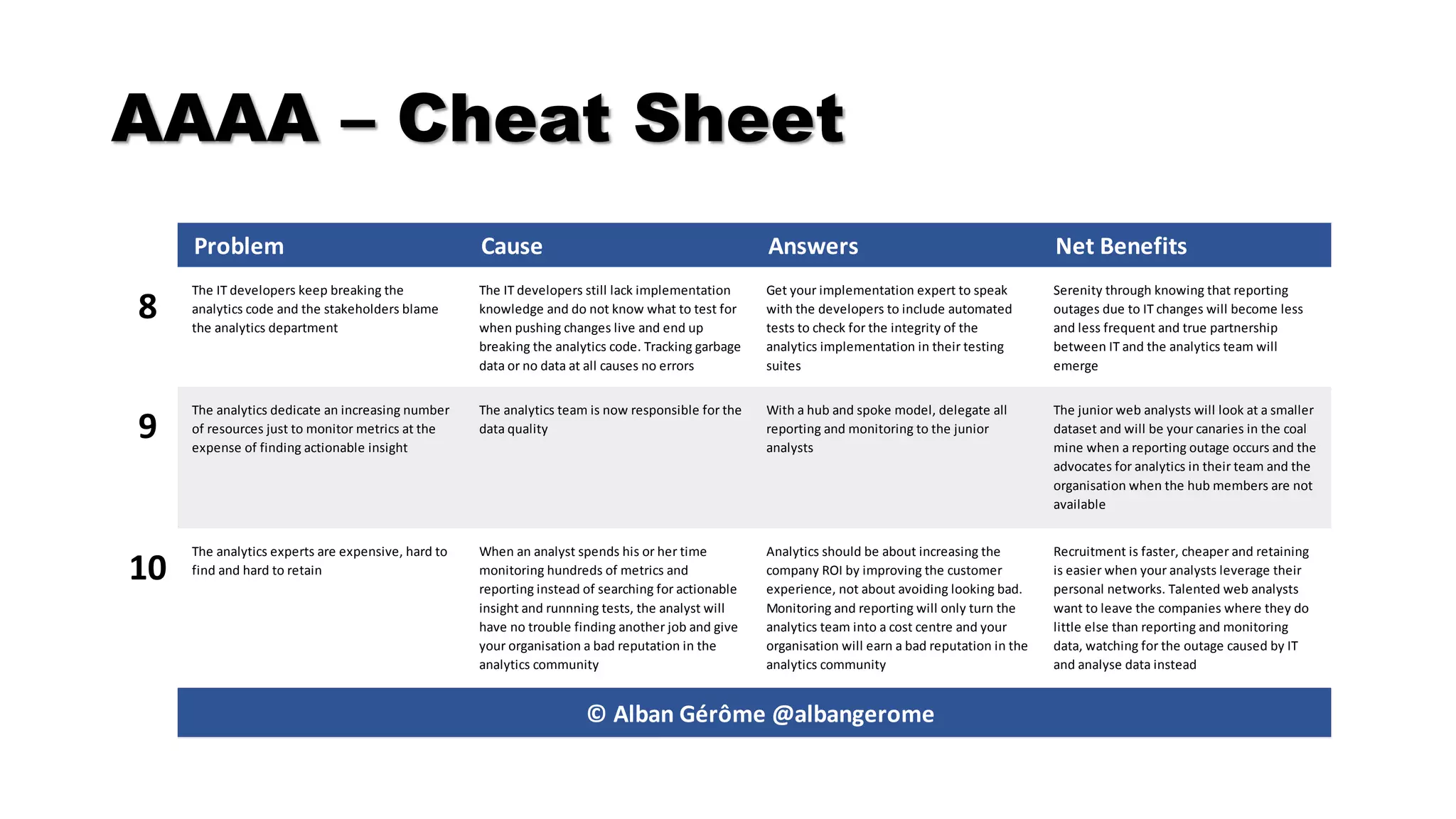
8
The IT developers keep breaking the
analytics code and the stakeholders blame
the analytics department
The IT developers still lack implementation
knowledge and do not know what to test for
when pushing changes live and end up
breaking the analytics code. Tracking garbage
data or no data at all causes no errors
Get your implementation expert to speak
with the developers to include automated
tests to check for the integrity of the
analytics implementation in their testing
suites
Serenity through knowing that reporting
outages due to IT changes will become less
and less frequent and true partnership
between IT and the analytics team will
emerge
9
The analytics dedicate an increasing number
of resources just to monitor metrics at the
expense of finding actionable insight
The analytics team is now responsible for the
data quality
With a hub and spoke model, delegate all
reporting and monitoring to the junior
analysts
The junior web analysts will look at a smaller
dataset and will be your canaries in the coal
mine when a reporting outage occurs and the
advocates for analytics in their team and the
organisation when the hub members are not
available
10
The analytics experts are expensive, hard to
find and hard to retain
When an analyst spends his or her time
monitoring hundreds of metrics and
reporting instead of searching for actionable
insight and runnning tests, the analyst will
have no trouble finding another job and give
your organisation a bad reputation in the
analytics community
Analytics should be about increasing the
company ROI by improving the customer
experience, not about avoiding looking bad.
Monitoring and reporting will only turn the
analytics team into a cost centre and your
organisation will earn a bad reputation in the
analytics community
Recruitment is faster, cheaper and retaining
is easier when your analysts leverage their
personal networks. Talented web analysts
want to leave the companies where they do
little else than reporting and monitoring
data, watching for the outage caused by IT
and analyse data instead
© Alban Gérôme @albangerome
AAAA – Cheat Sheet
Problem Cause Answers Net Benefits
11
The stakeholders keep making ever
increasing demands rather than keeping
their promise and implementing any
actionable insight
The stakeholders can borrow an idea from an
external thought-leader, tweak it enough to
claim credit and ownership. Looking data-
driven, i.e. data-justified, is much easier than
being genuinely data-driven and the C-suite
either cannot tell the difference or tolerate it
By growing your implementation rather than
trying to track everything from the
beginning, your stakeholders will have to
make do with the data available and stop
cherry-picking data
The stakeholders can develop their
experience with the analytics tools, their
data literacy too
12
Many biases are standing in the way of buy-
in such as belief persistence, confirmation
bias and selective attention bias
The stakeholders are trying to address the
gap between their beliefs and what the data
is telling
The analytics team must review the
stakeholder recommendations, protect and
educate the organisation about theses
biases, their causes and effects
The organisation becomes wiser to the
biases and protect them from potentially
disatrous ideas
13
Making actionable insight easier to
understand, memorable and other
persuasion and influence techniques do not
work
Asking stakeholders to implement actionable
insight without question is tantamount to
conservatorship, puts their careers at risk and
generates a strong but slient resistance
The analytics team can also find interesting
trends without potential commercial impact.
They need a steer from the stakeholders.
This guidance will provide the stakeholders
with opportunities to claim some of the
credit and the ownership for the actionable
insight
The seasoned stakeholders can regain pride
in their experience, feel valued for guiding
the analytics team and help them find real
actionable insight
© Alban Gérôme @albangerome
AAAA – Cheat Sheet
Problem Cause Answers Net Benefits
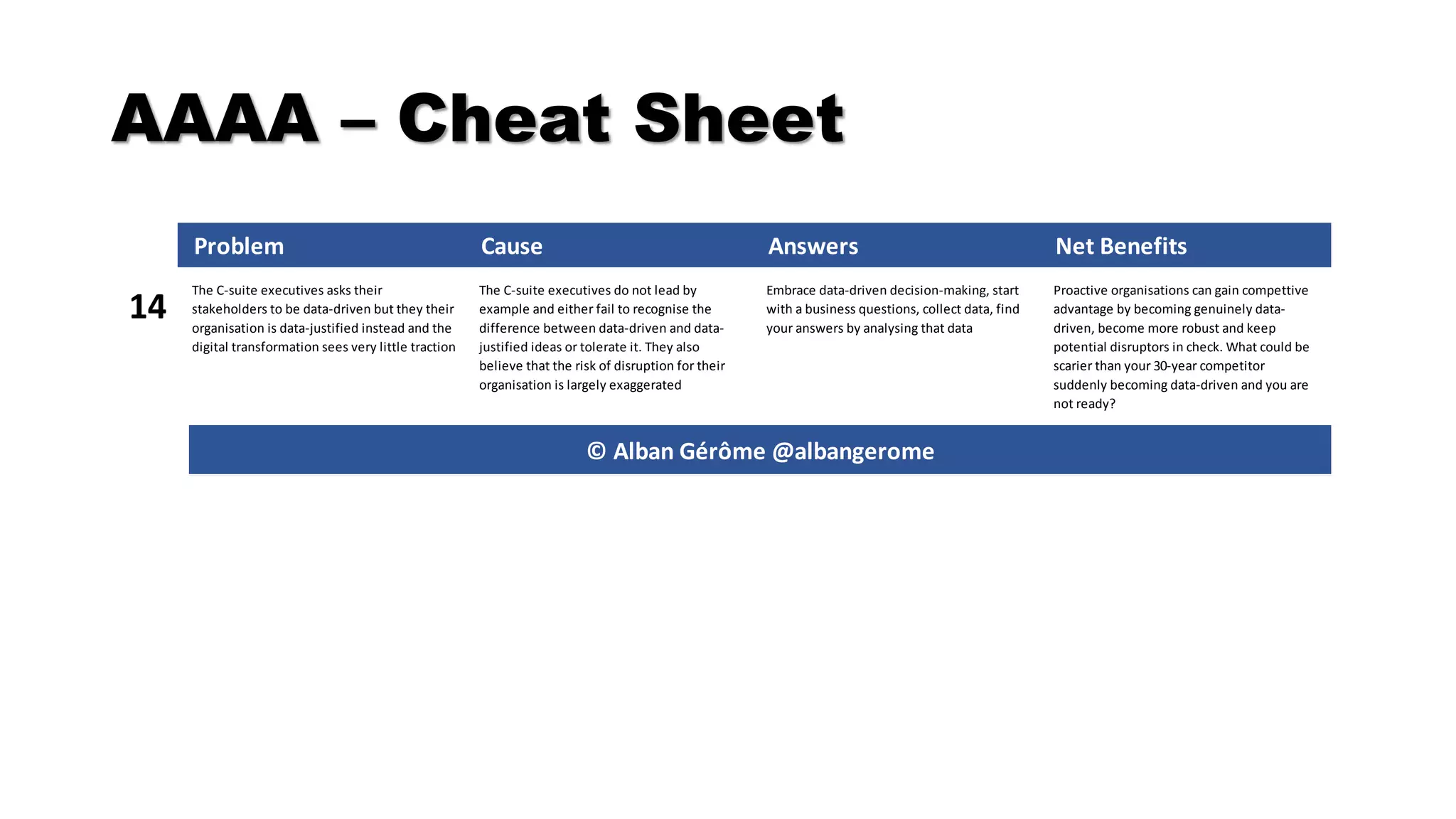
14
The C-suite executives asks their
stakeholders to be data-driven but they their
organisation is data-justified instead and the
digital transformation sees very little traction
The C-suite executives do not lead by
example and either fail to recognise the
difference between data-driven and data-
justified ideas or tolerate it. They also
believe that the risk of disruption for their
organisation is largely exaggerated
Embrace data-driven decision-making, start
with a business questions, collect data, find
your answers by analysing that data
Proactive organisations can gain compettive
advantage by becoming genuinely data-
driven, become more robust and keep
potential disruptors in check. What could be
scarier than your 30-year competitor
suddenly becoming data-driven and you are
not ready?
© Alban Gérôme @albangerome

Acceptance, Accessible, Actionable and Auditable

  • 1.
    Acceptance, Accessible, Actionable andAuditable A model for the digital transformation and excellence in analytics Alban Gérôme @albangerome Data Festival London 15 June 2018
  • 3.
    "Le doute, morneoiseau, nous frappe de son aile... Et l'horizon s'enfuit d'une fuite éternelle !..." "Doubt, dismal bird, beat us down with its wing... - And the horizon rushes away in endless flight!..." Arthur Rimbaud, Sun and Flesh (Credo in Unam)@albangerome
  • 5.
    Endemic misestimating • “Morethan half of senior executives experienced a backlog of at least two years on critical new analytics applications.” • 4 in 5 of Fortune 1000 companies claim that their big data investments are successful • 1 in 4 claim they have started seeing signs of a data driven culture @albangerome
  • 7.
    Cheap data storage •“You cannot improve what you cannot manage” has lead to an ever increasing appetite for data, driving the cost of data storage down • Intelligence agencies notorious for collecting data with little discrimination • Historical data is good, useless historical data costs little so let’s collect data without discrimination @albangerome
  • 9.
    Losing support • Projectsneed key supporters from the start to protect resources allocation from demands from other competing projects • Complex, multi-disciplinary projects get split into smaller parts and the projects moves only as fast the lowest prioritised part • A new project comes along with better prospects of success and steals a key supporter and then three, ten @albangerome
  • 11.
    IT cannot implementanalytics • Analytics tagging is mostly Javascript, IT has Javascript developers but IT is not competent to deliver an analytics implementation. You will need one or several implementation consultants • The vendor is only too happy to sell you premium consultancy services. Independent consultants are cheaper but this still causes delays and budget overruns • The implementation is never “done”, it evolves because customers expectations and technology evolve @albangerome
  • 13.
    Multiple versions ofthe truth • 2 managers find discrepancies in analytics data and end up blaming the tool • Senior management recognises that the organisation needs a single version of the truth, i.e. a dedicated analytics team • Building a team from only internal or only external has advantages and disadvantages @albangerome
  • 15.
    First reporting outage •IT developers pushed code changes live and broke analytics reporting in spite of following a rigorous testing procedure • Broken analytics tends not to produce errors, it pushes garbage data in the reports or even no data instead • IT believes that breaking analytics is no big deal but the analytics team should be the guardian of the data quality @albangerome
  • 17.
    Rebuilding trust • Theanalytics department is expected to monitor a large and increasing number of metrics • The stakeholders beginning to ask for a lot of analytics data, a sign of regained trust • The stakeholders are no longer asking for actionable insight. The analytics team should welcome this with a sigh of relief, this is a bad sign @albangerome
  • 19.
    First data analystleaves • The analytics team is treated like a cost-centre. This means a small team without prospects of promotions or opportunities to develop team leadership skills • Each day will consist of monitoring hundreds of metrics, producing daily, weekly, monthly reports and huge data extracts that the stakeholders barely exploit • Head of analysts without analytics experience only counting the days until their next rotation, never read of a book on analytics, complete unknown in the analytics community @albangerome
  • 21.
    Data cherry-picking • Pickonly the data that confirms prior beliefs, discard the rest on grounds of potential implementation issues • Blaming how the data was captured is much easier than questioning one’s beliefs when the data contradicts them • Data cherry-picking makes them look data-driven but they are really data-justified, biased and they get away with it because the CXOs are either naïve or complacent and too few of them lead this by example @albangerome
  • 23.
    Unwanted conservatorship • Spendingones resources for the benefits of another team at the expense of one’s own ideas and projects can only meet resistance • The incumbent teams want to retain autonomy of decision-making, claim credit and use the analytics purely as a support team • Implementing the analytics’ team ideas undermines their relevance and if given free rein, could usher something resembling holacracy @albangerome
  • 25.
    Apple juice anyone? •If making apple juice is harder than expected, perhaps something is blocking at the bottom of the press • Collecting ever more data and fancy data visualisations may not be the solution • People make decisions based on emotions and then justify them with data but we are supposed to have a data-driven decision process @albangerome
  • 27.
    Inspiration in strangeplaces To create a fire, you will need three elements • Oxygen • Fuel • Heat You will not achieve self-combustion until you reach a certain heat threshold. Remove one of these three items and a fire will stop @albangerome
  • 29.
    Accessible • John Gallwrote “Some complex systems actually work but building a complex one from scratch never works. You have to start over, beginning with a working simple system.” @albangerome
  • 30.
    Accessible • John Gallwrote “Some complex data capture implementations actually work but building a complex one from scratch never works. You have to start over, beginning with a working simple implementation.” • With too much data captured, one faces an increased noise to signal ratio. Beware analysis paralysis • Gradually increase the number of data points you collect data for and only give access to that data to people who need that data. This allows people to become more data literate at their pace @albangerome
  • 32.
    Actionable • The CXOsmust lead the digital transformation by example and stop tolerating data-justified recommendations. They will strive to become a data-informed organisation rather than just a data-driven one • You need an analytics centre of excellence with a steer from the other teams. The analytics experts will focus on complex finding actionable insight and rotate between teams to gain operational experience • The incumbent teams will need “moles” or “canaries”, i.e. junior data analysts doing the reporting and metrics monitoring. Data quality is every teams’ concern @albangerome
  • 34.
    Auditable • Although alack trust can be a very handy excuse for not implementing recommendations, trust in analytics data is key • Implement alerts, introduce tests in the developers test suites to check the integrity of the analytics tracking, ask your “moles” and “canaries” to report any issues they spot • All recommendations must document why you are tracking these data points, the data sources, the date ranges, how the data was cleaned and processed to ensure reproducibility @albangerome
  • 36.
    Acceptance • Dr ElisabethKübler-Ross wrote: “Any natural, normal human being, when faced with any kind of loss, will go from shock all the way through acceptance.” • An analytics project will inflict a shock to any organisation and this will come with a feeling of loss for many. Data-informed organisations still need years of experience and domain knowledge • An analytics programme will take an organisation on a journey, from doubt until finally reaching acceptance @albangerome
  • 38.
    You need allfour • The digital transformation must be accessible, actionable, auditable and achieve acceptance • Having all four will not usher the digital transformation until there is widespread acceptance all the way to the C-suite • If you lose one of the four A’s, you can wave your digital transformation goodbye @albangerome
  • 40.
    “The most beautifulpeople we have known are those who have known defeat, known suffering, known struggle, known loss, and have found their way out of the depths. These persons have an appreciation, a sensitivity, and an understanding of life that fills them with compassion, gentleness, and a deep loving concern. Beautiful people do not just happen.” Dr Elisabeth Kübler-Ross @albangerome
  • 41.
  • 42.
  • 43.
    AAAA – CheatSheet Problem Cause Answers Net Benefits 1 Vendors give the illusion that analytics is easy and downplay that implementing and operating their tools often requires experts To achieve the most sales for product licences, consulting services and premium support Address the expectations set by the vendors and explain that actionable insight requires effort and often starts with nothing more than an hypothesis which will then require A/B testing to verify A better alignment between expectations and capabilities and a better understanding of the resources required such as implementation experts and a web analytics team 2 The organisations decide to track everything and spend months capturing the requirements from the stakeholders The organisations do not know what to track but the cost of data storage keeps decreasing. Intelligence agencies are notoriously tracking with little discrimination and set a bad example. The organisations decide to track everything At first, focus on tracking very little data, demonstrate the value of a data-driven approach early, support a small number of stakeholders and then expand gradually by tracking more and supporting more stakeholders Traction, an earlier and faster implementation. Once implemented, the stakeholders will learn analytics at their own pace. Restraint in your tracking appetite will help your organisation comply with regulators 3 The implementation drags on and the initial key stakeholders are withdrawing their support and resources to support other projects with better chances of success The IT team may believe they can implement an analytics tool but they lack the skills in the analytics vendor proprietary code Hire an implementation expert. Large projects may require a team of implementation experts Traction, ensuring the continued support from the key stakeholders and their resources 4 At best, the first reports contain little actionable insight. At worse, the data is just garbage or contradicts the stakeholders' beliefs The IT team's lack of implementation expertise leads to collecting garbage. When the data is correct, it may paint a picture at odds with the stakeholders' beliefs Expect to hire implementation experts more than once as an implementation is never "done" Continued trust in the analytics data and an implementation that evolves with the organisation's needs © Alban Gérôme @albangerome
  • 44.
    AAAA – CheatSheet Problem Cause Answers Net Benefits 5 Two stakeholders extract data that should match but it does not and by a wide margin too. The organisation does not know who to trust anymore. The stakeholders lack experience with the analytics tool and data literacy too You will also need a web analytics department A single version of the truth 6 The stakeholders hide correct but unflattering data. The organisation suspects that their stakeholders lack objectivity The stakeholders leverage the perception that analytics is scientific and therefore the whole and accurate truth The head of the analytics department should report to the C-suite directly, the COO or the CEO preferably Reporting impartiality 7 Who should be in the analytics department? Internal staff or external experts? Internal staff have operational knowledge often struggle with analytics and make mistakes when extracting data. External experts can use data but often do not know which data could have a commercial impact Create a hub and spoke model, the incumbent teams who need analytics data will nominate a junior web analyst. Rotate the junior analysts between teams if possible. In the analytics team, you need external talent who will start spending time in other teams to gain operational experience The actionable insight is better aligned with the business objectives and strategy. The incumbent teams will stop become responsible for their own reporting and free the hub to focus on analysis © Alban Gérôme @albangerome
  • 45.
    AAAA – CheatSheet Problem Cause Answers Net Benefits 8 The IT developers keep breaking the analytics code and the stakeholders blame the analytics department The IT developers still lack implementation knowledge and do not know what to test for when pushing changes live and end up breaking the analytics code. Tracking garbage data or no data at all causes no errors Get your implementation expert to speak with the developers to include automated tests to check for the integrity of the analytics implementation in their testing suites Serenity through knowing that reporting outages due to IT changes will become less and less frequent and true partnership between IT and the analytics team will emerge 9 The analytics dedicate an increasing number of resources just to monitor metrics at the expense of finding actionable insight The analytics team is now responsible for the data quality With a hub and spoke model, delegate all reporting and monitoring to the junior analysts The junior web analysts will look at a smaller dataset and will be your canaries in the coal mine when a reporting outage occurs and the advocates for analytics in their team and the organisation when the hub members are not available 10 The analytics experts are expensive, hard to find and hard to retain When an analyst spends his or her time monitoring hundreds of metrics and reporting instead of searching for actionable insight and runnning tests, the analyst will have no trouble finding another job and give your organisation a bad reputation in the analytics community Analytics should be about increasing the company ROI by improving the customer experience, not about avoiding looking bad. Monitoring and reporting will only turn the analytics team into a cost centre and your organisation will earn a bad reputation in the analytics community Recruitment is faster, cheaper and retaining is easier when your analysts leverage their personal networks. Talented web analysts want to leave the companies where they do little else than reporting and monitoring data, watching for the outage caused by IT and analyse data instead © Alban Gérôme @albangerome
  • 46.
    AAAA – CheatSheet Problem Cause Answers Net Benefits 11 The stakeholders keep making ever increasing demands rather than keeping their promise and implementing any actionable insight The stakeholders can borrow an idea from an external thought-leader, tweak it enough to claim credit and ownership. Looking data- driven, i.e. data-justified, is much easier than being genuinely data-driven and the C-suite either cannot tell the difference or tolerate it By growing your implementation rather than trying to track everything from the beginning, your stakeholders will have to make do with the data available and stop cherry-picking data The stakeholders can develop their experience with the analytics tools, their data literacy too 12 Many biases are standing in the way of buy- in such as belief persistence, confirmation bias and selective attention bias The stakeholders are trying to address the gap between their beliefs and what the data is telling The analytics team must review the stakeholder recommendations, protect and educate the organisation about theses biases, their causes and effects The organisation becomes wiser to the biases and protect them from potentially disatrous ideas 13 Making actionable insight easier to understand, memorable and other persuasion and influence techniques do not work Asking stakeholders to implement actionable insight without question is tantamount to conservatorship, puts their careers at risk and generates a strong but slient resistance The analytics team can also find interesting trends without potential commercial impact. They need a steer from the stakeholders. This guidance will provide the stakeholders with opportunities to claim some of the credit and the ownership for the actionable insight The seasoned stakeholders can regain pride in their experience, feel valued for guiding the analytics team and help them find real actionable insight © Alban Gérôme @albangerome
  • 47.
    AAAA – CheatSheet Problem Cause Answers Net Benefits 14 The C-suite executives asks their stakeholders to be data-driven but they their organisation is data-justified instead and the digital transformation sees very little traction The C-suite executives do not lead by example and either fail to recognise the difference between data-driven and data- justified ideas or tolerate it. They also believe that the risk of disruption for their organisation is largely exaggerated Embrace data-driven decision-making, start with a business questions, collect data, find your answers by analysing that data Proactive organisations can gain compettive advantage by becoming genuinely data- driven, become more robust and keep potential disruptors in check. What could be scarier than your 30-year competitor suddenly becoming data-driven and you are not ready? © Alban Gérôme @albangerome

Editor's Notes

  • #4 Almost every week, I hear stories about companies who failed to extract value from their analytics solution. Stories of companies who replaced their web analysts with data scientists. Stories of companies that replaced their entreprise analytics tool with a free analytics solution. Stories of doubt. My first role in web analytics in the wide meaning the word, was working for a CRO startup which was acquired by Omniture a few months later. Not having much hands-on experience, I also believed that web analytics was easy. The trouble began in earnest when I landed my first web analytics role client-side. I was contracting and my client also believed that analytics was easy. I struggled in my early years and I decided to go back to basics. I drew a mindmap which evolved into what I called the AAA model up until about a year ago when I added a fourth A and the most important one of them, too. I believe that this model could help companies find the value in analytics that has eluded them so far.
  • #6 2016 and 2017 HBR articles, Endemic misestimating of cost, scope and time of analytics projects
  • #8 1GB Jan 2009: $0.11, Jan 2017: $0.028. In 2010 Eric Schmidt said that every 2 years we generate as much data as what was generated from the dawn of civilisation
  • #10 “Only 51% of the C-suite executives fully support their organisation’s digital and analytics strategy” from a 2016 KPMG survey. Analytics tend to lose support even before the implementation is delivered and can lose some ley supporters afterwards as well
  • #20 Cost-centres must keep costs down and often even cut them down on occasion
  • #22 MIT SMR reader letter claiming that the magazine is pushing the data-driven approach too much and contended that the companies that went bust because of data-driven disruption, were in reality badly managed companies in the first place. Seeing them going bankrupt was only a matter of time. Well managed but not very data-driven companies have little to fear from disruption and becoming data-driven, not really a priority. Does the C-suite or the board or the shareholders know what data-driven looks like. No, they are easy bamboozled. Disruptors may not have the luxury of a strong brand but what will happen when your 10, 20 or 30-year competitor with a brand as strong as yours, decides to become data-driven?
  • #24 Zappos, online shoe store has migrated away from a traditional operating model to holacracy with mitigated results. May early adopters of holacracy have now given up. Holacracy abolishes hierarchy ushers self-management, no more managers in the traditional meaning of the word but coaches of some sort
  • #26 What a paradox! Research on people who survived an accident that left them with brain injuries impairing their ability to feel emotions were also suddenly unable to make decisions. Trying to implement a data-driven process is like telling all plumbers they can’t work with their tools anymore and carpenters will do the plumbers jobs instead but with carpenter tools
  • #28 Foam extinguishers and filling a room with neutral glass will stop a fire my smothering it and depriving it from oxygen A water extinguisher will reduce the temperature enough to stop the fire That’s the Triangle of Fire
  • #31 The fastest response to disruption threats is a minimal viable analytics capability which will grow and evolve over time