Accelerating
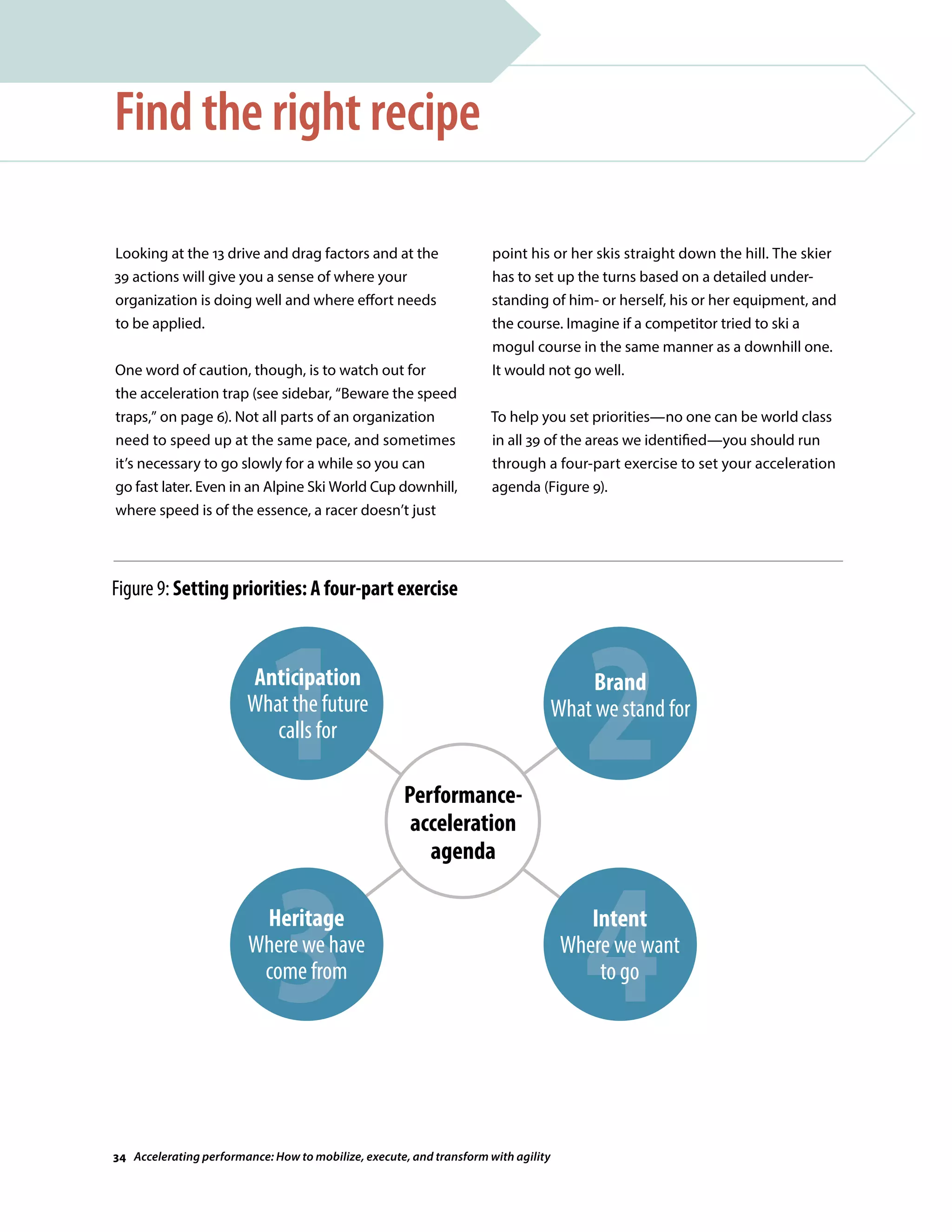
performance
How to mobilize, execute, and
transform with agility
Accelerating performance:
How to mobilize, execute,
and transform with agility
is written by experts and
practitioners of Heidrick
& Struggles‘ leadership-
consulting services.
Authors
RubenHillar
(rhillar@heidrick.com) is
global knowledge manager
of Heidrick & Struggles’
Leadership Consulting Practice;
he is based in the Washington,
DC, office.
ColinPrice
(cprice@heidrick.com) is
executive vice president
and managing partner of
the Leadership Consulting
Practice; he is based in the
London office.
SharonToye
(stoye@heidrick.com) is a
partner in the Leadership
Consulting Practice; she is
based in the London office.
DavidTurnbull
(dturnbull@heidrick.com) is
a partner in the Leadership
Consulting Practice; he is based
in the London office.
Art direction and design
Leff Communications
Copyright © 2016 Heidrick
& Struggles, Inc. All rights
reserved.
No part of this publication may
be copied or redistributed in any
form without the prior written
consent of Heidrick & Struggles.
Speed wins
Acceleration in a changing world
About the research
The 13 drive and drag factors
Differentiating actions
Four capabilities to develop
Find the right recipe
How META looks in action
Conclusion
Appendix A: Technical details on
the research
Appendix B: Diagnosing acceleration
Appendix C: The superaccelerators
Contents
2
4
8
13
16
31
34
36
39
40
46
51
Industries are being disrupted at a faster pace, and
not just by the increasing power of innovation
in our ever more digital world. Once staid industries
such as automotive face a confounding, once-in-a-
lifetime shift because of the prospects for self-driving
cars and the advent of ride-sharing apps, but that’s
actually just the beginning of the challenge in this
industry. Within just the past eight years, oil prices
soared to $140 a barrel, with predictions that they
would head to the moon, only to have them tumble
briefly to less than $30 and now settle, at least for
a time, around $40. Each sudden change in oil prices
not only affects demand for travel but also shapes
interest in, say, fuel-efficient cars or even electric
models, and everyone in the automotive industry
had best be ready. Companies in this industry and
others must also sort through greater urbanization,
the rising influence of emerging-market consumers,
and many other complex, interdependent trends.
Institutions are failing in a
changing world
In the face of this disruption, many institutions are
failing to keep up with the changes. Sometimes
they very visibly fail to react to a changing world—as
was the case with some financial institutions—and
sometimes they just fade away. Look at Sears, which
was easily the largest retailer in the United States
for decades but which failed to react soon enough to
the rise of Walmart, to the advent of online retailing,
and to a host of other changes in the market and has
been facing the prospect of a slow-motion collapse
for almost a decade. The company recently announced
that it and its sister company, Kmart, will shutter
78 more stores this summer.
Based on many years of research, supplemented
by a major study for this report, we have found that
Speed wins
organizational success requires acceleration. This
doesn’t mean a relentless push for speed in every part
of an organization. What it does mean is a careful
analysis that leads to removing certain drag factors
while taking other steps that will drive progress
in the key areas that accelerate overall performance.
It’s about how you run the race
Based on an intimate look at almost half of the world’s
largest companies, we identified a small group that
we dubbed “superaccelerators.” We were surprised by
two things.
First, their exceptional success is not a case of choosing
the right industry sector or geography. Our super-
accelerators are not all tech companies, and they come
from all geographies and include sectors thought
of as stable or low margin. Second, we found that many
companies are trying to do the same, sensible
things: put customers first, adopt clear management
structures, and so on.
What differentiated the superaccelerators from the
also-rans was their ability to mobilize, execute, and
transform with agility—being able to adapt and pivot
faster than their competitors. That was what made
the difference.
Beware the speed traps
Yet organizations must also accelerate with intel-
ligence. To be sure, building the ability to operate
quickly and nimbly is a positive, but it should
not be seen as a crude call to just do everything faster.
Even if that were possible, the effort required
would be prohibitive—organizations can’t live every
day like it’s a fire drill. A lot of the effort is wasted
in frantic organizations, and people start to fall apart,
leading to a cascade of problems.
2 Accelerating performance: How to mobilize, execute, and transform with agility
Beware, therefore, of the acceleration trap. Choose
to focus agility on where it is important, where it adds
value, and where it helps win the competitive race—
even when that means “slowing down to go fast.”
How well is my organization doing?
Our research led us to create a suite of survey-driven
tools to better understand the ability to accelerate at
the four levels that matter: strategy, organization, team,
and individual. However, to have a first, quick sense
of how your organization is doing, we have identified
13 drive and drag factors, grouped into four areas:
mobilize, execute, transform, and agility.
For example, does your organization suffer from
complacency or enjoy challenge? Is it characterized by
resilience or frailty?
More important, any organization will be somewhere
on the spectrum for each of these 13 drive and drag
factors—each is very much a dimmer, not an “on–off”
switch—so where are the biggest opportunities
for improvement?
How do we get better?
Although each organization, of course, needs to map
its own journey, that doesn’t mean each needs to be
created from scratch. As we researched what made for
successful companies, we catalogued good practices
and have developed a list of 39 differentiating actions
that organizations can use as ingredients for a change
agenda that will move them toward acceleration.
New capabilities required
Building an organization that can mobilize, execute,
and transform with agility is not as simple as just
picking a handful of the most relevant differentiating
actions and creating an agenda. Practices are
only as good as the people implementing them. Your
organization’s leaders are going to need four
important capabilities.
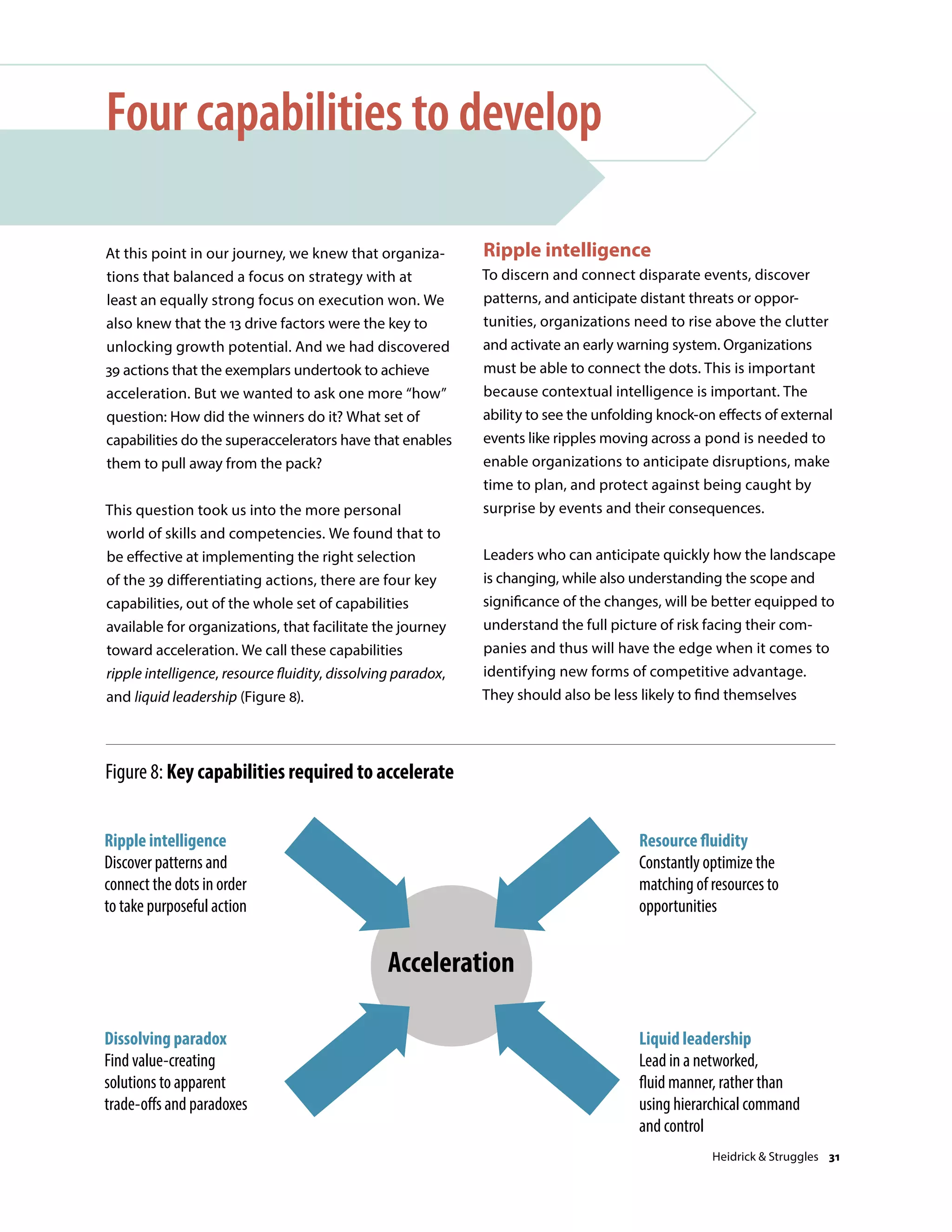
Ripple intelligence is the ability to keep abreast of
the multiple, interdependent changes happening in
the world, your industry, and your organization
and to understand the different ways they might
interact and play out.
Resource fluidity is the skill of being able to constantly
adjust the allocation of talent, resources, and ideas to
the most important challenges.
Dissolving paradox means seeing past simplistic
choices and recasting difficult decisions in ways that
result in transformative, “win–win” outcomes.
Liquid leadership means being able to operate, whether
through hierarchy or through other channels, to
mobilize action and share information in the quickest
and most appropriate way.
The challenge isn’t going away
Even with the necessary capabilities in place,
maintaining a constant level of agility in an organi-
zation requires effort and vigilance—the jungle
always grows back.
Indeed, the need for agility is part of the new normal;
competitive pressures and innovation will see to
that. Just maintaining your organization’s current level
of agility may not be enough to guarantee continuing
to win the race.
Heidrick & Struggles 3
To see the potential for innovation in our ever more
digital world, all you have to do is type “the Uber of”
into your browser. You will be prompted to turn
the phrase into “the Uber of everything,” “of insurance,”
“of food,” “of private jets,” “of dog walking,” and on
and on. “The Airbnb of” will lead to suggestions of
“food,” “cars,” “office space,” “car rentals,” “stuff,”
and more. Those possibilities don’t even touch on all
the digital conveniences in a world where, as Apple
puts it, “There’s an app for that.”
But there’s a downside, too, as the pressures of
rapid change leave a trail of broken institutions that
are less capable of maintaining a superior level of
performance in a changing environment. Finding the
failures isn’t as simple as typing a few words into a
browser, but it doesn’t take much looking to generate
a long list. In 2010, cultural flaws at BP led to the
largest marine oil spill in history, when the Deepwater
Horizon drilling rig in the Gulf of Mexico exploded,
killing 11 workers and injuring 16. The well gushed oil
for 87 days, generating tens of billions of dollars in
losses. Barclays Bank suffered its own disaster in 2012,
when an overly aggressive sales culture led employees
to attempt to manipulate Libor and Euribor (the
average rates at which banks lend to each other). HSBC,
the UK’s largest bank, was found to be laundering
money for drug cartels. The list goes on: a general
unraveling at Co-operative Bank, outrageous expense-
account abuses in Parliament, a woeful lack of
preparation at the Bank of England before the Great
Recession of 2008–09, phone hacking by UK media,
a toxic culture that killed more than 1,000 people at
Stafford Hospital, a culture of secrecy that protected
an alleged pedophile at the BBC, a scandal at the UK
Police Federation because of bullying and racism and
a culture of fear, a bloated bureaucracy in the British
Acceleration in a changing world
Army, ethical problems at Tesco, and a finding that
37% of beef burger products sold in the United
Kingdom contained traces of horsemeat, while traces
of pork were found in 85%.
That’s just a recent list and just from the United
Kingdom. In the United States, financial institutions—
including blue-chip firms such as JPMorgan Chase
and Goldman Sachs—have paid more than $110 billion
in fines to settle charges related to their roles in
selling mortgages that people couldn’t afford and
that fed the Great Recession. In Germany, Volkswagen
is immersed in a scandal because a defective culture
led to widespread cheating on emissions testing for
its diesel vehicles. Japan has its own failed institu-
tions, as does every other country. The list could go
on for a very long time.
The mix of opportunity, challenge, and abject failure
has been driving a key question for our research
agenda: How can companies thrive in a fast-paced,
digital world where profound long-term and
short-term forces collide in unpredictable ways? A
recent, major effort built on years of research into
effectiveness at four levels of organizations provided
some surprising insights, which we will share in
this report.
For example, although we began our research
project thinking that elite organizations used a dif-
ferent approach to management than did lesser
performers, we found that companies across the spec-
trum emphasized the same things. All wanted to
put the customer first. All wanted clarity within the
management structure. All wanted to innovate.
What we found, though, was that elite companies were
far more effective in attacking the same set of issues.
4 Accelerating performance: How to mobilize, execute, and transform with agility
The furthest-reaching insight relates to today’s single-
minded focus on having businesses rethink where
they compete—what industry segments and geogra-
phies they are in—and to consider new business
models. It’s no longer enough to compete or even to
win. Businesses are told they have to disrupt their
industries, or perhaps someone else’s, and become
“the Uber of” or “the Airbnb of” something. But,
while breakthroughs in strategy are still important,
they don’t provide the sort of long-term competi-
tive advantage they once did. Strategies are easier to
copy in these fast-moving times, when innovation
no longer requires enormous resources.
Disruption is certainly powerful, when it happens. But
our research found that the majority of competitive
differentiation now occurs based on companies’ ability
to exploit new sources of growth while sustaining
the source of today’s competitive advantage—in other
words, they are able to make sense of changes in their
environment and act in a timely manner. We found an
extremely strong correlation between a company’s
performance on certain management metrics and its
growth rate as well as its potential for improvement
in profitability, both much more than would come
from moving into a different industry or geography.
Although managers invariably point to external events
to explain poor results, the fact is that every busi-
ness faces storms; what matters most, we found, is
the resources you place on the boat to prepare for
changing circumstances as well as how you handle the
boat and crew and navigate the waters while you’re
in the storms.
This report will show how to turn our research insights
into a series of actions that will lead you toward
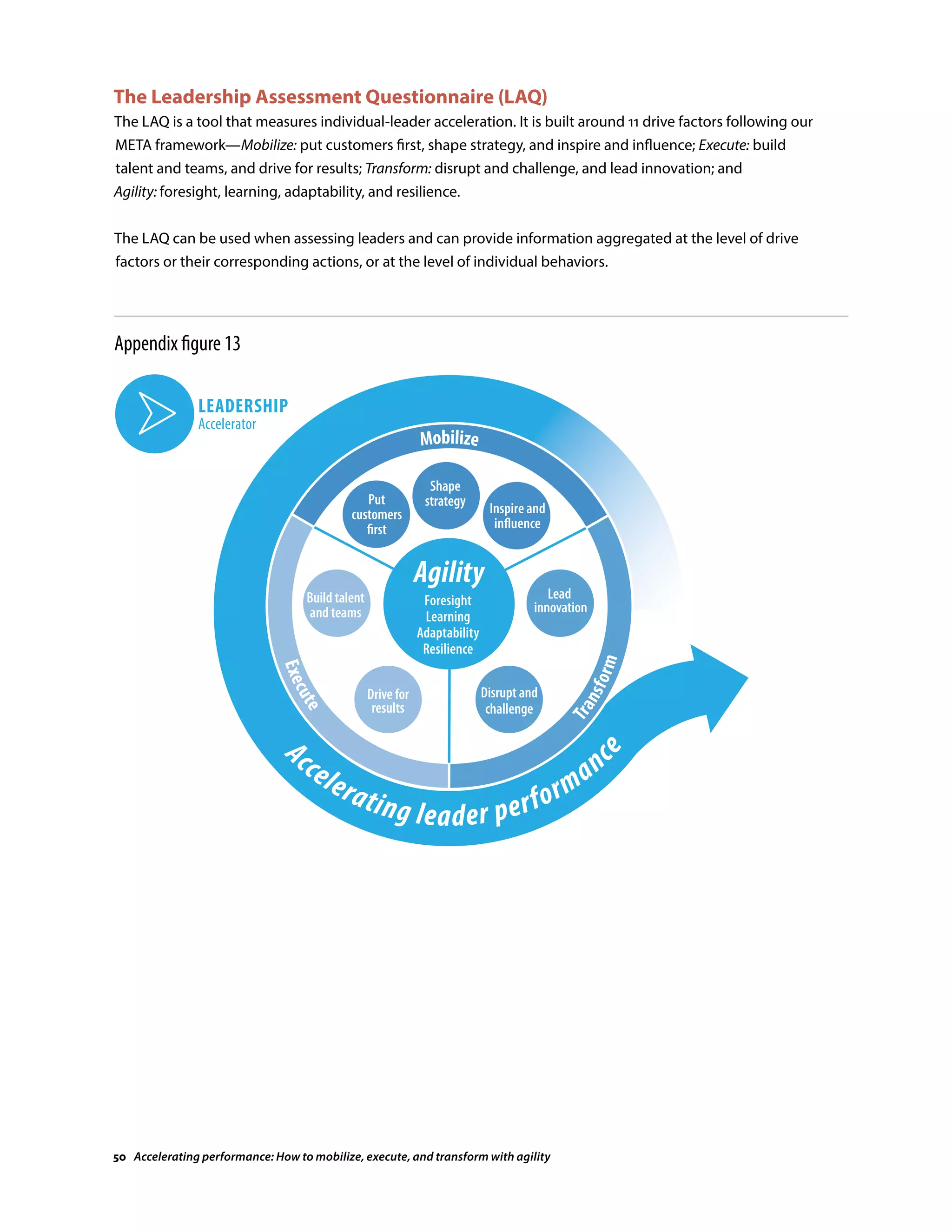
acceleration, within a framework we call META, which
stands for mobilize, execute, and transform with
agility. We define acceleration as the ability to reduce
time to value by building and changing momentum
more quickly than your competitors. The report high-
lights how acceleration in the organization reflects
the strategy and the way in which teams and individ-
uals behave, so understanding these levels becomes
very relevant as well.
Although most companies pursue many of the goals in
META, they miss key aspects. In particular, companies
often don’t do enough to be agile, which can act as an
amplifier of the work in the other three areas. The
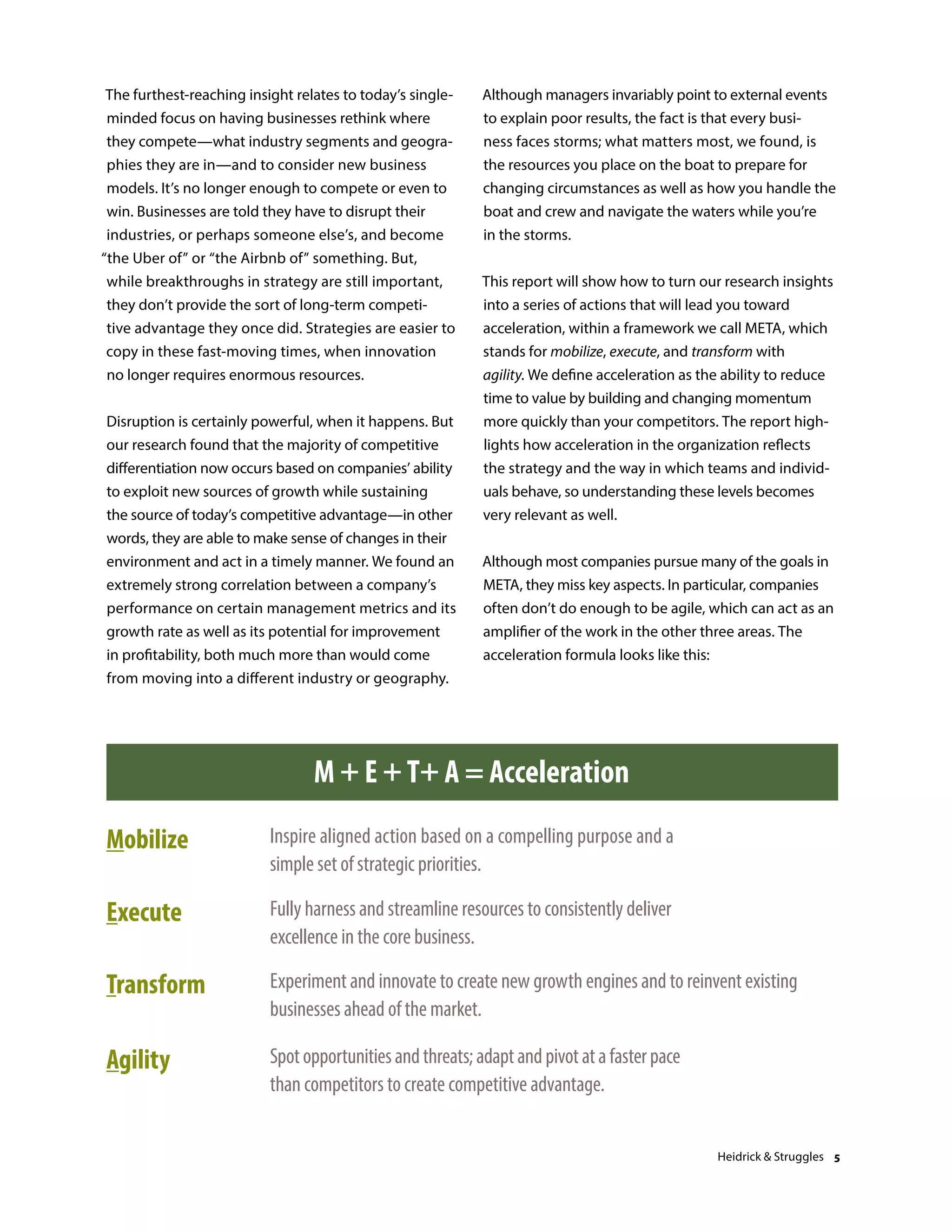
acceleration formula looks like this:
Source: Heidrick & Struggles
M + E +T+ A = Acceleration
Mobilize Inspire aligned action based on a compelling purpose and a
simple set of strategic priorities.
Execute Fully harness and streamline resources to consistently deliver
excellence in the core business.
Transform Experiment and innovate to create new growth engines and to reinvent existing
businesses ahead of the market.
Agility Spotopportunitiesandthreats;adaptandpivotatafasterpace
than competitors to create competitive advantage.
Heidrick & Struggles 5
Howmuchfasteristheworldmovingthesedays?Thepaceofwalkinghas
pickedup10%sincethe1990s.Wecheckourphonesmorethaneight
billion times a day. The average shot in a movie has gone from 10 seconds
inthe1940sto4secondstoday.Evenchickensarespeedier:theygrow
four times faster than they did 50 years ago. ADHD is the quintessential
modern disease. (For more on our accelerating modern world, see Robert
Colvile’sTheGreatAcceleration:HowtheWorldIsGettingFaster,Faster,
Bloomsbury, 2016.)
With the world moving much faster these days, it’s widely accepted that
businesses have to greatly increase their RPM just to stay in place
against the competition and must accelerate if they’re to keep up with
customer expectations. But those statements gloss over some impor-
tant distinctions. For one, not all industries are changing at the same
speed or at the same time—while music was upended 15 years ago,
forinstance,insuranceisjustnowseeingglimmersofinnovationbecause
the forces at work there play out over the longer term. For another,
change isn’t always that fast—look at the low number of new consumer
productsandthegenerallysteadyspeedofproduction.It’snotenough
justtomandatespeedallthetime,ineverypartofanorganizationandat
every level. There needs to be considerable understanding and sub-
tlety about how to marshal change inside an organization and accelerate
overall performance.
Infact,puttingtoomuchemphasisonspeedcanleadcompaniesintowhat
wecallthe“accelerationtrap”(inotherwords,adoptingafranticpace
inalloftheiractivitieswithoutevertakingthetimetostopandreflecton
what is going on). The trap can devastate performance, productivity,
and retention. A constant, frenetic pace saps employee motivation and
makes employees less willing to accompany the management team
in its quest for better performance. Stress-related health problems start
to arise, absenteeism and medical leaves increase, and, ultimately,
with no end in sight, people start to leave to go to companies with more
sustainable rhythms. Our data show that sustaining acceleration in
companies requires having a portfolio of initiatives composed of long-
termcommitmentsaswellassmallbets,balancingspeedandquality,
and providing access to the right information—all of which can go awry
in frantic organizations.
If you’re in quicksand, the worst thing you can do is thrash about, but
that’s just what many companies do.
The impact on the employees is also transferred to those in closest
contact with them, customers and suppliers, who feel neglected. In a
frantic organization, employees cannot dedicate time to listening to
their customers’ concerns because that slows them down. Employees
also do not have time to attend to the needs and requirements of
their suppliers, which are also operating at a frantic rhythm and require
attention. Pretty soon, customers and suppliers start defecting
to competitors.
So what is the answer if we have to accelerate performance but we
can’t go fast all the time? The answer is to ensure that all along the way
you are taking steps to avoid making the furious pace you need in
some areas the new normal across the organization. Focus on increasing
the number and speed of only the right activities. Do not raise
performance goals across the board; follow your acceleration pathway.
Shorten innovation cycles in the areas that most need it—it may be
productdevelopment,butitcanalsobeinternalmanagementinnovation
or continuous improvement plans. Introduce new management
technologies or organizational systems. Focus on the team and the
individual as much as you focus on the organization as a whole.
Make sure that your technical and managerial systems talk to each other
and support a faster rhythm, but don’t necessarily make them faster
just for the sake of it.
Toacceleratesustainably,thepacehastoadapttotheactualneedsof
the organization and invariably won’t be the same across every function
or group.
Beware the speed traps
6 Accelerating performance: How to mobilize, execute, and transform with agility
You need to have some level of excellence in all
four of the META components, but acceleration can
still be present even if one of the components is
little developed. For instance, in a mature industry
with well-established processes, such as steel or
pulp and paper, the ability to transform may matter
less than the other areas in driving acceleration.
This ability to move faster is particularly relevant in
light of research highlighting that 45% of the variance
in return on assets is due to external influences.1
META can, if you will, increase the metabolic rate of
an organization so that it is fitter and more effective
and responds faster to those external influences, no
matter what industry or geography it competes
in, while avoiding what we call the “acceleration trap”
(see sidebar, “Beware the speed traps”). Our research
has found that accelerating teams move faster and
deliver almost 23% more economic impact than
derailing teams. Individual leaders who are adept at
accelerating performance are as much as four times
more productive than their peers.2 And our research
demonstrates that acceleration is the capability
most critical in driving revenue growth.
Many CEOs agree that acceleration is the key to success:
	 •	 “Speed is the new currency of business,” says Marc
Benioff, CEO of Salesforce.com.3
	 •	Rakesh Kapoor, CEO of Reckitt Benckiser, says:
“Size can give you scale, but, for innovation, speed
is more critical.”4
	 •	Larry Page, CEO of Alphabet (parent of Google),
says, “I’d rather make the mistake in moving too
fast than make no mistakes and move too slow.”5
	 •	Mary Barra, CEO of GM, says, “I believe the auto
industry will change more in the next 5 to 10 years
than it has in the last 50.”6
	 •	Chuck Robbins, the new CEO of Cisco, says,
“I believe that as a company we have to be able
to move as fast [as] or faster than the whole
industry [is] moving.”7
We will begin with a summary of our recent research
that led us to 23 exemplars. We will then explain how
that research joined with our years of collaboration
with CEOs, CFOs, CHROs, and other senior executives
on how to build effective strategies, organizations,
teams, and individuals. Having the right individuals in
the right seats is not enough. We identified 13 drive
and drag factors that determine whether or not an
organization is accelerating—handled right, these
13 key factors drive a business, but, done wrong, they
create drag. We also looked at the top 3 actions
for each factor that companies can take to accelerate
effectively. Those differentiating actions, in turn,
lead to four capabilities that need to be developed at
the strategy, organization, team, and individual
levels. Because no organization can be world class in
all 39 of the differentiating actions we’ve identified,
and because not every action is of the same impor-
tance to every organization, we will explore how to
sort through all of them and develop the recipe that
will be right for your business. We conclude the report
with an extended case study that shows the META
process in practice, from problem through solution.
1 The data reflect more than 100 US manufacturing firms consisting
of at least two strategic business units, covering 160 industries.
2 Similarly, research conducted at MIT suggests that firms that
excel at agility grow revenue 37% faster and generate 30% higher
profits than firms that lack the capability. See Peter Weill, “IT
portfolio management and IT savvy—rethinking IT investments as
a portfolio,” Center for Information Systems Research, MIT Sloan
School of Management, June 14, 2007.
3 Stuart Lauchlan, “Davos 2016—no speed limit in pursuit of digital
transformation,” diginomica, January 21, 2016, diginomica.com.
4 Dale D. Buss,“4 ways for CEOs to boost innovation,” Chief Executive,
January 14, 2016, chiefexecutive.net.
5 Dr. John Sullivan, “Talent strategies for a turbulent VUCA
world—shifting to an adaptive approach,” ERE, October 22, 2012,
eremedia.com.
6 Mary Barra, “The next revolution in the auto industry,” World
Economic Forum, January 21, 2016, weforum.org.
7 Pete Carey, “QA: Chuck Robbins, CEO of Cisco Systems,” Mercury
News, July 30, 2015, mercurynews.com.
Heidrick  Struggles 7
In 1962, in his book Capitalism and Freedom, renowned
economist Milton Friedman said, “There is one
and only one social responsibility of business: . . . to
increase its profits.”8 We all know where that line
of thinking got us. Instead, we side squarely with Peter
Drucker, who wrote in 1954, “There is only one valid
definition of business purpose: to create a customer.”9
We began our latest research project by looking
for companies that are elite by Drucker’s definition—
not just good or even great, but elite—because
we wanted companies that had demonstrated real
success for an extended period, even in these
fast-changing times. We began with the FT 500 list of
the world’s largest, publicly traded companies and
evaluated them based on their compound average
growth rate (CAGR) for revenue. We chose revenue
growth because we believe it is a purer indicator of
Drucker’s version of success than others that are
commonly used, such as earnings per share or stock
price. The goal of every organization needs to be
to serve its customers, and the best way to measure
success is whether those customers are voting with
their wallets and buying more products and services.
The first pass at the data produced a standard bell
curve. In other words, some companies grow fast, some
are stable, and some shrink. No surprises there. The
paradox of growth is alive and well: all companies want
growth, but growth brings scale, and scale brings
complexity, which chokes growth. This is not a new
insight. However, when we applied additional
screens, we found a surprising reality.
We looked at the most valuable listed companies
in the world, represented by the FT 500 list, that were
in the top 20% for revenue growth in both the last
About the research
three and the last seven years, that generated no more
than 20% of their growth inorganically (through
acquisitions), that received no more than 20% of their
revenue from their home government (eliminating
state-sponsored behemoths such as Saudi Aramco
and some of the Chinese banks), and that had not
seen their profit margin reduced by more than 20%
as a percentage of revenue as they grew. Those
four “rules of 20,” as we came to call them, produced
a startlingly small number of companies. Out of our
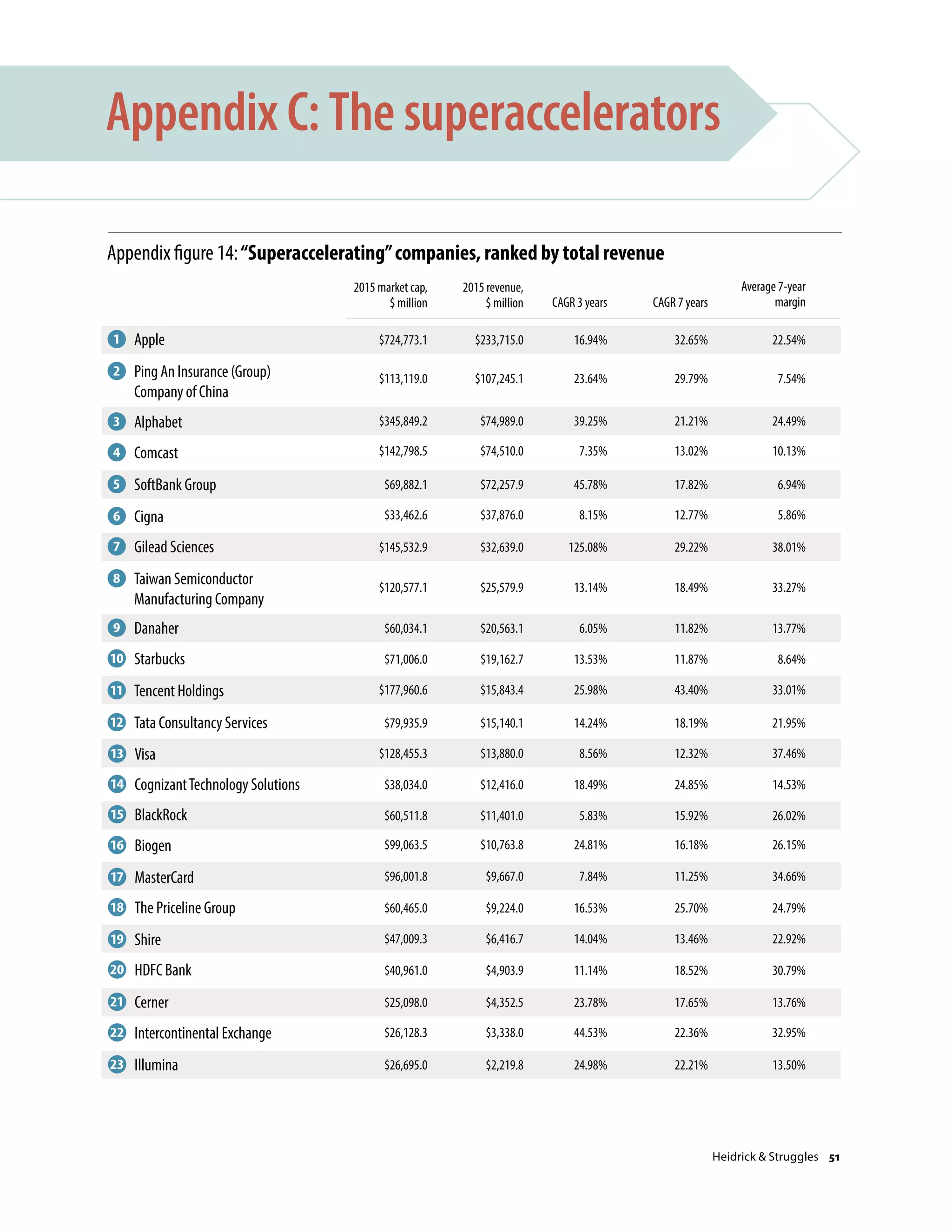
original list of the FT 500, only 23 companies met these
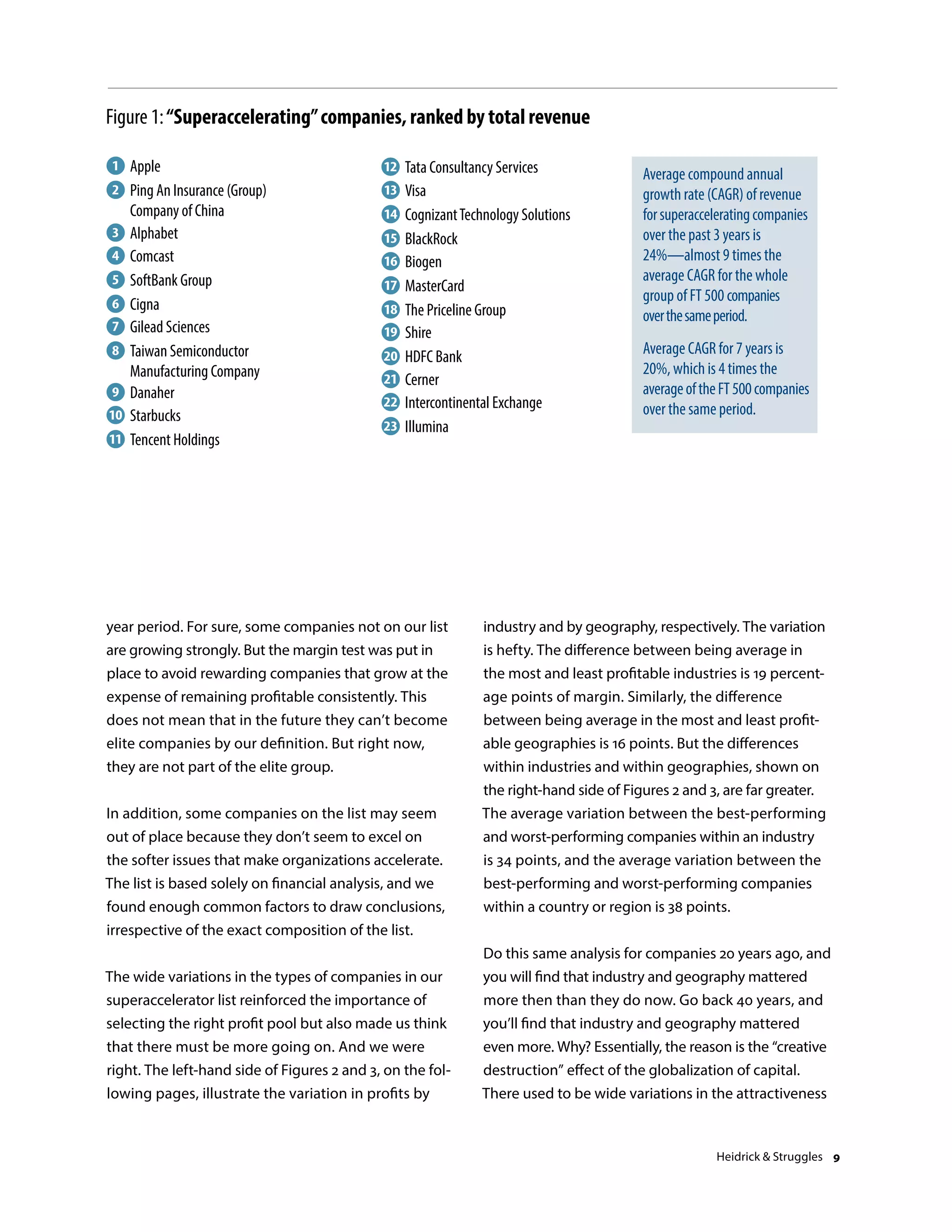
tests. We call them the “superaccelerators” (see Figure 1).
Although no company is guaranteed continued
success—as “lookbacks” at the list of companies in In
Search of Excellence, Good to Great, and other busi-
ness books have shown—these 23 have demonstrated
great enough success for a long enough stretch that
they can yield important lessons. Seven years of great
success is a long time in this day and age.
Note that, while the list includes Apple and Alphabet,
the companies come from a wide range of industries,
not just high tech. Nor are the companies all from the
United States or any other specific region; they span
the globe. Any company can become elite, or at least
make major strides in that direction. (For details on
the companies, see Appendix C.)
The list is absent some iconic companies—for example,
Amazon, Southwest Airlines, and Qualcomm. They
fail our test on maintaining or growing profitability (or
seeing margin decline less than 20%) in the seven-
8 Justin Fox, “The social responsibility of business is to increase . . .
what exactly?,” Harvard Business Review, April 18, 2012, hbr.org.
9 Gregory H. Watson, “Peter F. Drucker: Delivering Value to
Customers,” Quality Progress, May 2002.
8 Accelerating performance: How to mobilize, execute, and transform with agility
year period. For sure, some companies not on our list
are growing strongly. But the margin test was put in
place to avoid rewarding companies that grow at the
expense of remaining profitable consistently. This
does not mean that in the future they can’t become
elite companies by our definition. But right now,
they are not part of the elite group.
In addition, some companies on the list may seem
out of place because they don’t seem to excel on
the softer issues that make organizations accelerate.
The list is based solely on financial analysis, and we
found enough common factors to draw conclusions,
irrespective of the exact composition of the list.
The wide variations in the types of companies in our
superaccelerator list reinforced the importance of
selecting the right profit pool but also made us think
that there must be more going on. And we were
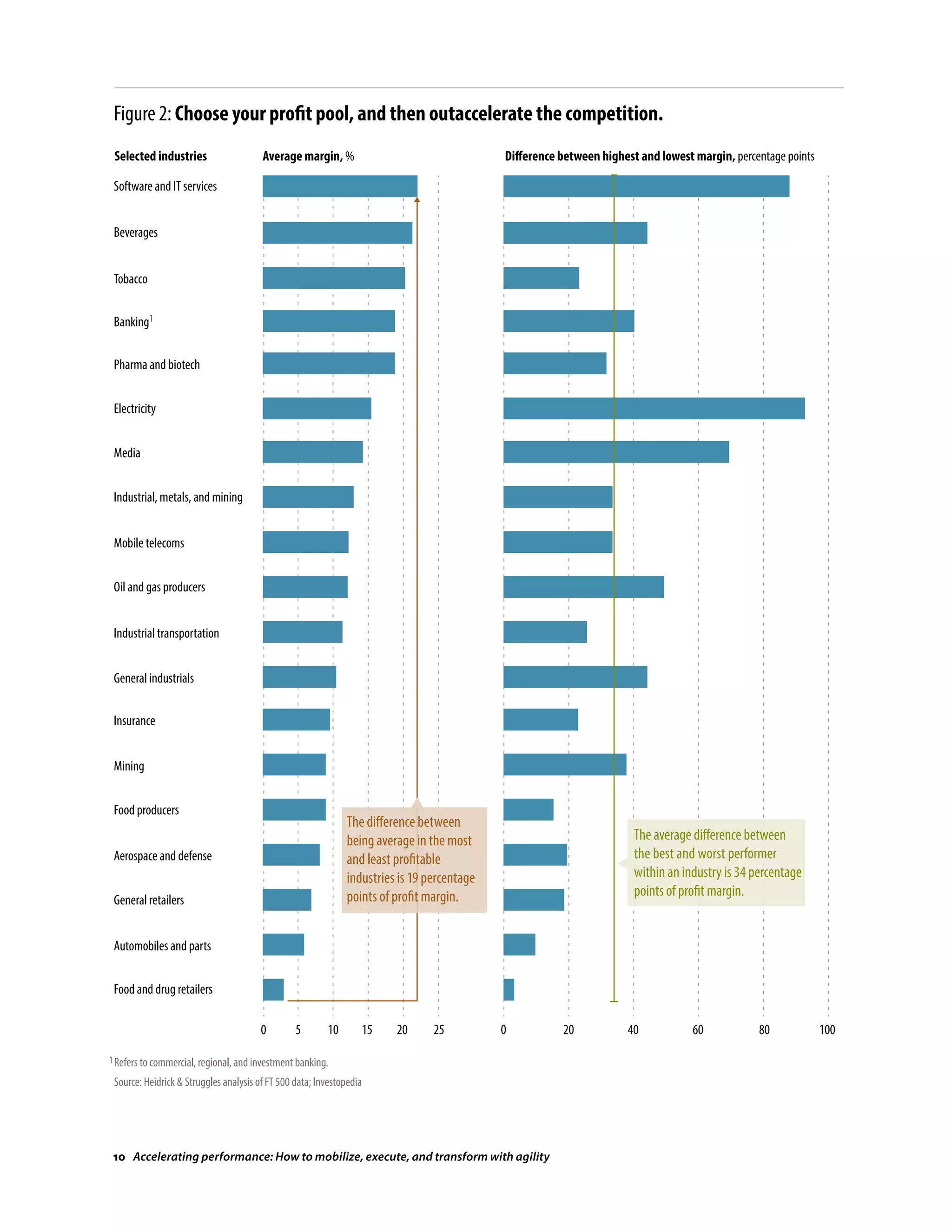
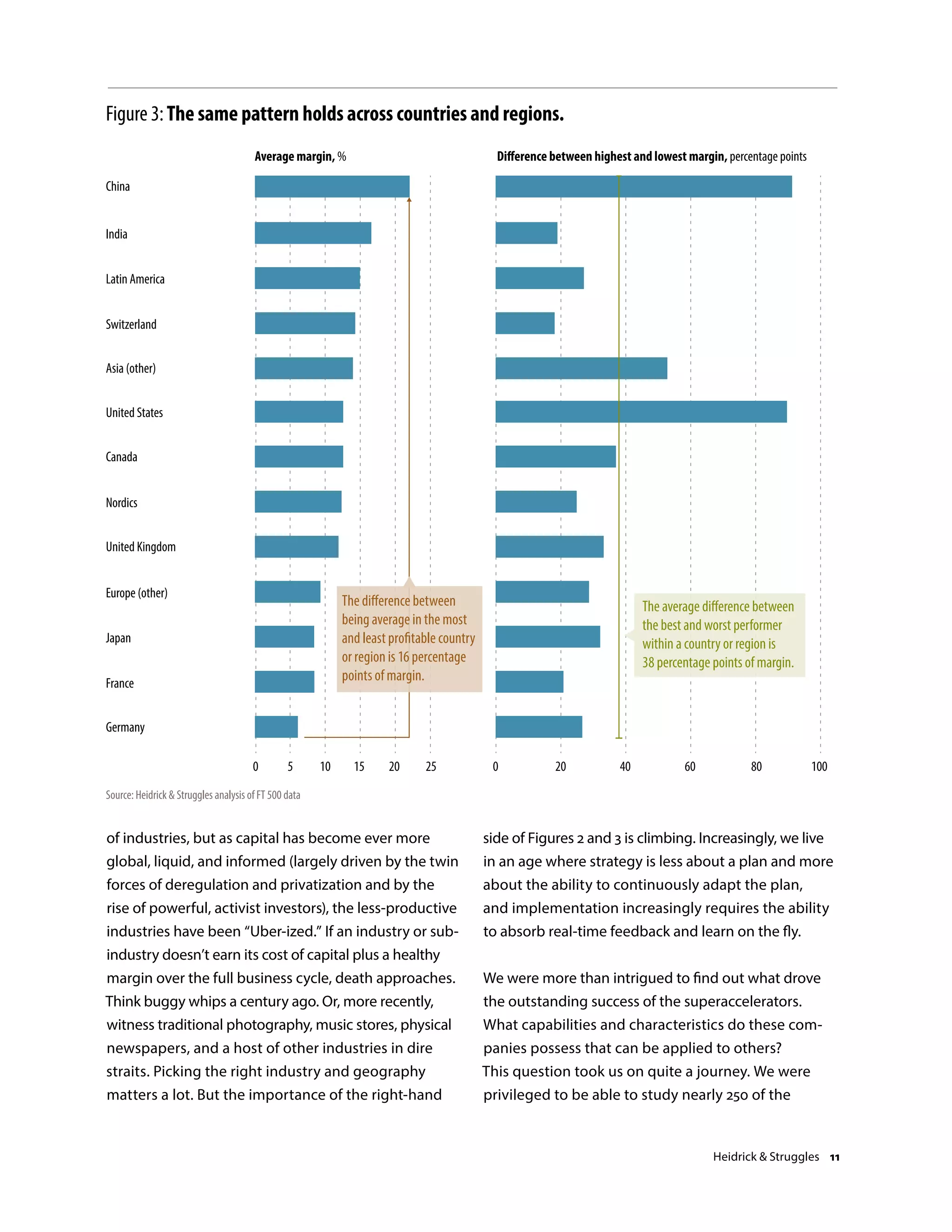
right. The left-hand side of Figures 2 and 3, on the fol-
lowing pages, illustrate the variation in profits by
industry and by geography, respectively. The variation
is hefty. The difference between being average in
the most and least profitable industries is 19 percent-
age points of margin. Similarly, the difference
between being average in the most and least profit-
able geographies is 16 points. But the differences
within industries and within geographies, shown on
the right-hand side of Figures 2 and 3, are far greater.
The average variation between the best-performing
and worst-performing companies within an industry
is 34 points, and the average variation between the
best-performing and worst-performing companies
within a country or region is 38 points.
Do this same analysis for companies 20 years ago, and
you will find that industry and geography mattered
more then than they do now. Go back 40 years, and
you’ll find that industry and geography mattered
even more. Why? Essentially, the reason is the “creative
destruction” effect of the globalization of capital.
There used to be wide variations in the attractiveness
Figure 1:“Superaccelerating”companies, ranked by total revenue
Source: Heidrick  Struggles
Apple1
Ping An Insurance (Group)
Company of China
2
Alphabet3
Comcast4
SoftBank Group5
Cigna6
Gilead Sciences7
Taiwan Semiconductor
Manufacturing Company
8
Danaher9
Starbucks10
Tencent Holdings11
Visa13
CognizantTechnology Solutions14
BlackRock15
Biogen16
MasterCard17
The Priceline Group18
Shire19
HDFC Bank20
Cerner21
Intercontinental Exchange22
Illumina23
Average compound annual
growth rate (CAGR) of revenue
forsuperacceleratingcompanies
over the past 3 years is
24%—almost 9 times the
average CAGR for the whole
group of FT 500 companies
overthesameperiod.
Average CAGR for 7 years is
20%, which is 4 times the
averageoftheFT500companies
over the same period.
Tata Consultancy Services12
Heidrick  Struggles 9
Figure 2: Choose your profit pool, and then outaccelerate the competition.
Software and IT services
Tobacco
Pharma and biotech
Mobile telecoms
Beverages
Electricity
Industrial, metals, and mining
Media
Average margin, %Selected industries Difference between highest and lowest margin, percentage points
Oil and gas producers
General industrials
Mining
Automobiles and parts
Industrial transportation
Food producers
General retailers
Aerospace and defense
Food and drug retailers
0 5 10 15 20 25 0 20 40 60 80 100
Banking1
Insurance
The difference between
being average in the most
and least profitable
industries is 19 percentage
points of profit margin.
1Refers to commercial, regional, and investment banking.
Source: Heidrick  Struggles analysis of FT 500 data; Investopedia
The average difference between
the best and worst performer
within an industry is 34 percentage
points of profit margin.
10 Accelerating performance: How to mobilize, execute, and transform with agility
Figure 3:The same pattern holds across countries and regions.
China
Latin America
Switzerland
Nordics
India
Asia (other)
Canada
United States
Average margin, % Difference between highest and lowest margin, percentage points
United Kingdom
Japan
France
Europe (other)
Germany
0 5 10 15 20 25 0 20 40 60 80 100
The average difference between
the best and worst performer
within a country or region is
38 percentage points of margin.
The difference between
being average in the most
and least profitable country
or region is 16 percentage
points of margin.
Source: Heidrick  Struggles analysis of FT 500 data
of industries, but as capital has become ever more
global, liquid, and informed (largely driven by the twin
forces of deregulation and privatization and by the
rise of powerful, activist investors), the less-productive
industries have been “Uber-ized.” If an industry or sub-
industry doesn’t earn its cost of capital plus a healthy
margin over the full business cycle, death approaches.
Think buggy whips a century ago. Or, more recently,
witness traditional photography, music stores, physical
newspapers, and a host of other industries in dire
straits. Picking the right industry and geography
matters a lot. But the importance of the right-hand
side of Figures 2 and 3 is climbing. Increasingly, we live
in an age where strategy is less about a plan and more
about the ability to continuously adapt the plan,
and implementation increasingly requires the ability
to absorb real-time feedback and learn on the fly.
We were more than intrigued to find out what drove
the outstanding success of the superaccelerators.
What capabilities and characteristics do these com-
panies possess that can be applied to others?
This question took us on quite a journey. We were
privileged to be able to study nearly 250 of the
Heidrick  Struggles 11
FT 500 companies and to dive into the minutiae
of their management practices. We combined that
research with what we have learned from years
of research into how hundreds of companies have
achieved acceleration at four levels: strategy, the
organization, teams, and individuals. For the strategy
dimension, we drew on our consulting work, on a
major study with the Wharton Business School, and
on surveys of more than 20,000 global leaders. For
the organization dimension, we crafted a survey that
received almost 250 responses from executives at
major organizations, and we conducted interviews
with clients around the world. For the team level,
we leveraged the data from 3,000 responses to
our proprietary 360-degree team diagnostic tool,
TAQ. Finally, for the individual level, we drew on our
experience from placing 4,000 senior executives a year,
on research done for The CEO Report (published in
2015 and developed through a partnership between
Heidrick  Struggles and Saïd Business School at
the University of Oxford), and on our proprietary
leadership profiling tool, Leadership SignatureTM.
(Details of the research are in Appendix A.)
What we found surprised us. We had expected to see
that the winners did different things than the losers.
We didn’t find that at all. We found that high-growth
and low-growth companies pursued strikingly
similar objectives. The difference was entirely con-
tained in how well they pursued those objectives.
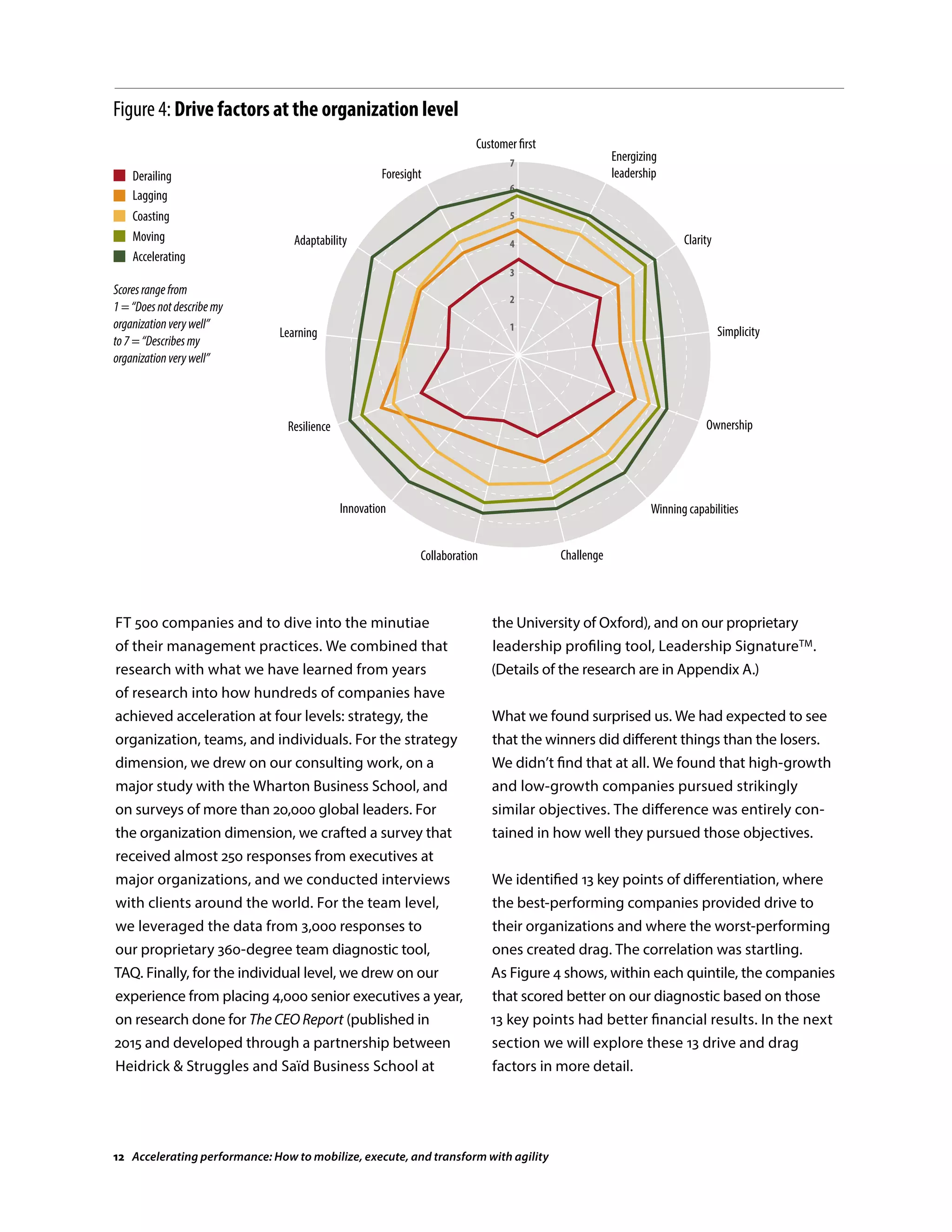
We identified 13 key points of differentiation, where
the best-performing companies provided drive to
their organizations and where the worst-performing
ones created drag. The correlation was startling.
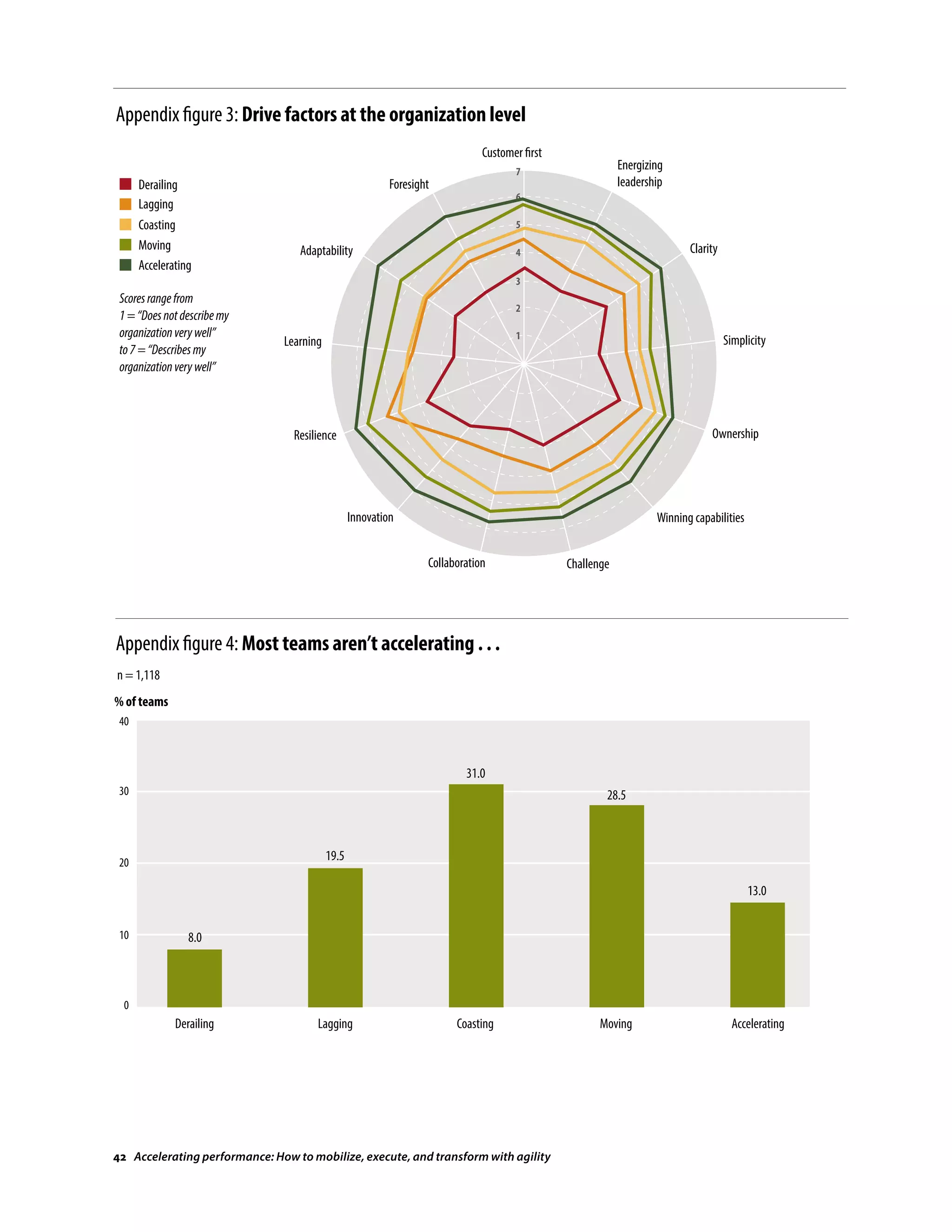
As Figure 4 shows, within each quintile, the companies
that scored better on our diagnostic based on those
13 key points had better financial results. In the next
section we will explore these 13 drive and drag
factors in more detail.
Figure 4: Drive factors at the organization level
Customer first
Source: Heidrick  Struggles
1
2
3
4
5
6
7
Energizing
leadership
Clarity
Simplicity
Ownership
Winning capabilities
ChallengeCollaboration
Innovation
Resilience
Learning
Adaptability
ForesightDerailing
Lagging
Coasting
Moving
Accelerating
Scoresrangefrom
1=“Doesnotdescribemy
organizationverywell”
to7=“Describesmy
organizationverywell”
12 Accelerating performance: How to mobilize, execute, and transform with agility
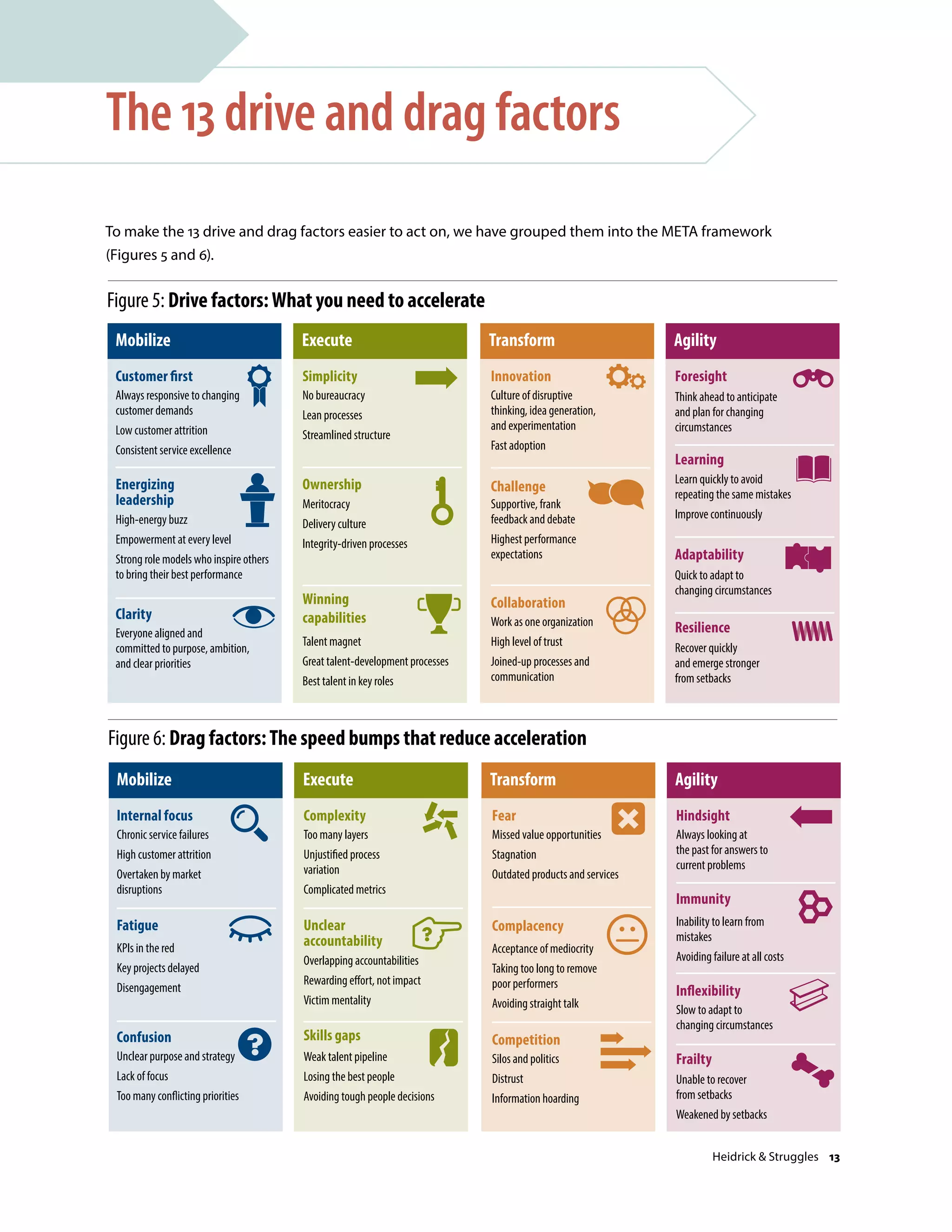
To make the 13 drive and drag factors easier to act on, we have grouped them into the META framework
(Figures 5 and 6).
The 13 drive and drag factors
Figure 5: Drive factors:What you need to accelerate
Source: Heidrick  Struggles
Mobilize Execute Transform Agility
Customer first
Always responsive to changing
customer demands
Low customer attrition
Consistent service excellence
Clarity
Everyone aligned and
committed to purpose, ambition,
and clear priorities
Energizing
leadership
High-energy buzz
Empowerment at every level
Strong role models who inspire others
to bring their best performance
Simplicity
No bureaucracy
Lean processes
Streamlined structure
Winning
capabilities
Talent magnet
Great talent-development processes
Best talent in key roles
Ownership
Meritocracy
Delivery culture
Integrity-driven processes
Innovation
Culture of disruptive
thinking, idea generation,
and experimentation
Fast adoption
Collaboration
Work as one organization
High level of trust
Joined-up processes and
communication
Challenge
Supportive, frank
feedback and debate
Highest performance
expectations
Foresight
Think ahead to anticipate
and plan for changing
circumstances
Adaptability
Resilience
Quick to adapt to
changing circumstances
Learning
Learn quickly to avoid
repeating the same mistakes
Improve continuously
Recover quickly
and emerge stronger
from setbacks
Figure 6: Drag factors:The speed bumps that reduce acceleration
Source: Heidrick  Struggles
Mobilize Execute Transform Agility
Internal focus
Chronic service failures
High customer attrition
Overtaken by market
disruptions
Confusion
Unclear purpose and strategy
Lack of focus
Too many conflicting priorities
Fatigue
KPIs in the red
Key projects delayed
Disengagement
Complexity
Too many layers
Unjustified process
variation
Complicated metrics
Skills gaps
Weak talent pipeline
Losing the best people
Avoiding tough people decisions
Unclear
accountability
Overlapping accountabilities
Rewarding effort, not impact
Victim mentality
Fear
Missed value opportunities
Stagnation
Outdated products and services
Competition
Silos and politics
Distrust
Information hoarding
Complacency
Acceptance of mediocrity
Taking too long to remove
poor performers
Avoiding straight talk
Hindsight
Always looking at
the past for answers to
current problems
Inflexibility
Frailty
Slow to adapt to
changing circumstances
Immunity
Inability to learn from
mistakes
Avoiding failure at all costs
Unable to recover
from setbacks
Weakened by setbacks
Heidrick  Struggles 13
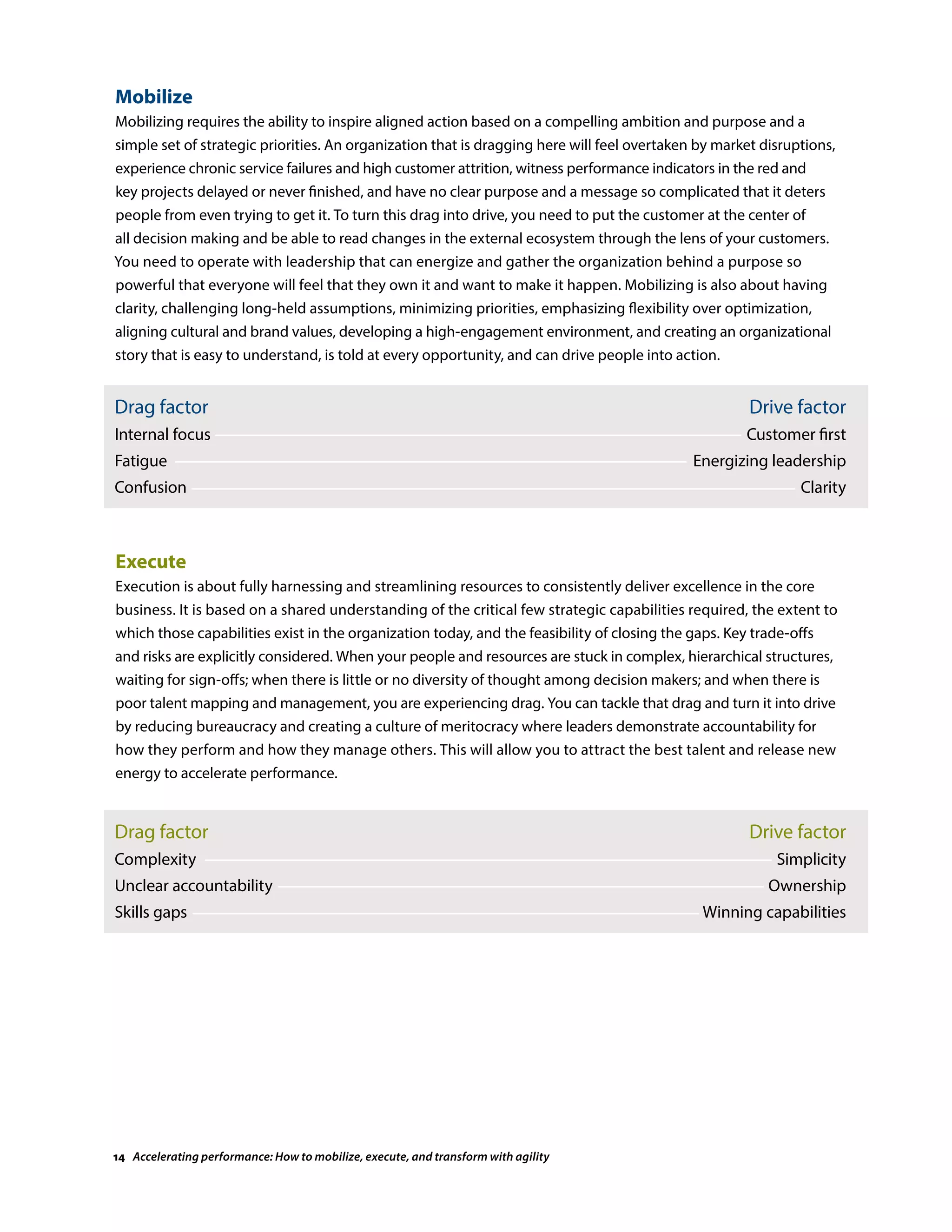
Mobilize
Mobilizing requires the ability to inspire aligned action based on a compelling ambition and purpose and a
simple set of strategic priorities. An organization that is dragging here will feel overtaken by market disruptions,
experience chronic service failures and high customer attrition, witness performance indicators in the red and
key projects delayed or never finished, and have no clear purpose and a message so complicated that it deters
people from even trying to get it. To turn this drag into drive, you need to put the customer at the center of
all decision making and be able to read changes in the external ecosystem through the lens of your customers.
You need to operate with leadership that can energize and gather the organization behind a purpose so
powerful that everyone will feel that they own it and want to make it happen. Mobilizing is also about having
clarity, challenging long-held assumptions, minimizing priorities, emphasizing flexibility over optimization,
aligning cultural and brand values, developing a high-engagement environment, and creating an organizational
story that is easy to understand, is told at every opportunity, and can drive people into action.
Drag factor
Internal focus
Fatigue
Confusion
Drive factor
Customer first
Energizing leadership
Clarity
Execute
Execution is about fully harnessing and streamlining resources to consistently deliver excellence in the core
business. It is based on a shared understanding of the critical few strategic capabilities required, the extent to
which those capabilities exist in the organization today, and the feasibility of closing the gaps. Key trade-offs
and risks are explicitly considered. When your people and resources are stuck in complex, hierarchical structures,
waiting for sign-offs; when there is little or no diversity of thought among decision makers; and when there is
poor talent mapping and management, you are experiencing drag. You can tackle that drag and turn it into drive
by reducing bureaucracy and creating a culture of meritocracy where leaders demonstrate accountability for
how they perform and how they manage others. This will allow you to attract the best talent and release new
energy to accelerate performance.
Drag factor
Complexity
Unclear accountability
Skills gaps
Drive factor
Simplicity
Ownership
Winning capabilities
14 Accelerating performance: How to mobilize, execute, and transform with agility
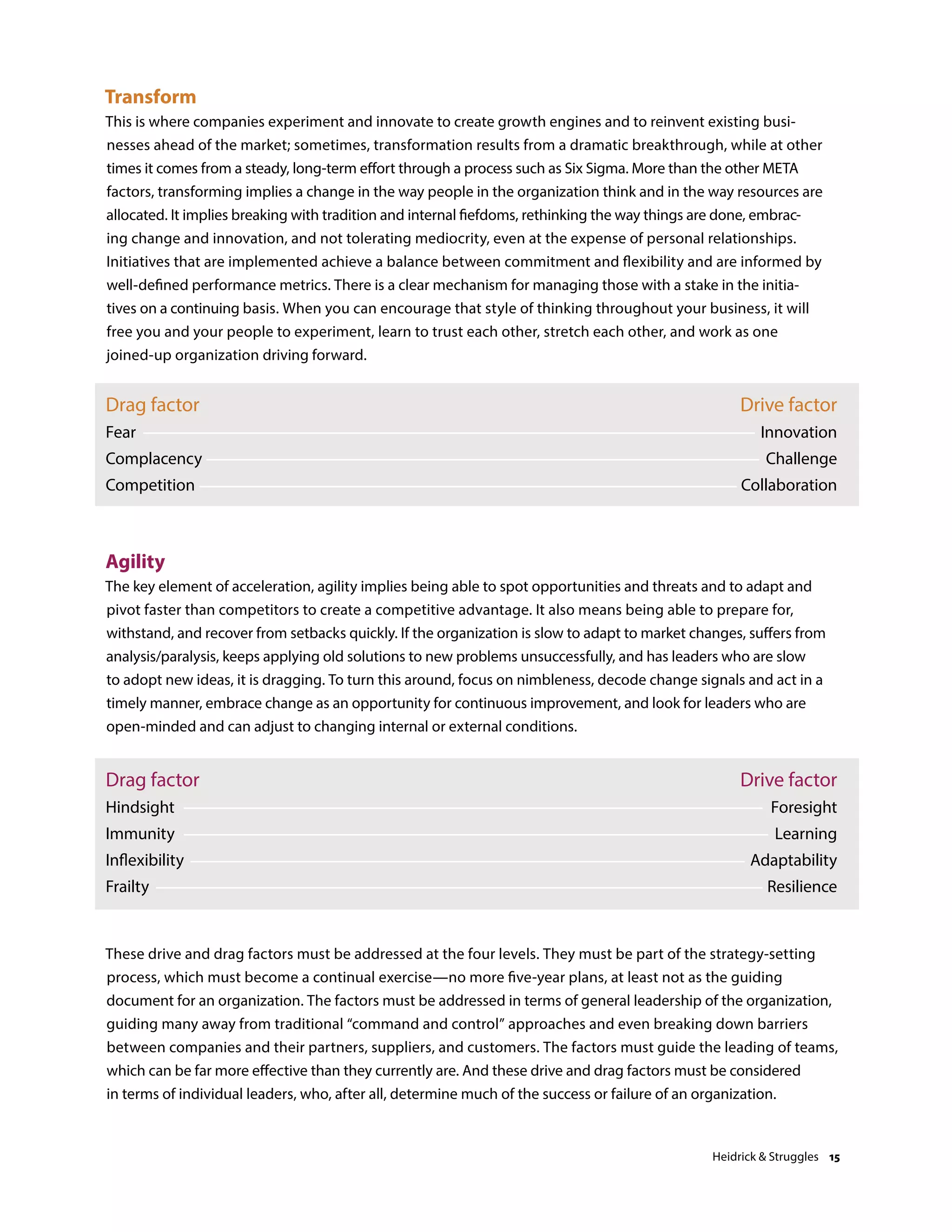
Drag factor
Fear
Complacency
Competition
Drive factor
Innovation
Challenge
Collaboration
Agility
The key element of acceleration, agility implies being able to spot opportunities and threats and to adapt and
pivot faster than competitors to create a competitive advantage. It also means being able to prepare for,
withstand, and recover from setbacks quickly. If the organization is slow to adapt to market changes, suffers from
analysis/paralysis, keeps applying old solutions to new problems unsuccessfully, and has leaders who are slow
to adopt new ideas, it is dragging. To turn this around, focus on nimbleness, decode change signals and act in a
timely manner, embrace change as an opportunity for continuous improvement, and look for leaders who are
open-minded and can adjust to changing internal or external conditions.
Drag factor
Hindsight
Immunity
Inflexibility
Frailty
Drive factor
Foresight
Learning
Adaptability
Resilience
Transform
This is where companies experiment and innovate to create growth engines and to reinvent existing busi-
nesses ahead of the market; sometimes, transformation results from a dramatic breakthrough, while at other
times it comes from a steady, long-term effort through a process such as Six Sigma. More than the other META
factors, transforming implies a change in the way people in the organization think and in the way resources are
allocated. It implies breaking with tradition and internal fiefdoms, rethinking the way things are done, embrac-
ing change and innovation, and not tolerating mediocrity, even at the expense of personal relationships.
Initiatives that are implemented achieve a balance between commitment and flexibility and are informed by
well-defined performance metrics. There is a clear mechanism for managing those with a stake in the initia-
tives on a continuing basis. When you can encourage that style of thinking throughout your business, it will
free you and your people to experiment, learn to trust each other, stretch each other, and work as one
joined-up organization driving forward.
These drive and drag factors must be addressed at the four levels. They must be part of the strategy-setting
process, which must become a continual exercise—no more five-year plans, at least not as the guiding
document for an organization. The factors must be addressed in terms of general leadership of the organization,
guiding many away from traditional “command and control” approaches and even breaking down barriers
between companies and their partners, suppliers, and customers. The factors must guide the leading of teams,
which can be far more effective than they currently are. And these drive and drag factors must be considered
in terms of individual leaders, who, after all, determine much of the success or failure of an organization.
Heidrick  Struggles 15
Of course, the big question is, “If both high- and low-
growth companies attempt to be great on these
13 drive factors, what are the winners doing that dif-
ferentiates them?” We dug deep into the management
practices of the superaccelerators and identified
3 actions for each of the 13 drive factors. We think of
these 39 actions as similar to the elements on the
periodic table, in that they can be combined with
one another in a virtually limitless range of different
options for organizations. No one company we
observed implemented all of these actions; instead,
the superaccelerators adroitly combined the most
critical ones into a winning recipe, given their context.
Differentiating actions
Thirty-nine actions is a lot, and not all will require
new thinking at every organization. But, in our
experience, many will serve as a sort of mirror; when
an organization holds that mirror up in front of
itself, it will find that it doesn’t look quite like it hoped
it did or thinks it should. So, we suggest running
through the list of actions to see which resonate and
then digging deeper into those. In later sections,
we’ll explain how to develop the capabilities necessary
to make changes and to turn your list of needed
actions into a recipe for success.
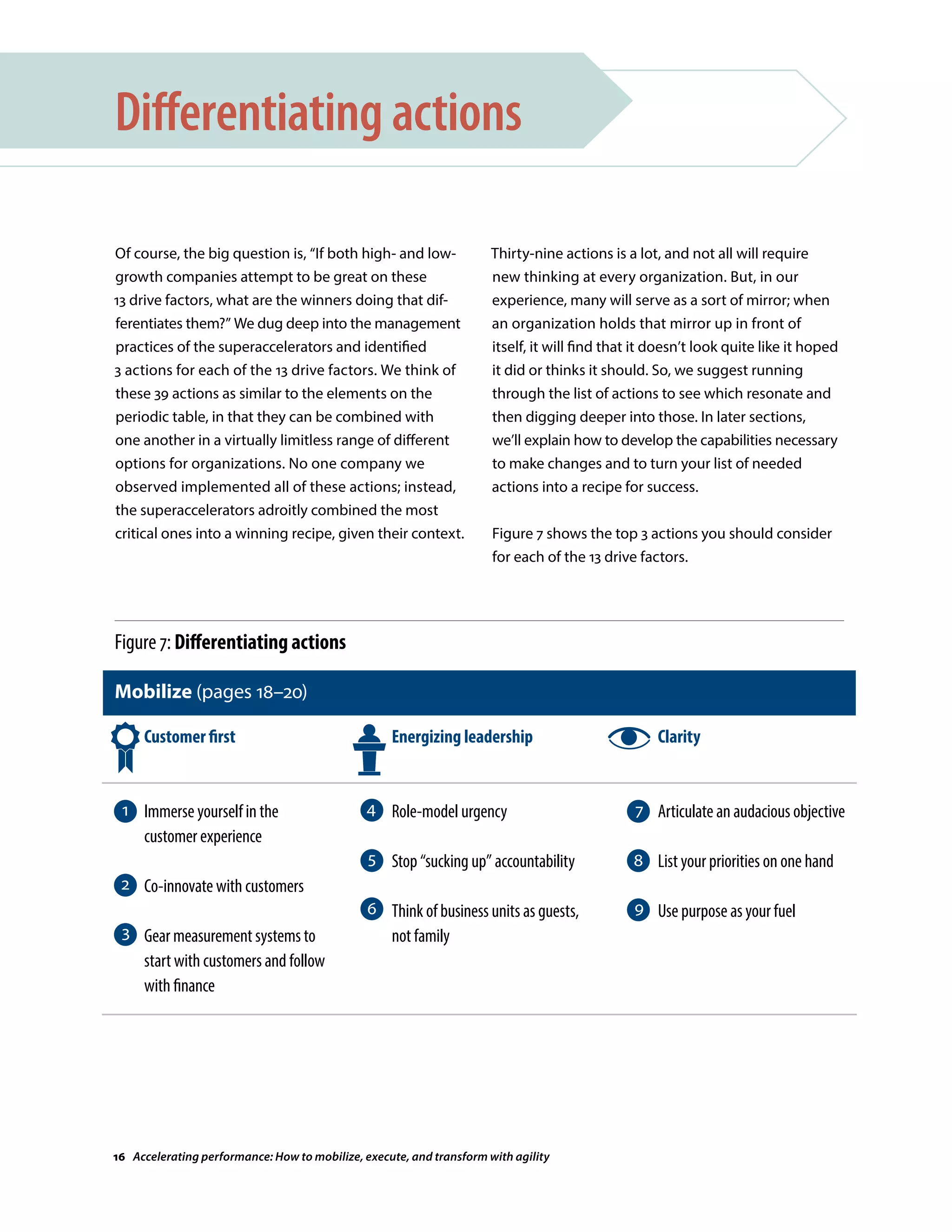
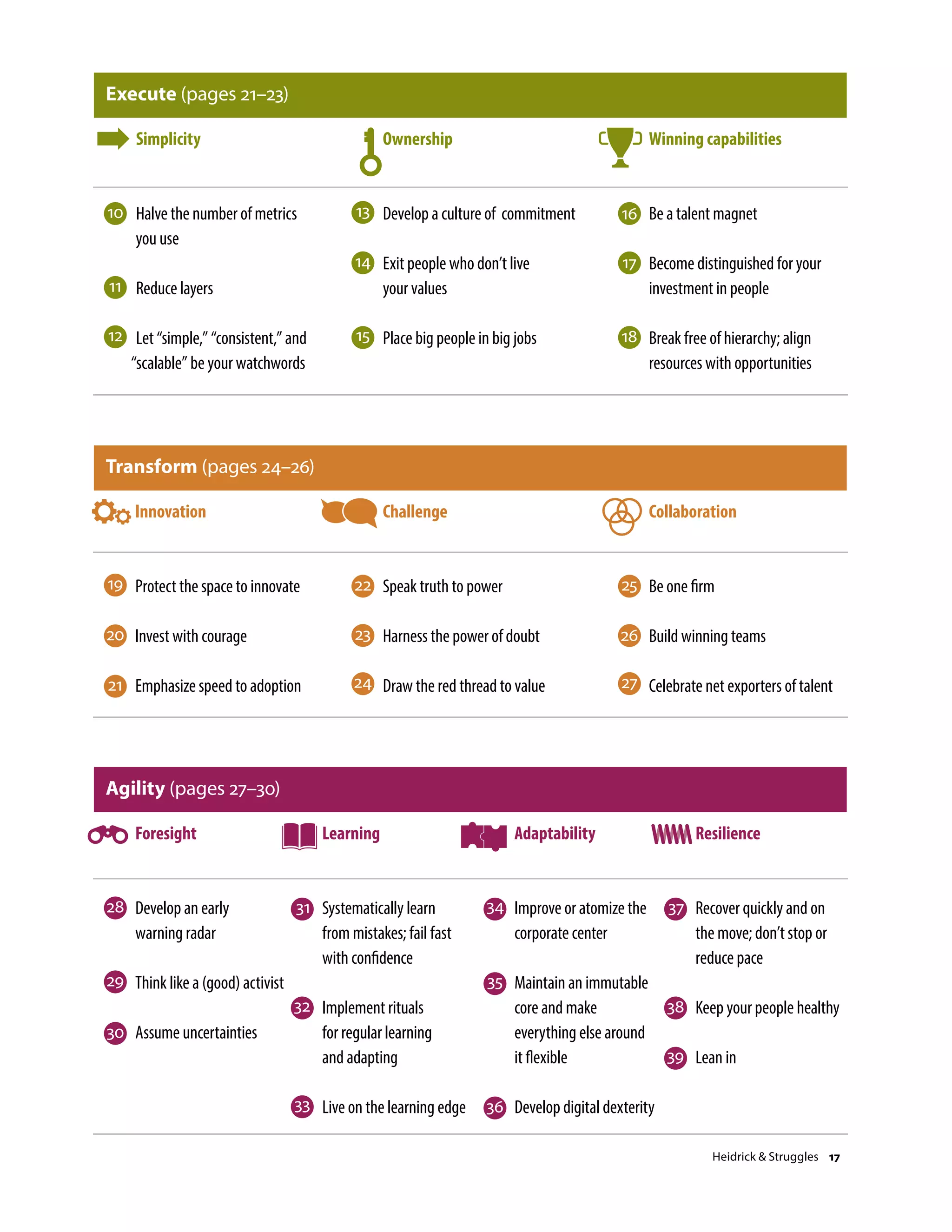
Figure 7 shows the top 3 actions you should consider
for each of the 13 drive factors.
Mobilize (pages 18–20)
Customer first
Immerse yourself in the
customer experience
Co-innovate with customers
Gear measurement systems to
start with customers and follow
with finance
Energizing leadership
Role-model urgency
Stop “sucking up” accountability
Think of business units as guests,
not family
Clarity
Articulate an audacious objective
List your priorities on one hand
Use purpose as your fuel
1
2
3
4
5
6
7
8
9
Figure 7: Differentiating actions
16 Accelerating performance: How to mobilize, execute, and transform with agility
Execute (pages 21–23)
Simplicity
Halve the number of metrics
you use
Reduce layers
Let “simple,” “consistent,” and
“scalable” be your watchwords
Ownership
Develop a culture of commitment
Exit people who don’t live
your values
Place big people in big jobs
Winning capabilities
Be a talent magnet
Become distinguished for your
investment in people
Break free of hierarchy; align
resources with opportunities
10
11
12
13
14
15
16
17
18
Transform (pages 24–26)
Innovation
Protect the space to innovate
Invest with courage
Emphasize speed to adoption
Challenge
Speak truth to power
Harness the power of doubt
Draw the red thread to value
Collaboration
Be one firm
Build winning teams
Celebrate net exporters of talent
19
20
21
22
23
24
25
26
27
Agility (pages 27–30)
Foresight
Develop an early
warning radar
Think like a (good) activist
Assume uncertainties
Learning
Systematically learn
from mistakes; fail fast
with confidence
Implement rituals
for regular learning
and adapting
Live on the learning edge
Adaptability
Improve or atomize the
corporate center
Maintain an immutable
core and make
everything else around
it flexible
Develop digital dexterity
28
29
30
31
32
33
34
35
36
Resilience
Recover quickly and on
the move; don’t stop or
reduce pace
Keep your people healthy
Lean in
37
38
39
Heidrick  Struggles 17
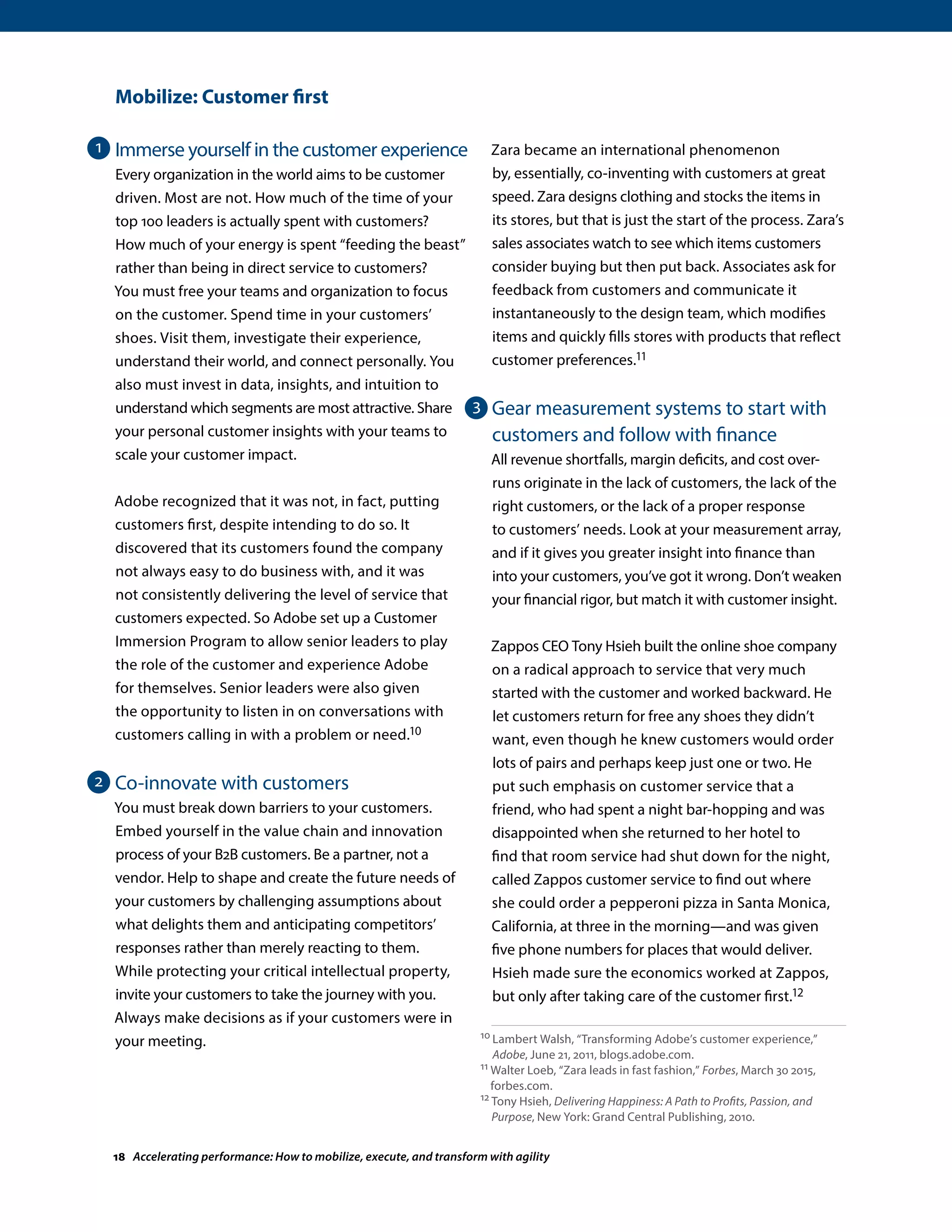
Mobilize: Customer first
Immerse yourself in the customer experience
Every organization in the world aims to be customer
driven. Most are not. How much of the time of your
top 100 leaders is actually spent with customers?
How much of your energy is spent “feeding the beast”
rather than being in direct service to customers?
You must free your teams and organization to focus
on the customer. Spend time in your customers’
shoes. Visit them, investigate their experience,
understand their world, and connect personally. You
also must invest in data, insights, and intuition to
understand which segments are most attractive. Share
your personal customer insights with your teams to
scale your customer impact.
Adobe recognized that it was not, in fact, putting
customers first, despite intending to do so. It
discovered that its customers found the company
not always easy to do business with, and it was
not consistently delivering the level of service that
customers expected. So Adobe set up a Customer
Immersion Program to allow senior leaders to play
the role of the customer and experience Adobe
for themselves. Senior leaders were also given
the opportunity to listen in on conversations with
customers calling in with a problem or need.10
Co-innovate with customers
You must break down barriers to your customers.
Embed yourself in the value chain and innovation
process of your B2B customers. Be a partner, not a
vendor. Help to shape and create the future needs of
your customers by challenging assumptions about
what delights them and anticipating competitors’
responses rather than merely reacting to them.
While protecting your critical intellectual property,
invite your customers to take the journey with you.
Always make decisions as if your customers were in
your meeting.
Zara became an international phenomenon
by, essentially, co-inventing with customers at great
speed. Zara designs clothing and stocks the items in
its stores, but that is just the start of the process. Zara’s
sales associates watch to see which items customers
consider buying but then put back. Associates ask for
feedback from customers and communicate it
instantaneously to the design team, which modifies
items and quickly fills stores with products that reflect
customer preferences.11
Gear measurement systems to start with
customers and follow with finance
All revenue shortfalls, margin deficits, and cost over-
runs originate in the lack of customers, the lack of the
right customers, or the lack of a proper response
to customers’ needs. Look at your measurement array,
and if it gives you greater insight into finance than
into your customers, you’ve got it wrong. Don’t weaken
your financial rigor, but match it with customer insight.
Zappos CEO Tony Hsieh built the online shoe company
on a radical approach to service that very much
started with the customer and worked backward. He
let customers return for free any shoes they didn’t
want, even though he knew customers would order
lots of pairs and perhaps keep just one or two. He
put such emphasis on customer service that a
friend, who had spent a night bar-hopping and was
disappointed when she returned to her hotel to
find that room service had shut down for the night,
called Zappos customer service to find out where
she could order a pepperoni pizza in Santa Monica,
California, at three in the morning—and was given
five phone numbers for places that would deliver.
Hsieh made sure the economics worked at Zappos,
but only after taking care of the customer first.12
10 Lambert Walsh, “Transforming Adobe’s customer experience,”
Adobe, June 21, 2011, blogs.adobe.com.
11 Walter Loeb, “Zara leads in fast fashion,” Forbes, March 30 2015,
forbes.com.
12 Tony Hsieh, Delivering Happiness: A Path to Profits, Passion, and
Purpose, New York: Grand Central Publishing, 2010.
1
2
3
18 Accelerating performance: How to mobilize, execute, and transform with agility
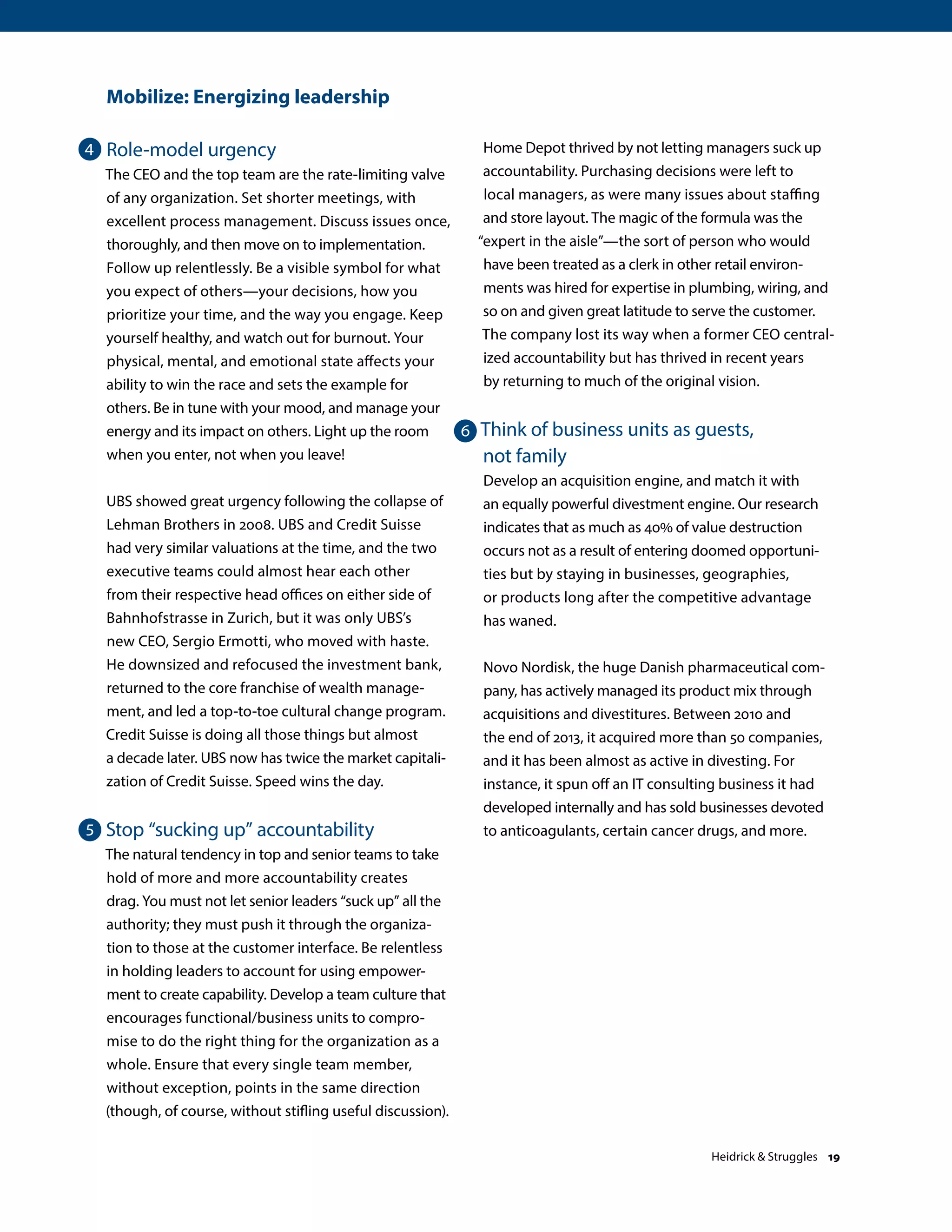
Mobilize: Energizing leadership
Role-model urgency
The CEO and the top team are the rate-limiting valve
of any organization. Set shorter meetings, with
excellent process management. Discuss issues once,
thoroughly, and then move on to implementation.
Follow up relentlessly. Be a visible symbol for what
you expect of others—your decisions, how you
prioritize your time, and the way you engage. Keep
yourself healthy, and watch out for burnout. Your
physical, mental, and emotional state affects your
ability to win the race and sets the example for
others. Be in tune with your mood, and manage your
energy and its impact on others. Light up the room
when you enter, not when you leave!
UBS showed great urgency following the collapse of
Lehman Brothers in 2008. UBS and Credit Suisse
had very similar valuations at the time, and the two
executive teams could almost hear each other
from their respective head offices on either side of
Bahnhofstrasse in Zurich, but it was only UBS’s
new CEO, Sergio Ermotti, who moved with haste.
He downsized and refocused the investment bank,
returned to the core franchise of wealth manage-
ment, and led a top-to-toe cultural change program.
Credit Suisse is doing all those things but almost
a decade later. UBS now has twice the market capitali-
zation of Credit Suisse. Speed wins the day.
Stop “sucking up” accountability
The natural tendency in top and senior teams to take
hold of more and more accountability creates
drag. You must not let senior leaders “suck up” all the
authority; they must push it through the organiza-
tion to those at the customer interface. Be relentless
in holding leaders to account for using empower-
ment to create capability. Develop a team culture that
encourages functional/business units to compro-
mise to do the right thing for the organization as a
whole. Ensure that every single team member,
without exception, points in the same direction
(though, of course, without stifling useful discussion).
Home Depot thrived by not letting managers suck up
accountability. Purchasing decisions were left to
local managers, as were many issues about staffing
and store layout. The magic of the formula was the
“expert in the aisle”—the sort of person who would
have been treated as a clerk in other retail environ-
ments was hired for expertise in plumbing, wiring, and
so on and given great latitude to serve the customer.
The company lost its way when a former CEO central-
ized accountability but has thrived in recent years
by returning to much of the original vision.
Think of business units as guests,
not family
Develop an acquisition engine, and match it with
an equally powerful divestment engine. Our research
indicates that as much as 40% of value destruction
occurs not as a result of entering doomed opportuni-
ties but by staying in businesses, geographies,
or products long after the competitive advantage
has waned.
Novo Nordisk, the huge Danish pharmaceutical com-
pany, has actively managed its product mix through
acquisitions and divestitures. Between 2010 and
the end of 2013, it acquired more than 50 companies,
and it has been almost as active in divesting. For
instance, it spun off an IT consulting business it had
developed internally and has sold businesses devoted
to anticoagulants, certain cancer drugs, and more.
4
5
6
Heidrick  Struggles 19
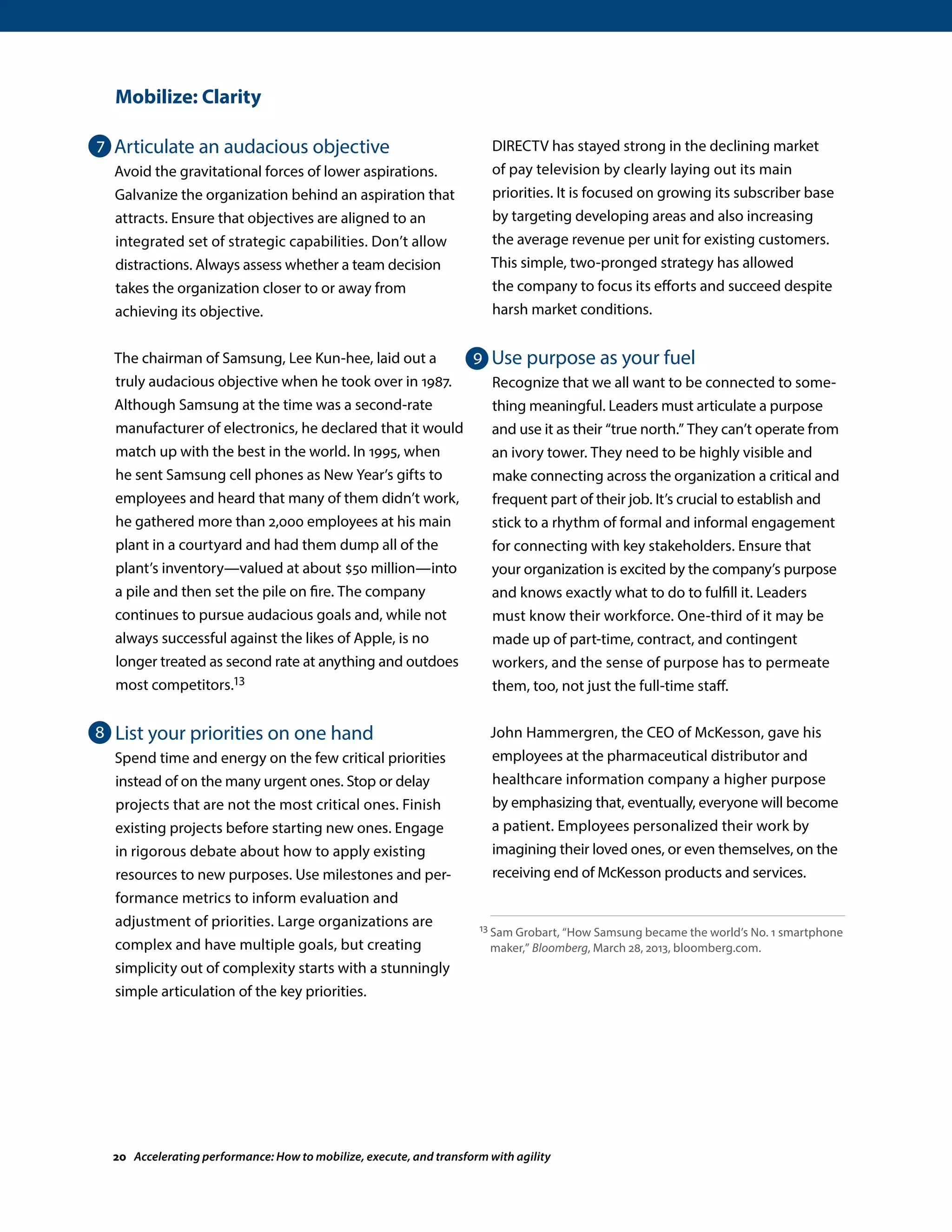
Mobilize: Clarity
Articulate an audacious objective
Avoid the gravitational forces of lower aspirations.
Galvanize the organization behind an aspiration that
attracts. Ensure that objectives are aligned to an
integrated set of strategic capabilities. Don’t allow
distractions. Always assess whether a team decision
takes the organization closer to or away from
achieving its objective.
The chairman of Samsung, Lee Kun-hee, laid out a
truly audacious objective when he took over in 1987.
Although Samsung at the time was a second-rate
manufacturer of electronics, he declared that it would
match up with the best in the world. In 1995, when
he sent Samsung cell phones as New Year’s gifts to
employees and heard that many of them didn’t work,
he gathered more than 2,000 employees at his main
plant in a courtyard and had them dump all of the
plant’s inventory—valued at about $50 million—into
a pile and then set the pile on fire. The company
continues to pursue audacious goals and, while not
always successful against the likes of Apple, is no
longer treated as second rate at anything and outdoes
most competitors.13
List your priorities on one hand
Spend time and energy on the few critical priorities
instead of on the many urgent ones. Stop or delay
projects that are not the most critical ones. Finish
existing projects before starting new ones. Engage
in rigorous debate about how to apply existing
resources to new purposes. Use milestones and per-
formance metrics to inform evaluation and
adjustment of priorities. Large organizations are
complex and have multiple goals, but creating
simplicity out of complexity starts with a stunningly
simple articulation of the key priorities.
DIRECTV has stayed strong in the declining market
of pay television by clearly laying out its main
priorities. It is focused on growing its subscriber base
by targeting developing areas and also increasing
the average revenue per unit for existing customers.
This simple, two-pronged strategy has allowed
the company to focus its efforts and succeed despite
harsh market conditions.
Use purpose as your fuel
Recognize that we all want to be connected to some-
thing meaningful. Leaders must articulate a purpose
and use it as their “true north.” They can’t operate from
an ivory tower. They need to be highly visible and
make connecting across the organization a critical and
frequent part of their job. It’s crucial to establish and
stick to a rhythm of formal and informal engagement
for connecting with key stakeholders. Ensure that
your organization is excited by the company’s purpose
and knows exactly what to do to fulfill it. Leaders
must know their workforce. One-third of it may be
made up of part-time, contract, and contingent
workers, and the sense of purpose has to permeate
them, too, not just the full-time staff.
John Hammergren, the CEO of McKesson, gave his
employees at the pharmaceutical distributor and
healthcare information company a higher purpose
by emphasizing that, eventually, everyone will become
a patient. Employees personalized their work by
imagining their loved ones, or even themselves, on the
receiving end of McKesson products and services.
13 Sam Grobart, “How Samsung became the world’s No. 1 smartphone
maker,” Bloomberg, March 28, 2013, bloomberg.com.
7
8
9
20 Accelerating performance: How to mobilize, execute, and transform with agility
Execute: Simplicity
Halve the number of metrics you use
Organizations are able to collect any piece of data they
want these days. All could potentially be used to
make decisions in one way or another. This abundance
of data, instead of helping companies make better
decisions, is stifling their ability to react quickly and
smartly to events as they unfold. Pick a limited set
of metrics for your scorecard. Understand your reasons
for picking those metrics and how they affect your
business. Make decisions based solely on those
metrics, and remain open to always questioning
the applicability of the metrics to the changing
realities of your business.
Danaher’s metrics reflect the company’s focus
on shareholders, customers, and people. Core growth,
operating-margin expansion, working-capital returns,
and return on invested capital are the four shareholder-
facing financial metrics. The two customer-facing
metrics are on-time delivery—measured against when
the customer wanted the company to deliver some-
thing (even if that was yesterday)—and external
quality as a broad measure of every dimension of a
customer experience. Finally, there are two human-
capital metrics: internal fill rate (the percentage of
managerial positions filled with internal candidates)
and retention. According to CEO Thomas Joyce,
“Every Danaher business uses those eight metrics to
answer the question: Are we winning?”14
Reduce layers
Simplify your structure. Have no more than five to
seven layers between the CEO and the front line,
depending on the scope of your organization (global
versus local). If you have leaders who cannot cope
with the necessary number of direct reports—usually
10 to 15—then change your leaders.
Apple’s hierarchy might remind you of a small busi-
ness. The late Steve Jobs liked to keep management
simple. He did not like layers of high-level people,
and the company keeps the same management style
today. It was Jobs’s contention that having layers
of management took the focus off of the task at hand,
and that task, in his opinion, was designing and
building the best products on the planet. Even after
his death, much remains the same at Apple.
Let “simple,” “consistent,” and “scalable”
be your watchwords
Cut through the creeping complexity of overlap-
ping, redundant processes. Continuously improve and
streamline the core business to ensure continued
relevance and competitiveness and the cash flow to
invest in transformation and the future. Decide
what not to do. Enable speed of progress and delivery
by regularly deprioritizing distractions.
In 2004, an MIT professor known for his work on
simplicity and four other outsiders—an architect, a
car designer, a fashion designer, and a radiologist—
were appointed by Philips Electronics to a simplicity
advisory board to help the company negotiate its
transition from an electronics giant to a healthcare
and domestic electronics company under the new
corporate initiative, “Sense and Simplicity.” The board
looked at the entire company, not just products.
London fashion designer Sara Berman, one of the
board members, says, “Our job was to say, ‘What
is simplicity, and how are we going to make Philips be
the bearer of that banner?’”15
14 George L. Roth and Art Kleiner, “Danaher's instruments of change,”
strategy+business, February 8, 2016, strategy-business.com.
15 John Morrish, “Simplicity: Not as easy as it looks,” Management Today,
April 1, 2008, managementtoday.co.uk.
10
11
12
Heidrick  Struggles 21
Execute: Ownership
Develop a culture of commitment
Once a commitment is made, bank it. Leaders must
be intolerant of renegotiation, unless important, new
information appears. Ruthlessly hold each other
and the team to account as a normal part of “how we
do things around here.” This culture of commitment
needs to empower people to lead.
Southwest Airlines is known for its culture of commit-
ment, which legendary founder Herb Kelleher said
stems from a decision to let employees be themselves.
He said, “If you create an environment where the
people truly participate, you don’t need control. They
know what needs to be done, and they do it. And the
more that people will devote themselves to your cause
on a voluntary basis, a willing basis, the fewer hierarchs
and control mechanisms you need. We’re not looking
for blind obedience. We’re looking for people who on
their own initiative want to be doing what they’re doing
because they consider it to be a worthy objective.”16
Exit people who don’t live your values
In an uncertain and volatile business environment,
an organization’s values are the anchor that keeps the
organization solidly positioned in the marketplace.
People who are unwilling or unable to live those values
will only produce drag. Once you have aligned your
values with META, you need to establish mechanisms
to quickly identify those people who are not living
the values—particularly after a change in values—and
exit them from the organization in a way that is not
disruptive but sends an important message to internal
and external stakeholders.
After employees joined Comergent, a supplier of
e-business software applications acquired by ATT's
Sterling Commerce in 2006, they were continually
reminded that the company’s values of dependability,
dedication, and self-motivation were more than
just words. The top team used these values as a metric
when designating stock, bonuses, and raises. Even
deciding whether to let someone go was influenced
by values. “I can work with someone who needs more
coaching or training, but when it comes to our
core values, I have to be intolerant,” CEO Jean Kovacs
explained in 2002. “That’s what ensures the strength
of our culture.”17
Place big people in big jobs
Know your people and know your jobs, and make sure
that the best people get the big jobs. This ensures
that you keep your best people engaged and interested
and also that the rest of the organization learns from
those who do things better. Putting the best people in
big jobs also sends signals to the market about the
seriousness of your organization.
By breaking with traditional thinking about creden-
tials, the Pittsburgh Steelers have put the best people
in the big jobs and have been the most successful
franchise in the modern era of American football. The
team had been a laughingstock for four decades
before it identified Chuck Noll as a talent and made
him the youngest head coach in league history in 1969,
at the tender age of 37. He won four Super Bowls for
Pittsburgh before retiring at the end of the 1991 season.
The Steelers named a 34-year-old head coach to replace
Noll, and he won a Super Bowl in his 15 years with the
team before stepping aside in favor of another 34-year-
old, who has also won a Super Bowl. While roughly
a quarter of the head coaches in the league turn over
every year, the Steelers have had only three in nearly
half a century and have won more championships
in that stretch than any other franchise. The team has
broken with tradition and focused on talent in other
ways, too: it had the league’s first black starting quarter-
back, first black assistant coach, and first black coordinator,
and its current head coach is black. Indeed, the team’s
practice of interviewing diverse candidates for important
jobs was made league policy in 2003 and is known as
the “Rooney Rule,” after the team’s owner, Dan Rooney.
16 Herb Kelleher, “A culture of commitment,” Leader to Leader, no. 4,
Spring 1997, slsglobal.com.
17 Patrick M. Lencioni, “Make your values mean something,” Harvard
Business Review, July 2002, hbr.org.
13
14
15
22 Accelerating performance: How to mobilize, execute, and transform with agility
Execute: Winning capabilities
Be a talent magnet
Scan the world for the very best, starting at the top
and working all the way through the front line, so that
the company is a preferred place to work at every
level. The difference between good and great talent
is orders of magnitude. Poor talent huddles together.
Once you tolerate having second-best people for their
roles, the best will leave.
Starbucks is known for its highly knowledgeable
employees. They are the main assets of the company,
and they are provided with great benefits such
as stock options, retirement accounts, and a healthy
culture. This effective human-capital management
translates into great customer service. Starbucks was
rated 94th in the 100 best places to work by Fortune
magazine in 2013. The company attracts exceptional
talent and retains frontline employees, and this in
an industry known for high turnover.
Become distinguished for your
investment in people
Continually develop your talent. Provide regular feed-
back and act as a coach and mentor. Once you
hire people with growth mind-sets, invest in all forms
of learning and development—coaching, stretch
assignments, self-initiated training—not just tradi-
tional “courses.” Push out complacency by making
it clear that learners are the only ones who get ahead.
Use partnerships, joint ventures, acquisitions, and
talent-attraction mechanisms to quickly obtain the
required capacity and capability.
Recognized as one of the firms that invests the most
in the development of its workforce, Google focuses
on hiring “learning animals” and generalists as
opposed to specialists. The main reason is that, because
of the dynamics of the industry, where conditions
are changing fast, things such as experience and the
way you’ve done a role before aren’t nearly as
important as your ability to think and be developed.
Break free of hierarchy; align resources
with opportunities
When making resource-allocation decisions, make
sure that you match your best resources to your
best opportunities. Let go of traditional, hard-wired
approaches that use a division-based view of the
organization as the main criteria to allocate critical
resources such as people, capital, or intellectual
property. Determine which opportunities will yield
the most promising results, and then marshal the
best resources from within the organization to ensure
that this potential is realized. Understand the intri-
cacies of gathering resources you don’t necessarily
own and prepare to make good business cases to
the owners.
At Infosys, budgets are adjusted on a rolling four-
quarter basis. The company prides itself on being able
to reallocate resources very quickly, and it does.
Infosys makes it obvious to anyone when a business
does not need that many resources. In fact, it is not
unusual for businesses to call the corporate planning
department to give back some resources they could
not support in a specific quarter. High-quality data and
total transparency help sustain this approach.
16
17
18
Heidrick  Struggles 23
Transform: Innovation
Protect the space to innovate
Create incubators and nurseries to enable growth.
Create a culture in which it is safe to fail and learn fast.
Bring outside ideas in. Track how often new ideas
are adopted from the external world, and improve on
that record. Leverage differences of perspective. Build
routines and rituals that call forth a range of insights
and ideas. Constantly look for and challenge biases
in framing and gathering intelligence and coming to
conclusions that may reinforce the status quo.
Although Microsoft hasn’t always been known for
innovation, it announced that the Microsoft Garage
was morphing into an incubator for lightweight,
consumer-focused apps for Android, iOS, and
Windows devices. The Microsoft Garage started out
in 2009 as part of Office Labs. At that time, it was
designed to enable employees to “embrace their
inner innovator and explore grassroots projects,
mostly as side projects.” But now the Garage’s new
mission is to make these kinds of side-project apps,
as well as apps from other parts of the company,
including Microsoft Research, available externally,
making a formal commitment that will protect the
space for innovation.18
Invest with courage
Encourage disruptive thinking. Go with instinct first,
and then back it up with empirical data that includes an
assessment of the risks and assumptions underlying
the choices made. Use healthy and growing sources of
cash and a stable platform to launch disruptive forays
into the unknown. Measure innovations achieved.
Target and track the introduction and impact of new
products, services, processes, markets, customer
interactions, and improvements for employees.
GM showed not only technical foresight when
it launched its OnStar telematics system in 1996 but
also the ability to invest with courage. Many inside
the company wanted OnStar to be available only as
an option, to limit the downside if OnStar proved
unpopular. Many others wanted OnStar to be available
only on luxury GM brands, viewing OnStar solely
as a way to sell more cars. But management felt that
OnStar needed to have critical mass to have a chance
and installed it as standard equipment across much of
the product line. Analysts say OnStar now accounts
for about a third of GM’s $46 billion of market value.
GM is showing similar courage with aggressive
investments in driverless cars, even though they could
represent a threat to its long-standing business
model because the cars would likely be bought and
operated by fleets, not individuals.
Emphasize speed to adoption
Push the rate at which great ideas spread across your
organization. Establish the systems, processes, and
culture that enable good ideas to be scaled quickly.
Pinpoint those who have a stake in the initiatives and
communicate intentions clearly, early, and continually.
Chinese Internet company Tencent uses simultaneous
product development and rapid “launch-test-
improve” cycles to speed innovation in business
models, effectively harnessing user feedback to
rapidly improve the quality and functionality of its
products after they are launched. Tencent developed
WeChat, which added mobile payments in 2013;
Facebook didn’t announce an online payment system
until 2015. WeChat allowed users to set up online
stores in 2014; Facebook added a feature that allows
retailers to sell from Facebook pages in 2015.
18 Mary Jo Foley, “Microsoft Garage incubator delivers new
Windows Phone, Android productivity apps,” ZDNet, February 25,
2015, zdnet.com.
19
20
21
24 Accelerating performance: How to mobilize, execute, and transform with agility
Transform: Challenge
Speak truth to power
Encourage straight talking. Value those who speak
up. Celebrate the art of giving and receiving difficult
messages. Remove the poor performers quickly.
Rupture and repair. Enable conversations that have
heat and energy. Encourage team members to
tussle hard with difficult topics and build the skills to
repair relationships.
Rosabeth Moss Kanter, the prolific author and former
editor of Harvard Business Review, tells a story that
shows both the value of speaking truth to power and
how hard it is to set up the right environment.
She says an executive told her about taking over
responsibility for a textile manufacturing plant as
a young manager and announcing to the workforce
that he welcomed all ideas about how to improve
operations. He was met with silence. Finally, after he
spent some months trying to demonstrate his
sincerity, a worker approached him and said he
thought he knew how to keep a delicate thread from
snapping during weaving, a problem that caused
lots of downtime. The manager liked the idea, tried
it, and found that it worked, improving profits by
millions of dollars a year. He went back to the worker,
thanked him, gave him a bonus, and asked how
long the worker had suspected he knew how to fix the
problem. “Thirty-two years,” the worker replied.19
Harness the power of doubt
Measure yourself and the organization not against
the past but against challenges not yet known.
Embrace paradox. Challenge yourself to go beyond
linear thinking. Reframe the problem and find
both–and solutions to seemingly conflicting priorities
(for example, winning today and investing in
the future; executing in the core business while trans-
forming and investing in the future). Mine for
conflict. Work hard to understand, name, and tackle
power dynamics and hidden issues. Put an end
to team meetings characterized by artificial harmony
or outright aggression.
When, in 1998, Russia defaulted on its foreign debt
and the ruble crashed, Mars, Incorporated came to
a halt. Its whole customer base stopped ordering
its products, because no one had money to pay for
them. Instead of pulling out of the market, Mars
welcomed the doubt: it gave its customers a lifeline,
offering them products that they did not have to
pay for until the products were sold. This saved many
of its customers from bankruptcy and allowed
them to continue to operate in uncertain times. This
unusual response ensured that Mars, together with
its customers, was in a position to thrive following the
crisis when many others had closed their doors.
Draw the red thread to value
Make sure that you and your organization understand
what the sources of value are for your company, and
direct all of your activities to focusing on those. Avoid
wasting energy and resources on things that are
not directly related to the sources of value, and design
mechanisms to alert you and the organization when
this is happening.
When Xerox was facing bankruptcy in 2001, CEO
Anne Mulcahy drew a red thread to value by first taking
stock of all the critical decisions that the company
routinely made. Using clarity and simplicity as her guide-
posts, she then reorganized the company based
on where those decisions should reside. For example,
while global teams organized by industry verticals had
made pricing decisions, she moved the responsibility
to local sales teams. She increased local accountability
while taking out several layers of middle manage-
ment and nearly $1 billion of cost. Mulcahy also concen-
trated responsibility for the shift from analog to
digital technology, simplifying the decision-making
process for that crucial transition. Reorganizing
based on where key decisions should be made was
critical to Mulcahy’s turnaround of Xerox.20
19 Rosabeth Moss Kanter, “Innovation: The classic traps,” Harvard
Business Review, November 2006, hbr.org.
20 Marcia W. Blenko, Michael C. Mankins, and Paul Rogers, “The decision-
driven organization,” Harvard Business Review, June 2010, hbr.org.
22
23
24
Heidrick  Struggles 25
Transform: Collaboration
Be one firm
Profit from the value sitting in the spaces between
silos. Everyone must contribute to the success
of the whole firm, not just their own function or busi-
ness unit. Teams must collaborate. Build each
team’s energy and capability to think “outside-in” and
cooperate with critical interface teams across the
organization. Align objectives and rewards. Establish
a team-based performance-management system
that encourages cooperation and avoids unhealthy
trade-offs and infighting.
At BlackRock, “We Are One” is one of the company’s
core values. The company understands that the best
solutions result from the ideas and contributions
of a diverse team of partners. Diversity strengthens
the company and helps deliver better results for
its clients. BlackRock’s employees are expected to
have a strong working knowledge of the firm beyond
their core responsibilities. BlackRock also uses
tools such as its Aladdin technology platform to help
its organization communicate effectively, address
problems quickly, and make informed decisions in
real time.
Build winning teams
Things slow when egos collide. Teach your people
how to work in fluid, output-oriented teams.
Drive toward shared values and diverse thinking.
Fully harness the power of diverse thinking through
robust dialogue.
At most organizations, getting approval to move
internally to a new job is a complex, often political
process. Facebook’s Hackamonth process allows
employees who have worked on a project for a year to
select their own next project team and, after work-
ing with the new team for a month, decide whether to
stay. This process helps keep the boundaries of the
teams very flexible and promotes diverse thinking.21
Celebrate net exporters of talent
Punish information hoarders. Stop providing incen-
tives that encourage lone-hero behavior. Remove
blockers. Make information transparent. Having the
data and insight into drivers and outcomes for each
team player prevents second-guessing, mistrust, and
game playing.
In the interest of making information transparent,
Whole Foods Market, the popular American super-
market chain, gives every employee access to
company-wide salary information. Similarly, managers
are required to post their store’s sales data each
day, along with regional sales each week. Once a month,
Whole Foods sends each store a detailed report on
its profitability and sales. The company’s unique
emphasis on transparency is in the interest of avoiding
certain abuses that often occur under typical cor-
porate structures. Co-CEO John Mackey introduced
the open policy six years after founding the company,
to foster a culture of “shared fate.” He states, “If
you’re trying to create a high-trust organization, an
organization where people are all-for-one and
one-for-all, you can’t have secrets.”22
21 Mark Weinberger, “Why Mark Zuckerberg is the last to know
about cool new Facebook features,” Business Insider, July 14, 2015,
businessinsider.com.
22 Alison Griswold, “Here’s why Whole Foods lets employees
look up each other’s salaries,” Business Insider, March 3, 2014,
businessinsider.com.
25
26
27
26 Accelerating performance: How to mobilize, execute, and transform with agility
Agility: Foresight
Develop an early warning radar
Systematically track what is going on outside and
inside the organization to foresee what is going
to affect the organization in the near future and how.
Ensure that this foresight is shared across functions
so that you can prepare for what’s coming. Maintain
communication channels with competitors, industry
associations, and academics; keep a close eye on
the rhythm of your workforce (which is getting both
older and younger, with the arrival of the millennials
and with the grey hairs working longer). Ensure that
there is accountability for sensing and acting on
weak signals by making unconventional connections
among disparate events. Put your most creative
people to work on “guessing the future.”
Ping An Insurance Group has separated itself from
its competitors in China’s insurance industry
through an early warning system that has allowed it
to consistently be a pioneer. Ping An was the first
to launch individual life insurance, the first to have an
international auditor and international actuary, the
first to have foreign capital, and the first to introduce
an audit-claim system.
Think like a (good) activist
Take responsibility for thinking ahead, before being
prompted, to create a compelling value case
for investing in the company’s future. Shape the
environment, culture, systems, and processes
around you, rather than being constrained by them.
While activists aren’t always popular, the best of
them can push companies to look honestly at their
businesses and unlock trapped value.
F. William McNabb III, chairman and CEO of Vanguard,
the world’s largest mutual-fund company, says the
best boards think like activist investors. In his
February 27, 2015, letter to independent directors, he
wrote: “We’ve observed that the best boards work hard
to develop ‘self-awareness’ and seek feedback and
perspectives independent of management. They ask
the right questions to understand how their company
may be different than [their] peers, and whether those
differences are strengths or vulnerabilities.”23
Assume uncertainties
Do not let the unknown slow you down. Assume
that what you don’t know for sure will happen, and
develop contingency plans to be able to deal with
whatever is thrown at your organization, minimizing
disruption to the business rhythm and allowing for
resources to be deployed quickly and seamlessly to
address the emerging situation.
Macy’s faced profound uncertainty in the early 2000s
as retailing began to move online. Unlike many rivals,
which outsourced their digital showrooms to online
specialists, Macy’s embraced the uncertainty. Macy’s
decided that the question was when, not if, online
retailing would become important and that the com-
pany needed to learn for itself how to merchandise
online, to preserve the company’s future. Although
Macy’s has sometimes struggled in the face of
the wrenching move away from its 150-year history
of physical stores, it has fared far better than its
competitors. In 2013, Macy’s Web-based revenue was
$3.1 billion, or 11% of the total, and was growing
some 40% a year.24
23 https://about.vanguard.com/vanguard-proxy-voting/CEO_
Letter_03_02_ext.pdf.
24 Martin Toner, Nikhil Ojha, Piet de Paepe, and Miguel Simoes de
Melo, “A strategy for thriving in uncertainty,” Bain Brief, August 12,
2015, bain.com.
28
29
30
Heidrick  Struggles 27
Agility: Learning
Systematically learn from mistakes;
fail fast with confidence
Implement mechanisms that prevent disruptions from
causing extreme malfunction or catastrophic collapse.
Conduct a “post-mortem” on every mistake so that
the organization can quickly adopt what worked and
avoid what did not. Codify what you learn, and make
it readily available to everybody in the organization
so that the learning becomes part of doing business.
Do not punish those who fail. On the contrary, invite
people to fail but fast and with conviction, so that the
organization does not waste resources pursuing ideas
that are doomed to fail in the end. Make deliberate
“mistakes” as part of the innovation process—for
example, try an ad that you don’t think will work or hire
some people you don’t think meet your criteria, to see
if you learn something new or gain a new perspective.
The idea of learning while failing fast has become
the order of the day in Silicon Valley. Seemingly every
company talks about coming out with a “minimally
viable product,” which gets to market far faster than
products traditionally have but which is expected to
fail. The idea is to give customers just enough to react
to, so the producer can figure out how to improve
quickly in the next version and the one after that and
the one after that.
Implement rituals for regular learning
and adapting
The organization as a whole has to have rituals
in place for people to regularly learn so that they can
adapt their ways. Encourage sharing of experiences
and learnings through as many media as you can. Make
sure that your technology platform supports a
learning environment so that people can constantly
adapt the way they work to the things they are learning.
Ensure that people can unlearn as fast as they can
learn. With things changing so fast, it is becoming
increasingly important to be able to let go of what we
know in order to embrace totally new approaches.
The American Medical Association (AMA) is trying to
reinvent medical education in the United States
through a series of pilot programs at medical schools
that regularly share information on best practices.
Students complain, for instance, that it no longer
makes sense for them to memorize reams of data
on dosages when they can look up the dosages on
their smartphones, so schools are experimenting
with revised curricula. The AMA notes that it takes more
than 15 years for something settled as scientific
fact—such as the benefit of taking a daily aspirin to
reduce the risk of heart attack—to be put into practice
through the medical community, so the AMA is
also working on continuing education that will help
doctors unlearn things they “know.”
Live on the learning edge
Learning never stops. Encourage your organization
to always be on the lookout for new things that
people can learn to improve the company’s operations
and the way it satisfies its customers’ needs. Ask
employees to question what they know, and hire them
as much for their ability to learn as for their ability
to unlearn what they know and learn something
completely different.
Intel, despite its decades of success, spends
considerable time looking at its failures. The board
looked into a series of venture investments that,
from the outside, had generally been seen as a neutral-
to-positive initiative and found them wanting. The
board developed procedures that led to additional
reviews. For major initiatives, the board came up
with what it called “half-baked” ideas—the notion
being that CEOs generally bring only “fully baked”
ideas to a board, which means the board can only vote
yes or no and not provide much input; instead, the
Intel board instructed the CEO to bring forward ideas
when they were only half-baked, with the assurance
that the resulting discussion would be in the spirit of
exploration and that no one would accuse him of a
lack of preparation.
31
32
33
28 Accelerating performance: How to mobilize, execute, and transform with agility
Agility: Adaptability
Improve or atomize the corporate center
The corporate center must remain an important
part of the business but only if it helps the company
achieve its acceleration objectives. Although
centralized roles such as the CFO and CHRO will
always be crucial, if the corporate center is slowing
things down due to increased bureaucracy and
control, organizations need to find a way to improve
it. Atomizing the corporate center is one way to ensure
that there is not too much concentration of power.
Haier, China’s largest appliance maker, with more than
$30 billion in annual sales, decided that its corporate
center was getting in the way of its diverse businesses,
so it eliminated 2,500 jobs there and now operates as
a confederation of businesses. It now has just 15 people
at the corporate center.
Maintain an immutable core and make
everything else around it flexible
As most people know, the key to maintaining flexi-
bility in your body is to have a strong core. The
same thing applies to organizations. To become truly
agile and accelerated, organizations need to pin-
point those elements that will remain immutable at
the core so that they constitute the strength that
will support flexible parts of the organization. Without
a strong core, flexibility becomes wobbliness and
organizations can’t accelerate.
Cognizant leapfrogged many of the major Indian
IT companies because, as a late entrant, it saw what
business models mattered most to its customers
and stabilized around those models. It could then be
flexible in dealing with its customers’ varying
cultures and requirements, while competitors had
the additional layer of complexity that came
from trying to adapt their business models to each
customer situation.
Develop digital dexterity
Develop the organizational capabilities to adopt
well-grooved processes that enhance the customer
experience. Merge your analog and digital worlds—
because your customers already have. Digitize key
processes and fully leverage technology, whether
that is IT, 3D printing, cognitive computing, sensors, the
Internet of Things, or any of the other opportunities
that keep appearing.
BMW’s new strategy, called NUMBER ONENEXT,
aims to sell digital services outside its conventional
business, to ensure that the company stays success-
ful amid the digital transformation that will play out
over the next 10 years. BMW aims to intensify its
efforts to develop digital tools to connect people,
vehicles, and drivers and to advance autonomous
driving. The Munich-based automaker is also
committed to investing in electric cars and expects
a new model from the i series to roll off its assembly
lines in the early 2020s.
34
35
36
Heidrick  Struggles 29
Agility: Resilience
Recover quickly and on the move;
don’t stop or reduce pace
It is a natural tendency when something “bad”
happens to slow down, take some time to think about
what just happened, learn from it, regroup, and
then start again. In a volatile and unpredictable world,
however, recovery has to happen on the go. If an
event is so traumatic that you absolutely have to stop
or reduce pace, minimize the way the slowing
down affects the organization by isolating the situa-
tion and dedicating resources to solving it as
quickly as possible. Set local rules of interaction, and
identify how successes and failures can be shared
with the broader organization.
SpaceX, which launched the first-ever commercial
spaceflight to dock with the International Space
Station, had a series of initial failures but kept plung-
ing ahead because a loss of momentum would
have killed the company’s prospects. SpaceX iterated
rapidly to recover from failure and solved its problems,
quite literally, on the fly. It has now landed rockets
on land and on platforms in the ocean, milestones that
will allow it to send rockets into space and then reuse
them, drastically reducing the cost of space travel.25
Keep your people healthy
The physical, mental, and emotional state of your
people determines their ability to win the race.
Be in tune with the mood so you can appreciate and
support people to be successful. Good benefits
are table stakes these days; you need to free people
to enjoy their lives outside the office while fully
committing to their work.
Pharmaceutical company Allergan is deeply com-
mitted to the health and financial and personal
well-being of its employees. The company offers
an incredible array of benefits that people can
choose from to ensure that they are taking care of
their health and well-being, including expansive
volunteer benefits. The design of these benefits is
clearly aligned with the ways things are done in
the organization: they are easy to use and have a
direct impact on the staff.
Lean in
Use stress not as a source of anxiety and retrenchment
but as an opportunity to galvanize the organization,
generate energy, and lean in to keep going. You need
to establish coping rituals that will allow people to
accept setbacks while avoiding the loss of momentum
that a bad moment may bring with it. But you also
have to learn whatever you can from setbacks,
avoiding the corporate amnesia that afflicts so many.
Virgin Group’s charismatic founder, Richard Branson,
epitomizes how to keep an organization moving
despite setbacks. He’s had some big ones, too. The
most notable was an attempt at a cola that would
displace Coke, which he announced by driving a tank
into Times Square in New York City. Others have
included a chain of bridal shops that is now shuttered.
He helps the organization cope by just continuing
to move forward, showing zero loss of confidence. He
mocks his failures—for instance, taking out a full-
page newspaper ad after an attempt to set the speed
record for crossing the Atlantic in a boat ended
with the boat sinking and the crew needing a rescue
300 miles off the coast of the United Kingdom;
the ad showed the hull sticking out of the water and
carried the caption, “Next time, Richard, take the
plane.” He says his nickname is “Dr. Yes,” because he’s
always approving new ideas.26
25 Loren Grush, “SpaceX successfully lands its rocket on a floating
drone ship for the first time,” The Verge, April 8, 2016, theverge.com.
26 Rod Kurtz, “Richard Branson on dealing with setbacks,”
Entrepreneur, January 21, 2013, entrepreneur.com.
37
38
39
30 Accelerating performance: How to mobilize, execute, and transform with agility
At this point in our journey, we knew that organiza-
tions that balanced a focus on strategy with at
least an equally strong focus on execution won. We
also knew that the 13 drive factors were the key to
unlocking growth potential. And we had discovered
39 actions that the exemplars undertook to achieve
acceleration. But we wanted to ask one more “how”
question: How did the winners do it? What set of
capabilities do the superaccelerators have that enables
them to pull away from the pack?
This question took us into the more personal
world of skills and competencies. We found that to
be effective at implementing the right selection
of the 39 differentiating actions, there are four key
capabilities, out of the whole set of capabilities
available for organizations, that facilitate the journey
toward acceleration. We call these capabilities
ripple intelligence, resource fluidity, dissolving paradox,
and liquid leadership (Figure 8).
Four capabilities to develop
Ripple intelligence
To discern and connect disparate events, discover
patterns, and anticipate distant threats or oppor-
tunities, organizations need to rise above the clutter
and activate an early warning system. Organizations
must be able to connect the dots. This is important
because contextual intelligence is important. The
ability to see the unfolding knock-on effects of external
events like ripples moving across a pond is needed to
enable organizations to anticipate disruptions, make
time to plan, and protect against being caught by
surprise by events and their consequences.
Leaders who can anticipate quickly how the landscape
is changing, while also understanding the scope and
significance of the changes, will be better equipped to
understand the full picture of risk facing their com-
panies and thus will have the edge when it comes to
identifying new forms of competitive advantage.
They should also be less likely to find themselves
Figure 8: Key capabilities required to accelerate
Source: Heidrick  Struggles
Acceleration
Ripple intelligence
Discover patterns and
connect the dots in order
to take purposeful action
Dissolving paradox
Find value-creating
solutions to apparent
trade-offs and paradoxes
Resource fluidity
Constantly optimize the
matching of resources to
opportunities
Liquid leadership
Lead in a networked,
fluid manner, rather than
using hierarchical command
and control
Heidrick  Struggles 31
blindsided, for example, by unexpected twists in the
markets or regions in which they compete.
CEOs need to keep an eye on emerging trends through
their peripheral vision but avoid acting prematurely.
The trick is to recognize when it is necessary to expand
the problem-solving space and “make the problem
bigger,” as one CEO suggests, and when to move to
a decision.
Resource fluidity
This is about breaking the hegemony of the ownership
of resources—recognizing complexity and acting
in a way that will free organizational structures and
establish clear talent mapping. You are looking to
fully harness and streamline resources to consistently
deliver excellence in the core business and to
improve execution.
Resource fluidity is about constantly optimizing the
fit between opportunities and resources. You need
to be infinitely adaptable at moving the right people,
the right financial resources, and the right equip-
ment or tech to the right place at the right time. To
achieve this, you need to accurately map the oppor-
tunities and talent life cycles and ensure that resources
are no longer “owned” by a division or group but
are shared to be allocated to the best opportunity. You
need to have a “plug and play” architecture, to plan
continually, and to free strategic direction from the
organizational structure.
To become more fluid, organizations need to have
a single view of their resources. This matters because,
in many companies, resources are held hostage at
the divisional or business unit level. When a business
is under pressure, or an opportunity falls between
units, a company can be unable to respond effectively,
because incumbent executives regard the change
as a threat.
Some companies have even begun to bring the
principles of crowdsourcing into their businesses,
creating the sorts of markets where people can
get the resources they need and can make excess
resources available in a free-flowing, efficient way.
Dissolving paradox
Faced with competing, yet equally valid, stakeholder
demands, CEOs increasingly face paradoxical
situations of choosing between “right and right.” CEOs
need to find mutually reinforcing ways of problem-
solving to get the “best of both worlds” if they are to
transform their companies. CEOs must widen the
aperture of problem-solving. They must be authentic
to build trust, and that requires some steadiness
about goals and a general approach to management,
but CEOs must also be adaptable as circumstances
change. CEOs must be at least somewhat narcissistic
to believe they can do things that others can’t, but
they must be humble enough to allow for feedback
and to course-correct.
The paradoxes multiply once you think about all
the levels at which they occur: strategy-setting, the
organization, teams, and the individual leaders
throughout the company.
To dissolve paradox requires getting to a fourth level
of thinking. The first level is binary: yes or no, on
or off. The second level sees a problem in terms of
shades of grey: nobody gets all the money being
allocated; everyone falls somewhere on a scale. The
third level tries to resolve the polarities by being
clever, perhaps picking a strategic area for investment
that will provide an early return. The fourth level—
the one that dissolves the paradox and that is now
necessary—finds ways to get divergent interests
to reinforce each other rather than compete. So, a
business may have customer service and product
development competing for funds but find a way to
structure an investment in customer service so
that it not only generates a return in its own right but
also gets the company closer to the customer and
provides keen insights that drive improvements in
product development.
32 Accelerating performance: How to mobilize, execute, and transform with agility
Liquid leadership
Working through the hierarchy (using power and
control) takes time, risks messages being diluted or
changed, and can make collaboration harder.
Building on the hierarchy, the liquid leader uses
networks, empowerment, and informal relation-
ships to drive collaboration and change at speed.
The liquid leader extends the idea about fluid
use of resources and people to the way that the
leadership team works together, removing
bottlenecks and allowing the leadership team to be
able to make decisions efficiently and effectively.
Liquid leadership is not really about getting rid
of hierarchy; it is more about making it work for the
benefit of the whole. Leaderless organizations may
work better than hierarchies in special circumstances,
but in the real world they are very hard to imple-
ment, particularly in large organizations. There are
some examples of large organizations that function
very well in a completely flat and free structure—
such as Morningstar, W. L. Gore, and Semco Partners—
but most companies of a certain size have difficulty
in implementing a leaderless approach. The solution
for most companies lies somewhere in the middle:
maintain the hierarchy, but don’t manage or lead
through it.
Liquid leadership means collective decisions can be
made quickly and don’t move through manage-
ment levels, making organizations nimbler and better
able to respond to changing market conditions or
opportunities. This structure allows decision makers
to leverage knowledge across the whole enterprise,
leading to faster and better decisions.
Having decisions made by fact holders close to the
action makes for more engaged employees, who
can quickly adapt to changing circumstances without
being slowed by layers of management.
In a hierarchy, a team cannot go faster than its
boss. With team-based, informal relationships, the team
makes changes and catches up with the leader later.
Team members own their decisions and are empowered.
Heidrick  Struggles 33
Looking at the 13 drive and drag factors and at the
39 actions will give you a sense of where your
organization is doing well and where effort needs
to be applied.
One word of caution, though, is to watch out for
the acceleration trap (see sidebar, “Beware the speed
traps,” on page 6). Not all parts of an organization
need to speed up at the same pace, and sometimes
it’s necessary to go slowly for a while so you can
go fast later. Even in an Alpine Ski World Cup downhill,
where speed is of the essence, a racer doesn’t just
Find the right recipe
point his or her skis straight down the hill. The skier
has to set up the turns based on a detailed under-
standing of him- or herself, his or her equipment, and
the course. Imagine if a competitor tried to ski a
mogul course in the same manner as a downhill one.
It would not go well.
To help you set priorities—no one can be world class
in all 39 of the areas we identified—you should run
through a four-part exercise to set your acceleration
agenda (Figure 9).
3
Figure 9: Setting priorities: A four-part exercise
Source: Heidrick  Struggles
Performance-
acceleration
agenda
Heritage
Where we have
come from
1Anticipation
What the future
calls for
2
4
Brand
What we stand for
Intent
Where we want
to go
34 Accelerating performance: How to mobilize, execute, and transform with agility
Start with anticipation, with what the future calls
for. That will provide a screen that will help you
identify which of the actions are most important for
accelerating your company in the right direction.
You’ll need to revisit the issue frequently because
“strategy” is changing from a verb to a noun in these
days of continual transformation. This means that
the strategy process considers how to win in future
market conditions based on major trends and
potential sources of disruption. It means profiting
from uncertain, unavoidable environmental shocks in
the future while challenging conventional wisdom.
Next, consider what your brand values are, what you
stand for in the marketplace. A company and its
products are always involved in a sort of conversation
with customers. You can say you stand for some-
thing, but you have to get customers to accept what
you say. As you think about which actions are most
important for you to take, you need to understand
what your customers are thinking and how far you
can move them in the hoped-for direction.
Then look at your organization’s heritage. There
are successes and failures that resonate with people
because of your history. There are stories that
have passed into lore. You need to take a hard look
at where you’ve been before and the sources of
your competitive advantage. This will help you under-
stand where you can go and which of the 39 dif-
ferentiating actions are most important for getting
you there.
Finally, consider what we call the “authentic intent
of leaders.” You must understand who they are and
what their goals are—not just what the leaders say
their goals are or what the goals should be or what the
compensation plan identifies as the goals. You can,
of course, always change your leadership team, but
you need to start with what you have.
Once you’ve viewed the META framework through
the lens of anticipation, your brand values, your
history, and your intent, you can see what recipe of
differentiating actions will enable you to change
the metabolism of your organization.
But have some humility. Senior executives’ views on
these four areas are frequently myopic. The fact is that
the reality of an organization to a senior executive is
very different from the reality to a frontline colleague.
We find that efforts to accelerate are invariably better
if executives have taken the time to do a thoughtful
diagnosis utilizing the wisdom of others. The four
tools we most frequently use to do this are described
in Appendix B. Whether you use these tools or
others, it is critical to have a robust and empirically
sound calibration of your current state of acceleration.
Heidrick  Struggles 35
A global electronics retailer was going through a
rough patch in terms of performance despite having
been an exemplar on many fronts in the past (for
example, it was the first company in its main market
to introduce private-label products in consumer
electronics). Rapid growth brought complexity,
bureaucracy, and a general slowing of the organiza-
tion. In addition, the company seemed to have
lost touch with its customers and damaged relation-
ships with key suppliers, as a result of excessive
centralization. Revenue was decreasing 5% per year,
and market share was dissolving even in the most
successful markets. The leadership team showed signs
of dysfunction and a lack of collaboration. The
team had plenty of excuses because of external
factors—weakness in various economies, actions by
competitors, changes in technology, and so on—
but it was clear that something needed to be done.
During an emergency meeting, the board ordered the
CEO to turn the situation around or risk getting fired.
The CEO agreed that the situation was dire. The board
and the CEO together committed to 10% revenue
growth for the following year.
The CEO immediately called a full-day meeting of
his top team. They decided to do a quick self-
diagnosis; most of the problems were pretty apparent
to the team, but they wanted to make sure that
everybody was on the same page. The self-diagnosis
indicated that the following actions needed the
most immediate attention:
	 •	Simplify the organization as much as possible to
create nimbleness and be more cost-efficient.
How META looks in action
	 •	Listen to the customer more to help define
the company’s approach to product development,
store layout, and the product mix.
	 •	Improve the effectiveness of the top team, and
increase the quality and speed of decision making.
	 •	Establish a clear succession plan for the CEO, who
planned to retire in two years.
	 •	Ensure that the whole organization is clear about
the company’s purpose and vision.
The CEO decided to do a deeper diagnosis using a
series of our tools (described in Appendix B) to
develop an outside-in view. The results confirmed
that the team was headed in the right direction
but identified some specific opportunities:
At the strategy level:
	 •	Develop a more balanced portfolio of
strategic initiatives.
	 •	Develop the capabilities required in the future to
maintain competitive advantage.
At the organization level:
	 •	Reduce layers in the stores to three, and reduce
the size of the corporate center by 35% in non-core
support functions.
	 •	Better understand customer segmentation and
needs, and incorporate them in operating
decisions such as store layout and the product mix.
36 Accelerating performance: How to mobilize, execute, and transform with agility
•	Turn employees into the eyes and ears of the
company in their interactions with customers.
	 •	Redesign the product-development process
for private-label merchandise, and switch the
marketing approach to elevate customers’
perceptions of product quality.
	 •	Move performance management to a semi-
annual cycle. Focus on customer-related metrics,
followed by financial metrics.
At the team level:
	 •	Redefine internal governance by creating
a smaller executive committee, focused on the
implementation of transformation initiatives,
and a larger leadership team to discuss
business performance.
	 •	Clearly define mandate, membership, and
operating rules of both groups to speed decision
making and create clear boundaries.
At the individual-leader level:
	 •	 Exit 20% of managers.
	 •	Invest heavily in stretch assignments and
leadership development.
The top team took the results of the diagnostic phase
and prioritized several initiatives. They established
a program management office (PMO) to track all of
the different initiatives, created a very stringent
implementation plan with immovable deadlines and
clear milestones, and relentlessly communicated
to the organization the purpose of the transformation
and what was going to happen to everybody.
They also spent some time trying to understand
how the situation got out of control and what they
could do to avoid a recurrence. That questioning led
them to the world of organizational capabilities.
The team realized that, as the company grew, two
key competencies had been lost: the ability to ignore
the hierarchy and manage the organization in a
horizontal way, and the capacity to anticipate what
customers wanted. They thought that, by flattening
the organization, they could incorporate a more liquid
approach to leadership. They focused on instruct-
ing leaders on how to use empowerment and other
mechanisms to make the hierarchy work in their favor
and not against them. Additionally, they designed
a comprehensive associate-development program
that would turn the associates into the “early warning
systems” required to ensure that the company
recovered its ripple intelligence.
The results of the acceleration were visible
very quickly:
	 •	Revenue grew 9% in 2015, compared with −11%
in the previous year.
	 •	 Customer defections fell; market share rose.
	 •	The product-development cycle was reduced
to four weeks.
	 •	The product-introduction process for private-
label products succeeded and was responsible for
35% of growth.
	 •	Store layout and the product mix were adapted
to local tastes and preferences.
	 •	The CEO personally renegotiated the contract with
its main supplier, which decided to start shipping
products to the company’s stores again.
	 •	Internal processes became more agile, with
the semiannual performance-management
process creating more visibility into the numbers,
Heidrick  Struggles 37
with a more collegial approach to solving
performance issues, and with tighter management
of variances.
	 •	The time required to make decisions at the top
team level was reduced by 50% because of
improvements in the process and increased trust
among team members.
	 •	The CEO is considering internal candidates
for his succession, particularly in light of the new
stretch assignments.
	 •	The company in general has more respect and
trust in the executive committee and the extended
leadership team.
	 •	The company is energized by the shared vision
and purpose of the organization.
	 •	The portfolio of initiatives is well designed and
better managed.
Work remains to be done, but the company has made
a great start and is on the right journey.
38 Accelerating performance: How to mobilize, execute, and transform with agility
The jungle always grows back.
No matter how much you push to put the customer
first, internal issues will always intrude and threaten to
move the focus away from the customer. No matter
how much you establish clarity within your team or
organization, something will always introduce con-
fusion and complexity. That confusion and complexity
will matter, too—research published in March 2016
in Harvard Business Review by Bain  Company
found that 94% of the 377 executives it surveyed at
businesses with at least $5 billion in annual revenue
felt that internal dysfunction, not a lack of opportunity
or some competitor’s capability that couldn’t
be matched, was the main impediment to profitable
growth.27 So the battle is never over.
It is vital for organizations to look at the future as
an ever-changing consequence of a marketplace that
is constantly evolving rather than as a predictable
point in time. Organizations must have the courage
to practice divergent, imaginative thinking. Strategy
must go well beyond basic risk management to
consider the multitude of external factors at play.
Though risk-averse executives tend to stick to the
familiar, the knowledge and experience gained from
weathering failure can pay dividends and help
your organization to accelerate performance to keep
the company on the cutting edge.
Conclusion
Prussian army chief of staff Helmuth von Moltke
once warned that “no battle plan ever survives first
contact with the enemy,”28 and boxer Mike Tyson
turned that into a modern version: “Everybody has
a plan until they get punched in the mouth.”29 The
same is true with META. It never gets implemented
quite as planned. But being in a continual state of
planning allows organizations to remain accelerated in
challenging environments. If you find the right recipe
by picking from among the 39 actions and do the right
support work to develop the necessary capabilities,
you will have a powerful way to improve the metabolic
rate of your organization. And that fitter version
of your organization will compete better, in ways that
will accelerate your business and allow you to win. 
27 Chris Zook and James Allen, “Reigniting growth,” Harvard Business
Review, March 2016, hbr.org.
28 “The first casualty,” The Economist, May 19, 2011, economist.com.
29 Mike Berardino, “Mike Tyson explains one of his most famous
quotes,” Sun Sentinel, November 9, 2012.
Heidrick  Struggles 39
In addition to the research that led to our identification
of the 23 superaccelerators discussed in the body
of the report, when we set out to understand how
acceleration works in organizations, we looked at
four levels: strategy, the organization, its teams, and
its individual leaders.
Strategy
The question was: What aspects of strategy enable an
organization to thrive under changing conditions?
Our underlying hypothesis was that, in today’s constantly
evolving world, the organizations that accelerate are
capable of sensing and acting in a timely manner. In a
study that we conducted in partnership with Wharton
Executive Education, which surveyed 1,200 leaders
from a variety of industries, we found that 60% of senior
executives admitted that their organization had
been blindsided by three or more high-impact events
within a five-year period and that this impeded their
ability to accelerate performance. Of those executives,
97% said that their organization lacked an adequate
early warning system, leading to unforeseen effects
on the core business or product lines.
This information, combined with our consulting work
and research in strategy and decision making, formed
the basis for developing a conceptual adaptation of
what it takes to accelerate strategy. We pretested the
conceptual model via draft surveys with more than
20,000 global leaders in companies representing diverse
geographies, companies, and functions.
This helped us to define and measure the aspects of
strategy that drive organizations to see sooner, scan
wider, and learn faster, enabling them to outperform
their competitors.
Appendix A: Technical details on
the research
Organization
The question was: What is it about great organizations
that enables them to beat the competition consistently?
Based on years of consulting with companies about
growth and acceleration, we developed a set of
hypotheses about what practices allow companies to
accelerate. We asked executives to self-rate their
level of META (mobilize, execute, transform, and agility),
and then correlated the ratings with actual financial
performance and found that the self-ratings on our
acceleration factors matched well with corporate
revenue growth, as Appendix figure 1 shows.
So, we found that companies that accelerate are better
at META and its associated drive factors. Those
companies that score low on META have more trouble
leveraging the drive factors to accelerate perform-
ance (see Appendix figure 2, on the opposite page, and
Appendix figure 3, on page 42). They may, in fact, be
turning some of them into drag factors.
The demographic cuts for the data show that CEOs
and top teams tend to see their organizations, teams,
and themselves as much more favorably accelerating
Appendixfigure1:Accelerationandperformance
Derailing
Accelerating
Coasting
CAGR of revenue
over 7 years
META survey
classification
Source: Heidrick  Struggles
–1.17% –1.40%
5.36% 6.31%
17.34% 14.87%
40 Accelerating performance: How to mobilize, execute, and transform with agility
than do other members at lower levels in the orga-
nization. The findings suggest that the further
someone in an organization is from the customer, the
more likely he or she is to have a distorted view
of the company’s position.
Companies in developed economies find accelera-
tion easier to achieve. In addition, the smaller
the organization, in terms of revenue and number of
employees, the more accelerated it was likely to be—
consistent with the paradox of growth.
Teams
Starting from the premise that organizations are a
collection of teams, the next logical question to ask is:
What makes teams more effective?
We analyzed data from 3,000 teams across a wide
number of organizations, functions, and geographies,
in industries as diverse as banking, private equity,
insurance, engineering, telecommunications, health-
care, and charitable institutions. We measured
team acceleration through the application of a tried
and tested questionnaire—the Team Accelerator
Questionnaire (TAQ), which takes only 15–20 minutes
to complete online and has robust reliability and
validity. We have used this instrument to take the
temperature of teams from within the team as
well as through the perceptions of key stakeholders
outside the team. Crucially, we have also correlated
team acceleration with financial performance data
from organizations.
Team acceleration was calculated based on the
number of respondent groups rating above 3.8 on
a 5-point scale across the 16 drive factors of brilliant
teams. The respondent groups included all four of
the interested and affected parties of a team—the
members, the leader, the line manager of the leader,
and the team’s stakeholders.
Teams have been categorized as accelerating when
all four respondent groups scored above 3.8; moving
when three respondent groups scored above 3.8;
coasting when two respondent groups scored above
3.8; lagging when only one respondent group scored
above 3.8; and derailing if none of the respondent
groups scored above 3.8.
Appendix figure 4, on the next page, shows the dis-
tribution of teams within these five classifications.
As you can see, using 3.8 as the standard produces
a normal distribution curve. We also found that,
true to our prediction that acceleration is not a
naturally occurring phenomenon for most teams,
n = 1,118
Appendixfigure2:Averagescoresfordrivefactors
at the organization level, by META classification
Mobilize
Execute
Transform
Agility
Derailing
Lagging
Coasting
Moving
Accelerating
3.30
4.20
4.88
Source: Heidrick  Struggles
Scoresrangefrom1=“Doesnotdescribemyorganizationverywell”
to7=“Describesmyorganizationverywell”
3.08
4.11
5.32
4.38
5.35
6.10
0 1 2 3 4 5 6 7
5.79
4.48
2.86
3.72
4.60
5.79
3.05
4.47
5.07
5.56
5.43
Heidrick  Struggles 41
Appendix figure 3: Drive factors at the organization level
Customer first
Source: Heidrick  Struggles
1
2
3
4
5
6
7
Energizing
leadership
Clarity
Simplicity
Ownership
Winning capabilities
ChallengeCollaboration
Innovation
Resilience
Learning
Adaptability
ForesightDerailing
Lagging
Coasting
Moving
Accelerating
Scoresrangefrom
1=“Doesnotdescribemy
organizationverywell”
to7=“Describesmy
organizationverywell”
Appendix figure 4: Most teams aren’t accelerating . . .
Source: Heidrick  Struggles
0
30
10
40
20
n = 1,118
% of teams
Derailing Lagging Coasting Moving Accelerating
8.0
19.5
31.0
28.5
13.0
42 Accelerating performance: How to mobilize, execute, and transform with agility
Appendix figure 5: . . . but accelerating teams make a lot more money.
Source: Heidrick  Struggles
Number of teams
0 0.2 1.00.4 0.6 0.8 1.2 1.4 2.21.6 1.8 2.0 3.02.4 2.6 2.8
High-performance threshold
Bonus-matrix mean
22.8% increase
Accelerating teamsDerailing teams
only 13% of the teams we studied could be defined
as accelerating, whereas almost 28% were lagging or
outright derailing.
The critical question here is: Do accelerating teams
deliver superior performance? Organizations use
various measures to assess performance of their people,
teams, functions, and enterprise as a whole. In
our research, we looked at bonuses as a proxy for
economic performance. We applied a multiple
regression analysis and found that being an accelerat-
ing team, as opposed to a derailing team, explains
13% of the variance in performance. As Appendix
figure 5 shows, across all the teams we studied, acceler-
ating teams, on average, had an economic impact
22.8% higher than that of derailing teams. Accelerating
teams reduced costs more quickly, got to market more
effectively, and launched products more smoothly.
Additional research found that senior teams do worse
than the rest of the teams in the organization and that
the closer a team is to the customer, the more likely
it is to be accelerating its performance (see Appendix
figures 6 and 7, on the next page).
Individual leaders
Given that individuals make up teams, the final ques-
tion for our research was: What characteristics
do the leaders who best drive acceleration have that
others lack?
Years of experience placing CEOs and other senior
executives across different industries have given
Heidrick  Struggles a comprehensive understanding
of what makes an effective senior leader.
Heidrick  Struggles 43
Appendix figure 6: It’s worse at the top . . .
n = 845
% of teams
Derailing
Lagging
Coasting
Moving
Accelerating
Below director level (n = 534)
Director level and above (n = 311)
6
12
19
22
31
34
30
24
15
9
Note: Numbers do not sum to 100%, because of rounding.
Source: Heidrick  Struggles
Appendix figure 7:...but better close to
customers.
n = 1,118
% of teams
Derailing
Lagging
Coasting
Moving
Accelerating
Non–customer facing1
Customer facing
8
20
33
25
13
5
16
25
37
17
1Numbers do not sum to 100%, because of rounding.
Source: Heidrick  Struggles
Appendix figure 8: Drive factors at the individual level
Shape strategy
Source: Heidrick  Struggles
1
2
3
4
5
6
7
Inspire and
influence
Build talent
and teams
Drive for results
Disrupt and
challenge
Lead innovation
Resilience
Learning
Adaptability
Foresight
Scoresrangefrom
1=“Doesnotdescribe
ourtopleadersverywell”
to7=“Describesourtop
leadersverywell”
Derailing
Lagging
Coasting
Moving
Accelerating
44 Accelerating performance: How to mobilize, execute, and transform with agility
In 1999, we developed our proprietary leadership
competency framework called LEEED (Learn, Envision,
Execute, Engage, Deduce), which provided a library
of 19 competencies with a 7-point anchored scale that
has been used in more than 10,000 executive
assessments over the years. A similar number of
assessments has been performed with other
leadership frameworks tailored to the unique context
of the client.
In 2014, we decided to develop a new approach to
thinking about leadership competencies that would
incorporate the rich empirical evidence collected
through our years of doing assessments, the emerging
knowledge from the accelerating performance
thinking in a VUCA (volatile, uncertain, complex, and
ambiguous) world, our in-depth interviews with more
than 150 leading CEOs in partnership with the Saïd
Business School at the University of Oxford, and our
close collaboration with clients.
In addition to this research, we developed Leadership
SignatureTM, an executive assessment tool that
considers the question: How will this person lead?
The online tool consists of 36 questions and provides
insight into a senior leader’s style in leading the
organization and his or her team. Leadership
SignatureTM assesses eight behavioral patterns that
individuals draw on when in leadership positions.
The result of all this research was a framework aligned
to the critical areas that can accelerate performance
through META. In 2015, we ran a customized survey to
try to understand what the practices of accelerating
organizations, teams, and leaders are. The results
showed that individual leaders who are accelerating
tend to do much better at the drive factors of META
than those who are not (see Appendix figures 8 and 9).
Putting all of this information and experience
together became the foundation of our Leadership
Assessment Questionnaire (LAQ), which can help
diagnose the level of acceleration that individual
leaders are capable of driving in your organization.
n = 1,118
Appendixfigure9:Averagescoresfordrivefactors
at the individual level, by META classification
Mobilize
Execute
Transform
Agility
3.11
4.10
5.41
Source: Heidrick  Struggles
Scoresrangefrom1=“Doesnotdescribeourtopleadersverywell”
to7=“Describesourtopleadersverywell”
2.83
5.35
4.10
6.12
0 1 2 3 4 5 6 7
4.09
5.98
3.02
4.86
5.78
3.82
4.69
5.88
2.80
4.54
Derailing
Lagging
Coasting
Moving
Accelerating
4.67
5.54
5.68
Heidrick  Struggles 45
Our core philosophy is accelerating performance at the strategy, organization, team, and individual-leader
levels. To be able to understand where organizations are and what gaps they need to fill, we have created a set
of linked diagnostic tools that allows our clients to target specific issues to drive acceleration. These tools
allow clients to make sense of the complexity surrounding their organizations and the options available to them
to achieve acceleration. Additionally, using the tools as a set allows clients to identify and align on a set of
initiatives that affects all levels in the organization while driving acceleration.
Each one of the four tools focuses on one level of acceleration: SAQ focuses on strategy, OAQ on the organization,
TAQ on teams, and LAQ on individual leaders.
All four tools are constructed in a similar way: they are organized around META, with a specific number of drive
factors under the mobilize, execute, and transform areas. (Three or four distinct energizing actions are associated
with each one of the drive factors.) At the center of all four tools we find agility, which is the only META area that
has the same drive factors across all four tools: foresight, learning, adaptability, and resilience.
In addition to these tools, our diagnostic approach includes stakeholder interviews, case studies, and other
questionnaires when required.
Appendix B: Diagnosing acceleration
46 Accelerating performance: How to mobilize, execute, and transform with agility
Appendix figure 10
Source: Heidrick  Struggles
Acc
elerating strategic performan
ce
Mobilize
Execute
Execute
Transform
Embrace
uncertainty Pressure-
tested
decision
making
Shared
vision
Futurecore
competencies
Execution
feasibility
Adaptive
playbook
Rapid
response
Fail fast
Balanced
portfolio
Agility
Foresight
Learning
Adaptability
Resilience
STRATEGY
Accelerator
The Strategy Assessment Questionnaire (SAQ)
The SAQ is a diagnostic tool that provides an accurate “acceleration profile” based on an assessment of the
13 drive factors of adaptive strategy—Mobilize: shared vision, embrace uncertainty, and pressure-tested decision
making; Execute: future core competencies, execution feasibility, and adaptive playbook; Transform: balanced
portfolio, fail fast, and rapid response; and Agility: foresight, learning, adaptability, and resilience.
The SAQ evaluates the extent to which the process of defining strategy in an organization enables acceleration
and examines how it positions the organization to outperform competitors in terms of profit and growth, no
matter what the future brings.
The tool allows us to identify blind spots in the organization’s ability to realize growth aspirations and readiness
to respond to the changing external environment.
Heidrick  Struggles 47
The Organization Assessment Questionnaire (OAQ)
The OAQ is a diagnostic tool that provides an accurate “acceleration profile” based on an assessment of the
13 drive factors of organizational performance—Mobilize: clarity, customer first, and energizing leadership;
Execute: ownership, simplicity, and winning capabilities; Transform: challenge, collaboration, and innovation;
and Agility: foresight, learning, adaptability, and resilience.
Each of the drive factors has 3 actions, or “energizers,” that define each factor. There are 39 energizers measured
in this tool.
The OAQ measures both an individual’s perception of the organization and his or her personal experience
within it, and it can be completed by the entire organization, by senior leaders, or by a representative sample of
the organization.
The tool allows us to compare organizations with other companies in the same or adjacent industries and also
with different divisions within the same organization. The results provide insights into what, if anything, is
preventing the organization from achieving acceleration.
Appendix figure 11
Source: Heidrick  Struggles
Accele
rating organization performa
nce
Customer
first
Energizing
leadership
Clarity
Ownership
Simplicity
Winning
capabilities
Challenge
Collaboration
Innovation
Mobilize
Execute
Transform
Agility
Foresight
Learning
Adaptability
Resilience
ORGANIZATION
Accelerator
48 Accelerating performance: How to mobilize, execute, and transform with agility
Appendix figure 12
Source: Heidrick  Struggles
Unique
commission
Distributed
leadership
Customer
first
Shared
purpose
Clear
direction
Stakeholder
influence
Robust
challenge
Disciplined
decisions
Focused
grip
Uncom-
promising
standards
Tight
composition
A
ccelerating team performance
Mobilize
Execute
Transform
Explicit
accountabili-
ties
Agility
Foresight
Learning
Adaptability
Resilience
TEAM
Accelerator
The Team Assessment Questionnaire (TAQ)
The TAQ is a 360-degree diagnostic tool aligned to the Team Accelerator framework. It is used to assess teams’
acceleration and to measure their progress over time. More than 3,000 teams across industries and geographies
have taken the TAQ, which allows us to provide our clients with benchmarks from comparable teams across
the globe.
The tool is organized around 16 drive factors that match our META framework—Mobilize: customer first, unique
commission, shared purpose, and clear direction; Execute: tight composition, explicit accountabilities,
uncompromising standards, and focused grip; Transform: stakeholder influence, distributed leadership, robust
challenge, and disciplined decisions; and Agility: foresight, learning, adaptability, and resilience.
Heidrick  Struggles 49
The Leadership Assessment Questionnaire (LAQ)
The LAQ is a tool that measures individual-leader acceleration. It is built around 11 drive factors following our
META framework—Mobilize: put customers first, shape strategy, and inspire and influence; Execute: build
talent and teams, and drive for results; Transform: disrupt and challenge, and lead innovation; and
Agility: foresight, learning, adaptability, and resilience.
The LAQ can be used when assessing leaders and can provide information aggregated at the level of drive
factors or their corresponding actions, or at the level of individual behaviors.
Appendix figure 13
Source: Heidrick  Struggles
Accelerating leader performan
ce
Shape
strategy Inspire and
influence
Lead
innovation
Disrupt and
challenge
Build talent
and teams
Drive for
results
Mobilize
Execute
Execute
Transform
Agility
Foresight
Learning
Adaptability
Resilience
Put
customers
first
LEADERSHIP
Accelerator
50 Accelerating performance: How to mobilize, execute, and transform with agility
Appendix C: The superaccelerators
$345,849.2 $74,989.0 39.25% 21.21% 24.49%
$69,882.1 $72,257.9 45.78% 17.82% 6.94%
$145,532.9 $32,639.0 125.08% 29.22% 38.01%
$60,034.1 $20,563.1 6.05% 11.82% 13.77%
$177,960.6 $15,843.4 25.98% 43.40% 33.01%
$128,455.3 $13,880.0 8.56% 12.32% 37.46%
$60,511.8 $11,401.0 5.83% 15.92% 26.02%
$96,001.8 $9,667.0 7.84% 11.25% 34.66%
$47,009.3 $6,416.7 14.04% 13.46% 22.92%
$25,098.0 $4,352.5 23.78% 17.65% 13.76%
$26,695.0 $2,219.8 24.98% 22.21% 13.50%
Appendix figure 14:“Superaccelerating”companies, ranked by total revenue
Source: Heidrick  Struggles
Apple1
Ping An Insurance (Group)
Company of China
2
Alphabet3
Comcast4
SoftBank Group5
Cigna6
Gilead Sciences7
Taiwan Semiconductor
Manufacturing Company
8
Danaher9
Starbucks10
Tencent Holdings11
Tata Consultancy Services12
Visa13
CognizantTechnology Solutions14
BlackRock15
Biogen16
MasterCard17
The Priceline Group18
Shire19
HDFC Bank20
Cerner21
Intercontinental Exchange22
Illumina23
2015 market cap,
$ million
2015 revenue,
$ million CAGR 3 years CAGR 7 years
$724,773.1 $233,715.0 16.94% 32.65% 22.54%
$113,119.0 $107,245.1 23.64% 29.79% 7.54%
$142,798.5 $74,510.0 7.35% 13.02% 10.13%
Average 7-year
margin
$33,462.6 $37,876.0 8.15% 12.77% 5.86%
$120,577.1 $25,579.9 13.14% 18.49% 33.27%
$71,006.0 $19,162.7 13.53% 11.87% 8.64%
$79,935.9 $15,140.1 14.24% 18.19% 21.95%
$38,034.0 $12,416.0 18.49% 24.85% 14.53%
$99,063.5 $10,763.8 24.81% 16.18% 26.15%
$60,465.0 $9,224.0 16.53% 25.70% 24.79%
$40,961.0 $4,903.9 11.14% 18.52% 30.79%
$26,128.3 $3,338.0 44.53% 22.36% 32.95%
Heidrick  Struggles 51
Apple designs, manufactures, and markets mobile
communication and media devices, personal com-
puters, and portable digital music players to
consumers, small and mid-sized businesses, education
institutions, and enterprise and government
customers worldwide. The company also sells related
software, services, accessories, networking solutions,
and third-party digital content and applications.
It offers: iPhone, a line of smartphones; iPad, a line
of multipurpose tablets; and Mac, a line of desktop
and portable personal computers. The company
also provides a variety of other products that helps
households connect with digital content in many
platforms. Apple was founded in 1976 and is
headquartered in Cupertino, California.
Ping An Insurance (Group) Company of China
engages in life insurance, property and casualty
insurance, trust, securities, banking, and other busi-
nesses in China. Its life insurance segment offers
a range of products—including term, whole life,
endowment, annuity, investment-linked, universal
life, and healthcare insurance—to individual
and corporate customers. The company’s property
and casualty segment provides automobile,
non-automobile, and accident and health insurance
to individual and corporate customers. It also has a
banking subsidiary, Ping An Bank. Ping An Insurance
(Group) Company of China was founded in 1988
and is based in Shenzhen, China.
Alphabet, through its subsidiaries, provides online
advertising services in the United States, the United
Kingdom, and the rest of the world. The company
offers performance and brand advertising services.
It operates through Google and Other Bets segments.
The Google segment includes principal Internet
products, such as Search, Ads, Commerce, Maps,
YouTube, Apps, Cloud, Android, Chrome, and Play, as
well as technical infrastructure and newer efforts,
such as Virtual Reality. This segment also sells hardware
products comprising Chromecast, Chromebooks,
and Nexus. Alphabet was founded in 1998 and is head-
quartered in Mountain View, California.
Comcast operates as a media and technology
company worldwide. It operates through Cable
Communications, Cable Networks, Broadcast
Television, Filmed Entertainment, and Theme Parks
segments. The company also owns the Philadelphia
Flyers as well as the Wells Fargo Center arena
in Philadelphia, Pennsylvania, and operates arena
management–related businesses. Comcast was
founded in 1963 and is headquartered in Philadelphia,
Pennsylvania.
SoftBank Group operates in the information industry
in Japan and internationally. Its Mobile Communi-
cations segment provides mobile communications
and broadband services. The company’s Sprint
segment offers mobile and fixed-line communications
services for individual consumers, businesses,
government subscribers, and resellers and sells
mobile devices and accessories. Its Fixed-Line
Telecommunications segment provides fixed-line
telecommunications, data transmission/dedicated line,
ICT, and other services to corporate customers and
broadband services to individuals. SoftBank Group was
founded in 1981 and is headquartered in Tokyo, Japan.
Cigna, a health-services organization, provides
insurance and related products and services in the
United States and internationally. It operates
through three segments: Global Health Care, Global
Supplemental Benefits, and Group Disability and
Life. The company distributes its products and services
through insurance brokers and insurance consultants
or directly to employers, unions and other groups,
or individuals and also through direct-response
television and the Internet. Cigna was founded in 1792
and is headquartered in Bloomfield, Connecticut.
Gilead Sciences, a research-based biopharmaceutical
company, discovers, develops, and commercializes
medicines in areas of unmet medical needs in North
America, South America, Europe, and Asia Pacific.
The company markets its products through its com-
mercial teams or in conjunction with third-party
1
2
3
4
5
6
7
52 Accelerating performance: How to mobilize, execute, and transform with agility
distributors and corporate partners. Gilead Sciences
has collaboration agreements with Bristol-Myers
Squibb Company, Janssen RD Ireland, Japan Tobacco
Inc., and Galapagos NV. The company was founded
in 1987 and is headquartered in Foster City, California.
Taiwan Semiconductor Manufacturing Company
engages in the computer-aided design, manufacture,
packaging, testing, sale, and marketing of integrated
circuits and other semiconductor devices. The
company is also involved in researching, developing,
designing, manufacturing, and selling renewable
energy and energy-saving technologies and products.
Taiwan Semiconductor Manufacturing Company was
founded in 1987 and is headquartered in Hsinchu, Taiwan.
Danaher designs, manufactures, and markets pro-
fessional, medical, industrial, and commercial
products and services worldwide. The company’s
segments include Test  Measurement, Environmental,
Life Sciences  Diagnostics, Dental, and Industrial
Technologies. The company was formerly known as
Diversified Mortgage Investors and changed its
name to Danaher Corporation in 1984. The company
was founded in 1969 and is headquartered in
Washington, DC.
Starbucks operates as a roaster, marketer, and
retailer of specialty coffees worldwide. The company
operates in four segments: Americas; Europe, Middle
East, and Africa; China/Asia Pacific; and Channel
Development. Its stores offer coffee and tea beverages,
packaged roasted whole bean and ground coffees,
single-serve and ready-to-drink coffee and tea
products, juices, and bottled water. As of March 3, 2016,
it operated approximately 22,000 cafes. Starbucks was
founded in 1987 and is based in Seattle, Washington.
Tencent Holdings, an investment holding company,
provides Internet and mobile value-added services
(VAS) and online advertising services in mainland
China, the United States, Europe, and internationally.
The company operates through VAS, Online
Advertising, and Others segments. The company’s
Internet platforms comprise Weixin/WeChat, QQmail,
Foxmail, and QQ.com. In addition, the company
provides trademark licensing, software development,
software sales, information-system integration,
and asset-management services. Tencent Holdings
was founded in 1998 and is headquartered in
Shenzhen, China.
Tata Consultancy Services provides information
technology (IT) and IT-enabled services worldwide.
The company offers assurance services, business
intelligence and performance management, and busi-
ness process services. It also provides consulting
services comprising business change and business and
technology optimization, eco-sustainability services,
and engineering and industrial services. Additionally,
the company offers software products, such as digital
software and solutions, as well as ignio, TCS BaNCS,
TCS MasterCraft, and TCS technology products. The
company was founded in 1968 and is based in Mumbai,
India. Tata Consultancy Services is a subsidiary of Tata
Sons Limited.
Visa, a payments technology company, operates an
open-loop payments network worldwide. The
company facilitates commerce through the transfer
of value and information among financial institu-
tions, merchants, consumers, businesses, and govern-
ment entities. It operates VisaNet—a processing
network that enables authorization, clearing, and
settlement of payment transactions—and offers fraud
protection for account holders and assured payment
for merchants. The company provides its services
under the Visa, Visa Electron, Interlink, and Plus brands.
Visa has a strategic alliance with Bottomline
Technologies. The company was incorporated in 2007
and is headquartered in San Francisco, California.
Cognizant Technology Solutions provides infor-
mation technology (IT), consulting, and business
process services worldwide. The company operates
through four segments: Financial Services, Healthcare,
8
9
10
11
12
13
14
Heidrick  Struggles 53
Manufacturing/Retail/Logistics, and Other. Its
consulting and technology services include IT strategy
consulting, program management consulting,
operations improvement consulting, strategy con-
sulting, and business consulting services and
application design and development, systems inte-
gration, enterprise resource planning, and customer
relationship management implementation services.
The company markets and sells services through its
professional staff, senior management, and direct
sales personnel. Cognizant Technology Solutions was
founded in 1994 and is headquartered in Teaneck,
New Jersey.
BlackRock is a publicly owned investment manager.
The firm primarily provides its services to institutional,
intermediary, and individual investors. It also man-
ages accounts for insurance companies, third-party
mutual funds, endowments, foundations, charities,
corporations, official institutions, banks, and corporate,
public, union, and industry pension plans. The firm
also provides global risk management and advisory
services. It manages separate client-focused equity,
fixed income, and balanced portfolios. BlackRock was
founded in 1988 and is based in New York City.
Biogen discovers, develops, manufactures, and
delivers therapies for the treatment of neurodegen-
erative diseases, hematologic conditions, and
autoimmune disorders. The company has a strategic
research collaboration with Ionis Pharmaceuticals.
It offers products primarily through its own sales
force, marketing groups, and third parties worldwide.
Biogen was founded in 1978 and is headquartered
in Cambridge, Massachusetts.
MasterCard, a technology company, provides
transaction processing and other payment-related
products and services in the United States and
internationally. It facilitates the processing of payment
transactions, including authorization, clearing, and
settlement, and delivers related products and services.
The company also offers value-added services, such
as loyalty and reward programs, and information and
consulting services. The company offers payment
solutions and services under the MasterCard, Maestro,
and Cirrus brands. MasterCard was founded in 1966
and is headquartered in Purchase, New York.
The Priceline Group provides online travel and res-
taurant reservation and related services. The company
operates Booking.com, which provides online accom-
modation reservation services, and Priceline.com,
which offers hotel, rental car, and airline ticket
reservation services as well as vacation packages and
cruises through its Name Your Own Price and Express
Deals travel services. The Priceline Group was founded
in 1997 and is headquartered in Norwalk, Connecticut.
Shire, a biotech company, together with its subsidi-
aries, engages in the research, development, licensing,
manufacture, marketing, distribution, and sale of
medicines for patients with rare diseases and other
select conditions. Shire markets its products through
wholesalers and pharmacies. The company has
collaboration and licensing activities with ArmaGen,
Sangamo BioSciences, and Shionogi. Shire was
founded in 1986 and is based in Dublin, Ireland.
HDFC Bank provides a range of banking and financial
services to individuals and businesses in India, Bahrain,
Hong Kong, and Dubai. The company operates in
Treasury, Retail Banking, Wholesale Banking, and
Other Banking Business segments. As of June 30, 2015,
the company operated a network of 4,101 branches
and 11,962 ATMs. HDFC Bank was founded in 1994 and
is based in Mumbai, India.
Cerner designs, develops, markets, installs, hosts, and
supports healthcare information technology,
healthcare devices, hardware, and content solutions
for healthcare organizations and consumers in
the United States and internationally. It serves inte-
grated delivery networks, physician groups and
networks, managed care organizations, hospitals,
medical centers, reference laboratories, home health
15
16
17
18
19
20
21
54 Accelerating performance: How to mobilize, execute, and transform with agility
agencies, blood banks, imaging centers, pharmacies,
pharmaceutical manufacturers, employers,
governments, and public health organizations. Cerner
was founded in 1979 and is headquartered in North
Kansas City, Missouri.
Intercontinental Exchange operates regulated
exchanges, clearinghouses, and listings venues for
financial and commodity markets in the United
States, the United Kingdom, Continental Europe, Asia,
Israel, and Canada. It serves financial institutions,
money managers, trading firms, commodity producers
and consumers, institutional and individual investors,
and other business entities. Intercontinental Exchange
was founded in 2000 and is headquartered in
Atlanta, Georgia.
Illumina provides sequencing and array-based
solutions for genetic analysis. The company’s sequenc-
ing by synthesis technology provides researchers
with various applications and the ability to sequence
mammalian genomes. The company markets and
distributes its products directly to customers in North
America, Europe, Latin America, and the Asia Pacific
region as well as through life science distributors.
Illumina was founded in 1998 and is headquartered in
San Diego, California.
22
23
Heidrick  Struggles 55
Leadership Consulting Practice
Success in the marketplace depends on the speed with which leaders and
organizations can mobilize, execute, and transform with agility—what we call
acceleration. Based on decades of experience helping top executives around
the world improve their personal leadership style, and its impact on their
organizations and teams, the Leadership Consulting Practice at Heidrick  Struggles
works with clients to build their capacity to accelerate at four levels: strategy,
the overall organization, the team, and the individual leader.
Colin Price
Executive Vice President and Managing Partner
cprice@heidrick.com
Christian Jerusalem
Regional Managing Partner, Europe
cjerusalem@heidrick.com
Gareth McIlroy
Regional Managing Partner, Asia Pacific
gmcilroy@heidrick.com
Graham Poston
Service-Line Leader: Accelerating leaders
gposton@heidrick.com
Leaders of Heidrick  Struggles’ Leadership Consulting Practice
Cathy Powell
Service-Line Leader: Accelerating organizations
cpowell@heidrick.com
Sharon Toye
Service-Line Leader: Accelerating teams
stoye@heidrick.com
Toomas Truumees
Service-Line Leader: Accelerating strategy
ttruumees@heidrick.com
Carolyn Vavrek
Regional Managing Partner, Americas
cvavrek@heidrick.com
Heidrick  Struggles is a premier provider of senior-level executive search,
culture shaping, and leadership consulting services. For more than 60 years
we have focused on quality service and built strong relationships with
clients and individuals worldwide. Today, Heidrick  Struggles’ leadership
experts operate from principal business centers globally.
www.heidrick.com
WE HELP OUR CLIENTS
CHANGE THE WORLD,
ONE LEADERSHIP
TEAM AT A TIME®

Accelerating-performance

  • 1.
    Accelerating performance How to mobilize,execute, and transform with agility
  • 2.
    Accelerating performance: How tomobilize, execute, and transform with agility is written by experts and practitioners of Heidrick & Struggles‘ leadership- consulting services. Authors RubenHillar (rhillar@heidrick.com) is global knowledge manager of Heidrick & Struggles’ Leadership Consulting Practice; he is based in the Washington, DC, office. ColinPrice (cprice@heidrick.com) is executive vice president and managing partner of the Leadership Consulting Practice; he is based in the London office. SharonToye (stoye@heidrick.com) is a partner in the Leadership Consulting Practice; she is based in the London office. DavidTurnbull (dturnbull@heidrick.com) is a partner in the Leadership Consulting Practice; he is based in the London office. Art direction and design Leff Communications Copyright © 2016 Heidrick & Struggles, Inc. All rights reserved. No part of this publication may be copied or redistributed in any form without the prior written consent of Heidrick & Struggles.
  • 3.
    Speed wins Acceleration ina changing world About the research The 13 drive and drag factors Differentiating actions Four capabilities to develop Find the right recipe How META looks in action Conclusion Appendix A: Technical details on the research Appendix B: Diagnosing acceleration Appendix C: The superaccelerators Contents 2 4 8 13 16 31 34 36 39 40 46 51
  • 4.
    Industries are beingdisrupted at a faster pace, and not just by the increasing power of innovation in our ever more digital world. Once staid industries such as automotive face a confounding, once-in-a- lifetime shift because of the prospects for self-driving cars and the advent of ride-sharing apps, but that’s actually just the beginning of the challenge in this industry. Within just the past eight years, oil prices soared to $140 a barrel, with predictions that they would head to the moon, only to have them tumble briefly to less than $30 and now settle, at least for a time, around $40. Each sudden change in oil prices not only affects demand for travel but also shapes interest in, say, fuel-efficient cars or even electric models, and everyone in the automotive industry had best be ready. Companies in this industry and others must also sort through greater urbanization, the rising influence of emerging-market consumers, and many other complex, interdependent trends. Institutions are failing in a changing world In the face of this disruption, many institutions are failing to keep up with the changes. Sometimes they very visibly fail to react to a changing world—as was the case with some financial institutions—and sometimes they just fade away. Look at Sears, which was easily the largest retailer in the United States for decades but which failed to react soon enough to the rise of Walmart, to the advent of online retailing, and to a host of other changes in the market and has been facing the prospect of a slow-motion collapse for almost a decade. The company recently announced that it and its sister company, Kmart, will shutter 78 more stores this summer. Based on many years of research, supplemented by a major study for this report, we have found that Speed wins organizational success requires acceleration. This doesn’t mean a relentless push for speed in every part of an organization. What it does mean is a careful analysis that leads to removing certain drag factors while taking other steps that will drive progress in the key areas that accelerate overall performance. It’s about how you run the race Based on an intimate look at almost half of the world’s largest companies, we identified a small group that we dubbed “superaccelerators.” We were surprised by two things. First, their exceptional success is not a case of choosing the right industry sector or geography. Our super- accelerators are not all tech companies, and they come from all geographies and include sectors thought of as stable or low margin. Second, we found that many companies are trying to do the same, sensible things: put customers first, adopt clear management structures, and so on. What differentiated the superaccelerators from the also-rans was their ability to mobilize, execute, and transform with agility—being able to adapt and pivot faster than their competitors. That was what made the difference. Beware the speed traps Yet organizations must also accelerate with intel- ligence. To be sure, building the ability to operate quickly and nimbly is a positive, but it should not be seen as a crude call to just do everything faster. Even if that were possible, the effort required would be prohibitive—organizations can’t live every day like it’s a fire drill. A lot of the effort is wasted in frantic organizations, and people start to fall apart, leading to a cascade of problems. 2 Accelerating performance: How to mobilize, execute, and transform with agility
  • 5.
    Beware, therefore, ofthe acceleration trap. Choose to focus agility on where it is important, where it adds value, and where it helps win the competitive race— even when that means “slowing down to go fast.” How well is my organization doing? Our research led us to create a suite of survey-driven tools to better understand the ability to accelerate at the four levels that matter: strategy, organization, team, and individual. However, to have a first, quick sense of how your organization is doing, we have identified 13 drive and drag factors, grouped into four areas: mobilize, execute, transform, and agility. For example, does your organization suffer from complacency or enjoy challenge? Is it characterized by resilience or frailty? More important, any organization will be somewhere on the spectrum for each of these 13 drive and drag factors—each is very much a dimmer, not an “on–off” switch—so where are the biggest opportunities for improvement? How do we get better? Although each organization, of course, needs to map its own journey, that doesn’t mean each needs to be created from scratch. As we researched what made for successful companies, we catalogued good practices and have developed a list of 39 differentiating actions that organizations can use as ingredients for a change agenda that will move them toward acceleration. New capabilities required Building an organization that can mobilize, execute, and transform with agility is not as simple as just picking a handful of the most relevant differentiating actions and creating an agenda. Practices are only as good as the people implementing them. Your organization’s leaders are going to need four important capabilities. Ripple intelligence is the ability to keep abreast of the multiple, interdependent changes happening in the world, your industry, and your organization and to understand the different ways they might interact and play out. Resource fluidity is the skill of being able to constantly adjust the allocation of talent, resources, and ideas to the most important challenges. Dissolving paradox means seeing past simplistic choices and recasting difficult decisions in ways that result in transformative, “win–win” outcomes. Liquid leadership means being able to operate, whether through hierarchy or through other channels, to mobilize action and share information in the quickest and most appropriate way. The challenge isn’t going away Even with the necessary capabilities in place, maintaining a constant level of agility in an organi- zation requires effort and vigilance—the jungle always grows back. Indeed, the need for agility is part of the new normal; competitive pressures and innovation will see to that. Just maintaining your organization’s current level of agility may not be enough to guarantee continuing to win the race. Heidrick & Struggles 3
  • 6.
    To see thepotential for innovation in our ever more digital world, all you have to do is type “the Uber of” into your browser. You will be prompted to turn the phrase into “the Uber of everything,” “of insurance,” “of food,” “of private jets,” “of dog walking,” and on and on. “The Airbnb of” will lead to suggestions of “food,” “cars,” “office space,” “car rentals,” “stuff,” and more. Those possibilities don’t even touch on all the digital conveniences in a world where, as Apple puts it, “There’s an app for that.” But there’s a downside, too, as the pressures of rapid change leave a trail of broken institutions that are less capable of maintaining a superior level of performance in a changing environment. Finding the failures isn’t as simple as typing a few words into a browser, but it doesn’t take much looking to generate a long list. In 2010, cultural flaws at BP led to the largest marine oil spill in history, when the Deepwater Horizon drilling rig in the Gulf of Mexico exploded, killing 11 workers and injuring 16. The well gushed oil for 87 days, generating tens of billions of dollars in losses. Barclays Bank suffered its own disaster in 2012, when an overly aggressive sales culture led employees to attempt to manipulate Libor and Euribor (the average rates at which banks lend to each other). HSBC, the UK’s largest bank, was found to be laundering money for drug cartels. The list goes on: a general unraveling at Co-operative Bank, outrageous expense- account abuses in Parliament, a woeful lack of preparation at the Bank of England before the Great Recession of 2008–09, phone hacking by UK media, a toxic culture that killed more than 1,000 people at Stafford Hospital, a culture of secrecy that protected an alleged pedophile at the BBC, a scandal at the UK Police Federation because of bullying and racism and a culture of fear, a bloated bureaucracy in the British Acceleration in a changing world Army, ethical problems at Tesco, and a finding that 37% of beef burger products sold in the United Kingdom contained traces of horsemeat, while traces of pork were found in 85%. That’s just a recent list and just from the United Kingdom. In the United States, financial institutions— including blue-chip firms such as JPMorgan Chase and Goldman Sachs—have paid more than $110 billion in fines to settle charges related to their roles in selling mortgages that people couldn’t afford and that fed the Great Recession. In Germany, Volkswagen is immersed in a scandal because a defective culture led to widespread cheating on emissions testing for its diesel vehicles. Japan has its own failed institu- tions, as does every other country. The list could go on for a very long time. The mix of opportunity, challenge, and abject failure has been driving a key question for our research agenda: How can companies thrive in a fast-paced, digital world where profound long-term and short-term forces collide in unpredictable ways? A recent, major effort built on years of research into effectiveness at four levels of organizations provided some surprising insights, which we will share in this report. For example, although we began our research project thinking that elite organizations used a dif- ferent approach to management than did lesser performers, we found that companies across the spec- trum emphasized the same things. All wanted to put the customer first. All wanted clarity within the management structure. All wanted to innovate. What we found, though, was that elite companies were far more effective in attacking the same set of issues. 4 Accelerating performance: How to mobilize, execute, and transform with agility
  • 7.
    The furthest-reaching insightrelates to today’s single- minded focus on having businesses rethink where they compete—what industry segments and geogra- phies they are in—and to consider new business models. It’s no longer enough to compete or even to win. Businesses are told they have to disrupt their industries, or perhaps someone else’s, and become “the Uber of” or “the Airbnb of” something. But, while breakthroughs in strategy are still important, they don’t provide the sort of long-term competi- tive advantage they once did. Strategies are easier to copy in these fast-moving times, when innovation no longer requires enormous resources. Disruption is certainly powerful, when it happens. But our research found that the majority of competitive differentiation now occurs based on companies’ ability to exploit new sources of growth while sustaining the source of today’s competitive advantage—in other words, they are able to make sense of changes in their environment and act in a timely manner. We found an extremely strong correlation between a company’s performance on certain management metrics and its growth rate as well as its potential for improvement in profitability, both much more than would come from moving into a different industry or geography. Although managers invariably point to external events to explain poor results, the fact is that every busi- ness faces storms; what matters most, we found, is the resources you place on the boat to prepare for changing circumstances as well as how you handle the boat and crew and navigate the waters while you’re in the storms. This report will show how to turn our research insights into a series of actions that will lead you toward acceleration, within a framework we call META, which stands for mobilize, execute, and transform with agility. We define acceleration as the ability to reduce time to value by building and changing momentum more quickly than your competitors. The report high- lights how acceleration in the organization reflects the strategy and the way in which teams and individ- uals behave, so understanding these levels becomes very relevant as well. Although most companies pursue many of the goals in META, they miss key aspects. In particular, companies often don’t do enough to be agile, which can act as an amplifier of the work in the other three areas. The acceleration formula looks like this: Source: Heidrick & Struggles M + E +T+ A = Acceleration Mobilize Inspire aligned action based on a compelling purpose and a simple set of strategic priorities. Execute Fully harness and streamline resources to consistently deliver excellence in the core business. Transform Experiment and innovate to create new growth engines and to reinvent existing businesses ahead of the market. Agility Spotopportunitiesandthreats;adaptandpivotatafasterpace than competitors to create competitive advantage. Heidrick & Struggles 5
  • 8.
    Howmuchfasteristheworldmovingthesedays?Thepaceofwalkinghas pickedup10%sincethe1990s.Wecheckourphonesmorethaneight billion times aday. The average shot in a movie has gone from 10 seconds inthe1940sto4secondstoday.Evenchickensarespeedier:theygrow four times faster than they did 50 years ago. ADHD is the quintessential modern disease. (For more on our accelerating modern world, see Robert Colvile’sTheGreatAcceleration:HowtheWorldIsGettingFaster,Faster, Bloomsbury, 2016.) With the world moving much faster these days, it’s widely accepted that businesses have to greatly increase their RPM just to stay in place against the competition and must accelerate if they’re to keep up with customer expectations. But those statements gloss over some impor- tant distinctions. For one, not all industries are changing at the same speed or at the same time—while music was upended 15 years ago, forinstance,insuranceisjustnowseeingglimmersofinnovationbecause the forces at work there play out over the longer term. For another, change isn’t always that fast—look at the low number of new consumer productsandthegenerallysteadyspeedofproduction.It’snotenough justtomandatespeedallthetime,ineverypartofanorganizationandat every level. There needs to be considerable understanding and sub- tlety about how to marshal change inside an organization and accelerate overall performance. Infact,puttingtoomuchemphasisonspeedcanleadcompaniesintowhat wecallthe“accelerationtrap”(inotherwords,adoptingafranticpace inalloftheiractivitieswithoutevertakingthetimetostopandreflecton what is going on). The trap can devastate performance, productivity, and retention. A constant, frenetic pace saps employee motivation and makes employees less willing to accompany the management team in its quest for better performance. Stress-related health problems start to arise, absenteeism and medical leaves increase, and, ultimately, with no end in sight, people start to leave to go to companies with more sustainable rhythms. Our data show that sustaining acceleration in companies requires having a portfolio of initiatives composed of long- termcommitmentsaswellassmallbets,balancingspeedandquality, and providing access to the right information—all of which can go awry in frantic organizations. If you’re in quicksand, the worst thing you can do is thrash about, but that’s just what many companies do. The impact on the employees is also transferred to those in closest contact with them, customers and suppliers, who feel neglected. In a frantic organization, employees cannot dedicate time to listening to their customers’ concerns because that slows them down. Employees also do not have time to attend to the needs and requirements of their suppliers, which are also operating at a frantic rhythm and require attention. Pretty soon, customers and suppliers start defecting to competitors. So what is the answer if we have to accelerate performance but we can’t go fast all the time? The answer is to ensure that all along the way you are taking steps to avoid making the furious pace you need in some areas the new normal across the organization. Focus on increasing the number and speed of only the right activities. Do not raise performance goals across the board; follow your acceleration pathway. Shorten innovation cycles in the areas that most need it—it may be productdevelopment,butitcanalsobeinternalmanagementinnovation or continuous improvement plans. Introduce new management technologies or organizational systems. Focus on the team and the individual as much as you focus on the organization as a whole. Make sure that your technical and managerial systems talk to each other and support a faster rhythm, but don’t necessarily make them faster just for the sake of it. Toacceleratesustainably,thepacehastoadapttotheactualneedsof the organization and invariably won’t be the same across every function or group. Beware the speed traps 6 Accelerating performance: How to mobilize, execute, and transform with agility
  • 9.
    You need tohave some level of excellence in all four of the META components, but acceleration can still be present even if one of the components is little developed. For instance, in a mature industry with well-established processes, such as steel or pulp and paper, the ability to transform may matter less than the other areas in driving acceleration. This ability to move faster is particularly relevant in light of research highlighting that 45% of the variance in return on assets is due to external influences.1 META can, if you will, increase the metabolic rate of an organization so that it is fitter and more effective and responds faster to those external influences, no matter what industry or geography it competes in, while avoiding what we call the “acceleration trap” (see sidebar, “Beware the speed traps”). Our research has found that accelerating teams move faster and deliver almost 23% more economic impact than derailing teams. Individual leaders who are adept at accelerating performance are as much as four times more productive than their peers.2 And our research demonstrates that acceleration is the capability most critical in driving revenue growth. Many CEOs agree that acceleration is the key to success: • “Speed is the new currency of business,” says Marc Benioff, CEO of Salesforce.com.3 • Rakesh Kapoor, CEO of Reckitt Benckiser, says: “Size can give you scale, but, for innovation, speed is more critical.”4 • Larry Page, CEO of Alphabet (parent of Google), says, “I’d rather make the mistake in moving too fast than make no mistakes and move too slow.”5 • Mary Barra, CEO of GM, says, “I believe the auto industry will change more in the next 5 to 10 years than it has in the last 50.”6 • Chuck Robbins, the new CEO of Cisco, says, “I believe that as a company we have to be able to move as fast [as] or faster than the whole industry [is] moving.”7 We will begin with a summary of our recent research that led us to 23 exemplars. We will then explain how that research joined with our years of collaboration with CEOs, CFOs, CHROs, and other senior executives on how to build effective strategies, organizations, teams, and individuals. Having the right individuals in the right seats is not enough. We identified 13 drive and drag factors that determine whether or not an organization is accelerating—handled right, these 13 key factors drive a business, but, done wrong, they create drag. We also looked at the top 3 actions for each factor that companies can take to accelerate effectively. Those differentiating actions, in turn, lead to four capabilities that need to be developed at the strategy, organization, team, and individual levels. Because no organization can be world class in all 39 of the differentiating actions we’ve identified, and because not every action is of the same impor- tance to every organization, we will explore how to sort through all of them and develop the recipe that will be right for your business. We conclude the report with an extended case study that shows the META process in practice, from problem through solution. 1 The data reflect more than 100 US manufacturing firms consisting of at least two strategic business units, covering 160 industries. 2 Similarly, research conducted at MIT suggests that firms that excel at agility grow revenue 37% faster and generate 30% higher profits than firms that lack the capability. See Peter Weill, “IT portfolio management and IT savvy—rethinking IT investments as a portfolio,” Center for Information Systems Research, MIT Sloan School of Management, June 14, 2007. 3 Stuart Lauchlan, “Davos 2016—no speed limit in pursuit of digital transformation,” diginomica, January 21, 2016, diginomica.com. 4 Dale D. Buss,“4 ways for CEOs to boost innovation,” Chief Executive, January 14, 2016, chiefexecutive.net. 5 Dr. John Sullivan, “Talent strategies for a turbulent VUCA world—shifting to an adaptive approach,” ERE, October 22, 2012, eremedia.com. 6 Mary Barra, “The next revolution in the auto industry,” World Economic Forum, January 21, 2016, weforum.org. 7 Pete Carey, “QA: Chuck Robbins, CEO of Cisco Systems,” Mercury News, July 30, 2015, mercurynews.com. Heidrick Struggles 7
  • 10.
    In 1962, inhis book Capitalism and Freedom, renowned economist Milton Friedman said, “There is one and only one social responsibility of business: . . . to increase its profits.”8 We all know where that line of thinking got us. Instead, we side squarely with Peter Drucker, who wrote in 1954, “There is only one valid definition of business purpose: to create a customer.”9 We began our latest research project by looking for companies that are elite by Drucker’s definition— not just good or even great, but elite—because we wanted companies that had demonstrated real success for an extended period, even in these fast-changing times. We began with the FT 500 list of the world’s largest, publicly traded companies and evaluated them based on their compound average growth rate (CAGR) for revenue. We chose revenue growth because we believe it is a purer indicator of Drucker’s version of success than others that are commonly used, such as earnings per share or stock price. The goal of every organization needs to be to serve its customers, and the best way to measure success is whether those customers are voting with their wallets and buying more products and services. The first pass at the data produced a standard bell curve. In other words, some companies grow fast, some are stable, and some shrink. No surprises there. The paradox of growth is alive and well: all companies want growth, but growth brings scale, and scale brings complexity, which chokes growth. This is not a new insight. However, when we applied additional screens, we found a surprising reality. We looked at the most valuable listed companies in the world, represented by the FT 500 list, that were in the top 20% for revenue growth in both the last About the research three and the last seven years, that generated no more than 20% of their growth inorganically (through acquisitions), that received no more than 20% of their revenue from their home government (eliminating state-sponsored behemoths such as Saudi Aramco and some of the Chinese banks), and that had not seen their profit margin reduced by more than 20% as a percentage of revenue as they grew. Those four “rules of 20,” as we came to call them, produced a startlingly small number of companies. Out of our original list of the FT 500, only 23 companies met these tests. We call them the “superaccelerators” (see Figure 1). Although no company is guaranteed continued success—as “lookbacks” at the list of companies in In Search of Excellence, Good to Great, and other busi- ness books have shown—these 23 have demonstrated great enough success for a long enough stretch that they can yield important lessons. Seven years of great success is a long time in this day and age. Note that, while the list includes Apple and Alphabet, the companies come from a wide range of industries, not just high tech. Nor are the companies all from the United States or any other specific region; they span the globe. Any company can become elite, or at least make major strides in that direction. (For details on the companies, see Appendix C.) The list is absent some iconic companies—for example, Amazon, Southwest Airlines, and Qualcomm. They fail our test on maintaining or growing profitability (or seeing margin decline less than 20%) in the seven- 8 Justin Fox, “The social responsibility of business is to increase . . . what exactly?,” Harvard Business Review, April 18, 2012, hbr.org. 9 Gregory H. Watson, “Peter F. Drucker: Delivering Value to Customers,” Quality Progress, May 2002. 8 Accelerating performance: How to mobilize, execute, and transform with agility
  • 11.
    year period. Forsure, some companies not on our list are growing strongly. But the margin test was put in place to avoid rewarding companies that grow at the expense of remaining profitable consistently. This does not mean that in the future they can’t become elite companies by our definition. But right now, they are not part of the elite group. In addition, some companies on the list may seem out of place because they don’t seem to excel on the softer issues that make organizations accelerate. The list is based solely on financial analysis, and we found enough common factors to draw conclusions, irrespective of the exact composition of the list. The wide variations in the types of companies in our superaccelerator list reinforced the importance of selecting the right profit pool but also made us think that there must be more going on. And we were right. The left-hand side of Figures 2 and 3, on the fol- lowing pages, illustrate the variation in profits by industry and by geography, respectively. The variation is hefty. The difference between being average in the most and least profitable industries is 19 percent- age points of margin. Similarly, the difference between being average in the most and least profit- able geographies is 16 points. But the differences within industries and within geographies, shown on the right-hand side of Figures 2 and 3, are far greater. The average variation between the best-performing and worst-performing companies within an industry is 34 points, and the average variation between the best-performing and worst-performing companies within a country or region is 38 points. Do this same analysis for companies 20 years ago, and you will find that industry and geography mattered more then than they do now. Go back 40 years, and you’ll find that industry and geography mattered even more. Why? Essentially, the reason is the “creative destruction” effect of the globalization of capital. There used to be wide variations in the attractiveness Figure 1:“Superaccelerating”companies, ranked by total revenue Source: Heidrick Struggles Apple1 Ping An Insurance (Group) Company of China 2 Alphabet3 Comcast4 SoftBank Group5 Cigna6 Gilead Sciences7 Taiwan Semiconductor Manufacturing Company 8 Danaher9 Starbucks10 Tencent Holdings11 Visa13 CognizantTechnology Solutions14 BlackRock15 Biogen16 MasterCard17 The Priceline Group18 Shire19 HDFC Bank20 Cerner21 Intercontinental Exchange22 Illumina23 Average compound annual growth rate (CAGR) of revenue forsuperacceleratingcompanies over the past 3 years is 24%—almost 9 times the average CAGR for the whole group of FT 500 companies overthesameperiod. Average CAGR for 7 years is 20%, which is 4 times the averageoftheFT500companies over the same period. Tata Consultancy Services12 Heidrick Struggles 9
  • 12.
    Figure 2: Chooseyour profit pool, and then outaccelerate the competition. Software and IT services Tobacco Pharma and biotech Mobile telecoms Beverages Electricity Industrial, metals, and mining Media Average margin, %Selected industries Difference between highest and lowest margin, percentage points Oil and gas producers General industrials Mining Automobiles and parts Industrial transportation Food producers General retailers Aerospace and defense Food and drug retailers 0 5 10 15 20 25 0 20 40 60 80 100 Banking1 Insurance The difference between being average in the most and least profitable industries is 19 percentage points of profit margin. 1Refers to commercial, regional, and investment banking. Source: Heidrick Struggles analysis of FT 500 data; Investopedia The average difference between the best and worst performer within an industry is 34 percentage points of profit margin. 10 Accelerating performance: How to mobilize, execute, and transform with agility
  • 13.
    Figure 3:The samepattern holds across countries and regions. China Latin America Switzerland Nordics India Asia (other) Canada United States Average margin, % Difference between highest and lowest margin, percentage points United Kingdom Japan France Europe (other) Germany 0 5 10 15 20 25 0 20 40 60 80 100 The average difference between the best and worst performer within a country or region is 38 percentage points of margin. The difference between being average in the most and least profitable country or region is 16 percentage points of margin. Source: Heidrick Struggles analysis of FT 500 data of industries, but as capital has become ever more global, liquid, and informed (largely driven by the twin forces of deregulation and privatization and by the rise of powerful, activist investors), the less-productive industries have been “Uber-ized.” If an industry or sub- industry doesn’t earn its cost of capital plus a healthy margin over the full business cycle, death approaches. Think buggy whips a century ago. Or, more recently, witness traditional photography, music stores, physical newspapers, and a host of other industries in dire straits. Picking the right industry and geography matters a lot. But the importance of the right-hand side of Figures 2 and 3 is climbing. Increasingly, we live in an age where strategy is less about a plan and more about the ability to continuously adapt the plan, and implementation increasingly requires the ability to absorb real-time feedback and learn on the fly. We were more than intrigued to find out what drove the outstanding success of the superaccelerators. What capabilities and characteristics do these com- panies possess that can be applied to others? This question took us on quite a journey. We were privileged to be able to study nearly 250 of the Heidrick Struggles 11
  • 14.
    FT 500 companiesand to dive into the minutiae of their management practices. We combined that research with what we have learned from years of research into how hundreds of companies have achieved acceleration at four levels: strategy, the organization, teams, and individuals. For the strategy dimension, we drew on our consulting work, on a major study with the Wharton Business School, and on surveys of more than 20,000 global leaders. For the organization dimension, we crafted a survey that received almost 250 responses from executives at major organizations, and we conducted interviews with clients around the world. For the team level, we leveraged the data from 3,000 responses to our proprietary 360-degree team diagnostic tool, TAQ. Finally, for the individual level, we drew on our experience from placing 4,000 senior executives a year, on research done for The CEO Report (published in 2015 and developed through a partnership between Heidrick Struggles and Saïd Business School at the University of Oxford), and on our proprietary leadership profiling tool, Leadership SignatureTM. (Details of the research are in Appendix A.) What we found surprised us. We had expected to see that the winners did different things than the losers. We didn’t find that at all. We found that high-growth and low-growth companies pursued strikingly similar objectives. The difference was entirely con- tained in how well they pursued those objectives. We identified 13 key points of differentiation, where the best-performing companies provided drive to their organizations and where the worst-performing ones created drag. The correlation was startling. As Figure 4 shows, within each quintile, the companies that scored better on our diagnostic based on those 13 key points had better financial results. In the next section we will explore these 13 drive and drag factors in more detail. Figure 4: Drive factors at the organization level Customer first Source: Heidrick Struggles 1 2 3 4 5 6 7 Energizing leadership Clarity Simplicity Ownership Winning capabilities ChallengeCollaboration Innovation Resilience Learning Adaptability ForesightDerailing Lagging Coasting Moving Accelerating Scoresrangefrom 1=“Doesnotdescribemy organizationverywell” to7=“Describesmy organizationverywell” 12 Accelerating performance: How to mobilize, execute, and transform with agility
  • 15.
    To make the13 drive and drag factors easier to act on, we have grouped them into the META framework (Figures 5 and 6). The 13 drive and drag factors Figure 5: Drive factors:What you need to accelerate Source: Heidrick Struggles Mobilize Execute Transform Agility Customer first Always responsive to changing customer demands Low customer attrition Consistent service excellence Clarity Everyone aligned and committed to purpose, ambition, and clear priorities Energizing leadership High-energy buzz Empowerment at every level Strong role models who inspire others to bring their best performance Simplicity No bureaucracy Lean processes Streamlined structure Winning capabilities Talent magnet Great talent-development processes Best talent in key roles Ownership Meritocracy Delivery culture Integrity-driven processes Innovation Culture of disruptive thinking, idea generation, and experimentation Fast adoption Collaboration Work as one organization High level of trust Joined-up processes and communication Challenge Supportive, frank feedback and debate Highest performance expectations Foresight Think ahead to anticipate and plan for changing circumstances Adaptability Resilience Quick to adapt to changing circumstances Learning Learn quickly to avoid repeating the same mistakes Improve continuously Recover quickly and emerge stronger from setbacks Figure 6: Drag factors:The speed bumps that reduce acceleration Source: Heidrick Struggles Mobilize Execute Transform Agility Internal focus Chronic service failures High customer attrition Overtaken by market disruptions Confusion Unclear purpose and strategy Lack of focus Too many conflicting priorities Fatigue KPIs in the red Key projects delayed Disengagement Complexity Too many layers Unjustified process variation Complicated metrics Skills gaps Weak talent pipeline Losing the best people Avoiding tough people decisions Unclear accountability Overlapping accountabilities Rewarding effort, not impact Victim mentality Fear Missed value opportunities Stagnation Outdated products and services Competition Silos and politics Distrust Information hoarding Complacency Acceptance of mediocrity Taking too long to remove poor performers Avoiding straight talk Hindsight Always looking at the past for answers to current problems Inflexibility Frailty Slow to adapt to changing circumstances Immunity Inability to learn from mistakes Avoiding failure at all costs Unable to recover from setbacks Weakened by setbacks Heidrick Struggles 13
  • 16.
    Mobilize Mobilizing requires theability to inspire aligned action based on a compelling ambition and purpose and a simple set of strategic priorities. An organization that is dragging here will feel overtaken by market disruptions, experience chronic service failures and high customer attrition, witness performance indicators in the red and key projects delayed or never finished, and have no clear purpose and a message so complicated that it deters people from even trying to get it. To turn this drag into drive, you need to put the customer at the center of all decision making and be able to read changes in the external ecosystem through the lens of your customers. You need to operate with leadership that can energize and gather the organization behind a purpose so powerful that everyone will feel that they own it and want to make it happen. Mobilizing is also about having clarity, challenging long-held assumptions, minimizing priorities, emphasizing flexibility over optimization, aligning cultural and brand values, developing a high-engagement environment, and creating an organizational story that is easy to understand, is told at every opportunity, and can drive people into action. Drag factor Internal focus Fatigue Confusion Drive factor Customer first Energizing leadership Clarity Execute Execution is about fully harnessing and streamlining resources to consistently deliver excellence in the core business. It is based on a shared understanding of the critical few strategic capabilities required, the extent to which those capabilities exist in the organization today, and the feasibility of closing the gaps. Key trade-offs and risks are explicitly considered. When your people and resources are stuck in complex, hierarchical structures, waiting for sign-offs; when there is little or no diversity of thought among decision makers; and when there is poor talent mapping and management, you are experiencing drag. You can tackle that drag and turn it into drive by reducing bureaucracy and creating a culture of meritocracy where leaders demonstrate accountability for how they perform and how they manage others. This will allow you to attract the best talent and release new energy to accelerate performance. Drag factor Complexity Unclear accountability Skills gaps Drive factor Simplicity Ownership Winning capabilities 14 Accelerating performance: How to mobilize, execute, and transform with agility
  • 17.
    Drag factor Fear Complacency Competition Drive factor Innovation Challenge Collaboration Agility Thekey element of acceleration, agility implies being able to spot opportunities and threats and to adapt and pivot faster than competitors to create a competitive advantage. It also means being able to prepare for, withstand, and recover from setbacks quickly. If the organization is slow to adapt to market changes, suffers from analysis/paralysis, keeps applying old solutions to new problems unsuccessfully, and has leaders who are slow to adopt new ideas, it is dragging. To turn this around, focus on nimbleness, decode change signals and act in a timely manner, embrace change as an opportunity for continuous improvement, and look for leaders who are open-minded and can adjust to changing internal or external conditions. Drag factor Hindsight Immunity Inflexibility Frailty Drive factor Foresight Learning Adaptability Resilience Transform This is where companies experiment and innovate to create growth engines and to reinvent existing busi- nesses ahead of the market; sometimes, transformation results from a dramatic breakthrough, while at other times it comes from a steady, long-term effort through a process such as Six Sigma. More than the other META factors, transforming implies a change in the way people in the organization think and in the way resources are allocated. It implies breaking with tradition and internal fiefdoms, rethinking the way things are done, embrac- ing change and innovation, and not tolerating mediocrity, even at the expense of personal relationships. Initiatives that are implemented achieve a balance between commitment and flexibility and are informed by well-defined performance metrics. There is a clear mechanism for managing those with a stake in the initia- tives on a continuing basis. When you can encourage that style of thinking throughout your business, it will free you and your people to experiment, learn to trust each other, stretch each other, and work as one joined-up organization driving forward. These drive and drag factors must be addressed at the four levels. They must be part of the strategy-setting process, which must become a continual exercise—no more five-year plans, at least not as the guiding document for an organization. The factors must be addressed in terms of general leadership of the organization, guiding many away from traditional “command and control” approaches and even breaking down barriers between companies and their partners, suppliers, and customers. The factors must guide the leading of teams, which can be far more effective than they currently are. And these drive and drag factors must be considered in terms of individual leaders, who, after all, determine much of the success or failure of an organization. Heidrick Struggles 15
  • 18.
    Of course, thebig question is, “If both high- and low- growth companies attempt to be great on these 13 drive factors, what are the winners doing that dif- ferentiates them?” We dug deep into the management practices of the superaccelerators and identified 3 actions for each of the 13 drive factors. We think of these 39 actions as similar to the elements on the periodic table, in that they can be combined with one another in a virtually limitless range of different options for organizations. No one company we observed implemented all of these actions; instead, the superaccelerators adroitly combined the most critical ones into a winning recipe, given their context. Differentiating actions Thirty-nine actions is a lot, and not all will require new thinking at every organization. But, in our experience, many will serve as a sort of mirror; when an organization holds that mirror up in front of itself, it will find that it doesn’t look quite like it hoped it did or thinks it should. So, we suggest running through the list of actions to see which resonate and then digging deeper into those. In later sections, we’ll explain how to develop the capabilities necessary to make changes and to turn your list of needed actions into a recipe for success. Figure 7 shows the top 3 actions you should consider for each of the 13 drive factors. Mobilize (pages 18–20) Customer first Immerse yourself in the customer experience Co-innovate with customers Gear measurement systems to start with customers and follow with finance Energizing leadership Role-model urgency Stop “sucking up” accountability Think of business units as guests, not family Clarity Articulate an audacious objective List your priorities on one hand Use purpose as your fuel 1 2 3 4 5 6 7 8 9 Figure 7: Differentiating actions 16 Accelerating performance: How to mobilize, execute, and transform with agility
  • 19.
    Execute (pages 21–23) Simplicity Halvethe number of metrics you use Reduce layers Let “simple,” “consistent,” and “scalable” be your watchwords Ownership Develop a culture of commitment Exit people who don’t live your values Place big people in big jobs Winning capabilities Be a talent magnet Become distinguished for your investment in people Break free of hierarchy; align resources with opportunities 10 11 12 13 14 15 16 17 18 Transform (pages 24–26) Innovation Protect the space to innovate Invest with courage Emphasize speed to adoption Challenge Speak truth to power Harness the power of doubt Draw the red thread to value Collaboration Be one firm Build winning teams Celebrate net exporters of talent 19 20 21 22 23 24 25 26 27 Agility (pages 27–30) Foresight Develop an early warning radar Think like a (good) activist Assume uncertainties Learning Systematically learn from mistakes; fail fast with confidence Implement rituals for regular learning and adapting Live on the learning edge Adaptability Improve or atomize the corporate center Maintain an immutable core and make everything else around it flexible Develop digital dexterity 28 29 30 31 32 33 34 35 36 Resilience Recover quickly and on the move; don’t stop or reduce pace Keep your people healthy Lean in 37 38 39 Heidrick Struggles 17
  • 20.
    Mobilize: Customer first Immerseyourself in the customer experience Every organization in the world aims to be customer driven. Most are not. How much of the time of your top 100 leaders is actually spent with customers? How much of your energy is spent “feeding the beast” rather than being in direct service to customers? You must free your teams and organization to focus on the customer. Spend time in your customers’ shoes. Visit them, investigate their experience, understand their world, and connect personally. You also must invest in data, insights, and intuition to understand which segments are most attractive. Share your personal customer insights with your teams to scale your customer impact. Adobe recognized that it was not, in fact, putting customers first, despite intending to do so. It discovered that its customers found the company not always easy to do business with, and it was not consistently delivering the level of service that customers expected. So Adobe set up a Customer Immersion Program to allow senior leaders to play the role of the customer and experience Adobe for themselves. Senior leaders were also given the opportunity to listen in on conversations with customers calling in with a problem or need.10 Co-innovate with customers You must break down barriers to your customers. Embed yourself in the value chain and innovation process of your B2B customers. Be a partner, not a vendor. Help to shape and create the future needs of your customers by challenging assumptions about what delights them and anticipating competitors’ responses rather than merely reacting to them. While protecting your critical intellectual property, invite your customers to take the journey with you. Always make decisions as if your customers were in your meeting. Zara became an international phenomenon by, essentially, co-inventing with customers at great speed. Zara designs clothing and stocks the items in its stores, but that is just the start of the process. Zara’s sales associates watch to see which items customers consider buying but then put back. Associates ask for feedback from customers and communicate it instantaneously to the design team, which modifies items and quickly fills stores with products that reflect customer preferences.11 Gear measurement systems to start with customers and follow with finance All revenue shortfalls, margin deficits, and cost over- runs originate in the lack of customers, the lack of the right customers, or the lack of a proper response to customers’ needs. Look at your measurement array, and if it gives you greater insight into finance than into your customers, you’ve got it wrong. Don’t weaken your financial rigor, but match it with customer insight. Zappos CEO Tony Hsieh built the online shoe company on a radical approach to service that very much started with the customer and worked backward. He let customers return for free any shoes they didn’t want, even though he knew customers would order lots of pairs and perhaps keep just one or two. He put such emphasis on customer service that a friend, who had spent a night bar-hopping and was disappointed when she returned to her hotel to find that room service had shut down for the night, called Zappos customer service to find out where she could order a pepperoni pizza in Santa Monica, California, at three in the morning—and was given five phone numbers for places that would deliver. Hsieh made sure the economics worked at Zappos, but only after taking care of the customer first.12 10 Lambert Walsh, “Transforming Adobe’s customer experience,” Adobe, June 21, 2011, blogs.adobe.com. 11 Walter Loeb, “Zara leads in fast fashion,” Forbes, March 30 2015, forbes.com. 12 Tony Hsieh, Delivering Happiness: A Path to Profits, Passion, and Purpose, New York: Grand Central Publishing, 2010. 1 2 3 18 Accelerating performance: How to mobilize, execute, and transform with agility
  • 21.
    Mobilize: Energizing leadership Role-modelurgency The CEO and the top team are the rate-limiting valve of any organization. Set shorter meetings, with excellent process management. Discuss issues once, thoroughly, and then move on to implementation. Follow up relentlessly. Be a visible symbol for what you expect of others—your decisions, how you prioritize your time, and the way you engage. Keep yourself healthy, and watch out for burnout. Your physical, mental, and emotional state affects your ability to win the race and sets the example for others. Be in tune with your mood, and manage your energy and its impact on others. Light up the room when you enter, not when you leave! UBS showed great urgency following the collapse of Lehman Brothers in 2008. UBS and Credit Suisse had very similar valuations at the time, and the two executive teams could almost hear each other from their respective head offices on either side of Bahnhofstrasse in Zurich, but it was only UBS’s new CEO, Sergio Ermotti, who moved with haste. He downsized and refocused the investment bank, returned to the core franchise of wealth manage- ment, and led a top-to-toe cultural change program. Credit Suisse is doing all those things but almost a decade later. UBS now has twice the market capitali- zation of Credit Suisse. Speed wins the day. Stop “sucking up” accountability The natural tendency in top and senior teams to take hold of more and more accountability creates drag. You must not let senior leaders “suck up” all the authority; they must push it through the organiza- tion to those at the customer interface. Be relentless in holding leaders to account for using empower- ment to create capability. Develop a team culture that encourages functional/business units to compro- mise to do the right thing for the organization as a whole. Ensure that every single team member, without exception, points in the same direction (though, of course, without stifling useful discussion). Home Depot thrived by not letting managers suck up accountability. Purchasing decisions were left to local managers, as were many issues about staffing and store layout. The magic of the formula was the “expert in the aisle”—the sort of person who would have been treated as a clerk in other retail environ- ments was hired for expertise in plumbing, wiring, and so on and given great latitude to serve the customer. The company lost its way when a former CEO central- ized accountability but has thrived in recent years by returning to much of the original vision. Think of business units as guests, not family Develop an acquisition engine, and match it with an equally powerful divestment engine. Our research indicates that as much as 40% of value destruction occurs not as a result of entering doomed opportuni- ties but by staying in businesses, geographies, or products long after the competitive advantage has waned. Novo Nordisk, the huge Danish pharmaceutical com- pany, has actively managed its product mix through acquisitions and divestitures. Between 2010 and the end of 2013, it acquired more than 50 companies, and it has been almost as active in divesting. For instance, it spun off an IT consulting business it had developed internally and has sold businesses devoted to anticoagulants, certain cancer drugs, and more. 4 5 6 Heidrick Struggles 19
  • 22.
    Mobilize: Clarity Articulate anaudacious objective Avoid the gravitational forces of lower aspirations. Galvanize the organization behind an aspiration that attracts. Ensure that objectives are aligned to an integrated set of strategic capabilities. Don’t allow distractions. Always assess whether a team decision takes the organization closer to or away from achieving its objective. The chairman of Samsung, Lee Kun-hee, laid out a truly audacious objective when he took over in 1987. Although Samsung at the time was a second-rate manufacturer of electronics, he declared that it would match up with the best in the world. In 1995, when he sent Samsung cell phones as New Year’s gifts to employees and heard that many of them didn’t work, he gathered more than 2,000 employees at his main plant in a courtyard and had them dump all of the plant’s inventory—valued at about $50 million—into a pile and then set the pile on fire. The company continues to pursue audacious goals and, while not always successful against the likes of Apple, is no longer treated as second rate at anything and outdoes most competitors.13 List your priorities on one hand Spend time and energy on the few critical priorities instead of on the many urgent ones. Stop or delay projects that are not the most critical ones. Finish existing projects before starting new ones. Engage in rigorous debate about how to apply existing resources to new purposes. Use milestones and per- formance metrics to inform evaluation and adjustment of priorities. Large organizations are complex and have multiple goals, but creating simplicity out of complexity starts with a stunningly simple articulation of the key priorities. DIRECTV has stayed strong in the declining market of pay television by clearly laying out its main priorities. It is focused on growing its subscriber base by targeting developing areas and also increasing the average revenue per unit for existing customers. This simple, two-pronged strategy has allowed the company to focus its efforts and succeed despite harsh market conditions. Use purpose as your fuel Recognize that we all want to be connected to some- thing meaningful. Leaders must articulate a purpose and use it as their “true north.” They can’t operate from an ivory tower. They need to be highly visible and make connecting across the organization a critical and frequent part of their job. It’s crucial to establish and stick to a rhythm of formal and informal engagement for connecting with key stakeholders. Ensure that your organization is excited by the company’s purpose and knows exactly what to do to fulfill it. Leaders must know their workforce. One-third of it may be made up of part-time, contract, and contingent workers, and the sense of purpose has to permeate them, too, not just the full-time staff. John Hammergren, the CEO of McKesson, gave his employees at the pharmaceutical distributor and healthcare information company a higher purpose by emphasizing that, eventually, everyone will become a patient. Employees personalized their work by imagining their loved ones, or even themselves, on the receiving end of McKesson products and services. 13 Sam Grobart, “How Samsung became the world’s No. 1 smartphone maker,” Bloomberg, March 28, 2013, bloomberg.com. 7 8 9 20 Accelerating performance: How to mobilize, execute, and transform with agility
  • 23.
    Execute: Simplicity Halve thenumber of metrics you use Organizations are able to collect any piece of data they want these days. All could potentially be used to make decisions in one way or another. This abundance of data, instead of helping companies make better decisions, is stifling their ability to react quickly and smartly to events as they unfold. Pick a limited set of metrics for your scorecard. Understand your reasons for picking those metrics and how they affect your business. Make decisions based solely on those metrics, and remain open to always questioning the applicability of the metrics to the changing realities of your business. Danaher’s metrics reflect the company’s focus on shareholders, customers, and people. Core growth, operating-margin expansion, working-capital returns, and return on invested capital are the four shareholder- facing financial metrics. The two customer-facing metrics are on-time delivery—measured against when the customer wanted the company to deliver some- thing (even if that was yesterday)—and external quality as a broad measure of every dimension of a customer experience. Finally, there are two human- capital metrics: internal fill rate (the percentage of managerial positions filled with internal candidates) and retention. According to CEO Thomas Joyce, “Every Danaher business uses those eight metrics to answer the question: Are we winning?”14 Reduce layers Simplify your structure. Have no more than five to seven layers between the CEO and the front line, depending on the scope of your organization (global versus local). If you have leaders who cannot cope with the necessary number of direct reports—usually 10 to 15—then change your leaders. Apple’s hierarchy might remind you of a small busi- ness. The late Steve Jobs liked to keep management simple. He did not like layers of high-level people, and the company keeps the same management style today. It was Jobs’s contention that having layers of management took the focus off of the task at hand, and that task, in his opinion, was designing and building the best products on the planet. Even after his death, much remains the same at Apple. Let “simple,” “consistent,” and “scalable” be your watchwords Cut through the creeping complexity of overlap- ping, redundant processes. Continuously improve and streamline the core business to ensure continued relevance and competitiveness and the cash flow to invest in transformation and the future. Decide what not to do. Enable speed of progress and delivery by regularly deprioritizing distractions. In 2004, an MIT professor known for his work on simplicity and four other outsiders—an architect, a car designer, a fashion designer, and a radiologist— were appointed by Philips Electronics to a simplicity advisory board to help the company negotiate its transition from an electronics giant to a healthcare and domestic electronics company under the new corporate initiative, “Sense and Simplicity.” The board looked at the entire company, not just products. London fashion designer Sara Berman, one of the board members, says, “Our job was to say, ‘What is simplicity, and how are we going to make Philips be the bearer of that banner?’”15 14 George L. Roth and Art Kleiner, “Danaher's instruments of change,” strategy+business, February 8, 2016, strategy-business.com. 15 John Morrish, “Simplicity: Not as easy as it looks,” Management Today, April 1, 2008, managementtoday.co.uk. 10 11 12 Heidrick Struggles 21
  • 24.
    Execute: Ownership Develop aculture of commitment Once a commitment is made, bank it. Leaders must be intolerant of renegotiation, unless important, new information appears. Ruthlessly hold each other and the team to account as a normal part of “how we do things around here.” This culture of commitment needs to empower people to lead. Southwest Airlines is known for its culture of commit- ment, which legendary founder Herb Kelleher said stems from a decision to let employees be themselves. He said, “If you create an environment where the people truly participate, you don’t need control. They know what needs to be done, and they do it. And the more that people will devote themselves to your cause on a voluntary basis, a willing basis, the fewer hierarchs and control mechanisms you need. We’re not looking for blind obedience. We’re looking for people who on their own initiative want to be doing what they’re doing because they consider it to be a worthy objective.”16 Exit people who don’t live your values In an uncertain and volatile business environment, an organization’s values are the anchor that keeps the organization solidly positioned in the marketplace. People who are unwilling or unable to live those values will only produce drag. Once you have aligned your values with META, you need to establish mechanisms to quickly identify those people who are not living the values—particularly after a change in values—and exit them from the organization in a way that is not disruptive but sends an important message to internal and external stakeholders. After employees joined Comergent, a supplier of e-business software applications acquired by ATT's Sterling Commerce in 2006, they were continually reminded that the company’s values of dependability, dedication, and self-motivation were more than just words. The top team used these values as a metric when designating stock, bonuses, and raises. Even deciding whether to let someone go was influenced by values. “I can work with someone who needs more coaching or training, but when it comes to our core values, I have to be intolerant,” CEO Jean Kovacs explained in 2002. “That’s what ensures the strength of our culture.”17 Place big people in big jobs Know your people and know your jobs, and make sure that the best people get the big jobs. This ensures that you keep your best people engaged and interested and also that the rest of the organization learns from those who do things better. Putting the best people in big jobs also sends signals to the market about the seriousness of your organization. By breaking with traditional thinking about creden- tials, the Pittsburgh Steelers have put the best people in the big jobs and have been the most successful franchise in the modern era of American football. The team had been a laughingstock for four decades before it identified Chuck Noll as a talent and made him the youngest head coach in league history in 1969, at the tender age of 37. He won four Super Bowls for Pittsburgh before retiring at the end of the 1991 season. The Steelers named a 34-year-old head coach to replace Noll, and he won a Super Bowl in his 15 years with the team before stepping aside in favor of another 34-year- old, who has also won a Super Bowl. While roughly a quarter of the head coaches in the league turn over every year, the Steelers have had only three in nearly half a century and have won more championships in that stretch than any other franchise. The team has broken with tradition and focused on talent in other ways, too: it had the league’s first black starting quarter- back, first black assistant coach, and first black coordinator, and its current head coach is black. Indeed, the team’s practice of interviewing diverse candidates for important jobs was made league policy in 2003 and is known as the “Rooney Rule,” after the team’s owner, Dan Rooney. 16 Herb Kelleher, “A culture of commitment,” Leader to Leader, no. 4, Spring 1997, slsglobal.com. 17 Patrick M. Lencioni, “Make your values mean something,” Harvard Business Review, July 2002, hbr.org. 13 14 15 22 Accelerating performance: How to mobilize, execute, and transform with agility
  • 25.
    Execute: Winning capabilities Bea talent magnet Scan the world for the very best, starting at the top and working all the way through the front line, so that the company is a preferred place to work at every level. The difference between good and great talent is orders of magnitude. Poor talent huddles together. Once you tolerate having second-best people for their roles, the best will leave. Starbucks is known for its highly knowledgeable employees. They are the main assets of the company, and they are provided with great benefits such as stock options, retirement accounts, and a healthy culture. This effective human-capital management translates into great customer service. Starbucks was rated 94th in the 100 best places to work by Fortune magazine in 2013. The company attracts exceptional talent and retains frontline employees, and this in an industry known for high turnover. Become distinguished for your investment in people Continually develop your talent. Provide regular feed- back and act as a coach and mentor. Once you hire people with growth mind-sets, invest in all forms of learning and development—coaching, stretch assignments, self-initiated training—not just tradi- tional “courses.” Push out complacency by making it clear that learners are the only ones who get ahead. Use partnerships, joint ventures, acquisitions, and talent-attraction mechanisms to quickly obtain the required capacity and capability. Recognized as one of the firms that invests the most in the development of its workforce, Google focuses on hiring “learning animals” and generalists as opposed to specialists. The main reason is that, because of the dynamics of the industry, where conditions are changing fast, things such as experience and the way you’ve done a role before aren’t nearly as important as your ability to think and be developed. Break free of hierarchy; align resources with opportunities When making resource-allocation decisions, make sure that you match your best resources to your best opportunities. Let go of traditional, hard-wired approaches that use a division-based view of the organization as the main criteria to allocate critical resources such as people, capital, or intellectual property. Determine which opportunities will yield the most promising results, and then marshal the best resources from within the organization to ensure that this potential is realized. Understand the intri- cacies of gathering resources you don’t necessarily own and prepare to make good business cases to the owners. At Infosys, budgets are adjusted on a rolling four- quarter basis. The company prides itself on being able to reallocate resources very quickly, and it does. Infosys makes it obvious to anyone when a business does not need that many resources. In fact, it is not unusual for businesses to call the corporate planning department to give back some resources they could not support in a specific quarter. High-quality data and total transparency help sustain this approach. 16 17 18 Heidrick Struggles 23
  • 26.
    Transform: Innovation Protect thespace to innovate Create incubators and nurseries to enable growth. Create a culture in which it is safe to fail and learn fast. Bring outside ideas in. Track how often new ideas are adopted from the external world, and improve on that record. Leverage differences of perspective. Build routines and rituals that call forth a range of insights and ideas. Constantly look for and challenge biases in framing and gathering intelligence and coming to conclusions that may reinforce the status quo. Although Microsoft hasn’t always been known for innovation, it announced that the Microsoft Garage was morphing into an incubator for lightweight, consumer-focused apps for Android, iOS, and Windows devices. The Microsoft Garage started out in 2009 as part of Office Labs. At that time, it was designed to enable employees to “embrace their inner innovator and explore grassroots projects, mostly as side projects.” But now the Garage’s new mission is to make these kinds of side-project apps, as well as apps from other parts of the company, including Microsoft Research, available externally, making a formal commitment that will protect the space for innovation.18 Invest with courage Encourage disruptive thinking. Go with instinct first, and then back it up with empirical data that includes an assessment of the risks and assumptions underlying the choices made. Use healthy and growing sources of cash and a stable platform to launch disruptive forays into the unknown. Measure innovations achieved. Target and track the introduction and impact of new products, services, processes, markets, customer interactions, and improvements for employees. GM showed not only technical foresight when it launched its OnStar telematics system in 1996 but also the ability to invest with courage. Many inside the company wanted OnStar to be available only as an option, to limit the downside if OnStar proved unpopular. Many others wanted OnStar to be available only on luxury GM brands, viewing OnStar solely as a way to sell more cars. But management felt that OnStar needed to have critical mass to have a chance and installed it as standard equipment across much of the product line. Analysts say OnStar now accounts for about a third of GM’s $46 billion of market value. GM is showing similar courage with aggressive investments in driverless cars, even though they could represent a threat to its long-standing business model because the cars would likely be bought and operated by fleets, not individuals. Emphasize speed to adoption Push the rate at which great ideas spread across your organization. Establish the systems, processes, and culture that enable good ideas to be scaled quickly. Pinpoint those who have a stake in the initiatives and communicate intentions clearly, early, and continually. Chinese Internet company Tencent uses simultaneous product development and rapid “launch-test- improve” cycles to speed innovation in business models, effectively harnessing user feedback to rapidly improve the quality and functionality of its products after they are launched. Tencent developed WeChat, which added mobile payments in 2013; Facebook didn’t announce an online payment system until 2015. WeChat allowed users to set up online stores in 2014; Facebook added a feature that allows retailers to sell from Facebook pages in 2015. 18 Mary Jo Foley, “Microsoft Garage incubator delivers new Windows Phone, Android productivity apps,” ZDNet, February 25, 2015, zdnet.com. 19 20 21 24 Accelerating performance: How to mobilize, execute, and transform with agility
  • 27.
    Transform: Challenge Speak truthto power Encourage straight talking. Value those who speak up. Celebrate the art of giving and receiving difficult messages. Remove the poor performers quickly. Rupture and repair. Enable conversations that have heat and energy. Encourage team members to tussle hard with difficult topics and build the skills to repair relationships. Rosabeth Moss Kanter, the prolific author and former editor of Harvard Business Review, tells a story that shows both the value of speaking truth to power and how hard it is to set up the right environment. She says an executive told her about taking over responsibility for a textile manufacturing plant as a young manager and announcing to the workforce that he welcomed all ideas about how to improve operations. He was met with silence. Finally, after he spent some months trying to demonstrate his sincerity, a worker approached him and said he thought he knew how to keep a delicate thread from snapping during weaving, a problem that caused lots of downtime. The manager liked the idea, tried it, and found that it worked, improving profits by millions of dollars a year. He went back to the worker, thanked him, gave him a bonus, and asked how long the worker had suspected he knew how to fix the problem. “Thirty-two years,” the worker replied.19 Harness the power of doubt Measure yourself and the organization not against the past but against challenges not yet known. Embrace paradox. Challenge yourself to go beyond linear thinking. Reframe the problem and find both–and solutions to seemingly conflicting priorities (for example, winning today and investing in the future; executing in the core business while trans- forming and investing in the future). Mine for conflict. Work hard to understand, name, and tackle power dynamics and hidden issues. Put an end to team meetings characterized by artificial harmony or outright aggression. When, in 1998, Russia defaulted on its foreign debt and the ruble crashed, Mars, Incorporated came to a halt. Its whole customer base stopped ordering its products, because no one had money to pay for them. Instead of pulling out of the market, Mars welcomed the doubt: it gave its customers a lifeline, offering them products that they did not have to pay for until the products were sold. This saved many of its customers from bankruptcy and allowed them to continue to operate in uncertain times. This unusual response ensured that Mars, together with its customers, was in a position to thrive following the crisis when many others had closed their doors. Draw the red thread to value Make sure that you and your organization understand what the sources of value are for your company, and direct all of your activities to focusing on those. Avoid wasting energy and resources on things that are not directly related to the sources of value, and design mechanisms to alert you and the organization when this is happening. When Xerox was facing bankruptcy in 2001, CEO Anne Mulcahy drew a red thread to value by first taking stock of all the critical decisions that the company routinely made. Using clarity and simplicity as her guide- posts, she then reorganized the company based on where those decisions should reside. For example, while global teams organized by industry verticals had made pricing decisions, she moved the responsibility to local sales teams. She increased local accountability while taking out several layers of middle manage- ment and nearly $1 billion of cost. Mulcahy also concen- trated responsibility for the shift from analog to digital technology, simplifying the decision-making process for that crucial transition. Reorganizing based on where key decisions should be made was critical to Mulcahy’s turnaround of Xerox.20 19 Rosabeth Moss Kanter, “Innovation: The classic traps,” Harvard Business Review, November 2006, hbr.org. 20 Marcia W. Blenko, Michael C. Mankins, and Paul Rogers, “The decision- driven organization,” Harvard Business Review, June 2010, hbr.org. 22 23 24 Heidrick Struggles 25
  • 28.
    Transform: Collaboration Be onefirm Profit from the value sitting in the spaces between silos. Everyone must contribute to the success of the whole firm, not just their own function or busi- ness unit. Teams must collaborate. Build each team’s energy and capability to think “outside-in” and cooperate with critical interface teams across the organization. Align objectives and rewards. Establish a team-based performance-management system that encourages cooperation and avoids unhealthy trade-offs and infighting. At BlackRock, “We Are One” is one of the company’s core values. The company understands that the best solutions result from the ideas and contributions of a diverse team of partners. Diversity strengthens the company and helps deliver better results for its clients. BlackRock’s employees are expected to have a strong working knowledge of the firm beyond their core responsibilities. BlackRock also uses tools such as its Aladdin technology platform to help its organization communicate effectively, address problems quickly, and make informed decisions in real time. Build winning teams Things slow when egos collide. Teach your people how to work in fluid, output-oriented teams. Drive toward shared values and diverse thinking. Fully harness the power of diverse thinking through robust dialogue. At most organizations, getting approval to move internally to a new job is a complex, often political process. Facebook’s Hackamonth process allows employees who have worked on a project for a year to select their own next project team and, after work- ing with the new team for a month, decide whether to stay. This process helps keep the boundaries of the teams very flexible and promotes diverse thinking.21 Celebrate net exporters of talent Punish information hoarders. Stop providing incen- tives that encourage lone-hero behavior. Remove blockers. Make information transparent. Having the data and insight into drivers and outcomes for each team player prevents second-guessing, mistrust, and game playing. In the interest of making information transparent, Whole Foods Market, the popular American super- market chain, gives every employee access to company-wide salary information. Similarly, managers are required to post their store’s sales data each day, along with regional sales each week. Once a month, Whole Foods sends each store a detailed report on its profitability and sales. The company’s unique emphasis on transparency is in the interest of avoiding certain abuses that often occur under typical cor- porate structures. Co-CEO John Mackey introduced the open policy six years after founding the company, to foster a culture of “shared fate.” He states, “If you’re trying to create a high-trust organization, an organization where people are all-for-one and one-for-all, you can’t have secrets.”22 21 Mark Weinberger, “Why Mark Zuckerberg is the last to know about cool new Facebook features,” Business Insider, July 14, 2015, businessinsider.com. 22 Alison Griswold, “Here’s why Whole Foods lets employees look up each other’s salaries,” Business Insider, March 3, 2014, businessinsider.com. 25 26 27 26 Accelerating performance: How to mobilize, execute, and transform with agility
  • 29.
    Agility: Foresight Develop anearly warning radar Systematically track what is going on outside and inside the organization to foresee what is going to affect the organization in the near future and how. Ensure that this foresight is shared across functions so that you can prepare for what’s coming. Maintain communication channels with competitors, industry associations, and academics; keep a close eye on the rhythm of your workforce (which is getting both older and younger, with the arrival of the millennials and with the grey hairs working longer). Ensure that there is accountability for sensing and acting on weak signals by making unconventional connections among disparate events. Put your most creative people to work on “guessing the future.” Ping An Insurance Group has separated itself from its competitors in China’s insurance industry through an early warning system that has allowed it to consistently be a pioneer. Ping An was the first to launch individual life insurance, the first to have an international auditor and international actuary, the first to have foreign capital, and the first to introduce an audit-claim system. Think like a (good) activist Take responsibility for thinking ahead, before being prompted, to create a compelling value case for investing in the company’s future. Shape the environment, culture, systems, and processes around you, rather than being constrained by them. While activists aren’t always popular, the best of them can push companies to look honestly at their businesses and unlock trapped value. F. William McNabb III, chairman and CEO of Vanguard, the world’s largest mutual-fund company, says the best boards think like activist investors. In his February 27, 2015, letter to independent directors, he wrote: “We’ve observed that the best boards work hard to develop ‘self-awareness’ and seek feedback and perspectives independent of management. They ask the right questions to understand how their company may be different than [their] peers, and whether those differences are strengths or vulnerabilities.”23 Assume uncertainties Do not let the unknown slow you down. Assume that what you don’t know for sure will happen, and develop contingency plans to be able to deal with whatever is thrown at your organization, minimizing disruption to the business rhythm and allowing for resources to be deployed quickly and seamlessly to address the emerging situation. Macy’s faced profound uncertainty in the early 2000s as retailing began to move online. Unlike many rivals, which outsourced their digital showrooms to online specialists, Macy’s embraced the uncertainty. Macy’s decided that the question was when, not if, online retailing would become important and that the com- pany needed to learn for itself how to merchandise online, to preserve the company’s future. Although Macy’s has sometimes struggled in the face of the wrenching move away from its 150-year history of physical stores, it has fared far better than its competitors. In 2013, Macy’s Web-based revenue was $3.1 billion, or 11% of the total, and was growing some 40% a year.24 23 https://about.vanguard.com/vanguard-proxy-voting/CEO_ Letter_03_02_ext.pdf. 24 Martin Toner, Nikhil Ojha, Piet de Paepe, and Miguel Simoes de Melo, “A strategy for thriving in uncertainty,” Bain Brief, August 12, 2015, bain.com. 28 29 30 Heidrick Struggles 27
  • 30.
    Agility: Learning Systematically learnfrom mistakes; fail fast with confidence Implement mechanisms that prevent disruptions from causing extreme malfunction or catastrophic collapse. Conduct a “post-mortem” on every mistake so that the organization can quickly adopt what worked and avoid what did not. Codify what you learn, and make it readily available to everybody in the organization so that the learning becomes part of doing business. Do not punish those who fail. On the contrary, invite people to fail but fast and with conviction, so that the organization does not waste resources pursuing ideas that are doomed to fail in the end. Make deliberate “mistakes” as part of the innovation process—for example, try an ad that you don’t think will work or hire some people you don’t think meet your criteria, to see if you learn something new or gain a new perspective. The idea of learning while failing fast has become the order of the day in Silicon Valley. Seemingly every company talks about coming out with a “minimally viable product,” which gets to market far faster than products traditionally have but which is expected to fail. The idea is to give customers just enough to react to, so the producer can figure out how to improve quickly in the next version and the one after that and the one after that. Implement rituals for regular learning and adapting The organization as a whole has to have rituals in place for people to regularly learn so that they can adapt their ways. Encourage sharing of experiences and learnings through as many media as you can. Make sure that your technology platform supports a learning environment so that people can constantly adapt the way they work to the things they are learning. Ensure that people can unlearn as fast as they can learn. With things changing so fast, it is becoming increasingly important to be able to let go of what we know in order to embrace totally new approaches. The American Medical Association (AMA) is trying to reinvent medical education in the United States through a series of pilot programs at medical schools that regularly share information on best practices. Students complain, for instance, that it no longer makes sense for them to memorize reams of data on dosages when they can look up the dosages on their smartphones, so schools are experimenting with revised curricula. The AMA notes that it takes more than 15 years for something settled as scientific fact—such as the benefit of taking a daily aspirin to reduce the risk of heart attack—to be put into practice through the medical community, so the AMA is also working on continuing education that will help doctors unlearn things they “know.” Live on the learning edge Learning never stops. Encourage your organization to always be on the lookout for new things that people can learn to improve the company’s operations and the way it satisfies its customers’ needs. Ask employees to question what they know, and hire them as much for their ability to learn as for their ability to unlearn what they know and learn something completely different. Intel, despite its decades of success, spends considerable time looking at its failures. The board looked into a series of venture investments that, from the outside, had generally been seen as a neutral- to-positive initiative and found them wanting. The board developed procedures that led to additional reviews. For major initiatives, the board came up with what it called “half-baked” ideas—the notion being that CEOs generally bring only “fully baked” ideas to a board, which means the board can only vote yes or no and not provide much input; instead, the Intel board instructed the CEO to bring forward ideas when they were only half-baked, with the assurance that the resulting discussion would be in the spirit of exploration and that no one would accuse him of a lack of preparation. 31 32 33 28 Accelerating performance: How to mobilize, execute, and transform with agility
  • 31.
    Agility: Adaptability Improve oratomize the corporate center The corporate center must remain an important part of the business but only if it helps the company achieve its acceleration objectives. Although centralized roles such as the CFO and CHRO will always be crucial, if the corporate center is slowing things down due to increased bureaucracy and control, organizations need to find a way to improve it. Atomizing the corporate center is one way to ensure that there is not too much concentration of power. Haier, China’s largest appliance maker, with more than $30 billion in annual sales, decided that its corporate center was getting in the way of its diverse businesses, so it eliminated 2,500 jobs there and now operates as a confederation of businesses. It now has just 15 people at the corporate center. Maintain an immutable core and make everything else around it flexible As most people know, the key to maintaining flexi- bility in your body is to have a strong core. The same thing applies to organizations. To become truly agile and accelerated, organizations need to pin- point those elements that will remain immutable at the core so that they constitute the strength that will support flexible parts of the organization. Without a strong core, flexibility becomes wobbliness and organizations can’t accelerate. Cognizant leapfrogged many of the major Indian IT companies because, as a late entrant, it saw what business models mattered most to its customers and stabilized around those models. It could then be flexible in dealing with its customers’ varying cultures and requirements, while competitors had the additional layer of complexity that came from trying to adapt their business models to each customer situation. Develop digital dexterity Develop the organizational capabilities to adopt well-grooved processes that enhance the customer experience. Merge your analog and digital worlds— because your customers already have. Digitize key processes and fully leverage technology, whether that is IT, 3D printing, cognitive computing, sensors, the Internet of Things, or any of the other opportunities that keep appearing. BMW’s new strategy, called NUMBER ONENEXT, aims to sell digital services outside its conventional business, to ensure that the company stays success- ful amid the digital transformation that will play out over the next 10 years. BMW aims to intensify its efforts to develop digital tools to connect people, vehicles, and drivers and to advance autonomous driving. The Munich-based automaker is also committed to investing in electric cars and expects a new model from the i series to roll off its assembly lines in the early 2020s. 34 35 36 Heidrick Struggles 29
  • 32.
    Agility: Resilience Recover quicklyand on the move; don’t stop or reduce pace It is a natural tendency when something “bad” happens to slow down, take some time to think about what just happened, learn from it, regroup, and then start again. In a volatile and unpredictable world, however, recovery has to happen on the go. If an event is so traumatic that you absolutely have to stop or reduce pace, minimize the way the slowing down affects the organization by isolating the situa- tion and dedicating resources to solving it as quickly as possible. Set local rules of interaction, and identify how successes and failures can be shared with the broader organization. SpaceX, which launched the first-ever commercial spaceflight to dock with the International Space Station, had a series of initial failures but kept plung- ing ahead because a loss of momentum would have killed the company’s prospects. SpaceX iterated rapidly to recover from failure and solved its problems, quite literally, on the fly. It has now landed rockets on land and on platforms in the ocean, milestones that will allow it to send rockets into space and then reuse them, drastically reducing the cost of space travel.25 Keep your people healthy The physical, mental, and emotional state of your people determines their ability to win the race. Be in tune with the mood so you can appreciate and support people to be successful. Good benefits are table stakes these days; you need to free people to enjoy their lives outside the office while fully committing to their work. Pharmaceutical company Allergan is deeply com- mitted to the health and financial and personal well-being of its employees. The company offers an incredible array of benefits that people can choose from to ensure that they are taking care of their health and well-being, including expansive volunteer benefits. The design of these benefits is clearly aligned with the ways things are done in the organization: they are easy to use and have a direct impact on the staff. Lean in Use stress not as a source of anxiety and retrenchment but as an opportunity to galvanize the organization, generate energy, and lean in to keep going. You need to establish coping rituals that will allow people to accept setbacks while avoiding the loss of momentum that a bad moment may bring with it. But you also have to learn whatever you can from setbacks, avoiding the corporate amnesia that afflicts so many. Virgin Group’s charismatic founder, Richard Branson, epitomizes how to keep an organization moving despite setbacks. He’s had some big ones, too. The most notable was an attempt at a cola that would displace Coke, which he announced by driving a tank into Times Square in New York City. Others have included a chain of bridal shops that is now shuttered. He helps the organization cope by just continuing to move forward, showing zero loss of confidence. He mocks his failures—for instance, taking out a full- page newspaper ad after an attempt to set the speed record for crossing the Atlantic in a boat ended with the boat sinking and the crew needing a rescue 300 miles off the coast of the United Kingdom; the ad showed the hull sticking out of the water and carried the caption, “Next time, Richard, take the plane.” He says his nickname is “Dr. Yes,” because he’s always approving new ideas.26 25 Loren Grush, “SpaceX successfully lands its rocket on a floating drone ship for the first time,” The Verge, April 8, 2016, theverge.com. 26 Rod Kurtz, “Richard Branson on dealing with setbacks,” Entrepreneur, January 21, 2013, entrepreneur.com. 37 38 39 30 Accelerating performance: How to mobilize, execute, and transform with agility
  • 33.
    At this pointin our journey, we knew that organiza- tions that balanced a focus on strategy with at least an equally strong focus on execution won. We also knew that the 13 drive factors were the key to unlocking growth potential. And we had discovered 39 actions that the exemplars undertook to achieve acceleration. But we wanted to ask one more “how” question: How did the winners do it? What set of capabilities do the superaccelerators have that enables them to pull away from the pack? This question took us into the more personal world of skills and competencies. We found that to be effective at implementing the right selection of the 39 differentiating actions, there are four key capabilities, out of the whole set of capabilities available for organizations, that facilitate the journey toward acceleration. We call these capabilities ripple intelligence, resource fluidity, dissolving paradox, and liquid leadership (Figure 8). Four capabilities to develop Ripple intelligence To discern and connect disparate events, discover patterns, and anticipate distant threats or oppor- tunities, organizations need to rise above the clutter and activate an early warning system. Organizations must be able to connect the dots. This is important because contextual intelligence is important. The ability to see the unfolding knock-on effects of external events like ripples moving across a pond is needed to enable organizations to anticipate disruptions, make time to plan, and protect against being caught by surprise by events and their consequences. Leaders who can anticipate quickly how the landscape is changing, while also understanding the scope and significance of the changes, will be better equipped to understand the full picture of risk facing their com- panies and thus will have the edge when it comes to identifying new forms of competitive advantage. They should also be less likely to find themselves Figure 8: Key capabilities required to accelerate Source: Heidrick Struggles Acceleration Ripple intelligence Discover patterns and connect the dots in order to take purposeful action Dissolving paradox Find value-creating solutions to apparent trade-offs and paradoxes Resource fluidity Constantly optimize the matching of resources to opportunities Liquid leadership Lead in a networked, fluid manner, rather than using hierarchical command and control Heidrick Struggles 31
  • 34.
    blindsided, for example,by unexpected twists in the markets or regions in which they compete. CEOs need to keep an eye on emerging trends through their peripheral vision but avoid acting prematurely. The trick is to recognize when it is necessary to expand the problem-solving space and “make the problem bigger,” as one CEO suggests, and when to move to a decision. Resource fluidity This is about breaking the hegemony of the ownership of resources—recognizing complexity and acting in a way that will free organizational structures and establish clear talent mapping. You are looking to fully harness and streamline resources to consistently deliver excellence in the core business and to improve execution. Resource fluidity is about constantly optimizing the fit between opportunities and resources. You need to be infinitely adaptable at moving the right people, the right financial resources, and the right equip- ment or tech to the right place at the right time. To achieve this, you need to accurately map the oppor- tunities and talent life cycles and ensure that resources are no longer “owned” by a division or group but are shared to be allocated to the best opportunity. You need to have a “plug and play” architecture, to plan continually, and to free strategic direction from the organizational structure. To become more fluid, organizations need to have a single view of their resources. This matters because, in many companies, resources are held hostage at the divisional or business unit level. When a business is under pressure, or an opportunity falls between units, a company can be unable to respond effectively, because incumbent executives regard the change as a threat. Some companies have even begun to bring the principles of crowdsourcing into their businesses, creating the sorts of markets where people can get the resources they need and can make excess resources available in a free-flowing, efficient way. Dissolving paradox Faced with competing, yet equally valid, stakeholder demands, CEOs increasingly face paradoxical situations of choosing between “right and right.” CEOs need to find mutually reinforcing ways of problem- solving to get the “best of both worlds” if they are to transform their companies. CEOs must widen the aperture of problem-solving. They must be authentic to build trust, and that requires some steadiness about goals and a general approach to management, but CEOs must also be adaptable as circumstances change. CEOs must be at least somewhat narcissistic to believe they can do things that others can’t, but they must be humble enough to allow for feedback and to course-correct. The paradoxes multiply once you think about all the levels at which they occur: strategy-setting, the organization, teams, and the individual leaders throughout the company. To dissolve paradox requires getting to a fourth level of thinking. The first level is binary: yes or no, on or off. The second level sees a problem in terms of shades of grey: nobody gets all the money being allocated; everyone falls somewhere on a scale. The third level tries to resolve the polarities by being clever, perhaps picking a strategic area for investment that will provide an early return. The fourth level— the one that dissolves the paradox and that is now necessary—finds ways to get divergent interests to reinforce each other rather than compete. So, a business may have customer service and product development competing for funds but find a way to structure an investment in customer service so that it not only generates a return in its own right but also gets the company closer to the customer and provides keen insights that drive improvements in product development. 32 Accelerating performance: How to mobilize, execute, and transform with agility
  • 35.
    Liquid leadership Working throughthe hierarchy (using power and control) takes time, risks messages being diluted or changed, and can make collaboration harder. Building on the hierarchy, the liquid leader uses networks, empowerment, and informal relation- ships to drive collaboration and change at speed. The liquid leader extends the idea about fluid use of resources and people to the way that the leadership team works together, removing bottlenecks and allowing the leadership team to be able to make decisions efficiently and effectively. Liquid leadership is not really about getting rid of hierarchy; it is more about making it work for the benefit of the whole. Leaderless organizations may work better than hierarchies in special circumstances, but in the real world they are very hard to imple- ment, particularly in large organizations. There are some examples of large organizations that function very well in a completely flat and free structure— such as Morningstar, W. L. Gore, and Semco Partners— but most companies of a certain size have difficulty in implementing a leaderless approach. The solution for most companies lies somewhere in the middle: maintain the hierarchy, but don’t manage or lead through it. Liquid leadership means collective decisions can be made quickly and don’t move through manage- ment levels, making organizations nimbler and better able to respond to changing market conditions or opportunities. This structure allows decision makers to leverage knowledge across the whole enterprise, leading to faster and better decisions. Having decisions made by fact holders close to the action makes for more engaged employees, who can quickly adapt to changing circumstances without being slowed by layers of management. In a hierarchy, a team cannot go faster than its boss. With team-based, informal relationships, the team makes changes and catches up with the leader later. Team members own their decisions and are empowered. Heidrick Struggles 33
  • 36.
    Looking at the13 drive and drag factors and at the 39 actions will give you a sense of where your organization is doing well and where effort needs to be applied. One word of caution, though, is to watch out for the acceleration trap (see sidebar, “Beware the speed traps,” on page 6). Not all parts of an organization need to speed up at the same pace, and sometimes it’s necessary to go slowly for a while so you can go fast later. Even in an Alpine Ski World Cup downhill, where speed is of the essence, a racer doesn’t just Find the right recipe point his or her skis straight down the hill. The skier has to set up the turns based on a detailed under- standing of him- or herself, his or her equipment, and the course. Imagine if a competitor tried to ski a mogul course in the same manner as a downhill one. It would not go well. To help you set priorities—no one can be world class in all 39 of the areas we identified—you should run through a four-part exercise to set your acceleration agenda (Figure 9). 3 Figure 9: Setting priorities: A four-part exercise Source: Heidrick Struggles Performance- acceleration agenda Heritage Where we have come from 1Anticipation What the future calls for 2 4 Brand What we stand for Intent Where we want to go 34 Accelerating performance: How to mobilize, execute, and transform with agility
  • 37.
    Start with anticipation,with what the future calls for. That will provide a screen that will help you identify which of the actions are most important for accelerating your company in the right direction. You’ll need to revisit the issue frequently because “strategy” is changing from a verb to a noun in these days of continual transformation. This means that the strategy process considers how to win in future market conditions based on major trends and potential sources of disruption. It means profiting from uncertain, unavoidable environmental shocks in the future while challenging conventional wisdom. Next, consider what your brand values are, what you stand for in the marketplace. A company and its products are always involved in a sort of conversation with customers. You can say you stand for some- thing, but you have to get customers to accept what you say. As you think about which actions are most important for you to take, you need to understand what your customers are thinking and how far you can move them in the hoped-for direction. Then look at your organization’s heritage. There are successes and failures that resonate with people because of your history. There are stories that have passed into lore. You need to take a hard look at where you’ve been before and the sources of your competitive advantage. This will help you under- stand where you can go and which of the 39 dif- ferentiating actions are most important for getting you there. Finally, consider what we call the “authentic intent of leaders.” You must understand who they are and what their goals are—not just what the leaders say their goals are or what the goals should be or what the compensation plan identifies as the goals. You can, of course, always change your leadership team, but you need to start with what you have. Once you’ve viewed the META framework through the lens of anticipation, your brand values, your history, and your intent, you can see what recipe of differentiating actions will enable you to change the metabolism of your organization. But have some humility. Senior executives’ views on these four areas are frequently myopic. The fact is that the reality of an organization to a senior executive is very different from the reality to a frontline colleague. We find that efforts to accelerate are invariably better if executives have taken the time to do a thoughtful diagnosis utilizing the wisdom of others. The four tools we most frequently use to do this are described in Appendix B. Whether you use these tools or others, it is critical to have a robust and empirically sound calibration of your current state of acceleration. Heidrick Struggles 35
  • 38.
    A global electronicsretailer was going through a rough patch in terms of performance despite having been an exemplar on many fronts in the past (for example, it was the first company in its main market to introduce private-label products in consumer electronics). Rapid growth brought complexity, bureaucracy, and a general slowing of the organiza- tion. In addition, the company seemed to have lost touch with its customers and damaged relation- ships with key suppliers, as a result of excessive centralization. Revenue was decreasing 5% per year, and market share was dissolving even in the most successful markets. The leadership team showed signs of dysfunction and a lack of collaboration. The team had plenty of excuses because of external factors—weakness in various economies, actions by competitors, changes in technology, and so on— but it was clear that something needed to be done. During an emergency meeting, the board ordered the CEO to turn the situation around or risk getting fired. The CEO agreed that the situation was dire. The board and the CEO together committed to 10% revenue growth for the following year. The CEO immediately called a full-day meeting of his top team. They decided to do a quick self- diagnosis; most of the problems were pretty apparent to the team, but they wanted to make sure that everybody was on the same page. The self-diagnosis indicated that the following actions needed the most immediate attention: • Simplify the organization as much as possible to create nimbleness and be more cost-efficient. How META looks in action • Listen to the customer more to help define the company’s approach to product development, store layout, and the product mix. • Improve the effectiveness of the top team, and increase the quality and speed of decision making. • Establish a clear succession plan for the CEO, who planned to retire in two years. • Ensure that the whole organization is clear about the company’s purpose and vision. The CEO decided to do a deeper diagnosis using a series of our tools (described in Appendix B) to develop an outside-in view. The results confirmed that the team was headed in the right direction but identified some specific opportunities: At the strategy level: • Develop a more balanced portfolio of strategic initiatives. • Develop the capabilities required in the future to maintain competitive advantage. At the organization level: • Reduce layers in the stores to three, and reduce the size of the corporate center by 35% in non-core support functions. • Better understand customer segmentation and needs, and incorporate them in operating decisions such as store layout and the product mix. 36 Accelerating performance: How to mobilize, execute, and transform with agility
  • 39.
    • Turn employees intothe eyes and ears of the company in their interactions with customers. • Redesign the product-development process for private-label merchandise, and switch the marketing approach to elevate customers’ perceptions of product quality. • Move performance management to a semi- annual cycle. Focus on customer-related metrics, followed by financial metrics. At the team level: • Redefine internal governance by creating a smaller executive committee, focused on the implementation of transformation initiatives, and a larger leadership team to discuss business performance. • Clearly define mandate, membership, and operating rules of both groups to speed decision making and create clear boundaries. At the individual-leader level: • Exit 20% of managers. • Invest heavily in stretch assignments and leadership development. The top team took the results of the diagnostic phase and prioritized several initiatives. They established a program management office (PMO) to track all of the different initiatives, created a very stringent implementation plan with immovable deadlines and clear milestones, and relentlessly communicated to the organization the purpose of the transformation and what was going to happen to everybody. They also spent some time trying to understand how the situation got out of control and what they could do to avoid a recurrence. That questioning led them to the world of organizational capabilities. The team realized that, as the company grew, two key competencies had been lost: the ability to ignore the hierarchy and manage the organization in a horizontal way, and the capacity to anticipate what customers wanted. They thought that, by flattening the organization, they could incorporate a more liquid approach to leadership. They focused on instruct- ing leaders on how to use empowerment and other mechanisms to make the hierarchy work in their favor and not against them. Additionally, they designed a comprehensive associate-development program that would turn the associates into the “early warning systems” required to ensure that the company recovered its ripple intelligence. The results of the acceleration were visible very quickly: • Revenue grew 9% in 2015, compared with −11% in the previous year. • Customer defections fell; market share rose. • The product-development cycle was reduced to four weeks. • The product-introduction process for private- label products succeeded and was responsible for 35% of growth. • Store layout and the product mix were adapted to local tastes and preferences. • The CEO personally renegotiated the contract with its main supplier, which decided to start shipping products to the company’s stores again. • Internal processes became more agile, with the semiannual performance-management process creating more visibility into the numbers, Heidrick Struggles 37
  • 40.
    with a morecollegial approach to solving performance issues, and with tighter management of variances. • The time required to make decisions at the top team level was reduced by 50% because of improvements in the process and increased trust among team members. • The CEO is considering internal candidates for his succession, particularly in light of the new stretch assignments. • The company in general has more respect and trust in the executive committee and the extended leadership team. • The company is energized by the shared vision and purpose of the organization. • The portfolio of initiatives is well designed and better managed. Work remains to be done, but the company has made a great start and is on the right journey. 38 Accelerating performance: How to mobilize, execute, and transform with agility
  • 41.
    The jungle alwaysgrows back. No matter how much you push to put the customer first, internal issues will always intrude and threaten to move the focus away from the customer. No matter how much you establish clarity within your team or organization, something will always introduce con- fusion and complexity. That confusion and complexity will matter, too—research published in March 2016 in Harvard Business Review by Bain Company found that 94% of the 377 executives it surveyed at businesses with at least $5 billion in annual revenue felt that internal dysfunction, not a lack of opportunity or some competitor’s capability that couldn’t be matched, was the main impediment to profitable growth.27 So the battle is never over. It is vital for organizations to look at the future as an ever-changing consequence of a marketplace that is constantly evolving rather than as a predictable point in time. Organizations must have the courage to practice divergent, imaginative thinking. Strategy must go well beyond basic risk management to consider the multitude of external factors at play. Though risk-averse executives tend to stick to the familiar, the knowledge and experience gained from weathering failure can pay dividends and help your organization to accelerate performance to keep the company on the cutting edge. Conclusion Prussian army chief of staff Helmuth von Moltke once warned that “no battle plan ever survives first contact with the enemy,”28 and boxer Mike Tyson turned that into a modern version: “Everybody has a plan until they get punched in the mouth.”29 The same is true with META. It never gets implemented quite as planned. But being in a continual state of planning allows organizations to remain accelerated in challenging environments. If you find the right recipe by picking from among the 39 actions and do the right support work to develop the necessary capabilities, you will have a powerful way to improve the metabolic rate of your organization. And that fitter version of your organization will compete better, in ways that will accelerate your business and allow you to win.  27 Chris Zook and James Allen, “Reigniting growth,” Harvard Business Review, March 2016, hbr.org. 28 “The first casualty,” The Economist, May 19, 2011, economist.com. 29 Mike Berardino, “Mike Tyson explains one of his most famous quotes,” Sun Sentinel, November 9, 2012. Heidrick Struggles 39
  • 42.
    In addition tothe research that led to our identification of the 23 superaccelerators discussed in the body of the report, when we set out to understand how acceleration works in organizations, we looked at four levels: strategy, the organization, its teams, and its individual leaders. Strategy The question was: What aspects of strategy enable an organization to thrive under changing conditions? Our underlying hypothesis was that, in today’s constantly evolving world, the organizations that accelerate are capable of sensing and acting in a timely manner. In a study that we conducted in partnership with Wharton Executive Education, which surveyed 1,200 leaders from a variety of industries, we found that 60% of senior executives admitted that their organization had been blindsided by three or more high-impact events within a five-year period and that this impeded their ability to accelerate performance. Of those executives, 97% said that their organization lacked an adequate early warning system, leading to unforeseen effects on the core business or product lines. This information, combined with our consulting work and research in strategy and decision making, formed the basis for developing a conceptual adaptation of what it takes to accelerate strategy. We pretested the conceptual model via draft surveys with more than 20,000 global leaders in companies representing diverse geographies, companies, and functions. This helped us to define and measure the aspects of strategy that drive organizations to see sooner, scan wider, and learn faster, enabling them to outperform their competitors. Appendix A: Technical details on the research Organization The question was: What is it about great organizations that enables them to beat the competition consistently? Based on years of consulting with companies about growth and acceleration, we developed a set of hypotheses about what practices allow companies to accelerate. We asked executives to self-rate their level of META (mobilize, execute, transform, and agility), and then correlated the ratings with actual financial performance and found that the self-ratings on our acceleration factors matched well with corporate revenue growth, as Appendix figure 1 shows. So, we found that companies that accelerate are better at META and its associated drive factors. Those companies that score low on META have more trouble leveraging the drive factors to accelerate perform- ance (see Appendix figure 2, on the opposite page, and Appendix figure 3, on page 42). They may, in fact, be turning some of them into drag factors. The demographic cuts for the data show that CEOs and top teams tend to see their organizations, teams, and themselves as much more favorably accelerating Appendixfigure1:Accelerationandperformance Derailing Accelerating Coasting CAGR of revenue over 7 years META survey classification Source: Heidrick Struggles –1.17% –1.40% 5.36% 6.31% 17.34% 14.87% 40 Accelerating performance: How to mobilize, execute, and transform with agility
  • 43.
    than do othermembers at lower levels in the orga- nization. The findings suggest that the further someone in an organization is from the customer, the more likely he or she is to have a distorted view of the company’s position. Companies in developed economies find accelera- tion easier to achieve. In addition, the smaller the organization, in terms of revenue and number of employees, the more accelerated it was likely to be— consistent with the paradox of growth. Teams Starting from the premise that organizations are a collection of teams, the next logical question to ask is: What makes teams more effective? We analyzed data from 3,000 teams across a wide number of organizations, functions, and geographies, in industries as diverse as banking, private equity, insurance, engineering, telecommunications, health- care, and charitable institutions. We measured team acceleration through the application of a tried and tested questionnaire—the Team Accelerator Questionnaire (TAQ), which takes only 15–20 minutes to complete online and has robust reliability and validity. We have used this instrument to take the temperature of teams from within the team as well as through the perceptions of key stakeholders outside the team. Crucially, we have also correlated team acceleration with financial performance data from organizations. Team acceleration was calculated based on the number of respondent groups rating above 3.8 on a 5-point scale across the 16 drive factors of brilliant teams. The respondent groups included all four of the interested and affected parties of a team—the members, the leader, the line manager of the leader, and the team’s stakeholders. Teams have been categorized as accelerating when all four respondent groups scored above 3.8; moving when three respondent groups scored above 3.8; coasting when two respondent groups scored above 3.8; lagging when only one respondent group scored above 3.8; and derailing if none of the respondent groups scored above 3.8. Appendix figure 4, on the next page, shows the dis- tribution of teams within these five classifications. As you can see, using 3.8 as the standard produces a normal distribution curve. We also found that, true to our prediction that acceleration is not a naturally occurring phenomenon for most teams, n = 1,118 Appendixfigure2:Averagescoresfordrivefactors at the organization level, by META classification Mobilize Execute Transform Agility Derailing Lagging Coasting Moving Accelerating 3.30 4.20 4.88 Source: Heidrick Struggles Scoresrangefrom1=“Doesnotdescribemyorganizationverywell” to7=“Describesmyorganizationverywell” 3.08 4.11 5.32 4.38 5.35 6.10 0 1 2 3 4 5 6 7 5.79 4.48 2.86 3.72 4.60 5.79 3.05 4.47 5.07 5.56 5.43 Heidrick Struggles 41
  • 44.
    Appendix figure 3:Drive factors at the organization level Customer first Source: Heidrick Struggles 1 2 3 4 5 6 7 Energizing leadership Clarity Simplicity Ownership Winning capabilities ChallengeCollaboration Innovation Resilience Learning Adaptability ForesightDerailing Lagging Coasting Moving Accelerating Scoresrangefrom 1=“Doesnotdescribemy organizationverywell” to7=“Describesmy organizationverywell” Appendix figure 4: Most teams aren’t accelerating . . . Source: Heidrick Struggles 0 30 10 40 20 n = 1,118 % of teams Derailing Lagging Coasting Moving Accelerating 8.0 19.5 31.0 28.5 13.0 42 Accelerating performance: How to mobilize, execute, and transform with agility
  • 45.
    Appendix figure 5:. . . but accelerating teams make a lot more money. Source: Heidrick Struggles Number of teams 0 0.2 1.00.4 0.6 0.8 1.2 1.4 2.21.6 1.8 2.0 3.02.4 2.6 2.8 High-performance threshold Bonus-matrix mean 22.8% increase Accelerating teamsDerailing teams only 13% of the teams we studied could be defined as accelerating, whereas almost 28% were lagging or outright derailing. The critical question here is: Do accelerating teams deliver superior performance? Organizations use various measures to assess performance of their people, teams, functions, and enterprise as a whole. In our research, we looked at bonuses as a proxy for economic performance. We applied a multiple regression analysis and found that being an accelerat- ing team, as opposed to a derailing team, explains 13% of the variance in performance. As Appendix figure 5 shows, across all the teams we studied, acceler- ating teams, on average, had an economic impact 22.8% higher than that of derailing teams. Accelerating teams reduced costs more quickly, got to market more effectively, and launched products more smoothly. Additional research found that senior teams do worse than the rest of the teams in the organization and that the closer a team is to the customer, the more likely it is to be accelerating its performance (see Appendix figures 6 and 7, on the next page). Individual leaders Given that individuals make up teams, the final ques- tion for our research was: What characteristics do the leaders who best drive acceleration have that others lack? Years of experience placing CEOs and other senior executives across different industries have given Heidrick Struggles a comprehensive understanding of what makes an effective senior leader. Heidrick Struggles 43
  • 46.
    Appendix figure 6:It’s worse at the top . . . n = 845 % of teams Derailing Lagging Coasting Moving Accelerating Below director level (n = 534) Director level and above (n = 311) 6 12 19 22 31 34 30 24 15 9 Note: Numbers do not sum to 100%, because of rounding. Source: Heidrick Struggles Appendix figure 7:...but better close to customers. n = 1,118 % of teams Derailing Lagging Coasting Moving Accelerating Non–customer facing1 Customer facing 8 20 33 25 13 5 16 25 37 17 1Numbers do not sum to 100%, because of rounding. Source: Heidrick Struggles Appendix figure 8: Drive factors at the individual level Shape strategy Source: Heidrick Struggles 1 2 3 4 5 6 7 Inspire and influence Build talent and teams Drive for results Disrupt and challenge Lead innovation Resilience Learning Adaptability Foresight Scoresrangefrom 1=“Doesnotdescribe ourtopleadersverywell” to7=“Describesourtop leadersverywell” Derailing Lagging Coasting Moving Accelerating 44 Accelerating performance: How to mobilize, execute, and transform with agility
  • 47.
    In 1999, wedeveloped our proprietary leadership competency framework called LEEED (Learn, Envision, Execute, Engage, Deduce), which provided a library of 19 competencies with a 7-point anchored scale that has been used in more than 10,000 executive assessments over the years. A similar number of assessments has been performed with other leadership frameworks tailored to the unique context of the client. In 2014, we decided to develop a new approach to thinking about leadership competencies that would incorporate the rich empirical evidence collected through our years of doing assessments, the emerging knowledge from the accelerating performance thinking in a VUCA (volatile, uncertain, complex, and ambiguous) world, our in-depth interviews with more than 150 leading CEOs in partnership with the Saïd Business School at the University of Oxford, and our close collaboration with clients. In addition to this research, we developed Leadership SignatureTM, an executive assessment tool that considers the question: How will this person lead? The online tool consists of 36 questions and provides insight into a senior leader’s style in leading the organization and his or her team. Leadership SignatureTM assesses eight behavioral patterns that individuals draw on when in leadership positions. The result of all this research was a framework aligned to the critical areas that can accelerate performance through META. In 2015, we ran a customized survey to try to understand what the practices of accelerating organizations, teams, and leaders are. The results showed that individual leaders who are accelerating tend to do much better at the drive factors of META than those who are not (see Appendix figures 8 and 9). Putting all of this information and experience together became the foundation of our Leadership Assessment Questionnaire (LAQ), which can help diagnose the level of acceleration that individual leaders are capable of driving in your organization. n = 1,118 Appendixfigure9:Averagescoresfordrivefactors at the individual level, by META classification Mobilize Execute Transform Agility 3.11 4.10 5.41 Source: Heidrick Struggles Scoresrangefrom1=“Doesnotdescribeourtopleadersverywell” to7=“Describesourtopleadersverywell” 2.83 5.35 4.10 6.12 0 1 2 3 4 5 6 7 4.09 5.98 3.02 4.86 5.78 3.82 4.69 5.88 2.80 4.54 Derailing Lagging Coasting Moving Accelerating 4.67 5.54 5.68 Heidrick Struggles 45
  • 48.
    Our core philosophyis accelerating performance at the strategy, organization, team, and individual-leader levels. To be able to understand where organizations are and what gaps they need to fill, we have created a set of linked diagnostic tools that allows our clients to target specific issues to drive acceleration. These tools allow clients to make sense of the complexity surrounding their organizations and the options available to them to achieve acceleration. Additionally, using the tools as a set allows clients to identify and align on a set of initiatives that affects all levels in the organization while driving acceleration. Each one of the four tools focuses on one level of acceleration: SAQ focuses on strategy, OAQ on the organization, TAQ on teams, and LAQ on individual leaders. All four tools are constructed in a similar way: they are organized around META, with a specific number of drive factors under the mobilize, execute, and transform areas. (Three or four distinct energizing actions are associated with each one of the drive factors.) At the center of all four tools we find agility, which is the only META area that has the same drive factors across all four tools: foresight, learning, adaptability, and resilience. In addition to these tools, our diagnostic approach includes stakeholder interviews, case studies, and other questionnaires when required. Appendix B: Diagnosing acceleration 46 Accelerating performance: How to mobilize, execute, and transform with agility
  • 49.
    Appendix figure 10 Source:Heidrick Struggles Acc elerating strategic performan ce Mobilize Execute Execute Transform Embrace uncertainty Pressure- tested decision making Shared vision Futurecore competencies Execution feasibility Adaptive playbook Rapid response Fail fast Balanced portfolio Agility Foresight Learning Adaptability Resilience STRATEGY Accelerator The Strategy Assessment Questionnaire (SAQ) The SAQ is a diagnostic tool that provides an accurate “acceleration profile” based on an assessment of the 13 drive factors of adaptive strategy—Mobilize: shared vision, embrace uncertainty, and pressure-tested decision making; Execute: future core competencies, execution feasibility, and adaptive playbook; Transform: balanced portfolio, fail fast, and rapid response; and Agility: foresight, learning, adaptability, and resilience. The SAQ evaluates the extent to which the process of defining strategy in an organization enables acceleration and examines how it positions the organization to outperform competitors in terms of profit and growth, no matter what the future brings. The tool allows us to identify blind spots in the organization’s ability to realize growth aspirations and readiness to respond to the changing external environment. Heidrick Struggles 47
  • 50.
    The Organization AssessmentQuestionnaire (OAQ) The OAQ is a diagnostic tool that provides an accurate “acceleration profile” based on an assessment of the 13 drive factors of organizational performance—Mobilize: clarity, customer first, and energizing leadership; Execute: ownership, simplicity, and winning capabilities; Transform: challenge, collaboration, and innovation; and Agility: foresight, learning, adaptability, and resilience. Each of the drive factors has 3 actions, or “energizers,” that define each factor. There are 39 energizers measured in this tool. The OAQ measures both an individual’s perception of the organization and his or her personal experience within it, and it can be completed by the entire organization, by senior leaders, or by a representative sample of the organization. The tool allows us to compare organizations with other companies in the same or adjacent industries and also with different divisions within the same organization. The results provide insights into what, if anything, is preventing the organization from achieving acceleration. Appendix figure 11 Source: Heidrick Struggles Accele rating organization performa nce Customer first Energizing leadership Clarity Ownership Simplicity Winning capabilities Challenge Collaboration Innovation Mobilize Execute Transform Agility Foresight Learning Adaptability Resilience ORGANIZATION Accelerator 48 Accelerating performance: How to mobilize, execute, and transform with agility
  • 51.
    Appendix figure 12 Source:Heidrick Struggles Unique commission Distributed leadership Customer first Shared purpose Clear direction Stakeholder influence Robust challenge Disciplined decisions Focused grip Uncom- promising standards Tight composition A ccelerating team performance Mobilize Execute Transform Explicit accountabili- ties Agility Foresight Learning Adaptability Resilience TEAM Accelerator The Team Assessment Questionnaire (TAQ) The TAQ is a 360-degree diagnostic tool aligned to the Team Accelerator framework. It is used to assess teams’ acceleration and to measure their progress over time. More than 3,000 teams across industries and geographies have taken the TAQ, which allows us to provide our clients with benchmarks from comparable teams across the globe. The tool is organized around 16 drive factors that match our META framework—Mobilize: customer first, unique commission, shared purpose, and clear direction; Execute: tight composition, explicit accountabilities, uncompromising standards, and focused grip; Transform: stakeholder influence, distributed leadership, robust challenge, and disciplined decisions; and Agility: foresight, learning, adaptability, and resilience. Heidrick Struggles 49
  • 52.
    The Leadership AssessmentQuestionnaire (LAQ) The LAQ is a tool that measures individual-leader acceleration. It is built around 11 drive factors following our META framework—Mobilize: put customers first, shape strategy, and inspire and influence; Execute: build talent and teams, and drive for results; Transform: disrupt and challenge, and lead innovation; and Agility: foresight, learning, adaptability, and resilience. The LAQ can be used when assessing leaders and can provide information aggregated at the level of drive factors or their corresponding actions, or at the level of individual behaviors. Appendix figure 13 Source: Heidrick Struggles Accelerating leader performan ce Shape strategy Inspire and influence Lead innovation Disrupt and challenge Build talent and teams Drive for results Mobilize Execute Execute Transform Agility Foresight Learning Adaptability Resilience Put customers first LEADERSHIP Accelerator 50 Accelerating performance: How to mobilize, execute, and transform with agility
  • 53.
    Appendix C: Thesuperaccelerators $345,849.2 $74,989.0 39.25% 21.21% 24.49% $69,882.1 $72,257.9 45.78% 17.82% 6.94% $145,532.9 $32,639.0 125.08% 29.22% 38.01% $60,034.1 $20,563.1 6.05% 11.82% 13.77% $177,960.6 $15,843.4 25.98% 43.40% 33.01% $128,455.3 $13,880.0 8.56% 12.32% 37.46% $60,511.8 $11,401.0 5.83% 15.92% 26.02% $96,001.8 $9,667.0 7.84% 11.25% 34.66% $47,009.3 $6,416.7 14.04% 13.46% 22.92% $25,098.0 $4,352.5 23.78% 17.65% 13.76% $26,695.0 $2,219.8 24.98% 22.21% 13.50% Appendix figure 14:“Superaccelerating”companies, ranked by total revenue Source: Heidrick Struggles Apple1 Ping An Insurance (Group) Company of China 2 Alphabet3 Comcast4 SoftBank Group5 Cigna6 Gilead Sciences7 Taiwan Semiconductor Manufacturing Company 8 Danaher9 Starbucks10 Tencent Holdings11 Tata Consultancy Services12 Visa13 CognizantTechnology Solutions14 BlackRock15 Biogen16 MasterCard17 The Priceline Group18 Shire19 HDFC Bank20 Cerner21 Intercontinental Exchange22 Illumina23 2015 market cap, $ million 2015 revenue, $ million CAGR 3 years CAGR 7 years $724,773.1 $233,715.0 16.94% 32.65% 22.54% $113,119.0 $107,245.1 23.64% 29.79% 7.54% $142,798.5 $74,510.0 7.35% 13.02% 10.13% Average 7-year margin $33,462.6 $37,876.0 8.15% 12.77% 5.86% $120,577.1 $25,579.9 13.14% 18.49% 33.27% $71,006.0 $19,162.7 13.53% 11.87% 8.64% $79,935.9 $15,140.1 14.24% 18.19% 21.95% $38,034.0 $12,416.0 18.49% 24.85% 14.53% $99,063.5 $10,763.8 24.81% 16.18% 26.15% $60,465.0 $9,224.0 16.53% 25.70% 24.79% $40,961.0 $4,903.9 11.14% 18.52% 30.79% $26,128.3 $3,338.0 44.53% 22.36% 32.95% Heidrick Struggles 51
  • 54.
    Apple designs, manufactures,and markets mobile communication and media devices, personal com- puters, and portable digital music players to consumers, small and mid-sized businesses, education institutions, and enterprise and government customers worldwide. The company also sells related software, services, accessories, networking solutions, and third-party digital content and applications. It offers: iPhone, a line of smartphones; iPad, a line of multipurpose tablets; and Mac, a line of desktop and portable personal computers. The company also provides a variety of other products that helps households connect with digital content in many platforms. Apple was founded in 1976 and is headquartered in Cupertino, California. Ping An Insurance (Group) Company of China engages in life insurance, property and casualty insurance, trust, securities, banking, and other busi- nesses in China. Its life insurance segment offers a range of products—including term, whole life, endowment, annuity, investment-linked, universal life, and healthcare insurance—to individual and corporate customers. The company’s property and casualty segment provides automobile, non-automobile, and accident and health insurance to individual and corporate customers. It also has a banking subsidiary, Ping An Bank. Ping An Insurance (Group) Company of China was founded in 1988 and is based in Shenzhen, China. Alphabet, through its subsidiaries, provides online advertising services in the United States, the United Kingdom, and the rest of the world. The company offers performance and brand advertising services. It operates through Google and Other Bets segments. The Google segment includes principal Internet products, such as Search, Ads, Commerce, Maps, YouTube, Apps, Cloud, Android, Chrome, and Play, as well as technical infrastructure and newer efforts, such as Virtual Reality. This segment also sells hardware products comprising Chromecast, Chromebooks, and Nexus. Alphabet was founded in 1998 and is head- quartered in Mountain View, California. Comcast operates as a media and technology company worldwide. It operates through Cable Communications, Cable Networks, Broadcast Television, Filmed Entertainment, and Theme Parks segments. The company also owns the Philadelphia Flyers as well as the Wells Fargo Center arena in Philadelphia, Pennsylvania, and operates arena management–related businesses. Comcast was founded in 1963 and is headquartered in Philadelphia, Pennsylvania. SoftBank Group operates in the information industry in Japan and internationally. Its Mobile Communi- cations segment provides mobile communications and broadband services. The company’s Sprint segment offers mobile and fixed-line communications services for individual consumers, businesses, government subscribers, and resellers and sells mobile devices and accessories. Its Fixed-Line Telecommunications segment provides fixed-line telecommunications, data transmission/dedicated line, ICT, and other services to corporate customers and broadband services to individuals. SoftBank Group was founded in 1981 and is headquartered in Tokyo, Japan. Cigna, a health-services organization, provides insurance and related products and services in the United States and internationally. It operates through three segments: Global Health Care, Global Supplemental Benefits, and Group Disability and Life. The company distributes its products and services through insurance brokers and insurance consultants or directly to employers, unions and other groups, or individuals and also through direct-response television and the Internet. Cigna was founded in 1792 and is headquartered in Bloomfield, Connecticut. Gilead Sciences, a research-based biopharmaceutical company, discovers, develops, and commercializes medicines in areas of unmet medical needs in North America, South America, Europe, and Asia Pacific. The company markets its products through its com- mercial teams or in conjunction with third-party 1 2 3 4 5 6 7 52 Accelerating performance: How to mobilize, execute, and transform with agility
  • 55.
    distributors and corporatepartners. Gilead Sciences has collaboration agreements with Bristol-Myers Squibb Company, Janssen RD Ireland, Japan Tobacco Inc., and Galapagos NV. The company was founded in 1987 and is headquartered in Foster City, California. Taiwan Semiconductor Manufacturing Company engages in the computer-aided design, manufacture, packaging, testing, sale, and marketing of integrated circuits and other semiconductor devices. The company is also involved in researching, developing, designing, manufacturing, and selling renewable energy and energy-saving technologies and products. Taiwan Semiconductor Manufacturing Company was founded in 1987 and is headquartered in Hsinchu, Taiwan. Danaher designs, manufactures, and markets pro- fessional, medical, industrial, and commercial products and services worldwide. The company’s segments include Test Measurement, Environmental, Life Sciences Diagnostics, Dental, and Industrial Technologies. The company was formerly known as Diversified Mortgage Investors and changed its name to Danaher Corporation in 1984. The company was founded in 1969 and is headquartered in Washington, DC. Starbucks operates as a roaster, marketer, and retailer of specialty coffees worldwide. The company operates in four segments: Americas; Europe, Middle East, and Africa; China/Asia Pacific; and Channel Development. Its stores offer coffee and tea beverages, packaged roasted whole bean and ground coffees, single-serve and ready-to-drink coffee and tea products, juices, and bottled water. As of March 3, 2016, it operated approximately 22,000 cafes. Starbucks was founded in 1987 and is based in Seattle, Washington. Tencent Holdings, an investment holding company, provides Internet and mobile value-added services (VAS) and online advertising services in mainland China, the United States, Europe, and internationally. The company operates through VAS, Online Advertising, and Others segments. The company’s Internet platforms comprise Weixin/WeChat, QQmail, Foxmail, and QQ.com. In addition, the company provides trademark licensing, software development, software sales, information-system integration, and asset-management services. Tencent Holdings was founded in 1998 and is headquartered in Shenzhen, China. Tata Consultancy Services provides information technology (IT) and IT-enabled services worldwide. The company offers assurance services, business intelligence and performance management, and busi- ness process services. It also provides consulting services comprising business change and business and technology optimization, eco-sustainability services, and engineering and industrial services. Additionally, the company offers software products, such as digital software and solutions, as well as ignio, TCS BaNCS, TCS MasterCraft, and TCS technology products. The company was founded in 1968 and is based in Mumbai, India. Tata Consultancy Services is a subsidiary of Tata Sons Limited. Visa, a payments technology company, operates an open-loop payments network worldwide. The company facilitates commerce through the transfer of value and information among financial institu- tions, merchants, consumers, businesses, and govern- ment entities. It operates VisaNet—a processing network that enables authorization, clearing, and settlement of payment transactions—and offers fraud protection for account holders and assured payment for merchants. The company provides its services under the Visa, Visa Electron, Interlink, and Plus brands. Visa has a strategic alliance with Bottomline Technologies. The company was incorporated in 2007 and is headquartered in San Francisco, California. Cognizant Technology Solutions provides infor- mation technology (IT), consulting, and business process services worldwide. The company operates through four segments: Financial Services, Healthcare, 8 9 10 11 12 13 14 Heidrick Struggles 53
  • 56.
    Manufacturing/Retail/Logistics, and Other.Its consulting and technology services include IT strategy consulting, program management consulting, operations improvement consulting, strategy con- sulting, and business consulting services and application design and development, systems inte- gration, enterprise resource planning, and customer relationship management implementation services. The company markets and sells services through its professional staff, senior management, and direct sales personnel. Cognizant Technology Solutions was founded in 1994 and is headquartered in Teaneck, New Jersey. BlackRock is a publicly owned investment manager. The firm primarily provides its services to institutional, intermediary, and individual investors. It also man- ages accounts for insurance companies, third-party mutual funds, endowments, foundations, charities, corporations, official institutions, banks, and corporate, public, union, and industry pension plans. The firm also provides global risk management and advisory services. It manages separate client-focused equity, fixed income, and balanced portfolios. BlackRock was founded in 1988 and is based in New York City. Biogen discovers, develops, manufactures, and delivers therapies for the treatment of neurodegen- erative diseases, hematologic conditions, and autoimmune disorders. The company has a strategic research collaboration with Ionis Pharmaceuticals. It offers products primarily through its own sales force, marketing groups, and third parties worldwide. Biogen was founded in 1978 and is headquartered in Cambridge, Massachusetts. MasterCard, a technology company, provides transaction processing and other payment-related products and services in the United States and internationally. It facilitates the processing of payment transactions, including authorization, clearing, and settlement, and delivers related products and services. The company also offers value-added services, such as loyalty and reward programs, and information and consulting services. The company offers payment solutions and services under the MasterCard, Maestro, and Cirrus brands. MasterCard was founded in 1966 and is headquartered in Purchase, New York. The Priceline Group provides online travel and res- taurant reservation and related services. The company operates Booking.com, which provides online accom- modation reservation services, and Priceline.com, which offers hotel, rental car, and airline ticket reservation services as well as vacation packages and cruises through its Name Your Own Price and Express Deals travel services. The Priceline Group was founded in 1997 and is headquartered in Norwalk, Connecticut. Shire, a biotech company, together with its subsidi- aries, engages in the research, development, licensing, manufacture, marketing, distribution, and sale of medicines for patients with rare diseases and other select conditions. Shire markets its products through wholesalers and pharmacies. The company has collaboration and licensing activities with ArmaGen, Sangamo BioSciences, and Shionogi. Shire was founded in 1986 and is based in Dublin, Ireland. HDFC Bank provides a range of banking and financial services to individuals and businesses in India, Bahrain, Hong Kong, and Dubai. The company operates in Treasury, Retail Banking, Wholesale Banking, and Other Banking Business segments. As of June 30, 2015, the company operated a network of 4,101 branches and 11,962 ATMs. HDFC Bank was founded in 1994 and is based in Mumbai, India. Cerner designs, develops, markets, installs, hosts, and supports healthcare information technology, healthcare devices, hardware, and content solutions for healthcare organizations and consumers in the United States and internationally. It serves inte- grated delivery networks, physician groups and networks, managed care organizations, hospitals, medical centers, reference laboratories, home health 15 16 17 18 19 20 21 54 Accelerating performance: How to mobilize, execute, and transform with agility
  • 57.
    agencies, blood banks,imaging centers, pharmacies, pharmaceutical manufacturers, employers, governments, and public health organizations. Cerner was founded in 1979 and is headquartered in North Kansas City, Missouri. Intercontinental Exchange operates regulated exchanges, clearinghouses, and listings venues for financial and commodity markets in the United States, the United Kingdom, Continental Europe, Asia, Israel, and Canada. It serves financial institutions, money managers, trading firms, commodity producers and consumers, institutional and individual investors, and other business entities. Intercontinental Exchange was founded in 2000 and is headquartered in Atlanta, Georgia. Illumina provides sequencing and array-based solutions for genetic analysis. The company’s sequenc- ing by synthesis technology provides researchers with various applications and the ability to sequence mammalian genomes. The company markets and distributes its products directly to customers in North America, Europe, Latin America, and the Asia Pacific region as well as through life science distributors. Illumina was founded in 1998 and is headquartered in San Diego, California. 22 23 Heidrick Struggles 55
  • 58.
    Leadership Consulting Practice Successin the marketplace depends on the speed with which leaders and organizations can mobilize, execute, and transform with agility—what we call acceleration. Based on decades of experience helping top executives around the world improve their personal leadership style, and its impact on their organizations and teams, the Leadership Consulting Practice at Heidrick Struggles works with clients to build their capacity to accelerate at four levels: strategy, the overall organization, the team, and the individual leader. Colin Price Executive Vice President and Managing Partner cprice@heidrick.com Christian Jerusalem Regional Managing Partner, Europe cjerusalem@heidrick.com Gareth McIlroy Regional Managing Partner, Asia Pacific gmcilroy@heidrick.com Graham Poston Service-Line Leader: Accelerating leaders gposton@heidrick.com Leaders of Heidrick Struggles’ Leadership Consulting Practice Cathy Powell Service-Line Leader: Accelerating organizations cpowell@heidrick.com Sharon Toye Service-Line Leader: Accelerating teams stoye@heidrick.com Toomas Truumees Service-Line Leader: Accelerating strategy ttruumees@heidrick.com Carolyn Vavrek Regional Managing Partner, Americas cvavrek@heidrick.com
  • 60.
    Heidrick Strugglesis a premier provider of senior-level executive search, culture shaping, and leadership consulting services. For more than 60 years we have focused on quality service and built strong relationships with clients and individuals worldwide. Today, Heidrick Struggles’ leadership experts operate from principal business centers globally. www.heidrick.com WE HELP OUR CLIENTS CHANGE THE WORLD, ONE LEADERSHIP TEAM AT A TIME®