CLINICAL DECISION
MAKING TOOLKIT
Instant guidance
for diagnosis, risk management
and treatment
2018 edition
The
Clinical Decision Making
Toolkit is produced by the Acute Cardiovascular
Care Association (ACCA), developed and distributed
through an educational grant from AstraZeneca.
AstraZeneca was not involved in the development
of this publication and in no way influenced its content.
ISBN: 978-2-9537898-7-4
The Acute Cardiovascular Care Association
Clinical Decision-Making
TOOLKIT
Héctor Bueno, M.D., PhD., FESC
Editor in Chief
Pascal Vranckx, M.D., PhD
Associate Editor
The ACCA Toolkit is available
through different platforms:
• 
Printed booklet, available at congresses
where ESC-ACCA is represented
• 
Web-based pdf file downloadable at:
www.escardio.org/ACCA
• 
Mobile application for smartphones/tablets
available in both Apple  Googleplay stores
Héctor Bueno
M.D., PhD., FESC
Editor in Chief
The best care of patients with acute cardiovascular syndromes
relies not only on specialists but also on systems of care that
involve many non-cardiologists. Several of these syndromes
require immediate diagnosis and decisions on treatment,
some of them life-saving. Critical decisions must often be
made quickly by professionals with different backgrounds
and levels of expertise with limited resources. This poses a
significant clinical challenge.
Against this background, the ACCA Clinical Decision-
Making Toolkit was created as a comprehensive resource
encompassing all aspects of acute cardiovascular care but
structured as an easy-to-use instrument in environments
where initial acute cardiovascular care is typically initiated.
Comprehensive tables, clear diagrams and algorithms, based
on the ESC clinical practice guidelines as well as in clinical
experience should provide diagnostic and therapeutic
guidance at a glance.
This 2018 Edition of the Clinical Decision Making Toolkit
has been updated with the 2016 and 2017 ESC Guidelines,
a chapter on secondary prevention was added and the chapter
on acute heart failure benefited a major update. However, it
does not replace textbooks and other sources of information
that need to be consulted to reach an optimal management
of these patients.
II
Preface
7 DAYS F R O M C A R D I A C E V E N T
U N T I L P A T I E N T S T A B I L I S A T I O N
ICCU
INTENSIVE
CARDIAC
CARE UNIT
CCU
CORONARY
CARE UNIT
PRE-HOSPITAL CARE
GENERAL
HOSPITAL
EMERGENCY ROOM
CARDIAC ARREST, STEMI, ACS, AHF,
CARDIOGENIC SHOCK, ARRHYTHMIAS,
VASCULAR SYNDROMES
List of Authors �������������������������������������������������������������������������������������������������������������������������� VI
CHAPTER 1: KEY SYMPTOMS
Chest Pain - M. Lettino, F. Schiele �������������������������������������������������������������������������������������������������� P. 2
Dyspnea - C. Müller ���������������������������������������������������������������������������������������������������������������������  P. 9
Syncope - R. Sutton �������������������������������������������������������������������������������������������������������������������  P. 16
CHAPTER 2: ACUTE CORONARY SYNDROMES
General concepts - H. Bueno ������������������������������������������������������������������������������������������������������ P. 24
Non ST-segment elevation ACS - H. Bueno ���������������������������������������������������������������������������������� P. 29
STEMI - P. Vranckx, B. Ibañez ������������������������������������������������������������������������������������������������������ P. 34
CHAPTER 3: SECONDARY PREVENTION AFTER ACS
General secondary prevention strategies and lipid lowering - H. Bueno, S. Halvorsen ����������������������� P. 38
Antithrombotic treatment - F. Costa, S. Halvorsen ������������������������������������������������������������������������  P. 41
CHAPTER 4: ACUTE HEART FAILURE
Wet-and-warm heart failure patient - V.P. Harjola, O. Miró ������������������������������������������������������������� P. 52
Cardiogenic shock (wet-and-cold) - P. Vranckx, U. Zeymer �������������������������������������������������������������  P. 61
IV
Contents
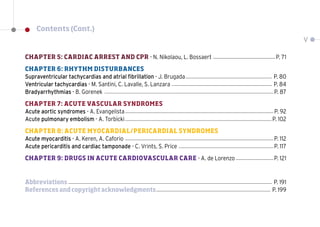
CHAPTER 5: CARDIAC ARREST AND CPR - N. Nikolaou, L. Bossaert ������������������������������������ P. 71
CHAPTER 6: RHYTHM DISTURBANCES
Supraventricular tachycardias and atrial fibrillation - J. Brugada ��������������������������������������������������  P. 80
Ventricular tachycardias - M. Santini, C. Lavalle, S. Lanzara ����������������������������������������������������������  P. 84
Bradyarrhythmias - B. Gorenek �������������������������������������������������������������������������������������������������� P. 87
CHAPTER 7: ACUTE VASCULAR SYNDROMES
Acute aortic syndromes - A. Evangelista �������������������������������������������������������������������������������������� P. 92
Acute pulmonary embolism - A. Torbicki ������������������������������������������������������������������������������������� P. 102
CHAPTER 8: ACUTE MYOCARDIAL/PERICARDIAL SYNDROMES
Acute myocarditis - A. Keren, A. Caforio �������������������������������������������������������������������������������������� P. 112
Acute pericarditis and cardiac tamponade - C. Vrints, S. Price ������������������������������������������������������� P. 117
CHAPTER 9: DRUGS IN ACUTE CARDIOVASCULAR CARE - A. de Lorenzo ���������������������� P. 121
Abbreviations ����������������������������������������������������������������������������������������������������������������������  P. 191
References and copyright acknowledgments �����������������������������������������������������������������  P. 199
V
Contents (Cont.)
Leo Bossaert	
Department of Medicine, University and University Hospital Antwerp, Antwerp,
Belgium
Josep Brugada	
Department of Cardiology, Hospital Clinic Universitat de Barcelona, Barcelona, Spain
Héctor Bueno	
Centro Nacional de Investigaciones Cardiovasculares Carlos III (CNIC),
and Department of Cardiology, Hospital Universitario 12 de Octubre, Madrid, Spain
Alida Caforio	
Department of Cardiology, Padua University Medical School, Padua, Italy
Francesco Costa	
Cardiovascular institute, Hospital Clínic, University of Barcelona, Barcelona, Spain
Department of Clinical and Experimental Medicine, University of Messina, Messina, Italy
Artur Evangelista	
Department of Cardiology, Hospital Universitario Vall d’Hebrón, Barcelona, Spain
Bulent Gorenek	
Department of Cardiology, Eskisehir Osmangazy University, Eskisehir, Turkey
Sigrun Halvorsen	
Department of Cardiology, Oslo University Hospital Ulleval and University of Oslo, Oslo, Norway
Veli-Pekka Harjola	
Division of Emergency Medicine, Department of Emergency Care and Services, Helsinki
University Hospital, Finland
Borja Ibañez	
Centro Nacional de Investigaciones Cardiovasculares Carlos III (CNIC),
and Department of Cardiology, University Hospital Fundación Jiménez Díaz, Madrid, Spain
Andre Keren	
Heart Failure and Heart Muscle Disease Centre, Hadassah University Hospital,
Jerusalem, Israel
VI
List of Authors
Stefania Lanzara	
Department of Emergency, Ospedale Madre Giuseppina Vannini, Rome, Italy
Carlo Lavalle	
Department of Cardiology, Ospedale San Filippo Neri, Rome Italy
Maddalena Lettino	
Clinical Cardiology Unit, IRCCS Istituto Clinico Humanitas, Milano, Italy
Ana de Lorenzo	
Pharmacy Department, Hospital General Universitario Gregorio Marañón, Madrid, Spain
Òscar Miró	
Emergency Department, Hospital Clínic, University of Barcelona, Barcelona, Catalonia, Spain
Christian Müller	
Department of Cardiology, University Hospital Basel, Basel,Switzerland
Nikolaos Nikolaou 	
Departement of Cardiology, Konstantopouleio General Hospital, Athens, Greece
Susanna Price 	
Consultant Cardiologist  Intensivist, Royal Brompton Hospital, London, United Kingdom
Massimo Santini	
Department of Cardiology, Ospedale San Filippo Neri, Rome, Italy
François Schiele	
Department of Cardiology, University Hospital Jean-Minjoz, Besancon, France
Richard Sutton 	
Department of Cardiology, National Heart and Lung Institute Imperial College,
London, United Kingdom
Adam Torbicki 	
Department of Pulmonary Circulation and Thromboembolic Diseases, Centre of
Postgraduate Medical Education, ECZ Otwock, Poland
Pascal Vranckx 	
Department of Cardiology and Critical Care Medicine, Hartcentrum Hasselt, Hasselt, Belgium
Christiaan Vrints 	
Department of Cardiology, Antwerp University Hospital, Edegem, Belgium
Uwe Zeymer 	
Department of Cardiology, Herzzentrum Klinikum Ludwigshafen, Ludwigshafen, Germany
VII
List of Authors (Cont.)
CHAPTER 1
KEY SYMPTOMS
1.1	CHEST PAIN ����������������������������������������������������������������� p.2
M. Lettino, F. Schiele
1.2	DYSPNEA �������������������������������������������������������������������� p.9
C. Müller
1.3	SYNCOPE ������������������������������������������������������������������� p.16
R. Sutton
P.1
1
1. Presentation
2. ECG
3. Troponin
4. Diagnosis
Reference: Roffi et al. Eur Heart J 2015; eurheartj.ehv320.
Low likelihood
of Acute Coronary Syndrome
High likelihood
of Acute Coronary Syndrome
Noncardiac
Other
Cardiac
UA STEMI
NSTEMI
P.2
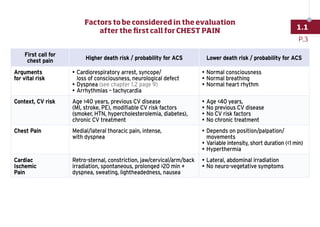
1.1
Initial assessment of patients with CHEST PAIN
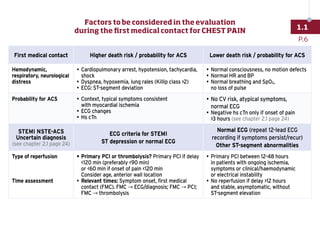
First call for
chest pain Higher death risk / probability for ACS Lower death risk / probability for ACS
Arguments
for vital risk
•	
Cardiorespiratory arrest, syncope/
loss of consciousness, neurological defect
•	Dyspnea (see chapter 1.2 page 9)
•	
Arrhythmias – tachycardia
•	Normal consciousness
•	Normal breathing
•	
Normal heart rhythm
Context, CV risk Age 40 years, previous CV disease
(MI, stroke, PE), modifiable CV risk factors
(smoker, HTN, hypercholesterolemia, diabetes),
chronic CV treatment
•	
Age 40 years,
•	
No previous CV disease
•	
No CV risk factors
•	No chronic treatment
Chest Pain Medial/lateral thoracic pain, intense,
with dyspnea
•	
Depends on position/palpation/
movements
•	
Variable intensity, short duration (1 min)
•	Hyperthermia
Cardiac
Ischemic
Pain
Retro-sternal, constriction, jaw/cervical/arm/back
irradiation, spontaneous, prolonged 20 min +
dyspnea, sweating, lightheadedness, nausea
•	
Lateral, abdominal irradiation
•	
No neuro-vegetative symptoms
P.3
1.1
Factors to be considered in the evaluation
after the first call for CHEST PAIN
No
Yes
Likelihood of ACS
High probability for ACS Low probability for ACS
Emergency transport
with trained medical team
Emergency care:
Resuscitation, hemodynamic or
rhythm restoration (see chapter 5)
APPROACH AFTER FIRST CALL FOR OUT-OF-HOSPITAL CHEST PAIN
VITAL RISK? (see chapter 1.1 page 3)
P.4
1.1
Approach after first call for out-of-hospital CHEST PAIN
ECG, decision for reperfusion,
antithrombotics, immediate
transport to ED/CPU/ICCU/Cathlab
(see chapter 2)
Emergency transport
Emergency transport
with trained medical team
Hospital admission
to the ED/CPU
Cardiology
ward
Non-cardiology
ward
Discharge after
prolonged observation
P.5
1.1
First medical contact Higher death risk / probability for ACS Lower death risk / probability for ACS
Hemodynamic,
respiratory, neurological
distress
•	
Cardiopulmonary arrest, hypotension, tachycardia,
shock
•	
Dyspnea, hypoxemia, lung rales (Killip class 2)
•	
ECG: ST-segment deviation
•	
Normal consciousness, no motion defects
•	
Normal HR and BP
•	
Normal breathing and SpO2,
no loss of pulse
Probability for ACS •	
Context, typical symptoms consistent
with myocardial ischemia
•	ECG changes
•	Hs cTn
•	
No CV risk, atypical symptoms,
normal ECG
•	
Negative hs cTn only if onset of pain
3 hours (see chapter 2.1 page 24)
STEMI NSTE-ACS
Uncertain diagnosis
(see chapter 2.1 page 24)
ECG criteria for STEMI
ST depression or normal ECG
Normal ECG (repeat 12-lead ECG
recording if symptoms persist/recur)
Other ST-segment abnormalities
Type of reperfusion
Time assessment
•	
Primary PCI or thrombolysis? Primary PCI if delay
120 min (preferably 90 min)
or 60 min if onset of pain 120 min
Consider age, anterior wall location
•	
Relevant times: Symptom onset, first medical
contact (FMC). FMC → ECG/diagnosis; FMC → PCI;
FMC → thrombolysis
•	
Primary PCI between 12-48 hours
in patients with ongoing ischemia,
symptoms or clinical/haemodynamic
or electrical instability
•	
No reperfusion if delay 12 hours
and stable, asymptomatic, without
ST-segment elevation
P.6
1.1
Factors to be considered in the evaluation
during the first medical contact for CHEST PAIN
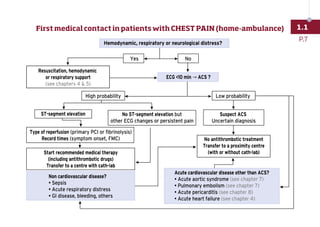
Yes
Resuscitation, hemodynamic
or respiratory support
(see chapters 4  5)
Type of reperfusion (primary PCI or fibrinolysis)
Record times (symptom onset, FMC)
High probability Low probability
No
FIRST MEDICAL CONTACT IN PATIENTS WITH CHEST PAIN (HOME-AMBULANCE)
Hemodynamic, respiratory or neurological distress?
ST-segment elevation
ECG 10 min → ACS ?
No ST-segment elevation but
other ECG changes or persistent pain
Suspect ACS
Uncertain diagnosis
No antithrombotic treatment
Transfer to a proximity centre
(with or without cath-lab)
Start recommended medical therapy
(including antithrombotic drugs)
Transfer to a centre with cath-lab
Non cardiovascular disease?
• Sepsis
• Acute respiratory distress
• GI disease, bleeding, others
Acute cardiovascular disease other than ACS?
• Acute aortic syndrome (see chapter 7)
• Pulmonary embolism (see chapter 7)
• Acute pericarditis (see chapter 8)
• Acute heart failure (see chapter 4)
P.7
1.1
First medical contact in patients with CHEST PAIN (home-ambulance)
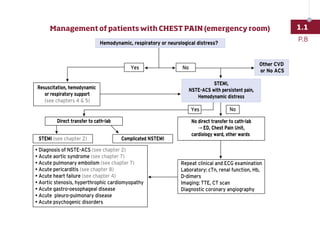
• Diagnosis of NSTE-ACS (see chapter 2)
• Acute aortic syndrome (see chapter 7)
• Acute pulmonary embolism (see chapter 7)
• Acute pericarditis (see chapter 8)
• Acute heart failure (see chapter 4)
• Aortic stenosis, hyperthrophic cardiomyopathy
• Acute gastro-oesophageal disease
• Acute pleuro-pulmonary disease
• Acute psychogenic disorders
Repeat clinical and ECG examination
Laboratory: cTn, renal function, Hb,
D-dimers
Imaging: TTE, CT scan
Diagnostic coronary angiography
Yes No
Yes No
MANAGEMENT OF PATIENTS WITH CHEST PAIN (EMERGENCY ROOM)
STEMI,
NSTE-ACS with persistent pain,
Hemodynamic distress
No direct transfer to cath-lab
→ ED, Chest Pain Unit,
cardiology ward, other wards
Other CVD
or No ACS
Resuscitation, hemodynamic
or respiratory support
(see chapters 4  5)
Direct transfer to cath-lab
Complicated NSTEMI
STEMI (see chapter 2)
Hemodynamic, respiratory or neurological distress?
P.8
1.1
Management of patients with CHEST PAIN (emergency room)
DYSPNEA: DIFERENTIAL DIAGNOSIS
50% have ≥2 diagnoses, which may result in acute respiratory failure*!
• ECG • Chest X-ray • Blood count • cTn
• BNP • Venous BG • D-dimers if suspicion of PE
Basic measures
• BP, HR, respiratory rate, SpO2  temperature
• Start oxygen to target SpO2 94-98%
• Start i.v. line  monitor patient
Criteria for transfer to ICU
(despite treatment for 30 minutes)
• Respiratory rate 35/min
• SpO2 85%
• SBP 90 mmHg
• HR 120 bpm
Investigations:
Acute heart
failure
Acute coronary
syndrome
Exacerbated COPD
or other chronic
lung disease
Other causes, including
• Asthma
• Severe sepsis
• Tumor
• Pneumothorax
• Pleural effusion/ascites
• Anxiety disorder
• Anemia
• Bronchitis
• Metabolic acidosis
• Neurologic disease
Pneumonia Pulmonary
embolism
* Defined as ≥1 criterion:
• Respiratory rate ≥25/min
• PaO2 ≤75 mmHg
• SpO2 ≤92% in ambient air
• PaCO2 ≥45 mmHg with arterial pH ≤7.35
Reference: Ray P et al. Acute respiratory failure in the elderly: etiology, emergency diagnosis and prognosis. Critical Care (2006); 10 (3):R82.
P.9
1.2
DYSPNEA: Diferential diagnosis
BASIC WORK-UP
• Positioning Keep head of bed elevated above level of legs
• Oxygen Up to 12 l/min via rebreather mask, titrate oxygen saturation to 94%
• Nitroglycerin 1-2 SL tablets or 2-3 patches 10 mg (1st
choice). In pulmonary edema with severe shortness
of breath: NTG drip 0.05% (100 mg in 200 ml)
- Start with 25 µg/min = 3 ml/h, check BP after 5 and 10 min
- Increase dose by 25 µg/min at a time as long as SBP 90 mmHg
- Additional BP check 5 and 10 min after each increase in dosing
- Check BP every 20 min once a steady drip rate is reached
• Furosemide 40-120 mg i.v. (adjust based on kidney function and clinical findings; monitor creatinine)
• Morphine 2 mg i.v. (preceeded by 10 mg i.v. metoclopramide PRN) if patient is in severe dyspnoea
• Consider digoxin 0.5 (-1.0) mg i.v. in patients with atrial fibrillation
• Anticoagulation Therapeutic dosing in ACS and atrial fibrillation: Enoxaparin 1 mg/kg body weight as 1st
dose
• Chest X-ray (lung ultrasound)
• Echocardiogram
During admission (earlier if decompensated
aortic stenosis or endocarditis are suspected)
• Coronary angiography
Emergent in patients with ACS; delayed in
patients with suspected coronary artery disease
• Immediate 12-lead ECG, cardiac monitor, BP, respiratory rate,
pulse oximetry
• Clinical findings
Most commonly: lower extremity edema, jugular venous
distension,rales,workupforunderlyingcardiacdiseaseandtriggers
• Laboratory findings
Complete blood count, chemistries, cardiac enzymes, BNP,
TSH, ABG as needed
P.10
1.2
DYSPNEA: Acute heart failure (see chapter 4.1)
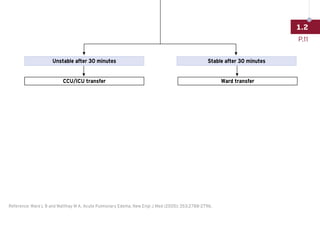
Reference: Ware L B and Matthay M A. Acute Pulmonary Edema. New Engl J Med (2005); 353:2788-2796.
Unstable after 30 minutes
CCU/ICU transfer Ward transfer
Stable after 30 minutes
P.11
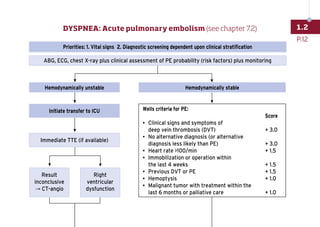
1.2
Priorities: 1. Vital signs 2. Diagnostic screening dependent upon clinical stratification
Hemodynamically unstable Hemodynamically stable
Initiate transfer to ICU
Immediate TTE (if available)
Result
inconclusive
→ CT-angio
Right
ventricular
dysfunction
Wells criteria for PE:
Score
• Clinical signs and symptoms of
deep vein thrombosis (DVT) + 3.0
• No alternative diagnosis (or alternative
diagnosis less likely than PE) + 3.0
• Heart rate 100/min + 1.5
• Immobilization or operation within
the last 4 weeks + 1.5
• Previous DVT or PE + 1.5
• Hemoptysis + 1.0
• Malignant tumor with treatment within the
last 6 months or palliative care + 1.0
ABG, ECG, chest X-ray plus clinical assessment of PE probability (risk factors) plus monitoring
P.12
1.2
DYSPNEA: Acute pulmonary embolism (see chapter 7.2)
Copyright: Stein PD, Woodard PK, Weg JG, et al. Diagnostic pathways in acute pulmonary embolism: recommendations of the PIOPED II investigators.
Am J Med (2006); 119:1048–55. - Goldhaber SZ. Pulmonary embolism. Lancet (2004); 363 (9417) 1295-1305. - Agnelli G and Becattini C. Acute Pulmonary
Embolism. New Engl J Med (2010); 363:266-274.
Intermediate
probability
Total score 2-6
High
probability
Total score 6
Low
probability
Total score 2
Outpatient management possible?
→ Risk stratification
PE confirmed: Treatment
(see chapter 7.2)
(see chapter 7.2)
P.13
1.2
DYSPNEA: COPD EXACERBATION
• Verify diagnosis (DD: PE, acute heart failure, pneumothorax)
• Oxygen administration → SpO2 target 88-92% (Beware of carbonarcosis: ABC after 1 h)
Definition:
Known COPD and/or • Progressive dyspnea and/or
• Change in quantitiy and color of sputum and/or
• Heavy coughing
• COPD classification
(GOLD)
• Etiology
• Hospitalisation indicated?
• Follow-up
• Evaluate ICU criteria
• NIV indicated?
• Laboratory findings: Blood count, coagulation, ProCT, perhaps BNP, D-Dimers
• Chest X-ray; ECG (exclusion of differential diagnoses)
• Sputum cultures (always in case of hospitalisation or previous
outpatient antibiotic treatment)
• Oxygen therapy 2-(4) l; target saturation 90%
• Salbutamol/ipratropium inhalations ≥4-6 x/d, if needed long-term inhalation
• Systemic steroids prednisone 0.5 mg/kg of body weight for 5 days
• Antibiotic treatment should be considered; always indicated in stage Gold IV
• Physiotherapy
• History, clinical examination (blood pressure, pulse, oxygen saturation, vigilance)
Copyright: Leuppi JD et al. JAMA. 2013 Jun 5; 309(21):2223-31.
P.14
1.2
DYSPNEA: COPD exacerbation
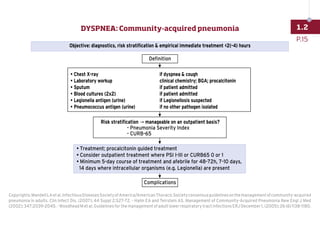
DYSPNEA: COMMUNITY-ACQUIRED PNEUMONIA
Objective: diagnostics, risk stratification  empirical immediate treatment 2(-4) hours
Definition
Complications
• Chest X-ray if dyspnea  cough
• Laboratory workup clinical chemistry; BGA; procalcitonin
• Sputum if patient admitted
• Blood cultures (2x2) if patient admitted
• Legionella antigen (urine) if Legionellosis suspected
• Pneumococcus antigen (urine) if no other pathogen isolated
Risk stratification → manageable on an outpatient basis?
- Pneumonia Severity Index
- CURB-65
• Treatment; procalcitonin guided treatment
• Consider outpatient treatment where PSI I-III or CURB65 0 or 1
• Minimum 5-day course of treatment and afebrile for 48-72h, 7-10 days,
14 days where intracellular organisms (e.g. Legionella) are present
Copyrights:MandellLAetal.InfectiousDiseasesSocietyofAmerica/AmericanThoracicSocietyconsensusguidelinesonthemanagementofcommunity-acquired
pneumonia in adults. Clin Infect Dis. (2007); 44 Suppl 2:S27-72. - Halm EA and Teirstein AS. Management of Community-Acquired Pneumonia New Engl J Med
(2002);347:2039-2045.-WoodheadMetal.GuidelinesforthemanagementofadultlowerrespiratorytractinfectionsERJDecember1,(2005);26(6)1138-1180.
P.15
1.2
DYSPNEA: Community-acquired pneumonia
Syncope is a transient loss of consciousness due to global cerebral hypoperfusion (usually, itself due to
period of low blood pressure) characterised by rapid onset, short duration, spontaneous and complete recovery.
The differentiation between syncope and non-syncopal conditions with real or apparent LOC can be achieved
in most cases with a detailed clinical history but sometimes can be extremely difficult. The following
questions should be answered:
•	
Was LOC complete?
•	
Was LOC transient with rapid onset and short duration?
•	
Did the patient recover spontaneously, completely and without sequelae?
•	
Did the patient lose postural tone?
If the answers to these questions are positive, the episode has a high likelihood of being syncope. If the answer to
one or more of these questions is negative, exclude other forms of LOC before proceeding with syncope evaluation.
Loss of Consciousness?
TLOC
Trauma Not Trauma
• Accidental • Fall
• Other abnormal mental state
No
No
Yes
Yes
• Coma
• Intoxication
• Metabolic disturbance
• Aborted sudden death
Transient, rapid onset,
short time, self-terminating
Syncope Epilepsy Psychogenic
Reference: Sutton R. Clinical classification of syncope. - Prog Cardiovasc Dis. (2013); 55(4):339-44.
P.16
1.3
SYNCOPE: Assessment of patients
with transient loss of conscioussness (TLOC)
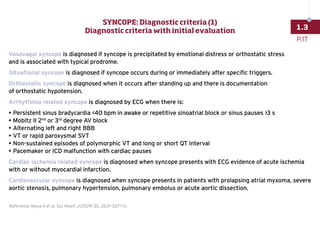
Vasovagal syncope is diagnosed if syncope is precipitated by emotional distress or orthostatic stress
and is associated with typical prodrome.
Situational syncope is diagnosed if syncope occurs during or immediately after specific triggers.
Orthostatic syncope is diagnosed when it occurs after standing up and there is documentation
of orthostatic hypotension.
Arrhythmia related syncope is diagnosed by ECG when there is:
•	
Persistent sinus bradycardia 40 bpm in awake or repetitive sinoatrial block or sinus pauses 3 s
•	
Mobitz II 2nd
or 3rd
degree AV block
•	
Alternating left and right BBB
•	
VT or rapid paroxysmal SVT
•	
Non-sustained episodes of polymorphic VT and long or short QT interval
•	
Pacemaker or ICD malfunction with cardiac pauses
Cardiac ischemia related syncope is diagnosed when syncope presents with ECG evidence of acute ischemia
with or without myocardial infarction.
Cardiovascular syncope is diagnosed when syncope presents in patients with prolapsing atrial myxoma, severe
aortic stenosis, pulmonary hypertension, pulmonary embolus or acute aortic dissection.
Reference: Moya A et al. Eur Heart J(2009) 30, 2631–2671 (1).
P.17
1.3
SYNCOPE: Diagnostic criteria (1)
Diagnostic criteria with initial evaluation
Patients with suspected syncope presenting to ED or clinic
“Uncertain” or unexplained syncope Certain diagnosis of syncope
Risk stratification
High risk Intermediate risk Low risk
Observation Unit
Home if stable,
Admit to hospital
if evidence of high risk
Home
Outpatient SMU
referral
Outpatient SMU for diagnosis, treatment
and follow-up as appropriate
Hospital admission
Inpatient SMU
Initiate therapy
Inpatient SMU, outpatient SMU or
personal physician as appropriate
Copyright: Sutton R, Brignole M, Benditt DG. Key challenges in the current management of syncope. Nat Rev Cardiol. (2012 ); (10):590-8.
Once syncope is considered to be the likely diagnosis, risk stratification is required to determine further management. P.18
1.3
SYNCOPE: Evaluation and risk stratification of patients
with suspected syncope
Carotid sinus massage Orthostatic Hypotension
Indications
•	
CSM is indicated in patients 40 years with syncope
of unknown aetiology after initial evaluation;
•	
CSM should be avoided in patients with previous MI,
TIA or stroke within the past 3 months and in
patients with carotid bruits (except if carotid Doppler
studies excluded significant stenosis)
Recommendations: Active standing Indications
•	
Manual intermittent determination with
sphygmomanometer of BP supine and, when OH
is suspected, during active standing for 3 min is
indicated as initial evaluation;
•	
Continuous beat-to-beat non-invasive pressure
measurement may be helpful in cases of doubt
Diagnostic criteria
•	
CSM is diagnostic if syncope is reproduced in presence
of asystole longer than 3 s and/or a fall in systolic
BP 50 mmHg
Diagnostic criteria
•	
The test is diagnostic when there is a symptomatic
fall in systolic BP from baseline value ≥20 mmHg
or diastolic BP ≥10 mmHg or a decrease in systolic BP
to 90 mmHg;
•	
The test should be considered diagnostic when there
is an asymptomatic fall in systolic BP from baseline
value ≥20 mmHg or diastolic BP 10 mmHg
or a decrease in systolic BP to 90 mmHg
Reference: Moya A et al. Eur Heart J(2009) 30; 2631–2671 (2).
P.19
1.3
SYNCOPE: Diagnostic criteria (2)
Diagnostic criteria with provocation maneuvers
Treatment of reflex syncope Treatment of orthostatic hypotension
•	
Explanation of the diagnosis, provision of reassurance and explanation
of risk of recurrence are in all patients
•	
Isometric PCM are indicated in patients with prodrome
•	
Cardiac pacing should be considered in patients with dominant
cardioinhibitory CSS
•	
Cardiac pacing should be considered in patients with frequent recurrent reflex
syncope, age 40 years and documented spontaneous cardioinhibitory response
during monitoring
•	
Midodrine may be indicated in patients with VVS refractory to lifestyle measures
•	
Tilt training may be useful for education of patients but long-term benefit depends
on compliance
•	
Cardiac pacing may be indicated in patients with tilt-induced cardioinhibitory
response with recurrent frequent unpredictable syncope and age 40 after
alternative therapy has failed
•	
Triggers or situations inducing syncope must be avoided as much as possible
•	
Hypotensive drugs must be modified or discontinued
•	
Cardiac pacing is not indicated in the absence of a documented cardioinhibitory
reflex
•	
Beta-adrenergic blocking drugs are not indicated
•	
Fluid consumption and salt in the diet should be increased
•	
Adequate hydration and salt
intake must be maintained
•	
Midodrine should be administered
as adjunctive therapy if needed
•	
Fludrocortisone should be
administered as adjunctive
therapy if needed
•	
PCM may be indicated
•	
Abdominal binders and/or support
stockings to reduce venous
pooling may be indicated
•	
Head-up tilt sleeping (10°)
to increase fluid volume
may be indicated
•	
Triggers or situations inducing
syncope must be avoided
as much as possible
•	
Hypotensive drugs administered
for concomitant conditions must
be discontinued or reduced
Copyright: Moya A et al. Eur Heart J(2009) 30; 2631–2671 (3).
P.20
1.3
Treatment according to type of SYNCOPE (1)
Treatment of arrhythmic syncope
Cardiac Pacing
•	
Pacing is indicated in patients with sinus node disease in
whom syncope is demonstrated to be due to sinus arrest
(symptom-ECG correlation) without a correctable cause
•	
Pacing is indicated in sinus node disease patients with
syncope and abnormal CSNRT
•	
Pacing is indicated in sinus node disease patients with
syncope and asymptomatic pauses 3 sec. (with possible
exceptions of young trained persons, during sleep and in
medicated patients)
•	
Pacing is indicated in patients with syncope and 2nd
degree
Mobitz II, advanced or complete AV block
•	
Pacing is indicated in patients with syncope,
BBB and positive EPS
•	
Pacing should be considered in patients with unexplained
syncope and BBB
•	
Pacing may be indicated in patients with unexplained
syncope and sinus node disease with persistent sinus
bradycardia itself asymptomatic
•	
Pacing is not indicated in patients with unexplained syncope
without evidence of any conduction disturbance
Catheter ablation
•	

Catheter ablation is indicated in patients with symptom/
arrhythmia ECG correlation in both SVT and VT in the
absence of structural heart disease
(with exception of atrial fibrillation)
•	

Catheter ablation may be indicated in patients with syncope
due to the onset of rapid atrial fibrillation
Antiarrhythmic drug therapy
•	

Antiarrhythmic drug therapy, including rate control drugs,
is indicated in patients with syncope due to onset of rapid
atrial fibrillation
•	

Drug therapy should be considered in patients with
symptom/ arrhythmia ECG correlation in both SVT and VT
when catheter ablation cannot be undertaken or has failed
Implantable Cardioverter Defibrillator (ICD)
•	

ICD is indicated in patients with documented VT
and structural heart disease
•	

ICD is indicated when sustained monomorphic VT is induced
at EPS in patients with previous myocardial infarction
•	

ICD should be considered in patients with documented VT
and inherited cardiomyopathies or channelopathies
Copyright: Moya A et al. Eur Heart J(2009) 30; 2631–2671 (4).
P.21
1.3
Treatment according to type of SYNCOPE (2)
CHAPTER 2
ACUTE CORONARY SYNDROMES
2.1	GENERAL CONCEPTS ������������������������������������������������������ p.24
H. Bueno
2.2	
NON ST-SEGMENT ELEVATION ACS ��������������������������������������� p.29
H. Bueno
2.3	ST-SEGMENT ELEVATION MI (STEMI) �������������������������������������� p.35
P. Vranckx, B. Ibañez
2
hs-cTnULN
hs-cTnULN
ACUTE CORONARY SYNDROMES: DIAGNOSIS
CHEST PAIN
or symptoms sugestive of myocardial ischemia
ECG
ST elevation
(persistent)
Repolarization not interpretable
(i.e. LBBB, pacemaker...)
ST/T abnormalities Normal ECG
STEMI
Pain resolves with
nitroglycerin 1st hsTn
NSTEMI Unstable Angina
Work-up
differential diagnoses
Pain onset 6 h
Pain onset 6 h
Re-test hs-cTn (3h later)
See next page for 1 h rule-in  rule-out algorithm
hs-cTn
no change
∆ hs-cTn
(1 value ULN)
hs-cTn x5 ULN
or
clinical
diagnosis
clear
Potential
noncardiac
causes for
abnormal Tn
Consider
STEMI
Yes
No
References: Roffi M. Eur Heart J 2016; 37:267-315.
Ibañez B. Eur Heart J 2018; 39:119-177.
P.24
2.1
ACUTE CORONARY SYNDROMES: Diagnosis (1)
Suspected NSTEMI
Other
0h≥D ng/l
or
≥
Observe
Rule-out Rule-in
hs-cTnT (Elecsys)*
hs-cTnl (Architect)*
hs-cTnl (DimensionVista)*
0-1h E ng/l
0hA ng/l
0hB ng/l
and
0-1hCng/l
A
5
2
0,5
B
12
5
5
C
3
2
2
D
52
52
107
E
5
6
19
or
or
•	
NSTEMI can be ruled-out at presentation, if hs-cTn concentration is very low
•	
NSTEMI can be ruled out by the combination of low baseline levels and the lack of a relevant increase within 1 h
•	
NSTEMI is highly likely if initial hs-cTn concentration is at least moderately elevated or hs-cTn concentrations
show a clear rise within the first hour
Reference: Roffi M. Eur Heart J 2016; 37:267-315.
*Cut-off levels are assay-specific.
P.25
2.1
ACUTE CORONARY SYNDROMES: Diagnosis (2)
0-1 H Rule-in  rule out test for NSTEMI
Causes of chest pain
Not related to ACS
Causes of troponin elevation
Not related to ACS
Primary cardiovascular
•	
Acute pericarditis, pericardial effusion
•	Acute myocarditis
•	
Severe hypertensive crisis
•	
Stress cardiomyopathy (Tako-Tsubo syndrome)
•	
Hypertrophic cardiomyopathy, aortic stenosis
•	
Severe acute heart failure
•	
Acute aortic syndrome (dissection, hematoma)
•	
Pulmonary embolism, pulmonary infarction
•	Cardiac contusion
Primary cardiovascular
•	Acute myo(peri)carditis
•	
Severe hypertensive crisis
•	
Pulmonary edema or severe congestive heart failure
•	
Stress cardiomyopathy (Tako-Tsubo syndrome)
•	
Post- tachy- or bradyarrhythmias
•	
Cardiac contusion or cardiac procedures
(ablation, cardioversion, or endomyocardial biopsy)
•	
Aortic dissection, aortic valve disease or hypertrophic cardiomyopathy
•	
Pulmonary embolism, severe pulmonary hypertension
Primary non-cardiovascular
•	
Oesophageal spasm, oesophagitis, Gastro
Esophageal Reflux (GER)
•	
Peptic ulcer disease, cholecystitis, pancreatitis
•	
Pneumonia, bronchitis, asthma attack
•	
Pleuritis, pleural effusion, pneumothorax
•	
Pulmonary embolism, severe pulmonary
hypertension
•	Thoracic trauma
•	
Costochondritis, rib fracture
•	
Cervical / thoracic vertebral or discal damage
•	Herpes Zoster
Primary non-cardiovascular
•	
Renal dysfunction (acute or chronic)
•	
Critical illness (sepsis, repiratory failure…)
•	
Acute neurological damage (i.e. stroke, subarachnoid hemorrhage)
•	
Severe burns (affecting 30% of body surface area)
•	Rhabdomyolysis
•	
Drug toxicity (chemotherapy with adriamycin, 5-fluorouracil,
herceptin, snake venoms…)
•	
Inflammatory or degenerative muscle diseases
•	Hypothyroidism
•	
Infiltrative diseases (amyloidosis, hemochromatosis, sarcoidosis)
•	Scleroderma
P.26
2.1
ACUTE CORONARY SYNDROMES: Differential diagnosis (1)
ST-segment elevation Negative T waves
Fixed
•	LV aneurysm
•	
LBBB, WPW, hypertrophic cardiomyopathy, LVH
•	Pacemaker stimulation
•	
Early repolarisation (elevated J-point)
Dynamic
•	
Acute (myo)pericarditis
•	
Pulmonary embolism
•	
Electrolyte disturbances (hyperkalemia)
•	
Acute brain damage (stroke, subarachnoid haemorrhage)
•	
Tako Tsubo syndrome
•	
Normal variants, i.e. women
(right precordial leads),
children, teenagers
•	
Evolutive changes post
myocardial infarction
•	
Chronic ischemic heart disease
•	Acute (myo)pericarditis,
cardiomyopathies
•	
BBB, LVH, WPW
•	Post-tachycardia or
pacemaker stimulation
•	
Metabolic or ionic disturbances
ST-segment depression Prominent T waves
Fixed
•	
Abnormal QRS (LBBB, WPW, pacemaker stimulation…)
•	
LVH, hypertrophic cardiomyopathy
•	
Chronic ischemic heart disease
•	
Normal variants, i.e.
early repolarisation
•	
Metabolic or ionic disturbances
(i.e. hyperkalemia)
•	
Acute neurological damage
(stroke, subarachnoid haemorrhage)
Dynamic
•	
Acute (myo)pericarditis
•	
Acute pulmonary hypertension
•	
Electrolyte disturbances (hyperkalemia)
•	
Intermitent LBBB, WPW, pacing
•	
Post-tachycardia / cardioversion
• 
Severe hypertensive crisis
• Drug effects (digoxin)
• Shock, pancreatitis
• Hyperventilation
• Tako Tsubo syndrome
P.27
2.1
ACUTE CORONARY SYNDROMES: Differential diagnosis (2)
Causes of repolarisation abnormalities in the ECG not related to ACS
2
ECG
(10 min)
3
Diagnosis /
Risk assessment
4
Medical
Treatment
5
Invasive
Strategy
STEMI (see chapter 2.3)
Thrombolysis
for STEMI if
primary PCI not
timely available
Primary
PCI
1
Clinical
Evaluation
NSTE ACS
(see chapter 2.2)
ACS unclear
(Rule out ACS) (see chapter 1.1)
No ACS
Chest Pain Unit
• Clinical presentation
(BP, HR)
• ECG presentation
• Past history
• Ischemic risk
(i.e. GRACE, TIMI scores)
• Bleeding risk
(i.e. CRUSADE score)
• Additional information
(labs, imaging...) optional
Anti-ischemic
therapy
Antiplatelet
therapy
Anticoagulation
Emergent
2 hours
Urgent
2-24 hours
Early
24-72 hours
No /
Elective
Quality of
chest pain
Clinical
context
Probability
of CAD
Physical
examination
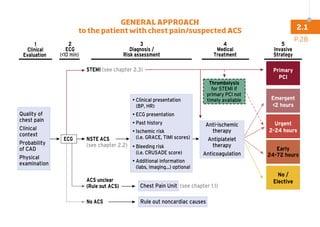
GENERAL APPROACH TO THE PATIENT WITH CHEST PAIN / SUSPECTED ACS
ECG
Rule out noncardiac causes
P.28
2.1
GENERAL APPROACH
to the patient with chest pain/suspected ACS
Ischemic risk
GRACE risk score TIMI risk score
Predictive Factors
•	Age
•	HR*
•	SBP*
•	Creatinine (mg/dl)*
•	Killip class*
•	Cardiac arrest*
•	ST-segment deviation
•	
Elevated cardiac markers
Outcomes
In-hospital, 6-month,
1-year and 3-year mortality
1-year death/MI
Predictive Factors
•	
Age 65 years
•	
At least 3 risk factors for CAD
•	
Significant (50%) coronary stenosis
•	
ST deviation
•	
Severe anginal symptoms (2 events in last 24h)
•	
Use of aspirin in last 7 days
•	
Elevated serum cardiac markers
Outcome
All-cause mortality/new
or recurrent MI/severe
recurrent ischemia requiring
urgent revascularisation at
14 days
* At admission.
50
40
30
20
10
0
70 	 90 	 110 	 130 	 150 	 170 	 190 	 210
GRACE Risk Score
Probability of all-cause mortality from
hopital discharge to 6 months (%)
50
40
30
20
10
0
0-1	 	 2	 	 3		 4	 	 5	 =6
TIMI Risk Score
Risk of 14 days events (%)
Risk calculation
http://www.gracescore.org/WebSite/WebVersion.aspx
Risk calculation
http://www.timi.org/index.php?page=calculators
P.29
2.2
NON ST-SEGMENT ELEVATION ACS: Risk stratification (1)
Bleeding risk
CRUSADE risk score
Predictive Factors
•	Sex
•	HR*
•	SBP*
•	Creatinine (mg/dl)*
•	Baseline hematocrit*
•	GFR: Cockcroft-Gault*
•	Diabetes
•	
Prior vascular disease
•	
Signs of congestive heart failure*
Outcome
In-hospital major bleeding
Copyrights: Eagle KA et al. A validated prediction model for all forms of acute coronary syndrome: estimating the risk of 6-month post-discharge death
in an international registry. JAMA. (2004); 291(22):2727-33. - Antman EM, et al. The TIMI risk score for unstable angina/non-ST elevation MI: A method
for prognostication and therapeutic decision making. JAMA. (2000); 284(7):835-42. - Subherwal S, et al Baseline risk of major bleeding in non-ST-segment-
elevation myocardial infarction: the CRUSADE (Can Rapid risk stratification of Unstable angina patients Suppress ADverse outcomes with Early implementation
of the ACC/AHA Guidelines) Bleeding Score. Circulation (2009); 119(14):1873-82.
* At admission.
50
40
30
20
10
0
0 		 20		 40		 60		 80 	 100
CRUSADE Bleeding Score
Probability of in-hospital major bleeding(%)
Risk calculation
www.crusadebleedingscore.org
P.30
2.2
NON ST-SEGMENT ELEVATION ACS: Risk stratification (2)
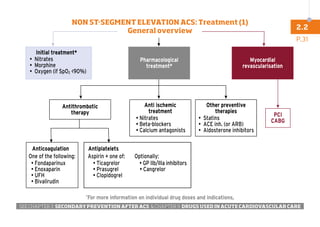
Initial treatment*
• Nitrates
• Morphine
• Oxygen (if SpO2 90%)
One of the following:
• Fondaparinux
• Enoxaparin
• UFH
• Bivalirudin
Aspirin + one of:
• Ticagrelor
• Prasugrel
• Clopidogrel
Optionally:
• GP IIb/IIIa inhibitors
• Cangrelor
• Nitrates
• Beta-blockers
• Calcium antagonists
• Statins
• ACE inh. (or ARB)
• Aldosterone inhibitors
Pharmacological
treatment*
Anti ischemic
treatment
Antithrombotic
therapy
Anticoagulation Antiplatelets
PCI
CABG
Other preventive
therapies
Myocardial
revascularisation
*
For more information on individual drug doses and indications,
SEE CHAPTER3 SECONDARY PREVENTION AFTER ACS CHAPTER9 DRUGS USED IN ACUTE CARDIOVASCULAR CARE
P.31
2.2
NON ST-SEGMENT ELEVATION ACS: Treatment (1)
General overview
Very-high-risk
criteria
•	Haemodynamic instability or cardiogenic shock
•	Recurrent or ongoing chest pain refractory to medical treatment
•	Life-threatening arrhythmias or cardiac arrest
•	Mechanical complications of MI
•	Acute heart failure
•	Recurrent dynamic ST-T wave changes, particularly with intermittent ST-elevation
High-risk criteria •	Rise or fall in cardiac troponin compatible with MI
•	Dynamic ST- or T-wave changes (symptomatic or silent)
•	GRACE score 140
Intermediate-risk
criteria
•	Diabetes mellitus
•	Renal insufficienty (eGFR 60 ml/min/1.73 m2
)
•	LVEF 40% or congestive heart failure
•	Early post-infarction angina
•	Prior PCI
•	Prior CABG
•	GRACE risk score 109 and 140
Low-risk criteria •	Any characteristics not mentioned above
Reference: Roffi M. Eur Heart J 2016; 37:267-315.
P.32
2.2
NON ST-SEGMENT ELEVATION ACS: Treatment (2)
Risk criteria mandating invasive strategy in NSTE-ACS
Symptoms Onset
PCI centre
Very high
Immediate
Invasive (2 hr)
Early invasive
(24 hr)
Invasive
(72 hr)
High
Intermediate
Immediate transfer to PCI centre
Same-day transfer
Transfer
Transfer optional
Risk
stratification
Therapeutic
strategy
Low
EMS or Non–PCI centre
First medical contact NSTE-ACS diagnosis
Very high
High
Intermediate
Low
Non-invasive
testing if appropriate
Reference: Roffi M. Eur Heart J 2016; 37:267-315.
P.33
2.2
NON ST-SEGMENT ELEVATION ACS: Treatment (3)
Timing and strategy for invasive management
0
24 hours
10 min
90 min
2 hours
Strategy
clock ECG STEMI diagnosis
Time to PCI?
≤120min
Primary PCI
strategy
Fibrinolysis
strategya
Bolus of
fibrinolyticb
Transfer
to PCI centre
Meet reperfusion
criteria?
No Yes
Routine PCI strategy
Rescue
PCI
120min
Alert  transfer
to PCI centre
Wire crossing
(reperfusion)
≥120min
60-90min
Reference: Ibañez B. Eur Heart J 2018; 39:119-177.
STEMI Treatment (1):
Reperfusion strategy
a
If fibrinolysis is contra-indicated, direct for primary PCI strategy regardless of time to PCI.
b 
10 min is the maximum target delay time from STEMI diagnosis to fibrinolytic bolus administration, however, it should be given as soon as
possible after STEMI diagnosis (after ruling out contra-indications).
P.34
2.3
Aspirin
Loading
Prasugrel or ticagrelor loading
(clopidogrel as alternative)
Aspirin
maintenance
Prasugrel or ticagrelor maintenance
(clopidogrel as alternative)
Oxygen when SpO2 90%
High dose statin
(e.g. atorvastatin 80 mg or rosuvastatin 40 mg)
Oral β-blocker
ACE inhibitor
Mineralocorticoid receptor antagonist
(if LVEF 40% and heart failure)
i.v. Beta-blocker
i.v. Opioids/tranquilizer
DURING PCI: radial access, UFH (enoxaparin/bivalirudin as alternatives)
STEMI
diagnosis
Wire crossing
(reperfusion)
Hospital
Admission
Hospital
Discharge
Reference: Ibañez B. Eur Heart J 2018; 39:119-177.
P.35
2.3
STEMI Treatment (2):
Medical management of patients treated with primary PCI
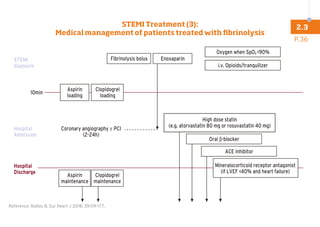
Aspirin
loading
Clopidogrel
loading
Fibrinolysis bolus Enoxaparin
Aspirin
maintenance
Clopidogrel
maintenance
Oxygen when SpO2 90%
i.v. Opioids/tranquilizer
High dose statin
(e.g. atorvastatin 80 mg or rosuvastatin 40 mg)
Oral β-blocker
ACE inhibitor
Mineralocorticoid receptor antagonist
(if LVEF 40% and heart failure)
STEMI
diagnosis
Hospital
Admission
Hospital
Discharge
10min
Coronary angiography ± PCI
(2-24h)
Reference: Ibañez B. Eur Heart J 2018; 39:119-177.
P.36
2.3
STEMI Treatment (3):
Medical management of patients treated with fibrinolysis
CHAPTER 3
SECONDARY PREVENTION
AFTER ACS
3.1	GENERAL SECONDARY PREVENTION STRATEGIES
AND LIPID LOWERING ����������������������������������������������������� p.38
H. Bueno, S. Halvorsen
3.2	ANTITHROMBOTIC TREATMENT ������������������������������������������� p.41
F. Costa, S. Halvorsen
P.37
3
Acute Coronary Syndrome
Antithrombotic
therapy
Aspirin + P2Y12
inhibitor
(12 months)
Lipid
lowering
High intensity
statin therapy
BP/LVD/
HF control
ACEI / ARB*,
Beta-blockers*,
MRA*
Glucose
control
Metformin
Insulin*
Hospitalization
• Risk factor control (e.g.
weight control, smoking cessation,
blood pressure and lipid control)
• Diet/nutritional counseling
• Physical activity counseling/
excercise training
• Psychosocial management,
sex advice
• Vocational advice
Plan and schedule
Cardiac Rehabilitation
Education
and counselling
Cardioprotective drugs
in secondary prevention
1- Acute care
• Drug therapy
• Coronary revascularisation
2- Cardiovascular risk assessment (e.g. concealed and uncontrolled risk factors)
3- Initiate secondary prevention and set treatment goals
Cardiac
Rehabilitation
programme
P.38
3.1
SECONDARY PREVENTION STRATEGIES after ACS
Re-evaluate lifestyle, control of risk factors, psychosocial factors and adherance to therapy
Adjustment of secondary prevention therapies. Consider polypill, if needed
Consider adding
Ezetimibe*
PCSK9 inhibitor*
Consider
dose adjustment
Consider ARNI*
Consider
SGLT2 inhibitor*
GLP-1 agonists*
Reinforce education
Psychosocial support
After Discharge
After 12 months
consider*:
Ticagrelor
60 mg bid
Anticoagulation?**
Reference modified from Cortés-Beringola A. Eur J Prev Cardiol 2017; 24(3 suppl): 22-28.
* When individually indicated and without specific contraindications. - ** Rivaroxaban 2.5 mg bid pending approval for indication in chronic CAD.
P.39
3.1
Potential strategies to optimize secondary prevention therapy after ACS
	• 
Participation in a comprehensive, multi-disciplinary cardiac
rehabilitation programme after hospital discharge
	• 
Coordination with primary care provider
(and other specilaists) in therapeutic plan and objectives
	• 
Re-check and reinforce advise on all lifestyle changes
(diet, physical activity, smoking cessation…) during follow-up visits
	• 
Check and optimise doses of all indicated secondary prevention drugs
	• 
Use of specialist support, nicotine replacement therapies, varenicline,
and/or bupropion individually or in combination
for patients who do not quit or restart smoking
	• 
Use of ezetimibe and/or a PCSK9 inhibitor in patients
who remain at high risk with LDL-cholesterol 70 mg/dl despite
apropriate diet and maximally tolerated doses of statins
	• 
Use of a polypill or combination therapy in patients
with suboptimal adherence to drug therapy
P.40
3.1
After ACS: POTENTIAL STRATEGIES
TO OPTIMIZE SECONDARY PREVENTION THERAPY
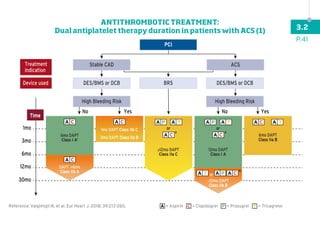
PCI
Stable CAD
DES/BMS or DCB BRS DES/BMS or DCB
High Bleeding Risk
6mo DAPT
Class I A1
1mo DAPT Class IIb C
3mo DAPT Class IIa B
≥12mo DAPT
Class IIa C
12mo DAPT
Class I A
6mo DAPT
Class IIa B
12mo DAPT
Class IIb B
DAPT 6mo
Class IIb A
High Bleeding Risk
ACS
No
1mo
3mo
6mo
12mo
30mo
Yes No
or
Yes
A C
A C
A C
A C
2
A P A T
or
A C
3
A C
A P A T
or A C
4
A P
A T
A T
Treatment
indication
Device used
Time
A = Aspirin C = Clopidogrel P = Prasugrel T = Tricagrelor
Reference: Valgimigli M, et al. Eur Heart J. 2018; 39:213-260.
P.41
3.2
ANTITHROMBOTIC TREATMENT:
Dual antiplatelet therapy duration in patients with ACS (1)
Medical Treatment Alone
Stable CAD ACS
No indication
for DAPT unless
concomitant or
prior indication
overrides
Stable CAD
No indication
for DAPT unless
concomitant or
prior indication
overrides
12mo DAPT
Class I C
6mo DAPT
Class IIa C
12moDAPT
Class IIb C
High Bleeding Risk
CABG
No
1mo
3mo
6mo
12mo
30mo
Yes
ACS
High Bleeding Risk
No Yes
Time
or
A C
3
A C
A P A T
or
A C
A P
A T
A T
12mo DAPT
Class I C
1mo DAPT
Class IIa C
12moDAPT
Class IIb C
or
A C
3
A C
A T
or A C
A T
Treatment
indication
Device used
A = Aspirin C = Clopidogrel P = Prasugrel T = Tricagrelor
Reference: Valgimigli M, et al. Eur Heart J. 2018; 39:213-260.
P.42
3.2
ANTITHROMBOTIC TREATMENT:
Dual antiplatelet therapy duration in patients with ACS (2)
CLOPIDOGREL
Ticagrelor LD (180 mg)
24h after last prasugrel dose
Prasugrel LD (60 mg)
24h after last ticagrelor dose
P
r
a
s
u
g
r
e
l
L
D
(
6
0
m
g
)
i
r
r
e
s
p
e
c
t
i
c
e
o
f
p
r
i
o
r
c
l
o
p
i
d
o
g
r
e
l
t
i
m
i
n
g
a
n
d
d
o
s
i
n
g
C
l
o
p
i
d
o
g
r
e
l
L
D
(
6
0
0
m
g
)
2
4
h
a
f
t
e
r
l
a
s
t
p
r
a
s
u
g
r
e
l
d
o
s
e
T
i
c
a
g
r
e
l
o
r
L
D
(
1
8
0
m
g
)
i
r
r
e
s
p
e
c
t
i
c
e
o
f
p
r
i
o
r
c
l
o
p
i
d
o
g
r
e
l
t
i
m
i
n
g
a
n
d
d
o
s
i
n
g
C
l
o
p
i
d
o
g
r
e
l
L
D
(
6
0
0
m
g
)
2
4
h
a
f
t
e
r
l
a
s
t
t
i
c
a
g
r
e
l
o
r
d
o
s
e
ACCUTE SETTING
ALWAYS RELOAD
PRASUGREL TICAGRELOR
Reference: Valgimigli M, et al. Eur Heart J. 2018;39:213-260.
P.43
3.2
ANTITHROMBOTIC TREATMENT:
Switching between P2Y12 inhibitors for DAPT after ACS (1)
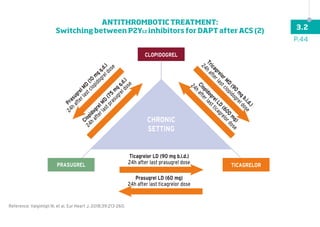
Ticagrelor LD (90 mg b.i.d.)
24h after last prasugrel dose
Prasugrel LD (60 mg)
24h after last ticagrelor dose
P
r
a
s
u
g
r
e
l
M
D
(
1
0
m
g
q
.
d
.
)
2
4
h
a
f
t
e
r
l
a
s
t
c
l
o
p
i
d
o
g
r
e
l
d
o
s
e
C
l
o
p
i
d
o
g
r
e
l
M
D
(
7
5
m
g
q
.
d
.
)
2
4
h
a
f
t
e
r
l
a
s
t
p
r
a
s
u
g
r
e
l
d
o
s
e
T
r
i
c
a
g
r
e
l
o
r
M
D
(
9
0
m
g
b
.
i
.
d
.
)
2
4
h
a
f
t
e
r
l
a
s
t
c
l
o
p
i
d
o
g
r
e
l
d
o
s
e
C
l
o
p
i
d
o
g
r
e
l
L
D
(
6
0
0
m
g
)
2
4
h
a
f
t
e
r
l
a
s
t
t
i
c
a
g
r
e
l
o
r
d
o
s
e
CLOPIDOGREL
CHRONIC
SETTING
PRASUGREL TICAGRELOR
Reference: Valgimigli M, et al. Eur Heart J. 2018;39:213-260.
P.44
3.2
ANTITHROMBOTIC TREATMENT:
Switching between P2Y12 inhibitors for DAPT after ACS (2)
P.45
3.2
ANTITHROMBOTIC TREATMENT:
Risk scores validated for DAPT duration decision-making
PRECISE-DAPT score DAPT score
Time of use At the time of coronary stenting After 12 months of uneventful DAPT
DAPT duration
strategies assessed
Short DAPT (3-6 months)
vs. Standard/long DAPT (12-24 monts)
Standard DAPT (12 months)
vs. Long DAPT (30 months)
Score calculation
HB	
Age
	 ≥75
	 65 to 75
	65
Cigarette smoking
Diabetes mellitus
MI at presentation
Prior PCI or prior MI
Paclitaxel-eluting stent
Stent diameter 3 mm
CHF or LVEF 30%
Vein graft stent
— 2 pt
— 1 pt
0 pt
+ 1 pt
+ 1 pt
+ 1 pt
+ 1 pt
+ 1 pt
+ 1 pt
+ 2 pt
+ 2 pt
WBC	
Age	
CrCl 	
Prior
Bleeding
Score
Points
Score range 0 to 100 points — 2 to 10 points
Decision making
cut-off
Score ≥25 → Short DAPT
Score 25 → Standard/long DAPT
Score ≥2 → Long DAPT
Score 2 → Standard DAPT
Electronic calculator www.precisedaptscore.com www.daptstudy.org
DUAL THERAPY strategy:
TRIPLE THERAPY strategy:
STEP
2:
Treatment
type
STEP
3:
Treatment
duration
STEP
1:
Patient
risk
assessment
BRIR
DUAL (12 mo.) OAC alone
OAC alone
OAC alone
TRIPLE (for 1 mo.)
TRIPLE (up to 6 mo.)
DUAL
(up to 12 mo.)
DUAL (up to 12 mo.)
BRIR
• NOAC* (preferable)
- Apixaban 5 mg b.i.d. (reduce to 2.5 mg b.i.d.(1)
- Dabigatran 110 mg b.i.d. (preferable while on DAPT)
or 150 mg b.i.d.
- Edoxaban 60 mg q.d. (reduce to 30 mg q.d.(2)
- Rivaroxaban 20 mg q.d. (reduce to 15 mg q.d.(3)
or 15 mg
(may be considered DAPT/SAPT)
or
• VKA dose ajusted: consider maintaining INR in the lower
part of the recommended target range (e.g. 2.0-2.5 for AF
and MV in aortic position, 2.5-3.0 for MV in mitral position)
OAC:
• Clopidogrel 75 mg q.d.
(preferable)*
or
• Aspirin 75-100 mg q.d.
SAPT:
• Clopidogrel 75 mg q.d.
and
• Aspirin 75-100 mg q.d.
DAPT:
• HIGH RISK OF BLEEDING?
High HAS-BLED: Hypertension, abnormal liver/renal function, prior stroke, bleeding diathesis, labile INR if on VKA, age 65, drugs
(e.g. NSAIDs or antiplatelets), alcohol abuse, ABC score: Age, Biomarkers (GDF-15, hs cTnT, Hb) and Clinical history of prior bleeding
• HIGH RISK OF RECURRENT CORONARY ISCHEMIC EVENTS?
ACS at presentation, prior ST, stenting of last remaining vessel, CrCL 60 ml/min, ≥3 stents implanted or lesions treated,
bifurcation with 2 stents, overall stentlengh 60 mm, treatment of CTO
TRIPLE
THERAPY
(If High BR Low IR)
(If High BR High IR)
or
(If Low BR High IR)
DUAL
THERAPY
Reference adapted from Valgimigli M et al. Eur Heart J. 2018;39:213-260.
*
In case of
selecting
dual therapy
immediately after
stent implantation
clopidogrel should
be selected as
single antiplatelet
agent. Aspirin
should however
be administered
at the time of the
intervention.
(1) 
Age ≥80 years,
body weight ≤60 kg
or serum creatinine
level ≥1.5 mg/dL.
(2) 
CrCl of
30–50 ml/min,
body weight
≤60 kg,
concomitant use
of verapamil,
quinidine or
dronedarone.
(3) 
CrCl30-49 ml/min.
P.46
3.2
ANTITHROMBOTIC TREATMENT in patients with concomitant
indication for DAPT and chronic oral anticoagulation (1)
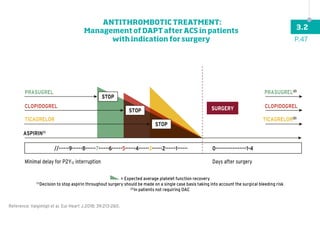
SURGERY
Minimal delay for P2Y12 interruption Days after surgery
CLOPIDOGREL
PRASUGREL
TICAGRELOR
CLOPIDOGREL
PRASUGREL(2)
TICAGRELOR(2)
ASPIRIN(1)
//••••••9••••••8••••••7••••••6••••••5••••••4••••••3••••••2••••••1•••••• 0••••••••••••••••••1-4
STOP
STOP
STOP
= Expected average platelet function recovery
(1) 
Decision to stop aspirin throughout surgery should be made on a single case basis taking into account the surgical bleeding risk
(2) 
In patients not requiring OAC
Reference: Valgimigli et al. Eur Heart J.2018; 39:213-260.
P.47
3.2
ANTITHROMBOTIC TREATMENT:
Management of DAPT after ACS in patients
with indication for surgery
LIFE-THREATENING BLEEDING
e.g. massive overt genitourinary,
respiratory or upper/lower
gastrointestinal bleeding,
active intracranial, spinal
or intraocular haemorrhage,
or any bleeding
STOP ALL ANTITHROMBOTIC MEDICATIONS
and reverse OAC. Once bleeding has ceased, re-evaluate the need
for DAPT or SAPT, preferably with the P2Y12 inhibitor
especially in case of upper GI bleeding
CONTINUE DAPT a
, CONTINUE OAC c
CONTINUE DAPT, CONTINUE OAC Consider skipping one single next pill
CONSIDER STOPPING DAPT
and continue with SAPT, preferably with the P2Y12 inhibitor
especially in case of upper GI bleeding. Once bleeding has ceased,
re-evaluate the need for DAPT or SAPTa
CONSIDER STOPPING OAC
or even reversal until bleeding is controlled, unless prohibitive thrombotic risk
(i.e. mechanical heart valve in mitral position, cardiac assist device )b-c-d
Reinitiate treatment within one week if clinically indicated.
If Bleeding persist despite treatment, or treatment is not possible
CONSIDER STOPPING ALL ANTITHROMBOTIC MEDICATIONS
CONSIDER STOPPING DAPT
and continue with SAPT, preferably with the P2Y12 inhibitorespecially in case
of upper GI bleeding Reinitiate DAPT as soon as deemed safea
CONSIDER STOPPING OAC
or even reversal until bleeding is controlled, unless very high thrombotic risk
(i.e. mechanical heart valves, cardiac assist device, CHA2DS2-VASc ≥4 ).b-c-d
Reinitiate treatment within one week if clinically indicated.
SEVERE BLEEDING
e.g. severe genitourinary,
respiratory or upper/lower
gastrointestinal bleeding
MODERATE BLEEDING
e.g. genitourinary, respiratory
or upper/lower gastrointestinal
bleeding with significant blood
loss or requiring transfusion
MILD BLEEDING
e.g. not self resolving epistaxis,
moderate conjunctival bleeding,
genitourinary or upper/lower
gastrointestinal bleeding
without significant blood loss,
mild haemoptysis
TRIVIAL BLEEDING e.g. skin bruising or ecchimosis,
self-resolving epistaxis, minimal conjunctival bleeding
ANTITHROMBOTIC TREATMENT
MANAGEMENT DURING BLEEDING
Active bleeding and unstable hemodynamic
putting patient’s life immediately at risk?
Hospitalization required? Hb loss 5 g/dl
Hb loss 5 g/dl
Significant blood loss (3 g/dl) ?
Requires medical intervention
or further evaluation?
Yes
Yes
Yes
Yes
No
No
No
No
Reference: Valgimigli et al. Eur Heart J.2018; 39:213-260.
a
Consider shortening DAPT duration or switching to less potent P2Y12 inhibitor (i.e. from ticagrelor/prasugrel to clopidogrel), especially if recurrent bleeding occurs
b 
Reinitiate treatment within one week if clinically indicated. For Vitamin-K antagonist consider a target INR of 2.0-2.5 unless overriding indication (i.e. mechanical
heart valves or cardiac assist device) for NOAC consider the lowest effective dose. - c 
In case of triple therapy consider downgrading to dual therapy, preferably with
clopidogrel and OAC. - d 
If patients on dual therapy, consider stopping antiplatelet therapy if deemed safe.
P.48
3.2
ANTITHROMBOTIC TREATMENT:
Management of acute bleeding after ACS
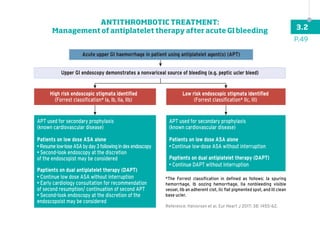
Acute upper GI haemorrhage in patient using antiplatelet agent(s) (APT)
Upper GI endoscopy demonstrates a nonvariceal source of bleeding (e.g. peptic ucler bleed)
High risk endoscopic stigmata identified
(Forrest classification* Ia, Ib, IIa, IIb)
APT used for secondary prophylaxis
(known cardiovascular disease)
Patients on low dose ASA alone
•Resumelow-loseASAbyday3followingindexendoscopy
• Second-look endoscopy at the discretion
of the endoscopist may be considered
Paptients on dual antiplatelet therapy (DAPT)
• Continue low dose ASA without interruption
• Early cardiology consultation for recommendation
of second resumption/ continuation of second APT
• Second-look endoscopy at the discretion of the
endoscopoist may be considered
APT used for secondary prophylaxis
(known cardiovascular disease)
Patients on low dose ASA alone
•Continue low-dose ASA without interruption
Paptients on dual antiplatelet therapy (DAPT)
• Continue DAPT without interruption
Low risk endoscopic stigmata identified
(Forrest classification* IIc, III)
*The Forrest classification in defined as follows: Ia spuring
hemorrhage, Ib oozing hemorrhage, IIa nonbleeding visible
vessel, IIb an adherent clot, IIc flat pigmented spot, and III clean
base ucler.
Reference: Halvorsen et al. Eur Heart J 2017; 38: 1455-62.
P.49
3.2
ANTITHROMBOTIC TREATMENT:
Management of antiplatelet therapy after acute GI bleeding
CHAPTER 4
ACUTE HEART FAILURE
4.1	WET-AND-WARM HEART FAILURE PATIENT ������������������������������ p.52
V.P. Harjola, O. Miró
4.2	CARDIOGENIC SHOCK (WET-AND-COLD) ����������������������������������� p.61
P. Vranckx, U. Zeymer
4
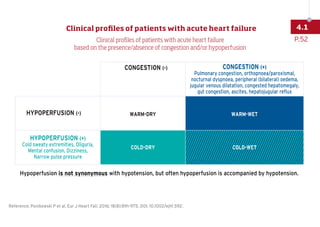
Reference: Ponikowski P et al. Eur J Heart Fail. 2016; 18(8):891-975. DOI: 10.1002/ejhf.592.
WARM-DRY WARM-WET
COLD-DRY COLD-WET
HYPOPERFUSION (+)
Cold sweaty extremities, Oliguria,
Mental confusion, Dizziness,
Narrow pulse pressure
HYPOPERFUSION (-)
CONGESTION (-) CONGESTION (+)
Pulmonary congestion, orthopnoea/paroxismal,
nocturnal dyspnoea, peripheral (bilateral) oedema,
jugular venous dilatation, congested hepatomegaly,
gut congestion, ascites, hepatojugular reflux
Clinical profiles of patients with acute heart failure
based on the presence/absence of congestion and/or hypoperfusion
Hypoperfusion is not synonymous with hypotension, but often hypoperfusion is accompanied by hypotension.
P.52
4.1
Clinical profiles of patients with acute heart failure
Reference: McMurray JJ et al. Eur Heart J (2012); 33:1787-847.
Ponikowski P et al. Eur J Heart Fail. 2016; 18:891-975.
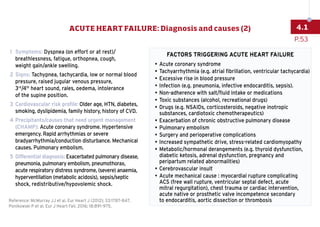
1	Symptoms: Dyspnea (on effort or at rest)/
breathlessness, fatigue, orthopnea, cough,
weight gain/ankle swelling.
2	Signs: Tachypnea, tachycardia, low or normal blood
pressure, raised jugular venous pressure,
3rd
/4th
heart sound, rales, oedema, intolerance
of the supine position.
3	
Cardiovascular risk profile: Older age, HTN, diabetes,
smoking, dyslipidemia, family history, history of CVD.
4	
Precipitants/causes that need urgent management
(CHAMP): Acute coronary syndrome. Hypertensive
emergency. Rapid arrhythmias or severe
bradyarrhythmia/conduction disturbance. Mechanical
causes. Pulmonary embolism.
5	Differential diagnosis: Exacerbated pulmonary disease,
pneumonia, pulmonary embolism, pneumothorax,
acute respiratory distress syndrome, (severe) anaemia,
hyperventilation (metabolic acidosis), sepsis/septic
shock, redistributive/hypovolemic shock.
FACTORS TRIGGERING ACUTE HEART FAILURE
•	
Acute coronary syndrome
•	
Tachyarrhythmia (e.g. atrial fibrillation, ventricular tachycardia)
•	
Excessive rise in blood pressure
•	
Infection (e.g. pneumonia, infective endocarditis, sepsis).
•	
Non-adherence with salt/fluid intake or medications
•	
Toxic substances (alcohol, recreational drugs)
•	
Drugs (e.g. NSAIDs, corticosteroids, negative inotropic
substances, cardiotoxic chemotherapeutics)
•	
Exacerbation of chronic obstructive pulmonary disease
•	Pulmonary embolism
•	
Surgery and perioperative complications
•	
Increased sympathetic drive, stress-related cardiomyopathy
•	
Metabolic/hormonal derangements (e.g. thyroid dysfunction,
diabetic ketosis, adrenal dysfunction, pregnancy and
peripartum related abnormalities)
•	Cerebrovascular insult
•	
Acute mechanical cause : myocardial rupture complicating
ACS (free wall rupture, ventricular septal defect, acute
mitral regurgitation), chest trauma or cardiac intervention,
acute native or prosthetic valve incompetence secondary
to endocarditis, aortic dissection or thrombosis
P.53
4.1
ACUTE HEART FAILURE: Diagnosis and causes (2)
Reference: Ponikowski P et al. Eur J Heart Fail. 2016; 18(8): 891-975. DOI: 10.1002/ejhf.592.
Patient with suspected AHF
1. Cardiogenic shock ?
Urgent phase after
first medical contact
Immediate stabilization
and transfer to ICU/CCU
Immediate initiation
of specific treatement
Indentification of acute aeticology :
C = Acute Coronary syndrome
H = Hypertension emergency
A = Arrhythmia
M = Acute Mechanical cause
P = Pulmonary embolism
Diagnostic work-up to confirm AHF
Clinical evaluation to select optimal management
Immediate phase
(initial 60-120 minutes)
Circulatory support
• pharmacological
• mechanical
Ventilatory support
• oxygen
• non-invasive positive
pressure ventilation (CPAP, BiPAP)
• mechanical ventilation
2. Respiratory failure ?
Yes
No
No
No
Yes
Yes
P.54
4.1
Initial management of a patient with ACUTE HEART FAILURE
After
60-90 min
In hospital
Pre-hospital or
emergency room
Reference adapted from Mebazaa A et al. Eur J Heart Fail. (2015); 17:544-58.
Conventional oxygen therapy
Conventional
oxygen therapy
Intolerance
Weaning
CPAP
CPAP
FAILURE
PS-PEEP
SUCCESS
SIGNIFICANT HYPERCAPNIA
AND ACIDOSIS
NORMAL pH
AND pCO2
Intubation
Intubation
RESPIRATORY DISTRESS?
SpO2 90%, RR25,
Work of breathing, orthopnea
PERSISTENT RESPIRATORY DISTRESS?
Upright position
No Yes
Yes
Venous/Arterial blood gases
No
Room air
P.55
4.1
ACUTE HEART FAILURE: Airway (A) and breathing (B)
Oxygen therapy and ventilatory support in acute heart failure
INSTRUMENTATION  INVESTIGATIONS:
Intravenous line (peripheral/central) and BP monitoring (arterial line in shock
and severe ventilatory/gas-exchange disturbances)
Laboratory measures
	 • Cardiac markers (troponin, BNP/NT-proBNP/MR-proANP)
	 • 
Complete blood count, electrolytes, creatinine, urea, glucose,
inflammation, TSH
	 • 
Consider arterial or venous blood gases, lactate, D-dimer
(suspicion of acute pulmonary embolism) 
Standard 12-lead ECG
	 • Rhythm, rate, conduction times?
	 • Signs of ischemia/myocardial infarction? Hypertrophy?
Echocardiography
	 a) Immediately in haemodynamically unstable patients
	 b) 
Within 48 hours when cardiac structure and function are either not known or
may have changed since previous studies
Ventricular function (systolic and diastolic)? Estimated left-and right-side filling
pressures? Lung ultrasound? Presence of valve dysfunction (severe stenosis/
insufficiency)? Pericardial tamponade?
ACTIONS:
Rule in/out
acute heart failure
as cause of symptoms
and signs
Determine
clinical profile
Start as soon as
possible treatment of
both heart failure and
the factors identified
as triggers
Establish cause
C - CIRCULATION*
HR (bradycardia [60/min], normal [60-100/min], tachycardia [100/min]), rhythm (regular, irregular), SBP (very low
[90 mmHg], low, normal [110-140 mmHg], high [140 mmHg]), and elevated jugular pressure should be checked.
P.56
4.1
ACUTE HEART FAILURE: Initial diagnosis (CDE)
References: Mebazaa A et al. Intensive Care Med. (2016); 42(2):147-63; Mueller C et al. Eur Heart J Acute Cardiovasc Care. (2017); 6(1):81-6.
D – DISABILITY DUE TO NEUROLOGICAL DETERIORATION
	 • 
Normal consiousness/altered mental status?
Measurement of mental state with AVPU (alert, visual, pain or unresponsive) 
or Glasgow
	 • 
Coma Scale: EMV score 8 Consider endotracheal intubation and mechanical ventilation
	 • 
Anxiety, severe dyspnea? Consider cautious administration of morphine 2 mg i.v. bolus,
preceded by antiemetic as needed
E – EXPOSURE  EXAMINATION
	• Temperature/fever: central and peripheral
	• Weight
	• Skin/extremities: circulation (e.g. capilary refill), color
	 • 
Urinary output (0.5 ml/kg/hr) Consider inserting indwelling catheter;
the benefits should outweigh the risks of infection and long-term complications
P.57
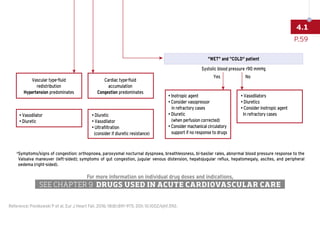
4.1
Patient with AHF
Bedside assessment to identify haemodynamic profiles
DRY patient
WET patient
No
(5% of all AHF patients)
Yes
(95% of all AHF patients)
Yes No
Yes
No
PRESENCE OF CONGESTIONa
?
ADEQUATE PERIPHERAL PERFUSION?
DRY and COLD
Hypoperfused, hypovolemic
DRY and WARM
Adequately perfused
≈ Compensated
Consider fluid challenge
Consider inotropic agent if still hypoperfused
Adjust oral therapy
WET and WARM
patient (typically elevated
or normal systolic blood
pressure)
P.58
4.1
ACUTE HEART FAILURE: Management of patients with acute heart
failure based on clinical profile during an early phase
WET and COLD patient
Systolic blood pressure 90 mmHg
Yes No
• Inotropic agent
• Consider vasopressor
in refractory cases
• Diuretic
(when perfusion corrected)
• Consider machanical circulatory
support if no response to drugs
• Vasodilators
• Diuretics
• Consider inotropic agent
In refractory cases
• Vasodilator
• Diuretic
• Diuretic
• Vasodilator
• Ultrafiltration
(consider if diuretic resistance)
Vascular type-fluid
redistribution
Hypertension predominates
Cardiac type-fluid
accumulation
Congestion predominates
a 
Symptoms/signs of congestion: orthopnoea, paroxysmal nocturnal dyspnoea, breathlessness, bi-basilar rales, abnormal blood pressure response to the
Valsalva maneuver (left-sided); symptoms of gut congestion, jugular venous distension, hepatojugular reflux, hepatomegaly, ascites, and peripheral
oedema (right-sided).
For more information on individual drug doses and indications,
SEE CHAPTER 9 DRUGS USED IN ACUTE CARDIOVASCULAR CARE
Reference: Ponikowski P et al. Eur J Heart Fail. 2016; 18(8):891-975. DOI: 10.1002/ejhf.592.
P.59
4.1
No acute heart failure
MONITORING
Dyspnea (VAS, RR), BP, SpO2, HR and
rhythm, urine output, peripheral perfusion
REASSESSMENT
Clinical, biological and psychosocial parameters by trained nurses
Observation unit (24h)
Discharge home
Ward (cardiology, internal
medicine, geriatrics)
Rehabilitation
program
Visit to cardiologist
1-2 weeks
Palliative care
hospitals
ICU/CCU
Confirmed acute heart failure
DIAGNOSTIC TESTS
OBSERVATION
UP
TO
120
min
ADMISSION/DISCHARGE
Risk stratification: ensure patient
is at low risk before direct discharge
Risk stratification: ensure patient
is at low risk before direct discharge
TREATMENT OBJECTIVES to prevent organ dysfunction:
Improve symptoms, maintain SBP 90 mmHg and peripheral
perfusion, mantain SpO2 90% (see table in pages 63-64)
Reference adapted from Mebazaa A et al. Eur J Heart Fail. (2015); 17: 544-58 and Miró Ò et al. Ann Intern Med (2017); 167:698-705.
P.60
4.1
ACUTE HEART FAILURE: Management of acute heart failure
Normotension/
Hypertension
Hypotension Low heart rate Potassium Renal impairment
100 90
mmHg
90
mmHg
60
≥50 bpm
50 bpm ≤3.5
mmol/L
5.5
mmol/L
Cr 2.5,
eGFR 30
Cr 2.5,
eGFR 30
ACE-I/ARB Review/
increase
Reduce/
stop
Stop No
change
No
change
Review/
increase
Stop Review Stop
Beta-blocker No change Reduce/
stop
Stop Reduce Stop No
change
No
change
No
change
No
change
MRA No change No
change
Stop No
change
No
change
Review/
increase
Stop Reduce Stop
Diuretics Increase Reduce Stop No
change
No
change
Review/
No
change
Review/
increase
No
change
Review
Sacubitril/
Valsartan
Review/
increase
Stop Stop No
change
No
change
Review/
increase
Stop Review Stop
Reference adapted from Mebazaa A et al. Eur J Heart Fail. (2015); 17(6):544-58.
Management of oral therapy in AHF in the first 48 hours P.61
ACUTE HEART FAILURE: Treatment (C) and preventive measures 4.0
4.1
Normotension/
Hypertension
Hypotension Low heart rate Potassium Renal impairment
100 90
mmHg
90
mmHg
60
≥50 bpm
50 bpm ≤3.5
mmol/L
5.5
mmol/L
Cr 2.5,
eGFR 30
Cr 2.5,
eGFR 30
Other
vasodilators
(nitrates)
Increase Reduce/
stop
Stop No
change
No
change
No
change
No
change
No
change
No
change
Other heart rate
slowing drugs
(amiodarone,
non-dihydropyridine
CCB, ivabradine)
Review Reduce/
stop
Stop Reduce/
stop
Stop Review/
stop(*)
No
change
No
change
No
change
Thrombosis prophylaxis should be started in patients not anticoagulated.
(*) Amiodarone.
Management of oral therapy in AHF in the first 48 hours
Reference adapted from Mebazaa A et al. Eur J Heart Fail. (2015); 17(6):544-58.
P.62
ACUTEHEARTFAILURE:Treatment(C)andpreventivemeasures(Cont.) 4.1
Hemodynamic criteria to define cardiogenic shock
• 
Systolic blood pressure 80 to 90 mmHg
or mean arterial pressure 30 mmHg lower than baseline
• 
Severe reduction in cardiac index:
1.8 l/min/m2
without support
or 2.0 to 2.2 l/min/m2
with support
• 
Adequate or elevated filling pressure:
Left ventricular end-diastolic pressure 18 mmHg
or Right atrial pressure 10 to 15 mmHg
Clinical condition defined as the inability of the heart to deliver an adequate amount of blood
to the tissues to meet resting metabolic demands as a result of impairment of its pumping function.
Cardiogenic shock is equal to wet-cold phenotype. The clinical signs of hypoperfusion are listed in page 65.
In addition, blood lactate is typically elevated above 2 mmol/L.
P.63
4.2
CARDIOGENIC SHOCK: Definition
LV pump failure is the primary insult in most forms of CS, but other parts of the circulatory system
contribute to shock with inadequate compensation or additional defects P.64
4.2
CARDIOGENIC SHOCK: Causes
This protocol should be initiated as soon as cardiogenic shock/end organ hypoperfusion is recognised
and should not be delayed pending intensive care admission.
EARLY TRIAGE  MONITORING
Start high flow O2
Establish i.v. access
• Age: 65–74, ≥75
• Heart rate 100 beats per minute
• Systolic blood pressure 100 mmHg
• Proportional pulse pressure ≤25 % (CI 2.2 l/min/m2
)
• Orthopnea (PCWP 22 mmHg)
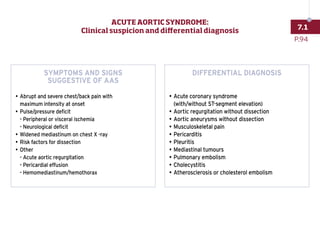
• Tachypnea (20/min), 30/min (!)
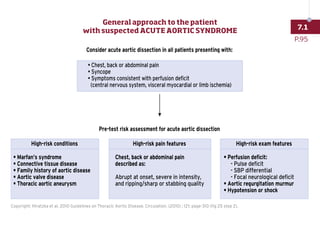
• Killip class IV
• 
Clinical symptoms of tissue hypoperfusion/hypoxia:
- cool extremities										- decreasedurineoutput(urineoutput40 
ml/h)
- decreased capillary refill or mottling	- alteration in mental status
INITIAL RESUSCITATION
• 
Arterial and a central venous
catheterization with a catheter
capable of measuring central venous
oxygen saturation
• 
Standard transthoracic
echocardiogram to assess left (and
right) ventricular function and for
the detection of potential mechanical
complications following MI
• 
Early coronary angiography in
specialized myocardial intervention
centre when signs and/or symptoms
of ongoing myocardial ischemia
(e.g. ST-segment elevation myocardial
infarction).
• CORRECT: hypoglycemia  hypocalcemia,
• TREAT: sustaned arrhythmias: brady- or tachycardia
• 
Isotonic saline-fluid challenge - 200-300 ml
over 30 min period to achieve a central venous pressure of 8 to 12 mmHg
or until perfusion improves (with a maximum of 500 ml)
• 
CONSIDER NIMV for comfort (fatigue, distress) or as needed:
- To correct acidosis	 - To correct hypoxemia
• INOTROPIC SUPPORT (dobutamine, levosimendan and/or vasopressor support)
TREATMENT GOALS
	 • a mean arterial pressure of 60 mmHg or above,
	 • a mean pulmonary artery wedge pressure of 18 mmHg or below,
	 • a central venous pressure of 8 to 12 mmHg,
	 • a urinary output of 0,5 ml or more per hour per kilogram of body weight
	 • an arterial pH of 7.3 to 7.5
	 • 
a central venous saturation (ScvO2) ≥70% (provided SpO2 ≥93%
and Hb level ≥9 g/dl)
In persistent drug-resistant cardiogenic shock,
consider mechanical circulatory support
0 min
5 min
15 min
60 min
EMERGENCY
DEPARTMENT
CARDIAC
INTENSIVE
CARE
UNIT
P.65
4.2
CARDIOGENIC SHOCK: Initial triage and management
Ventilator mode
Tidal Volume goal
Plateau Pressure goal
Anticipated PEEP levels
Ventilator rate and pH goal
Inspiration: Expiration time
Oxygenation goal:
• PaO2
• SpO2
Pressure assist/control
Reduce tidal volume to 6-8 ml/kg lean body weight
≤30 cm H2O
5-10 cm H2O
12-20, adjusted to achieve a pH ≥7.30 if possible
1:1 to 1:2
50-80 mmHg
90%
Predicted body weight calculation:
• Male: 50 + 0.91 (height in cm - 152.4)
• Female: 45.5 + 0.91 (height in cm - 152.4)
Some patients with CS will require increased PEEP to attain functional residual capacity and maintain oxygenation,
and peak pressures above 30 cm H2O to attain effective tidal volumes of 6-8 ml/kg with adequate CO2 removal.
For more informations on individual drug doses and indications:
For more information on individual drug doses and indications,
SEE CHAPTER 9 DRUGS USED IN ACUTE CARDIOVASCULAR CARE
P.66
4.2
CARDIOGENIC SHOCK: Treatment and ventilator procedures
CARDIOGENIC SHOCK: MANAGEMENT FOLLOWING STEMI
Assess volume status
Treat sustained arrhythmias: brady - or tachy -
Consider mechanical ventilation for comfort (during PCI) and/or as needed:
• to correct acidosis
• to correct hypoxemia
Inotropic support (dobutamine and/or vasopressor support)
Signs (ST-segment elevation or new LBBB)
and/or clinical symptoms of ongoing
myocardial ischemia
Early coronary angiography
± Pulmonary artery catheter
± IABP in selected patients
in a specialised Myocardial
Intervention Centre
PCI ± stenting
of the culprit lesion
CABG
+ correct mechanical complications
Pump failure
RV, LV, both
Short-term
mechanical
circulatory
support
Aortic
dissection
Pericardial
tamponade
• Acute severe mitral valve regurgitation
• Ventricular septum rupture
• Severe aortic/mitral valve stenosis
Operating theater ± coronary angiography
Emergency echocardiography
± Tissue doppler imaging
± Color flow imaging
No
NSTEACS,
Delayed CS
Yes
P.67
4.2
CARDIOGENIC SHOCK: management following STEMI
72-hrs
2-weeks
1-month ...
Left ventricular support BiVentricular support
Partial support
IABP Impella 2.5 Tandem-
heart
Impella 5.0 Implantable
ECMO
Levitronix
Full support
Level of support
Pulmonary support
P.68
4.2
CARDIOGENIC SHOCK:
Mechanical circulatory support, basic characteristics
Different systems for mechanical circulatory support are available to the medical community.
The available devices differ in terms of the insertion procedure, mechanical properties, and
mode of action. A minimal flow rate of 70 ml/kg/min, representing a cardiac index of at least
2.5 L/m2
, is generally required to provide adequate organ perfusion. This flow is the sum
of the mechanical circulatory support output and the remaining function of the heart.
The SAVE-score may be a tool to predict survival for patients receiving ECMO for refractory
cardiogenic shock
Type Support Access
Intra-aortic balloon
pump
Balloon
counterpulsation
Pulsatile flow 0.5 L Arterial: 7.5 French
Impella Recover
 LP 2.5
 CP
 LP 5.0
Axial flow Continuous flow
 2.5 L
 4.0 L
 5.0 L
Arterial: 12 French
Arterial: 14 French
Arterial: 21 French
Tandemheart
Centrifugal flow
 5.0 L
Continuous flow
 5.0 L
Venous: 21 French
Arterial: 15-17 French
Venous: 15-29 French
Arterial: 15-29 French
Cardiohelp
(www.save-score.com).
P.69
4.2
Monsieurs KG, et al. European Resuscitation Council Guidelines for Resuscitation 2015. Section 1
Executive Summary. Resuscitation 2015; 95C:1-80, DOI:10.1016/j.resuscitation.2015.07.038
CHAPTER 5
CARDIAC ARREST AND
CARDIOPULMONARY RESUSCITATION
N. Nikolaou, L. Bossaert
5
THE CHAIN OF SURVIVAL
P.71
OUT OF HOSPITAL CARDIAC ARREST:
ASSESSMENT OF A COLLAPSED VICTIM AND INITIAL TREATMENT
VICTIM COLLAPSES
Victim responds
Victim unresponsive
Leave victim as found
Find out what is wrong
Reassess victim regularly
Shout for help
Open airway
Assess breathing
Not breathing normally
Call for an ambulance
Start CPR 30:2
Send or go for an AED
As soon as AED arrives
Start AED,
listen to and follow voice prompts
AED Assesses rhythm
AED not available
30 chest compressions:
2 rescue breaths
Breathing normally
Put victim in recovery position
and call for an ambulance
Approach safely
Check response
P.72
5
OUT OF HOSPITAL CARDIAC ARREST:
Assessment of a collapsed victim and initial treatment
Continue until victim starts to wake up: to move, open eyes, and breathe normally
No shock advised
Immediately resume
CPR 30:2 for 2 min
Shock advised
1 shock
Immediately resume
CPR 30:2 for 2 min
P.73
5
IN-HOSPITAL CARDIAC ARREST:
ASSESSMENT OF A COLLAPSED VICTIM AND INITIAL TREATMENT
Collapsed/sick patient
Shout for HELP  assess patient
Yes
No
Assess ABCDE
Recognise  treat
oxygen; monitoring, i.v. access
Call resuscitation
team
CPR 30:2
with oxygen and airway adjuncts
Signs of life?
P.74
5
IN-HOSPITAL CARDIAC ARREST:
Assessment of a collapsed victim and initial treatment
Call resuscitation team
if appropriate
Apply pads/monitor
Attempt defibrillation
if appropriate
Handover to resuscitation team
Advanced Life Support
when resuscitation team arrives
P.75
5
IN-HOSPITAL CARDIAC ARREST: ADVANCED LIFE SUPPORT
Unresponsive
and not breathing
normally ?
Assess
rhythm
CPR 30:2
Attach defibrillator/monitor
Minimise interruptions
Call resuscitation
team
Shockable
(VF/Pulseless VT)
Non-shockable
(PEA/Asystole)
P.76
5
IN-HOSPITAL CARDIAC ARREST: Advanced life support
DURING CPR
• Ensure high-quality
chest compressions
• Minimise interruptions
to compressions
• Give Oxygen
• Use waveform capnography
• Continuous chest compressions
when advanced airway in place
• Vascular access (intravenous,
intraosseous)
• Give adrenaline every 3-5 min
• Give amiodarone after 3 shocks
• Correct reversible causes
REVERSIBLE CAUSES
• Hypoxia
• Hypovolaemia
• Hypo-/hyperkalaemia/metabolic
• Hypothermia
• Thrombosis
• Tamponade - cardiac
• Toxins
• Tension pneumothorax
1 Shock
Return of
spontaneous circulation
IMMEDIATE POST
CARDIAC
ARREST TREATMENT
Immediately resume:
CPR for 2 min
Minimise interruptions
Immediately resume:
CPR for 2 min
Minimise interruptions • Use ABCDE approach
• Aim for SaO2 94-98%
• Aim for normal PaCO2
• 12-lead ECG
• Treat precipitating cause
• Temperature control /
Therapeutic hypothermia
CONSIDER
• Ultrasound imaging
• Mechanical chest
compressions to facilitate
transfer/treatment
• Coronary angiography
and PCI
• Extracorporeal CPR
P.77
5
Give adrenaline and amiodarone
after 3rd
shock
Adrenaline: 1 mg i.v.
(10 ml 1:10,000 or 1 ml 1:1000)
repeated every 3-5 min
(alternate loops)
given without interrupting
chest compressions
Amiodarone
300 mg bolus i.v.
Second bolus dose of 150 mg i.v.
if VF/VT persists
followed by infusion of
900 mg over 24 h
Adrenaline: 1mg i.v. (10 ml 1:10,000 or 1 ml 1:1000)
given as soon as circulatory access is obtained
Repeat every 3-5 min (alternate loops)
Give without interrupting chest compressions
IN-HOSPITAL CARDIAC ARREST: DRUG THERAPY DURING ADVANCED LIFE SUPPORT
Cardiac Arrest
Non-shockable
rhythm
Shockable rhythm
(VF, pulseless VT)
P.78
5
IN-HOSPITAL CARDIAC ARREST:
Drug therapy during advanced life support
CHAPTER 6
RHYTHM DISTURBANCES
6.1	SUPRAVENTRICULAR TACHYCARDIAS AND ATRIAL FIBRILLATION ���� p.80
J. Brugada
6.2	VENTRICULAR TACHYCARDIAS ������������������������������������������ p.84
M. Santini, C. Lavalle, S. Lanzara
6.3	BRADYARRHYTHMIAS ���������������������������������������������������� p.87
B. Gorenek
6
QRS morphology similar to QRS morphology
in sinus rhythm?
QRS morphology similar to QRS morphology
in sinus rhythm?
YES
QRS complex
120 msec
Supraventr.
Tachycardia
QRS complex
120 msec
Supraventr.
Tachycardia
+ BBB
QRS complex
120 msec
QRS complex
120 msec
Fascicular
Tachycardia
or SVT with
aberrant
conduction
Ventricular
Tachycardia
or SVT with
aberrant
conduction
QRS complex
120 msec
QRS complex
120 msec
AF
conducting
over AVN
AF + BBB
or
AF + WPW
AF
+
WPW
Irregular
Ventricular
Tachycardia
Variable QRS
morphology
NO YES NO
TACHYARRHYTHMIAS: DIAGNOSTIC CRITERIA
Tachycardia
100 beats/min
Irregular
Regular
P.80
6.1
TACHYARRHYTHMIAS: Diagnostic criteria
• Concordant precordial pattern
(all leads + or all leads –)
• No RS pattern in precordial leads
• RS pattern with beginning
of R wave to nadir
of S wave 100 msec
Consider
SVT using
the AV node
(AVNRT, AVNT)
Atrial flutter
or atrial
tachycardia
Ventricular
Tachycardia
Ventricular
Tachycardia
Ventricular
Tachycardia
Consider
Sinus tachycardia
or non proper
administration
of adenosine
(too slow, insufficient
dose, etc)
Typical
morphology
in V1  V6
More As
than Vs
More Vs
than As
Wide
QRS complex
Narrow
QRS complex
Regular tachycardia
Vagal maneuvers
or
i.v. adenosine
No change
Tachycardia
terminates
AV relation
changes
P.81
6.1
TACHYARRHYTHMIAS: Diagnostic maneuvers
Hemodynamically
non-stable
Immediate electrical
cardioversion
No termination
Hemodynamically
stable
Vagal maneuvers
and/or i.v. Adenosine
Less than 48 hours
since initiation
AND
hemodynamically stable
Cardioversion
Electrical or pharmacological
using oral or i.v. flecainide
(only in normal heart)
or i.v. vernakalant
Anticoagulation
is initiated using i.v. heparine
Hemodynamically non-stable
Immediate electrical
Cardioversion
If no cardioversion
is considered: rate control
using betablockers or
calcium antagonists,
together with proper
anticoagulation, if required
Narrow QRS
complex tachycardia
Reconsider diagnosis:
sinus tachycardia,
atrial tachycardia
If no evidence:
Intravenous verapamil
Wide QRS
complex tachycardia
Reconsider the diagnosis of
Ventricular Tachycardia even
if hemodynamically stable
Do not administer
verapimil
More than 48 hours OR
unknown time of initiation,
AND
Patient chronically anticoagulated
OR
a TEE showing no thrombus
Electrical or pharmacological Cardioversion
Termination
TACHYARRHYTHMIAS: THERAPEUTIC ALGORITHMS (1)
Regular Supraventricular Tachycardias
with or without bundle branch block
Irregular and narrow QRS complex
Tachycardia
Hemodynamically
non-stable
Immediate electrical
cardioversion
No termination
Hemodynamically
stable
Vagal maneuvers
and/or i.v. Adenosine
Less than 48 hours
since initiation
AND
hemodynamically stable
Cardioversion
Electrical or pharmacological
using oral or i.v. flecainide
(only in normal heart)
or i.v. vernakalant
Anticoagulation
is initiated using i.v. heparine
Hemodynamically non-stable
Immediate electrical
Cardioversion
If no cardioversion
is considered: rate control
using betablockers or
calcium antagonists,
together with proper
anticoagulation, if required
Narrow QRS
complex tachycardia
Reconsider diagnosis:
sinus tachycardia,
atrial tachycardia
If no evidence:
Intravenous verapamil
Wide QRS
complex tachycardia
Reconsider the diagnosis of
Ventricular Tachycardia even
if hemodynamically stable
Do not administer
verapimil
More than 48 hours OR
unknown time of initiation,
AND
Patient chronically anticoagulated
OR
a TEE showing no thrombus
Electrical or pharmacological Cardioversion
Termination
TACHYARRHYTHMIAS: THERAPEUTIC ALGORITHMS (1)
Regular Supraventricular Tachycardias
with or without bundle branch block
Irregular and narrow QRS complex
Tachycardia
P.82
6.1
TACHYARRHYTHMIAS: Therapeutic algorithms (1)
Hemodynamically
non-stable
Immediate electrical
Cardioversion
If no cardioversion is considered:
rate control using betablockers or
calcium antagonists (only if VT and
AF+WPW is excluded), together
with proper anticoagulation
if required
Less than 48 hours since initiation
AND
hemodynamically stable
Cardioversion
electrical or pharmacological
using oral or i.v. flecainide
(only in normal heart)
or i.v. amiodarone
Anticoagulation
is initiated using i.v. heparin
More than 48 hours
or unknown initiation,
AND
patient chronically anticoagulated
or a TEE showing no thrombus
Electrical or pharmacological
Cardioversion
TACHYARRHYTHMIAS: THERAPEUTIC ALGORITHMS (2)
Irregular and wide QRS complex Tachycardia
P.83
6.1
TACHYARRHYTHMIAS: Therapeutic algorithms (2)
VENTRICULAR TACHYCARDIAS: DIFERENTIAL DIAGNOSIS OF WIDE QRS TACHYCARDIA
EKG signs of atrio-ventricular dissociation
Random P waves unrelated to QRS complexes
Capture beats / fusion beats / second degree V-A block
1st
Step
2nd
Step
3rd
Step
Concordant pattern in precordial leads
No RS morphology in any of the precordial leads
An interval 100 ms from the beginning of the
QRS complex to the nadir of S in a precordial lead
Morphology in precordial leads Morphology
in aVR lead
Yes
Yes
Yes
No
No
No
VT
P.84
6.2
VENTRICULAR TACHYSCARDIAS:
Diferential diagnosis of wide QRS tachyscardias
RBBB morphology LBBB morphology Initial R wave
Initial R wave
or q 40 msec
V1: qR, R, R’
V6: rS,QS
V1: rsR’, RSR’
V6: qRs
Aberrant conduction
V6: R V1: rS; R 30 ms,
S nadir 60 ms,
notching of the
S wave
V6: qR, QS
Yes
No
No
No
No
Yes
Yes
Yes
Notch in the
descending
Q wave limb
Vi/Vt ≤1
VT
Aberrant conduction
VT
P.85
6.2
MANAGEMENT OF WIDE QRS TACHYCARDIAS
Hemodynamic Tolerance
Stable
Regular rhythm
Irregular rhythm
Vagal maneuver
and/or
i.v. adenosine (push)
Differential Diagnosis
Interruption or
slow down HR
Yes
Yes
No
No
Differential
Diagnosis
(see chapter 6.1
page 81)
SVT
AF with aberrant
ventricular conduction
• β-blockers
• i.v.
• Verapamil or diltazem
Pre excited AF
• Class 1 AADs
Polymorphic VT
• Amiodarone
Amiodarone 150 mg i.v.
(can be repeated up to
a maximum dose of 2.2 g in 24 h)
Synchronised cardioversion
With pulse
Pulseless
Non-stable
• Sedation
or analgesia
• Synchronised
cardioversion
100 to 200 J
(monophasic)
or 50-100 J
(biphasic)
ACLS Resuscitation algorithm
• Immediate high- energy
defibrillation (200 J biphasic
or 360 monophasic)
• Resume CPR and continue
according to the ACLS algorithm
Drugs used in the ACLS algorithm
• Epinephrine 1 mg i.v./i.o.
(repeat every 3-5 min)
• Vasopressin 40 i.v./i.o.
• Amiodarone 300 mg i.v./i.o.
once then consider an additional
150 mg i.v./i.o. dose
• Lidocaine 1-1.5 mg/kg first dose
then 0.5-0-75 mg/kg i.v./i.o.
for max 3 doses or 3 mg/kg
• Magnesium loading dose 1-2 gr
i.v./i.o. for torsade des pointes
P.86
6.2
Management of wide QRS TACHYSCARDIAS
Sinus node dysfunction Atrioventricular (AV) blocks
•	Sinus bradycardia: It is a rhythm that originates
from the sinus node and has a rate of under 60 beats
per minute
•	
Sinoatrial exit block: The depolarisations that occur in
the sinus node cannot leave the node towards the atria
•	Sinus arrest: Sinus pause or arrest is defined as the
transient absence of sinus P waves
on the ECG
•	
First degree AV block: Atrioventricular impulse
transmission is delayed, resulting in a PR interval
longer than 200 msec
•	
Second degree AV block: Mobitz type I (Wenckebach
block): Progressive PR interval prolongation, which
precedes a nonconducted P wave
•	
Second degree AV block: Mobitz type II: PR interval
remains unchanged prior to a P wave that suddenly fails
to conduct to the ventricles
•	
Third degree (complete) AV block:
No atrial impulses reach the ventricle
P.87
6.3
BRADYARRHYTHMIAS: Definitions and diagnosis
•	
Rule out and treat any underlying causes of bradyarrhythmia
•	
Treat symptomatic patients only
For more information on individual drug doses and indications,
SEE CHAPTER 9 DRUGS USED IN ACUTE CARDIOVASCULAR CARE
Temporary transvenous pacing
Be Careful!
		•	

Complications are common!
		•	

Shall not be used routinely
		•	

Use only as a last resource when chronotropic drugs are insufficient
		•	

Every effort should be made to implant a permanent pacemaker
as soon as possible, if the indications are established.
Indications limited to:
		•	

High-degree AV block without escape rhythm
		•	

Life threatening bradyarrhythmias, such as those that occur during interventional
procedures, in acute settings such as acute myocardial infarction, drug toxicity.
P.88
6.3
BRADYARRHYTHMIAS: Treatment (1)
Permanent pacemaker is indicated in the following settings:
		•	

Documented symptomatic bradycardia, including frequent sinus pauses that produce symptoms
		•	

Symptomatic chronotropic incompetence
		•	

Symptomatic sinus bradycardia that results from required drug therapy for medical conditions
Permanent pacemaker is not recommended in the following settings:
		•	

Asymptomatic patients
		•	

Patients for whom the symptoms suggestive of bradycardia
have been clearly documented to occur in the absence of bradycardia
		•	

Symptomatic bradycardia due to nonessential drug therapy
P.89
6.3
BRADYARRHYTHMIAS: Treatment (2)
Pacemaker therapies in sinus node dysfunction
Permanent pacemaker therapy is indicated in the following settings regardless of associated symptoms:
		•	

Third-degree AV block
		•	

Advanced second-degree AV block
		•	

Symptomatic Mobitz I or Mobitz II second-degree AV block
		•	

Mobitz II second-degree AV block with a wide QRS or chronic bifascicular block
		•	

Exercise-induced second- or third-degree AV block
		•	

Neuromuscular diseases with third- or second-degree AV block
		•	

Third- or second-degree (Mobitz I or II) AV block after catheter ablation or valve surgery
when block is not expected to resolve
Permanent pacemaker is not recommended in the following settings:
		•	

Asymptomatic patients
		•	

Patients for whom the symptoms suggestive of bradycardia have been clearly documented
to occur in the absence of bradycardia
		•	

Symptomatic bradycardia due to nonessential drug therapy
P.90
6.3
BRADYARRHYTHMIAS: Treatment (3)
Pacemaker therapies in atrioventricular blocks
CHAPTER 7
ACUTE VASCULAR SYNDROMES
7.1	ACUTE AORTIC SYNDROMES ���������������������������������������������� p.92
A. Evangelista
7.2	ACUTE PULMONARY EMBOLISM ������������������������������������������ p.102
A. Torbicki
7
Classic aortic dissection
Separation of the aorta media with presence
of extraluminal blood within the layers of the aortic wall.
The intimal flap divides the aorta into two lumina, the true and the false
Penetrating aortic ulcer (PAU)
Atherosclerotic lesion penetrates
the internal elastic lamina of the aorta wall
Aortic aneurysm rupture
(contained or not contained)
Intramural hematoma (IMH)
Aortic wall hematoma with no entry tear
and no two-lumen flow
P.92
7.1
ACUTE AORTIC SYNDROMES: Concept and classification (1)
Types of presentation
DeBakey’s Classification
•	
Type I and Type II dissections both originate in the ascending aorta
In type I, the dissection extends distally to the descending aorta
In type II, it is confined to the ascending aorta
•	
Type III dissections originate in the descending aorta
Stanford Classification
•	
Type A includes all dissections involving the ascending
aorta regardless of entry site location
•	
Type B dissections include all those distal to the
brachiocephalic trunk, sparing the ascending aorta
Time course
•	
Acute: 14 days
•	
Subacute: 15-90 days
•	
Chronic: 90 days
Copyright: Nienaber CA, Eagle KA. Aortic dissection: new frontiers in diagnosis and management: Part II: therapeutic management and follow-up.
Circulation (2003); 108(6),772-778.
Adapted with permission from Nienaber CA, Eagle KA,
Circulation 2003;108(6):772-778. All rights reserved.
De Bakey
Stanford
Type I
Type A
Type II
Type A
Type III
Type B
P.93
7.1
ACUTE AORTIC SYNDROMES: Concept and classification (2)
Anatomic classification and time course
SYMPTOMS AND SIGNS
SUGGESTIVE OF AAS
•	
Abrupt and severe chest/back pain with
maximum intensity at onset
•	Pulse/pressure deficit
- Peripheral or visceral ischemia
- Neurological deficit
•	
Widened mediastinum on chest X -ray
•	
Risk factors for dissection
•	Other
- Acute aortic regurgitation
- Pericardial effusion
- Hemomediastinum/hemothorax
DIFFERENTIAL DIAGNOSIS
•	
Acute coronary syndrome
(with/without ST-segment elevation)
•	
Aortic regurgitation without dissection
•	
Aortic aneurysms without dissection
•	Musculoskeletal pain
•	Pericarditis
•	Pleuritis
•	Mediastinal tumours
•	Pulmonary embolism
•	Cholecystitis
•	
Atherosclerosis or cholesterol embolism
P.94
7.1
ACUTE AORTIC SYNDROME:
Clinical suspicion and differential diagnosis
Copyright: Hiratzka et al. 2010 Guidelines on Thoracic Aortic Disease. Circulation. (2010) ; 121: page-310 (fig 25 step 2).
Consider acute aortic dissection in all patients presenting with:
• Chest, back or abdominal pain
• Syncope
• Symptoms consistent with perfusion deficit
(central nervous system, visceral myocardial or limb ischemia)
Pre-test risk assessment for acute aortic dissection
• Marfan’s syndrome
• Connective tissue disease
• Family history of aortic disease
• Aortic valve disease
• Thoracic aortic aneurysm
• Perfusion deficit:
- Pulse deficit
- SBP differential
- Focal neurological deficit
• Aortic regurgitation murmur
• Hypotension or shock
Chest, back or abdominal pain
described as:
Abrupt at onset, severe in intensity,
and ripping/sharp or stabbing quality
High-risk conditions High-risk pain features High-risk exam features
P.95
7.1
General approach to the patient
with suspected ACUTE AORTIC SYNDROME
Laboratory tests To detect signs of:
Red blood cell count Blood loss, bleeding, anaemia
White blood cell count Infection, inflammation (SIRS)
C-reactive protein Inflammatory response
ProCalcitonin Differential diagnosis between SIRS and sepsis
Creatine kinase Reperfusion injury, rhabdomyolysis
TroponinIorT Myocardial ischaemia, myocardial infarction
D-dimer Aortic dissection, pulmonary embolism, thrombosis
Creatinine Renal failure (existing or developing)
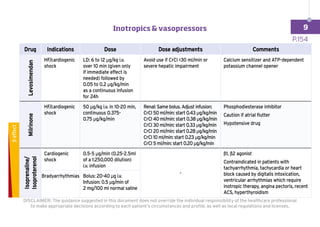
Aspartate transaminase / alanine aminotransferase Liver ischaemia, liver disease
Lactate Bowel ischaemia, metabolic disorder
Glucose Diabetes mellitus
Blood gases Metabolic disorder, oxygenation
Reference: Eur Heart J 2014; eurheartj.ehu281.
P.96
7.1
Laboratory tests required for patients
with ACUTE AORTIC dissection
a

STEMI can be associated with AAS in rare cases.
b

Pending local availability, patient
characteristics, and physician experience.
c

Proof of type-A AD by the presence of flap, aortic
regurgitation, and/or pericardial effusion.
d

Preferably point-of-care, otherwise classical.
e

Also troponin to detect non–ST-segment
elevation myocardial infarction.
Flowchart for decision-making based on pre-test sensitivity of acute aortic syndrome. Reference: Eur Heart J 2014; eurheartj.ehu281.
ACUTE CHEST PAIN
High probability (score 2-3)
or typical chest pain
Medical history + clinical examination + ECG STEMIa: see ESC guidelines169
HAEMODYNAMIC STATE
UNSTABLE
Low probability (score 0-1)
TTE + TOE/CT°
STABLE
AAS
confirmed
AAS
excluded
Consider
alternate
diagnosis
D-dimersd,e + TTE + Chest X-ray TTE
Consider
alternate
diagnosis
No argument
for AD
Signs
of AD
Widened
media-
stinum
Definite
Type A -ADc
Inconclusive
Refer on emergency
to surgical team and
pre-operative TOE
CT (or TOE)
AAS
confirmed
Consider
alternate
diagnosis
repeat CT
if necessary
AAS
confirmed
Consider
alternate
diagnosis
CT (MRI or TOE)b
P.97
7.1
ACUTE CHEST PAIN
Aortic dissection •	
Visualization of intimal flap
•	
Extent of the disease according to the aortic anatomic segmentation
•	
Identification of the false and true lumens (if present)
•	
Localization of entry and re-entry tears (if present)
•	
Identification of antegrade and/or retrograde aortic dissection
•	
Identification grading, and mechanism of aortic valve regurgitation
•	
Involvement of side branches
•	
Detection of malperfusion (low flow or no flow)
•	
Detection of organ ischaemia (brain, myocardium, bowels, kidneys, etc.)
•	
Detection of pericardial effusion and its severity
•	
Detection and extent of pleural effusion
•	
Detection of peri-aortic bleeding
•	
Signs of mediastinal bleeding
Intramural
haematoma
•	
Localization and extent of aortic wall thickening
•	
Co-existence of atheromatous disease (calcium shift)
•	
Presence of small intimal tears
Penetrating aortic
ulcer
•	
Localization of the lesion (length and depth)
•	
Co-existence of intramural haematoma
•	
Involvement of the peri-aortic tissue and bleeding
•	
Thickness of the residual wall
In all cases •	
Co-existence of other aortic lesions: aneurysms, plaques, signs of inflammatory disease, etc.
P.98
7.1
Details required from imaging in ACUTE AORTIC dissection
ACUTE AORTIC SYNDROMES MANAGEMENT: GENERAL APPROACH
ACUTE AORTIC DISSECTION
Type A
(Ascending aorta
involvement)
Type B
(No ascending
aorta involvement)
Uncomplicated
Medical
treatment
Open Surgery
with/without
Endovascular
Therapy
Endovascular
Therapy or
Open Surgery
(TEVAR)
Complicated
(malperfusion,
rupture)
P.99
7.1
ACUTE AORTIC SYNDROMES MANAGEMENT: General approach
1	 •	Detailed medical history and complete physical examination (when possible)
2	•	
Standard 12-lead ECG: Rule-out ACS, documentation of myocardial ischemia
3	•	
Intravenous line, blood sample (CK, cTn, myoglobin, white blood count, D-dimer, hematocrit, LDH)
4	•	
Monitoring: HR and BP
5	•	
Pain relief (morphine sulphate) (see chapter 4)
6	•	
Noninvasive imaging (see previous page)
7	•	
Transfer to ICU
For more information on individual drug doses and indications,
SEE CHAPTER 9 DRUGS USED IN ACUTE CARDIOVASCULAR CARE
P.100
7.1
ACUTE AORTIC SYNDROMES: Initial management
URGENT SURGERY (24h)
Emergency Surgery
Graft replacement of ascending aorta +/- arch
with/without aortic valve or aortic root
replacement/repair (depending on aortic regurgitation
and aortic root involvement)
ACUTE AORTIC SYNDROMES: SURGICAL MANAGEMENT
TYPE A ACUTE AORTIC DISSECTION TYPE B ACUTE AORTIC DISSECTION
• Haemodynamic instability
(hypotension/shock)
• Tamponade
• Severe acute aortic
regurgitation
• Impending rupture
• Flap in aortic root
• Malperfusion syndrome
Elective/individualised
Surgery
• Non-complicated
intramural hematoma
• Comorbidities
• Age 80 years
Definitive diagnosis
COMPLICATED
defined as:
by clinical presentation and imaging
• Impending rupture
• Malperfusion
• Refractory HTN
• SBP (90 mmHg)
• Shock
UNCOMPLICATED
defined as:
No features
of complicated
dissection
MEDICAL
MANAGEMENT
and imaging
surveillance protocol
• On admission
• At 7 days
• At discharge
• Every 6 months
thereafter
MEDICAL
MANAGEMENT
and
TEVAR
MEDICAL
MANAGEMENT
and
OPEN SURGERY
REPAIR
if TEVAR
contraindicated
Yes No
P.101
7.1
ACUTE AORTIC SYNDROMES: Surgical management
Diagnostic
algorithm
as for suspected
high-risk PE
Diagnostic algorithm as for suspected not high-risk PE
Assess clinical risk (PESI or SPESI)
RV function (echo or CT) a
Laboratory testing b
Intermediate risk
PE confirmed
Consider further
risk stratificaiton
PESI Class III-IV
or sPESI ≥ I
PESI Class I-II
or sPESI = 0
PE confirmed
Both positive One positive
or both negative
Clinical suspicion
Shock / hypotension?
No
Yes
P.102
7.2
Risk-adjusted management strategies
in ACUTE PULMONARY EMBOLISM
Reference: Eur Heart J 2014; 35:3033-3073.
a

If echocardiography has already been performed during diagnostic work-up for PE and detected RV dysfunction,
or if the CT already performed for diagnostic work–up has shown RV enlargement (RV/LV (left ventricular)
ratio ≥0.9, a cardiac troponin test should be performed except for cases in which primary reperfusion is
not a therapeutic option (e.g. due to severe comorbidity or limited life expectancy of the patient).
b

Markers of myocardial injury (e.g. elevated cardiac troponin I or T concentrations in plasma), or of heart failure as a
result of (right) ventricular dysfunction (elevated natriuretic peptide concentrations in plasma). If a laboratory test for
a cardiac biomarker has already been performed during initial diagnostic work-up (e.g. in the chest pain unit) and was
positive, then an echocardiogram should be considered to assess RV function, or RV size should be (re)assessed on CT.
c

Patients in the PESI Class I-II, or with sPESI of 0, and elevated cardiac biomarkers or signs of RV dysfunction on imaging tests, are
also to be classified into the intermediate-low risk category. This might apply to situations in which imaging or biomarker results
become available before calculation of the clinical severity index. These patients are probably no candidates for home treatment.
d

Thrombolysis, if (and as soon as) clinical signs of haemodynamic decompensation appear; surgical
pulmonary embolectomy or percutaneous catheter-directed treatment may be considered as
alternative options to systemic thrombolysis, particularly if the bleeding risk is high.
e

Monitoring should be considered for patients with confirmed PE and a positive troponin test,
even if there is no evidence of RV dysfunction on echocardiography or CT.
f

The simplified version of the PESI has not been validated in prospective home treatment trials; inclusion
criteria other than the PESI were used in two single-armed (non-randomized) management studies.
Intermediate-high risk Intermediate-low risk
A/C; monitoring
consider rescue
reperfusiond
Hospitalization A/C e
Consider early
discharge and home
treatment if feasible f
Primary
reperfusion
High-risk Low riskc
P.103
7.2
CARDIOVASCULAR
Symptoms/Signs
including but not limited to:
Shock? or
SBP 90 mmHg?
or
SBP fall by 40 mmHg?
persisting 15 min, otherwise unexplained
RESPIRATORY
Symptoms/Signs
including but not limited to:
ACUTE PULMONARY EMBOLISM: DIAGNOSIS
YES NO
Dyspnea
• Chest pain (angina)
• Syncope
• Tachycardia
• ECG changes
• NT-proBNP ↑
• Troponin ↑
• Chest pain (pleural)
• Pleural effusion
• Tachypnea
• Hemoptysis
• Hypoxemia
• Atelectasis
Suspect
acute
PE
Management algorithm
for UNSTABLE patients
Management algorithm
for initially STABLE patients
Reference: IACC Textbook (2015) chapter 66 Pulmonary embolism - page 638 - figure 66.1.
P.104
7.2
ACUTE PULMONARY EMBOLISM: Diagnosis
MANAGEMENT ALGORITHM FOR UNSTABLE PATIENTS WITH
SUSPECTED ACUTE PULMONARY EMBOLISM
CT angiography immediately available
and patient stabilised
Primary PA reperfusion
Primary PA reperfusion not justified
patient stabilised
No further diagnostic
tests feasible
Right heart,
pulmonary artery or
venous thrombi?
Echocardiography
(bedside)
CT*
Angio
RV pressure overload
CUS
No Yes
Yes
Yes positive
negative
No
TEE
Search for other causes
* Consider also pulmonary angiography if unstable patient in hemodynamic lab.
Reference: IACC Textbook (2015) chapter 66 Pulmonary embolism - page 639 - figure 66.2.
P.105
7.2
Management algorithm for unstable patients
with suspected ACUTE PULMONARY EMBOLISM
Shock or hypotension YES
Contraindications
for thrombolysis
No Relative Absolute
Primary PA
reperfusion
strategy
Thrombolysis
Low-­dose
transcatheter
thrombolysis /
clot fragmetation
Surgical or
Percutaneous catheter
embolectomy
(availability/experience)
Supportive treatment i.v. UFH, STABILISE SYSTEMIC BLOOD PRESSURE, CORRECT HYPOXEMIA
P.106
7.2
ACUTE PE: Management strategy for initially unstable patients
with confirmed high risk pulmonary embolism
MANAGEMENT ALGORITHM FOR INITIALLY STABLE PATIENTS WITH
SUSPECTED ACUTE PULMONARY EMBOLISM
Low or intermediate
“PE unlikely“
positive
negative D-dimer
CT angiography
negative positive
negative
Confirm by CUS
V/Q scan or angiography
positive
CT angiography
CUS
CUS
positive
High or
“PE likely“
Anticoagulation
not justified
Anticoagulation
required
Anticoagulation
not justified
Anticoagulation
required
Asses clinical (pre-test) probalility
Reference: IACC Textbook (2015) chapter 66 Pulmonary embolism - page 640 - figure 66.3.
P.107
7.2
Management algorithm for initially stable patients
with suspected ACUTE PULMONARY EMBOLISM
Markers for myocardial injury Positive Positive Negative
Markers for RV overload Positive Positive Negative
Clinical risk assessment
score (PESI)
Positive (class III-V) Positive (class III-V) Negative (class I-II)
Suggested initial
anticoagulation
UFH i.v./LMWH s.c.
LMWH/Fonda/apixaban/
rivaroxaban
apixaban/rivaroxaban
STRATEGY
Monitoring (ICU)*
rescue thrombolysis
Hospitalisation**
(telemonitoring)
Early
discharge***
* When all markers are positive. - ** When at least one marker is positive. - *** When all markers are negative.
For more information on individual drug doses and indications,
SEE CHAPTER 9 DRUGS USED IN ACUTE CARDIOVASCULAR CARE
P.108
7.2
Suggested management strategy for initially stable patients
with (non-high risk) confirmed PE
Key drugs for initial treatment of patients with confirmed PE
Unstable
Alteplase (rtPA) (intravenous) 100 mp/2h
or 0.6 mp/kg/15 min (max 50 mp)
Urokinase (intravenous) 3 million IU over 2h
Streptokinase (intravenous) 1.5 million IU over 2h
Unfractionated heparin (intravenous) 80 IU/kg bolus + 18 IU/kg/h
Stable
Enoxaparine (subcutaneous) 1 mp/kg BID or 1.5 mp/kg QD
Tinzaparin (subcutaneous) 175 U/kg QD
Fondaparinux (subcutaneous) 7.5 mp (50-100 kg of body weight)
5 mp for patients 50 kg,
10 mp for patients 100 kg
Rivaroxaban (oral) 15 mp BID
(for 3 weeks, then 20 mp QD)
Apixaban (oral) 10 mg bid (for 7 days, than 5 mg bid)
For more information on individual drug doses and indications,
SEE CHAPTER 9 DRUGS USED IN ACUTE CARDIOVASCULAR CARE
P.109
7.2
PULMONARY EMBOLISM: Pharmacological treatment
CHAPTER 8
ACUTE MYOCARDIAL/
PERICARDIAL SYNDROMES
8.1	ACUTE MYOCARDITIS ����������������������������������������������������� p.112
A. Keren, A. Caforio
8.2	ACUTE PERICARDITIS AND CARDIAC TAMPONADE ���������������������� p.117
C. Vrints, S. Price
8
CAUSES OF MYOCARDITIS
MYOCARDITIS (WHO /ISFC): Inflammatory disease of the myocardium diagnosed
by established histological, immunological and immunohistochemical criteria.
INFECTIOUS TOXIC
IMMUNE-MEDIATED
• Viral
• Bacterial
• Spirochaetal
• Fungal
• Protozoal
• Parasitic
• Rickettsial
• Drugs
• Heavy Metals
• Hormones, e.g.
catecholamines
(Pheochromocytoma)
• Physical agents
• Allergens: Tetanus toxoid, vaccines,
serum sickness, Drugs
• Alloantigens: Heart transplant rejection
• Autoantigens: Infection-negative lymphocytic,
infection-negative giant cell,
associated with autoimmune or
immune oriented disorders
P.112
8.1
ACUTE MYOCARDITIS: Definition and causes
Reference: Caforio ALP et al. Eur Heart J. (2013) Jul 3 (15).
Clinical presentations
with or without ancillary findings
Diagnostic criteria
•	
Acute chest pain (pericarditic or pseudo-ischemic)
•	
New-onset (days up to 3 months) or worsening
dyspnea or fatigue, with or without left/right heart
failure signs
•	
Palpitation, unexplained arrhythmia symptoms,
syncope, aborted sudden cardiac death
•	
Unexplained cardiogenic shock
and/or pulmonary oedema
I.	ECG/Holter/stress test features: Newly abnormal ECG and/or Holter
and/or stress testing, any of the following:	
•	
I to III degree atrioventricular block, or bundle branch block,
ST/T wave changes (ST elevation or non ST elevation, T wave inversion),
•	
Sinus arrest, ventricular tachycardia or fibrillation and asystole,
atrial fibrillation, frequent premature beats, supraventricular tachycardia
•	
Reduced R wave height, intraventricular conduction delay
(widened QRS complex), abnormal Q waves, low voltage
II.	 Myocardiocytolysis markers: Elevated cTnT/cTnI
III.	Functional/structural abnormalities on echocardiography
•	
New, otherwise unexplained LV and/or RV structure and function
abnormality (including incidental finding in apparently asymptomatic
subjects): regional wall motion or global systolic or diastolic function
abnormality, with or without ventricular dilatation, with or without
increased wall thickness, with or without pericardial effusion, with
or without endocavitary thrombi
IV.	 Tissue characterisation by CMR:
Edema and/or LGE of classical myocarditic pattern
Ancillary findings which support
the clinical suspicion of myocarditis
•	Fever ≥38.1°C within the preceding 30 days
•	
A respiratory or gastrointestinal infection
•	
Previous clinically suspected or biopsy proven
myocarditis
•	Peri-partum period
•	
Personal and/or family history of allergic asthma
•	
Other types of allergy
•	
Extra-cardiac autoimmune disease
•	Toxic agents
•	
Family history of dilated cardiomyopathy, myocarditis
P.113
8.1
ACUTE MYOCARDITIS: Diagnostic criteria (1)
Diagnostic criteria for clinically suspected myocarditis
One or more of the clinical presentations shown in the Diagnostic Criteria*
with or without Ancillary Features*
AND
One or more Diagnostic Criteria from different categories (I to IV)*
OR
when the patient is asymptomatic, two or more diagnostic criteria from different categories (I to IV)*
in the absence of:
1) angiographically detectable coronary artery disease
2) known pre-existing cardiovascular disease or extra-cardiac causes that could explain the syndrome
(e.g. valve disease, congenital heart disease, hyperthyroidism, etc.)
Suspicion is higher with higher number of fulfilled criteria*
Endomyocardial biopsy is necessary to:
1) confirm the diagnosis of clinically suspected myocarditis,
2) identify the type and aetiology of inflammation,
and 3) provide the basis for safe immunosuppression
(in virus negative cases).
Reference: Caforio ALP et al. Eur Heart J. (2013) Jul 3 (16).
*SEE CHAPTER 9 DRUGS USED IN ACUTE CARDIOVASCULAR CARE
P.114
8.1
ACUTE MYOCARDITIS: Diagnostic criteria (2)
Acute myocarditis should be clinically suspected in the presence of:
Hemodynamically stable
Preserved LV function
No eosinophilia
No significant rhythm or
conduction disturbances
Not associated with
systemic immune disease*
General supportive therapy
Immunosuppression if
unresponsive and virus negative EMB
Hemodynamically unstable,
decreased LV function, cardiogenic shock
Pharmacological and, if needed,
mechanical circulatory support (ECMO, LVAD/Bi-VAD,
bridge to heart transplant or to recovery)
Lymphocytic Giant cell, eosinophilic,
sarcoidosis (acute decompensation)
Immunosuppression
if infection-negative EMB
History, Physycal examination; ECG; Echocardiogram; Laboratory tests
(Troponin, CRP, ESR, blood cell count, BNP); CMR; If available, serum cardiac autoantibodies
Clinically suspected myocarditis
Consider coronary angiography and EMB
No coronary artery disease
*If myocarditis is associated with systemic immune disease exacerbation, therapy overlaps with treatment of the background disease (usually immunosuppression).
P.115
8.1
ACUTE MYOCARDITIS: Diagnostic and management protocol
•	
Patients with a life-threatening presentation should be sent to specialised units with capability for
hemodynamic monitoring, cardiac catheterisation and expertise in endomyocardial biopsy.
•	
In patients with hemodynamic instability a mechanical cardio-pulmonary assist device
may be needed as a bridge to recovery or to heart transplantation.
•	
Heart transplant should be deferred in the acute phase, because recovery may occur, but can be considered
for hemodynamically unstable myocarditis patients, including those with giant cell myocarditis, if optimal
pharmacological support and mechanical assistance cannot stabilise the patient
•	ICD implantation for complex arrhythmias should be deferred until resolution of the acute episode, with
possible use of a lifevest during the recovery period.
Reference: Caforio ALP et al. Eur Heart J. 2013 Jul 3 (18).
P.116
8.1
Management of patients
with life-threatening ACUTE MYOCARDITIS
DIAGNOSIS (≥ 2 of the following):
• Chest pain (pleuritic) varying with position
• Pericardial friction rub
• Typical ECG changes (PR depression and/or diffuse concave ST-segment elevation)
• Echocardiography: new pericardial effusion
Yes
Myopericarditis if:
↑ Troponin
Echocardiography: ↓ LV-function
Acute
pericarditis
Equivocal or no
Consider
cardiac
MRI
Delayed
enhancement
pericardium
Consider
alternative
diagnoses
P.117
8.2
ACUTE PERICARDITIS: Diagnosis
ACUTE PERICARDITIS: MANAGEMENT
Acute pericarditis
High-risk features?
• Fever 38°C
• Subacute onset
• Anticoagulated
• Trauma
• Immunocompromised
• Hypotension
• Jugular venous distension
• Large effusion
Other causes
• Post cardiac injury syndrome
• Post cardiac surgery
• Post MI: Dressler syndrome
• Uremic
• Neoplastic
• Collagen vascular diseases (e.g. SLE)
• Bacterial
• Tuberculous
Yes
Hospital admission
Stable
Ibuprofen + colchicine
Further testing for underlying etiology
Tamponade?
Pericardiocentesis
No
Most frequent cause:
Viral pericarditis
Outpatient treatment
Aspirin 800 mg
or Ibuprofen 600 mg BID - 2 weeks
If persisting or recurrent chest pain :
Add colchicine 0.5 mg once (70 kg)
or 0.5 mg BID (≥70 kg) for 3 months
Avoid corticosteroids!
P.118
8.2
ACUTE PERICARDITIS: Management
CARDIAC TAMPONADE: DIAGNOSIS AND MANAGEMENT
Tamponade ?
Tamponade
Echocardiography
with respirometer
• Presence of a moderate to large
pericardial effusion
• Diastolic collapses of right atrium and
right ventricle
• Ventricular interdependence
• Increased tricuspid and pulmonary flow
velocities (50%) with decreased mitral
and aortic flow velocities (25%) during
inspiration (predictive value 90%)
Physical examination
• Distended neck veins
• Shock
• Pulsus paradoxus
• Muffled heart sounds
ECG
• Sinus tachycardia
• Microvoltage QRS
• Electrical alternans
Cardiac catheterization
Early
• Right atrial pressure ↑
• Loss of X-descent
Late
• Aortic pressure ↓
• Pulsus paradoxus
• Intracardiac diastolic
pressure equilibration
Percutaneous
pericardiocentesis  drainage
Consider surgical drainage
Avoid PEEP ventilation
Not performed in routine
P.119
8.2
CARDIAC TAMPONADE: Diagnosis and management
CHAPTER 9
DRUGS IN
ACUTE CARDIOVASCULAR
CARE
Ana de Lorenzo
P.121
9
Drug Indications Dose
Dose
adjustments
Comments
Aspirin
Primary (not universally approved)
and secondary cardiovascular
disease prevention
LD (if ACS):
150-300 mg oral
MD: 75-100 mg
oral QD
-
Major contraindications:
GI bleeding-active peptic ulcer
Ticagrelor
ACS (all patients at moderate-to-high
risk of ischaemic events, e.g. elevated
cardiac troponins)
LD: 180 mg oral
MD: 90 mg oral BID -
Major contraindications: previous intracerebral
hemorrhage, severe hepatic impairment,
strong CYP3A4 inhibitors
Secondary prevention
1-3 years post-MI
MD: 60 mg oral BID
-
Prasugrel
ACS with planned PCI LD: 60 mg oral
MD: 10 mg oral QD
MD: 5 mg QD
weight 60kg
Contraindication:
previous stroke/TIA
Prasugrel is generally not recommended in
elderly, and if positive benefit/risk 5 mg is
recommended
DISCLAIMER: The guidance suggested in this document does not override the individual responsibility of the healthcare professional
to make appropriate decisions according to each patient’s circumstances and profile, as well as local regulations and licenses.
P.122
Oral antiplatelets 9
Drug Indications Dose
Dose
adjustments
Comments
Clopidogrel
ACS + PCI or medical management
(patients who cannot receive
ticagrelor or prasugrel) and in
ACS patients at high bleeding risk
(e.g. patients who require oral
anticoagulation)
LD: 300-600 mg
oral
MD: 75 mg oral QD
-
Prasugrel and ticagrelor have not been studied
as adjuncts to fibrinolysis and oral anticoagulants
STEMI
+ fibrinolysis 75 years
LD: 300 mg oral
MD: 75 mg oral QD
-
Prasugrel and ticagrelor have not been studied
as adjuncts to fibrinolysis and oral anticoagulants
STEMI
+ fibrinolysis ≥75 years
LD: 75 mg oral
MD: 75 mg oral QD
-
Secondary prevention 12 months
post coronary stenting
MD: 75 mg oral QD
-
DISCLAIMER: The guidance suggested in this document does not override the individual responsibility of the healthcare professional
to make appropriate decisions according to each patient’s circumstances and profile, as well as local regulations and licenses.
P.123
Oral antiplatelets (Cont.) 9
Drug Indications Dose
Dose
adjustments
Comments
Abciximab
Adjunct to PCI for bailout
situations or thrombotic
complications
LD: 0.25 mg/Kg i.v.
MD: 0.125 μg/Kg/
min i.v. (max: 10 μg/
min) for 12h
-
Contraindications:
Active internal bleeding - History of CVA within 2 years
- Bleeding diathesis - Preexisting thrombocytopenia
- Recent (within 2 months) intracranial or intraspinal
surgery or trauma - Recent (within 2 months) major
surgery - Intracranial neoplasm, arteriovenous
malformation, or aneurysm - Severe uncontrolled
hypertension - Presumed or documented history of
vasculitis - Severe hepatic failure or severe renal failure
requiring haemodialysis - Hypertensive retinopathy
Eptifibatide
ACS treated medically
or with PCI
LD: 180 μg/Kg i.v.
(at a 10 min
interval)
If STEMI and PCI:
add a second
180 mcg/kg i.v.
bolus
at 10 min
MD: 2 μg/Kg/min i.v.
infusion
Reduce infusion
dose to 1 μg/kg/
min if CrCl 
30-50 ml/min
Contraindications:
Bleeding diathesis or bleeding within the previous
30 days - Severe uncontrolled hypertension - Major
surgery within the preceding 6 weeks - Stroke within
30 days or any history of hemorrhagic stroke -
Coadministration of another parenteral GP II b/III a
inhibitor - Severe renal impairment or dependency on
renal dialysis - History of intracranial disease - Clinically
significant hepatic impairment - Thrombocytopenia -
Prothrombine time 1.2 times control or INR ≥2
DISCLAIMER: The guidance suggested in this document does not override the individual responsibility of the healthcare professional
to make appropriate decisions according to each patient’s circumstances and profile, as well as local regulations and licenses.
P.124
Intravenous antiplatelets 9
Drug Indications Dose
Dose
adjustments
Comments
Tirofiban
ACS treated medically
or with PCI
LD: 25 μg/Kg i.v.
over 5 min
MD: 0.15 μg/Kg/
min i.v. Infusion to
18 hours
CrCl 30 ml/min:
decrease 50%
bolus and infusion
dose
Contraindications:
A history of thrombocytopenia following prior exposure
Active internal bleeding or a history of bleeding
diathesis, major surgical procedure or severe physical
trauma within the previous month
Cangrelor
All patients undergoing PCI
(elective + ACS)
immediate onset + rapid
offset
(platelet recovery in 60min)
IV Bolus
of 30 μg/Kg
+
IV infusion
of 4 μg/kg/min
for at least 2 hours
from start of PCI
-
Major contraindications:
Significant active bleeding or stroke
Transition to oral P2Y12 inhibitors variable
according to type of agent
DISCLAIMER: The guidance suggested in this document does not override the individual responsibility of the healthcare professional
to make appropriate decisions according to each patient’s circumstances and profile, as well as local regulations and licenses.
P.125
Intravenous antiplatelets (Cont.) 9
Drug Indications Dose Dose adjustments Comments
Warfarin
Acenocoumarol
Treatment and
prophylaxis
of thrombosis
INR goal of 2-3
(INR: 2.5-3.5 for mechanical
mitral valve prostheses or
double valve replacement)
Assessing individual risks for
thromboembolism and bleeding
-
Apixaban
Prevention of stroke
and systemic embolism
in NVAF
5 mg oral BID 2.5 mg oral BID
1) when at least 2 of the following
characteristics: age ≥80,
Cr 1.5 mg/dl or weight 60Kg
2) when CrCl 15-29 ml/min
Contraindicated if CrCl 15 ml/min
or severe hepatic impairment
Treatment of DVT and PE 10 mg oral BID for the first
7 days
followed by 5 mg oral BID
-
Prevention of recurrent
DVT and PE
2.5 mg oral BID
-
DISCLAIMER: The guidance suggested in this document does not override the individual responsibility of the healthcare professional
to make appropriate decisions according to each patient’s circumstances and profile, as well as local regulations and licenses.
P.126
Oral anticoagulants and antagonists 9
Drug Indications Dose Dose adjustments Comments
Dabigatran
Prevention of stroke
and systemic embolism
in NVAF
150 mg oral BID 110 mg BID
(if age ≥80, increased bleeding
risk or concomitant use of
verapamil)
Contraindicated if CrCl 30 ml/min
or severe hepatic impairment
Active clinically significant bleeding
Concomitant treatment
with systemic ketoconazole,
cyclosporine, itraconazole and
dronedarone
Treatment of DVT and PE
in patients who have been
treated with a parenteral
anticoagulant for 5-10
days and prevention of
recurrent DVT and PE in
patients who have been
previously treated
Edoxaban
Prevention of stroke and
systemic embolism in
NVAF
60 mg oral QD 30 mg oral QD
1) when CrCl 15-50 ml/min
2) weight 60Kg
3) concomitant use of the
following P-glycoprotein inhibitors:
ciclosporin, dronedarone,
erythromycin, or ketoconazole.
Edoxaban can be initiated
in patients who may require
cardioversion. Treatment should
be started at least 2 hours before
cardioversion
Treatment of DVT and
PE and prevention of
recurrent DVT and PE
60 mg oral QD
DISCLAIMER: The guidance suggested in this document does not override the individual responsibility of the healthcare professional
to make appropriate decisions according to each patient’s circumstances and profile, as well as local regulations and licenses.
P.127
Oral anticoagulants and antagonists (Cont.) 9
Drug Indications Dose Dose adjustments Comments
Rivaroxaban
Prevention of stroke and
systemic embolism in
NVAF
20 mg oral QD CrCl 50 ml/min: 15 mg QD Contraindicated if CrCl 15 ml/min
or hepatic disease associated with
coagulopathy and clinically relevant
bleeding risk
Rivaroxaban can be initiated
in patients who may require
cardioversion
Treatment should be started at
least 4 hours before cardioversion
Treatment of DVT and
PE and prevention of
recurrent DVT and PE
15 mg oral BID for the first
3 weeks
followed by 20 mg QD
Reduce the maintenance dose to
15 mg QD if bleeding risk outweighs
the risk for recurrent DVT and PE
(not formally approved)
Prevention of
atherothrombotic events
2.5 mg oral BID
-
Anticoagulant antagonists
Idarucizumab
Specific reversal agent
for dabigatran
5g i.v. over 5 to 10 min
Another 5g dose if prolonged
clotting times and:
- 
recurrence of clinically
relevant bleeding
- 
if potential re-bleeding
would be life-threatening
- 
second emergency
surgery/urgent procedure
-
Dabigatran treatment can be re-
initiated 24h after administration of
idarucizumab, other antithrombotic
therapy at any time
Relevant coagulation parameters
are aPTT, dTT or ECT
DISCLAIMER: The guidance suggested in this document does not override the individual responsibility of the healthcare professional
to make appropriate decisions according to each patient’s circumstances and profile, as well as local regulations and licenses.
P.128
Oral anticoagulants and antagonists (Cont.) 9
Drug Indications Dose Dose adjustments Comments
Anticoagulant antagonists
Phytomenadione
(Vitamin
K)
Reversal for vitamin K
antagonists
Patients with asymptomatic high INR with or without mild haemorrhage
Anticoagulant INR Oral Vitamin K i.v. Vitamin K
Warfarin
5-9 1-2.5 mg or 2-5 mg for a rapid reversal
(additional dose of 1-2 mg if INR
remains high after 24h)
0.5-1 mg
9 2.5-5 mg (up to 10 mg) 1 mg
Acenocoumarol
5-8 1-2 mg 1-2 mg
8 3-5 mg 1-2 mg
Severe or life-threatening haemorrhage
Anticoagulant Situation i.v. Vitamin K Concomitant treatment
Warfarin
Severe
haemorrhage
5-10 mg CCP or FFP
Life-threatening 10 mg CCP, FFP or rFVIIa
Acenocoumarol
Severe
haemorrhage
5 mg CCP, FFP or rFVIIa
P.129
DISCLAIMER: The guidance suggested in this document does not override the individual responsibility of the healthcare professional
to make appropriate decisions according to each patient’s circumstances and profile, as well as local regulations and licenses.
Oral anticoagulants and antagonists (Cont.) 9
Drug Indications Dose Dose adjustments Comments
UFH
NSTE-ACS LD: 4,000 IU i.v. MD: 1,000 IU/h i.v. Target aPTT: 50-70s or 1.5 to
2.0 times that of control to be
monitored at 3, 6, 12 and 24h
Monitoring for heparin-induced
thrombocytopenia (HIT)
Dose-independent reaction
STEMI Primary PCI: 70-100 IU/Kg i.v. when no
GP-IIb/IIIa inhibitor is planned. 50-60 IU/Kg i.v.
bolus with GP-IIb/IIIa inhibitors - Fibrinolysis/
No reperfusion: 60 IU/kg i.v. bolus (max:
4,000 IU) followed by an i.v. infusion of 12 IU/kg
(max: 1,000 IU/h) for 24-48h
Target aPTT: 50-70s or 1.5 to
2.0 times that of control to be
monitored at 3, 6, 12 and 24h
Treatment of DVT
and PE
80 IU/Kg i.v. bolus
followed by 18 IU/Kg/h
According to aPTT,
thromboembolic and bleeding risk
Fondaparinux
NSTE-ACS 2.5 mg QD s.c. up to 8 days or hospital discharge - Acute bacterial endocarditis
Severe hepatic impairment:
caution advised
Contraindicated
if CrCl 20 ml/min
Contraindicated for DVT/PE
treatment if CrCl 30 ml/min
STEMI Fibrinolysis/No reperfusion: 2.5 mg i.v. bolus
followed by 2.5 mg QD s.c. up to 8 days
or hospital discharge
-
Treatment of
DVT and PE
5 mg QD s.c. (50kg); 7.5 mg QD s.c.
(50-100kg); 10 mg QD s.c. (100kg)
If 100Kg and CrCl 30-50 ml/min:
10 mg followed by 7.5 mg/24h s.c.
Prevention of VTE 2.5 mg QD s.c. CrCl 20-50 ml/min: 1.5 mg QD s.c.
P.130
DISCLAIMER: The guidance suggested in this document does not override the individual responsibility of the healthcare professional
to make appropriate decisions according to each patient’s circumstances and profile, as well as local regulations and licenses.
Parenteral anticoagulants 9
Drug Indications Dose Dose adjustments Comments
Bivalirudin
PCI for NSTE-ACS 0.75 mg/kg i.v. bolus followed immediatelly
by 1.75 mg/kg/h infusion which may be
continued for up to 4h post PCI as clinically
warranted and further continued at a reduced
infusion dose of 0.25 mg/kg/h for 4-12h as
clinically necessary
Patients undergoing PCI
with CrCl 30-50 ml/min should
receive a lower infusion rate of
1.4 mg/kg/h
No change for the bolus dose
Contraindicated
if CrCl 30 ml/min
Active bleeding or increased
risk of bleeding, severe
uncontrolled hypertension,
subacute bacterial endocarditis
PCI for STEMI 0.75 mg/kg i.v. bolus followed immediatelly
by 1.75 mg/kg/h infusion which should be
continued for up to 4h after the procedure
After cessation of the 1.75 mg/kg/h infusion,
a reduced infusion dose of 0.25 mg/kg/h may
be continued for 4-12h
PCI for elective
cases
0.75 mg/kg i.v. bolus followed immediatelly
by 1.75 mg/kg/h infusion which may be
continued for up to 4h post PCI
as clinically waranted
DISCLAIMER: The guidance suggested in this document does not override the individual responsibility of the healthcare professional
to make appropriate decisions according to each patient’s circumstances and profile, as well as local regulations and licenses.
P.131
Parenteral anticoagulants (Cont.) 9
Drug Indications Dose Dose adjustments Comments
Enoxaparin
NSTE-ACS 30 mg i.v. + 1 mg/kg s.c. BID If 75 years: no LD and MD
0.75 mg/Kg BID s.c.
CrCl 30 ml/min: no LD and MD
1 mg/Kg QD s.c.
If 75 years and CrCl 30 ml/min:
no LD and 0.75 mg/Kg QD s.c.
Monitoring for HIT
Anti Xa monitoring during
treatment with LMWH might
be helpful in pregnancy,
extreme body weights and renal
impairment
STE-ACS Primary PCI: 0.5 mg/Kg i.v. bolus
Fibrinolysis/No reperfusion:
a) Age 75 years: 30 mg i.v. bolus followed by
1 mg/Kg BID s.c. until hospital discharge for a
max of 8 days
The first two doses should not exceed 100 mg
b) Age 75 years: no bolus; 0.75 mg/Kg
BID s.c. - The first two doses should not
exceed 75 mg
In patients with CrCl 30 ml/min:
regardless of age, the s.c. doses
are given once daily
Treatment of DVT
and PE
1 mg/Kg s.c. BID or 1.5 mg/Kg s.c. QD CrCl 30 ml/min: 1 mg/Kg/24h
s.c.
Prevention of VTE 40 mg s.c. QD CrCl 30 ml/min: 20 mg s.c. QD
DISCLAIMER: The guidance suggested in this document does not override the individual responsibility of the healthcare professional
to make appropriate decisions according to each patient’s circumstances and profile, as well as local regulations and licenses.
P.132
Parenteral anticoagulants (Cont.) 9
Drug Indications Dose Dose adjustments Comments
Tinzaparin
Prevention of VTE 3,500 IU s.c. QD (moderate risk)
4,500 IU s.c. QD (high risk)
-
Monitoring for HIT
Anti Xa monitoring during
treatment with LMWH might
be helpful in pregnancy,
extreme body weights and renal
impairment
Dalteparin:
In cancer patients, dose of
200 IU/kg (max: 18,000 IU)/24h
for 1 month, followed by 150 IU/
kg/24h for 5 months
After this period, vitamin K antag
or a LMWH should be continued
indefinitely or until the cancer is
considered cured
Treatment of DVT
and PE
175 IU/Kg s.c. QD
-
Dalteparin
Prevention of VTE 2,500 IU s.c. QD (moderate risk)
5,000 IU s.c. QD (high risk)
-
Treatment of DVT
and PE
200 IU/Kg QD or 100 IU/Kg BID s.c. Anti Xa monitoring
if renal impairment
Argatroban
Anticoagulant in
patients with HIT
Initial i.v. infusion dose: 2 μg/kg/min
(not to exceed 10 μg/kg/min)
Patients undergoing PCI: 350 μg/kg i.v.
followed by 25 μg/kg/min i.v.
Renal and hepatic impairment:
caution advised
Monitored using aPTT goal:
1.5 to 3.0 times the initial
baseline value
PCI: ACT goal: 300-450s
DISCLAIMER: The guidance suggested in this document does not override the individual responsibility of the healthcare professional
to make appropriate decisions according to each patient’s circumstances and profile, as well as local regulations and licenses.
P.133
Parenteral anticoagulants (Cont.) 9
Drug Indications Dose
Dose
adjustments
Comments
Streptokinase
(SK)
STEMI 12 hours 1.5 million units over 30-60 min
i.v. -
Absolute contraindications to
fibrinolytics:
Previous intracranial haemorrhage or
stroke of unknown origin at any time
Ischaemic stroke in the preceding 6
months
Central nervous system damage
or neoplasms or atrioventricular
malformation
Recent major trauma/surgery/head injury
(within the preceding 3 weeks)
Gastrointestinal bleeding
within the past month
Known bleeding disorder (excluding
menses)
Aortic dissection
Non-compressible punctures in the past
24h (e.g. liver biopsy, lumbar puncture)
Treatment of PE 250,000 IU as a LD over 30min,
followed by 100,000 IU/h over
12-24h
-
Alteplase
(tPA)
STEMI 12 hours 15 mg i.v. bolus:
0.75 mg/kg over 30 min
(up to 50 mg) then
0.5 mg/kg over 60 min i.v.
(up to 35 mg)
-
Treatment of PE Total dose of 100 mg: 10 mg
i.v. bolus followed by 90 mg i.v.
for 2h
If weight 65 Kg: max
dose 1.5 mg/kg
DISCLAIMER: The guidance suggested in this document does not override the individual responsibility of the healthcare professional
to make appropriate decisions according to each patient’s circumstances and profile, as well as local regulations and licenses.
P.134
Fibrinolytics 9
Drug Indications Dose
Dose
adjustments
Comments
Reteplase
(rt-PA)
STEMI 12 hours 10 units + 10 units i.v. bolus given
30 min apart
Renal and hepatic
impairment:
caution advised
Absolute contraindications to
fibrinolytics:
Previous intracranial haemorrhage or
stroke of unknown origin at any time
Ischaemic stroke in the preceding 6
months
Central nervous system damage
or neoplasms or atrioventricular
malformation
Recent major trauma/surgery/head injury
(within the preceding 3 weeks)
Gastrointestinal bleeding
within the past month
Known bleeding disorder (excluding
menses)
Aortic dissection
Non-compressible punctures in the past
24h (e.g. liver biopsy, lumbar puncture)
Tenecteplase
(TNK-tPA)
STEMI 12 hours Single i.v. bolus over 10 seconds:
30 mg if 60kg
35 mg if 60 to 70kg
40 mg if 70 to 80kg
45 mg if 80 to 90kg
50 mg if ≥90kg -
DISCLAIMER: The guidance suggested in this document does not override the individual responsibility of the healthcare professional
to make appropriate decisions according to each patient’s circumstances and profile, as well as local regulations and licenses.
P.135
Fibrinolytics (Cont.) 9
Drug Indications Dose Dose adjustments Comments
Beta-blockers: Preferred over calcium channel blockers - Contraindicated if coronary spasm, severe bradycardia, AV block, severe bronchospasm
Atenolol
NSTE-ACS LD: 25-100 mg oral
MD: 25-100 mg QD
Elderly: start at
a lower dose
CrCl 15-35 ml/min:
max dose 50 mg/day;
CrCl 15 ml/min:
max dose 25 mg/day
Only if normal LVEF
STEMI 25-100 mg QD,
titrate as tolerated up to 100 mg QD
only if no LVSD or CHF
Carvedilol
NSTE-ACS LD: 3.125-25 mg oral
MD: 3.125-25 mg BID
Caution in elderly and hepatic
impairment
Preferred if LVSD/HF
STEMI 3.125-6.25 mg BID,
titrated as tolerated up to 50 mg BID
Bisoprolol
NSTE-ACS LD: 1.25-10 mg oral
MD: 1.25-10 mg QD
Caution in renal or hepatic impairment Preferred if LVSD/HF
STEMI 1.25-5 mg QD,
titrate as tolerated up to 10 mg QD
DISCLAIMER: The guidance suggested in this document does not override the individual responsibility of the healthcare professional
to make appropriate decisions according to each patient’s circumstances and profile, as well as local regulations and licenses.
P.136
Antiischemic drugs 9
Drug Indications Dose Dose adjustments Comments
Beta-blockers:Preferredovercalciumchannelblockers-Contraindicatedifcoronaryspasm,severebradycardia,AVblock,severebronchospasm
Metoprolol
NSTE-ACS LD: 25-100 mg oral
MD: 25-100 mg BID
Caution in hepatic impairment Preferred if LVSD/HF
STEMI 5-25 mg BID,
titrate as tolerated up to 200 mg QD
Calcium antagonists: Consider if beta-blockers are contraindicated. First option in vasospastic angina
Verapamil
ACS LD: 80-120 mg oral
MD: 80-240 mg TID-QD
Caution in elderly, renal
or hepatic impairment
Contraindicated if
bradycardia,
HF, LVSD
Diltiazem
ACS LD: 60-120 mg oral
MD: 60-300 mg TID-QD
Caution in elderly and hepatic
impairment
Contraindicated if
bradycardia,
HF, LVSD
DISCLAIMER: The guidance suggested in this document does not override the individual responsibility of the healthcare professional
to make appropriate decisions according to each patient’s circumstances and profile, as well as local regulations and licenses.
P.137
Antiischemic drugs (Cont.) 9
Drug Indications Dose Dose adjustments Comments
Calcium antagonists: Consider if beta-blockers are contraindicated. First option in vasospastic angina
Amlodipine
ACS LD: 5-10 mg oral, MD: 5-10 mg QD Caution in hepatic impairment Contraindicated
if hypotension
Nitrates
Nitroglycerin
i.v.
ACS If intolerant or unresponsive to
nitroglycerin s.l. 5 μg/min - Increase by
5 mcg/min q 3-5 min up to 20 μg/min
If 20 mcg/min is inadequate, increase by
10 to 20 μg/min every 3 to 5 min
Max dose: 400 μg/min
-
Contraindicated
if severe
hypotension and co-
administration with
phosphodiesterase
inhibitors
The most common
adverse effects
are headache and
dizziness
i.v. nitroglycerin
requires NON-PVC
containers
spray
Angina 1-2 puff s.l. every 5 min as needed,
up to 3 puffs in 15 min -
sublingual
tablet
Angina 0.3 to 0.6 mg s.l. or in the buccal pouch
every 5 min as needed, up to 3 doses
in 15 min -
DISCLAIMER: The guidance suggested in this document does not override the individual responsibility of the healthcare professional
to make appropriate decisions according to each patient’s circumstances and profile, as well as local regulations and licenses.
P.138
Antiischemic drugs (Cont.) 9
Drug Indications Dose Dose adjustments Comments
Isosorbide
mononitrate
Angina 5-10 mg BID with the two doses given
7h apart (8am and 3pm) to decrease
tolerance development - then titrate to
10 mg BID in first 2-3 days
Extended release tablet: Initial: 30-
60 mg given in the morning as a single
dose
Titrate upward as needed, giving at least
3 days between increases
Max daily single dose: 240 mg
-
Contraindicated
if severe
hypotension and co-
administration with
phosphodiesterase
inhibitors
The most common
adverse effects
are headache and
dizziness
Isosorbide
dinitrate
Angina Initial dose: 5 to 20 mg orally 2 or
3 times/day
MD: 10 to 40 mg orally 2 or 3 times a day
Extended release: 40 to 160 mg/day
orally
-
Nitroglycerin
transdermal
patch
Angina 0.2 to 0.4 mg/h patch applied topically
once a day for 12 to 14h per day;
titrate as needed and tolerated up
to 0.8 mg/h -
DISCLAIMER: The guidance suggested in this document does not override the individual responsibility of the healthcare professional
to make appropriate decisions according to each patient’s circumstances and profile, as well as local regulations and licenses.
P.139
Antiischemic drugs (Cont.) 9
Drug Indications Dose Dose adjustments Comments
Other antiishemic drugs
Ivabradine
Stable angina 5-7.5 mg oral BID Caution in elderly and CrCl 15 ml/min Contraindicated
if severe hepatic
impairment
Ranolazine
Stable angina Initial dose: 375 mg oral BID
After 2-4 weeks, the dose should be
titrated to 500 mg BID and, according to
the patient’s response, further titrated to
a recommended max dose of 750 mg BID
Use with caution in renal and hepatic
impairment, CHF, elderly, low weight
Contraindicated
if CrCl 30 ml/
min, concomitant
administration of
potent CYP3A4
inhibitors, moderate
or severe hepatic
impairment
Trimetazidine
Stable angina Modified-release: 35 mg oral BID Caution in elderly
and 30 CrCl 60 ml/min
Contraindicated in
parkinson disease,
parkinsonian
symptoms, tremors,
restlessleg syndrome,
movement disorders,
severe renal
impairment
DISCLAIMER: The guidance suggested in this document does not override the individual responsibility of the healthcare professional
to make appropriate decisions according to each patient’s circumstances and profile, as well as local regulations and licenses.
P.140
Antiischemic drugs (Cont.) 9
Drug Indications Dose Dose adjustments Comments
Statins: Primary or secondary prevention of cardiovascular disease
For secondary prevention, start with high doses initiated early after admission and downtitrate if side effects.
Target LDL-C levels 70 mg/dl
Atorvastatin
LDL-C reduction
30% 30-40% 40-50% 50%
Simva
10 mg
Simva
20-40 mg
Simva/ezet
20/10 mg
Simva/ezet
40/10 mg
Lova
20 mg
Ator
10 mg
Ator
20-40 mg
Ator
40-80 mg
Prava
10-40 mg
Rosu 5 mg Rosu 10 mg
Rosu
20-40 mg
Pita 1 mg Pita 2 mg Pita 4 mg
Fluva
20-40 mg
Fluva 80 mg
-
Contraindicated
in patients with
active liver disease
or with unexplained
elevation of liver
function enzyme
levels
Rosuvastatin
CrCl 30 ml/min: start 5 mg QD,
max: 10 mg QD
Pitavastatin
CrCl 30-59 ml/min: start 1 mg
QD, max 2 mg/day;
CrCl 10-29 ml/min: not defined
Simvastatin
Severe renal impairment:
start 5 mg QPM
Fluvastatin
Caution in severe renal
impairment
Pravastatin
Significant renal impairment:
start 10 mg QD
Lovastatin
CrCl 30 ml/min:
caution if dose 20 mg QD
DISCLAIMER: The guidance suggested in this document does not override the individual responsibility of the healthcare professional
to make appropriate decisions according to each patient’s circumstances and profile, as well as local regulations and licenses.
P.141
Lipid lowering drugs 9
Drug Indications Dose Dose adjustments Comments
Others
Ezetimibe
Hypercholesterolaemia 10 mg oral QD Avoid use if moderate-severe
hepatic impairment
-
Fenofibrate
Hyperlipidemia 48-160 mg oral QD
May adjust dose
q 4-8 weeks
CrCl 50-90 ml/min:
start 48-54 mg QD
Contraindicated
if CrCl 50 ml/min
or hepatic impairment
Gemfibrozil
Hyperlipidemia 900-1,200 mg/day oral
-
Contraindicated
if severe renal
impairment or hepatic
dysfunction
Statins may increase
muscle toxicity: avoid
concomitant use
DISCLAIMER: The guidance suggested in this document does not override the individual responsibility of the healthcare professional
to make appropriate decisions according to each patient’s circumstances and profile, as well as local regulations and licenses.
P.142
Lipid lowering drugs (Cont.) 9
Drug Indications Dose Dose adjustments Comments
PCSK9 Inhibitors
Evolocumab
Hypercholesterolaemia
and mixed dyslipidaemia
Homozygous familial
hypercholesterolaemia
140 mg s.c.
every 2 weeks
or 420 mg every month
Homozygous familial
hypercholesterolaemia:
420 mg s.c every month
Up-titrate to 420 mg
every 2 weeks if a
response is not achieved
-
Most common side
effects:
Nasopharingitis, upper
respiratory tract
infection, headache and
back pain
Alirocumab
Hypercholesterolaemia
and mixed dyslipidaemia
Start dose:
75 mg s.c. every 2 weeks
If a larger LDL-C reduction (60%)
is required, the start dose could
be 150 mg every 2 weeks, or
300 mg every 4 weeks
The dose can be individualised
based on LDL-C level, goal of
therapy, and response. Max dose:
150 mg once every 2 weeks
Most common side
effects:
Upper respiratory tract
signs and symptoms,
pruritus and injection site
reactions
P.143
DISCLAIMER: The guidance suggested in this document does not override the individual responsibility of the healthcare professional
to make appropriate decisions according to each patient’s circumstances and profile, as well as local regulations and licenses.
Lipid lowering drugs (Cont.) 9
Drug Indications Dose Dose adjustments Comments
ACEI
Captopril
HF Start: 6.25 mg oral TID
Target dose: 50 mg TID
CrCl 50 ml/min: 75-100%
of the normal dose
CrCl 10-50 ml/min: 25-50%
CrCl 10 ml/min: 12.5%
Check renal function,
electrolytes,
drug interactions
Major contraindications:
History of angioedema,
known bilateral renal artery
stenosis, pregnancy (risk)
HTN Start: 12.5 mg oral BID
Target dose: 25-50 mg TID
Max 450 mg/day
Enalapril
HF, HTN Start: 2.5 mg oral BID
Target dose: 10-20 mg BID
CrCl 30-80 ml/min: start 5 mg/day
CrCl 10-30 ml/min: start 2.5 mg/day
Lisinopril
HF Start: 2.5-5.0 mg oral QD
Target dose: 20-35 mg QD
CrCl 31-80 ml/min: start 5-10 mg/day
CrCl 10-30 ml/min: start 2.5-5 mg/day
CrCl 10 ml/min: start 2.5 mg/day
HTN 10-20 mg oral QD
Max: 80 mg QD
DISCLAIMER: The guidance suggested in this document does not override the individual responsibility of the healthcare professional
to make appropriate decisions according to each patient’s circumstances and profile, as well as local regulations and licenses.
P.144
Heart failure  hypertension 9
Drug Indications Dose Dose adjustments Comments
Perindopril
HF Start: 2 mg oral QD
Target dose: 8 mg QD
CrCl 60 ml/min: start 4 mg/day
CrCl 31-60 ml/min: start 2 mg/day
CrCl 15-30 ml/min:
start 2 mg every other day
CrCl 15ml/min:
2 mg on the day of dialysis
Check renal function,
electrolytes,
drug interactions
Major contraindications:
History of angioedema,
known bilateral renal artery
stenosis, pregnancy (risk)
HTN Start: 4 mg QD
Max dose: 8 mg QD
Ramipril
HF, HTN Start: 2.5 mg oral QD
Target dose: 5 mg BID
CrCl 40 ml/min: start 1.25 mg QD,
max 5 mg/day
Caution in elderly and hepatic impairment
Trandolapril
HF Start: 0.5 mg oral QD
Target dose: 4 mg QD
CrCl 30 ml/min or severe hepatic
impairment: start 0.5 mg
HTN 2-4 mg oral QD CrCl 30 ml/min or severe hepatic
impairment: start 0.5 mg
DISCLAIMER: The guidance suggested in this document does not override the individual responsibility of the healthcare professional
to make appropriate decisions according to each patient’s circumstances and profile, as well as local regulations and licenses.
P.145
Heart failure  hypertension (Cont.) 9
Drug Indications Dose Dose adjustments Comments
ARB
Candesartan
HF, HTN Start: 4-8 mg oral QD
Target dose: 32 mg QD
If renal or hepatic impairment:
start 4 mg/day
If ACEI is not tolerated
Check renal function,
electrolytes, drug
interactions
Major contraindications:
History of angioedema,
known bilateral renal artery
stenosis, pregnancy (risk)
Losartan
HF Start: 50 mg oral QD
Target dose: 150 mg QD
CrCl 20 ml/min: 25 mg QD
Caution if hepatic impairment
HTN 50-100 mg oral QD CrCl 20 ml/min: 25 mg QD
Caution if hepatic impairment
Valsartan
HF Start: 40 mg oral BID
Target dose: 160 mg BID
If mild-moderate hepatic impairment:
max dose 80 mg/day
HTN 80-160 mg QD If mild-moderate hepatic impairment:
max dose 80 mg/day
DISCLAIMER: The guidance suggested in this document does not override the individual responsibility of the healthcare professional
to make appropriate decisions according to each patient’s circumstances and profile, as well as local regulations and licenses.
P.146
Heart failure  hypertension (Cont.) 9
Drug Indications Dose Dose adjustments Comments
Neprilysin inhibitor/ARB
Sacubitril/Valsartan
Symptomatic
chronic HF
with reduced
ejection
fraction
Start: 49 mg/51 mg
oral BID
Target dose:
97 mg/103 mg BID
Do not initiate if K 5.4 mmol/l
or SBP 100 mmHg
Start dose of 24 mg/26 mg BID
if SBP 100-110 mmHg
or CrCl 30-60 ml/min
Do not co-administer with an ACEI or ARB. It must not
be started for at least 36 hours after discontinuing
an ACEI
Contraindicated if history of angioedema related
to ACEI or ARB
Hereditary or idiopathic angioedema
Concomitant use with aliskiren if diabetes mellitus
or renal impairment
Severe hepatic impairment, biliary cirrhosis and
cholestasis
DISCLAIMER: The guidance suggested in this document does not override the individual responsibility of the healthcare professional
to make appropriate decisions according to each patient’s circumstances and profile, as well as local regulations and licenses.
P.147
Heart failure  hypertension (Cont.) 9
Drug Indications Dose Dose adjustments Comments
Beta-blockers: Check 12 - lead ECG
Cardioselective
(1)
Atenolol
HTN Start: 25 mg oral QD
Usual dose: 50-100 mg QD
CrCl 10-50 ml/min:
decrease dose 50%
CrCl 10 ml/min:
decrease dose 75%
Major contraindications:
asthma, 2nd
or 3rd
degree
AV block
Bisoprolol
HF Start: 1.25 mg oral QD
Target dose: 10 mg QD
CrCl 20 ml/min:
max dose 10 mg QD
Hepatic impairment: avoid use
HTN Start: 2.5-5 mg oral QD
Usual dose: 5-10 mg QD
Max dose: 20 mg QD
Metoprolol
HF Start: 12.5-25 mg oral QD
Target dose: 200 mg QD
Hepatic impairment: start with low
doses and titrate gradually
HTN 100-400 mg QD
Max dose: 400 mg QD
DISCLAIMER: The guidance suggested in this document does not override the individual responsibility of the healthcare professional
to make appropriate decisions according to each patient’s circumstances and profile, as well as local regulations and licenses.
P.148
Heart failure  hypertension (Cont.) 9
Drug Indications Dose Dose adjustments Comments
Beta-blockers: Check 12- lead ECG
Cardioselective
(2)
Nebivolol
HF Start: 1.25 mg oral QD
Target dose: 10 mg QD
Renal impairment or elderly: start
dose 2.5 mg QD, titrate to 5 mg QD
Hepatic impairment: contraindicated
Major contraindications:
asthma, 2nd
or 3rd
degree
AV block
HTN Start: 2.5 mg oral QD
Usual dose: 5 mg QD
Non-cardioselective
Carvedilol
HF Start: 3.125 mg oral BID
Target dose: 25-50 mg BID
Caution in elderly
Contraindicated if hepatic
impairment
HTN Start: 12.5 mg oral QD
Usual dose: 25 mg QD
and max dose: 25 mg BID
or 50 mg QD
DISCLAIMER: The guidance suggested in this document does not override the individual responsibility of the healthcare professional
to make appropriate decisions according to each patient’s circumstances and profile, as well as local regulations and licenses.
P.149
Heart failure  hypertension (Cont.) 9
Drug Indications Dose Dose adjustments Comments
Other vasodilators
Amlodipine
HTN Start: 5 mg oral QD,
increase after 1-2 weeks
Max: 10 mg/day
Elderly or secondary agent:
start 2.5 mg QD
Hepatic impairment:
start 2.5 mg QD
Contraindicated if
cardiogenic shock, 2nd
or 3rd
degree AV block,
severe hypotension
Nifedipine
HTN Extended-release form:
Start 20 mg oral BID or TID
Max: 60 mg BID
Renal and hepatic impairment:
caution advised
Verapamil
HTN Immediate-release form:
Dose: 80-120 mg oral TID;
Start: 80 mg TID;
Max: 480 mg/day
Start 40 mg oral TID in elderly
or small stature patients
Contraindicated if
bradycardia, HF, LVSD
DISCLAIMER: The guidance suggested in this document does not override the individual responsibility of the healthcare professional
to make appropriate decisions according to each patient’s circumstances and profile, as well as local regulations and licenses.
P.150
Heart failure  hypertension (Cont.) 9
Drug Indications Dose Dose adjustments Comments
Loop diuretics
Furosemide
HF 20-40 mg i.v. bolus, continuous
100 mg/6h (adjust based on kidney
function and clinical findings;
monitor creatinine)
Anuria: contraindicated
Cirrhosis/ascites: caution advised
-
HTN 10-40 mg oral BID
Torsemide
HF 10-20 mg oral or i.v. QD Hepatic impairment: initial dose
should be reduced by 50% and
dosage adjustments made cautiously -
HTN 5 mg oral or i.v. QD
Max 10 mg QD
DISCLAIMER: The guidance suggested in this document does not override the individual responsibility of the healthcare professional
to make appropriate decisions according to each patient’s circumstances and profile, as well as local regulations and licenses.
P.151
Heart failure  hypertension (Cont.) 9
Drug Indications Dose Dose adjustments Comments
Thiazides
Chlorthalidone
HF 50-100 mg oral QD
MD: 25-50 mg QD
Elderly: max dose 25 mg/day
CrCl 25 ml/min: avoid use -
HTN Start 12.5-25 mg oral QD;
Max: 50 mg/day
Elderly: max dose 25 mg/day
CrCl 25 ml/min: avoid use
-
Hydrochlorothiazide
HF 25-200 mg oral/day CrCl 25 ml/min: avoid use
Hepatic impairment: caution advised -
HTN Start 12.5-25 mg oral QD
MD: may increase to 50 mg oral
as a single or 2 divided doses
CrCl 25 ml/min: avoid use
Hepatic impairment: caution advised
-
Indapamide
HTN Start 1.25 mg PO QAM x4weeks,
then increase dose if no response
Max: 5 mg/day
CrCl 25 ml/min: avoid use
Hepatic impairment: caution advised
-
DISCLAIMER: The guidance suggested in this document does not override the individual responsibility of the healthcare professional
to make appropriate decisions according to each patient’s circumstances and profile, as well as local regulations and licenses.
P.152
Heart failure  hypertension (Cont.) 9
Drug Indications Dose Dose adjustments Comments
Aldosterone-antagonists
Spironolactone
HF Start 25 mg oral QD
Target dose: 25-50 mg QD
CrCl 10 ml/min, anuria or acute
renal impairment: contraindicated
Severe hepatic impairment
and elderly: caution advised
Check renal function,
electrolytes, drug
interactions
Produces gynecomastia
HTN 50-100 mg/day oral
Eplerenone
HF Start 25 mg oral QD
Target dose: 50 mg QD
Elderly: caution advised
CrCl 50 ml/min: contraindicated
Check renal function,
electrolytes, drug
interactions
Major contraindications:
strong CYP3A4 inhibitors
HTN 50 mg oral QD-BID
Max: 100 mg/day
Others
Ivabradine
HF 5-7.5 mg oral BID Caution in elderly
and CrCl 15ml/min
Contraindicated if severe
hepatic impairment
DISCLAIMER: The guidance suggested in this document does not override the individual responsibility of the healthcare professional
to make appropriate decisions according to each patient’s circumstances and profile, as well as local regulations and licenses.
P.153
Heart failure  hypertension (Cont.) 9
Drug Indications Dose Dose adjustments Comments
Levosimendan
HF/cardiogenic
shock
LD: 6 to 12 μg/kg i.v.
over 10 min (given only
if immediate effect is
needed) followed by
0.05 to 0.2 μg/kg/min
as a continuous infusion
for 24h
Avoid use if CrCl 30 ml/min or
severe hepatic impairment
Calcium sensitizer and ATP-dependent
potassium channel opener
Milrinone
HF/cardiogenic
shock
50 μg/kg i.v. in 10-20 min,
continuous 0.375-
0.75 μg/kg/min
Renal: Same bolus. Adjust infusion:
CrCl 50 ml/min: start 0.43 μg/kg/min
CrCl 40 ml/min: start 0.38 μg/kg/min
CrCl 30 ml/min: start 0.33 μg/kg/min
CrCl 20 ml/min: start 0.28 μg/kg/min
CrCl 10 ml/min: start 0.23 μg/kg/min
CrCl 5 ml/min: start 0.20 μg/kg/min
Phosphodiesterase inhibitor
Caution if atrial flutter
Hypotensive drug
Isoprenaline/
Isoproterenol
Cardiogenic
shock
0.5-5 μg/min (0.25-2.5ml
of a 1:250,000 dilution)
i.v. infusion
-
ß1, ß2 agonist
Contraindicated in patients with
tachyarrhythmia, tachycardia or heart
block caused by digitalis intoxication,
ventricular arrhythmias which require
inotropic therapy, angina pectoris, recent
ACS, hyperthyroidism
Bradyarrhythmias Bolus: 20-40 μg i.v.
Infusion: 0.5 μg/min of
2 mg/100 ml normal saline
ß
effect
DISCLAIMER: The guidance suggested in this document does not override the individual responsibility of the healthcare professional
to make appropriate decisions according to each patient’s circumstances and profile, as well as local regulations and licenses.
P.154
Inotropics  vasopressors 9
Drug Indications Dose Dose adjustments Comments
Dobutamine
Cardiogenic
shock
2-20 μg/kg/min i.v.
-
ß1, a1/ß2 agonist
Increases contractility with little effect
on heart rate and blood pressure.
Reduces pulmonary and systemic VR,
PCP
Dopamine
Cardiogenic
shock
Dopaminergic effect:
2-5 μg/Kg/min i.v.
ß effect : 5-15 μg/Kg/min i.v.
a effect : 15-40 μg/Kg/min i.v.
-
ß, a, dopaminergic agonist
Increases BP, PAP, heart rate, cardiac
output and pulmonary and systemic VR
More arrhythmogenic than dobutamine
and noradrenaline
Noradrenaline
Cardiogenic
shock
0.05-0.2 μg/kg/min i.v.
titrate to effect
-
a 1, ß1 agonist
Increases BP and PAP
Little arrhythmogenic
a
effect
DISCLAIMER: The guidance suggested in this document does not override the individual responsibility of the healthcare professional
to make appropriate decisions according to each patient’s circumstances and profile, as well as local regulations and licenses.
P.155
Inotropics  vasopressors (Cont.) 9
Drug Indications Dose Dose adjustments Comments
Group I
Procainamide
i.v.
AF
(termination);
stable VT
(with a pulse)
15-18 mg/kg i.v. over 60min, followed by
infusion of 1-4 mg/min
Reduce LD to 12 mg/kg in severe renal
impairment
Reduce MD by one-third in moderate
renal impairment and by two-thirds in
severe renal impairment
Caution in elderly and asthma
Hypotension
(negative inotropic agent)
Lupus-like syndrome
Contraindicated if myasthenia
gravis, AV block, severe renal
impairment
Lidocaine
i.v.
Pulseless
VT/VF
1-1.5 mg/kg i.v./i.o. bolus (can give
additional 0.5-0.75 mg/kg i.v./i.o. push
every 5-10 min if persistent VT/VF, max
cumulative dose = 3 mg/kg), followed
by infusion of 1-4 mg/min
1-2 mg/min infusion if liver disease
or HF
Contraindicated if advanced
AV block, bradycardia,
hypersensitivity to local
anesthetics
Caution in HF, renal
impairment and elderly
May cause seizures, psychosis
Stop if QRS widens 50%
Stable VT
(with a pulse)
1-1.5 mg/kg i.v. bolus (can give additional
0.5-0.75 mg/kg i.v. push every 5-10 min
if persistent VT, max cumulative dose
= 3 mg/kg), followed by infusion
of 1-4 mg/min
DISCLAIMER: The guidance suggested in this document does not override the individual responsibility of the healthcare professional
to make appropriate decisions according to each patient’s circumstances and profile, as well as local regulations and licenses.
P.156
Antiarrhythmics 9
Drug Indications Dose Dose adjustments Comments
Group I
Flecainide
i.v.
SVT,
ventricular
arrhythmias
2 mg/kg (max 150 mg) i.v. over 30 min
This may be followed by an infusion at
a rate of 1.5 mg/kg/h for 1 h, reduced to
0.1-0.25 mg/kg/h for up to 24h,
max cumulative dose = 600 mg
Severe renal impairment: caution
advised
Contraindicated if cardiogenic
shock, recent MI, 2nd
or 3rd
degree AV block
Propafenone
i.v.
PSVT,
ventricular
arrhythmias
LD: 0.5-2 mg/kg i.v. direct over
aminimum of 3-5min
MD: 0.5-2.5 mg/kg i.v. direct q8h
(max 560 mg/day)
or continuous infusion up to 23 mg/h
May need to reduce dose in renal
or hepatic failure
Contraindicated if unstable
HF, cardiogenic shock,
AV block, bradycardia,
myasthenia gravis
severe hypotension,
bronchospastic disorders,
Brugada syndrome
DISCLAIMER: The guidance suggested in this document does not override the individual responsibility of the healthcare professional
to make appropriate decisions according to each patient’s circumstances and profile, as well as local regulations and licenses.
P.157
Antiarrhythmics (Cont.) 9
Drug Indications Dose
Dose
adjustments
Comments
Group II
Atenolol
i.v.
Arrhythmias 2.5 mg i.v. over 2.5 min every 5 min
(max 10 mg)
Caution in
elderly and/or
severe renal
impairment
Contraindicated if cardiogenic shock, bradycardia
and greater than first-degree block, unstable HF
Metoprolol
i.v.
Arrhythmias 2.5-5 mg i.v. over 5min,
may repeat every 5 min
(max 15 mg)
Caution if
severe hepatic
impairment
Contraindicated if cardiogenic shock, bradycardia
and greater than first-degree block, unstable HF
Propranolol
i.v.
Arrhythmias Initially given as slow i.v. boluses of
1 mg, repeated at 2 min intervals
(max: 10 mg in conscious patients
and 5 mg if under anesthesia)
-
Contraindicated if cardiogenic shock, bradycardia
and greater than first-degree block, asthma,
unstable HF
DISCLAIMER: The guidance suggested in this document does not override the individual responsibility of the healthcare professional
to make appropriate decisions according to each patient’s circumstances and profile, as well as local regulations and licenses.
P.158
Antiarrhythmics (Cont.) 9
Drug Indications Dose
Dose
adjustments
Comments
Group III
Amiodarone
i.v.
AF (termination) 5 mg/Kg i.v. over 30min, followed
by infusion of 1 mg/min for 6h,
then 0.5 mg/min
-
Reduce infusion rate if bradycardia, AV block,
hypotension
Bolus should be avoided if hypotension or severe
LV dysfunction
Highly vesicant agent
Stable VT
(with a pulse)
150 mg i.v. over 10 min followed by
infusion of 1 mg/min for 6h, then
0.5 mg/min
-
Pulseless VT/VF 300 mg bolus i.v. (can give additional
150 mg i.v. bolus if VF/VT persists)
followed by infusion of 900 mg
over 24h
-
Dronedarone
Paroxysmal
or persistent AF
prevention
400 mg oral BID
-
Contraindicated if severe renal or liver
dysfunction, LVSD, symptomatic HF, permanent AF,
bradycardia… (multiple contraindications)
DISCLAIMER: The guidance suggested in this document does not override the individual responsibility of the healthcare professional
to make appropriate decisions according to each patient’s circumstances and profile, as well as local regulations and licenses.
P.159
Antiarrhythmics (Cont.) 9
Drug Indications Dose
Dose
adjustments
Comments
Group IV
Diltiazem
i.v.
PSVT; AF (rate control) 0.25 mg/kg i.v. over 2 min
(may repeat with 0.35 mg/kg i.v.
over 2 min), followed by infusion of
5-15 mg/h
Hepatic
impairment:
caution advised -
Verapamil
i.v.
PSVT; AF (rate control) 2.5-5 mg i.v. over 2 min
(may repeat up to max cumulative
dose of 20 mg); can follow with
infusion of 2.5-10 mg/h -
Contraindicated if AF+WPW, tachycardias QRS
(except RVOT-VT), fascicular VT, bronchospasm,
age 70 years
Antidote:
- LVD: Calcium gluconate, dobutamine
- Bradycardia/AV block: Atropine, Isoproterenol
Adenosine
i.v.
Rapid conversion to a
normal sinus rhythm
of PSVT including
those associated
with accessory by-
pass tracts
(WPW syndrome)
Rapid i.v. boluses separated by
2 min: 6 mg → 6 mg → 12 mg
-
Contraindicated if sick sinus syndrome, second or
third degree Atrio-Ventricular (AV) block (except in
patients with a functioning artificial pacemaker),
chronic obstructive lung disease with evidence of
bronchospasm (e.g. asthma bronchiale), long QT
syndrome, severe hypotension; decompensated
states of heart failure - Adenosine can cause AF
DISCLAIMER: The guidance suggested in this document does not override the individual responsibility of the healthcare professional
to make appropriate decisions according to each patient’s circumstances and profile, as well as local regulations and licenses.
P.160
Antiarrhythmics (Cont.) 9
Drug Indications Dose
Dose
adjustments
Comments
Others
Magnesium
sulfate
VT-Torsades
de Pointes
Bolus: 1-2g i.v./i.o. over 5 min
Perfusion: 5-20 mg/min i.v.
Caution if
severe renal
failure
Contraindicated if myasthenia gravis
Vernakalant
Conversion
of recent onset AF
3 mg/kg i.v. over 10 min
If AF persists, a second 10min-
infusion of 2 mg/kg, 15 min later
may be administered
-
Contraindicated if ACS within the last 30 days,
severe aortic stenosis, SBP 100 mmHg,
HF class NYHA III/IV, severe bradycardia, sinus
node dysfunction or 2nd
or 3rd
degree heart
block, prolonged QT at baseline, use of i.v.
antiarrhythmics (class I and class III) within 4h
prior to, as well as in the first 4h after, vernakalant
administration
DISCLAIMER: The guidance suggested in this document does not override the individual responsibility of the healthcare professional
to make appropriate decisions according to each patient’s circumstances and profile, as well as local regulations and licenses.
P.161
Antiarrhythmics (Cont.) 9
Drug Indications Dose Dose adjustments Comments
Benzodiazepines: Use of benzodiazepines may lead to the development of physical and psychic dependence
upon these products. The risk of dependence increases with dose and duration of treatment. Benzodiazepines
may induce anterograde amnesia. Discontinuation: dosage should be reduced slowly
	 Short-acting benzodiazepines
Alprazolam
Moderate or
severe anxiety
or anxiety
associated with
depression
250-500mcg oral TID as short as
possible, increasing if required to a
total of 3 mg daily
Elderly or debilitating
disease: 250mcg BID or TID
and gradually increased
if needed and tolerated
Renal impairment
or mild-moderate hepatic
impairment: caution
Contraindicated if myasthenia gravis,
severe respiratory insufficiency, sleep
apnoea syndrome, severe hepatic
insufficiency
Loprazolam
Insomnia 1 mg oral at bedtime. This may
be increased to 1.5 mg or 2 mg if
necessary
Frail, debilitated or elderly:
start with half a tablet. Max
dose: 1 mg
Chronic pulmonary,
insufficiency, cerebrovascular
disease and chronic renal or
hepatic impairment: caution
Contraindicated if acute pulmonary
insufficiency, severe respiratory
insufficiency, myasthenia gravis, phobic
or obsessional states and sleep apnoea
syndrome, monotherapy in depression
or anxiety associated with depression
and chronic psychosis and alcohol
intake
P.162
DISCLAIMER: The guidance suggested in this document does not override the individual responsibility of the healthcare professional
to make appropriate decisions according to each patient’s circumstances and profile, as well as local regulations and licenses.
Sedatives and neuropsychiatric drugs 9
Drug Indications Dose Dose adjustments Comments
	 Short-acting benzodiazepines
Lorazepam
oral
Severe anxiety
Premedication
before surgery
Anxiety: 1-4 mg oral in divided doses
Insomnia: 1-2 mg oral before retiring
Premedication before surgery: 2-3 mg
oral the night before operation 2-4 mg
oral 1-2h before the procedure
Elderly: may respond
to lower doses
Renal or hepatic
impairment: lower doses
may be sufficient
Contraindicated if acute pulmonary
insufficiency, respiratory depression,
sleep apnoea, obsessional states,
severe hepatic insufficiency,
myasthenia gravis
Lorazepam
injection
Pre-operative
medication, acute
anxiety states,
acute excitement
or acute
mania, status
epilepticus
Premedication: 0.05 mg/Kg
By the i.v. route the injection should
be given 30-45 min before surgery
By the i.m. route the injection should
be given 1-1.5h before surgery
Acute anxiety: 0.025-0.03 mg/kg
i.v./i.m. Repeat 6 hourly
Status epilepticus: 4 mg i.v.
P.163
DISCLAIMER: The guidance suggested in this document does not override the individual responsibility of the healthcare professional
to make appropriate decisions according to each patient’s circumstances and profile, as well as local regulations and licenses.
Sedatives and neuropsychiatric drugs 9
Drug Indications Dose Dose adjustments Comments
	 Short-acting benzodiazepines
Lormetazepam
oral
Short-term
treatment of
insomnia
0.5-1.5 mg oral before retiring. The
initial dosage may be increased to
2 mg in individual cases if this proves
necessary
Elderly: may respond to
lower doses
Chronic respiratory
insufficiency: a lower dose
is recommended
Severe renal impairment:
caution
Contraindicated if myasthenia gravis,
severe respiratory insufficiency, sleep
apnoea syndrome, acute intoxication
with alcohol, hypnotics, analgesics
or psychotropic drugs, severe liver
insufficiency
Midazolam
oral
Insomnia DOSE / DOSE ADJUSTMENTS: 7.5-15 mg oral at bedtime
COMMENTS: Caution in adults 60years, chronically ill or debilitated patients, patients with chronic
respiratory insufficiency, patients with chronic renal failure, impaired hepatic function or with impaired
cardiac function - Contraindicated if conscious sedation in patients with severe respiratory failure or
acute respiratory depression - Severe cardiorespiratory adverse events have been reported (respiratory
depression, apnoea, respiratory arrest and/or cardiac arrest). Such life-threatening incidents are
more likely to occur when the injection is given too rapidly or when a high dosage is administered
P.164
DISCLAIMER: The guidance suggested in this document does not override the individual responsibility of the healthcare professional
to make appropriate decisions according to each patient’s circumstances and profile, as well as local regulations and licenses.
Sedatives and neuropsychiatric drugs (Cont.) 9
Drug Indications Dose Dose adjustments Comments
	 Short-acting benzodiazepines
Midazolam
injection
(1)
Short-acting
sleep-inducing
drug
DOSE / DOSE ADJUSTMENTS:
Indications Adults 60 y Adults ≥60 y/debilitated or chronically ill
Conscious sedation i.v.	
Initial dose: 2-2.5 mg
Titration doses: 1 mg
Total dose: 3.5-7.5 mg
i.v	
Initial dose: 0.5-1 mg
Titration doses: 0.5-1 mg
Total dose: 3.5 mg
Anaesthesia
premedication
i.v.	
1-2 mg repeated
i.m.	0.07-0.1  mg/kg
i.v.	
Initial dose: 0.5 mg
Slow uptitration as needed
i.m.	0.025-0.05  mg/kg
COMMENTS: Caution in adults 60years, chronically ill or debilitated patients, patients with chronic
respiratory insufficiency, patients with chronic renal failure, impaired hepatic function or with impaired
cardiac function - Contraindicated if conscious sedation in patients with severe respiratory failure or
acute respiratory depression - Severe cardiorespiratory adverse events have been reported (respiratory
depression, apnoea, respiratory arrest and/or cardiac arrest). Such life-threatening incidents are
more likely to occur when the injection is given too rapidly or when a high dosage is administered
DISCLAIMER: The guidance suggested in this document does not override the individual responsibility of the healthcare professional
to make appropriate decisions according to each patient’s circumstances and profile, as well as local regulations and licenses.
P.165
Sedatives and neuropsychiatric drugs (Cont.) 9
Drug Indications Dose Dose adjustments Comments
Midazolam
injection
(2)
Short-acting
sleep-inducing
drug
DOSE / DOSE ADJUSTMENTS:
Indications Adults 60 y Adults ≥60 y/debilitated or chronically ill
Anaesthesia induction i.v.	0.15-0.2  mg/kg
(0.3-0.35 without premedication)
i.v.	0.05-0.15  mg/kg
(0.15-0.3 without premedication)
Sedative component in
combined anaesthesia
i.v.	
Intermittent doses of 0.03-0.1 mg/kg
or continuous infusion of
0.03-0.1 mg/kg/h
i.v.	
Lower doses than recommended
for adults 60 years	
Sedation in ICU i.v.	
LD: 0.03-0.3 mg/kg in increments of 1-2.5 mg
MD: 0.03-0.2 mg/kg/h
COMMENTS: Caution in adults 60years, chronically ill or debilitated patients, patients with chronic
respiratory insufficiency, patients with chronic renal failure, impaired hepatic function or with impaired
cardiac function - Contraindicated if conscious sedation in patients with severe respiratory failure or
acute respiratory depression - Severe cardiorespiratory adverse events have been reported (respiratory
depression, apnoea, respiratory arrest and/or cardiac arrest). Such life-threatening incidents are
more likely to occur when the injection is given too rapidly or when a high dosage is administered
P.166
DISCLAIMER: The guidance suggested in this document does not override the individual responsibility of the healthcare professional
to make appropriate decisions according to each patient’s circumstances and profile, as well as local regulations and licenses.
Sedatives and neuropsychiatric drugs (Cont.) 9
Drug Indications Dose
Dose
adjustments
Comments
	 Long-acting benzodiazepines
Bromazepam
Insomnia,
short-term
treatment
of anxiety or
panic attacks
1.5-3 mg oral up to TID
If a severe condition: 6-12 mg oral BID or TID
Elderly or hepatic
impairment:
lower doses are
recommended
Contraindicated if myasthenia gravis,
severe hepatic impairment, severe
respiratory insufficiency, sleep apnoea
syndrome
Clobazam
Anxiety,
adjunctive
therapy in
epilepsy
Anxiety: 20-30 mg oral daily in divided doses
or as a single dose given at night. Doses up to
60 mg daily have been used in severe anxiety
Epilepsy: starting dose of 20-30 mg oral per
day, increasing up to a max of 60 mg daily
Elderly: lower doses
may be used
Chronic or acute
severe respiratory
insufficiency,
renal or hepatic
impairment:
lower doses are
recommended
Contraindicated if history of drug or
alcohol dependence, myasthenia gravis,
severe respiratory insufficiency, sleep
apnoea syndrome, severe hepatic
impairment
P.167
DISCLAIMER: The guidance suggested in this document does not override the individual responsibility of the healthcare professional
to make appropriate decisions according to each patient’s circumstances and profile, as well as local regulations and licenses.
Sedatives and neuropsychiatric drugs (Cont.) 9
Drug Indications Dose
Dose
adjustments
Comments
	 Long-acting benzodiazepines
Clonazepam
Epileptic
disease and
seizures
Oral: Initial dose not to exceed 1 mg/day; MD:
4-8 mg
i.v.: 1 mg by slow injection or slow infusion.
Repeat dose if needed (1-4 mg are usually
sufficient)
Elderly: initial dose
should not exceed
0.5 mg/day
Chronic pulmonary
insufficiency, renal
or mild-moderate
hepatic impairment:
may require lower
doses
Contraindicated if acute pulmonary
insufficiency, severe respiratory
insufficiency, sleep apnoea syndrome,
myasthenia gravis, severe hepatic
insufficiency, coma or in patients known
to be abusing pharmaceuticals, drugs or
alcohol
Clorazepate
oral
Anxiety,
insomnia
5-30 mg oral at bedtime
or in divided doses
Elderly, renal and
hepatic impairment:
lower doses may be
required
Contraindicated if myasthenia gravis,
severe decompensated respiratory
insufficiency, sleep apnoea syndrome,
severe hepatic impairment
Caution if alcohol deprivation, give
thiamine before administering glucose
containing i.v. fluids
P.168
DISCLAIMER: The guidance suggested in this document does not override the individual responsibility of the healthcare professional
to make appropriate decisions according to each patient’s circumstances and profile, as well as local regulations and licenses.
Sedatives and neuropsychiatric drugs (Cont.) 9
Drug Indications Dose
Dose
adjustments
Comments
	 Long-acting benzodiazepines
Clorazepate
injection
Agitation,
confusion,
aggressiveness,
premedication,
tetanus,
alcoholism
Agitation, confusion, aggressiveness:
20-200 mg/day, i.m./i.v. followed by oral therapy
Premedication: 20-50 mg/day i.m./i.v.
Alcoholism: 50-100 mg every 3-4h
Benign tetanus (without tracheostomy)
120-500 mg/day i.v.
Malignant tetanus (with tracheostomy and
assisted ventilation): 500-2,000 mg/day i.v.
Elderly, renal and
hepatic impairment:
lower doses may be
required
Contraindicated if myasthenia gravis,
severe decompensated respiratory
insufficiency, sleep apnoea syndrome,
severe hepatic impairment
Caution if alcohol deprivation, give
thiamine before administering glucose
containing i.v. fluids
Chlordiazepoxide
Anxiety,
muscle spasm,
symptomatic
relief of
acute alcohol
withdrawal
Anxiety: starting dose 5 mg/day oral: usual
dose up to 30 mg in divided doses increasing
to a max of 100 mg/day, in divided doses,
adjusted on an individual basis
Insomnia associated with anxiety: 10-30 mg
oral at bedtime
Muscle spasm: 10-30 mg/day oral in divided doses
Alcohol withdrawal: 25-100 mg, repeated
if necessary, in 2-4h
Elderly and/or
debilitated patients,
renal or hepatic
impairment: dosage
should not exceed
half the adult dose
Contraindicated if acute pulmonary
insufficiency, sleep apnoea, respiratory
depression, phobic and obsessional
states, chronic psychosis, severe hepatic
impairment, myasthenia gravis
P.169
DISCLAIMER: The guidance suggested in this document does not override the individual responsibility of the healthcare professional
to make appropriate decisions according to each patient’s circumstances and profile, as well as local regulations and licenses.
Sedatives and neuropsychiatric drugs (Cont.) 9
Drug Indications Dose
Dose
adjustments
Comments
	 Long-acting benzodiazepines
Diazepam
(1)
Anxiety 5-30 mg oral daily in divided doses
or
10 mg i.v. or i.m. and repeated after an interval
of not less than 4h
0.5 mg/kg rectal
Dose can be repeated every 4-12h. Max 30 mg
Elderly and
debilitated
patients: half of the
recommended dose
Hepatic impairment
and severe renal
impairment:
a lower dose is
recommended
Contraindicated if phobic or
obsessional states; chronic
psychosis, hyperkinesis, acute
pulmonary insufficiency;
respiratory depression, acute
or chronic severe respiratory
insufficiency, myasthenia gravis,
sleep apnoea, severe hepatic
impairment, acute porphyria
Insomnia associated
with anxiety
5-15 mg oral before retiring
Cerebral palsy 5-60 mg oral daily in divided doses
Upper motor neuronic
spasticity
5-60 mg oral daily in divided doses
P.170
DISCLAIMER: The guidance suggested in this document does not override the individual responsibility of the healthcare professional
to make appropriate decisions according to each patient’s circumstances and profile, as well as local regulations and licenses.
Sedatives and neuropsychiatric drugs (Cont.) 9
Drug Indications Dose
Dose
adjustments
Comments
	 Long-acting benzodiazepines
Diazepam
(2)
Muscle spasm 5-15 mg oral daily in divided doses or
10 mg i.v. or i.m. and repeated after after an
interval of not less than 4h
0.5 mg/Kg rectal. Dose can be repeated every
4-12h. Max 30 mg
Elderly and
debilitated
patients: half of the
recommended dose
Hepatic impairment
and severe renal
impairment:
a lower dose is
recommended
Contraindicated if phobic or
obsessional states; chronic
psychosis, hyperkinesis, acute
pulmonary insufficiency;
respiratory depression, acute
or chronic severe respiratory
insufficiency, myasthenia gravis,
sleep apnoea, severe hepatic
impairment, acute porphyria
Tetanus 0.1-0.3 mg/Kg i.v. and repeated every 1-4h;
alternatively, a continuous infusion of 3-10 mg/
kg/24h may be used.
0.5 mg/kg rectal. Dose can be repeated every
4-12h. Max 30 mg
P.171
DISCLAIMER: The guidance suggested in this document does not override the individual responsibility of the healthcare professional
to make appropriate decisions according to each patient’s circumstances and profile, as well as local regulations and licenses.
9
Sedatives and neuropsychiatric drugs (Cont.)
Drug Indications Dose
Dose
adjustments
Comments
	 Long-acting benzodiazepines
Diazepam
(3)
Epilepsy 2-60 mg oral daily in divided doses
or
10-20 mg i.v.or i.m. The dose can be repeated if
necessary after 30-60min. If indicated, this may
be followed by slow i.v. infusion (max total dose
3 mg/kg over 24h)
or
0.5 mg/kg rectal
Dose can be repeated every 4-12h. Max 30 mg
Elderly and
debilitated
patients: half of the
recommended dose
Hepatic impairment
and severe renal
impairment:
a lower dose is
recommended
Contraindicated if phobic or
obsessional states; chronic
psychosis, hyperkinesis, acute
pulmonary insufficiency;
respiratory depression, acute
or chronic severe respiratory
insufficiency, myasthenia gravis,
sleep apnoea, severe hepatic
impairment, acute porphyria
Alcohol withdrawal 5-20 mg oral, repeated if necessary in 2-4h
0.5 mg/kg rectal
Dose can be repeated every 4-12h. Max 30 mg
Delirium tremens: 10-20 mg i.v. or i.m.
Premedication
before surgery
5-20 mg oral
P.172
DISCLAIMER: The guidance suggested in this document does not override the individual responsibility of the healthcare professional
to make appropriate decisions according to each patient’s circumstances and profile, as well as local regulations and licenses.
Sedatives and neuropsychiatric drugs (Cont.) 9
Drug Indications Dose Dose adjustments Comments
	 Long-acting benzodiazepines
Flurazepam
Insomnia 15 mg oral at bedtime.
If severe insomnia: 30 mg oral but
residual effects on awakening are more
frequent at this dose
Elderly, chronic pulmonary
insufficiency, renal or hepatic
impairment: lower dose is
recommended
Contraindicated if myasthenia
gravis, severe pulmonary
insufficiency, respiratory
depression, phobic or obsessional
states, chronic psychosis,
sleep apnoea, severe hepatic
insufficiency
Other sedatives
Clomethiazole
(1)
Management of
restlessness and
agitation in the
elderly
192 mg (1 capsule) oral TID Elderly, renal impairment, gross
liver damage, decreased liver
function, sleep apnoea and
chronic pulmonary insufficiency:
caution
Contraindicated if acute
pulmonary insufficiency
Alcohol combined with
clomethiazole particularly
in alcoholics with cirrhosis
can lead to fatal respiratory
depression even with short
term use
Severe insomnia in
the elderly
192-384 mg oral (1-2 capsules)
at bedtime
P.173
DISCLAIMER: The guidance suggested in this document does not override the individual responsibility of the healthcare professional
to make appropriate decisions according to each patient’s circumstances and profile, as well as local regulations and licenses.
Sedatives and neuropsychiatric drugs (Cont.) 9
Drug Indications Dose Dose adjustments Comments
	 Other sedatives
Clomethiazole
(2)
INDICATIONS: Alcohol withdrawal
INITIALDOSE :2-4capsulesoral,ifnecessaryrepeatedaftersomehours
Day 1: first 24h: 9-12 capsules,
divided into 3 or 4 doses
Day 2: 6-8 capsules,
divided into 3 or 4 doses
Day 3: 4-6 capsules,
divided into 3 or 4 doses
Days 4-6: A gradual
reduction in dosage until the
final dose
Administration for more than
9 days is not recommended
Elderly, renal impairment, gross
liver damage, decreased liver
function, sleep apnoea and
chronic pulmonary insufficiency:
caution
Contraindicated if acute
pulmonary insufficiency
Alcohol combined with
clomethiazole particularly
in alcoholics with cirrhosis
can lead to fatal respiratory
depression even with short
term use
Dexmedetomidine
Sedation of adult ICU
patients
Switch to dexmedetomidine: initial i.v.
infusion rate of 0.7 mcg/kg/h
Titrate upwards to achieve desired
level of sedation,
range 0.2-1.4 mcg/kg/h
Max dose: 1.4 mcg/kg/h
Max duration: 14 days
Caution if hepatic impairment,
impaired peripheral autonomic
activity, pre-existing
bradycardia
Frail patients: a lower starting
infusion rate should be
considered
The drug provides analgesia
and does not cause respiratory
depression. Associated with a
lower prevalence of ICU delirium
compared to benzodiazepines.
Primary adverse effects are
dose-related bradycardia and
hypotension.
Dexmedetomidine should not
be administered by loading
or bolus dose
P.174
DISCLAIMER: The guidance suggested in this document does not override the individual responsibility of the healthcare professional
to make appropriate decisions according to each patient’s circumstances and profile, as well as local regulations and licenses.
Sedatives and neuropsychiatric drugs (Cont.) 9
Drug Indications Dose Dose adjustments Comments
	 Other sedatives
Doxylamine
Insomnia 12.5-25 mg oral at bedtime
Max duration: 7 days
Renal and hepatic impairment:
caution
Contraindicated if hypersensitive
to other antihistamines
Caution if: asthma, narrow angle
glaucoma, prostatic hypertrophy,
stenosing peptic ulcer, pyloric/
duodenal obstruction, bladder
neck obstruction, concurrent use
with MAOIs
Melatonin
Insomnia in patients
≥55 years
2 mg oral at bedtime
Max duration: 13 weeks
Renal impairment: caution
Hepatic impairment:
not recommended
Do not use in patients
with autoimmune diseases
Do not crush or chew tablets
Propofol
Sedation during
intensive care
Initiate at 5 mcg/Kg/min i.v.
(0.3 mcg/Kg/h) and titrate to achieve
sedation goals by 5 mcg/Kg/min
every 5 min
Maintenace rates of 5-50 mcg/Kg/
min may be required
Avoid prolonged infusions
50 mcg/Kg/min
Elderly: rate of infusion should
be reduced. Rapid bolus
administration is not indicated
in this group of patients
Rapid onset (1-2 min) and short
duration (3-5 min or longer if
prolonged infusion)
Avoid loading doses because of
the risk of hypotension
Monitor blood lipid levels, blood
pressure
Propofol has no analgesic
properties
P.175
DISCLAIMER: The guidance suggested in this document does not override the individual responsibility of the healthcare professional
to make appropriate decisions according to each patient’s circumstances and profile, as well as local regulations and licenses.
Sedatives and neuropsychiatric drugs (Cont.) 9
Drug Indications Dose Dose adjustments Comments
	 Other sedatives
Zolpidem
Insomnia 10 mg oral at bedtime
Max duration: 4 weeks
Elderly, debilitated patients,
hepatic impairment: initial dose
5 mg
Contraindicated if obstructive
sleep apnoea, myasthenia
gravis, severe hepatic
insufficiency, acute and/or
severe respiratory depression
Zopiclone
Insomnia 7.5 mg oral at bedtime
Max duration: 4 weeks
Elderly, hepatic or renal
impairment: initial dose 3.75 mg
Contraindicated if myasthenia
gravis, severe sleep apnoea
syndrome, severe respiratory
or severe hepatic insufficiency
P.176
DISCLAIMER: The guidance suggested in this document does not override the individual responsibility of the healthcare professional
to make appropriate decisions according to each patient’s circumstances and profile, as well as local regulations and licenses.
Sedatives and neuropsychiatric drugs (Cont.) 9
Drug Indications Dose
Dose
adjustments
Comments
Neuroleptics: Extrapyramidal symptoms and neuroleptic malignant syndrome may occur with all neuroleptics.
Elderly people with dementia who are treated with antipsychotics are at a small increased risk of death
compared with those who are not treated
	 Typical neuroleptics
Chlorpromazine
Schizophrenia and
other psychoses
Oral: Initially 25 mg TID or 75 mg at
bedtime increasing by daily amounts of
25 mg to an effective MD (75-300 mg
daily, some patients may require up to 1g)
I.M.: 25-50 mg every 6-8h
Elderly
(schizophrenia,
nausea and
vomiting): start
with ⅓ - ½ usual
adult dose
Contraindicated if liver or renal dysfunction,
epilepsy, Parkinson, hypothyroidism, cardiac
failure, phaeochromocytoma, agranulocytosis
myasthenia gravis, prostate hypertrophy,
history of narrow angle glaucoma
Caution in patients with risk factor for stroke,
seizures, cardiovascular disease or a family
history of QT prolongation
Intractable hiccup Oral: 25-50 mg TID or QD
I.M.: 25-50 mg and if this fails 25-50 mg
by slow i.v. infusion
Nausea and
vomiting in terminal
illness
Oral: 10-25 mg every 4-6h
I.M.: 25 mg initially then 25-50 mg every
3-4h until vomiting stops, then change
to orally
P.177
DISCLAIMER: The guidance suggested in this document does not override the individual responsibility of the healthcare professional
to make appropriate decisions according to each patient’s circumstances and profile, as well as local regulations and licenses.
Sedatives and neuropsychiatric drugs (Cont.) 9
Drug Indications Dose
Dose
adjustments
Comments
	 Typical neuroleptics
Fluphenazine
Schizophrenia and
other psychoses
Patients without previous exposure of
fluphenazine: start 12.5 mg i.m
Next dose depends on patient’s response
(12.5-100 mg)
When administered as maintenance
therapy, a single injection may be
effective for up to 4weeks or longer
Elderly
(over 60):
a lower dose is
recommended
Liver and renal
disease: caution
Contraindicated if comatose states, marked
cerebral atherosclerosis, liver failure, renal
failure, phaeochromocytoma, severe cardiac
insufficiency, severely depressed states,
existing blood dyscrasias
Caution if arrythmias, Parkinson, narrow angle
glaucoma, thyrotoxicosis, hypothyroidism,
epilepsy, myasthenia gravis, prostatic
hypertrophy, severe respiratory disease
P.178
DISCLAIMER: The guidance suggested in this document does not override the individual responsibility of the healthcare professional
to make appropriate decisions according to each patient’s circumstances and profile, as well as local regulations and licenses.
Sedatives and neuropsychiatric drugs (Cont.) 9
Drug Indications Dose Dose adjustments Comments
	 Typical neuroleptics
Haloperidol
oral
(1)
Schizophrenia, psychoses
and mania
Acute phase: 2-20 mg/day oral as
a single dose or in divided doses
Chronic phase: 1-3 mg oral TID,
may be increased up to 20 mg/day
in divided doses, depending on the
response
Max daily dose: 20 mg
DOSE ADJUSTMENTS:
Elderly: start with half the dosage stated for adults
and adjusted according to the results if necessary
COMMENTS: Contraindicated if comatose states,
CNS depression, Parkinson, lesions of the basal ganglia,
clinical significant cardiac disorders, QT interval prolongation,
history of ventricular arrhythmia or Torsades de pointes,
clinically significant bradycardia, 2nd
or 3rd
degree heart block,
uncorrected hypokalaemia and use of other QT prolonging drugs
Caution if renal failure, liver disease, epilepsy, hyperthyroidism,
phaeochromocytoma
Bioavailability from the oral route is about 60% of that from
the i.m. route and readjustment of dose may be required
i.v. haloperidol can be associated with QT prolongation and
torsades de pointes
Psychomotor
anti-agitation
Acute phase: Moderate
symptomatology 1.5-3.0 mg oral
BID or TID
Severe symptomatology/resistant
patients 3-5 mg oral BID or TID
Chronic phase: 0.5-1 mg oral TID,
may be increased to 2-3 mg TID,
if required, MD: gradually reduced
to the lowest effective MD
Max daily dose: 20 mg
P.179
DISCLAIMER: The guidance suggested in this document does not override the individual responsibility of the healthcare professional
to make appropriate decisions according to each patient’s circumstances and profile, as well as local regulations and licenses.
Sedatives and neuropsychiatric drugs (Cont.) 9
Drug Indications Dose Dose adjustments Comments
	 Typical neuroleptics
Haloperidol
oral
(2)
Gilles de la Tourette
syndrome, severe tics,
intractable hiccup
Starting dose 1.5 mg oral TID
adjusted according to response
A daily MD of 10 mg may be
required in Gilles de la Tourette
syndrome
Max daily dose: 20 mg
DOSE ADJUSTMENTS:
Elderly: start with half the dosage stated for adults
and adjusted according to the results if necessary
COMMENTS: Contraindicated if comatose states,
CNS depression, Parkinson, lesions of the basal ganglia,
clinical significant cardiac disorders, QT interval prolongation,
history of ventricular arrhythmia or Torsades de pointes,
clinically significant bradycardia, 2nd
or 3rd
degree heart block,
uncorrected hypokalaemia and use of other QT prolonging drugs
Caution if renal failure, liver disease, epilepsy, hyperthyroidism,
phaeochromocytoma
Bioavailability from the oral route is about 60% of that from
the i.m. route and readjustment of dose may be required
i.v. haloperidol can be associated with QT prolongation and
torsades de pointes
Haloperidol
injection
Rapid control of the
symptoms of hostility,
aggression, hyperactivity,
disruptive and violent
behaviour, confusion,
emotional withdrawal,
hallucinations and delusions
associated with acute and
chronic schizophrenia,
mania, and hypomania, and
organic brain syndrome
Nausea and vomiting
Initial doses of 2-10 mg i.m.
Depending on the response of the
patients, subsequent doses may
be given every 4-8h up to a max of
18 mg/day
P.180
DISCLAIMER: The guidance suggested in this document does not override the individual responsibility of the healthcare professional
to make appropriate decisions according to each patient’s circumstances and profile, as well as local regulations and licenses.
Sedatives and neuropsychiatric drugs (Cont.) 9
Drug Indications Dose Dose adjustments Comments
	 Typical neuroleptics
Levomepromazine
Management of pain,
restlessness or
distress in terminally
ill patient
12.5-25 mg i.m. or i.v. injection. In
cases of severe agitation, up to 50 mg
may be used, repeated every 6-8h
or
25-200 mg/daybycontinuoss.c.infusion
or
12.5-50 mg oral every 4-8h
Elderly: caution Caution if liver dysfunction
or cardiac disease, bradycardia
or 2nd
or 3rd
degree heart block,
risk of QT interval prolongation
Psychiatric
conditions
Bed patients: initially the total
daily dose 100-200 mg oral, usually
divided into 3 doses, gradually
increased to 1g daily if necessary
Pericyazine
Anxiety,
psichiatric conditions
Severe conditions: Initially 75 mg/
day oral in divided doses. Titrate
according to patient response at
weekly intervals; MD: max dose
300 mg/day
Mild or moderate conditions: Initially
15-30 mg/day oral divided in two
doses, with a larger dose being given
in the evening
Elderly
Severe conditions: Initially
15-30 mg/day in divided doses
Mild or moderate conditions:
start 5-10 mg/day. Half or
quarter the normal adult dose
may be sufficient as MD
Cautionifliverorrenal
dysfunction,epilepsy,Parkinson,
hypothyroidism,cardiacfailure,
phaeochromocytoma,myasthenia
gravis, prostrate hypertrophy,
history of narrow angle
glaucoma, agranulocytosis, risk
of QT interval prolongation
Discontinue if unexplained fever
P.181
DISCLAIMER: The guidance suggested in this document does not override the individual responsibility of the healthcare professional
to make appropriate decisions according to each patient’s circumstances and profile, as well as local regulations and licenses.
Sedatives and neuropsychiatric drugs (Cont.) 9
Drug Indications Dose Dose adjustments Comments
	 Typical neuroleptics
Perphenazine
Anxiety, psichiatric
conditions, nausea and
vomiting, intractable
hiccup
DOSE: 4 mg oral TID. Titrate according to
patient response. Max daily dose: 24 mg
DOSE ADJUSTMENTS:
Elderly: one quarter or one half of the recommended adult dosage
COMMENTS: Contraindicated if leucopenia, or in association with drugs liable to cause bone marrow
depression, or to patients in comatose states - Caution if liver disease, severe respiratory disease,
renal failure, epilepsy, Parkinson, history of narrow angle glaucoma, hypothyroidism, myasthenia gravis,
phaeochromocytoma, prostatic hypertrophy, risk of QT interval prolongation
Pimozide
Schizophrenia,
other psychoses
DOSE:
Chronic schizophrenia: 2-20 mg oral
daily, with 2 mg as a starting dose
This may be increased according to
response and tolerance
Other psychoses: an initial dose
of 4 mg oral daily which may then
be gradually increased, if necessary,
according to response, max 16 mg
daily
DOSE ADJUSTMENTS:
Elderly: half the normal starting dose
Caution if hepatic, renal impairment or phaeochromocytoma
COMMENTS: Contraindicated if risk of QT interval prolongation,
known uncorrected hypokalaemia, hypomagnesaemia, clinically
significant cardiac disorders, clinically significant bradycardia,
severe central nervous system depression, depression,
Parkinson, concomitant use with CYP3A4 or CYP2D6 inhibiting
drugs, serotonin uptake inhibitors
P.182
DISCLAIMER: The guidance suggested in this document does not override the individual responsibility of the healthcare professional
to make appropriate decisions according to each patient’s circumstances and profile, as well as local regulations and licenses.
Sedatives and neuropsychiatric drugs (Cont.) 9
Drug Indications Dose Dose adjustments Comments
	 Typical neuroleptics
Trifluoperazine
Anxiety, depressive
symptoms, agitation,
nausea and vomiting
Low dosage: 2-4 mg/day oral, given
in divided doses, according to the
severity of the patient’s condition
High dosage: 5 mg oral BID, after a
week this may be increased to 15 mg/
day. If necessary, further increases
of 5 mg may be made at three-day
intervals
DOSE ADJUSTMENTS:
Elderly: starting dose should be reduced by at least half
COMMENTS: Contraindicated if comatose patients, existing
blood dyscrasias or known liver damage, uncontrolled cardiac
decompensation
Caution if CV disease , Parkinson, risk of QT interval prolongation
Zuclopenthixol
Acute psychoses 50-150 mg i.m., repeated if necessary
after 2-3 days
Some patients may need an
additional injection between 1-2 days
after the first injection
Max accumulated dosage: 400 mg
DOSE ADJUSTMENTS:
Elderly, renal or hepatic impairment: caution, a lower dose may be
necessary
COMMENTS: Contraindicated if circulatory collapse, depressed
level of consciousness
Caution if Parkinson, epilepsy, risk of QT interval prolongation,
cardiac disease, or arrhythmias, narrow angle glaucoma,
myasthenia gravis, prostatic hypertrophy, hypothyroidism,
hyperthyroidism, phaeochromocytoma
P.183
DISCLAIMER: The guidance suggested in this document does not override the individual responsibility of the healthcare professional
to make appropriate decisions according to each patient’s circumstances and profile, as well as local regulations and licenses.
Sedatives and neuropsychiatric drugs (Cont.) 9
Drug Indications Dose Dose adjustments Comments
Atypical neuroleptics: 3 differences with typical neuroleptics: the risk of extrapyramidal symptoms is lower,
tardive dyskinesia is reduced and the ability to block serotonin-2 receptors is present. Atypical neuroleptics
have been associated with new-onset diabetes and metabolic syndrome
Amisulpride
Schizophrenia For acute psychotic episodes:
400-800 mg/day oral
In individual cases, the daily dose may
be increased up to 1,200 mg/day
Doses should be adjusted individually
Administered QD at oral doses up
to 300 mg, higher doses BID
Elderly: caution
CrCl 30-60 ml/min:
reduce to a half
CrCl 10-30 ml/min:
reduce to a third
Contraindicated if concomitant
prolactin-dependent tumours,
phaeochromocytoma, combination
with levodopa
Caution if epilepsy, risk of QT
interval prolongation
Asenapine
Severe manic
episodes
associated with
bipolar type I
disorder
5 mg s.l. BID
The dose can be increased to 10 mg BID
based on individual clinical response
and tolerability
Elderly, moderate hepatic
impairment: caution
Caution if Parkinson, risk of QT interval
prolongation, seizures
Do not use in severe hepatic
impairment or CrCl 15ml/min
Do not chew or swallow tablets
P.184
DISCLAIMER: The guidance suggested in this document does not override the individual responsibility of the healthcare professional
to make appropriate decisions according to each patient’s circumstances and profile, as well as local regulations and licenses.
Sedatives and neuropsychiatric drugs (Cont.) 9
Drug Indications Dose Dose adjustments Comments
Atypical neuroleptics
Aripiprazole
Schizophrenia,
manic episodes
in bipolar type I
disorder
Oral: 10-15 mg QD with a MD
of 10-30 mg QD
i.m.: Recommended initial dose:
9.75 mg Dose range: 5.25-15 mg
A second injection may be administered
2h after the first injection, on the basis
of individual clinical status and no more
than three injections should be given in
any 24h period
Max daily dose: 30 mg/day
Caution if elderly, severe
hepatic impairment
Orodispersible tablet should be placed
in the mouth, it will rapidly disperse
in saliva
Caution if known CV disease,
history of QT prolongation, epilepsy,
concomitant administration of potent
CYP3A4 or CYP2D6 inhibitors
Olanzapine
Psichiatric
conditions
Schizophrenia: recommended starting
dose 10 mg/day orally
Manic episode:
Starting dose 15 mg QD oral
in monotherapy or 10 mg QD
in combination therapy. Then, adjust
dose according to response:
5-20 mg/day
Elderly, renal or hepatic
impairment: consider
a lower starting dose
(5 mg/day)
Contraindicated if risk of narrow-angle
glaucoma
Caution if Parkinson, low leukocyte and/
or neutrophil counts for any reason,
risk of QT interval prolongation
Orodispersible tablet should be placed
in the mouth, it will rapidly disperse
in saliva
P.185
DISCLAIMER: The guidance suggested in this document does not override the individual responsibility of the healthcare professional
to make appropriate decisions according to each patient’s circumstances and profile, as well as local regulations and licenses.
Sedatives and neuropsychiatric drugs (Cont.) 9
Drug Indications Dose Dose adjustments Comments
Atypical neuroleptics
Paliperidone
Schizophrenia,
schizoaffective
disorder
6 mg oral QD, administered in the
morning. Some patients may benefit
from lower or higher doses within the
recommended range of 3-12 mg QD
(6-12 mg for schizoaffective disorder)
Caution if elderly patients
with dementia with risk
factors for stroke
Mild renal impairment:
initial dose 3 mg QD
(max 6 mg)
Moderate-severe renal
impairment:
initial dose 1.5 mg QD
(max 3 mg)
CrCl 10 ml/min:
not recommended
Caution if severe hepatic impairment,
seizures, Parkinson, risk of QT interval
prolongation, low leukocyte and/
or neutrophil counts for any reason,
known CV disease, cerebrovascular
disease or conditions that predispose
the patient to hypotension
Do not chew, divide, or crush
Take it the same way with regard
to meals
P.186
DISCLAIMER: The guidance suggested in this document does not override the individual responsibility of the healthcare professional
to make appropriate decisions according to each patient’s circumstances and profile, as well as local regulations and licenses.
Sedatives and neuropsychiatric drugs (Cont.) 9
Drug Indications Dose
Dose
adjustments
Comments
Atypical neuroleptics
Quetiapine
Schizophrenia IRF: Total daily dose for the first 4 days is: 50 mg (Day 1), 100 mg
(Day 2), 200 mg (Day 3) and 300 mg (Day 4), then 150-750 mg/day
Administered in 2 divided doses
PRF: Starting dose 300 mg oral on Day 1 and 600 mg on Day 2
MD: 400-800 mg/day
DOSE ADJUSTMENTS:
Elderly, hepatic impairment: caution,
a lower dose may be necessary
COMMENTS: Contraindicated if
concomitant administration of
cytochrome P450 3A4 inhibitors,
such as HIV-protease inhibitors, azole-
antifungal agents, erythromycin,
clarithromycin and nefazodone
Cautioniflowleukocyteand/orneutrophil
countsforanyreason,historyofseizures,
cerebrovascular disease, cardiovascular
disease, risk of QT interval prolongation
It could be used if Parkinson disease
PRF: tablets should not be split,
chewed or crushed
Moderate-severe
manic episodes
in bipolar
disorder
IRF: Total daily dose for the first 4 days is: 100 mg (Day 1), 200 mg
(Day 2), 300 mg (Day 3) and 400 mg (Day 4)
Further dosage adjustments up to 800 mg/day
Administered in 2 divided doses
PRF: Starting dose 300 mg oral on Day 1 and 600 mg on Day 2
MD: 400-800 mg/day
Depression
in bipolar
disorders
IRF: Total daily dose for the first 4days is: 50 mg (Day 1), 100 mg
(Day 2), 200 mg (Day 3) and 300 mg (Day 4)
The recommended daily dose is 300 mg
Administered at bedtime
PRF: Total daily dose for the first 4 days is: 50 mg oral (Day 1),
100 mg (Day 2), 200 mg (Day 3) and 300 mg (Day 4)
Recommended daily dose: 300 mg
Major depressive
episodes
PRF: 50 mg on Day 1 and 2, and 150 mg on Day 3 and 4 at bedtime
Max dose 300 mg/day
P.187
DISCLAIMER: The guidance suggested in this document does not override the individual responsibility of the healthcare professional
to make appropriate decisions according to each patient’s circumstances and profile, as well as local regulations and licenses.
Sedatives and neuropsychiatric drugs (Cont.) 9
Drug Indications Dose Dose adjustments Comments
Atypical neuroleptics
Risperidone
(1)
Schizophrenia Start 2 mg/day oral (QD or in 2 divided doses)
The dosage may be increased on the 2nd
day to 4 mg
MD: 4-6 mg
Elderly: 0.5 mg BID
Caution if renal or
hepatic impairment
Caution if known
cardiovascular disease,
low leukocyte and/or
neutrophil counts for any
reason, Parkinson, risk of
QT interval prolongation
Orodispersable tablet:
place the tablet on the
tongue
Manic episodes
in bipolar disorder
Start with 2 mg oral QD
Dosage adjustments, if needed, should occur
at intervals of not less than 24h and in dosage
increments of 1 mg/day. Max daily dose 6 mg
Elderly: start with
0.5 mg BID
This dosage can be
individually adjusted
with 0.5 mg BID
increments to
1-2 mg BID
Caution if renal
or hepatic impairment
Persistent aggression in
patients with moderate
to severe Alzheimer’s
dementia
Start with 0.25 mg oral BID
This dosage can be individually adjusted by
increments of 0.25 mg BID, not more frequently
than every other day, if needed. Optimum dose is
0.5 mg BID for most patients
Caution if renal
or hepatic impairment
P.188
DISCLAIMER: The guidance suggested in this document does not override the individual responsibility of the healthcare professional
to make appropriate decisions according to each patient’s circumstances and profile, as well as local regulations and licenses.
Sedatives and neuropsychiatric drugs (Cont.) 9
Drug Indications Dose Dose adjustments Comments
Atypical neuroleptics
Risperidone
(2)
Conduct disorder ≥50kg: starting dose 0.5 mg oral QD
This dosage can be individually adjusted by
increments of 0.5 mg QD not more frequently
than every other day, if needed. Optimum dose is
1 mg QD for most patients
50kg: starting dose 0.25 mg oral QD
This dosage can be individually adjusted by
increments of 0.25 mg QD not more frequently
than every other day, if needed. Optimum dose
is 0.5 mg QD
Caution if renal or
hepatic impairment
Caution if known
cardiovascular disease,
low leukocyte and/or
neutrophil counts for any
reason, Parkinson, risk of
QT interval prolongation
Orodispersable tablet:
place the tablet on the
tongue
Sulpiride
Acute and chronic
schizophrenia
Starting dose: 400-800 mg oral daily, given as
one or two tablets twice daily (morning and early
evening)
Predominantly positive symptons: starting
dose of at least 400 mg oral BID, increasing
if necessary up to a max of 1,200 mg BID
Predominantly negative symptoms respond to
doses below 800 mg oral daily, a starting dose
of 400 mg BID is recommended
Patients with mixed positive and negative
symptoms: 400-600 mg oral BID
Renal impairment:
caution
Contraindicated if
phaeochromocytoma
and acute porphyria,
concomitant prolactin-
dependent tumours,
association with levodopa
or antiparkinsonian drugs
Caution if Parkinson,
epilepsy, low leukocyte
and/or neutrophil counts
for any reason, risk of QT
interval prolongation
P.189
DISCLAIMER: The guidance suggested in this document does not override the individual responsibility of the healthcare professional
to make appropriate decisions according to each patient’s circumstances and profile, as well as local regulations and licenses.
Sedatives and neuropsychiatric drugs (Cont.) 9
Drug Indications Dose Dose adjustments Comments
Atypical neuroleptics
Tiapride
Behavioral disorders
in dementia patients
Starting dose 50 mg oral/i.m./i.v.
BID, increasing if necessary
to 100 mg TID
Max dose 400 mg/day
Elderly: caution
CrCl 30-60 ml/min:
75% of the normal dose
CrCl 10-30 ml/min:
50% of the normal dose
CrCl 10 ml/min:
25% of the normal dose
Contraindicated if phaeochromocytoma,
concomitant prolactin-dependent
tumours, association with levodopa
or antiparkinsonian drugs
Caution if epilepsy, Parkinson, low
leukocyte and/or neutrophil counts
for any reason, risk of QT interval
prolongation
Huntington’s disease 1,200 mg/day oral/i.m./i.v. divided
in 3 doses
Progressive reduction to a MD
Ziprasidone
Schizophrenia
Bipolar type I disorder
Initial dose 40 mg oral BID
with food
Then, dose may be increased
to 60-80 mg BID
Max dose 80 mg BID
Elderly, renal or hepatic
impairment: caution, a lower
dose may be necessary
Contraindicated if known history of
QT prolongation, decompensated
heart failure, recent MI
It could the parenteral drug of choice
for patients with Parkinson disease
Acute treatment
of agitation in
schizophrenia
10-20 mg i.m. administered as
required up to a max dose of
40 mg/day
Doses of 10 mg may be
administered every 2h
P.190
DISCLAIMER: The guidance suggested in this document does not override the individual responsibility of the healthcare professional
to make appropriate decisions according to each patient’s circumstances and profile, as well as local regulations and licenses.
Sedatives and neuropsychiatric drugs (Cont.) 9
APTT = Activated partial thromboplastin time
AB = Airway and breathing
ABG = Arterial blood gas
AADs = Antiarrhythmic drugs
AAS = Acute aortic syndrome
ACEI = Angiotensin converting enzyme inhibitor
ACLS = Advanced cardiovascular life support
ACS = Acute coronary syndrome
ACT = Activated clotting time
AD = Aortic Dissection
AED = Automated external defibrillator
AF = Atrial fibrillation
Ao = Aortic
aPTT = Activated partial thromboplastin time
ARB = Angiotensin receptor blockers
AS = Aortic stenosis
AV = Atrioventricular
AVN = Atrioventricular node
AVNRT = 
Atrioventricular nodal re-entrant
tachycardia
AVNT = Atrioventricular nodal tachycardia
BID = Twice a day
BBB = Bundle branch block
BLS = Basic life support
BNP = Brain natriuretic peptide
BP = Blood pressure
CABG = Coronary artery bypass grafting
CAD = Coronary artery disease
Cath Lab = Catheterisation laboratory
CCB = Calcium channel blockers
CCU = Coronary care unit
CHF = Congestive heart failure
CMR = Cardiovascular magnetic resonance
COPD = Chronic obstructive pulmonary disease
CPAP = Continuous positive airway pressure
CPR = Cardiopulmonary resuscitation
Cr = Creatinine blood level (mg/dL)
CrCl = Creatinine clearance
CS = Cardiogenic shock
CSM = Carotid sinus massage
CSNRT = Corrected sinus node recovery time
CSS = Carotid sinus syndrome
CT = Computed tomography
CT-angio = Computed tomography angiography
cTn = Cardiac troponin
CUS = Compression venous ultrasound
P.191
Abbreviations
CV = Cardiovascular
CVA = Cerebrovascular accident
CXR = Chest X-ray
DAPT = Dual antiplatelet therapy
DD = Dyastolic dysfunction
DM = Diabetes mellitus
dTT = Diluted thrombin time
DVT = Deep vein thrombosis
ECG = Electrocardiogram
ECT = Ecarin clotting time
ED = Emergency department
EG = Electrograms
eGFR = 
Estimated glomerular filtration rate
(ml/min/1.73 m2
)
EMB = Endomyocardial biopsy
EMS = Emergency medical services
EPS = Electrophysiological study
ERC = European Resuscitation Council
ESR = Erythrocyte sedimentation rate
ETT = Exercice treadmill testing
FFP = Fresh frozen plasma
FMC = First medical contact
GER = Gastroesophageal reflux
GFR = Glomerular flow rate
GI = Gastrointestinal
GP = Glycoprotein
Hb = haemoglobin
HF = Heart failure
HIT = Heparin-induced thrombocytopenia
HOCM = Hypertrophic obstructive cardiomyopathy
HTN = Hypertension
HR = Heart rate
hsTn = High-sensitive troponin
IABP = Intra-aortic balloon pump
ICC = Intensive cardiac care
ICCU = Intensive cardiac care unit
ICD = Implantable cardioverter defibrillator
IHD = Ischemic heart disease
IMH = Intramural hematoma
IRF = Immediate-release formulation
ISFC = 
International Society and Federation
of Cardiology
i.o. = Intraosseous
IV = Invasive ventilation
P.192
Abbreviations (Cont.)
i.v. = Intravenous
KD = Kidney disease
LBBB = Left bundle branch block
LD = Loading dose
LGE = Late gadolinium enhancement
LMWH = Low-molecular weight heparin
LOC = Loss of consciousness
LV = Left ventricular
LVD = Left ventricular dysfunction
LVEF = Left ventricular ejection fraction
LVH = Left ventricular hypertrophy
LVSD = Left ventricular systolic dysfunction
MCS = Mechanical circulatory support
MD = Maintenance dose
MDCT = Computed tomography with 4 elements
MI = Myocardial infarction
MRA = Mineralocorticoid receptor antagonist
MRI = Magnetic resonance imaging
Mvo = Microvascular obstruction
NIV = Non-invasive ventilation
NOAC = New oral anticoagulants
NSAID = 
Non-steroidal anti-inflammatory drugs
NSTE-ACS = 
Non ST-segment elevation
acute coronary syndrome
NSTEMI=
NonST-segmentelevationmyocardialinfarction
NTG = Nitroglycerin
NT-proBNP = 
N-terminal pro brain natriuretic
peptide
NVAF = Non-valvular atrial fibrillation
NYHA = New York Heart Association
OH = Orthostatic hypotension
PAP = Pulmonary arterial pressure
PAU = Penetrating aortic ulcer
PCI = Percutaneous coronary intervention
PCM = Physical counter-measures
PCP = Pulmonary capillary pressure
PE = Pulmonary embolism
PEA = Pulmonary endarterectomy
PEEP = Positive end expiratory pressure
PPC = Prothrombin complex concentrate
PR = Pulmonary regurgitation
PRECISE-DAPT = 
PREdicting bleeding Complications
In patients undergoing Stent
implantation and subsEquent Dual
Anti Platelet Therapy
P.193
Abbreviations (Cont.)
PRF = Prolonged-release formulation
ProCT = Procalcitonin
PRN = Pro re nata
PS-PEEP = 
Pressure support-positive end-
expiratory pressure
PSVT = Paroxysmal supraventricular tachycardia
QD = Once a day
QPM = Every evening
rFVIIa = Recombinant factor VIIa
rtPA = Recombinant tissue plasminogen activator
RV = Right ventricular
RVOT-VT = 
Right ventricular outflow tract
ventricular tachycardia
SBP = Systemic blood pressure
s.c = Subcutaneous
SIRS = systemic inflammatory response syndrome
SLE = Systemic lupus erythematosus
SMU = Syncope management units
STE-ACS = 
ST-segment elevation acute
coronary syndrome
STEMI = 
ST-segment elevation myocardial
infarction
SVT = Supraventricular tachycardia
Spo2 = Oxygen saturation
TEE = Transesophageal echocardiography
TEVAR = 
Thoracic endovascular aortic repair
TIA = Transient ischemic attack
TID = Three times a day
TLOC = Transient loss of consciousness
TOE = Transoesopageal echocardiography
TSH = Thyroid-stimulating hormone
TTE = Transthoracic echocardiography
UA = Unstable angina
UFH = Unfractionated heparin
ULN = Upper limit of normal
VF = Ventricular fibrillation
VR = Vascular resistance
VT = Ventricular tachycardia
VTE = Venous thromboembolism
VVS = Vasovagal syncope
WBC = white blood cell count
WHO = World Health Organization
WPW = Wolff-Parkinson-White
P.194
Abbreviations (Cont.)
������������������������������������������������������������������������������������������������������������������������������������������������������������������������������������������������������������������������
������������������������������������������������������������������������������������������������������������������������������������������������������������������������������������������������������������������������
������������������������������������������������������������������������������������������������������������������������������������������������������������������������������������������������������������������������
������������������������������������������������������������������������������������������������������������������������������������������������������������������������������������������������������������������������
������������������������������������������������������������������������������������������������������������������������������������������������������������������������������������������������������������������������
������������������������������������������������������������������������������������������������������������������������������������������������������������������������������������������������������������������������
������������������������������������������������������������������������������������������������������������������������������������������������������������������������������������������������������������������������
������������������������������������������������������������������������������������������������������������������������������������������������������������������������������������������������������������������������
������������������������������������������������������������������������������������������������������������������������������������������������������������������������������������������������������������������������
������������������������������������������������������������������������������������������������������������������������������������������������������������������������������������������������������������������������
������������������������������������������������������������������������������������������������������������������������������������������������������������������������������������������������������������������������
������������������������������������������������������������������������������������������������������������������������������������������������������������������������������������������������������������������������
������������������������������������������������������������������������������������������������������������������������������������������������������������������������������������������������������������������������
������������������������������������������������������������������������������������������������������������������������������������������������������������������������������������������������������������������������
������������������������������������������������������������������������������������������������������������������������������������������������������������������������������������������������������������������������
������������������������������������������������������������������������������������������������������������������������������������������������������������������������������������������������������������������������
������������������������������������������������������������������������������������������������������������������������������������������������������������������������������������������������������������������������
P.195
Notes
������������������������������������������������������������������������������������������������������������������������������������������������������������������������������������������������������������������������
������������������������������������������������������������������������������������������������������������������������������������������������������������������������������������������������������������������������
������������������������������������������������������������������������������������������������������������������������������������������������������������������������������������������������������������������������
������������������������������������������������������������������������������������������������������������������������������������������������������������������������������������������������������������������������
������������������������������������������������������������������������������������������������������������������������������������������������������������������������������������������������������������������������
������������������������������������������������������������������������������������������������������������������������������������������������������������������������������������������������������������������������
������������������������������������������������������������������������������������������������������������������������������������������������������������������������������������������������������������������������
������������������������������������������������������������������������������������������������������������������������������������������������������������������������������������������������������������������������
������������������������������������������������������������������������������������������������������������������������������������������������������������������������������������������������������������������������
������������������������������������������������������������������������������������������������������������������������������������������������������������������������������������������������������������������������
������������������������������������������������������������������������������������������������������������������������������������������������������������������������������������������������������������������������
������������������������������������������������������������������������������������������������������������������������������������������������������������������������������������������������������������������������
������������������������������������������������������������������������������������������������������������������������������������������������������������������������������������������������������������������������
������������������������������������������������������������������������������������������������������������������������������������������������������������������������������������������������������������������������
������������������������������������������������������������������������������������������������������������������������������������������������������������������������������������������������������������������������
������������������������������������������������������������������������������������������������������������������������������������������������������������������������������������������������������������������������
������������������������������������������������������������������������������������������������������������������������������������������������������������������������������������������������������������������������
P.196
Notes
• 
Network with a multidisciplinary community
in a patient focused organisation
• 
Get exclusive access to the latest scientific and educational
resources: ESC e-Learning platform, Journal, Toolkit,
Online Textbook and much more
• 
Benefit from discounts on the Acute CVD Congress
and get unlimited access to post-congress resources
ACCA, the worldwide reference for all professionals in Acute Cardiovascular Care
www.escardio.org/ACCA-membership
Mix and match the ESC membership
packages that best suit your needs
for unique savings and benefits.
WA N T
MORE?
TAKE THE NEXT STEP
Join your community
Reproduced With permission of Oxford University Press (UK) © European Society of Cardiology
Habib G, et al. 2015 ESC Guidelines for the management of infective endocarditis.
European Heart Journal Aug 2015, DOI: 10.1093/eurheartj/ehv319.
Priori, SG, et al. 2015 ESC Guidelines for the management of patients with ventricular arrhythmias and the
prevention of sudden cardiac death.
European Heart Journal Aug 2015, DOI: 10.1093/eurheartj/ehv316 .
Adler Y, et al. 2015 ESC Guidelines for the diagnosis and management of pericardial diseases.
European Heart Journal Aug 2015, DOI: 10.1093/eurheartj/ehv318 .
Roffi M, et al. 2015 ESC Guidelines for the management of acute coronary syndromes in patients
presenting without persistent ST-segment elevation.
European Heart Journal Aug 2015, DOI: 10.1093/eurheartj/ehv320 .
Erbel R, et al. 2014 ESC Guidelines on the diagnosis and treatment of aortic diseases.
European Heart Journal Aug 2014, DOI: 10.1093/eurheartj/ehu281 .
Konstantinides SV, et al. 2014 ESC Guidelines on the diagnosis and management of acute pulmonary embolism.
European Heart Journal Nov 2014, 35 (43) 3033-3073; DOI: 10.1093/eurheartj/ehu283.
Lip GYH, et al. Management of antithrombotic therapy in atrial fibrillation patients presenting with acute
coronary syndrome and/or undergoing percutaneous coronary or valve interventions: a joint consensus
document of the European Society of Cardiology Working Group on Thrombosis, European Heart Rhythm
Association (EHRA), European Association of Percutaneous Cardiovascular Interventions (EAPCI)
and European Association of Acute Cardiac Care (ACCA) endorsed by the Heart Rhythm Society (HRS)
and Asia-Pacific Heart Rhythm Society (APHRS).
European Heart Journal Dec 2014, 35 (45) 3155-3179; DOI: 10.1093/eurheartj/ehu298.
P.198
References and copyright acknowledgments (Cont.)
Windecker S, et al. 2014 ESC/EACTS Guidelines on myocardial revascularization.
European Heart Journal Oct 2014, 35 (37) 2541-2619; DOI: 10.1093/eurheartj/ehu278.
Caforio ALP, Pankuweit S, Arbustini E, Basso C, Gimeno-Blanes J, Felix SB, et al. Current state of
knowledge on aetiology, diagnosis, management, and therapy of myocarditis: a position statement of the
European Society of Cardiology Working Group on Myocardial and Pericardial Diseases.
European Heart Journal (2013); July 3. DOI: 10.1093/eurheartj/eht210.
McMurray JJ, Adamopoulos S, Anker SD, Auricchio A, Böhm M, Dickstein K et al. ESC Guidelines for the
diagnosis and treatment of acute and chronic heart failure 2012: The Task Force for the Diagnosis and
Treatment of Acute and Chronic Heart Failure 2012 of the European Society of Cardiology.
Developed in collaboration with the Heart Failure Association (HFA) of the ESC.
European Heart Journal (2012) DOI: 10.1093/eurheartj/ehs104.
Steg G, James SK Atar D, Badano LP, Blömstrom-Lundqvist C, Borger MA, et al. ESC Guidelines for the
management of acute myocardial infarction in patients presenting with ST-segment elevation.
European Heart Journal (2012); DOI: 10.1093/eurheartj/ehs215.
Steg PG, et al. ESC Guidelines for the management of acute myocardial infarction in patients presenting with
ST-segment elevation. European Heart Journal Oct 2012, 33 (20) 2569-2619; DOI: 10.1093/eurheartj/ehs215.
Moya A, Sutton R, Ammirati F, Blanc JJ, Brignole M, Dahm JB, et al. ESC Guidelines for the diagnosis
and management of syncope. European Heart Journal (2009); DOI:10.1093/eurheartj/ehp298.
Ibañez B, et al. 2017 ESC Guidelines for the management of acute myocardial infarction in
patients presenting with ST-segment elevation: The Task Force for the management of acute
myocardial infarction in patients presenting with ST-segment elevation of the European Society
of Cardiology (ESC), European Heart Journal (2017) 00, 1–66 doi:10.1093/eurheartj/ehx393.
P.199
References and copyright acknowledgments (Cont.)
M Valgimigli et al. 2017 ESC focused update on dual antiplatelet therapy in coronary artery disease
developed in collaboration with EACTS: The Task Force for dual antiplatelet therapy in coronary artery
disease of the European Society of Cardiology (ESC) and of the European Association for Cardio-Thoracic
Surgery (EACTS).
European Heart Journal (2018) 39, 3, 213–260.
DOI:10.1093/eurheartj/ehx419.
Halvorsen et Al. Management of antithrombotic therapy after bleeding in patients with coronary artery
disease and/or atrial fibrillation: expert consensus paper of the European Society of Cardiology Working
Group on Thrombosis.
Eur Heart J. 2017 May 14; 38(19):1455-1462. doi: 10.1093/eurheartj/ehw454.
Reproduced with permission of Sage Publications (UK) © European Society of Cardiology
Alejandro Cortés-Beringola et Al. - Planning secondary prevention: Room for improvement.
European Journal of Preventive Cardiology.
DOI:10.1177/2047487317704954.
Reproduced with permission from John Wiley  Sons © European Society of Cardiology
Mebazaa A et al. Eur J Heart Fail. (2015); Recommendations on pre-hospital and early hospital
management of acute heart failure.
DOI:10.1093/eurheartj/ehv066.
P.200
References and copyright acknowledgments (Cont.)
This is a publication of the Acute Cardiovascular Care Association (ACCA), a branch of the
European Society of Cardiology. Its content reflects the opinion of the authors based on the
evidence available at the time it was written and does not necessarily imply an endorsement
by ACCA or the ESC.
The guidance suggested in the Clinical Decision Making Toolkit does not override the
individual responsibility of the healthcare professional to make appropriate decisions
according to each patient’s circumstances and profile, as well as local regulations
and licenses.
Some content, illustrations/tables/figures were inspired and/or adapted from ESC Guidelines
and other existing sources, with permission granted by the original publishers.
Acknowledgements
We are indebted to all the authors for their commitment and for the strong effort to
synthesise their wide scientific knowledge and clinical experience into simple algorithms
and schemes using the aim to help clinicians in everyday clinical practice in the easiest
possible manner as the main driver of their work.
The support of this initiative by the ACCA board members was essential to launch this
initiative as was the hard work of the ESC staff to make this project move forward.
January 2018
Disclaimer and Copyrights
www.escardio.org/ACCA
Clinical Decision Making TOOLKIT
European Society of Cardiology
Acute Cardiovascular Care Association (ACCA)
2035, route des Colles - Les Templiers
CS 80179 Biot - 06903 Sophia Antipolis - FRANCE
Tel: +33 (0)4 92 94 76 00 - Fax: +33 (0)4 92 94 86 46
Email: acca@escardio.org
2018 edition

ACCA-TOOLKIT_2018.pdf

  • 1.
    CLINICAL DECISION MAKING TOOLKIT Instantguidance for diagnosis, risk management and treatment 2018 edition
  • 2.
    The Clinical Decision Making Toolkitis produced by the Acute Cardiovascular Care Association (ACCA), developed and distributed through an educational grant from AstraZeneca. AstraZeneca was not involved in the development of this publication and in no way influenced its content.
  • 3.
    ISBN: 978-2-9537898-7-4 The AcuteCardiovascular Care Association Clinical Decision-Making TOOLKIT Héctor Bueno, M.D., PhD., FESC Editor in Chief Pascal Vranckx, M.D., PhD Associate Editor
  • 4.
    The ACCA Toolkitis available through different platforms: • Printed booklet, available at congresses where ESC-ACCA is represented • Web-based pdf file downloadable at: www.escardio.org/ACCA • Mobile application for smartphones/tablets available in both Apple  Googleplay stores Héctor Bueno M.D., PhD., FESC Editor in Chief The best care of patients with acute cardiovascular syndromes relies not only on specialists but also on systems of care that involve many non-cardiologists. Several of these syndromes require immediate diagnosis and decisions on treatment, some of them life-saving. Critical decisions must often be made quickly by professionals with different backgrounds and levels of expertise with limited resources. This poses a significant clinical challenge. Against this background, the ACCA Clinical Decision- Making Toolkit was created as a comprehensive resource encompassing all aspects of acute cardiovascular care but structured as an easy-to-use instrument in environments where initial acute cardiovascular care is typically initiated. Comprehensive tables, clear diagrams and algorithms, based on the ESC clinical practice guidelines as well as in clinical experience should provide diagnostic and therapeutic guidance at a glance. This 2018 Edition of the Clinical Decision Making Toolkit has been updated with the 2016 and 2017 ESC Guidelines, a chapter on secondary prevention was added and the chapter on acute heart failure benefited a major update. However, it does not replace textbooks and other sources of information that need to be consulted to reach an optimal management of these patients. II Preface
  • 5.
    7 DAYS FR O M C A R D I A C E V E N T U N T I L P A T I E N T S T A B I L I S A T I O N ICCU INTENSIVE CARDIAC CARE UNIT CCU CORONARY CARE UNIT PRE-HOSPITAL CARE GENERAL HOSPITAL EMERGENCY ROOM CARDIAC ARREST, STEMI, ACS, AHF, CARDIOGENIC SHOCK, ARRHYTHMIAS, VASCULAR SYNDROMES
  • 6.
    List of Authors �������������������������������������������������������������������������������������������������������������������������� VI CHAPTER1: KEY SYMPTOMS Chest Pain - M. Lettino, F. Schiele �������������������������������������������������������������������������������������������������� P. 2 Dyspnea - C. Müller ���������������������������������������������������������������������������������������������������������������������  P. 9 Syncope - R. Sutton �������������������������������������������������������������������������������������������������������������������  P. 16 CHAPTER 2: ACUTE CORONARY SYNDROMES General concepts - H. Bueno ������������������������������������������������������������������������������������������������������ P. 24 Non ST-segment elevation ACS - H. Bueno ���������������������������������������������������������������������������������� P. 29 STEMI - P. Vranckx, B. Ibañez ������������������������������������������������������������������������������������������������������ P. 34 CHAPTER 3: SECONDARY PREVENTION AFTER ACS General secondary prevention strategies and lipid lowering - H. Bueno, S. Halvorsen ����������������������� P. 38 Antithrombotic treatment - F. Costa, S. Halvorsen ������������������������������������������������������������������������  P. 41 CHAPTER 4: ACUTE HEART FAILURE Wet-and-warm heart failure patient - V.P. Harjola, O. Miró ������������������������������������������������������������� P. 52 Cardiogenic shock (wet-and-cold) - P. Vranckx, U. Zeymer �������������������������������������������������������������  P. 61 IV Contents
  • 7.
    CHAPTER 5: CARDIACARREST AND CPR - N. Nikolaou, L. Bossaert ������������������������������������ P. 71 CHAPTER 6: RHYTHM DISTURBANCES Supraventricular tachycardias and atrial fibrillation - J. Brugada ��������������������������������������������������  P. 80 Ventricular tachycardias - M. Santini, C. Lavalle, S. Lanzara ����������������������������������������������������������  P. 84 Bradyarrhythmias - B. Gorenek �������������������������������������������������������������������������������������������������� P. 87 CHAPTER 7: ACUTE VASCULAR SYNDROMES Acute aortic syndromes - A. Evangelista �������������������������������������������������������������������������������������� P. 92 Acute pulmonary embolism - A. Torbicki ������������������������������������������������������������������������������������� P. 102 CHAPTER 8: ACUTE MYOCARDIAL/PERICARDIAL SYNDROMES Acute myocarditis - A. Keren, A. Caforio �������������������������������������������������������������������������������������� P. 112 Acute pericarditis and cardiac tamponade - C. Vrints, S. Price ������������������������������������������������������� P. 117 CHAPTER 9: DRUGS IN ACUTE CARDIOVASCULAR CARE - A. de Lorenzo ���������������������� P. 121 Abbreviations ����������������������������������������������������������������������������������������������������������������������  P. 191 References and copyright acknowledgments �����������������������������������������������������������������  P. 199 V Contents (Cont.)
  • 8.
    Leo Bossaert Department ofMedicine, University and University Hospital Antwerp, Antwerp, Belgium Josep Brugada Department of Cardiology, Hospital Clinic Universitat de Barcelona, Barcelona, Spain Héctor Bueno Centro Nacional de Investigaciones Cardiovasculares Carlos III (CNIC), and Department of Cardiology, Hospital Universitario 12 de Octubre, Madrid, Spain Alida Caforio Department of Cardiology, Padua University Medical School, Padua, Italy Francesco Costa Cardiovascular institute, Hospital Clínic, University of Barcelona, Barcelona, Spain Department of Clinical and Experimental Medicine, University of Messina, Messina, Italy Artur Evangelista Department of Cardiology, Hospital Universitario Vall d’Hebrón, Barcelona, Spain Bulent Gorenek Department of Cardiology, Eskisehir Osmangazy University, Eskisehir, Turkey Sigrun Halvorsen Department of Cardiology, Oslo University Hospital Ulleval and University of Oslo, Oslo, Norway Veli-Pekka Harjola Division of Emergency Medicine, Department of Emergency Care and Services, Helsinki University Hospital, Finland Borja Ibañez Centro Nacional de Investigaciones Cardiovasculares Carlos III (CNIC), and Department of Cardiology, University Hospital Fundación Jiménez Díaz, Madrid, Spain Andre Keren Heart Failure and Heart Muscle Disease Centre, Hadassah University Hospital, Jerusalem, Israel VI List of Authors
  • 9.
    Stefania Lanzara Department ofEmergency, Ospedale Madre Giuseppina Vannini, Rome, Italy Carlo Lavalle Department of Cardiology, Ospedale San Filippo Neri, Rome Italy Maddalena Lettino Clinical Cardiology Unit, IRCCS Istituto Clinico Humanitas, Milano, Italy Ana de Lorenzo Pharmacy Department, Hospital General Universitario Gregorio Marañón, Madrid, Spain Òscar Miró Emergency Department, Hospital Clínic, University of Barcelona, Barcelona, Catalonia, Spain Christian Müller Department of Cardiology, University Hospital Basel, Basel,Switzerland Nikolaos Nikolaou Departement of Cardiology, Konstantopouleio General Hospital, Athens, Greece Susanna Price Consultant Cardiologist Intensivist, Royal Brompton Hospital, London, United Kingdom Massimo Santini Department of Cardiology, Ospedale San Filippo Neri, Rome, Italy François Schiele Department of Cardiology, University Hospital Jean-Minjoz, Besancon, France Richard Sutton Department of Cardiology, National Heart and Lung Institute Imperial College, London, United Kingdom Adam Torbicki Department of Pulmonary Circulation and Thromboembolic Diseases, Centre of Postgraduate Medical Education, ECZ Otwock, Poland Pascal Vranckx Department of Cardiology and Critical Care Medicine, Hartcentrum Hasselt, Hasselt, Belgium Christiaan Vrints Department of Cardiology, Antwerp University Hospital, Edegem, Belgium Uwe Zeymer Department of Cardiology, Herzzentrum Klinikum Ludwigshafen, Ludwigshafen, Germany VII List of Authors (Cont.)
  • 11.
    CHAPTER 1 KEY SYMPTOMS 1.1 CHESTPAIN ����������������������������������������������������������������� p.2 M. Lettino, F. Schiele 1.2 DYSPNEA �������������������������������������������������������������������� p.9 C. Müller 1.3 SYNCOPE ������������������������������������������������������������������� p.16 R. Sutton P.1 1
  • 12.
    1. Presentation 2. ECG 3.Troponin 4. Diagnosis Reference: Roffi et al. Eur Heart J 2015; eurheartj.ehv320. Low likelihood of Acute Coronary Syndrome High likelihood of Acute Coronary Syndrome Noncardiac Other Cardiac UA STEMI NSTEMI P.2 1.1 Initial assessment of patients with CHEST PAIN
  • 13.
    First call for chestpain Higher death risk / probability for ACS Lower death risk / probability for ACS Arguments for vital risk • Cardiorespiratory arrest, syncope/ loss of consciousness, neurological defect • Dyspnea (see chapter 1.2 page 9) • Arrhythmias – tachycardia • Normal consciousness • Normal breathing • Normal heart rhythm Context, CV risk Age 40 years, previous CV disease (MI, stroke, PE), modifiable CV risk factors (smoker, HTN, hypercholesterolemia, diabetes), chronic CV treatment • Age 40 years, • No previous CV disease • No CV risk factors • No chronic treatment Chest Pain Medial/lateral thoracic pain, intense, with dyspnea • Depends on position/palpation/ movements • Variable intensity, short duration (1 min) • Hyperthermia Cardiac Ischemic Pain Retro-sternal, constriction, jaw/cervical/arm/back irradiation, spontaneous, prolonged 20 min + dyspnea, sweating, lightheadedness, nausea • Lateral, abdominal irradiation • No neuro-vegetative symptoms P.3 1.1 Factors to be considered in the evaluation after the first call for CHEST PAIN
  • 14.
    No Yes Likelihood of ACS Highprobability for ACS Low probability for ACS Emergency transport with trained medical team Emergency care: Resuscitation, hemodynamic or rhythm restoration (see chapter 5) APPROACH AFTER FIRST CALL FOR OUT-OF-HOSPITAL CHEST PAIN VITAL RISK? (see chapter 1.1 page 3) P.4 1.1 Approach after first call for out-of-hospital CHEST PAIN
  • 15.
    ECG, decision forreperfusion, antithrombotics, immediate transport to ED/CPU/ICCU/Cathlab (see chapter 2) Emergency transport Emergency transport with trained medical team Hospital admission to the ED/CPU Cardiology ward Non-cardiology ward Discharge after prolonged observation P.5 1.1
  • 16.
    First medical contactHigher death risk / probability for ACS Lower death risk / probability for ACS Hemodynamic, respiratory, neurological distress • Cardiopulmonary arrest, hypotension, tachycardia, shock • Dyspnea, hypoxemia, lung rales (Killip class 2) • ECG: ST-segment deviation • Normal consciousness, no motion defects • Normal HR and BP • Normal breathing and SpO2, no loss of pulse Probability for ACS • Context, typical symptoms consistent with myocardial ischemia • ECG changes • Hs cTn • No CV risk, atypical symptoms, normal ECG • Negative hs cTn only if onset of pain 3 hours (see chapter 2.1 page 24) STEMI NSTE-ACS Uncertain diagnosis (see chapter 2.1 page 24) ECG criteria for STEMI ST depression or normal ECG Normal ECG (repeat 12-lead ECG recording if symptoms persist/recur) Other ST-segment abnormalities Type of reperfusion Time assessment • Primary PCI or thrombolysis? Primary PCI if delay 120 min (preferably 90 min) or 60 min if onset of pain 120 min Consider age, anterior wall location • Relevant times: Symptom onset, first medical contact (FMC). FMC → ECG/diagnosis; FMC → PCI; FMC → thrombolysis • Primary PCI between 12-48 hours in patients with ongoing ischemia, symptoms or clinical/haemodynamic or electrical instability • No reperfusion if delay 12 hours and stable, asymptomatic, without ST-segment elevation P.6 1.1 Factors to be considered in the evaluation during the first medical contact for CHEST PAIN
  • 17.
    Yes Resuscitation, hemodynamic or respiratorysupport (see chapters 4 5) Type of reperfusion (primary PCI or fibrinolysis) Record times (symptom onset, FMC) High probability Low probability No FIRST MEDICAL CONTACT IN PATIENTS WITH CHEST PAIN (HOME-AMBULANCE) Hemodynamic, respiratory or neurological distress? ST-segment elevation ECG 10 min → ACS ? No ST-segment elevation but other ECG changes or persistent pain Suspect ACS Uncertain diagnosis No antithrombotic treatment Transfer to a proximity centre (with or without cath-lab) Start recommended medical therapy (including antithrombotic drugs) Transfer to a centre with cath-lab Non cardiovascular disease? • Sepsis • Acute respiratory distress • GI disease, bleeding, others Acute cardiovascular disease other than ACS? • Acute aortic syndrome (see chapter 7) • Pulmonary embolism (see chapter 7) • Acute pericarditis (see chapter 8) • Acute heart failure (see chapter 4) P.7 1.1 First medical contact in patients with CHEST PAIN (home-ambulance)
  • 18.
    • Diagnosis ofNSTE-ACS (see chapter 2) • Acute aortic syndrome (see chapter 7) • Acute pulmonary embolism (see chapter 7) • Acute pericarditis (see chapter 8) • Acute heart failure (see chapter 4) • Aortic stenosis, hyperthrophic cardiomyopathy • Acute gastro-oesophageal disease • Acute pleuro-pulmonary disease • Acute psychogenic disorders Repeat clinical and ECG examination Laboratory: cTn, renal function, Hb, D-dimers Imaging: TTE, CT scan Diagnostic coronary angiography Yes No Yes No MANAGEMENT OF PATIENTS WITH CHEST PAIN (EMERGENCY ROOM) STEMI, NSTE-ACS with persistent pain, Hemodynamic distress No direct transfer to cath-lab → ED, Chest Pain Unit, cardiology ward, other wards Other CVD or No ACS Resuscitation, hemodynamic or respiratory support (see chapters 4 5) Direct transfer to cath-lab Complicated NSTEMI STEMI (see chapter 2) Hemodynamic, respiratory or neurological distress? P.8 1.1 Management of patients with CHEST PAIN (emergency room)
  • 19.
    DYSPNEA: DIFERENTIAL DIAGNOSIS 50%have ≥2 diagnoses, which may result in acute respiratory failure*! • ECG • Chest X-ray • Blood count • cTn • BNP • Venous BG • D-dimers if suspicion of PE Basic measures • BP, HR, respiratory rate, SpO2 temperature • Start oxygen to target SpO2 94-98% • Start i.v. line monitor patient Criteria for transfer to ICU (despite treatment for 30 minutes) • Respiratory rate 35/min • SpO2 85% • SBP 90 mmHg • HR 120 bpm Investigations: Acute heart failure Acute coronary syndrome Exacerbated COPD or other chronic lung disease Other causes, including • Asthma • Severe sepsis • Tumor • Pneumothorax • Pleural effusion/ascites • Anxiety disorder • Anemia • Bronchitis • Metabolic acidosis • Neurologic disease Pneumonia Pulmonary embolism * Defined as ≥1 criterion: • Respiratory rate ≥25/min • PaO2 ≤75 mmHg • SpO2 ≤92% in ambient air • PaCO2 ≥45 mmHg with arterial pH ≤7.35 Reference: Ray P et al. Acute respiratory failure in the elderly: etiology, emergency diagnosis and prognosis. Critical Care (2006); 10 (3):R82. P.9 1.2 DYSPNEA: Diferential diagnosis
  • 20.
    BASIC WORK-UP • PositioningKeep head of bed elevated above level of legs • Oxygen Up to 12 l/min via rebreather mask, titrate oxygen saturation to 94% • Nitroglycerin 1-2 SL tablets or 2-3 patches 10 mg (1st choice). In pulmonary edema with severe shortness of breath: NTG drip 0.05% (100 mg in 200 ml) - Start with 25 µg/min = 3 ml/h, check BP after 5 and 10 min - Increase dose by 25 µg/min at a time as long as SBP 90 mmHg - Additional BP check 5 and 10 min after each increase in dosing - Check BP every 20 min once a steady drip rate is reached • Furosemide 40-120 mg i.v. (adjust based on kidney function and clinical findings; monitor creatinine) • Morphine 2 mg i.v. (preceeded by 10 mg i.v. metoclopramide PRN) if patient is in severe dyspnoea • Consider digoxin 0.5 (-1.0) mg i.v. in patients with atrial fibrillation • Anticoagulation Therapeutic dosing in ACS and atrial fibrillation: Enoxaparin 1 mg/kg body weight as 1st dose • Chest X-ray (lung ultrasound) • Echocardiogram During admission (earlier if decompensated aortic stenosis or endocarditis are suspected) • Coronary angiography Emergent in patients with ACS; delayed in patients with suspected coronary artery disease • Immediate 12-lead ECG, cardiac monitor, BP, respiratory rate, pulse oximetry • Clinical findings Most commonly: lower extremity edema, jugular venous distension,rales,workupforunderlyingcardiacdiseaseandtriggers • Laboratory findings Complete blood count, chemistries, cardiac enzymes, BNP, TSH, ABG as needed P.10 1.2 DYSPNEA: Acute heart failure (see chapter 4.1)
  • 21.
    Reference: Ware LB and Matthay M A. Acute Pulmonary Edema. New Engl J Med (2005); 353:2788-2796. Unstable after 30 minutes CCU/ICU transfer Ward transfer Stable after 30 minutes P.11 1.2
  • 22.
    Priorities: 1. Vitalsigns 2. Diagnostic screening dependent upon clinical stratification Hemodynamically unstable Hemodynamically stable Initiate transfer to ICU Immediate TTE (if available) Result inconclusive → CT-angio Right ventricular dysfunction Wells criteria for PE: Score • Clinical signs and symptoms of deep vein thrombosis (DVT) + 3.0 • No alternative diagnosis (or alternative diagnosis less likely than PE) + 3.0 • Heart rate 100/min + 1.5 • Immobilization or operation within the last 4 weeks + 1.5 • Previous DVT or PE + 1.5 • Hemoptysis + 1.0 • Malignant tumor with treatment within the last 6 months or palliative care + 1.0 ABG, ECG, chest X-ray plus clinical assessment of PE probability (risk factors) plus monitoring P.12 1.2 DYSPNEA: Acute pulmonary embolism (see chapter 7.2)
  • 23.
    Copyright: Stein PD,Woodard PK, Weg JG, et al. Diagnostic pathways in acute pulmonary embolism: recommendations of the PIOPED II investigators. Am J Med (2006); 119:1048–55. - Goldhaber SZ. Pulmonary embolism. Lancet (2004); 363 (9417) 1295-1305. - Agnelli G and Becattini C. Acute Pulmonary Embolism. New Engl J Med (2010); 363:266-274. Intermediate probability Total score 2-6 High probability Total score 6 Low probability Total score 2 Outpatient management possible? → Risk stratification PE confirmed: Treatment (see chapter 7.2) (see chapter 7.2) P.13 1.2
  • 24.
    DYSPNEA: COPD EXACERBATION •Verify diagnosis (DD: PE, acute heart failure, pneumothorax) • Oxygen administration → SpO2 target 88-92% (Beware of carbonarcosis: ABC after 1 h) Definition: Known COPD and/or • Progressive dyspnea and/or • Change in quantitiy and color of sputum and/or • Heavy coughing • COPD classification (GOLD) • Etiology • Hospitalisation indicated? • Follow-up • Evaluate ICU criteria • NIV indicated? • Laboratory findings: Blood count, coagulation, ProCT, perhaps BNP, D-Dimers • Chest X-ray; ECG (exclusion of differential diagnoses) • Sputum cultures (always in case of hospitalisation or previous outpatient antibiotic treatment) • Oxygen therapy 2-(4) l; target saturation 90% • Salbutamol/ipratropium inhalations ≥4-6 x/d, if needed long-term inhalation • Systemic steroids prednisone 0.5 mg/kg of body weight for 5 days • Antibiotic treatment should be considered; always indicated in stage Gold IV • Physiotherapy • History, clinical examination (blood pressure, pulse, oxygen saturation, vigilance) Copyright: Leuppi JD et al. JAMA. 2013 Jun 5; 309(21):2223-31. P.14 1.2 DYSPNEA: COPD exacerbation
  • 25.
    DYSPNEA: COMMUNITY-ACQUIRED PNEUMONIA Objective:diagnostics, risk stratification empirical immediate treatment 2(-4) hours Definition Complications • Chest X-ray if dyspnea cough • Laboratory workup clinical chemistry; BGA; procalcitonin • Sputum if patient admitted • Blood cultures (2x2) if patient admitted • Legionella antigen (urine) if Legionellosis suspected • Pneumococcus antigen (urine) if no other pathogen isolated Risk stratification → manageable on an outpatient basis? - Pneumonia Severity Index - CURB-65 • Treatment; procalcitonin guided treatment • Consider outpatient treatment where PSI I-III or CURB65 0 or 1 • Minimum 5-day course of treatment and afebrile for 48-72h, 7-10 days, 14 days where intracellular organisms (e.g. Legionella) are present Copyrights:MandellLAetal.InfectiousDiseasesSocietyofAmerica/AmericanThoracicSocietyconsensusguidelinesonthemanagementofcommunity-acquired pneumonia in adults. Clin Infect Dis. (2007); 44 Suppl 2:S27-72. - Halm EA and Teirstein AS. Management of Community-Acquired Pneumonia New Engl J Med (2002);347:2039-2045.-WoodheadMetal.GuidelinesforthemanagementofadultlowerrespiratorytractinfectionsERJDecember1,(2005);26(6)1138-1180. P.15 1.2 DYSPNEA: Community-acquired pneumonia
  • 26.
    Syncope is atransient loss of consciousness due to global cerebral hypoperfusion (usually, itself due to period of low blood pressure) characterised by rapid onset, short duration, spontaneous and complete recovery. The differentiation between syncope and non-syncopal conditions with real or apparent LOC can be achieved in most cases with a detailed clinical history but sometimes can be extremely difficult. The following questions should be answered: • Was LOC complete? • Was LOC transient with rapid onset and short duration? • Did the patient recover spontaneously, completely and without sequelae? • Did the patient lose postural tone? If the answers to these questions are positive, the episode has a high likelihood of being syncope. If the answer to one or more of these questions is negative, exclude other forms of LOC before proceeding with syncope evaluation. Loss of Consciousness? TLOC Trauma Not Trauma • Accidental • Fall • Other abnormal mental state No No Yes Yes • Coma • Intoxication • Metabolic disturbance • Aborted sudden death Transient, rapid onset, short time, self-terminating Syncope Epilepsy Psychogenic Reference: Sutton R. Clinical classification of syncope. - Prog Cardiovasc Dis. (2013); 55(4):339-44. P.16 1.3 SYNCOPE: Assessment of patients with transient loss of conscioussness (TLOC)
  • 27.
    Vasovagal syncope isdiagnosed if syncope is precipitated by emotional distress or orthostatic stress and is associated with typical prodrome. Situational syncope is diagnosed if syncope occurs during or immediately after specific triggers. Orthostatic syncope is diagnosed when it occurs after standing up and there is documentation of orthostatic hypotension. Arrhythmia related syncope is diagnosed by ECG when there is: • Persistent sinus bradycardia 40 bpm in awake or repetitive sinoatrial block or sinus pauses 3 s • Mobitz II 2nd or 3rd degree AV block • Alternating left and right BBB • VT or rapid paroxysmal SVT • Non-sustained episodes of polymorphic VT and long or short QT interval • Pacemaker or ICD malfunction with cardiac pauses Cardiac ischemia related syncope is diagnosed when syncope presents with ECG evidence of acute ischemia with or without myocardial infarction. Cardiovascular syncope is diagnosed when syncope presents in patients with prolapsing atrial myxoma, severe aortic stenosis, pulmonary hypertension, pulmonary embolus or acute aortic dissection. Reference: Moya A et al. Eur Heart J(2009) 30, 2631–2671 (1). P.17 1.3 SYNCOPE: Diagnostic criteria (1) Diagnostic criteria with initial evaluation
  • 28.
    Patients with suspectedsyncope presenting to ED or clinic “Uncertain” or unexplained syncope Certain diagnosis of syncope Risk stratification High risk Intermediate risk Low risk Observation Unit Home if stable, Admit to hospital if evidence of high risk Home Outpatient SMU referral Outpatient SMU for diagnosis, treatment and follow-up as appropriate Hospital admission Inpatient SMU Initiate therapy Inpatient SMU, outpatient SMU or personal physician as appropriate Copyright: Sutton R, Brignole M, Benditt DG. Key challenges in the current management of syncope. Nat Rev Cardiol. (2012 ); (10):590-8. Once syncope is considered to be the likely diagnosis, risk stratification is required to determine further management. P.18 1.3 SYNCOPE: Evaluation and risk stratification of patients with suspected syncope
  • 29.
    Carotid sinus massageOrthostatic Hypotension Indications • CSM is indicated in patients 40 years with syncope of unknown aetiology after initial evaluation; • CSM should be avoided in patients with previous MI, TIA or stroke within the past 3 months and in patients with carotid bruits (except if carotid Doppler studies excluded significant stenosis) Recommendations: Active standing Indications • Manual intermittent determination with sphygmomanometer of BP supine and, when OH is suspected, during active standing for 3 min is indicated as initial evaluation; • Continuous beat-to-beat non-invasive pressure measurement may be helpful in cases of doubt Diagnostic criteria • CSM is diagnostic if syncope is reproduced in presence of asystole longer than 3 s and/or a fall in systolic BP 50 mmHg Diagnostic criteria • The test is diagnostic when there is a symptomatic fall in systolic BP from baseline value ≥20 mmHg or diastolic BP ≥10 mmHg or a decrease in systolic BP to 90 mmHg; • The test should be considered diagnostic when there is an asymptomatic fall in systolic BP from baseline value ≥20 mmHg or diastolic BP 10 mmHg or a decrease in systolic BP to 90 mmHg Reference: Moya A et al. Eur Heart J(2009) 30; 2631–2671 (2). P.19 1.3 SYNCOPE: Diagnostic criteria (2) Diagnostic criteria with provocation maneuvers
  • 30.
    Treatment of reflexsyncope Treatment of orthostatic hypotension • Explanation of the diagnosis, provision of reassurance and explanation of risk of recurrence are in all patients • Isometric PCM are indicated in patients with prodrome • Cardiac pacing should be considered in patients with dominant cardioinhibitory CSS • Cardiac pacing should be considered in patients with frequent recurrent reflex syncope, age 40 years and documented spontaneous cardioinhibitory response during monitoring • Midodrine may be indicated in patients with VVS refractory to lifestyle measures • Tilt training may be useful for education of patients but long-term benefit depends on compliance • Cardiac pacing may be indicated in patients with tilt-induced cardioinhibitory response with recurrent frequent unpredictable syncope and age 40 after alternative therapy has failed • Triggers or situations inducing syncope must be avoided as much as possible • Hypotensive drugs must be modified or discontinued • Cardiac pacing is not indicated in the absence of a documented cardioinhibitory reflex • Beta-adrenergic blocking drugs are not indicated • Fluid consumption and salt in the diet should be increased • Adequate hydration and salt intake must be maintained • Midodrine should be administered as adjunctive therapy if needed • Fludrocortisone should be administered as adjunctive therapy if needed • PCM may be indicated • Abdominal binders and/or support stockings to reduce venous pooling may be indicated • Head-up tilt sleeping (10°) to increase fluid volume may be indicated • Triggers or situations inducing syncope must be avoided as much as possible • Hypotensive drugs administered for concomitant conditions must be discontinued or reduced Copyright: Moya A et al. Eur Heart J(2009) 30; 2631–2671 (3). P.20 1.3 Treatment according to type of SYNCOPE (1)
  • 31.
    Treatment of arrhythmicsyncope Cardiac Pacing • Pacing is indicated in patients with sinus node disease in whom syncope is demonstrated to be due to sinus arrest (symptom-ECG correlation) without a correctable cause • Pacing is indicated in sinus node disease patients with syncope and abnormal CSNRT • Pacing is indicated in sinus node disease patients with syncope and asymptomatic pauses 3 sec. (with possible exceptions of young trained persons, during sleep and in medicated patients) • Pacing is indicated in patients with syncope and 2nd degree Mobitz II, advanced or complete AV block • Pacing is indicated in patients with syncope, BBB and positive EPS • Pacing should be considered in patients with unexplained syncope and BBB • Pacing may be indicated in patients with unexplained syncope and sinus node disease with persistent sinus bradycardia itself asymptomatic • Pacing is not indicated in patients with unexplained syncope without evidence of any conduction disturbance Catheter ablation • Catheter ablation is indicated in patients with symptom/ arrhythmia ECG correlation in both SVT and VT in the absence of structural heart disease (with exception of atrial fibrillation) • Catheter ablation may be indicated in patients with syncope due to the onset of rapid atrial fibrillation Antiarrhythmic drug therapy • Antiarrhythmic drug therapy, including rate control drugs, is indicated in patients with syncope due to onset of rapid atrial fibrillation • Drug therapy should be considered in patients with symptom/ arrhythmia ECG correlation in both SVT and VT when catheter ablation cannot be undertaken or has failed Implantable Cardioverter Defibrillator (ICD) • ICD is indicated in patients with documented VT and structural heart disease • ICD is indicated when sustained monomorphic VT is induced at EPS in patients with previous myocardial infarction • ICD should be considered in patients with documented VT and inherited cardiomyopathies or channelopathies Copyright: Moya A et al. Eur Heart J(2009) 30; 2631–2671 (4). P.21 1.3 Treatment according to type of SYNCOPE (2)
  • 33.
    CHAPTER 2 ACUTE CORONARYSYNDROMES 2.1 GENERAL CONCEPTS ������������������������������������������������������ p.24 H. Bueno 2.2 NON ST-SEGMENT ELEVATION ACS ��������������������������������������� p.29 H. Bueno 2.3 ST-SEGMENT ELEVATION MI (STEMI) �������������������������������������� p.35 P. Vranckx, B. Ibañez 2
  • 34.
    hs-cTnULN hs-cTnULN ACUTE CORONARY SYNDROMES:DIAGNOSIS CHEST PAIN or symptoms sugestive of myocardial ischemia ECG ST elevation (persistent) Repolarization not interpretable (i.e. LBBB, pacemaker...) ST/T abnormalities Normal ECG STEMI Pain resolves with nitroglycerin 1st hsTn NSTEMI Unstable Angina Work-up differential diagnoses Pain onset 6 h Pain onset 6 h Re-test hs-cTn (3h later) See next page for 1 h rule-in rule-out algorithm hs-cTn no change ∆ hs-cTn (1 value ULN) hs-cTn x5 ULN or clinical diagnosis clear Potential noncardiac causes for abnormal Tn Consider STEMI Yes No References: Roffi M. Eur Heart J 2016; 37:267-315. Ibañez B. Eur Heart J 2018; 39:119-177. P.24 2.1 ACUTE CORONARY SYNDROMES: Diagnosis (1)
  • 35.
    Suspected NSTEMI Other 0h≥D ng/l or ≥ Observe Rule-outRule-in hs-cTnT (Elecsys)* hs-cTnl (Architect)* hs-cTnl (DimensionVista)* 0-1h E ng/l 0hA ng/l 0hB ng/l and 0-1hCng/l A 5 2 0,5 B 12 5 5 C 3 2 2 D 52 52 107 E 5 6 19 or or • NSTEMI can be ruled-out at presentation, if hs-cTn concentration is very low • NSTEMI can be ruled out by the combination of low baseline levels and the lack of a relevant increase within 1 h • NSTEMI is highly likely if initial hs-cTn concentration is at least moderately elevated or hs-cTn concentrations show a clear rise within the first hour Reference: Roffi M. Eur Heart J 2016; 37:267-315. *Cut-off levels are assay-specific. P.25 2.1 ACUTE CORONARY SYNDROMES: Diagnosis (2) 0-1 H Rule-in rule out test for NSTEMI
  • 36.
    Causes of chestpain Not related to ACS Causes of troponin elevation Not related to ACS Primary cardiovascular • Acute pericarditis, pericardial effusion • Acute myocarditis • Severe hypertensive crisis • Stress cardiomyopathy (Tako-Tsubo syndrome) • Hypertrophic cardiomyopathy, aortic stenosis • Severe acute heart failure • Acute aortic syndrome (dissection, hematoma) • Pulmonary embolism, pulmonary infarction • Cardiac contusion Primary cardiovascular • Acute myo(peri)carditis • Severe hypertensive crisis • Pulmonary edema or severe congestive heart failure • Stress cardiomyopathy (Tako-Tsubo syndrome) • Post- tachy- or bradyarrhythmias • Cardiac contusion or cardiac procedures (ablation, cardioversion, or endomyocardial biopsy) • Aortic dissection, aortic valve disease or hypertrophic cardiomyopathy • Pulmonary embolism, severe pulmonary hypertension Primary non-cardiovascular • Oesophageal spasm, oesophagitis, Gastro Esophageal Reflux (GER) • Peptic ulcer disease, cholecystitis, pancreatitis • Pneumonia, bronchitis, asthma attack • Pleuritis, pleural effusion, pneumothorax • Pulmonary embolism, severe pulmonary hypertension • Thoracic trauma • Costochondritis, rib fracture • Cervical / thoracic vertebral or discal damage • Herpes Zoster Primary non-cardiovascular • Renal dysfunction (acute or chronic) • Critical illness (sepsis, repiratory failure…) • Acute neurological damage (i.e. stroke, subarachnoid hemorrhage) • Severe burns (affecting 30% of body surface area) • Rhabdomyolysis • Drug toxicity (chemotherapy with adriamycin, 5-fluorouracil, herceptin, snake venoms…) • Inflammatory or degenerative muscle diseases • Hypothyroidism • Infiltrative diseases (amyloidosis, hemochromatosis, sarcoidosis) • Scleroderma P.26 2.1 ACUTE CORONARY SYNDROMES: Differential diagnosis (1)
  • 37.
    ST-segment elevation NegativeT waves Fixed • LV aneurysm • LBBB, WPW, hypertrophic cardiomyopathy, LVH • Pacemaker stimulation • Early repolarisation (elevated J-point) Dynamic • Acute (myo)pericarditis • Pulmonary embolism • Electrolyte disturbances (hyperkalemia) • Acute brain damage (stroke, subarachnoid haemorrhage) • Tako Tsubo syndrome • Normal variants, i.e. women (right precordial leads), children, teenagers • Evolutive changes post myocardial infarction • Chronic ischemic heart disease • Acute (myo)pericarditis, cardiomyopathies • BBB, LVH, WPW • Post-tachycardia or pacemaker stimulation • Metabolic or ionic disturbances ST-segment depression Prominent T waves Fixed • Abnormal QRS (LBBB, WPW, pacemaker stimulation…) • LVH, hypertrophic cardiomyopathy • Chronic ischemic heart disease • Normal variants, i.e. early repolarisation • Metabolic or ionic disturbances (i.e. hyperkalemia) • Acute neurological damage (stroke, subarachnoid haemorrhage) Dynamic • Acute (myo)pericarditis • Acute pulmonary hypertension • Electrolyte disturbances (hyperkalemia) • Intermitent LBBB, WPW, pacing • Post-tachycardia / cardioversion • Severe hypertensive crisis • Drug effects (digoxin) • Shock, pancreatitis • Hyperventilation • Tako Tsubo syndrome P.27 2.1 ACUTE CORONARY SYNDROMES: Differential diagnosis (2) Causes of repolarisation abnormalities in the ECG not related to ACS
  • 38.
    2 ECG (10 min) 3 Diagnosis / Riskassessment 4 Medical Treatment 5 Invasive Strategy STEMI (see chapter 2.3) Thrombolysis for STEMI if primary PCI not timely available Primary PCI 1 Clinical Evaluation NSTE ACS (see chapter 2.2) ACS unclear (Rule out ACS) (see chapter 1.1) No ACS Chest Pain Unit • Clinical presentation (BP, HR) • ECG presentation • Past history • Ischemic risk (i.e. GRACE, TIMI scores) • Bleeding risk (i.e. CRUSADE score) • Additional information (labs, imaging...) optional Anti-ischemic therapy Antiplatelet therapy Anticoagulation Emergent 2 hours Urgent 2-24 hours Early 24-72 hours No / Elective Quality of chest pain Clinical context Probability of CAD Physical examination GENERAL APPROACH TO THE PATIENT WITH CHEST PAIN / SUSPECTED ACS ECG Rule out noncardiac causes P.28 2.1 GENERAL APPROACH to the patient with chest pain/suspected ACS
  • 39.
    Ischemic risk GRACE riskscore TIMI risk score Predictive Factors • Age • HR* • SBP* • Creatinine (mg/dl)* • Killip class* • Cardiac arrest* • ST-segment deviation • Elevated cardiac markers Outcomes In-hospital, 6-month, 1-year and 3-year mortality 1-year death/MI Predictive Factors • Age 65 years • At least 3 risk factors for CAD • Significant (50%) coronary stenosis • ST deviation • Severe anginal symptoms (2 events in last 24h) • Use of aspirin in last 7 days • Elevated serum cardiac markers Outcome All-cause mortality/new or recurrent MI/severe recurrent ischemia requiring urgent revascularisation at 14 days * At admission. 50 40 30 20 10 0 70 90 110 130 150 170 190 210 GRACE Risk Score Probability of all-cause mortality from hopital discharge to 6 months (%) 50 40 30 20 10 0 0-1 2 3 4 5 =6 TIMI Risk Score Risk of 14 days events (%) Risk calculation http://www.gracescore.org/WebSite/WebVersion.aspx Risk calculation http://www.timi.org/index.php?page=calculators P.29 2.2 NON ST-SEGMENT ELEVATION ACS: Risk stratification (1)
  • 40.
    Bleeding risk CRUSADE riskscore Predictive Factors • Sex • HR* • SBP* • Creatinine (mg/dl)* • Baseline hematocrit* • GFR: Cockcroft-Gault* • Diabetes • Prior vascular disease • Signs of congestive heart failure* Outcome In-hospital major bleeding Copyrights: Eagle KA et al. A validated prediction model for all forms of acute coronary syndrome: estimating the risk of 6-month post-discharge death in an international registry. JAMA. (2004); 291(22):2727-33. - Antman EM, et al. The TIMI risk score for unstable angina/non-ST elevation MI: A method for prognostication and therapeutic decision making. JAMA. (2000); 284(7):835-42. - Subherwal S, et al Baseline risk of major bleeding in non-ST-segment- elevation myocardial infarction: the CRUSADE (Can Rapid risk stratification of Unstable angina patients Suppress ADverse outcomes with Early implementation of the ACC/AHA Guidelines) Bleeding Score. Circulation (2009); 119(14):1873-82. * At admission. 50 40 30 20 10 0 0 20 40 60 80 100 CRUSADE Bleeding Score Probability of in-hospital major bleeding(%) Risk calculation www.crusadebleedingscore.org P.30 2.2 NON ST-SEGMENT ELEVATION ACS: Risk stratification (2)
  • 41.
    Initial treatment* • Nitrates •Morphine • Oxygen (if SpO2 90%) One of the following: • Fondaparinux • Enoxaparin • UFH • Bivalirudin Aspirin + one of: • Ticagrelor • Prasugrel • Clopidogrel Optionally: • GP IIb/IIIa inhibitors • Cangrelor • Nitrates • Beta-blockers • Calcium antagonists • Statins • ACE inh. (or ARB) • Aldosterone inhibitors Pharmacological treatment* Anti ischemic treatment Antithrombotic therapy Anticoagulation Antiplatelets PCI CABG Other preventive therapies Myocardial revascularisation * For more information on individual drug doses and indications, SEE CHAPTER3 SECONDARY PREVENTION AFTER ACS CHAPTER9 DRUGS USED IN ACUTE CARDIOVASCULAR CARE P.31 2.2 NON ST-SEGMENT ELEVATION ACS: Treatment (1) General overview
  • 42.
    Very-high-risk criteria • Haemodynamic instability orcardiogenic shock • Recurrent or ongoing chest pain refractory to medical treatment • Life-threatening arrhythmias or cardiac arrest • Mechanical complications of MI • Acute heart failure • Recurrent dynamic ST-T wave changes, particularly with intermittent ST-elevation High-risk criteria • Rise or fall in cardiac troponin compatible with MI • Dynamic ST- or T-wave changes (symptomatic or silent) • GRACE score 140 Intermediate-risk criteria • Diabetes mellitus • Renal insufficienty (eGFR 60 ml/min/1.73 m2 ) • LVEF 40% or congestive heart failure • Early post-infarction angina • Prior PCI • Prior CABG • GRACE risk score 109 and 140 Low-risk criteria • Any characteristics not mentioned above Reference: Roffi M. Eur Heart J 2016; 37:267-315. P.32 2.2 NON ST-SEGMENT ELEVATION ACS: Treatment (2) Risk criteria mandating invasive strategy in NSTE-ACS
  • 43.
    Symptoms Onset PCI centre Veryhigh Immediate Invasive (2 hr) Early invasive (24 hr) Invasive (72 hr) High Intermediate Immediate transfer to PCI centre Same-day transfer Transfer Transfer optional Risk stratification Therapeutic strategy Low EMS or Non–PCI centre First medical contact NSTE-ACS diagnosis Very high High Intermediate Low Non-invasive testing if appropriate Reference: Roffi M. Eur Heart J 2016; 37:267-315. P.33 2.2 NON ST-SEGMENT ELEVATION ACS: Treatment (3) Timing and strategy for invasive management
  • 44.
    0 24 hours 10 min 90min 2 hours Strategy clock ECG STEMI diagnosis Time to PCI? ≤120min Primary PCI strategy Fibrinolysis strategya Bolus of fibrinolyticb Transfer to PCI centre Meet reperfusion criteria? No Yes Routine PCI strategy Rescue PCI 120min Alert transfer to PCI centre Wire crossing (reperfusion) ≥120min 60-90min Reference: Ibañez B. Eur Heart J 2018; 39:119-177. STEMI Treatment (1): Reperfusion strategy a If fibrinolysis is contra-indicated, direct for primary PCI strategy regardless of time to PCI. b 10 min is the maximum target delay time from STEMI diagnosis to fibrinolytic bolus administration, however, it should be given as soon as possible after STEMI diagnosis (after ruling out contra-indications). P.34 2.3
  • 45.
    Aspirin Loading Prasugrel or ticagrelorloading (clopidogrel as alternative) Aspirin maintenance Prasugrel or ticagrelor maintenance (clopidogrel as alternative) Oxygen when SpO2 90% High dose statin (e.g. atorvastatin 80 mg or rosuvastatin 40 mg) Oral β-blocker ACE inhibitor Mineralocorticoid receptor antagonist (if LVEF 40% and heart failure) i.v. Beta-blocker i.v. Opioids/tranquilizer DURING PCI: radial access, UFH (enoxaparin/bivalirudin as alternatives) STEMI diagnosis Wire crossing (reperfusion) Hospital Admission Hospital Discharge Reference: Ibañez B. Eur Heart J 2018; 39:119-177. P.35 2.3 STEMI Treatment (2): Medical management of patients treated with primary PCI
  • 46.
    Aspirin loading Clopidogrel loading Fibrinolysis bolus Enoxaparin Aspirin maintenance Clopidogrel maintenance Oxygenwhen SpO2 90% i.v. Opioids/tranquilizer High dose statin (e.g. atorvastatin 80 mg or rosuvastatin 40 mg) Oral β-blocker ACE inhibitor Mineralocorticoid receptor antagonist (if LVEF 40% and heart failure) STEMI diagnosis Hospital Admission Hospital Discharge 10min Coronary angiography ± PCI (2-24h) Reference: Ibañez B. Eur Heart J 2018; 39:119-177. P.36 2.3 STEMI Treatment (3): Medical management of patients treated with fibrinolysis
  • 47.
    CHAPTER 3 SECONDARY PREVENTION AFTERACS 3.1 GENERAL SECONDARY PREVENTION STRATEGIES AND LIPID LOWERING ����������������������������������������������������� p.38 H. Bueno, S. Halvorsen 3.2 ANTITHROMBOTIC TREATMENT ������������������������������������������� p.41 F. Costa, S. Halvorsen P.37 3
  • 48.
    Acute Coronary Syndrome Antithrombotic therapy Aspirin+ P2Y12 inhibitor (12 months) Lipid lowering High intensity statin therapy BP/LVD/ HF control ACEI / ARB*, Beta-blockers*, MRA* Glucose control Metformin Insulin* Hospitalization • Risk factor control (e.g. weight control, smoking cessation, blood pressure and lipid control) • Diet/nutritional counseling • Physical activity counseling/ excercise training • Psychosocial management, sex advice • Vocational advice Plan and schedule Cardiac Rehabilitation Education and counselling Cardioprotective drugs in secondary prevention 1- Acute care • Drug therapy • Coronary revascularisation 2- Cardiovascular risk assessment (e.g. concealed and uncontrolled risk factors) 3- Initiate secondary prevention and set treatment goals Cardiac Rehabilitation programme P.38 3.1 SECONDARY PREVENTION STRATEGIES after ACS
  • 49.
    Re-evaluate lifestyle, controlof risk factors, psychosocial factors and adherance to therapy Adjustment of secondary prevention therapies. Consider polypill, if needed Consider adding Ezetimibe* PCSK9 inhibitor* Consider dose adjustment Consider ARNI* Consider SGLT2 inhibitor* GLP-1 agonists* Reinforce education Psychosocial support After Discharge After 12 months consider*: Ticagrelor 60 mg bid Anticoagulation?** Reference modified from Cortés-Beringola A. Eur J Prev Cardiol 2017; 24(3 suppl): 22-28. * When individually indicated and without specific contraindications. - ** Rivaroxaban 2.5 mg bid pending approval for indication in chronic CAD. P.39 3.1
  • 50.
    Potential strategies tooptimize secondary prevention therapy after ACS • Participation in a comprehensive, multi-disciplinary cardiac rehabilitation programme after hospital discharge • Coordination with primary care provider (and other specilaists) in therapeutic plan and objectives • Re-check and reinforce advise on all lifestyle changes (diet, physical activity, smoking cessation…) during follow-up visits • Check and optimise doses of all indicated secondary prevention drugs • Use of specialist support, nicotine replacement therapies, varenicline, and/or bupropion individually or in combination for patients who do not quit or restart smoking • Use of ezetimibe and/or a PCSK9 inhibitor in patients who remain at high risk with LDL-cholesterol 70 mg/dl despite apropriate diet and maximally tolerated doses of statins • Use of a polypill or combination therapy in patients with suboptimal adherence to drug therapy P.40 3.1 After ACS: POTENTIAL STRATEGIES TO OPTIMIZE SECONDARY PREVENTION THERAPY
  • 51.
    PCI Stable CAD DES/BMS orDCB BRS DES/BMS or DCB High Bleeding Risk 6mo DAPT Class I A1 1mo DAPT Class IIb C 3mo DAPT Class IIa B ≥12mo DAPT Class IIa C 12mo DAPT Class I A 6mo DAPT Class IIa B 12mo DAPT Class IIb B DAPT 6mo Class IIb A High Bleeding Risk ACS No 1mo 3mo 6mo 12mo 30mo Yes No or Yes A C A C A C A C 2 A P A T or A C 3 A C A P A T or A C 4 A P A T A T Treatment indication Device used Time A = Aspirin C = Clopidogrel P = Prasugrel T = Tricagrelor Reference: Valgimigli M, et al. Eur Heart J. 2018; 39:213-260. P.41 3.2 ANTITHROMBOTIC TREATMENT: Dual antiplatelet therapy duration in patients with ACS (1)
  • 52.
    Medical Treatment Alone StableCAD ACS No indication for DAPT unless concomitant or prior indication overrides Stable CAD No indication for DAPT unless concomitant or prior indication overrides 12mo DAPT Class I C 6mo DAPT Class IIa C 12moDAPT Class IIb C High Bleeding Risk CABG No 1mo 3mo 6mo 12mo 30mo Yes ACS High Bleeding Risk No Yes Time or A C 3 A C A P A T or A C A P A T A T 12mo DAPT Class I C 1mo DAPT Class IIa C 12moDAPT Class IIb C or A C 3 A C A T or A C A T Treatment indication Device used A = Aspirin C = Clopidogrel P = Prasugrel T = Tricagrelor Reference: Valgimigli M, et al. Eur Heart J. 2018; 39:213-260. P.42 3.2 ANTITHROMBOTIC TREATMENT: Dual antiplatelet therapy duration in patients with ACS (2)
  • 53.
    CLOPIDOGREL Ticagrelor LD (180mg) 24h after last prasugrel dose Prasugrel LD (60 mg) 24h after last ticagrelor dose P r a s u g r e l L D ( 6 0 m g ) i r r e s p e c t i c e o f p r i o r c l o p i d o g r e l t i m i n g a n d d o s i n g C l o p i d o g r e l L D ( 6 0 0 m g ) 2 4 h a f t e r l a s t p r a s u g r e l d o s e T i c a g r e l o r L D ( 1 8 0 m g ) i r r e s p e c t i c e o f p r i o r c l o p i d o g r e l t i m i n g a n d d o s i n g C l o p i d o g r e l L D ( 6 0 0 m g ) 2 4 h a f t e r l a s t t i c a g r e l o r d o s e ACCUTE SETTING ALWAYS RELOAD PRASUGREL TICAGRELOR Reference: Valgimigli M, et al. Eur Heart J. 2018;39:213-260. P.43 3.2 ANTITHROMBOTIC TREATMENT: Switching between P2Y12 inhibitors for DAPT after ACS (1)
  • 54.
    Ticagrelor LD (90mg b.i.d.) 24h after last prasugrel dose Prasugrel LD (60 mg) 24h after last ticagrelor dose P r a s u g r e l M D ( 1 0 m g q . d . ) 2 4 h a f t e r l a s t c l o p i d o g r e l d o s e C l o p i d o g r e l M D ( 7 5 m g q . d . ) 2 4 h a f t e r l a s t p r a s u g r e l d o s e T r i c a g r e l o r M D ( 9 0 m g b . i . d . ) 2 4 h a f t e r l a s t c l o p i d o g r e l d o s e C l o p i d o g r e l L D ( 6 0 0 m g ) 2 4 h a f t e r l a s t t i c a g r e l o r d o s e CLOPIDOGREL CHRONIC SETTING PRASUGREL TICAGRELOR Reference: Valgimigli M, et al. Eur Heart J. 2018;39:213-260. P.44 3.2 ANTITHROMBOTIC TREATMENT: Switching between P2Y12 inhibitors for DAPT after ACS (2)
  • 55.
    P.45 3.2 ANTITHROMBOTIC TREATMENT: Risk scoresvalidated for DAPT duration decision-making PRECISE-DAPT score DAPT score Time of use At the time of coronary stenting After 12 months of uneventful DAPT DAPT duration strategies assessed Short DAPT (3-6 months) vs. Standard/long DAPT (12-24 monts) Standard DAPT (12 months) vs. Long DAPT (30 months) Score calculation HB Age ≥75 65 to 75 65 Cigarette smoking Diabetes mellitus MI at presentation Prior PCI or prior MI Paclitaxel-eluting stent Stent diameter 3 mm CHF or LVEF 30% Vein graft stent — 2 pt — 1 pt 0 pt + 1 pt + 1 pt + 1 pt + 1 pt + 1 pt + 1 pt + 2 pt + 2 pt WBC Age CrCl Prior Bleeding Score Points Score range 0 to 100 points — 2 to 10 points Decision making cut-off Score ≥25 → Short DAPT Score 25 → Standard/long DAPT Score ≥2 → Long DAPT Score 2 → Standard DAPT Electronic calculator www.precisedaptscore.com www.daptstudy.org
  • 56.
    DUAL THERAPY strategy: TRIPLETHERAPY strategy: STEP 2: Treatment type STEP 3: Treatment duration STEP 1: Patient risk assessment BRIR DUAL (12 mo.) OAC alone OAC alone OAC alone TRIPLE (for 1 mo.) TRIPLE (up to 6 mo.) DUAL (up to 12 mo.) DUAL (up to 12 mo.) BRIR • NOAC* (preferable) - Apixaban 5 mg b.i.d. (reduce to 2.5 mg b.i.d.(1) - Dabigatran 110 mg b.i.d. (preferable while on DAPT) or 150 mg b.i.d. - Edoxaban 60 mg q.d. (reduce to 30 mg q.d.(2) - Rivaroxaban 20 mg q.d. (reduce to 15 mg q.d.(3) or 15 mg (may be considered DAPT/SAPT) or • VKA dose ajusted: consider maintaining INR in the lower part of the recommended target range (e.g. 2.0-2.5 for AF and MV in aortic position, 2.5-3.0 for MV in mitral position) OAC: • Clopidogrel 75 mg q.d. (preferable)* or • Aspirin 75-100 mg q.d. SAPT: • Clopidogrel 75 mg q.d. and • Aspirin 75-100 mg q.d. DAPT: • HIGH RISK OF BLEEDING? High HAS-BLED: Hypertension, abnormal liver/renal function, prior stroke, bleeding diathesis, labile INR if on VKA, age 65, drugs (e.g. NSAIDs or antiplatelets), alcohol abuse, ABC score: Age, Biomarkers (GDF-15, hs cTnT, Hb) and Clinical history of prior bleeding • HIGH RISK OF RECURRENT CORONARY ISCHEMIC EVENTS? ACS at presentation, prior ST, stenting of last remaining vessel, CrCL 60 ml/min, ≥3 stents implanted or lesions treated, bifurcation with 2 stents, overall stentlengh 60 mm, treatment of CTO TRIPLE THERAPY (If High BR Low IR) (If High BR High IR) or (If Low BR High IR) DUAL THERAPY Reference adapted from Valgimigli M et al. Eur Heart J. 2018;39:213-260. * In case of selecting dual therapy immediately after stent implantation clopidogrel should be selected as single antiplatelet agent. Aspirin should however be administered at the time of the intervention. (1)  Age ≥80 years, body weight ≤60 kg or serum creatinine level ≥1.5 mg/dL. (2)  CrCl of 30–50 ml/min, body weight ≤60 kg, concomitant use of verapamil, quinidine or dronedarone. (3)  CrCl30-49 ml/min. P.46 3.2 ANTITHROMBOTIC TREATMENT in patients with concomitant indication for DAPT and chronic oral anticoagulation (1)
  • 57.
    SURGERY Minimal delay forP2Y12 interruption Days after surgery CLOPIDOGREL PRASUGREL TICAGRELOR CLOPIDOGREL PRASUGREL(2) TICAGRELOR(2) ASPIRIN(1) //••••••9••••••8••••••7••••••6••••••5••••••4••••••3••••••2••••••1•••••• 0••••••••••••••••••1-4 STOP STOP STOP = Expected average platelet function recovery (1)  Decision to stop aspirin throughout surgery should be made on a single case basis taking into account the surgical bleeding risk (2)  In patients not requiring OAC Reference: Valgimigli et al. Eur Heart J.2018; 39:213-260. P.47 3.2 ANTITHROMBOTIC TREATMENT: Management of DAPT after ACS in patients with indication for surgery
  • 58.
    LIFE-THREATENING BLEEDING e.g. massiveovert genitourinary, respiratory or upper/lower gastrointestinal bleeding, active intracranial, spinal or intraocular haemorrhage, or any bleeding STOP ALL ANTITHROMBOTIC MEDICATIONS and reverse OAC. Once bleeding has ceased, re-evaluate the need for DAPT or SAPT, preferably with the P2Y12 inhibitor especially in case of upper GI bleeding CONTINUE DAPT a , CONTINUE OAC c CONTINUE DAPT, CONTINUE OAC Consider skipping one single next pill CONSIDER STOPPING DAPT and continue with SAPT, preferably with the P2Y12 inhibitor especially in case of upper GI bleeding. Once bleeding has ceased, re-evaluate the need for DAPT or SAPTa CONSIDER STOPPING OAC or even reversal until bleeding is controlled, unless prohibitive thrombotic risk (i.e. mechanical heart valve in mitral position, cardiac assist device )b-c-d Reinitiate treatment within one week if clinically indicated. If Bleeding persist despite treatment, or treatment is not possible CONSIDER STOPPING ALL ANTITHROMBOTIC MEDICATIONS CONSIDER STOPPING DAPT and continue with SAPT, preferably with the P2Y12 inhibitorespecially in case of upper GI bleeding Reinitiate DAPT as soon as deemed safea CONSIDER STOPPING OAC or even reversal until bleeding is controlled, unless very high thrombotic risk (i.e. mechanical heart valves, cardiac assist device, CHA2DS2-VASc ≥4 ).b-c-d Reinitiate treatment within one week if clinically indicated. SEVERE BLEEDING e.g. severe genitourinary, respiratory or upper/lower gastrointestinal bleeding MODERATE BLEEDING e.g. genitourinary, respiratory or upper/lower gastrointestinal bleeding with significant blood loss or requiring transfusion MILD BLEEDING e.g. not self resolving epistaxis, moderate conjunctival bleeding, genitourinary or upper/lower gastrointestinal bleeding without significant blood loss, mild haemoptysis TRIVIAL BLEEDING e.g. skin bruising or ecchimosis, self-resolving epistaxis, minimal conjunctival bleeding ANTITHROMBOTIC TREATMENT MANAGEMENT DURING BLEEDING Active bleeding and unstable hemodynamic putting patient’s life immediately at risk? Hospitalization required? Hb loss 5 g/dl Hb loss 5 g/dl Significant blood loss (3 g/dl) ? Requires medical intervention or further evaluation? Yes Yes Yes Yes No No No No Reference: Valgimigli et al. Eur Heart J.2018; 39:213-260. a Consider shortening DAPT duration or switching to less potent P2Y12 inhibitor (i.e. from ticagrelor/prasugrel to clopidogrel), especially if recurrent bleeding occurs b  Reinitiate treatment within one week if clinically indicated. For Vitamin-K antagonist consider a target INR of 2.0-2.5 unless overriding indication (i.e. mechanical heart valves or cardiac assist device) for NOAC consider the lowest effective dose. - c  In case of triple therapy consider downgrading to dual therapy, preferably with clopidogrel and OAC. - d  If patients on dual therapy, consider stopping antiplatelet therapy if deemed safe. P.48 3.2 ANTITHROMBOTIC TREATMENT: Management of acute bleeding after ACS
  • 59.
    Acute upper GIhaemorrhage in patient using antiplatelet agent(s) (APT) Upper GI endoscopy demonstrates a nonvariceal source of bleeding (e.g. peptic ucler bleed) High risk endoscopic stigmata identified (Forrest classification* Ia, Ib, IIa, IIb) APT used for secondary prophylaxis (known cardiovascular disease) Patients on low dose ASA alone •Resumelow-loseASAbyday3followingindexendoscopy • Second-look endoscopy at the discretion of the endoscopist may be considered Paptients on dual antiplatelet therapy (DAPT) • Continue low dose ASA without interruption • Early cardiology consultation for recommendation of second resumption/ continuation of second APT • Second-look endoscopy at the discretion of the endoscopoist may be considered APT used for secondary prophylaxis (known cardiovascular disease) Patients on low dose ASA alone •Continue low-dose ASA without interruption Paptients on dual antiplatelet therapy (DAPT) • Continue DAPT without interruption Low risk endoscopic stigmata identified (Forrest classification* IIc, III) *The Forrest classification in defined as follows: Ia spuring hemorrhage, Ib oozing hemorrhage, IIa nonbleeding visible vessel, IIb an adherent clot, IIc flat pigmented spot, and III clean base ucler. Reference: Halvorsen et al. Eur Heart J 2017; 38: 1455-62. P.49 3.2 ANTITHROMBOTIC TREATMENT: Management of antiplatelet therapy after acute GI bleeding
  • 61.
    CHAPTER 4 ACUTE HEARTFAILURE 4.1 WET-AND-WARM HEART FAILURE PATIENT ������������������������������ p.52 V.P. Harjola, O. Miró 4.2 CARDIOGENIC SHOCK (WET-AND-COLD) ����������������������������������� p.61 P. Vranckx, U. Zeymer 4
  • 62.
    Reference: Ponikowski Pet al. Eur J Heart Fail. 2016; 18(8):891-975. DOI: 10.1002/ejhf.592. WARM-DRY WARM-WET COLD-DRY COLD-WET HYPOPERFUSION (+) Cold sweaty extremities, Oliguria, Mental confusion, Dizziness, Narrow pulse pressure HYPOPERFUSION (-) CONGESTION (-) CONGESTION (+) Pulmonary congestion, orthopnoea/paroxismal, nocturnal dyspnoea, peripheral (bilateral) oedema, jugular venous dilatation, congested hepatomegaly, gut congestion, ascites, hepatojugular reflux Clinical profiles of patients with acute heart failure based on the presence/absence of congestion and/or hypoperfusion Hypoperfusion is not synonymous with hypotension, but often hypoperfusion is accompanied by hypotension. P.52 4.1 Clinical profiles of patients with acute heart failure
  • 63.
    Reference: McMurray JJet al. Eur Heart J (2012); 33:1787-847. Ponikowski P et al. Eur J Heart Fail. 2016; 18:891-975. 1 Symptoms: Dyspnea (on effort or at rest)/ breathlessness, fatigue, orthopnea, cough, weight gain/ankle swelling. 2 Signs: Tachypnea, tachycardia, low or normal blood pressure, raised jugular venous pressure, 3rd /4th heart sound, rales, oedema, intolerance of the supine position. 3 Cardiovascular risk profile: Older age, HTN, diabetes, smoking, dyslipidemia, family history, history of CVD. 4 Precipitants/causes that need urgent management (CHAMP): Acute coronary syndrome. Hypertensive emergency. Rapid arrhythmias or severe bradyarrhythmia/conduction disturbance. Mechanical causes. Pulmonary embolism. 5 Differential diagnosis: Exacerbated pulmonary disease, pneumonia, pulmonary embolism, pneumothorax, acute respiratory distress syndrome, (severe) anaemia, hyperventilation (metabolic acidosis), sepsis/septic shock, redistributive/hypovolemic shock. FACTORS TRIGGERING ACUTE HEART FAILURE • Acute coronary syndrome • Tachyarrhythmia (e.g. atrial fibrillation, ventricular tachycardia) • Excessive rise in blood pressure • Infection (e.g. pneumonia, infective endocarditis, sepsis). • Non-adherence with salt/fluid intake or medications • Toxic substances (alcohol, recreational drugs) • Drugs (e.g. NSAIDs, corticosteroids, negative inotropic substances, cardiotoxic chemotherapeutics) • Exacerbation of chronic obstructive pulmonary disease • Pulmonary embolism • Surgery and perioperative complications • Increased sympathetic drive, stress-related cardiomyopathy • Metabolic/hormonal derangements (e.g. thyroid dysfunction, diabetic ketosis, adrenal dysfunction, pregnancy and peripartum related abnormalities) • Cerebrovascular insult • Acute mechanical cause : myocardial rupture complicating ACS (free wall rupture, ventricular septal defect, acute mitral regurgitation), chest trauma or cardiac intervention, acute native or prosthetic valve incompetence secondary to endocarditis, aortic dissection or thrombosis P.53 4.1 ACUTE HEART FAILURE: Diagnosis and causes (2)
  • 64.
    Reference: Ponikowski Pet al. Eur J Heart Fail. 2016; 18(8): 891-975. DOI: 10.1002/ejhf.592. Patient with suspected AHF 1. Cardiogenic shock ? Urgent phase after first medical contact Immediate stabilization and transfer to ICU/CCU Immediate initiation of specific treatement Indentification of acute aeticology : C = Acute Coronary syndrome H = Hypertension emergency A = Arrhythmia M = Acute Mechanical cause P = Pulmonary embolism Diagnostic work-up to confirm AHF Clinical evaluation to select optimal management Immediate phase (initial 60-120 minutes) Circulatory support • pharmacological • mechanical Ventilatory support • oxygen • non-invasive positive pressure ventilation (CPAP, BiPAP) • mechanical ventilation 2. Respiratory failure ? Yes No No No Yes Yes P.54 4.1 Initial management of a patient with ACUTE HEART FAILURE
  • 65.
    After 60-90 min In hospital Pre-hospital or emergencyroom Reference adapted from Mebazaa A et al. Eur J Heart Fail. (2015); 17:544-58. Conventional oxygen therapy Conventional oxygen therapy Intolerance Weaning CPAP CPAP FAILURE PS-PEEP SUCCESS SIGNIFICANT HYPERCAPNIA AND ACIDOSIS NORMAL pH AND pCO2 Intubation Intubation RESPIRATORY DISTRESS? SpO2 90%, RR25, Work of breathing, orthopnea PERSISTENT RESPIRATORY DISTRESS? Upright position No Yes Yes Venous/Arterial blood gases No Room air P.55 4.1 ACUTE HEART FAILURE: Airway (A) and breathing (B) Oxygen therapy and ventilatory support in acute heart failure
  • 66.
    INSTRUMENTATION INVESTIGATIONS: Intravenousline (peripheral/central) and BP monitoring (arterial line in shock and severe ventilatory/gas-exchange disturbances) Laboratory measures • Cardiac markers (troponin, BNP/NT-proBNP/MR-proANP) • Complete blood count, electrolytes, creatinine, urea, glucose, inflammation, TSH • Consider arterial or venous blood gases, lactate, D-dimer (suspicion of acute pulmonary embolism) Standard 12-lead ECG • Rhythm, rate, conduction times? • Signs of ischemia/myocardial infarction? Hypertrophy? Echocardiography a) Immediately in haemodynamically unstable patients b) Within 48 hours when cardiac structure and function are either not known or may have changed since previous studies Ventricular function (systolic and diastolic)? Estimated left-and right-side filling pressures? Lung ultrasound? Presence of valve dysfunction (severe stenosis/ insufficiency)? Pericardial tamponade? ACTIONS: Rule in/out acute heart failure as cause of symptoms and signs Determine clinical profile Start as soon as possible treatment of both heart failure and the factors identified as triggers Establish cause C - CIRCULATION* HR (bradycardia [60/min], normal [60-100/min], tachycardia [100/min]), rhythm (regular, irregular), SBP (very low [90 mmHg], low, normal [110-140 mmHg], high [140 mmHg]), and elevated jugular pressure should be checked. P.56 4.1 ACUTE HEART FAILURE: Initial diagnosis (CDE)
  • 67.
    References: Mebazaa Aet al. Intensive Care Med. (2016); 42(2):147-63; Mueller C et al. Eur Heart J Acute Cardiovasc Care. (2017); 6(1):81-6. D – DISABILITY DUE TO NEUROLOGICAL DETERIORATION • Normal consiousness/altered mental status? Measurement of mental state with AVPU (alert, visual, pain or unresponsive) or Glasgow • Coma Scale: EMV score 8 Consider endotracheal intubation and mechanical ventilation • Anxiety, severe dyspnea? Consider cautious administration of morphine 2 mg i.v. bolus, preceded by antiemetic as needed E – EXPOSURE EXAMINATION • Temperature/fever: central and peripheral • Weight • Skin/extremities: circulation (e.g. capilary refill), color • Urinary output (0.5 ml/kg/hr) Consider inserting indwelling catheter; the benefits should outweigh the risks of infection and long-term complications P.57 4.1
  • 68.
    Patient with AHF Bedsideassessment to identify haemodynamic profiles DRY patient WET patient No (5% of all AHF patients) Yes (95% of all AHF patients) Yes No Yes No PRESENCE OF CONGESTIONa ? ADEQUATE PERIPHERAL PERFUSION? DRY and COLD Hypoperfused, hypovolemic DRY and WARM Adequately perfused ≈ Compensated Consider fluid challenge Consider inotropic agent if still hypoperfused Adjust oral therapy WET and WARM patient (typically elevated or normal systolic blood pressure) P.58 4.1 ACUTE HEART FAILURE: Management of patients with acute heart failure based on clinical profile during an early phase
  • 69.
    WET and COLDpatient Systolic blood pressure 90 mmHg Yes No • Inotropic agent • Consider vasopressor in refractory cases • Diuretic (when perfusion corrected) • Consider machanical circulatory support if no response to drugs • Vasodilators • Diuretics • Consider inotropic agent In refractory cases • Vasodilator • Diuretic • Diuretic • Vasodilator • Ultrafiltration (consider if diuretic resistance) Vascular type-fluid redistribution Hypertension predominates Cardiac type-fluid accumulation Congestion predominates a  Symptoms/signs of congestion: orthopnoea, paroxysmal nocturnal dyspnoea, breathlessness, bi-basilar rales, abnormal blood pressure response to the Valsalva maneuver (left-sided); symptoms of gut congestion, jugular venous distension, hepatojugular reflux, hepatomegaly, ascites, and peripheral oedema (right-sided). For more information on individual drug doses and indications, SEE CHAPTER 9 DRUGS USED IN ACUTE CARDIOVASCULAR CARE Reference: Ponikowski P et al. Eur J Heart Fail. 2016; 18(8):891-975. DOI: 10.1002/ejhf.592. P.59 4.1
  • 70.
    No acute heartfailure MONITORING Dyspnea (VAS, RR), BP, SpO2, HR and rhythm, urine output, peripheral perfusion REASSESSMENT Clinical, biological and psychosocial parameters by trained nurses Observation unit (24h) Discharge home Ward (cardiology, internal medicine, geriatrics) Rehabilitation program Visit to cardiologist 1-2 weeks Palliative care hospitals ICU/CCU Confirmed acute heart failure DIAGNOSTIC TESTS OBSERVATION UP TO 120 min ADMISSION/DISCHARGE Risk stratification: ensure patient is at low risk before direct discharge Risk stratification: ensure patient is at low risk before direct discharge TREATMENT OBJECTIVES to prevent organ dysfunction: Improve symptoms, maintain SBP 90 mmHg and peripheral perfusion, mantain SpO2 90% (see table in pages 63-64) Reference adapted from Mebazaa A et al. Eur J Heart Fail. (2015); 17: 544-58 and Miró Ò et al. Ann Intern Med (2017); 167:698-705. P.60 4.1 ACUTE HEART FAILURE: Management of acute heart failure
  • 71.
    Normotension/ Hypertension Hypotension Low heartrate Potassium Renal impairment 100 90 mmHg 90 mmHg 60 ≥50 bpm 50 bpm ≤3.5 mmol/L 5.5 mmol/L Cr 2.5, eGFR 30 Cr 2.5, eGFR 30 ACE-I/ARB Review/ increase Reduce/ stop Stop No change No change Review/ increase Stop Review Stop Beta-blocker No change Reduce/ stop Stop Reduce Stop No change No change No change No change MRA No change No change Stop No change No change Review/ increase Stop Reduce Stop Diuretics Increase Reduce Stop No change No change Review/ No change Review/ increase No change Review Sacubitril/ Valsartan Review/ increase Stop Stop No change No change Review/ increase Stop Review Stop Reference adapted from Mebazaa A et al. Eur J Heart Fail. (2015); 17(6):544-58. Management of oral therapy in AHF in the first 48 hours P.61 ACUTE HEART FAILURE: Treatment (C) and preventive measures 4.0 4.1
  • 72.
    Normotension/ Hypertension Hypotension Low heartrate Potassium Renal impairment 100 90 mmHg 90 mmHg 60 ≥50 bpm 50 bpm ≤3.5 mmol/L 5.5 mmol/L Cr 2.5, eGFR 30 Cr 2.5, eGFR 30 Other vasodilators (nitrates) Increase Reduce/ stop Stop No change No change No change No change No change No change Other heart rate slowing drugs (amiodarone, non-dihydropyridine CCB, ivabradine) Review Reduce/ stop Stop Reduce/ stop Stop Review/ stop(*) No change No change No change Thrombosis prophylaxis should be started in patients not anticoagulated. (*) Amiodarone. Management of oral therapy in AHF in the first 48 hours Reference adapted from Mebazaa A et al. Eur J Heart Fail. (2015); 17(6):544-58. P.62 ACUTEHEARTFAILURE:Treatment(C)andpreventivemeasures(Cont.) 4.1
  • 73.
    Hemodynamic criteria todefine cardiogenic shock • Systolic blood pressure 80 to 90 mmHg or mean arterial pressure 30 mmHg lower than baseline • Severe reduction in cardiac index: 1.8 l/min/m2 without support or 2.0 to 2.2 l/min/m2 with support • Adequate or elevated filling pressure: Left ventricular end-diastolic pressure 18 mmHg or Right atrial pressure 10 to 15 mmHg Clinical condition defined as the inability of the heart to deliver an adequate amount of blood to the tissues to meet resting metabolic demands as a result of impairment of its pumping function. Cardiogenic shock is equal to wet-cold phenotype. The clinical signs of hypoperfusion are listed in page 65. In addition, blood lactate is typically elevated above 2 mmol/L. P.63 4.2 CARDIOGENIC SHOCK: Definition
  • 74.
    LV pump failureis the primary insult in most forms of CS, but other parts of the circulatory system contribute to shock with inadequate compensation or additional defects P.64 4.2 CARDIOGENIC SHOCK: Causes
  • 75.
    This protocol shouldbe initiated as soon as cardiogenic shock/end organ hypoperfusion is recognised and should not be delayed pending intensive care admission. EARLY TRIAGE MONITORING Start high flow O2 Establish i.v. access • Age: 65–74, ≥75 • Heart rate 100 beats per minute • Systolic blood pressure 100 mmHg • Proportional pulse pressure ≤25 % (CI 2.2 l/min/m2 ) • Orthopnea (PCWP 22 mmHg) • Tachypnea (20/min), 30/min (!) • Killip class IV • Clinical symptoms of tissue hypoperfusion/hypoxia: - cool extremities - decreasedurineoutput(urineoutput40  ml/h) - decreased capillary refill or mottling - alteration in mental status INITIAL RESUSCITATION • Arterial and a central venous catheterization with a catheter capable of measuring central venous oxygen saturation • Standard transthoracic echocardiogram to assess left (and right) ventricular function and for the detection of potential mechanical complications following MI • Early coronary angiography in specialized myocardial intervention centre when signs and/or symptoms of ongoing myocardial ischemia (e.g. ST-segment elevation myocardial infarction). • CORRECT: hypoglycemia hypocalcemia, • TREAT: sustaned arrhythmias: brady- or tachycardia • Isotonic saline-fluid challenge - 200-300 ml over 30 min period to achieve a central venous pressure of 8 to 12 mmHg or until perfusion improves (with a maximum of 500 ml) • CONSIDER NIMV for comfort (fatigue, distress) or as needed: - To correct acidosis - To correct hypoxemia • INOTROPIC SUPPORT (dobutamine, levosimendan and/or vasopressor support) TREATMENT GOALS • a mean arterial pressure of 60 mmHg or above, • a mean pulmonary artery wedge pressure of 18 mmHg or below, • a central venous pressure of 8 to 12 mmHg, • a urinary output of 0,5 ml or more per hour per kilogram of body weight • an arterial pH of 7.3 to 7.5 • a central venous saturation (ScvO2) ≥70% (provided SpO2 ≥93% and Hb level ≥9 g/dl) In persistent drug-resistant cardiogenic shock, consider mechanical circulatory support 0 min 5 min 15 min 60 min EMERGENCY DEPARTMENT CARDIAC INTENSIVE CARE UNIT P.65 4.2 CARDIOGENIC SHOCK: Initial triage and management
  • 76.
    Ventilator mode Tidal Volumegoal Plateau Pressure goal Anticipated PEEP levels Ventilator rate and pH goal Inspiration: Expiration time Oxygenation goal: • PaO2 • SpO2 Pressure assist/control Reduce tidal volume to 6-8 ml/kg lean body weight ≤30 cm H2O 5-10 cm H2O 12-20, adjusted to achieve a pH ≥7.30 if possible 1:1 to 1:2 50-80 mmHg 90% Predicted body weight calculation: • Male: 50 + 0.91 (height in cm - 152.4) • Female: 45.5 + 0.91 (height in cm - 152.4) Some patients with CS will require increased PEEP to attain functional residual capacity and maintain oxygenation, and peak pressures above 30 cm H2O to attain effective tidal volumes of 6-8 ml/kg with adequate CO2 removal. For more informations on individual drug doses and indications: For more information on individual drug doses and indications, SEE CHAPTER 9 DRUGS USED IN ACUTE CARDIOVASCULAR CARE P.66 4.2 CARDIOGENIC SHOCK: Treatment and ventilator procedures
  • 77.
    CARDIOGENIC SHOCK: MANAGEMENTFOLLOWING STEMI Assess volume status Treat sustained arrhythmias: brady - or tachy - Consider mechanical ventilation for comfort (during PCI) and/or as needed: • to correct acidosis • to correct hypoxemia Inotropic support (dobutamine and/or vasopressor support) Signs (ST-segment elevation or new LBBB) and/or clinical symptoms of ongoing myocardial ischemia Early coronary angiography ± Pulmonary artery catheter ± IABP in selected patients in a specialised Myocardial Intervention Centre PCI ± stenting of the culprit lesion CABG + correct mechanical complications Pump failure RV, LV, both Short-term mechanical circulatory support Aortic dissection Pericardial tamponade • Acute severe mitral valve regurgitation • Ventricular septum rupture • Severe aortic/mitral valve stenosis Operating theater ± coronary angiography Emergency echocardiography ± Tissue doppler imaging ± Color flow imaging No NSTEACS, Delayed CS Yes P.67 4.2 CARDIOGENIC SHOCK: management following STEMI
  • 78.
    72-hrs 2-weeks 1-month ... Left ventricularsupport BiVentricular support Partial support IABP Impella 2.5 Tandem- heart Impella 5.0 Implantable ECMO Levitronix Full support Level of support Pulmonary support P.68 4.2 CARDIOGENIC SHOCK: Mechanical circulatory support, basic characteristics
  • 79.
    Different systems formechanical circulatory support are available to the medical community. The available devices differ in terms of the insertion procedure, mechanical properties, and mode of action. A minimal flow rate of 70 ml/kg/min, representing a cardiac index of at least 2.5 L/m2 , is generally required to provide adequate organ perfusion. This flow is the sum of the mechanical circulatory support output and the remaining function of the heart. The SAVE-score may be a tool to predict survival for patients receiving ECMO for refractory cardiogenic shock Type Support Access Intra-aortic balloon pump Balloon counterpulsation Pulsatile flow 0.5 L Arterial: 7.5 French Impella Recover LP 2.5 CP LP 5.0 Axial flow Continuous flow 2.5 L 4.0 L 5.0 L Arterial: 12 French Arterial: 14 French Arterial: 21 French Tandemheart Centrifugal flow 5.0 L Continuous flow 5.0 L Venous: 21 French Arterial: 15-17 French Venous: 15-29 French Arterial: 15-29 French Cardiohelp (www.save-score.com). P.69 4.2
  • 81.
    Monsieurs KG, etal. European Resuscitation Council Guidelines for Resuscitation 2015. Section 1 Executive Summary. Resuscitation 2015; 95C:1-80, DOI:10.1016/j.resuscitation.2015.07.038 CHAPTER 5 CARDIAC ARREST AND CARDIOPULMONARY RESUSCITATION N. Nikolaou, L. Bossaert 5 THE CHAIN OF SURVIVAL P.71
  • 82.
    OUT OF HOSPITALCARDIAC ARREST: ASSESSMENT OF A COLLAPSED VICTIM AND INITIAL TREATMENT VICTIM COLLAPSES Victim responds Victim unresponsive Leave victim as found Find out what is wrong Reassess victim regularly Shout for help Open airway Assess breathing Not breathing normally Call for an ambulance Start CPR 30:2 Send or go for an AED As soon as AED arrives Start AED, listen to and follow voice prompts AED Assesses rhythm AED not available 30 chest compressions: 2 rescue breaths Breathing normally Put victim in recovery position and call for an ambulance Approach safely Check response P.72 5 OUT OF HOSPITAL CARDIAC ARREST: Assessment of a collapsed victim and initial treatment
  • 83.
    Continue until victimstarts to wake up: to move, open eyes, and breathe normally No shock advised Immediately resume CPR 30:2 for 2 min Shock advised 1 shock Immediately resume CPR 30:2 for 2 min P.73 5
  • 84.
    IN-HOSPITAL CARDIAC ARREST: ASSESSMENTOF A COLLAPSED VICTIM AND INITIAL TREATMENT Collapsed/sick patient Shout for HELP assess patient Yes No Assess ABCDE Recognise treat oxygen; monitoring, i.v. access Call resuscitation team CPR 30:2 with oxygen and airway adjuncts Signs of life? P.74 5 IN-HOSPITAL CARDIAC ARREST: Assessment of a collapsed victim and initial treatment
  • 85.
    Call resuscitation team ifappropriate Apply pads/monitor Attempt defibrillation if appropriate Handover to resuscitation team Advanced Life Support when resuscitation team arrives P.75 5
  • 86.
    IN-HOSPITAL CARDIAC ARREST:ADVANCED LIFE SUPPORT Unresponsive and not breathing normally ? Assess rhythm CPR 30:2 Attach defibrillator/monitor Minimise interruptions Call resuscitation team Shockable (VF/Pulseless VT) Non-shockable (PEA/Asystole) P.76 5 IN-HOSPITAL CARDIAC ARREST: Advanced life support
  • 87.
    DURING CPR • Ensurehigh-quality chest compressions • Minimise interruptions to compressions • Give Oxygen • Use waveform capnography • Continuous chest compressions when advanced airway in place • Vascular access (intravenous, intraosseous) • Give adrenaline every 3-5 min • Give amiodarone after 3 shocks • Correct reversible causes REVERSIBLE CAUSES • Hypoxia • Hypovolaemia • Hypo-/hyperkalaemia/metabolic • Hypothermia • Thrombosis • Tamponade - cardiac • Toxins • Tension pneumothorax 1 Shock Return of spontaneous circulation IMMEDIATE POST CARDIAC ARREST TREATMENT Immediately resume: CPR for 2 min Minimise interruptions Immediately resume: CPR for 2 min Minimise interruptions • Use ABCDE approach • Aim for SaO2 94-98% • Aim for normal PaCO2 • 12-lead ECG • Treat precipitating cause • Temperature control / Therapeutic hypothermia CONSIDER • Ultrasound imaging • Mechanical chest compressions to facilitate transfer/treatment • Coronary angiography and PCI • Extracorporeal CPR P.77 5
  • 88.
    Give adrenaline andamiodarone after 3rd shock Adrenaline: 1 mg i.v. (10 ml 1:10,000 or 1 ml 1:1000) repeated every 3-5 min (alternate loops) given without interrupting chest compressions Amiodarone 300 mg bolus i.v. Second bolus dose of 150 mg i.v. if VF/VT persists followed by infusion of 900 mg over 24 h Adrenaline: 1mg i.v. (10 ml 1:10,000 or 1 ml 1:1000) given as soon as circulatory access is obtained Repeat every 3-5 min (alternate loops) Give without interrupting chest compressions IN-HOSPITAL CARDIAC ARREST: DRUG THERAPY DURING ADVANCED LIFE SUPPORT Cardiac Arrest Non-shockable rhythm Shockable rhythm (VF, pulseless VT) P.78 5 IN-HOSPITAL CARDIAC ARREST: Drug therapy during advanced life support
  • 89.
    CHAPTER 6 RHYTHM DISTURBANCES 6.1 SUPRAVENTRICULARTACHYCARDIAS AND ATRIAL FIBRILLATION ���� p.80 J. Brugada 6.2 VENTRICULAR TACHYCARDIAS ������������������������������������������ p.84 M. Santini, C. Lavalle, S. Lanzara 6.3 BRADYARRHYTHMIAS ���������������������������������������������������� p.87 B. Gorenek 6
  • 90.
    QRS morphology similarto QRS morphology in sinus rhythm? QRS morphology similar to QRS morphology in sinus rhythm? YES QRS complex 120 msec Supraventr. Tachycardia QRS complex 120 msec Supraventr. Tachycardia + BBB QRS complex 120 msec QRS complex 120 msec Fascicular Tachycardia or SVT with aberrant conduction Ventricular Tachycardia or SVT with aberrant conduction QRS complex 120 msec QRS complex 120 msec AF conducting over AVN AF + BBB or AF + WPW AF + WPW Irregular Ventricular Tachycardia Variable QRS morphology NO YES NO TACHYARRHYTHMIAS: DIAGNOSTIC CRITERIA Tachycardia 100 beats/min Irregular Regular P.80 6.1 TACHYARRHYTHMIAS: Diagnostic criteria
  • 91.
    • Concordant precordialpattern (all leads + or all leads –) • No RS pattern in precordial leads • RS pattern with beginning of R wave to nadir of S wave 100 msec Consider SVT using the AV node (AVNRT, AVNT) Atrial flutter or atrial tachycardia Ventricular Tachycardia Ventricular Tachycardia Ventricular Tachycardia Consider Sinus tachycardia or non proper administration of adenosine (too slow, insufficient dose, etc) Typical morphology in V1 V6 More As than Vs More Vs than As Wide QRS complex Narrow QRS complex Regular tachycardia Vagal maneuvers or i.v. adenosine No change Tachycardia terminates AV relation changes P.81 6.1 TACHYARRHYTHMIAS: Diagnostic maneuvers
  • 92.
    Hemodynamically non-stable Immediate electrical cardioversion No termination Hemodynamically stable Vagalmaneuvers and/or i.v. Adenosine Less than 48 hours since initiation AND hemodynamically stable Cardioversion Electrical or pharmacological using oral or i.v. flecainide (only in normal heart) or i.v. vernakalant Anticoagulation is initiated using i.v. heparine Hemodynamically non-stable Immediate electrical Cardioversion If no cardioversion is considered: rate control using betablockers or calcium antagonists, together with proper anticoagulation, if required Narrow QRS complex tachycardia Reconsider diagnosis: sinus tachycardia, atrial tachycardia If no evidence: Intravenous verapamil Wide QRS complex tachycardia Reconsider the diagnosis of Ventricular Tachycardia even if hemodynamically stable Do not administer verapimil More than 48 hours OR unknown time of initiation, AND Patient chronically anticoagulated OR a TEE showing no thrombus Electrical or pharmacological Cardioversion Termination TACHYARRHYTHMIAS: THERAPEUTIC ALGORITHMS (1) Regular Supraventricular Tachycardias with or without bundle branch block Irregular and narrow QRS complex Tachycardia Hemodynamically non-stable Immediate electrical cardioversion No termination Hemodynamically stable Vagal maneuvers and/or i.v. Adenosine Less than 48 hours since initiation AND hemodynamically stable Cardioversion Electrical or pharmacological using oral or i.v. flecainide (only in normal heart) or i.v. vernakalant Anticoagulation is initiated using i.v. heparine Hemodynamically non-stable Immediate electrical Cardioversion If no cardioversion is considered: rate control using betablockers or calcium antagonists, together with proper anticoagulation, if required Narrow QRS complex tachycardia Reconsider diagnosis: sinus tachycardia, atrial tachycardia If no evidence: Intravenous verapamil Wide QRS complex tachycardia Reconsider the diagnosis of Ventricular Tachycardia even if hemodynamically stable Do not administer verapimil More than 48 hours OR unknown time of initiation, AND Patient chronically anticoagulated OR a TEE showing no thrombus Electrical or pharmacological Cardioversion Termination TACHYARRHYTHMIAS: THERAPEUTIC ALGORITHMS (1) Regular Supraventricular Tachycardias with or without bundle branch block Irregular and narrow QRS complex Tachycardia P.82 6.1 TACHYARRHYTHMIAS: Therapeutic algorithms (1)
  • 93.
    Hemodynamically non-stable Immediate electrical Cardioversion If nocardioversion is considered: rate control using betablockers or calcium antagonists (only if VT and AF+WPW is excluded), together with proper anticoagulation if required Less than 48 hours since initiation AND hemodynamically stable Cardioversion electrical or pharmacological using oral or i.v. flecainide (only in normal heart) or i.v. amiodarone Anticoagulation is initiated using i.v. heparin More than 48 hours or unknown initiation, AND patient chronically anticoagulated or a TEE showing no thrombus Electrical or pharmacological Cardioversion TACHYARRHYTHMIAS: THERAPEUTIC ALGORITHMS (2) Irregular and wide QRS complex Tachycardia P.83 6.1 TACHYARRHYTHMIAS: Therapeutic algorithms (2)
  • 94.
    VENTRICULAR TACHYCARDIAS: DIFERENTIALDIAGNOSIS OF WIDE QRS TACHYCARDIA EKG signs of atrio-ventricular dissociation Random P waves unrelated to QRS complexes Capture beats / fusion beats / second degree V-A block 1st Step 2nd Step 3rd Step Concordant pattern in precordial leads No RS morphology in any of the precordial leads An interval 100 ms from the beginning of the QRS complex to the nadir of S in a precordial lead Morphology in precordial leads Morphology in aVR lead Yes Yes Yes No No No VT P.84 6.2 VENTRICULAR TACHYSCARDIAS: Diferential diagnosis of wide QRS tachyscardias
  • 95.
    RBBB morphology LBBBmorphology Initial R wave Initial R wave or q 40 msec V1: qR, R, R’ V6: rS,QS V1: rsR’, RSR’ V6: qRs Aberrant conduction V6: R V1: rS; R 30 ms, S nadir 60 ms, notching of the S wave V6: qR, QS Yes No No No No Yes Yes Yes Notch in the descending Q wave limb Vi/Vt ≤1 VT Aberrant conduction VT P.85 6.2
  • 96.
    MANAGEMENT OF WIDEQRS TACHYCARDIAS Hemodynamic Tolerance Stable Regular rhythm Irregular rhythm Vagal maneuver and/or i.v. adenosine (push) Differential Diagnosis Interruption or slow down HR Yes Yes No No Differential Diagnosis (see chapter 6.1 page 81) SVT AF with aberrant ventricular conduction • β-blockers • i.v. • Verapamil or diltazem Pre excited AF • Class 1 AADs Polymorphic VT • Amiodarone Amiodarone 150 mg i.v. (can be repeated up to a maximum dose of 2.2 g in 24 h) Synchronised cardioversion With pulse Pulseless Non-stable • Sedation or analgesia • Synchronised cardioversion 100 to 200 J (monophasic) or 50-100 J (biphasic) ACLS Resuscitation algorithm • Immediate high- energy defibrillation (200 J biphasic or 360 monophasic) • Resume CPR and continue according to the ACLS algorithm Drugs used in the ACLS algorithm • Epinephrine 1 mg i.v./i.o. (repeat every 3-5 min) • Vasopressin 40 i.v./i.o. • Amiodarone 300 mg i.v./i.o. once then consider an additional 150 mg i.v./i.o. dose • Lidocaine 1-1.5 mg/kg first dose then 0.5-0-75 mg/kg i.v./i.o. for max 3 doses or 3 mg/kg • Magnesium loading dose 1-2 gr i.v./i.o. for torsade des pointes P.86 6.2 Management of wide QRS TACHYSCARDIAS
  • 97.
    Sinus node dysfunctionAtrioventricular (AV) blocks • Sinus bradycardia: It is a rhythm that originates from the sinus node and has a rate of under 60 beats per minute • Sinoatrial exit block: The depolarisations that occur in the sinus node cannot leave the node towards the atria • Sinus arrest: Sinus pause or arrest is defined as the transient absence of sinus P waves on the ECG • First degree AV block: Atrioventricular impulse transmission is delayed, resulting in a PR interval longer than 200 msec • Second degree AV block: Mobitz type I (Wenckebach block): Progressive PR interval prolongation, which precedes a nonconducted P wave • Second degree AV block: Mobitz type II: PR interval remains unchanged prior to a P wave that suddenly fails to conduct to the ventricles • Third degree (complete) AV block: No atrial impulses reach the ventricle P.87 6.3 BRADYARRHYTHMIAS: Definitions and diagnosis
  • 98.
    • Rule out andtreat any underlying causes of bradyarrhythmia • Treat symptomatic patients only For more information on individual drug doses and indications, SEE CHAPTER 9 DRUGS USED IN ACUTE CARDIOVASCULAR CARE Temporary transvenous pacing Be Careful! • Complications are common! • Shall not be used routinely • Use only as a last resource when chronotropic drugs are insufficient • Every effort should be made to implant a permanent pacemaker as soon as possible, if the indications are established. Indications limited to: • High-degree AV block without escape rhythm • Life threatening bradyarrhythmias, such as those that occur during interventional procedures, in acute settings such as acute myocardial infarction, drug toxicity. P.88 6.3 BRADYARRHYTHMIAS: Treatment (1)
  • 99.
    Permanent pacemaker isindicated in the following settings: • Documented symptomatic bradycardia, including frequent sinus pauses that produce symptoms • Symptomatic chronotropic incompetence • Symptomatic sinus bradycardia that results from required drug therapy for medical conditions Permanent pacemaker is not recommended in the following settings: • Asymptomatic patients • Patients for whom the symptoms suggestive of bradycardia have been clearly documented to occur in the absence of bradycardia • Symptomatic bradycardia due to nonessential drug therapy P.89 6.3 BRADYARRHYTHMIAS: Treatment (2) Pacemaker therapies in sinus node dysfunction
  • 100.
    Permanent pacemaker therapyis indicated in the following settings regardless of associated symptoms: • Third-degree AV block • Advanced second-degree AV block • Symptomatic Mobitz I or Mobitz II second-degree AV block • Mobitz II second-degree AV block with a wide QRS or chronic bifascicular block • Exercise-induced second- or third-degree AV block • Neuromuscular diseases with third- or second-degree AV block • Third- or second-degree (Mobitz I or II) AV block after catheter ablation or valve surgery when block is not expected to resolve Permanent pacemaker is not recommended in the following settings: • Asymptomatic patients • Patients for whom the symptoms suggestive of bradycardia have been clearly documented to occur in the absence of bradycardia • Symptomatic bradycardia due to nonessential drug therapy P.90 6.3 BRADYARRHYTHMIAS: Treatment (3) Pacemaker therapies in atrioventricular blocks
  • 101.
    CHAPTER 7 ACUTE VASCULARSYNDROMES 7.1 ACUTE AORTIC SYNDROMES ���������������������������������������������� p.92 A. Evangelista 7.2 ACUTE PULMONARY EMBOLISM ������������������������������������������ p.102 A. Torbicki 7
  • 102.
    Classic aortic dissection Separationof the aorta media with presence of extraluminal blood within the layers of the aortic wall. The intimal flap divides the aorta into two lumina, the true and the false Penetrating aortic ulcer (PAU) Atherosclerotic lesion penetrates the internal elastic lamina of the aorta wall Aortic aneurysm rupture (contained or not contained) Intramural hematoma (IMH) Aortic wall hematoma with no entry tear and no two-lumen flow P.92 7.1 ACUTE AORTIC SYNDROMES: Concept and classification (1) Types of presentation
  • 103.
    DeBakey’s Classification • Type Iand Type II dissections both originate in the ascending aorta In type I, the dissection extends distally to the descending aorta In type II, it is confined to the ascending aorta • Type III dissections originate in the descending aorta Stanford Classification • Type A includes all dissections involving the ascending aorta regardless of entry site location • Type B dissections include all those distal to the brachiocephalic trunk, sparing the ascending aorta Time course • Acute: 14 days • Subacute: 15-90 days • Chronic: 90 days Copyright: Nienaber CA, Eagle KA. Aortic dissection: new frontiers in diagnosis and management: Part II: therapeutic management and follow-up. Circulation (2003); 108(6),772-778. Adapted with permission from Nienaber CA, Eagle KA, Circulation 2003;108(6):772-778. All rights reserved. De Bakey Stanford Type I Type A Type II Type A Type III Type B P.93 7.1 ACUTE AORTIC SYNDROMES: Concept and classification (2) Anatomic classification and time course
  • 104.
    SYMPTOMS AND SIGNS SUGGESTIVEOF AAS • Abrupt and severe chest/back pain with maximum intensity at onset • Pulse/pressure deficit - Peripheral or visceral ischemia - Neurological deficit • Widened mediastinum on chest X -ray • Risk factors for dissection • Other - Acute aortic regurgitation - Pericardial effusion - Hemomediastinum/hemothorax DIFFERENTIAL DIAGNOSIS • Acute coronary syndrome (with/without ST-segment elevation) • Aortic regurgitation without dissection • Aortic aneurysms without dissection • Musculoskeletal pain • Pericarditis • Pleuritis • Mediastinal tumours • Pulmonary embolism • Cholecystitis • Atherosclerosis or cholesterol embolism P.94 7.1 ACUTE AORTIC SYNDROME: Clinical suspicion and differential diagnosis
  • 105.
    Copyright: Hiratzka etal. 2010 Guidelines on Thoracic Aortic Disease. Circulation. (2010) ; 121: page-310 (fig 25 step 2). Consider acute aortic dissection in all patients presenting with: • Chest, back or abdominal pain • Syncope • Symptoms consistent with perfusion deficit (central nervous system, visceral myocardial or limb ischemia) Pre-test risk assessment for acute aortic dissection • Marfan’s syndrome • Connective tissue disease • Family history of aortic disease • Aortic valve disease • Thoracic aortic aneurysm • Perfusion deficit: - Pulse deficit - SBP differential - Focal neurological deficit • Aortic regurgitation murmur • Hypotension or shock Chest, back or abdominal pain described as: Abrupt at onset, severe in intensity, and ripping/sharp or stabbing quality High-risk conditions High-risk pain features High-risk exam features P.95 7.1 General approach to the patient with suspected ACUTE AORTIC SYNDROME
  • 106.
    Laboratory tests Todetect signs of: Red blood cell count Blood loss, bleeding, anaemia White blood cell count Infection, inflammation (SIRS) C-reactive protein Inflammatory response ProCalcitonin Differential diagnosis between SIRS and sepsis Creatine kinase Reperfusion injury, rhabdomyolysis TroponinIorT Myocardial ischaemia, myocardial infarction D-dimer Aortic dissection, pulmonary embolism, thrombosis Creatinine Renal failure (existing or developing) Aspartate transaminase / alanine aminotransferase Liver ischaemia, liver disease Lactate Bowel ischaemia, metabolic disorder Glucose Diabetes mellitus Blood gases Metabolic disorder, oxygenation Reference: Eur Heart J 2014; eurheartj.ehu281. P.96 7.1 Laboratory tests required for patients with ACUTE AORTIC dissection
  • 107.
    a STEMI can beassociated with AAS in rare cases. b Pending local availability, patient characteristics, and physician experience. c Proof of type-A AD by the presence of flap, aortic regurgitation, and/or pericardial effusion. d Preferably point-of-care, otherwise classical. e Also troponin to detect non–ST-segment elevation myocardial infarction. Flowchart for decision-making based on pre-test sensitivity of acute aortic syndrome. Reference: Eur Heart J 2014; eurheartj.ehu281. ACUTE CHEST PAIN High probability (score 2-3) or typical chest pain Medical history + clinical examination + ECG STEMIa: see ESC guidelines169 HAEMODYNAMIC STATE UNSTABLE Low probability (score 0-1) TTE + TOE/CT° STABLE AAS confirmed AAS excluded Consider alternate diagnosis D-dimersd,e + TTE + Chest X-ray TTE Consider alternate diagnosis No argument for AD Signs of AD Widened media- stinum Definite Type A -ADc Inconclusive Refer on emergency to surgical team and pre-operative TOE CT (or TOE) AAS confirmed Consider alternate diagnosis repeat CT if necessary AAS confirmed Consider alternate diagnosis CT (MRI or TOE)b P.97 7.1 ACUTE CHEST PAIN
  • 108.
    Aortic dissection • Visualizationof intimal flap • Extent of the disease according to the aortic anatomic segmentation • Identification of the false and true lumens (if present) • Localization of entry and re-entry tears (if present) • Identification of antegrade and/or retrograde aortic dissection • Identification grading, and mechanism of aortic valve regurgitation • Involvement of side branches • Detection of malperfusion (low flow or no flow) • Detection of organ ischaemia (brain, myocardium, bowels, kidneys, etc.) • Detection of pericardial effusion and its severity • Detection and extent of pleural effusion • Detection of peri-aortic bleeding • Signs of mediastinal bleeding Intramural haematoma • Localization and extent of aortic wall thickening • Co-existence of atheromatous disease (calcium shift) • Presence of small intimal tears Penetrating aortic ulcer • Localization of the lesion (length and depth) • Co-existence of intramural haematoma • Involvement of the peri-aortic tissue and bleeding • Thickness of the residual wall In all cases • Co-existence of other aortic lesions: aneurysms, plaques, signs of inflammatory disease, etc. P.98 7.1 Details required from imaging in ACUTE AORTIC dissection
  • 109.
    ACUTE AORTIC SYNDROMESMANAGEMENT: GENERAL APPROACH ACUTE AORTIC DISSECTION Type A (Ascending aorta involvement) Type B (No ascending aorta involvement) Uncomplicated Medical treatment Open Surgery with/without Endovascular Therapy Endovascular Therapy or Open Surgery (TEVAR) Complicated (malperfusion, rupture) P.99 7.1 ACUTE AORTIC SYNDROMES MANAGEMENT: General approach
  • 110.
    1 • Detailed medicalhistory and complete physical examination (when possible) 2 • Standard 12-lead ECG: Rule-out ACS, documentation of myocardial ischemia 3 • Intravenous line, blood sample (CK, cTn, myoglobin, white blood count, D-dimer, hematocrit, LDH) 4 • Monitoring: HR and BP 5 • Pain relief (morphine sulphate) (see chapter 4) 6 • Noninvasive imaging (see previous page) 7 • Transfer to ICU For more information on individual drug doses and indications, SEE CHAPTER 9 DRUGS USED IN ACUTE CARDIOVASCULAR CARE P.100 7.1 ACUTE AORTIC SYNDROMES: Initial management
  • 111.
    URGENT SURGERY (24h) EmergencySurgery Graft replacement of ascending aorta +/- arch with/without aortic valve or aortic root replacement/repair (depending on aortic regurgitation and aortic root involvement) ACUTE AORTIC SYNDROMES: SURGICAL MANAGEMENT TYPE A ACUTE AORTIC DISSECTION TYPE B ACUTE AORTIC DISSECTION • Haemodynamic instability (hypotension/shock) • Tamponade • Severe acute aortic regurgitation • Impending rupture • Flap in aortic root • Malperfusion syndrome Elective/individualised Surgery • Non-complicated intramural hematoma • Comorbidities • Age 80 years Definitive diagnosis COMPLICATED defined as: by clinical presentation and imaging • Impending rupture • Malperfusion • Refractory HTN • SBP (90 mmHg) • Shock UNCOMPLICATED defined as: No features of complicated dissection MEDICAL MANAGEMENT and imaging surveillance protocol • On admission • At 7 days • At discharge • Every 6 months thereafter MEDICAL MANAGEMENT and TEVAR MEDICAL MANAGEMENT and OPEN SURGERY REPAIR if TEVAR contraindicated Yes No P.101 7.1 ACUTE AORTIC SYNDROMES: Surgical management
  • 112.
    Diagnostic algorithm as for suspected high-riskPE Diagnostic algorithm as for suspected not high-risk PE Assess clinical risk (PESI or SPESI) RV function (echo or CT) a Laboratory testing b Intermediate risk PE confirmed Consider further risk stratificaiton PESI Class III-IV or sPESI ≥ I PESI Class I-II or sPESI = 0 PE confirmed Both positive One positive or both negative Clinical suspicion Shock / hypotension? No Yes P.102 7.2 Risk-adjusted management strategies in ACUTE PULMONARY EMBOLISM
  • 113.
    Reference: Eur HeartJ 2014; 35:3033-3073. a If echocardiography has already been performed during diagnostic work-up for PE and detected RV dysfunction, or if the CT already performed for diagnostic work–up has shown RV enlargement (RV/LV (left ventricular) ratio ≥0.9, a cardiac troponin test should be performed except for cases in which primary reperfusion is not a therapeutic option (e.g. due to severe comorbidity or limited life expectancy of the patient). b Markers of myocardial injury (e.g. elevated cardiac troponin I or T concentrations in plasma), or of heart failure as a result of (right) ventricular dysfunction (elevated natriuretic peptide concentrations in plasma). If a laboratory test for a cardiac biomarker has already been performed during initial diagnostic work-up (e.g. in the chest pain unit) and was positive, then an echocardiogram should be considered to assess RV function, or RV size should be (re)assessed on CT. c Patients in the PESI Class I-II, or with sPESI of 0, and elevated cardiac biomarkers or signs of RV dysfunction on imaging tests, are also to be classified into the intermediate-low risk category. This might apply to situations in which imaging or biomarker results become available before calculation of the clinical severity index. These patients are probably no candidates for home treatment. d Thrombolysis, if (and as soon as) clinical signs of haemodynamic decompensation appear; surgical pulmonary embolectomy or percutaneous catheter-directed treatment may be considered as alternative options to systemic thrombolysis, particularly if the bleeding risk is high. e Monitoring should be considered for patients with confirmed PE and a positive troponin test, even if there is no evidence of RV dysfunction on echocardiography or CT. f The simplified version of the PESI has not been validated in prospective home treatment trials; inclusion criteria other than the PESI were used in two single-armed (non-randomized) management studies. Intermediate-high risk Intermediate-low risk A/C; monitoring consider rescue reperfusiond Hospitalization A/C e Consider early discharge and home treatment if feasible f Primary reperfusion High-risk Low riskc P.103 7.2
  • 114.
    CARDIOVASCULAR Symptoms/Signs including but notlimited to: Shock? or SBP 90 mmHg? or SBP fall by 40 mmHg? persisting 15 min, otherwise unexplained RESPIRATORY Symptoms/Signs including but not limited to: ACUTE PULMONARY EMBOLISM: DIAGNOSIS YES NO Dyspnea • Chest pain (angina) • Syncope • Tachycardia • ECG changes • NT-proBNP ↑ • Troponin ↑ • Chest pain (pleural) • Pleural effusion • Tachypnea • Hemoptysis • Hypoxemia • Atelectasis Suspect acute PE Management algorithm for UNSTABLE patients Management algorithm for initially STABLE patients Reference: IACC Textbook (2015) chapter 66 Pulmonary embolism - page 638 - figure 66.1. P.104 7.2 ACUTE PULMONARY EMBOLISM: Diagnosis
  • 115.
    MANAGEMENT ALGORITHM FORUNSTABLE PATIENTS WITH SUSPECTED ACUTE PULMONARY EMBOLISM CT angiography immediately available and patient stabilised Primary PA reperfusion Primary PA reperfusion not justified patient stabilised No further diagnostic tests feasible Right heart, pulmonary artery or venous thrombi? Echocardiography (bedside) CT* Angio RV pressure overload CUS No Yes Yes Yes positive negative No TEE Search for other causes * Consider also pulmonary angiography if unstable patient in hemodynamic lab. Reference: IACC Textbook (2015) chapter 66 Pulmonary embolism - page 639 - figure 66.2. P.105 7.2 Management algorithm for unstable patients with suspected ACUTE PULMONARY EMBOLISM
  • 116.
    Shock or hypotensionYES Contraindications for thrombolysis No Relative Absolute Primary PA reperfusion strategy Thrombolysis Low-­dose transcatheter thrombolysis / clot fragmetation Surgical or Percutaneous catheter embolectomy (availability/experience) Supportive treatment i.v. UFH, STABILISE SYSTEMIC BLOOD PRESSURE, CORRECT HYPOXEMIA P.106 7.2 ACUTE PE: Management strategy for initially unstable patients with confirmed high risk pulmonary embolism
  • 117.
    MANAGEMENT ALGORITHM FORINITIALLY STABLE PATIENTS WITH SUSPECTED ACUTE PULMONARY EMBOLISM Low or intermediate “PE unlikely“ positive negative D-dimer CT angiography negative positive negative Confirm by CUS V/Q scan or angiography positive CT angiography CUS CUS positive High or “PE likely“ Anticoagulation not justified Anticoagulation required Anticoagulation not justified Anticoagulation required Asses clinical (pre-test) probalility Reference: IACC Textbook (2015) chapter 66 Pulmonary embolism - page 640 - figure 66.3. P.107 7.2 Management algorithm for initially stable patients with suspected ACUTE PULMONARY EMBOLISM
  • 118.
    Markers for myocardialinjury Positive Positive Negative Markers for RV overload Positive Positive Negative Clinical risk assessment score (PESI) Positive (class III-V) Positive (class III-V) Negative (class I-II) Suggested initial anticoagulation UFH i.v./LMWH s.c. LMWH/Fonda/apixaban/ rivaroxaban apixaban/rivaroxaban STRATEGY Monitoring (ICU)* rescue thrombolysis Hospitalisation** (telemonitoring) Early discharge*** * When all markers are positive. - ** When at least one marker is positive. - *** When all markers are negative. For more information on individual drug doses and indications, SEE CHAPTER 9 DRUGS USED IN ACUTE CARDIOVASCULAR CARE P.108 7.2 Suggested management strategy for initially stable patients with (non-high risk) confirmed PE
  • 119.
    Key drugs forinitial treatment of patients with confirmed PE Unstable Alteplase (rtPA) (intravenous) 100 mp/2h or 0.6 mp/kg/15 min (max 50 mp) Urokinase (intravenous) 3 million IU over 2h Streptokinase (intravenous) 1.5 million IU over 2h Unfractionated heparin (intravenous) 80 IU/kg bolus + 18 IU/kg/h Stable Enoxaparine (subcutaneous) 1 mp/kg BID or 1.5 mp/kg QD Tinzaparin (subcutaneous) 175 U/kg QD Fondaparinux (subcutaneous) 7.5 mp (50-100 kg of body weight) 5 mp for patients 50 kg, 10 mp for patients 100 kg Rivaroxaban (oral) 15 mp BID (for 3 weeks, then 20 mp QD) Apixaban (oral) 10 mg bid (for 7 days, than 5 mg bid) For more information on individual drug doses and indications, SEE CHAPTER 9 DRUGS USED IN ACUTE CARDIOVASCULAR CARE P.109 7.2 PULMONARY EMBOLISM: Pharmacological treatment
  • 121.
    CHAPTER 8 ACUTE MYOCARDIAL/ PERICARDIALSYNDROMES 8.1 ACUTE MYOCARDITIS ����������������������������������������������������� p.112 A. Keren, A. Caforio 8.2 ACUTE PERICARDITIS AND CARDIAC TAMPONADE ���������������������� p.117 C. Vrints, S. Price 8
  • 122.
    CAUSES OF MYOCARDITIS MYOCARDITIS(WHO /ISFC): Inflammatory disease of the myocardium diagnosed by established histological, immunological and immunohistochemical criteria. INFECTIOUS TOXIC IMMUNE-MEDIATED • Viral • Bacterial • Spirochaetal • Fungal • Protozoal • Parasitic • Rickettsial • Drugs • Heavy Metals • Hormones, e.g. catecholamines (Pheochromocytoma) • Physical agents • Allergens: Tetanus toxoid, vaccines, serum sickness, Drugs • Alloantigens: Heart transplant rejection • Autoantigens: Infection-negative lymphocytic, infection-negative giant cell, associated with autoimmune or immune oriented disorders P.112 8.1 ACUTE MYOCARDITIS: Definition and causes
  • 123.
    Reference: Caforio ALPet al. Eur Heart J. (2013) Jul 3 (15). Clinical presentations with or without ancillary findings Diagnostic criteria • Acute chest pain (pericarditic or pseudo-ischemic) • New-onset (days up to 3 months) or worsening dyspnea or fatigue, with or without left/right heart failure signs • Palpitation, unexplained arrhythmia symptoms, syncope, aborted sudden cardiac death • Unexplained cardiogenic shock and/or pulmonary oedema I. ECG/Holter/stress test features: Newly abnormal ECG and/or Holter and/or stress testing, any of the following: • I to III degree atrioventricular block, or bundle branch block, ST/T wave changes (ST elevation or non ST elevation, T wave inversion), • Sinus arrest, ventricular tachycardia or fibrillation and asystole, atrial fibrillation, frequent premature beats, supraventricular tachycardia • Reduced R wave height, intraventricular conduction delay (widened QRS complex), abnormal Q waves, low voltage II. Myocardiocytolysis markers: Elevated cTnT/cTnI III. Functional/structural abnormalities on echocardiography • New, otherwise unexplained LV and/or RV structure and function abnormality (including incidental finding in apparently asymptomatic subjects): regional wall motion or global systolic or diastolic function abnormality, with or without ventricular dilatation, with or without increased wall thickness, with or without pericardial effusion, with or without endocavitary thrombi IV. Tissue characterisation by CMR: Edema and/or LGE of classical myocarditic pattern Ancillary findings which support the clinical suspicion of myocarditis • Fever ≥38.1°C within the preceding 30 days • A respiratory or gastrointestinal infection • Previous clinically suspected or biopsy proven myocarditis • Peri-partum period • Personal and/or family history of allergic asthma • Other types of allergy • Extra-cardiac autoimmune disease • Toxic agents • Family history of dilated cardiomyopathy, myocarditis P.113 8.1 ACUTE MYOCARDITIS: Diagnostic criteria (1) Diagnostic criteria for clinically suspected myocarditis
  • 124.
    One or moreof the clinical presentations shown in the Diagnostic Criteria* with or without Ancillary Features* AND One or more Diagnostic Criteria from different categories (I to IV)* OR when the patient is asymptomatic, two or more diagnostic criteria from different categories (I to IV)* in the absence of: 1) angiographically detectable coronary artery disease 2) known pre-existing cardiovascular disease or extra-cardiac causes that could explain the syndrome (e.g. valve disease, congenital heart disease, hyperthyroidism, etc.) Suspicion is higher with higher number of fulfilled criteria* Endomyocardial biopsy is necessary to: 1) confirm the diagnosis of clinically suspected myocarditis, 2) identify the type and aetiology of inflammation, and 3) provide the basis for safe immunosuppression (in virus negative cases). Reference: Caforio ALP et al. Eur Heart J. (2013) Jul 3 (16). *SEE CHAPTER 9 DRUGS USED IN ACUTE CARDIOVASCULAR CARE P.114 8.1 ACUTE MYOCARDITIS: Diagnostic criteria (2) Acute myocarditis should be clinically suspected in the presence of:
  • 125.
    Hemodynamically stable Preserved LVfunction No eosinophilia No significant rhythm or conduction disturbances Not associated with systemic immune disease* General supportive therapy General supportive therapy Immunosuppression if unresponsive and virus negative EMB Hemodynamically unstable, decreased LV function, cardiogenic shock Pharmacological and, if needed, mechanical circulatory support (ECMO, LVAD/Bi-VAD, bridge to heart transplant or to recovery) Lymphocytic Giant cell, eosinophilic, sarcoidosis (acute decompensation) Immunosuppression if infection-negative EMB History, Physycal examination; ECG; Echocardiogram; Laboratory tests (Troponin, CRP, ESR, blood cell count, BNP); CMR; If available, serum cardiac autoantibodies Clinically suspected myocarditis Consider coronary angiography and EMB No coronary artery disease *If myocarditis is associated with systemic immune disease exacerbation, therapy overlaps with treatment of the background disease (usually immunosuppression). P.115 8.1 ACUTE MYOCARDITIS: Diagnostic and management protocol
  • 126.
    • Patients with alife-threatening presentation should be sent to specialised units with capability for hemodynamic monitoring, cardiac catheterisation and expertise in endomyocardial biopsy. • In patients with hemodynamic instability a mechanical cardio-pulmonary assist device may be needed as a bridge to recovery or to heart transplantation. • Heart transplant should be deferred in the acute phase, because recovery may occur, but can be considered for hemodynamically unstable myocarditis patients, including those with giant cell myocarditis, if optimal pharmacological support and mechanical assistance cannot stabilise the patient • ICD implantation for complex arrhythmias should be deferred until resolution of the acute episode, with possible use of a lifevest during the recovery period. Reference: Caforio ALP et al. Eur Heart J. 2013 Jul 3 (18). P.116 8.1 Management of patients with life-threatening ACUTE MYOCARDITIS
  • 127.
    DIAGNOSIS (≥ 2of the following): • Chest pain (pleuritic) varying with position • Pericardial friction rub • Typical ECG changes (PR depression and/or diffuse concave ST-segment elevation) • Echocardiography: new pericardial effusion Yes Myopericarditis if: ↑ Troponin Echocardiography: ↓ LV-function Acute pericarditis Equivocal or no Consider cardiac MRI Delayed enhancement pericardium Consider alternative diagnoses P.117 8.2 ACUTE PERICARDITIS: Diagnosis
  • 128.
    ACUTE PERICARDITIS: MANAGEMENT Acutepericarditis High-risk features? • Fever 38°C • Subacute onset • Anticoagulated • Trauma • Immunocompromised • Hypotension • Jugular venous distension • Large effusion Other causes • Post cardiac injury syndrome • Post cardiac surgery • Post MI: Dressler syndrome • Uremic • Neoplastic • Collagen vascular diseases (e.g. SLE) • Bacterial • Tuberculous Yes Hospital admission Stable Ibuprofen + colchicine Further testing for underlying etiology Tamponade? Pericardiocentesis No Most frequent cause: Viral pericarditis Outpatient treatment Aspirin 800 mg or Ibuprofen 600 mg BID - 2 weeks If persisting or recurrent chest pain : Add colchicine 0.5 mg once (70 kg) or 0.5 mg BID (≥70 kg) for 3 months Avoid corticosteroids! P.118 8.2 ACUTE PERICARDITIS: Management
  • 129.
    CARDIAC TAMPONADE: DIAGNOSISAND MANAGEMENT Tamponade ? Tamponade Echocardiography with respirometer • Presence of a moderate to large pericardial effusion • Diastolic collapses of right atrium and right ventricle • Ventricular interdependence • Increased tricuspid and pulmonary flow velocities (50%) with decreased mitral and aortic flow velocities (25%) during inspiration (predictive value 90%) Physical examination • Distended neck veins • Shock • Pulsus paradoxus • Muffled heart sounds ECG • Sinus tachycardia • Microvoltage QRS • Electrical alternans Cardiac catheterization Early • Right atrial pressure ↑ • Loss of X-descent Late • Aortic pressure ↓ • Pulsus paradoxus • Intracardiac diastolic pressure equilibration Percutaneous pericardiocentesis drainage Consider surgical drainage Avoid PEEP ventilation Not performed in routine P.119 8.2 CARDIAC TAMPONADE: Diagnosis and management
  • 131.
    CHAPTER 9 DRUGS IN ACUTECARDIOVASCULAR CARE Ana de Lorenzo P.121 9
  • 132.
    Drug Indications Dose Dose adjustments Comments Aspirin Primary(not universally approved) and secondary cardiovascular disease prevention LD (if ACS): 150-300 mg oral MD: 75-100 mg oral QD - Major contraindications: GI bleeding-active peptic ulcer Ticagrelor ACS (all patients at moderate-to-high risk of ischaemic events, e.g. elevated cardiac troponins) LD: 180 mg oral MD: 90 mg oral BID - Major contraindications: previous intracerebral hemorrhage, severe hepatic impairment, strong CYP3A4 inhibitors Secondary prevention 1-3 years post-MI MD: 60 mg oral BID - Prasugrel ACS with planned PCI LD: 60 mg oral MD: 10 mg oral QD MD: 5 mg QD weight 60kg Contraindication: previous stroke/TIA Prasugrel is generally not recommended in elderly, and if positive benefit/risk 5 mg is recommended DISCLAIMER: The guidance suggested in this document does not override the individual responsibility of the healthcare professional to make appropriate decisions according to each patient’s circumstances and profile, as well as local regulations and licenses. P.122 Oral antiplatelets 9
  • 133.
    Drug Indications Dose Dose adjustments Comments Clopidogrel ACS+ PCI or medical management (patients who cannot receive ticagrelor or prasugrel) and in ACS patients at high bleeding risk (e.g. patients who require oral anticoagulation) LD: 300-600 mg oral MD: 75 mg oral QD - Prasugrel and ticagrelor have not been studied as adjuncts to fibrinolysis and oral anticoagulants STEMI + fibrinolysis 75 years LD: 300 mg oral MD: 75 mg oral QD - Prasugrel and ticagrelor have not been studied as adjuncts to fibrinolysis and oral anticoagulants STEMI + fibrinolysis ≥75 years LD: 75 mg oral MD: 75 mg oral QD - Secondary prevention 12 months post coronary stenting MD: 75 mg oral QD - DISCLAIMER: The guidance suggested in this document does not override the individual responsibility of the healthcare professional to make appropriate decisions according to each patient’s circumstances and profile, as well as local regulations and licenses. P.123 Oral antiplatelets (Cont.) 9
  • 134.
    Drug Indications Dose Dose adjustments Comments Abciximab Adjunctto PCI for bailout situations or thrombotic complications LD: 0.25 mg/Kg i.v. MD: 0.125 μg/Kg/ min i.v. (max: 10 μg/ min) for 12h - Contraindications: Active internal bleeding - History of CVA within 2 years - Bleeding diathesis - Preexisting thrombocytopenia - Recent (within 2 months) intracranial or intraspinal surgery or trauma - Recent (within 2 months) major surgery - Intracranial neoplasm, arteriovenous malformation, or aneurysm - Severe uncontrolled hypertension - Presumed or documented history of vasculitis - Severe hepatic failure or severe renal failure requiring haemodialysis - Hypertensive retinopathy Eptifibatide ACS treated medically or with PCI LD: 180 μg/Kg i.v. (at a 10 min interval) If STEMI and PCI: add a second 180 mcg/kg i.v. bolus at 10 min MD: 2 μg/Kg/min i.v. infusion Reduce infusion dose to 1 μg/kg/ min if CrCl  30-50 ml/min Contraindications: Bleeding diathesis or bleeding within the previous 30 days - Severe uncontrolled hypertension - Major surgery within the preceding 6 weeks - Stroke within 30 days or any history of hemorrhagic stroke - Coadministration of another parenteral GP II b/III a inhibitor - Severe renal impairment or dependency on renal dialysis - History of intracranial disease - Clinically significant hepatic impairment - Thrombocytopenia - Prothrombine time 1.2 times control or INR ≥2 DISCLAIMER: The guidance suggested in this document does not override the individual responsibility of the healthcare professional to make appropriate decisions according to each patient’s circumstances and profile, as well as local regulations and licenses. P.124 Intravenous antiplatelets 9
  • 135.
    Drug Indications Dose Dose adjustments Comments Tirofiban ACStreated medically or with PCI LD: 25 μg/Kg i.v. over 5 min MD: 0.15 μg/Kg/ min i.v. Infusion to 18 hours CrCl 30 ml/min: decrease 50% bolus and infusion dose Contraindications: A history of thrombocytopenia following prior exposure Active internal bleeding or a history of bleeding diathesis, major surgical procedure or severe physical trauma within the previous month Cangrelor All patients undergoing PCI (elective + ACS) immediate onset + rapid offset (platelet recovery in 60min) IV Bolus of 30 μg/Kg + IV infusion of 4 μg/kg/min for at least 2 hours from start of PCI - Major contraindications: Significant active bleeding or stroke Transition to oral P2Y12 inhibitors variable according to type of agent DISCLAIMER: The guidance suggested in this document does not override the individual responsibility of the healthcare professional to make appropriate decisions according to each patient’s circumstances and profile, as well as local regulations and licenses. P.125 Intravenous antiplatelets (Cont.) 9
  • 136.
    Drug Indications DoseDose adjustments Comments Warfarin Acenocoumarol Treatment and prophylaxis of thrombosis INR goal of 2-3 (INR: 2.5-3.5 for mechanical mitral valve prostheses or double valve replacement) Assessing individual risks for thromboembolism and bleeding - Apixaban Prevention of stroke and systemic embolism in NVAF 5 mg oral BID 2.5 mg oral BID 1) when at least 2 of the following characteristics: age ≥80, Cr 1.5 mg/dl or weight 60Kg 2) when CrCl 15-29 ml/min Contraindicated if CrCl 15 ml/min or severe hepatic impairment Treatment of DVT and PE 10 mg oral BID for the first 7 days followed by 5 mg oral BID - Prevention of recurrent DVT and PE 2.5 mg oral BID - DISCLAIMER: The guidance suggested in this document does not override the individual responsibility of the healthcare professional to make appropriate decisions according to each patient’s circumstances and profile, as well as local regulations and licenses. P.126 Oral anticoagulants and antagonists 9
  • 137.
    Drug Indications DoseDose adjustments Comments Dabigatran Prevention of stroke and systemic embolism in NVAF 150 mg oral BID 110 mg BID (if age ≥80, increased bleeding risk or concomitant use of verapamil) Contraindicated if CrCl 30 ml/min or severe hepatic impairment Active clinically significant bleeding Concomitant treatment with systemic ketoconazole, cyclosporine, itraconazole and dronedarone Treatment of DVT and PE in patients who have been treated with a parenteral anticoagulant for 5-10 days and prevention of recurrent DVT and PE in patients who have been previously treated Edoxaban Prevention of stroke and systemic embolism in NVAF 60 mg oral QD 30 mg oral QD 1) when CrCl 15-50 ml/min 2) weight 60Kg 3) concomitant use of the following P-glycoprotein inhibitors: ciclosporin, dronedarone, erythromycin, or ketoconazole. Edoxaban can be initiated in patients who may require cardioversion. Treatment should be started at least 2 hours before cardioversion Treatment of DVT and PE and prevention of recurrent DVT and PE 60 mg oral QD DISCLAIMER: The guidance suggested in this document does not override the individual responsibility of the healthcare professional to make appropriate decisions according to each patient’s circumstances and profile, as well as local regulations and licenses. P.127 Oral anticoagulants and antagonists (Cont.) 9
  • 138.
    Drug Indications DoseDose adjustments Comments Rivaroxaban Prevention of stroke and systemic embolism in NVAF 20 mg oral QD CrCl 50 ml/min: 15 mg QD Contraindicated if CrCl 15 ml/min or hepatic disease associated with coagulopathy and clinically relevant bleeding risk Rivaroxaban can be initiated in patients who may require cardioversion Treatment should be started at least 4 hours before cardioversion Treatment of DVT and PE and prevention of recurrent DVT and PE 15 mg oral BID for the first 3 weeks followed by 20 mg QD Reduce the maintenance dose to 15 mg QD if bleeding risk outweighs the risk for recurrent DVT and PE (not formally approved) Prevention of atherothrombotic events 2.5 mg oral BID - Anticoagulant antagonists Idarucizumab Specific reversal agent for dabigatran 5g i.v. over 5 to 10 min Another 5g dose if prolonged clotting times and: - recurrence of clinically relevant bleeding - if potential re-bleeding would be life-threatening - second emergency surgery/urgent procedure - Dabigatran treatment can be re- initiated 24h after administration of idarucizumab, other antithrombotic therapy at any time Relevant coagulation parameters are aPTT, dTT or ECT DISCLAIMER: The guidance suggested in this document does not override the individual responsibility of the healthcare professional to make appropriate decisions according to each patient’s circumstances and profile, as well as local regulations and licenses. P.128 Oral anticoagulants and antagonists (Cont.) 9
  • 139.
    Drug Indications DoseDose adjustments Comments Anticoagulant antagonists Phytomenadione (Vitamin K) Reversal for vitamin K antagonists Patients with asymptomatic high INR with or without mild haemorrhage Anticoagulant INR Oral Vitamin K i.v. Vitamin K Warfarin 5-9 1-2.5 mg or 2-5 mg for a rapid reversal (additional dose of 1-2 mg if INR remains high after 24h) 0.5-1 mg 9 2.5-5 mg (up to 10 mg) 1 mg Acenocoumarol 5-8 1-2 mg 1-2 mg 8 3-5 mg 1-2 mg Severe or life-threatening haemorrhage Anticoagulant Situation i.v. Vitamin K Concomitant treatment Warfarin Severe haemorrhage 5-10 mg CCP or FFP Life-threatening 10 mg CCP, FFP or rFVIIa Acenocoumarol Severe haemorrhage 5 mg CCP, FFP or rFVIIa P.129 DISCLAIMER: The guidance suggested in this document does not override the individual responsibility of the healthcare professional to make appropriate decisions according to each patient’s circumstances and profile, as well as local regulations and licenses. Oral anticoagulants and antagonists (Cont.) 9
  • 140.
    Drug Indications DoseDose adjustments Comments UFH NSTE-ACS LD: 4,000 IU i.v. MD: 1,000 IU/h i.v. Target aPTT: 50-70s or 1.5 to 2.0 times that of control to be monitored at 3, 6, 12 and 24h Monitoring for heparin-induced thrombocytopenia (HIT) Dose-independent reaction STEMI Primary PCI: 70-100 IU/Kg i.v. when no GP-IIb/IIIa inhibitor is planned. 50-60 IU/Kg i.v. bolus with GP-IIb/IIIa inhibitors - Fibrinolysis/ No reperfusion: 60 IU/kg i.v. bolus (max: 4,000 IU) followed by an i.v. infusion of 12 IU/kg (max: 1,000 IU/h) for 24-48h Target aPTT: 50-70s or 1.5 to 2.0 times that of control to be monitored at 3, 6, 12 and 24h Treatment of DVT and PE 80 IU/Kg i.v. bolus followed by 18 IU/Kg/h According to aPTT, thromboembolic and bleeding risk Fondaparinux NSTE-ACS 2.5 mg QD s.c. up to 8 days or hospital discharge - Acute bacterial endocarditis Severe hepatic impairment: caution advised Contraindicated if CrCl 20 ml/min Contraindicated for DVT/PE treatment if CrCl 30 ml/min STEMI Fibrinolysis/No reperfusion: 2.5 mg i.v. bolus followed by 2.5 mg QD s.c. up to 8 days or hospital discharge - Treatment of DVT and PE 5 mg QD s.c. (50kg); 7.5 mg QD s.c. (50-100kg); 10 mg QD s.c. (100kg) If 100Kg and CrCl 30-50 ml/min: 10 mg followed by 7.5 mg/24h s.c. Prevention of VTE 2.5 mg QD s.c. CrCl 20-50 ml/min: 1.5 mg QD s.c. P.130 DISCLAIMER: The guidance suggested in this document does not override the individual responsibility of the healthcare professional to make appropriate decisions according to each patient’s circumstances and profile, as well as local regulations and licenses. Parenteral anticoagulants 9
  • 141.
    Drug Indications DoseDose adjustments Comments Bivalirudin PCI for NSTE-ACS 0.75 mg/kg i.v. bolus followed immediatelly by 1.75 mg/kg/h infusion which may be continued for up to 4h post PCI as clinically warranted and further continued at a reduced infusion dose of 0.25 mg/kg/h for 4-12h as clinically necessary Patients undergoing PCI with CrCl 30-50 ml/min should receive a lower infusion rate of 1.4 mg/kg/h No change for the bolus dose Contraindicated if CrCl 30 ml/min Active bleeding or increased risk of bleeding, severe uncontrolled hypertension, subacute bacterial endocarditis PCI for STEMI 0.75 mg/kg i.v. bolus followed immediatelly by 1.75 mg/kg/h infusion which should be continued for up to 4h after the procedure After cessation of the 1.75 mg/kg/h infusion, a reduced infusion dose of 0.25 mg/kg/h may be continued for 4-12h PCI for elective cases 0.75 mg/kg i.v. bolus followed immediatelly by 1.75 mg/kg/h infusion which may be continued for up to 4h post PCI as clinically waranted DISCLAIMER: The guidance suggested in this document does not override the individual responsibility of the healthcare professional to make appropriate decisions according to each patient’s circumstances and profile, as well as local regulations and licenses. P.131 Parenteral anticoagulants (Cont.) 9
  • 142.
    Drug Indications DoseDose adjustments Comments Enoxaparin NSTE-ACS 30 mg i.v. + 1 mg/kg s.c. BID If 75 years: no LD and MD 0.75 mg/Kg BID s.c. CrCl 30 ml/min: no LD and MD 1 mg/Kg QD s.c. If 75 years and CrCl 30 ml/min: no LD and 0.75 mg/Kg QD s.c. Monitoring for HIT Anti Xa monitoring during treatment with LMWH might be helpful in pregnancy, extreme body weights and renal impairment STE-ACS Primary PCI: 0.5 mg/Kg i.v. bolus Fibrinolysis/No reperfusion: a) Age 75 years: 30 mg i.v. bolus followed by 1 mg/Kg BID s.c. until hospital discharge for a max of 8 days The first two doses should not exceed 100 mg b) Age 75 years: no bolus; 0.75 mg/Kg BID s.c. - The first two doses should not exceed 75 mg In patients with CrCl 30 ml/min: regardless of age, the s.c. doses are given once daily Treatment of DVT and PE 1 mg/Kg s.c. BID or 1.5 mg/Kg s.c. QD CrCl 30 ml/min: 1 mg/Kg/24h s.c. Prevention of VTE 40 mg s.c. QD CrCl 30 ml/min: 20 mg s.c. QD DISCLAIMER: The guidance suggested in this document does not override the individual responsibility of the healthcare professional to make appropriate decisions according to each patient’s circumstances and profile, as well as local regulations and licenses. P.132 Parenteral anticoagulants (Cont.) 9
  • 143.
    Drug Indications DoseDose adjustments Comments Tinzaparin Prevention of VTE 3,500 IU s.c. QD (moderate risk) 4,500 IU s.c. QD (high risk) - Monitoring for HIT Anti Xa monitoring during treatment with LMWH might be helpful in pregnancy, extreme body weights and renal impairment Dalteparin: In cancer patients, dose of 200 IU/kg (max: 18,000 IU)/24h for 1 month, followed by 150 IU/ kg/24h for 5 months After this period, vitamin K antag or a LMWH should be continued indefinitely or until the cancer is considered cured Treatment of DVT and PE 175 IU/Kg s.c. QD - Dalteparin Prevention of VTE 2,500 IU s.c. QD (moderate risk) 5,000 IU s.c. QD (high risk) - Treatment of DVT and PE 200 IU/Kg QD or 100 IU/Kg BID s.c. Anti Xa monitoring if renal impairment Argatroban Anticoagulant in patients with HIT Initial i.v. infusion dose: 2 μg/kg/min (not to exceed 10 μg/kg/min) Patients undergoing PCI: 350 μg/kg i.v. followed by 25 μg/kg/min i.v. Renal and hepatic impairment: caution advised Monitored using aPTT goal: 1.5 to 3.0 times the initial baseline value PCI: ACT goal: 300-450s DISCLAIMER: The guidance suggested in this document does not override the individual responsibility of the healthcare professional to make appropriate decisions according to each patient’s circumstances and profile, as well as local regulations and licenses. P.133 Parenteral anticoagulants (Cont.) 9
  • 144.
    Drug Indications Dose Dose adjustments Comments Streptokinase (SK) STEMI12 hours 1.5 million units over 30-60 min i.v. - Absolute contraindications to fibrinolytics: Previous intracranial haemorrhage or stroke of unknown origin at any time Ischaemic stroke in the preceding 6 months Central nervous system damage or neoplasms or atrioventricular malformation Recent major trauma/surgery/head injury (within the preceding 3 weeks) Gastrointestinal bleeding within the past month Known bleeding disorder (excluding menses) Aortic dissection Non-compressible punctures in the past 24h (e.g. liver biopsy, lumbar puncture) Treatment of PE 250,000 IU as a LD over 30min, followed by 100,000 IU/h over 12-24h - Alteplase (tPA) STEMI 12 hours 15 mg i.v. bolus: 0.75 mg/kg over 30 min (up to 50 mg) then 0.5 mg/kg over 60 min i.v. (up to 35 mg) - Treatment of PE Total dose of 100 mg: 10 mg i.v. bolus followed by 90 mg i.v. for 2h If weight 65 Kg: max dose 1.5 mg/kg DISCLAIMER: The guidance suggested in this document does not override the individual responsibility of the healthcare professional to make appropriate decisions according to each patient’s circumstances and profile, as well as local regulations and licenses. P.134 Fibrinolytics 9
  • 145.
    Drug Indications Dose Dose adjustments Comments Reteplase (rt-PA) STEMI12 hours 10 units + 10 units i.v. bolus given 30 min apart Renal and hepatic impairment: caution advised Absolute contraindications to fibrinolytics: Previous intracranial haemorrhage or stroke of unknown origin at any time Ischaemic stroke in the preceding 6 months Central nervous system damage or neoplasms or atrioventricular malformation Recent major trauma/surgery/head injury (within the preceding 3 weeks) Gastrointestinal bleeding within the past month Known bleeding disorder (excluding menses) Aortic dissection Non-compressible punctures in the past 24h (e.g. liver biopsy, lumbar puncture) Tenecteplase (TNK-tPA) STEMI 12 hours Single i.v. bolus over 10 seconds: 30 mg if 60kg 35 mg if 60 to 70kg 40 mg if 70 to 80kg 45 mg if 80 to 90kg 50 mg if ≥90kg - DISCLAIMER: The guidance suggested in this document does not override the individual responsibility of the healthcare professional to make appropriate decisions according to each patient’s circumstances and profile, as well as local regulations and licenses. P.135 Fibrinolytics (Cont.) 9
  • 146.
    Drug Indications DoseDose adjustments Comments Beta-blockers: Preferred over calcium channel blockers - Contraindicated if coronary spasm, severe bradycardia, AV block, severe bronchospasm Atenolol NSTE-ACS LD: 25-100 mg oral MD: 25-100 mg QD Elderly: start at a lower dose CrCl 15-35 ml/min: max dose 50 mg/day; CrCl 15 ml/min: max dose 25 mg/day Only if normal LVEF STEMI 25-100 mg QD, titrate as tolerated up to 100 mg QD only if no LVSD or CHF Carvedilol NSTE-ACS LD: 3.125-25 mg oral MD: 3.125-25 mg BID Caution in elderly and hepatic impairment Preferred if LVSD/HF STEMI 3.125-6.25 mg BID, titrated as tolerated up to 50 mg BID Bisoprolol NSTE-ACS LD: 1.25-10 mg oral MD: 1.25-10 mg QD Caution in renal or hepatic impairment Preferred if LVSD/HF STEMI 1.25-5 mg QD, titrate as tolerated up to 10 mg QD DISCLAIMER: The guidance suggested in this document does not override the individual responsibility of the healthcare professional to make appropriate decisions according to each patient’s circumstances and profile, as well as local regulations and licenses. P.136 Antiischemic drugs 9
  • 147.
    Drug Indications DoseDose adjustments Comments Beta-blockers:Preferredovercalciumchannelblockers-Contraindicatedifcoronaryspasm,severebradycardia,AVblock,severebronchospasm Metoprolol NSTE-ACS LD: 25-100 mg oral MD: 25-100 mg BID Caution in hepatic impairment Preferred if LVSD/HF STEMI 5-25 mg BID, titrate as tolerated up to 200 mg QD Calcium antagonists: Consider if beta-blockers are contraindicated. First option in vasospastic angina Verapamil ACS LD: 80-120 mg oral MD: 80-240 mg TID-QD Caution in elderly, renal or hepatic impairment Contraindicated if bradycardia, HF, LVSD Diltiazem ACS LD: 60-120 mg oral MD: 60-300 mg TID-QD Caution in elderly and hepatic impairment Contraindicated if bradycardia, HF, LVSD DISCLAIMER: The guidance suggested in this document does not override the individual responsibility of the healthcare professional to make appropriate decisions according to each patient’s circumstances and profile, as well as local regulations and licenses. P.137 Antiischemic drugs (Cont.) 9
  • 148.
    Drug Indications DoseDose adjustments Comments Calcium antagonists: Consider if beta-blockers are contraindicated. First option in vasospastic angina Amlodipine ACS LD: 5-10 mg oral, MD: 5-10 mg QD Caution in hepatic impairment Contraindicated if hypotension Nitrates Nitroglycerin i.v. ACS If intolerant or unresponsive to nitroglycerin s.l. 5 μg/min - Increase by 5 mcg/min q 3-5 min up to 20 μg/min If 20 mcg/min is inadequate, increase by 10 to 20 μg/min every 3 to 5 min Max dose: 400 μg/min - Contraindicated if severe hypotension and co- administration with phosphodiesterase inhibitors The most common adverse effects are headache and dizziness i.v. nitroglycerin requires NON-PVC containers spray Angina 1-2 puff s.l. every 5 min as needed, up to 3 puffs in 15 min - sublingual tablet Angina 0.3 to 0.6 mg s.l. or in the buccal pouch every 5 min as needed, up to 3 doses in 15 min - DISCLAIMER: The guidance suggested in this document does not override the individual responsibility of the healthcare professional to make appropriate decisions according to each patient’s circumstances and profile, as well as local regulations and licenses. P.138 Antiischemic drugs (Cont.) 9
  • 149.
    Drug Indications DoseDose adjustments Comments Isosorbide mononitrate Angina 5-10 mg BID with the two doses given 7h apart (8am and 3pm) to decrease tolerance development - then titrate to 10 mg BID in first 2-3 days Extended release tablet: Initial: 30- 60 mg given in the morning as a single dose Titrate upward as needed, giving at least 3 days between increases Max daily single dose: 240 mg - Contraindicated if severe hypotension and co- administration with phosphodiesterase inhibitors The most common adverse effects are headache and dizziness Isosorbide dinitrate Angina Initial dose: 5 to 20 mg orally 2 or 3 times/day MD: 10 to 40 mg orally 2 or 3 times a day Extended release: 40 to 160 mg/day orally - Nitroglycerin transdermal patch Angina 0.2 to 0.4 mg/h patch applied topically once a day for 12 to 14h per day; titrate as needed and tolerated up to 0.8 mg/h - DISCLAIMER: The guidance suggested in this document does not override the individual responsibility of the healthcare professional to make appropriate decisions according to each patient’s circumstances and profile, as well as local regulations and licenses. P.139 Antiischemic drugs (Cont.) 9
  • 150.
    Drug Indications DoseDose adjustments Comments Other antiishemic drugs Ivabradine Stable angina 5-7.5 mg oral BID Caution in elderly and CrCl 15 ml/min Contraindicated if severe hepatic impairment Ranolazine Stable angina Initial dose: 375 mg oral BID After 2-4 weeks, the dose should be titrated to 500 mg BID and, according to the patient’s response, further titrated to a recommended max dose of 750 mg BID Use with caution in renal and hepatic impairment, CHF, elderly, low weight Contraindicated if CrCl 30 ml/ min, concomitant administration of potent CYP3A4 inhibitors, moderate or severe hepatic impairment Trimetazidine Stable angina Modified-release: 35 mg oral BID Caution in elderly and 30 CrCl 60 ml/min Contraindicated in parkinson disease, parkinsonian symptoms, tremors, restlessleg syndrome, movement disorders, severe renal impairment DISCLAIMER: The guidance suggested in this document does not override the individual responsibility of the healthcare professional to make appropriate decisions according to each patient’s circumstances and profile, as well as local regulations and licenses. P.140 Antiischemic drugs (Cont.) 9
  • 151.
    Drug Indications DoseDose adjustments Comments Statins: Primary or secondary prevention of cardiovascular disease For secondary prevention, start with high doses initiated early after admission and downtitrate if side effects. Target LDL-C levels 70 mg/dl Atorvastatin LDL-C reduction 30% 30-40% 40-50% 50% Simva 10 mg Simva 20-40 mg Simva/ezet 20/10 mg Simva/ezet 40/10 mg Lova 20 mg Ator 10 mg Ator 20-40 mg Ator 40-80 mg Prava 10-40 mg Rosu 5 mg Rosu 10 mg Rosu 20-40 mg Pita 1 mg Pita 2 mg Pita 4 mg Fluva 20-40 mg Fluva 80 mg - Contraindicated in patients with active liver disease or with unexplained elevation of liver function enzyme levels Rosuvastatin CrCl 30 ml/min: start 5 mg QD, max: 10 mg QD Pitavastatin CrCl 30-59 ml/min: start 1 mg QD, max 2 mg/day; CrCl 10-29 ml/min: not defined Simvastatin Severe renal impairment: start 5 mg QPM Fluvastatin Caution in severe renal impairment Pravastatin Significant renal impairment: start 10 mg QD Lovastatin CrCl 30 ml/min: caution if dose 20 mg QD DISCLAIMER: The guidance suggested in this document does not override the individual responsibility of the healthcare professional to make appropriate decisions according to each patient’s circumstances and profile, as well as local regulations and licenses. P.141 Lipid lowering drugs 9
  • 152.
    Drug Indications DoseDose adjustments Comments Others Ezetimibe Hypercholesterolaemia 10 mg oral QD Avoid use if moderate-severe hepatic impairment - Fenofibrate Hyperlipidemia 48-160 mg oral QD May adjust dose q 4-8 weeks CrCl 50-90 ml/min: start 48-54 mg QD Contraindicated if CrCl 50 ml/min or hepatic impairment Gemfibrozil Hyperlipidemia 900-1,200 mg/day oral - Contraindicated if severe renal impairment or hepatic dysfunction Statins may increase muscle toxicity: avoid concomitant use DISCLAIMER: The guidance suggested in this document does not override the individual responsibility of the healthcare professional to make appropriate decisions according to each patient’s circumstances and profile, as well as local regulations and licenses. P.142 Lipid lowering drugs (Cont.) 9
  • 153.
    Drug Indications DoseDose adjustments Comments PCSK9 Inhibitors Evolocumab Hypercholesterolaemia and mixed dyslipidaemia Homozygous familial hypercholesterolaemia 140 mg s.c. every 2 weeks or 420 mg every month Homozygous familial hypercholesterolaemia: 420 mg s.c every month Up-titrate to 420 mg every 2 weeks if a response is not achieved - Most common side effects: Nasopharingitis, upper respiratory tract infection, headache and back pain Alirocumab Hypercholesterolaemia and mixed dyslipidaemia Start dose: 75 mg s.c. every 2 weeks If a larger LDL-C reduction (60%) is required, the start dose could be 150 mg every 2 weeks, or 300 mg every 4 weeks The dose can be individualised based on LDL-C level, goal of therapy, and response. Max dose: 150 mg once every 2 weeks Most common side effects: Upper respiratory tract signs and symptoms, pruritus and injection site reactions P.143 DISCLAIMER: The guidance suggested in this document does not override the individual responsibility of the healthcare professional to make appropriate decisions according to each patient’s circumstances and profile, as well as local regulations and licenses. Lipid lowering drugs (Cont.) 9
  • 154.
    Drug Indications DoseDose adjustments Comments ACEI Captopril HF Start: 6.25 mg oral TID Target dose: 50 mg TID CrCl 50 ml/min: 75-100% of the normal dose CrCl 10-50 ml/min: 25-50% CrCl 10 ml/min: 12.5% Check renal function, electrolytes, drug interactions Major contraindications: History of angioedema, known bilateral renal artery stenosis, pregnancy (risk) HTN Start: 12.5 mg oral BID Target dose: 25-50 mg TID Max 450 mg/day Enalapril HF, HTN Start: 2.5 mg oral BID Target dose: 10-20 mg BID CrCl 30-80 ml/min: start 5 mg/day CrCl 10-30 ml/min: start 2.5 mg/day Lisinopril HF Start: 2.5-5.0 mg oral QD Target dose: 20-35 mg QD CrCl 31-80 ml/min: start 5-10 mg/day CrCl 10-30 ml/min: start 2.5-5 mg/day CrCl 10 ml/min: start 2.5 mg/day HTN 10-20 mg oral QD Max: 80 mg QD DISCLAIMER: The guidance suggested in this document does not override the individual responsibility of the healthcare professional to make appropriate decisions according to each patient’s circumstances and profile, as well as local regulations and licenses. P.144 Heart failure hypertension 9
  • 155.
    Drug Indications DoseDose adjustments Comments Perindopril HF Start: 2 mg oral QD Target dose: 8 mg QD CrCl 60 ml/min: start 4 mg/day CrCl 31-60 ml/min: start 2 mg/day CrCl 15-30 ml/min: start 2 mg every other day CrCl 15ml/min: 2 mg on the day of dialysis Check renal function, electrolytes, drug interactions Major contraindications: History of angioedema, known bilateral renal artery stenosis, pregnancy (risk) HTN Start: 4 mg QD Max dose: 8 mg QD Ramipril HF, HTN Start: 2.5 mg oral QD Target dose: 5 mg BID CrCl 40 ml/min: start 1.25 mg QD, max 5 mg/day Caution in elderly and hepatic impairment Trandolapril HF Start: 0.5 mg oral QD Target dose: 4 mg QD CrCl 30 ml/min or severe hepatic impairment: start 0.5 mg HTN 2-4 mg oral QD CrCl 30 ml/min or severe hepatic impairment: start 0.5 mg DISCLAIMER: The guidance suggested in this document does not override the individual responsibility of the healthcare professional to make appropriate decisions according to each patient’s circumstances and profile, as well as local regulations and licenses. P.145 Heart failure hypertension (Cont.) 9
  • 156.
    Drug Indications DoseDose adjustments Comments ARB Candesartan HF, HTN Start: 4-8 mg oral QD Target dose: 32 mg QD If renal or hepatic impairment: start 4 mg/day If ACEI is not tolerated Check renal function, electrolytes, drug interactions Major contraindications: History of angioedema, known bilateral renal artery stenosis, pregnancy (risk) Losartan HF Start: 50 mg oral QD Target dose: 150 mg QD CrCl 20 ml/min: 25 mg QD Caution if hepatic impairment HTN 50-100 mg oral QD CrCl 20 ml/min: 25 mg QD Caution if hepatic impairment Valsartan HF Start: 40 mg oral BID Target dose: 160 mg BID If mild-moderate hepatic impairment: max dose 80 mg/day HTN 80-160 mg QD If mild-moderate hepatic impairment: max dose 80 mg/day DISCLAIMER: The guidance suggested in this document does not override the individual responsibility of the healthcare professional to make appropriate decisions according to each patient’s circumstances and profile, as well as local regulations and licenses. P.146 Heart failure hypertension (Cont.) 9
  • 157.
    Drug Indications DoseDose adjustments Comments Neprilysin inhibitor/ARB Sacubitril/Valsartan Symptomatic chronic HF with reduced ejection fraction Start: 49 mg/51 mg oral BID Target dose: 97 mg/103 mg BID Do not initiate if K 5.4 mmol/l or SBP 100 mmHg Start dose of 24 mg/26 mg BID if SBP 100-110 mmHg or CrCl 30-60 ml/min Do not co-administer with an ACEI or ARB. It must not be started for at least 36 hours after discontinuing an ACEI Contraindicated if history of angioedema related to ACEI or ARB Hereditary or idiopathic angioedema Concomitant use with aliskiren if diabetes mellitus or renal impairment Severe hepatic impairment, biliary cirrhosis and cholestasis DISCLAIMER: The guidance suggested in this document does not override the individual responsibility of the healthcare professional to make appropriate decisions according to each patient’s circumstances and profile, as well as local regulations and licenses. P.147 Heart failure hypertension (Cont.) 9
  • 158.
    Drug Indications DoseDose adjustments Comments Beta-blockers: Check 12 - lead ECG Cardioselective (1) Atenolol HTN Start: 25 mg oral QD Usual dose: 50-100 mg QD CrCl 10-50 ml/min: decrease dose 50% CrCl 10 ml/min: decrease dose 75% Major contraindications: asthma, 2nd or 3rd degree AV block Bisoprolol HF Start: 1.25 mg oral QD Target dose: 10 mg QD CrCl 20 ml/min: max dose 10 mg QD Hepatic impairment: avoid use HTN Start: 2.5-5 mg oral QD Usual dose: 5-10 mg QD Max dose: 20 mg QD Metoprolol HF Start: 12.5-25 mg oral QD Target dose: 200 mg QD Hepatic impairment: start with low doses and titrate gradually HTN 100-400 mg QD Max dose: 400 mg QD DISCLAIMER: The guidance suggested in this document does not override the individual responsibility of the healthcare professional to make appropriate decisions according to each patient’s circumstances and profile, as well as local regulations and licenses. P.148 Heart failure hypertension (Cont.) 9
  • 159.
    Drug Indications DoseDose adjustments Comments Beta-blockers: Check 12- lead ECG Cardioselective (2) Nebivolol HF Start: 1.25 mg oral QD Target dose: 10 mg QD Renal impairment or elderly: start dose 2.5 mg QD, titrate to 5 mg QD Hepatic impairment: contraindicated Major contraindications: asthma, 2nd or 3rd degree AV block HTN Start: 2.5 mg oral QD Usual dose: 5 mg QD Non-cardioselective Carvedilol HF Start: 3.125 mg oral BID Target dose: 25-50 mg BID Caution in elderly Contraindicated if hepatic impairment HTN Start: 12.5 mg oral QD Usual dose: 25 mg QD and max dose: 25 mg BID or 50 mg QD DISCLAIMER: The guidance suggested in this document does not override the individual responsibility of the healthcare professional to make appropriate decisions according to each patient’s circumstances and profile, as well as local regulations and licenses. P.149 Heart failure hypertension (Cont.) 9
  • 160.
    Drug Indications DoseDose adjustments Comments Other vasodilators Amlodipine HTN Start: 5 mg oral QD, increase after 1-2 weeks Max: 10 mg/day Elderly or secondary agent: start 2.5 mg QD Hepatic impairment: start 2.5 mg QD Contraindicated if cardiogenic shock, 2nd or 3rd degree AV block, severe hypotension Nifedipine HTN Extended-release form: Start 20 mg oral BID or TID Max: 60 mg BID Renal and hepatic impairment: caution advised Verapamil HTN Immediate-release form: Dose: 80-120 mg oral TID; Start: 80 mg TID; Max: 480 mg/day Start 40 mg oral TID in elderly or small stature patients Contraindicated if bradycardia, HF, LVSD DISCLAIMER: The guidance suggested in this document does not override the individual responsibility of the healthcare professional to make appropriate decisions according to each patient’s circumstances and profile, as well as local regulations and licenses. P.150 Heart failure hypertension (Cont.) 9
  • 161.
    Drug Indications DoseDose adjustments Comments Loop diuretics Furosemide HF 20-40 mg i.v. bolus, continuous 100 mg/6h (adjust based on kidney function and clinical findings; monitor creatinine) Anuria: contraindicated Cirrhosis/ascites: caution advised - HTN 10-40 mg oral BID Torsemide HF 10-20 mg oral or i.v. QD Hepatic impairment: initial dose should be reduced by 50% and dosage adjustments made cautiously - HTN 5 mg oral or i.v. QD Max 10 mg QD DISCLAIMER: The guidance suggested in this document does not override the individual responsibility of the healthcare professional to make appropriate decisions according to each patient’s circumstances and profile, as well as local regulations and licenses. P.151 Heart failure hypertension (Cont.) 9
  • 162.
    Drug Indications DoseDose adjustments Comments Thiazides Chlorthalidone HF 50-100 mg oral QD MD: 25-50 mg QD Elderly: max dose 25 mg/day CrCl 25 ml/min: avoid use - HTN Start 12.5-25 mg oral QD; Max: 50 mg/day Elderly: max dose 25 mg/day CrCl 25 ml/min: avoid use - Hydrochlorothiazide HF 25-200 mg oral/day CrCl 25 ml/min: avoid use Hepatic impairment: caution advised - HTN Start 12.5-25 mg oral QD MD: may increase to 50 mg oral as a single or 2 divided doses CrCl 25 ml/min: avoid use Hepatic impairment: caution advised - Indapamide HTN Start 1.25 mg PO QAM x4weeks, then increase dose if no response Max: 5 mg/day CrCl 25 ml/min: avoid use Hepatic impairment: caution advised - DISCLAIMER: The guidance suggested in this document does not override the individual responsibility of the healthcare professional to make appropriate decisions according to each patient’s circumstances and profile, as well as local regulations and licenses. P.152 Heart failure hypertension (Cont.) 9
  • 163.
    Drug Indications DoseDose adjustments Comments Aldosterone-antagonists Spironolactone HF Start 25 mg oral QD Target dose: 25-50 mg QD CrCl 10 ml/min, anuria or acute renal impairment: contraindicated Severe hepatic impairment and elderly: caution advised Check renal function, electrolytes, drug interactions Produces gynecomastia HTN 50-100 mg/day oral Eplerenone HF Start 25 mg oral QD Target dose: 50 mg QD Elderly: caution advised CrCl 50 ml/min: contraindicated Check renal function, electrolytes, drug interactions Major contraindications: strong CYP3A4 inhibitors HTN 50 mg oral QD-BID Max: 100 mg/day Others Ivabradine HF 5-7.5 mg oral BID Caution in elderly and CrCl 15ml/min Contraindicated if severe hepatic impairment DISCLAIMER: The guidance suggested in this document does not override the individual responsibility of the healthcare professional to make appropriate decisions according to each patient’s circumstances and profile, as well as local regulations and licenses. P.153 Heart failure hypertension (Cont.) 9
  • 164.
    Drug Indications DoseDose adjustments Comments Levosimendan HF/cardiogenic shock LD: 6 to 12 μg/kg i.v. over 10 min (given only if immediate effect is needed) followed by 0.05 to 0.2 μg/kg/min as a continuous infusion for 24h Avoid use if CrCl 30 ml/min or severe hepatic impairment Calcium sensitizer and ATP-dependent potassium channel opener Milrinone HF/cardiogenic shock 50 μg/kg i.v. in 10-20 min, continuous 0.375- 0.75 μg/kg/min Renal: Same bolus. Adjust infusion: CrCl 50 ml/min: start 0.43 μg/kg/min CrCl 40 ml/min: start 0.38 μg/kg/min CrCl 30 ml/min: start 0.33 μg/kg/min CrCl 20 ml/min: start 0.28 μg/kg/min CrCl 10 ml/min: start 0.23 μg/kg/min CrCl 5 ml/min: start 0.20 μg/kg/min Phosphodiesterase inhibitor Caution if atrial flutter Hypotensive drug Isoprenaline/ Isoproterenol Cardiogenic shock 0.5-5 μg/min (0.25-2.5ml of a 1:250,000 dilution) i.v. infusion - ß1, ß2 agonist Contraindicated in patients with tachyarrhythmia, tachycardia or heart block caused by digitalis intoxication, ventricular arrhythmias which require inotropic therapy, angina pectoris, recent ACS, hyperthyroidism Bradyarrhythmias Bolus: 20-40 μg i.v. Infusion: 0.5 μg/min of 2 mg/100 ml normal saline ß effect DISCLAIMER: The guidance suggested in this document does not override the individual responsibility of the healthcare professional to make appropriate decisions according to each patient’s circumstances and profile, as well as local regulations and licenses. P.154 Inotropics vasopressors 9
  • 165.
    Drug Indications DoseDose adjustments Comments Dobutamine Cardiogenic shock 2-20 μg/kg/min i.v. - ß1, a1/ß2 agonist Increases contractility with little effect on heart rate and blood pressure. Reduces pulmonary and systemic VR, PCP Dopamine Cardiogenic shock Dopaminergic effect: 2-5 μg/Kg/min i.v. ß effect : 5-15 μg/Kg/min i.v. a effect : 15-40 μg/Kg/min i.v. - ß, a, dopaminergic agonist Increases BP, PAP, heart rate, cardiac output and pulmonary and systemic VR More arrhythmogenic than dobutamine and noradrenaline Noradrenaline Cardiogenic shock 0.05-0.2 μg/kg/min i.v. titrate to effect - a 1, ß1 agonist Increases BP and PAP Little arrhythmogenic a effect DISCLAIMER: The guidance suggested in this document does not override the individual responsibility of the healthcare professional to make appropriate decisions according to each patient’s circumstances and profile, as well as local regulations and licenses. P.155 Inotropics vasopressors (Cont.) 9
  • 166.
    Drug Indications DoseDose adjustments Comments Group I Procainamide i.v. AF (termination); stable VT (with a pulse) 15-18 mg/kg i.v. over 60min, followed by infusion of 1-4 mg/min Reduce LD to 12 mg/kg in severe renal impairment Reduce MD by one-third in moderate renal impairment and by two-thirds in severe renal impairment Caution in elderly and asthma Hypotension (negative inotropic agent) Lupus-like syndrome Contraindicated if myasthenia gravis, AV block, severe renal impairment Lidocaine i.v. Pulseless VT/VF 1-1.5 mg/kg i.v./i.o. bolus (can give additional 0.5-0.75 mg/kg i.v./i.o. push every 5-10 min if persistent VT/VF, max cumulative dose = 3 mg/kg), followed by infusion of 1-4 mg/min 1-2 mg/min infusion if liver disease or HF Contraindicated if advanced AV block, bradycardia, hypersensitivity to local anesthetics Caution in HF, renal impairment and elderly May cause seizures, psychosis Stop if QRS widens 50% Stable VT (with a pulse) 1-1.5 mg/kg i.v. bolus (can give additional 0.5-0.75 mg/kg i.v. push every 5-10 min if persistent VT, max cumulative dose = 3 mg/kg), followed by infusion of 1-4 mg/min DISCLAIMER: The guidance suggested in this document does not override the individual responsibility of the healthcare professional to make appropriate decisions according to each patient’s circumstances and profile, as well as local regulations and licenses. P.156 Antiarrhythmics 9
  • 167.
    Drug Indications DoseDose adjustments Comments Group I Flecainide i.v. SVT, ventricular arrhythmias 2 mg/kg (max 150 mg) i.v. over 30 min This may be followed by an infusion at a rate of 1.5 mg/kg/h for 1 h, reduced to 0.1-0.25 mg/kg/h for up to 24h, max cumulative dose = 600 mg Severe renal impairment: caution advised Contraindicated if cardiogenic shock, recent MI, 2nd or 3rd degree AV block Propafenone i.v. PSVT, ventricular arrhythmias LD: 0.5-2 mg/kg i.v. direct over aminimum of 3-5min MD: 0.5-2.5 mg/kg i.v. direct q8h (max 560 mg/day) or continuous infusion up to 23 mg/h May need to reduce dose in renal or hepatic failure Contraindicated if unstable HF, cardiogenic shock, AV block, bradycardia, myasthenia gravis severe hypotension, bronchospastic disorders, Brugada syndrome DISCLAIMER: The guidance suggested in this document does not override the individual responsibility of the healthcare professional to make appropriate decisions according to each patient’s circumstances and profile, as well as local regulations and licenses. P.157 Antiarrhythmics (Cont.) 9
  • 168.
    Drug Indications Dose Dose adjustments Comments GroupII Atenolol i.v. Arrhythmias 2.5 mg i.v. over 2.5 min every 5 min (max 10 mg) Caution in elderly and/or severe renal impairment Contraindicated if cardiogenic shock, bradycardia and greater than first-degree block, unstable HF Metoprolol i.v. Arrhythmias 2.5-5 mg i.v. over 5min, may repeat every 5 min (max 15 mg) Caution if severe hepatic impairment Contraindicated if cardiogenic shock, bradycardia and greater than first-degree block, unstable HF Propranolol i.v. Arrhythmias Initially given as slow i.v. boluses of 1 mg, repeated at 2 min intervals (max: 10 mg in conscious patients and 5 mg if under anesthesia) - Contraindicated if cardiogenic shock, bradycardia and greater than first-degree block, asthma, unstable HF DISCLAIMER: The guidance suggested in this document does not override the individual responsibility of the healthcare professional to make appropriate decisions according to each patient’s circumstances and profile, as well as local regulations and licenses. P.158 Antiarrhythmics (Cont.) 9
  • 169.
    Drug Indications Dose Dose adjustments Comments GroupIII Amiodarone i.v. AF (termination) 5 mg/Kg i.v. over 30min, followed by infusion of 1 mg/min for 6h, then 0.5 mg/min - Reduce infusion rate if bradycardia, AV block, hypotension Bolus should be avoided if hypotension or severe LV dysfunction Highly vesicant agent Stable VT (with a pulse) 150 mg i.v. over 10 min followed by infusion of 1 mg/min for 6h, then 0.5 mg/min - Pulseless VT/VF 300 mg bolus i.v. (can give additional 150 mg i.v. bolus if VF/VT persists) followed by infusion of 900 mg over 24h - Dronedarone Paroxysmal or persistent AF prevention 400 mg oral BID - Contraindicated if severe renal or liver dysfunction, LVSD, symptomatic HF, permanent AF, bradycardia… (multiple contraindications) DISCLAIMER: The guidance suggested in this document does not override the individual responsibility of the healthcare professional to make appropriate decisions according to each patient’s circumstances and profile, as well as local regulations and licenses. P.159 Antiarrhythmics (Cont.) 9
  • 170.
    Drug Indications Dose Dose adjustments Comments GroupIV Diltiazem i.v. PSVT; AF (rate control) 0.25 mg/kg i.v. over 2 min (may repeat with 0.35 mg/kg i.v. over 2 min), followed by infusion of 5-15 mg/h Hepatic impairment: caution advised - Verapamil i.v. PSVT; AF (rate control) 2.5-5 mg i.v. over 2 min (may repeat up to max cumulative dose of 20 mg); can follow with infusion of 2.5-10 mg/h - Contraindicated if AF+WPW, tachycardias QRS (except RVOT-VT), fascicular VT, bronchospasm, age 70 years Antidote: - LVD: Calcium gluconate, dobutamine - Bradycardia/AV block: Atropine, Isoproterenol Adenosine i.v. Rapid conversion to a normal sinus rhythm of PSVT including those associated with accessory by- pass tracts (WPW syndrome) Rapid i.v. boluses separated by 2 min: 6 mg → 6 mg → 12 mg - Contraindicated if sick sinus syndrome, second or third degree Atrio-Ventricular (AV) block (except in patients with a functioning artificial pacemaker), chronic obstructive lung disease with evidence of bronchospasm (e.g. asthma bronchiale), long QT syndrome, severe hypotension; decompensated states of heart failure - Adenosine can cause AF DISCLAIMER: The guidance suggested in this document does not override the individual responsibility of the healthcare professional to make appropriate decisions according to each patient’s circumstances and profile, as well as local regulations and licenses. P.160 Antiarrhythmics (Cont.) 9
  • 171.
    Drug Indications Dose Dose adjustments Comments Others Magnesium sulfate VT-Torsades dePointes Bolus: 1-2g i.v./i.o. over 5 min Perfusion: 5-20 mg/min i.v. Caution if severe renal failure Contraindicated if myasthenia gravis Vernakalant Conversion of recent onset AF 3 mg/kg i.v. over 10 min If AF persists, a second 10min- infusion of 2 mg/kg, 15 min later may be administered - Contraindicated if ACS within the last 30 days, severe aortic stenosis, SBP 100 mmHg, HF class NYHA III/IV, severe bradycardia, sinus node dysfunction or 2nd or 3rd degree heart block, prolonged QT at baseline, use of i.v. antiarrhythmics (class I and class III) within 4h prior to, as well as in the first 4h after, vernakalant administration DISCLAIMER: The guidance suggested in this document does not override the individual responsibility of the healthcare professional to make appropriate decisions according to each patient’s circumstances and profile, as well as local regulations and licenses. P.161 Antiarrhythmics (Cont.) 9
  • 172.
    Drug Indications DoseDose adjustments Comments Benzodiazepines: Use of benzodiazepines may lead to the development of physical and psychic dependence upon these products. The risk of dependence increases with dose and duration of treatment. Benzodiazepines may induce anterograde amnesia. Discontinuation: dosage should be reduced slowly Short-acting benzodiazepines Alprazolam Moderate or severe anxiety or anxiety associated with depression 250-500mcg oral TID as short as possible, increasing if required to a total of 3 mg daily Elderly or debilitating disease: 250mcg BID or TID and gradually increased if needed and tolerated Renal impairment or mild-moderate hepatic impairment: caution Contraindicated if myasthenia gravis, severe respiratory insufficiency, sleep apnoea syndrome, severe hepatic insufficiency Loprazolam Insomnia 1 mg oral at bedtime. This may be increased to 1.5 mg or 2 mg if necessary Frail, debilitated or elderly: start with half a tablet. Max dose: 1 mg Chronic pulmonary, insufficiency, cerebrovascular disease and chronic renal or hepatic impairment: caution Contraindicated if acute pulmonary insufficiency, severe respiratory insufficiency, myasthenia gravis, phobic or obsessional states and sleep apnoea syndrome, monotherapy in depression or anxiety associated with depression and chronic psychosis and alcohol intake P.162 DISCLAIMER: The guidance suggested in this document does not override the individual responsibility of the healthcare professional to make appropriate decisions according to each patient’s circumstances and profile, as well as local regulations and licenses. Sedatives and neuropsychiatric drugs 9
  • 173.
    Drug Indications DoseDose adjustments Comments Short-acting benzodiazepines Lorazepam oral Severe anxiety Premedication before surgery Anxiety: 1-4 mg oral in divided doses Insomnia: 1-2 mg oral before retiring Premedication before surgery: 2-3 mg oral the night before operation 2-4 mg oral 1-2h before the procedure Elderly: may respond to lower doses Renal or hepatic impairment: lower doses may be sufficient Contraindicated if acute pulmonary insufficiency, respiratory depression, sleep apnoea, obsessional states, severe hepatic insufficiency, myasthenia gravis Lorazepam injection Pre-operative medication, acute anxiety states, acute excitement or acute mania, status epilepticus Premedication: 0.05 mg/Kg By the i.v. route the injection should be given 30-45 min before surgery By the i.m. route the injection should be given 1-1.5h before surgery Acute anxiety: 0.025-0.03 mg/kg i.v./i.m. Repeat 6 hourly Status epilepticus: 4 mg i.v. P.163 DISCLAIMER: The guidance suggested in this document does not override the individual responsibility of the healthcare professional to make appropriate decisions according to each patient’s circumstances and profile, as well as local regulations and licenses. Sedatives and neuropsychiatric drugs 9
  • 174.
    Drug Indications DoseDose adjustments Comments Short-acting benzodiazepines Lormetazepam oral Short-term treatment of insomnia 0.5-1.5 mg oral before retiring. The initial dosage may be increased to 2 mg in individual cases if this proves necessary Elderly: may respond to lower doses Chronic respiratory insufficiency: a lower dose is recommended Severe renal impairment: caution Contraindicated if myasthenia gravis, severe respiratory insufficiency, sleep apnoea syndrome, acute intoxication with alcohol, hypnotics, analgesics or psychotropic drugs, severe liver insufficiency Midazolam oral Insomnia DOSE / DOSE ADJUSTMENTS: 7.5-15 mg oral at bedtime COMMENTS: Caution in adults 60years, chronically ill or debilitated patients, patients with chronic respiratory insufficiency, patients with chronic renal failure, impaired hepatic function or with impaired cardiac function - Contraindicated if conscious sedation in patients with severe respiratory failure or acute respiratory depression - Severe cardiorespiratory adverse events have been reported (respiratory depression, apnoea, respiratory arrest and/or cardiac arrest). Such life-threatening incidents are more likely to occur when the injection is given too rapidly or when a high dosage is administered P.164 DISCLAIMER: The guidance suggested in this document does not override the individual responsibility of the healthcare professional to make appropriate decisions according to each patient’s circumstances and profile, as well as local regulations and licenses. Sedatives and neuropsychiatric drugs (Cont.) 9
  • 175.
    Drug Indications DoseDose adjustments Comments Short-acting benzodiazepines Midazolam injection (1) Short-acting sleep-inducing drug DOSE / DOSE ADJUSTMENTS: Indications Adults 60 y Adults ≥60 y/debilitated or chronically ill Conscious sedation i.v. Initial dose: 2-2.5 mg Titration doses: 1 mg Total dose: 3.5-7.5 mg i.v Initial dose: 0.5-1 mg Titration doses: 0.5-1 mg Total dose: 3.5 mg Anaesthesia premedication i.v. 1-2 mg repeated i.m. 0.07-0.1  mg/kg i.v. Initial dose: 0.5 mg Slow uptitration as needed i.m. 0.025-0.05  mg/kg COMMENTS: Caution in adults 60years, chronically ill or debilitated patients, patients with chronic respiratory insufficiency, patients with chronic renal failure, impaired hepatic function or with impaired cardiac function - Contraindicated if conscious sedation in patients with severe respiratory failure or acute respiratory depression - Severe cardiorespiratory adverse events have been reported (respiratory depression, apnoea, respiratory arrest and/or cardiac arrest). Such life-threatening incidents are more likely to occur when the injection is given too rapidly or when a high dosage is administered DISCLAIMER: The guidance suggested in this document does not override the individual responsibility of the healthcare professional to make appropriate decisions according to each patient’s circumstances and profile, as well as local regulations and licenses. P.165 Sedatives and neuropsychiatric drugs (Cont.) 9
  • 176.
    Drug Indications DoseDose adjustments Comments Midazolam injection (2) Short-acting sleep-inducing drug DOSE / DOSE ADJUSTMENTS: Indications Adults 60 y Adults ≥60 y/debilitated or chronically ill Anaesthesia induction i.v. 0.15-0.2  mg/kg (0.3-0.35 without premedication) i.v. 0.05-0.15  mg/kg (0.15-0.3 without premedication) Sedative component in combined anaesthesia i.v. Intermittent doses of 0.03-0.1 mg/kg or continuous infusion of 0.03-0.1 mg/kg/h i.v. Lower doses than recommended for adults 60 years Sedation in ICU i.v. LD: 0.03-0.3 mg/kg in increments of 1-2.5 mg MD: 0.03-0.2 mg/kg/h COMMENTS: Caution in adults 60years, chronically ill or debilitated patients, patients with chronic respiratory insufficiency, patients with chronic renal failure, impaired hepatic function or with impaired cardiac function - Contraindicated if conscious sedation in patients with severe respiratory failure or acute respiratory depression - Severe cardiorespiratory adverse events have been reported (respiratory depression, apnoea, respiratory arrest and/or cardiac arrest). Such life-threatening incidents are more likely to occur when the injection is given too rapidly or when a high dosage is administered P.166 DISCLAIMER: The guidance suggested in this document does not override the individual responsibility of the healthcare professional to make appropriate decisions according to each patient’s circumstances and profile, as well as local regulations and licenses. Sedatives and neuropsychiatric drugs (Cont.) 9
  • 177.
    Drug Indications Dose Dose adjustments Comments Long-acting benzodiazepines Bromazepam Insomnia, short-term treatment of anxiety or panic attacks 1.5-3 mg oral up to TID If a severe condition: 6-12 mg oral BID or TID Elderly or hepatic impairment: lower doses are recommended Contraindicated if myasthenia gravis, severe hepatic impairment, severe respiratory insufficiency, sleep apnoea syndrome Clobazam Anxiety, adjunctive therapy in epilepsy Anxiety: 20-30 mg oral daily in divided doses or as a single dose given at night. Doses up to 60 mg daily have been used in severe anxiety Epilepsy: starting dose of 20-30 mg oral per day, increasing up to a max of 60 mg daily Elderly: lower doses may be used Chronic or acute severe respiratory insufficiency, renal or hepatic impairment: lower doses are recommended Contraindicated if history of drug or alcohol dependence, myasthenia gravis, severe respiratory insufficiency, sleep apnoea syndrome, severe hepatic impairment P.167 DISCLAIMER: The guidance suggested in this document does not override the individual responsibility of the healthcare professional to make appropriate decisions according to each patient’s circumstances and profile, as well as local regulations and licenses. Sedatives and neuropsychiatric drugs (Cont.) 9
  • 178.
    Drug Indications Dose Dose adjustments Comments Long-acting benzodiazepines Clonazepam Epileptic disease and seizures Oral: Initial dose not to exceed 1 mg/day; MD: 4-8 mg i.v.: 1 mg by slow injection or slow infusion. Repeat dose if needed (1-4 mg are usually sufficient) Elderly: initial dose should not exceed 0.5 mg/day Chronic pulmonary insufficiency, renal or mild-moderate hepatic impairment: may require lower doses Contraindicated if acute pulmonary insufficiency, severe respiratory insufficiency, sleep apnoea syndrome, myasthenia gravis, severe hepatic insufficiency, coma or in patients known to be abusing pharmaceuticals, drugs or alcohol Clorazepate oral Anxiety, insomnia 5-30 mg oral at bedtime or in divided doses Elderly, renal and hepatic impairment: lower doses may be required Contraindicated if myasthenia gravis, severe decompensated respiratory insufficiency, sleep apnoea syndrome, severe hepatic impairment Caution if alcohol deprivation, give thiamine before administering glucose containing i.v. fluids P.168 DISCLAIMER: The guidance suggested in this document does not override the individual responsibility of the healthcare professional to make appropriate decisions according to each patient’s circumstances and profile, as well as local regulations and licenses. Sedatives and neuropsychiatric drugs (Cont.) 9
  • 179.
    Drug Indications Dose Dose adjustments Comments Long-acting benzodiazepines Clorazepate injection Agitation, confusion, aggressiveness, premedication, tetanus, alcoholism Agitation, confusion, aggressiveness: 20-200 mg/day, i.m./i.v. followed by oral therapy Premedication: 20-50 mg/day i.m./i.v. Alcoholism: 50-100 mg every 3-4h Benign tetanus (without tracheostomy) 120-500 mg/day i.v. Malignant tetanus (with tracheostomy and assisted ventilation): 500-2,000 mg/day i.v. Elderly, renal and hepatic impairment: lower doses may be required Contraindicated if myasthenia gravis, severe decompensated respiratory insufficiency, sleep apnoea syndrome, severe hepatic impairment Caution if alcohol deprivation, give thiamine before administering glucose containing i.v. fluids Chlordiazepoxide Anxiety, muscle spasm, symptomatic relief of acute alcohol withdrawal Anxiety: starting dose 5 mg/day oral: usual dose up to 30 mg in divided doses increasing to a max of 100 mg/day, in divided doses, adjusted on an individual basis Insomnia associated with anxiety: 10-30 mg oral at bedtime Muscle spasm: 10-30 mg/day oral in divided doses Alcohol withdrawal: 25-100 mg, repeated if necessary, in 2-4h Elderly and/or debilitated patients, renal or hepatic impairment: dosage should not exceed half the adult dose Contraindicated if acute pulmonary insufficiency, sleep apnoea, respiratory depression, phobic and obsessional states, chronic psychosis, severe hepatic impairment, myasthenia gravis P.169 DISCLAIMER: The guidance suggested in this document does not override the individual responsibility of the healthcare professional to make appropriate decisions according to each patient’s circumstances and profile, as well as local regulations and licenses. Sedatives and neuropsychiatric drugs (Cont.) 9
  • 180.
    Drug Indications Dose Dose adjustments Comments Long-acting benzodiazepines Diazepam (1) Anxiety 5-30 mg oral daily in divided doses or 10 mg i.v. or i.m. and repeated after an interval of not less than 4h 0.5 mg/kg rectal Dose can be repeated every 4-12h. Max 30 mg Elderly and debilitated patients: half of the recommended dose Hepatic impairment and severe renal impairment: a lower dose is recommended Contraindicated if phobic or obsessional states; chronic psychosis, hyperkinesis, acute pulmonary insufficiency; respiratory depression, acute or chronic severe respiratory insufficiency, myasthenia gravis, sleep apnoea, severe hepatic impairment, acute porphyria Insomnia associated with anxiety 5-15 mg oral before retiring Cerebral palsy 5-60 mg oral daily in divided doses Upper motor neuronic spasticity 5-60 mg oral daily in divided doses P.170 DISCLAIMER: The guidance suggested in this document does not override the individual responsibility of the healthcare professional to make appropriate decisions according to each patient’s circumstances and profile, as well as local regulations and licenses. Sedatives and neuropsychiatric drugs (Cont.) 9
  • 181.
    Drug Indications Dose Dose adjustments Comments Long-acting benzodiazepines Diazepam (2) Muscle spasm 5-15 mg oral daily in divided doses or 10 mg i.v. or i.m. and repeated after after an interval of not less than 4h 0.5 mg/Kg rectal. Dose can be repeated every 4-12h. Max 30 mg Elderly and debilitated patients: half of the recommended dose Hepatic impairment and severe renal impairment: a lower dose is recommended Contraindicated if phobic or obsessional states; chronic psychosis, hyperkinesis, acute pulmonary insufficiency; respiratory depression, acute or chronic severe respiratory insufficiency, myasthenia gravis, sleep apnoea, severe hepatic impairment, acute porphyria Tetanus 0.1-0.3 mg/Kg i.v. and repeated every 1-4h; alternatively, a continuous infusion of 3-10 mg/ kg/24h may be used. 0.5 mg/kg rectal. Dose can be repeated every 4-12h. Max 30 mg P.171 DISCLAIMER: The guidance suggested in this document does not override the individual responsibility of the healthcare professional to make appropriate decisions according to each patient’s circumstances and profile, as well as local regulations and licenses. 9 Sedatives and neuropsychiatric drugs (Cont.)
  • 182.
    Drug Indications Dose Dose adjustments Comments Long-acting benzodiazepines Diazepam (3) Epilepsy 2-60 mg oral daily in divided doses or 10-20 mg i.v.or i.m. The dose can be repeated if necessary after 30-60min. If indicated, this may be followed by slow i.v. infusion (max total dose 3 mg/kg over 24h) or 0.5 mg/kg rectal Dose can be repeated every 4-12h. Max 30 mg Elderly and debilitated patients: half of the recommended dose Hepatic impairment and severe renal impairment: a lower dose is recommended Contraindicated if phobic or obsessional states; chronic psychosis, hyperkinesis, acute pulmonary insufficiency; respiratory depression, acute or chronic severe respiratory insufficiency, myasthenia gravis, sleep apnoea, severe hepatic impairment, acute porphyria Alcohol withdrawal 5-20 mg oral, repeated if necessary in 2-4h 0.5 mg/kg rectal Dose can be repeated every 4-12h. Max 30 mg Delirium tremens: 10-20 mg i.v. or i.m. Premedication before surgery 5-20 mg oral P.172 DISCLAIMER: The guidance suggested in this document does not override the individual responsibility of the healthcare professional to make appropriate decisions according to each patient’s circumstances and profile, as well as local regulations and licenses. Sedatives and neuropsychiatric drugs (Cont.) 9
  • 183.
    Drug Indications DoseDose adjustments Comments Long-acting benzodiazepines Flurazepam Insomnia 15 mg oral at bedtime. If severe insomnia: 30 mg oral but residual effects on awakening are more frequent at this dose Elderly, chronic pulmonary insufficiency, renal or hepatic impairment: lower dose is recommended Contraindicated if myasthenia gravis, severe pulmonary insufficiency, respiratory depression, phobic or obsessional states, chronic psychosis, sleep apnoea, severe hepatic insufficiency Other sedatives Clomethiazole (1) Management of restlessness and agitation in the elderly 192 mg (1 capsule) oral TID Elderly, renal impairment, gross liver damage, decreased liver function, sleep apnoea and chronic pulmonary insufficiency: caution Contraindicated if acute pulmonary insufficiency Alcohol combined with clomethiazole particularly in alcoholics with cirrhosis can lead to fatal respiratory depression even with short term use Severe insomnia in the elderly 192-384 mg oral (1-2 capsules) at bedtime P.173 DISCLAIMER: The guidance suggested in this document does not override the individual responsibility of the healthcare professional to make appropriate decisions according to each patient’s circumstances and profile, as well as local regulations and licenses. Sedatives and neuropsychiatric drugs (Cont.) 9
  • 184.
    Drug Indications DoseDose adjustments Comments Other sedatives Clomethiazole (2) INDICATIONS: Alcohol withdrawal INITIALDOSE :2-4capsulesoral,ifnecessaryrepeatedaftersomehours Day 1: first 24h: 9-12 capsules, divided into 3 or 4 doses Day 2: 6-8 capsules, divided into 3 or 4 doses Day 3: 4-6 capsules, divided into 3 or 4 doses Days 4-6: A gradual reduction in dosage until the final dose Administration for more than 9 days is not recommended Elderly, renal impairment, gross liver damage, decreased liver function, sleep apnoea and chronic pulmonary insufficiency: caution Contraindicated if acute pulmonary insufficiency Alcohol combined with clomethiazole particularly in alcoholics with cirrhosis can lead to fatal respiratory depression even with short term use Dexmedetomidine Sedation of adult ICU patients Switch to dexmedetomidine: initial i.v. infusion rate of 0.7 mcg/kg/h Titrate upwards to achieve desired level of sedation, range 0.2-1.4 mcg/kg/h Max dose: 1.4 mcg/kg/h Max duration: 14 days Caution if hepatic impairment, impaired peripheral autonomic activity, pre-existing bradycardia Frail patients: a lower starting infusion rate should be considered The drug provides analgesia and does not cause respiratory depression. Associated with a lower prevalence of ICU delirium compared to benzodiazepines. Primary adverse effects are dose-related bradycardia and hypotension. Dexmedetomidine should not be administered by loading or bolus dose P.174 DISCLAIMER: The guidance suggested in this document does not override the individual responsibility of the healthcare professional to make appropriate decisions according to each patient’s circumstances and profile, as well as local regulations and licenses. Sedatives and neuropsychiatric drugs (Cont.) 9
  • 185.
    Drug Indications DoseDose adjustments Comments Other sedatives Doxylamine Insomnia 12.5-25 mg oral at bedtime Max duration: 7 days Renal and hepatic impairment: caution Contraindicated if hypersensitive to other antihistamines Caution if: asthma, narrow angle glaucoma, prostatic hypertrophy, stenosing peptic ulcer, pyloric/ duodenal obstruction, bladder neck obstruction, concurrent use with MAOIs Melatonin Insomnia in patients ≥55 years 2 mg oral at bedtime Max duration: 13 weeks Renal impairment: caution Hepatic impairment: not recommended Do not use in patients with autoimmune diseases Do not crush or chew tablets Propofol Sedation during intensive care Initiate at 5 mcg/Kg/min i.v. (0.3 mcg/Kg/h) and titrate to achieve sedation goals by 5 mcg/Kg/min every 5 min Maintenace rates of 5-50 mcg/Kg/ min may be required Avoid prolonged infusions 50 mcg/Kg/min Elderly: rate of infusion should be reduced. Rapid bolus administration is not indicated in this group of patients Rapid onset (1-2 min) and short duration (3-5 min or longer if prolonged infusion) Avoid loading doses because of the risk of hypotension Monitor blood lipid levels, blood pressure Propofol has no analgesic properties P.175 DISCLAIMER: The guidance suggested in this document does not override the individual responsibility of the healthcare professional to make appropriate decisions according to each patient’s circumstances and profile, as well as local regulations and licenses. Sedatives and neuropsychiatric drugs (Cont.) 9
  • 186.
    Drug Indications DoseDose adjustments Comments Other sedatives Zolpidem Insomnia 10 mg oral at bedtime Max duration: 4 weeks Elderly, debilitated patients, hepatic impairment: initial dose 5 mg Contraindicated if obstructive sleep apnoea, myasthenia gravis, severe hepatic insufficiency, acute and/or severe respiratory depression Zopiclone Insomnia 7.5 mg oral at bedtime Max duration: 4 weeks Elderly, hepatic or renal impairment: initial dose 3.75 mg Contraindicated if myasthenia gravis, severe sleep apnoea syndrome, severe respiratory or severe hepatic insufficiency P.176 DISCLAIMER: The guidance suggested in this document does not override the individual responsibility of the healthcare professional to make appropriate decisions according to each patient’s circumstances and profile, as well as local regulations and licenses. Sedatives and neuropsychiatric drugs (Cont.) 9
  • 187.
    Drug Indications Dose Dose adjustments Comments Neuroleptics:Extrapyramidal symptoms and neuroleptic malignant syndrome may occur with all neuroleptics. Elderly people with dementia who are treated with antipsychotics are at a small increased risk of death compared with those who are not treated Typical neuroleptics Chlorpromazine Schizophrenia and other psychoses Oral: Initially 25 mg TID or 75 mg at bedtime increasing by daily amounts of 25 mg to an effective MD (75-300 mg daily, some patients may require up to 1g) I.M.: 25-50 mg every 6-8h Elderly (schizophrenia, nausea and vomiting): start with ⅓ - ½ usual adult dose Contraindicated if liver or renal dysfunction, epilepsy, Parkinson, hypothyroidism, cardiac failure, phaeochromocytoma, agranulocytosis myasthenia gravis, prostate hypertrophy, history of narrow angle glaucoma Caution in patients with risk factor for stroke, seizures, cardiovascular disease or a family history of QT prolongation Intractable hiccup Oral: 25-50 mg TID or QD I.M.: 25-50 mg and if this fails 25-50 mg by slow i.v. infusion Nausea and vomiting in terminal illness Oral: 10-25 mg every 4-6h I.M.: 25 mg initially then 25-50 mg every 3-4h until vomiting stops, then change to orally P.177 DISCLAIMER: The guidance suggested in this document does not override the individual responsibility of the healthcare professional to make appropriate decisions according to each patient’s circumstances and profile, as well as local regulations and licenses. Sedatives and neuropsychiatric drugs (Cont.) 9
  • 188.
    Drug Indications Dose Dose adjustments Comments Typical neuroleptics Fluphenazine Schizophrenia and other psychoses Patients without previous exposure of fluphenazine: start 12.5 mg i.m Next dose depends on patient’s response (12.5-100 mg) When administered as maintenance therapy, a single injection may be effective for up to 4weeks or longer Elderly (over 60): a lower dose is recommended Liver and renal disease: caution Contraindicated if comatose states, marked cerebral atherosclerosis, liver failure, renal failure, phaeochromocytoma, severe cardiac insufficiency, severely depressed states, existing blood dyscrasias Caution if arrythmias, Parkinson, narrow angle glaucoma, thyrotoxicosis, hypothyroidism, epilepsy, myasthenia gravis, prostatic hypertrophy, severe respiratory disease P.178 DISCLAIMER: The guidance suggested in this document does not override the individual responsibility of the healthcare professional to make appropriate decisions according to each patient’s circumstances and profile, as well as local regulations and licenses. Sedatives and neuropsychiatric drugs (Cont.) 9
  • 189.
    Drug Indications DoseDose adjustments Comments Typical neuroleptics Haloperidol oral (1) Schizophrenia, psychoses and mania Acute phase: 2-20 mg/day oral as a single dose or in divided doses Chronic phase: 1-3 mg oral TID, may be increased up to 20 mg/day in divided doses, depending on the response Max daily dose: 20 mg DOSE ADJUSTMENTS: Elderly: start with half the dosage stated for adults and adjusted according to the results if necessary COMMENTS: Contraindicated if comatose states, CNS depression, Parkinson, lesions of the basal ganglia, clinical significant cardiac disorders, QT interval prolongation, history of ventricular arrhythmia or Torsades de pointes, clinically significant bradycardia, 2nd or 3rd degree heart block, uncorrected hypokalaemia and use of other QT prolonging drugs Caution if renal failure, liver disease, epilepsy, hyperthyroidism, phaeochromocytoma Bioavailability from the oral route is about 60% of that from the i.m. route and readjustment of dose may be required i.v. haloperidol can be associated with QT prolongation and torsades de pointes Psychomotor anti-agitation Acute phase: Moderate symptomatology 1.5-3.0 mg oral BID or TID Severe symptomatology/resistant patients 3-5 mg oral BID or TID Chronic phase: 0.5-1 mg oral TID, may be increased to 2-3 mg TID, if required, MD: gradually reduced to the lowest effective MD Max daily dose: 20 mg P.179 DISCLAIMER: The guidance suggested in this document does not override the individual responsibility of the healthcare professional to make appropriate decisions according to each patient’s circumstances and profile, as well as local regulations and licenses. Sedatives and neuropsychiatric drugs (Cont.) 9
  • 190.
    Drug Indications DoseDose adjustments Comments Typical neuroleptics Haloperidol oral (2) Gilles de la Tourette syndrome, severe tics, intractable hiccup Starting dose 1.5 mg oral TID adjusted according to response A daily MD of 10 mg may be required in Gilles de la Tourette syndrome Max daily dose: 20 mg DOSE ADJUSTMENTS: Elderly: start with half the dosage stated for adults and adjusted according to the results if necessary COMMENTS: Contraindicated if comatose states, CNS depression, Parkinson, lesions of the basal ganglia, clinical significant cardiac disorders, QT interval prolongation, history of ventricular arrhythmia or Torsades de pointes, clinically significant bradycardia, 2nd or 3rd degree heart block, uncorrected hypokalaemia and use of other QT prolonging drugs Caution if renal failure, liver disease, epilepsy, hyperthyroidism, phaeochromocytoma Bioavailability from the oral route is about 60% of that from the i.m. route and readjustment of dose may be required i.v. haloperidol can be associated with QT prolongation and torsades de pointes Haloperidol injection Rapid control of the symptoms of hostility, aggression, hyperactivity, disruptive and violent behaviour, confusion, emotional withdrawal, hallucinations and delusions associated with acute and chronic schizophrenia, mania, and hypomania, and organic brain syndrome Nausea and vomiting Initial doses of 2-10 mg i.m. Depending on the response of the patients, subsequent doses may be given every 4-8h up to a max of 18 mg/day P.180 DISCLAIMER: The guidance suggested in this document does not override the individual responsibility of the healthcare professional to make appropriate decisions according to each patient’s circumstances and profile, as well as local regulations and licenses. Sedatives and neuropsychiatric drugs (Cont.) 9
  • 191.
    Drug Indications DoseDose adjustments Comments Typical neuroleptics Levomepromazine Management of pain, restlessness or distress in terminally ill patient 12.5-25 mg i.m. or i.v. injection. In cases of severe agitation, up to 50 mg may be used, repeated every 6-8h or 25-200 mg/daybycontinuoss.c.infusion or 12.5-50 mg oral every 4-8h Elderly: caution Caution if liver dysfunction or cardiac disease, bradycardia or 2nd or 3rd degree heart block, risk of QT interval prolongation Psychiatric conditions Bed patients: initially the total daily dose 100-200 mg oral, usually divided into 3 doses, gradually increased to 1g daily if necessary Pericyazine Anxiety, psichiatric conditions Severe conditions: Initially 75 mg/ day oral in divided doses. Titrate according to patient response at weekly intervals; MD: max dose 300 mg/day Mild or moderate conditions: Initially 15-30 mg/day oral divided in two doses, with a larger dose being given in the evening Elderly Severe conditions: Initially 15-30 mg/day in divided doses Mild or moderate conditions: start 5-10 mg/day. Half or quarter the normal adult dose may be sufficient as MD Cautionifliverorrenal dysfunction,epilepsy,Parkinson, hypothyroidism,cardiacfailure, phaeochromocytoma,myasthenia gravis, prostrate hypertrophy, history of narrow angle glaucoma, agranulocytosis, risk of QT interval prolongation Discontinue if unexplained fever P.181 DISCLAIMER: The guidance suggested in this document does not override the individual responsibility of the healthcare professional to make appropriate decisions according to each patient’s circumstances and profile, as well as local regulations and licenses. Sedatives and neuropsychiatric drugs (Cont.) 9
  • 192.
    Drug Indications DoseDose adjustments Comments Typical neuroleptics Perphenazine Anxiety, psichiatric conditions, nausea and vomiting, intractable hiccup DOSE: 4 mg oral TID. Titrate according to patient response. Max daily dose: 24 mg DOSE ADJUSTMENTS: Elderly: one quarter or one half of the recommended adult dosage COMMENTS: Contraindicated if leucopenia, or in association with drugs liable to cause bone marrow depression, or to patients in comatose states - Caution if liver disease, severe respiratory disease, renal failure, epilepsy, Parkinson, history of narrow angle glaucoma, hypothyroidism, myasthenia gravis, phaeochromocytoma, prostatic hypertrophy, risk of QT interval prolongation Pimozide Schizophrenia, other psychoses DOSE: Chronic schizophrenia: 2-20 mg oral daily, with 2 mg as a starting dose This may be increased according to response and tolerance Other psychoses: an initial dose of 4 mg oral daily which may then be gradually increased, if necessary, according to response, max 16 mg daily DOSE ADJUSTMENTS: Elderly: half the normal starting dose Caution if hepatic, renal impairment or phaeochromocytoma COMMENTS: Contraindicated if risk of QT interval prolongation, known uncorrected hypokalaemia, hypomagnesaemia, clinically significant cardiac disorders, clinically significant bradycardia, severe central nervous system depression, depression, Parkinson, concomitant use with CYP3A4 or CYP2D6 inhibiting drugs, serotonin uptake inhibitors P.182 DISCLAIMER: The guidance suggested in this document does not override the individual responsibility of the healthcare professional to make appropriate decisions according to each patient’s circumstances and profile, as well as local regulations and licenses. Sedatives and neuropsychiatric drugs (Cont.) 9
  • 193.
    Drug Indications DoseDose adjustments Comments Typical neuroleptics Trifluoperazine Anxiety, depressive symptoms, agitation, nausea and vomiting Low dosage: 2-4 mg/day oral, given in divided doses, according to the severity of the patient’s condition High dosage: 5 mg oral BID, after a week this may be increased to 15 mg/ day. If necessary, further increases of 5 mg may be made at three-day intervals DOSE ADJUSTMENTS: Elderly: starting dose should be reduced by at least half COMMENTS: Contraindicated if comatose patients, existing blood dyscrasias or known liver damage, uncontrolled cardiac decompensation Caution if CV disease , Parkinson, risk of QT interval prolongation Zuclopenthixol Acute psychoses 50-150 mg i.m., repeated if necessary after 2-3 days Some patients may need an additional injection between 1-2 days after the first injection Max accumulated dosage: 400 mg DOSE ADJUSTMENTS: Elderly, renal or hepatic impairment: caution, a lower dose may be necessary COMMENTS: Contraindicated if circulatory collapse, depressed level of consciousness Caution if Parkinson, epilepsy, risk of QT interval prolongation, cardiac disease, or arrhythmias, narrow angle glaucoma, myasthenia gravis, prostatic hypertrophy, hypothyroidism, hyperthyroidism, phaeochromocytoma P.183 DISCLAIMER: The guidance suggested in this document does not override the individual responsibility of the healthcare professional to make appropriate decisions according to each patient’s circumstances and profile, as well as local regulations and licenses. Sedatives and neuropsychiatric drugs (Cont.) 9
  • 194.
    Drug Indications DoseDose adjustments Comments Atypical neuroleptics: 3 differences with typical neuroleptics: the risk of extrapyramidal symptoms is lower, tardive dyskinesia is reduced and the ability to block serotonin-2 receptors is present. Atypical neuroleptics have been associated with new-onset diabetes and metabolic syndrome Amisulpride Schizophrenia For acute psychotic episodes: 400-800 mg/day oral In individual cases, the daily dose may be increased up to 1,200 mg/day Doses should be adjusted individually Administered QD at oral doses up to 300 mg, higher doses BID Elderly: caution CrCl 30-60 ml/min: reduce to a half CrCl 10-30 ml/min: reduce to a third Contraindicated if concomitant prolactin-dependent tumours, phaeochromocytoma, combination with levodopa Caution if epilepsy, risk of QT interval prolongation Asenapine Severe manic episodes associated with bipolar type I disorder 5 mg s.l. BID The dose can be increased to 10 mg BID based on individual clinical response and tolerability Elderly, moderate hepatic impairment: caution Caution if Parkinson, risk of QT interval prolongation, seizures Do not use in severe hepatic impairment or CrCl 15ml/min Do not chew or swallow tablets P.184 DISCLAIMER: The guidance suggested in this document does not override the individual responsibility of the healthcare professional to make appropriate decisions according to each patient’s circumstances and profile, as well as local regulations and licenses. Sedatives and neuropsychiatric drugs (Cont.) 9
  • 195.
    Drug Indications DoseDose adjustments Comments Atypical neuroleptics Aripiprazole Schizophrenia, manic episodes in bipolar type I disorder Oral: 10-15 mg QD with a MD of 10-30 mg QD i.m.: Recommended initial dose: 9.75 mg Dose range: 5.25-15 mg A second injection may be administered 2h after the first injection, on the basis of individual clinical status and no more than three injections should be given in any 24h period Max daily dose: 30 mg/day Caution if elderly, severe hepatic impairment Orodispersible tablet should be placed in the mouth, it will rapidly disperse in saliva Caution if known CV disease, history of QT prolongation, epilepsy, concomitant administration of potent CYP3A4 or CYP2D6 inhibitors Olanzapine Psichiatric conditions Schizophrenia: recommended starting dose 10 mg/day orally Manic episode: Starting dose 15 mg QD oral in monotherapy or 10 mg QD in combination therapy. Then, adjust dose according to response: 5-20 mg/day Elderly, renal or hepatic impairment: consider a lower starting dose (5 mg/day) Contraindicated if risk of narrow-angle glaucoma Caution if Parkinson, low leukocyte and/ or neutrophil counts for any reason, risk of QT interval prolongation Orodispersible tablet should be placed in the mouth, it will rapidly disperse in saliva P.185 DISCLAIMER: The guidance suggested in this document does not override the individual responsibility of the healthcare professional to make appropriate decisions according to each patient’s circumstances and profile, as well as local regulations and licenses. Sedatives and neuropsychiatric drugs (Cont.) 9
  • 196.
    Drug Indications DoseDose adjustments Comments Atypical neuroleptics Paliperidone Schizophrenia, schizoaffective disorder 6 mg oral QD, administered in the morning. Some patients may benefit from lower or higher doses within the recommended range of 3-12 mg QD (6-12 mg for schizoaffective disorder) Caution if elderly patients with dementia with risk factors for stroke Mild renal impairment: initial dose 3 mg QD (max 6 mg) Moderate-severe renal impairment: initial dose 1.5 mg QD (max 3 mg) CrCl 10 ml/min: not recommended Caution if severe hepatic impairment, seizures, Parkinson, risk of QT interval prolongation, low leukocyte and/ or neutrophil counts for any reason, known CV disease, cerebrovascular disease or conditions that predispose the patient to hypotension Do not chew, divide, or crush Take it the same way with regard to meals P.186 DISCLAIMER: The guidance suggested in this document does not override the individual responsibility of the healthcare professional to make appropriate decisions according to each patient’s circumstances and profile, as well as local regulations and licenses. Sedatives and neuropsychiatric drugs (Cont.) 9
  • 197.
    Drug Indications Dose Dose adjustments Comments Atypicalneuroleptics Quetiapine Schizophrenia IRF: Total daily dose for the first 4 days is: 50 mg (Day 1), 100 mg (Day 2), 200 mg (Day 3) and 300 mg (Day 4), then 150-750 mg/day Administered in 2 divided doses PRF: Starting dose 300 mg oral on Day 1 and 600 mg on Day 2 MD: 400-800 mg/day DOSE ADJUSTMENTS: Elderly, hepatic impairment: caution, a lower dose may be necessary COMMENTS: Contraindicated if concomitant administration of cytochrome P450 3A4 inhibitors, such as HIV-protease inhibitors, azole- antifungal agents, erythromycin, clarithromycin and nefazodone Cautioniflowleukocyteand/orneutrophil countsforanyreason,historyofseizures, cerebrovascular disease, cardiovascular disease, risk of QT interval prolongation It could be used if Parkinson disease PRF: tablets should not be split, chewed or crushed Moderate-severe manic episodes in bipolar disorder IRF: Total daily dose for the first 4 days is: 100 mg (Day 1), 200 mg (Day 2), 300 mg (Day 3) and 400 mg (Day 4) Further dosage adjustments up to 800 mg/day Administered in 2 divided doses PRF: Starting dose 300 mg oral on Day 1 and 600 mg on Day 2 MD: 400-800 mg/day Depression in bipolar disorders IRF: Total daily dose for the first 4days is: 50 mg (Day 1), 100 mg (Day 2), 200 mg (Day 3) and 300 mg (Day 4) The recommended daily dose is 300 mg Administered at bedtime PRF: Total daily dose for the first 4 days is: 50 mg oral (Day 1), 100 mg (Day 2), 200 mg (Day 3) and 300 mg (Day 4) Recommended daily dose: 300 mg Major depressive episodes PRF: 50 mg on Day 1 and 2, and 150 mg on Day 3 and 4 at bedtime Max dose 300 mg/day P.187 DISCLAIMER: The guidance suggested in this document does not override the individual responsibility of the healthcare professional to make appropriate decisions according to each patient’s circumstances and profile, as well as local regulations and licenses. Sedatives and neuropsychiatric drugs (Cont.) 9
  • 198.
    Drug Indications DoseDose adjustments Comments Atypical neuroleptics Risperidone (1) Schizophrenia Start 2 mg/day oral (QD or in 2 divided doses) The dosage may be increased on the 2nd day to 4 mg MD: 4-6 mg Elderly: 0.5 mg BID Caution if renal or hepatic impairment Caution if known cardiovascular disease, low leukocyte and/or neutrophil counts for any reason, Parkinson, risk of QT interval prolongation Orodispersable tablet: place the tablet on the tongue Manic episodes in bipolar disorder Start with 2 mg oral QD Dosage adjustments, if needed, should occur at intervals of not less than 24h and in dosage increments of 1 mg/day. Max daily dose 6 mg Elderly: start with 0.5 mg BID This dosage can be individually adjusted with 0.5 mg BID increments to 1-2 mg BID Caution if renal or hepatic impairment Persistent aggression in patients with moderate to severe Alzheimer’s dementia Start with 0.25 mg oral BID This dosage can be individually adjusted by increments of 0.25 mg BID, not more frequently than every other day, if needed. Optimum dose is 0.5 mg BID for most patients Caution if renal or hepatic impairment P.188 DISCLAIMER: The guidance suggested in this document does not override the individual responsibility of the healthcare professional to make appropriate decisions according to each patient’s circumstances and profile, as well as local regulations and licenses. Sedatives and neuropsychiatric drugs (Cont.) 9
  • 199.
    Drug Indications DoseDose adjustments Comments Atypical neuroleptics Risperidone (2) Conduct disorder ≥50kg: starting dose 0.5 mg oral QD This dosage can be individually adjusted by increments of 0.5 mg QD not more frequently than every other day, if needed. Optimum dose is 1 mg QD for most patients 50kg: starting dose 0.25 mg oral QD This dosage can be individually adjusted by increments of 0.25 mg QD not more frequently than every other day, if needed. Optimum dose is 0.5 mg QD Caution if renal or hepatic impairment Caution if known cardiovascular disease, low leukocyte and/or neutrophil counts for any reason, Parkinson, risk of QT interval prolongation Orodispersable tablet: place the tablet on the tongue Sulpiride Acute and chronic schizophrenia Starting dose: 400-800 mg oral daily, given as one or two tablets twice daily (morning and early evening) Predominantly positive symptons: starting dose of at least 400 mg oral BID, increasing if necessary up to a max of 1,200 mg BID Predominantly negative symptoms respond to doses below 800 mg oral daily, a starting dose of 400 mg BID is recommended Patients with mixed positive and negative symptoms: 400-600 mg oral BID Renal impairment: caution Contraindicated if phaeochromocytoma and acute porphyria, concomitant prolactin- dependent tumours, association with levodopa or antiparkinsonian drugs Caution if Parkinson, epilepsy, low leukocyte and/or neutrophil counts for any reason, risk of QT interval prolongation P.189 DISCLAIMER: The guidance suggested in this document does not override the individual responsibility of the healthcare professional to make appropriate decisions according to each patient’s circumstances and profile, as well as local regulations and licenses. Sedatives and neuropsychiatric drugs (Cont.) 9
  • 200.
    Drug Indications DoseDose adjustments Comments Atypical neuroleptics Tiapride Behavioral disorders in dementia patients Starting dose 50 mg oral/i.m./i.v. BID, increasing if necessary to 100 mg TID Max dose 400 mg/day Elderly: caution CrCl 30-60 ml/min: 75% of the normal dose CrCl 10-30 ml/min: 50% of the normal dose CrCl 10 ml/min: 25% of the normal dose Contraindicated if phaeochromocytoma, concomitant prolactin-dependent tumours, association with levodopa or antiparkinsonian drugs Caution if epilepsy, Parkinson, low leukocyte and/or neutrophil counts for any reason, risk of QT interval prolongation Huntington’s disease 1,200 mg/day oral/i.m./i.v. divided in 3 doses Progressive reduction to a MD Ziprasidone Schizophrenia Bipolar type I disorder Initial dose 40 mg oral BID with food Then, dose may be increased to 60-80 mg BID Max dose 80 mg BID Elderly, renal or hepatic impairment: caution, a lower dose may be necessary Contraindicated if known history of QT prolongation, decompensated heart failure, recent MI It could the parenteral drug of choice for patients with Parkinson disease Acute treatment of agitation in schizophrenia 10-20 mg i.m. administered as required up to a max dose of 40 mg/day Doses of 10 mg may be administered every 2h P.190 DISCLAIMER: The guidance suggested in this document does not override the individual responsibility of the healthcare professional to make appropriate decisions according to each patient’s circumstances and profile, as well as local regulations and licenses. Sedatives and neuropsychiatric drugs (Cont.) 9
  • 201.
    APTT = Activatedpartial thromboplastin time AB = Airway and breathing ABG = Arterial blood gas AADs = Antiarrhythmic drugs AAS = Acute aortic syndrome ACEI = Angiotensin converting enzyme inhibitor ACLS = Advanced cardiovascular life support ACS = Acute coronary syndrome ACT = Activated clotting time AD = Aortic Dissection AED = Automated external defibrillator AF = Atrial fibrillation Ao = Aortic aPTT = Activated partial thromboplastin time ARB = Angiotensin receptor blockers AS = Aortic stenosis AV = Atrioventricular AVN = Atrioventricular node AVNRT = Atrioventricular nodal re-entrant tachycardia AVNT = Atrioventricular nodal tachycardia BID = Twice a day BBB = Bundle branch block BLS = Basic life support BNP = Brain natriuretic peptide BP = Blood pressure CABG = Coronary artery bypass grafting CAD = Coronary artery disease Cath Lab = Catheterisation laboratory CCB = Calcium channel blockers CCU = Coronary care unit CHF = Congestive heart failure CMR = Cardiovascular magnetic resonance COPD = Chronic obstructive pulmonary disease CPAP = Continuous positive airway pressure CPR = Cardiopulmonary resuscitation Cr = Creatinine blood level (mg/dL) CrCl = Creatinine clearance CS = Cardiogenic shock CSM = Carotid sinus massage CSNRT = Corrected sinus node recovery time CSS = Carotid sinus syndrome CT = Computed tomography CT-angio = Computed tomography angiography cTn = Cardiac troponin CUS = Compression venous ultrasound P.191 Abbreviations
  • 202.
    CV = Cardiovascular CVA= Cerebrovascular accident CXR = Chest X-ray DAPT = Dual antiplatelet therapy DD = Dyastolic dysfunction DM = Diabetes mellitus dTT = Diluted thrombin time DVT = Deep vein thrombosis ECG = Electrocardiogram ECT = Ecarin clotting time ED = Emergency department EG = Electrograms eGFR = Estimated glomerular filtration rate (ml/min/1.73 m2 ) EMB = Endomyocardial biopsy EMS = Emergency medical services EPS = Electrophysiological study ERC = European Resuscitation Council ESR = Erythrocyte sedimentation rate ETT = Exercice treadmill testing FFP = Fresh frozen plasma FMC = First medical contact GER = Gastroesophageal reflux GFR = Glomerular flow rate GI = Gastrointestinal GP = Glycoprotein Hb = haemoglobin HF = Heart failure HIT = Heparin-induced thrombocytopenia HOCM = Hypertrophic obstructive cardiomyopathy HTN = Hypertension HR = Heart rate hsTn = High-sensitive troponin IABP = Intra-aortic balloon pump ICC = Intensive cardiac care ICCU = Intensive cardiac care unit ICD = Implantable cardioverter defibrillator IHD = Ischemic heart disease IMH = Intramural hematoma IRF = Immediate-release formulation ISFC = International Society and Federation of Cardiology i.o. = Intraosseous IV = Invasive ventilation P.192 Abbreviations (Cont.)
  • 203.
    i.v. = Intravenous KD= Kidney disease LBBB = Left bundle branch block LD = Loading dose LGE = Late gadolinium enhancement LMWH = Low-molecular weight heparin LOC = Loss of consciousness LV = Left ventricular LVD = Left ventricular dysfunction LVEF = Left ventricular ejection fraction LVH = Left ventricular hypertrophy LVSD = Left ventricular systolic dysfunction MCS = Mechanical circulatory support MD = Maintenance dose MDCT = Computed tomography with 4 elements MI = Myocardial infarction MRA = Mineralocorticoid receptor antagonist MRI = Magnetic resonance imaging Mvo = Microvascular obstruction NIV = Non-invasive ventilation NOAC = New oral anticoagulants NSAID = Non-steroidal anti-inflammatory drugs NSTE-ACS = Non ST-segment elevation acute coronary syndrome NSTEMI= NonST-segmentelevationmyocardialinfarction NTG = Nitroglycerin NT-proBNP = N-terminal pro brain natriuretic peptide NVAF = Non-valvular atrial fibrillation NYHA = New York Heart Association OH = Orthostatic hypotension PAP = Pulmonary arterial pressure PAU = Penetrating aortic ulcer PCI = Percutaneous coronary intervention PCM = Physical counter-measures PCP = Pulmonary capillary pressure PE = Pulmonary embolism PEA = Pulmonary endarterectomy PEEP = Positive end expiratory pressure PPC = Prothrombin complex concentrate PR = Pulmonary regurgitation PRECISE-DAPT = PREdicting bleeding Complications In patients undergoing Stent implantation and subsEquent Dual Anti Platelet Therapy P.193 Abbreviations (Cont.)
  • 204.
    PRF = Prolonged-releaseformulation ProCT = Procalcitonin PRN = Pro re nata PS-PEEP = Pressure support-positive end- expiratory pressure PSVT = Paroxysmal supraventricular tachycardia QD = Once a day QPM = Every evening rFVIIa = Recombinant factor VIIa rtPA = Recombinant tissue plasminogen activator RV = Right ventricular RVOT-VT = Right ventricular outflow tract ventricular tachycardia SBP = Systemic blood pressure s.c = Subcutaneous SIRS = systemic inflammatory response syndrome SLE = Systemic lupus erythematosus SMU = Syncope management units STE-ACS = ST-segment elevation acute coronary syndrome STEMI = ST-segment elevation myocardial infarction SVT = Supraventricular tachycardia Spo2 = Oxygen saturation TEE = Transesophageal echocardiography TEVAR = Thoracic endovascular aortic repair TIA = Transient ischemic attack TID = Three times a day TLOC = Transient loss of consciousness TOE = Transoesopageal echocardiography TSH = Thyroid-stimulating hormone TTE = Transthoracic echocardiography UA = Unstable angina UFH = Unfractionated heparin ULN = Upper limit of normal VF = Ventricular fibrillation VR = Vascular resistance VT = Ventricular tachycardia VTE = Venous thromboembolism VVS = Vasovagal syncope WBC = white blood cell count WHO = World Health Organization WPW = Wolff-Parkinson-White P.194 Abbreviations (Cont.)
  • 205.
    ������������������������������������������������������������������������������������������������������������������������������������������������������������������������������������������������������������������������ ������������������������������������������������������������������������������������������������������������������������������������������������������������������������������������������������������������������������ ������������������������������������������������������������������������������������������������������������������������������������������������������������������������������������������������������������������������ ������������������������������������������������������������������������������������������������������������������������������������������������������������������������������������������������������������������������ ������������������������������������������������������������������������������������������������������������������������������������������������������������������������������������������������������������������������ ������������������������������������������������������������������������������������������������������������������������������������������������������������������������������������������������������������������������ ������������������������������������������������������������������������������������������������������������������������������������������������������������������������������������������������������������������������ ������������������������������������������������������������������������������������������������������������������������������������������������������������������������������������������������������������������������ ������������������������������������������������������������������������������������������������������������������������������������������������������������������������������������������������������������������������ ������������������������������������������������������������������������������������������������������������������������������������������������������������������������������������������������������������������������ ������������������������������������������������������������������������������������������������������������������������������������������������������������������������������������������������������������������������ ������������������������������������������������������������������������������������������������������������������������������������������������������������������������������������������������������������������������ ������������������������������������������������������������������������������������������������������������������������������������������������������������������������������������������������������������������������ ������������������������������������������������������������������������������������������������������������������������������������������������������������������������������������������������������������������������ ������������������������������������������������������������������������������������������������������������������������������������������������������������������������������������������������������������������������ ������������������������������������������������������������������������������������������������������������������������������������������������������������������������������������������������������������������������ ������������������������������������������������������������������������������������������������������������������������������������������������������������������������������������������������������������������������ P.195 Notes
  • 206.
    ������������������������������������������������������������������������������������������������������������������������������������������������������������������������������������������������������������������������ ������������������������������������������������������������������������������������������������������������������������������������������������������������������������������������������������������������������������ ������������������������������������������������������������������������������������������������������������������������������������������������������������������������������������������������������������������������ ������������������������������������������������������������������������������������������������������������������������������������������������������������������������������������������������������������������������ ������������������������������������������������������������������������������������������������������������������������������������������������������������������������������������������������������������������������ ������������������������������������������������������������������������������������������������������������������������������������������������������������������������������������������������������������������������ ������������������������������������������������������������������������������������������������������������������������������������������������������������������������������������������������������������������������ ������������������������������������������������������������������������������������������������������������������������������������������������������������������������������������������������������������������������ ������������������������������������������������������������������������������������������������������������������������������������������������������������������������������������������������������������������������ ������������������������������������������������������������������������������������������������������������������������������������������������������������������������������������������������������������������������ ������������������������������������������������������������������������������������������������������������������������������������������������������������������������������������������������������������������������ ������������������������������������������������������������������������������������������������������������������������������������������������������������������������������������������������������������������������ ������������������������������������������������������������������������������������������������������������������������������������������������������������������������������������������������������������������������ ������������������������������������������������������������������������������������������������������������������������������������������������������������������������������������������������������������������������ ������������������������������������������������������������������������������������������������������������������������������������������������������������������������������������������������������������������������ ������������������������������������������������������������������������������������������������������������������������������������������������������������������������������������������������������������������������ ������������������������������������������������������������������������������������������������������������������������������������������������������������������������������������������������������������������������ P.196 Notes
  • 207.
    • Network witha multidisciplinary community in a patient focused organisation • Get exclusive access to the latest scientific and educational resources: ESC e-Learning platform, Journal, Toolkit, Online Textbook and much more • Benefit from discounts on the Acute CVD Congress and get unlimited access to post-congress resources ACCA, the worldwide reference for all professionals in Acute Cardiovascular Care www.escardio.org/ACCA-membership Mix and match the ESC membership packages that best suit your needs for unique savings and benefits. WA N T MORE? TAKE THE NEXT STEP Join your community
  • 208.
    Reproduced With permissionof Oxford University Press (UK) © European Society of Cardiology Habib G, et al. 2015 ESC Guidelines for the management of infective endocarditis. European Heart Journal Aug 2015, DOI: 10.1093/eurheartj/ehv319. Priori, SG, et al. 2015 ESC Guidelines for the management of patients with ventricular arrhythmias and the prevention of sudden cardiac death. European Heart Journal Aug 2015, DOI: 10.1093/eurheartj/ehv316 . Adler Y, et al. 2015 ESC Guidelines for the diagnosis and management of pericardial diseases. European Heart Journal Aug 2015, DOI: 10.1093/eurheartj/ehv318 . Roffi M, et al. 2015 ESC Guidelines for the management of acute coronary syndromes in patients presenting without persistent ST-segment elevation. European Heart Journal Aug 2015, DOI: 10.1093/eurheartj/ehv320 . Erbel R, et al. 2014 ESC Guidelines on the diagnosis and treatment of aortic diseases. European Heart Journal Aug 2014, DOI: 10.1093/eurheartj/ehu281 . Konstantinides SV, et al. 2014 ESC Guidelines on the diagnosis and management of acute pulmonary embolism. European Heart Journal Nov 2014, 35 (43) 3033-3073; DOI: 10.1093/eurheartj/ehu283. Lip GYH, et al. Management of antithrombotic therapy in atrial fibrillation patients presenting with acute coronary syndrome and/or undergoing percutaneous coronary or valve interventions: a joint consensus document of the European Society of Cardiology Working Group on Thrombosis, European Heart Rhythm Association (EHRA), European Association of Percutaneous Cardiovascular Interventions (EAPCI) and European Association of Acute Cardiac Care (ACCA) endorsed by the Heart Rhythm Society (HRS) and Asia-Pacific Heart Rhythm Society (APHRS). European Heart Journal Dec 2014, 35 (45) 3155-3179; DOI: 10.1093/eurheartj/ehu298. P.198 References and copyright acknowledgments (Cont.)
  • 209.
    Windecker S, etal. 2014 ESC/EACTS Guidelines on myocardial revascularization. European Heart Journal Oct 2014, 35 (37) 2541-2619; DOI: 10.1093/eurheartj/ehu278. Caforio ALP, Pankuweit S, Arbustini E, Basso C, Gimeno-Blanes J, Felix SB, et al. Current state of knowledge on aetiology, diagnosis, management, and therapy of myocarditis: a position statement of the European Society of Cardiology Working Group on Myocardial and Pericardial Diseases. European Heart Journal (2013); July 3. DOI: 10.1093/eurheartj/eht210. McMurray JJ, Adamopoulos S, Anker SD, Auricchio A, Böhm M, Dickstein K et al. ESC Guidelines for the diagnosis and treatment of acute and chronic heart failure 2012: The Task Force for the Diagnosis and Treatment of Acute and Chronic Heart Failure 2012 of the European Society of Cardiology. Developed in collaboration with the Heart Failure Association (HFA) of the ESC. European Heart Journal (2012) DOI: 10.1093/eurheartj/ehs104. Steg G, James SK Atar D, Badano LP, Blömstrom-Lundqvist C, Borger MA, et al. ESC Guidelines for the management of acute myocardial infarction in patients presenting with ST-segment elevation. European Heart Journal (2012); DOI: 10.1093/eurheartj/ehs215. Steg PG, et al. ESC Guidelines for the management of acute myocardial infarction in patients presenting with ST-segment elevation. European Heart Journal Oct 2012, 33 (20) 2569-2619; DOI: 10.1093/eurheartj/ehs215. Moya A, Sutton R, Ammirati F, Blanc JJ, Brignole M, Dahm JB, et al. ESC Guidelines for the diagnosis and management of syncope. European Heart Journal (2009); DOI:10.1093/eurheartj/ehp298. Ibañez B, et al. 2017 ESC Guidelines for the management of acute myocardial infarction in patients presenting with ST-segment elevation: The Task Force for the management of acute myocardial infarction in patients presenting with ST-segment elevation of the European Society of Cardiology (ESC), European Heart Journal (2017) 00, 1–66 doi:10.1093/eurheartj/ehx393. P.199 References and copyright acknowledgments (Cont.)
  • 210.
    M Valgimigli etal. 2017 ESC focused update on dual antiplatelet therapy in coronary artery disease developed in collaboration with EACTS: The Task Force for dual antiplatelet therapy in coronary artery disease of the European Society of Cardiology (ESC) and of the European Association for Cardio-Thoracic Surgery (EACTS). European Heart Journal (2018) 39, 3, 213–260. DOI:10.1093/eurheartj/ehx419. Halvorsen et Al. Management of antithrombotic therapy after bleeding in patients with coronary artery disease and/or atrial fibrillation: expert consensus paper of the European Society of Cardiology Working Group on Thrombosis. Eur Heart J. 2017 May 14; 38(19):1455-1462. doi: 10.1093/eurheartj/ehw454. Reproduced with permission of Sage Publications (UK) © European Society of Cardiology Alejandro Cortés-Beringola et Al. - Planning secondary prevention: Room for improvement. European Journal of Preventive Cardiology. DOI:10.1177/2047487317704954. Reproduced with permission from John Wiley Sons © European Society of Cardiology Mebazaa A et al. Eur J Heart Fail. (2015); Recommendations on pre-hospital and early hospital management of acute heart failure. DOI:10.1093/eurheartj/ehv066. P.200 References and copyright acknowledgments (Cont.)
  • 211.
    This is apublication of the Acute Cardiovascular Care Association (ACCA), a branch of the European Society of Cardiology. Its content reflects the opinion of the authors based on the evidence available at the time it was written and does not necessarily imply an endorsement by ACCA or the ESC. The guidance suggested in the Clinical Decision Making Toolkit does not override the individual responsibility of the healthcare professional to make appropriate decisions according to each patient’s circumstances and profile, as well as local regulations and licenses. Some content, illustrations/tables/figures were inspired and/or adapted from ESC Guidelines and other existing sources, with permission granted by the original publishers. Acknowledgements We are indebted to all the authors for their commitment and for the strong effort to synthesise their wide scientific knowledge and clinical experience into simple algorithms and schemes using the aim to help clinicians in everyday clinical practice in the easiest possible manner as the main driver of their work. The support of this initiative by the ACCA board members was essential to launch this initiative as was the hard work of the ESC staff to make this project move forward. January 2018 Disclaimer and Copyrights
  • 212.
    www.escardio.org/ACCA Clinical Decision MakingTOOLKIT European Society of Cardiology Acute Cardiovascular Care Association (ACCA) 2035, route des Colles - Les Templiers CS 80179 Biot - 06903 Sophia Antipolis - FRANCE Tel: +33 (0)4 92 94 76 00 - Fax: +33 (0)4 92 94 86 46 Email: acca@escardio.org 2018 edition