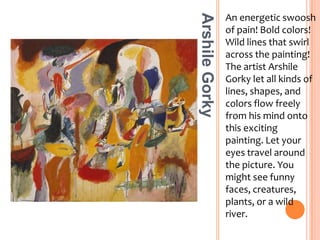
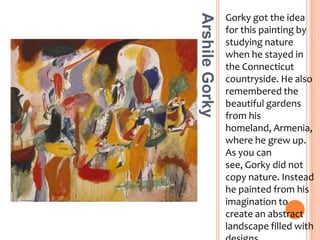
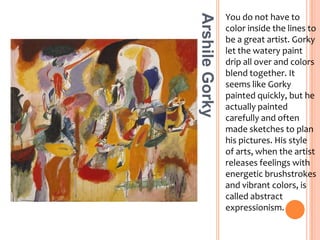
Abstract ArtDiscover the art ofPicassoMatisseLégerO’KeeffeCalderGorky
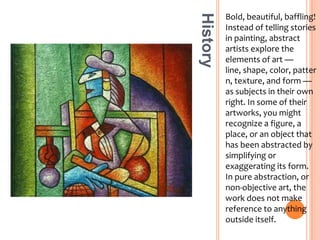
Bold, beautiful, baffling! Instead of telling stories in painting, abstract artists explore the elements of art — line, shape, color, pattern, texture, and form — as subjects in their own right. In some of their artworks, you might recognize a figure, a place, or an object that has been abstracted by simplifying or exaggerating its form. In pure abstraction, or non-objective art, the work does not make reference to anything outside itself.History
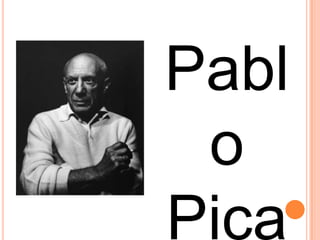
Pablo Picasso
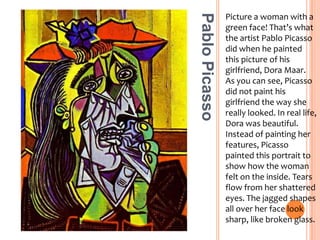
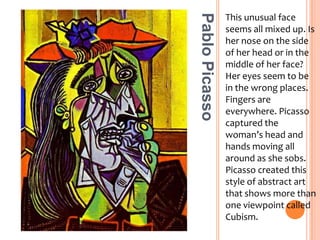
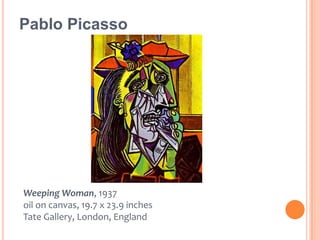
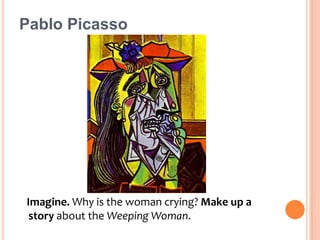
Picture a woman with a green face! That’s what the artist Pablo Picasso did when he painted this picture of his girlfriend, Dora Maar. As you can see, Picasso did not paint his girlfriend the way she really looked. In real life, Dora was beautiful. Instead of painting her features, Picasso painted this portrait to show how the woman felt on the inside. Tears flow from her shattered eyes. The jagged shapes all over her face look sharp, like broken glass.Pablo Picasso
This unusual face seems all mixed up. Is her nose on the side of her head or in the middle of her face? Her eyes seem to be in the wrong places. Fingers are everywhere. Picasso captured the woman’s head and hands moving all around as she sobs. Picasso created this style of abstract art that shows more than one viewpoint called Cubism.Pablo Picasso
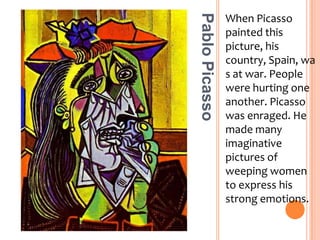
When Picasso painted this picture, his country, Spain, was at war. People were hurting one another. Picasso was enraged. He made many imaginative pictures of weeping women to express his strong emotions.Pablo Picasso
How do you think this woman feels?  How can you tell?
Pablo PicassoWeeping Woman, 1937oil on canvas, 19.7 x 23.9 inchesTate Gallery, London, England
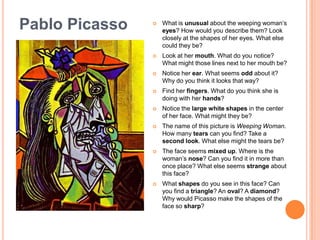
Pablo PicassoWhat is unusual about the weeping woman’s eyes? How would you describe them? Look closely at the shapes of her eyes. What else could they be? Look at her mouth. What do you notice? What might those lines next to her mouth be?Notice her ear. What seems odd about it? Why do you think it looks that way?Find her fingers. What do you think she is doing with her hands?Notice the large white shapes in the center of her face. What might they be? The name of this picture is Weeping Woman. How many tears can you find? Take a second look. What else might the tears be?The face seems mixed up. Where is the woman’s nose? Can you find it in more than once place? What else seems strange about this face?What shapes do you see in this face? Can you find a triangle? An oval? A diamond? Why would Picasso make the shapes of the face so sharp?
Pablo Picasso   Imagine. Why is the woman crying? Make up a story about the Weeping Woman.
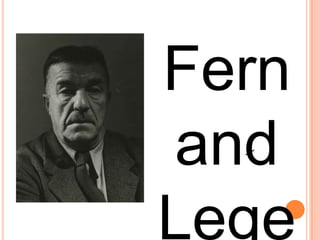
Fernand Leger
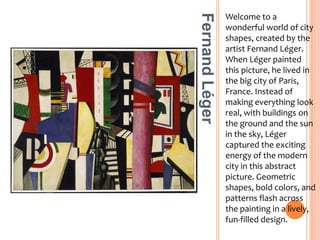
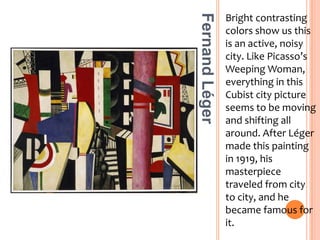
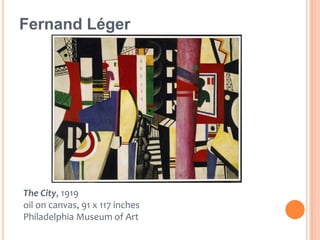
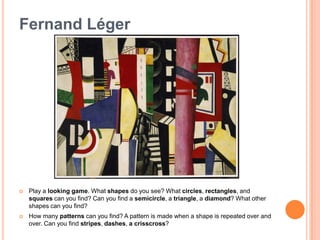
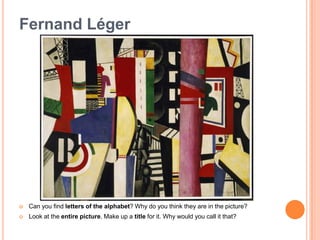
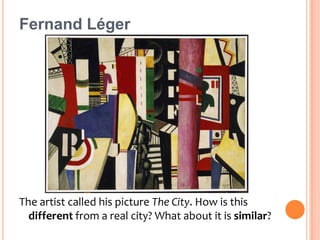
Welcome to a wonderful world of city shapes, created by the artist Fernand Léger. When Léger painted this picture, he lived in the big city of Paris, France. Instead of making everything look real, with buildings on the ground and the sun in the sky, Léger captured the exciting energy of the modern city in this abstract picture. Geometric shapes, bold colors, and patterns flash across the painting in a lively, fun-filled design.Fernand Léger
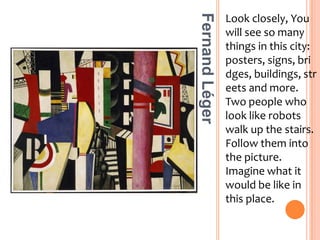
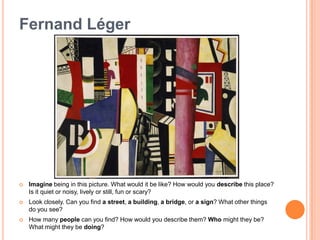
Look closely, You will see so many things in this city: posters, signs, bridges, buildings, streets and more. Two people who look like robots walk up the stairs. Follow them into the picture. Imagine what it would be like in this place.Fernand Léger
Bright contrasting colors show us this is an active, noisy city. Like Picasso’s Weeping Woman, everything in this Cubist city picture seems to be moving and shifting all around. After Léger made this painting in 1919, his masterpiece traveled from city to city, and he became famous for it.Fernand Léger
What place might this be?  How can you tell?
Fernand LégerThe City, 1919oil on canvas, 91 x 117 inchesPhiladelphia Museum of Art
Fernand LégerImagine being in this picture. What would it be like? How would you describe this place? Is it quiet or noisy, lively or still, fun or scary?
Look closely. Can you find a street, a building, a bridge, or a sign? What other things do you see?
How many people can you find? How would you describe them? Who might they be? What might they be doing?Fernand LégerPlay a looking game. What shapes do you see? What circles, rectangles, and squares can you find? Can you find a semicircle, a triangle, a diamond? What other shapes can you find?
How many patterns can you find? A pattern is made when a shape is repeated over and over. Can you find stripes, dashes, a crisscross?Fernand LégerCan you find letters of the alphabet? Why do you think they are in the picture?
Look at the entire picture. Make up a title for it. Why would you call it that?Fernand LégerThe artist called his picture The City. How is this different from a real city? What about it is similar?
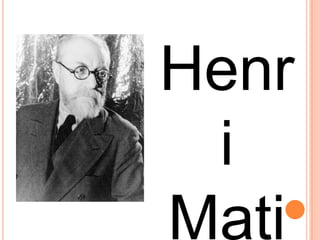
Henri Matisse
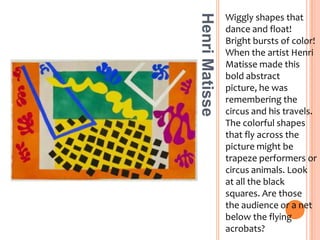
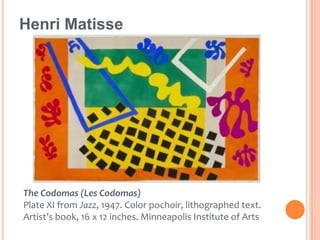
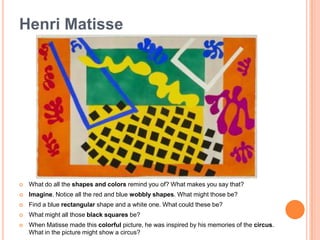
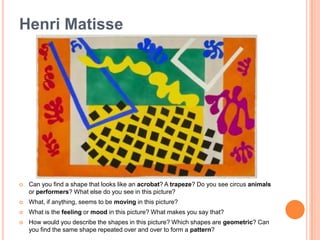
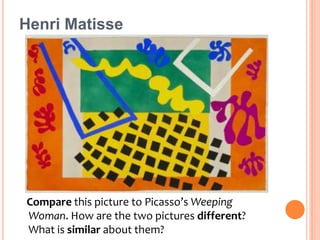
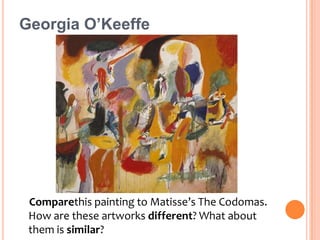
Wiggly shapes that dance and float! Bright bursts of color! When the artist Henri Matisse made this bold abstract picture, he was remembering the circus and his travels. The colorful shapes that fly across the picture might be trapeze performers or circus animals. Look at all the black squares. Are those the audience or a net below the flying acrobats?Henri Matisse
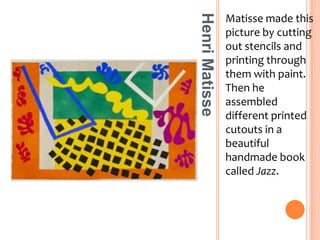
Matisse made this picture by cutting out stencils and printing through them with paint. Then he assembled different printed cutouts in a beautiful handmade book called Jazz. Henri Matisse
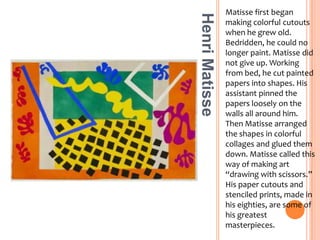
Matisse first began making colorful cutouts when he grew old. Bedridden, he could no longer paint. Matisse did not give up. Working from bed, he cut painted papers into shapes. His assistant pinned the papers loosely on the walls all around him. Then Matisse arranged the shapes in colorful collages and glued them down. Matisse called this way of making art “drawing with scissors.” His paper cutouts and stenciled prints, made in his eighties, are some of his greatest masterpieces.Henri Matisse
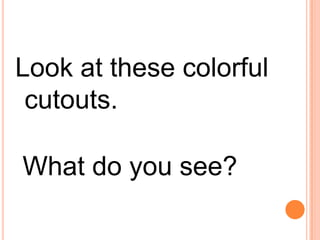
Look at these colorful cutouts.  What do you see?
Henri MatisseThe Codomas (Les Codomas)Plate XI from Jazz, 1947. Color pochoir, lithographed text.Artist’s book, 16 x 12 inches. Minneapolis Institute of Arts
Henri MatisseWhat do all the shapes and colors remind you of? What makes you say that?
Imagine. Notice all the red and blue wobbly shapes. What might those be?
Find a blue rectangular shape and a white one. What could these be?
What might all those black squares be?
When Matisse made this colorful picture, he was inspired by his memories of the circus. What in the picture might show a circus?Henri MatisseCan you find a shape that looks like an acrobat? A trapeze? Do you see circus animals or performers? What else do you see in this picture?
What, if anything, seems to be moving in this picture?
What is the feeling or mood in this picture? What makes you say that?
How would you describe the shapes in this picture? Which shapes are geometric? Can you find the same shape repeated over and over to form a pattern?Henri Matisse   Compare this picture to Picasso’s Weeping Woman. How are the two pictures different? What is similar about them?
Alexander Calder
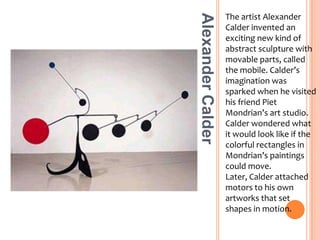
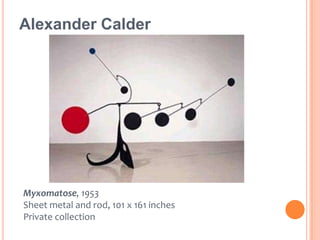
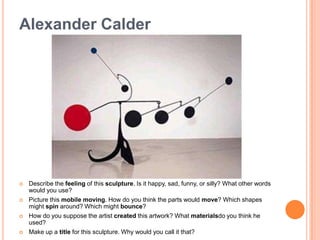
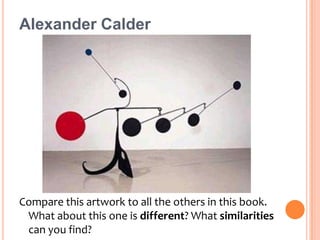
The artist Alexander Calder invented an exciting new kind of abstract sculpture with movable parts, called the mobile. Calder’s imagination was sparked when he visited his friend Piet Mondrian’s art studio. Calder wondered what it would look like if the colorful rectangles in Mondrian’s paintings could move. Later, Calder attached motors to his own artworks that set shapes in motion.Alexander Calder
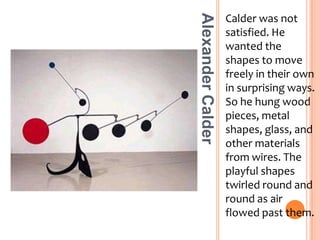
Calder was not satisfied. He wanted the shapes to move freely in their own in surprising ways. So he hung wood pieces, metal shapes, glass, and other materials from wires. The playful shapes twirled round and round as air flowed past them.Alexander Calder
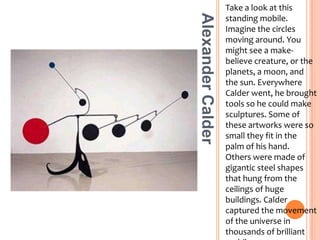
Take a look at this standing mobile. Imagine the circles moving around. You might see a make-believe creature, or the planets, a moon, and the sun. Everywhere Calder went, he brought tools so he could make sculptures. Some of these artworks were so small they fit in the palm of his hand. Others were made of gigantic steel shapes that hung from the ceilings of huge buildings. Calder captured the movement of the universe in thousands of brilliant mobiles.Alexander Calder
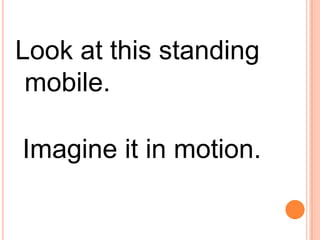
Look at this standing mobile. Imagine it in motion.
Alexander CalderMyxomatose, 1953Sheet metal and rod, 101 x 161 inchesPrivate collection
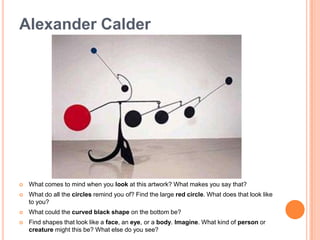
Alexander CalderWhat comes to mind when you look at this artwork? What makes you say that?
What do all the circles remind you of? Find the large red circle. What does that look like to you?
What could the curved black shape on the bottom be?
Find shapes that look like a face, an eye, or a body. Imagine. What kind of person or creature might this be? What else do you see?Alexander CalderDescribe the feeling of this sculpture. Is it happy, sad, funny, or silly? What other words would you use?
Picture this mobile moving. How do you think the parts would move? Which shapes might spin around? Which might bounce?
How do you suppose the artist created this artwork? What materialsdo you think he used?
Make up a title for this sculpture. Why would you call it that?Alexander CalderCompare this artwork to all the others in this book. What about this one is different? What similarities can you find?
Georgia O’Keeffe
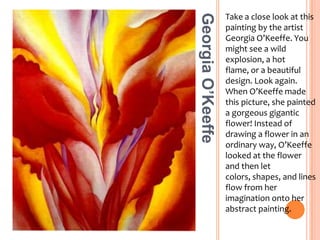
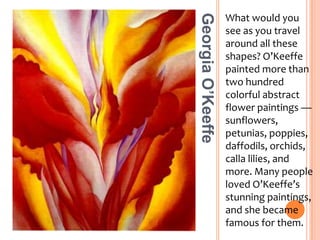
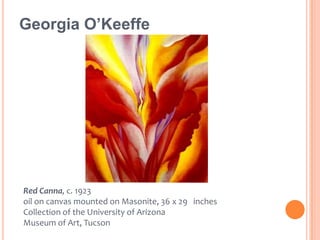
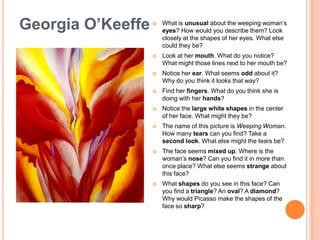
Take a close look at this painting by the artist Georgia O’Keeffe. You might see a wild explosion, a hot flame, or a beautiful design. Look again. When O’Keeffe made this picture, she painted a gorgeous gigantic flower! Instead of drawing a flower in an ordinary way, O’Keeffe looked at the flower and then let colors, shapes, and lines flow from her imagination onto her abstract painting.Georgia O’Keeffe
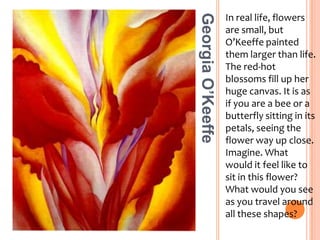
In real life, flowers are small, but O’Keeffe painted them larger than life. The red-hot blossoms fill up her huge canvas. It is as if you are a bee or a butterfly sitting in its petals, seeing the flower way up close. Imagine. What would it feel like to sit in this flower? What would you see as you travel around all these shapes? Georgia O’Keeffe
What would you see as you travel around all these shapes? O’Keeffe painted more than two hundred colorful abstract flower paintings — sunflowers, petunias, poppies, daffodils, orchids, calla lilies, and more. Many people loved O’Keeffe’s stunning paintings, and she became famous for them.Georgia O’Keeffe
What do you see in this picture?
Georgia O’KeeffeRed Canna, c. 1923oil on canvas mounted on Masonite, 36 x 29   inchesCollection of the University of ArizonaMuseum of Art, Tucson

Abstract art

  • 1.
    Abstract ArtDiscover theart ofPicassoMatisseLégerO’KeeffeCalderGorky
  • 2.
    Bold, beautiful, baffling!Instead of telling stories in painting, abstract artists explore the elements of art — line, shape, color, pattern, texture, and form — as subjects in their own right. In some of their artworks, you might recognize a figure, a place, or an object that has been abstracted by simplifying or exaggerating its form. In pure abstraction, or non-objective art, the work does not make reference to anything outside itself.History
  • 3.
  • 4.
    Picture a womanwith a green face! That’s what the artist Pablo Picasso did when he painted this picture of his girlfriend, Dora Maar. As you can see, Picasso did not paint his girlfriend the way she really looked. In real life, Dora was beautiful. Instead of painting her features, Picasso painted this portrait to show how the woman felt on the inside. Tears flow from her shattered eyes. The jagged shapes all over her face look sharp, like broken glass.Pablo Picasso
  • 5.
    This unusual faceseems all mixed up. Is her nose on the side of her head or in the middle of her face? Her eyes seem to be in the wrong places. Fingers are everywhere. Picasso captured the woman’s head and hands moving all around as she sobs. Picasso created this style of abstract art that shows more than one viewpoint called Cubism.Pablo Picasso
  • 6.
    When Picasso paintedthis picture, his country, Spain, was at war. People were hurting one another. Picasso was enraged. He made many imaginative pictures of weeping women to express his strong emotions.Pablo Picasso
  • 7.
    How do youthink this woman feels? How can you tell?
  • 8.
    Pablo PicassoWeeping Woman,1937oil on canvas, 19.7 x 23.9 inchesTate Gallery, London, England
  • 9.
    Pablo PicassoWhat isunusual about the weeping woman’s eyes? How would you describe them? Look closely at the shapes of her eyes. What else could they be? Look at her mouth. What do you notice? What might those lines next to her mouth be?Notice her ear. What seems odd about it? Why do you think it looks that way?Find her fingers. What do you think she is doing with her hands?Notice the large white shapes in the center of her face. What might they be? The name of this picture is Weeping Woman. How many tears can you find? Take a second look. What else might the tears be?The face seems mixed up. Where is the woman’s nose? Can you find it in more than once place? What else seems strange about this face?What shapes do you see in this face? Can you find a triangle? An oval? A diamond? Why would Picasso make the shapes of the face so sharp?
  • 10.
    Pablo Picasso Imagine. Why is the woman crying? Make up a story about the Weeping Woman.
  • 11.
  • 12.
    Welcome to awonderful world of city shapes, created by the artist Fernand Léger. When Léger painted this picture, he lived in the big city of Paris, France. Instead of making everything look real, with buildings on the ground and the sun in the sky, Léger captured the exciting energy of the modern city in this abstract picture. Geometric shapes, bold colors, and patterns flash across the painting in a lively, fun-filled design.Fernand Léger
  • 13.
    Look closely, Youwill see so many things in this city: posters, signs, bridges, buildings, streets and more. Two people who look like robots walk up the stairs. Follow them into the picture. Imagine what it would be like in this place.Fernand Léger
  • 14.
    Bright contrasting colorsshow us this is an active, noisy city. Like Picasso’s Weeping Woman, everything in this Cubist city picture seems to be moving and shifting all around. After Léger made this painting in 1919, his masterpiece traveled from city to city, and he became famous for it.Fernand Léger
  • 15.
    What place mightthis be? How can you tell?
  • 16.
    Fernand LégerThe City,1919oil on canvas, 91 x 117 inchesPhiladelphia Museum of Art
  • 17.
    Fernand LégerImagine beingin this picture. What would it be like? How would you describe this place? Is it quiet or noisy, lively or still, fun or scary?
  • 18.
    Look closely. Canyou find a street, a building, a bridge, or a sign? What other things do you see?
  • 19.
    How many peoplecan you find? How would you describe them? Who might they be? What might they be doing?Fernand LégerPlay a looking game. What shapes do you see? What circles, rectangles, and squares can you find? Can you find a semicircle, a triangle, a diamond? What other shapes can you find?
  • 20.
    How many patternscan you find? A pattern is made when a shape is repeated over and over. Can you find stripes, dashes, a crisscross?Fernand LégerCan you find letters of the alphabet? Why do you think they are in the picture?
  • 21.
    Look at theentire picture. Make up a title for it. Why would you call it that?Fernand LégerThe artist called his picture The City. How is this different from a real city? What about it is similar?
  • 22.
  • 23.
    Wiggly shapes thatdance and float! Bright bursts of color! When the artist Henri Matisse made this bold abstract picture, he was remembering the circus and his travels. The colorful shapes that fly across the picture might be trapeze performers or circus animals. Look at all the black squares. Are those the audience or a net below the flying acrobats?Henri Matisse
  • 24.
    Matisse made thispicture by cutting out stencils and printing through them with paint. Then he assembled different printed cutouts in a beautiful handmade book called Jazz. Henri Matisse
  • 25.
    Matisse first beganmaking colorful cutouts when he grew old. Bedridden, he could no longer paint. Matisse did not give up. Working from bed, he cut painted papers into shapes. His assistant pinned the papers loosely on the walls all around him. Then Matisse arranged the shapes in colorful collages and glued them down. Matisse called this way of making art “drawing with scissors.” His paper cutouts and stenciled prints, made in his eighties, are some of his greatest masterpieces.Henri Matisse
  • 26.
    Look at thesecolorful cutouts. What do you see?
  • 27.
    Henri MatisseThe Codomas(Les Codomas)Plate XI from Jazz, 1947. Color pochoir, lithographed text.Artist’s book, 16 x 12 inches. Minneapolis Institute of Arts
  • 28.
    Henri MatisseWhat doall the shapes and colors remind you of? What makes you say that?
  • 29.
    Imagine. Notice allthe red and blue wobbly shapes. What might those be?
  • 30.
    Find a bluerectangular shape and a white one. What could these be?
  • 31.
    What might allthose black squares be?
  • 32.
    When Matisse madethis colorful picture, he was inspired by his memories of the circus. What in the picture might show a circus?Henri MatisseCan you find a shape that looks like an acrobat? A trapeze? Do you see circus animals or performers? What else do you see in this picture?
  • 33.
    What, if anything,seems to be moving in this picture?
  • 34.
    What is thefeeling or mood in this picture? What makes you say that?
  • 35.
    How would youdescribe the shapes in this picture? Which shapes are geometric? Can you find the same shape repeated over and over to form a pattern?Henri Matisse Compare this picture to Picasso’s Weeping Woman. How are the two pictures different? What is similar about them?
  • 36.
  • 37.
    The artist AlexanderCalder invented an exciting new kind of abstract sculpture with movable parts, called the mobile. Calder’s imagination was sparked when he visited his friend Piet Mondrian’s art studio. Calder wondered what it would look like if the colorful rectangles in Mondrian’s paintings could move. Later, Calder attached motors to his own artworks that set shapes in motion.Alexander Calder
  • 38.
    Calder was notsatisfied. He wanted the shapes to move freely in their own in surprising ways. So he hung wood pieces, metal shapes, glass, and other materials from wires. The playful shapes twirled round and round as air flowed past them.Alexander Calder
  • 39.
    Take a lookat this standing mobile. Imagine the circles moving around. You might see a make-believe creature, or the planets, a moon, and the sun. Everywhere Calder went, he brought tools so he could make sculptures. Some of these artworks were so small they fit in the palm of his hand. Others were made of gigantic steel shapes that hung from the ceilings of huge buildings. Calder captured the movement of the universe in thousands of brilliant mobiles.Alexander Calder
  • 40.
    Look at thisstanding mobile. Imagine it in motion.
  • 41.
    Alexander CalderMyxomatose, 1953Sheetmetal and rod, 101 x 161 inchesPrivate collection
  • 42.
    Alexander CalderWhat comesto mind when you look at this artwork? What makes you say that?
  • 43.
    What do allthe circles remind you of? Find the large red circle. What does that look like to you?
  • 44.
    What could thecurved black shape on the bottom be?
  • 45.
    Find shapes thatlook like a face, an eye, or a body. Imagine. What kind of person or creature might this be? What else do you see?Alexander CalderDescribe the feeling of this sculpture. Is it happy, sad, funny, or silly? What other words would you use?
  • 46.
    Picture this mobilemoving. How do you think the parts would move? Which shapes might spin around? Which might bounce?
  • 47.
    How do yousuppose the artist created this artwork? What materialsdo you think he used?
  • 48.
    Make up atitle for this sculpture. Why would you call it that?Alexander CalderCompare this artwork to all the others in this book. What about this one is different? What similarities can you find?
  • 49.
  • 50.
    Take a closelook at this painting by the artist Georgia O’Keeffe. You might see a wild explosion, a hot flame, or a beautiful design. Look again. When O’Keeffe made this picture, she painted a gorgeous gigantic flower! Instead of drawing a flower in an ordinary way, O’Keeffe looked at the flower and then let colors, shapes, and lines flow from her imagination onto her abstract painting.Georgia O’Keeffe
  • 51.
    In real life,flowers are small, but O’Keeffe painted them larger than life. The red-hot blossoms fill up her huge canvas. It is as if you are a bee or a butterfly sitting in its petals, seeing the flower way up close. Imagine. What would it feel like to sit in this flower? What would you see as you travel around all these shapes? Georgia O’Keeffe
  • 52.
    What would yousee as you travel around all these shapes? O’Keeffe painted more than two hundred colorful abstract flower paintings — sunflowers, petunias, poppies, daffodils, orchids, calla lilies, and more. Many people loved O’Keeffe’s stunning paintings, and she became famous for them.Georgia O’Keeffe
  • 53.
    What do yousee in this picture?
  • 54.
    Georgia O’KeeffeRed Canna,c. 1923oil on canvas mounted on Masonite, 36 x 29 inchesCollection of the University of ArizonaMuseum of Art, Tucson