1
Risk & reputation: is data the problem or the solution
Data Management at ABN AMRO in a nutshell
Chief Architect & Data Management
Marijne le Comte (head of Data Management Consultancy)
This presentation is offered to you
by Altares Dun & Bradstreet
2
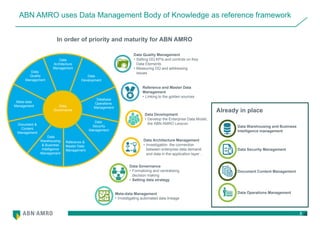
ABN AMRO uses Data Management Body of Knowledge as reference framework
2
Text
Data
Architecture
Management
Data
Development
Document &
Content
Management
Data
Warehousing
& Business
Intelligence
Management
Reference &
Master Data
Management
Meta-data
Management
Data
Quality
Management
Data
Security
Management
Database
Operations
ManagementData
Governance
Data Architecture Management
• Investigation the connection
between enterprise data demand
and data in the application layer .
Reference and Master Data
Management
• Linking to the golden sources
Data Security Management
Document Content Management
Data Operations Management
Data Governance
• Formalizing and centralising
decision making
• Setting data strategy
Data Quality Management
• Setting DQ KPIs and controls on Key
Data Elements
• Measuring DQ and addressing
issues
Data Development
• Develop the Enterprise Data Model,
the ABN AMRO Lexicon
Data Warehousing and Business
Intelligence management
Meta-data Management
• Investigating automated data lineage
Already in place
In order of priority and maturity for ABN AMRO
3
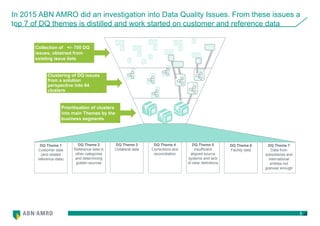
Collection of +/- 700 DQ
issues, obtained from
existing issue lists
DQ Theme 7
Data from
subsidiaries and
international
entities not
granular enough
DQ Theme 6
Facility data
DQ Theme 5
Insufficient
aligned source
systems and lack
of clear definitions
DQ Theme 4
Corrections and
reconciliation
DQ Theme 3
Collateral data
DQ Theme 2
Reference data in
other categories
and determining
golden sources
DQ Theme 1
Customer data
(and related
reference data)
Clustering of DQ issues
from a solution
perspective into 64
clusters
Prioritisation of clusters
into main Themes by the
business segments
In 2015 ABN AMRO did an investigation into Data Quality Issues. From these issues a
top 7 of DQ themes is distilled and work started on customer and reference data
4
Capture many
details
Use internal
segment codes
Use external
segment codes
(Nace)
Use internal
customer segment
codes
Use Dun &
Bradstreet
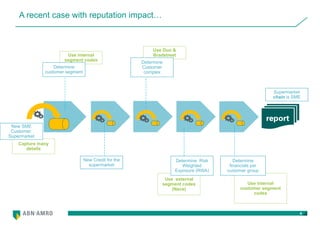
A recent case with reputation impact…
report
New SME
Customer:
Supermarket
New Credit for the
supermarket
Determine
customer segment
Determine Risk
Weighted
Exposure (RWA)
Determine
Customer
complex
Determine
financials per
customer group
Supermarket
chain is SME
5
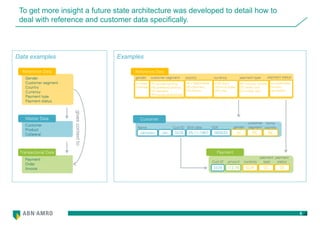
To get more insight a future state architecture was developed to detail how to
deal with reference and customer data specifically.
Data examples Examples
Gender
Customer segment
Country
Currency
Payment type
Payment status
Customer
Product
Collateral
Payment
Order
Invoice
Reference Data
Master Data
Transactional Data
Customer
JanJanssen 3478 25-11-1967 985634 m PC NL
Name Cust-ID Birth date SSN gender
customer
segment
home
country
Reference Data
m=male
f=female
gender
PC=private banking
PB=preferred banking
ST=standard
YP=young professional
customer segment
NL= Netherlands
DE=Germany
FR=France
…
country
EUR=Euro
USD=US-Dollar
JPY=Yen
…
currency
MT=money transfer
DC=debit card
CC=credit card
payment type
au=authorised
st=sent
se=settled
payment status
Payment
3478
Cust-ID
EUR DC SE
currency
payment
type
payment
status
112,78
amount
givescontextto
6
If none of the above applies. Data is used
 for just one purpose, or
 by only one party within ABN AMRO
Data to meet enterprise responsibilities of ABN
AMRO
 Data imposed for usage by entire ABN AMRO
 Data aggregated for enterprise overview &
reporting
Data used in multiple contexts. Data is used
 for more than just one purpose, or
 by multiple parties within ABN AMRO
Non-shared
Shared
Enterprise
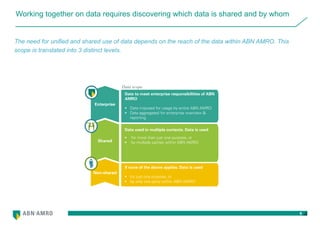
Working together on data requires discovering which data is shared and by whom
The need for unified and shared use of data depends on the reach of the data within ABN AMRO. This
scope is translated into 3 distinct levels.
Data scope
7
Low volume High volume

#
#
previous
month
current
month
change
The table shows the number of DQ issues raised per business segment (column) that are agreed to be resolved by another (or the same) business segment (row)
When we started working on the DQ issues, some other interesting things can be observed…
8
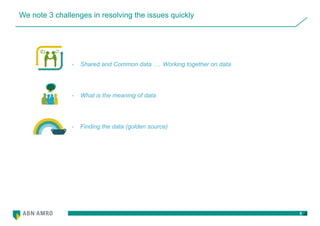
We note 3 challenges in resolving the issues quickly
- Shared and Common data …. Working together on data
- What is the meaning of data
- Finding the data (golden source)
9
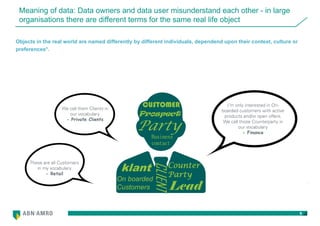
Meaning of data: Data owners and data user misunderstand each other - in large
organisations there are different terms for the same real life object
Objects in the real world are named differently by different individuals, dependend upon their context, culture or
preferences*.
These are all Customers
in my vocabulary
- Retail
We call them Clients in
our vocabulary
- Private Clients
I’m only interested in On-
boarded customers with active
products and/or open offers.
We call those Counterparty in
our vocabulary
- Finance
Lead
On boarded
Customers
Prospect
CLIENT
Counter
Party
Party
CUSTOMER
klant
Business
contact
.
10
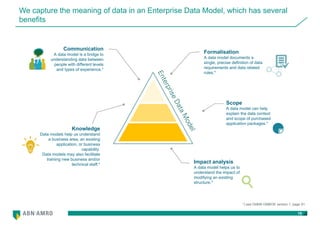
We capture the meaning of data in an Enterprise Data Model, which has several
benefits
Communication
A data model is a bridge to
understanding data between
people with different levels
and types of experience.*
Formalisation
A data model documents a
single, precise definition of data
requirements and data related
rules.*
Knowledge
Data models help us understand
a business area, an existing
application, or business
capability.
Data models may also facilitate
training new business and/or
technical staff.*
Scope
A data model can help
explain the data context
and scope of purchased
application packages.*
Impact analysis
A data model helps us to
understand the impact of
modifying an existing
structure.*
*) see DAMA DMBOK version 1, page 91.
11
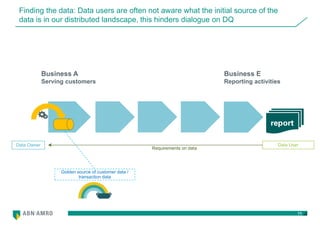
Finding the data: Data users are often not aware what the initial source of the
data is in our distributed landscape, this hinders dialogue on DQ
Data Owner
Business A
Serving customers
Data User
report
Golden source of customer data /
transaction data
Requirements on data
Business E
Reporting activities
12
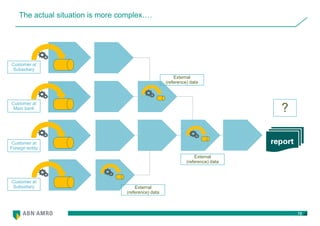
The actual situation is more complex….
report
Customer at
Main bank
External
(reference) data
External
(reference) data
External
(reference) data
?
Customer at
Subsidiary
Customer at
Subsidiary
Customer at
Foreign entity
13
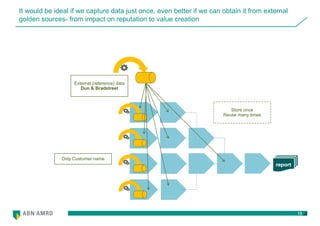
It would be ideal if we capture data just once, even better if we can obtain it from external
golden sources- from impact on reputation to value creation
report
External (reference) data
Dun & Bradstreet
Store once
Reuse many times
Only Customer name
14
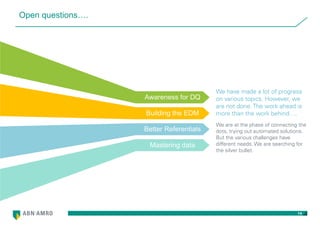
Open questions….
We have made a lot of progress
on various topics. However, we
are not done. The work ahead is
more than the work behind….
We are at the phase of connecting the
dots, trying out automated solutions.
But the various challenges have
different needs. We are searching for
the silver bullet.
Awareness for DQ
Building the EDM
Better Referentials
Mastering data
Want to learn more? Visit us at booth 48 for
a Master Data Virtual Reality experience!

Abn amro altares Marijne le Comte

  • 1.
    1 Risk & reputation:is data the problem or the solution Data Management at ABN AMRO in a nutshell Chief Architect & Data Management Marijne le Comte (head of Data Management Consultancy) This presentation is offered to you by Altares Dun & Bradstreet
  • 2.
    2 ABN AMRO usesData Management Body of Knowledge as reference framework 2 Text Data Architecture Management Data Development Document & Content Management Data Warehousing & Business Intelligence Management Reference & Master Data Management Meta-data Management Data Quality Management Data Security Management Database Operations ManagementData Governance Data Architecture Management • Investigation the connection between enterprise data demand and data in the application layer . Reference and Master Data Management • Linking to the golden sources Data Security Management Document Content Management Data Operations Management Data Governance • Formalizing and centralising decision making • Setting data strategy Data Quality Management • Setting DQ KPIs and controls on Key Data Elements • Measuring DQ and addressing issues Data Development • Develop the Enterprise Data Model, the ABN AMRO Lexicon Data Warehousing and Business Intelligence management Meta-data Management • Investigating automated data lineage Already in place In order of priority and maturity for ABN AMRO
  • 3.
    3 Collection of +/-700 DQ issues, obtained from existing issue lists DQ Theme 7 Data from subsidiaries and international entities not granular enough DQ Theme 6 Facility data DQ Theme 5 Insufficient aligned source systems and lack of clear definitions DQ Theme 4 Corrections and reconciliation DQ Theme 3 Collateral data DQ Theme 2 Reference data in other categories and determining golden sources DQ Theme 1 Customer data (and related reference data) Clustering of DQ issues from a solution perspective into 64 clusters Prioritisation of clusters into main Themes by the business segments In 2015 ABN AMRO did an investigation into Data Quality Issues. From these issues a top 7 of DQ themes is distilled and work started on customer and reference data
  • 4.
    4 Capture many details Use internal segmentcodes Use external segment codes (Nace) Use internal customer segment codes Use Dun & Bradstreet A recent case with reputation impact… report New SME Customer: Supermarket New Credit for the supermarket Determine customer segment Determine Risk Weighted Exposure (RWA) Determine Customer complex Determine financials per customer group Supermarket chain is SME
  • 5.
    5 To get moreinsight a future state architecture was developed to detail how to deal with reference and customer data specifically. Data examples Examples Gender Customer segment Country Currency Payment type Payment status Customer Product Collateral Payment Order Invoice Reference Data Master Data Transactional Data Customer JanJanssen 3478 25-11-1967 985634 m PC NL Name Cust-ID Birth date SSN gender customer segment home country Reference Data m=male f=female gender PC=private banking PB=preferred banking ST=standard YP=young professional customer segment NL= Netherlands DE=Germany FR=France … country EUR=Euro USD=US-Dollar JPY=Yen … currency MT=money transfer DC=debit card CC=credit card payment type au=authorised st=sent se=settled payment status Payment 3478 Cust-ID EUR DC SE currency payment type payment status 112,78 amount givescontextto
  • 6.
    6 If none ofthe above applies. Data is used  for just one purpose, or  by only one party within ABN AMRO Data to meet enterprise responsibilities of ABN AMRO  Data imposed for usage by entire ABN AMRO  Data aggregated for enterprise overview & reporting Data used in multiple contexts. Data is used  for more than just one purpose, or  by multiple parties within ABN AMRO Non-shared Shared Enterprise Working together on data requires discovering which data is shared and by whom The need for unified and shared use of data depends on the reach of the data within ABN AMRO. This scope is translated into 3 distinct levels. Data scope
  • 7.
    7 Low volume Highvolume  # # previous month current month change The table shows the number of DQ issues raised per business segment (column) that are agreed to be resolved by another (or the same) business segment (row) When we started working on the DQ issues, some other interesting things can be observed…
  • 8.
    8 We note 3challenges in resolving the issues quickly - Shared and Common data …. Working together on data - What is the meaning of data - Finding the data (golden source)
  • 9.
    9 Meaning of data:Data owners and data user misunderstand each other - in large organisations there are different terms for the same real life object Objects in the real world are named differently by different individuals, dependend upon their context, culture or preferences*. These are all Customers in my vocabulary - Retail We call them Clients in our vocabulary - Private Clients I’m only interested in On- boarded customers with active products and/or open offers. We call those Counterparty in our vocabulary - Finance Lead On boarded Customers Prospect CLIENT Counter Party Party CUSTOMER klant Business contact .
  • 10.
    10 We capture themeaning of data in an Enterprise Data Model, which has several benefits Communication A data model is a bridge to understanding data between people with different levels and types of experience.* Formalisation A data model documents a single, precise definition of data requirements and data related rules.* Knowledge Data models help us understand a business area, an existing application, or business capability. Data models may also facilitate training new business and/or technical staff.* Scope A data model can help explain the data context and scope of purchased application packages.* Impact analysis A data model helps us to understand the impact of modifying an existing structure.* *) see DAMA DMBOK version 1, page 91.
  • 11.
    11 Finding the data:Data users are often not aware what the initial source of the data is in our distributed landscape, this hinders dialogue on DQ Data Owner Business A Serving customers Data User report Golden source of customer data / transaction data Requirements on data Business E Reporting activities
  • 12.
    12 The actual situationis more complex…. report Customer at Main bank External (reference) data External (reference) data External (reference) data ? Customer at Subsidiary Customer at Subsidiary Customer at Foreign entity
  • 13.
    13 It would beideal if we capture data just once, even better if we can obtain it from external golden sources- from impact on reputation to value creation report External (reference) data Dun & Bradstreet Store once Reuse many times Only Customer name
  • 14.
    14 Open questions…. We havemade a lot of progress on various topics. However, we are not done. The work ahead is more than the work behind…. We are at the phase of connecting the dots, trying out automated solutions. But the various challenges have different needs. We are searching for the silver bullet. Awareness for DQ Building the EDM Better Referentials Mastering data
  • 15.
    Want to learnmore? Visit us at booth 48 for a Master Data Virtual Reality experience!