JCAM No.304-R1
1 ofPage 4
Japan Customs Analysis Methods
No. 304
Quantitative Analysis of Sorbitol
(Issued in June 1999)
(Updated in May 2001)
1. Scope
This analysis method is applied to sorbitol of
subheading 2905.44 or 3824.60 of Customs Tariff Law
(Appendix Table – Customs Tariff Schedule) which
requires the determination of its purity.
2. Outline of Test Method
In this method, sorbitol content is determined
either by an n-butane boronic acid derivatization-gas
chromatography (GC) with internal standard method
using methyl nonadecanate as an internal standard or
by high-performance liquid chromatography (HPLC)
with internal standard method using propylene glycol
as an internal standard.
3. Apparatus
(1) For GC method
Gas chromatograph (GC), equipped with a flame
ionization detector.
(a) Column
2 m × 3 mm (i.d.) glass column, packed with
a solid phase carrier (e.g., Chromosorb WAW,
DMCS, 100 – 120 meshes) coated with silicone
OV-225 as the liquid phase, or its equivalent.
(b) Operating parameters
Column temperature, 220 °C; Injection port
temperature, 250 °C; Carrier gas, nitrogen or
helium. Flow rates of carrier gas, hydrogen gas
and air should be adjusted to be the optimum
conditions for a gas chromatograph used.
(2) For HPLC method
High-performance liquid chromatograph (HPLC),
equipped with a refractive index detector (RID).
(a) Column
Calcium type cation-exchange resin gel
column, 7.9 mm i.d. × 300 mm, or its
equivalent.
(b) Operating parameters
Column temperature, 75 °C; Mobile phase,
Water (HPLC grade); Flow rate, 0.8 ml/min;
Injection volume, 20 μl.
4. Reagents
All chemicals must be JIS special reagent grade or
equivalent, unless otherwise specified.
(a) n-butane boronic acid (available as a
derivatization reagent in gas chromatography.)
Due to its hydroscopic property, once its
package is opened, it should tightly be sealed
again and kept in a desiccator.
(b) Methyl nonadecanate (internal standard
substance)
(c) Propylene glycol (internal standard substance)
(d) Sorbitol
5. Procedure
5.1. Determination of Moisture Content
For liquid samples, accurately weigh about 2 g of
the sample into a weighing bottle dried to a constant
weight after placing sea sand in. Place the weighing
bottle in an oven and dry the content for 1 hour at a
constant temperature of 105 °C. Remove it from the
oven, cool it to room temperature in a desiccator and
weigh. Repeat until the loss in weight does not exceed 2
2.
JCAM No.304-R1
2 ofPage 4
mg per 1 hour drying period. For solid samples,
accurately weigh about 2 g of the sample in a weighing
bottle previously dried, and dry the content in the same
manner as with liquid samples. Constant weight is
attained, when the loss in weight does not exceed 2 mg
per 1 hour drying period.
Calculate the moisture content from the following
formula. Round off the numerical value to one decimal
place.
100
W
W
W
moisture
%,
0
1
0
×
−
=
Where- W0: Amount (g) of test sample collected
W1: Weight (g) of test sample after drying
5.2. Determination of Sorbitol Content
A. GC Method
A.1. Preparation of Sorbitol Standard Solution
Accurately weigh about 150 mg of sorbitol in a
beaker, and dissolve it in a small amount of water.
Transfer the solution to a 100 ml volumetric flask,
and dilute to volume with methanol.
A.2. Preparation of n-Butane Boronic Acid-Methyl
Nonadecanate (Internal Standard) Solution
Accurately weigh about 200 mg of n-butane
boronic acid and about 40 mg of methyl
nonadecanate in a beaker, and dissolve them in
pyridine. Transfer the solution into a 20 ml
volumetric flask, and dilute to volume with
pyridine.
A.3. Preparation of Sample Solution
Accurately weigh the amount of sample
corresponding to 150 mg of sorbitol in a beaker,
and dissolve it in a small amount of water.
Transfer the solution into a 100 ml volumetric
flask, and dilute to volume with methanol.
A.4. Preparation of Derivatization Solution and Gas
Chromatography
Accurately take 1 ml each of the sorbitol
standard solution and sample solution using
whole pipets, and place them into separate 5 ml
vials. Place the vials on a hot water bath
maintained at around 70 °C to evaporate the
solvent (methanol). Then, evaporate the residues
to dryness in a vacuum drying oven at 70 °C.
Accurately add 1ml of the n-butane boronic
acid-methyl nonadecanate (internal standard)
solution to each vial using whole pipets. Shake
the vials gently. After the content of the solution
is completely dissolved, leave the vials to stand
for 20 min. Inject the solutions into GC.
A.5. Calculation of Sorbitol Content
Based on peak areas of sorbitol and the
internal standard substance in the obtained gas
chromatograms, calculate sorbitol content (on the
dry matter) in the sample according to the
following formula. Round to the first decimal
place.
100
M)
(100
100
C
B
D
A
sorbitol
%, ×
−
×
×
×
=
Where- A: Amount (mg) of standard sorbitol
collected
B: Amount (mg) of test sample collected
C: The peak area ratio of sorbitol
derivative to methyl nonadecanate,
based on a gas chromatogram for
standard sorbitol (i.e. the peak area
of sorbitol derivative / the peak area
of methyl nonadecanate)
D: The peak area ratio of sorbitol
derivative to methyl nonadecanate,
based on a gas chromatogram for the
test sample (i.e., the peak area of
sorbitol derivative / the peak area of
methyl nonadecanate)
M: Mositure content (%) in the test
sample
3.
JCAM No.304-R1
3 ofPage 4
B. HPLC Method
B.1. Preparation of Propylene Glycol (Internal
Standard) Solution
Accurately weigh 10 g of propylene glycol in a
100 ml volumetric flask, and dilute to volume
with water.
B.2. Preparation of Sorbitol Standard Solution
Accurately weigh 0.5, 1 and 2 g of sorbitol in
separate 100 ml volumetric flasks. Accurately
add 10 ml of the propylene glycol (internal
standard) solution prepared in B.1. to each of the
flasks, using a whole pipet. Dilute to volume with
water.
B.3. Preparation of Sample Solution
Accurately weigh sample of an amount
corresponding to 1 g of sorbitol into a 100 ml
volumetric flask. Accurately add 10 ml of the
propylene glycol (internal standard) solution
prepared in B.1. to the flask, using a whole pipet.
Dilute to volume with water.
B.4. High Performance Liquid Chromatography
Filter the sorbitol standard solutions
prepared in B.2. and the sample solution
prepared in B.3. through a membrane filter, and
place the respective filtrates into 1 ml vials,.
Inject the filtrates into HPLC.
B.5. Preparation of Calibration Curve
Measure the peak areas of sorbitol and
propylene glycol (internal standard) in the HPLC
chromatograms of the sorbitol standard solutions
prepared in B.4. Calculate the peak area ratio
(Ax/As) of sorbitol (Ax) to propylene glycol
(internal standard) (As). Construct a calibration
curve by plotting the calculated peak area ratio
(Ax/As) against the weight ratio (Wx/Ws) of
sorbitol to propylene glycol (internal standard).
B.6. Calculation of Sorbitol Content
Measure the peak areas of sorbitol and
propylene glycol (internal standard) in the HPLC
chromatogram of the test sample obtained in B.4.
Calculate the area ratio of sorbitol to propylene
glycol. Calculate the weight ratio (Wx/Ws) of
sorbitol (Wx) to propylene glycol (internal
standard) (Ws) from the calibration curve
constructed in B.5.
Calculate the sorbitol content in the test
sample using the following formula (Round to the
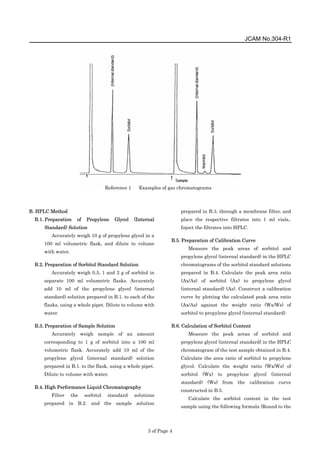
Reference 1 Examples of gas chromatograms
4.
JCAM No.304-R1
4 ofPage 4
first decimal place.).
100
W
100
100
1000
S
Ms
)
s
/W
x
(W
matter)
dry
the
(on
sorbitol
%, ×
−
×
×
×
=
Where -
Wx/Ws: Weight ratio of sorbitol to propylene
glycol, calculated based on the
calibration curve
Ms: Amount (mg) of propylene glycol in the
100 ml of test solution prepared
S: Amount (g) of test sample collected
W: Moisture content (%) in test sample
6. References
(1) The United State Pharmacopeia 18ed.(1970)
(2) JAPAN'S SPECIFICATIONS AND STANDARDS
FOR FOOD ADDITIVES, the Seventh Edition
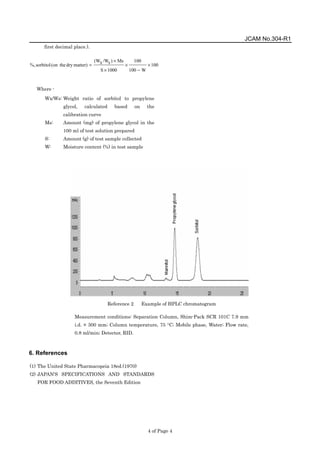
Reference 2 Example of HPLC chromatogram
Measurement conditions: Separation Column, Shim-Pack SCR 101C 7.9 mm
i.d. × 300 mm; Column temperature, 75 °C; Mobile phase, Water; Flow rate,
0.8 ml/min; Detector, RID.