torturing  numbers  
a novice’s guide to descriptive dtatistics
1	
  
Bandhu	
  P.	
  Das	
  
"If you torture the data long
enough, it will confess"
@BPDas_	
   2	
  
– Ronald Harry Coase
why  do  we  torture  numbers?
@BPDas_	
   3	
  
q  Describe the story
q  Find trends in data
against variation
q  Determine if a sample
represents a population
q  Draw conclusions about the story
a tool called
‘descriptive statistics’
is used
@BPDas_	
   4	
  
describing  numbers
@BPDas_	
   5	
  
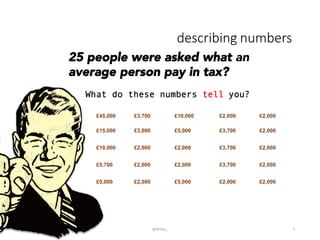
25 people were asked what an
average person pay in tax?
What do these numbers tell you?
£45,000	
   £3,700	
   £10,000	
   £2,000	
   £2,000	
  
£15,000	
   £3,000	
   £5,000	
   £3,700	
   £2,000	
  
£10,000	
   £2,000	
   £2,000	
   £3,700	
   £2,000	
  
£5,700	
   £2,000	
   £2,000	
   £3,700	
   £2,000	
  
£5,000	
   £2,000	
   £5,000	
   £2,000	
   £2,000	
  
describing  numbers
@BPDas_	
   6	
  
£2,000
Here is the same data ordered from greatest to
least and weighted to show how many times each
value occurs in the data set
•  Now what do the data tell
you?
•  What is the average income?
£45,000
£15,000
£10,000
£5,700
£5,000
£3,700
£3,000
£45,000
£15,000
£10,000
£5,700
£5,000
£3,700
£3,000
describing  numbers
@BPDas_	
   7	
  
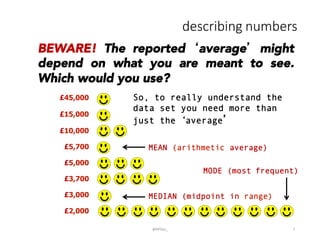
BEWARE! The reported ‘average’ might
depend on what you are meant to see.
Which would you use?
MEAN (arithmetic average)
MEDIAN (midpoint in range)
MODE (most frequent)
So, to really understand the
data set you need more than
just the ‘average’
£2,000
spread  and  variability
@BPDas_	
   8	
  
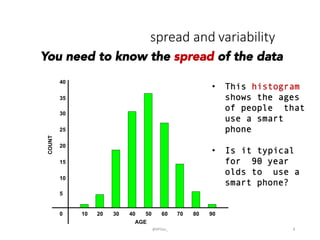
You need to know the spread of the data
•  This histogram
shows the ages
of people that
use a smart
phone
•  Is it typical
for 90 year
olds to use a
smart phone?
spread  and  variability
@BPDas_	
   9	
  
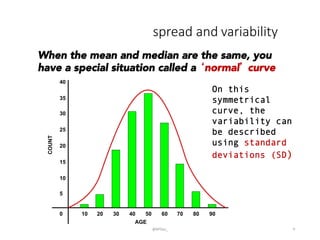
When the mean and median are the same, you
have a special situation called a ‘normal’ curve
On this
symmetrical
curve, the
variability can
be described
using standard
deviations (SD)
spread  and  variability
@BPDas_	
   10	
  
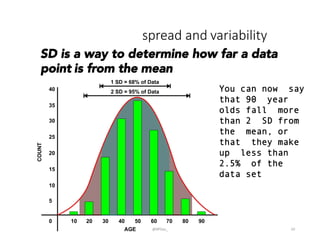
SD is a way to determine how far a data
point is from the mean
You can now say
that 90 year
olds fall more
than 2 SD from
the mean, or
that they make
up less than
2.5% of the
data set
spread  and  variability
@BPDas_	
   11	
  
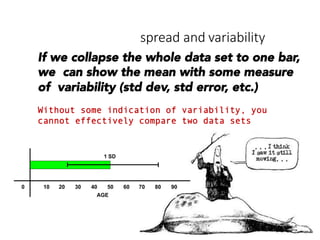
If we collapse the whole data set to one bar,
we can show the mean with some measure
of variability (std dev, std error, etc.)
Without some indication of variability, you
cannot effectively compare two data sets
spread  and  variability
@BPDas_	
   12	
  
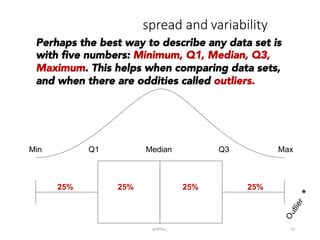
Min Q1 Median Q3 Max
Perhaps the best way to describe any data set is
with five numbers: Minimum, Q1, Median, Q3,
Maximum. This helps when comparing data sets,
and when there are oddities called outliers.
25% 25% 25% 25%
*
“79.48% of all statistics are
made up on the spot.”
@BPDas_	
   13	
  
– John A. Paulos
a  sample  study
@BPDas_	
   14	
  
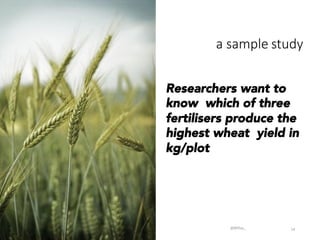
Researchers want to
know which of three
fertilisers produce the
highest wheat yield in
kg/plot
a  sample  study
@BPDas_	
   15	
  
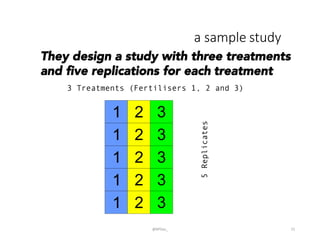
They design a study with three treatments
and five replications for each treatment
3 Treatments (Fertilisers 1, 2 and 3)
5Replicates
a  sample  study
@BPDas_	
   16	
  
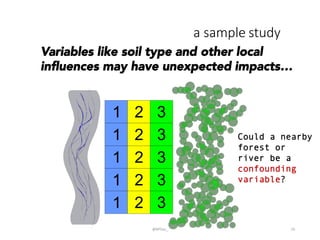
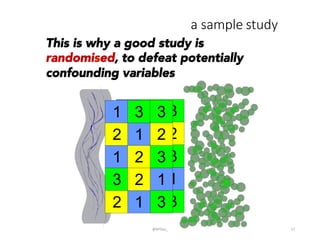
Could a nearby
forest or
river be a
confounding
variable?
Variables like soil type and other local
influences may have unexpected impacts…
a  sample  study
@BPDas_	
   17	
  
This is why a good study is
randomised, to defeat potentially
confounding variables
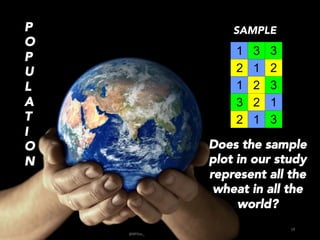
Does the sample
plot in our study
represent all the
wheat in all the
world?
P
O
P
U
L
A
T
I
O
N
SAMPLE
@BPDas_	
  
18	
  
uncertainty
@BPDas_	
   19	
  
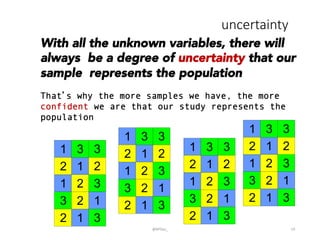
With all the unknown variables, there will
always be a degree of uncertainty that our
sample represents the population
That’s why the more samples we have, the more
confident we are that our study represents the
population
confidence
@BPDas_	
   20	
  
•  Any confidence interval
could be used, but 95% is
often chosen
•  This means that 95% of
the time, you expect your
data represents reality
•  BEWARE reports with no
confidence interval
@BPDas_	
   21	
  
Fer$lizer	
  1	
  Fer$lizer	
  2	
  Fer$lizer	
  3	
  
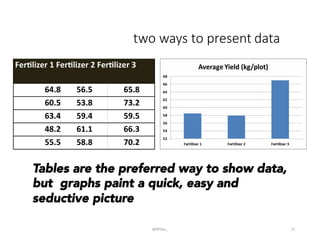
64.8	
   56.5	
   65.8	
  
60.5	
   53.8	
   73.2	
  
63.4	
   59.4	
   59.5	
  
48.2	
   61.1	
   66.3	
  
55.5	
   58.8	
   70.2	
  
two  ways  to  present  data
Tables are the preferred way to show data,
but graphs paint a quick, easy and
seductive picture
drawing  conclusions
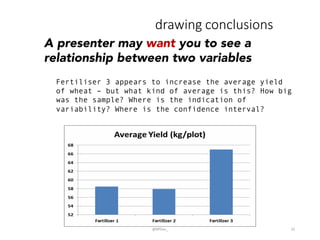
A presenter may want you to see a
relationship between two variables
Fertiliser 3 appears to increase the average yield
of wheat – but what kind of average is this? How big
was the sample? Where is the indication of
variability? Where is the confidence interval?
@BPDas_	
   22	
  
drawing  conclusions
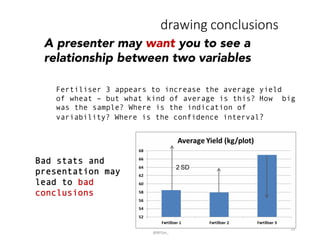
A presenter may want you to see a
relationship between two variables
Fertiliser 3 appears to increase the average yield
of wheat – but what kind of average is this? How big
was the sample? Where is the indication of
variability? Where is the confidence interval?
@BPDas_	
  
23	
  
Bad stats and
presentation may
lead to bad
conclusions
2 SD
drawing  conclusions
@BPDas_	
   24	
  
Correlation does not imply causation
The more firemen fighting a fire, the
bigger the fire is observed to be.
Therefore more firemen cause an increase
in the size of a fire
Often, a presenter wants to lead you to
a conclusion. Newspapers, TV and
online articles should be scrutinised!
BEWARE:
“This is not a scientific poll…”
“These results may not be representative of
the population”
“…based on a list of those that responded”
“Data showed a trend but was not
statistically significant”
it’s  all  in  how  they  are  presented
@BPDas_	
   25	
  
it’s  all  in  how  they  are  presented
@BPDas_	
   26	
  
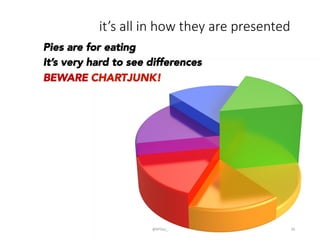
Pies are for eating
It’s very hard to see differences
BEWARE CHARTJUNK!
it’s  all  in  how  they  are  presented
@BPDas_	
  
27	
  
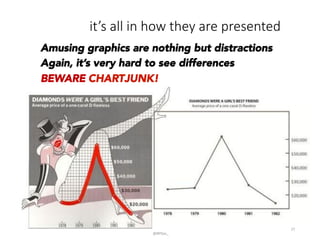
Amusing graphics are nothing but distractions
Again, it’s very hard to see differences
BEWARE CHARTJUNK!
it’s  all  in  how  they  are  presented
@BPDas_	
   28	
  
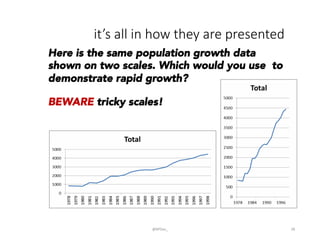
Here is the same population growth data
shown on two scales. Which would you use to
demonstrate rapid growth?
BEWARE tricky scales!
it’s  all  in  how  they  are  presented
@BPDas_	
   29	
  
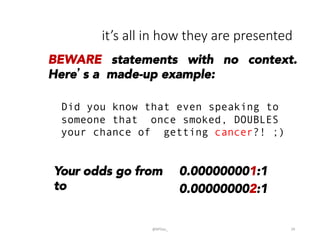
BEWARE statements with no context.
Here’s a made-up example:
Did you know that even speaking to
someone that once smoked, DOUBLES
your chance of getting cancer?! ;)
Your odds go from
to
0.000000001:1
0.000000002:1
conclusion
@BPDas_	
   30	
  
Like any tool, stats can be misused
(intentionally or unintentionally)
Maintain a healthy skepticism and
question charts, tables and conclusions
where insufficient information is provided
references
@BPDas_	
   31	
  
-  The Cartoon Guide to Statistics (1993)
-  Larry Gonick and Woolcott Smith
-  How to Lie with Statistics (1954)
-  Darrel Huff

A Visual Guide for Describing Numbers

  • 1.
    torturing  numbers   anovice’s guide to descriptive dtatistics 1   Bandhu  P.  Das  
  • 2.
    "If you torturethe data long enough, it will confess" @BPDas_   2   – Ronald Harry Coase
  • 3.
    why  do  we torture  numbers? @BPDas_   3   q  Describe the story q  Find trends in data against variation q  Determine if a sample represents a population q  Draw conclusions about the story
  • 4.
    a tool called ‘descriptivestatistics’ is used @BPDas_   4  
  • 5.
    describing  numbers @BPDas_  5   25 people were asked what an average person pay in tax? What do these numbers tell you? £45,000   £3,700   £10,000   £2,000   £2,000   £15,000   £3,000   £5,000   £3,700   £2,000   £10,000   £2,000   £2,000   £3,700   £2,000   £5,700   £2,000   £2,000   £3,700   £2,000   £5,000   £2,000   £5,000   £2,000   £2,000  
  • 6.
    describing  numbers @BPDas_  6   £2,000 Here is the same data ordered from greatest to least and weighted to show how many times each value occurs in the data set •  Now what do the data tell you? •  What is the average income? £45,000 £15,000 £10,000 £5,700 £5,000 £3,700 £3,000
  • 7.
    £45,000 £15,000 £10,000 £5,700 £5,000 £3,700 £3,000 describing  numbers @BPDas_  7   BEWARE! The reported ‘average’ might depend on what you are meant to see. Which would you use? MEAN (arithmetic average) MEDIAN (midpoint in range) MODE (most frequent) So, to really understand the data set you need more than just the ‘average’ £2,000
  • 8.
    spread  and  variability @BPDas_   8   You need to know the spread of the data •  This histogram shows the ages of people that use a smart phone •  Is it typical for 90 year olds to use a smart phone?
  • 9.
    spread  and  variability @BPDas_   9   When the mean and median are the same, you have a special situation called a ‘normal’ curve On this symmetrical curve, the variability can be described using standard deviations (SD)
  • 10.
    spread  and  variability @BPDas_   10   SD is a way to determine how far a data point is from the mean You can now say that 90 year olds fall more than 2 SD from the mean, or that they make up less than 2.5% of the data set
  • 11.
    spread  and  variability @BPDas_   11   If we collapse the whole data set to one bar, we can show the mean with some measure of variability (std dev, std error, etc.) Without some indication of variability, you cannot effectively compare two data sets
  • 12.
    spread  and  variability @BPDas_   12   Min Q1 Median Q3 Max Perhaps the best way to describe any data set is with five numbers: Minimum, Q1, Median, Q3, Maximum. This helps when comparing data sets, and when there are oddities called outliers. 25% 25% 25% 25% *
  • 13.
    “79.48% of allstatistics are made up on the spot.” @BPDas_   13   – John A. Paulos
  • 14.
    a  sample  study @BPDas_   14   Researchers want to know which of three fertilisers produce the highest wheat yield in kg/plot
  • 15.
    a  sample  study @BPDas_   15   They design a study with three treatments and five replications for each treatment 3 Treatments (Fertilisers 1, 2 and 3) 5Replicates
  • 16.
    a  sample  study @BPDas_   16   Could a nearby forest or river be a confounding variable? Variables like soil type and other local influences may have unexpected impacts…
  • 17.
    a  sample  study @BPDas_   17   This is why a good study is randomised, to defeat potentially confounding variables
  • 18.
    Does the sample plotin our study represent all the wheat in all the world? P O P U L A T I O N SAMPLE @BPDas_   18  
  • 19.
    uncertainty @BPDas_   19   With all the unknown variables, there will always be a degree of uncertainty that our sample represents the population That’s why the more samples we have, the more confident we are that our study represents the population
  • 20.
    confidence @BPDas_   20   •  Any confidence interval could be used, but 95% is often chosen •  This means that 95% of the time, you expect your data represents reality •  BEWARE reports with no confidence interval
  • 21.
    @BPDas_   21   Fer$lizer  1  Fer$lizer  2  Fer$lizer  3   64.8   56.5   65.8   60.5   53.8   73.2   63.4   59.4   59.5   48.2   61.1   66.3   55.5   58.8   70.2   two  ways  to  present  data Tables are the preferred way to show data, but graphs paint a quick, easy and seductive picture
  • 22.
    drawing  conclusions A presentermay want you to see a relationship between two variables Fertiliser 3 appears to increase the average yield of wheat – but what kind of average is this? How big was the sample? Where is the indication of variability? Where is the confidence interval? @BPDas_   22  
  • 23.
    drawing  conclusions A presentermay want you to see a relationship between two variables Fertiliser 3 appears to increase the average yield of wheat – but what kind of average is this? How big was the sample? Where is the indication of variability? Where is the confidence interval? @BPDas_   23   Bad stats and presentation may lead to bad conclusions 2 SD
  • 24.
    drawing  conclusions @BPDas_  24   Correlation does not imply causation The more firemen fighting a fire, the bigger the fire is observed to be. Therefore more firemen cause an increase in the size of a fire
  • 25.
    Often, a presenterwants to lead you to a conclusion. Newspapers, TV and online articles should be scrutinised! BEWARE: “This is not a scientific poll…” “These results may not be representative of the population” “…based on a list of those that responded” “Data showed a trend but was not statistically significant” it’s  all  in  how  they  are  presented @BPDas_   25  
  • 26.
    it’s  all  in how  they  are  presented @BPDas_   26   Pies are for eating It’s very hard to see differences BEWARE CHARTJUNK!
  • 27.
    it’s  all  in how  they  are  presented @BPDas_   27   Amusing graphics are nothing but distractions Again, it’s very hard to see differences BEWARE CHARTJUNK!
  • 28.
    it’s  all  in how  they  are  presented @BPDas_   28   Here is the same population growth data shown on two scales. Which would you use to demonstrate rapid growth? BEWARE tricky scales!
  • 29.
    it’s  all  in how  they  are  presented @BPDas_   29   BEWARE statements with no context. Here’s a made-up example: Did you know that even speaking to someone that once smoked, DOUBLES your chance of getting cancer?! ;) Your odds go from to 0.000000001:1 0.000000002:1
  • 30.
    conclusion @BPDas_   30   Like any tool, stats can be misused (intentionally or unintentionally) Maintain a healthy skepticism and question charts, tables and conclusions where insufficient information is provided
  • 31.
    references @BPDas_   31   -  The Cartoon Guide to Statistics (1993) -  Larry Gonick and Woolcott Smith -  How to Lie with Statistics (1954) -  Darrel Huff